This is an abridged version of George’s review of Blowout 2015. Read the full article on the website.
Since I’ve reported on the Blowout many times our perceptive Editor said, “Why not tell those who don’t go what they’re missing?” So here goes!
First, it’s FUN. We often start the weekend with a competition, and this year we were invited to get up and perform a piece of music from stage and screen – not often bagpipe hotspots. But it was clear that Society members are an ingenious bunch. Apart from the Heath Robertson clapometer worked by John Goodacre, the tunes were staggering. No room to list them all, but Jon Swayne and Becky Price’s Nessun Dorma looked a winner until we saw and heard Peter and Kate perform selections from “Andy Pandy” of beloved TV memory – in costume! As Julian said, anyone who went to those lengths surely deserved the prize.
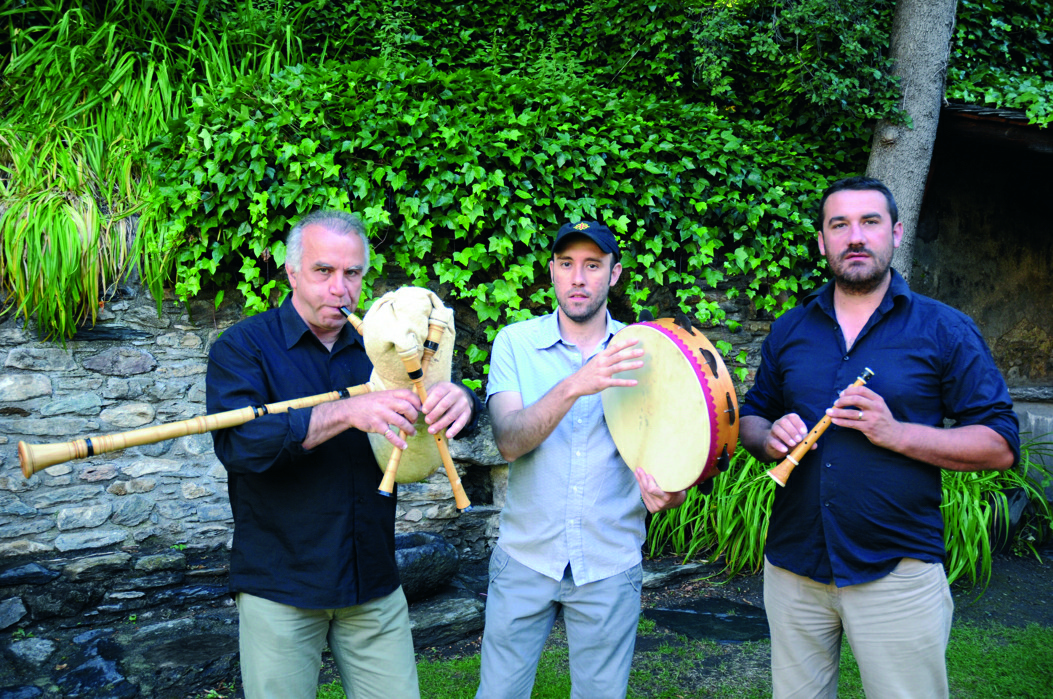
Next, naturally the Blowout is primarily about bagpipes. And it’s the best place in the country to see a lot of them and of different types. We don’t see so many Highland, Northumbrian or Irish regularly as they have their own support networks and their habitat is a bit more specialised. In fact, though we’ve covered aspects of all three in the Society’s nearly 30 years, we’re more generalist in outlook, and the Blowout is the place to see and hear an incredibly wide variety of types. Not only that, but you can get close up and personal. You can ask the owners about them, you can talk to the makers, and have a play on that type you haven’t tried before – and perhaps even order a set. For that the Blowout is a very exciting place with so many of Britain’s top makers displaying their wares. Jon Swayne, Julian Goodacre and Sean Jones are regulars, but I hadn’t seen Jim Parr before, although he’s been a maker for a long time. I was impressed with his neat Zampogna, the classic Italian pipe. Phil Bleazey’s whistles were a reminder that if your budget is limited and you don’t play anything yet, a whistle or recorder is a good start. This year we also had pipes and hautbois (shawms) from guests Robert Matta and Pierre Rouch, whose work concentrates on a surprisingly wide range of pipes and shawms from the Pyrenean regions of France and Spain. These areas are part of a wide historic Occitan and Basque culture which runs from Aragon and Catalonia to Provence and the north east of Italy. Their presence at the Blowout was also an important part of what the Society is about: we’re not tied to a nationalistic agenda, but enjoy pipe music from all over the world and of all types. It’s a lot of years since I heard Occitan music and I’ve tended to play more Central French in the years since, but this year reminded me how much I enjoyed the sort of stuff that Robert and Pierre were playing with Jonas Gimeno as part of “Trio Matta Rouch”.
The Blowout is also about playing with other pipers, not always possible for some of us at home. So it’s a real pleasure to join in the sessions last thing. The noisy pipes play for dancing in the hall, normally, and the quieter ones, usually in D, have the dining room to themselves. I usually play in the noisy brigade, but the quiet players make a fantastic sound.
It’s all very well to have your set of pipes and play them – but are you doing that as well, as effectively, as you could? And so the Blowout has its talks and workshops on technique, on possible repertoires, and on the history of piping. In that recent BBC Scotland two-part programme on bagpipes, the great Liam O’Flynn said that in piping you’re part of a tradition, and that’s a comfortable place to be. Workshops over the weekend came from Paul Martin on border pipes and tunes, Dave Rowlands looking at Irish music, Andy Letcher running a piper’s surgery for those needing help with their piping and Trio Matta Rouch took people through various Occitan tunes. Meanwhile, Chris Allen ran workshops for the hurdy gurdy players in attendance.
Although as pipers we respect tradition, we are not slavishly bound to it, as quite a few presentations in past Blowouts have shown. Rohan Kriwaczek took us back to the basics of what we are about. He explained how his own long academic study of music and composition has left him dissatisfied. Looking at primitive music, he argues that humans seem to find that with five notes is a minimum because with them we can begin to tell a story. People have been doing that for a long time; “proper” flutes have been found going back 45,000 years. And dance may well be as old; we’re creatures that evolved to run long distances – rhythmically. He sees pipes as a way forward as drone music is the basis of so much modern music, and pipes are the ideal instrument for that. He felt that ornamentation was as vital as consonants are to speech, but we shouldn’t be too hung up on the exact system. Nor did he want simply to trot out traditional tunes as he had his own things to say. In the same way, he didn’t want to saddle himself with a nationalistic baggage, so he has invented his “own” country. And if you want to hear the results, you can buy his CD!
Other guests paying a fleeting visit were Balazs Istvanfi and Andras Nemeth from Hungary. Central European pipes can look primitive, but the music is complex and beautiful. As we know, pipes pair well with hurdy-gurdies, and Hungarians have found this out as well as the French. Their hurdy-gurdy is big, but has a small wheel as it needs to be able to articulate some very fast music.
AGM’s are not considered fun, but are necessary. Further, the tone was very positive. Membership is increasing, the Blowout is well- attended and the profile of bagpipes is greater than it was. But we need to raise it more, and there is still money for special events to do that. Showcases and workshops at festivals to come and try a bagpipe often do well - could you do that at your regular festival given the chance? Further, in these days of widespread mobile phone filming, could more piping “footage” be sent in to be spread via the net? A final point ‐ next year is our 30th anniversary – any suggestions?
We’ve been lucky over the years to have a church for our Saturday formal concert as they’re ideal for our instrument. As usual, several members joined a workshop for a band presentation as the opening spot, and this year it was a treat to hear a piece conducted by our own John Tose, and written by his daughter Mickey, who is studying music. It was a lovely reflective piece, and fitted the church setting perfectly.
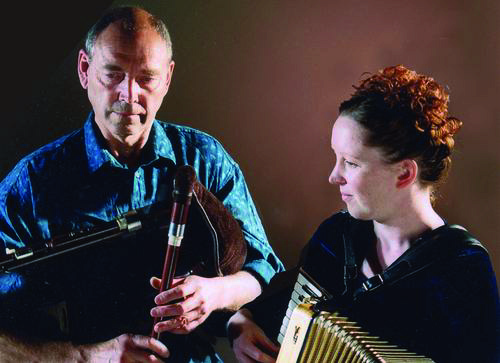
Next were the Hungarians. What struck me on this second hearing was that this is not sound bite music. It’s probably not familiar to most of us, but it’s inaccessible either and it’s full of drive, power and passion. Third were the Occitans with their amazing variety of pipes and shawms. We ended Saturday with the dance. One of the good things about BagSoc is that we don’t forget that a lot of piping, indeed folk playing generally is about dance, a fact that has been forgotten in the many “sessions” where it’s played today. There were two “official” bands, the first being duo Jon Swayne and Becky Price on pipes, accordion and keyboards. They know exactly how to play effectively for dancing, and it struck me that their music is classy. It’s original, with good melodies, it’s good to listen to as well as dance to, and there’s always a sense of warmth in their playing. And the second band was Trio Matta Rouch. It was a great performance with a fandango and a sept-sauts joining the more familiar French dances. Then it was down to everyone else to play for those who wished to dance!
Sunday contained more workshops and presentations and concluded with a final concert from all those taking part throughout the Blowout. I thoroughly enjoyed the weekend, but I can’t end without mentioning all those that make it possible – Ian Clabburn, Robert and Ruth Bramley and the team with the kind cooperation of the vicar and his congregation. And the excellent food provided by Vanessa and her team. (I look forward to it almost as much as anything else!) Without them all the event wouldn’t be the same, and I doubt if it would even be possible. So three cheers to them all!
I hope this has given those who have not attended the Blowout before a flavour of the event. So see you all there in 2016?
To get a full flavour of the Blowout, then do take 10 minutes out with a brew to watch a video made by Jeremy Cooper. He really managed to capture the event brilliantly. Thanks Jeremy! Here’s a link http://tinyurl.com/ogxus9m Also check out recordings of the groups in concert on the Society’s YouTube channel - see next article for the address.
This edition is from our archives, so it is presented as scanned pages rather than text.
You may need to scroll to find the article you’re looking for.
The second king received Jack politely and, as he had given
his word, his daughter consented to be married to Jack Ny Hedgehog
despite his appearance. After the ceremonies were over they went up
stairs to bed. Jack had a big fire made up in the grate and instructed
four men to wait till he was about to lie down, when he would creep
out of his hedgehog skin and they were to rush in and fling it on the
fire. This they did, whereupon Jack became a handsome young man, much
to his wife’s surprise and delight.
                                         D.C.

 The illustration above is from the forthcoming Channel 4
series on European Fairy Tales (due later this year). In the series
the story is called “Hans My Hedgehog”. Whether he plays the bagpipes
or not remains to be seen. Knowing the way these TV people think,
he’ll not be given bagpipes unless he comes from Scotland. No
hum… Still, y’never know! If anyone knows any other fairy tales or
legends that involve pipes or pipers, send them in and we’ll print
them. (Ed.)
THE BAGPIPE SOCIETY
11TH NEWSLETTER
NOV 1987
MUSINGS
Well, it looks like it’s been a good year again for bagpipes.
Things seem to be getting better all the time with pipes in evidence at
most, if not all, the major British folk festivals — not to mention
those abroad. Especially good to see special piping events beginning to
take off: the Edinburgh Bagpipe Festival, Stockton Bagpipe Festival, our
own Chestnuts concert, Blowzabella at Aldershot (okay, so it wasn’t
exclusively bagpipes - but there were times when you could have been
forgiven for thinking otherwise!). And of course the regulars of St
Chartier and Lorient. And these are just the ones we get to hear about.
What we need now is for some to organise an event for next
year that will take pipers out onto the streets. Yes, we know that all
you Highland pipers have been doing just that since Bonnie Prince
Charlie — and keep it up I say. But what about all you others? How about
a piping day at Covent Garden for instance — any takers for
organisation?
And whatever happened to the giant Hurdy-Gurdy/Bagpipe
Marching Band from the summer of last year? I thought it sounded pretty
good, even if the bagpipes were a bit short in number - just what we
need to take the drones onto the streets. Any carnival organisers out
there among you need something a bit different?
Yah Boo to Folk on Two! Despite an otherwise excellent
coverage of the Blowzabella Aldershot Workshop Weekend, BBC Radio 5 tc
didn’t even mention the grand Bagpipe Band organised and coached by our
illustrious President. Chicken, that’s what I reckon!
And now for something completely different: congratulations to
pipers Anne and Bob Cross of Cheshire Waits on the birth of their
daughter Emily - 5 lb 12 oz, Saturday 19th September. May her lungs be
sound and her elbows always have plenty of squeeze.
We continue to extract members from all around the world — great stuff! But why are you a tiny short letting us know about piping in your countries (tell us honestly, exceptions in this issue’s Letters column)? Please write. Don’t worry if your English isn’t too good; we probably put it right. If you like, write in French or Spanish (for instance). We’re supposed by international organisations on why not give us something to print in your own language? And perhaps we might want to transliterate and print it in English as well. Doesn’t have to be a full scale article — anything would be nice. A signal nowhere will do. Tell us about the state of piping in your country. What’s the revival like? How healthy is the local tradition? What’s known about older forms of bagpipe in your country that haven’t died out? What’s the weather like? The world thirsts for knowledge (well I do anyway) — so write about it.
Roy Sloan of N. Hastings writes to say that on pre-print Geordie languishing in Hastings he would be pleased to hear from other pipers in the area. He would also be happy to teach Northumbrian pipes free of charge. Roy also makes pipes, but due to other pressures and the fact that he has a backlog of pipes he wants to make for himself, he can only undertake repairs at the moment.
Still losing members in the cessation of the Membership List. No time it’s £11 Crofman who has, according to the Post Office, “Being Away”. Any of you Crofmans reading? Where where he’s gone? Ohmigawd! Roy’s bagpiping to all you CAS? And when the Phantom Piper appears, has found with them, what letter will he start on next? Meanwhile, what sort of you remain under C. lost your door and windows next time you get the old pipes out for a practice — even New Zealand’s not too far away to except the cluthes.
Couple of juicy records we hear of: Hamish Moore’s “Open Friday” (Sablet) on 7-CH01 is currently getting airtime on Folk on two and BBC History 1900 - 2030. Hamish features lots of great musicians on this disc such as Nigel Eaton on hurdy-gurdy.
I hear Ian Sloan reported up hear of (via Julian Goodacre) that Italian piper and nifty bracis of Moses playing on it, well he would say that wouldn’t he? There of course is why Ian Sloan has not made it to many pipes, as many think, but one may be interested in news it was because one of their number had an argument with a tree while doing a bit of lumberjacking: the tree won.
Ian Smith would like it to be known that, due still health, he is winding up his just under cases selling business, but please don’t mind if you have an order in the pipeline Ian will be fulfilling all existing orders first.
Couple of important changes for you to note in your File: your Geordie Bagpipe Society position out open — only sixty quid!! Your Hon. Treasurer has grabbed the money and run all the way to Dollar . . . (with Vic and Drolin’s blessing, anyway).
The letter columns is a grave Society Editor who, faced in sultan idea of how to get out of his job, has indeed for every one of the many thousands who have already put the date in your diary with a firm resolve to be there at all costs, please accept our apologies and skip on to the more interesting bits of the Newsletter.
Events start at 11.30 on the morn of Sat. Dec. 5th in the town dives of the country, we are pleased to report that she has at last broken down to her new address.
So if you have any publicity matters you want to discuss, or help to offer, get in touch with her under her new name at her new home (and she might even play you a tune on her new pipes):
Judy would like to hear from any of you interested in attending a French bagpipe workshop which she hopes to get together with Jean-Pierre Rasle. I spoke to Jean-Pierre recently about this myself and he was very keen. Judy says not to worry if you don’t have French pipes. So long as you can more or less achieve the same fingerings and virtuosic things should be okay — after all, there is a very wide variety of pipes played in France as it is.
Now Chi has gone and deserted all us Londoners, is there anyone else who would be willing to host/organise some sort of rural or London meeting? Don’t worry if you haven’t got any ideas — we’re full of ‘em — all we need is a willingness.
Whatever happened to Milton Keynes? It seemed that everyone and his dog I spoke to was going to be there, but, who keeps from the event poor old John Ross had so few takers he had to cancel all but the Cauld Wind course. Where did we go wrong please note: this is not a rhetorical question? Answers — even if they hurt — urgently required.
Flying Camel present a Day of French Dance, from Brittany to Berry on November 29th, noon - midnight at the Chesterfield Arts Centre — dance workshops, music, food and a bar till late. Music will include bagpipes and hurdy-gurdy as well as other traditional French instruments. For tickets, phone (Ian Smith).
For the first time since the Society was formed, by your old fingers have been given something of a rest from the chore of typing this Newsletter. Pete Stewart (of Goodacre Brothers fame) is now sharing the load which is why the eagerly-read among you may detect a subtle difference in type faces throughout this issue. But the cunning devil has taken advantage of his privileged position to write letters, commenting on stuff in this issue (see letter from Uncle Fret) — crafty sod! Seriously, many thanks to you Pete; perhaps I can now get down to some bagpipe practice.
ANNUAL GENERAL MEETING
As announced in the last Newsletter, this will be at Moutlarch on December 5th. By now you should all have had formal notice with your issue of ‘Chanter’ (you did all get ‘Chanter’ this time didn’t you?). But just to remind you, here are the details again (yes, I know I’ve a bore, but we are determined to get you out to this one. If you’re one of the many thousands who have already put the date in your diary with a firm resolve to be there at all costs, please accept our apologies and skip on to the more interesting bits of the Newsletter).
Events start at 11.30 on the morn of Sat. Dec. 5th in the town
square when there will be Morris dancing around the Town with White Rose Morris, Queen Esther, Jenny and Simon Mon — ‘dancing will finish in the Square at 1.30. Don’t worry if you arrive late—just fetch out for the bells and the pipes to find where everyone is. And bring your instruments, for from 12 noon onwards (says there all afternoon) there will be sessions at the Bowling Green and ‘The Talbot’. Also at noon there will be a craft fair at Norwich Civic Hall. From 3 till 5 there will be workshops at the Methodist Church Hall (Folk Cent.) with demonstrations and discussion, on a variety of pipes and styles with Bob White, Anne Cross, Jean Pierre Rasle, Ann Seymore, Masiah Moore, Dave Shaw and Peter Stacey. This is all absolutely FREE to members (quid to non-members).
Don’t forget—Somewhere in the midst of all this festivity we shall be appearing in an (all day—ringing!) But the actual timing you will have little oddity how that we have only allowed an hour for it to shift by time for the service wondering (and we have made more hot air than anyone last year). Having said that, there is a bit of free time between acts in case any pressing urgent items crop up (ho-hum). Food, side stalls and odd (?) Yes, will I suppose we’ve got to make time for it somewhere. But just to ensure you don’t all go sneaking off to Whitehall’s just as the AGM is getting really exciting, we’ve allowed an hour or two (the acting for you to partake of some excellent wholefood grub of sensible prices - also all the Full Centre).
By now, in fonding anticipation, you will all have mentally lost your seats for the last item of the day: Tar-raah — The Grand Concert from 6 till 10, featuring (in order of appearance) Dave Shaw, Ann Seymore, Masiah Moore and Jean-Pierre Rasle & Peter Stacey. Once again, what will be entirely FREE to members (3 quid to non-members).
Bob Criss, to whom we are indebted for organising all this, can arrange a certain amount of accommodation. But you must contact him quickly (unless you want to end up sleeping under the town bridge. You can contact Bob on for accomodation, advice or advance tickets for the concert (how was that? Bob? Do you think that’ll get the buggers along?).
Even if you can’t make it (you mean there are some who won’t go then?) you can still send in nominations for the Committee. All posts are up for grabs (as per our constitution) but in particular we will need a new Treasurer as Chi feels his new home is a bit remote for the job (nearest Post Office is about 5 miles away). You may nominate yourself if you wish — don’t be shy about this as that’s the way most people do it.
DIRECTORY OF MAKERS AND TEACHERS
This list is now being coordinated by DM member Bob Aston (that’s the one from Crosley; we’ve got two you see who is sending out questionnaires to all who have expressed an interest in being included). If you want to be included but think we might not be aware of that fact, please contact Bob at the
Bob is also trying to gather enough information to start producing proper plans for the Society or use by amateur pipe makers. If you have any drawings, measurements etc. for non-copyright
instruments you have encountered or produced that you would like to share with other members, please let Bob know so he has got something he can let his draughting talents loose on.
BIBLIOGRAPHY & DISCOGRAPHY
Another new member raring to go is Ross Campbell (only got two of these at the moment). Ross has a pretty hefty collection of bagpipe related books and articles plus a chunky record collection, he is cataloguing these for the Society and would like to know if the existence of anything you might have that is a bit unusual i.e. anything other than the Baines and Collinson books. Recognise he is hoping to get together with Stefan Hannigan who has already begun work on a bagpipe discography. Perhaps we might see something in the not too distant future chaps?
On the subject of the great SH, Stefan would like everyone to know that he is still alive and pumping art. He’s been very busy lately with Student Union business but can be contacted at his new address (via Membership List update) or the London College of Furniture (Old address).
PIPES FOR HIRE
not just pipes but all sorts of Folk Music instruments. This is Stefan Hannigan’s (yes, him again) aim for early next year. If anyone has any instruments they would like to send out to work to earn their keep, get in touch with Stefan. He will either handle it all on a 10% commission or will put you in touch with the pointer for 5% and you do the rest.
FUNDRAISING OFFICER
It has been suggested that a new post be created of Fundraising Officer. This would involve dreaming up ideas for raising a few bots for the Society (thus keeping subs down). Is there anyone out there who’d like to take it on? You won’t necessarily have to do all of work, just ‘corral’ and get others to do it. Quite a lot of you ticked the ‘willling to help’ boxes on the Membership Form; now’s your chance to help, either at a national (international?) or local level. The ‘sort of things we’re thinking about are organisation concerts, busking, sponsoring piping, things for sale etc. At least, those are the sort of things we have thought of so far. Even if you’re not willing to take on the job perhaps you might have ideas as to how we could raise some money. Get in touch with any Committee member.
page 4 page 5
PIPES IN THE PRESS
The following item in the French Folk magazine “Tradition Vivante” was sent in by J. Godalton (Coventry, I’ve forgotten which one?)
“Le premier numero de Chanter, le journal du “Bagpipe Society” d’Angleterre est, pour Octobre (60 pages concues aux cornemuses, c’est un omest> pour les sauveteurs anglais. Au sommaire du No. 1 interview du floboiata, commentaire reparer les cornemuses, Westernshire small pipes, partitions et copies de stripes, 104 cornemuses italiennes et une étude de repertoire possible pour la cornemuse du sud de l’Angleterre, instrument disparu depuis plusieurs siècles, mais qui jouit d’un regain d’interet depuis quelques années.”
No.11 Jan-Mars 1987
Fame at last! The particularly astute among you will notice that the above extract is not in English. This is not because I’m too lazy to translate it (well… partly) but because I’ve seen why we shouldn’t have the old article in another language. You will have noticed in my Musings “what You never read them?” that I have invited articles in languages other than English. The above is to prove my business! We are supposed to be an international organisation after all. The “translations bits are theirs not mine by the way (wouldn’t dream of it!).
The following item was noticed by Judy in the Western Daily Press (so thinks):
“A judge yesterday summoned the leader of a band of Scottish pipers to appear before him when the swelling of bagpipes drowned out proceedings. The band, who had been tuning up outside Cambridge Crown Court in preparation for their concert in the city, were told to move out of earshot”
Oh well, at least it’s something when the press actually admit that pipers so turn up. ‘sbetter than being told to move out of the c, I suppose, which some of us came mighty close to a few weeks back.
For further ramblings from the press, see the Lorient Festival item complete with picture (caption also in French, note). Keep your eyes on the papers and magazines folks for suitable items for us to print, bagpipist or otherwise.
The following article does not strictly speaking fall into the above category if for no other reason than it’s 12 years late! However, we thought it worth reprinting in its entirety, including barely recognisable photos. If you want to get at the original it comes from the Journal of the English Folk Song and Dance Society, Autumn 1975. I don’t know who the author is (R.A. Schofield). If you’re still around and reading this R.A., how about getting in touch with a possible update?
BILLY BOLTON, PIPER OF THE DALES
by R. A. Schofield
Not many realise that the people is only recently extinct, if that, as a traditional instrument in Yorkshire and Lancashire. A recently in 1960, Julius Pilling visited and duly laid Barrowford who said he father had played the bagpipe when wickd if he was Scottish, he replied “No, celically not, he played the Union Pipe,” What sort of tunes did he play? “Hinyes,” she replied. The union pipes have often been thought of as solely Irish, but this, and other evidence shows that not to be the case. For instance I look at “Yates Dictionary in the following voluy 4: “Indelible”. A sin who plays the Union Pipes is called a tweedler.” To receive as only in this book shows how popular the pipes have been. Of all pipes, however, none have been as cherished as Billy Bolton, often called the Dales Minstrel. Born in the village of Gilling (about three miles north of Richmond in Yorkshire), he was bound up at Skip, nearby, on the estate of Lord Dundas. He was apprenticed as a wheelsmith to John Alcull of Richmond, but by the age of 26 he had left that trade and became an incident hardened artisan and knife grinder based on Whalcliffe Mill about a mile West of Richmond. His travels took him all over the North and West Riding and it appears he was very poorly paid given his work, but also for the stories he told, the songs he sang, and the conjuring tricks he performed. Country persons appear to have been his principal fans, rather oddly perhaps since he was a musical Catholic, ever eager to put forward his own views.
Billy’s obituary I does not say when he heard to play the pipes but dates other evidence to put forward it is probable that he was taught while living in the Richmond area, since by one of his own family, or by a friend during his youth. The fact mention of his piping comes in 1886 when Dr. J. H. Dixon wrote of a ballad called “The Gerald Gace” that he collected from Billy. “We first heard it sung in Malhamdale, Yorkshire, by Billy Bolton, an old Dales minstrel, who accompanied himself on the Union Pipes.”
An appreciation of Billy was written the year before he died. Two very interesting passages are given here in full. " His favourite resort, when “in-coles” was “ay getting Malhamdale and the fine dale Gordale and another one the clear slipping source of the Aire and there by night the famous glenander ja The Cove, with pips and chanter playing which fell pick, and this in the grand and romantic styles of Craven was spent many of the happiest days of the old Dales Minstrel."
“When press of hours began to tell upon the old grinder, the machine slackened its revolutions, the fingers became less active on the pipes and the song would rarely be continued because when it was about this time that the old minstrel had the misfortune to with the little handle of Hilton East, where, after having done certain work for the collages and farmers and the chief magistrate of that place, he unfortunately felt his pipes with the magicians’ charms who promised he old minstrel that the voice of care alone should be taken off them until his return on the following day. Gebri, however, was the old man’s grief, when, on his return, the pipes, which he valued at three pounds, were smashed, burst, and entirely spoilt. However, after a household or family council, in which the old minstrel had the first time in his life made threats of law, the pound was paid to the old man - a third of the damage done. The poor minstrel tried many ways to “raise the wind” and get through repairs, but failing to do so, ultimately had the pipe fond fair fillings.”
I would put the above event as happening in about 1870, since Billy eventually settled down in retirement in the village of Barnsill, in Whalcliffe, after nearly sixty years of travelling. In some ways he was lucky, since he was due for the workhouse as a destitute when a London merchant whose father, the Rev. W. J. Parkinson, late Rector of Barrowford, near Leyburn, had befriended him, granted Billy a weekly allowance of six shillings.
Billy died on September 1st, 1884, and after his death a subscription was made to raise a headstone over his grave, which can be seen in Barnsill churchyard.
What happened to Billy’s pipes? There are two sets of Union pipes in Yorkshire museums. One set, mentioned by R. D. Cannon in the 1971 edition
page 6 page 7
REFERENCES
Brierley B. “Abc of ‘Yates Dictionary” Craven Pioneer, 12th September 1884
Dixon, J. H. “Ancient Poems, Ballads, and Songs of the Peasantry of England." London, 1846.
Also quoted is Forshaw C. F. (ed.) “Holroyd’s Collection of Yorkshire Ballads," London, 1892.
Craven Pioneer, 18th December, 1880.
Cannon, R. D. “The Bagpipe in Northern England,” Folk Music Journal, London, 1971.
of The Folk Music Journal, is in The Castle Museum, York,* and the other is displayed at Cliffe Castle, Keighley. The York pipes were made by M. Egan of Liverpool in about 1850, but nothing— whatsoever is known of the Keighley set, except that they date from the nineteenth century and appear to be of a later manufacture than those in York Records to where either set were acquired are also missing, but since both museums have generally collected local material, I would guess that both have been played in Yorkshire. The possibility that the players were Irish, or that they were donated by local collectors of instruments, is an great, however, that their origin can be no more than conjecture.
Whoever else owned them, I do not think that they belonged to Billy Bolton. “While minor repairs have been done there is nothing to suggest that either set has been *” repaired, tourist and surely polished." Also when the York pipes were made Billy was over 50 years of age, an old man for these days Where the are Billy’s pipes today? Probably in some Wharfedale attic or hanging on a Dales’ pub wall. Much more research (especially in Dales’ pubs) is necessary before an answer can be given to this and other intriguing questions about ringing in Yorlksire during the last hundred years.
FOR SALE
Mibsa (North Italian bagpipes) by Julian Goodacre. Almost new, perfect condition. Single drone, high D pitch. Only £100. Ian Smith
Flemish pipes in D by Jon Swayne (formerly belongings to Paul James). Overhauled by Jon only last year. £370. Jack Humphreys.
Set of Dill Headworth Northumbrian Smallpipes about 15 years old (one of his best sets). £195. Julie Bell.
Chris Daley says he has now sold most of his stock of ready-made pipes (though is still taking orders of course) but has a few secondhand sets in the process of restoration, mostly a set of Irish pipes and a set of smallpipes if anyone is interested.
Calfskin Bodhran and beater. As new. £20. Duncan Ross.
Still for Sale: Dulcibro (Dollcimer/Dulcifo) by Homer Ledford of Kentucky. As there are no takers yet for this superb example of rug Dulcimer maker’s art, I am forced to drop the price to a final £1000. Includes lined case, books, tutors, plectrums, notes. steel etc. all cost over £300. Julian Watson.
MEMBERSHIP SECRETARY
By the time you read this we should have a new Membership Secretary as I am hanging up that particular hat to concentrate on doing the Newsletter. Your new Membership Sec. will be Val Woollott and all enquiries regarding membership, new membership applications and changes to Membership List details should be addressed to her at
As will be help a new start on typesetting, I am extremely grateful to Val for her help and well with the job (you may still notify changes directly to the keeper of the Society’s bits, Don Ward, if you prefer, for loan to put straight onto his tame computer).
BAGPIPE SOCIETY CASSETTE
Chi has had quite a good response for his plea for material/performers for a Society cassette. He has asked me to tell everyone who has replied and to ask you all to be patient with him for a little while yet. As no tasd earlier, he is in the throes of moving house
page 8 page 9
ed lifestyle. As soon as he has settled in, he will be giving his every attention to the project. The other problem, at the moment is funds. As always, the Society is operating from hand to mouth with leaves little or no project work at this. Any philanthropists among you? In the meantime, he would still love to hear from anyone who would like to purchase material.
MEMBERSHIP RATES & ALL THAT JAZZ
As you’ve probably gathered from the above, we could always do with a bit more cash. We feel we have managed your money well (well we would, wouldn’t we?), our main aim being to provide lots of good quality publications (recently, 1 of net always printing wise). Small print runs are expensive as is postage; so “the bulk of your subscription money goes on just this. Now, hands up all those who thought I was going to announce an increase in subs! Well no, you’re wrong – at least I hope so. . . one more. At the time of writing this, the proposal for the AGM is that the subs should remain the same for the coming year. Things would be a
trifle out of present for us though – if everyone paid up promptly! If 15/- then old news about careful . . Even as I write I’m not sure we can afford the paper and mail, but this newsletter – because so many of you haven’t renewed who should have done so in the summer (with apologies to those who have paid up promptly).
We hate having to moan like this, particularly when so many of you of the offenders have done so much good work for the Society in other ways, but we simply can’t go on without money. So what have you of objects have you magic piece, please take note of this typed little behind-the-block “notices” at the time they’re printed (aren’t these the same corner?), first the once per used magazine Society.
Unfortunately, although we hope to keep going static, minimal hope got to go by. We just didn’t anticipate the rise in publications being so strict and heavy when we put the rate and aimed is almost expensive! The good news (for some) is that it would appear that surface mail from everywhere but the Far East and Oz/ NZ is pretty well as quiet as air mail I think: at all goes by plane anyway; anyone know for sure?), so those of you in North America might like to try surface mail when you renew. You can always bring us a few quid more later to go over to Airmail.
The Highland Gathering
London’s Centre for Everything Scottish
The other big problem at this moment, is the date of renewals. Like all bodies, we tried to make it so that everyone renewed at the same after joining: it was ain’t that easy! Everyone we’ve got to was due a subs for every period of renewal. This means that subs will be shortchanged while others get out a bit of that for nothing. These just doesn’t show to be any other way. The present proposal (for the AGM) at the time of writing, though it could change by then) is that everyone should renew in April 1988 and every April thereafter. We haven’t hammered out the details yet but it probably means that those of you who joined within the six months prior to April 87 will not be asked to renew until 1989. If we do adopt this policy and you think this is unfair or will cause you undue hardship, just write when you get your renewal notice for April and we’ll see if we can’t come to some sort of agreement.
That’s about all on the boring side of Bagpipe Society matters.
(except to remind you that you each have a vote and can make proposals at the AGM even if you can’t be there in person. If you don’t like any of the above, make sure your voice is heard! It’s your Society members.
MEET YOUR MAKER
People often ask me where they can get French pipes. Well this issue features a maker of all sorts of fine French bagpipes, Dominique Butruille of Montpellier in France. As well as French pipes, Dominique also offers Uilleann pipes ranging from a practice set at 2500F to a full set at 11900F; a Bulgarian Kaba Gajda (that’s the deep one!) at 3500F in blackwood or 3700F in blackwood; Swedish pipes in fruitwood at 2500F; and Southdown student pipes (14 or 16 pouces) in fruitwood at 2700F.
But he is best known (for his traditional French pipes, the southdowns Bourdonnais/Berrichann pipes come in two sizes 14 pouces (A/D/E) and 16 pouces (Sol/Do; G/C) in fruitwood or blackwood with mounts of pewter or bone with prices ranging from 4900F to 8000F depending on size and material.
It occurs to me at this point that a brief explanation of the French system of designation for pipes facts, the centre of the tone would not go amiss; while we’re all sadly going metric, the French cling invented it all, still use the inch (le pouce) to describe their pipes! So a 14 pouces bagpipe has a 14 inch chanter. This is obviously just convention and I’m not sure whose thumb they used to arrive at the inch – it probably doesn’t correspond exactly to our imperial inch anyway. In convention, the 14 pouces pipes are pitched in B-Upper D – Three finger giving the proper keynote for French pipes – but they usually quote it C-G-finger notes as well (firsts). To make matters more difficult – the usually quote the pitch using the Tonic Sol-fa, which is being Sol. So, you can see that the smaller of Dominique’s Bourdonnais/Berrichon pipes has a 14 inch chanter (approximately), the third finger (3-finger/3-finger), otherwise known as A/D. Drones are always tuned to the 6-finger note and/or small pipes (Setti). To continue:
In addition to the smaller southdowns Bourdonnais pipes Dominique also makes the Grande Correnoise and Nivernais & Bourbonnais – all with the smaller pipes from the region. They have two drones but are only available only in fruitwood with mounts of pewter or horn. They come in three sizes: 20 pouces (Re/Sol; D#G); 22 pouces, (Do/Fa; C/F); and 24 pouces (Re/ Mi/ BVF) – to complicate matters further, this latter …
5-reopen (in French) as a 5/4 pitch. Prices range from 6200F to 7500F depending on size.
And so on to the bellows-blown. The Musette dechonnet is well-known in lovers of French bagpipes. Unlike most French pipes, it alone is name from its inventor, not a region. Rene dechonnet (Dechonnet converted these pipes towards the end of the last century and they were entirely played through the central region of France during and after his lifetime. A number of makers, including Dominic Bourg, continue the tradition with pipes modeled after the style of the old master. Dechonnet’s are in full wood or bell-tawed with bone mounts. The pipes may be ordered with the most nearly French or southern of 4 tenor drops in parallel with the chanter one octave below its 6-finger note plus a bass drone one octave below that; alternatively, dechonnet pipes can be had with two tenor and two bass accompanied by a small treble drone, pipe in the chanter/tenor drone (trotier), which is tuned in unison with the “limier” note. This tiny drone gives an unexpected lift to the sound of the pipes. It is brought into play. The dechonnet pipes are available in A mance (>4,292 hrl) and 16 pounces (501/Dc) or in B flat, corning to 50 or to 1500F depending on size and material.
Dominc Bourg makes 14 pieces (La/Rg A/D) bellows-blown musettes. Premiums will turn drones made entirely from boxwood for 5600F. No bagpipe not very well known outside its native Brittany is the Veeuze. It is a larger bagpipe than the better known Breton Binioù, being more akin in style and sound to the Gaitas of northern Spain and Portugal. Dominiqne differs the Yeeuze with one or two drones in Do (C) and La (A) or fours; three or beazart 2700F.
In addition to bagpipes, M. Bouge also makes excellent oboes from 1350F, musettes (a small oboe in G) from 1300F and serpents in C from 1900F.
Most of his pipes have around a 6 to 8 month waiting period which can months to a year for most of William. All instruments come fully correct and playing when are available upon request. A 50% deposit is required. He also paysable before delivery.
Contact: Denis Bouge
BANSPIPE FESTIVAL, PRESTON HALL MUSEUM, STOCKTON by Dave McQuade
This event, held on the August bank holiday, turned out to be surprising successful and approximately 7,500 visitors to the museum entertained by members of the Society and other local folk dancers and musicians. I was surprisingly as I think it is true to say that the Society and the Museum administration did not quite get their act together. Problems with organisation meant that we did not twist people’s arms so badly, so we should have done and contacting folk during the holiday period proved exceptionally difficult. In fact, we were not very precisely who was going to turn up until the actual weekend itself.
As you can imagine, cold problems made proper advertising almost impossible and the curator decided to relay safe by cutting the original programme. Apologies to those who were squeezed out at the last minute, or traded up providing a very informal concert to the visitors by playing in a crumpet outside Victoria Street within the museum on Sunday and Monday afternoons. To add to the atmosphere, most of the performers were presented twists provided on traditional dress. although this made page 12
no difference to the music, it always surprises me how much more interest the public show when they see someone dressed up!
On Sunday evening we had a pub session at one of the local hotels, and this to me has the highlight of the weekend. It was quite an experience to hear Maisie Moor and Jean Pierre Basle fully ensemble really heartwarming when Jon Swayne led the pipers who could play together. I don’t think I’ve ever heard so many different types of bagpipe playing in tune and sounding so harmonious.
On Monday morning, Hamish held a workshop for the participants. Again, it was a pity that advertising was so sparse as a lot of local pipers would have appreciated this.
Throughout the weekend, piping was provided by Peter Stev and Jean-Pierre Basle, Hamish Moore, Jon Swayne, the Goudarce Tetral, James Merryweather, Colin Ross, Malachi Simon, Judy Rockcliffe, Joe Flin and Mary Cannon. Folk groups featuring pipes were Northern Irish Folk , Blackwater Folk.
Ray Fisher acted as compere for the occasion, and managed to keep things running smoothly.
Everyone who took part seemed to thoroughly enjoy themselves. One certainly must have done - he sent his cheque back cancelled!
THE SOCIETY OF IRISH PIPERS - NA PIOBAIRI UILLEANN
As promised in an earlier Newsletter, we are continuing with our feature on other piping societies with Na Piobairi Uilleann.
The society caters for Uilleann pipers and was founded in 1968; from modest beginnings, it now boasts a worldwide membership of 400 with active clubs in London, Sheffield, Paris, Holland, Toronto, Francisco and Seattle with many members in continental Europe, America and New Zealand. The majority of members, as may be expected, now live in Ireland with many in the Dublin area where tuition is given weekly basis at the Society’s membership. Sheet music stores are free to all and encompasses differing levels of expertise. In addition courses in reedmaking and general maintenance are run at intervals required.
The society co-operates with the Irish Arts Council in holding regional gatherings throughout Ireland with demonstrations of piping classes and workshops, thus reaching members outside Dublin and also cooperates with pipers in England and further afield in conduct similar functions abroad. The most important event on the calendar is the annual Willie Clancy Summer School at Miltown Malbay. Co Clare in July. Na Piobairi Uilleann runs the piping section of the school, providing teachers, organising the classes, selling piping concert, daily recitals by competent players for students, and exhibition of pipes and piping.
The growth in the number of members of Uilleann piping throughout the world since the foundation of the society is a reflection of the increased interest in Irish piping being translated into a demand for pipe, this increased interest is also in large part to the singular work of Na Piobairi Uilleann in protecting the playing and making of pipes.
Contact: Na Piobairi Uilleann, page 13
HURDY-GURDIES AND PUBLIC SAFETY—THE ALARMING FACTS EMERGE
by Julian Goodacre
Just how safe are hurdy-gurdies? For some time this question has worried the building and medical professions, but it appears that no research in Britain has been carried out in this field. In the light of the disaster at Aldershot, 11th September I feel it is time to press the government into setting up a well-funded enquiry.
The disaster to which I refer occurred at the Blowzabella weekend on Sunday 6th in the foyer of the Aldershot West End Arts Centre. At approximately 2.15pm a large portion of the bar collapsed. Fortunately the bar was closed, as its floor became a mass of broken glasses and bottles mixed with several gallons of spirits. It would be easy to dismiss this accident as unforeseeable—an Act of God—but I believe it was deliberate. For the previous forty hours there had been a variety of sessions in front of the bar—some of them involving up to fourteen hurdy-gurdies, all playing simultaneously. Shortly before this disaster there was a session with three hurdy-gurdies.
I am of the opinion that when two or more hurdy-gurdies employ their trumpettes simultaneously it can cause molecular realignment, which can seriously weaken masonry and other building materials. The greater the number of trumpettes, the greater the structural damage they can cause.
The French are looking this problem far more seriously than the British. Anyone who has been to the Festival at St. Chartier will see evidence of this. It must be the largest gathering of hurdy-gurdies in the world and the organisers have had the wisdom to run it as an outdoor event taking place in the grounds of an old Chateau. Even though it takes place outdoors the Chateau and its surrounding buildings have suffered considerably from the annual throng of molecular bombardment they receive from the hideous buzzing of several hundred hurdy-gurdies. During the last twelve months a portion of one of the towers collapsed and some segments of a parapet became so unsafe that they had to be removed. Portions of the outbuilding are now little more than ruins.
In the village square where much music and dancing takes place from midnight to sunrise the organisers have taken sensible precautions. Two of the dance floors have no walls and thus there is no fear of collapse. The third dance floor has a roof but no solid walls. To ensure that the roof and supports are under as little stress from molecular bombardment as possible the musicians’ platform is placed outside of the covered area.
I shall be pressing my local MP to take up this worrying matter in The House. An enquiry must be begun immediately. Interim guidelines should be issued to all players. Meanwhile I would beg all hurdy-gurdy players to be very sparing in their use of the trumpets and to take all sensible precautions.
Aside from the collapsing Bar Disaster the Blowzabella weekend was extremely enjoyable. Much praise must go to Paul James for programming the whole event. The only suggestion I have for next
year is that on the door of one of the rooms assigned for sleeping be placed a large sign reading: ‘THANK YOU FOR NOT SNORING’
I came across a fascinating item in an American catalogue recently. It’s called The Reedsual and it appears to be an expensive but valuable alternative to the Melton Keynes weekend. It all sounds too good to be true. The catalogue states: ‘The Reedsual makes and repairs all Oboe, English Horn, Bassoon and Bagpipe reeds. Reedsual repairs all sizes of single reeds up to 7 reformings. Reedsual cuts reeds out of blank or semifinished reed stock. Reedsual duplicates a model reed in all its exact proportions and playing qualities. Reedsual makes a reed softer or harder as desired. (Making a reed harder is done by trimming the reed tip until it is very lively hard and then putting a heavier cut on the slightly shortened reed.)’
Does anyone in the society have ‘hands-on’ experience of the Reedsual?
Many readers have been staggered that I have made no mention of Goodacre’s Eaze Pipe since February. Actually the whole matter has been sub-judice for the past seven months pending the outcome of an enquiry. It would appear that there is a police informant among the newsletter readership who grassed to Edinburgh Police Drugs Dept. that I was manufacturing hallucinogenic substances. On a fateful evening in March I answered a loud knock on my door and 15 swarthy Peace Officers burst into the kitchen and removed a large portion of its contents including half a bowl-full of Sharon’s finest Tapioca pudding. All the materials I had been using in my Eaze Pipe experiments were similarly confiscated after being placed in self-seal polythene bags.
I was fortunate that I had previously solved the mystery of the hallucinogenic side effects. It appears that the rye malt extract I had been using had been infected with ergot. This produces effects similar to Lysergic Acid. I had disposed of the entire infected batch shortly before the police raid.
I have written nine letters to the Times about this—none of which have been published. I am waiting for a police apology and the return of all Eaze Pipe ingredients, tapioca pudding, etc.
J.G.
The illustration to the right was sent in by anonymous donors (not quite anon.; they call themselves Cornamusements Inc.). Didn’t know where to put it so I thought I’d stick it here.
For those of you sick and tired of this Newsletter’s ‘tin’ jokes, an examination of Chaucer and Julian’s catalogue will reveal all.
Whoever you are Cornamusements Inc., please send more! It would make a great regular spot.
Page 14 Page 15
FESTIVAL OF EUROPEAN PIPING IN EDINBURGH by John Gardacre
Although the bagpipe is the national instrument of Scotland and the Edinburgh museums together contain a magnificent collection of bagpipes, it is only recently that efforts have been made to develop the Edinburgh International Folk Festival at Easter into a European Piping Festival. The work has already for some years included a Harp Festival. Last year Hamish Moore contributed his first week of ‘could wind’ piping classes and there was a varied piping concert at the end. This year these were repeated and the whole programme broadened to cover many aspects of piping and pipe making.
Traditional Scottish piping was represented by two striking bands, the Shotts and Dykehead Caledonia Band and the Monckton Hill Band, and by two promising young soloists, Martyn Bennett and Stuart Reid. Anyone who thinks that such players are committing themselves to a hidebound tradition should listen to some of the more progressive music being played by both soloists and bands. Jim Sutherland, though not a piper himself, has contributed some smashing new-style tunes to the ‘Scottish rhythm and swing’ played by his group the Easy Club at their concert. They were not the only ones to be playing this jaunty piping ‘jazz’. The Easy Club Reel. In another direction Mark Duff, who plays recorder and whistles in the young group Capercaillie, slipped in a line on the Leicestershire small pipe to effect in one song.
Another departure from the main Scottish tradition is the revival of the solo Ireland tradition of border and small pipes. In his recitals Hamish Moore has the advantage of being able to draw on his experience as a highland piper and to select techniques and music from the Highland tradition that suit his fellows pipers. He also has the gift of being able to explain to his pupils the minute details of what exactly he is aiming at, at each point in a tune and to give them precise comment even though their individual techniques may never be in the copies of his own. For many pipers interested in this repertoire the week began with the annual competition of the Lowland and Border Piper’s Society, although this was not mentioned in the Festival programme. This is intentionally a relaxed event, to dispel any idea of a formal championship, and many styles of playing are welcomed, from border pipes played as if they were Highland pipes to small pipes sounding more like Northumbrian pipes and with an overlapping repertoire. This year the range was extended in more ways than one by Jonathan Swann’s entry, playing his own developed half-long pipes. If Scottish pipers had difficulty in accepting these as border pipes rather than as a French chanter with common stock-drones, they might welcome them instead as a new form of the pastoral pipes of the eighteenth century.
The Northumbrian tradition was represented by Chris Miller, who is pushing his technique to the limits, especially concentrating on high speed repeated notes with the left thumb, like the Scottish doubling and trebling on the top A. Irish pipes were played by Peter Smith from Dublin and Eugene Lamb from the west coast of Ireland, who is also a distinguished maker. They both can produce that sparkling trickle of tiny notes that dance on the edge of the drones without counting themselves to plunge into haronny with them. The Glasgow group Setanta, who play Scottish and Irish music, were playing for the last time with their Irish pipes player David Munro, who is moving south.
A Hungarian group, Makirag, played exciting string music and also a couple of tunes using a bagpipe. One aim seems to have been to obtain some western currency by selling the instrument between returning home. The central French tradition was represented by Andre Kierus, the virtuoso cabrette player from the Auvergne, accompanied on diatonic accordion by Jacques Laveigne. Arresting Spanish music was contributed by Los Raperigos, a group from Galicia who play gaita, whistle and percussion.
An innovation this year was an exhibition or trade stand event of two days, ‘Meet the Pipemakers’, an opportunity to browse, ask questions and even try out pipes of different kinds. It was also a chance for interchange between the various makers there; but there was never a sufficient crowd of visitors at any one time to justify the planned sequence of lectures and demonstrations by makers.
Another innovation was the series of Piping Festival lectures given on the last day. Hamish Moore sketched in some of the historical background to present day lowland piping, the transition from pitch tuning to modern chromatic tuning, the hunt but reported an hopes for the future of ‘breaking down the barriers’ between lowland and the construction of Irish pipes and Peter Brown spoke about their music. He maintained that while there were distinct regional styles of fiddle playing, piping styles were more personal. This might be because until recently there were so few pipers playing in Ireland. He prefers jigs and reels to hornpipes, which are ‘more European than Irish’ and have ’no sadness’.
Xan Silver, with Los Raperigos, gave an expert introduction and demonstration of their music, starting from simple percussion instruments and the gaita as a solo instrument and concluding with ‘composed’ music and ‘classical arrangements’, sometimes using three gaitas in harmony.
The principal theme for the piping festival was stated by Hugh Cheape in his talk ‘The European Roots of Scottish Piping’, illustrated with diagrams (instead of the musical examples) in the other talks. He is assistant Keeper at the Royal Scottish Museum and is actively campaigning to win for the bagpipe collections in the Edinburgh national museums the recognition of their international importance and the public display that they deserve, In sorting and cataloguing the pipes he has been struck by the variety of types represented and the fact that few of them conform to what we know as the standard Highland pipes. This is not just because pipes to museums are often cast-offs and the ‘real’ pipes remained in use. His researches into old illustrations and publications, types of music and tune names all confirm the pattern: the development of the Scottish pipes must be accounted a nineteenth century movement, part of the re-adoption of a Highland identity for the whole of Scotland. Before then the Scottish pipe music was recognisably part of the European song and dance tradition.
The foundations have been laid for a British piping festival of European scope, in the most appropriate venue in the world. This year it was supported by Scottish, Irish, English, French and Spanish cultural bodies and pipers’ societies. Now it is hoped that EEC support can be obtained via the EEC Cultural Co-operation Committee likewise. Much has been achieved by the Festival Administrator, Marian Ramsay, under the ofbeat festival directorship of Robin Morton and with the enthusiastic help of the others. What is needed is a presiding genius to pursue energetically the ideas that have been thrown around so far. Marsh can hardly be expected to undertake this in addition to the classes and his concert commitments. The whole project is so much in line with the aims of our bagpipe society that the least we can do is to wish success to the new director, Archie Fisher. But there must also be some way in which we can actively show our support and help him and Marian Ramsay continue and develop such good work. Next year the Festival will be from March 25th to April 3rd and the Festival of European Piping will be concentrated on the second weekend, April 1st-3rd. Write for fuller details, which should be ready around Christmas.
RECORD REVIEW by Simon Owers
XORIMA–KORIMA Edigal Bell 70007
This is the first, and only record, by this young Galician group Korima, but one hopes that they make more and very soon. They are a five-piece band who compose most of their own material, which is very strongly rooted in the traditional idiom. The influence of Breton and Scottish music makes itself plain in some of their wholly instrumental items, but it is the Galician traditional influences that shape most of the tunes. In these days of increasing cultural homogenization it is most refreshing to find a group that respects the traditions of its own culture while still being responsive to cultures of others. To me, this is the only way to put a cultural heritage to good use, without a continuous evolutionary process, any culture becomes fossilized and its practitioners risk becoming intolerant of differing philosophies or traditions which consequent disastrous results at either personal or national level. (End of digression.)
While always retaining a keen sense of dynamics and textures, Korima are a very high-energy group which has a great fondness for playing very fast. In the hands of technically unaccomplished groups this approach can result in a chaotic thrash that is infinitely more fun for the player than the bass-would listener. Here, however, the excellent arrangements and playing skills keep such excursions under tight rein.
The band features two gaitas, bombards, recorders, bozouk, guitar, accordion, bass, piano/synthesiser and assorted percussion. The use of piano as an upfront instrument is a salutory reminder of how effective it can be when played thoughtfully (all too rare in most folk bands). The gaita playing is deadly accurate even at high speed (which is not to say that the playing is gratuitously speedy, but only where it is most effective). The bombard playing is also excellent, and really lifts some of the tunes with its clarion tone.
Nearly every tune on this record is a strong one which leaves you whistling it for long afterwards, and the arrangements all leave room for exploration of dynamics and texture. Thankfully, a lot of folk bands are moving away from the all start, all play, all finish approach to tune playing, and Korima’s arrangements are exemplary in bringing out the most in the material. Of all the tracks, I could single out the closing one for special mention. In two parts, the first is a panderiada (named after the dance named after the drum – the pandeiro – used to provide the rythms which motors along very smartly with the two gaitas taking the main part. Following this, the second part is the well-known Up of Slurs which is taken up by the piano and whistle at a pace which makes you wonder how long they can keep it up until the bagpipes make a re-appearance at Warp Factor Nine, leaving you (me anyway) breathless by the time it’s over. The articulation used by the gaitas on this difficult tune is razor sharp, giving clarity to the melody while bundling it along in a way that makes your average jig sound like a slow air. Brilliant!
File under essential purchase.
This record is available from Collatt’s or if not by mail order (along with all other Galician and other Spanish records) from ARPAFOLK,
S.O.
IN SEARCH OF THE 100 BAGPIPERS
by Paul Miller
Most of you will have received a circular a month or two back inviting you to join the British-Bulgarian Friendship society on their trip to the Rozen folkore festival in Bulgaria for something less than a bargain price (23688+extras? must be a joke). Being a seasoned traveller of the Balkans but having made only one trip to Bulgaria, which was somewhat limited due to having acquired a plastered leg on the way, I decided to make my own way there. So armed with a cheap charter ticket to Yugoslavia, a visa for Bulgaria (£20?) must have been another joke) and against the advice of Bulgoraphil friends who warned that events like this have a habit of getting cancelled at the last minute, I set off for Rozen.
Looks like I should have heeded their advice, Because when I got there all the posters had been overprinted with a new date - the festival had been postponed for a week!
So what happened? Were the promised 100 bagpipers too busy like I was, queuing for bread? Was it because long-standing party leader Todor Zhivkov was being ousted from power because he doesn’t get on with Gorbacev (The order to take his portraits down came while I was there.) Local officials were not to be found and those not in authority were as clueless as any Bulgarian is about what is happening in the country.
Anyway, your intrepid Bagpipe Society member had to miss the festival as my charter flight left from Yugoslavia while the festival was on… I wasn’t too sorry to miss the 100 bagpipers, except for the fact that they would have been playing the local instrument, the Kaba Gaida which has a beautiful deep tone distinct from most other bagpipes. The idea of playing 100 together is probably not traditional but more probably the idea of some official or committee; still, I was curious to know what they would have sounded like. In certain villages in Macedonia there is a tradition of playing large numbers of Gajdas (or Gajdi in the plural) together and in the village of Dolneni they can still manage an ensemble of 10 players and pretty amazing they sound too, but Pece Atanasovski, Macedonia’s most famous Gajda player who comes from that village tells me that it once was able to muster 100 players. So it looks like the Bulgarians stole the idea from the Macedonians!
Anyway this was supposed to have been a report on the festival. Instead I have to ask if any members did actually make it to the festival on the presumably rescheduled BBFS trip? Or did they turn up the wrong weekend as well?
P.M.
Page 20
LORIENT THROUGH THE DRINKING GLASS by Simon Owen
For the bagpiper, the Lorient Interceltic festival in Brittany is like a course of aversion therapy. If nine days of continuous bagpipes can’t cure you of being involved with them, nothing will! For most people, of course, nothing will. Imagine some four thousand participants, a large percentage of whom play bagpipes (generally Highland or Galias), playing virtually continuously from afternoon till dawn; music of the spheres to some, souls in torment to others.
Each Celtic nation sends a delegation to the Lorient Festival, and it is easy to lose track of who is currently claiming to be Celtic. It took several years for Galicia to be accepted in to the Celtic fold, and now their neighbours and fellow Gaelters, Asturias, are claiming Celtic nationhood. Although neither has been accepted into the League of Celtic Nations, such distinctions count for very little when you have such exuberant people and wonderful music.
The Welsh contingent was a massive ten musicians (seven of PENCERDD and three of CROMLECH), although we did manage a good showing on the bagpipe front, with myself and Richard Brown from Pencerdd and Peter Davies of Cromlech using various beasts of burden. Welsh music has never had the highest of reputations in the past, being either unbearably polite and bland Elsftedfa-type parlour music or choral singing excerpts from Gilbert and Sullivan (as I heard when I was on the festival a few years previously) We were determined, therefore, to keep a high profile and continue the trend started in the last few years of the more progressive Welsh groups such as Aberjaber.
On arrival at two in the afternoon, we passed the main marquee which had a sign saying that Pencerdd would be playing at four o’clock. This left very little time for any apprehension and no time at all to gauge the standard of the other groups or the mood of the audience! I wondered how, in such a short time, they could manage to do sound checks, but in the field of chackling and settling up, I feel that the Lorient organization has hit on an excellent arrangement. Each group is given an hour-long slot in which to set up and perform. If they tinker with microphones for most of that hour and play for only a few minutes, that is up to them. To my mind, nothing is more frustrating than endless and often self-indulgent sound checks which can last longer than the actual performance. In addition, the sound crews were excellent and really understood what the groups were doing, following the music and mixing accordingly.
Our first performance went tolerably well, and we finished with a set of Welsh tunes played by myself and Richard on two pipes, having hung a large Welsh flag from the drone of mine to indicate that it was a Welsh bagpipe (gaita gallega?). We were closely questioned afterwards by a newspaper reporter on why we used gaitas, and what had happened to Welsh bagpipes. The result of this conversation was the following newspaper paragraph which demonstrates that he took my answers for less than gospel truth!
Page 21
Cherchez l’intrus…
[Image: Surprise pour les festivaliers assemblés samedi après-midi, sous le chapiteau des arts : un jour de gaîté figurait au nombre des musiciens de groupe gaëlls]
Pencerdé, « La goIte, m’a-t-il expliqué, ressemble à la cornemuse gaëllole au Moyen Age. » (?)
Having settled into the routine fairly quickly, certain things became obvious. Primarily among these was the enthusiasm of the Lorient and Vittelng public for informal playing. Setting up in a bar inevitably resulted in many free drinks and a lot of interest. As with a lot of festivals, this was the best part of the proceedings, especially for meeting and playing with other musicians. Most nights we would play, usually in the same bar, until four or five in the morning. Fortunately, concerts did not resume until the afternoon, the morning’s only activity being a parade by a different pipe band every day.
Although a group’s concert schedule is by no means arduous, we hardly got to see half of the other concerts that were on. However there were several outstanding groups: the Gallican Luar la Lubre, whose gaitero had a deeply wonderful three-drone gaita; also from Galicia, Armegüi, who feature more vocal music than is usually associated with bands having two gaiteros. Although Asturian music is not so immediately memorable or exciting as Galician, I enjoyed the young Asturian group Lian de Cubel, who featured an excellent gaitero. Not to everyone’s taste were the Gallican rock group Brath, who integrated the gaita very well into rock numbers with firm traditional feeling, but were less successful at rocking up actual traditional tunes, which were a bit too simple for such elaborate treatment and ended up a little over-dressed.
Although Irish music is not exactly my favourite to listen to (rather than play), I could not help but be impressed by the absurdly young and extremely talented Irish groups, especially Slabh and Tamalin. Unfortunately I missed seeing Davy Spillane, who I think was performing solo and also missed hearing Calticants, who are an Italian band using the ‘bags’ (the North Indian pipe resurrected by Massimo Fumagalli) and are a very theatrical and musically very exciting group.
For the bagpiper the wonder of the event was not in the variety of bagpipes on show, as would be the case in St. Chartier, but the sheer weight of numbers of sets of pipes around, usually Highland or Gaitas. A common sight at mealtimes would to a bagpipe mountain stacked up while their owners partook of the excellent food. On several occasions I was transfixed by a pile of Antonio Corral gaitas twenty or thirty deep (the Man himself ran an excellent pipe band Gaitas de Xarabal); surely they wouldn’t miss just one?
Since the Irish, Scottish and Breton pipe bands use the same pipes (more or less), it was interesting to compare the different styles and repertories. This was made very easy on the day of the Great Parade, when seventy different outfits went in procession along a mile-long course. It took two hours for the whole parade to go by, and most of the participants played pipes. The Breton bagadou seemed to be the most interesting, since the bombarders give them a flexibility of approach to the music which the bagpiper only bands don’t have. For the first time in its history, the parade was not led by the naval bagad of Lorient, Bagad Lann-Bihoué. Pride of place (I this time went to the Frenchmen marching band of two flatau, rauschpfeife and percussion. As the only Welsh representatives willing to process, we were put at the front to avoid upsetting the careful programming of the rest. Apart from the fact that we couldn’t be heard when the bagad turned passes behind us was playing (2 gaitas vs. 20 pipes, 20 bombarders and 8 drums) our only embarrassment was the lack of a national costume. Alex Evans’ suggestion that we went naked painted with blood was not put into practise since it was a chill morning and none of the shops sold woad.
I love the sound of a massed palta marching band, and the Gallican costumes were the most elegant on display, especially those of the men. The Asturian seem less lamboyant, both in costumes and music, although not without charm of their own. They do not go to for large groups of pipers (a dozen or so at the must) and marching is made most uncomfortable due to their amazing three-pronged clogs. The Asturian pipes are outwardly the same as Gallican gaitas except they only ever have one drone (as far as I could see) and have a flared end to the drone rather than the characteristic bottle-shaped ends of the Galician drones. However, they employ exclusively closed fingering as opposed to the Gallican open or semi-closed and the tunes use overblowing as a matter of course, to at least the three finger note of the second octave. The Gallicans very rarely stray above the break and even then only go one or two notes above.
Page 22
Page 23
For us, the highlight of the festival was the night at the fishing port nearby, for which a large boulevard was blocked at each end and six stages erected at intervals on which groups performed from evening until daybreak. Fish was on the menu of nearly every bar and stall from freshly grilled sardines to fish couscous. If they could have made beer from fish, I’m sure they would have done so. By 4am or so the whole 15,000-strong audience was very drunk and very cheerful. A similar event would be impossible to stage in Britain as it would result in the stupid, ignorant and aggressive behaviour that usually seems to accompany a certain stratum of British society. At Lorient however, everyone was fully occupied in enjoying themselves and being friendly to one and all.
Hopefully, we generated a lot more members for the bagpipe society with the large number of leaflets we gave away. There is an exhibition of Lutherie in the main marquee (including, this year, a superb bagpipe maker Dominique Bougé making French and Balkan pipes) at which we might be able to set up a permanent stall next time. It seems that we were well enough received this time to be asked back next year, so I hope to be writing a similar report then. Watch this space.
S.O.
For details of Lorient ’88 contact Simon Owen. We will be advising you through these pages in plenty of time for you to plan your bolts… Ed.
LETTERS
Dear Bagpipe Society,
Re Hale the Piper
The pipes are not shown in any detail but did appear as in the illustration you have but larger in the other, now lost, part of the broadsheet.
The drones clearly have holes. This now makes sense through comparison with other types of weak tuned drones or does it remain as an error on the part of the artist? No means of inflation is visible. ‘Old Hale’s Hornpipe’ used a range of notes from A below the stave to F sharp in the top line - this is worth looking at again (but not available, lost or stolen or mislaid, when asked for last at the local library) (reproduced in John Offord’s book-typist)
The bell on the hale’s pipes appears to be attached by binding or staples; or are they keys?
Was Hale also a pipe maker? There appears to be a lathe in the background with odd, partly finished pieces under it. The lathe itself looks a glance to be very modern and anachronisms appear to abound, what with the tune, the pipes and details from the illustration. Accuracy or concentration?
And as for your blood running cold, is someone trying to tell me something? Hale isn’t such a common name and my musical unconscious has certainly not been developed for me by the last generation of my family. Oddly enough I do a lot of what my paternal grandfather did; he was an ‘Anglo’ concertina player, born in the Black Country, who moved (back?) to Derby. I am an English concertina player with a definite leaning towards practical, repairing, making aspects. Who knows where we both came from?? (Grandfather died before I was born.)
Derrick Hale,
A number of other members have written to draw attention to the item by Jon Swayne on the Hale pipes in John Offord’s book of English Dance Tunes, “John of the Greeny Cheshire Way”. In it Jon casts doubt on the authenticity of the bagpipe itself and suggests that it might be an invention of the artist in an attempt to depict “an instrument current 100 years before his time”….
ed
Dear Bagpipe Society,
I would like to tell you about our Pipeband in Switzerland, the Basle Drum and the Swiss bagpipe.
In Switzerland there are two Pipebands: one in Basle and one in Zürich. There are a few little groups of about three or slightly more members. The pipeband I’m a member of is ten years old now. The very beginning of the band consisted of three members who brought along bagpipes from Scotland without any knowledge of maintenance, tuning, fingering or anything else. Slowly they began to improve their piping after having got aquainted with a Scottish instructor, who normally still comes once a year to Basle, together with a drum instructor. During recent years the band has grown bigger and more experienced. It might be mentioned that the Drum Corps is relatively good, for all the drummers are already very experienced Basle Drummers.
The Basle drum is a low-pitched metal drum with snares and two cowhides which are not as strongly strained as for example the Scottish drum in nowadays. The drum is played sometimes in groups of 50 drummers who play together. Mostly you can see the Basle drum at the “Fasnacht”, which may be known abroad, for the Basle Carnival is very famous.
Page 24 Page 25
At the moment our Land country twelve pipers and seven drummers. Three years ago we were competing in Scotland in Grade four and three.
Recently I saw a Swiss bagpipe, which is the same type as the Southern German. Unfortunately I don’t know where to get them from or where to learn more about them. The only thing I know is that they are mouthblown and a comparatively similar sound to the Scottish Highland pipes.
East Wiches
Markus Schermer.
JUNIOR PIPER’S CORNER
Hello Juniors…… This is Uncle Peter welcoming you to a new feature. And aren’t there a lot of young pipers for you to read about in this issue? Two promising young soloists and the young group Capercaillie at Edinburgh (did you know, one of them is only 26!), a young Galician group who’ve even been allowed to make a record(!), a young Austrian group at Lorient, together with two absurdly young groups (well really, what ever were their parents thinking of allowing them out so late?), But seriously though, don’t you look forward to the day when you pass forty and you can become a real member of the club? I mean, just how old do you have to be before you can be just a good musician, and not a child protege/e?
Agitely Yours,
Uncle P.
Have you heard about the amazing young Northumbrian piper Paul Higgs (hope I’ve got the name right) who has been shopping for Kathryn Tickell? Now this one really is young, Peter; I believe he’s about 12 (correct me if I’m wrong Don Bender). Apparently he’s good enough to study musicians who have come to see KT, and that’s saying something…..Ed.
GREEK BAGPIPES - THE SAGA CONTINUES
by Paul Miller
Here is my contribution to the Greek pipes story. As far as I am concerned the gajda in its Greek variants is the mainland bagpipe. Let me justify that statement. Firstly Macedonia is just as valid an ethnic and geographic region of Greece as Spirus or the Islands. The wider region of Macedonia (i.e. including the parts of Yugoslavia and Bulgaria) is not an entity like Kurdistan, where the Kurdish people have a homeland but the territory is split between three modern states ruled by people with different ethnic and religious backgrounds. Macedonia has always been a region of mixed nationalities, hence the French use of the term “macedoine” and the two largest minorities are basically either Greek or Slav speaking. Political events of the last 100 years including exchanges of population have led to the current situation of a vast Greek speaking majority in the part now under Greece. I am a bit worried that all this is too simplified to make sense but a whole library has been written on ‘The Macedonian
Question" and the ??pcvfjpa Society Newsletter is not the place to continue it. What I think I am really trying to say is that there is no such person as a ‘Macedonian’ in the same way as there is in Kurd or Basque. So back to the pipes.
The gajda is not just played in Greek Macedonia but it is also played further east in Thrace. The instruments appear to be much the same as those more familiar gajdas played by the Slavs and Romanisms to the north, the only notable difference being that in Greek Macedonia the higher pitched instrument is favoured, playing around 3 finger d’ (or e’ in some villages, known as the ‘mosquito’ gajda for obvious reasons).
All the authentic Greek-manufactured instruments I have come across have had cylindrical bores. There are some conical bore ones around, but these appear to be Bulgarian imports. As regards the Thracian, the lower pitched instrument, with 4 finger notes around d’ flat, seems to be favoured together with a conical bore as in Bulgaria, but I am less sure about this because I have never met a player and am relying on the tapes and written information I have found. Both the Greek Thracian and Macedonian players have a playing style similar to but at the same time distinct from the corresponding Slav players in Bulgaria and Yugoslavia.
The second reason for regarding the gajda as the ‘authentic’ mainland instrument is this: Brian Wilson, who posed the original question seemed to want to disregard the gajda on the basis that it was copied or borrowed from a neighbouring group. If you follow this argument then logically there are no real Greek pipes at all because the island pipes (known as ‘Tsambouna’ in most places) are so clearly related to the Turkish ‘Tulumb’.
While on the subject of the island pipes: apparently on some islands the pipers don’t bother to play when there is a southerly wind because it brings too much moisture; instead they wait for the dry northerlies. So if you thought it was just the British climate that was bad for pipes, you are wrong! Also on some islands they use uncured bags; presumably there everybody is glad of any wind at all just to carry away the stink!
Lastly, there is a fresco on Mt. Athos painted in the 16th Century and showing an instrument much like the typical medieval pipes (eg. Jon Swayne’s reconstruction), including a proper conical bore, and such pipes also have some sketchy references elsewhere in written sources. So perhaps these pipes were once widespread in mainland Greece and they are the missing link?
P.M.
The subject of Greek bagpipes is still definitely open and any more light that can be shed on the subject will be most welcome. Paul is currently spending a protracted sojourn in Macedonia and will, we hope, have lots more goodies for the newsletter on his return. We contact address can be found in the newsletter list supplement. Meanwhile, see next letter for details of a recording of Pontus bagpipes… Ed
Page 27
MORE LETTERS
Dear Bagpipe Society,
Yes, pipe collecting is really sheer madness! I have a large collection of pipes, not all of them in playing condition - especially out here. Keeping pipes playing in our ridiculous extremes of temperature and humidity certainly takes on a whole new and frustrating perspective. The west coast of Canada and the North Western U.S. is much preferred; the temperatures, rain and general climate are much more conducive to bagpipe players (somewhat resembling the British weather).
Well- the listing of my pipes- it just keeps getting longer!.
I have recently added;
1 full Bflat set of Uillean pipes in boxwood made by Hughes and McLeod in Downpatrick, N. Ireland (Obtained from west coast of US)
2 A keyless set of Northumbrian smallpipes- extra Colin Ross chanter- no maker’s name on this set. Very nicely made in blackwood/ivory. Obtained via a friend here, who got them via Dave McCordick (should this be Stephen?—ed)- pipe maker in the Derby area. The chanter has a plunger in the end, facilitating playing open style (plunger out) or closed style (plunger in).
3 Bflat blackwood chanter- Hughes and McLeod
4 Full blackwood/silver plated brass set of D concert pitch uillean pipes from David Quinn- dimensionally copied from Liam O’Flynn’s 1936 Leo Rowsome set (David measured Liam’s set). Fantastically high standard of workmanship from David Quinn (USA)
5 Old Scottish smallpipe drones (19th Century probably) plus D chanter made by Denny Hall (near Seattle, Washington State).
On order
1 Remi Dubois Bechonnet Bourbonnas
2 Flemish Cornemuse
3 cabrette chanter from Bernard Blanc
4 Half-longes from Jonathan Swayne
no doubt I’ll have excuses for other pipes in the meantime. Keen to locate older sets now- though obviously difficult to find.
Will be in the UK at Christmas time, so possibly I could try to meet some of you folks when I’m over.
The North American Northumbrian pipers’ convention is looking good for this year (August) and I’m getting Gerry O’Sullivan up from New York City to play in the Sunday concert. He’s without doubt amongst the top half-dozen or so uillean pipers here in North America. A little on the style of Paddy Keenan. (He may have a record out shortly over here.)
Enthusiastically
Alan Jones,
Alan has also sent a complete list of the pipes he owns. It is reproduced here as a warning to all members against excess and overindulgence! Take heed, you too could end up like Alan, sleeping in a pup tent while your house is full of bagpipes (seriously Alan, where do you keep them all?). I’m sure this can’t be the lot as Alan is a keen Northumbrian piper- somewhere between America and England there must be a stray sheet listing his Northumbrian pipes- Help!
Ulliean 1 Eugene Lamb 4 set (small drone down side of chanter
2 David Quinn (not in boxwood)
3 Pat McNulty practice set
4 Pete Riley set in maple (made in Maine, USA)
5 David Quinn Bflat 4 set (Original B/Bflat)
6 Joe McKenna 4 set in C. Cuharp chanter for his Rowsome set- reeded to play in C.
7 Jim Maloney/Eugene Lamb full set in D.
8 Glendon McCarthy (London) full set in D.
9 John Addison full set in D (Lignum)
10 Jeff Slaven full set (Derby and Nottinghamshire).
11 David Quinn D chanter (5 keys + stop switch)
12 Chris Langan (Ireland/Toronto, Canada)- C chanter
13 Matt Kiernan Bflat chanter,
14 Peter Riley D chanter.
15 John Addison D chanter in blackwood.
16 Chris Bailey (London) D chanter.
17 Early Uillean (Pastoral?) pipe, manufacturer currently unknown. Excellent workmanship. Bellows intact- piece missing off end of chanter (footjoint?) - Looks like Robert Reed standard of work.
18 Hughes and McLeod- full set in Bflat.
Scottish
1 Scottish smallpipes in D Colin Ross
2 Bflat/A smallpipes (interchangeable chanter) Colin Ross
3 C Scottish smallpipes Robbie Greensit
4 MacDonald, Edinburgh, border pipes (late 17/early 1800’s)
5 MacPhearson Highland blackwood/ivory (60 years old?)
6 Hardie Highland
7 Hardie Practice Goose.
8 Henderson(?) Practice chanter.
9 to come this summer- Old set of 19th century drones (3)+ modern smallpipe chanter Denny Hall USA.
Miscellaneous
2 Breton Veuze (Hervieux and Glet, Brittany) in G, two drones
Spanish Gaita 2 drones, blackwood, in C (made by Veuze malers in Brittany)
3 Swedish Saxpipa Leif Eriksson
4 Flemish pipes David Quinn
5 English Double pipes in F with interchangeable double chanter Julian Goodacre
6 D English pipes C interchangeable chanter Julian Goodacre
Page 29
Dear Bagpipe Society
I thought you might like to publish Dr Baino’s letter to me concerning the piping records held at Oxford University Music Faculty (note the one from Pontus, under Greece)
Has anyone been over, these, or thought of transferring selected bands onto cassette tape (or distribution within the society)? I would agree with Duncan Moss about AIDS but I am less sure about hepatitis B and tuberculosis (rare though it is nowadays). A disposable plastic slipcover for the mouth-piece would be necessary for demonstration sets, perhaps with a one-way valve.
Yours Sincerely
Dr. Peter Cameron
Dear Dr. Cameron
In answer to your letter, I have recently been able to go through the records, old and new, which are in the Music Faculty here; many of them are mine. In case any are fresh to you, here are the bagpipe items. (LP 12” unless otherwise stated)
Albania: Topic 12v154 Lloyd). gaida, 2 bands
Bulgaria Unesco Coll. Univeral. 76, 10” gajda, 1 band
Argo ZRG 562, 2945, 2 bands
Chant du Monde LD-M8313a. 101, gajda trio arranged
Czecho: Supraphon SP 20377; “V” (contained in V. longó’s book on Slovak instruments - in Slovak), gajdy, 3 bands
03122, 45. 7”, gajdy 3 bands.
03085/6 45, 7”, gajdy 2 bands.
031139, 03115/6, dudý, many bands
Rescho HV 72253, 45. 7” (contained in music book by König)
England: Northumbrian: Unesco Coll. Univ. 78 10” (no artist named)
Topic 12t283: ‘Holey Ha’ penny’ Clough & others.
Estonia; Unesco Coll.Univ. 78 10” (no.19 in the series) 1 band.
France: Col. SL-207. Folk Music of France ‘musette’, 2 bands
Decca for EFDSS S.P.12 ‘Folk Tunes from the Auvergne’, 1 band
Westminster WL 5334, (IKFC Pampolona festival) cabreta, 1 band
Brittany - no old 78 not yet listed, with old biniou.
Germany Colos.SM 3014. Uppere Palatinata (Eichensoer 1975 collection)
Greece SDNM 110. Chios tsabouna, 2 bands
Fan Vox BIGA 1357) 10143. (Songs etc from Pontous) tulum, recorded in Greece.
Hungary Hung. Acad of Sciences. Quallton LPX 1187 (IMFC ‘64). 1 band
Ireland: Unesco Coll Univ 78 10” union pipes; no name, 1 band.
Westminster ‘Als above, France) R.Ragh. 1 band.
HWV DLP 1143 ’K Recorded in Scotland 1 band
HWV CLP 1327 (Kennedy), McPeaks, 2 bands.
HWV L.M.498 78 10" Rowzona (all)
Decca W.4009,4046,4332 76 10” Walsh (3 records)
Italy: Col.KL-5137, Latium, Molise (unusual) 2 bands. Also Sicilian.
Col. KL-5174 zampogna, 3 bands.
Col D.Q. 426. 78 10” Zampognari
Homecord A-6366, 78 10” ………….
Sicilly: Odeon GO 17874, 78 10”, Cormamusa.
Col.D.Q. 553
Portugal Request SRLP 0089, galateros, 2 bands
Rumania Electrecord EPD 78, 10”, cimpoi
Topic 10T12 10”, …………..
Antalogia muz.porp romin.5. 10”, cimpoi
Scotland Coll.DB115 S. Pipe-maJ, Forsyth, 78 10"
Westminster (San France). sword dance
Spain Col. KL-216. Gallicas, 1 band
Yugos. Col. KL-217. Five bands, different types
Jugotorn Ethnophilia. 78 10” mih.
Vegner Verlag. Lieder der Welt VIII, diple? 1 band
Unesco coll. univ. 78 10" Macedonia, gajda
Radiotel Beograd LPV 175 Tanset’ gajda.
Yours sincerely, Anthony Baines, Faculty of Music. …[redacted] Oxford
Nov. 1977
What a treasure trove this little lot is! Unfortunately, we simply can’t lift selected bands, even for distribution exclusively within the society — our copyright laws, quite rightly, do not allow it. However, it would seem that the records are available for listening; just what the borrowing or auditioning arrangements are I do not know. If any members are interested, perhaps they might like to contact Dr Baines at the above address…
Ed
NEWSLETTER 12 COPY DATE
The copy date for the next Newsletter is January 30th. This gives us a clear month to get it all written up, typeset, printed and distributed. You may think a month is a long time but, believe me, it isn’t — even if we were doing it full time. When you consider that it has to be squeezed in between other leisure activities (even Newsletter editors/typesetters like to actually play bagpipes occasionally as well as write about them), I’m sure you’ll realise that we really do need your copy in early to avoid a last minute panic. I would also like to make a plea to the 90% of members who do not contribute; it’s not that we’re short of material, just that there must be lots of wonderful fax info out there about the wonderful world of bagpipes that just isn’t being shared with other members. Tips, tunes, anecdotes, research, jokes, letters, complaints; keep it all rolling in.
Page 31
DEAR UNCLE OCTAVIUS
PIPERS’ PROBLEM PAGE
Double Trouble.
I have a strange effect in the common drone stock of my E.M.S. Praetorius bagpipes. It is try to play both drones at once, the vibrating air from one seems to disturb the other. I have tried several reeds in both without improvement. Sketch below of the drone arrangement.
The other trouble is with the chanter on a set of Scottish small pipes made by Grainger and Campbell. These play in the key of D (a little flat usually) with a bassoon reed. I suspect incorrectly placed or sized finger holes. The trouble is 4 of 5th holes and 8 (5th hole) numbered from the bottom, which play almost one semi-tone sharp. I’ve been playing these for nearly thirty plastic tape over the tops of the holes to flatten these two notes. Different reeds make no improvement, and I’d either like to alter the holes, or have a new chanter made, which tunes properly (G & C no longer makes them). If any of your members would undertake these alterations, or be willing to duplicate my existing chanter with properly placed holes in African blackwood and ivory sole, I’d be anxious to hear from them.
Al Saguto,
First of all, let me say that I am only glancingly familiar with the E.H.S. instrument, so cannot give any advice based on direct experience of it. However there must be many members with sets who may have come up against this problem and have discovered how to sort it out, so let’s hear from them. In the meantime, I can make a few general comments. This annoying phenomenon occasionally crops up with common drone stocks, and is also known to occur with certain designs of chanter/drone stocks as used in Central France. In my experience it seems to be related to the volume of air contained in the stock. For example, stocks of tile type used on Border or Loth pipes, where the stock is hollowed out behind the sockets for the drone tenons, seem to be free of the problem. Such stocks are also sometimes constructed by long straight through for each drone, thus each drone would effectively have a separate feed from the bag; this arrangement is also not susceptible to interference. The smaller the volume in which reeds is regulated to operate, the greater will be the change above and below ambient pressure in response to the compressor/compression cycle produced by the vibrating reed. Mutual coupling (interference) is therefore likely to occur where a common stock has a relatively small internal volume; a reduction in bore area, by contrast and the bag is likely to make matters worse, since it would tend to make it more difficult for the air in the stock to stand at ambient bag pressure. Assuming that you have strictly followed the instructions on the kit as to the construction of the stock, the remaining approach is to experiment with the reeds. Intuitively I would have thought that a stiffer reed is less likely to be affected by mutual coupling. The resonant frequency of a drone reed is a function of the mass and stiffness of the tongue. The size of the reed must also be matched to the air-column it is required to excite. Since the relationship with frequency is inverse in the case of mass, and direct in the case of stiffness, any increase in stiffness must be matched by an increase in mass (usually length) in order to preserve a matching resonant frequency.
As to the second problem, even Uncle Octavius (inds it impossible to give sensible advice without having the instrument in front of him, and without the answers to the many questions it raises. Perhaps members may be able to help, or to recommend someone who can.
A Case of Aural Harassment.
Could your “Pipers’ Problem Page” be retitled “Problem Pipers’ Page?” My landlord has recently acquired a set of “ullan HoofdraHESTEeetanshirane saal l pipes, with the result that domestic harmony (to say nothing of the musical variety) has been somewhat disturbed of late. My main problem appears to be an insufficient supply of blu-tek for plugging up the end of the drone, couple with the fact that Mr. Goddill has rather inconsistently made the bore too small for poking anything larger than a piece of spaghetti up it to act as a mute (which is not very satisfactory since the spaghetti goes soggy after a few days use). I never used to have this trouble with my landlord’s bassoon since almost anything can be dropped down the end of a bassoon and a pair of rugby socks made a most efficient mute. Do not misread me - I have no quarrel with the pipes, which I’m sure are a most melodious and mellifluous instrument in the right pair of hands; I am merely worried about my landlord’s health - how long can be withstand the barrage of insults (and greater items) hurled at him from across the living-room floor? Perhaps there is some medical operation which can separate a problem piper from his pipes - I hope you can give me some advice (or failing that, some consolation).
Yours worriedly,
Ann Noyd, Beeston, Notts.
This column receives a constant stream of letters and phone calls of similar substance, and I often wonder whether pipers as a type have something to learn in their choice of wife/partner/live-in lover. Or since the vast majority of pipers are male, perhaps the problem is that their, female partners exhibit to a greater extent than normal, the tendency of some women to fall in love with their men’s potential rather than with his present reality. In this case the relationship seems to be that of landlord and tenant, but if it is, how do they come to share the same living-room? Astute readers will have noticed many unanswered questions here. For instance, why should Ann want to blu-tak the drone? Is it too loud, or not in tune? Why cannot the ’landlord’ blu-tak his own drone, stick spaghetti up his own chanter, drop socks down his own bassoon? Why should she worry about her landlord’s health when the insults seem to be coming from her? Does the executioner worry about the health of the condemned men? Has Ann consided that spaghetti in a soggy state is likely to be a more efficient mute than in its raw state? In fact, why hasn’t she noticed this? Has she considered that dirty socks may be a more efficient mute than clean ones due to the increased density of air laden with smelly-sock molecules? Can a state of harmony ever be said to exist between landlord and tenant, and if it can, can such harmony properly be described as domestic? Quite frankly, I think that Ann has not been Frank (gaddit?) with us. As for surgical separation, I think this suggestion smacks no a little of panic every. You ask for advice and consolation, Ann, but I can’t help you unless you come clean. Come to think of it, have you asked yourself whether all this activity with pipes you complain of might not be what the psychologists call “displacement activity” or “sublimation”? Consider carefully before coming to any premature conclusions.
IMPORTANT NOTE to Organologists: with reference to using bagpipes for cooking spaghetti, compare the practice of rock-concert goers of ‘hard-boiling’ eggs by placing them directly in front of the speaker stacks. After a few hours of exposure to several kilowatts of acoustic energy, the eggs are nicely done in their shells, ready for eating on the way home.
The Deeper Mysteries.
At the recent-making workshop held in Milton Keynes in October 1986, I noticed that all the makers secured the 2 shaped blades of cane together with red thread of different gauges, prior to gluing them onto the staple. Is this absolutely necessary - or any less green thread? Stanley Wolff, Shadwell
You are clearly a highly evolved being, since the capacity for such sensitive discernment of the HIGHER SECRETS of reed-making is bestowed upon few. Your experience shows how things reveal themselves to us only when we are ready and fit to receive them, doesn’t it? You exquisitely developed intuition has shown you naturally that which THE MAKERS rarely reveal unasked, in fact, namely that the higher vibrations of the coloured thread affect the molecular structure of the cane at a deeper level than is apparent to those, shall we say, woven of coarser cloth. The colour RED was used by THE MAKERS, because it carries the lowest rate of vibration in the hierarchy and is less likely to represent a danger to the uninitiated. The aspirant must purify the dense matter of his being before he can bear the intensity of the vibrations of the higher Colours. It has also been shown to you that the thickness of the thread that binds must be matched to that which is bound. That you have already perceived the hue of the next colour in the hierarchy is truly uplifting; have patience, the CALL TO THE GREEN will come when you are ready for it. In the meantime you must be sure to continue to develop your Strength and Awareness. In the knowledge that great gifts carry with them great responsibility, the responsibility which will be required of you at the final step of TAKING ORANGE when you will be worthy to be privy to the company of the ineffable Swah Deva Himself, first among the Company of the Elders (so-called, as I am sure you know, not because of their great age, but because of their reverence for the Elder plant), in comparison with whom we are all but a broken reed and beyond whom we cannot on this plane aspire, until we go to the GREAT REED-MAKER in the sky. (Note: this last sentence is of a length of which even Bernard Levin would be proud).
THIS INSPIRING COMMUNICATION WINS THIS MONTH’S PRIZE FOR THE BEST LETTER. The Prize, consisting of the Ashes produced by the spontaneous combustion of Seven Reeds used and blessed by SWAH DEVA himself will as usual be sent to the Home for Indigent Gentleppers.
EIGHTEENTH CENTURY BAGPIPE - A DICTIONARY DEFINITION
BAGPIPE, a musical instrument of the wind kind, chiefly used in country places, especially in the north: it consists of three principal parts; the first a leathern bag, which blows up like a foot-ball, by means of a port-vent, or little tube, fitted to it, and stopped by a valve: the other part consists of three pipes or flutes, the first called the great pipe, or drone; and the second, the little one; which pass the wind out only at the bottom: the third has a reed, and is played by compressing the bag under the arm when full, and pouting or stopping the holes, which are eight, with the fingers. The little pipe is ordinarily a foot long; that played on, thirteen inches; and the portent six.
From “A new and Complete Dictionary of Arts and Sciences, extracted from the best authors, by a Society of Gentlemen, London, 1754.
I am grateful to Dr Maurice Byrne, editor of the Galpin Society Journal, for referring me to this dictionary.
JOHN GOODGORE
JACK MY HEDGEHOG by Dirk Campbell
A farmer whose wife had been childless for many years wished eventually for a “child of any kind at all, even though it were a hedgehog!” His wife soon gave birth to a child who was a boy from the waist down but a hedgehog from the waist up. The boy lay on a pile of straw behind the stove doing nothing except eating and sleeping until he was grown, when he unexpectedly asked his father to bring him a hogpie from the market, having received this gift, he went to the smith to have the hoops took about, and, much to the relief of his long-suffering parents, rode away on it to the forest to look after his father’s pigs and asses. There he flew up to the top of a tall tree and sat there year after year, playing on his pipes.
One day a king lost his way in the forest, and hearing the beautiful music of the pipes, sent his servant to see if the player could tell him who he was.
Jack My Hedgehog promised to oblige on the condition that the king would give him whatever first met him on his return home. The king did so, but failed to carry out his promise, since it was his daughter that ran out to him.
A second king got lost in the forest and brought Jack to show him the way home. Jack exacted the same promise from him, which he felt obliged honour, even though he and his daughter were understandably upset at the thought.
Unaware of the decisions of the two kings, Jack took his herd of pigs and asses home to his father, but the cock crowed and rode off to the first king’s castle, where the king had given orders that Jack was to be shot on sight. But Jack avoided the soldiers by flying over the walls into the palace. He confronted the king and his daughter and threatened both of them with death if he did not have his wish. Terrified, the king consented to the marriage. Jack and the princess left the town in the usual way, but after a few miles he stopped. Tears of all her life crowded her all over with his bristles and sent the poor girl home in disgrace.
Page 35
The Pastoral Pipes
Very little appears to have been written about the pastoral pipes. We do know that a year after Culloden a tutor appeared published in London by Geoghegan. Some suggest that this was a Scottish version of the Irish pipes but I think that in fact it is the other way around. It is possible that after the first Jacobite uprising in 1715 someone realised the effect that warpipes had on the enemy or it may have been that a pipemaker who required something more refined started work on this new set.
Geoghegan shows in his tutor fingering for ornaments already familiar to the Scottish piper, birls and grips and the like. He also gives the range of this instrument two octaves from ‘d’ in D major (A4 15) bearing out his statement that: “It is able to perform the same number of notes with the flute or hautboy”. This instrument also had a detachable foot joint usually half the length of the chanter again with two tone holes in Scottish style. One of the difficulties with the historical analysis of the instrument is the fact that many early makers did not put a name to their instrument.
A drawing by Hogarth in 1728 “The Beggars Opera Burlesqued” shows a piper standing whilst playing the pipes. He does not appear to be playing them by blowing into the bag so I presume the bellows are hidden. The bag is tucked in underneath an arm and the drones and one regulator issue from a common stock. This could well be the pastoral pipe which Geoghegan wrote his tutor for. It would be pointless to write a tutor for an unpopular instrument so they must have been common for some time previous to the tutor. According to Rod Cannon (Galpin Society Journal 1989) Hogarth must have seen one somewhere shortly before making the drawing. The instrument is also described by Gehot in his treatese on “The Theory and Practice of Music” (1784) as the pastoral or new pipes. Cocks (1954) attributes the pastoral pipes to a Scottish adaptation of the union (or Irish or Uilleann) pipes in his entry for Groves under bagpipes but I think most people would now refute this.
Few people were known as makers as few signed their work. This was possibly because if the new pipes did not gain popularity they could not be denegrated for making them! According to a popular belief Reid from Tyneside, a maker of Northumbrian and later Uilleann pipes, was a maker of pastoral pipes. He is supposed to have done a fair amount of research. There is extant in Scotland a set of these pastoral pipes without a makers name dated by an authority on pipes as about 1710. This has a detachable foot-joint and plays e^b with the foot-joint taken off and the chanter placed upon the knee. Possibly Reid and others altered the drones to d’d and D. By about 1730 they were appearing with three drones. The foot joint is supposed to provide the chanter with a length of air which when the bag is squeezed harder aids the chanter to jump up to the next register. A maker of Northumbrian half-long pipes had a bell joint which came off and when he tried using modern Irish piping fingering, found he could get nearly two octaves with the chanter placed
Chanter 19
upon the knee. Some pastoral pipes are said to be more in tune when played Irish-style. The foot joints on extant pastoral pipes seems to be half the length of the chanter without foot joint. An interesting observation to note is the morphology of the last two inches of many Irish pipe chanters. They have a noticeable bulge and a brass ferrule on the bottom.
This could well be the tenon of a new pastoral pipes preserved in the external features of the pipe known now as the Irish pipe, Uilleann pipe, organ pipe or union pipe. I prefer to call it the Irish or Uilleann pipes.
![An Irish warpiper with bagpipes]
An Irish warpiper
20 Chanter
The Irish Pipes
Bagpipes in Ireland have without doubt a long and varied history. Before what is now the Irish pipe there was an older bagpipe called the great pipe or Piob Mhor in Gaelic.
Some sources give the earliest documentary evidence of Piob Mhor as occurring in the Brehon laws of the fifth century. O’Curry mentions a reference to them in the Trinity College Library, Dublin. It contains a list of fines payable to lower grade professionals for insults or bodily injury and concludes:
“These are base, that is inferior professionals and entitled to the same level of fine as Pipairedha or pipers and Cuisleannach or pipe blowers.”
This makes the distinction between bagpipers and flute players. In the 11th century a poem about the fair of Carmen mentions the pipes in the sixty-third stanza. It was noted that the pipers were used from early times in many varied roles. They played for cattle raids, dances, weddings, fairs, battles and other social gatherings including funerals where they were used to great effect.
The Irish pipes were, much as with their cousins the Scottish pipes, a martial instrument with connotations of war for the players. Many had a brush with the clergy or the law.
One story told today talks about a chap playing on the pipes on a Sunday morning just before mass. The priest on his way to mass stops the piper and shouts at him saying “You should be ashamed of yourself playing instead of going inside to mass, don’t you know the Ten Commandments?” “I’m not sure” said the piper “Would you care to hum the first part, I’m no good at remembering the names of tunes?”.
The Statutes of Kilkenny were another time of persecution for the art of piping. A law in 1367, the work of Edward the Third, stated that there would be imprisonment for Irish pipers or minstrels or whosoever helps them.
In 1475 Irish mercenaries complete with their pipers accompanied the Kings Crown soldiers to Calais. Kerns and their pipers fought for whoever would pay them and throughout the fifteenth and sixteenth century there are many references. They fought in Belgium in 1513, Boulogne 1544, and were seen in London in 1544 and 1566. Derricks images of Ireland shows a piper playing in front of a group of kearns. The picture, while showing a piper with a bag, should not be taken too literally, but it does show the pipes in historical perspective.
Galilei in his ‘Dialogue’ published in 1581 offers a good description of the role of a piper in Ireland at the time:
“To its sound, this unconquered fierce and warlike people march their
armies and encourage one another to feats of valour with it. Also they accompany their dead to the grave, making such mourneful sounds as almost to force the bystander to weep.”
The original pipes probably had a single drone of some description and by the 16th century development two. As described in “De Rebus in Hibernia Getis” there were two drones as well as the blowpipe and chanter (cf O’Neill, Musicians and Minstrels). There are numerous mentions of this pipe in the 15th century and there must have been much cross fertilisation of ideas between Scottish and Irish pipers for the McCrimmonds to travel between the two. Flood has suggested that there is a reference to Irish pipes in Shakespeares time but we will deal with that suggestion in the next section.
Slowly but surely the pipes began to decline in use and there was quite a downturn in their use after the Williamite wars of the 1680’s and 90’s. The playing of Irish war pipes was supressed largely due to their rousing influence on the Irish. By the mid 18th century they were little in evidence. The last recorded use of the Piob Mhor is at the Battle of Fontenoy where an Irish brigade fought with the French against the English on May 11th 1745. There are no extant remains of these pipes anywhere. There used to be an old set of pipes in the Musee De Cluny in Paris which have subsequently disappeared.
The decline of the large pipes was also due no doubt to the influence of dance music which began to become very popular. There is a good account of the rise in popularity in the Breathnach book “Folk Music and Dances of Ireland”:
“Arthur Young in his account of his travels in Ireland … 1776-1779 remarked that dancing was so universal through the country from cabin to cabin, with a piper or blind fiddler, and were paid by the cottiers for teaching their children dancing.”
The pipes mentioned above were not the Piob Mhor but quite another sort altogether. As western tonality and music requiring notes outside one or two confined scales developed in Ireland, so too did the need to change the instrument. The new one was bellows-blown with two to three drones and a similar number of regulators. The chanter had a range of over two octaves. This was the Union Irish or Uilleann pipes.
The Irish, Union, Organ or Uilleann Pipes
As the above title suggests there are many names for the newer form of pipes played in Ireland. The pipes were known as union pipes in a tutor published by O’Farrell c1800 which is the earliest known tutor for the instrument. Some suggest that the name union comes from the Act of Union (1800) but this is also not the case as it appears in a poem of 1796 where the playing of a musician is recorded thus:
“For he can play the union pipes and nobly squeeze his bags.”
22 Chanter
Frontispiece from O’farrell’s National Irish Music for the Union Pipes
Another possibility is that “union” is a variation of “unison”. The tenor regulator would sound in unison with the chanter. At this stage I can reintroduce Shakespeare namely the character of Shylock who talks of a “woolen” pipe in Act iv, Scene 1 of the Merchant of Venice. Flood did suggest that this was a corruption of Uilleann. The word uill comes from the Irish word for elbow. It would be difficult as Breathnach suggests to anglicise it into union in 18th century Ireland. The term uilleann has caught on and is used today. “Woolen” as previously mentioned more than likely refers to the bag being an animal (sheep or goat) skin turned with fleece outermost. It may even be a corruption of wooden pipe the material of the chanter.
The earliest form was, I suggest the new or pastoral pipes which as in the modern instrument had a key note of D (old pitch). The octave obtained by squeezing the bag harder. Geoghegans tutor as mentioned before showed largely Scottish technique. These sets had usually two drones set one octave apart and a regulator. The idea for that probably deriving from the Sordinella.
In the early 18th two sometimes three regulators were added giving the possibility of chordal work. The drones were extended to three in number and dropped into the modern tuning of an octave above, below and unison with the chanter. Double chanter sets appeared, as did keyed chanters, in the early part of the last century and were used in non traditional music. Chanters were
Chanter 23
made in pitches from low a up as high as e^b. A drone switch was also added about then. It enabled the drones to be turned on and off at the players discretion.
O’Farrell published the first tutor for what was then known as the union pipes. He gave its range as d’-d’’’ with a fully chromatic scale. The tutor was written by a noted performer who appeared often on the London stage. He was noted for using the pipes as accompaniment to songs providing a melody on the chanter and harmonies with the regulators.
The Moloney brothers of Knockerra near Kilrush are credited with providing the pipes with the perculiar trombone-slide on the bass drone to aid with tuning in the mid-late 1800’s. But certainly the most sought after makers were the Kennas, Maurice Coyne, Michael and John Egan, and the Rowsome family. Tim Kenna was an excellent maker and made top quality sets from 1768 up until about 1794. The younger Kenna worked in the first part of the 19th century was supposed to be more secretive about the way he worked though he was a great maker. Coynes pipes are much sought after today as they provide a mellow, quiet, pure tone and are beautifully made. John Egan is supposed to have been a Dublin pipe maker but Michael Egan is considered one of the best makers of all. He was in business in the early nineteenth century making good sets from 1830-1860 and was one of the first to make in America.
The Rowsome family were and still are a noted family of Irish pipers and makers going back many generations. Pipes made by William Rowsome and later Leo Rowsome are much sought after today by the top players. The family tradition carries on in Kevin Rowsome who is a maker and player himself.
The people who had the greatest effect on pipe making undoubtedly were the Taylor Brothers - they were born in the 1830’s in Drogheda and they were sons of a player-maker. The decline of the pipes after the great famine in Ireland in the 19th century forced the Taylors to America and Philadelphia in particular. In c1873 they started manufacturing and repairing pipes but they realised that the pipes they had were too quiet for the concert and music halls which were an important venue for a piper. So the pipes were redesigned and made more compact. The bore was widened, the holes enlarged and the end result was a d-pitched instrument which was also easier for others to play along with making it a much more popular instrument and winning many new players. These sets were in demand!
The pipes manufactured in this way were known as concert sets because they could now play in concert halls without being lost. The other narrow bore sets became known as flat sets even if they were in concert pitch (a=440). Present developments have included having four, sometimes up to six regulators! Having cylindrical regulators, drones tuned to different intervals and drones capable of playing in different pitches by venting a hole further up the drone via a sliding ring as in Northumbrian pipes.
24 Chanter
The style of playing has also evolved in different ways. Seamus Ennis has suggested three main styles. Tight or stacatto playing with many triplets and ornaments, the notes separated by a stopping of the chanter, similar to Northumbrian piping. Legato or smooth open playing is just the reverse and said to be more fluid. The third is called drawing room style, a cross between the two.
The biggest bone of contention in piping is probably the use of the regulators. It seems that it is every pipers ambition to have a set of regulators but many players do not, according to the late Seamus Ennis, play them at all well:
“They are an abomination if used as monsterous percussion.”
The great man also suggested that it took seven years listening, seven years practising/learning and seven years playing before you became a player! (Maybe a nod in the direction of piping colleges!)
With the improvement in amplification techniques there is not such a need for D chanters and many players such as Robbie Hannon use old flat sets to play on in concerts. Many think that the sound is better on the flat sets now. Today there is a great revival both in pipe-playing and making with probably over 30 makers in western Europe alone. The pipes are back on an upswing helped greatly by Brendan Breathnach and ‘Na Piobari Uilleannn’ which was formed in 1968 with the aims of promoting the playing, collecting and preserving the music, and promoting their manufacture and servicing. Pipes are played by lords, ladies, students, lawyers, buskers and people from all walks of life. Long may it continue!
Conclusion
The pipes as we know them in the form of Uilleann pipes via a convoluted path could be a distant cousin of the old Piob Mhor of Ireland.
Scotland shared the same piping traditions up until the 17th century. The Jacobite and Williamite wars caused makers to experiment giving rise to bellows blown smaller pipes. The pastoral pipes being one of those. Although not so popular in Scotland (few makers names) it took off in Ireland with the new 17th century craze for jigs, reels, hornpipes and dance music of other forms. These pipes were developed and became the union pipes, were adjusted and refined to become the Uilleann pipes we know now.
Materials such as box and elder are still being used along with brass and silver but these days makers are experimenting with ebony, blackwood, cocobolo, lignum vitae as well as using nickle silver, and replacing ivory with plastic or horn. There are new developments all the time including a stop mechanism for the chanter and a spring mounted popping-pad which fits under the chanter.
Chanter 25
The time for making and playing has never been better with many good modern players such as Liam O’Flinn, Paddy Keenan, Robbie Hannon, Sean og Potts, Ronan Brown, Declan Masterson, Billy Brown, John Murphy, to name but a few. Credit must be given to two who brought piping to a more commercial music world: Finbar Furry and Dave Spillane.
Bibliography
Armstrong,-Davidson MH, Galpin Society Journal, A note on the History of the Northumbrian Smallipes, 1985
Bagpipe Society Newsletter, Summer, 1988.
Baines A, Bagpipes, 1960
Breathnach B, Folk Music and Dances of Ireland, 1981
Cannon R, The Highland Bagpipe and Its Music, 1988
Carson, Irish Traditional Music, 1986
Charlton G, The Northumbrian Bagpipes, Archaeologica Aelianna, 4th series
Chaucer G, Complete Works (Prologue to Canterbury Tales) 1932
Clarke ET, The New Approach to Uilleann Piping, 1988
Cocks WA, The Northumbrian Bagpipes; Their Development and Makers 1933
Cleary W, The Bagpipe, 1982
Collinson F, The Bagpipe, Fiddle and Harp, 1983
Collinson F, The Bagpipe - The History of a Musical Instrument, 1975
Dineen Rev. P, Irish-English Dictionary
Flood G The Story of the Bagpipe, 1911
Galelei V, Dialogo Delia Musica Antica E Moderna, 1581
Galpin Society Journals 1985-89
Garvin W, The Irish Bagpipes, Construction and Maintainance
Geoghegan J, Compleat Tutor for Pastoral or New Bagpipe, London, 1771
Sachs C, Handbuch der Musikinstrumenten-Kunde, 1930
Schlesinger K, Boumas Boekhuls nu Gronigenito, The Greek Aulos, 1934
Shakespeare W, Complete Works, The Merchant of Venice
Stacy & Wishart, Bagpipes & Hurdy Gurdies, 1984
Sky, Patrick, A Manual for the Irish Uilleann Pipes, 1980
Weber W Die Agyptisch Griechischen Terracotten, 1921
Winternitz Musical Instruments and their Symbolism in Western Art, 1970
Chanter 27
Swedish Bagpipe (Säckpipa or Blasböck)
French Musette
Montguscon Bagpipe, French
Bassoon-shaped Bass Dulcian (Dulcian-trombone) for Bass, German
Note: This page features an image of various traditional bagpipes and a bassoon-shaped dulcian. The instruments are numbered and their names are listed accordingly.
Drones and Modal Music
The mention of the Appalachian Dulcimer in Newsletter 18, and the way in which the drones are used against different modal tunings prompts me to write about my wanderings in this musical minefield. At least two of the modal scales should be familiar already to bagpipers, the Ionian and the Myxolydian, but the Aeolian and Dorian also deserve examination. Both are commonly used in British and other European folk music traditions.
I have read numerous articles about the modal scales and most of them are very technical and confuse rather than clarify. To put it as simply as I can for the four modes I want to describe I suggest that the reader picks up a whistle and tries them. any pitch will do. First the Ionian or Doh mode. This is the common or garden major scale. Just play straight up the scale from the all fingers down position from Doh to Doh. Next there is the Myxolidian or Soh mode, the scale which is found on many sorts of bagpipe, e.g. Scottish Piob Mhor. To play it on the whistle start from the two top holes covered and play straight up from Soh to Soh crossing over the octave Doh on the way. You will notice that it is exactly like the Ionian mode until the final two intervals. Three fingers down gives the familiar whole tone leading note below the Soh you started on.
The next two modes are sometimes described as minor because they do resemble the minor scale used in Western Europe “serious” music. It is my feeling that whereas they are moody, to call them minor suggests that they are essentially said in character. Under certain circumstances tunes in these modes show many shifts of mood as the tune progresses.
The Dorian or Ray mode can be played on a whistle by starting from five holes covered and playing straight up to the corresponding five holes covered in the second octave. Here is a tune which will be within the compass of most chanters:
[Musical notation]
The Aeolian or Lah mode can be played by starting with one hole covered and playing straight up into the second octave until the same note is reached.
Another popular way of illustrating the modes is to use the white notes of a piano, the key of C, and playing straight up using no sharps or flats. The Ionian mode (Doh) is C to c Dorian (Ray) is D to d, Myxolidian (Soh) is G to g, and Aeolian (Lah) is A to a.
A good way to investigate them on whistle or chanter which has the option of either a flattened or sharpened interval just before the octave is as follows. Ionian from Doh to Doh with the seventh or leading note sharpened, Myxolidian from Doh to Doh with the seventh flattened, Dorian Ray to Ray with sharpened seventh, Aeolian Ray to Ray with flattened seventh note.
I don’t want to worry about the other modes but for people who want to delve into them the Phrygian goes from Mi to Mi, the Lydian from Fah to Fah, and the Locrian from Ti to Ti. They don’t occur too often in our part of the world.
Without doubt the Appalachian Dulcimer or related instruments, Epinette des Vosges, Hummel etc, are excellent for finding the haunting qualities of the Dorian and Myxolidian. The system they use is to have two drone strings tuned a fifth apart and to shift the paired unison strings accordingly. For example, keeping the drones the same, you can have:
Ionian or Doh
Myxolidian or Soh
Dorian or Ray
Aeolian or Lah
AA - A - D
DD - A - D
GG - A - D
CC - A - D
The arrangement of the frets makes it possible to play each of the seven common modes merely by starting on the appropriate fret. There are many variations in tuning but the thing that should interest the piper is that the starting note of each mode is an octave above the bass drone. The relationship with the other drone remains at a fourth below the melody starting note and a fifth above the bass drone.
Clearly most sorts of bagpipes can cope with the Ionian and Myxolidian. In fact the Myxolidian scale is the feature which attracts so many of us, and to be fair, is what some other musicians find strange. The problems start to arise when attempting to play a tune in the Dorian or Aeolian. In a conversation with a Chabrette player a long time ago I formed the impression that he was able to cope with other modes by swapping chanters and keeping the drones the same. However, my French was not up to deep technical musical discussions and my notions of the modes were pretty hazy at the time. Perhaps a Chabrette player could take up this point and enlighten me. Some how for most of us the “home” note of the mode has to be brought in tune with the drones. The range of the chanter may be capable of playing the scale but unless you have the sort of drone arrangement found on the Northumbrian pipes you are unlikely to be able to try out these modes against the drones.
One way to try the effect is to find a friend who has an instrument with drones in D and play along on a whistle in C using the scales described above,
i.e. starting on D and using either the B# for Dorian or B♭ for Aeolian. A quick rule of thumb for finding out whether a tune is in the Dorian or Aeolian, or any other mode, is to look at the last note of the tune. Nearly always they finish on the home note of the mode. Examination of the last two notes of the scale will determine whether or not it is Dorian or Aeolian.
Now the rationale for the pipes I make and play should be clear. I was faced with a repertoire which was difficult to exploit against the drones. The answer was to conceive an instrument which could overcome the difficulty by having drones which could be raised by a tone, as on the Northumbrian Pipes. This brought almost the entire range of Manks tunes within reach. It also in another way avoided the necessity of adjusting the repertoire to fit the instrument.
Finally, here is a tune in the Aeolian mode which most chanters will be able to play. If, as well, you can get an E out of the drones you will get the full effect.
Colin Jerry
This is a black and white photograph of an elderly man playing the bagpipes. He is wearing a bowler hat, a dark jacket, and light-colored pants. He is seated and appears to be concentrating on playing the instrument. Beside him, there is a wooden barrel with a glass of beer placed on top of it. The background shows a wall with tiles.
La Gaita De Fuelle o Cornamusa Aragonesa
Los Autores
Pedro Mir Tierz tiene 36 anos, es licenciadoo en Ciencias Quimicas, lee ingles, habla y lee frances con bastante fluidez y trabaja de profesor en Sevilla. Residio en Francia casi dos anos en la decada de los setenta, descubriendo con much asombro las llamadas musicas celticas, que fueron para el, el despertar hacia la busqueda de su propia identidad.
Martin Blecua Vitales tiene 33 anos, es propietario de una tienda de comestibles. Reside en Sarinena (Huesca), lugar donde nacio, y desde los 10 anos, forma parte del grupo de danzantes de alli. Fue preparado como gaitero por el antiquo mayoral (jefe de los danzantes) Antonia Susin Palacios, fallecido hace unos anos. lleva pues 23 anos en el folklore, de los que 14 son como gaitero. No tiene conocimientos de musica y es sin lugar a dudas el gaitero de musica tradicional mas completo de Aragon.
Los dos, somos originarios de Sarinena (Huesca), el ultimo pueblo de Aragon que mantuvo viva la gaita aragonesa. Desde nuestra infancia hemos escuchado siempre el instrumento, recordamos perfectamente al gaitero Vicente Capitan Inglan (muerto en 1967). Conocemos al gaitero Juan Mir Susin, que fue su continuador y con el que nos unen lazos de amistad y parentesco. Eramos pues, a todas luces los mas idoneos para recuperar el instrumento, que dejo de sonar durante un periodo de 5 anos.
Siempre contamos con la colaboracion entusiasta del Grupo de Dance y de todo el pueblo en general.
Hoy tras 14 anos de trabajos e investigaciones, nos vemos en la obligacion de escribir algo, que todavia es desconocido para la inmensa mayoria de los aragoneses. Sobre esto, hay muy poco esctrito, y lo poco que hay, son nociones generales.
Pasaremos ahora a contar brevemente, ell proceso de recuperacion del instrumento, dando asi a este trabajo un orden cronologico similar al que tuvo lugar en nuestras actuaciones.
Recuperacion del Instrumento
Es obvio que cuando se habla de recuperacion de un instrumento quiere decir que hubo un tiempo en que desaparecio, asii ocurrio con la gaita de fuelle aragonesa, otro tiempo muy frecuente en toda la provincia de Huesca y que
desde los anos 60 queda reducida unicamente a un pueblo, el nuestro; nosotros conocemos a dos gaiteros, Capitan y Juan Mir, quien sucede al anterior tras su muerte. Juan Mir toca hasta 1975.
Deja de tocar por motivos personales y familiares, llevandose consigo su vieja gaita. Al jefe de los danzantes, no le queda mas remedio que formar un nuevo gaitero: Martin Blecua, quien tocara con gaita gallega al no poderse obtener las aragonesas en las tiendas. Nadie sabe quien o cuando se construyeron, llegando muchos a ignorar hasta que existe este instrumento en nuestra region.
Desde 1976 comenzamos a pensar la manera de sustituir la gaita gallega por una aragonesa, que fuera copia de la de Juan Mir, siendo imposible encontrar gente dispuesta a hacerlo, nadie quiere intentarlo. Por fin, en 1980, un pastor de Sangarren (Huesca) llamado Clemente Brun, realiza una copia “a mano” de la gaita vieja, marcando por fin la recuperacion del instrumento. Esa gaita fue montada en el odre y presentada en publico en Zaragoza en el mes de Mayo de 1980.
Como en aquella epoca nadie nos habia instruido en la afinacion de los bordones, los bordones sonaban absolutamente desafinados.
Desde 1974, Pedro Mir seguia la pista de una gaita aragonesa que segun le habia contado Anchel Conte, era propiedad del ayuntamiento de Ainsa (Huesca) y que habia sido cedida a unos vascos para su estudio, los cuales la habian llevado a Francia para que un artesano les hiciese copias.
En Agosto de 1980, Pedro Mir conoce a este artesano en Tarbes (Francia), se trata de Marcel Gastellu Etchegorry.
Marcel Gastellu habia heco 6 copias de la gaita de Bestue (Huesca), nos conto que habia pertenecido a Juan Cazcarra (muerto en 1963) y que Juan Antonia Urbeltz y sus equipo de San Sebastian eran los que tenian la gaita.
Marcel Gastellu marca tambien la recuperacion de la gaita aragonesa, y sera al cedernos gratuitamente 4 copias, asesorandonos con conocimientos y bibliografia, el Recuperador de la gaita en Aragon y nuestro “guia”. Todo se lo debemos a el, y desde estas paginas asi lo declaramos.
Volveremos posteriormente all tema de la vieja gaita de Buestue, ya que fue y es todavia hoy, objeto de teorias sin base real.
Luego ya en 1982, poseemos 5 ejemplares funcionando correctamente, hemos aprendido la nocion de afinar los bordones e incluso somos capaces de fabricarnos las canas para el instrumento.
Se necesita para la revitalizacion definitive del instrumento, que desplace las gaitas gallegas de Aragon, y que en la medida de lo posible, vuelva a tener la difusion que tenia a principio de siglo. Faltaba claro esta, alguien que fuese
34
Chanter
capaz de construirla en Aragon.
Felizmente, nuestros amigos Mario Gros y Jose Luis Sarrablo del Grupo de Musica Tradicional Biella Nuey, residentes en Zaragonsa, fueron capaces de montar un taller, que en 1986, fabrican una copia de la gaita de Bestue. Desde entonces, muchas cosas han cambiado.
Habia una gran necesidad de gaitas aragonesas por parte de los grupos folk y por parte de los pueblos que querian sustituir la gaita gallega. Para todos ellos les hacia falta una gaita con una escala musical “normalizada”, y Biella Nuey hizo el trabajo, conscientes de que era prioritario el disponer de la mayor cantidad de gaitas posible, para posteriormente con mas tranquilidad acometer el estudio de escalas musicales de los clarines. Hasta la fecha, Biella Nuey lleva construidos mas de 12 ejemplares de gaita del modelo de Bestue (Huesca).
Description del Instrumento y sus Canas
Para la perfecta comprension de lo que aqui viene, les recomendamos vean el dibujo anejo y la tabla de equivalencias.
Tras un profundo analisis, de las viejas gaitas aragonesas encontradas hasta ahora, podemos deducir que existe un modelo unico, del que se hicieron varias versiones, conservando todas una unidad dentro de su variedad (todavia no se han encontrado dos que sean igual les).
La gaita de fuelle aragonesa, consta de:
A) Un odre para reserva de aire (llamado bot, botico, boto, botarron, bocoy etc), siempre de piel de cabra e impermeabilizado con pe para evitar la pérdida de aire a traves de los poros de la piel curitda. Al cuello y patas delanteras del animal, se ataran los “cepos”. La capacidad del odre es de unos 25 litros de aire.
B) Los cepos, que son piezas de madera que van atadas directamente al cuello y patas, su mision es la de acoplar los distintos tubos: el soplador, el clarin (protegiendo a la vez la pita o cana doble del roce con la piel del boto) y los bordones (protegiendo igualmente las canas de estos).
C) Un soplador o tubo para llenar el boto de aire, provisto de una lengueta de cuero, que actua de valvula neumatica, con un hierro que impide su apertura total. A veces esta constituido por un hueso vaciado, pero casi siempre es de madera, forrado de laton, bronce o incluso directamente el tubo de bronce (para que no se deteriore con el uso).
D) Tres tubos sonoros: clarin, bordon y bordoneta, con funcion melodica aquell y pedal estos. El clarin y la bordoneta se disponen en paralelo, en un cepo comun llamado pieza de los clarines. La forma de llevar el bordon es
Chanter 35
Gaita de Fuelle O Cornamusa Aragonesa
pieza de los clarines
bordoneta
    clarín
          regulador del bordón
                   bordón
                                       boto
                                                 cepo
                                                    soplador
clarín bordoneta bordón
Dibujo sacado de Charles Alexandre (ver bibliografía) basado en la gaita de Bestue (Huesca)
generalmente debajo del brazo, correspondiendo a la anatomia del animal y del gaitero.
E) Pita o cana doble-lengueta para el clarin y canas simples para el bordon y la bordoneta. En Bestue (Huesca), se nos has asegurado que Juan Cazcarra llevaba “incheta” o cana doble en la bordoneta, siendo la excepcion al resto de los hallazgos. Hay bordonetas que presentan una perforacion conica y otras en cambio que son pequenos bordones con perforacion cilindrica.
F) Tela estampada y de vivos colores que forra el boto, que al ser un cuerpo de animal (cabrito), da una apariencia de vestido de nina, ya que termina en unos volantes. Algo similar ocurre con la gaita de Sencelles (Mallorca).
G) Piel de serpiente que recubre los tubos sonoros (que nosotros sepamos es la unica gaita del mundo con estas caracteristicas).
36 Chanter
GAITA GALLEGA
GAITA ARAGONESA
SAC DE GEMECS
ESPAÑOL
CHABRETA LIMOUSINA
FRANCES
SCOTTISH HIGHLAND BAGPIPE
FOL
BOTO, BOT
SAC
ODRE, PIEL
PEU
SAC.-POCHE
BAG
RONQUILLA
BUNES BORDON
PITI BORDON PETIT BOURDON
BOURDON
DRONE
CAMES ASPRES
BORDON
CONELHA
BOURDON
DRONE
BORDON TENOR
CARAMILLO
PE AUBOE
CHALUMEAU
CHANTER
GRALL
PORTE VENT BLOW PIPE
CLARIN MEDIANETA
BUFADORE TUBO DE INSUFLACION
BUFAREU
STOCK
SOPLADOR
L’EMPENHA
SOUCHE
STOCK
SOPLETE
L’EMPENHA
SOUCHE
ANCHE DOUBLE DOUBLE REED
ANCHE DOUBLE
DOUBLE REED
ANCHE SIMPLE
SINGLE REED
Chanter
Descripcion pormenorizada
El botico
Se despelleja el animal por la pata trasera derecha y se saca la piel entera por alli, sin necesidad de hacer mas costuras. Despues se curte, se vuelve del
reves (con el pelo por dentro) y con este material, se fabrican pellejos, botas
de vino etc.
Normalmente el pelo va esquilado, quedando de una largura de 1/2 cm para que alli se agarre mejor la pez, cuya mision es evitar las fungas a traves de los poros, del aire o del vino, segun su uso, quedando asi impermeable.
Todas las gaitas viejas aragonesas llevan el boto impermeahlizado con pez. Nosotros, siguiendo la tradicion, montamos en 1980 la gaita hecha a mano en un boto con pez, y comprobamos:
que la piel adquiere una rigidez excesiva
cuando la pez se seca y la gaita esta desinflada, se pega por dentro y para despegarla hay que echar agua caliente dentro o poner el boto largo rato al sol.
es muy engorrosa la puesta a punto del instrumento.
En la recuperacion del instrumento, hemos sustituido la pez por unas lanolinas que provienen de Escocia, que ademas de tapar los poros, dan una gran flexibilidad a la piel, estando siempre el boto y la gaita listos para tocar.
Los bordones
Estan compuestos de dos piezas, una de ellas va dentro de la otra y su alargamiento o acortamiento modifica la nota continua hasta la afinacion deseada, dentro de los limites de la nota dada por la cana.
Presentan aros de estano para proteger las zonas de deslizamiento y tambien como funcion ornamental, aunque esta ultima, en Aragon es muy sobria. Igualmente, en amplias zonas de Europa se encuentra el mismo fenomeno:
“Los pastores del Alto Isabana, valles de Barrabes, Bohi y Bosia en algunos casos hendian los dibujos (en la talla de la madera) mas que de ordinario para rellenarlos de estano, metiendo el objeto dentro de un trozo de piel o nai·pe arrollado y echando el metal derretido. Esta tecnica de estanado ornamental, ademas de en la Ribagorza y el Pallars, tambien aparece en el Pais Vasco y Portugal, asi como en la Bretana armoricana y en otras comarcas francesas de los Alpes”>(1)
Todos los bordones presentan caja de resonancia; uno de ellos presenta bajo la piel de serpiente un hermoso trabajo pastoril de tallada a cuchillo y decoracion de hexafolias, lineas de puntos etc.
Las bordonetas
La mayoría de ellas son de un tipo determinado, dos piezas con un interior conico, muy dificiles de ajustar y deslizar una dentro de otra debido a la conicidad. Salvo una de ellas, todas las demas presentan caña simple.
Las bordonetas que son como bordones pequenos por su forma a interior suelen contener la otra pieza de una largura tal que la bordoneta casi tiene la largura del clarin.
Los clarines
La mayoría de los encontrados son de muy buena construcion, hechos con torno y largura muy similar. Al ser la parte principal de la gaita y ser faciles de deteriorar (se rajan con bastante facilidad), algunos gaiteros los reforzaban por fuera con aros de alambre, que al ser cubiertos con piel de serpiente, dan una apariencia y tacto muy extrano. Son de interior conico y varian de uno a otro en el numero de oidos o agujeros de resonancia. Siempre llevan pita o caña de doble lengueta.
Maderas usadas
La mayor parte de las gaitas encontradas son de boj, madera que tiene unas propiedades de dureza, brillo, duracion etc. que hace que sea la favorita de los pastores.
El boj solia tenerse hacia unos tonos rojizos, para lo cual se enterraba durante un cierto tiempo en estiercol.
La tela de flores
Sobre la tela de flores que recubre el botico, se han contado muchas historias, tales como que al gaitero de Bestue, Juan Cazcarra se le murio una hija, y que el lleno de dolor, tomo el vestido de ella y vistio la gaita. Lastima que esta bonita historia llena de ternura no sea verdad. Sus descendientes asi lo ratifican.
Igualmente, tenemos fotografias de gaiteros antiguos con estas telas de flores. Seguramente, por no mostrar la desnudez de la piel es costumbre en muchos paises del mundo el vestir la gaita.
La piell de serpiente
Pertenece este instrumento a una epoca en la que el hombre, con un claro sentido magico de la vida, usaba partes de los cuerpos de los animales para construir los instrumentos de musica. La serpiente, totem de mucho pueblos primitivos, refuerza todavia mas el caracter ritual del instrumento y del que lo tocaba.
Ademas de la gaita, existe en Aragon una flauta de tres agujeros llamada “chiflo” (en aragones chiflar es silbar), que tambien va forrada de piel de serpiente.
Chanter 39
Los pastores aragoneses hacen bastones tallados con navaja y el motivo casi generalizado es la serpiente, cayados terminados en una cabeza de serpiente son tambien abundantes (2).
Los antiguos gaiteros de nuestro pueblo, siempre han dicho y creido firmemente, que si in se forraban los tubos de la gaita con piel de serpiente, esta no sonaba bien. No hace falta decir que eso no es cierto.
Hay varias opiniones que tratan de explicar el uso de la piel de serpiente:
a) Para que no se les ocurra tocar la gaita a las mujeres, conocido el asco que sienten por los reptiles. Hay en el fondo una cierta misoginia ancestral, pero no hay que olvidar que la gaita sonaba mayoritariamente en el Dance o lo que es lo mismo, en las danzas rituales de palos y espades que son exclusivamente masculinas.
b) Uso de la piel de serpiente como “capa termica” que evitaria que el instrumento se desafinase. No podemos creer que seamós los unicos del mundo en haber encontrado esta solucion.
c) Uso de la piel de serpiente para evitar fugas de aire que se producian al agrietarse las piezas de madera. Teoria muy logica, util y nada despreciable, puede ser exacta.
d) Nosotros nos inclinamos a pensar en un caracter magico de la serpiente, que podria quedar reflejado en la mudanza de espadas “la culebreta” (la pequeña serpiente) del Dance de Graus (Huesca), donde los “volantes” en zig-zag serpentean a lo largo de la fila de danzantes, imitando claramente los movimientos de la serpiente.
Hay abundancia como as de esperar de alusiones a la serpiente y la brujería, conservandose en el alma del pueblo en forma de supersticion. Nuestro antiguo gaitero Vicente Capitan, cuando fue grabado en magnetofon en 1950, al oirse se echo a correr asustado.
Situacion Actual Del Instrumento
Hoy nos encontramos con unos 6 grupos folk en toda la region, todos ellos llevan gaita aragonesa. En cuanto a los pueblos con grupos de folklore, de ser nuestro pueblo el unico en tener gaita hemos pasado a ser ya 5 pueblos importantes.
Se ha pasado de untaller de construccion en Zaragoza, a tener otro en Sarinena, donde Martin Blecua lleva construidas tres gaitas y pronto Jose Luis Sarrablo pondra en funcionamiento otro taller en Boltana (Huesca).
Mario Gros tiene en Zaragoza un exceso de trabajo, que le impide abarcar
40 Chanter
Clarines de Castejon de Monegros (Huesca), paertenecieron al gaitero Senen Pueyo (muerto en 1954).
Clarines de La Almolda (Zaragoza), pertenecieron al gaitero Cristobal Falceto (muerto en 1953).
Chanter 41
Two axes of iron (figs. 4-6) were found in one of the huts at Vulci, and a socketed axe in a pit near by.
Fig. 4.-Iron axe. Length, 15.5 cm.
Fig. 5.-Iron axe. Length, 17.cm.
Fig. 6.-Iron axe. Length, 21 cm.
Photograph 58. — Column of the “chi” in Holy Cross Church, Segovia.
The so-called Column of the “chi” is found in the church of the Holy Cross, one of the two churches named in the jurisdiction of the Convent of San Juan de Duero.
The column, which has a shape easily recognizable by its circular base and capital and its central smooth quadrangular body, is adorned on two of them with incised designs: on one face a “chi” with two bars which intersect at right angles, and on one of the lateral sides a cross with a bit truncated arms in the style called “batavian” in the international art museums.
The stone has a length of about 1.20 m.
These carved designs are the same as those represented in many rock art painted figures in the territory of Burgos, La Rioja and Soria, generally in the same form: the “chi” or rosette and the “batavian” cross. The importance of this column lies in the artistic and symbolic verification that it provides, proving that these Christian signs were in use among the ancient Christians of the vicinity.
As for the column itself, there are no data to designate the christian date or the period of its works. It is possible that it has dates of the eleventh century, since this type of ornamentation is known in some architectural elements from that time. But it could belong to a later period, up to the fourteenth or fifteenth century.
This must be taken into account in studies of medieval art and also in the study of our ancient Christian beliefs.
Gaita de Boto (Morón de Almazán)
This edition is from our archives, so it is presented as scanned pages rather than text.
You may need to scroll to find the article you’re looking for.
The second king received Jack politely and, as he had given
his word, his daughter consented to be married to Jack Ny Hedgehog
despite his appearance. After the ceremonies were over they went up
stairs to bed. Jack had a big fire made up in the grate and instructed
four men to wait till he was about to lie down, when he would creep
out of his hedgehog skin and they were to rush in and fling it on the
fire. This they did, whereupon Jack became a handsome young man, much
to his wife’s surprise and delight.
                                         D.C.

 The illustration above is from the forthcoming Channel 4
series on European Fairy Tales (due later this year). In the series
the story is called “Hans My Hedgehog”. Whether he plays the bagpipes
or not remains to be seen. Knowing the way these TV people think,
he’ll not be given bagpipes unless he comes from Scotland. No
hum… Still, y’never know! If anyone knows any other fairy tales or
legends that involve pipes or pipers, send them in and we’ll print
them. (Ed.)
THE BAGPIPE SOCIETY
11TH NEWSLETTER
NOV 1987
MUSINGS
Well, it looks like it’s been a good year again for bagpipes.
Things seem to be getting better all the time with pipes in evidence at
most, if not all, the major British folk festivals — not to mention
those abroad. Especially good to see special piping events beginning to
take off: the Edinburgh Bagpipe Festival, Stockton Bagpipe Festival, our
own Chestnuts concert, Blowzabella at Aldershot (okay, so it wasn’t
exclusively bagpipes - but there were times when you could have been
forgiven for thinking otherwise!). And of course the regulars of St
Chartier and Lorient. And these are just the ones we get to hear about.
What we need now is for some to organise an event for next
year that will take pipers out onto the streets. Yes, we know that all
you Highland pipers have been doing just that since Bonnie Prince
Charlie — and keep it up I say. But what about all you others? How about
a piping day at Covent Garden for instance — any takers for
organisation?
And whatever happened to the giant Hurdy-Gurdy/Bagpipe
Marching Band from the summer of last year? I thought it sounded pretty
good, even if the bagpipes were a bit short in number - just what we
need to take the drones onto the streets. Any carnival organisers out
there among you need something a bit different?
Yah Boo to Folk on Two! Despite an otherwise excellent
coverage of the Blowzabella Aldershot Workshop Weekend, BBC Radio 5 tc
didn’t even mention the grand Bagpipe Band organised and coached by our
illustrious President. Chicken, that’s what I reckon!
And now for something completely different: congratulations to
pipers Anne and Bob Cross of Cheshire Waits on the birth of their
daughter Emily - 5 lb 12 oz, Saturday 19th September. May her lungs be
sound and her elbows always have plenty of squeeze.
We continue to extract members from all around the world — great stuff! But why are you a tiny short letting us know about piping in your countries (tell us honestly, exceptions in this issue’s Letters column)? Please write. Don’t worry if your English isn’t too good; we probably put it right. If you like, write in French or Spanish (for instance). We’re supposed by international organisations on why not give us something to print in your own language? And perhaps we might want to transliterate and print it in English as well. Doesn’t have to be a full scale article — anything would be nice. A signal nowhere will do. Tell us about the state of piping in your country. What’s the revival like? How healthy is the local tradition? What’s known about older forms of bagpipe in your country that haven’t died out? What’s the weather like? The world thirsts for knowledge (well I do anyway) — so write about it.
Roy Sloan of N. Hastings writes to say that on pre-print Geordie languishing in Hastings he would be pleased to hear from other pipers in the area. He would also be happy to teach Northumbrian pipes free of charge. Roy also makes pipes, but due to other pressures and the fact that he has a backlog of pipes he wants to make for himself, he can only undertake repairs at the moment.
Still losing members in the cessation of the Membership List. No time it’s £11 Crofman who has, according to the Post Office, “Being Away”. Any of you Crofmans reading? Where where he’s gone? Ohmigawd! Roy’s bagpiping to all you CAS? And when the Phantom Piper appears, has found with them, what letter will he start on next? Meanwhile, what sort of you remain under C. lost your door and windows next time you get the old pipes out for a practice — even New Zealand’s not too far away to except the cluthes.
Couple of juicy records we hear of: Hamish Moore’s “Open Friday” (Sablet) on 7-CH01 is currently getting airtime on Folk on two and BBC History 1900 - 2030. Hamish features lots of great musicians on this disc such as Nigel Eaton on hurdy-gurdy.
I hear Ian Sloan reported up hear of (via Julian Goodacre) that Italian piper and nifty bracis of Moses playing on it, well he would say that wouldn’t he? There of course is why Ian Sloan has not made it to many pipes, as many think, but one may be interested in news it was because one of their number had an argument with a tree while doing a bit of lumberjacking: the tree won.
Ian Smith would like it to be known that, due still health, he is winding up his just under cases selling business, but please don’t mind if you have an order in the pipeline Ian will be fulfilling all existing orders first.
Couple of important changes for you to note in your File: your Geordie Bagpipe Society position out open — only sixty quid!! Your Hon. Treasurer has grabbed the money and run all the way to Dollar . . . (with Vic and Drolin’s blessing, anyway).
The letter columns is a grave Society Editor who, faced in sultan idea of how to get out of his job, has indeed for every one of the many thousands who have already put the date in your diary with a firm resolve to be there at all costs, please accept our apologies and skip on to the more interesting bits of the Newsletter.
Events start at 11.30 on the morn of Sat. Dec. 5th in the town dives of the country, we are pleased to report that she has at last broken down to her new address.
So if you have any publicity matters you want to discuss, or help to offer, get in touch with her under her new name at her new home (and she might even play you a tune on her new pipes):
Judy would like to hear from any of you interested in attending a French bagpipe workshop which she hopes to get together with Jean-Pierre Rasle. I spoke to Jean-Pierre recently about this myself and he was very keen. Judy says not to worry if you don’t have French pipes. So long as you can more or less achieve the same fingerings and virtuosic things should be okay — after all, there is a very wide variety of pipes played in France as it is.
Now Chi has gone and deserted all us Londoners, is there anyone else who would be willing to host/organise some sort of rural or London meeting? Don’t worry if you haven’t got any ideas — we’re full of ‘em — all we need is a willingness.
Whatever happened to Milton Keynes? It seemed that everyone and his dog I spoke to was going to be there, but, who keeps from the event poor old John Ross had so few takers he had to cancel all but the Cauld Wind course. Where did we go wrong please note: this is not a rhetorical question? Answers — even if they hurt — urgently required.
Flying Camel present a Day of French Dance, from Brittany to Berry on November 29th, noon - midnight at the Chesterfield Arts Centre — dance workshops, music, food and a bar till late. Music will include bagpipes and hurdy-gurdy as well as other traditional French instruments. For tickets, phone (Ian Smith).
For the first time since the Society was formed, by your old fingers have been given something of a rest from the chore of typing this Newsletter. Pete Stewart (of Goodacre Brothers fame) is now sharing the load which is why the eagerly-read among you may detect a subtle difference in type faces throughout this issue. But the cunning devil has taken advantage of his privileged position to write letters, commenting on stuff in this issue (see letter from Uncle Fret) — crafty sod! Seriously, many thanks to you Pete; perhaps I can now get down to some bagpipe practice.
ANNUAL GENERAL MEETING
As announced in the last Newsletter, this will be at Moutlarch on December 5th. By now you should all have had formal notice with your issue of ‘Chanter’ (you did all get ‘Chanter’ this time didn’t you?). But just to remind you, here are the details again (yes, I know I’ve a bore, but we are determined to get you out to this one. If you’re one of the many thousands who have already put the date in your diary with a firm resolve to be there at all costs, please accept our apologies and skip on to the more interesting bits of the Newsletter).
Events start at 11.30 on the morn of Sat. Dec. 5th in the town
square when there will be Morris dancing around the Town with White Rose Morris, Queen Esther, Jenny and Simon Mon — ‘dancing will finish in the Square at 1.30. Don’t worry if you arrive late—just fetch out for the bells and the pipes to find where everyone is. And bring your instruments, for from 12 noon onwards (says there all afternoon) there will be sessions at the Bowling Green and ‘The Talbot’. Also at noon there will be a craft fair at Norwich Civic Hall. From 3 till 5 there will be workshops at the Methodist Church Hall (Folk Cent.) with demonstrations and discussion, on a variety of pipes and styles with Bob White, Anne Cross, Jean Pierre Rasle, Ann Seymore, Masiah Moore, Dave Shaw and Peter Stacey. This is all absolutely FREE to members (quid to non-members).
Don’t forget—Somewhere in the midst of all this festivity we shall be appearing in an (all day—ringing!) But the actual timing you will have little oddity how that we have only allowed an hour for it to shift by time for the service wondering (and we have made more hot air than anyone last year). Having said that, there is a bit of free time between acts in case any pressing urgent items crop up (ho-hum). Food, side stalls and odd (?) Yes, will I suppose we’ve got to make time for it somewhere. But just to ensure you don’t all go sneaking off to Whitehall’s just as the AGM is getting really exciting, we’ve allowed an hour or two (the acting for you to partake of some excellent wholefood grub of sensible prices - also all the Full Centre).
By now, in fonding anticipation, you will all have mentally lost your seats for the last item of the day: Tar-raah — The Grand Concert from 6 till 10, featuring (in order of appearance) Dave Shaw, Ann Seymore, Masiah Moore and Jean-Pierre Rasle & Peter Stacey. Once again, what will be entirely FREE to members (3 quid to non-members).
Bob Criss, to whom we are indebted for organising all this, can arrange a certain amount of accommodation. But you must contact him quickly (unless you want to end up sleeping under the town bridge. You can contact Bob on for accomodation, advice or advance tickets for the concert (how was that? Bob? Do you think that’ll get the buggers along?).
Even if you can’t make it (you mean there are some who won’t go then?) you can still send in nominations for the Committee. All posts are up for grabs (as per our constitution) but in particular we will need a new Treasurer as Chi feels his new home is a bit remote for the job (nearest Post Office is about 5 miles away). You may nominate yourself if you wish — don’t be shy about this as that’s the way most people do it.
DIRECTORY OF MAKERS AND TEACHERS
This list is now being coordinated by DM member Bob Aston (that’s the one from Crosley; we’ve got two you see who is sending out questionnaires to all who have expressed an interest in being included). If you want to be included but think we might not be aware of that fact, please contact Bob at the
Bob is also trying to gather enough information to start producing proper plans for the Society or use by amateur pipe makers. If you have any drawings, measurements etc. for non-copyright
instruments you have encountered or produced that you would like to share with other members, please let Bob know so he has got something he can let his draughting talents loose on.
BIBLIOGRAPHY & DISCOGRAPHY
Another new member raring to go is Ross Campbell (only got two of these at the moment). Ross has a pretty hefty collection of bagpipe related books and articles plus a chunky record collection, he is cataloguing these for the Society and would like to know if the existence of anything you might have that is a bit unusual i.e. anything other than the Baines and Collinson books. Recognise he is hoping to get together with Stefan Hannigan who has already begun work on a bagpipe discography. Perhaps we might see something in the not too distant future chaps?
On the subject of the great SH, Stefan would like everyone to know that he is still alive and pumping art. He’s been very busy lately with Student Union business but can be contacted at his new address (via Membership List update) or the London College of Furniture (Old address).
PIPES FOR HIRE
not just pipes but all sorts of Folk Music instruments. This is Stefan Hannigan’s (yes, him again) aim for early next year. If anyone has any instruments they would like to send out to work to earn their keep, get in touch with Stefan. He will either handle it all on a 10% commission or will put you in touch with the pointer for 5% and you do the rest.
FUNDRAISING OFFICER
It has been suggested that a new post be created of Fundraising Officer. This would involve dreaming up ideas for raising a few bots for the Society (thus keeping subs down). Is there anyone out there who’d like to take it on? You won’t necessarily have to do all of work, just ‘corral’ and get others to do it. Quite a lot of you ticked the ‘willling to help’ boxes on the Membership Form; now’s your chance to help, either at a national (international?) or local level. The ‘sort of things we’re thinking about are organisation concerts, busking, sponsoring piping, things for sale etc. At least, those are the sort of things we have thought of so far. Even if you’re not willing to take on the job perhaps you might have ideas as to how we could raise some money. Get in touch with any Committee member.
page 4 page 5
PIPES IN THE PRESS
The following item in the French Folk magazine “Tradition Vivante” was sent in by J. Godalton (Coventry, I’ve forgotten which one?)
“Le premier numero de Chanter, le journal du “Bagpipe Society” d’Angleterre est, pour Octobre (60 pages concues aux cornemuses, c’est un omest> pour les sauveteurs anglais. Au sommaire du No. 1 interview du floboiata, commentaire reparer les cornemuses, Westernshire small pipes, partitions et copies de stripes, 104 cornemuses italiennes et une étude de repertoire possible pour la cornemuse du sud de l’Angleterre, instrument disparu depuis plusieurs siècles, mais qui jouit d’un regain d’interet depuis quelques années.”
No.11 Jan-Mars 1987
Fame at last! The particularly astute among you will notice that the above extract is not in English. This is not because I’m too lazy to translate it (well… partly) but because I’ve seen why we shouldn’t have the old article in another language. You will have noticed in my Musings “what You never read them?” that I have invited articles in languages other than English. The above is to prove my business! We are supposed to be an international organisation after all. The “translations bits are theirs not mine by the way (wouldn’t dream of it!).
The following item was noticed by Judy in the Western Daily Press (so thinks):
“A judge yesterday summoned the leader of a band of Scottish pipers to appear before him when the swelling of bagpipes drowned out proceedings. The band, who had been tuning up outside Cambridge Crown Court in preparation for their concert in the city, were told to move out of earshot”
Oh well, at least it’s something when the press actually admit that pipers so turn up. ‘sbetter than being told to move out of the c, I suppose, which some of us came mighty close to a few weeks back.
For further ramblings from the press, see the Lorient Festival item complete with picture (caption also in French, note). Keep your eyes on the papers and magazines folks for suitable items for us to print, bagpipist or otherwise.
The following article does not strictly speaking fall into the above category if for no other reason than it’s 12 years late! However, we thought it worth reprinting in its entirety, including barely recognisable photos. If you want to get at the original it comes from the Journal of the English Folk Song and Dance Society, Autumn 1975. I don’t know who the author is (R.A. Schofield). If you’re still around and reading this R.A., how about getting in touch with a possible update?
BILLY BOLTON, PIPER OF THE DALES
by R. A. Schofield
Not many realise that the people is only recently extinct, if that, as a traditional instrument in Yorkshire and Lancashire. A recently in 1960, Julius Pilling visited and duly laid Barrowford who said he father had played the bagpipe when wickd if he was Scottish, he replied “No, celically not, he played the Union Pipe,” What sort of tunes did he play? “Hinyes,” she replied. The union pipes have often been thought of as solely Irish, but this, and other evidence shows that not to be the case. For instance I look at “Yates Dictionary in the following voluy 4: “Indelible”. A sin who plays the Union Pipes is called a tweedler.” To receive as only in this book shows how popular the pipes have been. Of all pipes, however, none have been as cherished as Billy Bolton, often called the Dales Minstrel. Born in the village of Gilling (about three miles north of Richmond in Yorkshire), he was bound up at Skip, nearby, on the estate of Lord Dundas. He was apprenticed as a wheelsmith to John Alcull of Richmond, but by the age of 26 he had left that trade and became an incident hardened artisan and knife grinder based on Whalcliffe Mill about a mile West of Richmond. His travels took him all over the North and West Riding and it appears he was very poorly paid given his work, but also for the stories he told, the songs he sang, and the conjuring tricks he performed. Country persons appear to have been his principal fans, rather oddly perhaps since he was a musical Catholic, ever eager to put forward his own views.
Billy’s obituary I does not say when he heard to play the pipes but dates other evidence to put forward it is probable that he was taught while living in the Richmond area, since by one of his own family, or by a friend during his youth. The fact mention of his piping comes in 1886 when Dr. J. H. Dixon wrote of a ballad called “The Gerald Gace” that he collected from Billy. “We first heard it sung in Malhamdale, Yorkshire, by Billy Bolton, an old Dales minstrel, who accompanied himself on the Union Pipes.”
An appreciation of Billy was written the year before he died. Two very interesting passages are given here in full. " His favourite resort, when “in-coles” was “ay getting Malhamdale and the fine dale Gordale and another one the clear slipping source of the Aire and there by night the famous glenander ja The Cove, with pips and chanter playing which fell pick, and this in the grand and romantic styles of Craven was spent many of the happiest days of the old Dales Minstrel."
“When press of hours began to tell upon the old grinder, the machine slackened its revolutions, the fingers became less active on the pipes and the song would rarely be continued because when it was about this time that the old minstrel had the misfortune to with the little handle of Hilton East, where, after having done certain work for the collages and farmers and the chief magistrate of that place, he unfortunately felt his pipes with the magicians’ charms who promised he old minstrel that the voice of care alone should be taken off them until his return on the following day. Gebri, however, was the old man’s grief, when, on his return, the pipes, which he valued at three pounds, were smashed, burst, and entirely spoilt. However, after a household or family council, in which the old minstrel had the first time in his life made threats of law, the pound was paid to the old man - a third of the damage done. The poor minstrel tried many ways to “raise the wind” and get through repairs, but failing to do so, ultimately had the pipe fond fair fillings.”
I would put the above event as happening in about 1870, since Billy eventually settled down in retirement in the village of Barnsill, in Whalcliffe, after nearly sixty years of travelling. In some ways he was lucky, since he was due for the workhouse as a destitute when a London merchant whose father, the Rev. W. J. Parkinson, late Rector of Barrowford, near Leyburn, had befriended him, granted Billy a weekly allowance of six shillings.
Billy died on September 1st, 1884, and after his death a subscription was made to raise a headstone over his grave, which can be seen in Barnsill churchyard.
What happened to Billy’s pipes? There are two sets of Union pipes in Yorkshire museums. One set, mentioned by R. D. Cannon in the 1971 edition
page 6 page 7
REFERENCES
Brierley B. “Abc of ‘Yates Dictionary” Craven Pioneer, 12th September 1884
Dixon, J. H. “Ancient Poems, Ballads, and Songs of the Peasantry of England." London, 1846.
Also quoted is Forshaw C. F. (ed.) “Holroyd’s Collection of Yorkshire Ballads," London, 1892.
Craven Pioneer, 18th December, 1880.
Cannon, R. D. “The Bagpipe in Northern England,” Folk Music Journal, London, 1971.
of The Folk Music Journal, is in The Castle Museum, York,* and the other is displayed at Cliffe Castle, Keighley. The York pipes were made by M. Egan of Liverpool in about 1850, but nothing— whatsoever is known of the Keighley set, except that they date from the nineteenth century and appear to be of a later manufacture than those in York Records to where either set were acquired are also missing, but since both museums have generally collected local material, I would guess that both have been played in Yorkshire. The possibility that the players were Irish, or that they were donated by local collectors of instruments, is an great, however, that their origin can be no more than conjecture.
Whoever else owned them, I do not think that they belonged to Billy Bolton. “While minor repairs have been done there is nothing to suggest that either set has been *” repaired, tourist and surely polished." Also when the York pipes were made Billy was over 50 years of age, an old man for these days Where the are Billy’s pipes today? Probably in some Wharfedale attic or hanging on a Dales’ pub wall. Much more research (especially in Dales’ pubs) is necessary before an answer can be given to this and other intriguing questions about ringing in Yorlksire during the last hundred years.
FOR SALE
Mibsa (North Italian bagpipes) by Julian Goodacre. Almost new, perfect condition. Single drone, high D pitch. Only £100. Ian Smith
Flemish pipes in D by Jon Swayne (formerly belongings to Paul James). Overhauled by Jon only last year. £370. Jack Humphreys.
Set of Dill Headworth Northumbrian Smallpipes about 15 years old (one of his best sets). £195. Julie Bell.
Chris Daley says he has now sold most of his stock of ready-made pipes (though is still taking orders of course) but has a few secondhand sets in the process of restoration, mostly a set of Irish pipes and a set of smallpipes if anyone is interested.
Calfskin Bodhran and beater. As new. £20. Duncan Ross.
Still for Sale: Dulcibro (Dollcimer/Dulcifo) by Homer Ledford of Kentucky. As there are no takers yet for this superb example of rug Dulcimer maker’s art, I am forced to drop the price to a final £1000. Includes lined case, books, tutors, plectrums, notes. steel etc. all cost over £300. Julian Watson.
MEMBERSHIP SECRETARY
By the time you read this we should have a new Membership Secretary as I am hanging up that particular hat to concentrate on doing the Newsletter. Your new Membership Sec. will be Val Woollott and all enquiries regarding membership, new membership applications and changes to Membership List details should be addressed to her at
As will be help a new start on typesetting, I am extremely grateful to Val for her help and well with the job (you may still notify changes directly to the keeper of the Society’s bits, Don Ward, if you prefer, for loan to put straight onto his tame computer).
BAGPIPE SOCIETY CASSETTE
Chi has had quite a good response for his plea for material/performers for a Society cassette. He has asked me to tell everyone who has replied and to ask you all to be patient with him for a little while yet. As no tasd earlier, he is in the throes of moving house
page 8 page 9
ed lifestyle. As soon as he has settled in, he will be giving his every attention to the project. The other problem, at the moment is funds. As always, the Society is operating from hand to mouth with leaves little or no project work at this. Any philanthropists among you? In the meantime, he would still love to hear from anyone who would like to purchase material.
MEMBERSHIP RATES & ALL THAT JAZZ
As you’ve probably gathered from the above, we could always do with a bit more cash. We feel we have managed your money well (well we would, wouldn’t we?), our main aim being to provide lots of good quality publications (recently, 1 of net always printing wise). Small print runs are expensive as is postage; so “the bulk of your subscription money goes on just this. Now, hands up all those who thought I was going to announce an increase in subs! Well no, you’re wrong – at least I hope so. . . one more. At the time of writing this, the proposal for the AGM is that the subs should remain the same for the coming year. Things would be a
trifle out of present for us though – if everyone paid up promptly! If 15/- then old news about careful . . Even as I write I’m not sure we can afford the paper and mail, but this newsletter – because so many of you haven’t renewed who should have done so in the summer (with apologies to those who have paid up promptly).
We hate having to moan like this, particularly when so many of you of the offenders have done so much good work for the Society in other ways, but we simply can’t go on without money. So what have you of objects have you magic piece, please take note of this typed little behind-the-block “notices” at the time they’re printed (aren’t these the same corner?), first the once per used magazine Society.
Unfortunately, although we hope to keep going static, minimal hope got to go by. We just didn’t anticipate the rise in publications being so strict and heavy when we put the rate and aimed is almost expensive! The good news (for some) is that it would appear that surface mail from everywhere but the Far East and Oz/ NZ is pretty well as quiet as air mail I think: at all goes by plane anyway; anyone know for sure?), so those of you in North America might like to try surface mail when you renew. You can always bring us a few quid more later to go over to Airmail.
The Highland Gathering
London’s Centre for Everything Scottish
The other big problem at this moment, is the date of renewals. Like all bodies, we tried to make it so that everyone renewed at the same after joining: it was ain’t that easy! Everyone we’ve got to was due a subs for every period of renewal. This means that subs will be shortchanged while others get out a bit of that for nothing. These just doesn’t show to be any other way. The present proposal (for the AGM) at the time of writing, though it could change by then) is that everyone should renew in April 1988 and every April thereafter. We haven’t hammered out the details yet but it probably means that those of you who joined within the six months prior to April 87 will not be asked to renew until 1989. If we do adopt this policy and you think this is unfair or will cause you undue hardship, just write when you get your renewal notice for April and we’ll see if we can’t come to some sort of agreement.
That’s about all on the boring side of Bagpipe Society matters.
(except to remind you that you each have a vote and can make proposals at the AGM even if you can’t be there in person. If you don’t like any of the above, make sure your voice is heard! It’s your Society members.
MEET YOUR MAKER
People often ask me where they can get French pipes. Well this issue features a maker of all sorts of fine French bagpipes, Dominique Butruille of Montpellier in France. As well as French pipes, Dominique also offers Uilleann pipes ranging from a practice set at 2500F to a full set at 11900F; a Bulgarian Kaba Gajda (that’s the deep one!) at 3500F in blackwood or 3700F in blackwood; Swedish pipes in fruitwood at 2500F; and Southdown student pipes (14 or 16 pouces) in fruitwood at 2700F.
But he is best known (for his traditional French pipes, the southdowns Bourdonnais/Berrichann pipes come in two sizes 14 pouces (A/D/E) and 16 pouces (Sol/Do; G/C) in fruitwood or blackwood with mounts of pewter or bone with prices ranging from 4900F to 8000F depending on size and material.
It occurs to me at this point that a brief explanation of the French system of designation for pipes facts, the centre of the tone would not go amiss; while we’re all sadly going metric, the French cling invented it all, still use the inch (le pouce) to describe their pipes! So a 14 pouces bagpipe has a 14 inch chanter. This is obviously just convention and I’m not sure whose thumb they used to arrive at the inch – it probably doesn’t correspond exactly to our imperial inch anyway. In convention, the 14 pouces pipes are pitched in B-Upper D – Three finger giving the proper keynote for French pipes – but they usually quote it C-G-finger notes as well (firsts). To make matters more difficult – the usually quote the pitch using the Tonic Sol-fa, which is being Sol. So, you can see that the smaller of Dominique’s Bourdonnais/Berrichon pipes has a 14 inch chanter (approximately), the third finger (3-finger/3-finger), otherwise known as A/D. Drones are always tuned to the 6-finger note and/or small pipes (Setti). To continue:
In addition to the smaller southdowns Bourdonnais pipes Dominique also makes the Grande Correnoise and Nivernais & Bourbonnais – all with the smaller pipes from the region. They have two drones but are only available only in fruitwood with mounts of pewter or horn. They come in three sizes: 20 pouces (Re/Sol; D#G); 22 pouces, (Do/Fa; C/F); and 24 pouces (Re/ Mi/ BVF) – to complicate matters further, this latter …
5-reopen (in French) as a 5/4 pitch. Prices range from 6200F to 7500F depending on size.
And so on to the bellows-blown. The Musette dechonnet is well-known in lovers of French bagpipes. Unlike most French pipes, it alone is name from its inventor, not a region. Rene dechonnet (Dechonnet converted these pipes towards the end of the last century and they were entirely played through the central region of France during and after his lifetime. A number of makers, including Dominic Bourg, continue the tradition with pipes modeled after the style of the old master. Dechonnet’s are in full wood or bell-tawed with bone mounts. The pipes may be ordered with the most nearly French or southern of 4 tenor drops in parallel with the chanter one octave below its 6-finger note plus a bass drone one octave below that; alternatively, dechonnet pipes can be had with two tenor and two bass accompanied by a small treble drone, pipe in the chanter/tenor drone (trotier), which is tuned in unison with the “limier” note. This tiny drone gives an unexpected lift to the sound of the pipes. It is brought into play. The dechonnet pipes are available in A mance (>4,292 hrl) and 16 pounces (501/Dc) or in B flat, corning to 50 or to 1500F depending on size and material.
Dominc Bourg makes 14 pieces (La/Rg A/D) bellows-blown musettes. Premiums will turn drones made entirely from boxwood for 5600F. No bagpipe not very well known outside its native Brittany is the Veeuze. It is a larger bagpipe than the better known Breton Binioù, being more akin in style and sound to the Gaitas of northern Spain and Portugal. Dominiqne differs the Yeeuze with one or two drones in Do (C) and La (A) or fours; three or beazart 2700F.
In addition to bagpipes, M. Bouge also makes excellent oboes from 1350F, musettes (a small oboe in G) from 1300F and serpents in C from 1900F.
Most of his pipes have around a 6 to 8 month waiting period which can months to a year for most of William. All instruments come fully correct and playing when are available upon request. A 50% deposit is required. He also paysable before delivery.
Contact: Denis Bouge
BANSPIPE FESTIVAL, PRESTON HALL MUSEUM, STOCKTON by Dave McQuade
This event, held on the August bank holiday, turned out to be surprising successful and approximately 7,500 visitors to the museum entertained by members of the Society and other local folk dancers and musicians. I was surprisingly as I think it is true to say that the Society and the Museum administration did not quite get their act together. Problems with organisation meant that we did not twist people’s arms so badly, so we should have done and contacting folk during the holiday period proved exceptionally difficult. In fact, we were not very precisely who was going to turn up until the actual weekend itself.
As you can imagine, cold problems made proper advertising almost impossible and the curator decided to relay safe by cutting the original programme. Apologies to those who were squeezed out at the last minute, or traded up providing a very informal concert to the visitors by playing in a crumpet outside Victoria Street within the museum on Sunday and Monday afternoons. To add to the atmosphere, most of the performers were presented twists provided on traditional dress. although this made page 12
no difference to the music, it always surprises me how much more interest the public show when they see someone dressed up!
On Sunday evening we had a pub session at one of the local hotels, and this to me has the highlight of the weekend. It was quite an experience to hear Maisie Moor and Jean Pierre Basle fully ensemble really heartwarming when Jon Swayne led the pipers who could play together. I don’t think I’ve ever heard so many different types of bagpipe playing in tune and sounding so harmonious.
On Monday morning, Hamish held a workshop for the participants. Again, it was a pity that advertising was so sparse as a lot of local pipers would have appreciated this.
Throughout the weekend, piping was provided by Peter Stev and Jean-Pierre Basle, Hamish Moore, Jon Swayne, the Goudarce Tetral, James Merryweather, Colin Ross, Malachi Simon, Judy Rockcliffe, Joe Flin and Mary Cannon. Folk groups featuring pipes were Northern Irish Folk , Blackwater Folk.
Ray Fisher acted as compere for the occasion, and managed to keep things running smoothly.
Everyone who took part seemed to thoroughly enjoy themselves. One certainly must have done - he sent his cheque back cancelled!
THE SOCIETY OF IRISH PIPERS - NA PIOBAIRI UILLEANN
As promised in an earlier Newsletter, we are continuing with our feature on other piping societies with Na Piobairi Uilleann.
The society caters for Uilleann pipers and was founded in 1968; from modest beginnings, it now boasts a worldwide membership of 400 with active clubs in London, Sheffield, Paris, Holland, Toronto, Francisco and Seattle with many members in continental Europe, America and New Zealand. The majority of members, as may be expected, now live in Ireland with many in the Dublin area where tuition is given weekly basis at the Society’s membership. Sheet music stores are free to all and encompasses differing levels of expertise. In addition courses in reedmaking and general maintenance are run at intervals required.
The society co-operates with the Irish Arts Council in holding regional gatherings throughout Ireland with demonstrations of piping classes and workshops, thus reaching members outside Dublin and also cooperates with pipers in England and further afield in conduct similar functions abroad. The most important event on the calendar is the annual Willie Clancy Summer School at Miltown Malbay. Co Clare in July. Na Piobairi Uilleann runs the piping section of the school, providing teachers, organising the classes, selling piping concert, daily recitals by competent players for students, and exhibition of pipes and piping.
The growth in the number of members of Uilleann piping throughout the world since the foundation of the society is a reflection of the increased interest in Irish piping being translated into a demand for pipe, this increased interest is also in large part to the singular work of Na Piobairi Uilleann in protecting the playing and making of pipes.
Contact: Na Piobairi Uilleann, page 13
HURDY-GURDIES AND PUBLIC SAFETY—THE ALARMING FACTS EMERGE
by Julian Goodacre
Just how safe are hurdy-gurdies? For some time this question has worried the building and medical professions, but it appears that no research in Britain has been carried out in this field. In the light of the disaster at Aldershot, 11th September I feel it is time to press the government into setting up a well-funded enquiry.
The disaster to which I refer occurred at the Blowzabella weekend on Sunday 6th in the foyer of the Aldershot West End Arts Centre. At approximately 2.15pm a large portion of the bar collapsed. Fortunately the bar was closed, as its floor became a mass of broken glasses and bottles mixed with several gallons of spirits. It would be easy to dismiss this accident as unforeseeable—an Act of God—but I believe it was deliberate. For the previous forty hours there had been a variety of sessions in front of the bar—some of them involving up to fourteen hurdy-gurdies, all playing simultaneously. Shortly before this disaster there was a session with three hurdy-gurdies.
I am of the opinion that when two or more hurdy-gurdies employ their trumpettes simultaneously it can cause molecular realignment, which can seriously weaken masonry and other building materials. The greater the number of trumpettes, the greater the structural damage they can cause.
The French are looking this problem far more seriously than the British. Anyone who has been to the Festival at St. Chartier will see evidence of this. It must be the largest gathering of hurdy-gurdies in the world and the organisers have had the wisdom to run it as an outdoor event taking place in the grounds of an old Chateau. Even though it takes place outdoors the Chateau and its surrounding buildings have suffered considerably from the annual throng of molecular bombardment they receive from the hideous buzzing of several hundred hurdy-gurdies. During the last twelve months a portion of one of the towers collapsed and some segments of a parapet became so unsafe that they had to be removed. Portions of the outbuilding are now little more than ruins.
In the village square where much music and dancing takes place from midnight to sunrise the organisers have taken sensible precautions. Two of the dance floors have no walls and thus there is no fear of collapse. The third dance floor has a roof but no solid walls. To ensure that the roof and supports are under as little stress from molecular bombardment as possible the musicians’ platform is placed outside of the covered area.
I shall be pressing my local MP to take up this worrying matter in The House. An enquiry must be begun immediately. Interim guidelines should be issued to all players. Meanwhile I would beg all hurdy-gurdy players to be very sparing in their use of the trumpets and to take all sensible precautions.
Aside from the collapsing Bar Disaster the Blowzabella weekend was extremely enjoyable. Much praise must go to Paul James for programming the whole event. The only suggestion I have for next
year is that on the door of one of the rooms assigned for sleeping be placed a large sign reading: ‘THANK YOU FOR NOT SNORING’
I came across a fascinating item in an American catalogue recently. It’s called The Reedsual and it appears to be an expensive but valuable alternative to the Melton Keynes weekend. It all sounds too good to be true. The catalogue states: ‘The Reedsual makes and repairs all Oboe, English Horn, Bassoon and Bagpipe reeds. Reedsual repairs all sizes of single reeds up to 7 reformings. Reedsual cuts reeds out of blank or semifinished reed stock. Reedsual duplicates a model reed in all its exact proportions and playing qualities. Reedsual makes a reed softer or harder as desired. (Making a reed harder is done by trimming the reed tip until it is very lively hard and then putting a heavier cut on the slightly shortened reed.)’
Does anyone in the society have ‘hands-on’ experience of the Reedsual?
Many readers have been staggered that I have made no mention of Goodacre’s Eaze Pipe since February. Actually the whole matter has been sub-judice for the past seven months pending the outcome of an enquiry. It would appear that there is a police informant among the newsletter readership who grassed to Edinburgh Police Drugs Dept. that I was manufacturing hallucinogenic substances. On a fateful evening in March I answered a loud knock on my door and 15 swarthy Peace Officers burst into the kitchen and removed a large portion of its contents including half a bowl-full of Sharon’s finest Tapioca pudding. All the materials I had been using in my Eaze Pipe experiments were similarly confiscated after being placed in self-seal polythene bags.
I was fortunate that I had previously solved the mystery of the hallucinogenic side effects. It appears that the rye malt extract I had been using had been infected with ergot. This produces effects similar to Lysergic Acid. I had disposed of the entire infected batch shortly before the police raid.
I have written nine letters to the Times about this—none of which have been published. I am waiting for a police apology and the return of all Eaze Pipe ingredients, tapioca pudding, etc.
J.G.
The illustration to the right was sent in by anonymous donors (not quite anon.; they call themselves Cornamusements Inc.). Didn’t know where to put it so I thought I’d stick it here.
For those of you sick and tired of this Newsletter’s ‘tin’ jokes, an examination of Chaucer and Julian’s catalogue will reveal all.
Whoever you are Cornamusements Inc., please send more! It would make a great regular spot.
Page 14 Page 15
FESTIVAL OF EUROPEAN PIPING IN EDINBURGH by John Gardacre
Although the bagpipe is the national instrument of Scotland and the Edinburgh museums together contain a magnificent collection of bagpipes, it is only recently that efforts have been made to develop the Edinburgh International Folk Festival at Easter into a European Piping Festival. The work has already for some years included a Harp Festival. Last year Hamish Moore contributed his first week of ‘could wind’ piping classes and there was a varied piping concert at the end. This year these were repeated and the whole programme broadened to cover many aspects of piping and pipe making.
Traditional Scottish piping was represented by two striking bands, the Shotts and Dykehead Caledonia Band and the Monckton Hill Band, and by two promising young soloists, Martyn Bennett and Stuart Reid. Anyone who thinks that such players are committing themselves to a hidebound tradition should listen to some of the more progressive music being played by both soloists and bands. Jim Sutherland, though not a piper himself, has contributed some smashing new-style tunes to the ‘Scottish rhythm and swing’ played by his group the Easy Club at their concert. They were not the only ones to be playing this jaunty piping ‘jazz’. The Easy Club Reel. In another direction Mark Duff, who plays recorder and whistles in the young group Capercaillie, slipped in a line on the Leicestershire small pipe to effect in one song.
Another departure from the main Scottish tradition is the revival of the solo Ireland tradition of border and small pipes. In his recitals Hamish Moore has the advantage of being able to draw on his experience as a highland piper and to select techniques and music from the Highland tradition that suit his fellows pipers. He also has the gift of being able to explain to his pupils the minute details of what exactly he is aiming at, at each point in a tune and to give them precise comment even though their individual techniques may never be in the copies of his own. For many pipers interested in this repertoire the week began with the annual competition of the Lowland and Border Piper’s Society, although this was not mentioned in the Festival programme. This is intentionally a relaxed event, to dispel any idea of a formal championship, and many styles of playing are welcomed, from border pipes played as if they were Highland pipes to small pipes sounding more like Northumbrian pipes and with an overlapping repertoire. This year the range was extended in more ways than one by Jonathan Swann’s entry, playing his own developed half-long pipes. If Scottish pipers had difficulty in accepting these as border pipes rather than as a French chanter with common stock-drones, they might welcome them instead as a new form of the pastoral pipes of the eighteenth century.
The Northumbrian tradition was represented by Chris Miller, who is pushing his technique to the limits, especially concentrating on high speed repeated notes with the left thumb, like the Scottish doubling and trebling on the top A. Irish pipes were played by Peter Smith from Dublin and Eugene Lamb from the west coast of Ireland, who is also a distinguished maker. They both can produce that sparkling trickle of tiny notes that dance on the edge of the drones without counting themselves to plunge into haronny with them. The Glasgow group Setanta, who play Scottish and Irish music, were playing for the last time with their Irish pipes player David Munro, who is moving south.
A Hungarian group, Makirag, played exciting string music and also a couple of tunes using a bagpipe. One aim seems to have been to obtain some western currency by selling the instrument between returning home. The central French tradition was represented by Andre Kierus, the virtuoso cabrette player from the Auvergne, accompanied on diatonic accordion by Jacques Laveigne. Arresting Spanish music was contributed by Los Raperigos, a group from Galicia who play gaita, whistle and percussion.
An innovation this year was an exhibition or trade stand event of two days, ‘Meet the Pipemakers’, an opportunity to browse, ask questions and even try out pipes of different kinds. It was also a chance for interchange between the various makers there; but there was never a sufficient crowd of visitors at any one time to justify the planned sequence of lectures and demonstrations by makers.
Another innovation was the series of Piping Festival lectures given on the last day. Hamish Moore sketched in some of the historical background to present day lowland piping, the transition from pitch tuning to modern chromatic tuning, the hunt but reported an hopes for the future of ‘breaking down the barriers’ between lowland and the construction of Irish pipes and Peter Brown spoke about their music. He maintained that while there were distinct regional styles of fiddle playing, piping styles were more personal. This might be because until recently there were so few pipers playing in Ireland. He prefers jigs and reels to hornpipes, which are ‘more European than Irish’ and have ’no sadness’.
Xan Silver, with Los Raperigos, gave an expert introduction and demonstration of their music, starting from simple percussion instruments and the gaita as a solo instrument and concluding with ‘composed’ music and ‘classical arrangements’, sometimes using three gaitas in harmony.
The principal theme for the piping festival was stated by Hugh Cheape in his talk ‘The European Roots of Scottish Piping’, illustrated with diagrams (instead of the musical examples) in the other talks. He is assistant Keeper at the Royal Scottish Museum and is actively campaigning to win for the bagpipe collections in the Edinburgh national museums the recognition of their international importance and the public display that they deserve, In sorting and cataloguing the pipes he has been struck by the variety of types represented and the fact that few of them conform to what we know as the standard Highland pipes. This is not just because pipes to museums are often cast-offs and the ‘real’ pipes remained in use. His researches into old illustrations and publications, types of music and tune names all confirm the pattern: the development of the Scottish pipes must be accounted a nineteenth century movement, part of the re-adoption of a Highland identity for the whole of Scotland. Before then the Scottish pipe music was recognisably part of the European song and dance tradition.
The foundations have been laid for a British piping festival of European scope, in the most appropriate venue in the world. This year it was supported by Scottish, Irish, English, French and Spanish cultural bodies and pipers’ societies. Now it is hoped that EEC support can be obtained via the EEC Cultural Co-operation Committee likewise. Much has been achieved by the Festival Administrator, Marian Ramsay, under the ofbeat festival directorship of Robin Morton and with the enthusiastic help of the others. What is needed is a presiding genius to pursue energetically the ideas that have been thrown around so far. Marsh can hardly be expected to undertake this in addition to the classes and his concert commitments. The whole project is so much in line with the aims of our bagpipe society that the least we can do is to wish success to the new director, Archie Fisher. But there must also be some way in which we can actively show our support and help him and Marian Ramsay continue and develop such good work. Next year the Festival will be from March 25th to April 3rd and the Festival of European Piping will be concentrated on the second weekend, April 1st-3rd. Write for fuller details, which should be ready around Christmas.
RECORD REVIEW by Simon Owers
XORIMA–KORIMA Edigal Bell 70007
This is the first, and only record, by this young Galician group Korima, but one hopes that they make more and very soon. They are a five-piece band who compose most of their own material, which is very strongly rooted in the traditional idiom. The influence of Breton and Scottish music makes itself plain in some of their wholly instrumental items, but it is the Galician traditional influences that shape most of the tunes. In these days of increasing cultural homogenization it is most refreshing to find a group that respects the traditions of its own culture while still being responsive to cultures of others. To me, this is the only way to put a cultural heritage to good use, without a continuous evolutionary process, any culture becomes fossilized and its practitioners risk becoming intolerant of differing philosophies or traditions which consequent disastrous results at either personal or national level. (End of digression.)
While always retaining a keen sense of dynamics and textures, Korima are a very high-energy group which has a great fondness for playing very fast. In the hands of technically unaccomplished groups this approach can result in a chaotic thrash that is infinitely more fun for the player than the bass-would listener. Here, however, the excellent arrangements and playing skills keep such excursions under tight rein.
The band features two gaitas, bombards, recorders, bozouk, guitar, accordion, bass, piano/synthesiser and assorted percussion. The use of piano as an upfront instrument is a salutory reminder of how effective it can be when played thoughtfully (all too rare in most folk bands). The gaita playing is deadly accurate even at high speed (which is not to say that the playing is gratuitously speedy, but only where it is most effective). The bombard playing is also excellent, and really lifts some of the tunes with its clarion tone.
Nearly every tune on this record is a strong one which leaves you whistling it for long afterwards, and the arrangements all leave room for exploration of dynamics and texture. Thankfully, a lot of folk bands are moving away from the all start, all play, all finish approach to tune playing, and Korima’s arrangements are exemplary in bringing out the most in the material. Of all the tracks, I could single out the closing one for special mention. In two parts, the first is a panderiada (named after the dance named after the drum – the pandeiro – used to provide the rythms which motors along very smartly with the two gaitas taking the main part. Following this, the second part is the well-known Up of Slurs which is taken up by the piano and whistle at a pace which makes you wonder how long they can keep it up until the bagpipes make a re-appearance at Warp Factor Nine, leaving you (me anyway) breathless by the time it’s over. The articulation used by the gaitas on this difficult tune is razor sharp, giving clarity to the melody while bundling it along in a way that makes your average jig sound like a slow air. Brilliant!
File under essential purchase.
This record is available from Collatt’s or if not by mail order (along with all other Galician and other Spanish records) from ARPAFOLK,
S.O.
IN SEARCH OF THE 100 BAGPIPERS
by Paul Miller
Most of you will have received a circular a month or two back inviting you to join the British-Bulgarian Friendship society on their trip to the Rozen folkore festival in Bulgaria for something less than a bargain price (23688+extras? must be a joke). Being a seasoned traveller of the Balkans but having made only one trip to Bulgaria, which was somewhat limited due to having acquired a plastered leg on the way, I decided to make my own way there. So armed with a cheap charter ticket to Yugoslavia, a visa for Bulgaria (£20?) must have been another joke) and against the advice of Bulgoraphil friends who warned that events like this have a habit of getting cancelled at the last minute, I set off for Rozen.
Looks like I should have heeded their advice, Because when I got there all the posters had been overprinted with a new date - the festival had been postponed for a week!
So what happened? Were the promised 100 bagpipers too busy like I was, queuing for bread? Was it because long-standing party leader Todor Zhivkov was being ousted from power because he doesn’t get on with Gorbacev (The order to take his portraits down came while I was there.) Local officials were not to be found and those not in authority were as clueless as any Bulgarian is about what is happening in the country.
Anyway, your intrepid Bagpipe Society member had to miss the festival as my charter flight left from Yugoslavia while the festival was on… I wasn’t too sorry to miss the 100 bagpipers, except for the fact that they would have been playing the local instrument, the Kaba Gaida which has a beautiful deep tone distinct from most other bagpipes. The idea of playing 100 together is probably not traditional but more probably the idea of some official or committee; still, I was curious to know what they would have sounded like. In certain villages in Macedonia there is a tradition of playing large numbers of Gajdas (or Gajdi in the plural) together and in the village of Dolneni they can still manage an ensemble of 10 players and pretty amazing they sound too, but Pece Atanasovski, Macedonia’s most famous Gajda player who comes from that village tells me that it once was able to muster 100 players. So it looks like the Bulgarians stole the idea from the Macedonians!
Anyway this was supposed to have been a report on the festival. Instead I have to ask if any members did actually make it to the festival on the presumably rescheduled BBFS trip? Or did they turn up the wrong weekend as well?
P.M.
Page 20
LORIENT THROUGH THE DRINKING GLASS by Simon Owen
For the bagpiper, the Lorient Interceltic festival in Brittany is like a course of aversion therapy. If nine days of continuous bagpipes can’t cure you of being involved with them, nothing will! For most people, of course, nothing will. Imagine some four thousand participants, a large percentage of whom play bagpipes (generally Highland or Galias), playing virtually continuously from afternoon till dawn; music of the spheres to some, souls in torment to others.
Each Celtic nation sends a delegation to the Lorient Festival, and it is easy to lose track of who is currently claiming to be Celtic. It took several years for Galicia to be accepted in to the Celtic fold, and now their neighbours and fellow Gaelters, Asturias, are claiming Celtic nationhood. Although neither has been accepted into the League of Celtic Nations, such distinctions count for very little when you have such exuberant people and wonderful music.
The Welsh contingent was a massive ten musicians (seven of PENCERDD and three of CROMLECH), although we did manage a good showing on the bagpipe front, with myself and Richard Brown from Pencerdd and Peter Davies of Cromlech using various beasts of burden. Welsh music has never had the highest of reputations in the past, being either unbearably polite and bland Elsftedfa-type parlour music or choral singing excerpts from Gilbert and Sullivan (as I heard when I was on the festival a few years previously) We were determined, therefore, to keep a high profile and continue the trend started in the last few years of the more progressive Welsh groups such as Aberjaber.
On arrival at two in the afternoon, we passed the main marquee which had a sign saying that Pencerdd would be playing at four o’clock. This left very little time for any apprehension and no time at all to gauge the standard of the other groups or the mood of the audience! I wondered how, in such a short time, they could manage to do sound checks, but in the field of chackling and settling up, I feel that the Lorient organization has hit on an excellent arrangement. Each group is given an hour-long slot in which to set up and perform. If they tinker with microphones for most of that hour and play for only a few minutes, that is up to them. To my mind, nothing is more frustrating than endless and often self-indulgent sound checks which can last longer than the actual performance. In addition, the sound crews were excellent and really understood what the groups were doing, following the music and mixing accordingly.
Our first performance went tolerably well, and we finished with a set of Welsh tunes played by myself and Richard on two pipes, having hung a large Welsh flag from the drone of mine to indicate that it was a Welsh bagpipe (gaita gallega?). We were closely questioned afterwards by a newspaper reporter on why we used gaitas, and what had happened to Welsh bagpipes. The result of this conversation was the following newspaper paragraph which demonstrates that he took my answers for less than gospel truth!
Page 21
Cherchez l’intrus…
[Image: Surprise pour les festivaliers assemblés samedi après-midi, sous le chapiteau des arts : un jour de gaîté figurait au nombre des musiciens de groupe gaëlls]
Pencerdé, « La goIte, m’a-t-il expliqué, ressemble à la cornemuse gaëllole au Moyen Age. » (?)
Having settled into the routine fairly quickly, certain things became obvious. Primarily among these was the enthusiasm of the Lorient and Vittelng public for informal playing. Setting up in a bar inevitably resulted in many free drinks and a lot of interest. As with a lot of festivals, this was the best part of the proceedings, especially for meeting and playing with other musicians. Most nights we would play, usually in the same bar, until four or five in the morning. Fortunately, concerts did not resume until the afternoon, the morning’s only activity being a parade by a different pipe band every day.
Although a group’s concert schedule is by no means arduous, we hardly got to see half of the other concerts that were on. However there were several outstanding groups: the Gallican Luar la Lubre, whose gaitero had a deeply wonderful three-drone gaita; also from Galicia, Armegüi, who feature more vocal music than is usually associated with bands having two gaiteros. Although Asturian music is not so immediately memorable or exciting as Galician, I enjoyed the young Asturian group Lian de Cubel, who featured an excellent gaitero. Not to everyone’s taste were the Gallican rock group Brath, who integrated the gaita very well into rock numbers with firm traditional feeling, but were less successful at rocking up actual traditional tunes, which were a bit too simple for such elaborate treatment and ended up a little over-dressed.
Although Irish music is not exactly my favourite to listen to (rather than play), I could not help but be impressed by the absurdly young and extremely talented Irish groups, especially Slabh and Tamalin. Unfortunately I missed seeing Davy Spillane, who I think was performing solo and also missed hearing Calticants, who are an Italian band using the ‘bags’ (the North Indian pipe resurrected by Massimo Fumagalli) and are a very theatrical and musically very exciting group.
For the bagpiper the wonder of the event was not in the variety of bagpipes on show, as would be the case in St. Chartier, but the sheer weight of numbers of sets of pipes around, usually Highland or Gaitas. A common sight at mealtimes would to a bagpipe mountain stacked up while their owners partook of the excellent food. On several occasions I was transfixed by a pile of Antonio Corral gaitas twenty or thirty deep (the Man himself ran an excellent pipe band Gaitas de Xarabal); surely they wouldn’t miss just one?
Since the Irish, Scottish and Breton pipe bands use the same pipes (more or less), it was interesting to compare the different styles and repertories. This was made very easy on the day of the Great Parade, when seventy different outfits went in procession along a mile-long course. It took two hours for the whole parade to go by, and most of the participants played pipes. The Breton bagadou seemed to be the most interesting, since the bombarders give them a flexibility of approach to the music which the bagpiper only bands don’t have. For the first time in its history, the parade was not led by the naval bagad of Lorient, Bagad Lann-Bihoué. Pride of place (I this time went to the Frenchmen marching band of two flatau, rauschpfeife and percussion. As the only Welsh representatives willing to process, we were put at the front to avoid upsetting the careful programming of the rest. Apart from the fact that we couldn’t be heard when the bagad turned passes behind us was playing (2 gaitas vs. 20 pipes, 20 bombarders and 8 drums) our only embarrassment was the lack of a national costume. Alex Evans’ suggestion that we went naked painted with blood was not put into practise since it was a chill morning and none of the shops sold woad.
I love the sound of a massed palta marching band, and the Gallican costumes were the most elegant on display, especially those of the men. The Asturian seem less lamboyant, both in costumes and music, although not without charm of their own. They do not go to for large groups of pipers (a dozen or so at the must) and marching is made most uncomfortable due to their amazing three-pronged clogs. The Asturian pipes are outwardly the same as Gallican gaitas except they only ever have one drone (as far as I could see) and have a flared end to the drone rather than the characteristic bottle-shaped ends of the Galician drones. However, they employ exclusively closed fingering as opposed to the Gallican open or semi-closed and the tunes use overblowing as a matter of course, to at least the three finger note of the second octave. The Gallicans very rarely stray above the break and even then only go one or two notes above.
Page 22
Page 23
For us, the highlight of the festival was the night at the fishing port nearby, for which a large boulevard was blocked at each end and six stages erected at intervals on which groups performed from evening until daybreak. Fish was on the menu of nearly every bar and stall from freshly grilled sardines to fish couscous. If they could have made beer from fish, I’m sure they would have done so. By 4am or so the whole 15,000-strong audience was very drunk and very cheerful. A similar event would be impossible to stage in Britain as it would result in the stupid, ignorant and aggressive behaviour that usually seems to accompany a certain stratum of British society. At Lorient however, everyone was fully occupied in enjoying themselves and being friendly to one and all.
Hopefully, we generated a lot more members for the bagpipe society with the large number of leaflets we gave away. There is an exhibition of Lutherie in the main marquee (including, this year, a superb bagpipe maker Dominique Bougé making French and Balkan pipes) at which we might be able to set up a permanent stall next time. It seems that we were well enough received this time to be asked back next year, so I hope to be writing a similar report then. Watch this space.
S.O.
For details of Lorient ’88 contact Simon Owen. We will be advising you through these pages in plenty of time for you to plan your bolts… Ed.
LETTERS
Dear Bagpipe Society,
Re Hale the Piper
The pipes are not shown in any detail but did appear as in the illustration you have but larger in the other, now lost, part of the broadsheet.
The drones clearly have holes. This now makes sense through comparison with other types of weak tuned drones or does it remain as an error on the part of the artist? No means of inflation is visible. ‘Old Hale’s Hornpipe’ used a range of notes from A below the stave to F sharp in the top line - this is worth looking at again (but not available, lost or stolen or mislaid, when asked for last at the local library) (reproduced in John Offord’s book-typist)
The bell on the hale’s pipes appears to be attached by binding or staples; or are they keys?
Was Hale also a pipe maker? There appears to be a lathe in the background with odd, partly finished pieces under it. The lathe itself looks a glance to be very modern and anachronisms appear to abound, what with the tune, the pipes and details from the illustration. Accuracy or concentration?
And as for your blood running cold, is someone trying to tell me something? Hale isn’t such a common name and my musical unconscious has certainly not been developed for me by the last generation of my family. Oddly enough I do a lot of what my paternal grandfather did; he was an ‘Anglo’ concertina player, born in the Black Country, who moved (back?) to Derby. I am an English concertina player with a definite leaning towards practical, repairing, making aspects. Who knows where we both came from?? (Grandfather died before I was born.)
Derrick Hale,
A number of other members have written to draw attention to the item by Jon Swayne on the Hale pipes in John Offord’s book of English Dance Tunes, “John of the Greeny Cheshire Way”. In it Jon casts doubt on the authenticity of the bagpipe itself and suggests that it might be an invention of the artist in an attempt to depict “an instrument current 100 years before his time”….
ed
Dear Bagpipe Society,
I would like to tell you about our Pipeband in Switzerland, the Basle Drum and the Swiss bagpipe.
In Switzerland there are two Pipebands: one in Basle and one in Zürich. There are a few little groups of about three or slightly more members. The pipeband I’m a member of is ten years old now. The very beginning of the band consisted of three members who brought along bagpipes from Scotland without any knowledge of maintenance, tuning, fingering or anything else. Slowly they began to improve their piping after having got aquainted with a Scottish instructor, who normally still comes once a year to Basle, together with a drum instructor. During recent years the band has grown bigger and more experienced. It might be mentioned that the Drum Corps is relatively good, for all the drummers are already very experienced Basle Drummers.
The Basle drum is a low-pitched metal drum with snares and two cowhides which are not as strongly strained as for example the Scottish drum in nowadays. The drum is played sometimes in groups of 50 drummers who play together. Mostly you can see the Basle drum at the “Fasnacht”, which may be known abroad, for the Basle Carnival is very famous.
Page 24 Page 25
At the moment our Land country twelve pipers and seven drummers. Three years ago we were competing in Scotland in Grade four and three.
Recently I saw a Swiss bagpipe, which is the same type as the Southern German. Unfortunately I don’t know where to get them from or where to learn more about them. The only thing I know is that they are mouthblown and a comparatively similar sound to the Scottish Highland pipes.
East Wiches
Markus Schermer.
JUNIOR PIPER’S CORNER
Hello Juniors…… This is Uncle Peter welcoming you to a new feature. And aren’t there a lot of young pipers for you to read about in this issue? Two promising young soloists and the young group Capercaillie at Edinburgh (did you know, one of them is only 26!), a young Galician group who’ve even been allowed to make a record(!), a young Austrian group at Lorient, together with two absurdly young groups (well really, what ever were their parents thinking of allowing them out so late?), But seriously though, don’t you look forward to the day when you pass forty and you can become a real member of the club? I mean, just how old do you have to be before you can be just a good musician, and not a child protege/e?
Agitely Yours,
Uncle P.
Have you heard about the amazing young Northumbrian piper Paul Higgs (hope I’ve got the name right) who has been shopping for Kathryn Tickell? Now this one really is young, Peter; I believe he’s about 12 (correct me if I’m wrong Don Bender). Apparently he’s good enough to study musicians who have come to see KT, and that’s saying something…..Ed.
GREEK BAGPIPES - THE SAGA CONTINUES
by Paul Miller
Here is my contribution to the Greek pipes story. As far as I am concerned the gajda in its Greek variants is the mainland bagpipe. Let me justify that statement. Firstly Macedonia is just as valid an ethnic and geographic region of Greece as Spirus or the Islands. The wider region of Macedonia (i.e. including the parts of Yugoslavia and Bulgaria) is not an entity like Kurdistan, where the Kurdish people have a homeland but the territory is split between three modern states ruled by people with different ethnic and religious backgrounds. Macedonia has always been a region of mixed nationalities, hence the French use of the term “macedoine” and the two largest minorities are basically either Greek or Slav speaking. Political events of the last 100 years including exchanges of population have led to the current situation of a vast Greek speaking majority in the part now under Greece. I am a bit worried that all this is too simplified to make sense but a whole library has been written on ‘The Macedonian
Question" and the ??pcvfjpa Society Newsletter is not the place to continue it. What I think I am really trying to say is that there is no such person as a ‘Macedonian’ in the same way as there is in Kurd or Basque. So back to the pipes.
The gajda is not just played in Greek Macedonia but it is also played further east in Thrace. The instruments appear to be much the same as those more familiar gajdas played by the Slavs and Romanisms to the north, the only notable difference being that in Greek Macedonia the higher pitched instrument is favoured, playing around 3 finger d’ (or e’ in some villages, known as the ‘mosquito’ gajda for obvious reasons).
All the authentic Greek-manufactured instruments I have come across have had cylindrical bores. There are some conical bore ones around, but these appear to be Bulgarian imports. As regards the Thracian, the lower pitched instrument, with 4 finger notes around d’ flat, seems to be favoured together with a conical bore as in Bulgaria, but I am less sure about this because I have never met a player and am relying on the tapes and written information I have found. Both the Greek Thracian and Macedonian players have a playing style similar to but at the same time distinct from the corresponding Slav players in Bulgaria and Yugoslavia.
The second reason for regarding the gajda as the ‘authentic’ mainland instrument is this: Brian Wilson, who posed the original question seemed to want to disregard the gajda on the basis that it was copied or borrowed from a neighbouring group. If you follow this argument then logically there are no real Greek pipes at all because the island pipes (known as ‘Tsambouna’ in most places) are so clearly related to the Turkish ‘Tulumb’.
While on the subject of the island pipes: apparently on some islands the pipers don’t bother to play when there is a southerly wind because it brings too much moisture; instead they wait for the dry northerlies. So if you thought it was just the British climate that was bad for pipes, you are wrong! Also on some islands they use uncured bags; presumably there everybody is glad of any wind at all just to carry away the stink!
Lastly, there is a fresco on Mt. Athos painted in the 16th Century and showing an instrument much like the typical medieval pipes (eg. Jon Swayne’s reconstruction), including a proper conical bore, and such pipes also have some sketchy references elsewhere in written sources. So perhaps these pipes were once widespread in mainland Greece and they are the missing link?
P.M.
The subject of Greek bagpipes is still definitely open and any more light that can be shed on the subject will be most welcome. Paul is currently spending a protracted sojourn in Macedonia and will, we hope, have lots more goodies for the newsletter on his return. We contact address can be found in the newsletter list supplement. Meanwhile, see next letter for details of a recording of Pontus bagpipes… Ed
Page 27
MORE LETTERS
Dear Bagpipe Society,
Yes, pipe collecting is really sheer madness! I have a large collection of pipes, not all of them in playing condition - especially out here. Keeping pipes playing in our ridiculous extremes of temperature and humidity certainly takes on a whole new and frustrating perspective. The west coast of Canada and the North Western U.S. is much preferred; the temperatures, rain and general climate are much more conducive to bagpipe players (somewhat resembling the British weather).
Well- the listing of my pipes- it just keeps getting longer!.
I have recently added;
1 full Bflat set of Uillean pipes in boxwood made by Hughes and McLeod in Downpatrick, N. Ireland (Obtained from west coast of US)
2 A keyless set of Northumbrian smallpipes- extra Colin Ross chanter- no maker’s name on this set. Very nicely made in blackwood/ivory. Obtained via a friend here, who got them via Dave McCordick (should this be Stephen?—ed)- pipe maker in the Derby area. The chanter has a plunger in the end, facilitating playing open style (plunger out) or closed style (plunger in).
3 Bflat blackwood chanter- Hughes and McLeod
4 Full blackwood/silver plated brass set of D concert pitch uillean pipes from David Quinn- dimensionally copied from Liam O’Flynn’s 1936 Leo Rowsome set (David measured Liam’s set). Fantastically high standard of workmanship from David Quinn (USA)
5 Old Scottish smallpipe drones (19th Century probably) plus D chanter made by Denny Hall (near Seattle, Washington State).
On order
1 Remi Dubois Bechonnet Bourbonnas
2 Flemish Cornemuse
3 cabrette chanter from Bernard Blanc
4 Half-longes from Jonathan Swayne
no doubt I’ll have excuses for other pipes in the meantime. Keen to locate older sets now- though obviously difficult to find.
Will be in the UK at Christmas time, so possibly I could try to meet some of you folks when I’m over.
The North American Northumbrian pipers’ convention is looking good for this year (August) and I’m getting Gerry O’Sullivan up from New York City to play in the Sunday concert. He’s without doubt amongst the top half-dozen or so uillean pipers here in North America. A little on the style of Paddy Keenan. (He may have a record out shortly over here.)
Enthusiastically
Alan Jones,
Alan has also sent a complete list of the pipes he owns. It is reproduced here as a warning to all members against excess and overindulgence! Take heed, you too could end up like Alan, sleeping in a pup tent while your house is full of bagpipes (seriously Alan, where do you keep them all?). I’m sure this can’t be the lot as Alan is a keen Northumbrian piper- somewhere between America and England there must be a stray sheet listing his Northumbrian pipes- Help!
Ulliean 1 Eugene Lamb 4 set (small drone down side of chanter
2 David Quinn (not in boxwood)
3 Pat McNulty practice set
4 Pete Riley set in maple (made in Maine, USA)
5 David Quinn Bflat 4 set (Original B/Bflat)
6 Joe McKenna 4 set in C. Cuharp chanter for his Rowsome set- reeded to play in C.
7 Jim Maloney/Eugene Lamb full set in D.
8 Glendon McCarthy (London) full set in D.
9 John Addison full set in D (Lignum)
10 Jeff Slaven full set (Derby and Nottinghamshire).
11 David Quinn D chanter (5 keys + stop switch)
12 Chris Langan (Ireland/Toronto, Canada)- C chanter
13 Matt Kiernan Bflat chanter,
14 Peter Riley D chanter.
15 John Addison D chanter in blackwood.
16 Chris Bailey (London) D chanter.
17 Early Uillean (Pastoral?) pipe, manufacturer currently unknown. Excellent workmanship. Bellows intact- piece missing off end of chanter (footjoint?) - Looks like Robert Reed standard of work.
18 Hughes and McLeod- full set in Bflat.
Scottish
1 Scottish smallpipes in D Colin Ross
2 Bflat/A smallpipes (interchangeable chanter) Colin Ross
3 C Scottish smallpipes Robbie Greensit
4 MacDonald, Edinburgh, border pipes (late 17/early 1800’s)
5 MacPhearson Highland blackwood/ivory (60 years old?)
6 Hardie Highland
7 Hardie Practice Goose.
8 Henderson(?) Practice chanter.
9 to come this summer- Old set of 19th century drones (3)+ modern smallpipe chanter Denny Hall USA.
Miscellaneous
2 Breton Veuze (Hervieux and Glet, Brittany) in G, two drones
Spanish Gaita 2 drones, blackwood, in C (made by Veuze malers in Brittany)
3 Swedish Saxpipa Leif Eriksson
4 Flemish pipes David Quinn
5 English Double pipes in F with interchangeable double chanter Julian Goodacre
6 D English pipes C interchangeable chanter Julian Goodacre
Page 29
Dear Bagpipe Society
I thought you might like to publish Dr Baino’s letter to me concerning the piping records held at Oxford University Music Faculty (note the one from Pontus, under Greece)
Has anyone been over, these, or thought of transferring selected bands onto cassette tape (or distribution within the society)? I would agree with Duncan Moss about AIDS but I am less sure about hepatitis B and tuberculosis (rare though it is nowadays). A disposable plastic slipcover for the mouth-piece would be necessary for demonstration sets, perhaps with a one-way valve.
Yours Sincerely
Dr. Peter Cameron
Dear Dr. Cameron
In answer to your letter, I have recently been able to go through the records, old and new, which are in the Music Faculty here; many of them are mine. In case any are fresh to you, here are the bagpipe items. (LP 12” unless otherwise stated)
Albania: Topic 12v154 Lloyd). gaida, 2 bands
Bulgaria Unesco Coll. Univeral. 76, 10” gajda, 1 band
Argo ZRG 562, 2945, 2 bands
Chant du Monde LD-M8313a. 101, gajda trio arranged
Czecho: Supraphon SP 20377; “V” (contained in V. longó’s book on Slovak instruments - in Slovak), gajdy, 3 bands
03122, 45. 7”, gajdy 3 bands.
03085/6 45, 7”, gajdy 2 bands.
031139, 03115/6, dudý, many bands
Rescho HV 72253, 45. 7” (contained in music book by König)
England: Northumbrian: Unesco Coll. Univ. 78 10” (no artist named)
Topic 12t283: ‘Holey Ha’ penny’ Clough & others.
Estonia; Unesco Coll.Univ. 78 10” (no.19 in the series) 1 band.
France: Col. SL-207. Folk Music of France ‘musette’, 2 bands
Decca for EFDSS S.P.12 ‘Folk Tunes from the Auvergne’, 1 band
Westminster WL 5334, (IKFC Pampolona festival) cabreta, 1 band
Brittany - no old 78 not yet listed, with old biniou.
Germany Colos.SM 3014. Uppere Palatinata (Eichensoer 1975 collection)
Greece SDNM 110. Chios tsabouna, 2 bands
Fan Vox BIGA 1357) 10143. (Songs etc from Pontous) tulum, recorded in Greece.
Hungary Hung. Acad of Sciences. Quallton LPX 1187 (IMFC ‘64). 1 band
Ireland: Unesco Coll Univ 78 10” union pipes; no name, 1 band.
Westminster ‘Als above, France) R.Ragh. 1 band.
HWV DLP 1143 ’K Recorded in Scotland 1 band
HWV CLP 1327 (Kennedy), McPeaks, 2 bands.
HWV L.M.498 78 10" Rowzona (all)
Decca W.4009,4046,4332 76 10” Walsh (3 records)
Italy: Col.KL-5137, Latium, Molise (unusual) 2 bands. Also Sicilian.
Col. KL-5174 zampogna, 3 bands.
Col D.Q. 426. 78 10” Zampognari
Homecord A-6366, 78 10” ………….
Sicilly: Odeon GO 17874, 78 10”, Cormamusa.
Col.D.Q. 553
Portugal Request SRLP 0089, galateros, 2 bands
Rumania Electrecord EPD 78, 10”, cimpoi
Topic 10T12 10”, …………..
Antalogia muz.porp romin.5. 10”, cimpoi
Scotland Coll.DB115 S. Pipe-maJ, Forsyth, 78 10"
Westminster (San France). sword dance
Spain Col. KL-216. Gallicas, 1 band
Yugos. Col. KL-217. Five bands, different types
Jugotorn Ethnophilia. 78 10” mih.
Vegner Verlag. Lieder der Welt VIII, diple? 1 band
Unesco coll. univ. 78 10" Macedonia, gajda
Radiotel Beograd LPV 175 Tanset’ gajda.
Yours sincerely, Anthony Baines, Faculty of Music. …[redacted] Oxford
Nov. 1977
What a treasure trove this little lot is! Unfortunately, we simply can’t lift selected bands, even for distribution exclusively within the society — our copyright laws, quite rightly, do not allow it. However, it would seem that the records are available for listening; just what the borrowing or auditioning arrangements are I do not know. If any members are interested, perhaps they might like to contact Dr Baines at the above address…
Ed
NEWSLETTER 12 COPY DATE
The copy date for the next Newsletter is January 30th. This gives us a clear month to get it all written up, typeset, printed and distributed. You may think a month is a long time but, believe me, it isn’t — even if we were doing it full time. When you consider that it has to be squeezed in between other leisure activities (even Newsletter editors/typesetters like to actually play bagpipes occasionally as well as write about them), I’m sure you’ll realise that we really do need your copy in early to avoid a last minute panic. I would also like to make a plea to the 90% of members who do not contribute; it’s not that we’re short of material, just that there must be lots of wonderful fax info out there about the wonderful world of bagpipes that just isn’t being shared with other members. Tips, tunes, anecdotes, research, jokes, letters, complaints; keep it all rolling in.
Page 31
DEAR UNCLE OCTAVIUS
PIPERS’ PROBLEM PAGE
Double Trouble.
I have a strange effect in the common drone stock of my E.M.S. Praetorius bagpipes. It is try to play both drones at once, the vibrating air from one seems to disturb the other. I have tried several reeds in both without improvement. Sketch below of the drone arrangement.
The other trouble is with the chanter on a set of Scottish small pipes made by Grainger and Campbell. These play in the key of D (a little flat usually) with a bassoon reed. I suspect incorrectly placed or sized finger holes. The trouble is 4 of 5th holes and 8 (5th hole) numbered from the bottom, which play almost one semi-tone sharp. I’ve been playing these for nearly thirty plastic tape over the tops of the holes to flatten these two notes. Different reeds make no improvement, and I’d either like to alter the holes, or have a new chanter made, which tunes properly (G & C no longer makes them). If any of your members would undertake these alterations, or be willing to duplicate my existing chanter with properly placed holes in African blackwood and ivory sole, I’d be anxious to hear from them.
Al Saguto,
First of all, let me say that I am only glancingly familiar with the E.H.S. instrument, so cannot give any advice based on direct experience of it. However there must be many members with sets who may have come up against this problem and have discovered how to sort it out, so let’s hear from them. In the meantime, I can make a few general comments. This annoying phenomenon occasionally crops up with common drone stocks, and is also known to occur with certain designs of chanter/drone stocks as used in Central France. In my experience it seems to be related to the volume of air contained in the stock. For example, stocks of tile type used on Border or Loth pipes, where the stock is hollowed out behind the sockets for the drone tenons, seem to be free of the problem. Such stocks are also sometimes constructed by long straight through for each drone, thus each drone would effectively have a separate feed from the bag; this arrangement is also not susceptible to interference. The smaller the volume in which reeds is regulated to operate, the greater will be the change above and below ambient pressure in response to the compressor/compression cycle produced by the vibrating reed. Mutual coupling (interference) is therefore likely to occur where a common stock has a relatively small internal volume; a reduction in bore area, by contrast and the bag is likely to make matters worse, since it would tend to make it more difficult for the air in the stock to stand at ambient bag pressure. Assuming that you have strictly followed the instructions on the kit as to the construction of the stock, the remaining approach is to experiment with the reeds. Intuitively I would have thought that a stiffer reed is less likely to be affected by mutual coupling. The resonant frequency of a drone reed is a function of the mass and stiffness of the tongue. The size of the reed must also be matched to the air-column it is required to excite. Since the relationship with frequency is inverse in the case of mass, and direct in the case of stiffness, any increase in stiffness must be matched by an increase in mass (usually length) in order to preserve a matching resonant frequency.
As to the second problem, even Uncle Octavius (inds it impossible to give sensible advice without having the instrument in front of him, and without the answers to the many questions it raises. Perhaps members may be able to help, or to recommend someone who can.
A Case of Aural Harassment.
Could your “Pipers’ Problem Page” be retitled “Problem Pipers’ Page?” My landlord has recently acquired a set of “ullan HoofdraHESTEeetanshirane saal l pipes, with the result that domestic harmony (to say nothing of the musical variety) has been somewhat disturbed of late. My main problem appears to be an insufficient supply of blu-tek for plugging up the end of the drone, couple with the fact that Mr. Goddill has rather inconsistently made the bore too small for poking anything larger than a piece of spaghetti up it to act as a mute (which is not very satisfactory since the spaghetti goes soggy after a few days use). I never used to have this trouble with my landlord’s bassoon since almost anything can be dropped down the end of a bassoon and a pair of rugby socks made a most efficient mute. Do not misread me - I have no quarrel with the pipes, which I’m sure are a most melodious and mellifluous instrument in the right pair of hands; I am merely worried about my landlord’s health - how long can be withstand the barrage of insults (and greater items) hurled at him from across the living-room floor? Perhaps there is some medical operation which can separate a problem piper from his pipes - I hope you can give me some advice (or failing that, some consolation).
Yours worriedly,
Ann Noyd, Beeston, Notts.
This column receives a constant stream of letters and phone calls of similar substance, and I often wonder whether pipers as a type have something to learn in their choice of wife/partner/live-in lover. Or since the vast majority of pipers are male, perhaps the problem is that their, female partners exhibit to a greater extent than normal, the tendency of some women to fall in love with their men’s potential rather than with his present reality. In this case the relationship seems to be that of landlord and tenant, but if it is, how do they come to share the same living-room? Astute readers will have noticed many unanswered questions here. For instance, why should Ann want to blu-tak the drone? Is it too loud, or not in tune? Why cannot the ’landlord’ blu-tak his own drone, stick spaghetti up his own chanter, drop socks down his own bassoon? Why should she worry about her landlord’s health when the insults seem to be coming from her? Does the executioner worry about the health of the condemned men? Has Ann consided that spaghetti in a soggy state is likely to be a more efficient mute than in its raw state? In fact, why hasn’t she noticed this? Has she considered that dirty socks may be a more efficient mute than clean ones due to the increased density of air laden with smelly-sock molecules? Can a state of harmony ever be said to exist between landlord and tenant, and if it can, can such harmony properly be described as domestic? Quite frankly, I think that Ann has not been Frank (gaddit?) with us. As for surgical separation, I think this suggestion smacks no a little of panic every. You ask for advice and consolation, Ann, but I can’t help you unless you come clean. Come to think of it, have you asked yourself whether all this activity with pipes you complain of might not be what the psychologists call “displacement activity” or “sublimation”? Consider carefully before coming to any premature conclusions.
IMPORTANT NOTE to Organologists: with reference to using bagpipes for cooking spaghetti, compare the practice of rock-concert goers of ‘hard-boiling’ eggs by placing them directly in front of the speaker stacks. After a few hours of exposure to several kilowatts of acoustic energy, the eggs are nicely done in their shells, ready for eating on the way home.
The Deeper Mysteries.
At the recent-making workshop held in Milton Keynes in October 1986, I noticed that all the makers secured the 2 shaped blades of cane together with red thread of different gauges, prior to gluing them onto the staple. Is this absolutely necessary - or any less green thread? Stanley Wolff, Shadwell
You are clearly a highly evolved being, since the capacity for such sensitive discernment of the HIGHER SECRETS of reed-making is bestowed upon few. Your experience shows how things reveal themselves to us only when we are ready and fit to receive them, doesn’t it? You exquisitely developed intuition has shown you naturally that which THE MAKERS rarely reveal unasked, in fact, namely that the higher vibrations of the coloured thread affect the molecular structure of the cane at a deeper level than is apparent to those, shall we say, woven of coarser cloth. The colour RED was used by THE MAKERS, because it carries the lowest rate of vibration in the hierarchy and is less likely to represent a danger to the uninitiated. The aspirant must purify the dense matter of his being before he can bear the intensity of the vibrations of the higher Colours. It has also been shown to you that the thickness of the thread that binds must be matched to that which is bound. That you have already perceived the hue of the next colour in the hierarchy is truly uplifting; have patience, the CALL TO THE GREEN will come when you are ready for it. In the meantime you must be sure to continue to develop your Strength and Awareness. In the knowledge that great gifts carry with them great responsibility, the responsibility which will be required of you at the final step of TAKING ORANGE when you will be worthy to be privy to the company of the ineffable Swah Deva Himself, first among the Company of the Elders (so-called, as I am sure you know, not because of their great age, but because of their reverence for the Elder plant), in comparison with whom we are all but a broken reed and beyond whom we cannot on this plane aspire, until we go to the GREAT REED-MAKER in the sky. (Note: this last sentence is of a length of which even Bernard Levin would be proud).
THIS INSPIRING COMMUNICATION WINS THIS MONTH’S PRIZE FOR THE BEST LETTER. The Prize, consisting of the Ashes produced by the spontaneous combustion of Seven Reeds used and blessed by SWAH DEVA himself will as usual be sent to the Home for Indigent Gentleppers.
EIGHTEENTH CENTURY BAGPIPE - A DICTIONARY DEFINITION
BAGPIPE, a musical instrument of the wind kind, chiefly used in country places, especially in the north: it consists of three principal parts; the first a leathern bag, which blows up like a foot-ball, by means of a port-vent, or little tube, fitted to it, and stopped by a valve: the other part consists of three pipes or flutes, the first called the great pipe, or drone; and the second, the little one; which pass the wind out only at the bottom: the third has a reed, and is played by compressing the bag under the arm when full, and pouting or stopping the holes, which are eight, with the fingers. The little pipe is ordinarily a foot long; that played on, thirteen inches; and the portent six.
From “A new and Complete Dictionary of Arts and Sciences, extracted from the best authors, by a Society of Gentlemen, London, 1754.
I am grateful to Dr Maurice Byrne, editor of the Galpin Society Journal, for referring me to this dictionary.
JOHN GOODGORE
JACK MY HEDGEHOG by Dirk Campbell
A farmer whose wife had been childless for many years wished eventually for a “child of any kind at all, even though it were a hedgehog!” His wife soon gave birth to a child who was a boy from the waist down but a hedgehog from the waist up. The boy lay on a pile of straw behind the stove doing nothing except eating and sleeping until he was grown, when he unexpectedly asked his father to bring him a hogpie from the market, having received this gift, he went to the smith to have the hoops took about, and, much to the relief of his long-suffering parents, rode away on it to the forest to look after his father’s pigs and asses. There he flew up to the top of a tall tree and sat there year after year, playing on his pipes.
One day a king lost his way in the forest, and hearing the beautiful music of the pipes, sent his servant to see if the player could tell him who he was.
Jack My Hedgehog promised to oblige on the condition that the king would give him whatever first met him on his return home. The king did so, but failed to carry out his promise, since it was his daughter that ran out to him.
A second king got lost in the forest and brought Jack to show him the way home. Jack exacted the same promise from him, which he felt obliged honour, even though he and his daughter were understandably upset at the thought.
Unaware of the decisions of the two kings, Jack took his herd of pigs and asses home to his father, but the cock crowed and rode off to the first king’s castle, where the king had given orders that Jack was to be shot on sight. But Jack avoided the soldiers by flying over the walls into the palace. He confronted the king and his daughter and threatened both of them with death if he did not have his wish. Terrified, the king consented to the marriage. Jack and the princess left the town in the usual way, but after a few miles he stopped. Tears of all her life crowded her all over with his bristles and sent the poor girl home in disgrace.
Page 35
The Pastoral Pipes
Very little appears to have been written about the pastoral pipes. We do know that a year after Culloden a tutor appeared published in London by Geoghegan. Some suggest that this was a Scottish version of the Irish pipes but I think that in fact it is the other way around. It is possible that after the first Jacobite uprising in 1715 someone realised the effect that warpipes had on the enemy or it may have been that a pipemaker who required something more refined started work on this new set.
Geoghegan shows in his tutor fingering for ornaments already familiar to the Scottish piper, birls and grips and the like. He also gives the range of this instrument two octaves from ‘d’ in D major (A4 15) bearing out his statement that: “It is able to perform the same number of notes with the flute or hautboy”. This instrument also had a detachable foot joint usually half the length of the chanter again with two tone holes in Scottish style. One of the difficulties with the historical analysis of the instrument is the fact that many early makers did not put a name to their instrument.
A drawing by Hogarth in 1728 “The Beggars Opera Burlesqued” shows a piper standing whilst playing the pipes. He does not appear to be playing them by blowing into the bag so I presume the bellows are hidden. The bag is tucked in underneath an arm and the drones and one regulator issue from a common stock. This could well be the pastoral pipe which Geoghegan wrote his tutor for. It would be pointless to write a tutor for an unpopular instrument so they must have been common for some time previous to the tutor. According to Rod Cannon (Galpin Society Journal 1989) Hogarth must have seen one somewhere shortly before making the drawing. The instrument is also described by Gehot in his treatese on “The Theory and Practice of Music” (1784) as the pastoral or new pipes. Cocks (1954) attributes the pastoral pipes to a Scottish adaptation of the union (or Irish or Uilleann) pipes in his entry for Groves under bagpipes but I think most people would now refute this.
Few people were known as makers as few signed their work. This was possibly because if the new pipes did not gain popularity they could not be denegrated for making them! According to a popular belief Reid from Tyneside, a maker of Northumbrian and later Uilleann pipes, was a maker of pastoral pipes. He is supposed to have done a fair amount of research. There is extant in Scotland a set of these pastoral pipes without a makers name dated by an authority on pipes as about 1710. This has a detachable foot-joint and plays e^b with the foot-joint taken off and the chanter placed upon the knee. Possibly Reid and others altered the drones to d’d and D. By about 1730 they were appearing with three drones. The foot joint is supposed to provide the chanter with a length of air which when the bag is squeezed harder aids the chanter to jump up to the next register. A maker of Northumbrian half-long pipes had a bell joint which came off and when he tried using modern Irish piping fingering, found he could get nearly two octaves with the chanter placed
Chanter 19
upon the knee. Some pastoral pipes are said to be more in tune when played Irish-style. The foot joints on extant pastoral pipes seems to be half the length of the chanter without foot joint. An interesting observation to note is the morphology of the last two inches of many Irish pipe chanters. They have a noticeable bulge and a brass ferrule on the bottom.
This could well be the tenon of a new pastoral pipes preserved in the external features of the pipe known now as the Irish pipe, Uilleann pipe, organ pipe or union pipe. I prefer to call it the Irish or Uilleann pipes.
![An Irish warpiper with bagpipes]
An Irish warpiper
20 Chanter
The Irish Pipes
Bagpipes in Ireland have without doubt a long and varied history. Before what is now the Irish pipe there was an older bagpipe called the great pipe or Piob Mhor in Gaelic.
Some sources give the earliest documentary evidence of Piob Mhor as occurring in the Brehon laws of the fifth century. O’Curry mentions a reference to them in the Trinity College Library, Dublin. It contains a list of fines payable to lower grade professionals for insults or bodily injury and concludes:
“These are base, that is inferior professionals and entitled to the same level of fine as Pipairedha or pipers and Cuisleannach or pipe blowers.”
This makes the distinction between bagpipers and flute players. In the 11th century a poem about the fair of Carmen mentions the pipes in the sixty-third stanza. It was noted that the pipers were used from early times in many varied roles. They played for cattle raids, dances, weddings, fairs, battles and other social gatherings including funerals where they were used to great effect.
The Irish pipes were, much as with their cousins the Scottish pipes, a martial instrument with connotations of war for the players. Many had a brush with the clergy or the law.
One story told today talks about a chap playing on the pipes on a Sunday morning just before mass. The priest on his way to mass stops the piper and shouts at him saying “You should be ashamed of yourself playing instead of going inside to mass, don’t you know the Ten Commandments?” “I’m not sure” said the piper “Would you care to hum the first part, I’m no good at remembering the names of tunes?”.
The Statutes of Kilkenny were another time of persecution for the art of piping. A law in 1367, the work of Edward the Third, stated that there would be imprisonment for Irish pipers or minstrels or whosoever helps them.
In 1475 Irish mercenaries complete with their pipers accompanied the Kings Crown soldiers to Calais. Kerns and their pipers fought for whoever would pay them and throughout the fifteenth and sixteenth century there are many references. They fought in Belgium in 1513, Boulogne 1544, and were seen in London in 1544 and 1566. Derricks images of Ireland shows a piper playing in front of a group of kearns. The picture, while showing a piper with a bag, should not be taken too literally, but it does show the pipes in historical perspective.
Galilei in his ‘Dialogue’ published in 1581 offers a good description of the role of a piper in Ireland at the time:
“To its sound, this unconquered fierce and warlike people march their
armies and encourage one another to feats of valour with it. Also they accompany their dead to the grave, making such mourneful sounds as almost to force the bystander to weep.”
The original pipes probably had a single drone of some description and by the 16th century development two. As described in “De Rebus in Hibernia Getis” there were two drones as well as the blowpipe and chanter (cf O’Neill, Musicians and Minstrels). There are numerous mentions of this pipe in the 15th century and there must have been much cross fertilisation of ideas between Scottish and Irish pipers for the McCrimmonds to travel between the two. Flood has suggested that there is a reference to Irish pipes in Shakespeares time but we will deal with that suggestion in the next section.
Slowly but surely the pipes began to decline in use and there was quite a downturn in their use after the Williamite wars of the 1680’s and 90’s. The playing of Irish war pipes was supressed largely due to their rousing influence on the Irish. By the mid 18th century they were little in evidence. The last recorded use of the Piob Mhor is at the Battle of Fontenoy where an Irish brigade fought with the French against the English on May 11th 1745. There are no extant remains of these pipes anywhere. There used to be an old set of pipes in the Musee De Cluny in Paris which have subsequently disappeared.
The decline of the large pipes was also due no doubt to the influence of dance music which began to become very popular. There is a good account of the rise in popularity in the Breathnach book “Folk Music and Dances of Ireland”:
“Arthur Young in his account of his travels in Ireland … 1776-1779 remarked that dancing was so universal through the country from cabin to cabin, with a piper or blind fiddler, and were paid by the cottiers for teaching their children dancing.”
The pipes mentioned above were not the Piob Mhor but quite another sort altogether. As western tonality and music requiring notes outside one or two confined scales developed in Ireland, so too did the need to change the instrument. The new one was bellows-blown with two to three drones and a similar number of regulators. The chanter had a range of over two octaves. This was the Union Irish or Uilleann pipes.
The Irish, Union, Organ or Uilleann Pipes
As the above title suggests there are many names for the newer form of pipes played in Ireland. The pipes were known as union pipes in a tutor published by O’Farrell c1800 which is the earliest known tutor for the instrument. Some suggest that the name union comes from the Act of Union (1800) but this is also not the case as it appears in a poem of 1796 where the playing of a musician is recorded thus:
“For he can play the union pipes and nobly squeeze his bags.”
22 Chanter
Frontispiece from O’farrell’s National Irish Music for the Union Pipes
Another possibility is that “union” is a variation of “unison”. The tenor regulator would sound in unison with the chanter. At this stage I can reintroduce Shakespeare namely the character of Shylock who talks of a “woolen” pipe in Act iv, Scene 1 of the Merchant of Venice. Flood did suggest that this was a corruption of Uilleann. The word uill comes from the Irish word for elbow. It would be difficult as Breathnach suggests to anglicise it into union in 18th century Ireland. The term uilleann has caught on and is used today. “Woolen” as previously mentioned more than likely refers to the bag being an animal (sheep or goat) skin turned with fleece outermost. It may even be a corruption of wooden pipe the material of the chanter.
The earliest form was, I suggest the new or pastoral pipes which as in the modern instrument had a key note of D (old pitch). The octave obtained by squeezing the bag harder. Geoghegans tutor as mentioned before showed largely Scottish technique. These sets had usually two drones set one octave apart and a regulator. The idea for that probably deriving from the Sordinella.
In the early 18th two sometimes three regulators were added giving the possibility of chordal work. The drones were extended to three in number and dropped into the modern tuning of an octave above, below and unison with the chanter. Double chanter sets appeared, as did keyed chanters, in the early part of the last century and were used in non traditional music. Chanters were
Chanter 23
made in pitches from low a up as high as e^b. A drone switch was also added about then. It enabled the drones to be turned on and off at the players discretion.
O’Farrell published the first tutor for what was then known as the union pipes. He gave its range as d’-d’’’ with a fully chromatic scale. The tutor was written by a noted performer who appeared often on the London stage. He was noted for using the pipes as accompaniment to songs providing a melody on the chanter and harmonies with the regulators.
The Moloney brothers of Knockerra near Kilrush are credited with providing the pipes with the perculiar trombone-slide on the bass drone to aid with tuning in the mid-late 1800’s. But certainly the most sought after makers were the Kennas, Maurice Coyne, Michael and John Egan, and the Rowsome family. Tim Kenna was an excellent maker and made top quality sets from 1768 up until about 1794. The younger Kenna worked in the first part of the 19th century was supposed to be more secretive about the way he worked though he was a great maker. Coynes pipes are much sought after today as they provide a mellow, quiet, pure tone and are beautifully made. John Egan is supposed to have been a Dublin pipe maker but Michael Egan is considered one of the best makers of all. He was in business in the early nineteenth century making good sets from 1830-1860 and was one of the first to make in America.
The Rowsome family were and still are a noted family of Irish pipers and makers going back many generations. Pipes made by William Rowsome and later Leo Rowsome are much sought after today by the top players. The family tradition carries on in Kevin Rowsome who is a maker and player himself.
The people who had the greatest effect on pipe making undoubtedly were the Taylor Brothers - they were born in the 1830’s in Drogheda and they were sons of a player-maker. The decline of the pipes after the great famine in Ireland in the 19th century forced the Taylors to America and Philadelphia in particular. In c1873 they started manufacturing and repairing pipes but they realised that the pipes they had were too quiet for the concert and music halls which were an important venue for a piper. So the pipes were redesigned and made more compact. The bore was widened, the holes enlarged and the end result was a d-pitched instrument which was also easier for others to play along with making it a much more popular instrument and winning many new players. These sets were in demand!
The pipes manufactured in this way were known as concert sets because they could now play in concert halls without being lost. The other narrow bore sets became known as flat sets even if they were in concert pitch (a=440). Present developments have included having four, sometimes up to six regulators! Having cylindrical regulators, drones tuned to different intervals and drones capable of playing in different pitches by venting a hole further up the drone via a sliding ring as in Northumbrian pipes.
24 Chanter
The style of playing has also evolved in different ways. Seamus Ennis has suggested three main styles. Tight or stacatto playing with many triplets and ornaments, the notes separated by a stopping of the chanter, similar to Northumbrian piping. Legato or smooth open playing is just the reverse and said to be more fluid. The third is called drawing room style, a cross between the two.
The biggest bone of contention in piping is probably the use of the regulators. It seems that it is every pipers ambition to have a set of regulators but many players do not, according to the late Seamus Ennis, play them at all well:
“They are an abomination if used as monsterous percussion.”
The great man also suggested that it took seven years listening, seven years practising/learning and seven years playing before you became a player! (Maybe a nod in the direction of piping colleges!)
With the improvement in amplification techniques there is not such a need for D chanters and many players such as Robbie Hannon use old flat sets to play on in concerts. Many think that the sound is better on the flat sets now. Today there is a great revival both in pipe-playing and making with probably over 30 makers in western Europe alone. The pipes are back on an upswing helped greatly by Brendan Breathnach and ‘Na Piobari Uilleannn’ which was formed in 1968 with the aims of promoting the playing, collecting and preserving the music, and promoting their manufacture and servicing. Pipes are played by lords, ladies, students, lawyers, buskers and people from all walks of life. Long may it continue!
Conclusion
The pipes as we know them in the form of Uilleann pipes via a convoluted path could be a distant cousin of the old Piob Mhor of Ireland.
Scotland shared the same piping traditions up until the 17th century. The Jacobite and Williamite wars caused makers to experiment giving rise to bellows blown smaller pipes. The pastoral pipes being one of those. Although not so popular in Scotland (few makers names) it took off in Ireland with the new 17th century craze for jigs, reels, hornpipes and dance music of other forms. These pipes were developed and became the union pipes, were adjusted and refined to become the Uilleann pipes we know now.
Materials such as box and elder are still being used along with brass and silver but these days makers are experimenting with ebony, blackwood, cocobolo, lignum vitae as well as using nickle silver, and replacing ivory with plastic or horn. There are new developments all the time including a stop mechanism for the chanter and a spring mounted popping-pad which fits under the chanter.
Chanter 25
The time for making and playing has never been better with many good modern players such as Liam O’Flinn, Paddy Keenan, Robbie Hannon, Sean og Potts, Ronan Brown, Declan Masterson, Billy Brown, John Murphy, to name but a few. Credit must be given to two who brought piping to a more commercial music world: Finbar Furry and Dave Spillane.
Bibliography
Armstrong,-Davidson MH, Galpin Society Journal, A note on the History of the Northumbrian Smallipes, 1985
Bagpipe Society Newsletter, Summer, 1988.
Baines A, Bagpipes, 1960
Breathnach B, Folk Music and Dances of Ireland, 1981
Cannon R, The Highland Bagpipe and Its Music, 1988
Carson, Irish Traditional Music, 1986
Charlton G, The Northumbrian Bagpipes, Archaeologica Aelianna, 4th series
Chaucer G, Complete Works (Prologue to Canterbury Tales) 1932
Clarke ET, The New Approach to Uilleann Piping, 1988
Cocks WA, The Northumbrian Bagpipes; Their Development and Makers 1933
Cleary W, The Bagpipe, 1982
Collinson F, The Bagpipe, Fiddle and Harp, 1983
Collinson F, The Bagpipe - The History of a Musical Instrument, 1975
Dineen Rev. P, Irish-English Dictionary
Flood G The Story of the Bagpipe, 1911
Galelei V, Dialogo Delia Musica Antica E Moderna, 1581
Galpin Society Journals 1985-89
Garvin W, The Irish Bagpipes, Construction and Maintainance
Geoghegan J, Compleat Tutor for Pastoral or New Bagpipe, London, 1771
Sachs C, Handbuch der Musikinstrumenten-Kunde, 1930
Schlesinger K, Boumas Boekhuls nu Gronigenito, The Greek Aulos, 1934
Shakespeare W, Complete Works, The Merchant of Venice
Stacy & Wishart, Bagpipes & Hurdy Gurdies, 1984
Sky, Patrick, A Manual for the Irish Uilleann Pipes, 1980
Weber W Die Agyptisch Griechischen Terracotten, 1921
Winternitz Musical Instruments and their Symbolism in Western Art, 1970
Chanter 27
Swedish Bagpipe (Säckpipa or Blasböck)
French Musette
Montguscon Bagpipe, French
Bassoon-shaped Bass Dulcian (Dulcian-trombone) for Bass, German
Note: This page features an image of various traditional bagpipes and a bassoon-shaped dulcian. The instruments are numbered and their names are listed accordingly.
Drones and Modal Music
The mention of the Appalachian Dulcimer in Newsletter 18, and the way in which the drones are used against different modal tunings prompts me to write about my wanderings in this musical minefield. At least two of the modal scales should be familiar already to bagpipers, the Ionian and the Myxolydian, but the Aeolian and Dorian also deserve examination. Both are commonly used in British and other European folk music traditions.
I have read numerous articles about the modal scales and most of them are very technical and confuse rather than clarify. To put it as simply as I can for the four modes I want to describe I suggest that the reader picks up a whistle and tries them. any pitch will do. First the Ionian or Doh mode. This is the common or garden major scale. Just play straight up the scale from the all fingers down position from Doh to Doh. Next there is the Myxolidian or Soh mode, the scale which is found on many sorts of bagpipe, e.g. Scottish Piob Mhor. To play it on the whistle start from the two top holes covered and play straight up from Soh to Soh crossing over the octave Doh on the way. You will notice that it is exactly like the Ionian mode until the final two intervals. Three fingers down gives the familiar whole tone leading note below the Soh you started on.
The next two modes are sometimes described as minor because they do resemble the minor scale used in Western Europe “serious” music. It is my feeling that whereas they are moody, to call them minor suggests that they are essentially said in character. Under certain circumstances tunes in these modes show many shifts of mood as the tune progresses.
The Dorian or Ray mode can be played on a whistle by starting from five holes covered and playing straight up to the corresponding five holes covered in the second octave. Here is a tune which will be within the compass of most chanters:
[Musical notation]
The Aeolian or Lah mode can be played by starting with one hole covered and playing straight up into the second octave until the same note is reached.
Another popular way of illustrating the modes is to use the white notes of a piano, the key of C, and playing straight up using no sharps or flats. The Ionian mode (Doh) is C to c Dorian (Ray) is D to d, Myxolidian (Soh) is G to g, and Aeolian (Lah) is A to a.
A good way to investigate them on whistle or chanter which has the option of either a flattened or sharpened interval just before the octave is as follows. Ionian from Doh to Doh with the seventh or leading note sharpened, Myxolidian from Doh to Doh with the seventh flattened, Dorian Ray to Ray with sharpened seventh, Aeolian Ray to Ray with flattened seventh note.
I don’t want to worry about the other modes but for people who want to delve into them the Phrygian goes from Mi to Mi, the Lydian from Fah to Fah, and the Locrian from Ti to Ti. They don’t occur too often in our part of the world.
Without doubt the Appalachian Dulcimer or related instruments, Epinette des Vosges, Hummel etc, are excellent for finding the haunting qualities of the Dorian and Myxolidian. The system they use is to have two drone strings tuned a fifth apart and to shift the paired unison strings accordingly. For example, keeping the drones the same, you can have:
Ionian or Doh
Myxolidian or Soh
Dorian or Ray
Aeolian or Lah
AA - A - D
DD - A - D
GG - A - D
CC - A - D
The arrangement of the frets makes it possible to play each of the seven common modes merely by starting on the appropriate fret. There are many variations in tuning but the thing that should interest the piper is that the starting note of each mode is an octave above the bass drone. The relationship with the other drone remains at a fourth below the melody starting note and a fifth above the bass drone.
Clearly most sorts of bagpipes can cope with the Ionian and Myxolidian. In fact the Myxolidian scale is the feature which attracts so many of us, and to be fair, is what some other musicians find strange. The problems start to arise when attempting to play a tune in the Dorian or Aeolian. In a conversation with a Chabrette player a long time ago I formed the impression that he was able to cope with other modes by swapping chanters and keeping the drones the same. However, my French was not up to deep technical musical discussions and my notions of the modes were pretty hazy at the time. Perhaps a Chabrette player could take up this point and enlighten me. Some how for most of us the “home” note of the mode has to be brought in tune with the drones. The range of the chanter may be capable of playing the scale but unless you have the sort of drone arrangement found on the Northumbrian pipes you are unlikely to be able to try out these modes against the drones.
One way to try the effect is to find a friend who has an instrument with drones in D and play along on a whistle in C using the scales described above,
i.e. starting on D and using either the B# for Dorian or B♭ for Aeolian. A quick rule of thumb for finding out whether a tune is in the Dorian or Aeolian, or any other mode, is to look at the last note of the tune. Nearly always they finish on the home note of the mode. Examination of the last two notes of the scale will determine whether or not it is Dorian or Aeolian.
Now the rationale for the pipes I make and play should be clear. I was faced with a repertoire which was difficult to exploit against the drones. The answer was to conceive an instrument which could overcome the difficulty by having drones which could be raised by a tone, as on the Northumbrian Pipes. This brought almost the entire range of Manks tunes within reach. It also in another way avoided the necessity of adjusting the repertoire to fit the instrument.
Finally, here is a tune in the Aeolian mode which most chanters will be able to play. If, as well, you can get an E out of the drones you will get the full effect.
Colin Jerry
This is a black and white photograph of an elderly man playing the bagpipes. He is wearing a bowler hat, a dark jacket, and light-colored pants. He is seated and appears to be concentrating on playing the instrument. Beside him, there is a wooden barrel with a glass of beer placed on top of it. The background shows a wall with tiles.
La Gaita De Fuelle o Cornamusa Aragonesa
Los Autores
Pedro Mir Tierz tiene 36 anos, es licenciadoo en Ciencias Quimicas, lee ingles, habla y lee frances con bastante fluidez y trabaja de profesor en Sevilla. Residio en Francia casi dos anos en la decada de los setenta, descubriendo con much asombro las llamadas musicas celticas, que fueron para el, el despertar hacia la busqueda de su propia identidad.
Martin Blecua Vitales tiene 33 anos, es propietario de una tienda de comestibles. Reside en Sarinena (Huesca), lugar donde nacio, y desde los 10 anos, forma parte del grupo de danzantes de alli. Fue preparado como gaitero por el antiquo mayoral (jefe de los danzantes) Antonia Susin Palacios, fallecido hace unos anos. lleva pues 23 anos en el folklore, de los que 14 son como gaitero. No tiene conocimientos de musica y es sin lugar a dudas el gaitero de musica tradicional mas completo de Aragon.
Los dos, somos originarios de Sarinena (Huesca), el ultimo pueblo de Aragon que mantuvo viva la gaita aragonesa. Desde nuestra infancia hemos escuchado siempre el instrumento, recordamos perfectamente al gaitero Vicente Capitan Inglan (muerto en 1967). Conocemos al gaitero Juan Mir Susin, que fue su continuador y con el que nos unen lazos de amistad y parentesco. Eramos pues, a todas luces los mas idoneos para recuperar el instrumento, que dejo de sonar durante un periodo de 5 anos.
Siempre contamos con la colaboracion entusiasta del Grupo de Dance y de todo el pueblo en general.
Hoy tras 14 anos de trabajos e investigaciones, nos vemos en la obligacion de escribir algo, que todavia es desconocido para la inmensa mayoria de los aragoneses. Sobre esto, hay muy poco esctrito, y lo poco que hay, son nociones generales.
Pasaremos ahora a contar brevemente, ell proceso de recuperacion del instrumento, dando asi a este trabajo un orden cronologico similar al que tuvo lugar en nuestras actuaciones.
Recuperacion del Instrumento
Es obvio que cuando se habla de recuperacion de un instrumento quiere decir que hubo un tiempo en que desaparecio, asii ocurrio con la gaita de fuelle aragonesa, otro tiempo muy frecuente en toda la provincia de Huesca y que
desde los anos 60 queda reducida unicamente a un pueblo, el nuestro; nosotros conocemos a dos gaiteros, Capitan y Juan Mir, quien sucede al anterior tras su muerte. Juan Mir toca hasta 1975.
Deja de tocar por motivos personales y familiares, llevandose consigo su vieja gaita. Al jefe de los danzantes, no le queda mas remedio que formar un nuevo gaitero: Martin Blecua, quien tocara con gaita gallega al no poderse obtener las aragonesas en las tiendas. Nadie sabe quien o cuando se construyeron, llegando muchos a ignorar hasta que existe este instrumento en nuestra region.
Desde 1976 comenzamos a pensar la manera de sustituir la gaita gallega por una aragonesa, que fuera copia de la de Juan Mir, siendo imposible encontrar gente dispuesta a hacerlo, nadie quiere intentarlo. Por fin, en 1980, un pastor de Sangarren (Huesca) llamado Clemente Brun, realiza una copia “a mano” de la gaita vieja, marcando por fin la recuperacion del instrumento. Esa gaita fue montada en el odre y presentada en publico en Zaragoza en el mes de Mayo de 1980.
Como en aquella epoca nadie nos habia instruido en la afinacion de los bordones, los bordones sonaban absolutamente desafinados.
Desde 1974, Pedro Mir seguia la pista de una gaita aragonesa que segun le habia contado Anchel Conte, era propiedad del ayuntamiento de Ainsa (Huesca) y que habia sido cedida a unos vascos para su estudio, los cuales la habian llevado a Francia para que un artesano les hiciese copias.
En Agosto de 1980, Pedro Mir conoce a este artesano en Tarbes (Francia), se trata de Marcel Gastellu Etchegorry.
Marcel Gastellu habia heco 6 copias de la gaita de Bestue (Huesca), nos conto que habia pertenecido a Juan Cazcarra (muerto en 1963) y que Juan Antonia Urbeltz y sus equipo de San Sebastian eran los que tenian la gaita.
Marcel Gastellu marca tambien la recuperacion de la gaita aragonesa, y sera al cedernos gratuitamente 4 copias, asesorandonos con conocimientos y bibliografia, el Recuperador de la gaita en Aragon y nuestro “guia”. Todo se lo debemos a el, y desde estas paginas asi lo declaramos.
Volveremos posteriormente all tema de la vieja gaita de Buestue, ya que fue y es todavia hoy, objeto de teorias sin base real.
Luego ya en 1982, poseemos 5 ejemplares funcionando correctamente, hemos aprendido la nocion de afinar los bordones e incluso somos capaces de fabricarnos las canas para el instrumento.
Se necesita para la revitalizacion definitive del instrumento, que desplace las gaitas gallegas de Aragon, y que en la medida de lo posible, vuelva a tener la difusion que tenia a principio de siglo. Faltaba claro esta, alguien que fuese
34
Chanter
capaz de construirla en Aragon.
Felizmente, nuestros amigos Mario Gros y Jose Luis Sarrablo del Grupo de Musica Tradicional Biella Nuey, residentes en Zaragonsa, fueron capaces de montar un taller, que en 1986, fabrican una copia de la gaita de Bestue. Desde entonces, muchas cosas han cambiado.
Habia una gran necesidad de gaitas aragonesas por parte de los grupos folk y por parte de los pueblos que querian sustituir la gaita gallega. Para todos ellos les hacia falta una gaita con una escala musical “normalizada”, y Biella Nuey hizo el trabajo, conscientes de que era prioritario el disponer de la mayor cantidad de gaitas posible, para posteriormente con mas tranquilidad acometer el estudio de escalas musicales de los clarines. Hasta la fecha, Biella Nuey lleva construidos mas de 12 ejemplares de gaita del modelo de Bestue (Huesca).
Description del Instrumento y sus Canas
Para la perfecta comprension de lo que aqui viene, les recomendamos vean el dibujo anejo y la tabla de equivalencias.
Tras un profundo analisis, de las viejas gaitas aragonesas encontradas hasta ahora, podemos deducir que existe un modelo unico, del que se hicieron varias versiones, conservando todas una unidad dentro de su variedad (todavia no se han encontrado dos que sean igual les).
La gaita de fuelle aragonesa, consta de:
A) Un odre para reserva de aire (llamado bot, botico, boto, botarron, bocoy etc), siempre de piel de cabra e impermeabilizado con pe para evitar la pérdida de aire a traves de los poros de la piel curitda. Al cuello y patas delanteras del animal, se ataran los “cepos”. La capacidad del odre es de unos 25 litros de aire.
B) Los cepos, que son piezas de madera que van atadas directamente al cuello y patas, su mision es la de acoplar los distintos tubos: el soplador, el clarin (protegiendo a la vez la pita o cana doble del roce con la piel del boto) y los bordones (protegiendo igualmente las canas de estos).
C) Un soplador o tubo para llenar el boto de aire, provisto de una lengueta de cuero, que actua de valvula neumatica, con un hierro que impide su apertura total. A veces esta constituido por un hueso vaciado, pero casi siempre es de madera, forrado de laton, bronce o incluso directamente el tubo de bronce (para que no se deteriore con el uso).
D) Tres tubos sonoros: clarin, bordon y bordoneta, con funcion melodica aquell y pedal estos. El clarin y la bordoneta se disponen en paralelo, en un cepo comun llamado pieza de los clarines. La forma de llevar el bordon es
Chanter 35
Gaita de Fuelle O Cornamusa Aragonesa
pieza de los clarines
bordoneta
    clarín
          regulador del bordón
                   bordón
                                       boto
                                                 cepo
                                                    soplador
clarín bordoneta bordón
Dibujo sacado de Charles Alexandre (ver bibliografía) basado en la gaita de Bestue (Huesca)
generalmente debajo del brazo, correspondiendo a la anatomia del animal y del gaitero.
E) Pita o cana doble-lengueta para el clarin y canas simples para el bordon y la bordoneta. En Bestue (Huesca), se nos has asegurado que Juan Cazcarra llevaba “incheta” o cana doble en la bordoneta, siendo la excepcion al resto de los hallazgos. Hay bordonetas que presentan una perforacion conica y otras en cambio que son pequenos bordones con perforacion cilindrica.
F) Tela estampada y de vivos colores que forra el boto, que al ser un cuerpo de animal (cabrito), da una apariencia de vestido de nina, ya que termina en unos volantes. Algo similar ocurre con la gaita de Sencelles (Mallorca).
G) Piel de serpiente que recubre los tubos sonoros (que nosotros sepamos es la unica gaita del mundo con estas caracteristicas).
36 Chanter
GAITA GALLEGA
GAITA ARAGONESA
SAC DE GEMECS
ESPAÑOL
CHABRETA LIMOUSINA
FRANCES
SCOTTISH HIGHLAND BAGPIPE
FOL
BOTO, BOT
SAC
ODRE, PIEL
PEU
SAC.-POCHE
BAG
RONQUILLA
BUNES BORDON
PITI BORDON PETIT BOURDON
BOURDON
DRONE
CAMES ASPRES
BORDON
CONELHA
BOURDON
DRONE
BORDON TENOR
CARAMILLO
PE AUBOE
CHALUMEAU
CHANTER
GRALL
PORTE VENT BLOW PIPE
CLARIN MEDIANETA
BUFADORE TUBO DE INSUFLACION
BUFAREU
STOCK
SOPLADOR
L’EMPENHA
SOUCHE
STOCK
SOPLETE
L’EMPENHA
SOUCHE
ANCHE DOUBLE DOUBLE REED
ANCHE DOUBLE
DOUBLE REED
ANCHE SIMPLE
SINGLE REED
Chanter
Descripcion pormenorizada
El botico
Se despelleja el animal por la pata trasera derecha y se saca la piel entera por alli, sin necesidad de hacer mas costuras. Despues se curte, se vuelve del
reves (con el pelo por dentro) y con este material, se fabrican pellejos, botas
de vino etc.
Normalmente el pelo va esquilado, quedando de una largura de 1/2 cm para que alli se agarre mejor la pez, cuya mision es evitar las fungas a traves de los poros, del aire o del vino, segun su uso, quedando asi impermeable.
Todas las gaitas viejas aragonesas llevan el boto impermeahlizado con pez. Nosotros, siguiendo la tradicion, montamos en 1980 la gaita hecha a mano en un boto con pez, y comprobamos:
que la piel adquiere una rigidez excesiva
cuando la pez se seca y la gaita esta desinflada, se pega por dentro y para despegarla hay que echar agua caliente dentro o poner el boto largo rato al sol.
es muy engorrosa la puesta a punto del instrumento.
En la recuperacion del instrumento, hemos sustituido la pez por unas lanolinas que provienen de Escocia, que ademas de tapar los poros, dan una gran flexibilidad a la piel, estando siempre el boto y la gaita listos para tocar.
Los bordones
Estan compuestos de dos piezas, una de ellas va dentro de la otra y su alargamiento o acortamiento modifica la nota continua hasta la afinacion deseada, dentro de los limites de la nota dada por la cana.
Presentan aros de estano para proteger las zonas de deslizamiento y tambien como funcion ornamental, aunque esta ultima, en Aragon es muy sobria. Igualmente, en amplias zonas de Europa se encuentra el mismo fenomeno:
“Los pastores del Alto Isabana, valles de Barrabes, Bohi y Bosia en algunos casos hendian los dibujos (en la talla de la madera) mas que de ordinario para rellenarlos de estano, metiendo el objeto dentro de un trozo de piel o nai·pe arrollado y echando el metal derretido. Esta tecnica de estanado ornamental, ademas de en la Ribagorza y el Pallars, tambien aparece en el Pais Vasco y Portugal, asi como en la Bretana armoricana y en otras comarcas francesas de los Alpes”>(1)
Todos los bordones presentan caja de resonancia; uno de ellos presenta bajo la piel de serpiente un hermoso trabajo pastoril de tallada a cuchillo y decoracion de hexafolias, lineas de puntos etc.
Las bordonetas
La mayoría de ellas son de un tipo determinado, dos piezas con un interior conico, muy dificiles de ajustar y deslizar una dentro de otra debido a la conicidad. Salvo una de ellas, todas las demas presentan caña simple.
Las bordonetas que son como bordones pequenos por su forma a interior suelen contener la otra pieza de una largura tal que la bordoneta casi tiene la largura del clarin.
Los clarines
La mayoría de los encontrados son de muy buena construcion, hechos con torno y largura muy similar. Al ser la parte principal de la gaita y ser faciles de deteriorar (se rajan con bastante facilidad), algunos gaiteros los reforzaban por fuera con aros de alambre, que al ser cubiertos con piel de serpiente, dan una apariencia y tacto muy extrano. Son de interior conico y varian de uno a otro en el numero de oidos o agujeros de resonancia. Siempre llevan pita o caña de doble lengueta.
Maderas usadas
La mayor parte de las gaitas encontradas son de boj, madera que tiene unas propiedades de dureza, brillo, duracion etc. que hace que sea la favorita de los pastores.
El boj solia tenerse hacia unos tonos rojizos, para lo cual se enterraba durante un cierto tiempo en estiercol.
La tela de flores
Sobre la tela de flores que recubre el botico, se han contado muchas historias, tales como que al gaitero de Bestue, Juan Cazcarra se le murio una hija, y que el lleno de dolor, tomo el vestido de ella y vistio la gaita. Lastima que esta bonita historia llena de ternura no sea verdad. Sus descendientes asi lo ratifican.
Igualmente, tenemos fotografias de gaiteros antiguos con estas telas de flores. Seguramente, por no mostrar la desnudez de la piel es costumbre en muchos paises del mundo el vestir la gaita.
La piell de serpiente
Pertenece este instrumento a una epoca en la que el hombre, con un claro sentido magico de la vida, usaba partes de los cuerpos de los animales para construir los instrumentos de musica. La serpiente, totem de mucho pueblos primitivos, refuerza todavia mas el caracter ritual del instrumento y del que lo tocaba.
Ademas de la gaita, existe en Aragon una flauta de tres agujeros llamada “chiflo” (en aragones chiflar es silbar), que tambien va forrada de piel de serpiente.
Chanter 39
Los pastores aragoneses hacen bastones tallados con navaja y el motivo casi generalizado es la serpiente, cayados terminados en una cabeza de serpiente son tambien abundantes (2).
Los antiguos gaiteros de nuestro pueblo, siempre han dicho y creido firmemente, que si in se forraban los tubos de la gaita con piel de serpiente, esta no sonaba bien. No hace falta decir que eso no es cierto.
Hay varias opiniones que tratan de explicar el uso de la piel de serpiente:
a) Para que no se les ocurra tocar la gaita a las mujeres, conocido el asco que sienten por los reptiles. Hay en el fondo una cierta misoginia ancestral, pero no hay que olvidar que la gaita sonaba mayoritariamente en el Dance o lo que es lo mismo, en las danzas rituales de palos y espades que son exclusivamente masculinas.
b) Uso de la piel de serpiente como “capa termica” que evitaria que el instrumento se desafinase. No podemos creer que seamós los unicos del mundo en haber encontrado esta solucion.
c) Uso de la piel de serpiente para evitar fugas de aire que se producian al agrietarse las piezas de madera. Teoria muy logica, util y nada despreciable, puede ser exacta.
d) Nosotros nos inclinamos a pensar en un caracter magico de la serpiente, que podria quedar reflejado en la mudanza de espadas “la culebreta” (la pequeña serpiente) del Dance de Graus (Huesca), donde los “volantes” en zig-zag serpentean a lo largo de la fila de danzantes, imitando claramente los movimientos de la serpiente.
Hay abundancia como as de esperar de alusiones a la serpiente y la brujería, conservandose en el alma del pueblo en forma de supersticion. Nuestro antiguo gaitero Vicente Capitan, cuando fue grabado en magnetofon en 1950, al oirse se echo a correr asustado.
Situacion Actual Del Instrumento
Hoy nos encontramos con unos 6 grupos folk en toda la region, todos ellos llevan gaita aragonesa. En cuanto a los pueblos con grupos de folklore, de ser nuestro pueblo el unico en tener gaita hemos pasado a ser ya 5 pueblos importantes.
Se ha pasado de untaller de construccion en Zaragoza, a tener otro en Sarinena, donde Martin Blecua lleva construidas tres gaitas y pronto Jose Luis Sarrablo pondra en funcionamiento otro taller en Boltana (Huesca).
Mario Gros tiene en Zaragoza un exceso de trabajo, que le impide abarcar
40 Chanter
Clarines de Castejon de Monegros (Huesca), paertenecieron al gaitero Senen Pueyo (muerto en 1954).
Clarines de La Almolda (Zaragoza), pertenecieron al gaitero Cristobal Falceto (muerto en 1953).
Chanter 41
Two axes of iron (figs. 4-6) were found in one of the huts at Vulci, and a socketed axe in a pit near by.
Fig. 4.-Iron axe. Length, 15.5 cm.
Fig. 5.-Iron axe. Length, 17.cm.
Fig. 6.-Iron axe. Length, 21 cm.
Photograph 58. — Column of the “chi” in Holy Cross Church, Segovia.
The so-called Column of the “chi” is found in the church of the Holy Cross, one of the two churches named in the jurisdiction of the Convent of San Juan de Duero.
The column, which has a shape easily recognizable by its circular base and capital and its central smooth quadrangular body, is adorned on two of them with incised designs: on one face a “chi” with two bars which intersect at right angles, and on one of the lateral sides a cross with a bit truncated arms in the style called “batavian” in the international art museums.
The stone has a length of about 1.20 m.
These carved designs are the same as those represented in many rock art painted figures in the territory of Burgos, La Rioja and Soria, generally in the same form: the “chi” or rosette and the “batavian” cross. The importance of this column lies in the artistic and symbolic verification that it provides, proving that these Christian signs were in use among the ancient Christians of the vicinity.
As for the column itself, there are no data to designate the christian date or the period of its works. It is possible that it has dates of the eleventh century, since this type of ornamentation is known in some architectural elements from that time. But it could belong to a later period, up to the fourteenth or fifteenth century.
This must be taken into account in studies of medieval art and also in the study of our ancient Christian beliefs.
Gaita de Boto (Morón de Almazán)
This edition is from our archives, so it is presented as scanned pages rather than text.
You may need to scroll to find the article you’re looking for.
The second king received Jack politely and, as he had given
his word, his daughter consented to be married to Jack Ny Hedgehog
despite his appearance. After the ceremonies were over they went up
stairs to bed. Jack had a big fire made up in the grate and instructed
four men to wait till he was about to lie down, when he would creep
out of his hedgehog skin and they were to rush in and fling it on the
fire. This they did, whereupon Jack became a handsome young man, much
to his wife’s surprise and delight.
                                         D.C.

 The illustration above is from the forthcoming Channel 4
series on European Fairy Tales (due later this year). In the series
the story is called “Hans My Hedgehog”. Whether he plays the bagpipes
or not remains to be seen. Knowing the way these TV people think,
he’ll not be given bagpipes unless he comes from Scotland. No
hum… Still, y’never know! If anyone knows any other fairy tales or
legends that involve pipes or pipers, send them in and we’ll print
them. (Ed.)
THE BAGPIPE SOCIETY
11TH NEWSLETTER
NOV 1987
MUSINGS
Well, it looks like it’s been a good year again for bagpipes.
Things seem to be getting better all the time with pipes in evidence at
most, if not all, the major British folk festivals — not to mention
those abroad. Especially good to see special piping events beginning to
take off: the Edinburgh Bagpipe Festival, Stockton Bagpipe Festival, our
own Chestnuts concert, Blowzabella at Aldershot (okay, so it wasn’t
exclusively bagpipes - but there were times when you could have been
forgiven for thinking otherwise!). And of course the regulars of St
Chartier and Lorient. And these are just the ones we get to hear about.
What we need now is for some to organise an event for next
year that will take pipers out onto the streets. Yes, we know that all
you Highland pipers have been doing just that since Bonnie Prince
Charlie — and keep it up I say. But what about all you others? How about
a piping day at Covent Garden for instance — any takers for
organisation?
And whatever happened to the giant Hurdy-Gurdy/Bagpipe
Marching Band from the summer of last year? I thought it sounded pretty
good, even if the bagpipes were a bit short in number - just what we
need to take the drones onto the streets. Any carnival organisers out
there among you need something a bit different?
Yah Boo to Folk on Two! Despite an otherwise excellent
coverage of the Blowzabella Aldershot Workshop Weekend, BBC Radio 5 tc
didn’t even mention the grand Bagpipe Band organised and coached by our
illustrious President. Chicken, that’s what I reckon!
And now for something completely different: congratulations to
pipers Anne and Bob Cross of Cheshire Waits on the birth of their
daughter Emily - 5 lb 12 oz, Saturday 19th September. May her lungs be
sound and her elbows always have plenty of squeeze.
We continue to extract members from all around the world — great stuff! But why are you a tiny short letting us know about piping in your countries (tell us honestly, exceptions in this issue’s Letters column)? Please write. Don’t worry if your English isn’t too good; we probably put it right. If you like, write in French or Spanish (for instance). We’re supposed by international organisations on why not give us something to print in your own language? And perhaps we might want to transliterate and print it in English as well. Doesn’t have to be a full scale article — anything would be nice. A signal nowhere will do. Tell us about the state of piping in your country. What’s the revival like? How healthy is the local tradition? What’s known about older forms of bagpipe in your country that haven’t died out? What’s the weather like? The world thirsts for knowledge (well I do anyway) — so write about it.
Roy Sloan of N. Hastings writes to say that on pre-print Geordie languishing in Hastings he would be pleased to hear from other pipers in the area. He would also be happy to teach Northumbrian pipes free of charge. Roy also makes pipes, but due to other pressures and the fact that he has a backlog of pipes he wants to make for himself, he can only undertake repairs at the moment.
Still losing members in the cessation of the Membership List. No time it’s £11 Crofman who has, according to the Post Office, “Being Away”. Any of you Crofmans reading? Where where he’s gone? Ohmigawd! Roy’s bagpiping to all you CAS? And when the Phantom Piper appears, has found with them, what letter will he start on next? Meanwhile, what sort of you remain under C. lost your door and windows next time you get the old pipes out for a practice — even New Zealand’s not too far away to except the cluthes.
Couple of juicy records we hear of: Hamish Moore’s “Open Friday” (Sablet) on 7-CH01 is currently getting airtime on Folk on two and BBC History 1900 - 2030. Hamish features lots of great musicians on this disc such as Nigel Eaton on hurdy-gurdy.
I hear Ian Sloan reported up hear of (via Julian Goodacre) that Italian piper and nifty bracis of Moses playing on it, well he would say that wouldn’t he? There of course is why Ian Sloan has not made it to many pipes, as many think, but one may be interested in news it was because one of their number had an argument with a tree while doing a bit of lumberjacking: the tree won.
Ian Smith would like it to be known that, due still health, he is winding up his just under cases selling business, but please don’t mind if you have an order in the pipeline Ian will be fulfilling all existing orders first.
Couple of important changes for you to note in your File: your Geordie Bagpipe Society position out open — only sixty quid!! Your Hon. Treasurer has grabbed the money and run all the way to Dollar . . . (with Vic and Drolin’s blessing, anyway).
The letter columns is a grave Society Editor who, faced in sultan idea of how to get out of his job, has indeed for every one of the many thousands who have already put the date in your diary with a firm resolve to be there at all costs, please accept our apologies and skip on to the more interesting bits of the Newsletter.
Events start at 11.30 on the morn of Sat. Dec. 5th in the town dives of the country, we are pleased to report that she has at last broken down to her new address.
So if you have any publicity matters you want to discuss, or help to offer, get in touch with her under her new name at her new home (and she might even play you a tune on her new pipes):
Judy would like to hear from any of you interested in attending a French bagpipe workshop which she hopes to get together with Jean-Pierre Rasle. I spoke to Jean-Pierre recently about this myself and he was very keen. Judy says not to worry if you don’t have French pipes. So long as you can more or less achieve the same fingerings and virtuosic things should be okay — after all, there is a very wide variety of pipes played in France as it is.
Now Chi has gone and deserted all us Londoners, is there anyone else who would be willing to host/organise some sort of rural or London meeting? Don’t worry if you haven’t got any ideas — we’re full of ‘em — all we need is a willingness.
Whatever happened to Milton Keynes? It seemed that everyone and his dog I spoke to was going to be there, but, who keeps from the event poor old John Ross had so few takers he had to cancel all but the Cauld Wind course. Where did we go wrong please note: this is not a rhetorical question? Answers — even if they hurt — urgently required.
Flying Camel present a Day of French Dance, from Brittany to Berry on November 29th, noon - midnight at the Chesterfield Arts Centre — dance workshops, music, food and a bar till late. Music will include bagpipes and hurdy-gurdy as well as other traditional French instruments. For tickets, phone (Ian Smith).
For the first time since the Society was formed, by your old fingers have been given something of a rest from the chore of typing this Newsletter. Pete Stewart (of Goodacre Brothers fame) is now sharing the load which is why the eagerly-read among you may detect a subtle difference in type faces throughout this issue. But the cunning devil has taken advantage of his privileged position to write letters, commenting on stuff in this issue (see letter from Uncle Fret) — crafty sod! Seriously, many thanks to you Pete; perhaps I can now get down to some bagpipe practice.
ANNUAL GENERAL MEETING
As announced in the last Newsletter, this will be at Moutlarch on December 5th. By now you should all have had formal notice with your issue of ‘Chanter’ (you did all get ‘Chanter’ this time didn’t you?). But just to remind you, here are the details again (yes, I know I’ve a bore, but we are determined to get you out to this one. If you’re one of the many thousands who have already put the date in your diary with a firm resolve to be there at all costs, please accept our apologies and skip on to the more interesting bits of the Newsletter).
Events start at 11.30 on the morn of Sat. Dec. 5th in the town
square when there will be Morris dancing around the Town with White Rose Morris, Queen Esther, Jenny and Simon Mon — ‘dancing will finish in the Square at 1.30. Don’t worry if you arrive late—just fetch out for the bells and the pipes to find where everyone is. And bring your instruments, for from 12 noon onwards (says there all afternoon) there will be sessions at the Bowling Green and ‘The Talbot’. Also at noon there will be a craft fair at Norwich Civic Hall. From 3 till 5 there will be workshops at the Methodist Church Hall (Folk Cent.) with demonstrations and discussion, on a variety of pipes and styles with Bob White, Anne Cross, Jean Pierre Rasle, Ann Seymore, Masiah Moore, Dave Shaw and Peter Stacey. This is all absolutely FREE to members (quid to non-members).
Don’t forget—Somewhere in the midst of all this festivity we shall be appearing in an (all day—ringing!) But the actual timing you will have little oddity how that we have only allowed an hour for it to shift by time for the service wondering (and we have made more hot air than anyone last year). Having said that, there is a bit of free time between acts in case any pressing urgent items crop up (ho-hum). Food, side stalls and odd (?) Yes, will I suppose we’ve got to make time for it somewhere. But just to ensure you don’t all go sneaking off to Whitehall’s just as the AGM is getting really exciting, we’ve allowed an hour or two (the acting for you to partake of some excellent wholefood grub of sensible prices - also all the Full Centre).
By now, in fonding anticipation, you will all have mentally lost your seats for the last item of the day: Tar-raah — The Grand Concert from 6 till 10, featuring (in order of appearance) Dave Shaw, Ann Seymore, Masiah Moore and Jean-Pierre Rasle & Peter Stacey. Once again, what will be entirely FREE to members (3 quid to non-members).
Bob Criss, to whom we are indebted for organising all this, can arrange a certain amount of accommodation. But you must contact him quickly (unless you want to end up sleeping under the town bridge. You can contact Bob on for accomodation, advice or advance tickets for the concert (how was that? Bob? Do you think that’ll get the buggers along?).
Even if you can’t make it (you mean there are some who won’t go then?) you can still send in nominations for the Committee. All posts are up for grabs (as per our constitution) but in particular we will need a new Treasurer as Chi feels his new home is a bit remote for the job (nearest Post Office is about 5 miles away). You may nominate yourself if you wish — don’t be shy about this as that’s the way most people do it.
DIRECTORY OF MAKERS AND TEACHERS
This list is now being coordinated by DM member Bob Aston (that’s the one from Crosley; we’ve got two you see who is sending out questionnaires to all who have expressed an interest in being included). If you want to be included but think we might not be aware of that fact, please contact Bob at the
Bob is also trying to gather enough information to start producing proper plans for the Society or use by amateur pipe makers. If you have any drawings, measurements etc. for non-copyright
instruments you have encountered or produced that you would like to share with other members, please let Bob know so he has got something he can let his draughting talents loose on.
BIBLIOGRAPHY & DISCOGRAPHY
Another new member raring to go is Ross Campbell (only got two of these at the moment). Ross has a pretty hefty collection of bagpipe related books and articles plus a chunky record collection, he is cataloguing these for the Society and would like to know if the existence of anything you might have that is a bit unusual i.e. anything other than the Baines and Collinson books. Recognise he is hoping to get together with Stefan Hannigan who has already begun work on a bagpipe discography. Perhaps we might see something in the not too distant future chaps?
On the subject of the great SH, Stefan would like everyone to know that he is still alive and pumping art. He’s been very busy lately with Student Union business but can be contacted at his new address (via Membership List update) or the London College of Furniture (Old address).
PIPES FOR HIRE
not just pipes but all sorts of Folk Music instruments. This is Stefan Hannigan’s (yes, him again) aim for early next year. If anyone has any instruments they would like to send out to work to earn their keep, get in touch with Stefan. He will either handle it all on a 10% commission or will put you in touch with the pointer for 5% and you do the rest.
FUNDRAISING OFFICER
It has been suggested that a new post be created of Fundraising Officer. This would involve dreaming up ideas for raising a few bots for the Society (thus keeping subs down). Is there anyone out there who’d like to take it on? You won’t necessarily have to do all of work, just ‘corral’ and get others to do it. Quite a lot of you ticked the ‘willling to help’ boxes on the Membership Form; now’s your chance to help, either at a national (international?) or local level. The ‘sort of things we’re thinking about are organisation concerts, busking, sponsoring piping, things for sale etc. At least, those are the sort of things we have thought of so far. Even if you’re not willing to take on the job perhaps you might have ideas as to how we could raise some money. Get in touch with any Committee member.
page 4 page 5
PIPES IN THE PRESS
The following item in the French Folk magazine “Tradition Vivante” was sent in by J. Godalton (Coventry, I’ve forgotten which one?)
“Le premier numero de Chanter, le journal du “Bagpipe Society” d’Angleterre est, pour Octobre (60 pages concues aux cornemuses, c’est un omest> pour les sauveteurs anglais. Au sommaire du No. 1 interview du floboiata, commentaire reparer les cornemuses, Westernshire small pipes, partitions et copies de stripes, 104 cornemuses italiennes et une étude de repertoire possible pour la cornemuse du sud de l’Angleterre, instrument disparu depuis plusieurs siècles, mais qui jouit d’un regain d’interet depuis quelques années.”
No.11 Jan-Mars 1987
Fame at last! The particularly astute among you will notice that the above extract is not in English. This is not because I’m too lazy to translate it (well… partly) but because I’ve seen why we shouldn’t have the old article in another language. You will have noticed in my Musings “what You never read them?” that I have invited articles in languages other than English. The above is to prove my business! We are supposed to be an international organisation after all. The “translations bits are theirs not mine by the way (wouldn’t dream of it!).
The following item was noticed by Judy in the Western Daily Press (so thinks):
“A judge yesterday summoned the leader of a band of Scottish pipers to appear before him when the swelling of bagpipes drowned out proceedings. The band, who had been tuning up outside Cambridge Crown Court in preparation for their concert in the city, were told to move out of earshot”
Oh well, at least it’s something when the press actually admit that pipers so turn up. ‘sbetter than being told to move out of the c, I suppose, which some of us came mighty close to a few weeks back.
For further ramblings from the press, see the Lorient Festival item complete with picture (caption also in French, note). Keep your eyes on the papers and magazines folks for suitable items for us to print, bagpipist or otherwise.
The following article does not strictly speaking fall into the above category if for no other reason than it’s 12 years late! However, we thought it worth reprinting in its entirety, including barely recognisable photos. If you want to get at the original it comes from the Journal of the English Folk Song and Dance Society, Autumn 1975. I don’t know who the author is (R.A. Schofield). If you’re still around and reading this R.A., how about getting in touch with a possible update?
BILLY BOLTON, PIPER OF THE DALES
by R. A. Schofield
Not many realise that the people is only recently extinct, if that, as a traditional instrument in Yorkshire and Lancashire. A recently in 1960, Julius Pilling visited and duly laid Barrowford who said he father had played the bagpipe when wickd if he was Scottish, he replied “No, celically not, he played the Union Pipe,” What sort of tunes did he play? “Hinyes,” she replied. The union pipes have often been thought of as solely Irish, but this, and other evidence shows that not to be the case. For instance I look at “Yates Dictionary in the following voluy 4: “Indelible”. A sin who plays the Union Pipes is called a tweedler.” To receive as only in this book shows how popular the pipes have been. Of all pipes, however, none have been as cherished as Billy Bolton, often called the Dales Minstrel. Born in the village of Gilling (about three miles north of Richmond in Yorkshire), he was bound up at Skip, nearby, on the estate of Lord Dundas. He was apprenticed as a wheelsmith to John Alcull of Richmond, but by the age of 26 he had left that trade and became an incident hardened artisan and knife grinder based on Whalcliffe Mill about a mile West of Richmond. His travels took him all over the North and West Riding and it appears he was very poorly paid given his work, but also for the stories he told, the songs he sang, and the conjuring tricks he performed. Country persons appear to have been his principal fans, rather oddly perhaps since he was a musical Catholic, ever eager to put forward his own views.
Billy’s obituary I does not say when he heard to play the pipes but dates other evidence to put forward it is probable that he was taught while living in the Richmond area, since by one of his own family, or by a friend during his youth. The fact mention of his piping comes in 1886 when Dr. J. H. Dixon wrote of a ballad called “The Gerald Gace” that he collected from Billy. “We first heard it sung in Malhamdale, Yorkshire, by Billy Bolton, an old Dales minstrel, who accompanied himself on the Union Pipes.”
An appreciation of Billy was written the year before he died. Two very interesting passages are given here in full. " His favourite resort, when “in-coles” was “ay getting Malhamdale and the fine dale Gordale and another one the clear slipping source of the Aire and there by night the famous glenander ja The Cove, with pips and chanter playing which fell pick, and this in the grand and romantic styles of Craven was spent many of the happiest days of the old Dales Minstrel."
“When press of hours began to tell upon the old grinder, the machine slackened its revolutions, the fingers became less active on the pipes and the song would rarely be continued because when it was about this time that the old minstrel had the misfortune to with the little handle of Hilton East, where, after having done certain work for the collages and farmers and the chief magistrate of that place, he unfortunately felt his pipes with the magicians’ charms who promised he old minstrel that the voice of care alone should be taken off them until his return on the following day. Gebri, however, was the old man’s grief, when, on his return, the pipes, which he valued at three pounds, were smashed, burst, and entirely spoilt. However, after a household or family council, in which the old minstrel had the first time in his life made threats of law, the pound was paid to the old man - a third of the damage done. The poor minstrel tried many ways to “raise the wind” and get through repairs, but failing to do so, ultimately had the pipe fond fair fillings.”
I would put the above event as happening in about 1870, since Billy eventually settled down in retirement in the village of Barnsill, in Whalcliffe, after nearly sixty years of travelling. In some ways he was lucky, since he was due for the workhouse as a destitute when a London merchant whose father, the Rev. W. J. Parkinson, late Rector of Barrowford, near Leyburn, had befriended him, granted Billy a weekly allowance of six shillings.
Billy died on September 1st, 1884, and after his death a subscription was made to raise a headstone over his grave, which can be seen in Barnsill churchyard.
What happened to Billy’s pipes? There are two sets of Union pipes in Yorkshire museums. One set, mentioned by R. D. Cannon in the 1971 edition
page 6 page 7
REFERENCES
Brierley B. “Abc of ‘Yates Dictionary” Craven Pioneer, 12th September 1884
Dixon, J. H. “Ancient Poems, Ballads, and Songs of the Peasantry of England." London, 1846.
Also quoted is Forshaw C. F. (ed.) “Holroyd’s Collection of Yorkshire Ballads," London, 1892.
Craven Pioneer, 18th December, 1880.
Cannon, R. D. “The Bagpipe in Northern England,” Folk Music Journal, London, 1971.
of The Folk Music Journal, is in The Castle Museum, York,* and the other is displayed at Cliffe Castle, Keighley. The York pipes were made by M. Egan of Liverpool in about 1850, but nothing— whatsoever is known of the Keighley set, except that they date from the nineteenth century and appear to be of a later manufacture than those in York Records to where either set were acquired are also missing, but since both museums have generally collected local material, I would guess that both have been played in Yorkshire. The possibility that the players were Irish, or that they were donated by local collectors of instruments, is an great, however, that their origin can be no more than conjecture.
Whoever else owned them, I do not think that they belonged to Billy Bolton. “While minor repairs have been done there is nothing to suggest that either set has been *” repaired, tourist and surely polished." Also when the York pipes were made Billy was over 50 years of age, an old man for these days Where the are Billy’s pipes today? Probably in some Wharfedale attic or hanging on a Dales’ pub wall. Much more research (especially in Dales’ pubs) is necessary before an answer can be given to this and other intriguing questions about ringing in Yorlksire during the last hundred years.
FOR SALE
Mibsa (North Italian bagpipes) by Julian Goodacre. Almost new, perfect condition. Single drone, high D pitch. Only £100. Ian Smith
Flemish pipes in D by Jon Swayne (formerly belongings to Paul James). Overhauled by Jon only last year. £370. Jack Humphreys.
Set of Dill Headworth Northumbrian Smallpipes about 15 years old (one of his best sets). £195. Julie Bell.
Chris Daley says he has now sold most of his stock of ready-made pipes (though is still taking orders of course) but has a few secondhand sets in the process of restoration, mostly a set of Irish pipes and a set of smallpipes if anyone is interested.
Calfskin Bodhran and beater. As new. £20. Duncan Ross.
Still for Sale: Dulcibro (Dollcimer/Dulcifo) by Homer Ledford of Kentucky. As there are no takers yet for this superb example of rug Dulcimer maker’s art, I am forced to drop the price to a final £1000. Includes lined case, books, tutors, plectrums, notes. steel etc. all cost over £300. Julian Watson.
MEMBERSHIP SECRETARY
By the time you read this we should have a new Membership Secretary as I am hanging up that particular hat to concentrate on doing the Newsletter. Your new Membership Sec. will be Val Woollott and all enquiries regarding membership, new membership applications and changes to Membership List details should be addressed to her at
As will be help a new start on typesetting, I am extremely grateful to Val for her help and well with the job (you may still notify changes directly to the keeper of the Society’s bits, Don Ward, if you prefer, for loan to put straight onto his tame computer).
BAGPIPE SOCIETY CASSETTE
Chi has had quite a good response for his plea for material/performers for a Society cassette. He has asked me to tell everyone who has replied and to ask you all to be patient with him for a little while yet. As no tasd earlier, he is in the throes of moving house
page 8 page 9
ed lifestyle. As soon as he has settled in, he will be giving his every attention to the project. The other problem, at the moment is funds. As always, the Society is operating from hand to mouth with leaves little or no project work at this. Any philanthropists among you? In the meantime, he would still love to hear from anyone who would like to purchase material.
MEMBERSHIP RATES & ALL THAT JAZZ
As you’ve probably gathered from the above, we could always do with a bit more cash. We feel we have managed your money well (well we would, wouldn’t we?), our main aim being to provide lots of good quality publications (recently, 1 of net always printing wise). Small print runs are expensive as is postage; so “the bulk of your subscription money goes on just this. Now, hands up all those who thought I was going to announce an increase in subs! Well no, you’re wrong – at least I hope so. . . one more. At the time of writing this, the proposal for the AGM is that the subs should remain the same for the coming year. Things would be a
trifle out of present for us though – if everyone paid up promptly! If 15/- then old news about careful . . Even as I write I’m not sure we can afford the paper and mail, but this newsletter – because so many of you haven’t renewed who should have done so in the summer (with apologies to those who have paid up promptly).
We hate having to moan like this, particularly when so many of you of the offenders have done so much good work for the Society in other ways, but we simply can’t go on without money. So what have you of objects have you magic piece, please take note of this typed little behind-the-block “notices” at the time they’re printed (aren’t these the same corner?), first the once per used magazine Society.
Unfortunately, although we hope to keep going static, minimal hope got to go by. We just didn’t anticipate the rise in publications being so strict and heavy when we put the rate and aimed is almost expensive! The good news (for some) is that it would appear that surface mail from everywhere but the Far East and Oz/ NZ is pretty well as quiet as air mail I think: at all goes by plane anyway; anyone know for sure?), so those of you in North America might like to try surface mail when you renew. You can always bring us a few quid more later to go over to Airmail.
The Highland Gathering
London’s Centre for Everything Scottish
The other big problem at this moment, is the date of renewals. Like all bodies, we tried to make it so that everyone renewed at the same after joining: it was ain’t that easy! Everyone we’ve got to was due a subs for every period of renewal. This means that subs will be shortchanged while others get out a bit of that for nothing. These just doesn’t show to be any other way. The present proposal (for the AGM) at the time of writing, though it could change by then) is that everyone should renew in April 1988 and every April thereafter. We haven’t hammered out the details yet but it probably means that those of you who joined within the six months prior to April 87 will not be asked to renew until 1989. If we do adopt this policy and you think this is unfair or will cause you undue hardship, just write when you get your renewal notice for April and we’ll see if we can’t come to some sort of agreement.
That’s about all on the boring side of Bagpipe Society matters.
(except to remind you that you each have a vote and can make proposals at the AGM even if you can’t be there in person. If you don’t like any of the above, make sure your voice is heard! It’s your Society members.
MEET YOUR MAKER
People often ask me where they can get French pipes. Well this issue features a maker of all sorts of fine French bagpipes, Dominique Butruille of Montpellier in France. As well as French pipes, Dominique also offers Uilleann pipes ranging from a practice set at 2500F to a full set at 11900F; a Bulgarian Kaba Gajda (that’s the deep one!) at 3500F in blackwood or 3700F in blackwood; Swedish pipes in fruitwood at 2500F; and Southdown student pipes (14 or 16 pouces) in fruitwood at 2700F.
But he is best known (for his traditional French pipes, the southdowns Bourdonnais/Berrichann pipes come in two sizes 14 pouces (A/D/E) and 16 pouces (Sol/Do; G/C) in fruitwood or blackwood with mounts of pewter or bone with prices ranging from 4900F to 8000F depending on size and material.
It occurs to me at this point that a brief explanation of the French system of designation for pipes facts, the centre of the tone would not go amiss; while we’re all sadly going metric, the French cling invented it all, still use the inch (le pouce) to describe their pipes! So a 14 pouces bagpipe has a 14 inch chanter. This is obviously just convention and I’m not sure whose thumb they used to arrive at the inch – it probably doesn’t correspond exactly to our imperial inch anyway. In convention, the 14 pouces pipes are pitched in B-Upper D – Three finger giving the proper keynote for French pipes – but they usually quote it C-G-finger notes as well (firsts). To make matters more difficult – the usually quote the pitch using the Tonic Sol-fa, which is being Sol. So, you can see that the smaller of Dominique’s Bourdonnais/Berrichon pipes has a 14 inch chanter (approximately), the third finger (3-finger/3-finger), otherwise known as A/D. Drones are always tuned to the 6-finger note and/or small pipes (Setti). To continue:
In addition to the smaller southdowns Bourdonnais pipes Dominique also makes the Grande Correnoise and Nivernais & Bourbonnais – all with the smaller pipes from the region. They have two drones but are only available only in fruitwood with mounts of pewter or horn. They come in three sizes: 20 pouces (Re/Sol; D#G); 22 pouces, (Do/Fa; C/F); and 24 pouces (Re/ Mi/ BVF) – to complicate matters further, this latter …
5-reopen (in French) as a 5/4 pitch. Prices range from 6200F to 7500F depending on size.
And so on to the bellows-blown. The Musette dechonnet is well-known in lovers of French bagpipes. Unlike most French pipes, it alone is name from its inventor, not a region. Rene dechonnet (Dechonnet converted these pipes towards the end of the last century and they were entirely played through the central region of France during and after his lifetime. A number of makers, including Dominic Bourg, continue the tradition with pipes modeled after the style of the old master. Dechonnet’s are in full wood or bell-tawed with bone mounts. The pipes may be ordered with the most nearly French or southern of 4 tenor drops in parallel with the chanter one octave below its 6-finger note plus a bass drone one octave below that; alternatively, dechonnet pipes can be had with two tenor and two bass accompanied by a small treble drone, pipe in the chanter/tenor drone (trotier), which is tuned in unison with the “limier” note. This tiny drone gives an unexpected lift to the sound of the pipes. It is brought into play. The dechonnet pipes are available in A mance (>4,292 hrl) and 16 pounces (501/Dc) or in B flat, corning to 50 or to 1500F depending on size and material.
Dominc Bourg makes 14 pieces (La/Rg A/D) bellows-blown musettes. Premiums will turn drones made entirely from boxwood for 5600F. No bagpipe not very well known outside its native Brittany is the Veeuze. It is a larger bagpipe than the better known Breton Binioù, being more akin in style and sound to the Gaitas of northern Spain and Portugal. Dominiqne differs the Yeeuze with one or two drones in Do (C) and La (A) or fours; three or beazart 2700F.
In addition to bagpipes, M. Bouge also makes excellent oboes from 1350F, musettes (a small oboe in G) from 1300F and serpents in C from 1900F.
Most of his pipes have around a 6 to 8 month waiting period which can months to a year for most of William. All instruments come fully correct and playing when are available upon request. A 50% deposit is required. He also paysable before delivery.
Contact: Denis Bouge
BANSPIPE FESTIVAL, PRESTON HALL MUSEUM, STOCKTON by Dave McQuade
This event, held on the August bank holiday, turned out to be surprising successful and approximately 7,500 visitors to the museum entertained by members of the Society and other local folk dancers and musicians. I was surprisingly as I think it is true to say that the Society and the Museum administration did not quite get their act together. Problems with organisation meant that we did not twist people’s arms so badly, so we should have done and contacting folk during the holiday period proved exceptionally difficult. In fact, we were not very precisely who was going to turn up until the actual weekend itself.
As you can imagine, cold problems made proper advertising almost impossible and the curator decided to relay safe by cutting the original programme. Apologies to those who were squeezed out at the last minute, or traded up providing a very informal concert to the visitors by playing in a crumpet outside Victoria Street within the museum on Sunday and Monday afternoons. To add to the atmosphere, most of the performers were presented twists provided on traditional dress. although this made page 12
no difference to the music, it always surprises me how much more interest the public show when they see someone dressed up!
On Sunday evening we had a pub session at one of the local hotels, and this to me has the highlight of the weekend. It was quite an experience to hear Maisie Moor and Jean Pierre Basle fully ensemble really heartwarming when Jon Swayne led the pipers who could play together. I don’t think I’ve ever heard so many different types of bagpipe playing in tune and sounding so harmonious.
On Monday morning, Hamish held a workshop for the participants. Again, it was a pity that advertising was so sparse as a lot of local pipers would have appreciated this.
Throughout the weekend, piping was provided by Peter Stev and Jean-Pierre Basle, Hamish Moore, Jon Swayne, the Goudarce Tetral, James Merryweather, Colin Ross, Malachi Simon, Judy Rockcliffe, Joe Flin and Mary Cannon. Folk groups featuring pipes were Northern Irish Folk , Blackwater Folk.
Ray Fisher acted as compere for the occasion, and managed to keep things running smoothly.
Everyone who took part seemed to thoroughly enjoy themselves. One certainly must have done - he sent his cheque back cancelled!
THE SOCIETY OF IRISH PIPERS - NA PIOBAIRI UILLEANN
As promised in an earlier Newsletter, we are continuing with our feature on other piping societies with Na Piobairi Uilleann.
The society caters for Uilleann pipers and was founded in 1968; from modest beginnings, it now boasts a worldwide membership of 400 with active clubs in London, Sheffield, Paris, Holland, Toronto, Francisco and Seattle with many members in continental Europe, America and New Zealand. The majority of members, as may be expected, now live in Ireland with many in the Dublin area where tuition is given weekly basis at the Society’s membership. Sheet music stores are free to all and encompasses differing levels of expertise. In addition courses in reedmaking and general maintenance are run at intervals required.
The society co-operates with the Irish Arts Council in holding regional gatherings throughout Ireland with demonstrations of piping classes and workshops, thus reaching members outside Dublin and also cooperates with pipers in England and further afield in conduct similar functions abroad. The most important event on the calendar is the annual Willie Clancy Summer School at Miltown Malbay. Co Clare in July. Na Piobairi Uilleann runs the piping section of the school, providing teachers, organising the classes, selling piping concert, daily recitals by competent players for students, and exhibition of pipes and piping.
The growth in the number of members of Uilleann piping throughout the world since the foundation of the society is a reflection of the increased interest in Irish piping being translated into a demand for pipe, this increased interest is also in large part to the singular work of Na Piobairi Uilleann in protecting the playing and making of pipes.
Contact: Na Piobairi Uilleann, page 13
HURDY-GURDIES AND PUBLIC SAFETY—THE ALARMING FACTS EMERGE
by Julian Goodacre
Just how safe are hurdy-gurdies? For some time this question has worried the building and medical professions, but it appears that no research in Britain has been carried out in this field. In the light of the disaster at Aldershot, 11th September I feel it is time to press the government into setting up a well-funded enquiry.
The disaster to which I refer occurred at the Blowzabella weekend on Sunday 6th in the foyer of the Aldershot West End Arts Centre. At approximately 2.15pm a large portion of the bar collapsed. Fortunately the bar was closed, as its floor became a mass of broken glasses and bottles mixed with several gallons of spirits. It would be easy to dismiss this accident as unforeseeable—an Act of God—but I believe it was deliberate. For the previous forty hours there had been a variety of sessions in front of the bar—some of them involving up to fourteen hurdy-gurdies, all playing simultaneously. Shortly before this disaster there was a session with three hurdy-gurdies.
I am of the opinion that when two or more hurdy-gurdies employ their trumpettes simultaneously it can cause molecular realignment, which can seriously weaken masonry and other building materials. The greater the number of trumpettes, the greater the structural damage they can cause.
The French are looking this problem far more seriously than the British. Anyone who has been to the Festival at St. Chartier will see evidence of this. It must be the largest gathering of hurdy-gurdies in the world and the organisers have had the wisdom to run it as an outdoor event taking place in the grounds of an old Chateau. Even though it takes place outdoors the Chateau and its surrounding buildings have suffered considerably from the annual throng of molecular bombardment they receive from the hideous buzzing of several hundred hurdy-gurdies. During the last twelve months a portion of one of the towers collapsed and some segments of a parapet became so unsafe that they had to be removed. Portions of the outbuilding are now little more than ruins.
In the village square where much music and dancing takes place from midnight to sunrise the organisers have taken sensible precautions. Two of the dance floors have no walls and thus there is no fear of collapse. The third dance floor has a roof but no solid walls. To ensure that the roof and supports are under as little stress from molecular bombardment as possible the musicians’ platform is placed outside of the covered area.
I shall be pressing my local MP to take up this worrying matter in The House. An enquiry must be begun immediately. Interim guidelines should be issued to all players. Meanwhile I would beg all hurdy-gurdy players to be very sparing in their use of the trumpets and to take all sensible precautions.
Aside from the collapsing Bar Disaster the Blowzabella weekend was extremely enjoyable. Much praise must go to Paul James for programming the whole event. The only suggestion I have for next
year is that on the door of one of the rooms assigned for sleeping be placed a large sign reading: ‘THANK YOU FOR NOT SNORING’
I came across a fascinating item in an American catalogue recently. It’s called The Reedsual and it appears to be an expensive but valuable alternative to the Melton Keynes weekend. It all sounds too good to be true. The catalogue states: ‘The Reedsual makes and repairs all Oboe, English Horn, Bassoon and Bagpipe reeds. Reedsual repairs all sizes of single reeds up to 7 reformings. Reedsual cuts reeds out of blank or semifinished reed stock. Reedsual duplicates a model reed in all its exact proportions and playing qualities. Reedsual makes a reed softer or harder as desired. (Making a reed harder is done by trimming the reed tip until it is very lively hard and then putting a heavier cut on the slightly shortened reed.)’
Does anyone in the society have ‘hands-on’ experience of the Reedsual?
Many readers have been staggered that I have made no mention of Goodacre’s Eaze Pipe since February. Actually the whole matter has been sub-judice for the past seven months pending the outcome of an enquiry. It would appear that there is a police informant among the newsletter readership who grassed to Edinburgh Police Drugs Dept. that I was manufacturing hallucinogenic substances. On a fateful evening in March I answered a loud knock on my door and 15 swarthy Peace Officers burst into the kitchen and removed a large portion of its contents including half a bowl-full of Sharon’s finest Tapioca pudding. All the materials I had been using in my Eaze Pipe experiments were similarly confiscated after being placed in self-seal polythene bags.
I was fortunate that I had previously solved the mystery of the hallucinogenic side effects. It appears that the rye malt extract I had been using had been infected with ergot. This produces effects similar to Lysergic Acid. I had disposed of the entire infected batch shortly before the police raid.
I have written nine letters to the Times about this—none of which have been published. I am waiting for a police apology and the return of all Eaze Pipe ingredients, tapioca pudding, etc.
J.G.
The illustration to the right was sent in by anonymous donors (not quite anon.; they call themselves Cornamusements Inc.). Didn’t know where to put it so I thought I’d stick it here.
For those of you sick and tired of this Newsletter’s ‘tin’ jokes, an examination of Chaucer and Julian’s catalogue will reveal all.
Whoever you are Cornamusements Inc., please send more! It would make a great regular spot.
Page 14 Page 15
FESTIVAL OF EUROPEAN PIPING IN EDINBURGH by John Gardacre
Although the bagpipe is the national instrument of Scotland and the Edinburgh museums together contain a magnificent collection of bagpipes, it is only recently that efforts have been made to develop the Edinburgh International Folk Festival at Easter into a European Piping Festival. The work has already for some years included a Harp Festival. Last year Hamish Moore contributed his first week of ‘could wind’ piping classes and there was a varied piping concert at the end. This year these were repeated and the whole programme broadened to cover many aspects of piping and pipe making.
Traditional Scottish piping was represented by two striking bands, the Shotts and Dykehead Caledonia Band and the Monckton Hill Band, and by two promising young soloists, Martyn Bennett and Stuart Reid. Anyone who thinks that such players are committing themselves to a hidebound tradition should listen to some of the more progressive music being played by both soloists and bands. Jim Sutherland, though not a piper himself, has contributed some smashing new-style tunes to the ‘Scottish rhythm and swing’ played by his group the Easy Club at their concert. They were not the only ones to be playing this jaunty piping ‘jazz’. The Easy Club Reel. In another direction Mark Duff, who plays recorder and whistles in the young group Capercaillie, slipped in a line on the Leicestershire small pipe to effect in one song.
Another departure from the main Scottish tradition is the revival of the solo Ireland tradition of border and small pipes. In his recitals Hamish Moore has the advantage of being able to draw on his experience as a highland piper and to select techniques and music from the Highland tradition that suit his fellows pipers. He also has the gift of being able to explain to his pupils the minute details of what exactly he is aiming at, at each point in a tune and to give them precise comment even though their individual techniques may never be in the copies of his own. For many pipers interested in this repertoire the week began with the annual competition of the Lowland and Border Piper’s Society, although this was not mentioned in the Festival programme. This is intentionally a relaxed event, to dispel any idea of a formal championship, and many styles of playing are welcomed, from border pipes played as if they were Highland pipes to small pipes sounding more like Northumbrian pipes and with an overlapping repertoire. This year the range was extended in more ways than one by Jonathan Swann’s entry, playing his own developed half-long pipes. If Scottish pipers had difficulty in accepting these as border pipes rather than as a French chanter with common stock-drones, they might welcome them instead as a new form of the pastoral pipes of the eighteenth century.
The Northumbrian tradition was represented by Chris Miller, who is pushing his technique to the limits, especially concentrating on high speed repeated notes with the left thumb, like the Scottish doubling and trebling on the top A. Irish pipes were played by Peter Smith from Dublin and Eugene Lamb from the west coast of Ireland, who is also a distinguished maker. They both can produce that sparkling trickle of tiny notes that dance on the edge of the drones without counting themselves to plunge into haronny with them. The Glasgow group Setanta, who play Scottish and Irish music, were playing for the last time with their Irish pipes player David Munro, who is moving south.
A Hungarian group, Makirag, played exciting string music and also a couple of tunes using a bagpipe. One aim seems to have been to obtain some western currency by selling the instrument between returning home. The central French tradition was represented by Andre Kierus, the virtuoso cabrette player from the Auvergne, accompanied on diatonic accordion by Jacques Laveigne. Arresting Spanish music was contributed by Los Raperigos, a group from Galicia who play gaita, whistle and percussion.
An innovation this year was an exhibition or trade stand event of two days, ‘Meet the Pipemakers’, an opportunity to browse, ask questions and even try out pipes of different kinds. It was also a chance for interchange between the various makers there; but there was never a sufficient crowd of visitors at any one time to justify the planned sequence of lectures and demonstrations by makers.
Another innovation was the series of Piping Festival lectures given on the last day. Hamish Moore sketched in some of the historical background to present day lowland piping, the transition from pitch tuning to modern chromatic tuning, the hunt but reported an hopes for the future of ‘breaking down the barriers’ between lowland and the construction of Irish pipes and Peter Brown spoke about their music. He maintained that while there were distinct regional styles of fiddle playing, piping styles were more personal. This might be because until recently there were so few pipers playing in Ireland. He prefers jigs and reels to hornpipes, which are ‘more European than Irish’ and have ’no sadness’.
Xan Silver, with Los Raperigos, gave an expert introduction and demonstration of their music, starting from simple percussion instruments and the gaita as a solo instrument and concluding with ‘composed’ music and ‘classical arrangements’, sometimes using three gaitas in harmony.
The principal theme for the piping festival was stated by Hugh Cheape in his talk ‘The European Roots of Scottish Piping’, illustrated with diagrams (instead of the musical examples) in the other talks. He is assistant Keeper at the Royal Scottish Museum and is actively campaigning to win for the bagpipe collections in the Edinburgh national museums the recognition of their international importance and the public display that they deserve, In sorting and cataloguing the pipes he has been struck by the variety of types represented and the fact that few of them conform to what we know as the standard Highland pipes. This is not just because pipes to museums are often cast-offs and the ‘real’ pipes remained in use. His researches into old illustrations and publications, types of music and tune names all confirm the pattern: the development of the Scottish pipes must be accounted a nineteenth century movement, part of the re-adoption of a Highland identity for the whole of Scotland. Before then the Scottish pipe music was recognisably part of the European song and dance tradition.
The foundations have been laid for a British piping festival of European scope, in the most appropriate venue in the world. This year it was supported by Scottish, Irish, English, French and Spanish cultural bodies and pipers’ societies. Now it is hoped that EEC support can be obtained via the EEC Cultural Co-operation Committee likewise. Much has been achieved by the Festival Administrator, Marian Ramsay, under the ofbeat festival directorship of Robin Morton and with the enthusiastic help of the others. What is needed is a presiding genius to pursue energetically the ideas that have been thrown around so far. Marsh can hardly be expected to undertake this in addition to the classes and his concert commitments. The whole project is so much in line with the aims of our bagpipe society that the least we can do is to wish success to the new director, Archie Fisher. But there must also be some way in which we can actively show our support and help him and Marian Ramsay continue and develop such good work. Next year the Festival will be from March 25th to April 3rd and the Festival of European Piping will be concentrated on the second weekend, April 1st-3rd. Write for fuller details, which should be ready around Christmas.
RECORD REVIEW by Simon Owers
XORIMA–KORIMA Edigal Bell 70007
This is the first, and only record, by this young Galician group Korima, but one hopes that they make more and very soon. They are a five-piece band who compose most of their own material, which is very strongly rooted in the traditional idiom. The influence of Breton and Scottish music makes itself plain in some of their wholly instrumental items, but it is the Galician traditional influences that shape most of the tunes. In these days of increasing cultural homogenization it is most refreshing to find a group that respects the traditions of its own culture while still being responsive to cultures of others. To me, this is the only way to put a cultural heritage to good use, without a continuous evolutionary process, any culture becomes fossilized and its practitioners risk becoming intolerant of differing philosophies or traditions which consequent disastrous results at either personal or national level. (End of digression.)
While always retaining a keen sense of dynamics and textures, Korima are a very high-energy group which has a great fondness for playing very fast. In the hands of technically unaccomplished groups this approach can result in a chaotic thrash that is infinitely more fun for the player than the bass-would listener. Here, however, the excellent arrangements and playing skills keep such excursions under tight rein.
The band features two gaitas, bombards, recorders, bozouk, guitar, accordion, bass, piano/synthesiser and assorted percussion. The use of piano as an upfront instrument is a salutory reminder of how effective it can be when played thoughtfully (all too rare in most folk bands). The gaita playing is deadly accurate even at high speed (which is not to say that the playing is gratuitously speedy, but only where it is most effective). The bombard playing is also excellent, and really lifts some of the tunes with its clarion tone.
Nearly every tune on this record is a strong one which leaves you whistling it for long afterwards, and the arrangements all leave room for exploration of dynamics and texture. Thankfully, a lot of folk bands are moving away from the all start, all play, all finish approach to tune playing, and Korima’s arrangements are exemplary in bringing out the most in the material. Of all the tracks, I could single out the closing one for special mention. In two parts, the first is a panderiada (named after the dance named after the drum – the pandeiro – used to provide the rythms which motors along very smartly with the two gaitas taking the main part. Following this, the second part is the well-known Up of Slurs which is taken up by the piano and whistle at a pace which makes you wonder how long they can keep it up until the bagpipes make a re-appearance at Warp Factor Nine, leaving you (me anyway) breathless by the time it’s over. The articulation used by the gaitas on this difficult tune is razor sharp, giving clarity to the melody while bundling it along in a way that makes your average jig sound like a slow air. Brilliant!
File under essential purchase.
This record is available from Collatt’s or if not by mail order (along with all other Galician and other Spanish records) from ARPAFOLK,
S.O.
IN SEARCH OF THE 100 BAGPIPERS
by Paul Miller
Most of you will have received a circular a month or two back inviting you to join the British-Bulgarian Friendship society on their trip to the Rozen folkore festival in Bulgaria for something less than a bargain price (23688+extras? must be a joke). Being a seasoned traveller of the Balkans but having made only one trip to Bulgaria, which was somewhat limited due to having acquired a plastered leg on the way, I decided to make my own way there. So armed with a cheap charter ticket to Yugoslavia, a visa for Bulgaria (£20?) must have been another joke) and against the advice of Bulgoraphil friends who warned that events like this have a habit of getting cancelled at the last minute, I set off for Rozen.
Looks like I should have heeded their advice, Because when I got there all the posters had been overprinted with a new date - the festival had been postponed for a week!
So what happened? Were the promised 100 bagpipers too busy like I was, queuing for bread? Was it because long-standing party leader Todor Zhivkov was being ousted from power because he doesn’t get on with Gorbacev (The order to take his portraits down came while I was there.) Local officials were not to be found and those not in authority were as clueless as any Bulgarian is about what is happening in the country.
Anyway, your intrepid Bagpipe Society member had to miss the festival as my charter flight left from Yugoslavia while the festival was on… I wasn’t too sorry to miss the 100 bagpipers, except for the fact that they would have been playing the local instrument, the Kaba Gaida which has a beautiful deep tone distinct from most other bagpipes. The idea of playing 100 together is probably not traditional but more probably the idea of some official or committee; still, I was curious to know what they would have sounded like. In certain villages in Macedonia there is a tradition of playing large numbers of Gajdas (or Gajdi in the plural) together and in the village of Dolneni they can still manage an ensemble of 10 players and pretty amazing they sound too, but Pece Atanasovski, Macedonia’s most famous Gajda player who comes from that village tells me that it once was able to muster 100 players. So it looks like the Bulgarians stole the idea from the Macedonians!
Anyway this was supposed to have been a report on the festival. Instead I have to ask if any members did actually make it to the festival on the presumably rescheduled BBFS trip? Or did they turn up the wrong weekend as well?
P.M.
Page 20
LORIENT THROUGH THE DRINKING GLASS by Simon Owen
For the bagpiper, the Lorient Interceltic festival in Brittany is like a course of aversion therapy. If nine days of continuous bagpipes can’t cure you of being involved with them, nothing will! For most people, of course, nothing will. Imagine some four thousand participants, a large percentage of whom play bagpipes (generally Highland or Galias), playing virtually continuously from afternoon till dawn; music of the spheres to some, souls in torment to others.
Each Celtic nation sends a delegation to the Lorient Festival, and it is easy to lose track of who is currently claiming to be Celtic. It took several years for Galicia to be accepted in to the Celtic fold, and now their neighbours and fellow Gaelters, Asturias, are claiming Celtic nationhood. Although neither has been accepted into the League of Celtic Nations, such distinctions count for very little when you have such exuberant people and wonderful music.
The Welsh contingent was a massive ten musicians (seven of PENCERDD and three of CROMLECH), although we did manage a good showing on the bagpipe front, with myself and Richard Brown from Pencerdd and Peter Davies of Cromlech using various beasts of burden. Welsh music has never had the highest of reputations in the past, being either unbearably polite and bland Elsftedfa-type parlour music or choral singing excerpts from Gilbert and Sullivan (as I heard when I was on the festival a few years previously) We were determined, therefore, to keep a high profile and continue the trend started in the last few years of the more progressive Welsh groups such as Aberjaber.
On arrival at two in the afternoon, we passed the main marquee which had a sign saying that Pencerdd would be playing at four o’clock. This left very little time for any apprehension and no time at all to gauge the standard of the other groups or the mood of the audience! I wondered how, in such a short time, they could manage to do sound checks, but in the field of chackling and settling up, I feel that the Lorient organization has hit on an excellent arrangement. Each group is given an hour-long slot in which to set up and perform. If they tinker with microphones for most of that hour and play for only a few minutes, that is up to them. To my mind, nothing is more frustrating than endless and often self-indulgent sound checks which can last longer than the actual performance. In addition, the sound crews were excellent and really understood what the groups were doing, following the music and mixing accordingly.
Our first performance went tolerably well, and we finished with a set of Welsh tunes played by myself and Richard on two pipes, having hung a large Welsh flag from the drone of mine to indicate that it was a Welsh bagpipe (gaita gallega?). We were closely questioned afterwards by a newspaper reporter on why we used gaitas, and what had happened to Welsh bagpipes. The result of this conversation was the following newspaper paragraph which demonstrates that he took my answers for less than gospel truth!
Page 21
Cherchez l’intrus…
[Image: Surprise pour les festivaliers assemblés samedi après-midi, sous le chapiteau des arts : un jour de gaîté figurait au nombre des musiciens de groupe gaëlls]
Pencerdé, « La goIte, m’a-t-il expliqué, ressemble à la cornemuse gaëllole au Moyen Age. » (?)
Having settled into the routine fairly quickly, certain things became obvious. Primarily among these was the enthusiasm of the Lorient and Vittelng public for informal playing. Setting up in a bar inevitably resulted in many free drinks and a lot of interest. As with a lot of festivals, this was the best part of the proceedings, especially for meeting and playing with other musicians. Most nights we would play, usually in the same bar, until four or five in the morning. Fortunately, concerts did not resume until the afternoon, the morning’s only activity being a parade by a different pipe band every day.
Although a group’s concert schedule is by no means arduous, we hardly got to see half of the other concerts that were on. However there were several outstanding groups: the Gallican Luar la Lubre, whose gaitero had a deeply wonderful three-drone gaita; also from Galicia, Armegüi, who feature more vocal music than is usually associated with bands having two gaiteros. Although Asturian music is not so immediately memorable or exciting as Galician, I enjoyed the young Asturian group Lian de Cubel, who featured an excellent gaitero. Not to everyone’s taste were the Gallican rock group Brath, who integrated the gaita very well into rock numbers with firm traditional feeling, but were less successful at rocking up actual traditional tunes, which were a bit too simple for such elaborate treatment and ended up a little over-dressed.
Although Irish music is not exactly my favourite to listen to (rather than play), I could not help but be impressed by the absurdly young and extremely talented Irish groups, especially Slabh and Tamalin. Unfortunately I missed seeing Davy Spillane, who I think was performing solo and also missed hearing Calticants, who are an Italian band using the ‘bags’ (the North Indian pipe resurrected by Massimo Fumagalli) and are a very theatrical and musically very exciting group.
For the bagpiper the wonder of the event was not in the variety of bagpipes on show, as would be the case in St. Chartier, but the sheer weight of numbers of sets of pipes around, usually Highland or Gaitas. A common sight at mealtimes would to a bagpipe mountain stacked up while their owners partook of the excellent food. On several occasions I was transfixed by a pile of Antonio Corral gaitas twenty or thirty deep (the Man himself ran an excellent pipe band Gaitas de Xarabal); surely they wouldn’t miss just one?
Since the Irish, Scottish and Breton pipe bands use the same pipes (more or less), it was interesting to compare the different styles and repertories. This was made very easy on the day of the Great Parade, when seventy different outfits went in procession along a mile-long course. It took two hours for the whole parade to go by, and most of the participants played pipes. The Breton bagadou seemed to be the most interesting, since the bombarders give them a flexibility of approach to the music which the bagpiper only bands don’t have. For the first time in its history, the parade was not led by the naval bagad of Lorient, Bagad Lann-Bihoué. Pride of place (I this time went to the Frenchmen marching band of two flatau, rauschpfeife and percussion. As the only Welsh representatives willing to process, we were put at the front to avoid upsetting the careful programming of the rest. Apart from the fact that we couldn’t be heard when the bagad turned passes behind us was playing (2 gaitas vs. 20 pipes, 20 bombarders and 8 drums) our only embarrassment was the lack of a national costume. Alex Evans’ suggestion that we went naked painted with blood was not put into practise since it was a chill morning and none of the shops sold woad.
I love the sound of a massed palta marching band, and the Gallican costumes were the most elegant on display, especially those of the men. The Asturian seem less lamboyant, both in costumes and music, although not without charm of their own. They do not go to for large groups of pipers (a dozen or so at the must) and marching is made most uncomfortable due to their amazing three-pronged clogs. The Asturian pipes are outwardly the same as Gallican gaitas except they only ever have one drone (as far as I could see) and have a flared end to the drone rather than the characteristic bottle-shaped ends of the Galician drones. However, they employ exclusively closed fingering as opposed to the Gallican open or semi-closed and the tunes use overblowing as a matter of course, to at least the three finger note of the second octave. The Gallicans very rarely stray above the break and even then only go one or two notes above.
Page 22
Page 23
For us, the highlight of the festival was the night at the fishing port nearby, for which a large boulevard was blocked at each end and six stages erected at intervals on which groups performed from evening until daybreak. Fish was on the menu of nearly every bar and stall from freshly grilled sardines to fish couscous. If they could have made beer from fish, I’m sure they would have done so. By 4am or so the whole 15,000-strong audience was very drunk and very cheerful. A similar event would be impossible to stage in Britain as it would result in the stupid, ignorant and aggressive behaviour that usually seems to accompany a certain stratum of British society. At Lorient however, everyone was fully occupied in enjoying themselves and being friendly to one and all.
Hopefully, we generated a lot more members for the bagpipe society with the large number of leaflets we gave away. There is an exhibition of Lutherie in the main marquee (including, this year, a superb bagpipe maker Dominique Bougé making French and Balkan pipes) at which we might be able to set up a permanent stall next time. It seems that we were well enough received this time to be asked back next year, so I hope to be writing a similar report then. Watch this space.
S.O.
For details of Lorient ’88 contact Simon Owen. We will be advising you through these pages in plenty of time for you to plan your bolts… Ed.
LETTERS
Dear Bagpipe Society,
Re Hale the Piper
The pipes are not shown in any detail but did appear as in the illustration you have but larger in the other, now lost, part of the broadsheet.
The drones clearly have holes. This now makes sense through comparison with other types of weak tuned drones or does it remain as an error on the part of the artist? No means of inflation is visible. ‘Old Hale’s Hornpipe’ used a range of notes from A below the stave to F sharp in the top line - this is worth looking at again (but not available, lost or stolen or mislaid, when asked for last at the local library) (reproduced in John Offord’s book-typist)
The bell on the hale’s pipes appears to be attached by binding or staples; or are they keys?
Was Hale also a pipe maker? There appears to be a lathe in the background with odd, partly finished pieces under it. The lathe itself looks a glance to be very modern and anachronisms appear to abound, what with the tune, the pipes and details from the illustration. Accuracy or concentration?
And as for your blood running cold, is someone trying to tell me something? Hale isn’t such a common name and my musical unconscious has certainly not been developed for me by the last generation of my family. Oddly enough I do a lot of what my paternal grandfather did; he was an ‘Anglo’ concertina player, born in the Black Country, who moved (back?) to Derby. I am an English concertina player with a definite leaning towards practical, repairing, making aspects. Who knows where we both came from?? (Grandfather died before I was born.)
Derrick Hale,
A number of other members have written to draw attention to the item by Jon Swayne on the Hale pipes in John Offord’s book of English Dance Tunes, “John of the Greeny Cheshire Way”. In it Jon casts doubt on the authenticity of the bagpipe itself and suggests that it might be an invention of the artist in an attempt to depict “an instrument current 100 years before his time”….
ed
Dear Bagpipe Society,
I would like to tell you about our Pipeband in Switzerland, the Basle Drum and the Swiss bagpipe.
In Switzerland there are two Pipebands: one in Basle and one in Zürich. There are a few little groups of about three or slightly more members. The pipeband I’m a member of is ten years old now. The very beginning of the band consisted of three members who brought along bagpipes from Scotland without any knowledge of maintenance, tuning, fingering or anything else. Slowly they began to improve their piping after having got aquainted with a Scottish instructor, who normally still comes once a year to Basle, together with a drum instructor. During recent years the band has grown bigger and more experienced. It might be mentioned that the Drum Corps is relatively good, for all the drummers are already very experienced Basle Drummers.
The Basle drum is a low-pitched metal drum with snares and two cowhides which are not as strongly strained as for example the Scottish drum in nowadays. The drum is played sometimes in groups of 50 drummers who play together. Mostly you can see the Basle drum at the “Fasnacht”, which may be known abroad, for the Basle Carnival is very famous.
Page 24 Page 25
At the moment our Land country twelve pipers and seven drummers. Three years ago we were competing in Scotland in Grade four and three.
Recently I saw a Swiss bagpipe, which is the same type as the Southern German. Unfortunately I don’t know where to get them from or where to learn more about them. The only thing I know is that they are mouthblown and a comparatively similar sound to the Scottish Highland pipes.
East Wiches
Markus Schermer.
JUNIOR PIPER’S CORNER
Hello Juniors…… This is Uncle Peter welcoming you to a new feature. And aren’t there a lot of young pipers for you to read about in this issue? Two promising young soloists and the young group Capercaillie at Edinburgh (did you know, one of them is only 26!), a young Galician group who’ve even been allowed to make a record(!), a young Austrian group at Lorient, together with two absurdly young groups (well really, what ever were their parents thinking of allowing them out so late?), But seriously though, don’t you look forward to the day when you pass forty and you can become a real member of the club? I mean, just how old do you have to be before you can be just a good musician, and not a child protege/e?
Agitely Yours,
Uncle P.
Have you heard about the amazing young Northumbrian piper Paul Higgs (hope I’ve got the name right) who has been shopping for Kathryn Tickell? Now this one really is young, Peter; I believe he’s about 12 (correct me if I’m wrong Don Bender). Apparently he’s good enough to study musicians who have come to see KT, and that’s saying something…..Ed.
GREEK BAGPIPES - THE SAGA CONTINUES
by Paul Miller
Here is my contribution to the Greek pipes story. As far as I am concerned the gajda in its Greek variants is the mainland bagpipe. Let me justify that statement. Firstly Macedonia is just as valid an ethnic and geographic region of Greece as Spirus or the Islands. The wider region of Macedonia (i.e. including the parts of Yugoslavia and Bulgaria) is not an entity like Kurdistan, where the Kurdish people have a homeland but the territory is split between three modern states ruled by people with different ethnic and religious backgrounds. Macedonia has always been a region of mixed nationalities, hence the French use of the term “macedoine” and the two largest minorities are basically either Greek or Slav speaking. Political events of the last 100 years including exchanges of population have led to the current situation of a vast Greek speaking majority in the part now under Greece. I am a bit worried that all this is too simplified to make sense but a whole library has been written on ‘The Macedonian
Question" and the ??pcvfjpa Society Newsletter is not the place to continue it. What I think I am really trying to say is that there is no such person as a ‘Macedonian’ in the same way as there is in Kurd or Basque. So back to the pipes.
The gajda is not just played in Greek Macedonia but it is also played further east in Thrace. The instruments appear to be much the same as those more familiar gajdas played by the Slavs and Romanisms to the north, the only notable difference being that in Greek Macedonia the higher pitched instrument is favoured, playing around 3 finger d’ (or e’ in some villages, known as the ‘mosquito’ gajda for obvious reasons).
All the authentic Greek-manufactured instruments I have come across have had cylindrical bores. There are some conical bore ones around, but these appear to be Bulgarian imports. As regards the Thracian, the lower pitched instrument, with 4 finger notes around d’ flat, seems to be favoured together with a conical bore as in Bulgaria, but I am less sure about this because I have never met a player and am relying on the tapes and written information I have found. Both the Greek Thracian and Macedonian players have a playing style similar to but at the same time distinct from the corresponding Slav players in Bulgaria and Yugoslavia.
The second reason for regarding the gajda as the ‘authentic’ mainland instrument is this: Brian Wilson, who posed the original question seemed to want to disregard the gajda on the basis that it was copied or borrowed from a neighbouring group. If you follow this argument then logically there are no real Greek pipes at all because the island pipes (known as ‘Tsambouna’ in most places) are so clearly related to the Turkish ‘Tulumb’.
While on the subject of the island pipes: apparently on some islands the pipers don’t bother to play when there is a southerly wind because it brings too much moisture; instead they wait for the dry northerlies. So if you thought it was just the British climate that was bad for pipes, you are wrong! Also on some islands they use uncured bags; presumably there everybody is glad of any wind at all just to carry away the stink!
Lastly, there is a fresco on Mt. Athos painted in the 16th Century and showing an instrument much like the typical medieval pipes (eg. Jon Swayne’s reconstruction), including a proper conical bore, and such pipes also have some sketchy references elsewhere in written sources. So perhaps these pipes were once widespread in mainland Greece and they are the missing link?
P.M.
The subject of Greek bagpipes is still definitely open and any more light that can be shed on the subject will be most welcome. Paul is currently spending a protracted sojourn in Macedonia and will, we hope, have lots more goodies for the newsletter on his return. We contact address can be found in the newsletter list supplement. Meanwhile, see next letter for details of a recording of Pontus bagpipes… Ed
Page 27
MORE LETTERS
Dear Bagpipe Society,
Yes, pipe collecting is really sheer madness! I have a large collection of pipes, not all of them in playing condition - especially out here. Keeping pipes playing in our ridiculous extremes of temperature and humidity certainly takes on a whole new and frustrating perspective. The west coast of Canada and the North Western U.S. is much preferred; the temperatures, rain and general climate are much more conducive to bagpipe players (somewhat resembling the British weather).
Well- the listing of my pipes- it just keeps getting longer!.
I have recently added;
1 full Bflat set of Uillean pipes in boxwood made by Hughes and McLeod in Downpatrick, N. Ireland (Obtained from west coast of US)
2 A keyless set of Northumbrian smallpipes- extra Colin Ross chanter- no maker’s name on this set. Very nicely made in blackwood/ivory. Obtained via a friend here, who got them via Dave McCordick (should this be Stephen?—ed)- pipe maker in the Derby area. The chanter has a plunger in the end, facilitating playing open style (plunger out) or closed style (plunger in).
3 Bflat blackwood chanter- Hughes and McLeod
4 Full blackwood/silver plated brass set of D concert pitch uillean pipes from David Quinn- dimensionally copied from Liam O’Flynn’s 1936 Leo Rowsome set (David measured Liam’s set). Fantastically high standard of workmanship from David Quinn (USA)
5 Old Scottish smallpipe drones (19th Century probably) plus D chanter made by Denny Hall (near Seattle, Washington State).
On order
1 Remi Dubois Bechonnet Bourbonnas
2 Flemish Cornemuse
3 cabrette chanter from Bernard Blanc
4 Half-longes from Jonathan Swayne
no doubt I’ll have excuses for other pipes in the meantime. Keen to locate older sets now- though obviously difficult to find.
Will be in the UK at Christmas time, so possibly I could try to meet some of you folks when I’m over.
The North American Northumbrian pipers’ convention is looking good for this year (August) and I’m getting Gerry O’Sullivan up from New York City to play in the Sunday concert. He’s without doubt amongst the top half-dozen or so uillean pipers here in North America. A little on the style of Paddy Keenan. (He may have a record out shortly over here.)
Enthusiastically
Alan Jones,
Alan has also sent a complete list of the pipes he owns. It is reproduced here as a warning to all members against excess and overindulgence! Take heed, you too could end up like Alan, sleeping in a pup tent while your house is full of bagpipes (seriously Alan, where do you keep them all?). I’m sure this can’t be the lot as Alan is a keen Northumbrian piper- somewhere between America and England there must be a stray sheet listing his Northumbrian pipes- Help!
Ulliean 1 Eugene Lamb 4 set (small drone down side of chanter
2 David Quinn (not in boxwood)
3 Pat McNulty practice set
4 Pete Riley set in maple (made in Maine, USA)
5 David Quinn Bflat 4 set (Original B/Bflat)
6 Joe McKenna 4 set in C. Cuharp chanter for his Rowsome set- reeded to play in C.
7 Jim Maloney/Eugene Lamb full set in D.
8 Glendon McCarthy (London) full set in D.
9 John Addison full set in D (Lignum)
10 Jeff Slaven full set (Derby and Nottinghamshire).
11 David Quinn D chanter (5 keys + stop switch)
12 Chris Langan (Ireland/Toronto, Canada)- C chanter
13 Matt Kiernan Bflat chanter,
14 Peter Riley D chanter.
15 John Addison D chanter in blackwood.
16 Chris Bailey (London) D chanter.
17 Early Uillean (Pastoral?) pipe, manufacturer currently unknown. Excellent workmanship. Bellows intact- piece missing off end of chanter (footjoint?) - Looks like Robert Reed standard of work.
18 Hughes and McLeod- full set in Bflat.
Scottish
1 Scottish smallpipes in D Colin Ross
2 Bflat/A smallpipes (interchangeable chanter) Colin Ross
3 C Scottish smallpipes Robbie Greensit
4 MacDonald, Edinburgh, border pipes (late 17/early 1800’s)
5 MacPhearson Highland blackwood/ivory (60 years old?)
6 Hardie Highland
7 Hardie Practice Goose.
8 Henderson(?) Practice chanter.
9 to come this summer- Old set of 19th century drones (3)+ modern smallpipe chanter Denny Hall USA.
Miscellaneous
2 Breton Veuze (Hervieux and Glet, Brittany) in G, two drones
Spanish Gaita 2 drones, blackwood, in C (made by Veuze malers in Brittany)
3 Swedish Saxpipa Leif Eriksson
4 Flemish pipes David Quinn
5 English Double pipes in F with interchangeable double chanter Julian Goodacre
6 D English pipes C interchangeable chanter Julian Goodacre
Page 29
Dear Bagpipe Society
I thought you might like to publish Dr Baino’s letter to me concerning the piping records held at Oxford University Music Faculty (note the one from Pontus, under Greece)
Has anyone been over, these, or thought of transferring selected bands onto cassette tape (or distribution within the society)? I would agree with Duncan Moss about AIDS but I am less sure about hepatitis B and tuberculosis (rare though it is nowadays). A disposable plastic slipcover for the mouth-piece would be necessary for demonstration sets, perhaps with a one-way valve.
Yours Sincerely
Dr. Peter Cameron
Dear Dr. Cameron
In answer to your letter, I have recently been able to go through the records, old and new, which are in the Music Faculty here; many of them are mine. In case any are fresh to you, here are the bagpipe items. (LP 12” unless otherwise stated)
Albania: Topic 12v154 Lloyd). gaida, 2 bands
Bulgaria Unesco Coll. Univeral. 76, 10” gajda, 1 band
Argo ZRG 562, 2945, 2 bands
Chant du Monde LD-M8313a. 101, gajda trio arranged
Czecho: Supraphon SP 20377; “V” (contained in V. longó’s book on Slovak instruments - in Slovak), gajdy, 3 bands
03122, 45. 7”, gajdy 3 bands.
03085/6 45, 7”, gajdy 2 bands.
031139, 03115/6, dudý, many bands
Rescho HV 72253, 45. 7” (contained in music book by König)
England: Northumbrian: Unesco Coll. Univ. 78 10” (no artist named)
Topic 12t283: ‘Holey Ha’ penny’ Clough & others.
Estonia; Unesco Coll.Univ. 78 10” (no.19 in the series) 1 band.
France: Col. SL-207. Folk Music of France ‘musette’, 2 bands
Decca for EFDSS S.P.12 ‘Folk Tunes from the Auvergne’, 1 band
Westminster WL 5334, (IKFC Pampolona festival) cabreta, 1 band
Brittany - no old 78 not yet listed, with old biniou.
Germany Colos.SM 3014. Uppere Palatinata (Eichensoer 1975 collection)
Greece SDNM 110. Chios tsabouna, 2 bands
Fan Vox BIGA 1357) 10143. (Songs etc from Pontous) tulum, recorded in Greece.
Hungary Hung. Acad of Sciences. Quallton LPX 1187 (IMFC ‘64). 1 band
Ireland: Unesco Coll Univ 78 10” union pipes; no name, 1 band.
Westminster ‘Als above, France) R.Ragh. 1 band.
HWV DLP 1143 ’K Recorded in Scotland 1 band
HWV CLP 1327 (Kennedy), McPeaks, 2 bands.
HWV L.M.498 78 10" Rowzona (all)
Decca W.4009,4046,4332 76 10” Walsh (3 records)
Italy: Col.KL-5137, Latium, Molise (unusual) 2 bands. Also Sicilian.
Col. KL-5174 zampogna, 3 bands.
Col D.Q. 426. 78 10” Zampognari
Homecord A-6366, 78 10” ………….
Sicilly: Odeon GO 17874, 78 10”, Cormamusa.
Col.D.Q. 553
Portugal Request SRLP 0089, galateros, 2 bands
Rumania Electrecord EPD 78, 10”, cimpoi
Topic 10T12 10”, …………..
Antalogia muz.porp romin.5. 10”, cimpoi
Scotland Coll.DB115 S. Pipe-maJ, Forsyth, 78 10"
Westminster (San France). sword dance
Spain Col. KL-216. Gallicas, 1 band
Yugos. Col. KL-217. Five bands, different types
Jugotorn Ethnophilia. 78 10” mih.
Vegner Verlag. Lieder der Welt VIII, diple? 1 band
Unesco coll. univ. 78 10" Macedonia, gajda
Radiotel Beograd LPV 175 Tanset’ gajda.
Yours sincerely, Anthony Baines, Faculty of Music. …[redacted] Oxford
Nov. 1977
What a treasure trove this little lot is! Unfortunately, we simply can’t lift selected bands, even for distribution exclusively within the society — our copyright laws, quite rightly, do not allow it. However, it would seem that the records are available for listening; just what the borrowing or auditioning arrangements are I do not know. If any members are interested, perhaps they might like to contact Dr Baines at the above address…
Ed
NEWSLETTER 12 COPY DATE
The copy date for the next Newsletter is January 30th. This gives us a clear month to get it all written up, typeset, printed and distributed. You may think a month is a long time but, believe me, it isn’t — even if we were doing it full time. When you consider that it has to be squeezed in between other leisure activities (even Newsletter editors/typesetters like to actually play bagpipes occasionally as well as write about them), I’m sure you’ll realise that we really do need your copy in early to avoid a last minute panic. I would also like to make a plea to the 90% of members who do not contribute; it’s not that we’re short of material, just that there must be lots of wonderful fax info out there about the wonderful world of bagpipes that just isn’t being shared with other members. Tips, tunes, anecdotes, research, jokes, letters, complaints; keep it all rolling in.
Page 31
DEAR UNCLE OCTAVIUS
PIPERS’ PROBLEM PAGE
Double Trouble.
I have a strange effect in the common drone stock of my E.M.S. Praetorius bagpipes. It is try to play both drones at once, the vibrating air from one seems to disturb the other. I have tried several reeds in both without improvement. Sketch below of the drone arrangement.
The other trouble is with the chanter on a set of Scottish small pipes made by Grainger and Campbell. These play in the key of D (a little flat usually) with a bassoon reed. I suspect incorrectly placed or sized finger holes. The trouble is 4 of 5th holes and 8 (5th hole) numbered from the bottom, which play almost one semi-tone sharp. I’ve been playing these for nearly thirty plastic tape over the tops of the holes to flatten these two notes. Different reeds make no improvement, and I’d either like to alter the holes, or have a new chanter made, which tunes properly (G & C no longer makes them). If any of your members would undertake these alterations, or be willing to duplicate my existing chanter with properly placed holes in African blackwood and ivory sole, I’d be anxious to hear from them.
Al Saguto,
First of all, let me say that I am only glancingly familiar with the E.H.S. instrument, so cannot give any advice based on direct experience of it. However there must be many members with sets who may have come up against this problem and have discovered how to sort it out, so let’s hear from them. In the meantime, I can make a few general comments. This annoying phenomenon occasionally crops up with common drone stocks, and is also known to occur with certain designs of chanter/drone stocks as used in Central France. In my experience it seems to be related to the volume of air contained in the stock. For example, stocks of tile type used on Border or Loth pipes, where the stock is hollowed out behind the sockets for the drone tenons, seem to be free of the problem. Such stocks are also sometimes constructed by long straight through for each drone, thus each drone would effectively have a separate feed from the bag; this arrangement is also not susceptible to interference. The smaller the volume in which reeds is regulated to operate, the greater will be the change above and below ambient pressure in response to the compressor/compression cycle produced by the vibrating reed. Mutual coupling (interference) is therefore likely to occur where a common stock has a relatively small internal volume; a reduction in bore area, by contrast and the bag is likely to make matters worse, since it would tend to make it more difficult for the air in the stock to stand at ambient bag pressure. Assuming that you have strictly followed the instructions on the kit as to the construction of the stock, the remaining approach is to experiment with the reeds. Intuitively I would have thought that a stiffer reed is less likely to be affected by mutual coupling. The resonant frequency of a drone reed is a function of the mass and stiffness of the tongue. The size of the reed must also be matched to the air-column it is required to excite. Since the relationship with frequency is inverse in the case of mass, and direct in the case of stiffness, any increase in stiffness must be matched by an increase in mass (usually length) in order to preserve a matching resonant frequency.
As to the second problem, even Uncle Octavius (inds it impossible to give sensible advice without having the instrument in front of him, and without the answers to the many questions it raises. Perhaps members may be able to help, or to recommend someone who can.
A Case of Aural Harassment.
Could your “Pipers’ Problem Page” be retitled “Problem Pipers’ Page?” My landlord has recently acquired a set of “ullan HoofdraHESTEeetanshirane saal l pipes, with the result that domestic harmony (to say nothing of the musical variety) has been somewhat disturbed of late. My main problem appears to be an insufficient supply of blu-tek for plugging up the end of the drone, couple with the fact that Mr. Goddill has rather inconsistently made the bore too small for poking anything larger than a piece of spaghetti up it to act as a mute (which is not very satisfactory since the spaghetti goes soggy after a few days use). I never used to have this trouble with my landlord’s bassoon since almost anything can be dropped down the end of a bassoon and a pair of rugby socks made a most efficient mute. Do not misread me - I have no quarrel with the pipes, which I’m sure are a most melodious and mellifluous instrument in the right pair of hands; I am merely worried about my landlord’s health - how long can be withstand the barrage of insults (and greater items) hurled at him from across the living-room floor? Perhaps there is some medical operation which can separate a problem piper from his pipes - I hope you can give me some advice (or failing that, some consolation).
Yours worriedly,
Ann Noyd, Beeston, Notts.
This column receives a constant stream of letters and phone calls of similar substance, and I often wonder whether pipers as a type have something to learn in their choice of wife/partner/live-in lover. Or since the vast majority of pipers are male, perhaps the problem is that their, female partners exhibit to a greater extent than normal, the tendency of some women to fall in love with their men’s potential rather than with his present reality. In this case the relationship seems to be that of landlord and tenant, but if it is, how do they come to share the same living-room? Astute readers will have noticed many unanswered questions here. For instance, why should Ann want to blu-tak the drone? Is it too loud, or not in tune? Why cannot the ’landlord’ blu-tak his own drone, stick spaghetti up his own chanter, drop socks down his own bassoon? Why should she worry about her landlord’s health when the insults seem to be coming from her? Does the executioner worry about the health of the condemned men? Has Ann consided that spaghetti in a soggy state is likely to be a more efficient mute than in its raw state? In fact, why hasn’t she noticed this? Has she considered that dirty socks may be a more efficient mute than clean ones due to the increased density of air laden with smelly-sock molecules? Can a state of harmony ever be said to exist between landlord and tenant, and if it can, can such harmony properly be described as domestic? Quite frankly, I think that Ann has not been Frank (gaddit?) with us. As for surgical separation, I think this suggestion smacks no a little of panic every. You ask for advice and consolation, Ann, but I can’t help you unless you come clean. Come to think of it, have you asked yourself whether all this activity with pipes you complain of might not be what the psychologists call “displacement activity” or “sublimation”? Consider carefully before coming to any premature conclusions.
IMPORTANT NOTE to Organologists: with reference to using bagpipes for cooking spaghetti, compare the practice of rock-concert goers of ‘hard-boiling’ eggs by placing them directly in front of the speaker stacks. After a few hours of exposure to several kilowatts of acoustic energy, the eggs are nicely done in their shells, ready for eating on the way home.
The Deeper Mysteries.
At the recent-making workshop held in Milton Keynes in October 1986, I noticed that all the makers secured the 2 shaped blades of cane together with red thread of different gauges, prior to gluing them onto the staple. Is this absolutely necessary - or any less green thread? Stanley Wolff, Shadwell
You are clearly a highly evolved being, since the capacity for such sensitive discernment of the HIGHER SECRETS of reed-making is bestowed upon few. Your experience shows how things reveal themselves to us only when we are ready and fit to receive them, doesn’t it? You exquisitely developed intuition has shown you naturally that which THE MAKERS rarely reveal unasked, in fact, namely that the higher vibrations of the coloured thread affect the molecular structure of the cane at a deeper level than is apparent to those, shall we say, woven of coarser cloth. The colour RED was used by THE MAKERS, because it carries the lowest rate of vibration in the hierarchy and is less likely to represent a danger to the uninitiated. The aspirant must purify the dense matter of his being before he can bear the intensity of the vibrations of the higher Colours. It has also been shown to you that the thickness of the thread that binds must be matched to that which is bound. That you have already perceived the hue of the next colour in the hierarchy is truly uplifting; have patience, the CALL TO THE GREEN will come when you are ready for it. In the meantime you must be sure to continue to develop your Strength and Awareness. In the knowledge that great gifts carry with them great responsibility, the responsibility which will be required of you at the final step of TAKING ORANGE when you will be worthy to be privy to the company of the ineffable Swah Deva Himself, first among the Company of the Elders (so-called, as I am sure you know, not because of their great age, but because of their reverence for the Elder plant), in comparison with whom we are all but a broken reed and beyond whom we cannot on this plane aspire, until we go to the GREAT REED-MAKER in the sky. (Note: this last sentence is of a length of which even Bernard Levin would be proud).
THIS INSPIRING COMMUNICATION WINS THIS MONTH’S PRIZE FOR THE BEST LETTER. The Prize, consisting of the Ashes produced by the spontaneous combustion of Seven Reeds used and blessed by SWAH DEVA himself will as usual be sent to the Home for Indigent Gentleppers.
EIGHTEENTH CENTURY BAGPIPE - A DICTIONARY DEFINITION
BAGPIPE, a musical instrument of the wind kind, chiefly used in country places, especially in the north: it consists of three principal parts; the first a leathern bag, which blows up like a foot-ball, by means of a port-vent, or little tube, fitted to it, and stopped by a valve: the other part consists of three pipes or flutes, the first called the great pipe, or drone; and the second, the little one; which pass the wind out only at the bottom: the third has a reed, and is played by compressing the bag under the arm when full, and pouting or stopping the holes, which are eight, with the fingers. The little pipe is ordinarily a foot long; that played on, thirteen inches; and the portent six.
From “A new and Complete Dictionary of Arts and Sciences, extracted from the best authors, by a Society of Gentlemen, London, 1754.
I am grateful to Dr Maurice Byrne, editor of the Galpin Society Journal, for referring me to this dictionary.
JOHN GOODGORE
JACK MY HEDGEHOG by Dirk Campbell
A farmer whose wife had been childless for many years wished eventually for a “child of any kind at all, even though it were a hedgehog!” His wife soon gave birth to a child who was a boy from the waist down but a hedgehog from the waist up. The boy lay on a pile of straw behind the stove doing nothing except eating and sleeping until he was grown, when he unexpectedly asked his father to bring him a hogpie from the market, having received this gift, he went to the smith to have the hoops took about, and, much to the relief of his long-suffering parents, rode away on it to the forest to look after his father’s pigs and asses. There he flew up to the top of a tall tree and sat there year after year, playing on his pipes.
One day a king lost his way in the forest, and hearing the beautiful music of the pipes, sent his servant to see if the player could tell him who he was.
Jack My Hedgehog promised to oblige on the condition that the king would give him whatever first met him on his return home. The king did so, but failed to carry out his promise, since it was his daughter that ran out to him.
A second king got lost in the forest and brought Jack to show him the way home. Jack exacted the same promise from him, which he felt obliged honour, even though he and his daughter were understandably upset at the thought.
Unaware of the decisions of the two kings, Jack took his herd of pigs and asses home to his father, but the cock crowed and rode off to the first king’s castle, where the king had given orders that Jack was to be shot on sight. But Jack avoided the soldiers by flying over the walls into the palace. He confronted the king and his daughter and threatened both of them with death if he did not have his wish. Terrified, the king consented to the marriage. Jack and the princess left the town in the usual way, but after a few miles he stopped. Tears of all her life crowded her all over with his bristles and sent the poor girl home in disgrace.
Page 35
The Pastoral Pipes
Very little appears to have been written about the pastoral pipes. We do know that a year after Culloden a tutor appeared published in London by Geoghegan. Some suggest that this was a Scottish version of the Irish pipes but I think that in fact it is the other way around. It is possible that after the first Jacobite uprising in 1715 someone realised the effect that warpipes had on the enemy or it may have been that a pipemaker who required something more refined started work on this new set.
Geoghegan shows in his tutor fingering for ornaments already familiar to the Scottish piper, birls and grips and the like. He also gives the range of this instrument two octaves from ‘d’ in D major (A4 15) bearing out his statement that: “It is able to perform the same number of notes with the flute or hautboy”. This instrument also had a detachable foot joint usually half the length of the chanter again with two tone holes in Scottish style. One of the difficulties with the historical analysis of the instrument is the fact that many early makers did not put a name to their instrument.
A drawing by Hogarth in 1728 “The Beggars Opera Burlesqued” shows a piper standing whilst playing the pipes. He does not appear to be playing them by blowing into the bag so I presume the bellows are hidden. The bag is tucked in underneath an arm and the drones and one regulator issue from a common stock. This could well be the pastoral pipe which Geoghegan wrote his tutor for. It would be pointless to write a tutor for an unpopular instrument so they must have been common for some time previous to the tutor. According to Rod Cannon (Galpin Society Journal 1989) Hogarth must have seen one somewhere shortly before making the drawing. The instrument is also described by Gehot in his treatese on “The Theory and Practice of Music” (1784) as the pastoral or new pipes. Cocks (1954) attributes the pastoral pipes to a Scottish adaptation of the union (or Irish or Uilleann) pipes in his entry for Groves under bagpipes but I think most people would now refute this.
Few people were known as makers as few signed their work. This was possibly because if the new pipes did not gain popularity they could not be denegrated for making them! According to a popular belief Reid from Tyneside, a maker of Northumbrian and later Uilleann pipes, was a maker of pastoral pipes. He is supposed to have done a fair amount of research. There is extant in Scotland a set of these pastoral pipes without a makers name dated by an authority on pipes as about 1710. This has a detachable foot-joint and plays e^b with the foot-joint taken off and the chanter placed upon the knee. Possibly Reid and others altered the drones to d’d and D. By about 1730 they were appearing with three drones. The foot joint is supposed to provide the chanter with a length of air which when the bag is squeezed harder aids the chanter to jump up to the next register. A maker of Northumbrian half-long pipes had a bell joint which came off and when he tried using modern Irish piping fingering, found he could get nearly two octaves with the chanter placed
Chanter 19
upon the knee. Some pastoral pipes are said to be more in tune when played Irish-style. The foot joints on extant pastoral pipes seems to be half the length of the chanter without foot joint. An interesting observation to note is the morphology of the last two inches of many Irish pipe chanters. They have a noticeable bulge and a brass ferrule on the bottom.
This could well be the tenon of a new pastoral pipes preserved in the external features of the pipe known now as the Irish pipe, Uilleann pipe, organ pipe or union pipe. I prefer to call it the Irish or Uilleann pipes.
![An Irish warpiper with bagpipes]
An Irish warpiper
20 Chanter
The Irish Pipes
Bagpipes in Ireland have without doubt a long and varied history. Before what is now the Irish pipe there was an older bagpipe called the great pipe or Piob Mhor in Gaelic.
Some sources give the earliest documentary evidence of Piob Mhor as occurring in the Brehon laws of the fifth century. O’Curry mentions a reference to them in the Trinity College Library, Dublin. It contains a list of fines payable to lower grade professionals for insults or bodily injury and concludes:
“These are base, that is inferior professionals and entitled to the same level of fine as Pipairedha or pipers and Cuisleannach or pipe blowers.”
This makes the distinction between bagpipers and flute players. In the 11th century a poem about the fair of Carmen mentions the pipes in the sixty-third stanza. It was noted that the pipers were used from early times in many varied roles. They played for cattle raids, dances, weddings, fairs, battles and other social gatherings including funerals where they were used to great effect.
The Irish pipes were, much as with their cousins the Scottish pipes, a martial instrument with connotations of war for the players. Many had a brush with the clergy or the law.
One story told today talks about a chap playing on the pipes on a Sunday morning just before mass. The priest on his way to mass stops the piper and shouts at him saying “You should be ashamed of yourself playing instead of going inside to mass, don’t you know the Ten Commandments?” “I’m not sure” said the piper “Would you care to hum the first part, I’m no good at remembering the names of tunes?”.
The Statutes of Kilkenny were another time of persecution for the art of piping. A law in 1367, the work of Edward the Third, stated that there would be imprisonment for Irish pipers or minstrels or whosoever helps them.
In 1475 Irish mercenaries complete with their pipers accompanied the Kings Crown soldiers to Calais. Kerns and their pipers fought for whoever would pay them and throughout the fifteenth and sixteenth century there are many references. They fought in Belgium in 1513, Boulogne 1544, and were seen in London in 1544 and 1566. Derricks images of Ireland shows a piper playing in front of a group of kearns. The picture, while showing a piper with a bag, should not be taken too literally, but it does show the pipes in historical perspective.
Galilei in his ‘Dialogue’ published in 1581 offers a good description of the role of a piper in Ireland at the time:
“To its sound, this unconquered fierce and warlike people march their
armies and encourage one another to feats of valour with it. Also they accompany their dead to the grave, making such mourneful sounds as almost to force the bystander to weep.”
The original pipes probably had a single drone of some description and by the 16th century development two. As described in “De Rebus in Hibernia Getis” there were two drones as well as the blowpipe and chanter (cf O’Neill, Musicians and Minstrels). There are numerous mentions of this pipe in the 15th century and there must have been much cross fertilisation of ideas between Scottish and Irish pipers for the McCrimmonds to travel between the two. Flood has suggested that there is a reference to Irish pipes in Shakespeares time but we will deal with that suggestion in the next section.
Slowly but surely the pipes began to decline in use and there was quite a downturn in their use after the Williamite wars of the 1680’s and 90’s. The playing of Irish war pipes was supressed largely due to their rousing influence on the Irish. By the mid 18th century they were little in evidence. The last recorded use of the Piob Mhor is at the Battle of Fontenoy where an Irish brigade fought with the French against the English on May 11th 1745. There are no extant remains of these pipes anywhere. There used to be an old set of pipes in the Musee De Cluny in Paris which have subsequently disappeared.
The decline of the large pipes was also due no doubt to the influence of dance music which began to become very popular. There is a good account of the rise in popularity in the Breathnach book “Folk Music and Dances of Ireland”:
“Arthur Young in his account of his travels in Ireland … 1776-1779 remarked that dancing was so universal through the country from cabin to cabin, with a piper or blind fiddler, and were paid by the cottiers for teaching their children dancing.”
The pipes mentioned above were not the Piob Mhor but quite another sort altogether. As western tonality and music requiring notes outside one or two confined scales developed in Ireland, so too did the need to change the instrument. The new one was bellows-blown with two to three drones and a similar number of regulators. The chanter had a range of over two octaves. This was the Union Irish or Uilleann pipes.
The Irish, Union, Organ or Uilleann Pipes
As the above title suggests there are many names for the newer form of pipes played in Ireland. The pipes were known as union pipes in a tutor published by O’Farrell c1800 which is the earliest known tutor for the instrument. Some suggest that the name union comes from the Act of Union (1800) but this is also not the case as it appears in a poem of 1796 where the playing of a musician is recorded thus:
“For he can play the union pipes and nobly squeeze his bags.”
22 Chanter
Frontispiece from O’farrell’s National Irish Music for the Union Pipes
Another possibility is that “union” is a variation of “unison”. The tenor regulator would sound in unison with the chanter. At this stage I can reintroduce Shakespeare namely the character of Shylock who talks of a “woolen” pipe in Act iv, Scene 1 of the Merchant of Venice. Flood did suggest that this was a corruption of Uilleann. The word uill comes from the Irish word for elbow. It would be difficult as Breathnach suggests to anglicise it into union in 18th century Ireland. The term uilleann has caught on and is used today. “Woolen” as previously mentioned more than likely refers to the bag being an animal (sheep or goat) skin turned with fleece outermost. It may even be a corruption of wooden pipe the material of the chanter.
The earliest form was, I suggest the new or pastoral pipes which as in the modern instrument had a key note of D (old pitch). The octave obtained by squeezing the bag harder. Geoghegans tutor as mentioned before showed largely Scottish technique. These sets had usually two drones set one octave apart and a regulator. The idea for that probably deriving from the Sordinella.
In the early 18th two sometimes three regulators were added giving the possibility of chordal work. The drones were extended to three in number and dropped into the modern tuning of an octave above, below and unison with the chanter. Double chanter sets appeared, as did keyed chanters, in the early part of the last century and were used in non traditional music. Chanters were
Chanter 23
made in pitches from low a up as high as e^b. A drone switch was also added about then. It enabled the drones to be turned on and off at the players discretion.
O’Farrell published the first tutor for what was then known as the union pipes. He gave its range as d’-d’’’ with a fully chromatic scale. The tutor was written by a noted performer who appeared often on the London stage. He was noted for using the pipes as accompaniment to songs providing a melody on the chanter and harmonies with the regulators.
The Moloney brothers of Knockerra near Kilrush are credited with providing the pipes with the perculiar trombone-slide on the bass drone to aid with tuning in the mid-late 1800’s. But certainly the most sought after makers were the Kennas, Maurice Coyne, Michael and John Egan, and the Rowsome family. Tim Kenna was an excellent maker and made top quality sets from 1768 up until about 1794. The younger Kenna worked in the first part of the 19th century was supposed to be more secretive about the way he worked though he was a great maker. Coynes pipes are much sought after today as they provide a mellow, quiet, pure tone and are beautifully made. John Egan is supposed to have been a Dublin pipe maker but Michael Egan is considered one of the best makers of all. He was in business in the early nineteenth century making good sets from 1830-1860 and was one of the first to make in America.
The Rowsome family were and still are a noted family of Irish pipers and makers going back many generations. Pipes made by William Rowsome and later Leo Rowsome are much sought after today by the top players. The family tradition carries on in Kevin Rowsome who is a maker and player himself.
The people who had the greatest effect on pipe making undoubtedly were the Taylor Brothers - they were born in the 1830’s in Drogheda and they were sons of a player-maker. The decline of the pipes after the great famine in Ireland in the 19th century forced the Taylors to America and Philadelphia in particular. In c1873 they started manufacturing and repairing pipes but they realised that the pipes they had were too quiet for the concert and music halls which were an important venue for a piper. So the pipes were redesigned and made more compact. The bore was widened, the holes enlarged and the end result was a d-pitched instrument which was also easier for others to play along with making it a much more popular instrument and winning many new players. These sets were in demand!
The pipes manufactured in this way were known as concert sets because they could now play in concert halls without being lost. The other narrow bore sets became known as flat sets even if they were in concert pitch (a=440). Present developments have included having four, sometimes up to six regulators! Having cylindrical regulators, drones tuned to different intervals and drones capable of playing in different pitches by venting a hole further up the drone via a sliding ring as in Northumbrian pipes.
24 Chanter
The style of playing has also evolved in different ways. Seamus Ennis has suggested three main styles. Tight or stacatto playing with many triplets and ornaments, the notes separated by a stopping of the chanter, similar to Northumbrian piping. Legato or smooth open playing is just the reverse and said to be more fluid. The third is called drawing room style, a cross between the two.
The biggest bone of contention in piping is probably the use of the regulators. It seems that it is every pipers ambition to have a set of regulators but many players do not, according to the late Seamus Ennis, play them at all well:
“They are an abomination if used as monsterous percussion.”
The great man also suggested that it took seven years listening, seven years practising/learning and seven years playing before you became a player! (Maybe a nod in the direction of piping colleges!)
With the improvement in amplification techniques there is not such a need for D chanters and many players such as Robbie Hannon use old flat sets to play on in concerts. Many think that the sound is better on the flat sets now. Today there is a great revival both in pipe-playing and making with probably over 30 makers in western Europe alone. The pipes are back on an upswing helped greatly by Brendan Breathnach and ‘Na Piobari Uilleannn’ which was formed in 1968 with the aims of promoting the playing, collecting and preserving the music, and promoting their manufacture and servicing. Pipes are played by lords, ladies, students, lawyers, buskers and people from all walks of life. Long may it continue!
Conclusion
The pipes as we know them in the form of Uilleann pipes via a convoluted path could be a distant cousin of the old Piob Mhor of Ireland.
Scotland shared the same piping traditions up until the 17th century. The Jacobite and Williamite wars caused makers to experiment giving rise to bellows blown smaller pipes. The pastoral pipes being one of those. Although not so popular in Scotland (few makers names) it took off in Ireland with the new 17th century craze for jigs, reels, hornpipes and dance music of other forms. These pipes were developed and became the union pipes, were adjusted and refined to become the Uilleann pipes we know now.
Materials such as box and elder are still being used along with brass and silver but these days makers are experimenting with ebony, blackwood, cocobolo, lignum vitae as well as using nickle silver, and replacing ivory with plastic or horn. There are new developments all the time including a stop mechanism for the chanter and a spring mounted popping-pad which fits under the chanter.
Chanter 25
The time for making and playing has never been better with many good modern players such as Liam O’Flinn, Paddy Keenan, Robbie Hannon, Sean og Potts, Ronan Brown, Declan Masterson, Billy Brown, John Murphy, to name but a few. Credit must be given to two who brought piping to a more commercial music world: Finbar Furry and Dave Spillane.
Bibliography
Armstrong,-Davidson MH, Galpin Society Journal, A note on the History of the Northumbrian Smallipes, 1985
Bagpipe Society Newsletter, Summer, 1988.
Baines A, Bagpipes, 1960
Breathnach B, Folk Music and Dances of Ireland, 1981
Cannon R, The Highland Bagpipe and Its Music, 1988
Carson, Irish Traditional Music, 1986
Charlton G, The Northumbrian Bagpipes, Archaeologica Aelianna, 4th series
Chaucer G, Complete Works (Prologue to Canterbury Tales) 1932
Clarke ET, The New Approach to Uilleann Piping, 1988
Cocks WA, The Northumbrian Bagpipes; Their Development and Makers 1933
Cleary W, The Bagpipe, 1982
Collinson F, The Bagpipe, Fiddle and Harp, 1983
Collinson F, The Bagpipe - The History of a Musical Instrument, 1975
Dineen Rev. P, Irish-English Dictionary
Flood G The Story of the Bagpipe, 1911
Galelei V, Dialogo Delia Musica Antica E Moderna, 1581
Galpin Society Journals 1985-89
Garvin W, The Irish Bagpipes, Construction and Maintainance
Geoghegan J, Compleat Tutor for Pastoral or New Bagpipe, London, 1771
Sachs C, Handbuch der Musikinstrumenten-Kunde, 1930
Schlesinger K, Boumas Boekhuls nu Gronigenito, The Greek Aulos, 1934
Shakespeare W, Complete Works, The Merchant of Venice
Stacy & Wishart, Bagpipes & Hurdy Gurdies, 1984
Sky, Patrick, A Manual for the Irish Uilleann Pipes, 1980
Weber W Die Agyptisch Griechischen Terracotten, 1921
Winternitz Musical Instruments and their Symbolism in Western Art, 1970
Chanter 27
Swedish Bagpipe (Säckpipa or Blasböck)
French Musette
Montguscon Bagpipe, French
Bassoon-shaped Bass Dulcian (Dulcian-trombone) for Bass, German
Note: This page features an image of various traditional bagpipes and a bassoon-shaped dulcian. The instruments are numbered and their names are listed accordingly.
Drones and Modal Music
The mention of the Appalachian Dulcimer in Newsletter 18, and the way in which the drones are used against different modal tunings prompts me to write about my wanderings in this musical minefield. At least two of the modal scales should be familiar already to bagpipers, the Ionian and the Myxolydian, but the Aeolian and Dorian also deserve examination. Both are commonly used in British and other European folk music traditions.
I have read numerous articles about the modal scales and most of them are very technical and confuse rather than clarify. To put it as simply as I can for the four modes I want to describe I suggest that the reader picks up a whistle and tries them. any pitch will do. First the Ionian or Doh mode. This is the common or garden major scale. Just play straight up the scale from the all fingers down position from Doh to Doh. Next there is the Myxolidian or Soh mode, the scale which is found on many sorts of bagpipe, e.g. Scottish Piob Mhor. To play it on the whistle start from the two top holes covered and play straight up from Soh to Soh crossing over the octave Doh on the way. You will notice that it is exactly like the Ionian mode until the final two intervals. Three fingers down gives the familiar whole tone leading note below the Soh you started on.
The next two modes are sometimes described as minor because they do resemble the minor scale used in Western Europe “serious” music. It is my feeling that whereas they are moody, to call them minor suggests that they are essentially said in character. Under certain circumstances tunes in these modes show many shifts of mood as the tune progresses.
The Dorian or Ray mode can be played on a whistle by starting from five holes covered and playing straight up to the corresponding five holes covered in the second octave. Here is a tune which will be within the compass of most chanters:
[Musical notation]
The Aeolian or Lah mode can be played by starting with one hole covered and playing straight up into the second octave until the same note is reached.
Another popular way of illustrating the modes is to use the white notes of a piano, the key of C, and playing straight up using no sharps or flats. The Ionian mode (Doh) is C to c Dorian (Ray) is D to d, Myxolidian (Soh) is G to g, and Aeolian (Lah) is A to a.
A good way to investigate them on whistle or chanter which has the option of either a flattened or sharpened interval just before the octave is as follows. Ionian from Doh to Doh with the seventh or leading note sharpened, Myxolidian from Doh to Doh with the seventh flattened, Dorian Ray to Ray with sharpened seventh, Aeolian Ray to Ray with flattened seventh note.
I don’t want to worry about the other modes but for people who want to delve into them the Phrygian goes from Mi to Mi, the Lydian from Fah to Fah, and the Locrian from Ti to Ti. They don’t occur too often in our part of the world.
Without doubt the Appalachian Dulcimer or related instruments, Epinette des Vosges, Hummel etc, are excellent for finding the haunting qualities of the Dorian and Myxolidian. The system they use is to have two drone strings tuned a fifth apart and to shift the paired unison strings accordingly. For example, keeping the drones the same, you can have:
Ionian or Doh
Myxolidian or Soh
Dorian or Ray
Aeolian or Lah
AA - A - D
DD - A - D
GG - A - D
CC - A - D
The arrangement of the frets makes it possible to play each of the seven common modes merely by starting on the appropriate fret. There are many variations in tuning but the thing that should interest the piper is that the starting note of each mode is an octave above the bass drone. The relationship with the other drone remains at a fourth below the melody starting note and a fifth above the bass drone.
Clearly most sorts of bagpipes can cope with the Ionian and Myxolidian. In fact the Myxolidian scale is the feature which attracts so many of us, and to be fair, is what some other musicians find strange. The problems start to arise when attempting to play a tune in the Dorian or Aeolian. In a conversation with a Chabrette player a long time ago I formed the impression that he was able to cope with other modes by swapping chanters and keeping the drones the same. However, my French was not up to deep technical musical discussions and my notions of the modes were pretty hazy at the time. Perhaps a Chabrette player could take up this point and enlighten me. Some how for most of us the “home” note of the mode has to be brought in tune with the drones. The range of the chanter may be capable of playing the scale but unless you have the sort of drone arrangement found on the Northumbrian pipes you are unlikely to be able to try out these modes against the drones.
One way to try the effect is to find a friend who has an instrument with drones in D and play along on a whistle in C using the scales described above,
i.e. starting on D and using either the B# for Dorian or B♭ for Aeolian. A quick rule of thumb for finding out whether a tune is in the Dorian or Aeolian, or any other mode, is to look at the last note of the tune. Nearly always they finish on the home note of the mode. Examination of the last two notes of the scale will determine whether or not it is Dorian or Aeolian.
Now the rationale for the pipes I make and play should be clear. I was faced with a repertoire which was difficult to exploit against the drones. The answer was to conceive an instrument which could overcome the difficulty by having drones which could be raised by a tone, as on the Northumbrian Pipes. This brought almost the entire range of Manks tunes within reach. It also in another way avoided the necessity of adjusting the repertoire to fit the instrument.
Finally, here is a tune in the Aeolian mode which most chanters will be able to play. If, as well, you can get an E out of the drones you will get the full effect.
Colin Jerry
This is a black and white photograph of an elderly man playing the bagpipes. He is wearing a bowler hat, a dark jacket, and light-colored pants. He is seated and appears to be concentrating on playing the instrument. Beside him, there is a wooden barrel with a glass of beer placed on top of it. The background shows a wall with tiles.
La Gaita De Fuelle o Cornamusa Aragonesa
Los Autores
Pedro Mir Tierz tiene 36 anos, es licenciadoo en Ciencias Quimicas, lee ingles, habla y lee frances con bastante fluidez y trabaja de profesor en Sevilla. Residio en Francia casi dos anos en la decada de los setenta, descubriendo con much asombro las llamadas musicas celticas, que fueron para el, el despertar hacia la busqueda de su propia identidad.
Martin Blecua Vitales tiene 33 anos, es propietario de una tienda de comestibles. Reside en Sarinena (Huesca), lugar donde nacio, y desde los 10 anos, forma parte del grupo de danzantes de alli. Fue preparado como gaitero por el antiquo mayoral (jefe de los danzantes) Antonia Susin Palacios, fallecido hace unos anos. lleva pues 23 anos en el folklore, de los que 14 son como gaitero. No tiene conocimientos de musica y es sin lugar a dudas el gaitero de musica tradicional mas completo de Aragon.
Los dos, somos originarios de Sarinena (Huesca), el ultimo pueblo de Aragon que mantuvo viva la gaita aragonesa. Desde nuestra infancia hemos escuchado siempre el instrumento, recordamos perfectamente al gaitero Vicente Capitan Inglan (muerto en 1967). Conocemos al gaitero Juan Mir Susin, que fue su continuador y con el que nos unen lazos de amistad y parentesco. Eramos pues, a todas luces los mas idoneos para recuperar el instrumento, que dejo de sonar durante un periodo de 5 anos.
Siempre contamos con la colaboracion entusiasta del Grupo de Dance y de todo el pueblo en general.
Hoy tras 14 anos de trabajos e investigaciones, nos vemos en la obligacion de escribir algo, que todavia es desconocido para la inmensa mayoria de los aragoneses. Sobre esto, hay muy poco esctrito, y lo poco que hay, son nociones generales.
Pasaremos ahora a contar brevemente, ell proceso de recuperacion del instrumento, dando asi a este trabajo un orden cronologico similar al que tuvo lugar en nuestras actuaciones.
Recuperacion del Instrumento
Es obvio que cuando se habla de recuperacion de un instrumento quiere decir que hubo un tiempo en que desaparecio, asii ocurrio con la gaita de fuelle aragonesa, otro tiempo muy frecuente en toda la provincia de Huesca y que
desde los anos 60 queda reducida unicamente a un pueblo, el nuestro; nosotros conocemos a dos gaiteros, Capitan y Juan Mir, quien sucede al anterior tras su muerte. Juan Mir toca hasta 1975.
Deja de tocar por motivos personales y familiares, llevandose consigo su vieja gaita. Al jefe de los danzantes, no le queda mas remedio que formar un nuevo gaitero: Martin Blecua, quien tocara con gaita gallega al no poderse obtener las aragonesas en las tiendas. Nadie sabe quien o cuando se construyeron, llegando muchos a ignorar hasta que existe este instrumento en nuestra region.
Desde 1976 comenzamos a pensar la manera de sustituir la gaita gallega por una aragonesa, que fuera copia de la de Juan Mir, siendo imposible encontrar gente dispuesta a hacerlo, nadie quiere intentarlo. Por fin, en 1980, un pastor de Sangarren (Huesca) llamado Clemente Brun, realiza una copia “a mano” de la gaita vieja, marcando por fin la recuperacion del instrumento. Esa gaita fue montada en el odre y presentada en publico en Zaragoza en el mes de Mayo de 1980.
Como en aquella epoca nadie nos habia instruido en la afinacion de los bordones, los bordones sonaban absolutamente desafinados.
Desde 1974, Pedro Mir seguia la pista de una gaita aragonesa que segun le habia contado Anchel Conte, era propiedad del ayuntamiento de Ainsa (Huesca) y que habia sido cedida a unos vascos para su estudio, los cuales la habian llevado a Francia para que un artesano les hiciese copias.
En Agosto de 1980, Pedro Mir conoce a este artesano en Tarbes (Francia), se trata de Marcel Gastellu Etchegorry.
Marcel Gastellu habia heco 6 copias de la gaita de Bestue (Huesca), nos conto que habia pertenecido a Juan Cazcarra (muerto en 1963) y que Juan Antonia Urbeltz y sus equipo de San Sebastian eran los que tenian la gaita.
Marcel Gastellu marca tambien la recuperacion de la gaita aragonesa, y sera al cedernos gratuitamente 4 copias, asesorandonos con conocimientos y bibliografia, el Recuperador de la gaita en Aragon y nuestro “guia”. Todo se lo debemos a el, y desde estas paginas asi lo declaramos.
Volveremos posteriormente all tema de la vieja gaita de Buestue, ya que fue y es todavia hoy, objeto de teorias sin base real.
Luego ya en 1982, poseemos 5 ejemplares funcionando correctamente, hemos aprendido la nocion de afinar los bordones e incluso somos capaces de fabricarnos las canas para el instrumento.
Se necesita para la revitalizacion definitive del instrumento, que desplace las gaitas gallegas de Aragon, y que en la medida de lo posible, vuelva a tener la difusion que tenia a principio de siglo. Faltaba claro esta, alguien que fuese
34
Chanter
capaz de construirla en Aragon.
Felizmente, nuestros amigos Mario Gros y Jose Luis Sarrablo del Grupo de Musica Tradicional Biella Nuey, residentes en Zaragonsa, fueron capaces de montar un taller, que en 1986, fabrican una copia de la gaita de Bestue. Desde entonces, muchas cosas han cambiado.
Habia una gran necesidad de gaitas aragonesas por parte de los grupos folk y por parte de los pueblos que querian sustituir la gaita gallega. Para todos ellos les hacia falta una gaita con una escala musical “normalizada”, y Biella Nuey hizo el trabajo, conscientes de que era prioritario el disponer de la mayor cantidad de gaitas posible, para posteriormente con mas tranquilidad acometer el estudio de escalas musicales de los clarines. Hasta la fecha, Biella Nuey lleva construidos mas de 12 ejemplares de gaita del modelo de Bestue (Huesca).
Description del Instrumento y sus Canas
Para la perfecta comprension de lo que aqui viene, les recomendamos vean el dibujo anejo y la tabla de equivalencias.
Tras un profundo analisis, de las viejas gaitas aragonesas encontradas hasta ahora, podemos deducir que existe un modelo unico, del que se hicieron varias versiones, conservando todas una unidad dentro de su variedad (todavia no se han encontrado dos que sean igual les).
La gaita de fuelle aragonesa, consta de:
A) Un odre para reserva de aire (llamado bot, botico, boto, botarron, bocoy etc), siempre de piel de cabra e impermeabilizado con pe para evitar la pérdida de aire a traves de los poros de la piel curitda. Al cuello y patas delanteras del animal, se ataran los “cepos”. La capacidad del odre es de unos 25 litros de aire.
B) Los cepos, que son piezas de madera que van atadas directamente al cuello y patas, su mision es la de acoplar los distintos tubos: el soplador, el clarin (protegiendo a la vez la pita o cana doble del roce con la piel del boto) y los bordones (protegiendo igualmente las canas de estos).
C) Un soplador o tubo para llenar el boto de aire, provisto de una lengueta de cuero, que actua de valvula neumatica, con un hierro que impide su apertura total. A veces esta constituido por un hueso vaciado, pero casi siempre es de madera, forrado de laton, bronce o incluso directamente el tubo de bronce (para que no se deteriore con el uso).
D) Tres tubos sonoros: clarin, bordon y bordoneta, con funcion melodica aquell y pedal estos. El clarin y la bordoneta se disponen en paralelo, en un cepo comun llamado pieza de los clarines. La forma de llevar el bordon es
Chanter 35
Gaita de Fuelle O Cornamusa Aragonesa
pieza de los clarines
bordoneta
    clarín
          regulador del bordón
                   bordón
                                       boto
                                                 cepo
                                                    soplador
clarín bordoneta bordón
Dibujo sacado de Charles Alexandre (ver bibliografía) basado en la gaita de Bestue (Huesca)
generalmente debajo del brazo, correspondiendo a la anatomia del animal y del gaitero.
E) Pita o cana doble-lengueta para el clarin y canas simples para el bordon y la bordoneta. En Bestue (Huesca), se nos has asegurado que Juan Cazcarra llevaba “incheta” o cana doble en la bordoneta, siendo la excepcion al resto de los hallazgos. Hay bordonetas que presentan una perforacion conica y otras en cambio que son pequenos bordones con perforacion cilindrica.
F) Tela estampada y de vivos colores que forra el boto, que al ser un cuerpo de animal (cabrito), da una apariencia de vestido de nina, ya que termina en unos volantes. Algo similar ocurre con la gaita de Sencelles (Mallorca).
G) Piel de serpiente que recubre los tubos sonoros (que nosotros sepamos es la unica gaita del mundo con estas caracteristicas).
36 Chanter
GAITA GALLEGA
GAITA ARAGONESA
SAC DE GEMECS
ESPAÑOL
CHABRETA LIMOUSINA
FRANCES
SCOTTISH HIGHLAND BAGPIPE
FOL
BOTO, BOT
SAC
ODRE, PIEL
PEU
SAC.-POCHE
BAG
RONQUILLA
BUNES BORDON
PITI BORDON PETIT BOURDON
BOURDON
DRONE
CAMES ASPRES
BORDON
CONELHA
BOURDON
DRONE
BORDON TENOR
CARAMILLO
PE AUBOE
CHALUMEAU
CHANTER
GRALL
PORTE VENT BLOW PIPE
CLARIN MEDIANETA
BUFADORE TUBO DE INSUFLACION
BUFAREU
STOCK
SOPLADOR
L’EMPENHA
SOUCHE
STOCK
SOPLETE
L’EMPENHA
SOUCHE
ANCHE DOUBLE DOUBLE REED
ANCHE DOUBLE
DOUBLE REED
ANCHE SIMPLE
SINGLE REED
Chanter
Descripcion pormenorizada
El botico
Se despelleja el animal por la pata trasera derecha y se saca la piel entera por alli, sin necesidad de hacer mas costuras. Despues se curte, se vuelve del
reves (con el pelo por dentro) y con este material, se fabrican pellejos, botas
de vino etc.
Normalmente el pelo va esquilado, quedando de una largura de 1/2 cm para que alli se agarre mejor la pez, cuya mision es evitar las fungas a traves de los poros, del aire o del vino, segun su uso, quedando asi impermeable.
Todas las gaitas viejas aragonesas llevan el boto impermeahlizado con pez. Nosotros, siguiendo la tradicion, montamos en 1980 la gaita hecha a mano en un boto con pez, y comprobamos:
que la piel adquiere una rigidez excesiva
cuando la pez se seca y la gaita esta desinflada, se pega por dentro y para despegarla hay que echar agua caliente dentro o poner el boto largo rato al sol.
es muy engorrosa la puesta a punto del instrumento.
En la recuperacion del instrumento, hemos sustituido la pez por unas lanolinas que provienen de Escocia, que ademas de tapar los poros, dan una gran flexibilidad a la piel, estando siempre el boto y la gaita listos para tocar.
Los bordones
Estan compuestos de dos piezas, una de ellas va dentro de la otra y su alargamiento o acortamiento modifica la nota continua hasta la afinacion deseada, dentro de los limites de la nota dada por la cana.
Presentan aros de estano para proteger las zonas de deslizamiento y tambien como funcion ornamental, aunque esta ultima, en Aragon es muy sobria. Igualmente, en amplias zonas de Europa se encuentra el mismo fenomeno:
“Los pastores del Alto Isabana, valles de Barrabes, Bohi y Bosia en algunos casos hendian los dibujos (en la talla de la madera) mas que de ordinario para rellenarlos de estano, metiendo el objeto dentro de un trozo de piel o nai·pe arrollado y echando el metal derretido. Esta tecnica de estanado ornamental, ademas de en la Ribagorza y el Pallars, tambien aparece en el Pais Vasco y Portugal, asi como en la Bretana armoricana y en otras comarcas francesas de los Alpes”>(1)
Todos los bordones presentan caja de resonancia; uno de ellos presenta bajo la piel de serpiente un hermoso trabajo pastoril de tallada a cuchillo y decoracion de hexafolias, lineas de puntos etc.
Las bordonetas
La mayoría de ellas son de un tipo determinado, dos piezas con un interior conico, muy dificiles de ajustar y deslizar una dentro de otra debido a la conicidad. Salvo una de ellas, todas las demas presentan caña simple.
Las bordonetas que son como bordones pequenos por su forma a interior suelen contener la otra pieza de una largura tal que la bordoneta casi tiene la largura del clarin.
Los clarines
La mayoría de los encontrados son de muy buena construcion, hechos con torno y largura muy similar. Al ser la parte principal de la gaita y ser faciles de deteriorar (se rajan con bastante facilidad), algunos gaiteros los reforzaban por fuera con aros de alambre, que al ser cubiertos con piel de serpiente, dan una apariencia y tacto muy extrano. Son de interior conico y varian de uno a otro en el numero de oidos o agujeros de resonancia. Siempre llevan pita o caña de doble lengueta.
Maderas usadas
La mayor parte de las gaitas encontradas son de boj, madera que tiene unas propiedades de dureza, brillo, duracion etc. que hace que sea la favorita de los pastores.
El boj solia tenerse hacia unos tonos rojizos, para lo cual se enterraba durante un cierto tiempo en estiercol.
La tela de flores
Sobre la tela de flores que recubre el botico, se han contado muchas historias, tales como que al gaitero de Bestue, Juan Cazcarra se le murio una hija, y que el lleno de dolor, tomo el vestido de ella y vistio la gaita. Lastima que esta bonita historia llena de ternura no sea verdad. Sus descendientes asi lo ratifican.
Igualmente, tenemos fotografias de gaiteros antiguos con estas telas de flores. Seguramente, por no mostrar la desnudez de la piel es costumbre en muchos paises del mundo el vestir la gaita.
La piell de serpiente
Pertenece este instrumento a una epoca en la que el hombre, con un claro sentido magico de la vida, usaba partes de los cuerpos de los animales para construir los instrumentos de musica. La serpiente, totem de mucho pueblos primitivos, refuerza todavia mas el caracter ritual del instrumento y del que lo tocaba.
Ademas de la gaita, existe en Aragon una flauta de tres agujeros llamada “chiflo” (en aragones chiflar es silbar), que tambien va forrada de piel de serpiente.
Chanter 39
Los pastores aragoneses hacen bastones tallados con navaja y el motivo casi generalizado es la serpiente, cayados terminados en una cabeza de serpiente son tambien abundantes (2).
Los antiguos gaiteros de nuestro pueblo, siempre han dicho y creido firmemente, que si in se forraban los tubos de la gaita con piel de serpiente, esta no sonaba bien. No hace falta decir que eso no es cierto.
Hay varias opiniones que tratan de explicar el uso de la piel de serpiente:
a) Para que no se les ocurra tocar la gaita a las mujeres, conocido el asco que sienten por los reptiles. Hay en el fondo una cierta misoginia ancestral, pero no hay que olvidar que la gaita sonaba mayoritariamente en el Dance o lo que es lo mismo, en las danzas rituales de palos y espades que son exclusivamente masculinas.
b) Uso de la piel de serpiente como “capa termica” que evitaria que el instrumento se desafinase. No podemos creer que seamós los unicos del mundo en haber encontrado esta solucion.
c) Uso de la piel de serpiente para evitar fugas de aire que se producian al agrietarse las piezas de madera. Teoria muy logica, util y nada despreciable, puede ser exacta.
d) Nosotros nos inclinamos a pensar en un caracter magico de la serpiente, que podria quedar reflejado en la mudanza de espadas “la culebreta” (la pequeña serpiente) del Dance de Graus (Huesca), donde los “volantes” en zig-zag serpentean a lo largo de la fila de danzantes, imitando claramente los movimientos de la serpiente.
Hay abundancia como as de esperar de alusiones a la serpiente y la brujería, conservandose en el alma del pueblo en forma de supersticion. Nuestro antiguo gaitero Vicente Capitan, cuando fue grabado en magnetofon en 1950, al oirse se echo a correr asustado.
Situacion Actual Del Instrumento
Hoy nos encontramos con unos 6 grupos folk en toda la region, todos ellos llevan gaita aragonesa. En cuanto a los pueblos con grupos de folklore, de ser nuestro pueblo el unico en tener gaita hemos pasado a ser ya 5 pueblos importantes.
Se ha pasado de untaller de construccion en Zaragoza, a tener otro en Sarinena, donde Martin Blecua lleva construidas tres gaitas y pronto Jose Luis Sarrablo pondra en funcionamiento otro taller en Boltana (Huesca).
Mario Gros tiene en Zaragoza un exceso de trabajo, que le impide abarcar
40 Chanter
This edition is from our archives, so it is presented as scanned pages rather than text.
You may need to scroll to find the article you’re looking for.
The second king received Jack politely and, as he had given
his word, his daughter consented to be married to Jack Ny Hedgehog
despite his appearance. After the ceremonies were over they went up
stairs to bed. Jack had a big fire made up in the grate and instructed
four men to wait till he was about to lie down, when he would creep
out of his hedgehog skin and they were to rush in and fling it on the
fire. This they did, whereupon Jack became a handsome young man, much
to his wife’s surprise and delight.
                                         D.C.

 The illustration above is from the forthcoming Channel 4
series on European Fairy Tales (due later this year). In the series
the story is called “Hans My Hedgehog”. Whether he plays the bagpipes
or not remains to be seen. Knowing the way these TV people think,
he’ll not be given bagpipes unless he comes from Scotland. No
hum… Still, y’never know! If anyone knows any other fairy tales or
legends that involve pipes or pipers, send them in and we’ll print
them. (Ed.)
THE BAGPIPE SOCIETY
11TH NEWSLETTER
NOV 1987
MUSINGS
Well, it looks like it’s been a good year again for bagpipes.
Things seem to be getting better all the time with pipes in evidence at
most, if not all, the major British folk festivals — not to mention
those abroad. Especially good to see special piping events beginning to
take off: the Edinburgh Bagpipe Festival, Stockton Bagpipe Festival, our
own Chestnuts concert, Blowzabella at Aldershot (okay, so it wasn’t
exclusively bagpipes - but there were times when you could have been
forgiven for thinking otherwise!). And of course the regulars of St
Chartier and Lorient. And these are just the ones we get to hear about.
What we need now is for some to organise an event for next
year that will take pipers out onto the streets. Yes, we know that all
you Highland pipers have been doing just that since Bonnie Prince
Charlie — and keep it up I say. But what about all you others? How about
a piping day at Covent Garden for instance — any takers for
organisation?
And whatever happened to the giant Hurdy-Gurdy/Bagpipe
Marching Band from the summer of last year? I thought it sounded pretty
good, even if the bagpipes were a bit short in number - just what we
need to take the drones onto the streets. Any carnival organisers out
there among you need something a bit different?
Yah Boo to Folk on Two! Despite an otherwise excellent
coverage of the Blowzabella Aldershot Workshop Weekend, BBC Radio 5 tc
didn’t even mention the grand Bagpipe Band organised and coached by our
illustrious President. Chicken, that’s what I reckon!
And now for something completely different: congratulations to
pipers Anne and Bob Cross of Cheshire Waits on the birth of their
daughter Emily - 5 lb 12 oz, Saturday 19th September. May her lungs be
sound and her elbows always have plenty of squeeze.
We continue to extract members from all around the world — great stuff! But why are you a tiny short letting us know about piping in your countries (tell us honestly, exceptions in this issue’s Letters column)? Please write. Don’t worry if your English isn’t too good; we probably put it right. If you like, write in French or Spanish (for instance). We’re supposed by international organisations on why not give us something to print in your own language? And perhaps we might want to transliterate and print it in English as well. Doesn’t have to be a full scale article — anything would be nice. A signal nowhere will do. Tell us about the state of piping in your country. What’s the revival like? How healthy is the local tradition? What’s known about older forms of bagpipe in your country that haven’t died out? What’s the weather like? The world thirsts for knowledge (well I do anyway) — so write about it.
Roy Sloan of N. Hastings writes to say that on pre-print Geordie languishing in Hastings he would be pleased to hear from other pipers in the area. He would also be happy to teach Northumbrian pipes free of charge. Roy also makes pipes, but due to other pressures and the fact that he has a backlog of pipes he wants to make for himself, he can only undertake repairs at the moment.
Still losing members in the cessation of the Membership List. No time it’s £11 Crofman who has, according to the Post Office, “Being Away”. Any of you Crofmans reading? Where where he’s gone? Ohmigawd! Roy’s bagpiping to all you CAS? And when the Phantom Piper appears, has found with them, what letter will he start on next? Meanwhile, what sort of you remain under C. lost your door and windows next time you get the old pipes out for a practice — even New Zealand’s not too far away to except the cluthes.
Couple of juicy records we hear of: Hamish Moore’s “Open Friday” (Sablet) on 7-CH01 is currently getting airtime on Folk on two and BBC History 1900 - 2030. Hamish features lots of great musicians on this disc such as Nigel Eaton on hurdy-gurdy.
I hear Ian Sloan reported up hear of (via Julian Goodacre) that Italian piper and nifty bracis of Moses playing on it, well he would say that wouldn’t he? There of course is why Ian Sloan has not made it to many pipes, as many think, but one may be interested in news it was because one of their number had an argument with a tree while doing a bit of lumberjacking: the tree won.
Ian Smith would like it to be known that, due still health, he is winding up his just under cases selling business, but please don’t mind if you have an order in the pipeline Ian will be fulfilling all existing orders first.
Couple of important changes for you to note in your File: your Geordie Bagpipe Society position out open — only sixty quid!! Your Hon. Treasurer has grabbed the money and run all the way to Dollar . . . (with Vic and Drolin’s blessing, anyway).
The letter columns is a grave Society Editor who, faced in sultan idea of how to get out of his job, has indeed for every one of the many thousands who have already put the date in your diary with a firm resolve to be there at all costs, please accept our apologies and skip on to the more interesting bits of the Newsletter.
Events start at 11.30 on the morn of Sat. Dec. 5th in the town dives of the country, we are pleased to report that she has at last broken down to her new address.
So if you have any publicity matters you want to discuss, or help to offer, get in touch with her under her new name at her new home (and she might even play you a tune on her new pipes):
Judy would like to hear from any of you interested in attending a French bagpipe workshop which she hopes to get together with Jean-Pierre Rasle. I spoke to Jean-Pierre recently about this myself and he was very keen. Judy says not to worry if you don’t have French pipes. So long as you can more or less achieve the same fingerings and virtuosic things should be okay — after all, there is a very wide variety of pipes played in France as it is.
Now Chi has gone and deserted all us Londoners, is there anyone else who would be willing to host/organise some sort of rural or London meeting? Don’t worry if you haven’t got any ideas — we’re full of ‘em — all we need is a willingness.
Whatever happened to Milton Keynes? It seemed that everyone and his dog I spoke to was going to be there, but, who keeps from the event poor old John Ross had so few takers he had to cancel all but the Cauld Wind course. Where did we go wrong please note: this is not a rhetorical question? Answers — even if they hurt — urgently required.
Flying Camel present a Day of French Dance, from Brittany to Berry on November 29th, noon - midnight at the Chesterfield Arts Centre — dance workshops, music, food and a bar till late. Music will include bagpipes and hurdy-gurdy as well as other traditional French instruments. For tickets, phone (Ian Smith).
For the first time since the Society was formed, by your old fingers have been given something of a rest from the chore of typing this Newsletter. Pete Stewart (of Goodacre Brothers fame) is now sharing the load which is why the eagerly-read among you may detect a subtle difference in type faces throughout this issue. But the cunning devil has taken advantage of his privileged position to write letters, commenting on stuff in this issue (see letter from Uncle Fret) — crafty sod! Seriously, many thanks to you Pete; perhaps I can now get down to some bagpipe practice.
ANNUAL GENERAL MEETING
As announced in the last Newsletter, this will be at Moutlarch on December 5th. By now you should all have had formal notice with your issue of ‘Chanter’ (you did all get ‘Chanter’ this time didn’t you?). But just to remind you, here are the details again (yes, I know I’ve a bore, but we are determined to get you out to this one. If you’re one of the many thousands who have already put the date in your diary with a firm resolve to be there at all costs, please accept our apologies and skip on to the more interesting bits of the Newsletter).
Events start at 11.30 on the morn of Sat. Dec. 5th in the town
square when there will be Morris dancing around the Town with White Rose Morris, Queen Esther, Jenny and Simon Mon — ‘dancing will finish in the Square at 1.30. Don’t worry if you arrive late—just fetch out for the bells and the pipes to find where everyone is. And bring your instruments, for from 12 noon onwards (says there all afternoon) there will be sessions at the Bowling Green and ‘The Talbot’. Also at noon there will be a craft fair at Norwich Civic Hall. From 3 till 5 there will be workshops at the Methodist Church Hall (Folk Cent.) with demonstrations and discussion, on a variety of pipes and styles with Bob White, Anne Cross, Jean Pierre Rasle, Ann Seymore, Masiah Moore, Dave Shaw and Peter Stacey. This is all absolutely FREE to members (quid to non-members).
Don’t forget—Somewhere in the midst of all this festivity we shall be appearing in an (all day—ringing!) But the actual timing you will have little oddity how that we have only allowed an hour for it to shift by time for the service wondering (and we have made more hot air than anyone last year). Having said that, there is a bit of free time between acts in case any pressing urgent items crop up (ho-hum). Food, side stalls and odd (?) Yes, will I suppose we’ve got to make time for it somewhere. But just to ensure you don’t all go sneaking off to Whitehall’s just as the AGM is getting really exciting, we’ve allowed an hour or two (the acting for you to partake of some excellent wholefood grub of sensible prices - also all the Full Centre).
By now, in fonding anticipation, you will all have mentally lost your seats for the last item of the day: Tar-raah — The Grand Concert from 6 till 10, featuring (in order of appearance) Dave Shaw, Ann Seymore, Masiah Moore and Jean-Pierre Rasle & Peter Stacey. Once again, what will be entirely FREE to members (3 quid to non-members).
Bob Criss, to whom we are indebted for organising all this, can arrange a certain amount of accommodation. But you must contact him quickly (unless you want to end up sleeping under the town bridge. You can contact Bob on for accomodation, advice or advance tickets for the concert (how was that? Bob? Do you think that’ll get the buggers along?).
Even if you can’t make it (you mean there are some who won’t go then?) you can still send in nominations for the Committee. All posts are up for grabs (as per our constitution) but in particular we will need a new Treasurer as Chi feels his new home is a bit remote for the job (nearest Post Office is about 5 miles away). You may nominate yourself if you wish — don’t be shy about this as that’s the way most people do it.
DIRECTORY OF MAKERS AND TEACHERS
This list is now being coordinated by DM member Bob Aston (that’s the one from Crosley; we’ve got two you see who is sending out questionnaires to all who have expressed an interest in being included). If you want to be included but think we might not be aware of that fact, please contact Bob at the
Bob is also trying to gather enough information to start producing proper plans for the Society or use by amateur pipe makers. If you have any drawings, measurements etc. for non-copyright
instruments you have encountered or produced that you would like to share with other members, please let Bob know so he has got something he can let his draughting talents loose on.
BIBLIOGRAPHY & DISCOGRAPHY
Another new member raring to go is Ross Campbell (only got two of these at the moment). Ross has a pretty hefty collection of bagpipe related books and articles plus a chunky record collection, he is cataloguing these for the Society and would like to know if the existence of anything you might have that is a bit unusual i.e. anything other than the Baines and Collinson books. Recognise he is hoping to get together with Stefan Hannigan who has already begun work on a bagpipe discography. Perhaps we might see something in the not too distant future chaps?
On the subject of the great SH, Stefan would like everyone to know that he is still alive and pumping art. He’s been very busy lately with Student Union business but can be contacted at his new address (via Membership List update) or the London College of Furniture (Old address).
PIPES FOR HIRE
not just pipes but all sorts of Folk Music instruments. This is Stefan Hannigan’s (yes, him again) aim for early next year. If anyone has any instruments they would like to send out to work to earn their keep, get in touch with Stefan. He will either handle it all on a 10% commission or will put you in touch with the pointer for 5% and you do the rest.
FUNDRAISING OFFICER
It has been suggested that a new post be created of Fundraising Officer. This would involve dreaming up ideas for raising a few bots for the Society (thus keeping subs down). Is there anyone out there who’d like to take it on? You won’t necessarily have to do all of work, just ‘corral’ and get others to do it. Quite a lot of you ticked the ‘willling to help’ boxes on the Membership Form; now’s your chance to help, either at a national (international?) or local level. The ‘sort of things we’re thinking about are organisation concerts, busking, sponsoring piping, things for sale etc. At least, those are the sort of things we have thought of so far. Even if you’re not willing to take on the job perhaps you might have ideas as to how we could raise some money. Get in touch with any Committee member.
page 4 page 5
PIPES IN THE PRESS
The following item in the French Folk magazine “Tradition Vivante” was sent in by J. Godalton (Coventry, I’ve forgotten which one?)
“Le premier numero de Chanter, le journal du “Bagpipe Society” d’Angleterre est, pour Octobre (60 pages concues aux cornemuses, c’est un omest> pour les sauveteurs anglais. Au sommaire du No. 1 interview du floboiata, commentaire reparer les cornemuses, Westernshire small pipes, partitions et copies de stripes, 104 cornemuses italiennes et une étude de repertoire possible pour la cornemuse du sud de l’Angleterre, instrument disparu depuis plusieurs siècles, mais qui jouit d’un regain d’interet depuis quelques années.”
No.11 Jan-Mars 1987
Fame at last! The particularly astute among you will notice that the above extract is not in English. This is not because I’m too lazy to translate it (well… partly) but because I’ve seen why we shouldn’t have the old article in another language. You will have noticed in my Musings “what You never read them?” that I have invited articles in languages other than English. The above is to prove my business! We are supposed to be an international organisation after all. The “translations bits are theirs not mine by the way (wouldn’t dream of it!).
The following item was noticed by Judy in the Western Daily Press (so thinks):
“A judge yesterday summoned the leader of a band of Scottish pipers to appear before him when the swelling of bagpipes drowned out proceedings. The band, who had been tuning up outside Cambridge Crown Court in preparation for their concert in the city, were told to move out of earshot”
Oh well, at least it’s something when the press actually admit that pipers so turn up. ‘sbetter than being told to move out of the c, I suppose, which some of us came mighty close to a few weeks back.
For further ramblings from the press, see the Lorient Festival item complete with picture (caption also in French, note). Keep your eyes on the papers and magazines folks for suitable items for us to print, bagpipist or otherwise.
The following article does not strictly speaking fall into the above category if for no other reason than it’s 12 years late! However, we thought it worth reprinting in its entirety, including barely recognisable photos. If you want to get at the original it comes from the Journal of the English Folk Song and Dance Society, Autumn 1975. I don’t know who the author is (R.A. Schofield). If you’re still around and reading this R.A., how about getting in touch with a possible update?
BILLY BOLTON, PIPER OF THE DALES
by R. A. Schofield
Not many realise that the people is only recently extinct, if that, as a traditional instrument in Yorkshire and Lancashire. A recently in 1960, Julius Pilling visited and duly laid Barrowford who said he father had played the bagpipe when wickd if he was Scottish, he replied “No, celically not, he played the Union Pipe,” What sort of tunes did he play? “Hinyes,” she replied. The union pipes have often been thought of as solely Irish, but this, and other evidence shows that not to be the case. For instance I look at “Yates Dictionary in the following voluy 4: “Indelible”. A sin who plays the Union Pipes is called a tweedler.” To receive as only in this book shows how popular the pipes have been. Of all pipes, however, none have been as cherished as Billy Bolton, often called the Dales Minstrel. Born in the village of Gilling (about three miles north of Richmond in Yorkshire), he was bound up at Skip, nearby, on the estate of Lord Dundas. He was apprenticed as a wheelsmith to John Alcull of Richmond, but by the age of 26 he had left that trade and became an incident hardened artisan and knife grinder based on Whalcliffe Mill about a mile West of Richmond. His travels took him all over the North and West Riding and it appears he was very poorly paid given his work, but also for the stories he told, the songs he sang, and the conjuring tricks he performed. Country persons appear to have been his principal fans, rather oddly perhaps since he was a musical Catholic, ever eager to put forward his own views.
Billy’s obituary I does not say when he heard to play the pipes but dates other evidence to put forward it is probable that he was taught while living in the Richmond area, since by one of his own family, or by a friend during his youth. The fact mention of his piping comes in 1886 when Dr. J. H. Dixon wrote of a ballad called “The Gerald Gace” that he collected from Billy. “We first heard it sung in Malhamdale, Yorkshire, by Billy Bolton, an old Dales minstrel, who accompanied himself on the Union Pipes.”
An appreciation of Billy was written the year before he died. Two very interesting passages are given here in full. " His favourite resort, when “in-coles” was “ay getting Malhamdale and the fine dale Gordale and another one the clear slipping source of the Aire and there by night the famous glenander ja The Cove, with pips and chanter playing which fell pick, and this in the grand and romantic styles of Craven was spent many of the happiest days of the old Dales Minstrel."
“When press of hours began to tell upon the old grinder, the machine slackened its revolutions, the fingers became less active on the pipes and the song would rarely be continued because when it was about this time that the old minstrel had the misfortune to with the little handle of Hilton East, where, after having done certain work for the collages and farmers and the chief magistrate of that place, he unfortunately felt his pipes with the magicians’ charms who promised he old minstrel that the voice of care alone should be taken off them until his return on the following day. Gebri, however, was the old man’s grief, when, on his return, the pipes, which he valued at three pounds, were smashed, burst, and entirely spoilt. However, after a household or family council, in which the old minstrel had the first time in his life made threats of law, the pound was paid to the old man - a third of the damage done. The poor minstrel tried many ways to “raise the wind” and get through repairs, but failing to do so, ultimately had the pipe fond fair fillings.”
I would put the above event as happening in about 1870, since Billy eventually settled down in retirement in the village of Barnsill, in Whalcliffe, after nearly sixty years of travelling. In some ways he was lucky, since he was due for the workhouse as a destitute when a London merchant whose father, the Rev. W. J. Parkinson, late Rector of Barrowford, near Leyburn, had befriended him, granted Billy a weekly allowance of six shillings.
Billy died on September 1st, 1884, and after his death a subscription was made to raise a headstone over his grave, which can be seen in Barnsill churchyard.
What happened to Billy’s pipes? There are two sets of Union pipes in Yorkshire museums. One set, mentioned by R. D. Cannon in the 1971 edition
page 6 page 7
REFERENCES
Brierley B. “Abc of ‘Yates Dictionary” Craven Pioneer, 12th September 1884
Dixon, J. H. “Ancient Poems, Ballads, and Songs of the Peasantry of England." London, 1846.
Also quoted is Forshaw C. F. (ed.) “Holroyd’s Collection of Yorkshire Ballads," London, 1892.
Craven Pioneer, 18th December, 1880.
Cannon, R. D. “The Bagpipe in Northern England,” Folk Music Journal, London, 1971.
of The Folk Music Journal, is in The Castle Museum, York,* and the other is displayed at Cliffe Castle, Keighley. The York pipes were made by M. Egan of Liverpool in about 1850, but nothing— whatsoever is known of the Keighley set, except that they date from the nineteenth century and appear to be of a later manufacture than those in York Records to where either set were acquired are also missing, but since both museums have generally collected local material, I would guess that both have been played in Yorkshire. The possibility that the players were Irish, or that they were donated by local collectors of instruments, is an great, however, that their origin can be no more than conjecture.
Whoever else owned them, I do not think that they belonged to Billy Bolton. “While minor repairs have been done there is nothing to suggest that either set has been *” repaired, tourist and surely polished." Also when the York pipes were made Billy was over 50 years of age, an old man for these days Where the are Billy’s pipes today? Probably in some Wharfedale attic or hanging on a Dales’ pub wall. Much more research (especially in Dales’ pubs) is necessary before an answer can be given to this and other intriguing questions about ringing in Yorlksire during the last hundred years.
FOR SALE
Mibsa (North Italian bagpipes) by Julian Goodacre. Almost new, perfect condition. Single drone, high D pitch. Only £100. Ian Smith
Flemish pipes in D by Jon Swayne (formerly belongings to Paul James). Overhauled by Jon only last year. £370. Jack Humphreys.
Set of Dill Headworth Northumbrian Smallpipes about 15 years old (one of his best sets). £195. Julie Bell.
Chris Daley says he has now sold most of his stock of ready-made pipes (though is still taking orders of course) but has a few secondhand sets in the process of restoration, mostly a set of Irish pipes and a set of smallpipes if anyone is interested.
Calfskin Bodhran and beater. As new. £20. Duncan Ross.
Still for Sale: Dulcibro (Dollcimer/Dulcifo) by Homer Ledford of Kentucky. As there are no takers yet for this superb example of rug Dulcimer maker’s art, I am forced to drop the price to a final £1000. Includes lined case, books, tutors, plectrums, notes. steel etc. all cost over £300. Julian Watson.
MEMBERSHIP SECRETARY
By the time you read this we should have a new Membership Secretary as I am hanging up that particular hat to concentrate on doing the Newsletter. Your new Membership Sec. will be Val Woollott and all enquiries regarding membership, new membership applications and changes to Membership List details should be addressed to her at
As will be help a new start on typesetting, I am extremely grateful to Val for her help and well with the job (you may still notify changes directly to the keeper of the Society’s bits, Don Ward, if you prefer, for loan to put straight onto his tame computer).
BAGPIPE SOCIETY CASSETTE
Chi has had quite a good response for his plea for material/performers for a Society cassette. He has asked me to tell everyone who has replied and to ask you all to be patient with him for a little while yet. As no tasd earlier, he is in the throes of moving house
page 8 page 9
ed lifestyle. As soon as he has settled in, he will be giving his every attention to the project. The other problem, at the moment is funds. As always, the Society is operating from hand to mouth with leaves little or no project work at this. Any philanthropists among you? In the meantime, he would still love to hear from anyone who would like to purchase material.
MEMBERSHIP RATES & ALL THAT JAZZ
As you’ve probably gathered from the above, we could always do with a bit more cash. We feel we have managed your money well (well we would, wouldn’t we?), our main aim being to provide lots of good quality publications (recently, 1 of net always printing wise). Small print runs are expensive as is postage; so “the bulk of your subscription money goes on just this. Now, hands up all those who thought I was going to announce an increase in subs! Well no, you’re wrong – at least I hope so. . . one more. At the time of writing this, the proposal for the AGM is that the subs should remain the same for the coming year. Things would be a
trifle out of present for us though – if everyone paid up promptly! If 15/- then old news about careful . . Even as I write I’m not sure we can afford the paper and mail, but this newsletter – because so many of you haven’t renewed who should have done so in the summer (with apologies to those who have paid up promptly).
We hate having to moan like this, particularly when so many of you of the offenders have done so much good work for the Society in other ways, but we simply can’t go on without money. So what have you of objects have you magic piece, please take note of this typed little behind-the-block “notices” at the time they’re printed (aren’t these the same corner?), first the once per used magazine Society.
Unfortunately, although we hope to keep going static, minimal hope got to go by. We just didn’t anticipate the rise in publications being so strict and heavy when we put the rate and aimed is almost expensive! The good news (for some) is that it would appear that surface mail from everywhere but the Far East and Oz/ NZ is pretty well as quiet as air mail I think: at all goes by plane anyway; anyone know for sure?), so those of you in North America might like to try surface mail when you renew. You can always bring us a few quid more later to go over to Airmail.
The Highland Gathering
London’s Centre for Everything Scottish
The other big problem at this moment, is the date of renewals. Like all bodies, we tried to make it so that everyone renewed at the same after joining: it was ain’t that easy! Everyone we’ve got to was due a subs for every period of renewal. This means that subs will be shortchanged while others get out a bit of that for nothing. These just doesn’t show to be any other way. The present proposal (for the AGM) at the time of writing, though it could change by then) is that everyone should renew in April 1988 and every April thereafter. We haven’t hammered out the details yet but it probably means that those of you who joined within the six months prior to April 87 will not be asked to renew until 1989. If we do adopt this policy and you think this is unfair or will cause you undue hardship, just write when you get your renewal notice for April and we’ll see if we can’t come to some sort of agreement.
That’s about all on the boring side of Bagpipe Society matters.
(except to remind you that you each have a vote and can make proposals at the AGM even if you can’t be there in person. If you don’t like any of the above, make sure your voice is heard! It’s your Society members.
MEET YOUR MAKER
People often ask me where they can get French pipes. Well this issue features a maker of all sorts of fine French bagpipes, Dominique Butruille of Montpellier in France. As well as French pipes, Dominique also offers Uilleann pipes ranging from a practice set at 2500F to a full set at 11900F; a Bulgarian Kaba Gajda (that’s the deep one!) at 3500F in blackwood or 3700F in blackwood; Swedish pipes in fruitwood at 2500F; and Southdown student pipes (14 or 16 pouces) in fruitwood at 2700F.
But he is best known (for his traditional French pipes, the southdowns Bourdonnais/Berrichann pipes come in two sizes 14 pouces (A/D/E) and 16 pouces (Sol/Do; G/C) in fruitwood or blackwood with mounts of pewter or bone with prices ranging from 4900F to 8000F depending on size and material.
It occurs to me at this point that a brief explanation of the French system of designation for pipes facts, the centre of the tone would not go amiss; while we’re all sadly going metric, the French cling invented it all, still use the inch (le pouce) to describe their pipes! So a 14 pouces bagpipe has a 14 inch chanter. This is obviously just convention and I’m not sure whose thumb they used to arrive at the inch – it probably doesn’t correspond exactly to our imperial inch anyway. In convention, the 14 pouces pipes are pitched in B-Upper D – Three finger giving the proper keynote for French pipes – but they usually quote it C-G-finger notes as well (firsts). To make matters more difficult – the usually quote the pitch using the Tonic Sol-fa, which is being Sol. So, you can see that the smaller of Dominique’s Bourdonnais/Berrichon pipes has a 14 inch chanter (approximately), the third finger (3-finger/3-finger), otherwise known as A/D. Drones are always tuned to the 6-finger note and/or small pipes (Setti). To continue:
In addition to the smaller southdowns Bourdonnais pipes Dominique also makes the Grande Correnoise and Nivernais & Bourbonnais – all with the smaller pipes from the region. They have two drones but are only available only in fruitwood with mounts of pewter or horn. They come in three sizes: 20 pouces (Re/Sol; D#G); 22 pouces, (Do/Fa; C/F); and 24 pouces (Re/ Mi/ BVF) – to complicate matters further, this latter …
5-reopen (in French) as a 5/4 pitch. Prices range from 6200F to 7500F depending on size.
And so on to the bellows-blown. The Musette dechonnet is well-known in lovers of French bagpipes. Unlike most French pipes, it alone is name from its inventor, not a region. Rene dechonnet (Dechonnet converted these pipes towards the end of the last century and they were entirely played through the central region of France during and after his lifetime. A number of makers, including Dominic Bourg, continue the tradition with pipes modeled after the style of the old master. Dechonnet’s are in full wood or bell-tawed with bone mounts. The pipes may be ordered with the most nearly French or southern of 4 tenor drops in parallel with the chanter one octave below its 6-finger note plus a bass drone one octave below that; alternatively, dechonnet pipes can be had with two tenor and two bass accompanied by a small treble drone, pipe in the chanter/tenor drone (trotier), which is tuned in unison with the “limier” note. This tiny drone gives an unexpected lift to the sound of the pipes. It is brought into play. The dechonnet pipes are available in A mance (>4,292 hrl) and 16 pounces (501/Dc) or in B flat, corning to 50 or to 1500F depending on size and material.
Dominc Bourg makes 14 pieces (La/Rg A/D) bellows-blown musettes. Premiums will turn drones made entirely from boxwood for 5600F. No bagpipe not very well known outside its native Brittany is the Veeuze. It is a larger bagpipe than the better known Breton Binioù, being more akin in style and sound to the Gaitas of northern Spain and Portugal. Dominiqne differs the Yeeuze with one or two drones in Do (C) and La (A) or fours; three or beazart 2700F.
In addition to bagpipes, M. Bouge also makes excellent oboes from 1350F, musettes (a small oboe in G) from 1300F and serpents in C from 1900F.
Most of his pipes have around a 6 to 8 month waiting period which can months to a year for most of William. All instruments come fully correct and playing when are available upon request. A 50% deposit is required. He also paysable before delivery.
Contact: Denis Bouge
BANSPIPE FESTIVAL, PRESTON HALL MUSEUM, STOCKTON by Dave McQuade
This event, held on the August bank holiday, turned out to be surprising successful and approximately 7,500 visitors to the museum entertained by members of the Society and other local folk dancers and musicians. I was surprisingly as I think it is true to say that the Society and the Museum administration did not quite get their act together. Problems with organisation meant that we did not twist people’s arms so badly, so we should have done and contacting folk during the holiday period proved exceptionally difficult. In fact, we were not very precisely who was going to turn up until the actual weekend itself.
As you can imagine, cold problems made proper advertising almost impossible and the curator decided to relay safe by cutting the original programme. Apologies to those who were squeezed out at the last minute, or traded up providing a very informal concert to the visitors by playing in a crumpet outside Victoria Street within the museum on Sunday and Monday afternoons. To add to the atmosphere, most of the performers were presented twists provided on traditional dress. although this made page 12
no difference to the music, it always surprises me how much more interest the public show when they see someone dressed up!
On Sunday evening we had a pub session at one of the local hotels, and this to me has the highlight of the weekend. It was quite an experience to hear Maisie Moor and Jean Pierre Basle fully ensemble really heartwarming when Jon Swayne led the pipers who could play together. I don’t think I’ve ever heard so many different types of bagpipe playing in tune and sounding so harmonious.
On Monday morning, Hamish held a workshop for the participants. Again, it was a pity that advertising was so sparse as a lot of local pipers would have appreciated this.
Throughout the weekend, piping was provided by Peter Stev and Jean-Pierre Basle, Hamish Moore, Jon Swayne, the Goudarce Tetral, James Merryweather, Colin Ross, Malachi Simon, Judy Rockcliffe, Joe Flin and Mary Cannon. Folk groups featuring pipes were Northern Irish Folk , Blackwater Folk.
Ray Fisher acted as compere for the occasion, and managed to keep things running smoothly.
Everyone who took part seemed to thoroughly enjoy themselves. One certainly must have done - he sent his cheque back cancelled!
THE SOCIETY OF IRISH PIPERS - NA PIOBAIRI UILLEANN
As promised in an earlier Newsletter, we are continuing with our feature on other piping societies with Na Piobairi Uilleann.
The society caters for Uilleann pipers and was founded in 1968; from modest beginnings, it now boasts a worldwide membership of 400 with active clubs in London, Sheffield, Paris, Holland, Toronto, Francisco and Seattle with many members in continental Europe, America and New Zealand. The majority of members, as may be expected, now live in Ireland with many in the Dublin area where tuition is given weekly basis at the Society’s membership. Sheet music stores are free to all and encompasses differing levels of expertise. In addition courses in reedmaking and general maintenance are run at intervals required.
The society co-operates with the Irish Arts Council in holding regional gatherings throughout Ireland with demonstrations of piping classes and workshops, thus reaching members outside Dublin and also cooperates with pipers in England and further afield in conduct similar functions abroad. The most important event on the calendar is the annual Willie Clancy Summer School at Miltown Malbay. Co Clare in July. Na Piobairi Uilleann runs the piping section of the school, providing teachers, organising the classes, selling piping concert, daily recitals by competent players for students, and exhibition of pipes and piping.
The growth in the number of members of Uilleann piping throughout the world since the foundation of the society is a reflection of the increased interest in Irish piping being translated into a demand for pipe, this increased interest is also in large part to the singular work of Na Piobairi Uilleann in protecting the playing and making of pipes.
Contact: Na Piobairi Uilleann, page 13
HURDY-GURDIES AND PUBLIC SAFETY—THE ALARMING FACTS EMERGE
by Julian Goodacre
Just how safe are hurdy-gurdies? For some time this question has worried the building and medical professions, but it appears that no research in Britain has been carried out in this field. In the light of the disaster at Aldershot, 11th September I feel it is time to press the government into setting up a well-funded enquiry.
The disaster to which I refer occurred at the Blowzabella weekend on Sunday 6th in the foyer of the Aldershot West End Arts Centre. At approximately 2.15pm a large portion of the bar collapsed. Fortunately the bar was closed, as its floor became a mass of broken glasses and bottles mixed with several gallons of spirits. It would be easy to dismiss this accident as unforeseeable—an Act of God—but I believe it was deliberate. For the previous forty hours there had been a variety of sessions in front of the bar—some of them involving up to fourteen hurdy-gurdies, all playing simultaneously. Shortly before this disaster there was a session with three hurdy-gurdies.
I am of the opinion that when two or more hurdy-gurdies employ their trumpettes simultaneously it can cause molecular realignment, which can seriously weaken masonry and other building materials. The greater the number of trumpettes, the greater the structural damage they can cause.
The French are looking this problem far more seriously than the British. Anyone who has been to the Festival at St. Chartier will see evidence of this. It must be the largest gathering of hurdy-gurdies in the world and the organisers have had the wisdom to run it as an outdoor event taking place in the grounds of an old Chateau. Even though it takes place outdoors the Chateau and its surrounding buildings have suffered considerably from the annual throng of molecular bombardment they receive from the hideous buzzing of several hundred hurdy-gurdies. During the last twelve months a portion of one of the towers collapsed and some segments of a parapet became so unsafe that they had to be removed. Portions of the outbuilding are now little more than ruins.
In the village square where much music and dancing takes place from midnight to sunrise the organisers have taken sensible precautions. Two of the dance floors have no walls and thus there is no fear of collapse. The third dance floor has a roof but no solid walls. To ensure that the roof and supports are under as little stress from molecular bombardment as possible the musicians’ platform is placed outside of the covered area.
I shall be pressing my local MP to take up this worrying matter in The House. An enquiry must be begun immediately. Interim guidelines should be issued to all players. Meanwhile I would beg all hurdy-gurdy players to be very sparing in their use of the trumpets and to take all sensible precautions.
Aside from the collapsing Bar Disaster the Blowzabella weekend was extremely enjoyable. Much praise must go to Paul James for programming the whole event. The only suggestion I have for next
year is that on the door of one of the rooms assigned for sleeping be placed a large sign reading: ‘THANK YOU FOR NOT SNORING’
I came across a fascinating item in an American catalogue recently. It’s called The Reedsual and it appears to be an expensive but valuable alternative to the Melton Keynes weekend. It all sounds too good to be true. The catalogue states: ‘The Reedsual makes and repairs all Oboe, English Horn, Bassoon and Bagpipe reeds. Reedsual repairs all sizes of single reeds up to 7 reformings. Reedsual cuts reeds out of blank or semifinished reed stock. Reedsual duplicates a model reed in all its exact proportions and playing qualities. Reedsual makes a reed softer or harder as desired. (Making a reed harder is done by trimming the reed tip until it is very lively hard and then putting a heavier cut on the slightly shortened reed.)’
Does anyone in the society have ‘hands-on’ experience of the Reedsual?
Many readers have been staggered that I have made no mention of Goodacre’s Eaze Pipe since February. Actually the whole matter has been sub-judice for the past seven months pending the outcome of an enquiry. It would appear that there is a police informant among the newsletter readership who grassed to Edinburgh Police Drugs Dept. that I was manufacturing hallucinogenic substances. On a fateful evening in March I answered a loud knock on my door and 15 swarthy Peace Officers burst into the kitchen and removed a large portion of its contents including half a bowl-full of Sharon’s finest Tapioca pudding. All the materials I had been using in my Eaze Pipe experiments were similarly confiscated after being placed in self-seal polythene bags.
I was fortunate that I had previously solved the mystery of the hallucinogenic side effects. It appears that the rye malt extract I had been using had been infected with ergot. This produces effects similar to Lysergic Acid. I had disposed of the entire infected batch shortly before the police raid.
I have written nine letters to the Times about this—none of which have been published. I am waiting for a police apology and the return of all Eaze Pipe ingredients, tapioca pudding, etc.
J.G.
The illustration to the right was sent in by anonymous donors (not quite anon.; they call themselves Cornamusements Inc.). Didn’t know where to put it so I thought I’d stick it here.
For those of you sick and tired of this Newsletter’s ‘tin’ jokes, an examination of Chaucer and Julian’s catalogue will reveal all.
Whoever you are Cornamusements Inc., please send more! It would make a great regular spot.
Page 14 Page 15
FESTIVAL OF EUROPEAN PIPING IN EDINBURGH by John Gardacre
Although the bagpipe is the national instrument of Scotland and the Edinburgh museums together contain a magnificent collection of bagpipes, it is only recently that efforts have been made to develop the Edinburgh International Folk Festival at Easter into a European Piping Festival. The work has already for some years included a Harp Festival. Last year Hamish Moore contributed his first week of ‘could wind’ piping classes and there was a varied piping concert at the end. This year these were repeated and the whole programme broadened to cover many aspects of piping and pipe making.
Traditional Scottish piping was represented by two striking bands, the Shotts and Dykehead Caledonia Band and the Monckton Hill Band, and by two promising young soloists, Martyn Bennett and Stuart Reid. Anyone who thinks that such players are committing themselves to a hidebound tradition should listen to some of the more progressive music being played by both soloists and bands. Jim Sutherland, though not a piper himself, has contributed some smashing new-style tunes to the ‘Scottish rhythm and swing’ played by his group the Easy Club at their concert. They were not the only ones to be playing this jaunty piping ‘jazz’. The Easy Club Reel. In another direction Mark Duff, who plays recorder and whistles in the young group Capercaillie, slipped in a line on the Leicestershire small pipe to effect in one song.
Another departure from the main Scottish tradition is the revival of the solo Ireland tradition of border and small pipes. In his recitals Hamish Moore has the advantage of being able to draw on his experience as a highland piper and to select techniques and music from the Highland tradition that suit his fellows pipers. He also has the gift of being able to explain to his pupils the minute details of what exactly he is aiming at, at each point in a tune and to give them precise comment even though their individual techniques may never be in the copies of his own. For many pipers interested in this repertoire the week began with the annual competition of the Lowland and Border Piper’s Society, although this was not mentioned in the Festival programme. This is intentionally a relaxed event, to dispel any idea of a formal championship, and many styles of playing are welcomed, from border pipes played as if they were Highland pipes to small pipes sounding more like Northumbrian pipes and with an overlapping repertoire. This year the range was extended in more ways than one by Jonathan Swann’s entry, playing his own developed half-long pipes. If Scottish pipers had difficulty in accepting these as border pipes rather than as a French chanter with common stock-drones, they might welcome them instead as a new form of the pastoral pipes of the eighteenth century.
The Northumbrian tradition was represented by Chris Miller, who is pushing his technique to the limits, especially concentrating on high speed repeated notes with the left thumb, like the Scottish doubling and trebling on the top A. Irish pipes were played by Peter Smith from Dublin and Eugene Lamb from the west coast of Ireland, who is also a distinguished maker. They both can produce that sparkling trickle of tiny notes that dance on the edge of the drones without counting themselves to plunge into haronny with them. The Glasgow group Setanta, who play Scottish and Irish music, were playing for the last time with their Irish pipes player David Munro, who is moving south.
A Hungarian group, Makirag, played exciting string music and also a couple of tunes using a bagpipe. One aim seems to have been to obtain some western currency by selling the instrument between returning home. The central French tradition was represented by Andre Kierus, the virtuoso cabrette player from the Auvergne, accompanied on diatonic accordion by Jacques Laveigne. Arresting Spanish music was contributed by Los Raperigos, a group from Galicia who play gaita, whistle and percussion.
An innovation this year was an exhibition or trade stand event of two days, ‘Meet the Pipemakers’, an opportunity to browse, ask questions and even try out pipes of different kinds. It was also a chance for interchange between the various makers there; but there was never a sufficient crowd of visitors at any one time to justify the planned sequence of lectures and demonstrations by makers.
Another innovation was the series of Piping Festival lectures given on the last day. Hamish Moore sketched in some of the historical background to present day lowland piping, the transition from pitch tuning to modern chromatic tuning, the hunt but reported an hopes for the future of ‘breaking down the barriers’ between lowland and the construction of Irish pipes and Peter Brown spoke about their music. He maintained that while there were distinct regional styles of fiddle playing, piping styles were more personal. This might be because until recently there were so few pipers playing in Ireland. He prefers jigs and reels to hornpipes, which are ‘more European than Irish’ and have ’no sadness’.
Xan Silver, with Los Raperigos, gave an expert introduction and demonstration of their music, starting from simple percussion instruments and the gaita as a solo instrument and concluding with ‘composed’ music and ‘classical arrangements’, sometimes using three gaitas in harmony.
The principal theme for the piping festival was stated by Hugh Cheape in his talk ‘The European Roots of Scottish Piping’, illustrated with diagrams (instead of the musical examples) in the other talks. He is assistant Keeper at the Royal Scottish Museum and is actively campaigning to win for the bagpipe collections in the Edinburgh national museums the recognition of their international importance and the public display that they deserve, In sorting and cataloguing the pipes he has been struck by the variety of types represented and the fact that few of them conform to what we know as the standard Highland pipes. This is not just because pipes to museums are often cast-offs and the ‘real’ pipes remained in use. His researches into old illustrations and publications, types of music and tune names all confirm the pattern: the development of the Scottish pipes must be accounted a nineteenth century movement, part of the re-adoption of a Highland identity for the whole of Scotland. Before then the Scottish pipe music was recognisably part of the European song and dance tradition.
The foundations have been laid for a British piping festival of European scope, in the most appropriate venue in the world. This year it was supported by Scottish, Irish, English, French and Spanish cultural bodies and pipers’ societies. Now it is hoped that EEC support can be obtained via the EEC Cultural Co-operation Committee likewise. Much has been achieved by the Festival Administrator, Marian Ramsay, under the ofbeat festival directorship of Robin Morton and with the enthusiastic help of the others. What is needed is a presiding genius to pursue energetically the ideas that have been thrown around so far. Marsh can hardly be expected to undertake this in addition to the classes and his concert commitments. The whole project is so much in line with the aims of our bagpipe society that the least we can do is to wish success to the new director, Archie Fisher. But there must also be some way in which we can actively show our support and help him and Marian Ramsay continue and develop such good work. Next year the Festival will be from March 25th to April 3rd and the Festival of European Piping will be concentrated on the second weekend, April 1st-3rd. Write for fuller details, which should be ready around Christmas.
RECORD REVIEW by Simon Owers
XORIMA–KORIMA Edigal Bell 70007
This is the first, and only record, by this young Galician group Korima, but one hopes that they make more and very soon. They are a five-piece band who compose most of their own material, which is very strongly rooted in the traditional idiom. The influence of Breton and Scottish music makes itself plain in some of their wholly instrumental items, but it is the Galician traditional influences that shape most of the tunes. In these days of increasing cultural homogenization it is most refreshing to find a group that respects the traditions of its own culture while still being responsive to cultures of others. To me, this is the only way to put a cultural heritage to good use, without a continuous evolutionary process, any culture becomes fossilized and its practitioners risk becoming intolerant of differing philosophies or traditions which consequent disastrous results at either personal or national level. (End of digression.)
While always retaining a keen sense of dynamics and textures, Korima are a very high-energy group which has a great fondness for playing very fast. In the hands of technically unaccomplished groups this approach can result in a chaotic thrash that is infinitely more fun for the player than the bass-would listener. Here, however, the excellent arrangements and playing skills keep such excursions under tight rein.
The band features two gaitas, bombards, recorders, bozouk, guitar, accordion, bass, piano/synthesiser and assorted percussion. The use of piano as an upfront instrument is a salutory reminder of how effective it can be when played thoughtfully (all too rare in most folk bands). The gaita playing is deadly accurate even at high speed (which is not to say that the playing is gratuitously speedy, but only where it is most effective). The bombard playing is also excellent, and really lifts some of the tunes with its clarion tone.
Nearly every tune on this record is a strong one which leaves you whistling it for long afterwards, and the arrangements all leave room for exploration of dynamics and texture. Thankfully, a lot of folk bands are moving away from the all start, all play, all finish approach to tune playing, and Korima’s arrangements are exemplary in bringing out the most in the material. Of all the tracks, I could single out the closing one for special mention. In two parts, the first is a panderiada (named after the dance named after the drum – the pandeiro – used to provide the rythms which motors along very smartly with the two gaitas taking the main part. Following this, the second part is the well-known Up of Slurs which is taken up by the piano and whistle at a pace which makes you wonder how long they can keep it up until the bagpipes make a re-appearance at Warp Factor Nine, leaving you (me anyway) breathless by the time it’s over. The articulation used by the gaitas on this difficult tune is razor sharp, giving clarity to the melody while bundling it along in a way that makes your average jig sound like a slow air. Brilliant!
File under essential purchase.
This record is available from Collatt’s or if not by mail order (along with all other Galician and other Spanish records) from ARPAFOLK,
S.O.
IN SEARCH OF THE 100 BAGPIPERS
by Paul Miller
Most of you will have received a circular a month or two back inviting you to join the British-Bulgarian Friendship society on their trip to the Rozen folkore festival in Bulgaria for something less than a bargain price (23688+extras? must be a joke). Being a seasoned traveller of the Balkans but having made only one trip to Bulgaria, which was somewhat limited due to having acquired a plastered leg on the way, I decided to make my own way there. So armed with a cheap charter ticket to Yugoslavia, a visa for Bulgaria (£20?) must have been another joke) and against the advice of Bulgoraphil friends who warned that events like this have a habit of getting cancelled at the last minute, I set off for Rozen.
Looks like I should have heeded their advice, Because when I got there all the posters had been overprinted with a new date - the festival had been postponed for a week!
So what happened? Were the promised 100 bagpipers too busy like I was, queuing for bread? Was it because long-standing party leader Todor Zhivkov was being ousted from power because he doesn’t get on with Gorbacev (The order to take his portraits down came while I was there.) Local officials were not to be found and those not in authority were as clueless as any Bulgarian is about what is happening in the country.
Anyway, your intrepid Bagpipe Society member had to miss the festival as my charter flight left from Yugoslavia while the festival was on… I wasn’t too sorry to miss the 100 bagpipers, except for the fact that they would have been playing the local instrument, the Kaba Gaida which has a beautiful deep tone distinct from most other bagpipes. The idea of playing 100 together is probably not traditional but more probably the idea of some official or committee; still, I was curious to know what they would have sounded like. In certain villages in Macedonia there is a tradition of playing large numbers of Gajdas (or Gajdi in the plural) together and in the village of Dolneni they can still manage an ensemble of 10 players and pretty amazing they sound too, but Pece Atanasovski, Macedonia’s most famous Gajda player who comes from that village tells me that it once was able to muster 100 players. So it looks like the Bulgarians stole the idea from the Macedonians!
Anyway this was supposed to have been a report on the festival. Instead I have to ask if any members did actually make it to the festival on the presumably rescheduled BBFS trip? Or did they turn up the wrong weekend as well?
P.M.
Page 20
LORIENT THROUGH THE DRINKING GLASS by Simon Owen
For the bagpiper, the Lorient Interceltic festival in Brittany is like a course of aversion therapy. If nine days of continuous bagpipes can’t cure you of being involved with them, nothing will! For most people, of course, nothing will. Imagine some four thousand participants, a large percentage of whom play bagpipes (generally Highland or Galias), playing virtually continuously from afternoon till dawn; music of the spheres to some, souls in torment to others.
Each Celtic nation sends a delegation to the Lorient Festival, and it is easy to lose track of who is currently claiming to be Celtic. It took several years for Galicia to be accepted in to the Celtic fold, and now their neighbours and fellow Gaelters, Asturias, are claiming Celtic nationhood. Although neither has been accepted into the League of Celtic Nations, such distinctions count for very little when you have such exuberant people and wonderful music.
The Welsh contingent was a massive ten musicians (seven of PENCERDD and three of CROMLECH), although we did manage a good showing on the bagpipe front, with myself and Richard Brown from Pencerdd and Peter Davies of Cromlech using various beasts of burden. Welsh music has never had the highest of reputations in the past, being either unbearably polite and bland Elsftedfa-type parlour music or choral singing excerpts from Gilbert and Sullivan (as I heard when I was on the festival a few years previously) We were determined, therefore, to keep a high profile and continue the trend started in the last few years of the more progressive Welsh groups such as Aberjaber.
On arrival at two in the afternoon, we passed the main marquee which had a sign saying that Pencerdd would be playing at four o’clock. This left very little time for any apprehension and no time at all to gauge the standard of the other groups or the mood of the audience! I wondered how, in such a short time, they could manage to do sound checks, but in the field of chackling and settling up, I feel that the Lorient organization has hit on an excellent arrangement. Each group is given an hour-long slot in which to set up and perform. If they tinker with microphones for most of that hour and play for only a few minutes, that is up to them. To my mind, nothing is more frustrating than endless and often self-indulgent sound checks which can last longer than the actual performance. In addition, the sound crews were excellent and really understood what the groups were doing, following the music and mixing accordingly.
Our first performance went tolerably well, and we finished with a set of Welsh tunes played by myself and Richard on two pipes, having hung a large Welsh flag from the drone of mine to indicate that it was a Welsh bagpipe (gaita gallega?). We were closely questioned afterwards by a newspaper reporter on why we used gaitas, and what had happened to Welsh bagpipes. The result of this conversation was the following newspaper paragraph which demonstrates that he took my answers for less than gospel truth!
Page 21
Cherchez l’intrus…
[Image: Surprise pour les festivaliers assemblés samedi après-midi, sous le chapiteau des arts : un jour de gaîté figurait au nombre des musiciens de groupe gaëlls]
Pencerdé, « La goIte, m’a-t-il expliqué, ressemble à la cornemuse gaëllole au Moyen Age. » (?)
Having settled into the routine fairly quickly, certain things became obvious. Primarily among these was the enthusiasm of the Lorient and Vittelng public for informal playing. Setting up in a bar inevitably resulted in many free drinks and a lot of interest. As with a lot of festivals, this was the best part of the proceedings, especially for meeting and playing with other musicians. Most nights we would play, usually in the same bar, until four or five in the morning. Fortunately, concerts did not resume until the afternoon, the morning’s only activity being a parade by a different pipe band every day.
Although a group’s concert schedule is by no means arduous, we hardly got to see half of the other concerts that were on. However there were several outstanding groups: the Gallican Luar la Lubre, whose gaitero had a deeply wonderful three-drone gaita; also from Galicia, Armegüi, who feature more vocal music than is usually associated with bands having two gaiteros. Although Asturian music is not so immediately memorable or exciting as Galician, I enjoyed the young Asturian group Lian de Cubel, who featured an excellent gaitero. Not to everyone’s taste were the Gallican rock group Brath, who integrated the gaita very well into rock numbers with firm traditional feeling, but were less successful at rocking up actual traditional tunes, which were a bit too simple for such elaborate treatment and ended up a little over-dressed.
Although Irish music is not exactly my favourite to listen to (rather than play), I could not help but be impressed by the absurdly young and extremely talented Irish groups, especially Slabh and Tamalin. Unfortunately I missed seeing Davy Spillane, who I think was performing solo and also missed hearing Calticants, who are an Italian band using the ‘bags’ (the North Indian pipe resurrected by Massimo Fumagalli) and are a very theatrical and musically very exciting group.
For the bagpiper the wonder of the event was not in the variety of bagpipes on show, as would be the case in St. Chartier, but the sheer weight of numbers of sets of pipes around, usually Highland or Gaitas. A common sight at mealtimes would to a bagpipe mountain stacked up while their owners partook of the excellent food. On several occasions I was transfixed by a pile of Antonio Corral gaitas twenty or thirty deep (the Man himself ran an excellent pipe band Gaitas de Xarabal); surely they wouldn’t miss just one?
Since the Irish, Scottish and Breton pipe bands use the same pipes (more or less), it was interesting to compare the different styles and repertories. This was made very easy on the day of the Great Parade, when seventy different outfits went in procession along a mile-long course. It took two hours for the whole parade to go by, and most of the participants played pipes. The Breton bagadou seemed to be the most interesting, since the bombarders give them a flexibility of approach to the music which the bagpiper only bands don’t have. For the first time in its history, the parade was not led by the naval bagad of Lorient, Bagad Lann-Bihoué. Pride of place (I this time went to the Frenchmen marching band of two flatau, rauschpfeife and percussion. As the only Welsh representatives willing to process, we were put at the front to avoid upsetting the careful programming of the rest. Apart from the fact that we couldn’t be heard when the bagad turned passes behind us was playing (2 gaitas vs. 20 pipes, 20 bombarders and 8 drums) our only embarrassment was the lack of a national costume. Alex Evans’ suggestion that we went naked painted with blood was not put into practise since it was a chill morning and none of the shops sold woad.
I love the sound of a massed palta marching band, and the Gallican costumes were the most elegant on display, especially those of the men. The Asturian seem less lamboyant, both in costumes and music, although not without charm of their own. They do not go to for large groups of pipers (a dozen or so at the must) and marching is made most uncomfortable due to their amazing three-pronged clogs. The Asturian pipes are outwardly the same as Gallican gaitas except they only ever have one drone (as far as I could see) and have a flared end to the drone rather than the characteristic bottle-shaped ends of the Galician drones. However, they employ exclusively closed fingering as opposed to the Gallican open or semi-closed and the tunes use overblowing as a matter of course, to at least the three finger note of the second octave. The Gallicans very rarely stray above the break and even then only go one or two notes above.
Page 22
Page 23
For us, the highlight of the festival was the night at the fishing port nearby, for which a large boulevard was blocked at each end and six stages erected at intervals on which groups performed from evening until daybreak. Fish was on the menu of nearly every bar and stall from freshly grilled sardines to fish couscous. If they could have made beer from fish, I’m sure they would have done so. By 4am or so the whole 15,000-strong audience was very drunk and very cheerful. A similar event would be impossible to stage in Britain as it would result in the stupid, ignorant and aggressive behaviour that usually seems to accompany a certain stratum of British society. At Lorient however, everyone was fully occupied in enjoying themselves and being friendly to one and all.
Hopefully, we generated a lot more members for the bagpipe society with the large number of leaflets we gave away. There is an exhibition of Lutherie in the main marquee (including, this year, a superb bagpipe maker Dominique Bougé making French and Balkan pipes) at which we might be able to set up a permanent stall next time. It seems that we were well enough received this time to be asked back next year, so I hope to be writing a similar report then. Watch this space.
S.O.
For details of Lorient ’88 contact Simon Owen. We will be advising you through these pages in plenty of time for you to plan your bolts… Ed.
LETTERS
Dear Bagpipe Society,
Re Hale the Piper
The pipes are not shown in any detail but did appear as in the illustration you have but larger in the other, now lost, part of the broadsheet.
The drones clearly have holes. This now makes sense through comparison with other types of weak tuned drones or does it remain as an error on the part of the artist? No means of inflation is visible. ‘Old Hale’s Hornpipe’ used a range of notes from A below the stave to F sharp in the top line - this is worth looking at again (but not available, lost or stolen or mislaid, when asked for last at the local library) (reproduced in John Offord’s book-typist)
The bell on the hale’s pipes appears to be attached by binding or staples; or are they keys?
Was Hale also a pipe maker? There appears to be a lathe in the background with odd, partly finished pieces under it. The lathe itself looks a glance to be very modern and anachronisms appear to abound, what with the tune, the pipes and details from the illustration. Accuracy or concentration?
And as for your blood running cold, is someone trying to tell me something? Hale isn’t such a common name and my musical unconscious has certainly not been developed for me by the last generation of my family. Oddly enough I do a lot of what my paternal grandfather did; he was an ‘Anglo’ concertina player, born in the Black Country, who moved (back?) to Derby. I am an English concertina player with a definite leaning towards practical, repairing, making aspects. Who knows where we both came from?? (Grandfather died before I was born.)
Derrick Hale,
A number of other members have written to draw attention to the item by Jon Swayne on the Hale pipes in John Offord’s book of English Dance Tunes, “John of the Greeny Cheshire Way”. In it Jon casts doubt on the authenticity of the bagpipe itself and suggests that it might be an invention of the artist in an attempt to depict “an instrument current 100 years before his time”….
ed
Dear Bagpipe Society,
I would like to tell you about our Pipeband in Switzerland, the Basle Drum and the Swiss bagpipe.
In Switzerland there are two Pipebands: one in Basle and one in Zürich. There are a few little groups of about three or slightly more members. The pipeband I’m a member of is ten years old now. The very beginning of the band consisted of three members who brought along bagpipes from Scotland without any knowledge of maintenance, tuning, fingering or anything else. Slowly they began to improve their piping after having got aquainted with a Scottish instructor, who normally still comes once a year to Basle, together with a drum instructor. During recent years the band has grown bigger and more experienced. It might be mentioned that the Drum Corps is relatively good, for all the drummers are already very experienced Basle Drummers.
The Basle drum is a low-pitched metal drum with snares and two cowhides which are not as strongly strained as for example the Scottish drum in nowadays. The drum is played sometimes in groups of 50 drummers who play together. Mostly you can see the Basle drum at the “Fasnacht”, which may be known abroad, for the Basle Carnival is very famous.
Page 24 Page 25
At the moment our Land country twelve pipers and seven drummers. Three years ago we were competing in Scotland in Grade four and three.
Recently I saw a Swiss bagpipe, which is the same type as the Southern German. Unfortunately I don’t know where to get them from or where to learn more about them. The only thing I know is that they are mouthblown and a comparatively similar sound to the Scottish Highland pipes.
East Wiches
Markus Schermer.
JUNIOR PIPER’S CORNER
Hello Juniors…… This is Uncle Peter welcoming you to a new feature. And aren’t there a lot of young pipers for you to read about in this issue? Two promising young soloists and the young group Capercaillie at Edinburgh (did you know, one of them is only 26!), a young Galician group who’ve even been allowed to make a record(!), a young Austrian group at Lorient, together with two absurdly young groups (well really, what ever were their parents thinking of allowing them out so late?), But seriously though, don’t you look forward to the day when you pass forty and you can become a real member of the club? I mean, just how old do you have to be before you can be just a good musician, and not a child protege/e?
Agitely Yours,
Uncle P.
Have you heard about the amazing young Northumbrian piper Paul Higgs (hope I’ve got the name right) who has been shopping for Kathryn Tickell? Now this one really is young, Peter; I believe he’s about 12 (correct me if I’m wrong Don Bender). Apparently he’s good enough to study musicians who have come to see KT, and that’s saying something…..Ed.
GREEK BAGPIPES - THE SAGA CONTINUES
by Paul Miller
Here is my contribution to the Greek pipes story. As far as I am concerned the gajda in its Greek variants is the mainland bagpipe. Let me justify that statement. Firstly Macedonia is just as valid an ethnic and geographic region of Greece as Spirus or the Islands. The wider region of Macedonia (i.e. including the parts of Yugoslavia and Bulgaria) is not an entity like Kurdistan, where the Kurdish people have a homeland but the territory is split between three modern states ruled by people with different ethnic and religious backgrounds. Macedonia has always been a region of mixed nationalities, hence the French use of the term “macedoine” and the two largest minorities are basically either Greek or Slav speaking. Political events of the last 100 years including exchanges of population have led to the current situation of a vast Greek speaking majority in the part now under Greece. I am a bit worried that all this is too simplified to make sense but a whole library has been written on ‘The Macedonian
Question" and the ??pcvfjpa Society Newsletter is not the place to continue it. What I think I am really trying to say is that there is no such person as a ‘Macedonian’ in the same way as there is in Kurd or Basque. So back to the pipes.
The gajda is not just played in Greek Macedonia but it is also played further east in Thrace. The instruments appear to be much the same as those more familiar gajdas played by the Slavs and Romanisms to the north, the only notable difference being that in Greek Macedonia the higher pitched instrument is favoured, playing around 3 finger d’ (or e’ in some villages, known as the ‘mosquito’ gajda for obvious reasons).
All the authentic Greek-manufactured instruments I have come across have had cylindrical bores. There are some conical bore ones around, but these appear to be Bulgarian imports. As regards the Thracian, the lower pitched instrument, with 4 finger notes around d’ flat, seems to be favoured together with a conical bore as in Bulgaria, but I am less sure about this because I have never met a player and am relying on the tapes and written information I have found. Both the Greek Thracian and Macedonian players have a playing style similar to but at the same time distinct from the corresponding Slav players in Bulgaria and Yugoslavia.
The second reason for regarding the gajda as the ‘authentic’ mainland instrument is this: Brian Wilson, who posed the original question seemed to want to disregard the gajda on the basis that it was copied or borrowed from a neighbouring group. If you follow this argument then logically there are no real Greek pipes at all because the island pipes (known as ‘Tsambouna’ in most places) are so clearly related to the Turkish ‘Tulumb’.
While on the subject of the island pipes: apparently on some islands the pipers don’t bother to play when there is a southerly wind because it brings too much moisture; instead they wait for the dry northerlies. So if you thought it was just the British climate that was bad for pipes, you are wrong! Also on some islands they use uncured bags; presumably there everybody is glad of any wind at all just to carry away the stink!
Lastly, there is a fresco on Mt. Athos painted in the 16th Century and showing an instrument much like the typical medieval pipes (eg. Jon Swayne’s reconstruction), including a proper conical bore, and such pipes also have some sketchy references elsewhere in written sources. So perhaps these pipes were once widespread in mainland Greece and they are the missing link?
P.M.
The subject of Greek bagpipes is still definitely open and any more light that can be shed on the subject will be most welcome. Paul is currently spending a protracted sojourn in Macedonia and will, we hope, have lots more goodies for the newsletter on his return. We contact address can be found in the newsletter list supplement. Meanwhile, see next letter for details of a recording of Pontus bagpipes… Ed
Page 27
MORE LETTERS
Dear Bagpipe Society,
Yes, pipe collecting is really sheer madness! I have a large collection of pipes, not all of them in playing condition - especially out here. Keeping pipes playing in our ridiculous extremes of temperature and humidity certainly takes on a whole new and frustrating perspective. The west coast of Canada and the North Western U.S. is much preferred; the temperatures, rain and general climate are much more conducive to bagpipe players (somewhat resembling the British weather).
Well- the listing of my pipes- it just keeps getting longer!.
I have recently added;
1 full Bflat set of Uillean pipes in boxwood made by Hughes and McLeod in Downpatrick, N. Ireland (Obtained from west coast of US)
2 A keyless set of Northumbrian smallpipes- extra Colin Ross chanter- no maker’s name on this set. Very nicely made in blackwood/ivory. Obtained via a friend here, who got them via Dave McCordick (should this be Stephen?—ed)- pipe maker in the Derby area. The chanter has a plunger in the end, facilitating playing open style (plunger out) or closed style (plunger in).
3 Bflat blackwood chanter- Hughes and McLeod
4 Full blackwood/silver plated brass set of D concert pitch uillean pipes from David Quinn- dimensionally copied from Liam O’Flynn’s 1936 Leo Rowsome set (David measured Liam’s set). Fantastically high standard of workmanship from David Quinn (USA)
5 Old Scottish smallpipe drones (19th Century probably) plus D chanter made by Denny Hall (near Seattle, Washington State).
On order
1 Remi Dubois Bechonnet Bourbonnas
2 Flemish Cornemuse
3 cabrette chanter from Bernard Blanc
4 Half-longes from Jonathan Swayne
no doubt I’ll have excuses for other pipes in the meantime. Keen to locate older sets now- though obviously difficult to find.
Will be in the UK at Christmas time, so possibly I could try to meet some of you folks when I’m over.
The North American Northumbrian pipers’ convention is looking good for this year (August) and I’m getting Gerry O’Sullivan up from New York City to play in the Sunday concert. He’s without doubt amongst the top half-dozen or so uillean pipers here in North America. A little on the style of Paddy Keenan. (He may have a record out shortly over here.)
Enthusiastically
Alan Jones,
Alan has also sent a complete list of the pipes he owns. It is reproduced here as a warning to all members against excess and overindulgence! Take heed, you too could end up like Alan, sleeping in a pup tent while your house is full of bagpipes (seriously Alan, where do you keep them all?). I’m sure this can’t be the lot as Alan is a keen Northumbrian piper- somewhere between America and England there must be a stray sheet listing his Northumbrian pipes- Help!
Ulliean 1 Eugene Lamb 4 set (small drone down side of chanter
2 David Quinn (not in boxwood)
3 Pat McNulty practice set
4 Pete Riley set in maple (made in Maine, USA)
5 David Quinn Bflat 4 set (Original B/Bflat)
6 Joe McKenna 4 set in C. Cuharp chanter for his Rowsome set- reeded to play in C.
7 Jim Maloney/Eugene Lamb full set in D.
8 Glendon McCarthy (London) full set in D.
9 John Addison full set in D (Lignum)
10 Jeff Slaven full set (Derby and Nottinghamshire).
11 David Quinn D chanter (5 keys + stop switch)
12 Chris Langan (Ireland/Toronto, Canada)- C chanter
13 Matt Kiernan Bflat chanter,
14 Peter Riley D chanter.
15 John Addison D chanter in blackwood.
16 Chris Bailey (London) D chanter.
17 Early Uillean (Pastoral?) pipe, manufacturer currently unknown. Excellent workmanship. Bellows intact- piece missing off end of chanter (footjoint?) - Looks like Robert Reed standard of work.
18 Hughes and McLeod- full set in Bflat.
Scottish
1 Scottish smallpipes in D Colin Ross
2 Bflat/A smallpipes (interchangeable chanter) Colin Ross
3 C Scottish smallpipes Robbie Greensit
4 MacDonald, Edinburgh, border pipes (late 17/early 1800’s)
5 MacPhearson Highland blackwood/ivory (60 years old?)
6 Hardie Highland
7 Hardie Practice Goose.
8 Henderson(?) Practice chanter.
9 to come this summer- Old set of 19th century drones (3)+ modern smallpipe chanter Denny Hall USA.
Miscellaneous
2 Breton Veuze (Hervieux and Glet, Brittany) in G, two drones
Spanish Gaita 2 drones, blackwood, in C (made by Veuze malers in Brittany)
3 Swedish Saxpipa Leif Eriksson
4 Flemish pipes David Quinn
5 English Double pipes in F with interchangeable double chanter Julian Goodacre
6 D English pipes C interchangeable chanter Julian Goodacre
Page 29
Dear Bagpipe Society
I thought you might like to publish Dr Baino’s letter to me concerning the piping records held at Oxford University Music Faculty (note the one from Pontus, under Greece)
Has anyone been over, these, or thought of transferring selected bands onto cassette tape (or distribution within the society)? I would agree with Duncan Moss about AIDS but I am less sure about hepatitis B and tuberculosis (rare though it is nowadays). A disposable plastic slipcover for the mouth-piece would be necessary for demonstration sets, perhaps with a one-way valve.
Yours Sincerely
Dr. Peter Cameron
Dear Dr. Cameron
In answer to your letter, I have recently been able to go through the records, old and new, which are in the Music Faculty here; many of them are mine. In case any are fresh to you, here are the bagpipe items. (LP 12” unless otherwise stated)
Albania: Topic 12v154 Lloyd). gaida, 2 bands
Bulgaria Unesco Coll. Univeral. 76, 10” gajda, 1 band
Argo ZRG 562, 2945, 2 bands
Chant du Monde LD-M8313a. 101, gajda trio arranged
Czecho: Supraphon SP 20377; “V” (contained in V. longó’s book on Slovak instruments - in Slovak), gajdy, 3 bands
03122, 45. 7”, gajdy 3 bands.
03085/6 45, 7”, gajdy 2 bands.
031139, 03115/6, dudý, many bands
Rescho HV 72253, 45. 7” (contained in music book by König)
England: Northumbrian: Unesco Coll. Univ. 78 10” (no artist named)
Topic 12t283: ‘Holey Ha’ penny’ Clough & others.
Estonia; Unesco Coll.Univ. 78 10” (no.19 in the series) 1 band.
France: Col. SL-207. Folk Music of France ‘musette’, 2 bands
Decca for EFDSS S.P.12 ‘Folk Tunes from the Auvergne’, 1 band
Westminster WL 5334, (IKFC Pampolona festival) cabreta, 1 band
Brittany - no old 78 not yet listed, with old biniou.
Germany Colos.SM 3014. Uppere Palatinata (Eichensoer 1975 collection)
Greece SDNM 110. Chios tsabouna, 2 bands
Fan Vox BIGA 1357) 10143. (Songs etc from Pontous) tulum, recorded in Greece.
Hungary Hung. Acad of Sciences. Quallton LPX 1187 (IMFC ‘64). 1 band
Ireland: Unesco Coll Univ 78 10” union pipes; no name, 1 band.
Westminster ‘Als above, France) R.Ragh. 1 band.
HWV DLP 1143 ’K Recorded in Scotland 1 band
HWV CLP 1327 (Kennedy), McPeaks, 2 bands.
HWV L.M.498 78 10" Rowzona (all)
Decca W.4009,4046,4332 76 10” Walsh (3 records)
Italy: Col.KL-5137, Latium, Molise (unusual) 2 bands. Also Sicilian.
Col. KL-5174 zampogna, 3 bands.
Col D.Q. 426. 78 10” Zampognari
Homecord A-6366, 78 10” ………….
Sicilly: Odeon GO 17874, 78 10”, Cormamusa.
Col.D.Q. 553
Portugal Request SRLP 0089, galateros, 2 bands
Rumania Electrecord EPD 78, 10”, cimpoi
Topic 10T12 10”, …………..
Antalogia muz.porp romin.5. 10”, cimpoi
Scotland Coll.DB115 S. Pipe-maJ, Forsyth, 78 10"
Westminster (San France). sword dance
Spain Col. KL-216. Gallicas, 1 band
Yugos. Col. KL-217. Five bands, different types
Jugotorn Ethnophilia. 78 10” mih.
Vegner Verlag. Lieder der Welt VIII, diple? 1 band
Unesco coll. univ. 78 10" Macedonia, gajda
Radiotel Beograd LPV 175 Tanset’ gajda.
Yours sincerely, Anthony Baines, Faculty of Music. …[redacted] Oxford
Nov. 1977
What a treasure trove this little lot is! Unfortunately, we simply can’t lift selected bands, even for distribution exclusively within the society — our copyright laws, quite rightly, do not allow it. However, it would seem that the records are available for listening; just what the borrowing or auditioning arrangements are I do not know. If any members are interested, perhaps they might like to contact Dr Baines at the above address…
Ed
NEWSLETTER 12 COPY DATE
The copy date for the next Newsletter is January 30th. This gives us a clear month to get it all written up, typeset, printed and distributed. You may think a month is a long time but, believe me, it isn’t — even if we were doing it full time. When you consider that it has to be squeezed in between other leisure activities (even Newsletter editors/typesetters like to actually play bagpipes occasionally as well as write about them), I’m sure you’ll realise that we really do need your copy in early to avoid a last minute panic. I would also like to make a plea to the 90% of members who do not contribute; it’s not that we’re short of material, just that there must be lots of wonderful fax info out there about the wonderful world of bagpipes that just isn’t being shared with other members. Tips, tunes, anecdotes, research, jokes, letters, complaints; keep it all rolling in.
Page 31
DEAR UNCLE OCTAVIUS
PIPERS’ PROBLEM PAGE
Double Trouble.
I have a strange effect in the common drone stock of my E.M.S. Praetorius bagpipes. It is try to play both drones at once, the vibrating air from one seems to disturb the other. I have tried several reeds in both without improvement. Sketch below of the drone arrangement.
The other trouble is with the chanter on a set of Scottish small pipes made by Grainger and Campbell. These play in the key of D (a little flat usually) with a bassoon reed. I suspect incorrectly placed or sized finger holes. The trouble is 4 of 5th holes and 8 (5th hole) numbered from the bottom, which play almost one semi-tone sharp. I’ve been playing these for nearly thirty plastic tape over the tops of the holes to flatten these two notes. Different reeds make no improvement, and I’d either like to alter the holes, or have a new chanter made, which tunes properly (G & C no longer makes them). If any of your members would undertake these alterations, or be willing to duplicate my existing chanter with properly placed holes in African blackwood and ivory sole, I’d be anxious to hear from them.
Al Saguto,
First of all, let me say that I am only glancingly familiar with the E.H.S. instrument, so cannot give any advice based on direct experience of it. However there must be many members with sets who may have come up against this problem and have discovered how to sort it out, so let’s hear from them. In the meantime, I can make a few general comments. This annoying phenomenon occasionally crops up with common drone stocks, and is also known to occur with certain designs of chanter/drone stocks as used in Central France. In my experience it seems to be related to the volume of air contained in the stock. For example, stocks of tile type used on Border or Loth pipes, where the stock is hollowed out behind the sockets for the drone tenons, seem to be free of the problem. Such stocks are also sometimes constructed by long straight through for each drone, thus each drone would effectively have a separate feed from the bag; this arrangement is also not susceptible to interference. The smaller the volume in which reeds is regulated to operate, the greater will be the change above and below ambient pressure in response to the compressor/compression cycle produced by the vibrating reed. Mutual coupling (interference) is therefore likely to occur where a common stock has a relatively small internal volume; a reduction in bore area, by contrast and the bag is likely to make matters worse, since it would tend to make it more difficult for the air in the stock to stand at ambient bag pressure. Assuming that you have strictly followed the instructions on the kit as to the construction of the stock, the remaining approach is to experiment with the reeds. Intuitively I would have thought that a stiffer reed is less likely to be affected by mutual coupling. The resonant frequency of a drone reed is a function of the mass and stiffness of the tongue. The size of the reed must also be matched to the air-column it is required to excite. Since the relationship with frequency is inverse in the case of mass, and direct in the case of stiffness, any increase in stiffness must be matched by an increase in mass (usually length) in order to preserve a matching resonant frequency.
As to the second problem, even Uncle Octavius (inds it impossible to give sensible advice without having the instrument in front of him, and without the answers to the many questions it raises. Perhaps members may be able to help, or to recommend someone who can.
A Case of Aural Harassment.
Could your “Pipers’ Problem Page” be retitled “Problem Pipers’ Page?” My landlord has recently acquired a set of “ullan HoofdraHESTEeetanshirane saal l pipes, with the result that domestic harmony (to say nothing of the musical variety) has been somewhat disturbed of late. My main problem appears to be an insufficient supply of blu-tek for plugging up the end of the drone, couple with the fact that Mr. Goddill has rather inconsistently made the bore too small for poking anything larger than a piece of spaghetti up it to act as a mute (which is not very satisfactory since the spaghetti goes soggy after a few days use). I never used to have this trouble with my landlord’s bassoon since almost anything can be dropped down the end of a bassoon and a pair of rugby socks made a most efficient mute. Do not misread me - I have no quarrel with the pipes, which I’m sure are a most melodious and mellifluous instrument in the right pair of hands; I am merely worried about my landlord’s health - how long can be withstand the barrage of insults (and greater items) hurled at him from across the living-room floor? Perhaps there is some medical operation which can separate a problem piper from his pipes - I hope you can give me some advice (or failing that, some consolation).
Yours worriedly,
Ann Noyd, Beeston, Notts.
This column receives a constant stream of letters and phone calls of similar substance, and I often wonder whether pipers as a type have something to learn in their choice of wife/partner/live-in lover. Or since the vast majority of pipers are male, perhaps the problem is that their, female partners exhibit to a greater extent than normal, the tendency of some women to fall in love with their men’s potential rather than with his present reality. In this case the relationship seems to be that of landlord and tenant, but if it is, how do they come to share the same living-room? Astute readers will have noticed many unanswered questions here. For instance, why should Ann want to blu-tak the drone? Is it too loud, or not in tune? Why cannot the ’landlord’ blu-tak his own drone, stick spaghetti up his own chanter, drop socks down his own bassoon? Why should she worry about her landlord’s health when the insults seem to be coming from her? Does the executioner worry about the health of the condemned men? Has Ann consided that spaghetti in a soggy state is likely to be a more efficient mute than in its raw state? In fact, why hasn’t she noticed this? Has she considered that dirty socks may be a more efficient mute than clean ones due to the increased density of air laden with smelly-sock molecules? Can a state of harmony ever be said to exist between landlord and tenant, and if it can, can such harmony properly be described as domestic? Quite frankly, I think that Ann has not been Frank (gaddit?) with us. As for surgical separation, I think this suggestion smacks no a little of panic every. You ask for advice and consolation, Ann, but I can’t help you unless you come clean. Come to think of it, have you asked yourself whether all this activity with pipes you complain of might not be what the psychologists call “displacement activity” or “sublimation”? Consider carefully before coming to any premature conclusions.
IMPORTANT NOTE to Organologists: with reference to using bagpipes for cooking spaghetti, compare the practice of rock-concert goers of ‘hard-boiling’ eggs by placing them directly in front of the speaker stacks. After a few hours of exposure to several kilowatts of acoustic energy, the eggs are nicely done in their shells, ready for eating on the way home.
The Deeper Mysteries.
At the recent-making workshop held in Milton Keynes in October 1986, I noticed that all the makers secured the 2 shaped blades of cane together with red thread of different gauges, prior to gluing them onto the staple. Is this absolutely necessary - or any less green thread? Stanley Wolff, Shadwell
You are clearly a highly evolved being, since the capacity for such sensitive discernment of the HIGHER SECRETS of reed-making is bestowed upon few. Your experience shows how things reveal themselves to us only when we are ready and fit to receive them, doesn’t it? You exquisitely developed intuition has shown you naturally that which THE MAKERS rarely reveal unasked, in fact, namely that the higher vibrations of the coloured thread affect the molecular structure of the cane at a deeper level than is apparent to those, shall we say, woven of coarser cloth. The colour RED was used by THE MAKERS, because it carries the lowest rate of vibration in the hierarchy and is less likely to represent a danger to the uninitiated. The aspirant must purify the dense matter of his being before he can bear the intensity of the vibrations of the higher Colours. It has also been shown to you that the thickness of the thread that binds must be matched to that which is bound. That you have already perceived the hue of the next colour in the hierarchy is truly uplifting; have patience, the CALL TO THE GREEN will come when you are ready for it. In the meantime you must be sure to continue to develop your Strength and Awareness. In the knowledge that great gifts carry with them great responsibility, the responsibility which will be required of you at the final step of TAKING ORANGE when you will be worthy to be privy to the company of the ineffable Swah Deva Himself, first among the Company of the Elders (so-called, as I am sure you know, not because of their great age, but because of their reverence for the Elder plant), in comparison with whom we are all but a broken reed and beyond whom we cannot on this plane aspire, until we go to the GREAT REED-MAKER in the sky. (Note: this last sentence is of a length of which even Bernard Levin would be proud).
THIS INSPIRING COMMUNICATION WINS THIS MONTH’S PRIZE FOR THE BEST LETTER. The Prize, consisting of the Ashes produced by the spontaneous combustion of Seven Reeds used and blessed by SWAH DEVA himself will as usual be sent to the Home for Indigent Gentleppers.
EIGHTEENTH CENTURY BAGPIPE - A DICTIONARY DEFINITION
BAGPIPE, a musical instrument of the wind kind, chiefly used in country places, especially in the north: it consists of three principal parts; the first a leathern bag, which blows up like a foot-ball, by means of a port-vent, or little tube, fitted to it, and stopped by a valve: the other part consists of three pipes or flutes, the first called the great pipe, or drone; and the second, the little one; which pass the wind out only at the bottom: the third has a reed, and is played by compressing the bag under the arm when full, and pouting or stopping the holes, which are eight, with the fingers. The little pipe is ordinarily a foot long; that played on, thirteen inches; and the portent six.
From “A new and Complete Dictionary of Arts and Sciences, extracted from the best authors, by a Society of Gentlemen, London, 1754.
I am grateful to Dr Maurice Byrne, editor of the Galpin Society Journal, for referring me to this dictionary.
JOHN GOODGORE
JACK MY HEDGEHOG by Dirk Campbell
A farmer whose wife had been childless for many years wished eventually for a “child of any kind at all, even though it were a hedgehog!” His wife soon gave birth to a child who was a boy from the waist down but a hedgehog from the waist up. The boy lay on a pile of straw behind the stove doing nothing except eating and sleeping until he was grown, when he unexpectedly asked his father to bring him a hogpie from the market, having received this gift, he went to the smith to have the hoops took about, and, much to the relief of his long-suffering parents, rode away on it to the forest to look after his father’s pigs and asses. There he flew up to the top of a tall tree and sat there year after year, playing on his pipes.
One day a king lost his way in the forest, and hearing the beautiful music of the pipes, sent his servant to see if the player could tell him who he was.
Jack My Hedgehog promised to oblige on the condition that the king would give him whatever first met him on his return home. The king did so, but failed to carry out his promise, since it was his daughter that ran out to him.
A second king got lost in the forest and brought Jack to show him the way home. Jack exacted the same promise from him, which he felt obliged honour, even though he and his daughter were understandably upset at the thought.
Unaware of the decisions of the two kings, Jack took his herd of pigs and asses home to his father, but the cock crowed and rode off to the first king’s castle, where the king had given orders that Jack was to be shot on sight. But Jack avoided the soldiers by flying over the walls into the palace. He confronted the king and his daughter and threatened both of them with death if he did not have his wish. Terrified, the king consented to the marriage. Jack and the princess left the town in the usual way, but after a few miles he stopped. Tears of all her life crowded her all over with his bristles and sent the poor girl home in disgrace.
Page 35
The Pastoral Pipes
Very little appears to have been written about the pastoral pipes. We do know that a year after Culloden a tutor appeared published in London by Geoghegan. Some suggest that this was a Scottish version of the Irish pipes but I think that in fact it is the other way around. It is possible that after the first Jacobite uprising in 1715 someone realised the effect that warpipes had on the enemy or it may have been that a pipemaker who required something more refined started work on this new set.
Geoghegan shows in his tutor fingering for ornaments already familiar to the Scottish piper, birls and grips and the like. He also gives the range of this instrument two octaves from ‘d’ in D major (A4 15) bearing out his statement that: “It is able to perform the same number of notes with the flute or hautboy”. This instrument also had a detachable foot joint usually half the length of the chanter again with two tone holes in Scottish style. One of the difficulties with the historical analysis of the instrument is the fact that many early makers did not put a name to their instrument.
A drawing by Hogarth in 1728 “The Beggars Opera Burlesqued” shows a piper standing whilst playing the pipes. He does not appear to be playing them by blowing into the bag so I presume the bellows are hidden. The bag is tucked in underneath an arm and the drones and one regulator issue from a common stock. This could well be the pastoral pipe which Geoghegan wrote his tutor for. It would be pointless to write a tutor for an unpopular instrument so they must have been common for some time previous to the tutor. According to Rod Cannon (Galpin Society Journal 1989) Hogarth must have seen one somewhere shortly before making the drawing. The instrument is also described by Gehot in his treatese on “The Theory and Practice of Music” (1784) as the pastoral or new pipes. Cocks (1954) attributes the pastoral pipes to a Scottish adaptation of the union (or Irish or Uilleann) pipes in his entry for Groves under bagpipes but I think most people would now refute this.
Few people were known as makers as few signed their work. This was possibly because if the new pipes did not gain popularity they could not be denegrated for making them! According to a popular belief Reid from Tyneside, a maker of Northumbrian and later Uilleann pipes, was a maker of pastoral pipes. He is supposed to have done a fair amount of research. There is extant in Scotland a set of these pastoral pipes without a makers name dated by an authority on pipes as about 1710. This has a detachable foot-joint and plays e^b with the foot-joint taken off and the chanter placed upon the knee. Possibly Reid and others altered the drones to d’d and D. By about 1730 they were appearing with three drones. The foot joint is supposed to provide the chanter with a length of air which when the bag is squeezed harder aids the chanter to jump up to the next register. A maker of Northumbrian half-long pipes had a bell joint which came off and when he tried using modern Irish piping fingering, found he could get nearly two octaves with the chanter placed
Chanter 19
upon the knee. Some pastoral pipes are said to be more in tune when played Irish-style. The foot joints on extant pastoral pipes seems to be half the length of the chanter without foot joint. An interesting observation to note is the morphology of the last two inches of many Irish pipe chanters. They have a noticeable bulge and a brass ferrule on the bottom.
This could well be the tenon of a new pastoral pipes preserved in the external features of the pipe known now as the Irish pipe, Uilleann pipe, organ pipe or union pipe. I prefer to call it the Irish or Uilleann pipes.
![An Irish warpiper with bagpipes]
An Irish warpiper
20 Chanter
The Irish Pipes
Bagpipes in Ireland have without doubt a long and varied history. Before what is now the Irish pipe there was an older bagpipe called the great pipe or Piob Mhor in Gaelic.
Some sources give the earliest documentary evidence of Piob Mhor as occurring in the Brehon laws of the fifth century. O’Curry mentions a reference to them in the Trinity College Library, Dublin. It contains a list of fines payable to lower grade professionals for insults or bodily injury and concludes:
“These are base, that is inferior professionals and entitled to the same level of fine as Pipairedha or pipers and Cuisleannach or pipe blowers.”
This makes the distinction between bagpipers and flute players. In the 11th century a poem about the fair of Carmen mentions the pipes in the sixty-third stanza. It was noted that the pipers were used from early times in many varied roles. They played for cattle raids, dances, weddings, fairs, battles and other social gatherings including funerals where they were used to great effect.
The Irish pipes were, much as with their cousins the Scottish pipes, a martial instrument with connotations of war for the players. Many had a brush with the clergy or the law.
One story told today talks about a chap playing on the pipes on a Sunday morning just before mass. The priest on his way to mass stops the piper and shouts at him saying “You should be ashamed of yourself playing instead of going inside to mass, don’t you know the Ten Commandments?” “I’m not sure” said the piper “Would you care to hum the first part, I’m no good at remembering the names of tunes?”.
The Statutes of Kilkenny were another time of persecution for the art of piping. A law in 1367, the work of Edward the Third, stated that there would be imprisonment for Irish pipers or minstrels or whosoever helps them.
In 1475 Irish mercenaries complete with their pipers accompanied the Kings Crown soldiers to Calais. Kerns and their pipers fought for whoever would pay them and throughout the fifteenth and sixteenth century there are many references. They fought in Belgium in 1513, Boulogne 1544, and were seen in London in 1544 and 1566. Derricks images of Ireland shows a piper playing in front of a group of kearns. The picture, while showing a piper with a bag, should not be taken too literally, but it does show the pipes in historical perspective.
Galilei in his ‘Dialogue’ published in 1581 offers a good description of the role of a piper in Ireland at the time:
“To its sound, this unconquered fierce and warlike people march their
armies and encourage one another to feats of valour with it. Also they accompany their dead to the grave, making such mourneful sounds as almost to force the bystander to weep.”
The original pipes probably had a single drone of some description and by the 16th century development two. As described in “De Rebus in Hibernia Getis” there were two drones as well as the blowpipe and chanter (cf O’Neill, Musicians and Minstrels). There are numerous mentions of this pipe in the 15th century and there must have been much cross fertilisation of ideas between Scottish and Irish pipers for the McCrimmonds to travel between the two. Flood has suggested that there is a reference to Irish pipes in Shakespeares time but we will deal with that suggestion in the next section.
Slowly but surely the pipes began to decline in use and there was quite a downturn in their use after the Williamite wars of the 1680’s and 90’s. The playing of Irish war pipes was supressed largely due to their rousing influence on the Irish. By the mid 18th century they were little in evidence. The last recorded use of the Piob Mhor is at the Battle of Fontenoy where an Irish brigade fought with the French against the English on May 11th 1745. There are no extant remains of these pipes anywhere. There used to be an old set of pipes in the Musee De Cluny in Paris which have subsequently disappeared.
The decline of the large pipes was also due no doubt to the influence of dance music which began to become very popular. There is a good account of the rise in popularity in the Breathnach book “Folk Music and Dances of Ireland”:
“Arthur Young in his account of his travels in Ireland … 1776-1779 remarked that dancing was so universal through the country from cabin to cabin, with a piper or blind fiddler, and were paid by the cottiers for teaching their children dancing.”
The pipes mentioned above were not the Piob Mhor but quite another sort altogether. As western tonality and music requiring notes outside one or two confined scales developed in Ireland, so too did the need to change the instrument. The new one was bellows-blown with two to three drones and a similar number of regulators. The chanter had a range of over two octaves. This was the Union Irish or Uilleann pipes.
The Irish, Union, Organ or Uilleann Pipes
As the above title suggests there are many names for the newer form of pipes played in Ireland. The pipes were known as union pipes in a tutor published by O’Farrell c1800 which is the earliest known tutor for the instrument. Some suggest that the name union comes from the Act of Union (1800) but this is also not the case as it appears in a poem of 1796 where the playing of a musician is recorded thus:
“For he can play the union pipes and nobly squeeze his bags.”
22 Chanter
Frontispiece from O’farrell’s National Irish Music for the Union Pipes
Another possibility is that “union” is a variation of “unison”. The tenor regulator would sound in unison with the chanter. At this stage I can reintroduce Shakespeare namely the character of Shylock who talks of a “woolen” pipe in Act iv, Scene 1 of the Merchant of Venice. Flood did suggest that this was a corruption of Uilleann. The word uill comes from the Irish word for elbow. It would be difficult as Breathnach suggests to anglicise it into union in 18th century Ireland. The term uilleann has caught on and is used today. “Woolen” as previously mentioned more than likely refers to the bag being an animal (sheep or goat) skin turned with fleece outermost. It may even be a corruption of wooden pipe the material of the chanter.
The earliest form was, I suggest the new or pastoral pipes which as in the modern instrument had a key note of D (old pitch). The octave obtained by squeezing the bag harder. Geoghegans tutor as mentioned before showed largely Scottish technique. These sets had usually two drones set one octave apart and a regulator. The idea for that probably deriving from the Sordinella.
In the early 18th two sometimes three regulators were added giving the possibility of chordal work. The drones were extended to three in number and dropped into the modern tuning of an octave above, below and unison with the chanter. Double chanter sets appeared, as did keyed chanters, in the early part of the last century and were used in non traditional music. Chanters were
Chanter 23
made in pitches from low a up as high as e^b. A drone switch was also added about then. It enabled the drones to be turned on and off at the players discretion.
O’Farrell published the first tutor for what was then known as the union pipes. He gave its range as d’-d’’’ with a fully chromatic scale. The tutor was written by a noted performer who appeared often on the London stage. He was noted for using the pipes as accompaniment to songs providing a melody on the chanter and harmonies with the regulators.
The Moloney brothers of Knockerra near Kilrush are credited with providing the pipes with the perculiar trombone-slide on the bass drone to aid with tuning in the mid-late 1800’s. But certainly the most sought after makers were the Kennas, Maurice Coyne, Michael and John Egan, and the Rowsome family. Tim Kenna was an excellent maker and made top quality sets from 1768 up until about 1794. The younger Kenna worked in the first part of the 19th century was supposed to be more secretive about the way he worked though he was a great maker. Coynes pipes are much sought after today as they provide a mellow, quiet, pure tone and are beautifully made. John Egan is supposed to have been a Dublin pipe maker but Michael Egan is considered one of the best makers of all. He was in business in the early nineteenth century making good sets from 1830-1860 and was one of the first to make in America.
The Rowsome family were and still are a noted family of Irish pipers and makers going back many generations. Pipes made by William Rowsome and later Leo Rowsome are much sought after today by the top players. The family tradition carries on in Kevin Rowsome who is a maker and player himself.
The people who had the greatest effect on pipe making undoubtedly were the Taylor Brothers - they were born in the 1830’s in Drogheda and they were sons of a player-maker. The decline of the pipes after the great famine in Ireland in the 19th century forced the Taylors to America and Philadelphia in particular. In c1873 they started manufacturing and repairing pipes but they realised that the pipes they had were too quiet for the concert and music halls which were an important venue for a piper. So the pipes were redesigned and made more compact. The bore was widened, the holes enlarged and the end result was a d-pitched instrument which was also easier for others to play along with making it a much more popular instrument and winning many new players. These sets were in demand!
The pipes manufactured in this way were known as concert sets because they could now play in concert halls without being lost. The other narrow bore sets became known as flat sets even if they were in concert pitch (a=440). Present developments have included having four, sometimes up to six regulators! Having cylindrical regulators, drones tuned to different intervals and drones capable of playing in different pitches by venting a hole further up the drone via a sliding ring as in Northumbrian pipes.
24 Chanter
The style of playing has also evolved in different ways. Seamus Ennis has suggested three main styles. Tight or stacatto playing with many triplets and ornaments, the notes separated by a stopping of the chanter, similar to Northumbrian piping. Legato or smooth open playing is just the reverse and said to be more fluid. The third is called drawing room style, a cross between the two.
The biggest bone of contention in piping is probably the use of the regulators. It seems that it is every pipers ambition to have a set of regulators but many players do not, according to the late Seamus Ennis, play them at all well:
“They are an abomination if used as monsterous percussion.”
The great man also suggested that it took seven years listening, seven years practising/learning and seven years playing before you became a player! (Maybe a nod in the direction of piping colleges!)
With the improvement in amplification techniques there is not such a need for D chanters and many players such as Robbie Hannon use old flat sets to play on in concerts. Many think that the sound is better on the flat sets now. Today there is a great revival both in pipe-playing and making with probably over 30 makers in western Europe alone. The pipes are back on an upswing helped greatly by Brendan Breathnach and ‘Na Piobari Uilleannn’ which was formed in 1968 with the aims of promoting the playing, collecting and preserving the music, and promoting their manufacture and servicing. Pipes are played by lords, ladies, students, lawyers, buskers and people from all walks of life. Long may it continue!
Conclusion
The pipes as we know them in the form of Uilleann pipes via a convoluted path could be a distant cousin of the old Piob Mhor of Ireland.
Scotland shared the same piping traditions up until the 17th century. The Jacobite and Williamite wars caused makers to experiment giving rise to bellows blown smaller pipes. The pastoral pipes being one of those. Although not so popular in Scotland (few makers names) it took off in Ireland with the new 17th century craze for jigs, reels, hornpipes and dance music of other forms. These pipes were developed and became the union pipes, were adjusted and refined to become the Uilleann pipes we know now.
Materials such as box and elder are still being used along with brass and silver but these days makers are experimenting with ebony, blackwood, cocobolo, lignum vitae as well as using nickle silver, and replacing ivory with plastic or horn. There are new developments all the time including a stop mechanism for the chanter and a spring mounted popping-pad which fits under the chanter.
Chanter 25
The time for making and playing has never been better with many good modern players such as Liam O’Flinn, Paddy Keenan, Robbie Hannon, Sean og Potts, Ronan Brown, Declan Masterson, Billy Brown, John Murphy, to name but a few. Credit must be given to two who brought piping to a more commercial music world: Finbar Furry and Dave Spillane.
Bibliography
Armstrong,-Davidson MH, Galpin Society Journal, A note on the History of the Northumbrian Smallipes, 1985
Bagpipe Society Newsletter, Summer, 1988.
Baines A, Bagpipes, 1960
Breathnach B, Folk Music and Dances of Ireland, 1981
Cannon R, The Highland Bagpipe and Its Music, 1988
Carson, Irish Traditional Music, 1986
Charlton G, The Northumbrian Bagpipes, Archaeologica Aelianna, 4th series
Chaucer G, Complete Works (Prologue to Canterbury Tales) 1932
Clarke ET, The New Approach to Uilleann Piping, 1988
Cocks WA, The Northumbrian Bagpipes; Their Development and Makers 1933
Cleary W, The Bagpipe, 1982
Collinson F, The Bagpipe, Fiddle and Harp, 1983
Collinson F, The Bagpipe - The History of a Musical Instrument, 1975
Dineen Rev. P, Irish-English Dictionary
Flood G The Story of the Bagpipe, 1911
Galelei V, Dialogo Delia Musica Antica E Moderna, 1581
Galpin Society Journals 1985-89
Garvin W, The Irish Bagpipes, Construction and Maintainance
Geoghegan J, Compleat Tutor for Pastoral or New Bagpipe, London, 1771
Sachs C, Handbuch der Musikinstrumenten-Kunde, 1930
Schlesinger K, Boumas Boekhuls nu Gronigenito, The Greek Aulos, 1934
Shakespeare W, Complete Works, The Merchant of Venice
Stacy & Wishart, Bagpipes & Hurdy Gurdies, 1984
Sky, Patrick, A Manual for the Irish Uilleann Pipes, 1980
Weber W Die Agyptisch Griechischen Terracotten, 1921
Winternitz Musical Instruments and their Symbolism in Western Art, 1970
Chanter 27
Swedish Bagpipe (Säckpipa or Blasböck)
French Musette
Montguscon Bagpipe, French
Bassoon-shaped Bass Dulcian (Dulcian-trombone) for Bass, German
Note: This page features an image of various traditional bagpipes and a bassoon-shaped dulcian. The instruments are numbered and their names are listed accordingly.
Drones and Modal Music
The mention of the Appalachian Dulcimer in Newsletter 18, and the way in which the drones are used against different modal tunings prompts me to write about my wanderings in this musical minefield. At least two of the modal scales should be familiar already to bagpipers, the Ionian and the Myxolydian, but the Aeolian and Dorian also deserve examination. Both are commonly used in British and other European folk music traditions.
I have read numerous articles about the modal scales and most of them are very technical and confuse rather than clarify. To put it as simply as I can for the four modes I want to describe I suggest that the reader picks up a whistle and tries them. any pitch will do. First the Ionian or Doh mode. This is the common or garden major scale. Just play straight up the scale from the all fingers down position from Doh to Doh. Next there is the Myxolidian or Soh mode, the scale which is found on many sorts of bagpipe, e.g. Scottish Piob Mhor. To play it on the whistle start from the two top holes covered and play straight up from Soh to Soh crossing over the octave Doh on the way. You will notice that it is exactly like the Ionian mode until the final two intervals. Three fingers down gives the familiar whole tone leading note below the Soh you started on.
The next two modes are sometimes described as minor because they do resemble the minor scale used in Western Europe “serious” music. It is my feeling that whereas they are moody, to call them minor suggests that they are essentially said in character. Under certain circumstances tunes in these modes show many shifts of mood as the tune progresses.
The Dorian or Ray mode can be played on a whistle by starting from five holes covered and playing straight up to the corresponding five holes covered in the second octave. Here is a tune which will be within the compass of most chanters:
[Musical notation]
The Aeolian or Lah mode can be played by starting with one hole covered and playing straight up into the second octave until the same note is reached.
Another popular way of illustrating the modes is to use the white notes of a piano, the key of C, and playing straight up using no sharps or flats. The Ionian mode (Doh) is C to c Dorian (Ray) is D to d, Myxolidian (Soh) is G to g, and Aeolian (Lah) is A to a.
A good way to investigate them on whistle or chanter which has the option of either a flattened or sharpened interval just before the octave is as follows. Ionian from Doh to Doh with the seventh or leading note sharpened, Myxolidian from Doh to Doh with the seventh flattened, Dorian Ray to Ray with sharpened seventh, Aeolian Ray to Ray with flattened seventh note.
I don’t want to worry about the other modes but for people who want to delve into them the Phrygian goes from Mi to Mi, the Lydian from Fah to Fah, and the Locrian from Ti to Ti. They don’t occur too often in our part of the world.
Without doubt the Appalachian Dulcimer or related instruments, Epinette des Vosges, Hummel etc, are excellent for finding the haunting qualities of the Dorian and Myxolidian. The system they use is to have two drone strings tuned a fifth apart and to shift the paired unison strings accordingly. For example, keeping the drones the same, you can have:
Ionian or Doh
Myxolidian or Soh
Dorian or Ray
Aeolian or Lah
AA - A - D
DD - A - D
GG - A - D
CC - A - D
The arrangement of the frets makes it possible to play each of the seven common modes merely by starting on the appropriate fret. There are many variations in tuning but the thing that should interest the piper is that the starting note of each mode is an octave above the bass drone. The relationship with the other drone remains at a fourth below the melody starting note and a fifth above the bass drone.
Clearly most sorts of bagpipes can cope with the Ionian and Myxolidian. In fact the Myxolidian scale is the feature which attracts so many of us, and to be fair, is what some other musicians find strange. The problems start to arise when attempting to play a tune in the Dorian or Aeolian. In a conversation with a Chabrette player a long time ago I formed the impression that he was able to cope with other modes by swapping chanters and keeping the drones the same. However, my French was not up to deep technical musical discussions and my notions of the modes were pretty hazy at the time. Perhaps a Chabrette player could take up this point and enlighten me. Some how for most of us the “home” note of the mode has to be brought in tune with the drones. The range of the chanter may be capable of playing the scale but unless you have the sort of drone arrangement found on the Northumbrian pipes you are unlikely to be able to try out these modes against the drones.
One way to try the effect is to find a friend who has an instrument with drones in D and play along on a whistle in C using the scales described above,
i.e. starting on D and using either the B# for Dorian or B♭ for Aeolian. A quick rule of thumb for finding out whether a tune is in the Dorian or Aeolian, or any other mode, is to look at the last note of the tune. Nearly always they finish on the home note of the mode. Examination of the last two notes of the scale will determine whether or not it is Dorian or Aeolian.
Now the rationale for the pipes I make and play should be clear. I was faced with a repertoire which was difficult to exploit against the drones. The answer was to conceive an instrument which could overcome the difficulty by having drones which could be raised by a tone, as on the Northumbrian Pipes. This brought almost the entire range of Manks tunes within reach. It also in another way avoided the necessity of adjusting the repertoire to fit the instrument.
Finally, here is a tune in the Aeolian mode which most chanters will be able to play. If, as well, you can get an E out of the drones you will get the full effect.
Colin Jerry
This is a black and white photograph of an elderly man playing the bagpipes. He is wearing a bowler hat, a dark jacket, and light-colored pants. He is seated and appears to be concentrating on playing the instrument. Beside him, there is a wooden barrel with a glass of beer placed on top of it. The background shows a wall with tiles.
La Gaita De Fuelle o Cornamusa Aragonesa
Los Autores
Pedro Mir Tierz tiene 36 anos, es licenciadoo en Ciencias Quimicas, lee ingles, habla y lee frances con bastante fluidez y trabaja de profesor en Sevilla. Residio en Francia casi dos anos en la decada de los setenta, descubriendo con much asombro las llamadas musicas celticas, que fueron para el, el despertar hacia la busqueda de su propia identidad.
Martin Blecua Vitales tiene 33 anos, es propietario de una tienda de comestibles. Reside en Sarinena (Huesca), lugar donde nacio, y desde los 10 anos, forma parte del grupo de danzantes de alli. Fue preparado como gaitero por el antiquo mayoral (jefe de los danzantes) Antonia Susin Palacios, fallecido hace unos anos. lleva pues 23 anos en el folklore, de los que 14 son como gaitero. No tiene conocimientos de musica y es sin lugar a dudas el gaitero de musica tradicional mas completo de Aragon.
Los dos, somos originarios de Sarinena (Huesca), el ultimo pueblo de Aragon que mantuvo viva la gaita aragonesa. Desde nuestra infancia hemos escuchado siempre el instrumento, recordamos perfectamente al gaitero Vicente Capitan Inglan (muerto en 1967). Conocemos al gaitero Juan Mir Susin, que fue su continuador y con el que nos unen lazos de amistad y parentesco. Eramos pues, a todas luces los mas idoneos para recuperar el instrumento, que dejo de sonar durante un periodo de 5 anos.
Siempre contamos con la colaboracion entusiasta del Grupo de Dance y de todo el pueblo en general.
Hoy tras 14 anos de trabajos e investigaciones, nos vemos en la obligacion de escribir algo, que todavia es desconocido para la inmensa mayoria de los aragoneses. Sobre esto, hay muy poco esctrito, y lo poco que hay, son nociones generales.
Pasaremos ahora a contar brevemente, ell proceso de recuperacion del instrumento, dando asi a este trabajo un orden cronologico similar al que tuvo lugar en nuestras actuaciones.
Recuperacion del Instrumento
Es obvio que cuando se habla de recuperacion de un instrumento quiere decir que hubo un tiempo en que desaparecio, asii ocurrio con la gaita de fuelle aragonesa, otro tiempo muy frecuente en toda la provincia de Huesca y que
desde los anos 60 queda reducida unicamente a un pueblo, el nuestro; nosotros conocemos a dos gaiteros, Capitan y Juan Mir, quien sucede al anterior tras su muerte. Juan Mir toca hasta 1975.
Deja de tocar por motivos personales y familiares, llevandose consigo su vieja gaita. Al jefe de los danzantes, no le queda mas remedio que formar un nuevo gaitero: Martin Blecua, quien tocara con gaita gallega al no poderse obtener las aragonesas en las tiendas. Nadie sabe quien o cuando se construyeron, llegando muchos a ignorar hasta que existe este instrumento en nuestra region.
Desde 1976 comenzamos a pensar la manera de sustituir la gaita gallega por una aragonesa, que fuera copia de la de Juan Mir, siendo imposible encontrar gente dispuesta a hacerlo, nadie quiere intentarlo. Por fin, en 1980, un pastor de Sangarren (Huesca) llamado Clemente Brun, realiza una copia “a mano” de la gaita vieja, marcando por fin la recuperacion del instrumento. Esa gaita fue montada en el odre y presentada en publico en Zaragoza en el mes de Mayo de 1980.
Como en aquella epoca nadie nos habia instruido en la afinacion de los bordones, los bordones sonaban absolutamente desafinados.
Desde 1974, Pedro Mir seguia la pista de una gaita aragonesa que segun le habia contado Anchel Conte, era propiedad del ayuntamiento de Ainsa (Huesca) y que habia sido cedida a unos vascos para su estudio, los cuales la habian llevado a Francia para que un artesano les hiciese copias.
En Agosto de 1980, Pedro Mir conoce a este artesano en Tarbes (Francia), se trata de Marcel Gastellu Etchegorry.
Marcel Gastellu habia heco 6 copias de la gaita de Bestue (Huesca), nos conto que habia pertenecido a Juan Cazcarra (muerto en 1963) y que Juan Antonia Urbeltz y sus equipo de San Sebastian eran los que tenian la gaita.
Marcel Gastellu marca tambien la recuperacion de la gaita aragonesa, y sera al cedernos gratuitamente 4 copias, asesorandonos con conocimientos y bibliografia, el Recuperador de la gaita en Aragon y nuestro “guia”. Todo se lo debemos a el, y desde estas paginas asi lo declaramos.
Volveremos posteriormente all tema de la vieja gaita de Buestue, ya que fue y es todavia hoy, objeto de teorias sin base real.
Luego ya en 1982, poseemos 5 ejemplares funcionando correctamente, hemos aprendido la nocion de afinar los bordones e incluso somos capaces de fabricarnos las canas para el instrumento.
Se necesita para la revitalizacion definitive del instrumento, que desplace las gaitas gallegas de Aragon, y que en la medida de lo posible, vuelva a tener la difusion que tenia a principio de siglo. Faltaba claro esta, alguien que fuese
34
Chanter
capaz de construirla en Aragon.
Felizmente, nuestros amigos Mario Gros y Jose Luis Sarrablo del Grupo de Musica Tradicional Biella Nuey, residentes en Zaragonsa, fueron capaces de montar un taller, que en 1986, fabrican una copia de la gaita de Bestue. Desde entonces, muchas cosas han cambiado.
Habia una gran necesidad de gaitas aragonesas por parte de los grupos folk y por parte de los pueblos que querian sustituir la gaita gallega. Para todos ellos les hacia falta una gaita con una escala musical “normalizada”, y Biella Nuey hizo el trabajo, conscientes de que era prioritario el disponer de la mayor cantidad de gaitas posible, para posteriormente con mas tranquilidad acometer el estudio de escalas musicales de los clarines. Hasta la fecha, Biella Nuey lleva construidos mas de 12 ejemplares de gaita del modelo de Bestue (Huesca).
Description del Instrumento y sus Canas
Para la perfecta comprension de lo que aqui viene, les recomendamos vean el dibujo anejo y la tabla de equivalencias.
Tras un profundo analisis, de las viejas gaitas aragonesas encontradas hasta ahora, podemos deducir que existe un modelo unico, del que se hicieron varias versiones, conservando todas una unidad dentro de su variedad (todavia no se han encontrado dos que sean igual les).
La gaita de fuelle aragonesa, consta de:
A) Un odre para reserva de aire (llamado bot, botico, boto, botarron, bocoy etc), siempre de piel de cabra e impermeabilizado con pe para evitar la pérdida de aire a traves de los poros de la piel curitda. Al cuello y patas delanteras del animal, se ataran los “cepos”. La capacidad del odre es de unos 25 litros de aire.
B) Los cepos, que son piezas de madera que van atadas directamente al cuello y patas, su mision es la de acoplar los distintos tubos: el soplador, el clarin (protegiendo a la vez la pita o cana doble del roce con la piel del boto) y los bordones (protegiendo igualmente las canas de estos).
C) Un soplador o tubo para llenar el boto de aire, provisto de una lengueta de cuero, que actua de valvula neumatica, con un hierro que impide su apertura total. A veces esta constituido por un hueso vaciado, pero casi siempre es de madera, forrado de laton, bronce o incluso directamente el tubo de bronce (para que no se deteriore con el uso).
D) Tres tubos sonoros: clarin, bordon y bordoneta, con funcion melodica aquell y pedal estos. El clarin y la bordoneta se disponen en paralelo, en un cepo comun llamado pieza de los clarines. La forma de llevar el bordon es
Chanter 35
Gaita de Fuelle O Cornamusa Aragonesa
pieza de los clarines
bordoneta
    clarín
          regulador del bordón
                   bordón
                                       boto
                                                 cepo
                                                    soplador
clarín bordoneta bordón
Dibujo sacado de Charles Alexandre (ver bibliografía) basado en la gaita de Bestue (Huesca)
generalmente debajo del brazo, correspondiendo a la anatomia del animal y del gaitero.
E) Pita o cana doble-lengueta para el clarin y canas simples para el bordon y la bordoneta. En Bestue (Huesca), se nos has asegurado que Juan Cazcarra llevaba “incheta” o cana doble en la bordoneta, siendo la excepcion al resto de los hallazgos. Hay bordonetas que presentan una perforacion conica y otras en cambio que son pequenos bordones con perforacion cilindrica.
F) Tela estampada y de vivos colores que forra el boto, que al ser un cuerpo de animal (cabrito), da una apariencia de vestido de nina, ya que termina en unos volantes. Algo similar ocurre con la gaita de Sencelles (Mallorca).
G) Piel de serpiente que recubre los tubos sonoros (que nosotros sepamos es la unica gaita del mundo con estas caracteristicas).
36 Chanter
GAITA GALLEGA
GAITA ARAGONESA
SAC DE GEMECS
ESPAÑOL
CHABRETA LIMOUSINA
FRANCES
SCOTTISH HIGHLAND BAGPIPE
FOL
BOTO, BOT
SAC
ODRE, PIEL
PEU
SAC.-POCHE
BAG
RONQUILLA
BUNES BORDON
PITI BORDON PETIT BOURDON
BOURDON
DRONE
CAMES ASPRES
BORDON
CONELHA
BOURDON
DRONE
BORDON TENOR
CARAMILLO
PE AUBOE
CHALUMEAU
CHANTER
GRALL
PORTE VENT BLOW PIPE
CLARIN MEDIANETA
BUFADORE TUBO DE INSUFLACION
BUFAREU
STOCK
SOPLADOR
L’EMPENHA
SOUCHE
STOCK
SOPLETE
L’EMPENHA
SOUCHE
ANCHE DOUBLE DOUBLE REED
ANCHE DOUBLE
DOUBLE REED
ANCHE SIMPLE
SINGLE REED
Chanter
Descripcion pormenorizada
El botico
Se despelleja el animal por la pata trasera derecha y se saca la piel entera por alli, sin necesidad de hacer mas costuras. Despues se curte, se vuelve del
reves (con el pelo por dentro) y con este material, se fabrican pellejos, botas
de vino etc.
Normalmente el pelo va esquilado, quedando de una largura de 1/2 cm para que alli se agarre mejor la pez, cuya mision es evitar las fungas a traves de los poros, del aire o del vino, segun su uso, quedando asi impermeable.
Todas las gaitas viejas aragonesas llevan el boto impermeahlizado con pez. Nosotros, siguiendo la tradicion, montamos en 1980 la gaita hecha a mano en un boto con pez, y comprobamos:
que la piel adquiere una rigidez excesiva
cuando la pez se seca y la gaita esta desinflada, se pega por dentro y para despegarla hay que echar agua caliente dentro o poner el boto largo rato al sol.
es muy engorrosa la puesta a punto del instrumento.
En la recuperacion del instrumento, hemos sustituido la pez por unas lanolinas que provienen de Escocia, que ademas de tapar los poros, dan una gran flexibilidad a la piel, estando siempre el boto y la gaita listos para tocar.
Los bordones
Estan compuestos de dos piezas, una de ellas va dentro de la otra y su alargamiento o acortamiento modifica la nota continua hasta la afinacion deseada, dentro de los limites de la nota dada por la cana.
Presentan aros de estano para proteger las zonas de deslizamiento y tambien como funcion ornamental, aunque esta ultima, en Aragon es muy sobria. Igualmente, en amplias zonas de Europa se encuentra el mismo fenomeno:
“Los pastores del Alto Isabana, valles de Barrabes, Bohi y Bosia en algunos casos hendian los dibujos (en la talla de la madera) mas que de ordinario para rellenarlos de estano, metiendo el objeto dentro de un trozo de piel o nai·pe arrollado y echando el metal derretido. Esta tecnica de estanado ornamental, ademas de en la Ribagorza y el Pallars, tambien aparece en el Pais Vasco y Portugal, asi como en la Bretana armoricana y en otras comarcas francesas de los Alpes”>(1)
Todos los bordones presentan caja de resonancia; uno de ellos presenta bajo la piel de serpiente un hermoso trabajo pastoril de tallada a cuchillo y decoracion de hexafolias, lineas de puntos etc.
Las bordonetas
La mayoría de ellas son de un tipo determinado, dos piezas con un interior conico, muy dificiles de ajustar y deslizar una dentro de otra debido a la conicidad. Salvo una de ellas, todas las demas presentan caña simple.
Las bordonetas que son como bordones pequenos por su forma a interior suelen contener la otra pieza de una largura tal que la bordoneta casi tiene la largura del clarin.
Los clarines
La mayoría de los encontrados son de muy buena construcion, hechos con torno y largura muy similar. Al ser la parte principal de la gaita y ser faciles de deteriorar (se rajan con bastante facilidad), algunos gaiteros los reforzaban por fuera con aros de alambre, que al ser cubiertos con piel de serpiente, dan una apariencia y tacto muy extrano. Son de interior conico y varian de uno a otro en el numero de oidos o agujeros de resonancia. Siempre llevan pita o caña de doble lengueta.
Maderas usadas
La mayor parte de las gaitas encontradas son de boj, madera que tiene unas propiedades de dureza, brillo, duracion etc. que hace que sea la favorita de los pastores.
El boj solia tenerse hacia unos tonos rojizos, para lo cual se enterraba durante un cierto tiempo en estiercol.
La tela de flores
Sobre la tela de flores que recubre el botico, se han contado muchas historias, tales como que al gaitero de Bestue, Juan Cazcarra se le murio una hija, y que el lleno de dolor, tomo el vestido de ella y vistio la gaita. Lastima que esta bonita historia llena de ternura no sea verdad. Sus descendientes asi lo ratifican.
Igualmente, tenemos fotografias de gaiteros antiguos con estas telas de flores. Seguramente, por no mostrar la desnudez de la piel es costumbre en muchos paises del mundo el vestir la gaita.
La piell de serpiente
Pertenece este instrumento a una epoca en la que el hombre, con un claro sentido magico de la vida, usaba partes de los cuerpos de los animales para construir los instrumentos de musica. La serpiente, totem de mucho pueblos primitivos, refuerza todavia mas el caracter ritual del instrumento y del que lo tocaba.
Ademas de la gaita, existe en Aragon una flauta de tres agujeros llamada “chiflo” (en aragones chiflar es silbar), que tambien va forrada de piel de serpiente.
Chanter 39
Los pastores aragoneses hacen bastones tallados con navaja y el motivo casi generalizado es la serpiente, cayados terminados en una cabeza de serpiente son tambien abundantes (2).
Los antiguos gaiteros de nuestro pueblo, siempre han dicho y creido firmemente, que si in se forraban los tubos de la gaita con piel de serpiente, esta no sonaba bien. No hace falta decir que eso no es cierto.
Hay varias opiniones que tratan de explicar el uso de la piel de serpiente:
a) Para que no se les ocurra tocar la gaita a las mujeres, conocido el asco que sienten por los reptiles. Hay en el fondo una cierta misoginia ancestral, pero no hay que olvidar que la gaita sonaba mayoritariamente en el Dance o lo que es lo mismo, en las danzas rituales de palos y espades que son exclusivamente masculinas.
b) Uso de la piel de serpiente como “capa termica” que evitaria que el instrumento se desafinase. No podemos creer que seamós los unicos del mundo en haber encontrado esta solucion.
c) Uso de la piel de serpiente para evitar fugas de aire que se producian al agrietarse las piezas de madera. Teoria muy logica, util y nada despreciable, puede ser exacta.
d) Nosotros nos inclinamos a pensar en un caracter magico de la serpiente, que podria quedar reflejado en la mudanza de espadas “la culebreta” (la pequeña serpiente) del Dance de Graus (Huesca), donde los “volantes” en zig-zag serpentean a lo largo de la fila de danzantes, imitando claramente los movimientos de la serpiente.
Hay abundancia como as de esperar de alusiones a la serpiente y la brujería, conservandose en el alma del pueblo en forma de supersticion. Nuestro antiguo gaitero Vicente Capitan, cuando fue grabado en magnetofon en 1950, al oirse se echo a correr asustado.
Situacion Actual Del Instrumento
Hoy nos encontramos con unos 6 grupos folk en toda la region, todos ellos llevan gaita aragonesa. En cuanto a los pueblos con grupos de folklore, de ser nuestro pueblo el unico en tener gaita hemos pasado a ser ya 5 pueblos importantes.
Se ha pasado de untaller de construccion en Zaragoza, a tener otro en Sarinena, donde Martin Blecua lleva construidas tres gaitas y pronto Jose Luis Sarrablo pondra en funcionamiento otro taller en Boltana (Huesca).
Mario Gros tiene en Zaragoza un exceso de trabajo, que le impide abarcar
40 Chanter
This edition is from our archives, so it is presented as scanned pages rather than text.
You may need to scroll to find the article you’re looking for.
The second king received Jack politely and, as he had given
his word, his daughter consented to be married to Jack Ny Hedgehog
despite his appearance. After the ceremonies were over they went up
stairs to bed. Jack had a big fire made up in the grate and instructed
four men to wait till he was about to lie down, when he would creep
out of his hedgehog skin and they were to rush in and fling it on the
fire. This they did, whereupon Jack became a handsome young man, much
to his wife’s surprise and delight.
                                         D.C.

 The illustration above is from the forthcoming Channel 4
series on European Fairy Tales (due later this year). In the series
the story is called “Hans My Hedgehog”. Whether he plays the bagpipes
or not remains to be seen. Knowing the way these TV people think,
he’ll not be given bagpipes unless he comes from Scotland. No
hum… Still, y’never know! If anyone knows any other fairy tales or
legends that involve pipes or pipers, send them in and we’ll print
them. (Ed.)
THE BAGPIPE SOCIETY
11TH NEWSLETTER
NOV 1987
MUSINGS
Well, it looks like it’s been a good year again for bagpipes.
Things seem to be getting better all the time with pipes in evidence at
most, if not all, the major British folk festivals — not to mention
those abroad. Especially good to see special piping events beginning to
take off: the Edinburgh Bagpipe Festival, Stockton Bagpipe Festival, our
own Chestnuts concert, Blowzabella at Aldershot (okay, so it wasn’t
exclusively bagpipes - but there were times when you could have been
forgiven for thinking otherwise!). And of course the regulars of St
Chartier and Lorient. And these are just the ones we get to hear about.
What we need now is for some to organise an event for next
year that will take pipers out onto the streets. Yes, we know that all
you Highland pipers have been doing just that since Bonnie Prince
Charlie — and keep it up I say. But what about all you others? How about
a piping day at Covent Garden for instance — any takers for
organisation?
And whatever happened to the giant Hurdy-Gurdy/Bagpipe
Marching Band from the summer of last year? I thought it sounded pretty
good, even if the bagpipes were a bit short in number - just what we
need to take the drones onto the streets. Any carnival organisers out
there among you need something a bit different?
Yah Boo to Folk on Two! Despite an otherwise excellent
coverage of the Blowzabella Aldershot Workshop Weekend, BBC Radio 5 tc
didn’t even mention the grand Bagpipe Band organised and coached by our
illustrious President. Chicken, that’s what I reckon!
And now for something completely different: congratulations to
pipers Anne and Bob Cross of Cheshire Waits on the birth of their
daughter Emily - 5 lb 12 oz, Saturday 19th September. May her lungs be
sound and her elbows always have plenty of squeeze.
We continue to extract members from all around the world — great stuff! But why are you a tiny short letting us know about piping in your countries (tell us honestly, exceptions in this issue’s Letters column)? Please write. Don’t worry if your English isn’t too good; we probably put it right. If you like, write in French or Spanish (for instance). We’re supposed by international organisations on why not give us something to print in your own language? And perhaps we might want to transliterate and print it in English as well. Doesn’t have to be a full scale article — anything would be nice. A signal nowhere will do. Tell us about the state of piping in your country. What’s the revival like? How healthy is the local tradition? What’s known about older forms of bagpipe in your country that haven’t died out? What’s the weather like? The world thirsts for knowledge (well I do anyway) — so write about it.
Roy Sloan of N. Hastings writes to say that on pre-print Geordie languishing in Hastings he would be pleased to hear from other pipers in the area. He would also be happy to teach Northumbrian pipes free of charge. Roy also makes pipes, but due to other pressures and the fact that he has a backlog of pipes he wants to make for himself, he can only undertake repairs at the moment.
Still losing members in the cessation of the Membership List. No time it’s £11 Crofman who has, according to the Post Office, “Being Away”. Any of you Crofmans reading? Where where he’s gone? Ohmigawd! Roy’s bagpiping to all you CAS? And when the Phantom Piper appears, has found with them, what letter will he start on next? Meanwhile, what sort of you remain under C. lost your door and windows next time you get the old pipes out for a practice — even New Zealand’s not too far away to except the cluthes.
Couple of juicy records we hear of: Hamish Moore’s “Open Friday” (Sablet) on 7-CH01 is currently getting airtime on Folk on two and BBC History 1900 - 2030. Hamish features lots of great musicians on this disc such as Nigel Eaton on hurdy-gurdy.
I hear Ian Sloan reported up hear of (via Julian Goodacre) that Italian piper and nifty bracis of Moses playing on it, well he would say that wouldn’t he? There of course is why Ian Sloan has not made it to many pipes, as many think, but one may be interested in news it was because one of their number had an argument with a tree while doing a bit of lumberjacking: the tree won.
Ian Smith would like it to be known that, due still health, he is winding up his just under cases selling business, but please don’t mind if you have an order in the pipeline Ian will be fulfilling all existing orders first.
Couple of important changes for you to note in your File: your Geordie Bagpipe Society position out open — only sixty quid!! Your Hon. Treasurer has grabbed the money and run all the way to Dollar . . . (with Vic and Drolin’s blessing, anyway).
The letter columns is a grave Society Editor who, faced in sultan idea of how to get out of his job, has indeed for every one of the many thousands who have already put the date in your diary with a firm resolve to be there at all costs, please accept our apologies and skip on to the more interesting bits of the Newsletter.
Events start at 11.30 on the morn of Sat. Dec. 5th in the town dives of the country, we are pleased to report that she has at last broken down to her new address.
So if you have any publicity matters you want to discuss, or help to offer, get in touch with her under her new name at her new home (and she might even play you a tune on her new pipes):
Judy would like to hear from any of you interested in attending a French bagpipe workshop which she hopes to get together with Jean-Pierre Rasle. I spoke to Jean-Pierre recently about this myself and he was very keen. Judy says not to worry if you don’t have French pipes. So long as you can more or less achieve the same fingerings and virtuosic things should be okay — after all, there is a very wide variety of pipes played in France as it is.
Now Chi has gone and deserted all us Londoners, is there anyone else who would be willing to host/organise some sort of rural or London meeting? Don’t worry if you haven’t got any ideas — we’re full of ‘em — all we need is a willingness.
Whatever happened to Milton Keynes? It seemed that everyone and his dog I spoke to was going to be there, but, who keeps from the event poor old John Ross had so few takers he had to cancel all but the Cauld Wind course. Where did we go wrong please note: this is not a rhetorical question? Answers — even if they hurt — urgently required.
Flying Camel present a Day of French Dance, from Brittany to Berry on November 29th, noon - midnight at the Chesterfield Arts Centre — dance workshops, music, food and a bar till late. Music will include bagpipes and hurdy-gurdy as well as other traditional French instruments. For tickets, phone (Ian Smith).
For the first time since the Society was formed, by your old fingers have been given something of a rest from the chore of typing this Newsletter. Pete Stewart (of Goodacre Brothers fame) is now sharing the load which is why the eagerly-read among you may detect a subtle difference in type faces throughout this issue. But the cunning devil has taken advantage of his privileged position to write letters, commenting on stuff in this issue (see letter from Uncle Fret) — crafty sod! Seriously, many thanks to you Pete; perhaps I can now get down to some bagpipe practice.
ANNUAL GENERAL MEETING
As announced in the last Newsletter, this will be at Moutlarch on December 5th. By now you should all have had formal notice with your issue of ‘Chanter’ (you did all get ‘Chanter’ this time didn’t you?). But just to remind you, here are the details again (yes, I know I’ve a bore, but we are determined to get you out to this one. If you’re one of the many thousands who have already put the date in your diary with a firm resolve to be there at all costs, please accept our apologies and skip on to the more interesting bits of the Newsletter).
Events start at 11.30 on the morn of Sat. Dec. 5th in the town
square when there will be Morris dancing around the Town with White Rose Morris, Queen Esther, Jenny and Simon Mon — ‘dancing will finish in the Square at 1.30. Don’t worry if you arrive late—just fetch out for the bells and the pipes to find where everyone is. And bring your instruments, for from 12 noon onwards (says there all afternoon) there will be sessions at the Bowling Green and ‘The Talbot’. Also at noon there will be a craft fair at Norwich Civic Hall. From 3 till 5 there will be workshops at the Methodist Church Hall (Folk Cent.) with demonstrations and discussion, on a variety of pipes and styles with Bob White, Anne Cross, Jean Pierre Rasle, Ann Seymore, Masiah Moore, Dave Shaw and Peter Stacey. This is all absolutely FREE to members (quid to non-members).
Don’t forget—Somewhere in the midst of all this festivity we shall be appearing in an (all day—ringing!) But the actual timing you will have little oddity how that we have only allowed an hour for it to shift by time for the service wondering (and we have made more hot air than anyone last year). Having said that, there is a bit of free time between acts in case any pressing urgent items crop up (ho-hum). Food, side stalls and odd (?) Yes, will I suppose we’ve got to make time for it somewhere. But just to ensure you don’t all go sneaking off to Whitehall’s just as the AGM is getting really exciting, we’ve allowed an hour or two (the acting for you to partake of some excellent wholefood grub of sensible prices - also all the Full Centre).
By now, in fonding anticipation, you will all have mentally lost your seats for the last item of the day: Tar-raah — The Grand Concert from 6 till 10, featuring (in order of appearance) Dave Shaw, Ann Seymore, Masiah Moore and Jean-Pierre Rasle & Peter Stacey. Once again, what will be entirely FREE to members (3 quid to non-members).
Bob Criss, to whom we are indebted for organising all this, can arrange a certain amount of accommodation. But you must contact him quickly (unless you want to end up sleeping under the town bridge. You can contact Bob on for accomodation, advice or advance tickets for the concert (how was that? Bob? Do you think that’ll get the buggers along?).
Even if you can’t make it (you mean there are some who won’t go then?) you can still send in nominations for the Committee. All posts are up for grabs (as per our constitution) but in particular we will need a new Treasurer as Chi feels his new home is a bit remote for the job (nearest Post Office is about 5 miles away). You may nominate yourself if you wish — don’t be shy about this as that’s the way most people do it.
DIRECTORY OF MAKERS AND TEACHERS
This list is now being coordinated by DM member Bob Aston (that’s the one from Crosley; we’ve got two you see who is sending out questionnaires to all who have expressed an interest in being included). If you want to be included but think we might not be aware of that fact, please contact Bob at the
Bob is also trying to gather enough information to start producing proper plans for the Society or use by amateur pipe makers. If you have any drawings, measurements etc. for non-copyright
instruments you have encountered or produced that you would like to share with other members, please let Bob know so he has got something he can let his draughting talents loose on.
BIBLIOGRAPHY & DISCOGRAPHY
Another new member raring to go is Ross Campbell (only got two of these at the moment). Ross has a pretty hefty collection of bagpipe related books and articles plus a chunky record collection, he is cataloguing these for the Society and would like to know if the existence of anything you might have that is a bit unusual i.e. anything other than the Baines and Collinson books. Recognise he is hoping to get together with Stefan Hannigan who has already begun work on a bagpipe discography. Perhaps we might see something in the not too distant future chaps?
On the subject of the great SH, Stefan would like everyone to know that he is still alive and pumping art. He’s been very busy lately with Student Union business but can be contacted at his new address (via Membership List update) or the London College of Furniture (Old address).
PIPES FOR HIRE
not just pipes but all sorts of Folk Music instruments. This is Stefan Hannigan’s (yes, him again) aim for early next year. If anyone has any instruments they would like to send out to work to earn their keep, get in touch with Stefan. He will either handle it all on a 10% commission or will put you in touch with the pointer for 5% and you do the rest.
FUNDRAISING OFFICER
It has been suggested that a new post be created of Fundraising Officer. This would involve dreaming up ideas for raising a few bots for the Society (thus keeping subs down). Is there anyone out there who’d like to take it on? You won’t necessarily have to do all of work, just ‘corral’ and get others to do it. Quite a lot of you ticked the ‘willling to help’ boxes on the Membership Form; now’s your chance to help, either at a national (international?) or local level. The ‘sort of things we’re thinking about are organisation concerts, busking, sponsoring piping, things for sale etc. At least, those are the sort of things we have thought of so far. Even if you’re not willing to take on the job perhaps you might have ideas as to how we could raise some money. Get in touch with any Committee member.
page 4 page 5
PIPES IN THE PRESS
The following item in the French Folk magazine “Tradition Vivante” was sent in by J. Godalton (Coventry, I’ve forgotten which one?)
“Le premier numero de Chanter, le journal du “Bagpipe Society” d’Angleterre est, pour Octobre (60 pages concues aux cornemuses, c’est un omest> pour les sauveteurs anglais. Au sommaire du No. 1 interview du floboiata, commentaire reparer les cornemuses, Westernshire small pipes, partitions et copies de stripes, 104 cornemuses italiennes et une étude de repertoire possible pour la cornemuse du sud de l’Angleterre, instrument disparu depuis plusieurs siècles, mais qui jouit d’un regain d’interet depuis quelques années.”
No.11 Jan-Mars 1987
Fame at last! The particularly astute among you will notice that the above extract is not in English. This is not because I’m too lazy to translate it (well… partly) but because I’ve seen why we shouldn’t have the old article in another language. You will have noticed in my Musings “what You never read them?” that I have invited articles in languages other than English. The above is to prove my business! We are supposed to be an international organisation after all. The “translations bits are theirs not mine by the way (wouldn’t dream of it!).
The following item was noticed by Judy in the Western Daily Press (so thinks):
“A judge yesterday summoned the leader of a band of Scottish pipers to appear before him when the swelling of bagpipes drowned out proceedings. The band, who had been tuning up outside Cambridge Crown Court in preparation for their concert in the city, were told to move out of earshot”
Oh well, at least it’s something when the press actually admit that pipers so turn up. ‘sbetter than being told to move out of the c, I suppose, which some of us came mighty close to a few weeks back.
For further ramblings from the press, see the Lorient Festival item complete with picture (caption also in French, note). Keep your eyes on the papers and magazines folks for suitable items for us to print, bagpipist or otherwise.
The following article does not strictly speaking fall into the above category if for no other reason than it’s 12 years late! However, we thought it worth reprinting in its entirety, including barely recognisable photos. If you want to get at the original it comes from the Journal of the English Folk Song and Dance Society, Autumn 1975. I don’t know who the author is (R.A. Schofield). If you’re still around and reading this R.A., how about getting in touch with a possible update?
BILLY BOLTON, PIPER OF THE DALES
by R. A. Schofield
Not many realise that the people is only recently extinct, if that, as a traditional instrument in Yorkshire and Lancashire. A recently in 1960, Julius Pilling visited and duly laid Barrowford who said he father had played the bagpipe when wickd if he was Scottish, he replied “No, celically not, he played the Union Pipe,” What sort of tunes did he play? “Hinyes,” she replied. The union pipes have often been thought of as solely Irish, but this, and other evidence shows that not to be the case. For instance I look at “Yates Dictionary in the following voluy 4: “Indelible”. A sin who plays the Union Pipes is called a tweedler.” To receive as only in this book shows how popular the pipes have been. Of all pipes, however, none have been as cherished as Billy Bolton, often called the Dales Minstrel. Born in the village of Gilling (about three miles north of Richmond in Yorkshire), he was bound up at Skip, nearby, on the estate of Lord Dundas. He was apprenticed as a wheelsmith to John Alcull of Richmond, but by the age of 26 he had left that trade and became an incident hardened artisan and knife grinder based on Whalcliffe Mill about a mile West of Richmond. His travels took him all over the North and West Riding and it appears he was very poorly paid given his work, but also for the stories he told, the songs he sang, and the conjuring tricks he performed. Country persons appear to have been his principal fans, rather oddly perhaps since he was a musical Catholic, ever eager to put forward his own views.
Billy’s obituary I does not say when he heard to play the pipes but dates other evidence to put forward it is probable that he was taught while living in the Richmond area, since by one of his own family, or by a friend during his youth. The fact mention of his piping comes in 1886 when Dr. J. H. Dixon wrote of a ballad called “The Gerald Gace” that he collected from Billy. “We first heard it sung in Malhamdale, Yorkshire, by Billy Bolton, an old Dales minstrel, who accompanied himself on the Union Pipes.”
An appreciation of Billy was written the year before he died. Two very interesting passages are given here in full. " His favourite resort, when “in-coles” was “ay getting Malhamdale and the fine dale Gordale and another one the clear slipping source of the Aire and there by night the famous glenander ja The Cove, with pips and chanter playing which fell pick, and this in the grand and romantic styles of Craven was spent many of the happiest days of the old Dales Minstrel."
“When press of hours began to tell upon the old grinder, the machine slackened its revolutions, the fingers became less active on the pipes and the song would rarely be continued because when it was about this time that the old minstrel had the misfortune to with the little handle of Hilton East, where, after having done certain work for the collages and farmers and the chief magistrate of that place, he unfortunately felt his pipes with the magicians’ charms who promised he old minstrel that the voice of care alone should be taken off them until his return on the following day. Gebri, however, was the old man’s grief, when, on his return, the pipes, which he valued at three pounds, were smashed, burst, and entirely spoilt. However, after a household or family council, in which the old minstrel had the first time in his life made threats of law, the pound was paid to the old man - a third of the damage done. The poor minstrel tried many ways to “raise the wind” and get through repairs, but failing to do so, ultimately had the pipe fond fair fillings.”
I would put the above event as happening in about 1870, since Billy eventually settled down in retirement in the village of Barnsill, in Whalcliffe, after nearly sixty years of travelling. In some ways he was lucky, since he was due for the workhouse as a destitute when a London merchant whose father, the Rev. W. J. Parkinson, late Rector of Barrowford, near Leyburn, had befriended him, granted Billy a weekly allowance of six shillings.
Billy died on September 1st, 1884, and after his death a subscription was made to raise a headstone over his grave, which can be seen in Barnsill churchyard.
What happened to Billy’s pipes? There are two sets of Union pipes in Yorkshire museums. One set, mentioned by R. D. Cannon in the 1971 edition
page 6 page 7
REFERENCES
Brierley B. “Abc of ‘Yates Dictionary” Craven Pioneer, 12th September 1884
Dixon, J. H. “Ancient Poems, Ballads, and Songs of the Peasantry of England." London, 1846.
Also quoted is Forshaw C. F. (ed.) “Holroyd’s Collection of Yorkshire Ballads," London, 1892.
Craven Pioneer, 18th December, 1880.
Cannon, R. D. “The Bagpipe in Northern England,” Folk Music Journal, London, 1971.
of The Folk Music Journal, is in The Castle Museum, York,* and the other is displayed at Cliffe Castle, Keighley. The York pipes were made by M. Egan of Liverpool in about 1850, but nothing— whatsoever is known of the Keighley set, except that they date from the nineteenth century and appear to be of a later manufacture than those in York Records to where either set were acquired are also missing, but since both museums have generally collected local material, I would guess that both have been played in Yorkshire. The possibility that the players were Irish, or that they were donated by local collectors of instruments, is an great, however, that their origin can be no more than conjecture.
Whoever else owned them, I do not think that they belonged to Billy Bolton. “While minor repairs have been done there is nothing to suggest that either set has been *” repaired, tourist and surely polished." Also when the York pipes were made Billy was over 50 years of age, an old man for these days Where the are Billy’s pipes today? Probably in some Wharfedale attic or hanging on a Dales’ pub wall. Much more research (especially in Dales’ pubs) is necessary before an answer can be given to this and other intriguing questions about ringing in Yorlksire during the last hundred years.
FOR SALE
Mibsa (North Italian bagpipes) by Julian Goodacre. Almost new, perfect condition. Single drone, high D pitch. Only £100. Ian Smith
Flemish pipes in D by Jon Swayne (formerly belongings to Paul James). Overhauled by Jon only last year. £370. Jack Humphreys.
Set of Dill Headworth Northumbrian Smallpipes about 15 years old (one of his best sets). £195. Julie Bell.
Chris Daley says he has now sold most of his stock of ready-made pipes (though is still taking orders of course) but has a few secondhand sets in the process of restoration, mostly a set of Irish pipes and a set of smallpipes if anyone is interested.
Calfskin Bodhran and beater. As new. £20. Duncan Ross.
Still for Sale: Dulcibro (Dollcimer/Dulcifo) by Homer Ledford of Kentucky. As there are no takers yet for this superb example of rug Dulcimer maker’s art, I am forced to drop the price to a final £1000. Includes lined case, books, tutors, plectrums, notes. steel etc. all cost over £300. Julian Watson.
MEMBERSHIP SECRETARY
By the time you read this we should have a new Membership Secretary as I am hanging up that particular hat to concentrate on doing the Newsletter. Your new Membership Sec. will be Val Woollott and all enquiries regarding membership, new membership applications and changes to Membership List details should be addressed to her at
As will be help a new start on typesetting, I am extremely grateful to Val for her help and well with the job (you may still notify changes directly to the keeper of the Society’s bits, Don Ward, if you prefer, for loan to put straight onto his tame computer).
BAGPIPE SOCIETY CASSETTE
Chi has had quite a good response for his plea for material/performers for a Society cassette. He has asked me to tell everyone who has replied and to ask you all to be patient with him for a little while yet. As no tasd earlier, he is in the throes of moving house
page 8 page 9
ed lifestyle. As soon as he has settled in, he will be giving his every attention to the project. The other problem, at the moment is funds. As always, the Society is operating from hand to mouth with leaves little or no project work at this. Any philanthropists among you? In the meantime, he would still love to hear from anyone who would like to purchase material.
MEMBERSHIP RATES & ALL THAT JAZZ
As you’ve probably gathered from the above, we could always do with a bit more cash. We feel we have managed your money well (well we would, wouldn’t we?), our main aim being to provide lots of good quality publications (recently, 1 of net always printing wise). Small print runs are expensive as is postage; so “the bulk of your subscription money goes on just this. Now, hands up all those who thought I was going to announce an increase in subs! Well no, you’re wrong – at least I hope so. . . one more. At the time of writing this, the proposal for the AGM is that the subs should remain the same for the coming year. Things would be a
trifle out of present for us though – if everyone paid up promptly! If 15/- then old news about careful . . Even as I write I’m not sure we can afford the paper and mail, but this newsletter – because so many of you haven’t renewed who should have done so in the summer (with apologies to those who have paid up promptly).
We hate having to moan like this, particularly when so many of you of the offenders have done so much good work for the Society in other ways, but we simply can’t go on without money. So what have you of objects have you magic piece, please take note of this typed little behind-the-block “notices” at the time they’re printed (aren’t these the same corner?), first the once per used magazine Society.
Unfortunately, although we hope to keep going static, minimal hope got to go by. We just didn’t anticipate the rise in publications being so strict and heavy when we put the rate and aimed is almost expensive! The good news (for some) is that it would appear that surface mail from everywhere but the Far East and Oz/ NZ is pretty well as quiet as air mail I think: at all goes by plane anyway; anyone know for sure?), so those of you in North America might like to try surface mail when you renew. You can always bring us a few quid more later to go over to Airmail.
The Highland Gathering
London’s Centre for Everything Scottish
The other big problem at this moment, is the date of renewals. Like all bodies, we tried to make it so that everyone renewed at the same after joining: it was ain’t that easy! Everyone we’ve got to was due a subs for every period of renewal. This means that subs will be shortchanged while others get out a bit of that for nothing. These just doesn’t show to be any other way. The present proposal (for the AGM) at the time of writing, though it could change by then) is that everyone should renew in April 1988 and every April thereafter. We haven’t hammered out the details yet but it probably means that those of you who joined within the six months prior to April 87 will not be asked to renew until 1989. If we do adopt this policy and you think this is unfair or will cause you undue hardship, just write when you get your renewal notice for April and we’ll see if we can’t come to some sort of agreement.
That’s about all on the boring side of Bagpipe Society matters.
(except to remind you that you each have a vote and can make proposals at the AGM even if you can’t be there in person. If you don’t like any of the above, make sure your voice is heard! It’s your Society members.
MEET YOUR MAKER
People often ask me where they can get French pipes. Well this issue features a maker of all sorts of fine French bagpipes, Dominique Butruille of Montpellier in France. As well as French pipes, Dominique also offers Uilleann pipes ranging from a practice set at 2500F to a full set at 11900F; a Bulgarian Kaba Gajda (that’s the deep one!) at 3500F in blackwood or 3700F in blackwood; Swedish pipes in fruitwood at 2500F; and Southdown student pipes (14 or 16 pouces) in fruitwood at 2700F.
But he is best known (for his traditional French pipes, the southdowns Bourdonnais/Berrichann pipes come in two sizes 14 pouces (A/D/E) and 16 pouces (Sol/Do; G/C) in fruitwood or blackwood with mounts of pewter or bone with prices ranging from 4900F to 8000F depending on size and material.
It occurs to me at this point that a brief explanation of the French system of designation for pipes facts, the centre of the tone would not go amiss; while we’re all sadly going metric, the French cling invented it all, still use the inch (le pouce) to describe their pipes! So a 14 pouces bagpipe has a 14 inch chanter. This is obviously just convention and I’m not sure whose thumb they used to arrive at the inch – it probably doesn’t correspond exactly to our imperial inch anyway. In convention, the 14 pouces pipes are pitched in B-Upper D – Three finger giving the proper keynote for French pipes – but they usually quote it C-G-finger notes as well (firsts). To make matters more difficult – the usually quote the pitch using the Tonic Sol-fa, which is being Sol. So, you can see that the smaller of Dominique’s Bourdonnais/Berrichon pipes has a 14 inch chanter (approximately), the third finger (3-finger/3-finger), otherwise known as A/D. Drones are always tuned to the 6-finger note and/or small pipes (Setti). To continue:
In addition to the smaller southdowns Bourdonnais pipes Dominique also makes the Grande Correnoise and Nivernais & Bourbonnais – all with the smaller pipes from the region. They have two drones but are only available only in fruitwood with mounts of pewter or horn. They come in three sizes: 20 pouces (Re/Sol; D#G); 22 pouces, (Do/Fa; C/F); and 24 pouces (Re/ Mi/ BVF) – to complicate matters further, this latter …
5-reopen (in French) as a 5/4 pitch. Prices range from 6200F to 7500F depending on size.
And so on to the bellows-blown. The Musette dechonnet is well-known in lovers of French bagpipes. Unlike most French pipes, it alone is name from its inventor, not a region. Rene dechonnet (Dechonnet converted these pipes towards the end of the last century and they were entirely played through the central region of France during and after his lifetime. A number of makers, including Dominic Bourg, continue the tradition with pipes modeled after the style of the old master. Dechonnet’s are in full wood or bell-tawed with bone mounts. The pipes may be ordered with the most nearly French or southern of 4 tenor drops in parallel with the chanter one octave below its 6-finger note plus a bass drone one octave below that; alternatively, dechonnet pipes can be had with two tenor and two bass accompanied by a small treble drone, pipe in the chanter/tenor drone (trotier), which is tuned in unison with the “limier” note. This tiny drone gives an unexpected lift to the sound of the pipes. It is brought into play. The dechonnet pipes are available in A mance (>4,292 hrl) and 16 pounces (501/Dc) or in B flat, corning to 50 or to 1500F depending on size and material.
Dominc Bourg makes 14 pieces (La/Rg A/D) bellows-blown musettes. Premiums will turn drones made entirely from boxwood for 5600F. No bagpipe not very well known outside its native Brittany is the Veeuze. It is a larger bagpipe than the better known Breton Binioù, being more akin in style and sound to the Gaitas of northern Spain and Portugal. Dominiqne differs the Yeeuze with one or two drones in Do (C) and La (A) or fours; three or beazart 2700F.
In addition to bagpipes, M. Bouge also makes excellent oboes from 1350F, musettes (a small oboe in G) from 1300F and serpents in C from 1900F.
Most of his pipes have around a 6 to 8 month waiting period which can months to a year for most of William. All instruments come fully correct and playing when are available upon request. A 50% deposit is required. He also paysable before delivery.
Contact: Denis Bouge
BANSPIPE FESTIVAL, PRESTON HALL MUSEUM, STOCKTON by Dave McQuade
This event, held on the August bank holiday, turned out to be surprising successful and approximately 7,500 visitors to the museum entertained by members of the Society and other local folk dancers and musicians. I was surprisingly as I think it is true to say that the Society and the Museum administration did not quite get their act together. Problems with organisation meant that we did not twist people’s arms so badly, so we should have done and contacting folk during the holiday period proved exceptionally difficult. In fact, we were not very precisely who was going to turn up until the actual weekend itself.
As you can imagine, cold problems made proper advertising almost impossible and the curator decided to relay safe by cutting the original programme. Apologies to those who were squeezed out at the last minute, or traded up providing a very informal concert to the visitors by playing in a crumpet outside Victoria Street within the museum on Sunday and Monday afternoons. To add to the atmosphere, most of the performers were presented twists provided on traditional dress. although this made page 12
no difference to the music, it always surprises me how much more interest the public show when they see someone dressed up!
On Sunday evening we had a pub session at one of the local hotels, and this to me has the highlight of the weekend. It was quite an experience to hear Maisie Moor and Jean Pierre Basle fully ensemble really heartwarming when Jon Swayne led the pipers who could play together. I don’t think I’ve ever heard so many different types of bagpipe playing in tune and sounding so harmonious.
On Monday morning, Hamish held a workshop for the participants. Again, it was a pity that advertising was so sparse as a lot of local pipers would have appreciated this.
Throughout the weekend, piping was provided by Peter Stev and Jean-Pierre Basle, Hamish Moore, Jon Swayne, the Goudarce Tetral, James Merryweather, Colin Ross, Malachi Simon, Judy Rockcliffe, Joe Flin and Mary Cannon. Folk groups featuring pipes were Northern Irish Folk , Blackwater Folk.
Ray Fisher acted as compere for the occasion, and managed to keep things running smoothly.
Everyone who took part seemed to thoroughly enjoy themselves. One certainly must have done - he sent his cheque back cancelled!
THE SOCIETY OF IRISH PIPERS - NA PIOBAIRI UILLEANN
As promised in an earlier Newsletter, we are continuing with our feature on other piping societies with Na Piobairi Uilleann.
The society caters for Uilleann pipers and was founded in 1968; from modest beginnings, it now boasts a worldwide membership of 400 with active clubs in London, Sheffield, Paris, Holland, Toronto, Francisco and Seattle with many members in continental Europe, America and New Zealand. The majority of members, as may be expected, now live in Ireland with many in the Dublin area where tuition is given weekly basis at the Society’s membership. Sheet music stores are free to all and encompasses differing levels of expertise. In addition courses in reedmaking and general maintenance are run at intervals required.
The society co-operates with the Irish Arts Council in holding regional gatherings throughout Ireland with demonstrations of piping classes and workshops, thus reaching members outside Dublin and also cooperates with pipers in England and further afield in conduct similar functions abroad. The most important event on the calendar is the annual Willie Clancy Summer School at Miltown Malbay. Co Clare in July. Na Piobairi Uilleann runs the piping section of the school, providing teachers, organising the classes, selling piping concert, daily recitals by competent players for students, and exhibition of pipes and piping.
The growth in the number of members of Uilleann piping throughout the world since the foundation of the society is a reflection of the increased interest in Irish piping being translated into a demand for pipe, this increased interest is also in large part to the singular work of Na Piobairi Uilleann in protecting the playing and making of pipes.
Contact: Na Piobairi Uilleann, page 13
HURDY-GURDIES AND PUBLIC SAFETY—THE ALARMING FACTS EMERGE
by Julian Goodacre
Just how safe are hurdy-gurdies? For some time this question has worried the building and medical professions, but it appears that no research in Britain has been carried out in this field. In the light of the disaster at Aldershot, 11th September I feel it is time to press the government into setting up a well-funded enquiry.
The disaster to which I refer occurred at the Blowzabella weekend on Sunday 6th in the foyer of the Aldershot West End Arts Centre. At approximately 2.15pm a large portion of the bar collapsed. Fortunately the bar was closed, as its floor became a mass of broken glasses and bottles mixed with several gallons of spirits. It would be easy to dismiss this accident as unforeseeable—an Act of God—but I believe it was deliberate. For the previous forty hours there had been a variety of sessions in front of the bar—some of them involving up to fourteen hurdy-gurdies, all playing simultaneously. Shortly before this disaster there was a session with three hurdy-gurdies.
I am of the opinion that when two or more hurdy-gurdies employ their trumpettes simultaneously it can cause molecular realignment, which can seriously weaken masonry and other building materials. The greater the number of trumpettes, the greater the structural damage they can cause.
The French are looking this problem far more seriously than the British. Anyone who has been to the Festival at St. Chartier will see evidence of this. It must be the largest gathering of hurdy-gurdies in the world and the organisers have had the wisdom to run it as an outdoor event taking place in the grounds of an old Chateau. Even though it takes place outdoors the Chateau and its surrounding buildings have suffered considerably from the annual throng of molecular bombardment they receive from the hideous buzzing of several hundred hurdy-gurdies. During the last twelve months a portion of one of the towers collapsed and some segments of a parapet became so unsafe that they had to be removed. Portions of the outbuilding are now little more than ruins.
In the village square where much music and dancing takes place from midnight to sunrise the organisers have taken sensible precautions. Two of the dance floors have no walls and thus there is no fear of collapse. The third dance floor has a roof but no solid walls. To ensure that the roof and supports are under as little stress from molecular bombardment as possible the musicians’ platform is placed outside of the covered area.
I shall be pressing my local MP to take up this worrying matter in The House. An enquiry must be begun immediately. Interim guidelines should be issued to all players. Meanwhile I would beg all hurdy-gurdy players to be very sparing in their use of the trumpets and to take all sensible precautions.
Aside from the collapsing Bar Disaster the Blowzabella weekend was extremely enjoyable. Much praise must go to Paul James for programming the whole event. The only suggestion I have for next
year is that on the door of one of the rooms assigned for sleeping be placed a large sign reading: ‘THANK YOU FOR NOT SNORING’
I came across a fascinating item in an American catalogue recently. It’s called The Reedsual and it appears to be an expensive but valuable alternative to the Melton Keynes weekend. It all sounds too good to be true. The catalogue states: ‘The Reedsual makes and repairs all Oboe, English Horn, Bassoon and Bagpipe reeds. Reedsual repairs all sizes of single reeds up to 7 reformings. Reedsual cuts reeds out of blank or semifinished reed stock. Reedsual duplicates a model reed in all its exact proportions and playing qualities. Reedsual makes a reed softer or harder as desired. (Making a reed harder is done by trimming the reed tip until it is very lively hard and then putting a heavier cut on the slightly shortened reed.)’
Does anyone in the society have ‘hands-on’ experience of the Reedsual?
Many readers have been staggered that I have made no mention of Goodacre’s Eaze Pipe since February. Actually the whole matter has been sub-judice for the past seven months pending the outcome of an enquiry. It would appear that there is a police informant among the newsletter readership who grassed to Edinburgh Police Drugs Dept. that I was manufacturing hallucinogenic substances. On a fateful evening in March I answered a loud knock on my door and 15 swarthy Peace Officers burst into the kitchen and removed a large portion of its contents including half a bowl-full of Sharon’s finest Tapioca pudding. All the materials I had been using in my Eaze Pipe experiments were similarly confiscated after being placed in self-seal polythene bags.
I was fortunate that I had previously solved the mystery of the hallucinogenic side effects. It appears that the rye malt extract I had been using had been infected with ergot. This produces effects similar to Lysergic Acid. I had disposed of the entire infected batch shortly before the police raid.
I have written nine letters to the Times about this—none of which have been published. I am waiting for a police apology and the return of all Eaze Pipe ingredients, tapioca pudding, etc.
J.G.
The illustration to the right was sent in by anonymous donors (not quite anon.; they call themselves Cornamusements Inc.). Didn’t know where to put it so I thought I’d stick it here.
For those of you sick and tired of this Newsletter’s ‘tin’ jokes, an examination of Chaucer and Julian’s catalogue will reveal all.
Whoever you are Cornamusements Inc., please send more! It would make a great regular spot.
Page 14 Page 15
FESTIVAL OF EUROPEAN PIPING IN EDINBURGH by John Gardacre
Although the bagpipe is the national instrument of Scotland and the Edinburgh museums together contain a magnificent collection of bagpipes, it is only recently that efforts have been made to develop the Edinburgh International Folk Festival at Easter into a European Piping Festival. The work has already for some years included a Harp Festival. Last year Hamish Moore contributed his first week of ‘could wind’ piping classes and there was a varied piping concert at the end. This year these were repeated and the whole programme broadened to cover many aspects of piping and pipe making.
Traditional Scottish piping was represented by two striking bands, the Shotts and Dykehead Caledonia Band and the Monckton Hill Band, and by two promising young soloists, Martyn Bennett and Stuart Reid. Anyone who thinks that such players are committing themselves to a hidebound tradition should listen to some of the more progressive music being played by both soloists and bands. Jim Sutherland, though not a piper himself, has contributed some smashing new-style tunes to the ‘Scottish rhythm and swing’ played by his group the Easy Club at their concert. They were not the only ones to be playing this jaunty piping ‘jazz’. The Easy Club Reel. In another direction Mark Duff, who plays recorder and whistles in the young group Capercaillie, slipped in a line on the Leicestershire small pipe to effect in one song.
Another departure from the main Scottish tradition is the revival of the solo Ireland tradition of border and small pipes. In his recitals Hamish Moore has the advantage of being able to draw on his experience as a highland piper and to select techniques and music from the Highland tradition that suit his fellows pipers. He also has the gift of being able to explain to his pupils the minute details of what exactly he is aiming at, at each point in a tune and to give them precise comment even though their individual techniques may never be in the copies of his own. For many pipers interested in this repertoire the week began with the annual competition of the Lowland and Border Piper’s Society, although this was not mentioned in the Festival programme. This is intentionally a relaxed event, to dispel any idea of a formal championship, and many styles of playing are welcomed, from border pipes played as if they were Highland pipes to small pipes sounding more like Northumbrian pipes and with an overlapping repertoire. This year the range was extended in more ways than one by Jonathan Swann’s entry, playing his own developed half-long pipes. If Scottish pipers had difficulty in accepting these as border pipes rather than as a French chanter with common stock-drones, they might welcome them instead as a new form of the pastoral pipes of the eighteenth century.
The Northumbrian tradition was represented by Chris Miller, who is pushing his technique to the limits, especially concentrating on high speed repeated notes with the left thumb, like the Scottish doubling and trebling on the top A. Irish pipes were played by Peter Smith from Dublin and Eugene Lamb from the west coast of Ireland, who is also a distinguished maker. They both can produce that sparkling trickle of tiny notes that dance on the edge of the drones without counting themselves to plunge into haronny with them. The Glasgow group Setanta, who play Scottish and Irish music, were playing for the last time with their Irish pipes player David Munro, who is moving south.
A Hungarian group, Makirag, played exciting string music and also a couple of tunes using a bagpipe. One aim seems to have been to obtain some western currency by selling the instrument between returning home. The central French tradition was represented by Andre Kierus, the virtuoso cabrette player from the Auvergne, accompanied on diatonic accordion by Jacques Laveigne. Arresting Spanish music was contributed by Los Raperigos, a group from Galicia who play gaita, whistle and percussion.
An innovation this year was an exhibition or trade stand event of two days, ‘Meet the Pipemakers’, an opportunity to browse, ask questions and even try out pipes of different kinds. It was also a chance for interchange between the various makers there; but there was never a sufficient crowd of visitors at any one time to justify the planned sequence of lectures and demonstrations by makers.
Another innovation was the series of Piping Festival lectures given on the last day. Hamish Moore sketched in some of the historical background to present day lowland piping, the transition from pitch tuning to modern chromatic tuning, the hunt but reported an hopes for the future of ‘breaking down the barriers’ between lowland and the construction of Irish pipes and Peter Brown spoke about their music. He maintained that while there were distinct regional styles of fiddle playing, piping styles were more personal. This might be because until recently there were so few pipers playing in Ireland. He prefers jigs and reels to hornpipes, which are ‘more European than Irish’ and have ’no sadness’.
Xan Silver, with Los Raperigos, gave an expert introduction and demonstration of their music, starting from simple percussion instruments and the gaita as a solo instrument and concluding with ‘composed’ music and ‘classical arrangements’, sometimes using three gaitas in harmony.
The principal theme for the piping festival was stated by Hugh Cheape in his talk ‘The European Roots of Scottish Piping’, illustrated with diagrams (instead of the musical examples) in the other talks. He is assistant Keeper at the Royal Scottish Museum and is actively campaigning to win for the bagpipe collections in the Edinburgh national museums the recognition of their international importance and the public display that they deserve, In sorting and cataloguing the pipes he has been struck by the variety of types represented and the fact that few of them conform to what we know as the standard Highland pipes. This is not just because pipes to museums are often cast-offs and the ‘real’ pipes remained in use. His researches into old illustrations and publications, types of music and tune names all confirm the pattern: the development of the Scottish pipes must be accounted a nineteenth century movement, part of the re-adoption of a Highland identity for the whole of Scotland. Before then the Scottish pipe music was recognisably part of the European song and dance tradition.
The foundations have been laid for a British piping festival of European scope, in the most appropriate venue in the world. This year it was supported by Scottish, Irish, English, French and Spanish cultural bodies and pipers’ societies. Now it is hoped that EEC support can be obtained via the EEC Cultural Co-operation Committee likewise. Much has been achieved by the Festival Administrator, Marian Ramsay, under the ofbeat festival directorship of Robin Morton and with the enthusiastic help of the others. What is needed is a presiding genius to pursue energetically the ideas that have been thrown around so far. Marsh can hardly be expected to undertake this in addition to the classes and his concert commitments. The whole project is so much in line with the aims of our bagpipe society that the least we can do is to wish success to the new director, Archie Fisher. But there must also be some way in which we can actively show our support and help him and Marian Ramsay continue and develop such good work. Next year the Festival will be from March 25th to April 3rd and the Festival of European Piping will be concentrated on the second weekend, April 1st-3rd. Write for fuller details, which should be ready around Christmas.
RECORD REVIEW by Simon Owers
XORIMA–KORIMA Edigal Bell 70007
This is the first, and only record, by this young Galician group Korima, but one hopes that they make more and very soon. They are a five-piece band who compose most of their own material, which is very strongly rooted in the traditional idiom. The influence of Breton and Scottish music makes itself plain in some of their wholly instrumental items, but it is the Galician traditional influences that shape most of the tunes. In these days of increasing cultural homogenization it is most refreshing to find a group that respects the traditions of its own culture while still being responsive to cultures of others. To me, this is the only way to put a cultural heritage to good use, without a continuous evolutionary process, any culture becomes fossilized and its practitioners risk becoming intolerant of differing philosophies or traditions which consequent disastrous results at either personal or national level. (End of digression.)
While always retaining a keen sense of dynamics and textures, Korima are a very high-energy group which has a great fondness for playing very fast. In the hands of technically unaccomplished groups this approach can result in a chaotic thrash that is infinitely more fun for the player than the bass-would listener. Here, however, the excellent arrangements and playing skills keep such excursions under tight rein.
The band features two gaitas, bombards, recorders, bozouk, guitar, accordion, bass, piano/synthesiser and assorted percussion. The use of piano as an upfront instrument is a salutory reminder of how effective it can be when played thoughtfully (all too rare in most folk bands). The gaita playing is deadly accurate even at high speed (which is not to say that the playing is gratuitously speedy, but only where it is most effective). The bombard playing is also excellent, and really lifts some of the tunes with its clarion tone.
Nearly every tune on this record is a strong one which leaves you whistling it for long afterwards, and the arrangements all leave room for exploration of dynamics and texture. Thankfully, a lot of folk bands are moving away from the all start, all play, all finish approach to tune playing, and Korima’s arrangements are exemplary in bringing out the most in the material. Of all the tracks, I could single out the closing one for special mention. In two parts, the first is a panderiada (named after the dance named after the drum – the pandeiro – used to provide the rythms which motors along very smartly with the two gaitas taking the main part. Following this, the second part is the well-known Up of Slurs which is taken up by the piano and whistle at a pace which makes you wonder how long they can keep it up until the bagpipes make a re-appearance at Warp Factor Nine, leaving you (me anyway) breathless by the time it’s over. The articulation used by the gaitas on this difficult tune is razor sharp, giving clarity to the melody while bundling it along in a way that makes your average jig sound like a slow air. Brilliant!
File under essential purchase.
This record is available from Collatt’s or if not by mail order (along with all other Galician and other Spanish records) from ARPAFOLK,
S.O.
IN SEARCH OF THE 100 BAGPIPERS
by Paul Miller
Most of you will have received a circular a month or two back inviting you to join the British-Bulgarian Friendship society on their trip to the Rozen folkore festival in Bulgaria for something less than a bargain price (23688+extras? must be a joke). Being a seasoned traveller of the Balkans but having made only one trip to Bulgaria, which was somewhat limited due to having acquired a plastered leg on the way, I decided to make my own way there. So armed with a cheap charter ticket to Yugoslavia, a visa for Bulgaria (£20?) must have been another joke) and against the advice of Bulgoraphil friends who warned that events like this have a habit of getting cancelled at the last minute, I set off for Rozen.
Looks like I should have heeded their advice, Because when I got there all the posters had been overprinted with a new date - the festival had been postponed for a week!
So what happened? Were the promised 100 bagpipers too busy like I was, queuing for bread? Was it because long-standing party leader Todor Zhivkov was being ousted from power because he doesn’t get on with Gorbacev (The order to take his portraits down came while I was there.) Local officials were not to be found and those not in authority were as clueless as any Bulgarian is about what is happening in the country.
Anyway, your intrepid Bagpipe Society member had to miss the festival as my charter flight left from Yugoslavia while the festival was on… I wasn’t too sorry to miss the 100 bagpipers, except for the fact that they would have been playing the local instrument, the Kaba Gaida which has a beautiful deep tone distinct from most other bagpipes. The idea of playing 100 together is probably not traditional but more probably the idea of some official or committee; still, I was curious to know what they would have sounded like. In certain villages in Macedonia there is a tradition of playing large numbers of Gajdas (or Gajdi in the plural) together and in the village of Dolneni they can still manage an ensemble of 10 players and pretty amazing they sound too, but Pece Atanasovski, Macedonia’s most famous Gajda player who comes from that village tells me that it once was able to muster 100 players. So it looks like the Bulgarians stole the idea from the Macedonians!
Anyway this was supposed to have been a report on the festival. Instead I have to ask if any members did actually make it to the festival on the presumably rescheduled BBFS trip? Or did they turn up the wrong weekend as well?
P.M.
Page 20
LORIENT THROUGH THE DRINKING GLASS by Simon Owen
For the bagpiper, the Lorient Interceltic festival in Brittany is like a course of aversion therapy. If nine days of continuous bagpipes can’t cure you of being involved with them, nothing will! For most people, of course, nothing will. Imagine some four thousand participants, a large percentage of whom play bagpipes (generally Highland or Galias), playing virtually continuously from afternoon till dawn; music of the spheres to some, souls in torment to others.
Each Celtic nation sends a delegation to the Lorient Festival, and it is easy to lose track of who is currently claiming to be Celtic. It took several years for Galicia to be accepted in to the Celtic fold, and now their neighbours and fellow Gaelters, Asturias, are claiming Celtic nationhood. Although neither has been accepted into the League of Celtic Nations, such distinctions count for very little when you have such exuberant people and wonderful music.
The Welsh contingent was a massive ten musicians (seven of PENCERDD and three of CROMLECH), although we did manage a good showing on the bagpipe front, with myself and Richard Brown from Pencerdd and Peter Davies of Cromlech using various beasts of burden. Welsh music has never had the highest of reputations in the past, being either unbearably polite and bland Elsftedfa-type parlour music or choral singing excerpts from Gilbert and Sullivan (as I heard when I was on the festival a few years previously) We were determined, therefore, to keep a high profile and continue the trend started in the last few years of the more progressive Welsh groups such as Aberjaber.
On arrival at two in the afternoon, we passed the main marquee which had a sign saying that Pencerdd would be playing at four o’clock. This left very little time for any apprehension and no time at all to gauge the standard of the other groups or the mood of the audience! I wondered how, in such a short time, they could manage to do sound checks, but in the field of chackling and settling up, I feel that the Lorient organization has hit on an excellent arrangement. Each group is given an hour-long slot in which to set up and perform. If they tinker with microphones for most of that hour and play for only a few minutes, that is up to them. To my mind, nothing is more frustrating than endless and often self-indulgent sound checks which can last longer than the actual performance. In addition, the sound crews were excellent and really understood what the groups were doing, following the music and mixing accordingly.
Our first performance went tolerably well, and we finished with a set of Welsh tunes played by myself and Richard on two pipes, having hung a large Welsh flag from the drone of mine to indicate that it was a Welsh bagpipe (gaita gallega?). We were closely questioned afterwards by a newspaper reporter on why we used gaitas, and what had happened to Welsh bagpipes. The result of this conversation was the following newspaper paragraph which demonstrates that he took my answers for less than gospel truth!
Page 21
Cherchez l’intrus…
[Image: Surprise pour les festivaliers assemblés samedi après-midi, sous le chapiteau des arts : un jour de gaîté figurait au nombre des musiciens de groupe gaëlls]
Pencerdé, « La goIte, m’a-t-il expliqué, ressemble à la cornemuse gaëllole au Moyen Age. » (?)
Having settled into the routine fairly quickly, certain things became obvious. Primarily among these was the enthusiasm of the Lorient and Vittelng public for informal playing. Setting up in a bar inevitably resulted in many free drinks and a lot of interest. As with a lot of festivals, this was the best part of the proceedings, especially for meeting and playing with other musicians. Most nights we would play, usually in the same bar, until four or five in the morning. Fortunately, concerts did not resume until the afternoon, the morning’s only activity being a parade by a different pipe band every day.
Although a group’s concert schedule is by no means arduous, we hardly got to see half of the other concerts that were on. However there were several outstanding groups: the Gallican Luar la Lubre, whose gaitero had a deeply wonderful three-drone gaita; also from Galicia, Armegüi, who feature more vocal music than is usually associated with bands having two gaiteros. Although Asturian music is not so immediately memorable or exciting as Galician, I enjoyed the young Asturian group Lian de Cubel, who featured an excellent gaitero. Not to everyone’s taste were the Gallican rock group Brath, who integrated the gaita very well into rock numbers with firm traditional feeling, but were less successful at rocking up actual traditional tunes, which were a bit too simple for such elaborate treatment and ended up a little over-dressed.
Although Irish music is not exactly my favourite to listen to (rather than play), I could not help but be impressed by the absurdly young and extremely talented Irish groups, especially Slabh and Tamalin. Unfortunately I missed seeing Davy Spillane, who I think was performing solo and also missed hearing Calticants, who are an Italian band using the ‘bags’ (the North Indian pipe resurrected by Massimo Fumagalli) and are a very theatrical and musically very exciting group.
For the bagpiper the wonder of the event was not in the variety of bagpipes on show, as would be the case in St. Chartier, but the sheer weight of numbers of sets of pipes around, usually Highland or Gaitas. A common sight at mealtimes would to a bagpipe mountain stacked up while their owners partook of the excellent food. On several occasions I was transfixed by a pile of Antonio Corral gaitas twenty or thirty deep (the Man himself ran an excellent pipe band Gaitas de Xarabal); surely they wouldn’t miss just one?
Since the Irish, Scottish and Breton pipe bands use the same pipes (more or less), it was interesting to compare the different styles and repertories. This was made very easy on the day of the Great Parade, when seventy different outfits went in procession along a mile-long course. It took two hours for the whole parade to go by, and most of the participants played pipes. The Breton bagadou seemed to be the most interesting, since the bombarders give them a flexibility of approach to the music which the bagpiper only bands don’t have. For the first time in its history, the parade was not led by the naval bagad of Lorient, Bagad Lann-Bihoué. Pride of place (I this time went to the Frenchmen marching band of two flatau, rauschpfeife and percussion. As the only Welsh representatives willing to process, we were put at the front to avoid upsetting the careful programming of the rest. Apart from the fact that we couldn’t be heard when the bagad turned passes behind us was playing (2 gaitas vs. 20 pipes, 20 bombarders and 8 drums) our only embarrassment was the lack of a national costume. Alex Evans’ suggestion that we went naked painted with blood was not put into practise since it was a chill morning and none of the shops sold woad.
I love the sound of a massed palta marching band, and the Gallican costumes were the most elegant on display, especially those of the men. The Asturian seem less lamboyant, both in costumes and music, although not without charm of their own. They do not go to for large groups of pipers (a dozen or so at the must) and marching is made most uncomfortable due to their amazing three-pronged clogs. The Asturian pipes are outwardly the same as Gallican gaitas except they only ever have one drone (as far as I could see) and have a flared end to the drone rather than the characteristic bottle-shaped ends of the Galician drones. However, they employ exclusively closed fingering as opposed to the Gallican open or semi-closed and the tunes use overblowing as a matter of course, to at least the three finger note of the second octave. The Gallicans very rarely stray above the break and even then only go one or two notes above.
Page 22
Page 23
For us, the highlight of the festival was the night at the fishing port nearby, for which a large boulevard was blocked at each end and six stages erected at intervals on which groups performed from evening until daybreak. Fish was on the menu of nearly every bar and stall from freshly grilled sardines to fish couscous. If they could have made beer from fish, I’m sure they would have done so. By 4am or so the whole 15,000-strong audience was very drunk and very cheerful. A similar event would be impossible to stage in Britain as it would result in the stupid, ignorant and aggressive behaviour that usually seems to accompany a certain stratum of British society. At Lorient however, everyone was fully occupied in enjoying themselves and being friendly to one and all.
Hopefully, we generated a lot more members for the bagpipe society with the large number of leaflets we gave away. There is an exhibition of Lutherie in the main marquee (including, this year, a superb bagpipe maker Dominique Bougé making French and Balkan pipes) at which we might be able to set up a permanent stall next time. It seems that we were well enough received this time to be asked back next year, so I hope to be writing a similar report then. Watch this space.
S.O.
For details of Lorient ’88 contact Simon Owen. We will be advising you through these pages in plenty of time for you to plan your bolts… Ed.
LETTERS
Dear Bagpipe Society,
Re Hale the Piper
The pipes are not shown in any detail but did appear as in the illustration you have but larger in the other, now lost, part of the broadsheet.
The drones clearly have holes. This now makes sense through comparison with other types of weak tuned drones or does it remain as an error on the part of the artist? No means of inflation is visible. ‘Old Hale’s Hornpipe’ used a range of notes from A below the stave to F sharp in the top line - this is worth looking at again (but not available, lost or stolen or mislaid, when asked for last at the local library) (reproduced in John Offord’s book-typist)
The bell on the hale’s pipes appears to be attached by binding or staples; or are they keys?
Was Hale also a pipe maker? There appears to be a lathe in the background with odd, partly finished pieces under it. The lathe itself looks a glance to be very modern and anachronisms appear to abound, what with the tune, the pipes and details from the illustration. Accuracy or concentration?
And as for your blood running cold, is someone trying to tell me something? Hale isn’t such a common name and my musical unconscious has certainly not been developed for me by the last generation of my family. Oddly enough I do a lot of what my paternal grandfather did; he was an ‘Anglo’ concertina player, born in the Black Country, who moved (back?) to Derby. I am an English concertina player with a definite leaning towards practical, repairing, making aspects. Who knows where we both came from?? (Grandfather died before I was born.)
Derrick Hale,
A number of other members have written to draw attention to the item by Jon Swayne on the Hale pipes in John Offord’s book of English Dance Tunes, “John of the Greeny Cheshire Way”. In it Jon casts doubt on the authenticity of the bagpipe itself and suggests that it might be an invention of the artist in an attempt to depict “an instrument current 100 years before his time”….
ed
Dear Bagpipe Society,
I would like to tell you about our Pipeband in Switzerland, the Basle Drum and the Swiss bagpipe.
In Switzerland there are two Pipebands: one in Basle and one in Zürich. There are a few little groups of about three or slightly more members. The pipeband I’m a member of is ten years old now. The very beginning of the band consisted of three members who brought along bagpipes from Scotland without any knowledge of maintenance, tuning, fingering or anything else. Slowly they began to improve their piping after having got aquainted with a Scottish instructor, who normally still comes once a year to Basle, together with a drum instructor. During recent years the band has grown bigger and more experienced. It might be mentioned that the Drum Corps is relatively good, for all the drummers are already very experienced Basle Drummers.
The Basle drum is a low-pitched metal drum with snares and two cowhides which are not as strongly strained as for example the Scottish drum in nowadays. The drum is played sometimes in groups of 50 drummers who play together. Mostly you can see the Basle drum at the “Fasnacht”, which may be known abroad, for the Basle Carnival is very famous.
Page 24 Page 25
At the moment our Land country twelve pipers and seven drummers. Three years ago we were competing in Scotland in Grade four and three.
Recently I saw a Swiss bagpipe, which is the same type as the Southern German. Unfortunately I don’t know where to get them from or where to learn more about them. The only thing I know is that they are mouthblown and a comparatively similar sound to the Scottish Highland pipes.
East Wiches
Markus Schermer.
JUNIOR PIPER’S CORNER
Hello Juniors…… This is Uncle Peter welcoming you to a new feature. And aren’t there a lot of young pipers for you to read about in this issue? Two promising young soloists and the young group Capercaillie at Edinburgh (did you know, one of them is only 26!), a young Galician group who’ve even been allowed to make a record(!), a young Austrian group at Lorient, together with two absurdly young groups (well really, what ever were their parents thinking of allowing them out so late?), But seriously though, don’t you look forward to the day when you pass forty and you can become a real member of the club? I mean, just how old do you have to be before you can be just a good musician, and not a child protege/e?
Agitely Yours,
Uncle P.
Have you heard about the amazing young Northumbrian piper Paul Higgs (hope I’ve got the name right) who has been shopping for Kathryn Tickell? Now this one really is young, Peter; I believe he’s about 12 (correct me if I’m wrong Don Bender). Apparently he’s good enough to study musicians who have come to see KT, and that’s saying something…..Ed.
GREEK BAGPIPES - THE SAGA CONTINUES
by Paul Miller
Here is my contribution to the Greek pipes story. As far as I am concerned the gajda in its Greek variants is the mainland bagpipe. Let me justify that statement. Firstly Macedonia is just as valid an ethnic and geographic region of Greece as Spirus or the Islands. The wider region of Macedonia (i.e. including the parts of Yugoslavia and Bulgaria) is not an entity like Kurdistan, where the Kurdish people have a homeland but the territory is split between three modern states ruled by people with different ethnic and religious backgrounds. Macedonia has always been a region of mixed nationalities, hence the French use of the term “macedoine” and the two largest minorities are basically either Greek or Slav speaking. Political events of the last 100 years including exchanges of population have led to the current situation of a vast Greek speaking majority in the part now under Greece. I am a bit worried that all this is too simplified to make sense but a whole library has been written on ‘The Macedonian
Question" and the ??pcvfjpa Society Newsletter is not the place to continue it. What I think I am really trying to say is that there is no such person as a ‘Macedonian’ in the same way as there is in Kurd or Basque. So back to the pipes.
The gajda is not just played in Greek Macedonia but it is also played further east in Thrace. The instruments appear to be much the same as those more familiar gajdas played by the Slavs and Romanisms to the north, the only notable difference being that in Greek Macedonia the higher pitched instrument is favoured, playing around 3 finger d’ (or e’ in some villages, known as the ‘mosquito’ gajda for obvious reasons).
All the authentic Greek-manufactured instruments I have come across have had cylindrical bores. There are some conical bore ones around, but these appear to be Bulgarian imports. As regards the Thracian, the lower pitched instrument, with 4 finger notes around d’ flat, seems to be favoured together with a conical bore as in Bulgaria, but I am less sure about this because I have never met a player and am relying on the tapes and written information I have found. Both the Greek Thracian and Macedonian players have a playing style similar to but at the same time distinct from the corresponding Slav players in Bulgaria and Yugoslavia.
The second reason for regarding the gajda as the ‘authentic’ mainland instrument is this: Brian Wilson, who posed the original question seemed to want to disregard the gajda on the basis that it was copied or borrowed from a neighbouring group. If you follow this argument then logically there are no real Greek pipes at all because the island pipes (known as ‘Tsambouna’ in most places) are so clearly related to the Turkish ‘Tulumb’.
While on the subject of the island pipes: apparently on some islands the pipers don’t bother to play when there is a southerly wind because it brings too much moisture; instead they wait for the dry northerlies. So if you thought it was just the British climate that was bad for pipes, you are wrong! Also on some islands they use uncured bags; presumably there everybody is glad of any wind at all just to carry away the stink!
Lastly, there is a fresco on Mt. Athos painted in the 16th Century and showing an instrument much like the typical medieval pipes (eg. Jon Swayne’s reconstruction), including a proper conical bore, and such pipes also have some sketchy references elsewhere in written sources. So perhaps these pipes were once widespread in mainland Greece and they are the missing link?
P.M.
The subject of Greek bagpipes is still definitely open and any more light that can be shed on the subject will be most welcome. Paul is currently spending a protracted sojourn in Macedonia and will, we hope, have lots more goodies for the newsletter on his return. We contact address can be found in the newsletter list supplement. Meanwhile, see next letter for details of a recording of Pontus bagpipes… Ed
Page 27
MORE LETTERS
Dear Bagpipe Society,
Yes, pipe collecting is really sheer madness! I have a large collection of pipes, not all of them in playing condition - especially out here. Keeping pipes playing in our ridiculous extremes of temperature and humidity certainly takes on a whole new and frustrating perspective. The west coast of Canada and the North Western U.S. is much preferred; the temperatures, rain and general climate are much more conducive to bagpipe players (somewhat resembling the British weather).
Well- the listing of my pipes- it just keeps getting longer!.
I have recently added;
1 full Bflat set of Uillean pipes in boxwood made by Hughes and McLeod in Downpatrick, N. Ireland (Obtained from west coast of US)
2 A keyless set of Northumbrian smallpipes- extra Colin Ross chanter- no maker’s name on this set. Very nicely made in blackwood/ivory. Obtained via a friend here, who got them via Dave McCordick (should this be Stephen?—ed)- pipe maker in the Derby area. The chanter has a plunger in the end, facilitating playing open style (plunger out) or closed style (plunger in).
3 Bflat blackwood chanter- Hughes and McLeod
4 Full blackwood/silver plated brass set of D concert pitch uillean pipes from David Quinn- dimensionally copied from Liam O’Flynn’s 1936 Leo Rowsome set (David measured Liam’s set). Fantastically high standard of workmanship from David Quinn (USA)
5 Old Scottish smallpipe drones (19th Century probably) plus D chanter made by Denny Hall (near Seattle, Washington State).
On order
1 Remi Dubois Bechonnet Bourbonnas
2 Flemish Cornemuse
3 cabrette chanter from Bernard Blanc
4 Half-longes from Jonathan Swayne
no doubt I’ll have excuses for other pipes in the meantime. Keen to locate older sets now- though obviously difficult to find.
Will be in the UK at Christmas time, so possibly I could try to meet some of you folks when I’m over.
The North American Northumbrian pipers’ convention is looking good for this year (August) and I’m getting Gerry O’Sullivan up from New York City to play in the Sunday concert. He’s without doubt amongst the top half-dozen or so uillean pipers here in North America. A little on the style of Paddy Keenan. (He may have a record out shortly over here.)
Enthusiastically
Alan Jones,
Alan has also sent a complete list of the pipes he owns. It is reproduced here as a warning to all members against excess and overindulgence! Take heed, you too could end up like Alan, sleeping in a pup tent while your house is full of bagpipes (seriously Alan, where do you keep them all?). I’m sure this can’t be the lot as Alan is a keen Northumbrian piper- somewhere between America and England there must be a stray sheet listing his Northumbrian pipes- Help!
Ulliean 1 Eugene Lamb 4 set (small drone down side of chanter
2 David Quinn (not in boxwood)
3 Pat McNulty practice set
4 Pete Riley set in maple (made in Maine, USA)
5 David Quinn Bflat 4 set (Original B/Bflat)
6 Joe McKenna 4 set in C. Cuharp chanter for his Rowsome set- reeded to play in C.
7 Jim Maloney/Eugene Lamb full set in D.
8 Glendon McCarthy (London) full set in D.
9 John Addison full set in D (Lignum)
10 Jeff Slaven full set (Derby and Nottinghamshire).
11 David Quinn D chanter (5 keys + stop switch)
12 Chris Langan (Ireland/Toronto, Canada)- C chanter
13 Matt Kiernan Bflat chanter,
14 Peter Riley D chanter.
15 John Addison D chanter in blackwood.
16 Chris Bailey (London) D chanter.
17 Early Uillean (Pastoral?) pipe, manufacturer currently unknown. Excellent workmanship. Bellows intact- piece missing off end of chanter (footjoint?) - Looks like Robert Reed standard of work.
18 Hughes and McLeod- full set in Bflat.
Scottish
1 Scottish smallpipes in D Colin Ross
2 Bflat/A smallpipes (interchangeable chanter) Colin Ross
3 C Scottish smallpipes Robbie Greensit
4 MacDonald, Edinburgh, border pipes (late 17/early 1800’s)
5 MacPhearson Highland blackwood/ivory (60 years old?)
6 Hardie Highland
7 Hardie Practice Goose.
8 Henderson(?) Practice chanter.
9 to come this summer- Old set of 19th century drones (3)+ modern smallpipe chanter Denny Hall USA.
Miscellaneous
2 Breton Veuze (Hervieux and Glet, Brittany) in G, two drones
Spanish Gaita 2 drones, blackwood, in C (made by Veuze malers in Brittany)
3 Swedish Saxpipa Leif Eriksson
4 Flemish pipes David Quinn
5 English Double pipes in F with interchangeable double chanter Julian Goodacre
6 D English pipes C interchangeable chanter Julian Goodacre
Page 29
Dear Bagpipe Society
I thought you might like to publish Dr Baino’s letter to me concerning the piping records held at Oxford University Music Faculty (note the one from Pontus, under Greece)
Has anyone been over, these, or thought of transferring selected bands onto cassette tape (or distribution within the society)? I would agree with Duncan Moss about AIDS but I am less sure about hepatitis B and tuberculosis (rare though it is nowadays). A disposable plastic slipcover for the mouth-piece would be necessary for demonstration sets, perhaps with a one-way valve.
Yours Sincerely
Dr. Peter Cameron
Dear Dr. Cameron
In answer to your letter, I have recently been able to go through the records, old and new, which are in the Music Faculty here; many of them are mine. In case any are fresh to you, here are the bagpipe items. (LP 12” unless otherwise stated)
Albania: Topic 12v154 Lloyd). gaida, 2 bands
Bulgaria Unesco Coll. Univeral. 76, 10” gajda, 1 band
Argo ZRG 562, 2945, 2 bands
Chant du Monde LD-M8313a. 101, gajda trio arranged
Czecho: Supraphon SP 20377; “V” (contained in V. longó’s book on Slovak instruments - in Slovak), gajdy, 3 bands
03122, 45. 7”, gajdy 3 bands.
03085/6 45, 7”, gajdy 2 bands.
031139, 03115/6, dudý, many bands
Rescho HV 72253, 45. 7” (contained in music book by König)
England: Northumbrian: Unesco Coll. Univ. 78 10” (no artist named)
Topic 12t283: ‘Holey Ha’ penny’ Clough & others.
Estonia; Unesco Coll.Univ. 78 10” (no.19 in the series) 1 band.
France: Col. SL-207. Folk Music of France ‘musette’, 2 bands
Decca for EFDSS S.P.12 ‘Folk Tunes from the Auvergne’, 1 band
Westminster WL 5334, (IKFC Pampolona festival) cabreta, 1 band
Brittany - no old 78 not yet listed, with old biniou.
Germany Colos.SM 3014. Uppere Palatinata (Eichensoer 1975 collection)
Greece SDNM 110. Chios tsabouna, 2 bands
Fan Vox BIGA 1357) 10143. (Songs etc from Pontous) tulum, recorded in Greece.
Hungary Hung. Acad of Sciences. Quallton LPX 1187 (IMFC ‘64). 1 band
Ireland: Unesco Coll Univ 78 10” union pipes; no name, 1 band.
Westminster ‘Als above, France) R.Ragh. 1 band.
HWV DLP 1143 ’K Recorded in Scotland 1 band
HWV CLP 1327 (Kennedy), McPeaks, 2 bands.
HWV L.M.498 78 10" Rowzona (all)
Decca W.4009,4046,4332 76 10” Walsh (3 records)
Italy: Col.KL-5137, Latium, Molise (unusual) 2 bands. Also Sicilian.
Col. KL-5174 zampogna, 3 bands.
Col D.Q. 426. 78 10” Zampognari
Homecord A-6366, 78 10” ………….
Sicilly: Odeon GO 17874, 78 10”, Cormamusa.
Col.D.Q. 553
Portugal Request SRLP 0089, galateros, 2 bands
Rumania Electrecord EPD 78, 10”, cimpoi
Topic 10T12 10”, …………..
Antalogia muz.porp romin.5. 10”, cimpoi
Scotland Coll.DB115 S. Pipe-maJ, Forsyth, 78 10"
Westminster (San France). sword dance
Spain Col. KL-216. Gallicas, 1 band
Yugos. Col. KL-217. Five bands, different types
Jugotorn Ethnophilia. 78 10” mih.
Vegner Verlag. Lieder der Welt VIII, diple? 1 band
Unesco coll. univ. 78 10" Macedonia, gajda
Radiotel Beograd LPV 175 Tanset’ gajda.
Yours sincerely, Anthony Baines, Faculty of Music. …[redacted] Oxford
Nov. 1977
What a treasure trove this little lot is! Unfortunately, we simply can’t lift selected bands, even for distribution exclusively within the society — our copyright laws, quite rightly, do not allow it. However, it would seem that the records are available for listening; just what the borrowing or auditioning arrangements are I do not know. If any members are interested, perhaps they might like to contact Dr Baines at the above address…
Ed
NEWSLETTER 12 COPY DATE
The copy date for the next Newsletter is January 30th. This gives us a clear month to get it all written up, typeset, printed and distributed. You may think a month is a long time but, believe me, it isn’t — even if we were doing it full time. When you consider that it has to be squeezed in between other leisure activities (even Newsletter editors/typesetters like to actually play bagpipes occasionally as well as write about them), I’m sure you’ll realise that we really do need your copy in early to avoid a last minute panic. I would also like to make a plea to the 90% of members who do not contribute; it’s not that we’re short of material, just that there must be lots of wonderful fax info out there about the wonderful world of bagpipes that just isn’t being shared with other members. Tips, tunes, anecdotes, research, jokes, letters, complaints; keep it all rolling in.
Page 31
DEAR UNCLE OCTAVIUS
PIPERS’ PROBLEM PAGE
Double Trouble.
I have a strange effect in the common drone stock of my E.M.S. Praetorius bagpipes. It is try to play both drones at once, the vibrating air from one seems to disturb the other. I have tried several reeds in both without improvement. Sketch below of the drone arrangement.
The other trouble is with the chanter on a set of Scottish small pipes made by Grainger and Campbell. These play in the key of D (a little flat usually) with a bassoon reed. I suspect incorrectly placed or sized finger holes. The trouble is 4 of 5th holes and 8 (5th hole) numbered from the bottom, which play almost one semi-tone sharp. I’ve been playing these for nearly thirty plastic tape over the tops of the holes to flatten these two notes. Different reeds make no improvement, and I’d either like to alter the holes, or have a new chanter made, which tunes properly (G & C no longer makes them). If any of your members would undertake these alterations, or be willing to duplicate my existing chanter with properly placed holes in African blackwood and ivory sole, I’d be anxious to hear from them.
Al Saguto,
First of all, let me say that I am only glancingly familiar with the E.H.S. instrument, so cannot give any advice based on direct experience of it. However there must be many members with sets who may have come up against this problem and have discovered how to sort it out, so let’s hear from them. In the meantime, I can make a few general comments. This annoying phenomenon occasionally crops up with common drone stocks, and is also known to occur with certain designs of chanter/drone stocks as used in Central France. In my experience it seems to be related to the volume of air contained in the stock. For example, stocks of tile type used on Border or Loth pipes, where the stock is hollowed out behind the sockets for the drone tenons, seem to be free of the problem. Such stocks are also sometimes constructed by long straight through for each drone, thus each drone would effectively have a separate feed from the bag; this arrangement is also not susceptible to interference. The smaller the volume in which reeds is regulated to operate, the greater will be the change above and below ambient pressure in response to the compressor/compression cycle produced by the vibrating reed. Mutual coupling (interference) is therefore likely to occur where a common stock has a relatively small internal volume; a reduction in bore area, by contrast and the bag is likely to make matters worse, since it would tend to make it more difficult for the air in the stock to stand at ambient bag pressure. Assuming that you have strictly followed the instructions on the kit as to the construction of the stock, the remaining approach is to experiment with the reeds. Intuitively I would have thought that a stiffer reed is less likely to be affected by mutual coupling. The resonant frequency of a drone reed is a function of the mass and stiffness of the tongue. The size of the reed must also be matched to the air-column it is required to excite. Since the relationship with frequency is inverse in the case of mass, and direct in the case of stiffness, any increase in stiffness must be matched by an increase in mass (usually length) in order to preserve a matching resonant frequency.
As to the second problem, even Uncle Octavius (inds it impossible to give sensible advice without having the instrument in front of him, and without the answers to the many questions it raises. Perhaps members may be able to help, or to recommend someone who can.
A Case of Aural Harassment.
Could your “Pipers’ Problem Page” be retitled “Problem Pipers’ Page?” My landlord has recently acquired a set of “ullan HoofdraHESTEeetanshirane saal l pipes, with the result that domestic harmony (to say nothing of the musical variety) has been somewhat disturbed of late. My main problem appears to be an insufficient supply of blu-tek for plugging up the end of the drone, couple with the fact that Mr. Goddill has rather inconsistently made the bore too small for poking anything larger than a piece of spaghetti up it to act as a mute (which is not very satisfactory since the spaghetti goes soggy after a few days use). I never used to have this trouble with my landlord’s bassoon since almost anything can be dropped down the end of a bassoon and a pair of rugby socks made a most efficient mute. Do not misread me - I have no quarrel with the pipes, which I’m sure are a most melodious and mellifluous instrument in the right pair of hands; I am merely worried about my landlord’s health - how long can be withstand the barrage of insults (and greater items) hurled at him from across the living-room floor? Perhaps there is some medical operation which can separate a problem piper from his pipes - I hope you can give me some advice (or failing that, some consolation).
Yours worriedly,
Ann Noyd, Beeston, Notts.
This column receives a constant stream of letters and phone calls of similar substance, and I often wonder whether pipers as a type have something to learn in their choice of wife/partner/live-in lover. Or since the vast majority of pipers are male, perhaps the problem is that their, female partners exhibit to a greater extent than normal, the tendency of some women to fall in love with their men’s potential rather than with his present reality. In this case the relationship seems to be that of landlord and tenant, but if it is, how do they come to share the same living-room? Astute readers will have noticed many unanswered questions here. For instance, why should Ann want to blu-tak the drone? Is it too loud, or not in tune? Why cannot the ’landlord’ blu-tak his own drone, stick spaghetti up his own chanter, drop socks down his own bassoon? Why should she worry about her landlord’s health when the insults seem to be coming from her? Does the executioner worry about the health of the condemned men? Has Ann consided that spaghetti in a soggy state is likely to be a more efficient mute than in its raw state? In fact, why hasn’t she noticed this? Has she considered that dirty socks may be a more efficient mute than clean ones due to the increased density of air laden with smelly-sock molecules? Can a state of harmony ever be said to exist between landlord and tenant, and if it can, can such harmony properly be described as domestic? Quite frankly, I think that Ann has not been Frank (gaddit?) with us. As for surgical separation, I think this suggestion smacks no a little of panic every. You ask for advice and consolation, Ann, but I can’t help you unless you come clean. Come to think of it, have you asked yourself whether all this activity with pipes you complain of might not be what the psychologists call “displacement activity” or “sublimation”? Consider carefully before coming to any premature conclusions.
IMPORTANT NOTE to Organologists: with reference to using bagpipes for cooking spaghetti, compare the practice of rock-concert goers of ‘hard-boiling’ eggs by placing them directly in front of the speaker stacks. After a few hours of exposure to several kilowatts of acoustic energy, the eggs are nicely done in their shells, ready for eating on the way home.
The Deeper Mysteries.
At the recent-making workshop held in Milton Keynes in October 1986, I noticed that all the makers secured the 2 shaped blades of cane together with red thread of different gauges, prior to gluing them onto the staple. Is this absolutely necessary - or any less green thread? Stanley Wolff, Shadwell
You are clearly a highly evolved being, since the capacity for such sensitive discernment of the HIGHER SECRETS of reed-making is bestowed upon few. Your experience shows how things reveal themselves to us only when we are ready and fit to receive them, doesn’t it? You exquisitely developed intuition has shown you naturally that which THE MAKERS rarely reveal unasked, in fact, namely that the higher vibrations of the coloured thread affect the molecular structure of the cane at a deeper level than is apparent to those, shall we say, woven of coarser cloth. The colour RED was used by THE MAKERS, because it carries the lowest rate of vibration in the hierarchy and is less likely to represent a danger to the uninitiated. The aspirant must purify the dense matter of his being before he can bear the intensity of the vibrations of the higher Colours. It has also been shown to you that the thickness of the thread that binds must be matched to that which is bound. That you have already perceived the hue of the next colour in the hierarchy is truly uplifting; have patience, the CALL TO THE GREEN will come when you are ready for it. In the meantime you must be sure to continue to develop your Strength and Awareness. In the knowledge that great gifts carry with them great responsibility, the responsibility which will be required of you at the final step of TAKING ORANGE when you will be worthy to be privy to the company of the ineffable Swah Deva Himself, first among the Company of the Elders (so-called, as I am sure you know, not because of their great age, but because of their reverence for the Elder plant), in comparison with whom we are all but a broken reed and beyond whom we cannot on this plane aspire, until we go to the GREAT REED-MAKER in the sky. (Note: this last sentence is of a length of which even Bernard Levin would be proud).
THIS INSPIRING COMMUNICATION WINS THIS MONTH’S PRIZE FOR THE BEST LETTER. The Prize, consisting of the Ashes produced by the spontaneous combustion of Seven Reeds used and blessed by SWAH DEVA himself will as usual be sent to the Home for Indigent Gentleppers.
EIGHTEENTH CENTURY BAGPIPE - A DICTIONARY DEFINITION
BAGPIPE, a musical instrument of the wind kind, chiefly used in country places, especially in the north: it consists of three principal parts; the first a leathern bag, which blows up like a foot-ball, by means of a port-vent, or little tube, fitted to it, and stopped by a valve: the other part consists of three pipes or flutes, the first called the great pipe, or drone; and the second, the little one; which pass the wind out only at the bottom: the third has a reed, and is played by compressing the bag under the arm when full, and pouting or stopping the holes, which are eight, with the fingers. The little pipe is ordinarily a foot long; that played on, thirteen inches; and the portent six.
From “A new and Complete Dictionary of Arts and Sciences, extracted from the best authors, by a Society of Gentlemen, London, 1754.
I am grateful to Dr Maurice Byrne, editor of the Galpin Society Journal, for referring me to this dictionary.
JOHN GOODGORE
JACK MY HEDGEHOG by Dirk Campbell
A farmer whose wife had been childless for many years wished eventually for a “child of any kind at all, even though it were a hedgehog!” His wife soon gave birth to a child who was a boy from the waist down but a hedgehog from the waist up. The boy lay on a pile of straw behind the stove doing nothing except eating and sleeping until he was grown, when he unexpectedly asked his father to bring him a hogpie from the market, having received this gift, he went to the smith to have the hoops took about, and, much to the relief of his long-suffering parents, rode away on it to the forest to look after his father’s pigs and asses. There he flew up to the top of a tall tree and sat there year after year, playing on his pipes.
One day a king lost his way in the forest, and hearing the beautiful music of the pipes, sent his servant to see if the player could tell him who he was.
Jack My Hedgehog promised to oblige on the condition that the king would give him whatever first met him on his return home. The king did so, but failed to carry out his promise, since it was his daughter that ran out to him.
A second king got lost in the forest and brought Jack to show him the way home. Jack exacted the same promise from him, which he felt obliged honour, even though he and his daughter were understandably upset at the thought.
Unaware of the decisions of the two kings, Jack took his herd of pigs and asses home to his father, but the cock crowed and rode off to the first king’s castle, where the king had given orders that Jack was to be shot on sight. But Jack avoided the soldiers by flying over the walls into the palace. He confronted the king and his daughter and threatened both of them with death if he did not have his wish. Terrified, the king consented to the marriage. Jack and the princess left the town in the usual way, but after a few miles he stopped. Tears of all her life crowded her all over with his bristles and sent the poor girl home in disgrace.
Page 35
The Pastoral Pipes
Very little appears to have been written about the pastoral pipes. We do know that a year after Culloden a tutor appeared published in London by Geoghegan. Some suggest that this was a Scottish version of the Irish pipes but I think that in fact it is the other way around. It is possible that after the first Jacobite uprising in 1715 someone realised the effect that warpipes had on the enemy or it may have been that a pipemaker who required something more refined started work on this new set.
Geoghegan shows in his tutor fingering for ornaments already familiar to the Scottish piper, birls and grips and the like. He also gives the range of this instrument two octaves from ‘d’ in D major (A4 15) bearing out his statement that: “It is able to perform the same number of notes with the flute or hautboy”. This instrument also had a detachable foot joint usually half the length of the chanter again with two tone holes in Scottish style. One of the difficulties with the historical analysis of the instrument is the fact that many early makers did not put a name to their instrument.
A drawing by Hogarth in 1728 “The Beggars Opera Burlesqued” shows a piper standing whilst playing the pipes. He does not appear to be playing them by blowing into the bag so I presume the bellows are hidden. The bag is tucked in underneath an arm and the drones and one regulator issue from a common stock. This could well be the pastoral pipe which Geoghegan wrote his tutor for. It would be pointless to write a tutor for an unpopular instrument so they must have been common for some time previous to the tutor. According to Rod Cannon (Galpin Society Journal 1989) Hogarth must have seen one somewhere shortly before making the drawing. The instrument is also described by Gehot in his treatese on “The Theory and Practice of Music” (1784) as the pastoral or new pipes. Cocks (1954) attributes the pastoral pipes to a Scottish adaptation of the union (or Irish or Uilleann) pipes in his entry for Groves under bagpipes but I think most people would now refute this.
Few people were known as makers as few signed their work. This was possibly because if the new pipes did not gain popularity they could not be denegrated for making them! According to a popular belief Reid from Tyneside, a maker of Northumbrian and later Uilleann pipes, was a maker of pastoral pipes. He is supposed to have done a fair amount of research. There is extant in Scotland a set of these pastoral pipes without a makers name dated by an authority on pipes as about 1710. This has a detachable foot-joint and plays e^b with the foot-joint taken off and the chanter placed upon the knee. Possibly Reid and others altered the drones to d’d and D. By about 1730 they were appearing with three drones. The foot joint is supposed to provide the chanter with a length of air which when the bag is squeezed harder aids the chanter to jump up to the next register. A maker of Northumbrian half-long pipes had a bell joint which came off and when he tried using modern Irish piping fingering, found he could get nearly two octaves with the chanter placed
Chanter 19
upon the knee. Some pastoral pipes are said to be more in tune when played Irish-style. The foot joints on extant pastoral pipes seems to be half the length of the chanter without foot joint. An interesting observation to note is the morphology of the last two inches of many Irish pipe chanters. They have a noticeable bulge and a brass ferrule on the bottom.
This could well be the tenon of a new pastoral pipes preserved in the external features of the pipe known now as the Irish pipe, Uilleann pipe, organ pipe or union pipe. I prefer to call it the Irish or Uilleann pipes.
![An Irish warpiper with bagpipes]
An Irish warpiper
20 Chanter
The Irish Pipes
Bagpipes in Ireland have without doubt a long and varied history. Before what is now the Irish pipe there was an older bagpipe called the great pipe or Piob Mhor in Gaelic.
Some sources give the earliest documentary evidence of Piob Mhor as occurring in the Brehon laws of the fifth century. O’Curry mentions a reference to them in the Trinity College Library, Dublin. It contains a list of fines payable to lower grade professionals for insults or bodily injury and concludes:
“These are base, that is inferior professionals and entitled to the same level of fine as Pipairedha or pipers and Cuisleannach or pipe blowers.”
This makes the distinction between bagpipers and flute players. In the 11th century a poem about the fair of Carmen mentions the pipes in the sixty-third stanza. It was noted that the pipers were used from early times in many varied roles. They played for cattle raids, dances, weddings, fairs, battles and other social gatherings including funerals where they were used to great effect.
The Irish pipes were, much as with their cousins the Scottish pipes, a martial instrument with connotations of war for the players. Many had a brush with the clergy or the law.
One story told today talks about a chap playing on the pipes on a Sunday morning just before mass. The priest on his way to mass stops the piper and shouts at him saying “You should be ashamed of yourself playing instead of going inside to mass, don’t you know the Ten Commandments?” “I’m not sure” said the piper “Would you care to hum the first part, I’m no good at remembering the names of tunes?”.
The Statutes of Kilkenny were another time of persecution for the art of piping. A law in 1367, the work of Edward the Third, stated that there would be imprisonment for Irish pipers or minstrels or whosoever helps them.
In 1475 Irish mercenaries complete with their pipers accompanied the Kings Crown soldiers to Calais. Kerns and their pipers fought for whoever would pay them and throughout the fifteenth and sixteenth century there are many references. They fought in Belgium in 1513, Boulogne 1544, and were seen in London in 1544 and 1566. Derricks images of Ireland shows a piper playing in front of a group of kearns. The picture, while showing a piper with a bag, should not be taken too literally, but it does show the pipes in historical perspective.
Galilei in his ‘Dialogue’ published in 1581 offers a good description of the role of a piper in Ireland at the time:
“To its sound, this unconquered fierce and warlike people march their
armies and encourage one another to feats of valour with it. Also they accompany their dead to the grave, making such mourneful sounds as almost to force the bystander to weep.”
The original pipes probably had a single drone of some description and by the 16th century development two. As described in “De Rebus in Hibernia Getis” there were two drones as well as the blowpipe and chanter (cf O’Neill, Musicians and Minstrels). There are numerous mentions of this pipe in the 15th century and there must have been much cross fertilisation of ideas between Scottish and Irish pipers for the McCrimmonds to travel between the two. Flood has suggested that there is a reference to Irish pipes in Shakespeares time but we will deal with that suggestion in the next section.
Slowly but surely the pipes began to decline in use and there was quite a downturn in their use after the Williamite wars of the 1680’s and 90’s. The playing of Irish war pipes was supressed largely due to their rousing influence on the Irish. By the mid 18th century they were little in evidence. The last recorded use of the Piob Mhor is at the Battle of Fontenoy where an Irish brigade fought with the French against the English on May 11th 1745. There are no extant remains of these pipes anywhere. There used to be an old set of pipes in the Musee De Cluny in Paris which have subsequently disappeared.
The decline of the large pipes was also due no doubt to the influence of dance music which began to become very popular. There is a good account of the rise in popularity in the Breathnach book “Folk Music and Dances of Ireland”:
“Arthur Young in his account of his travels in Ireland … 1776-1779 remarked that dancing was so universal through the country from cabin to cabin, with a piper or blind fiddler, and were paid by the cottiers for teaching their children dancing.”
The pipes mentioned above were not the Piob Mhor but quite another sort altogether. As western tonality and music requiring notes outside one or two confined scales developed in Ireland, so too did the need to change the instrument. The new one was bellows-blown with two to three drones and a similar number of regulators. The chanter had a range of over two octaves. This was the Union Irish or Uilleann pipes.
The Irish, Union, Organ or Uilleann Pipes
As the above title suggests there are many names for the newer form of pipes played in Ireland. The pipes were known as union pipes in a tutor published by O’Farrell c1800 which is the earliest known tutor for the instrument. Some suggest that the name union comes from the Act of Union (1800) but this is also not the case as it appears in a poem of 1796 where the playing of a musician is recorded thus:
“For he can play the union pipes and nobly squeeze his bags.”
22 Chanter
Frontispiece from O’farrell’s National Irish Music for the Union Pipes
Another possibility is that “union” is a variation of “unison”. The tenor regulator would sound in unison with the chanter. At this stage I can reintroduce Shakespeare namely the character of Shylock who talks of a “woolen” pipe in Act iv, Scene 1 of the Merchant of Venice. Flood did suggest that this was a corruption of Uilleann. The word uill comes from the Irish word for elbow. It would be difficult as Breathnach suggests to anglicise it into union in 18th century Ireland. The term uilleann has caught on and is used today. “Woolen” as previously mentioned more than likely refers to the bag being an animal (sheep or goat) skin turned with fleece outermost. It may even be a corruption of wooden pipe the material of the chanter.
The earliest form was, I suggest the new or pastoral pipes which as in the modern instrument had a key note of D (old pitch). The octave obtained by squeezing the bag harder. Geoghegans tutor as mentioned before showed largely Scottish technique. These sets had usually two drones set one octave apart and a regulator. The idea for that probably deriving from the Sordinella.
In the early 18th two sometimes three regulators were added giving the possibility of chordal work. The drones were extended to three in number and dropped into the modern tuning of an octave above, below and unison with the chanter. Double chanter sets appeared, as did keyed chanters, in the early part of the last century and were used in non traditional music. Chanters were
Chanter 23
made in pitches from low a up as high as e^b. A drone switch was also added about then. It enabled the drones to be turned on and off at the players discretion.
O’Farrell published the first tutor for what was then known as the union pipes. He gave its range as d’-d’’’ with a fully chromatic scale. The tutor was written by a noted performer who appeared often on the London stage. He was noted for using the pipes as accompaniment to songs providing a melody on the chanter and harmonies with the regulators.
The Moloney brothers of Knockerra near Kilrush are credited with providing the pipes with the perculiar trombone-slide on the bass drone to aid with tuning in the mid-late 1800’s. But certainly the most sought after makers were the Kennas, Maurice Coyne, Michael and John Egan, and the Rowsome family. Tim Kenna was an excellent maker and made top quality sets from 1768 up until about 1794. The younger Kenna worked in the first part of the 19th century was supposed to be more secretive about the way he worked though he was a great maker. Coynes pipes are much sought after today as they provide a mellow, quiet, pure tone and are beautifully made. John Egan is supposed to have been a Dublin pipe maker but Michael Egan is considered one of the best makers of all. He was in business in the early nineteenth century making good sets from 1830-1860 and was one of the first to make in America.
The Rowsome family were and still are a noted family of Irish pipers and makers going back many generations. Pipes made by William Rowsome and later Leo Rowsome are much sought after today by the top players. The family tradition carries on in Kevin Rowsome who is a maker and player himself.
The people who had the greatest effect on pipe making undoubtedly were the Taylor Brothers - they were born in the 1830’s in Drogheda and they were sons of a player-maker. The decline of the pipes after the great famine in Ireland in the 19th century forced the Taylors to America and Philadelphia in particular. In c1873 they started manufacturing and repairing pipes but they realised that the pipes they had were too quiet for the concert and music halls which were an important venue for a piper. So the pipes were redesigned and made more compact. The bore was widened, the holes enlarged and the end result was a d-pitched instrument which was also easier for others to play along with making it a much more popular instrument and winning many new players. These sets were in demand!
The pipes manufactured in this way were known as concert sets because they could now play in concert halls without being lost. The other narrow bore sets became known as flat sets even if they were in concert pitch (a=440). Present developments have included having four, sometimes up to six regulators! Having cylindrical regulators, drones tuned to different intervals and drones capable of playing in different pitches by venting a hole further up the drone via a sliding ring as in Northumbrian pipes.
24 Chanter
The style of playing has also evolved in different ways. Seamus Ennis has suggested three main styles. Tight or stacatto playing with many triplets and ornaments, the notes separated by a stopping of the chanter, similar to Northumbrian piping. Legato or smooth open playing is just the reverse and said to be more fluid. The third is called drawing room style, a cross between the two.
The biggest bone of contention in piping is probably the use of the regulators. It seems that it is every pipers ambition to have a set of regulators but many players do not, according to the late Seamus Ennis, play them at all well:
“They are an abomination if used as monsterous percussion.”
The great man also suggested that it took seven years listening, seven years practising/learning and seven years playing before you became a player! (Maybe a nod in the direction of piping colleges!)
With the improvement in amplification techniques there is not such a need for D chanters and many players such as Robbie Hannon use old flat sets to play on in concerts. Many think that the sound is better on the flat sets now. Today there is a great revival both in pipe-playing and making with probably over 30 makers in western Europe alone. The pipes are back on an upswing helped greatly by Brendan Breathnach and ‘Na Piobari Uilleannn’ which was formed in 1968 with the aims of promoting the playing, collecting and preserving the music, and promoting their manufacture and servicing. Pipes are played by lords, ladies, students, lawyers, buskers and people from all walks of life. Long may it continue!
Conclusion
The pipes as we know them in the form of Uilleann pipes via a convoluted path could be a distant cousin of the old Piob Mhor of Ireland.
Scotland shared the same piping traditions up until the 17th century. The Jacobite and Williamite wars caused makers to experiment giving rise to bellows blown smaller pipes. The pastoral pipes being one of those. Although not so popular in Scotland (few makers names) it took off in Ireland with the new 17th century craze for jigs, reels, hornpipes and dance music of other forms. These pipes were developed and became the union pipes, were adjusted and refined to become the Uilleann pipes we know now.
Materials such as box and elder are still being used along with brass and silver but these days makers are experimenting with ebony, blackwood, cocobolo, lignum vitae as well as using nickle silver, and replacing ivory with plastic or horn. There are new developments all the time including a stop mechanism for the chanter and a spring mounted popping-pad which fits under the chanter.
Chanter 25
The time for making and playing has never been better with many good modern players such as Liam O’Flinn, Paddy Keenan, Robbie Hannon, Sean og Potts, Ronan Brown, Declan Masterson, Billy Brown, John Murphy, to name but a few. Credit must be given to two who brought piping to a more commercial music world: Finbar Furry and Dave Spillane.
Bibliography
Armstrong,-Davidson MH, Galpin Society Journal, A note on the History of the Northumbrian Smallipes, 1985
Bagpipe Society Newsletter, Summer, 1988.
Baines A, Bagpipes, 1960
Breathnach B, Folk Music and Dances of Ireland, 1981
Cannon R, The Highland Bagpipe and Its Music, 1988
Carson, Irish Traditional Music, 1986
Charlton G, The Northumbrian Bagpipes, Archaeologica Aelianna, 4th series
Chaucer G, Complete Works (Prologue to Canterbury Tales) 1932
Clarke ET, The New Approach to Uilleann Piping, 1988
Cocks WA, The Northumbrian Bagpipes; Their Development and Makers 1933
Cleary W, The Bagpipe, 1982
Collinson F, The Bagpipe, Fiddle and Harp, 1983
Collinson F, The Bagpipe - The History of a Musical Instrument, 1975
Dineen Rev. P, Irish-English Dictionary
Flood G The Story of the Bagpipe, 1911
Galelei V, Dialogo Delia Musica Antica E Moderna, 1581
Galpin Society Journals 1985-89
Garvin W, The Irish Bagpipes, Construction and Maintainance
Geoghegan J, Compleat Tutor for Pastoral or New Bagpipe, London, 1771
Sachs C, Handbuch der Musikinstrumenten-Kunde, 1930
Schlesinger K, Boumas Boekhuls nu Gronigenito, The Greek Aulos, 1934
Shakespeare W, Complete Works, The Merchant of Venice
Stacy & Wishart, Bagpipes & Hurdy Gurdies, 1984
Sky, Patrick, A Manual for the Irish Uilleann Pipes, 1980
Weber W Die Agyptisch Griechischen Terracotten, 1921
Winternitz Musical Instruments and their Symbolism in Western Art, 1970
Chanter 27
Swedish Bagpipe (Säckpipa or Blasböck)
French Musette
Montguscon Bagpipe, French
Bassoon-shaped Bass Dulcian (Dulcian-trombone) for Bass, German
Note: This page features an image of various traditional bagpipes and a bassoon-shaped dulcian. The instruments are numbered and their names are listed accordingly.
Drones and Modal Music
The mention of the Appalachian Dulcimer in Newsletter 18, and the way in which the drones are used against different modal tunings prompts me to write about my wanderings in this musical minefield. At least two of the modal scales should be familiar already to bagpipers, the Ionian and the Myxolydian, but the Aeolian and Dorian also deserve examination. Both are commonly used in British and other European folk music traditions.
I have read numerous articles about the modal scales and most of them are very technical and confuse rather than clarify. To put it as simply as I can for the four modes I want to describe I suggest that the reader picks up a whistle and tries them. any pitch will do. First the Ionian or Doh mode. This is the common or garden major scale. Just play straight up the scale from the all fingers down position from Doh to Doh. Next there is the Myxolidian or Soh mode, the scale which is found on many sorts of bagpipe, e.g. Scottish Piob Mhor. To play it on the whistle start from the two top holes covered and play straight up from Soh to Soh crossing over the octave Doh on the way. You will notice that it is exactly like the Ionian mode until the final two intervals. Three fingers down gives the familiar whole tone leading note below the Soh you started on.
The next two modes are sometimes described as minor because they do resemble the minor scale used in Western Europe “serious” music. It is my feeling that whereas they are moody, to call them minor suggests that they are essentially said in character. Under certain circumstances tunes in these modes show many shifts of mood as the tune progresses.
The Dorian or Ray mode can be played on a whistle by starting from five holes covered and playing straight up to the corresponding five holes covered in the second octave. Here is a tune which will be within the compass of most chanters:
[Musical notation]
The Aeolian or Lah mode can be played by starting with one hole covered and playing straight up into the second octave until the same note is reached.
Another popular way of illustrating the modes is to use the white notes of a piano, the key of C, and playing straight up using no sharps or flats. The Ionian mode (Doh) is C to c Dorian (Ray) is D to d, Myxolidian (Soh) is G to g, and Aeolian (Lah) is A to a.
A good way to investigate them on whistle or chanter which has the option of either a flattened or sharpened interval just before the octave is as follows. Ionian from Doh to Doh with the seventh or leading note sharpened, Myxolidian from Doh to Doh with the seventh flattened, Dorian Ray to Ray with sharpened seventh, Aeolian Ray to Ray with flattened seventh note.
I don’t want to worry about the other modes but for people who want to delve into them the Phrygian goes from Mi to Mi, the Lydian from Fah to Fah, and the Locrian from Ti to Ti. They don’t occur too often in our part of the world.
Without doubt the Appalachian Dulcimer or related instruments, Epinette des Vosges, Hummel etc, are excellent for finding the haunting qualities of the Dorian and Myxolidian. The system they use is to have two drone strings tuned a fifth apart and to shift the paired unison strings accordingly. For example, keeping the drones the same, you can have:
Ionian or Doh
Myxolidian or Soh
Dorian or Ray
Aeolian or Lah
AA - A - D
DD - A - D
GG - A - D
CC - A - D
The arrangement of the frets makes it possible to play each of the seven common modes merely by starting on the appropriate fret. There are many variations in tuning but the thing that should interest the piper is that the starting note of each mode is an octave above the bass drone. The relationship with the other drone remains at a fourth below the melody starting note and a fifth above the bass drone.
Clearly most sorts of bagpipes can cope with the Ionian and Myxolidian. In fact the Myxolidian scale is the feature which attracts so many of us, and to be fair, is what some other musicians find strange. The problems start to arise when attempting to play a tune in the Dorian or Aeolian. In a conversation with a Chabrette player a long time ago I formed the impression that he was able to cope with other modes by swapping chanters and keeping the drones the same. However, my French was not up to deep technical musical discussions and my notions of the modes were pretty hazy at the time. Perhaps a Chabrette player could take up this point and enlighten me. Some how for most of us the “home” note of the mode has to be brought in tune with the drones. The range of the chanter may be capable of playing the scale but unless you have the sort of drone arrangement found on the Northumbrian pipes you are unlikely to be able to try out these modes against the drones.
One way to try the effect is to find a friend who has an instrument with drones in D and play along on a whistle in C using the scales described above,
i.e. starting on D and using either the B# for Dorian or B♭ for Aeolian. A quick rule of thumb for finding out whether a tune is in the Dorian or Aeolian, or any other mode, is to look at the last note of the tune. Nearly always they finish on the home note of the mode. Examination of the last two notes of the scale will determine whether or not it is Dorian or Aeolian.
Now the rationale for the pipes I make and play should be clear. I was faced with a repertoire which was difficult to exploit against the drones. The answer was to conceive an instrument which could overcome the difficulty by having drones which could be raised by a tone, as on the Northumbrian Pipes. This brought almost the entire range of Manks tunes within reach. It also in another way avoided the necessity of adjusting the repertoire to fit the instrument.
Finally, here is a tune in the Aeolian mode which most chanters will be able to play. If, as well, you can get an E out of the drones you will get the full effect.
Colin Jerry
This is a black and white photograph of an elderly man playing the bagpipes. He is wearing a bowler hat, a dark jacket, and light-colored pants. He is seated and appears to be concentrating on playing the instrument. Beside him, there is a wooden barrel with a glass of beer placed on top of it. The background shows a wall with tiles.
La Gaita De Fuelle o Cornamusa Aragonesa
Los Autores
Pedro Mir Tierz tiene 36 anos, es licenciadoo en Ciencias Quimicas, lee ingles, habla y lee frances con bastante fluidez y trabaja de profesor en Sevilla. Residio en Francia casi dos anos en la decada de los setenta, descubriendo con much asombro las llamadas musicas celticas, que fueron para el, el despertar hacia la busqueda de su propia identidad.
Martin Blecua Vitales tiene 33 anos, es propietario de una tienda de comestibles. Reside en Sarinena (Huesca), lugar donde nacio, y desde los 10 anos, forma parte del grupo de danzantes de alli. Fue preparado como gaitero por el antiquo mayoral (jefe de los danzantes) Antonia Susin Palacios, fallecido hace unos anos. lleva pues 23 anos en el folklore, de los que 14 son como gaitero. No tiene conocimientos de musica y es sin lugar a dudas el gaitero de musica tradicional mas completo de Aragon.
Los dos, somos originarios de Sarinena (Huesca), el ultimo pueblo de Aragon que mantuvo viva la gaita aragonesa. Desde nuestra infancia hemos escuchado siempre el instrumento, recordamos perfectamente al gaitero Vicente Capitan Inglan (muerto en 1967). Conocemos al gaitero Juan Mir Susin, que fue su continuador y con el que nos unen lazos de amistad y parentesco. Eramos pues, a todas luces los mas idoneos para recuperar el instrumento, que dejo de sonar durante un periodo de 5 anos.
Siempre contamos con la colaboracion entusiasta del Grupo de Dance y de todo el pueblo en general.
Hoy tras 14 anos de trabajos e investigaciones, nos vemos en la obligacion de escribir algo, que todavia es desconocido para la inmensa mayoria de los aragoneses. Sobre esto, hay muy poco esctrito, y lo poco que hay, son nociones generales.
Pasaremos ahora a contar brevemente, ell proceso de recuperacion del instrumento, dando asi a este trabajo un orden cronologico similar al que tuvo lugar en nuestras actuaciones.
Recuperacion del Instrumento
Es obvio que cuando se habla de recuperacion de un instrumento quiere decir que hubo un tiempo en que desaparecio, asii ocurrio con la gaita de fuelle aragonesa, otro tiempo muy frecuente en toda la provincia de Huesca y que
desde los anos 60 queda reducida unicamente a un pueblo, el nuestro; nosotros conocemos a dos gaiteros, Capitan y Juan Mir, quien sucede al anterior tras su muerte. Juan Mir toca hasta 1975.
Deja de tocar por motivos personales y familiares, llevandose consigo su vieja gaita. Al jefe de los danzantes, no le queda mas remedio que formar un nuevo gaitero: Martin Blecua, quien tocara con gaita gallega al no poderse obtener las aragonesas en las tiendas. Nadie sabe quien o cuando se construyeron, llegando muchos a ignorar hasta que existe este instrumento en nuestra region.
Desde 1976 comenzamos a pensar la manera de sustituir la gaita gallega por una aragonesa, que fuera copia de la de Juan Mir, siendo imposible encontrar gente dispuesta a hacerlo, nadie quiere intentarlo. Por fin, en 1980, un pastor de Sangarren (Huesca) llamado Clemente Brun, realiza una copia “a mano” de la gaita vieja, marcando por fin la recuperacion del instrumento. Esa gaita fue montada en el odre y presentada en publico en Zaragoza en el mes de Mayo de 1980.
Como en aquella epoca nadie nos habia instruido en la afinacion de los bordones, los bordones sonaban absolutamente desafinados.
Desde 1974, Pedro Mir seguia la pista de una gaita aragonesa que segun le habia contado Anchel Conte, era propiedad del ayuntamiento de Ainsa (Huesca) y que habia sido cedida a unos vascos para su estudio, los cuales la habian llevado a Francia para que un artesano les hiciese copias.
En Agosto de 1980, Pedro Mir conoce a este artesano en Tarbes (Francia), se trata de Marcel Gastellu Etchegorry.
Marcel Gastellu habia heco 6 copias de la gaita de Bestue (Huesca), nos conto que habia pertenecido a Juan Cazcarra (muerto en 1963) y que Juan Antonia Urbeltz y sus equipo de San Sebastian eran los que tenian la gaita.
Marcel Gastellu marca tambien la recuperacion de la gaita aragonesa, y sera al cedernos gratuitamente 4 copias, asesorandonos con conocimientos y bibliografia, el Recuperador de la gaita en Aragon y nuestro “guia”. Todo se lo debemos a el, y desde estas paginas asi lo declaramos.
Volveremos posteriormente all tema de la vieja gaita de Buestue, ya que fue y es todavia hoy, objeto de teorias sin base real.
Luego ya en 1982, poseemos 5 ejemplares funcionando correctamente, hemos aprendido la nocion de afinar los bordones e incluso somos capaces de fabricarnos las canas para el instrumento.
Se necesita para la revitalizacion definitive del instrumento, que desplace las gaitas gallegas de Aragon, y que en la medida de lo posible, vuelva a tener la difusion que tenia a principio de siglo. Faltaba claro esta, alguien que fuese
34
Chanter
capaz de construirla en Aragon.
Felizmente, nuestros amigos Mario Gros y Jose Luis Sarrablo del Grupo de Musica Tradicional Biella Nuey, residentes en Zaragonsa, fueron capaces de montar un taller, que en 1986, fabrican una copia de la gaita de Bestue. Desde entonces, muchas cosas han cambiado.
Habia una gran necesidad de gaitas aragonesas por parte de los grupos folk y por parte de los pueblos que querian sustituir la gaita gallega. Para todos ellos les hacia falta una gaita con una escala musical “normalizada”, y Biella Nuey hizo el trabajo, conscientes de que era prioritario el disponer de la mayor cantidad de gaitas posible, para posteriormente con mas tranquilidad acometer el estudio de escalas musicales de los clarines. Hasta la fecha, Biella Nuey lleva construidos mas de 12 ejemplares de gaita del modelo de Bestue (Huesca).
Description del Instrumento y sus Canas
Para la perfecta comprension de lo que aqui viene, les recomendamos vean el dibujo anejo y la tabla de equivalencias.
Tras un profundo analisis, de las viejas gaitas aragonesas encontradas hasta ahora, podemos deducir que existe un modelo unico, del que se hicieron varias versiones, conservando todas una unidad dentro de su variedad (todavia no se han encontrado dos que sean igual les).
La gaita de fuelle aragonesa, consta de:
A) Un odre para reserva de aire (llamado bot, botico, boto, botarron, bocoy etc), siempre de piel de cabra e impermeabilizado con pe para evitar la pérdida de aire a traves de los poros de la piel curitda. Al cuello y patas delanteras del animal, se ataran los “cepos”. La capacidad del odre es de unos 25 litros de aire.
B) Los cepos, que son piezas de madera que van atadas directamente al cuello y patas, su mision es la de acoplar los distintos tubos: el soplador, el clarin (protegiendo a la vez la pita o cana doble del roce con la piel del boto) y los bordones (protegiendo igualmente las canas de estos).
C) Un soplador o tubo para llenar el boto de aire, provisto de una lengueta de cuero, que actua de valvula neumatica, con un hierro que impide su apertura total. A veces esta constituido por un hueso vaciado, pero casi siempre es de madera, forrado de laton, bronce o incluso directamente el tubo de bronce (para que no se deteriore con el uso).
D) Tres tubos sonoros: clarin, bordon y bordoneta, con funcion melodica aquell y pedal estos. El clarin y la bordoneta se disponen en paralelo, en un cepo comun llamado pieza de los clarines. La forma de llevar el bordon es
Chanter 35
Gaita de Fuelle O Cornamusa Aragonesa
pieza de los clarines
bordoneta
    clarín
          regulador del bordón
                   bordón
                                       boto
                                                 cepo
                                                    soplador
clarín bordoneta bordón
Dibujo sacado de Charles Alexandre (ver bibliografía) basado en la gaita de Bestue (Huesca)
generalmente debajo del brazo, correspondiendo a la anatomia del animal y del gaitero.
E) Pita o cana doble-lengueta para el clarin y canas simples para el bordon y la bordoneta. En Bestue (Huesca), se nos has asegurado que Juan Cazcarra llevaba “incheta” o cana doble en la bordoneta, siendo la excepcion al resto de los hallazgos. Hay bordonetas que presentan una perforacion conica y otras en cambio que son pequenos bordones con perforacion cilindrica.
F) Tela estampada y de vivos colores que forra el boto, que al ser un cuerpo de animal (cabrito), da una apariencia de vestido de nina, ya que termina en unos volantes. Algo similar ocurre con la gaita de Sencelles (Mallorca).
G) Piel de serpiente que recubre los tubos sonoros (que nosotros sepamos es la unica gaita del mundo con estas caracteristicas).
36 Chanter
GAITA GALLEGA
GAITA ARAGONESA
SAC DE GEMECS
ESPAÑOL
CHABRETA LIMOUSINA
FRANCES
SCOTTISH HIGHLAND BAGPIPE
FOL
BOTO, BOT
SAC
ODRE, PIEL
PEU
SAC.-POCHE
BAG
RONQUILLA
BUNES BORDON
PITI BORDON PETIT BOURDON
BOURDON
DRONE
CAMES ASPRES
BORDON
CONELHA
BOURDON
DRONE
BORDON TENOR
CARAMILLO
PE AUBOE
CHALUMEAU
CHANTER
GRALL
PORTE VENT BLOW PIPE
CLARIN MEDIANETA
BUFADORE TUBO DE INSUFLACION
BUFAREU
STOCK
SOPLADOR
L’EMPENHA
SOUCHE
STOCK
SOPLETE
L’EMPENHA
SOUCHE
ANCHE DOUBLE DOUBLE REED
ANCHE DOUBLE
DOUBLE REED
ANCHE SIMPLE
SINGLE REED
Chanter
Descripcion pormenorizada
El botico
Se despelleja el animal por la pata trasera derecha y se saca la piel entera por alli, sin necesidad de hacer mas costuras. Despues se curte, se vuelve del
reves (con el pelo por dentro) y con este material, se fabrican pellejos, botas
de vino etc.
Normalmente el pelo va esquilado, quedando de una largura de 1/2 cm para que alli se agarre mejor la pez, cuya mision es evitar las fungas a traves de los poros, del aire o del vino, segun su uso, quedando asi impermeable.
Todas las gaitas viejas aragonesas llevan el boto impermeahlizado con pez. Nosotros, siguiendo la tradicion, montamos en 1980 la gaita hecha a mano en un boto con pez, y comprobamos:
que la piel adquiere una rigidez excesiva
cuando la pez se seca y la gaita esta desinflada, se pega por dentro y para despegarla hay que echar agua caliente dentro o poner el boto largo rato al sol.
es muy engorrosa la puesta a punto del instrumento.
En la recuperacion del instrumento, hemos sustituido la pez por unas lanolinas que provienen de Escocia, que ademas de tapar los poros, dan una gran flexibilidad a la piel, estando siempre el boto y la gaita listos para tocar.
Los bordones
Estan compuestos de dos piezas, una de ellas va dentro de la otra y su alargamiento o acortamiento modifica la nota continua hasta la afinacion deseada, dentro de los limites de la nota dada por la cana.
Presentan aros de estano para proteger las zonas de deslizamiento y tambien como funcion ornamental, aunque esta ultima, en Aragon es muy sobria. Igualmente, en amplias zonas de Europa se encuentra el mismo fenomeno:
“Los pastores del Alto Isabana, valles de Barrabes, Bohi y Bosia en algunos casos hendian los dibujos (en la talla de la madera) mas que de ordinario para rellenarlos de estano, metiendo el objeto dentro de un trozo de piel o nai·pe arrollado y echando el metal derretido. Esta tecnica de estanado ornamental, ademas de en la Ribagorza y el Pallars, tambien aparece en el Pais Vasco y Portugal, asi como en la Bretana armoricana y en otras comarcas francesas de los Alpes”>(1)
Todos los bordones presentan caja de resonancia; uno de ellos presenta bajo la piel de serpiente un hermoso trabajo pastoril de tallada a cuchillo y decoracion de hexafolias, lineas de puntos etc.
Las bordonetas
La mayoría de ellas son de un tipo determinado, dos piezas con un interior conico, muy dificiles de ajustar y deslizar una dentro de otra debido a la conicidad. Salvo una de ellas, todas las demas presentan caña simple.
Las bordonetas que son como bordones pequenos por su forma a interior suelen contener la otra pieza de una largura tal que la bordoneta casi tiene la largura del clarin.
Los clarines
La mayoría de los encontrados son de muy buena construcion, hechos con torno y largura muy similar. Al ser la parte principal de la gaita y ser faciles de deteriorar (se rajan con bastante facilidad), algunos gaiteros los reforzaban por fuera con aros de alambre, que al ser cubiertos con piel de serpiente, dan una apariencia y tacto muy extrano. Son de interior conico y varian de uno a otro en el numero de oidos o agujeros de resonancia. Siempre llevan pita o caña de doble lengueta.
Maderas usadas
La mayor parte de las gaitas encontradas son de boj, madera que tiene unas propiedades de dureza, brillo, duracion etc. que hace que sea la favorita de los pastores.
El boj solia tenerse hacia unos tonos rojizos, para lo cual se enterraba durante un cierto tiempo en estiercol.
La tela de flores
Sobre la tela de flores que recubre el botico, se han contado muchas historias, tales como que al gaitero de Bestue, Juan Cazcarra se le murio una hija, y que el lleno de dolor, tomo el vestido de ella y vistio la gaita. Lastima que esta bonita historia llena de ternura no sea verdad. Sus descendientes asi lo ratifican.
Igualmente, tenemos fotografias de gaiteros antiguos con estas telas de flores. Seguramente, por no mostrar la desnudez de la piel es costumbre en muchos paises del mundo el vestir la gaita.
La piell de serpiente
Pertenece este instrumento a una epoca en la que el hombre, con un claro sentido magico de la vida, usaba partes de los cuerpos de los animales para construir los instrumentos de musica. La serpiente, totem de mucho pueblos primitivos, refuerza todavia mas el caracter ritual del instrumento y del que lo tocaba.
Ademas de la gaita, existe en Aragon una flauta de tres agujeros llamada “chiflo” (en aragones chiflar es silbar), que tambien va forrada de piel de serpiente.
Chanter 39
Los pastores aragoneses hacen bastones tallados con navaja y el motivo casi generalizado es la serpiente, cayados terminados en una cabeza de serpiente son tambien abundantes (2).
Los antiguos gaiteros de nuestro pueblo, siempre han dicho y creido firmemente, que si in se forraban los tubos de la gaita con piel de serpiente, esta no sonaba bien. No hace falta decir que eso no es cierto.
Hay varias opiniones que tratan de explicar el uso de la piel de serpiente:
a) Para que no se les ocurra tocar la gaita a las mujeres, conocido el asco que sienten por los reptiles. Hay en el fondo una cierta misoginia ancestral, pero no hay que olvidar que la gaita sonaba mayoritariamente en el Dance o lo que es lo mismo, en las danzas rituales de palos y espades que son exclusivamente masculinas.
b) Uso de la piel de serpiente como “capa termica” que evitaria que el instrumento se desafinase. No podemos creer que seamós los unicos del mundo en haber encontrado esta solucion.
c) Uso de la piel de serpiente para evitar fugas de aire que se producian al agrietarse las piezas de madera. Teoria muy logica, util y nada despreciable, puede ser exacta.
d) Nosotros nos inclinamos a pensar en un caracter magico de la serpiente, que podria quedar reflejado en la mudanza de espadas “la culebreta” (la pequeña serpiente) del Dance de Graus (Huesca), donde los “volantes” en zig-zag serpentean a lo largo de la fila de danzantes, imitando claramente los movimientos de la serpiente.
Hay abundancia como as de esperar de alusiones a la serpiente y la brujería, conservandose en el alma del pueblo en forma de supersticion. Nuestro antiguo gaitero Vicente Capitan, cuando fue grabado en magnetofon en 1950, al oirse se echo a correr asustado.
Situacion Actual Del Instrumento
Hoy nos encontramos con unos 6 grupos folk en toda la region, todos ellos llevan gaita aragonesa. En cuanto a los pueblos con grupos de folklore, de ser nuestro pueblo el unico en tener gaita hemos pasado a ser ya 5 pueblos importantes.
Se ha pasado de untaller de construccion en Zaragoza, a tener otro en Sarinena, donde Martin Blecua lleva construidas tres gaitas y pronto Jose Luis Sarrablo pondra en funcionamiento otro taller en Boltana (Huesca).
Mario Gros tiene en Zaragoza un exceso de trabajo, que le impide abarcar
40 Chanter
This edition is from our archives, so it is presented as scanned pages rather than text.
You may need to scroll to find the article you’re looking for.
The second king received Jack politely and, as he had given
his word, his daughter consented to be married to Jack Ny Hedgehog
despite his appearance. After the ceremonies were over they went up
stairs to bed. Jack had a big fire made up in the grate and instructed
four men to wait till he was about to lie down, when he would creep
out of his hedgehog skin and they were to rush in and fling it on the
fire. This they did, whereupon Jack became a handsome young man, much
to his wife’s surprise and delight.
                                         D.C.

 The illustration above is from the forthcoming Channel 4
series on European Fairy Tales (due later this year). In the series
the story is called “Hans My Hedgehog”. Whether he plays the bagpipes
or not remains to be seen. Knowing the way these TV people think,
he’ll not be given bagpipes unless he comes from Scotland. No
hum… Still, y’never know! If anyone knows any other fairy tales or
legends that involve pipes or pipers, send them in and we’ll print
them. (Ed.)
THE BAGPIPE SOCIETY
11TH NEWSLETTER
NOV 1987
MUSINGS
Well, it looks like it’s been a good year again for bagpipes.
Things seem to be getting better all the time with pipes in evidence at
most, if not all, the major British folk festivals — not to mention
those abroad. Especially good to see special piping events beginning to
take off: the Edinburgh Bagpipe Festival, Stockton Bagpipe Festival, our
own Chestnuts concert, Blowzabella at Aldershot (okay, so it wasn’t
exclusively bagpipes - but there were times when you could have been
forgiven for thinking otherwise!). And of course the regulars of St
Chartier and Lorient. And these are just the ones we get to hear about.
What we need now is for some to organise an event for next
year that will take pipers out onto the streets. Yes, we know that all
you Highland pipers have been doing just that since Bonnie Prince
Charlie — and keep it up I say. But what about all you others? How about
a piping day at Covent Garden for instance — any takers for
organisation?
And whatever happened to the giant Hurdy-Gurdy/Bagpipe
Marching Band from the summer of last year? I thought it sounded pretty
good, even if the bagpipes were a bit short in number - just what we
need to take the drones onto the streets. Any carnival organisers out
there among you need something a bit different?
Yah Boo to Folk on Two! Despite an otherwise excellent
coverage of the Blowzabella Aldershot Workshop Weekend, BBC Radio 5 tc
didn’t even mention the grand Bagpipe Band organised and coached by our
illustrious President. Chicken, that’s what I reckon!
And now for something completely different: congratulations to
pipers Anne and Bob Cross of Cheshire Waits on the birth of their
daughter Emily - 5 lb 12 oz, Saturday 19th September. May her lungs be
sound and her elbows always have plenty of squeeze.
We continue to extract members from all around the world — great stuff! But why are you a tiny short letting us know about piping in your countries (tell us honestly, exceptions in this issue’s Letters column)? Please write. Don’t worry if your English isn’t too good; we probably put it right. If you like, write in French or Spanish (for instance). We’re supposed by international organisations on why not give us something to print in your own language? And perhaps we might want to transliterate and print it in English as well. Doesn’t have to be a full scale article — anything would be nice. A signal nowhere will do. Tell us about the state of piping in your country. What’s the revival like? How healthy is the local tradition? What’s known about older forms of bagpipe in your country that haven’t died out? What’s the weather like? The world thirsts for knowledge (well I do anyway) — so write about it.
Roy Sloan of N. Hastings writes to say that on pre-print Geordie languishing in Hastings he would be pleased to hear from other pipers in the area. He would also be happy to teach Northumbrian pipes free of charge. Roy also makes pipes, but due to other pressures and the fact that he has a backlog of pipes he wants to make for himself, he can only undertake repairs at the moment.
Still losing members in the cessation of the Membership List. No time it’s £11 Crofman who has, according to the Post Office, “Being Away”. Any of you Crofmans reading? Where where he’s gone? Ohmigawd! Roy’s bagpiping to all you CAS? And when the Phantom Piper appears, has found with them, what letter will he start on next? Meanwhile, what sort of you remain under C. lost your door and windows next time you get the old pipes out for a practice — even New Zealand’s not too far away to except the cluthes.
Couple of juicy records we hear of: Hamish Moore’s “Open Friday” (Sablet) on 7-CH01 is currently getting airtime on Folk on two and BBC History 1900 - 2030. Hamish features lots of great musicians on this disc such as Nigel Eaton on hurdy-gurdy.
I hear Ian Sloan reported up hear of (via Julian Goodacre) that Italian piper and nifty bracis of Moses playing on it, well he would say that wouldn’t he? There of course is why Ian Sloan has not made it to many pipes, as many think, but one may be interested in news it was because one of their number had an argument with a tree while doing a bit of lumberjacking: the tree won.
Ian Smith would like it to be known that, due still health, he is winding up his just under cases selling business, but please don’t mind if you have an order in the pipeline Ian will be fulfilling all existing orders first.
Couple of important changes for you to note in your File: your Geordie Bagpipe Society position out open — only sixty quid!! Your Hon. Treasurer has grabbed the money and run all the way to Dollar . . . (with Vic and Drolin’s blessing, anyway).
The letter columns is a grave Society Editor who, faced in sultan idea of how to get out of his job, has indeed for every one of the many thousands who have already put the date in your diary with a firm resolve to be there at all costs, please accept our apologies and skip on to the more interesting bits of the Newsletter.
Events start at 11.30 on the morn of Sat. Dec. 5th in the town dives of the country, we are pleased to report that she has at last broken down to her new address.
So if you have any publicity matters you want to discuss, or help to offer, get in touch with her under her new name at her new home (and she might even play you a tune on her new pipes):
Judy would like to hear from any of you interested in attending a French bagpipe workshop which she hopes to get together with Jean-Pierre Rasle. I spoke to Jean-Pierre recently about this myself and he was very keen. Judy says not to worry if you don’t have French pipes. So long as you can more or less achieve the same fingerings and virtuosic things should be okay — after all, there is a very wide variety of pipes played in France as it is.
Now Chi has gone and deserted all us Londoners, is there anyone else who would be willing to host/organise some sort of rural or London meeting? Don’t worry if you haven’t got any ideas — we’re full of ‘em — all we need is a willingness.
Whatever happened to Milton Keynes? It seemed that everyone and his dog I spoke to was going to be there, but, who keeps from the event poor old John Ross had so few takers he had to cancel all but the Cauld Wind course. Where did we go wrong please note: this is not a rhetorical question? Answers — even if they hurt — urgently required.
Flying Camel present a Day of French Dance, from Brittany to Berry on November 29th, noon - midnight at the Chesterfield Arts Centre — dance workshops, music, food and a bar till late. Music will include bagpipes and hurdy-gurdy as well as other traditional French instruments. For tickets, phone (Ian Smith).
For the first time since the Society was formed, by your old fingers have been given something of a rest from the chore of typing this Newsletter. Pete Stewart (of Goodacre Brothers fame) is now sharing the load which is why the eagerly-read among you may detect a subtle difference in type faces throughout this issue. But the cunning devil has taken advantage of his privileged position to write letters, commenting on stuff in this issue (see letter from Uncle Fret) — crafty sod! Seriously, many thanks to you Pete; perhaps I can now get down to some bagpipe practice.
ANNUAL GENERAL MEETING
As announced in the last Newsletter, this will be at Moutlarch on December 5th. By now you should all have had formal notice with your issue of ‘Chanter’ (you did all get ‘Chanter’ this time didn’t you?). But just to remind you, here are the details again (yes, I know I’ve a bore, but we are determined to get you out to this one. If you’re one of the many thousands who have already put the date in your diary with a firm resolve to be there at all costs, please accept our apologies and skip on to the more interesting bits of the Newsletter).
Events start at 11.30 on the morn of Sat. Dec. 5th in the town
square when there will be Morris dancing around the Town with White Rose Morris, Queen Esther, Jenny and Simon Mon — ‘dancing will finish in the Square at 1.30. Don’t worry if you arrive late—just fetch out for the bells and the pipes to find where everyone is. And bring your instruments, for from 12 noon onwards (says there all afternoon) there will be sessions at the Bowling Green and ‘The Talbot’. Also at noon there will be a craft fair at Norwich Civic Hall. From 3 till 5 there will be workshops at the Methodist Church Hall (Folk Cent.) with demonstrations and discussion, on a variety of pipes and styles with Bob White, Anne Cross, Jean Pierre Rasle, Ann Seymore, Masiah Moore, Dave Shaw and Peter Stacey. This is all absolutely FREE to members (quid to non-members).
Don’t forget—Somewhere in the midst of all this festivity we shall be appearing in an (all day—ringing!) But the actual timing you will have little oddity how that we have only allowed an hour for it to shift by time for the service wondering (and we have made more hot air than anyone last year). Having said that, there is a bit of free time between acts in case any pressing urgent items crop up (ho-hum). Food, side stalls and odd (?) Yes, will I suppose we’ve got to make time for it somewhere. But just to ensure you don’t all go sneaking off to Whitehall’s just as the AGM is getting really exciting, we’ve allowed an hour or two (the acting for you to partake of some excellent wholefood grub of sensible prices - also all the Full Centre).
By now, in fonding anticipation, you will all have mentally lost your seats for the last item of the day: Tar-raah — The Grand Concert from 6 till 10, featuring (in order of appearance) Dave Shaw, Ann Seymore, Masiah Moore and Jean-Pierre Rasle & Peter Stacey. Once again, what will be entirely FREE to members (3 quid to non-members).
Bob Criss, to whom we are indebted for organising all this, can arrange a certain amount of accommodation. But you must contact him quickly (unless you want to end up sleeping under the town bridge. You can contact Bob on for accomodation, advice or advance tickets for the concert (how was that? Bob? Do you think that’ll get the buggers along?).
Even if you can’t make it (you mean there are some who won’t go then?) you can still send in nominations for the Committee. All posts are up for grabs (as per our constitution) but in particular we will need a new Treasurer as Chi feels his new home is a bit remote for the job (nearest Post Office is about 5 miles away). You may nominate yourself if you wish — don’t be shy about this as that’s the way most people do it.
DIRECTORY OF MAKERS AND TEACHERS
This list is now being coordinated by DM member Bob Aston (that’s the one from Crosley; we’ve got two you see who is sending out questionnaires to all who have expressed an interest in being included). If you want to be included but think we might not be aware of that fact, please contact Bob at the
Bob is also trying to gather enough information to start producing proper plans for the Society or use by amateur pipe makers. If you have any drawings, measurements etc. for non-copyright
instruments you have encountered or produced that you would like to share with other members, please let Bob know so he has got something he can let his draughting talents loose on.
BIBLIOGRAPHY & DISCOGRAPHY
Another new member raring to go is Ross Campbell (only got two of these at the moment). Ross has a pretty hefty collection of bagpipe related books and articles plus a chunky record collection, he is cataloguing these for the Society and would like to know if the existence of anything you might have that is a bit unusual i.e. anything other than the Baines and Collinson books. Recognise he is hoping to get together with Stefan Hannigan who has already begun work on a bagpipe discography. Perhaps we might see something in the not too distant future chaps?
On the subject of the great SH, Stefan would like everyone to know that he is still alive and pumping art. He’s been very busy lately with Student Union business but can be contacted at his new address (via Membership List update) or the London College of Furniture (Old address).
PIPES FOR HIRE
not just pipes but all sorts of Folk Music instruments. This is Stefan Hannigan’s (yes, him again) aim for early next year. If anyone has any instruments they would like to send out to work to earn their keep, get in touch with Stefan. He will either handle it all on a 10% commission or will put you in touch with the pointer for 5% and you do the rest.
FUNDRAISING OFFICER
It has been suggested that a new post be created of Fundraising Officer. This would involve dreaming up ideas for raising a few bots for the Society (thus keeping subs down). Is there anyone out there who’d like to take it on? You won’t necessarily have to do all of work, just ‘corral’ and get others to do it. Quite a lot of you ticked the ‘willling to help’ boxes on the Membership Form; now’s your chance to help, either at a national (international?) or local level. The ‘sort of things we’re thinking about are organisation concerts, busking, sponsoring piping, things for sale etc. At least, those are the sort of things we have thought of so far. Even if you’re not willing to take on the job perhaps you might have ideas as to how we could raise some money. Get in touch with any Committee member.
page 4 page 5
PIPES IN THE PRESS
The following item in the French Folk magazine “Tradition Vivante” was sent in by J. Godalton (Coventry, I’ve forgotten which one?)
“Le premier numero de Chanter, le journal du “Bagpipe Society” d’Angleterre est, pour Octobre (60 pages concues aux cornemuses, c’est un omest> pour les sauveteurs anglais. Au sommaire du No. 1 interview du floboiata, commentaire reparer les cornemuses, Westernshire small pipes, partitions et copies de stripes, 104 cornemuses italiennes et une étude de repertoire possible pour la cornemuse du sud de l’Angleterre, instrument disparu depuis plusieurs siècles, mais qui jouit d’un regain d’interet depuis quelques années.”
No.11 Jan-Mars 1987
Fame at last! The particularly astute among you will notice that the above extract is not in English. This is not because I’m too lazy to translate it (well… partly) but because I’ve seen why we shouldn’t have the old article in another language. You will have noticed in my Musings “what You never read them?” that I have invited articles in languages other than English. The above is to prove my business! We are supposed to be an international organisation after all. The “translations bits are theirs not mine by the way (wouldn’t dream of it!).
The following item was noticed by Judy in the Western Daily Press (so thinks):
“A judge yesterday summoned the leader of a band of Scottish pipers to appear before him when the swelling of bagpipes drowned out proceedings. The band, who had been tuning up outside Cambridge Crown Court in preparation for their concert in the city, were told to move out of earshot”
Oh well, at least it’s something when the press actually admit that pipers so turn up. ‘sbetter than being told to move out of the c, I suppose, which some of us came mighty close to a few weeks back.
For further ramblings from the press, see the Lorient Festival item complete with picture (caption also in French, note). Keep your eyes on the papers and magazines folks for suitable items for us to print, bagpipist or otherwise.
The following article does not strictly speaking fall into the above category if for no other reason than it’s 12 years late! However, we thought it worth reprinting in its entirety, including barely recognisable photos. If you want to get at the original it comes from the Journal of the English Folk Song and Dance Society, Autumn 1975. I don’t know who the author is (R.A. Schofield). If you’re still around and reading this R.A., how about getting in touch with a possible update?
BILLY BOLTON, PIPER OF THE DALES
by R. A. Schofield
Not many realise that the people is only recently extinct, if that, as a traditional instrument in Yorkshire and Lancashire. A recently in 1960, Julius Pilling visited and duly laid Barrowford who said he father had played the bagpipe when wickd if he was Scottish, he replied “No, celically not, he played the Union Pipe,” What sort of tunes did he play? “Hinyes,” she replied. The union pipes have often been thought of as solely Irish, but this, and other evidence shows that not to be the case. For instance I look at “Yates Dictionary in the following voluy 4: “Indelible”. A sin who plays the Union Pipes is called a tweedler.” To receive as only in this book shows how popular the pipes have been. Of all pipes, however, none have been as cherished as Billy Bolton, often called the Dales Minstrel. Born in the village of Gilling (about three miles north of Richmond in Yorkshire), he was bound up at Skip, nearby, on the estate of Lord Dundas. He was apprenticed as a wheelsmith to John Alcull of Richmond, but by the age of 26 he had left that trade and became an incident hardened artisan and knife grinder based on Whalcliffe Mill about a mile West of Richmond. His travels took him all over the North and West Riding and it appears he was very poorly paid given his work, but also for the stories he told, the songs he sang, and the conjuring tricks he performed. Country persons appear to have been his principal fans, rather oddly perhaps since he was a musical Catholic, ever eager to put forward his own views.
Billy’s obituary I does not say when he heard to play the pipes but dates other evidence to put forward it is probable that he was taught while living in the Richmond area, since by one of his own family, or by a friend during his youth. The fact mention of his piping comes in 1886 when Dr. J. H. Dixon wrote of a ballad called “The Gerald Gace” that he collected from Billy. “We first heard it sung in Malhamdale, Yorkshire, by Billy Bolton, an old Dales minstrel, who accompanied himself on the Union Pipes.”
An appreciation of Billy was written the year before he died. Two very interesting passages are given here in full. " His favourite resort, when “in-coles” was “ay getting Malhamdale and the fine dale Gordale and another one the clear slipping source of the Aire and there by night the famous glenander ja The Cove, with pips and chanter playing which fell pick, and this in the grand and romantic styles of Craven was spent many of the happiest days of the old Dales Minstrel."
“When press of hours began to tell upon the old grinder, the machine slackened its revolutions, the fingers became less active on the pipes and the song would rarely be continued because when it was about this time that the old minstrel had the misfortune to with the little handle of Hilton East, where, after having done certain work for the collages and farmers and the chief magistrate of that place, he unfortunately felt his pipes with the magicians’ charms who promised he old minstrel that the voice of care alone should be taken off them until his return on the following day. Gebri, however, was the old man’s grief, when, on his return, the pipes, which he valued at three pounds, were smashed, burst, and entirely spoilt. However, after a household or family council, in which the old minstrel had the first time in his life made threats of law, the pound was paid to the old man - a third of the damage done. The poor minstrel tried many ways to “raise the wind” and get through repairs, but failing to do so, ultimately had the pipe fond fair fillings.”
I would put the above event as happening in about 1870, since Billy eventually settled down in retirement in the village of Barnsill, in Whalcliffe, after nearly sixty years of travelling. In some ways he was lucky, since he was due for the workhouse as a destitute when a London merchant whose father, the Rev. W. J. Parkinson, late Rector of Barrowford, near Leyburn, had befriended him, granted Billy a weekly allowance of six shillings.
Billy died on September 1st, 1884, and after his death a subscription was made to raise a headstone over his grave, which can be seen in Barnsill churchyard.
What happened to Billy’s pipes? There are two sets of Union pipes in Yorkshire museums. One set, mentioned by R. D. Cannon in the 1971 edition
page 6 page 7
REFERENCES
Brierley B. “Abc of ‘Yates Dictionary” Craven Pioneer, 12th September 1884
Dixon, J. H. “Ancient Poems, Ballads, and Songs of the Peasantry of England." London, 1846.
Also quoted is Forshaw C. F. (ed.) “Holroyd’s Collection of Yorkshire Ballads," London, 1892.
Craven Pioneer, 18th December, 1880.
Cannon, R. D. “The Bagpipe in Northern England,” Folk Music Journal, London, 1971.
of The Folk Music Journal, is in The Castle Museum, York,* and the other is displayed at Cliffe Castle, Keighley. The York pipes were made by M. Egan of Liverpool in about 1850, but nothing— whatsoever is known of the Keighley set, except that they date from the nineteenth century and appear to be of a later manufacture than those in York Records to where either set were acquired are also missing, but since both museums have generally collected local material, I would guess that both have been played in Yorkshire. The possibility that the players were Irish, or that they were donated by local collectors of instruments, is an great, however, that their origin can be no more than conjecture.
Whoever else owned them, I do not think that they belonged to Billy Bolton. “While minor repairs have been done there is nothing to suggest that either set has been *” repaired, tourist and surely polished." Also when the York pipes were made Billy was over 50 years of age, an old man for these days Where the are Billy’s pipes today? Probably in some Wharfedale attic or hanging on a Dales’ pub wall. Much more research (especially in Dales’ pubs) is necessary before an answer can be given to this and other intriguing questions about ringing in Yorlksire during the last hundred years.
FOR SALE
Mibsa (North Italian bagpipes) by Julian Goodacre. Almost new, perfect condition. Single drone, high D pitch. Only £100. Ian Smith
Flemish pipes in D by Jon Swayne (formerly belongings to Paul James). Overhauled by Jon only last year. £370. Jack Humphreys.
Set of Dill Headworth Northumbrian Smallpipes about 15 years old (one of his best sets). £195. Julie Bell.
Chris Daley says he has now sold most of his stock of ready-made pipes (though is still taking orders of course) but has a few secondhand sets in the process of restoration, mostly a set of Irish pipes and a set of smallpipes if anyone is interested.
Calfskin Bodhran and beater. As new. £20. Duncan Ross.
Still for Sale: Dulcibro (Dollcimer/Dulcifo) by Homer Ledford of Kentucky. As there are no takers yet for this superb example of rug Dulcimer maker’s art, I am forced to drop the price to a final £1000. Includes lined case, books, tutors, plectrums, notes. steel etc. all cost over £300. Julian Watson.
MEMBERSHIP SECRETARY
By the time you read this we should have a new Membership Secretary as I am hanging up that particular hat to concentrate on doing the Newsletter. Your new Membership Sec. will be Val Woollott and all enquiries regarding membership, new membership applications and changes to Membership List details should be addressed to her at
As will be help a new start on typesetting, I am extremely grateful to Val for her help and well with the job (you may still notify changes directly to the keeper of the Society’s bits, Don Ward, if you prefer, for loan to put straight onto his tame computer).
BAGPIPE SOCIETY CASSETTE
Chi has had quite a good response for his plea for material/performers for a Society cassette. He has asked me to tell everyone who has replied and to ask you all to be patient with him for a little while yet. As no tasd earlier, he is in the throes of moving house
page 8 page 9
ed lifestyle. As soon as he has settled in, he will be giving his every attention to the project. The other problem, at the moment is funds. As always, the Society is operating from hand to mouth with leaves little or no project work at this. Any philanthropists among you? In the meantime, he would still love to hear from anyone who would like to purchase material.
MEMBERSHIP RATES & ALL THAT JAZZ
As you’ve probably gathered from the above, we could always do with a bit more cash. We feel we have managed your money well (well we would, wouldn’t we?), our main aim being to provide lots of good quality publications (recently, 1 of net always printing wise). Small print runs are expensive as is postage; so “the bulk of your subscription money goes on just this. Now, hands up all those who thought I was going to announce an increase in subs! Well no, you’re wrong – at least I hope so. . . one more. At the time of writing this, the proposal for the AGM is that the subs should remain the same for the coming year. Things would be a
trifle out of present for us though – if everyone paid up promptly! If 15/- then old news about careful . . Even as I write I’m not sure we can afford the paper and mail, but this newsletter – because so many of you haven’t renewed who should have done so in the summer (with apologies to those who have paid up promptly).
We hate having to moan like this, particularly when so many of you of the offenders have done so much good work for the Society in other ways, but we simply can’t go on without money. So what have you of objects have you magic piece, please take note of this typed little behind-the-block “notices” at the time they’re printed (aren’t these the same corner?), first the once per used magazine Society.
Unfortunately, although we hope to keep going static, minimal hope got to go by. We just didn’t anticipate the rise in publications being so strict and heavy when we put the rate and aimed is almost expensive! The good news (for some) is that it would appear that surface mail from everywhere but the Far East and Oz/ NZ is pretty well as quiet as air mail I think: at all goes by plane anyway; anyone know for sure?), so those of you in North America might like to try surface mail when you renew. You can always bring us a few quid more later to go over to Airmail.
The Highland Gathering
London’s Centre for Everything Scottish
The other big problem at this moment, is the date of renewals. Like all bodies, we tried to make it so that everyone renewed at the same after joining: it was ain’t that easy! Everyone we’ve got to was due a subs for every period of renewal. This means that subs will be shortchanged while others get out a bit of that for nothing. These just doesn’t show to be any other way. The present proposal (for the AGM) at the time of writing, though it could change by then) is that everyone should renew in April 1988 and every April thereafter. We haven’t hammered out the details yet but it probably means that those of you who joined within the six months prior to April 87 will not be asked to renew until 1989. If we do adopt this policy and you think this is unfair or will cause you undue hardship, just write when you get your renewal notice for April and we’ll see if we can’t come to some sort of agreement.
That’s about all on the boring side of Bagpipe Society matters.
(except to remind you that you each have a vote and can make proposals at the AGM even if you can’t be there in person. If you don’t like any of the above, make sure your voice is heard! It’s your Society members.
MEET YOUR MAKER
People often ask me where they can get French pipes. Well this issue features a maker of all sorts of fine French bagpipes, Dominique Butruille of Montpellier in France. As well as French pipes, Dominique also offers Uilleann pipes ranging from a practice set at 2500F to a full set at 11900F; a Bulgarian Kaba Gajda (that’s the deep one!) at 3500F in blackwood or 3700F in blackwood; Swedish pipes in fruitwood at 2500F; and Southdown student pipes (14 or 16 pouces) in fruitwood at 2700F.
But he is best known (for his traditional French pipes, the southdowns Bourdonnais/Berrichann pipes come in two sizes 14 pouces (A/D/E) and 16 pouces (Sol/Do; G/C) in fruitwood or blackwood with mounts of pewter or bone with prices ranging from 4900F to 8000F depending on size and material.
It occurs to me at this point that a brief explanation of the French system of designation for pipes facts, the centre of the tone would not go amiss; while we’re all sadly going metric, the French cling invented it all, still use the inch (le pouce) to describe their pipes! So a 14 pouces bagpipe has a 14 inch chanter. This is obviously just convention and I’m not sure whose thumb they used to arrive at the inch – it probably doesn’t correspond exactly to our imperial inch anyway. In convention, the 14 pouces pipes are pitched in B-Upper D – Three finger giving the proper keynote for French pipes – but they usually quote it C-G-finger notes as well (firsts). To make matters more difficult – the usually quote the pitch using the Tonic Sol-fa, which is being Sol. So, you can see that the smaller of Dominique’s Bourdonnais/Berrichon pipes has a 14 inch chanter (approximately), the third finger (3-finger/3-finger), otherwise known as A/D. Drones are always tuned to the 6-finger note and/or small pipes (Setti). To continue:
In addition to the smaller southdowns Bourdonnais pipes Dominique also makes the Grande Correnoise and Nivernais & Bourbonnais – all with the smaller pipes from the region. They have two drones but are only available only in fruitwood with mounts of pewter or horn. They come in three sizes: 20 pouces (Re/Sol; D#G); 22 pouces, (Do/Fa; C/F); and 24 pouces (Re/ Mi/ BVF) – to complicate matters further, this latter …
5-reopen (in French) as a 5/4 pitch. Prices range from 6200F to 7500F depending on size.
And so on to the bellows-blown. The Musette dechonnet is well-known in lovers of French bagpipes. Unlike most French pipes, it alone is name from its inventor, not a region. Rene dechonnet (Dechonnet converted these pipes towards the end of the last century and they were entirely played through the central region of France during and after his lifetime. A number of makers, including Dominic Bourg, continue the tradition with pipes modeled after the style of the old master. Dechonnet’s are in full wood or bell-tawed with bone mounts. The pipes may be ordered with the most nearly French or southern of 4 tenor drops in parallel with the chanter one octave below its 6-finger note plus a bass drone one octave below that; alternatively, dechonnet pipes can be had with two tenor and two bass accompanied by a small treble drone, pipe in the chanter/tenor drone (trotier), which is tuned in unison with the “limier” note. This tiny drone gives an unexpected lift to the sound of the pipes. It is brought into play. The dechonnet pipes are available in A mance (>4,292 hrl) and 16 pounces (501/Dc) or in B flat, corning to 50 or to 1500F depending on size and material.
Dominc Bourg makes 14 pieces (La/Rg A/D) bellows-blown musettes. Premiums will turn drones made entirely from boxwood for 5600F. No bagpipe not very well known outside its native Brittany is the Veeuze. It is a larger bagpipe than the better known Breton Binioù, being more akin in style and sound to the Gaitas of northern Spain and Portugal. Dominiqne differs the Yeeuze with one or two drones in Do (C) and La (A) or fours; three or beazart 2700F.
In addition to bagpipes, M. Bouge also makes excellent oboes from 1350F, musettes (a small oboe in G) from 1300F and serpents in C from 1900F.
Most of his pipes have around a 6 to 8 month waiting period which can months to a year for most of William. All instruments come fully correct and playing when are available upon request. A 50% deposit is required. He also paysable before delivery.
Contact: Denis Bouge
BANSPIPE FESTIVAL, PRESTON HALL MUSEUM, STOCKTON by Dave McQuade
This event, held on the August bank holiday, turned out to be surprising successful and approximately 7,500 visitors to the museum entertained by members of the Society and other local folk dancers and musicians. I was surprisingly as I think it is true to say that the Society and the Museum administration did not quite get their act together. Problems with organisation meant that we did not twist people’s arms so badly, so we should have done and contacting folk during the holiday period proved exceptionally difficult. In fact, we were not very precisely who was going to turn up until the actual weekend itself.
As you can imagine, cold problems made proper advertising almost impossible and the curator decided to relay safe by cutting the original programme. Apologies to those who were squeezed out at the last minute, or traded up providing a very informal concert to the visitors by playing in a crumpet outside Victoria Street within the museum on Sunday and Monday afternoons. To add to the atmosphere, most of the performers were presented twists provided on traditional dress. although this made page 12
no difference to the music, it always surprises me how much more interest the public show when they see someone dressed up!
On Sunday evening we had a pub session at one of the local hotels, and this to me has the highlight of the weekend. It was quite an experience to hear Maisie Moor and Jean Pierre Basle fully ensemble really heartwarming when Jon Swayne led the pipers who could play together. I don’t think I’ve ever heard so many different types of bagpipe playing in tune and sounding so harmonious.
On Monday morning, Hamish held a workshop for the participants. Again, it was a pity that advertising was so sparse as a lot of local pipers would have appreciated this.
Throughout the weekend, piping was provided by Peter Stev and Jean-Pierre Basle, Hamish Moore, Jon Swayne, the Goudarce Tetral, James Merryweather, Colin Ross, Malachi Simon, Judy Rockcliffe, Joe Flin and Mary Cannon. Folk groups featuring pipes were Northern Irish Folk , Blackwater Folk.
Ray Fisher acted as compere for the occasion, and managed to keep things running smoothly.
Everyone who took part seemed to thoroughly enjoy themselves. One certainly must have done - he sent his cheque back cancelled!
THE SOCIETY OF IRISH PIPERS - NA PIOBAIRI UILLEANN
As promised in an earlier Newsletter, we are continuing with our feature on other piping societies with Na Piobairi Uilleann.
The society caters for Uilleann pipers and was founded in 1968; from modest beginnings, it now boasts a worldwide membership of 400 with active clubs in London, Sheffield, Paris, Holland, Toronto, Francisco and Seattle with many members in continental Europe, America and New Zealand. The majority of members, as may be expected, now live in Ireland with many in the Dublin area where tuition is given weekly basis at the Society’s membership. Sheet music stores are free to all and encompasses differing levels of expertise. In addition courses in reedmaking and general maintenance are run at intervals required.
The society co-operates with the Irish Arts Council in holding regional gatherings throughout Ireland with demonstrations of piping classes and workshops, thus reaching members outside Dublin and also cooperates with pipers in England and further afield in conduct similar functions abroad. The most important event on the calendar is the annual Willie Clancy Summer School at Miltown Malbay. Co Clare in July. Na Piobairi Uilleann runs the piping section of the school, providing teachers, organising the classes, selling piping concert, daily recitals by competent players for students, and exhibition of pipes and piping.
The growth in the number of members of Uilleann piping throughout the world since the foundation of the society is a reflection of the increased interest in Irish piping being translated into a demand for pipe, this increased interest is also in large part to the singular work of Na Piobairi Uilleann in protecting the playing and making of pipes.
Contact: Na Piobairi Uilleann, page 13
HURDY-GURDIES AND PUBLIC SAFETY—THE ALARMING FACTS EMERGE
by Julian Goodacre
Just how safe are hurdy-gurdies? For some time this question has worried the building and medical professions, but it appears that no research in Britain has been carried out in this field. In the light of the disaster at Aldershot, 11th September I feel it is time to press the government into setting up a well-funded enquiry.
The disaster to which I refer occurred at the Blowzabella weekend on Sunday 6th in the foyer of the Aldershot West End Arts Centre. At approximately 2.15pm a large portion of the bar collapsed. Fortunately the bar was closed, as its floor became a mass of broken glasses and bottles mixed with several gallons of spirits. It would be easy to dismiss this accident as unforeseeable—an Act of God—but I believe it was deliberate. For the previous forty hours there had been a variety of sessions in front of the bar—some of them involving up to fourteen hurdy-gurdies, all playing simultaneously. Shortly before this disaster there was a session with three hurdy-gurdies.
I am of the opinion that when two or more hurdy-gurdies employ their trumpettes simultaneously it can cause molecular realignment, which can seriously weaken masonry and other building materials. The greater the number of trumpettes, the greater the structural damage they can cause.
The French are looking this problem far more seriously than the British. Anyone who has been to the Festival at St. Chartier will see evidence of this. It must be the largest gathering of hurdy-gurdies in the world and the organisers have had the wisdom to run it as an outdoor event taking place in the grounds of an old Chateau. Even though it takes place outdoors the Chateau and its surrounding buildings have suffered considerably from the annual throng of molecular bombardment they receive from the hideous buzzing of several hundred hurdy-gurdies. During the last twelve months a portion of one of the towers collapsed and some segments of a parapet became so unsafe that they had to be removed. Portions of the outbuilding are now little more than ruins.
In the village square where much music and dancing takes place from midnight to sunrise the organisers have taken sensible precautions. Two of the dance floors have no walls and thus there is no fear of collapse. The third dance floor has a roof but no solid walls. To ensure that the roof and supports are under as little stress from molecular bombardment as possible the musicians’ platform is placed outside of the covered area.
I shall be pressing my local MP to take up this worrying matter in The House. An enquiry must be begun immediately. Interim guidelines should be issued to all players. Meanwhile I would beg all hurdy-gurdy players to be very sparing in their use of the trumpets and to take all sensible precautions.
Aside from the collapsing Bar Disaster the Blowzabella weekend was extremely enjoyable. Much praise must go to Paul James for programming the whole event. The only suggestion I have for next
year is that on the door of one of the rooms assigned for sleeping be placed a large sign reading: ‘THANK YOU FOR NOT SNORING’
I came across a fascinating item in an American catalogue recently. It’s called The Reedsual and it appears to be an expensive but valuable alternative to the Melton Keynes weekend. It all sounds too good to be true. The catalogue states: ‘The Reedsual makes and repairs all Oboe, English Horn, Bassoon and Bagpipe reeds. Reedsual repairs all sizes of single reeds up to 7 reformings. Reedsual cuts reeds out of blank or semifinished reed stock. Reedsual duplicates a model reed in all its exact proportions and playing qualities. Reedsual makes a reed softer or harder as desired. (Making a reed harder is done by trimming the reed tip until it is very lively hard and then putting a heavier cut on the slightly shortened reed.)’
Does anyone in the society have ‘hands-on’ experience of the Reedsual?
Many readers have been staggered that I have made no mention of Goodacre’s Eaze Pipe since February. Actually the whole matter has been sub-judice for the past seven months pending the outcome of an enquiry. It would appear that there is a police informant among the newsletter readership who grassed to Edinburgh Police Drugs Dept. that I was manufacturing hallucinogenic substances. On a fateful evening in March I answered a loud knock on my door and 15 swarthy Peace Officers burst into the kitchen and removed a large portion of its contents including half a bowl-full of Sharon’s finest Tapioca pudding. All the materials I had been using in my Eaze Pipe experiments were similarly confiscated after being placed in self-seal polythene bags.
I was fortunate that I had previously solved the mystery of the hallucinogenic side effects. It appears that the rye malt extract I had been using had been infected with ergot. This produces effects similar to Lysergic Acid. I had disposed of the entire infected batch shortly before the police raid.
I have written nine letters to the Times about this—none of which have been published. I am waiting for a police apology and the return of all Eaze Pipe ingredients, tapioca pudding, etc.
J.G.
The illustration to the right was sent in by anonymous donors (not quite anon.; they call themselves Cornamusements Inc.). Didn’t know where to put it so I thought I’d stick it here.
For those of you sick and tired of this Newsletter’s ‘tin’ jokes, an examination of Chaucer and Julian’s catalogue will reveal all.
Whoever you are Cornamusements Inc., please send more! It would make a great regular spot.
Page 14 Page 15
FESTIVAL OF EUROPEAN PIPING IN EDINBURGH by John Gardacre
Although the bagpipe is the national instrument of Scotland and the Edinburgh museums together contain a magnificent collection of bagpipes, it is only recently that efforts have been made to develop the Edinburgh International Folk Festival at Easter into a European Piping Festival. The work has already for some years included a Harp Festival. Last year Hamish Moore contributed his first week of ‘could wind’ piping classes and there was a varied piping concert at the end. This year these were repeated and the whole programme broadened to cover many aspects of piping and pipe making.
Traditional Scottish piping was represented by two striking bands, the Shotts and Dykehead Caledonia Band and the Monckton Hill Band, and by two promising young soloists, Martyn Bennett and Stuart Reid. Anyone who thinks that such players are committing themselves to a hidebound tradition should listen to some of the more progressive music being played by both soloists and bands. Jim Sutherland, though not a piper himself, has contributed some smashing new-style tunes to the ‘Scottish rhythm and swing’ played by his group the Easy Club at their concert. They were not the only ones to be playing this jaunty piping ‘jazz’. The Easy Club Reel. In another direction Mark Duff, who plays recorder and whistles in the young group Capercaillie, slipped in a line on the Leicestershire small pipe to effect in one song.
Another departure from the main Scottish tradition is the revival of the solo Ireland tradition of border and small pipes. In his recitals Hamish Moore has the advantage of being able to draw on his experience as a highland piper and to select techniques and music from the Highland tradition that suit his fellows pipers. He also has the gift of being able to explain to his pupils the minute details of what exactly he is aiming at, at each point in a tune and to give them precise comment even though their individual techniques may never be in the copies of his own. For many pipers interested in this repertoire the week began with the annual competition of the Lowland and Border Piper’s Society, although this was not mentioned in the Festival programme. This is intentionally a relaxed event, to dispel any idea of a formal championship, and many styles of playing are welcomed, from border pipes played as if they were Highland pipes to small pipes sounding more like Northumbrian pipes and with an overlapping repertoire. This year the range was extended in more ways than one by Jonathan Swann’s entry, playing his own developed half-long pipes. If Scottish pipers had difficulty in accepting these as border pipes rather than as a French chanter with common stock-drones, they might welcome them instead as a new form of the pastoral pipes of the eighteenth century.
The Northumbrian tradition was represented by Chris Miller, who is pushing his technique to the limits, especially concentrating on high speed repeated notes with the left thumb, like the Scottish doubling and trebling on the top A. Irish pipes were played by Peter Smith from Dublin and Eugene Lamb from the west coast of Ireland, who is also a distinguished maker. They both can produce that sparkling trickle of tiny notes that dance on the edge of the drones without counting themselves to plunge into haronny with them. The Glasgow group Setanta, who play Scottish and Irish music, were playing for the last time with their Irish pipes player David Munro, who is moving south.
A Hungarian group, Makirag, played exciting string music and also a couple of tunes using a bagpipe. One aim seems to have been to obtain some western currency by selling the instrument between returning home. The central French tradition was represented by Andre Kierus, the virtuoso cabrette player from the Auvergne, accompanied on diatonic accordion by Jacques Laveigne. Arresting Spanish music was contributed by Los Raperigos, a group from Galicia who play gaita, whistle and percussion.
An innovation this year was an exhibition or trade stand event of two days, ‘Meet the Pipemakers’, an opportunity to browse, ask questions and even try out pipes of different kinds. It was also a chance for interchange between the various makers there; but there was never a sufficient crowd of visitors at any one time to justify the planned sequence of lectures and demonstrations by makers.
Another innovation was the series of Piping Festival lectures given on the last day. Hamish Moore sketched in some of the historical background to present day lowland piping, the transition from pitch tuning to modern chromatic tuning, the hunt but reported an hopes for the future of ‘breaking down the barriers’ between lowland and the construction of Irish pipes and Peter Brown spoke about their music. He maintained that while there were distinct regional styles of fiddle playing, piping styles were more personal. This might be because until recently there were so few pipers playing in Ireland. He prefers jigs and reels to hornpipes, which are ‘more European than Irish’ and have ’no sadness’.
Xan Silver, with Los Raperigos, gave an expert introduction and demonstration of their music, starting from simple percussion instruments and the gaita as a solo instrument and concluding with ‘composed’ music and ‘classical arrangements’, sometimes using three gaitas in harmony.
The principal theme for the piping festival was stated by Hugh Cheape in his talk ‘The European Roots of Scottish Piping’, illustrated with diagrams (instead of the musical examples) in the other talks. He is assistant Keeper at the Royal Scottish Museum and is actively campaigning to win for the bagpipe collections in the Edinburgh national museums the recognition of their international importance and the public display that they deserve, In sorting and cataloguing the pipes he has been struck by the variety of types represented and the fact that few of them conform to what we know as the standard Highland pipes. This is not just because pipes to museums are often cast-offs and the ‘real’ pipes remained in use. His researches into old illustrations and publications, types of music and tune names all confirm the pattern: the development of the Scottish pipes must be accounted a nineteenth century movement, part of the re-adoption of a Highland identity for the whole of Scotland. Before then the Scottish pipe music was recognisably part of the European song and dance tradition.
The foundations have been laid for a British piping festival of European scope, in the most appropriate venue in the world. This year it was supported by Scottish, Irish, English, French and Spanish cultural bodies and pipers’ societies. Now it is hoped that EEC support can be obtained via the EEC Cultural Co-operation Committee likewise. Much has been achieved by the Festival Administrator, Marian Ramsay, under the ofbeat festival directorship of Robin Morton and with the enthusiastic help of the others. What is needed is a presiding genius to pursue energetically the ideas that have been thrown around so far. Marsh can hardly be expected to undertake this in addition to the classes and his concert commitments. The whole project is so much in line with the aims of our bagpipe society that the least we can do is to wish success to the new director, Archie Fisher. But there must also be some way in which we can actively show our support and help him and Marian Ramsay continue and develop such good work. Next year the Festival will be from March 25th to April 3rd and the Festival of European Piping will be concentrated on the second weekend, April 1st-3rd. Write for fuller details, which should be ready around Christmas.
RECORD REVIEW by Simon Owers
XORIMA–KORIMA Edigal Bell 70007
This is the first, and only record, by this young Galician group Korima, but one hopes that they make more and very soon. They are a five-piece band who compose most of their own material, which is very strongly rooted in the traditional idiom. The influence of Breton and Scottish music makes itself plain in some of their wholly instrumental items, but it is the Galician traditional influences that shape most of the tunes. In these days of increasing cultural homogenization it is most refreshing to find a group that respects the traditions of its own culture while still being responsive to cultures of others. To me, this is the only way to put a cultural heritage to good use, without a continuous evolutionary process, any culture becomes fossilized and its practitioners risk becoming intolerant of differing philosophies or traditions which consequent disastrous results at either personal or national level. (End of digression.)
While always retaining a keen sense of dynamics and textures, Korima are a very high-energy group which has a great fondness for playing very fast. In the hands of technically unaccomplished groups this approach can result in a chaotic thrash that is infinitely more fun for the player than the bass-would listener. Here, however, the excellent arrangements and playing skills keep such excursions under tight rein.
The band features two gaitas, bombards, recorders, bozouk, guitar, accordion, bass, piano/synthesiser and assorted percussion. The use of piano as an upfront instrument is a salutory reminder of how effective it can be when played thoughtfully (all too rare in most folk bands). The gaita playing is deadly accurate even at high speed (which is not to say that the playing is gratuitously speedy, but only where it is most effective). The bombard playing is also excellent, and really lifts some of the tunes with its clarion tone.
Nearly every tune on this record is a strong one which leaves you whistling it for long afterwards, and the arrangements all leave room for exploration of dynamics and texture. Thankfully, a lot of folk bands are moving away from the all start, all play, all finish approach to tune playing, and Korima’s arrangements are exemplary in bringing out the most in the material. Of all the tracks, I could single out the closing one for special mention. In two parts, the first is a panderiada (named after the dance named after the drum – the pandeiro – used to provide the rythms which motors along very smartly with the two gaitas taking the main part. Following this, the second part is the well-known Up of Slurs which is taken up by the piano and whistle at a pace which makes you wonder how long they can keep it up until the bagpipes make a re-appearance at Warp Factor Nine, leaving you (me anyway) breathless by the time it’s over. The articulation used by the gaitas on this difficult tune is razor sharp, giving clarity to the melody while bundling it along in a way that makes your average jig sound like a slow air. Brilliant!
File under essential purchase.
This record is available from Collatt’s or if not by mail order (along with all other Galician and other Spanish records) from ARPAFOLK,
S.O.
IN SEARCH OF THE 100 BAGPIPERS
by Paul Miller
Most of you will have received a circular a month or two back inviting you to join the British-Bulgarian Friendship society on their trip to the Rozen folkore festival in Bulgaria for something less than a bargain price (23688+extras? must be a joke). Being a seasoned traveller of the Balkans but having made only one trip to Bulgaria, which was somewhat limited due to having acquired a plastered leg on the way, I decided to make my own way there. So armed with a cheap charter ticket to Yugoslavia, a visa for Bulgaria (£20?) must have been another joke) and against the advice of Bulgoraphil friends who warned that events like this have a habit of getting cancelled at the last minute, I set off for Rozen.
Looks like I should have heeded their advice, Because when I got there all the posters had been overprinted with a new date - the festival had been postponed for a week!
So what happened? Were the promised 100 bagpipers too busy like I was, queuing for bread? Was it because long-standing party leader Todor Zhivkov was being ousted from power because he doesn’t get on with Gorbacev (The order to take his portraits down came while I was there.) Local officials were not to be found and those not in authority were as clueless as any Bulgarian is about what is happening in the country.
Anyway, your intrepid Bagpipe Society member had to miss the festival as my charter flight left from Yugoslavia while the festival was on… I wasn’t too sorry to miss the 100 bagpipers, except for the fact that they would have been playing the local instrument, the Kaba Gaida which has a beautiful deep tone distinct from most other bagpipes. The idea of playing 100 together is probably not traditional but more probably the idea of some official or committee; still, I was curious to know what they would have sounded like. In certain villages in Macedonia there is a tradition of playing large numbers of Gajdas (or Gajdi in the plural) together and in the village of Dolneni they can still manage an ensemble of 10 players and pretty amazing they sound too, but Pece Atanasovski, Macedonia’s most famous Gajda player who comes from that village tells me that it once was able to muster 100 players. So it looks like the Bulgarians stole the idea from the Macedonians!
Anyway this was supposed to have been a report on the festival. Instead I have to ask if any members did actually make it to the festival on the presumably rescheduled BBFS trip? Or did they turn up the wrong weekend as well?
P.M.
Page 20
LORIENT THROUGH THE DRINKING GLASS by Simon Owen
For the bagpiper, the Lorient Interceltic festival in Brittany is like a course of aversion therapy. If nine days of continuous bagpipes can’t cure you of being involved with them, nothing will! For most people, of course, nothing will. Imagine some four thousand participants, a large percentage of whom play bagpipes (generally Highland or Galias), playing virtually continuously from afternoon till dawn; music of the spheres to some, souls in torment to others.
Each Celtic nation sends a delegation to the Lorient Festival, and it is easy to lose track of who is currently claiming to be Celtic. It took several years for Galicia to be accepted in to the Celtic fold, and now their neighbours and fellow Gaelters, Asturias, are claiming Celtic nationhood. Although neither has been accepted into the League of Celtic Nations, such distinctions count for very little when you have such exuberant people and wonderful music.
The Welsh contingent was a massive ten musicians (seven of PENCERDD and three of CROMLECH), although we did manage a good showing on the bagpipe front, with myself and Richard Brown from Pencerdd and Peter Davies of Cromlech using various beasts of burden. Welsh music has never had the highest of reputations in the past, being either unbearably polite and bland Elsftedfa-type parlour music or choral singing excerpts from Gilbert and Sullivan (as I heard when I was on the festival a few years previously) We were determined, therefore, to keep a high profile and continue the trend started in the last few years of the more progressive Welsh groups such as Aberjaber.
On arrival at two in the afternoon, we passed the main marquee which had a sign saying that Pencerdd would be playing at four o’clock. This left very little time for any apprehension and no time at all to gauge the standard of the other groups or the mood of the audience! I wondered how, in such a short time, they could manage to do sound checks, but in the field of chackling and settling up, I feel that the Lorient organization has hit on an excellent arrangement. Each group is given an hour-long slot in which to set up and perform. If they tinker with microphones for most of that hour and play for only a few minutes, that is up to them. To my mind, nothing is more frustrating than endless and often self-indulgent sound checks which can last longer than the actual performance. In addition, the sound crews were excellent and really understood what the groups were doing, following the music and mixing accordingly.
Our first performance went tolerably well, and we finished with a set of Welsh tunes played by myself and Richard on two pipes, having hung a large Welsh flag from the drone of mine to indicate that it was a Welsh bagpipe (gaita gallega?). We were closely questioned afterwards by a newspaper reporter on why we used gaitas, and what had happened to Welsh bagpipes. The result of this conversation was the following newspaper paragraph which demonstrates that he took my answers for less than gospel truth!
Page 21
Cherchez l’intrus…
[Image: Surprise pour les festivaliers assemblés samedi après-midi, sous le chapiteau des arts : un jour de gaîté figurait au nombre des musiciens de groupe gaëlls]
Pencerdé, « La goIte, m’a-t-il expliqué, ressemble à la cornemuse gaëllole au Moyen Age. » (?)
Having settled into the routine fairly quickly, certain things became obvious. Primarily among these was the enthusiasm of the Lorient and Vittelng public for informal playing. Setting up in a bar inevitably resulted in many free drinks and a lot of interest. As with a lot of festivals, this was the best part of the proceedings, especially for meeting and playing with other musicians. Most nights we would play, usually in the same bar, until four or five in the morning. Fortunately, concerts did not resume until the afternoon, the morning’s only activity being a parade by a different pipe band every day.
Although a group’s concert schedule is by no means arduous, we hardly got to see half of the other concerts that were on. However there were several outstanding groups: the Gallican Luar la Lubre, whose gaitero had a deeply wonderful three-drone gaita; also from Galicia, Armegüi, who feature more vocal music than is usually associated with bands having two gaiteros. Although Asturian music is not so immediately memorable or exciting as Galician, I enjoyed the young Asturian group Lian de Cubel, who featured an excellent gaitero. Not to everyone’s taste were the Gallican rock group Brath, who integrated the gaita very well into rock numbers with firm traditional feeling, but were less successful at rocking up actual traditional tunes, which were a bit too simple for such elaborate treatment and ended up a little over-dressed.
Although Irish music is not exactly my favourite to listen to (rather than play), I could not help but be impressed by the absurdly young and extremely talented Irish groups, especially Slabh and Tamalin. Unfortunately I missed seeing Davy Spillane, who I think was performing solo and also missed hearing Calticants, who are an Italian band using the ‘bags’ (the North Indian pipe resurrected by Massimo Fumagalli) and are a very theatrical and musically very exciting group.
For the bagpiper the wonder of the event was not in the variety of bagpipes on show, as would be the case in St. Chartier, but the sheer weight of numbers of sets of pipes around, usually Highland or Gaitas. A common sight at mealtimes would to a bagpipe mountain stacked up while their owners partook of the excellent food. On several occasions I was transfixed by a pile of Antonio Corral gaitas twenty or thirty deep (the Man himself ran an excellent pipe band Gaitas de Xarabal); surely they wouldn’t miss just one?
Since the Irish, Scottish and Breton pipe bands use the same pipes (more or less), it was interesting to compare the different styles and repertories. This was made very easy on the day of the Great Parade, when seventy different outfits went in procession along a mile-long course. It took two hours for the whole parade to go by, and most of the participants played pipes. The Breton bagadou seemed to be the most interesting, since the bombarders give them a flexibility of approach to the music which the bagpiper only bands don’t have. For the first time in its history, the parade was not led by the naval bagad of Lorient, Bagad Lann-Bihoué. Pride of place (I this time went to the Frenchmen marching band of two flatau, rauschpfeife and percussion. As the only Welsh representatives willing to process, we were put at the front to avoid upsetting the careful programming of the rest. Apart from the fact that we couldn’t be heard when the bagad turned passes behind us was playing (2 gaitas vs. 20 pipes, 20 bombarders and 8 drums) our only embarrassment was the lack of a national costume. Alex Evans’ suggestion that we went naked painted with blood was not put into practise since it was a chill morning and none of the shops sold woad.
I love the sound of a massed palta marching band, and the Gallican costumes were the most elegant on display, especially those of the men. The Asturian seem less lamboyant, both in costumes and music, although not without charm of their own. They do not go to for large groups of pipers (a dozen or so at the must) and marching is made most uncomfortable due to their amazing three-pronged clogs. The Asturian pipes are outwardly the same as Gallican gaitas except they only ever have one drone (as far as I could see) and have a flared end to the drone rather than the characteristic bottle-shaped ends of the Galician drones. However, they employ exclusively closed fingering as opposed to the Gallican open or semi-closed and the tunes use overblowing as a matter of course, to at least the three finger note of the second octave. The Gallicans very rarely stray above the break and even then only go one or two notes above.
Page 22
Page 23
For us, the highlight of the festival was the night at the fishing port nearby, for which a large boulevard was blocked at each end and six stages erected at intervals on which groups performed from evening until daybreak. Fish was on the menu of nearly every bar and stall from freshly grilled sardines to fish couscous. If they could have made beer from fish, I’m sure they would have done so. By 4am or so the whole 15,000-strong audience was very drunk and very cheerful. A similar event would be impossible to stage in Britain as it would result in the stupid, ignorant and aggressive behaviour that usually seems to accompany a certain stratum of British society. At Lorient however, everyone was fully occupied in enjoying themselves and being friendly to one and all.
Hopefully, we generated a lot more members for the bagpipe society with the large number of leaflets we gave away. There is an exhibition of Lutherie in the main marquee (including, this year, a superb bagpipe maker Dominique Bougé making French and Balkan pipes) at which we might be able to set up a permanent stall next time. It seems that we were well enough received this time to be asked back next year, so I hope to be writing a similar report then. Watch this space.
S.O.
For details of Lorient ’88 contact Simon Owen. We will be advising you through these pages in plenty of time for you to plan your bolts… Ed.
LETTERS
Dear Bagpipe Society,
Re Hale the Piper
The pipes are not shown in any detail but did appear as in the illustration you have but larger in the other, now lost, part of the broadsheet.
The drones clearly have holes. This now makes sense through comparison with other types of weak tuned drones or does it remain as an error on the part of the artist? No means of inflation is visible. ‘Old Hale’s Hornpipe’ used a range of notes from A below the stave to F sharp in the top line - this is worth looking at again (but not available, lost or stolen or mislaid, when asked for last at the local library) (reproduced in John Offord’s book-typist)
The bell on the hale’s pipes appears to be attached by binding or staples; or are they keys?
Was Hale also a pipe maker? There appears to be a lathe in the background with odd, partly finished pieces under it. The lathe itself looks a glance to be very modern and anachronisms appear to abound, what with the tune, the pipes and details from the illustration. Accuracy or concentration?
And as for your blood running cold, is someone trying to tell me something? Hale isn’t such a common name and my musical unconscious has certainly not been developed for me by the last generation of my family. Oddly enough I do a lot of what my paternal grandfather did; he was an ‘Anglo’ concertina player, born in the Black Country, who moved (back?) to Derby. I am an English concertina player with a definite leaning towards practical, repairing, making aspects. Who knows where we both came from?? (Grandfather died before I was born.)
Derrick Hale,
A number of other members have written to draw attention to the item by Jon Swayne on the Hale pipes in John Offord’s book of English Dance Tunes, “John of the Greeny Cheshire Way”. In it Jon casts doubt on the authenticity of the bagpipe itself and suggests that it might be an invention of the artist in an attempt to depict “an instrument current 100 years before his time”….
ed
Dear Bagpipe Society,
I would like to tell you about our Pipeband in Switzerland, the Basle Drum and the Swiss bagpipe.
In Switzerland there are two Pipebands: one in Basle and one in Zürich. There are a few little groups of about three or slightly more members. The pipeband I’m a member of is ten years old now. The very beginning of the band consisted of three members who brought along bagpipes from Scotland without any knowledge of maintenance, tuning, fingering or anything else. Slowly they began to improve their piping after having got aquainted with a Scottish instructor, who normally still comes once a year to Basle, together with a drum instructor. During recent years the band has grown bigger and more experienced. It might be mentioned that the Drum Corps is relatively good, for all the drummers are already very experienced Basle Drummers.
The Basle drum is a low-pitched metal drum with snares and two cowhides which are not as strongly strained as for example the Scottish drum in nowadays. The drum is played sometimes in groups of 50 drummers who play together. Mostly you can see the Basle drum at the “Fasnacht”, which may be known abroad, for the Basle Carnival is very famous.
Page 24 Page 25
At the moment our Land country twelve pipers and seven drummers. Three years ago we were competing in Scotland in Grade four and three.
Recently I saw a Swiss bagpipe, which is the same type as the Southern German. Unfortunately I don’t know where to get them from or where to learn more about them. The only thing I know is that they are mouthblown and a comparatively similar sound to the Scottish Highland pipes.
East Wiches
Markus Schermer.
JUNIOR PIPER’S CORNER
Hello Juniors…… This is Uncle Peter welcoming you to a new feature. And aren’t there a lot of young pipers for you to read about in this issue? Two promising young soloists and the young group Capercaillie at Edinburgh (did you know, one of them is only 26!), a young Galician group who’ve even been allowed to make a record(!), a young Austrian group at Lorient, together with two absurdly young groups (well really, what ever were their parents thinking of allowing them out so late?), But seriously though, don’t you look forward to the day when you pass forty and you can become a real member of the club? I mean, just how old do you have to be before you can be just a good musician, and not a child protege/e?
Agitely Yours,
Uncle P.
Have you heard about the amazing young Northumbrian piper Paul Higgs (hope I’ve got the name right) who has been shopping for Kathryn Tickell? Now this one really is young, Peter; I believe he’s about 12 (correct me if I’m wrong Don Bender). Apparently he’s good enough to study musicians who have come to see KT, and that’s saying something…..Ed.
GREEK BAGPIPES - THE SAGA CONTINUES
by Paul Miller
Here is my contribution to the Greek pipes story. As far as I am concerned the gajda in its Greek variants is the mainland bagpipe. Let me justify that statement. Firstly Macedonia is just as valid an ethnic and geographic region of Greece as Spirus or the Islands. The wider region of Macedonia (i.e. including the parts of Yugoslavia and Bulgaria) is not an entity like Kurdistan, where the Kurdish people have a homeland but the territory is split between three modern states ruled by people with different ethnic and religious backgrounds. Macedonia has always been a region of mixed nationalities, hence the French use of the term “macedoine” and the two largest minorities are basically either Greek or Slav speaking. Political events of the last 100 years including exchanges of population have led to the current situation of a vast Greek speaking majority in the part now under Greece. I am a bit worried that all this is too simplified to make sense but a whole library has been written on ‘The Macedonian
Question" and the ??pcvfjpa Society Newsletter is not the place to continue it. What I think I am really trying to say is that there is no such person as a ‘Macedonian’ in the same way as there is in Kurd or Basque. So back to the pipes.
The gajda is not just played in Greek Macedonia but it is also played further east in Thrace. The instruments appear to be much the same as those more familiar gajdas played by the Slavs and Romanisms to the north, the only notable difference being that in Greek Macedonia the higher pitched instrument is favoured, playing around 3 finger d’ (or e’ in some villages, known as the ‘mosquito’ gajda for obvious reasons).
All the authentic Greek-manufactured instruments I have come across have had cylindrical bores. There are some conical bore ones around, but these appear to be Bulgarian imports. As regards the Thracian, the lower pitched instrument, with 4 finger notes around d’ flat, seems to be favoured together with a conical bore as in Bulgaria, but I am less sure about this because I have never met a player and am relying on the tapes and written information I have found. Both the Greek Thracian and Macedonian players have a playing style similar to but at the same time distinct from the corresponding Slav players in Bulgaria and Yugoslavia.
The second reason for regarding the gajda as the ‘authentic’ mainland instrument is this: Brian Wilson, who posed the original question seemed to want to disregard the gajda on the basis that it was copied or borrowed from a neighbouring group. If you follow this argument then logically there are no real Greek pipes at all because the island pipes (known as ‘Tsambouna’ in most places) are so clearly related to the Turkish ‘Tulumb’.
While on the subject of the island pipes: apparently on some islands the pipers don’t bother to play when there is a southerly wind because it brings too much moisture; instead they wait for the dry northerlies. So if you thought it was just the British climate that was bad for pipes, you are wrong! Also on some islands they use uncured bags; presumably there everybody is glad of any wind at all just to carry away the stink!
Lastly, there is a fresco on Mt. Athos painted in the 16th Century and showing an instrument much like the typical medieval pipes (eg. Jon Swayne’s reconstruction), including a proper conical bore, and such pipes also have some sketchy references elsewhere in written sources. So perhaps these pipes were once widespread in mainland Greece and they are the missing link?
P.M.
The subject of Greek bagpipes is still definitely open and any more light that can be shed on the subject will be most welcome. Paul is currently spending a protracted sojourn in Macedonia and will, we hope, have lots more goodies for the newsletter on his return. We contact address can be found in the newsletter list supplement. Meanwhile, see next letter for details of a recording of Pontus bagpipes… Ed
Page 27
MORE LETTERS
Dear Bagpipe Society,
Yes, pipe collecting is really sheer madness! I have a large collection of pipes, not all of them in playing condition - especially out here. Keeping pipes playing in our ridiculous extremes of temperature and humidity certainly takes on a whole new and frustrating perspective. The west coast of Canada and the North Western U.S. is much preferred; the temperatures, rain and general climate are much more conducive to bagpipe players (somewhat resembling the British weather).
Well- the listing of my pipes- it just keeps getting longer!.
I have recently added;
1 full Bflat set of Uillean pipes in boxwood made by Hughes and McLeod in Downpatrick, N. Ireland (Obtained from west coast of US)
2 A keyless set of Northumbrian smallpipes- extra Colin Ross chanter- no maker’s name on this set. Very nicely made in blackwood/ivory. Obtained via a friend here, who got them via Dave McCordick (should this be Stephen?—ed)- pipe maker in the Derby area. The chanter has a plunger in the end, facilitating playing open style (plunger out) or closed style (plunger in).
3 Bflat blackwood chanter- Hughes and McLeod
4 Full blackwood/silver plated brass set of D concert pitch uillean pipes from David Quinn- dimensionally copied from Liam O’Flynn’s 1936 Leo Rowsome set (David measured Liam’s set). Fantastically high standard of workmanship from David Quinn (USA)
5 Old Scottish smallpipe drones (19th Century probably) plus D chanter made by Denny Hall (near Seattle, Washington State).
On order
1 Remi Dubois Bechonnet Bourbonnas
2 Flemish Cornemuse
3 cabrette chanter from Bernard Blanc
4 Half-longes from Jonathan Swayne
no doubt I’ll have excuses for other pipes in the meantime. Keen to locate older sets now- though obviously difficult to find.
Will be in the UK at Christmas time, so possibly I could try to meet some of you folks when I’m over.
The North American Northumbrian pipers’ convention is looking good for this year (August) and I’m getting Gerry O’Sullivan up from New York City to play in the Sunday concert. He’s without doubt amongst the top half-dozen or so uillean pipers here in North America. A little on the style of Paddy Keenan. (He may have a record out shortly over here.)
Enthusiastically
Alan Jones,
Alan has also sent a complete list of the pipes he owns. It is reproduced here as a warning to all members against excess and overindulgence! Take heed, you too could end up like Alan, sleeping in a pup tent while your house is full of bagpipes (seriously Alan, where do you keep them all?). I’m sure this can’t be the lot as Alan is a keen Northumbrian piper- somewhere between America and England there must be a stray sheet listing his Northumbrian pipes- Help!
Ulliean 1 Eugene Lamb 4 set (small drone down side of chanter
2 David Quinn (not in boxwood)
3 Pat McNulty practice set
4 Pete Riley set in maple (made in Maine, USA)
5 David Quinn Bflat 4 set (Original B/Bflat)
6 Joe McKenna 4 set in C. Cuharp chanter for his Rowsome set- reeded to play in C.
7 Jim Maloney/Eugene Lamb full set in D.
8 Glendon McCarthy (London) full set in D.
9 John Addison full set in D (Lignum)
10 Jeff Slaven full set (Derby and Nottinghamshire).
11 David Quinn D chanter (5 keys + stop switch)
12 Chris Langan (Ireland/Toronto, Canada)- C chanter
13 Matt Kiernan Bflat chanter,
14 Peter Riley D chanter.
15 John Addison D chanter in blackwood.
16 Chris Bailey (London) D chanter.
17 Early Uillean (Pastoral?) pipe, manufacturer currently unknown. Excellent workmanship. Bellows intact- piece missing off end of chanter (footjoint?) - Looks like Robert Reed standard of work.
18 Hughes and McLeod- full set in Bflat.
Scottish
1 Scottish smallpipes in D Colin Ross
2 Bflat/A smallpipes (interchangeable chanter) Colin Ross
3 C Scottish smallpipes Robbie Greensit
4 MacDonald, Edinburgh, border pipes (late 17/early 1800’s)
5 MacPhearson Highland blackwood/ivory (60 years old?)
6 Hardie Highland
7 Hardie Practice Goose.
8 Henderson(?) Practice chanter.
9 to come this summer- Old set of 19th century drones (3)+ modern smallpipe chanter Denny Hall USA.
Miscellaneous
2 Breton Veuze (Hervieux and Glet, Brittany) in G, two drones
Spanish Gaita 2 drones, blackwood, in C (made by Veuze malers in Brittany)
3 Swedish Saxpipa Leif Eriksson
4 Flemish pipes David Quinn
5 English Double pipes in F with interchangeable double chanter Julian Goodacre
6 D English pipes C interchangeable chanter Julian Goodacre
Page 29
Dear Bagpipe Society
I thought you might like to publish Dr Baino’s letter to me concerning the piping records held at Oxford University Music Faculty (note the one from Pontus, under Greece)
Has anyone been over, these, or thought of transferring selected bands onto cassette tape (or distribution within the society)? I would agree with Duncan Moss about AIDS but I am less sure about hepatitis B and tuberculosis (rare though it is nowadays). A disposable plastic slipcover for the mouth-piece would be necessary for demonstration sets, perhaps with a one-way valve.
Yours Sincerely
Dr. Peter Cameron
Dear Dr. Cameron
In answer to your letter, I have recently been able to go through the records, old and new, which are in the Music Faculty here; many of them are mine. In case any are fresh to you, here are the bagpipe items. (LP 12” unless otherwise stated)
Albania: Topic 12v154 Lloyd). gaida, 2 bands
Bulgaria Unesco Coll. Univeral. 76, 10” gajda, 1 band
Argo ZRG 562, 2945, 2 bands
Chant du Monde LD-M8313a. 101, gajda trio arranged
Czecho: Supraphon SP 20377; “V” (contained in V. longó’s book on Slovak instruments - in Slovak), gajdy, 3 bands
03122, 45. 7”, gajdy 3 bands.
03085/6 45, 7”, gajdy 2 bands.
031139, 03115/6, dudý, many bands
Rescho HV 72253, 45. 7” (contained in music book by König)
England: Northumbrian: Unesco Coll. Univ. 78 10” (no artist named)
Topic 12t283: ‘Holey Ha’ penny’ Clough & others.
Estonia; Unesco Coll.Univ. 78 10” (no.19 in the series) 1 band.
France: Col. SL-207. Folk Music of France ‘musette’, 2 bands
Decca for EFDSS S.P.12 ‘Folk Tunes from the Auvergne’, 1 band
Westminster WL 5334, (IKFC Pampolona festival) cabreta, 1 band
Brittany - no old 78 not yet listed, with old biniou.
Germany Colos.SM 3014. Uppere Palatinata (Eichensoer 1975 collection)
Greece SDNM 110. Chios tsabouna, 2 bands
Fan Vox BIGA 1357) 10143. (Songs etc from Pontous) tulum, recorded in Greece.
Hungary Hung. Acad of Sciences. Quallton LPX 1187 (IMFC ‘64). 1 band
Ireland: Unesco Coll Univ 78 10” union pipes; no name, 1 band.
Westminster ‘Als above, France) R.Ragh. 1 band.
HWV DLP 1143 ’K Recorded in Scotland 1 band
HWV CLP 1327 (Kennedy), McPeaks, 2 bands.
HWV L.M.498 78 10" Rowzona (all)
Decca W.4009,4046,4332 76 10” Walsh (3 records)
Italy: Col.KL-5137, Latium, Molise (unusual) 2 bands. Also Sicilian.
Col. KL-5174 zampogna, 3 bands.
Col D.Q. 426. 78 10” Zampognari
Homecord A-6366, 78 10” ………….
Sicilly: Odeon GO 17874, 78 10”, Cormamusa.
Col.D.Q. 553
Portugal Request SRLP 0089, galateros, 2 bands
Rumania Electrecord EPD 78, 10”, cimpoi
Topic 10T12 10”, …………..
Antalogia muz.porp romin.5. 10”, cimpoi
Scotland Coll.DB115 S. Pipe-maJ, Forsyth, 78 10"
Westminster (San France). sword dance
Spain Col. KL-216. Gallicas, 1 band
Yugos. Col. KL-217. Five bands, different types
Jugotorn Ethnophilia. 78 10” mih.
Vegner Verlag. Lieder der Welt VIII, diple? 1 band
Unesco coll. univ. 78 10" Macedonia, gajda
Radiotel Beograd LPV 175 Tanset’ gajda.
Yours sincerely, Anthony Baines, Faculty of Music. …[redacted] Oxford
Nov. 1977
What a treasure trove this little lot is! Unfortunately, we simply can’t lift selected bands, even for distribution exclusively within the society — our copyright laws, quite rightly, do not allow it. However, it would seem that the records are available for listening; just what the borrowing or auditioning arrangements are I do not know. If any members are interested, perhaps they might like to contact Dr Baines at the above address…
Ed
NEWSLETTER 12 COPY DATE
The copy date for the next Newsletter is January 30th. This gives us a clear month to get it all written up, typeset, printed and distributed. You may think a month is a long time but, believe me, it isn’t — even if we were doing it full time. When you consider that it has to be squeezed in between other leisure activities (even Newsletter editors/typesetters like to actually play bagpipes occasionally as well as write about them), I’m sure you’ll realise that we really do need your copy in early to avoid a last minute panic. I would also like to make a plea to the 90% of members who do not contribute; it’s not that we’re short of material, just that there must be lots of wonderful fax info out there about the wonderful world of bagpipes that just isn’t being shared with other members. Tips, tunes, anecdotes, research, jokes, letters, complaints; keep it all rolling in.
Page 31
DEAR UNCLE OCTAVIUS
PIPERS’ PROBLEM PAGE
Double Trouble.
I have a strange effect in the common drone stock of my E.M.S. Praetorius bagpipes. It is try to play both drones at once, the vibrating air from one seems to disturb the other. I have tried several reeds in both without improvement. Sketch below of the drone arrangement.
The other trouble is with the chanter on a set of Scottish small pipes made by Grainger and Campbell. These play in the key of D (a little flat usually) with a bassoon reed. I suspect incorrectly placed or sized finger holes. The trouble is 4 of 5th holes and 8 (5th hole) numbered from the bottom, which play almost one semi-tone sharp. I’ve been playing these for nearly thirty plastic tape over the tops of the holes to flatten these two notes. Different reeds make no improvement, and I’d either like to alter the holes, or have a new chanter made, which tunes properly (G & C no longer makes them). If any of your members would undertake these alterations, or be willing to duplicate my existing chanter with properly placed holes in African blackwood and ivory sole, I’d be anxious to hear from them.
Al Saguto,
First of all, let me say that I am only glancingly familiar with the E.H.S. instrument, so cannot give any advice based on direct experience of it. However there must be many members with sets who may have come up against this problem and have discovered how to sort it out, so let’s hear from them. In the meantime, I can make a few general comments. This annoying phenomenon occasionally crops up with common drone stocks, and is also known to occur with certain designs of chanter/drone stocks as used in Central France. In my experience it seems to be related to the volume of air contained in the stock. For example, stocks of tile type used on Border or Loth pipes, where the stock is hollowed out behind the sockets for the drone tenons, seem to be free of the problem. Such stocks are also sometimes constructed by long straight through for each drone, thus each drone would effectively have a separate feed from the bag; this arrangement is also not susceptible to interference. The smaller the volume in which reeds is regulated to operate, the greater will be the change above and below ambient pressure in response to the compressor/compression cycle produced by the vibrating reed. Mutual coupling (interference) is therefore likely to occur where a common stock has a relatively small internal volume; a reduction in bore area, by contrast and the bag is likely to make matters worse, since it would tend to make it more difficult for the air in the stock to stand at ambient bag pressure. Assuming that you have strictly followed the instructions on the kit as to the construction of the stock, the remaining approach is to experiment with the reeds. Intuitively I would have thought that a stiffer reed is less likely to be affected by mutual coupling. The resonant frequency of a drone reed is a function of the mass and stiffness of the tongue. The size of the reed must also be matched to the air-column it is required to excite. Since the relationship with frequency is inverse in the case of mass, and direct in the case of stiffness, any increase in stiffness must be matched by an increase in mass (usually length) in order to preserve a matching resonant frequency.
As to the second problem, even Uncle Octavius (inds it impossible to give sensible advice without having the instrument in front of him, and without the answers to the many questions it raises. Perhaps members may be able to help, or to recommend someone who can.
A Case of Aural Harassment.
Could your “Pipers’ Problem Page” be retitled “Problem Pipers’ Page?” My landlord has recently acquired a set of “ullan HoofdraHESTEeetanshirane saal l pipes, with the result that domestic harmony (to say nothing of the musical variety) has been somewhat disturbed of late. My main problem appears to be an insufficient supply of blu-tek for plugging up the end of the drone, couple with the fact that Mr. Goddill has rather inconsistently made the bore too small for poking anything larger than a piece of spaghetti up it to act as a mute (which is not very satisfactory since the spaghetti goes soggy after a few days use). I never used to have this trouble with my landlord’s bassoon since almost anything can be dropped down the end of a bassoon and a pair of rugby socks made a most efficient mute. Do not misread me - I have no quarrel with the pipes, which I’m sure are a most melodious and mellifluous instrument in the right pair of hands; I am merely worried about my landlord’s health - how long can be withstand the barrage of insults (and greater items) hurled at him from across the living-room floor? Perhaps there is some medical operation which can separate a problem piper from his pipes - I hope you can give me some advice (or failing that, some consolation).
Yours worriedly,
Ann Noyd, Beeston, Notts.
This column receives a constant stream of letters and phone calls of similar substance, and I often wonder whether pipers as a type have something to learn in their choice of wife/partner/live-in lover. Or since the vast majority of pipers are male, perhaps the problem is that their, female partners exhibit to a greater extent than normal, the tendency of some women to fall in love with their men’s potential rather than with his present reality. In this case the relationship seems to be that of landlord and tenant, but if it is, how do they come to share the same living-room? Astute readers will have noticed many unanswered questions here. For instance, why should Ann want to blu-tak the drone? Is it too loud, or not in tune? Why cannot the ’landlord’ blu-tak his own drone, stick spaghetti up his own chanter, drop socks down his own bassoon? Why should she worry about her landlord’s health when the insults seem to be coming from her? Does the executioner worry about the health of the condemned men? Has Ann consided that spaghetti in a soggy state is likely to be a more efficient mute than in its raw state? In fact, why hasn’t she noticed this? Has she considered that dirty socks may be a more efficient mute than clean ones due to the increased density of air laden with smelly-sock molecules? Can a state of harmony ever be said to exist between landlord and tenant, and if it can, can such harmony properly be described as domestic? Quite frankly, I think that Ann has not been Frank (gaddit?) with us. As for surgical separation, I think this suggestion smacks no a little of panic every. You ask for advice and consolation, Ann, but I can’t help you unless you come clean. Come to think of it, have you asked yourself whether all this activity with pipes you complain of might not be what the psychologists call “displacement activity” or “sublimation”? Consider carefully before coming to any premature conclusions.
IMPORTANT NOTE to Organologists: with reference to using bagpipes for cooking spaghetti, compare the practice of rock-concert goers of ‘hard-boiling’ eggs by placing them directly in front of the speaker stacks. After a few hours of exposure to several kilowatts of acoustic energy, the eggs are nicely done in their shells, ready for eating on the way home.
The Deeper Mysteries.
At the recent-making workshop held in Milton Keynes in October 1986, I noticed that all the makers secured the 2 shaped blades of cane together with red thread of different gauges, prior to gluing them onto the staple. Is this absolutely necessary - or any less green thread? Stanley Wolff, Shadwell
You are clearly a highly evolved being, since the capacity for such sensitive discernment of the HIGHER SECRETS of reed-making is bestowed upon few. Your experience shows how things reveal themselves to us only when we are ready and fit to receive them, doesn’t it? You exquisitely developed intuition has shown you naturally that which THE MAKERS rarely reveal unasked, in fact, namely that the higher vibrations of the coloured thread affect the molecular structure of the cane at a deeper level than is apparent to those, shall we say, woven of coarser cloth. The colour RED was used by THE MAKERS, because it carries the lowest rate of vibration in the hierarchy and is less likely to represent a danger to the uninitiated. The aspirant must purify the dense matter of his being before he can bear the intensity of the vibrations of the higher Colours. It has also been shown to you that the thickness of the thread that binds must be matched to that which is bound. That you have already perceived the hue of the next colour in the hierarchy is truly uplifting; have patience, the CALL TO THE GREEN will come when you are ready for it. In the meantime you must be sure to continue to develop your Strength and Awareness. In the knowledge that great gifts carry with them great responsibility, the responsibility which will be required of you at the final step of TAKING ORANGE when you will be worthy to be privy to the company of the ineffable Swah Deva Himself, first among the Company of the Elders (so-called, as I am sure you know, not because of their great age, but because of their reverence for the Elder plant), in comparison with whom we are all but a broken reed and beyond whom we cannot on this plane aspire, until we go to the GREAT REED-MAKER in the sky. (Note: this last sentence is of a length of which even Bernard Levin would be proud).
THIS INSPIRING COMMUNICATION WINS THIS MONTH’S PRIZE FOR THE BEST LETTER. The Prize, consisting of the Ashes produced by the spontaneous combustion of Seven Reeds used and blessed by SWAH DEVA himself will as usual be sent to the Home for Indigent Gentleppers.
EIGHTEENTH CENTURY BAGPIPE - A DICTIONARY DEFINITION
BAGPIPE, a musical instrument of the wind kind, chiefly used in country places, especially in the north: it consists of three principal parts; the first a leathern bag, which blows up like a foot-ball, by means of a port-vent, or little tube, fitted to it, and stopped by a valve: the other part consists of three pipes or flutes, the first called the great pipe, or drone; and the second, the little one; which pass the wind out only at the bottom: the third has a reed, and is played by compressing the bag under the arm when full, and pouting or stopping the holes, which are eight, with the fingers. The little pipe is ordinarily a foot long; that played on, thirteen inches; and the portent six.
From “A new and Complete Dictionary of Arts and Sciences, extracted from the best authors, by a Society of Gentlemen, London, 1754.
I am grateful to Dr Maurice Byrne, editor of the Galpin Society Journal, for referring me to this dictionary.
JOHN GOODGORE
JACK MY HEDGEHOG by Dirk Campbell
A farmer whose wife had been childless for many years wished eventually for a “child of any kind at all, even though it were a hedgehog!” His wife soon gave birth to a child who was a boy from the waist down but a hedgehog from the waist up. The boy lay on a pile of straw behind the stove doing nothing except eating and sleeping until he was grown, when he unexpectedly asked his father to bring him a hogpie from the market, having received this gift, he went to the smith to have the hoops took about, and, much to the relief of his long-suffering parents, rode away on it to the forest to look after his father’s pigs and asses. There he flew up to the top of a tall tree and sat there year after year, playing on his pipes.
One day a king lost his way in the forest, and hearing the beautiful music of the pipes, sent his servant to see if the player could tell him who he was.
Jack My Hedgehog promised to oblige on the condition that the king would give him whatever first met him on his return home. The king did so, but failed to carry out his promise, since it was his daughter that ran out to him.
A second king got lost in the forest and brought Jack to show him the way home. Jack exacted the same promise from him, which he felt obliged honour, even though he and his daughter were understandably upset at the thought.
Unaware of the decisions of the two kings, Jack took his herd of pigs and asses home to his father, but the cock crowed and rode off to the first king’s castle, where the king had given orders that Jack was to be shot on sight. But Jack avoided the soldiers by flying over the walls into the palace. He confronted the king and his daughter and threatened both of them with death if he did not have his wish. Terrified, the king consented to the marriage. Jack and the princess left the town in the usual way, but after a few miles he stopped. Tears of all her life crowded her all over with his bristles and sent the poor girl home in disgrace.
Page 35
The Pastoral Pipes
Very little appears to have been written about the pastoral pipes. We do know that a year after Culloden a tutor appeared published in London by Geoghegan. Some suggest that this was a Scottish version of the Irish pipes but I think that in fact it is the other way around. It is possible that after the first Jacobite uprising in 1715 someone realised the effect that warpipes had on the enemy or it may have been that a pipemaker who required something more refined started work on this new set.
Geoghegan shows in his tutor fingering for ornaments already familiar to the Scottish piper, birls and grips and the like. He also gives the range of this instrument two octaves from ‘d’ in D major (A4 15) bearing out his statement that: “It is able to perform the same number of notes with the flute or hautboy”. This instrument also had a detachable foot joint usually half the length of the chanter again with two tone holes in Scottish style. One of the difficulties with the historical analysis of the instrument is the fact that many early makers did not put a name to their instrument.
A drawing by Hogarth in 1728 “The Beggars Opera Burlesqued” shows a piper standing whilst playing the pipes. He does not appear to be playing them by blowing into the bag so I presume the bellows are hidden. The bag is tucked in underneath an arm and the drones and one regulator issue from a common stock. This could well be the pastoral pipe which Geoghegan wrote his tutor for. It would be pointless to write a tutor for an unpopular instrument so they must have been common for some time previous to the tutor. According to Rod Cannon (Galpin Society Journal 1989) Hogarth must have seen one somewhere shortly before making the drawing. The instrument is also described by Gehot in his treatese on “The Theory and Practice of Music” (1784) as the pastoral or new pipes. Cocks (1954) attributes the pastoral pipes to a Scottish adaptation of the union (or Irish or Uilleann) pipes in his entry for Groves under bagpipes but I think most people would now refute this.
Few people were known as makers as few signed their work. This was possibly because if the new pipes did not gain popularity they could not be denegrated for making them! According to a popular belief Reid from Tyneside, a maker of Northumbrian and later Uilleann pipes, was a maker of pastoral pipes. He is supposed to have done a fair amount of research. There is extant in Scotland a set of these pastoral pipes without a makers name dated by an authority on pipes as about 1710. This has a detachable foot-joint and plays e^b with the foot-joint taken off and the chanter placed upon the knee. Possibly Reid and others altered the drones to d’d and D. By about 1730 they were appearing with three drones. The foot joint is supposed to provide the chanter with a length of air which when the bag is squeezed harder aids the chanter to jump up to the next register. A maker of Northumbrian half-long pipes had a bell joint which came off and when he tried using modern Irish piping fingering, found he could get nearly two octaves with the chanter placed
Chanter 19
upon the knee. Some pastoral pipes are said to be more in tune when played Irish-style. The foot joints on extant pastoral pipes seems to be half the length of the chanter without foot joint. An interesting observation to note is the morphology of the last two inches of many Irish pipe chanters. They have a noticeable bulge and a brass ferrule on the bottom.
This could well be the tenon of a new pastoral pipes preserved in the external features of the pipe known now as the Irish pipe, Uilleann pipe, organ pipe or union pipe. I prefer to call it the Irish or Uilleann pipes.
![An Irish warpiper with bagpipes]
An Irish warpiper
20 Chanter
The Irish Pipes
Bagpipes in Ireland have without doubt a long and varied history. Before what is now the Irish pipe there was an older bagpipe called the great pipe or Piob Mhor in Gaelic.
Some sources give the earliest documentary evidence of Piob Mhor as occurring in the Brehon laws of the fifth century. O’Curry mentions a reference to them in the Trinity College Library, Dublin. It contains a list of fines payable to lower grade professionals for insults or bodily injury and concludes:
“These are base, that is inferior professionals and entitled to the same level of fine as Pipairedha or pipers and Cuisleannach or pipe blowers.”
This makes the distinction between bagpipers and flute players. In the 11th century a poem about the fair of Carmen mentions the pipes in the sixty-third stanza. It was noted that the pipers were used from early times in many varied roles. They played for cattle raids, dances, weddings, fairs, battles and other social gatherings including funerals where they were used to great effect.
The Irish pipes were, much as with their cousins the Scottish pipes, a martial instrument with connotations of war for the players. Many had a brush with the clergy or the law.
One story told today talks about a chap playing on the pipes on a Sunday morning just before mass. The priest on his way to mass stops the piper and shouts at him saying “You should be ashamed of yourself playing instead of going inside to mass, don’t you know the Ten Commandments?” “I’m not sure” said the piper “Would you care to hum the first part, I’m no good at remembering the names of tunes?”.
The Statutes of Kilkenny were another time of persecution for the art of piping. A law in 1367, the work of Edward the Third, stated that there would be imprisonment for Irish pipers or minstrels or whosoever helps them.
In 1475 Irish mercenaries complete with their pipers accompanied the Kings Crown soldiers to Calais. Kerns and their pipers fought for whoever would pay them and throughout the fifteenth and sixteenth century there are many references. They fought in Belgium in 1513, Boulogne 1544, and were seen in London in 1544 and 1566. Derricks images of Ireland shows a piper playing in front of a group of kearns. The picture, while showing a piper with a bag, should not be taken too literally, but it does show the pipes in historical perspective.
Galilei in his ‘Dialogue’ published in 1581 offers a good description of the role of a piper in Ireland at the time:
“To its sound, this unconquered fierce and warlike people march their
armies and encourage one another to feats of valour with it. Also they accompany their dead to the grave, making such mourneful sounds as almost to force the bystander to weep.”
The original pipes probably had a single drone of some description and by the 16th century development two. As described in “De Rebus in Hibernia Getis” there were two drones as well as the blowpipe and chanter (cf O’Neill, Musicians and Minstrels). There are numerous mentions of this pipe in the 15th century and there must have been much cross fertilisation of ideas between Scottish and Irish pipers for the McCrimmonds to travel between the two. Flood has suggested that there is a reference to Irish pipes in Shakespeares time but we will deal with that suggestion in the next section.
Slowly but surely the pipes began to decline in use and there was quite a downturn in their use after the Williamite wars of the 1680’s and 90’s. The playing of Irish war pipes was supressed largely due to their rousing influence on the Irish. By the mid 18th century they were little in evidence. The last recorded use of the Piob Mhor is at the Battle of Fontenoy where an Irish brigade fought with the French against the English on May 11th 1745. There are no extant remains of these pipes anywhere. There used to be an old set of pipes in the Musee De Cluny in Paris which have subsequently disappeared.
The decline of the large pipes was also due no doubt to the influence of dance music which began to become very popular. There is a good account of the rise in popularity in the Breathnach book “Folk Music and Dances of Ireland”:
“Arthur Young in his account of his travels in Ireland … 1776-1779 remarked that dancing was so universal through the country from cabin to cabin, with a piper or blind fiddler, and were paid by the cottiers for teaching their children dancing.”
The pipes mentioned above were not the Piob Mhor but quite another sort altogether. As western tonality and music requiring notes outside one or two confined scales developed in Ireland, so too did the need to change the instrument. The new one was bellows-blown with two to three drones and a similar number of regulators. The chanter had a range of over two octaves. This was the Union Irish or Uilleann pipes.
The Irish, Union, Organ or Uilleann Pipes
As the above title suggests there are many names for the newer form of pipes played in Ireland. The pipes were known as union pipes in a tutor published by O’Farrell c1800 which is the earliest known tutor for the instrument. Some suggest that the name union comes from the Act of Union (1800) but this is also not the case as it appears in a poem of 1796 where the playing of a musician is recorded thus:
“For he can play the union pipes and nobly squeeze his bags.”
22 Chanter
Frontispiece from O’farrell’s National Irish Music for the Union Pipes
Another possibility is that “union” is a variation of “unison”. The tenor regulator would sound in unison with the chanter. At this stage I can reintroduce Shakespeare namely the character of Shylock who talks of a “woolen” pipe in Act iv, Scene 1 of the Merchant of Venice. Flood did suggest that this was a corruption of Uilleann. The word uill comes from the Irish word for elbow. It would be difficult as Breathnach suggests to anglicise it into union in 18th century Ireland. The term uilleann has caught on and is used today. “Woolen” as previously mentioned more than likely refers to the bag being an animal (sheep or goat) skin turned with fleece outermost. It may even be a corruption of wooden pipe the material of the chanter.
The earliest form was, I suggest the new or pastoral pipes which as in the modern instrument had a key note of D (old pitch). The octave obtained by squeezing the bag harder. Geoghegans tutor as mentioned before showed largely Scottish technique. These sets had usually two drones set one octave apart and a regulator. The idea for that probably deriving from the Sordinella.
In the early 18th two sometimes three regulators were added giving the possibility of chordal work. The drones were extended to three in number and dropped into the modern tuning of an octave above, below and unison with the chanter. Double chanter sets appeared, as did keyed chanters, in the early part of the last century and were used in non traditional music. Chanters were
Chanter 23
made in pitches from low a up as high as e^b. A drone switch was also added about then. It enabled the drones to be turned on and off at the players discretion.
O’Farrell published the first tutor for what was then known as the union pipes. He gave its range as d’-d’’’ with a fully chromatic scale. The tutor was written by a noted performer who appeared often on the London stage. He was noted for using the pipes as accompaniment to songs providing a melody on the chanter and harmonies with the regulators.
The Moloney brothers of Knockerra near Kilrush are credited with providing the pipes with the perculiar trombone-slide on the bass drone to aid with tuning in the mid-late 1800’s. But certainly the most sought after makers were the Kennas, Maurice Coyne, Michael and John Egan, and the Rowsome family. Tim Kenna was an excellent maker and made top quality sets from 1768 up until about 1794. The younger Kenna worked in the first part of the 19th century was supposed to be more secretive about the way he worked though he was a great maker. Coynes pipes are much sought after today as they provide a mellow, quiet, pure tone and are beautifully made. John Egan is supposed to have been a Dublin pipe maker but Michael Egan is considered one of the best makers of all. He was in business in the early nineteenth century making good sets from 1830-1860 and was one of the first to make in America.
The Rowsome family were and still are a noted family of Irish pipers and makers going back many generations. Pipes made by William Rowsome and later Leo Rowsome are much sought after today by the top players. The family tradition carries on in Kevin Rowsome who is a maker and player himself.
The people who had the greatest effect on pipe making undoubtedly were the Taylor Brothers - they were born in the 1830’s in Drogheda and they were sons of a player-maker. The decline of the pipes after the great famine in Ireland in the 19th century forced the Taylors to America and Philadelphia in particular. In c1873 they started manufacturing and repairing pipes but they realised that the pipes they had were too quiet for the concert and music halls which were an important venue for a piper. So the pipes were redesigned and made more compact. The bore was widened, the holes enlarged and the end result was a d-pitched instrument which was also easier for others to play along with making it a much more popular instrument and winning many new players. These sets were in demand!
The pipes manufactured in this way were known as concert sets because they could now play in concert halls without being lost. The other narrow bore sets became known as flat sets even if they were in concert pitch (a=440). Present developments have included having four, sometimes up to six regulators! Having cylindrical regulators, drones tuned to different intervals and drones capable of playing in different pitches by venting a hole further up the drone via a sliding ring as in Northumbrian pipes.
24 Chanter
The style of playing has also evolved in different ways. Seamus Ennis has suggested three main styles. Tight or stacatto playing with many triplets and ornaments, the notes separated by a stopping of the chanter, similar to Northumbrian piping. Legato or smooth open playing is just the reverse and said to be more fluid. The third is called drawing room style, a cross between the two.
The biggest bone of contention in piping is probably the use of the regulators. It seems that it is every pipers ambition to have a set of regulators but many players do not, according to the late Seamus Ennis, play them at all well:
“They are an abomination if used as monsterous percussion.”
The great man also suggested that it took seven years listening, seven years practising/learning and seven years playing before you became a player! (Maybe a nod in the direction of piping colleges!)
With the improvement in amplification techniques there is not such a need for D chanters and many players such as Robbie Hannon use old flat sets to play on in concerts. Many think that the sound is better on the flat sets now. Today there is a great revival both in pipe-playing and making with probably over 30 makers in western Europe alone. The pipes are back on an upswing helped greatly by Brendan Breathnach and ‘Na Piobari Uilleannn’ which was formed in 1968 with the aims of promoting the playing, collecting and preserving the music, and promoting their manufacture and servicing. Pipes are played by lords, ladies, students, lawyers, buskers and people from all walks of life. Long may it continue!
Conclusion
The pipes as we know them in the form of Uilleann pipes via a convoluted path could be a distant cousin of the old Piob Mhor of Ireland.
Scotland shared the same piping traditions up until the 17th century. The Jacobite and Williamite wars caused makers to experiment giving rise to bellows blown smaller pipes. The pastoral pipes being one of those. Although not so popular in Scotland (few makers names) it took off in Ireland with the new 17th century craze for jigs, reels, hornpipes and dance music of other forms. These pipes were developed and became the union pipes, were adjusted and refined to become the Uilleann pipes we know now.
Materials such as box and elder are still being used along with brass and silver but these days makers are experimenting with ebony, blackwood, cocobolo, lignum vitae as well as using nickle silver, and replacing ivory with plastic or horn. There are new developments all the time including a stop mechanism for the chanter and a spring mounted popping-pad which fits under the chanter.
Chanter 25
The time for making and playing has never been better with many good modern players such as Liam O’Flinn, Paddy Keenan, Robbie Hannon, Sean og Potts, Ronan Brown, Declan Masterson, Billy Brown, John Murphy, to name but a few. Credit must be given to two who brought piping to a more commercial music world: Finbar Furry and Dave Spillane.
Bibliography
Armstrong,-Davidson MH, Galpin Society Journal, A note on the History of the Northumbrian Smallipes, 1985
Bagpipe Society Newsletter, Summer, 1988.
Baines A, Bagpipes, 1960
Breathnach B, Folk Music and Dances of Ireland, 1981
Cannon R, The Highland Bagpipe and Its Music, 1988
Carson, Irish Traditional Music, 1986
Charlton G, The Northumbrian Bagpipes, Archaeologica Aelianna, 4th series
Chaucer G, Complete Works (Prologue to Canterbury Tales) 1932
Clarke ET, The New Approach to Uilleann Piping, 1988
Cocks WA, The Northumbrian Bagpipes; Their Development and Makers 1933
Cleary W, The Bagpipe, 1982
Collinson F, The Bagpipe, Fiddle and Harp, 1983
Collinson F, The Bagpipe - The History of a Musical Instrument, 1975
Dineen Rev. P, Irish-English Dictionary
Flood G The Story of the Bagpipe, 1911
Galelei V, Dialogo Delia Musica Antica E Moderna, 1581
Galpin Society Journals 1985-89
Garvin W, The Irish Bagpipes, Construction and Maintainance
Geoghegan J, Compleat Tutor for Pastoral or New Bagpipe, London, 1771
Sachs C, Handbuch der Musikinstrumenten-Kunde, 1930
Schlesinger K, Boumas Boekhuls nu Gronigenito, The Greek Aulos, 1934
Shakespeare W, Complete Works, The Merchant of Venice
Stacy & Wishart, Bagpipes & Hurdy Gurdies, 1984
Sky, Patrick, A Manual for the Irish Uilleann Pipes, 1980
Weber W Die Agyptisch Griechischen Terracotten, 1921
Winternitz Musical Instruments and their Symbolism in Western Art, 1970
Chanter 27
Swedish Bagpipe (Säckpipa or Blasböck)
French Musette
Montguscon Bagpipe, French
Bassoon-shaped Bass Dulcian (Dulcian-trombone) for Bass, German
Note: This page features an image of various traditional bagpipes and a bassoon-shaped dulcian. The instruments are numbered and their names are listed accordingly.
Drones and Modal Music
The mention of the Appalachian Dulcimer in Newsletter 18, and the way in which the drones are used against different modal tunings prompts me to write about my wanderings in this musical minefield. At least two of the modal scales should be familiar already to bagpipers, the Ionian and the Myxolydian, but the Aeolian and Dorian also deserve examination. Both are commonly used in British and other European folk music traditions.
I have read numerous articles about the modal scales and most of them are very technical and confuse rather than clarify. To put it as simply as I can for the four modes I want to describe I suggest that the reader picks up a whistle and tries them. any pitch will do. First the Ionian or Doh mode. This is the common or garden major scale. Just play straight up the scale from the all fingers down position from Doh to Doh. Next there is the Myxolidian or Soh mode, the scale which is found on many sorts of bagpipe, e.g. Scottish Piob Mhor. To play it on the whistle start from the two top holes covered and play straight up from Soh to Soh crossing over the octave Doh on the way. You will notice that it is exactly like the Ionian mode until the final two intervals. Three fingers down gives the familiar whole tone leading note below the Soh you started on.
The next two modes are sometimes described as minor because they do resemble the minor scale used in Western Europe “serious” music. It is my feeling that whereas they are moody, to call them minor suggests that they are essentially said in character. Under certain circumstances tunes in these modes show many shifts of mood as the tune progresses.
The Dorian or Ray mode can be played on a whistle by starting from five holes covered and playing straight up to the corresponding five holes covered in the second octave. Here is a tune which will be within the compass of most chanters:
[Musical notation]
The Aeolian or Lah mode can be played by starting with one hole covered and playing straight up into the second octave until the same note is reached.
Another popular way of illustrating the modes is to use the white notes of a piano, the key of C, and playing straight up using no sharps or flats. The Ionian mode (Doh) is C to c Dorian (Ray) is D to d, Myxolidian (Soh) is G to g, and Aeolian (Lah) is A to a.
A good way to investigate them on whistle or chanter which has the option of either a flattened or sharpened interval just before the octave is as follows. Ionian from Doh to Doh with the seventh or leading note sharpened, Myxolidian from Doh to Doh with the seventh flattened, Dorian Ray to Ray with sharpened seventh, Aeolian Ray to Ray with flattened seventh note.
I don’t want to worry about the other modes but for people who want to delve into them the Phrygian goes from Mi to Mi, the Lydian from Fah to Fah, and the Locrian from Ti to Ti. They don’t occur too often in our part of the world.
Without doubt the Appalachian Dulcimer or related instruments, Epinette des Vosges, Hummel etc, are excellent for finding the haunting qualities of the Dorian and Myxolidian. The system they use is to have two drone strings tuned a fifth apart and to shift the paired unison strings accordingly. For example, keeping the drones the same, you can have:
Ionian or Doh
Myxolidian or Soh
Dorian or Ray
Aeolian or Lah
AA - A - D
DD - A - D
GG - A - D
CC - A - D
The arrangement of the frets makes it possible to play each of the seven common modes merely by starting on the appropriate fret. There are many variations in tuning but the thing that should interest the piper is that the starting note of each mode is an octave above the bass drone. The relationship with the other drone remains at a fourth below the melody starting note and a fifth above the bass drone.
Clearly most sorts of bagpipes can cope with the Ionian and Myxolidian. In fact the Myxolidian scale is the feature which attracts so many of us, and to be fair, is what some other musicians find strange. The problems start to arise when attempting to play a tune in the Dorian or Aeolian. In a conversation with a Chabrette player a long time ago I formed the impression that he was able to cope with other modes by swapping chanters and keeping the drones the same. However, my French was not up to deep technical musical discussions and my notions of the modes were pretty hazy at the time. Perhaps a Chabrette player could take up this point and enlighten me. Some how for most of us the “home” note of the mode has to be brought in tune with the drones. The range of the chanter may be capable of playing the scale but unless you have the sort of drone arrangement found on the Northumbrian pipes you are unlikely to be able to try out these modes against the drones.
One way to try the effect is to find a friend who has an instrument with drones in D and play along on a whistle in C using the scales described above,
i.e. starting on D and using either the B# for Dorian or B♭ for Aeolian. A quick rule of thumb for finding out whether a tune is in the Dorian or Aeolian, or any other mode, is to look at the last note of the tune. Nearly always they finish on the home note of the mode. Examination of the last two notes of the scale will determine whether or not it is Dorian or Aeolian.
Now the rationale for the pipes I make and play should be clear. I was faced with a repertoire which was difficult to exploit against the drones. The answer was to conceive an instrument which could overcome the difficulty by having drones which could be raised by a tone, as on the Northumbrian Pipes. This brought almost the entire range of Manks tunes within reach. It also in another way avoided the necessity of adjusting the repertoire to fit the instrument.
Finally, here is a tune in the Aeolian mode which most chanters will be able to play. If, as well, you can get an E out of the drones you will get the full effect.
Colin Jerry
This is a black and white photograph of an elderly man playing the bagpipes. He is wearing a bowler hat, a dark jacket, and light-colored pants. He is seated and appears to be concentrating on playing the instrument. Beside him, there is a wooden barrel with a glass of beer placed on top of it. The background shows a wall with tiles.
La Gaita De Fuelle o Cornamusa Aragonesa
Los Autores
Pedro Mir Tierz tiene 36 anos, es licenciadoo en Ciencias Quimicas, lee ingles, habla y lee frances con bastante fluidez y trabaja de profesor en Sevilla. Residio en Francia casi dos anos en la decada de los setenta, descubriendo con much asombro las llamadas musicas celticas, que fueron para el, el despertar hacia la busqueda de su propia identidad.
Martin Blecua Vitales tiene 33 anos, es propietario de una tienda de comestibles. Reside en Sarinena (Huesca), lugar donde nacio, y desde los 10 anos, forma parte del grupo de danzantes de alli. Fue preparado como gaitero por el antiquo mayoral (jefe de los danzantes) Antonia Susin Palacios, fallecido hace unos anos. lleva pues 23 anos en el folklore, de los que 14 son como gaitero. No tiene conocimientos de musica y es sin lugar a dudas el gaitero de musica tradicional mas completo de Aragon.
Los dos, somos originarios de Sarinena (Huesca), el ultimo pueblo de Aragon que mantuvo viva la gaita aragonesa. Desde nuestra infancia hemos escuchado siempre el instrumento, recordamos perfectamente al gaitero Vicente Capitan Inglan (muerto en 1967). Conocemos al gaitero Juan Mir Susin, que fue su continuador y con el que nos unen lazos de amistad y parentesco. Eramos pues, a todas luces los mas idoneos para recuperar el instrumento, que dejo de sonar durante un periodo de 5 anos.
Siempre contamos con la colaboracion entusiasta del Grupo de Dance y de todo el pueblo en general.
Hoy tras 14 anos de trabajos e investigaciones, nos vemos en la obligacion de escribir algo, que todavia es desconocido para la inmensa mayoria de los aragoneses. Sobre esto, hay muy poco esctrito, y lo poco que hay, son nociones generales.
Pasaremos ahora a contar brevemente, ell proceso de recuperacion del instrumento, dando asi a este trabajo un orden cronologico similar al que tuvo lugar en nuestras actuaciones.
Recuperacion del Instrumento
Es obvio que cuando se habla de recuperacion de un instrumento quiere decir que hubo un tiempo en que desaparecio, asii ocurrio con la gaita de fuelle aragonesa, otro tiempo muy frecuente en toda la provincia de Huesca y que
desde los anos 60 queda reducida unicamente a un pueblo, el nuestro; nosotros conocemos a dos gaiteros, Capitan y Juan Mir, quien sucede al anterior tras su muerte. Juan Mir toca hasta 1975.
Deja de tocar por motivos personales y familiares, llevandose consigo su vieja gaita. Al jefe de los danzantes, no le queda mas remedio que formar un nuevo gaitero: Martin Blecua, quien tocara con gaita gallega al no poderse obtener las aragonesas en las tiendas. Nadie sabe quien o cuando se construyeron, llegando muchos a ignorar hasta que existe este instrumento en nuestra region.
Desde 1976 comenzamos a pensar la manera de sustituir la gaita gallega por una aragonesa, que fuera copia de la de Juan Mir, siendo imposible encontrar gente dispuesta a hacerlo, nadie quiere intentarlo. Por fin, en 1980, un pastor de Sangarren (Huesca) llamado Clemente Brun, realiza una copia “a mano” de la gaita vieja, marcando por fin la recuperacion del instrumento. Esa gaita fue montada en el odre y presentada en publico en Zaragoza en el mes de Mayo de 1980.
Como en aquella epoca nadie nos habia instruido en la afinacion de los bordones, los bordones sonaban absolutamente desafinados.
Desde 1974, Pedro Mir seguia la pista de una gaita aragonesa que segun le habia contado Anchel Conte, era propiedad del ayuntamiento de Ainsa (Huesca) y que habia sido cedida a unos vascos para su estudio, los cuales la habian llevado a Francia para que un artesano les hiciese copias.
En Agosto de 1980, Pedro Mir conoce a este artesano en Tarbes (Francia), se trata de Marcel Gastellu Etchegorry.
Marcel Gastellu habia heco 6 copias de la gaita de Bestue (Huesca), nos conto que habia pertenecido a Juan Cazcarra (muerto en 1963) y que Juan Antonia Urbeltz y sus equipo de San Sebastian eran los que tenian la gaita.
Marcel Gastellu marca tambien la recuperacion de la gaita aragonesa, y sera al cedernos gratuitamente 4 copias, asesorandonos con conocimientos y bibliografia, el Recuperador de la gaita en Aragon y nuestro “guia”. Todo se lo debemos a el, y desde estas paginas asi lo declaramos.
Volveremos posteriormente all tema de la vieja gaita de Buestue, ya que fue y es todavia hoy, objeto de teorias sin base real.
Luego ya en 1982, poseemos 5 ejemplares funcionando correctamente, hemos aprendido la nocion de afinar los bordones e incluso somos capaces de fabricarnos las canas para el instrumento.
Se necesita para la revitalizacion definitive del instrumento, que desplace las gaitas gallegas de Aragon, y que en la medida de lo posible, vuelva a tener la difusion que tenia a principio de siglo. Faltaba claro esta, alguien que fuese
34
Chanter
capaz de construirla en Aragon.
Felizmente, nuestros amigos Mario Gros y Jose Luis Sarrablo del Grupo de Musica Tradicional Biella Nuey, residentes en Zaragonsa, fueron capaces de montar un taller, que en 1986, fabrican una copia de la gaita de Bestue. Desde entonces, muchas cosas han cambiado.
Habia una gran necesidad de gaitas aragonesas por parte de los grupos folk y por parte de los pueblos que querian sustituir la gaita gallega. Para todos ellos les hacia falta una gaita con una escala musical “normalizada”, y Biella Nuey hizo el trabajo, conscientes de que era prioritario el disponer de la mayor cantidad de gaitas posible, para posteriormente con mas tranquilidad acometer el estudio de escalas musicales de los clarines. Hasta la fecha, Biella Nuey lleva construidos mas de 12 ejemplares de gaita del modelo de Bestue (Huesca).
Description del Instrumento y sus Canas
Para la perfecta comprension de lo que aqui viene, les recomendamos vean el dibujo anejo y la tabla de equivalencias.
Tras un profundo analisis, de las viejas gaitas aragonesas encontradas hasta ahora, podemos deducir que existe un modelo unico, del que se hicieron varias versiones, conservando todas una unidad dentro de su variedad (todavia no se han encontrado dos que sean igual les).
La gaita de fuelle aragonesa, consta de:
A) Un odre para reserva de aire (llamado bot, botico, boto, botarron, bocoy etc), siempre de piel de cabra e impermeabilizado con pe para evitar la pérdida de aire a traves de los poros de la piel curitda. Al cuello y patas delanteras del animal, se ataran los “cepos”. La capacidad del odre es de unos 25 litros de aire.
B) Los cepos, que son piezas de madera que van atadas directamente al cuello y patas, su mision es la de acoplar los distintos tubos: el soplador, el clarin (protegiendo a la vez la pita o cana doble del roce con la piel del boto) y los bordones (protegiendo igualmente las canas de estos).
C) Un soplador o tubo para llenar el boto de aire, provisto de una lengueta de cuero, que actua de valvula neumatica, con un hierro que impide su apertura total. A veces esta constituido por un hueso vaciado, pero casi siempre es de madera, forrado de laton, bronce o incluso directamente el tubo de bronce (para que no se deteriore con el uso).
D) Tres tubos sonoros: clarin, bordon y bordoneta, con funcion melodica aquell y pedal estos. El clarin y la bordoneta se disponen en paralelo, en un cepo comun llamado pieza de los clarines. La forma de llevar el bordon es
Chanter 35
Gaita de Fuelle O Cornamusa Aragonesa
pieza de los clarines
bordoneta
    clarín
          regulador del bordón
                   bordón
                                       boto
                                                 cepo
                                                    soplador
clarín bordoneta bordón
Dibujo sacado de Charles Alexandre (ver bibliografía) basado en la gaita de Bestue (Huesca)
generalmente debajo del brazo, correspondiendo a la anatomia del animal y del gaitero.
E) Pita o cana doble-lengueta para el clarin y canas simples para el bordon y la bordoneta. En Bestue (Huesca), se nos has asegurado que Juan Cazcarra llevaba “incheta” o cana doble en la bordoneta, siendo la excepcion al resto de los hallazgos. Hay bordonetas que presentan una perforacion conica y otras en cambio que son pequenos bordones con perforacion cilindrica.
F) Tela estampada y de vivos colores que forra el boto, que al ser un cuerpo de animal (cabrito), da una apariencia de vestido de nina, ya que termina en unos volantes. Algo similar ocurre con la gaita de Sencelles (Mallorca).
G) Piel de serpiente que recubre los tubos sonoros (que nosotros sepamos es la unica gaita del mundo con estas caracteristicas).
36 Chanter
GAITA GALLEGA
GAITA ARAGONESA
SAC DE GEMECS
ESPAÑOL
CHABRETA LIMOUSINA
FRANCES
SCOTTISH HIGHLAND BAGPIPE
FOL
BOTO, BOT
SAC
ODRE, PIEL
PEU
SAC.-POCHE
BAG
RONQUILLA
BUNES BORDON
PITI BORDON PETIT BOURDON
BOURDON
DRONE
CAMES ASPRES
BORDON
CONELHA
BOURDON
DRONE
BORDON TENOR
CARAMILLO
PE AUBOE
CHALUMEAU
CHANTER
GRALL
PORTE VENT BLOW PIPE
CLARIN MEDIANETA
BUFADORE TUBO DE INSUFLACION
BUFAREU
STOCK
SOPLADOR
L’EMPENHA
SOUCHE
STOCK
SOPLETE
L’EMPENHA
SOUCHE
ANCHE DOUBLE DOUBLE REED
ANCHE DOUBLE
DOUBLE REED
ANCHE SIMPLE
SINGLE REED
Chanter
Descripcion pormenorizada
El botico
Se despelleja el animal por la pata trasera derecha y se saca la piel entera por alli, sin necesidad de hacer mas costuras. Despues se curte, se vuelve del
reves (con el pelo por dentro) y con este material, se fabrican pellejos, botas
de vino etc.
Normalmente el pelo va esquilado, quedando de una largura de 1/2 cm para que alli se agarre mejor la pez, cuya mision es evitar las fungas a traves de los poros, del aire o del vino, segun su uso, quedando asi impermeable.
Todas las gaitas viejas aragonesas llevan el boto impermeahlizado con pez. Nosotros, siguiendo la tradicion, montamos en 1980 la gaita hecha a mano en un boto con pez, y comprobamos:
que la piel adquiere una rigidez excesiva
cuando la pez se seca y la gaita esta desinflada, se pega por dentro y para despegarla hay que echar agua caliente dentro o poner el boto largo rato al sol.
es muy engorrosa la puesta a punto del instrumento.
En la recuperacion del instrumento, hemos sustituido la pez por unas lanolinas que provienen de Escocia, que ademas de tapar los poros, dan una gran flexibilidad a la piel, estando siempre el boto y la gaita listos para tocar.
Los bordones
Estan compuestos de dos piezas, una de ellas va dentro de la otra y su alargamiento o acortamiento modifica la nota continua hasta la afinacion deseada, dentro de los limites de la nota dada por la cana.
Presentan aros de estano para proteger las zonas de deslizamiento y tambien como funcion ornamental, aunque esta ultima, en Aragon es muy sobria. Igualmente, en amplias zonas de Europa se encuentra el mismo fenomeno:
“Los pastores del Alto Isabana, valles de Barrabes, Bohi y Bosia en algunos casos hendian los dibujos (en la talla de la madera) mas que de ordinario para rellenarlos de estano, metiendo el objeto dentro de un trozo de piel o nai·pe arrollado y echando el metal derretido. Esta tecnica de estanado ornamental, ademas de en la Ribagorza y el Pallars, tambien aparece en el Pais Vasco y Portugal, asi como en la Bretana armoricana y en otras comarcas francesas de los Alpes”>(1)
Todos los bordones presentan caja de resonancia; uno de ellos presenta bajo la piel de serpiente un hermoso trabajo pastoril de tallada a cuchillo y decoracion de hexafolias, lineas de puntos etc.
Las bordonetas
La mayoría de ellas son de un tipo determinado, dos piezas con un interior conico, muy dificiles de ajustar y deslizar una dentro de otra debido a la conicidad. Salvo una de ellas, todas las demas presentan caña simple.
Las bordonetas que son como bordones pequenos por su forma a interior suelen contener la otra pieza de una largura tal que la bordoneta casi tiene la largura del clarin.
Los clarines
La mayoría de los encontrados son de muy buena construcion, hechos con torno y largura muy similar. Al ser la parte principal de la gaita y ser faciles de deteriorar (se rajan con bastante facilidad), algunos gaiteros los reforzaban por fuera con aros de alambre, que al ser cubiertos con piel de serpiente, dan una apariencia y tacto muy extrano. Son de interior conico y varian de uno a otro en el numero de oidos o agujeros de resonancia. Siempre llevan pita o caña de doble lengueta.
Maderas usadas
La mayor parte de las gaitas encontradas son de boj, madera que tiene unas propiedades de dureza, brillo, duracion etc. que hace que sea la favorita de los pastores.
El boj solia tenerse hacia unos tonos rojizos, para lo cual se enterraba durante un cierto tiempo en estiercol.
La tela de flores
Sobre la tela de flores que recubre el botico, se han contado muchas historias, tales como que al gaitero de Bestue, Juan Cazcarra se le murio una hija, y que el lleno de dolor, tomo el vestido de ella y vistio la gaita. Lastima que esta bonita historia llena de ternura no sea verdad. Sus descendientes asi lo ratifican.
Igualmente, tenemos fotografias de gaiteros antiguos con estas telas de flores. Seguramente, por no mostrar la desnudez de la piel es costumbre en muchos paises del mundo el vestir la gaita.
La piell de serpiente
Pertenece este instrumento a una epoca en la que el hombre, con un claro sentido magico de la vida, usaba partes de los cuerpos de los animales para construir los instrumentos de musica. La serpiente, totem de mucho pueblos primitivos, refuerza todavia mas el caracter ritual del instrumento y del que lo tocaba.
Ademas de la gaita, existe en Aragon una flauta de tres agujeros llamada “chiflo” (en aragones chiflar es silbar), que tambien va forrada de piel de serpiente.
Chanter 39
Los pastores aragoneses hacen bastones tallados con navaja y el motivo casi generalizado es la serpiente, cayados terminados en una cabeza de serpiente son tambien abundantes (2).
Los antiguos gaiteros de nuestro pueblo, siempre han dicho y creido firmemente, que si in se forraban los tubos de la gaita con piel de serpiente, esta no sonaba bien. No hace falta decir que eso no es cierto.
Hay varias opiniones que tratan de explicar el uso de la piel de serpiente:
a) Para que no se les ocurra tocar la gaita a las mujeres, conocido el asco que sienten por los reptiles. Hay en el fondo una cierta misoginia ancestral, pero no hay que olvidar que la gaita sonaba mayoritariamente en el Dance o lo que es lo mismo, en las danzas rituales de palos y espades que son exclusivamente masculinas.
b) Uso de la piel de serpiente como “capa termica” que evitaria que el instrumento se desafinase. No podemos creer que seamós los unicos del mundo en haber encontrado esta solucion.
c) Uso de la piel de serpiente para evitar fugas de aire que se producian al agrietarse las piezas de madera. Teoria muy logica, util y nada despreciable, puede ser exacta.
d) Nosotros nos inclinamos a pensar en un caracter magico de la serpiente, que podria quedar reflejado en la mudanza de espadas “la culebreta” (la pequeña serpiente) del Dance de Graus (Huesca), donde los “volantes” en zig-zag serpentean a lo largo de la fila de danzantes, imitando claramente los movimientos de la serpiente.
Hay abundancia como as de esperar de alusiones a la serpiente y la brujería, conservandose en el alma del pueblo en forma de supersticion. Nuestro antiguo gaitero Vicente Capitan, cuando fue grabado en magnetofon en 1950, al oirse se echo a correr asustado.
Situacion Actual Del Instrumento
Hoy nos encontramos con unos 6 grupos folk en toda la region, todos ellos llevan gaita aragonesa. En cuanto a los pueblos con grupos de folklore, de ser nuestro pueblo el unico en tener gaita hemos pasado a ser ya 5 pueblos importantes.
Se ha pasado de untaller de construccion en Zaragoza, a tener otro en Sarinena, donde Martin Blecua lleva construidas tres gaitas y pronto Jose Luis Sarrablo pondra en funcionamiento otro taller en Boltana (Huesca).
Mario Gros tiene en Zaragoza un exceso de trabajo, que le impide abarcar
40 Chanter
Clarines de Castejon de Monegros (Huesca), paertenecieron al gaitero Senen Pueyo (muerto en 1954).
Clarines de La Almolda (Zaragoza), pertenecieron al gaitero Cristobal Falceto (muerto en 1953).
Chanter 41
Two axes of iron (figs. 4-6) were found in one of the huts at Vulci, and a socketed axe in a pit near by.
Fig. 4.-Iron axe. Length, 15.5 cm.
Fig. 5.-Iron axe. Length, 17.cm.
Fig. 6.-Iron axe. Length, 21 cm.
Photograph 58. — Column of the “chi” in Holy Cross Church, Segovia.
The so-called Column of the “chi” is found in the church of the Holy Cross, one of the two churches named in the jurisdiction of the Convent of San Juan de Duero.
The column, which has a shape easily recognizable by its circular base and capital and its central smooth quadrangular body, is adorned on two of them with incised designs: on one face a “chi” with two bars which intersect at right angles, and on one of the lateral sides a cross with a bit truncated arms in the style called “batavian” in the international art museums.
The stone has a length of about 1.20 m.
These carved designs are the same as those represented in many rock art painted figures in the territory of Burgos, La Rioja and Soria, generally in the same form: the “chi” or rosette and the “batavian” cross. The importance of this column lies in the artistic and symbolic verification that it provides, proving that these Christian signs were in use among the ancient Christians of the vicinity.
As for the column itself, there are no data to designate the christian date or the period of its works. It is possible that it has dates of the eleventh century, since this type of ornamentation is known in some architectural elements from that time. But it could belong to a later period, up to the fourteenth or fifteenth century.
This must be taken into account in studies of medieval art and also in the study of our ancient Christian beliefs.
Gaita de Boto (Morón de Almazán)
This edition is from our archives, so it is presented as scanned pages rather than text.
You may need to scroll to find the article you’re looking for.
The second king received Jack politely and, as he had given
his word, his daughter consented to be married to Jack Ny Hedgehog
despite his appearance. After the ceremonies were over they went up
stairs to bed. Jack had a big fire made up in the grate and instructed
four men to wait till he was about to lie down, when he would creep
out of his hedgehog skin and they were to rush in and fling it on the
fire. This they did, whereupon Jack became a handsome young man, much
to his wife’s surprise and delight.
                                         D.C.

 The illustration above is from the forthcoming Channel 4
series on European Fairy Tales (due later this year). In the series
the story is called “Hans My Hedgehog”. Whether he plays the bagpipes
or not remains to be seen. Knowing the way these TV people think,
he’ll not be given bagpipes unless he comes from Scotland. No
hum… Still, y’never know! If anyone knows any other fairy tales or
legends that involve pipes or pipers, send them in and we’ll print
them. (Ed.)
THE BAGPIPE SOCIETY
11TH NEWSLETTER
NOV 1987
MUSINGS
Well, it looks like it’s been a good year again for bagpipes.
Things seem to be getting better all the time with pipes in evidence at
most, if not all, the major British folk festivals — not to mention
those abroad. Especially good to see special piping events beginning to
take off: the Edinburgh Bagpipe Festival, Stockton Bagpipe Festival, our
own Chestnuts concert, Blowzabella at Aldershot (okay, so it wasn’t
exclusively bagpipes - but there were times when you could have been
forgiven for thinking otherwise!). And of course the regulars of St
Chartier and Lorient. And these are just the ones we get to hear about.
What we need now is for some to organise an event for next
year that will take pipers out onto the streets. Yes, we know that all
you Highland pipers have been doing just that since Bonnie Prince
Charlie — and keep it up I say. But what about all you others? How about
a piping day at Covent Garden for instance — any takers for
organisation?
And whatever happened to the giant Hurdy-Gurdy/Bagpipe
Marching Band from the summer of last year? I thought it sounded pretty
good, even if the bagpipes were a bit short in number - just what we
need to take the drones onto the streets. Any carnival organisers out
there among you need something a bit different?
Yah Boo to Folk on Two! Despite an otherwise excellent
coverage of the Blowzabella Aldershot Workshop Weekend, BBC Radio 5 tc
didn’t even mention the grand Bagpipe Band organised and coached by our
illustrious President. Chicken, that’s what I reckon!
And now for something completely different: congratulations to
pipers Anne and Bob Cross of Cheshire Waits on the birth of their
daughter Emily - 5 lb 12 oz, Saturday 19th September. May her lungs be
sound and her elbows always have plenty of squeeze.
We continue to extract members from all around the world — great stuff! But why are you a tiny short letting us know about piping in your countries (tell us honestly, exceptions in this issue’s Letters column)? Please write. Don’t worry if your English isn’t too good; we probably put it right. If you like, write in French or Spanish (for instance). We’re supposed by international organisations on why not give us something to print in your own language? And perhaps we might want to transliterate and print it in English as well. Doesn’t have to be a full scale article — anything would be nice. A signal nowhere will do. Tell us about the state of piping in your country. What’s the revival like? How healthy is the local tradition? What’s known about older forms of bagpipe in your country that haven’t died out? What’s the weather like? The world thirsts for knowledge (well I do anyway) — so write about it.
Roy Sloan of N. Hastings writes to say that on pre-print Geordie languishing in Hastings he would be pleased to hear from other pipers in the area. He would also be happy to teach Northumbrian pipes free of charge. Roy also makes pipes, but due to other pressures and the fact that he has a backlog of pipes he wants to make for himself, he can only undertake repairs at the moment.
Still losing members in the cessation of the Membership List. No time it’s £11 Crofman who has, according to the Post Office, “Being Away”. Any of you Crofmans reading? Where where he’s gone? Ohmigawd! Roy’s bagpiping to all you CAS? And when the Phantom Piper appears, has found with them, what letter will he start on next? Meanwhile, what sort of you remain under C. lost your door and windows next time you get the old pipes out for a practice — even New Zealand’s not too far away to except the cluthes.
Couple of juicy records we hear of: Hamish Moore’s “Open Friday” (Sablet) on 7-CH01 is currently getting airtime on Folk on two and BBC History 1900 - 2030. Hamish features lots of great musicians on this disc such as Nigel Eaton on hurdy-gurdy.
I hear Ian Sloan reported up hear of (via Julian Goodacre) that Italian piper and nifty bracis of Moses playing on it, well he would say that wouldn’t he? There of course is why Ian Sloan has not made it to many pipes, as many think, but one may be interested in news it was because one of their number had an argument with a tree while doing a bit of lumberjacking: the tree won.
Ian Smith would like it to be known that, due still health, he is winding up his just under cases selling business, but please don’t mind if you have an order in the pipeline Ian will be fulfilling all existing orders first.
Couple of important changes for you to note in your File: your Geordie Bagpipe Society position out open — only sixty quid!! Your Hon. Treasurer has grabbed the money and run all the way to Dollar . . . (with Vic and Drolin’s blessing, anyway).
The letter columns is a grave Society Editor who, faced in sultan idea of how to get out of his job, has indeed for every one of the many thousands who have already put the date in your diary with a firm resolve to be there at all costs, please accept our apologies and skip on to the more interesting bits of the Newsletter.
Events start at 11.30 on the morn of Sat. Dec. 5th in the town dives of the country, we are pleased to report that she has at last broken down to her new address.
So if you have any publicity matters you want to discuss, or help to offer, get in touch with her under her new name at her new home (and she might even play you a tune on her new pipes):
Judy would like to hear from any of you interested in attending a French bagpipe workshop which she hopes to get together with Jean-Pierre Rasle. I spoke to Jean-Pierre recently about this myself and he was very keen. Judy says not to worry if you don’t have French pipes. So long as you can more or less achieve the same fingerings and virtuosic things should be okay — after all, there is a very wide variety of pipes played in France as it is.
Now Chi has gone and deserted all us Londoners, is there anyone else who would be willing to host/organise some sort of rural or London meeting? Don’t worry if you haven’t got any ideas — we’re full of ‘em — all we need is a willingness.
Whatever happened to Milton Keynes? It seemed that everyone and his dog I spoke to was going to be there, but, who keeps from the event poor old John Ross had so few takers he had to cancel all but the Cauld Wind course. Where did we go wrong please note: this is not a rhetorical question? Answers — even if they hurt — urgently required.
Flying Camel present a Day of French Dance, from Brittany to Berry on November 29th, noon - midnight at the Chesterfield Arts Centre — dance workshops, music, food and a bar till late. Music will include bagpipes and hurdy-gurdy as well as other traditional French instruments. For tickets, phone (Ian Smith).
For the first time since the Society was formed, by your old fingers have been given something of a rest from the chore of typing this Newsletter. Pete Stewart (of Goodacre Brothers fame) is now sharing the load which is why the eagerly-read among you may detect a subtle difference in type faces throughout this issue. But the cunning devil has taken advantage of his privileged position to write letters, commenting on stuff in this issue (see letter from Uncle Fret) — crafty sod! Seriously, many thanks to you Pete; perhaps I can now get down to some bagpipe practice.
ANNUAL GENERAL MEETING
As announced in the last Newsletter, this will be at Moutlarch on December 5th. By now you should all have had formal notice with your issue of ‘Chanter’ (you did all get ‘Chanter’ this time didn’t you?). But just to remind you, here are the details again (yes, I know I’ve a bore, but we are determined to get you out to this one. If you’re one of the many thousands who have already put the date in your diary with a firm resolve to be there at all costs, please accept our apologies and skip on to the more interesting bits of the Newsletter).
Events start at 11.30 on the morn of Sat. Dec. 5th in the town
square when there will be Morris dancing around the Town with White Rose Morris, Queen Esther, Jenny and Simon Mon — ‘dancing will finish in the Square at 1.30. Don’t worry if you arrive late—just fetch out for the bells and the pipes to find where everyone is. And bring your instruments, for from 12 noon onwards (says there all afternoon) there will be sessions at the Bowling Green and ‘The Talbot’. Also at noon there will be a craft fair at Norwich Civic Hall. From 3 till 5 there will be workshops at the Methodist Church Hall (Folk Cent.) with demonstrations and discussion, on a variety of pipes and styles with Bob White, Anne Cross, Jean Pierre Rasle, Ann Seymore, Masiah Moore, Dave Shaw and Peter Stacey. This is all absolutely FREE to members (quid to non-members).
Don’t forget—Somewhere in the midst of all this festivity we shall be appearing in an (all day—ringing!) But the actual timing you will have little oddity how that we have only allowed an hour for it to shift by time for the service wondering (and we have made more hot air than anyone last year). Having said that, there is a bit of free time between acts in case any pressing urgent items crop up (ho-hum). Food, side stalls and odd (?) Yes, will I suppose we’ve got to make time for it somewhere. But just to ensure you don’t all go sneaking off to Whitehall’s just as the AGM is getting really exciting, we’ve allowed an hour or two (the acting for you to partake of some excellent wholefood grub of sensible prices - also all the Full Centre).
By now, in fonding anticipation, you will all have mentally lost your seats for the last item of the day: Tar-raah — The Grand Concert from 6 till 10, featuring (in order of appearance) Dave Shaw, Ann Seymore, Masiah Moore and Jean-Pierre Rasle & Peter Stacey. Once again, what will be entirely FREE to members (3 quid to non-members).
Bob Criss, to whom we are indebted for organising all this, can arrange a certain amount of accommodation. But you must contact him quickly (unless you want to end up sleeping under the town bridge. You can contact Bob on for accomodation, advice or advance tickets for the concert (how was that? Bob? Do you think that’ll get the buggers along?).
Even if you can’t make it (you mean there are some who won’t go then?) you can still send in nominations for the Committee. All posts are up for grabs (as per our constitution) but in particular we will need a new Treasurer as Chi feels his new home is a bit remote for the job (nearest Post Office is about 5 miles away). You may nominate yourself if you wish — don’t be shy about this as that’s the way most people do it.
DIRECTORY OF MAKERS AND TEACHERS
This list is now being coordinated by DM member Bob Aston (that’s the one from Crosley; we’ve got two you see who is sending out questionnaires to all who have expressed an interest in being included). If you want to be included but think we might not be aware of that fact, please contact Bob at the
Bob is also trying to gather enough information to start producing proper plans for the Society or use by amateur pipe makers. If you have any drawings, measurements etc. for non-copyright
instruments you have encountered or produced that you would like to share with other members, please let Bob know so he has got something he can let his draughting talents loose on.
BIBLIOGRAPHY & DISCOGRAPHY
Another new member raring to go is Ross Campbell (only got two of these at the moment). Ross has a pretty hefty collection of bagpipe related books and articles plus a chunky record collection, he is cataloguing these for the Society and would like to know if the existence of anything you might have that is a bit unusual i.e. anything other than the Baines and Collinson books. Recognise he is hoping to get together with Stefan Hannigan who has already begun work on a bagpipe discography. Perhaps we might see something in the not too distant future chaps?
On the subject of the great SH, Stefan would like everyone to know that he is still alive and pumping art. He’s been very busy lately with Student Union business but can be contacted at his new address (via Membership List update) or the London College of Furniture (Old address).
PIPES FOR HIRE
not just pipes but all sorts of Folk Music instruments. This is Stefan Hannigan’s (yes, him again) aim for early next year. If anyone has any instruments they would like to send out to work to earn their keep, get in touch with Stefan. He will either handle it all on a 10% commission or will put you in touch with the pointer for 5% and you do the rest.
FUNDRAISING OFFICER
It has been suggested that a new post be created of Fundraising Officer. This would involve dreaming up ideas for raising a few bots for the Society (thus keeping subs down). Is there anyone out there who’d like to take it on? You won’t necessarily have to do all of work, just ‘corral’ and get others to do it. Quite a lot of you ticked the ‘willling to help’ boxes on the Membership Form; now’s your chance to help, either at a national (international?) or local level. The ‘sort of things we’re thinking about are organisation concerts, busking, sponsoring piping, things for sale etc. At least, those are the sort of things we have thought of so far. Even if you’re not willing to take on the job perhaps you might have ideas as to how we could raise some money. Get in touch with any Committee member.
page 4 page 5
PIPES IN THE PRESS
The following item in the French Folk magazine “Tradition Vivante” was sent in by J. Godalton (Coventry, I’ve forgotten which one?)
“Le premier numero de Chanter, le journal du “Bagpipe Society” d’Angleterre est, pour Octobre (60 pages concues aux cornemuses, c’est un omest> pour les sauveteurs anglais. Au sommaire du No. 1 interview du floboiata, commentaire reparer les cornemuses, Westernshire small pipes, partitions et copies de stripes, 104 cornemuses italiennes et une étude de repertoire possible pour la cornemuse du sud de l’Angleterre, instrument disparu depuis plusieurs siècles, mais qui jouit d’un regain d’interet depuis quelques années.”
No.11 Jan-Mars 1987
Fame at last! The particularly astute among you will notice that the above extract is not in English. This is not because I’m too lazy to translate it (well… partly) but because I’ve seen why we shouldn’t have the old article in another language. You will have noticed in my Musings “what You never read them?” that I have invited articles in languages other than English. The above is to prove my business! We are supposed to be an international organisation after all. The “translations bits are theirs not mine by the way (wouldn’t dream of it!).
The following item was noticed by Judy in the Western Daily Press (so thinks):
“A judge yesterday summoned the leader of a band of Scottish pipers to appear before him when the swelling of bagpipes drowned out proceedings. The band, who had been tuning up outside Cambridge Crown Court in preparation for their concert in the city, were told to move out of earshot”
Oh well, at least it’s something when the press actually admit that pipers so turn up. ‘sbetter than being told to move out of the c, I suppose, which some of us came mighty close to a few weeks back.
For further ramblings from the press, see the Lorient Festival item complete with picture (caption also in French, note). Keep your eyes on the papers and magazines folks for suitable items for us to print, bagpipist or otherwise.
The following article does not strictly speaking fall into the above category if for no other reason than it’s 12 years late! However, we thought it worth reprinting in its entirety, including barely recognisable photos. If you want to get at the original it comes from the Journal of the English Folk Song and Dance Society, Autumn 1975. I don’t know who the author is (R.A. Schofield). If you’re still around and reading this R.A., how about getting in touch with a possible update?
BILLY BOLTON, PIPER OF THE DALES
by R. A. Schofield
Not many realise that the people is only recently extinct, if that, as a traditional instrument in Yorkshire and Lancashire. A recently in 1960, Julius Pilling visited and duly laid Barrowford who said he father had played the bagpipe when wickd if he was Scottish, he replied “No, celically not, he played the Union Pipe,” What sort of tunes did he play? “Hinyes,” she replied. The union pipes have often been thought of as solely Irish, but this, and other evidence shows that not to be the case. For instance I look at “Yates Dictionary in the following voluy 4: “Indelible”. A sin who plays the Union Pipes is called a tweedler.” To receive as only in this book shows how popular the pipes have been. Of all pipes, however, none have been as cherished as Billy Bolton, often called the Dales Minstrel. Born in the village of Gilling (about three miles north of Richmond in Yorkshire), he was bound up at Skip, nearby, on the estate of Lord Dundas. He was apprenticed as a wheelsmith to John Alcull of Richmond, but by the age of 26 he had left that trade and became an incident hardened artisan and knife grinder based on Whalcliffe Mill about a mile West of Richmond. His travels took him all over the North and West Riding and it appears he was very poorly paid given his work, but also for the stories he told, the songs he sang, and the conjuring tricks he performed. Country persons appear to have been his principal fans, rather oddly perhaps since he was a musical Catholic, ever eager to put forward his own views.
Billy’s obituary I does not say when he heard to play the pipes but dates other evidence to put forward it is probable that he was taught while living in the Richmond area, since by one of his own family, or by a friend during his youth. The fact mention of his piping comes in 1886 when Dr. J. H. Dixon wrote of a ballad called “The Gerald Gace” that he collected from Billy. “We first heard it sung in Malhamdale, Yorkshire, by Billy Bolton, an old Dales minstrel, who accompanied himself on the Union Pipes.”
An appreciation of Billy was written the year before he died. Two very interesting passages are given here in full. " His favourite resort, when “in-coles” was “ay getting Malhamdale and the fine dale Gordale and another one the clear slipping source of the Aire and there by night the famous glenander ja The Cove, with pips and chanter playing which fell pick, and this in the grand and romantic styles of Craven was spent many of the happiest days of the old Dales Minstrel."
“When press of hours began to tell upon the old grinder, the machine slackened its revolutions, the fingers became less active on the pipes and the song would rarely be continued because when it was about this time that the old minstrel had the misfortune to with the little handle of Hilton East, where, after having done certain work for the collages and farmers and the chief magistrate of that place, he unfortunately felt his pipes with the magicians’ charms who promised he old minstrel that the voice of care alone should be taken off them until his return on the following day. Gebri, however, was the old man’s grief, when, on his return, the pipes, which he valued at three pounds, were smashed, burst, and entirely spoilt. However, after a household or family council, in which the old minstrel had the first time in his life made threats of law, the pound was paid to the old man - a third of the damage done. The poor minstrel tried many ways to “raise the wind” and get through repairs, but failing to do so, ultimately had the pipe fond fair fillings.”
I would put the above event as happening in about 1870, since Billy eventually settled down in retirement in the village of Barnsill, in Whalcliffe, after nearly sixty years of travelling. In some ways he was lucky, since he was due for the workhouse as a destitute when a London merchant whose father, the Rev. W. J. Parkinson, late Rector of Barrowford, near Leyburn, had befriended him, granted Billy a weekly allowance of six shillings.
Billy died on September 1st, 1884, and after his death a subscription was made to raise a headstone over his grave, which can be seen in Barnsill churchyard.
What happened to Billy’s pipes? There are two sets of Union pipes in Yorkshire museums. One set, mentioned by R. D. Cannon in the 1971 edition
page 6 page 7
REFERENCES
Brierley B. “Abc of ‘Yates Dictionary” Craven Pioneer, 12th September 1884
Dixon, J. H. “Ancient Poems, Ballads, and Songs of the Peasantry of England." London, 1846.
Also quoted is Forshaw C. F. (ed.) “Holroyd’s Collection of Yorkshire Ballads," London, 1892.
Craven Pioneer, 18th December, 1880.
Cannon, R. D. “The Bagpipe in Northern England,” Folk Music Journal, London, 1971.
of The Folk Music Journal, is in The Castle Museum, York,* and the other is displayed at Cliffe Castle, Keighley. The York pipes were made by M. Egan of Liverpool in about 1850, but nothing— whatsoever is known of the Keighley set, except that they date from the nineteenth century and appear to be of a later manufacture than those in York Records to where either set were acquired are also missing, but since both museums have generally collected local material, I would guess that both have been played in Yorkshire. The possibility that the players were Irish, or that they were donated by local collectors of instruments, is an great, however, that their origin can be no more than conjecture.
Whoever else owned them, I do not think that they belonged to Billy Bolton. “While minor repairs have been done there is nothing to suggest that either set has been *” repaired, tourist and surely polished." Also when the York pipes were made Billy was over 50 years of age, an old man for these days Where the are Billy’s pipes today? Probably in some Wharfedale attic or hanging on a Dales’ pub wall. Much more research (especially in Dales’ pubs) is necessary before an answer can be given to this and other intriguing questions about ringing in Yorlksire during the last hundred years.
FOR SALE
Mibsa (North Italian bagpipes) by Julian Goodacre. Almost new, perfect condition. Single drone, high D pitch. Only £100. Ian Smith
Flemish pipes in D by Jon Swayne (formerly belongings to Paul James). Overhauled by Jon only last year. £370. Jack Humphreys.
Set of Dill Headworth Northumbrian Smallpipes about 15 years old (one of his best sets). £195. Julie Bell.
Chris Daley says he has now sold most of his stock of ready-made pipes (though is still taking orders of course) but has a few secondhand sets in the process of restoration, mostly a set of Irish pipes and a set of smallpipes if anyone is interested.
Calfskin Bodhran and beater. As new. £20. Duncan Ross.
Still for Sale: Dulcibro (Dollcimer/Dulcifo) by Homer Ledford of Kentucky. As there are no takers yet for this superb example of rug Dulcimer maker’s art, I am forced to drop the price to a final £1000. Includes lined case, books, tutors, plectrums, notes. steel etc. all cost over £300. Julian Watson.
MEMBERSHIP SECRETARY
By the time you read this we should have a new Membership Secretary as I am hanging up that particular hat to concentrate on doing the Newsletter. Your new Membership Sec. will be Val Woollott and all enquiries regarding membership, new membership applications and changes to Membership List details should be addressed to her at
As will be help a new start on typesetting, I am extremely grateful to Val for her help and well with the job (you may still notify changes directly to the keeper of the Society’s bits, Don Ward, if you prefer, for loan to put straight onto his tame computer).
BAGPIPE SOCIETY CASSETTE
Chi has had quite a good response for his plea for material/performers for a Society cassette. He has asked me to tell everyone who has replied and to ask you all to be patient with him for a little while yet. As no tasd earlier, he is in the throes of moving house
page 8 page 9
ed lifestyle. As soon as he has settled in, he will be giving his every attention to the project. The other problem, at the moment is funds. As always, the Society is operating from hand to mouth with leaves little or no project work at this. Any philanthropists among you? In the meantime, he would still love to hear from anyone who would like to purchase material.
MEMBERSHIP RATES & ALL THAT JAZZ
As you’ve probably gathered from the above, we could always do with a bit more cash. We feel we have managed your money well (well we would, wouldn’t we?), our main aim being to provide lots of good quality publications (recently, 1 of net always printing wise). Small print runs are expensive as is postage; so “the bulk of your subscription money goes on just this. Now, hands up all those who thought I was going to announce an increase in subs! Well no, you’re wrong – at least I hope so. . . one more. At the time of writing this, the proposal for the AGM is that the subs should remain the same for the coming year. Things would be a
trifle out of present for us though – if everyone paid up promptly! If 15/- then old news about careful . . Even as I write I’m not sure we can afford the paper and mail, but this newsletter – because so many of you haven’t renewed who should have done so in the summer (with apologies to those who have paid up promptly).
We hate having to moan like this, particularly when so many of you of the offenders have done so much good work for the Society in other ways, but we simply can’t go on without money. So what have you of objects have you magic piece, please take note of this typed little behind-the-block “notices” at the time they’re printed (aren’t these the same corner?), first the once per used magazine Society.
Unfortunately, although we hope to keep going static, minimal hope got to go by. We just didn’t anticipate the rise in publications being so strict and heavy when we put the rate and aimed is almost expensive! The good news (for some) is that it would appear that surface mail from everywhere but the Far East and Oz/ NZ is pretty well as quiet as air mail I think: at all goes by plane anyway; anyone know for sure?), so those of you in North America might like to try surface mail when you renew. You can always bring us a few quid more later to go over to Airmail.
The Highland Gathering
London’s Centre for Everything Scottish
The other big problem at this moment, is the date of renewals. Like all bodies, we tried to make it so that everyone renewed at the same after joining: it was ain’t that easy! Everyone we’ve got to was due a subs for every period of renewal. This means that subs will be shortchanged while others get out a bit of that for nothing. These just doesn’t show to be any other way. The present proposal (for the AGM) at the time of writing, though it could change by then) is that everyone should renew in April 1988 and every April thereafter. We haven’t hammered out the details yet but it probably means that those of you who joined within the six months prior to April 87 will not be asked to renew until 1989. If we do adopt this policy and you think this is unfair or will cause you undue hardship, just write when you get your renewal notice for April and we’ll see if we can’t come to some sort of agreement.
That’s about all on the boring side of Bagpipe Society matters.
(except to remind you that you each have a vote and can make proposals at the AGM even if you can’t be there in person. If you don’t like any of the above, make sure your voice is heard! It’s your Society members.
MEET YOUR MAKER
People often ask me where they can get French pipes. Well this issue features a maker of all sorts of fine French bagpipes, Dominique Butruille of Montpellier in France. As well as French pipes, Dominique also offers Uilleann pipes ranging from a practice set at 2500F to a full set at 11900F; a Bulgarian Kaba Gajda (that’s the deep one!) at 3500F in blackwood or 3700F in blackwood; Swedish pipes in fruitwood at 2500F; and Southdown student pipes (14 or 16 pouces) in fruitwood at 2700F.
But he is best known (for his traditional French pipes, the southdowns Bourdonnais/Berrichann pipes come in two sizes 14 pouces (A/D/E) and 16 pouces (Sol/Do; G/C) in fruitwood or blackwood with mounts of pewter or bone with prices ranging from 4900F to 8000F depending on size and material.
It occurs to me at this point that a brief explanation of the French system of designation for pipes facts, the centre of the tone would not go amiss; while we’re all sadly going metric, the French cling invented it all, still use the inch (le pouce) to describe their pipes! So a 14 pouces bagpipe has a 14 inch chanter. This is obviously just convention and I’m not sure whose thumb they used to arrive at the inch – it probably doesn’t correspond exactly to our imperial inch anyway. In convention, the 14 pouces pipes are pitched in B-Upper D – Three finger giving the proper keynote for French pipes – but they usually quote it C-G-finger notes as well (firsts). To make matters more difficult – the usually quote the pitch using the Tonic Sol-fa, which is being Sol. So, you can see that the smaller of Dominique’s Bourdonnais/Berrichon pipes has a 14 inch chanter (approximately), the third finger (3-finger/3-finger), otherwise known as A/D. Drones are always tuned to the 6-finger note and/or small pipes (Setti). To continue:
In addition to the smaller southdowns Bourdonnais pipes Dominique also makes the Grande Correnoise and Nivernais & Bourbonnais – all with the smaller pipes from the region. They have two drones but are only available only in fruitwood with mounts of pewter or horn. They come in three sizes: 20 pouces (Re/Sol; D#G); 22 pouces, (Do/Fa; C/F); and 24 pouces (Re/ Mi/ BVF) – to complicate matters further, this latter …
5-reopen (in French) as a 5/4 pitch. Prices range from 6200F to 7500F depending on size.
And so on to the bellows-blown. The Musette dechonnet is well-known in lovers of French bagpipes. Unlike most French pipes, it alone is name from its inventor, not a region. Rene dechonnet (Dechonnet converted these pipes towards the end of the last century and they were entirely played through the central region of France during and after his lifetime. A number of makers, including Dominic Bourg, continue the tradition with pipes modeled after the style of the old master. Dechonnet’s are in full wood or bell-tawed with bone mounts. The pipes may be ordered with the most nearly French or southern of 4 tenor drops in parallel with the chanter one octave below its 6-finger note plus a bass drone one octave below that; alternatively, dechonnet pipes can be had with two tenor and two bass accompanied by a small treble drone, pipe in the chanter/tenor drone (trotier), which is tuned in unison with the “limier” note. This tiny drone gives an unexpected lift to the sound of the pipes. It is brought into play. The dechonnet pipes are available in A mance (>4,292 hrl) and 16 pounces (501/Dc) or in B flat, corning to 50 or to 1500F depending on size and material.
Dominc Bourg makes 14 pieces (La/Rg A/D) bellows-blown musettes. Premiums will turn drones made entirely from boxwood for 5600F. No bagpipe not very well known outside its native Brittany is the Veeuze. It is a larger bagpipe than the better known Breton Binioù, being more akin in style and sound to the Gaitas of northern Spain and Portugal. Dominiqne differs the Yeeuze with one or two drones in Do (C) and La (A) or fours; three or beazart 2700F.
In addition to bagpipes, M. Bouge also makes excellent oboes from 1350F, musettes (a small oboe in G) from 1300F and serpents in C from 1900F.
Most of his pipes have around a 6 to 8 month waiting period which can months to a year for most of William. All instruments come fully correct and playing when are available upon request. A 50% deposit is required. He also paysable before delivery.
Contact: Denis Bouge
BANSPIPE FESTIVAL, PRESTON HALL MUSEUM, STOCKTON by Dave McQuade
This event, held on the August bank holiday, turned out to be surprising successful and approximately 7,500 visitors to the museum entertained by members of the Society and other local folk dancers and musicians. I was surprisingly as I think it is true to say that the Society and the Museum administration did not quite get their act together. Problems with organisation meant that we did not twist people’s arms so badly, so we should have done and contacting folk during the holiday period proved exceptionally difficult. In fact, we were not very precisely who was going to turn up until the actual weekend itself.
As you can imagine, cold problems made proper advertising almost impossible and the curator decided to relay safe by cutting the original programme. Apologies to those who were squeezed out at the last minute, or traded up providing a very informal concert to the visitors by playing in a crumpet outside Victoria Street within the museum on Sunday and Monday afternoons. To add to the atmosphere, most of the performers were presented twists provided on traditional dress. although this made page 12
no difference to the music, it always surprises me how much more interest the public show when they see someone dressed up!
On Sunday evening we had a pub session at one of the local hotels, and this to me has the highlight of the weekend. It was quite an experience to hear Maisie Moor and Jean Pierre Basle fully ensemble really heartwarming when Jon Swayne led the pipers who could play together. I don’t think I’ve ever heard so many different types of bagpipe playing in tune and sounding so harmonious.
On Monday morning, Hamish held a workshop for the participants. Again, it was a pity that advertising was so sparse as a lot of local pipers would have appreciated this.
Throughout the weekend, piping was provided by Peter Stev and Jean-Pierre Basle, Hamish Moore, Jon Swayne, the Goudarce Tetral, James Merryweather, Colin Ross, Malachi Simon, Judy Rockcliffe, Joe Flin and Mary Cannon. Folk groups featuring pipes were Northern Irish Folk , Blackwater Folk.
Ray Fisher acted as compere for the occasion, and managed to keep things running smoothly.
Everyone who took part seemed to thoroughly enjoy themselves. One certainly must have done - he sent his cheque back cancelled!
THE SOCIETY OF IRISH PIPERS - NA PIOBAIRI UILLEANN
As promised in an earlier Newsletter, we are continuing with our feature on other piping societies with Na Piobairi Uilleann.
The society caters for Uilleann pipers and was founded in 1968; from modest beginnings, it now boasts a worldwide membership of 400 with active clubs in London, Sheffield, Paris, Holland, Toronto, Francisco and Seattle with many members in continental Europe, America and New Zealand. The majority of members, as may be expected, now live in Ireland with many in the Dublin area where tuition is given weekly basis at the Society’s membership. Sheet music stores are free to all and encompasses differing levels of expertise. In addition courses in reedmaking and general maintenance are run at intervals required.
The society co-operates with the Irish Arts Council in holding regional gatherings throughout Ireland with demonstrations of piping classes and workshops, thus reaching members outside Dublin and also cooperates with pipers in England and further afield in conduct similar functions abroad. The most important event on the calendar is the annual Willie Clancy Summer School at Miltown Malbay. Co Clare in July. Na Piobairi Uilleann runs the piping section of the school, providing teachers, organising the classes, selling piping concert, daily recitals by competent players for students, and exhibition of pipes and piping.
The growth in the number of members of Uilleann piping throughout the world since the foundation of the society is a reflection of the increased interest in Irish piping being translated into a demand for pipe, this increased interest is also in large part to the singular work of Na Piobairi Uilleann in protecting the playing and making of pipes.
Contact: Na Piobairi Uilleann, page 13
HURDY-GURDIES AND PUBLIC SAFETY—THE ALARMING FACTS EMERGE
by Julian Goodacre
Just how safe are hurdy-gurdies? For some time this question has worried the building and medical professions, but it appears that no research in Britain has been carried out in this field. In the light of the disaster at Aldershot, 11th September I feel it is time to press the government into setting up a well-funded enquiry.
The disaster to which I refer occurred at the Blowzabella weekend on Sunday 6th in the foyer of the Aldershot West End Arts Centre. At approximately 2.15pm a large portion of the bar collapsed. Fortunately the bar was closed, as its floor became a mass of broken glasses and bottles mixed with several gallons of spirits. It would be easy to dismiss this accident as unforeseeable—an Act of God—but I believe it was deliberate. For the previous forty hours there had been a variety of sessions in front of the bar—some of them involving up to fourteen hurdy-gurdies, all playing simultaneously. Shortly before this disaster there was a session with three hurdy-gurdies.
I am of the opinion that when two or more hurdy-gurdies employ their trumpettes simultaneously it can cause molecular realignment, which can seriously weaken masonry and other building materials. The greater the number of trumpettes, the greater the structural damage they can cause.
The French are looking this problem far more seriously than the British. Anyone who has been to the Festival at St. Chartier will see evidence of this. It must be the largest gathering of hurdy-gurdies in the world and the organisers have had the wisdom to run it as an outdoor event taking place in the grounds of an old Chateau. Even though it takes place outdoors the Chateau and its surrounding buildings have suffered considerably from the annual throng of molecular bombardment they receive from the hideous buzzing of several hundred hurdy-gurdies. During the last twelve months a portion of one of the towers collapsed and some segments of a parapet became so unsafe that they had to be removed. Portions of the outbuilding are now little more than ruins.
In the village square where much music and dancing takes place from midnight to sunrise the organisers have taken sensible precautions. Two of the dance floors have no walls and thus there is no fear of collapse. The third dance floor has a roof but no solid walls. To ensure that the roof and supports are under as little stress from molecular bombardment as possible the musicians’ platform is placed outside of the covered area.
I shall be pressing my local MP to take up this worrying matter in The House. An enquiry must be begun immediately. Interim guidelines should be issued to all players. Meanwhile I would beg all hurdy-gurdy players to be very sparing in their use of the trumpets and to take all sensible precautions.
Aside from the collapsing Bar Disaster the Blowzabella weekend was extremely enjoyable. Much praise must go to Paul James for programming the whole event. The only suggestion I have for next
year is that on the door of one of the rooms assigned for sleeping be placed a large sign reading: ‘THANK YOU FOR NOT SNORING’
I came across a fascinating item in an American catalogue recently. It’s called The Reedsual and it appears to be an expensive but valuable alternative to the Melton Keynes weekend. It all sounds too good to be true. The catalogue states: ‘The Reedsual makes and repairs all Oboe, English Horn, Bassoon and Bagpipe reeds. Reedsual repairs all sizes of single reeds up to 7 reformings. Reedsual cuts reeds out of blank or semifinished reed stock. Reedsual duplicates a model reed in all its exact proportions and playing qualities. Reedsual makes a reed softer or harder as desired. (Making a reed harder is done by trimming the reed tip until it is very lively hard and then putting a heavier cut on the slightly shortened reed.)’
Does anyone in the society have ‘hands-on’ experience of the Reedsual?
Many readers have been staggered that I have made no mention of Goodacre’s Eaze Pipe since February. Actually the whole matter has been sub-judice for the past seven months pending the outcome of an enquiry. It would appear that there is a police informant among the newsletter readership who grassed to Edinburgh Police Drugs Dept. that I was manufacturing hallucinogenic substances. On a fateful evening in March I answered a loud knock on my door and 15 swarthy Peace Officers burst into the kitchen and removed a large portion of its contents including half a bowl-full of Sharon’s finest Tapioca pudding. All the materials I had been using in my Eaze Pipe experiments were similarly confiscated after being placed in self-seal polythene bags.
I was fortunate that I had previously solved the mystery of the hallucinogenic side effects. It appears that the rye malt extract I had been using had been infected with ergot. This produces effects similar to Lysergic Acid. I had disposed of the entire infected batch shortly before the police raid.
I have written nine letters to the Times about this—none of which have been published. I am waiting for a police apology and the return of all Eaze Pipe ingredients, tapioca pudding, etc.
J.G.
The illustration to the right was sent in by anonymous donors (not quite anon.; they call themselves Cornamusements Inc.). Didn’t know where to put it so I thought I’d stick it here.
For those of you sick and tired of this Newsletter’s ‘tin’ jokes, an examination of Chaucer and Julian’s catalogue will reveal all.
Whoever you are Cornamusements Inc., please send more! It would make a great regular spot.
Page 14 Page 15
FESTIVAL OF EUROPEAN PIPING IN EDINBURGH by John Gardacre
Although the bagpipe is the national instrument of Scotland and the Edinburgh museums together contain a magnificent collection of bagpipes, it is only recently that efforts have been made to develop the Edinburgh International Folk Festival at Easter into a European Piping Festival. The work has already for some years included a Harp Festival. Last year Hamish Moore contributed his first week of ‘could wind’ piping classes and there was a varied piping concert at the end. This year these were repeated and the whole programme broadened to cover many aspects of piping and pipe making.
Traditional Scottish piping was represented by two striking bands, the Shotts and Dykehead Caledonia Band and the Monckton Hill Band, and by two promising young soloists, Martyn Bennett and Stuart Reid. Anyone who thinks that such players are committing themselves to a hidebound tradition should listen to some of the more progressive music being played by both soloists and bands. Jim Sutherland, though not a piper himself, has contributed some smashing new-style tunes to the ‘Scottish rhythm and swing’ played by his group the Easy Club at their concert. They were not the only ones to be playing this jaunty piping ‘jazz’. The Easy Club Reel. In another direction Mark Duff, who plays recorder and whistles in the young group Capercaillie, slipped in a line on the Leicestershire small pipe to effect in one song.
Another departure from the main Scottish tradition is the revival of the solo Ireland tradition of border and small pipes. In his recitals Hamish Moore has the advantage of being able to draw on his experience as a highland piper and to select techniques and music from the Highland tradition that suit his fellows pipers. He also has the gift of being able to explain to his pupils the minute details of what exactly he is aiming at, at each point in a tune and to give them precise comment even though their individual techniques may never be in the copies of his own. For many pipers interested in this repertoire the week began with the annual competition of the Lowland and Border Piper’s Society, although this was not mentioned in the Festival programme. This is intentionally a relaxed event, to dispel any idea of a formal championship, and many styles of playing are welcomed, from border pipes played as if they were Highland pipes to small pipes sounding more like Northumbrian pipes and with an overlapping repertoire. This year the range was extended in more ways than one by Jonathan Swann’s entry, playing his own developed half-long pipes. If Scottish pipers had difficulty in accepting these as border pipes rather than as a French chanter with common stock-drones, they might welcome them instead as a new form of the pastoral pipes of the eighteenth century.
The Northumbrian tradition was represented by Chris Miller, who is pushing his technique to the limits, especially concentrating on high speed repeated notes with the left thumb, like the Scottish doubling and trebling on the top A. Irish pipes were played by Peter Smith from Dublin and Eugene Lamb from the west coast of Ireland, who is also a distinguished maker. They both can produce that sparkling trickle of tiny notes that dance on the edge of the drones without counting themselves to plunge into haronny with them. The Glasgow group Setanta, who play Scottish and Irish music, were playing for the last time with their Irish pipes player David Munro, who is moving south.
A Hungarian group, Makirag, played exciting string music and also a couple of tunes using a bagpipe. One aim seems to have been to obtain some western currency by selling the instrument between returning home. The central French tradition was represented by Andre Kierus, the virtuoso cabrette player from the Auvergne, accompanied on diatonic accordion by Jacques Laveigne. Arresting Spanish music was contributed by Los Raperigos, a group from Galicia who play gaita, whistle and percussion.
An innovation this year was an exhibition or trade stand event of two days, ‘Meet the Pipemakers’, an opportunity to browse, ask questions and even try out pipes of different kinds. It was also a chance for interchange between the various makers there; but there was never a sufficient crowd of visitors at any one time to justify the planned sequence of lectures and demonstrations by makers.
Another innovation was the series of Piping Festival lectures given on the last day. Hamish Moore sketched in some of the historical background to present day lowland piping, the transition from pitch tuning to modern chromatic tuning, the hunt but reported an hopes for the future of ‘breaking down the barriers’ between lowland and the construction of Irish pipes and Peter Brown spoke about their music. He maintained that while there were distinct regional styles of fiddle playing, piping styles were more personal. This might be because until recently there were so few pipers playing in Ireland. He prefers jigs and reels to hornpipes, which are ‘more European than Irish’ and have ’no sadness’.
Xan Silver, with Los Raperigos, gave an expert introduction and demonstration of their music, starting from simple percussion instruments and the gaita as a solo instrument and concluding with ‘composed’ music and ‘classical arrangements’, sometimes using three gaitas in harmony.
The principal theme for the piping festival was stated by Hugh Cheape in his talk ‘The European Roots of Scottish Piping’, illustrated with diagrams (instead of the musical examples) in the other talks. He is assistant Keeper at the Royal Scottish Museum and is actively campaigning to win for the bagpipe collections in the Edinburgh national museums the recognition of their international importance and the public display that they deserve, In sorting and cataloguing the pipes he has been struck by the variety of types represented and the fact that few of them conform to what we know as the standard Highland pipes. This is not just because pipes to museums are often cast-offs and the ‘real’ pipes remained in use. His researches into old illustrations and publications, types of music and tune names all confirm the pattern: the development of the Scottish pipes must be accounted a nineteenth century movement, part of the re-adoption of a Highland identity for the whole of Scotland. Before then the Scottish pipe music was recognisably part of the European song and dance tradition.
The foundations have been laid for a British piping festival of European scope, in the most appropriate venue in the world. This year it was supported by Scottish, Irish, English, French and Spanish cultural bodies and pipers’ societies. Now it is hoped that EEC support can be obtained via the EEC Cultural Co-operation Committee likewise. Much has been achieved by the Festival Administrator, Marian Ramsay, under the ofbeat festival directorship of Robin Morton and with the enthusiastic help of the others. What is needed is a presiding genius to pursue energetically the ideas that have been thrown around so far. Marsh can hardly be expected to undertake this in addition to the classes and his concert commitments. The whole project is so much in line with the aims of our bagpipe society that the least we can do is to wish success to the new director, Archie Fisher. But there must also be some way in which we can actively show our support and help him and Marian Ramsay continue and develop such good work. Next year the Festival will be from March 25th to April 3rd and the Festival of European Piping will be concentrated on the second weekend, April 1st-3rd. Write for fuller details, which should be ready around Christmas.
RECORD REVIEW by Simon Owers
XORIMA–KORIMA Edigal Bell 70007
This is the first, and only record, by this young Galician group Korima, but one hopes that they make more and very soon. They are a five-piece band who compose most of their own material, which is very strongly rooted in the traditional idiom. The influence of Breton and Scottish music makes itself plain in some of their wholly instrumental items, but it is the Galician traditional influences that shape most of the tunes. In these days of increasing cultural homogenization it is most refreshing to find a group that respects the traditions of its own culture while still being responsive to cultures of others. To me, this is the only way to put a cultural heritage to good use, without a continuous evolutionary process, any culture becomes fossilized and its practitioners risk becoming intolerant of differing philosophies or traditions which consequent disastrous results at either personal or national level. (End of digression.)
While always retaining a keen sense of dynamics and textures, Korima are a very high-energy group which has a great fondness for playing very fast. In the hands of technically unaccomplished groups this approach can result in a chaotic thrash that is infinitely more fun for the player than the bass-would listener. Here, however, the excellent arrangements and playing skills keep such excursions under tight rein.
The band features two gaitas, bombards, recorders, bozouk, guitar, accordion, bass, piano/synthesiser and assorted percussion. The use of piano as an upfront instrument is a salutory reminder of how effective it can be when played thoughtfully (all too rare in most folk bands). The gaita playing is deadly accurate even at high speed (which is not to say that the playing is gratuitously speedy, but only where it is most effective). The bombard playing is also excellent, and really lifts some of the tunes with its clarion tone.
Nearly every tune on this record is a strong one which leaves you whistling it for long afterwards, and the arrangements all leave room for exploration of dynamics and texture. Thankfully, a lot of folk bands are moving away from the all start, all play, all finish approach to tune playing, and Korima’s arrangements are exemplary in bringing out the most in the material. Of all the tracks, I could single out the closing one for special mention. In two parts, the first is a panderiada (named after the dance named after the drum – the pandeiro – used to provide the rythms which motors along very smartly with the two gaitas taking the main part. Following this, the second part is the well-known Up of Slurs which is taken up by the piano and whistle at a pace which makes you wonder how long they can keep it up until the bagpipes make a re-appearance at Warp Factor Nine, leaving you (me anyway) breathless by the time it’s over. The articulation used by the gaitas on this difficult tune is razor sharp, giving clarity to the melody while bundling it along in a way that makes your average jig sound like a slow air. Brilliant!
File under essential purchase.
This record is available from Collatt’s or if not by mail order (along with all other Galician and other Spanish records) from ARPAFOLK,
S.O.
IN SEARCH OF THE 100 BAGPIPERS
by Paul Miller
Most of you will have received a circular a month or two back inviting you to join the British-Bulgarian Friendship society on their trip to the Rozen folkore festival in Bulgaria for something less than a bargain price (23688+extras? must be a joke). Being a seasoned traveller of the Balkans but having made only one trip to Bulgaria, which was somewhat limited due to having acquired a plastered leg on the way, I decided to make my own way there. So armed with a cheap charter ticket to Yugoslavia, a visa for Bulgaria (£20?) must have been another joke) and against the advice of Bulgoraphil friends who warned that events like this have a habit of getting cancelled at the last minute, I set off for Rozen.
Looks like I should have heeded their advice, Because when I got there all the posters had been overprinted with a new date - the festival had been postponed for a week!
So what happened? Were the promised 100 bagpipers too busy like I was, queuing for bread? Was it because long-standing party leader Todor Zhivkov was being ousted from power because he doesn’t get on with Gorbacev (The order to take his portraits down came while I was there.) Local officials were not to be found and those not in authority were as clueless as any Bulgarian is about what is happening in the country.
Anyway, your intrepid Bagpipe Society member had to miss the festival as my charter flight left from Yugoslavia while the festival was on… I wasn’t too sorry to miss the 100 bagpipers, except for the fact that they would have been playing the local instrument, the Kaba Gaida which has a beautiful deep tone distinct from most other bagpipes. The idea of playing 100 together is probably not traditional but more probably the idea of some official or committee; still, I was curious to know what they would have sounded like. In certain villages in Macedonia there is a tradition of playing large numbers of Gajdas (or Gajdi in the plural) together and in the village of Dolneni they can still manage an ensemble of 10 players and pretty amazing they sound too, but Pece Atanasovski, Macedonia’s most famous Gajda player who comes from that village tells me that it once was able to muster 100 players. So it looks like the Bulgarians stole the idea from the Macedonians!
Anyway this was supposed to have been a report on the festival. Instead I have to ask if any members did actually make it to the festival on the presumably rescheduled BBFS trip? Or did they turn up the wrong weekend as well?
P.M.
Page 20
LORIENT THROUGH THE DRINKING GLASS by Simon Owen
For the bagpiper, the Lorient Interceltic festival in Brittany is like a course of aversion therapy. If nine days of continuous bagpipes can’t cure you of being involved with them, nothing will! For most people, of course, nothing will. Imagine some four thousand participants, a large percentage of whom play bagpipes (generally Highland or Galias), playing virtually continuously from afternoon till dawn; music of the spheres to some, souls in torment to others.
Each Celtic nation sends a delegation to the Lorient Festival, and it is easy to lose track of who is currently claiming to be Celtic. It took several years for Galicia to be accepted in to the Celtic fold, and now their neighbours and fellow Gaelters, Asturias, are claiming Celtic nationhood. Although neither has been accepted into the League of Celtic Nations, such distinctions count for very little when you have such exuberant people and wonderful music.
The Welsh contingent was a massive ten musicians (seven of PENCERDD and three of CROMLECH), although we did manage a good showing on the bagpipe front, with myself and Richard Brown from Pencerdd and Peter Davies of Cromlech using various beasts of burden. Welsh music has never had the highest of reputations in the past, being either unbearably polite and bland Elsftedfa-type parlour music or choral singing excerpts from Gilbert and Sullivan (as I heard when I was on the festival a few years previously) We were determined, therefore, to keep a high profile and continue the trend started in the last few years of the more progressive Welsh groups such as Aberjaber.
On arrival at two in the afternoon, we passed the main marquee which had a sign saying that Pencerdd would be playing at four o’clock. This left very little time for any apprehension and no time at all to gauge the standard of the other groups or the mood of the audience! I wondered how, in such a short time, they could manage to do sound checks, but in the field of chackling and settling up, I feel that the Lorient organization has hit on an excellent arrangement. Each group is given an hour-long slot in which to set up and perform. If they tinker with microphones for most of that hour and play for only a few minutes, that is up to them. To my mind, nothing is more frustrating than endless and often self-indulgent sound checks which can last longer than the actual performance. In addition, the sound crews were excellent and really understood what the groups were doing, following the music and mixing accordingly.
Our first performance went tolerably well, and we finished with a set of Welsh tunes played by myself and Richard on two pipes, having hung a large Welsh flag from the drone of mine to indicate that it was a Welsh bagpipe (gaita gallega?). We were closely questioned afterwards by a newspaper reporter on why we used gaitas, and what had happened to Welsh bagpipes. The result of this conversation was the following newspaper paragraph which demonstrates that he took my answers for less than gospel truth!
Page 21
Cherchez l’intrus…
[Image: Surprise pour les festivaliers assemblés samedi après-midi, sous le chapiteau des arts : un jour de gaîté figurait au nombre des musiciens de groupe gaëlls]
Pencerdé, « La goIte, m’a-t-il expliqué, ressemble à la cornemuse gaëllole au Moyen Age. » (?)
Having settled into the routine fairly quickly, certain things became obvious. Primarily among these was the enthusiasm of the Lorient and Vittelng public for informal playing. Setting up in a bar inevitably resulted in many free drinks and a lot of interest. As with a lot of festivals, this was the best part of the proceedings, especially for meeting and playing with other musicians. Most nights we would play, usually in the same bar, until four or five in the morning. Fortunately, concerts did not resume until the afternoon, the morning’s only activity being a parade by a different pipe band every day.
Although a group’s concert schedule is by no means arduous, we hardly got to see half of the other concerts that were on. However there were several outstanding groups: the Gallican Luar la Lubre, whose gaitero had a deeply wonderful three-drone gaita; also from Galicia, Armegüi, who feature more vocal music than is usually associated with bands having two gaiteros. Although Asturian music is not so immediately memorable or exciting as Galician, I enjoyed the young Asturian group Lian de Cubel, who featured an excellent gaitero. Not to everyone’s taste were the Gallican rock group Brath, who integrated the gaita very well into rock numbers with firm traditional feeling, but were less successful at rocking up actual traditional tunes, which were a bit too simple for such elaborate treatment and ended up a little over-dressed.
Although Irish music is not exactly my favourite to listen to (rather than play), I could not help but be impressed by the absurdly young and extremely talented Irish groups, especially Slabh and Tamalin. Unfortunately I missed seeing Davy Spillane, who I think was performing solo and also missed hearing Calticants, who are an Italian band using the ‘bags’ (the North Indian pipe resurrected by Massimo Fumagalli) and are a very theatrical and musically very exciting group.
For the bagpiper the wonder of the event was not in the variety of bagpipes on show, as would be the case in St. Chartier, but the sheer weight of numbers of sets of pipes around, usually Highland or Gaitas. A common sight at mealtimes would to a bagpipe mountain stacked up while their owners partook of the excellent food. On several occasions I was transfixed by a pile of Antonio Corral gaitas twenty or thirty deep (the Man himself ran an excellent pipe band Gaitas de Xarabal); surely they wouldn’t miss just one?
Since the Irish, Scottish and Breton pipe bands use the same pipes (more or less), it was interesting to compare the different styles and repertories. This was made very easy on the day of the Great Parade, when seventy different outfits went in procession along a mile-long course. It took two hours for the whole parade to go by, and most of the participants played pipes. The Breton bagadou seemed to be the most interesting, since the bombarders give them a flexibility of approach to the music which the bagpiper only bands don’t have. For the first time in its history, the parade was not led by the naval bagad of Lorient, Bagad Lann-Bihoué. Pride of place (I this time went to the Frenchmen marching band of two flatau, rauschpfeife and percussion. As the only Welsh representatives willing to process, we were put at the front to avoid upsetting the careful programming of the rest. Apart from the fact that we couldn’t be heard when the bagad turned passes behind us was playing (2 gaitas vs. 20 pipes, 20 bombarders and 8 drums) our only embarrassment was the lack of a national costume. Alex Evans’ suggestion that we went naked painted with blood was not put into practise since it was a chill morning and none of the shops sold woad.
I love the sound of a massed palta marching band, and the Gallican costumes were the most elegant on display, especially those of the men. The Asturian seem less lamboyant, both in costumes and music, although not without charm of their own. They do not go to for large groups of pipers (a dozen or so at the must) and marching is made most uncomfortable due to their amazing three-pronged clogs. The Asturian pipes are outwardly the same as Gallican gaitas except they only ever have one drone (as far as I could see) and have a flared end to the drone rather than the characteristic bottle-shaped ends of the Galician drones. However, they employ exclusively closed fingering as opposed to the Gallican open or semi-closed and the tunes use overblowing as a matter of course, to at least the three finger note of the second octave. The Gallicans very rarely stray above the break and even then only go one or two notes above.
Page 22
Page 23
For us, the highlight of the festival was the night at the fishing port nearby, for which a large boulevard was blocked at each end and six stages erected at intervals on which groups performed from evening until daybreak. Fish was on the menu of nearly every bar and stall from freshly grilled sardines to fish couscous. If they could have made beer from fish, I’m sure they would have done so. By 4am or so the whole 15,000-strong audience was very drunk and very cheerful. A similar event would be impossible to stage in Britain as it would result in the stupid, ignorant and aggressive behaviour that usually seems to accompany a certain stratum of British society. At Lorient however, everyone was fully occupied in enjoying themselves and being friendly to one and all.
Hopefully, we generated a lot more members for the bagpipe society with the large number of leaflets we gave away. There is an exhibition of Lutherie in the main marquee (including, this year, a superb bagpipe maker Dominique Bougé making French and Balkan pipes) at which we might be able to set up a permanent stall next time. It seems that we were well enough received this time to be asked back next year, so I hope to be writing a similar report then. Watch this space.
S.O.
For details of Lorient ’88 contact Simon Owen. We will be advising you through these pages in plenty of time for you to plan your bolts… Ed.
LETTERS
Dear Bagpipe Society,
Re Hale the Piper
The pipes are not shown in any detail but did appear as in the illustration you have but larger in the other, now lost, part of the broadsheet.
The drones clearly have holes. This now makes sense through comparison with other types of weak tuned drones or does it remain as an error on the part of the artist? No means of inflation is visible. ‘Old Hale’s Hornpipe’ used a range of notes from A below the stave to F sharp in the top line - this is worth looking at again (but not available, lost or stolen or mislaid, when asked for last at the local library) (reproduced in John Offord’s book-typist)
The bell on the hale’s pipes appears to be attached by binding or staples; or are they keys?
Was Hale also a pipe maker? There appears to be a lathe in the background with odd, partly finished pieces under it. The lathe itself looks a glance to be very modern and anachronisms appear to abound, what with the tune, the pipes and details from the illustration. Accuracy or concentration?
And as for your blood running cold, is someone trying to tell me something? Hale isn’t such a common name and my musical unconscious has certainly not been developed for me by the last generation of my family. Oddly enough I do a lot of what my paternal grandfather did; he was an ‘Anglo’ concertina player, born in the Black Country, who moved (back?) to Derby. I am an English concertina player with a definite leaning towards practical, repairing, making aspects. Who knows where we both came from?? (Grandfather died before I was born.)
Derrick Hale,
A number of other members have written to draw attention to the item by Jon Swayne on the Hale pipes in John Offord’s book of English Dance Tunes, “John of the Greeny Cheshire Way”. In it Jon casts doubt on the authenticity of the bagpipe itself and suggests that it might be an invention of the artist in an attempt to depict “an instrument current 100 years before his time”….
ed
Dear Bagpipe Society,
I would like to tell you about our Pipeband in Switzerland, the Basle Drum and the Swiss bagpipe.
In Switzerland there are two Pipebands: one in Basle and one in Zürich. There are a few little groups of about three or slightly more members. The pipeband I’m a member of is ten years old now. The very beginning of the band consisted of three members who brought along bagpipes from Scotland without any knowledge of maintenance, tuning, fingering or anything else. Slowly they began to improve their piping after having got aquainted with a Scottish instructor, who normally still comes once a year to Basle, together with a drum instructor. During recent years the band has grown bigger and more experienced. It might be mentioned that the Drum Corps is relatively good, for all the drummers are already very experienced Basle Drummers.
The Basle drum is a low-pitched metal drum with snares and two cowhides which are not as strongly strained as for example the Scottish drum in nowadays. The drum is played sometimes in groups of 50 drummers who play together. Mostly you can see the Basle drum at the “Fasnacht”, which may be known abroad, for the Basle Carnival is very famous.
Page 24 Page 25
At the moment our Land country twelve pipers and seven drummers. Three years ago we were competing in Scotland in Grade four and three.
Recently I saw a Swiss bagpipe, which is the same type as the Southern German. Unfortunately I don’t know where to get them from or where to learn more about them. The only thing I know is that they are mouthblown and a comparatively similar sound to the Scottish Highland pipes.
East Wiches
Markus Schermer.
JUNIOR PIPER’S CORNER
Hello Juniors…… This is Uncle Peter welcoming you to a new feature. And aren’t there a lot of young pipers for you to read about in this issue? Two promising young soloists and the young group Capercaillie at Edinburgh (did you know, one of them is only 26!), a young Galician group who’ve even been allowed to make a record(!), a young Austrian group at Lorient, together with two absurdly young groups (well really, what ever were their parents thinking of allowing them out so late?), But seriously though, don’t you look forward to the day when you pass forty and you can become a real member of the club? I mean, just how old do you have to be before you can be just a good musician, and not a child protege/e?
Agitely Yours,
Uncle P.
Have you heard about the amazing young Northumbrian piper Paul Higgs (hope I’ve got the name right) who has been shopping for Kathryn Tickell? Now this one really is young, Peter; I believe he’s about 12 (correct me if I’m wrong Don Bender). Apparently he’s good enough to study musicians who have come to see KT, and that’s saying something…..Ed.
GREEK BAGPIPES - THE SAGA CONTINUES
by Paul Miller
Here is my contribution to the Greek pipes story. As far as I am concerned the gajda in its Greek variants is the mainland bagpipe. Let me justify that statement. Firstly Macedonia is just as valid an ethnic and geographic region of Greece as Spirus or the Islands. The wider region of Macedonia (i.e. including the parts of Yugoslavia and Bulgaria) is not an entity like Kurdistan, where the Kurdish people have a homeland but the territory is split between three modern states ruled by people with different ethnic and religious backgrounds. Macedonia has always been a region of mixed nationalities, hence the French use of the term “macedoine” and the two largest minorities are basically either Greek or Slav speaking. Political events of the last 100 years including exchanges of population have led to the current situation of a vast Greek speaking majority in the part now under Greece. I am a bit worried that all this is too simplified to make sense but a whole library has been written on ‘The Macedonian
Question" and the ??pcvfjpa Society Newsletter is not the place to continue it. What I think I am really trying to say is that there is no such person as a ‘Macedonian’ in the same way as there is in Kurd or Basque. So back to the pipes.
The gajda is not just played in Greek Macedonia but it is also played further east in Thrace. The instruments appear to be much the same as those more familiar gajdas played by the Slavs and Romanisms to the north, the only notable difference being that in Greek Macedonia the higher pitched instrument is favoured, playing around 3 finger d’ (or e’ in some villages, known as the ‘mosquito’ gajda for obvious reasons).
All the authentic Greek-manufactured instruments I have come across have had cylindrical bores. There are some conical bore ones around, but these appear to be Bulgarian imports. As regards the Thracian, the lower pitched instrument, with 4 finger notes around d’ flat, seems to be favoured together with a conical bore as in Bulgaria, but I am less sure about this because I have never met a player and am relying on the tapes and written information I have found. Both the Greek Thracian and Macedonian players have a playing style similar to but at the same time distinct from the corresponding Slav players in Bulgaria and Yugoslavia.
The second reason for regarding the gajda as the ‘authentic’ mainland instrument is this: Brian Wilson, who posed the original question seemed to want to disregard the gajda on the basis that it was copied or borrowed from a neighbouring group. If you follow this argument then logically there are no real Greek pipes at all because the island pipes (known as ‘Tsambouna’ in most places) are so clearly related to the Turkish ‘Tulumb’.
While on the subject of the island pipes: apparently on some islands the pipers don’t bother to play when there is a southerly wind because it brings too much moisture; instead they wait for the dry northerlies. So if you thought it was just the British climate that was bad for pipes, you are wrong! Also on some islands they use uncured bags; presumably there everybody is glad of any wind at all just to carry away the stink!
Lastly, there is a fresco on Mt. Athos painted in the 16th Century and showing an instrument much like the typical medieval pipes (eg. Jon Swayne’s reconstruction), including a proper conical bore, and such pipes also have some sketchy references elsewhere in written sources. So perhaps these pipes were once widespread in mainland Greece and they are the missing link?
P.M.
The subject of Greek bagpipes is still definitely open and any more light that can be shed on the subject will be most welcome. Paul is currently spending a protracted sojourn in Macedonia and will, we hope, have lots more goodies for the newsletter on his return. We contact address can be found in the newsletter list supplement. Meanwhile, see next letter for details of a recording of Pontus bagpipes… Ed
Page 27
MORE LETTERS
Dear Bagpipe Society,
Yes, pipe collecting is really sheer madness! I have a large collection of pipes, not all of them in playing condition - especially out here. Keeping pipes playing in our ridiculous extremes of temperature and humidity certainly takes on a whole new and frustrating perspective. The west coast of Canada and the North Western U.S. is much preferred; the temperatures, rain and general climate are much more conducive to bagpipe players (somewhat resembling the British weather).
Well- the listing of my pipes- it just keeps getting longer!.
I have recently added;
1 full Bflat set of Uillean pipes in boxwood made by Hughes and McLeod in Downpatrick, N. Ireland (Obtained from west coast of US)
2 A keyless set of Northumbrian smallpipes- extra Colin Ross chanter- no maker’s name on this set. Very nicely made in blackwood/ivory. Obtained via a friend here, who got them via Dave McCordick (should this be Stephen?—ed)- pipe maker in the Derby area. The chanter has a plunger in the end, facilitating playing open style (plunger out) or closed style (plunger in).
3 Bflat blackwood chanter- Hughes and McLeod
4 Full blackwood/silver plated brass set of D concert pitch uillean pipes from David Quinn- dimensionally copied from Liam O’Flynn’s 1936 Leo Rowsome set (David measured Liam’s set). Fantastically high standard of workmanship from David Quinn (USA)
5 Old Scottish smallpipe drones (19th Century probably) plus D chanter made by Denny Hall (near Seattle, Washington State).
On order
1 Remi Dubois Bechonnet Bourbonnas
2 Flemish Cornemuse
3 cabrette chanter from Bernard Blanc
4 Half-longes from Jonathan Swayne
no doubt I’ll have excuses for other pipes in the meantime. Keen to locate older sets now- though obviously difficult to find.
Will be in the UK at Christmas time, so possibly I could try to meet some of you folks when I’m over.
The North American Northumbrian pipers’ convention is looking good for this year (August) and I’m getting Gerry O’Sullivan up from New York City to play in the Sunday concert. He’s without doubt amongst the top half-dozen or so uillean pipers here in North America. A little on the style of Paddy Keenan. (He may have a record out shortly over here.)
Enthusiastically
Alan Jones,
Alan has also sent a complete list of the pipes he owns. It is reproduced here as a warning to all members against excess and overindulgence! Take heed, you too could end up like Alan, sleeping in a pup tent while your house is full of bagpipes (seriously Alan, where do you keep them all?). I’m sure this can’t be the lot as Alan is a keen Northumbrian piper- somewhere between America and England there must be a stray sheet listing his Northumbrian pipes- Help!
Ulliean 1 Eugene Lamb 4 set (small drone down side of chanter
2 David Quinn (not in boxwood)
3 Pat McNulty practice set
4 Pete Riley set in maple (made in Maine, USA)
5 David Quinn Bflat 4 set (Original B/Bflat)
6 Joe McKenna 4 set in C. Cuharp chanter for his Rowsome set- reeded to play in C.
7 Jim Maloney/Eugene Lamb full set in D.
8 Glendon McCarthy (London) full set in D.
9 John Addison full set in D (Lignum)
10 Jeff Slaven full set (Derby and Nottinghamshire).
11 David Quinn D chanter (5 keys + stop switch)
12 Chris Langan (Ireland/Toronto, Canada)- C chanter
13 Matt Kiernan Bflat chanter,
14 Peter Riley D chanter.
15 John Addison D chanter in blackwood.
16 Chris Bailey (London) D chanter.
17 Early Uillean (Pastoral?) pipe, manufacturer currently unknown. Excellent workmanship. Bellows intact- piece missing off end of chanter (footjoint?) - Looks like Robert Reed standard of work.
18 Hughes and McLeod- full set in Bflat.
Scottish
1 Scottish smallpipes in D Colin Ross
2 Bflat/A smallpipes (interchangeable chanter) Colin Ross
3 C Scottish smallpipes Robbie Greensit
4 MacDonald, Edinburgh, border pipes (late 17/early 1800’s)
5 MacPhearson Highland blackwood/ivory (60 years old?)
6 Hardie Highland
7 Hardie Practice Goose.
8 Henderson(?) Practice chanter.
9 to come this summer- Old set of 19th century drones (3)+ modern smallpipe chanter Denny Hall USA.
Miscellaneous
2 Breton Veuze (Hervieux and Glet, Brittany) in G, two drones
Spanish Gaita 2 drones, blackwood, in C (made by Veuze malers in Brittany)
3 Swedish Saxpipa Leif Eriksson
4 Flemish pipes David Quinn
5 English Double pipes in F with interchangeable double chanter Julian Goodacre
6 D English pipes C interchangeable chanter Julian Goodacre
Page 29
Dear Bagpipe Society
I thought you might like to publish Dr Baino’s letter to me concerning the piping records held at Oxford University Music Faculty (note the one from Pontus, under Greece)
Has anyone been over, these, or thought of transferring selected bands onto cassette tape (or distribution within the society)? I would agree with Duncan Moss about AIDS but I am less sure about hepatitis B and tuberculosis (rare though it is nowadays). A disposable plastic slipcover for the mouth-piece would be necessary for demonstration sets, perhaps with a one-way valve.
Yours Sincerely
Dr. Peter Cameron
Dear Dr. Cameron
In answer to your letter, I have recently been able to go through the records, old and new, which are in the Music Faculty here; many of them are mine. In case any are fresh to you, here are the bagpipe items. (LP 12” unless otherwise stated)
Albania: Topic 12v154 Lloyd). gaida, 2 bands
Bulgaria Unesco Coll. Univeral. 76, 10” gajda, 1 band
Argo ZRG 562, 2945, 2 bands
Chant du Monde LD-M8313a. 101, gajda trio arranged
Czecho: Supraphon SP 20377; “V” (contained in V. longó’s book on Slovak instruments - in Slovak), gajdy, 3 bands
03122, 45. 7”, gajdy 3 bands.
03085/6 45, 7”, gajdy 2 bands.
031139, 03115/6, dudý, many bands
Rescho HV 72253, 45. 7” (contained in music book by König)
England: Northumbrian: Unesco Coll. Univ. 78 10” (no artist named)
Topic 12t283: ‘Holey Ha’ penny’ Clough & others.
Estonia; Unesco Coll.Univ. 78 10” (no.19 in the series) 1 band.
France: Col. SL-207. Folk Music of France ‘musette’, 2 bands
Decca for EFDSS S.P.12 ‘Folk Tunes from the Auvergne’, 1 band
Westminster WL 5334, (IKFC Pampolona festival) cabreta, 1 band
Brittany - no old 78 not yet listed, with old biniou.
Germany Colos.SM 3014. Uppere Palatinata (Eichensoer 1975 collection)
Greece SDNM 110. Chios tsabouna, 2 bands
Fan Vox BIGA 1357) 10143. (Songs etc from Pontous) tulum, recorded in Greece.
Hungary Hung. Acad of Sciences. Quallton LPX 1187 (IMFC ‘64). 1 band
Ireland: Unesco Coll Univ 78 10” union pipes; no name, 1 band.
Westminster ‘Als above, France) R.Ragh. 1 band.
HWV DLP 1143 ’K Recorded in Scotland 1 band
HWV CLP 1327 (Kennedy), McPeaks, 2 bands.
HWV L.M.498 78 10" Rowzona (all)
Decca W.4009,4046,4332 76 10” Walsh (3 records)
Italy: Col.KL-5137, Latium, Molise (unusual) 2 bands. Also Sicilian.
Col. KL-5174 zampogna, 3 bands.
Col D.Q. 426. 78 10” Zampognari
Homecord A-6366, 78 10” ………….
Sicilly: Odeon GO 17874, 78 10”, Cormamusa.
Col.D.Q. 553
Portugal Request SRLP 0089, galateros, 2 bands
Rumania Electrecord EPD 78, 10”, cimpoi
Topic 10T12 10”, …………..
Antalogia muz.porp romin.5. 10”, cimpoi
Scotland Coll.DB115 S. Pipe-maJ, Forsyth, 78 10"
Westminster (San France). sword dance
Spain Col. KL-216. Gallicas, 1 band
Yugos. Col. KL-217. Five bands, different types
Jugotorn Ethnophilia. 78 10” mih.
Vegner Verlag. Lieder der Welt VIII, diple? 1 band
Unesco coll. univ. 78 10" Macedonia, gajda
Radiotel Beograd LPV 175 Tanset’ gajda.
Yours sincerely, Anthony Baines, Faculty of Music. …[redacted] Oxford
Nov. 1977
What a treasure trove this little lot is! Unfortunately, we simply can’t lift selected bands, even for distribution exclusively within the society — our copyright laws, quite rightly, do not allow it. However, it would seem that the records are available for listening; just what the borrowing or auditioning arrangements are I do not know. If any members are interested, perhaps they might like to contact Dr Baines at the above address…
Ed
NEWSLETTER 12 COPY DATE
The copy date for the next Newsletter is January 30th. This gives us a clear month to get it all written up, typeset, printed and distributed. You may think a month is a long time but, believe me, it isn’t — even if we were doing it full time. When you consider that it has to be squeezed in between other leisure activities (even Newsletter editors/typesetters like to actually play bagpipes occasionally as well as write about them), I’m sure you’ll realise that we really do need your copy in early to avoid a last minute panic. I would also like to make a plea to the 90% of members who do not contribute; it’s not that we’re short of material, just that there must be lots of wonderful fax info out there about the wonderful world of bagpipes that just isn’t being shared with other members. Tips, tunes, anecdotes, research, jokes, letters, complaints; keep it all rolling in.
Page 31
DEAR UNCLE OCTAVIUS
PIPERS’ PROBLEM PAGE
Double Trouble.
I have a strange effect in the common drone stock of my E.M.S. Praetorius bagpipes. It is try to play both drones at once, the vibrating air from one seems to disturb the other. I have tried several reeds in both without improvement. Sketch below of the drone arrangement.
The other trouble is with the chanter on a set of Scottish small pipes made by Grainger and Campbell. These play in the key of D (a little flat usually) with a bassoon reed. I suspect incorrectly placed or sized finger holes. The trouble is 4 of 5th holes and 8 (5th hole) numbered from the bottom, which play almost one semi-tone sharp. I’ve been playing these for nearly thirty plastic tape over the tops of the holes to flatten these two notes. Different reeds make no improvement, and I’d either like to alter the holes, or have a new chanter made, which tunes properly (G & C no longer makes them). If any of your members would undertake these alterations, or be willing to duplicate my existing chanter with properly placed holes in African blackwood and ivory sole, I’d be anxious to hear from them.
Al Saguto,
First of all, let me say that I am only glancingly familiar with the E.H.S. instrument, so cannot give any advice based on direct experience of it. However there must be many members with sets who may have come up against this problem and have discovered how to sort it out, so let’s hear from them. In the meantime, I can make a few general comments. This annoying phenomenon occasionally crops up with common drone stocks, and is also known to occur with certain designs of chanter/drone stocks as used in Central France. In my experience it seems to be related to the volume of air contained in the stock. For example, stocks of tile type used on Border or Loth pipes, where the stock is hollowed out behind the sockets for the drone tenons, seem to be free of the problem. Such stocks are also sometimes constructed by long straight through for each drone, thus each drone would effectively have a separate feed from the bag; this arrangement is also not susceptible to interference. The smaller the volume in which reeds is regulated to operate, the greater will be the change above and below ambient pressure in response to the compressor/compression cycle produced by the vibrating reed. Mutual coupling (interference) is therefore likely to occur where a common stock has a relatively small internal volume; a reduction in bore area, by contrast and the bag is likely to make matters worse, since it would tend to make it more difficult for the air in the stock to stand at ambient bag pressure. Assuming that you have strictly followed the instructions on the kit as to the construction of the stock, the remaining approach is to experiment with the reeds. Intuitively I would have thought that a stiffer reed is less likely to be affected by mutual coupling. The resonant frequency of a drone reed is a function of the mass and stiffness of the tongue. The size of the reed must also be matched to the air-column it is required to excite. Since the relationship with frequency is inverse in the case of mass, and direct in the case of stiffness, any increase in stiffness must be matched by an increase in mass (usually length) in order to preserve a matching resonant frequency.
As to the second problem, even Uncle Octavius (inds it impossible to give sensible advice without having the instrument in front of him, and without the answers to the many questions it raises. Perhaps members may be able to help, or to recommend someone who can.
A Case of Aural Harassment.
Could your “Pipers’ Problem Page” be retitled “Problem Pipers’ Page?” My landlord has recently acquired a set of “ullan HoofdraHESTEeetanshirane saal l pipes, with the result that domestic harmony (to say nothing of the musical variety) has been somewhat disturbed of late. My main problem appears to be an insufficient supply of blu-tek for plugging up the end of the drone, couple with the fact that Mr. Goddill has rather inconsistently made the bore too small for poking anything larger than a piece of spaghetti up it to act as a mute (which is not very satisfactory since the spaghetti goes soggy after a few days use). I never used to have this trouble with my landlord’s bassoon since almost anything can be dropped down the end of a bassoon and a pair of rugby socks made a most efficient mute. Do not misread me - I have no quarrel with the pipes, which I’m sure are a most melodious and mellifluous instrument in the right pair of hands; I am merely worried about my landlord’s health - how long can be withstand the barrage of insults (and greater items) hurled at him from across the living-room floor? Perhaps there is some medical operation which can separate a problem piper from his pipes - I hope you can give me some advice (or failing that, some consolation).
Yours worriedly,
Ann Noyd, Beeston, Notts.
This column receives a constant stream of letters and phone calls of similar substance, and I often wonder whether pipers as a type have something to learn in their choice of wife/partner/live-in lover. Or since the vast majority of pipers are male, perhaps the problem is that their, female partners exhibit to a greater extent than normal, the tendency of some women to fall in love with their men’s potential rather than with his present reality. In this case the relationship seems to be that of landlord and tenant, but if it is, how do they come to share the same living-room? Astute readers will have noticed many unanswered questions here. For instance, why should Ann want to blu-tak the drone? Is it too loud, or not in tune? Why cannot the ’landlord’ blu-tak his own drone, stick spaghetti up his own chanter, drop socks down his own bassoon? Why should she worry about her landlord’s health when the insults seem to be coming from her? Does the executioner worry about the health of the condemned men? Has Ann consided that spaghetti in a soggy state is likely to be a more efficient mute than in its raw state? In fact, why hasn’t she noticed this? Has she considered that dirty socks may be a more efficient mute than clean ones due to the increased density of air laden with smelly-sock molecules? Can a state of harmony ever be said to exist between landlord and tenant, and if it can, can such harmony properly be described as domestic? Quite frankly, I think that Ann has not been Frank (gaddit?) with us. As for surgical separation, I think this suggestion smacks no a little of panic every. You ask for advice and consolation, Ann, but I can’t help you unless you come clean. Come to think of it, have you asked yourself whether all this activity with pipes you complain of might not be what the psychologists call “displacement activity” or “sublimation”? Consider carefully before coming to any premature conclusions.
IMPORTANT NOTE to Organologists: with reference to using bagpipes for cooking spaghetti, compare the practice of rock-concert goers of ‘hard-boiling’ eggs by placing them directly in front of the speaker stacks. After a few hours of exposure to several kilowatts of acoustic energy, the eggs are nicely done in their shells, ready for eating on the way home.
The Deeper Mysteries.
At the recent-making workshop held in Milton Keynes in October 1986, I noticed that all the makers secured the 2 shaped blades of cane together with red thread of different gauges, prior to gluing them onto the staple. Is this absolutely necessary - or any less green thread? Stanley Wolff, Shadwell
You are clearly a highly evolved being, since the capacity for such sensitive discernment of the HIGHER SECRETS of reed-making is bestowed upon few. Your experience shows how things reveal themselves to us only when we are ready and fit to receive them, doesn’t it? You exquisitely developed intuition has shown you naturally that which THE MAKERS rarely reveal unasked, in fact, namely that the higher vibrations of the coloured thread affect the molecular structure of the cane at a deeper level than is apparent to those, shall we say, woven of coarser cloth. The colour RED was used by THE MAKERS, because it carries the lowest rate of vibration in the hierarchy and is less likely to represent a danger to the uninitiated. The aspirant must purify the dense matter of his being before he can bear the intensity of the vibrations of the higher Colours. It has also been shown to you that the thickness of the thread that binds must be matched to that which is bound. That you have already perceived the hue of the next colour in the hierarchy is truly uplifting; have patience, the CALL TO THE GREEN will come when you are ready for it. In the meantime you must be sure to continue to develop your Strength and Awareness. In the knowledge that great gifts carry with them great responsibility, the responsibility which will be required of you at the final step of TAKING ORANGE when you will be worthy to be privy to the company of the ineffable Swah Deva Himself, first among the Company of the Elders (so-called, as I am sure you know, not because of their great age, but because of their reverence for the Elder plant), in comparison with whom we are all but a broken reed and beyond whom we cannot on this plane aspire, until we go to the GREAT REED-MAKER in the sky. (Note: this last sentence is of a length of which even Bernard Levin would be proud).
THIS INSPIRING COMMUNICATION WINS THIS MONTH’S PRIZE FOR THE BEST LETTER. The Prize, consisting of the Ashes produced by the spontaneous combustion of Seven Reeds used and blessed by SWAH DEVA himself will as usual be sent to the Home for Indigent Gentleppers.
EIGHTEENTH CENTURY BAGPIPE - A DICTIONARY DEFINITION
BAGPIPE, a musical instrument of the wind kind, chiefly used in country places, especially in the north: it consists of three principal parts; the first a leathern bag, which blows up like a foot-ball, by means of a port-vent, or little tube, fitted to it, and stopped by a valve: the other part consists of three pipes or flutes, the first called the great pipe, or drone; and the second, the little one; which pass the wind out only at the bottom: the third has a reed, and is played by compressing the bag under the arm when full, and pouting or stopping the holes, which are eight, with the fingers. The little pipe is ordinarily a foot long; that played on, thirteen inches; and the portent six.
From “A new and Complete Dictionary of Arts and Sciences, extracted from the best authors, by a Society of Gentlemen, London, 1754.
I am grateful to Dr Maurice Byrne, editor of the Galpin Society Journal, for referring me to this dictionary.
JOHN GOODGORE
JACK MY HEDGEHOG by Dirk Campbell
A farmer whose wife had been childless for many years wished eventually for a “child of any kind at all, even though it were a hedgehog!” His wife soon gave birth to a child who was a boy from the waist down but a hedgehog from the waist up. The boy lay on a pile of straw behind the stove doing nothing except eating and sleeping until he was grown, when he unexpectedly asked his father to bring him a hogpie from the market, having received this gift, he went to the smith to have the hoops took about, and, much to the relief of his long-suffering parents, rode away on it to the forest to look after his father’s pigs and asses. There he flew up to the top of a tall tree and sat there year after year, playing on his pipes.
One day a king lost his way in the forest, and hearing the beautiful music of the pipes, sent his servant to see if the player could tell him who he was.
Jack My Hedgehog promised to oblige on the condition that the king would give him whatever first met him on his return home. The king did so, but failed to carry out his promise, since it was his daughter that ran out to him.
A second king got lost in the forest and brought Jack to show him the way home. Jack exacted the same promise from him, which he felt obliged honour, even though he and his daughter were understandably upset at the thought.
Unaware of the decisions of the two kings, Jack took his herd of pigs and asses home to his father, but the cock crowed and rode off to the first king’s castle, where the king had given orders that Jack was to be shot on sight. But Jack avoided the soldiers by flying over the walls into the palace. He confronted the king and his daughter and threatened both of them with death if he did not have his wish. Terrified, the king consented to the marriage. Jack and the princess left the town in the usual way, but after a few miles he stopped. Tears of all her life crowded her all over with his bristles and sent the poor girl home in disgrace.
Page 35
The Pastoral Pipes
Very little appears to have been written about the pastoral pipes. We do know that a year after Culloden a tutor appeared published in London by Geoghegan. Some suggest that this was a Scottish version of the Irish pipes but I think that in fact it is the other way around. It is possible that after the first Jacobite uprising in 1715 someone realised the effect that warpipes had on the enemy or it may have been that a pipemaker who required something more refined started work on this new set.
Geoghegan shows in his tutor fingering for ornaments already familiar to the Scottish piper, birls and grips and the like. He also gives the range of this instrument two octaves from ‘d’ in D major (A4 15) bearing out his statement that: “It is able to perform the same number of notes with the flute or hautboy”. This instrument also had a detachable foot joint usually half the length of the chanter again with two tone holes in Scottish style. One of the difficulties with the historical analysis of the instrument is the fact that many early makers did not put a name to their instrument.
A drawing by Hogarth in 1728 “The Beggars Opera Burlesqued” shows a piper standing whilst playing the pipes. He does not appear to be playing them by blowing into the bag so I presume the bellows are hidden. The bag is tucked in underneath an arm and the drones and one regulator issue from a common stock. This could well be the pastoral pipe which Geoghegan wrote his tutor for. It would be pointless to write a tutor for an unpopular instrument so they must have been common for some time previous to the tutor. According to Rod Cannon (Galpin Society Journal 1989) Hogarth must have seen one somewhere shortly before making the drawing. The instrument is also described by Gehot in his treatese on “The Theory and Practice of Music” (1784) as the pastoral or new pipes. Cocks (1954) attributes the pastoral pipes to a Scottish adaptation of the union (or Irish or Uilleann) pipes in his entry for Groves under bagpipes but I think most people would now refute this.
Few people were known as makers as few signed their work. This was possibly because if the new pipes did not gain popularity they could not be denegrated for making them! According to a popular belief Reid from Tyneside, a maker of Northumbrian and later Uilleann pipes, was a maker of pastoral pipes. He is supposed to have done a fair amount of research. There is extant in Scotland a set of these pastoral pipes without a makers name dated by an authority on pipes as about 1710. This has a detachable foot-joint and plays e^b with the foot-joint taken off and the chanter placed upon the knee. Possibly Reid and others altered the drones to d’d and D. By about 1730 they were appearing with three drones. The foot joint is supposed to provide the chanter with a length of air which when the bag is squeezed harder aids the chanter to jump up to the next register. A maker of Northumbrian half-long pipes had a bell joint which came off and when he tried using modern Irish piping fingering, found he could get nearly two octaves with the chanter placed
Chanter 19
upon the knee. Some pastoral pipes are said to be more in tune when played Irish-style. The foot joints on extant pastoral pipes seems to be half the length of the chanter without foot joint. An interesting observation to note is the morphology of the last two inches of many Irish pipe chanters. They have a noticeable bulge and a brass ferrule on the bottom.
This could well be the tenon of a new pastoral pipes preserved in the external features of the pipe known now as the Irish pipe, Uilleann pipe, organ pipe or union pipe. I prefer to call it the Irish or Uilleann pipes.
![An Irish warpiper with bagpipes]
An Irish warpiper
20 Chanter
The Irish Pipes
Bagpipes in Ireland have without doubt a long and varied history. Before what is now the Irish pipe there was an older bagpipe called the great pipe or Piob Mhor in Gaelic.
Some sources give the earliest documentary evidence of Piob Mhor as occurring in the Brehon laws of the fifth century. O’Curry mentions a reference to them in the Trinity College Library, Dublin. It contains a list of fines payable to lower grade professionals for insults or bodily injury and concludes:
“These are base, that is inferior professionals and entitled to the same level of fine as Pipairedha or pipers and Cuisleannach or pipe blowers.”
This makes the distinction between bagpipers and flute players. In the 11th century a poem about the fair of Carmen mentions the pipes in the sixty-third stanza. It was noted that the pipers were used from early times in many varied roles. They played for cattle raids, dances, weddings, fairs, battles and other social gatherings including funerals where they were used to great effect.
The Irish pipes were, much as with their cousins the Scottish pipes, a martial instrument with connotations of war for the players. Many had a brush with the clergy or the law.
One story told today talks about a chap playing on the pipes on a Sunday morning just before mass. The priest on his way to mass stops the piper and shouts at him saying “You should be ashamed of yourself playing instead of going inside to mass, don’t you know the Ten Commandments?” “I’m not sure” said the piper “Would you care to hum the first part, I’m no good at remembering the names of tunes?”.
The Statutes of Kilkenny were another time of persecution for the art of piping. A law in 1367, the work of Edward the Third, stated that there would be imprisonment for Irish pipers or minstrels or whosoever helps them.
In 1475 Irish mercenaries complete with their pipers accompanied the Kings Crown soldiers to Calais. Kerns and their pipers fought for whoever would pay them and throughout the fifteenth and sixteenth century there are many references. They fought in Belgium in 1513, Boulogne 1544, and were seen in London in 1544 and 1566. Derricks images of Ireland shows a piper playing in front of a group of kearns. The picture, while showing a piper with a bag, should not be taken too literally, but it does show the pipes in historical perspective.
Galilei in his ‘Dialogue’ published in 1581 offers a good description of the role of a piper in Ireland at the time:
“To its sound, this unconquered fierce and warlike people march their
armies and encourage one another to feats of valour with it. Also they accompany their dead to the grave, making such mourneful sounds as almost to force the bystander to weep.”
The original pipes probably had a single drone of some description and by the 16th century development two. As described in “De Rebus in Hibernia Getis” there were two drones as well as the blowpipe and chanter (cf O’Neill, Musicians and Minstrels). There are numerous mentions of this pipe in the 15th century and there must have been much cross fertilisation of ideas between Scottish and Irish pipers for the McCrimmonds to travel between the two. Flood has suggested that there is a reference to Irish pipes in Shakespeares time but we will deal with that suggestion in the next section.
Slowly but surely the pipes began to decline in use and there was quite a downturn in their use after the Williamite wars of the 1680’s and 90’s. The playing of Irish war pipes was supressed largely due to their rousing influence on the Irish. By the mid 18th century they were little in evidence. The last recorded use of the Piob Mhor is at the Battle of Fontenoy where an Irish brigade fought with the French against the English on May 11th 1745. There are no extant remains of these pipes anywhere. There used to be an old set of pipes in the Musee De Cluny in Paris which have subsequently disappeared.
The decline of the large pipes was also due no doubt to the influence of dance music which began to become very popular. There is a good account of the rise in popularity in the Breathnach book “Folk Music and Dances of Ireland”:
“Arthur Young in his account of his travels in Ireland … 1776-1779 remarked that dancing was so universal through the country from cabin to cabin, with a piper or blind fiddler, and were paid by the cottiers for teaching their children dancing.”
The pipes mentioned above were not the Piob Mhor but quite another sort altogether. As western tonality and music requiring notes outside one or two confined scales developed in Ireland, so too did the need to change the instrument. The new one was bellows-blown with two to three drones and a similar number of regulators. The chanter had a range of over two octaves. This was the Union Irish or Uilleann pipes.
The Irish, Union, Organ or Uilleann Pipes
As the above title suggests there are many names for the newer form of pipes played in Ireland. The pipes were known as union pipes in a tutor published by O’Farrell c1800 which is the earliest known tutor for the instrument. Some suggest that the name union comes from the Act of Union (1800) but this is also not the case as it appears in a poem of 1796 where the playing of a musician is recorded thus:
“For he can play the union pipes and nobly squeeze his bags.”
22 Chanter
Frontispiece from O’farrell’s National Irish Music for the Union Pipes
Another possibility is that “union” is a variation of “unison”. The tenor regulator would sound in unison with the chanter. At this stage I can reintroduce Shakespeare namely the character of Shylock who talks of a “woolen” pipe in Act iv, Scene 1 of the Merchant of Venice. Flood did suggest that this was a corruption of Uilleann. The word uill comes from the Irish word for elbow. It would be difficult as Breathnach suggests to anglicise it into union in 18th century Ireland. The term uilleann has caught on and is used today. “Woolen” as previously mentioned more than likely refers to the bag being an animal (sheep or goat) skin turned with fleece outermost. It may even be a corruption of wooden pipe the material of the chanter.
The earliest form was, I suggest the new or pastoral pipes which as in the modern instrument had a key note of D (old pitch). The octave obtained by squeezing the bag harder. Geoghegans tutor as mentioned before showed largely Scottish technique. These sets had usually two drones set one octave apart and a regulator. The idea for that probably deriving from the Sordinella.
In the early 18th two sometimes three regulators were added giving the possibility of chordal work. The drones were extended to three in number and dropped into the modern tuning of an octave above, below and unison with the chanter. Double chanter sets appeared, as did keyed chanters, in the early part of the last century and were used in non traditional music. Chanters were
Chanter 23
made in pitches from low a up as high as e^b. A drone switch was also added about then. It enabled the drones to be turned on and off at the players discretion.
O’Farrell published the first tutor for what was then known as the union pipes. He gave its range as d’-d’’’ with a fully chromatic scale. The tutor was written by a noted performer who appeared often on the London stage. He was noted for using the pipes as accompaniment to songs providing a melody on the chanter and harmonies with the regulators.
The Moloney brothers of Knockerra near Kilrush are credited with providing the pipes with the perculiar trombone-slide on the bass drone to aid with tuning in the mid-late 1800’s. But certainly the most sought after makers were the Kennas, Maurice Coyne, Michael and John Egan, and the Rowsome family. Tim Kenna was an excellent maker and made top quality sets from 1768 up until about 1794. The younger Kenna worked in the first part of the 19th century was supposed to be more secretive about the way he worked though he was a great maker. Coynes pipes are much sought after today as they provide a mellow, quiet, pure tone and are beautifully made. John Egan is supposed to have been a Dublin pipe maker but Michael Egan is considered one of the best makers of all. He was in business in the early nineteenth century making good sets from 1830-1860 and was one of the first to make in America.
The Rowsome family were and still are a noted family of Irish pipers and makers going back many generations. Pipes made by William Rowsome and later Leo Rowsome are much sought after today by the top players. The family tradition carries on in Kevin Rowsome who is a maker and player himself.
The people who had the greatest effect on pipe making undoubtedly were the Taylor Brothers - they were born in the 1830’s in Drogheda and they were sons of a player-maker. The decline of the pipes after the great famine in Ireland in the 19th century forced the Taylors to America and Philadelphia in particular. In c1873 they started manufacturing and repairing pipes but they realised that the pipes they had were too quiet for the concert and music halls which were an important venue for a piper. So the pipes were redesigned and made more compact. The bore was widened, the holes enlarged and the end result was a d-pitched instrument which was also easier for others to play along with making it a much more popular instrument and winning many new players. These sets were in demand!
The pipes manufactured in this way were known as concert sets because they could now play in concert halls without being lost. The other narrow bore sets became known as flat sets even if they were in concert pitch (a=440). Present developments have included having four, sometimes up to six regulators! Having cylindrical regulators, drones tuned to different intervals and drones capable of playing in different pitches by venting a hole further up the drone via a sliding ring as in Northumbrian pipes.
24 Chanter
The style of playing has also evolved in different ways. Seamus Ennis has suggested three main styles. Tight or stacatto playing with many triplets and ornaments, the notes separated by a stopping of the chanter, similar to Northumbrian piping. Legato or smooth open playing is just the reverse and said to be more fluid. The third is called drawing room style, a cross between the two.
The biggest bone of contention in piping is probably the use of the regulators. It seems that it is every pipers ambition to have a set of regulators but many players do not, according to the late Seamus Ennis, play them at all well:
“They are an abomination if used as monsterous percussion.”
The great man also suggested that it took seven years listening, seven years practising/learning and seven years playing before you became a player! (Maybe a nod in the direction of piping colleges!)
With the improvement in amplification techniques there is not such a need for D chanters and many players such as Robbie Hannon use old flat sets to play on in concerts. Many think that the sound is better on the flat sets now. Today there is a great revival both in pipe-playing and making with probably over 30 makers in western Europe alone. The pipes are back on an upswing helped greatly by Brendan Breathnach and ‘Na Piobari Uilleannn’ which was formed in 1968 with the aims of promoting the playing, collecting and preserving the music, and promoting their manufacture and servicing. Pipes are played by lords, ladies, students, lawyers, buskers and people from all walks of life. Long may it continue!
Conclusion
The pipes as we know them in the form of Uilleann pipes via a convoluted path could be a distant cousin of the old Piob Mhor of Ireland.
Scotland shared the same piping traditions up until the 17th century. The Jacobite and Williamite wars caused makers to experiment giving rise to bellows blown smaller pipes. The pastoral pipes being one of those. Although not so popular in Scotland (few makers names) it took off in Ireland with the new 17th century craze for jigs, reels, hornpipes and dance music of other forms. These pipes were developed and became the union pipes, were adjusted and refined to become the Uilleann pipes we know now.
Materials such as box and elder are still being used along with brass and silver but these days makers are experimenting with ebony, blackwood, cocobolo, lignum vitae as well as using nickle silver, and replacing ivory with plastic or horn. There are new developments all the time including a stop mechanism for the chanter and a spring mounted popping-pad which fits under the chanter.
Chanter 25
The time for making and playing has never been better with many good modern players such as Liam O’Flinn, Paddy Keenan, Robbie Hannon, Sean og Potts, Ronan Brown, Declan Masterson, Billy Brown, John Murphy, to name but a few. Credit must be given to two who brought piping to a more commercial music world: Finbar Furry and Dave Spillane.
Bibliography
Armstrong,-Davidson MH, Galpin Society Journal, A note on the History of the Northumbrian Smallipes, 1985
Bagpipe Society Newsletter, Summer, 1988.
Baines A, Bagpipes, 1960
Breathnach B, Folk Music and Dances of Ireland, 1981
Cannon R, The Highland Bagpipe and Its Music, 1988
Carson, Irish Traditional Music, 1986
Charlton G, The Northumbrian Bagpipes, Archaeologica Aelianna, 4th series
Chaucer G, Complete Works (Prologue to Canterbury Tales) 1932
Clarke ET, The New Approach to Uilleann Piping, 1988
Cocks WA, The Northumbrian Bagpipes; Their Development and Makers 1933
Cleary W, The Bagpipe, 1982
Collinson F, The Bagpipe, Fiddle and Harp, 1983
Collinson F, The Bagpipe - The History of a Musical Instrument, 1975
Dineen Rev. P, Irish-English Dictionary
Flood G The Story of the Bagpipe, 1911
Galelei V, Dialogo Delia Musica Antica E Moderna, 1581
Galpin Society Journals 1985-89
Garvin W, The Irish Bagpipes, Construction and Maintainance
Geoghegan J, Compleat Tutor for Pastoral or New Bagpipe, London, 1771
Sachs C, Handbuch der Musikinstrumenten-Kunde, 1930
Schlesinger K, Boumas Boekhuls nu Gronigenito, The Greek Aulos, 1934
Shakespeare W, Complete Works, The Merchant of Venice
Stacy & Wishart, Bagpipes & Hurdy Gurdies, 1984
Sky, Patrick, A Manual for the Irish Uilleann Pipes, 1980
Weber W Die Agyptisch Griechischen Terracotten, 1921
Winternitz Musical Instruments and their Symbolism in Western Art, 1970
Chanter 27
Swedish Bagpipe (Säckpipa or Blasböck)
French Musette
Montguscon Bagpipe, French
Bassoon-shaped Bass Dulcian (Dulcian-trombone) for Bass, German
Note: This page features an image of various traditional bagpipes and a bassoon-shaped dulcian. The instruments are numbered and their names are listed accordingly.
Drones and Modal Music
The mention of the Appalachian Dulcimer in Newsletter 18, and the way in which the drones are used against different modal tunings prompts me to write about my wanderings in this musical minefield. At least two of the modal scales should be familiar already to bagpipers, the Ionian and the Myxolydian, but the Aeolian and Dorian also deserve examination. Both are commonly used in British and other European folk music traditions.
I have read numerous articles about the modal scales and most of them are very technical and confuse rather than clarify. To put it as simply as I can for the four modes I want to describe I suggest that the reader picks up a whistle and tries them. any pitch will do. First the Ionian or Doh mode. This is the common or garden major scale. Just play straight up the scale from the all fingers down position from Doh to Doh. Next there is the Myxolidian or Soh mode, the scale which is found on many sorts of bagpipe, e.g. Scottish Piob Mhor. To play it on the whistle start from the two top holes covered and play straight up from Soh to Soh crossing over the octave Doh on the way. You will notice that it is exactly like the Ionian mode until the final two intervals. Three fingers down gives the familiar whole tone leading note below the Soh you started on.
The next two modes are sometimes described as minor because they do resemble the minor scale used in Western Europe “serious” music. It is my feeling that whereas they are moody, to call them minor suggests that they are essentially said in character. Under certain circumstances tunes in these modes show many shifts of mood as the tune progresses.
The Dorian or Ray mode can be played on a whistle by starting from five holes covered and playing straight up to the corresponding five holes covered in the second octave. Here is a tune which will be within the compass of most chanters:
[Musical notation]
The Aeolian or Lah mode can be played by starting with one hole covered and playing straight up into the second octave until the same note is reached.
Another popular way of illustrating the modes is to use the white notes of a piano, the key of C, and playing straight up using no sharps or flats. The Ionian mode (Doh) is C to c Dorian (Ray) is D to d, Myxolidian (Soh) is G to g, and Aeolian (Lah) is A to a.
A good way to investigate them on whistle or chanter which has the option of either a flattened or sharpened interval just before the octave is as follows. Ionian from Doh to Doh with the seventh or leading note sharpened, Myxolidian from Doh to Doh with the seventh flattened, Dorian Ray to Ray with sharpened seventh, Aeolian Ray to Ray with flattened seventh note.
I don’t want to worry about the other modes but for people who want to delve into them the Phrygian goes from Mi to Mi, the Lydian from Fah to Fah, and the Locrian from Ti to Ti. They don’t occur too often in our part of the world.
Without doubt the Appalachian Dulcimer or related instruments, Epinette des Vosges, Hummel etc, are excellent for finding the haunting qualities of the Dorian and Myxolidian. The system they use is to have two drone strings tuned a fifth apart and to shift the paired unison strings accordingly. For example, keeping the drones the same, you can have:
Ionian or Doh
Myxolidian or Soh
Dorian or Ray
Aeolian or Lah
AA - A - D
DD - A - D
GG - A - D
CC - A - D
The arrangement of the frets makes it possible to play each of the seven common modes merely by starting on the appropriate fret. There are many variations in tuning but the thing that should interest the piper is that the starting note of each mode is an octave above the bass drone. The relationship with the other drone remains at a fourth below the melody starting note and a fifth above the bass drone.
Clearly most sorts of bagpipes can cope with the Ionian and Myxolidian. In fact the Myxolidian scale is the feature which attracts so many of us, and to be fair, is what some other musicians find strange. The problems start to arise when attempting to play a tune in the Dorian or Aeolian. In a conversation with a Chabrette player a long time ago I formed the impression that he was able to cope with other modes by swapping chanters and keeping the drones the same. However, my French was not up to deep technical musical discussions and my notions of the modes were pretty hazy at the time. Perhaps a Chabrette player could take up this point and enlighten me. Some how for most of us the “home” note of the mode has to be brought in tune with the drones. The range of the chanter may be capable of playing the scale but unless you have the sort of drone arrangement found on the Northumbrian pipes you are unlikely to be able to try out these modes against the drones.
One way to try the effect is to find a friend who has an instrument with drones in D and play along on a whistle in C using the scales described above,
i.e. starting on D and using either the B# for Dorian or B♭ for Aeolian. A quick rule of thumb for finding out whether a tune is in the Dorian or Aeolian, or any other mode, is to look at the last note of the tune. Nearly always they finish on the home note of the mode. Examination of the last two notes of the scale will determine whether or not it is Dorian or Aeolian.
Now the rationale for the pipes I make and play should be clear. I was faced with a repertoire which was difficult to exploit against the drones. The answer was to conceive an instrument which could overcome the difficulty by having drones which could be raised by a tone, as on the Northumbrian Pipes. This brought almost the entire range of Manks tunes within reach. It also in another way avoided the necessity of adjusting the repertoire to fit the instrument.
Finally, here is a tune in the Aeolian mode which most chanters will be able to play. If, as well, you can get an E out of the drones you will get the full effect.
Colin Jerry
This is a black and white photograph of an elderly man playing the bagpipes. He is wearing a bowler hat, a dark jacket, and light-colored pants. He is seated and appears to be concentrating on playing the instrument. Beside him, there is a wooden barrel with a glass of beer placed on top of it. The background shows a wall with tiles.
La Gaita De Fuelle o Cornamusa Aragonesa
Los Autores
Pedro Mir Tierz tiene 36 anos, es licenciadoo en Ciencias Quimicas, lee ingles, habla y lee frances con bastante fluidez y trabaja de profesor en Sevilla. Residio en Francia casi dos anos en la decada de los setenta, descubriendo con much asombro las llamadas musicas celticas, que fueron para el, el despertar hacia la busqueda de su propia identidad.
Martin Blecua Vitales tiene 33 anos, es propietario de una tienda de comestibles. Reside en Sarinena (Huesca), lugar donde nacio, y desde los 10 anos, forma parte del grupo de danzantes de alli. Fue preparado como gaitero por el antiquo mayoral (jefe de los danzantes) Antonia Susin Palacios, fallecido hace unos anos. lleva pues 23 anos en el folklore, de los que 14 son como gaitero. No tiene conocimientos de musica y es sin lugar a dudas el gaitero de musica tradicional mas completo de Aragon.
Los dos, somos originarios de Sarinena (Huesca), el ultimo pueblo de Aragon que mantuvo viva la gaita aragonesa. Desde nuestra infancia hemos escuchado siempre el instrumento, recordamos perfectamente al gaitero Vicente Capitan Inglan (muerto en 1967). Conocemos al gaitero Juan Mir Susin, que fue su continuador y con el que nos unen lazos de amistad y parentesco. Eramos pues, a todas luces los mas idoneos para recuperar el instrumento, que dejo de sonar durante un periodo de 5 anos.
Siempre contamos con la colaboracion entusiasta del Grupo de Dance y de todo el pueblo en general.
Hoy tras 14 anos de trabajos e investigaciones, nos vemos en la obligacion de escribir algo, que todavia es desconocido para la inmensa mayoria de los aragoneses. Sobre esto, hay muy poco esctrito, y lo poco que hay, son nociones generales.
Pasaremos ahora a contar brevemente, ell proceso de recuperacion del instrumento, dando asi a este trabajo un orden cronologico similar al que tuvo lugar en nuestras actuaciones.
Recuperacion del Instrumento
Es obvio que cuando se habla de recuperacion de un instrumento quiere decir que hubo un tiempo en que desaparecio, asii ocurrio con la gaita de fuelle aragonesa, otro tiempo muy frecuente en toda la provincia de Huesca y que
desde los anos 60 queda reducida unicamente a un pueblo, el nuestro; nosotros conocemos a dos gaiteros, Capitan y Juan Mir, quien sucede al anterior tras su muerte. Juan Mir toca hasta 1975.
Deja de tocar por motivos personales y familiares, llevandose consigo su vieja gaita. Al jefe de los danzantes, no le queda mas remedio que formar un nuevo gaitero: Martin Blecua, quien tocara con gaita gallega al no poderse obtener las aragonesas en las tiendas. Nadie sabe quien o cuando se construyeron, llegando muchos a ignorar hasta que existe este instrumento en nuestra region.
Desde 1976 comenzamos a pensar la manera de sustituir la gaita gallega por una aragonesa, que fuera copia de la de Juan Mir, siendo imposible encontrar gente dispuesta a hacerlo, nadie quiere intentarlo. Por fin, en 1980, un pastor de Sangarren (Huesca) llamado Clemente Brun, realiza una copia “a mano” de la gaita vieja, marcando por fin la recuperacion del instrumento. Esa gaita fue montada en el odre y presentada en publico en Zaragoza en el mes de Mayo de 1980.
Como en aquella epoca nadie nos habia instruido en la afinacion de los bordones, los bordones sonaban absolutamente desafinados.
Desde 1974, Pedro Mir seguia la pista de una gaita aragonesa que segun le habia contado Anchel Conte, era propiedad del ayuntamiento de Ainsa (Huesca) y que habia sido cedida a unos vascos para su estudio, los cuales la habian llevado a Francia para que un artesano les hiciese copias.
En Agosto de 1980, Pedro Mir conoce a este artesano en Tarbes (Francia), se trata de Marcel Gastellu Etchegorry.
Marcel Gastellu habia heco 6 copias de la gaita de Bestue (Huesca), nos conto que habia pertenecido a Juan Cazcarra (muerto en 1963) y que Juan Antonia Urbeltz y sus equipo de San Sebastian eran los que tenian la gaita.
Marcel Gastellu marca tambien la recuperacion de la gaita aragonesa, y sera al cedernos gratuitamente 4 copias, asesorandonos con conocimientos y bibliografia, el Recuperador de la gaita en Aragon y nuestro “guia”. Todo se lo debemos a el, y desde estas paginas asi lo declaramos.
Volveremos posteriormente all tema de la vieja gaita de Buestue, ya que fue y es todavia hoy, objeto de teorias sin base real.
Luego ya en 1982, poseemos 5 ejemplares funcionando correctamente, hemos aprendido la nocion de afinar los bordones e incluso somos capaces de fabricarnos las canas para el instrumento.
Se necesita para la revitalizacion definitive del instrumento, que desplace las gaitas gallegas de Aragon, y que en la medida de lo posible, vuelva a tener la difusion que tenia a principio de siglo. Faltaba claro esta, alguien que fuese
34
Chanter
capaz de construirla en Aragon.
Felizmente, nuestros amigos Mario Gros y Jose Luis Sarrablo del Grupo de Musica Tradicional Biella Nuey, residentes en Zaragonsa, fueron capaces de montar un taller, que en 1986, fabrican una copia de la gaita de Bestue. Desde entonces, muchas cosas han cambiado.
Habia una gran necesidad de gaitas aragonesas por parte de los grupos folk y por parte de los pueblos que querian sustituir la gaita gallega. Para todos ellos les hacia falta una gaita con una escala musical “normalizada”, y Biella Nuey hizo el trabajo, conscientes de que era prioritario el disponer de la mayor cantidad de gaitas posible, para posteriormente con mas tranquilidad acometer el estudio de escalas musicales de los clarines. Hasta la fecha, Biella Nuey lleva construidos mas de 12 ejemplares de gaita del modelo de Bestue (Huesca).
Description del Instrumento y sus Canas
Para la perfecta comprension de lo que aqui viene, les recomendamos vean el dibujo anejo y la tabla de equivalencias.
Tras un profundo analisis, de las viejas gaitas aragonesas encontradas hasta ahora, podemos deducir que existe un modelo unico, del que se hicieron varias versiones, conservando todas una unidad dentro de su variedad (todavia no se han encontrado dos que sean igual les).
La gaita de fuelle aragonesa, consta de:
A) Un odre para reserva de aire (llamado bot, botico, boto, botarron, bocoy etc), siempre de piel de cabra e impermeabilizado con pe para evitar la pérdida de aire a traves de los poros de la piel curitda. Al cuello y patas delanteras del animal, se ataran los “cepos”. La capacidad del odre es de unos 25 litros de aire.
B) Los cepos, que son piezas de madera que van atadas directamente al cuello y patas, su mision es la de acoplar los distintos tubos: el soplador, el clarin (protegiendo a la vez la pita o cana doble del roce con la piel del boto) y los bordones (protegiendo igualmente las canas de estos).
C) Un soplador o tubo para llenar el boto de aire, provisto de una lengueta de cuero, que actua de valvula neumatica, con un hierro que impide su apertura total. A veces esta constituido por un hueso vaciado, pero casi siempre es de madera, forrado de laton, bronce o incluso directamente el tubo de bronce (para que no se deteriore con el uso).
D) Tres tubos sonoros: clarin, bordon y bordoneta, con funcion melodica aquell y pedal estos. El clarin y la bordoneta se disponen en paralelo, en un cepo comun llamado pieza de los clarines. La forma de llevar el bordon es
Chanter 35
Gaita de Fuelle O Cornamusa Aragonesa
pieza de los clarines
bordoneta
    clarín
          regulador del bordón
                   bordón
                                       boto
                                                 cepo
                                                    soplador
clarín bordoneta bordón
Dibujo sacado de Charles Alexandre (ver bibliografía) basado en la gaita de Bestue (Huesca)
generalmente debajo del brazo, correspondiendo a la anatomia del animal y del gaitero.
E) Pita o cana doble-lengueta para el clarin y canas simples para el bordon y la bordoneta. En Bestue (Huesca), se nos has asegurado que Juan Cazcarra llevaba “incheta” o cana doble en la bordoneta, siendo la excepcion al resto de los hallazgos. Hay bordonetas que presentan una perforacion conica y otras en cambio que son pequenos bordones con perforacion cilindrica.
F) Tela estampada y de vivos colores que forra el boto, que al ser un cuerpo de animal (cabrito), da una apariencia de vestido de nina, ya que termina en unos volantes. Algo similar ocurre con la gaita de Sencelles (Mallorca).
G) Piel de serpiente que recubre los tubos sonoros (que nosotros sepamos es la unica gaita del mundo con estas caracteristicas).
36 Chanter
GAITA GALLEGA
GAITA ARAGONESA
SAC DE GEMECS
ESPAÑOL
CHABRETA LIMOUSINA
FRANCES
SCOTTISH HIGHLAND BAGPIPE
FOL
BOTO, BOT
SAC
ODRE, PIEL
PEU
SAC.-POCHE
BAG
RONQUILLA
BUNES BORDON
PITI BORDON PETIT BOURDON
BOURDON
DRONE
CAMES ASPRES
BORDON
CONELHA
BOURDON
DRONE
BORDON TENOR
CARAMILLO
PE AUBOE
CHALUMEAU
CHANTER
GRALL
PORTE VENT BLOW PIPE
CLARIN MEDIANETA
BUFADORE TUBO DE INSUFLACION
BUFAREU
STOCK
SOPLADOR
L’EMPENHA
SOUCHE
STOCK
SOPLETE
L’EMPENHA
SOUCHE
ANCHE DOUBLE DOUBLE REED
ANCHE DOUBLE
DOUBLE REED
ANCHE SIMPLE
SINGLE REED
Chanter
Descripcion pormenorizada
El botico
Se despelleja el animal por la pata trasera derecha y se saca la piel entera por alli, sin necesidad de hacer mas costuras. Despues se curte, se vuelve del
reves (con el pelo por dentro) y con este material, se fabrican pellejos, botas
de vino etc.
Normalmente el pelo va esquilado, quedando de una largura de 1/2 cm para que alli se agarre mejor la pez, cuya mision es evitar las fungas a traves de los poros, del aire o del vino, segun su uso, quedando asi impermeable.
Todas las gaitas viejas aragonesas llevan el boto impermeahlizado con pez. Nosotros, siguiendo la tradicion, montamos en 1980 la gaita hecha a mano en un boto con pez, y comprobamos:
que la piel adquiere una rigidez excesiva
cuando la pez se seca y la gaita esta desinflada, se pega por dentro y para despegarla hay que echar agua caliente dentro o poner el boto largo rato al sol.
es muy engorrosa la puesta a punto del instrumento.
En la recuperacion del instrumento, hemos sustituido la pez por unas lanolinas que provienen de Escocia, que ademas de tapar los poros, dan una gran flexibilidad a la piel, estando siempre el boto y la gaita listos para tocar.
Los bordones
Estan compuestos de dos piezas, una de ellas va dentro de la otra y su alargamiento o acortamiento modifica la nota continua hasta la afinacion deseada, dentro de los limites de la nota dada por la cana.
Presentan aros de estano para proteger las zonas de deslizamiento y tambien como funcion ornamental, aunque esta ultima, en Aragon es muy sobria. Igualmente, en amplias zonas de Europa se encuentra el mismo fenomeno:
“Los pastores del Alto Isabana, valles de Barrabes, Bohi y Bosia en algunos casos hendian los dibujos (en la talla de la madera) mas que de ordinario para rellenarlos de estano, metiendo el objeto dentro de un trozo de piel o nai·pe arrollado y echando el metal derretido. Esta tecnica de estanado ornamental, ademas de en la Ribagorza y el Pallars, tambien aparece en el Pais Vasco y Portugal, asi como en la Bretana armoricana y en otras comarcas francesas de los Alpes”>(1)
Todos los bordones presentan caja de resonancia; uno de ellos presenta bajo la piel de serpiente un hermoso trabajo pastoril de tallada a cuchillo y decoracion de hexafolias, lineas de puntos etc.
Las bordonetas
La mayoría de ellas son de un tipo determinado, dos piezas con un interior conico, muy dificiles de ajustar y deslizar una dentro de otra debido a la conicidad. Salvo una de ellas, todas las demas presentan caña simple.
Las bordonetas que son como bordones pequenos por su forma a interior suelen contener la otra pieza de una largura tal que la bordoneta casi tiene la largura del clarin.
Los clarines
La mayoría de los encontrados son de muy buena construcion, hechos con torno y largura muy similar. Al ser la parte principal de la gaita y ser faciles de deteriorar (se rajan con bastante facilidad), algunos gaiteros los reforzaban por fuera con aros de alambre, que al ser cubiertos con piel de serpiente, dan una apariencia y tacto muy extrano. Son de interior conico y varian de uno a otro en el numero de oidos o agujeros de resonancia. Siempre llevan pita o caña de doble lengueta.
Maderas usadas
La mayor parte de las gaitas encontradas son de boj, madera que tiene unas propiedades de dureza, brillo, duracion etc. que hace que sea la favorita de los pastores.
El boj solia tenerse hacia unos tonos rojizos, para lo cual se enterraba durante un cierto tiempo en estiercol.
La tela de flores
Sobre la tela de flores que recubre el botico, se han contado muchas historias, tales como que al gaitero de Bestue, Juan Cazcarra se le murio una hija, y que el lleno de dolor, tomo el vestido de ella y vistio la gaita. Lastima que esta bonita historia llena de ternura no sea verdad. Sus descendientes asi lo ratifican.
Igualmente, tenemos fotografias de gaiteros antiguos con estas telas de flores. Seguramente, por no mostrar la desnudez de la piel es costumbre en muchos paises del mundo el vestir la gaita.
La piell de serpiente
Pertenece este instrumento a una epoca en la que el hombre, con un claro sentido magico de la vida, usaba partes de los cuerpos de los animales para construir los instrumentos de musica. La serpiente, totem de mucho pueblos primitivos, refuerza todavia mas el caracter ritual del instrumento y del que lo tocaba.
Ademas de la gaita, existe en Aragon una flauta de tres agujeros llamada “chiflo” (en aragones chiflar es silbar), que tambien va forrada de piel de serpiente.
Chanter 39
Los pastores aragoneses hacen bastones tallados con navaja y el motivo casi generalizado es la serpiente, cayados terminados en una cabeza de serpiente son tambien abundantes (2).
Los antiguos gaiteros de nuestro pueblo, siempre han dicho y creido firmemente, que si in se forraban los tubos de la gaita con piel de serpiente, esta no sonaba bien. No hace falta decir que eso no es cierto.
Hay varias opiniones que tratan de explicar el uso de la piel de serpiente:
a) Para que no se les ocurra tocar la gaita a las mujeres, conocido el asco que sienten por los reptiles. Hay en el fondo una cierta misoginia ancestral, pero no hay que olvidar que la gaita sonaba mayoritariamente en el Dance o lo que es lo mismo, en las danzas rituales de palos y espades que son exclusivamente masculinas.
b) Uso de la piel de serpiente como “capa termica” que evitaria que el instrumento se desafinase. No podemos creer que seamós los unicos del mundo en haber encontrado esta solucion.
c) Uso de la piel de serpiente para evitar fugas de aire que se producian al agrietarse las piezas de madera. Teoria muy logica, util y nada despreciable, puede ser exacta.
d) Nosotros nos inclinamos a pensar en un caracter magico de la serpiente, que podria quedar reflejado en la mudanza de espadas “la culebreta” (la pequeña serpiente) del Dance de Graus (Huesca), donde los “volantes” en zig-zag serpentean a lo largo de la fila de danzantes, imitando claramente los movimientos de la serpiente.
Hay abundancia como as de esperar de alusiones a la serpiente y la brujería, conservandose en el alma del pueblo en forma de supersticion. Nuestro antiguo gaitero Vicente Capitan, cuando fue grabado en magnetofon en 1950, al oirse se echo a correr asustado.
Situacion Actual Del Instrumento
Hoy nos encontramos con unos 6 grupos folk en toda la region, todos ellos llevan gaita aragonesa. En cuanto a los pueblos con grupos de folklore, de ser nuestro pueblo el unico en tener gaita hemos pasado a ser ya 5 pueblos importantes.
Se ha pasado de untaller de construccion en Zaragoza, a tener otro en Sarinena, donde Martin Blecua lleva construidas tres gaitas y pronto Jose Luis Sarrablo pondra en funcionamiento otro taller en Boltana (Huesca).
Mario Gros tiene en Zaragoza un exceso de trabajo, que le impide abarcar
40 Chanter
Clarines de Castejon de Monegros (Huesca), paertenecieron al gaitero Senen Pueyo (muerto en 1954).
Clarines de La Almolda (Zaragoza), pertenecieron al gaitero Cristobal Falceto (muerto en 1953).
Chanter 41
Two axes of iron (figs. 4-6) were found in one of the huts at Vulci, and a socketed axe in a pit near by.
Fig. 4.-Iron axe. Length, 15.5 cm.
Fig. 5.-Iron axe. Length, 17.cm.
Fig. 6.-Iron axe. Length, 21 cm.
Photograph 58. — Column of the “chi” in Holy Cross Church, Segovia.
The so-called Column of the “chi” is found in the church of the Holy Cross, one of the two churches named in the jurisdiction of the Convent of San Juan de Duero.
The column, which has a shape easily recognizable by its circular base and capital and its central smooth quadrangular body, is adorned on two of them with incised designs: on one face a “chi” with two bars which intersect at right angles, and on one of the lateral sides a cross with a bit truncated arms in the style called “batavian” in the international art museums.
The stone has a length of about 1.20 m.
These carved designs are the same as those represented in many rock art painted figures in the territory of Burgos, La Rioja and Soria, generally in the same form: the “chi” or rosette and the “batavian” cross. The importance of this column lies in the artistic and symbolic verification that it provides, proving that these Christian signs were in use among the ancient Christians of the vicinity.
As for the column itself, there are no data to designate the christian date or the period of its works. It is possible that it has dates of the eleventh century, since this type of ornamentation is known in some architectural elements from that time. But it could belong to a later period, up to the fourteenth or fifteenth century.
This must be taken into account in studies of medieval art and also in the study of our ancient Christian beliefs.
Gaita de Boto (Morón de Almazán)
John Tose:
Arriving at Polesworth, and whilst
setting up camp in the field behind the Abbey – looking forward to an evening chilling out over some cider, a barbeque, and a few tunes with the girls – I was collared by none other than Julian Goodacre. Apparently my pres- ence was required in the hall as he had some- thing planned about an assembly dedicated to producing a standard chanter. No rest for the wicked.
To be honest, I had no idea what he
was on about, but as it turned out Julian
hosted an entertaining session in which he
hooked up a bagpipe to a standard lamp (!)
via a reed chamber containing the biggest
double reed you’re ever likely to want to see
in action. This produced a D so low I expect
it was only really audible to the larger cetace-
ans… and then invited the assembly to decide
how work should proceed to turn the beast
into a working chanter. Sean Jones was the first to step up and drilled a hole about half way – a Bb apparently – closely followed by Dom Allan who managed the D above. Somehow I got wangled in to get the C between the two, and that was it for the ‘standard chanter’ for the evening.
Funny thing with the Blowout – there’s always plenty going on, but you can only be in one place at a time, so you might well see or take part in a full weekend of activi- ties, workshops and concerts while missing out on as much again. And so that was more or less the last that I saw of Julian’s standard chanter apart from brief and sometimes distant sightings…
Saturday dawned a sunny day and so it was soon time for the first workshop of the day. I was in the church for a playing session on medieval music led by Tony Purnell, a self confessed inexperienced bagpiper, but someone with more than a little experience of early music. First tune up was ‘Quand je voi’, a troubadour song by Colin Muset, which, arranged for G and D pipes, went pretty well. We then had a go at something a little harder - ‘Sempr’acha Santa Maria’, cantiga 137. Well we struggled with this one, but eventually got the hang of it’s odd rhythms by the end. It’s one of those tunes that once you’ve got it, it’s a lovely piece, but just following the dots it was a bit of a pig! Now it’s in my head I’ll be keep- ing it for future use.
After Tony’s workshop I went to Clive Matthews’ one on ‘Apes, Jugglers and the Scourge of Actors’. You may know Clive from his many recent contributions to Chanter. He gave a splendid talk on the subject of bagpipers in the ‘masks’ performed in Tudor times. This could have been really dry fare, but Clive managed to make it lively and hu- morous. A thoroughly entertaining lecture which should be appearing in expanded form in Chanter in the not too distant future.
In the afternoon it was back to the church for another playing session with Tony Purnell – this time on renaissance music; an Allemande from Gervaise, and a canon by Melchior Franck ‘Da Pacem Domine’. This was a fairly straightforward 6 bar phrase arranged for D and G pipes but with the different parts coming in at odd times. The ar- rangement we settled on had us all playing the G part through a couple of times, then the D part held a note so we could come in 1⁄2 a bar later than the G players. After a couple of times through like this we further split so that half the G’s re entered a bar and a half after the other G’s, while half the D’s re entered a bar and a half after the D part, or 2 bars after the original G part. I have
to say without Tony’s excellent con-
ducting this could never have
worked but as it was it was lovely,
and looking in on the workshop, Ian
Clabburn asked us to perform it at
the start of the evening concert.
Whilst hanging round wait- ing for the AGM - and thanks Andy for the constant reminders; I actu- ally remembered to go to it this year! – and on the lookout for photo opportunities I was collared by Paul Martin one of the guest pipers at the Blowout this year, who had spotted my pipes sticking out of my bag and wanted to know more about them. It seems he’s a bit of a fan of single reed pipes so was interested in my pibgorn / gaida hybrid pipes that I play mostly these days. There’s a photo hereabouts of him having a go. There should be a law against people being able to just pick up a strange set of pipes and being able to play them better than you can yourself…
The evening concert was soon upon us and as usual well attended both by Blowout goers and local people as well. This year Ian had changed the format somewhat so that it was basically just the guest pipers. The show started with Tony Purnell’s workshop group performing ‘Da Pacem Domine’ which went pretty well, although I confess to going a little wrong in the last few bars – hopefully no- body noticed!
Next up was Paul Martin on bellows blown border pipes. Paul’s a fine player both of tradi- tional border tunes (with variations) and also his own compositions, and his performance was true to form. Excellent stuff.
He was followed by Rémi Decker, a young
piper from Belgium with a growing reputation.
Rémi is from the French part of the country and is
a notable performer on French bagpipes as well as
the Belgian shepherds bagpipe (the Muchosa with it’s untempered scale and which died out in the early 20th century) the pastoral pipes and low whistle. He started his set on the French pipes, singing a song of his own composition as he played before moving on to dance tunes. Between them he proved himself a fine storyteller as well. He finished this first set with a couple of tunes on the low whistle – a couple of his own composition; one describing the perambulations of a tipsy priest on a bicycle (much to Father Phillip’s amusement), the other a Breton style gavotte…
After the interval Paul returned for another 3 sets of tunes, this time having switched to another set of pipes, still border pipes but this time mouthblown and with a single bass drone. A very mellow set of pipes and quite old by the looks of them.
Then Rémi was up again. More tunes on the
French pipes but an excel- lent piece as well on the Muchosa – a bit of a walk on the wild side this one and owing more to Jimi Hendrix than piping tradition! More whistle as well plus a set on the Swedish pipes. The concert finished with Rémi call- ing on Paul and Ian Clab- burn to perform a bourree that had been composed earlier in Rémi’s workshop earlier in the day.
The evening concluded with the usual bal in the community hall to new French band ‘Mister Klof’ who are Julien Cartonnet on cornemuse du Centre, Sylvain Quéré on guitar – both ex Rufut de Chene from last year’s Blowout - Tiennet Simonnin on accordéon chromatique and Sylvain Vuidart on flute. As I’m sure you can imag- ine they were excellent both to just listen to and to dance to as well. After their first set, Rémi took over for a while before they returned, but by then we’d had enough and it was time for bed.
Sunday dawned sunny at
first but quickly turning to rain, though not before I managed to get most of our camping gear to the car. I was off site until after lunchtime visiting relatives but got back in the afternoon for part of Rémi’s workshop where he explained more about the revival of the Muchosa. Controversial at times he told us how the instrument had been copied from a survivor but then there had been difficulty in reeding it – no one knew what it should sound like. The result is an instrument with it’s own unique scale – a long way from ei- ther equal temperament or just intonation. And yet it sounds great…
The Blowout ended as usual with the Sunday afternoon concert, which once more featured our two guest pipers (Paul Martin doing a nice set this time on Northumbrian smallpipes) but with the unexpected addition of one Mano Panfor- reteiro, a Galician piper who was attending the festival. Highlight of his set was when he was joined by Vanessa Ryall’s daughter Dolly and they performed, well, a jazz song I guess you’d call it – Mano playing gaita and Dolly singing over the top of it. Excellent stuff.
Many thanks to Ian Clabburn for once again organising an excellent Blow- out. Robert Bramley for ticketing, Vanessa Ryall and the catering staff for keeping everyone fed, and all the workshop people for their contributions.
Ruth Bramley:
I always look forward to the Blowout, and this year was certainly no exception,
especially because I knew that the hurdy-gurdy workshops would be extremely good. This was my first year of running the box office, although I have assisted Robert for several years, so I wanted to get to Polesworth quite early on Friday, armed with all my paperwork, tickets for collection, etc. Almost as soon
as we arrived, people started asking me for tickets, or wanting to pay for previously booked tickets.
Anyway, back to the review… Once the tent was pitched we met up with Chris Allen and Mike Gil- pin, who were to do the gurdy workshops over the weekend. Mike and Chris are very good friends of ours: Mike was my teacher when I first started playing and it was through him that we met Chris. Both are hurdy- gurdy makers and I have had the pleasure of attending the Over the Water hurdy-gurdy festival in Seattle a couple of times, when they have been teaching there. I had found out that it was Chris’s birthday so had baked a big chocolate cake, complete with dark and white chocolate barber-pole edg- ing, in pseudo-hurdy-gurdy style. I knew that Chris would be embarrassed if we announced his birthday in the hall, so instead we had a quiet celebration with those in the vicinity, with just enough cake to keep us go- ing until dinner time. Dinner was, as usual, delicious and a truly sociable event. Julian Goodacre then summoned us all to participate in his planned discussion on the “standard chanter” – or how
to construct a chanter using a wooden standard lamp and an enormous reed. He invited people to drill finger holes, which caused much hilarity. A number of brave souls volun- teered, including Sean Jones, Dominic Allan and Chris Allen. Very soon the sessions were underway and the beer was flowing freely.
After a healthy breakfast, the workshops commenced, with the hurdy-gurdy play- ers trooping over to the refectory where Mike and Chris were getting ready to lead the workshop for the morning. As usual there was a mix of abilities, and gurdies in both G and D, but Mike and Chris were well-prepared. They decided to concentrate on just one tune, Bourrée de Glux, a traditional tune from the Morvan area of France. Mike and Chris had cleverly arranged the tune in two parts, one part for the G and the other for D instruments, but both parts equally interesting, with enough challenging bits for the more advanced players, but without being too daunting for those not so experienced. The morning flew by as we all worked on getting our fingers to go in the right places, and very soon it was time for lunch. In the afternoon hurdy-gurdy workshop we continued to work on the same piece, now adding the trompetting. I think we all came away from the workshop feeling that we had learnt a lot. It was good to see so many in the class, with at least ten participants attending both workshops.
After dinner we made our way over to the church for the concert, where Paul Martin and Rémi Decker played magnificent sets. I was also very impressed by the group from Tony Purnell’s workshop who opened the concert. We rounded the evening off with a few pints of beer (well someone had to do it) and lots of dancing in the com- munity hall before crawling back to our tent.
There was some interest in continuing the gurdy workshop on Sunday, and Chris said that he was willing to do so. As the refectory was theoretically available from 11.45 we headed over there, but weren’t able to get in until a little later. In the short time we had we revised what we had learnt the previous day, before heading back for lunch. As always, the final concert was a very intimate and delightful end to another enjoyable Blowout. All too soon it was time to bid farewell to our friends, many of whom we may not see until next year’s Blowout.
Featuring: Mister Klof, Paul Martin, Rémi Decker, Julian Goodacre, Clive Matthews, Andy Letcher, Chris Allen & Mike Gilpin
This year, we’re back to a “normal” weekend, a little later than usual, but this guarantees much better weather, of course.
The programme is still evolving and there will be updates on our website:
are Julien Cartonnet on pipes, Tiennet Simonnin on accordéon Sylvain Quéré on guitar. Sylvain Vuidart: transverse flute. Last Blowout saw the one and only UK appearance of the excellent Re-fût de Chêne which, sadly, disbanded in the autumn. However, I am very pleased to introduce the new incarnation, Mister Klof. The brilliant and innovative piper Julien Cartonnet and guitarist Sylvain Quéré from Re-fût de Chêne have joined with Sylvain Vuidart (Kitus) and Tiennet Simonnin (Duet TTC) to bring us a dance band fusing the diverse influences of the members to create a blend that is quite their own. The Bal last year was something special and you are strongly advised not to miss what will undoubtedly be one of the dance events of the year!
It has taken me two years to get this amazing player to the Blowout and I am sure that the wait will have been more than worthwhile! Paul has a style which is both deeply rooted in his traditions and also very much his own. Not to be missed!
Biography:
Paul has spent most of his life in County
Durham in the North East of England, apart from a spell in the Army and a prolonged stay in Australia.
Since the age of 12 he has played several varieties of bagpipe, initially learning the Highland pipes before experiencing local traditional music and taking up Smallpipes and Uilleann pipes.
Over the last 12 years, he began to explore the bagpipe music of the North of England and Lowland Scotland, whilst also trying medieval and other European styles of tunes suitable for bagpipes. This led to the formation of Northumbrian 5 piece Horseplay, neo-medieval street band Wulffengrimm, and latterly the trio Roughshod. He’s also half of duo Mckone and Martin (Pipes , Song, Fiddles and Guitar).
In 2009 Paul recorded a solo CD “Blue”, playing Border pipes in A and G, and Northumbrian and Scottish Smallpipes.
Paul continues to add to his bagpipe collection, and developing his playing style which varies depending on the favourite music of the moment! When it gets too much he plays Mandolin, Fiddle, Whistle and Hurdy Gurdy.
“ the timing and dexterity of Paul Martin’s playing is exceptional…”
Alex Monaghan Living Tradition
“ a well earned reputation as an exponent of the Border pipes…”
John Tose Chanter “Paul has developed a style which works well with the repertoire, crisp fingerwork with
thoughtful application of gracing.”
Chris Ormston Northumbrian Pipers Society Magazine
This is another UK first!! Rémi must be one of the top pipers in the French /Belgian scene. He is coming over specially for The Blowout and is not to be missed. He will be performing in the Saturday and Sunday concerts and also running two workshops (details below). Catch him on YouTube and prepare to be impressed!
Biography:
Rémi grew up in a musical family. He
discovered the (continental) bagpipe at the
age of 10, which was something of a co-
incidence: his great-grandfather, Emmanuel
Durlet, a well-known composer and pianist,
was fascinated by bagpipes and traditional
music (he composed a piece called ‘Bagpipe
player’). Through the years, whistles took a
rightful place next to the pipes. Tradition and
creativity makes Rémi’s musical language
rich, inventive and spontaneous. His talents and his desires have led him to initiate an eclectic variety of projects including:
GRIFF, BBGE (Belgian Bagpipe Groove Experience), DUO DECKER-DECOMBEL All details can be found on http://www.griff.be. Rémi also performs with SOURDINE (www.sourdine.be), IALMA, the BRABANTS VOLKSORKEST and the French band MINUIT GUIBOLLES.(www.minuitguibolles.com)
He has toured with his projects in Poland, Finland (Kaustinnen Folk Festival), Italy (Liguria, Puglia, Sardinia), France, Spain, Andorra, Germany, Austria, Malaysia, Mexico… Rémi is also often asked for different projects as studio musician (film music, singer song…) and is becoming a renowned teacher of whistle and bagpipes. http://www.remi-decker.be
Illustrated Talks:
Julian Goodacre
“Old tunes. New Tunes. Your Tunes?”
Julian says: “The aim of this presentation is to encourage everyone to explore
their own potential as composers of tunes. I will consider tunes, their inspiration, where they come from and my own process of ‘capturing’ them. This is based on my personal experience and is open to all; pipers and non pipers alike.”
Clive Matthews
“Apes,Jugglers and the Scourge of Actors: Glimpses of Tudor and Stewart Bagpipers”
This talk will introduce some recently discovered references to 16th century bagpipers in England. The main focus will be on the Revels accounts of Edward VI which describe a Masque of bagpipe playing apes performed in front of the dying king in 1553, a 1592 diatribe by William Cuckoe an Elizabethan bagpiping juggler and an anti- Puritan play written in Latin and performed in 1623 which includes the named role of “utricularius” (bagpiper).
After an initial classical training on the oboe at the Royal College of Music, Clive came to the pipes in the mid-1990s as part of the historical re-enactment scene. In recent years he has become interested in exploring and writing about the history of the pipes, especially in an English context.
Workshops in The Vestry
Chris Allen & Mike Gilpin
Chris says: I started to make lutes 23 yrs ago but have long since been abducted by the hurdy gurdy. This amicable separation has allowed me to indulge my love for French traditional dance music. I will be teaching from beginners to intermediate, French repertoire and trompette technique. The plan is to add layers of difficulty until we all have a good workout. The Montagnard St Anne as listed on the hurdy gurdy forum resources page is a useful tune which we could work with, or Carrée de Vouvray is well known and we could use it as a vehicle to find harmony, counter-melody, and rhythmic diversity. Maybe people will have their own agenda that I can try to work to.
Precisely how things pan out will depend on what level of playing (competence) we have and the mix of G/C and D/G instruments.
I don’t want to spend much time setting instruments up as this frustrates the better
players ! We should do that before class, and I’ll be happy to help. Mike intends to come too, so we could split the G/C D/G, or separate out beginners. There will be number limits for this workshop, so please make sure you book a place by ticking the box on the application form, and returning it asap.
Workshops in the Community Hall
Rémi Decker
Rémi will be presenting two workshops based around Belgian music, one about the historical aspect with musical illustrations, maybe learning a tune, and the second one about how to arrange traditional tunes.
Paul Martin
Paul will be presenting two workshops entitled: Ornamenting Tunes on the Border Pipes and Tackling Variations in Border Pipe Music
Andy Letcher
Pipers’ surgery - for ‘southern’ English Border pipes in G or D. Andy will be offering individual (or small group) lessons where you can concentrate on one aspect of pipe playing, depending on your stage of progress/personal interest. Examples might include ornamentation, developing rhythm, reaching the second octave, or handling tricky fingerings. Each session will be 30mins and can be booked on a chart, which will be available from 9.00 Saturday morning. There will obviously be limited availability, so it will be offered on a strictly “first come” basis.
Biography:
Andy Letcher (southern English border pipes) has worked with Distil, Max Reinhardt, Kerfuffle, The Steve Tyler Band, Nonimus and Dragonsfly. In 2008 he appeared with Bellowhead at the BBC Proms in the Park, and was guest tutor at Chris Wood’s English Acoustic Collective summer school; and in 2009 he performed in Rosemary Lee’s ‘Common Dance’ with a score composed by Terry Mann. He plays for French and Breton dancing in a duo with Cliff Stapleton, and in 2011 is set to launch a new trio, Wod. A song-writer, he also fronts Spiral Earth Award-nominees, Telling the Bees.
And…
Other participatory workshops to be announced – as in previous years, there will be workshops for “novice” players as well as those who already know their way round the instrument. Please contact me direct if you have any requests or suggestions.
We will also be running a dance workshop prior to the Bal. Details to be confirmed.
Makers’ Stalls
The following pipe makers will be exhibiting their wares and will be glad to help you draw up your wish list: Julian Goodacre, Dominic Allen, Sean Jones
There may be others…
CD Stall and “Swap Shop”
This become quite a success and we have expanded our services, to include a small range of commercial recordings, mostly produced by BagSoc members (sold on commission only) and a selection of tune books. We will also continue with our CD swap shop – bring along your unwanted pipe CDs and swap them for someone else’s – small contribution to BagSoc funds invited. Start digging them out now!!
Enquiries to: vicky”at”windway.co.uk
The Venue
Polesworth Priory has a beautiful setting among mature trees and the remains of a monastery by the river. We have unlimited access to the mediaeval church and vestry (services permitting) and we have hired the adjacent community centre from Friday pm to Monday midday. This gives us plenty of space and facilities, which include a good number of REAL MODERN TOILETS, warm dry rooms, a dance-sized hall with stage, kitchen and a bar with real ales ordered.
Camping at the Blowout will be in two main areas: inside the Priory’s secure and fully enclosed walled gardens and also the adjacent field, both of which are secluded and well away from public rights of way. There is unrestricted access to the modern toilet facilities throughout the night.
IMPORTANT!!!
We are getting an increasing number of caravans and camper vans and this is beginning to cause some space issues in the main car park round the community hall. With reluctance we will need to place a restriction on total placements, so it is most important that you pre-book as early as possible, by returning the booking form and ticking the “camper van/caravan box”.
Wash facilities are still limited to small hand basins. Last year we had access to the showers at the local leisure centre on the far side of Polesworth. It may be possible to use them again. Please ask when you arrive.
Local Accommodation
Polesworth is not a tourist area and accommodation is scarce. There is one hotel in the village - contact me if you are considering this option. Tamworth is only a short drive away and can offer a wider range of accommodation.
Volunteers!
Over the years, the smooth running of the festival has relied upon the hard work of a few totally unpaid volunteers who put in more time than they should. Please be prepared to lend a hand whenever you can, whether it involves collecting up empties, sweeping round, putting out or clearing chairs, wiping tables etc.
Blowout Menu
Vanessa (The Blowout’s official caterer) will again be providing all the meals for the weekend – quality, quantity and value for money! At last year’s prices too! However, in order for this to work, it is vital that we all pitch in with peeling, chopping, setting out, clearing away and general all round helpfulness.
NB All meals must be booked and paid for in advance.
Fri 10th June
Supper £4.00: Vanessa’s vegetable special! Stew, mash plus pickled cabbage, onions and gherkins, yoghurt, fruit
Saturday 11th June
Big breakfast £3.50: Cereals, bacon & egg bap, tea, coffee, juice, toast, jam etc
Lunch £5.00: Pasta Bakes, seasonal salads. Tiramisu, fruit
Evening meal £6.00: Big Vegetable Curry, dhal, raita, onion salad, chutneys, rice, lime pickles. Fruit salad, mango couli, yoghurt
Sunday 12th June
Big breakfast £3.50: (As Saturday)
Lunch £5.00: “Big Soup”, bread, salad. Cakes
Directions
Postal address: Polesworth Priory, High Street, Polesworth B78 1DU
Nearest Motorway Junction M42 Junction 10, take A5 (East) to Dordon, then
follow signs to Polesworth. From Tamworth, take the B5000. At the mini roundabout in Polesworth turn left over the river then follow second paragraph below.
Directions from the A5 Grendon (near Tamworth). At the Black Swan Roundabout turn on to Spon Lane, which is the exit on the opposite side of the roundabout to the pub. At the end of the lane, turn left on to the B5000. On entering Polesworth, stay on the B5000. You will pass a Gulf garage on your right. Take the next right turn over the bridge, signed to Warton.
Turn right into the Community Hall, Library and Surgery car park. On arrival and before you set up/ pitch tents etc, please walk through the park to the church and make yourself known at the reception area, where you will be directed to the appropriate camping spot.
PARKING - IMPORTANT, PLEASE NOTE:
The driveway is now complete and is no longer a car park! It’s definitely a driveway.There are only a few spaces available for cars, quite close to the Church, but they are solely for disabled visitors to the site. There is no problem with the usual drop off and unload, either by the Refectory door or by the garage — which is probably an easy way into the garden. After drop off, re-park, either by the Memorial Hall or on the College Car Park, which is the next entrance up from the Gatehouse, opposite the Co Op. Both are really convenient — within 100 metres of the Church.
Words: John Tose. Photos: John, Daniele and Micayla Tose.
Usually, George Featherston writes us an excellent, detailed account of goings on at the Blowout and as Chanter editor I can sit back with my feet up and wait for it to come in the post. Unfortunately, George phoned me a couple of weeks before the event to let me know he wouldn’t be able to attend this years bash so that put paid to that scenario… Still - an opportunity, perhaps, for an account from someone giving one of the workshops rather than someone on the receiving end. That would be me then.
Actually, this was to be my third year on the trot of doing a tunes workshop for pipes in D and G and after the previous two attempts I was quite looking forward to it. Last year’s effort had been perhaps a little too ambitious though it had been well received, so for this year I’d settled on something a little easier - the Galician ‘Marcha Procesional de San Benito’ and as Julian Goodacre had suggested to me that it might be a good idea to do something again from a previous workshop, I’d opted for the Welsh round with variations ‘Had Maip Mon’ that we did the first year but never performed in the concert.
I’m getting a little ahead of myself
here, so back to the
beginning… It was
getting quite late when
we (the family and I)
arrived in Polesworth
as we’d had to wait
until Sheila finished
work before we could
load the car up for the
trip - and although
Polesworth is a lot
easier to get to than
Milton Keynes used to
be, it’s still a four hour
drive. So we arrived
only to discover that
the driveway up to the Rectory was closed off for repair work so we had to lug our gear quite a way to the campsite which again was in the Rectory garden and the field beyond it. We elected for the field this year and very pleasant it was down by the riverside and by the morning we knew it had been a good decision as Father Phillip had forgotten to switch off the church bells for Friday night.
Over in the community hall I thought it was a bit quieter than previous years. There had been a competition - the most inappropriate tune for the bagpipes - but we missed that and by the time we got over there, there was just a bit of a session going on that petered out some time after midnight.
Saturday dawned a little miserably and was quite a wet day, though the ground was so dry you would hardly have known it had been wet at all. First thing of the day was my first workshop, which went really well I thought. We started with the ‘San Benito’ piece which I had arranged fairly simply - the G pipes had the tune for the first part while the Ds also mostly had it but dropping an octave for those parts that were too high for them. In the second part the D pipes had the tune while the G parts played it a third higher. Both parts in fact could be played as if they were the tune - I always feel this is important when making an arrangement - sometimes you see arrangements for duet playing where one pipe simply has the melody while the other seems to have a series of disconnected notes jumping up and down all over the place, which although they may well harmonise with the melody and sound okay, are no pleasure to play at all.
Mike York bores out the chanter with a helping hand from Jon Swayne.
After I played through the D part to show how it went, the Ds had a go and then the Gs. They both sounded pretty good and when Ds and Gs played together it was really good. Normally I try arrangements out on the computer to check they’ll work but with this one I hadn’t been able to as we’d changed computers and the old programme no longer worked.
So then we moved on to ‘Had Maip Mon’ - which translates as ‘Anglesey Turnip Seeds’ - not exactly a classic as tune titles go… Again, I played through the D part before the rest of the D pipes had a go, and then the Gs had their turn. We did it then as a simple round, with the Ds starting and the Gs joining us after 4 bars. This worked quite nicely so at someone’s suggestion we split the Ds and Gs into two and each group came in after each succeeding 2 bars. This also went well but the result was a bit more muddy so we decided to stick with the 4 bars and just the two groups. And that was the end of my first workshop.
Terry Mann then followed with his percussion workshop which I attended. He had us seated in a circle beating a rhythm to start with using feet and hands as we introduced ourselves and despite the simplicity of the beat it was surprisingly hard to think and talk at the same time while maintaining the rhythm - but there again I can’t talk and play an instrument either… We moved on to harder stuff then - doing syncopated clapping and eventually an Egyptian drum rhythm (dum ta-ka dum ta) before finishing with stamping and clapping working from 4 beat bars to 3 beat bars and then into 2 beat bars and back again.
That took us up to
lunchtime. Both workshops had
been in the main hall and there
had been some difficulty due to
noise from other things going
on - people going round the
stalls of various pipemakers
and of course the main
attraction of the day in the little
room at the end of the hall
where Tony Millyard had set
up his impressive looking lathe
the ‘Pipewatch’ event in
which several of the Bagpipe
Society’s professional pipe
makers were attempting to
jointly make a working set of
pipes from scratch over the two
days of the Blowout.
Pipemakers involved were:
Sean Jones, Julian Goodacre,
Jon Swayne, Mike York and
Dom Allan, while Tony himself made two of the stocks. There seemed to be always a good crowd gathered in front of the lathe while the pipemakers discussed matters and woodchips flew. A certain Welsh Bagsoc member was heard to say that it kind of knocks the two year waiting list on the head a bit…
After lunch, while Matt Seattle was giving his talk in the main hall I retired with a couple of other Welsh attendees for a bit of a ‘sesh’ in the side room which was quite fun and a bit of a change from all the English/French stuff wafting in through open doors. Stephen Rowley’s early music workshop followed. Stephen is ‘Chair’ of the Taborer’s Society which is dedicated to the Pipe and Tabor and he led a variety of instrumentation through such as ‘Edi Beo Thu’, ‘Miri it is’ and ‘Chirintana’. It was quite a pleasant change to be playing in ensemble with hurdy-gurdies, flutes, recorders and tabor pipes as well as a wide variety of bagpipes.
Well, that was Saturday’s workshops for me, though there were other ones I didn’t attend. Julien Cartonnet did a French pipe workshop, Jean Pierre Rasle held a piper’s surgery while Ian Clabburn did his usual beginners workshop , and there were hurdy-gurdy and pipes masterclasses from Cliff Stapleton and Dave Faulkner.
The evenings entertainment was a bal, featuring Jean Pierre Rasle accompanied by Paul Martin on guitar to start us off followed by Dave Faulkner and Steve Turner who managed to squeeze a little English country dancing into the otherwise Frenchness of the evening. There was a little resistance from the French dance brigade but those of us who did the dances thoroughly enjoyed ourselves - including the three members of the main band of the evening ‘Re-fut de Chene’ who joined our set a little bewilderedly for ‘The Willow Tree’ but who seemed to really have fun once they got the hang of it!
After a break it was then French dancing for the rest of the evening with youthful band Re-fut de Chene. They were all three truly awesome - a pleasure to listen to and to dance to. They hail from the Morvan area of Berry and appeared to have brought quite a contingent of young French people with them to the Bal.
Interestingly, their attitude to the dancing seemed much more relaxed and natural, and dare I say, much less stuffy than some of the Brit. French dance brigade…
Sunday got off to a traumatic start when well known French dancer and Blowout attendee Mike Hughes suffered a major heart attack and had to be rushed to hospital for surgery. At the moment of writing Mike would appear to be on the road to recovery. I’m sure we all wish him well and hope to see him back at next years Blowout. Thankfully there were several first-aiders present at the time who were of great assistance until the paramedics arrived.
First workshop of the day for me was with Stephen Rowley again. This was for a second attempt at the pieces that the group would be performing in the concert in the evening. It went pretty well although it became apparent that not everyone present would be playing in the concert, plus Tony Milyard and Eric Moulder who would be at the concert and had been with us at Saturday’s workshop with their shawms, couldn’t be there this morning. Difficult therefore to finalise an arrangement.
It was interesting for me to be one of the ones struggling to sight-read unfamiliar scores when of course in my own workshops I can mostly play without looking at the music. I also find it harder to play by sight-reading when I’m playing bagpipes than other instruments. Presumably because with the pipes there’s more to concentrate on than with other instruments - bag pressure, grace notes and such.
We finished by agreeing to have a further practice in the church itself after my own workshop which was also to be in the church in the afternoon just before the AGM. I can’t actually remember what I did for the rest of the morning and early afternoon. There were more workshops by Terry Mann, Jean-Pierre Rasle, Dave Faulkner, Cliff Stapleton and Dirk Campbell (on Uilleann pipes) but I managed somehow to miss them all. I did watch a bit more of the pipe turning - fascinating to see that almost everything they did was completely different to what I do in my own, rather less sophisticated workshop.
Then it was into the church with my own group which had dwindled in numbers somewhat, less assured members of my previous workshop having dropped out and some at least having started for home already. It did actually feel a little strange to be having the main concert on the Sunday evening instead of the Saturday and doubtless some people had lives to return to…
This rehearsal went really well and by the end we were not only playing in tune but everyone starting up and finishing neatly as well as coming in exactly in time with everyone else. This also applied to Stephen Rowley’s rehearsal which followed.
Next thing up was the AGM but one committee member blotted his copy-book somewhat by forgetting all about it and failing to attend (not for the first time!). He shall remain nameless… Apparently there was quite an interesting discussion as well as the usual stuff.
And so to the concert. The Goodacre Brothers started off proceedings with processing into the church before performing a couple more tune sets. Excellent stuff - and this from the new line-up of Pete Stewart, John Goodacre and his son John Francis in place of Julian who announced his retirement from the band though couldn’t resist the temptation to join in at one point to everyone’s amusement.
Next on was Stephen Rowley with his ‘Rowley’s Rowdies’. Nerves were a factor here - we definitely peaked during the afternoon rehearsal! - but that’s not really the point with these participatory contributions to the event. We all thoroughly enjoyed ourselves and this kind of thing gives us all a chance to take part and to do something we don’t normally have a chance to do. Long may it continue.
We were followed by 14 year old Grace Lemon playing a delightful set on
Uilleann pipes which would have been a credit to anyone irrespective of their age. In his introduction of her Ian Clabburn told us that from the age of 7 she had had the ambition to become an Irish piper after seeing someone performing on them and just seven years later here she is playing at this standard. I’m sure she’s going to attain great things in her future musical career. As well as the usual jigs and reels, all well executed and with good use of the regulators, she did a slow air in a most unusual style. Difficult to describe but not played like anything I’ve ever heard before. Great stuff.
Then it was the turn of the ‘Pipewatch’ pipemakers to show off the fruit of their labours to general amusement as all five together proceeded to play a tune on the finished bagpipe - Dominic Allan supplying elbow pressure with the bag tucked under his arm, Julian Goodacre on inflation, Mike York, upper three fingerholes, Jon Swayne, lower three and Sean Jones, thumb holes.
Re-fut de Chene finished off the first half of the concert. They were as good as they had been the night before at the Bal. Great Morvan piping from Julien Cartonnet with sensitive but equally talented guitar and accordeon work by Sylvain Quere and Jean Thiery. Again, quite a youthful ensemble making this first half of the concert a very young affair, what with John Francis Goodacre, Grace Lemon, and now these new generation musicians from France.
After a short break it
was on with the show, starting
with my own ensemble from
the workshops. Last year Ian
dubbed us the John Tose Light
Orchestra, but this years group
was a much slimmed down
version. And non the worse for
that. Again, as with Stephen
Rowley’s group, nerves were a
problem. Sight reading is hard
enough but there’s extra
pressure in the concert of
course. On the whole it went
quite well though not as well
as in the rehearsal - the
‘Marcha’ was way too slow - I
blame the conductor; who is
that guy? In ‘Had Maip Mon’
the D and G pipes got a little
out of step at one point but
managed to get back together by the end. For me, I had the bizarre experience of playing to an audience with my back to them!
Dave Faulkner (border pipes) and Steve Turner (piano accordeon) followed and did a predictably excellent set. Steve’s accompaniment was thoughtful and sensitive, never overpowering Dave’s piping - despite the fact that I was sitting much closer to Steve than Dave.
Then, last item on the bill - the Matt Seattle Band, with Terry Mann standing in for their usual percussionist. I confess to a little feeling of guilt here - when I was setting up for my last rehearsal in the church earlier, they’d come in expecting to do some rehearsing themselves and had had to go off and find somewhere else to practice, it having been a while since they’d last played together. Well, apologies, Matt - but I think you’d agree that my lot needed the practice more than yours!
Anyway, they played a blinding set. Two items really stood out for me - the first was a twelve minute suite based on the tune ‘Thomas the Rhymer’ which I thought was great, starting with a slow air based on it, then into an extended version of the song tune before finishing with a reel version of it. Great stuff. The second was ‘Damascus Drum’ named after a cafe in Hawick with a great arabic feel to it.
After the concert, which was considerably longer than we normally have, dancing commenced over in the main hall though we didn’t stay for long. Andy Letcher and Cliff Stapleton did a spot followed by Ian Clabburn on French pipes plus bass (Dom Allan) and hurdy gurdy. And that was it for us - another thoroughly enjoyable Blowout courteously provided by the considerable efforts of many people. All the workshop leaders, the performers, the ‘Pipewatch’ pipemakers, Vanessa in the kitchens doing sterling work and Robert Bramley and of course the irrepressible Ian Clabburn who is doubtless already well into organising next year’s event. Once again: well done all…
As always, I was looking forward
to the Blowout, knowing that it
would be a great weekend, filled
with music, dancing and good
company, this year extending into
the Monday as it was over the Bank
Holiday weekend. This would be an
extra special weekend for my friend
Michael Opp (pictured far right),
who had planned his trip to
England, (to collect his brand new
hurdy-gurdy from Mike Gilpin), to
include the Blowout weekend. I
met Michael at the Over the Water
Hurdy-Gurdy Festival in Seattle in
2008, when he came along hoping to have his first go on a hurdy-gurdy. He left the festival the proud owner of a gurdy made by Cali and Alden Hackmann. Having worked hard at his playing, he decided that he should now have a more traditional instrument, and duly ordered one from Mike Gilpin, who lives quite near us in Cambridgeshire (Mike taught at OTW in 2008 and 2009). This was Michael’s first trip outside North America, so a big adventure for him. He is a big fan of Blowzabella (and loves French dancing too), so was absolutely delighted when I told him that Cliff Stapleton would be running the gurdy workshops at the Blowout.
We arrived at Polesworth and pitched the tents before heading over to the community hall to check people in for dinner. The after-dinner competition was hilarious! I’m sure that John Cage would be delighted that so many people chose to play his well-known composition… And then the session began. I’m not sure what time the session finished, but it was in full swing when I headed off to my tent.
Saturday morning arrived and we were soon breakfasted and ready for the first workshop, which took place in the refectory. All too often workshop leaders try to squeeze too much into a short time, leaving all the participants (except, perhaps, the best players), gasping for breath and feeling swamped. Thankfully, this was not the case with Cliff. He had supplied music in advance, for just one tune, Spider. On the face of it, this is a fairly simple tune, but presents a number of technical problems for the gurdy player, mainly to do with the fingering. During the first workshop we worked on just the first part of the tune, playing the melody over and over until we were all happy with the fingering. The tune is in two parts, in G minor and C minor, which meant that it could be played on both G and D instruments. The time flew past and very soon it was the end of the first of Cliff’s classes.
After lunch we returned to the refectory for the next instalment. Again, Cliff worked steadily, this time concentrating on the second part of the tune (in both keys), until we were all confident that we could play the whole tune reasonably well, at first just the G, then just the D instruments, and finally all of us together playing in harmony. What a lovely sound we made! Up to this point we had not even looked at the trompetting side of the tune - that was to be saved until the following day.
Cliff ran a further two workshops on Sunday afternoon during which we worked on the trompetting, looking at possible variations and decorations to both the tune and the rhythm. By the end of the final class we were all able to play the tune confidently, and most managed the trompetting as well. I certainly felt that I had gained a huge amount from Cliff’s workshops and I think the other participants felt the same. Nice one, Cliff! And as for Michael… well, he’s hoping to be able to come back to England and says that he would love to come to the Blowout again.
Yes, we’re back to the Bank Holiday weekend for this year, which gives us more time to indulge in all the qualities that have made The Blowout such a great little festival. Changes:
I have taken this opportunity to make the Saturday Bal longer and to move the now extended concert to the Sunday evening. The concert will be followed by an “open stage mini-bal”, featuring Society members. Contact me direct if you want to be part of this. All at last year’s prices too!
I am pleased to also announce The Return of the Inappropriate Tune Competition, but more of this later.
Monday will be “Chill out” time – nothing programmed as such, but a chance to wind down socialise, play wonderful music, including all those new tunes, and say goodbye
Hailing from the Morvan area of Berry, we are very pleased to host the first UK appearance of this excellent young French band Re-fût de chêne. They are Julien Cartonnet on pipes, Jean Thiéry (son of Raphael) on accordéon, and Sylvain Quere on guitar.
They come highly recommended by Jon Swayne, Adam Cade and others who know, and that’s good enough for me. You can hear them on: http://www.myspace.com/refutdechene Prepare to be impressed!
Matt Seattle Band (Sunday concert)
Matt Seattle - Border pipes, guitar, voice, Donald Knox - guitar, mandolin, voice, Lewis Powell-Reid - accordion, mandolin, guitar, and Terry Mann - (dep for Frazer Watson) - percussion
In Matt’s own inimitable words: “Music with a Border heart, welling forth in muckle springs from watershed ridges thrown skywards from the Earth’s fiery depths to where Alba and Albion touch shoulders. Melodies of strength, passion and beauty which weave new strands into the tapestry of tales and tunes of bards and minstrels, from Thomas the Rhymer of Earlston to Rattlin Roarin Willie Henderson of Teviotdale. Our sound - pipes, accordion, guitar and middle eastern percussion - has been described as “Border lamb with Moroccan spice”! Music from here, enhanced with the finest natural ingredients from around the world.”
A band of musicians sharing a common interest in medieval music and entertainment, Trouvere perform on a wide variety of medieval instruments and also often include storytelling and jesting as part of their live performance, though not at The Blowout!.
Trouvere include: Mike Beeke (bagpipes, percussion and recorder), Gill Page (harp, psaltery, percussion and voice) and Paul Leigh (citole, flute, lute, percussion, bagpipes and recorder).
The band describe their music as usually ‘authentic’ in style, though they are quite happy to mix in modern sounds as well .
They have performed for The Royal Armouries, English Heritage, The National Trust, The Museum of London, Warwick Castle, The Merchant Adventurer’s Hall in York and The York Archaeological Trust.
As well as performing with his band Matt will give a talk with musical illustrations entitled “The Muckle Lowp Forrit - closing the gap with Dixon”
In 1995 Matt was privileged to rediscover the William Dixon manuscript of Border pipe music, made in 1733 when that tradition was at its creative peak. Since then he has been working hard to make up for the missing centuries so that the Border piping tradition is once again at the evolving stem of piping in these islands.
Dirk Campbell (Sunday)
Dirk will give a talk with musical interludes entitled ‘The Ace and Deuce of Pipering’. This will cover: “Popping, accenting, staccato, rolls, crans, bellows, regulators and all. Learn the secrets of the uilleann pipes and the intricacies of Irish piping. “
Dirk Campbell has been playing uilleann pipes for the best part of 30 years and has featured on films, TV programmes and commercials.
Following the success of our extended “masterclass” workshops, I am making use of the extra time to run two this year, which will alternate with each other, giving approximately 3 hours teaching time each over the two days
David Faulkner Extended workshops – Saturday and Sunday
David will be working through some of his favourite tunes, which will include traditional English and Border music plus some original tunes from the Eel Grinders English and French dance repertoire. David writes: “Through these tunes you will be looking at technique and ornamentation as well as having fun with variations. The music learnt will be useful in developing a dance repertoire.”
The workshop will be for pipes in G.
Full time community musician at Devon’s folk arts development charity Wren 13.
Music, David is at the forefront of the English pipe tradition. He is well known for his work with bands including The Eel Grinders and Zephyrus, and his solo work has included international tours and performances. He was the winner of the prestigious Trophy for Border Pipes at the Morpeth Northumbrian Gathering in 2006 and 2007, and also won the Duo Performance award there in 2007. David has a wide knowledge of English and other traditional British music, as well as great enthusiasm for British and European traditional dance.
Cliff Stapleton Extended Workshops – Saturday and Sunday
Cliff is a veteran gurdy-player. An early member of Blowzabella, he has performed and recorded with The Drones, Sheila Chandra, Nigel Eaton and Primaeval. An experimentalist, he has worked extensively in theatre, plays in a free-jazz duo with saxophonist, Tim Hill, and is a member of the electro/industrial band, Cyclobe. Cliff is very busy on the dance circuit with his new band Angles.
Cliff will be exploring technique and repertoire, building on the strengths of those attending. Please note, this workshop is not for absolute beginners.
There will be number limits for these workshops, so please make sure you book a place, by ticking the box on the application form, and returning it asap.
Other Workshops in the Community Hall:
Pipewatch Special (all weekend)
This is a workshop with a difference. Originating from a vague discussion about the possibility of making a simple bagpipe using a pole lathe, a plan has evolved to turn and build a working bagpipe in two days. A live performance on the pipes in the concert is the aim.
An electric lathe will be set up in a side room and over the weekend, Jon Swayne, Sean Jones, Mike York, Dom Allan, John Tose and Tony Millyard will all contribute to building a bagpipe from scratch. You are welcome to pop in and observe the project as it evolves, a bit like Bill Oddie’s nature watch, but without the live webcam and fluffy chicks! This is unlikely to happen again, so don’t miss out.
Stephen Rowley
Stephen will be presenting: ‘Music for Mystery Plays’ - English early music From C12th to the end of C15th.
The workshop will be aimed at bagpipes, but it will be suitable for any instruments, with the possibility of producing something for the Sunday concert. Stephen says: “In The Taborers Society we have been accumulating a strong repertoire of Early English music in our role as musicians for the York Mystery Plays. When we do the plays we invite other appropriate instruments to join us - these have included bagpipes and hurdy gurdies and I would like to use this as a basis for my workshop.”
A leading exponent of the pipe and tabor, Stephen is steeped in the world of ancient and traditional music. He has performed widely both in the UK and mainland Europe. This year he has been working with Simo Busquets - the leading exponent of the Catalan bagpipe - the Sac de Gemecs.
Jean Pierre Rasle
Pipers’ surgery. Following last year’s success “Dr R” will again be offering individual (or small group) lessons where you can concentrate on one aspect of pipe playing, depending on your stage of progress/personal interest. Each session will be 30mins and can be booked on a chart, which will be available from 9.00 Saturday morning. There will obviously be limited availability, so it will be offered on a strictly “first come” basis.
John Tose
John will be presenting a joint D & G pipes harmony workshop, divided into two sessions (Saturday and Sunday)
During the past two Blowout’s a repertoire of pieces has been built up and John will be drawing from this as well as adding his arrangement of the Galician tune ‘Marcha Procesional de San Benito’ by master gaitero Xose Benito Gonzalez. Music reading ability will be needed!
The aim will be a performance in the concert on Sunday.
Terry Mann - Rhythm Workshop
Terry writes: “Not everyone likes percussion, but everyone needs rhythm. Come and explore some ideas of how to improve your sense of rhythm. Bring something to hit if you feel like it.”
Terry plays percussion for Zephyrus (the English Bagpipe Orchestra), and played for several years for contemporary dance classes at the English National Ballet School, Royal School of Ballet, The Place, Greenwich Dance Agency and The Laban Centre.
Other participatory workshops to be announced – as last year, there will be workshops for “novice” players as well as those who already know their way round the instrument. Please contact me direct if you have any requests or suggestions.
We will also be looking to run a dance workshop prior to the Bal. Details to be confirmed.
THE COMPETITION!
After a few years’ rest to allow memories to fade, I feel it is time for the Friday evening tune competition to return.
As before, the challenge is to perform the most inappropriate tune on the pipes. There is a 3 minute rule and the judges retain the right to terminate performances if there is a risk of permanent damage to performer or audience!
Jon Swayne has won this once with One Note Samba and the other time with All the Things You Are, which brought Julian out in a cold sweat!! Your challenge is to prevent him winning three in a row. There will be a prize…
Makers’ Stalls
The following pipe makers will be exhibiting their wares and will be glad to help you draw up your wish list: Jon Swayne, Julian Goodacre, Dominic Allen, Sean Jones, Mike York.
CD Stall and “Swap Shop”
This become quite a success and we have expanded our services, to include a small range of commercial recordings, mostly produced by BagSoc members (sold on commission only) and a selection of tune books. We will also continue with our CD swap shop – bring along your unwanted pipe CDs and swap them for someone else’s – small contribution to BagSoc funds invited. Start digging them out now!!
Enquiries to: Vicky”at”windway.co.uk
The Venue:
Polesworth Priory has a beautiful setting among mature trees and the remains of a monastery by the river. We have unlimited access to the mediaeval church and vestry (services permitting) and we have hired the adjacent community centre from Friday pm to Monday midday. This gives us plenty of space and facilities, which include a good number of REAL MODERN TOILETS, warm dry rooms, a dance sized hall with stage, kitchen and a bar with real ales ordered.
Camping at the Blowout will be in two main areas: inside the Priory’s secure and fully enclosed walled gardens and also the adjacent field, both of which are secluded and well away from public rights of way. There is unrestricted access to the modern toilet facilities throughout the night.
IMPORTANT!!!
We are getting an increasing number of caravans and camper vans and this is beginning to cause some space issues in the main car park round the community hall. With reluctance we will need to place a restriction on total placements, so it is most important that you pre-book as early as possible, by returning the booking form and ticking the “camper van/caravan box”.
Wash facilities are still limited to small hand basins, but I am looking into the possibility of using the shower facilities in the local sports pavilion. This facility is run by the local authority, so I am not expecting a quick response. Watch for further developments on the website.
Local Accommodation
Polesworth is not a tourist area and accommodation is scarce. There is one hotel in the village - contact me if you are considering this option. Tamworth is only a short drive away and can offer a wider range of accommodation.
Volunteers!
Over the years, the smooth running of the festival has relied upon the hard work of a few totally unpaid volunteers who put in more time than they should. Please be prepared to lend a hand whenever you can, whether it involves collecting up empties, sweeping round, putting out or clearing chairs, wiping tables etc.
Blowout Menu
Vanessa (The Blowout’s official caterer) will again be providing all the meals for the weekend – quality, quantity and value for money! At last year’s prices too! However, in order for this to work, it is vital that we all pitch in with peeling, chopping, setting out, clearing away and general all round helpfulness.
NB All meals must be booked and paid for in advance. 16.
Fri 28th May
Supper £4.00 - Vanessa’s vegetable special! Stew, mash plus pickled cabbage, onions and gherkins, yoghurt, fruit
Saturday 29th May
Big breakfast £3.50 - Cereals, bacon & egg bap, tea, coffee, juice, toast, jam etc
Lunch £5.00 - Ham & Egg Pie, Cheese & Onion Pie, Frittata, four seasonal salads. Eton Mess i.e. Strawberries, raspberries, meringue in cream – yum!
Evening meal £6.00 - Big Vegetable Curry, raita, onion salad, chutneys, rice, lime pickles. Fruit salad, yoghurt
Sunday 30th May
Big breakfast £3.50
Lunch £5.00 - “Big Soup”, bread, salad. Fruit
Evening meal £6.00 - Greek and Italian Pasta Bakes with accompanying salads, Big Chocolate Trifle
Monday 31st May
Big breakfast £3.50
Lunch – FREE to season ticket holders! - “Big Soup”, bread, salad.
Directions
Postal address: Polesworth Priory, High Street, Polesworth B78 1DU Directions from the A5 Grendon (near Tamworth). At the Black Swan
Roundabout turn on to Spon Lane, which is the exit on the opposite side of the roundabout to the pub. At the end of the lane, turn left on to the B5000. On entering Polesworth, stay on the B5000. You will pass a Gulf garage on your right. Take the next right turn over the bridge, signed to Warton. Turn right into the Community Hall, Library and Surgery car park. On arrival and before you set up/ pitch tents etc, please walk through the park to the church and make yourself known at the reception area, where you will be directed to the appropriate camping spot.
IMPORTANT PLEASE NOTE:
As I write this there is restoration work being done on the gatehouse, so car access to the church may be restricted. Watch for updates on this. If you choose to park on the driveway leading up to the church, please park on the left hand side only and be aware that the gates are locked overnight – anyone wishing to use their car between 10.30pm and 9.00 am will need to park in the Community Centre car park.
This edition is from our archives, so it is presented as scanned pages rather than text.
You may need to scroll to find the article you’re looking for.
The second king received Jack politely and, as he had given
his word, his daughter consented to be married to Jack Ny Hedgehog
despite his appearance. After the ceremonies were over they went up
stairs to bed. Jack had a big fire made up in the grate and instructed
four men to wait till he was about to lie down, when he would creep
out of his hedgehog skin and they were to rush in and fling it on the
fire. This they did, whereupon Jack became a handsome young man, much
to his wife’s surprise and delight.
                                         D.C.

 The illustration above is from the forthcoming Channel 4
series on European Fairy Tales (due later this year). In the series
the story is called “Hans My Hedgehog”. Whether he plays the bagpipes
or not remains to be seen. Knowing the way these TV people think,
he’ll not be given bagpipes unless he comes from Scotland. No
hum… Still, y’never know! If anyone knows any other fairy tales or
legends that involve pipes or pipers, send them in and we’ll print
them. (Ed.)
THE BAGPIPE SOCIETY
11TH NEWSLETTER
NOV 1987
MUSINGS
Well, it looks like it’s been a good year again for bagpipes.
Things seem to be getting better all the time with pipes in evidence at
most, if not all, the major British folk festivals — not to mention
those abroad. Especially good to see special piping events beginning to
take off: the Edinburgh Bagpipe Festival, Stockton Bagpipe Festival, our
own Chestnuts concert, Blowzabella at Aldershot (okay, so it wasn’t
exclusively bagpipes - but there were times when you could have been
forgiven for thinking otherwise!). And of course the regulars of St
Chartier and Lorient. And these are just the ones we get to hear about.
What we need now is for some to organise an event for next
year that will take pipers out onto the streets. Yes, we know that all
you Highland pipers have been doing just that since Bonnie Prince
Charlie — and keep it up I say. But what about all you others? How about
a piping day at Covent Garden for instance — any takers for
organisation?
And whatever happened to the giant Hurdy-Gurdy/Bagpipe
Marching Band from the summer of last year? I thought it sounded pretty
good, even if the bagpipes were a bit short in number - just what we
need to take the drones onto the streets. Any carnival organisers out
there among you need something a bit different?
Yah Boo to Folk on Two! Despite an otherwise excellent
coverage of the Blowzabella Aldershot Workshop Weekend, BBC Radio 5 tc
didn’t even mention the grand Bagpipe Band organised and coached by our
illustrious President. Chicken, that’s what I reckon!
And now for something completely different: congratulations to
pipers Anne and Bob Cross of Cheshire Waits on the birth of their
daughter Emily - 5 lb 12 oz, Saturday 19th September. May her lungs be
sound and her elbows always have plenty of squeeze.
We continue to extract members from all around the world — great stuff! But why are you a tiny short letting us know about piping in your countries (tell us honestly, exceptions in this issue’s Letters column)? Please write. Don’t worry if your English isn’t too good; we probably put it right. If you like, write in French or Spanish (for instance). We’re supposed by international organisations on why not give us something to print in your own language? And perhaps we might want to transliterate and print it in English as well. Doesn’t have to be a full scale article — anything would be nice. A signal nowhere will do. Tell us about the state of piping in your country. What’s the revival like? How healthy is the local tradition? What’s known about older forms of bagpipe in your country that haven’t died out? What’s the weather like? The world thirsts for knowledge (well I do anyway) — so write about it.
Roy Sloan of N. Hastings writes to say that on pre-print Geordie languishing in Hastings he would be pleased to hear from other pipers in the area. He would also be happy to teach Northumbrian pipes free of charge. Roy also makes pipes, but due to other pressures and the fact that he has a backlog of pipes he wants to make for himself, he can only undertake repairs at the moment.
Still losing members in the cessation of the Membership List. No time it’s £11 Crofman who has, according to the Post Office, “Being Away”. Any of you Crofmans reading? Where where he’s gone? Ohmigawd! Roy’s bagpiping to all you CAS? And when the Phantom Piper appears, has found with them, what letter will he start on next? Meanwhile, what sort of you remain under C. lost your door and windows next time you get the old pipes out for a practice — even New Zealand’s not too far away to except the cluthes.
Couple of juicy records we hear of: Hamish Moore’s “Open Friday” (Sablet) on 7-CH01 is currently getting airtime on Folk on two and BBC History 1900 - 2030. Hamish features lots of great musicians on this disc such as Nigel Eaton on hurdy-gurdy.
I hear Ian Sloan reported up hear of (via Julian Goodacre) that Italian piper and nifty bracis of Moses playing on it, well he would say that wouldn’t he? There of course is why Ian Sloan has not made it to many pipes, as many think, but one may be interested in news it was because one of their number had an argument with a tree while doing a bit of lumberjacking: the tree won.
Ian Smith would like it to be known that, due still health, he is winding up his just under cases selling business, but please don’t mind if you have an order in the pipeline Ian will be fulfilling all existing orders first.
Couple of important changes for you to note in your File: your Geordie Bagpipe Society position out open — only sixty quid!! Your Hon. Treasurer has grabbed the money and run all the way to Dollar . . . (with Vic and Drolin’s blessing, anyway).
The letter columns is a grave Society Editor who, faced in sultan idea of how to get out of his job, has indeed for every one of the many thousands who have already put the date in your diary with a firm resolve to be there at all costs, please accept our apologies and skip on to the more interesting bits of the Newsletter.
Events start at 11.30 on the morn of Sat. Dec. 5th in the town dives of the country, we are pleased to report that she has at last broken down to her new address.
So if you have any publicity matters you want to discuss, or help to offer, get in touch with her under her new name at her new home (and she might even play you a tune on her new pipes):
Judy would like to hear from any of you interested in attending a French bagpipe workshop which she hopes to get together with Jean-Pierre Rasle. I spoke to Jean-Pierre recently about this myself and he was very keen. Judy says not to worry if you don’t have French pipes. So long as you can more or less achieve the same fingerings and virtuosic things should be okay — after all, there is a very wide variety of pipes played in France as it is.
Now Chi has gone and deserted all us Londoners, is there anyone else who would be willing to host/organise some sort of rural or London meeting? Don’t worry if you haven’t got any ideas — we’re full of ‘em — all we need is a willingness.
Whatever happened to Milton Keynes? It seemed that everyone and his dog I spoke to was going to be there, but, who keeps from the event poor old John Ross had so few takers he had to cancel all but the Cauld Wind course. Where did we go wrong please note: this is not a rhetorical question? Answers — even if they hurt — urgently required.
Flying Camel present a Day of French Dance, from Brittany to Berry on November 29th, noon - midnight at the Chesterfield Arts Centre — dance workshops, music, food and a bar till late. Music will include bagpipes and hurdy-gurdy as well as other traditional French instruments. For tickets, phone (Ian Smith).
For the first time since the Society was formed, by your old fingers have been given something of a rest from the chore of typing this Newsletter. Pete Stewart (of Goodacre Brothers fame) is now sharing the load which is why the eagerly-read among you may detect a subtle difference in type faces throughout this issue. But the cunning devil has taken advantage of his privileged position to write letters, commenting on stuff in this issue (see letter from Uncle Fret) — crafty sod! Seriously, many thanks to you Pete; perhaps I can now get down to some bagpipe practice.
ANNUAL GENERAL MEETING
As announced in the last Newsletter, this will be at Moutlarch on December 5th. By now you should all have had formal notice with your issue of ‘Chanter’ (you did all get ‘Chanter’ this time didn’t you?). But just to remind you, here are the details again (yes, I know I’ve a bore, but we are determined to get you out to this one. If you’re one of the many thousands who have already put the date in your diary with a firm resolve to be there at all costs, please accept our apologies and skip on to the more interesting bits of the Newsletter).
Events start at 11.30 on the morn of Sat. Dec. 5th in the town
square when there will be Morris dancing around the Town with White Rose Morris, Queen Esther, Jenny and Simon Mon — ‘dancing will finish in the Square at 1.30. Don’t worry if you arrive late—just fetch out for the bells and the pipes to find where everyone is. And bring your instruments, for from 12 noon onwards (says there all afternoon) there will be sessions at the Bowling Green and ‘The Talbot’. Also at noon there will be a craft fair at Norwich Civic Hall. From 3 till 5 there will be workshops at the Methodist Church Hall (Folk Cent.) with demonstrations and discussion, on a variety of pipes and styles with Bob White, Anne Cross, Jean Pierre Rasle, Ann Seymore, Masiah Moore, Dave Shaw and Peter Stacey. This is all absolutely FREE to members (quid to non-members).
Don’t forget—Somewhere in the midst of all this festivity we shall be appearing in an (all day—ringing!) But the actual timing you will have little oddity how that we have only allowed an hour for it to shift by time for the service wondering (and we have made more hot air than anyone last year). Having said that, there is a bit of free time between acts in case any pressing urgent items crop up (ho-hum). Food, side stalls and odd (?) Yes, will I suppose we’ve got to make time for it somewhere. But just to ensure you don’t all go sneaking off to Whitehall’s just as the AGM is getting really exciting, we’ve allowed an hour or two (the acting for you to partake of some excellent wholefood grub of sensible prices - also all the Full Centre).
By now, in fonding anticipation, you will all have mentally lost your seats for the last item of the day: Tar-raah — The Grand Concert from 6 till 10, featuring (in order of appearance) Dave Shaw, Ann Seymore, Masiah Moore and Jean-Pierre Rasle & Peter Stacey. Once again, what will be entirely FREE to members (3 quid to non-members).
Bob Criss, to whom we are indebted for organising all this, can arrange a certain amount of accommodation. But you must contact him quickly (unless you want to end up sleeping under the town bridge. You can contact Bob on for accomodation, advice or advance tickets for the concert (how was that? Bob? Do you think that’ll get the buggers along?).
Even if you can’t make it (you mean there are some who won’t go then?) you can still send in nominations for the Committee. All posts are up for grabs (as per our constitution) but in particular we will need a new Treasurer as Chi feels his new home is a bit remote for the job (nearest Post Office is about 5 miles away). You may nominate yourself if you wish — don’t be shy about this as that’s the way most people do it.
DIRECTORY OF MAKERS AND TEACHERS
This list is now being coordinated by DM member Bob Aston (that’s the one from Crosley; we’ve got two you see who is sending out questionnaires to all who have expressed an interest in being included). If you want to be included but think we might not be aware of that fact, please contact Bob at the
Bob is also trying to gather enough information to start producing proper plans for the Society or use by amateur pipe makers. If you have any drawings, measurements etc. for non-copyright
instruments you have encountered or produced that you would like to share with other members, please let Bob know so he has got something he can let his draughting talents loose on.
BIBLIOGRAPHY & DISCOGRAPHY
Another new member raring to go is Ross Campbell (only got two of these at the moment). Ross has a pretty hefty collection of bagpipe related books and articles plus a chunky record collection, he is cataloguing these for the Society and would like to know if the existence of anything you might have that is a bit unusual i.e. anything other than the Baines and Collinson books. Recognise he is hoping to get together with Stefan Hannigan who has already begun work on a bagpipe discography. Perhaps we might see something in the not too distant future chaps?
On the subject of the great SH, Stefan would like everyone to know that he is still alive and pumping art. He’s been very busy lately with Student Union business but can be contacted at his new address (via Membership List update) or the London College of Furniture (Old address).
PIPES FOR HIRE
not just pipes but all sorts of Folk Music instruments. This is Stefan Hannigan’s (yes, him again) aim for early next year. If anyone has any instruments they would like to send out to work to earn their keep, get in touch with Stefan. He will either handle it all on a 10% commission or will put you in touch with the pointer for 5% and you do the rest.
FUNDRAISING OFFICER
It has been suggested that a new post be created of Fundraising Officer. This would involve dreaming up ideas for raising a few bots for the Society (thus keeping subs down). Is there anyone out there who’d like to take it on? You won’t necessarily have to do all of work, just ‘corral’ and get others to do it. Quite a lot of you ticked the ‘willling to help’ boxes on the Membership Form; now’s your chance to help, either at a national (international?) or local level. The ‘sort of things we’re thinking about are organisation concerts, busking, sponsoring piping, things for sale etc. At least, those are the sort of things we have thought of so far. Even if you’re not willing to take on the job perhaps you might have ideas as to how we could raise some money. Get in touch with any Committee member.
page 4 page 5
PIPES IN THE PRESS
The following item in the French Folk magazine “Tradition Vivante” was sent in by J. Godalton (Coventry, I’ve forgotten which one?)
“Le premier numero de Chanter, le journal du “Bagpipe Society” d’Angleterre est, pour Octobre (60 pages concues aux cornemuses, c’est un omest> pour les sauveteurs anglais. Au sommaire du No. 1 interview du floboiata, commentaire reparer les cornemuses, Westernshire small pipes, partitions et copies de stripes, 104 cornemuses italiennes et une étude de repertoire possible pour la cornemuse du sud de l’Angleterre, instrument disparu depuis plusieurs siècles, mais qui jouit d’un regain d’interet depuis quelques années.”
No.11 Jan-Mars 1987
Fame at last! The particularly astute among you will notice that the above extract is not in English. This is not because I’m too lazy to translate it (well… partly) but because I’ve seen why we shouldn’t have the old article in another language. You will have noticed in my Musings “what You never read them?” that I have invited articles in languages other than English. The above is to prove my business! We are supposed to be an international organisation after all. The “translations bits are theirs not mine by the way (wouldn’t dream of it!).
The following item was noticed by Judy in the Western Daily Press (so thinks):
“A judge yesterday summoned the leader of a band of Scottish pipers to appear before him when the swelling of bagpipes drowned out proceedings. The band, who had been tuning up outside Cambridge Crown Court in preparation for their concert in the city, were told to move out of earshot”
Oh well, at least it’s something when the press actually admit that pipers so turn up. ‘sbetter than being told to move out of the c, I suppose, which some of us came mighty close to a few weeks back.
For further ramblings from the press, see the Lorient Festival item complete with picture (caption also in French, note). Keep your eyes on the papers and magazines folks for suitable items for us to print, bagpipist or otherwise.
The following article does not strictly speaking fall into the above category if for no other reason than it’s 12 years late! However, we thought it worth reprinting in its entirety, including barely recognisable photos. If you want to get at the original it comes from the Journal of the English Folk Song and Dance Society, Autumn 1975. I don’t know who the author is (R.A. Schofield). If you’re still around and reading this R.A., how about getting in touch with a possible update?
BILLY BOLTON, PIPER OF THE DALES
by R. A. Schofield
Not many realise that the people is only recently extinct, if that, as a traditional instrument in Yorkshire and Lancashire. A recently in 1960, Julius Pilling visited and duly laid Barrowford who said he father had played the bagpipe when wickd if he was Scottish, he replied “No, celically not, he played the Union Pipe,” What sort of tunes did he play? “Hinyes,” she replied. The union pipes have often been thought of as solely Irish, but this, and other evidence shows that not to be the case. For instance I look at “Yates Dictionary in the following voluy 4: “Indelible”. A sin who plays the Union Pipes is called a tweedler.” To receive as only in this book shows how popular the pipes have been. Of all pipes, however, none have been as cherished as Billy Bolton, often called the Dales Minstrel. Born in the village of Gilling (about three miles north of Richmond in Yorkshire), he was bound up at Skip, nearby, on the estate of Lord Dundas. He was apprenticed as a wheelsmith to John Alcull of Richmond, but by the age of 26 he had left that trade and became an incident hardened artisan and knife grinder based on Whalcliffe Mill about a mile West of Richmond. His travels took him all over the North and West Riding and it appears he was very poorly paid given his work, but also for the stories he told, the songs he sang, and the conjuring tricks he performed. Country persons appear to have been his principal fans, rather oddly perhaps since he was a musical Catholic, ever eager to put forward his own views.
Billy’s obituary I does not say when he heard to play the pipes but dates other evidence to put forward it is probable that he was taught while living in the Richmond area, since by one of his own family, or by a friend during his youth. The fact mention of his piping comes in 1886 when Dr. J. H. Dixon wrote of a ballad called “The Gerald Gace” that he collected from Billy. “We first heard it sung in Malhamdale, Yorkshire, by Billy Bolton, an old Dales minstrel, who accompanied himself on the Union Pipes.”
An appreciation of Billy was written the year before he died. Two very interesting passages are given here in full. " His favourite resort, when “in-coles” was “ay getting Malhamdale and the fine dale Gordale and another one the clear slipping source of the Aire and there by night the famous glenander ja The Cove, with pips and chanter playing which fell pick, and this in the grand and romantic styles of Craven was spent many of the happiest days of the old Dales Minstrel."
“When press of hours began to tell upon the old grinder, the machine slackened its revolutions, the fingers became less active on the pipes and the song would rarely be continued because when it was about this time that the old minstrel had the misfortune to with the little handle of Hilton East, where, after having done certain work for the collages and farmers and the chief magistrate of that place, he unfortunately felt his pipes with the magicians’ charms who promised he old minstrel that the voice of care alone should be taken off them until his return on the following day. Gebri, however, was the old man’s grief, when, on his return, the pipes, which he valued at three pounds, were smashed, burst, and entirely spoilt. However, after a household or family council, in which the old minstrel had the first time in his life made threats of law, the pound was paid to the old man - a third of the damage done. The poor minstrel tried many ways to “raise the wind” and get through repairs, but failing to do so, ultimately had the pipe fond fair fillings.”
I would put the above event as happening in about 1870, since Billy eventually settled down in retirement in the village of Barnsill, in Whalcliffe, after nearly sixty years of travelling. In some ways he was lucky, since he was due for the workhouse as a destitute when a London merchant whose father, the Rev. W. J. Parkinson, late Rector of Barrowford, near Leyburn, had befriended him, granted Billy a weekly allowance of six shillings.
Billy died on September 1st, 1884, and after his death a subscription was made to raise a headstone over his grave, which can be seen in Barnsill churchyard.
What happened to Billy’s pipes? There are two sets of Union pipes in Yorkshire museums. One set, mentioned by R. D. Cannon in the 1971 edition
page 6 page 7
REFERENCES
Brierley B. “Abc of ‘Yates Dictionary” Craven Pioneer, 12th September 1884
Dixon, J. H. “Ancient Poems, Ballads, and Songs of the Peasantry of England." London, 1846.
Also quoted is Forshaw C. F. (ed.) “Holroyd’s Collection of Yorkshire Ballads," London, 1892.
Craven Pioneer, 18th December, 1880.
Cannon, R. D. “The Bagpipe in Northern England,” Folk Music Journal, London, 1971.
of The Folk Music Journal, is in The Castle Museum, York,* and the other is displayed at Cliffe Castle, Keighley. The York pipes were made by M. Egan of Liverpool in about 1850, but nothing— whatsoever is known of the Keighley set, except that they date from the nineteenth century and appear to be of a later manufacture than those in York Records to where either set were acquired are also missing, but since both museums have generally collected local material, I would guess that both have been played in Yorkshire. The possibility that the players were Irish, or that they were donated by local collectors of instruments, is an great, however, that their origin can be no more than conjecture.
Whoever else owned them, I do not think that they belonged to Billy Bolton. “While minor repairs have been done there is nothing to suggest that either set has been *” repaired, tourist and surely polished." Also when the York pipes were made Billy was over 50 years of age, an old man for these days Where the are Billy’s pipes today? Probably in some Wharfedale attic or hanging on a Dales’ pub wall. Much more research (especially in Dales’ pubs) is necessary before an answer can be given to this and other intriguing questions about ringing in Yorlksire during the last hundred years.
FOR SALE
Mibsa (North Italian bagpipes) by Julian Goodacre. Almost new, perfect condition. Single drone, high D pitch. Only £100. Ian Smith
Flemish pipes in D by Jon Swayne (formerly belongings to Paul James). Overhauled by Jon only last year. £370. Jack Humphreys.
Set of Dill Headworth Northumbrian Smallpipes about 15 years old (one of his best sets). £195. Julie Bell.
Chris Daley says he has now sold most of his stock of ready-made pipes (though is still taking orders of course) but has a few secondhand sets in the process of restoration, mostly a set of Irish pipes and a set of smallpipes if anyone is interested.
Calfskin Bodhran and beater. As new. £20. Duncan Ross.
Still for Sale: Dulcibro (Dollcimer/Dulcifo) by Homer Ledford of Kentucky. As there are no takers yet for this superb example of rug Dulcimer maker’s art, I am forced to drop the price to a final £1000. Includes lined case, books, tutors, plectrums, notes. steel etc. all cost over £300. Julian Watson.
MEMBERSHIP SECRETARY
By the time you read this we should have a new Membership Secretary as I am hanging up that particular hat to concentrate on doing the Newsletter. Your new Membership Sec. will be Val Woollott and all enquiries regarding membership, new membership applications and changes to Membership List details should be addressed to her at
As will be help a new start on typesetting, I am extremely grateful to Val for her help and well with the job (you may still notify changes directly to the keeper of the Society’s bits, Don Ward, if you prefer, for loan to put straight onto his tame computer).
BAGPIPE SOCIETY CASSETTE
Chi has had quite a good response for his plea for material/performers for a Society cassette. He has asked me to tell everyone who has replied and to ask you all to be patient with him for a little while yet. As no tasd earlier, he is in the throes of moving house
page 8 page 9
ed lifestyle. As soon as he has settled in, he will be giving his every attention to the project. The other problem, at the moment is funds. As always, the Society is operating from hand to mouth with leaves little or no project work at this. Any philanthropists among you? In the meantime, he would still love to hear from anyone who would like to purchase material.
MEMBERSHIP RATES & ALL THAT JAZZ
As you’ve probably gathered from the above, we could always do with a bit more cash. We feel we have managed your money well (well we would, wouldn’t we?), our main aim being to provide lots of good quality publications (recently, 1 of net always printing wise). Small print runs are expensive as is postage; so “the bulk of your subscription money goes on just this. Now, hands up all those who thought I was going to announce an increase in subs! Well no, you’re wrong – at least I hope so. . . one more. At the time of writing this, the proposal for the AGM is that the subs should remain the same for the coming year. Things would be a
trifle out of present for us though – if everyone paid up promptly! If 15/- then old news about careful . . Even as I write I’m not sure we can afford the paper and mail, but this newsletter – because so many of you haven’t renewed who should have done so in the summer (with apologies to those who have paid up promptly).
We hate having to moan like this, particularly when so many of you of the offenders have done so much good work for the Society in other ways, but we simply can’t go on without money. So what have you of objects have you magic piece, please take note of this typed little behind-the-block “notices” at the time they’re printed (aren’t these the same corner?), first the once per used magazine Society.
Unfortunately, although we hope to keep going static, minimal hope got to go by. We just didn’t anticipate the rise in publications being so strict and heavy when we put the rate and aimed is almost expensive! The good news (for some) is that it would appear that surface mail from everywhere but the Far East and Oz/ NZ is pretty well as quiet as air mail I think: at all goes by plane anyway; anyone know for sure?), so those of you in North America might like to try surface mail when you renew. You can always bring us a few quid more later to go over to Airmail.
The Highland Gathering
London’s Centre for Everything Scottish
The other big problem at this moment, is the date of renewals. Like all bodies, we tried to make it so that everyone renewed at the same after joining: it was ain’t that easy! Everyone we’ve got to was due a subs for every period of renewal. This means that subs will be shortchanged while others get out a bit of that for nothing. These just doesn’t show to be any other way. The present proposal (for the AGM) at the time of writing, though it could change by then) is that everyone should renew in April 1988 and every April thereafter. We haven’t hammered out the details yet but it probably means that those of you who joined within the six months prior to April 87 will not be asked to renew until 1989. If we do adopt this policy and you think this is unfair or will cause you undue hardship, just write when you get your renewal notice for April and we’ll see if we can’t come to some sort of agreement.
That’s about all on the boring side of Bagpipe Society matters.
(except to remind you that you each have a vote and can make proposals at the AGM even if you can’t be there in person. If you don’t like any of the above, make sure your voice is heard! It’s your Society members.
MEET YOUR MAKER
People often ask me where they can get French pipes. Well this issue features a maker of all sorts of fine French bagpipes, Dominique Butruille of Montpellier in France. As well as French pipes, Dominique also offers Uilleann pipes ranging from a practice set at 2500F to a full set at 11900F; a Bulgarian Kaba Gajda (that’s the deep one!) at 3500F in blackwood or 3700F in blackwood; Swedish pipes in fruitwood at 2500F; and Southdown student pipes (14 or 16 pouces) in fruitwood at 2700F.
But he is best known (for his traditional French pipes, the southdowns Bourdonnais/Berrichann pipes come in two sizes 14 pouces (A/D/E) and 16 pouces (Sol/Do; G/C) in fruitwood or blackwood with mounts of pewter or bone with prices ranging from 4900F to 8000F depending on size and material.
It occurs to me at this point that a brief explanation of the French system of designation for pipes facts, the centre of the tone would not go amiss; while we’re all sadly going metric, the French cling invented it all, still use the inch (le pouce) to describe their pipes! So a 14 pouces bagpipe has a 14 inch chanter. This is obviously just convention and I’m not sure whose thumb they used to arrive at the inch – it probably doesn’t correspond exactly to our imperial inch anyway. In convention, the 14 pouces pipes are pitched in B-Upper D – Three finger giving the proper keynote for French pipes – but they usually quote it C-G-finger notes as well (firsts). To make matters more difficult – the usually quote the pitch using the Tonic Sol-fa, which is being Sol. So, you can see that the smaller of Dominique’s Bourdonnais/Berrichon pipes has a 14 inch chanter (approximately), the third finger (3-finger/3-finger), otherwise known as A/D. Drones are always tuned to the 6-finger note and/or small pipes (Setti). To continue:
In addition to the smaller southdowns Bourdonnais pipes Dominique also makes the Grande Correnoise and Nivernais & Bourbonnais – all with the smaller pipes from the region. They have two drones but are only available only in fruitwood with mounts of pewter or horn. They come in three sizes: 20 pouces (Re/Sol; D#G); 22 pouces, (Do/Fa; C/F); and 24 pouces (Re/ Mi/ BVF) – to complicate matters further, this latter …
5-reopen (in French) as a 5/4 pitch. Prices range from 6200F to 7500F depending on size.
And so on to the bellows-blown. The Musette dechonnet is well-known in lovers of French bagpipes. Unlike most French pipes, it alone is name from its inventor, not a region. Rene dechonnet (Dechonnet converted these pipes towards the end of the last century and they were entirely played through the central region of France during and after his lifetime. A number of makers, including Dominic Bourg, continue the tradition with pipes modeled after the style of the old master. Dechonnet’s are in full wood or bell-tawed with bone mounts. The pipes may be ordered with the most nearly French or southern of 4 tenor drops in parallel with the chanter one octave below its 6-finger note plus a bass drone one octave below that; alternatively, dechonnet pipes can be had with two tenor and two bass accompanied by a small treble drone, pipe in the chanter/tenor drone (trotier), which is tuned in unison with the “limier” note. This tiny drone gives an unexpected lift to the sound of the pipes. It is brought into play. The dechonnet pipes are available in A mance (>4,292 hrl) and 16 pounces (501/Dc) or in B flat, corning to 50 or to 1500F depending on size and material.
Dominc Bourg makes 14 pieces (La/Rg A/D) bellows-blown musettes. Premiums will turn drones made entirely from boxwood for 5600F. No bagpipe not very well known outside its native Brittany is the Veeuze. It is a larger bagpipe than the better known Breton Binioù, being more akin in style and sound to the Gaitas of northern Spain and Portugal. Dominiqne differs the Yeeuze with one or two drones in Do (C) and La (A) or fours; three or beazart 2700F.
In addition to bagpipes, M. Bouge also makes excellent oboes from 1350F, musettes (a small oboe in G) from 1300F and serpents in C from 1900F.
Most of his pipes have around a 6 to 8 month waiting period which can months to a year for most of William. All instruments come fully correct and playing when are available upon request. A 50% deposit is required. He also paysable before delivery.
Contact: Denis Bouge
BANSPIPE FESTIVAL, PRESTON HALL MUSEUM, STOCKTON by Dave McQuade
This event, held on the August bank holiday, turned out to be surprising successful and approximately 7,500 visitors to the museum entertained by members of the Society and other local folk dancers and musicians. I was surprisingly as I think it is true to say that the Society and the Museum administration did not quite get their act together. Problems with organisation meant that we did not twist people’s arms so badly, so we should have done and contacting folk during the holiday period proved exceptionally difficult. In fact, we were not very precisely who was going to turn up until the actual weekend itself.
As you can imagine, cold problems made proper advertising almost impossible and the curator decided to relay safe by cutting the original programme. Apologies to those who were squeezed out at the last minute, or traded up providing a very informal concert to the visitors by playing in a crumpet outside Victoria Street within the museum on Sunday and Monday afternoons. To add to the atmosphere, most of the performers were presented twists provided on traditional dress. although this made page 12
no difference to the music, it always surprises me how much more interest the public show when they see someone dressed up!
On Sunday evening we had a pub session at one of the local hotels, and this to me has the highlight of the weekend. It was quite an experience to hear Maisie Moor and Jean Pierre Basle fully ensemble really heartwarming when Jon Swayne led the pipers who could play together. I don’t think I’ve ever heard so many different types of bagpipe playing in tune and sounding so harmonious.
On Monday morning, Hamish held a workshop for the participants. Again, it was a pity that advertising was so sparse as a lot of local pipers would have appreciated this.
Throughout the weekend, piping was provided by Peter Stev and Jean-Pierre Basle, Hamish Moore, Jon Swayne, the Goudarce Tetral, James Merryweather, Colin Ross, Malachi Simon, Judy Rockcliffe, Joe Flin and Mary Cannon. Folk groups featuring pipes were Northern Irish Folk , Blackwater Folk.
Ray Fisher acted as compere for the occasion, and managed to keep things running smoothly.
Everyone who took part seemed to thoroughly enjoy themselves. One certainly must have done - he sent his cheque back cancelled!
THE SOCIETY OF IRISH PIPERS - NA PIOBAIRI UILLEANN
As promised in an earlier Newsletter, we are continuing with our feature on other piping societies with Na Piobairi Uilleann.
The society caters for Uilleann pipers and was founded in 1968; from modest beginnings, it now boasts a worldwide membership of 400 with active clubs in London, Sheffield, Paris, Holland, Toronto, Francisco and Seattle with many members in continental Europe, America and New Zealand. The majority of members, as may be expected, now live in Ireland with many in the Dublin area where tuition is given weekly basis at the Society’s membership. Sheet music stores are free to all and encompasses differing levels of expertise. In addition courses in reedmaking and general maintenance are run at intervals required.
The society co-operates with the Irish Arts Council in holding regional gatherings throughout Ireland with demonstrations of piping classes and workshops, thus reaching members outside Dublin and also cooperates with pipers in England and further afield in conduct similar functions abroad. The most important event on the calendar is the annual Willie Clancy Summer School at Miltown Malbay. Co Clare in July. Na Piobairi Uilleann runs the piping section of the school, providing teachers, organising the classes, selling piping concert, daily recitals by competent players for students, and exhibition of pipes and piping.
The growth in the number of members of Uilleann piping throughout the world since the foundation of the society is a reflection of the increased interest in Irish piping being translated into a demand for pipe, this increased interest is also in large part to the singular work of Na Piobairi Uilleann in protecting the playing and making of pipes.
Contact: Na Piobairi Uilleann, page 13
HURDY-GURDIES AND PUBLIC SAFETY—THE ALARMING FACTS EMERGE
by Julian Goodacre
Just how safe are hurdy-gurdies? For some time this question has worried the building and medical professions, but it appears that no research in Britain has been carried out in this field. In the light of the disaster at Aldershot, 11th September I feel it is time to press the government into setting up a well-funded enquiry.
The disaster to which I refer occurred at the Blowzabella weekend on Sunday 6th in the foyer of the Aldershot West End Arts Centre. At approximately 2.15pm a large portion of the bar collapsed. Fortunately the bar was closed, as its floor became a mass of broken glasses and bottles mixed with several gallons of spirits. It would be easy to dismiss this accident as unforeseeable—an Act of God—but I believe it was deliberate. For the previous forty hours there had been a variety of sessions in front of the bar—some of them involving up to fourteen hurdy-gurdies, all playing simultaneously. Shortly before this disaster there was a session with three hurdy-gurdies.
I am of the opinion that when two or more hurdy-gurdies employ their trumpettes simultaneously it can cause molecular realignment, which can seriously weaken masonry and other building materials. The greater the number of trumpettes, the greater the structural damage they can cause.
The French are looking this problem far more seriously than the British. Anyone who has been to the Festival at St. Chartier will see evidence of this. It must be the largest gathering of hurdy-gurdies in the world and the organisers have had the wisdom to run it as an outdoor event taking place in the grounds of an old Chateau. Even though it takes place outdoors the Chateau and its surrounding buildings have suffered considerably from the annual throng of molecular bombardment they receive from the hideous buzzing of several hundred hurdy-gurdies. During the last twelve months a portion of one of the towers collapsed and some segments of a parapet became so unsafe that they had to be removed. Portions of the outbuilding are now little more than ruins.
In the village square where much music and dancing takes place from midnight to sunrise the organisers have taken sensible precautions. Two of the dance floors have no walls and thus there is no fear of collapse. The third dance floor has a roof but no solid walls. To ensure that the roof and supports are under as little stress from molecular bombardment as possible the musicians’ platform is placed outside of the covered area.
I shall be pressing my local MP to take up this worrying matter in The House. An enquiry must be begun immediately. Interim guidelines should be issued to all players. Meanwhile I would beg all hurdy-gurdy players to be very sparing in their use of the trumpets and to take all sensible precautions.
Aside from the collapsing Bar Disaster the Blowzabella weekend was extremely enjoyable. Much praise must go to Paul James for programming the whole event. The only suggestion I have for next
year is that on the door of one of the rooms assigned for sleeping be placed a large sign reading: ‘THANK YOU FOR NOT SNORING’
I came across a fascinating item in an American catalogue recently. It’s called The Reedsual and it appears to be an expensive but valuable alternative to the Melton Keynes weekend. It all sounds too good to be true. The catalogue states: ‘The Reedsual makes and repairs all Oboe, English Horn, Bassoon and Bagpipe reeds. Reedsual repairs all sizes of single reeds up to 7 reformings. Reedsual cuts reeds out of blank or semifinished reed stock. Reedsual duplicates a model reed in all its exact proportions and playing qualities. Reedsual makes a reed softer or harder as desired. (Making a reed harder is done by trimming the reed tip until it is very lively hard and then putting a heavier cut on the slightly shortened reed.)’
Does anyone in the society have ‘hands-on’ experience of the Reedsual?
Many readers have been staggered that I have made no mention of Goodacre’s Eaze Pipe since February. Actually the whole matter has been sub-judice for the past seven months pending the outcome of an enquiry. It would appear that there is a police informant among the newsletter readership who grassed to Edinburgh Police Drugs Dept. that I was manufacturing hallucinogenic substances. On a fateful evening in March I answered a loud knock on my door and 15 swarthy Peace Officers burst into the kitchen and removed a large portion of its contents including half a bowl-full of Sharon’s finest Tapioca pudding. All the materials I had been using in my Eaze Pipe experiments were similarly confiscated after being placed in self-seal polythene bags.
I was fortunate that I had previously solved the mystery of the hallucinogenic side effects. It appears that the rye malt extract I had been using had been infected with ergot. This produces effects similar to Lysergic Acid. I had disposed of the entire infected batch shortly before the police raid.
I have written nine letters to the Times about this—none of which have been published. I am waiting for a police apology and the return of all Eaze Pipe ingredients, tapioca pudding, etc.
J.G.
The illustration to the right was sent in by anonymous donors (not quite anon.; they call themselves Cornamusements Inc.). Didn’t know where to put it so I thought I’d stick it here.
For those of you sick and tired of this Newsletter’s ‘tin’ jokes, an examination of Chaucer and Julian’s catalogue will reveal all.
Whoever you are Cornamusements Inc., please send more! It would make a great regular spot.
Page 14 Page 15
FESTIVAL OF EUROPEAN PIPING IN EDINBURGH by John Gardacre
Although the bagpipe is the national instrument of Scotland and the Edinburgh museums together contain a magnificent collection of bagpipes, it is only recently that efforts have been made to develop the Edinburgh International Folk Festival at Easter into a European Piping Festival. The work has already for some years included a Harp Festival. Last year Hamish Moore contributed his first week of ‘could wind’ piping classes and there was a varied piping concert at the end. This year these were repeated and the whole programme broadened to cover many aspects of piping and pipe making.
Traditional Scottish piping was represented by two striking bands, the Shotts and Dykehead Caledonia Band and the Monckton Hill Band, and by two promising young soloists, Martyn Bennett and Stuart Reid. Anyone who thinks that such players are committing themselves to a hidebound tradition should listen to some of the more progressive music being played by both soloists and bands. Jim Sutherland, though not a piper himself, has contributed some smashing new-style tunes to the ‘Scottish rhythm and swing’ played by his group the Easy Club at their concert. They were not the only ones to be playing this jaunty piping ‘jazz’. The Easy Club Reel. In another direction Mark Duff, who plays recorder and whistles in the young group Capercaillie, slipped in a line on the Leicestershire small pipe to effect in one song.
Another departure from the main Scottish tradition is the revival of the solo Ireland tradition of border and small pipes. In his recitals Hamish Moore has the advantage of being able to draw on his experience as a highland piper and to select techniques and music from the Highland tradition that suit his fellows pipers. He also has the gift of being able to explain to his pupils the minute details of what exactly he is aiming at, at each point in a tune and to give them precise comment even though their individual techniques may never be in the copies of his own. For many pipers interested in this repertoire the week began with the annual competition of the Lowland and Border Piper’s Society, although this was not mentioned in the Festival programme. This is intentionally a relaxed event, to dispel any idea of a formal championship, and many styles of playing are welcomed, from border pipes played as if they were Highland pipes to small pipes sounding more like Northumbrian pipes and with an overlapping repertoire. This year the range was extended in more ways than one by Jonathan Swann’s entry, playing his own developed half-long pipes. If Scottish pipers had difficulty in accepting these as border pipes rather than as a French chanter with common stock-drones, they might welcome them instead as a new form of the pastoral pipes of the eighteenth century.
The Northumbrian tradition was represented by Chris Miller, who is pushing his technique to the limits, especially concentrating on high speed repeated notes with the left thumb, like the Scottish doubling and trebling on the top A. Irish pipes were played by Peter Smith from Dublin and Eugene Lamb from the west coast of Ireland, who is also a distinguished maker. They both can produce that sparkling trickle of tiny notes that dance on the edge of the drones without counting themselves to plunge into haronny with them. The Glasgow group Setanta, who play Scottish and Irish music, were playing for the last time with their Irish pipes player David Munro, who is moving south.
A Hungarian group, Makirag, played exciting string music and also a couple of tunes using a bagpipe. One aim seems to have been to obtain some western currency by selling the instrument between returning home. The central French tradition was represented by Andre Kierus, the virtuoso cabrette player from the Auvergne, accompanied on diatonic accordion by Jacques Laveigne. Arresting Spanish music was contributed by Los Raperigos, a group from Galicia who play gaita, whistle and percussion.
An innovation this year was an exhibition or trade stand event of two days, ‘Meet the Pipemakers’, an opportunity to browse, ask questions and even try out pipes of different kinds. It was also a chance for interchange between the various makers there; but there was never a sufficient crowd of visitors at any one time to justify the planned sequence of lectures and demonstrations by makers.
Another innovation was the series of Piping Festival lectures given on the last day. Hamish Moore sketched in some of the historical background to present day lowland piping, the transition from pitch tuning to modern chromatic tuning, the hunt but reported an hopes for the future of ‘breaking down the barriers’ between lowland and the construction of Irish pipes and Peter Brown spoke about their music. He maintained that while there were distinct regional styles of fiddle playing, piping styles were more personal. This might be because until recently there were so few pipers playing in Ireland. He prefers jigs and reels to hornpipes, which are ‘more European than Irish’ and have ’no sadness’.
Xan Silver, with Los Raperigos, gave an expert introduction and demonstration of their music, starting from simple percussion instruments and the gaita as a solo instrument and concluding with ‘composed’ music and ‘classical arrangements’, sometimes using three gaitas in harmony.
The principal theme for the piping festival was stated by Hugh Cheape in his talk ‘The European Roots of Scottish Piping’, illustrated with diagrams (instead of the musical examples) in the other talks. He is assistant Keeper at the Royal Scottish Museum and is actively campaigning to win for the bagpipe collections in the Edinburgh national museums the recognition of their international importance and the public display that they deserve, In sorting and cataloguing the pipes he has been struck by the variety of types represented and the fact that few of them conform to what we know as the standard Highland pipes. This is not just because pipes to museums are often cast-offs and the ‘real’ pipes remained in use. His researches into old illustrations and publications, types of music and tune names all confirm the pattern: the development of the Scottish pipes must be accounted a nineteenth century movement, part of the re-adoption of a Highland identity for the whole of Scotland. Before then the Scottish pipe music was recognisably part of the European song and dance tradition.
The foundations have been laid for a British piping festival of European scope, in the most appropriate venue in the world. This year it was supported by Scottish, Irish, English, French and Spanish cultural bodies and pipers’ societies. Now it is hoped that EEC support can be obtained via the EEC Cultural Co-operation Committee likewise. Much has been achieved by the Festival Administrator, Marian Ramsay, under the ofbeat festival directorship of Robin Morton and with the enthusiastic help of the others. What is needed is a presiding genius to pursue energetically the ideas that have been thrown around so far. Marsh can hardly be expected to undertake this in addition to the classes and his concert commitments. The whole project is so much in line with the aims of our bagpipe society that the least we can do is to wish success to the new director, Archie Fisher. But there must also be some way in which we can actively show our support and help him and Marian Ramsay continue and develop such good work. Next year the Festival will be from March 25th to April 3rd and the Festival of European Piping will be concentrated on the second weekend, April 1st-3rd. Write for fuller details, which should be ready around Christmas.
RECORD REVIEW by Simon Owers
XORIMA–KORIMA Edigal Bell 70007
This is the first, and only record, by this young Galician group Korima, but one hopes that they make more and very soon. They are a five-piece band who compose most of their own material, which is very strongly rooted in the traditional idiom. The influence of Breton and Scottish music makes itself plain in some of their wholly instrumental items, but it is the Galician traditional influences that shape most of the tunes. In these days of increasing cultural homogenization it is most refreshing to find a group that respects the traditions of its own culture while still being responsive to cultures of others. To me, this is the only way to put a cultural heritage to good use, without a continuous evolutionary process, any culture becomes fossilized and its practitioners risk becoming intolerant of differing philosophies or traditions which consequent disastrous results at either personal or national level. (End of digression.)
While always retaining a keen sense of dynamics and textures, Korima are a very high-energy group which has a great fondness for playing very fast. In the hands of technically unaccomplished groups this approach can result in a chaotic thrash that is infinitely more fun for the player than the bass-would listener. Here, however, the excellent arrangements and playing skills keep such excursions under tight rein.
The band features two gaitas, bombards, recorders, bozouk, guitar, accordion, bass, piano/synthesiser and assorted percussion. The use of piano as an upfront instrument is a salutory reminder of how effective it can be when played thoughtfully (all too rare in most folk bands). The gaita playing is deadly accurate even at high speed (which is not to say that the playing is gratuitously speedy, but only where it is most effective). The bombard playing is also excellent, and really lifts some of the tunes with its clarion tone.
Nearly every tune on this record is a strong one which leaves you whistling it for long afterwards, and the arrangements all leave room for exploration of dynamics and texture. Thankfully, a lot of folk bands are moving away from the all start, all play, all finish approach to tune playing, and Korima’s arrangements are exemplary in bringing out the most in the material. Of all the tracks, I could single out the closing one for special mention. In two parts, the first is a panderiada (named after the dance named after the drum – the pandeiro – used to provide the rythms which motors along very smartly with the two gaitas taking the main part. Following this, the second part is the well-known Up of Slurs which is taken up by the piano and whistle at a pace which makes you wonder how long they can keep it up until the bagpipes make a re-appearance at Warp Factor Nine, leaving you (me anyway) breathless by the time it’s over. The articulation used by the gaitas on this difficult tune is razor sharp, giving clarity to the melody while bundling it along in a way that makes your average jig sound like a slow air. Brilliant!
File under essential purchase.
This record is available from Collatt’s or if not by mail order (along with all other Galician and other Spanish records) from ARPAFOLK,
S.O.
IN SEARCH OF THE 100 BAGPIPERS
by Paul Miller
Most of you will have received a circular a month or two back inviting you to join the British-Bulgarian Friendship society on their trip to the Rozen folkore festival in Bulgaria for something less than a bargain price (23688+extras? must be a joke). Being a seasoned traveller of the Balkans but having made only one trip to Bulgaria, which was somewhat limited due to having acquired a plastered leg on the way, I decided to make my own way there. So armed with a cheap charter ticket to Yugoslavia, a visa for Bulgaria (£20?) must have been another joke) and against the advice of Bulgoraphil friends who warned that events like this have a habit of getting cancelled at the last minute, I set off for Rozen.
Looks like I should have heeded their advice, Because when I got there all the posters had been overprinted with a new date - the festival had been postponed for a week!
So what happened? Were the promised 100 bagpipers too busy like I was, queuing for bread? Was it because long-standing party leader Todor Zhivkov was being ousted from power because he doesn’t get on with Gorbacev (The order to take his portraits down came while I was there.) Local officials were not to be found and those not in authority were as clueless as any Bulgarian is about what is happening in the country.
Anyway, your intrepid Bagpipe Society member had to miss the festival as my charter flight left from Yugoslavia while the festival was on… I wasn’t too sorry to miss the 100 bagpipers, except for the fact that they would have been playing the local instrument, the Kaba Gaida which has a beautiful deep tone distinct from most other bagpipes. The idea of playing 100 together is probably not traditional but more probably the idea of some official or committee; still, I was curious to know what they would have sounded like. In certain villages in Macedonia there is a tradition of playing large numbers of Gajdas (or Gajdi in the plural) together and in the village of Dolneni they can still manage an ensemble of 10 players and pretty amazing they sound too, but Pece Atanasovski, Macedonia’s most famous Gajda player who comes from that village tells me that it once was able to muster 100 players. So it looks like the Bulgarians stole the idea from the Macedonians!
Anyway this was supposed to have been a report on the festival. Instead I have to ask if any members did actually make it to the festival on the presumably rescheduled BBFS trip? Or did they turn up the wrong weekend as well?
P.M.
Page 20
LORIENT THROUGH THE DRINKING GLASS by Simon Owen
For the bagpiper, the Lorient Interceltic festival in Brittany is like a course of aversion therapy. If nine days of continuous bagpipes can’t cure you of being involved with them, nothing will! For most people, of course, nothing will. Imagine some four thousand participants, a large percentage of whom play bagpipes (generally Highland or Galias), playing virtually continuously from afternoon till dawn; music of the spheres to some, souls in torment to others.
Each Celtic nation sends a delegation to the Lorient Festival, and it is easy to lose track of who is currently claiming to be Celtic. It took several years for Galicia to be accepted in to the Celtic fold, and now their neighbours and fellow Gaelters, Asturias, are claiming Celtic nationhood. Although neither has been accepted into the League of Celtic Nations, such distinctions count for very little when you have such exuberant people and wonderful music.
The Welsh contingent was a massive ten musicians (seven of PENCERDD and three of CROMLECH), although we did manage a good showing on the bagpipe front, with myself and Richard Brown from Pencerdd and Peter Davies of Cromlech using various beasts of burden. Welsh music has never had the highest of reputations in the past, being either unbearably polite and bland Elsftedfa-type parlour music or choral singing excerpts from Gilbert and Sullivan (as I heard when I was on the festival a few years previously) We were determined, therefore, to keep a high profile and continue the trend started in the last few years of the more progressive Welsh groups such as Aberjaber.
On arrival at two in the afternoon, we passed the main marquee which had a sign saying that Pencerdd would be playing at four o’clock. This left very little time for any apprehension and no time at all to gauge the standard of the other groups or the mood of the audience! I wondered how, in such a short time, they could manage to do sound checks, but in the field of chackling and settling up, I feel that the Lorient organization has hit on an excellent arrangement. Each group is given an hour-long slot in which to set up and perform. If they tinker with microphones for most of that hour and play for only a few minutes, that is up to them. To my mind, nothing is more frustrating than endless and often self-indulgent sound checks which can last longer than the actual performance. In addition, the sound crews were excellent and really understood what the groups were doing, following the music and mixing accordingly.
Our first performance went tolerably well, and we finished with a set of Welsh tunes played by myself and Richard on two pipes, having hung a large Welsh flag from the drone of mine to indicate that it was a Welsh bagpipe (gaita gallega?). We were closely questioned afterwards by a newspaper reporter on why we used gaitas, and what had happened to Welsh bagpipes. The result of this conversation was the following newspaper paragraph which demonstrates that he took my answers for less than gospel truth!
Page 21
Cherchez l’intrus…
[Image: Surprise pour les festivaliers assemblés samedi après-midi, sous le chapiteau des arts : un jour de gaîté figurait au nombre des musiciens de groupe gaëlls]
Pencerdé, « La goIte, m’a-t-il expliqué, ressemble à la cornemuse gaëllole au Moyen Age. » (?)
Having settled into the routine fairly quickly, certain things became obvious. Primarily among these was the enthusiasm of the Lorient and Vittelng public for informal playing. Setting up in a bar inevitably resulted in many free drinks and a lot of interest. As with a lot of festivals, this was the best part of the proceedings, especially for meeting and playing with other musicians. Most nights we would play, usually in the same bar, until four or five in the morning. Fortunately, concerts did not resume until the afternoon, the morning’s only activity being a parade by a different pipe band every day.
Although a group’s concert schedule is by no means arduous, we hardly got to see half of the other concerts that were on. However there were several outstanding groups: the Gallican Luar la Lubre, whose gaitero had a deeply wonderful three-drone gaita; also from Galicia, Armegüi, who feature more vocal music than is usually associated with bands having two gaiteros. Although Asturian music is not so immediately memorable or exciting as Galician, I enjoyed the young Asturian group Lian de Cubel, who featured an excellent gaitero. Not to everyone’s taste were the Gallican rock group Brath, who integrated the gaita very well into rock numbers with firm traditional feeling, but were less successful at rocking up actual traditional tunes, which were a bit too simple for such elaborate treatment and ended up a little over-dressed.
Although Irish music is not exactly my favourite to listen to (rather than play), I could not help but be impressed by the absurdly young and extremely talented Irish groups, especially Slabh and Tamalin. Unfortunately I missed seeing Davy Spillane, who I think was performing solo and also missed hearing Calticants, who are an Italian band using the ‘bags’ (the North Indian pipe resurrected by Massimo Fumagalli) and are a very theatrical and musically very exciting group.
For the bagpiper the wonder of the event was not in the variety of bagpipes on show, as would be the case in St. Chartier, but the sheer weight of numbers of sets of pipes around, usually Highland or Gaitas. A common sight at mealtimes would to a bagpipe mountain stacked up while their owners partook of the excellent food. On several occasions I was transfixed by a pile of Antonio Corral gaitas twenty or thirty deep (the Man himself ran an excellent pipe band Gaitas de Xarabal); surely they wouldn’t miss just one?
Since the Irish, Scottish and Breton pipe bands use the same pipes (more or less), it was interesting to compare the different styles and repertories. This was made very easy on the day of the Great Parade, when seventy different outfits went in procession along a mile-long course. It took two hours for the whole parade to go by, and most of the participants played pipes. The Breton bagadou seemed to be the most interesting, since the bombarders give them a flexibility of approach to the music which the bagpiper only bands don’t have. For the first time in its history, the parade was not led by the naval bagad of Lorient, Bagad Lann-Bihoué. Pride of place (I this time went to the Frenchmen marching band of two flatau, rauschpfeife and percussion. As the only Welsh representatives willing to process, we were put at the front to avoid upsetting the careful programming of the rest. Apart from the fact that we couldn’t be heard when the bagad turned passes behind us was playing (2 gaitas vs. 20 pipes, 20 bombarders and 8 drums) our only embarrassment was the lack of a national costume. Alex Evans’ suggestion that we went naked painted with blood was not put into practise since it was a chill morning and none of the shops sold woad.
I love the sound of a massed palta marching band, and the Gallican costumes were the most elegant on display, especially those of the men. The Asturian seem less lamboyant, both in costumes and music, although not without charm of their own. They do not go to for large groups of pipers (a dozen or so at the must) and marching is made most uncomfortable due to their amazing three-pronged clogs. The Asturian pipes are outwardly the same as Gallican gaitas except they only ever have one drone (as far as I could see) and have a flared end to the drone rather than the characteristic bottle-shaped ends of the Galician drones. However, they employ exclusively closed fingering as opposed to the Gallican open or semi-closed and the tunes use overblowing as a matter of course, to at least the three finger note of the second octave. The Gallicans very rarely stray above the break and even then only go one or two notes above.
Page 22
Page 23
For us, the highlight of the festival was the night at the fishing port nearby, for which a large boulevard was blocked at each end and six stages erected at intervals on which groups performed from evening until daybreak. Fish was on the menu of nearly every bar and stall from freshly grilled sardines to fish couscous. If they could have made beer from fish, I’m sure they would have done so. By 4am or so the whole 15,000-strong audience was very drunk and very cheerful. A similar event would be impossible to stage in Britain as it would result in the stupid, ignorant and aggressive behaviour that usually seems to accompany a certain stratum of British society. At Lorient however, everyone was fully occupied in enjoying themselves and being friendly to one and all.
Hopefully, we generated a lot more members for the bagpipe society with the large number of leaflets we gave away. There is an exhibition of Lutherie in the main marquee (including, this year, a superb bagpipe maker Dominique Bougé making French and Balkan pipes) at which we might be able to set up a permanent stall next time. It seems that we were well enough received this time to be asked back next year, so I hope to be writing a similar report then. Watch this space.
S.O.
For details of Lorient ’88 contact Simon Owen. We will be advising you through these pages in plenty of time for you to plan your bolts… Ed.
LETTERS
Dear Bagpipe Society,
Re Hale the Piper
The pipes are not shown in any detail but did appear as in the illustration you have but larger in the other, now lost, part of the broadsheet.
The drones clearly have holes. This now makes sense through comparison with other types of weak tuned drones or does it remain as an error on the part of the artist? No means of inflation is visible. ‘Old Hale’s Hornpipe’ used a range of notes from A below the stave to F sharp in the top line - this is worth looking at again (but not available, lost or stolen or mislaid, when asked for last at the local library) (reproduced in John Offord’s book-typist)
The bell on the hale’s pipes appears to be attached by binding or staples; or are they keys?
Was Hale also a pipe maker? There appears to be a lathe in the background with odd, partly finished pieces under it. The lathe itself looks a glance to be very modern and anachronisms appear to abound, what with the tune, the pipes and details from the illustration. Accuracy or concentration?
And as for your blood running cold, is someone trying to tell me something? Hale isn’t such a common name and my musical unconscious has certainly not been developed for me by the last generation of my family. Oddly enough I do a lot of what my paternal grandfather did; he was an ‘Anglo’ concertina player, born in the Black Country, who moved (back?) to Derby. I am an English concertina player with a definite leaning towards practical, repairing, making aspects. Who knows where we both came from?? (Grandfather died before I was born.)
Derrick Hale,
A number of other members have written to draw attention to the item by Jon Swayne on the Hale pipes in John Offord’s book of English Dance Tunes, “John of the Greeny Cheshire Way”. In it Jon casts doubt on the authenticity of the bagpipe itself and suggests that it might be an invention of the artist in an attempt to depict “an instrument current 100 years before his time”….
ed
Dear Bagpipe Society,
I would like to tell you about our Pipeband in Switzerland, the Basle Drum and the Swiss bagpipe.
In Switzerland there are two Pipebands: one in Basle and one in Zürich. There are a few little groups of about three or slightly more members. The pipeband I’m a member of is ten years old now. The very beginning of the band consisted of three members who brought along bagpipes from Scotland without any knowledge of maintenance, tuning, fingering or anything else. Slowly they began to improve their piping after having got aquainted with a Scottish instructor, who normally still comes once a year to Basle, together with a drum instructor. During recent years the band has grown bigger and more experienced. It might be mentioned that the Drum Corps is relatively good, for all the drummers are already very experienced Basle Drummers.
The Basle drum is a low-pitched metal drum with snares and two cowhides which are not as strongly strained as for example the Scottish drum in nowadays. The drum is played sometimes in groups of 50 drummers who play together. Mostly you can see the Basle drum at the “Fasnacht”, which may be known abroad, for the Basle Carnival is very famous.
Page 24 Page 25
At the moment our Land country twelve pipers and seven drummers. Three years ago we were competing in Scotland in Grade four and three.
Recently I saw a Swiss bagpipe, which is the same type as the Southern German. Unfortunately I don’t know where to get them from or where to learn more about them. The only thing I know is that they are mouthblown and a comparatively similar sound to the Scottish Highland pipes.
East Wiches
Markus Schermer.
JUNIOR PIPER’S CORNER
Hello Juniors…… This is Uncle Peter welcoming you to a new feature. And aren’t there a lot of young pipers for you to read about in this issue? Two promising young soloists and the young group Capercaillie at Edinburgh (did you know, one of them is only 26!), a young Galician group who’ve even been allowed to make a record(!), a young Austrian group at Lorient, together with two absurdly young groups (well really, what ever were their parents thinking of allowing them out so late?), But seriously though, don’t you look forward to the day when you pass forty and you can become a real member of the club? I mean, just how old do you have to be before you can be just a good musician, and not a child protege/e?
Agitely Yours,
Uncle P.
Have you heard about the amazing young Northumbrian piper Paul Higgs (hope I’ve got the name right) who has been shopping for Kathryn Tickell? Now this one really is young, Peter; I believe he’s about 12 (correct me if I’m wrong Don Bender). Apparently he’s good enough to study musicians who have come to see KT, and that’s saying something…..Ed.
GREEK BAGPIPES - THE SAGA CONTINUES
by Paul Miller
Here is my contribution to the Greek pipes story. As far as I am concerned the gajda in its Greek variants is the mainland bagpipe. Let me justify that statement. Firstly Macedonia is just as valid an ethnic and geographic region of Greece as Spirus or the Islands. The wider region of Macedonia (i.e. including the parts of Yugoslavia and Bulgaria) is not an entity like Kurdistan, where the Kurdish people have a homeland but the territory is split between three modern states ruled by people with different ethnic and religious backgrounds. Macedonia has always been a region of mixed nationalities, hence the French use of the term “macedoine” and the two largest minorities are basically either Greek or Slav speaking. Political events of the last 100 years including exchanges of population have led to the current situation of a vast Greek speaking majority in the part now under Greece. I am a bit worried that all this is too simplified to make sense but a whole library has been written on ‘The Macedonian
Question" and the ??pcvfjpa Society Newsletter is not the place to continue it. What I think I am really trying to say is that there is no such person as a ‘Macedonian’ in the same way as there is in Kurd or Basque. So back to the pipes.
The gajda is not just played in Greek Macedonia but it is also played further east in Thrace. The instruments appear to be much the same as those more familiar gajdas played by the Slavs and Romanisms to the north, the only notable difference being that in Greek Macedonia the higher pitched instrument is favoured, playing around 3 finger d’ (or e’ in some villages, known as the ‘mosquito’ gajda for obvious reasons).
All the authentic Greek-manufactured instruments I have come across have had cylindrical bores. There are some conical bore ones around, but these appear to be Bulgarian imports. As regards the Thracian, the lower pitched instrument, with 4 finger notes around d’ flat, seems to be favoured together with a conical bore as in Bulgaria, but I am less sure about this because I have never met a player and am relying on the tapes and written information I have found. Both the Greek Thracian and Macedonian players have a playing style similar to but at the same time distinct from the corresponding Slav players in Bulgaria and Yugoslavia.
The second reason for regarding the gajda as the ‘authentic’ mainland instrument is this: Brian Wilson, who posed the original question seemed to want to disregard the gajda on the basis that it was copied or borrowed from a neighbouring group. If you follow this argument then logically there are no real Greek pipes at all because the island pipes (known as ‘Tsambouna’ in most places) are so clearly related to the Turkish ‘Tulumb’.
While on the subject of the island pipes: apparently on some islands the pipers don’t bother to play when there is a southerly wind because it brings too much moisture; instead they wait for the dry northerlies. So if you thought it was just the British climate that was bad for pipes, you are wrong! Also on some islands they use uncured bags; presumably there everybody is glad of any wind at all just to carry away the stink!
Lastly, there is a fresco on Mt. Athos painted in the 16th Century and showing an instrument much like the typical medieval pipes (eg. Jon Swayne’s reconstruction), including a proper conical bore, and such pipes also have some sketchy references elsewhere in written sources. So perhaps these pipes were once widespread in mainland Greece and they are the missing link?
P.M.
The subject of Greek bagpipes is still definitely open and any more light that can be shed on the subject will be most welcome. Paul is currently spending a protracted sojourn in Macedonia and will, we hope, have lots more goodies for the newsletter on his return. We contact address can be found in the newsletter list supplement. Meanwhile, see next letter for details of a recording of Pontus bagpipes… Ed
Page 27
MORE LETTERS
Dear Bagpipe Society,
Yes, pipe collecting is really sheer madness! I have a large collection of pipes, not all of them in playing condition - especially out here. Keeping pipes playing in our ridiculous extremes of temperature and humidity certainly takes on a whole new and frustrating perspective. The west coast of Canada and the North Western U.S. is much preferred; the temperatures, rain and general climate are much more conducive to bagpipe players (somewhat resembling the British weather).
Well- the listing of my pipes- it just keeps getting longer!.
I have recently added;
1 full Bflat set of Uillean pipes in boxwood made by Hughes and McLeod in Downpatrick, N. Ireland (Obtained from west coast of US)
2 A keyless set of Northumbrian smallpipes- extra Colin Ross chanter- no maker’s name on this set. Very nicely made in blackwood/ivory. Obtained via a friend here, who got them via Dave McCordick (should this be Stephen?—ed)- pipe maker in the Derby area. The chanter has a plunger in the end, facilitating playing open style (plunger out) or closed style (plunger in).
3 Bflat blackwood chanter- Hughes and McLeod
4 Full blackwood/silver plated brass set of D concert pitch uillean pipes from David Quinn- dimensionally copied from Liam O’Flynn’s 1936 Leo Rowsome set (David measured Liam’s set). Fantastically high standard of workmanship from David Quinn (USA)
5 Old Scottish smallpipe drones (19th Century probably) plus D chanter made by Denny Hall (near Seattle, Washington State).
On order
1 Remi Dubois Bechonnet Bourbonnas
2 Flemish Cornemuse
3 cabrette chanter from Bernard Blanc
4 Half-longes from Jonathan Swayne
no doubt I’ll have excuses for other pipes in the meantime. Keen to locate older sets now- though obviously difficult to find.
Will be in the UK at Christmas time, so possibly I could try to meet some of you folks when I’m over.
The North American Northumbrian pipers’ convention is looking good for this year (August) and I’m getting Gerry O’Sullivan up from New York City to play in the Sunday concert. He’s without doubt amongst the top half-dozen or so uillean pipers here in North America. A little on the style of Paddy Keenan. (He may have a record out shortly over here.)
Enthusiastically
Alan Jones,
Alan has also sent a complete list of the pipes he owns. It is reproduced here as a warning to all members against excess and overindulgence! Take heed, you too could end up like Alan, sleeping in a pup tent while your house is full of bagpipes (seriously Alan, where do you keep them all?). I’m sure this can’t be the lot as Alan is a keen Northumbrian piper- somewhere between America and England there must be a stray sheet listing his Northumbrian pipes- Help!
Ulliean 1 Eugene Lamb 4 set (small drone down side of chanter
2 David Quinn (not in boxwood)
3 Pat McNulty practice set
4 Pete Riley set in maple (made in Maine, USA)
5 David Quinn Bflat 4 set (Original B/Bflat)
6 Joe McKenna 4 set in C. Cuharp chanter for his Rowsome set- reeded to play in C.
7 Jim Maloney/Eugene Lamb full set in D.
8 Glendon McCarthy (London) full set in D.
9 John Addison full set in D (Lignum)
10 Jeff Slaven full set (Derby and Nottinghamshire).
11 David Quinn D chanter (5 keys + stop switch)
12 Chris Langan (Ireland/Toronto, Canada)- C chanter
13 Matt Kiernan Bflat chanter,
14 Peter Riley D chanter.
15 John Addison D chanter in blackwood.
16 Chris Bailey (London) D chanter.
17 Early Uillean (Pastoral?) pipe, manufacturer currently unknown. Excellent workmanship. Bellows intact- piece missing off end of chanter (footjoint?) - Looks like Robert Reed standard of work.
18 Hughes and McLeod- full set in Bflat.
Scottish
1 Scottish smallpipes in D Colin Ross
2 Bflat/A smallpipes (interchangeable chanter) Colin Ross
3 C Scottish smallpipes Robbie Greensit
4 MacDonald, Edinburgh, border pipes (late 17/early 1800’s)
5 MacPhearson Highland blackwood/ivory (60 years old?)
6 Hardie Highland
7 Hardie Practice Goose.
8 Henderson(?) Practice chanter.
9 to come this summer- Old set of 19th century drones (3)+ modern smallpipe chanter Denny Hall USA.
Miscellaneous
2 Breton Veuze (Hervieux and Glet, Brittany) in G, two drones
Spanish Gaita 2 drones, blackwood, in C (made by Veuze malers in Brittany)
3 Swedish Saxpipa Leif Eriksson
4 Flemish pipes David Quinn
5 English Double pipes in F with interchangeable double chanter Julian Goodacre
6 D English pipes C interchangeable chanter Julian Goodacre
Page 29
Dear Bagpipe Society
I thought you might like to publish Dr Baino’s letter to me concerning the piping records held at Oxford University Music Faculty (note the one from Pontus, under Greece)
Has anyone been over, these, or thought of transferring selected bands onto cassette tape (or distribution within the society)? I would agree with Duncan Moss about AIDS but I am less sure about hepatitis B and tuberculosis (rare though it is nowadays). A disposable plastic slipcover for the mouth-piece would be necessary for demonstration sets, perhaps with a one-way valve.
Yours Sincerely
Dr. Peter Cameron
Dear Dr. Cameron
In answer to your letter, I have recently been able to go through the records, old and new, which are in the Music Faculty here; many of them are mine. In case any are fresh to you, here are the bagpipe items. (LP 12” unless otherwise stated)
Albania: Topic 12v154 Lloyd). gaida, 2 bands
Bulgaria Unesco Coll. Univeral. 76, 10” gajda, 1 band
Argo ZRG 562, 2945, 2 bands
Chant du Monde LD-M8313a. 101, gajda trio arranged
Czecho: Supraphon SP 20377; “V” (contained in V. longó’s book on Slovak instruments - in Slovak), gajdy, 3 bands
03122, 45. 7”, gajdy 3 bands.
03085/6 45, 7”, gajdy 2 bands.
031139, 03115/6, dudý, many bands
Rescho HV 72253, 45. 7” (contained in music book by König)
England: Northumbrian: Unesco Coll. Univ. 78 10” (no artist named)
Topic 12t283: ‘Holey Ha’ penny’ Clough & others.
Estonia; Unesco Coll.Univ. 78 10” (no.19 in the series) 1 band.
France: Col. SL-207. Folk Music of France ‘musette’, 2 bands
Decca for EFDSS S.P.12 ‘Folk Tunes from the Auvergne’, 1 band
Westminster WL 5334, (IKFC Pampolona festival) cabreta, 1 band
Brittany - no old 78 not yet listed, with old biniou.
Germany Colos.SM 3014. Uppere Palatinata (Eichensoer 1975 collection)
Greece SDNM 110. Chios tsabouna, 2 bands
Fan Vox BIGA 1357) 10143. (Songs etc from Pontous) tulum, recorded in Greece.
Hungary Hung. Acad of Sciences. Quallton LPX 1187 (IMFC ‘64). 1 band
Ireland: Unesco Coll Univ 78 10” union pipes; no name, 1 band.
Westminster ‘Als above, France) R.Ragh. 1 band.
HWV DLP 1143 ’K Recorded in Scotland 1 band
HWV CLP 1327 (Kennedy), McPeaks, 2 bands.
HWV L.M.498 78 10" Rowzona (all)
Decca W.4009,4046,4332 76 10” Walsh (3 records)
Italy: Col.KL-5137, Latium, Molise (unusual) 2 bands. Also Sicilian.
Col. KL-5174 zampogna, 3 bands.
Col D.Q. 426. 78 10” Zampognari
Homecord A-6366, 78 10” ………….
Sicilly: Odeon GO 17874, 78 10”, Cormamusa.
Col.D.Q. 553
Portugal Request SRLP 0089, galateros, 2 bands
Rumania Electrecord EPD 78, 10”, cimpoi
Topic 10T12 10”, …………..
Antalogia muz.porp romin.5. 10”, cimpoi
Scotland Coll.DB115 S. Pipe-maJ, Forsyth, 78 10"
Westminster (San France). sword dance
Spain Col. KL-216. Gallicas, 1 band
Yugos. Col. KL-217. Five bands, different types
Jugotorn Ethnophilia. 78 10” mih.
Vegner Verlag. Lieder der Welt VIII, diple? 1 band
Unesco coll. univ. 78 10" Macedonia, gajda
Radiotel Beograd LPV 175 Tanset’ gajda.
Yours sincerely, Anthony Baines, Faculty of Music. …[redacted] Oxford
Nov. 1977
What a treasure trove this little lot is! Unfortunately, we simply can’t lift selected bands, even for distribution exclusively within the society — our copyright laws, quite rightly, do not allow it. However, it would seem that the records are available for listening; just what the borrowing or auditioning arrangements are I do not know. If any members are interested, perhaps they might like to contact Dr Baines at the above address…
Ed
NEWSLETTER 12 COPY DATE
The copy date for the next Newsletter is January 30th. This gives us a clear month to get it all written up, typeset, printed and distributed. You may think a month is a long time but, believe me, it isn’t — even if we were doing it full time. When you consider that it has to be squeezed in between other leisure activities (even Newsletter editors/typesetters like to actually play bagpipes occasionally as well as write about them), I’m sure you’ll realise that we really do need your copy in early to avoid a last minute panic. I would also like to make a plea to the 90% of members who do not contribute; it’s not that we’re short of material, just that there must be lots of wonderful fax info out there about the wonderful world of bagpipes that just isn’t being shared with other members. Tips, tunes, anecdotes, research, jokes, letters, complaints; keep it all rolling in.
Page 31
DEAR UNCLE OCTAVIUS
PIPERS’ PROBLEM PAGE
Double Trouble.
I have a strange effect in the common drone stock of my E.M.S. Praetorius bagpipes. It is try to play both drones at once, the vibrating air from one seems to disturb the other. I have tried several reeds in both without improvement. Sketch below of the drone arrangement.
The other trouble is with the chanter on a set of Scottish small pipes made by Grainger and Campbell. These play in the key of D (a little flat usually) with a bassoon reed. I suspect incorrectly placed or sized finger holes. The trouble is 4 of 5th holes and 8 (5th hole) numbered from the bottom, which play almost one semi-tone sharp. I’ve been playing these for nearly thirty plastic tape over the tops of the holes to flatten these two notes. Different reeds make no improvement, and I’d either like to alter the holes, or have a new chanter made, which tunes properly (G & C no longer makes them). If any of your members would undertake these alterations, or be willing to duplicate my existing chanter with properly placed holes in African blackwood and ivory sole, I’d be anxious to hear from them.
Al Saguto,
First of all, let me say that I am only glancingly familiar with the E.H.S. instrument, so cannot give any advice based on direct experience of it. However there must be many members with sets who may have come up against this problem and have discovered how to sort it out, so let’s hear from them. In the meantime, I can make a few general comments. This annoying phenomenon occasionally crops up with common drone stocks, and is also known to occur with certain designs of chanter/drone stocks as used in Central France. In my experience it seems to be related to the volume of air contained in the stock. For example, stocks of tile type used on Border or Loth pipes, where the stock is hollowed out behind the sockets for the drone tenons, seem to be free of the problem. Such stocks are also sometimes constructed by long straight through for each drone, thus each drone would effectively have a separate feed from the bag; this arrangement is also not susceptible to interference. The smaller the volume in which reeds is regulated to operate, the greater will be the change above and below ambient pressure in response to the compressor/compression cycle produced by the vibrating reed. Mutual coupling (interference) is therefore likely to occur where a common stock has a relatively small internal volume; a reduction in bore area, by contrast and the bag is likely to make matters worse, since it would tend to make it more difficult for the air in the stock to stand at ambient bag pressure. Assuming that you have strictly followed the instructions on the kit as to the construction of the stock, the remaining approach is to experiment with the reeds. Intuitively I would have thought that a stiffer reed is less likely to be affected by mutual coupling. The resonant frequency of a drone reed is a function of the mass and stiffness of the tongue. The size of the reed must also be matched to the air-column it is required to excite. Since the relationship with frequency is inverse in the case of mass, and direct in the case of stiffness, any increase in stiffness must be matched by an increase in mass (usually length) in order to preserve a matching resonant frequency.
As to the second problem, even Uncle Octavius (inds it impossible to give sensible advice without having the instrument in front of him, and without the answers to the many questions it raises. Perhaps members may be able to help, or to recommend someone who can.
A Case of Aural Harassment.
Could your “Pipers’ Problem Page” be retitled “Problem Pipers’ Page?” My landlord has recently acquired a set of “ullan HoofdraHESTEeetanshirane saal l pipes, with the result that domestic harmony (to say nothing of the musical variety) has been somewhat disturbed of late. My main problem appears to be an insufficient supply of blu-tek for plugging up the end of the drone, couple with the fact that Mr. Goddill has rather inconsistently made the bore too small for poking anything larger than a piece of spaghetti up it to act as a mute (which is not very satisfactory since the spaghetti goes soggy after a few days use). I never used to have this trouble with my landlord’s bassoon since almost anything can be dropped down the end of a bassoon and a pair of rugby socks made a most efficient mute. Do not misread me - I have no quarrel with the pipes, which I’m sure are a most melodious and mellifluous instrument in the right pair of hands; I am merely worried about my landlord’s health - how long can be withstand the barrage of insults (and greater items) hurled at him from across the living-room floor? Perhaps there is some medical operation which can separate a problem piper from his pipes - I hope you can give me some advice (or failing that, some consolation).
Yours worriedly,
Ann Noyd, Beeston, Notts.
This column receives a constant stream of letters and phone calls of similar substance, and I often wonder whether pipers as a type have something to learn in their choice of wife/partner/live-in lover. Or since the vast majority of pipers are male, perhaps the problem is that their, female partners exhibit to a greater extent than normal, the tendency of some women to fall in love with their men’s potential rather than with his present reality. In this case the relationship seems to be that of landlord and tenant, but if it is, how do they come to share the same living-room? Astute readers will have noticed many unanswered questions here. For instance, why should Ann want to blu-tak the drone? Is it too loud, or not in tune? Why cannot the ’landlord’ blu-tak his own drone, stick spaghetti up his own chanter, drop socks down his own bassoon? Why should she worry about her landlord’s health when the insults seem to be coming from her? Does the executioner worry about the health of the condemned men? Has Ann consided that spaghetti in a soggy state is likely to be a more efficient mute than in its raw state? In fact, why hasn’t she noticed this? Has she considered that dirty socks may be a more efficient mute than clean ones due to the increased density of air laden with smelly-sock molecules? Can a state of harmony ever be said to exist between landlord and tenant, and if it can, can such harmony properly be described as domestic? Quite frankly, I think that Ann has not been Frank (gaddit?) with us. As for surgical separation, I think this suggestion smacks no a little of panic every. You ask for advice and consolation, Ann, but I can’t help you unless you come clean. Come to think of it, have you asked yourself whether all this activity with pipes you complain of might not be what the psychologists call “displacement activity” or “sublimation”? Consider carefully before coming to any premature conclusions.
IMPORTANT NOTE to Organologists: with reference to using bagpipes for cooking spaghetti, compare the practice of rock-concert goers of ‘hard-boiling’ eggs by placing them directly in front of the speaker stacks. After a few hours of exposure to several kilowatts of acoustic energy, the eggs are nicely done in their shells, ready for eating on the way home.
The Deeper Mysteries.
At the recent-making workshop held in Milton Keynes in October 1986, I noticed that all the makers secured the 2 shaped blades of cane together with red thread of different gauges, prior to gluing them onto the staple. Is this absolutely necessary - or any less green thread? Stanley Wolff, Shadwell
You are clearly a highly evolved being, since the capacity for such sensitive discernment of the HIGHER SECRETS of reed-making is bestowed upon few. Your experience shows how things reveal themselves to us only when we are ready and fit to receive them, doesn’t it? You exquisitely developed intuition has shown you naturally that which THE MAKERS rarely reveal unasked, in fact, namely that the higher vibrations of the coloured thread affect the molecular structure of the cane at a deeper level than is apparent to those, shall we say, woven of coarser cloth. The colour RED was used by THE MAKERS, because it carries the lowest rate of vibration in the hierarchy and is less likely to represent a danger to the uninitiated. The aspirant must purify the dense matter of his being before he can bear the intensity of the vibrations of the higher Colours. It has also been shown to you that the thickness of the thread that binds must be matched to that which is bound. That you have already perceived the hue of the next colour in the hierarchy is truly uplifting; have patience, the CALL TO THE GREEN will come when you are ready for it. In the meantime you must be sure to continue to develop your Strength and Awareness. In the knowledge that great gifts carry with them great responsibility, the responsibility which will be required of you at the final step of TAKING ORANGE when you will be worthy to be privy to the company of the ineffable Swah Deva Himself, first among the Company of the Elders (so-called, as I am sure you know, not because of their great age, but because of their reverence for the Elder plant), in comparison with whom we are all but a broken reed and beyond whom we cannot on this plane aspire, until we go to the GREAT REED-MAKER in the sky. (Note: this last sentence is of a length of which even Bernard Levin would be proud).
THIS INSPIRING COMMUNICATION WINS THIS MONTH’S PRIZE FOR THE BEST LETTER. The Prize, consisting of the Ashes produced by the spontaneous combustion of Seven Reeds used and blessed by SWAH DEVA himself will as usual be sent to the Home for Indigent Gentleppers.
EIGHTEENTH CENTURY BAGPIPE - A DICTIONARY DEFINITION
BAGPIPE, a musical instrument of the wind kind, chiefly used in country places, especially in the north: it consists of three principal parts; the first a leathern bag, which blows up like a foot-ball, by means of a port-vent, or little tube, fitted to it, and stopped by a valve: the other part consists of three pipes or flutes, the first called the great pipe, or drone; and the second, the little one; which pass the wind out only at the bottom: the third has a reed, and is played by compressing the bag under the arm when full, and pouting or stopping the holes, which are eight, with the fingers. The little pipe is ordinarily a foot long; that played on, thirteen inches; and the portent six.
From “A new and Complete Dictionary of Arts and Sciences, extracted from the best authors, by a Society of Gentlemen, London, 1754.
I am grateful to Dr Maurice Byrne, editor of the Galpin Society Journal, for referring me to this dictionary.
JOHN GOODGORE
JACK MY HEDGEHOG by Dirk Campbell
A farmer whose wife had been childless for many years wished eventually for a “child of any kind at all, even though it were a hedgehog!” His wife soon gave birth to a child who was a boy from the waist down but a hedgehog from the waist up. The boy lay on a pile of straw behind the stove doing nothing except eating and sleeping until he was grown, when he unexpectedly asked his father to bring him a hogpie from the market, having received this gift, he went to the smith to have the hoops took about, and, much to the relief of his long-suffering parents, rode away on it to the forest to look after his father’s pigs and asses. There he flew up to the top of a tall tree and sat there year after year, playing on his pipes.
One day a king lost his way in the forest, and hearing the beautiful music of the pipes, sent his servant to see if the player could tell him who he was.
Jack My Hedgehog promised to oblige on the condition that the king would give him whatever first met him on his return home. The king did so, but failed to carry out his promise, since it was his daughter that ran out to him.
A second king got lost in the forest and brought Jack to show him the way home. Jack exacted the same promise from him, which he felt obliged honour, even though he and his daughter were understandably upset at the thought.
Unaware of the decisions of the two kings, Jack took his herd of pigs and asses home to his father, but the cock crowed and rode off to the first king’s castle, where the king had given orders that Jack was to be shot on sight. But Jack avoided the soldiers by flying over the walls into the palace. He confronted the king and his daughter and threatened both of them with death if he did not have his wish. Terrified, the king consented to the marriage. Jack and the princess left the town in the usual way, but after a few miles he stopped. Tears of all her life crowded her all over with his bristles and sent the poor girl home in disgrace.
Page 35
The Pastoral Pipes
Very little appears to have been written about the pastoral pipes. We do know that a year after Culloden a tutor appeared published in London by Geoghegan. Some suggest that this was a Scottish version of the Irish pipes but I think that in fact it is the other way around. It is possible that after the first Jacobite uprising in 1715 someone realised the effect that warpipes had on the enemy or it may have been that a pipemaker who required something more refined started work on this new set.
Geoghegan shows in his tutor fingering for ornaments already familiar to the Scottish piper, birls and grips and the like. He also gives the range of this instrument two octaves from ‘d’ in D major (A4 15) bearing out his statement that: “It is able to perform the same number of notes with the flute or hautboy”. This instrument also had a detachable foot joint usually half the length of the chanter again with two tone holes in Scottish style. One of the difficulties with the historical analysis of the instrument is the fact that many early makers did not put a name to their instrument.
A drawing by Hogarth in 1728 “The Beggars Opera Burlesqued” shows a piper standing whilst playing the pipes. He does not appear to be playing them by blowing into the bag so I presume the bellows are hidden. The bag is tucked in underneath an arm and the drones and one regulator issue from a common stock. This could well be the pastoral pipe which Geoghegan wrote his tutor for. It would be pointless to write a tutor for an unpopular instrument so they must have been common for some time previous to the tutor. According to Rod Cannon (Galpin Society Journal 1989) Hogarth must have seen one somewhere shortly before making the drawing. The instrument is also described by Gehot in his treatese on “The Theory and Practice of Music” (1784) as the pastoral or new pipes. Cocks (1954) attributes the pastoral pipes to a Scottish adaptation of the union (or Irish or Uilleann) pipes in his entry for Groves under bagpipes but I think most people would now refute this.
Few people were known as makers as few signed their work. This was possibly because if the new pipes did not gain popularity they could not be denegrated for making them! According to a popular belief Reid from Tyneside, a maker of Northumbrian and later Uilleann pipes, was a maker of pastoral pipes. He is supposed to have done a fair amount of research. There is extant in Scotland a set of these pastoral pipes without a makers name dated by an authority on pipes as about 1710. This has a detachable foot-joint and plays e^b with the foot-joint taken off and the chanter placed upon the knee. Possibly Reid and others altered the drones to d’d and D. By about 1730 they were appearing with three drones. The foot joint is supposed to provide the chanter with a length of air which when the bag is squeezed harder aids the chanter to jump up to the next register. A maker of Northumbrian half-long pipes had a bell joint which came off and when he tried using modern Irish piping fingering, found he could get nearly two octaves with the chanter placed
Chanter 19
upon the knee. Some pastoral pipes are said to be more in tune when played Irish-style. The foot joints on extant pastoral pipes seems to be half the length of the chanter without foot joint. An interesting observation to note is the morphology of the last two inches of many Irish pipe chanters. They have a noticeable bulge and a brass ferrule on the bottom.
This could well be the tenon of a new pastoral pipes preserved in the external features of the pipe known now as the Irish pipe, Uilleann pipe, organ pipe or union pipe. I prefer to call it the Irish or Uilleann pipes.
![An Irish warpiper with bagpipes]
An Irish warpiper
20 Chanter
The Irish Pipes
Bagpipes in Ireland have without doubt a long and varied history. Before what is now the Irish pipe there was an older bagpipe called the great pipe or Piob Mhor in Gaelic.
Some sources give the earliest documentary evidence of Piob Mhor as occurring in the Brehon laws of the fifth century. O’Curry mentions a reference to them in the Trinity College Library, Dublin. It contains a list of fines payable to lower grade professionals for insults or bodily injury and concludes:
“These are base, that is inferior professionals and entitled to the same level of fine as Pipairedha or pipers and Cuisleannach or pipe blowers.”
This makes the distinction between bagpipers and flute players. In the 11th century a poem about the fair of Carmen mentions the pipes in the sixty-third stanza. It was noted that the pipers were used from early times in many varied roles. They played for cattle raids, dances, weddings, fairs, battles and other social gatherings including funerals where they were used to great effect.
The Irish pipes were, much as with their cousins the Scottish pipes, a martial instrument with connotations of war for the players. Many had a brush with the clergy or the law.
One story told today talks about a chap playing on the pipes on a Sunday morning just before mass. The priest on his way to mass stops the piper and shouts at him saying “You should be ashamed of yourself playing instead of going inside to mass, don’t you know the Ten Commandments?” “I’m not sure” said the piper “Would you care to hum the first part, I’m no good at remembering the names of tunes?”.
The Statutes of Kilkenny were another time of persecution for the art of piping. A law in 1367, the work of Edward the Third, stated that there would be imprisonment for Irish pipers or minstrels or whosoever helps them.
In 1475 Irish mercenaries complete with their pipers accompanied the Kings Crown soldiers to Calais. Kerns and their pipers fought for whoever would pay them and throughout the fifteenth and sixteenth century there are many references. They fought in Belgium in 1513, Boulogne 1544, and were seen in London in 1544 and 1566. Derricks images of Ireland shows a piper playing in front of a group of kearns. The picture, while showing a piper with a bag, should not be taken too literally, but it does show the pipes in historical perspective.
Galilei in his ‘Dialogue’ published in 1581 offers a good description of the role of a piper in Ireland at the time:
“To its sound, this unconquered fierce and warlike people march their
armies and encourage one another to feats of valour with it. Also they accompany their dead to the grave, making such mourneful sounds as almost to force the bystander to weep.”
The original pipes probably had a single drone of some description and by the 16th century development two. As described in “De Rebus in Hibernia Getis” there were two drones as well as the blowpipe and chanter (cf O’Neill, Musicians and Minstrels). There are numerous mentions of this pipe in the 15th century and there must have been much cross fertilisation of ideas between Scottish and Irish pipers for the McCrimmonds to travel between the two. Flood has suggested that there is a reference to Irish pipes in Shakespeares time but we will deal with that suggestion in the next section.
Slowly but surely the pipes began to decline in use and there was quite a downturn in their use after the Williamite wars of the 1680’s and 90’s. The playing of Irish war pipes was supressed largely due to their rousing influence on the Irish. By the mid 18th century they were little in evidence. The last recorded use of the Piob Mhor is at the Battle of Fontenoy where an Irish brigade fought with the French against the English on May 11th 1745. There are no extant remains of these pipes anywhere. There used to be an old set of pipes in the Musee De Cluny in Paris which have subsequently disappeared.
The decline of the large pipes was also due no doubt to the influence of dance music which began to become very popular. There is a good account of the rise in popularity in the Breathnach book “Folk Music and Dances of Ireland”:
“Arthur Young in his account of his travels in Ireland … 1776-1779 remarked that dancing was so universal through the country from cabin to cabin, with a piper or blind fiddler, and were paid by the cottiers for teaching their children dancing.”
The pipes mentioned above were not the Piob Mhor but quite another sort altogether. As western tonality and music requiring notes outside one or two confined scales developed in Ireland, so too did the need to change the instrument. The new one was bellows-blown with two to three drones and a similar number of regulators. The chanter had a range of over two octaves. This was the Union Irish or Uilleann pipes.
The Irish, Union, Organ or Uilleann Pipes
As the above title suggests there are many names for the newer form of pipes played in Ireland. The pipes were known as union pipes in a tutor published by O’Farrell c1800 which is the earliest known tutor for the instrument. Some suggest that the name union comes from the Act of Union (1800) but this is also not the case as it appears in a poem of 1796 where the playing of a musician is recorded thus:
“For he can play the union pipes and nobly squeeze his bags.”
22 Chanter
Frontispiece from O’farrell’s National Irish Music for the Union Pipes
Another possibility is that “union” is a variation of “unison”. The tenor regulator would sound in unison with the chanter. At this stage I can reintroduce Shakespeare namely the character of Shylock who talks of a “woolen” pipe in Act iv, Scene 1 of the Merchant of Venice. Flood did suggest that this was a corruption of Uilleann. The word uill comes from the Irish word for elbow. It would be difficult as Breathnach suggests to anglicise it into union in 18th century Ireland. The term uilleann has caught on and is used today. “Woolen” as previously mentioned more than likely refers to the bag being an animal (sheep or goat) skin turned with fleece outermost. It may even be a corruption of wooden pipe the material of the chanter.
The earliest form was, I suggest the new or pastoral pipes which as in the modern instrument had a key note of D (old pitch). The octave obtained by squeezing the bag harder. Geoghegans tutor as mentioned before showed largely Scottish technique. These sets had usually two drones set one octave apart and a regulator. The idea for that probably deriving from the Sordinella.
In the early 18th two sometimes three regulators were added giving the possibility of chordal work. The drones were extended to three in number and dropped into the modern tuning of an octave above, below and unison with the chanter. Double chanter sets appeared, as did keyed chanters, in the early part of the last century and were used in non traditional music. Chanters were
Chanter 23
made in pitches from low a up as high as e^b. A drone switch was also added about then. It enabled the drones to be turned on and off at the players discretion.
O’Farrell published the first tutor for what was then known as the union pipes. He gave its range as d’-d’’’ with a fully chromatic scale. The tutor was written by a noted performer who appeared often on the London stage. He was noted for using the pipes as accompaniment to songs providing a melody on the chanter and harmonies with the regulators.
The Moloney brothers of Knockerra near Kilrush are credited with providing the pipes with the perculiar trombone-slide on the bass drone to aid with tuning in the mid-late 1800’s. But certainly the most sought after makers were the Kennas, Maurice Coyne, Michael and John Egan, and the Rowsome family. Tim Kenna was an excellent maker and made top quality sets from 1768 up until about 1794. The younger Kenna worked in the first part of the 19th century was supposed to be more secretive about the way he worked though he was a great maker. Coynes pipes are much sought after today as they provide a mellow, quiet, pure tone and are beautifully made. John Egan is supposed to have been a Dublin pipe maker but Michael Egan is considered one of the best makers of all. He was in business in the early nineteenth century making good sets from 1830-1860 and was one of the first to make in America.
The Rowsome family were and still are a noted family of Irish pipers and makers going back many generations. Pipes made by William Rowsome and later Leo Rowsome are much sought after today by the top players. The family tradition carries on in Kevin Rowsome who is a maker and player himself.
The people who had the greatest effect on pipe making undoubtedly were the Taylor Brothers - they were born in the 1830’s in Drogheda and they were sons of a player-maker. The decline of the pipes after the great famine in Ireland in the 19th century forced the Taylors to America and Philadelphia in particular. In c1873 they started manufacturing and repairing pipes but they realised that the pipes they had were too quiet for the concert and music halls which were an important venue for a piper. So the pipes were redesigned and made more compact. The bore was widened, the holes enlarged and the end result was a d-pitched instrument which was also easier for others to play along with making it a much more popular instrument and winning many new players. These sets were in demand!
The pipes manufactured in this way were known as concert sets because they could now play in concert halls without being lost. The other narrow bore sets became known as flat sets even if they were in concert pitch (a=440). Present developments have included having four, sometimes up to six regulators! Having cylindrical regulators, drones tuned to different intervals and drones capable of playing in different pitches by venting a hole further up the drone via a sliding ring as in Northumbrian pipes.
24 Chanter
The style of playing has also evolved in different ways. Seamus Ennis has suggested three main styles. Tight or stacatto playing with many triplets and ornaments, the notes separated by a stopping of the chanter, similar to Northumbrian piping. Legato or smooth open playing is just the reverse and said to be more fluid. The third is called drawing room style, a cross between the two.
The biggest bone of contention in piping is probably the use of the regulators. It seems that it is every pipers ambition to have a set of regulators but many players do not, according to the late Seamus Ennis, play them at all well:
“They are an abomination if used as monsterous percussion.”
The great man also suggested that it took seven years listening, seven years practising/learning and seven years playing before you became a player! (Maybe a nod in the direction of piping colleges!)
With the improvement in amplification techniques there is not such a need for D chanters and many players such as Robbie Hannon use old flat sets to play on in concerts. Many think that the sound is better on the flat sets now. Today there is a great revival both in pipe-playing and making with probably over 30 makers in western Europe alone. The pipes are back on an upswing helped greatly by Brendan Breathnach and ‘Na Piobari Uilleannn’ which was formed in 1968 with the aims of promoting the playing, collecting and preserving the music, and promoting their manufacture and servicing. Pipes are played by lords, ladies, students, lawyers, buskers and people from all walks of life. Long may it continue!
Conclusion
The pipes as we know them in the form of Uilleann pipes via a convoluted path could be a distant cousin of the old Piob Mhor of Ireland.
Scotland shared the same piping traditions up until the 17th century. The Jacobite and Williamite wars caused makers to experiment giving rise to bellows blown smaller pipes. The pastoral pipes being one of those. Although not so popular in Scotland (few makers names) it took off in Ireland with the new 17th century craze for jigs, reels, hornpipes and dance music of other forms. These pipes were developed and became the union pipes, were adjusted and refined to become the Uilleann pipes we know now.
Materials such as box and elder are still being used along with brass and silver but these days makers are experimenting with ebony, blackwood, cocobolo, lignum vitae as well as using nickle silver, and replacing ivory with plastic or horn. There are new developments all the time including a stop mechanism for the chanter and a spring mounted popping-pad which fits under the chanter.
Chanter 25
The time for making and playing has never been better with many good modern players such as Liam O’Flinn, Paddy Keenan, Robbie Hannon, Sean og Potts, Ronan Brown, Declan Masterson, Billy Brown, John Murphy, to name but a few. Credit must be given to two who brought piping to a more commercial music world: Finbar Furry and Dave Spillane.
Bibliography
Armstrong,-Davidson MH, Galpin Society Journal, A note on the History of the Northumbrian Smallipes, 1985
Bagpipe Society Newsletter, Summer, 1988.
Baines A, Bagpipes, 1960
Breathnach B, Folk Music and Dances of Ireland, 1981
Cannon R, The Highland Bagpipe and Its Music, 1988
Carson, Irish Traditional Music, 1986
Charlton G, The Northumbrian Bagpipes, Archaeologica Aelianna, 4th series
Chaucer G, Complete Works (Prologue to Canterbury Tales) 1932
Clarke ET, The New Approach to Uilleann Piping, 1988
Cocks WA, The Northumbrian Bagpipes; Their Development and Makers 1933
Cleary W, The Bagpipe, 1982
Collinson F, The Bagpipe, Fiddle and Harp, 1983
Collinson F, The Bagpipe - The History of a Musical Instrument, 1975
Dineen Rev. P, Irish-English Dictionary
Flood G The Story of the Bagpipe, 1911
Galelei V, Dialogo Delia Musica Antica E Moderna, 1581
Galpin Society Journals 1985-89
Garvin W, The Irish Bagpipes, Construction and Maintainance
Geoghegan J, Compleat Tutor for Pastoral or New Bagpipe, London, 1771
Sachs C, Handbuch der Musikinstrumenten-Kunde, 1930
Schlesinger K, Boumas Boekhuls nu Gronigenito, The Greek Aulos, 1934
Shakespeare W, Complete Works, The Merchant of Venice
Stacy & Wishart, Bagpipes & Hurdy Gurdies, 1984
Sky, Patrick, A Manual for the Irish Uilleann Pipes, 1980
Weber W Die Agyptisch Griechischen Terracotten, 1921
Winternitz Musical Instruments and their Symbolism in Western Art, 1970
Chanter 27
Swedish Bagpipe (Säckpipa or Blasböck)
French Musette
Montguscon Bagpipe, French
Bassoon-shaped Bass Dulcian (Dulcian-trombone) for Bass, German
Note: This page features an image of various traditional bagpipes and a bassoon-shaped dulcian. The instruments are numbered and their names are listed accordingly.
Drones and Modal Music
The mention of the Appalachian Dulcimer in Newsletter 18, and the way in which the drones are used against different modal tunings prompts me to write about my wanderings in this musical minefield. At least two of the modal scales should be familiar already to bagpipers, the Ionian and the Myxolydian, but the Aeolian and Dorian also deserve examination. Both are commonly used in British and other European folk music traditions.
I have read numerous articles about the modal scales and most of them are very technical and confuse rather than clarify. To put it as simply as I can for the four modes I want to describe I suggest that the reader picks up a whistle and tries them. any pitch will do. First the Ionian or Doh mode. This is the common or garden major scale. Just play straight up the scale from the all fingers down position from Doh to Doh. Next there is the Myxolidian or Soh mode, the scale which is found on many sorts of bagpipe, e.g. Scottish Piob Mhor. To play it on the whistle start from the two top holes covered and play straight up from Soh to Soh crossing over the octave Doh on the way. You will notice that it is exactly like the Ionian mode until the final two intervals. Three fingers down gives the familiar whole tone leading note below the Soh you started on.
The next two modes are sometimes described as minor because they do resemble the minor scale used in Western Europe “serious” music. It is my feeling that whereas they are moody, to call them minor suggests that they are essentially said in character. Under certain circumstances tunes in these modes show many shifts of mood as the tune progresses.
The Dorian or Ray mode can be played on a whistle by starting from five holes covered and playing straight up to the corresponding five holes covered in the second octave. Here is a tune which will be within the compass of most chanters:
[Musical notation]
The Aeolian or Lah mode can be played by starting with one hole covered and playing straight up into the second octave until the same note is reached.
Another popular way of illustrating the modes is to use the white notes of a piano, the key of C, and playing straight up using no sharps or flats. The Ionian mode (Doh) is C to c Dorian (Ray) is D to d, Myxolidian (Soh) is G to g, and Aeolian (Lah) is A to a.
A good way to investigate them on whistle or chanter which has the option of either a flattened or sharpened interval just before the octave is as follows. Ionian from Doh to Doh with the seventh or leading note sharpened, Myxolidian from Doh to Doh with the seventh flattened, Dorian Ray to Ray with sharpened seventh, Aeolian Ray to Ray with flattened seventh note.
I don’t want to worry about the other modes but for people who want to delve into them the Phrygian goes from Mi to Mi, the Lydian from Fah to Fah, and the Locrian from Ti to Ti. They don’t occur too often in our part of the world.
Without doubt the Appalachian Dulcimer or related instruments, Epinette des Vosges, Hummel etc, are excellent for finding the haunting qualities of the Dorian and Myxolidian. The system they use is to have two drone strings tuned a fifth apart and to shift the paired unison strings accordingly. For example, keeping the drones the same, you can have:
Ionian or Doh
Myxolidian or Soh
Dorian or Ray
Aeolian or Lah
AA - A - D
DD - A - D
GG - A - D
CC - A - D
The arrangement of the frets makes it possible to play each of the seven common modes merely by starting on the appropriate fret. There are many variations in tuning but the thing that should interest the piper is that the starting note of each mode is an octave above the bass drone. The relationship with the other drone remains at a fourth below the melody starting note and a fifth above the bass drone.
Clearly most sorts of bagpipes can cope with the Ionian and Myxolidian. In fact the Myxolidian scale is the feature which attracts so many of us, and to be fair, is what some other musicians find strange. The problems start to arise when attempting to play a tune in the Dorian or Aeolian. In a conversation with a Chabrette player a long time ago I formed the impression that he was able to cope with other modes by swapping chanters and keeping the drones the same. However, my French was not up to deep technical musical discussions and my notions of the modes were pretty hazy at the time. Perhaps a Chabrette player could take up this point and enlighten me. Some how for most of us the “home” note of the mode has to be brought in tune with the drones. The range of the chanter may be capable of playing the scale but unless you have the sort of drone arrangement found on the Northumbrian pipes you are unlikely to be able to try out these modes against the drones.
One way to try the effect is to find a friend who has an instrument with drones in D and play along on a whistle in C using the scales described above,
i.e. starting on D and using either the B# for Dorian or B♭ for Aeolian. A quick rule of thumb for finding out whether a tune is in the Dorian or Aeolian, or any other mode, is to look at the last note of the tune. Nearly always they finish on the home note of the mode. Examination of the last two notes of the scale will determine whether or not it is Dorian or Aeolian.
Now the rationale for the pipes I make and play should be clear. I was faced with a repertoire which was difficult to exploit against the drones. The answer was to conceive an instrument which could overcome the difficulty by having drones which could be raised by a tone, as on the Northumbrian Pipes. This brought almost the entire range of Manks tunes within reach. It also in another way avoided the necessity of adjusting the repertoire to fit the instrument.
Finally, here is a tune in the Aeolian mode which most chanters will be able to play. If, as well, you can get an E out of the drones you will get the full effect.
Colin Jerry
This is a black and white photograph of an elderly man playing the bagpipes. He is wearing a bowler hat, a dark jacket, and light-colored pants. He is seated and appears to be concentrating on playing the instrument. Beside him, there is a wooden barrel with a glass of beer placed on top of it. The background shows a wall with tiles.
La Gaita De Fuelle o Cornamusa Aragonesa
Los Autores
Pedro Mir Tierz tiene 36 anos, es licenciadoo en Ciencias Quimicas, lee ingles, habla y lee frances con bastante fluidez y trabaja de profesor en Sevilla. Residio en Francia casi dos anos en la decada de los setenta, descubriendo con much asombro las llamadas musicas celticas, que fueron para el, el despertar hacia la busqueda de su propia identidad.
Martin Blecua Vitales tiene 33 anos, es propietario de una tienda de comestibles. Reside en Sarinena (Huesca), lugar donde nacio, y desde los 10 anos, forma parte del grupo de danzantes de alli. Fue preparado como gaitero por el antiquo mayoral (jefe de los danzantes) Antonia Susin Palacios, fallecido hace unos anos. lleva pues 23 anos en el folklore, de los que 14 son como gaitero. No tiene conocimientos de musica y es sin lugar a dudas el gaitero de musica tradicional mas completo de Aragon.
Los dos, somos originarios de Sarinena (Huesca), el ultimo pueblo de Aragon que mantuvo viva la gaita aragonesa. Desde nuestra infancia hemos escuchado siempre el instrumento, recordamos perfectamente al gaitero Vicente Capitan Inglan (muerto en 1967). Conocemos al gaitero Juan Mir Susin, que fue su continuador y con el que nos unen lazos de amistad y parentesco. Eramos pues, a todas luces los mas idoneos para recuperar el instrumento, que dejo de sonar durante un periodo de 5 anos.
Siempre contamos con la colaboracion entusiasta del Grupo de Dance y de todo el pueblo en general.
Hoy tras 14 anos de trabajos e investigaciones, nos vemos en la obligacion de escribir algo, que todavia es desconocido para la inmensa mayoria de los aragoneses. Sobre esto, hay muy poco esctrito, y lo poco que hay, son nociones generales.
Pasaremos ahora a contar brevemente, ell proceso de recuperacion del instrumento, dando asi a este trabajo un orden cronologico similar al que tuvo lugar en nuestras actuaciones.
Recuperacion del Instrumento
Es obvio que cuando se habla de recuperacion de un instrumento quiere decir que hubo un tiempo en que desaparecio, asii ocurrio con la gaita de fuelle aragonesa, otro tiempo muy frecuente en toda la provincia de Huesca y que
desde los anos 60 queda reducida unicamente a un pueblo, el nuestro; nosotros conocemos a dos gaiteros, Capitan y Juan Mir, quien sucede al anterior tras su muerte. Juan Mir toca hasta 1975.
Deja de tocar por motivos personales y familiares, llevandose consigo su vieja gaita. Al jefe de los danzantes, no le queda mas remedio que formar un nuevo gaitero: Martin Blecua, quien tocara con gaita gallega al no poderse obtener las aragonesas en las tiendas. Nadie sabe quien o cuando se construyeron, llegando muchos a ignorar hasta que existe este instrumento en nuestra region.
Desde 1976 comenzamos a pensar la manera de sustituir la gaita gallega por una aragonesa, que fuera copia de la de Juan Mir, siendo imposible encontrar gente dispuesta a hacerlo, nadie quiere intentarlo. Por fin, en 1980, un pastor de Sangarren (Huesca) llamado Clemente Brun, realiza una copia “a mano” de la gaita vieja, marcando por fin la recuperacion del instrumento. Esa gaita fue montada en el odre y presentada en publico en Zaragoza en el mes de Mayo de 1980.
Como en aquella epoca nadie nos habia instruido en la afinacion de los bordones, los bordones sonaban absolutamente desafinados.
Desde 1974, Pedro Mir seguia la pista de una gaita aragonesa que segun le habia contado Anchel Conte, era propiedad del ayuntamiento de Ainsa (Huesca) y que habia sido cedida a unos vascos para su estudio, los cuales la habian llevado a Francia para que un artesano les hiciese copias.
En Agosto de 1980, Pedro Mir conoce a este artesano en Tarbes (Francia), se trata de Marcel Gastellu Etchegorry.
Marcel Gastellu habia heco 6 copias de la gaita de Bestue (Huesca), nos conto que habia pertenecido a Juan Cazcarra (muerto en 1963) y que Juan Antonia Urbeltz y sus equipo de San Sebastian eran los que tenian la gaita.
Marcel Gastellu marca tambien la recuperacion de la gaita aragonesa, y sera al cedernos gratuitamente 4 copias, asesorandonos con conocimientos y bibliografia, el Recuperador de la gaita en Aragon y nuestro “guia”. Todo se lo debemos a el, y desde estas paginas asi lo declaramos.
Volveremos posteriormente all tema de la vieja gaita de Buestue, ya que fue y es todavia hoy, objeto de teorias sin base real.
Luego ya en 1982, poseemos 5 ejemplares funcionando correctamente, hemos aprendido la nocion de afinar los bordones e incluso somos capaces de fabricarnos las canas para el instrumento.
Se necesita para la revitalizacion definitive del instrumento, que desplace las gaitas gallegas de Aragon, y que en la medida de lo posible, vuelva a tener la difusion que tenia a principio de siglo. Faltaba claro esta, alguien que fuese
34
Chanter
capaz de construirla en Aragon.
Felizmente, nuestros amigos Mario Gros y Jose Luis Sarrablo del Grupo de Musica Tradicional Biella Nuey, residentes en Zaragonsa, fueron capaces de montar un taller, que en 1986, fabrican una copia de la gaita de Bestue. Desde entonces, muchas cosas han cambiado.
Habia una gran necesidad de gaitas aragonesas por parte de los grupos folk y por parte de los pueblos que querian sustituir la gaita gallega. Para todos ellos les hacia falta una gaita con una escala musical “normalizada”, y Biella Nuey hizo el trabajo, conscientes de que era prioritario el disponer de la mayor cantidad de gaitas posible, para posteriormente con mas tranquilidad acometer el estudio de escalas musicales de los clarines. Hasta la fecha, Biella Nuey lleva construidos mas de 12 ejemplares de gaita del modelo de Bestue (Huesca).
Description del Instrumento y sus Canas
Para la perfecta comprension de lo que aqui viene, les recomendamos vean el dibujo anejo y la tabla de equivalencias.
Tras un profundo analisis, de las viejas gaitas aragonesas encontradas hasta ahora, podemos deducir que existe un modelo unico, del que se hicieron varias versiones, conservando todas una unidad dentro de su variedad (todavia no se han encontrado dos que sean igual les).
La gaita de fuelle aragonesa, consta de:
A) Un odre para reserva de aire (llamado bot, botico, boto, botarron, bocoy etc), siempre de piel de cabra e impermeabilizado con pe para evitar la pérdida de aire a traves de los poros de la piel curitda. Al cuello y patas delanteras del animal, se ataran los “cepos”. La capacidad del odre es de unos 25 litros de aire.
B) Los cepos, que son piezas de madera que van atadas directamente al cuello y patas, su mision es la de acoplar los distintos tubos: el soplador, el clarin (protegiendo a la vez la pita o cana doble del roce con la piel del boto) y los bordones (protegiendo igualmente las canas de estos).
C) Un soplador o tubo para llenar el boto de aire, provisto de una lengueta de cuero, que actua de valvula neumatica, con un hierro que impide su apertura total. A veces esta constituido por un hueso vaciado, pero casi siempre es de madera, forrado de laton, bronce o incluso directamente el tubo de bronce (para que no se deteriore con el uso).
D) Tres tubos sonoros: clarin, bordon y bordoneta, con funcion melodica aquell y pedal estos. El clarin y la bordoneta se disponen en paralelo, en un cepo comun llamado pieza de los clarines. La forma de llevar el bordon es
Chanter 35
Gaita de Fuelle O Cornamusa Aragonesa
pieza de los clarines
bordoneta
    clarín
          regulador del bordón
                   bordón
                                       boto
                                                 cepo
                                                    soplador
clarín bordoneta bordón
Dibujo sacado de Charles Alexandre (ver bibliografía) basado en la gaita de Bestue (Huesca)
generalmente debajo del brazo, correspondiendo a la anatomia del animal y del gaitero.
E) Pita o cana doble-lengueta para el clarin y canas simples para el bordon y la bordoneta. En Bestue (Huesca), se nos has asegurado que Juan Cazcarra llevaba “incheta” o cana doble en la bordoneta, siendo la excepcion al resto de los hallazgos. Hay bordonetas que presentan una perforacion conica y otras en cambio que son pequenos bordones con perforacion cilindrica.
F) Tela estampada y de vivos colores que forra el boto, que al ser un cuerpo de animal (cabrito), da una apariencia de vestido de nina, ya que termina en unos volantes. Algo similar ocurre con la gaita de Sencelles (Mallorca).
G) Piel de serpiente que recubre los tubos sonoros (que nosotros sepamos es la unica gaita del mundo con estas caracteristicas).
36 Chanter
GAITA GALLEGA
GAITA ARAGONESA
SAC DE GEMECS
ESPAÑOL
CHABRETA LIMOUSINA
FRANCES
SCOTTISH HIGHLAND BAGPIPE
FOL
BOTO, BOT
SAC
ODRE, PIEL
PEU
SAC.-POCHE
BAG
RONQUILLA
BUNES BORDON
PITI BORDON PETIT BOURDON
BOURDON
DRONE
CAMES ASPRES
BORDON
CONELHA
BOURDON
DRONE
BORDON TENOR
CARAMILLO
PE AUBOE
CHALUMEAU
CHANTER
GRALL
PORTE VENT BLOW PIPE
CLARIN MEDIANETA
BUFADORE TUBO DE INSUFLACION
BUFAREU
STOCK
SOPLADOR
L’EMPENHA
SOUCHE
STOCK
SOPLETE
L’EMPENHA
SOUCHE
ANCHE DOUBLE DOUBLE REED
ANCHE DOUBLE
DOUBLE REED
ANCHE SIMPLE
SINGLE REED
Chanter
Descripcion pormenorizada
El botico
Se despelleja el animal por la pata trasera derecha y se saca la piel entera por alli, sin necesidad de hacer mas costuras. Despues se curte, se vuelve del
reves (con el pelo por dentro) y con este material, se fabrican pellejos, botas
de vino etc.
Normalmente el pelo va esquilado, quedando de una largura de 1/2 cm para que alli se agarre mejor la pez, cuya mision es evitar las fungas a traves de los poros, del aire o del vino, segun su uso, quedando asi impermeable.
Todas las gaitas viejas aragonesas llevan el boto impermeahlizado con pez. Nosotros, siguiendo la tradicion, montamos en 1980 la gaita hecha a mano en un boto con pez, y comprobamos:
que la piel adquiere una rigidez excesiva
cuando la pez se seca y la gaita esta desinflada, se pega por dentro y para despegarla hay que echar agua caliente dentro o poner el boto largo rato al sol.
es muy engorrosa la puesta a punto del instrumento.
En la recuperacion del instrumento, hemos sustituido la pez por unas lanolinas que provienen de Escocia, que ademas de tapar los poros, dan una gran flexibilidad a la piel, estando siempre el boto y la gaita listos para tocar.
Los bordones
Estan compuestos de dos piezas, una de ellas va dentro de la otra y su alargamiento o acortamiento modifica la nota continua hasta la afinacion deseada, dentro de los limites de la nota dada por la cana.
Presentan aros de estano para proteger las zonas de deslizamiento y tambien como funcion ornamental, aunque esta ultima, en Aragon es muy sobria. Igualmente, en amplias zonas de Europa se encuentra el mismo fenomeno:
“Los pastores del Alto Isabana, valles de Barrabes, Bohi y Bosia en algunos casos hendian los dibujos (en la talla de la madera) mas que de ordinario para rellenarlos de estano, metiendo el objeto dentro de un trozo de piel o nai·pe arrollado y echando el metal derretido. Esta tecnica de estanado ornamental, ademas de en la Ribagorza y el Pallars, tambien aparece en el Pais Vasco y Portugal, asi como en la Bretana armoricana y en otras comarcas francesas de los Alpes”>(1)
Todos los bordones presentan caja de resonancia; uno de ellos presenta bajo la piel de serpiente un hermoso trabajo pastoril de tallada a cuchillo y decoracion de hexafolias, lineas de puntos etc.
Las bordonetas
La mayoría de ellas son de un tipo determinado, dos piezas con un interior conico, muy dificiles de ajustar y deslizar una dentro de otra debido a la conicidad. Salvo una de ellas, todas las demas presentan caña simple.
Las bordonetas que son como bordones pequenos por su forma a interior suelen contener la otra pieza de una largura tal que la bordoneta casi tiene la largura del clarin.
Los clarines
La mayoría de los encontrados son de muy buena construcion, hechos con torno y largura muy similar. Al ser la parte principal de la gaita y ser faciles de deteriorar (se rajan con bastante facilidad), algunos gaiteros los reforzaban por fuera con aros de alambre, que al ser cubiertos con piel de serpiente, dan una apariencia y tacto muy extrano. Son de interior conico y varian de uno a otro en el numero de oidos o agujeros de resonancia. Siempre llevan pita o caña de doble lengueta.
Maderas usadas
La mayor parte de las gaitas encontradas son de boj, madera que tiene unas propiedades de dureza, brillo, duracion etc. que hace que sea la favorita de los pastores.
El boj solia tenerse hacia unos tonos rojizos, para lo cual se enterraba durante un cierto tiempo en estiercol.
La tela de flores
Sobre la tela de flores que recubre el botico, se han contado muchas historias, tales como que al gaitero de Bestue, Juan Cazcarra se le murio una hija, y que el lleno de dolor, tomo el vestido de ella y vistio la gaita. Lastima que esta bonita historia llena de ternura no sea verdad. Sus descendientes asi lo ratifican.
Igualmente, tenemos fotografias de gaiteros antiguos con estas telas de flores. Seguramente, por no mostrar la desnudez de la piel es costumbre en muchos paises del mundo el vestir la gaita.
La piell de serpiente
Pertenece este instrumento a una epoca en la que el hombre, con un claro sentido magico de la vida, usaba partes de los cuerpos de los animales para construir los instrumentos de musica. La serpiente, totem de mucho pueblos primitivos, refuerza todavia mas el caracter ritual del instrumento y del que lo tocaba.
Ademas de la gaita, existe en Aragon una flauta de tres agujeros llamada “chiflo” (en aragones chiflar es silbar), que tambien va forrada de piel de serpiente.
Chanter 39
Los pastores aragoneses hacen bastones tallados con navaja y el motivo casi generalizado es la serpiente, cayados terminados en una cabeza de serpiente son tambien abundantes (2).
Los antiguos gaiteros de nuestro pueblo, siempre han dicho y creido firmemente, que si in se forraban los tubos de la gaita con piel de serpiente, esta no sonaba bien. No hace falta decir que eso no es cierto.
Hay varias opiniones que tratan de explicar el uso de la piel de serpiente:
a) Para que no se les ocurra tocar la gaita a las mujeres, conocido el asco que sienten por los reptiles. Hay en el fondo una cierta misoginia ancestral, pero no hay que olvidar que la gaita sonaba mayoritariamente en el Dance o lo que es lo mismo, en las danzas rituales de palos y espades que son exclusivamente masculinas.
b) Uso de la piel de serpiente como “capa termica” que evitaria que el instrumento se desafinase. No podemos creer que seamós los unicos del mundo en haber encontrado esta solucion.
c) Uso de la piel de serpiente para evitar fugas de aire que se producian al agrietarse las piezas de madera. Teoria muy logica, util y nada despreciable, puede ser exacta.
d) Nosotros nos inclinamos a pensar en un caracter magico de la serpiente, que podria quedar reflejado en la mudanza de espadas “la culebreta” (la pequeña serpiente) del Dance de Graus (Huesca), donde los “volantes” en zig-zag serpentean a lo largo de la fila de danzantes, imitando claramente los movimientos de la serpiente.
Hay abundancia como as de esperar de alusiones a la serpiente y la brujería, conservandose en el alma del pueblo en forma de supersticion. Nuestro antiguo gaitero Vicente Capitan, cuando fue grabado en magnetofon en 1950, al oirse se echo a correr asustado.
Situacion Actual Del Instrumento
Hoy nos encontramos con unos 6 grupos folk en toda la region, todos ellos llevan gaita aragonesa. En cuanto a los pueblos con grupos de folklore, de ser nuestro pueblo el unico en tener gaita hemos pasado a ser ya 5 pueblos importantes.
Se ha pasado de untaller de construccion en Zaragoza, a tener otro en Sarinena, donde Martin Blecua lleva construidas tres gaitas y pronto Jose Luis Sarrablo pondra en funcionamiento otro taller en Boltana (Huesca).
Mario Gros tiene en Zaragoza un exceso de trabajo, que le impide abarcar
40 Chanter
Clarines de Castejon de Monegros (Huesca), paertenecieron al gaitero Senen Pueyo (muerto en 1954).
Clarines de La Almolda (Zaragoza), pertenecieron al gaitero Cristobal Falceto (muerto en 1953).
Chanter 41
Two axes of iron (figs. 4-6) were found in one of the huts at Vulci, and a socketed axe in a pit near by.
Fig. 4.-Iron axe. Length, 15.5 cm.
Fig. 5.-Iron axe. Length, 17.cm.
Fig. 6.-Iron axe. Length, 21 cm.
Photograph 58. — Column of the “chi” in Holy Cross Church, Segovia.
The so-called Column of the “chi” is found in the church of the Holy Cross, one of the two churches named in the jurisdiction of the Convent of San Juan de Duero.
The column, which has a shape easily recognizable by its circular base and capital and its central smooth quadrangular body, is adorned on two of them with incised designs: on one face a “chi” with two bars which intersect at right angles, and on one of the lateral sides a cross with a bit truncated arms in the style called “batavian” in the international art museums.
The stone has a length of about 1.20 m.
These carved designs are the same as those represented in many rock art painted figures in the territory of Burgos, La Rioja and Soria, generally in the same form: the “chi” or rosette and the “batavian” cross. The importance of this column lies in the artistic and symbolic verification that it provides, proving that these Christian signs were in use among the ancient Christians of the vicinity.
As for the column itself, there are no data to designate the christian date or the period of its works. It is possible that it has dates of the eleventh century, since this type of ornamentation is known in some architectural elements from that time. But it could belong to a later period, up to the fourteenth or fifteenth century.
This must be taken into account in studies of medieval art and also in the study of our ancient Christian beliefs.
Gaita de Boto (Morón de Almazán)
Dry Cleaning
Clothing articles that because of construction, fabric, twists, pleating, dyeing, or printing, cannot be cleaned with water are best cleaned by dry cleaning.
The most common solvent used is perchloroethylene (perchlorethylene). It is a special liquid that dissolves oily and greasy dirt and stains but that water cannot.
Dry cleaning solves the cleaning problem of clothes which could be spoiled by water, such as men’s suits, fine uniform coats, and embroidered clothes.
The dry cleaning machine works like a washing machine except:
The cleaning agent used is perchloroethylene
The clothes need to be washed after each use of the liquid to make it clear and reusable.
Every cleaning machine has a “filter” to remove lint, hair, dirt, etc.
Clothes are dried at the end of the cleaning process (almost like a “tumbling dryer”).
The clothes are pressed and ironed before they come out.
The dry cleaner’s machine is expensive. Unless there is a problem that cannot be solved with ordinary washing, dry cleaning can be avoided in the home laundry.
The disadvantage of dry cleaning is that if clothes are left too long in the dry cleaning liquid that is not clear, the grease and dirt deposit on the cloth and damage it.
If clothes are dry cleaned by the local dry-cleaner, first remove the heavy dirt and bits of mud or dust on the garment by water or brushing, before sending the garment for dry cleaning.
There is a liquid known as detergent, which is useful in removing mud stains and oily dirt from clothes. It contains a mixture of different chemicals prepared specially for use in household washing machines.
Clothes which are cleaned in detergent solution easily rinse and clean thoroughly. But detergent solution may increase the dirtiness of the water and require special disposal methods.
Almost all modern washing powders and liquids contain detergent. Detergents usually cost more than ordinary soap powders and do not make the clothes smell much or foam.
A few detergents are made for some specialty cleaning like work clothes cleaned with special machines or for hand washing of very delicate clothes.
When detergent is applied on a storage water pipe, it aids in dissolving grease and increases the risk of damaging the metal pipe.
Hence the water pipes and the water source should be free of detergent or chemicals from cleaning wastes.
If special detergents are unavailable, soap powder may be used instead for washing dirty clothes. But soap powder removes less dirt, especially oily dirt.
Sometimes soft detergents or washing agents made from shampoo liquid and soap powder are available. These give quite good cleaning and are sometimes preferred. Good washing powders or liquids dissolve in water quickly and reach the dirt easily.
One carefully checks the amount of washing powder (or detergent or soap) needed. Too little powder means the clothes are not washed properly; too much powder means it’s wasted and it may be harmful to the clothes and the environment.
Too much powder causes heavy foam that interferes with washing, rinsing, and sometimes damages the clothes.
The best way to use detergent and clothes washing powders is to:
Use the recommended amount.
Use warm water, not cold. Water that is too hot may
damage delicate clothes.
Because of the above, cold water washing is not preferred for washing oily clothes.
If the clothes are very oily, solely detergent may not be enough. Pretreat the clothes by rubbing soap or detergent on grease stains. Allow some time for the soap to act before washing.
When clothes have stubborn dirt and stains, washing powder should be dissolved well in warm water first.
Then soak the clothes in this solution for some time before rubbing or washing. This gives better results.
Increase the washing time for heavily soiled clothes but not excessively long as this may damage the clothes fabric.
Delicate clothes do not need vigorous washing; it is better to do gentle hand washing or use a special delicate cycle in a machine.
Special Problems in Washing Some Clothes
The following clothes require special care in washing or cleaning:
Woolen Clothes - Woolen clothes should not be dipped or soaked in water for a long time as it may easily deform them. Wool should never be cleaned with detergents for all-purpose washing. They should be washed in special wool detergents in water which is warm but not hot.
Silk Clothes - Silk clothes are unsuitable for washing in water. They should preferably be washed in dry cleaning liquids but some varieties of silk can be washed in mild soapy water or very mild detergents. They should not be soaked in water for long or rubbed vigorously. Dry and iron promptly after washing or cleaning.
Clothes with Embroidery or Decoration - Clothes which are embroidered or decorated with beads, sequins, fringes, or other delicate designs should be handled with gentle washing, often dry cleaned. If washed in water, handle the decoration carefully.
Clothes with Bright Colors or Prints - Some clothes may have colors that bleed or fade while washing. Test a small area first in water before washing the entire garment.
The above precautions help to extend the life and appearance of special clothes.
Gaita de Vicente Capitan, gaitero de Sarinena la gaita se encuentra en Sena (Huesca)
la actual demanda (suele construir 6 unidades al año).
Todos los que participamos en esta labor somos amigos, la mayoría somos universitarios y esto lo realizamos en nuestro tiempo libre. Todas las gaitas que suenan en Aragón actualmente son copias del modelo de Bestue. La gaita del pastor hecha a mano, está en Sarinena guardada como recuerdo. Estamos trabajando en la fabricación de copias de los otros modelos encontrados hasta ahora, tal como la gaita de Vicente Capitan que se encuentra en Sena (Huesca), de la que Mario Gros acaba de hacer un prototipo en madera de boj.
Estamos construyendo una familia de canas para estudiar las escalas de los clarines, que poco a poco los estamos radiografiando para poder obtener replicas.
El trabajo principal esta todavia por hacer y sabemos que costara tiempo y esfuerzo, pero tenemos la satisfaccion de saber que estamos en el buen camino.
Otra cuestion de importancia capital es la formacion de gaiteros, hay muchos jovenes en las capitales que se interesan por el instrumento, pero en los pueblos cuesta muchisimo, por falte de paciencia en el aprendizaje. Quiza haya que abrir la puerta a las mjueres (ye hay dos de ellas).
![Image of bagpipe]
Copia de la gaita Bestue hecha por Mario gros en madera de boj
![Image of bagpipe]
Copia de la gaita de Vicente Caitán, hecha por Mario Gros en madera de boj
Chanter 45
Medidas approximadas del clarin del gaíta de Sarriñena (Huesca)
Serrión 6 158
Serrión 6 16
Serrión 6 185
Chanter
46
This edition is from our archives, so it is presented as scanned pages rather than text.
You may need to scroll to find the article you’re looking for.
The second king received Jack politely and, as he had given
his word, his daughter consented to be married to Jack Ny Hedgehog
despite his appearance. After the ceremonies were over they went up
stairs to bed. Jack had a big fire made up in the grate and instructed
four men to wait till he was about to lie down, when he would creep
out of his hedgehog skin and they were to rush in and fling it on the
fire. This they did, whereupon Jack became a handsome young man, much
to his wife’s surprise and delight.
                                         D.C.

 The illustration above is from the forthcoming Channel 4
series on European Fairy Tales (due later this year). In the series
the story is called “Hans My Hedgehog”. Whether he plays the bagpipes
or not remains to be seen. Knowing the way these TV people think,
he’ll not be given bagpipes unless he comes from Scotland. No
hum… Still, y’never know! If anyone knows any other fairy tales or
legends that involve pipes or pipers, send them in and we’ll print
them. (Ed.)
THE BAGPIPE SOCIETY
11TH NEWSLETTER
NOV 1987
MUSINGS
Well, it looks like it’s been a good year again for bagpipes.
Things seem to be getting better all the time with pipes in evidence at
most, if not all, the major British folk festivals — not to mention
those abroad. Especially good to see special piping events beginning to
take off: the Edinburgh Bagpipe Festival, Stockton Bagpipe Festival, our
own Chestnuts concert, Blowzabella at Aldershot (okay, so it wasn’t
exclusively bagpipes - but there were times when you could have been
forgiven for thinking otherwise!). And of course the regulars of St
Chartier and Lorient. And these are just the ones we get to hear about.
What we need now is for some to organise an event for next
year that will take pipers out onto the streets. Yes, we know that all
you Highland pipers have been doing just that since Bonnie Prince
Charlie — and keep it up I say. But what about all you others? How about
a piping day at Covent Garden for instance — any takers for
organisation?
And whatever happened to the giant Hurdy-Gurdy/Bagpipe
Marching Band from the summer of last year? I thought it sounded pretty
good, even if the bagpipes were a bit short in number - just what we
need to take the drones onto the streets. Any carnival organisers out
there among you need something a bit different?
Yah Boo to Folk on Two! Despite an otherwise excellent
coverage of the Blowzabella Aldershot Workshop Weekend, BBC Radio 5 tc
didn’t even mention the grand Bagpipe Band organised and coached by our
illustrious President. Chicken, that’s what I reckon!
And now for something completely different: congratulations to
pipers Anne and Bob Cross of Cheshire Waits on the birth of their
daughter Emily - 5 lb 12 oz, Saturday 19th September. May her lungs be
sound and her elbows always have plenty of squeeze.
We continue to extract members from all around the world — great stuff! But why are you a tiny short letting us know about piping in your countries (tell us honestly, exceptions in this issue’s Letters column)? Please write. Don’t worry if your English isn’t too good; we probably put it right. If you like, write in French or Spanish (for instance). We’re supposed by international organisations on why not give us something to print in your own language? And perhaps we might want to transliterate and print it in English as well. Doesn’t have to be a full scale article — anything would be nice. A signal nowhere will do. Tell us about the state of piping in your country. What’s the revival like? How healthy is the local tradition? What’s known about older forms of bagpipe in your country that haven’t died out? What’s the weather like? The world thirsts for knowledge (well I do anyway) — so write about it.
Roy Sloan of N. Hastings writes to say that on pre-print Geordie languishing in Hastings he would be pleased to hear from other pipers in the area. He would also be happy to teach Northumbrian pipes free of charge. Roy also makes pipes, but due to other pressures and the fact that he has a backlog of pipes he wants to make for himself, he can only undertake repairs at the moment.
Still losing members in the cessation of the Membership List. No time it’s £11 Crofman who has, according to the Post Office, “Being Away”. Any of you Crofmans reading? Where where he’s gone? Ohmigawd! Roy’s bagpiping to all you CAS? And when the Phantom Piper appears, has found with them, what letter will he start on next? Meanwhile, what sort of you remain under C. lost your door and windows next time you get the old pipes out for a practice — even New Zealand’s not too far away to except the cluthes.
Couple of juicy records we hear of: Hamish Moore’s “Open Friday” (Sablet) on 7-CH01 is currently getting airtime on Folk on two and BBC History 1900 - 2030. Hamish features lots of great musicians on this disc such as Nigel Eaton on hurdy-gurdy.
I hear Ian Sloan reported up hear of (via Julian Goodacre) that Italian piper and nifty bracis of Moses playing on it, well he would say that wouldn’t he? There of course is why Ian Sloan has not made it to many pipes, as many think, but one may be interested in news it was because one of their number had an argument with a tree while doing a bit of lumberjacking: the tree won.
Ian Smith would like it to be known that, due still health, he is winding up his just under cases selling business, but please don’t mind if you have an order in the pipeline Ian will be fulfilling all existing orders first.
Couple of important changes for you to note in your File: your Geordie Bagpipe Society position out open — only sixty quid!! Your Hon. Treasurer has grabbed the money and run all the way to Dollar . . . (with Vic and Drolin’s blessing, anyway).
The letter columns is a grave Society Editor who, faced in sultan idea of how to get out of his job, has indeed for every one of the many thousands who have already put the date in your diary with a firm resolve to be there at all costs, please accept our apologies and skip on to the more interesting bits of the Newsletter.
Events start at 11.30 on the morn of Sat. Dec. 5th in the town dives of the country, we are pleased to report that she has at last broken down to her new address.
So if you have any publicity matters you want to discuss, or help to offer, get in touch with her under her new name at her new home (and she might even play you a tune on her new pipes):
Judy would like to hear from any of you interested in attending a French bagpipe workshop which she hopes to get together with Jean-Pierre Rasle. I spoke to Jean-Pierre recently about this myself and he was very keen. Judy says not to worry if you don’t have French pipes. So long as you can more or less achieve the same fingerings and virtuosic things should be okay — after all, there is a very wide variety of pipes played in France as it is.
Now Chi has gone and deserted all us Londoners, is there anyone else who would be willing to host/organise some sort of rural or London meeting? Don’t worry if you haven’t got any ideas — we’re full of ‘em — all we need is a willingness.
Whatever happened to Milton Keynes? It seemed that everyone and his dog I spoke to was going to be there, but, who keeps from the event poor old John Ross had so few takers he had to cancel all but the Cauld Wind course. Where did we go wrong please note: this is not a rhetorical question? Answers — even if they hurt — urgently required.
Flying Camel present a Day of French Dance, from Brittany to Berry on November 29th, noon - midnight at the Chesterfield Arts Centre — dance workshops, music, food and a bar till late. Music will include bagpipes and hurdy-gurdy as well as other traditional French instruments. For tickets, phone (Ian Smith).
For the first time since the Society was formed, by your old fingers have been given something of a rest from the chore of typing this Newsletter. Pete Stewart (of Goodacre Brothers fame) is now sharing the load which is why the eagerly-read among you may detect a subtle difference in type faces throughout this issue. But the cunning devil has taken advantage of his privileged position to write letters, commenting on stuff in this issue (see letter from Uncle Fret) — crafty sod! Seriously, many thanks to you Pete; perhaps I can now get down to some bagpipe practice.
ANNUAL GENERAL MEETING
As announced in the last Newsletter, this will be at Moutlarch on December 5th. By now you should all have had formal notice with your issue of ‘Chanter’ (you did all get ‘Chanter’ this time didn’t you?). But just to remind you, here are the details again (yes, I know I’ve a bore, but we are determined to get you out to this one. If you’re one of the many thousands who have already put the date in your diary with a firm resolve to be there at all costs, please accept our apologies and skip on to the more interesting bits of the Newsletter).
Events start at 11.30 on the morn of Sat. Dec. 5th in the town
square when there will be Morris dancing around the Town with White Rose Morris, Queen Esther, Jenny and Simon Mon — ‘dancing will finish in the Square at 1.30. Don’t worry if you arrive late—just fetch out for the bells and the pipes to find where everyone is. And bring your instruments, for from 12 noon onwards (says there all afternoon) there will be sessions at the Bowling Green and ‘The Talbot’. Also at noon there will be a craft fair at Norwich Civic Hall. From 3 till 5 there will be workshops at the Methodist Church Hall (Folk Cent.) with demonstrations and discussion, on a variety of pipes and styles with Bob White, Anne Cross, Jean Pierre Rasle, Ann Seymore, Masiah Moore, Dave Shaw and Peter Stacey. This is all absolutely FREE to members (quid to non-members).
Don’t forget—Somewhere in the midst of all this festivity we shall be appearing in an (all day—ringing!) But the actual timing you will have little oddity how that we have only allowed an hour for it to shift by time for the service wondering (and we have made more hot air than anyone last year). Having said that, there is a bit of free time between acts in case any pressing urgent items crop up (ho-hum). Food, side stalls and odd (?) Yes, will I suppose we’ve got to make time for it somewhere. But just to ensure you don’t all go sneaking off to Whitehall’s just as the AGM is getting really exciting, we’ve allowed an hour or two (the acting for you to partake of some excellent wholefood grub of sensible prices - also all the Full Centre).
By now, in fonding anticipation, you will all have mentally lost your seats for the last item of the day: Tar-raah — The Grand Concert from 6 till 10, featuring (in order of appearance) Dave Shaw, Ann Seymore, Masiah Moore and Jean-Pierre Rasle & Peter Stacey. Once again, what will be entirely FREE to members (3 quid to non-members).
Bob Criss, to whom we are indebted for organising all this, can arrange a certain amount of accommodation. But you must contact him quickly (unless you want to end up sleeping under the town bridge. You can contact Bob on for accomodation, advice or advance tickets for the concert (how was that? Bob? Do you think that’ll get the buggers along?).
Even if you can’t make it (you mean there are some who won’t go then?) you can still send in nominations for the Committee. All posts are up for grabs (as per our constitution) but in particular we will need a new Treasurer as Chi feels his new home is a bit remote for the job (nearest Post Office is about 5 miles away). You may nominate yourself if you wish — don’t be shy about this as that’s the way most people do it.
DIRECTORY OF MAKERS AND TEACHERS
This list is now being coordinated by DM member Bob Aston (that’s the one from Crosley; we’ve got two you see who is sending out questionnaires to all who have expressed an interest in being included). If you want to be included but think we might not be aware of that fact, please contact Bob at the
Bob is also trying to gather enough information to start producing proper plans for the Society or use by amateur pipe makers. If you have any drawings, measurements etc. for non-copyright
instruments you have encountered or produced that you would like to share with other members, please let Bob know so he has got something he can let his draughting talents loose on.
BIBLIOGRAPHY & DISCOGRAPHY
Another new member raring to go is Ross Campbell (only got two of these at the moment). Ross has a pretty hefty collection of bagpipe related books and articles plus a chunky record collection, he is cataloguing these for the Society and would like to know if the existence of anything you might have that is a bit unusual i.e. anything other than the Baines and Collinson books. Recognise he is hoping to get together with Stefan Hannigan who has already begun work on a bagpipe discography. Perhaps we might see something in the not too distant future chaps?
On the subject of the great SH, Stefan would like everyone to know that he is still alive and pumping art. He’s been very busy lately with Student Union business but can be contacted at his new address (via Membership List update) or the London College of Furniture (Old address).
PIPES FOR HIRE
not just pipes but all sorts of Folk Music instruments. This is Stefan Hannigan’s (yes, him again) aim for early next year. If anyone has any instruments they would like to send out to work to earn their keep, get in touch with Stefan. He will either handle it all on a 10% commission or will put you in touch with the pointer for 5% and you do the rest.
FUNDRAISING OFFICER
It has been suggested that a new post be created of Fundraising Officer. This would involve dreaming up ideas for raising a few bots for the Society (thus keeping subs down). Is there anyone out there who’d like to take it on? You won’t necessarily have to do all of work, just ‘corral’ and get others to do it. Quite a lot of you ticked the ‘willling to help’ boxes on the Membership Form; now’s your chance to help, either at a national (international?) or local level. The ‘sort of things we’re thinking about are organisation concerts, busking, sponsoring piping, things for sale etc. At least, those are the sort of things we have thought of so far. Even if you’re not willing to take on the job perhaps you might have ideas as to how we could raise some money. Get in touch with any Committee member.
page 4 page 5
PIPES IN THE PRESS
The following item in the French Folk magazine “Tradition Vivante” was sent in by J. Godalton (Coventry, I’ve forgotten which one?)
“Le premier numero de Chanter, le journal du “Bagpipe Society” d’Angleterre est, pour Octobre (60 pages concues aux cornemuses, c’est un omest> pour les sauveteurs anglais. Au sommaire du No. 1 interview du floboiata, commentaire reparer les cornemuses, Westernshire small pipes, partitions et copies de stripes, 104 cornemuses italiennes et une étude de repertoire possible pour la cornemuse du sud de l’Angleterre, instrument disparu depuis plusieurs siècles, mais qui jouit d’un regain d’interet depuis quelques années.”
No.11 Jan-Mars 1987
Fame at last! The particularly astute among you will notice that the above extract is not in English. This is not because I’m too lazy to translate it (well… partly) but because I’ve seen why we shouldn’t have the old article in another language. You will have noticed in my Musings “what You never read them?” that I have invited articles in languages other than English. The above is to prove my business! We are supposed to be an international organisation after all. The “translations bits are theirs not mine by the way (wouldn’t dream of it!).
The following item was noticed by Judy in the Western Daily Press (so thinks):
“A judge yesterday summoned the leader of a band of Scottish pipers to appear before him when the swelling of bagpipes drowned out proceedings. The band, who had been tuning up outside Cambridge Crown Court in preparation for their concert in the city, were told to move out of earshot”
Oh well, at least it’s something when the press actually admit that pipers so turn up. ‘sbetter than being told to move out of the c, I suppose, which some of us came mighty close to a few weeks back.
For further ramblings from the press, see the Lorient Festival item complete with picture (caption also in French, note). Keep your eyes on the papers and magazines folks for suitable items for us to print, bagpipist or otherwise.
The following article does not strictly speaking fall into the above category if for no other reason than it’s 12 years late! However, we thought it worth reprinting in its entirety, including barely recognisable photos. If you want to get at the original it comes from the Journal of the English Folk Song and Dance Society, Autumn 1975. I don’t know who the author is (R.A. Schofield). If you’re still around and reading this R.A., how about getting in touch with a possible update?
BILLY BOLTON, PIPER OF THE DALES
by R. A. Schofield
Not many realise that the people is only recently extinct, if that, as a traditional instrument in Yorkshire and Lancashire. A recently in 1960, Julius Pilling visited and duly laid Barrowford who said he father had played the bagpipe when wickd if he was Scottish, he replied “No, celically not, he played the Union Pipe,” What sort of tunes did he play? “Hinyes,” she replied. The union pipes have often been thought of as solely Irish, but this, and other evidence shows that not to be the case. For instance I look at “Yates Dictionary in the following voluy 4: “Indelible”. A sin who plays the Union Pipes is called a tweedler.” To receive as only in this book shows how popular the pipes have been. Of all pipes, however, none have been as cherished as Billy Bolton, often called the Dales Minstrel. Born in the village of Gilling (about three miles north of Richmond in Yorkshire), he was bound up at Skip, nearby, on the estate of Lord Dundas. He was apprenticed as a wheelsmith to John Alcull of Richmond, but by the age of 26 he had left that trade and became an incident hardened artisan and knife grinder based on Whalcliffe Mill about a mile West of Richmond. His travels took him all over the North and West Riding and it appears he was very poorly paid given his work, but also for the stories he told, the songs he sang, and the conjuring tricks he performed. Country persons appear to have been his principal fans, rather oddly perhaps since he was a musical Catholic, ever eager to put forward his own views.
Billy’s obituary I does not say when he heard to play the pipes but dates other evidence to put forward it is probable that he was taught while living in the Richmond area, since by one of his own family, or by a friend during his youth. The fact mention of his piping comes in 1886 when Dr. J. H. Dixon wrote of a ballad called “The Gerald Gace” that he collected from Billy. “We first heard it sung in Malhamdale, Yorkshire, by Billy Bolton, an old Dales minstrel, who accompanied himself on the Union Pipes.”
An appreciation of Billy was written the year before he died. Two very interesting passages are given here in full. " His favourite resort, when “in-coles” was “ay getting Malhamdale and the fine dale Gordale and another one the clear slipping source of the Aire and there by night the famous glenander ja The Cove, with pips and chanter playing which fell pick, and this in the grand and romantic styles of Craven was spent many of the happiest days of the old Dales Minstrel."
“When press of hours began to tell upon the old grinder, the machine slackened its revolutions, the fingers became less active on the pipes and the song would rarely be continued because when it was about this time that the old minstrel had the misfortune to with the little handle of Hilton East, where, after having done certain work for the collages and farmers and the chief magistrate of that place, he unfortunately felt his pipes with the magicians’ charms who promised he old minstrel that the voice of care alone should be taken off them until his return on the following day. Gebri, however, was the old man’s grief, when, on his return, the pipes, which he valued at three pounds, were smashed, burst, and entirely spoilt. However, after a household or family council, in which the old minstrel had the first time in his life made threats of law, the pound was paid to the old man - a third of the damage done. The poor minstrel tried many ways to “raise the wind” and get through repairs, but failing to do so, ultimately had the pipe fond fair fillings.”
I would put the above event as happening in about 1870, since Billy eventually settled down in retirement in the village of Barnsill, in Whalcliffe, after nearly sixty years of travelling. In some ways he was lucky, since he was due for the workhouse as a destitute when a London merchant whose father, the Rev. W. J. Parkinson, late Rector of Barrowford, near Leyburn, had befriended him, granted Billy a weekly allowance of six shillings.
Billy died on September 1st, 1884, and after his death a subscription was made to raise a headstone over his grave, which can be seen in Barnsill churchyard.
What happened to Billy’s pipes? There are two sets of Union pipes in Yorkshire museums. One set, mentioned by R. D. Cannon in the 1971 edition
page 6 page 7
REFERENCES
Brierley B. “Abc of ‘Yates Dictionary” Craven Pioneer, 12th September 1884
Dixon, J. H. “Ancient Poems, Ballads, and Songs of the Peasantry of England." London, 1846.
Also quoted is Forshaw C. F. (ed.) “Holroyd’s Collection of Yorkshire Ballads," London, 1892.
Craven Pioneer, 18th December, 1880.
Cannon, R. D. “The Bagpipe in Northern England,” Folk Music Journal, London, 1971.
of The Folk Music Journal, is in The Castle Museum, York,* and the other is displayed at Cliffe Castle, Keighley. The York pipes were made by M. Egan of Liverpool in about 1850, but nothing— whatsoever is known of the Keighley set, except that they date from the nineteenth century and appear to be of a later manufacture than those in York Records to where either set were acquired are also missing, but since both museums have generally collected local material, I would guess that both have been played in Yorkshire. The possibility that the players were Irish, or that they were donated by local collectors of instruments, is an great, however, that their origin can be no more than conjecture.
Whoever else owned them, I do not think that they belonged to Billy Bolton. “While minor repairs have been done there is nothing to suggest that either set has been *” repaired, tourist and surely polished." Also when the York pipes were made Billy was over 50 years of age, an old man for these days Where the are Billy’s pipes today? Probably in some Wharfedale attic or hanging on a Dales’ pub wall. Much more research (especially in Dales’ pubs) is necessary before an answer can be given to this and other intriguing questions about ringing in Yorlksire during the last hundred years.
FOR SALE
Mibsa (North Italian bagpipes) by Julian Goodacre. Almost new, perfect condition. Single drone, high D pitch. Only £100. Ian Smith
Flemish pipes in D by Jon Swayne (formerly belongings to Paul James). Overhauled by Jon only last year. £370. Jack Humphreys.
Set of Dill Headworth Northumbrian Smallpipes about 15 years old (one of his best sets). £195. Julie Bell.
Chris Daley says he has now sold most of his stock of ready-made pipes (though is still taking orders of course) but has a few secondhand sets in the process of restoration, mostly a set of Irish pipes and a set of smallpipes if anyone is interested.
Calfskin Bodhran and beater. As new. £20. Duncan Ross.
Still for Sale: Dulcibro (Dollcimer/Dulcifo) by Homer Ledford of Kentucky. As there are no takers yet for this superb example of rug Dulcimer maker’s art, I am forced to drop the price to a final £1000. Includes lined case, books, tutors, plectrums, notes. steel etc. all cost over £300. Julian Watson.
MEMBERSHIP SECRETARY
By the time you read this we should have a new Membership Secretary as I am hanging up that particular hat to concentrate on doing the Newsletter. Your new Membership Sec. will be Val Woollott and all enquiries regarding membership, new membership applications and changes to Membership List details should be addressed to her at
As will be help a new start on typesetting, I am extremely grateful to Val for her help and well with the job (you may still notify changes directly to the keeper of the Society’s bits, Don Ward, if you prefer, for loan to put straight onto his tame computer).
BAGPIPE SOCIETY CASSETTE
Chi has had quite a good response for his plea for material/performers for a Society cassette. He has asked me to tell everyone who has replied and to ask you all to be patient with him for a little while yet. As no tasd earlier, he is in the throes of moving house
page 8 page 9
ed lifestyle. As soon as he has settled in, he will be giving his every attention to the project. The other problem, at the moment is funds. As always, the Society is operating from hand to mouth with leaves little or no project work at this. Any philanthropists among you? In the meantime, he would still love to hear from anyone who would like to purchase material.
MEMBERSHIP RATES & ALL THAT JAZZ
As you’ve probably gathered from the above, we could always do with a bit more cash. We feel we have managed your money well (well we would, wouldn’t we?), our main aim being to provide lots of good quality publications (recently, 1 of net always printing wise). Small print runs are expensive as is postage; so “the bulk of your subscription money goes on just this. Now, hands up all those who thought I was going to announce an increase in subs! Well no, you’re wrong – at least I hope so. . . one more. At the time of writing this, the proposal for the AGM is that the subs should remain the same for the coming year. Things would be a
trifle out of present for us though – if everyone paid up promptly! If 15/- then old news about careful . . Even as I write I’m not sure we can afford the paper and mail, but this newsletter – because so many of you haven’t renewed who should have done so in the summer (with apologies to those who have paid up promptly).
We hate having to moan like this, particularly when so many of you of the offenders have done so much good work for the Society in other ways, but we simply can’t go on without money. So what have you of objects have you magic piece, please take note of this typed little behind-the-block “notices” at the time they’re printed (aren’t these the same corner?), first the once per used magazine Society.
Unfortunately, although we hope to keep going static, minimal hope got to go by. We just didn’t anticipate the rise in publications being so strict and heavy when we put the rate and aimed is almost expensive! The good news (for some) is that it would appear that surface mail from everywhere but the Far East and Oz/ NZ is pretty well as quiet as air mail I think: at all goes by plane anyway; anyone know for sure?), so those of you in North America might like to try surface mail when you renew. You can always bring us a few quid more later to go over to Airmail.
The Highland Gathering
London’s Centre for Everything Scottish
The other big problem at this moment, is the date of renewals. Like all bodies, we tried to make it so that everyone renewed at the same after joining: it was ain’t that easy! Everyone we’ve got to was due a subs for every period of renewal. This means that subs will be shortchanged while others get out a bit of that for nothing. These just doesn’t show to be any other way. The present proposal (for the AGM) at the time of writing, though it could change by then) is that everyone should renew in April 1988 and every April thereafter. We haven’t hammered out the details yet but it probably means that those of you who joined within the six months prior to April 87 will not be asked to renew until 1989. If we do adopt this policy and you think this is unfair or will cause you undue hardship, just write when you get your renewal notice for April and we’ll see if we can’t come to some sort of agreement.
That’s about all on the boring side of Bagpipe Society matters.
(except to remind you that you each have a vote and can make proposals at the AGM even if you can’t be there in person. If you don’t like any of the above, make sure your voice is heard! It’s your Society members.
MEET YOUR MAKER
People often ask me where they can get French pipes. Well this issue features a maker of all sorts of fine French bagpipes, Dominique Butruille of Montpellier in France. As well as French pipes, Dominique also offers Uilleann pipes ranging from a practice set at 2500F to a full set at 11900F; a Bulgarian Kaba Gajda (that’s the deep one!) at 3500F in blackwood or 3700F in blackwood; Swedish pipes in fruitwood at 2500F; and Southdown student pipes (14 or 16 pouces) in fruitwood at 2700F.
But he is best known (for his traditional French pipes, the southdowns Bourdonnais/Berrichann pipes come in two sizes 14 pouces (A/D/E) and 16 pouces (Sol/Do; G/C) in fruitwood or blackwood with mounts of pewter or bone with prices ranging from 4900F to 8000F depending on size and material.
It occurs to me at this point that a brief explanation of the French system of designation for pipes facts, the centre of the tone would not go amiss; while we’re all sadly going metric, the French cling invented it all, still use the inch (le pouce) to describe their pipes! So a 14 pouces bagpipe has a 14 inch chanter. This is obviously just convention and I’m not sure whose thumb they used to arrive at the inch – it probably doesn’t correspond exactly to our imperial inch anyway. In convention, the 14 pouces pipes are pitched in B-Upper D – Three finger giving the proper keynote for French pipes – but they usually quote it C-G-finger notes as well (firsts). To make matters more difficult – the usually quote the pitch using the Tonic Sol-fa, which is being Sol. So, you can see that the smaller of Dominique’s Bourdonnais/Berrichon pipes has a 14 inch chanter (approximately), the third finger (3-finger/3-finger), otherwise known as A/D. Drones are always tuned to the 6-finger note and/or small pipes (Setti). To continue:
In addition to the smaller southdowns Bourdonnais pipes Dominique also makes the Grande Correnoise and Nivernais & Bourbonnais – all with the smaller pipes from the region. They have two drones but are only available only in fruitwood with mounts of pewter or horn. They come in three sizes: 20 pouces (Re/Sol; D#G); 22 pouces, (Do/Fa; C/F); and 24 pouces (Re/ Mi/ BVF) – to complicate matters further, this latter …
5-reopen (in French) as a 5/4 pitch. Prices range from 6200F to 7500F depending on size.
And so on to the bellows-blown. The Musette dechonnet is well-known in lovers of French bagpipes. Unlike most French pipes, it alone is name from its inventor, not a region. Rene dechonnet (Dechonnet converted these pipes towards the end of the last century and they were entirely played through the central region of France during and after his lifetime. A number of makers, including Dominic Bourg, continue the tradition with pipes modeled after the style of the old master. Dechonnet’s are in full wood or bell-tawed with bone mounts. The pipes may be ordered with the most nearly French or southern of 4 tenor drops in parallel with the chanter one octave below its 6-finger note plus a bass drone one octave below that; alternatively, dechonnet pipes can be had with two tenor and two bass accompanied by a small treble drone, pipe in the chanter/tenor drone (trotier), which is tuned in unison with the “limier” note. This tiny drone gives an unexpected lift to the sound of the pipes. It is brought into play. The dechonnet pipes are available in A mance (>4,292 hrl) and 16 pounces (501/Dc) or in B flat, corning to 50 or to 1500F depending on size and material.
Dominc Bourg makes 14 pieces (La/Rg A/D) bellows-blown musettes. Premiums will turn drones made entirely from boxwood for 5600F. No bagpipe not very well known outside its native Brittany is the Veeuze. It is a larger bagpipe than the better known Breton Binioù, being more akin in style and sound to the Gaitas of northern Spain and Portugal. Dominiqne differs the Yeeuze with one or two drones in Do (C) and La (A) or fours; three or beazart 2700F.
In addition to bagpipes, M. Bouge also makes excellent oboes from 1350F, musettes (a small oboe in G) from 1300F and serpents in C from 1900F.
Most of his pipes have around a 6 to 8 month waiting period which can months to a year for most of William. All instruments come fully correct and playing when are available upon request. A 50% deposit is required. He also paysable before delivery.
Contact: Denis Bouge
BANSPIPE FESTIVAL, PRESTON HALL MUSEUM, STOCKTON by Dave McQuade
This event, held on the August bank holiday, turned out to be surprising successful and approximately 7,500 visitors to the museum entertained by members of the Society and other local folk dancers and musicians. I was surprisingly as I think it is true to say that the Society and the Museum administration did not quite get their act together. Problems with organisation meant that we did not twist people’s arms so badly, so we should have done and contacting folk during the holiday period proved exceptionally difficult. In fact, we were not very precisely who was going to turn up until the actual weekend itself.
As you can imagine, cold problems made proper advertising almost impossible and the curator decided to relay safe by cutting the original programme. Apologies to those who were squeezed out at the last minute, or traded up providing a very informal concert to the visitors by playing in a crumpet outside Victoria Street within the museum on Sunday and Monday afternoons. To add to the atmosphere, most of the performers were presented twists provided on traditional dress. although this made page 12
no difference to the music, it always surprises me how much more interest the public show when they see someone dressed up!
On Sunday evening we had a pub session at one of the local hotels, and this to me has the highlight of the weekend. It was quite an experience to hear Maisie Moor and Jean Pierre Basle fully ensemble really heartwarming when Jon Swayne led the pipers who could play together. I don’t think I’ve ever heard so many different types of bagpipe playing in tune and sounding so harmonious.
On Monday morning, Hamish held a workshop for the participants. Again, it was a pity that advertising was so sparse as a lot of local pipers would have appreciated this.
Throughout the weekend, piping was provided by Peter Stev and Jean-Pierre Basle, Hamish Moore, Jon Swayne, the Goudarce Tetral, James Merryweather, Colin Ross, Malachi Simon, Judy Rockcliffe, Joe Flin and Mary Cannon. Folk groups featuring pipes were Northern Irish Folk , Blackwater Folk.
Ray Fisher acted as compere for the occasion, and managed to keep things running smoothly.
Everyone who took part seemed to thoroughly enjoy themselves. One certainly must have done - he sent his cheque back cancelled!
THE SOCIETY OF IRISH PIPERS - NA PIOBAIRI UILLEANN
As promised in an earlier Newsletter, we are continuing with our feature on other piping societies with Na Piobairi Uilleann.
The society caters for Uilleann pipers and was founded in 1968; from modest beginnings, it now boasts a worldwide membership of 400 with active clubs in London, Sheffield, Paris, Holland, Toronto, Francisco and Seattle with many members in continental Europe, America and New Zealand. The majority of members, as may be expected, now live in Ireland with many in the Dublin area where tuition is given weekly basis at the Society’s membership. Sheet music stores are free to all and encompasses differing levels of expertise. In addition courses in reedmaking and general maintenance are run at intervals required.
The society co-operates with the Irish Arts Council in holding regional gatherings throughout Ireland with demonstrations of piping classes and workshops, thus reaching members outside Dublin and also cooperates with pipers in England and further afield in conduct similar functions abroad. The most important event on the calendar is the annual Willie Clancy Summer School at Miltown Malbay. Co Clare in July. Na Piobairi Uilleann runs the piping section of the school, providing teachers, organising the classes, selling piping concert, daily recitals by competent players for students, and exhibition of pipes and piping.
The growth in the number of members of Uilleann piping throughout the world since the foundation of the society is a reflection of the increased interest in Irish piping being translated into a demand for pipe, this increased interest is also in large part to the singular work of Na Piobairi Uilleann in protecting the playing and making of pipes.
Contact: Na Piobairi Uilleann, page 13
HURDY-GURDIES AND PUBLIC SAFETY—THE ALARMING FACTS EMERGE
by Julian Goodacre
Just how safe are hurdy-gurdies? For some time this question has worried the building and medical professions, but it appears that no research in Britain has been carried out in this field. In the light of the disaster at Aldershot, 11th September I feel it is time to press the government into setting up a well-funded enquiry.
The disaster to which I refer occurred at the Blowzabella weekend on Sunday 6th in the foyer of the Aldershot West End Arts Centre. At approximately 2.15pm a large portion of the bar collapsed. Fortunately the bar was closed, as its floor became a mass of broken glasses and bottles mixed with several gallons of spirits. It would be easy to dismiss this accident as unforeseeable—an Act of God—but I believe it was deliberate. For the previous forty hours there had been a variety of sessions in front of the bar—some of them involving up to fourteen hurdy-gurdies, all playing simultaneously. Shortly before this disaster there was a session with three hurdy-gurdies.
I am of the opinion that when two or more hurdy-gurdies employ their trumpettes simultaneously it can cause molecular realignment, which can seriously weaken masonry and other building materials. The greater the number of trumpettes, the greater the structural damage they can cause.
The French are looking this problem far more seriously than the British. Anyone who has been to the Festival at St. Chartier will see evidence of this. It must be the largest gathering of hurdy-gurdies in the world and the organisers have had the wisdom to run it as an outdoor event taking place in the grounds of an old Chateau. Even though it takes place outdoors the Chateau and its surrounding buildings have suffered considerably from the annual throng of molecular bombardment they receive from the hideous buzzing of several hundred hurdy-gurdies. During the last twelve months a portion of one of the towers collapsed and some segments of a parapet became so unsafe that they had to be removed. Portions of the outbuilding are now little more than ruins.
In the village square where much music and dancing takes place from midnight to sunrise the organisers have taken sensible precautions. Two of the dance floors have no walls and thus there is no fear of collapse. The third dance floor has a roof but no solid walls. To ensure that the roof and supports are under as little stress from molecular bombardment as possible the musicians’ platform is placed outside of the covered area.
I shall be pressing my local MP to take up this worrying matter in The House. An enquiry must be begun immediately. Interim guidelines should be issued to all players. Meanwhile I would beg all hurdy-gurdy players to be very sparing in their use of the trumpets and to take all sensible precautions.
Aside from the collapsing Bar Disaster the Blowzabella weekend was extremely enjoyable. Much praise must go to Paul James for programming the whole event. The only suggestion I have for next
year is that on the door of one of the rooms assigned for sleeping be placed a large sign reading: ‘THANK YOU FOR NOT SNORING’
I came across a fascinating item in an American catalogue recently. It’s called The Reedsual and it appears to be an expensive but valuable alternative to the Melton Keynes weekend. It all sounds too good to be true. The catalogue states: ‘The Reedsual makes and repairs all Oboe, English Horn, Bassoon and Bagpipe reeds. Reedsual repairs all sizes of single reeds up to 7 reformings. Reedsual cuts reeds out of blank or semifinished reed stock. Reedsual duplicates a model reed in all its exact proportions and playing qualities. Reedsual makes a reed softer or harder as desired. (Making a reed harder is done by trimming the reed tip until it is very lively hard and then putting a heavier cut on the slightly shortened reed.)’
Does anyone in the society have ‘hands-on’ experience of the Reedsual?
Many readers have been staggered that I have made no mention of Goodacre’s Eaze Pipe since February. Actually the whole matter has been sub-judice for the past seven months pending the outcome of an enquiry. It would appear that there is a police informant among the newsletter readership who grassed to Edinburgh Police Drugs Dept. that I was manufacturing hallucinogenic substances. On a fateful evening in March I answered a loud knock on my door and 15 swarthy Peace Officers burst into the kitchen and removed a large portion of its contents including half a bowl-full of Sharon’s finest Tapioca pudding. All the materials I had been using in my Eaze Pipe experiments were similarly confiscated after being placed in self-seal polythene bags.
I was fortunate that I had previously solved the mystery of the hallucinogenic side effects. It appears that the rye malt extract I had been using had been infected with ergot. This produces effects similar to Lysergic Acid. I had disposed of the entire infected batch shortly before the police raid.
I have written nine letters to the Times about this—none of which have been published. I am waiting for a police apology and the return of all Eaze Pipe ingredients, tapioca pudding, etc.
J.G.
The illustration to the right was sent in by anonymous donors (not quite anon.; they call themselves Cornamusements Inc.). Didn’t know where to put it so I thought I’d stick it here.
For those of you sick and tired of this Newsletter’s ‘tin’ jokes, an examination of Chaucer and Julian’s catalogue will reveal all.
Whoever you are Cornamusements Inc., please send more! It would make a great regular spot.
Page 14 Page 15
FESTIVAL OF EUROPEAN PIPING IN EDINBURGH by John Gardacre
Although the bagpipe is the national instrument of Scotland and the Edinburgh museums together contain a magnificent collection of bagpipes, it is only recently that efforts have been made to develop the Edinburgh International Folk Festival at Easter into a European Piping Festival. The work has already for some years included a Harp Festival. Last year Hamish Moore contributed his first week of ‘could wind’ piping classes and there was a varied piping concert at the end. This year these were repeated and the whole programme broadened to cover many aspects of piping and pipe making.
Traditional Scottish piping was represented by two striking bands, the Shotts and Dykehead Caledonia Band and the Monckton Hill Band, and by two promising young soloists, Martyn Bennett and Stuart Reid. Anyone who thinks that such players are committing themselves to a hidebound tradition should listen to some of the more progressive music being played by both soloists and bands. Jim Sutherland, though not a piper himself, has contributed some smashing new-style tunes to the ‘Scottish rhythm and swing’ played by his group the Easy Club at their concert. They were not the only ones to be playing this jaunty piping ‘jazz’. The Easy Club Reel. In another direction Mark Duff, who plays recorder and whistles in the young group Capercaillie, slipped in a line on the Leicestershire small pipe to effect in one song.
Another departure from the main Scottish tradition is the revival of the solo Ireland tradition of border and small pipes. In his recitals Hamish Moore has the advantage of being able to draw on his experience as a highland piper and to select techniques and music from the Highland tradition that suit his fellows pipers. He also has the gift of being able to explain to his pupils the minute details of what exactly he is aiming at, at each point in a tune and to give them precise comment even though their individual techniques may never be in the copies of his own. For many pipers interested in this repertoire the week began with the annual competition of the Lowland and Border Piper’s Society, although this was not mentioned in the Festival programme. This is intentionally a relaxed event, to dispel any idea of a formal championship, and many styles of playing are welcomed, from border pipes played as if they were Highland pipes to small pipes sounding more like Northumbrian pipes and with an overlapping repertoire. This year the range was extended in more ways than one by Jonathan Swann’s entry, playing his own developed half-long pipes. If Scottish pipers had difficulty in accepting these as border pipes rather than as a French chanter with common stock-drones, they might welcome them instead as a new form of the pastoral pipes of the eighteenth century.
The Northumbrian tradition was represented by Chris Miller, who is pushing his technique to the limits, especially concentrating on high speed repeated notes with the left thumb, like the Scottish doubling and trebling on the top A. Irish pipes were played by Peter Smith from Dublin and Eugene Lamb from the west coast of Ireland, who is also a distinguished maker. They both can produce that sparkling trickle of tiny notes that dance on the edge of the drones without counting themselves to plunge into haronny with them. The Glasgow group Setanta, who play Scottish and Irish music, were playing for the last time with their Irish pipes player David Munro, who is moving south.
A Hungarian group, Makirag, played exciting string music and also a couple of tunes using a bagpipe. One aim seems to have been to obtain some western currency by selling the instrument between returning home. The central French tradition was represented by Andre Kierus, the virtuoso cabrette player from the Auvergne, accompanied on diatonic accordion by Jacques Laveigne. Arresting Spanish music was contributed by Los Raperigos, a group from Galicia who play gaita, whistle and percussion.
An innovation this year was an exhibition or trade stand event of two days, ‘Meet the Pipemakers’, an opportunity to browse, ask questions and even try out pipes of different kinds. It was also a chance for interchange between the various makers there; but there was never a sufficient crowd of visitors at any one time to justify the planned sequence of lectures and demonstrations by makers.
Another innovation was the series of Piping Festival lectures given on the last day. Hamish Moore sketched in some of the historical background to present day lowland piping, the transition from pitch tuning to modern chromatic tuning, the hunt but reported an hopes for the future of ‘breaking down the barriers’ between lowland and the construction of Irish pipes and Peter Brown spoke about their music. He maintained that while there were distinct regional styles of fiddle playing, piping styles were more personal. This might be because until recently there were so few pipers playing in Ireland. He prefers jigs and reels to hornpipes, which are ‘more European than Irish’ and have ’no sadness’.
Xan Silver, with Los Raperigos, gave an expert introduction and demonstration of their music, starting from simple percussion instruments and the gaita as a solo instrument and concluding with ‘composed’ music and ‘classical arrangements’, sometimes using three gaitas in harmony.
The principal theme for the piping festival was stated by Hugh Cheape in his talk ‘The European Roots of Scottish Piping’, illustrated with diagrams (instead of the musical examples) in the other talks. He is assistant Keeper at the Royal Scottish Museum and is actively campaigning to win for the bagpipe collections in the Edinburgh national museums the recognition of their international importance and the public display that they deserve, In sorting and cataloguing the pipes he has been struck by the variety of types represented and the fact that few of them conform to what we know as the standard Highland pipes. This is not just because pipes to museums are often cast-offs and the ‘real’ pipes remained in use. His researches into old illustrations and publications, types of music and tune names all confirm the pattern: the development of the Scottish pipes must be accounted a nineteenth century movement, part of the re-adoption of a Highland identity for the whole of Scotland. Before then the Scottish pipe music was recognisably part of the European song and dance tradition.
The foundations have been laid for a British piping festival of European scope, in the most appropriate venue in the world. This year it was supported by Scottish, Irish, English, French and Spanish cultural bodies and pipers’ societies. Now it is hoped that EEC support can be obtained via the EEC Cultural Co-operation Committee likewise. Much has been achieved by the Festival Administrator, Marian Ramsay, under the ofbeat festival directorship of Robin Morton and with the enthusiastic help of the others. What is needed is a presiding genius to pursue energetically the ideas that have been thrown around so far. Marsh can hardly be expected to undertake this in addition to the classes and his concert commitments. The whole project is so much in line with the aims of our bagpipe society that the least we can do is to wish success to the new director, Archie Fisher. But there must also be some way in which we can actively show our support and help him and Marian Ramsay continue and develop such good work. Next year the Festival will be from March 25th to April 3rd and the Festival of European Piping will be concentrated on the second weekend, April 1st-3rd. Write for fuller details, which should be ready around Christmas.
RECORD REVIEW by Simon Owers
XORIMA–KORIMA Edigal Bell 70007
This is the first, and only record, by this young Galician group Korima, but one hopes that they make more and very soon. They are a five-piece band who compose most of their own material, which is very strongly rooted in the traditional idiom. The influence of Breton and Scottish music makes itself plain in some of their wholly instrumental items, but it is the Galician traditional influences that shape most of the tunes. In these days of increasing cultural homogenization it is most refreshing to find a group that respects the traditions of its own culture while still being responsive to cultures of others. To me, this is the only way to put a cultural heritage to good use, without a continuous evolutionary process, any culture becomes fossilized and its practitioners risk becoming intolerant of differing philosophies or traditions which consequent disastrous results at either personal or national level. (End of digression.)
While always retaining a keen sense of dynamics and textures, Korima are a very high-energy group which has a great fondness for playing very fast. In the hands of technically unaccomplished groups this approach can result in a chaotic thrash that is infinitely more fun for the player than the bass-would listener. Here, however, the excellent arrangements and playing skills keep such excursions under tight rein.
The band features two gaitas, bombards, recorders, bozouk, guitar, accordion, bass, piano/synthesiser and assorted percussion. The use of piano as an upfront instrument is a salutory reminder of how effective it can be when played thoughtfully (all too rare in most folk bands). The gaita playing is deadly accurate even at high speed (which is not to say that the playing is gratuitously speedy, but only where it is most effective). The bombard playing is also excellent, and really lifts some of the tunes with its clarion tone.
Nearly every tune on this record is a strong one which leaves you whistling it for long afterwards, and the arrangements all leave room for exploration of dynamics and texture. Thankfully, a lot of folk bands are moving away from the all start, all play, all finish approach to tune playing, and Korima’s arrangements are exemplary in bringing out the most in the material. Of all the tracks, I could single out the closing one for special mention. In two parts, the first is a panderiada (named after the dance named after the drum – the pandeiro – used to provide the rythms which motors along very smartly with the two gaitas taking the main part. Following this, the second part is the well-known Up of Slurs which is taken up by the piano and whistle at a pace which makes you wonder how long they can keep it up until the bagpipes make a re-appearance at Warp Factor Nine, leaving you (me anyway) breathless by the time it’s over. The articulation used by the gaitas on this difficult tune is razor sharp, giving clarity to the melody while bundling it along in a way that makes your average jig sound like a slow air. Brilliant!
File under essential purchase.
This record is available from Collatt’s or if not by mail order (along with all other Galician and other Spanish records) from ARPAFOLK,
S.O.
IN SEARCH OF THE 100 BAGPIPERS
by Paul Miller
Most of you will have received a circular a month or two back inviting you to join the British-Bulgarian Friendship society on their trip to the Rozen folkore festival in Bulgaria for something less than a bargain price (23688+extras? must be a joke). Being a seasoned traveller of the Balkans but having made only one trip to Bulgaria, which was somewhat limited due to having acquired a plastered leg on the way, I decided to make my own way there. So armed with a cheap charter ticket to Yugoslavia, a visa for Bulgaria (£20?) must have been another joke) and against the advice of Bulgoraphil friends who warned that events like this have a habit of getting cancelled at the last minute, I set off for Rozen.
Looks like I should have heeded their advice, Because when I got there all the posters had been overprinted with a new date - the festival had been postponed for a week!
So what happened? Were the promised 100 bagpipers too busy like I was, queuing for bread? Was it because long-standing party leader Todor Zhivkov was being ousted from power because he doesn’t get on with Gorbacev (The order to take his portraits down came while I was there.) Local officials were not to be found and those not in authority were as clueless as any Bulgarian is about what is happening in the country.
Anyway, your intrepid Bagpipe Society member had to miss the festival as my charter flight left from Yugoslavia while the festival was on… I wasn’t too sorry to miss the 100 bagpipers, except for the fact that they would have been playing the local instrument, the Kaba Gaida which has a beautiful deep tone distinct from most other bagpipes. The idea of playing 100 together is probably not traditional but more probably the idea of some official or committee; still, I was curious to know what they would have sounded like. In certain villages in Macedonia there is a tradition of playing large numbers of Gajdas (or Gajdi in the plural) together and in the village of Dolneni they can still manage an ensemble of 10 players and pretty amazing they sound too, but Pece Atanasovski, Macedonia’s most famous Gajda player who comes from that village tells me that it once was able to muster 100 players. So it looks like the Bulgarians stole the idea from the Macedonians!
Anyway this was supposed to have been a report on the festival. Instead I have to ask if any members did actually make it to the festival on the presumably rescheduled BBFS trip? Or did they turn up the wrong weekend as well?
P.M.
Page 20
LORIENT THROUGH THE DRINKING GLASS by Simon Owen
For the bagpiper, the Lorient Interceltic festival in Brittany is like a course of aversion therapy. If nine days of continuous bagpipes can’t cure you of being involved with them, nothing will! For most people, of course, nothing will. Imagine some four thousand participants, a large percentage of whom play bagpipes (generally Highland or Galias), playing virtually continuously from afternoon till dawn; music of the spheres to some, souls in torment to others.
Each Celtic nation sends a delegation to the Lorient Festival, and it is easy to lose track of who is currently claiming to be Celtic. It took several years for Galicia to be accepted in to the Celtic fold, and now their neighbours and fellow Gaelters, Asturias, are claiming Celtic nationhood. Although neither has been accepted into the League of Celtic Nations, such distinctions count for very little when you have such exuberant people and wonderful music.
The Welsh contingent was a massive ten musicians (seven of PENCERDD and three of CROMLECH), although we did manage a good showing on the bagpipe front, with myself and Richard Brown from Pencerdd and Peter Davies of Cromlech using various beasts of burden. Welsh music has never had the highest of reputations in the past, being either unbearably polite and bland Elsftedfa-type parlour music or choral singing excerpts from Gilbert and Sullivan (as I heard when I was on the festival a few years previously) We were determined, therefore, to keep a high profile and continue the trend started in the last few years of the more progressive Welsh groups such as Aberjaber.
On arrival at two in the afternoon, we passed the main marquee which had a sign saying that Pencerdd would be playing at four o’clock. This left very little time for any apprehension and no time at all to gauge the standard of the other groups or the mood of the audience! I wondered how, in such a short time, they could manage to do sound checks, but in the field of chackling and settling up, I feel that the Lorient organization has hit on an excellent arrangement. Each group is given an hour-long slot in which to set up and perform. If they tinker with microphones for most of that hour and play for only a few minutes, that is up to them. To my mind, nothing is more frustrating than endless and often self-indulgent sound checks which can last longer than the actual performance. In addition, the sound crews were excellent and really understood what the groups were doing, following the music and mixing accordingly.
Our first performance went tolerably well, and we finished with a set of Welsh tunes played by myself and Richard on two pipes, having hung a large Welsh flag from the drone of mine to indicate that it was a Welsh bagpipe (gaita gallega?). We were closely questioned afterwards by a newspaper reporter on why we used gaitas, and what had happened to Welsh bagpipes. The result of this conversation was the following newspaper paragraph which demonstrates that he took my answers for less than gospel truth!
Page 21
Cherchez l’intrus…
[Image: Surprise pour les festivaliers assemblés samedi après-midi, sous le chapiteau des arts : un jour de gaîté figurait au nombre des musiciens de groupe gaëlls]
Pencerdé, « La goIte, m’a-t-il expliqué, ressemble à la cornemuse gaëllole au Moyen Age. » (?)
Having settled into the routine fairly quickly, certain things became obvious. Primarily among these was the enthusiasm of the Lorient and Vittelng public for informal playing. Setting up in a bar inevitably resulted in many free drinks and a lot of interest. As with a lot of festivals, this was the best part of the proceedings, especially for meeting and playing with other musicians. Most nights we would play, usually in the same bar, until four or five in the morning. Fortunately, concerts did not resume until the afternoon, the morning’s only activity being a parade by a different pipe band every day.
Although a group’s concert schedule is by no means arduous, we hardly got to see half of the other concerts that were on. However there were several outstanding groups: the Gallican Luar la Lubre, whose gaitero had a deeply wonderful three-drone gaita; also from Galicia, Armegüi, who feature more vocal music than is usually associated with bands having two gaiteros. Although Asturian music is not so immediately memorable or exciting as Galician, I enjoyed the young Asturian group Lian de Cubel, who featured an excellent gaitero. Not to everyone’s taste were the Gallican rock group Brath, who integrated the gaita very well into rock numbers with firm traditional feeling, but were less successful at rocking up actual traditional tunes, which were a bit too simple for such elaborate treatment and ended up a little over-dressed.
Although Irish music is not exactly my favourite to listen to (rather than play), I could not help but be impressed by the absurdly young and extremely talented Irish groups, especially Slabh and Tamalin. Unfortunately I missed seeing Davy Spillane, who I think was performing solo and also missed hearing Calticants, who are an Italian band using the ‘bags’ (the North Indian pipe resurrected by Massimo Fumagalli) and are a very theatrical and musically very exciting group.
For the bagpiper the wonder of the event was not in the variety of bagpipes on show, as would be the case in St. Chartier, but the sheer weight of numbers of sets of pipes around, usually Highland or Gaitas. A common sight at mealtimes would to a bagpipe mountain stacked up while their owners partook of the excellent food. On several occasions I was transfixed by a pile of Antonio Corral gaitas twenty or thirty deep (the Man himself ran an excellent pipe band Gaitas de Xarabal); surely they wouldn’t miss just one?
Since the Irish, Scottish and Breton pipe bands use the same pipes (more or less), it was interesting to compare the different styles and repertories. This was made very easy on the day of the Great Parade, when seventy different outfits went in procession along a mile-long course. It took two hours for the whole parade to go by, and most of the participants played pipes. The Breton bagadou seemed to be the most interesting, since the bombarders give them a flexibility of approach to the music which the bagpiper only bands don’t have. For the first time in its history, the parade was not led by the naval bagad of Lorient, Bagad Lann-Bihoué. Pride of place (I this time went to the Frenchmen marching band of two flatau, rauschpfeife and percussion. As the only Welsh representatives willing to process, we were put at the front to avoid upsetting the careful programming of the rest. Apart from the fact that we couldn’t be heard when the bagad turned passes behind us was playing (2 gaitas vs. 20 pipes, 20 bombarders and 8 drums) our only embarrassment was the lack of a national costume. Alex Evans’ suggestion that we went naked painted with blood was not put into practise since it was a chill morning and none of the shops sold woad.
I love the sound of a massed palta marching band, and the Gallican costumes were the most elegant on display, especially those of the men. The Asturian seem less lamboyant, both in costumes and music, although not without charm of their own. They do not go to for large groups of pipers (a dozen or so at the must) and marching is made most uncomfortable due to their amazing three-pronged clogs. The Asturian pipes are outwardly the same as Gallican gaitas except they only ever have one drone (as far as I could see) and have a flared end to the drone rather than the characteristic bottle-shaped ends of the Galician drones. However, they employ exclusively closed fingering as opposed to the Gallican open or semi-closed and the tunes use overblowing as a matter of course, to at least the three finger note of the second octave. The Gallicans very rarely stray above the break and even then only go one or two notes above.
Page 22
Page 23
For us, the highlight of the festival was the night at the fishing port nearby, for which a large boulevard was blocked at each end and six stages erected at intervals on which groups performed from evening until daybreak. Fish was on the menu of nearly every bar and stall from freshly grilled sardines to fish couscous. If they could have made beer from fish, I’m sure they would have done so. By 4am or so the whole 15,000-strong audience was very drunk and very cheerful. A similar event would be impossible to stage in Britain as it would result in the stupid, ignorant and aggressive behaviour that usually seems to accompany a certain stratum of British society. At Lorient however, everyone was fully occupied in enjoying themselves and being friendly to one and all.
Hopefully, we generated a lot more members for the bagpipe society with the large number of leaflets we gave away. There is an exhibition of Lutherie in the main marquee (including, this year, a superb bagpipe maker Dominique Bougé making French and Balkan pipes) at which we might be able to set up a permanent stall next time. It seems that we were well enough received this time to be asked back next year, so I hope to be writing a similar report then. Watch this space.
S.O.
For details of Lorient ’88 contact Simon Owen. We will be advising you through these pages in plenty of time for you to plan your bolts… Ed.
LETTERS
Dear Bagpipe Society,
Re Hale the Piper
The pipes are not shown in any detail but did appear as in the illustration you have but larger in the other, now lost, part of the broadsheet.
The drones clearly have holes. This now makes sense through comparison with other types of weak tuned drones or does it remain as an error on the part of the artist? No means of inflation is visible. ‘Old Hale’s Hornpipe’ used a range of notes from A below the stave to F sharp in the top line - this is worth looking at again (but not available, lost or stolen or mislaid, when asked for last at the local library) (reproduced in John Offord’s book-typist)
The bell on the hale’s pipes appears to be attached by binding or staples; or are they keys?
Was Hale also a pipe maker? There appears to be a lathe in the background with odd, partly finished pieces under it. The lathe itself looks a glance to be very modern and anachronisms appear to abound, what with the tune, the pipes and details from the illustration. Accuracy or concentration?
And as for your blood running cold, is someone trying to tell me something? Hale isn’t such a common name and my musical unconscious has certainly not been developed for me by the last generation of my family. Oddly enough I do a lot of what my paternal grandfather did; he was an ‘Anglo’ concertina player, born in the Black Country, who moved (back?) to Derby. I am an English concertina player with a definite leaning towards practical, repairing, making aspects. Who knows where we both came from?? (Grandfather died before I was born.)
Derrick Hale,
A number of other members have written to draw attention to the item by Jon Swayne on the Hale pipes in John Offord’s book of English Dance Tunes, “John of the Greeny Cheshire Way”. In it Jon casts doubt on the authenticity of the bagpipe itself and suggests that it might be an invention of the artist in an attempt to depict “an instrument current 100 years before his time”….
ed
Dear Bagpipe Society,
I would like to tell you about our Pipeband in Switzerland, the Basle Drum and the Swiss bagpipe.
In Switzerland there are two Pipebands: one in Basle and one in Zürich. There are a few little groups of about three or slightly more members. The pipeband I’m a member of is ten years old now. The very beginning of the band consisted of three members who brought along bagpipes from Scotland without any knowledge of maintenance, tuning, fingering or anything else. Slowly they began to improve their piping after having got aquainted with a Scottish instructor, who normally still comes once a year to Basle, together with a drum instructor. During recent years the band has grown bigger and more experienced. It might be mentioned that the Drum Corps is relatively good, for all the drummers are already very experienced Basle Drummers.
The Basle drum is a low-pitched metal drum with snares and two cowhides which are not as strongly strained as for example the Scottish drum in nowadays. The drum is played sometimes in groups of 50 drummers who play together. Mostly you can see the Basle drum at the “Fasnacht”, which may be known abroad, for the Basle Carnival is very famous.
Page 24 Page 25
At the moment our Land country twelve pipers and seven drummers. Three years ago we were competing in Scotland in Grade four and three.
Recently I saw a Swiss bagpipe, which is the same type as the Southern German. Unfortunately I don’t know where to get them from or where to learn more about them. The only thing I know is that they are mouthblown and a comparatively similar sound to the Scottish Highland pipes.
East Wiches
Markus Schermer.
JUNIOR PIPER’S CORNER
Hello Juniors…… This is Uncle Peter welcoming you to a new feature. And aren’t there a lot of young pipers for you to read about in this issue? Two promising young soloists and the young group Capercaillie at Edinburgh (did you know, one of them is only 26!), a young Galician group who’ve even been allowed to make a record(!), a young Austrian group at Lorient, together with two absurdly young groups (well really, what ever were their parents thinking of allowing them out so late?), But seriously though, don’t you look forward to the day when you pass forty and you can become a real member of the club? I mean, just how old do you have to be before you can be just a good musician, and not a child protege/e?
Agitely Yours,
Uncle P.
Have you heard about the amazing young Northumbrian piper Paul Higgs (hope I’ve got the name right) who has been shopping for Kathryn Tickell? Now this one really is young, Peter; I believe he’s about 12 (correct me if I’m wrong Don Bender). Apparently he’s good enough to study musicians who have come to see KT, and that’s saying something…..Ed.
GREEK BAGPIPES - THE SAGA CONTINUES
by Paul Miller
Here is my contribution to the Greek pipes story. As far as I am concerned the gajda in its Greek variants is the mainland bagpipe. Let me justify that statement. Firstly Macedonia is just as valid an ethnic and geographic region of Greece as Spirus or the Islands. The wider region of Macedonia (i.e. including the parts of Yugoslavia and Bulgaria) is not an entity like Kurdistan, where the Kurdish people have a homeland but the territory is split between three modern states ruled by people with different ethnic and religious backgrounds. Macedonia has always been a region of mixed nationalities, hence the French use of the term “macedoine” and the two largest minorities are basically either Greek or Slav speaking. Political events of the last 100 years including exchanges of population have led to the current situation of a vast Greek speaking majority in the part now under Greece. I am a bit worried that all this is too simplified to make sense but a whole library has been written on ‘The Macedonian
Question" and the ??pcvfjpa Society Newsletter is not the place to continue it. What I think I am really trying to say is that there is no such person as a ‘Macedonian’ in the same way as there is in Kurd or Basque. So back to the pipes.
The gajda is not just played in Greek Macedonia but it is also played further east in Thrace. The instruments appear to be much the same as those more familiar gajdas played by the Slavs and Romanisms to the north, the only notable difference being that in Greek Macedonia the higher pitched instrument is favoured, playing around 3 finger d’ (or e’ in some villages, known as the ‘mosquito’ gajda for obvious reasons).
All the authentic Greek-manufactured instruments I have come across have had cylindrical bores. There are some conical bore ones around, but these appear to be Bulgarian imports. As regards the Thracian, the lower pitched instrument, with 4 finger notes around d’ flat, seems to be favoured together with a conical bore as in Bulgaria, but I am less sure about this because I have never met a player and am relying on the tapes and written information I have found. Both the Greek Thracian and Macedonian players have a playing style similar to but at the same time distinct from the corresponding Slav players in Bulgaria and Yugoslavia.
The second reason for regarding the gajda as the ‘authentic’ mainland instrument is this: Brian Wilson, who posed the original question seemed to want to disregard the gajda on the basis that it was copied or borrowed from a neighbouring group. If you follow this argument then logically there are no real Greek pipes at all because the island pipes (known as ‘Tsambouna’ in most places) are so clearly related to the Turkish ‘Tulumb’.
While on the subject of the island pipes: apparently on some islands the pipers don’t bother to play when there is a southerly wind because it brings too much moisture; instead they wait for the dry northerlies. So if you thought it was just the British climate that was bad for pipes, you are wrong! Also on some islands they use uncured bags; presumably there everybody is glad of any wind at all just to carry away the stink!
Lastly, there is a fresco on Mt. Athos painted in the 16th Century and showing an instrument much like the typical medieval pipes (eg. Jon Swayne’s reconstruction), including a proper conical bore, and such pipes also have some sketchy references elsewhere in written sources. So perhaps these pipes were once widespread in mainland Greece and they are the missing link?
P.M.
The subject of Greek bagpipes is still definitely open and any more light that can be shed on the subject will be most welcome. Paul is currently spending a protracted sojourn in Macedonia and will, we hope, have lots more goodies for the newsletter on his return. We contact address can be found in the newsletter list supplement. Meanwhile, see next letter for details of a recording of Pontus bagpipes… Ed
Page 27
MORE LETTERS
Dear Bagpipe Society,
Yes, pipe collecting is really sheer madness! I have a large collection of pipes, not all of them in playing condition - especially out here. Keeping pipes playing in our ridiculous extremes of temperature and humidity certainly takes on a whole new and frustrating perspective. The west coast of Canada and the North Western U.S. is much preferred; the temperatures, rain and general climate are much more conducive to bagpipe players (somewhat resembling the British weather).
Well- the listing of my pipes- it just keeps getting longer!.
I have recently added;
1 full Bflat set of Uillean pipes in boxwood made by Hughes and McLeod in Downpatrick, N. Ireland (Obtained from west coast of US)
2 A keyless set of Northumbrian smallpipes- extra Colin Ross chanter- no maker’s name on this set. Very nicely made in blackwood/ivory. Obtained via a friend here, who got them via Dave McCordick (should this be Stephen?—ed)- pipe maker in the Derby area. The chanter has a plunger in the end, facilitating playing open style (plunger out) or closed style (plunger in).
3 Bflat blackwood chanter- Hughes and McLeod
4 Full blackwood/silver plated brass set of D concert pitch uillean pipes from David Quinn- dimensionally copied from Liam O’Flynn’s 1936 Leo Rowsome set (David measured Liam’s set). Fantastically high standard of workmanship from David Quinn (USA)
5 Old Scottish smallpipe drones (19th Century probably) plus D chanter made by Denny Hall (near Seattle, Washington State).
On order
1 Remi Dubois Bechonnet Bourbonnas
2 Flemish Cornemuse
3 cabrette chanter from Bernard Blanc
4 Half-longes from Jonathan Swayne
no doubt I’ll have excuses for other pipes in the meantime. Keen to locate older sets now- though obviously difficult to find.
Will be in the UK at Christmas time, so possibly I could try to meet some of you folks when I’m over.
The North American Northumbrian pipers’ convention is looking good for this year (August) and I’m getting Gerry O’Sullivan up from New York City to play in the Sunday concert. He’s without doubt amongst the top half-dozen or so uillean pipers here in North America. A little on the style of Paddy Keenan. (He may have a record out shortly over here.)
Enthusiastically
Alan Jones,
Alan has also sent a complete list of the pipes he owns. It is reproduced here as a warning to all members against excess and overindulgence! Take heed, you too could end up like Alan, sleeping in a pup tent while your house is full of bagpipes (seriously Alan, where do you keep them all?). I’m sure this can’t be the lot as Alan is a keen Northumbrian piper- somewhere between America and England there must be a stray sheet listing his Northumbrian pipes- Help!
Ulliean 1 Eugene Lamb 4 set (small drone down side of chanter
2 David Quinn (not in boxwood)
3 Pat McNulty practice set
4 Pete Riley set in maple (made in Maine, USA)
5 David Quinn Bflat 4 set (Original B/Bflat)
6 Joe McKenna 4 set in C. Cuharp chanter for his Rowsome set- reeded to play in C.
7 Jim Maloney/Eugene Lamb full set in D.
8 Glendon McCarthy (London) full set in D.
9 John Addison full set in D (Lignum)
10 Jeff Slaven full set (Derby and Nottinghamshire).
11 David Quinn D chanter (5 keys + stop switch)
12 Chris Langan (Ireland/Toronto, Canada)- C chanter
13 Matt Kiernan Bflat chanter,
14 Peter Riley D chanter.
15 John Addison D chanter in blackwood.
16 Chris Bailey (London) D chanter.
17 Early Uillean (Pastoral?) pipe, manufacturer currently unknown. Excellent workmanship. Bellows intact- piece missing off end of chanter (footjoint?) - Looks like Robert Reed standard of work.
18 Hughes and McLeod- full set in Bflat.
Scottish
1 Scottish smallpipes in D Colin Ross
2 Bflat/A smallpipes (interchangeable chanter) Colin Ross
3 C Scottish smallpipes Robbie Greensit
4 MacDonald, Edinburgh, border pipes (late 17/early 1800’s)
5 MacPhearson Highland blackwood/ivory (60 years old?)
6 Hardie Highland
7 Hardie Practice Goose.
8 Henderson(?) Practice chanter.
9 to come this summer- Old set of 19th century drones (3)+ modern smallpipe chanter Denny Hall USA.
Miscellaneous
2 Breton Veuze (Hervieux and Glet, Brittany) in G, two drones
Spanish Gaita 2 drones, blackwood, in C (made by Veuze malers in Brittany)
3 Swedish Saxpipa Leif Eriksson
4 Flemish pipes David Quinn
5 English Double pipes in F with interchangeable double chanter Julian Goodacre
6 D English pipes C interchangeable chanter Julian Goodacre
Page 29
Dear Bagpipe Society
I thought you might like to publish Dr Baino’s letter to me concerning the piping records held at Oxford University Music Faculty (note the one from Pontus, under Greece)
Has anyone been over, these, or thought of transferring selected bands onto cassette tape (or distribution within the society)? I would agree with Duncan Moss about AIDS but I am less sure about hepatitis B and tuberculosis (rare though it is nowadays). A disposable plastic slipcover for the mouth-piece would be necessary for demonstration sets, perhaps with a one-way valve.
Yours Sincerely
Dr. Peter Cameron
Dear Dr. Cameron
In answer to your letter, I have recently been able to go through the records, old and new, which are in the Music Faculty here; many of them are mine. In case any are fresh to you, here are the bagpipe items. (LP 12” unless otherwise stated)
Albania: Topic 12v154 Lloyd). gaida, 2 bands
Bulgaria Unesco Coll. Univeral. 76, 10” gajda, 1 band
Argo ZRG 562, 2945, 2 bands
Chant du Monde LD-M8313a. 101, gajda trio arranged
Czecho: Supraphon SP 20377; “V” (contained in V. longó’s book on Slovak instruments - in Slovak), gajdy, 3 bands
03122, 45. 7”, gajdy 3 bands.
03085/6 45, 7”, gajdy 2 bands.
031139, 03115/6, dudý, many bands
Rescho HV 72253, 45. 7” (contained in music book by König)
England: Northumbrian: Unesco Coll. Univ. 78 10” (no artist named)
Topic 12t283: ‘Holey Ha’ penny’ Clough & others.
Estonia; Unesco Coll.Univ. 78 10” (no.19 in the series) 1 band.
France: Col. SL-207. Folk Music of France ‘musette’, 2 bands
Decca for EFDSS S.P.12 ‘Folk Tunes from the Auvergne’, 1 band
Westminster WL 5334, (IKFC Pampolona festival) cabreta, 1 band
Brittany - no old 78 not yet listed, with old biniou.
Germany Colos.SM 3014. Uppere Palatinata (Eichensoer 1975 collection)
Greece SDNM 110. Chios tsabouna, 2 bands
Fan Vox BIGA 1357) 10143. (Songs etc from Pontous) tulum, recorded in Greece.
Hungary Hung. Acad of Sciences. Quallton LPX 1187 (IMFC ‘64). 1 band
Ireland: Unesco Coll Univ 78 10” union pipes; no name, 1 band.
Westminster ‘Als above, France) R.Ragh. 1 band.
HWV DLP 1143 ’K Recorded in Scotland 1 band
HWV CLP 1327 (Kennedy), McPeaks, 2 bands.
HWV L.M.498 78 10" Rowzona (all)
Decca W.4009,4046,4332 76 10” Walsh (3 records)
Italy: Col.KL-5137, Latium, Molise (unusual) 2 bands. Also Sicilian.
Col. KL-5174 zampogna, 3 bands.
Col D.Q. 426. 78 10” Zampognari
Homecord A-6366, 78 10” ………….
Sicilly: Odeon GO 17874, 78 10”, Cormamusa.
Col.D.Q. 553
Portugal Request SRLP 0089, galateros, 2 bands
Rumania Electrecord EPD 78, 10”, cimpoi
Topic 10T12 10”, …………..
Antalogia muz.porp romin.5. 10”, cimpoi
Scotland Coll.DB115 S. Pipe-maJ, Forsyth, 78 10"
Westminster (San France). sword dance
Spain Col. KL-216. Gallicas, 1 band
Yugos. Col. KL-217. Five bands, different types
Jugotorn Ethnophilia. 78 10” mih.
Vegner Verlag. Lieder der Welt VIII, diple? 1 band
Unesco coll. univ. 78 10" Macedonia, gajda
Radiotel Beograd LPV 175 Tanset’ gajda.
Yours sincerely, Anthony Baines, Faculty of Music. …[redacted] Oxford
Nov. 1977
What a treasure trove this little lot is! Unfortunately, we simply can’t lift selected bands, even for distribution exclusively within the society — our copyright laws, quite rightly, do not allow it. However, it would seem that the records are available for listening; just what the borrowing or auditioning arrangements are I do not know. If any members are interested, perhaps they might like to contact Dr Baines at the above address…
Ed
NEWSLETTER 12 COPY DATE
The copy date for the next Newsletter is January 30th. This gives us a clear month to get it all written up, typeset, printed and distributed. You may think a month is a long time but, believe me, it isn’t — even if we were doing it full time. When you consider that it has to be squeezed in between other leisure activities (even Newsletter editors/typesetters like to actually play bagpipes occasionally as well as write about them), I’m sure you’ll realise that we really do need your copy in early to avoid a last minute panic. I would also like to make a plea to the 90% of members who do not contribute; it’s not that we’re short of material, just that there must be lots of wonderful fax info out there about the wonderful world of bagpipes that just isn’t being shared with other members. Tips, tunes, anecdotes, research, jokes, letters, complaints; keep it all rolling in.
Page 31
DEAR UNCLE OCTAVIUS
PIPERS’ PROBLEM PAGE
Double Trouble.
I have a strange effect in the common drone stock of my E.M.S. Praetorius bagpipes. It is try to play both drones at once, the vibrating air from one seems to disturb the other. I have tried several reeds in both without improvement. Sketch below of the drone arrangement.
The other trouble is with the chanter on a set of Scottish small pipes made by Grainger and Campbell. These play in the key of D (a little flat usually) with a bassoon reed. I suspect incorrectly placed or sized finger holes. The trouble is 4 of 5th holes and 8 (5th hole) numbered from the bottom, which play almost one semi-tone sharp. I’ve been playing these for nearly thirty plastic tape over the tops of the holes to flatten these two notes. Different reeds make no improvement, and I’d either like to alter the holes, or have a new chanter made, which tunes properly (G & C no longer makes them). If any of your members would undertake these alterations, or be willing to duplicate my existing chanter with properly placed holes in African blackwood and ivory sole, I’d be anxious to hear from them.
Al Saguto,
First of all, let me say that I am only glancingly familiar with the E.H.S. instrument, so cannot give any advice based on direct experience of it. However there must be many members with sets who may have come up against this problem and have discovered how to sort it out, so let’s hear from them. In the meantime, I can make a few general comments. This annoying phenomenon occasionally crops up with common drone stocks, and is also known to occur with certain designs of chanter/drone stocks as used in Central France. In my experience it seems to be related to the volume of air contained in the stock. For example, stocks of tile type used on Border or Loth pipes, where the stock is hollowed out behind the sockets for the drone tenons, seem to be free of the problem. Such stocks are also sometimes constructed by long straight through for each drone, thus each drone would effectively have a separate feed from the bag; this arrangement is also not susceptible to interference. The smaller the volume in which reeds is regulated to operate, the greater will be the change above and below ambient pressure in response to the compressor/compression cycle produced by the vibrating reed. Mutual coupling (interference) is therefore likely to occur where a common stock has a relatively small internal volume; a reduction in bore area, by contrast and the bag is likely to make matters worse, since it would tend to make it more difficult for the air in the stock to stand at ambient bag pressure. Assuming that you have strictly followed the instructions on the kit as to the construction of the stock, the remaining approach is to experiment with the reeds. Intuitively I would have thought that a stiffer reed is less likely to be affected by mutual coupling. The resonant frequency of a drone reed is a function of the mass and stiffness of the tongue. The size of the reed must also be matched to the air-column it is required to excite. Since the relationship with frequency is inverse in the case of mass, and direct in the case of stiffness, any increase in stiffness must be matched by an increase in mass (usually length) in order to preserve a matching resonant frequency.
As to the second problem, even Uncle Octavius (inds it impossible to give sensible advice without having the instrument in front of him, and without the answers to the many questions it raises. Perhaps members may be able to help, or to recommend someone who can.
A Case of Aural Harassment.
Could your “Pipers’ Problem Page” be retitled “Problem Pipers’ Page?” My landlord has recently acquired a set of “ullan HoofdraHESTEeetanshirane saal l pipes, with the result that domestic harmony (to say nothing of the musical variety) has been somewhat disturbed of late. My main problem appears to be an insufficient supply of blu-tek for plugging up the end of the drone, couple with the fact that Mr. Goddill has rather inconsistently made the bore too small for poking anything larger than a piece of spaghetti up it to act as a mute (which is not very satisfactory since the spaghetti goes soggy after a few days use). I never used to have this trouble with my landlord’s bassoon since almost anything can be dropped down the end of a bassoon and a pair of rugby socks made a most efficient mute. Do not misread me - I have no quarrel with the pipes, which I’m sure are a most melodious and mellifluous instrument in the right pair of hands; I am merely worried about my landlord’s health - how long can be withstand the barrage of insults (and greater items) hurled at him from across the living-room floor? Perhaps there is some medical operation which can separate a problem piper from his pipes - I hope you can give me some advice (or failing that, some consolation).
Yours worriedly,
Ann Noyd, Beeston, Notts.
This column receives a constant stream of letters and phone calls of similar substance, and I often wonder whether pipers as a type have something to learn in their choice of wife/partner/live-in lover. Or since the vast majority of pipers are male, perhaps the problem is that their, female partners exhibit to a greater extent than normal, the tendency of some women to fall in love with their men’s potential rather than with his present reality. In this case the relationship seems to be that of landlord and tenant, but if it is, how do they come to share the same living-room? Astute readers will have noticed many unanswered questions here. For instance, why should Ann want to blu-tak the drone? Is it too loud, or not in tune? Why cannot the ’landlord’ blu-tak his own drone, stick spaghetti up his own chanter, drop socks down his own bassoon? Why should she worry about her landlord’s health when the insults seem to be coming from her? Does the executioner worry about the health of the condemned men? Has Ann consided that spaghetti in a soggy state is likely to be a more efficient mute than in its raw state? In fact, why hasn’t she noticed this? Has she considered that dirty socks may be a more efficient mute than clean ones due to the increased density of air laden with smelly-sock molecules? Can a state of harmony ever be said to exist between landlord and tenant, and if it can, can such harmony properly be described as domestic? Quite frankly, I think that Ann has not been Frank (gaddit?) with us. As for surgical separation, I think this suggestion smacks no a little of panic every. You ask for advice and consolation, Ann, but I can’t help you unless you come clean. Come to think of it, have you asked yourself whether all this activity with pipes you complain of might not be what the psychologists call “displacement activity” or “sublimation”? Consider carefully before coming to any premature conclusions.
IMPORTANT NOTE to Organologists: with reference to using bagpipes for cooking spaghetti, compare the practice of rock-concert goers of ‘hard-boiling’ eggs by placing them directly in front of the speaker stacks. After a few hours of exposure to several kilowatts of acoustic energy, the eggs are nicely done in their shells, ready for eating on the way home.
The Deeper Mysteries.
At the recent-making workshop held in Milton Keynes in October 1986, I noticed that all the makers secured the 2 shaped blades of cane together with red thread of different gauges, prior to gluing them onto the staple. Is this absolutely necessary - or any less green thread? Stanley Wolff, Shadwell
You are clearly a highly evolved being, since the capacity for such sensitive discernment of the HIGHER SECRETS of reed-making is bestowed upon few. Your experience shows how things reveal themselves to us only when we are ready and fit to receive them, doesn’t it? You exquisitely developed intuition has shown you naturally that which THE MAKERS rarely reveal unasked, in fact, namely that the higher vibrations of the coloured thread affect the molecular structure of the cane at a deeper level than is apparent to those, shall we say, woven of coarser cloth. The colour RED was used by THE MAKERS, because it carries the lowest rate of vibration in the hierarchy and is less likely to represent a danger to the uninitiated. The aspirant must purify the dense matter of his being before he can bear the intensity of the vibrations of the higher Colours. It has also been shown to you that the thickness of the thread that binds must be matched to that which is bound. That you have already perceived the hue of the next colour in the hierarchy is truly uplifting; have patience, the CALL TO THE GREEN will come when you are ready for it. In the meantime you must be sure to continue to develop your Strength and Awareness. In the knowledge that great gifts carry with them great responsibility, the responsibility which will be required of you at the final step of TAKING ORANGE when you will be worthy to be privy to the company of the ineffable Swah Deva Himself, first among the Company of the Elders (so-called, as I am sure you know, not because of their great age, but because of their reverence for the Elder plant), in comparison with whom we are all but a broken reed and beyond whom we cannot on this plane aspire, until we go to the GREAT REED-MAKER in the sky. (Note: this last sentence is of a length of which even Bernard Levin would be proud).
THIS INSPIRING COMMUNICATION WINS THIS MONTH’S PRIZE FOR THE BEST LETTER. The Prize, consisting of the Ashes produced by the spontaneous combustion of Seven Reeds used and blessed by SWAH DEVA himself will as usual be sent to the Home for Indigent Gentleppers.
EIGHTEENTH CENTURY BAGPIPE - A DICTIONARY DEFINITION
BAGPIPE, a musical instrument of the wind kind, chiefly used in country places, especially in the north: it consists of three principal parts; the first a leathern bag, which blows up like a foot-ball, by means of a port-vent, or little tube, fitted to it, and stopped by a valve: the other part consists of three pipes or flutes, the first called the great pipe, or drone; and the second, the little one; which pass the wind out only at the bottom: the third has a reed, and is played by compressing the bag under the arm when full, and pouting or stopping the holes, which are eight, with the fingers. The little pipe is ordinarily a foot long; that played on, thirteen inches; and the portent six.
From “A new and Complete Dictionary of Arts and Sciences, extracted from the best authors, by a Society of Gentlemen, London, 1754.
I am grateful to Dr Maurice Byrne, editor of the Galpin Society Journal, for referring me to this dictionary.
JOHN GOODGORE
JACK MY HEDGEHOG by Dirk Campbell
A farmer whose wife had been childless for many years wished eventually for a “child of any kind at all, even though it were a hedgehog!” His wife soon gave birth to a child who was a boy from the waist down but a hedgehog from the waist up. The boy lay on a pile of straw behind the stove doing nothing except eating and sleeping until he was grown, when he unexpectedly asked his father to bring him a hogpie from the market, having received this gift, he went to the smith to have the hoops took about, and, much to the relief of his long-suffering parents, rode away on it to the forest to look after his father’s pigs and asses. There he flew up to the top of a tall tree and sat there year after year, playing on his pipes.
One day a king lost his way in the forest, and hearing the beautiful music of the pipes, sent his servant to see if the player could tell him who he was.
Jack My Hedgehog promised to oblige on the condition that the king would give him whatever first met him on his return home. The king did so, but failed to carry out his promise, since it was his daughter that ran out to him.
A second king got lost in the forest and brought Jack to show him the way home. Jack exacted the same promise from him, which he felt obliged honour, even though he and his daughter were understandably upset at the thought.
Unaware of the decisions of the two kings, Jack took his herd of pigs and asses home to his father, but the cock crowed and rode off to the first king’s castle, where the king had given orders that Jack was to be shot on sight. But Jack avoided the soldiers by flying over the walls into the palace. He confronted the king and his daughter and threatened both of them with death if he did not have his wish. Terrified, the king consented to the marriage. Jack and the princess left the town in the usual way, but after a few miles he stopped. Tears of all her life crowded her all over with his bristles and sent the poor girl home in disgrace.
Page 35
The Pastoral Pipes
Very little appears to have been written about the pastoral pipes. We do know that a year after Culloden a tutor appeared published in London by Geoghegan. Some suggest that this was a Scottish version of the Irish pipes but I think that in fact it is the other way around. It is possible that after the first Jacobite uprising in 1715 someone realised the effect that warpipes had on the enemy or it may have been that a pipemaker who required something more refined started work on this new set.
Geoghegan shows in his tutor fingering for ornaments already familiar to the Scottish piper, birls and grips and the like. He also gives the range of this instrument two octaves from ‘d’ in D major (A4 15) bearing out his statement that: “It is able to perform the same number of notes with the flute or hautboy”. This instrument also had a detachable foot joint usually half the length of the chanter again with two tone holes in Scottish style. One of the difficulties with the historical analysis of the instrument is the fact that many early makers did not put a name to their instrument.
A drawing by Hogarth in 1728 “The Beggars Opera Burlesqued” shows a piper standing whilst playing the pipes. He does not appear to be playing them by blowing into the bag so I presume the bellows are hidden. The bag is tucked in underneath an arm and the drones and one regulator issue from a common stock. This could well be the pastoral pipe which Geoghegan wrote his tutor for. It would be pointless to write a tutor for an unpopular instrument so they must have been common for some time previous to the tutor. According to Rod Cannon (Galpin Society Journal 1989) Hogarth must have seen one somewhere shortly before making the drawing. The instrument is also described by Gehot in his treatese on “The Theory and Practice of Music” (1784) as the pastoral or new pipes. Cocks (1954) attributes the pastoral pipes to a Scottish adaptation of the union (or Irish or Uilleann) pipes in his entry for Groves under bagpipes but I think most people would now refute this.
Few people were known as makers as few signed their work. This was possibly because if the new pipes did not gain popularity they could not be denegrated for making them! According to a popular belief Reid from Tyneside, a maker of Northumbrian and later Uilleann pipes, was a maker of pastoral pipes. He is supposed to have done a fair amount of research. There is extant in Scotland a set of these pastoral pipes without a makers name dated by an authority on pipes as about 1710. This has a detachable foot-joint and plays e^b with the foot-joint taken off and the chanter placed upon the knee. Possibly Reid and others altered the drones to d’d and D. By about 1730 they were appearing with three drones. The foot joint is supposed to provide the chanter with a length of air which when the bag is squeezed harder aids the chanter to jump up to the next register. A maker of Northumbrian half-long pipes had a bell joint which came off and when he tried using modern Irish piping fingering, found he could get nearly two octaves with the chanter placed
Chanter 19
upon the knee. Some pastoral pipes are said to be more in tune when played Irish-style. The foot joints on extant pastoral pipes seems to be half the length of the chanter without foot joint. An interesting observation to note is the morphology of the last two inches of many Irish pipe chanters. They have a noticeable bulge and a brass ferrule on the bottom.
This could well be the tenon of a new pastoral pipes preserved in the external features of the pipe known now as the Irish pipe, Uilleann pipe, organ pipe or union pipe. I prefer to call it the Irish or Uilleann pipes.
![An Irish warpiper with bagpipes]
An Irish warpiper
20 Chanter
The Irish Pipes
Bagpipes in Ireland have without doubt a long and varied history. Before what is now the Irish pipe there was an older bagpipe called the great pipe or Piob Mhor in Gaelic.
Some sources give the earliest documentary evidence of Piob Mhor as occurring in the Brehon laws of the fifth century. O’Curry mentions a reference to them in the Trinity College Library, Dublin. It contains a list of fines payable to lower grade professionals for insults or bodily injury and concludes:
“These are base, that is inferior professionals and entitled to the same level of fine as Pipairedha or pipers and Cuisleannach or pipe blowers.”
This makes the distinction between bagpipers and flute players. In the 11th century a poem about the fair of Carmen mentions the pipes in the sixty-third stanza. It was noted that the pipers were used from early times in many varied roles. They played for cattle raids, dances, weddings, fairs, battles and other social gatherings including funerals where they were used to great effect.
The Irish pipes were, much as with their cousins the Scottish pipes, a martial instrument with connotations of war for the players. Many had a brush with the clergy or the law.
One story told today talks about a chap playing on the pipes on a Sunday morning just before mass. The priest on his way to mass stops the piper and shouts at him saying “You should be ashamed of yourself playing instead of going inside to mass, don’t you know the Ten Commandments?” “I’m not sure” said the piper “Would you care to hum the first part, I’m no good at remembering the names of tunes?”.
The Statutes of Kilkenny were another time of persecution for the art of piping. A law in 1367, the work of Edward the Third, stated that there would be imprisonment for Irish pipers or minstrels or whosoever helps them.
In 1475 Irish mercenaries complete with their pipers accompanied the Kings Crown soldiers to Calais. Kerns and their pipers fought for whoever would pay them and throughout the fifteenth and sixteenth century there are many references. They fought in Belgium in 1513, Boulogne 1544, and were seen in London in 1544 and 1566. Derricks images of Ireland shows a piper playing in front of a group of kearns. The picture, while showing a piper with a bag, should not be taken too literally, but it does show the pipes in historical perspective.
Galilei in his ‘Dialogue’ published in 1581 offers a good description of the role of a piper in Ireland at the time:
“To its sound, this unconquered fierce and warlike people march their
armies and encourage one another to feats of valour with it. Also they accompany their dead to the grave, making such mourneful sounds as almost to force the bystander to weep.”
The original pipes probably had a single drone of some description and by the 16th century development two. As described in “De Rebus in Hibernia Getis” there were two drones as well as the blowpipe and chanter (cf O’Neill, Musicians and Minstrels). There are numerous mentions of this pipe in the 15th century and there must have been much cross fertilisation of ideas between Scottish and Irish pipers for the McCrimmonds to travel between the two. Flood has suggested that there is a reference to Irish pipes in Shakespeares time but we will deal with that suggestion in the next section.
Slowly but surely the pipes began to decline in use and there was quite a downturn in their use after the Williamite wars of the 1680’s and 90’s. The playing of Irish war pipes was supressed largely due to their rousing influence on the Irish. By the mid 18th century they were little in evidence. The last recorded use of the Piob Mhor is at the Battle of Fontenoy where an Irish brigade fought with the French against the English on May 11th 1745. There are no extant remains of these pipes anywhere. There used to be an old set of pipes in the Musee De Cluny in Paris which have subsequently disappeared.
The decline of the large pipes was also due no doubt to the influence of dance music which began to become very popular. There is a good account of the rise in popularity in the Breathnach book “Folk Music and Dances of Ireland”:
“Arthur Young in his account of his travels in Ireland … 1776-1779 remarked that dancing was so universal through the country from cabin to cabin, with a piper or blind fiddler, and were paid by the cottiers for teaching their children dancing.”
The pipes mentioned above were not the Piob Mhor but quite another sort altogether. As western tonality and music requiring notes outside one or two confined scales developed in Ireland, so too did the need to change the instrument. The new one was bellows-blown with two to three drones and a similar number of regulators. The chanter had a range of over two octaves. This was the Union Irish or Uilleann pipes.
The Irish, Union, Organ or Uilleann Pipes
As the above title suggests there are many names for the newer form of pipes played in Ireland. The pipes were known as union pipes in a tutor published by O’Farrell c1800 which is the earliest known tutor for the instrument. Some suggest that the name union comes from the Act of Union (1800) but this is also not the case as it appears in a poem of 1796 where the playing of a musician is recorded thus:
“For he can play the union pipes and nobly squeeze his bags.”
22 Chanter
Frontispiece from O’farrell’s National Irish Music for the Union Pipes
Another possibility is that “union” is a variation of “unison”. The tenor regulator would sound in unison with the chanter. At this stage I can reintroduce Shakespeare namely the character of Shylock who talks of a “woolen” pipe in Act iv, Scene 1 of the Merchant of Venice. Flood did suggest that this was a corruption of Uilleann. The word uill comes from the Irish word for elbow. It would be difficult as Breathnach suggests to anglicise it into union in 18th century Ireland. The term uilleann has caught on and is used today. “Woolen” as previously mentioned more than likely refers to the bag being an animal (sheep or goat) skin turned with fleece outermost. It may even be a corruption of wooden pipe the material of the chanter.
The earliest form was, I suggest the new or pastoral pipes which as in the modern instrument had a key note of D (old pitch). The octave obtained by squeezing the bag harder. Geoghegans tutor as mentioned before showed largely Scottish technique. These sets had usually two drones set one octave apart and a regulator. The idea for that probably deriving from the Sordinella.
In the early 18th two sometimes three regulators were added giving the possibility of chordal work. The drones were extended to three in number and dropped into the modern tuning of an octave above, below and unison with the chanter. Double chanter sets appeared, as did keyed chanters, in the early part of the last century and were used in non traditional music. Chanters were
Chanter 23
made in pitches from low a up as high as e^b. A drone switch was also added about then. It enabled the drones to be turned on and off at the players discretion.
O’Farrell published the first tutor for what was then known as the union pipes. He gave its range as d’-d’’’ with a fully chromatic scale. The tutor was written by a noted performer who appeared often on the London stage. He was noted for using the pipes as accompaniment to songs providing a melody on the chanter and harmonies with the regulators.
The Moloney brothers of Knockerra near Kilrush are credited with providing the pipes with the perculiar trombone-slide on the bass drone to aid with tuning in the mid-late 1800’s. But certainly the most sought after makers were the Kennas, Maurice Coyne, Michael and John Egan, and the Rowsome family. Tim Kenna was an excellent maker and made top quality sets from 1768 up until about 1794. The younger Kenna worked in the first part of the 19th century was supposed to be more secretive about the way he worked though he was a great maker. Coynes pipes are much sought after today as they provide a mellow, quiet, pure tone and are beautifully made. John Egan is supposed to have been a Dublin pipe maker but Michael Egan is considered one of the best makers of all. He was in business in the early nineteenth century making good sets from 1830-1860 and was one of the first to make in America.
The Rowsome family were and still are a noted family of Irish pipers and makers going back many generations. Pipes made by William Rowsome and later Leo Rowsome are much sought after today by the top players. The family tradition carries on in Kevin Rowsome who is a maker and player himself.
The people who had the greatest effect on pipe making undoubtedly were the Taylor Brothers - they were born in the 1830’s in Drogheda and they were sons of a player-maker. The decline of the pipes after the great famine in Ireland in the 19th century forced the Taylors to America and Philadelphia in particular. In c1873 they started manufacturing and repairing pipes but they realised that the pipes they had were too quiet for the concert and music halls which were an important venue for a piper. So the pipes were redesigned and made more compact. The bore was widened, the holes enlarged and the end result was a d-pitched instrument which was also easier for others to play along with making it a much more popular instrument and winning many new players. These sets were in demand!
The pipes manufactured in this way were known as concert sets because they could now play in concert halls without being lost. The other narrow bore sets became known as flat sets even if they were in concert pitch (a=440). Present developments have included having four, sometimes up to six regulators! Having cylindrical regulators, drones tuned to different intervals and drones capable of playing in different pitches by venting a hole further up the drone via a sliding ring as in Northumbrian pipes.
24 Chanter
The style of playing has also evolved in different ways. Seamus Ennis has suggested three main styles. Tight or stacatto playing with many triplets and ornaments, the notes separated by a stopping of the chanter, similar to Northumbrian piping. Legato or smooth open playing is just the reverse and said to be more fluid. The third is called drawing room style, a cross between the two.
The biggest bone of contention in piping is probably the use of the regulators. It seems that it is every pipers ambition to have a set of regulators but many players do not, according to the late Seamus Ennis, play them at all well:
“They are an abomination if used as monsterous percussion.”
The great man also suggested that it took seven years listening, seven years practising/learning and seven years playing before you became a player! (Maybe a nod in the direction of piping colleges!)
With the improvement in amplification techniques there is not such a need for D chanters and many players such as Robbie Hannon use old flat sets to play on in concerts. Many think that the sound is better on the flat sets now. Today there is a great revival both in pipe-playing and making with probably over 30 makers in western Europe alone. The pipes are back on an upswing helped greatly by Brendan Breathnach and ‘Na Piobari Uilleannn’ which was formed in 1968 with the aims of promoting the playing, collecting and preserving the music, and promoting their manufacture and servicing. Pipes are played by lords, ladies, students, lawyers, buskers and people from all walks of life. Long may it continue!
Conclusion
The pipes as we know them in the form of Uilleann pipes via a convoluted path could be a distant cousin of the old Piob Mhor of Ireland.
Scotland shared the same piping traditions up until the 17th century. The Jacobite and Williamite wars caused makers to experiment giving rise to bellows blown smaller pipes. The pastoral pipes being one of those. Although not so popular in Scotland (few makers names) it took off in Ireland with the new 17th century craze for jigs, reels, hornpipes and dance music of other forms. These pipes were developed and became the union pipes, were adjusted and refined to become the Uilleann pipes we know now.
Materials such as box and elder are still being used along with brass and silver but these days makers are experimenting with ebony, blackwood, cocobolo, lignum vitae as well as using nickle silver, and replacing ivory with plastic or horn. There are new developments all the time including a stop mechanism for the chanter and a spring mounted popping-pad which fits under the chanter.
Chanter 25
The time for making and playing has never been better with many good modern players such as Liam O’Flinn, Paddy Keenan, Robbie Hannon, Sean og Potts, Ronan Brown, Declan Masterson, Billy Brown, John Murphy, to name but a few. Credit must be given to two who brought piping to a more commercial music world: Finbar Furry and Dave Spillane.
Bibliography
Armstrong,-Davidson MH, Galpin Society Journal, A note on the History of the Northumbrian Smallipes, 1985
Bagpipe Society Newsletter, Summer, 1988.
Baines A, Bagpipes, 1960
Breathnach B, Folk Music and Dances of Ireland, 1981
Cannon R, The Highland Bagpipe and Its Music, 1988
Carson, Irish Traditional Music, 1986
Charlton G, The Northumbrian Bagpipes, Archaeologica Aelianna, 4th series
Chaucer G, Complete Works (Prologue to Canterbury Tales) 1932
Clarke ET, The New Approach to Uilleann Piping, 1988
Cocks WA, The Northumbrian Bagpipes; Their Development and Makers 1933
Cleary W, The Bagpipe, 1982
Collinson F, The Bagpipe, Fiddle and Harp, 1983
Collinson F, The Bagpipe - The History of a Musical Instrument, 1975
Dineen Rev. P, Irish-English Dictionary
Flood G The Story of the Bagpipe, 1911
Galelei V, Dialogo Delia Musica Antica E Moderna, 1581
Galpin Society Journals 1985-89
Garvin W, The Irish Bagpipes, Construction and Maintainance
Geoghegan J, Compleat Tutor for Pastoral or New Bagpipe, London, 1771
Sachs C, Handbuch der Musikinstrumenten-Kunde, 1930
Schlesinger K, Boumas Boekhuls nu Gronigenito, The Greek Aulos, 1934
Shakespeare W, Complete Works, The Merchant of Venice
Stacy & Wishart, Bagpipes & Hurdy Gurdies, 1984
Sky, Patrick, A Manual for the Irish Uilleann Pipes, 1980
Weber W Die Agyptisch Griechischen Terracotten, 1921
Winternitz Musical Instruments and their Symbolism in Western Art, 1970
Chanter 27
Swedish Bagpipe (Säckpipa or Blasböck)
French Musette
Montguscon Bagpipe, French
Bassoon-shaped Bass Dulcian (Dulcian-trombone) for Bass, German
Note: This page features an image of various traditional bagpipes and a bassoon-shaped dulcian. The instruments are numbered and their names are listed accordingly.
Drones and Modal Music
The mention of the Appalachian Dulcimer in Newsletter 18, and the way in which the drones are used against different modal tunings prompts me to write about my wanderings in this musical minefield. At least two of the modal scales should be familiar already to bagpipers, the Ionian and the Myxolydian, but the Aeolian and Dorian also deserve examination. Both are commonly used in British and other European folk music traditions.
I have read numerous articles about the modal scales and most of them are very technical and confuse rather than clarify. To put it as simply as I can for the four modes I want to describe I suggest that the reader picks up a whistle and tries them. any pitch will do. First the Ionian or Doh mode. This is the common or garden major scale. Just play straight up the scale from the all fingers down position from Doh to Doh. Next there is the Myxolidian or Soh mode, the scale which is found on many sorts of bagpipe, e.g. Scottish Piob Mhor. To play it on the whistle start from the two top holes covered and play straight up from Soh to Soh crossing over the octave Doh on the way. You will notice that it is exactly like the Ionian mode until the final two intervals. Three fingers down gives the familiar whole tone leading note below the Soh you started on.
The next two modes are sometimes described as minor because they do resemble the minor scale used in Western Europe “serious” music. It is my feeling that whereas they are moody, to call them minor suggests that they are essentially said in character. Under certain circumstances tunes in these modes show many shifts of mood as the tune progresses.
The Dorian or Ray mode can be played on a whistle by starting from five holes covered and playing straight up to the corresponding five holes covered in the second octave. Here is a tune which will be within the compass of most chanters:
[Musical notation]
The Aeolian or Lah mode can be played by starting with one hole covered and playing straight up into the second octave until the same note is reached.
Another popular way of illustrating the modes is to use the white notes of a piano, the key of C, and playing straight up using no sharps or flats. The Ionian mode (Doh) is C to c Dorian (Ray) is D to d, Myxolidian (Soh) is G to g, and Aeolian (Lah) is A to a.
A good way to investigate them on whistle or chanter which has the option of either a flattened or sharpened interval just before the octave is as follows. Ionian from Doh to Doh with the seventh or leading note sharpened, Myxolidian from Doh to Doh with the seventh flattened, Dorian Ray to Ray with sharpened seventh, Aeolian Ray to Ray with flattened seventh note.
I don’t want to worry about the other modes but for people who want to delve into them the Phrygian goes from Mi to Mi, the Lydian from Fah to Fah, and the Locrian from Ti to Ti. They don’t occur too often in our part of the world.
Without doubt the Appalachian Dulcimer or related instruments, Epinette des Vosges, Hummel etc, are excellent for finding the haunting qualities of the Dorian and Myxolidian. The system they use is to have two drone strings tuned a fifth apart and to shift the paired unison strings accordingly. For example, keeping the drones the same, you can have:
Ionian or Doh
Myxolidian or Soh
Dorian or Ray
Aeolian or Lah
AA - A - D
DD - A - D
GG - A - D
CC - A - D
The arrangement of the frets makes it possible to play each of the seven common modes merely by starting on the appropriate fret. There are many variations in tuning but the thing that should interest the piper is that the starting note of each mode is an octave above the bass drone. The relationship with the other drone remains at a fourth below the melody starting note and a fifth above the bass drone.
Clearly most sorts of bagpipes can cope with the Ionian and Myxolidian. In fact the Myxolidian scale is the feature which attracts so many of us, and to be fair, is what some other musicians find strange. The problems start to arise when attempting to play a tune in the Dorian or Aeolian. In a conversation with a Chabrette player a long time ago I formed the impression that he was able to cope with other modes by swapping chanters and keeping the drones the same. However, my French was not up to deep technical musical discussions and my notions of the modes were pretty hazy at the time. Perhaps a Chabrette player could take up this point and enlighten me. Some how for most of us the “home” note of the mode has to be brought in tune with the drones. The range of the chanter may be capable of playing the scale but unless you have the sort of drone arrangement found on the Northumbrian pipes you are unlikely to be able to try out these modes against the drones.
One way to try the effect is to find a friend who has an instrument with drones in D and play along on a whistle in C using the scales described above,
i.e. starting on D and using either the B# for Dorian or B♭ for Aeolian. A quick rule of thumb for finding out whether a tune is in the Dorian or Aeolian, or any other mode, is to look at the last note of the tune. Nearly always they finish on the home note of the mode. Examination of the last two notes of the scale will determine whether or not it is Dorian or Aeolian.
Now the rationale for the pipes I make and play should be clear. I was faced with a repertoire which was difficult to exploit against the drones. The answer was to conceive an instrument which could overcome the difficulty by having drones which could be raised by a tone, as on the Northumbrian Pipes. This brought almost the entire range of Manks tunes within reach. It also in another way avoided the necessity of adjusting the repertoire to fit the instrument.
Finally, here is a tune in the Aeolian mode which most chanters will be able to play. If, as well, you can get an E out of the drones you will get the full effect.
Colin Jerry
This is a black and white photograph of an elderly man playing the bagpipes. He is wearing a bowler hat, a dark jacket, and light-colored pants. He is seated and appears to be concentrating on playing the instrument. Beside him, there is a wooden barrel with a glass of beer placed on top of it. The background shows a wall with tiles.
La Gaita De Fuelle o Cornamusa Aragonesa
Los Autores
Pedro Mir Tierz tiene 36 anos, es licenciadoo en Ciencias Quimicas, lee ingles, habla y lee frances con bastante fluidez y trabaja de profesor en Sevilla. Residio en Francia casi dos anos en la decada de los setenta, descubriendo con much asombro las llamadas musicas celticas, que fueron para el, el despertar hacia la busqueda de su propia identidad.
Martin Blecua Vitales tiene 33 anos, es propietario de una tienda de comestibles. Reside en Sarinena (Huesca), lugar donde nacio, y desde los 10 anos, forma parte del grupo de danzantes de alli. Fue preparado como gaitero por el antiquo mayoral (jefe de los danzantes) Antonia Susin Palacios, fallecido hace unos anos. lleva pues 23 anos en el folklore, de los que 14 son como gaitero. No tiene conocimientos de musica y es sin lugar a dudas el gaitero de musica tradicional mas completo de Aragon.
Los dos, somos originarios de Sarinena (Huesca), el ultimo pueblo de Aragon que mantuvo viva la gaita aragonesa. Desde nuestra infancia hemos escuchado siempre el instrumento, recordamos perfectamente al gaitero Vicente Capitan Inglan (muerto en 1967). Conocemos al gaitero Juan Mir Susin, que fue su continuador y con el que nos unen lazos de amistad y parentesco. Eramos pues, a todas luces los mas idoneos para recuperar el instrumento, que dejo de sonar durante un periodo de 5 anos.
Siempre contamos con la colaboracion entusiasta del Grupo de Dance y de todo el pueblo en general.
Hoy tras 14 anos de trabajos e investigaciones, nos vemos en la obligacion de escribir algo, que todavia es desconocido para la inmensa mayoria de los aragoneses. Sobre esto, hay muy poco esctrito, y lo poco que hay, son nociones generales.
Pasaremos ahora a contar brevemente, ell proceso de recuperacion del instrumento, dando asi a este trabajo un orden cronologico similar al que tuvo lugar en nuestras actuaciones.
Recuperacion del Instrumento
Es obvio que cuando se habla de recuperacion de un instrumento quiere decir que hubo un tiempo en que desaparecio, asii ocurrio con la gaita de fuelle aragonesa, otro tiempo muy frecuente en toda la provincia de Huesca y que
desde los anos 60 queda reducida unicamente a un pueblo, el nuestro; nosotros conocemos a dos gaiteros, Capitan y Juan Mir, quien sucede al anterior tras su muerte. Juan Mir toca hasta 1975.
Deja de tocar por motivos personales y familiares, llevandose consigo su vieja gaita. Al jefe de los danzantes, no le queda mas remedio que formar un nuevo gaitero: Martin Blecua, quien tocara con gaita gallega al no poderse obtener las aragonesas en las tiendas. Nadie sabe quien o cuando se construyeron, llegando muchos a ignorar hasta que existe este instrumento en nuestra region.
Desde 1976 comenzamos a pensar la manera de sustituir la gaita gallega por una aragonesa, que fuera copia de la de Juan Mir, siendo imposible encontrar gente dispuesta a hacerlo, nadie quiere intentarlo. Por fin, en 1980, un pastor de Sangarren (Huesca) llamado Clemente Brun, realiza una copia “a mano” de la gaita vieja, marcando por fin la recuperacion del instrumento. Esa gaita fue montada en el odre y presentada en publico en Zaragoza en el mes de Mayo de 1980.
Como en aquella epoca nadie nos habia instruido en la afinacion de los bordones, los bordones sonaban absolutamente desafinados.
Desde 1974, Pedro Mir seguia la pista de una gaita aragonesa que segun le habia contado Anchel Conte, era propiedad del ayuntamiento de Ainsa (Huesca) y que habia sido cedida a unos vascos para su estudio, los cuales la habian llevado a Francia para que un artesano les hiciese copias.
En Agosto de 1980, Pedro Mir conoce a este artesano en Tarbes (Francia), se trata de Marcel Gastellu Etchegorry.
Marcel Gastellu habia heco 6 copias de la gaita de Bestue (Huesca), nos conto que habia pertenecido a Juan Cazcarra (muerto en 1963) y que Juan Antonia Urbeltz y sus equipo de San Sebastian eran los que tenian la gaita.
Marcel Gastellu marca tambien la recuperacion de la gaita aragonesa, y sera al cedernos gratuitamente 4 copias, asesorandonos con conocimientos y bibliografia, el Recuperador de la gaita en Aragon y nuestro “guia”. Todo se lo debemos a el, y desde estas paginas asi lo declaramos.
Volveremos posteriormente all tema de la vieja gaita de Buestue, ya que fue y es todavia hoy, objeto de teorias sin base real.
Luego ya en 1982, poseemos 5 ejemplares funcionando correctamente, hemos aprendido la nocion de afinar los bordones e incluso somos capaces de fabricarnos las canas para el instrumento.
Se necesita para la revitalizacion definitive del instrumento, que desplace las gaitas gallegas de Aragon, y que en la medida de lo posible, vuelva a tener la difusion que tenia a principio de siglo. Faltaba claro esta, alguien que fuese
34
Chanter
capaz de construirla en Aragon.
Felizmente, nuestros amigos Mario Gros y Jose Luis Sarrablo del Grupo de Musica Tradicional Biella Nuey, residentes en Zaragonsa, fueron capaces de montar un taller, que en 1986, fabrican una copia de la gaita de Bestue. Desde entonces, muchas cosas han cambiado.
Habia una gran necesidad de gaitas aragonesas por parte de los grupos folk y por parte de los pueblos que querian sustituir la gaita gallega. Para todos ellos les hacia falta una gaita con una escala musical “normalizada”, y Biella Nuey hizo el trabajo, conscientes de que era prioritario el disponer de la mayor cantidad de gaitas posible, para posteriormente con mas tranquilidad acometer el estudio de escalas musicales de los clarines. Hasta la fecha, Biella Nuey lleva construidos mas de 12 ejemplares de gaita del modelo de Bestue (Huesca).
Description del Instrumento y sus Canas
Para la perfecta comprension de lo que aqui viene, les recomendamos vean el dibujo anejo y la tabla de equivalencias.
Tras un profundo analisis, de las viejas gaitas aragonesas encontradas hasta ahora, podemos deducir que existe un modelo unico, del que se hicieron varias versiones, conservando todas una unidad dentro de su variedad (todavia no se han encontrado dos que sean igual les).
La gaita de fuelle aragonesa, consta de:
A) Un odre para reserva de aire (llamado bot, botico, boto, botarron, bocoy etc), siempre de piel de cabra e impermeabilizado con pe para evitar la pérdida de aire a traves de los poros de la piel curitda. Al cuello y patas delanteras del animal, se ataran los “cepos”. La capacidad del odre es de unos 25 litros de aire.
B) Los cepos, que son piezas de madera que van atadas directamente al cuello y patas, su mision es la de acoplar los distintos tubos: el soplador, el clarin (protegiendo a la vez la pita o cana doble del roce con la piel del boto) y los bordones (protegiendo igualmente las canas de estos).
C) Un soplador o tubo para llenar el boto de aire, provisto de una lengueta de cuero, que actua de valvula neumatica, con un hierro que impide su apertura total. A veces esta constituido por un hueso vaciado, pero casi siempre es de madera, forrado de laton, bronce o incluso directamente el tubo de bronce (para que no se deteriore con el uso).
D) Tres tubos sonoros: clarin, bordon y bordoneta, con funcion melodica aquell y pedal estos. El clarin y la bordoneta se disponen en paralelo, en un cepo comun llamado pieza de los clarines. La forma de llevar el bordon es
Chanter 35
Gaita de Fuelle O Cornamusa Aragonesa
pieza de los clarines
bordoneta
    clarín
          regulador del bordón
                   bordón
                                       boto
                                                 cepo
                                                    soplador
clarín bordoneta bordón
Dibujo sacado de Charles Alexandre (ver bibliografía) basado en la gaita de Bestue (Huesca)
generalmente debajo del brazo, correspondiendo a la anatomia del animal y del gaitero.
E) Pita o cana doble-lengueta para el clarin y canas simples para el bordon y la bordoneta. En Bestue (Huesca), se nos has asegurado que Juan Cazcarra llevaba “incheta” o cana doble en la bordoneta, siendo la excepcion al resto de los hallazgos. Hay bordonetas que presentan una perforacion conica y otras en cambio que son pequenos bordones con perforacion cilindrica.
F) Tela estampada y de vivos colores que forra el boto, que al ser un cuerpo de animal (cabrito), da una apariencia de vestido de nina, ya que termina en unos volantes. Algo similar ocurre con la gaita de Sencelles (Mallorca).
G) Piel de serpiente que recubre los tubos sonoros (que nosotros sepamos es la unica gaita del mundo con estas caracteristicas).
36 Chanter
GAITA GALLEGA
GAITA ARAGONESA
SAC DE GEMECS
ESPAÑOL
CHABRETA LIMOUSINA
FRANCES
SCOTTISH HIGHLAND BAGPIPE
FOL
BOTO, BOT
SAC
ODRE, PIEL
PEU
SAC.-POCHE
BAG
RONQUILLA
BUNES BORDON
PITI BORDON PETIT BOURDON
BOURDON
DRONE
CAMES ASPRES
BORDON
CONELHA
BOURDON
DRONE
BORDON TENOR
CARAMILLO
PE AUBOE
CHALUMEAU
CHANTER
GRALL
PORTE VENT BLOW PIPE
CLARIN MEDIANETA
BUFADORE TUBO DE INSUFLACION
BUFAREU
STOCK
SOPLADOR
L’EMPENHA
SOUCHE
STOCK
SOPLETE
L’EMPENHA
SOUCHE
ANCHE DOUBLE DOUBLE REED
ANCHE DOUBLE
DOUBLE REED
ANCHE SIMPLE
SINGLE REED
Chanter
Descripcion pormenorizada
El botico
Se despelleja el animal por la pata trasera derecha y se saca la piel entera por alli, sin necesidad de hacer mas costuras. Despues se curte, se vuelve del
reves (con el pelo por dentro) y con este material, se fabrican pellejos, botas
de vino etc.
Normalmente el pelo va esquilado, quedando de una largura de 1/2 cm para que alli se agarre mejor la pez, cuya mision es evitar las fungas a traves de los poros, del aire o del vino, segun su uso, quedando asi impermeable.
Todas las gaitas viejas aragonesas llevan el boto impermeahlizado con pez. Nosotros, siguiendo la tradicion, montamos en 1980 la gaita hecha a mano en un boto con pez, y comprobamos:
que la piel adquiere una rigidez excesiva
cuando la pez se seca y la gaita esta desinflada, se pega por dentro y para despegarla hay que echar agua caliente dentro o poner el boto largo rato al sol.
es muy engorrosa la puesta a punto del instrumento.
En la recuperacion del instrumento, hemos sustituido la pez por unas lanolinas que provienen de Escocia, que ademas de tapar los poros, dan una gran flexibilidad a la piel, estando siempre el boto y la gaita listos para tocar.
Los bordones
Estan compuestos de dos piezas, una de ellas va dentro de la otra y su alargamiento o acortamiento modifica la nota continua hasta la afinacion deseada, dentro de los limites de la nota dada por la cana.
Presentan aros de estano para proteger las zonas de deslizamiento y tambien como funcion ornamental, aunque esta ultima, en Aragon es muy sobria. Igualmente, en amplias zonas de Europa se encuentra el mismo fenomeno:
“Los pastores del Alto Isabana, valles de Barrabes, Bohi y Bosia en algunos casos hendian los dibujos (en la talla de la madera) mas que de ordinario para rellenarlos de estano, metiendo el objeto dentro de un trozo de piel o nai·pe arrollado y echando el metal derretido. Esta tecnica de estanado ornamental, ademas de en la Ribagorza y el Pallars, tambien aparece en el Pais Vasco y Portugal, asi como en la Bretana armoricana y en otras comarcas francesas de los Alpes”>(1)
Todos los bordones presentan caja de resonancia; uno de ellos presenta bajo la piel de serpiente un hermoso trabajo pastoril de tallada a cuchillo y decoracion de hexafolias, lineas de puntos etc.
Las bordonetas
La mayoría de ellas son de un tipo determinado, dos piezas con un interior conico, muy dificiles de ajustar y deslizar una dentro de otra debido a la conicidad. Salvo una de ellas, todas las demas presentan caña simple.
Las bordonetas que son como bordones pequenos por su forma a interior suelen contener la otra pieza de una largura tal que la bordoneta casi tiene la largura del clarin.
Los clarines
La mayoría de los encontrados son de muy buena construcion, hechos con torno y largura muy similar. Al ser la parte principal de la gaita y ser faciles de deteriorar (se rajan con bastante facilidad), algunos gaiteros los reforzaban por fuera con aros de alambre, que al ser cubiertos con piel de serpiente, dan una apariencia y tacto muy extrano. Son de interior conico y varian de uno a otro en el numero de oidos o agujeros de resonancia. Siempre llevan pita o caña de doble lengueta.
Maderas usadas
La mayor parte de las gaitas encontradas son de boj, madera que tiene unas propiedades de dureza, brillo, duracion etc. que hace que sea la favorita de los pastores.
El boj solia tenerse hacia unos tonos rojizos, para lo cual se enterraba durante un cierto tiempo en estiercol.
La tela de flores
Sobre la tela de flores que recubre el botico, se han contado muchas historias, tales como que al gaitero de Bestue, Juan Cazcarra se le murio una hija, y que el lleno de dolor, tomo el vestido de ella y vistio la gaita. Lastima que esta bonita historia llena de ternura no sea verdad. Sus descendientes asi lo ratifican.
Igualmente, tenemos fotografias de gaiteros antiguos con estas telas de flores. Seguramente, por no mostrar la desnudez de la piel es costumbre en muchos paises del mundo el vestir la gaita.
La piell de serpiente
Pertenece este instrumento a una epoca en la que el hombre, con un claro sentido magico de la vida, usaba partes de los cuerpos de los animales para construir los instrumentos de musica. La serpiente, totem de mucho pueblos primitivos, refuerza todavia mas el caracter ritual del instrumento y del que lo tocaba.
Ademas de la gaita, existe en Aragon una flauta de tres agujeros llamada “chiflo” (en aragones chiflar es silbar), que tambien va forrada de piel de serpiente.
Chanter 39
Los pastores aragoneses hacen bastones tallados con navaja y el motivo casi generalizado es la serpiente, cayados terminados en una cabeza de serpiente son tambien abundantes (2).
Los antiguos gaiteros de nuestro pueblo, siempre han dicho y creido firmemente, que si in se forraban los tubos de la gaita con piel de serpiente, esta no sonaba bien. No hace falta decir que eso no es cierto.
Hay varias opiniones que tratan de explicar el uso de la piel de serpiente:
a) Para que no se les ocurra tocar la gaita a las mujeres, conocido el asco que sienten por los reptiles. Hay en el fondo una cierta misoginia ancestral, pero no hay que olvidar que la gaita sonaba mayoritariamente en el Dance o lo que es lo mismo, en las danzas rituales de palos y espades que son exclusivamente masculinas.
b) Uso de la piel de serpiente como “capa termica” que evitaria que el instrumento se desafinase. No podemos creer que seamós los unicos del mundo en haber encontrado esta solucion.
c) Uso de la piel de serpiente para evitar fugas de aire que se producian al agrietarse las piezas de madera. Teoria muy logica, util y nada despreciable, puede ser exacta.
d) Nosotros nos inclinamos a pensar en un caracter magico de la serpiente, que podria quedar reflejado en la mudanza de espadas “la culebreta” (la pequeña serpiente) del Dance de Graus (Huesca), donde los “volantes” en zig-zag serpentean a lo largo de la fila de danzantes, imitando claramente los movimientos de la serpiente.
Hay abundancia como as de esperar de alusiones a la serpiente y la brujería, conservandose en el alma del pueblo en forma de supersticion. Nuestro antiguo gaitero Vicente Capitan, cuando fue grabado en magnetofon en 1950, al oirse se echo a correr asustado.
Situacion Actual Del Instrumento
Hoy nos encontramos con unos 6 grupos folk en toda la region, todos ellos llevan gaita aragonesa. En cuanto a los pueblos con grupos de folklore, de ser nuestro pueblo el unico en tener gaita hemos pasado a ser ya 5 pueblos importantes.
Se ha pasado de untaller de construccion en Zaragoza, a tener otro en Sarinena, donde Martin Blecua lleva construidas tres gaitas y pronto Jose Luis Sarrablo pondra en funcionamiento otro taller en Boltana (Huesca).
Mario Gros tiene en Zaragoza un exceso de trabajo, que le impide abarcar
40 Chanter
Clarines de Castejon de Monegros (Huesca), paertenecieron al gaitero Senen Pueyo (muerto en 1954).
Clarines de La Almolda (Zaragoza), pertenecieron al gaitero Cristobal Falceto (muerto en 1953).
Chanter 41
Two axes of iron (figs. 4-6) were found in one of the huts at Vulci, and a socketed axe in a pit near by.
Fig. 4.-Iron axe. Length, 15.5 cm.
Fig. 5.-Iron axe. Length, 17.cm.
Fig. 6.-Iron axe. Length, 21 cm.
Photograph 58. — Column of the “chi” in Holy Cross Church, Segovia.
The so-called Column of the “chi” is found in the church of the Holy Cross, one of the two churches named in the jurisdiction of the Convent of San Juan de Duero.
The column, which has a shape easily recognizable by its circular base and capital and its central smooth quadrangular body, is adorned on two of them with incised designs: on one face a “chi” with two bars which intersect at right angles, and on one of the lateral sides a cross with a bit truncated arms in the style called “batavian” in the international art museums.
The stone has a length of about 1.20 m.
These carved designs are the same as those represented in many rock art painted figures in the territory of Burgos, La Rioja and Soria, generally in the same form: the “chi” or rosette and the “batavian” cross. The importance of this column lies in the artistic and symbolic verification that it provides, proving that these Christian signs were in use among the ancient Christians of the vicinity.
As for the column itself, there are no data to designate the christian date or the period of its works. It is possible that it has dates of the eleventh century, since this type of ornamentation is known in some architectural elements from that time. But it could belong to a later period, up to the fourteenth or fifteenth century.
This must be taken into account in studies of medieval art and also in the study of our ancient Christian beliefs.
Gaita de Boto (Morón de Almazán)
Dry Cleaning
Clothing articles that because of construction, fabric, twists, pleating, dyeing, or printing, cannot be cleaned with water are best cleaned by dry cleaning.
The most common solvent used is perchloroethylene (perchlorethylene). It is a special liquid that dissolves oily and greasy dirt and stains but that water cannot.
Dry cleaning solves the cleaning problem of clothes which could be spoiled by water, such as men’s suits, fine uniform coats, and embroidered clothes.
The dry cleaning machine works like a washing machine except:
The cleaning agent used is perchloroethylene
The clothes need to be washed after each use of the liquid to make it clear and reusable.
Every cleaning machine has a “filter” to remove lint, hair, dirt, etc.
Clothes are dried at the end of the cleaning process (almost like a “tumbling dryer”).
The clothes are pressed and ironed before they come out.
The dry cleaner’s machine is expensive. Unless there is a problem that cannot be solved with ordinary washing, dry cleaning can be avoided in the home laundry.
The disadvantage of dry cleaning is that if clothes are left too long in the dry cleaning liquid that is not clear, the grease and dirt deposit on the cloth and damage it.
If clothes are dry cleaned by the local dry-cleaner, first remove the heavy dirt and bits of mud or dust on the garment by water or brushing, before sending the garment for dry cleaning.
There is a liquid known as detergent, which is useful in removing mud stains and oily dirt from clothes. It contains a mixture of different chemicals prepared specially for use in household washing machines.
Clothes which are cleaned in detergent solution easily rinse and clean thoroughly. But detergent solution may increase the dirtiness of the water and require special disposal methods.
Almost all modern washing powders and liquids contain detergent. Detergents usually cost more than ordinary soap powders and do not make the clothes smell much or foam.
A few detergents are made for some specialty cleaning like work clothes cleaned with special machines or for hand washing of very delicate clothes.
When detergent is applied on a storage water pipe, it aids in dissolving grease and increases the risk of damaging the metal pipe.
Hence the water pipes and the water source should be free of detergent or chemicals from cleaning wastes.
If special detergents are unavailable, soap powder may be used instead for washing dirty clothes. But soap powder removes less dirt, especially oily dirt.
Sometimes soft detergents or washing agents made from shampoo liquid and soap powder are available. These give quite good cleaning and are sometimes preferred. Good washing powders or liquids dissolve in water quickly and reach the dirt easily.
One carefully checks the amount of washing powder (or detergent or soap) needed. Too little powder means the clothes are not washed properly; too much powder means it’s wasted and it may be harmful to the clothes and the environment.
Too much powder causes heavy foam that interferes with washing, rinsing, and sometimes damages the clothes.
The best way to use detergent and clothes washing powders is to:
Use the recommended amount.
Use warm water, not cold. Water that is too hot may
damage delicate clothes.
Because of the above, cold water washing is not preferred for washing oily clothes.
If the clothes are very oily, solely detergent may not be enough. Pretreat the clothes by rubbing soap or detergent on grease stains. Allow some time for the soap to act before washing.
When clothes have stubborn dirt and stains, washing powder should be dissolved well in warm water first.
Then soak the clothes in this solution for some time before rubbing or washing. This gives better results.
Increase the washing time for heavily soiled clothes but not excessively long as this may damage the clothes fabric.
Delicate clothes do not need vigorous washing; it is better to do gentle hand washing or use a special delicate cycle in a machine.
Special Problems in Washing Some Clothes
The following clothes require special care in washing or cleaning:
Woolen Clothes - Woolen clothes should not be dipped or soaked in water for a long time as it may easily deform them. Wool should never be cleaned with detergents for all-purpose washing. They should be washed in special wool detergents in water which is warm but not hot.
Silk Clothes - Silk clothes are unsuitable for washing in water. They should preferably be washed in dry cleaning liquids but some varieties of silk can be washed in mild soapy water or very mild detergents. They should not be soaked in water for long or rubbed vigorously. Dry and iron promptly after washing or cleaning.
Clothes with Embroidery or Decoration - Clothes which are embroidered or decorated with beads, sequins, fringes, or other delicate designs should be handled with gentle washing, often dry cleaned. If washed in water, handle the decoration carefully.
Clothes with Bright Colors or Prints - Some clothes may have colors that bleed or fade while washing. Test a small area first in water before washing the entire garment.
The above precautions help to extend the life and appearance of special clothes.
Gaita de Vicente Capitan, gaitero de Sarinena la gaita se encuentra en Sena (Huesca)
la actual demanda (suele construir 6 unidades al año).
Todos los que participamos en esta labor somos amigos, la mayoría somos universitarios y esto lo realizamos en nuestro tiempo libre. Todas las gaitas que suenan en Aragón actualmente son copias del modelo de Bestue. La gaita del pastor hecha a mano, está en Sarinena guardada como recuerdo. Estamos trabajando en la fabricación de copias de los otros modelos encontrados hasta ahora, tal como la gaita de Vicente Capitan que se encuentra en Sena (Huesca), de la que Mario Gros acaba de hacer un prototipo en madera de boj.
Estamos construyendo una familia de canas para estudiar las escalas de los clarines, que poco a poco los estamos radiografiando para poder obtener replicas.
El trabajo principal esta todavia por hacer y sabemos que costara tiempo y esfuerzo, pero tenemos la satisfaccion de saber que estamos en el buen camino.
Otra cuestion de importancia capital es la formacion de gaiteros, hay muchos jovenes en las capitales que se interesan por el instrumento, pero en los pueblos cuesta muchisimo, por falte de paciencia en el aprendizaje. Quiza haya que abrir la puerta a las mjueres (ye hay dos de ellas).
![Image of bagpipe]
Copia de la gaita Bestue hecha por Mario gros en madera de boj
![Image of bagpipe]
Copia de la gaita de Vicente Caitán, hecha por Mario Gros en madera de boj
Chanter 45
Medidas approximadas del clarin del gaíta de Sarriñena (Huesca)
Serrión 6 158
Serrión 6 16
Serrión 6 185
Chanter
46
This edition is from our archives, so it is presented as scanned pages rather than text.
You may need to scroll to find the article you’re looking for.
The second king received Jack politely and, as he had given
his word, his daughter consented to be married to Jack Ny Hedgehog
despite his appearance. After the ceremonies were over they went up
stairs to bed. Jack had a big fire made up in the grate and instructed
four men to wait till he was about to lie down, when he would creep
out of his hedgehog skin and they were to rush in and fling it on the
fire. This they did, whereupon Jack became a handsome young man, much
to his wife’s surprise and delight.
                                         D.C.

 The illustration above is from the forthcoming Channel 4
series on European Fairy Tales (due later this year). In the series
the story is called “Hans My Hedgehog”. Whether he plays the bagpipes
or not remains to be seen. Knowing the way these TV people think,
he’ll not be given bagpipes unless he comes from Scotland. No
hum… Still, y’never know! If anyone knows any other fairy tales or
legends that involve pipes or pipers, send them in and we’ll print
them. (Ed.)
THE BAGPIPE SOCIETY
11TH NEWSLETTER
NOV 1987
MUSINGS
Well, it looks like it’s been a good year again for bagpipes.
Things seem to be getting better all the time with pipes in evidence at
most, if not all, the major British folk festivals — not to mention
those abroad. Especially good to see special piping events beginning to
take off: the Edinburgh Bagpipe Festival, Stockton Bagpipe Festival, our
own Chestnuts concert, Blowzabella at Aldershot (okay, so it wasn’t
exclusively bagpipes - but there were times when you could have been
forgiven for thinking otherwise!). And of course the regulars of St
Chartier and Lorient. And these are just the ones we get to hear about.
What we need now is for some to organise an event for next
year that will take pipers out onto the streets. Yes, we know that all
you Highland pipers have been doing just that since Bonnie Prince
Charlie — and keep it up I say. But what about all you others? How about
a piping day at Covent Garden for instance — any takers for
organisation?
And whatever happened to the giant Hurdy-Gurdy/Bagpipe
Marching Band from the summer of last year? I thought it sounded pretty
good, even if the bagpipes were a bit short in number - just what we
need to take the drones onto the streets. Any carnival organisers out
there among you need something a bit different?
Yah Boo to Folk on Two! Despite an otherwise excellent
coverage of the Blowzabella Aldershot Workshop Weekend, BBC Radio 5 tc
didn’t even mention the grand Bagpipe Band organised and coached by our
illustrious President. Chicken, that’s what I reckon!
And now for something completely different: congratulations to
pipers Anne and Bob Cross of Cheshire Waits on the birth of their
daughter Emily - 5 lb 12 oz, Saturday 19th September. May her lungs be
sound and her elbows always have plenty of squeeze.
We continue to extract members from all around the world — great stuff! But why are you a tiny short letting us know about piping in your countries (tell us honestly, exceptions in this issue’s Letters column)? Please write. Don’t worry if your English isn’t too good; we probably put it right. If you like, write in French or Spanish (for instance). We’re supposed by international organisations on why not give us something to print in your own language? And perhaps we might want to transliterate and print it in English as well. Doesn’t have to be a full scale article — anything would be nice. A signal nowhere will do. Tell us about the state of piping in your country. What’s the revival like? How healthy is the local tradition? What’s known about older forms of bagpipe in your country that haven’t died out? What’s the weather like? The world thirsts for knowledge (well I do anyway) — so write about it.
Roy Sloan of N. Hastings writes to say that on pre-print Geordie languishing in Hastings he would be pleased to hear from other pipers in the area. He would also be happy to teach Northumbrian pipes free of charge. Roy also makes pipes, but due to other pressures and the fact that he has a backlog of pipes he wants to make for himself, he can only undertake repairs at the moment.
Still losing members in the cessation of the Membership List. No time it’s £11 Crofman who has, according to the Post Office, “Being Away”. Any of you Crofmans reading? Where where he’s gone? Ohmigawd! Roy’s bagpiping to all you CAS? And when the Phantom Piper appears, has found with them, what letter will he start on next? Meanwhile, what sort of you remain under C. lost your door and windows next time you get the old pipes out for a practice — even New Zealand’s not too far away to except the cluthes.
Couple of juicy records we hear of: Hamish Moore’s “Open Friday” (Sablet) on 7-CH01 is currently getting airtime on Folk on two and BBC History 1900 - 2030. Hamish features lots of great musicians on this disc such as Nigel Eaton on hurdy-gurdy.
I hear Ian Sloan reported up hear of (via Julian Goodacre) that Italian piper and nifty bracis of Moses playing on it, well he would say that wouldn’t he? There of course is why Ian Sloan has not made it to many pipes, as many think, but one may be interested in news it was because one of their number had an argument with a tree while doing a bit of lumberjacking: the tree won.
Ian Smith would like it to be known that, due still health, he is winding up his just under cases selling business, but please don’t mind if you have an order in the pipeline Ian will be fulfilling all existing orders first.
Couple of important changes for you to note in your File: your Geordie Bagpipe Society position out open — only sixty quid!! Your Hon. Treasurer has grabbed the money and run all the way to Dollar . . . (with Vic and Drolin’s blessing, anyway).
The letter columns is a grave Society Editor who, faced in sultan idea of how to get out of his job, has indeed for every one of the many thousands who have already put the date in your diary with a firm resolve to be there at all costs, please accept our apologies and skip on to the more interesting bits of the Newsletter.
Events start at 11.30 on the morn of Sat. Dec. 5th in the town dives of the country, we are pleased to report that she has at last broken down to her new address.
So if you have any publicity matters you want to discuss, or help to offer, get in touch with her under her new name at her new home (and she might even play you a tune on her new pipes):
Judy would like to hear from any of you interested in attending a French bagpipe workshop which she hopes to get together with Jean-Pierre Rasle. I spoke to Jean-Pierre recently about this myself and he was very keen. Judy says not to worry if you don’t have French pipes. So long as you can more or less achieve the same fingerings and virtuosic things should be okay — after all, there is a very wide variety of pipes played in France as it is.
Now Chi has gone and deserted all us Londoners, is there anyone else who would be willing to host/organise some sort of rural or London meeting? Don’t worry if you haven’t got any ideas — we’re full of ‘em — all we need is a willingness.
Whatever happened to Milton Keynes? It seemed that everyone and his dog I spoke to was going to be there, but, who keeps from the event poor old John Ross had so few takers he had to cancel all but the Cauld Wind course. Where did we go wrong please note: this is not a rhetorical question? Answers — even if they hurt — urgently required.
Flying Camel present a Day of French Dance, from Brittany to Berry on November 29th, noon - midnight at the Chesterfield Arts Centre — dance workshops, music, food and a bar till late. Music will include bagpipes and hurdy-gurdy as well as other traditional French instruments. For tickets, phone (Ian Smith).
For the first time since the Society was formed, by your old fingers have been given something of a rest from the chore of typing this Newsletter. Pete Stewart (of Goodacre Brothers fame) is now sharing the load which is why the eagerly-read among you may detect a subtle difference in type faces throughout this issue. But the cunning devil has taken advantage of his privileged position to write letters, commenting on stuff in this issue (see letter from Uncle Fret) — crafty sod! Seriously, many thanks to you Pete; perhaps I can now get down to some bagpipe practice.
ANNUAL GENERAL MEETING
As announced in the last Newsletter, this will be at Moutlarch on December 5th. By now you should all have had formal notice with your issue of ‘Chanter’ (you did all get ‘Chanter’ this time didn’t you?). But just to remind you, here are the details again (yes, I know I’ve a bore, but we are determined to get you out to this one. If you’re one of the many thousands who have already put the date in your diary with a firm resolve to be there at all costs, please accept our apologies and skip on to the more interesting bits of the Newsletter).
Events start at 11.30 on the morn of Sat. Dec. 5th in the town
square when there will be Morris dancing around the Town with White Rose Morris, Queen Esther, Jenny and Simon Mon — ‘dancing will finish in the Square at 1.30. Don’t worry if you arrive late—just fetch out for the bells and the pipes to find where everyone is. And bring your instruments, for from 12 noon onwards (says there all afternoon) there will be sessions at the Bowling Green and ‘The Talbot’. Also at noon there will be a craft fair at Norwich Civic Hall. From 3 till 5 there will be workshops at the Methodist Church Hall (Folk Cent.) with demonstrations and discussion, on a variety of pipes and styles with Bob White, Anne Cross, Jean Pierre Rasle, Ann Seymore, Masiah Moore, Dave Shaw and Peter Stacey. This is all absolutely FREE to members (quid to non-members).
Don’t forget—Somewhere in the midst of all this festivity we shall be appearing in an (all day—ringing!) But the actual timing you will have little oddity how that we have only allowed an hour for it to shift by time for the service wondering (and we have made more hot air than anyone last year). Having said that, there is a bit of free time between acts in case any pressing urgent items crop up (ho-hum). Food, side stalls and odd (?) Yes, will I suppose we’ve got to make time for it somewhere. But just to ensure you don’t all go sneaking off to Whitehall’s just as the AGM is getting really exciting, we’ve allowed an hour or two (the acting for you to partake of some excellent wholefood grub of sensible prices - also all the Full Centre).
By now, in fonding anticipation, you will all have mentally lost your seats for the last item of the day: Tar-raah — The Grand Concert from 6 till 10, featuring (in order of appearance) Dave Shaw, Ann Seymore, Masiah Moore and Jean-Pierre Rasle & Peter Stacey. Once again, what will be entirely FREE to members (3 quid to non-members).
Bob Criss, to whom we are indebted for organising all this, can arrange a certain amount of accommodation. But you must contact him quickly (unless you want to end up sleeping under the town bridge. You can contact Bob on for accomodation, advice or advance tickets for the concert (how was that? Bob? Do you think that’ll get the buggers along?).
Even if you can’t make it (you mean there are some who won’t go then?) you can still send in nominations for the Committee. All posts are up for grabs (as per our constitution) but in particular we will need a new Treasurer as Chi feels his new home is a bit remote for the job (nearest Post Office is about 5 miles away). You may nominate yourself if you wish — don’t be shy about this as that’s the way most people do it.
DIRECTORY OF MAKERS AND TEACHERS
This list is now being coordinated by DM member Bob Aston (that’s the one from Crosley; we’ve got two you see who is sending out questionnaires to all who have expressed an interest in being included). If you want to be included but think we might not be aware of that fact, please contact Bob at the
Bob is also trying to gather enough information to start producing proper plans for the Society or use by amateur pipe makers. If you have any drawings, measurements etc. for non-copyright
instruments you have encountered or produced that you would like to share with other members, please let Bob know so he has got something he can let his draughting talents loose on.
BIBLIOGRAPHY & DISCOGRAPHY
Another new member raring to go is Ross Campbell (only got two of these at the moment). Ross has a pretty hefty collection of bagpipe related books and articles plus a chunky record collection, he is cataloguing these for the Society and would like to know if the existence of anything you might have that is a bit unusual i.e. anything other than the Baines and Collinson books. Recognise he is hoping to get together with Stefan Hannigan who has already begun work on a bagpipe discography. Perhaps we might see something in the not too distant future chaps?
On the subject of the great SH, Stefan would like everyone to know that he is still alive and pumping art. He’s been very busy lately with Student Union business but can be contacted at his new address (via Membership List update) or the London College of Furniture (Old address).
PIPES FOR HIRE
not just pipes but all sorts of Folk Music instruments. This is Stefan Hannigan’s (yes, him again) aim for early next year. If anyone has any instruments they would like to send out to work to earn their keep, get in touch with Stefan. He will either handle it all on a 10% commission or will put you in touch with the pointer for 5% and you do the rest.
FUNDRAISING OFFICER
It has been suggested that a new post be created of Fundraising Officer. This would involve dreaming up ideas for raising a few bots for the Society (thus keeping subs down). Is there anyone out there who’d like to take it on? You won’t necessarily have to do all of work, just ‘corral’ and get others to do it. Quite a lot of you ticked the ‘willling to help’ boxes on the Membership Form; now’s your chance to help, either at a national (international?) or local level. The ‘sort of things we’re thinking about are organisation concerts, busking, sponsoring piping, things for sale etc. At least, those are the sort of things we have thought of so far. Even if you’re not willing to take on the job perhaps you might have ideas as to how we could raise some money. Get in touch with any Committee member.
page 4 page 5
PIPES IN THE PRESS
The following item in the French Folk magazine “Tradition Vivante” was sent in by J. Godalton (Coventry, I’ve forgotten which one?)
“Le premier numero de Chanter, le journal du “Bagpipe Society” d’Angleterre est, pour Octobre (60 pages concues aux cornemuses, c’est un omest> pour les sauveteurs anglais. Au sommaire du No. 1 interview du floboiata, commentaire reparer les cornemuses, Westernshire small pipes, partitions et copies de stripes, 104 cornemuses italiennes et une étude de repertoire possible pour la cornemuse du sud de l’Angleterre, instrument disparu depuis plusieurs siècles, mais qui jouit d’un regain d’interet depuis quelques années.”
No.11 Jan-Mars 1987
Fame at last! The particularly astute among you will notice that the above extract is not in English. This is not because I’m too lazy to translate it (well… partly) but because I’ve seen why we shouldn’t have the old article in another language. You will have noticed in my Musings “what You never read them?” that I have invited articles in languages other than English. The above is to prove my business! We are supposed to be an international organisation after all. The “translations bits are theirs not mine by the way (wouldn’t dream of it!).
The following item was noticed by Judy in the Western Daily Press (so thinks):
“A judge yesterday summoned the leader of a band of Scottish pipers to appear before him when the swelling of bagpipes drowned out proceedings. The band, who had been tuning up outside Cambridge Crown Court in preparation for their concert in the city, were told to move out of earshot”
Oh well, at least it’s something when the press actually admit that pipers so turn up. ‘sbetter than being told to move out of the c, I suppose, which some of us came mighty close to a few weeks back.
For further ramblings from the press, see the Lorient Festival item complete with picture (caption also in French, note). Keep your eyes on the papers and magazines folks for suitable items for us to print, bagpipist or otherwise.
The following article does not strictly speaking fall into the above category if for no other reason than it’s 12 years late! However, we thought it worth reprinting in its entirety, including barely recognisable photos. If you want to get at the original it comes from the Journal of the English Folk Song and Dance Society, Autumn 1975. I don’t know who the author is (R.A. Schofield). If you’re still around and reading this R.A., how about getting in touch with a possible update?
BILLY BOLTON, PIPER OF THE DALES
by R. A. Schofield
Not many realise that the people is only recently extinct, if that, as a traditional instrument in Yorkshire and Lancashire. A recently in 1960, Julius Pilling visited and duly laid Barrowford who said he father had played the bagpipe when wickd if he was Scottish, he replied “No, celically not, he played the Union Pipe,” What sort of tunes did he play? “Hinyes,” she replied. The union pipes have often been thought of as solely Irish, but this, and other evidence shows that not to be the case. For instance I look at “Yates Dictionary in the following voluy 4: “Indelible”. A sin who plays the Union Pipes is called a tweedler.” To receive as only in this book shows how popular the pipes have been. Of all pipes, however, none have been as cherished as Billy Bolton, often called the Dales Minstrel. Born in the village of Gilling (about three miles north of Richmond in Yorkshire), he was bound up at Skip, nearby, on the estate of Lord Dundas. He was apprenticed as a wheelsmith to John Alcull of Richmond, but by the age of 26 he had left that trade and became an incident hardened artisan and knife grinder based on Whalcliffe Mill about a mile West of Richmond. His travels took him all over the North and West Riding and it appears he was very poorly paid given his work, but also for the stories he told, the songs he sang, and the conjuring tricks he performed. Country persons appear to have been his principal fans, rather oddly perhaps since he was a musical Catholic, ever eager to put forward his own views.
Billy’s obituary I does not say when he heard to play the pipes but dates other evidence to put forward it is probable that he was taught while living in the Richmond area, since by one of his own family, or by a friend during his youth. The fact mention of his piping comes in 1886 when Dr. J. H. Dixon wrote of a ballad called “The Gerald Gace” that he collected from Billy. “We first heard it sung in Malhamdale, Yorkshire, by Billy Bolton, an old Dales minstrel, who accompanied himself on the Union Pipes.”
An appreciation of Billy was written the year before he died. Two very interesting passages are given here in full. " His favourite resort, when “in-coles” was “ay getting Malhamdale and the fine dale Gordale and another one the clear slipping source of the Aire and there by night the famous glenander ja The Cove, with pips and chanter playing which fell pick, and this in the grand and romantic styles of Craven was spent many of the happiest days of the old Dales Minstrel."
“When press of hours began to tell upon the old grinder, the machine slackened its revolutions, the fingers became less active on the pipes and the song would rarely be continued because when it was about this time that the old minstrel had the misfortune to with the little handle of Hilton East, where, after having done certain work for the collages and farmers and the chief magistrate of that place, he unfortunately felt his pipes with the magicians’ charms who promised he old minstrel that the voice of care alone should be taken off them until his return on the following day. Gebri, however, was the old man’s grief, when, on his return, the pipes, which he valued at three pounds, were smashed, burst, and entirely spoilt. However, after a household or family council, in which the old minstrel had the first time in his life made threats of law, the pound was paid to the old man - a third of the damage done. The poor minstrel tried many ways to “raise the wind” and get through repairs, but failing to do so, ultimately had the pipe fond fair fillings.”
I would put the above event as happening in about 1870, since Billy eventually settled down in retirement in the village of Barnsill, in Whalcliffe, after nearly sixty years of travelling. In some ways he was lucky, since he was due for the workhouse as a destitute when a London merchant whose father, the Rev. W. J. Parkinson, late Rector of Barrowford, near Leyburn, had befriended him, granted Billy a weekly allowance of six shillings.
Billy died on September 1st, 1884, and after his death a subscription was made to raise a headstone over his grave, which can be seen in Barnsill churchyard.
What happened to Billy’s pipes? There are two sets of Union pipes in Yorkshire museums. One set, mentioned by R. D. Cannon in the 1971 edition
page 6 page 7
REFERENCES
Brierley B. “Abc of ‘Yates Dictionary” Craven Pioneer, 12th September 1884
Dixon, J. H. “Ancient Poems, Ballads, and Songs of the Peasantry of England." London, 1846.
Also quoted is Forshaw C. F. (ed.) “Holroyd’s Collection of Yorkshire Ballads," London, 1892.
Craven Pioneer, 18th December, 1880.
Cannon, R. D. “The Bagpipe in Northern England,” Folk Music Journal, London, 1971.
of The Folk Music Journal, is in The Castle Museum, York,* and the other is displayed at Cliffe Castle, Keighley. The York pipes were made by M. Egan of Liverpool in about 1850, but nothing— whatsoever is known of the Keighley set, except that they date from the nineteenth century and appear to be of a later manufacture than those in York Records to where either set were acquired are also missing, but since both museums have generally collected local material, I would guess that both have been played in Yorkshire. The possibility that the players were Irish, or that they were donated by local collectors of instruments, is an great, however, that their origin can be no more than conjecture.
Whoever else owned them, I do not think that they belonged to Billy Bolton. “While minor repairs have been done there is nothing to suggest that either set has been *” repaired, tourist and surely polished." Also when the York pipes were made Billy was over 50 years of age, an old man for these days Where the are Billy’s pipes today? Probably in some Wharfedale attic or hanging on a Dales’ pub wall. Much more research (especially in Dales’ pubs) is necessary before an answer can be given to this and other intriguing questions about ringing in Yorlksire during the last hundred years.
FOR SALE
Mibsa (North Italian bagpipes) by Julian Goodacre. Almost new, perfect condition. Single drone, high D pitch. Only £100. Ian Smith
Flemish pipes in D by Jon Swayne (formerly belongings to Paul James). Overhauled by Jon only last year. £370. Jack Humphreys.
Set of Dill Headworth Northumbrian Smallpipes about 15 years old (one of his best sets). £195. Julie Bell.
Chris Daley says he has now sold most of his stock of ready-made pipes (though is still taking orders of course) but has a few secondhand sets in the process of restoration, mostly a set of Irish pipes and a set of smallpipes if anyone is interested.
Calfskin Bodhran and beater. As new. £20. Duncan Ross.
Still for Sale: Dulcibro (Dollcimer/Dulcifo) by Homer Ledford of Kentucky. As there are no takers yet for this superb example of rug Dulcimer maker’s art, I am forced to drop the price to a final £1000. Includes lined case, books, tutors, plectrums, notes. steel etc. all cost over £300. Julian Watson.
MEMBERSHIP SECRETARY
By the time you read this we should have a new Membership Secretary as I am hanging up that particular hat to concentrate on doing the Newsletter. Your new Membership Sec. will be Val Woollott and all enquiries regarding membership, new membership applications and changes to Membership List details should be addressed to her at
As will be help a new start on typesetting, I am extremely grateful to Val for her help and well with the job (you may still notify changes directly to the keeper of the Society’s bits, Don Ward, if you prefer, for loan to put straight onto his tame computer).
BAGPIPE SOCIETY CASSETTE
Chi has had quite a good response for his plea for material/performers for a Society cassette. He has asked me to tell everyone who has replied and to ask you all to be patient with him for a little while yet. As no tasd earlier, he is in the throes of moving house
page 8 page 9
ed lifestyle. As soon as he has settled in, he will be giving his every attention to the project. The other problem, at the moment is funds. As always, the Society is operating from hand to mouth with leaves little or no project work at this. Any philanthropists among you? In the meantime, he would still love to hear from anyone who would like to purchase material.
MEMBERSHIP RATES & ALL THAT JAZZ
As you’ve probably gathered from the above, we could always do with a bit more cash. We feel we have managed your money well (well we would, wouldn’t we?), our main aim being to provide lots of good quality publications (recently, 1 of net always printing wise). Small print runs are expensive as is postage; so “the bulk of your subscription money goes on just this. Now, hands up all those who thought I was going to announce an increase in subs! Well no, you’re wrong – at least I hope so. . . one more. At the time of writing this, the proposal for the AGM is that the subs should remain the same for the coming year. Things would be a
trifle out of present for us though – if everyone paid up promptly! If 15/- then old news about careful . . Even as I write I’m not sure we can afford the paper and mail, but this newsletter – because so many of you haven’t renewed who should have done so in the summer (with apologies to those who have paid up promptly).
We hate having to moan like this, particularly when so many of you of the offenders have done so much good work for the Society in other ways, but we simply can’t go on without money. So what have you of objects have you magic piece, please take note of this typed little behind-the-block “notices” at the time they’re printed (aren’t these the same corner?), first the once per used magazine Society.
Unfortunately, although we hope to keep going static, minimal hope got to go by. We just didn’t anticipate the rise in publications being so strict and heavy when we put the rate and aimed is almost expensive! The good news (for some) is that it would appear that surface mail from everywhere but the Far East and Oz/ NZ is pretty well as quiet as air mail I think: at all goes by plane anyway; anyone know for sure?), so those of you in North America might like to try surface mail when you renew. You can always bring us a few quid more later to go over to Airmail.
The Highland Gathering
London’s Centre for Everything Scottish
The other big problem at this moment, is the date of renewals. Like all bodies, we tried to make it so that everyone renewed at the same after joining: it was ain’t that easy! Everyone we’ve got to was due a subs for every period of renewal. This means that subs will be shortchanged while others get out a bit of that for nothing. These just doesn’t show to be any other way. The present proposal (for the AGM) at the time of writing, though it could change by then) is that everyone should renew in April 1988 and every April thereafter. We haven’t hammered out the details yet but it probably means that those of you who joined within the six months prior to April 87 will not be asked to renew until 1989. If we do adopt this policy and you think this is unfair or will cause you undue hardship, just write when you get your renewal notice for April and we’ll see if we can’t come to some sort of agreement.
That’s about all on the boring side of Bagpipe Society matters.
(except to remind you that you each have a vote and can make proposals at the AGM even if you can’t be there in person. If you don’t like any of the above, make sure your voice is heard! It’s your Society members.
MEET YOUR MAKER
People often ask me where they can get French pipes. Well this issue features a maker of all sorts of fine French bagpipes, Dominique Butruille of Montpellier in France. As well as French pipes, Dominique also offers Uilleann pipes ranging from a practice set at 2500F to a full set at 11900F; a Bulgarian Kaba Gajda (that’s the deep one!) at 3500F in blackwood or 3700F in blackwood; Swedish pipes in fruitwood at 2500F; and Southdown student pipes (14 or 16 pouces) in fruitwood at 2700F.
But he is best known (for his traditional French pipes, the southdowns Bourdonnais/Berrichann pipes come in two sizes 14 pouces (A/D/E) and 16 pouces (Sol/Do; G/C) in fruitwood or blackwood with mounts of pewter or bone with prices ranging from 4900F to 8000F depending on size and material.
It occurs to me at this point that a brief explanation of the French system of designation for pipes facts, the centre of the tone would not go amiss; while we’re all sadly going metric, the French cling invented it all, still use the inch (le pouce) to describe their pipes! So a 14 pouces bagpipe has a 14 inch chanter. This is obviously just convention and I’m not sure whose thumb they used to arrive at the inch – it probably doesn’t correspond exactly to our imperial inch anyway. In convention, the 14 pouces pipes are pitched in B-Upper D – Three finger giving the proper keynote for French pipes – but they usually quote it C-G-finger notes as well (firsts). To make matters more difficult – the usually quote the pitch using the Tonic Sol-fa, which is being Sol. So, you can see that the smaller of Dominique’s Bourdonnais/Berrichon pipes has a 14 inch chanter (approximately), the third finger (3-finger/3-finger), otherwise known as A/D. Drones are always tuned to the 6-finger note and/or small pipes (Setti). To continue:
In addition to the smaller southdowns Bourdonnais pipes Dominique also makes the Grande Correnoise and Nivernais & Bourbonnais – all with the smaller pipes from the region. They have two drones but are only available only in fruitwood with mounts of pewter or horn. They come in three sizes: 20 pouces (Re/Sol; D#G); 22 pouces, (Do/Fa; C/F); and 24 pouces (Re/ Mi/ BVF) – to complicate matters further, this latter …
5-reopen (in French) as a 5/4 pitch. Prices range from 6200F to 7500F depending on size.
And so on to the bellows-blown. The Musette dechonnet is well-known in lovers of French bagpipes. Unlike most French pipes, it alone is name from its inventor, not a region. Rene dechonnet (Dechonnet converted these pipes towards the end of the last century and they were entirely played through the central region of France during and after his lifetime. A number of makers, including Dominic Bourg, continue the tradition with pipes modeled after the style of the old master. Dechonnet’s are in full wood or bell-tawed with bone mounts. The pipes may be ordered with the most nearly French or southern of 4 tenor drops in parallel with the chanter one octave below its 6-finger note plus a bass drone one octave below that; alternatively, dechonnet pipes can be had with two tenor and two bass accompanied by a small treble drone, pipe in the chanter/tenor drone (trotier), which is tuned in unison with the “limier” note. This tiny drone gives an unexpected lift to the sound of the pipes. It is brought into play. The dechonnet pipes are available in A mance (>4,292 hrl) and 16 pounces (501/Dc) or in B flat, corning to 50 or to 1500F depending on size and material.
Dominc Bourg makes 14 pieces (La/Rg A/D) bellows-blown musettes. Premiums will turn drones made entirely from boxwood for 5600F. No bagpipe not very well known outside its native Brittany is the Veeuze. It is a larger bagpipe than the better known Breton Binioù, being more akin in style and sound to the Gaitas of northern Spain and Portugal. Dominiqne differs the Yeeuze with one or two drones in Do (C) and La (A) or fours; three or beazart 2700F.
In addition to bagpipes, M. Bouge also makes excellent oboes from 1350F, musettes (a small oboe in G) from 1300F and serpents in C from 1900F.
Most of his pipes have around a 6 to 8 month waiting period which can months to a year for most of William. All instruments come fully correct and playing when are available upon request. A 50% deposit is required. He also paysable before delivery.
Contact: Denis Bouge
BANSPIPE FESTIVAL, PRESTON HALL MUSEUM, STOCKTON by Dave McQuade
This event, held on the August bank holiday, turned out to be surprising successful and approximately 7,500 visitors to the museum entertained by members of the Society and other local folk dancers and musicians. I was surprisingly as I think it is true to say that the Society and the Museum administration did not quite get their act together. Problems with organisation meant that we did not twist people’s arms so badly, so we should have done and contacting folk during the holiday period proved exceptionally difficult. In fact, we were not very precisely who was going to turn up until the actual weekend itself.
As you can imagine, cold problems made proper advertising almost impossible and the curator decided to relay safe by cutting the original programme. Apologies to those who were squeezed out at the last minute, or traded up providing a very informal concert to the visitors by playing in a crumpet outside Victoria Street within the museum on Sunday and Monday afternoons. To add to the atmosphere, most of the performers were presented twists provided on traditional dress. although this made page 12
no difference to the music, it always surprises me how much more interest the public show when they see someone dressed up!
On Sunday evening we had a pub session at one of the local hotels, and this to me has the highlight of the weekend. It was quite an experience to hear Maisie Moor and Jean Pierre Basle fully ensemble really heartwarming when Jon Swayne led the pipers who could play together. I don’t think I’ve ever heard so many different types of bagpipe playing in tune and sounding so harmonious.
On Monday morning, Hamish held a workshop for the participants. Again, it was a pity that advertising was so sparse as a lot of local pipers would have appreciated this.
Throughout the weekend, piping was provided by Peter Stev and Jean-Pierre Basle, Hamish Moore, Jon Swayne, the Goudarce Tetral, James Merryweather, Colin Ross, Malachi Simon, Judy Rockcliffe, Joe Flin and Mary Cannon. Folk groups featuring pipes were Northern Irish Folk , Blackwater Folk.
Ray Fisher acted as compere for the occasion, and managed to keep things running smoothly.
Everyone who took part seemed to thoroughly enjoy themselves. One certainly must have done - he sent his cheque back cancelled!
THE SOCIETY OF IRISH PIPERS - NA PIOBAIRI UILLEANN
As promised in an earlier Newsletter, we are continuing with our feature on other piping societies with Na Piobairi Uilleann.
The society caters for Uilleann pipers and was founded in 1968; from modest beginnings, it now boasts a worldwide membership of 400 with active clubs in London, Sheffield, Paris, Holland, Toronto, Francisco and Seattle with many members in continental Europe, America and New Zealand. The majority of members, as may be expected, now live in Ireland with many in the Dublin area where tuition is given weekly basis at the Society’s membership. Sheet music stores are free to all and encompasses differing levels of expertise. In addition courses in reedmaking and general maintenance are run at intervals required.
The society co-operates with the Irish Arts Council in holding regional gatherings throughout Ireland with demonstrations of piping classes and workshops, thus reaching members outside Dublin and also cooperates with pipers in England and further afield in conduct similar functions abroad. The most important event on the calendar is the annual Willie Clancy Summer School at Miltown Malbay. Co Clare in July. Na Piobairi Uilleann runs the piping section of the school, providing teachers, organising the classes, selling piping concert, daily recitals by competent players for students, and exhibition of pipes and piping.
The growth in the number of members of Uilleann piping throughout the world since the foundation of the society is a reflection of the increased interest in Irish piping being translated into a demand for pipe, this increased interest is also in large part to the singular work of Na Piobairi Uilleann in protecting the playing and making of pipes.
Contact: Na Piobairi Uilleann, page 13
HURDY-GURDIES AND PUBLIC SAFETY—THE ALARMING FACTS EMERGE
by Julian Goodacre
Just how safe are hurdy-gurdies? For some time this question has worried the building and medical professions, but it appears that no research in Britain has been carried out in this field. In the light of the disaster at Aldershot, 11th September I feel it is time to press the government into setting up a well-funded enquiry.
The disaster to which I refer occurred at the Blowzabella weekend on Sunday 6th in the foyer of the Aldershot West End Arts Centre. At approximately 2.15pm a large portion of the bar collapsed. Fortunately the bar was closed, as its floor became a mass of broken glasses and bottles mixed with several gallons of spirits. It would be easy to dismiss this accident as unforeseeable—an Act of God—but I believe it was deliberate. For the previous forty hours there had been a variety of sessions in front of the bar—some of them involving up to fourteen hurdy-gurdies, all playing simultaneously. Shortly before this disaster there was a session with three hurdy-gurdies.
I am of the opinion that when two or more hurdy-gurdies employ their trumpettes simultaneously it can cause molecular realignment, which can seriously weaken masonry and other building materials. The greater the number of trumpettes, the greater the structural damage they can cause.
The French are looking this problem far more seriously than the British. Anyone who has been to the Festival at St. Chartier will see evidence of this. It must be the largest gathering of hurdy-gurdies in the world and the organisers have had the wisdom to run it as an outdoor event taking place in the grounds of an old Chateau. Even though it takes place outdoors the Chateau and its surrounding buildings have suffered considerably from the annual throng of molecular bombardment they receive from the hideous buzzing of several hundred hurdy-gurdies. During the last twelve months a portion of one of the towers collapsed and some segments of a parapet became so unsafe that they had to be removed. Portions of the outbuilding are now little more than ruins.
In the village square where much music and dancing takes place from midnight to sunrise the organisers have taken sensible precautions. Two of the dance floors have no walls and thus there is no fear of collapse. The third dance floor has a roof but no solid walls. To ensure that the roof and supports are under as little stress from molecular bombardment as possible the musicians’ platform is placed outside of the covered area.
I shall be pressing my local MP to take up this worrying matter in The House. An enquiry must be begun immediately. Interim guidelines should be issued to all players. Meanwhile I would beg all hurdy-gurdy players to be very sparing in their use of the trumpets and to take all sensible precautions.
Aside from the collapsing Bar Disaster the Blowzabella weekend was extremely enjoyable. Much praise must go to Paul James for programming the whole event. The only suggestion I have for next
year is that on the door of one of the rooms assigned for sleeping be placed a large sign reading: ‘THANK YOU FOR NOT SNORING’
I came across a fascinating item in an American catalogue recently. It’s called The Reedsual and it appears to be an expensive but valuable alternative to the Melton Keynes weekend. It all sounds too good to be true. The catalogue states: ‘The Reedsual makes and repairs all Oboe, English Horn, Bassoon and Bagpipe reeds. Reedsual repairs all sizes of single reeds up to 7 reformings. Reedsual cuts reeds out of blank or semifinished reed stock. Reedsual duplicates a model reed in all its exact proportions and playing qualities. Reedsual makes a reed softer or harder as desired. (Making a reed harder is done by trimming the reed tip until it is very lively hard and then putting a heavier cut on the slightly shortened reed.)’
Does anyone in the society have ‘hands-on’ experience of the Reedsual?
Many readers have been staggered that I have made no mention of Goodacre’s Eaze Pipe since February. Actually the whole matter has been sub-judice for the past seven months pending the outcome of an enquiry. It would appear that there is a police informant among the newsletter readership who grassed to Edinburgh Police Drugs Dept. that I was manufacturing hallucinogenic substances. On a fateful evening in March I answered a loud knock on my door and 15 swarthy Peace Officers burst into the kitchen and removed a large portion of its contents including half a bowl-full of Sharon’s finest Tapioca pudding. All the materials I had been using in my Eaze Pipe experiments were similarly confiscated after being placed in self-seal polythene bags.
I was fortunate that I had previously solved the mystery of the hallucinogenic side effects. It appears that the rye malt extract I had been using had been infected with ergot. This produces effects similar to Lysergic Acid. I had disposed of the entire infected batch shortly before the police raid.
I have written nine letters to the Times about this—none of which have been published. I am waiting for a police apology and the return of all Eaze Pipe ingredients, tapioca pudding, etc.
J.G.
The illustration to the right was sent in by anonymous donors (not quite anon.; they call themselves Cornamusements Inc.). Didn’t know where to put it so I thought I’d stick it here.
For those of you sick and tired of this Newsletter’s ‘tin’ jokes, an examination of Chaucer and Julian’s catalogue will reveal all.
Whoever you are Cornamusements Inc., please send more! It would make a great regular spot.
Page 14 Page 15
FESTIVAL OF EUROPEAN PIPING IN EDINBURGH by John Gardacre
Although the bagpipe is the national instrument of Scotland and the Edinburgh museums together contain a magnificent collection of bagpipes, it is only recently that efforts have been made to develop the Edinburgh International Folk Festival at Easter into a European Piping Festival. The work has already for some years included a Harp Festival. Last year Hamish Moore contributed his first week of ‘could wind’ piping classes and there was a varied piping concert at the end. This year these were repeated and the whole programme broadened to cover many aspects of piping and pipe making.
Traditional Scottish piping was represented by two striking bands, the Shotts and Dykehead Caledonia Band and the Monckton Hill Band, and by two promising young soloists, Martyn Bennett and Stuart Reid. Anyone who thinks that such players are committing themselves to a hidebound tradition should listen to some of the more progressive music being played by both soloists and bands. Jim Sutherland, though not a piper himself, has contributed some smashing new-style tunes to the ‘Scottish rhythm and swing’ played by his group the Easy Club at their concert. They were not the only ones to be playing this jaunty piping ‘jazz’. The Easy Club Reel. In another direction Mark Duff, who plays recorder and whistles in the young group Capercaillie, slipped in a line on the Leicestershire small pipe to effect in one song.
Another departure from the main Scottish tradition is the revival of the solo Ireland tradition of border and small pipes. In his recitals Hamish Moore has the advantage of being able to draw on his experience as a highland piper and to select techniques and music from the Highland tradition that suit his fellows pipers. He also has the gift of being able to explain to his pupils the minute details of what exactly he is aiming at, at each point in a tune and to give them precise comment even though their individual techniques may never be in the copies of his own. For many pipers interested in this repertoire the week began with the annual competition of the Lowland and Border Piper’s Society, although this was not mentioned in the Festival programme. This is intentionally a relaxed event, to dispel any idea of a formal championship, and many styles of playing are welcomed, from border pipes played as if they were Highland pipes to small pipes sounding more like Northumbrian pipes and with an overlapping repertoire. This year the range was extended in more ways than one by Jonathan Swann’s entry, playing his own developed half-long pipes. If Scottish pipers had difficulty in accepting these as border pipes rather than as a French chanter with common stock-drones, they might welcome them instead as a new form of the pastoral pipes of the eighteenth century.
The Northumbrian tradition was represented by Chris Miller, who is pushing his technique to the limits, especially concentrating on high speed repeated notes with the left thumb, like the Scottish doubling and trebling on the top A. Irish pipes were played by Peter Smith from Dublin and Eugene Lamb from the west coast of Ireland, who is also a distinguished maker. They both can produce that sparkling trickle of tiny notes that dance on the edge of the drones without counting themselves to plunge into haronny with them. The Glasgow group Setanta, who play Scottish and Irish music, were playing for the last time with their Irish pipes player David Munro, who is moving south.
A Hungarian group, Makirag, played exciting string music and also a couple of tunes using a bagpipe. One aim seems to have been to obtain some western currency by selling the instrument between returning home. The central French tradition was represented by Andre Kierus, the virtuoso cabrette player from the Auvergne, accompanied on diatonic accordion by Jacques Laveigne. Arresting Spanish music was contributed by Los Raperigos, a group from Galicia who play gaita, whistle and percussion.
An innovation this year was an exhibition or trade stand event of two days, ‘Meet the Pipemakers’, an opportunity to browse, ask questions and even try out pipes of different kinds. It was also a chance for interchange between the various makers there; but there was never a sufficient crowd of visitors at any one time to justify the planned sequence of lectures and demonstrations by makers.
Another innovation was the series of Piping Festival lectures given on the last day. Hamish Moore sketched in some of the historical background to present day lowland piping, the transition from pitch tuning to modern chromatic tuning, the hunt but reported an hopes for the future of ‘breaking down the barriers’ between lowland and the construction of Irish pipes and Peter Brown spoke about their music. He maintained that while there were distinct regional styles of fiddle playing, piping styles were more personal. This might be because until recently there were so few pipers playing in Ireland. He prefers jigs and reels to hornpipes, which are ‘more European than Irish’ and have ’no sadness’.
Xan Silver, with Los Raperigos, gave an expert introduction and demonstration of their music, starting from simple percussion instruments and the gaita as a solo instrument and concluding with ‘composed’ music and ‘classical arrangements’, sometimes using three gaitas in harmony.
The principal theme for the piping festival was stated by Hugh Cheape in his talk ‘The European Roots of Scottish Piping’, illustrated with diagrams (instead of the musical examples) in the other talks. He is assistant Keeper at the Royal Scottish Museum and is actively campaigning to win for the bagpipe collections in the Edinburgh national museums the recognition of their international importance and the public display that they deserve, In sorting and cataloguing the pipes he has been struck by the variety of types represented and the fact that few of them conform to what we know as the standard Highland pipes. This is not just because pipes to museums are often cast-offs and the ‘real’ pipes remained in use. His researches into old illustrations and publications, types of music and tune names all confirm the pattern: the development of the Scottish pipes must be accounted a nineteenth century movement, part of the re-adoption of a Highland identity for the whole of Scotland. Before then the Scottish pipe music was recognisably part of the European song and dance tradition.
The foundations have been laid for a British piping festival of European scope, in the most appropriate venue in the world. This year it was supported by Scottish, Irish, English, French and Spanish cultural bodies and pipers’ societies. Now it is hoped that EEC support can be obtained via the EEC Cultural Co-operation Committee likewise. Much has been achieved by the Festival Administrator, Marian Ramsay, under the ofbeat festival directorship of Robin Morton and with the enthusiastic help of the others. What is needed is a presiding genius to pursue energetically the ideas that have been thrown around so far. Marsh can hardly be expected to undertake this in addition to the classes and his concert commitments. The whole project is so much in line with the aims of our bagpipe society that the least we can do is to wish success to the new director, Archie Fisher. But there must also be some way in which we can actively show our support and help him and Marian Ramsay continue and develop such good work. Next year the Festival will be from March 25th to April 3rd and the Festival of European Piping will be concentrated on the second weekend, April 1st-3rd. Write for fuller details, which should be ready around Christmas.
RECORD REVIEW by Simon Owers
XORIMA–KORIMA Edigal Bell 70007
This is the first, and only record, by this young Galician group Korima, but one hopes that they make more and very soon. They are a five-piece band who compose most of their own material, which is very strongly rooted in the traditional idiom. The influence of Breton and Scottish music makes itself plain in some of their wholly instrumental items, but it is the Galician traditional influences that shape most of the tunes. In these days of increasing cultural homogenization it is most refreshing to find a group that respects the traditions of its own culture while still being responsive to cultures of others. To me, this is the only way to put a cultural heritage to good use, without a continuous evolutionary process, any culture becomes fossilized and its practitioners risk becoming intolerant of differing philosophies or traditions which consequent disastrous results at either personal or national level. (End of digression.)
While always retaining a keen sense of dynamics and textures, Korima are a very high-energy group which has a great fondness for playing very fast. In the hands of technically unaccomplished groups this approach can result in a chaotic thrash that is infinitely more fun for the player than the bass-would listener. Here, however, the excellent arrangements and playing skills keep such excursions under tight rein.
The band features two gaitas, bombards, recorders, bozouk, guitar, accordion, bass, piano/synthesiser and assorted percussion. The use of piano as an upfront instrument is a salutory reminder of how effective it can be when played thoughtfully (all too rare in most folk bands). The gaita playing is deadly accurate even at high speed (which is not to say that the playing is gratuitously speedy, but only where it is most effective). The bombard playing is also excellent, and really lifts some of the tunes with its clarion tone.
Nearly every tune on this record is a strong one which leaves you whistling it for long afterwards, and the arrangements all leave room for exploration of dynamics and texture. Thankfully, a lot of folk bands are moving away from the all start, all play, all finish approach to tune playing, and Korima’s arrangements are exemplary in bringing out the most in the material. Of all the tracks, I could single out the closing one for special mention. In two parts, the first is a panderiada (named after the dance named after the drum – the pandeiro – used to provide the rythms which motors along very smartly with the two gaitas taking the main part. Following this, the second part is the well-known Up of Slurs which is taken up by the piano and whistle at a pace which makes you wonder how long they can keep it up until the bagpipes make a re-appearance at Warp Factor Nine, leaving you (me anyway) breathless by the time it’s over. The articulation used by the gaitas on this difficult tune is razor sharp, giving clarity to the melody while bundling it along in a way that makes your average jig sound like a slow air. Brilliant!
File under essential purchase.
This record is available from Collatt’s or if not by mail order (along with all other Galician and other Spanish records) from ARPAFOLK,
S.O.
IN SEARCH OF THE 100 BAGPIPERS
by Paul Miller
Most of you will have received a circular a month or two back inviting you to join the British-Bulgarian Friendship society on their trip to the Rozen folkore festival in Bulgaria for something less than a bargain price (23688+extras? must be a joke). Being a seasoned traveller of the Balkans but having made only one trip to Bulgaria, which was somewhat limited due to having acquired a plastered leg on the way, I decided to make my own way there. So armed with a cheap charter ticket to Yugoslavia, a visa for Bulgaria (£20?) must have been another joke) and against the advice of Bulgoraphil friends who warned that events like this have a habit of getting cancelled at the last minute, I set off for Rozen.
Looks like I should have heeded their advice, Because when I got there all the posters had been overprinted with a new date - the festival had been postponed for a week!
So what happened? Were the promised 100 bagpipers too busy like I was, queuing for bread? Was it because long-standing party leader Todor Zhivkov was being ousted from power because he doesn’t get on with Gorbacev (The order to take his portraits down came while I was there.) Local officials were not to be found and those not in authority were as clueless as any Bulgarian is about what is happening in the country.
Anyway, your intrepid Bagpipe Society member had to miss the festival as my charter flight left from Yugoslavia while the festival was on… I wasn’t too sorry to miss the 100 bagpipers, except for the fact that they would have been playing the local instrument, the Kaba Gaida which has a beautiful deep tone distinct from most other bagpipes. The idea of playing 100 together is probably not traditional but more probably the idea of some official or committee; still, I was curious to know what they would have sounded like. In certain villages in Macedonia there is a tradition of playing large numbers of Gajdas (or Gajdi in the plural) together and in the village of Dolneni they can still manage an ensemble of 10 players and pretty amazing they sound too, but Pece Atanasovski, Macedonia’s most famous Gajda player who comes from that village tells me that it once was able to muster 100 players. So it looks like the Bulgarians stole the idea from the Macedonians!
Anyway this was supposed to have been a report on the festival. Instead I have to ask if any members did actually make it to the festival on the presumably rescheduled BBFS trip? Or did they turn up the wrong weekend as well?
P.M.
Page 20
LORIENT THROUGH THE DRINKING GLASS by Simon Owen
For the bagpiper, the Lorient Interceltic festival in Brittany is like a course of aversion therapy. If nine days of continuous bagpipes can’t cure you of being involved with them, nothing will! For most people, of course, nothing will. Imagine some four thousand participants, a large percentage of whom play bagpipes (generally Highland or Galias), playing virtually continuously from afternoon till dawn; music of the spheres to some, souls in torment to others.
Each Celtic nation sends a delegation to the Lorient Festival, and it is easy to lose track of who is currently claiming to be Celtic. It took several years for Galicia to be accepted in to the Celtic fold, and now their neighbours and fellow Gaelters, Asturias, are claiming Celtic nationhood. Although neither has been accepted into the League of Celtic Nations, such distinctions count for very little when you have such exuberant people and wonderful music.
The Welsh contingent was a massive ten musicians (seven of PENCERDD and three of CROMLECH), although we did manage a good showing on the bagpipe front, with myself and Richard Brown from Pencerdd and Peter Davies of Cromlech using various beasts of burden. Welsh music has never had the highest of reputations in the past, being either unbearably polite and bland Elsftedfa-type parlour music or choral singing excerpts from Gilbert and Sullivan (as I heard when I was on the festival a few years previously) We were determined, therefore, to keep a high profile and continue the trend started in the last few years of the more progressive Welsh groups such as Aberjaber.
On arrival at two in the afternoon, we passed the main marquee which had a sign saying that Pencerdd would be playing at four o’clock. This left very little time for any apprehension and no time at all to gauge the standard of the other groups or the mood of the audience! I wondered how, in such a short time, they could manage to do sound checks, but in the field of chackling and settling up, I feel that the Lorient organization has hit on an excellent arrangement. Each group is given an hour-long slot in which to set up and perform. If they tinker with microphones for most of that hour and play for only a few minutes, that is up to them. To my mind, nothing is more frustrating than endless and often self-indulgent sound checks which can last longer than the actual performance. In addition, the sound crews were excellent and really understood what the groups were doing, following the music and mixing accordingly.
Our first performance went tolerably well, and we finished with a set of Welsh tunes played by myself and Richard on two pipes, having hung a large Welsh flag from the drone of mine to indicate that it was a Welsh bagpipe (gaita gallega?). We were closely questioned afterwards by a newspaper reporter on why we used gaitas, and what had happened to Welsh bagpipes. The result of this conversation was the following newspaper paragraph which demonstrates that he took my answers for less than gospel truth!
Page 21
Cherchez l’intrus…
[Image: Surprise pour les festivaliers assemblés samedi après-midi, sous le chapiteau des arts : un jour de gaîté figurait au nombre des musiciens de groupe gaëlls]
Pencerdé, « La goIte, m’a-t-il expliqué, ressemble à la cornemuse gaëllole au Moyen Age. » (?)
Having settled into the routine fairly quickly, certain things became obvious. Primarily among these was the enthusiasm of the Lorient and Vittelng public for informal playing. Setting up in a bar inevitably resulted in many free drinks and a lot of interest. As with a lot of festivals, this was the best part of the proceedings, especially for meeting and playing with other musicians. Most nights we would play, usually in the same bar, until four or five in the morning. Fortunately, concerts did not resume until the afternoon, the morning’s only activity being a parade by a different pipe band every day.
Although a group’s concert schedule is by no means arduous, we hardly got to see half of the other concerts that were on. However there were several outstanding groups: the Gallican Luar la Lubre, whose gaitero had a deeply wonderful three-drone gaita; also from Galicia, Armegüi, who feature more vocal music than is usually associated with bands having two gaiteros. Although Asturian music is not so immediately memorable or exciting as Galician, I enjoyed the young Asturian group Lian de Cubel, who featured an excellent gaitero. Not to everyone’s taste were the Gallican rock group Brath, who integrated the gaita very well into rock numbers with firm traditional feeling, but were less successful at rocking up actual traditional tunes, which were a bit too simple for such elaborate treatment and ended up a little over-dressed.
Although Irish music is not exactly my favourite to listen to (rather than play), I could not help but be impressed by the absurdly young and extremely talented Irish groups, especially Slabh and Tamalin. Unfortunately I missed seeing Davy Spillane, who I think was performing solo and also missed hearing Calticants, who are an Italian band using the ‘bags’ (the North Indian pipe resurrected by Massimo Fumagalli) and are a very theatrical and musically very exciting group.
For the bagpiper the wonder of the event was not in the variety of bagpipes on show, as would be the case in St. Chartier, but the sheer weight of numbers of sets of pipes around, usually Highland or Gaitas. A common sight at mealtimes would to a bagpipe mountain stacked up while their owners partook of the excellent food. On several occasions I was transfixed by a pile of Antonio Corral gaitas twenty or thirty deep (the Man himself ran an excellent pipe band Gaitas de Xarabal); surely they wouldn’t miss just one?
Since the Irish, Scottish and Breton pipe bands use the same pipes (more or less), it was interesting to compare the different styles and repertories. This was made very easy on the day of the Great Parade, when seventy different outfits went in procession along a mile-long course. It took two hours for the whole parade to go by, and most of the participants played pipes. The Breton bagadou seemed to be the most interesting, since the bombarders give them a flexibility of approach to the music which the bagpiper only bands don’t have. For the first time in its history, the parade was not led by the naval bagad of Lorient, Bagad Lann-Bihoué. Pride of place (I this time went to the Frenchmen marching band of two flatau, rauschpfeife and percussion. As the only Welsh representatives willing to process, we were put at the front to avoid upsetting the careful programming of the rest. Apart from the fact that we couldn’t be heard when the bagad turned passes behind us was playing (2 gaitas vs. 20 pipes, 20 bombarders and 8 drums) our only embarrassment was the lack of a national costume. Alex Evans’ suggestion that we went naked painted with blood was not put into practise since it was a chill morning and none of the shops sold woad.
I love the sound of a massed palta marching band, and the Gallican costumes were the most elegant on display, especially those of the men. The Asturian seem less lamboyant, both in costumes and music, although not without charm of their own. They do not go to for large groups of pipers (a dozen or so at the must) and marching is made most uncomfortable due to their amazing three-pronged clogs. The Asturian pipes are outwardly the same as Gallican gaitas except they only ever have one drone (as far as I could see) and have a flared end to the drone rather than the characteristic bottle-shaped ends of the Galician drones. However, they employ exclusively closed fingering as opposed to the Gallican open or semi-closed and the tunes use overblowing as a matter of course, to at least the three finger note of the second octave. The Gallicans very rarely stray above the break and even then only go one or two notes above.
Page 22
Page 23
For us, the highlight of the festival was the night at the fishing port nearby, for which a large boulevard was blocked at each end and six stages erected at intervals on which groups performed from evening until daybreak. Fish was on the menu of nearly every bar and stall from freshly grilled sardines to fish couscous. If they could have made beer from fish, I’m sure they would have done so. By 4am or so the whole 15,000-strong audience was very drunk and very cheerful. A similar event would be impossible to stage in Britain as it would result in the stupid, ignorant and aggressive behaviour that usually seems to accompany a certain stratum of British society. At Lorient however, everyone was fully occupied in enjoying themselves and being friendly to one and all.
Hopefully, we generated a lot more members for the bagpipe society with the large number of leaflets we gave away. There is an exhibition of Lutherie in the main marquee (including, this year, a superb bagpipe maker Dominique Bougé making French and Balkan pipes) at which we might be able to set up a permanent stall next time. It seems that we were well enough received this time to be asked back next year, so I hope to be writing a similar report then. Watch this space.
S.O.
For details of Lorient ’88 contact Simon Owen. We will be advising you through these pages in plenty of time for you to plan your bolts… Ed.
LETTERS
Dear Bagpipe Society,
Re Hale the Piper
The pipes are not shown in any detail but did appear as in the illustration you have but larger in the other, now lost, part of the broadsheet.
The drones clearly have holes. This now makes sense through comparison with other types of weak tuned drones or does it remain as an error on the part of the artist? No means of inflation is visible. ‘Old Hale’s Hornpipe’ used a range of notes from A below the stave to F sharp in the top line - this is worth looking at again (but not available, lost or stolen or mislaid, when asked for last at the local library) (reproduced in John Offord’s book-typist)
The bell on the hale’s pipes appears to be attached by binding or staples; or are they keys?
Was Hale also a pipe maker? There appears to be a lathe in the background with odd, partly finished pieces under it. The lathe itself looks a glance to be very modern and anachronisms appear to abound, what with the tune, the pipes and details from the illustration. Accuracy or concentration?
And as for your blood running cold, is someone trying to tell me something? Hale isn’t such a common name and my musical unconscious has certainly not been developed for me by the last generation of my family. Oddly enough I do a lot of what my paternal grandfather did; he was an ‘Anglo’ concertina player, born in the Black Country, who moved (back?) to Derby. I am an English concertina player with a definite leaning towards practical, repairing, making aspects. Who knows where we both came from?? (Grandfather died before I was born.)
Derrick Hale,
A number of other members have written to draw attention to the item by Jon Swayne on the Hale pipes in John Offord’s book of English Dance Tunes, “John of the Greeny Cheshire Way”. In it Jon casts doubt on the authenticity of the bagpipe itself and suggests that it might be an invention of the artist in an attempt to depict “an instrument current 100 years before his time”….
ed
Dear Bagpipe Society,
I would like to tell you about our Pipeband in Switzerland, the Basle Drum and the Swiss bagpipe.
In Switzerland there are two Pipebands: one in Basle and one in Zürich. There are a few little groups of about three or slightly more members. The pipeband I’m a member of is ten years old now. The very beginning of the band consisted of three members who brought along bagpipes from Scotland without any knowledge of maintenance, tuning, fingering or anything else. Slowly they began to improve their piping after having got aquainted with a Scottish instructor, who normally still comes once a year to Basle, together with a drum instructor. During recent years the band has grown bigger and more experienced. It might be mentioned that the Drum Corps is relatively good, for all the drummers are already very experienced Basle Drummers.
The Basle drum is a low-pitched metal drum with snares and two cowhides which are not as strongly strained as for example the Scottish drum in nowadays. The drum is played sometimes in groups of 50 drummers who play together. Mostly you can see the Basle drum at the “Fasnacht”, which may be known abroad, for the Basle Carnival is very famous.
Page 24 Page 25
At the moment our Land country twelve pipers and seven drummers. Three years ago we were competing in Scotland in Grade four and three.
Recently I saw a Swiss bagpipe, which is the same type as the Southern German. Unfortunately I don’t know where to get them from or where to learn more about them. The only thing I know is that they are mouthblown and a comparatively similar sound to the Scottish Highland pipes.
East Wiches
Markus Schermer.
JUNIOR PIPER’S CORNER
Hello Juniors…… This is Uncle Peter welcoming you to a new feature. And aren’t there a lot of young pipers for you to read about in this issue? Two promising young soloists and the young group Capercaillie at Edinburgh (did you know, one of them is only 26!), a young Galician group who’ve even been allowed to make a record(!), a young Austrian group at Lorient, together with two absurdly young groups (well really, what ever were their parents thinking of allowing them out so late?), But seriously though, don’t you look forward to the day when you pass forty and you can become a real member of the club? I mean, just how old do you have to be before you can be just a good musician, and not a child protege/e?
Agitely Yours,
Uncle P.
Have you heard about the amazing young Northumbrian piper Paul Higgs (hope I’ve got the name right) who has been shopping for Kathryn Tickell? Now this one really is young, Peter; I believe he’s about 12 (correct me if I’m wrong Don Bender). Apparently he’s good enough to study musicians who have come to see KT, and that’s saying something…..Ed.
GREEK BAGPIPES - THE SAGA CONTINUES
by Paul Miller
Here is my contribution to the Greek pipes story. As far as I am concerned the gajda in its Greek variants is the mainland bagpipe. Let me justify that statement. Firstly Macedonia is just as valid an ethnic and geographic region of Greece as Spirus or the Islands. The wider region of Macedonia (i.e. including the parts of Yugoslavia and Bulgaria) is not an entity like Kurdistan, where the Kurdish people have a homeland but the territory is split between three modern states ruled by people with different ethnic and religious backgrounds. Macedonia has always been a region of mixed nationalities, hence the French use of the term “macedoine” and the two largest minorities are basically either Greek or Slav speaking. Political events of the last 100 years including exchanges of population have led to the current situation of a vast Greek speaking majority in the part now under Greece. I am a bit worried that all this is too simplified to make sense but a whole library has been written on ‘The Macedonian
Question" and the ??pcvfjpa Society Newsletter is not the place to continue it. What I think I am really trying to say is that there is no such person as a ‘Macedonian’ in the same way as there is in Kurd or Basque. So back to the pipes.
The gajda is not just played in Greek Macedonia but it is also played further east in Thrace. The instruments appear to be much the same as those more familiar gajdas played by the Slavs and Romanisms to the north, the only notable difference being that in Greek Macedonia the higher pitched instrument is favoured, playing around 3 finger d’ (or e’ in some villages, known as the ‘mosquito’ gajda for obvious reasons).
All the authentic Greek-manufactured instruments I have come across have had cylindrical bores. There are some conical bore ones around, but these appear to be Bulgarian imports. As regards the Thracian, the lower pitched instrument, with 4 finger notes around d’ flat, seems to be favoured together with a conical bore as in Bulgaria, but I am less sure about this because I have never met a player and am relying on the tapes and written information I have found. Both the Greek Thracian and Macedonian players have a playing style similar to but at the same time distinct from the corresponding Slav players in Bulgaria and Yugoslavia.
The second reason for regarding the gajda as the ‘authentic’ mainland instrument is this: Brian Wilson, who posed the original question seemed to want to disregard the gajda on the basis that it was copied or borrowed from a neighbouring group. If you follow this argument then logically there are no real Greek pipes at all because the island pipes (known as ‘Tsambouna’ in most places) are so clearly related to the Turkish ‘Tulumb’.
While on the subject of the island pipes: apparently on some islands the pipers don’t bother to play when there is a southerly wind because it brings too much moisture; instead they wait for the dry northerlies. So if you thought it was just the British climate that was bad for pipes, you are wrong! Also on some islands they use uncured bags; presumably there everybody is glad of any wind at all just to carry away the stink!
Lastly, there is a fresco on Mt. Athos painted in the 16th Century and showing an instrument much like the typical medieval pipes (eg. Jon Swayne’s reconstruction), including a proper conical bore, and such pipes also have some sketchy references elsewhere in written sources. So perhaps these pipes were once widespread in mainland Greece and they are the missing link?
P.M.
The subject of Greek bagpipes is still definitely open and any more light that can be shed on the subject will be most welcome. Paul is currently spending a protracted sojourn in Macedonia and will, we hope, have lots more goodies for the newsletter on his return. We contact address can be found in the newsletter list supplement. Meanwhile, see next letter for details of a recording of Pontus bagpipes… Ed
Page 27
MORE LETTERS
Dear Bagpipe Society,
Yes, pipe collecting is really sheer madness! I have a large collection of pipes, not all of them in playing condition - especially out here. Keeping pipes playing in our ridiculous extremes of temperature and humidity certainly takes on a whole new and frustrating perspective. The west coast of Canada and the North Western U.S. is much preferred; the temperatures, rain and general climate are much more conducive to bagpipe players (somewhat resembling the British weather).
Well- the listing of my pipes- it just keeps getting longer!.
I have recently added;
1 full Bflat set of Uillean pipes in boxwood made by Hughes and McLeod in Downpatrick, N. Ireland (Obtained from west coast of US)
2 A keyless set of Northumbrian smallpipes- extra Colin Ross chanter- no maker’s name on this set. Very nicely made in blackwood/ivory. Obtained via a friend here, who got them via Dave McCordick (should this be Stephen?—ed)- pipe maker in the Derby area. The chanter has a plunger in the end, facilitating playing open style (plunger out) or closed style (plunger in).
3 Bflat blackwood chanter- Hughes and McLeod
4 Full blackwood/silver plated brass set of D concert pitch uillean pipes from David Quinn- dimensionally copied from Liam O’Flynn’s 1936 Leo Rowsome set (David measured Liam’s set). Fantastically high standard of workmanship from David Quinn (USA)
5 Old Scottish smallpipe drones (19th Century probably) plus D chanter made by Denny Hall (near Seattle, Washington State).
On order
1 Remi Dubois Bechonnet Bourbonnas
2 Flemish Cornemuse
3 cabrette chanter from Bernard Blanc
4 Half-longes from Jonathan Swayne
no doubt I’ll have excuses for other pipes in the meantime. Keen to locate older sets now- though obviously difficult to find.
Will be in the UK at Christmas time, so possibly I could try to meet some of you folks when I’m over.
The North American Northumbrian pipers’ convention is looking good for this year (August) and I’m getting Gerry O’Sullivan up from New York City to play in the Sunday concert. He’s without doubt amongst the top half-dozen or so uillean pipers here in North America. A little on the style of Paddy Keenan. (He may have a record out shortly over here.)
Enthusiastically
Alan Jones,
Alan has also sent a complete list of the pipes he owns. It is reproduced here as a warning to all members against excess and overindulgence! Take heed, you too could end up like Alan, sleeping in a pup tent while your house is full of bagpipes (seriously Alan, where do you keep them all?). I’m sure this can’t be the lot as Alan is a keen Northumbrian piper- somewhere between America and England there must be a stray sheet listing his Northumbrian pipes- Help!
Ulliean 1 Eugene Lamb 4 set (small drone down side of chanter
2 David Quinn (not in boxwood)
3 Pat McNulty practice set
4 Pete Riley set in maple (made in Maine, USA)
5 David Quinn Bflat 4 set (Original B/Bflat)
6 Joe McKenna 4 set in C. Cuharp chanter for his Rowsome set- reeded to play in C.
7 Jim Maloney/Eugene Lamb full set in D.
8 Glendon McCarthy (London) full set in D.
9 John Addison full set in D (Lignum)
10 Jeff Slaven full set (Derby and Nottinghamshire).
11 David Quinn D chanter (5 keys + stop switch)
12 Chris Langan (Ireland/Toronto, Canada)- C chanter
13 Matt Kiernan Bflat chanter,
14 Peter Riley D chanter.
15 John Addison D chanter in blackwood.
16 Chris Bailey (London) D chanter.
17 Early Uillean (Pastoral?) pipe, manufacturer currently unknown. Excellent workmanship. Bellows intact- piece missing off end of chanter (footjoint?) - Looks like Robert Reed standard of work.
18 Hughes and McLeod- full set in Bflat.
Scottish
1 Scottish smallpipes in D Colin Ross
2 Bflat/A smallpipes (interchangeable chanter) Colin Ross
3 C Scottish smallpipes Robbie Greensit
4 MacDonald, Edinburgh, border pipes (late 17/early 1800’s)
5 MacPhearson Highland blackwood/ivory (60 years old?)
6 Hardie Highland
7 Hardie Practice Goose.
8 Henderson(?) Practice chanter.
9 to come this summer- Old set of 19th century drones (3)+ modern smallpipe chanter Denny Hall USA.
Miscellaneous
2 Breton Veuze (Hervieux and Glet, Brittany) in G, two drones
Spanish Gaita 2 drones, blackwood, in C (made by Veuze malers in Brittany)
3 Swedish Saxpipa Leif Eriksson
4 Flemish pipes David Quinn
5 English Double pipes in F with interchangeable double chanter Julian Goodacre
6 D English pipes C interchangeable chanter Julian Goodacre
Page 29
Dear Bagpipe Society
I thought you might like to publish Dr Baino’s letter to me concerning the piping records held at Oxford University Music Faculty (note the one from Pontus, under Greece)
Has anyone been over, these, or thought of transferring selected bands onto cassette tape (or distribution within the society)? I would agree with Duncan Moss about AIDS but I am less sure about hepatitis B and tuberculosis (rare though it is nowadays). A disposable plastic slipcover for the mouth-piece would be necessary for demonstration sets, perhaps with a one-way valve.
Yours Sincerely
Dr. Peter Cameron
Dear Dr. Cameron
In answer to your letter, I have recently been able to go through the records, old and new, which are in the Music Faculty here; many of them are mine. In case any are fresh to you, here are the bagpipe items. (LP 12” unless otherwise stated)
Albania: Topic 12v154 Lloyd). gaida, 2 bands
Bulgaria Unesco Coll. Univeral. 76, 10” gajda, 1 band
Argo ZRG 562, 2945, 2 bands
Chant du Monde LD-M8313a. 101, gajda trio arranged
Czecho: Supraphon SP 20377; “V” (contained in V. longó’s book on Slovak instruments - in Slovak), gajdy, 3 bands
03122, 45. 7”, gajdy 3 bands.
03085/6 45, 7”, gajdy 2 bands.
031139, 03115/6, dudý, many bands
Rescho HV 72253, 45. 7” (contained in music book by König)
England: Northumbrian: Unesco Coll. Univ. 78 10” (no artist named)
Topic 12t283: ‘Holey Ha’ penny’ Clough & others.
Estonia; Unesco Coll.Univ. 78 10” (no.19 in the series) 1 band.
France: Col. SL-207. Folk Music of France ‘musette’, 2 bands
Decca for EFDSS S.P.12 ‘Folk Tunes from the Auvergne’, 1 band
Westminster WL 5334, (IKFC Pampolona festival) cabreta, 1 band
Brittany - no old 78 not yet listed, with old biniou.
Germany Colos.SM 3014. Uppere Palatinata (Eichensoer 1975 collection)
Greece SDNM 110. Chios tsabouna, 2 bands
Fan Vox BIGA 1357) 10143. (Songs etc from Pontous) tulum, recorded in Greece.
Hungary Hung. Acad of Sciences. Quallton LPX 1187 (IMFC ‘64). 1 band
Ireland: Unesco Coll Univ 78 10” union pipes; no name, 1 band.
Westminster ‘Als above, France) R.Ragh. 1 band.
HWV DLP 1143 ’K Recorded in Scotland 1 band
HWV CLP 1327 (Kennedy), McPeaks, 2 bands.
HWV L.M.498 78 10" Rowzona (all)
Decca W.4009,4046,4332 76 10” Walsh (3 records)
Italy: Col.KL-5137, Latium, Molise (unusual) 2 bands. Also Sicilian.
Col. KL-5174 zampogna, 3 bands.
Col D.Q. 426. 78 10” Zampognari
Homecord A-6366, 78 10” ………….
Sicilly: Odeon GO 17874, 78 10”, Cormamusa.
Col.D.Q. 553
Portugal Request SRLP 0089, galateros, 2 bands
Rumania Electrecord EPD 78, 10”, cimpoi
Topic 10T12 10”, …………..
Antalogia muz.porp romin.5. 10”, cimpoi
Scotland Coll.DB115 S. Pipe-maJ, Forsyth, 78 10"
Westminster (San France). sword dance
Spain Col. KL-216. Gallicas, 1 band
Yugos. Col. KL-217. Five bands, different types
Jugotorn Ethnophilia. 78 10” mih.
Vegner Verlag. Lieder der Welt VIII, diple? 1 band
Unesco coll. univ. 78 10" Macedonia, gajda
Radiotel Beograd LPV 175 Tanset’ gajda.
Yours sincerely, Anthony Baines, Faculty of Music. …[redacted] Oxford
Nov. 1977
What a treasure trove this little lot is! Unfortunately, we simply can’t lift selected bands, even for distribution exclusively within the society — our copyright laws, quite rightly, do not allow it. However, it would seem that the records are available for listening; just what the borrowing or auditioning arrangements are I do not know. If any members are interested, perhaps they might like to contact Dr Baines at the above address…
Ed
NEWSLETTER 12 COPY DATE
The copy date for the next Newsletter is January 30th. This gives us a clear month to get it all written up, typeset, printed and distributed. You may think a month is a long time but, believe me, it isn’t — even if we were doing it full time. When you consider that it has to be squeezed in between other leisure activities (even Newsletter editors/typesetters like to actually play bagpipes occasionally as well as write about them), I’m sure you’ll realise that we really do need your copy in early to avoid a last minute panic. I would also like to make a plea to the 90% of members who do not contribute; it’s not that we’re short of material, just that there must be lots of wonderful fax info out there about the wonderful world of bagpipes that just isn’t being shared with other members. Tips, tunes, anecdotes, research, jokes, letters, complaints; keep it all rolling in.
Page 31
DEAR UNCLE OCTAVIUS
PIPERS’ PROBLEM PAGE
Double Trouble.
I have a strange effect in the common drone stock of my E.M.S. Praetorius bagpipes. It is try to play both drones at once, the vibrating air from one seems to disturb the other. I have tried several reeds in both without improvement. Sketch below of the drone arrangement.
The other trouble is with the chanter on a set of Scottish small pipes made by Grainger and Campbell. These play in the key of D (a little flat usually) with a bassoon reed. I suspect incorrectly placed or sized finger holes. The trouble is 4 of 5th holes and 8 (5th hole) numbered from the bottom, which play almost one semi-tone sharp. I’ve been playing these for nearly thirty plastic tape over the tops of the holes to flatten these two notes. Different reeds make no improvement, and I’d either like to alter the holes, or have a new chanter made, which tunes properly (G & C no longer makes them). If any of your members would undertake these alterations, or be willing to duplicate my existing chanter with properly placed holes in African blackwood and ivory sole, I’d be anxious to hear from them.
Al Saguto,
First of all, let me say that I am only glancingly familiar with the E.H.S. instrument, so cannot give any advice based on direct experience of it. However there must be many members with sets who may have come up against this problem and have discovered how to sort it out, so let’s hear from them. In the meantime, I can make a few general comments. This annoying phenomenon occasionally crops up with common drone stocks, and is also known to occur with certain designs of chanter/drone stocks as used in Central France. In my experience it seems to be related to the volume of air contained in the stock. For example, stocks of tile type used on Border or Loth pipes, where the stock is hollowed out behind the sockets for the drone tenons, seem to be free of the problem. Such stocks are also sometimes constructed by long straight through for each drone, thus each drone would effectively have a separate feed from the bag; this arrangement is also not susceptible to interference. The smaller the volume in which reeds is regulated to operate, the greater will be the change above and below ambient pressure in response to the compressor/compression cycle produced by the vibrating reed. Mutual coupling (interference) is therefore likely to occur where a common stock has a relatively small internal volume; a reduction in bore area, by contrast and the bag is likely to make matters worse, since it would tend to make it more difficult for the air in the stock to stand at ambient bag pressure. Assuming that you have strictly followed the instructions on the kit as to the construction of the stock, the remaining approach is to experiment with the reeds. Intuitively I would have thought that a stiffer reed is less likely to be affected by mutual coupling. The resonant frequency of a drone reed is a function of the mass and stiffness of the tongue. The size of the reed must also be matched to the air-column it is required to excite. Since the relationship with frequency is inverse in the case of mass, and direct in the case of stiffness, any increase in stiffness must be matched by an increase in mass (usually length) in order to preserve a matching resonant frequency.
As to the second problem, even Uncle Octavius (inds it impossible to give sensible advice without having the instrument in front of him, and without the answers to the many questions it raises. Perhaps members may be able to help, or to recommend someone who can.
A Case of Aural Harassment.
Could your “Pipers’ Problem Page” be retitled “Problem Pipers’ Page?” My landlord has recently acquired a set of “ullan HoofdraHESTEeetanshirane saal l pipes, with the result that domestic harmony (to say nothing of the musical variety) has been somewhat disturbed of late. My main problem appears to be an insufficient supply of blu-tek for plugging up the end of the drone, couple with the fact that Mr. Goddill has rather inconsistently made the bore too small for poking anything larger than a piece of spaghetti up it to act as a mute (which is not very satisfactory since the spaghetti goes soggy after a few days use). I never used to have this trouble with my landlord’s bassoon since almost anything can be dropped down the end of a bassoon and a pair of rugby socks made a most efficient mute. Do not misread me - I have no quarrel with the pipes, which I’m sure are a most melodious and mellifluous instrument in the right pair of hands; I am merely worried about my landlord’s health - how long can be withstand the barrage of insults (and greater items) hurled at him from across the living-room floor? Perhaps there is some medical operation which can separate a problem piper from his pipes - I hope you can give me some advice (or failing that, some consolation).
Yours worriedly,
Ann Noyd, Beeston, Notts.
This column receives a constant stream of letters and phone calls of similar substance, and I often wonder whether pipers as a type have something to learn in their choice of wife/partner/live-in lover. Or since the vast majority of pipers are male, perhaps the problem is that their, female partners exhibit to a greater extent than normal, the tendency of some women to fall in love with their men’s potential rather than with his present reality. In this case the relationship seems to be that of landlord and tenant, but if it is, how do they come to share the same living-room? Astute readers will have noticed many unanswered questions here. For instance, why should Ann want to blu-tak the drone? Is it too loud, or not in tune? Why cannot the ’landlord’ blu-tak his own drone, stick spaghetti up his own chanter, drop socks down his own bassoon? Why should she worry about her landlord’s health when the insults seem to be coming from her? Does the executioner worry about the health of the condemned men? Has Ann consided that spaghetti in a soggy state is likely to be a more efficient mute than in its raw state? In fact, why hasn’t she noticed this? Has she considered that dirty socks may be a more efficient mute than clean ones due to the increased density of air laden with smelly-sock molecules? Can a state of harmony ever be said to exist between landlord and tenant, and if it can, can such harmony properly be described as domestic? Quite frankly, I think that Ann has not been Frank (gaddit?) with us. As for surgical separation, I think this suggestion smacks no a little of panic every. You ask for advice and consolation, Ann, but I can’t help you unless you come clean. Come to think of it, have you asked yourself whether all this activity with pipes you complain of might not be what the psychologists call “displacement activity” or “sublimation”? Consider carefully before coming to any premature conclusions.
IMPORTANT NOTE to Organologists: with reference to using bagpipes for cooking spaghetti, compare the practice of rock-concert goers of ‘hard-boiling’ eggs by placing them directly in front of the speaker stacks. After a few hours of exposure to several kilowatts of acoustic energy, the eggs are nicely done in their shells, ready for eating on the way home.
The Deeper Mysteries.
At the recent-making workshop held in Milton Keynes in October 1986, I noticed that all the makers secured the 2 shaped blades of cane together with red thread of different gauges, prior to gluing them onto the staple. Is this absolutely necessary - or any less green thread? Stanley Wolff, Shadwell
You are clearly a highly evolved being, since the capacity for such sensitive discernment of the HIGHER SECRETS of reed-making is bestowed upon few. Your experience shows how things reveal themselves to us only when we are ready and fit to receive them, doesn’t it? You exquisitely developed intuition has shown you naturally that which THE MAKERS rarely reveal unasked, in fact, namely that the higher vibrations of the coloured thread affect the molecular structure of the cane at a deeper level than is apparent to those, shall we say, woven of coarser cloth. The colour RED was used by THE MAKERS, because it carries the lowest rate of vibration in the hierarchy and is less likely to represent a danger to the uninitiated. The aspirant must purify the dense matter of his being before he can bear the intensity of the vibrations of the higher Colours. It has also been shown to you that the thickness of the thread that binds must be matched to that which is bound. That you have already perceived the hue of the next colour in the hierarchy is truly uplifting; have patience, the CALL TO THE GREEN will come when you are ready for it. In the meantime you must be sure to continue to develop your Strength and Awareness. In the knowledge that great gifts carry with them great responsibility, the responsibility which will be required of you at the final step of TAKING ORANGE when you will be worthy to be privy to the company of the ineffable Swah Deva Himself, first among the Company of the Elders (so-called, as I am sure you know, not because of their great age, but because of their reverence for the Elder plant), in comparison with whom we are all but a broken reed and beyond whom we cannot on this plane aspire, until we go to the GREAT REED-MAKER in the sky. (Note: this last sentence is of a length of which even Bernard Levin would be proud).
THIS INSPIRING COMMUNICATION WINS THIS MONTH’S PRIZE FOR THE BEST LETTER. The Prize, consisting of the Ashes produced by the spontaneous combustion of Seven Reeds used and blessed by SWAH DEVA himself will as usual be sent to the Home for Indigent Gentleppers.
EIGHTEENTH CENTURY BAGPIPE - A DICTIONARY DEFINITION
BAGPIPE, a musical instrument of the wind kind, chiefly used in country places, especially in the north: it consists of three principal parts; the first a leathern bag, which blows up like a foot-ball, by means of a port-vent, or little tube, fitted to it, and stopped by a valve: the other part consists of three pipes or flutes, the first called the great pipe, or drone; and the second, the little one; which pass the wind out only at the bottom: the third has a reed, and is played by compressing the bag under the arm when full, and pouting or stopping the holes, which are eight, with the fingers. The little pipe is ordinarily a foot long; that played on, thirteen inches; and the portent six.
From “A new and Complete Dictionary of Arts and Sciences, extracted from the best authors, by a Society of Gentlemen, London, 1754.
I am grateful to Dr Maurice Byrne, editor of the Galpin Society Journal, for referring me to this dictionary.
JOHN GOODGORE
JACK MY HEDGEHOG by Dirk Campbell
A farmer whose wife had been childless for many years wished eventually for a “child of any kind at all, even though it were a hedgehog!” His wife soon gave birth to a child who was a boy from the waist down but a hedgehog from the waist up. The boy lay on a pile of straw behind the stove doing nothing except eating and sleeping until he was grown, when he unexpectedly asked his father to bring him a hogpie from the market, having received this gift, he went to the smith to have the hoops took about, and, much to the relief of his long-suffering parents, rode away on it to the forest to look after his father’s pigs and asses. There he flew up to the top of a tall tree and sat there year after year, playing on his pipes.
One day a king lost his way in the forest, and hearing the beautiful music of the pipes, sent his servant to see if the player could tell him who he was.
Jack My Hedgehog promised to oblige on the condition that the king would give him whatever first met him on his return home. The king did so, but failed to carry out his promise, since it was his daughter that ran out to him.
A second king got lost in the forest and brought Jack to show him the way home. Jack exacted the same promise from him, which he felt obliged honour, even though he and his daughter were understandably upset at the thought.
Unaware of the decisions of the two kings, Jack took his herd of pigs and asses home to his father, but the cock crowed and rode off to the first king’s castle, where the king had given orders that Jack was to be shot on sight. But Jack avoided the soldiers by flying over the walls into the palace. He confronted the king and his daughter and threatened both of them with death if he did not have his wish. Terrified, the king consented to the marriage. Jack and the princess left the town in the usual way, but after a few miles he stopped. Tears of all her life crowded her all over with his bristles and sent the poor girl home in disgrace.
Page 35
The Pastoral Pipes
Very little appears to have been written about the pastoral pipes. We do know that a year after Culloden a tutor appeared published in London by Geoghegan. Some suggest that this was a Scottish version of the Irish pipes but I think that in fact it is the other way around. It is possible that after the first Jacobite uprising in 1715 someone realised the effect that warpipes had on the enemy or it may have been that a pipemaker who required something more refined started work on this new set.
Geoghegan shows in his tutor fingering for ornaments already familiar to the Scottish piper, birls and grips and the like. He also gives the range of this instrument two octaves from ‘d’ in D major (A4 15) bearing out his statement that: “It is able to perform the same number of notes with the flute or hautboy”. This instrument also had a detachable foot joint usually half the length of the chanter again with two tone holes in Scottish style. One of the difficulties with the historical analysis of the instrument is the fact that many early makers did not put a name to their instrument.
A drawing by Hogarth in 1728 “The Beggars Opera Burlesqued” shows a piper standing whilst playing the pipes. He does not appear to be playing them by blowing into the bag so I presume the bellows are hidden. The bag is tucked in underneath an arm and the drones and one regulator issue from a common stock. This could well be the pastoral pipe which Geoghegan wrote his tutor for. It would be pointless to write a tutor for an unpopular instrument so they must have been common for some time previous to the tutor. According to Rod Cannon (Galpin Society Journal 1989) Hogarth must have seen one somewhere shortly before making the drawing. The instrument is also described by Gehot in his treatese on “The Theory and Practice of Music” (1784) as the pastoral or new pipes. Cocks (1954) attributes the pastoral pipes to a Scottish adaptation of the union (or Irish or Uilleann) pipes in his entry for Groves under bagpipes but I think most people would now refute this.
Few people were known as makers as few signed their work. This was possibly because if the new pipes did not gain popularity they could not be denegrated for making them! According to a popular belief Reid from Tyneside, a maker of Northumbrian and later Uilleann pipes, was a maker of pastoral pipes. He is supposed to have done a fair amount of research. There is extant in Scotland a set of these pastoral pipes without a makers name dated by an authority on pipes as about 1710. This has a detachable foot-joint and plays e^b with the foot-joint taken off and the chanter placed upon the knee. Possibly Reid and others altered the drones to d’d and D. By about 1730 they were appearing with three drones. The foot joint is supposed to provide the chanter with a length of air which when the bag is squeezed harder aids the chanter to jump up to the next register. A maker of Northumbrian half-long pipes had a bell joint which came off and when he tried using modern Irish piping fingering, found he could get nearly two octaves with the chanter placed
Chanter 19
upon the knee. Some pastoral pipes are said to be more in tune when played Irish-style. The foot joints on extant pastoral pipes seems to be half the length of the chanter without foot joint. An interesting observation to note is the morphology of the last two inches of many Irish pipe chanters. They have a noticeable bulge and a brass ferrule on the bottom.
This could well be the tenon of a new pastoral pipes preserved in the external features of the pipe known now as the Irish pipe, Uilleann pipe, organ pipe or union pipe. I prefer to call it the Irish or Uilleann pipes.
![An Irish warpiper with bagpipes]
An Irish warpiper
20 Chanter
The Irish Pipes
Bagpipes in Ireland have without doubt a long and varied history. Before what is now the Irish pipe there was an older bagpipe called the great pipe or Piob Mhor in Gaelic.
Some sources give the earliest documentary evidence of Piob Mhor as occurring in the Brehon laws of the fifth century. O’Curry mentions a reference to them in the Trinity College Library, Dublin. It contains a list of fines payable to lower grade professionals for insults or bodily injury and concludes:
“These are base, that is inferior professionals and entitled to the same level of fine as Pipairedha or pipers and Cuisleannach or pipe blowers.”
This makes the distinction between bagpipers and flute players. In the 11th century a poem about the fair of Carmen mentions the pipes in the sixty-third stanza. It was noted that the pipers were used from early times in many varied roles. They played for cattle raids, dances, weddings, fairs, battles and other social gatherings including funerals where they were used to great effect.
The Irish pipes were, much as with their cousins the Scottish pipes, a martial instrument with connotations of war for the players. Many had a brush with the clergy or the law.
One story told today talks about a chap playing on the pipes on a Sunday morning just before mass. The priest on his way to mass stops the piper and shouts at him saying “You should be ashamed of yourself playing instead of going inside to mass, don’t you know the Ten Commandments?” “I’m not sure” said the piper “Would you care to hum the first part, I’m no good at remembering the names of tunes?”.
The Statutes of Kilkenny were another time of persecution for the art of piping. A law in 1367, the work of Edward the Third, stated that there would be imprisonment for Irish pipers or minstrels or whosoever helps them.
In 1475 Irish mercenaries complete with their pipers accompanied the Kings Crown soldiers to Calais. Kerns and their pipers fought for whoever would pay them and throughout the fifteenth and sixteenth century there are many references. They fought in Belgium in 1513, Boulogne 1544, and were seen in London in 1544 and 1566. Derricks images of Ireland shows a piper playing in front of a group of kearns. The picture, while showing a piper with a bag, should not be taken too literally, but it does show the pipes in historical perspective.
Galilei in his ‘Dialogue’ published in 1581 offers a good description of the role of a piper in Ireland at the time:
“To its sound, this unconquered fierce and warlike people march their
armies and encourage one another to feats of valour with it. Also they accompany their dead to the grave, making such mourneful sounds as almost to force the bystander to weep.”
The original pipes probably had a single drone of some description and by the 16th century development two. As described in “De Rebus in Hibernia Getis” there were two drones as well as the blowpipe and chanter (cf O’Neill, Musicians and Minstrels). There are numerous mentions of this pipe in the 15th century and there must have been much cross fertilisation of ideas between Scottish and Irish pipers for the McCrimmonds to travel between the two. Flood has suggested that there is a reference to Irish pipes in Shakespeares time but we will deal with that suggestion in the next section.
Slowly but surely the pipes began to decline in use and there was quite a downturn in their use after the Williamite wars of the 1680’s and 90’s. The playing of Irish war pipes was supressed largely due to their rousing influence on the Irish. By the mid 18th century they were little in evidence. The last recorded use of the Piob Mhor is at the Battle of Fontenoy where an Irish brigade fought with the French against the English on May 11th 1745. There are no extant remains of these pipes anywhere. There used to be an old set of pipes in the Musee De Cluny in Paris which have subsequently disappeared.
The decline of the large pipes was also due no doubt to the influence of dance music which began to become very popular. There is a good account of the rise in popularity in the Breathnach book “Folk Music and Dances of Ireland”:
“Arthur Young in his account of his travels in Ireland … 1776-1779 remarked that dancing was so universal through the country from cabin to cabin, with a piper or blind fiddler, and were paid by the cottiers for teaching their children dancing.”
The pipes mentioned above were not the Piob Mhor but quite another sort altogether. As western tonality and music requiring notes outside one or two confined scales developed in Ireland, so too did the need to change the instrument. The new one was bellows-blown with two to three drones and a similar number of regulators. The chanter had a range of over two octaves. This was the Union Irish or Uilleann pipes.
The Irish, Union, Organ or Uilleann Pipes
As the above title suggests there are many names for the newer form of pipes played in Ireland. The pipes were known as union pipes in a tutor published by O’Farrell c1800 which is the earliest known tutor for the instrument. Some suggest that the name union comes from the Act of Union (1800) but this is also not the case as it appears in a poem of 1796 where the playing of a musician is recorded thus:
“For he can play the union pipes and nobly squeeze his bags.”
22 Chanter
Frontispiece from O’farrell’s National Irish Music for the Union Pipes
Another possibility is that “union” is a variation of “unison”. The tenor regulator would sound in unison with the chanter. At this stage I can reintroduce Shakespeare namely the character of Shylock who talks of a “woolen” pipe in Act iv, Scene 1 of the Merchant of Venice. Flood did suggest that this was a corruption of Uilleann. The word uill comes from the Irish word for elbow. It would be difficult as Breathnach suggests to anglicise it into union in 18th century Ireland. The term uilleann has caught on and is used today. “Woolen” as previously mentioned more than likely refers to the bag being an animal (sheep or goat) skin turned with fleece outermost. It may even be a corruption of wooden pipe the material of the chanter.
The earliest form was, I suggest the new or pastoral pipes which as in the modern instrument had a key note of D (old pitch). The octave obtained by squeezing the bag harder. Geoghegans tutor as mentioned before showed largely Scottish technique. These sets had usually two drones set one octave apart and a regulator. The idea for that probably deriving from the Sordinella.
In the early 18th two sometimes three regulators were added giving the possibility of chordal work. The drones were extended to three in number and dropped into the modern tuning of an octave above, below and unison with the chanter. Double chanter sets appeared, as did keyed chanters, in the early part of the last century and were used in non traditional music. Chanters were
Chanter 23
made in pitches from low a up as high as e^b. A drone switch was also added about then. It enabled the drones to be turned on and off at the players discretion.
O’Farrell published the first tutor for what was then known as the union pipes. He gave its range as d’-d’’’ with a fully chromatic scale. The tutor was written by a noted performer who appeared often on the London stage. He was noted for using the pipes as accompaniment to songs providing a melody on the chanter and harmonies with the regulators.
The Moloney brothers of Knockerra near Kilrush are credited with providing the pipes with the perculiar trombone-slide on the bass drone to aid with tuning in the mid-late 1800’s. But certainly the most sought after makers were the Kennas, Maurice Coyne, Michael and John Egan, and the Rowsome family. Tim Kenna was an excellent maker and made top quality sets from 1768 up until about 1794. The younger Kenna worked in the first part of the 19th century was supposed to be more secretive about the way he worked though he was a great maker. Coynes pipes are much sought after today as they provide a mellow, quiet, pure tone and are beautifully made. John Egan is supposed to have been a Dublin pipe maker but Michael Egan is considered one of the best makers of all. He was in business in the early nineteenth century making good sets from 1830-1860 and was one of the first to make in America.
The Rowsome family were and still are a noted family of Irish pipers and makers going back many generations. Pipes made by William Rowsome and later Leo Rowsome are much sought after today by the top players. The family tradition carries on in Kevin Rowsome who is a maker and player himself.
The people who had the greatest effect on pipe making undoubtedly were the Taylor Brothers - they were born in the 1830’s in Drogheda and they were sons of a player-maker. The decline of the pipes after the great famine in Ireland in the 19th century forced the Taylors to America and Philadelphia in particular. In c1873 they started manufacturing and repairing pipes but they realised that the pipes they had were too quiet for the concert and music halls which were an important venue for a piper. So the pipes were redesigned and made more compact. The bore was widened, the holes enlarged and the end result was a d-pitched instrument which was also easier for others to play along with making it a much more popular instrument and winning many new players. These sets were in demand!
The pipes manufactured in this way were known as concert sets because they could now play in concert halls without being lost. The other narrow bore sets became known as flat sets even if they were in concert pitch (a=440). Present developments have included having four, sometimes up to six regulators! Having cylindrical regulators, drones tuned to different intervals and drones capable of playing in different pitches by venting a hole further up the drone via a sliding ring as in Northumbrian pipes.
24 Chanter
The style of playing has also evolved in different ways. Seamus Ennis has suggested three main styles. Tight or stacatto playing with many triplets and ornaments, the notes separated by a stopping of the chanter, similar to Northumbrian piping. Legato or smooth open playing is just the reverse and said to be more fluid. The third is called drawing room style, a cross between the two.
The biggest bone of contention in piping is probably the use of the regulators. It seems that it is every pipers ambition to have a set of regulators but many players do not, according to the late Seamus Ennis, play them at all well:
“They are an abomination if used as monsterous percussion.”
The great man also suggested that it took seven years listening, seven years practising/learning and seven years playing before you became a player! (Maybe a nod in the direction of piping colleges!)
With the improvement in amplification techniques there is not such a need for D chanters and many players such as Robbie Hannon use old flat sets to play on in concerts. Many think that the sound is better on the flat sets now. Today there is a great revival both in pipe-playing and making with probably over 30 makers in western Europe alone. The pipes are back on an upswing helped greatly by Brendan Breathnach and ‘Na Piobari Uilleannn’ which was formed in 1968 with the aims of promoting the playing, collecting and preserving the music, and promoting their manufacture and servicing. Pipes are played by lords, ladies, students, lawyers, buskers and people from all walks of life. Long may it continue!
Conclusion
The pipes as we know them in the form of Uilleann pipes via a convoluted path could be a distant cousin of the old Piob Mhor of Ireland.
Scotland shared the same piping traditions up until the 17th century. The Jacobite and Williamite wars caused makers to experiment giving rise to bellows blown smaller pipes. The pastoral pipes being one of those. Although not so popular in Scotland (few makers names) it took off in Ireland with the new 17th century craze for jigs, reels, hornpipes and dance music of other forms. These pipes were developed and became the union pipes, were adjusted and refined to become the Uilleann pipes we know now.
Materials such as box and elder are still being used along with brass and silver but these days makers are experimenting with ebony, blackwood, cocobolo, lignum vitae as well as using nickle silver, and replacing ivory with plastic or horn. There are new developments all the time including a stop mechanism for the chanter and a spring mounted popping-pad which fits under the chanter.
Chanter 25
The time for making and playing has never been better with many good modern players such as Liam O’Flinn, Paddy Keenan, Robbie Hannon, Sean og Potts, Ronan Brown, Declan Masterson, Billy Brown, John Murphy, to name but a few. Credit must be given to two who brought piping to a more commercial music world: Finbar Furry and Dave Spillane.
Bibliography
Armstrong,-Davidson MH, Galpin Society Journal, A note on the History of the Northumbrian Smallipes, 1985
Bagpipe Society Newsletter, Summer, 1988.
Baines A, Bagpipes, 1960
Breathnach B, Folk Music and Dances of Ireland, 1981
Cannon R, The Highland Bagpipe and Its Music, 1988
Carson, Irish Traditional Music, 1986
Charlton G, The Northumbrian Bagpipes, Archaeologica Aelianna, 4th series
Chaucer G, Complete Works (Prologue to Canterbury Tales) 1932
Clarke ET, The New Approach to Uilleann Piping, 1988
Cocks WA, The Northumbrian Bagpipes; Their Development and Makers 1933
Cleary W, The Bagpipe, 1982
Collinson F, The Bagpipe, Fiddle and Harp, 1983
Collinson F, The Bagpipe - The History of a Musical Instrument, 1975
Dineen Rev. P, Irish-English Dictionary
Flood G The Story of the Bagpipe, 1911
Galelei V, Dialogo Delia Musica Antica E Moderna, 1581
Galpin Society Journals 1985-89
Garvin W, The Irish Bagpipes, Construction and Maintainance
Geoghegan J, Compleat Tutor for Pastoral or New Bagpipe, London, 1771
Sachs C, Handbuch der Musikinstrumenten-Kunde, 1930
Schlesinger K, Boumas Boekhuls nu Gronigenito, The Greek Aulos, 1934
Shakespeare W, Complete Works, The Merchant of Venice
Stacy & Wishart, Bagpipes & Hurdy Gurdies, 1984
Sky, Patrick, A Manual for the Irish Uilleann Pipes, 1980
Weber W Die Agyptisch Griechischen Terracotten, 1921
Winternitz Musical Instruments and their Symbolism in Western Art, 1970
Chanter 27
Swedish Bagpipe (Säckpipa or Blasböck)
French Musette
Montguscon Bagpipe, French
Bassoon-shaped Bass Dulcian (Dulcian-trombone) for Bass, German
Note: This page features an image of various traditional bagpipes and a bassoon-shaped dulcian. The instruments are numbered and their names are listed accordingly.
Drones and Modal Music
The mention of the Appalachian Dulcimer in Newsletter 18, and the way in which the drones are used against different modal tunings prompts me to write about my wanderings in this musical minefield. At least two of the modal scales should be familiar already to bagpipers, the Ionian and the Myxolydian, but the Aeolian and Dorian also deserve examination. Both are commonly used in British and other European folk music traditions.
I have read numerous articles about the modal scales and most of them are very technical and confuse rather than clarify. To put it as simply as I can for the four modes I want to describe I suggest that the reader picks up a whistle and tries them. any pitch will do. First the Ionian or Doh mode. This is the common or garden major scale. Just play straight up the scale from the all fingers down position from Doh to Doh. Next there is the Myxolidian or Soh mode, the scale which is found on many sorts of bagpipe, e.g. Scottish Piob Mhor. To play it on the whistle start from the two top holes covered and play straight up from Soh to Soh crossing over the octave Doh on the way. You will notice that it is exactly like the Ionian mode until the final two intervals. Three fingers down gives the familiar whole tone leading note below the Soh you started on.
The next two modes are sometimes described as minor because they do resemble the minor scale used in Western Europe “serious” music. It is my feeling that whereas they are moody, to call them minor suggests that they are essentially said in character. Under certain circumstances tunes in these modes show many shifts of mood as the tune progresses.
The Dorian or Ray mode can be played on a whistle by starting from five holes covered and playing straight up to the corresponding five holes covered in the second octave. Here is a tune which will be within the compass of most chanters:
[Musical notation]
The Aeolian or Lah mode can be played by starting with one hole covered and playing straight up into the second octave until the same note is reached.
Another popular way of illustrating the modes is to use the white notes of a piano, the key of C, and playing straight up using no sharps or flats. The Ionian mode (Doh) is C to c Dorian (Ray) is D to d, Myxolidian (Soh) is G to g, and Aeolian (Lah) is A to a.
A good way to investigate them on whistle or chanter which has the option of either a flattened or sharpened interval just before the octave is as follows. Ionian from Doh to Doh with the seventh or leading note sharpened, Myxolidian from Doh to Doh with the seventh flattened, Dorian Ray to Ray with sharpened seventh, Aeolian Ray to Ray with flattened seventh note.
I don’t want to worry about the other modes but for people who want to delve into them the Phrygian goes from Mi to Mi, the Lydian from Fah to Fah, and the Locrian from Ti to Ti. They don’t occur too often in our part of the world.
Without doubt the Appalachian Dulcimer or related instruments, Epinette des Vosges, Hummel etc, are excellent for finding the haunting qualities of the Dorian and Myxolidian. The system they use is to have two drone strings tuned a fifth apart and to shift the paired unison strings accordingly. For example, keeping the drones the same, you can have:
Ionian or Doh
Myxolidian or Soh
Dorian or Ray
Aeolian or Lah
AA - A - D
DD - A - D
GG - A - D
CC - A - D
The arrangement of the frets makes it possible to play each of the seven common modes merely by starting on the appropriate fret. There are many variations in tuning but the thing that should interest the piper is that the starting note of each mode is an octave above the bass drone. The relationship with the other drone remains at a fourth below the melody starting note and a fifth above the bass drone.
Clearly most sorts of bagpipes can cope with the Ionian and Myxolidian. In fact the Myxolidian scale is the feature which attracts so many of us, and to be fair, is what some other musicians find strange. The problems start to arise when attempting to play a tune in the Dorian or Aeolian. In a conversation with a Chabrette player a long time ago I formed the impression that he was able to cope with other modes by swapping chanters and keeping the drones the same. However, my French was not up to deep technical musical discussions and my notions of the modes were pretty hazy at the time. Perhaps a Chabrette player could take up this point and enlighten me. Some how for most of us the “home” note of the mode has to be brought in tune with the drones. The range of the chanter may be capable of playing the scale but unless you have the sort of drone arrangement found on the Northumbrian pipes you are unlikely to be able to try out these modes against the drones.
One way to try the effect is to find a friend who has an instrument with drones in D and play along on a whistle in C using the scales described above,
i.e. starting on D and using either the B# for Dorian or B♭ for Aeolian. A quick rule of thumb for finding out whether a tune is in the Dorian or Aeolian, or any other mode, is to look at the last note of the tune. Nearly always they finish on the home note of the mode. Examination of the last two notes of the scale will determine whether or not it is Dorian or Aeolian.
Now the rationale for the pipes I make and play should be clear. I was faced with a repertoire which was difficult to exploit against the drones. The answer was to conceive an instrument which could overcome the difficulty by having drones which could be raised by a tone, as on the Northumbrian Pipes. This brought almost the entire range of Manks tunes within reach. It also in another way avoided the necessity of adjusting the repertoire to fit the instrument.
Finally, here is a tune in the Aeolian mode which most chanters will be able to play. If, as well, you can get an E out of the drones you will get the full effect.
Colin Jerry
This is a black and white photograph of an elderly man playing the bagpipes. He is wearing a bowler hat, a dark jacket, and light-colored pants. He is seated and appears to be concentrating on playing the instrument. Beside him, there is a wooden barrel with a glass of beer placed on top of it. The background shows a wall with tiles.
La Gaita De Fuelle o Cornamusa Aragonesa
Los Autores
Pedro Mir Tierz tiene 36 anos, es licenciadoo en Ciencias Quimicas, lee ingles, habla y lee frances con bastante fluidez y trabaja de profesor en Sevilla. Residio en Francia casi dos anos en la decada de los setenta, descubriendo con much asombro las llamadas musicas celticas, que fueron para el, el despertar hacia la busqueda de su propia identidad.
Martin Blecua Vitales tiene 33 anos, es propietario de una tienda de comestibles. Reside en Sarinena (Huesca), lugar donde nacio, y desde los 10 anos, forma parte del grupo de danzantes de alli. Fue preparado como gaitero por el antiquo mayoral (jefe de los danzantes) Antonia Susin Palacios, fallecido hace unos anos. lleva pues 23 anos en el folklore, de los que 14 son como gaitero. No tiene conocimientos de musica y es sin lugar a dudas el gaitero de musica tradicional mas completo de Aragon.
Los dos, somos originarios de Sarinena (Huesca), el ultimo pueblo de Aragon que mantuvo viva la gaita aragonesa. Desde nuestra infancia hemos escuchado siempre el instrumento, recordamos perfectamente al gaitero Vicente Capitan Inglan (muerto en 1967). Conocemos al gaitero Juan Mir Susin, que fue su continuador y con el que nos unen lazos de amistad y parentesco. Eramos pues, a todas luces los mas idoneos para recuperar el instrumento, que dejo de sonar durante un periodo de 5 anos.
Siempre contamos con la colaboracion entusiasta del Grupo de Dance y de todo el pueblo en general.
Hoy tras 14 anos de trabajos e investigaciones, nos vemos en la obligacion de escribir algo, que todavia es desconocido para la inmensa mayoria de los aragoneses. Sobre esto, hay muy poco esctrito, y lo poco que hay, son nociones generales.
Pasaremos ahora a contar brevemente, ell proceso de recuperacion del instrumento, dando asi a este trabajo un orden cronologico similar al que tuvo lugar en nuestras actuaciones.
Recuperacion del Instrumento
Es obvio que cuando se habla de recuperacion de un instrumento quiere decir que hubo un tiempo en que desaparecio, asii ocurrio con la gaita de fuelle aragonesa, otro tiempo muy frecuente en toda la provincia de Huesca y que
desde los anos 60 queda reducida unicamente a un pueblo, el nuestro; nosotros conocemos a dos gaiteros, Capitan y Juan Mir, quien sucede al anterior tras su muerte. Juan Mir toca hasta 1975.
Deja de tocar por motivos personales y familiares, llevandose consigo su vieja gaita. Al jefe de los danzantes, no le queda mas remedio que formar un nuevo gaitero: Martin Blecua, quien tocara con gaita gallega al no poderse obtener las aragonesas en las tiendas. Nadie sabe quien o cuando se construyeron, llegando muchos a ignorar hasta que existe este instrumento en nuestra region.
Desde 1976 comenzamos a pensar la manera de sustituir la gaita gallega por una aragonesa, que fuera copia de la de Juan Mir, siendo imposible encontrar gente dispuesta a hacerlo, nadie quiere intentarlo. Por fin, en 1980, un pastor de Sangarren (Huesca) llamado Clemente Brun, realiza una copia “a mano” de la gaita vieja, marcando por fin la recuperacion del instrumento. Esa gaita fue montada en el odre y presentada en publico en Zaragoza en el mes de Mayo de 1980.
Como en aquella epoca nadie nos habia instruido en la afinacion de los bordones, los bordones sonaban absolutamente desafinados.
Desde 1974, Pedro Mir seguia la pista de una gaita aragonesa que segun le habia contado Anchel Conte, era propiedad del ayuntamiento de Ainsa (Huesca) y que habia sido cedida a unos vascos para su estudio, los cuales la habian llevado a Francia para que un artesano les hiciese copias.
En Agosto de 1980, Pedro Mir conoce a este artesano en Tarbes (Francia), se trata de Marcel Gastellu Etchegorry.
Marcel Gastellu habia heco 6 copias de la gaita de Bestue (Huesca), nos conto que habia pertenecido a Juan Cazcarra (muerto en 1963) y que Juan Antonia Urbeltz y sus equipo de San Sebastian eran los que tenian la gaita.
Marcel Gastellu marca tambien la recuperacion de la gaita aragonesa, y sera al cedernos gratuitamente 4 copias, asesorandonos con conocimientos y bibliografia, el Recuperador de la gaita en Aragon y nuestro “guia”. Todo se lo debemos a el, y desde estas paginas asi lo declaramos.
Volveremos posteriormente all tema de la vieja gaita de Buestue, ya que fue y es todavia hoy, objeto de teorias sin base real.
Luego ya en 1982, poseemos 5 ejemplares funcionando correctamente, hemos aprendido la nocion de afinar los bordones e incluso somos capaces de fabricarnos las canas para el instrumento.
Se necesita para la revitalizacion definitive del instrumento, que desplace las gaitas gallegas de Aragon, y que en la medida de lo posible, vuelva a tener la difusion que tenia a principio de siglo. Faltaba claro esta, alguien que fuese
34
Chanter
capaz de construirla en Aragon.
Felizmente, nuestros amigos Mario Gros y Jose Luis Sarrablo del Grupo de Musica Tradicional Biella Nuey, residentes en Zaragonsa, fueron capaces de montar un taller, que en 1986, fabrican una copia de la gaita de Bestue. Desde entonces, muchas cosas han cambiado.
Habia una gran necesidad de gaitas aragonesas por parte de los grupos folk y por parte de los pueblos que querian sustituir la gaita gallega. Para todos ellos les hacia falta una gaita con una escala musical “normalizada”, y Biella Nuey hizo el trabajo, conscientes de que era prioritario el disponer de la mayor cantidad de gaitas posible, para posteriormente con mas tranquilidad acometer el estudio de escalas musicales de los clarines. Hasta la fecha, Biella Nuey lleva construidos mas de 12 ejemplares de gaita del modelo de Bestue (Huesca).
Description del Instrumento y sus Canas
Para la perfecta comprension de lo que aqui viene, les recomendamos vean el dibujo anejo y la tabla de equivalencias.
Tras un profundo analisis, de las viejas gaitas aragonesas encontradas hasta ahora, podemos deducir que existe un modelo unico, del que se hicieron varias versiones, conservando todas una unidad dentro de su variedad (todavia no se han encontrado dos que sean igual les).
La gaita de fuelle aragonesa, consta de:
A) Un odre para reserva de aire (llamado bot, botico, boto, botarron, bocoy etc), siempre de piel de cabra e impermeabilizado con pe para evitar la pérdida de aire a traves de los poros de la piel curitda. Al cuello y patas delanteras del animal, se ataran los “cepos”. La capacidad del odre es de unos 25 litros de aire.
B) Los cepos, que son piezas de madera que van atadas directamente al cuello y patas, su mision es la de acoplar los distintos tubos: el soplador, el clarin (protegiendo a la vez la pita o cana doble del roce con la piel del boto) y los bordones (protegiendo igualmente las canas de estos).
C) Un soplador o tubo para llenar el boto de aire, provisto de una lengueta de cuero, que actua de valvula neumatica, con un hierro que impide su apertura total. A veces esta constituido por un hueso vaciado, pero casi siempre es de madera, forrado de laton, bronce o incluso directamente el tubo de bronce (para que no se deteriore con el uso).
D) Tres tubos sonoros: clarin, bordon y bordoneta, con funcion melodica aquell y pedal estos. El clarin y la bordoneta se disponen en paralelo, en un cepo comun llamado pieza de los clarines. La forma de llevar el bordon es
Chanter 35
Gaita de Fuelle O Cornamusa Aragonesa
pieza de los clarines
bordoneta
    clarín
          regulador del bordón
                   bordón
                                       boto
                                                 cepo
                                                    soplador
clarín bordoneta bordón
Dibujo sacado de Charles Alexandre (ver bibliografía) basado en la gaita de Bestue (Huesca)
generalmente debajo del brazo, correspondiendo a la anatomia del animal y del gaitero.
E) Pita o cana doble-lengueta para el clarin y canas simples para el bordon y la bordoneta. En Bestue (Huesca), se nos has asegurado que Juan Cazcarra llevaba “incheta” o cana doble en la bordoneta, siendo la excepcion al resto de los hallazgos. Hay bordonetas que presentan una perforacion conica y otras en cambio que son pequenos bordones con perforacion cilindrica.
F) Tela estampada y de vivos colores que forra el boto, que al ser un cuerpo de animal (cabrito), da una apariencia de vestido de nina, ya que termina en unos volantes. Algo similar ocurre con la gaita de Sencelles (Mallorca).
G) Piel de serpiente que recubre los tubos sonoros (que nosotros sepamos es la unica gaita del mundo con estas caracteristicas).
36 Chanter
GAITA GALLEGA
GAITA ARAGONESA
SAC DE GEMECS
ESPAÑOL
CHABRETA LIMOUSINA
FRANCES
SCOTTISH HIGHLAND BAGPIPE
FOL
BOTO, BOT
SAC
ODRE, PIEL
PEU
SAC.-POCHE
BAG
RONQUILLA
BUNES BORDON
PITI BORDON PETIT BOURDON
BOURDON
DRONE
CAMES ASPRES
BORDON
CONELHA
BOURDON
DRONE
BORDON TENOR
CARAMILLO
PE AUBOE
CHALUMEAU
CHANTER
GRALL
PORTE VENT BLOW PIPE
CLARIN MEDIANETA
BUFADORE TUBO DE INSUFLACION
BUFAREU
STOCK
SOPLADOR
L’EMPENHA
SOUCHE
STOCK
SOPLETE
L’EMPENHA
SOUCHE
ANCHE DOUBLE DOUBLE REED
ANCHE DOUBLE
DOUBLE REED
ANCHE SIMPLE
SINGLE REED
Chanter
Descripcion pormenorizada
El botico
Se despelleja el animal por la pata trasera derecha y se saca la piel entera por alli, sin necesidad de hacer mas costuras. Despues se curte, se vuelve del
reves (con el pelo por dentro) y con este material, se fabrican pellejos, botas
de vino etc.
Normalmente el pelo va esquilado, quedando de una largura de 1/2 cm para que alli se agarre mejor la pez, cuya mision es evitar las fungas a traves de los poros, del aire o del vino, segun su uso, quedando asi impermeable.
Todas las gaitas viejas aragonesas llevan el boto impermeahlizado con pez. Nosotros, siguiendo la tradicion, montamos en 1980 la gaita hecha a mano en un boto con pez, y comprobamos:
que la piel adquiere una rigidez excesiva
cuando la pez se seca y la gaita esta desinflada, se pega por dentro y para despegarla hay que echar agua caliente dentro o poner el boto largo rato al sol.
es muy engorrosa la puesta a punto del instrumento.
En la recuperacion del instrumento, hemos sustituido la pez por unas lanolinas que provienen de Escocia, que ademas de tapar los poros, dan una gran flexibilidad a la piel, estando siempre el boto y la gaita listos para tocar.
Los bordones
Estan compuestos de dos piezas, una de ellas va dentro de la otra y su alargamiento o acortamiento modifica la nota continua hasta la afinacion deseada, dentro de los limites de la nota dada por la cana.
Presentan aros de estano para proteger las zonas de deslizamiento y tambien como funcion ornamental, aunque esta ultima, en Aragon es muy sobria. Igualmente, en amplias zonas de Europa se encuentra el mismo fenomeno:
“Los pastores del Alto Isabana, valles de Barrabes, Bohi y Bosia en algunos casos hendian los dibujos (en la talla de la madera) mas que de ordinario para rellenarlos de estano, metiendo el objeto dentro de un trozo de piel o nai·pe arrollado y echando el metal derretido. Esta tecnica de estanado ornamental, ademas de en la Ribagorza y el Pallars, tambien aparece en el Pais Vasco y Portugal, asi como en la Bretana armoricana y en otras comarcas francesas de los Alpes”>(1)
Todos los bordones presentan caja de resonancia; uno de ellos presenta bajo la piel de serpiente un hermoso trabajo pastoril de tallada a cuchillo y decoracion de hexafolias, lineas de puntos etc.
Las bordonetas
La mayoría de ellas son de un tipo determinado, dos piezas con un interior conico, muy dificiles de ajustar y deslizar una dentro de otra debido a la conicidad. Salvo una de ellas, todas las demas presentan caña simple.
Las bordonetas que son como bordones pequenos por su forma a interior suelen contener la otra pieza de una largura tal que la bordoneta casi tiene la largura del clarin.
Los clarines
La mayoría de los encontrados son de muy buena construcion, hechos con torno y largura muy similar. Al ser la parte principal de la gaita y ser faciles de deteriorar (se rajan con bastante facilidad), algunos gaiteros los reforzaban por fuera con aros de alambre, que al ser cubiertos con piel de serpiente, dan una apariencia y tacto muy extrano. Son de interior conico y varian de uno a otro en el numero de oidos o agujeros de resonancia. Siempre llevan pita o caña de doble lengueta.
Maderas usadas
La mayor parte de las gaitas encontradas son de boj, madera que tiene unas propiedades de dureza, brillo, duracion etc. que hace que sea la favorita de los pastores.
El boj solia tenerse hacia unos tonos rojizos, para lo cual se enterraba durante un cierto tiempo en estiercol.
La tela de flores
Sobre la tela de flores que recubre el botico, se han contado muchas historias, tales como que al gaitero de Bestue, Juan Cazcarra se le murio una hija, y que el lleno de dolor, tomo el vestido de ella y vistio la gaita. Lastima que esta bonita historia llena de ternura no sea verdad. Sus descendientes asi lo ratifican.
Igualmente, tenemos fotografias de gaiteros antiguos con estas telas de flores. Seguramente, por no mostrar la desnudez de la piel es costumbre en muchos paises del mundo el vestir la gaita.
La piell de serpiente
Pertenece este instrumento a una epoca en la que el hombre, con un claro sentido magico de la vida, usaba partes de los cuerpos de los animales para construir los instrumentos de musica. La serpiente, totem de mucho pueblos primitivos, refuerza todavia mas el caracter ritual del instrumento y del que lo tocaba.
Ademas de la gaita, existe en Aragon una flauta de tres agujeros llamada “chiflo” (en aragones chiflar es silbar), que tambien va forrada de piel de serpiente.
Chanter 39
Los pastores aragoneses hacen bastones tallados con navaja y el motivo casi generalizado es la serpiente, cayados terminados en una cabeza de serpiente son tambien abundantes (2).
Los antiguos gaiteros de nuestro pueblo, siempre han dicho y creido firmemente, que si in se forraban los tubos de la gaita con piel de serpiente, esta no sonaba bien. No hace falta decir que eso no es cierto.
Hay varias opiniones que tratan de explicar el uso de la piel de serpiente:
a) Para que no se les ocurra tocar la gaita a las mujeres, conocido el asco que sienten por los reptiles. Hay en el fondo una cierta misoginia ancestral, pero no hay que olvidar que la gaita sonaba mayoritariamente en el Dance o lo que es lo mismo, en las danzas rituales de palos y espades que son exclusivamente masculinas.
b) Uso de la piel de serpiente como “capa termica” que evitaria que el instrumento se desafinase. No podemos creer que seamós los unicos del mundo en haber encontrado esta solucion.
c) Uso de la piel de serpiente para evitar fugas de aire que se producian al agrietarse las piezas de madera. Teoria muy logica, util y nada despreciable, puede ser exacta.
d) Nosotros nos inclinamos a pensar en un caracter magico de la serpiente, que podria quedar reflejado en la mudanza de espadas “la culebreta” (la pequeña serpiente) del Dance de Graus (Huesca), donde los “volantes” en zig-zag serpentean a lo largo de la fila de danzantes, imitando claramente los movimientos de la serpiente.
Hay abundancia como as de esperar de alusiones a la serpiente y la brujería, conservandose en el alma del pueblo en forma de supersticion. Nuestro antiguo gaitero Vicente Capitan, cuando fue grabado en magnetofon en 1950, al oirse se echo a correr asustado.
Situacion Actual Del Instrumento
Hoy nos encontramos con unos 6 grupos folk en toda la region, todos ellos llevan gaita aragonesa. En cuanto a los pueblos con grupos de folklore, de ser nuestro pueblo el unico en tener gaita hemos pasado a ser ya 5 pueblos importantes.
Se ha pasado de untaller de construccion en Zaragoza, a tener otro en Sarinena, donde Martin Blecua lleva construidas tres gaitas y pronto Jose Luis Sarrablo pondra en funcionamiento otro taller en Boltana (Huesca).
Mario Gros tiene en Zaragoza un exceso de trabajo, que le impide abarcar
40 Chanter
This edition is from our archives, so it is presented as scanned pages rather than text.
You may need to scroll to find the article you’re looking for.
The second king received Jack politely and, as he had given
his word, his daughter consented to be married to Jack Ny Hedgehog
despite his appearance. After the ceremonies were over they went up
stairs to bed. Jack had a big fire made up in the grate and instructed
four men to wait till he was about to lie down, when he would creep
out of his hedgehog skin and they were to rush in and fling it on the
fire. This they did, whereupon Jack became a handsome young man, much
to his wife’s surprise and delight.
                                         D.C.

 The illustration above is from the forthcoming Channel 4
series on European Fairy Tales (due later this year). In the series
the story is called “Hans My Hedgehog”. Whether he plays the bagpipes
or not remains to be seen. Knowing the way these TV people think,
he’ll not be given bagpipes unless he comes from Scotland. No
hum… Still, y’never know! If anyone knows any other fairy tales or
legends that involve pipes or pipers, send them in and we’ll print
them. (Ed.)
THE BAGPIPE SOCIETY
11TH NEWSLETTER
NOV 1987
MUSINGS
Well, it looks like it’s been a good year again for bagpipes.
Things seem to be getting better all the time with pipes in evidence at
most, if not all, the major British folk festivals — not to mention
those abroad. Especially good to see special piping events beginning to
take off: the Edinburgh Bagpipe Festival, Stockton Bagpipe Festival, our
own Chestnuts concert, Blowzabella at Aldershot (okay, so it wasn’t
exclusively bagpipes - but there were times when you could have been
forgiven for thinking otherwise!). And of course the regulars of St
Chartier and Lorient. And these are just the ones we get to hear about.
What we need now is for some to organise an event for next
year that will take pipers out onto the streets. Yes, we know that all
you Highland pipers have been doing just that since Bonnie Prince
Charlie — and keep it up I say. But what about all you others? How about
a piping day at Covent Garden for instance — any takers for
organisation?
And whatever happened to the giant Hurdy-Gurdy/Bagpipe
Marching Band from the summer of last year? I thought it sounded pretty
good, even if the bagpipes were a bit short in number - just what we
need to take the drones onto the streets. Any carnival organisers out
there among you need something a bit different?
Yah Boo to Folk on Two! Despite an otherwise excellent
coverage of the Blowzabella Aldershot Workshop Weekend, BBC Radio 5 tc
didn’t even mention the grand Bagpipe Band organised and coached by our
illustrious President. Chicken, that’s what I reckon!
And now for something completely different: congratulations to
pipers Anne and Bob Cross of Cheshire Waits on the birth of their
daughter Emily - 5 lb 12 oz, Saturday 19th September. May her lungs be
sound and her elbows always have plenty of squeeze.
We continue to extract members from all around the world — great stuff! But why are you a tiny short letting us know about piping in your countries (tell us honestly, exceptions in this issue’s Letters column)? Please write. Don’t worry if your English isn’t too good; we probably put it right. If you like, write in French or Spanish (for instance). We’re supposed by international organisations on why not give us something to print in your own language? And perhaps we might want to transliterate and print it in English as well. Doesn’t have to be a full scale article — anything would be nice. A signal nowhere will do. Tell us about the state of piping in your country. What’s the revival like? How healthy is the local tradition? What’s known about older forms of bagpipe in your country that haven’t died out? What’s the weather like? The world thirsts for knowledge (well I do anyway) — so write about it.
Roy Sloan of N. Hastings writes to say that on pre-print Geordie languishing in Hastings he would be pleased to hear from other pipers in the area. He would also be happy to teach Northumbrian pipes free of charge. Roy also makes pipes, but due to other pressures and the fact that he has a backlog of pipes he wants to make for himself, he can only undertake repairs at the moment.
Still losing members in the cessation of the Membership List. No time it’s £11 Crofman who has, according to the Post Office, “Being Away”. Any of you Crofmans reading? Where where he’s gone? Ohmigawd! Roy’s bagpiping to all you CAS? And when the Phantom Piper appears, has found with them, what letter will he start on next? Meanwhile, what sort of you remain under C. lost your door and windows next time you get the old pipes out for a practice — even New Zealand’s not too far away to except the cluthes.
Couple of juicy records we hear of: Hamish Moore’s “Open Friday” (Sablet) on 7-CH01 is currently getting airtime on Folk on two and BBC History 1900 - 2030. Hamish features lots of great musicians on this disc such as Nigel Eaton on hurdy-gurdy.
I hear Ian Sloan reported up hear of (via Julian Goodacre) that Italian piper and nifty bracis of Moses playing on it, well he would say that wouldn’t he? There of course is why Ian Sloan has not made it to many pipes, as many think, but one may be interested in news it was because one of their number had an argument with a tree while doing a bit of lumberjacking: the tree won.
Ian Smith would like it to be known that, due still health, he is winding up his just under cases selling business, but please don’t mind if you have an order in the pipeline Ian will be fulfilling all existing orders first.
Couple of important changes for you to note in your File: your Geordie Bagpipe Society position out open — only sixty quid!! Your Hon. Treasurer has grabbed the money and run all the way to Dollar . . . (with Vic and Drolin’s blessing, anyway).
The letter columns is a grave Society Editor who, faced in sultan idea of how to get out of his job, has indeed for every one of the many thousands who have already put the date in your diary with a firm resolve to be there at all costs, please accept our apologies and skip on to the more interesting bits of the Newsletter.
Events start at 11.30 on the morn of Sat. Dec. 5th in the town dives of the country, we are pleased to report that she has at last broken down to her new address.
So if you have any publicity matters you want to discuss, or help to offer, get in touch with her under her new name at her new home (and she might even play you a tune on her new pipes):
Judy would like to hear from any of you interested in attending a French bagpipe workshop which she hopes to get together with Jean-Pierre Rasle. I spoke to Jean-Pierre recently about this myself and he was very keen. Judy says not to worry if you don’t have French pipes. So long as you can more or less achieve the same fingerings and virtuosic things should be okay — after all, there is a very wide variety of pipes played in France as it is.
Now Chi has gone and deserted all us Londoners, is there anyone else who would be willing to host/organise some sort of rural or London meeting? Don’t worry if you haven’t got any ideas — we’re full of ‘em — all we need is a willingness.
Whatever happened to Milton Keynes? It seemed that everyone and his dog I spoke to was going to be there, but, who keeps from the event poor old John Ross had so few takers he had to cancel all but the Cauld Wind course. Where did we go wrong please note: this is not a rhetorical question? Answers — even if they hurt — urgently required.
Flying Camel present a Day of French Dance, from Brittany to Berry on November 29th, noon - midnight at the Chesterfield Arts Centre — dance workshops, music, food and a bar till late. Music will include bagpipes and hurdy-gurdy as well as other traditional French instruments. For tickets, phone (Ian Smith).
For the first time since the Society was formed, by your old fingers have been given something of a rest from the chore of typing this Newsletter. Pete Stewart (of Goodacre Brothers fame) is now sharing the load which is why the eagerly-read among you may detect a subtle difference in type faces throughout this issue. But the cunning devil has taken advantage of his privileged position to write letters, commenting on stuff in this issue (see letter from Uncle Fret) — crafty sod! Seriously, many thanks to you Pete; perhaps I can now get down to some bagpipe practice.
ANNUAL GENERAL MEETING
As announced in the last Newsletter, this will be at Moutlarch on December 5th. By now you should all have had formal notice with your issue of ‘Chanter’ (you did all get ‘Chanter’ this time didn’t you?). But just to remind you, here are the details again (yes, I know I’ve a bore, but we are determined to get you out to this one. If you’re one of the many thousands who have already put the date in your diary with a firm resolve to be there at all costs, please accept our apologies and skip on to the more interesting bits of the Newsletter).
Events start at 11.30 on the morn of Sat. Dec. 5th in the town
square when there will be Morris dancing around the Town with White Rose Morris, Queen Esther, Jenny and Simon Mon — ‘dancing will finish in the Square at 1.30. Don’t worry if you arrive late—just fetch out for the bells and the pipes to find where everyone is. And bring your instruments, for from 12 noon onwards (says there all afternoon) there will be sessions at the Bowling Green and ‘The Talbot’. Also at noon there will be a craft fair at Norwich Civic Hall. From 3 till 5 there will be workshops at the Methodist Church Hall (Folk Cent.) with demonstrations and discussion, on a variety of pipes and styles with Bob White, Anne Cross, Jean Pierre Rasle, Ann Seymore, Masiah Moore, Dave Shaw and Peter Stacey. This is all absolutely FREE to members (quid to non-members).
Don’t forget—Somewhere in the midst of all this festivity we shall be appearing in an (all day—ringing!) But the actual timing you will have little oddity how that we have only allowed an hour for it to shift by time for the service wondering (and we have made more hot air than anyone last year). Having said that, there is a bit of free time between acts in case any pressing urgent items crop up (ho-hum). Food, side stalls and odd (?) Yes, will I suppose we’ve got to make time for it somewhere. But just to ensure you don’t all go sneaking off to Whitehall’s just as the AGM is getting really exciting, we’ve allowed an hour or two (the acting for you to partake of some excellent wholefood grub of sensible prices - also all the Full Centre).
By now, in fonding anticipation, you will all have mentally lost your seats for the last item of the day: Tar-raah — The Grand Concert from 6 till 10, featuring (in order of appearance) Dave Shaw, Ann Seymore, Masiah Moore and Jean-Pierre Rasle & Peter Stacey. Once again, what will be entirely FREE to members (3 quid to non-members).
Bob Criss, to whom we are indebted for organising all this, can arrange a certain amount of accommodation. But you must contact him quickly (unless you want to end up sleeping under the town bridge. You can contact Bob on for accomodation, advice or advance tickets for the concert (how was that? Bob? Do you think that’ll get the buggers along?).
Even if you can’t make it (you mean there are some who won’t go then?) you can still send in nominations for the Committee. All posts are up for grabs (as per our constitution) but in particular we will need a new Treasurer as Chi feels his new home is a bit remote for the job (nearest Post Office is about 5 miles away). You may nominate yourself if you wish — don’t be shy about this as that’s the way most people do it.
DIRECTORY OF MAKERS AND TEACHERS
This list is now being coordinated by DM member Bob Aston (that’s the one from Crosley; we’ve got two you see who is sending out questionnaires to all who have expressed an interest in being included). If you want to be included but think we might not be aware of that fact, please contact Bob at the
Bob is also trying to gather enough information to start producing proper plans for the Society or use by amateur pipe makers. If you have any drawings, measurements etc. for non-copyright
instruments you have encountered or produced that you would like to share with other members, please let Bob know so he has got something he can let his draughting talents loose on.
BIBLIOGRAPHY & DISCOGRAPHY
Another new member raring to go is Ross Campbell (only got two of these at the moment). Ross has a pretty hefty collection of bagpipe related books and articles plus a chunky record collection, he is cataloguing these for the Society and would like to know if the existence of anything you might have that is a bit unusual i.e. anything other than the Baines and Collinson books. Recognise he is hoping to get together with Stefan Hannigan who has already begun work on a bagpipe discography. Perhaps we might see something in the not too distant future chaps?
On the subject of the great SH, Stefan would like everyone to know that he is still alive and pumping art. He’s been very busy lately with Student Union business but can be contacted at his new address (via Membership List update) or the London College of Furniture (Old address).
PIPES FOR HIRE
not just pipes but all sorts of Folk Music instruments. This is Stefan Hannigan’s (yes, him again) aim for early next year. If anyone has any instruments they would like to send out to work to earn their keep, get in touch with Stefan. He will either handle it all on a 10% commission or will put you in touch with the pointer for 5% and you do the rest.
FUNDRAISING OFFICER
It has been suggested that a new post be created of Fundraising Officer. This would involve dreaming up ideas for raising a few bots for the Society (thus keeping subs down). Is there anyone out there who’d like to take it on? You won’t necessarily have to do all of work, just ‘corral’ and get others to do it. Quite a lot of you ticked the ‘willling to help’ boxes on the Membership Form; now’s your chance to help, either at a national (international?) or local level. The ‘sort of things we’re thinking about are organisation concerts, busking, sponsoring piping, things for sale etc. At least, those are the sort of things we have thought of so far. Even if you’re not willing to take on the job perhaps you might have ideas as to how we could raise some money. Get in touch with any Committee member.
page 4 page 5
PIPES IN THE PRESS
The following item in the French Folk magazine “Tradition Vivante” was sent in by J. Godalton (Coventry, I’ve forgotten which one?)
“Le premier numero de Chanter, le journal du “Bagpipe Society” d’Angleterre est, pour Octobre (60 pages concues aux cornemuses, c’est un omest> pour les sauveteurs anglais. Au sommaire du No. 1 interview du floboiata, commentaire reparer les cornemuses, Westernshire small pipes, partitions et copies de stripes, 104 cornemuses italiennes et une étude de repertoire possible pour la cornemuse du sud de l’Angleterre, instrument disparu depuis plusieurs siècles, mais qui jouit d’un regain d’interet depuis quelques années.”
No.11 Jan-Mars 1987
Fame at last! The particularly astute among you will notice that the above extract is not in English. This is not because I’m too lazy to translate it (well… partly) but because I’ve seen why we shouldn’t have the old article in another language. You will have noticed in my Musings “what You never read them?” that I have invited articles in languages other than English. The above is to prove my business! We are supposed to be an international organisation after all. The “translations bits are theirs not mine by the way (wouldn’t dream of it!).
The following item was noticed by Judy in the Western Daily Press (so thinks):
“A judge yesterday summoned the leader of a band of Scottish pipers to appear before him when the swelling of bagpipes drowned out proceedings. The band, who had been tuning up outside Cambridge Crown Court in preparation for their concert in the city, were told to move out of earshot”
Oh well, at least it’s something when the press actually admit that pipers so turn up. ‘sbetter than being told to move out of the c, I suppose, which some of us came mighty close to a few weeks back.
For further ramblings from the press, see the Lorient Festival item complete with picture (caption also in French, note). Keep your eyes on the papers and magazines folks for suitable items for us to print, bagpipist or otherwise.
The following article does not strictly speaking fall into the above category if for no other reason than it’s 12 years late! However, we thought it worth reprinting in its entirety, including barely recognisable photos. If you want to get at the original it comes from the Journal of the English Folk Song and Dance Society, Autumn 1975. I don’t know who the author is (R.A. Schofield). If you’re still around and reading this R.A., how about getting in touch with a possible update?
BILLY BOLTON, PIPER OF THE DALES
by R. A. Schofield
Not many realise that the people is only recently extinct, if that, as a traditional instrument in Yorkshire and Lancashire. A recently in 1960, Julius Pilling visited and duly laid Barrowford who said he father had played the bagpipe when wickd if he was Scottish, he replied “No, celically not, he played the Union Pipe,” What sort of tunes did he play? “Hinyes,” she replied. The union pipes have often been thought of as solely Irish, but this, and other evidence shows that not to be the case. For instance I look at “Yates Dictionary in the following voluy 4: “Indelible”. A sin who plays the Union Pipes is called a tweedler.” To receive as only in this book shows how popular the pipes have been. Of all pipes, however, none have been as cherished as Billy Bolton, often called the Dales Minstrel. Born in the village of Gilling (about three miles north of Richmond in Yorkshire), he was bound up at Skip, nearby, on the estate of Lord Dundas. He was apprenticed as a wheelsmith to John Alcull of Richmond, but by the age of 26 he had left that trade and became an incident hardened artisan and knife grinder based on Whalcliffe Mill about a mile West of Richmond. His travels took him all over the North and West Riding and it appears he was very poorly paid given his work, but also for the stories he told, the songs he sang, and the conjuring tricks he performed. Country persons appear to have been his principal fans, rather oddly perhaps since he was a musical Catholic, ever eager to put forward his own views.
Billy’s obituary I does not say when he heard to play the pipes but dates other evidence to put forward it is probable that he was taught while living in the Richmond area, since by one of his own family, or by a friend during his youth. The fact mention of his piping comes in 1886 when Dr. J. H. Dixon wrote of a ballad called “The Gerald Gace” that he collected from Billy. “We first heard it sung in Malhamdale, Yorkshire, by Billy Bolton, an old Dales minstrel, who accompanied himself on the Union Pipes.”
An appreciation of Billy was written the year before he died. Two very interesting passages are given here in full. " His favourite resort, when “in-coles” was “ay getting Malhamdale and the fine dale Gordale and another one the clear slipping source of the Aire and there by night the famous glenander ja The Cove, with pips and chanter playing which fell pick, and this in the grand and romantic styles of Craven was spent many of the happiest days of the old Dales Minstrel."
“When press of hours began to tell upon the old grinder, the machine slackened its revolutions, the fingers became less active on the pipes and the song would rarely be continued because when it was about this time that the old minstrel had the misfortune to with the little handle of Hilton East, where, after having done certain work for the collages and farmers and the chief magistrate of that place, he unfortunately felt his pipes with the magicians’ charms who promised he old minstrel that the voice of care alone should be taken off them until his return on the following day. Gebri, however, was the old man’s grief, when, on his return, the pipes, which he valued at three pounds, were smashed, burst, and entirely spoilt. However, after a household or family council, in which the old minstrel had the first time in his life made threats of law, the pound was paid to the old man - a third of the damage done. The poor minstrel tried many ways to “raise the wind” and get through repairs, but failing to do so, ultimately had the pipe fond fair fillings.”
I would put the above event as happening in about 1870, since Billy eventually settled down in retirement in the village of Barnsill, in Whalcliffe, after nearly sixty years of travelling. In some ways he was lucky, since he was due for the workhouse as a destitute when a London merchant whose father, the Rev. W. J. Parkinson, late Rector of Barrowford, near Leyburn, had befriended him, granted Billy a weekly allowance of six shillings.
Billy died on September 1st, 1884, and after his death a subscription was made to raise a headstone over his grave, which can be seen in Barnsill churchyard.
What happened to Billy’s pipes? There are two sets of Union pipes in Yorkshire museums. One set, mentioned by R. D. Cannon in the 1971 edition
page 6 page 7
REFERENCES
Brierley B. “Abc of ‘Yates Dictionary” Craven Pioneer, 12th September 1884
Dixon, J. H. “Ancient Poems, Ballads, and Songs of the Peasantry of England." London, 1846.
Also quoted is Forshaw C. F. (ed.) “Holroyd’s Collection of Yorkshire Ballads," London, 1892.
Craven Pioneer, 18th December, 1880.
Cannon, R. D. “The Bagpipe in Northern England,” Folk Music Journal, London, 1971.
of The Folk Music Journal, is in The Castle Museum, York,* and the other is displayed at Cliffe Castle, Keighley. The York pipes were made by M. Egan of Liverpool in about 1850, but nothing— whatsoever is known of the Keighley set, except that they date from the nineteenth century and appear to be of a later manufacture than those in York Records to where either set were acquired are also missing, but since both museums have generally collected local material, I would guess that both have been played in Yorkshire. The possibility that the players were Irish, or that they were donated by local collectors of instruments, is an great, however, that their origin can be no more than conjecture.
Whoever else owned them, I do not think that they belonged to Billy Bolton. “While minor repairs have been done there is nothing to suggest that either set has been *” repaired, tourist and surely polished." Also when the York pipes were made Billy was over 50 years of age, an old man for these days Where the are Billy’s pipes today? Probably in some Wharfedale attic or hanging on a Dales’ pub wall. Much more research (especially in Dales’ pubs) is necessary before an answer can be given to this and other intriguing questions about ringing in Yorlksire during the last hundred years.
FOR SALE
Mibsa (North Italian bagpipes) by Julian Goodacre. Almost new, perfect condition. Single drone, high D pitch. Only £100. Ian Smith
Flemish pipes in D by Jon Swayne (formerly belongings to Paul James). Overhauled by Jon only last year. £370. Jack Humphreys.
Set of Dill Headworth Northumbrian Smallpipes about 15 years old (one of his best sets). £195. Julie Bell.
Chris Daley says he has now sold most of his stock of ready-made pipes (though is still taking orders of course) but has a few secondhand sets in the process of restoration, mostly a set of Irish pipes and a set of smallpipes if anyone is interested.
Calfskin Bodhran and beater. As new. £20. Duncan Ross.
Still for Sale: Dulcibro (Dollcimer/Dulcifo) by Homer Ledford of Kentucky. As there are no takers yet for this superb example of rug Dulcimer maker’s art, I am forced to drop the price to a final £1000. Includes lined case, books, tutors, plectrums, notes. steel etc. all cost over £300. Julian Watson.
MEMBERSHIP SECRETARY
By the time you read this we should have a new Membership Secretary as I am hanging up that particular hat to concentrate on doing the Newsletter. Your new Membership Sec. will be Val Woollott and all enquiries regarding membership, new membership applications and changes to Membership List details should be addressed to her at
As will be help a new start on typesetting, I am extremely grateful to Val for her help and well with the job (you may still notify changes directly to the keeper of the Society’s bits, Don Ward, if you prefer, for loan to put straight onto his tame computer).
BAGPIPE SOCIETY CASSETTE
Chi has had quite a good response for his plea for material/performers for a Society cassette. He has asked me to tell everyone who has replied and to ask you all to be patient with him for a little while yet. As no tasd earlier, he is in the throes of moving house
page 8 page 9
ed lifestyle. As soon as he has settled in, he will be giving his every attention to the project. The other problem, at the moment is funds. As always, the Society is operating from hand to mouth with leaves little or no project work at this. Any philanthropists among you? In the meantime, he would still love to hear from anyone who would like to purchase material.
MEMBERSHIP RATES & ALL THAT JAZZ
As you’ve probably gathered from the above, we could always do with a bit more cash. We feel we have managed your money well (well we would, wouldn’t we?), our main aim being to provide lots of good quality publications (recently, 1 of net always printing wise). Small print runs are expensive as is postage; so “the bulk of your subscription money goes on just this. Now, hands up all those who thought I was going to announce an increase in subs! Well no, you’re wrong – at least I hope so. . . one more. At the time of writing this, the proposal for the AGM is that the subs should remain the same for the coming year. Things would be a
trifle out of present for us though – if everyone paid up promptly! If 15/- then old news about careful . . Even as I write I’m not sure we can afford the paper and mail, but this newsletter – because so many of you haven’t renewed who should have done so in the summer (with apologies to those who have paid up promptly).
We hate having to moan like this, particularly when so many of you of the offenders have done so much good work for the Society in other ways, but we simply can’t go on without money. So what have you of objects have you magic piece, please take note of this typed little behind-the-block “notices” at the time they’re printed (aren’t these the same corner?), first the once per used magazine Society.
Unfortunately, although we hope to keep going static, minimal hope got to go by. We just didn’t anticipate the rise in publications being so strict and heavy when we put the rate and aimed is almost expensive! The good news (for some) is that it would appear that surface mail from everywhere but the Far East and Oz/ NZ is pretty well as quiet as air mail I think: at all goes by plane anyway; anyone know for sure?), so those of you in North America might like to try surface mail when you renew. You can always bring us a few quid more later to go over to Airmail.
The Highland Gathering
London’s Centre for Everything Scottish
The other big problem at this moment, is the date of renewals. Like all bodies, we tried to make it so that everyone renewed at the same after joining: it was ain’t that easy! Everyone we’ve got to was due a subs for every period of renewal. This means that subs will be shortchanged while others get out a bit of that for nothing. These just doesn’t show to be any other way. The present proposal (for the AGM) at the time of writing, though it could change by then) is that everyone should renew in April 1988 and every April thereafter. We haven’t hammered out the details yet but it probably means that those of you who joined within the six months prior to April 87 will not be asked to renew until 1989. If we do adopt this policy and you think this is unfair or will cause you undue hardship, just write when you get your renewal notice for April and we’ll see if we can’t come to some sort of agreement.
That’s about all on the boring side of Bagpipe Society matters.
(except to remind you that you each have a vote and can make proposals at the AGM even if you can’t be there in person. If you don’t like any of the above, make sure your voice is heard! It’s your Society members.
MEET YOUR MAKER
People often ask me where they can get French pipes. Well this issue features a maker of all sorts of fine French bagpipes, Dominique Butruille of Montpellier in France. As well as French pipes, Dominique also offers Uilleann pipes ranging from a practice set at 2500F to a full set at 11900F; a Bulgarian Kaba Gajda (that’s the deep one!) at 3500F in blackwood or 3700F in blackwood; Swedish pipes in fruitwood at 2500F; and Southdown student pipes (14 or 16 pouces) in fruitwood at 2700F.
But he is best known (for his traditional French pipes, the southdowns Bourdonnais/Berrichann pipes come in two sizes 14 pouces (A/D/E) and 16 pouces (Sol/Do; G/C) in fruitwood or blackwood with mounts of pewter or bone with prices ranging from 4900F to 8000F depending on size and material.
It occurs to me at this point that a brief explanation of the French system of designation for pipes facts, the centre of the tone would not go amiss; while we’re all sadly going metric, the French cling invented it all, still use the inch (le pouce) to describe their pipes! So a 14 pouces bagpipe has a 14 inch chanter. This is obviously just convention and I’m not sure whose thumb they used to arrive at the inch – it probably doesn’t correspond exactly to our imperial inch anyway. In convention, the 14 pouces pipes are pitched in B-Upper D – Three finger giving the proper keynote for French pipes – but they usually quote it C-G-finger notes as well (firsts). To make matters more difficult – the usually quote the pitch using the Tonic Sol-fa, which is being Sol. So, you can see that the smaller of Dominique’s Bourdonnais/Berrichon pipes has a 14 inch chanter (approximately), the third finger (3-finger/3-finger), otherwise known as A/D. Drones are always tuned to the 6-finger note and/or small pipes (Setti). To continue:
In addition to the smaller southdowns Bourdonnais pipes Dominique also makes the Grande Correnoise and Nivernais & Bourbonnais – all with the smaller pipes from the region. They have two drones but are only available only in fruitwood with mounts of pewter or horn. They come in three sizes: 20 pouces (Re/Sol; D#G); 22 pouces, (Do/Fa; C/F); and 24 pouces (Re/ Mi/ BVF) – to complicate matters further, this latter …
5-reopen (in French) as a 5/4 pitch. Prices range from 6200F to 7500F depending on size.
And so on to the bellows-blown. The Musette dechonnet is well-known in lovers of French bagpipes. Unlike most French pipes, it alone is name from its inventor, not a region. Rene dechonnet (Dechonnet converted these pipes towards the end of the last century and they were entirely played through the central region of France during and after his lifetime. A number of makers, including Dominic Bourg, continue the tradition with pipes modeled after the style of the old master. Dechonnet’s are in full wood or bell-tawed with bone mounts. The pipes may be ordered with the most nearly French or southern of 4 tenor drops in parallel with the chanter one octave below its 6-finger note plus a bass drone one octave below that; alternatively, dechonnet pipes can be had with two tenor and two bass accompanied by a small treble drone, pipe in the chanter/tenor drone (trotier), which is tuned in unison with the “limier” note. This tiny drone gives an unexpected lift to the sound of the pipes. It is brought into play. The dechonnet pipes are available in A mance (>4,292 hrl) and 16 pounces (501/Dc) or in B flat, corning to 50 or to 1500F depending on size and material.
Dominc Bourg makes 14 pieces (La/Rg A/D) bellows-blown musettes. Premiums will turn drones made entirely from boxwood for 5600F. No bagpipe not very well known outside its native Brittany is the Veeuze. It is a larger bagpipe than the better known Breton Binioù, being more akin in style and sound to the Gaitas of northern Spain and Portugal. Dominiqne differs the Yeeuze with one or two drones in Do (C) and La (A) or fours; three or beazart 2700F.
In addition to bagpipes, M. Bouge also makes excellent oboes from 1350F, musettes (a small oboe in G) from 1300F and serpents in C from 1900F.
Most of his pipes have around a 6 to 8 month waiting period which can months to a year for most of William. All instruments come fully correct and playing when are available upon request. A 50% deposit is required. He also paysable before delivery.
Contact: Denis Bouge
BANSPIPE FESTIVAL, PRESTON HALL MUSEUM, STOCKTON by Dave McQuade
This event, held on the August bank holiday, turned out to be surprising successful and approximately 7,500 visitors to the museum entertained by members of the Society and other local folk dancers and musicians. I was surprisingly as I think it is true to say that the Society and the Museum administration did not quite get their act together. Problems with organisation meant that we did not twist people’s arms so badly, so we should have done and contacting folk during the holiday period proved exceptionally difficult. In fact, we were not very precisely who was going to turn up until the actual weekend itself.
As you can imagine, cold problems made proper advertising almost impossible and the curator decided to relay safe by cutting the original programme. Apologies to those who were squeezed out at the last minute, or traded up providing a very informal concert to the visitors by playing in a crumpet outside Victoria Street within the museum on Sunday and Monday afternoons. To add to the atmosphere, most of the performers were presented twists provided on traditional dress. although this made page 12
no difference to the music, it always surprises me how much more interest the public show when they see someone dressed up!
On Sunday evening we had a pub session at one of the local hotels, and this to me has the highlight of the weekend. It was quite an experience to hear Maisie Moor and Jean Pierre Basle fully ensemble really heartwarming when Jon Swayne led the pipers who could play together. I don’t think I’ve ever heard so many different types of bagpipe playing in tune and sounding so harmonious.
On Monday morning, Hamish held a workshop for the participants. Again, it was a pity that advertising was so sparse as a lot of local pipers would have appreciated this.
Throughout the weekend, piping was provided by Peter Stev and Jean-Pierre Basle, Hamish Moore, Jon Swayne, the Goudarce Tetral, James Merryweather, Colin Ross, Malachi Simon, Judy Rockcliffe, Joe Flin and Mary Cannon. Folk groups featuring pipes were Northern Irish Folk , Blackwater Folk.
Ray Fisher acted as compere for the occasion, and managed to keep things running smoothly.
Everyone who took part seemed to thoroughly enjoy themselves. One certainly must have done - he sent his cheque back cancelled!
THE SOCIETY OF IRISH PIPERS - NA PIOBAIRI UILLEANN
As promised in an earlier Newsletter, we are continuing with our feature on other piping societies with Na Piobairi Uilleann.
The society caters for Uilleann pipers and was founded in 1968; from modest beginnings, it now boasts a worldwide membership of 400 with active clubs in London, Sheffield, Paris, Holland, Toronto, Francisco and Seattle with many members in continental Europe, America and New Zealand. The majority of members, as may be expected, now live in Ireland with many in the Dublin area where tuition is given weekly basis at the Society’s membership. Sheet music stores are free to all and encompasses differing levels of expertise. In addition courses in reedmaking and general maintenance are run at intervals required.
The society co-operates with the Irish Arts Council in holding regional gatherings throughout Ireland with demonstrations of piping classes and workshops, thus reaching members outside Dublin and also cooperates with pipers in England and further afield in conduct similar functions abroad. The most important event on the calendar is the annual Willie Clancy Summer School at Miltown Malbay. Co Clare in July. Na Piobairi Uilleann runs the piping section of the school, providing teachers, organising the classes, selling piping concert, daily recitals by competent players for students, and exhibition of pipes and piping.
The growth in the number of members of Uilleann piping throughout the world since the foundation of the society is a reflection of the increased interest in Irish piping being translated into a demand for pipe, this increased interest is also in large part to the singular work of Na Piobairi Uilleann in protecting the playing and making of pipes.
Contact: Na Piobairi Uilleann, page 13
HURDY-GURDIES AND PUBLIC SAFETY—THE ALARMING FACTS EMERGE
by Julian Goodacre
Just how safe are hurdy-gurdies? For some time this question has worried the building and medical professions, but it appears that no research in Britain has been carried out in this field. In the light of the disaster at Aldershot, 11th September I feel it is time to press the government into setting up a well-funded enquiry.
The disaster to which I refer occurred at the Blowzabella weekend on Sunday 6th in the foyer of the Aldershot West End Arts Centre. At approximately 2.15pm a large portion of the bar collapsed. Fortunately the bar was closed, as its floor became a mass of broken glasses and bottles mixed with several gallons of spirits. It would be easy to dismiss this accident as unforeseeable—an Act of God—but I believe it was deliberate. For the previous forty hours there had been a variety of sessions in front of the bar—some of them involving up to fourteen hurdy-gurdies, all playing simultaneously. Shortly before this disaster there was a session with three hurdy-gurdies.
I am of the opinion that when two or more hurdy-gurdies employ their trumpettes simultaneously it can cause molecular realignment, which can seriously weaken masonry and other building materials. The greater the number of trumpettes, the greater the structural damage they can cause.
The French are looking this problem far more seriously than the British. Anyone who has been to the Festival at St. Chartier will see evidence of this. It must be the largest gathering of hurdy-gurdies in the world and the organisers have had the wisdom to run it as an outdoor event taking place in the grounds of an old Chateau. Even though it takes place outdoors the Chateau and its surrounding buildings have suffered considerably from the annual throng of molecular bombardment they receive from the hideous buzzing of several hundred hurdy-gurdies. During the last twelve months a portion of one of the towers collapsed and some segments of a parapet became so unsafe that they had to be removed. Portions of the outbuilding are now little more than ruins.
In the village square where much music and dancing takes place from midnight to sunrise the organisers have taken sensible precautions. Two of the dance floors have no walls and thus there is no fear of collapse. The third dance floor has a roof but no solid walls. To ensure that the roof and supports are under as little stress from molecular bombardment as possible the musicians’ platform is placed outside of the covered area.
I shall be pressing my local MP to take up this worrying matter in The House. An enquiry must be begun immediately. Interim guidelines should be issued to all players. Meanwhile I would beg all hurdy-gurdy players to be very sparing in their use of the trumpets and to take all sensible precautions.
Aside from the collapsing Bar Disaster the Blowzabella weekend was extremely enjoyable. Much praise must go to Paul James for programming the whole event. The only suggestion I have for next
year is that on the door of one of the rooms assigned for sleeping be placed a large sign reading: ‘THANK YOU FOR NOT SNORING’
I came across a fascinating item in an American catalogue recently. It’s called The Reedsual and it appears to be an expensive but valuable alternative to the Melton Keynes weekend. It all sounds too good to be true. The catalogue states: ‘The Reedsual makes and repairs all Oboe, English Horn, Bassoon and Bagpipe reeds. Reedsual repairs all sizes of single reeds up to 7 reformings. Reedsual cuts reeds out of blank or semifinished reed stock. Reedsual duplicates a model reed in all its exact proportions and playing qualities. Reedsual makes a reed softer or harder as desired. (Making a reed harder is done by trimming the reed tip until it is very lively hard and then putting a heavier cut on the slightly shortened reed.)’
Does anyone in the society have ‘hands-on’ experience of the Reedsual?
Many readers have been staggered that I have made no mention of Goodacre’s Eaze Pipe since February. Actually the whole matter has been sub-judice for the past seven months pending the outcome of an enquiry. It would appear that there is a police informant among the newsletter readership who grassed to Edinburgh Police Drugs Dept. that I was manufacturing hallucinogenic substances. On a fateful evening in March I answered a loud knock on my door and 15 swarthy Peace Officers burst into the kitchen and removed a large portion of its contents including half a bowl-full of Sharon’s finest Tapioca pudding. All the materials I had been using in my Eaze Pipe experiments were similarly confiscated after being placed in self-seal polythene bags.
I was fortunate that I had previously solved the mystery of the hallucinogenic side effects. It appears that the rye malt extract I had been using had been infected with ergot. This produces effects similar to Lysergic Acid. I had disposed of the entire infected batch shortly before the police raid.
I have written nine letters to the Times about this—none of which have been published. I am waiting for a police apology and the return of all Eaze Pipe ingredients, tapioca pudding, etc.
J.G.
The illustration to the right was sent in by anonymous donors (not quite anon.; they call themselves Cornamusements Inc.). Didn’t know where to put it so I thought I’d stick it here.
For those of you sick and tired of this Newsletter’s ‘tin’ jokes, an examination of Chaucer and Julian’s catalogue will reveal all.
Whoever you are Cornamusements Inc., please send more! It would make a great regular spot.
Page 14 Page 15
FESTIVAL OF EUROPEAN PIPING IN EDINBURGH by John Gardacre
Although the bagpipe is the national instrument of Scotland and the Edinburgh museums together contain a magnificent collection of bagpipes, it is only recently that efforts have been made to develop the Edinburgh International Folk Festival at Easter into a European Piping Festival. The work has already for some years included a Harp Festival. Last year Hamish Moore contributed his first week of ‘could wind’ piping classes and there was a varied piping concert at the end. This year these were repeated and the whole programme broadened to cover many aspects of piping and pipe making.
Traditional Scottish piping was represented by two striking bands, the Shotts and Dykehead Caledonia Band and the Monckton Hill Band, and by two promising young soloists, Martyn Bennett and Stuart Reid. Anyone who thinks that such players are committing themselves to a hidebound tradition should listen to some of the more progressive music being played by both soloists and bands. Jim Sutherland, though not a piper himself, has contributed some smashing new-style tunes to the ‘Scottish rhythm and swing’ played by his group the Easy Club at their concert. They were not the only ones to be playing this jaunty piping ‘jazz’. The Easy Club Reel. In another direction Mark Duff, who plays recorder and whistles in the young group Capercaillie, slipped in a line on the Leicestershire small pipe to effect in one song.
Another departure from the main Scottish tradition is the revival of the solo Ireland tradition of border and small pipes. In his recitals Hamish Moore has the advantage of being able to draw on his experience as a highland piper and to select techniques and music from the Highland tradition that suit his fellows pipers. He also has the gift of being able to explain to his pupils the minute details of what exactly he is aiming at, at each point in a tune and to give them precise comment even though their individual techniques may never be in the copies of his own. For many pipers interested in this repertoire the week began with the annual competition of the Lowland and Border Piper’s Society, although this was not mentioned in the Festival programme. This is intentionally a relaxed event, to dispel any idea of a formal championship, and many styles of playing are welcomed, from border pipes played as if they were Highland pipes to small pipes sounding more like Northumbrian pipes and with an overlapping repertoire. This year the range was extended in more ways than one by Jonathan Swann’s entry, playing his own developed half-long pipes. If Scottish pipers had difficulty in accepting these as border pipes rather than as a French chanter with common stock-drones, they might welcome them instead as a new form of the pastoral pipes of the eighteenth century.
The Northumbrian tradition was represented by Chris Miller, who is pushing his technique to the limits, especially concentrating on high speed repeated notes with the left thumb, like the Scottish doubling and trebling on the top A. Irish pipes were played by Peter Smith from Dublin and Eugene Lamb from the west coast of Ireland, who is also a distinguished maker. They both can produce that sparkling trickle of tiny notes that dance on the edge of the drones without counting themselves to plunge into haronny with them. The Glasgow group Setanta, who play Scottish and Irish music, were playing for the last time with their Irish pipes player David Munro, who is moving south.
A Hungarian group, Makirag, played exciting string music and also a couple of tunes using a bagpipe. One aim seems to have been to obtain some western currency by selling the instrument between returning home. The central French tradition was represented by Andre Kierus, the virtuoso cabrette player from the Auvergne, accompanied on diatonic accordion by Jacques Laveigne. Arresting Spanish music was contributed by Los Raperigos, a group from Galicia who play gaita, whistle and percussion.
An innovation this year was an exhibition or trade stand event of two days, ‘Meet the Pipemakers’, an opportunity to browse, ask questions and even try out pipes of different kinds. It was also a chance for interchange between the various makers there; but there was never a sufficient crowd of visitors at any one time to justify the planned sequence of lectures and demonstrations by makers.
Another innovation was the series of Piping Festival lectures given on the last day. Hamish Moore sketched in some of the historical background to present day lowland piping, the transition from pitch tuning to modern chromatic tuning, the hunt but reported an hopes for the future of ‘breaking down the barriers’ between lowland and the construction of Irish pipes and Peter Brown spoke about their music. He maintained that while there were distinct regional styles of fiddle playing, piping styles were more personal. This might be because until recently there were so few pipers playing in Ireland. He prefers jigs and reels to hornpipes, which are ‘more European than Irish’ and have ’no sadness’.
Xan Silver, with Los Raperigos, gave an expert introduction and demonstration of their music, starting from simple percussion instruments and the gaita as a solo instrument and concluding with ‘composed’ music and ‘classical arrangements’, sometimes using three gaitas in harmony.
The principal theme for the piping festival was stated by Hugh Cheape in his talk ‘The European Roots of Scottish Piping’, illustrated with diagrams (instead of the musical examples) in the other talks. He is assistant Keeper at the Royal Scottish Museum and is actively campaigning to win for the bagpipe collections in the Edinburgh national museums the recognition of their international importance and the public display that they deserve, In sorting and cataloguing the pipes he has been struck by the variety of types represented and the fact that few of them conform to what we know as the standard Highland pipes. This is not just because pipes to museums are often cast-offs and the ‘real’ pipes remained in use. His researches into old illustrations and publications, types of music and tune names all confirm the pattern: the development of the Scottish pipes must be accounted a nineteenth century movement, part of the re-adoption of a Highland identity for the whole of Scotland. Before then the Scottish pipe music was recognisably part of the European song and dance tradition.
The foundations have been laid for a British piping festival of European scope, in the most appropriate venue in the world. This year it was supported by Scottish, Irish, English, French and Spanish cultural bodies and pipers’ societies. Now it is hoped that EEC support can be obtained via the EEC Cultural Co-operation Committee likewise. Much has been achieved by the Festival Administrator, Marian Ramsay, under the ofbeat festival directorship of Robin Morton and with the enthusiastic help of the others. What is needed is a presiding genius to pursue energetically the ideas that have been thrown around so far. Marsh can hardly be expected to undertake this in addition to the classes and his concert commitments. The whole project is so much in line with the aims of our bagpipe society that the least we can do is to wish success to the new director, Archie Fisher. But there must also be some way in which we can actively show our support and help him and Marian Ramsay continue and develop such good work. Next year the Festival will be from March 25th to April 3rd and the Festival of European Piping will be concentrated on the second weekend, April 1st-3rd. Write for fuller details, which should be ready around Christmas.
RECORD REVIEW by Simon Owers
XORIMA–KORIMA Edigal Bell 70007
This is the first, and only record, by this young Galician group Korima, but one hopes that they make more and very soon. They are a five-piece band who compose most of their own material, which is very strongly rooted in the traditional idiom. The influence of Breton and Scottish music makes itself plain in some of their wholly instrumental items, but it is the Galician traditional influences that shape most of the tunes. In these days of increasing cultural homogenization it is most refreshing to find a group that respects the traditions of its own culture while still being responsive to cultures of others. To me, this is the only way to put a cultural heritage to good use, without a continuous evolutionary process, any culture becomes fossilized and its practitioners risk becoming intolerant of differing philosophies or traditions which consequent disastrous results at either personal or national level. (End of digression.)
While always retaining a keen sense of dynamics and textures, Korima are a very high-energy group which has a great fondness for playing very fast. In the hands of technically unaccomplished groups this approach can result in a chaotic thrash that is infinitely more fun for the player than the bass-would listener. Here, however, the excellent arrangements and playing skills keep such excursions under tight rein.
The band features two gaitas, bombards, recorders, bozouk, guitar, accordion, bass, piano/synthesiser and assorted percussion. The use of piano as an upfront instrument is a salutory reminder of how effective it can be when played thoughtfully (all too rare in most folk bands). The gaita playing is deadly accurate even at high speed (which is not to say that the playing is gratuitously speedy, but only where it is most effective). The bombard playing is also excellent, and really lifts some of the tunes with its clarion tone.
Nearly every tune on this record is a strong one which leaves you whistling it for long afterwards, and the arrangements all leave room for exploration of dynamics and texture. Thankfully, a lot of folk bands are moving away from the all start, all play, all finish approach to tune playing, and Korima’s arrangements are exemplary in bringing out the most in the material. Of all the tracks, I could single out the closing one for special mention. In two parts, the first is a panderiada (named after the dance named after the drum – the pandeiro – used to provide the rythms which motors along very smartly with the two gaitas taking the main part. Following this, the second part is the well-known Up of Slurs which is taken up by the piano and whistle at a pace which makes you wonder how long they can keep it up until the bagpipes make a re-appearance at Warp Factor Nine, leaving you (me anyway) breathless by the time it’s over. The articulation used by the gaitas on this difficult tune is razor sharp, giving clarity to the melody while bundling it along in a way that makes your average jig sound like a slow air. Brilliant!
File under essential purchase.
This record is available from Collatt’s or if not by mail order (along with all other Galician and other Spanish records) from ARPAFOLK,
S.O.
IN SEARCH OF THE 100 BAGPIPERS
by Paul Miller
Most of you will have received a circular a month or two back inviting you to join the British-Bulgarian Friendship society on their trip to the Rozen folkore festival in Bulgaria for something less than a bargain price (23688+extras? must be a joke). Being a seasoned traveller of the Balkans but having made only one trip to Bulgaria, which was somewhat limited due to having acquired a plastered leg on the way, I decided to make my own way there. So armed with a cheap charter ticket to Yugoslavia, a visa for Bulgaria (£20?) must have been another joke) and against the advice of Bulgoraphil friends who warned that events like this have a habit of getting cancelled at the last minute, I set off for Rozen.
Looks like I should have heeded their advice, Because when I got there all the posters had been overprinted with a new date - the festival had been postponed for a week!
So what happened? Were the promised 100 bagpipers too busy like I was, queuing for bread? Was it because long-standing party leader Todor Zhivkov was being ousted from power because he doesn’t get on with Gorbacev (The order to take his portraits down came while I was there.) Local officials were not to be found and those not in authority were as clueless as any Bulgarian is about what is happening in the country.
Anyway, your intrepid Bagpipe Society member had to miss the festival as my charter flight left from Yugoslavia while the festival was on… I wasn’t too sorry to miss the 100 bagpipers, except for the fact that they would have been playing the local instrument, the Kaba Gaida which has a beautiful deep tone distinct from most other bagpipes. The idea of playing 100 together is probably not traditional but more probably the idea of some official or committee; still, I was curious to know what they would have sounded like. In certain villages in Macedonia there is a tradition of playing large numbers of Gajdas (or Gajdi in the plural) together and in the village of Dolneni they can still manage an ensemble of 10 players and pretty amazing they sound too, but Pece Atanasovski, Macedonia’s most famous Gajda player who comes from that village tells me that it once was able to muster 100 players. So it looks like the Bulgarians stole the idea from the Macedonians!
Anyway this was supposed to have been a report on the festival. Instead I have to ask if any members did actually make it to the festival on the presumably rescheduled BBFS trip? Or did they turn up the wrong weekend as well?
P.M.
Page 20
LORIENT THROUGH THE DRINKING GLASS by Simon Owen
For the bagpiper, the Lorient Interceltic festival in Brittany is like a course of aversion therapy. If nine days of continuous bagpipes can’t cure you of being involved with them, nothing will! For most people, of course, nothing will. Imagine some four thousand participants, a large percentage of whom play bagpipes (generally Highland or Galias), playing virtually continuously from afternoon till dawn; music of the spheres to some, souls in torment to others.
Each Celtic nation sends a delegation to the Lorient Festival, and it is easy to lose track of who is currently claiming to be Celtic. It took several years for Galicia to be accepted in to the Celtic fold, and now their neighbours and fellow Gaelters, Asturias, are claiming Celtic nationhood. Although neither has been accepted into the League of Celtic Nations, such distinctions count for very little when you have such exuberant people and wonderful music.
The Welsh contingent was a massive ten musicians (seven of PENCERDD and three of CROMLECH), although we did manage a good showing on the bagpipe front, with myself and Richard Brown from Pencerdd and Peter Davies of Cromlech using various beasts of burden. Welsh music has never had the highest of reputations in the past, being either unbearably polite and bland Elsftedfa-type parlour music or choral singing excerpts from Gilbert and Sullivan (as I heard when I was on the festival a few years previously) We were determined, therefore, to keep a high profile and continue the trend started in the last few years of the more progressive Welsh groups such as Aberjaber.
On arrival at two in the afternoon, we passed the main marquee which had a sign saying that Pencerdd would be playing at four o’clock. This left very little time for any apprehension and no time at all to gauge the standard of the other groups or the mood of the audience! I wondered how, in such a short time, they could manage to do sound checks, but in the field of chackling and settling up, I feel that the Lorient organization has hit on an excellent arrangement. Each group is given an hour-long slot in which to set up and perform. If they tinker with microphones for most of that hour and play for only a few minutes, that is up to them. To my mind, nothing is more frustrating than endless and often self-indulgent sound checks which can last longer than the actual performance. In addition, the sound crews were excellent and really understood what the groups were doing, following the music and mixing accordingly.
Our first performance went tolerably well, and we finished with a set of Welsh tunes played by myself and Richard on two pipes, having hung a large Welsh flag from the drone of mine to indicate that it was a Welsh bagpipe (gaita gallega?). We were closely questioned afterwards by a newspaper reporter on why we used gaitas, and what had happened to Welsh bagpipes. The result of this conversation was the following newspaper paragraph which demonstrates that he took my answers for less than gospel truth!
Page 21
Cherchez l’intrus…
[Image: Surprise pour les festivaliers assemblés samedi après-midi, sous le chapiteau des arts : un jour de gaîté figurait au nombre des musiciens de groupe gaëlls]
Pencerdé, « La goIte, m’a-t-il expliqué, ressemble à la cornemuse gaëllole au Moyen Age. » (?)
Having settled into the routine fairly quickly, certain things became obvious. Primarily among these was the enthusiasm of the Lorient and Vittelng public for informal playing. Setting up in a bar inevitably resulted in many free drinks and a lot of interest. As with a lot of festivals, this was the best part of the proceedings, especially for meeting and playing with other musicians. Most nights we would play, usually in the same bar, until four or five in the morning. Fortunately, concerts did not resume until the afternoon, the morning’s only activity being a parade by a different pipe band every day.
Although a group’s concert schedule is by no means arduous, we hardly got to see half of the other concerts that were on. However there were several outstanding groups: the Gallican Luar la Lubre, whose gaitero had a deeply wonderful three-drone gaita; also from Galicia, Armegüi, who feature more vocal music than is usually associated with bands having two gaiteros. Although Asturian music is not so immediately memorable or exciting as Galician, I enjoyed the young Asturian group Lian de Cubel, who featured an excellent gaitero. Not to everyone’s taste were the Gallican rock group Brath, who integrated the gaita very well into rock numbers with firm traditional feeling, but were less successful at rocking up actual traditional tunes, which were a bit too simple for such elaborate treatment and ended up a little over-dressed.
Although Irish music is not exactly my favourite to listen to (rather than play), I could not help but be impressed by the absurdly young and extremely talented Irish groups, especially Slabh and Tamalin. Unfortunately I missed seeing Davy Spillane, who I think was performing solo and also missed hearing Calticants, who are an Italian band using the ‘bags’ (the North Indian pipe resurrected by Massimo Fumagalli) and are a very theatrical and musically very exciting group.
For the bagpiper the wonder of the event was not in the variety of bagpipes on show, as would be the case in St. Chartier, but the sheer weight of numbers of sets of pipes around, usually Highland or Gaitas. A common sight at mealtimes would to a bagpipe mountain stacked up while their owners partook of the excellent food. On several occasions I was transfixed by a pile of Antonio Corral gaitas twenty or thirty deep (the Man himself ran an excellent pipe band Gaitas de Xarabal); surely they wouldn’t miss just one?
Since the Irish, Scottish and Breton pipe bands use the same pipes (more or less), it was interesting to compare the different styles and repertories. This was made very easy on the day of the Great Parade, when seventy different outfits went in procession along a mile-long course. It took two hours for the whole parade to go by, and most of the participants played pipes. The Breton bagadou seemed to be the most interesting, since the bombarders give them a flexibility of approach to the music which the bagpiper only bands don’t have. For the first time in its history, the parade was not led by the naval bagad of Lorient, Bagad Lann-Bihoué. Pride of place (I this time went to the Frenchmen marching band of two flatau, rauschpfeife and percussion. As the only Welsh representatives willing to process, we were put at the front to avoid upsetting the careful programming of the rest. Apart from the fact that we couldn’t be heard when the bagad turned passes behind us was playing (2 gaitas vs. 20 pipes, 20 bombarders and 8 drums) our only embarrassment was the lack of a national costume. Alex Evans’ suggestion that we went naked painted with blood was not put into practise since it was a chill morning and none of the shops sold woad.
I love the sound of a massed palta marching band, and the Gallican costumes were the most elegant on display, especially those of the men. The Asturian seem less lamboyant, both in costumes and music, although not without charm of their own. They do not go to for large groups of pipers (a dozen or so at the must) and marching is made most uncomfortable due to their amazing three-pronged clogs. The Asturian pipes are outwardly the same as Gallican gaitas except they only ever have one drone (as far as I could see) and have a flared end to the drone rather than the characteristic bottle-shaped ends of the Galician drones. However, they employ exclusively closed fingering as opposed to the Gallican open or semi-closed and the tunes use overblowing as a matter of course, to at least the three finger note of the second octave. The Gallicans very rarely stray above the break and even then only go one or two notes above.
Page 22
Page 23
For us, the highlight of the festival was the night at the fishing port nearby, for which a large boulevard was blocked at each end and six stages erected at intervals on which groups performed from evening until daybreak. Fish was on the menu of nearly every bar and stall from freshly grilled sardines to fish couscous. If they could have made beer from fish, I’m sure they would have done so. By 4am or so the whole 15,000-strong audience was very drunk and very cheerful. A similar event would be impossible to stage in Britain as it would result in the stupid, ignorant and aggressive behaviour that usually seems to accompany a certain stratum of British society. At Lorient however, everyone was fully occupied in enjoying themselves and being friendly to one and all.
Hopefully, we generated a lot more members for the bagpipe society with the large number of leaflets we gave away. There is an exhibition of Lutherie in the main marquee (including, this year, a superb bagpipe maker Dominique Bougé making French and Balkan pipes) at which we might be able to set up a permanent stall next time. It seems that we were well enough received this time to be asked back next year, so I hope to be writing a similar report then. Watch this space.
S.O.
For details of Lorient ’88 contact Simon Owen. We will be advising you through these pages in plenty of time for you to plan your bolts… Ed.
LETTERS
Dear Bagpipe Society,
Re Hale the Piper
The pipes are not shown in any detail but did appear as in the illustration you have but larger in the other, now lost, part of the broadsheet.
The drones clearly have holes. This now makes sense through comparison with other types of weak tuned drones or does it remain as an error on the part of the artist? No means of inflation is visible. ‘Old Hale’s Hornpipe’ used a range of notes from A below the stave to F sharp in the top line - this is worth looking at again (but not available, lost or stolen or mislaid, when asked for last at the local library) (reproduced in John Offord’s book-typist)
The bell on the hale’s pipes appears to be attached by binding or staples; or are they keys?
Was Hale also a pipe maker? There appears to be a lathe in the background with odd, partly finished pieces under it. The lathe itself looks a glance to be very modern and anachronisms appear to abound, what with the tune, the pipes and details from the illustration. Accuracy or concentration?
And as for your blood running cold, is someone trying to tell me something? Hale isn’t such a common name and my musical unconscious has certainly not been developed for me by the last generation of my family. Oddly enough I do a lot of what my paternal grandfather did; he was an ‘Anglo’ concertina player, born in the Black Country, who moved (back?) to Derby. I am an English concertina player with a definite leaning towards practical, repairing, making aspects. Who knows where we both came from?? (Grandfather died before I was born.)
Derrick Hale,
A number of other members have written to draw attention to the item by Jon Swayne on the Hale pipes in John Offord’s book of English Dance Tunes, “John of the Greeny Cheshire Way”. In it Jon casts doubt on the authenticity of the bagpipe itself and suggests that it might be an invention of the artist in an attempt to depict “an instrument current 100 years before his time”….
ed
Dear Bagpipe Society,
I would like to tell you about our Pipeband in Switzerland, the Basle Drum and the Swiss bagpipe.
In Switzerland there are two Pipebands: one in Basle and one in Zürich. There are a few little groups of about three or slightly more members. The pipeband I’m a member of is ten years old now. The very beginning of the band consisted of three members who brought along bagpipes from Scotland without any knowledge of maintenance, tuning, fingering or anything else. Slowly they began to improve their piping after having got aquainted with a Scottish instructor, who normally still comes once a year to Basle, together with a drum instructor. During recent years the band has grown bigger and more experienced. It might be mentioned that the Drum Corps is relatively good, for all the drummers are already very experienced Basle Drummers.
The Basle drum is a low-pitched metal drum with snares and two cowhides which are not as strongly strained as for example the Scottish drum in nowadays. The drum is played sometimes in groups of 50 drummers who play together. Mostly you can see the Basle drum at the “Fasnacht”, which may be known abroad, for the Basle Carnival is very famous.
Page 24 Page 25
At the moment our Land country twelve pipers and seven drummers. Three years ago we were competing in Scotland in Grade four and three.
Recently I saw a Swiss bagpipe, which is the same type as the Southern German. Unfortunately I don’t know where to get them from or where to learn more about them. The only thing I know is that they are mouthblown and a comparatively similar sound to the Scottish Highland pipes.
East Wiches
Markus Schermer.
JUNIOR PIPER’S CORNER
Hello Juniors…… This is Uncle Peter welcoming you to a new feature. And aren’t there a lot of young pipers for you to read about in this issue? Two promising young soloists and the young group Capercaillie at Edinburgh (did you know, one of them is only 26!), a young Galician group who’ve even been allowed to make a record(!), a young Austrian group at Lorient, together with two absurdly young groups (well really, what ever were their parents thinking of allowing them out so late?), But seriously though, don’t you look forward to the day when you pass forty and you can become a real member of the club? I mean, just how old do you have to be before you can be just a good musician, and not a child protege/e?
Agitely Yours,
Uncle P.
Have you heard about the amazing young Northumbrian piper Paul Higgs (hope I’ve got the name right) who has been shopping for Kathryn Tickell? Now this one really is young, Peter; I believe he’s about 12 (correct me if I’m wrong Don Bender). Apparently he’s good enough to study musicians who have come to see KT, and that’s saying something…..Ed.
GREEK BAGPIPES - THE SAGA CONTINUES
by Paul Miller
Here is my contribution to the Greek pipes story. As far as I am concerned the gajda in its Greek variants is the mainland bagpipe. Let me justify that statement. Firstly Macedonia is just as valid an ethnic and geographic region of Greece as Spirus or the Islands. The wider region of Macedonia (i.e. including the parts of Yugoslavia and Bulgaria) is not an entity like Kurdistan, where the Kurdish people have a homeland but the territory is split between three modern states ruled by people with different ethnic and religious backgrounds. Macedonia has always been a region of mixed nationalities, hence the French use of the term “macedoine” and the two largest minorities are basically either Greek or Slav speaking. Political events of the last 100 years including exchanges of population have led to the current situation of a vast Greek speaking majority in the part now under Greece. I am a bit worried that all this is too simplified to make sense but a whole library has been written on ‘The Macedonian
Question" and the ??pcvfjpa Society Newsletter is not the place to continue it. What I think I am really trying to say is that there is no such person as a ‘Macedonian’ in the same way as there is in Kurd or Basque. So back to the pipes.
The gajda is not just played in Greek Macedonia but it is also played further east in Thrace. The instruments appear to be much the same as those more familiar gajdas played by the Slavs and Romanisms to the north, the only notable difference being that in Greek Macedonia the higher pitched instrument is favoured, playing around 3 finger d’ (or e’ in some villages, known as the ‘mosquito’ gajda for obvious reasons).
All the authentic Greek-manufactured instruments I have come across have had cylindrical bores. There are some conical bore ones around, but these appear to be Bulgarian imports. As regards the Thracian, the lower pitched instrument, with 4 finger notes around d’ flat, seems to be favoured together with a conical bore as in Bulgaria, but I am less sure about this because I have never met a player and am relying on the tapes and written information I have found. Both the Greek Thracian and Macedonian players have a playing style similar to but at the same time distinct from the corresponding Slav players in Bulgaria and Yugoslavia.
The second reason for regarding the gajda as the ‘authentic’ mainland instrument is this: Brian Wilson, who posed the original question seemed to want to disregard the gajda on the basis that it was copied or borrowed from a neighbouring group. If you follow this argument then logically there are no real Greek pipes at all because the island pipes (known as ‘Tsambouna’ in most places) are so clearly related to the Turkish ‘Tulumb’.
While on the subject of the island pipes: apparently on some islands the pipers don’t bother to play when there is a southerly wind because it brings too much moisture; instead they wait for the dry northerlies. So if you thought it was just the British climate that was bad for pipes, you are wrong! Also on some islands they use uncured bags; presumably there everybody is glad of any wind at all just to carry away the stink!
Lastly, there is a fresco on Mt. Athos painted in the 16th Century and showing an instrument much like the typical medieval pipes (eg. Jon Swayne’s reconstruction), including a proper conical bore, and such pipes also have some sketchy references elsewhere in written sources. So perhaps these pipes were once widespread in mainland Greece and they are the missing link?
P.M.
The subject of Greek bagpipes is still definitely open and any more light that can be shed on the subject will be most welcome. Paul is currently spending a protracted sojourn in Macedonia and will, we hope, have lots more goodies for the newsletter on his return. We contact address can be found in the newsletter list supplement. Meanwhile, see next letter for details of a recording of Pontus bagpipes… Ed
Page 27
MORE LETTERS
Dear Bagpipe Society,
Yes, pipe collecting is really sheer madness! I have a large collection of pipes, not all of them in playing condition - especially out here. Keeping pipes playing in our ridiculous extremes of temperature and humidity certainly takes on a whole new and frustrating perspective. The west coast of Canada and the North Western U.S. is much preferred; the temperatures, rain and general climate are much more conducive to bagpipe players (somewhat resembling the British weather).
Well- the listing of my pipes- it just keeps getting longer!.
I have recently added;
1 full Bflat set of Uillean pipes in boxwood made by Hughes and McLeod in Downpatrick, N. Ireland (Obtained from west coast of US)
2 A keyless set of Northumbrian smallpipes- extra Colin Ross chanter- no maker’s name on this set. Very nicely made in blackwood/ivory. Obtained via a friend here, who got them via Dave McCordick (should this be Stephen?—ed)- pipe maker in the Derby area. The chanter has a plunger in the end, facilitating playing open style (plunger out) or closed style (plunger in).
3 Bflat blackwood chanter- Hughes and McLeod
4 Full blackwood/silver plated brass set of D concert pitch uillean pipes from David Quinn- dimensionally copied from Liam O’Flynn’s 1936 Leo Rowsome set (David measured Liam’s set). Fantastically high standard of workmanship from David Quinn (USA)
5 Old Scottish smallpipe drones (19th Century probably) plus D chanter made by Denny Hall (near Seattle, Washington State).
On order
1 Remi Dubois Bechonnet Bourbonnas
2 Flemish Cornemuse
3 cabrette chanter from Bernard Blanc
4 Half-longes from Jonathan Swayne
no doubt I’ll have excuses for other pipes in the meantime. Keen to locate older sets now- though obviously difficult to find.
Will be in the UK at Christmas time, so possibly I could try to meet some of you folks when I’m over.
The North American Northumbrian pipers’ convention is looking good for this year (August) and I’m getting Gerry O’Sullivan up from New York City to play in the Sunday concert. He’s without doubt amongst the top half-dozen or so uillean pipers here in North America. A little on the style of Paddy Keenan. (He may have a record out shortly over here.)
Enthusiastically
Alan Jones,
Alan has also sent a complete list of the pipes he owns. It is reproduced here as a warning to all members against excess and overindulgence! Take heed, you too could end up like Alan, sleeping in a pup tent while your house is full of bagpipes (seriously Alan, where do you keep them all?). I’m sure this can’t be the lot as Alan is a keen Northumbrian piper- somewhere between America and England there must be a stray sheet listing his Northumbrian pipes- Help!
Ulliean 1 Eugene Lamb 4 set (small drone down side of chanter
2 David Quinn (not in boxwood)
3 Pat McNulty practice set
4 Pete Riley set in maple (made in Maine, USA)
5 David Quinn Bflat 4 set (Original B/Bflat)
6 Joe McKenna 4 set in C. Cuharp chanter for his Rowsome set- reeded to play in C.
7 Jim Maloney/Eugene Lamb full set in D.
8 Glendon McCarthy (London) full set in D.
9 John Addison full set in D (Lignum)
10 Jeff Slaven full set (Derby and Nottinghamshire).
11 David Quinn D chanter (5 keys + stop switch)
12 Chris Langan (Ireland/Toronto, Canada)- C chanter
13 Matt Kiernan Bflat chanter,
14 Peter Riley D chanter.
15 John Addison D chanter in blackwood.
16 Chris Bailey (London) D chanter.
17 Early Uillean (Pastoral?) pipe, manufacturer currently unknown. Excellent workmanship. Bellows intact- piece missing off end of chanter (footjoint?) - Looks like Robert Reed standard of work.
18 Hughes and McLeod- full set in Bflat.
Scottish
1 Scottish smallpipes in D Colin Ross
2 Bflat/A smallpipes (interchangeable chanter) Colin Ross
3 C Scottish smallpipes Robbie Greensit
4 MacDonald, Edinburgh, border pipes (late 17/early 1800’s)
5 MacPhearson Highland blackwood/ivory (60 years old?)
6 Hardie Highland
7 Hardie Practice Goose.
8 Henderson(?) Practice chanter.
9 to come this summer- Old set of 19th century drones (3)+ modern smallpipe chanter Denny Hall USA.
Miscellaneous
2 Breton Veuze (Hervieux and Glet, Brittany) in G, two drones
Spanish Gaita 2 drones, blackwood, in C (made by Veuze malers in Brittany)
3 Swedish Saxpipa Leif Eriksson
4 Flemish pipes David Quinn
5 English Double pipes in F with interchangeable double chanter Julian Goodacre
6 D English pipes C interchangeable chanter Julian Goodacre
Page 29
Dear Bagpipe Society
I thought you might like to publish Dr Baino’s letter to me concerning the piping records held at Oxford University Music Faculty (note the one from Pontus, under Greece)
Has anyone been over, these, or thought of transferring selected bands onto cassette tape (or distribution within the society)? I would agree with Duncan Moss about AIDS but I am less sure about hepatitis B and tuberculosis (rare though it is nowadays). A disposable plastic slipcover for the mouth-piece would be necessary for demonstration sets, perhaps with a one-way valve.
Yours Sincerely
Dr. Peter Cameron
Dear Dr. Cameron
In answer to your letter, I have recently been able to go through the records, old and new, which are in the Music Faculty here; many of them are mine. In case any are fresh to you, here are the bagpipe items. (LP 12” unless otherwise stated)
Albania: Topic 12v154 Lloyd). gaida, 2 bands
Bulgaria Unesco Coll. Univeral. 76, 10” gajda, 1 band
Argo ZRG 562, 2945, 2 bands
Chant du Monde LD-M8313a. 101, gajda trio arranged
Czecho: Supraphon SP 20377; “V” (contained in V. longó’s book on Slovak instruments - in Slovak), gajdy, 3 bands
03122, 45. 7”, gajdy 3 bands.
03085/6 45, 7”, gajdy 2 bands.
031139, 03115/6, dudý, many bands
Rescho HV 72253, 45. 7” (contained in music book by König)
England: Northumbrian: Unesco Coll. Univ. 78 10” (no artist named)
Topic 12t283: ‘Holey Ha’ penny’ Clough & others.
Estonia; Unesco Coll.Univ. 78 10” (no.19 in the series) 1 band.
France: Col. SL-207. Folk Music of France ‘musette’, 2 bands
Decca for EFDSS S.P.12 ‘Folk Tunes from the Auvergne’, 1 band
Westminster WL 5334, (IKFC Pampolona festival) cabreta, 1 band
Brittany - no old 78 not yet listed, with old biniou.
Germany Colos.SM 3014. Uppere Palatinata (Eichensoer 1975 collection)
Greece SDNM 110. Chios tsabouna, 2 bands
Fan Vox BIGA 1357) 10143. (Songs etc from Pontous) tulum, recorded in Greece.
Hungary Hung. Acad of Sciences. Quallton LPX 1187 (IMFC ‘64). 1 band
Ireland: Unesco Coll Univ 78 10” union pipes; no name, 1 band.
Westminster ‘Als above, France) R.Ragh. 1 band.
HWV DLP 1143 ’K Recorded in Scotland 1 band
HWV CLP 1327 (Kennedy), McPeaks, 2 bands.
HWV L.M.498 78 10" Rowzona (all)
Decca W.4009,4046,4332 76 10” Walsh (3 records)
Italy: Col.KL-5137, Latium, Molise (unusual) 2 bands. Also Sicilian.
Col. KL-5174 zampogna, 3 bands.
Col D.Q. 426. 78 10” Zampognari
Homecord A-6366, 78 10” ………….
Sicilly: Odeon GO 17874, 78 10”, Cormamusa.
Col.D.Q. 553
Portugal Request SRLP 0089, galateros, 2 bands
Rumania Electrecord EPD 78, 10”, cimpoi
Topic 10T12 10”, …………..
Antalogia muz.porp romin.5. 10”, cimpoi
Scotland Coll.DB115 S. Pipe-maJ, Forsyth, 78 10"
Westminster (San France). sword dance
Spain Col. KL-216. Gallicas, 1 band
Yugos. Col. KL-217. Five bands, different types
Jugotorn Ethnophilia. 78 10” mih.
Vegner Verlag. Lieder der Welt VIII, diple? 1 band
Unesco coll. univ. 78 10" Macedonia, gajda
Radiotel Beograd LPV 175 Tanset’ gajda.
Yours sincerely, Anthony Baines, Faculty of Music. …[redacted] Oxford
Nov. 1977
What a treasure trove this little lot is! Unfortunately, we simply can’t lift selected bands, even for distribution exclusively within the society — our copyright laws, quite rightly, do not allow it. However, it would seem that the records are available for listening; just what the borrowing or auditioning arrangements are I do not know. If any members are interested, perhaps they might like to contact Dr Baines at the above address…
Ed
NEWSLETTER 12 COPY DATE
The copy date for the next Newsletter is January 30th. This gives us a clear month to get it all written up, typeset, printed and distributed. You may think a month is a long time but, believe me, it isn’t — even if we were doing it full time. When you consider that it has to be squeezed in between other leisure activities (even Newsletter editors/typesetters like to actually play bagpipes occasionally as well as write about them), I’m sure you’ll realise that we really do need your copy in early to avoid a last minute panic. I would also like to make a plea to the 90% of members who do not contribute; it’s not that we’re short of material, just that there must be lots of wonderful fax info out there about the wonderful world of bagpipes that just isn’t being shared with other members. Tips, tunes, anecdotes, research, jokes, letters, complaints; keep it all rolling in.
Page 31
DEAR UNCLE OCTAVIUS
PIPERS’ PROBLEM PAGE
Double Trouble.
I have a strange effect in the common drone stock of my E.M.S. Praetorius bagpipes. It is try to play both drones at once, the vibrating air from one seems to disturb the other. I have tried several reeds in both without improvement. Sketch below of the drone arrangement.
The other trouble is with the chanter on a set of Scottish small pipes made by Grainger and Campbell. These play in the key of D (a little flat usually) with a bassoon reed. I suspect incorrectly placed or sized finger holes. The trouble is 4 of 5th holes and 8 (5th hole) numbered from the bottom, which play almost one semi-tone sharp. I’ve been playing these for nearly thirty plastic tape over the tops of the holes to flatten these two notes. Different reeds make no improvement, and I’d either like to alter the holes, or have a new chanter made, which tunes properly (G & C no longer makes them). If any of your members would undertake these alterations, or be willing to duplicate my existing chanter with properly placed holes in African blackwood and ivory sole, I’d be anxious to hear from them.
Al Saguto,
First of all, let me say that I am only glancingly familiar with the E.H.S. instrument, so cannot give any advice based on direct experience of it. However there must be many members with sets who may have come up against this problem and have discovered how to sort it out, so let’s hear from them. In the meantime, I can make a few general comments. This annoying phenomenon occasionally crops up with common drone stocks, and is also known to occur with certain designs of chanter/drone stocks as used in Central France. In my experience it seems to be related to the volume of air contained in the stock. For example, stocks of tile type used on Border or Loth pipes, where the stock is hollowed out behind the sockets for the drone tenons, seem to be free of the problem. Such stocks are also sometimes constructed by long straight through for each drone, thus each drone would effectively have a separate feed from the bag; this arrangement is also not susceptible to interference. The smaller the volume in which reeds is regulated to operate, the greater will be the change above and below ambient pressure in response to the compressor/compression cycle produced by the vibrating reed. Mutual coupling (interference) is therefore likely to occur where a common stock has a relatively small internal volume; a reduction in bore area, by contrast and the bag is likely to make matters worse, since it would tend to make it more difficult for the air in the stock to stand at ambient bag pressure. Assuming that you have strictly followed the instructions on the kit as to the construction of the stock, the remaining approach is to experiment with the reeds. Intuitively I would have thought that a stiffer reed is less likely to be affected by mutual coupling. The resonant frequency of a drone reed is a function of the mass and stiffness of the tongue. The size of the reed must also be matched to the air-column it is required to excite. Since the relationship with frequency is inverse in the case of mass, and direct in the case of stiffness, any increase in stiffness must be matched by an increase in mass (usually length) in order to preserve a matching resonant frequency.
As to the second problem, even Uncle Octavius (inds it impossible to give sensible advice without having the instrument in front of him, and without the answers to the many questions it raises. Perhaps members may be able to help, or to recommend someone who can.
A Case of Aural Harassment.
Could your “Pipers’ Problem Page” be retitled “Problem Pipers’ Page?” My landlord has recently acquired a set of “ullan HoofdraHESTEeetanshirane saal l pipes, with the result that domestic harmony (to say nothing of the musical variety) has been somewhat disturbed of late. My main problem appears to be an insufficient supply of blu-tek for plugging up the end of the drone, couple with the fact that Mr. Goddill has rather inconsistently made the bore too small for poking anything larger than a piece of spaghetti up it to act as a mute (which is not very satisfactory since the spaghetti goes soggy after a few days use). I never used to have this trouble with my landlord’s bassoon since almost anything can be dropped down the end of a bassoon and a pair of rugby socks made a most efficient mute. Do not misread me - I have no quarrel with the pipes, which I’m sure are a most melodious and mellifluous instrument in the right pair of hands; I am merely worried about my landlord’s health - how long can be withstand the barrage of insults (and greater items) hurled at him from across the living-room floor? Perhaps there is some medical operation which can separate a problem piper from his pipes - I hope you can give me some advice (or failing that, some consolation).
Yours worriedly,
Ann Noyd, Beeston, Notts.
This column receives a constant stream of letters and phone calls of similar substance, and I often wonder whether pipers as a type have something to learn in their choice of wife/partner/live-in lover. Or since the vast majority of pipers are male, perhaps the problem is that their, female partners exhibit to a greater extent than normal, the tendency of some women to fall in love with their men’s potential rather than with his present reality. In this case the relationship seems to be that of landlord and tenant, but if it is, how do they come to share the same living-room? Astute readers will have noticed many unanswered questions here. For instance, why should Ann want to blu-tak the drone? Is it too loud, or not in tune? Why cannot the ’landlord’ blu-tak his own drone, stick spaghetti up his own chanter, drop socks down his own bassoon? Why should she worry about her landlord’s health when the insults seem to be coming from her? Does the executioner worry about the health of the condemned men? Has Ann consided that spaghetti in a soggy state is likely to be a more efficient mute than in its raw state? In fact, why hasn’t she noticed this? Has she considered that dirty socks may be a more efficient mute than clean ones due to the increased density of air laden with smelly-sock molecules? Can a state of harmony ever be said to exist between landlord and tenant, and if it can, can such harmony properly be described as domestic? Quite frankly, I think that Ann has not been Frank (gaddit?) with us. As for surgical separation, I think this suggestion smacks no a little of panic every. You ask for advice and consolation, Ann, but I can’t help you unless you come clean. Come to think of it, have you asked yourself whether all this activity with pipes you complain of might not be what the psychologists call “displacement activity” or “sublimation”? Consider carefully before coming to any premature conclusions.
IMPORTANT NOTE to Organologists: with reference to using bagpipes for cooking spaghetti, compare the practice of rock-concert goers of ‘hard-boiling’ eggs by placing them directly in front of the speaker stacks. After a few hours of exposure to several kilowatts of acoustic energy, the eggs are nicely done in their shells, ready for eating on the way home.
The Deeper Mysteries.
At the recent-making workshop held in Milton Keynes in October 1986, I noticed that all the makers secured the 2 shaped blades of cane together with red thread of different gauges, prior to gluing them onto the staple. Is this absolutely necessary - or any less green thread? Stanley Wolff, Shadwell
You are clearly a highly evolved being, since the capacity for such sensitive discernment of the HIGHER SECRETS of reed-making is bestowed upon few. Your experience shows how things reveal themselves to us only when we are ready and fit to receive them, doesn’t it? You exquisitely developed intuition has shown you naturally that which THE MAKERS rarely reveal unasked, in fact, namely that the higher vibrations of the coloured thread affect the molecular structure of the cane at a deeper level than is apparent to those, shall we say, woven of coarser cloth. The colour RED was used by THE MAKERS, because it carries the lowest rate of vibration in the hierarchy and is less likely to represent a danger to the uninitiated. The aspirant must purify the dense matter of his being before he can bear the intensity of the vibrations of the higher Colours. It has also been shown to you that the thickness of the thread that binds must be matched to that which is bound. That you have already perceived the hue of the next colour in the hierarchy is truly uplifting; have patience, the CALL TO THE GREEN will come when you are ready for it. In the meantime you must be sure to continue to develop your Strength and Awareness. In the knowledge that great gifts carry with them great responsibility, the responsibility which will be required of you at the final step of TAKING ORANGE when you will be worthy to be privy to the company of the ineffable Swah Deva Himself, first among the Company of the Elders (so-called, as I am sure you know, not because of their great age, but because of their reverence for the Elder plant), in comparison with whom we are all but a broken reed and beyond whom we cannot on this plane aspire, until we go to the GREAT REED-MAKER in the sky. (Note: this last sentence is of a length of which even Bernard Levin would be proud).
THIS INSPIRING COMMUNICATION WINS THIS MONTH’S PRIZE FOR THE BEST LETTER. The Prize, consisting of the Ashes produced by the spontaneous combustion of Seven Reeds used and blessed by SWAH DEVA himself will as usual be sent to the Home for Indigent Gentleppers.
EIGHTEENTH CENTURY BAGPIPE - A DICTIONARY DEFINITION
BAGPIPE, a musical instrument of the wind kind, chiefly used in country places, especially in the north: it consists of three principal parts; the first a leathern bag, which blows up like a foot-ball, by means of a port-vent, or little tube, fitted to it, and stopped by a valve: the other part consists of three pipes or flutes, the first called the great pipe, or drone; and the second, the little one; which pass the wind out only at the bottom: the third has a reed, and is played by compressing the bag under the arm when full, and pouting or stopping the holes, which are eight, with the fingers. The little pipe is ordinarily a foot long; that played on, thirteen inches; and the portent six.
From “A new and Complete Dictionary of Arts and Sciences, extracted from the best authors, by a Society of Gentlemen, London, 1754.
I am grateful to Dr Maurice Byrne, editor of the Galpin Society Journal, for referring me to this dictionary.
JOHN GOODGORE
JACK MY HEDGEHOG by Dirk Campbell
A farmer whose wife had been childless for many years wished eventually for a “child of any kind at all, even though it were a hedgehog!” His wife soon gave birth to a child who was a boy from the waist down but a hedgehog from the waist up. The boy lay on a pile of straw behind the stove doing nothing except eating and sleeping until he was grown, when he unexpectedly asked his father to bring him a hogpie from the market, having received this gift, he went to the smith to have the hoops took about, and, much to the relief of his long-suffering parents, rode away on it to the forest to look after his father’s pigs and asses. There he flew up to the top of a tall tree and sat there year after year, playing on his pipes.
One day a king lost his way in the forest, and hearing the beautiful music of the pipes, sent his servant to see if the player could tell him who he was.
Jack My Hedgehog promised to oblige on the condition that the king would give him whatever first met him on his return home. The king did so, but failed to carry out his promise, since it was his daughter that ran out to him.
A second king got lost in the forest and brought Jack to show him the way home. Jack exacted the same promise from him, which he felt obliged honour, even though he and his daughter were understandably upset at the thought.
Unaware of the decisions of the two kings, Jack took his herd of pigs and asses home to his father, but the cock crowed and rode off to the first king’s castle, where the king had given orders that Jack was to be shot on sight. But Jack avoided the soldiers by flying over the walls into the palace. He confronted the king and his daughter and threatened both of them with death if he did not have his wish. Terrified, the king consented to the marriage. Jack and the princess left the town in the usual way, but after a few miles he stopped. Tears of all her life crowded her all over with his bristles and sent the poor girl home in disgrace.
Page 35
The Pastoral Pipes
Very little appears to have been written about the pastoral pipes. We do know that a year after Culloden a tutor appeared published in London by Geoghegan. Some suggest that this was a Scottish version of the Irish pipes but I think that in fact it is the other way around. It is possible that after the first Jacobite uprising in 1715 someone realised the effect that warpipes had on the enemy or it may have been that a pipemaker who required something more refined started work on this new set.
Geoghegan shows in his tutor fingering for ornaments already familiar to the Scottish piper, birls and grips and the like. He also gives the range of this instrument two octaves from ‘d’ in D major (A4 15) bearing out his statement that: “It is able to perform the same number of notes with the flute or hautboy”. This instrument also had a detachable foot joint usually half the length of the chanter again with two tone holes in Scottish style. One of the difficulties with the historical analysis of the instrument is the fact that many early makers did not put a name to their instrument.
A drawing by Hogarth in 1728 “The Beggars Opera Burlesqued” shows a piper standing whilst playing the pipes. He does not appear to be playing them by blowing into the bag so I presume the bellows are hidden. The bag is tucked in underneath an arm and the drones and one regulator issue from a common stock. This could well be the pastoral pipe which Geoghegan wrote his tutor for. It would be pointless to write a tutor for an unpopular instrument so they must have been common for some time previous to the tutor. According to Rod Cannon (Galpin Society Journal 1989) Hogarth must have seen one somewhere shortly before making the drawing. The instrument is also described by Gehot in his treatese on “The Theory and Practice of Music” (1784) as the pastoral or new pipes. Cocks (1954) attributes the pastoral pipes to a Scottish adaptation of the union (or Irish or Uilleann) pipes in his entry for Groves under bagpipes but I think most people would now refute this.
Few people were known as makers as few signed their work. This was possibly because if the new pipes did not gain popularity they could not be denegrated for making them! According to a popular belief Reid from Tyneside, a maker of Northumbrian and later Uilleann pipes, was a maker of pastoral pipes. He is supposed to have done a fair amount of research. There is extant in Scotland a set of these pastoral pipes without a makers name dated by an authority on pipes as about 1710. This has a detachable foot-joint and plays e^b with the foot-joint taken off and the chanter placed upon the knee. Possibly Reid and others altered the drones to d’d and D. By about 1730 they were appearing with three drones. The foot joint is supposed to provide the chanter with a length of air which when the bag is squeezed harder aids the chanter to jump up to the next register. A maker of Northumbrian half-long pipes had a bell joint which came off and when he tried using modern Irish piping fingering, found he could get nearly two octaves with the chanter placed
Chanter 19
upon the knee. Some pastoral pipes are said to be more in tune when played Irish-style. The foot joints on extant pastoral pipes seems to be half the length of the chanter without foot joint. An interesting observation to note is the morphology of the last two inches of many Irish pipe chanters. They have a noticeable bulge and a brass ferrule on the bottom.
This could well be the tenon of a new pastoral pipes preserved in the external features of the pipe known now as the Irish pipe, Uilleann pipe, organ pipe or union pipe. I prefer to call it the Irish or Uilleann pipes.
![An Irish warpiper with bagpipes]
An Irish warpiper
20 Chanter
The Irish Pipes
Bagpipes in Ireland have without doubt a long and varied history. Before what is now the Irish pipe there was an older bagpipe called the great pipe or Piob Mhor in Gaelic.
Some sources give the earliest documentary evidence of Piob Mhor as occurring in the Brehon laws of the fifth century. O’Curry mentions a reference to them in the Trinity College Library, Dublin. It contains a list of fines payable to lower grade professionals for insults or bodily injury and concludes:
“These are base, that is inferior professionals and entitled to the same level of fine as Pipairedha or pipers and Cuisleannach or pipe blowers.”
This makes the distinction between bagpipers and flute players. In the 11th century a poem about the fair of Carmen mentions the pipes in the sixty-third stanza. It was noted that the pipers were used from early times in many varied roles. They played for cattle raids, dances, weddings, fairs, battles and other social gatherings including funerals where they were used to great effect.
The Irish pipes were, much as with their cousins the Scottish pipes, a martial instrument with connotations of war for the players. Many had a brush with the clergy or the law.
One story told today talks about a chap playing on the pipes on a Sunday morning just before mass. The priest on his way to mass stops the piper and shouts at him saying “You should be ashamed of yourself playing instead of going inside to mass, don’t you know the Ten Commandments?” “I’m not sure” said the piper “Would you care to hum the first part, I’m no good at remembering the names of tunes?”.
The Statutes of Kilkenny were another time of persecution for the art of piping. A law in 1367, the work of Edward the Third, stated that there would be imprisonment for Irish pipers or minstrels or whosoever helps them.
In 1475 Irish mercenaries complete with their pipers accompanied the Kings Crown soldiers to Calais. Kerns and their pipers fought for whoever would pay them and throughout the fifteenth and sixteenth century there are many references. They fought in Belgium in 1513, Boulogne 1544, and were seen in London in 1544 and 1566. Derricks images of Ireland shows a piper playing in front of a group of kearns. The picture, while showing a piper with a bag, should not be taken too literally, but it does show the pipes in historical perspective.
Galilei in his ‘Dialogue’ published in 1581 offers a good description of the role of a piper in Ireland at the time:
“To its sound, this unconquered fierce and warlike people march their
armies and encourage one another to feats of valour with it. Also they accompany their dead to the grave, making such mourneful sounds as almost to force the bystander to weep.”
The original pipes probably had a single drone of some description and by the 16th century development two. As described in “De Rebus in Hibernia Getis” there were two drones as well as the blowpipe and chanter (cf O’Neill, Musicians and Minstrels). There are numerous mentions of this pipe in the 15th century and there must have been much cross fertilisation of ideas between Scottish and Irish pipers for the McCrimmonds to travel between the two. Flood has suggested that there is a reference to Irish pipes in Shakespeares time but we will deal with that suggestion in the next section.
Slowly but surely the pipes began to decline in use and there was quite a downturn in their use after the Williamite wars of the 1680’s and 90’s. The playing of Irish war pipes was supressed largely due to their rousing influence on the Irish. By the mid 18th century they were little in evidence. The last recorded use of the Piob Mhor is at the Battle of Fontenoy where an Irish brigade fought with the French against the English on May 11th 1745. There are no extant remains of these pipes anywhere. There used to be an old set of pipes in the Musee De Cluny in Paris which have subsequently disappeared.
The decline of the large pipes was also due no doubt to the influence of dance music which began to become very popular. There is a good account of the rise in popularity in the Breathnach book “Folk Music and Dances of Ireland”:
“Arthur Young in his account of his travels in Ireland … 1776-1779 remarked that dancing was so universal through the country from cabin to cabin, with a piper or blind fiddler, and were paid by the cottiers for teaching their children dancing.”
The pipes mentioned above were not the Piob Mhor but quite another sort altogether. As western tonality and music requiring notes outside one or two confined scales developed in Ireland, so too did the need to change the instrument. The new one was bellows-blown with two to three drones and a similar number of regulators. The chanter had a range of over two octaves. This was the Union Irish or Uilleann pipes.
The Irish, Union, Organ or Uilleann Pipes
As the above title suggests there are many names for the newer form of pipes played in Ireland. The pipes were known as union pipes in a tutor published by O’Farrell c1800 which is the earliest known tutor for the instrument. Some suggest that the name union comes from the Act of Union (1800) but this is also not the case as it appears in a poem of 1796 where the playing of a musician is recorded thus:
“For he can play the union pipes and nobly squeeze his bags.”
22 Chanter
Frontispiece from O’farrell’s National Irish Music for the Union Pipes
Another possibility is that “union” is a variation of “unison”. The tenor regulator would sound in unison with the chanter. At this stage I can reintroduce Shakespeare namely the character of Shylock who talks of a “woolen” pipe in Act iv, Scene 1 of the Merchant of Venice. Flood did suggest that this was a corruption of Uilleann. The word uill comes from the Irish word for elbow. It would be difficult as Breathnach suggests to anglicise it into union in 18th century Ireland. The term uilleann has caught on and is used today. “Woolen” as previously mentioned more than likely refers to the bag being an animal (sheep or goat) skin turned with fleece outermost. It may even be a corruption of wooden pipe the material of the chanter.
The earliest form was, I suggest the new or pastoral pipes which as in the modern instrument had a key note of D (old pitch). The octave obtained by squeezing the bag harder. Geoghegans tutor as mentioned before showed largely Scottish technique. These sets had usually two drones set one octave apart and a regulator. The idea for that probably deriving from the Sordinella.
In the early 18th two sometimes three regulators were added giving the possibility of chordal work. The drones were extended to three in number and dropped into the modern tuning of an octave above, below and unison with the chanter. Double chanter sets appeared, as did keyed chanters, in the early part of the last century and were used in non traditional music. Chanters were
Chanter 23
made in pitches from low a up as high as e^b. A drone switch was also added about then. It enabled the drones to be turned on and off at the players discretion.
O’Farrell published the first tutor for what was then known as the union pipes. He gave its range as d’-d’’’ with a fully chromatic scale. The tutor was written by a noted performer who appeared often on the London stage. He was noted for using the pipes as accompaniment to songs providing a melody on the chanter and harmonies with the regulators.
The Moloney brothers of Knockerra near Kilrush are credited with providing the pipes with the perculiar trombone-slide on the bass drone to aid with tuning in the mid-late 1800’s. But certainly the most sought after makers were the Kennas, Maurice Coyne, Michael and John Egan, and the Rowsome family. Tim Kenna was an excellent maker and made top quality sets from 1768 up until about 1794. The younger Kenna worked in the first part of the 19th century was supposed to be more secretive about the way he worked though he was a great maker. Coynes pipes are much sought after today as they provide a mellow, quiet, pure tone and are beautifully made. John Egan is supposed to have been a Dublin pipe maker but Michael Egan is considered one of the best makers of all. He was in business in the early nineteenth century making good sets from 1830-1860 and was one of the first to make in America.
The Rowsome family were and still are a noted family of Irish pipers and makers going back many generations. Pipes made by William Rowsome and later Leo Rowsome are much sought after today by the top players. The family tradition carries on in Kevin Rowsome who is a maker and player himself.
The people who had the greatest effect on pipe making undoubtedly were the Taylor Brothers - they were born in the 1830’s in Drogheda and they were sons of a player-maker. The decline of the pipes after the great famine in Ireland in the 19th century forced the Taylors to America and Philadelphia in particular. In c1873 they started manufacturing and repairing pipes but they realised that the pipes they had were too quiet for the concert and music halls which were an important venue for a piper. So the pipes were redesigned and made more compact. The bore was widened, the holes enlarged and the end result was a d-pitched instrument which was also easier for others to play along with making it a much more popular instrument and winning many new players. These sets were in demand!
The pipes manufactured in this way were known as concert sets because they could now play in concert halls without being lost. The other narrow bore sets became known as flat sets even if they were in concert pitch (a=440). Present developments have included having four, sometimes up to six regulators! Having cylindrical regulators, drones tuned to different intervals and drones capable of playing in different pitches by venting a hole further up the drone via a sliding ring as in Northumbrian pipes.
24 Chanter
The style of playing has also evolved in different ways. Seamus Ennis has suggested three main styles. Tight or stacatto playing with many triplets and ornaments, the notes separated by a stopping of the chanter, similar to Northumbrian piping. Legato or smooth open playing is just the reverse and said to be more fluid. The third is called drawing room style, a cross between the two.
The biggest bone of contention in piping is probably the use of the regulators. It seems that it is every pipers ambition to have a set of regulators but many players do not, according to the late Seamus Ennis, play them at all well:
“They are an abomination if used as monsterous percussion.”
The great man also suggested that it took seven years listening, seven years practising/learning and seven years playing before you became a player! (Maybe a nod in the direction of piping colleges!)
With the improvement in amplification techniques there is not such a need for D chanters and many players such as Robbie Hannon use old flat sets to play on in concerts. Many think that the sound is better on the flat sets now. Today there is a great revival both in pipe-playing and making with probably over 30 makers in western Europe alone. The pipes are back on an upswing helped greatly by Brendan Breathnach and ‘Na Piobari Uilleannn’ which was formed in 1968 with the aims of promoting the playing, collecting and preserving the music, and promoting their manufacture and servicing. Pipes are played by lords, ladies, students, lawyers, buskers and people from all walks of life. Long may it continue!
Conclusion
The pipes as we know them in the form of Uilleann pipes via a convoluted path could be a distant cousin of the old Piob Mhor of Ireland.
Scotland shared the same piping traditions up until the 17th century. The Jacobite and Williamite wars caused makers to experiment giving rise to bellows blown smaller pipes. The pastoral pipes being one of those. Although not so popular in Scotland (few makers names) it took off in Ireland with the new 17th century craze for jigs, reels, hornpipes and dance music of other forms. These pipes were developed and became the union pipes, were adjusted and refined to become the Uilleann pipes we know now.
Materials such as box and elder are still being used along with brass and silver but these days makers are experimenting with ebony, blackwood, cocobolo, lignum vitae as well as using nickle silver, and replacing ivory with plastic or horn. There are new developments all the time including a stop mechanism for the chanter and a spring mounted popping-pad which fits under the chanter.
Chanter 25
The time for making and playing has never been better with many good modern players such as Liam O’Flinn, Paddy Keenan, Robbie Hannon, Sean og Potts, Ronan Brown, Declan Masterson, Billy Brown, John Murphy, to name but a few. Credit must be given to two who brought piping to a more commercial music world: Finbar Furry and Dave Spillane.
Bibliography
Armstrong,-Davidson MH, Galpin Society Journal, A note on the History of the Northumbrian Smallipes, 1985
Bagpipe Society Newsletter, Summer, 1988.
Baines A, Bagpipes, 1960
Breathnach B, Folk Music and Dances of Ireland, 1981
Cannon R, The Highland Bagpipe and Its Music, 1988
Carson, Irish Traditional Music, 1986
Charlton G, The Northumbrian Bagpipes, Archaeologica Aelianna, 4th series
Chaucer G, Complete Works (Prologue to Canterbury Tales) 1932
Clarke ET, The New Approach to Uilleann Piping, 1988
Cocks WA, The Northumbrian Bagpipes; Their Development and Makers 1933
Cleary W, The Bagpipe, 1982
Collinson F, The Bagpipe, Fiddle and Harp, 1983
Collinson F, The Bagpipe - The History of a Musical Instrument, 1975
Dineen Rev. P, Irish-English Dictionary
Flood G The Story of the Bagpipe, 1911
Galelei V, Dialogo Delia Musica Antica E Moderna, 1581
Galpin Society Journals 1985-89
Garvin W, The Irish Bagpipes, Construction and Maintainance
Geoghegan J, Compleat Tutor for Pastoral or New Bagpipe, London, 1771
Sachs C, Handbuch der Musikinstrumenten-Kunde, 1930
Schlesinger K, Boumas Boekhuls nu Gronigenito, The Greek Aulos, 1934
Shakespeare W, Complete Works, The Merchant of Venice
Stacy & Wishart, Bagpipes & Hurdy Gurdies, 1984
Sky, Patrick, A Manual for the Irish Uilleann Pipes, 1980
Weber W Die Agyptisch Griechischen Terracotten, 1921
Winternitz Musical Instruments and their Symbolism in Western Art, 1970
Chanter 27
Swedish Bagpipe (Säckpipa or Blasböck)
French Musette
Montguscon Bagpipe, French
Bassoon-shaped Bass Dulcian (Dulcian-trombone) for Bass, German
Note: This page features an image of various traditional bagpipes and a bassoon-shaped dulcian. The instruments are numbered and their names are listed accordingly.
Drones and Modal Music
The mention of the Appalachian Dulcimer in Newsletter 18, and the way in which the drones are used against different modal tunings prompts me to write about my wanderings in this musical minefield. At least two of the modal scales should be familiar already to bagpipers, the Ionian and the Myxolydian, but the Aeolian and Dorian also deserve examination. Both are commonly used in British and other European folk music traditions.
I have read numerous articles about the modal scales and most of them are very technical and confuse rather than clarify. To put it as simply as I can for the four modes I want to describe I suggest that the reader picks up a whistle and tries them. any pitch will do. First the Ionian or Doh mode. This is the common or garden major scale. Just play straight up the scale from the all fingers down position from Doh to Doh. Next there is the Myxolidian or Soh mode, the scale which is found on many sorts of bagpipe, e.g. Scottish Piob Mhor. To play it on the whistle start from the two top holes covered and play straight up from Soh to Soh crossing over the octave Doh on the way. You will notice that it is exactly like the Ionian mode until the final two intervals. Three fingers down gives the familiar whole tone leading note below the Soh you started on.
The next two modes are sometimes described as minor because they do resemble the minor scale used in Western Europe “serious” music. It is my feeling that whereas they are moody, to call them minor suggests that they are essentially said in character. Under certain circumstances tunes in these modes show many shifts of mood as the tune progresses.
The Dorian or Ray mode can be played on a whistle by starting from five holes covered and playing straight up to the corresponding five holes covered in the second octave. Here is a tune which will be within the compass of most chanters:
[Musical notation]
The Aeolian or Lah mode can be played by starting with one hole covered and playing straight up into the second octave until the same note is reached.
Another popular way of illustrating the modes is to use the white notes of a piano, the key of C, and playing straight up using no sharps or flats. The Ionian mode (Doh) is C to c Dorian (Ray) is D to d, Myxolidian (Soh) is G to g, and Aeolian (Lah) is A to a.
A good way to investigate them on whistle or chanter which has the option of either a flattened or sharpened interval just before the octave is as follows. Ionian from Doh to Doh with the seventh or leading note sharpened, Myxolidian from Doh to Doh with the seventh flattened, Dorian Ray to Ray with sharpened seventh, Aeolian Ray to Ray with flattened seventh note.
I don’t want to worry about the other modes but for people who want to delve into them the Phrygian goes from Mi to Mi, the Lydian from Fah to Fah, and the Locrian from Ti to Ti. They don’t occur too often in our part of the world.
Without doubt the Appalachian Dulcimer or related instruments, Epinette des Vosges, Hummel etc, are excellent for finding the haunting qualities of the Dorian and Myxolidian. The system they use is to have two drone strings tuned a fifth apart and to shift the paired unison strings accordingly. For example, keeping the drones the same, you can have:
Ionian or Doh
Myxolidian or Soh
Dorian or Ray
Aeolian or Lah
AA - A - D
DD - A - D
GG - A - D
CC - A - D
The arrangement of the frets makes it possible to play each of the seven common modes merely by starting on the appropriate fret. There are many variations in tuning but the thing that should interest the piper is that the starting note of each mode is an octave above the bass drone. The relationship with the other drone remains at a fourth below the melody starting note and a fifth above the bass drone.
Clearly most sorts of bagpipes can cope with the Ionian and Myxolidian. In fact the Myxolidian scale is the feature which attracts so many of us, and to be fair, is what some other musicians find strange. The problems start to arise when attempting to play a tune in the Dorian or Aeolian. In a conversation with a Chabrette player a long time ago I formed the impression that he was able to cope with other modes by swapping chanters and keeping the drones the same. However, my French was not up to deep technical musical discussions and my notions of the modes were pretty hazy at the time. Perhaps a Chabrette player could take up this point and enlighten me. Some how for most of us the “home” note of the mode has to be brought in tune with the drones. The range of the chanter may be capable of playing the scale but unless you have the sort of drone arrangement found on the Northumbrian pipes you are unlikely to be able to try out these modes against the drones.
One way to try the effect is to find a friend who has an instrument with drones in D and play along on a whistle in C using the scales described above,
i.e. starting on D and using either the B# for Dorian or B♭ for Aeolian. A quick rule of thumb for finding out whether a tune is in the Dorian or Aeolian, or any other mode, is to look at the last note of the tune. Nearly always they finish on the home note of the mode. Examination of the last two notes of the scale will determine whether or not it is Dorian or Aeolian.
Now the rationale for the pipes I make and play should be clear. I was faced with a repertoire which was difficult to exploit against the drones. The answer was to conceive an instrument which could overcome the difficulty by having drones which could be raised by a tone, as on the Northumbrian Pipes. This brought almost the entire range of Manks tunes within reach. It also in another way avoided the necessity of adjusting the repertoire to fit the instrument.
Finally, here is a tune in the Aeolian mode which most chanters will be able to play. If, as well, you can get an E out of the drones you will get the full effect.
Colin Jerry
This is a black and white photograph of an elderly man playing the bagpipes. He is wearing a bowler hat, a dark jacket, and light-colored pants. He is seated and appears to be concentrating on playing the instrument. Beside him, there is a wooden barrel with a glass of beer placed on top of it. The background shows a wall with tiles.
La Gaita De Fuelle o Cornamusa Aragonesa
Los Autores
Pedro Mir Tierz tiene 36 anos, es licenciadoo en Ciencias Quimicas, lee ingles, habla y lee frances con bastante fluidez y trabaja de profesor en Sevilla. Residio en Francia casi dos anos en la decada de los setenta, descubriendo con much asombro las llamadas musicas celticas, que fueron para el, el despertar hacia la busqueda de su propia identidad.
Martin Blecua Vitales tiene 33 anos, es propietario de una tienda de comestibles. Reside en Sarinena (Huesca), lugar donde nacio, y desde los 10 anos, forma parte del grupo de danzantes de alli. Fue preparado como gaitero por el antiquo mayoral (jefe de los danzantes) Antonia Susin Palacios, fallecido hace unos anos. lleva pues 23 anos en el folklore, de los que 14 son como gaitero. No tiene conocimientos de musica y es sin lugar a dudas el gaitero de musica tradicional mas completo de Aragon.
Los dos, somos originarios de Sarinena (Huesca), el ultimo pueblo de Aragon que mantuvo viva la gaita aragonesa. Desde nuestra infancia hemos escuchado siempre el instrumento, recordamos perfectamente al gaitero Vicente Capitan Inglan (muerto en 1967). Conocemos al gaitero Juan Mir Susin, que fue su continuador y con el que nos unen lazos de amistad y parentesco. Eramos pues, a todas luces los mas idoneos para recuperar el instrumento, que dejo de sonar durante un periodo de 5 anos.
Siempre contamos con la colaboracion entusiasta del Grupo de Dance y de todo el pueblo en general.
Hoy tras 14 anos de trabajos e investigaciones, nos vemos en la obligacion de escribir algo, que todavia es desconocido para la inmensa mayoria de los aragoneses. Sobre esto, hay muy poco esctrito, y lo poco que hay, son nociones generales.
Pasaremos ahora a contar brevemente, ell proceso de recuperacion del instrumento, dando asi a este trabajo un orden cronologico similar al que tuvo lugar en nuestras actuaciones.
Recuperacion del Instrumento
Es obvio que cuando se habla de recuperacion de un instrumento quiere decir que hubo un tiempo en que desaparecio, asii ocurrio con la gaita de fuelle aragonesa, otro tiempo muy frecuente en toda la provincia de Huesca y que
desde los anos 60 queda reducida unicamente a un pueblo, el nuestro; nosotros conocemos a dos gaiteros, Capitan y Juan Mir, quien sucede al anterior tras su muerte. Juan Mir toca hasta 1975.
Deja de tocar por motivos personales y familiares, llevandose consigo su vieja gaita. Al jefe de los danzantes, no le queda mas remedio que formar un nuevo gaitero: Martin Blecua, quien tocara con gaita gallega al no poderse obtener las aragonesas en las tiendas. Nadie sabe quien o cuando se construyeron, llegando muchos a ignorar hasta que existe este instrumento en nuestra region.
Desde 1976 comenzamos a pensar la manera de sustituir la gaita gallega por una aragonesa, que fuera copia de la de Juan Mir, siendo imposible encontrar gente dispuesta a hacerlo, nadie quiere intentarlo. Por fin, en 1980, un pastor de Sangarren (Huesca) llamado Clemente Brun, realiza una copia “a mano” de la gaita vieja, marcando por fin la recuperacion del instrumento. Esa gaita fue montada en el odre y presentada en publico en Zaragoza en el mes de Mayo de 1980.
Como en aquella epoca nadie nos habia instruido en la afinacion de los bordones, los bordones sonaban absolutamente desafinados.
Desde 1974, Pedro Mir seguia la pista de una gaita aragonesa que segun le habia contado Anchel Conte, era propiedad del ayuntamiento de Ainsa (Huesca) y que habia sido cedida a unos vascos para su estudio, los cuales la habian llevado a Francia para que un artesano les hiciese copias.
En Agosto de 1980, Pedro Mir conoce a este artesano en Tarbes (Francia), se trata de Marcel Gastellu Etchegorry.
Marcel Gastellu habia heco 6 copias de la gaita de Bestue (Huesca), nos conto que habia pertenecido a Juan Cazcarra (muerto en 1963) y que Juan Antonia Urbeltz y sus equipo de San Sebastian eran los que tenian la gaita.
Marcel Gastellu marca tambien la recuperacion de la gaita aragonesa, y sera al cedernos gratuitamente 4 copias, asesorandonos con conocimientos y bibliografia, el Recuperador de la gaita en Aragon y nuestro “guia”. Todo se lo debemos a el, y desde estas paginas asi lo declaramos.
Volveremos posteriormente all tema de la vieja gaita de Buestue, ya que fue y es todavia hoy, objeto de teorias sin base real.
Luego ya en 1982, poseemos 5 ejemplares funcionando correctamente, hemos aprendido la nocion de afinar los bordones e incluso somos capaces de fabricarnos las canas para el instrumento.
Se necesita para la revitalizacion definitive del instrumento, que desplace las gaitas gallegas de Aragon, y que en la medida de lo posible, vuelva a tener la difusion que tenia a principio de siglo. Faltaba claro esta, alguien que fuese
34
Chanter
capaz de construirla en Aragon.
Felizmente, nuestros amigos Mario Gros y Jose Luis Sarrablo del Grupo de Musica Tradicional Biella Nuey, residentes en Zaragonsa, fueron capaces de montar un taller, que en 1986, fabrican una copia de la gaita de Bestue. Desde entonces, muchas cosas han cambiado.
Habia una gran necesidad de gaitas aragonesas por parte de los grupos folk y por parte de los pueblos que querian sustituir la gaita gallega. Para todos ellos les hacia falta una gaita con una escala musical “normalizada”, y Biella Nuey hizo el trabajo, conscientes de que era prioritario el disponer de la mayor cantidad de gaitas posible, para posteriormente con mas tranquilidad acometer el estudio de escalas musicales de los clarines. Hasta la fecha, Biella Nuey lleva construidos mas de 12 ejemplares de gaita del modelo de Bestue (Huesca).
Description del Instrumento y sus Canas
Para la perfecta comprension de lo que aqui viene, les recomendamos vean el dibujo anejo y la tabla de equivalencias.
Tras un profundo analisis, de las viejas gaitas aragonesas encontradas hasta ahora, podemos deducir que existe un modelo unico, del que se hicieron varias versiones, conservando todas una unidad dentro de su variedad (todavia no se han encontrado dos que sean igual les).
La gaita de fuelle aragonesa, consta de:
A) Un odre para reserva de aire (llamado bot, botico, boto, botarron, bocoy etc), siempre de piel de cabra e impermeabilizado con pe para evitar la pérdida de aire a traves de los poros de la piel curitda. Al cuello y patas delanteras del animal, se ataran los “cepos”. La capacidad del odre es de unos 25 litros de aire.
B) Los cepos, que son piezas de madera que van atadas directamente al cuello y patas, su mision es la de acoplar los distintos tubos: el soplador, el clarin (protegiendo a la vez la pita o cana doble del roce con la piel del boto) y los bordones (protegiendo igualmente las canas de estos).
C) Un soplador o tubo para llenar el boto de aire, provisto de una lengueta de cuero, que actua de valvula neumatica, con un hierro que impide su apertura total. A veces esta constituido por un hueso vaciado, pero casi siempre es de madera, forrado de laton, bronce o incluso directamente el tubo de bronce (para que no se deteriore con el uso).
D) Tres tubos sonoros: clarin, bordon y bordoneta, con funcion melodica aquell y pedal estos. El clarin y la bordoneta se disponen en paralelo, en un cepo comun llamado pieza de los clarines. La forma de llevar el bordon es
Chanter 35
Gaita de Fuelle O Cornamusa Aragonesa
pieza de los clarines
bordoneta
    clarín
          regulador del bordón
                   bordón
                                       boto
                                                 cepo
                                                    soplador
clarín bordoneta bordón
Dibujo sacado de Charles Alexandre (ver bibliografía) basado en la gaita de Bestue (Huesca)
generalmente debajo del brazo, correspondiendo a la anatomia del animal y del gaitero.
E) Pita o cana doble-lengueta para el clarin y canas simples para el bordon y la bordoneta. En Bestue (Huesca), se nos has asegurado que Juan Cazcarra llevaba “incheta” o cana doble en la bordoneta, siendo la excepcion al resto de los hallazgos. Hay bordonetas que presentan una perforacion conica y otras en cambio que son pequenos bordones con perforacion cilindrica.
F) Tela estampada y de vivos colores que forra el boto, que al ser un cuerpo de animal (cabrito), da una apariencia de vestido de nina, ya que termina en unos volantes. Algo similar ocurre con la gaita de Sencelles (Mallorca).
G) Piel de serpiente que recubre los tubos sonoros (que nosotros sepamos es la unica gaita del mundo con estas caracteristicas).
36 Chanter
GAITA GALLEGA
GAITA ARAGONESA
SAC DE GEMECS
ESPAÑOL
CHABRETA LIMOUSINA
FRANCES
SCOTTISH HIGHLAND BAGPIPE
FOL
BOTO, BOT
SAC
ODRE, PIEL
PEU
SAC.-POCHE
BAG
RONQUILLA
BUNES BORDON
PITI BORDON PETIT BOURDON
BOURDON
DRONE
CAMES ASPRES
BORDON
CONELHA
BOURDON
DRONE
BORDON TENOR
CARAMILLO
PE AUBOE
CHALUMEAU
CHANTER
GRALL
PORTE VENT BLOW PIPE
CLARIN MEDIANETA
BUFADORE TUBO DE INSUFLACION
BUFAREU
STOCK
SOPLADOR
L’EMPENHA
SOUCHE
STOCK
SOPLETE
L’EMPENHA
SOUCHE
ANCHE DOUBLE DOUBLE REED
ANCHE DOUBLE
DOUBLE REED
ANCHE SIMPLE
SINGLE REED
Chanter
Descripcion pormenorizada
El botico
Se despelleja el animal por la pata trasera derecha y se saca la piel entera por alli, sin necesidad de hacer mas costuras. Despues se curte, se vuelve del
reves (con el pelo por dentro) y con este material, se fabrican pellejos, botas
de vino etc.
Normalmente el pelo va esquilado, quedando de una largura de 1/2 cm para que alli se agarre mejor la pez, cuya mision es evitar las fungas a traves de los poros, del aire o del vino, segun su uso, quedando asi impermeable.
Todas las gaitas viejas aragonesas llevan el boto impermeahlizado con pez. Nosotros, siguiendo la tradicion, montamos en 1980 la gaita hecha a mano en un boto con pez, y comprobamos:
que la piel adquiere una rigidez excesiva
cuando la pez se seca y la gaita esta desinflada, se pega por dentro y para despegarla hay que echar agua caliente dentro o poner el boto largo rato al sol.
es muy engorrosa la puesta a punto del instrumento.
En la recuperacion del instrumento, hemos sustituido la pez por unas lanolinas que provienen de Escocia, que ademas de tapar los poros, dan una gran flexibilidad a la piel, estando siempre el boto y la gaita listos para tocar.
Los bordones
Estan compuestos de dos piezas, una de ellas va dentro de la otra y su alargamiento o acortamiento modifica la nota continua hasta la afinacion deseada, dentro de los limites de la nota dada por la cana.
Presentan aros de estano para proteger las zonas de deslizamiento y tambien como funcion ornamental, aunque esta ultima, en Aragon es muy sobria. Igualmente, en amplias zonas de Europa se encuentra el mismo fenomeno:
“Los pastores del Alto Isabana, valles de Barrabes, Bohi y Bosia en algunos casos hendian los dibujos (en la talla de la madera) mas que de ordinario para rellenarlos de estano, metiendo el objeto dentro de un trozo de piel o nai·pe arrollado y echando el metal derretido. Esta tecnica de estanado ornamental, ademas de en la Ribagorza y el Pallars, tambien aparece en el Pais Vasco y Portugal, asi como en la Bretana armoricana y en otras comarcas francesas de los Alpes”>(1)
Todos los bordones presentan caja de resonancia; uno de ellos presenta bajo la piel de serpiente un hermoso trabajo pastoril de tallada a cuchillo y decoracion de hexafolias, lineas de puntos etc.
Las bordonetas
La mayoría de ellas son de un tipo determinado, dos piezas con un interior conico, muy dificiles de ajustar y deslizar una dentro de otra debido a la conicidad. Salvo una de ellas, todas las demas presentan caña simple.
Las bordonetas que son como bordones pequenos por su forma a interior suelen contener la otra pieza de una largura tal que la bordoneta casi tiene la largura del clarin.
Los clarines
La mayoría de los encontrados son de muy buena construcion, hechos con torno y largura muy similar. Al ser la parte principal de la gaita y ser faciles de deteriorar (se rajan con bastante facilidad), algunos gaiteros los reforzaban por fuera con aros de alambre, que al ser cubiertos con piel de serpiente, dan una apariencia y tacto muy extrano. Son de interior conico y varian de uno a otro en el numero de oidos o agujeros de resonancia. Siempre llevan pita o caña de doble lengueta.
Maderas usadas
La mayor parte de las gaitas encontradas son de boj, madera que tiene unas propiedades de dureza, brillo, duracion etc. que hace que sea la favorita de los pastores.
El boj solia tenerse hacia unos tonos rojizos, para lo cual se enterraba durante un cierto tiempo en estiercol.
La tela de flores
Sobre la tela de flores que recubre el botico, se han contado muchas historias, tales como que al gaitero de Bestue, Juan Cazcarra se le murio una hija, y que el lleno de dolor, tomo el vestido de ella y vistio la gaita. Lastima que esta bonita historia llena de ternura no sea verdad. Sus descendientes asi lo ratifican.
Igualmente, tenemos fotografias de gaiteros antiguos con estas telas de flores. Seguramente, por no mostrar la desnudez de la piel es costumbre en muchos paises del mundo el vestir la gaita.
La piell de serpiente
Pertenece este instrumento a una epoca en la que el hombre, con un claro sentido magico de la vida, usaba partes de los cuerpos de los animales para construir los instrumentos de musica. La serpiente, totem de mucho pueblos primitivos, refuerza todavia mas el caracter ritual del instrumento y del que lo tocaba.
Ademas de la gaita, existe en Aragon una flauta de tres agujeros llamada “chiflo” (en aragones chiflar es silbar), que tambien va forrada de piel de serpiente.
Chanter 39
Los pastores aragoneses hacen bastones tallados con navaja y el motivo casi generalizado es la serpiente, cayados terminados en una cabeza de serpiente son tambien abundantes (2).
Los antiguos gaiteros de nuestro pueblo, siempre han dicho y creido firmemente, que si in se forraban los tubos de la gaita con piel de serpiente, esta no sonaba bien. No hace falta decir que eso no es cierto.
Hay varias opiniones que tratan de explicar el uso de la piel de serpiente:
a) Para que no se les ocurra tocar la gaita a las mujeres, conocido el asco que sienten por los reptiles. Hay en el fondo una cierta misoginia ancestral, pero no hay que olvidar que la gaita sonaba mayoritariamente en el Dance o lo que es lo mismo, en las danzas rituales de palos y espades que son exclusivamente masculinas.
b) Uso de la piel de serpiente como “capa termica” que evitaria que el instrumento se desafinase. No podemos creer que seamós los unicos del mundo en haber encontrado esta solucion.
c) Uso de la piel de serpiente para evitar fugas de aire que se producian al agrietarse las piezas de madera. Teoria muy logica, util y nada despreciable, puede ser exacta.
d) Nosotros nos inclinamos a pensar en un caracter magico de la serpiente, que podria quedar reflejado en la mudanza de espadas “la culebreta” (la pequeña serpiente) del Dance de Graus (Huesca), donde los “volantes” en zig-zag serpentean a lo largo de la fila de danzantes, imitando claramente los movimientos de la serpiente.
Hay abundancia como as de esperar de alusiones a la serpiente y la brujería, conservandose en el alma del pueblo en forma de supersticion. Nuestro antiguo gaitero Vicente Capitan, cuando fue grabado en magnetofon en 1950, al oirse se echo a correr asustado.
Situacion Actual Del Instrumento
Hoy nos encontramos con unos 6 grupos folk en toda la region, todos ellos llevan gaita aragonesa. En cuanto a los pueblos con grupos de folklore, de ser nuestro pueblo el unico en tener gaita hemos pasado a ser ya 5 pueblos importantes.
Se ha pasado de untaller de construccion en Zaragoza, a tener otro en Sarinena, donde Martin Blecua lleva construidas tres gaitas y pronto Jose Luis Sarrablo pondra en funcionamiento otro taller en Boltana (Huesca).
Mario Gros tiene en Zaragoza un exceso de trabajo, que le impide abarcar
40 Chanter
This edition is from our archives, so it is presented as scanned pages rather than text.
You may need to scroll to find the article you’re looking for.
The second king received Jack politely and, as he had given
his word, his daughter consented to be married to Jack Ny Hedgehog
despite his appearance. After the ceremonies were over they went up
stairs to bed. Jack had a big fire made up in the grate and instructed
four men to wait till he was about to lie down, when he would creep
out of his hedgehog skin and they were to rush in and fling it on the
fire. This they did, whereupon Jack became a handsome young man, much
to his wife’s surprise and delight.
                                         D.C.

 The illustration above is from the forthcoming Channel 4
series on European Fairy Tales (due later this year). In the series
the story is called “Hans My Hedgehog”. Whether he plays the bagpipes
or not remains to be seen. Knowing the way these TV people think,
he’ll not be given bagpipes unless he comes from Scotland. No
hum… Still, y’never know! If anyone knows any other fairy tales or
legends that involve pipes or pipers, send them in and we’ll print
them. (Ed.)
THE BAGPIPE SOCIETY
11TH NEWSLETTER
NOV 1987
MUSINGS
Well, it looks like it’s been a good year again for bagpipes.
Things seem to be getting better all the time with pipes in evidence at
most, if not all, the major British folk festivals — not to mention
those abroad. Especially good to see special piping events beginning to
take off: the Edinburgh Bagpipe Festival, Stockton Bagpipe Festival, our
own Chestnuts concert, Blowzabella at Aldershot (okay, so it wasn’t
exclusively bagpipes - but there were times when you could have been
forgiven for thinking otherwise!). And of course the regulars of St
Chartier and Lorient. And these are just the ones we get to hear about.
What we need now is for some to organise an event for next
year that will take pipers out onto the streets. Yes, we know that all
you Highland pipers have been doing just that since Bonnie Prince
Charlie — and keep it up I say. But what about all you others? How about
a piping day at Covent Garden for instance — any takers for
organisation?
And whatever happened to the giant Hurdy-Gurdy/Bagpipe
Marching Band from the summer of last year? I thought it sounded pretty
good, even if the bagpipes were a bit short in number - just what we
need to take the drones onto the streets. Any carnival organisers out
there among you need something a bit different?
Yah Boo to Folk on Two! Despite an otherwise excellent
coverage of the Blowzabella Aldershot Workshop Weekend, BBC Radio 5 tc
didn’t even mention the grand Bagpipe Band organised and coached by our
illustrious President. Chicken, that’s what I reckon!
And now for something completely different: congratulations to
pipers Anne and Bob Cross of Cheshire Waits on the birth of their
daughter Emily - 5 lb 12 oz, Saturday 19th September. May her lungs be
sound and her elbows always have plenty of squeeze.
We continue to extract members from all around the world — great stuff! But why are you a tiny short letting us know about piping in your countries (tell us honestly, exceptions in this issue’s Letters column)? Please write. Don’t worry if your English isn’t too good; we probably put it right. If you like, write in French or Spanish (for instance). We’re supposed by international organisations on why not give us something to print in your own language? And perhaps we might want to transliterate and print it in English as well. Doesn’t have to be a full scale article — anything would be nice. A signal nowhere will do. Tell us about the state of piping in your country. What’s the revival like? How healthy is the local tradition? What’s known about older forms of bagpipe in your country that haven’t died out? What’s the weather like? The world thirsts for knowledge (well I do anyway) — so write about it.
Roy Sloan of N. Hastings writes to say that on pre-print Geordie languishing in Hastings he would be pleased to hear from other pipers in the area. He would also be happy to teach Northumbrian pipes free of charge. Roy also makes pipes, but due to other pressures and the fact that he has a backlog of pipes he wants to make for himself, he can only undertake repairs at the moment.
Still losing members in the cessation of the Membership List. No time it’s £11 Crofman who has, according to the Post Office, “Being Away”. Any of you Crofmans reading? Where where he’s gone? Ohmigawd! Roy’s bagpiping to all you CAS? And when the Phantom Piper appears, has found with them, what letter will he start on next? Meanwhile, what sort of you remain under C. lost your door and windows next time you get the old pipes out for a practice — even New Zealand’s not too far away to except the cluthes.
Couple of juicy records we hear of: Hamish Moore’s “Open Friday” (Sablet) on 7-CH01 is currently getting airtime on Folk on two and BBC History 1900 - 2030. Hamish features lots of great musicians on this disc such as Nigel Eaton on hurdy-gurdy.
I hear Ian Sloan reported up hear of (via Julian Goodacre) that Italian piper and nifty bracis of Moses playing on it, well he would say that wouldn’t he? There of course is why Ian Sloan has not made it to many pipes, as many think, but one may be interested in news it was because one of their number had an argument with a tree while doing a bit of lumberjacking: the tree won.
Ian Smith would like it to be known that, due still health, he is winding up his just under cases selling business, but please don’t mind if you have an order in the pipeline Ian will be fulfilling all existing orders first.
Couple of important changes for you to note in your File: your Geordie Bagpipe Society position out open — only sixty quid!! Your Hon. Treasurer has grabbed the money and run all the way to Dollar . . . (with Vic and Drolin’s blessing, anyway).
The letter columns is a grave Society Editor who, faced in sultan idea of how to get out of his job, has indeed for every one of the many thousands who have already put the date in your diary with a firm resolve to be there at all costs, please accept our apologies and skip on to the more interesting bits of the Newsletter.
Events start at 11.30 on the morn of Sat. Dec. 5th in the town dives of the country, we are pleased to report that she has at last broken down to her new address.
So if you have any publicity matters you want to discuss, or help to offer, get in touch with her under her new name at her new home (and she might even play you a tune on her new pipes):
Judy would like to hear from any of you interested in attending a French bagpipe workshop which she hopes to get together with Jean-Pierre Rasle. I spoke to Jean-Pierre recently about this myself and he was very keen. Judy says not to worry if you don’t have French pipes. So long as you can more or less achieve the same fingerings and virtuosic things should be okay — after all, there is a very wide variety of pipes played in France as it is.
Now Chi has gone and deserted all us Londoners, is there anyone else who would be willing to host/organise some sort of rural or London meeting? Don’t worry if you haven’t got any ideas — we’re full of ‘em — all we need is a willingness.
Whatever happened to Milton Keynes? It seemed that everyone and his dog I spoke to was going to be there, but, who keeps from the event poor old John Ross had so few takers he had to cancel all but the Cauld Wind course. Where did we go wrong please note: this is not a rhetorical question? Answers — even if they hurt — urgently required.
Flying Camel present a Day of French Dance, from Brittany to Berry on November 29th, noon - midnight at the Chesterfield Arts Centre — dance workshops, music, food and a bar till late. Music will include bagpipes and hurdy-gurdy as well as other traditional French instruments. For tickets, phone (Ian Smith).
For the first time since the Society was formed, by your old fingers have been given something of a rest from the chore of typing this Newsletter. Pete Stewart (of Goodacre Brothers fame) is now sharing the load which is why the eagerly-read among you may detect a subtle difference in type faces throughout this issue. But the cunning devil has taken advantage of his privileged position to write letters, commenting on stuff in this issue (see letter from Uncle Fret) — crafty sod! Seriously, many thanks to you Pete; perhaps I can now get down to some bagpipe practice.
ANNUAL GENERAL MEETING
As announced in the last Newsletter, this will be at Moutlarch on December 5th. By now you should all have had formal notice with your issue of ‘Chanter’ (you did all get ‘Chanter’ this time didn’t you?). But just to remind you, here are the details again (yes, I know I’ve a bore, but we are determined to get you out to this one. If you’re one of the many thousands who have already put the date in your diary with a firm resolve to be there at all costs, please accept our apologies and skip on to the more interesting bits of the Newsletter).
Events start at 11.30 on the morn of Sat. Dec. 5th in the town
square when there will be Morris dancing around the Town with White Rose Morris, Queen Esther, Jenny and Simon Mon — ‘dancing will finish in the Square at 1.30. Don’t worry if you arrive late—just fetch out for the bells and the pipes to find where everyone is. And bring your instruments, for from 12 noon onwards (says there all afternoon) there will be sessions at the Bowling Green and ‘The Talbot’. Also at noon there will be a craft fair at Norwich Civic Hall. From 3 till 5 there will be workshops at the Methodist Church Hall (Folk Cent.) with demonstrations and discussion, on a variety of pipes and styles with Bob White, Anne Cross, Jean Pierre Rasle, Ann Seymore, Masiah Moore, Dave Shaw and Peter Stacey. This is all absolutely FREE to members (quid to non-members).
Don’t forget—Somewhere in the midst of all this festivity we shall be appearing in an (all day—ringing!) But the actual timing you will have little oddity how that we have only allowed an hour for it to shift by time for the service wondering (and we have made more hot air than anyone last year). Having said that, there is a bit of free time between acts in case any pressing urgent items crop up (ho-hum). Food, side stalls and odd (?) Yes, will I suppose we’ve got to make time for it somewhere. But just to ensure you don’t all go sneaking off to Whitehall’s just as the AGM is getting really exciting, we’ve allowed an hour or two (the acting for you to partake of some excellent wholefood grub of sensible prices - also all the Full Centre).
By now, in fonding anticipation, you will all have mentally lost your seats for the last item of the day: Tar-raah — The Grand Concert from 6 till 10, featuring (in order of appearance) Dave Shaw, Ann Seymore, Masiah Moore and Jean-Pierre Rasle & Peter Stacey. Once again, what will be entirely FREE to members (3 quid to non-members).
Bob Criss, to whom we are indebted for organising all this, can arrange a certain amount of accommodation. But you must contact him quickly (unless you want to end up sleeping under the town bridge. You can contact Bob on for accomodation, advice or advance tickets for the concert (how was that? Bob? Do you think that’ll get the buggers along?).
Even if you can’t make it (you mean there are some who won’t go then?) you can still send in nominations for the Committee. All posts are up for grabs (as per our constitution) but in particular we will need a new Treasurer as Chi feels his new home is a bit remote for the job (nearest Post Office is about 5 miles away). You may nominate yourself if you wish — don’t be shy about this as that’s the way most people do it.
DIRECTORY OF MAKERS AND TEACHERS
This list is now being coordinated by DM member Bob Aston (that’s the one from Crosley; we’ve got two you see who is sending out questionnaires to all who have expressed an interest in being included). If you want to be included but think we might not be aware of that fact, please contact Bob at the
Bob is also trying to gather enough information to start producing proper plans for the Society or use by amateur pipe makers. If you have any drawings, measurements etc. for non-copyright
instruments you have encountered or produced that you would like to share with other members, please let Bob know so he has got something he can let his draughting talents loose on.
BIBLIOGRAPHY & DISCOGRAPHY
Another new member raring to go is Ross Campbell (only got two of these at the moment). Ross has a pretty hefty collection of bagpipe related books and articles plus a chunky record collection, he is cataloguing these for the Society and would like to know if the existence of anything you might have that is a bit unusual i.e. anything other than the Baines and Collinson books. Recognise he is hoping to get together with Stefan Hannigan who has already begun work on a bagpipe discography. Perhaps we might see something in the not too distant future chaps?
On the subject of the great SH, Stefan would like everyone to know that he is still alive and pumping art. He’s been very busy lately with Student Union business but can be contacted at his new address (via Membership List update) or the London College of Furniture (Old address).
PIPES FOR HIRE
not just pipes but all sorts of Folk Music instruments. This is Stefan Hannigan’s (yes, him again) aim for early next year. If anyone has any instruments they would like to send out to work to earn their keep, get in touch with Stefan. He will either handle it all on a 10% commission or will put you in touch with the pointer for 5% and you do the rest.
FUNDRAISING OFFICER
It has been suggested that a new post be created of Fundraising Officer. This would involve dreaming up ideas for raising a few bots for the Society (thus keeping subs down). Is there anyone out there who’d like to take it on? You won’t necessarily have to do all of work, just ‘corral’ and get others to do it. Quite a lot of you ticked the ‘willling to help’ boxes on the Membership Form; now’s your chance to help, either at a national (international?) or local level. The ‘sort of things we’re thinking about are organisation concerts, busking, sponsoring piping, things for sale etc. At least, those are the sort of things we have thought of so far. Even if you’re not willing to take on the job perhaps you might have ideas as to how we could raise some money. Get in touch with any Committee member.
page 4 page 5
PIPES IN THE PRESS
The following item in the French Folk magazine “Tradition Vivante” was sent in by J. Godalton (Coventry, I’ve forgotten which one?)
“Le premier numero de Chanter, le journal du “Bagpipe Society” d’Angleterre est, pour Octobre (60 pages concues aux cornemuses, c’est un omest> pour les sauveteurs anglais. Au sommaire du No. 1 interview du floboiata, commentaire reparer les cornemuses, Westernshire small pipes, partitions et copies de stripes, 104 cornemuses italiennes et une étude de repertoire possible pour la cornemuse du sud de l’Angleterre, instrument disparu depuis plusieurs siècles, mais qui jouit d’un regain d’interet depuis quelques années.”
No.11 Jan-Mars 1987
Fame at last! The particularly astute among you will notice that the above extract is not in English. This is not because I’m too lazy to translate it (well… partly) but because I’ve seen why we shouldn’t have the old article in another language. You will have noticed in my Musings “what You never read them?” that I have invited articles in languages other than English. The above is to prove my business! We are supposed to be an international organisation after all. The “translations bits are theirs not mine by the way (wouldn’t dream of it!).
The following item was noticed by Judy in the Western Daily Press (so thinks):
“A judge yesterday summoned the leader of a band of Scottish pipers to appear before him when the swelling of bagpipes drowned out proceedings. The band, who had been tuning up outside Cambridge Crown Court in preparation for their concert in the city, were told to move out of earshot”
Oh well, at least it’s something when the press actually admit that pipers so turn up. ‘sbetter than being told to move out of the c, I suppose, which some of us came mighty close to a few weeks back.
For further ramblings from the press, see the Lorient Festival item complete with picture (caption also in French, note). Keep your eyes on the papers and magazines folks for suitable items for us to print, bagpipist or otherwise.
The following article does not strictly speaking fall into the above category if for no other reason than it’s 12 years late! However, we thought it worth reprinting in its entirety, including barely recognisable photos. If you want to get at the original it comes from the Journal of the English Folk Song and Dance Society, Autumn 1975. I don’t know who the author is (R.A. Schofield). If you’re still around and reading this R.A., how about getting in touch with a possible update?
BILLY BOLTON, PIPER OF THE DALES
by R. A. Schofield
Not many realise that the people is only recently extinct, if that, as a traditional instrument in Yorkshire and Lancashire. A recently in 1960, Julius Pilling visited and duly laid Barrowford who said he father had played the bagpipe when wickd if he was Scottish, he replied “No, celically not, he played the Union Pipe,” What sort of tunes did he play? “Hinyes,” she replied. The union pipes have often been thought of as solely Irish, but this, and other evidence shows that not to be the case. For instance I look at “Yates Dictionary in the following voluy 4: “Indelible”. A sin who plays the Union Pipes is called a tweedler.” To receive as only in this book shows how popular the pipes have been. Of all pipes, however, none have been as cherished as Billy Bolton, often called the Dales Minstrel. Born in the village of Gilling (about three miles north of Richmond in Yorkshire), he was bound up at Skip, nearby, on the estate of Lord Dundas. He was apprenticed as a wheelsmith to John Alcull of Richmond, but by the age of 26 he had left that trade and became an incident hardened artisan and knife grinder based on Whalcliffe Mill about a mile West of Richmond. His travels took him all over the North and West Riding and it appears he was very poorly paid given his work, but also for the stories he told, the songs he sang, and the conjuring tricks he performed. Country persons appear to have been his principal fans, rather oddly perhaps since he was a musical Catholic, ever eager to put forward his own views.
Billy’s obituary I does not say when he heard to play the pipes but dates other evidence to put forward it is probable that he was taught while living in the Richmond area, since by one of his own family, or by a friend during his youth. The fact mention of his piping comes in 1886 when Dr. J. H. Dixon wrote of a ballad called “The Gerald Gace” that he collected from Billy. “We first heard it sung in Malhamdale, Yorkshire, by Billy Bolton, an old Dales minstrel, who accompanied himself on the Union Pipes.”
An appreciation of Billy was written the year before he died. Two very interesting passages are given here in full. " His favourite resort, when “in-coles” was “ay getting Malhamdale and the fine dale Gordale and another one the clear slipping source of the Aire and there by night the famous glenander ja The Cove, with pips and chanter playing which fell pick, and this in the grand and romantic styles of Craven was spent many of the happiest days of the old Dales Minstrel."
“When press of hours began to tell upon the old grinder, the machine slackened its revolutions, the fingers became less active on the pipes and the song would rarely be continued because when it was about this time that the old minstrel had the misfortune to with the little handle of Hilton East, where, after having done certain work for the collages and farmers and the chief magistrate of that place, he unfortunately felt his pipes with the magicians’ charms who promised he old minstrel that the voice of care alone should be taken off them until his return on the following day. Gebri, however, was the old man’s grief, when, on his return, the pipes, which he valued at three pounds, were smashed, burst, and entirely spoilt. However, after a household or family council, in which the old minstrel had the first time in his life made threats of law, the pound was paid to the old man - a third of the damage done. The poor minstrel tried many ways to “raise the wind” and get through repairs, but failing to do so, ultimately had the pipe fond fair fillings.”
I would put the above event as happening in about 1870, since Billy eventually settled down in retirement in the village of Barnsill, in Whalcliffe, after nearly sixty years of travelling. In some ways he was lucky, since he was due for the workhouse as a destitute when a London merchant whose father, the Rev. W. J. Parkinson, late Rector of Barrowford, near Leyburn, had befriended him, granted Billy a weekly allowance of six shillings.
Billy died on September 1st, 1884, and after his death a subscription was made to raise a headstone over his grave, which can be seen in Barnsill churchyard.
What happened to Billy’s pipes? There are two sets of Union pipes in Yorkshire museums. One set, mentioned by R. D. Cannon in the 1971 edition
page 6 page 7
REFERENCES
Brierley B. “Abc of ‘Yates Dictionary” Craven Pioneer, 12th September 1884
Dixon, J. H. “Ancient Poems, Ballads, and Songs of the Peasantry of England." London, 1846.
Also quoted is Forshaw C. F. (ed.) “Holroyd’s Collection of Yorkshire Ballads," London, 1892.
Craven Pioneer, 18th December, 1880.
Cannon, R. D. “The Bagpipe in Northern England,” Folk Music Journal, London, 1971.
of The Folk Music Journal, is in The Castle Museum, York,* and the other is displayed at Cliffe Castle, Keighley. The York pipes were made by M. Egan of Liverpool in about 1850, but nothing— whatsoever is known of the Keighley set, except that they date from the nineteenth century and appear to be of a later manufacture than those in York Records to where either set were acquired are also missing, but since both museums have generally collected local material, I would guess that both have been played in Yorkshire. The possibility that the players were Irish, or that they were donated by local collectors of instruments, is an great, however, that their origin can be no more than conjecture.
Whoever else owned them, I do not think that they belonged to Billy Bolton. “While minor repairs have been done there is nothing to suggest that either set has been *” repaired, tourist and surely polished." Also when the York pipes were made Billy was over 50 years of age, an old man for these days Where the are Billy’s pipes today? Probably in some Wharfedale attic or hanging on a Dales’ pub wall. Much more research (especially in Dales’ pubs) is necessary before an answer can be given to this and other intriguing questions about ringing in Yorlksire during the last hundred years.
FOR SALE
Mibsa (North Italian bagpipes) by Julian Goodacre. Almost new, perfect condition. Single drone, high D pitch. Only £100. Ian Smith
Flemish pipes in D by Jon Swayne (formerly belongings to Paul James). Overhauled by Jon only last year. £370. Jack Humphreys.
Set of Dill Headworth Northumbrian Smallpipes about 15 years old (one of his best sets). £195. Julie Bell.
Chris Daley says he has now sold most of his stock of ready-made pipes (though is still taking orders of course) but has a few secondhand sets in the process of restoration, mostly a set of Irish pipes and a set of smallpipes if anyone is interested.
Calfskin Bodhran and beater. As new. £20. Duncan Ross.
Still for Sale: Dulcibro (Dollcimer/Dulcifo) by Homer Ledford of Kentucky. As there are no takers yet for this superb example of rug Dulcimer maker’s art, I am forced to drop the price to a final £1000. Includes lined case, books, tutors, plectrums, notes. steel etc. all cost over £300. Julian Watson.
MEMBERSHIP SECRETARY
By the time you read this we should have a new Membership Secretary as I am hanging up that particular hat to concentrate on doing the Newsletter. Your new Membership Sec. will be Val Woollott and all enquiries regarding membership, new membership applications and changes to Membership List details should be addressed to her at
As will be help a new start on typesetting, I am extremely grateful to Val for her help and well with the job (you may still notify changes directly to the keeper of the Society’s bits, Don Ward, if you prefer, for loan to put straight onto his tame computer).
BAGPIPE SOCIETY CASSETTE
Chi has had quite a good response for his plea for material/performers for a Society cassette. He has asked me to tell everyone who has replied and to ask you all to be patient with him for a little while yet. As no tasd earlier, he is in the throes of moving house
page 8 page 9
ed lifestyle. As soon as he has settled in, he will be giving his every attention to the project. The other problem, at the moment is funds. As always, the Society is operating from hand to mouth with leaves little or no project work at this. Any philanthropists among you? In the meantime, he would still love to hear from anyone who would like to purchase material.
MEMBERSHIP RATES & ALL THAT JAZZ
As you’ve probably gathered from the above, we could always do with a bit more cash. We feel we have managed your money well (well we would, wouldn’t we?), our main aim being to provide lots of good quality publications (recently, 1 of net always printing wise). Small print runs are expensive as is postage; so “the bulk of your subscription money goes on just this. Now, hands up all those who thought I was going to announce an increase in subs! Well no, you’re wrong – at least I hope so. . . one more. At the time of writing this, the proposal for the AGM is that the subs should remain the same for the coming year. Things would be a
trifle out of present for us though – if everyone paid up promptly! If 15/- then old news about careful . . Even as I write I’m not sure we can afford the paper and mail, but this newsletter – because so many of you haven’t renewed who should have done so in the summer (with apologies to those who have paid up promptly).
We hate having to moan like this, particularly when so many of you of the offenders have done so much good work for the Society in other ways, but we simply can’t go on without money. So what have you of objects have you magic piece, please take note of this typed little behind-the-block “notices” at the time they’re printed (aren’t these the same corner?), first the once per used magazine Society.
Unfortunately, although we hope to keep going static, minimal hope got to go by. We just didn’t anticipate the rise in publications being so strict and heavy when we put the rate and aimed is almost expensive! The good news (for some) is that it would appear that surface mail from everywhere but the Far East and Oz/ NZ is pretty well as quiet as air mail I think: at all goes by plane anyway; anyone know for sure?), so those of you in North America might like to try surface mail when you renew. You can always bring us a few quid more later to go over to Airmail.
The Highland Gathering
London’s Centre for Everything Scottish
The other big problem at this moment, is the date of renewals. Like all bodies, we tried to make it so that everyone renewed at the same after joining: it was ain’t that easy! Everyone we’ve got to was due a subs for every period of renewal. This means that subs will be shortchanged while others get out a bit of that for nothing. These just doesn’t show to be any other way. The present proposal (for the AGM) at the time of writing, though it could change by then) is that everyone should renew in April 1988 and every April thereafter. We haven’t hammered out the details yet but it probably means that those of you who joined within the six months prior to April 87 will not be asked to renew until 1989. If we do adopt this policy and you think this is unfair or will cause you undue hardship, just write when you get your renewal notice for April and we’ll see if we can’t come to some sort of agreement.
That’s about all on the boring side of Bagpipe Society matters.
(except to remind you that you each have a vote and can make proposals at the AGM even if you can’t be there in person. If you don’t like any of the above, make sure your voice is heard! It’s your Society members.
MEET YOUR MAKER
People often ask me where they can get French pipes. Well this issue features a maker of all sorts of fine French bagpipes, Dominique Butruille of Montpellier in France. As well as French pipes, Dominique also offers Uilleann pipes ranging from a practice set at 2500F to a full set at 11900F; a Bulgarian Kaba Gajda (that’s the deep one!) at 3500F in blackwood or 3700F in blackwood; Swedish pipes in fruitwood at 2500F; and Southdown student pipes (14 or 16 pouces) in fruitwood at 2700F.
But he is best known (for his traditional French pipes, the southdowns Bourdonnais/Berrichann pipes come in two sizes 14 pouces (A/D/E) and 16 pouces (Sol/Do; G/C) in fruitwood or blackwood with mounts of pewter or bone with prices ranging from 4900F to 8000F depending on size and material.
It occurs to me at this point that a brief explanation of the French system of designation for pipes facts, the centre of the tone would not go amiss; while we’re all sadly going metric, the French cling invented it all, still use the inch (le pouce) to describe their pipes! So a 14 pouces bagpipe has a 14 inch chanter. This is obviously just convention and I’m not sure whose thumb they used to arrive at the inch – it probably doesn’t correspond exactly to our imperial inch anyway. In convention, the 14 pouces pipes are pitched in B-Upper D – Three finger giving the proper keynote for French pipes – but they usually quote it C-G-finger notes as well (firsts). To make matters more difficult – the usually quote the pitch using the Tonic Sol-fa, which is being Sol. So, you can see that the smaller of Dominique’s Bourdonnais/Berrichon pipes has a 14 inch chanter (approximately), the third finger (3-finger/3-finger), otherwise known as A/D. Drones are always tuned to the 6-finger note and/or small pipes (Setti). To continue:
In addition to the smaller southdowns Bourdonnais pipes Dominique also makes the Grande Correnoise and Nivernais & Bourbonnais – all with the smaller pipes from the region. They have two drones but are only available only in fruitwood with mounts of pewter or horn. They come in three sizes: 20 pouces (Re/Sol; D#G); 22 pouces, (Do/Fa; C/F); and 24 pouces (Re/ Mi/ BVF) – to complicate matters further, this latter …
5-reopen (in French) as a 5/4 pitch. Prices range from 6200F to 7500F depending on size.
And so on to the bellows-blown. The Musette dechonnet is well-known in lovers of French bagpipes. Unlike most French pipes, it alone is name from its inventor, not a region. Rene dechonnet (Dechonnet converted these pipes towards the end of the last century and they were entirely played through the central region of France during and after his lifetime. A number of makers, including Dominic Bourg, continue the tradition with pipes modeled after the style of the old master. Dechonnet’s are in full wood or bell-tawed with bone mounts. The pipes may be ordered with the most nearly French or southern of 4 tenor drops in parallel with the chanter one octave below its 6-finger note plus a bass drone one octave below that; alternatively, dechonnet pipes can be had with two tenor and two bass accompanied by a small treble drone, pipe in the chanter/tenor drone (trotier), which is tuned in unison with the “limier” note. This tiny drone gives an unexpected lift to the sound of the pipes. It is brought into play. The dechonnet pipes are available in A mance (>4,292 hrl) and 16 pounces (501/Dc) or in B flat, corning to 50 or to 1500F depending on size and material.
Dominc Bourg makes 14 pieces (La/Rg A/D) bellows-blown musettes. Premiums will turn drones made entirely from boxwood for 5600F. No bagpipe not very well known outside its native Brittany is the Veeuze. It is a larger bagpipe than the better known Breton Binioù, being more akin in style and sound to the Gaitas of northern Spain and Portugal. Dominiqne differs the Yeeuze with one or two drones in Do (C) and La (A) or fours; three or beazart 2700F.
In addition to bagpipes, M. Bouge also makes excellent oboes from 1350F, musettes (a small oboe in G) from 1300F and serpents in C from 1900F.
Most of his pipes have around a 6 to 8 month waiting period which can months to a year for most of William. All instruments come fully correct and playing when are available upon request. A 50% deposit is required. He also paysable before delivery.
Contact: Denis Bouge
BANSPIPE FESTIVAL, PRESTON HALL MUSEUM, STOCKTON by Dave McQuade
This event, held on the August bank holiday, turned out to be surprising successful and approximately 7,500 visitors to the museum entertained by members of the Society and other local folk dancers and musicians. I was surprisingly as I think it is true to say that the Society and the Museum administration did not quite get their act together. Problems with organisation meant that we did not twist people’s arms so badly, so we should have done and contacting folk during the holiday period proved exceptionally difficult. In fact, we were not very precisely who was going to turn up until the actual weekend itself.
As you can imagine, cold problems made proper advertising almost impossible and the curator decided to relay safe by cutting the original programme. Apologies to those who were squeezed out at the last minute, or traded up providing a very informal concert to the visitors by playing in a crumpet outside Victoria Street within the museum on Sunday and Monday afternoons. To add to the atmosphere, most of the performers were presented twists provided on traditional dress. although this made page 12
no difference to the music, it always surprises me how much more interest the public show when they see someone dressed up!
On Sunday evening we had a pub session at one of the local hotels, and this to me has the highlight of the weekend. It was quite an experience to hear Maisie Moor and Jean Pierre Basle fully ensemble really heartwarming when Jon Swayne led the pipers who could play together. I don’t think I’ve ever heard so many different types of bagpipe playing in tune and sounding so harmonious.
On Monday morning, Hamish held a workshop for the participants. Again, it was a pity that advertising was so sparse as a lot of local pipers would have appreciated this.
Throughout the weekend, piping was provided by Peter Stev and Jean-Pierre Basle, Hamish Moore, Jon Swayne, the Goudarce Tetral, James Merryweather, Colin Ross, Malachi Simon, Judy Rockcliffe, Joe Flin and Mary Cannon. Folk groups featuring pipes were Northern Irish Folk , Blackwater Folk.
Ray Fisher acted as compere for the occasion, and managed to keep things running smoothly.
Everyone who took part seemed to thoroughly enjoy themselves. One certainly must have done - he sent his cheque back cancelled!
THE SOCIETY OF IRISH PIPERS - NA PIOBAIRI UILLEANN
As promised in an earlier Newsletter, we are continuing with our feature on other piping societies with Na Piobairi Uilleann.
The society caters for Uilleann pipers and was founded in 1968; from modest beginnings, it now boasts a worldwide membership of 400 with active clubs in London, Sheffield, Paris, Holland, Toronto, Francisco and Seattle with many members in continental Europe, America and New Zealand. The majority of members, as may be expected, now live in Ireland with many in the Dublin area where tuition is given weekly basis at the Society’s membership. Sheet music stores are free to all and encompasses differing levels of expertise. In addition courses in reedmaking and general maintenance are run at intervals required.
The society co-operates with the Irish Arts Council in holding regional gatherings throughout Ireland with demonstrations of piping classes and workshops, thus reaching members outside Dublin and also cooperates with pipers in England and further afield in conduct similar functions abroad. The most important event on the calendar is the annual Willie Clancy Summer School at Miltown Malbay. Co Clare in July. Na Piobairi Uilleann runs the piping section of the school, providing teachers, organising the classes, selling piping concert, daily recitals by competent players for students, and exhibition of pipes and piping.
The growth in the number of members of Uilleann piping throughout the world since the foundation of the society is a reflection of the increased interest in Irish piping being translated into a demand for pipe, this increased interest is also in large part to the singular work of Na Piobairi Uilleann in protecting the playing and making of pipes.
Contact: Na Piobairi Uilleann, page 13
HURDY-GURDIES AND PUBLIC SAFETY—THE ALARMING FACTS EMERGE
by Julian Goodacre
Just how safe are hurdy-gurdies? For some time this question has worried the building and medical professions, but it appears that no research in Britain has been carried out in this field. In the light of the disaster at Aldershot, 11th September I feel it is time to press the government into setting up a well-funded enquiry.
The disaster to which I refer occurred at the Blowzabella weekend on Sunday 6th in the foyer of the Aldershot West End Arts Centre. At approximately 2.15pm a large portion of the bar collapsed. Fortunately the bar was closed, as its floor became a mass of broken glasses and bottles mixed with several gallons of spirits. It would be easy to dismiss this accident as unforeseeable—an Act of God—but I believe it was deliberate. For the previous forty hours there had been a variety of sessions in front of the bar—some of them involving up to fourteen hurdy-gurdies, all playing simultaneously. Shortly before this disaster there was a session with three hurdy-gurdies.
I am of the opinion that when two or more hurdy-gurdies employ their trumpettes simultaneously it can cause molecular realignment, which can seriously weaken masonry and other building materials. The greater the number of trumpettes, the greater the structural damage they can cause.
The French are looking this problem far more seriously than the British. Anyone who has been to the Festival at St. Chartier will see evidence of this. It must be the largest gathering of hurdy-gurdies in the world and the organisers have had the wisdom to run it as an outdoor event taking place in the grounds of an old Chateau. Even though it takes place outdoors the Chateau and its surrounding buildings have suffered considerably from the annual throng of molecular bombardment they receive from the hideous buzzing of several hundred hurdy-gurdies. During the last twelve months a portion of one of the towers collapsed and some segments of a parapet became so unsafe that they had to be removed. Portions of the outbuilding are now little more than ruins.
In the village square where much music and dancing takes place from midnight to sunrise the organisers have taken sensible precautions. Two of the dance floors have no walls and thus there is no fear of collapse. The third dance floor has a roof but no solid walls. To ensure that the roof and supports are under as little stress from molecular bombardment as possible the musicians’ platform is placed outside of the covered area.
I shall be pressing my local MP to take up this worrying matter in The House. An enquiry must be begun immediately. Interim guidelines should be issued to all players. Meanwhile I would beg all hurdy-gurdy players to be very sparing in their use of the trumpets and to take all sensible precautions.
Aside from the collapsing Bar Disaster the Blowzabella weekend was extremely enjoyable. Much praise must go to Paul James for programming the whole event. The only suggestion I have for next
year is that on the door of one of the rooms assigned for sleeping be placed a large sign reading: ‘THANK YOU FOR NOT SNORING’
I came across a fascinating item in an American catalogue recently. It’s called The Reedsual and it appears to be an expensive but valuable alternative to the Melton Keynes weekend. It all sounds too good to be true. The catalogue states: ‘The Reedsual makes and repairs all Oboe, English Horn, Bassoon and Bagpipe reeds. Reedsual repairs all sizes of single reeds up to 7 reformings. Reedsual cuts reeds out of blank or semifinished reed stock. Reedsual duplicates a model reed in all its exact proportions and playing qualities. Reedsual makes a reed softer or harder as desired. (Making a reed harder is done by trimming the reed tip until it is very lively hard and then putting a heavier cut on the slightly shortened reed.)’
Does anyone in the society have ‘hands-on’ experience of the Reedsual?
Many readers have been staggered that I have made no mention of Goodacre’s Eaze Pipe since February. Actually the whole matter has been sub-judice for the past seven months pending the outcome of an enquiry. It would appear that there is a police informant among the newsletter readership who grassed to Edinburgh Police Drugs Dept. that I was manufacturing hallucinogenic substances. On a fateful evening in March I answered a loud knock on my door and 15 swarthy Peace Officers burst into the kitchen and removed a large portion of its contents including half a bowl-full of Sharon’s finest Tapioca pudding. All the materials I had been using in my Eaze Pipe experiments were similarly confiscated after being placed in self-seal polythene bags.
I was fortunate that I had previously solved the mystery of the hallucinogenic side effects. It appears that the rye malt extract I had been using had been infected with ergot. This produces effects similar to Lysergic Acid. I had disposed of the entire infected batch shortly before the police raid.
I have written nine letters to the Times about this—none of which have been published. I am waiting for a police apology and the return of all Eaze Pipe ingredients, tapioca pudding, etc.
J.G.
The illustration to the right was sent in by anonymous donors (not quite anon.; they call themselves Cornamusements Inc.). Didn’t know where to put it so I thought I’d stick it here.
For those of you sick and tired of this Newsletter’s ‘tin’ jokes, an examination of Chaucer and Julian’s catalogue will reveal all.
Whoever you are Cornamusements Inc., please send more! It would make a great regular spot.
Page 14 Page 15
FESTIVAL OF EUROPEAN PIPING IN EDINBURGH by John Gardacre
Although the bagpipe is the national instrument of Scotland and the Edinburgh museums together contain a magnificent collection of bagpipes, it is only recently that efforts have been made to develop the Edinburgh International Folk Festival at Easter into a European Piping Festival. The work has already for some years included a Harp Festival. Last year Hamish Moore contributed his first week of ‘could wind’ piping classes and there was a varied piping concert at the end. This year these were repeated and the whole programme broadened to cover many aspects of piping and pipe making.
Traditional Scottish piping was represented by two striking bands, the Shotts and Dykehead Caledonia Band and the Monckton Hill Band, and by two promising young soloists, Martyn Bennett and Stuart Reid. Anyone who thinks that such players are committing themselves to a hidebound tradition should listen to some of the more progressive music being played by both soloists and bands. Jim Sutherland, though not a piper himself, has contributed some smashing new-style tunes to the ‘Scottish rhythm and swing’ played by his group the Easy Club at their concert. They were not the only ones to be playing this jaunty piping ‘jazz’. The Easy Club Reel. In another direction Mark Duff, who plays recorder and whistles in the young group Capercaillie, slipped in a line on the Leicestershire small pipe to effect in one song.
Another departure from the main Scottish tradition is the revival of the solo Ireland tradition of border and small pipes. In his recitals Hamish Moore has the advantage of being able to draw on his experience as a highland piper and to select techniques and music from the Highland tradition that suit his fellows pipers. He also has the gift of being able to explain to his pupils the minute details of what exactly he is aiming at, at each point in a tune and to give them precise comment even though their individual techniques may never be in the copies of his own. For many pipers interested in this repertoire the week began with the annual competition of the Lowland and Border Piper’s Society, although this was not mentioned in the Festival programme. This is intentionally a relaxed event, to dispel any idea of a formal championship, and many styles of playing are welcomed, from border pipes played as if they were Highland pipes to small pipes sounding more like Northumbrian pipes and with an overlapping repertoire. This year the range was extended in more ways than one by Jonathan Swann’s entry, playing his own developed half-long pipes. If Scottish pipers had difficulty in accepting these as border pipes rather than as a French chanter with common stock-drones, they might welcome them instead as a new form of the pastoral pipes of the eighteenth century.
The Northumbrian tradition was represented by Chris Miller, who is pushing his technique to the limits, especially concentrating on high speed repeated notes with the left thumb, like the Scottish doubling and trebling on the top A. Irish pipes were played by Peter Smith from Dublin and Eugene Lamb from the west coast of Ireland, who is also a distinguished maker. They both can produce that sparkling trickle of tiny notes that dance on the edge of the drones without counting themselves to plunge into haronny with them. The Glasgow group Setanta, who play Scottish and Irish music, were playing for the last time with their Irish pipes player David Munro, who is moving south.
A Hungarian group, Makirag, played exciting string music and also a couple of tunes using a bagpipe. One aim seems to have been to obtain some western currency by selling the instrument between returning home. The central French tradition was represented by Andre Kierus, the virtuoso cabrette player from the Auvergne, accompanied on diatonic accordion by Jacques Laveigne. Arresting Spanish music was contributed by Los Raperigos, a group from Galicia who play gaita, whistle and percussion.
An innovation this year was an exhibition or trade stand event of two days, ‘Meet the Pipemakers’, an opportunity to browse, ask questions and even try out pipes of different kinds. It was also a chance for interchange between the various makers there; but there was never a sufficient crowd of visitors at any one time to justify the planned sequence of lectures and demonstrations by makers.
Another innovation was the series of Piping Festival lectures given on the last day. Hamish Moore sketched in some of the historical background to present day lowland piping, the transition from pitch tuning to modern chromatic tuning, the hunt but reported an hopes for the future of ‘breaking down the barriers’ between lowland and the construction of Irish pipes and Peter Brown spoke about their music. He maintained that while there were distinct regional styles of fiddle playing, piping styles were more personal. This might be because until recently there were so few pipers playing in Ireland. He prefers jigs and reels to hornpipes, which are ‘more European than Irish’ and have ’no sadness’.
Xan Silver, with Los Raperigos, gave an expert introduction and demonstration of their music, starting from simple percussion instruments and the gaita as a solo instrument and concluding with ‘composed’ music and ‘classical arrangements’, sometimes using three gaitas in harmony.
The principal theme for the piping festival was stated by Hugh Cheape in his talk ‘The European Roots of Scottish Piping’, illustrated with diagrams (instead of the musical examples) in the other talks. He is assistant Keeper at the Royal Scottish Museum and is actively campaigning to win for the bagpipe collections in the Edinburgh national museums the recognition of their international importance and the public display that they deserve, In sorting and cataloguing the pipes he has been struck by the variety of types represented and the fact that few of them conform to what we know as the standard Highland pipes. This is not just because pipes to museums are often cast-offs and the ‘real’ pipes remained in use. His researches into old illustrations and publications, types of music and tune names all confirm the pattern: the development of the Scottish pipes must be accounted a nineteenth century movement, part of the re-adoption of a Highland identity for the whole of Scotland. Before then the Scottish pipe music was recognisably part of the European song and dance tradition.
The foundations have been laid for a British piping festival of European scope, in the most appropriate venue in the world. This year it was supported by Scottish, Irish, English, French and Spanish cultural bodies and pipers’ societies. Now it is hoped that EEC support can be obtained via the EEC Cultural Co-operation Committee likewise. Much has been achieved by the Festival Administrator, Marian Ramsay, under the ofbeat festival directorship of Robin Morton and with the enthusiastic help of the others. What is needed is a presiding genius to pursue energetically the ideas that have been thrown around so far. Marsh can hardly be expected to undertake this in addition to the classes and his concert commitments. The whole project is so much in line with the aims of our bagpipe society that the least we can do is to wish success to the new director, Archie Fisher. But there must also be some way in which we can actively show our support and help him and Marian Ramsay continue and develop such good work. Next year the Festival will be from March 25th to April 3rd and the Festival of European Piping will be concentrated on the second weekend, April 1st-3rd. Write for fuller details, which should be ready around Christmas.
RECORD REVIEW by Simon Owers
XORIMA–KORIMA Edigal Bell 70007
This is the first, and only record, by this young Galician group Korima, but one hopes that they make more and very soon. They are a five-piece band who compose most of their own material, which is very strongly rooted in the traditional idiom. The influence of Breton and Scottish music makes itself plain in some of their wholly instrumental items, but it is the Galician traditional influences that shape most of the tunes. In these days of increasing cultural homogenization it is most refreshing to find a group that respects the traditions of its own culture while still being responsive to cultures of others. To me, this is the only way to put a cultural heritage to good use, without a continuous evolutionary process, any culture becomes fossilized and its practitioners risk becoming intolerant of differing philosophies or traditions which consequent disastrous results at either personal or national level. (End of digression.)
While always retaining a keen sense of dynamics and textures, Korima are a very high-energy group which has a great fondness for playing very fast. In the hands of technically unaccomplished groups this approach can result in a chaotic thrash that is infinitely more fun for the player than the bass-would listener. Here, however, the excellent arrangements and playing skills keep such excursions under tight rein.
The band features two gaitas, bombards, recorders, bozouk, guitar, accordion, bass, piano/synthesiser and assorted percussion. The use of piano as an upfront instrument is a salutory reminder of how effective it can be when played thoughtfully (all too rare in most folk bands). The gaita playing is deadly accurate even at high speed (which is not to say that the playing is gratuitously speedy, but only where it is most effective). The bombard playing is also excellent, and really lifts some of the tunes with its clarion tone.
Nearly every tune on this record is a strong one which leaves you whistling it for long afterwards, and the arrangements all leave room for exploration of dynamics and texture. Thankfully, a lot of folk bands are moving away from the all start, all play, all finish approach to tune playing, and Korima’s arrangements are exemplary in bringing out the most in the material. Of all the tracks, I could single out the closing one for special mention. In two parts, the first is a panderiada (named after the dance named after the drum – the pandeiro – used to provide the rythms which motors along very smartly with the two gaitas taking the main part. Following this, the second part is the well-known Up of Slurs which is taken up by the piano and whistle at a pace which makes you wonder how long they can keep it up until the bagpipes make a re-appearance at Warp Factor Nine, leaving you (me anyway) breathless by the time it’s over. The articulation used by the gaitas on this difficult tune is razor sharp, giving clarity to the melody while bundling it along in a way that makes your average jig sound like a slow air. Brilliant!
File under essential purchase.
This record is available from Collatt’s or if not by mail order (along with all other Galician and other Spanish records) from ARPAFOLK,
S.O.
IN SEARCH OF THE 100 BAGPIPERS
by Paul Miller
Most of you will have received a circular a month or two back inviting you to join the British-Bulgarian Friendship society on their trip to the Rozen folkore festival in Bulgaria for something less than a bargain price (23688+extras? must be a joke). Being a seasoned traveller of the Balkans but having made only one trip to Bulgaria, which was somewhat limited due to having acquired a plastered leg on the way, I decided to make my own way there. So armed with a cheap charter ticket to Yugoslavia, a visa for Bulgaria (£20?) must have been another joke) and against the advice of Bulgoraphil friends who warned that events like this have a habit of getting cancelled at the last minute, I set off for Rozen.
Looks like I should have heeded their advice, Because when I got there all the posters had been overprinted with a new date - the festival had been postponed for a week!
So what happened? Were the promised 100 bagpipers too busy like I was, queuing for bread? Was it because long-standing party leader Todor Zhivkov was being ousted from power because he doesn’t get on with Gorbacev (The order to take his portraits down came while I was there.) Local officials were not to be found and those not in authority were as clueless as any Bulgarian is about what is happening in the country.
Anyway, your intrepid Bagpipe Society member had to miss the festival as my charter flight left from Yugoslavia while the festival was on… I wasn’t too sorry to miss the 100 bagpipers, except for the fact that they would have been playing the local instrument, the Kaba Gaida which has a beautiful deep tone distinct from most other bagpipes. The idea of playing 100 together is probably not traditional but more probably the idea of some official or committee; still, I was curious to know what they would have sounded like. In certain villages in Macedonia there is a tradition of playing large numbers of Gajdas (or Gajdi in the plural) together and in the village of Dolneni they can still manage an ensemble of 10 players and pretty amazing they sound too, but Pece Atanasovski, Macedonia’s most famous Gajda player who comes from that village tells me that it once was able to muster 100 players. So it looks like the Bulgarians stole the idea from the Macedonians!
Anyway this was supposed to have been a report on the festival. Instead I have to ask if any members did actually make it to the festival on the presumably rescheduled BBFS trip? Or did they turn up the wrong weekend as well?
P.M.
Page 20
LORIENT THROUGH THE DRINKING GLASS by Simon Owen
For the bagpiper, the Lorient Interceltic festival in Brittany is like a course of aversion therapy. If nine days of continuous bagpipes can’t cure you of being involved with them, nothing will! For most people, of course, nothing will. Imagine some four thousand participants, a large percentage of whom play bagpipes (generally Highland or Galias), playing virtually continuously from afternoon till dawn; music of the spheres to some, souls in torment to others.
Each Celtic nation sends a delegation to the Lorient Festival, and it is easy to lose track of who is currently claiming to be Celtic. It took several years for Galicia to be accepted in to the Celtic fold, and now their neighbours and fellow Gaelters, Asturias, are claiming Celtic nationhood. Although neither has been accepted into the League of Celtic Nations, such distinctions count for very little when you have such exuberant people and wonderful music.
The Welsh contingent was a massive ten musicians (seven of PENCERDD and three of CROMLECH), although we did manage a good showing on the bagpipe front, with myself and Richard Brown from Pencerdd and Peter Davies of Cromlech using various beasts of burden. Welsh music has never had the highest of reputations in the past, being either unbearably polite and bland Elsftedfa-type parlour music or choral singing excerpts from Gilbert and Sullivan (as I heard when I was on the festival a few years previously) We were determined, therefore, to keep a high profile and continue the trend started in the last few years of the more progressive Welsh groups such as Aberjaber.
On arrival at two in the afternoon, we passed the main marquee which had a sign saying that Pencerdd would be playing at four o’clock. This left very little time for any apprehension and no time at all to gauge the standard of the other groups or the mood of the audience! I wondered how, in such a short time, they could manage to do sound checks, but in the field of chackling and settling up, I feel that the Lorient organization has hit on an excellent arrangement. Each group is given an hour-long slot in which to set up and perform. If they tinker with microphones for most of that hour and play for only a few minutes, that is up to them. To my mind, nothing is more frustrating than endless and often self-indulgent sound checks which can last longer than the actual performance. In addition, the sound crews were excellent and really understood what the groups were doing, following the music and mixing accordingly.
Our first performance went tolerably well, and we finished with a set of Welsh tunes played by myself and Richard on two pipes, having hung a large Welsh flag from the drone of mine to indicate that it was a Welsh bagpipe (gaita gallega?). We were closely questioned afterwards by a newspaper reporter on why we used gaitas, and what had happened to Welsh bagpipes. The result of this conversation was the following newspaper paragraph which demonstrates that he took my answers for less than gospel truth!
Page 21
Cherchez l’intrus…
[Image: Surprise pour les festivaliers assemblés samedi après-midi, sous le chapiteau des arts : un jour de gaîté figurait au nombre des musiciens de groupe gaëlls]
Pencerdé, « La goIte, m’a-t-il expliqué, ressemble à la cornemuse gaëllole au Moyen Age. » (?)
Having settled into the routine fairly quickly, certain things became obvious. Primarily among these was the enthusiasm of the Lorient and Vittelng public for informal playing. Setting up in a bar inevitably resulted in many free drinks and a lot of interest. As with a lot of festivals, this was the best part of the proceedings, especially for meeting and playing with other musicians. Most nights we would play, usually in the same bar, until four or five in the morning. Fortunately, concerts did not resume until the afternoon, the morning’s only activity being a parade by a different pipe band every day.
Although a group’s concert schedule is by no means arduous, we hardly got to see half of the other concerts that were on. However there were several outstanding groups: the Gallican Luar la Lubre, whose gaitero had a deeply wonderful three-drone gaita; also from Galicia, Armegüi, who feature more vocal music than is usually associated with bands having two gaiteros. Although Asturian music is not so immediately memorable or exciting as Galician, I enjoyed the young Asturian group Lian de Cubel, who featured an excellent gaitero. Not to everyone’s taste were the Gallican rock group Brath, who integrated the gaita very well into rock numbers with firm traditional feeling, but were less successful at rocking up actual traditional tunes, which were a bit too simple for such elaborate treatment and ended up a little over-dressed.
Although Irish music is not exactly my favourite to listen to (rather than play), I could not help but be impressed by the absurdly young and extremely talented Irish groups, especially Slabh and Tamalin. Unfortunately I missed seeing Davy Spillane, who I think was performing solo and also missed hearing Calticants, who are an Italian band using the ‘bags’ (the North Indian pipe resurrected by Massimo Fumagalli) and are a very theatrical and musically very exciting group.
For the bagpiper the wonder of the event was not in the variety of bagpipes on show, as would be the case in St. Chartier, but the sheer weight of numbers of sets of pipes around, usually Highland or Gaitas. A common sight at mealtimes would to a bagpipe mountain stacked up while their owners partook of the excellent food. On several occasions I was transfixed by a pile of Antonio Corral gaitas twenty or thirty deep (the Man himself ran an excellent pipe band Gaitas de Xarabal); surely they wouldn’t miss just one?
Since the Irish, Scottish and Breton pipe bands use the same pipes (more or less), it was interesting to compare the different styles and repertories. This was made very easy on the day of the Great Parade, when seventy different outfits went in procession along a mile-long course. It took two hours for the whole parade to go by, and most of the participants played pipes. The Breton bagadou seemed to be the most interesting, since the bombarders give them a flexibility of approach to the music which the bagpiper only bands don’t have. For the first time in its history, the parade was not led by the naval bagad of Lorient, Bagad Lann-Bihoué. Pride of place (I this time went to the Frenchmen marching band of two flatau, rauschpfeife and percussion. As the only Welsh representatives willing to process, we were put at the front to avoid upsetting the careful programming of the rest. Apart from the fact that we couldn’t be heard when the bagad turned passes behind us was playing (2 gaitas vs. 20 pipes, 20 bombarders and 8 drums) our only embarrassment was the lack of a national costume. Alex Evans’ suggestion that we went naked painted with blood was not put into practise since it was a chill morning and none of the shops sold woad.
I love the sound of a massed palta marching band, and the Gallican costumes were the most elegant on display, especially those of the men. The Asturian seem less lamboyant, both in costumes and music, although not without charm of their own. They do not go to for large groups of pipers (a dozen or so at the must) and marching is made most uncomfortable due to their amazing three-pronged clogs. The Asturian pipes are outwardly the same as Gallican gaitas except they only ever have one drone (as far as I could see) and have a flared end to the drone rather than the characteristic bottle-shaped ends of the Galician drones. However, they employ exclusively closed fingering as opposed to the Gallican open or semi-closed and the tunes use overblowing as a matter of course, to at least the three finger note of the second octave. The Gallicans very rarely stray above the break and even then only go one or two notes above.
Page 22
Page 23
For us, the highlight of the festival was the night at the fishing port nearby, for which a large boulevard was blocked at each end and six stages erected at intervals on which groups performed from evening until daybreak. Fish was on the menu of nearly every bar and stall from freshly grilled sardines to fish couscous. If they could have made beer from fish, I’m sure they would have done so. By 4am or so the whole 15,000-strong audience was very drunk and very cheerful. A similar event would be impossible to stage in Britain as it would result in the stupid, ignorant and aggressive behaviour that usually seems to accompany a certain stratum of British society. At Lorient however, everyone was fully occupied in enjoying themselves and being friendly to one and all.
Hopefully, we generated a lot more members for the bagpipe society with the large number of leaflets we gave away. There is an exhibition of Lutherie in the main marquee (including, this year, a superb bagpipe maker Dominique Bougé making French and Balkan pipes) at which we might be able to set up a permanent stall next time. It seems that we were well enough received this time to be asked back next year, so I hope to be writing a similar report then. Watch this space.
S.O.
For details of Lorient ’88 contact Simon Owen. We will be advising you through these pages in plenty of time for you to plan your bolts… Ed.
LETTERS
Dear Bagpipe Society,
Re Hale the Piper
The pipes are not shown in any detail but did appear as in the illustration you have but larger in the other, now lost, part of the broadsheet.
The drones clearly have holes. This now makes sense through comparison with other types of weak tuned drones or does it remain as an error on the part of the artist? No means of inflation is visible. ‘Old Hale’s Hornpipe’ used a range of notes from A below the stave to F sharp in the top line - this is worth looking at again (but not available, lost or stolen or mislaid, when asked for last at the local library) (reproduced in John Offord’s book-typist)
The bell on the hale’s pipes appears to be attached by binding or staples; or are they keys?
Was Hale also a pipe maker? There appears to be a lathe in the background with odd, partly finished pieces under it. The lathe itself looks a glance to be very modern and anachronisms appear to abound, what with the tune, the pipes and details from the illustration. Accuracy or concentration?
And as for your blood running cold, is someone trying to tell me something? Hale isn’t such a common name and my musical unconscious has certainly not been developed for me by the last generation of my family. Oddly enough I do a lot of what my paternal grandfather did; he was an ‘Anglo’ concertina player, born in the Black Country, who moved (back?) to Derby. I am an English concertina player with a definite leaning towards practical, repairing, making aspects. Who knows where we both came from?? (Grandfather died before I was born.)
Derrick Hale,
A number of other members have written to draw attention to the item by Jon Swayne on the Hale pipes in John Offord’s book of English Dance Tunes, “John of the Greeny Cheshire Way”. In it Jon casts doubt on the authenticity of the bagpipe itself and suggests that it might be an invention of the artist in an attempt to depict “an instrument current 100 years before his time”….
ed
Dear Bagpipe Society,
I would like to tell you about our Pipeband in Switzerland, the Basle Drum and the Swiss bagpipe.
In Switzerland there are two Pipebands: one in Basle and one in Zürich. There are a few little groups of about three or slightly more members. The pipeband I’m a member of is ten years old now. The very beginning of the band consisted of three members who brought along bagpipes from Scotland without any knowledge of maintenance, tuning, fingering or anything else. Slowly they began to improve their piping after having got aquainted with a Scottish instructor, who normally still comes once a year to Basle, together with a drum instructor. During recent years the band has grown bigger and more experienced. It might be mentioned that the Drum Corps is relatively good, for all the drummers are already very experienced Basle Drummers.
The Basle drum is a low-pitched metal drum with snares and two cowhides which are not as strongly strained as for example the Scottish drum in nowadays. The drum is played sometimes in groups of 50 drummers who play together. Mostly you can see the Basle drum at the “Fasnacht”, which may be known abroad, for the Basle Carnival is very famous.
Page 24 Page 25
At the moment our Land country twelve pipers and seven drummers. Three years ago we were competing in Scotland in Grade four and three.
Recently I saw a Swiss bagpipe, which is the same type as the Southern German. Unfortunately I don’t know where to get them from or where to learn more about them. The only thing I know is that they are mouthblown and a comparatively similar sound to the Scottish Highland pipes.
East Wiches
Markus Schermer.
JUNIOR PIPER’S CORNER
Hello Juniors…… This is Uncle Peter welcoming you to a new feature. And aren’t there a lot of young pipers for you to read about in this issue? Two promising young soloists and the young group Capercaillie at Edinburgh (did you know, one of them is only 26!), a young Galician group who’ve even been allowed to make a record(!), a young Austrian group at Lorient, together with two absurdly young groups (well really, what ever were their parents thinking of allowing them out so late?), But seriously though, don’t you look forward to the day when you pass forty and you can become a real member of the club? I mean, just how old do you have to be before you can be just a good musician, and not a child protege/e?
Agitely Yours,
Uncle P.
Have you heard about the amazing young Northumbrian piper Paul Higgs (hope I’ve got the name right) who has been shopping for Kathryn Tickell? Now this one really is young, Peter; I believe he’s about 12 (correct me if I’m wrong Don Bender). Apparently he’s good enough to study musicians who have come to see KT, and that’s saying something…..Ed.
GREEK BAGPIPES - THE SAGA CONTINUES
by Paul Miller
Here is my contribution to the Greek pipes story. As far as I am concerned the gajda in its Greek variants is the mainland bagpipe. Let me justify that statement. Firstly Macedonia is just as valid an ethnic and geographic region of Greece as Spirus or the Islands. The wider region of Macedonia (i.e. including the parts of Yugoslavia and Bulgaria) is not an entity like Kurdistan, where the Kurdish people have a homeland but the territory is split between three modern states ruled by people with different ethnic and religious backgrounds. Macedonia has always been a region of mixed nationalities, hence the French use of the term “macedoine” and the two largest minorities are basically either Greek or Slav speaking. Political events of the last 100 years including exchanges of population have led to the current situation of a vast Greek speaking majority in the part now under Greece. I am a bit worried that all this is too simplified to make sense but a whole library has been written on ‘The Macedonian
Question" and the ??pcvfjpa Society Newsletter is not the place to continue it. What I think I am really trying to say is that there is no such person as a ‘Macedonian’ in the same way as there is in Kurd or Basque. So back to the pipes.
The gajda is not just played in Greek Macedonia but it is also played further east in Thrace. The instruments appear to be much the same as those more familiar gajdas played by the Slavs and Romanisms to the north, the only notable difference being that in Greek Macedonia the higher pitched instrument is favoured, playing around 3 finger d’ (or e’ in some villages, known as the ‘mosquito’ gajda for obvious reasons).
All the authentic Greek-manufactured instruments I have come across have had cylindrical bores. There are some conical bore ones around, but these appear to be Bulgarian imports. As regards the Thracian, the lower pitched instrument, with 4 finger notes around d’ flat, seems to be favoured together with a conical bore as in Bulgaria, but I am less sure about this because I have never met a player and am relying on the tapes and written information I have found. Both the Greek Thracian and Macedonian players have a playing style similar to but at the same time distinct from the corresponding Slav players in Bulgaria and Yugoslavia.
The second reason for regarding the gajda as the ‘authentic’ mainland instrument is this: Brian Wilson, who posed the original question seemed to want to disregard the gajda on the basis that it was copied or borrowed from a neighbouring group. If you follow this argument then logically there are no real Greek pipes at all because the island pipes (known as ‘Tsambouna’ in most places) are so clearly related to the Turkish ‘Tulumb’.
While on the subject of the island pipes: apparently on some islands the pipers don’t bother to play when there is a southerly wind because it brings too much moisture; instead they wait for the dry northerlies. So if you thought it was just the British climate that was bad for pipes, you are wrong! Also on some islands they use uncured bags; presumably there everybody is glad of any wind at all just to carry away the stink!
Lastly, there is a fresco on Mt. Athos painted in the 16th Century and showing an instrument much like the typical medieval pipes (eg. Jon Swayne’s reconstruction), including a proper conical bore, and such pipes also have some sketchy references elsewhere in written sources. So perhaps these pipes were once widespread in mainland Greece and they are the missing link?
P.M.
The subject of Greek bagpipes is still definitely open and any more light that can be shed on the subject will be most welcome. Paul is currently spending a protracted sojourn in Macedonia and will, we hope, have lots more goodies for the newsletter on his return. We contact address can be found in the newsletter list supplement. Meanwhile, see next letter for details of a recording of Pontus bagpipes… Ed
Page 27
MORE LETTERS
Dear Bagpipe Society,
Yes, pipe collecting is really sheer madness! I have a large collection of pipes, not all of them in playing condition - especially out here. Keeping pipes playing in our ridiculous extremes of temperature and humidity certainly takes on a whole new and frustrating perspective. The west coast of Canada and the North Western U.S. is much preferred; the temperatures, rain and general climate are much more conducive to bagpipe players (somewhat resembling the British weather).
Well- the listing of my pipes- it just keeps getting longer!.
I have recently added;
1 full Bflat set of Uillean pipes in boxwood made by Hughes and McLeod in Downpatrick, N. Ireland (Obtained from west coast of US)
2 A keyless set of Northumbrian smallpipes- extra Colin Ross chanter- no maker’s name on this set. Very nicely made in blackwood/ivory. Obtained via a friend here, who got them via Dave McCordick (should this be Stephen?—ed)- pipe maker in the Derby area. The chanter has a plunger in the end, facilitating playing open style (plunger out) or closed style (plunger in).
3 Bflat blackwood chanter- Hughes and McLeod
4 Full blackwood/silver plated brass set of D concert pitch uillean pipes from David Quinn- dimensionally copied from Liam O’Flynn’s 1936 Leo Rowsome set (David measured Liam’s set). Fantastically high standard of workmanship from David Quinn (USA)
5 Old Scottish smallpipe drones (19th Century probably) plus D chanter made by Denny Hall (near Seattle, Washington State).
On order
1 Remi Dubois Bechonnet Bourbonnas
2 Flemish Cornemuse
3 cabrette chanter from Bernard Blanc
4 Half-longes from Jonathan Swayne
no doubt I’ll have excuses for other pipes in the meantime. Keen to locate older sets now- though obviously difficult to find.
Will be in the UK at Christmas time, so possibly I could try to meet some of you folks when I’m over.
The North American Northumbrian pipers’ convention is looking good for this year (August) and I’m getting Gerry O’Sullivan up from New York City to play in the Sunday concert. He’s without doubt amongst the top half-dozen or so uillean pipers here in North America. A little on the style of Paddy Keenan. (He may have a record out shortly over here.)
Enthusiastically
Alan Jones,
Alan has also sent a complete list of the pipes he owns. It is reproduced here as a warning to all members against excess and overindulgence! Take heed, you too could end up like Alan, sleeping in a pup tent while your house is full of bagpipes (seriously Alan, where do you keep them all?). I’m sure this can’t be the lot as Alan is a keen Northumbrian piper- somewhere between America and England there must be a stray sheet listing his Northumbrian pipes- Help!
Ulliean 1 Eugene Lamb 4 set (small drone down side of chanter
2 David Quinn (not in boxwood)
3 Pat McNulty practice set
4 Pete Riley set in maple (made in Maine, USA)
5 David Quinn Bflat 4 set (Original B/Bflat)
6 Joe McKenna 4 set in C. Cuharp chanter for his Rowsome set- reeded to play in C.
7 Jim Maloney/Eugene Lamb full set in D.
8 Glendon McCarthy (London) full set in D.
9 John Addison full set in D (Lignum)
10 Jeff Slaven full set (Derby and Nottinghamshire).
11 David Quinn D chanter (5 keys + stop switch)
12 Chris Langan (Ireland/Toronto, Canada)- C chanter
13 Matt Kiernan Bflat chanter,
14 Peter Riley D chanter.
15 John Addison D chanter in blackwood.
16 Chris Bailey (London) D chanter.
17 Early Uillean (Pastoral?) pipe, manufacturer currently unknown. Excellent workmanship. Bellows intact- piece missing off end of chanter (footjoint?) - Looks like Robert Reed standard of work.
18 Hughes and McLeod- full set in Bflat.
Scottish
1 Scottish smallpipes in D Colin Ross
2 Bflat/A smallpipes (interchangeable chanter) Colin Ross
3 C Scottish smallpipes Robbie Greensit
4 MacDonald, Edinburgh, border pipes (late 17/early 1800’s)
5 MacPhearson Highland blackwood/ivory (60 years old?)
6 Hardie Highland
7 Hardie Practice Goose.
8 Henderson(?) Practice chanter.
9 to come this summer- Old set of 19th century drones (3)+ modern smallpipe chanter Denny Hall USA.
Miscellaneous
2 Breton Veuze (Hervieux and Glet, Brittany) in G, two drones
Spanish Gaita 2 drones, blackwood, in C (made by Veuze malers in Brittany)
3 Swedish Saxpipa Leif Eriksson
4 Flemish pipes David Quinn
5 English Double pipes in F with interchangeable double chanter Julian Goodacre
6 D English pipes C interchangeable chanter Julian Goodacre
Page 29
Dear Bagpipe Society
I thought you might like to publish Dr Baino’s letter to me concerning the piping records held at Oxford University Music Faculty (note the one from Pontus, under Greece)
Has anyone been over, these, or thought of transferring selected bands onto cassette tape (or distribution within the society)? I would agree with Duncan Moss about AIDS but I am less sure about hepatitis B and tuberculosis (rare though it is nowadays). A disposable plastic slipcover for the mouth-piece would be necessary for demonstration sets, perhaps with a one-way valve.
Yours Sincerely
Dr. Peter Cameron
Dear Dr. Cameron
In answer to your letter, I have recently been able to go through the records, old and new, which are in the Music Faculty here; many of them are mine. In case any are fresh to you, here are the bagpipe items. (LP 12” unless otherwise stated)
Albania: Topic 12v154 Lloyd). gaida, 2 bands
Bulgaria Unesco Coll. Univeral. 76, 10” gajda, 1 band
Argo ZRG 562, 2945, 2 bands
Chant du Monde LD-M8313a. 101, gajda trio arranged
Czecho: Supraphon SP 20377; “V” (contained in V. longó’s book on Slovak instruments - in Slovak), gajdy, 3 bands
03122, 45. 7”, gajdy 3 bands.
03085/6 45, 7”, gajdy 2 bands.
031139, 03115/6, dudý, many bands
Rescho HV 72253, 45. 7” (contained in music book by König)
England: Northumbrian: Unesco Coll. Univ. 78 10” (no artist named)
Topic 12t283: ‘Holey Ha’ penny’ Clough & others.
Estonia; Unesco Coll.Univ. 78 10” (no.19 in the series) 1 band.
France: Col. SL-207. Folk Music of France ‘musette’, 2 bands
Decca for EFDSS S.P.12 ‘Folk Tunes from the Auvergne’, 1 band
Westminster WL 5334, (IKFC Pampolona festival) cabreta, 1 band
Brittany - no old 78 not yet listed, with old biniou.
Germany Colos.SM 3014. Uppere Palatinata (Eichensoer 1975 collection)
Greece SDNM 110. Chios tsabouna, 2 bands
Fan Vox BIGA 1357) 10143. (Songs etc from Pontous) tulum, recorded in Greece.
Hungary Hung. Acad of Sciences. Quallton LPX 1187 (IMFC ‘64). 1 band
Ireland: Unesco Coll Univ 78 10” union pipes; no name, 1 band.
Westminster ‘Als above, France) R.Ragh. 1 band.
HWV DLP 1143 ’K Recorded in Scotland 1 band
HWV CLP 1327 (Kennedy), McPeaks, 2 bands.
HWV L.M.498 78 10" Rowzona (all)
Decca W.4009,4046,4332 76 10” Walsh (3 records)
Italy: Col.KL-5137, Latium, Molise (unusual) 2 bands. Also Sicilian.
Col. KL-5174 zampogna, 3 bands.
Col D.Q. 426. 78 10” Zampognari
Homecord A-6366, 78 10” ………….
Sicilly: Odeon GO 17874, 78 10”, Cormamusa.
Col.D.Q. 553
Portugal Request SRLP 0089, galateros, 2 bands
Rumania Electrecord EPD 78, 10”, cimpoi
Topic 10T12 10”, …………..
Antalogia muz.porp romin.5. 10”, cimpoi
Scotland Coll.DB115 S. Pipe-maJ, Forsyth, 78 10"
Westminster (San France). sword dance
Spain Col. KL-216. Gallicas, 1 band
Yugos. Col. KL-217. Five bands, different types
Jugotorn Ethnophilia. 78 10” mih.
Vegner Verlag. Lieder der Welt VIII, diple? 1 band
Unesco coll. univ. 78 10" Macedonia, gajda
Radiotel Beograd LPV 175 Tanset’ gajda.
Yours sincerely, Anthony Baines, Faculty of Music. …[redacted] Oxford
Nov. 1977
What a treasure trove this little lot is! Unfortunately, we simply can’t lift selected bands, even for distribution exclusively within the society — our copyright laws, quite rightly, do not allow it. However, it would seem that the records are available for listening; just what the borrowing or auditioning arrangements are I do not know. If any members are interested, perhaps they might like to contact Dr Baines at the above address…
Ed
NEWSLETTER 12 COPY DATE
The copy date for the next Newsletter is January 30th. This gives us a clear month to get it all written up, typeset, printed and distributed. You may think a month is a long time but, believe me, it isn’t — even if we were doing it full time. When you consider that it has to be squeezed in between other leisure activities (even Newsletter editors/typesetters like to actually play bagpipes occasionally as well as write about them), I’m sure you’ll realise that we really do need your copy in early to avoid a last minute panic. I would also like to make a plea to the 90% of members who do not contribute; it’s not that we’re short of material, just that there must be lots of wonderful fax info out there about the wonderful world of bagpipes that just isn’t being shared with other members. Tips, tunes, anecdotes, research, jokes, letters, complaints; keep it all rolling in.
Page 31
DEAR UNCLE OCTAVIUS
PIPERS’ PROBLEM PAGE
Double Trouble.
I have a strange effect in the common drone stock of my E.M.S. Praetorius bagpipes. It is try to play both drones at once, the vibrating air from one seems to disturb the other. I have tried several reeds in both without improvement. Sketch below of the drone arrangement.
The other trouble is with the chanter on a set of Scottish small pipes made by Grainger and Campbell. These play in the key of D (a little flat usually) with a bassoon reed. I suspect incorrectly placed or sized finger holes. The trouble is 4 of 5th holes and 8 (5th hole) numbered from the bottom, which play almost one semi-tone sharp. I’ve been playing these for nearly thirty plastic tape over the tops of the holes to flatten these two notes. Different reeds make no improvement, and I’d either like to alter the holes, or have a new chanter made, which tunes properly (G & C no longer makes them). If any of your members would undertake these alterations, or be willing to duplicate my existing chanter with properly placed holes in African blackwood and ivory sole, I’d be anxious to hear from them.
Al Saguto,
First of all, let me say that I am only glancingly familiar with the E.H.S. instrument, so cannot give any advice based on direct experience of it. However there must be many members with sets who may have come up against this problem and have discovered how to sort it out, so let’s hear from them. In the meantime, I can make a few general comments. This annoying phenomenon occasionally crops up with common drone stocks, and is also known to occur with certain designs of chanter/drone stocks as used in Central France. In my experience it seems to be related to the volume of air contained in the stock. For example, stocks of tile type used on Border or Loth pipes, where the stock is hollowed out behind the sockets for the drone tenons, seem to be free of the problem. Such stocks are also sometimes constructed by long straight through for each drone, thus each drone would effectively have a separate feed from the bag; this arrangement is also not susceptible to interference. The smaller the volume in which reeds is regulated to operate, the greater will be the change above and below ambient pressure in response to the compressor/compression cycle produced by the vibrating reed. Mutual coupling (interference) is therefore likely to occur where a common stock has a relatively small internal volume; a reduction in bore area, by contrast and the bag is likely to make matters worse, since it would tend to make it more difficult for the air in the stock to stand at ambient bag pressure. Assuming that you have strictly followed the instructions on the kit as to the construction of the stock, the remaining approach is to experiment with the reeds. Intuitively I would have thought that a stiffer reed is less likely to be affected by mutual coupling. The resonant frequency of a drone reed is a function of the mass and stiffness of the tongue. The size of the reed must also be matched to the air-column it is required to excite. Since the relationship with frequency is inverse in the case of mass, and direct in the case of stiffness, any increase in stiffness must be matched by an increase in mass (usually length) in order to preserve a matching resonant frequency.
As to the second problem, even Uncle Octavius (inds it impossible to give sensible advice without having the instrument in front of him, and without the answers to the many questions it raises. Perhaps members may be able to help, or to recommend someone who can.
A Case of Aural Harassment.
Could your “Pipers’ Problem Page” be retitled “Problem Pipers’ Page?” My landlord has recently acquired a set of “ullan HoofdraHESTEeetanshirane saal l pipes, with the result that domestic harmony (to say nothing of the musical variety) has been somewhat disturbed of late. My main problem appears to be an insufficient supply of blu-tek for plugging up the end of the drone, couple with the fact that Mr. Goddill has rather inconsistently made the bore too small for poking anything larger than a piece of spaghetti up it to act as a mute (which is not very satisfactory since the spaghetti goes soggy after a few days use). I never used to have this trouble with my landlord’s bassoon since almost anything can be dropped down the end of a bassoon and a pair of rugby socks made a most efficient mute. Do not misread me - I have no quarrel with the pipes, which I’m sure are a most melodious and mellifluous instrument in the right pair of hands; I am merely worried about my landlord’s health - how long can be withstand the barrage of insults (and greater items) hurled at him from across the living-room floor? Perhaps there is some medical operation which can separate a problem piper from his pipes - I hope you can give me some advice (or failing that, some consolation).
Yours worriedly,
Ann Noyd, Beeston, Notts.
This column receives a constant stream of letters and phone calls of similar substance, and I often wonder whether pipers as a type have something to learn in their choice of wife/partner/live-in lover. Or since the vast majority of pipers are male, perhaps the problem is that their, female partners exhibit to a greater extent than normal, the tendency of some women to fall in love with their men’s potential rather than with his present reality. In this case the relationship seems to be that of landlord and tenant, but if it is, how do they come to share the same living-room? Astute readers will have noticed many unanswered questions here. For instance, why should Ann want to blu-tak the drone? Is it too loud, or not in tune? Why cannot the ’landlord’ blu-tak his own drone, stick spaghetti up his own chanter, drop socks down his own bassoon? Why should she worry about her landlord’s health when the insults seem to be coming from her? Does the executioner worry about the health of the condemned men? Has Ann consided that spaghetti in a soggy state is likely to be a more efficient mute than in its raw state? In fact, why hasn’t she noticed this? Has she considered that dirty socks may be a more efficient mute than clean ones due to the increased density of air laden with smelly-sock molecules? Can a state of harmony ever be said to exist between landlord and tenant, and if it can, can such harmony properly be described as domestic? Quite frankly, I think that Ann has not been Frank (gaddit?) with us. As for surgical separation, I think this suggestion smacks no a little of panic every. You ask for advice and consolation, Ann, but I can’t help you unless you come clean. Come to think of it, have you asked yourself whether all this activity with pipes you complain of might not be what the psychologists call “displacement activity” or “sublimation”? Consider carefully before coming to any premature conclusions.
IMPORTANT NOTE to Organologists: with reference to using bagpipes for cooking spaghetti, compare the practice of rock-concert goers of ‘hard-boiling’ eggs by placing them directly in front of the speaker stacks. After a few hours of exposure to several kilowatts of acoustic energy, the eggs are nicely done in their shells, ready for eating on the way home.
The Deeper Mysteries.
At the recent-making workshop held in Milton Keynes in October 1986, I noticed that all the makers secured the 2 shaped blades of cane together with red thread of different gauges, prior to gluing them onto the staple. Is this absolutely necessary - or any less green thread? Stanley Wolff, Shadwell
You are clearly a highly evolved being, since the capacity for such sensitive discernment of the HIGHER SECRETS of reed-making is bestowed upon few. Your experience shows how things reveal themselves to us only when we are ready and fit to receive them, doesn’t it? You exquisitely developed intuition has shown you naturally that which THE MAKERS rarely reveal unasked, in fact, namely that the higher vibrations of the coloured thread affect the molecular structure of the cane at a deeper level than is apparent to those, shall we say, woven of coarser cloth. The colour RED was used by THE MAKERS, because it carries the lowest rate of vibration in the hierarchy and is less likely to represent a danger to the uninitiated. The aspirant must purify the dense matter of his being before he can bear the intensity of the vibrations of the higher Colours. It has also been shown to you that the thickness of the thread that binds must be matched to that which is bound. That you have already perceived the hue of the next colour in the hierarchy is truly uplifting; have patience, the CALL TO THE GREEN will come when you are ready for it. In the meantime you must be sure to continue to develop your Strength and Awareness. In the knowledge that great gifts carry with them great responsibility, the responsibility which will be required of you at the final step of TAKING ORANGE when you will be worthy to be privy to the company of the ineffable Swah Deva Himself, first among the Company of the Elders (so-called, as I am sure you know, not because of their great age, but because of their reverence for the Elder plant), in comparison with whom we are all but a broken reed and beyond whom we cannot on this plane aspire, until we go to the GREAT REED-MAKER in the sky. (Note: this last sentence is of a length of which even Bernard Levin would be proud).
THIS INSPIRING COMMUNICATION WINS THIS MONTH’S PRIZE FOR THE BEST LETTER. The Prize, consisting of the Ashes produced by the spontaneous combustion of Seven Reeds used and blessed by SWAH DEVA himself will as usual be sent to the Home for Indigent Gentleppers.
EIGHTEENTH CENTURY BAGPIPE - A DICTIONARY DEFINITION
BAGPIPE, a musical instrument of the wind kind, chiefly used in country places, especially in the north: it consists of three principal parts; the first a leathern bag, which blows up like a foot-ball, by means of a port-vent, or little tube, fitted to it, and stopped by a valve: the other part consists of three pipes or flutes, the first called the great pipe, or drone; and the second, the little one; which pass the wind out only at the bottom: the third has a reed, and is played by compressing the bag under the arm when full, and pouting or stopping the holes, which are eight, with the fingers. The little pipe is ordinarily a foot long; that played on, thirteen inches; and the portent six.
From “A new and Complete Dictionary of Arts and Sciences, extracted from the best authors, by a Society of Gentlemen, London, 1754.
I am grateful to Dr Maurice Byrne, editor of the Galpin Society Journal, for referring me to this dictionary.
JOHN GOODGORE
JACK MY HEDGEHOG by Dirk Campbell
A farmer whose wife had been childless for many years wished eventually for a “child of any kind at all, even though it were a hedgehog!” His wife soon gave birth to a child who was a boy from the waist down but a hedgehog from the waist up. The boy lay on a pile of straw behind the stove doing nothing except eating and sleeping until he was grown, when he unexpectedly asked his father to bring him a hogpie from the market, having received this gift, he went to the smith to have the hoops took about, and, much to the relief of his long-suffering parents, rode away on it to the forest to look after his father’s pigs and asses. There he flew up to the top of a tall tree and sat there year after year, playing on his pipes.
One day a king lost his way in the forest, and hearing the beautiful music of the pipes, sent his servant to see if the player could tell him who he was.
Jack My Hedgehog promised to oblige on the condition that the king would give him whatever first met him on his return home. The king did so, but failed to carry out his promise, since it was his daughter that ran out to him.
A second king got lost in the forest and brought Jack to show him the way home. Jack exacted the same promise from him, which he felt obliged honour, even though he and his daughter were understandably upset at the thought.
Unaware of the decisions of the two kings, Jack took his herd of pigs and asses home to his father, but the cock crowed and rode off to the first king’s castle, where the king had given orders that Jack was to be shot on sight. But Jack avoided the soldiers by flying over the walls into the palace. He confronted the king and his daughter and threatened both of them with death if he did not have his wish. Terrified, the king consented to the marriage. Jack and the princess left the town in the usual way, but after a few miles he stopped. Tears of all her life crowded her all over with his bristles and sent the poor girl home in disgrace.
Page 35
The Pastoral Pipes
Very little appears to have been written about the pastoral pipes. We do know that a year after Culloden a tutor appeared published in London by Geoghegan. Some suggest that this was a Scottish version of the Irish pipes but I think that in fact it is the other way around. It is possible that after the first Jacobite uprising in 1715 someone realised the effect that warpipes had on the enemy or it may have been that a pipemaker who required something more refined started work on this new set.
Geoghegan shows in his tutor fingering for ornaments already familiar to the Scottish piper, birls and grips and the like. He also gives the range of this instrument two octaves from ‘d’ in D major (A4 15) bearing out his statement that: “It is able to perform the same number of notes with the flute or hautboy”. This instrument also had a detachable foot joint usually half the length of the chanter again with two tone holes in Scottish style. One of the difficulties with the historical analysis of the instrument is the fact that many early makers did not put a name to their instrument.
A drawing by Hogarth in 1728 “The Beggars Opera Burlesqued” shows a piper standing whilst playing the pipes. He does not appear to be playing them by blowing into the bag so I presume the bellows are hidden. The bag is tucked in underneath an arm and the drones and one regulator issue from a common stock. This could well be the pastoral pipe which Geoghegan wrote his tutor for. It would be pointless to write a tutor for an unpopular instrument so they must have been common for some time previous to the tutor. According to Rod Cannon (Galpin Society Journal 1989) Hogarth must have seen one somewhere shortly before making the drawing. The instrument is also described by Gehot in his treatese on “The Theory and Practice of Music” (1784) as the pastoral or new pipes. Cocks (1954) attributes the pastoral pipes to a Scottish adaptation of the union (or Irish or Uilleann) pipes in his entry for Groves under bagpipes but I think most people would now refute this.
Few people were known as makers as few signed their work. This was possibly because if the new pipes did not gain popularity they could not be denegrated for making them! According to a popular belief Reid from Tyneside, a maker of Northumbrian and later Uilleann pipes, was a maker of pastoral pipes. He is supposed to have done a fair amount of research. There is extant in Scotland a set of these pastoral pipes without a makers name dated by an authority on pipes as about 1710. This has a detachable foot-joint and plays e^b with the foot-joint taken off and the chanter placed upon the knee. Possibly Reid and others altered the drones to d’d and D. By about 1730 they were appearing with three drones. The foot joint is supposed to provide the chanter with a length of air which when the bag is squeezed harder aids the chanter to jump up to the next register. A maker of Northumbrian half-long pipes had a bell joint which came off and when he tried using modern Irish piping fingering, found he could get nearly two octaves with the chanter placed
Chanter 19
upon the knee. Some pastoral pipes are said to be more in tune when played Irish-style. The foot joints on extant pastoral pipes seems to be half the length of the chanter without foot joint. An interesting observation to note is the morphology of the last two inches of many Irish pipe chanters. They have a noticeable bulge and a brass ferrule on the bottom.
This could well be the tenon of a new pastoral pipes preserved in the external features of the pipe known now as the Irish pipe, Uilleann pipe, organ pipe or union pipe. I prefer to call it the Irish or Uilleann pipes.
![An Irish warpiper with bagpipes]
An Irish warpiper
20 Chanter
The Irish Pipes
Bagpipes in Ireland have without doubt a long and varied history. Before what is now the Irish pipe there was an older bagpipe called the great pipe or Piob Mhor in Gaelic.
Some sources give the earliest documentary evidence of Piob Mhor as occurring in the Brehon laws of the fifth century. O’Curry mentions a reference to them in the Trinity College Library, Dublin. It contains a list of fines payable to lower grade professionals for insults or bodily injury and concludes:
“These are base, that is inferior professionals and entitled to the same level of fine as Pipairedha or pipers and Cuisleannach or pipe blowers.”
This makes the distinction between bagpipers and flute players. In the 11th century a poem about the fair of Carmen mentions the pipes in the sixty-third stanza. It was noted that the pipers were used from early times in many varied roles. They played for cattle raids, dances, weddings, fairs, battles and other social gatherings including funerals where they were used to great effect.
The Irish pipes were, much as with their cousins the Scottish pipes, a martial instrument with connotations of war for the players. Many had a brush with the clergy or the law.
One story told today talks about a chap playing on the pipes on a Sunday morning just before mass. The priest on his way to mass stops the piper and shouts at him saying “You should be ashamed of yourself playing instead of going inside to mass, don’t you know the Ten Commandments?” “I’m not sure” said the piper “Would you care to hum the first part, I’m no good at remembering the names of tunes?”.
The Statutes of Kilkenny were another time of persecution for the art of piping. A law in 1367, the work of Edward the Third, stated that there would be imprisonment for Irish pipers or minstrels or whosoever helps them.
In 1475 Irish mercenaries complete with their pipers accompanied the Kings Crown soldiers to Calais. Kerns and their pipers fought for whoever would pay them and throughout the fifteenth and sixteenth century there are many references. They fought in Belgium in 1513, Boulogne 1544, and were seen in London in 1544 and 1566. Derricks images of Ireland shows a piper playing in front of a group of kearns. The picture, while showing a piper with a bag, should not be taken too literally, but it does show the pipes in historical perspective.
Galilei in his ‘Dialogue’ published in 1581 offers a good description of the role of a piper in Ireland at the time:
“To its sound, this unconquered fierce and warlike people march their
armies and encourage one another to feats of valour with it. Also they accompany their dead to the grave, making such mourneful sounds as almost to force the bystander to weep.”
The original pipes probably had a single drone of some description and by the 16th century development two. As described in “De Rebus in Hibernia Getis” there were two drones as well as the blowpipe and chanter (cf O’Neill, Musicians and Minstrels). There are numerous mentions of this pipe in the 15th century and there must have been much cross fertilisation of ideas between Scottish and Irish pipers for the McCrimmonds to travel between the two. Flood has suggested that there is a reference to Irish pipes in Shakespeares time but we will deal with that suggestion in the next section.
Slowly but surely the pipes began to decline in use and there was quite a downturn in their use after the Williamite wars of the 1680’s and 90’s. The playing of Irish war pipes was supressed largely due to their rousing influence on the Irish. By the mid 18th century they were little in evidence. The last recorded use of the Piob Mhor is at the Battle of Fontenoy where an Irish brigade fought with the French against the English on May 11th 1745. There are no extant remains of these pipes anywhere. There used to be an old set of pipes in the Musee De Cluny in Paris which have subsequently disappeared.
The decline of the large pipes was also due no doubt to the influence of dance music which began to become very popular. There is a good account of the rise in popularity in the Breathnach book “Folk Music and Dances of Ireland”:
“Arthur Young in his account of his travels in Ireland … 1776-1779 remarked that dancing was so universal through the country from cabin to cabin, with a piper or blind fiddler, and were paid by the cottiers for teaching their children dancing.”
The pipes mentioned above were not the Piob Mhor but quite another sort altogether. As western tonality and music requiring notes outside one or two confined scales developed in Ireland, so too did the need to change the instrument. The new one was bellows-blown with two to three drones and a similar number of regulators. The chanter had a range of over two octaves. This was the Union Irish or Uilleann pipes.
The Irish, Union, Organ or Uilleann Pipes
As the above title suggests there are many names for the newer form of pipes played in Ireland. The pipes were known as union pipes in a tutor published by O’Farrell c1800 which is the earliest known tutor for the instrument. Some suggest that the name union comes from the Act of Union (1800) but this is also not the case as it appears in a poem of 1796 where the playing of a musician is recorded thus:
“For he can play the union pipes and nobly squeeze his bags.”
22 Chanter
Frontispiece from O’farrell’s National Irish Music for the Union Pipes
Another possibility is that “union” is a variation of “unison”. The tenor regulator would sound in unison with the chanter. At this stage I can reintroduce Shakespeare namely the character of Shylock who talks of a “woolen” pipe in Act iv, Scene 1 of the Merchant of Venice. Flood did suggest that this was a corruption of Uilleann. The word uill comes from the Irish word for elbow. It would be difficult as Breathnach suggests to anglicise it into union in 18th century Ireland. The term uilleann has caught on and is used today. “Woolen” as previously mentioned more than likely refers to the bag being an animal (sheep or goat) skin turned with fleece outermost. It may even be a corruption of wooden pipe the material of the chanter.
The earliest form was, I suggest the new or pastoral pipes which as in the modern instrument had a key note of D (old pitch). The octave obtained by squeezing the bag harder. Geoghegans tutor as mentioned before showed largely Scottish technique. These sets had usually two drones set one octave apart and a regulator. The idea for that probably deriving from the Sordinella.
In the early 18th two sometimes three regulators were added giving the possibility of chordal work. The drones were extended to three in number and dropped into the modern tuning of an octave above, below and unison with the chanter. Double chanter sets appeared, as did keyed chanters, in the early part of the last century and were used in non traditional music. Chanters were
Chanter 23
made in pitches from low a up as high as e^b. A drone switch was also added about then. It enabled the drones to be turned on and off at the players discretion.
O’Farrell published the first tutor for what was then known as the union pipes. He gave its range as d’-d’’’ with a fully chromatic scale. The tutor was written by a noted performer who appeared often on the London stage. He was noted for using the pipes as accompaniment to songs providing a melody on the chanter and harmonies with the regulators.
The Moloney brothers of Knockerra near Kilrush are credited with providing the pipes with the perculiar trombone-slide on the bass drone to aid with tuning in the mid-late 1800’s. But certainly the most sought after makers were the Kennas, Maurice Coyne, Michael and John Egan, and the Rowsome family. Tim Kenna was an excellent maker and made top quality sets from 1768 up until about 1794. The younger Kenna worked in the first part of the 19th century was supposed to be more secretive about the way he worked though he was a great maker. Coynes pipes are much sought after today as they provide a mellow, quiet, pure tone and are beautifully made. John Egan is supposed to have been a Dublin pipe maker but Michael Egan is considered one of the best makers of all. He was in business in the early nineteenth century making good sets from 1830-1860 and was one of the first to make in America.
The Rowsome family were and still are a noted family of Irish pipers and makers going back many generations. Pipes made by William Rowsome and later Leo Rowsome are much sought after today by the top players. The family tradition carries on in Kevin Rowsome who is a maker and player himself.
The people who had the greatest effect on pipe making undoubtedly were the Taylor Brothers - they were born in the 1830’s in Drogheda and they were sons of a player-maker. The decline of the pipes after the great famine in Ireland in the 19th century forced the Taylors to America and Philadelphia in particular. In c1873 they started manufacturing and repairing pipes but they realised that the pipes they had were too quiet for the concert and music halls which were an important venue for a piper. So the pipes were redesigned and made more compact. The bore was widened, the holes enlarged and the end result was a d-pitched instrument which was also easier for others to play along with making it a much more popular instrument and winning many new players. These sets were in demand!
The pipes manufactured in this way were known as concert sets because they could now play in concert halls without being lost. The other narrow bore sets became known as flat sets even if they were in concert pitch (a=440). Present developments have included having four, sometimes up to six regulators! Having cylindrical regulators, drones tuned to different intervals and drones capable of playing in different pitches by venting a hole further up the drone via a sliding ring as in Northumbrian pipes.
24 Chanter
The style of playing has also evolved in different ways. Seamus Ennis has suggested three main styles. Tight or stacatto playing with many triplets and ornaments, the notes separated by a stopping of the chanter, similar to Northumbrian piping. Legato or smooth open playing is just the reverse and said to be more fluid. The third is called drawing room style, a cross between the two.
The biggest bone of contention in piping is probably the use of the regulators. It seems that it is every pipers ambition to have a set of regulators but many players do not, according to the late Seamus Ennis, play them at all well:
“They are an abomination if used as monsterous percussion.”
The great man also suggested that it took seven years listening, seven years practising/learning and seven years playing before you became a player! (Maybe a nod in the direction of piping colleges!)
With the improvement in amplification techniques there is not such a need for D chanters and many players such as Robbie Hannon use old flat sets to play on in concerts. Many think that the sound is better on the flat sets now. Today there is a great revival both in pipe-playing and making with probably over 30 makers in western Europe alone. The pipes are back on an upswing helped greatly by Brendan Breathnach and ‘Na Piobari Uilleannn’ which was formed in 1968 with the aims of promoting the playing, collecting and preserving the music, and promoting their manufacture and servicing. Pipes are played by lords, ladies, students, lawyers, buskers and people from all walks of life. Long may it continue!
Conclusion
The pipes as we know them in the form of Uilleann pipes via a convoluted path could be a distant cousin of the old Piob Mhor of Ireland.
Scotland shared the same piping traditions up until the 17th century. The Jacobite and Williamite wars caused makers to experiment giving rise to bellows blown smaller pipes. The pastoral pipes being one of those. Although not so popular in Scotland (few makers names) it took off in Ireland with the new 17th century craze for jigs, reels, hornpipes and dance music of other forms. These pipes were developed and became the union pipes, were adjusted and refined to become the Uilleann pipes we know now.
Materials such as box and elder are still being used along with brass and silver but these days makers are experimenting with ebony, blackwood, cocobolo, lignum vitae as well as using nickle silver, and replacing ivory with plastic or horn. There are new developments all the time including a stop mechanism for the chanter and a spring mounted popping-pad which fits under the chanter.
Chanter 25
The time for making and playing has never been better with many good modern players such as Liam O’Flinn, Paddy Keenan, Robbie Hannon, Sean og Potts, Ronan Brown, Declan Masterson, Billy Brown, John Murphy, to name but a few. Credit must be given to two who brought piping to a more commercial music world: Finbar Furry and Dave Spillane.
Bibliography
Armstrong,-Davidson MH, Galpin Society Journal, A note on the History of the Northumbrian Smallipes, 1985
Bagpipe Society Newsletter, Summer, 1988.
Baines A, Bagpipes, 1960
Breathnach B, Folk Music and Dances of Ireland, 1981
Cannon R, The Highland Bagpipe and Its Music, 1988
Carson, Irish Traditional Music, 1986
Charlton G, The Northumbrian Bagpipes, Archaeologica Aelianna, 4th series
Chaucer G, Complete Works (Prologue to Canterbury Tales) 1932
Clarke ET, The New Approach to Uilleann Piping, 1988
Cocks WA, The Northumbrian Bagpipes; Their Development and Makers 1933
Cleary W, The Bagpipe, 1982
Collinson F, The Bagpipe, Fiddle and Harp, 1983
Collinson F, The Bagpipe - The History of a Musical Instrument, 1975
Dineen Rev. P, Irish-English Dictionary
Flood G The Story of the Bagpipe, 1911
Galelei V, Dialogo Delia Musica Antica E Moderna, 1581
Galpin Society Journals 1985-89
Garvin W, The Irish Bagpipes, Construction and Maintainance
Geoghegan J, Compleat Tutor for Pastoral or New Bagpipe, London, 1771
Sachs C, Handbuch der Musikinstrumenten-Kunde, 1930
Schlesinger K, Boumas Boekhuls nu Gronigenito, The Greek Aulos, 1934
Shakespeare W, Complete Works, The Merchant of Venice
Stacy & Wishart, Bagpipes & Hurdy Gurdies, 1984
Sky, Patrick, A Manual for the Irish Uilleann Pipes, 1980
Weber W Die Agyptisch Griechischen Terracotten, 1921
Winternitz Musical Instruments and their Symbolism in Western Art, 1970
Chanter 27
Swedish Bagpipe (Säckpipa or Blasböck)
French Musette
Montguscon Bagpipe, French
Bassoon-shaped Bass Dulcian (Dulcian-trombone) for Bass, German
Note: This page features an image of various traditional bagpipes and a bassoon-shaped dulcian. The instruments are numbered and their names are listed accordingly.
Drones and Modal Music
The mention of the Appalachian Dulcimer in Newsletter 18, and the way in which the drones are used against different modal tunings prompts me to write about my wanderings in this musical minefield. At least two of the modal scales should be familiar already to bagpipers, the Ionian and the Myxolydian, but the Aeolian and Dorian also deserve examination. Both are commonly used in British and other European folk music traditions.
I have read numerous articles about the modal scales and most of them are very technical and confuse rather than clarify. To put it as simply as I can for the four modes I want to describe I suggest that the reader picks up a whistle and tries them. any pitch will do. First the Ionian or Doh mode. This is the common or garden major scale. Just play straight up the scale from the all fingers down position from Doh to Doh. Next there is the Myxolidian or Soh mode, the scale which is found on many sorts of bagpipe, e.g. Scottish Piob Mhor. To play it on the whistle start from the two top holes covered and play straight up from Soh to Soh crossing over the octave Doh on the way. You will notice that it is exactly like the Ionian mode until the final two intervals. Three fingers down gives the familiar whole tone leading note below the Soh you started on.
The next two modes are sometimes described as minor because they do resemble the minor scale used in Western Europe “serious” music. It is my feeling that whereas they are moody, to call them minor suggests that they are essentially said in character. Under certain circumstances tunes in these modes show many shifts of mood as the tune progresses.
The Dorian or Ray mode can be played on a whistle by starting from five holes covered and playing straight up to the corresponding five holes covered in the second octave. Here is a tune which will be within the compass of most chanters:
[Musical notation]
The Aeolian or Lah mode can be played by starting with one hole covered and playing straight up into the second octave until the same note is reached.
Another popular way of illustrating the modes is to use the white notes of a piano, the key of C, and playing straight up using no sharps or flats. The Ionian mode (Doh) is C to c Dorian (Ray) is D to d, Myxolidian (Soh) is G to g, and Aeolian (Lah) is A to a.
A good way to investigate them on whistle or chanter which has the option of either a flattened or sharpened interval just before the octave is as follows. Ionian from Doh to Doh with the seventh or leading note sharpened, Myxolidian from Doh to Doh with the seventh flattened, Dorian Ray to Ray with sharpened seventh, Aeolian Ray to Ray with flattened seventh note.
I don’t want to worry about the other modes but for people who want to delve into them the Phrygian goes from Mi to Mi, the Lydian from Fah to Fah, and the Locrian from Ti to Ti. They don’t occur too often in our part of the world.
Without doubt the Appalachian Dulcimer or related instruments, Epinette des Vosges, Hummel etc, are excellent for finding the haunting qualities of the Dorian and Myxolidian. The system they use is to have two drone strings tuned a fifth apart and to shift the paired unison strings accordingly. For example, keeping the drones the same, you can have:
Ionian or Doh
Myxolidian or Soh
Dorian or Ray
Aeolian or Lah
AA - A - D
DD - A - D
GG - A - D
CC - A - D
The arrangement of the frets makes it possible to play each of the seven common modes merely by starting on the appropriate fret. There are many variations in tuning but the thing that should interest the piper is that the starting note of each mode is an octave above the bass drone. The relationship with the other drone remains at a fourth below the melody starting note and a fifth above the bass drone.
Clearly most sorts of bagpipes can cope with the Ionian and Myxolidian. In fact the Myxolidian scale is the feature which attracts so many of us, and to be fair, is what some other musicians find strange. The problems start to arise when attempting to play a tune in the Dorian or Aeolian. In a conversation with a Chabrette player a long time ago I formed the impression that he was able to cope with other modes by swapping chanters and keeping the drones the same. However, my French was not up to deep technical musical discussions and my notions of the modes were pretty hazy at the time. Perhaps a Chabrette player could take up this point and enlighten me. Some how for most of us the “home” note of the mode has to be brought in tune with the drones. The range of the chanter may be capable of playing the scale but unless you have the sort of drone arrangement found on the Northumbrian pipes you are unlikely to be able to try out these modes against the drones.
One way to try the effect is to find a friend who has an instrument with drones in D and play along on a whistle in C using the scales described above,
i.e. starting on D and using either the B# for Dorian or B♭ for Aeolian. A quick rule of thumb for finding out whether a tune is in the Dorian or Aeolian, or any other mode, is to look at the last note of the tune. Nearly always they finish on the home note of the mode. Examination of the last two notes of the scale will determine whether or not it is Dorian or Aeolian.
Now the rationale for the pipes I make and play should be clear. I was faced with a repertoire which was difficult to exploit against the drones. The answer was to conceive an instrument which could overcome the difficulty by having drones which could be raised by a tone, as on the Northumbrian Pipes. This brought almost the entire range of Manks tunes within reach. It also in another way avoided the necessity of adjusting the repertoire to fit the instrument.
Finally, here is a tune in the Aeolian mode which most chanters will be able to play. If, as well, you can get an E out of the drones you will get the full effect.
Colin Jerry
This is a black and white photograph of an elderly man playing the bagpipes. He is wearing a bowler hat, a dark jacket, and light-colored pants. He is seated and appears to be concentrating on playing the instrument. Beside him, there is a wooden barrel with a glass of beer placed on top of it. The background shows a wall with tiles.
La Gaita De Fuelle o Cornamusa Aragonesa
Los Autores
Pedro Mir Tierz tiene 36 anos, es licenciadoo en Ciencias Quimicas, lee ingles, habla y lee frances con bastante fluidez y trabaja de profesor en Sevilla. Residio en Francia casi dos anos en la decada de los setenta, descubriendo con much asombro las llamadas musicas celticas, que fueron para el, el despertar hacia la busqueda de su propia identidad.
Martin Blecua Vitales tiene 33 anos, es propietario de una tienda de comestibles. Reside en Sarinena (Huesca), lugar donde nacio, y desde los 10 anos, forma parte del grupo de danzantes de alli. Fue preparado como gaitero por el antiquo mayoral (jefe de los danzantes) Antonia Susin Palacios, fallecido hace unos anos. lleva pues 23 anos en el folklore, de los que 14 son como gaitero. No tiene conocimientos de musica y es sin lugar a dudas el gaitero de musica tradicional mas completo de Aragon.
Los dos, somos originarios de Sarinena (Huesca), el ultimo pueblo de Aragon que mantuvo viva la gaita aragonesa. Desde nuestra infancia hemos escuchado siempre el instrumento, recordamos perfectamente al gaitero Vicente Capitan Inglan (muerto en 1967). Conocemos al gaitero Juan Mir Susin, que fue su continuador y con el que nos unen lazos de amistad y parentesco. Eramos pues, a todas luces los mas idoneos para recuperar el instrumento, que dejo de sonar durante un periodo de 5 anos.
Siempre contamos con la colaboracion entusiasta del Grupo de Dance y de todo el pueblo en general.
Hoy tras 14 anos de trabajos e investigaciones, nos vemos en la obligacion de escribir algo, que todavia es desconocido para la inmensa mayoria de los aragoneses. Sobre esto, hay muy poco esctrito, y lo poco que hay, son nociones generales.
Pasaremos ahora a contar brevemente, ell proceso de recuperacion del instrumento, dando asi a este trabajo un orden cronologico similar al que tuvo lugar en nuestras actuaciones.
Recuperacion del Instrumento
Es obvio que cuando se habla de recuperacion de un instrumento quiere decir que hubo un tiempo en que desaparecio, asii ocurrio con la gaita de fuelle aragonesa, otro tiempo muy frecuente en toda la provincia de Huesca y que
desde los anos 60 queda reducida unicamente a un pueblo, el nuestro; nosotros conocemos a dos gaiteros, Capitan y Juan Mir, quien sucede al anterior tras su muerte. Juan Mir toca hasta 1975.
Deja de tocar por motivos personales y familiares, llevandose consigo su vieja gaita. Al jefe de los danzantes, no le queda mas remedio que formar un nuevo gaitero: Martin Blecua, quien tocara con gaita gallega al no poderse obtener las aragonesas en las tiendas. Nadie sabe quien o cuando se construyeron, llegando muchos a ignorar hasta que existe este instrumento en nuestra region.
Desde 1976 comenzamos a pensar la manera de sustituir la gaita gallega por una aragonesa, que fuera copia de la de Juan Mir, siendo imposible encontrar gente dispuesta a hacerlo, nadie quiere intentarlo. Por fin, en 1980, un pastor de Sangarren (Huesca) llamado Clemente Brun, realiza una copia “a mano” de la gaita vieja, marcando por fin la recuperacion del instrumento. Esa gaita fue montada en el odre y presentada en publico en Zaragoza en el mes de Mayo de 1980.
Como en aquella epoca nadie nos habia instruido en la afinacion de los bordones, los bordones sonaban absolutamente desafinados.
Desde 1974, Pedro Mir seguia la pista de una gaita aragonesa que segun le habia contado Anchel Conte, era propiedad del ayuntamiento de Ainsa (Huesca) y que habia sido cedida a unos vascos para su estudio, los cuales la habian llevado a Francia para que un artesano les hiciese copias.
En Agosto de 1980, Pedro Mir conoce a este artesano en Tarbes (Francia), se trata de Marcel Gastellu Etchegorry.
Marcel Gastellu habia heco 6 copias de la gaita de Bestue (Huesca), nos conto que habia pertenecido a Juan Cazcarra (muerto en 1963) y que Juan Antonia Urbeltz y sus equipo de San Sebastian eran los que tenian la gaita.
Marcel Gastellu marca tambien la recuperacion de la gaita aragonesa, y sera al cedernos gratuitamente 4 copias, asesorandonos con conocimientos y bibliografia, el Recuperador de la gaita en Aragon y nuestro “guia”. Todo se lo debemos a el, y desde estas paginas asi lo declaramos.
Volveremos posteriormente all tema de la vieja gaita de Buestue, ya que fue y es todavia hoy, objeto de teorias sin base real.
Luego ya en 1982, poseemos 5 ejemplares funcionando correctamente, hemos aprendido la nocion de afinar los bordones e incluso somos capaces de fabricarnos las canas para el instrumento.
Se necesita para la revitalizacion definitive del instrumento, que desplace las gaitas gallegas de Aragon, y que en la medida de lo posible, vuelva a tener la difusion que tenia a principio de siglo. Faltaba claro esta, alguien que fuese
34
Chanter
capaz de construirla en Aragon.
Felizmente, nuestros amigos Mario Gros y Jose Luis Sarrablo del Grupo de Musica Tradicional Biella Nuey, residentes en Zaragonsa, fueron capaces de montar un taller, que en 1986, fabrican una copia de la gaita de Bestue. Desde entonces, muchas cosas han cambiado.
Habia una gran necesidad de gaitas aragonesas por parte de los grupos folk y por parte de los pueblos que querian sustituir la gaita gallega. Para todos ellos les hacia falta una gaita con una escala musical “normalizada”, y Biella Nuey hizo el trabajo, conscientes de que era prioritario el disponer de la mayor cantidad de gaitas posible, para posteriormente con mas tranquilidad acometer el estudio de escalas musicales de los clarines. Hasta la fecha, Biella Nuey lleva construidos mas de 12 ejemplares de gaita del modelo de Bestue (Huesca).
Description del Instrumento y sus Canas
Para la perfecta comprension de lo que aqui viene, les recomendamos vean el dibujo anejo y la tabla de equivalencias.
Tras un profundo analisis, de las viejas gaitas aragonesas encontradas hasta ahora, podemos deducir que existe un modelo unico, del que se hicieron varias versiones, conservando todas una unidad dentro de su variedad (todavia no se han encontrado dos que sean igual les).
La gaita de fuelle aragonesa, consta de:
A) Un odre para reserva de aire (llamado bot, botico, boto, botarron, bocoy etc), siempre de piel de cabra e impermeabilizado con pe para evitar la pérdida de aire a traves de los poros de la piel curitda. Al cuello y patas delanteras del animal, se ataran los “cepos”. La capacidad del odre es de unos 25 litros de aire.
B) Los cepos, que son piezas de madera que van atadas directamente al cuello y patas, su mision es la de acoplar los distintos tubos: el soplador, el clarin (protegiendo a la vez la pita o cana doble del roce con la piel del boto) y los bordones (protegiendo igualmente las canas de estos).
C) Un soplador o tubo para llenar el boto de aire, provisto de una lengueta de cuero, que actua de valvula neumatica, con un hierro que impide su apertura total. A veces esta constituido por un hueso vaciado, pero casi siempre es de madera, forrado de laton, bronce o incluso directamente el tubo de bronce (para que no se deteriore con el uso).
D) Tres tubos sonoros: clarin, bordon y bordoneta, con funcion melodica aquell y pedal estos. El clarin y la bordoneta se disponen en paralelo, en un cepo comun llamado pieza de los clarines. La forma de llevar el bordon es
Chanter 35
Gaita de Fuelle O Cornamusa Aragonesa
pieza de los clarines
bordoneta
    clarín
          regulador del bordón
                   bordón
                                       boto
                                                 cepo
                                                    soplador
clarín bordoneta bordón
Dibujo sacado de Charles Alexandre (ver bibliografía) basado en la gaita de Bestue (Huesca)
generalmente debajo del brazo, correspondiendo a la anatomia del animal y del gaitero.
E) Pita o cana doble-lengueta para el clarin y canas simples para el bordon y la bordoneta. En Bestue (Huesca), se nos has asegurado que Juan Cazcarra llevaba “incheta” o cana doble en la bordoneta, siendo la excepcion al resto de los hallazgos. Hay bordonetas que presentan una perforacion conica y otras en cambio que son pequenos bordones con perforacion cilindrica.
F) Tela estampada y de vivos colores que forra el boto, que al ser un cuerpo de animal (cabrito), da una apariencia de vestido de nina, ya que termina en unos volantes. Algo similar ocurre con la gaita de Sencelles (Mallorca).
G) Piel de serpiente que recubre los tubos sonoros (que nosotros sepamos es la unica gaita del mundo con estas caracteristicas).
36 Chanter
GAITA GALLEGA
GAITA ARAGONESA
SAC DE GEMECS
ESPAÑOL
CHABRETA LIMOUSINA
FRANCES
SCOTTISH HIGHLAND BAGPIPE
FOL
BOTO, BOT
SAC
ODRE, PIEL
PEU
SAC.-POCHE
BAG
RONQUILLA
BUNES BORDON
PITI BORDON PETIT BOURDON
BOURDON
DRONE
CAMES ASPRES
BORDON
CONELHA
BOURDON
DRONE
BORDON TENOR
CARAMILLO
PE AUBOE
CHALUMEAU
CHANTER
GRALL
PORTE VENT BLOW PIPE
CLARIN MEDIANETA
BUFADORE TUBO DE INSUFLACION
BUFAREU
STOCK
SOPLADOR
L’EMPENHA
SOUCHE
STOCK
SOPLETE
L’EMPENHA
SOUCHE
ANCHE DOUBLE DOUBLE REED
ANCHE DOUBLE
DOUBLE REED
ANCHE SIMPLE
SINGLE REED
Chanter
Descripcion pormenorizada
El botico
Se despelleja el animal por la pata trasera derecha y se saca la piel entera por alli, sin necesidad de hacer mas costuras. Despues se curte, se vuelve del
reves (con el pelo por dentro) y con este material, se fabrican pellejos, botas
de vino etc.
Normalmente el pelo va esquilado, quedando de una largura de 1/2 cm para que alli se agarre mejor la pez, cuya mision es evitar las fungas a traves de los poros, del aire o del vino, segun su uso, quedando asi impermeable.
Todas las gaitas viejas aragonesas llevan el boto impermeahlizado con pez. Nosotros, siguiendo la tradicion, montamos en 1980 la gaita hecha a mano en un boto con pez, y comprobamos:
que la piel adquiere una rigidez excesiva
cuando la pez se seca y la gaita esta desinflada, se pega por dentro y para despegarla hay que echar agua caliente dentro o poner el boto largo rato al sol.
es muy engorrosa la puesta a punto del instrumento.
En la recuperacion del instrumento, hemos sustituido la pez por unas lanolinas que provienen de Escocia, que ademas de tapar los poros, dan una gran flexibilidad a la piel, estando siempre el boto y la gaita listos para tocar.
Los bordones
Estan compuestos de dos piezas, una de ellas va dentro de la otra y su alargamiento o acortamiento modifica la nota continua hasta la afinacion deseada, dentro de los limites de la nota dada por la cana.
Presentan aros de estano para proteger las zonas de deslizamiento y tambien como funcion ornamental, aunque esta ultima, en Aragon es muy sobria. Igualmente, en amplias zonas de Europa se encuentra el mismo fenomeno:
“Los pastores del Alto Isabana, valles de Barrabes, Bohi y Bosia en algunos casos hendian los dibujos (en la talla de la madera) mas que de ordinario para rellenarlos de estano, metiendo el objeto dentro de un trozo de piel o nai·pe arrollado y echando el metal derretido. Esta tecnica de estanado ornamental, ademas de en la Ribagorza y el Pallars, tambien aparece en el Pais Vasco y Portugal, asi como en la Bretana armoricana y en otras comarcas francesas de los Alpes”>(1)
Todos los bordones presentan caja de resonancia; uno de ellos presenta bajo la piel de serpiente un hermoso trabajo pastoril de tallada a cuchillo y decoracion de hexafolias, lineas de puntos etc.
Las bordonetas
La mayoría de ellas son de un tipo determinado, dos piezas con un interior conico, muy dificiles de ajustar y deslizar una dentro de otra debido a la conicidad. Salvo una de ellas, todas las demas presentan caña simple.
Las bordonetas que son como bordones pequenos por su forma a interior suelen contener la otra pieza de una largura tal que la bordoneta casi tiene la largura del clarin.
Los clarines
La mayoría de los encontrados son de muy buena construcion, hechos con torno y largura muy similar. Al ser la parte principal de la gaita y ser faciles de deteriorar (se rajan con bastante facilidad), algunos gaiteros los reforzaban por fuera con aros de alambre, que al ser cubiertos con piel de serpiente, dan una apariencia y tacto muy extrano. Son de interior conico y varian de uno a otro en el numero de oidos o agujeros de resonancia. Siempre llevan pita o caña de doble lengueta.
Maderas usadas
La mayor parte de las gaitas encontradas son de boj, madera que tiene unas propiedades de dureza, brillo, duracion etc. que hace que sea la favorita de los pastores.
El boj solia tenerse hacia unos tonos rojizos, para lo cual se enterraba durante un cierto tiempo en estiercol.
La tela de flores
Sobre la tela de flores que recubre el botico, se han contado muchas historias, tales como que al gaitero de Bestue, Juan Cazcarra se le murio una hija, y que el lleno de dolor, tomo el vestido de ella y vistio la gaita. Lastima que esta bonita historia llena de ternura no sea verdad. Sus descendientes asi lo ratifican.
Igualmente, tenemos fotografias de gaiteros antiguos con estas telas de flores. Seguramente, por no mostrar la desnudez de la piel es costumbre en muchos paises del mundo el vestir la gaita.
La piell de serpiente
Pertenece este instrumento a una epoca en la que el hombre, con un claro sentido magico de la vida, usaba partes de los cuerpos de los animales para construir los instrumentos de musica. La serpiente, totem de mucho pueblos primitivos, refuerza todavia mas el caracter ritual del instrumento y del que lo tocaba.
Ademas de la gaita, existe en Aragon una flauta de tres agujeros llamada “chiflo” (en aragones chiflar es silbar), que tambien va forrada de piel de serpiente.
Chanter 39
Los pastores aragoneses hacen bastones tallados con navaja y el motivo casi generalizado es la serpiente, cayados terminados en una cabeza de serpiente son tambien abundantes (2).
Los antiguos gaiteros de nuestro pueblo, siempre han dicho y creido firmemente, que si in se forraban los tubos de la gaita con piel de serpiente, esta no sonaba bien. No hace falta decir que eso no es cierto.
Hay varias opiniones que tratan de explicar el uso de la piel de serpiente:
a) Para que no se les ocurra tocar la gaita a las mujeres, conocido el asco que sienten por los reptiles. Hay en el fondo una cierta misoginia ancestral, pero no hay que olvidar que la gaita sonaba mayoritariamente en el Dance o lo que es lo mismo, en las danzas rituales de palos y espades que son exclusivamente masculinas.
b) Uso de la piel de serpiente como “capa termica” que evitaria que el instrumento se desafinase. No podemos creer que seamós los unicos del mundo en haber encontrado esta solucion.
c) Uso de la piel de serpiente para evitar fugas de aire que se producian al agrietarse las piezas de madera. Teoria muy logica, util y nada despreciable, puede ser exacta.
d) Nosotros nos inclinamos a pensar en un caracter magico de la serpiente, que podria quedar reflejado en la mudanza de espadas “la culebreta” (la pequeña serpiente) del Dance de Graus (Huesca), donde los “volantes” en zig-zag serpentean a lo largo de la fila de danzantes, imitando claramente los movimientos de la serpiente.
Hay abundancia como as de esperar de alusiones a la serpiente y la brujería, conservandose en el alma del pueblo en forma de supersticion. Nuestro antiguo gaitero Vicente Capitan, cuando fue grabado en magnetofon en 1950, al oirse se echo a correr asustado.
Situacion Actual Del Instrumento
Hoy nos encontramos con unos 6 grupos folk en toda la region, todos ellos llevan gaita aragonesa. En cuanto a los pueblos con grupos de folklore, de ser nuestro pueblo el unico en tener gaita hemos pasado a ser ya 5 pueblos importantes.
Se ha pasado de untaller de construccion en Zaragoza, a tener otro en Sarinena, donde Martin Blecua lleva construidas tres gaitas y pronto Jose Luis Sarrablo pondra en funcionamiento otro taller en Boltana (Huesca).
Mario Gros tiene en Zaragoza un exceso de trabajo, que le impide abarcar
40 Chanter
Clarines de Castejon de Monegros (Huesca), paertenecieron al gaitero Senen Pueyo (muerto en 1954).
Clarines de La Almolda (Zaragoza), pertenecieron al gaitero Cristobal Falceto (muerto en 1953).
Chanter 41
Two axes of iron (figs. 4-6) were found in one of the huts at Vulci, and a socketed axe in a pit near by.
Fig. 4.-Iron axe. Length, 15.5 cm.
Fig. 5.-Iron axe. Length, 17.cm.
Fig. 6.-Iron axe. Length, 21 cm.
Photograph 58. — Column of the “chi” in Holy Cross Church, Segovia.
The so-called Column of the “chi” is found in the church of the Holy Cross, one of the two churches named in the jurisdiction of the Convent of San Juan de Duero.
The column, which has a shape easily recognizable by its circular base and capital and its central smooth quadrangular body, is adorned on two of them with incised designs: on one face a “chi” with two bars which intersect at right angles, and on one of the lateral sides a cross with a bit truncated arms in the style called “batavian” in the international art museums.
The stone has a length of about 1.20 m.
These carved designs are the same as those represented in many rock art painted figures in the territory of Burgos, La Rioja and Soria, generally in the same form: the “chi” or rosette and the “batavian” cross. The importance of this column lies in the artistic and symbolic verification that it provides, proving that these Christian signs were in use among the ancient Christians of the vicinity.
As for the column itself, there are no data to designate the christian date or the period of its works. It is possible that it has dates of the eleventh century, since this type of ornamentation is known in some architectural elements from that time. But it could belong to a later period, up to the fourteenth or fifteenth century.
This must be taken into account in studies of medieval art and also in the study of our ancient Christian beliefs.
Gaita de Boto (Morón de Almazán)
Dry Cleaning
Clothing articles that because of construction, fabric, twists, pleating, dyeing, or printing, cannot be cleaned with water are best cleaned by dry cleaning.
The most common solvent used is perchloroethylene (perchlorethylene). It is a special liquid that dissolves oily and greasy dirt and stains but that water cannot.
Dry cleaning solves the cleaning problem of clothes which could be spoiled by water, such as men’s suits, fine uniform coats, and embroidered clothes.
The dry cleaning machine works like a washing machine except:
The cleaning agent used is perchloroethylene
The clothes need to be washed after each use of the liquid to make it clear and reusable.
Every cleaning machine has a “filter” to remove lint, hair, dirt, etc.
Clothes are dried at the end of the cleaning process (almost like a “tumbling dryer”).
The clothes are pressed and ironed before they come out.
The dry cleaner’s machine is expensive. Unless there is a problem that cannot be solved with ordinary washing, dry cleaning can be avoided in the home laundry.
The disadvantage of dry cleaning is that if clothes are left too long in the dry cleaning liquid that is not clear, the grease and dirt deposit on the cloth and damage it.
If clothes are dry cleaned by the local dry-cleaner, first remove the heavy dirt and bits of mud or dust on the garment by water or brushing, before sending the garment for dry cleaning.
There is a liquid known as detergent, which is useful in removing mud stains and oily dirt from clothes. It contains a mixture of different chemicals prepared specially for use in household washing machines.
Clothes which are cleaned in detergent solution easily rinse and clean thoroughly. But detergent solution may increase the dirtiness of the water and require special disposal methods.
Almost all modern washing powders and liquids contain detergent. Detergents usually cost more than ordinary soap powders and do not make the clothes smell much or foam.
A few detergents are made for some specialty cleaning like work clothes cleaned with special machines or for hand washing of very delicate clothes.
When detergent is applied on a storage water pipe, it aids in dissolving grease and increases the risk of damaging the metal pipe.
Hence the water pipes and the water source should be free of detergent or chemicals from cleaning wastes.
If special detergents are unavailable, soap powder may be used instead for washing dirty clothes. But soap powder removes less dirt, especially oily dirt.
Sometimes soft detergents or washing agents made from shampoo liquid and soap powder are available. These give quite good cleaning and are sometimes preferred. Good washing powders or liquids dissolve in water quickly and reach the dirt easily.
One carefully checks the amount of washing powder (or detergent or soap) needed. Too little powder means the clothes are not washed properly; too much powder means it’s wasted and it may be harmful to the clothes and the environment.
Too much powder causes heavy foam that interferes with washing, rinsing, and sometimes damages the clothes.
The best way to use detergent and clothes washing powders is to:
Use the recommended amount.
Use warm water, not cold. Water that is too hot may
damage delicate clothes.
Because of the above, cold water washing is not preferred for washing oily clothes.
If the clothes are very oily, solely detergent may not be enough. Pretreat the clothes by rubbing soap or detergent on grease stains. Allow some time for the soap to act before washing.
When clothes have stubborn dirt and stains, washing powder should be dissolved well in warm water first.
Then soak the clothes in this solution for some time before rubbing or washing. This gives better results.
Increase the washing time for heavily soiled clothes but not excessively long as this may damage the clothes fabric.
Delicate clothes do not need vigorous washing; it is better to do gentle hand washing or use a special delicate cycle in a machine.
Special Problems in Washing Some Clothes
The following clothes require special care in washing or cleaning:
Woolen Clothes - Woolen clothes should not be dipped or soaked in water for a long time as it may easily deform them. Wool should never be cleaned with detergents for all-purpose washing. They should be washed in special wool detergents in water which is warm but not hot.
Silk Clothes - Silk clothes are unsuitable for washing in water. They should preferably be washed in dry cleaning liquids but some varieties of silk can be washed in mild soapy water or very mild detergents. They should not be soaked in water for long or rubbed vigorously. Dry and iron promptly after washing or cleaning.
Clothes with Embroidery or Decoration - Clothes which are embroidered or decorated with beads, sequins, fringes, or other delicate designs should be handled with gentle washing, often dry cleaned. If washed in water, handle the decoration carefully.
Clothes with Bright Colors or Prints - Some clothes may have colors that bleed or fade while washing. Test a small area first in water before washing the entire garment.
The above precautions help to extend the life and appearance of special clothes.
Gaita de Vicente Capitan, gaitero de Sarinena la gaita se encuentra en Sena (Huesca)
la actual demanda (suele construir 6 unidades al año).
Todos los que participamos en esta labor somos amigos, la mayoría somos universitarios y esto lo realizamos en nuestro tiempo libre. Todas las gaitas que suenan en Aragón actualmente son copias del modelo de Bestue. La gaita del pastor hecha a mano, está en Sarinena guardada como recuerdo. Estamos trabajando en la fabricación de copias de los otros modelos encontrados hasta ahora, tal como la gaita de Vicente Capitan que se encuentra en Sena (Huesca), de la que Mario Gros acaba de hacer un prototipo en madera de boj.
Estamos construyendo una familia de canas para estudiar las escalas de los clarines, que poco a poco los estamos radiografiando para poder obtener replicas.
El trabajo principal esta todavia por hacer y sabemos que costara tiempo y esfuerzo, pero tenemos la satisfaccion de saber que estamos en el buen camino.
Otra cuestion de importancia capital es la formacion de gaiteros, hay muchos jovenes en las capitales que se interesan por el instrumento, pero en los pueblos cuesta muchisimo, por falte de paciencia en el aprendizaje. Quiza haya que abrir la puerta a las mjueres (ye hay dos de ellas).
![Image of bagpipe]
Copia de la gaita Bestue hecha por Mario gros en madera de boj
![Image of bagpipe]
Copia de la gaita de Vicente Caitán, hecha por Mario Gros en madera de boj
Chanter 45
Medidas approximadas del clarin del gaíta de Sarriñena (Huesca)
Serrión 6 158
Serrión 6 16
Serrión 6 185
Chanter
46
This edition is from our archives, so it is presented as scanned pages rather than text.
You may need to scroll to find the article you’re looking for.
The second king received Jack politely and, as he had given
his word, his daughter consented to be married to Jack Ny Hedgehog
despite his appearance. After the ceremonies were over they went up
stairs to bed. Jack had a big fire made up in the grate and instructed
four men to wait till he was about to lie down, when he would creep
out of his hedgehog skin and they were to rush in and fling it on the
fire. This they did, whereupon Jack became a handsome young man, much
to his wife’s surprise and delight.
                                         D.C.

 The illustration above is from the forthcoming Channel 4
series on European Fairy Tales (due later this year). In the series
the story is called “Hans My Hedgehog”. Whether he plays the bagpipes
or not remains to be seen. Knowing the way these TV people think,
he’ll not be given bagpipes unless he comes from Scotland. No
hum… Still, y’never know! If anyone knows any other fairy tales or
legends that involve pipes or pipers, send them in and we’ll print
them. (Ed.)
THE BAGPIPE SOCIETY
11TH NEWSLETTER
NOV 1987
MUSINGS
Well, it looks like it’s been a good year again for bagpipes.
Things seem to be getting better all the time with pipes in evidence at
most, if not all, the major British folk festivals — not to mention
those abroad. Especially good to see special piping events beginning to
take off: the Edinburgh Bagpipe Festival, Stockton Bagpipe Festival, our
own Chestnuts concert, Blowzabella at Aldershot (okay, so it wasn’t
exclusively bagpipes - but there were times when you could have been
forgiven for thinking otherwise!). And of course the regulars of St
Chartier and Lorient. And these are just the ones we get to hear about.
What we need now is for some to organise an event for next
year that will take pipers out onto the streets. Yes, we know that all
you Highland pipers have been doing just that since Bonnie Prince
Charlie — and keep it up I say. But what about all you others? How about
a piping day at Covent Garden for instance — any takers for
organisation?
And whatever happened to the giant Hurdy-Gurdy/Bagpipe
Marching Band from the summer of last year? I thought it sounded pretty
good, even if the bagpipes were a bit short in number - just what we
need to take the drones onto the streets. Any carnival organisers out
there among you need something a bit different?
Yah Boo to Folk on Two! Despite an otherwise excellent
coverage of the Blowzabella Aldershot Workshop Weekend, BBC Radio 5 tc
didn’t even mention the grand Bagpipe Band organised and coached by our
illustrious President. Chicken, that’s what I reckon!
And now for something completely different: congratulations to
pipers Anne and Bob Cross of Cheshire Waits on the birth of their
daughter Emily - 5 lb 12 oz, Saturday 19th September. May her lungs be
sound and her elbows always have plenty of squeeze.
We continue to extract members from all around the world — great stuff! But why are you a tiny short letting us know about piping in your countries (tell us honestly, exceptions in this issue’s Letters column)? Please write. Don’t worry if your English isn’t too good; we probably put it right. If you like, write in French or Spanish (for instance). We’re supposed by international organisations on why not give us something to print in your own language? And perhaps we might want to transliterate and print it in English as well. Doesn’t have to be a full scale article — anything would be nice. A signal nowhere will do. Tell us about the state of piping in your country. What’s the revival like? How healthy is the local tradition? What’s known about older forms of bagpipe in your country that haven’t died out? What’s the weather like? The world thirsts for knowledge (well I do anyway) — so write about it.
Roy Sloan of N. Hastings writes to say that on pre-print Geordie languishing in Hastings he would be pleased to hear from other pipers in the area. He would also be happy to teach Northumbrian pipes free of charge. Roy also makes pipes, but due to other pressures and the fact that he has a backlog of pipes he wants to make for himself, he can only undertake repairs at the moment.
Still losing members in the cessation of the Membership List. No time it’s £11 Crofman who has, according to the Post Office, “Being Away”. Any of you Crofmans reading? Where where he’s gone? Ohmigawd! Roy’s bagpiping to all you CAS? And when the Phantom Piper appears, has found with them, what letter will he start on next? Meanwhile, what sort of you remain under C. lost your door and windows next time you get the old pipes out for a practice — even New Zealand’s not too far away to except the cluthes.
Couple of juicy records we hear of: Hamish Moore’s “Open Friday” (Sablet) on 7-CH01 is currently getting airtime on Folk on two and BBC History 1900 - 2030. Hamish features lots of great musicians on this disc such as Nigel Eaton on hurdy-gurdy.
I hear Ian Sloan reported up hear of (via Julian Goodacre) that Italian piper and nifty bracis of Moses playing on it, well he would say that wouldn’t he? There of course is why Ian Sloan has not made it to many pipes, as many think, but one may be interested in news it was because one of their number had an argument with a tree while doing a bit of lumberjacking: the tree won.
Ian Smith would like it to be known that, due still health, he is winding up his just under cases selling business, but please don’t mind if you have an order in the pipeline Ian will be fulfilling all existing orders first.
Couple of important changes for you to note in your File: your Geordie Bagpipe Society position out open — only sixty quid!! Your Hon. Treasurer has grabbed the money and run all the way to Dollar . . . (with Vic and Drolin’s blessing, anyway).
The letter columns is a grave Society Editor who, faced in sultan idea of how to get out of his job, has indeed for every one of the many thousands who have already put the date in your diary with a firm resolve to be there at all costs, please accept our apologies and skip on to the more interesting bits of the Newsletter.
Events start at 11.30 on the morn of Sat. Dec. 5th in the town dives of the country, we are pleased to report that she has at last broken down to her new address.
So if you have any publicity matters you want to discuss, or help to offer, get in touch with her under her new name at her new home (and she might even play you a tune on her new pipes):
Judy would like to hear from any of you interested in attending a French bagpipe workshop which she hopes to get together with Jean-Pierre Rasle. I spoke to Jean-Pierre recently about this myself and he was very keen. Judy says not to worry if you don’t have French pipes. So long as you can more or less achieve the same fingerings and virtuosic things should be okay — after all, there is a very wide variety of pipes played in France as it is.
Now Chi has gone and deserted all us Londoners, is there anyone else who would be willing to host/organise some sort of rural or London meeting? Don’t worry if you haven’t got any ideas — we’re full of ‘em — all we need is a willingness.
Whatever happened to Milton Keynes? It seemed that everyone and his dog I spoke to was going to be there, but, who keeps from the event poor old John Ross had so few takers he had to cancel all but the Cauld Wind course. Where did we go wrong please note: this is not a rhetorical question? Answers — even if they hurt — urgently required.
Flying Camel present a Day of French Dance, from Brittany to Berry on November 29th, noon - midnight at the Chesterfield Arts Centre — dance workshops, music, food and a bar till late. Music will include bagpipes and hurdy-gurdy as well as other traditional French instruments. For tickets, phone (Ian Smith).
For the first time since the Society was formed, by your old fingers have been given something of a rest from the chore of typing this Newsletter. Pete Stewart (of Goodacre Brothers fame) is now sharing the load which is why the eagerly-read among you may detect a subtle difference in type faces throughout this issue. But the cunning devil has taken advantage of his privileged position to write letters, commenting on stuff in this issue (see letter from Uncle Fret) — crafty sod! Seriously, many thanks to you Pete; perhaps I can now get down to some bagpipe practice.
ANNUAL GENERAL MEETING
As announced in the last Newsletter, this will be at Moutlarch on December 5th. By now you should all have had formal notice with your issue of ‘Chanter’ (you did all get ‘Chanter’ this time didn’t you?). But just to remind you, here are the details again (yes, I know I’ve a bore, but we are determined to get you out to this one. If you’re one of the many thousands who have already put the date in your diary with a firm resolve to be there at all costs, please accept our apologies and skip on to the more interesting bits of the Newsletter).
Events start at 11.30 on the morn of Sat. Dec. 5th in the town
square when there will be Morris dancing around the Town with White Rose Morris, Queen Esther, Jenny and Simon Mon — ‘dancing will finish in the Square at 1.30. Don’t worry if you arrive late—just fetch out for the bells and the pipes to find where everyone is. And bring your instruments, for from 12 noon onwards (says there all afternoon) there will be sessions at the Bowling Green and ‘The Talbot’. Also at noon there will be a craft fair at Norwich Civic Hall. From 3 till 5 there will be workshops at the Methodist Church Hall (Folk Cent.) with demonstrations and discussion, on a variety of pipes and styles with Bob White, Anne Cross, Jean Pierre Rasle, Ann Seymore, Masiah Moore, Dave Shaw and Peter Stacey. This is all absolutely FREE to members (quid to non-members).
Don’t forget—Somewhere in the midst of all this festivity we shall be appearing in an (all day—ringing!) But the actual timing you will have little oddity how that we have only allowed an hour for it to shift by time for the service wondering (and we have made more hot air than anyone last year). Having said that, there is a bit of free time between acts in case any pressing urgent items crop up (ho-hum). Food, side stalls and odd (?) Yes, will I suppose we’ve got to make time for it somewhere. But just to ensure you don’t all go sneaking off to Whitehall’s just as the AGM is getting really exciting, we’ve allowed an hour or two (the acting for you to partake of some excellent wholefood grub of sensible prices - also all the Full Centre).
By now, in fonding anticipation, you will all have mentally lost your seats for the last item of the day: Tar-raah — The Grand Concert from 6 till 10, featuring (in order of appearance) Dave Shaw, Ann Seymore, Masiah Moore and Jean-Pierre Rasle & Peter Stacey. Once again, what will be entirely FREE to members (3 quid to non-members).
Bob Criss, to whom we are indebted for organising all this, can arrange a certain amount of accommodation. But you must contact him quickly (unless you want to end up sleeping under the town bridge. You can contact Bob on for accomodation, advice or advance tickets for the concert (how was that? Bob? Do you think that’ll get the buggers along?).
Even if you can’t make it (you mean there are some who won’t go then?) you can still send in nominations for the Committee. All posts are up for grabs (as per our constitution) but in particular we will need a new Treasurer as Chi feels his new home is a bit remote for the job (nearest Post Office is about 5 miles away). You may nominate yourself if you wish — don’t be shy about this as that’s the way most people do it.
DIRECTORY OF MAKERS AND TEACHERS
This list is now being coordinated by DM member Bob Aston (that’s the one from Crosley; we’ve got two you see who is sending out questionnaires to all who have expressed an interest in being included). If you want to be included but think we might not be aware of that fact, please contact Bob at the
Bob is also trying to gather enough information to start producing proper plans for the Society or use by amateur pipe makers. If you have any drawings, measurements etc. for non-copyright
instruments you have encountered or produced that you would like to share with other members, please let Bob know so he has got something he can let his draughting talents loose on.
BIBLIOGRAPHY & DISCOGRAPHY
Another new member raring to go is Ross Campbell (only got two of these at the moment). Ross has a pretty hefty collection of bagpipe related books and articles plus a chunky record collection, he is cataloguing these for the Society and would like to know if the existence of anything you might have that is a bit unusual i.e. anything other than the Baines and Collinson books. Recognise he is hoping to get together with Stefan Hannigan who has already begun work on a bagpipe discography. Perhaps we might see something in the not too distant future chaps?
On the subject of the great SH, Stefan would like everyone to know that he is still alive and pumping art. He’s been very busy lately with Student Union business but can be contacted at his new address (via Membership List update) or the London College of Furniture (Old address).
PIPES FOR HIRE
not just pipes but all sorts of Folk Music instruments. This is Stefan Hannigan’s (yes, him again) aim for early next year. If anyone has any instruments they would like to send out to work to earn their keep, get in touch with Stefan. He will either handle it all on a 10% commission or will put you in touch with the pointer for 5% and you do the rest.
FUNDRAISING OFFICER
It has been suggested that a new post be created of Fundraising Officer. This would involve dreaming up ideas for raising a few bots for the Society (thus keeping subs down). Is there anyone out there who’d like to take it on? You won’t necessarily have to do all of work, just ‘corral’ and get others to do it. Quite a lot of you ticked the ‘willling to help’ boxes on the Membership Form; now’s your chance to help, either at a national (international?) or local level. The ‘sort of things we’re thinking about are organisation concerts, busking, sponsoring piping, things for sale etc. At least, those are the sort of things we have thought of so far. Even if you’re not willing to take on the job perhaps you might have ideas as to how we could raise some money. Get in touch with any Committee member.
page 4 page 5
PIPES IN THE PRESS
The following item in the French Folk magazine “Tradition Vivante” was sent in by J. Godalton (Coventry, I’ve forgotten which one?)
“Le premier numero de Chanter, le journal du “Bagpipe Society” d’Angleterre est, pour Octobre (60 pages concues aux cornemuses, c’est un omest> pour les sauveteurs anglais. Au sommaire du No. 1 interview du floboiata, commentaire reparer les cornemuses, Westernshire small pipes, partitions et copies de stripes, 104 cornemuses italiennes et une étude de repertoire possible pour la cornemuse du sud de l’Angleterre, instrument disparu depuis plusieurs siècles, mais qui jouit d’un regain d’interet depuis quelques années.”
No.11 Jan-Mars 1987
Fame at last! The particularly astute among you will notice that the above extract is not in English. This is not because I’m too lazy to translate it (well… partly) but because I’ve seen why we shouldn’t have the old article in another language. You will have noticed in my Musings “what You never read them?” that I have invited articles in languages other than English. The above is to prove my business! We are supposed to be an international organisation after all. The “translations bits are theirs not mine by the way (wouldn’t dream of it!).
The following item was noticed by Judy in the Western Daily Press (so thinks):
“A judge yesterday summoned the leader of a band of Scottish pipers to appear before him when the swelling of bagpipes drowned out proceedings. The band, who had been tuning up outside Cambridge Crown Court in preparation for their concert in the city, were told to move out of earshot”
Oh well, at least it’s something when the press actually admit that pipers so turn up. ‘sbetter than being told to move out of the c, I suppose, which some of us came mighty close to a few weeks back.
For further ramblings from the press, see the Lorient Festival item complete with picture (caption also in French, note). Keep your eyes on the papers and magazines folks for suitable items for us to print, bagpipist or otherwise.
The following article does not strictly speaking fall into the above category if for no other reason than it’s 12 years late! However, we thought it worth reprinting in its entirety, including barely recognisable photos. If you want to get at the original it comes from the Journal of the English Folk Song and Dance Society, Autumn 1975. I don’t know who the author is (R.A. Schofield). If you’re still around and reading this R.A., how about getting in touch with a possible update?
BILLY BOLTON, PIPER OF THE DALES
by R. A. Schofield
Not many realise that the people is only recently extinct, if that, as a traditional instrument in Yorkshire and Lancashire. A recently in 1960, Julius Pilling visited and duly laid Barrowford who said he father had played the bagpipe when wickd if he was Scottish, he replied “No, celically not, he played the Union Pipe,” What sort of tunes did he play? “Hinyes,” she replied. The union pipes have often been thought of as solely Irish, but this, and other evidence shows that not to be the case. For instance I look at “Yates Dictionary in the following voluy 4: “Indelible”. A sin who plays the Union Pipes is called a tweedler.” To receive as only in this book shows how popular the pipes have been. Of all pipes, however, none have been as cherished as Billy Bolton, often called the Dales Minstrel. Born in the village of Gilling (about three miles north of Richmond in Yorkshire), he was bound up at Skip, nearby, on the estate of Lord Dundas. He was apprenticed as a wheelsmith to John Alcull of Richmond, but by the age of 26 he had left that trade and became an incident hardened artisan and knife grinder based on Whalcliffe Mill about a mile West of Richmond. His travels took him all over the North and West Riding and it appears he was very poorly paid given his work, but also for the stories he told, the songs he sang, and the conjuring tricks he performed. Country persons appear to have been his principal fans, rather oddly perhaps since he was a musical Catholic, ever eager to put forward his own views.
Billy’s obituary I does not say when he heard to play the pipes but dates other evidence to put forward it is probable that he was taught while living in the Richmond area, since by one of his own family, or by a friend during his youth. The fact mention of his piping comes in 1886 when Dr. J. H. Dixon wrote of a ballad called “The Gerald Gace” that he collected from Billy. “We first heard it sung in Malhamdale, Yorkshire, by Billy Bolton, an old Dales minstrel, who accompanied himself on the Union Pipes.”
An appreciation of Billy was written the year before he died. Two very interesting passages are given here in full. " His favourite resort, when “in-coles” was “ay getting Malhamdale and the fine dale Gordale and another one the clear slipping source of the Aire and there by night the famous glenander ja The Cove, with pips and chanter playing which fell pick, and this in the grand and romantic styles of Craven was spent many of the happiest days of the old Dales Minstrel."
“When press of hours began to tell upon the old grinder, the machine slackened its revolutions, the fingers became less active on the pipes and the song would rarely be continued because when it was about this time that the old minstrel had the misfortune to with the little handle of Hilton East, where, after having done certain work for the collages and farmers and the chief magistrate of that place, he unfortunately felt his pipes with the magicians’ charms who promised he old minstrel that the voice of care alone should be taken off them until his return on the following day. Gebri, however, was the old man’s grief, when, on his return, the pipes, which he valued at three pounds, were smashed, burst, and entirely spoilt. However, after a household or family council, in which the old minstrel had the first time in his life made threats of law, the pound was paid to the old man - a third of the damage done. The poor minstrel tried many ways to “raise the wind” and get through repairs, but failing to do so, ultimately had the pipe fond fair fillings.”
I would put the above event as happening in about 1870, since Billy eventually settled down in retirement in the village of Barnsill, in Whalcliffe, after nearly sixty years of travelling. In some ways he was lucky, since he was due for the workhouse as a destitute when a London merchant whose father, the Rev. W. J. Parkinson, late Rector of Barrowford, near Leyburn, had befriended him, granted Billy a weekly allowance of six shillings.
Billy died on September 1st, 1884, and after his death a subscription was made to raise a headstone over his grave, which can be seen in Barnsill churchyard.
What happened to Billy’s pipes? There are two sets of Union pipes in Yorkshire museums. One set, mentioned by R. D. Cannon in the 1971 edition
page 6 page 7
REFERENCES
Brierley B. “Abc of ‘Yates Dictionary” Craven Pioneer, 12th September 1884
Dixon, J. H. “Ancient Poems, Ballads, and Songs of the Peasantry of England." London, 1846.
Also quoted is Forshaw C. F. (ed.) “Holroyd’s Collection of Yorkshire Ballads," London, 1892.
Craven Pioneer, 18th December, 1880.
Cannon, R. D. “The Bagpipe in Northern England,” Folk Music Journal, London, 1971.
of The Folk Music Journal, is in The Castle Museum, York,* and the other is displayed at Cliffe Castle, Keighley. The York pipes were made by M. Egan of Liverpool in about 1850, but nothing— whatsoever is known of the Keighley set, except that they date from the nineteenth century and appear to be of a later manufacture than those in York Records to where either set were acquired are also missing, but since both museums have generally collected local material, I would guess that both have been played in Yorkshire. The possibility that the players were Irish, or that they were donated by local collectors of instruments, is an great, however, that their origin can be no more than conjecture.
Whoever else owned them, I do not think that they belonged to Billy Bolton. “While minor repairs have been done there is nothing to suggest that either set has been *” repaired, tourist and surely polished." Also when the York pipes were made Billy was over 50 years of age, an old man for these days Where the are Billy’s pipes today? Probably in some Wharfedale attic or hanging on a Dales’ pub wall. Much more research (especially in Dales’ pubs) is necessary before an answer can be given to this and other intriguing questions about ringing in Yorlksire during the last hundred years.
FOR SALE
Mibsa (North Italian bagpipes) by Julian Goodacre. Almost new, perfect condition. Single drone, high D pitch. Only £100. Ian Smith
Flemish pipes in D by Jon Swayne (formerly belongings to Paul James). Overhauled by Jon only last year. £370. Jack Humphreys.
Set of Dill Headworth Northumbrian Smallpipes about 15 years old (one of his best sets). £195. Julie Bell.
Chris Daley says he has now sold most of his stock of ready-made pipes (though is still taking orders of course) but has a few secondhand sets in the process of restoration, mostly a set of Irish pipes and a set of smallpipes if anyone is interested.
Calfskin Bodhran and beater. As new. £20. Duncan Ross.
Still for Sale: Dulcibro (Dollcimer/Dulcifo) by Homer Ledford of Kentucky. As there are no takers yet for this superb example of rug Dulcimer maker’s art, I am forced to drop the price to a final £1000. Includes lined case, books, tutors, plectrums, notes. steel etc. all cost over £300. Julian Watson.
MEMBERSHIP SECRETARY
By the time you read this we should have a new Membership Secretary as I am hanging up that particular hat to concentrate on doing the Newsletter. Your new Membership Sec. will be Val Woollott and all enquiries regarding membership, new membership applications and changes to Membership List details should be addressed to her at
As will be help a new start on typesetting, I am extremely grateful to Val for her help and well with the job (you may still notify changes directly to the keeper of the Society’s bits, Don Ward, if you prefer, for loan to put straight onto his tame computer).
BAGPIPE SOCIETY CASSETTE
Chi has had quite a good response for his plea for material/performers for a Society cassette. He has asked me to tell everyone who has replied and to ask you all to be patient with him for a little while yet. As no tasd earlier, he is in the throes of moving house
page 8 page 9
ed lifestyle. As soon as he has settled in, he will be giving his every attention to the project. The other problem, at the moment is funds. As always, the Society is operating from hand to mouth with leaves little or no project work at this. Any philanthropists among you? In the meantime, he would still love to hear from anyone who would like to purchase material.
MEMBERSHIP RATES & ALL THAT JAZZ
As you’ve probably gathered from the above, we could always do with a bit more cash. We feel we have managed your money well (well we would, wouldn’t we?), our main aim being to provide lots of good quality publications (recently, 1 of net always printing wise). Small print runs are expensive as is postage; so “the bulk of your subscription money goes on just this. Now, hands up all those who thought I was going to announce an increase in subs! Well no, you’re wrong – at least I hope so. . . one more. At the time of writing this, the proposal for the AGM is that the subs should remain the same for the coming year. Things would be a
trifle out of present for us though – if everyone paid up promptly! If 15/- then old news about careful . . Even as I write I’m not sure we can afford the paper and mail, but this newsletter – because so many of you haven’t renewed who should have done so in the summer (with apologies to those who have paid up promptly).
We hate having to moan like this, particularly when so many of you of the offenders have done so much good work for the Society in other ways, but we simply can’t go on without money. So what have you of objects have you magic piece, please take note of this typed little behind-the-block “notices” at the time they’re printed (aren’t these the same corner?), first the once per used magazine Society.
Unfortunately, although we hope to keep going static, minimal hope got to go by. We just didn’t anticipate the rise in publications being so strict and heavy when we put the rate and aimed is almost expensive! The good news (for some) is that it would appear that surface mail from everywhere but the Far East and Oz/ NZ is pretty well as quiet as air mail I think: at all goes by plane anyway; anyone know for sure?), so those of you in North America might like to try surface mail when you renew. You can always bring us a few quid more later to go over to Airmail.
The Highland Gathering
London’s Centre for Everything Scottish
The other big problem at this moment, is the date of renewals. Like all bodies, we tried to make it so that everyone renewed at the same after joining: it was ain’t that easy! Everyone we’ve got to was due a subs for every period of renewal. This means that subs will be shortchanged while others get out a bit of that for nothing. These just doesn’t show to be any other way. The present proposal (for the AGM) at the time of writing, though it could change by then) is that everyone should renew in April 1988 and every April thereafter. We haven’t hammered out the details yet but it probably means that those of you who joined within the six months prior to April 87 will not be asked to renew until 1989. If we do adopt this policy and you think this is unfair or will cause you undue hardship, just write when you get your renewal notice for April and we’ll see if we can’t come to some sort of agreement.
That’s about all on the boring side of Bagpipe Society matters.
(except to remind you that you each have a vote and can make proposals at the AGM even if you can’t be there in person. If you don’t like any of the above, make sure your voice is heard! It’s your Society members.
MEET YOUR MAKER
People often ask me where they can get French pipes. Well this issue features a maker of all sorts of fine French bagpipes, Dominique Butruille of Montpellier in France. As well as French pipes, Dominique also offers Uilleann pipes ranging from a practice set at 2500F to a full set at 11900F; a Bulgarian Kaba Gajda (that’s the deep one!) at 3500F in blackwood or 3700F in blackwood; Swedish pipes in fruitwood at 2500F; and Southdown student pipes (14 or 16 pouces) in fruitwood at 2700F.
But he is best known (for his traditional French pipes, the southdowns Bourdonnais/Berrichann pipes come in two sizes 14 pouces (A/D/E) and 16 pouces (Sol/Do; G/C) in fruitwood or blackwood with mounts of pewter or bone with prices ranging from 4900F to 8000F depending on size and material.
It occurs to me at this point that a brief explanation of the French system of designation for pipes facts, the centre of the tone would not go amiss; while we’re all sadly going metric, the French cling invented it all, still use the inch (le pouce) to describe their pipes! So a 14 pouces bagpipe has a 14 inch chanter. This is obviously just convention and I’m not sure whose thumb they used to arrive at the inch – it probably doesn’t correspond exactly to our imperial inch anyway. In convention, the 14 pouces pipes are pitched in B-Upper D – Three finger giving the proper keynote for French pipes – but they usually quote it C-G-finger notes as well (firsts). To make matters more difficult – the usually quote the pitch using the Tonic Sol-fa, which is being Sol. So, you can see that the smaller of Dominique’s Bourdonnais/Berrichon pipes has a 14 inch chanter (approximately), the third finger (3-finger/3-finger), otherwise known as A/D. Drones are always tuned to the 6-finger note and/or small pipes (Setti). To continue:
In addition to the smaller southdowns Bourdonnais pipes Dominique also makes the Grande Correnoise and Nivernais & Bourbonnais – all with the smaller pipes from the region. They have two drones but are only available only in fruitwood with mounts of pewter or horn. They come in three sizes: 20 pouces (Re/Sol; D#G); 22 pouces, (Do/Fa; C/F); and 24 pouces (Re/ Mi/ BVF) – to complicate matters further, this latter …
5-reopen (in French) as a 5/4 pitch. Prices range from 6200F to 7500F depending on size.
And so on to the bellows-blown. The Musette dechonnet is well-known in lovers of French bagpipes. Unlike most French pipes, it alone is name from its inventor, not a region. Rene dechonnet (Dechonnet converted these pipes towards the end of the last century and they were entirely played through the central region of France during and after his lifetime. A number of makers, including Dominic Bourg, continue the tradition with pipes modeled after the style of the old master. Dechonnet’s are in full wood or bell-tawed with bone mounts. The pipes may be ordered with the most nearly French or southern of 4 tenor drops in parallel with the chanter one octave below its 6-finger note plus a bass drone one octave below that; alternatively, dechonnet pipes can be had with two tenor and two bass accompanied by a small treble drone, pipe in the chanter/tenor drone (trotier), which is tuned in unison with the “limier” note. This tiny drone gives an unexpected lift to the sound of the pipes. It is brought into play. The dechonnet pipes are available in A mance (>4,292 hrl) and 16 pounces (501/Dc) or in B flat, corning to 50 or to 1500F depending on size and material.
Dominc Bourg makes 14 pieces (La/Rg A/D) bellows-blown musettes. Premiums will turn drones made entirely from boxwood for 5600F. No bagpipe not very well known outside its native Brittany is the Veeuze. It is a larger bagpipe than the better known Breton Binioù, being more akin in style and sound to the Gaitas of northern Spain and Portugal. Dominiqne differs the Yeeuze with one or two drones in Do (C) and La (A) or fours; three or beazart 2700F.
In addition to bagpipes, M. Bouge also makes excellent oboes from 1350F, musettes (a small oboe in G) from 1300F and serpents in C from 1900F.
Most of his pipes have around a 6 to 8 month waiting period which can months to a year for most of William. All instruments come fully correct and playing when are available upon request. A 50% deposit is required. He also paysable before delivery.
Contact: Denis Bouge
BANSPIPE FESTIVAL, PRESTON HALL MUSEUM, STOCKTON by Dave McQuade
This event, held on the August bank holiday, turned out to be surprising successful and approximately 7,500 visitors to the museum entertained by members of the Society and other local folk dancers and musicians. I was surprisingly as I think it is true to say that the Society and the Museum administration did not quite get their act together. Problems with organisation meant that we did not twist people’s arms so badly, so we should have done and contacting folk during the holiday period proved exceptionally difficult. In fact, we were not very precisely who was going to turn up until the actual weekend itself.
As you can imagine, cold problems made proper advertising almost impossible and the curator decided to relay safe by cutting the original programme. Apologies to those who were squeezed out at the last minute, or traded up providing a very informal concert to the visitors by playing in a crumpet outside Victoria Street within the museum on Sunday and Monday afternoons. To add to the atmosphere, most of the performers were presented twists provided on traditional dress. although this made page 12
no difference to the music, it always surprises me how much more interest the public show when they see someone dressed up!
On Sunday evening we had a pub session at one of the local hotels, and this to me has the highlight of the weekend. It was quite an experience to hear Maisie Moor and Jean Pierre Basle fully ensemble really heartwarming when Jon Swayne led the pipers who could play together. I don’t think I’ve ever heard so many different types of bagpipe playing in tune and sounding so harmonious.
On Monday morning, Hamish held a workshop for the participants. Again, it was a pity that advertising was so sparse as a lot of local pipers would have appreciated this.
Throughout the weekend, piping was provided by Peter Stev and Jean-Pierre Basle, Hamish Moore, Jon Swayne, the Goudarce Tetral, James Merryweather, Colin Ross, Malachi Simon, Judy Rockcliffe, Joe Flin and Mary Cannon. Folk groups featuring pipes were Northern Irish Folk , Blackwater Folk.
Ray Fisher acted as compere for the occasion, and managed to keep things running smoothly.
Everyone who took part seemed to thoroughly enjoy themselves. One certainly must have done - he sent his cheque back cancelled!
THE SOCIETY OF IRISH PIPERS - NA PIOBAIRI UILLEANN
As promised in an earlier Newsletter, we are continuing with our feature on other piping societies with Na Piobairi Uilleann.
The society caters for Uilleann pipers and was founded in 1968; from modest beginnings, it now boasts a worldwide membership of 400 with active clubs in London, Sheffield, Paris, Holland, Toronto, Francisco and Seattle with many members in continental Europe, America and New Zealand. The majority of members, as may be expected, now live in Ireland with many in the Dublin area where tuition is given weekly basis at the Society’s membership. Sheet music stores are free to all and encompasses differing levels of expertise. In addition courses in reedmaking and general maintenance are run at intervals required.
The society co-operates with the Irish Arts Council in holding regional gatherings throughout Ireland with demonstrations of piping classes and workshops, thus reaching members outside Dublin and also cooperates with pipers in England and further afield in conduct similar functions abroad. The most important event on the calendar is the annual Willie Clancy Summer School at Miltown Malbay. Co Clare in July. Na Piobairi Uilleann runs the piping section of the school, providing teachers, organising the classes, selling piping concert, daily recitals by competent players for students, and exhibition of pipes and piping.
The growth in the number of members of Uilleann piping throughout the world since the foundation of the society is a reflection of the increased interest in Irish piping being translated into a demand for pipe, this increased interest is also in large part to the singular work of Na Piobairi Uilleann in protecting the playing and making of pipes.
Contact: Na Piobairi Uilleann, page 13
HURDY-GURDIES AND PUBLIC SAFETY—THE ALARMING FACTS EMERGE
by Julian Goodacre
Just how safe are hurdy-gurdies? For some time this question has worried the building and medical professions, but it appears that no research in Britain has been carried out in this field. In the light of the disaster at Aldershot, 11th September I feel it is time to press the government into setting up a well-funded enquiry.
The disaster to which I refer occurred at the Blowzabella weekend on Sunday 6th in the foyer of the Aldershot West End Arts Centre. At approximately 2.15pm a large portion of the bar collapsed. Fortunately the bar was closed, as its floor became a mass of broken glasses and bottles mixed with several gallons of spirits. It would be easy to dismiss this accident as unforeseeable—an Act of God—but I believe it was deliberate. For the previous forty hours there had been a variety of sessions in front of the bar—some of them involving up to fourteen hurdy-gurdies, all playing simultaneously. Shortly before this disaster there was a session with three hurdy-gurdies.
I am of the opinion that when two or more hurdy-gurdies employ their trumpettes simultaneously it can cause molecular realignment, which can seriously weaken masonry and other building materials. The greater the number of trumpettes, the greater the structural damage they can cause.
The French are looking this problem far more seriously than the British. Anyone who has been to the Festival at St. Chartier will see evidence of this. It must be the largest gathering of hurdy-gurdies in the world and the organisers have had the wisdom to run it as an outdoor event taking place in the grounds of an old Chateau. Even though it takes place outdoors the Chateau and its surrounding buildings have suffered considerably from the annual throng of molecular bombardment they receive from the hideous buzzing of several hundred hurdy-gurdies. During the last twelve months a portion of one of the towers collapsed and some segments of a parapet became so unsafe that they had to be removed. Portions of the outbuilding are now little more than ruins.
In the village square where much music and dancing takes place from midnight to sunrise the organisers have taken sensible precautions. Two of the dance floors have no walls and thus there is no fear of collapse. The third dance floor has a roof but no solid walls. To ensure that the roof and supports are under as little stress from molecular bombardment as possible the musicians’ platform is placed outside of the covered area.
I shall be pressing my local MP to take up this worrying matter in The House. An enquiry must be begun immediately. Interim guidelines should be issued to all players. Meanwhile I would beg all hurdy-gurdy players to be very sparing in their use of the trumpets and to take all sensible precautions.
Aside from the collapsing Bar Disaster the Blowzabella weekend was extremely enjoyable. Much praise must go to Paul James for programming the whole event. The only suggestion I have for next
year is that on the door of one of the rooms assigned for sleeping be placed a large sign reading: ‘THANK YOU FOR NOT SNORING’
I came across a fascinating item in an American catalogue recently. It’s called The Reedsual and it appears to be an expensive but valuable alternative to the Melton Keynes weekend. It all sounds too good to be true. The catalogue states: ‘The Reedsual makes and repairs all Oboe, English Horn, Bassoon and Bagpipe reeds. Reedsual repairs all sizes of single reeds up to 7 reformings. Reedsual cuts reeds out of blank or semifinished reed stock. Reedsual duplicates a model reed in all its exact proportions and playing qualities. Reedsual makes a reed softer or harder as desired. (Making a reed harder is done by trimming the reed tip until it is very lively hard and then putting a heavier cut on the slightly shortened reed.)’
Does anyone in the society have ‘hands-on’ experience of the Reedsual?
Many readers have been staggered that I have made no mention of Goodacre’s Eaze Pipe since February. Actually the whole matter has been sub-judice for the past seven months pending the outcome of an enquiry. It would appear that there is a police informant among the newsletter readership who grassed to Edinburgh Police Drugs Dept. that I was manufacturing hallucinogenic substances. On a fateful evening in March I answered a loud knock on my door and 15 swarthy Peace Officers burst into the kitchen and removed a large portion of its contents including half a bowl-full of Sharon’s finest Tapioca pudding. All the materials I had been using in my Eaze Pipe experiments were similarly confiscated after being placed in self-seal polythene bags.
I was fortunate that I had previously solved the mystery of the hallucinogenic side effects. It appears that the rye malt extract I had been using had been infected with ergot. This produces effects similar to Lysergic Acid. I had disposed of the entire infected batch shortly before the police raid.
I have written nine letters to the Times about this—none of which have been published. I am waiting for a police apology and the return of all Eaze Pipe ingredients, tapioca pudding, etc.
J.G.
The illustration to the right was sent in by anonymous donors (not quite anon.; they call themselves Cornamusements Inc.). Didn’t know where to put it so I thought I’d stick it here.
For those of you sick and tired of this Newsletter’s ‘tin’ jokes, an examination of Chaucer and Julian’s catalogue will reveal all.
Whoever you are Cornamusements Inc., please send more! It would make a great regular spot.
Page 14 Page 15
FESTIVAL OF EUROPEAN PIPING IN EDINBURGH by John Gardacre
Although the bagpipe is the national instrument of Scotland and the Edinburgh museums together contain a magnificent collection of bagpipes, it is only recently that efforts have been made to develop the Edinburgh International Folk Festival at Easter into a European Piping Festival. The work has already for some years included a Harp Festival. Last year Hamish Moore contributed his first week of ‘could wind’ piping classes and there was a varied piping concert at the end. This year these were repeated and the whole programme broadened to cover many aspects of piping and pipe making.
Traditional Scottish piping was represented by two striking bands, the Shotts and Dykehead Caledonia Band and the Monckton Hill Band, and by two promising young soloists, Martyn Bennett and Stuart Reid. Anyone who thinks that such players are committing themselves to a hidebound tradition should listen to some of the more progressive music being played by both soloists and bands. Jim Sutherland, though not a piper himself, has contributed some smashing new-style tunes to the ‘Scottish rhythm and swing’ played by his group the Easy Club at their concert. They were not the only ones to be playing this jaunty piping ‘jazz’. The Easy Club Reel. In another direction Mark Duff, who plays recorder and whistles in the young group Capercaillie, slipped in a line on the Leicestershire small pipe to effect in one song.
Another departure from the main Scottish tradition is the revival of the solo Ireland tradition of border and small pipes. In his recitals Hamish Moore has the advantage of being able to draw on his experience as a highland piper and to select techniques and music from the Highland tradition that suit his fellows pipers. He also has the gift of being able to explain to his pupils the minute details of what exactly he is aiming at, at each point in a tune and to give them precise comment even though their individual techniques may never be in the copies of his own. For many pipers interested in this repertoire the week began with the annual competition of the Lowland and Border Piper’s Society, although this was not mentioned in the Festival programme. This is intentionally a relaxed event, to dispel any idea of a formal championship, and many styles of playing are welcomed, from border pipes played as if they were Highland pipes to small pipes sounding more like Northumbrian pipes and with an overlapping repertoire. This year the range was extended in more ways than one by Jonathan Swann’s entry, playing his own developed half-long pipes. If Scottish pipers had difficulty in accepting these as border pipes rather than as a French chanter with common stock-drones, they might welcome them instead as a new form of the pastoral pipes of the eighteenth century.
The Northumbrian tradition was represented by Chris Miller, who is pushing his technique to the limits, especially concentrating on high speed repeated notes with the left thumb, like the Scottish doubling and trebling on the top A. Irish pipes were played by Peter Smith from Dublin and Eugene Lamb from the west coast of Ireland, who is also a distinguished maker. They both can produce that sparkling trickle of tiny notes that dance on the edge of the drones without counting themselves to plunge into haronny with them. The Glasgow group Setanta, who play Scottish and Irish music, were playing for the last time with their Irish pipes player David Munro, who is moving south.
A Hungarian group, Makirag, played exciting string music and also a couple of tunes using a bagpipe. One aim seems to have been to obtain some western currency by selling the instrument between returning home. The central French tradition was represented by Andre Kierus, the virtuoso cabrette player from the Auvergne, accompanied on diatonic accordion by Jacques Laveigne. Arresting Spanish music was contributed by Los Raperigos, a group from Galicia who play gaita, whistle and percussion.
An innovation this year was an exhibition or trade stand event of two days, ‘Meet the Pipemakers’, an opportunity to browse, ask questions and even try out pipes of different kinds. It was also a chance for interchange between the various makers there; but there was never a sufficient crowd of visitors at any one time to justify the planned sequence of lectures and demonstrations by makers.
Another innovation was the series of Piping Festival lectures given on the last day. Hamish Moore sketched in some of the historical background to present day lowland piping, the transition from pitch tuning to modern chromatic tuning, the hunt but reported an hopes for the future of ‘breaking down the barriers’ between lowland and the construction of Irish pipes and Peter Brown spoke about their music. He maintained that while there were distinct regional styles of fiddle playing, piping styles were more personal. This might be because until recently there were so few pipers playing in Ireland. He prefers jigs and reels to hornpipes, which are ‘more European than Irish’ and have ’no sadness’.
Xan Silver, with Los Raperigos, gave an expert introduction and demonstration of their music, starting from simple percussion instruments and the gaita as a solo instrument and concluding with ‘composed’ music and ‘classical arrangements’, sometimes using three gaitas in harmony.
The principal theme for the piping festival was stated by Hugh Cheape in his talk ‘The European Roots of Scottish Piping’, illustrated with diagrams (instead of the musical examples) in the other talks. He is assistant Keeper at the Royal Scottish Museum and is actively campaigning to win for the bagpipe collections in the Edinburgh national museums the recognition of their international importance and the public display that they deserve, In sorting and cataloguing the pipes he has been struck by the variety of types represented and the fact that few of them conform to what we know as the standard Highland pipes. This is not just because pipes to museums are often cast-offs and the ‘real’ pipes remained in use. His researches into old illustrations and publications, types of music and tune names all confirm the pattern: the development of the Scottish pipes must be accounted a nineteenth century movement, part of the re-adoption of a Highland identity for the whole of Scotland. Before then the Scottish pipe music was recognisably part of the European song and dance tradition.
The foundations have been laid for a British piping festival of European scope, in the most appropriate venue in the world. This year it was supported by Scottish, Irish, English, French and Spanish cultural bodies and pipers’ societies. Now it is hoped that EEC support can be obtained via the EEC Cultural Co-operation Committee likewise. Much has been achieved by the Festival Administrator, Marian Ramsay, under the ofbeat festival directorship of Robin Morton and with the enthusiastic help of the others. What is needed is a presiding genius to pursue energetically the ideas that have been thrown around so far. Marsh can hardly be expected to undertake this in addition to the classes and his concert commitments. The whole project is so much in line with the aims of our bagpipe society that the least we can do is to wish success to the new director, Archie Fisher. But there must also be some way in which we can actively show our support and help him and Marian Ramsay continue and develop such good work. Next year the Festival will be from March 25th to April 3rd and the Festival of European Piping will be concentrated on the second weekend, April 1st-3rd. Write for fuller details, which should be ready around Christmas.
RECORD REVIEW by Simon Owers
XORIMA–KORIMA Edigal Bell 70007
This is the first, and only record, by this young Galician group Korima, but one hopes that they make more and very soon. They are a five-piece band who compose most of their own material, which is very strongly rooted in the traditional idiom. The influence of Breton and Scottish music makes itself plain in some of their wholly instrumental items, but it is the Galician traditional influences that shape most of the tunes. In these days of increasing cultural homogenization it is most refreshing to find a group that respects the traditions of its own culture while still being responsive to cultures of others. To me, this is the only way to put a cultural heritage to good use, without a continuous evolutionary process, any culture becomes fossilized and its practitioners risk becoming intolerant of differing philosophies or traditions which consequent disastrous results at either personal or national level. (End of digression.)
While always retaining a keen sense of dynamics and textures, Korima are a very high-energy group which has a great fondness for playing very fast. In the hands of technically unaccomplished groups this approach can result in a chaotic thrash that is infinitely more fun for the player than the bass-would listener. Here, however, the excellent arrangements and playing skills keep such excursions under tight rein.
The band features two gaitas, bombards, recorders, bozouk, guitar, accordion, bass, piano/synthesiser and assorted percussion. The use of piano as an upfront instrument is a salutory reminder of how effective it can be when played thoughtfully (all too rare in most folk bands). The gaita playing is deadly accurate even at high speed (which is not to say that the playing is gratuitously speedy, but only where it is most effective). The bombard playing is also excellent, and really lifts some of the tunes with its clarion tone.
Nearly every tune on this record is a strong one which leaves you whistling it for long afterwards, and the arrangements all leave room for exploration of dynamics and texture. Thankfully, a lot of folk bands are moving away from the all start, all play, all finish approach to tune playing, and Korima’s arrangements are exemplary in bringing out the most in the material. Of all the tracks, I could single out the closing one for special mention. In two parts, the first is a panderiada (named after the dance named after the drum – the pandeiro – used to provide the rythms which motors along very smartly with the two gaitas taking the main part. Following this, the second part is the well-known Up of Slurs which is taken up by the piano and whistle at a pace which makes you wonder how long they can keep it up until the bagpipes make a re-appearance at Warp Factor Nine, leaving you (me anyway) breathless by the time it’s over. The articulation used by the gaitas on this difficult tune is razor sharp, giving clarity to the melody while bundling it along in a way that makes your average jig sound like a slow air. Brilliant!
File under essential purchase.
This record is available from Collatt’s or if not by mail order (along with all other Galician and other Spanish records) from ARPAFOLK,
S.O.
IN SEARCH OF THE 100 BAGPIPERS
by Paul Miller
Most of you will have received a circular a month or two back inviting you to join the British-Bulgarian Friendship society on their trip to the Rozen folkore festival in Bulgaria for something less than a bargain price (23688+extras? must be a joke). Being a seasoned traveller of the Balkans but having made only one trip to Bulgaria, which was somewhat limited due to having acquired a plastered leg on the way, I decided to make my own way there. So armed with a cheap charter ticket to Yugoslavia, a visa for Bulgaria (£20?) must have been another joke) and against the advice of Bulgoraphil friends who warned that events like this have a habit of getting cancelled at the last minute, I set off for Rozen.
Looks like I should have heeded their advice, Because when I got there all the posters had been overprinted with a new date - the festival had been postponed for a week!
So what happened? Were the promised 100 bagpipers too busy like I was, queuing for bread? Was it because long-standing party leader Todor Zhivkov was being ousted from power because he doesn’t get on with Gorbacev (The order to take his portraits down came while I was there.) Local officials were not to be found and those not in authority were as clueless as any Bulgarian is about what is happening in the country.
Anyway, your intrepid Bagpipe Society member had to miss the festival as my charter flight left from Yugoslavia while the festival was on… I wasn’t too sorry to miss the 100 bagpipers, except for the fact that they would have been playing the local instrument, the Kaba Gaida which has a beautiful deep tone distinct from most other bagpipes. The idea of playing 100 together is probably not traditional but more probably the idea of some official or committee; still, I was curious to know what they would have sounded like. In certain villages in Macedonia there is a tradition of playing large numbers of Gajdas (or Gajdi in the plural) together and in the village of Dolneni they can still manage an ensemble of 10 players and pretty amazing they sound too, but Pece Atanasovski, Macedonia’s most famous Gajda player who comes from that village tells me that it once was able to muster 100 players. So it looks like the Bulgarians stole the idea from the Macedonians!
Anyway this was supposed to have been a report on the festival. Instead I have to ask if any members did actually make it to the festival on the presumably rescheduled BBFS trip? Or did they turn up the wrong weekend as well?
P.M.
Page 20
LORIENT THROUGH THE DRINKING GLASS by Simon Owen
For the bagpiper, the Lorient Interceltic festival in Brittany is like a course of aversion therapy. If nine days of continuous bagpipes can’t cure you of being involved with them, nothing will! For most people, of course, nothing will. Imagine some four thousand participants, a large percentage of whom play bagpipes (generally Highland or Galias), playing virtually continuously from afternoon till dawn; music of the spheres to some, souls in torment to others.
Each Celtic nation sends a delegation to the Lorient Festival, and it is easy to lose track of who is currently claiming to be Celtic. It took several years for Galicia to be accepted in to the Celtic fold, and now their neighbours and fellow Gaelters, Asturias, are claiming Celtic nationhood. Although neither has been accepted into the League of Celtic Nations, such distinctions count for very little when you have such exuberant people and wonderful music.
The Welsh contingent was a massive ten musicians (seven of PENCERDD and three of CROMLECH), although we did manage a good showing on the bagpipe front, with myself and Richard Brown from Pencerdd and Peter Davies of Cromlech using various beasts of burden. Welsh music has never had the highest of reputations in the past, being either unbearably polite and bland Elsftedfa-type parlour music or choral singing excerpts from Gilbert and Sullivan (as I heard when I was on the festival a few years previously) We were determined, therefore, to keep a high profile and continue the trend started in the last few years of the more progressive Welsh groups such as Aberjaber.
On arrival at two in the afternoon, we passed the main marquee which had a sign saying that Pencerdd would be playing at four o’clock. This left very little time for any apprehension and no time at all to gauge the standard of the other groups or the mood of the audience! I wondered how, in such a short time, they could manage to do sound checks, but in the field of chackling and settling up, I feel that the Lorient organization has hit on an excellent arrangement. Each group is given an hour-long slot in which to set up and perform. If they tinker with microphones for most of that hour and play for only a few minutes, that is up to them. To my mind, nothing is more frustrating than endless and often self-indulgent sound checks which can last longer than the actual performance. In addition, the sound crews were excellent and really understood what the groups were doing, following the music and mixing accordingly.
Our first performance went tolerably well, and we finished with a set of Welsh tunes played by myself and Richard on two pipes, having hung a large Welsh flag from the drone of mine to indicate that it was a Welsh bagpipe (gaita gallega?). We were closely questioned afterwards by a newspaper reporter on why we used gaitas, and what had happened to Welsh bagpipes. The result of this conversation was the following newspaper paragraph which demonstrates that he took my answers for less than gospel truth!
Page 21
Cherchez l’intrus…
[Image: Surprise pour les festivaliers assemblés samedi après-midi, sous le chapiteau des arts : un jour de gaîté figurait au nombre des musiciens de groupe gaëlls]
Pencerdé, « La goIte, m’a-t-il expliqué, ressemble à la cornemuse gaëllole au Moyen Age. » (?)
Having settled into the routine fairly quickly, certain things became obvious. Primarily among these was the enthusiasm of the Lorient and Vittelng public for informal playing. Setting up in a bar inevitably resulted in many free drinks and a lot of interest. As with a lot of festivals, this was the best part of the proceedings, especially for meeting and playing with other musicians. Most nights we would play, usually in the same bar, until four or five in the morning. Fortunately, concerts did not resume until the afternoon, the morning’s only activity being a parade by a different pipe band every day.
Although a group’s concert schedule is by no means arduous, we hardly got to see half of the other concerts that were on. However there were several outstanding groups: the Gallican Luar la Lubre, whose gaitero had a deeply wonderful three-drone gaita; also from Galicia, Armegüi, who feature more vocal music than is usually associated with bands having two gaiteros. Although Asturian music is not so immediately memorable or exciting as Galician, I enjoyed the young Asturian group Lian de Cubel, who featured an excellent gaitero. Not to everyone’s taste were the Gallican rock group Brath, who integrated the gaita very well into rock numbers with firm traditional feeling, but were less successful at rocking up actual traditional tunes, which were a bit too simple for such elaborate treatment and ended up a little over-dressed.
Although Irish music is not exactly my favourite to listen to (rather than play), I could not help but be impressed by the absurdly young and extremely talented Irish groups, especially Slabh and Tamalin. Unfortunately I missed seeing Davy Spillane, who I think was performing solo and also missed hearing Calticants, who are an Italian band using the ‘bags’ (the North Indian pipe resurrected by Massimo Fumagalli) and are a very theatrical and musically very exciting group.
For the bagpiper the wonder of the event was not in the variety of bagpipes on show, as would be the case in St. Chartier, but the sheer weight of numbers of sets of pipes around, usually Highland or Gaitas. A common sight at mealtimes would to a bagpipe mountain stacked up while their owners partook of the excellent food. On several occasions I was transfixed by a pile of Antonio Corral gaitas twenty or thirty deep (the Man himself ran an excellent pipe band Gaitas de Xarabal); surely they wouldn’t miss just one?
Since the Irish, Scottish and Breton pipe bands use the same pipes (more or less), it was interesting to compare the different styles and repertories. This was made very easy on the day of the Great Parade, when seventy different outfits went in procession along a mile-long course. It took two hours for the whole parade to go by, and most of the participants played pipes. The Breton bagadou seemed to be the most interesting, since the bombarders give them a flexibility of approach to the music which the bagpiper only bands don’t have. For the first time in its history, the parade was not led by the naval bagad of Lorient, Bagad Lann-Bihoué. Pride of place (I this time went to the Frenchmen marching band of two flatau, rauschpfeife and percussion. As the only Welsh representatives willing to process, we were put at the front to avoid upsetting the careful programming of the rest. Apart from the fact that we couldn’t be heard when the bagad turned passes behind us was playing (2 gaitas vs. 20 pipes, 20 bombarders and 8 drums) our only embarrassment was the lack of a national costume. Alex Evans’ suggestion that we went naked painted with blood was not put into practise since it was a chill morning and none of the shops sold woad.
I love the sound of a massed palta marching band, and the Gallican costumes were the most elegant on display, especially those of the men. The Asturian seem less lamboyant, both in costumes and music, although not without charm of their own. They do not go to for large groups of pipers (a dozen or so at the must) and marching is made most uncomfortable due to their amazing three-pronged clogs. The Asturian pipes are outwardly the same as Gallican gaitas except they only ever have one drone (as far as I could see) and have a flared end to the drone rather than the characteristic bottle-shaped ends of the Galician drones. However, they employ exclusively closed fingering as opposed to the Gallican open or semi-closed and the tunes use overblowing as a matter of course, to at least the three finger note of the second octave. The Gallicans very rarely stray above the break and even then only go one or two notes above.
Page 22
Page 23
For us, the highlight of the festival was the night at the fishing port nearby, for which a large boulevard was blocked at each end and six stages erected at intervals on which groups performed from evening until daybreak. Fish was on the menu of nearly every bar and stall from freshly grilled sardines to fish couscous. If they could have made beer from fish, I’m sure they would have done so. By 4am or so the whole 15,000-strong audience was very drunk and very cheerful. A similar event would be impossible to stage in Britain as it would result in the stupid, ignorant and aggressive behaviour that usually seems to accompany a certain stratum of British society. At Lorient however, everyone was fully occupied in enjoying themselves and being friendly to one and all.
Hopefully, we generated a lot more members for the bagpipe society with the large number of leaflets we gave away. There is an exhibition of Lutherie in the main marquee (including, this year, a superb bagpipe maker Dominique Bougé making French and Balkan pipes) at which we might be able to set up a permanent stall next time. It seems that we were well enough received this time to be asked back next year, so I hope to be writing a similar report then. Watch this space.
S.O.
For details of Lorient ’88 contact Simon Owen. We will be advising you through these pages in plenty of time for you to plan your bolts… Ed.
LETTERS
Dear Bagpipe Society,
Re Hale the Piper
The pipes are not shown in any detail but did appear as in the illustration you have but larger in the other, now lost, part of the broadsheet.
The drones clearly have holes. This now makes sense through comparison with other types of weak tuned drones or does it remain as an error on the part of the artist? No means of inflation is visible. ‘Old Hale’s Hornpipe’ used a range of notes from A below the stave to F sharp in the top line - this is worth looking at again (but not available, lost or stolen or mislaid, when asked for last at the local library) (reproduced in John Offord’s book-typist)
The bell on the hale’s pipes appears to be attached by binding or staples; or are they keys?
Was Hale also a pipe maker? There appears to be a lathe in the background with odd, partly finished pieces under it. The lathe itself looks a glance to be very modern and anachronisms appear to abound, what with the tune, the pipes and details from the illustration. Accuracy or concentration?
And as for your blood running cold, is someone trying to tell me something? Hale isn’t such a common name and my musical unconscious has certainly not been developed for me by the last generation of my family. Oddly enough I do a lot of what my paternal grandfather did; he was an ‘Anglo’ concertina player, born in the Black Country, who moved (back?) to Derby. I am an English concertina player with a definite leaning towards practical, repairing, making aspects. Who knows where we both came from?? (Grandfather died before I was born.)
Derrick Hale,
A number of other members have written to draw attention to the item by Jon Swayne on the Hale pipes in John Offord’s book of English Dance Tunes, “John of the Greeny Cheshire Way”. In it Jon casts doubt on the authenticity of the bagpipe itself and suggests that it might be an invention of the artist in an attempt to depict “an instrument current 100 years before his time”….
ed
Dear Bagpipe Society,
I would like to tell you about our Pipeband in Switzerland, the Basle Drum and the Swiss bagpipe.
In Switzerland there are two Pipebands: one in Basle and one in Zürich. There are a few little groups of about three or slightly more members. The pipeband I’m a member of is ten years old now. The very beginning of the band consisted of three members who brought along bagpipes from Scotland without any knowledge of maintenance, tuning, fingering or anything else. Slowly they began to improve their piping after having got aquainted with a Scottish instructor, who normally still comes once a year to Basle, together with a drum instructor. During recent years the band has grown bigger and more experienced. It might be mentioned that the Drum Corps is relatively good, for all the drummers are already very experienced Basle Drummers.
The Basle drum is a low-pitched metal drum with snares and two cowhides which are not as strongly strained as for example the Scottish drum in nowadays. The drum is played sometimes in groups of 50 drummers who play together. Mostly you can see the Basle drum at the “Fasnacht”, which may be known abroad, for the Basle Carnival is very famous.
Page 24 Page 25
At the moment our Land country twelve pipers and seven drummers. Three years ago we were competing in Scotland in Grade four and three.
Recently I saw a Swiss bagpipe, which is the same type as the Southern German. Unfortunately I don’t know where to get them from or where to learn more about them. The only thing I know is that they are mouthblown and a comparatively similar sound to the Scottish Highland pipes.
East Wiches
Markus Schermer.
JUNIOR PIPER’S CORNER
Hello Juniors…… This is Uncle Peter welcoming you to a new feature. And aren’t there a lot of young pipers for you to read about in this issue? Two promising young soloists and the young group Capercaillie at Edinburgh (did you know, one of them is only 26!), a young Galician group who’ve even been allowed to make a record(!), a young Austrian group at Lorient, together with two absurdly young groups (well really, what ever were their parents thinking of allowing them out so late?), But seriously though, don’t you look forward to the day when you pass forty and you can become a real member of the club? I mean, just how old do you have to be before you can be just a good musician, and not a child protege/e?
Agitely Yours,
Uncle P.
Have you heard about the amazing young Northumbrian piper Paul Higgs (hope I’ve got the name right) who has been shopping for Kathryn Tickell? Now this one really is young, Peter; I believe he’s about 12 (correct me if I’m wrong Don Bender). Apparently he’s good enough to study musicians who have come to see KT, and that’s saying something…..Ed.
GREEK BAGPIPES - THE SAGA CONTINUES
by Paul Miller
Here is my contribution to the Greek pipes story. As far as I am concerned the gajda in its Greek variants is the mainland bagpipe. Let me justify that statement. Firstly Macedonia is just as valid an ethnic and geographic region of Greece as Spirus or the Islands. The wider region of Macedonia (i.e. including the parts of Yugoslavia and Bulgaria) is not an entity like Kurdistan, where the Kurdish people have a homeland but the territory is split between three modern states ruled by people with different ethnic and religious backgrounds. Macedonia has always been a region of mixed nationalities, hence the French use of the term “macedoine” and the two largest minorities are basically either Greek or Slav speaking. Political events of the last 100 years including exchanges of population have led to the current situation of a vast Greek speaking majority in the part now under Greece. I am a bit worried that all this is too simplified to make sense but a whole library has been written on ‘The Macedonian
Question" and the ??pcvfjpa Society Newsletter is not the place to continue it. What I think I am really trying to say is that there is no such person as a ‘Macedonian’ in the same way as there is in Kurd or Basque. So back to the pipes.
The gajda is not just played in Greek Macedonia but it is also played further east in Thrace. The instruments appear to be much the same as those more familiar gajdas played by the Slavs and Romanisms to the north, the only notable difference being that in Greek Macedonia the higher pitched instrument is favoured, playing around 3 finger d’ (or e’ in some villages, known as the ‘mosquito’ gajda for obvious reasons).
All the authentic Greek-manufactured instruments I have come across have had cylindrical bores. There are some conical bore ones around, but these appear to be Bulgarian imports. As regards the Thracian, the lower pitched instrument, with 4 finger notes around d’ flat, seems to be favoured together with a conical bore as in Bulgaria, but I am less sure about this because I have never met a player and am relying on the tapes and written information I have found. Both the Greek Thracian and Macedonian players have a playing style similar to but at the same time distinct from the corresponding Slav players in Bulgaria and Yugoslavia.
The second reason for regarding the gajda as the ‘authentic’ mainland instrument is this: Brian Wilson, who posed the original question seemed to want to disregard the gajda on the basis that it was copied or borrowed from a neighbouring group. If you follow this argument then logically there are no real Greek pipes at all because the island pipes (known as ‘Tsambouna’ in most places) are so clearly related to the Turkish ‘Tulumb’.
While on the subject of the island pipes: apparently on some islands the pipers don’t bother to play when there is a southerly wind because it brings too much moisture; instead they wait for the dry northerlies. So if you thought it was just the British climate that was bad for pipes, you are wrong! Also on some islands they use uncured bags; presumably there everybody is glad of any wind at all just to carry away the stink!
Lastly, there is a fresco on Mt. Athos painted in the 16th Century and showing an instrument much like the typical medieval pipes (eg. Jon Swayne’s reconstruction), including a proper conical bore, and such pipes also have some sketchy references elsewhere in written sources. So perhaps these pipes were once widespread in mainland Greece and they are the missing link?
P.M.
The subject of Greek bagpipes is still definitely open and any more light that can be shed on the subject will be most welcome. Paul is currently spending a protracted sojourn in Macedonia and will, we hope, have lots more goodies for the newsletter on his return. We contact address can be found in the newsletter list supplement. Meanwhile, see next letter for details of a recording of Pontus bagpipes… Ed
Page 27
MORE LETTERS
Dear Bagpipe Society,
Yes, pipe collecting is really sheer madness! I have a large collection of pipes, not all of them in playing condition - especially out here. Keeping pipes playing in our ridiculous extremes of temperature and humidity certainly takes on a whole new and frustrating perspective. The west coast of Canada and the North Western U.S. is much preferred; the temperatures, rain and general climate are much more conducive to bagpipe players (somewhat resembling the British weather).
Well- the listing of my pipes- it just keeps getting longer!.
I have recently added;
1 full Bflat set of Uillean pipes in boxwood made by Hughes and McLeod in Downpatrick, N. Ireland (Obtained from west coast of US)
2 A keyless set of Northumbrian smallpipes- extra Colin Ross chanter- no maker’s name on this set. Very nicely made in blackwood/ivory. Obtained via a friend here, who got them via Dave McCordick (should this be Stephen?—ed)- pipe maker in the Derby area. The chanter has a plunger in the end, facilitating playing open style (plunger out) or closed style (plunger in).
3 Bflat blackwood chanter- Hughes and McLeod
4 Full blackwood/silver plated brass set of D concert pitch uillean pipes from David Quinn- dimensionally copied from Liam O’Flynn’s 1936 Leo Rowsome set (David measured Liam’s set). Fantastically high standard of workmanship from David Quinn (USA)
5 Old Scottish smallpipe drones (19th Century probably) plus D chanter made by Denny Hall (near Seattle, Washington State).
On order
1 Remi Dubois Bechonnet Bourbonnas
2 Flemish Cornemuse
3 cabrette chanter from Bernard Blanc
4 Half-longes from Jonathan Swayne
no doubt I’ll have excuses for other pipes in the meantime. Keen to locate older sets now- though obviously difficult to find.
Will be in the UK at Christmas time, so possibly I could try to meet some of you folks when I’m over.
The North American Northumbrian pipers’ convention is looking good for this year (August) and I’m getting Gerry O’Sullivan up from New York City to play in the Sunday concert. He’s without doubt amongst the top half-dozen or so uillean pipers here in North America. A little on the style of Paddy Keenan. (He may have a record out shortly over here.)
Enthusiastically
Alan Jones,
Alan has also sent a complete list of the pipes he owns. It is reproduced here as a warning to all members against excess and overindulgence! Take heed, you too could end up like Alan, sleeping in a pup tent while your house is full of bagpipes (seriously Alan, where do you keep them all?). I’m sure this can’t be the lot as Alan is a keen Northumbrian piper- somewhere between America and England there must be a stray sheet listing his Northumbrian pipes- Help!
Ulliean 1 Eugene Lamb 4 set (small drone down side of chanter
2 David Quinn (not in boxwood)
3 Pat McNulty practice set
4 Pete Riley set in maple (made in Maine, USA)
5 David Quinn Bflat 4 set (Original B/Bflat)
6 Joe McKenna 4 set in C. Cuharp chanter for his Rowsome set- reeded to play in C.
7 Jim Maloney/Eugene Lamb full set in D.
8 Glendon McCarthy (London) full set in D.
9 John Addison full set in D (Lignum)
10 Jeff Slaven full set (Derby and Nottinghamshire).
11 David Quinn D chanter (5 keys + stop switch)
12 Chris Langan (Ireland/Toronto, Canada)- C chanter
13 Matt Kiernan Bflat chanter,
14 Peter Riley D chanter.
15 John Addison D chanter in blackwood.
16 Chris Bailey (London) D chanter.
17 Early Uillean (Pastoral?) pipe, manufacturer currently unknown. Excellent workmanship. Bellows intact- piece missing off end of chanter (footjoint?) - Looks like Robert Reed standard of work.
18 Hughes and McLeod- full set in Bflat.
Scottish
1 Scottish smallpipes in D Colin Ross
2 Bflat/A smallpipes (interchangeable chanter) Colin Ross
3 C Scottish smallpipes Robbie Greensit
4 MacDonald, Edinburgh, border pipes (late 17/early 1800’s)
5 MacPhearson Highland blackwood/ivory (60 years old?)
6 Hardie Highland
7 Hardie Practice Goose.
8 Henderson(?) Practice chanter.
9 to come this summer- Old set of 19th century drones (3)+ modern smallpipe chanter Denny Hall USA.
Miscellaneous
2 Breton Veuze (Hervieux and Glet, Brittany) in G, two drones
Spanish Gaita 2 drones, blackwood, in C (made by Veuze malers in Brittany)
3 Swedish Saxpipa Leif Eriksson
4 Flemish pipes David Quinn
5 English Double pipes in F with interchangeable double chanter Julian Goodacre
6 D English pipes C interchangeable chanter Julian Goodacre
Page 29
Dear Bagpipe Society
I thought you might like to publish Dr Baino’s letter to me concerning the piping records held at Oxford University Music Faculty (note the one from Pontus, under Greece)
Has anyone been over, these, or thought of transferring selected bands onto cassette tape (or distribution within the society)? I would agree with Duncan Moss about AIDS but I am less sure about hepatitis B and tuberculosis (rare though it is nowadays). A disposable plastic slipcover for the mouth-piece would be necessary for demonstration sets, perhaps with a one-way valve.
Yours Sincerely
Dr. Peter Cameron
Dear Dr. Cameron
In answer to your letter, I have recently been able to go through the records, old and new, which are in the Music Faculty here; many of them are mine. In case any are fresh to you, here are the bagpipe items. (LP 12” unless otherwise stated)
Albania: Topic 12v154 Lloyd). gaida, 2 bands
Bulgaria Unesco Coll. Univeral. 76, 10” gajda, 1 band
Argo ZRG 562, 2945, 2 bands
Chant du Monde LD-M8313a. 101, gajda trio arranged
Czecho: Supraphon SP 20377; “V” (contained in V. longó’s book on Slovak instruments - in Slovak), gajdy, 3 bands
03122, 45. 7”, gajdy 3 bands.
03085/6 45, 7”, gajdy 2 bands.
031139, 03115/6, dudý, many bands
Rescho HV 72253, 45. 7” (contained in music book by König)
England: Northumbrian: Unesco Coll. Univ. 78 10” (no artist named)
Topic 12t283: ‘Holey Ha’ penny’ Clough & others.
Estonia; Unesco Coll.Univ. 78 10” (no.19 in the series) 1 band.
France: Col. SL-207. Folk Music of France ‘musette’, 2 bands
Decca for EFDSS S.P.12 ‘Folk Tunes from the Auvergne’, 1 band
Westminster WL 5334, (IKFC Pampolona festival) cabreta, 1 band
Brittany - no old 78 not yet listed, with old biniou.
Germany Colos.SM 3014. Uppere Palatinata (Eichensoer 1975 collection)
Greece SDNM 110. Chios tsabouna, 2 bands
Fan Vox BIGA 1357) 10143. (Songs etc from Pontous) tulum, recorded in Greece.
Hungary Hung. Acad of Sciences. Quallton LPX 1187 (IMFC ‘64). 1 band
Ireland: Unesco Coll Univ 78 10” union pipes; no name, 1 band.
Westminster ‘Als above, France) R.Ragh. 1 band.
HWV DLP 1143 ’K Recorded in Scotland 1 band
HWV CLP 1327 (Kennedy), McPeaks, 2 bands.
HWV L.M.498 78 10" Rowzona (all)
Decca W.4009,4046,4332 76 10” Walsh (3 records)
Italy: Col.KL-5137, Latium, Molise (unusual) 2 bands. Also Sicilian.
Col. KL-5174 zampogna, 3 bands.
Col D.Q. 426. 78 10” Zampognari
Homecord A-6366, 78 10” ………….
Sicilly: Odeon GO 17874, 78 10”, Cormamusa.
Col.D.Q. 553
Portugal Request SRLP 0089, galateros, 2 bands
Rumania Electrecord EPD 78, 10”, cimpoi
Topic 10T12 10”, …………..
Antalogia muz.porp romin.5. 10”, cimpoi
Scotland Coll.DB115 S. Pipe-maJ, Forsyth, 78 10"
Westminster (San France). sword dance
Spain Col. KL-216. Gallicas, 1 band
Yugos. Col. KL-217. Five bands, different types
Jugotorn Ethnophilia. 78 10” mih.
Vegner Verlag. Lieder der Welt VIII, diple? 1 band
Unesco coll. univ. 78 10" Macedonia, gajda
Radiotel Beograd LPV 175 Tanset’ gajda.
Yours sincerely, Anthony Baines, Faculty of Music. …[redacted] Oxford
Nov. 1977
What a treasure trove this little lot is! Unfortunately, we simply can’t lift selected bands, even for distribution exclusively within the society — our copyright laws, quite rightly, do not allow it. However, it would seem that the records are available for listening; just what the borrowing or auditioning arrangements are I do not know. If any members are interested, perhaps they might like to contact Dr Baines at the above address…
Ed
NEWSLETTER 12 COPY DATE
The copy date for the next Newsletter is January 30th. This gives us a clear month to get it all written up, typeset, printed and distributed. You may think a month is a long time but, believe me, it isn’t — even if we were doing it full time. When you consider that it has to be squeezed in between other leisure activities (even Newsletter editors/typesetters like to actually play bagpipes occasionally as well as write about them), I’m sure you’ll realise that we really do need your copy in early to avoid a last minute panic. I would also like to make a plea to the 90% of members who do not contribute; it’s not that we’re short of material, just that there must be lots of wonderful fax info out there about the wonderful world of bagpipes that just isn’t being shared with other members. Tips, tunes, anecdotes, research, jokes, letters, complaints; keep it all rolling in.
Page 31
DEAR UNCLE OCTAVIUS
PIPERS’ PROBLEM PAGE
Double Trouble.
I have a strange effect in the common drone stock of my E.M.S. Praetorius bagpipes. It is try to play both drones at once, the vibrating air from one seems to disturb the other. I have tried several reeds in both without improvement. Sketch below of the drone arrangement.
The other trouble is with the chanter on a set of Scottish small pipes made by Grainger and Campbell. These play in the key of D (a little flat usually) with a bassoon reed. I suspect incorrectly placed or sized finger holes. The trouble is 4 of 5th holes and 8 (5th hole) numbered from the bottom, which play almost one semi-tone sharp. I’ve been playing these for nearly thirty plastic tape over the tops of the holes to flatten these two notes. Different reeds make no improvement, and I’d either like to alter the holes, or have a new chanter made, which tunes properly (G & C no longer makes them). If any of your members would undertake these alterations, or be willing to duplicate my existing chanter with properly placed holes in African blackwood and ivory sole, I’d be anxious to hear from them.
Al Saguto,
First of all, let me say that I am only glancingly familiar with the E.H.S. instrument, so cannot give any advice based on direct experience of it. However there must be many members with sets who may have come up against this problem and have discovered how to sort it out, so let’s hear from them. In the meantime, I can make a few general comments. This annoying phenomenon occasionally crops up with common drone stocks, and is also known to occur with certain designs of chanter/drone stocks as used in Central France. In my experience it seems to be related to the volume of air contained in the stock. For example, stocks of tile type used on Border or Loth pipes, where the stock is hollowed out behind the sockets for the drone tenons, seem to be free of the problem. Such stocks are also sometimes constructed by long straight through for each drone, thus each drone would effectively have a separate feed from the bag; this arrangement is also not susceptible to interference. The smaller the volume in which reeds is regulated to operate, the greater will be the change above and below ambient pressure in response to the compressor/compression cycle produced by the vibrating reed. Mutual coupling (interference) is therefore likely to occur where a common stock has a relatively small internal volume; a reduction in bore area, by contrast and the bag is likely to make matters worse, since it would tend to make it more difficult for the air in the stock to stand at ambient bag pressure. Assuming that you have strictly followed the instructions on the kit as to the construction of the stock, the remaining approach is to experiment with the reeds. Intuitively I would have thought that a stiffer reed is less likely to be affected by mutual coupling. The resonant frequency of a drone reed is a function of the mass and stiffness of the tongue. The size of the reed must also be matched to the air-column it is required to excite. Since the relationship with frequency is inverse in the case of mass, and direct in the case of stiffness, any increase in stiffness must be matched by an increase in mass (usually length) in order to preserve a matching resonant frequency.
As to the second problem, even Uncle Octavius (inds it impossible to give sensible advice without having the instrument in front of him, and without the answers to the many questions it raises. Perhaps members may be able to help, or to recommend someone who can.
A Case of Aural Harassment.
Could your “Pipers’ Problem Page” be retitled “Problem Pipers’ Page?” My landlord has recently acquired a set of “ullan HoofdraHESTEeetanshirane saal l pipes, with the result that domestic harmony (to say nothing of the musical variety) has been somewhat disturbed of late. My main problem appears to be an insufficient supply of blu-tek for plugging up the end of the drone, couple with the fact that Mr. Goddill has rather inconsistently made the bore too small for poking anything larger than a piece of spaghetti up it to act as a mute (which is not very satisfactory since the spaghetti goes soggy after a few days use). I never used to have this trouble with my landlord’s bassoon since almost anything can be dropped down the end of a bassoon and a pair of rugby socks made a most efficient mute. Do not misread me - I have no quarrel with the pipes, which I’m sure are a most melodious and mellifluous instrument in the right pair of hands; I am merely worried about my landlord’s health - how long can be withstand the barrage of insults (and greater items) hurled at him from across the living-room floor? Perhaps there is some medical operation which can separate a problem piper from his pipes - I hope you can give me some advice (or failing that, some consolation).
Yours worriedly,
Ann Noyd, Beeston, Notts.
This column receives a constant stream of letters and phone calls of similar substance, and I often wonder whether pipers as a type have something to learn in their choice of wife/partner/live-in lover. Or since the vast majority of pipers are male, perhaps the problem is that their, female partners exhibit to a greater extent than normal, the tendency of some women to fall in love with their men’s potential rather than with his present reality. In this case the relationship seems to be that of landlord and tenant, but if it is, how do they come to share the same living-room? Astute readers will have noticed many unanswered questions here. For instance, why should Ann want to blu-tak the drone? Is it too loud, or not in tune? Why cannot the ’landlord’ blu-tak his own drone, stick spaghetti up his own chanter, drop socks down his own bassoon? Why should she worry about her landlord’s health when the insults seem to be coming from her? Does the executioner worry about the health of the condemned men? Has Ann consided that spaghetti in a soggy state is likely to be a more efficient mute than in its raw state? In fact, why hasn’t she noticed this? Has she considered that dirty socks may be a more efficient mute than clean ones due to the increased density of air laden with smelly-sock molecules? Can a state of harmony ever be said to exist between landlord and tenant, and if it can, can such harmony properly be described as domestic? Quite frankly, I think that Ann has not been Frank (gaddit?) with us. As for surgical separation, I think this suggestion smacks no a little of panic every. You ask for advice and consolation, Ann, but I can’t help you unless you come clean. Come to think of it, have you asked yourself whether all this activity with pipes you complain of might not be what the psychologists call “displacement activity” or “sublimation”? Consider carefully before coming to any premature conclusions.
IMPORTANT NOTE to Organologists: with reference to using bagpipes for cooking spaghetti, compare the practice of rock-concert goers of ‘hard-boiling’ eggs by placing them directly in front of the speaker stacks. After a few hours of exposure to several kilowatts of acoustic energy, the eggs are nicely done in their shells, ready for eating on the way home.
The Deeper Mysteries.
At the recent-making workshop held in Milton Keynes in October 1986, I noticed that all the makers secured the 2 shaped blades of cane together with red thread of different gauges, prior to gluing them onto the staple. Is this absolutely necessary - or any less green thread? Stanley Wolff, Shadwell
You are clearly a highly evolved being, since the capacity for such sensitive discernment of the HIGHER SECRETS of reed-making is bestowed upon few. Your experience shows how things reveal themselves to us only when we are ready and fit to receive them, doesn’t it? You exquisitely developed intuition has shown you naturally that which THE MAKERS rarely reveal unasked, in fact, namely that the higher vibrations of the coloured thread affect the molecular structure of the cane at a deeper level than is apparent to those, shall we say, woven of coarser cloth. The colour RED was used by THE MAKERS, because it carries the lowest rate of vibration in the hierarchy and is less likely to represent a danger to the uninitiated. The aspirant must purify the dense matter of his being before he can bear the intensity of the vibrations of the higher Colours. It has also been shown to you that the thickness of the thread that binds must be matched to that which is bound. That you have already perceived the hue of the next colour in the hierarchy is truly uplifting; have patience, the CALL TO THE GREEN will come when you are ready for it. In the meantime you must be sure to continue to develop your Strength and Awareness. In the knowledge that great gifts carry with them great responsibility, the responsibility which will be required of you at the final step of TAKING ORANGE when you will be worthy to be privy to the company of the ineffable Swah Deva Himself, first among the Company of the Elders (so-called, as I am sure you know, not because of their great age, but because of their reverence for the Elder plant), in comparison with whom we are all but a broken reed and beyond whom we cannot on this plane aspire, until we go to the GREAT REED-MAKER in the sky. (Note: this last sentence is of a length of which even Bernard Levin would be proud).
THIS INSPIRING COMMUNICATION WINS THIS MONTH’S PRIZE FOR THE BEST LETTER. The Prize, consisting of the Ashes produced by the spontaneous combustion of Seven Reeds used and blessed by SWAH DEVA himself will as usual be sent to the Home for Indigent Gentleppers.
EIGHTEENTH CENTURY BAGPIPE - A DICTIONARY DEFINITION
BAGPIPE, a musical instrument of the wind kind, chiefly used in country places, especially in the north: it consists of three principal parts; the first a leathern bag, which blows up like a foot-ball, by means of a port-vent, or little tube, fitted to it, and stopped by a valve: the other part consists of three pipes or flutes, the first called the great pipe, or drone; and the second, the little one; which pass the wind out only at the bottom: the third has a reed, and is played by compressing the bag under the arm when full, and pouting or stopping the holes, which are eight, with the fingers. The little pipe is ordinarily a foot long; that played on, thirteen inches; and the portent six.
From “A new and Complete Dictionary of Arts and Sciences, extracted from the best authors, by a Society of Gentlemen, London, 1754.
I am grateful to Dr Maurice Byrne, editor of the Galpin Society Journal, for referring me to this dictionary.
JOHN GOODGORE
JACK MY HEDGEHOG by Dirk Campbell
A farmer whose wife had been childless for many years wished eventually for a “child of any kind at all, even though it were a hedgehog!” His wife soon gave birth to a child who was a boy from the waist down but a hedgehog from the waist up. The boy lay on a pile of straw behind the stove doing nothing except eating and sleeping until he was grown, when he unexpectedly asked his father to bring him a hogpie from the market, having received this gift, he went to the smith to have the hoops took about, and, much to the relief of his long-suffering parents, rode away on it to the forest to look after his father’s pigs and asses. There he flew up to the top of a tall tree and sat there year after year, playing on his pipes.
One day a king lost his way in the forest, and hearing the beautiful music of the pipes, sent his servant to see if the player could tell him who he was.
Jack My Hedgehog promised to oblige on the condition that the king would give him whatever first met him on his return home. The king did so, but failed to carry out his promise, since it was his daughter that ran out to him.
A second king got lost in the forest and brought Jack to show him the way home. Jack exacted the same promise from him, which he felt obliged honour, even though he and his daughter were understandably upset at the thought.
Unaware of the decisions of the two kings, Jack took his herd of pigs and asses home to his father, but the cock crowed and rode off to the first king’s castle, where the king had given orders that Jack was to be shot on sight. But Jack avoided the soldiers by flying over the walls into the palace. He confronted the king and his daughter and threatened both of them with death if he did not have his wish. Terrified, the king consented to the marriage. Jack and the princess left the town in the usual way, but after a few miles he stopped. Tears of all her life crowded her all over with his bristles and sent the poor girl home in disgrace.
Page 35
The Pastoral Pipes
Very little appears to have been written about the pastoral pipes. We do know that a year after Culloden a tutor appeared published in London by Geoghegan. Some suggest that this was a Scottish version of the Irish pipes but I think that in fact it is the other way around. It is possible that after the first Jacobite uprising in 1715 someone realised the effect that warpipes had on the enemy or it may have been that a pipemaker who required something more refined started work on this new set.
Geoghegan shows in his tutor fingering for ornaments already familiar to the Scottish piper, birls and grips and the like. He also gives the range of this instrument two octaves from ‘d’ in D major (A4 15) bearing out his statement that: “It is able to perform the same number of notes with the flute or hautboy”. This instrument also had a detachable foot joint usually half the length of the chanter again with two tone holes in Scottish style. One of the difficulties with the historical analysis of the instrument is the fact that many early makers did not put a name to their instrument.
A drawing by Hogarth in 1728 “The Beggars Opera Burlesqued” shows a piper standing whilst playing the pipes. He does not appear to be playing them by blowing into the bag so I presume the bellows are hidden. The bag is tucked in underneath an arm and the drones and one regulator issue from a common stock. This could well be the pastoral pipe which Geoghegan wrote his tutor for. It would be pointless to write a tutor for an unpopular instrument so they must have been common for some time previous to the tutor. According to Rod Cannon (Galpin Society Journal 1989) Hogarth must have seen one somewhere shortly before making the drawing. The instrument is also described by Gehot in his treatese on “The Theory and Practice of Music” (1784) as the pastoral or new pipes. Cocks (1954) attributes the pastoral pipes to a Scottish adaptation of the union (or Irish or Uilleann) pipes in his entry for Groves under bagpipes but I think most people would now refute this.
Few people were known as makers as few signed their work. This was possibly because if the new pipes did not gain popularity they could not be denegrated for making them! According to a popular belief Reid from Tyneside, a maker of Northumbrian and later Uilleann pipes, was a maker of pastoral pipes. He is supposed to have done a fair amount of research. There is extant in Scotland a set of these pastoral pipes without a makers name dated by an authority on pipes as about 1710. This has a detachable foot-joint and plays e^b with the foot-joint taken off and the chanter placed upon the knee. Possibly Reid and others altered the drones to d’d and D. By about 1730 they were appearing with three drones. The foot joint is supposed to provide the chanter with a length of air which when the bag is squeezed harder aids the chanter to jump up to the next register. A maker of Northumbrian half-long pipes had a bell joint which came off and when he tried using modern Irish piping fingering, found he could get nearly two octaves with the chanter placed
Chanter 19
upon the knee. Some pastoral pipes are said to be more in tune when played Irish-style. The foot joints on extant pastoral pipes seems to be half the length of the chanter without foot joint. An interesting observation to note is the morphology of the last two inches of many Irish pipe chanters. They have a noticeable bulge and a brass ferrule on the bottom.
This could well be the tenon of a new pastoral pipes preserved in the external features of the pipe known now as the Irish pipe, Uilleann pipe, organ pipe or union pipe. I prefer to call it the Irish or Uilleann pipes.
![An Irish warpiper with bagpipes]
An Irish warpiper
20 Chanter
The Irish Pipes
Bagpipes in Ireland have without doubt a long and varied history. Before what is now the Irish pipe there was an older bagpipe called the great pipe or Piob Mhor in Gaelic.
Some sources give the earliest documentary evidence of Piob Mhor as occurring in the Brehon laws of the fifth century. O’Curry mentions a reference to them in the Trinity College Library, Dublin. It contains a list of fines payable to lower grade professionals for insults or bodily injury and concludes:
“These are base, that is inferior professionals and entitled to the same level of fine as Pipairedha or pipers and Cuisleannach or pipe blowers.”
This makes the distinction between bagpipers and flute players. In the 11th century a poem about the fair of Carmen mentions the pipes in the sixty-third stanza. It was noted that the pipers were used from early times in many varied roles. They played for cattle raids, dances, weddings, fairs, battles and other social gatherings including funerals where they were used to great effect.
The Irish pipes were, much as with their cousins the Scottish pipes, a martial instrument with connotations of war for the players. Many had a brush with the clergy or the law.
One story told today talks about a chap playing on the pipes on a Sunday morning just before mass. The priest on his way to mass stops the piper and shouts at him saying “You should be ashamed of yourself playing instead of going inside to mass, don’t you know the Ten Commandments?” “I’m not sure” said the piper “Would you care to hum the first part, I’m no good at remembering the names of tunes?”.
The Statutes of Kilkenny were another time of persecution for the art of piping. A law in 1367, the work of Edward the Third, stated that there would be imprisonment for Irish pipers or minstrels or whosoever helps them.
In 1475 Irish mercenaries complete with their pipers accompanied the Kings Crown soldiers to Calais. Kerns and their pipers fought for whoever would pay them and throughout the fifteenth and sixteenth century there are many references. They fought in Belgium in 1513, Boulogne 1544, and were seen in London in 1544 and 1566. Derricks images of Ireland shows a piper playing in front of a group of kearns. The picture, while showing a piper with a bag, should not be taken too literally, but it does show the pipes in historical perspective.
Galilei in his ‘Dialogue’ published in 1581 offers a good description of the role of a piper in Ireland at the time:
“To its sound, this unconquered fierce and warlike people march their
armies and encourage one another to feats of valour with it. Also they accompany their dead to the grave, making such mourneful sounds as almost to force the bystander to weep.”
The original pipes probably had a single drone of some description and by the 16th century development two. As described in “De Rebus in Hibernia Getis” there were two drones as well as the blowpipe and chanter (cf O’Neill, Musicians and Minstrels). There are numerous mentions of this pipe in the 15th century and there must have been much cross fertilisation of ideas between Scottish and Irish pipers for the McCrimmonds to travel between the two. Flood has suggested that there is a reference to Irish pipes in Shakespeares time but we will deal with that suggestion in the next section.
Slowly but surely the pipes began to decline in use and there was quite a downturn in their use after the Williamite wars of the 1680’s and 90’s. The playing of Irish war pipes was supressed largely due to their rousing influence on the Irish. By the mid 18th century they were little in evidence. The last recorded use of the Piob Mhor is at the Battle of Fontenoy where an Irish brigade fought with the French against the English on May 11th 1745. There are no extant remains of these pipes anywhere. There used to be an old set of pipes in the Musee De Cluny in Paris which have subsequently disappeared.
The decline of the large pipes was also due no doubt to the influence of dance music which began to become very popular. There is a good account of the rise in popularity in the Breathnach book “Folk Music and Dances of Ireland”:
“Arthur Young in his account of his travels in Ireland … 1776-1779 remarked that dancing was so universal through the country from cabin to cabin, with a piper or blind fiddler, and were paid by the cottiers for teaching their children dancing.”
The pipes mentioned above were not the Piob Mhor but quite another sort altogether. As western tonality and music requiring notes outside one or two confined scales developed in Ireland, so too did the need to change the instrument. The new one was bellows-blown with two to three drones and a similar number of regulators. The chanter had a range of over two octaves. This was the Union Irish or Uilleann pipes.
The Irish, Union, Organ or Uilleann Pipes
As the above title suggests there are many names for the newer form of pipes played in Ireland. The pipes were known as union pipes in a tutor published by O’Farrell c1800 which is the earliest known tutor for the instrument. Some suggest that the name union comes from the Act of Union (1800) but this is also not the case as it appears in a poem of 1796 where the playing of a musician is recorded thus:
“For he can play the union pipes and nobly squeeze his bags.”
22 Chanter
Frontispiece from O’farrell’s National Irish Music for the Union Pipes
Another possibility is that “union” is a variation of “unison”. The tenor regulator would sound in unison with the chanter. At this stage I can reintroduce Shakespeare namely the character of Shylock who talks of a “woolen” pipe in Act iv, Scene 1 of the Merchant of Venice. Flood did suggest that this was a corruption of Uilleann. The word uill comes from the Irish word for elbow. It would be difficult as Breathnach suggests to anglicise it into union in 18th century Ireland. The term uilleann has caught on and is used today. “Woolen” as previously mentioned more than likely refers to the bag being an animal (sheep or goat) skin turned with fleece outermost. It may even be a corruption of wooden pipe the material of the chanter.
The earliest form was, I suggest the new or pastoral pipes which as in the modern instrument had a key note of D (old pitch). The octave obtained by squeezing the bag harder. Geoghegans tutor as mentioned before showed largely Scottish technique. These sets had usually two drones set one octave apart and a regulator. The idea for that probably deriving from the Sordinella.
In the early 18th two sometimes three regulators were added giving the possibility of chordal work. The drones were extended to three in number and dropped into the modern tuning of an octave above, below and unison with the chanter. Double chanter sets appeared, as did keyed chanters, in the early part of the last century and were used in non traditional music. Chanters were
Chanter 23
made in pitches from low a up as high as e^b. A drone switch was also added about then. It enabled the drones to be turned on and off at the players discretion.
O’Farrell published the first tutor for what was then known as the union pipes. He gave its range as d’-d’’’ with a fully chromatic scale. The tutor was written by a noted performer who appeared often on the London stage. He was noted for using the pipes as accompaniment to songs providing a melody on the chanter and harmonies with the regulators.
The Moloney brothers of Knockerra near Kilrush are credited with providing the pipes with the perculiar trombone-slide on the bass drone to aid with tuning in the mid-late 1800’s. But certainly the most sought after makers were the Kennas, Maurice Coyne, Michael and John Egan, and the Rowsome family. Tim Kenna was an excellent maker and made top quality sets from 1768 up until about 1794. The younger Kenna worked in the first part of the 19th century was supposed to be more secretive about the way he worked though he was a great maker. Coynes pipes are much sought after today as they provide a mellow, quiet, pure tone and are beautifully made. John Egan is supposed to have been a Dublin pipe maker but Michael Egan is considered one of the best makers of all. He was in business in the early nineteenth century making good sets from 1830-1860 and was one of the first to make in America.
The Rowsome family were and still are a noted family of Irish pipers and makers going back many generations. Pipes made by William Rowsome and later Leo Rowsome are much sought after today by the top players. The family tradition carries on in Kevin Rowsome who is a maker and player himself.
The people who had the greatest effect on pipe making undoubtedly were the Taylor Brothers - they were born in the 1830’s in Drogheda and they were sons of a player-maker. The decline of the pipes after the great famine in Ireland in the 19th century forced the Taylors to America and Philadelphia in particular. In c1873 they started manufacturing and repairing pipes but they realised that the pipes they had were too quiet for the concert and music halls which were an important venue for a piper. So the pipes were redesigned and made more compact. The bore was widened, the holes enlarged and the end result was a d-pitched instrument which was also easier for others to play along with making it a much more popular instrument and winning many new players. These sets were in demand!
The pipes manufactured in this way were known as concert sets because they could now play in concert halls without being lost. The other narrow bore sets became known as flat sets even if they were in concert pitch (a=440). Present developments have included having four, sometimes up to six regulators! Having cylindrical regulators, drones tuned to different intervals and drones capable of playing in different pitches by venting a hole further up the drone via a sliding ring as in Northumbrian pipes.
24 Chanter
The style of playing has also evolved in different ways. Seamus Ennis has suggested three main styles. Tight or stacatto playing with many triplets and ornaments, the notes separated by a stopping of the chanter, similar to Northumbrian piping. Legato or smooth open playing is just the reverse and said to be more fluid. The third is called drawing room style, a cross between the two.
The biggest bone of contention in piping is probably the use of the regulators. It seems that it is every pipers ambition to have a set of regulators but many players do not, according to the late Seamus Ennis, play them at all well:
“They are an abomination if used as monsterous percussion.”
The great man also suggested that it took seven years listening, seven years practising/learning and seven years playing before you became a player! (Maybe a nod in the direction of piping colleges!)
With the improvement in amplification techniques there is not such a need for D chanters and many players such as Robbie Hannon use old flat sets to play on in concerts. Many think that the sound is better on the flat sets now. Today there is a great revival both in pipe-playing and making with probably over 30 makers in western Europe alone. The pipes are back on an upswing helped greatly by Brendan Breathnach and ‘Na Piobari Uilleannn’ which was formed in 1968 with the aims of promoting the playing, collecting and preserving the music, and promoting their manufacture and servicing. Pipes are played by lords, ladies, students, lawyers, buskers and people from all walks of life. Long may it continue!
Conclusion
The pipes as we know them in the form of Uilleann pipes via a convoluted path could be a distant cousin of the old Piob Mhor of Ireland.
Scotland shared the same piping traditions up until the 17th century. The Jacobite and Williamite wars caused makers to experiment giving rise to bellows blown smaller pipes. The pastoral pipes being one of those. Although not so popular in Scotland (few makers names) it took off in Ireland with the new 17th century craze for jigs, reels, hornpipes and dance music of other forms. These pipes were developed and became the union pipes, were adjusted and refined to become the Uilleann pipes we know now.
Materials such as box and elder are still being used along with brass and silver but these days makers are experimenting with ebony, blackwood, cocobolo, lignum vitae as well as using nickle silver, and replacing ivory with plastic or horn. There are new developments all the time including a stop mechanism for the chanter and a spring mounted popping-pad which fits under the chanter.
Chanter 25
The time for making and playing has never been better with many good modern players such as Liam O’Flinn, Paddy Keenan, Robbie Hannon, Sean og Potts, Ronan Brown, Declan Masterson, Billy Brown, John Murphy, to name but a few. Credit must be given to two who brought piping to a more commercial music world: Finbar Furry and Dave Spillane.
Bibliography
Armstrong,-Davidson MH, Galpin Society Journal, A note on the History of the Northumbrian Smallipes, 1985
Bagpipe Society Newsletter, Summer, 1988.
Baines A, Bagpipes, 1960
Breathnach B, Folk Music and Dances of Ireland, 1981
Cannon R, The Highland Bagpipe and Its Music, 1988
Carson, Irish Traditional Music, 1986
Charlton G, The Northumbrian Bagpipes, Archaeologica Aelianna, 4th series
Chaucer G, Complete Works (Prologue to Canterbury Tales) 1932
Clarke ET, The New Approach to Uilleann Piping, 1988
Cocks WA, The Northumbrian Bagpipes; Their Development and Makers 1933
Cleary W, The Bagpipe, 1982
Collinson F, The Bagpipe, Fiddle and Harp, 1983
Collinson F, The Bagpipe - The History of a Musical Instrument, 1975
Dineen Rev. P, Irish-English Dictionary
Flood G The Story of the Bagpipe, 1911
Galelei V, Dialogo Delia Musica Antica E Moderna, 1581
Galpin Society Journals 1985-89
Garvin W, The Irish Bagpipes, Construction and Maintainance
Geoghegan J, Compleat Tutor for Pastoral or New Bagpipe, London, 1771
Sachs C, Handbuch der Musikinstrumenten-Kunde, 1930
Schlesinger K, Boumas Boekhuls nu Gronigenito, The Greek Aulos, 1934
Shakespeare W, Complete Works, The Merchant of Venice
Stacy & Wishart, Bagpipes & Hurdy Gurdies, 1984
Sky, Patrick, A Manual for the Irish Uilleann Pipes, 1980
Weber W Die Agyptisch Griechischen Terracotten, 1921
Winternitz Musical Instruments and their Symbolism in Western Art, 1970
Chanter 27
Swedish Bagpipe (Säckpipa or Blasböck)
French Musette
Montguscon Bagpipe, French
Bassoon-shaped Bass Dulcian (Dulcian-trombone) for Bass, German
Note: This page features an image of various traditional bagpipes and a bassoon-shaped dulcian. The instruments are numbered and their names are listed accordingly.
Drones and Modal Music
The mention of the Appalachian Dulcimer in Newsletter 18, and the way in which the drones are used against different modal tunings prompts me to write about my wanderings in this musical minefield. At least two of the modal scales should be familiar already to bagpipers, the Ionian and the Myxolydian, but the Aeolian and Dorian also deserve examination. Both are commonly used in British and other European folk music traditions.
I have read numerous articles about the modal scales and most of them are very technical and confuse rather than clarify. To put it as simply as I can for the four modes I want to describe I suggest that the reader picks up a whistle and tries them. any pitch will do. First the Ionian or Doh mode. This is the common or garden major scale. Just play straight up the scale from the all fingers down position from Doh to Doh. Next there is the Myxolidian or Soh mode, the scale which is found on many sorts of bagpipe, e.g. Scottish Piob Mhor. To play it on the whistle start from the two top holes covered and play straight up from Soh to Soh crossing over the octave Doh on the way. You will notice that it is exactly like the Ionian mode until the final two intervals. Three fingers down gives the familiar whole tone leading note below the Soh you started on.
The next two modes are sometimes described as minor because they do resemble the minor scale used in Western Europe “serious” music. It is my feeling that whereas they are moody, to call them minor suggests that they are essentially said in character. Under certain circumstances tunes in these modes show many shifts of mood as the tune progresses.
The Dorian or Ray mode can be played on a whistle by starting from five holes covered and playing straight up to the corresponding five holes covered in the second octave. Here is a tune which will be within the compass of most chanters:
[Musical notation]
The Aeolian or Lah mode can be played by starting with one hole covered and playing straight up into the second octave until the same note is reached.
Another popular way of illustrating the modes is to use the white notes of a piano, the key of C, and playing straight up using no sharps or flats. The Ionian mode (Doh) is C to c Dorian (Ray) is D to d, Myxolidian (Soh) is G to g, and Aeolian (Lah) is A to a.
A good way to investigate them on whistle or chanter which has the option of either a flattened or sharpened interval just before the octave is as follows. Ionian from Doh to Doh with the seventh or leading note sharpened, Myxolidian from Doh to Doh with the seventh flattened, Dorian Ray to Ray with sharpened seventh, Aeolian Ray to Ray with flattened seventh note.
I don’t want to worry about the other modes but for people who want to delve into them the Phrygian goes from Mi to Mi, the Lydian from Fah to Fah, and the Locrian from Ti to Ti. They don’t occur too often in our part of the world.
Without doubt the Appalachian Dulcimer or related instruments, Epinette des Vosges, Hummel etc, are excellent for finding the haunting qualities of the Dorian and Myxolidian. The system they use is to have two drone strings tuned a fifth apart and to shift the paired unison strings accordingly. For example, keeping the drones the same, you can have:
Ionian or Doh
Myxolidian or Soh
Dorian or Ray
Aeolian or Lah
AA - A - D
DD - A - D
GG - A - D
CC - A - D
The arrangement of the frets makes it possible to play each of the seven common modes merely by starting on the appropriate fret. There are many variations in tuning but the thing that should interest the piper is that the starting note of each mode is an octave above the bass drone. The relationship with the other drone remains at a fourth below the melody starting note and a fifth above the bass drone.
Clearly most sorts of bagpipes can cope with the Ionian and Myxolidian. In fact the Myxolidian scale is the feature which attracts so many of us, and to be fair, is what some other musicians find strange. The problems start to arise when attempting to play a tune in the Dorian or Aeolian. In a conversation with a Chabrette player a long time ago I formed the impression that he was able to cope with other modes by swapping chanters and keeping the drones the same. However, my French was not up to deep technical musical discussions and my notions of the modes were pretty hazy at the time. Perhaps a Chabrette player could take up this point and enlighten me. Some how for most of us the “home” note of the mode has to be brought in tune with the drones. The range of the chanter may be capable of playing the scale but unless you have the sort of drone arrangement found on the Northumbrian pipes you are unlikely to be able to try out these modes against the drones.
One way to try the effect is to find a friend who has an instrument with drones in D and play along on a whistle in C using the scales described above,
i.e. starting on D and using either the B# for Dorian or B♭ for Aeolian. A quick rule of thumb for finding out whether a tune is in the Dorian or Aeolian, or any other mode, is to look at the last note of the tune. Nearly always they finish on the home note of the mode. Examination of the last two notes of the scale will determine whether or not it is Dorian or Aeolian.
Now the rationale for the pipes I make and play should be clear. I was faced with a repertoire which was difficult to exploit against the drones. The answer was to conceive an instrument which could overcome the difficulty by having drones which could be raised by a tone, as on the Northumbrian Pipes. This brought almost the entire range of Manks tunes within reach. It also in another way avoided the necessity of adjusting the repertoire to fit the instrument.
Finally, here is a tune in the Aeolian mode which most chanters will be able to play. If, as well, you can get an E out of the drones you will get the full effect.
Colin Jerry
This is a black and white photograph of an elderly man playing the bagpipes. He is wearing a bowler hat, a dark jacket, and light-colored pants. He is seated and appears to be concentrating on playing the instrument. Beside him, there is a wooden barrel with a glass of beer placed on top of it. The background shows a wall with tiles.
La Gaita De Fuelle o Cornamusa Aragonesa
Los Autores
Pedro Mir Tierz tiene 36 anos, es licenciadoo en Ciencias Quimicas, lee ingles, habla y lee frances con bastante fluidez y trabaja de profesor en Sevilla. Residio en Francia casi dos anos en la decada de los setenta, descubriendo con much asombro las llamadas musicas celticas, que fueron para el, el despertar hacia la busqueda de su propia identidad.
Martin Blecua Vitales tiene 33 anos, es propietario de una tienda de comestibles. Reside en Sarinena (Huesca), lugar donde nacio, y desde los 10 anos, forma parte del grupo de danzantes de alli. Fue preparado como gaitero por el antiquo mayoral (jefe de los danzantes) Antonia Susin Palacios, fallecido hace unos anos. lleva pues 23 anos en el folklore, de los que 14 son como gaitero. No tiene conocimientos de musica y es sin lugar a dudas el gaitero de musica tradicional mas completo de Aragon.
Los dos, somos originarios de Sarinena (Huesca), el ultimo pueblo de Aragon que mantuvo viva la gaita aragonesa. Desde nuestra infancia hemos escuchado siempre el instrumento, recordamos perfectamente al gaitero Vicente Capitan Inglan (muerto en 1967). Conocemos al gaitero Juan Mir Susin, que fue su continuador y con el que nos unen lazos de amistad y parentesco. Eramos pues, a todas luces los mas idoneos para recuperar el instrumento, que dejo de sonar durante un periodo de 5 anos.
Siempre contamos con la colaboracion entusiasta del Grupo de Dance y de todo el pueblo en general.
Hoy tras 14 anos de trabajos e investigaciones, nos vemos en la obligacion de escribir algo, que todavia es desconocido para la inmensa mayoria de los aragoneses. Sobre esto, hay muy poco esctrito, y lo poco que hay, son nociones generales.
Pasaremos ahora a contar brevemente, ell proceso de recuperacion del instrumento, dando asi a este trabajo un orden cronologico similar al que tuvo lugar en nuestras actuaciones.
Recuperacion del Instrumento
Es obvio que cuando se habla de recuperacion de un instrumento quiere decir que hubo un tiempo en que desaparecio, asii ocurrio con la gaita de fuelle aragonesa, otro tiempo muy frecuente en toda la provincia de Huesca y que
desde los anos 60 queda reducida unicamente a un pueblo, el nuestro; nosotros conocemos a dos gaiteros, Capitan y Juan Mir, quien sucede al anterior tras su muerte. Juan Mir toca hasta 1975.
Deja de tocar por motivos personales y familiares, llevandose consigo su vieja gaita. Al jefe de los danzantes, no le queda mas remedio que formar un nuevo gaitero: Martin Blecua, quien tocara con gaita gallega al no poderse obtener las aragonesas en las tiendas. Nadie sabe quien o cuando se construyeron, llegando muchos a ignorar hasta que existe este instrumento en nuestra region.
Desde 1976 comenzamos a pensar la manera de sustituir la gaita gallega por una aragonesa, que fuera copia de la de Juan Mir, siendo imposible encontrar gente dispuesta a hacerlo, nadie quiere intentarlo. Por fin, en 1980, un pastor de Sangarren (Huesca) llamado Clemente Brun, realiza una copia “a mano” de la gaita vieja, marcando por fin la recuperacion del instrumento. Esa gaita fue montada en el odre y presentada en publico en Zaragoza en el mes de Mayo de 1980.
Como en aquella epoca nadie nos habia instruido en la afinacion de los bordones, los bordones sonaban absolutamente desafinados.
Desde 1974, Pedro Mir seguia la pista de una gaita aragonesa que segun le habia contado Anchel Conte, era propiedad del ayuntamiento de Ainsa (Huesca) y que habia sido cedida a unos vascos para su estudio, los cuales la habian llevado a Francia para que un artesano les hiciese copias.
En Agosto de 1980, Pedro Mir conoce a este artesano en Tarbes (Francia), se trata de Marcel Gastellu Etchegorry.
Marcel Gastellu habia heco 6 copias de la gaita de Bestue (Huesca), nos conto que habia pertenecido a Juan Cazcarra (muerto en 1963) y que Juan Antonia Urbeltz y sus equipo de San Sebastian eran los que tenian la gaita.
Marcel Gastellu marca tambien la recuperacion de la gaita aragonesa, y sera al cedernos gratuitamente 4 copias, asesorandonos con conocimientos y bibliografia, el Recuperador de la gaita en Aragon y nuestro “guia”. Todo se lo debemos a el, y desde estas paginas asi lo declaramos.
Volveremos posteriormente all tema de la vieja gaita de Buestue, ya que fue y es todavia hoy, objeto de teorias sin base real.
Luego ya en 1982, poseemos 5 ejemplares funcionando correctamente, hemos aprendido la nocion de afinar los bordones e incluso somos capaces de fabricarnos las canas para el instrumento.
Se necesita para la revitalizacion definitive del instrumento, que desplace las gaitas gallegas de Aragon, y que en la medida de lo posible, vuelva a tener la difusion que tenia a principio de siglo. Faltaba claro esta, alguien que fuese
34
Chanter
capaz de construirla en Aragon.
Felizmente, nuestros amigos Mario Gros y Jose Luis Sarrablo del Grupo de Musica Tradicional Biella Nuey, residentes en Zaragonsa, fueron capaces de montar un taller, que en 1986, fabrican una copia de la gaita de Bestue. Desde entonces, muchas cosas han cambiado.
Habia una gran necesidad de gaitas aragonesas por parte de los grupos folk y por parte de los pueblos que querian sustituir la gaita gallega. Para todos ellos les hacia falta una gaita con una escala musical “normalizada”, y Biella Nuey hizo el trabajo, conscientes de que era prioritario el disponer de la mayor cantidad de gaitas posible, para posteriormente con mas tranquilidad acometer el estudio de escalas musicales de los clarines. Hasta la fecha, Biella Nuey lleva construidos mas de 12 ejemplares de gaita del modelo de Bestue (Huesca).
Description del Instrumento y sus Canas
Para la perfecta comprension de lo que aqui viene, les recomendamos vean el dibujo anejo y la tabla de equivalencias.
Tras un profundo analisis, de las viejas gaitas aragonesas encontradas hasta ahora, podemos deducir que existe un modelo unico, del que se hicieron varias versiones, conservando todas una unidad dentro de su variedad (todavia no se han encontrado dos que sean igual les).
La gaita de fuelle aragonesa, consta de:
A) Un odre para reserva de aire (llamado bot, botico, boto, botarron, bocoy etc), siempre de piel de cabra e impermeabilizado con pe para evitar la pérdida de aire a traves de los poros de la piel curitda. Al cuello y patas delanteras del animal, se ataran los “cepos”. La capacidad del odre es de unos 25 litros de aire.
B) Los cepos, que son piezas de madera que van atadas directamente al cuello y patas, su mision es la de acoplar los distintos tubos: el soplador, el clarin (protegiendo a la vez la pita o cana doble del roce con la piel del boto) y los bordones (protegiendo igualmente las canas de estos).
C) Un soplador o tubo para llenar el boto de aire, provisto de una lengueta de cuero, que actua de valvula neumatica, con un hierro que impide su apertura total. A veces esta constituido por un hueso vaciado, pero casi siempre es de madera, forrado de laton, bronce o incluso directamente el tubo de bronce (para que no se deteriore con el uso).
D) Tres tubos sonoros: clarin, bordon y bordoneta, con funcion melodica aquell y pedal estos. El clarin y la bordoneta se disponen en paralelo, en un cepo comun llamado pieza de los clarines. La forma de llevar el bordon es
Chanter 35
Gaita de Fuelle O Cornamusa Aragonesa
pieza de los clarines
bordoneta
    clarín
          regulador del bordón
                   bordón
                                       boto
                                                 cepo
                                                    soplador
clarín bordoneta bordón
Dibujo sacado de Charles Alexandre (ver bibliografía) basado en la gaita de Bestue (Huesca)
generalmente debajo del brazo, correspondiendo a la anatomia del animal y del gaitero.
E) Pita o cana doble-lengueta para el clarin y canas simples para el bordon y la bordoneta. En Bestue (Huesca), se nos has asegurado que Juan Cazcarra llevaba “incheta” o cana doble en la bordoneta, siendo la excepcion al resto de los hallazgos. Hay bordonetas que presentan una perforacion conica y otras en cambio que son pequenos bordones con perforacion cilindrica.
F) Tela estampada y de vivos colores que forra el boto, que al ser un cuerpo de animal (cabrito), da una apariencia de vestido de nina, ya que termina en unos volantes. Algo similar ocurre con la gaita de Sencelles (Mallorca).
G) Piel de serpiente que recubre los tubos sonoros (que nosotros sepamos es la unica gaita del mundo con estas caracteristicas).
36 Chanter
GAITA GALLEGA
GAITA ARAGONESA
SAC DE GEMECS
ESPAÑOL
CHABRETA LIMOUSINA
FRANCES
SCOTTISH HIGHLAND BAGPIPE
FOL
BOTO, BOT
SAC
ODRE, PIEL
PEU
SAC.-POCHE
BAG
RONQUILLA
BUNES BORDON
PITI BORDON PETIT BOURDON
BOURDON
DRONE
CAMES ASPRES
BORDON
CONELHA
BOURDON
DRONE
BORDON TENOR
CARAMILLO
PE AUBOE
CHALUMEAU
CHANTER
GRALL
PORTE VENT BLOW PIPE
CLARIN MEDIANETA
BUFADORE TUBO DE INSUFLACION
BUFAREU
STOCK
SOPLADOR
L’EMPENHA
SOUCHE
STOCK
SOPLETE
L’EMPENHA
SOUCHE
ANCHE DOUBLE DOUBLE REED
ANCHE DOUBLE
DOUBLE REED
ANCHE SIMPLE
SINGLE REED
Chanter
Descripcion pormenorizada
El botico
Se despelleja el animal por la pata trasera derecha y se saca la piel entera por alli, sin necesidad de hacer mas costuras. Despues se curte, se vuelve del
reves (con el pelo por dentro) y con este material, se fabrican pellejos, botas
de vino etc.
Normalmente el pelo va esquilado, quedando de una largura de 1/2 cm para que alli se agarre mejor la pez, cuya mision es evitar las fungas a traves de los poros, del aire o del vino, segun su uso, quedando asi impermeable.
Todas las gaitas viejas aragonesas llevan el boto impermeahlizado con pez. Nosotros, siguiendo la tradicion, montamos en 1980 la gaita hecha a mano en un boto con pez, y comprobamos:
que la piel adquiere una rigidez excesiva
cuando la pez se seca y la gaita esta desinflada, se pega por dentro y para despegarla hay que echar agua caliente dentro o poner el boto largo rato al sol.
es muy engorrosa la puesta a punto del instrumento.
En la recuperacion del instrumento, hemos sustituido la pez por unas lanolinas que provienen de Escocia, que ademas de tapar los poros, dan una gran flexibilidad a la piel, estando siempre el boto y la gaita listos para tocar.
Los bordones
Estan compuestos de dos piezas, una de ellas va dentro de la otra y su alargamiento o acortamiento modifica la nota continua hasta la afinacion deseada, dentro de los limites de la nota dada por la cana.
Presentan aros de estano para proteger las zonas de deslizamiento y tambien como funcion ornamental, aunque esta ultima, en Aragon es muy sobria. Igualmente, en amplias zonas de Europa se encuentra el mismo fenomeno:
“Los pastores del Alto Isabana, valles de Barrabes, Bohi y Bosia en algunos casos hendian los dibujos (en la talla de la madera) mas que de ordinario para rellenarlos de estano, metiendo el objeto dentro de un trozo de piel o nai·pe arrollado y echando el metal derretido. Esta tecnica de estanado ornamental, ademas de en la Ribagorza y el Pallars, tambien aparece en el Pais Vasco y Portugal, asi como en la Bretana armoricana y en otras comarcas francesas de los Alpes”>(1)
Todos los bordones presentan caja de resonancia; uno de ellos presenta bajo la piel de serpiente un hermoso trabajo pastoril de tallada a cuchillo y decoracion de hexafolias, lineas de puntos etc.
Las bordonetas
La mayoría de ellas son de un tipo determinado, dos piezas con un interior conico, muy dificiles de ajustar y deslizar una dentro de otra debido a la conicidad. Salvo una de ellas, todas las demas presentan caña simple.
Las bordonetas que son como bordones pequenos por su forma a interior suelen contener la otra pieza de una largura tal que la bordoneta casi tiene la largura del clarin.
Los clarines
La mayoría de los encontrados son de muy buena construcion, hechos con torno y largura muy similar. Al ser la parte principal de la gaita y ser faciles de deteriorar (se rajan con bastante facilidad), algunos gaiteros los reforzaban por fuera con aros de alambre, que al ser cubiertos con piel de serpiente, dan una apariencia y tacto muy extrano. Son de interior conico y varian de uno a otro en el numero de oidos o agujeros de resonancia. Siempre llevan pita o caña de doble lengueta.
Maderas usadas
La mayor parte de las gaitas encontradas son de boj, madera que tiene unas propiedades de dureza, brillo, duracion etc. que hace que sea la favorita de los pastores.
El boj solia tenerse hacia unos tonos rojizos, para lo cual se enterraba durante un cierto tiempo en estiercol.
La tela de flores
Sobre la tela de flores que recubre el botico, se han contado muchas historias, tales como que al gaitero de Bestue, Juan Cazcarra se le murio una hija, y que el lleno de dolor, tomo el vestido de ella y vistio la gaita. Lastima que esta bonita historia llena de ternura no sea verdad. Sus descendientes asi lo ratifican.
Igualmente, tenemos fotografias de gaiteros antiguos con estas telas de flores. Seguramente, por no mostrar la desnudez de la piel es costumbre en muchos paises del mundo el vestir la gaita.
La piell de serpiente
Pertenece este instrumento a una epoca en la que el hombre, con un claro sentido magico de la vida, usaba partes de los cuerpos de los animales para construir los instrumentos de musica. La serpiente, totem de mucho pueblos primitivos, refuerza todavia mas el caracter ritual del instrumento y del que lo tocaba.
Ademas de la gaita, existe en Aragon una flauta de tres agujeros llamada “chiflo” (en aragones chiflar es silbar), que tambien va forrada de piel de serpiente.
Chanter 39
Los pastores aragoneses hacen bastones tallados con navaja y el motivo casi generalizado es la serpiente, cayados terminados en una cabeza de serpiente son tambien abundantes (2).
Los antiguos gaiteros de nuestro pueblo, siempre han dicho y creido firmemente, que si in se forraban los tubos de la gaita con piel de serpiente, esta no sonaba bien. No hace falta decir que eso no es cierto.
Hay varias opiniones que tratan de explicar el uso de la piel de serpiente:
a) Para que no se les ocurra tocar la gaita a las mujeres, conocido el asco que sienten por los reptiles. Hay en el fondo una cierta misoginia ancestral, pero no hay que olvidar que la gaita sonaba mayoritariamente en el Dance o lo que es lo mismo, en las danzas rituales de palos y espades que son exclusivamente masculinas.
b) Uso de la piel de serpiente como “capa termica” que evitaria que el instrumento se desafinase. No podemos creer que seamós los unicos del mundo en haber encontrado esta solucion.
c) Uso de la piel de serpiente para evitar fugas de aire que se producian al agrietarse las piezas de madera. Teoria muy logica, util y nada despreciable, puede ser exacta.
d) Nosotros nos inclinamos a pensar en un caracter magico de la serpiente, que podria quedar reflejado en la mudanza de espadas “la culebreta” (la pequeña serpiente) del Dance de Graus (Huesca), donde los “volantes” en zig-zag serpentean a lo largo de la fila de danzantes, imitando claramente los movimientos de la serpiente.
Hay abundancia como as de esperar de alusiones a la serpiente y la brujería, conservandose en el alma del pueblo en forma de supersticion. Nuestro antiguo gaitero Vicente Capitan, cuando fue grabado en magnetofon en 1950, al oirse se echo a correr asustado.
Situacion Actual Del Instrumento
Hoy nos encontramos con unos 6 grupos folk en toda la region, todos ellos llevan gaita aragonesa. En cuanto a los pueblos con grupos de folklore, de ser nuestro pueblo el unico en tener gaita hemos pasado a ser ya 5 pueblos importantes.
Se ha pasado de untaller de construccion en Zaragoza, a tener otro en Sarinena, donde Martin Blecua lleva construidas tres gaitas y pronto Jose Luis Sarrablo pondra en funcionamiento otro taller en Boltana (Huesca).
Mario Gros tiene en Zaragoza un exceso de trabajo, que le impide abarcar
40 Chanter
This edition is from our archives, so it is presented as scanned pages rather than text.
You may need to scroll to find the article you’re looking for.
The second king received Jack politely and, as he had given
his word, his daughter consented to be married to Jack Ny Hedgehog
despite his appearance. After the ceremonies were over they went up
stairs to bed. Jack had a big fire made up in the grate and instructed
four men to wait till he was about to lie down, when he would creep
out of his hedgehog skin and they were to rush in and fling it on the
fire. This they did, whereupon Jack became a handsome young man, much
to his wife’s surprise and delight.
                                         D.C.

 The illustration above is from the forthcoming Channel 4
series on European Fairy Tales (due later this year). In the series
the story is called “Hans My Hedgehog”. Whether he plays the bagpipes
or not remains to be seen. Knowing the way these TV people think,
he’ll not be given bagpipes unless he comes from Scotland. No
hum… Still, y’never know! If anyone knows any other fairy tales or
legends that involve pipes or pipers, send them in and we’ll print
them. (Ed.)
THE BAGPIPE SOCIETY
11TH NEWSLETTER
NOV 1987
MUSINGS
Well, it looks like it’s been a good year again for bagpipes.
Things seem to be getting better all the time with pipes in evidence at
most, if not all, the major British folk festivals — not to mention
those abroad. Especially good to see special piping events beginning to
take off: the Edinburgh Bagpipe Festival, Stockton Bagpipe Festival, our
own Chestnuts concert, Blowzabella at Aldershot (okay, so it wasn’t
exclusively bagpipes - but there were times when you could have been
forgiven for thinking otherwise!). And of course the regulars of St
Chartier and Lorient. And these are just the ones we get to hear about.
What we need now is for some to organise an event for next
year that will take pipers out onto the streets. Yes, we know that all
you Highland pipers have been doing just that since Bonnie Prince
Charlie — and keep it up I say. But what about all you others? How about
a piping day at Covent Garden for instance — any takers for
organisation?
And whatever happened to the giant Hurdy-Gurdy/Bagpipe
Marching Band from the summer of last year? I thought it sounded pretty
good, even if the bagpipes were a bit short in number - just what we
need to take the drones onto the streets. Any carnival organisers out
there among you need something a bit different?
Yah Boo to Folk on Two! Despite an otherwise excellent
coverage of the Blowzabella Aldershot Workshop Weekend, BBC Radio 5 tc
didn’t even mention the grand Bagpipe Band organised and coached by our
illustrious President. Chicken, that’s what I reckon!
And now for something completely different: congratulations to
pipers Anne and Bob Cross of Cheshire Waits on the birth of their
daughter Emily - 5 lb 12 oz, Saturday 19th September. May her lungs be
sound and her elbows always have plenty of squeeze.
We continue to extract members from all around the world — great stuff! But why are you a tiny short letting us know about piping in your countries (tell us honestly, exceptions in this issue’s Letters column)? Please write. Don’t worry if your English isn’t too good; we probably put it right. If you like, write in French or Spanish (for instance). We’re supposed by international organisations on why not give us something to print in your own language? And perhaps we might want to transliterate and print it in English as well. Doesn’t have to be a full scale article — anything would be nice. A signal nowhere will do. Tell us about the state of piping in your country. What’s the revival like? How healthy is the local tradition? What’s known about older forms of bagpipe in your country that haven’t died out? What’s the weather like? The world thirsts for knowledge (well I do anyway) — so write about it.
Roy Sloan of N. Hastings writes to say that on pre-print Geordie languishing in Hastings he would be pleased to hear from other pipers in the area. He would also be happy to teach Northumbrian pipes free of charge. Roy also makes pipes, but due to other pressures and the fact that he has a backlog of pipes he wants to make for himself, he can only undertake repairs at the moment.
Still losing members in the cessation of the Membership List. No time it’s £11 Crofman who has, according to the Post Office, “Being Away”. Any of you Crofmans reading? Where where he’s gone? Ohmigawd! Roy’s bagpiping to all you CAS? And when the Phantom Piper appears, has found with them, what letter will he start on next? Meanwhile, what sort of you remain under C. lost your door and windows next time you get the old pipes out for a practice — even New Zealand’s not too far away to except the cluthes.
Couple of juicy records we hear of: Hamish Moore’s “Open Friday” (Sablet) on 7-CH01 is currently getting airtime on Folk on two and BBC History 1900 - 2030. Hamish features lots of great musicians on this disc such as Nigel Eaton on hurdy-gurdy.
I hear Ian Sloan reported up hear of (via Julian Goodacre) that Italian piper and nifty bracis of Moses playing on it, well he would say that wouldn’t he? There of course is why Ian Sloan has not made it to many pipes, as many think, but one may be interested in news it was because one of their number had an argument with a tree while doing a bit of lumberjacking: the tree won.
Ian Smith would like it to be known that, due still health, he is winding up his just under cases selling business, but please don’t mind if you have an order in the pipeline Ian will be fulfilling all existing orders first.
Couple of important changes for you to note in your File: your Geordie Bagpipe Society position out open — only sixty quid!! Your Hon. Treasurer has grabbed the money and run all the way to Dollar . . . (with Vic and Drolin’s blessing, anyway).
The letter columns is a grave Society Editor who, faced in sultan idea of how to get out of his job, has indeed for every one of the many thousands who have already put the date in your diary with a firm resolve to be there at all costs, please accept our apologies and skip on to the more interesting bits of the Newsletter.
Events start at 11.30 on the morn of Sat. Dec. 5th in the town dives of the country, we are pleased to report that she has at last broken down to her new address.
So if you have any publicity matters you want to discuss, or help to offer, get in touch with her under her new name at her new home (and she might even play you a tune on her new pipes):
Judy would like to hear from any of you interested in attending a French bagpipe workshop which she hopes to get together with Jean-Pierre Rasle. I spoke to Jean-Pierre recently about this myself and he was very keen. Judy says not to worry if you don’t have French pipes. So long as you can more or less achieve the same fingerings and virtuosic things should be okay — after all, there is a very wide variety of pipes played in France as it is.
Now Chi has gone and deserted all us Londoners, is there anyone else who would be willing to host/organise some sort of rural or London meeting? Don’t worry if you haven’t got any ideas — we’re full of ‘em — all we need is a willingness.
Whatever happened to Milton Keynes? It seemed that everyone and his dog I spoke to was going to be there, but, who keeps from the event poor old John Ross had so few takers he had to cancel all but the Cauld Wind course. Where did we go wrong please note: this is not a rhetorical question? Answers — even if they hurt — urgently required.
Flying Camel present a Day of French Dance, from Brittany to Berry on November 29th, noon - midnight at the Chesterfield Arts Centre — dance workshops, music, food and a bar till late. Music will include bagpipes and hurdy-gurdy as well as other traditional French instruments. For tickets, phone (Ian Smith).
For the first time since the Society was formed, by your old fingers have been given something of a rest from the chore of typing this Newsletter. Pete Stewart (of Goodacre Brothers fame) is now sharing the load which is why the eagerly-read among you may detect a subtle difference in type faces throughout this issue. But the cunning devil has taken advantage of his privileged position to write letters, commenting on stuff in this issue (see letter from Uncle Fret) — crafty sod! Seriously, many thanks to you Pete; perhaps I can now get down to some bagpipe practice.
ANNUAL GENERAL MEETING
As announced in the last Newsletter, this will be at Moutlarch on December 5th. By now you should all have had formal notice with your issue of ‘Chanter’ (you did all get ‘Chanter’ this time didn’t you?). But just to remind you, here are the details again (yes, I know I’ve a bore, but we are determined to get you out to this one. If you’re one of the many thousands who have already put the date in your diary with a firm resolve to be there at all costs, please accept our apologies and skip on to the more interesting bits of the Newsletter).
Events start at 11.30 on the morn of Sat. Dec. 5th in the town
square when there will be Morris dancing around the Town with White Rose Morris, Queen Esther, Jenny and Simon Mon — ‘dancing will finish in the Square at 1.30. Don’t worry if you arrive late—just fetch out for the bells and the pipes to find where everyone is. And bring your instruments, for from 12 noon onwards (says there all afternoon) there will be sessions at the Bowling Green and ‘The Talbot’. Also at noon there will be a craft fair at Norwich Civic Hall. From 3 till 5 there will be workshops at the Methodist Church Hall (Folk Cent.) with demonstrations and discussion, on a variety of pipes and styles with Bob White, Anne Cross, Jean Pierre Rasle, Ann Seymore, Masiah Moore, Dave Shaw and Peter Stacey. This is all absolutely FREE to members (quid to non-members).
Don’t forget—Somewhere in the midst of all this festivity we shall be appearing in an (all day—ringing!) But the actual timing you will have little oddity how that we have only allowed an hour for it to shift by time for the service wondering (and we have made more hot air than anyone last year). Having said that, there is a bit of free time between acts in case any pressing urgent items crop up (ho-hum). Food, side stalls and odd (?) Yes, will I suppose we’ve got to make time for it somewhere. But just to ensure you don’t all go sneaking off to Whitehall’s just as the AGM is getting really exciting, we’ve allowed an hour or two (the acting for you to partake of some excellent wholefood grub of sensible prices - also all the Full Centre).
By now, in fonding anticipation, you will all have mentally lost your seats for the last item of the day: Tar-raah — The Grand Concert from 6 till 10, featuring (in order of appearance) Dave Shaw, Ann Seymore, Masiah Moore and Jean-Pierre Rasle & Peter Stacey. Once again, what will be entirely FREE to members (3 quid to non-members).
Bob Criss, to whom we are indebted for organising all this, can arrange a certain amount of accommodation. But you must contact him quickly (unless you want to end up sleeping under the town bridge. You can contact Bob on for accomodation, advice or advance tickets for the concert (how was that? Bob? Do you think that’ll get the buggers along?).
Even if you can’t make it (you mean there are some who won’t go then?) you can still send in nominations for the Committee. All posts are up for grabs (as per our constitution) but in particular we will need a new Treasurer as Chi feels his new home is a bit remote for the job (nearest Post Office is about 5 miles away). You may nominate yourself if you wish — don’t be shy about this as that’s the way most people do it.
DIRECTORY OF MAKERS AND TEACHERS
This list is now being coordinated by DM member Bob Aston (that’s the one from Crosley; we’ve got two you see who is sending out questionnaires to all who have expressed an interest in being included). If you want to be included but think we might not be aware of that fact, please contact Bob at the
Bob is also trying to gather enough information to start producing proper plans for the Society or use by amateur pipe makers. If you have any drawings, measurements etc. for non-copyright
instruments you have encountered or produced that you would like to share with other members, please let Bob know so he has got something he can let his draughting talents loose on.
BIBLIOGRAPHY & DISCOGRAPHY
Another new member raring to go is Ross Campbell (only got two of these at the moment). Ross has a pretty hefty collection of bagpipe related books and articles plus a chunky record collection, he is cataloguing these for the Society and would like to know if the existence of anything you might have that is a bit unusual i.e. anything other than the Baines and Collinson books. Recognise he is hoping to get together with Stefan Hannigan who has already begun work on a bagpipe discography. Perhaps we might see something in the not too distant future chaps?
On the subject of the great SH, Stefan would like everyone to know that he is still alive and pumping art. He’s been very busy lately with Student Union business but can be contacted at his new address (via Membership List update) or the London College of Furniture (Old address).
PIPES FOR HIRE
not just pipes but all sorts of Folk Music instruments. This is Stefan Hannigan’s (yes, him again) aim for early next year. If anyone has any instruments they would like to send out to work to earn their keep, get in touch with Stefan. He will either handle it all on a 10% commission or will put you in touch with the pointer for 5% and you do the rest.
FUNDRAISING OFFICER
It has been suggested that a new post be created of Fundraising Officer. This would involve dreaming up ideas for raising a few bots for the Society (thus keeping subs down). Is there anyone out there who’d like to take it on? You won’t necessarily have to do all of work, just ‘corral’ and get others to do it. Quite a lot of you ticked the ‘willling to help’ boxes on the Membership Form; now’s your chance to help, either at a national (international?) or local level. The ‘sort of things we’re thinking about are organisation concerts, busking, sponsoring piping, things for sale etc. At least, those are the sort of things we have thought of so far. Even if you’re not willing to take on the job perhaps you might have ideas as to how we could raise some money. Get in touch with any Committee member.
page 4 page 5
PIPES IN THE PRESS
The following item in the French Folk magazine “Tradition Vivante” was sent in by J. Godalton (Coventry, I’ve forgotten which one?)
“Le premier numero de Chanter, le journal du “Bagpipe Society” d’Angleterre est, pour Octobre (60 pages concues aux cornemuses, c’est un omest> pour les sauveteurs anglais. Au sommaire du No. 1 interview du floboiata, commentaire reparer les cornemuses, Westernshire small pipes, partitions et copies de stripes, 104 cornemuses italiennes et une étude de repertoire possible pour la cornemuse du sud de l’Angleterre, instrument disparu depuis plusieurs siècles, mais qui jouit d’un regain d’interet depuis quelques années.”
No.11 Jan-Mars 1987
Fame at last! The particularly astute among you will notice that the above extract is not in English. This is not because I’m too lazy to translate it (well… partly) but because I’ve seen why we shouldn’t have the old article in another language. You will have noticed in my Musings “what You never read them?” that I have invited articles in languages other than English. The above is to prove my business! We are supposed to be an international organisation after all. The “translations bits are theirs not mine by the way (wouldn’t dream of it!).
The following item was noticed by Judy in the Western Daily Press (so thinks):
“A judge yesterday summoned the leader of a band of Scottish pipers to appear before him when the swelling of bagpipes drowned out proceedings. The band, who had been tuning up outside Cambridge Crown Court in preparation for their concert in the city, were told to move out of earshot”
Oh well, at least it’s something when the press actually admit that pipers so turn up. ‘sbetter than being told to move out of the c, I suppose, which some of us came mighty close to a few weeks back.
For further ramblings from the press, see the Lorient Festival item complete with picture (caption also in French, note). Keep your eyes on the papers and magazines folks for suitable items for us to print, bagpipist or otherwise.
The following article does not strictly speaking fall into the above category if for no other reason than it’s 12 years late! However, we thought it worth reprinting in its entirety, including barely recognisable photos. If you want to get at the original it comes from the Journal of the English Folk Song and Dance Society, Autumn 1975. I don’t know who the author is (R.A. Schofield). If you’re still around and reading this R.A., how about getting in touch with a possible update?
BILLY BOLTON, PIPER OF THE DALES
by R. A. Schofield
Not many realise that the people is only recently extinct, if that, as a traditional instrument in Yorkshire and Lancashire. A recently in 1960, Julius Pilling visited and duly laid Barrowford who said he father had played the bagpipe when wickd if he was Scottish, he replied “No, celically not, he played the Union Pipe,” What sort of tunes did he play? “Hinyes,” she replied. The union pipes have often been thought of as solely Irish, but this, and other evidence shows that not to be the case. For instance I look at “Yates Dictionary in the following voluy 4: “Indelible”. A sin who plays the Union Pipes is called a tweedler.” To receive as only in this book shows how popular the pipes have been. Of all pipes, however, none have been as cherished as Billy Bolton, often called the Dales Minstrel. Born in the village of Gilling (about three miles north of Richmond in Yorkshire), he was bound up at Skip, nearby, on the estate of Lord Dundas. He was apprenticed as a wheelsmith to John Alcull of Richmond, but by the age of 26 he had left that trade and became an incident hardened artisan and knife grinder based on Whalcliffe Mill about a mile West of Richmond. His travels took him all over the North and West Riding and it appears he was very poorly paid given his work, but also for the stories he told, the songs he sang, and the conjuring tricks he performed. Country persons appear to have been his principal fans, rather oddly perhaps since he was a musical Catholic, ever eager to put forward his own views.
Billy’s obituary I does not say when he heard to play the pipes but dates other evidence to put forward it is probable that he was taught while living in the Richmond area, since by one of his own family, or by a friend during his youth. The fact mention of his piping comes in 1886 when Dr. J. H. Dixon wrote of a ballad called “The Gerald Gace” that he collected from Billy. “We first heard it sung in Malhamdale, Yorkshire, by Billy Bolton, an old Dales minstrel, who accompanied himself on the Union Pipes.”
An appreciation of Billy was written the year before he died. Two very interesting passages are given here in full. " His favourite resort, when “in-coles” was “ay getting Malhamdale and the fine dale Gordale and another one the clear slipping source of the Aire and there by night the famous glenander ja The Cove, with pips and chanter playing which fell pick, and this in the grand and romantic styles of Craven was spent many of the happiest days of the old Dales Minstrel."
“When press of hours began to tell upon the old grinder, the machine slackened its revolutions, the fingers became less active on the pipes and the song would rarely be continued because when it was about this time that the old minstrel had the misfortune to with the little handle of Hilton East, where, after having done certain work for the collages and farmers and the chief magistrate of that place, he unfortunately felt his pipes with the magicians’ charms who promised he old minstrel that the voice of care alone should be taken off them until his return on the following day. Gebri, however, was the old man’s grief, when, on his return, the pipes, which he valued at three pounds, were smashed, burst, and entirely spoilt. However, after a household or family council, in which the old minstrel had the first time in his life made threats of law, the pound was paid to the old man - a third of the damage done. The poor minstrel tried many ways to “raise the wind” and get through repairs, but failing to do so, ultimately had the pipe fond fair fillings.”
I would put the above event as happening in about 1870, since Billy eventually settled down in retirement in the village of Barnsill, in Whalcliffe, after nearly sixty years of travelling. In some ways he was lucky, since he was due for the workhouse as a destitute when a London merchant whose father, the Rev. W. J. Parkinson, late Rector of Barrowford, near Leyburn, had befriended him, granted Billy a weekly allowance of six shillings.
Billy died on September 1st, 1884, and after his death a subscription was made to raise a headstone over his grave, which can be seen in Barnsill churchyard.
What happened to Billy’s pipes? There are two sets of Union pipes in Yorkshire museums. One set, mentioned by R. D. Cannon in the 1971 edition
page 6 page 7
REFERENCES
Brierley B. “Abc of ‘Yates Dictionary” Craven Pioneer, 12th September 1884
Dixon, J. H. “Ancient Poems, Ballads, and Songs of the Peasantry of England." London, 1846.
Also quoted is Forshaw C. F. (ed.) “Holroyd’s Collection of Yorkshire Ballads," London, 1892.
Craven Pioneer, 18th December, 1880.
Cannon, R. D. “The Bagpipe in Northern England,” Folk Music Journal, London, 1971.
of The Folk Music Journal, is in The Castle Museum, York,* and the other is displayed at Cliffe Castle, Keighley. The York pipes were made by M. Egan of Liverpool in about 1850, but nothing— whatsoever is known of the Keighley set, except that they date from the nineteenth century and appear to be of a later manufacture than those in York Records to where either set were acquired are also missing, but since both museums have generally collected local material, I would guess that both have been played in Yorkshire. The possibility that the players were Irish, or that they were donated by local collectors of instruments, is an great, however, that their origin can be no more than conjecture.
Whoever else owned them, I do not think that they belonged to Billy Bolton. “While minor repairs have been done there is nothing to suggest that either set has been *” repaired, tourist and surely polished." Also when the York pipes were made Billy was over 50 years of age, an old man for these days Where the are Billy’s pipes today? Probably in some Wharfedale attic or hanging on a Dales’ pub wall. Much more research (especially in Dales’ pubs) is necessary before an answer can be given to this and other intriguing questions about ringing in Yorlksire during the last hundred years.
FOR SALE
Mibsa (North Italian bagpipes) by Julian Goodacre. Almost new, perfect condition. Single drone, high D pitch. Only £100. Ian Smith
Flemish pipes in D by Jon Swayne (formerly belongings to Paul James). Overhauled by Jon only last year. £370. Jack Humphreys.
Set of Dill Headworth Northumbrian Smallpipes about 15 years old (one of his best sets). £195. Julie Bell.
Chris Daley says he has now sold most of his stock of ready-made pipes (though is still taking orders of course) but has a few secondhand sets in the process of restoration, mostly a set of Irish pipes and a set of smallpipes if anyone is interested.
Calfskin Bodhran and beater. As new. £20. Duncan Ross.
Still for Sale: Dulcibro (Dollcimer/Dulcifo) by Homer Ledford of Kentucky. As there are no takers yet for this superb example of rug Dulcimer maker’s art, I am forced to drop the price to a final £1000. Includes lined case, books, tutors, plectrums, notes. steel etc. all cost over £300. Julian Watson.
MEMBERSHIP SECRETARY
By the time you read this we should have a new Membership Secretary as I am hanging up that particular hat to concentrate on doing the Newsletter. Your new Membership Sec. will be Val Woollott and all enquiries regarding membership, new membership applications and changes to Membership List details should be addressed to her at
As will be help a new start on typesetting, I am extremely grateful to Val for her help and well with the job (you may still notify changes directly to the keeper of the Society’s bits, Don Ward, if you prefer, for loan to put straight onto his tame computer).
BAGPIPE SOCIETY CASSETTE
Chi has had quite a good response for his plea for material/performers for a Society cassette. He has asked me to tell everyone who has replied and to ask you all to be patient with him for a little while yet. As no tasd earlier, he is in the throes of moving house
page 8 page 9
ed lifestyle. As soon as he has settled in, he will be giving his every attention to the project. The other problem, at the moment is funds. As always, the Society is operating from hand to mouth with leaves little or no project work at this. Any philanthropists among you? In the meantime, he would still love to hear from anyone who would like to purchase material.
MEMBERSHIP RATES & ALL THAT JAZZ
As you’ve probably gathered from the above, we could always do with a bit more cash. We feel we have managed your money well (well we would, wouldn’t we?), our main aim being to provide lots of good quality publications (recently, 1 of net always printing wise). Small print runs are expensive as is postage; so “the bulk of your subscription money goes on just this. Now, hands up all those who thought I was going to announce an increase in subs! Well no, you’re wrong – at least I hope so. . . one more. At the time of writing this, the proposal for the AGM is that the subs should remain the same for the coming year. Things would be a
trifle out of present for us though – if everyone paid up promptly! If 15/- then old news about careful . . Even as I write I’m not sure we can afford the paper and mail, but this newsletter – because so many of you haven’t renewed who should have done so in the summer (with apologies to those who have paid up promptly).
We hate having to moan like this, particularly when so many of you of the offenders have done so much good work for the Society in other ways, but we simply can’t go on without money. So what have you of objects have you magic piece, please take note of this typed little behind-the-block “notices” at the time they’re printed (aren’t these the same corner?), first the once per used magazine Society.
Unfortunately, although we hope to keep going static, minimal hope got to go by. We just didn’t anticipate the rise in publications being so strict and heavy when we put the rate and aimed is almost expensive! The good news (for some) is that it would appear that surface mail from everywhere but the Far East and Oz/ NZ is pretty well as quiet as air mail I think: at all goes by plane anyway; anyone know for sure?), so those of you in North America might like to try surface mail when you renew. You can always bring us a few quid more later to go over to Airmail.
The Highland Gathering
London’s Centre for Everything Scottish
The other big problem at this moment, is the date of renewals. Like all bodies, we tried to make it so that everyone renewed at the same after joining: it was ain’t that easy! Everyone we’ve got to was due a subs for every period of renewal. This means that subs will be shortchanged while others get out a bit of that for nothing. These just doesn’t show to be any other way. The present proposal (for the AGM) at the time of writing, though it could change by then) is that everyone should renew in April 1988 and every April thereafter. We haven’t hammered out the details yet but it probably means that those of you who joined within the six months prior to April 87 will not be asked to renew until 1989. If we do adopt this policy and you think this is unfair or will cause you undue hardship, just write when you get your renewal notice for April and we’ll see if we can’t come to some sort of agreement.
That’s about all on the boring side of Bagpipe Society matters.
(except to remind you that you each have a vote and can make proposals at the AGM even if you can’t be there in person. If you don’t like any of the above, make sure your voice is heard! It’s your Society members.
MEET YOUR MAKER
People often ask me where they can get French pipes. Well this issue features a maker of all sorts of fine French bagpipes, Dominique Butruille of Montpellier in France. As well as French pipes, Dominique also offers Uilleann pipes ranging from a practice set at 2500F to a full set at 11900F; a Bulgarian Kaba Gajda (that’s the deep one!) at 3500F in blackwood or 3700F in blackwood; Swedish pipes in fruitwood at 2500F; and Southdown student pipes (14 or 16 pouces) in fruitwood at 2700F.
But he is best known (for his traditional French pipes, the southdowns Bourdonnais/Berrichann pipes come in two sizes 14 pouces (A/D/E) and 16 pouces (Sol/Do; G/C) in fruitwood or blackwood with mounts of pewter or bone with prices ranging from 4900F to 8000F depending on size and material.
It occurs to me at this point that a brief explanation of the French system of designation for pipes facts, the centre of the tone would not go amiss; while we’re all sadly going metric, the French cling invented it all, still use the inch (le pouce) to describe their pipes! So a 14 pouces bagpipe has a 14 inch chanter. This is obviously just convention and I’m not sure whose thumb they used to arrive at the inch – it probably doesn’t correspond exactly to our imperial inch anyway. In convention, the 14 pouces pipes are pitched in B-Upper D – Three finger giving the proper keynote for French pipes – but they usually quote it C-G-finger notes as well (firsts). To make matters more difficult – the usually quote the pitch using the Tonic Sol-fa, which is being Sol. So, you can see that the smaller of Dominique’s Bourdonnais/Berrichon pipes has a 14 inch chanter (approximately), the third finger (3-finger/3-finger), otherwise known as A/D. Drones are always tuned to the 6-finger note and/or small pipes (Setti). To continue:
In addition to the smaller southdowns Bourdonnais pipes Dominique also makes the Grande Correnoise and Nivernais & Bourbonnais – all with the smaller pipes from the region. They have two drones but are only available only in fruitwood with mounts of pewter or horn. They come in three sizes: 20 pouces (Re/Sol; D#G); 22 pouces, (Do/Fa; C/F); and 24 pouces (Re/ Mi/ BVF) – to complicate matters further, this latter …
5-reopen (in French) as a 5/4 pitch. Prices range from 6200F to 7500F depending on size.
And so on to the bellows-blown. The Musette dechonnet is well-known in lovers of French bagpipes. Unlike most French pipes, it alone is name from its inventor, not a region. Rene dechonnet (Dechonnet converted these pipes towards the end of the last century and they were entirely played through the central region of France during and after his lifetime. A number of makers, including Dominic Bourg, continue the tradition with pipes modeled after the style of the old master. Dechonnet’s are in full wood or bell-tawed with bone mounts. The pipes may be ordered with the most nearly French or southern of 4 tenor drops in parallel with the chanter one octave below its 6-finger note plus a bass drone one octave below that; alternatively, dechonnet pipes can be had with two tenor and two bass accompanied by a small treble drone, pipe in the chanter/tenor drone (trotier), which is tuned in unison with the “limier” note. This tiny drone gives an unexpected lift to the sound of the pipes. It is brought into play. The dechonnet pipes are available in A mance (>4,292 hrl) and 16 pounces (501/Dc) or in B flat, corning to 50 or to 1500F depending on size and material.
Dominc Bourg makes 14 pieces (La/Rg A/D) bellows-blown musettes. Premiums will turn drones made entirely from boxwood for 5600F. No bagpipe not very well known outside its native Brittany is the Veeuze. It is a larger bagpipe than the better known Breton Binioù, being more akin in style and sound to the Gaitas of northern Spain and Portugal. Dominiqne differs the Yeeuze with one or two drones in Do (C) and La (A) or fours; three or beazart 2700F.
In addition to bagpipes, M. Bouge also makes excellent oboes from 1350F, musettes (a small oboe in G) from 1300F and serpents in C from 1900F.
Most of his pipes have around a 6 to 8 month waiting period which can months to a year for most of William. All instruments come fully correct and playing when are available upon request. A 50% deposit is required. He also paysable before delivery.
Contact: Denis Bouge
BANSPIPE FESTIVAL, PRESTON HALL MUSEUM, STOCKTON by Dave McQuade
This event, held on the August bank holiday, turned out to be surprising successful and approximately 7,500 visitors to the museum entertained by members of the Society and other local folk dancers and musicians. I was surprisingly as I think it is true to say that the Society and the Museum administration did not quite get their act together. Problems with organisation meant that we did not twist people’s arms so badly, so we should have done and contacting folk during the holiday period proved exceptionally difficult. In fact, we were not very precisely who was going to turn up until the actual weekend itself.
As you can imagine, cold problems made proper advertising almost impossible and the curator decided to relay safe by cutting the original programme. Apologies to those who were squeezed out at the last minute, or traded up providing a very informal concert to the visitors by playing in a crumpet outside Victoria Street within the museum on Sunday and Monday afternoons. To add to the atmosphere, most of the performers were presented twists provided on traditional dress. although this made page 12
no difference to the music, it always surprises me how much more interest the public show when they see someone dressed up!
On Sunday evening we had a pub session at one of the local hotels, and this to me has the highlight of the weekend. It was quite an experience to hear Maisie Moor and Jean Pierre Basle fully ensemble really heartwarming when Jon Swayne led the pipers who could play together. I don’t think I’ve ever heard so many different types of bagpipe playing in tune and sounding so harmonious.
On Monday morning, Hamish held a workshop for the participants. Again, it was a pity that advertising was so sparse as a lot of local pipers would have appreciated this.
Throughout the weekend, piping was provided by Peter Stev and Jean-Pierre Basle, Hamish Moore, Jon Swayne, the Goudarce Tetral, James Merryweather, Colin Ross, Malachi Simon, Judy Rockcliffe, Joe Flin and Mary Cannon. Folk groups featuring pipes were Northern Irish Folk , Blackwater Folk.
Ray Fisher acted as compere for the occasion, and managed to keep things running smoothly.
Everyone who took part seemed to thoroughly enjoy themselves. One certainly must have done - he sent his cheque back cancelled!
THE SOCIETY OF IRISH PIPERS - NA PIOBAIRI UILLEANN
As promised in an earlier Newsletter, we are continuing with our feature on other piping societies with Na Piobairi Uilleann.
The society caters for Uilleann pipers and was founded in 1968; from modest beginnings, it now boasts a worldwide membership of 400 with active clubs in London, Sheffield, Paris, Holland, Toronto, Francisco and Seattle with many members in continental Europe, America and New Zealand. The majority of members, as may be expected, now live in Ireland with many in the Dublin area where tuition is given weekly basis at the Society’s membership. Sheet music stores are free to all and encompasses differing levels of expertise. In addition courses in reedmaking and general maintenance are run at intervals required.
The society co-operates with the Irish Arts Council in holding regional gatherings throughout Ireland with demonstrations of piping classes and workshops, thus reaching members outside Dublin and also cooperates with pipers in England and further afield in conduct similar functions abroad. The most important event on the calendar is the annual Willie Clancy Summer School at Miltown Malbay. Co Clare in July. Na Piobairi Uilleann runs the piping section of the school, providing teachers, organising the classes, selling piping concert, daily recitals by competent players for students, and exhibition of pipes and piping.
The growth in the number of members of Uilleann piping throughout the world since the foundation of the society is a reflection of the increased interest in Irish piping being translated into a demand for pipe, this increased interest is also in large part to the singular work of Na Piobairi Uilleann in protecting the playing and making of pipes.
Contact: Na Piobairi Uilleann, page 13
HURDY-GURDIES AND PUBLIC SAFETY—THE ALARMING FACTS EMERGE
by Julian Goodacre
Just how safe are hurdy-gurdies? For some time this question has worried the building and medical professions, but it appears that no research in Britain has been carried out in this field. In the light of the disaster at Aldershot, 11th September I feel it is time to press the government into setting up a well-funded enquiry.
The disaster to which I refer occurred at the Blowzabella weekend on Sunday 6th in the foyer of the Aldershot West End Arts Centre. At approximately 2.15pm a large portion of the bar collapsed. Fortunately the bar was closed, as its floor became a mass of broken glasses and bottles mixed with several gallons of spirits. It would be easy to dismiss this accident as unforeseeable—an Act of God—but I believe it was deliberate. For the previous forty hours there had been a variety of sessions in front of the bar—some of them involving up to fourteen hurdy-gurdies, all playing simultaneously. Shortly before this disaster there was a session with three hurdy-gurdies.
I am of the opinion that when two or more hurdy-gurdies employ their trumpettes simultaneously it can cause molecular realignment, which can seriously weaken masonry and other building materials. The greater the number of trumpettes, the greater the structural damage they can cause.
The French are looking this problem far more seriously than the British. Anyone who has been to the Festival at St. Chartier will see evidence of this. It must be the largest gathering of hurdy-gurdies in the world and the organisers have had the wisdom to run it as an outdoor event taking place in the grounds of an old Chateau. Even though it takes place outdoors the Chateau and its surrounding buildings have suffered considerably from the annual throng of molecular bombardment they receive from the hideous buzzing of several hundred hurdy-gurdies. During the last twelve months a portion of one of the towers collapsed and some segments of a parapet became so unsafe that they had to be removed. Portions of the outbuilding are now little more than ruins.
In the village square where much music and dancing takes place from midnight to sunrise the organisers have taken sensible precautions. Two of the dance floors have no walls and thus there is no fear of collapse. The third dance floor has a roof but no solid walls. To ensure that the roof and supports are under as little stress from molecular bombardment as possible the musicians’ platform is placed outside of the covered area.
I shall be pressing my local MP to take up this worrying matter in The House. An enquiry must be begun immediately. Interim guidelines should be issued to all players. Meanwhile I would beg all hurdy-gurdy players to be very sparing in their use of the trumpets and to take all sensible precautions.
Aside from the collapsing Bar Disaster the Blowzabella weekend was extremely enjoyable. Much praise must go to Paul James for programming the whole event. The only suggestion I have for next
year is that on the door of one of the rooms assigned for sleeping be placed a large sign reading: ‘THANK YOU FOR NOT SNORING’
I came across a fascinating item in an American catalogue recently. It’s called The Reedsual and it appears to be an expensive but valuable alternative to the Melton Keynes weekend. It all sounds too good to be true. The catalogue states: ‘The Reedsual makes and repairs all Oboe, English Horn, Bassoon and Bagpipe reeds. Reedsual repairs all sizes of single reeds up to 7 reformings. Reedsual cuts reeds out of blank or semifinished reed stock. Reedsual duplicates a model reed in all its exact proportions and playing qualities. Reedsual makes a reed softer or harder as desired. (Making a reed harder is done by trimming the reed tip until it is very lively hard and then putting a heavier cut on the slightly shortened reed.)’
Does anyone in the society have ‘hands-on’ experience of the Reedsual?
Many readers have been staggered that I have made no mention of Goodacre’s Eaze Pipe since February. Actually the whole matter has been sub-judice for the past seven months pending the outcome of an enquiry. It would appear that there is a police informant among the newsletter readership who grassed to Edinburgh Police Drugs Dept. that I was manufacturing hallucinogenic substances. On a fateful evening in March I answered a loud knock on my door and 15 swarthy Peace Officers burst into the kitchen and removed a large portion of its contents including half a bowl-full of Sharon’s finest Tapioca pudding. All the materials I had been using in my Eaze Pipe experiments were similarly confiscated after being placed in self-seal polythene bags.
I was fortunate that I had previously solved the mystery of the hallucinogenic side effects. It appears that the rye malt extract I had been using had been infected with ergot. This produces effects similar to Lysergic Acid. I had disposed of the entire infected batch shortly before the police raid.
I have written nine letters to the Times about this—none of which have been published. I am waiting for a police apology and the return of all Eaze Pipe ingredients, tapioca pudding, etc.
J.G.
The illustration to the right was sent in by anonymous donors (not quite anon.; they call themselves Cornamusements Inc.). Didn’t know where to put it so I thought I’d stick it here.
For those of you sick and tired of this Newsletter’s ‘tin’ jokes, an examination of Chaucer and Julian’s catalogue will reveal all.
Whoever you are Cornamusements Inc., please send more! It would make a great regular spot.
Page 14 Page 15
FESTIVAL OF EUROPEAN PIPING IN EDINBURGH by John Gardacre
Although the bagpipe is the national instrument of Scotland and the Edinburgh museums together contain a magnificent collection of bagpipes, it is only recently that efforts have been made to develop the Edinburgh International Folk Festival at Easter into a European Piping Festival. The work has already for some years included a Harp Festival. Last year Hamish Moore contributed his first week of ‘could wind’ piping classes and there was a varied piping concert at the end. This year these were repeated and the whole programme broadened to cover many aspects of piping and pipe making.
Traditional Scottish piping was represented by two striking bands, the Shotts and Dykehead Caledonia Band and the Monckton Hill Band, and by two promising young soloists, Martyn Bennett and Stuart Reid. Anyone who thinks that such players are committing themselves to a hidebound tradition should listen to some of the more progressive music being played by both soloists and bands. Jim Sutherland, though not a piper himself, has contributed some smashing new-style tunes to the ‘Scottish rhythm and swing’ played by his group the Easy Club at their concert. They were not the only ones to be playing this jaunty piping ‘jazz’. The Easy Club Reel. In another direction Mark Duff, who plays recorder and whistles in the young group Capercaillie, slipped in a line on the Leicestershire small pipe to effect in one song.
Another departure from the main Scottish tradition is the revival of the solo Ireland tradition of border and small pipes. In his recitals Hamish Moore has the advantage of being able to draw on his experience as a highland piper and to select techniques and music from the Highland tradition that suit his fellows pipers. He also has the gift of being able to explain to his pupils the minute details of what exactly he is aiming at, at each point in a tune and to give them precise comment even though their individual techniques may never be in the copies of his own. For many pipers interested in this repertoire the week began with the annual competition of the Lowland and Border Piper’s Society, although this was not mentioned in the Festival programme. This is intentionally a relaxed event, to dispel any idea of a formal championship, and many styles of playing are welcomed, from border pipes played as if they were Highland pipes to small pipes sounding more like Northumbrian pipes and with an overlapping repertoire. This year the range was extended in more ways than one by Jonathan Swann’s entry, playing his own developed half-long pipes. If Scottish pipers had difficulty in accepting these as border pipes rather than as a French chanter with common stock-drones, they might welcome them instead as a new form of the pastoral pipes of the eighteenth century.
The Northumbrian tradition was represented by Chris Miller, who is pushing his technique to the limits, especially concentrating on high speed repeated notes with the left thumb, like the Scottish doubling and trebling on the top A. Irish pipes were played by Peter Smith from Dublin and Eugene Lamb from the west coast of Ireland, who is also a distinguished maker. They both can produce that sparkling trickle of tiny notes that dance on the edge of the drones without counting themselves to plunge into haronny with them. The Glasgow group Setanta, who play Scottish and Irish music, were playing for the last time with their Irish pipes player David Munro, who is moving south.
A Hungarian group, Makirag, played exciting string music and also a couple of tunes using a bagpipe. One aim seems to have been to obtain some western currency by selling the instrument between returning home. The central French tradition was represented by Andre Kierus, the virtuoso cabrette player from the Auvergne, accompanied on diatonic accordion by Jacques Laveigne. Arresting Spanish music was contributed by Los Raperigos, a group from Galicia who play gaita, whistle and percussion.
An innovation this year was an exhibition or trade stand event of two days, ‘Meet the Pipemakers’, an opportunity to browse, ask questions and even try out pipes of different kinds. It was also a chance for interchange between the various makers there; but there was never a sufficient crowd of visitors at any one time to justify the planned sequence of lectures and demonstrations by makers.
Another innovation was the series of Piping Festival lectures given on the last day. Hamish Moore sketched in some of the historical background to present day lowland piping, the transition from pitch tuning to modern chromatic tuning, the hunt but reported an hopes for the future of ‘breaking down the barriers’ between lowland and the construction of Irish pipes and Peter Brown spoke about their music. He maintained that while there were distinct regional styles of fiddle playing, piping styles were more personal. This might be because until recently there were so few pipers playing in Ireland. He prefers jigs and reels to hornpipes, which are ‘more European than Irish’ and have ’no sadness’.
Xan Silver, with Los Raperigos, gave an expert introduction and demonstration of their music, starting from simple percussion instruments and the gaita as a solo instrument and concluding with ‘composed’ music and ‘classical arrangements’, sometimes using three gaitas in harmony.
The principal theme for the piping festival was stated by Hugh Cheape in his talk ‘The European Roots of Scottish Piping’, illustrated with diagrams (instead of the musical examples) in the other talks. He is assistant Keeper at the Royal Scottish Museum and is actively campaigning to win for the bagpipe collections in the Edinburgh national museums the recognition of their international importance and the public display that they deserve, In sorting and cataloguing the pipes he has been struck by the variety of types represented and the fact that few of them conform to what we know as the standard Highland pipes. This is not just because pipes to museums are often cast-offs and the ‘real’ pipes remained in use. His researches into old illustrations and publications, types of music and tune names all confirm the pattern: the development of the Scottish pipes must be accounted a nineteenth century movement, part of the re-adoption of a Highland identity for the whole of Scotland. Before then the Scottish pipe music was recognisably part of the European song and dance tradition.
The foundations have been laid for a British piping festival of European scope, in the most appropriate venue in the world. This year it was supported by Scottish, Irish, English, French and Spanish cultural bodies and pipers’ societies. Now it is hoped that EEC support can be obtained via the EEC Cultural Co-operation Committee likewise. Much has been achieved by the Festival Administrator, Marian Ramsay, under the ofbeat festival directorship of Robin Morton and with the enthusiastic help of the others. What is needed is a presiding genius to pursue energetically the ideas that have been thrown around so far. Marsh can hardly be expected to undertake this in addition to the classes and his concert commitments. The whole project is so much in line with the aims of our bagpipe society that the least we can do is to wish success to the new director, Archie Fisher. But there must also be some way in which we can actively show our support and help him and Marian Ramsay continue and develop such good work. Next year the Festival will be from March 25th to April 3rd and the Festival of European Piping will be concentrated on the second weekend, April 1st-3rd. Write for fuller details, which should be ready around Christmas.
RECORD REVIEW by Simon Owers
XORIMA–KORIMA Edigal Bell 70007
This is the first, and only record, by this young Galician group Korima, but one hopes that they make more and very soon. They are a five-piece band who compose most of their own material, which is very strongly rooted in the traditional idiom. The influence of Breton and Scottish music makes itself plain in some of their wholly instrumental items, but it is the Galician traditional influences that shape most of the tunes. In these days of increasing cultural homogenization it is most refreshing to find a group that respects the traditions of its own culture while still being responsive to cultures of others. To me, this is the only way to put a cultural heritage to good use, without a continuous evolutionary process, any culture becomes fossilized and its practitioners risk becoming intolerant of differing philosophies or traditions which consequent disastrous results at either personal or national level. (End of digression.)
While always retaining a keen sense of dynamics and textures, Korima are a very high-energy group which has a great fondness for playing very fast. In the hands of technically unaccomplished groups this approach can result in a chaotic thrash that is infinitely more fun for the player than the bass-would listener. Here, however, the excellent arrangements and playing skills keep such excursions under tight rein.
The band features two gaitas, bombards, recorders, bozouk, guitar, accordion, bass, piano/synthesiser and assorted percussion. The use of piano as an upfront instrument is a salutory reminder of how effective it can be when played thoughtfully (all too rare in most folk bands). The gaita playing is deadly accurate even at high speed (which is not to say that the playing is gratuitously speedy, but only where it is most effective). The bombard playing is also excellent, and really lifts some of the tunes with its clarion tone.
Nearly every tune on this record is a strong one which leaves you whistling it for long afterwards, and the arrangements all leave room for exploration of dynamics and texture. Thankfully, a lot of folk bands are moving away from the all start, all play, all finish approach to tune playing, and Korima’s arrangements are exemplary in bringing out the most in the material. Of all the tracks, I could single out the closing one for special mention. In two parts, the first is a panderiada (named after the dance named after the drum – the pandeiro – used to provide the rythms which motors along very smartly with the two gaitas taking the main part. Following this, the second part is the well-known Up of Slurs which is taken up by the piano and whistle at a pace which makes you wonder how long they can keep it up until the bagpipes make a re-appearance at Warp Factor Nine, leaving you (me anyway) breathless by the time it’s over. The articulation used by the gaitas on this difficult tune is razor sharp, giving clarity to the melody while bundling it along in a way that makes your average jig sound like a slow air. Brilliant!
File under essential purchase.
This record is available from Collatt’s or if not by mail order (along with all other Galician and other Spanish records) from ARPAFOLK,
S.O.
IN SEARCH OF THE 100 BAGPIPERS
by Paul Miller
Most of you will have received a circular a month or two back inviting you to join the British-Bulgarian Friendship society on their trip to the Rozen folkore festival in Bulgaria for something less than a bargain price (23688+extras? must be a joke). Being a seasoned traveller of the Balkans but having made only one trip to Bulgaria, which was somewhat limited due to having acquired a plastered leg on the way, I decided to make my own way there. So armed with a cheap charter ticket to Yugoslavia, a visa for Bulgaria (£20?) must have been another joke) and against the advice of Bulgoraphil friends who warned that events like this have a habit of getting cancelled at the last minute, I set off for Rozen.
Looks like I should have heeded their advice, Because when I got there all the posters had been overprinted with a new date - the festival had been postponed for a week!
So what happened? Were the promised 100 bagpipers too busy like I was, queuing for bread? Was it because long-standing party leader Todor Zhivkov was being ousted from power because he doesn’t get on with Gorbacev (The order to take his portraits down came while I was there.) Local officials were not to be found and those not in authority were as clueless as any Bulgarian is about what is happening in the country.
Anyway, your intrepid Bagpipe Society member had to miss the festival as my charter flight left from Yugoslavia while the festival was on… I wasn’t too sorry to miss the 100 bagpipers, except for the fact that they would have been playing the local instrument, the Kaba Gaida which has a beautiful deep tone distinct from most other bagpipes. The idea of playing 100 together is probably not traditional but more probably the idea of some official or committee; still, I was curious to know what they would have sounded like. In certain villages in Macedonia there is a tradition of playing large numbers of Gajdas (or Gajdi in the plural) together and in the village of Dolneni they can still manage an ensemble of 10 players and pretty amazing they sound too, but Pece Atanasovski, Macedonia’s most famous Gajda player who comes from that village tells me that it once was able to muster 100 players. So it looks like the Bulgarians stole the idea from the Macedonians!
Anyway this was supposed to have been a report on the festival. Instead I have to ask if any members did actually make it to the festival on the presumably rescheduled BBFS trip? Or did they turn up the wrong weekend as well?
P.M.
Page 20
LORIENT THROUGH THE DRINKING GLASS by Simon Owen
For the bagpiper, the Lorient Interceltic festival in Brittany is like a course of aversion therapy. If nine days of continuous bagpipes can’t cure you of being involved with them, nothing will! For most people, of course, nothing will. Imagine some four thousand participants, a large percentage of whom play bagpipes (generally Highland or Galias), playing virtually continuously from afternoon till dawn; music of the spheres to some, souls in torment to others.
Each Celtic nation sends a delegation to the Lorient Festival, and it is easy to lose track of who is currently claiming to be Celtic. It took several years for Galicia to be accepted in to the Celtic fold, and now their neighbours and fellow Gaelters, Asturias, are claiming Celtic nationhood. Although neither has been accepted into the League of Celtic Nations, such distinctions count for very little when you have such exuberant people and wonderful music.
The Welsh contingent was a massive ten musicians (seven of PENCERDD and three of CROMLECH), although we did manage a good showing on the bagpipe front, with myself and Richard Brown from Pencerdd and Peter Davies of Cromlech using various beasts of burden. Welsh music has never had the highest of reputations in the past, being either unbearably polite and bland Elsftedfa-type parlour music or choral singing excerpts from Gilbert and Sullivan (as I heard when I was on the festival a few years previously) We were determined, therefore, to keep a high profile and continue the trend started in the last few years of the more progressive Welsh groups such as Aberjaber.
On arrival at two in the afternoon, we passed the main marquee which had a sign saying that Pencerdd would be playing at four o’clock. This left very little time for any apprehension and no time at all to gauge the standard of the other groups or the mood of the audience! I wondered how, in such a short time, they could manage to do sound checks, but in the field of chackling and settling up, I feel that the Lorient organization has hit on an excellent arrangement. Each group is given an hour-long slot in which to set up and perform. If they tinker with microphones for most of that hour and play for only a few minutes, that is up to them. To my mind, nothing is more frustrating than endless and often self-indulgent sound checks which can last longer than the actual performance. In addition, the sound crews were excellent and really understood what the groups were doing, following the music and mixing accordingly.
Our first performance went tolerably well, and we finished with a set of Welsh tunes played by myself and Richard on two pipes, having hung a large Welsh flag from the drone of mine to indicate that it was a Welsh bagpipe (gaita gallega?). We were closely questioned afterwards by a newspaper reporter on why we used gaitas, and what had happened to Welsh bagpipes. The result of this conversation was the following newspaper paragraph which demonstrates that he took my answers for less than gospel truth!
Page 21
Cherchez l’intrus…
[Image: Surprise pour les festivaliers assemblés samedi après-midi, sous le chapiteau des arts : un jour de gaîté figurait au nombre des musiciens de groupe gaëlls]
Pencerdé, « La goIte, m’a-t-il expliqué, ressemble à la cornemuse gaëllole au Moyen Age. » (?)
Having settled into the routine fairly quickly, certain things became obvious. Primarily among these was the enthusiasm of the Lorient and Vittelng public for informal playing. Setting up in a bar inevitably resulted in many free drinks and a lot of interest. As with a lot of festivals, this was the best part of the proceedings, especially for meeting and playing with other musicians. Most nights we would play, usually in the same bar, until four or five in the morning. Fortunately, concerts did not resume until the afternoon, the morning’s only activity being a parade by a different pipe band every day.
Although a group’s concert schedule is by no means arduous, we hardly got to see half of the other concerts that were on. However there were several outstanding groups: the Gallican Luar la Lubre, whose gaitero had a deeply wonderful three-drone gaita; also from Galicia, Armegüi, who feature more vocal music than is usually associated with bands having two gaiteros. Although Asturian music is not so immediately memorable or exciting as Galician, I enjoyed the young Asturian group Lian de Cubel, who featured an excellent gaitero. Not to everyone’s taste were the Gallican rock group Brath, who integrated the gaita very well into rock numbers with firm traditional feeling, but were less successful at rocking up actual traditional tunes, which were a bit too simple for such elaborate treatment and ended up a little over-dressed.
Although Irish music is not exactly my favourite to listen to (rather than play), I could not help but be impressed by the absurdly young and extremely talented Irish groups, especially Slabh and Tamalin. Unfortunately I missed seeing Davy Spillane, who I think was performing solo and also missed hearing Calticants, who are an Italian band using the ‘bags’ (the North Indian pipe resurrected by Massimo Fumagalli) and are a very theatrical and musically very exciting group.
For the bagpiper the wonder of the event was not in the variety of bagpipes on show, as would be the case in St. Chartier, but the sheer weight of numbers of sets of pipes around, usually Highland or Gaitas. A common sight at mealtimes would to a bagpipe mountain stacked up while their owners partook of the excellent food. On several occasions I was transfixed by a pile of Antonio Corral gaitas twenty or thirty deep (the Man himself ran an excellent pipe band Gaitas de Xarabal); surely they wouldn’t miss just one?
Since the Irish, Scottish and Breton pipe bands use the same pipes (more or less), it was interesting to compare the different styles and repertories. This was made very easy on the day of the Great Parade, when seventy different outfits went in procession along a mile-long course. It took two hours for the whole parade to go by, and most of the participants played pipes. The Breton bagadou seemed to be the most interesting, since the bombarders give them a flexibility of approach to the music which the bagpiper only bands don’t have. For the first time in its history, the parade was not led by the naval bagad of Lorient, Bagad Lann-Bihoué. Pride of place (I this time went to the Frenchmen marching band of two flatau, rauschpfeife and percussion. As the only Welsh representatives willing to process, we were put at the front to avoid upsetting the careful programming of the rest. Apart from the fact that we couldn’t be heard when the bagad turned passes behind us was playing (2 gaitas vs. 20 pipes, 20 bombarders and 8 drums) our only embarrassment was the lack of a national costume. Alex Evans’ suggestion that we went naked painted with blood was not put into practise since it was a chill morning and none of the shops sold woad.
I love the sound of a massed palta marching band, and the Gallican costumes were the most elegant on display, especially those of the men. The Asturian seem less lamboyant, both in costumes and music, although not without charm of their own. They do not go to for large groups of pipers (a dozen or so at the must) and marching is made most uncomfortable due to their amazing three-pronged clogs. The Asturian pipes are outwardly the same as Gallican gaitas except they only ever have one drone (as far as I could see) and have a flared end to the drone rather than the characteristic bottle-shaped ends of the Galician drones. However, they employ exclusively closed fingering as opposed to the Gallican open or semi-closed and the tunes use overblowing as a matter of course, to at least the three finger note of the second octave. The Gallicans very rarely stray above the break and even then only go one or two notes above.
Page 22
Page 23
For us, the highlight of the festival was the night at the fishing port nearby, for which a large boulevard was blocked at each end and six stages erected at intervals on which groups performed from evening until daybreak. Fish was on the menu of nearly every bar and stall from freshly grilled sardines to fish couscous. If they could have made beer from fish, I’m sure they would have done so. By 4am or so the whole 15,000-strong audience was very drunk and very cheerful. A similar event would be impossible to stage in Britain as it would result in the stupid, ignorant and aggressive behaviour that usually seems to accompany a certain stratum of British society. At Lorient however, everyone was fully occupied in enjoying themselves and being friendly to one and all.
Hopefully, we generated a lot more members for the bagpipe society with the large number of leaflets we gave away. There is an exhibition of Lutherie in the main marquee (including, this year, a superb bagpipe maker Dominique Bougé making French and Balkan pipes) at which we might be able to set up a permanent stall next time. It seems that we were well enough received this time to be asked back next year, so I hope to be writing a similar report then. Watch this space.
S.O.
For details of Lorient ’88 contact Simon Owen. We will be advising you through these pages in plenty of time for you to plan your bolts… Ed.
LETTERS
Dear Bagpipe Society,
Re Hale the Piper
The pipes are not shown in any detail but did appear as in the illustration you have but larger in the other, now lost, part of the broadsheet.
The drones clearly have holes. This now makes sense through comparison with other types of weak tuned drones or does it remain as an error on the part of the artist? No means of inflation is visible. ‘Old Hale’s Hornpipe’ used a range of notes from A below the stave to F sharp in the top line - this is worth looking at again (but not available, lost or stolen or mislaid, when asked for last at the local library) (reproduced in John Offord’s book-typist)
The bell on the hale’s pipes appears to be attached by binding or staples; or are they keys?
Was Hale also a pipe maker? There appears to be a lathe in the background with odd, partly finished pieces under it. The lathe itself looks a glance to be very modern and anachronisms appear to abound, what with the tune, the pipes and details from the illustration. Accuracy or concentration?
And as for your blood running cold, is someone trying to tell me something? Hale isn’t such a common name and my musical unconscious has certainly not been developed for me by the last generation of my family. Oddly enough I do a lot of what my paternal grandfather did; he was an ‘Anglo’ concertina player, born in the Black Country, who moved (back?) to Derby. I am an English concertina player with a definite leaning towards practical, repairing, making aspects. Who knows where we both came from?? (Grandfather died before I was born.)
Derrick Hale,
A number of other members have written to draw attention to the item by Jon Swayne on the Hale pipes in John Offord’s book of English Dance Tunes, “John of the Greeny Cheshire Way”. In it Jon casts doubt on the authenticity of the bagpipe itself and suggests that it might be an invention of the artist in an attempt to depict “an instrument current 100 years before his time”….
ed
Dear Bagpipe Society,
I would like to tell you about our Pipeband in Switzerland, the Basle Drum and the Swiss bagpipe.
In Switzerland there are two Pipebands: one in Basle and one in Zürich. There are a few little groups of about three or slightly more members. The pipeband I’m a member of is ten years old now. The very beginning of the band consisted of three members who brought along bagpipes from Scotland without any knowledge of maintenance, tuning, fingering or anything else. Slowly they began to improve their piping after having got aquainted with a Scottish instructor, who normally still comes once a year to Basle, together with a drum instructor. During recent years the band has grown bigger and more experienced. It might be mentioned that the Drum Corps is relatively good, for all the drummers are already very experienced Basle Drummers.
The Basle drum is a low-pitched metal drum with snares and two cowhides which are not as strongly strained as for example the Scottish drum in nowadays. The drum is played sometimes in groups of 50 drummers who play together. Mostly you can see the Basle drum at the “Fasnacht”, which may be known abroad, for the Basle Carnival is very famous.
Page 24 Page 25
At the moment our Land country twelve pipers and seven drummers. Three years ago we were competing in Scotland in Grade four and three.
Recently I saw a Swiss bagpipe, which is the same type as the Southern German. Unfortunately I don’t know where to get them from or where to learn more about them. The only thing I know is that they are mouthblown and a comparatively similar sound to the Scottish Highland pipes.
East Wiches
Markus Schermer.
JUNIOR PIPER’S CORNER
Hello Juniors…… This is Uncle Peter welcoming you to a new feature. And aren’t there a lot of young pipers for you to read about in this issue? Two promising young soloists and the young group Capercaillie at Edinburgh (did you know, one of them is only 26!), a young Galician group who’ve even been allowed to make a record(!), a young Austrian group at Lorient, together with two absurdly young groups (well really, what ever were their parents thinking of allowing them out so late?), But seriously though, don’t you look forward to the day when you pass forty and you can become a real member of the club? I mean, just how old do you have to be before you can be just a good musician, and not a child protege/e?
Agitely Yours,
Uncle P.
Have you heard about the amazing young Northumbrian piper Paul Higgs (hope I’ve got the name right) who has been shopping for Kathryn Tickell? Now this one really is young, Peter; I believe he’s about 12 (correct me if I’m wrong Don Bender). Apparently he’s good enough to study musicians who have come to see KT, and that’s saying something…..Ed.
GREEK BAGPIPES - THE SAGA CONTINUES
by Paul Miller
Here is my contribution to the Greek pipes story. As far as I am concerned the gajda in its Greek variants is the mainland bagpipe. Let me justify that statement. Firstly Macedonia is just as valid an ethnic and geographic region of Greece as Spirus or the Islands. The wider region of Macedonia (i.e. including the parts of Yugoslavia and Bulgaria) is not an entity like Kurdistan, where the Kurdish people have a homeland but the territory is split between three modern states ruled by people with different ethnic and religious backgrounds. Macedonia has always been a region of mixed nationalities, hence the French use of the term “macedoine” and the two largest minorities are basically either Greek or Slav speaking. Political events of the last 100 years including exchanges of population have led to the current situation of a vast Greek speaking majority in the part now under Greece. I am a bit worried that all this is too simplified to make sense but a whole library has been written on ‘The Macedonian
Question" and the ??pcvfjpa Society Newsletter is not the place to continue it. What I think I am really trying to say is that there is no such person as a ‘Macedonian’ in the same way as there is in Kurd or Basque. So back to the pipes.
The gajda is not just played in Greek Macedonia but it is also played further east in Thrace. The instruments appear to be much the same as those more familiar gajdas played by the Slavs and Romanisms to the north, the only notable difference being that in Greek Macedonia the higher pitched instrument is favoured, playing around 3 finger d’ (or e’ in some villages, known as the ‘mosquito’ gajda for obvious reasons).
All the authentic Greek-manufactured instruments I have come across have had cylindrical bores. There are some conical bore ones around, but these appear to be Bulgarian imports. As regards the Thracian, the lower pitched instrument, with 4 finger notes around d’ flat, seems to be favoured together with a conical bore as in Bulgaria, but I am less sure about this because I have never met a player and am relying on the tapes and written information I have found. Both the Greek Thracian and Macedonian players have a playing style similar to but at the same time distinct from the corresponding Slav players in Bulgaria and Yugoslavia.
The second reason for regarding the gajda as the ‘authentic’ mainland instrument is this: Brian Wilson, who posed the original question seemed to want to disregard the gajda on the basis that it was copied or borrowed from a neighbouring group. If you follow this argument then logically there are no real Greek pipes at all because the island pipes (known as ‘Tsambouna’ in most places) are so clearly related to the Turkish ‘Tulumb’.
While on the subject of the island pipes: apparently on some islands the pipers don’t bother to play when there is a southerly wind because it brings too much moisture; instead they wait for the dry northerlies. So if you thought it was just the British climate that was bad for pipes, you are wrong! Also on some islands they use uncured bags; presumably there everybody is glad of any wind at all just to carry away the stink!
Lastly, there is a fresco on Mt. Athos painted in the 16th Century and showing an instrument much like the typical medieval pipes (eg. Jon Swayne’s reconstruction), including a proper conical bore, and such pipes also have some sketchy references elsewhere in written sources. So perhaps these pipes were once widespread in mainland Greece and they are the missing link?
P.M.
The subject of Greek bagpipes is still definitely open and any more light that can be shed on the subject will be most welcome. Paul is currently spending a protracted sojourn in Macedonia and will, we hope, have lots more goodies for the newsletter on his return. We contact address can be found in the newsletter list supplement. Meanwhile, see next letter for details of a recording of Pontus bagpipes… Ed
Page 27
MORE LETTERS
Dear Bagpipe Society,
Yes, pipe collecting is really sheer madness! I have a large collection of pipes, not all of them in playing condition - especially out here. Keeping pipes playing in our ridiculous extremes of temperature and humidity certainly takes on a whole new and frustrating perspective. The west coast of Canada and the North Western U.S. is much preferred; the temperatures, rain and general climate are much more conducive to bagpipe players (somewhat resembling the British weather).
Well- the listing of my pipes- it just keeps getting longer!.
I have recently added;
1 full Bflat set of Uillean pipes in boxwood made by Hughes and McLeod in Downpatrick, N. Ireland (Obtained from west coast of US)
2 A keyless set of Northumbrian smallpipes- extra Colin Ross chanter- no maker’s name on this set. Very nicely made in blackwood/ivory. Obtained via a friend here, who got them via Dave McCordick (should this be Stephen?—ed)- pipe maker in the Derby area. The chanter has a plunger in the end, facilitating playing open style (plunger out) or closed style (plunger in).
3 Bflat blackwood chanter- Hughes and McLeod
4 Full blackwood/silver plated brass set of D concert pitch uillean pipes from David Quinn- dimensionally copied from Liam O’Flynn’s 1936 Leo Rowsome set (David measured Liam’s set). Fantastically high standard of workmanship from David Quinn (USA)
5 Old Scottish smallpipe drones (19th Century probably) plus D chanter made by Denny Hall (near Seattle, Washington State).
On order
1 Remi Dubois Bechonnet Bourbonnas
2 Flemish Cornemuse
3 cabrette chanter from Bernard Blanc
4 Half-longes from Jonathan Swayne
no doubt I’ll have excuses for other pipes in the meantime. Keen to locate older sets now- though obviously difficult to find.
Will be in the UK at Christmas time, so possibly I could try to meet some of you folks when I’m over.
The North American Northumbrian pipers’ convention is looking good for this year (August) and I’m getting Gerry O’Sullivan up from New York City to play in the Sunday concert. He’s without doubt amongst the top half-dozen or so uillean pipers here in North America. A little on the style of Paddy Keenan. (He may have a record out shortly over here.)
Enthusiastically
Alan Jones,
Alan has also sent a complete list of the pipes he owns. It is reproduced here as a warning to all members against excess and overindulgence! Take heed, you too could end up like Alan, sleeping in a pup tent while your house is full of bagpipes (seriously Alan, where do you keep them all?). I’m sure this can’t be the lot as Alan is a keen Northumbrian piper- somewhere between America and England there must be a stray sheet listing his Northumbrian pipes- Help!
Ulliean 1 Eugene Lamb 4 set (small drone down side of chanter
2 David Quinn (not in boxwood)
3 Pat McNulty practice set
4 Pete Riley set in maple (made in Maine, USA)
5 David Quinn Bflat 4 set (Original B/Bflat)
6 Joe McKenna 4 set in C. Cuharp chanter for his Rowsome set- reeded to play in C.
7 Jim Maloney/Eugene Lamb full set in D.
8 Glendon McCarthy (London) full set in D.
9 John Addison full set in D (Lignum)
10 Jeff Slaven full set (Derby and Nottinghamshire).
11 David Quinn D chanter (5 keys + stop switch)
12 Chris Langan (Ireland/Toronto, Canada)- C chanter
13 Matt Kiernan Bflat chanter,
14 Peter Riley D chanter.
15 John Addison D chanter in blackwood.
16 Chris Bailey (London) D chanter.
17 Early Uillean (Pastoral?) pipe, manufacturer currently unknown. Excellent workmanship. Bellows intact- piece missing off end of chanter (footjoint?) - Looks like Robert Reed standard of work.
18 Hughes and McLeod- full set in Bflat.
Scottish
1 Scottish smallpipes in D Colin Ross
2 Bflat/A smallpipes (interchangeable chanter) Colin Ross
3 C Scottish smallpipes Robbie Greensit
4 MacDonald, Edinburgh, border pipes (late 17/early 1800’s)
5 MacPhearson Highland blackwood/ivory (60 years old?)
6 Hardie Highland
7 Hardie Practice Goose.
8 Henderson(?) Practice chanter.
9 to come this summer- Old set of 19th century drones (3)+ modern smallpipe chanter Denny Hall USA.
Miscellaneous
2 Breton Veuze (Hervieux and Glet, Brittany) in G, two drones
Spanish Gaita 2 drones, blackwood, in C (made by Veuze malers in Brittany)
3 Swedish Saxpipa Leif Eriksson
4 Flemish pipes David Quinn
5 English Double pipes in F with interchangeable double chanter Julian Goodacre
6 D English pipes C interchangeable chanter Julian Goodacre
Page 29
Dear Bagpipe Society
I thought you might like to publish Dr Baino’s letter to me concerning the piping records held at Oxford University Music Faculty (note the one from Pontus, under Greece)
Has anyone been over, these, or thought of transferring selected bands onto cassette tape (or distribution within the society)? I would agree with Duncan Moss about AIDS but I am less sure about hepatitis B and tuberculosis (rare though it is nowadays). A disposable plastic slipcover for the mouth-piece would be necessary for demonstration sets, perhaps with a one-way valve.
Yours Sincerely
Dr. Peter Cameron
Dear Dr. Cameron
In answer to your letter, I have recently been able to go through the records, old and new, which are in the Music Faculty here; many of them are mine. In case any are fresh to you, here are the bagpipe items. (LP 12” unless otherwise stated)
Albania: Topic 12v154 Lloyd). gaida, 2 bands
Bulgaria Unesco Coll. Univeral. 76, 10” gajda, 1 band
Argo ZRG 562, 2945, 2 bands
Chant du Monde LD-M8313a. 101, gajda trio arranged
Czecho: Supraphon SP 20377; “V” (contained in V. longó’s book on Slovak instruments - in Slovak), gajdy, 3 bands
03122, 45. 7”, gajdy 3 bands.
03085/6 45, 7”, gajdy 2 bands.
031139, 03115/6, dudý, many bands
Rescho HV 72253, 45. 7” (contained in music book by König)
England: Northumbrian: Unesco Coll. Univ. 78 10” (no artist named)
Topic 12t283: ‘Holey Ha’ penny’ Clough & others.
Estonia; Unesco Coll.Univ. 78 10” (no.19 in the series) 1 band.
France: Col. SL-207. Folk Music of France ‘musette’, 2 bands
Decca for EFDSS S.P.12 ‘Folk Tunes from the Auvergne’, 1 band
Westminster WL 5334, (IKFC Pampolona festival) cabreta, 1 band
Brittany - no old 78 not yet listed, with old biniou.
Germany Colos.SM 3014. Uppere Palatinata (Eichensoer 1975 collection)
Greece SDNM 110. Chios tsabouna, 2 bands
Fan Vox BIGA 1357) 10143. (Songs etc from Pontous) tulum, recorded in Greece.
Hungary Hung. Acad of Sciences. Quallton LPX 1187 (IMFC ‘64). 1 band
Ireland: Unesco Coll Univ 78 10” union pipes; no name, 1 band.
Westminster ‘Als above, France) R.Ragh. 1 band.
HWV DLP 1143 ’K Recorded in Scotland 1 band
HWV CLP 1327 (Kennedy), McPeaks, 2 bands.
HWV L.M.498 78 10" Rowzona (all)
Decca W.4009,4046,4332 76 10” Walsh (3 records)
Italy: Col.KL-5137, Latium, Molise (unusual) 2 bands. Also Sicilian.
Col. KL-5174 zampogna, 3 bands.
Col D.Q. 426. 78 10” Zampognari
Homecord A-6366, 78 10” ………….
Sicilly: Odeon GO 17874, 78 10”, Cormamusa.
Col.D.Q. 553
Portugal Request SRLP 0089, galateros, 2 bands
Rumania Electrecord EPD 78, 10”, cimpoi
Topic 10T12 10”, …………..
Antalogia muz.porp romin.5. 10”, cimpoi
Scotland Coll.DB115 S. Pipe-maJ, Forsyth, 78 10"
Westminster (San France). sword dance
Spain Col. KL-216. Gallicas, 1 band
Yugos. Col. KL-217. Five bands, different types
Jugotorn Ethnophilia. 78 10” mih.
Vegner Verlag. Lieder der Welt VIII, diple? 1 band
Unesco coll. univ. 78 10" Macedonia, gajda
Radiotel Beograd LPV 175 Tanset’ gajda.
Yours sincerely, Anthony Baines, Faculty of Music. …[redacted] Oxford
Nov. 1977
What a treasure trove this little lot is! Unfortunately, we simply can’t lift selected bands, even for distribution exclusively within the society — our copyright laws, quite rightly, do not allow it. However, it would seem that the records are available for listening; just what the borrowing or auditioning arrangements are I do not know. If any members are interested, perhaps they might like to contact Dr Baines at the above address…
Ed
NEWSLETTER 12 COPY DATE
The copy date for the next Newsletter is January 30th. This gives us a clear month to get it all written up, typeset, printed and distributed. You may think a month is a long time but, believe me, it isn’t — even if we were doing it full time. When you consider that it has to be squeezed in between other leisure activities (even Newsletter editors/typesetters like to actually play bagpipes occasionally as well as write about them), I’m sure you’ll realise that we really do need your copy in early to avoid a last minute panic. I would also like to make a plea to the 90% of members who do not contribute; it’s not that we’re short of material, just that there must be lots of wonderful fax info out there about the wonderful world of bagpipes that just isn’t being shared with other members. Tips, tunes, anecdotes, research, jokes, letters, complaints; keep it all rolling in.
Page 31
DEAR UNCLE OCTAVIUS
PIPERS’ PROBLEM PAGE
Double Trouble.
I have a strange effect in the common drone stock of my E.M.S. Praetorius bagpipes. It is try to play both drones at once, the vibrating air from one seems to disturb the other. I have tried several reeds in both without improvement. Sketch below of the drone arrangement.
The other trouble is with the chanter on a set of Scottish small pipes made by Grainger and Campbell. These play in the key of D (a little flat usually) with a bassoon reed. I suspect incorrectly placed or sized finger holes. The trouble is 4 of 5th holes and 8 (5th hole) numbered from the bottom, which play almost one semi-tone sharp. I’ve been playing these for nearly thirty plastic tape over the tops of the holes to flatten these two notes. Different reeds make no improvement, and I’d either like to alter the holes, or have a new chanter made, which tunes properly (G & C no longer makes them). If any of your members would undertake these alterations, or be willing to duplicate my existing chanter with properly placed holes in African blackwood and ivory sole, I’d be anxious to hear from them.
Al Saguto,
First of all, let me say that I am only glancingly familiar with the E.H.S. instrument, so cannot give any advice based on direct experience of it. However there must be many members with sets who may have come up against this problem and have discovered how to sort it out, so let’s hear from them. In the meantime, I can make a few general comments. This annoying phenomenon occasionally crops up with common drone stocks, and is also known to occur with certain designs of chanter/drone stocks as used in Central France. In my experience it seems to be related to the volume of air contained in the stock. For example, stocks of tile type used on Border or Loth pipes, where the stock is hollowed out behind the sockets for the drone tenons, seem to be free of the problem. Such stocks are also sometimes constructed by long straight through for each drone, thus each drone would effectively have a separate feed from the bag; this arrangement is also not susceptible to interference. The smaller the volume in which reeds is regulated to operate, the greater will be the change above and below ambient pressure in response to the compressor/compression cycle produced by the vibrating reed. Mutual coupling (interference) is therefore likely to occur where a common stock has a relatively small internal volume; a reduction in bore area, by contrast and the bag is likely to make matters worse, since it would tend to make it more difficult for the air in the stock to stand at ambient bag pressure. Assuming that you have strictly followed the instructions on the kit as to the construction of the stock, the remaining approach is to experiment with the reeds. Intuitively I would have thought that a stiffer reed is less likely to be affected by mutual coupling. The resonant frequency of a drone reed is a function of the mass and stiffness of the tongue. The size of the reed must also be matched to the air-column it is required to excite. Since the relationship with frequency is inverse in the case of mass, and direct in the case of stiffness, any increase in stiffness must be matched by an increase in mass (usually length) in order to preserve a matching resonant frequency.
As to the second problem, even Uncle Octavius (inds it impossible to give sensible advice without having the instrument in front of him, and without the answers to the many questions it raises. Perhaps members may be able to help, or to recommend someone who can.
A Case of Aural Harassment.
Could your “Pipers’ Problem Page” be retitled “Problem Pipers’ Page?” My landlord has recently acquired a set of “ullan HoofdraHESTEeetanshirane saal l pipes, with the result that domestic harmony (to say nothing of the musical variety) has been somewhat disturbed of late. My main problem appears to be an insufficient supply of blu-tek for plugging up the end of the drone, couple with the fact that Mr. Goddill has rather inconsistently made the bore too small for poking anything larger than a piece of spaghetti up it to act as a mute (which is not very satisfactory since the spaghetti goes soggy after a few days use). I never used to have this trouble with my landlord’s bassoon since almost anything can be dropped down the end of a bassoon and a pair of rugby socks made a most efficient mute. Do not misread me - I have no quarrel with the pipes, which I’m sure are a most melodious and mellifluous instrument in the right pair of hands; I am merely worried about my landlord’s health - how long can be withstand the barrage of insults (and greater items) hurled at him from across the living-room floor? Perhaps there is some medical operation which can separate a problem piper from his pipes - I hope you can give me some advice (or failing that, some consolation).
Yours worriedly,
Ann Noyd, Beeston, Notts.
This column receives a constant stream of letters and phone calls of similar substance, and I often wonder whether pipers as a type have something to learn in their choice of wife/partner/live-in lover. Or since the vast majority of pipers are male, perhaps the problem is that their, female partners exhibit to a greater extent than normal, the tendency of some women to fall in love with their men’s potential rather than with his present reality. In this case the relationship seems to be that of landlord and tenant, but if it is, how do they come to share the same living-room? Astute readers will have noticed many unanswered questions here. For instance, why should Ann want to blu-tak the drone? Is it too loud, or not in tune? Why cannot the ’landlord’ blu-tak his own drone, stick spaghetti up his own chanter, drop socks down his own bassoon? Why should she worry about her landlord’s health when the insults seem to be coming from her? Does the executioner worry about the health of the condemned men? Has Ann consided that spaghetti in a soggy state is likely to be a more efficient mute than in its raw state? In fact, why hasn’t she noticed this? Has she considered that dirty socks may be a more efficient mute than clean ones due to the increased density of air laden with smelly-sock molecules? Can a state of harmony ever be said to exist between landlord and tenant, and if it can, can such harmony properly be described as domestic? Quite frankly, I think that Ann has not been Frank (gaddit?) with us. As for surgical separation, I think this suggestion smacks no a little of panic every. You ask for advice and consolation, Ann, but I can’t help you unless you come clean. Come to think of it, have you asked yourself whether all this activity with pipes you complain of might not be what the psychologists call “displacement activity” or “sublimation”? Consider carefully before coming to any premature conclusions.
IMPORTANT NOTE to Organologists: with reference to using bagpipes for cooking spaghetti, compare the practice of rock-concert goers of ‘hard-boiling’ eggs by placing them directly in front of the speaker stacks. After a few hours of exposure to several kilowatts of acoustic energy, the eggs are nicely done in their shells, ready for eating on the way home.
The Deeper Mysteries.
At the recent-making workshop held in Milton Keynes in October 1986, I noticed that all the makers secured the 2 shaped blades of cane together with red thread of different gauges, prior to gluing them onto the staple. Is this absolutely necessary - or any less green thread? Stanley Wolff, Shadwell
You are clearly a highly evolved being, since the capacity for such sensitive discernment of the HIGHER SECRETS of reed-making is bestowed upon few. Your experience shows how things reveal themselves to us only when we are ready and fit to receive them, doesn’t it? You exquisitely developed intuition has shown you naturally that which THE MAKERS rarely reveal unasked, in fact, namely that the higher vibrations of the coloured thread affect the molecular structure of the cane at a deeper level than is apparent to those, shall we say, woven of coarser cloth. The colour RED was used by THE MAKERS, because it carries the lowest rate of vibration in the hierarchy and is less likely to represent a danger to the uninitiated. The aspirant must purify the dense matter of his being before he can bear the intensity of the vibrations of the higher Colours. It has also been shown to you that the thickness of the thread that binds must be matched to that which is bound. That you have already perceived the hue of the next colour in the hierarchy is truly uplifting; have patience, the CALL TO THE GREEN will come when you are ready for it. In the meantime you must be sure to continue to develop your Strength and Awareness. In the knowledge that great gifts carry with them great responsibility, the responsibility which will be required of you at the final step of TAKING ORANGE when you will be worthy to be privy to the company of the ineffable Swah Deva Himself, first among the Company of the Elders (so-called, as I am sure you know, not because of their great age, but because of their reverence for the Elder plant), in comparison with whom we are all but a broken reed and beyond whom we cannot on this plane aspire, until we go to the GREAT REED-MAKER in the sky. (Note: this last sentence is of a length of which even Bernard Levin would be proud).
THIS INSPIRING COMMUNICATION WINS THIS MONTH’S PRIZE FOR THE BEST LETTER. The Prize, consisting of the Ashes produced by the spontaneous combustion of Seven Reeds used and blessed by SWAH DEVA himself will as usual be sent to the Home for Indigent Gentleppers.
EIGHTEENTH CENTURY BAGPIPE - A DICTIONARY DEFINITION
BAGPIPE, a musical instrument of the wind kind, chiefly used in country places, especially in the north: it consists of three principal parts; the first a leathern bag, which blows up like a foot-ball, by means of a port-vent, or little tube, fitted to it, and stopped by a valve: the other part consists of three pipes or flutes, the first called the great pipe, or drone; and the second, the little one; which pass the wind out only at the bottom: the third has a reed, and is played by compressing the bag under the arm when full, and pouting or stopping the holes, which are eight, with the fingers. The little pipe is ordinarily a foot long; that played on, thirteen inches; and the portent six.
From “A new and Complete Dictionary of Arts and Sciences, extracted from the best authors, by a Society of Gentlemen, London, 1754.
I am grateful to Dr Maurice Byrne, editor of the Galpin Society Journal, for referring me to this dictionary.
JOHN GOODGORE
JACK MY HEDGEHOG by Dirk Campbell
A farmer whose wife had been childless for many years wished eventually for a “child of any kind at all, even though it were a hedgehog!” His wife soon gave birth to a child who was a boy from the waist down but a hedgehog from the waist up. The boy lay on a pile of straw behind the stove doing nothing except eating and sleeping until he was grown, when he unexpectedly asked his father to bring him a hogpie from the market, having received this gift, he went to the smith to have the hoops took about, and, much to the relief of his long-suffering parents, rode away on it to the forest to look after his father’s pigs and asses. There he flew up to the top of a tall tree and sat there year after year, playing on his pipes.
One day a king lost his way in the forest, and hearing the beautiful music of the pipes, sent his servant to see if the player could tell him who he was.
Jack My Hedgehog promised to oblige on the condition that the king would give him whatever first met him on his return home. The king did so, but failed to carry out his promise, since it was his daughter that ran out to him.
A second king got lost in the forest and brought Jack to show him the way home. Jack exacted the same promise from him, which he felt obliged honour, even though he and his daughter were understandably upset at the thought.
Unaware of the decisions of the two kings, Jack took his herd of pigs and asses home to his father, but the cock crowed and rode off to the first king’s castle, where the king had given orders that Jack was to be shot on sight. But Jack avoided the soldiers by flying over the walls into the palace. He confronted the king and his daughter and threatened both of them with death if he did not have his wish. Terrified, the king consented to the marriage. Jack and the princess left the town in the usual way, but after a few miles he stopped. Tears of all her life crowded her all over with his bristles and sent the poor girl home in disgrace.
Page 35
The Pastoral Pipes
Very little appears to have been written about the pastoral pipes. We do know that a year after Culloden a tutor appeared published in London by Geoghegan. Some suggest that this was a Scottish version of the Irish pipes but I think that in fact it is the other way around. It is possible that after the first Jacobite uprising in 1715 someone realised the effect that warpipes had on the enemy or it may have been that a pipemaker who required something more refined started work on this new set.
Geoghegan shows in his tutor fingering for ornaments already familiar to the Scottish piper, birls and grips and the like. He also gives the range of this instrument two octaves from ‘d’ in D major (A4 15) bearing out his statement that: “It is able to perform the same number of notes with the flute or hautboy”. This instrument also had a detachable foot joint usually half the length of the chanter again with two tone holes in Scottish style. One of the difficulties with the historical analysis of the instrument is the fact that many early makers did not put a name to their instrument.
A drawing by Hogarth in 1728 “The Beggars Opera Burlesqued” shows a piper standing whilst playing the pipes. He does not appear to be playing them by blowing into the bag so I presume the bellows are hidden. The bag is tucked in underneath an arm and the drones and one regulator issue from a common stock. This could well be the pastoral pipe which Geoghegan wrote his tutor for. It would be pointless to write a tutor for an unpopular instrument so they must have been common for some time previous to the tutor. According to Rod Cannon (Galpin Society Journal 1989) Hogarth must have seen one somewhere shortly before making the drawing. The instrument is also described by Gehot in his treatese on “The Theory and Practice of Music” (1784) as the pastoral or new pipes. Cocks (1954) attributes the pastoral pipes to a Scottish adaptation of the union (or Irish or Uilleann) pipes in his entry for Groves under bagpipes but I think most people would now refute this.
Few people were known as makers as few signed their work. This was possibly because if the new pipes did not gain popularity they could not be denegrated for making them! According to a popular belief Reid from Tyneside, a maker of Northumbrian and later Uilleann pipes, was a maker of pastoral pipes. He is supposed to have done a fair amount of research. There is extant in Scotland a set of these pastoral pipes without a makers name dated by an authority on pipes as about 1710. This has a detachable foot-joint and plays e^b with the foot-joint taken off and the chanter placed upon the knee. Possibly Reid and others altered the drones to d’d and D. By about 1730 they were appearing with three drones. The foot joint is supposed to provide the chanter with a length of air which when the bag is squeezed harder aids the chanter to jump up to the next register. A maker of Northumbrian half-long pipes had a bell joint which came off and when he tried using modern Irish piping fingering, found he could get nearly two octaves with the chanter placed
Chanter 19
upon the knee. Some pastoral pipes are said to be more in tune when played Irish-style. The foot joints on extant pastoral pipes seems to be half the length of the chanter without foot joint. An interesting observation to note is the morphology of the last two inches of many Irish pipe chanters. They have a noticeable bulge and a brass ferrule on the bottom.
This could well be the tenon of a new pastoral pipes preserved in the external features of the pipe known now as the Irish pipe, Uilleann pipe, organ pipe or union pipe. I prefer to call it the Irish or Uilleann pipes.
![An Irish warpiper with bagpipes]
An Irish warpiper
20 Chanter
The Irish Pipes
Bagpipes in Ireland have without doubt a long and varied history. Before what is now the Irish pipe there was an older bagpipe called the great pipe or Piob Mhor in Gaelic.
Some sources give the earliest documentary evidence of Piob Mhor as occurring in the Brehon laws of the fifth century. O’Curry mentions a reference to them in the Trinity College Library, Dublin. It contains a list of fines payable to lower grade professionals for insults or bodily injury and concludes:
“These are base, that is inferior professionals and entitled to the same level of fine as Pipairedha or pipers and Cuisleannach or pipe blowers.”
This makes the distinction between bagpipers and flute players. In the 11th century a poem about the fair of Carmen mentions the pipes in the sixty-third stanza. It was noted that the pipers were used from early times in many varied roles. They played for cattle raids, dances, weddings, fairs, battles and other social gatherings including funerals where they were used to great effect.
The Irish pipes were, much as with their cousins the Scottish pipes, a martial instrument with connotations of war for the players. Many had a brush with the clergy or the law.
One story told today talks about a chap playing on the pipes on a Sunday morning just before mass. The priest on his way to mass stops the piper and shouts at him saying “You should be ashamed of yourself playing instead of going inside to mass, don’t you know the Ten Commandments?” “I’m not sure” said the piper “Would you care to hum the first part, I’m no good at remembering the names of tunes?”.
The Statutes of Kilkenny were another time of persecution for the art of piping. A law in 1367, the work of Edward the Third, stated that there would be imprisonment for Irish pipers or minstrels or whosoever helps them.
In 1475 Irish mercenaries complete with their pipers accompanied the Kings Crown soldiers to Calais. Kerns and their pipers fought for whoever would pay them and throughout the fifteenth and sixteenth century there are many references. They fought in Belgium in 1513, Boulogne 1544, and were seen in London in 1544 and 1566. Derricks images of Ireland shows a piper playing in front of a group of kearns. The picture, while showing a piper with a bag, should not be taken too literally, but it does show the pipes in historical perspective.
Galilei in his ‘Dialogue’ published in 1581 offers a good description of the role of a piper in Ireland at the time:
“To its sound, this unconquered fierce and warlike people march their
armies and encourage one another to feats of valour with it. Also they accompany their dead to the grave, making such mourneful sounds as almost to force the bystander to weep.”
The original pipes probably had a single drone of some description and by the 16th century development two. As described in “De Rebus in Hibernia Getis” there were two drones as well as the blowpipe and chanter (cf O’Neill, Musicians and Minstrels). There are numerous mentions of this pipe in the 15th century and there must have been much cross fertilisation of ideas between Scottish and Irish pipers for the McCrimmonds to travel between the two. Flood has suggested that there is a reference to Irish pipes in Shakespeares time but we will deal with that suggestion in the next section.
Slowly but surely the pipes began to decline in use and there was quite a downturn in their use after the Williamite wars of the 1680’s and 90’s. The playing of Irish war pipes was supressed largely due to their rousing influence on the Irish. By the mid 18th century they were little in evidence. The last recorded use of the Piob Mhor is at the Battle of Fontenoy where an Irish brigade fought with the French against the English on May 11th 1745. There are no extant remains of these pipes anywhere. There used to be an old set of pipes in the Musee De Cluny in Paris which have subsequently disappeared.
The decline of the large pipes was also due no doubt to the influence of dance music which began to become very popular. There is a good account of the rise in popularity in the Breathnach book “Folk Music and Dances of Ireland”:
“Arthur Young in his account of his travels in Ireland … 1776-1779 remarked that dancing was so universal through the country from cabin to cabin, with a piper or blind fiddler, and were paid by the cottiers for teaching their children dancing.”
The pipes mentioned above were not the Piob Mhor but quite another sort altogether. As western tonality and music requiring notes outside one or two confined scales developed in Ireland, so too did the need to change the instrument. The new one was bellows-blown with two to three drones and a similar number of regulators. The chanter had a range of over two octaves. This was the Union Irish or Uilleann pipes.
The Irish, Union, Organ or Uilleann Pipes
As the above title suggests there are many names for the newer form of pipes played in Ireland. The pipes were known as union pipes in a tutor published by O’Farrell c1800 which is the earliest known tutor for the instrument. Some suggest that the name union comes from the Act of Union (1800) but this is also not the case as it appears in a poem of 1796 where the playing of a musician is recorded thus:
“For he can play the union pipes and nobly squeeze his bags.”
22 Chanter
Frontispiece from O’farrell’s National Irish Music for the Union Pipes
Another possibility is that “union” is a variation of “unison”. The tenor regulator would sound in unison with the chanter. At this stage I can reintroduce Shakespeare namely the character of Shylock who talks of a “woolen” pipe in Act iv, Scene 1 of the Merchant of Venice. Flood did suggest that this was a corruption of Uilleann. The word uill comes from the Irish word for elbow. It would be difficult as Breathnach suggests to anglicise it into union in 18th century Ireland. The term uilleann has caught on and is used today. “Woolen” as previously mentioned more than likely refers to the bag being an animal (sheep or goat) skin turned with fleece outermost. It may even be a corruption of wooden pipe the material of the chanter.
The earliest form was, I suggest the new or pastoral pipes which as in the modern instrument had a key note of D (old pitch). The octave obtained by squeezing the bag harder. Geoghegans tutor as mentioned before showed largely Scottish technique. These sets had usually two drones set one octave apart and a regulator. The idea for that probably deriving from the Sordinella.
In the early 18th two sometimes three regulators were added giving the possibility of chordal work. The drones were extended to three in number and dropped into the modern tuning of an octave above, below and unison with the chanter. Double chanter sets appeared, as did keyed chanters, in the early part of the last century and were used in non traditional music. Chanters were
Chanter 23
made in pitches from low a up as high as e^b. A drone switch was also added about then. It enabled the drones to be turned on and off at the players discretion.
O’Farrell published the first tutor for what was then known as the union pipes. He gave its range as d’-d’’’ with a fully chromatic scale. The tutor was written by a noted performer who appeared often on the London stage. He was noted for using the pipes as accompaniment to songs providing a melody on the chanter and harmonies with the regulators.
The Moloney brothers of Knockerra near Kilrush are credited with providing the pipes with the perculiar trombone-slide on the bass drone to aid with tuning in the mid-late 1800’s. But certainly the most sought after makers were the Kennas, Maurice Coyne, Michael and John Egan, and the Rowsome family. Tim Kenna was an excellent maker and made top quality sets from 1768 up until about 1794. The younger Kenna worked in the first part of the 19th century was supposed to be more secretive about the way he worked though he was a great maker. Coynes pipes are much sought after today as they provide a mellow, quiet, pure tone and are beautifully made. John Egan is supposed to have been a Dublin pipe maker but Michael Egan is considered one of the best makers of all. He was in business in the early nineteenth century making good sets from 1830-1860 and was one of the first to make in America.
The Rowsome family were and still are a noted family of Irish pipers and makers going back many generations. Pipes made by William Rowsome and later Leo Rowsome are much sought after today by the top players. The family tradition carries on in Kevin Rowsome who is a maker and player himself.
The people who had the greatest effect on pipe making undoubtedly were the Taylor Brothers - they were born in the 1830’s in Drogheda and they were sons of a player-maker. The decline of the pipes after the great famine in Ireland in the 19th century forced the Taylors to America and Philadelphia in particular. In c1873 they started manufacturing and repairing pipes but they realised that the pipes they had were too quiet for the concert and music halls which were an important venue for a piper. So the pipes were redesigned and made more compact. The bore was widened, the holes enlarged and the end result was a d-pitched instrument which was also easier for others to play along with making it a much more popular instrument and winning many new players. These sets were in demand!
The pipes manufactured in this way were known as concert sets because they could now play in concert halls without being lost. The other narrow bore sets became known as flat sets even if they were in concert pitch (a=440). Present developments have included having four, sometimes up to six regulators! Having cylindrical regulators, drones tuned to different intervals and drones capable of playing in different pitches by venting a hole further up the drone via a sliding ring as in Northumbrian pipes.
24 Chanter
The style of playing has also evolved in different ways. Seamus Ennis has suggested three main styles. Tight or stacatto playing with many triplets and ornaments, the notes separated by a stopping of the chanter, similar to Northumbrian piping. Legato or smooth open playing is just the reverse and said to be more fluid. The third is called drawing room style, a cross between the two.
The biggest bone of contention in piping is probably the use of the regulators. It seems that it is every pipers ambition to have a set of regulators but many players do not, according to the late Seamus Ennis, play them at all well:
“They are an abomination if used as monsterous percussion.”
The great man also suggested that it took seven years listening, seven years practising/learning and seven years playing before you became a player! (Maybe a nod in the direction of piping colleges!)
With the improvement in amplification techniques there is not such a need for D chanters and many players such as Robbie Hannon use old flat sets to play on in concerts. Many think that the sound is better on the flat sets now. Today there is a great revival both in pipe-playing and making with probably over 30 makers in western Europe alone. The pipes are back on an upswing helped greatly by Brendan Breathnach and ‘Na Piobari Uilleannn’ which was formed in 1968 with the aims of promoting the playing, collecting and preserving the music, and promoting their manufacture and servicing. Pipes are played by lords, ladies, students, lawyers, buskers and people from all walks of life. Long may it continue!
Conclusion
The pipes as we know them in the form of Uilleann pipes via a convoluted path could be a distant cousin of the old Piob Mhor of Ireland.
Scotland shared the same piping traditions up until the 17th century. The Jacobite and Williamite wars caused makers to experiment giving rise to bellows blown smaller pipes. The pastoral pipes being one of those. Although not so popular in Scotland (few makers names) it took off in Ireland with the new 17th century craze for jigs, reels, hornpipes and dance music of other forms. These pipes were developed and became the union pipes, were adjusted and refined to become the Uilleann pipes we know now.
Materials such as box and elder are still being used along with brass and silver but these days makers are experimenting with ebony, blackwood, cocobolo, lignum vitae as well as using nickle silver, and replacing ivory with plastic or horn. There are new developments all the time including a stop mechanism for the chanter and a spring mounted popping-pad which fits under the chanter.
Chanter 25
The time for making and playing has never been better with many good modern players such as Liam O’Flinn, Paddy Keenan, Robbie Hannon, Sean og Potts, Ronan Brown, Declan Masterson, Billy Brown, John Murphy, to name but a few. Credit must be given to two who brought piping to a more commercial music world: Finbar Furry and Dave Spillane.
Bibliography
Armstrong,-Davidson MH, Galpin Society Journal, A note on the History of the Northumbrian Smallipes, 1985
Bagpipe Society Newsletter, Summer, 1988.
Baines A, Bagpipes, 1960
Breathnach B, Folk Music and Dances of Ireland, 1981
Cannon R, The Highland Bagpipe and Its Music, 1988
Carson, Irish Traditional Music, 1986
Charlton G, The Northumbrian Bagpipes, Archaeologica Aelianna, 4th series
Chaucer G, Complete Works (Prologue to Canterbury Tales) 1932
Clarke ET, The New Approach to Uilleann Piping, 1988
Cocks WA, The Northumbrian Bagpipes; Their Development and Makers 1933
Cleary W, The Bagpipe, 1982
Collinson F, The Bagpipe, Fiddle and Harp, 1983
Collinson F, The Bagpipe - The History of a Musical Instrument, 1975
Dineen Rev. P, Irish-English Dictionary
Flood G The Story of the Bagpipe, 1911
Galelei V, Dialogo Delia Musica Antica E Moderna, 1581
Galpin Society Journals 1985-89
Garvin W, The Irish Bagpipes, Construction and Maintainance
Geoghegan J, Compleat Tutor for Pastoral or New Bagpipe, London, 1771
Sachs C, Handbuch der Musikinstrumenten-Kunde, 1930
Schlesinger K, Boumas Boekhuls nu Gronigenito, The Greek Aulos, 1934
Shakespeare W, Complete Works, The Merchant of Venice
Stacy & Wishart, Bagpipes & Hurdy Gurdies, 1984
Sky, Patrick, A Manual for the Irish Uilleann Pipes, 1980
Weber W Die Agyptisch Griechischen Terracotten, 1921
Winternitz Musical Instruments and their Symbolism in Western Art, 1970
Chanter 27
Swedish Bagpipe (Säckpipa or Blasböck)
French Musette
Montguscon Bagpipe, French
Bassoon-shaped Bass Dulcian (Dulcian-trombone) for Bass, German
Note: This page features an image of various traditional bagpipes and a bassoon-shaped dulcian. The instruments are numbered and their names are listed accordingly.
Drones and Modal Music
The mention of the Appalachian Dulcimer in Newsletter 18, and the way in which the drones are used against different modal tunings prompts me to write about my wanderings in this musical minefield. At least two of the modal scales should be familiar already to bagpipers, the Ionian and the Myxolydian, but the Aeolian and Dorian also deserve examination. Both are commonly used in British and other European folk music traditions.
I have read numerous articles about the modal scales and most of them are very technical and confuse rather than clarify. To put it as simply as I can for the four modes I want to describe I suggest that the reader picks up a whistle and tries them. any pitch will do. First the Ionian or Doh mode. This is the common or garden major scale. Just play straight up the scale from the all fingers down position from Doh to Doh. Next there is the Myxolidian or Soh mode, the scale which is found on many sorts of bagpipe, e.g. Scottish Piob Mhor. To play it on the whistle start from the two top holes covered and play straight up from Soh to Soh crossing over the octave Doh on the way. You will notice that it is exactly like the Ionian mode until the final two intervals. Three fingers down gives the familiar whole tone leading note below the Soh you started on.
The next two modes are sometimes described as minor because they do resemble the minor scale used in Western Europe “serious” music. It is my feeling that whereas they are moody, to call them minor suggests that they are essentially said in character. Under certain circumstances tunes in these modes show many shifts of mood as the tune progresses.
The Dorian or Ray mode can be played on a whistle by starting from five holes covered and playing straight up to the corresponding five holes covered in the second octave. Here is a tune which will be within the compass of most chanters:
[Musical notation]
The Aeolian or Lah mode can be played by starting with one hole covered and playing straight up into the second octave until the same note is reached.
Another popular way of illustrating the modes is to use the white notes of a piano, the key of C, and playing straight up using no sharps or flats. The Ionian mode (Doh) is C to c Dorian (Ray) is D to d, Myxolidian (Soh) is G to g, and Aeolian (Lah) is A to a.
A good way to investigate them on whistle or chanter which has the option of either a flattened or sharpened interval just before the octave is as follows. Ionian from Doh to Doh with the seventh or leading note sharpened, Myxolidian from Doh to Doh with the seventh flattened, Dorian Ray to Ray with sharpened seventh, Aeolian Ray to Ray with flattened seventh note.
I don’t want to worry about the other modes but for people who want to delve into them the Phrygian goes from Mi to Mi, the Lydian from Fah to Fah, and the Locrian from Ti to Ti. They don’t occur too often in our part of the world.
Without doubt the Appalachian Dulcimer or related instruments, Epinette des Vosges, Hummel etc, are excellent for finding the haunting qualities of the Dorian and Myxolidian. The system they use is to have two drone strings tuned a fifth apart and to shift the paired unison strings accordingly. For example, keeping the drones the same, you can have:
Ionian or Doh
Myxolidian or Soh
Dorian or Ray
Aeolian or Lah
AA - A - D
DD - A - D
GG - A - D
CC - A - D
The arrangement of the frets makes it possible to play each of the seven common modes merely by starting on the appropriate fret. There are many variations in tuning but the thing that should interest the piper is that the starting note of each mode is an octave above the bass drone. The relationship with the other drone remains at a fourth below the melody starting note and a fifth above the bass drone.
Clearly most sorts of bagpipes can cope with the Ionian and Myxolidian. In fact the Myxolidian scale is the feature which attracts so many of us, and to be fair, is what some other musicians find strange. The problems start to arise when attempting to play a tune in the Dorian or Aeolian. In a conversation with a Chabrette player a long time ago I formed the impression that he was able to cope with other modes by swapping chanters and keeping the drones the same. However, my French was not up to deep technical musical discussions and my notions of the modes were pretty hazy at the time. Perhaps a Chabrette player could take up this point and enlighten me. Some how for most of us the “home” note of the mode has to be brought in tune with the drones. The range of the chanter may be capable of playing the scale but unless you have the sort of drone arrangement found on the Northumbrian pipes you are unlikely to be able to try out these modes against the drones.
One way to try the effect is to find a friend who has an instrument with drones in D and play along on a whistle in C using the scales described above,
i.e. starting on D and using either the B# for Dorian or B♭ for Aeolian. A quick rule of thumb for finding out whether a tune is in the Dorian or Aeolian, or any other mode, is to look at the last note of the tune. Nearly always they finish on the home note of the mode. Examination of the last two notes of the scale will determine whether or not it is Dorian or Aeolian.
Now the rationale for the pipes I make and play should be clear. I was faced with a repertoire which was difficult to exploit against the drones. The answer was to conceive an instrument which could overcome the difficulty by having drones which could be raised by a tone, as on the Northumbrian Pipes. This brought almost the entire range of Manks tunes within reach. It also in another way avoided the necessity of adjusting the repertoire to fit the instrument.
Finally, here is a tune in the Aeolian mode which most chanters will be able to play. If, as well, you can get an E out of the drones you will get the full effect.
Colin Jerry
This is a black and white photograph of an elderly man playing the bagpipes. He is wearing a bowler hat, a dark jacket, and light-colored pants. He is seated and appears to be concentrating on playing the instrument. Beside him, there is a wooden barrel with a glass of beer placed on top of it. The background shows a wall with tiles.
La Gaita De Fuelle o Cornamusa Aragonesa
Los Autores
Pedro Mir Tierz tiene 36 anos, es licenciadoo en Ciencias Quimicas, lee ingles, habla y lee frances con bastante fluidez y trabaja de profesor en Sevilla. Residio en Francia casi dos anos en la decada de los setenta, descubriendo con much asombro las llamadas musicas celticas, que fueron para el, el despertar hacia la busqueda de su propia identidad.
Martin Blecua Vitales tiene 33 anos, es propietario de una tienda de comestibles. Reside en Sarinena (Huesca), lugar donde nacio, y desde los 10 anos, forma parte del grupo de danzantes de alli. Fue preparado como gaitero por el antiquo mayoral (jefe de los danzantes) Antonia Susin Palacios, fallecido hace unos anos. lleva pues 23 anos en el folklore, de los que 14 son como gaitero. No tiene conocimientos de musica y es sin lugar a dudas el gaitero de musica tradicional mas completo de Aragon.
Los dos, somos originarios de Sarinena (Huesca), el ultimo pueblo de Aragon que mantuvo viva la gaita aragonesa. Desde nuestra infancia hemos escuchado siempre el instrumento, recordamos perfectamente al gaitero Vicente Capitan Inglan (muerto en 1967). Conocemos al gaitero Juan Mir Susin, que fue su continuador y con el que nos unen lazos de amistad y parentesco. Eramos pues, a todas luces los mas idoneos para recuperar el instrumento, que dejo de sonar durante un periodo de 5 anos.
Siempre contamos con la colaboracion entusiasta del Grupo de Dance y de todo el pueblo en general.
Hoy tras 14 anos de trabajos e investigaciones, nos vemos en la obligacion de escribir algo, que todavia es desconocido para la inmensa mayoria de los aragoneses. Sobre esto, hay muy poco esctrito, y lo poco que hay, son nociones generales.
Pasaremos ahora a contar brevemente, ell proceso de recuperacion del instrumento, dando asi a este trabajo un orden cronologico similar al que tuvo lugar en nuestras actuaciones.
Recuperacion del Instrumento
Es obvio que cuando se habla de recuperacion de un instrumento quiere decir que hubo un tiempo en que desaparecio, asii ocurrio con la gaita de fuelle aragonesa, otro tiempo muy frecuente en toda la provincia de Huesca y que
desde los anos 60 queda reducida unicamente a un pueblo, el nuestro; nosotros conocemos a dos gaiteros, Capitan y Juan Mir, quien sucede al anterior tras su muerte. Juan Mir toca hasta 1975.
Deja de tocar por motivos personales y familiares, llevandose consigo su vieja gaita. Al jefe de los danzantes, no le queda mas remedio que formar un nuevo gaitero: Martin Blecua, quien tocara con gaita gallega al no poderse obtener las aragonesas en las tiendas. Nadie sabe quien o cuando se construyeron, llegando muchos a ignorar hasta que existe este instrumento en nuestra region.
Desde 1976 comenzamos a pensar la manera de sustituir la gaita gallega por una aragonesa, que fuera copia de la de Juan Mir, siendo imposible encontrar gente dispuesta a hacerlo, nadie quiere intentarlo. Por fin, en 1980, un pastor de Sangarren (Huesca) llamado Clemente Brun, realiza una copia “a mano” de la gaita vieja, marcando por fin la recuperacion del instrumento. Esa gaita fue montada en el odre y presentada en publico en Zaragoza en el mes de Mayo de 1980.
Como en aquella epoca nadie nos habia instruido en la afinacion de los bordones, los bordones sonaban absolutamente desafinados.
Desde 1974, Pedro Mir seguia la pista de una gaita aragonesa que segun le habia contado Anchel Conte, era propiedad del ayuntamiento de Ainsa (Huesca) y que habia sido cedida a unos vascos para su estudio, los cuales la habian llevado a Francia para que un artesano les hiciese copias.
En Agosto de 1980, Pedro Mir conoce a este artesano en Tarbes (Francia), se trata de Marcel Gastellu Etchegorry.
Marcel Gastellu habia heco 6 copias de la gaita de Bestue (Huesca), nos conto que habia pertenecido a Juan Cazcarra (muerto en 1963) y que Juan Antonia Urbeltz y sus equipo de San Sebastian eran los que tenian la gaita.
Marcel Gastellu marca tambien la recuperacion de la gaita aragonesa, y sera al cedernos gratuitamente 4 copias, asesorandonos con conocimientos y bibliografia, el Recuperador de la gaita en Aragon y nuestro “guia”. Todo se lo debemos a el, y desde estas paginas asi lo declaramos.
Volveremos posteriormente all tema de la vieja gaita de Buestue, ya que fue y es todavia hoy, objeto de teorias sin base real.
Luego ya en 1982, poseemos 5 ejemplares funcionando correctamente, hemos aprendido la nocion de afinar los bordones e incluso somos capaces de fabricarnos las canas para el instrumento.
Se necesita para la revitalizacion definitive del instrumento, que desplace las gaitas gallegas de Aragon, y que en la medida de lo posible, vuelva a tener la difusion que tenia a principio de siglo. Faltaba claro esta, alguien que fuese
34
Chanter
capaz de construirla en Aragon.
Felizmente, nuestros amigos Mario Gros y Jose Luis Sarrablo del Grupo de Musica Tradicional Biella Nuey, residentes en Zaragonsa, fueron capaces de montar un taller, que en 1986, fabrican una copia de la gaita de Bestue. Desde entonces, muchas cosas han cambiado.
Habia una gran necesidad de gaitas aragonesas por parte de los grupos folk y por parte de los pueblos que querian sustituir la gaita gallega. Para todos ellos les hacia falta una gaita con una escala musical “normalizada”, y Biella Nuey hizo el trabajo, conscientes de que era prioritario el disponer de la mayor cantidad de gaitas posible, para posteriormente con mas tranquilidad acometer el estudio de escalas musicales de los clarines. Hasta la fecha, Biella Nuey lleva construidos mas de 12 ejemplares de gaita del modelo de Bestue (Huesca).
Description del Instrumento y sus Canas
Para la perfecta comprension de lo que aqui viene, les recomendamos vean el dibujo anejo y la tabla de equivalencias.
Tras un profundo analisis, de las viejas gaitas aragonesas encontradas hasta ahora, podemos deducir que existe un modelo unico, del que se hicieron varias versiones, conservando todas una unidad dentro de su variedad (todavia no se han encontrado dos que sean igual les).
La gaita de fuelle aragonesa, consta de:
A) Un odre para reserva de aire (llamado bot, botico, boto, botarron, bocoy etc), siempre de piel de cabra e impermeabilizado con pe para evitar la pérdida de aire a traves de los poros de la piel curitda. Al cuello y patas delanteras del animal, se ataran los “cepos”. La capacidad del odre es de unos 25 litros de aire.
B) Los cepos, que son piezas de madera que van atadas directamente al cuello y patas, su mision es la de acoplar los distintos tubos: el soplador, el clarin (protegiendo a la vez la pita o cana doble del roce con la piel del boto) y los bordones (protegiendo igualmente las canas de estos).
C) Un soplador o tubo para llenar el boto de aire, provisto de una lengueta de cuero, que actua de valvula neumatica, con un hierro que impide su apertura total. A veces esta constituido por un hueso vaciado, pero casi siempre es de madera, forrado de laton, bronce o incluso directamente el tubo de bronce (para que no se deteriore con el uso).
D) Tres tubos sonoros: clarin, bordon y bordoneta, con funcion melodica aquell y pedal estos. El clarin y la bordoneta se disponen en paralelo, en un cepo comun llamado pieza de los clarines. La forma de llevar el bordon es
Chanter 35
Gaita de Fuelle O Cornamusa Aragonesa
pieza de los clarines
bordoneta
    clarín
          regulador del bordón
                   bordón
                                       boto
                                                 cepo
                                                    soplador
clarín bordoneta bordón
Dibujo sacado de Charles Alexandre (ver bibliografía) basado en la gaita de Bestue (Huesca)
generalmente debajo del brazo, correspondiendo a la anatomia del animal y del gaitero.
E) Pita o cana doble-lengueta para el clarin y canas simples para el bordon y la bordoneta. En Bestue (Huesca), se nos has asegurado que Juan Cazcarra llevaba “incheta” o cana doble en la bordoneta, siendo la excepcion al resto de los hallazgos. Hay bordonetas que presentan una perforacion conica y otras en cambio que son pequenos bordones con perforacion cilindrica.
F) Tela estampada y de vivos colores que forra el boto, que al ser un cuerpo de animal (cabrito), da una apariencia de vestido de nina, ya que termina en unos volantes. Algo similar ocurre con la gaita de Sencelles (Mallorca).
G) Piel de serpiente que recubre los tubos sonoros (que nosotros sepamos es la unica gaita del mundo con estas caracteristicas).
36 Chanter
GAITA GALLEGA
GAITA ARAGONESA
SAC DE GEMECS
ESPAÑOL
CHABRETA LIMOUSINA
FRANCES
SCOTTISH HIGHLAND BAGPIPE
FOL
BOTO, BOT
SAC
ODRE, PIEL
PEU
SAC.-POCHE
BAG
RONQUILLA
BUNES BORDON
PITI BORDON PETIT BOURDON
BOURDON
DRONE
CAMES ASPRES
BORDON
CONELHA
BOURDON
DRONE
BORDON TENOR
CARAMILLO
PE AUBOE
CHALUMEAU
CHANTER
GRALL
PORTE VENT BLOW PIPE
CLARIN MEDIANETA
BUFADORE TUBO DE INSUFLACION
BUFAREU
STOCK
SOPLADOR
L’EMPENHA
SOUCHE
STOCK
SOPLETE
L’EMPENHA
SOUCHE
ANCHE DOUBLE DOUBLE REED
ANCHE DOUBLE
DOUBLE REED
ANCHE SIMPLE
SINGLE REED
Chanter
Descripcion pormenorizada
El botico
Se despelleja el animal por la pata trasera derecha y se saca la piel entera por alli, sin necesidad de hacer mas costuras. Despues se curte, se vuelve del
reves (con el pelo por dentro) y con este material, se fabrican pellejos, botas
de vino etc.
Normalmente el pelo va esquilado, quedando de una largura de 1/2 cm para que alli se agarre mejor la pez, cuya mision es evitar las fungas a traves de los poros, del aire o del vino, segun su uso, quedando asi impermeable.
Todas las gaitas viejas aragonesas llevan el boto impermeahlizado con pez. Nosotros, siguiendo la tradicion, montamos en 1980 la gaita hecha a mano en un boto con pez, y comprobamos:
que la piel adquiere una rigidez excesiva
cuando la pez se seca y la gaita esta desinflada, se pega por dentro y para despegarla hay que echar agua caliente dentro o poner el boto largo rato al sol.
es muy engorrosa la puesta a punto del instrumento.
En la recuperacion del instrumento, hemos sustituido la pez por unas lanolinas que provienen de Escocia, que ademas de tapar los poros, dan una gran flexibilidad a la piel, estando siempre el boto y la gaita listos para tocar.
Los bordones
Estan compuestos de dos piezas, una de ellas va dentro de la otra y su alargamiento o acortamiento modifica la nota continua hasta la afinacion deseada, dentro de los limites de la nota dada por la cana.
Presentan aros de estano para proteger las zonas de deslizamiento y tambien como funcion ornamental, aunque esta ultima, en Aragon es muy sobria. Igualmente, en amplias zonas de Europa se encuentra el mismo fenomeno:
“Los pastores del Alto Isabana, valles de Barrabes, Bohi y Bosia en algunos casos hendian los dibujos (en la talla de la madera) mas que de ordinario para rellenarlos de estano, metiendo el objeto dentro de un trozo de piel o nai·pe arrollado y echando el metal derretido. Esta tecnica de estanado ornamental, ademas de en la Ribagorza y el Pallars, tambien aparece en el Pais Vasco y Portugal, asi como en la Bretana armoricana y en otras comarcas francesas de los Alpes”>(1)
Todos los bordones presentan caja de resonancia; uno de ellos presenta bajo la piel de serpiente un hermoso trabajo pastoril de tallada a cuchillo y decoracion de hexafolias, lineas de puntos etc.
Las bordonetas
La mayoría de ellas son de un tipo determinado, dos piezas con un interior conico, muy dificiles de ajustar y deslizar una dentro de otra debido a la conicidad. Salvo una de ellas, todas las demas presentan caña simple.
Las bordonetas que son como bordones pequenos por su forma a interior suelen contener la otra pieza de una largura tal que la bordoneta casi tiene la largura del clarin.
Los clarines
La mayoría de los encontrados son de muy buena construcion, hechos con torno y largura muy similar. Al ser la parte principal de la gaita y ser faciles de deteriorar (se rajan con bastante facilidad), algunos gaiteros los reforzaban por fuera con aros de alambre, que al ser cubiertos con piel de serpiente, dan una apariencia y tacto muy extrano. Son de interior conico y varian de uno a otro en el numero de oidos o agujeros de resonancia. Siempre llevan pita o caña de doble lengueta.
Maderas usadas
La mayor parte de las gaitas encontradas son de boj, madera que tiene unas propiedades de dureza, brillo, duracion etc. que hace que sea la favorita de los pastores.
El boj solia tenerse hacia unos tonos rojizos, para lo cual se enterraba durante un cierto tiempo en estiercol.
La tela de flores
Sobre la tela de flores que recubre el botico, se han contado muchas historias, tales como que al gaitero de Bestue, Juan Cazcarra se le murio una hija, y que el lleno de dolor, tomo el vestido de ella y vistio la gaita. Lastima que esta bonita historia llena de ternura no sea verdad. Sus descendientes asi lo ratifican.
Igualmente, tenemos fotografias de gaiteros antiguos con estas telas de flores. Seguramente, por no mostrar la desnudez de la piel es costumbre en muchos paises del mundo el vestir la gaita.
La piell de serpiente
Pertenece este instrumento a una epoca en la que el hombre, con un claro sentido magico de la vida, usaba partes de los cuerpos de los animales para construir los instrumentos de musica. La serpiente, totem de mucho pueblos primitivos, refuerza todavia mas el caracter ritual del instrumento y del que lo tocaba.
Ademas de la gaita, existe en Aragon una flauta de tres agujeros llamada “chiflo” (en aragones chiflar es silbar), que tambien va forrada de piel de serpiente.
Chanter 39
Los pastores aragoneses hacen bastones tallados con navaja y el motivo casi generalizado es la serpiente, cayados terminados en una cabeza de serpiente son tambien abundantes (2).
Los antiguos gaiteros de nuestro pueblo, siempre han dicho y creido firmemente, que si in se forraban los tubos de la gaita con piel de serpiente, esta no sonaba bien. No hace falta decir que eso no es cierto.
Hay varias opiniones que tratan de explicar el uso de la piel de serpiente:
a) Para que no se les ocurra tocar la gaita a las mujeres, conocido el asco que sienten por los reptiles. Hay en el fondo una cierta misoginia ancestral, pero no hay que olvidar que la gaita sonaba mayoritariamente en el Dance o lo que es lo mismo, en las danzas rituales de palos y espades que son exclusivamente masculinas.
b) Uso de la piel de serpiente como “capa termica” que evitaria que el instrumento se desafinase. No podemos creer que seamós los unicos del mundo en haber encontrado esta solucion.
c) Uso de la piel de serpiente para evitar fugas de aire que se producian al agrietarse las piezas de madera. Teoria muy logica, util y nada despreciable, puede ser exacta.
d) Nosotros nos inclinamos a pensar en un caracter magico de la serpiente, que podria quedar reflejado en la mudanza de espadas “la culebreta” (la pequeña serpiente) del Dance de Graus (Huesca), donde los “volantes” en zig-zag serpentean a lo largo de la fila de danzantes, imitando claramente los movimientos de la serpiente.
Hay abundancia como as de esperar de alusiones a la serpiente y la brujería, conservandose en el alma del pueblo en forma de supersticion. Nuestro antiguo gaitero Vicente Capitan, cuando fue grabado en magnetofon en 1950, al oirse se echo a correr asustado.
Situacion Actual Del Instrumento
Hoy nos encontramos con unos 6 grupos folk en toda la region, todos ellos llevan gaita aragonesa. En cuanto a los pueblos con grupos de folklore, de ser nuestro pueblo el unico en tener gaita hemos pasado a ser ya 5 pueblos importantes.
Se ha pasado de untaller de construccion en Zaragoza, a tener otro en Sarinena, donde Martin Blecua lleva construidas tres gaitas y pronto Jose Luis Sarrablo pondra en funcionamiento otro taller en Boltana (Huesca).
Mario Gros tiene en Zaragoza un exceso de trabajo, que le impide abarcar
40 Chanter
Clarines de Castejon de Monegros (Huesca), paertenecieron al gaitero Senen Pueyo (muerto en 1954).
Clarines de La Almolda (Zaragoza), pertenecieron al gaitero Cristobal Falceto (muerto en 1953).
Chanter 41
Two axes of iron (figs. 4-6) were found in one of the huts at Vulci, and a socketed axe in a pit near by.
Fig. 4.-Iron axe. Length, 15.5 cm.
Fig. 5.-Iron axe. Length, 17.cm.
Fig. 6.-Iron axe. Length, 21 cm.
Photograph 58. — Column of the “chi” in Holy Cross Church, Segovia.
The so-called Column of the “chi” is found in the church of the Holy Cross, one of the two churches named in the jurisdiction of the Convent of San Juan de Duero.
The column, which has a shape easily recognizable by its circular base and capital and its central smooth quadrangular body, is adorned on two of them with incised designs: on one face a “chi” with two bars which intersect at right angles, and on one of the lateral sides a cross with a bit truncated arms in the style called “batavian” in the international art museums.
The stone has a length of about 1.20 m.
These carved designs are the same as those represented in many rock art painted figures in the territory of Burgos, La Rioja and Soria, generally in the same form: the “chi” or rosette and the “batavian” cross. The importance of this column lies in the artistic and symbolic verification that it provides, proving that these Christian signs were in use among the ancient Christians of the vicinity.
As for the column itself, there are no data to designate the christian date or the period of its works. It is possible that it has dates of the eleventh century, since this type of ornamentation is known in some architectural elements from that time. But it could belong to a later period, up to the fourteenth or fifteenth century.
This must be taken into account in studies of medieval art and also in the study of our ancient Christian beliefs.
Gaita de Boto (Morón de Almazán)
Dry Cleaning
Clothing articles that because of construction, fabric, twists, pleating, dyeing, or printing, cannot be cleaned with water are best cleaned by dry cleaning.
The most common solvent used is perchloroethylene (perchlorethylene). It is a special liquid that dissolves oily and greasy dirt and stains but that water cannot.
Dry cleaning solves the cleaning problem of clothes which could be spoiled by water, such as men’s suits, fine uniform coats, and embroidered clothes.
The dry cleaning machine works like a washing machine except:
The cleaning agent used is perchloroethylene
The clothes need to be washed after each use of the liquid to make it clear and reusable.
Every cleaning machine has a “filter” to remove lint, hair, dirt, etc.
Clothes are dried at the end of the cleaning process (almost like a “tumbling dryer”).
The clothes are pressed and ironed before they come out.
The dry cleaner’s machine is expensive. Unless there is a problem that cannot be solved with ordinary washing, dry cleaning can be avoided in the home laundry.
The disadvantage of dry cleaning is that if clothes are left too long in the dry cleaning liquid that is not clear, the grease and dirt deposit on the cloth and damage it.
If clothes are dry cleaned by the local dry-cleaner, first remove the heavy dirt and bits of mud or dust on the garment by water or brushing, before sending the garment for dry cleaning.
There is a liquid known as detergent, which is useful in removing mud stains and oily dirt from clothes. It contains a mixture of different chemicals prepared specially for use in household washing machines.
Clothes which are cleaned in detergent solution easily rinse and clean thoroughly. But detergent solution may increase the dirtiness of the water and require special disposal methods.
Almost all modern washing powders and liquids contain detergent. Detergents usually cost more than ordinary soap powders and do not make the clothes smell much or foam.
A few detergents are made for some specialty cleaning like work clothes cleaned with special machines or for hand washing of very delicate clothes.
When detergent is applied on a storage water pipe, it aids in dissolving grease and increases the risk of damaging the metal pipe.
Hence the water pipes and the water source should be free of detergent or chemicals from cleaning wastes.
If special detergents are unavailable, soap powder may be used instead for washing dirty clothes. But soap powder removes less dirt, especially oily dirt.
Sometimes soft detergents or washing agents made from shampoo liquid and soap powder are available. These give quite good cleaning and are sometimes preferred. Good washing powders or liquids dissolve in water quickly and reach the dirt easily.
One carefully checks the amount of washing powder (or detergent or soap) needed. Too little powder means the clothes are not washed properly; too much powder means it’s wasted and it may be harmful to the clothes and the environment.
Too much powder causes heavy foam that interferes with washing, rinsing, and sometimes damages the clothes.
The best way to use detergent and clothes washing powders is to:
Use the recommended amount.
Use warm water, not cold. Water that is too hot may
damage delicate clothes.
Because of the above, cold water washing is not preferred for washing oily clothes.
If the clothes are very oily, solely detergent may not be enough. Pretreat the clothes by rubbing soap or detergent on grease stains. Allow some time for the soap to act before washing.
When clothes have stubborn dirt and stains, washing powder should be dissolved well in warm water first.
Then soak the clothes in this solution for some time before rubbing or washing. This gives better results.
Increase the washing time for heavily soiled clothes but not excessively long as this may damage the clothes fabric.
Delicate clothes do not need vigorous washing; it is better to do gentle hand washing or use a special delicate cycle in a machine.
Special Problems in Washing Some Clothes
The following clothes require special care in washing or cleaning:
Woolen Clothes - Woolen clothes should not be dipped or soaked in water for a long time as it may easily deform them. Wool should never be cleaned with detergents for all-purpose washing. They should be washed in special wool detergents in water which is warm but not hot.
Silk Clothes - Silk clothes are unsuitable for washing in water. They should preferably be washed in dry cleaning liquids but some varieties of silk can be washed in mild soapy water or very mild detergents. They should not be soaked in water for long or rubbed vigorously. Dry and iron promptly after washing or cleaning.
Clothes with Embroidery or Decoration - Clothes which are embroidered or decorated with beads, sequins, fringes, or other delicate designs should be handled with gentle washing, often dry cleaned. If washed in water, handle the decoration carefully.
Clothes with Bright Colors or Prints - Some clothes may have colors that bleed or fade while washing. Test a small area first in water before washing the entire garment.
The above precautions help to extend the life and appearance of special clothes.
Gaita de Vicente Capitan, gaitero de Sarinena la gaita se encuentra en Sena (Huesca)
la actual demanda (suele construir 6 unidades al año).
Todos los que participamos en esta labor somos amigos, la mayoría somos universitarios y esto lo realizamos en nuestro tiempo libre. Todas las gaitas que suenan en Aragón actualmente son copias del modelo de Bestue. La gaita del pastor hecha a mano, está en Sarinena guardada como recuerdo. Estamos trabajando en la fabricación de copias de los otros modelos encontrados hasta ahora, tal como la gaita de Vicente Capitan que se encuentra en Sena (Huesca), de la que Mario Gros acaba de hacer un prototipo en madera de boj.
Estamos construyendo una familia de canas para estudiar las escalas de los clarines, que poco a poco los estamos radiografiando para poder obtener replicas.
El trabajo principal esta todavia por hacer y sabemos que costara tiempo y esfuerzo, pero tenemos la satisfaccion de saber que estamos en el buen camino.
Otra cuestion de importancia capital es la formacion de gaiteros, hay muchos jovenes en las capitales que se interesan por el instrumento, pero en los pueblos cuesta muchisimo, por falte de paciencia en el aprendizaje. Quiza haya que abrir la puerta a las mjueres (ye hay dos de ellas).
![Image of bagpipe]
Copia de la gaita Bestue hecha por Mario gros en madera de boj
![Image of bagpipe]
Copia de la gaita de Vicente Caitán, hecha por Mario Gros en madera de boj
Chanter 45
Medidas approximadas del clarin del gaíta de Sarriñena (Huesca)
Serrión 6 158
Serrión 6 16
Serrión 6 185
Chanter
46
This edition is from our archives, so it is presented as scanned pages rather than text.
You may need to scroll to find the article you’re looking for.
The second king received Jack politely and, as he had given
his word, his daughter consented to be married to Jack Ny Hedgehog
despite his appearance. After the ceremonies were over they went up
stairs to bed. Jack had a big fire made up in the grate and instructed
four men to wait till he was about to lie down, when he would creep
out of his hedgehog skin and they were to rush in and fling it on the
fire. This they did, whereupon Jack became a handsome young man, much
to his wife’s surprise and delight.
                                         D.C.

 The illustration above is from the forthcoming Channel 4
series on European Fairy Tales (due later this year). In the series
the story is called “Hans My Hedgehog”. Whether he plays the bagpipes
or not remains to be seen. Knowing the way these TV people think,
he’ll not be given bagpipes unless he comes from Scotland. No
hum… Still, y’never know! If anyone knows any other fairy tales or
legends that involve pipes or pipers, send them in and we’ll print
them. (Ed.)
THE BAGPIPE SOCIETY
11TH NEWSLETTER
NOV 1987
MUSINGS
Well, it looks like it’s been a good year again for bagpipes.
Things seem to be getting better all the time with pipes in evidence at
most, if not all, the major British folk festivals — not to mention
those abroad. Especially good to see special piping events beginning to
take off: the Edinburgh Bagpipe Festival, Stockton Bagpipe Festival, our
own Chestnuts concert, Blowzabella at Aldershot (okay, so it wasn’t
exclusively bagpipes - but there were times when you could have been
forgiven for thinking otherwise!). And of course the regulars of St
Chartier and Lorient. And these are just the ones we get to hear about.
What we need now is for some to organise an event for next
year that will take pipers out onto the streets. Yes, we know that all
you Highland pipers have been doing just that since Bonnie Prince
Charlie — and keep it up I say. But what about all you others? How about
a piping day at Covent Garden for instance — any takers for
organisation?
And whatever happened to the giant Hurdy-Gurdy/Bagpipe
Marching Band from the summer of last year? I thought it sounded pretty
good, even if the bagpipes were a bit short in number - just what we
need to take the drones onto the streets. Any carnival organisers out
there among you need something a bit different?
Yah Boo to Folk on Two! Despite an otherwise excellent
coverage of the Blowzabella Aldershot Workshop Weekend, BBC Radio 5 tc
didn’t even mention the grand Bagpipe Band organised and coached by our
illustrious President. Chicken, that’s what I reckon!
And now for something completely different: congratulations to
pipers Anne and Bob Cross of Cheshire Waits on the birth of their
daughter Emily - 5 lb 12 oz, Saturday 19th September. May her lungs be
sound and her elbows always have plenty of squeeze.
We continue to extract members from all around the world — great stuff! But why are you a tiny short letting us know about piping in your countries (tell us honestly, exceptions in this issue’s Letters column)? Please write. Don’t worry if your English isn’t too good; we probably put it right. If you like, write in French or Spanish (for instance). We’re supposed by international organisations on why not give us something to print in your own language? And perhaps we might want to transliterate and print it in English as well. Doesn’t have to be a full scale article — anything would be nice. A signal nowhere will do. Tell us about the state of piping in your country. What’s the revival like? How healthy is the local tradition? What’s known about older forms of bagpipe in your country that haven’t died out? What’s the weather like? The world thirsts for knowledge (well I do anyway) — so write about it.
Roy Sloan of N. Hastings writes to say that on pre-print Geordie languishing in Hastings he would be pleased to hear from other pipers in the area. He would also be happy to teach Northumbrian pipes free of charge. Roy also makes pipes, but due to other pressures and the fact that he has a backlog of pipes he wants to make for himself, he can only undertake repairs at the moment.
Still losing members in the cessation of the Membership List. No time it’s £11 Crofman who has, according to the Post Office, “Being Away”. Any of you Crofmans reading? Where where he’s gone? Ohmigawd! Roy’s bagpiping to all you CAS? And when the Phantom Piper appears, has found with them, what letter will he start on next? Meanwhile, what sort of you remain under C. lost your door and windows next time you get the old pipes out for a practice — even New Zealand’s not too far away to except the cluthes.
Couple of juicy records we hear of: Hamish Moore’s “Open Friday” (Sablet) on 7-CH01 is currently getting airtime on Folk on two and BBC History 1900 - 2030. Hamish features lots of great musicians on this disc such as Nigel Eaton on hurdy-gurdy.
I hear Ian Sloan reported up hear of (via Julian Goodacre) that Italian piper and nifty bracis of Moses playing on it, well he would say that wouldn’t he? There of course is why Ian Sloan has not made it to many pipes, as many think, but one may be interested in news it was because one of their number had an argument with a tree while doing a bit of lumberjacking: the tree won.
Ian Smith would like it to be known that, due still health, he is winding up his just under cases selling business, but please don’t mind if you have an order in the pipeline Ian will be fulfilling all existing orders first.
Couple of important changes for you to note in your File: your Geordie Bagpipe Society position out open — only sixty quid!! Your Hon. Treasurer has grabbed the money and run all the way to Dollar . . . (with Vic and Drolin’s blessing, anyway).
The letter columns is a grave Society Editor who, faced in sultan idea of how to get out of his job, has indeed for every one of the many thousands who have already put the date in your diary with a firm resolve to be there at all costs, please accept our apologies and skip on to the more interesting bits of the Newsletter.
Events start at 11.30 on the morn of Sat. Dec. 5th in the town dives of the country, we are pleased to report that she has at last broken down to her new address.
So if you have any publicity matters you want to discuss, or help to offer, get in touch with her under her new name at her new home (and she might even play you a tune on her new pipes):
Judy would like to hear from any of you interested in attending a French bagpipe workshop which she hopes to get together with Jean-Pierre Rasle. I spoke to Jean-Pierre recently about this myself and he was very keen. Judy says not to worry if you don’t have French pipes. So long as you can more or less achieve the same fingerings and virtuosic things should be okay — after all, there is a very wide variety of pipes played in France as it is.
Now Chi has gone and deserted all us Londoners, is there anyone else who would be willing to host/organise some sort of rural or London meeting? Don’t worry if you haven’t got any ideas — we’re full of ‘em — all we need is a willingness.
Whatever happened to Milton Keynes? It seemed that everyone and his dog I spoke to was going to be there, but, who keeps from the event poor old John Ross had so few takers he had to cancel all but the Cauld Wind course. Where did we go wrong please note: this is not a rhetorical question? Answers — even if they hurt — urgently required.
Flying Camel present a Day of French Dance, from Brittany to Berry on November 29th, noon - midnight at the Chesterfield Arts Centre — dance workshops, music, food and a bar till late. Music will include bagpipes and hurdy-gurdy as well as other traditional French instruments. For tickets, phone (Ian Smith).
For the first time since the Society was formed, by your old fingers have been given something of a rest from the chore of typing this Newsletter. Pete Stewart (of Goodacre Brothers fame) is now sharing the load which is why the eagerly-read among you may detect a subtle difference in type faces throughout this issue. But the cunning devil has taken advantage of his privileged position to write letters, commenting on stuff in this issue (see letter from Uncle Fret) — crafty sod! Seriously, many thanks to you Pete; perhaps I can now get down to some bagpipe practice.
ANNUAL GENERAL MEETING
As announced in the last Newsletter, this will be at Moutlarch on December 5th. By now you should all have had formal notice with your issue of ‘Chanter’ (you did all get ‘Chanter’ this time didn’t you?). But just to remind you, here are the details again (yes, I know I’ve a bore, but we are determined to get you out to this one. If you’re one of the many thousands who have already put the date in your diary with a firm resolve to be there at all costs, please accept our apologies and skip on to the more interesting bits of the Newsletter).
Events start at 11.30 on the morn of Sat. Dec. 5th in the town
square when there will be Morris dancing around the Town with White Rose Morris, Queen Esther, Jenny and Simon Mon — ‘dancing will finish in the Square at 1.30. Don’t worry if you arrive late—just fetch out for the bells and the pipes to find where everyone is. And bring your instruments, for from 12 noon onwards (says there all afternoon) there will be sessions at the Bowling Green and ‘The Talbot’. Also at noon there will be a craft fair at Norwich Civic Hall. From 3 till 5 there will be workshops at the Methodist Church Hall (Folk Cent.) with demonstrations and discussion, on a variety of pipes and styles with Bob White, Anne Cross, Jean Pierre Rasle, Ann Seymore, Masiah Moore, Dave Shaw and Peter Stacey. This is all absolutely FREE to members (quid to non-members).
Don’t forget—Somewhere in the midst of all this festivity we shall be appearing in an (all day—ringing!) But the actual timing you will have little oddity how that we have only allowed an hour for it to shift by time for the service wondering (and we have made more hot air than anyone last year). Having said that, there is a bit of free time between acts in case any pressing urgent items crop up (ho-hum). Food, side stalls and odd (?) Yes, will I suppose we’ve got to make time for it somewhere. But just to ensure you don’t all go sneaking off to Whitehall’s just as the AGM is getting really exciting, we’ve allowed an hour or two (the acting for you to partake of some excellent wholefood grub of sensible prices - also all the Full Centre).
By now, in fonding anticipation, you will all have mentally lost your seats for the last item of the day: Tar-raah — The Grand Concert from 6 till 10, featuring (in order of appearance) Dave Shaw, Ann Seymore, Masiah Moore and Jean-Pierre Rasle & Peter Stacey. Once again, what will be entirely FREE to members (3 quid to non-members).
Bob Criss, to whom we are indebted for organising all this, can arrange a certain amount of accommodation. But you must contact him quickly (unless you want to end up sleeping under the town bridge. You can contact Bob on for accomodation, advice or advance tickets for the concert (how was that? Bob? Do you think that’ll get the buggers along?).
Even if you can’t make it (you mean there are some who won’t go then?) you can still send in nominations for the Committee. All posts are up for grabs (as per our constitution) but in particular we will need a new Treasurer as Chi feels his new home is a bit remote for the job (nearest Post Office is about 5 miles away). You may nominate yourself if you wish — don’t be shy about this as that’s the way most people do it.
DIRECTORY OF MAKERS AND TEACHERS
This list is now being coordinated by DM member Bob Aston (that’s the one from Crosley; we’ve got two you see who is sending out questionnaires to all who have expressed an interest in being included). If you want to be included but think we might not be aware of that fact, please contact Bob at the
Bob is also trying to gather enough information to start producing proper plans for the Society or use by amateur pipe makers. If you have any drawings, measurements etc. for non-copyright
instruments you have encountered or produced that you would like to share with other members, please let Bob know so he has got something he can let his draughting talents loose on.
BIBLIOGRAPHY & DISCOGRAPHY
Another new member raring to go is Ross Campbell (only got two of these at the moment). Ross has a pretty hefty collection of bagpipe related books and articles plus a chunky record collection, he is cataloguing these for the Society and would like to know if the existence of anything you might have that is a bit unusual i.e. anything other than the Baines and Collinson books. Recognise he is hoping to get together with Stefan Hannigan who has already begun work on a bagpipe discography. Perhaps we might see something in the not too distant future chaps?
On the subject of the great SH, Stefan would like everyone to know that he is still alive and pumping art. He’s been very busy lately with Student Union business but can be contacted at his new address (via Membership List update) or the London College of Furniture (Old address).
PIPES FOR HIRE
not just pipes but all sorts of Folk Music instruments. This is Stefan Hannigan’s (yes, him again) aim for early next year. If anyone has any instruments they would like to send out to work to earn their keep, get in touch with Stefan. He will either handle it all on a 10% commission or will put you in touch with the pointer for 5% and you do the rest.
FUNDRAISING OFFICER
It has been suggested that a new post be created of Fundraising Officer. This would involve dreaming up ideas for raising a few bots for the Society (thus keeping subs down). Is there anyone out there who’d like to take it on? You won’t necessarily have to do all of work, just ‘corral’ and get others to do it. Quite a lot of you ticked the ‘willling to help’ boxes on the Membership Form; now’s your chance to help, either at a national (international?) or local level. The ‘sort of things we’re thinking about are organisation concerts, busking, sponsoring piping, things for sale etc. At least, those are the sort of things we have thought of so far. Even if you’re not willing to take on the job perhaps you might have ideas as to how we could raise some money. Get in touch with any Committee member.
page 4 page 5
PIPES IN THE PRESS
The following item in the French Folk magazine “Tradition Vivante” was sent in by J. Godalton (Coventry, I’ve forgotten which one?)
“Le premier numero de Chanter, le journal du “Bagpipe Society” d’Angleterre est, pour Octobre (60 pages concues aux cornemuses, c’est un omest> pour les sauveteurs anglais. Au sommaire du No. 1 interview du floboiata, commentaire reparer les cornemuses, Westernshire small pipes, partitions et copies de stripes, 104 cornemuses italiennes et une étude de repertoire possible pour la cornemuse du sud de l’Angleterre, instrument disparu depuis plusieurs siècles, mais qui jouit d’un regain d’interet depuis quelques années.”
No.11 Jan-Mars 1987
Fame at last! The particularly astute among you will notice that the above extract is not in English. This is not because I’m too lazy to translate it (well… partly) but because I’ve seen why we shouldn’t have the old article in another language. You will have noticed in my Musings “what You never read them?” that I have invited articles in languages other than English. The above is to prove my business! We are supposed to be an international organisation after all. The “translations bits are theirs not mine by the way (wouldn’t dream of it!).
The following item was noticed by Judy in the Western Daily Press (so thinks):
“A judge yesterday summoned the leader of a band of Scottish pipers to appear before him when the swelling of bagpipes drowned out proceedings. The band, who had been tuning up outside Cambridge Crown Court in preparation for their concert in the city, were told to move out of earshot”
Oh well, at least it’s something when the press actually admit that pipers so turn up. ‘sbetter than being told to move out of the c, I suppose, which some of us came mighty close to a few weeks back.
For further ramblings from the press, see the Lorient Festival item complete with picture (caption also in French, note). Keep your eyes on the papers and magazines folks for suitable items for us to print, bagpipist or otherwise.
The following article does not strictly speaking fall into the above category if for no other reason than it’s 12 years late! However, we thought it worth reprinting in its entirety, including barely recognisable photos. If you want to get at the original it comes from the Journal of the English Folk Song and Dance Society, Autumn 1975. I don’t know who the author is (R.A. Schofield). If you’re still around and reading this R.A., how about getting in touch with a possible update?
BILLY BOLTON, PIPER OF THE DALES
by R. A. Schofield
Not many realise that the people is only recently extinct, if that, as a traditional instrument in Yorkshire and Lancashire. A recently in 1960, Julius Pilling visited and duly laid Barrowford who said he father had played the bagpipe when wickd if he was Scottish, he replied “No, celically not, he played the Union Pipe,” What sort of tunes did he play? “Hinyes,” she replied. The union pipes have often been thought of as solely Irish, but this, and other evidence shows that not to be the case. For instance I look at “Yates Dictionary in the following voluy 4: “Indelible”. A sin who plays the Union Pipes is called a tweedler.” To receive as only in this book shows how popular the pipes have been. Of all pipes, however, none have been as cherished as Billy Bolton, often called the Dales Minstrel. Born in the village of Gilling (about three miles north of Richmond in Yorkshire), he was bound up at Skip, nearby, on the estate of Lord Dundas. He was apprenticed as a wheelsmith to John Alcull of Richmond, but by the age of 26 he had left that trade and became an incident hardened artisan and knife grinder based on Whalcliffe Mill about a mile West of Richmond. His travels took him all over the North and West Riding and it appears he was very poorly paid given his work, but also for the stories he told, the songs he sang, and the conjuring tricks he performed. Country persons appear to have been his principal fans, rather oddly perhaps since he was a musical Catholic, ever eager to put forward his own views.
Billy’s obituary I does not say when he heard to play the pipes but dates other evidence to put forward it is probable that he was taught while living in the Richmond area, since by one of his own family, or by a friend during his youth. The fact mention of his piping comes in 1886 when Dr. J. H. Dixon wrote of a ballad called “The Gerald Gace” that he collected from Billy. “We first heard it sung in Malhamdale, Yorkshire, by Billy Bolton, an old Dales minstrel, who accompanied himself on the Union Pipes.”
An appreciation of Billy was written the year before he died. Two very interesting passages are given here in full. " His favourite resort, when “in-coles” was “ay getting Malhamdale and the fine dale Gordale and another one the clear slipping source of the Aire and there by night the famous glenander ja The Cove, with pips and chanter playing which fell pick, and this in the grand and romantic styles of Craven was spent many of the happiest days of the old Dales Minstrel."
“When press of hours began to tell upon the old grinder, the machine slackened its revolutions, the fingers became less active on the pipes and the song would rarely be continued because when it was about this time that the old minstrel had the misfortune to with the little handle of Hilton East, where, after having done certain work for the collages and farmers and the chief magistrate of that place, he unfortunately felt his pipes with the magicians’ charms who promised he old minstrel that the voice of care alone should be taken off them until his return on the following day. Gebri, however, was the old man’s grief, when, on his return, the pipes, which he valued at three pounds, were smashed, burst, and entirely spoilt. However, after a household or family council, in which the old minstrel had the first time in his life made threats of law, the pound was paid to the old man - a third of the damage done. The poor minstrel tried many ways to “raise the wind” and get through repairs, but failing to do so, ultimately had the pipe fond fair fillings.”
I would put the above event as happening in about 1870, since Billy eventually settled down in retirement in the village of Barnsill, in Whalcliffe, after nearly sixty years of travelling. In some ways he was lucky, since he was due for the workhouse as a destitute when a London merchant whose father, the Rev. W. J. Parkinson, late Rector of Barrowford, near Leyburn, had befriended him, granted Billy a weekly allowance of six shillings.
Billy died on September 1st, 1884, and after his death a subscription was made to raise a headstone over his grave, which can be seen in Barnsill churchyard.
What happened to Billy’s pipes? There are two sets of Union pipes in Yorkshire museums. One set, mentioned by R. D. Cannon in the 1971 edition
page 6 page 7
REFERENCES
Brierley B. “Abc of ‘Yates Dictionary” Craven Pioneer, 12th September 1884
Dixon, J. H. “Ancient Poems, Ballads, and Songs of the Peasantry of England." London, 1846.
Also quoted is Forshaw C. F. (ed.) “Holroyd’s Collection of Yorkshire Ballads," London, 1892.
Craven Pioneer, 18th December, 1880.
Cannon, R. D. “The Bagpipe in Northern England,” Folk Music Journal, London, 1971.
of The Folk Music Journal, is in The Castle Museum, York,* and the other is displayed at Cliffe Castle, Keighley. The York pipes were made by M. Egan of Liverpool in about 1850, but nothing— whatsoever is known of the Keighley set, except that they date from the nineteenth century and appear to be of a later manufacture than those in York Records to where either set were acquired are also missing, but since both museums have generally collected local material, I would guess that both have been played in Yorkshire. The possibility that the players were Irish, or that they were donated by local collectors of instruments, is an great, however, that their origin can be no more than conjecture.
Whoever else owned them, I do not think that they belonged to Billy Bolton. “While minor repairs have been done there is nothing to suggest that either set has been *” repaired, tourist and surely polished." Also when the York pipes were made Billy was over 50 years of age, an old man for these days Where the are Billy’s pipes today? Probably in some Wharfedale attic or hanging on a Dales’ pub wall. Much more research (especially in Dales’ pubs) is necessary before an answer can be given to this and other intriguing questions about ringing in Yorlksire during the last hundred years.
FOR SALE
Mibsa (North Italian bagpipes) by Julian Goodacre. Almost new, perfect condition. Single drone, high D pitch. Only £100. Ian Smith
Flemish pipes in D by Jon Swayne (formerly belongings to Paul James). Overhauled by Jon only last year. £370. Jack Humphreys.
Set of Dill Headworth Northumbrian Smallpipes about 15 years old (one of his best sets). £195. Julie Bell.
Chris Daley says he has now sold most of his stock of ready-made pipes (though is still taking orders of course) but has a few secondhand sets in the process of restoration, mostly a set of Irish pipes and a set of smallpipes if anyone is interested.
Calfskin Bodhran and beater. As new. £20. Duncan Ross.
Still for Sale: Dulcibro (Dollcimer/Dulcifo) by Homer Ledford of Kentucky. As there are no takers yet for this superb example of rug Dulcimer maker’s art, I am forced to drop the price to a final £1000. Includes lined case, books, tutors, plectrums, notes. steel etc. all cost over £300. Julian Watson.
MEMBERSHIP SECRETARY
By the time you read this we should have a new Membership Secretary as I am hanging up that particular hat to concentrate on doing the Newsletter. Your new Membership Sec. will be Val Woollott and all enquiries regarding membership, new membership applications and changes to Membership List details should be addressed to her at
As will be help a new start on typesetting, I am extremely grateful to Val for her help and well with the job (you may still notify changes directly to the keeper of the Society’s bits, Don Ward, if you prefer, for loan to put straight onto his tame computer).
BAGPIPE SOCIETY CASSETTE
Chi has had quite a good response for his plea for material/performers for a Society cassette. He has asked me to tell everyone who has replied and to ask you all to be patient with him for a little while yet. As no tasd earlier, he is in the throes of moving house
page 8 page 9
ed lifestyle. As soon as he has settled in, he will be giving his every attention to the project. The other problem, at the moment is funds. As always, the Society is operating from hand to mouth with leaves little or no project work at this. Any philanthropists among you? In the meantime, he would still love to hear from anyone who would like to purchase material.
MEMBERSHIP RATES & ALL THAT JAZZ
As you’ve probably gathered from the above, we could always do with a bit more cash. We feel we have managed your money well (well we would, wouldn’t we?), our main aim being to provide lots of good quality publications (recently, 1 of net always printing wise). Small print runs are expensive as is postage; so “the bulk of your subscription money goes on just this. Now, hands up all those who thought I was going to announce an increase in subs! Well no, you’re wrong – at least I hope so. . . one more. At the time of writing this, the proposal for the AGM is that the subs should remain the same for the coming year. Things would be a
trifle out of present for us though – if everyone paid up promptly! If 15/- then old news about careful . . Even as I write I’m not sure we can afford the paper and mail, but this newsletter – because so many of you haven’t renewed who should have done so in the summer (with apologies to those who have paid up promptly).
We hate having to moan like this, particularly when so many of you of the offenders have done so much good work for the Society in other ways, but we simply can’t go on without money. So what have you of objects have you magic piece, please take note of this typed little behind-the-block “notices” at the time they’re printed (aren’t these the same corner?), first the once per used magazine Society.
Unfortunately, although we hope to keep going static, minimal hope got to go by. We just didn’t anticipate the rise in publications being so strict and heavy when we put the rate and aimed is almost expensive! The good news (for some) is that it would appear that surface mail from everywhere but the Far East and Oz/ NZ is pretty well as quiet as air mail I think: at all goes by plane anyway; anyone know for sure?), so those of you in North America might like to try surface mail when you renew. You can always bring us a few quid more later to go over to Airmail.
The Highland Gathering
London’s Centre for Everything Scottish
The other big problem at this moment, is the date of renewals. Like all bodies, we tried to make it so that everyone renewed at the same after joining: it was ain’t that easy! Everyone we’ve got to was due a subs for every period of renewal. This means that subs will be shortchanged while others get out a bit of that for nothing. These just doesn’t show to be any other way. The present proposal (for the AGM) at the time of writing, though it could change by then) is that everyone should renew in April 1988 and every April thereafter. We haven’t hammered out the details yet but it probably means that those of you who joined within the six months prior to April 87 will not be asked to renew until 1989. If we do adopt this policy and you think this is unfair or will cause you undue hardship, just write when you get your renewal notice for April and we’ll see if we can’t come to some sort of agreement.
That’s about all on the boring side of Bagpipe Society matters.
(except to remind you that you each have a vote and can make proposals at the AGM even if you can’t be there in person. If you don’t like any of the above, make sure your voice is heard! It’s your Society members.
MEET YOUR MAKER
People often ask me where they can get French pipes. Well this issue features a maker of all sorts of fine French bagpipes, Dominique Butruille of Montpellier in France. As well as French pipes, Dominique also offers Uilleann pipes ranging from a practice set at 2500F to a full set at 11900F; a Bulgarian Kaba Gajda (that’s the deep one!) at 3500F in blackwood or 3700F in blackwood; Swedish pipes in fruitwood at 2500F; and Southdown student pipes (14 or 16 pouces) in fruitwood at 2700F.
But he is best known (for his traditional French pipes, the southdowns Bourdonnais/Berrichann pipes come in two sizes 14 pouces (A/D/E) and 16 pouces (Sol/Do; G/C) in fruitwood or blackwood with mounts of pewter or bone with prices ranging from 4900F to 8000F depending on size and material.
It occurs to me at this point that a brief explanation of the French system of designation for pipes facts, the centre of the tone would not go amiss; while we’re all sadly going metric, the French cling invented it all, still use the inch (le pouce) to describe their pipes! So a 14 pouces bagpipe has a 14 inch chanter. This is obviously just convention and I’m not sure whose thumb they used to arrive at the inch – it probably doesn’t correspond exactly to our imperial inch anyway. In convention, the 14 pouces pipes are pitched in B-Upper D – Three finger giving the proper keynote for French pipes – but they usually quote it C-G-finger notes as well (firsts). To make matters more difficult – the usually quote the pitch using the Tonic Sol-fa, which is being Sol. So, you can see that the smaller of Dominique’s Bourdonnais/Berrichon pipes has a 14 inch chanter (approximately), the third finger (3-finger/3-finger), otherwise known as A/D. Drones are always tuned to the 6-finger note and/or small pipes (Setti). To continue:
In addition to the smaller southdowns Bourdonnais pipes Dominique also makes the Grande Correnoise and Nivernais & Bourbonnais – all with the smaller pipes from the region. They have two drones but are only available only in fruitwood with mounts of pewter or horn. They come in three sizes: 20 pouces (Re/Sol; D#G); 22 pouces, (Do/Fa; C/F); and 24 pouces (Re/ Mi/ BVF) – to complicate matters further, this latter …
5-reopen (in French) as a 5/4 pitch. Prices range from 6200F to 7500F depending on size.
And so on to the bellows-blown. The Musette dechonnet is well-known in lovers of French bagpipes. Unlike most French pipes, it alone is name from its inventor, not a region. Rene dechonnet (Dechonnet converted these pipes towards the end of the last century and they were entirely played through the central region of France during and after his lifetime. A number of makers, including Dominic Bourg, continue the tradition with pipes modeled after the style of the old master. Dechonnet’s are in full wood or bell-tawed with bone mounts. The pipes may be ordered with the most nearly French or southern of 4 tenor drops in parallel with the chanter one octave below its 6-finger note plus a bass drone one octave below that; alternatively, dechonnet pipes can be had with two tenor and two bass accompanied by a small treble drone, pipe in the chanter/tenor drone (trotier), which is tuned in unison with the “limier” note. This tiny drone gives an unexpected lift to the sound of the pipes. It is brought into play. The dechonnet pipes are available in A mance (>4,292 hrl) and 16 pounces (501/Dc) or in B flat, corning to 50 or to 1500F depending on size and material.
Dominc Bourg makes 14 pieces (La/Rg A/D) bellows-blown musettes. Premiums will turn drones made entirely from boxwood for 5600F. No bagpipe not very well known outside its native Brittany is the Veeuze. It is a larger bagpipe than the better known Breton Binioù, being more akin in style and sound to the Gaitas of northern Spain and Portugal. Dominiqne differs the Yeeuze with one or two drones in Do (C) and La (A) or fours; three or beazart 2700F.
In addition to bagpipes, M. Bouge also makes excellent oboes from 1350F, musettes (a small oboe in G) from 1300F and serpents in C from 1900F.
Most of his pipes have around a 6 to 8 month waiting period which can months to a year for most of William. All instruments come fully correct and playing when are available upon request. A 50% deposit is required. He also paysable before delivery.
Contact: Denis Bouge
BANSPIPE FESTIVAL, PRESTON HALL MUSEUM, STOCKTON by Dave McQuade
This event, held on the August bank holiday, turned out to be surprising successful and approximately 7,500 visitors to the museum entertained by members of the Society and other local folk dancers and musicians. I was surprisingly as I think it is true to say that the Society and the Museum administration did not quite get their act together. Problems with organisation meant that we did not twist people’s arms so badly, so we should have done and contacting folk during the holiday period proved exceptionally difficult. In fact, we were not very precisely who was going to turn up until the actual weekend itself.
As you can imagine, cold problems made proper advertising almost impossible and the curator decided to relay safe by cutting the original programme. Apologies to those who were squeezed out at the last minute, or traded up providing a very informal concert to the visitors by playing in a crumpet outside Victoria Street within the museum on Sunday and Monday afternoons. To add to the atmosphere, most of the performers were presented twists provided on traditional dress. although this made page 12
no difference to the music, it always surprises me how much more interest the public show when they see someone dressed up!
On Sunday evening we had a pub session at one of the local hotels, and this to me has the highlight of the weekend. It was quite an experience to hear Maisie Moor and Jean Pierre Basle fully ensemble really heartwarming when Jon Swayne led the pipers who could play together. I don’t think I’ve ever heard so many different types of bagpipe playing in tune and sounding so harmonious.
On Monday morning, Hamish held a workshop for the participants. Again, it was a pity that advertising was so sparse as a lot of local pipers would have appreciated this.
Throughout the weekend, piping was provided by Peter Stev and Jean-Pierre Basle, Hamish Moore, Jon Swayne, the Goudarce Tetral, James Merryweather, Colin Ross, Malachi Simon, Judy Rockcliffe, Joe Flin and Mary Cannon. Folk groups featuring pipes were Northern Irish Folk , Blackwater Folk.
Ray Fisher acted as compere for the occasion, and managed to keep things running smoothly.
Everyone who took part seemed to thoroughly enjoy themselves. One certainly must have done - he sent his cheque back cancelled!
THE SOCIETY OF IRISH PIPERS - NA PIOBAIRI UILLEANN
As promised in an earlier Newsletter, we are continuing with our feature on other piping societies with Na Piobairi Uilleann.
The society caters for Uilleann pipers and was founded in 1968; from modest beginnings, it now boasts a worldwide membership of 400 with active clubs in London, Sheffield, Paris, Holland, Toronto, Francisco and Seattle with many members in continental Europe, America and New Zealand. The majority of members, as may be expected, now live in Ireland with many in the Dublin area where tuition is given weekly basis at the Society’s membership. Sheet music stores are free to all and encompasses differing levels of expertise. In addition courses in reedmaking and general maintenance are run at intervals required.
The society co-operates with the Irish Arts Council in holding regional gatherings throughout Ireland with demonstrations of piping classes and workshops, thus reaching members outside Dublin and also cooperates with pipers in England and further afield in conduct similar functions abroad. The most important event on the calendar is the annual Willie Clancy Summer School at Miltown Malbay. Co Clare in July. Na Piobairi Uilleann runs the piping section of the school, providing teachers, organising the classes, selling piping concert, daily recitals by competent players for students, and exhibition of pipes and piping.
The growth in the number of members of Uilleann piping throughout the world since the foundation of the society is a reflection of the increased interest in Irish piping being translated into a demand for pipe, this increased interest is also in large part to the singular work of Na Piobairi Uilleann in protecting the playing and making of pipes.
Contact: Na Piobairi Uilleann, page 13
HURDY-GURDIES AND PUBLIC SAFETY—THE ALARMING FACTS EMERGE
by Julian Goodacre
Just how safe are hurdy-gurdies? For some time this question has worried the building and medical professions, but it appears that no research in Britain has been carried out in this field. In the light of the disaster at Aldershot, 11th September I feel it is time to press the government into setting up a well-funded enquiry.
The disaster to which I refer occurred at the Blowzabella weekend on Sunday 6th in the foyer of the Aldershot West End Arts Centre. At approximately 2.15pm a large portion of the bar collapsed. Fortunately the bar was closed, as its floor became a mass of broken glasses and bottles mixed with several gallons of spirits. It would be easy to dismiss this accident as unforeseeable—an Act of God—but I believe it was deliberate. For the previous forty hours there had been a variety of sessions in front of the bar—some of them involving up to fourteen hurdy-gurdies, all playing simultaneously. Shortly before this disaster there was a session with three hurdy-gurdies.
I am of the opinion that when two or more hurdy-gurdies employ their trumpettes simultaneously it can cause molecular realignment, which can seriously weaken masonry and other building materials. The greater the number of trumpettes, the greater the structural damage they can cause.
The French are looking this problem far more seriously than the British. Anyone who has been to the Festival at St. Chartier will see evidence of this. It must be the largest gathering of hurdy-gurdies in the world and the organisers have had the wisdom to run it as an outdoor event taking place in the grounds of an old Chateau. Even though it takes place outdoors the Chateau and its surrounding buildings have suffered considerably from the annual throng of molecular bombardment they receive from the hideous buzzing of several hundred hurdy-gurdies. During the last twelve months a portion of one of the towers collapsed and some segments of a parapet became so unsafe that they had to be removed. Portions of the outbuilding are now little more than ruins.
In the village square where much music and dancing takes place from midnight to sunrise the organisers have taken sensible precautions. Two of the dance floors have no walls and thus there is no fear of collapse. The third dance floor has a roof but no solid walls. To ensure that the roof and supports are under as little stress from molecular bombardment as possible the musicians’ platform is placed outside of the covered area.
I shall be pressing my local MP to take up this worrying matter in The House. An enquiry must be begun immediately. Interim guidelines should be issued to all players. Meanwhile I would beg all hurdy-gurdy players to be very sparing in their use of the trumpets and to take all sensible precautions.
Aside from the collapsing Bar Disaster the Blowzabella weekend was extremely enjoyable. Much praise must go to Paul James for programming the whole event. The only suggestion I have for next
year is that on the door of one of the rooms assigned for sleeping be placed a large sign reading: ‘THANK YOU FOR NOT SNORING’
I came across a fascinating item in an American catalogue recently. It’s called The Reedsual and it appears to be an expensive but valuable alternative to the Melton Keynes weekend. It all sounds too good to be true. The catalogue states: ‘The Reedsual makes and repairs all Oboe, English Horn, Bassoon and Bagpipe reeds. Reedsual repairs all sizes of single reeds up to 7 reformings. Reedsual cuts reeds out of blank or semifinished reed stock. Reedsual duplicates a model reed in all its exact proportions and playing qualities. Reedsual makes a reed softer or harder as desired. (Making a reed harder is done by trimming the reed tip until it is very lively hard and then putting a heavier cut on the slightly shortened reed.)’
Does anyone in the society have ‘hands-on’ experience of the Reedsual?
Many readers have been staggered that I have made no mention of Goodacre’s Eaze Pipe since February. Actually the whole matter has been sub-judice for the past seven months pending the outcome of an enquiry. It would appear that there is a police informant among the newsletter readership who grassed to Edinburgh Police Drugs Dept. that I was manufacturing hallucinogenic substances. On a fateful evening in March I answered a loud knock on my door and 15 swarthy Peace Officers burst into the kitchen and removed a large portion of its contents including half a bowl-full of Sharon’s finest Tapioca pudding. All the materials I had been using in my Eaze Pipe experiments were similarly confiscated after being placed in self-seal polythene bags.
I was fortunate that I had previously solved the mystery of the hallucinogenic side effects. It appears that the rye malt extract I had been using had been infected with ergot. This produces effects similar to Lysergic Acid. I had disposed of the entire infected batch shortly before the police raid.
I have written nine letters to the Times about this—none of which have been published. I am waiting for a police apology and the return of all Eaze Pipe ingredients, tapioca pudding, etc.
J.G.
The illustration to the right was sent in by anonymous donors (not quite anon.; they call themselves Cornamusements Inc.). Didn’t know where to put it so I thought I’d stick it here.
For those of you sick and tired of this Newsletter’s ‘tin’ jokes, an examination of Chaucer and Julian’s catalogue will reveal all.
Whoever you are Cornamusements Inc., please send more! It would make a great regular spot.
Page 14 Page 15
FESTIVAL OF EUROPEAN PIPING IN EDINBURGH by John Gardacre
Although the bagpipe is the national instrument of Scotland and the Edinburgh museums together contain a magnificent collection of bagpipes, it is only recently that efforts have been made to develop the Edinburgh International Folk Festival at Easter into a European Piping Festival. The work has already for some years included a Harp Festival. Last year Hamish Moore contributed his first week of ‘could wind’ piping classes and there was a varied piping concert at the end. This year these were repeated and the whole programme broadened to cover many aspects of piping and pipe making.
Traditional Scottish piping was represented by two striking bands, the Shotts and Dykehead Caledonia Band and the Monckton Hill Band, and by two promising young soloists, Martyn Bennett and Stuart Reid. Anyone who thinks that such players are committing themselves to a hidebound tradition should listen to some of the more progressive music being played by both soloists and bands. Jim Sutherland, though not a piper himself, has contributed some smashing new-style tunes to the ‘Scottish rhythm and swing’ played by his group the Easy Club at their concert. They were not the only ones to be playing this jaunty piping ‘jazz’. The Easy Club Reel. In another direction Mark Duff, who plays recorder and whistles in the young group Capercaillie, slipped in a line on the Leicestershire small pipe to effect in one song.
Another departure from the main Scottish tradition is the revival of the solo Ireland tradition of border and small pipes. In his recitals Hamish Moore has the advantage of being able to draw on his experience as a highland piper and to select techniques and music from the Highland tradition that suit his fellows pipers. He also has the gift of being able to explain to his pupils the minute details of what exactly he is aiming at, at each point in a tune and to give them precise comment even though their individual techniques may never be in the copies of his own. For many pipers interested in this repertoire the week began with the annual competition of the Lowland and Border Piper’s Society, although this was not mentioned in the Festival programme. This is intentionally a relaxed event, to dispel any idea of a formal championship, and many styles of playing are welcomed, from border pipes played as if they were Highland pipes to small pipes sounding more like Northumbrian pipes and with an overlapping repertoire. This year the range was extended in more ways than one by Jonathan Swann’s entry, playing his own developed half-long pipes. If Scottish pipers had difficulty in accepting these as border pipes rather than as a French chanter with common stock-drones, they might welcome them instead as a new form of the pastoral pipes of the eighteenth century.
The Northumbrian tradition was represented by Chris Miller, who is pushing his technique to the limits, especially concentrating on high speed repeated notes with the left thumb, like the Scottish doubling and trebling on the top A. Irish pipes were played by Peter Smith from Dublin and Eugene Lamb from the west coast of Ireland, who is also a distinguished maker. They both can produce that sparkling trickle of tiny notes that dance on the edge of the drones without counting themselves to plunge into haronny with them. The Glasgow group Setanta, who play Scottish and Irish music, were playing for the last time with their Irish pipes player David Munro, who is moving south.
A Hungarian group, Makirag, played exciting string music and also a couple of tunes using a bagpipe. One aim seems to have been to obtain some western currency by selling the instrument between returning home. The central French tradition was represented by Andre Kierus, the virtuoso cabrette player from the Auvergne, accompanied on diatonic accordion by Jacques Laveigne. Arresting Spanish music was contributed by Los Raperigos, a group from Galicia who play gaita, whistle and percussion.
An innovation this year was an exhibition or trade stand event of two days, ‘Meet the Pipemakers’, an opportunity to browse, ask questions and even try out pipes of different kinds. It was also a chance for interchange between the various makers there; but there was never a sufficient crowd of visitors at any one time to justify the planned sequence of lectures and demonstrations by makers.
Another innovation was the series of Piping Festival lectures given on the last day. Hamish Moore sketched in some of the historical background to present day lowland piping, the transition from pitch tuning to modern chromatic tuning, the hunt but reported an hopes for the future of ‘breaking down the barriers’ between lowland and the construction of Irish pipes and Peter Brown spoke about their music. He maintained that while there were distinct regional styles of fiddle playing, piping styles were more personal. This might be because until recently there were so few pipers playing in Ireland. He prefers jigs and reels to hornpipes, which are ‘more European than Irish’ and have ’no sadness’.
Xan Silver, with Los Raperigos, gave an expert introduction and demonstration of their music, starting from simple percussion instruments and the gaita as a solo instrument and concluding with ‘composed’ music and ‘classical arrangements’, sometimes using three gaitas in harmony.
The principal theme for the piping festival was stated by Hugh Cheape in his talk ‘The European Roots of Scottish Piping’, illustrated with diagrams (instead of the musical examples) in the other talks. He is assistant Keeper at the Royal Scottish Museum and is actively campaigning to win for the bagpipe collections in the Edinburgh national museums the recognition of their international importance and the public display that they deserve, In sorting and cataloguing the pipes he has been struck by the variety of types represented and the fact that few of them conform to what we know as the standard Highland pipes. This is not just because pipes to museums are often cast-offs and the ‘real’ pipes remained in use. His researches into old illustrations and publications, types of music and tune names all confirm the pattern: the development of the Scottish pipes must be accounted a nineteenth century movement, part of the re-adoption of a Highland identity for the whole of Scotland. Before then the Scottish pipe music was recognisably part of the European song and dance tradition.
The foundations have been laid for a British piping festival of European scope, in the most appropriate venue in the world. This year it was supported by Scottish, Irish, English, French and Spanish cultural bodies and pipers’ societies. Now it is hoped that EEC support can be obtained via the EEC Cultural Co-operation Committee likewise. Much has been achieved by the Festival Administrator, Marian Ramsay, under the ofbeat festival directorship of Robin Morton and with the enthusiastic help of the others. What is needed is a presiding genius to pursue energetically the ideas that have been thrown around so far. Marsh can hardly be expected to undertake this in addition to the classes and his concert commitments. The whole project is so much in line with the aims of our bagpipe society that the least we can do is to wish success to the new director, Archie Fisher. But there must also be some way in which we can actively show our support and help him and Marian Ramsay continue and develop such good work. Next year the Festival will be from March 25th to April 3rd and the Festival of European Piping will be concentrated on the second weekend, April 1st-3rd. Write for fuller details, which should be ready around Christmas.
RECORD REVIEW by Simon Owers
XORIMA–KORIMA Edigal Bell 70007
This is the first, and only record, by this young Galician group Korima, but one hopes that they make more and very soon. They are a five-piece band who compose most of their own material, which is very strongly rooted in the traditional idiom. The influence of Breton and Scottish music makes itself plain in some of their wholly instrumental items, but it is the Galician traditional influences that shape most of the tunes. In these days of increasing cultural homogenization it is most refreshing to find a group that respects the traditions of its own culture while still being responsive to cultures of others. To me, this is the only way to put a cultural heritage to good use, without a continuous evolutionary process, any culture becomes fossilized and its practitioners risk becoming intolerant of differing philosophies or traditions which consequent disastrous results at either personal or national level. (End of digression.)
While always retaining a keen sense of dynamics and textures, Korima are a very high-energy group which has a great fondness for playing very fast. In the hands of technically unaccomplished groups this approach can result in a chaotic thrash that is infinitely more fun for the player than the bass-would listener. Here, however, the excellent arrangements and playing skills keep such excursions under tight rein.
The band features two gaitas, bombards, recorders, bozouk, guitar, accordion, bass, piano/synthesiser and assorted percussion. The use of piano as an upfront instrument is a salutory reminder of how effective it can be when played thoughtfully (all too rare in most folk bands). The gaita playing is deadly accurate even at high speed (which is not to say that the playing is gratuitously speedy, but only where it is most effective). The bombard playing is also excellent, and really lifts some of the tunes with its clarion tone.
Nearly every tune on this record is a strong one which leaves you whistling it for long afterwards, and the arrangements all leave room for exploration of dynamics and texture. Thankfully, a lot of folk bands are moving away from the all start, all play, all finish approach to tune playing, and Korima’s arrangements are exemplary in bringing out the most in the material. Of all the tracks, I could single out the closing one for special mention. In two parts, the first is a panderiada (named after the dance named after the drum – the pandeiro – used to provide the rythms which motors along very smartly with the two gaitas taking the main part. Following this, the second part is the well-known Up of Slurs which is taken up by the piano and whistle at a pace which makes you wonder how long they can keep it up until the bagpipes make a re-appearance at Warp Factor Nine, leaving you (me anyway) breathless by the time it’s over. The articulation used by the gaitas on this difficult tune is razor sharp, giving clarity to the melody while bundling it along in a way that makes your average jig sound like a slow air. Brilliant!
File under essential purchase.
This record is available from Collatt’s or if not by mail order (along with all other Galician and other Spanish records) from ARPAFOLK,
S.O.
IN SEARCH OF THE 100 BAGPIPERS
by Paul Miller
Most of you will have received a circular a month or two back inviting you to join the British-Bulgarian Friendship society on their trip to the Rozen folkore festival in Bulgaria for something less than a bargain price (23688+extras? must be a joke). Being a seasoned traveller of the Balkans but having made only one trip to Bulgaria, which was somewhat limited due to having acquired a plastered leg on the way, I decided to make my own way there. So armed with a cheap charter ticket to Yugoslavia, a visa for Bulgaria (£20?) must have been another joke) and against the advice of Bulgoraphil friends who warned that events like this have a habit of getting cancelled at the last minute, I set off for Rozen.
Looks like I should have heeded their advice, Because when I got there all the posters had been overprinted with a new date - the festival had been postponed for a week!
So what happened? Were the promised 100 bagpipers too busy like I was, queuing for bread? Was it because long-standing party leader Todor Zhivkov was being ousted from power because he doesn’t get on with Gorbacev (The order to take his portraits down came while I was there.) Local officials were not to be found and those not in authority were as clueless as any Bulgarian is about what is happening in the country.
Anyway, your intrepid Bagpipe Society member had to miss the festival as my charter flight left from Yugoslavia while the festival was on… I wasn’t too sorry to miss the 100 bagpipers, except for the fact that they would have been playing the local instrument, the Kaba Gaida which has a beautiful deep tone distinct from most other bagpipes. The idea of playing 100 together is probably not traditional but more probably the idea of some official or committee; still, I was curious to know what they would have sounded like. In certain villages in Macedonia there is a tradition of playing large numbers of Gajdas (or Gajdi in the plural) together and in the village of Dolneni they can still manage an ensemble of 10 players and pretty amazing they sound too, but Pece Atanasovski, Macedonia’s most famous Gajda player who comes from that village tells me that it once was able to muster 100 players. So it looks like the Bulgarians stole the idea from the Macedonians!
Anyway this was supposed to have been a report on the festival. Instead I have to ask if any members did actually make it to the festival on the presumably rescheduled BBFS trip? Or did they turn up the wrong weekend as well?
P.M.
Page 20
LORIENT THROUGH THE DRINKING GLASS by Simon Owen
For the bagpiper, the Lorient Interceltic festival in Brittany is like a course of aversion therapy. If nine days of continuous bagpipes can’t cure you of being involved with them, nothing will! For most people, of course, nothing will. Imagine some four thousand participants, a large percentage of whom play bagpipes (generally Highland or Galias), playing virtually continuously from afternoon till dawn; music of the spheres to some, souls in torment to others.
Each Celtic nation sends a delegation to the Lorient Festival, and it is easy to lose track of who is currently claiming to be Celtic. It took several years for Galicia to be accepted in to the Celtic fold, and now their neighbours and fellow Gaelters, Asturias, are claiming Celtic nationhood. Although neither has been accepted into the League of Celtic Nations, such distinctions count for very little when you have such exuberant people and wonderful music.
The Welsh contingent was a massive ten musicians (seven of PENCERDD and three of CROMLECH), although we did manage a good showing on the bagpipe front, with myself and Richard Brown from Pencerdd and Peter Davies of Cromlech using various beasts of burden. Welsh music has never had the highest of reputations in the past, being either unbearably polite and bland Elsftedfa-type parlour music or choral singing excerpts from Gilbert and Sullivan (as I heard when I was on the festival a few years previously) We were determined, therefore, to keep a high profile and continue the trend started in the last few years of the more progressive Welsh groups such as Aberjaber.
On arrival at two in the afternoon, we passed the main marquee which had a sign saying that Pencerdd would be playing at four o’clock. This left very little time for any apprehension and no time at all to gauge the standard of the other groups or the mood of the audience! I wondered how, in such a short time, they could manage to do sound checks, but in the field of chackling and settling up, I feel that the Lorient organization has hit on an excellent arrangement. Each group is given an hour-long slot in which to set up and perform. If they tinker with microphones for most of that hour and play for only a few minutes, that is up to them. To my mind, nothing is more frustrating than endless and often self-indulgent sound checks which can last longer than the actual performance. In addition, the sound crews were excellent and really understood what the groups were doing, following the music and mixing accordingly.
Our first performance went tolerably well, and we finished with a set of Welsh tunes played by myself and Richard on two pipes, having hung a large Welsh flag from the drone of mine to indicate that it was a Welsh bagpipe (gaita gallega?). We were closely questioned afterwards by a newspaper reporter on why we used gaitas, and what had happened to Welsh bagpipes. The result of this conversation was the following newspaper paragraph which demonstrates that he took my answers for less than gospel truth!
Page 21
Cherchez l’intrus…
[Image: Surprise pour les festivaliers assemblés samedi après-midi, sous le chapiteau des arts : un jour de gaîté figurait au nombre des musiciens de groupe gaëlls]
Pencerdé, « La goIte, m’a-t-il expliqué, ressemble à la cornemuse gaëllole au Moyen Age. » (?)
Having settled into the routine fairly quickly, certain things became obvious. Primarily among these was the enthusiasm of the Lorient and Vittelng public for informal playing. Setting up in a bar inevitably resulted in many free drinks and a lot of interest. As with a lot of festivals, this was the best part of the proceedings, especially for meeting and playing with other musicians. Most nights we would play, usually in the same bar, until four or five in the morning. Fortunately, concerts did not resume until the afternoon, the morning’s only activity being a parade by a different pipe band every day.
Although a group’s concert schedule is by no means arduous, we hardly got to see half of the other concerts that were on. However there were several outstanding groups: the Gallican Luar la Lubre, whose gaitero had a deeply wonderful three-drone gaita; also from Galicia, Armegüi, who feature more vocal music than is usually associated with bands having two gaiteros. Although Asturian music is not so immediately memorable or exciting as Galician, I enjoyed the young Asturian group Lian de Cubel, who featured an excellent gaitero. Not to everyone’s taste were the Gallican rock group Brath, who integrated the gaita very well into rock numbers with firm traditional feeling, but were less successful at rocking up actual traditional tunes, which were a bit too simple for such elaborate treatment and ended up a little over-dressed.
Although Irish music is not exactly my favourite to listen to (rather than play), I could not help but be impressed by the absurdly young and extremely talented Irish groups, especially Slabh and Tamalin. Unfortunately I missed seeing Davy Spillane, who I think was performing solo and also missed hearing Calticants, who are an Italian band using the ‘bags’ (the North Indian pipe resurrected by Massimo Fumagalli) and are a very theatrical and musically very exciting group.
For the bagpiper the wonder of the event was not in the variety of bagpipes on show, as would be the case in St. Chartier, but the sheer weight of numbers of sets of pipes around, usually Highland or Gaitas. A common sight at mealtimes would to a bagpipe mountain stacked up while their owners partook of the excellent food. On several occasions I was transfixed by a pile of Antonio Corral gaitas twenty or thirty deep (the Man himself ran an excellent pipe band Gaitas de Xarabal); surely they wouldn’t miss just one?
Since the Irish, Scottish and Breton pipe bands use the same pipes (more or less), it was interesting to compare the different styles and repertories. This was made very easy on the day of the Great Parade, when seventy different outfits went in procession along a mile-long course. It took two hours for the whole parade to go by, and most of the participants played pipes. The Breton bagadou seemed to be the most interesting, since the bombarders give them a flexibility of approach to the music which the bagpiper only bands don’t have. For the first time in its history, the parade was not led by the naval bagad of Lorient, Bagad Lann-Bihoué. Pride of place (I this time went to the Frenchmen marching band of two flatau, rauschpfeife and percussion. As the only Welsh representatives willing to process, we were put at the front to avoid upsetting the careful programming of the rest. Apart from the fact that we couldn’t be heard when the bagad turned passes behind us was playing (2 gaitas vs. 20 pipes, 20 bombarders and 8 drums) our only embarrassment was the lack of a national costume. Alex Evans’ suggestion that we went naked painted with blood was not put into practise since it was a chill morning and none of the shops sold woad.
I love the sound of a massed palta marching band, and the Gallican costumes were the most elegant on display, especially those of the men. The Asturian seem less lamboyant, both in costumes and music, although not without charm of their own. They do not go to for large groups of pipers (a dozen or so at the must) and marching is made most uncomfortable due to their amazing three-pronged clogs. The Asturian pipes are outwardly the same as Gallican gaitas except they only ever have one drone (as far as I could see) and have a flared end to the drone rather than the characteristic bottle-shaped ends of the Galician drones. However, they employ exclusively closed fingering as opposed to the Gallican open or semi-closed and the tunes use overblowing as a matter of course, to at least the three finger note of the second octave. The Gallicans very rarely stray above the break and even then only go one or two notes above.
Page 22
Page 23
For us, the highlight of the festival was the night at the fishing port nearby, for which a large boulevard was blocked at each end and six stages erected at intervals on which groups performed from evening until daybreak. Fish was on the menu of nearly every bar and stall from freshly grilled sardines to fish couscous. If they could have made beer from fish, I’m sure they would have done so. By 4am or so the whole 15,000-strong audience was very drunk and very cheerful. A similar event would be impossible to stage in Britain as it would result in the stupid, ignorant and aggressive behaviour that usually seems to accompany a certain stratum of British society. At Lorient however, everyone was fully occupied in enjoying themselves and being friendly to one and all.
Hopefully, we generated a lot more members for the bagpipe society with the large number of leaflets we gave away. There is an exhibition of Lutherie in the main marquee (including, this year, a superb bagpipe maker Dominique Bougé making French and Balkan pipes) at which we might be able to set up a permanent stall next time. It seems that we were well enough received this time to be asked back next year, so I hope to be writing a similar report then. Watch this space.
S.O.
For details of Lorient ’88 contact Simon Owen. We will be advising you through these pages in plenty of time for you to plan your bolts… Ed.
LETTERS
Dear Bagpipe Society,
Re Hale the Piper
The pipes are not shown in any detail but did appear as in the illustration you have but larger in the other, now lost, part of the broadsheet.
The drones clearly have holes. This now makes sense through comparison with other types of weak tuned drones or does it remain as an error on the part of the artist? No means of inflation is visible. ‘Old Hale’s Hornpipe’ used a range of notes from A below the stave to F sharp in the top line - this is worth looking at again (but not available, lost or stolen or mislaid, when asked for last at the local library) (reproduced in John Offord’s book-typist)
The bell on the hale’s pipes appears to be attached by binding or staples; or are they keys?
Was Hale also a pipe maker? There appears to be a lathe in the background with odd, partly finished pieces under it. The lathe itself looks a glance to be very modern and anachronisms appear to abound, what with the tune, the pipes and details from the illustration. Accuracy or concentration?
And as for your blood running cold, is someone trying to tell me something? Hale isn’t such a common name and my musical unconscious has certainly not been developed for me by the last generation of my family. Oddly enough I do a lot of what my paternal grandfather did; he was an ‘Anglo’ concertina player, born in the Black Country, who moved (back?) to Derby. I am an English concertina player with a definite leaning towards practical, repairing, making aspects. Who knows where we both came from?? (Grandfather died before I was born.)
Derrick Hale,
A number of other members have written to draw attention to the item by Jon Swayne on the Hale pipes in John Offord’s book of English Dance Tunes, “John of the Greeny Cheshire Way”. In it Jon casts doubt on the authenticity of the bagpipe itself and suggests that it might be an invention of the artist in an attempt to depict “an instrument current 100 years before his time”….
ed
Dear Bagpipe Society,
I would like to tell you about our Pipeband in Switzerland, the Basle Drum and the Swiss bagpipe.
In Switzerland there are two Pipebands: one in Basle and one in Zürich. There are a few little groups of about three or slightly more members. The pipeband I’m a member of is ten years old now. The very beginning of the band consisted of three members who brought along bagpipes from Scotland without any knowledge of maintenance, tuning, fingering or anything else. Slowly they began to improve their piping after having got aquainted with a Scottish instructor, who normally still comes once a year to Basle, together with a drum instructor. During recent years the band has grown bigger and more experienced. It might be mentioned that the Drum Corps is relatively good, for all the drummers are already very experienced Basle Drummers.
The Basle drum is a low-pitched metal drum with snares and two cowhides which are not as strongly strained as for example the Scottish drum in nowadays. The drum is played sometimes in groups of 50 drummers who play together. Mostly you can see the Basle drum at the “Fasnacht”, which may be known abroad, for the Basle Carnival is very famous.
Page 24 Page 25
At the moment our Land country twelve pipers and seven drummers. Three years ago we were competing in Scotland in Grade four and three.
Recently I saw a Swiss bagpipe, which is the same type as the Southern German. Unfortunately I don’t know where to get them from or where to learn more about them. The only thing I know is that they are mouthblown and a comparatively similar sound to the Scottish Highland pipes.
East Wiches
Markus Schermer.
JUNIOR PIPER’S CORNER
Hello Juniors…… This is Uncle Peter welcoming you to a new feature. And aren’t there a lot of young pipers for you to read about in this issue? Two promising young soloists and the young group Capercaillie at Edinburgh (did you know, one of them is only 26!), a young Galician group who’ve even been allowed to make a record(!), a young Austrian group at Lorient, together with two absurdly young groups (well really, what ever were their parents thinking of allowing them out so late?), But seriously though, don’t you look forward to the day when you pass forty and you can become a real member of the club? I mean, just how old do you have to be before you can be just a good musician, and not a child protege/e?
Agitely Yours,
Uncle P.
Have you heard about the amazing young Northumbrian piper Paul Higgs (hope I’ve got the name right) who has been shopping for Kathryn Tickell? Now this one really is young, Peter; I believe he’s about 12 (correct me if I’m wrong Don Bender). Apparently he’s good enough to study musicians who have come to see KT, and that’s saying something…..Ed.
GREEK BAGPIPES - THE SAGA CONTINUES
by Paul Miller
Here is my contribution to the Greek pipes story. As far as I am concerned the gajda in its Greek variants is the mainland bagpipe. Let me justify that statement. Firstly Macedonia is just as valid an ethnic and geographic region of Greece as Spirus or the Islands. The wider region of Macedonia (i.e. including the parts of Yugoslavia and Bulgaria) is not an entity like Kurdistan, where the Kurdish people have a homeland but the territory is split between three modern states ruled by people with different ethnic and religious backgrounds. Macedonia has always been a region of mixed nationalities, hence the French use of the term “macedoine” and the two largest minorities are basically either Greek or Slav speaking. Political events of the last 100 years including exchanges of population have led to the current situation of a vast Greek speaking majority in the part now under Greece. I am a bit worried that all this is too simplified to make sense but a whole library has been written on ‘The Macedonian
Question" and the ??pcvfjpa Society Newsletter is not the place to continue it. What I think I am really trying to say is that there is no such person as a ‘Macedonian’ in the same way as there is in Kurd or Basque. So back to the pipes.
The gajda is not just played in Greek Macedonia but it is also played further east in Thrace. The instruments appear to be much the same as those more familiar gajdas played by the Slavs and Romanisms to the north, the only notable difference being that in Greek Macedonia the higher pitched instrument is favoured, playing around 3 finger d’ (or e’ in some villages, known as the ‘mosquito’ gajda for obvious reasons).
All the authentic Greek-manufactured instruments I have come across have had cylindrical bores. There are some conical bore ones around, but these appear to be Bulgarian imports. As regards the Thracian, the lower pitched instrument, with 4 finger notes around d’ flat, seems to be favoured together with a conical bore as in Bulgaria, but I am less sure about this because I have never met a player and am relying on the tapes and written information I have found. Both the Greek Thracian and Macedonian players have a playing style similar to but at the same time distinct from the corresponding Slav players in Bulgaria and Yugoslavia.
The second reason for regarding the gajda as the ‘authentic’ mainland instrument is this: Brian Wilson, who posed the original question seemed to want to disregard the gajda on the basis that it was copied or borrowed from a neighbouring group. If you follow this argument then logically there are no real Greek pipes at all because the island pipes (known as ‘Tsambouna’ in most places) are so clearly related to the Turkish ‘Tulumb’.
While on the subject of the island pipes: apparently on some islands the pipers don’t bother to play when there is a southerly wind because it brings too much moisture; instead they wait for the dry northerlies. So if you thought it was just the British climate that was bad for pipes, you are wrong! Also on some islands they use uncured bags; presumably there everybody is glad of any wind at all just to carry away the stink!
Lastly, there is a fresco on Mt. Athos painted in the 16th Century and showing an instrument much like the typical medieval pipes (eg. Jon Swayne’s reconstruction), including a proper conical bore, and such pipes also have some sketchy references elsewhere in written sources. So perhaps these pipes were once widespread in mainland Greece and they are the missing link?
P.M.
The subject of Greek bagpipes is still definitely open and any more light that can be shed on the subject will be most welcome. Paul is currently spending a protracted sojourn in Macedonia and will, we hope, have lots more goodies for the newsletter on his return. We contact address can be found in the newsletter list supplement. Meanwhile, see next letter for details of a recording of Pontus bagpipes… Ed
Page 27
MORE LETTERS
Dear Bagpipe Society,
Yes, pipe collecting is really sheer madness! I have a large collection of pipes, not all of them in playing condition - especially out here. Keeping pipes playing in our ridiculous extremes of temperature and humidity certainly takes on a whole new and frustrating perspective. The west coast of Canada and the North Western U.S. is much preferred; the temperatures, rain and general climate are much more conducive to bagpipe players (somewhat resembling the British weather).
Well- the listing of my pipes- it just keeps getting longer!.
I have recently added;
1 full Bflat set of Uillean pipes in boxwood made by Hughes and McLeod in Downpatrick, N. Ireland (Obtained from west coast of US)
2 A keyless set of Northumbrian smallpipes- extra Colin Ross chanter- no maker’s name on this set. Very nicely made in blackwood/ivory. Obtained via a friend here, who got them via Dave McCordick (should this be Stephen?—ed)- pipe maker in the Derby area. The chanter has a plunger in the end, facilitating playing open style (plunger out) or closed style (plunger in).
3 Bflat blackwood chanter- Hughes and McLeod
4 Full blackwood/silver plated brass set of D concert pitch uillean pipes from David Quinn- dimensionally copied from Liam O’Flynn’s 1936 Leo Rowsome set (David measured Liam’s set). Fantastically high standard of workmanship from David Quinn (USA)
5 Old Scottish smallpipe drones (19th Century probably) plus D chanter made by Denny Hall (near Seattle, Washington State).
On order
1 Remi Dubois Bechonnet Bourbonnas
2 Flemish Cornemuse
3 cabrette chanter from Bernard Blanc
4 Half-longes from Jonathan Swayne
no doubt I’ll have excuses for other pipes in the meantime. Keen to locate older sets now- though obviously difficult to find.
Will be in the UK at Christmas time, so possibly I could try to meet some of you folks when I’m over.
The North American Northumbrian pipers’ convention is looking good for this year (August) and I’m getting Gerry O’Sullivan up from New York City to play in the Sunday concert. He’s without doubt amongst the top half-dozen or so uillean pipers here in North America. A little on the style of Paddy Keenan. (He may have a record out shortly over here.)
Enthusiastically
Alan Jones,
Alan has also sent a complete list of the pipes he owns. It is reproduced here as a warning to all members against excess and overindulgence! Take heed, you too could end up like Alan, sleeping in a pup tent while your house is full of bagpipes (seriously Alan, where do you keep them all?). I’m sure this can’t be the lot as Alan is a keen Northumbrian piper- somewhere between America and England there must be a stray sheet listing his Northumbrian pipes- Help!
Ulliean 1 Eugene Lamb 4 set (small drone down side of chanter
2 David Quinn (not in boxwood)
3 Pat McNulty practice set
4 Pete Riley set in maple (made in Maine, USA)
5 David Quinn Bflat 4 set (Original B/Bflat)
6 Joe McKenna 4 set in C. Cuharp chanter for his Rowsome set- reeded to play in C.
7 Jim Maloney/Eugene Lamb full set in D.
8 Glendon McCarthy (London) full set in D.
9 John Addison full set in D (Lignum)
10 Jeff Slaven full set (Derby and Nottinghamshire).
11 David Quinn D chanter (5 keys + stop switch)
12 Chris Langan (Ireland/Toronto, Canada)- C chanter
13 Matt Kiernan Bflat chanter,
14 Peter Riley D chanter.
15 John Addison D chanter in blackwood.
16 Chris Bailey (London) D chanter.
17 Early Uillean (Pastoral?) pipe, manufacturer currently unknown. Excellent workmanship. Bellows intact- piece missing off end of chanter (footjoint?) - Looks like Robert Reed standard of work.
18 Hughes and McLeod- full set in Bflat.
Scottish
1 Scottish smallpipes in D Colin Ross
2 Bflat/A smallpipes (interchangeable chanter) Colin Ross
3 C Scottish smallpipes Robbie Greensit
4 MacDonald, Edinburgh, border pipes (late 17/early 1800’s)
5 MacPhearson Highland blackwood/ivory (60 years old?)
6 Hardie Highland
7 Hardie Practice Goose.
8 Henderson(?) Practice chanter.
9 to come this summer- Old set of 19th century drones (3)+ modern smallpipe chanter Denny Hall USA.
Miscellaneous
2 Breton Veuze (Hervieux and Glet, Brittany) in G, two drones
Spanish Gaita 2 drones, blackwood, in C (made by Veuze malers in Brittany)
3 Swedish Saxpipa Leif Eriksson
4 Flemish pipes David Quinn
5 English Double pipes in F with interchangeable double chanter Julian Goodacre
6 D English pipes C interchangeable chanter Julian Goodacre
Page 29
Dear Bagpipe Society
I thought you might like to publish Dr Baino’s letter to me concerning the piping records held at Oxford University Music Faculty (note the one from Pontus, under Greece)
Has anyone been over, these, or thought of transferring selected bands onto cassette tape (or distribution within the society)? I would agree with Duncan Moss about AIDS but I am less sure about hepatitis B and tuberculosis (rare though it is nowadays). A disposable plastic slipcover for the mouth-piece would be necessary for demonstration sets, perhaps with a one-way valve.
Yours Sincerely
Dr. Peter Cameron
Dear Dr. Cameron
In answer to your letter, I have recently been able to go through the records, old and new, which are in the Music Faculty here; many of them are mine. In case any are fresh to you, here are the bagpipe items. (LP 12” unless otherwise stated)
Albania: Topic 12v154 Lloyd). gaida, 2 bands
Bulgaria Unesco Coll. Univeral. 76, 10” gajda, 1 band
Argo ZRG 562, 2945, 2 bands
Chant du Monde LD-M8313a. 101, gajda trio arranged
Czecho: Supraphon SP 20377; “V” (contained in V. longó’s book on Slovak instruments - in Slovak), gajdy, 3 bands
03122, 45. 7”, gajdy 3 bands.
03085/6 45, 7”, gajdy 2 bands.
031139, 03115/6, dudý, many bands
Rescho HV 72253, 45. 7” (contained in music book by König)
England: Northumbrian: Unesco Coll. Univ. 78 10” (no artist named)
Topic 12t283: ‘Holey Ha’ penny’ Clough & others.
Estonia; Unesco Coll.Univ. 78 10” (no.19 in the series) 1 band.
France: Col. SL-207. Folk Music of France ‘musette’, 2 bands
Decca for EFDSS S.P.12 ‘Folk Tunes from the Auvergne’, 1 band
Westminster WL 5334, (IKFC Pampolona festival) cabreta, 1 band
Brittany - no old 78 not yet listed, with old biniou.
Germany Colos.SM 3014. Uppere Palatinata (Eichensoer 1975 collection)
Greece SDNM 110. Chios tsabouna, 2 bands
Fan Vox BIGA 1357) 10143. (Songs etc from Pontous) tulum, recorded in Greece.
Hungary Hung. Acad of Sciences. Quallton LPX 1187 (IMFC ‘64). 1 band
Ireland: Unesco Coll Univ 78 10” union pipes; no name, 1 band.
Westminster ‘Als above, France) R.Ragh. 1 band.
HWV DLP 1143 ’K Recorded in Scotland 1 band
HWV CLP 1327 (Kennedy), McPeaks, 2 bands.
HWV L.M.498 78 10" Rowzona (all)
Decca W.4009,4046,4332 76 10” Walsh (3 records)
Italy: Col.KL-5137, Latium, Molise (unusual) 2 bands. Also Sicilian.
Col. KL-5174 zampogna, 3 bands.
Col D.Q. 426. 78 10” Zampognari
Homecord A-6366, 78 10” ………….
Sicilly: Odeon GO 17874, 78 10”, Cormamusa.
Col.D.Q. 553
Portugal Request SRLP 0089, galateros, 2 bands
Rumania Electrecord EPD 78, 10”, cimpoi
Topic 10T12 10”, …………..
Antalogia muz.porp romin.5. 10”, cimpoi
Scotland Coll.DB115 S. Pipe-maJ, Forsyth, 78 10"
Westminster (San France). sword dance
Spain Col. KL-216. Gallicas, 1 band
Yugos. Col. KL-217. Five bands, different types
Jugotorn Ethnophilia. 78 10” mih.
Vegner Verlag. Lieder der Welt VIII, diple? 1 band
Unesco coll. univ. 78 10" Macedonia, gajda
Radiotel Beograd LPV 175 Tanset’ gajda.
Yours sincerely, Anthony Baines, Faculty of Music. …[redacted] Oxford
Nov. 1977
What a treasure trove this little lot is! Unfortunately, we simply can’t lift selected bands, even for distribution exclusively within the society — our copyright laws, quite rightly, do not allow it. However, it would seem that the records are available for listening; just what the borrowing or auditioning arrangements are I do not know. If any members are interested, perhaps they might like to contact Dr Baines at the above address…
Ed
NEWSLETTER 12 COPY DATE
The copy date for the next Newsletter is January 30th. This gives us a clear month to get it all written up, typeset, printed and distributed. You may think a month is a long time but, believe me, it isn’t — even if we were doing it full time. When you consider that it has to be squeezed in between other leisure activities (even Newsletter editors/typesetters like to actually play bagpipes occasionally as well as write about them), I’m sure you’ll realise that we really do need your copy in early to avoid a last minute panic. I would also like to make a plea to the 90% of members who do not contribute; it’s not that we’re short of material, just that there must be lots of wonderful fax info out there about the wonderful world of bagpipes that just isn’t being shared with other members. Tips, tunes, anecdotes, research, jokes, letters, complaints; keep it all rolling in.
Page 31
DEAR UNCLE OCTAVIUS
PIPERS’ PROBLEM PAGE
Double Trouble.
I have a strange effect in the common drone stock of my E.M.S. Praetorius bagpipes. It is try to play both drones at once, the vibrating air from one seems to disturb the other. I have tried several reeds in both without improvement. Sketch below of the drone arrangement.
The other trouble is with the chanter on a set of Scottish small pipes made by Grainger and Campbell. These play in the key of D (a little flat usually) with a bassoon reed. I suspect incorrectly placed or sized finger holes. The trouble is 4 of 5th holes and 8 (5th hole) numbered from the bottom, which play almost one semi-tone sharp. I’ve been playing these for nearly thirty plastic tape over the tops of the holes to flatten these two notes. Different reeds make no improvement, and I’d either like to alter the holes, or have a new chanter made, which tunes properly (G & C no longer makes them). If any of your members would undertake these alterations, or be willing to duplicate my existing chanter with properly placed holes in African blackwood and ivory sole, I’d be anxious to hear from them.
Al Saguto,
First of all, let me say that I am only glancingly familiar with the E.H.S. instrument, so cannot give any advice based on direct experience of it. However there must be many members with sets who may have come up against this problem and have discovered how to sort it out, so let’s hear from them. In the meantime, I can make a few general comments. This annoying phenomenon occasionally crops up with common drone stocks, and is also known to occur with certain designs of chanter/drone stocks as used in Central France. In my experience it seems to be related to the volume of air contained in the stock. For example, stocks of tile type used on Border or Loth pipes, where the stock is hollowed out behind the sockets for the drone tenons, seem to be free of the problem. Such stocks are also sometimes constructed by long straight through for each drone, thus each drone would effectively have a separate feed from the bag; this arrangement is also not susceptible to interference. The smaller the volume in which reeds is regulated to operate, the greater will be the change above and below ambient pressure in response to the compressor/compression cycle produced by the vibrating reed. Mutual coupling (interference) is therefore likely to occur where a common stock has a relatively small internal volume; a reduction in bore area, by contrast and the bag is likely to make matters worse, since it would tend to make it more difficult for the air in the stock to stand at ambient bag pressure. Assuming that you have strictly followed the instructions on the kit as to the construction of the stock, the remaining approach is to experiment with the reeds. Intuitively I would have thought that a stiffer reed is less likely to be affected by mutual coupling. The resonant frequency of a drone reed is a function of the mass and stiffness of the tongue. The size of the reed must also be matched to the air-column it is required to excite. Since the relationship with frequency is inverse in the case of mass, and direct in the case of stiffness, any increase in stiffness must be matched by an increase in mass (usually length) in order to preserve a matching resonant frequency.
As to the second problem, even Uncle Octavius (inds it impossible to give sensible advice without having the instrument in front of him, and without the answers to the many questions it raises. Perhaps members may be able to help, or to recommend someone who can.
A Case of Aural Harassment.
Could your “Pipers’ Problem Page” be retitled “Problem Pipers’ Page?” My landlord has recently acquired a set of “ullan HoofdraHESTEeetanshirane saal l pipes, with the result that domestic harmony (to say nothing of the musical variety) has been somewhat disturbed of late. My main problem appears to be an insufficient supply of blu-tek for plugging up the end of the drone, couple with the fact that Mr. Goddill has rather inconsistently made the bore too small for poking anything larger than a piece of spaghetti up it to act as a mute (which is not very satisfactory since the spaghetti goes soggy after a few days use). I never used to have this trouble with my landlord’s bassoon since almost anything can be dropped down the end of a bassoon and a pair of rugby socks made a most efficient mute. Do not misread me - I have no quarrel with the pipes, which I’m sure are a most melodious and mellifluous instrument in the right pair of hands; I am merely worried about my landlord’s health - how long can be withstand the barrage of insults (and greater items) hurled at him from across the living-room floor? Perhaps there is some medical operation which can separate a problem piper from his pipes - I hope you can give me some advice (or failing that, some consolation).
Yours worriedly,
Ann Noyd, Beeston, Notts.
This column receives a constant stream of letters and phone calls of similar substance, and I often wonder whether pipers as a type have something to learn in their choice of wife/partner/live-in lover. Or since the vast majority of pipers are male, perhaps the problem is that their, female partners exhibit to a greater extent than normal, the tendency of some women to fall in love with their men’s potential rather than with his present reality. In this case the relationship seems to be that of landlord and tenant, but if it is, how do they come to share the same living-room? Astute readers will have noticed many unanswered questions here. For instance, why should Ann want to blu-tak the drone? Is it too loud, or not in tune? Why cannot the ’landlord’ blu-tak his own drone, stick spaghetti up his own chanter, drop socks down his own bassoon? Why should she worry about her landlord’s health when the insults seem to be coming from her? Does the executioner worry about the health of the condemned men? Has Ann consided that spaghetti in a soggy state is likely to be a more efficient mute than in its raw state? In fact, why hasn’t she noticed this? Has she considered that dirty socks may be a more efficient mute than clean ones due to the increased density of air laden with smelly-sock molecules? Can a state of harmony ever be said to exist between landlord and tenant, and if it can, can such harmony properly be described as domestic? Quite frankly, I think that Ann has not been Frank (gaddit?) with us. As for surgical separation, I think this suggestion smacks no a little of panic every. You ask for advice and consolation, Ann, but I can’t help you unless you come clean. Come to think of it, have you asked yourself whether all this activity with pipes you complain of might not be what the psychologists call “displacement activity” or “sublimation”? Consider carefully before coming to any premature conclusions.
IMPORTANT NOTE to Organologists: with reference to using bagpipes for cooking spaghetti, compare the practice of rock-concert goers of ‘hard-boiling’ eggs by placing them directly in front of the speaker stacks. After a few hours of exposure to several kilowatts of acoustic energy, the eggs are nicely done in their shells, ready for eating on the way home.
The Deeper Mysteries.
At the recent-making workshop held in Milton Keynes in October 1986, I noticed that all the makers secured the 2 shaped blades of cane together with red thread of different gauges, prior to gluing them onto the staple. Is this absolutely necessary - or any less green thread? Stanley Wolff, Shadwell
You are clearly a highly evolved being, since the capacity for such sensitive discernment of the HIGHER SECRETS of reed-making is bestowed upon few. Your experience shows how things reveal themselves to us only when we are ready and fit to receive them, doesn’t it? You exquisitely developed intuition has shown you naturally that which THE MAKERS rarely reveal unasked, in fact, namely that the higher vibrations of the coloured thread affect the molecular structure of the cane at a deeper level than is apparent to those, shall we say, woven of coarser cloth. The colour RED was used by THE MAKERS, because it carries the lowest rate of vibration in the hierarchy and is less likely to represent a danger to the uninitiated. The aspirant must purify the dense matter of his being before he can bear the intensity of the vibrations of the higher Colours. It has also been shown to you that the thickness of the thread that binds must be matched to that which is bound. That you have already perceived the hue of the next colour in the hierarchy is truly uplifting; have patience, the CALL TO THE GREEN will come when you are ready for it. In the meantime you must be sure to continue to develop your Strength and Awareness. In the knowledge that great gifts carry with them great responsibility, the responsibility which will be required of you at the final step of TAKING ORANGE when you will be worthy to be privy to the company of the ineffable Swah Deva Himself, first among the Company of the Elders (so-called, as I am sure you know, not because of their great age, but because of their reverence for the Elder plant), in comparison with whom we are all but a broken reed and beyond whom we cannot on this plane aspire, until we go to the GREAT REED-MAKER in the sky. (Note: this last sentence is of a length of which even Bernard Levin would be proud).
THIS INSPIRING COMMUNICATION WINS THIS MONTH’S PRIZE FOR THE BEST LETTER. The Prize, consisting of the Ashes produced by the spontaneous combustion of Seven Reeds used and blessed by SWAH DEVA himself will as usual be sent to the Home for Indigent Gentleppers.
EIGHTEENTH CENTURY BAGPIPE - A DICTIONARY DEFINITION
BAGPIPE, a musical instrument of the wind kind, chiefly used in country places, especially in the north: it consists of three principal parts; the first a leathern bag, which blows up like a foot-ball, by means of a port-vent, or little tube, fitted to it, and stopped by a valve: the other part consists of three pipes or flutes, the first called the great pipe, or drone; and the second, the little one; which pass the wind out only at the bottom: the third has a reed, and is played by compressing the bag under the arm when full, and pouting or stopping the holes, which are eight, with the fingers. The little pipe is ordinarily a foot long; that played on, thirteen inches; and the portent six.
From “A new and Complete Dictionary of Arts and Sciences, extracted from the best authors, by a Society of Gentlemen, London, 1754.
I am grateful to Dr Maurice Byrne, editor of the Galpin Society Journal, for referring me to this dictionary.
JOHN GOODGORE
JACK MY HEDGEHOG by Dirk Campbell
A farmer whose wife had been childless for many years wished eventually for a “child of any kind at all, even though it were a hedgehog!” His wife soon gave birth to a child who was a boy from the waist down but a hedgehog from the waist up. The boy lay on a pile of straw behind the stove doing nothing except eating and sleeping until he was grown, when he unexpectedly asked his father to bring him a hogpie from the market, having received this gift, he went to the smith to have the hoops took about, and, much to the relief of his long-suffering parents, rode away on it to the forest to look after his father’s pigs and asses. There he flew up to the top of a tall tree and sat there year after year, playing on his pipes.
One day a king lost his way in the forest, and hearing the beautiful music of the pipes, sent his servant to see if the player could tell him who he was.
Jack My Hedgehog promised to oblige on the condition that the king would give him whatever first met him on his return home. The king did so, but failed to carry out his promise, since it was his daughter that ran out to him.
A second king got lost in the forest and brought Jack to show him the way home. Jack exacted the same promise from him, which he felt obliged honour, even though he and his daughter were understandably upset at the thought.
Unaware of the decisions of the two kings, Jack took his herd of pigs and asses home to his father, but the cock crowed and rode off to the first king’s castle, where the king had given orders that Jack was to be shot on sight. But Jack avoided the soldiers by flying over the walls into the palace. He confronted the king and his daughter and threatened both of them with death if he did not have his wish. Terrified, the king consented to the marriage. Jack and the princess left the town in the usual way, but after a few miles he stopped. Tears of all her life crowded her all over with his bristles and sent the poor girl home in disgrace.
Page 35
The Pastoral Pipes
Very little appears to have been written about the pastoral pipes. We do know that a year after Culloden a tutor appeared published in London by Geoghegan. Some suggest that this was a Scottish version of the Irish pipes but I think that in fact it is the other way around. It is possible that after the first Jacobite uprising in 1715 someone realised the effect that warpipes had on the enemy or it may have been that a pipemaker who required something more refined started work on this new set.
Geoghegan shows in his tutor fingering for ornaments already familiar to the Scottish piper, birls and grips and the like. He also gives the range of this instrument two octaves from ‘d’ in D major (A4 15) bearing out his statement that: “It is able to perform the same number of notes with the flute or hautboy”. This instrument also had a detachable foot joint usually half the length of the chanter again with two tone holes in Scottish style. One of the difficulties with the historical analysis of the instrument is the fact that many early makers did not put a name to their instrument.
A drawing by Hogarth in 1728 “The Beggars Opera Burlesqued” shows a piper standing whilst playing the pipes. He does not appear to be playing them by blowing into the bag so I presume the bellows are hidden. The bag is tucked in underneath an arm and the drones and one regulator issue from a common stock. This could well be the pastoral pipe which Geoghegan wrote his tutor for. It would be pointless to write a tutor for an unpopular instrument so they must have been common for some time previous to the tutor. According to Rod Cannon (Galpin Society Journal 1989) Hogarth must have seen one somewhere shortly before making the drawing. The instrument is also described by Gehot in his treatese on “The Theory and Practice of Music” (1784) as the pastoral or new pipes. Cocks (1954) attributes the pastoral pipes to a Scottish adaptation of the union (or Irish or Uilleann) pipes in his entry for Groves under bagpipes but I think most people would now refute this.
Few people were known as makers as few signed their work. This was possibly because if the new pipes did not gain popularity they could not be denegrated for making them! According to a popular belief Reid from Tyneside, a maker of Northumbrian and later Uilleann pipes, was a maker of pastoral pipes. He is supposed to have done a fair amount of research. There is extant in Scotland a set of these pastoral pipes without a makers name dated by an authority on pipes as about 1710. This has a detachable foot-joint and plays e^b with the foot-joint taken off and the chanter placed upon the knee. Possibly Reid and others altered the drones to d’d and D. By about 1730 they were appearing with three drones. The foot joint is supposed to provide the chanter with a length of air which when the bag is squeezed harder aids the chanter to jump up to the next register. A maker of Northumbrian half-long pipes had a bell joint which came off and when he tried using modern Irish piping fingering, found he could get nearly two octaves with the chanter placed
Chanter 19
upon the knee. Some pastoral pipes are said to be more in tune when played Irish-style. The foot joints on extant pastoral pipes seems to be half the length of the chanter without foot joint. An interesting observation to note is the morphology of the last two inches of many Irish pipe chanters. They have a noticeable bulge and a brass ferrule on the bottom.
This could well be the tenon of a new pastoral pipes preserved in the external features of the pipe known now as the Irish pipe, Uilleann pipe, organ pipe or union pipe. I prefer to call it the Irish or Uilleann pipes.
![An Irish warpiper with bagpipes]
An Irish warpiper
20 Chanter
The Irish Pipes
Bagpipes in Ireland have without doubt a long and varied history. Before what is now the Irish pipe there was an older bagpipe called the great pipe or Piob Mhor in Gaelic.
Some sources give the earliest documentary evidence of Piob Mhor as occurring in the Brehon laws of the fifth century. O’Curry mentions a reference to them in the Trinity College Library, Dublin. It contains a list of fines payable to lower grade professionals for insults or bodily injury and concludes:
“These are base, that is inferior professionals and entitled to the same level of fine as Pipairedha or pipers and Cuisleannach or pipe blowers.”
This makes the distinction between bagpipers and flute players. In the 11th century a poem about the fair of Carmen mentions the pipes in the sixty-third stanza. It was noted that the pipers were used from early times in many varied roles. They played for cattle raids, dances, weddings, fairs, battles and other social gatherings including funerals where they were used to great effect.
The Irish pipes were, much as with their cousins the Scottish pipes, a martial instrument with connotations of war for the players. Many had a brush with the clergy or the law.
One story told today talks about a chap playing on the pipes on a Sunday morning just before mass. The priest on his way to mass stops the piper and shouts at him saying “You should be ashamed of yourself playing instead of going inside to mass, don’t you know the Ten Commandments?” “I’m not sure” said the piper “Would you care to hum the first part, I’m no good at remembering the names of tunes?”.
The Statutes of Kilkenny were another time of persecution for the art of piping. A law in 1367, the work of Edward the Third, stated that there would be imprisonment for Irish pipers or minstrels or whosoever helps them.
In 1475 Irish mercenaries complete with their pipers accompanied the Kings Crown soldiers to Calais. Kerns and their pipers fought for whoever would pay them and throughout the fifteenth and sixteenth century there are many references. They fought in Belgium in 1513, Boulogne 1544, and were seen in London in 1544 and 1566. Derricks images of Ireland shows a piper playing in front of a group of kearns. The picture, while showing a piper with a bag, should not be taken too literally, but it does show the pipes in historical perspective.
Galilei in his ‘Dialogue’ published in 1581 offers a good description of the role of a piper in Ireland at the time:
“To its sound, this unconquered fierce and warlike people march their
armies and encourage one another to feats of valour with it. Also they accompany their dead to the grave, making such mourneful sounds as almost to force the bystander to weep.”
The original pipes probably had a single drone of some description and by the 16th century development two. As described in “De Rebus in Hibernia Getis” there were two drones as well as the blowpipe and chanter (cf O’Neill, Musicians and Minstrels). There are numerous mentions of this pipe in the 15th century and there must have been much cross fertilisation of ideas between Scottish and Irish pipers for the McCrimmonds to travel between the two. Flood has suggested that there is a reference to Irish pipes in Shakespeares time but we will deal with that suggestion in the next section.
Slowly but surely the pipes began to decline in use and there was quite a downturn in their use after the Williamite wars of the 1680’s and 90’s. The playing of Irish war pipes was supressed largely due to their rousing influence on the Irish. By the mid 18th century they were little in evidence. The last recorded use of the Piob Mhor is at the Battle of Fontenoy where an Irish brigade fought with the French against the English on May 11th 1745. There are no extant remains of these pipes anywhere. There used to be an old set of pipes in the Musee De Cluny in Paris which have subsequently disappeared.
The decline of the large pipes was also due no doubt to the influence of dance music which began to become very popular. There is a good account of the rise in popularity in the Breathnach book “Folk Music and Dances of Ireland”:
“Arthur Young in his account of his travels in Ireland … 1776-1779 remarked that dancing was so universal through the country from cabin to cabin, with a piper or blind fiddler, and were paid by the cottiers for teaching their children dancing.”
The pipes mentioned above were not the Piob Mhor but quite another sort altogether. As western tonality and music requiring notes outside one or two confined scales developed in Ireland, so too did the need to change the instrument. The new one was bellows-blown with two to three drones and a similar number of regulators. The chanter had a range of over two octaves. This was the Union Irish or Uilleann pipes.
The Irish, Union, Organ or Uilleann Pipes
As the above title suggests there are many names for the newer form of pipes played in Ireland. The pipes were known as union pipes in a tutor published by O’Farrell c1800 which is the earliest known tutor for the instrument. Some suggest that the name union comes from the Act of Union (1800) but this is also not the case as it appears in a poem of 1796 where the playing of a musician is recorded thus:
“For he can play the union pipes and nobly squeeze his bags.”
22 Chanter
Frontispiece from O’farrell’s National Irish Music for the Union Pipes
Another possibility is that “union” is a variation of “unison”. The tenor regulator would sound in unison with the chanter. At this stage I can reintroduce Shakespeare namely the character of Shylock who talks of a “woolen” pipe in Act iv, Scene 1 of the Merchant of Venice. Flood did suggest that this was a corruption of Uilleann. The word uill comes from the Irish word for elbow. It would be difficult as Breathnach suggests to anglicise it into union in 18th century Ireland. The term uilleann has caught on and is used today. “Woolen” as previously mentioned more than likely refers to the bag being an animal (sheep or goat) skin turned with fleece outermost. It may even be a corruption of wooden pipe the material of the chanter.
The earliest form was, I suggest the new or pastoral pipes which as in the modern instrument had a key note of D (old pitch). The octave obtained by squeezing the bag harder. Geoghegans tutor as mentioned before showed largely Scottish technique. These sets had usually two drones set one octave apart and a regulator. The idea for that probably deriving from the Sordinella.
In the early 18th two sometimes three regulators were added giving the possibility of chordal work. The drones were extended to three in number and dropped into the modern tuning of an octave above, below and unison with the chanter. Double chanter sets appeared, as did keyed chanters, in the early part of the last century and were used in non traditional music. Chanters were
Chanter 23
made in pitches from low a up as high as e^b. A drone switch was also added about then. It enabled the drones to be turned on and off at the players discretion.
O’Farrell published the first tutor for what was then known as the union pipes. He gave its range as d’-d’’’ with a fully chromatic scale. The tutor was written by a noted performer who appeared often on the London stage. He was noted for using the pipes as accompaniment to songs providing a melody on the chanter and harmonies with the regulators.
The Moloney brothers of Knockerra near Kilrush are credited with providing the pipes with the perculiar trombone-slide on the bass drone to aid with tuning in the mid-late 1800’s. But certainly the most sought after makers were the Kennas, Maurice Coyne, Michael and John Egan, and the Rowsome family. Tim Kenna was an excellent maker and made top quality sets from 1768 up until about 1794. The younger Kenna worked in the first part of the 19th century was supposed to be more secretive about the way he worked though he was a great maker. Coynes pipes are much sought after today as they provide a mellow, quiet, pure tone and are beautifully made. John Egan is supposed to have been a Dublin pipe maker but Michael Egan is considered one of the best makers of all. He was in business in the early nineteenth century making good sets from 1830-1860 and was one of the first to make in America.
The Rowsome family were and still are a noted family of Irish pipers and makers going back many generations. Pipes made by William Rowsome and later Leo Rowsome are much sought after today by the top players. The family tradition carries on in Kevin Rowsome who is a maker and player himself.
The people who had the greatest effect on pipe making undoubtedly were the Taylor Brothers - they were born in the 1830’s in Drogheda and they were sons of a player-maker. The decline of the pipes after the great famine in Ireland in the 19th century forced the Taylors to America and Philadelphia in particular. In c1873 they started manufacturing and repairing pipes but they realised that the pipes they had were too quiet for the concert and music halls which were an important venue for a piper. So the pipes were redesigned and made more compact. The bore was widened, the holes enlarged and the end result was a d-pitched instrument which was also easier for others to play along with making it a much more popular instrument and winning many new players. These sets were in demand!
The pipes manufactured in this way were known as concert sets because they could now play in concert halls without being lost. The other narrow bore sets became known as flat sets even if they were in concert pitch (a=440). Present developments have included having four, sometimes up to six regulators! Having cylindrical regulators, drones tuned to different intervals and drones capable of playing in different pitches by venting a hole further up the drone via a sliding ring as in Northumbrian pipes.
24 Chanter
The style of playing has also evolved in different ways. Seamus Ennis has suggested three main styles. Tight or stacatto playing with many triplets and ornaments, the notes separated by a stopping of the chanter, similar to Northumbrian piping. Legato or smooth open playing is just the reverse and said to be more fluid. The third is called drawing room style, a cross between the two.
The biggest bone of contention in piping is probably the use of the regulators. It seems that it is every pipers ambition to have a set of regulators but many players do not, according to the late Seamus Ennis, play them at all well:
“They are an abomination if used as monsterous percussion.”
The great man also suggested that it took seven years listening, seven years practising/learning and seven years playing before you became a player! (Maybe a nod in the direction of piping colleges!)
With the improvement in amplification techniques there is not such a need for D chanters and many players such as Robbie Hannon use old flat sets to play on in concerts. Many think that the sound is better on the flat sets now. Today there is a great revival both in pipe-playing and making with probably over 30 makers in western Europe alone. The pipes are back on an upswing helped greatly by Brendan Breathnach and ‘Na Piobari Uilleannn’ which was formed in 1968 with the aims of promoting the playing, collecting and preserving the music, and promoting their manufacture and servicing. Pipes are played by lords, ladies, students, lawyers, buskers and people from all walks of life. Long may it continue!
Conclusion
The pipes as we know them in the form of Uilleann pipes via a convoluted path could be a distant cousin of the old Piob Mhor of Ireland.
Scotland shared the same piping traditions up until the 17th century. The Jacobite and Williamite wars caused makers to experiment giving rise to bellows blown smaller pipes. The pastoral pipes being one of those. Although not so popular in Scotland (few makers names) it took off in Ireland with the new 17th century craze for jigs, reels, hornpipes and dance music of other forms. These pipes were developed and became the union pipes, were adjusted and refined to become the Uilleann pipes we know now.
Materials such as box and elder are still being used along with brass and silver but these days makers are experimenting with ebony, blackwood, cocobolo, lignum vitae as well as using nickle silver, and replacing ivory with plastic or horn. There are new developments all the time including a stop mechanism for the chanter and a spring mounted popping-pad which fits under the chanter.
Chanter 25
The time for making and playing has never been better with many good modern players such as Liam O’Flinn, Paddy Keenan, Robbie Hannon, Sean og Potts, Ronan Brown, Declan Masterson, Billy Brown, John Murphy, to name but a few. Credit must be given to two who brought piping to a more commercial music world: Finbar Furry and Dave Spillane.
Bibliography
Armstrong,-Davidson MH, Galpin Society Journal, A note on the History of the Northumbrian Smallipes, 1985
Bagpipe Society Newsletter, Summer, 1988.
Baines A, Bagpipes, 1960
Breathnach B, Folk Music and Dances of Ireland, 1981
Cannon R, The Highland Bagpipe and Its Music, 1988
Carson, Irish Traditional Music, 1986
Charlton G, The Northumbrian Bagpipes, Archaeologica Aelianna, 4th series
Chaucer G, Complete Works (Prologue to Canterbury Tales) 1932
Clarke ET, The New Approach to Uilleann Piping, 1988
Cocks WA, The Northumbrian Bagpipes; Their Development and Makers 1933
Cleary W, The Bagpipe, 1982
Collinson F, The Bagpipe, Fiddle and Harp, 1983
Collinson F, The Bagpipe - The History of a Musical Instrument, 1975
Dineen Rev. P, Irish-English Dictionary
Flood G The Story of the Bagpipe, 1911
Galelei V, Dialogo Delia Musica Antica E Moderna, 1581
Galpin Society Journals 1985-89
Garvin W, The Irish Bagpipes, Construction and Maintainance
Geoghegan J, Compleat Tutor for Pastoral or New Bagpipe, London, 1771
Sachs C, Handbuch der Musikinstrumenten-Kunde, 1930
Schlesinger K, Boumas Boekhuls nu Gronigenito, The Greek Aulos, 1934
Shakespeare W, Complete Works, The Merchant of Venice
Stacy & Wishart, Bagpipes & Hurdy Gurdies, 1984
Sky, Patrick, A Manual for the Irish Uilleann Pipes, 1980
Weber W Die Agyptisch Griechischen Terracotten, 1921
Winternitz Musical Instruments and their Symbolism in Western Art, 1970
Chanter 27
Swedish Bagpipe (Säckpipa or Blasböck)
French Musette
Montguscon Bagpipe, French
Bassoon-shaped Bass Dulcian (Dulcian-trombone) for Bass, German
Note: This page features an image of various traditional bagpipes and a bassoon-shaped dulcian. The instruments are numbered and their names are listed accordingly.
Drones and Modal Music
The mention of the Appalachian Dulcimer in Newsletter 18, and the way in which the drones are used against different modal tunings prompts me to write about my wanderings in this musical minefield. At least two of the modal scales should be familiar already to bagpipers, the Ionian and the Myxolydian, but the Aeolian and Dorian also deserve examination. Both are commonly used in British and other European folk music traditions.
I have read numerous articles about the modal scales and most of them are very technical and confuse rather than clarify. To put it as simply as I can for the four modes I want to describe I suggest that the reader picks up a whistle and tries them. any pitch will do. First the Ionian or Doh mode. This is the common or garden major scale. Just play straight up the scale from the all fingers down position from Doh to Doh. Next there is the Myxolidian or Soh mode, the scale which is found on many sorts of bagpipe, e.g. Scottish Piob Mhor. To play it on the whistle start from the two top holes covered and play straight up from Soh to Soh crossing over the octave Doh on the way. You will notice that it is exactly like the Ionian mode until the final two intervals. Three fingers down gives the familiar whole tone leading note below the Soh you started on.
The next two modes are sometimes described as minor because they do resemble the minor scale used in Western Europe “serious” music. It is my feeling that whereas they are moody, to call them minor suggests that they are essentially said in character. Under certain circumstances tunes in these modes show many shifts of mood as the tune progresses.
The Dorian or Ray mode can be played on a whistle by starting from five holes covered and playing straight up to the corresponding five holes covered in the second octave. Here is a tune which will be within the compass of most chanters:
[Musical notation]
The Aeolian or Lah mode can be played by starting with one hole covered and playing straight up into the second octave until the same note is reached.
Another popular way of illustrating the modes is to use the white notes of a piano, the key of C, and playing straight up using no sharps or flats. The Ionian mode (Doh) is C to c Dorian (Ray) is D to d, Myxolidian (Soh) is G to g, and Aeolian (Lah) is A to a.
A good way to investigate them on whistle or chanter which has the option of either a flattened or sharpened interval just before the octave is as follows. Ionian from Doh to Doh with the seventh or leading note sharpened, Myxolidian from Doh to Doh with the seventh flattened, Dorian Ray to Ray with sharpened seventh, Aeolian Ray to Ray with flattened seventh note.
I don’t want to worry about the other modes but for people who want to delve into them the Phrygian goes from Mi to Mi, the Lydian from Fah to Fah, and the Locrian from Ti to Ti. They don’t occur too often in our part of the world.
Without doubt the Appalachian Dulcimer or related instruments, Epinette des Vosges, Hummel etc, are excellent for finding the haunting qualities of the Dorian and Myxolidian. The system they use is to have two drone strings tuned a fifth apart and to shift the paired unison strings accordingly. For example, keeping the drones the same, you can have:
Ionian or Doh
Myxolidian or Soh
Dorian or Ray
Aeolian or Lah
AA - A - D
DD - A - D
GG - A - D
CC - A - D
The arrangement of the frets makes it possible to play each of the seven common modes merely by starting on the appropriate fret. There are many variations in tuning but the thing that should interest the piper is that the starting note of each mode is an octave above the bass drone. The relationship with the other drone remains at a fourth below the melody starting note and a fifth above the bass drone.
Clearly most sorts of bagpipes can cope with the Ionian and Myxolidian. In fact the Myxolidian scale is the feature which attracts so many of us, and to be fair, is what some other musicians find strange. The problems start to arise when attempting to play a tune in the Dorian or Aeolian. In a conversation with a Chabrette player a long time ago I formed the impression that he was able to cope with other modes by swapping chanters and keeping the drones the same. However, my French was not up to deep technical musical discussions and my notions of the modes were pretty hazy at the time. Perhaps a Chabrette player could take up this point and enlighten me. Some how for most of us the “home” note of the mode has to be brought in tune with the drones. The range of the chanter may be capable of playing the scale but unless you have the sort of drone arrangement found on the Northumbrian pipes you are unlikely to be able to try out these modes against the drones.
One way to try the effect is to find a friend who has an instrument with drones in D and play along on a whistle in C using the scales described above,
i.e. starting on D and using either the B# for Dorian or B♭ for Aeolian. A quick rule of thumb for finding out whether a tune is in the Dorian or Aeolian, or any other mode, is to look at the last note of the tune. Nearly always they finish on the home note of the mode. Examination of the last two notes of the scale will determine whether or not it is Dorian or Aeolian.
Now the rationale for the pipes I make and play should be clear. I was faced with a repertoire which was difficult to exploit against the drones. The answer was to conceive an instrument which could overcome the difficulty by having drones which could be raised by a tone, as on the Northumbrian Pipes. This brought almost the entire range of Manks tunes within reach. It also in another way avoided the necessity of adjusting the repertoire to fit the instrument.
Finally, here is a tune in the Aeolian mode which most chanters will be able to play. If, as well, you can get an E out of the drones you will get the full effect.
Colin Jerry
This is a black and white photograph of an elderly man playing the bagpipes. He is wearing a bowler hat, a dark jacket, and light-colored pants. He is seated and appears to be concentrating on playing the instrument. Beside him, there is a wooden barrel with a glass of beer placed on top of it. The background shows a wall with tiles.
La Gaita De Fuelle o Cornamusa Aragonesa
Los Autores
Pedro Mir Tierz tiene 36 anos, es licenciadoo en Ciencias Quimicas, lee ingles, habla y lee frances con bastante fluidez y trabaja de profesor en Sevilla. Residio en Francia casi dos anos en la decada de los setenta, descubriendo con much asombro las llamadas musicas celticas, que fueron para el, el despertar hacia la busqueda de su propia identidad.
Martin Blecua Vitales tiene 33 anos, es propietario de una tienda de comestibles. Reside en Sarinena (Huesca), lugar donde nacio, y desde los 10 anos, forma parte del grupo de danzantes de alli. Fue preparado como gaitero por el antiquo mayoral (jefe de los danzantes) Antonia Susin Palacios, fallecido hace unos anos. lleva pues 23 anos en el folklore, de los que 14 son como gaitero. No tiene conocimientos de musica y es sin lugar a dudas el gaitero de musica tradicional mas completo de Aragon.
Los dos, somos originarios de Sarinena (Huesca), el ultimo pueblo de Aragon que mantuvo viva la gaita aragonesa. Desde nuestra infancia hemos escuchado siempre el instrumento, recordamos perfectamente al gaitero Vicente Capitan Inglan (muerto en 1967). Conocemos al gaitero Juan Mir Susin, que fue su continuador y con el que nos unen lazos de amistad y parentesco. Eramos pues, a todas luces los mas idoneos para recuperar el instrumento, que dejo de sonar durante un periodo de 5 anos.
Siempre contamos con la colaboracion entusiasta del Grupo de Dance y de todo el pueblo en general.
Hoy tras 14 anos de trabajos e investigaciones, nos vemos en la obligacion de escribir algo, que todavia es desconocido para la inmensa mayoria de los aragoneses. Sobre esto, hay muy poco esctrito, y lo poco que hay, son nociones generales.
Pasaremos ahora a contar brevemente, ell proceso de recuperacion del instrumento, dando asi a este trabajo un orden cronologico similar al que tuvo lugar en nuestras actuaciones.
Recuperacion del Instrumento
Es obvio que cuando se habla de recuperacion de un instrumento quiere decir que hubo un tiempo en que desaparecio, asii ocurrio con la gaita de fuelle aragonesa, otro tiempo muy frecuente en toda la provincia de Huesca y que
desde los anos 60 queda reducida unicamente a un pueblo, el nuestro; nosotros conocemos a dos gaiteros, Capitan y Juan Mir, quien sucede al anterior tras su muerte. Juan Mir toca hasta 1975.
Deja de tocar por motivos personales y familiares, llevandose consigo su vieja gaita. Al jefe de los danzantes, no le queda mas remedio que formar un nuevo gaitero: Martin Blecua, quien tocara con gaita gallega al no poderse obtener las aragonesas en las tiendas. Nadie sabe quien o cuando se construyeron, llegando muchos a ignorar hasta que existe este instrumento en nuestra region.
Desde 1976 comenzamos a pensar la manera de sustituir la gaita gallega por una aragonesa, que fuera copia de la de Juan Mir, siendo imposible encontrar gente dispuesta a hacerlo, nadie quiere intentarlo. Por fin, en 1980, un pastor de Sangarren (Huesca) llamado Clemente Brun, realiza una copia “a mano” de la gaita vieja, marcando por fin la recuperacion del instrumento. Esa gaita fue montada en el odre y presentada en publico en Zaragoza en el mes de Mayo de 1980.
Como en aquella epoca nadie nos habia instruido en la afinacion de los bordones, los bordones sonaban absolutamente desafinados.
Desde 1974, Pedro Mir seguia la pista de una gaita aragonesa que segun le habia contado Anchel Conte, era propiedad del ayuntamiento de Ainsa (Huesca) y que habia sido cedida a unos vascos para su estudio, los cuales la habian llevado a Francia para que un artesano les hiciese copias.
En Agosto de 1980, Pedro Mir conoce a este artesano en Tarbes (Francia), se trata de Marcel Gastellu Etchegorry.
Marcel Gastellu habia heco 6 copias de la gaita de Bestue (Huesca), nos conto que habia pertenecido a Juan Cazcarra (muerto en 1963) y que Juan Antonia Urbeltz y sus equipo de San Sebastian eran los que tenian la gaita.
Marcel Gastellu marca tambien la recuperacion de la gaita aragonesa, y sera al cedernos gratuitamente 4 copias, asesorandonos con conocimientos y bibliografia, el Recuperador de la gaita en Aragon y nuestro “guia”. Todo se lo debemos a el, y desde estas paginas asi lo declaramos.
Volveremos posteriormente all tema de la vieja gaita de Buestue, ya que fue y es todavia hoy, objeto de teorias sin base real.
Luego ya en 1982, poseemos 5 ejemplares funcionando correctamente, hemos aprendido la nocion de afinar los bordones e incluso somos capaces de fabricarnos las canas para el instrumento.
Se necesita para la revitalizacion definitive del instrumento, que desplace las gaitas gallegas de Aragon, y que en la medida de lo posible, vuelva a tener la difusion que tenia a principio de siglo. Faltaba claro esta, alguien que fuese
34
Chanter
capaz de construirla en Aragon.
Felizmente, nuestros amigos Mario Gros y Jose Luis Sarrablo del Grupo de Musica Tradicional Biella Nuey, residentes en Zaragonsa, fueron capaces de montar un taller, que en 1986, fabrican una copia de la gaita de Bestue. Desde entonces, muchas cosas han cambiado.
Habia una gran necesidad de gaitas aragonesas por parte de los grupos folk y por parte de los pueblos que querian sustituir la gaita gallega. Para todos ellos les hacia falta una gaita con una escala musical “normalizada”, y Biella Nuey hizo el trabajo, conscientes de que era prioritario el disponer de la mayor cantidad de gaitas posible, para posteriormente con mas tranquilidad acometer el estudio de escalas musicales de los clarines. Hasta la fecha, Biella Nuey lleva construidos mas de 12 ejemplares de gaita del modelo de Bestue (Huesca).
Description del Instrumento y sus Canas
Para la perfecta comprension de lo que aqui viene, les recomendamos vean el dibujo anejo y la tabla de equivalencias.
Tras un profundo analisis, de las viejas gaitas aragonesas encontradas hasta ahora, podemos deducir que existe un modelo unico, del que se hicieron varias versiones, conservando todas una unidad dentro de su variedad (todavia no se han encontrado dos que sean igual les).
La gaita de fuelle aragonesa, consta de:
A) Un odre para reserva de aire (llamado bot, botico, boto, botarron, bocoy etc), siempre de piel de cabra e impermeabilizado con pe para evitar la pérdida de aire a traves de los poros de la piel curitda. Al cuello y patas delanteras del animal, se ataran los “cepos”. La capacidad del odre es de unos 25 litros de aire.
B) Los cepos, que son piezas de madera que van atadas directamente al cuello y patas, su mision es la de acoplar los distintos tubos: el soplador, el clarin (protegiendo a la vez la pita o cana doble del roce con la piel del boto) y los bordones (protegiendo igualmente las canas de estos).
C) Un soplador o tubo para llenar el boto de aire, provisto de una lengueta de cuero, que actua de valvula neumatica, con un hierro que impide su apertura total. A veces esta constituido por un hueso vaciado, pero casi siempre es de madera, forrado de laton, bronce o incluso directamente el tubo de bronce (para que no se deteriore con el uso).
D) Tres tubos sonoros: clarin, bordon y bordoneta, con funcion melodica aquell y pedal estos. El clarin y la bordoneta se disponen en paralelo, en un cepo comun llamado pieza de los clarines. La forma de llevar el bordon es
Chanter 35
Gaita de Fuelle O Cornamusa Aragonesa
pieza de los clarines
bordoneta
    clarín
          regulador del bordón
                   bordón
                                       boto
                                                 cepo
                                                    soplador
clarín bordoneta bordón
Dibujo sacado de Charles Alexandre (ver bibliografía) basado en la gaita de Bestue (Huesca)
generalmente debajo del brazo, correspondiendo a la anatomia del animal y del gaitero.
E) Pita o cana doble-lengueta para el clarin y canas simples para el bordon y la bordoneta. En Bestue (Huesca), se nos has asegurado que Juan Cazcarra llevaba “incheta” o cana doble en la bordoneta, siendo la excepcion al resto de los hallazgos. Hay bordonetas que presentan una perforacion conica y otras en cambio que son pequenos bordones con perforacion cilindrica.
F) Tela estampada y de vivos colores que forra el boto, que al ser un cuerpo de animal (cabrito), da una apariencia de vestido de nina, ya que termina en unos volantes. Algo similar ocurre con la gaita de Sencelles (Mallorca).
G) Piel de serpiente que recubre los tubos sonoros (que nosotros sepamos es la unica gaita del mundo con estas caracteristicas).
36 Chanter
GAITA GALLEGA
GAITA ARAGONESA
SAC DE GEMECS
ESPAÑOL
CHABRETA LIMOUSINA
FRANCES
SCOTTISH HIGHLAND BAGPIPE
FOL
BOTO, BOT
SAC
ODRE, PIEL
PEU
SAC.-POCHE
BAG
RONQUILLA
BUNES BORDON
PITI BORDON PETIT BOURDON
BOURDON
DRONE
CAMES ASPRES
BORDON
CONELHA
BOURDON
DRONE
BORDON TENOR
CARAMILLO
PE AUBOE
CHALUMEAU
CHANTER
GRALL
PORTE VENT BLOW PIPE
CLARIN MEDIANETA
BUFADORE TUBO DE INSUFLACION
BUFAREU
STOCK
SOPLADOR
L’EMPENHA
SOUCHE
STOCK
SOPLETE
L’EMPENHA
SOUCHE
ANCHE DOUBLE DOUBLE REED
ANCHE DOUBLE
DOUBLE REED
ANCHE SIMPLE
SINGLE REED
Chanter
Descripcion pormenorizada
El botico
Se despelleja el animal por la pata trasera derecha y se saca la piel entera por alli, sin necesidad de hacer mas costuras. Despues se curte, se vuelve del
reves (con el pelo por dentro) y con este material, se fabrican pellejos, botas
de vino etc.
Normalmente el pelo va esquilado, quedando de una largura de 1/2 cm para que alli se agarre mejor la pez, cuya mision es evitar las fungas a traves de los poros, del aire o del vino, segun su uso, quedando asi impermeable.
Todas las gaitas viejas aragonesas llevan el boto impermeahlizado con pez. Nosotros, siguiendo la tradicion, montamos en 1980 la gaita hecha a mano en un boto con pez, y comprobamos:
que la piel adquiere una rigidez excesiva
cuando la pez se seca y la gaita esta desinflada, se pega por dentro y para despegarla hay que echar agua caliente dentro o poner el boto largo rato al sol.
es muy engorrosa la puesta a punto del instrumento.
En la recuperacion del instrumento, hemos sustituido la pez por unas lanolinas que provienen de Escocia, que ademas de tapar los poros, dan una gran flexibilidad a la piel, estando siempre el boto y la gaita listos para tocar.
Los bordones
Estan compuestos de dos piezas, una de ellas va dentro de la otra y su alargamiento o acortamiento modifica la nota continua hasta la afinacion deseada, dentro de los limites de la nota dada por la cana.
Presentan aros de estano para proteger las zonas de deslizamiento y tambien como funcion ornamental, aunque esta ultima, en Aragon es muy sobria. Igualmente, en amplias zonas de Europa se encuentra el mismo fenomeno:
“Los pastores del Alto Isabana, valles de Barrabes, Bohi y Bosia en algunos casos hendian los dibujos (en la talla de la madera) mas que de ordinario para rellenarlos de estano, metiendo el objeto dentro de un trozo de piel o nai·pe arrollado y echando el metal derretido. Esta tecnica de estanado ornamental, ademas de en la Ribagorza y el Pallars, tambien aparece en el Pais Vasco y Portugal, asi como en la Bretana armoricana y en otras comarcas francesas de los Alpes”>(1)
Todos los bordones presentan caja de resonancia; uno de ellos presenta bajo la piel de serpiente un hermoso trabajo pastoril de tallada a cuchillo y decoracion de hexafolias, lineas de puntos etc.
Las bordonetas
La mayoría de ellas son de un tipo determinado, dos piezas con un interior conico, muy dificiles de ajustar y deslizar una dentro de otra debido a la conicidad. Salvo una de ellas, todas las demas presentan caña simple.
Las bordonetas que son como bordones pequenos por su forma a interior suelen contener la otra pieza de una largura tal que la bordoneta casi tiene la largura del clarin.
Los clarines
La mayoría de los encontrados son de muy buena construcion, hechos con torno y largura muy similar. Al ser la parte principal de la gaita y ser faciles de deteriorar (se rajan con bastante facilidad), algunos gaiteros los reforzaban por fuera con aros de alambre, que al ser cubiertos con piel de serpiente, dan una apariencia y tacto muy extrano. Son de interior conico y varian de uno a otro en el numero de oidos o agujeros de resonancia. Siempre llevan pita o caña de doble lengueta.
Maderas usadas
La mayor parte de las gaitas encontradas son de boj, madera que tiene unas propiedades de dureza, brillo, duracion etc. que hace que sea la favorita de los pastores.
El boj solia tenerse hacia unos tonos rojizos, para lo cual se enterraba durante un cierto tiempo en estiercol.
La tela de flores
Sobre la tela de flores que recubre el botico, se han contado muchas historias, tales como que al gaitero de Bestue, Juan Cazcarra se le murio una hija, y que el lleno de dolor, tomo el vestido de ella y vistio la gaita. Lastima que esta bonita historia llena de ternura no sea verdad. Sus descendientes asi lo ratifican.
Igualmente, tenemos fotografias de gaiteros antiguos con estas telas de flores. Seguramente, por no mostrar la desnudez de la piel es costumbre en muchos paises del mundo el vestir la gaita.
La piell de serpiente
Pertenece este instrumento a una epoca en la que el hombre, con un claro sentido magico de la vida, usaba partes de los cuerpos de los animales para construir los instrumentos de musica. La serpiente, totem de mucho pueblos primitivos, refuerza todavia mas el caracter ritual del instrumento y del que lo tocaba.
Ademas de la gaita, existe en Aragon una flauta de tres agujeros llamada “chiflo” (en aragones chiflar es silbar), que tambien va forrada de piel de serpiente.
Chanter 39
Los pastores aragoneses hacen bastones tallados con navaja y el motivo casi generalizado es la serpiente, cayados terminados en una cabeza de serpiente son tambien abundantes (2).
Los antiguos gaiteros de nuestro pueblo, siempre han dicho y creido firmemente, que si in se forraban los tubos de la gaita con piel de serpiente, esta no sonaba bien. No hace falta decir que eso no es cierto.
Hay varias opiniones que tratan de explicar el uso de la piel de serpiente:
a) Para que no se les ocurra tocar la gaita a las mujeres, conocido el asco que sienten por los reptiles. Hay en el fondo una cierta misoginia ancestral, pero no hay que olvidar que la gaita sonaba mayoritariamente en el Dance o lo que es lo mismo, en las danzas rituales de palos y espades que son exclusivamente masculinas.
b) Uso de la piel de serpiente como “capa termica” que evitaria que el instrumento se desafinase. No podemos creer que seamós los unicos del mundo en haber encontrado esta solucion.
c) Uso de la piel de serpiente para evitar fugas de aire que se producian al agrietarse las piezas de madera. Teoria muy logica, util y nada despreciable, puede ser exacta.
d) Nosotros nos inclinamos a pensar en un caracter magico de la serpiente, que podria quedar reflejado en la mudanza de espadas “la culebreta” (la pequeña serpiente) del Dance de Graus (Huesca), donde los “volantes” en zig-zag serpentean a lo largo de la fila de danzantes, imitando claramente los movimientos de la serpiente.
Hay abundancia como as de esperar de alusiones a la serpiente y la brujería, conservandose en el alma del pueblo en forma de supersticion. Nuestro antiguo gaitero Vicente Capitan, cuando fue grabado en magnetofon en 1950, al oirse se echo a correr asustado.
Situacion Actual Del Instrumento
Hoy nos encontramos con unos 6 grupos folk en toda la region, todos ellos llevan gaita aragonesa. En cuanto a los pueblos con grupos de folklore, de ser nuestro pueblo el unico en tener gaita hemos pasado a ser ya 5 pueblos importantes.
Se ha pasado de untaller de construccion en Zaragoza, a tener otro en Sarinena, donde Martin Blecua lleva construidas tres gaitas y pronto Jose Luis Sarrablo pondra en funcionamiento otro taller en Boltana (Huesca).
Mario Gros tiene en Zaragoza un exceso de trabajo, que le impide abarcar
40 Chanter
Clarines de Castejon de Monegros (Huesca), paertenecieron al gaitero Senen Pueyo (muerto en 1954).
Clarines de La Almolda (Zaragoza), pertenecieron al gaitero Cristobal Falceto (muerto en 1953).
Chanter 41
Two axes of iron (figs. 4-6) were found in one of the huts at Vulci, and a socketed axe in a pit near by.
Fig. 4.-Iron axe. Length, 15.5 cm.
Fig. 5.-Iron axe. Length, 17.cm.
Fig. 6.-Iron axe. Length, 21 cm.
Photograph 58. — Column of the “chi” in Holy Cross Church, Segovia.
The so-called Column of the “chi” is found in the church of the Holy Cross, one of the two churches named in the jurisdiction of the Convent of San Juan de Duero.
The column, which has a shape easily recognizable by its circular base and capital and its central smooth quadrangular body, is adorned on two of them with incised designs: on one face a “chi” with two bars which intersect at right angles, and on one of the lateral sides a cross with a bit truncated arms in the style called “batavian” in the international art museums.
The stone has a length of about 1.20 m.
These carved designs are the same as those represented in many rock art painted figures in the territory of Burgos, La Rioja and Soria, generally in the same form: the “chi” or rosette and the “batavian” cross. The importance of this column lies in the artistic and symbolic verification that it provides, proving that these Christian signs were in use among the ancient Christians of the vicinity.
As for the column itself, there are no data to designate the christian date or the period of its works. It is possible that it has dates of the eleventh century, since this type of ornamentation is known in some architectural elements from that time. But it could belong to a later period, up to the fourteenth or fifteenth century.
This must be taken into account in studies of medieval art and also in the study of our ancient Christian beliefs.
Gaita de Boto (Morón de Almazán)
Dry Cleaning
Clothing articles that because of construction, fabric, twists, pleating, dyeing, or printing, cannot be cleaned with water are best cleaned by dry cleaning.
The most common solvent used is perchloroethylene (perchlorethylene). It is a special liquid that dissolves oily and greasy dirt and stains but that water cannot.
Dry cleaning solves the cleaning problem of clothes which could be spoiled by water, such as men’s suits, fine uniform coats, and embroidered clothes.
The dry cleaning machine works like a washing machine except:
The cleaning agent used is perchloroethylene
The clothes need to be washed after each use of the liquid to make it clear and reusable.
Every cleaning machine has a “filter” to remove lint, hair, dirt, etc.
Clothes are dried at the end of the cleaning process (almost like a “tumbling dryer”).
The clothes are pressed and ironed before they come out.
The dry cleaner’s machine is expensive. Unless there is a problem that cannot be solved with ordinary washing, dry cleaning can be avoided in the home laundry.
The disadvantage of dry cleaning is that if clothes are left too long in the dry cleaning liquid that is not clear, the grease and dirt deposit on the cloth and damage it.
If clothes are dry cleaned by the local dry-cleaner, first remove the heavy dirt and bits of mud or dust on the garment by water or brushing, before sending the garment for dry cleaning.
There is a liquid known as detergent, which is useful in removing mud stains and oily dirt from clothes. It contains a mixture of different chemicals prepared specially for use in household washing machines.
Clothes which are cleaned in detergent solution easily rinse and clean thoroughly. But detergent solution may increase the dirtiness of the water and require special disposal methods.
Almost all modern washing powders and liquids contain detergent. Detergents usually cost more than ordinary soap powders and do not make the clothes smell much or foam.
A few detergents are made for some specialty cleaning like work clothes cleaned with special machines or for hand washing of very delicate clothes.
When detergent is applied on a storage water pipe, it aids in dissolving grease and increases the risk of damaging the metal pipe.
Hence the water pipes and the water source should be free of detergent or chemicals from cleaning wastes.
If special detergents are unavailable, soap powder may be used instead for washing dirty clothes. But soap powder removes less dirt, especially oily dirt.
Sometimes soft detergents or washing agents made from shampoo liquid and soap powder are available. These give quite good cleaning and are sometimes preferred. Good washing powders or liquids dissolve in water quickly and reach the dirt easily.
One carefully checks the amount of washing powder (or detergent or soap) needed. Too little powder means the clothes are not washed properly; too much powder means it’s wasted and it may be harmful to the clothes and the environment.
Too much powder causes heavy foam that interferes with washing, rinsing, and sometimes damages the clothes.
The best way to use detergent and clothes washing powders is to:
Use the recommended amount.
Use warm water, not cold. Water that is too hot may
damage delicate clothes.
Because of the above, cold water washing is not preferred for washing oily clothes.
If the clothes are very oily, solely detergent may not be enough. Pretreat the clothes by rubbing soap or detergent on grease stains. Allow some time for the soap to act before washing.
When clothes have stubborn dirt and stains, washing powder should be dissolved well in warm water first.
Then soak the clothes in this solution for some time before rubbing or washing. This gives better results.
Increase the washing time for heavily soiled clothes but not excessively long as this may damage the clothes fabric.
Delicate clothes do not need vigorous washing; it is better to do gentle hand washing or use a special delicate cycle in a machine.
Special Problems in Washing Some Clothes
The following clothes require special care in washing or cleaning:
Woolen Clothes - Woolen clothes should not be dipped or soaked in water for a long time as it may easily deform them. Wool should never be cleaned with detergents for all-purpose washing. They should be washed in special wool detergents in water which is warm but not hot.
Silk Clothes - Silk clothes are unsuitable for washing in water. They should preferably be washed in dry cleaning liquids but some varieties of silk can be washed in mild soapy water or very mild detergents. They should not be soaked in water for long or rubbed vigorously. Dry and iron promptly after washing or cleaning.
Clothes with Embroidery or Decoration - Clothes which are embroidered or decorated with beads, sequins, fringes, or other delicate designs should be handled with gentle washing, often dry cleaned. If washed in water, handle the decoration carefully.
Clothes with Bright Colors or Prints - Some clothes may have colors that bleed or fade while washing. Test a small area first in water before washing the entire garment.
The above precautions help to extend the life and appearance of special clothes.
Gaita de Vicente Capitan, gaitero de Sarinena la gaita se encuentra en Sena (Huesca)
la actual demanda (suele construir 6 unidades al año).
Todos los que participamos en esta labor somos amigos, la mayoría somos universitarios y esto lo realizamos en nuestro tiempo libre. Todas las gaitas que suenan en Aragón actualmente son copias del modelo de Bestue. La gaita del pastor hecha a mano, está en Sarinena guardada como recuerdo. Estamos trabajando en la fabricación de copias de los otros modelos encontrados hasta ahora, tal como la gaita de Vicente Capitan que se encuentra en Sena (Huesca), de la que Mario Gros acaba de hacer un prototipo en madera de boj.
Estamos construyendo una familia de canas para estudiar las escalas de los clarines, que poco a poco los estamos radiografiando para poder obtener replicas.
El trabajo principal esta todavia por hacer y sabemos que costara tiempo y esfuerzo, pero tenemos la satisfaccion de saber que estamos en el buen camino.
Otra cuestion de importancia capital es la formacion de gaiteros, hay muchos jovenes en las capitales que se interesan por el instrumento, pero en los pueblos cuesta muchisimo, por falte de paciencia en el aprendizaje. Quiza haya que abrir la puerta a las mjueres (ye hay dos de ellas).
![Image of bagpipe]
Copia de la gaita Bestue hecha por Mario gros en madera de boj
![Image of bagpipe]
Copia de la gaita de Vicente Caitán, hecha por Mario Gros en madera de boj
Chanter 45
Medidas approximadas del clarin del gaíta de Sarriñena (Huesca)
Serrión 6 158
Serrión 6 16
Serrión 6 185
Chanter
46
This edition is from our archives, so it is presented as scanned pages rather than text.
You may need to scroll to find the article you’re looking for.
The second king received Jack politely and, as he had given
his word, his daughter consented to be married to Jack Ny Hedgehog
despite his appearance. After the ceremonies were over they went up
stairs to bed. Jack had a big fire made up in the grate and instructed
four men to wait till he was about to lie down, when he would creep
out of his hedgehog skin and they were to rush in and fling it on the
fire. This they did, whereupon Jack became a handsome young man, much
to his wife’s surprise and delight.
                                         D.C.

 The illustration above is from the forthcoming Channel 4
series on European Fairy Tales (due later this year). In the series
the story is called “Hans My Hedgehog”. Whether he plays the bagpipes
or not remains to be seen. Knowing the way these TV people think,
he’ll not be given bagpipes unless he comes from Scotland. No
hum… Still, y’never know! If anyone knows any other fairy tales or
legends that involve pipes or pipers, send them in and we’ll print
them. (Ed.)
THE BAGPIPE SOCIETY
11TH NEWSLETTER
NOV 1987
MUSINGS
Well, it looks like it’s been a good year again for bagpipes.
Things seem to be getting better all the time with pipes in evidence at
most, if not all, the major British folk festivals — not to mention
those abroad. Especially good to see special piping events beginning to
take off: the Edinburgh Bagpipe Festival, Stockton Bagpipe Festival, our
own Chestnuts concert, Blowzabella at Aldershot (okay, so it wasn’t
exclusively bagpipes - but there were times when you could have been
forgiven for thinking otherwise!). And of course the regulars of St
Chartier and Lorient. And these are just the ones we get to hear about.
What we need now is for some to organise an event for next
year that will take pipers out onto the streets. Yes, we know that all
you Highland pipers have been doing just that since Bonnie Prince
Charlie — and keep it up I say. But what about all you others? How about
a piping day at Covent Garden for instance — any takers for
organisation?
And whatever happened to the giant Hurdy-Gurdy/Bagpipe
Marching Band from the summer of last year? I thought it sounded pretty
good, even if the bagpipes were a bit short in number - just what we
need to take the drones onto the streets. Any carnival organisers out
there among you need something a bit different?
Yah Boo to Folk on Two! Despite an otherwise excellent
coverage of the Blowzabella Aldershot Workshop Weekend, BBC Radio 5 tc
didn’t even mention the grand Bagpipe Band organised and coached by our
illustrious President. Chicken, that’s what I reckon!
And now for something completely different: congratulations to
pipers Anne and Bob Cross of Cheshire Waits on the birth of their
daughter Emily - 5 lb 12 oz, Saturday 19th September. May her lungs be
sound and her elbows always have plenty of squeeze.
We continue to extract members from all around the world — great stuff! But why are you a tiny short letting us know about piping in your countries (tell us honestly, exceptions in this issue’s Letters column)? Please write. Don’t worry if your English isn’t too good; we probably put it right. If you like, write in French or Spanish (for instance). We’re supposed by international organisations on why not give us something to print in your own language? And perhaps we might want to transliterate and print it in English as well. Doesn’t have to be a full scale article — anything would be nice. A signal nowhere will do. Tell us about the state of piping in your country. What’s the revival like? How healthy is the local tradition? What’s known about older forms of bagpipe in your country that haven’t died out? What’s the weather like? The world thirsts for knowledge (well I do anyway) — so write about it.
Roy Sloan of N. Hastings writes to say that on pre-print Geordie languishing in Hastings he would be pleased to hear from other pipers in the area. He would also be happy to teach Northumbrian pipes free of charge. Roy also makes pipes, but due to other pressures and the fact that he has a backlog of pipes he wants to make for himself, he can only undertake repairs at the moment.
Still losing members in the cessation of the Membership List. No time it’s £11 Crofman who has, according to the Post Office, “Being Away”. Any of you Crofmans reading? Where where he’s gone? Ohmigawd! Roy’s bagpiping to all you CAS? And when the Phantom Piper appears, has found with them, what letter will he start on next? Meanwhile, what sort of you remain under C. lost your door and windows next time you get the old pipes out for a practice — even New Zealand’s not too far away to except the cluthes.
Couple of juicy records we hear of: Hamish Moore’s “Open Friday” (Sablet) on 7-CH01 is currently getting airtime on Folk on two and BBC History 1900 - 2030. Hamish features lots of great musicians on this disc such as Nigel Eaton on hurdy-gurdy.
I hear Ian Sloan reported up hear of (via Julian Goodacre) that Italian piper and nifty bracis of Moses playing on it, well he would say that wouldn’t he? There of course is why Ian Sloan has not made it to many pipes, as many think, but one may be interested in news it was because one of their number had an argument with a tree while doing a bit of lumberjacking: the tree won.
Ian Smith would like it to be known that, due still health, he is winding up his just under cases selling business, but please don’t mind if you have an order in the pipeline Ian will be fulfilling all existing orders first.
Couple of important changes for you to note in your File: your Geordie Bagpipe Society position out open — only sixty quid!! Your Hon. Treasurer has grabbed the money and run all the way to Dollar . . . (with Vic and Drolin’s blessing, anyway).
The letter columns is a grave Society Editor who, faced in sultan idea of how to get out of his job, has indeed for every one of the many thousands who have already put the date in your diary with a firm resolve to be there at all costs, please accept our apologies and skip on to the more interesting bits of the Newsletter.
Events start at 11.30 on the morn of Sat. Dec. 5th in the town dives of the country, we are pleased to report that she has at last broken down to her new address.
So if you have any publicity matters you want to discuss, or help to offer, get in touch with her under her new name at her new home (and she might even play you a tune on her new pipes):
Judy would like to hear from any of you interested in attending a French bagpipe workshop which she hopes to get together with Jean-Pierre Rasle. I spoke to Jean-Pierre recently about this myself and he was very keen. Judy says not to worry if you don’t have French pipes. So long as you can more or less achieve the same fingerings and virtuosic things should be okay — after all, there is a very wide variety of pipes played in France as it is.
Now Chi has gone and deserted all us Londoners, is there anyone else who would be willing to host/organise some sort of rural or London meeting? Don’t worry if you haven’t got any ideas — we’re full of ‘em — all we need is a willingness.
Whatever happened to Milton Keynes? It seemed that everyone and his dog I spoke to was going to be there, but, who keeps from the event poor old John Ross had so few takers he had to cancel all but the Cauld Wind course. Where did we go wrong please note: this is not a rhetorical question? Answers — even if they hurt — urgently required.
Flying Camel present a Day of French Dance, from Brittany to Berry on November 29th, noon - midnight at the Chesterfield Arts Centre — dance workshops, music, food and a bar till late. Music will include bagpipes and hurdy-gurdy as well as other traditional French instruments. For tickets, phone (Ian Smith).
For the first time since the Society was formed, by your old fingers have been given something of a rest from the chore of typing this Newsletter. Pete Stewart (of Goodacre Brothers fame) is now sharing the load which is why the eagerly-read among you may detect a subtle difference in type faces throughout this issue. But the cunning devil has taken advantage of his privileged position to write letters, commenting on stuff in this issue (see letter from Uncle Fret) — crafty sod! Seriously, many thanks to you Pete; perhaps I can now get down to some bagpipe practice.
ANNUAL GENERAL MEETING
As announced in the last Newsletter, this will be at Moutlarch on December 5th. By now you should all have had formal notice with your issue of ‘Chanter’ (you did all get ‘Chanter’ this time didn’t you?). But just to remind you, here are the details again (yes, I know I’ve a bore, but we are determined to get you out to this one. If you’re one of the many thousands who have already put the date in your diary with a firm resolve to be there at all costs, please accept our apologies and skip on to the more interesting bits of the Newsletter).
Events start at 11.30 on the morn of Sat. Dec. 5th in the town
square when there will be Morris dancing around the Town with White Rose Morris, Queen Esther, Jenny and Simon Mon — ‘dancing will finish in the Square at 1.30. Don’t worry if you arrive late—just fetch out for the bells and the pipes to find where everyone is. And bring your instruments, for from 12 noon onwards (says there all afternoon) there will be sessions at the Bowling Green and ‘The Talbot’. Also at noon there will be a craft fair at Norwich Civic Hall. From 3 till 5 there will be workshops at the Methodist Church Hall (Folk Cent.) with demonstrations and discussion, on a variety of pipes and styles with Bob White, Anne Cross, Jean Pierre Rasle, Ann Seymore, Masiah Moore, Dave Shaw and Peter Stacey. This is all absolutely FREE to members (quid to non-members).
Don’t forget—Somewhere in the midst of all this festivity we shall be appearing in an (all day—ringing!) But the actual timing you will have little oddity how that we have only allowed an hour for it to shift by time for the service wondering (and we have made more hot air than anyone last year). Having said that, there is a bit of free time between acts in case any pressing urgent items crop up (ho-hum). Food, side stalls and odd (?) Yes, will I suppose we’ve got to make time for it somewhere. But just to ensure you don’t all go sneaking off to Whitehall’s just as the AGM is getting really exciting, we’ve allowed an hour or two (the acting for you to partake of some excellent wholefood grub of sensible prices - also all the Full Centre).
By now, in fonding anticipation, you will all have mentally lost your seats for the last item of the day: Tar-raah — The Grand Concert from 6 till 10, featuring (in order of appearance) Dave Shaw, Ann Seymore, Masiah Moore and Jean-Pierre Rasle & Peter Stacey. Once again, what will be entirely FREE to members (3 quid to non-members).
Bob Criss, to whom we are indebted for organising all this, can arrange a certain amount of accommodation. But you must contact him quickly (unless you want to end up sleeping under the town bridge. You can contact Bob on for accomodation, advice or advance tickets for the concert (how was that? Bob? Do you think that’ll get the buggers along?).
Even if you can’t make it (you mean there are some who won’t go then?) you can still send in nominations for the Committee. All posts are up for grabs (as per our constitution) but in particular we will need a new Treasurer as Chi feels his new home is a bit remote for the job (nearest Post Office is about 5 miles away). You may nominate yourself if you wish — don’t be shy about this as that’s the way most people do it.
DIRECTORY OF MAKERS AND TEACHERS
This list is now being coordinated by DM member Bob Aston (that’s the one from Crosley; we’ve got two you see who is sending out questionnaires to all who have expressed an interest in being included). If you want to be included but think we might not be aware of that fact, please contact Bob at the
Bob is also trying to gather enough information to start producing proper plans for the Society or use by amateur pipe makers. If you have any drawings, measurements etc. for non-copyright
instruments you have encountered or produced that you would like to share with other members, please let Bob know so he has got something he can let his draughting talents loose on.
BIBLIOGRAPHY & DISCOGRAPHY
Another new member raring to go is Ross Campbell (only got two of these at the moment). Ross has a pretty hefty collection of bagpipe related books and articles plus a chunky record collection, he is cataloguing these for the Society and would like to know if the existence of anything you might have that is a bit unusual i.e. anything other than the Baines and Collinson books. Recognise he is hoping to get together with Stefan Hannigan who has already begun work on a bagpipe discography. Perhaps we might see something in the not too distant future chaps?
On the subject of the great SH, Stefan would like everyone to know that he is still alive and pumping art. He’s been very busy lately with Student Union business but can be contacted at his new address (via Membership List update) or the London College of Furniture (Old address).
PIPES FOR HIRE
not just pipes but all sorts of Folk Music instruments. This is Stefan Hannigan’s (yes, him again) aim for early next year. If anyone has any instruments they would like to send out to work to earn their keep, get in touch with Stefan. He will either handle it all on a 10% commission or will put you in touch with the pointer for 5% and you do the rest.
FUNDRAISING OFFICER
It has been suggested that a new post be created of Fundraising Officer. This would involve dreaming up ideas for raising a few bots for the Society (thus keeping subs down). Is there anyone out there who’d like to take it on? You won’t necessarily have to do all of work, just ‘corral’ and get others to do it. Quite a lot of you ticked the ‘willling to help’ boxes on the Membership Form; now’s your chance to help, either at a national (international?) or local level. The ‘sort of things we’re thinking about are organisation concerts, busking, sponsoring piping, things for sale etc. At least, those are the sort of things we have thought of so far. Even if you’re not willing to take on the job perhaps you might have ideas as to how we could raise some money. Get in touch with any Committee member.
page 4 page 5
PIPES IN THE PRESS
The following item in the French Folk magazine “Tradition Vivante” was sent in by J. Godalton (Coventry, I’ve forgotten which one?)
“Le premier numero de Chanter, le journal du “Bagpipe Society” d’Angleterre est, pour Octobre (60 pages concues aux cornemuses, c’est un omest> pour les sauveteurs anglais. Au sommaire du No. 1 interview du floboiata, commentaire reparer les cornemuses, Westernshire small pipes, partitions et copies de stripes, 104 cornemuses italiennes et une étude de repertoire possible pour la cornemuse du sud de l’Angleterre, instrument disparu depuis plusieurs siècles, mais qui jouit d’un regain d’interet depuis quelques années.”
No.11 Jan-Mars 1987
Fame at last! The particularly astute among you will notice that the above extract is not in English. This is not because I’m too lazy to translate it (well… partly) but because I’ve seen why we shouldn’t have the old article in another language. You will have noticed in my Musings “what You never read them?” that I have invited articles in languages other than English. The above is to prove my business! We are supposed to be an international organisation after all. The “translations bits are theirs not mine by the way (wouldn’t dream of it!).
The following item was noticed by Judy in the Western Daily Press (so thinks):
“A judge yesterday summoned the leader of a band of Scottish pipers to appear before him when the swelling of bagpipes drowned out proceedings. The band, who had been tuning up outside Cambridge Crown Court in preparation for their concert in the city, were told to move out of earshot”
Oh well, at least it’s something when the press actually admit that pipers so turn up. ‘sbetter than being told to move out of the c, I suppose, which some of us came mighty close to a few weeks back.
For further ramblings from the press, see the Lorient Festival item complete with picture (caption also in French, note). Keep your eyes on the papers and magazines folks for suitable items for us to print, bagpipist or otherwise.
The following article does not strictly speaking fall into the above category if for no other reason than it’s 12 years late! However, we thought it worth reprinting in its entirety, including barely recognisable photos. If you want to get at the original it comes from the Journal of the English Folk Song and Dance Society, Autumn 1975. I don’t know who the author is (R.A. Schofield). If you’re still around and reading this R.A., how about getting in touch with a possible update?
BILLY BOLTON, PIPER OF THE DALES
by R. A. Schofield
Not many realise that the people is only recently extinct, if that, as a traditional instrument in Yorkshire and Lancashire. A recently in 1960, Julius Pilling visited and duly laid Barrowford who said he father had played the bagpipe when wickd if he was Scottish, he replied “No, celically not, he played the Union Pipe,” What sort of tunes did he play? “Hinyes,” she replied. The union pipes have often been thought of as solely Irish, but this, and other evidence shows that not to be the case. For instance I look at “Yates Dictionary in the following voluy 4: “Indelible”. A sin who plays the Union Pipes is called a tweedler.” To receive as only in this book shows how popular the pipes have been. Of all pipes, however, none have been as cherished as Billy Bolton, often called the Dales Minstrel. Born in the village of Gilling (about three miles north of Richmond in Yorkshire), he was bound up at Skip, nearby, on the estate of Lord Dundas. He was apprenticed as a wheelsmith to John Alcull of Richmond, but by the age of 26 he had left that trade and became an incident hardened artisan and knife grinder based on Whalcliffe Mill about a mile West of Richmond. His travels took him all over the North and West Riding and it appears he was very poorly paid given his work, but also for the stories he told, the songs he sang, and the conjuring tricks he performed. Country persons appear to have been his principal fans, rather oddly perhaps since he was a musical Catholic, ever eager to put forward his own views.
Billy’s obituary I does not say when he heard to play the pipes but dates other evidence to put forward it is probable that he was taught while living in the Richmond area, since by one of his own family, or by a friend during his youth. The fact mention of his piping comes in 1886 when Dr. J. H. Dixon wrote of a ballad called “The Gerald Gace” that he collected from Billy. “We first heard it sung in Malhamdale, Yorkshire, by Billy Bolton, an old Dales minstrel, who accompanied himself on the Union Pipes.”
An appreciation of Billy was written the year before he died. Two very interesting passages are given here in full. " His favourite resort, when “in-coles” was “ay getting Malhamdale and the fine dale Gordale and another one the clear slipping source of the Aire and there by night the famous glenander ja The Cove, with pips and chanter playing which fell pick, and this in the grand and romantic styles of Craven was spent many of the happiest days of the old Dales Minstrel."
“When press of hours began to tell upon the old grinder, the machine slackened its revolutions, the fingers became less active on the pipes and the song would rarely be continued because when it was about this time that the old minstrel had the misfortune to with the little handle of Hilton East, where, after having done certain work for the collages and farmers and the chief magistrate of that place, he unfortunately felt his pipes with the magicians’ charms who promised he old minstrel that the voice of care alone should be taken off them until his return on the following day. Gebri, however, was the old man’s grief, when, on his return, the pipes, which he valued at three pounds, were smashed, burst, and entirely spoilt. However, after a household or family council, in which the old minstrel had the first time in his life made threats of law, the pound was paid to the old man - a third of the damage done. The poor minstrel tried many ways to “raise the wind” and get through repairs, but failing to do so, ultimately had the pipe fond fair fillings.”
I would put the above event as happening in about 1870, since Billy eventually settled down in retirement in the village of Barnsill, in Whalcliffe, after nearly sixty years of travelling. In some ways he was lucky, since he was due for the workhouse as a destitute when a London merchant whose father, the Rev. W. J. Parkinson, late Rector of Barrowford, near Leyburn, had befriended him, granted Billy a weekly allowance of six shillings.
Billy died on September 1st, 1884, and after his death a subscription was made to raise a headstone over his grave, which can be seen in Barnsill churchyard.
What happened to Billy’s pipes? There are two sets of Union pipes in Yorkshire museums. One set, mentioned by R. D. Cannon in the 1971 edition
page 6 page 7
REFERENCES
Brierley B. “Abc of ‘Yates Dictionary” Craven Pioneer, 12th September 1884
Dixon, J. H. “Ancient Poems, Ballads, and Songs of the Peasantry of England." London, 1846.
Also quoted is Forshaw C. F. (ed.) “Holroyd’s Collection of Yorkshire Ballads," London, 1892.
Craven Pioneer, 18th December, 1880.
Cannon, R. D. “The Bagpipe in Northern England,” Folk Music Journal, London, 1971.
of The Folk Music Journal, is in The Castle Museum, York,* and the other is displayed at Cliffe Castle, Keighley. The York pipes were made by M. Egan of Liverpool in about 1850, but nothing— whatsoever is known of the Keighley set, except that they date from the nineteenth century and appear to be of a later manufacture than those in York Records to where either set were acquired are also missing, but since both museums have generally collected local material, I would guess that both have been played in Yorkshire. The possibility that the players were Irish, or that they were donated by local collectors of instruments, is an great, however, that their origin can be no more than conjecture.
Whoever else owned them, I do not think that they belonged to Billy Bolton. “While minor repairs have been done there is nothing to suggest that either set has been *” repaired, tourist and surely polished." Also when the York pipes were made Billy was over 50 years of age, an old man for these days Where the are Billy’s pipes today? Probably in some Wharfedale attic or hanging on a Dales’ pub wall. Much more research (especially in Dales’ pubs) is necessary before an answer can be given to this and other intriguing questions about ringing in Yorlksire during the last hundred years.
FOR SALE
Mibsa (North Italian bagpipes) by Julian Goodacre. Almost new, perfect condition. Single drone, high D pitch. Only £100. Ian Smith
Flemish pipes in D by Jon Swayne (formerly belongings to Paul James). Overhauled by Jon only last year. £370. Jack Humphreys.
Set of Dill Headworth Northumbrian Smallpipes about 15 years old (one of his best sets). £195. Julie Bell.
Chris Daley says he has now sold most of his stock of ready-made pipes (though is still taking orders of course) but has a few secondhand sets in the process of restoration, mostly a set of Irish pipes and a set of smallpipes if anyone is interested.
Calfskin Bodhran and beater. As new. £20. Duncan Ross.
Still for Sale: Dulcibro (Dollcimer/Dulcifo) by Homer Ledford of Kentucky. As there are no takers yet for this superb example of rug Dulcimer maker’s art, I am forced to drop the price to a final £1000. Includes lined case, books, tutors, plectrums, notes. steel etc. all cost over £300. Julian Watson.
MEMBERSHIP SECRETARY
By the time you read this we should have a new Membership Secretary as I am hanging up that particular hat to concentrate on doing the Newsletter. Your new Membership Sec. will be Val Woollott and all enquiries regarding membership, new membership applications and changes to Membership List details should be addressed to her at
As will be help a new start on typesetting, I am extremely grateful to Val for her help and well with the job (you may still notify changes directly to the keeper of the Society’s bits, Don Ward, if you prefer, for loan to put straight onto his tame computer).
BAGPIPE SOCIETY CASSETTE
Chi has had quite a good response for his plea for material/performers for a Society cassette. He has asked me to tell everyone who has replied and to ask you all to be patient with him for a little while yet. As no tasd earlier, he is in the throes of moving house
page 8 page 9
ed lifestyle. As soon as he has settled in, he will be giving his every attention to the project. The other problem, at the moment is funds. As always, the Society is operating from hand to mouth with leaves little or no project work at this. Any philanthropists among you? In the meantime, he would still love to hear from anyone who would like to purchase material.
MEMBERSHIP RATES & ALL THAT JAZZ
As you’ve probably gathered from the above, we could always do with a bit more cash. We feel we have managed your money well (well we would, wouldn’t we?), our main aim being to provide lots of good quality publications (recently, 1 of net always printing wise). Small print runs are expensive as is postage; so “the bulk of your subscription money goes on just this. Now, hands up all those who thought I was going to announce an increase in subs! Well no, you’re wrong – at least I hope so. . . one more. At the time of writing this, the proposal for the AGM is that the subs should remain the same for the coming year. Things would be a
trifle out of present for us though – if everyone paid up promptly! If 15/- then old news about careful . . Even as I write I’m not sure we can afford the paper and mail, but this newsletter – because so many of you haven’t renewed who should have done so in the summer (with apologies to those who have paid up promptly).
We hate having to moan like this, particularly when so many of you of the offenders have done so much good work for the Society in other ways, but we simply can’t go on without money. So what have you of objects have you magic piece, please take note of this typed little behind-the-block “notices” at the time they’re printed (aren’t these the same corner?), first the once per used magazine Society.
Unfortunately, although we hope to keep going static, minimal hope got to go by. We just didn’t anticipate the rise in publications being so strict and heavy when we put the rate and aimed is almost expensive! The good news (for some) is that it would appear that surface mail from everywhere but the Far East and Oz/ NZ is pretty well as quiet as air mail I think: at all goes by plane anyway; anyone know for sure?), so those of you in North America might like to try surface mail when you renew. You can always bring us a few quid more later to go over to Airmail.
The Highland Gathering
London’s Centre for Everything Scottish
The other big problem at this moment, is the date of renewals. Like all bodies, we tried to make it so that everyone renewed at the same after joining: it was ain’t that easy! Everyone we’ve got to was due a subs for every period of renewal. This means that subs will be shortchanged while others get out a bit of that for nothing. These just doesn’t show to be any other way. The present proposal (for the AGM) at the time of writing, though it could change by then) is that everyone should renew in April 1988 and every April thereafter. We haven’t hammered out the details yet but it probably means that those of you who joined within the six months prior to April 87 will not be asked to renew until 1989. If we do adopt this policy and you think this is unfair or will cause you undue hardship, just write when you get your renewal notice for April and we’ll see if we can’t come to some sort of agreement.
That’s about all on the boring side of Bagpipe Society matters.
(except to remind you that you each have a vote and can make proposals at the AGM even if you can’t be there in person. If you don’t like any of the above, make sure your voice is heard! It’s your Society members.
MEET YOUR MAKER
People often ask me where they can get French pipes. Well this issue features a maker of all sorts of fine French bagpipes, Dominique Butruille of Montpellier in France. As well as French pipes, Dominique also offers Uilleann pipes ranging from a practice set at 2500F to a full set at 11900F; a Bulgarian Kaba Gajda (that’s the deep one!) at 3500F in blackwood or 3700F in blackwood; Swedish pipes in fruitwood at 2500F; and Southdown student pipes (14 or 16 pouces) in fruitwood at 2700F.
But he is best known (for his traditional French pipes, the southdowns Bourdonnais/Berrichann pipes come in two sizes 14 pouces (A/D/E) and 16 pouces (Sol/Do; G/C) in fruitwood or blackwood with mounts of pewter or bone with prices ranging from 4900F to 8000F depending on size and material.
It occurs to me at this point that a brief explanation of the French system of designation for pipes facts, the centre of the tone would not go amiss; while we’re all sadly going metric, the French cling invented it all, still use the inch (le pouce) to describe their pipes! So a 14 pouces bagpipe has a 14 inch chanter. This is obviously just convention and I’m not sure whose thumb they used to arrive at the inch – it probably doesn’t correspond exactly to our imperial inch anyway. In convention, the 14 pouces pipes are pitched in B-Upper D – Three finger giving the proper keynote for French pipes – but they usually quote it C-G-finger notes as well (firsts). To make matters more difficult – the usually quote the pitch using the Tonic Sol-fa, which is being Sol. So, you can see that the smaller of Dominique’s Bourdonnais/Berrichon pipes has a 14 inch chanter (approximately), the third finger (3-finger/3-finger), otherwise known as A/D. Drones are always tuned to the 6-finger note and/or small pipes (Setti). To continue:
In addition to the smaller southdowns Bourdonnais pipes Dominique also makes the Grande Correnoise and Nivernais & Bourbonnais – all with the smaller pipes from the region. They have two drones but are only available only in fruitwood with mounts of pewter or horn. They come in three sizes: 20 pouces (Re/Sol; D#G); 22 pouces, (Do/Fa; C/F); and 24 pouces (Re/ Mi/ BVF) – to complicate matters further, this latter …
5-reopen (in French) as a 5/4 pitch. Prices range from 6200F to 7500F depending on size.
And so on to the bellows-blown. The Musette dechonnet is well-known in lovers of French bagpipes. Unlike most French pipes, it alone is name from its inventor, not a region. Rene dechonnet (Dechonnet converted these pipes towards the end of the last century and they were entirely played through the central region of France during and after his lifetime. A number of makers, including Dominic Bourg, continue the tradition with pipes modeled after the style of the old master. Dechonnet’s are in full wood or bell-tawed with bone mounts. The pipes may be ordered with the most nearly French or southern of 4 tenor drops in parallel with the chanter one octave below its 6-finger note plus a bass drone one octave below that; alternatively, dechonnet pipes can be had with two tenor and two bass accompanied by a small treble drone, pipe in the chanter/tenor drone (trotier), which is tuned in unison with the “limier” note. This tiny drone gives an unexpected lift to the sound of the pipes. It is brought into play. The dechonnet pipes are available in A mance (>4,292 hrl) and 16 pounces (501/Dc) or in B flat, corning to 50 or to 1500F depending on size and material.
Dominc Bourg makes 14 pieces (La/Rg A/D) bellows-blown musettes. Premiums will turn drones made entirely from boxwood for 5600F. No bagpipe not very well known outside its native Brittany is the Veeuze. It is a larger bagpipe than the better known Breton Binioù, being more akin in style and sound to the Gaitas of northern Spain and Portugal. Dominiqne differs the Yeeuze with one or two drones in Do (C) and La (A) or fours; three or beazart 2700F.
In addition to bagpipes, M. Bouge also makes excellent oboes from 1350F, musettes (a small oboe in G) from 1300F and serpents in C from 1900F.
Most of his pipes have around a 6 to 8 month waiting period which can months to a year for most of William. All instruments come fully correct and playing when are available upon request. A 50% deposit is required. He also paysable before delivery.
Contact: Denis Bouge
BANSPIPE FESTIVAL, PRESTON HALL MUSEUM, STOCKTON by Dave McQuade
This event, held on the August bank holiday, turned out to be surprising successful and approximately 7,500 visitors to the museum entertained by members of the Society and other local folk dancers and musicians. I was surprisingly as I think it is true to say that the Society and the Museum administration did not quite get their act together. Problems with organisation meant that we did not twist people’s arms so badly, so we should have done and contacting folk during the holiday period proved exceptionally difficult. In fact, we were not very precisely who was going to turn up until the actual weekend itself.
As you can imagine, cold problems made proper advertising almost impossible and the curator decided to relay safe by cutting the original programme. Apologies to those who were squeezed out at the last minute, or traded up providing a very informal concert to the visitors by playing in a crumpet outside Victoria Street within the museum on Sunday and Monday afternoons. To add to the atmosphere, most of the performers were presented twists provided on traditional dress. although this made page 12
no difference to the music, it always surprises me how much more interest the public show when they see someone dressed up!
On Sunday evening we had a pub session at one of the local hotels, and this to me has the highlight of the weekend. It was quite an experience to hear Maisie Moor and Jean Pierre Basle fully ensemble really heartwarming when Jon Swayne led the pipers who could play together. I don’t think I’ve ever heard so many different types of bagpipe playing in tune and sounding so harmonious.
On Monday morning, Hamish held a workshop for the participants. Again, it was a pity that advertising was so sparse as a lot of local pipers would have appreciated this.
Throughout the weekend, piping was provided by Peter Stev and Jean-Pierre Basle, Hamish Moore, Jon Swayne, the Goudarce Tetral, James Merryweather, Colin Ross, Malachi Simon, Judy Rockcliffe, Joe Flin and Mary Cannon. Folk groups featuring pipes were Northern Irish Folk , Blackwater Folk.
Ray Fisher acted as compere for the occasion, and managed to keep things running smoothly.
Everyone who took part seemed to thoroughly enjoy themselves. One certainly must have done - he sent his cheque back cancelled!
THE SOCIETY OF IRISH PIPERS - NA PIOBAIRI UILLEANN
As promised in an earlier Newsletter, we are continuing with our feature on other piping societies with Na Piobairi Uilleann.
The society caters for Uilleann pipers and was founded in 1968; from modest beginnings, it now boasts a worldwide membership of 400 with active clubs in London, Sheffield, Paris, Holland, Toronto, Francisco and Seattle with many members in continental Europe, America and New Zealand. The majority of members, as may be expected, now live in Ireland with many in the Dublin area where tuition is given weekly basis at the Society’s membership. Sheet music stores are free to all and encompasses differing levels of expertise. In addition courses in reedmaking and general maintenance are run at intervals required.
The society co-operates with the Irish Arts Council in holding regional gatherings throughout Ireland with demonstrations of piping classes and workshops, thus reaching members outside Dublin and also cooperates with pipers in England and further afield in conduct similar functions abroad. The most important event on the calendar is the annual Willie Clancy Summer School at Miltown Malbay. Co Clare in July. Na Piobairi Uilleann runs the piping section of the school, providing teachers, organising the classes, selling piping concert, daily recitals by competent players for students, and exhibition of pipes and piping.
The growth in the number of members of Uilleann piping throughout the world since the foundation of the society is a reflection of the increased interest in Irish piping being translated into a demand for pipe, this increased interest is also in large part to the singular work of Na Piobairi Uilleann in protecting the playing and making of pipes.
Contact: Na Piobairi Uilleann, page 13
HURDY-GURDIES AND PUBLIC SAFETY—THE ALARMING FACTS EMERGE
by Julian Goodacre
Just how safe are hurdy-gurdies? For some time this question has worried the building and medical professions, but it appears that no research in Britain has been carried out in this field. In the light of the disaster at Aldershot, 11th September I feel it is time to press the government into setting up a well-funded enquiry.
The disaster to which I refer occurred at the Blowzabella weekend on Sunday 6th in the foyer of the Aldershot West End Arts Centre. At approximately 2.15pm a large portion of the bar collapsed. Fortunately the bar was closed, as its floor became a mass of broken glasses and bottles mixed with several gallons of spirits. It would be easy to dismiss this accident as unforeseeable—an Act of God—but I believe it was deliberate. For the previous forty hours there had been a variety of sessions in front of the bar—some of them involving up to fourteen hurdy-gurdies, all playing simultaneously. Shortly before this disaster there was a session with three hurdy-gurdies.
I am of the opinion that when two or more hurdy-gurdies employ their trumpettes simultaneously it can cause molecular realignment, which can seriously weaken masonry and other building materials. The greater the number of trumpettes, the greater the structural damage they can cause.
The French are looking this problem far more seriously than the British. Anyone who has been to the Festival at St. Chartier will see evidence of this. It must be the largest gathering of hurdy-gurdies in the world and the organisers have had the wisdom to run it as an outdoor event taking place in the grounds of an old Chateau. Even though it takes place outdoors the Chateau and its surrounding buildings have suffered considerably from the annual throng of molecular bombardment they receive from the hideous buzzing of several hundred hurdy-gurdies. During the last twelve months a portion of one of the towers collapsed and some segments of a parapet became so unsafe that they had to be removed. Portions of the outbuilding are now little more than ruins.
In the village square where much music and dancing takes place from midnight to sunrise the organisers have taken sensible precautions. Two of the dance floors have no walls and thus there is no fear of collapse. The third dance floor has a roof but no solid walls. To ensure that the roof and supports are under as little stress from molecular bombardment as possible the musicians’ platform is placed outside of the covered area.
I shall be pressing my local MP to take up this worrying matter in The House. An enquiry must be begun immediately. Interim guidelines should be issued to all players. Meanwhile I would beg all hurdy-gurdy players to be very sparing in their use of the trumpets and to take all sensible precautions.
Aside from the collapsing Bar Disaster the Blowzabella weekend was extremely enjoyable. Much praise must go to Paul James for programming the whole event. The only suggestion I have for next
year is that on the door of one of the rooms assigned for sleeping be placed a large sign reading: ‘THANK YOU FOR NOT SNORING’
I came across a fascinating item in an American catalogue recently. It’s called The Reedsual and it appears to be an expensive but valuable alternative to the Melton Keynes weekend. It all sounds too good to be true. The catalogue states: ‘The Reedsual makes and repairs all Oboe, English Horn, Bassoon and Bagpipe reeds. Reedsual repairs all sizes of single reeds up to 7 reformings. Reedsual cuts reeds out of blank or semifinished reed stock. Reedsual duplicates a model reed in all its exact proportions and playing qualities. Reedsual makes a reed softer or harder as desired. (Making a reed harder is done by trimming the reed tip until it is very lively hard and then putting a heavier cut on the slightly shortened reed.)’
Does anyone in the society have ‘hands-on’ experience of the Reedsual?
Many readers have been staggered that I have made no mention of Goodacre’s Eaze Pipe since February. Actually the whole matter has been sub-judice for the past seven months pending the outcome of an enquiry. It would appear that there is a police informant among the newsletter readership who grassed to Edinburgh Police Drugs Dept. that I was manufacturing hallucinogenic substances. On a fateful evening in March I answered a loud knock on my door and 15 swarthy Peace Officers burst into the kitchen and removed a large portion of its contents including half a bowl-full of Sharon’s finest Tapioca pudding. All the materials I had been using in my Eaze Pipe experiments were similarly confiscated after being placed in self-seal polythene bags.
I was fortunate that I had previously solved the mystery of the hallucinogenic side effects. It appears that the rye malt extract I had been using had been infected with ergot. This produces effects similar to Lysergic Acid. I had disposed of the entire infected batch shortly before the police raid.
I have written nine letters to the Times about this—none of which have been published. I am waiting for a police apology and the return of all Eaze Pipe ingredients, tapioca pudding, etc.
J.G.
The illustration to the right was sent in by anonymous donors (not quite anon.; they call themselves Cornamusements Inc.). Didn’t know where to put it so I thought I’d stick it here.
For those of you sick and tired of this Newsletter’s ‘tin’ jokes, an examination of Chaucer and Julian’s catalogue will reveal all.
Whoever you are Cornamusements Inc., please send more! It would make a great regular spot.
Page 14 Page 15
FESTIVAL OF EUROPEAN PIPING IN EDINBURGH by John Gardacre
Although the bagpipe is the national instrument of Scotland and the Edinburgh museums together contain a magnificent collection of bagpipes, it is only recently that efforts have been made to develop the Edinburgh International Folk Festival at Easter into a European Piping Festival. The work has already for some years included a Harp Festival. Last year Hamish Moore contributed his first week of ‘could wind’ piping classes and there was a varied piping concert at the end. This year these were repeated and the whole programme broadened to cover many aspects of piping and pipe making.
Traditional Scottish piping was represented by two striking bands, the Shotts and Dykehead Caledonia Band and the Monckton Hill Band, and by two promising young soloists, Martyn Bennett and Stuart Reid. Anyone who thinks that such players are committing themselves to a hidebound tradition should listen to some of the more progressive music being played by both soloists and bands. Jim Sutherland, though not a piper himself, has contributed some smashing new-style tunes to the ‘Scottish rhythm and swing’ played by his group the Easy Club at their concert. They were not the only ones to be playing this jaunty piping ‘jazz’. The Easy Club Reel. In another direction Mark Duff, who plays recorder and whistles in the young group Capercaillie, slipped in a line on the Leicestershire small pipe to effect in one song.
Another departure from the main Scottish tradition is the revival of the solo Ireland tradition of border and small pipes. In his recitals Hamish Moore has the advantage of being able to draw on his experience as a highland piper and to select techniques and music from the Highland tradition that suit his fellows pipers. He also has the gift of being able to explain to his pupils the minute details of what exactly he is aiming at, at each point in a tune and to give them precise comment even though their individual techniques may never be in the copies of his own. For many pipers interested in this repertoire the week began with the annual competition of the Lowland and Border Piper’s Society, although this was not mentioned in the Festival programme. This is intentionally a relaxed event, to dispel any idea of a formal championship, and many styles of playing are welcomed, from border pipes played as if they were Highland pipes to small pipes sounding more like Northumbrian pipes and with an overlapping repertoire. This year the range was extended in more ways than one by Jonathan Swann’s entry, playing his own developed half-long pipes. If Scottish pipers had difficulty in accepting these as border pipes rather than as a French chanter with common stock-drones, they might welcome them instead as a new form of the pastoral pipes of the eighteenth century.
The Northumbrian tradition was represented by Chris Miller, who is pushing his technique to the limits, especially concentrating on high speed repeated notes with the left thumb, like the Scottish doubling and trebling on the top A. Irish pipes were played by Peter Smith from Dublin and Eugene Lamb from the west coast of Ireland, who is also a distinguished maker. They both can produce that sparkling trickle of tiny notes that dance on the edge of the drones without counting themselves to plunge into haronny with them. The Glasgow group Setanta, who play Scottish and Irish music, were playing for the last time with their Irish pipes player David Munro, who is moving south.
A Hungarian group, Makirag, played exciting string music and also a couple of tunes using a bagpipe. One aim seems to have been to obtain some western currency by selling the instrument between returning home. The central French tradition was represented by Andre Kierus, the virtuoso cabrette player from the Auvergne, accompanied on diatonic accordion by Jacques Laveigne. Arresting Spanish music was contributed by Los Raperigos, a group from Galicia who play gaita, whistle and percussion.
An innovation this year was an exhibition or trade stand event of two days, ‘Meet the Pipemakers’, an opportunity to browse, ask questions and even try out pipes of different kinds. It was also a chance for interchange between the various makers there; but there was never a sufficient crowd of visitors at any one time to justify the planned sequence of lectures and demonstrations by makers.
Another innovation was the series of Piping Festival lectures given on the last day. Hamish Moore sketched in some of the historical background to present day lowland piping, the transition from pitch tuning to modern chromatic tuning, the hunt but reported an hopes for the future of ‘breaking down the barriers’ between lowland and the construction of Irish pipes and Peter Brown spoke about their music. He maintained that while there were distinct regional styles of fiddle playing, piping styles were more personal. This might be because until recently there were so few pipers playing in Ireland. He prefers jigs and reels to hornpipes, which are ‘more European than Irish’ and have ’no sadness’.
Xan Silver, with Los Raperigos, gave an expert introduction and demonstration of their music, starting from simple percussion instruments and the gaita as a solo instrument and concluding with ‘composed’ music and ‘classical arrangements’, sometimes using three gaitas in harmony.
The principal theme for the piping festival was stated by Hugh Cheape in his talk ‘The European Roots of Scottish Piping’, illustrated with diagrams (instead of the musical examples) in the other talks. He is assistant Keeper at the Royal Scottish Museum and is actively campaigning to win for the bagpipe collections in the Edinburgh national museums the recognition of their international importance and the public display that they deserve, In sorting and cataloguing the pipes he has been struck by the variety of types represented and the fact that few of them conform to what we know as the standard Highland pipes. This is not just because pipes to museums are often cast-offs and the ‘real’ pipes remained in use. His researches into old illustrations and publications, types of music and tune names all confirm the pattern: the development of the Scottish pipes must be accounted a nineteenth century movement, part of the re-adoption of a Highland identity for the whole of Scotland. Before then the Scottish pipe music was recognisably part of the European song and dance tradition.
The foundations have been laid for a British piping festival of European scope, in the most appropriate venue in the world. This year it was supported by Scottish, Irish, English, French and Spanish cultural bodies and pipers’ societies. Now it is hoped that EEC support can be obtained via the EEC Cultural Co-operation Committee likewise. Much has been achieved by the Festival Administrator, Marian Ramsay, under the ofbeat festival directorship of Robin Morton and with the enthusiastic help of the others. What is needed is a presiding genius to pursue energetically the ideas that have been thrown around so far. Marsh can hardly be expected to undertake this in addition to the classes and his concert commitments. The whole project is so much in line with the aims of our bagpipe society that the least we can do is to wish success to the new director, Archie Fisher. But there must also be some way in which we can actively show our support and help him and Marian Ramsay continue and develop such good work. Next year the Festival will be from March 25th to April 3rd and the Festival of European Piping will be concentrated on the second weekend, April 1st-3rd. Write for fuller details, which should be ready around Christmas.
RECORD REVIEW by Simon Owers
XORIMA–KORIMA Edigal Bell 70007
This is the first, and only record, by this young Galician group Korima, but one hopes that they make more and very soon. They are a five-piece band who compose most of their own material, which is very strongly rooted in the traditional idiom. The influence of Breton and Scottish music makes itself plain in some of their wholly instrumental items, but it is the Galician traditional influences that shape most of the tunes. In these days of increasing cultural homogenization it is most refreshing to find a group that respects the traditions of its own culture while still being responsive to cultures of others. To me, this is the only way to put a cultural heritage to good use, without a continuous evolutionary process, any culture becomes fossilized and its practitioners risk becoming intolerant of differing philosophies or traditions which consequent disastrous results at either personal or national level. (End of digression.)
While always retaining a keen sense of dynamics and textures, Korima are a very high-energy group which has a great fondness for playing very fast. In the hands of technically unaccomplished groups this approach can result in a chaotic thrash that is infinitely more fun for the player than the bass-would listener. Here, however, the excellent arrangements and playing skills keep such excursions under tight rein.
The band features two gaitas, bombards, recorders, bozouk, guitar, accordion, bass, piano/synthesiser and assorted percussion. The use of piano as an upfront instrument is a salutory reminder of how effective it can be when played thoughtfully (all too rare in most folk bands). The gaita playing is deadly accurate even at high speed (which is not to say that the playing is gratuitously speedy, but only where it is most effective). The bombard playing is also excellent, and really lifts some of the tunes with its clarion tone.
Nearly every tune on this record is a strong one which leaves you whistling it for long afterwards, and the arrangements all leave room for exploration of dynamics and texture. Thankfully, a lot of folk bands are moving away from the all start, all play, all finish approach to tune playing, and Korima’s arrangements are exemplary in bringing out the most in the material. Of all the tracks, I could single out the closing one for special mention. In two parts, the first is a panderiada (named after the dance named after the drum – the pandeiro – used to provide the rythms which motors along very smartly with the two gaitas taking the main part. Following this, the second part is the well-known Up of Slurs which is taken up by the piano and whistle at a pace which makes you wonder how long they can keep it up until the bagpipes make a re-appearance at Warp Factor Nine, leaving you (me anyway) breathless by the time it’s over. The articulation used by the gaitas on this difficult tune is razor sharp, giving clarity to the melody while bundling it along in a way that makes your average jig sound like a slow air. Brilliant!
File under essential purchase.
This record is available from Collatt’s or if not by mail order (along with all other Galician and other Spanish records) from ARPAFOLK,
S.O.
IN SEARCH OF THE 100 BAGPIPERS
by Paul Miller
Most of you will have received a circular a month or two back inviting you to join the British-Bulgarian Friendship society on their trip to the Rozen folkore festival in Bulgaria for something less than a bargain price (23688+extras? must be a joke). Being a seasoned traveller of the Balkans but having made only one trip to Bulgaria, which was somewhat limited due to having acquired a plastered leg on the way, I decided to make my own way there. So armed with a cheap charter ticket to Yugoslavia, a visa for Bulgaria (£20?) must have been another joke) and against the advice of Bulgoraphil friends who warned that events like this have a habit of getting cancelled at the last minute, I set off for Rozen.
Looks like I should have heeded their advice, Because when I got there all the posters had been overprinted with a new date - the festival had been postponed for a week!
So what happened? Were the promised 100 bagpipers too busy like I was, queuing for bread? Was it because long-standing party leader Todor Zhivkov was being ousted from power because he doesn’t get on with Gorbacev (The order to take his portraits down came while I was there.) Local officials were not to be found and those not in authority were as clueless as any Bulgarian is about what is happening in the country.
Anyway, your intrepid Bagpipe Society member had to miss the festival as my charter flight left from Yugoslavia while the festival was on… I wasn’t too sorry to miss the 100 bagpipers, except for the fact that they would have been playing the local instrument, the Kaba Gaida which has a beautiful deep tone distinct from most other bagpipes. The idea of playing 100 together is probably not traditional but more probably the idea of some official or committee; still, I was curious to know what they would have sounded like. In certain villages in Macedonia there is a tradition of playing large numbers of Gajdas (or Gajdi in the plural) together and in the village of Dolneni they can still manage an ensemble of 10 players and pretty amazing they sound too, but Pece Atanasovski, Macedonia’s most famous Gajda player who comes from that village tells me that it once was able to muster 100 players. So it looks like the Bulgarians stole the idea from the Macedonians!
Anyway this was supposed to have been a report on the festival. Instead I have to ask if any members did actually make it to the festival on the presumably rescheduled BBFS trip? Or did they turn up the wrong weekend as well?
P.M.
Page 20
LORIENT THROUGH THE DRINKING GLASS by Simon Owen
For the bagpiper, the Lorient Interceltic festival in Brittany is like a course of aversion therapy. If nine days of continuous bagpipes can’t cure you of being involved with them, nothing will! For most people, of course, nothing will. Imagine some four thousand participants, a large percentage of whom play bagpipes (generally Highland or Galias), playing virtually continuously from afternoon till dawn; music of the spheres to some, souls in torment to others.
Each Celtic nation sends a delegation to the Lorient Festival, and it is easy to lose track of who is currently claiming to be Celtic. It took several years for Galicia to be accepted in to the Celtic fold, and now their neighbours and fellow Gaelters, Asturias, are claiming Celtic nationhood. Although neither has been accepted into the League of Celtic Nations, such distinctions count for very little when you have such exuberant people and wonderful music.
The Welsh contingent was a massive ten musicians (seven of PENCERDD and three of CROMLECH), although we did manage a good showing on the bagpipe front, with myself and Richard Brown from Pencerdd and Peter Davies of Cromlech using various beasts of burden. Welsh music has never had the highest of reputations in the past, being either unbearably polite and bland Elsftedfa-type parlour music or choral singing excerpts from Gilbert and Sullivan (as I heard when I was on the festival a few years previously) We were determined, therefore, to keep a high profile and continue the trend started in the last few years of the more progressive Welsh groups such as Aberjaber.
On arrival at two in the afternoon, we passed the main marquee which had a sign saying that Pencerdd would be playing at four o’clock. This left very little time for any apprehension and no time at all to gauge the standard of the other groups or the mood of the audience! I wondered how, in such a short time, they could manage to do sound checks, but in the field of chackling and settling up, I feel that the Lorient organization has hit on an excellent arrangement. Each group is given an hour-long slot in which to set up and perform. If they tinker with microphones for most of that hour and play for only a few minutes, that is up to them. To my mind, nothing is more frustrating than endless and often self-indulgent sound checks which can last longer than the actual performance. In addition, the sound crews were excellent and really understood what the groups were doing, following the music and mixing accordingly.
Our first performance went tolerably well, and we finished with a set of Welsh tunes played by myself and Richard on two pipes, having hung a large Welsh flag from the drone of mine to indicate that it was a Welsh bagpipe (gaita gallega?). We were closely questioned afterwards by a newspaper reporter on why we used gaitas, and what had happened to Welsh bagpipes. The result of this conversation was the following newspaper paragraph which demonstrates that he took my answers for less than gospel truth!
Page 21
Cherchez l’intrus…
[Image: Surprise pour les festivaliers assemblés samedi après-midi, sous le chapiteau des arts : un jour de gaîté figurait au nombre des musiciens de groupe gaëlls]
Pencerdé, « La goIte, m’a-t-il expliqué, ressemble à la cornemuse gaëllole au Moyen Age. » (?)
Having settled into the routine fairly quickly, certain things became obvious. Primarily among these was the enthusiasm of the Lorient and Vittelng public for informal playing. Setting up in a bar inevitably resulted in many free drinks and a lot of interest. As with a lot of festivals, this was the best part of the proceedings, especially for meeting and playing with other musicians. Most nights we would play, usually in the same bar, until four or five in the morning. Fortunately, concerts did not resume until the afternoon, the morning’s only activity being a parade by a different pipe band every day.
Although a group’s concert schedule is by no means arduous, we hardly got to see half of the other concerts that were on. However there were several outstanding groups: the Gallican Luar la Lubre, whose gaitero had a deeply wonderful three-drone gaita; also from Galicia, Armegüi, who feature more vocal music than is usually associated with bands having two gaiteros. Although Asturian music is not so immediately memorable or exciting as Galician, I enjoyed the young Asturian group Lian de Cubel, who featured an excellent gaitero. Not to everyone’s taste were the Gallican rock group Brath, who integrated the gaita very well into rock numbers with firm traditional feeling, but were less successful at rocking up actual traditional tunes, which were a bit too simple for such elaborate treatment and ended up a little over-dressed.
Although Irish music is not exactly my favourite to listen to (rather than play), I could not help but be impressed by the absurdly young and extremely talented Irish groups, especially Slabh and Tamalin. Unfortunately I missed seeing Davy Spillane, who I think was performing solo and also missed hearing Calticants, who are an Italian band using the ‘bags’ (the North Indian pipe resurrected by Massimo Fumagalli) and are a very theatrical and musically very exciting group.
For the bagpiper the wonder of the event was not in the variety of bagpipes on show, as would be the case in St. Chartier, but the sheer weight of numbers of sets of pipes around, usually Highland or Gaitas. A common sight at mealtimes would to a bagpipe mountain stacked up while their owners partook of the excellent food. On several occasions I was transfixed by a pile of Antonio Corral gaitas twenty or thirty deep (the Man himself ran an excellent pipe band Gaitas de Xarabal); surely they wouldn’t miss just one?
Since the Irish, Scottish and Breton pipe bands use the same pipes (more or less), it was interesting to compare the different styles and repertories. This was made very easy on the day of the Great Parade, when seventy different outfits went in procession along a mile-long course. It took two hours for the whole parade to go by, and most of the participants played pipes. The Breton bagadou seemed to be the most interesting, since the bombarders give them a flexibility of approach to the music which the bagpiper only bands don’t have. For the first time in its history, the parade was not led by the naval bagad of Lorient, Bagad Lann-Bihoué. Pride of place (I this time went to the Frenchmen marching band of two flatau, rauschpfeife and percussion. As the only Welsh representatives willing to process, we were put at the front to avoid upsetting the careful programming of the rest. Apart from the fact that we couldn’t be heard when the bagad turned passes behind us was playing (2 gaitas vs. 20 pipes, 20 bombarders and 8 drums) our only embarrassment was the lack of a national costume. Alex Evans’ suggestion that we went naked painted with blood was not put into practise since it was a chill morning and none of the shops sold woad.
I love the sound of a massed palta marching band, and the Gallican costumes were the most elegant on display, especially those of the men. The Asturian seem less lamboyant, both in costumes and music, although not without charm of their own. They do not go to for large groups of pipers (a dozen or so at the must) and marching is made most uncomfortable due to their amazing three-pronged clogs. The Asturian pipes are outwardly the same as Gallican gaitas except they only ever have one drone (as far as I could see) and have a flared end to the drone rather than the characteristic bottle-shaped ends of the Galician drones. However, they employ exclusively closed fingering as opposed to the Gallican open or semi-closed and the tunes use overblowing as a matter of course, to at least the three finger note of the second octave. The Gallicans very rarely stray above the break and even then only go one or two notes above.
Page 22
Page 23
For us, the highlight of the festival was the night at the fishing port nearby, for which a large boulevard was blocked at each end and six stages erected at intervals on which groups performed from evening until daybreak. Fish was on the menu of nearly every bar and stall from freshly grilled sardines to fish couscous. If they could have made beer from fish, I’m sure they would have done so. By 4am or so the whole 15,000-strong audience was very drunk and very cheerful. A similar event would be impossible to stage in Britain as it would result in the stupid, ignorant and aggressive behaviour that usually seems to accompany a certain stratum of British society. At Lorient however, everyone was fully occupied in enjoying themselves and being friendly to one and all.
Hopefully, we generated a lot more members for the bagpipe society with the large number of leaflets we gave away. There is an exhibition of Lutherie in the main marquee (including, this year, a superb bagpipe maker Dominique Bougé making French and Balkan pipes) at which we might be able to set up a permanent stall next time. It seems that we were well enough received this time to be asked back next year, so I hope to be writing a similar report then. Watch this space.
S.O.
For details of Lorient ’88 contact Simon Owen. We will be advising you through these pages in plenty of time for you to plan your bolts… Ed.
LETTERS
Dear Bagpipe Society,
Re Hale the Piper
The pipes are not shown in any detail but did appear as in the illustration you have but larger in the other, now lost, part of the broadsheet.
The drones clearly have holes. This now makes sense through comparison with other types of weak tuned drones or does it remain as an error on the part of the artist? No means of inflation is visible. ‘Old Hale’s Hornpipe’ used a range of notes from A below the stave to F sharp in the top line - this is worth looking at again (but not available, lost or stolen or mislaid, when asked for last at the local library) (reproduced in John Offord’s book-typist)
The bell on the hale’s pipes appears to be attached by binding or staples; or are they keys?
Was Hale also a pipe maker? There appears to be a lathe in the background with odd, partly finished pieces under it. The lathe itself looks a glance to be very modern and anachronisms appear to abound, what with the tune, the pipes and details from the illustration. Accuracy or concentration?
And as for your blood running cold, is someone trying to tell me something? Hale isn’t such a common name and my musical unconscious has certainly not been developed for me by the last generation of my family. Oddly enough I do a lot of what my paternal grandfather did; he was an ‘Anglo’ concertina player, born in the Black Country, who moved (back?) to Derby. I am an English concertina player with a definite leaning towards practical, repairing, making aspects. Who knows where we both came from?? (Grandfather died before I was born.)
Derrick Hale,
A number of other members have written to draw attention to the item by Jon Swayne on the Hale pipes in John Offord’s book of English Dance Tunes, “John of the Greeny Cheshire Way”. In it Jon casts doubt on the authenticity of the bagpipe itself and suggests that it might be an invention of the artist in an attempt to depict “an instrument current 100 years before his time”….
ed
Dear Bagpipe Society,
I would like to tell you about our Pipeband in Switzerland, the Basle Drum and the Swiss bagpipe.
In Switzerland there are two Pipebands: one in Basle and one in Zürich. There are a few little groups of about three or slightly more members. The pipeband I’m a member of is ten years old now. The very beginning of the band consisted of three members who brought along bagpipes from Scotland without any knowledge of maintenance, tuning, fingering or anything else. Slowly they began to improve their piping after having got aquainted with a Scottish instructor, who normally still comes once a year to Basle, together with a drum instructor. During recent years the band has grown bigger and more experienced. It might be mentioned that the Drum Corps is relatively good, for all the drummers are already very experienced Basle Drummers.
The Basle drum is a low-pitched metal drum with snares and two cowhides which are not as strongly strained as for example the Scottish drum in nowadays. The drum is played sometimes in groups of 50 drummers who play together. Mostly you can see the Basle drum at the “Fasnacht”, which may be known abroad, for the Basle Carnival is very famous.
Page 24 Page 25
At the moment our Land country twelve pipers and seven drummers. Three years ago we were competing in Scotland in Grade four and three.
Recently I saw a Swiss bagpipe, which is the same type as the Southern German. Unfortunately I don’t know where to get them from or where to learn more about them. The only thing I know is that they are mouthblown and a comparatively similar sound to the Scottish Highland pipes.
East Wiches
Markus Schermer.
JUNIOR PIPER’S CORNER
Hello Juniors…… This is Uncle Peter welcoming you to a new feature. And aren’t there a lot of young pipers for you to read about in this issue? Two promising young soloists and the young group Capercaillie at Edinburgh (did you know, one of them is only 26!), a young Galician group who’ve even been allowed to make a record(!), a young Austrian group at Lorient, together with two absurdly young groups (well really, what ever were their parents thinking of allowing them out so late?), But seriously though, don’t you look forward to the day when you pass forty and you can become a real member of the club? I mean, just how old do you have to be before you can be just a good musician, and not a child protege/e?
Agitely Yours,
Uncle P.
Have you heard about the amazing young Northumbrian piper Paul Higgs (hope I’ve got the name right) who has been shopping for Kathryn Tickell? Now this one really is young, Peter; I believe he’s about 12 (correct me if I’m wrong Don Bender). Apparently he’s good enough to study musicians who have come to see KT, and that’s saying something…..Ed.
GREEK BAGPIPES - THE SAGA CONTINUES
by Paul Miller
Here is my contribution to the Greek pipes story. As far as I am concerned the gajda in its Greek variants is the mainland bagpipe. Let me justify that statement. Firstly Macedonia is just as valid an ethnic and geographic region of Greece as Spirus or the Islands. The wider region of Macedonia (i.e. including the parts of Yugoslavia and Bulgaria) is not an entity like Kurdistan, where the Kurdish people have a homeland but the territory is split between three modern states ruled by people with different ethnic and religious backgrounds. Macedonia has always been a region of mixed nationalities, hence the French use of the term “macedoine” and the two largest minorities are basically either Greek or Slav speaking. Political events of the last 100 years including exchanges of population have led to the current situation of a vast Greek speaking majority in the part now under Greece. I am a bit worried that all this is too simplified to make sense but a whole library has been written on ‘The Macedonian
Question" and the ??pcvfjpa Society Newsletter is not the place to continue it. What I think I am really trying to say is that there is no such person as a ‘Macedonian’ in the same way as there is in Kurd or Basque. So back to the pipes.
The gajda is not just played in Greek Macedonia but it is also played further east in Thrace. The instruments appear to be much the same as those more familiar gajdas played by the Slavs and Romanisms to the north, the only notable difference being that in Greek Macedonia the higher pitched instrument is favoured, playing around 3 finger d’ (or e’ in some villages, known as the ‘mosquito’ gajda for obvious reasons).
All the authentic Greek-manufactured instruments I have come across have had cylindrical bores. There are some conical bore ones around, but these appear to be Bulgarian imports. As regards the Thracian, the lower pitched instrument, with 4 finger notes around d’ flat, seems to be favoured together with a conical bore as in Bulgaria, but I am less sure about this because I have never met a player and am relying on the tapes and written information I have found. Both the Greek Thracian and Macedonian players have a playing style similar to but at the same time distinct from the corresponding Slav players in Bulgaria and Yugoslavia.
The second reason for regarding the gajda as the ‘authentic’ mainland instrument is this: Brian Wilson, who posed the original question seemed to want to disregard the gajda on the basis that it was copied or borrowed from a neighbouring group. If you follow this argument then logically there are no real Greek pipes at all because the island pipes (known as ‘Tsambouna’ in most places) are so clearly related to the Turkish ‘Tulumb’.
While on the subject of the island pipes: apparently on some islands the pipers don’t bother to play when there is a southerly wind because it brings too much moisture; instead they wait for the dry northerlies. So if you thought it was just the British climate that was bad for pipes, you are wrong! Also on some islands they use uncured bags; presumably there everybody is glad of any wind at all just to carry away the stink!
Lastly, there is a fresco on Mt. Athos painted in the 16th Century and showing an instrument much like the typical medieval pipes (eg. Jon Swayne’s reconstruction), including a proper conical bore, and such pipes also have some sketchy references elsewhere in written sources. So perhaps these pipes were once widespread in mainland Greece and they are the missing link?
P.M.
The subject of Greek bagpipes is still definitely open and any more light that can be shed on the subject will be most welcome. Paul is currently spending a protracted sojourn in Macedonia and will, we hope, have lots more goodies for the newsletter on his return. We contact address can be found in the newsletter list supplement. Meanwhile, see next letter for details of a recording of Pontus bagpipes… Ed
Page 27
MORE LETTERS
Dear Bagpipe Society,
Yes, pipe collecting is really sheer madness! I have a large collection of pipes, not all of them in playing condition - especially out here. Keeping pipes playing in our ridiculous extremes of temperature and humidity certainly takes on a whole new and frustrating perspective. The west coast of Canada and the North Western U.S. is much preferred; the temperatures, rain and general climate are much more conducive to bagpipe players (somewhat resembling the British weather).
Well- the listing of my pipes- it just keeps getting longer!.
I have recently added;
1 full Bflat set of Uillean pipes in boxwood made by Hughes and McLeod in Downpatrick, N. Ireland (Obtained from west coast of US)
2 A keyless set of Northumbrian smallpipes- extra Colin Ross chanter- no maker’s name on this set. Very nicely made in blackwood/ivory. Obtained via a friend here, who got them via Dave McCordick (should this be Stephen?—ed)- pipe maker in the Derby area. The chanter has a plunger in the end, facilitating playing open style (plunger out) or closed style (plunger in).
3 Bflat blackwood chanter- Hughes and McLeod
4 Full blackwood/silver plated brass set of D concert pitch uillean pipes from David Quinn- dimensionally copied from Liam O’Flynn’s 1936 Leo Rowsome set (David measured Liam’s set). Fantastically high standard of workmanship from David Quinn (USA)
5 Old Scottish smallpipe drones (19th Century probably) plus D chanter made by Denny Hall (near Seattle, Washington State).
On order
1 Remi Dubois Bechonnet Bourbonnas
2 Flemish Cornemuse
3 cabrette chanter from Bernard Blanc
4 Half-longes from Jonathan Swayne
no doubt I’ll have excuses for other pipes in the meantime. Keen to locate older sets now- though obviously difficult to find.
Will be in the UK at Christmas time, so possibly I could try to meet some of you folks when I’m over.
The North American Northumbrian pipers’ convention is looking good for this year (August) and I’m getting Gerry O’Sullivan up from New York City to play in the Sunday concert. He’s without doubt amongst the top half-dozen or so uillean pipers here in North America. A little on the style of Paddy Keenan. (He may have a record out shortly over here.)
Enthusiastically
Alan Jones,
Alan has also sent a complete list of the pipes he owns. It is reproduced here as a warning to all members against excess and overindulgence! Take heed, you too could end up like Alan, sleeping in a pup tent while your house is full of bagpipes (seriously Alan, where do you keep them all?). I’m sure this can’t be the lot as Alan is a keen Northumbrian piper- somewhere between America and England there must be a stray sheet listing his Northumbrian pipes- Help!
Ulliean 1 Eugene Lamb 4 set (small drone down side of chanter
2 David Quinn (not in boxwood)
3 Pat McNulty practice set
4 Pete Riley set in maple (made in Maine, USA)
5 David Quinn Bflat 4 set (Original B/Bflat)
6 Joe McKenna 4 set in C. Cuharp chanter for his Rowsome set- reeded to play in C.
7 Jim Maloney/Eugene Lamb full set in D.
8 Glendon McCarthy (London) full set in D.
9 John Addison full set in D (Lignum)
10 Jeff Slaven full set (Derby and Nottinghamshire).
11 David Quinn D chanter (5 keys + stop switch)
12 Chris Langan (Ireland/Toronto, Canada)- C chanter
13 Matt Kiernan Bflat chanter,
14 Peter Riley D chanter.
15 John Addison D chanter in blackwood.
16 Chris Bailey (London) D chanter.
17 Early Uillean (Pastoral?) pipe, manufacturer currently unknown. Excellent workmanship. Bellows intact- piece missing off end of chanter (footjoint?) - Looks like Robert Reed standard of work.
18 Hughes and McLeod- full set in Bflat.
Scottish
1 Scottish smallpipes in D Colin Ross
2 Bflat/A smallpipes (interchangeable chanter) Colin Ross
3 C Scottish smallpipes Robbie Greensit
4 MacDonald, Edinburgh, border pipes (late 17/early 1800’s)
5 MacPhearson Highland blackwood/ivory (60 years old?)
6 Hardie Highland
7 Hardie Practice Goose.
8 Henderson(?) Practice chanter.
9 to come this summer- Old set of 19th century drones (3)+ modern smallpipe chanter Denny Hall USA.
Miscellaneous
2 Breton Veuze (Hervieux and Glet, Brittany) in G, two drones
Spanish Gaita 2 drones, blackwood, in C (made by Veuze malers in Brittany)
3 Swedish Saxpipa Leif Eriksson
4 Flemish pipes David Quinn
5 English Double pipes in F with interchangeable double chanter Julian Goodacre
6 D English pipes C interchangeable chanter Julian Goodacre
Page 29
Dear Bagpipe Society
I thought you might like to publish Dr Baino’s letter to me concerning the piping records held at Oxford University Music Faculty (note the one from Pontus, under Greece)
Has anyone been over, these, or thought of transferring selected bands onto cassette tape (or distribution within the society)? I would agree with Duncan Moss about AIDS but I am less sure about hepatitis B and tuberculosis (rare though it is nowadays). A disposable plastic slipcover for the mouth-piece would be necessary for demonstration sets, perhaps with a one-way valve.
Yours Sincerely
Dr. Peter Cameron
Dear Dr. Cameron
In answer to your letter, I have recently been able to go through the records, old and new, which are in the Music Faculty here; many of them are mine. In case any are fresh to you, here are the bagpipe items. (LP 12” unless otherwise stated)
Albania: Topic 12v154 Lloyd). gaida, 2 bands
Bulgaria Unesco Coll. Univeral. 76, 10” gajda, 1 band
Argo ZRG 562, 2945, 2 bands
Chant du Monde LD-M8313a. 101, gajda trio arranged
Czecho: Supraphon SP 20377; “V” (contained in V. longó’s book on Slovak instruments - in Slovak), gajdy, 3 bands
03122, 45. 7”, gajdy 3 bands.
03085/6 45, 7”, gajdy 2 bands.
031139, 03115/6, dudý, many bands
Rescho HV 72253, 45. 7” (contained in music book by König)
England: Northumbrian: Unesco Coll. Univ. 78 10” (no artist named)
Topic 12t283: ‘Holey Ha’ penny’ Clough & others.
Estonia; Unesco Coll.Univ. 78 10” (no.19 in the series) 1 band.
France: Col. SL-207. Folk Music of France ‘musette’, 2 bands
Decca for EFDSS S.P.12 ‘Folk Tunes from the Auvergne’, 1 band
Westminster WL 5334, (IKFC Pampolona festival) cabreta, 1 band
Brittany - no old 78 not yet listed, with old biniou.
Germany Colos.SM 3014. Uppere Palatinata (Eichensoer 1975 collection)
Greece SDNM 110. Chios tsabouna, 2 bands
Fan Vox BIGA 1357) 10143. (Songs etc from Pontous) tulum, recorded in Greece.
Hungary Hung. Acad of Sciences. Quallton LPX 1187 (IMFC ‘64). 1 band
Ireland: Unesco Coll Univ 78 10” union pipes; no name, 1 band.
Westminster ‘Als above, France) R.Ragh. 1 band.
HWV DLP 1143 ’K Recorded in Scotland 1 band
HWV CLP 1327 (Kennedy), McPeaks, 2 bands.
HWV L.M.498 78 10" Rowzona (all)
Decca W.4009,4046,4332 76 10” Walsh (3 records)
Italy: Col.KL-5137, Latium, Molise (unusual) 2 bands. Also Sicilian.
Col. KL-5174 zampogna, 3 bands.
Col D.Q. 426. 78 10” Zampognari
Homecord A-6366, 78 10” ………….
Sicilly: Odeon GO 17874, 78 10”, Cormamusa.
Col.D.Q. 553
Portugal Request SRLP 0089, galateros, 2 bands
Rumania Electrecord EPD 78, 10”, cimpoi
Topic 10T12 10”, …………..
Antalogia muz.porp romin.5. 10”, cimpoi
Scotland Coll.DB115 S. Pipe-maJ, Forsyth, 78 10"
Westminster (San France). sword dance
Spain Col. KL-216. Gallicas, 1 band
Yugos. Col. KL-217. Five bands, different types
Jugotorn Ethnophilia. 78 10” mih.
Vegner Verlag. Lieder der Welt VIII, diple? 1 band
Unesco coll. univ. 78 10" Macedonia, gajda
Radiotel Beograd LPV 175 Tanset’ gajda.
Yours sincerely, Anthony Baines, Faculty of Music. …[redacted] Oxford
Nov. 1977
What a treasure trove this little lot is! Unfortunately, we simply can’t lift selected bands, even for distribution exclusively within the society — our copyright laws, quite rightly, do not allow it. However, it would seem that the records are available for listening; just what the borrowing or auditioning arrangements are I do not know. If any members are interested, perhaps they might like to contact Dr Baines at the above address…
Ed
NEWSLETTER 12 COPY DATE
The copy date for the next Newsletter is January 30th. This gives us a clear month to get it all written up, typeset, printed and distributed. You may think a month is a long time but, believe me, it isn’t — even if we were doing it full time. When you consider that it has to be squeezed in between other leisure activities (even Newsletter editors/typesetters like to actually play bagpipes occasionally as well as write about them), I’m sure you’ll realise that we really do need your copy in early to avoid a last minute panic. I would also like to make a plea to the 90% of members who do not contribute; it’s not that we’re short of material, just that there must be lots of wonderful fax info out there about the wonderful world of bagpipes that just isn’t being shared with other members. Tips, tunes, anecdotes, research, jokes, letters, complaints; keep it all rolling in.
Page 31
DEAR UNCLE OCTAVIUS
PIPERS’ PROBLEM PAGE
Double Trouble.
I have a strange effect in the common drone stock of my E.M.S. Praetorius bagpipes. It is try to play both drones at once, the vibrating air from one seems to disturb the other. I have tried several reeds in both without improvement. Sketch below of the drone arrangement.
The other trouble is with the chanter on a set of Scottish small pipes made by Grainger and Campbell. These play in the key of D (a little flat usually) with a bassoon reed. I suspect incorrectly placed or sized finger holes. The trouble is 4 of 5th holes and 8 (5th hole) numbered from the bottom, which play almost one semi-tone sharp. I’ve been playing these for nearly thirty plastic tape over the tops of the holes to flatten these two notes. Different reeds make no improvement, and I’d either like to alter the holes, or have a new chanter made, which tunes properly (G & C no longer makes them). If any of your members would undertake these alterations, or be willing to duplicate my existing chanter with properly placed holes in African blackwood and ivory sole, I’d be anxious to hear from them.
Al Saguto,
First of all, let me say that I am only glancingly familiar with the E.H.S. instrument, so cannot give any advice based on direct experience of it. However there must be many members with sets who may have come up against this problem and have discovered how to sort it out, so let’s hear from them. In the meantime, I can make a few general comments. This annoying phenomenon occasionally crops up with common drone stocks, and is also known to occur with certain designs of chanter/drone stocks as used in Central France. In my experience it seems to be related to the volume of air contained in the stock. For example, stocks of tile type used on Border or Loth pipes, where the stock is hollowed out behind the sockets for the drone tenons, seem to be free of the problem. Such stocks are also sometimes constructed by long straight through for each drone, thus each drone would effectively have a separate feed from the bag; this arrangement is also not susceptible to interference. The smaller the volume in which reeds is regulated to operate, the greater will be the change above and below ambient pressure in response to the compressor/compression cycle produced by the vibrating reed. Mutual coupling (interference) is therefore likely to occur where a common stock has a relatively small internal volume; a reduction in bore area, by contrast and the bag is likely to make matters worse, since it would tend to make it more difficult for the air in the stock to stand at ambient bag pressure. Assuming that you have strictly followed the instructions on the kit as to the construction of the stock, the remaining approach is to experiment with the reeds. Intuitively I would have thought that a stiffer reed is less likely to be affected by mutual coupling. The resonant frequency of a drone reed is a function of the mass and stiffness of the tongue. The size of the reed must also be matched to the air-column it is required to excite. Since the relationship with frequency is inverse in the case of mass, and direct in the case of stiffness, any increase in stiffness must be matched by an increase in mass (usually length) in order to preserve a matching resonant frequency.
As to the second problem, even Uncle Octavius (inds it impossible to give sensible advice without having the instrument in front of him, and without the answers to the many questions it raises. Perhaps members may be able to help, or to recommend someone who can.
A Case of Aural Harassment.
Could your “Pipers’ Problem Page” be retitled “Problem Pipers’ Page?” My landlord has recently acquired a set of “ullan HoofdraHESTEeetanshirane saal l pipes, with the result that domestic harmony (to say nothing of the musical variety) has been somewhat disturbed of late. My main problem appears to be an insufficient supply of blu-tek for plugging up the end of the drone, couple with the fact that Mr. Goddill has rather inconsistently made the bore too small for poking anything larger than a piece of spaghetti up it to act as a mute (which is not very satisfactory since the spaghetti goes soggy after a few days use). I never used to have this trouble with my landlord’s bassoon since almost anything can be dropped down the end of a bassoon and a pair of rugby socks made a most efficient mute. Do not misread me - I have no quarrel with the pipes, which I’m sure are a most melodious and mellifluous instrument in the right pair of hands; I am merely worried about my landlord’s health - how long can be withstand the barrage of insults (and greater items) hurled at him from across the living-room floor? Perhaps there is some medical operation which can separate a problem piper from his pipes - I hope you can give me some advice (or failing that, some consolation).
Yours worriedly,
Ann Noyd, Beeston, Notts.
This column receives a constant stream of letters and phone calls of similar substance, and I often wonder whether pipers as a type have something to learn in their choice of wife/partner/live-in lover. Or since the vast majority of pipers are male, perhaps the problem is that their, female partners exhibit to a greater extent than normal, the tendency of some women to fall in love with their men’s potential rather than with his present reality. In this case the relationship seems to be that of landlord and tenant, but if it is, how do they come to share the same living-room? Astute readers will have noticed many unanswered questions here. For instance, why should Ann want to blu-tak the drone? Is it too loud, or not in tune? Why cannot the ’landlord’ blu-tak his own drone, stick spaghetti up his own chanter, drop socks down his own bassoon? Why should she worry about her landlord’s health when the insults seem to be coming from her? Does the executioner worry about the health of the condemned men? Has Ann consided that spaghetti in a soggy state is likely to be a more efficient mute than in its raw state? In fact, why hasn’t she noticed this? Has she considered that dirty socks may be a more efficient mute than clean ones due to the increased density of air laden with smelly-sock molecules? Can a state of harmony ever be said to exist between landlord and tenant, and if it can, can such harmony properly be described as domestic? Quite frankly, I think that Ann has not been Frank (gaddit?) with us. As for surgical separation, I think this suggestion smacks no a little of panic every. You ask for advice and consolation, Ann, but I can’t help you unless you come clean. Come to think of it, have you asked yourself whether all this activity with pipes you complain of might not be what the psychologists call “displacement activity” or “sublimation”? Consider carefully before coming to any premature conclusions.
IMPORTANT NOTE to Organologists: with reference to using bagpipes for cooking spaghetti, compare the practice of rock-concert goers of ‘hard-boiling’ eggs by placing them directly in front of the speaker stacks. After a few hours of exposure to several kilowatts of acoustic energy, the eggs are nicely done in their shells, ready for eating on the way home.
The Deeper Mysteries.
At the recent-making workshop held in Milton Keynes in October 1986, I noticed that all the makers secured the 2 shaped blades of cane together with red thread of different gauges, prior to gluing them onto the staple. Is this absolutely necessary - or any less green thread? Stanley Wolff, Shadwell
You are clearly a highly evolved being, since the capacity for such sensitive discernment of the HIGHER SECRETS of reed-making is bestowed upon few. Your experience shows how things reveal themselves to us only when we are ready and fit to receive them, doesn’t it? You exquisitely developed intuition has shown you naturally that which THE MAKERS rarely reveal unasked, in fact, namely that the higher vibrations of the coloured thread affect the molecular structure of the cane at a deeper level than is apparent to those, shall we say, woven of coarser cloth. The colour RED was used by THE MAKERS, because it carries the lowest rate of vibration in the hierarchy and is less likely to represent a danger to the uninitiated. The aspirant must purify the dense matter of his being before he can bear the intensity of the vibrations of the higher Colours. It has also been shown to you that the thickness of the thread that binds must be matched to that which is bound. That you have already perceived the hue of the next colour in the hierarchy is truly uplifting; have patience, the CALL TO THE GREEN will come when you are ready for it. In the meantime you must be sure to continue to develop your Strength and Awareness. In the knowledge that great gifts carry with them great responsibility, the responsibility which will be required of you at the final step of TAKING ORANGE when you will be worthy to be privy to the company of the ineffable Swah Deva Himself, first among the Company of the Elders (so-called, as I am sure you know, not because of their great age, but because of their reverence for the Elder plant), in comparison with whom we are all but a broken reed and beyond whom we cannot on this plane aspire, until we go to the GREAT REED-MAKER in the sky. (Note: this last sentence is of a length of which even Bernard Levin would be proud).
THIS INSPIRING COMMUNICATION WINS THIS MONTH’S PRIZE FOR THE BEST LETTER. The Prize, consisting of the Ashes produced by the spontaneous combustion of Seven Reeds used and blessed by SWAH DEVA himself will as usual be sent to the Home for Indigent Gentleppers.
EIGHTEENTH CENTURY BAGPIPE - A DICTIONARY DEFINITION
BAGPIPE, a musical instrument of the wind kind, chiefly used in country places, especially in the north: it consists of three principal parts; the first a leathern bag, which blows up like a foot-ball, by means of a port-vent, or little tube, fitted to it, and stopped by a valve: the other part consists of three pipes or flutes, the first called the great pipe, or drone; and the second, the little one; which pass the wind out only at the bottom: the third has a reed, and is played by compressing the bag under the arm when full, and pouting or stopping the holes, which are eight, with the fingers. The little pipe is ordinarily a foot long; that played on, thirteen inches; and the portent six.
From “A new and Complete Dictionary of Arts and Sciences, extracted from the best authors, by a Society of Gentlemen, London, 1754.
I am grateful to Dr Maurice Byrne, editor of the Galpin Society Journal, for referring me to this dictionary.
JOHN GOODGORE
JACK MY HEDGEHOG by Dirk Campbell
A farmer whose wife had been childless for many years wished eventually for a “child of any kind at all, even though it were a hedgehog!” His wife soon gave birth to a child who was a boy from the waist down but a hedgehog from the waist up. The boy lay on a pile of straw behind the stove doing nothing except eating and sleeping until he was grown, when he unexpectedly asked his father to bring him a hogpie from the market, having received this gift, he went to the smith to have the hoops took about, and, much to the relief of his long-suffering parents, rode away on it to the forest to look after his father’s pigs and asses. There he flew up to the top of a tall tree and sat there year after year, playing on his pipes.
One day a king lost his way in the forest, and hearing the beautiful music of the pipes, sent his servant to see if the player could tell him who he was.
Jack My Hedgehog promised to oblige on the condition that the king would give him whatever first met him on his return home. The king did so, but failed to carry out his promise, since it was his daughter that ran out to him.
A second king got lost in the forest and brought Jack to show him the way home. Jack exacted the same promise from him, which he felt obliged honour, even though he and his daughter were understandably upset at the thought.
Unaware of the decisions of the two kings, Jack took his herd of pigs and asses home to his father, but the cock crowed and rode off to the first king’s castle, where the king had given orders that Jack was to be shot on sight. But Jack avoided the soldiers by flying over the walls into the palace. He confronted the king and his daughter and threatened both of them with death if he did not have his wish. Terrified, the king consented to the marriage. Jack and the princess left the town in the usual way, but after a few miles he stopped. Tears of all her life crowded her all over with his bristles and sent the poor girl home in disgrace.
Page 35
The Pastoral Pipes
Very little appears to have been written about the pastoral pipes. We do know that a year after Culloden a tutor appeared published in London by Geoghegan. Some suggest that this was a Scottish version of the Irish pipes but I think that in fact it is the other way around. It is possible that after the first Jacobite uprising in 1715 someone realised the effect that warpipes had on the enemy or it may have been that a pipemaker who required something more refined started work on this new set.
Geoghegan shows in his tutor fingering for ornaments already familiar to the Scottish piper, birls and grips and the like. He also gives the range of this instrument two octaves from ‘d’ in D major (A4 15) bearing out his statement that: “It is able to perform the same number of notes with the flute or hautboy”. This instrument also had a detachable foot joint usually half the length of the chanter again with two tone holes in Scottish style. One of the difficulties with the historical analysis of the instrument is the fact that many early makers did not put a name to their instrument.
A drawing by Hogarth in 1728 “The Beggars Opera Burlesqued” shows a piper standing whilst playing the pipes. He does not appear to be playing them by blowing into the bag so I presume the bellows are hidden. The bag is tucked in underneath an arm and the drones and one regulator issue from a common stock. This could well be the pastoral pipe which Geoghegan wrote his tutor for. It would be pointless to write a tutor for an unpopular instrument so they must have been common for some time previous to the tutor. According to Rod Cannon (Galpin Society Journal 1989) Hogarth must have seen one somewhere shortly before making the drawing. The instrument is also described by Gehot in his treatese on “The Theory and Practice of Music” (1784) as the pastoral or new pipes. Cocks (1954) attributes the pastoral pipes to a Scottish adaptation of the union (or Irish or Uilleann) pipes in his entry for Groves under bagpipes but I think most people would now refute this.
Few people were known as makers as few signed their work. This was possibly because if the new pipes did not gain popularity they could not be denegrated for making them! According to a popular belief Reid from Tyneside, a maker of Northumbrian and later Uilleann pipes, was a maker of pastoral pipes. He is supposed to have done a fair amount of research. There is extant in Scotland a set of these pastoral pipes without a makers name dated by an authority on pipes as about 1710. This has a detachable foot-joint and plays e^b with the foot-joint taken off and the chanter placed upon the knee. Possibly Reid and others altered the drones to d’d and D. By about 1730 they were appearing with three drones. The foot joint is supposed to provide the chanter with a length of air which when the bag is squeezed harder aids the chanter to jump up to the next register. A maker of Northumbrian half-long pipes had a bell joint which came off and when he tried using modern Irish piping fingering, found he could get nearly two octaves with the chanter placed
Chanter 19
upon the knee. Some pastoral pipes are said to be more in tune when played Irish-style. The foot joints on extant pastoral pipes seems to be half the length of the chanter without foot joint. An interesting observation to note is the morphology of the last two inches of many Irish pipe chanters. They have a noticeable bulge and a brass ferrule on the bottom.
This could well be the tenon of a new pastoral pipes preserved in the external features of the pipe known now as the Irish pipe, Uilleann pipe, organ pipe or union pipe. I prefer to call it the Irish or Uilleann pipes.
![An Irish warpiper with bagpipes]
An Irish warpiper
20 Chanter
The Irish Pipes
Bagpipes in Ireland have without doubt a long and varied history. Before what is now the Irish pipe there was an older bagpipe called the great pipe or Piob Mhor in Gaelic.
Some sources give the earliest documentary evidence of Piob Mhor as occurring in the Brehon laws of the fifth century. O’Curry mentions a reference to them in the Trinity College Library, Dublin. It contains a list of fines payable to lower grade professionals for insults or bodily injury and concludes:
“These are base, that is inferior professionals and entitled to the same level of fine as Pipairedha or pipers and Cuisleannach or pipe blowers.”
This makes the distinction between bagpipers and flute players. In the 11th century a poem about the fair of Carmen mentions the pipes in the sixty-third stanza. It was noted that the pipers were used from early times in many varied roles. They played for cattle raids, dances, weddings, fairs, battles and other social gatherings including funerals where they were used to great effect.
The Irish pipes were, much as with their cousins the Scottish pipes, a martial instrument with connotations of war for the players. Many had a brush with the clergy or the law.
One story told today talks about a chap playing on the pipes on a Sunday morning just before mass. The priest on his way to mass stops the piper and shouts at him saying “You should be ashamed of yourself playing instead of going inside to mass, don’t you know the Ten Commandments?” “I’m not sure” said the piper “Would you care to hum the first part, I’m no good at remembering the names of tunes?”.
The Statutes of Kilkenny were another time of persecution for the art of piping. A law in 1367, the work of Edward the Third, stated that there would be imprisonment for Irish pipers or minstrels or whosoever helps them.
In 1475 Irish mercenaries complete with their pipers accompanied the Kings Crown soldiers to Calais. Kerns and their pipers fought for whoever would pay them and throughout the fifteenth and sixteenth century there are many references. They fought in Belgium in 1513, Boulogne 1544, and were seen in London in 1544 and 1566. Derricks images of Ireland shows a piper playing in front of a group of kearns. The picture, while showing a piper with a bag, should not be taken too literally, but it does show the pipes in historical perspective.
Galilei in his ‘Dialogue’ published in 1581 offers a good description of the role of a piper in Ireland at the time:
“To its sound, this unconquered fierce and warlike people march their
armies and encourage one another to feats of valour with it. Also they accompany their dead to the grave, making such mourneful sounds as almost to force the bystander to weep.”
The original pipes probably had a single drone of some description and by the 16th century development two. As described in “De Rebus in Hibernia Getis” there were two drones as well as the blowpipe and chanter (cf O’Neill, Musicians and Minstrels). There are numerous mentions of this pipe in the 15th century and there must have been much cross fertilisation of ideas between Scottish and Irish pipers for the McCrimmonds to travel between the two. Flood has suggested that there is a reference to Irish pipes in Shakespeares time but we will deal with that suggestion in the next section.
Slowly but surely the pipes began to decline in use and there was quite a downturn in their use after the Williamite wars of the 1680’s and 90’s. The playing of Irish war pipes was supressed largely due to their rousing influence on the Irish. By the mid 18th century they were little in evidence. The last recorded use of the Piob Mhor is at the Battle of Fontenoy where an Irish brigade fought with the French against the English on May 11th 1745. There are no extant remains of these pipes anywhere. There used to be an old set of pipes in the Musee De Cluny in Paris which have subsequently disappeared.
The decline of the large pipes was also due no doubt to the influence of dance music which began to become very popular. There is a good account of the rise in popularity in the Breathnach book “Folk Music and Dances of Ireland”:
“Arthur Young in his account of his travels in Ireland … 1776-1779 remarked that dancing was so universal through the country from cabin to cabin, with a piper or blind fiddler, and were paid by the cottiers for teaching their children dancing.”
The pipes mentioned above were not the Piob Mhor but quite another sort altogether. As western tonality and music requiring notes outside one or two confined scales developed in Ireland, so too did the need to change the instrument. The new one was bellows-blown with two to three drones and a similar number of regulators. The chanter had a range of over two octaves. This was the Union Irish or Uilleann pipes.
The Irish, Union, Organ or Uilleann Pipes
As the above title suggests there are many names for the newer form of pipes played in Ireland. The pipes were known as union pipes in a tutor published by O’Farrell c1800 which is the earliest known tutor for the instrument. Some suggest that the name union comes from the Act of Union (1800) but this is also not the case as it appears in a poem of 1796 where the playing of a musician is recorded thus:
“For he can play the union pipes and nobly squeeze his bags.”
22 Chanter
Frontispiece from O’farrell’s National Irish Music for the Union Pipes
Another possibility is that “union” is a variation of “unison”. The tenor regulator would sound in unison with the chanter. At this stage I can reintroduce Shakespeare namely the character of Shylock who talks of a “woolen” pipe in Act iv, Scene 1 of the Merchant of Venice. Flood did suggest that this was a corruption of Uilleann. The word uill comes from the Irish word for elbow. It would be difficult as Breathnach suggests to anglicise it into union in 18th century Ireland. The term uilleann has caught on and is used today. “Woolen” as previously mentioned more than likely refers to the bag being an animal (sheep or goat) skin turned with fleece outermost. It may even be a corruption of wooden pipe the material of the chanter.
The earliest form was, I suggest the new or pastoral pipes which as in the modern instrument had a key note of D (old pitch). The octave obtained by squeezing the bag harder. Geoghegans tutor as mentioned before showed largely Scottish technique. These sets had usually two drones set one octave apart and a regulator. The idea for that probably deriving from the Sordinella.
In the early 18th two sometimes three regulators were added giving the possibility of chordal work. The drones were extended to three in number and dropped into the modern tuning of an octave above, below and unison with the chanter. Double chanter sets appeared, as did keyed chanters, in the early part of the last century and were used in non traditional music. Chanters were
Chanter 23
made in pitches from low a up as high as e^b. A drone switch was also added about then. It enabled the drones to be turned on and off at the players discretion.
O’Farrell published the first tutor for what was then known as the union pipes. He gave its range as d’-d’’’ with a fully chromatic scale. The tutor was written by a noted performer who appeared often on the London stage. He was noted for using the pipes as accompaniment to songs providing a melody on the chanter and harmonies with the regulators.
The Moloney brothers of Knockerra near Kilrush are credited with providing the pipes with the perculiar trombone-slide on the bass drone to aid with tuning in the mid-late 1800’s. But certainly the most sought after makers were the Kennas, Maurice Coyne, Michael and John Egan, and the Rowsome family. Tim Kenna was an excellent maker and made top quality sets from 1768 up until about 1794. The younger Kenna worked in the first part of the 19th century was supposed to be more secretive about the way he worked though he was a great maker. Coynes pipes are much sought after today as they provide a mellow, quiet, pure tone and are beautifully made. John Egan is supposed to have been a Dublin pipe maker but Michael Egan is considered one of the best makers of all. He was in business in the early nineteenth century making good sets from 1830-1860 and was one of the first to make in America.
The Rowsome family were and still are a noted family of Irish pipers and makers going back many generations. Pipes made by William Rowsome and later Leo Rowsome are much sought after today by the top players. The family tradition carries on in Kevin Rowsome who is a maker and player himself.
The people who had the greatest effect on pipe making undoubtedly were the Taylor Brothers - they were born in the 1830’s in Drogheda and they were sons of a player-maker. The decline of the pipes after the great famine in Ireland in the 19th century forced the Taylors to America and Philadelphia in particular. In c1873 they started manufacturing and repairing pipes but they realised that the pipes they had were too quiet for the concert and music halls which were an important venue for a piper. So the pipes were redesigned and made more compact. The bore was widened, the holes enlarged and the end result was a d-pitched instrument which was also easier for others to play along with making it a much more popular instrument and winning many new players. These sets were in demand!
The pipes manufactured in this way were known as concert sets because they could now play in concert halls without being lost. The other narrow bore sets became known as flat sets even if they were in concert pitch (a=440). Present developments have included having four, sometimes up to six regulators! Having cylindrical regulators, drones tuned to different intervals and drones capable of playing in different pitches by venting a hole further up the drone via a sliding ring as in Northumbrian pipes.
24 Chanter
The style of playing has also evolved in different ways. Seamus Ennis has suggested three main styles. Tight or stacatto playing with many triplets and ornaments, the notes separated by a stopping of the chanter, similar to Northumbrian piping. Legato or smooth open playing is just the reverse and said to be more fluid. The third is called drawing room style, a cross between the two.
The biggest bone of contention in piping is probably the use of the regulators. It seems that it is every pipers ambition to have a set of regulators but many players do not, according to the late Seamus Ennis, play them at all well:
“They are an abomination if used as monsterous percussion.”
The great man also suggested that it took seven years listening, seven years practising/learning and seven years playing before you became a player! (Maybe a nod in the direction of piping colleges!)
With the improvement in amplification techniques there is not such a need for D chanters and many players such as Robbie Hannon use old flat sets to play on in concerts. Many think that the sound is better on the flat sets now. Today there is a great revival both in pipe-playing and making with probably over 30 makers in western Europe alone. The pipes are back on an upswing helped greatly by Brendan Breathnach and ‘Na Piobari Uilleannn’ which was formed in 1968 with the aims of promoting the playing, collecting and preserving the music, and promoting their manufacture and servicing. Pipes are played by lords, ladies, students, lawyers, buskers and people from all walks of life. Long may it continue!
Conclusion
The pipes as we know them in the form of Uilleann pipes via a convoluted path could be a distant cousin of the old Piob Mhor of Ireland.
Scotland shared the same piping traditions up until the 17th century. The Jacobite and Williamite wars caused makers to experiment giving rise to bellows blown smaller pipes. The pastoral pipes being one of those. Although not so popular in Scotland (few makers names) it took off in Ireland with the new 17th century craze for jigs, reels, hornpipes and dance music of other forms. These pipes were developed and became the union pipes, were adjusted and refined to become the Uilleann pipes we know now.
Materials such as box and elder are still being used along with brass and silver but these days makers are experimenting with ebony, blackwood, cocobolo, lignum vitae as well as using nickle silver, and replacing ivory with plastic or horn. There are new developments all the time including a stop mechanism for the chanter and a spring mounted popping-pad which fits under the chanter.
Chanter 25
The time for making and playing has never been better with many good modern players such as Liam O’Flinn, Paddy Keenan, Robbie Hannon, Sean og Potts, Ronan Brown, Declan Masterson, Billy Brown, John Murphy, to name but a few. Credit must be given to two who brought piping to a more commercial music world: Finbar Furry and Dave Spillane.
Bibliography
Armstrong,-Davidson MH, Galpin Society Journal, A note on the History of the Northumbrian Smallipes, 1985
Bagpipe Society Newsletter, Summer, 1988.
Baines A, Bagpipes, 1960
Breathnach B, Folk Music and Dances of Ireland, 1981
Cannon R, The Highland Bagpipe and Its Music, 1988
Carson, Irish Traditional Music, 1986
Charlton G, The Northumbrian Bagpipes, Archaeologica Aelianna, 4th series
Chaucer G, Complete Works (Prologue to Canterbury Tales) 1932
Clarke ET, The New Approach to Uilleann Piping, 1988
Cocks WA, The Northumbrian Bagpipes; Their Development and Makers 1933
Cleary W, The Bagpipe, 1982
Collinson F, The Bagpipe, Fiddle and Harp, 1983
Collinson F, The Bagpipe - The History of a Musical Instrument, 1975
Dineen Rev. P, Irish-English Dictionary
Flood G The Story of the Bagpipe, 1911
Galelei V, Dialogo Delia Musica Antica E Moderna, 1581
Galpin Society Journals 1985-89
Garvin W, The Irish Bagpipes, Construction and Maintainance
Geoghegan J, Compleat Tutor for Pastoral or New Bagpipe, London, 1771
Sachs C, Handbuch der Musikinstrumenten-Kunde, 1930
Schlesinger K, Boumas Boekhuls nu Gronigenito, The Greek Aulos, 1934
Shakespeare W, Complete Works, The Merchant of Venice
Stacy & Wishart, Bagpipes & Hurdy Gurdies, 1984
Sky, Patrick, A Manual for the Irish Uilleann Pipes, 1980
Weber W Die Agyptisch Griechischen Terracotten, 1921
Winternitz Musical Instruments and their Symbolism in Western Art, 1970
Chanter 27
Swedish Bagpipe (Säckpipa or Blasböck)
French Musette
Montguscon Bagpipe, French
Bassoon-shaped Bass Dulcian (Dulcian-trombone) for Bass, German
Note: This page features an image of various traditional bagpipes and a bassoon-shaped dulcian. The instruments are numbered and their names are listed accordingly.
Drones and Modal Music
The mention of the Appalachian Dulcimer in Newsletter 18, and the way in which the drones are used against different modal tunings prompts me to write about my wanderings in this musical minefield. At least two of the modal scales should be familiar already to bagpipers, the Ionian and the Myxolydian, but the Aeolian and Dorian also deserve examination. Both are commonly used in British and other European folk music traditions.
I have read numerous articles about the modal scales and most of them are very technical and confuse rather than clarify. To put it as simply as I can for the four modes I want to describe I suggest that the reader picks up a whistle and tries them. any pitch will do. First the Ionian or Doh mode. This is the common or garden major scale. Just play straight up the scale from the all fingers down position from Doh to Doh. Next there is the Myxolidian or Soh mode, the scale which is found on many sorts of bagpipe, e.g. Scottish Piob Mhor. To play it on the whistle start from the two top holes covered and play straight up from Soh to Soh crossing over the octave Doh on the way. You will notice that it is exactly like the Ionian mode until the final two intervals. Three fingers down gives the familiar whole tone leading note below the Soh you started on.
The next two modes are sometimes described as minor because they do resemble the minor scale used in Western Europe “serious” music. It is my feeling that whereas they are moody, to call them minor suggests that they are essentially said in character. Under certain circumstances tunes in these modes show many shifts of mood as the tune progresses.
The Dorian or Ray mode can be played on a whistle by starting from five holes covered and playing straight up to the corresponding five holes covered in the second octave. Here is a tune which will be within the compass of most chanters:
[Musical notation]
The Aeolian or Lah mode can be played by starting with one hole covered and playing straight up into the second octave until the same note is reached.
Another popular way of illustrating the modes is to use the white notes of a piano, the key of C, and playing straight up using no sharps or flats. The Ionian mode (Doh) is C to c Dorian (Ray) is D to d, Myxolidian (Soh) is G to g, and Aeolian (Lah) is A to a.
A good way to investigate them on whistle or chanter which has the option of either a flattened or sharpened interval just before the octave is as follows. Ionian from Doh to Doh with the seventh or leading note sharpened, Myxolidian from Doh to Doh with the seventh flattened, Dorian Ray to Ray with sharpened seventh, Aeolian Ray to Ray with flattened seventh note.
I don’t want to worry about the other modes but for people who want to delve into them the Phrygian goes from Mi to Mi, the Lydian from Fah to Fah, and the Locrian from Ti to Ti. They don’t occur too often in our part of the world.
Without doubt the Appalachian Dulcimer or related instruments, Epinette des Vosges, Hummel etc, are excellent for finding the haunting qualities of the Dorian and Myxolidian. The system they use is to have two drone strings tuned a fifth apart and to shift the paired unison strings accordingly. For example, keeping the drones the same, you can have:
Ionian or Doh
Myxolidian or Soh
Dorian or Ray
Aeolian or Lah
AA - A - D
DD - A - D
GG - A - D
CC - A - D
The arrangement of the frets makes it possible to play each of the seven common modes merely by starting on the appropriate fret. There are many variations in tuning but the thing that should interest the piper is that the starting note of each mode is an octave above the bass drone. The relationship with the other drone remains at a fourth below the melody starting note and a fifth above the bass drone.
Clearly most sorts of bagpipes can cope with the Ionian and Myxolidian. In fact the Myxolidian scale is the feature which attracts so many of us, and to be fair, is what some other musicians find strange. The problems start to arise when attempting to play a tune in the Dorian or Aeolian. In a conversation with a Chabrette player a long time ago I formed the impression that he was able to cope with other modes by swapping chanters and keeping the drones the same. However, my French was not up to deep technical musical discussions and my notions of the modes were pretty hazy at the time. Perhaps a Chabrette player could take up this point and enlighten me. Some how for most of us the “home” note of the mode has to be brought in tune with the drones. The range of the chanter may be capable of playing the scale but unless you have the sort of drone arrangement found on the Northumbrian pipes you are unlikely to be able to try out these modes against the drones.
One way to try the effect is to find a friend who has an instrument with drones in D and play along on a whistle in C using the scales described above,
i.e. starting on D and using either the B# for Dorian or B♭ for Aeolian. A quick rule of thumb for finding out whether a tune is in the Dorian or Aeolian, or any other mode, is to look at the last note of the tune. Nearly always they finish on the home note of the mode. Examination of the last two notes of the scale will determine whether or not it is Dorian or Aeolian.
Now the rationale for the pipes I make and play should be clear. I was faced with a repertoire which was difficult to exploit against the drones. The answer was to conceive an instrument which could overcome the difficulty by having drones which could be raised by a tone, as on the Northumbrian Pipes. This brought almost the entire range of Manks tunes within reach. It also in another way avoided the necessity of adjusting the repertoire to fit the instrument.
Finally, here is a tune in the Aeolian mode which most chanters will be able to play. If, as well, you can get an E out of the drones you will get the full effect.
Colin Jerry
This is a black and white photograph of an elderly man playing the bagpipes. He is wearing a bowler hat, a dark jacket, and light-colored pants. He is seated and appears to be concentrating on playing the instrument. Beside him, there is a wooden barrel with a glass of beer placed on top of it. The background shows a wall with tiles.
La Gaita De Fuelle o Cornamusa Aragonesa
Los Autores
Pedro Mir Tierz tiene 36 anos, es licenciadoo en Ciencias Quimicas, lee ingles, habla y lee frances con bastante fluidez y trabaja de profesor en Sevilla. Residio en Francia casi dos anos en la decada de los setenta, descubriendo con much asombro las llamadas musicas celticas, que fueron para el, el despertar hacia la busqueda de su propia identidad.
Martin Blecua Vitales tiene 33 anos, es propietario de una tienda de comestibles. Reside en Sarinena (Huesca), lugar donde nacio, y desde los 10 anos, forma parte del grupo de danzantes de alli. Fue preparado como gaitero por el antiquo mayoral (jefe de los danzantes) Antonia Susin Palacios, fallecido hace unos anos. lleva pues 23 anos en el folklore, de los que 14 son como gaitero. No tiene conocimientos de musica y es sin lugar a dudas el gaitero de musica tradicional mas completo de Aragon.
Los dos, somos originarios de Sarinena (Huesca), el ultimo pueblo de Aragon que mantuvo viva la gaita aragonesa. Desde nuestra infancia hemos escuchado siempre el instrumento, recordamos perfectamente al gaitero Vicente Capitan Inglan (muerto en 1967). Conocemos al gaitero Juan Mir Susin, que fue su continuador y con el que nos unen lazos de amistad y parentesco. Eramos pues, a todas luces los mas idoneos para recuperar el instrumento, que dejo de sonar durante un periodo de 5 anos.
Siempre contamos con la colaboracion entusiasta del Grupo de Dance y de todo el pueblo en general.
Hoy tras 14 anos de trabajos e investigaciones, nos vemos en la obligacion de escribir algo, que todavia es desconocido para la inmensa mayoria de los aragoneses. Sobre esto, hay muy poco esctrito, y lo poco que hay, son nociones generales.
Pasaremos ahora a contar brevemente, ell proceso de recuperacion del instrumento, dando asi a este trabajo un orden cronologico similar al que tuvo lugar en nuestras actuaciones.
Recuperacion del Instrumento
Es obvio que cuando se habla de recuperacion de un instrumento quiere decir que hubo un tiempo en que desaparecio, asii ocurrio con la gaita de fuelle aragonesa, otro tiempo muy frecuente en toda la provincia de Huesca y que
desde los anos 60 queda reducida unicamente a un pueblo, el nuestro; nosotros conocemos a dos gaiteros, Capitan y Juan Mir, quien sucede al anterior tras su muerte. Juan Mir toca hasta 1975.
Deja de tocar por motivos personales y familiares, llevandose consigo su vieja gaita. Al jefe de los danzantes, no le queda mas remedio que formar un nuevo gaitero: Martin Blecua, quien tocara con gaita gallega al no poderse obtener las aragonesas en las tiendas. Nadie sabe quien o cuando se construyeron, llegando muchos a ignorar hasta que existe este instrumento en nuestra region.
Desde 1976 comenzamos a pensar la manera de sustituir la gaita gallega por una aragonesa, que fuera copia de la de Juan Mir, siendo imposible encontrar gente dispuesta a hacerlo, nadie quiere intentarlo. Por fin, en 1980, un pastor de Sangarren (Huesca) llamado Clemente Brun, realiza una copia “a mano” de la gaita vieja, marcando por fin la recuperacion del instrumento. Esa gaita fue montada en el odre y presentada en publico en Zaragoza en el mes de Mayo de 1980.
Como en aquella epoca nadie nos habia instruido en la afinacion de los bordones, los bordones sonaban absolutamente desafinados.
Desde 1974, Pedro Mir seguia la pista de una gaita aragonesa que segun le habia contado Anchel Conte, era propiedad del ayuntamiento de Ainsa (Huesca) y que habia sido cedida a unos vascos para su estudio, los cuales la habian llevado a Francia para que un artesano les hiciese copias.
En Agosto de 1980, Pedro Mir conoce a este artesano en Tarbes (Francia), se trata de Marcel Gastellu Etchegorry.
Marcel Gastellu habia heco 6 copias de la gaita de Bestue (Huesca), nos conto que habia pertenecido a Juan Cazcarra (muerto en 1963) y que Juan Antonia Urbeltz y sus equipo de San Sebastian eran los que tenian la gaita.
Marcel Gastellu marca tambien la recuperacion de la gaita aragonesa, y sera al cedernos gratuitamente 4 copias, asesorandonos con conocimientos y bibliografia, el Recuperador de la gaita en Aragon y nuestro “guia”. Todo se lo debemos a el, y desde estas paginas asi lo declaramos.
Volveremos posteriormente all tema de la vieja gaita de Buestue, ya que fue y es todavia hoy, objeto de teorias sin base real.
Luego ya en 1982, poseemos 5 ejemplares funcionando correctamente, hemos aprendido la nocion de afinar los bordones e incluso somos capaces de fabricarnos las canas para el instrumento.
Se necesita para la revitalizacion definitive del instrumento, que desplace las gaitas gallegas de Aragon, y que en la medida de lo posible, vuelva a tener la difusion que tenia a principio de siglo. Faltaba claro esta, alguien que fuese
34
Chanter
capaz de construirla en Aragon.
Felizmente, nuestros amigos Mario Gros y Jose Luis Sarrablo del Grupo de Musica Tradicional Biella Nuey, residentes en Zaragonsa, fueron capaces de montar un taller, que en 1986, fabrican una copia de la gaita de Bestue. Desde entonces, muchas cosas han cambiado.
Habia una gran necesidad de gaitas aragonesas por parte de los grupos folk y por parte de los pueblos que querian sustituir la gaita gallega. Para todos ellos les hacia falta una gaita con una escala musical “normalizada”, y Biella Nuey hizo el trabajo, conscientes de que era prioritario el disponer de la mayor cantidad de gaitas posible, para posteriormente con mas tranquilidad acometer el estudio de escalas musicales de los clarines. Hasta la fecha, Biella Nuey lleva construidos mas de 12 ejemplares de gaita del modelo de Bestue (Huesca).
Description del Instrumento y sus Canas
Para la perfecta comprension de lo que aqui viene, les recomendamos vean el dibujo anejo y la tabla de equivalencias.
Tras un profundo analisis, de las viejas gaitas aragonesas encontradas hasta ahora, podemos deducir que existe un modelo unico, del que se hicieron varias versiones, conservando todas una unidad dentro de su variedad (todavia no se han encontrado dos que sean igual les).
La gaita de fuelle aragonesa, consta de:
A) Un odre para reserva de aire (llamado bot, botico, boto, botarron, bocoy etc), siempre de piel de cabra e impermeabilizado con pe para evitar la pérdida de aire a traves de los poros de la piel curitda. Al cuello y patas delanteras del animal, se ataran los “cepos”. La capacidad del odre es de unos 25 litros de aire.
B) Los cepos, que son piezas de madera que van atadas directamente al cuello y patas, su mision es la de acoplar los distintos tubos: el soplador, el clarin (protegiendo a la vez la pita o cana doble del roce con la piel del boto) y los bordones (protegiendo igualmente las canas de estos).
C) Un soplador o tubo para llenar el boto de aire, provisto de una lengueta de cuero, que actua de valvula neumatica, con un hierro que impide su apertura total. A veces esta constituido por un hueso vaciado, pero casi siempre es de madera, forrado de laton, bronce o incluso directamente el tubo de bronce (para que no se deteriore con el uso).
D) Tres tubos sonoros: clarin, bordon y bordoneta, con funcion melodica aquell y pedal estos. El clarin y la bordoneta se disponen en paralelo, en un cepo comun llamado pieza de los clarines. La forma de llevar el bordon es
Chanter 35
Gaita de Fuelle O Cornamusa Aragonesa
pieza de los clarines
bordoneta
    clarín
          regulador del bordón
                   bordón
                                       boto
                                                 cepo
                                                    soplador
clarín bordoneta bordón
Dibujo sacado de Charles Alexandre (ver bibliografía) basado en la gaita de Bestue (Huesca)
generalmente debajo del brazo, correspondiendo a la anatomia del animal y del gaitero.
E) Pita o cana doble-lengueta para el clarin y canas simples para el bordon y la bordoneta. En Bestue (Huesca), se nos has asegurado que Juan Cazcarra llevaba “incheta” o cana doble en la bordoneta, siendo la excepcion al resto de los hallazgos. Hay bordonetas que presentan una perforacion conica y otras en cambio que son pequenos bordones con perforacion cilindrica.
F) Tela estampada y de vivos colores que forra el boto, que al ser un cuerpo de animal (cabrito), da una apariencia de vestido de nina, ya que termina en unos volantes. Algo similar ocurre con la gaita de Sencelles (Mallorca).
G) Piel de serpiente que recubre los tubos sonoros (que nosotros sepamos es la unica gaita del mundo con estas caracteristicas).
36 Chanter
GAITA GALLEGA
GAITA ARAGONESA
SAC DE GEMECS
ESPAÑOL
CHABRETA LIMOUSINA
FRANCES
SCOTTISH HIGHLAND BAGPIPE
FOL
BOTO, BOT
SAC
ODRE, PIEL
PEU
SAC.-POCHE
BAG
RONQUILLA
BUNES BORDON
PITI BORDON PETIT BOURDON
BOURDON
DRONE
CAMES ASPRES
BORDON
CONELHA
BOURDON
DRONE
BORDON TENOR
CARAMILLO
PE AUBOE
CHALUMEAU
CHANTER
GRALL
PORTE VENT BLOW PIPE
CLARIN MEDIANETA
BUFADORE TUBO DE INSUFLACION
BUFAREU
STOCK
SOPLADOR
L’EMPENHA
SOUCHE
STOCK
SOPLETE
L’EMPENHA
SOUCHE
ANCHE DOUBLE DOUBLE REED
ANCHE DOUBLE
DOUBLE REED
ANCHE SIMPLE
SINGLE REED
Chanter
Descripcion pormenorizada
El botico
Se despelleja el animal por la pata trasera derecha y se saca la piel entera por alli, sin necesidad de hacer mas costuras. Despues se curte, se vuelve del
reves (con el pelo por dentro) y con este material, se fabrican pellejos, botas
de vino etc.
Normalmente el pelo va esquilado, quedando de una largura de 1/2 cm para que alli se agarre mejor la pez, cuya mision es evitar las fungas a traves de los poros, del aire o del vino, segun su uso, quedando asi impermeable.
Todas las gaitas viejas aragonesas llevan el boto impermeahlizado con pez. Nosotros, siguiendo la tradicion, montamos en 1980 la gaita hecha a mano en un boto con pez, y comprobamos:
que la piel adquiere una rigidez excesiva
cuando la pez se seca y la gaita esta desinflada, se pega por dentro y para despegarla hay que echar agua caliente dentro o poner el boto largo rato al sol.
es muy engorrosa la puesta a punto del instrumento.
En la recuperacion del instrumento, hemos sustituido la pez por unas lanolinas que provienen de Escocia, que ademas de tapar los poros, dan una gran flexibilidad a la piel, estando siempre el boto y la gaita listos para tocar.
Los bordones
Estan compuestos de dos piezas, una de ellas va dentro de la otra y su alargamiento o acortamiento modifica la nota continua hasta la afinacion deseada, dentro de los limites de la nota dada por la cana.
Presentan aros de estano para proteger las zonas de deslizamiento y tambien como funcion ornamental, aunque esta ultima, en Aragon es muy sobria. Igualmente, en amplias zonas de Europa se encuentra el mismo fenomeno:
“Los pastores del Alto Isabana, valles de Barrabes, Bohi y Bosia en algunos casos hendian los dibujos (en la talla de la madera) mas que de ordinario para rellenarlos de estano, metiendo el objeto dentro de un trozo de piel o nai·pe arrollado y echando el metal derretido. Esta tecnica de estanado ornamental, ademas de en la Ribagorza y el Pallars, tambien aparece en el Pais Vasco y Portugal, asi como en la Bretana armoricana y en otras comarcas francesas de los Alpes”>(1)
Todos los bordones presentan caja de resonancia; uno de ellos presenta bajo la piel de serpiente un hermoso trabajo pastoril de tallada a cuchillo y decoracion de hexafolias, lineas de puntos etc.
Las bordonetas
La mayoría de ellas son de un tipo determinado, dos piezas con un interior conico, muy dificiles de ajustar y deslizar una dentro de otra debido a la conicidad. Salvo una de ellas, todas las demas presentan caña simple.
Las bordonetas que son como bordones pequenos por su forma a interior suelen contener la otra pieza de una largura tal que la bordoneta casi tiene la largura del clarin.
Los clarines
La mayoría de los encontrados son de muy buena construcion, hechos con torno y largura muy similar. Al ser la parte principal de la gaita y ser faciles de deteriorar (se rajan con bastante facilidad), algunos gaiteros los reforzaban por fuera con aros de alambre, que al ser cubiertos con piel de serpiente, dan una apariencia y tacto muy extrano. Son de interior conico y varian de uno a otro en el numero de oidos o agujeros de resonancia. Siempre llevan pita o caña de doble lengueta.
Maderas usadas
La mayor parte de las gaitas encontradas son de boj, madera que tiene unas propiedades de dureza, brillo, duracion etc. que hace que sea la favorita de los pastores.
El boj solia tenerse hacia unos tonos rojizos, para lo cual se enterraba durante un cierto tiempo en estiercol.
La tela de flores
Sobre la tela de flores que recubre el botico, se han contado muchas historias, tales como que al gaitero de Bestue, Juan Cazcarra se le murio una hija, y que el lleno de dolor, tomo el vestido de ella y vistio la gaita. Lastima que esta bonita historia llena de ternura no sea verdad. Sus descendientes asi lo ratifican.
Igualmente, tenemos fotografias de gaiteros antiguos con estas telas de flores. Seguramente, por no mostrar la desnudez de la piel es costumbre en muchos paises del mundo el vestir la gaita.
La piell de serpiente
Pertenece este instrumento a una epoca en la que el hombre, con un claro sentido magico de la vida, usaba partes de los cuerpos de los animales para construir los instrumentos de musica. La serpiente, totem de mucho pueblos primitivos, refuerza todavia mas el caracter ritual del instrumento y del que lo tocaba.
Ademas de la gaita, existe en Aragon una flauta de tres agujeros llamada “chiflo” (en aragones chiflar es silbar), que tambien va forrada de piel de serpiente.
Chanter 39
Los pastores aragoneses hacen bastones tallados con navaja y el motivo casi generalizado es la serpiente, cayados terminados en una cabeza de serpiente son tambien abundantes (2).
Los antiguos gaiteros de nuestro pueblo, siempre han dicho y creido firmemente, que si in se forraban los tubos de la gaita con piel de serpiente, esta no sonaba bien. No hace falta decir que eso no es cierto.
Hay varias opiniones que tratan de explicar el uso de la piel de serpiente:
a) Para que no se les ocurra tocar la gaita a las mujeres, conocido el asco que sienten por los reptiles. Hay en el fondo una cierta misoginia ancestral, pero no hay que olvidar que la gaita sonaba mayoritariamente en el Dance o lo que es lo mismo, en las danzas rituales de palos y espades que son exclusivamente masculinas.
b) Uso de la piel de serpiente como “capa termica” que evitaria que el instrumento se desafinase. No podemos creer que seamós los unicos del mundo en haber encontrado esta solucion.
c) Uso de la piel de serpiente para evitar fugas de aire que se producian al agrietarse las piezas de madera. Teoria muy logica, util y nada despreciable, puede ser exacta.
d) Nosotros nos inclinamos a pensar en un caracter magico de la serpiente, que podria quedar reflejado en la mudanza de espadas “la culebreta” (la pequeña serpiente) del Dance de Graus (Huesca), donde los “volantes” en zig-zag serpentean a lo largo de la fila de danzantes, imitando claramente los movimientos de la serpiente.
Hay abundancia como as de esperar de alusiones a la serpiente y la brujería, conservandose en el alma del pueblo en forma de supersticion. Nuestro antiguo gaitero Vicente Capitan, cuando fue grabado en magnetofon en 1950, al oirse se echo a correr asustado.
Situacion Actual Del Instrumento
Hoy nos encontramos con unos 6 grupos folk en toda la region, todos ellos llevan gaita aragonesa. En cuanto a los pueblos con grupos de folklore, de ser nuestro pueblo el unico en tener gaita hemos pasado a ser ya 5 pueblos importantes.
Se ha pasado de untaller de construccion en Zaragoza, a tener otro en Sarinena, donde Martin Blecua lleva construidas tres gaitas y pronto Jose Luis Sarrablo pondra en funcionamiento otro taller en Boltana (Huesca).
Mario Gros tiene en Zaragoza un exceso de trabajo, que le impide abarcar
40 Chanter
Clarines de Castejon de Monegros (Huesca), paertenecieron al gaitero Senen Pueyo (muerto en 1954).
Clarines de La Almolda (Zaragoza), pertenecieron al gaitero Cristobal Falceto (muerto en 1953).
Chanter 41
Two axes of iron (figs. 4-6) were found in one of the huts at Vulci, and a socketed axe in a pit near by.
Fig. 4.-Iron axe. Length, 15.5 cm.
Fig. 5.-Iron axe. Length, 17.cm.
Fig. 6.-Iron axe. Length, 21 cm.
Photograph 58. — Column of the “chi” in Holy Cross Church, Segovia.
The so-called Column of the “chi” is found in the church of the Holy Cross, one of the two churches named in the jurisdiction of the Convent of San Juan de Duero.
The column, which has a shape easily recognizable by its circular base and capital and its central smooth quadrangular body, is adorned on two of them with incised designs: on one face a “chi” with two bars which intersect at right angles, and on one of the lateral sides a cross with a bit truncated arms in the style called “batavian” in the international art museums.
The stone has a length of about 1.20 m.
These carved designs are the same as those represented in many rock art painted figures in the territory of Burgos, La Rioja and Soria, generally in the same form: the “chi” or rosette and the “batavian” cross. The importance of this column lies in the artistic and symbolic verification that it provides, proving that these Christian signs were in use among the ancient Christians of the vicinity.
As for the column itself, there are no data to designate the christian date or the period of its works. It is possible that it has dates of the eleventh century, since this type of ornamentation is known in some architectural elements from that time. But it could belong to a later period, up to the fourteenth or fifteenth century.
This must be taken into account in studies of medieval art and also in the study of our ancient Christian beliefs.
Gaita de Boto (Morón de Almazán)
Dry Cleaning
Clothing articles that because of construction, fabric, twists, pleating, dyeing, or printing, cannot be cleaned with water are best cleaned by dry cleaning.
The most common solvent used is perchloroethylene (perchlorethylene). It is a special liquid that dissolves oily and greasy dirt and stains but that water cannot.
Dry cleaning solves the cleaning problem of clothes which could be spoiled by water, such as men’s suits, fine uniform coats, and embroidered clothes.
The dry cleaning machine works like a washing machine except:
The cleaning agent used is perchloroethylene
The clothes need to be washed after each use of the liquid to make it clear and reusable.
Every cleaning machine has a “filter” to remove lint, hair, dirt, etc.
Clothes are dried at the end of the cleaning process (almost like a “tumbling dryer”).
The clothes are pressed and ironed before they come out.
The dry cleaner’s machine is expensive. Unless there is a problem that cannot be solved with ordinary washing, dry cleaning can be avoided in the home laundry.
The disadvantage of dry cleaning is that if clothes are left too long in the dry cleaning liquid that is not clear, the grease and dirt deposit on the cloth and damage it.
If clothes are dry cleaned by the local dry-cleaner, first remove the heavy dirt and bits of mud or dust on the garment by water or brushing, before sending the garment for dry cleaning.
There is a liquid known as detergent, which is useful in removing mud stains and oily dirt from clothes. It contains a mixture of different chemicals prepared specially for use in household washing machines.
Clothes which are cleaned in detergent solution easily rinse and clean thoroughly. But detergent solution may increase the dirtiness of the water and require special disposal methods.
Almost all modern washing powders and liquids contain detergent. Detergents usually cost more than ordinary soap powders and do not make the clothes smell much or foam.
A few detergents are made for some specialty cleaning like work clothes cleaned with special machines or for hand washing of very delicate clothes.
When detergent is applied on a storage water pipe, it aids in dissolving grease and increases the risk of damaging the metal pipe.
Hence the water pipes and the water source should be free of detergent or chemicals from cleaning wastes.
If special detergents are unavailable, soap powder may be used instead for washing dirty clothes. But soap powder removes less dirt, especially oily dirt.
Sometimes soft detergents or washing agents made from shampoo liquid and soap powder are available. These give quite good cleaning and are sometimes preferred. Good washing powders or liquids dissolve in water quickly and reach the dirt easily.
One carefully checks the amount of washing powder (or detergent or soap) needed. Too little powder means the clothes are not washed properly; too much powder means it’s wasted and it may be harmful to the clothes and the environment.
Too much powder causes heavy foam that interferes with washing, rinsing, and sometimes damages the clothes.
The best way to use detergent and clothes washing powders is to:
Use the recommended amount.
Use warm water, not cold. Water that is too hot may
damage delicate clothes.
Because of the above, cold water washing is not preferred for washing oily clothes.
If the clothes are very oily, solely detergent may not be enough. Pretreat the clothes by rubbing soap or detergent on grease stains. Allow some time for the soap to act before washing.
When clothes have stubborn dirt and stains, washing powder should be dissolved well in warm water first.
Then soak the clothes in this solution for some time before rubbing or washing. This gives better results.
Increase the washing time for heavily soiled clothes but not excessively long as this may damage the clothes fabric.
Delicate clothes do not need vigorous washing; it is better to do gentle hand washing or use a special delicate cycle in a machine.
Special Problems in Washing Some Clothes
The following clothes require special care in washing or cleaning:
Woolen Clothes - Woolen clothes should not be dipped or soaked in water for a long time as it may easily deform them. Wool should never be cleaned with detergents for all-purpose washing. They should be washed in special wool detergents in water which is warm but not hot.
Silk Clothes - Silk clothes are unsuitable for washing in water. They should preferably be washed in dry cleaning liquids but some varieties of silk can be washed in mild soapy water or very mild detergents. They should not be soaked in water for long or rubbed vigorously. Dry and iron promptly after washing or cleaning.
Clothes with Embroidery or Decoration - Clothes which are embroidered or decorated with beads, sequins, fringes, or other delicate designs should be handled with gentle washing, often dry cleaned. If washed in water, handle the decoration carefully.
Clothes with Bright Colors or Prints - Some clothes may have colors that bleed or fade while washing. Test a small area first in water before washing the entire garment.
The above precautions help to extend the life and appearance of special clothes.
Gaita de Vicente Capitan, gaitero de Sarinena la gaita se encuentra en Sena (Huesca)
la actual demanda (suele construir 6 unidades al año).
Todos los que participamos en esta labor somos amigos, la mayoría somos universitarios y esto lo realizamos en nuestro tiempo libre. Todas las gaitas que suenan en Aragón actualmente son copias del modelo de Bestue. La gaita del pastor hecha a mano, está en Sarinena guardada como recuerdo. Estamos trabajando en la fabricación de copias de los otros modelos encontrados hasta ahora, tal como la gaita de Vicente Capitan que se encuentra en Sena (Huesca), de la que Mario Gros acaba de hacer un prototipo en madera de boj.
Estamos construyendo una familia de canas para estudiar las escalas de los clarines, que poco a poco los estamos radiografiando para poder obtener replicas.
El trabajo principal esta todavia por hacer y sabemos que costara tiempo y esfuerzo, pero tenemos la satisfaccion de saber que estamos en el buen camino.
Otra cuestion de importancia capital es la formacion de gaiteros, hay muchos jovenes en las capitales que se interesan por el instrumento, pero en los pueblos cuesta muchisimo, por falte de paciencia en el aprendizaje. Quiza haya que abrir la puerta a las mjueres (ye hay dos de ellas).
![Image of bagpipe]
Copia de la gaita Bestue hecha por Mario gros en madera de boj
![Image of bagpipe]
Copia de la gaita de Vicente Caitán, hecha por Mario Gros en madera de boj
Chanter 45
Medidas approximadas del clarin del gaíta de Sarriñena (Huesca)
Serrión 6 158
Serrión 6 16
Serrión 6 185
Chanter
46
Medidas aproximadas del clarín de la gaita de Bestue (Huesa)
Chanter
47
Historia de La gaita en Aragon
Nuestro reino en la edad media, se asocio al condado de Barcelona formando durante siglos la llamada Corona de Aragon. Nuestros datos parten de los Archivos de aquella epoca.
Ma Carmen Gomez (3) obtiene de los Archivos de la Corona de Aragon una fuente de datos que nos son de una gran utilidad, sobre todos los referidos a los reyes Pedro IV el Ceremonioso y Juan I:
“En cuanto a otros musicos de instrumentos altos que estuvieron al servicio del monarca (Pedro IV), llama la atencion el hecho de que durante varios anos fueran estos casi de forma exclusiva juglares de cornamusa. El numero de juglares de la especialidad que tuvo empleados en su casa osciló entre tres y cinco durante los anos 1345 a 1356, luego se quedo solo con uno durante el periodo belico anteriormente senalado, y entre los anos 1378 a 1381 consta que eran dos las cornamusas a su servicio”.
Continuan los nombres de los gaiteros y anos en los que trabajaron, asi como en el reinado de Juan I en los anos 1387 y 1388.
Emilio Reina (4) nos cuenta:
“El consejo de Teruel en 1401, celebro fiestas por la concordia de haber un papa, y pago a los juglares que tocaban las botiellas e jaramiellos ….”
No olvidemos que botielle es bot, boto es decir odre. En la Ribagorza aragonesa, se dice “fer el bot” para decir “tocar la gaita”.
Ma Carmen Novoa dice:
“Alfonso el Magnanimo, rey de Aragon, Napoles y Sicilia (siglo XV) se llevo a su corte napolitana a partir de 1420, ministriles de su pais y entre los instrumentos que manejaban se mencionan “xalamias”, as decir, la gaita denominada en Mallorca “xeremias” (5).
En la procesion del Corpus de Zaragoza aparece (6):
gaiteros en los anos 1471, 1472, 1492, 1549, 1550, 1583, 1584 y 1585.
Eliseo Serrano (7) con relacion a las fiestas en honor de Felipe V de la ciudad de Zaragoza en 1711 dice:
“La musica interpretada fue una mezcla de laudes, citaras, vihuelas gaitas, salterios, tamboriles y sonajas.”
Huesca en 1823, con motivo de la liberacion de Fernando VII, los danzantes:
“….una veces con espadas y dagas y otras con palos al son de la gayta que
48 Chanter
es su musica favorita” (8).
Zaragoza en 828, por la visita de Fernando VII, dice el Mayoral del Dance de las Tererias:
…………………………..
y celebramos un danze
con gayta y paloteado
………………………….. (9)
En 1869 en Huesca, Nicolas Momprade solicita que los danzantes sean acompañados por banda de musica y que sustituyan la gaita (10).
Ya hemos llagado a unas fechas en las que existen las viejas gaitas que hoy poseemos y que nos ayudan a darnos una idea del pasado y del area de extension geografica del instrumento a principios de siglo.
Contexto Sociologico de Utilizacion
No es nuestra intencion el hacer un apartada ampuloso y detallado sobre el folklore interpretado por este instrumento, hay cancioneros de las provincias de Huesca y Zaragoza que lo recogen, sino de dar un breve recorrido por el repertorio, centrarnos mas en algun punto poco conocido.
Por las referencias orales que tenemos, recogidas en los pueblos, los gaiteros eran los musicos del lugar, y como tales, tocaban con su instrumento todo tipo de musica, a gusto del pueblo.
La mayor parte de las veces tocaran en solitario (por problemas de escala musical del clarin), aunque haya excepcion de acompanamiento con violin, haciendo el baile en el pueblo. Pero como todo cambia y aparecen nuevas modas, la gaita se vera arrinconda por el acordeon, y el gaitero en los pueblos sera sustituido en el baile por la orquesta.
Este fenomeno, hace perder parcelas de actuacion al gaitero, viendose al final reducido a los actos religiosos al ser desplazado de los profanos.
En las fiestas profanas, aparte del repertorio de moda, tocaban pasodobles, polkas, mazurkas, jotas etc. que se encuentran bastante bien documentades para el Sobrarbe (zona de la montana de Huesco) en los trabajos de Anchel Conte y el Biello Sobrarbe de L’Ainsa o en el de Alvaro de la Torre (de proxima publicacion).
Nosotros vamos a centrarnos en el aspecto religioso, pues es el mas caracteristico de los Monegros (zona desertica entre las provincias de Huesca y Zaragoza, donde se han encontrado mas restos de gaitas, la gaita esta aqui viva en la mente de los viejos. Sarinena es el pueblo mas importante de la comarca).
Chanter 49
Por un lado tenemos:
El canto a son de gaita en Romances (profanos y religiosos)
Despertaderas y Auroras. En todos estos, con la intervencion de gaitero, solista y coro, a menudo acompaandos de una pequena campanilla como percusion. Y por otro lado:
El Dance.
Nos detendremos en el Dance, por ser el elemento que mas y major ha perdurado pese a los avatares del tiempo.
El Dance consiste en danzas rituales de palos, espadas, arcos y broqueles (pequenos escudos de madera), donde solo participan hombres (moder- namente hay excepciones) y cuya finalidad es realizar unrito cuyo significado nos es desconocido.
En los Monegros (comarca de Aragon), el Dance se suele componer de un Mayoral o jefe de los danzantes, cuatro “cuadros” de 4 hombres cada uno, es decir 16 danzantes y un cuadro de 4 ninos llamados volantes, que suelen llevar enaguas blancas. Todos portan las camadas de cascabeles en las piernas, camisas blancas y cintas de colores o mantones de Manila cruzados al pecho.
Al son de la gaita, interpretan distintas musicas o mudanzas, ya sean de palos, espadas, segun la percusion; ya sean pasacalles, ofertorios o mudanzas segun los movimientos de los danzantes. A destacar de las mudanzas de los Monegros su musica, que podemos llamar “entica”, con gran personalidad y absolutamente diferenciada del resto de Aragon.
De las diguras que forman los danzantes: el cinco del domino, donde cada punto es un cuadro de cuatro danzantes, siendo el punto central los volantes, que se expanden para formar una flor de 4 petalos; el circulo, la espiral, cadenas girando concentricas en sentido contrario etc.
Dentro de la simbologia, hay una mudanza conocida como “el degollau” (la decapitation) que representa la muerte falsa, seguida de resurreccion de un danzante o del Mayoral. Para ello se forma una cadena con los 16 danzantes provistos de una aspada cada uno, y al son de una musica muy cadenciosa, van rodeano el cuello del Mayoral con las espadas, formando los danzantes una espiral, y las espadas alrededor del cuello una estrella. Posteriormente subiran de pie, sobre los hombros de los danzantes, los cuatro volantes, que aisdos de las manos formaran un circulo coronando la espiral; todo el conjunto de hombres y ninos girara, degollando al jefe. Tras un silencio, los volantes descenderan y entre los danzantes saldra ell Mayoral “resucitado”, seguido de la cadena de danzantes, que de manera reversible vuelven a la posicion inicial de la mudanza.
50 Chanter
This edition is from our archives, so it is presented as scanned pages rather than text.
You may need to scroll to find the article you’re looking for.
The second king received Jack politely and, as he had given
his word, his daughter consented to be married to Jack Ny Hedgehog
despite his appearance. After the ceremonies were over they went up
stairs to bed. Jack had a big fire made up in the grate and instructed
four men to wait till he was about to lie down, when he would creep
out of his hedgehog skin and they were to rush in and fling it on the
fire. This they did, whereupon Jack became a handsome young man, much
to his wife’s surprise and delight.
                                         D.C.

 The illustration above is from the forthcoming Channel 4
series on European Fairy Tales (due later this year). In the series
the story is called “Hans My Hedgehog”. Whether he plays the bagpipes
or not remains to be seen. Knowing the way these TV people think,
he’ll not be given bagpipes unless he comes from Scotland. No
hum… Still, y’never know! If anyone knows any other fairy tales or
legends that involve pipes or pipers, send them in and we’ll print
them. (Ed.)
THE BAGPIPE SOCIETY
11TH NEWSLETTER
NOV 1987
MUSINGS
Well, it looks like it’s been a good year again for bagpipes.
Things seem to be getting better all the time with pipes in evidence at
most, if not all, the major British folk festivals — not to mention
those abroad. Especially good to see special piping events beginning to
take off: the Edinburgh Bagpipe Festival, Stockton Bagpipe Festival, our
own Chestnuts concert, Blowzabella at Aldershot (okay, so it wasn’t
exclusively bagpipes - but there were times when you could have been
forgiven for thinking otherwise!). And of course the regulars of St
Chartier and Lorient. And these are just the ones we get to hear about.
What we need now is for some to organise an event for next
year that will take pipers out onto the streets. Yes, we know that all
you Highland pipers have been doing just that since Bonnie Prince
Charlie — and keep it up I say. But what about all you others? How about
a piping day at Covent Garden for instance — any takers for
organisation?
And whatever happened to the giant Hurdy-Gurdy/Bagpipe
Marching Band from the summer of last year? I thought it sounded pretty
good, even if the bagpipes were a bit short in number - just what we
need to take the drones onto the streets. Any carnival organisers out
there among you need something a bit different?
Yah Boo to Folk on Two! Despite an otherwise excellent
coverage of the Blowzabella Aldershot Workshop Weekend, BBC Radio 5 tc
didn’t even mention the grand Bagpipe Band organised and coached by our
illustrious President. Chicken, that’s what I reckon!
And now for something completely different: congratulations to
pipers Anne and Bob Cross of Cheshire Waits on the birth of their
daughter Emily - 5 lb 12 oz, Saturday 19th September. May her lungs be
sound and her elbows always have plenty of squeeze.
We continue to extract members from all around the world — great stuff! But why are you a tiny short letting us know about piping in your countries (tell us honestly, exceptions in this issue’s Letters column)? Please write. Don’t worry if your English isn’t too good; we probably put it right. If you like, write in French or Spanish (for instance). We’re supposed by international organisations on why not give us something to print in your own language? And perhaps we might want to transliterate and print it in English as well. Doesn’t have to be a full scale article — anything would be nice. A signal nowhere will do. Tell us about the state of piping in your country. What’s the revival like? How healthy is the local tradition? What’s known about older forms of bagpipe in your country that haven’t died out? What’s the weather like? The world thirsts for knowledge (well I do anyway) — so write about it.
Roy Sloan of N. Hastings writes to say that on pre-print Geordie languishing in Hastings he would be pleased to hear from other pipers in the area. He would also be happy to teach Northumbrian pipes free of charge. Roy also makes pipes, but due to other pressures and the fact that he has a backlog of pipes he wants to make for himself, he can only undertake repairs at the moment.
Still losing members in the cessation of the Membership List. No time it’s £11 Crofman who has, according to the Post Office, “Being Away”. Any of you Crofmans reading? Where where he’s gone? Ohmigawd! Roy’s bagpiping to all you CAS? And when the Phantom Piper appears, has found with them, what letter will he start on next? Meanwhile, what sort of you remain under C. lost your door and windows next time you get the old pipes out for a practice — even New Zealand’s not too far away to except the cluthes.
Couple of juicy records we hear of: Hamish Moore’s “Open Friday” (Sablet) on 7-CH01 is currently getting airtime on Folk on two and BBC History 1900 - 2030. Hamish features lots of great musicians on this disc such as Nigel Eaton on hurdy-gurdy.
I hear Ian Sloan reported up hear of (via Julian Goodacre) that Italian piper and nifty bracis of Moses playing on it, well he would say that wouldn’t he? There of course is why Ian Sloan has not made it to many pipes, as many think, but one may be interested in news it was because one of their number had an argument with a tree while doing a bit of lumberjacking: the tree won.
Ian Smith would like it to be known that, due still health, he is winding up his just under cases selling business, but please don’t mind if you have an order in the pipeline Ian will be fulfilling all existing orders first.
Couple of important changes for you to note in your File: your Geordie Bagpipe Society position out open — only sixty quid!! Your Hon. Treasurer has grabbed the money and run all the way to Dollar . . . (with Vic and Drolin’s blessing, anyway).
The letter columns is a grave Society Editor who, faced in sultan idea of how to get out of his job, has indeed for every one of the many thousands who have already put the date in your diary with a firm resolve to be there at all costs, please accept our apologies and skip on to the more interesting bits of the Newsletter.
Events start at 11.30 on the morn of Sat. Dec. 5th in the town dives of the country, we are pleased to report that she has at last broken down to her new address.
So if you have any publicity matters you want to discuss, or help to offer, get in touch with her under her new name at her new home (and she might even play you a tune on her new pipes):
Judy would like to hear from any of you interested in attending a French bagpipe workshop which she hopes to get together with Jean-Pierre Rasle. I spoke to Jean-Pierre recently about this myself and he was very keen. Judy says not to worry if you don’t have French pipes. So long as you can more or less achieve the same fingerings and virtuosic things should be okay — after all, there is a very wide variety of pipes played in France as it is.
Now Chi has gone and deserted all us Londoners, is there anyone else who would be willing to host/organise some sort of rural or London meeting? Don’t worry if you haven’t got any ideas — we’re full of ‘em — all we need is a willingness.
Whatever happened to Milton Keynes? It seemed that everyone and his dog I spoke to was going to be there, but, who keeps from the event poor old John Ross had so few takers he had to cancel all but the Cauld Wind course. Where did we go wrong please note: this is not a rhetorical question? Answers — even if they hurt — urgently required.
Flying Camel present a Day of French Dance, from Brittany to Berry on November 29th, noon - midnight at the Chesterfield Arts Centre — dance workshops, music, food and a bar till late. Music will include bagpipes and hurdy-gurdy as well as other traditional French instruments. For tickets, phone (Ian Smith).
For the first time since the Society was formed, by your old fingers have been given something of a rest from the chore of typing this Newsletter. Pete Stewart (of Goodacre Brothers fame) is now sharing the load which is why the eagerly-read among you may detect a subtle difference in type faces throughout this issue. But the cunning devil has taken advantage of his privileged position to write letters, commenting on stuff in this issue (see letter from Uncle Fret) — crafty sod! Seriously, many thanks to you Pete; perhaps I can now get down to some bagpipe practice.
ANNUAL GENERAL MEETING
As announced in the last Newsletter, this will be at Moutlarch on December 5th. By now you should all have had formal notice with your issue of ‘Chanter’ (you did all get ‘Chanter’ this time didn’t you?). But just to remind you, here are the details again (yes, I know I’ve a bore, but we are determined to get you out to this one. If you’re one of the many thousands who have already put the date in your diary with a firm resolve to be there at all costs, please accept our apologies and skip on to the more interesting bits of the Newsletter).
Events start at 11.30 on the morn of Sat. Dec. 5th in the town
square when there will be Morris dancing around the Town with White Rose Morris, Queen Esther, Jenny and Simon Mon — ‘dancing will finish in the Square at 1.30. Don’t worry if you arrive late—just fetch out for the bells and the pipes to find where everyone is. And bring your instruments, for from 12 noon onwards (says there all afternoon) there will be sessions at the Bowling Green and ‘The Talbot’. Also at noon there will be a craft fair at Norwich Civic Hall. From 3 till 5 there will be workshops at the Methodist Church Hall (Folk Cent.) with demonstrations and discussion, on a variety of pipes and styles with Bob White, Anne Cross, Jean Pierre Rasle, Ann Seymore, Masiah Moore, Dave Shaw and Peter Stacey. This is all absolutely FREE to members (quid to non-members).
Don’t forget—Somewhere in the midst of all this festivity we shall be appearing in an (all day—ringing!) But the actual timing you will have little oddity how that we have only allowed an hour for it to shift by time for the service wondering (and we have made more hot air than anyone last year). Having said that, there is a bit of free time between acts in case any pressing urgent items crop up (ho-hum). Food, side stalls and odd (?) Yes, will I suppose we’ve got to make time for it somewhere. But just to ensure you don’t all go sneaking off to Whitehall’s just as the AGM is getting really exciting, we’ve allowed an hour or two (the acting for you to partake of some excellent wholefood grub of sensible prices - also all the Full Centre).
By now, in fonding anticipation, you will all have mentally lost your seats for the last item of the day: Tar-raah — The Grand Concert from 6 till 10, featuring (in order of appearance) Dave Shaw, Ann Seymore, Masiah Moore and Jean-Pierre Rasle & Peter Stacey. Once again, what will be entirely FREE to members (3 quid to non-members).
Bob Criss, to whom we are indebted for organising all this, can arrange a certain amount of accommodation. But you must contact him quickly (unless you want to end up sleeping under the town bridge. You can contact Bob on for accomodation, advice or advance tickets for the concert (how was that? Bob? Do you think that’ll get the buggers along?).
Even if you can’t make it (you mean there are some who won’t go then?) you can still send in nominations for the Committee. All posts are up for grabs (as per our constitution) but in particular we will need a new Treasurer as Chi feels his new home is a bit remote for the job (nearest Post Office is about 5 miles away). You may nominate yourself if you wish — don’t be shy about this as that’s the way most people do it.
DIRECTORY OF MAKERS AND TEACHERS
This list is now being coordinated by DM member Bob Aston (that’s the one from Crosley; we’ve got two you see who is sending out questionnaires to all who have expressed an interest in being included). If you want to be included but think we might not be aware of that fact, please contact Bob at the
Bob is also trying to gather enough information to start producing proper plans for the Society or use by amateur pipe makers. If you have any drawings, measurements etc. for non-copyright
instruments you have encountered or produced that you would like to share with other members, please let Bob know so he has got something he can let his draughting talents loose on.
BIBLIOGRAPHY & DISCOGRAPHY
Another new member raring to go is Ross Campbell (only got two of these at the moment). Ross has a pretty hefty collection of bagpipe related books and articles plus a chunky record collection, he is cataloguing these for the Society and would like to know if the existence of anything you might have that is a bit unusual i.e. anything other than the Baines and Collinson books. Recognise he is hoping to get together with Stefan Hannigan who has already begun work on a bagpipe discography. Perhaps we might see something in the not too distant future chaps?
On the subject of the great SH, Stefan would like everyone to know that he is still alive and pumping art. He’s been very busy lately with Student Union business but can be contacted at his new address (via Membership List update) or the London College of Furniture (Old address).
PIPES FOR HIRE
not just pipes but all sorts of Folk Music instruments. This is Stefan Hannigan’s (yes, him again) aim for early next year. If anyone has any instruments they would like to send out to work to earn their keep, get in touch with Stefan. He will either handle it all on a 10% commission or will put you in touch with the pointer for 5% and you do the rest.
FUNDRAISING OFFICER
It has been suggested that a new post be created of Fundraising Officer. This would involve dreaming up ideas for raising a few bots for the Society (thus keeping subs down). Is there anyone out there who’d like to take it on? You won’t necessarily have to do all of work, just ‘corral’ and get others to do it. Quite a lot of you ticked the ‘willling to help’ boxes on the Membership Form; now’s your chance to help, either at a national (international?) or local level. The ‘sort of things we’re thinking about are organisation concerts, busking, sponsoring piping, things for sale etc. At least, those are the sort of things we have thought of so far. Even if you’re not willing to take on the job perhaps you might have ideas as to how we could raise some money. Get in touch with any Committee member.
page 4 page 5
PIPES IN THE PRESS
The following item in the French Folk magazine “Tradition Vivante” was sent in by J. Godalton (Coventry, I’ve forgotten which one?)
“Le premier numero de Chanter, le journal du “Bagpipe Society” d’Angleterre est, pour Octobre (60 pages concues aux cornemuses, c’est un omest> pour les sauveteurs anglais. Au sommaire du No. 1 interview du floboiata, commentaire reparer les cornemuses, Westernshire small pipes, partitions et copies de stripes, 104 cornemuses italiennes et une étude de repertoire possible pour la cornemuse du sud de l’Angleterre, instrument disparu depuis plusieurs siècles, mais qui jouit d’un regain d’interet depuis quelques années.”
No.11 Jan-Mars 1987
Fame at last! The particularly astute among you will notice that the above extract is not in English. This is not because I’m too lazy to translate it (well… partly) but because I’ve seen why we shouldn’t have the old article in another language. You will have noticed in my Musings “what You never read them?” that I have invited articles in languages other than English. The above is to prove my business! We are supposed to be an international organisation after all. The “translations bits are theirs not mine by the way (wouldn’t dream of it!).
The following item was noticed by Judy in the Western Daily Press (so thinks):
“A judge yesterday summoned the leader of a band of Scottish pipers to appear before him when the swelling of bagpipes drowned out proceedings. The band, who had been tuning up outside Cambridge Crown Court in preparation for their concert in the city, were told to move out of earshot”
Oh well, at least it’s something when the press actually admit that pipers so turn up. ‘sbetter than being told to move out of the c, I suppose, which some of us came mighty close to a few weeks back.
For further ramblings from the press, see the Lorient Festival item complete with picture (caption also in French, note). Keep your eyes on the papers and magazines folks for suitable items for us to print, bagpipist or otherwise.
The following article does not strictly speaking fall into the above category if for no other reason than it’s 12 years late! However, we thought it worth reprinting in its entirety, including barely recognisable photos. If you want to get at the original it comes from the Journal of the English Folk Song and Dance Society, Autumn 1975. I don’t know who the author is (R.A. Schofield). If you’re still around and reading this R.A., how about getting in touch with a possible update?
BILLY BOLTON, PIPER OF THE DALES
by R. A. Schofield
Not many realise that the people is only recently extinct, if that, as a traditional instrument in Yorkshire and Lancashire. A recently in 1960, Julius Pilling visited and duly laid Barrowford who said he father had played the bagpipe when wickd if he was Scottish, he replied “No, celically not, he played the Union Pipe,” What sort of tunes did he play? “Hinyes,” she replied. The union pipes have often been thought of as solely Irish, but this, and other evidence shows that not to be the case. For instance I look at “Yates Dictionary in the following voluy 4: “Indelible”. A sin who plays the Union Pipes is called a tweedler.” To receive as only in this book shows how popular the pipes have been. Of all pipes, however, none have been as cherished as Billy Bolton, often called the Dales Minstrel. Born in the village of Gilling (about three miles north of Richmond in Yorkshire), he was bound up at Skip, nearby, on the estate of Lord Dundas. He was apprenticed as a wheelsmith to John Alcull of Richmond, but by the age of 26 he had left that trade and became an incident hardened artisan and knife grinder based on Whalcliffe Mill about a mile West of Richmond. His travels took him all over the North and West Riding and it appears he was very poorly paid given his work, but also for the stories he told, the songs he sang, and the conjuring tricks he performed. Country persons appear to have been his principal fans, rather oddly perhaps since he was a musical Catholic, ever eager to put forward his own views.
Billy’s obituary I does not say when he heard to play the pipes but dates other evidence to put forward it is probable that he was taught while living in the Richmond area, since by one of his own family, or by a friend during his youth. The fact mention of his piping comes in 1886 when Dr. J. H. Dixon wrote of a ballad called “The Gerald Gace” that he collected from Billy. “We first heard it sung in Malhamdale, Yorkshire, by Billy Bolton, an old Dales minstrel, who accompanied himself on the Union Pipes.”
An appreciation of Billy was written the year before he died. Two very interesting passages are given here in full. " His favourite resort, when “in-coles” was “ay getting Malhamdale and the fine dale Gordale and another one the clear slipping source of the Aire and there by night the famous glenander ja The Cove, with pips and chanter playing which fell pick, and this in the grand and romantic styles of Craven was spent many of the happiest days of the old Dales Minstrel."
“When press of hours began to tell upon the old grinder, the machine slackened its revolutions, the fingers became less active on the pipes and the song would rarely be continued because when it was about this time that the old minstrel had the misfortune to with the little handle of Hilton East, where, after having done certain work for the collages and farmers and the chief magistrate of that place, he unfortunately felt his pipes with the magicians’ charms who promised he old minstrel that the voice of care alone should be taken off them until his return on the following day. Gebri, however, was the old man’s grief, when, on his return, the pipes, which he valued at three pounds, were smashed, burst, and entirely spoilt. However, after a household or family council, in which the old minstrel had the first time in his life made threats of law, the pound was paid to the old man - a third of the damage done. The poor minstrel tried many ways to “raise the wind” and get through repairs, but failing to do so, ultimately had the pipe fond fair fillings.”
I would put the above event as happening in about 1870, since Billy eventually settled down in retirement in the village of Barnsill, in Whalcliffe, after nearly sixty years of travelling. In some ways he was lucky, since he was due for the workhouse as a destitute when a London merchant whose father, the Rev. W. J. Parkinson, late Rector of Barrowford, near Leyburn, had befriended him, granted Billy a weekly allowance of six shillings.
Billy died on September 1st, 1884, and after his death a subscription was made to raise a headstone over his grave, which can be seen in Barnsill churchyard.
What happened to Billy’s pipes? There are two sets of Union pipes in Yorkshire museums. One set, mentioned by R. D. Cannon in the 1971 edition
page 6 page 7
REFERENCES
Brierley B. “Abc of ‘Yates Dictionary” Craven Pioneer, 12th September 1884
Dixon, J. H. “Ancient Poems, Ballads, and Songs of the Peasantry of England." London, 1846.
Also quoted is Forshaw C. F. (ed.) “Holroyd’s Collection of Yorkshire Ballads," London, 1892.
Craven Pioneer, 18th December, 1880.
Cannon, R. D. “The Bagpipe in Northern England,” Folk Music Journal, London, 1971.
of The Folk Music Journal, is in The Castle Museum, York,* and the other is displayed at Cliffe Castle, Keighley. The York pipes were made by M. Egan of Liverpool in about 1850, but nothing— whatsoever is known of the Keighley set, except that they date from the nineteenth century and appear to be of a later manufacture than those in York Records to where either set were acquired are also missing, but since both museums have generally collected local material, I would guess that both have been played in Yorkshire. The possibility that the players were Irish, or that they were donated by local collectors of instruments, is an great, however, that their origin can be no more than conjecture.
Whoever else owned them, I do not think that they belonged to Billy Bolton. “While minor repairs have been done there is nothing to suggest that either set has been *” repaired, tourist and surely polished." Also when the York pipes were made Billy was over 50 years of age, an old man for these days Where the are Billy’s pipes today? Probably in some Wharfedale attic or hanging on a Dales’ pub wall. Much more research (especially in Dales’ pubs) is necessary before an answer can be given to this and other intriguing questions about ringing in Yorlksire during the last hundred years.
FOR SALE
Mibsa (North Italian bagpipes) by Julian Goodacre. Almost new, perfect condition. Single drone, high D pitch. Only £100. Ian Smith
Flemish pipes in D by Jon Swayne (formerly belongings to Paul James). Overhauled by Jon only last year. £370. Jack Humphreys.
Set of Dill Headworth Northumbrian Smallpipes about 15 years old (one of his best sets). £195. Julie Bell.
Chris Daley says he has now sold most of his stock of ready-made pipes (though is still taking orders of course) but has a few secondhand sets in the process of restoration, mostly a set of Irish pipes and a set of smallpipes if anyone is interested.
Calfskin Bodhran and beater. As new. £20. Duncan Ross.
Still for Sale: Dulcibro (Dollcimer/Dulcifo) by Homer Ledford of Kentucky. As there are no takers yet for this superb example of rug Dulcimer maker’s art, I am forced to drop the price to a final £1000. Includes lined case, books, tutors, plectrums, notes. steel etc. all cost over £300. Julian Watson.
MEMBERSHIP SECRETARY
By the time you read this we should have a new Membership Secretary as I am hanging up that particular hat to concentrate on doing the Newsletter. Your new Membership Sec. will be Val Woollott and all enquiries regarding membership, new membership applications and changes to Membership List details should be addressed to her at
As will be help a new start on typesetting, I am extremely grateful to Val for her help and well with the job (you may still notify changes directly to the keeper of the Society’s bits, Don Ward, if you prefer, for loan to put straight onto his tame computer).
BAGPIPE SOCIETY CASSETTE
Chi has had quite a good response for his plea for material/performers for a Society cassette. He has asked me to tell everyone who has replied and to ask you all to be patient with him for a little while yet. As no tasd earlier, he is in the throes of moving house
page 8 page 9
ed lifestyle. As soon as he has settled in, he will be giving his every attention to the project. The other problem, at the moment is funds. As always, the Society is operating from hand to mouth with leaves little or no project work at this. Any philanthropists among you? In the meantime, he would still love to hear from anyone who would like to purchase material.
MEMBERSHIP RATES & ALL THAT JAZZ
As you’ve probably gathered from the above, we could always do with a bit more cash. We feel we have managed your money well (well we would, wouldn’t we?), our main aim being to provide lots of good quality publications (recently, 1 of net always printing wise). Small print runs are expensive as is postage; so “the bulk of your subscription money goes on just this. Now, hands up all those who thought I was going to announce an increase in subs! Well no, you’re wrong – at least I hope so. . . one more. At the time of writing this, the proposal for the AGM is that the subs should remain the same for the coming year. Things would be a
trifle out of present for us though – if everyone paid up promptly! If 15/- then old news about careful . . Even as I write I’m not sure we can afford the paper and mail, but this newsletter – because so many of you haven’t renewed who should have done so in the summer (with apologies to those who have paid up promptly).
We hate having to moan like this, particularly when so many of you of the offenders have done so much good work for the Society in other ways, but we simply can’t go on without money. So what have you of objects have you magic piece, please take note of this typed little behind-the-block “notices” at the time they’re printed (aren’t these the same corner?), first the once per used magazine Society.
Unfortunately, although we hope to keep going static, minimal hope got to go by. We just didn’t anticipate the rise in publications being so strict and heavy when we put the rate and aimed is almost expensive! The good news (for some) is that it would appear that surface mail from everywhere but the Far East and Oz/ NZ is pretty well as quiet as air mail I think: at all goes by plane anyway; anyone know for sure?), so those of you in North America might like to try surface mail when you renew. You can always bring us a few quid more later to go over to Airmail.
The Highland Gathering
London’s Centre for Everything Scottish
The other big problem at this moment, is the date of renewals. Like all bodies, we tried to make it so that everyone renewed at the same after joining: it was ain’t that easy! Everyone we’ve got to was due a subs for every period of renewal. This means that subs will be shortchanged while others get out a bit of that for nothing. These just doesn’t show to be any other way. The present proposal (for the AGM) at the time of writing, though it could change by then) is that everyone should renew in April 1988 and every April thereafter. We haven’t hammered out the details yet but it probably means that those of you who joined within the six months prior to April 87 will not be asked to renew until 1989. If we do adopt this policy and you think this is unfair or will cause you undue hardship, just write when you get your renewal notice for April and we’ll see if we can’t come to some sort of agreement.
That’s about all on the boring side of Bagpipe Society matters.
(except to remind you that you each have a vote and can make proposals at the AGM even if you can’t be there in person. If you don’t like any of the above, make sure your voice is heard! It’s your Society members.
MEET YOUR MAKER
People often ask me where they can get French pipes. Well this issue features a maker of all sorts of fine French bagpipes, Dominique Butruille of Montpellier in France. As well as French pipes, Dominique also offers Uilleann pipes ranging from a practice set at 2500F to a full set at 11900F; a Bulgarian Kaba Gajda (that’s the deep one!) at 3500F in blackwood or 3700F in blackwood; Swedish pipes in fruitwood at 2500F; and Southdown student pipes (14 or 16 pouces) in fruitwood at 2700F.
But he is best known (for his traditional French pipes, the southdowns Bourdonnais/Berrichann pipes come in two sizes 14 pouces (A/D/E) and 16 pouces (Sol/Do; G/C) in fruitwood or blackwood with mounts of pewter or bone with prices ranging from 4900F to 8000F depending on size and material.
It occurs to me at this point that a brief explanation of the French system of designation for pipes facts, the centre of the tone would not go amiss; while we’re all sadly going metric, the French cling invented it all, still use the inch (le pouce) to describe their pipes! So a 14 pouces bagpipe has a 14 inch chanter. This is obviously just convention and I’m not sure whose thumb they used to arrive at the inch – it probably doesn’t correspond exactly to our imperial inch anyway. In convention, the 14 pouces pipes are pitched in B-Upper D – Three finger giving the proper keynote for French pipes – but they usually quote it C-G-finger notes as well (firsts). To make matters more difficult – the usually quote the pitch using the Tonic Sol-fa, which is being Sol. So, you can see that the smaller of Dominique’s Bourdonnais/Berrichon pipes has a 14 inch chanter (approximately), the third finger (3-finger/3-finger), otherwise known as A/D. Drones are always tuned to the 6-finger note and/or small pipes (Setti). To continue:
In addition to the smaller southdowns Bourdonnais pipes Dominique also makes the Grande Correnoise and Nivernais & Bourbonnais – all with the smaller pipes from the region. They have two drones but are only available only in fruitwood with mounts of pewter or horn. They come in three sizes: 20 pouces (Re/Sol; D#G); 22 pouces, (Do/Fa; C/F); and 24 pouces (Re/ Mi/ BVF) – to complicate matters further, this latter …
5-reopen (in French) as a 5/4 pitch. Prices range from 6200F to 7500F depending on size.
And so on to the bellows-blown. The Musette dechonnet is well-known in lovers of French bagpipes. Unlike most French pipes, it alone is name from its inventor, not a region. Rene dechonnet (Dechonnet converted these pipes towards the end of the last century and they were entirely played through the central region of France during and after his lifetime. A number of makers, including Dominic Bourg, continue the tradition with pipes modeled after the style of the old master. Dechonnet’s are in full wood or bell-tawed with bone mounts. The pipes may be ordered with the most nearly French or southern of 4 tenor drops in parallel with the chanter one octave below its 6-finger note plus a bass drone one octave below that; alternatively, dechonnet pipes can be had with two tenor and two bass accompanied by a small treble drone, pipe in the chanter/tenor drone (trotier), which is tuned in unison with the “limier” note. This tiny drone gives an unexpected lift to the sound of the pipes. It is brought into play. The dechonnet pipes are available in A mance (>4,292 hrl) and 16 pounces (501/Dc) or in B flat, corning to 50 or to 1500F depending on size and material.
Dominc Bourg makes 14 pieces (La/Rg A/D) bellows-blown musettes. Premiums will turn drones made entirely from boxwood for 5600F. No bagpipe not very well known outside its native Brittany is the Veeuze. It is a larger bagpipe than the better known Breton Binioù, being more akin in style and sound to the Gaitas of northern Spain and Portugal. Dominiqne differs the Yeeuze with one or two drones in Do (C) and La (A) or fours; three or beazart 2700F.
In addition to bagpipes, M. Bouge also makes excellent oboes from 1350F, musettes (a small oboe in G) from 1300F and serpents in C from 1900F.
Most of his pipes have around a 6 to 8 month waiting period which can months to a year for most of William. All instruments come fully correct and playing when are available upon request. A 50% deposit is required. He also paysable before delivery.
Contact: Denis Bouge
BANSPIPE FESTIVAL, PRESTON HALL MUSEUM, STOCKTON by Dave McQuade
This event, held on the August bank holiday, turned out to be surprising successful and approximately 7,500 visitors to the museum entertained by members of the Society and other local folk dancers and musicians. I was surprisingly as I think it is true to say that the Society and the Museum administration did not quite get their act together. Problems with organisation meant that we did not twist people’s arms so badly, so we should have done and contacting folk during the holiday period proved exceptionally difficult. In fact, we were not very precisely who was going to turn up until the actual weekend itself.
As you can imagine, cold problems made proper advertising almost impossible and the curator decided to relay safe by cutting the original programme. Apologies to those who were squeezed out at the last minute, or traded up providing a very informal concert to the visitors by playing in a crumpet outside Victoria Street within the museum on Sunday and Monday afternoons. To add to the atmosphere, most of the performers were presented twists provided on traditional dress. although this made page 12
no difference to the music, it always surprises me how much more interest the public show when they see someone dressed up!
On Sunday evening we had a pub session at one of the local hotels, and this to me has the highlight of the weekend. It was quite an experience to hear Maisie Moor and Jean Pierre Basle fully ensemble really heartwarming when Jon Swayne led the pipers who could play together. I don’t think I’ve ever heard so many different types of bagpipe playing in tune and sounding so harmonious.
On Monday morning, Hamish held a workshop for the participants. Again, it was a pity that advertising was so sparse as a lot of local pipers would have appreciated this.
Throughout the weekend, piping was provided by Peter Stev and Jean-Pierre Basle, Hamish Moore, Jon Swayne, the Goudarce Tetral, James Merryweather, Colin Ross, Malachi Simon, Judy Rockcliffe, Joe Flin and Mary Cannon. Folk groups featuring pipes were Northern Irish Folk , Blackwater Folk.
Ray Fisher acted as compere for the occasion, and managed to keep things running smoothly.
Everyone who took part seemed to thoroughly enjoy themselves. One certainly must have done - he sent his cheque back cancelled!
THE SOCIETY OF IRISH PIPERS - NA PIOBAIRI UILLEANN
As promised in an earlier Newsletter, we are continuing with our feature on other piping societies with Na Piobairi Uilleann.
The society caters for Uilleann pipers and was founded in 1968; from modest beginnings, it now boasts a worldwide membership of 400 with active clubs in London, Sheffield, Paris, Holland, Toronto, Francisco and Seattle with many members in continental Europe, America and New Zealand. The majority of members, as may be expected, now live in Ireland with many in the Dublin area where tuition is given weekly basis at the Society’s membership. Sheet music stores are free to all and encompasses differing levels of expertise. In addition courses in reedmaking and general maintenance are run at intervals required.
The society co-operates with the Irish Arts Council in holding regional gatherings throughout Ireland with demonstrations of piping classes and workshops, thus reaching members outside Dublin and also cooperates with pipers in England and further afield in conduct similar functions abroad. The most important event on the calendar is the annual Willie Clancy Summer School at Miltown Malbay. Co Clare in July. Na Piobairi Uilleann runs the piping section of the school, providing teachers, organising the classes, selling piping concert, daily recitals by competent players for students, and exhibition of pipes and piping.
The growth in the number of members of Uilleann piping throughout the world since the foundation of the society is a reflection of the increased interest in Irish piping being translated into a demand for pipe, this increased interest is also in large part to the singular work of Na Piobairi Uilleann in protecting the playing and making of pipes.
Contact: Na Piobairi Uilleann, page 13
HURDY-GURDIES AND PUBLIC SAFETY—THE ALARMING FACTS EMERGE
by Julian Goodacre
Just how safe are hurdy-gurdies? For some time this question has worried the building and medical professions, but it appears that no research in Britain has been carried out in this field. In the light of the disaster at Aldershot, 11th September I feel it is time to press the government into setting up a well-funded enquiry.
The disaster to which I refer occurred at the Blowzabella weekend on Sunday 6th in the foyer of the Aldershot West End Arts Centre. At approximately 2.15pm a large portion of the bar collapsed. Fortunately the bar was closed, as its floor became a mass of broken glasses and bottles mixed with several gallons of spirits. It would be easy to dismiss this accident as unforeseeable—an Act of God—but I believe it was deliberate. For the previous forty hours there had been a variety of sessions in front of the bar—some of them involving up to fourteen hurdy-gurdies, all playing simultaneously. Shortly before this disaster there was a session with three hurdy-gurdies.
I am of the opinion that when two or more hurdy-gurdies employ their trumpettes simultaneously it can cause molecular realignment, which can seriously weaken masonry and other building materials. The greater the number of trumpettes, the greater the structural damage they can cause.
The French are looking this problem far more seriously than the British. Anyone who has been to the Festival at St. Chartier will see evidence of this. It must be the largest gathering of hurdy-gurdies in the world and the organisers have had the wisdom to run it as an outdoor event taking place in the grounds of an old Chateau. Even though it takes place outdoors the Chateau and its surrounding buildings have suffered considerably from the annual throng of molecular bombardment they receive from the hideous buzzing of several hundred hurdy-gurdies. During the last twelve months a portion of one of the towers collapsed and some segments of a parapet became so unsafe that they had to be removed. Portions of the outbuilding are now little more than ruins.
In the village square where much music and dancing takes place from midnight to sunrise the organisers have taken sensible precautions. Two of the dance floors have no walls and thus there is no fear of collapse. The third dance floor has a roof but no solid walls. To ensure that the roof and supports are under as little stress from molecular bombardment as possible the musicians’ platform is placed outside of the covered area.
I shall be pressing my local MP to take up this worrying matter in The House. An enquiry must be begun immediately. Interim guidelines should be issued to all players. Meanwhile I would beg all hurdy-gurdy players to be very sparing in their use of the trumpets and to take all sensible precautions.
Aside from the collapsing Bar Disaster the Blowzabella weekend was extremely enjoyable. Much praise must go to Paul James for programming the whole event. The only suggestion I have for next
year is that on the door of one of the rooms assigned for sleeping be placed a large sign reading: ‘THANK YOU FOR NOT SNORING’
I came across a fascinating item in an American catalogue recently. It’s called The Reedsual and it appears to be an expensive but valuable alternative to the Melton Keynes weekend. It all sounds too good to be true. The catalogue states: ‘The Reedsual makes and repairs all Oboe, English Horn, Bassoon and Bagpipe reeds. Reedsual repairs all sizes of single reeds up to 7 reformings. Reedsual cuts reeds out of blank or semifinished reed stock. Reedsual duplicates a model reed in all its exact proportions and playing qualities. Reedsual makes a reed softer or harder as desired. (Making a reed harder is done by trimming the reed tip until it is very lively hard and then putting a heavier cut on the slightly shortened reed.)’
Does anyone in the society have ‘hands-on’ experience of the Reedsual?
Many readers have been staggered that I have made no mention of Goodacre’s Eaze Pipe since February. Actually the whole matter has been sub-judice for the past seven months pending the outcome of an enquiry. It would appear that there is a police informant among the newsletter readership who grassed to Edinburgh Police Drugs Dept. that I was manufacturing hallucinogenic substances. On a fateful evening in March I answered a loud knock on my door and 15 swarthy Peace Officers burst into the kitchen and removed a large portion of its contents including half a bowl-full of Sharon’s finest Tapioca pudding. All the materials I had been using in my Eaze Pipe experiments were similarly confiscated after being placed in self-seal polythene bags.
I was fortunate that I had previously solved the mystery of the hallucinogenic side effects. It appears that the rye malt extract I had been using had been infected with ergot. This produces effects similar to Lysergic Acid. I had disposed of the entire infected batch shortly before the police raid.
I have written nine letters to the Times about this—none of which have been published. I am waiting for a police apology and the return of all Eaze Pipe ingredients, tapioca pudding, etc.
J.G.
The illustration to the right was sent in by anonymous donors (not quite anon.; they call themselves Cornamusements Inc.). Didn’t know where to put it so I thought I’d stick it here.
For those of you sick and tired of this Newsletter’s ‘tin’ jokes, an examination of Chaucer and Julian’s catalogue will reveal all.
Whoever you are Cornamusements Inc., please send more! It would make a great regular spot.
Page 14 Page 15
FESTIVAL OF EUROPEAN PIPING IN EDINBURGH by John Gardacre
Although the bagpipe is the national instrument of Scotland and the Edinburgh museums together contain a magnificent collection of bagpipes, it is only recently that efforts have been made to develop the Edinburgh International Folk Festival at Easter into a European Piping Festival. The work has already for some years included a Harp Festival. Last year Hamish Moore contributed his first week of ‘could wind’ piping classes and there was a varied piping concert at the end. This year these were repeated and the whole programme broadened to cover many aspects of piping and pipe making.
Traditional Scottish piping was represented by two striking bands, the Shotts and Dykehead Caledonia Band and the Monckton Hill Band, and by two promising young soloists, Martyn Bennett and Stuart Reid. Anyone who thinks that such players are committing themselves to a hidebound tradition should listen to some of the more progressive music being played by both soloists and bands. Jim Sutherland, though not a piper himself, has contributed some smashing new-style tunes to the ‘Scottish rhythm and swing’ played by his group the Easy Club at their concert. They were not the only ones to be playing this jaunty piping ‘jazz’. The Easy Club Reel. In another direction Mark Duff, who plays recorder and whistles in the young group Capercaillie, slipped in a line on the Leicestershire small pipe to effect in one song.
Another departure from the main Scottish tradition is the revival of the solo Ireland tradition of border and small pipes. In his recitals Hamish Moore has the advantage of being able to draw on his experience as a highland piper and to select techniques and music from the Highland tradition that suit his fellows pipers. He also has the gift of being able to explain to his pupils the minute details of what exactly he is aiming at, at each point in a tune and to give them precise comment even though their individual techniques may never be in the copies of his own. For many pipers interested in this repertoire the week began with the annual competition of the Lowland and Border Piper’s Society, although this was not mentioned in the Festival programme. This is intentionally a relaxed event, to dispel any idea of a formal championship, and many styles of playing are welcomed, from border pipes played as if they were Highland pipes to small pipes sounding more like Northumbrian pipes and with an overlapping repertoire. This year the range was extended in more ways than one by Jonathan Swann’s entry, playing his own developed half-long pipes. If Scottish pipers had difficulty in accepting these as border pipes rather than as a French chanter with common stock-drones, they might welcome them instead as a new form of the pastoral pipes of the eighteenth century.
The Northumbrian tradition was represented by Chris Miller, who is pushing his technique to the limits, especially concentrating on high speed repeated notes with the left thumb, like the Scottish doubling and trebling on the top A. Irish pipes were played by Peter Smith from Dublin and Eugene Lamb from the west coast of Ireland, who is also a distinguished maker. They both can produce that sparkling trickle of tiny notes that dance on the edge of the drones without counting themselves to plunge into haronny with them. The Glasgow group Setanta, who play Scottish and Irish music, were playing for the last time with their Irish pipes player David Munro, who is moving south.
A Hungarian group, Makirag, played exciting string music and also a couple of tunes using a bagpipe. One aim seems to have been to obtain some western currency by selling the instrument between returning home. The central French tradition was represented by Andre Kierus, the virtuoso cabrette player from the Auvergne, accompanied on diatonic accordion by Jacques Laveigne. Arresting Spanish music was contributed by Los Raperigos, a group from Galicia who play gaita, whistle and percussion.
An innovation this year was an exhibition or trade stand event of two days, ‘Meet the Pipemakers’, an opportunity to browse, ask questions and even try out pipes of different kinds. It was also a chance for interchange between the various makers there; but there was never a sufficient crowd of visitors at any one time to justify the planned sequence of lectures and demonstrations by makers.
Another innovation was the series of Piping Festival lectures given on the last day. Hamish Moore sketched in some of the historical background to present day lowland piping, the transition from pitch tuning to modern chromatic tuning, the hunt but reported an hopes for the future of ‘breaking down the barriers’ between lowland and the construction of Irish pipes and Peter Brown spoke about their music. He maintained that while there were distinct regional styles of fiddle playing, piping styles were more personal. This might be because until recently there were so few pipers playing in Ireland. He prefers jigs and reels to hornpipes, which are ‘more European than Irish’ and have ’no sadness’.
Xan Silver, with Los Raperigos, gave an expert introduction and demonstration of their music, starting from simple percussion instruments and the gaita as a solo instrument and concluding with ‘composed’ music and ‘classical arrangements’, sometimes using three gaitas in harmony.
The principal theme for the piping festival was stated by Hugh Cheape in his talk ‘The European Roots of Scottish Piping’, illustrated with diagrams (instead of the musical examples) in the other talks. He is assistant Keeper at the Royal Scottish Museum and is actively campaigning to win for the bagpipe collections in the Edinburgh national museums the recognition of their international importance and the public display that they deserve, In sorting and cataloguing the pipes he has been struck by the variety of types represented and the fact that few of them conform to what we know as the standard Highland pipes. This is not just because pipes to museums are often cast-offs and the ‘real’ pipes remained in use. His researches into old illustrations and publications, types of music and tune names all confirm the pattern: the development of the Scottish pipes must be accounted a nineteenth century movement, part of the re-adoption of a Highland identity for the whole of Scotland. Before then the Scottish pipe music was recognisably part of the European song and dance tradition.
The foundations have been laid for a British piping festival of European scope, in the most appropriate venue in the world. This year it was supported by Scottish, Irish, English, French and Spanish cultural bodies and pipers’ societies. Now it is hoped that EEC support can be obtained via the EEC Cultural Co-operation Committee likewise. Much has been achieved by the Festival Administrator, Marian Ramsay, under the ofbeat festival directorship of Robin Morton and with the enthusiastic help of the others. What is needed is a presiding genius to pursue energetically the ideas that have been thrown around so far. Marsh can hardly be expected to undertake this in addition to the classes and his concert commitments. The whole project is so much in line with the aims of our bagpipe society that the least we can do is to wish success to the new director, Archie Fisher. But there must also be some way in which we can actively show our support and help him and Marian Ramsay continue and develop such good work. Next year the Festival will be from March 25th to April 3rd and the Festival of European Piping will be concentrated on the second weekend, April 1st-3rd. Write for fuller details, which should be ready around Christmas.
RECORD REVIEW by Simon Owers
XORIMA–KORIMA Edigal Bell 70007
This is the first, and only record, by this young Galician group Korima, but one hopes that they make more and very soon. They are a five-piece band who compose most of their own material, which is very strongly rooted in the traditional idiom. The influence of Breton and Scottish music makes itself plain in some of their wholly instrumental items, but it is the Galician traditional influences that shape most of the tunes. In these days of increasing cultural homogenization it is most refreshing to find a group that respects the traditions of its own culture while still being responsive to cultures of others. To me, this is the only way to put a cultural heritage to good use, without a continuous evolutionary process, any culture becomes fossilized and its practitioners risk becoming intolerant of differing philosophies or traditions which consequent disastrous results at either personal or national level. (End of digression.)
While always retaining a keen sense of dynamics and textures, Korima are a very high-energy group which has a great fondness for playing very fast. In the hands of technically unaccomplished groups this approach can result in a chaotic thrash that is infinitely more fun for the player than the bass-would listener. Here, however, the excellent arrangements and playing skills keep such excursions under tight rein.
The band features two gaitas, bombards, recorders, bozouk, guitar, accordion, bass, piano/synthesiser and assorted percussion. The use of piano as an upfront instrument is a salutory reminder of how effective it can be when played thoughtfully (all too rare in most folk bands). The gaita playing is deadly accurate even at high speed (which is not to say that the playing is gratuitously speedy, but only where it is most effective). The bombard playing is also excellent, and really lifts some of the tunes with its clarion tone.
Nearly every tune on this record is a strong one which leaves you whistling it for long afterwards, and the arrangements all leave room for exploration of dynamics and texture. Thankfully, a lot of folk bands are moving away from the all start, all play, all finish approach to tune playing, and Korima’s arrangements are exemplary in bringing out the most in the material. Of all the tracks, I could single out the closing one for special mention. In two parts, the first is a panderiada (named after the dance named after the drum – the pandeiro – used to provide the rythms which motors along very smartly with the two gaitas taking the main part. Following this, the second part is the well-known Up of Slurs which is taken up by the piano and whistle at a pace which makes you wonder how long they can keep it up until the bagpipes make a re-appearance at Warp Factor Nine, leaving you (me anyway) breathless by the time it’s over. The articulation used by the gaitas on this difficult tune is razor sharp, giving clarity to the melody while bundling it along in a way that makes your average jig sound like a slow air. Brilliant!
File under essential purchase.
This record is available from Collatt’s or if not by mail order (along with all other Galician and other Spanish records) from ARPAFOLK,
S.O.
IN SEARCH OF THE 100 BAGPIPERS
by Paul Miller
Most of you will have received a circular a month or two back inviting you to join the British-Bulgarian Friendship society on their trip to the Rozen folkore festival in Bulgaria for something less than a bargain price (23688+extras? must be a joke). Being a seasoned traveller of the Balkans but having made only one trip to Bulgaria, which was somewhat limited due to having acquired a plastered leg on the way, I decided to make my own way there. So armed with a cheap charter ticket to Yugoslavia, a visa for Bulgaria (£20?) must have been another joke) and against the advice of Bulgoraphil friends who warned that events like this have a habit of getting cancelled at the last minute, I set off for Rozen.
Looks like I should have heeded their advice, Because when I got there all the posters had been overprinted with a new date - the festival had been postponed for a week!
So what happened? Were the promised 100 bagpipers too busy like I was, queuing for bread? Was it because long-standing party leader Todor Zhivkov was being ousted from power because he doesn’t get on with Gorbacev (The order to take his portraits down came while I was there.) Local officials were not to be found and those not in authority were as clueless as any Bulgarian is about what is happening in the country.
Anyway, your intrepid Bagpipe Society member had to miss the festival as my charter flight left from Yugoslavia while the festival was on… I wasn’t too sorry to miss the 100 bagpipers, except for the fact that they would have been playing the local instrument, the Kaba Gaida which has a beautiful deep tone distinct from most other bagpipes. The idea of playing 100 together is probably not traditional but more probably the idea of some official or committee; still, I was curious to know what they would have sounded like. In certain villages in Macedonia there is a tradition of playing large numbers of Gajdas (or Gajdi in the plural) together and in the village of Dolneni they can still manage an ensemble of 10 players and pretty amazing they sound too, but Pece Atanasovski, Macedonia’s most famous Gajda player who comes from that village tells me that it once was able to muster 100 players. So it looks like the Bulgarians stole the idea from the Macedonians!
Anyway this was supposed to have been a report on the festival. Instead I have to ask if any members did actually make it to the festival on the presumably rescheduled BBFS trip? Or did they turn up the wrong weekend as well?
P.M.
Page 20
LORIENT THROUGH THE DRINKING GLASS by Simon Owen
For the bagpiper, the Lorient Interceltic festival in Brittany is like a course of aversion therapy. If nine days of continuous bagpipes can’t cure you of being involved with them, nothing will! For most people, of course, nothing will. Imagine some four thousand participants, a large percentage of whom play bagpipes (generally Highland or Galias), playing virtually continuously from afternoon till dawn; music of the spheres to some, souls in torment to others.
Each Celtic nation sends a delegation to the Lorient Festival, and it is easy to lose track of who is currently claiming to be Celtic. It took several years for Galicia to be accepted in to the Celtic fold, and now their neighbours and fellow Gaelters, Asturias, are claiming Celtic nationhood. Although neither has been accepted into the League of Celtic Nations, such distinctions count for very little when you have such exuberant people and wonderful music.
The Welsh contingent was a massive ten musicians (seven of PENCERDD and three of CROMLECH), although we did manage a good showing on the bagpipe front, with myself and Richard Brown from Pencerdd and Peter Davies of Cromlech using various beasts of burden. Welsh music has never had the highest of reputations in the past, being either unbearably polite and bland Elsftedfa-type parlour music or choral singing excerpts from Gilbert and Sullivan (as I heard when I was on the festival a few years previously) We were determined, therefore, to keep a high profile and continue the trend started in the last few years of the more progressive Welsh groups such as Aberjaber.
On arrival at two in the afternoon, we passed the main marquee which had a sign saying that Pencerdd would be playing at four o’clock. This left very little time for any apprehension and no time at all to gauge the standard of the other groups or the mood of the audience! I wondered how, in such a short time, they could manage to do sound checks, but in the field of chackling and settling up, I feel that the Lorient organization has hit on an excellent arrangement. Each group is given an hour-long slot in which to set up and perform. If they tinker with microphones for most of that hour and play for only a few minutes, that is up to them. To my mind, nothing is more frustrating than endless and often self-indulgent sound checks which can last longer than the actual performance. In addition, the sound crews were excellent and really understood what the groups were doing, following the music and mixing accordingly.
Our first performance went tolerably well, and we finished with a set of Welsh tunes played by myself and Richard on two pipes, having hung a large Welsh flag from the drone of mine to indicate that it was a Welsh bagpipe (gaita gallega?). We were closely questioned afterwards by a newspaper reporter on why we used gaitas, and what had happened to Welsh bagpipes. The result of this conversation was the following newspaper paragraph which demonstrates that he took my answers for less than gospel truth!
Page 21
Cherchez l’intrus…
[Image: Surprise pour les festivaliers assemblés samedi après-midi, sous le chapiteau des arts : un jour de gaîté figurait au nombre des musiciens de groupe gaëlls]
Pencerdé, « La goIte, m’a-t-il expliqué, ressemble à la cornemuse gaëllole au Moyen Age. » (?)
Having settled into the routine fairly quickly, certain things became obvious. Primarily among these was the enthusiasm of the Lorient and Vittelng public for informal playing. Setting up in a bar inevitably resulted in many free drinks and a lot of interest. As with a lot of festivals, this was the best part of the proceedings, especially for meeting and playing with other musicians. Most nights we would play, usually in the same bar, until four or five in the morning. Fortunately, concerts did not resume until the afternoon, the morning’s only activity being a parade by a different pipe band every day.
Although a group’s concert schedule is by no means arduous, we hardly got to see half of the other concerts that were on. However there were several outstanding groups: the Gallican Luar la Lubre, whose gaitero had a deeply wonderful three-drone gaita; also from Galicia, Armegüi, who feature more vocal music than is usually associated with bands having two gaiteros. Although Asturian music is not so immediately memorable or exciting as Galician, I enjoyed the young Asturian group Lian de Cubel, who featured an excellent gaitero. Not to everyone’s taste were the Gallican rock group Brath, who integrated the gaita very well into rock numbers with firm traditional feeling, but were less successful at rocking up actual traditional tunes, which were a bit too simple for such elaborate treatment and ended up a little over-dressed.
Although Irish music is not exactly my favourite to listen to (rather than play), I could not help but be impressed by the absurdly young and extremely talented Irish groups, especially Slabh and Tamalin. Unfortunately I missed seeing Davy Spillane, who I think was performing solo and also missed hearing Calticants, who are an Italian band using the ‘bags’ (the North Indian pipe resurrected by Massimo Fumagalli) and are a very theatrical and musically very exciting group.
For the bagpiper the wonder of the event was not in the variety of bagpipes on show, as would be the case in St. Chartier, but the sheer weight of numbers of sets of pipes around, usually Highland or Gaitas. A common sight at mealtimes would to a bagpipe mountain stacked up while their owners partook of the excellent food. On several occasions I was transfixed by a pile of Antonio Corral gaitas twenty or thirty deep (the Man himself ran an excellent pipe band Gaitas de Xarabal); surely they wouldn’t miss just one?
Since the Irish, Scottish and Breton pipe bands use the same pipes (more or less), it was interesting to compare the different styles and repertories. This was made very easy on the day of the Great Parade, when seventy different outfits went in procession along a mile-long course. It took two hours for the whole parade to go by, and most of the participants played pipes. The Breton bagadou seemed to be the most interesting, since the bombarders give them a flexibility of approach to the music which the bagpiper only bands don’t have. For the first time in its history, the parade was not led by the naval bagad of Lorient, Bagad Lann-Bihoué. Pride of place (I this time went to the Frenchmen marching band of two flatau, rauschpfeife and percussion. As the only Welsh representatives willing to process, we were put at the front to avoid upsetting the careful programming of the rest. Apart from the fact that we couldn’t be heard when the bagad turned passes behind us was playing (2 gaitas vs. 20 pipes, 20 bombarders and 8 drums) our only embarrassment was the lack of a national costume. Alex Evans’ suggestion that we went naked painted with blood was not put into practise since it was a chill morning and none of the shops sold woad.
I love the sound of a massed palta marching band, and the Gallican costumes were the most elegant on display, especially those of the men. The Asturian seem less lamboyant, both in costumes and music, although not without charm of their own. They do not go to for large groups of pipers (a dozen or so at the must) and marching is made most uncomfortable due to their amazing three-pronged clogs. The Asturian pipes are outwardly the same as Gallican gaitas except they only ever have one drone (as far as I could see) and have a flared end to the drone rather than the characteristic bottle-shaped ends of the Galician drones. However, they employ exclusively closed fingering as opposed to the Gallican open or semi-closed and the tunes use overblowing as a matter of course, to at least the three finger note of the second octave. The Gallicans very rarely stray above the break and even then only go one or two notes above.
Page 22
Page 23
For us, the highlight of the festival was the night at the fishing port nearby, for which a large boulevard was blocked at each end and six stages erected at intervals on which groups performed from evening until daybreak. Fish was on the menu of nearly every bar and stall from freshly grilled sardines to fish couscous. If they could have made beer from fish, I’m sure they would have done so. By 4am or so the whole 15,000-strong audience was very drunk and very cheerful. A similar event would be impossible to stage in Britain as it would result in the stupid, ignorant and aggressive behaviour that usually seems to accompany a certain stratum of British society. At Lorient however, everyone was fully occupied in enjoying themselves and being friendly to one and all.
Hopefully, we generated a lot more members for the bagpipe society with the large number of leaflets we gave away. There is an exhibition of Lutherie in the main marquee (including, this year, a superb bagpipe maker Dominique Bougé making French and Balkan pipes) at which we might be able to set up a permanent stall next time. It seems that we were well enough received this time to be asked back next year, so I hope to be writing a similar report then. Watch this space.
S.O.
For details of Lorient ’88 contact Simon Owen. We will be advising you through these pages in plenty of time for you to plan your bolts… Ed.
LETTERS
Dear Bagpipe Society,
Re Hale the Piper
The pipes are not shown in any detail but did appear as in the illustration you have but larger in the other, now lost, part of the broadsheet.
The drones clearly have holes. This now makes sense through comparison with other types of weak tuned drones or does it remain as an error on the part of the artist? No means of inflation is visible. ‘Old Hale’s Hornpipe’ used a range of notes from A below the stave to F sharp in the top line - this is worth looking at again (but not available, lost or stolen or mislaid, when asked for last at the local library) (reproduced in John Offord’s book-typist)
The bell on the hale’s pipes appears to be attached by binding or staples; or are they keys?
Was Hale also a pipe maker? There appears to be a lathe in the background with odd, partly finished pieces under it. The lathe itself looks a glance to be very modern and anachronisms appear to abound, what with the tune, the pipes and details from the illustration. Accuracy or concentration?
And as for your blood running cold, is someone trying to tell me something? Hale isn’t such a common name and my musical unconscious has certainly not been developed for me by the last generation of my family. Oddly enough I do a lot of what my paternal grandfather did; he was an ‘Anglo’ concertina player, born in the Black Country, who moved (back?) to Derby. I am an English concertina player with a definite leaning towards practical, repairing, making aspects. Who knows where we both came from?? (Grandfather died before I was born.)
Derrick Hale,
A number of other members have written to draw attention to the item by Jon Swayne on the Hale pipes in John Offord’s book of English Dance Tunes, “John of the Greeny Cheshire Way”. In it Jon casts doubt on the authenticity of the bagpipe itself and suggests that it might be an invention of the artist in an attempt to depict “an instrument current 100 years before his time”….
ed
Dear Bagpipe Society,
I would like to tell you about our Pipeband in Switzerland, the Basle Drum and the Swiss bagpipe.
In Switzerland there are two Pipebands: one in Basle and one in Zürich. There are a few little groups of about three or slightly more members. The pipeband I’m a member of is ten years old now. The very beginning of the band consisted of three members who brought along bagpipes from Scotland without any knowledge of maintenance, tuning, fingering or anything else. Slowly they began to improve their piping after having got aquainted with a Scottish instructor, who normally still comes once a year to Basle, together with a drum instructor. During recent years the band has grown bigger and more experienced. It might be mentioned that the Drum Corps is relatively good, for all the drummers are already very experienced Basle Drummers.
The Basle drum is a low-pitched metal drum with snares and two cowhides which are not as strongly strained as for example the Scottish drum in nowadays. The drum is played sometimes in groups of 50 drummers who play together. Mostly you can see the Basle drum at the “Fasnacht”, which may be known abroad, for the Basle Carnival is very famous.
Page 24 Page 25
At the moment our Land country twelve pipers and seven drummers. Three years ago we were competing in Scotland in Grade four and three.
Recently I saw a Swiss bagpipe, which is the same type as the Southern German. Unfortunately I don’t know where to get them from or where to learn more about them. The only thing I know is that they are mouthblown and a comparatively similar sound to the Scottish Highland pipes.
East Wiches
Markus Schermer.
JUNIOR PIPER’S CORNER
Hello Juniors…… This is Uncle Peter welcoming you to a new feature. And aren’t there a lot of young pipers for you to read about in this issue? Two promising young soloists and the young group Capercaillie at Edinburgh (did you know, one of them is only 26!), a young Galician group who’ve even been allowed to make a record(!), a young Austrian group at Lorient, together with two absurdly young groups (well really, what ever were their parents thinking of allowing them out so late?), But seriously though, don’t you look forward to the day when you pass forty and you can become a real member of the club? I mean, just how old do you have to be before you can be just a good musician, and not a child protege/e?
Agitely Yours,
Uncle P.
Have you heard about the amazing young Northumbrian piper Paul Higgs (hope I’ve got the name right) who has been shopping for Kathryn Tickell? Now this one really is young, Peter; I believe he’s about 12 (correct me if I’m wrong Don Bender). Apparently he’s good enough to study musicians who have come to see KT, and that’s saying something…..Ed.
GREEK BAGPIPES - THE SAGA CONTINUES
by Paul Miller
Here is my contribution to the Greek pipes story. As far as I am concerned the gajda in its Greek variants is the mainland bagpipe. Let me justify that statement. Firstly Macedonia is just as valid an ethnic and geographic region of Greece as Spirus or the Islands. The wider region of Macedonia (i.e. including the parts of Yugoslavia and Bulgaria) is not an entity like Kurdistan, where the Kurdish people have a homeland but the territory is split between three modern states ruled by people with different ethnic and religious backgrounds. Macedonia has always been a region of mixed nationalities, hence the French use of the term “macedoine” and the two largest minorities are basically either Greek or Slav speaking. Political events of the last 100 years including exchanges of population have led to the current situation of a vast Greek speaking majority in the part now under Greece. I am a bit worried that all this is too simplified to make sense but a whole library has been written on ‘The Macedonian
Question" and the ??pcvfjpa Society Newsletter is not the place to continue it. What I think I am really trying to say is that there is no such person as a ‘Macedonian’ in the same way as there is in Kurd or Basque. So back to the pipes.
The gajda is not just played in Greek Macedonia but it is also played further east in Thrace. The instruments appear to be much the same as those more familiar gajdas played by the Slavs and Romanisms to the north, the only notable difference being that in Greek Macedonia the higher pitched instrument is favoured, playing around 3 finger d’ (or e’ in some villages, known as the ‘mosquito’ gajda for obvious reasons).
All the authentic Greek-manufactured instruments I have come across have had cylindrical bores. There are some conical bore ones around, but these appear to be Bulgarian imports. As regards the Thracian, the lower pitched instrument, with 4 finger notes around d’ flat, seems to be favoured together with a conical bore as in Bulgaria, but I am less sure about this because I have never met a player and am relying on the tapes and written information I have found. Both the Greek Thracian and Macedonian players have a playing style similar to but at the same time distinct from the corresponding Slav players in Bulgaria and Yugoslavia.
The second reason for regarding the gajda as the ‘authentic’ mainland instrument is this: Brian Wilson, who posed the original question seemed to want to disregard the gajda on the basis that it was copied or borrowed from a neighbouring group. If you follow this argument then logically there are no real Greek pipes at all because the island pipes (known as ‘Tsambouna’ in most places) are so clearly related to the Turkish ‘Tulumb’.
While on the subject of the island pipes: apparently on some islands the pipers don’t bother to play when there is a southerly wind because it brings too much moisture; instead they wait for the dry northerlies. So if you thought it was just the British climate that was bad for pipes, you are wrong! Also on some islands they use uncured bags; presumably there everybody is glad of any wind at all just to carry away the stink!
Lastly, there is a fresco on Mt. Athos painted in the 16th Century and showing an instrument much like the typical medieval pipes (eg. Jon Swayne’s reconstruction), including a proper conical bore, and such pipes also have some sketchy references elsewhere in written sources. So perhaps these pipes were once widespread in mainland Greece and they are the missing link?
P.M.
The subject of Greek bagpipes is still definitely open and any more light that can be shed on the subject will be most welcome. Paul is currently spending a protracted sojourn in Macedonia and will, we hope, have lots more goodies for the newsletter on his return. We contact address can be found in the newsletter list supplement. Meanwhile, see next letter for details of a recording of Pontus bagpipes… Ed
Page 27
MORE LETTERS
Dear Bagpipe Society,
Yes, pipe collecting is really sheer madness! I have a large collection of pipes, not all of them in playing condition - especially out here. Keeping pipes playing in our ridiculous extremes of temperature and humidity certainly takes on a whole new and frustrating perspective. The west coast of Canada and the North Western U.S. is much preferred; the temperatures, rain and general climate are much more conducive to bagpipe players (somewhat resembling the British weather).
Well- the listing of my pipes- it just keeps getting longer!.
I have recently added;
1 full Bflat set of Uillean pipes in boxwood made by Hughes and McLeod in Downpatrick, N. Ireland (Obtained from west coast of US)
2 A keyless set of Northumbrian smallpipes- extra Colin Ross chanter- no maker’s name on this set. Very nicely made in blackwood/ivory. Obtained via a friend here, who got them via Dave McCordick (should this be Stephen?—ed)- pipe maker in the Derby area. The chanter has a plunger in the end, facilitating playing open style (plunger out) or closed style (plunger in).
3 Bflat blackwood chanter- Hughes and McLeod
4 Full blackwood/silver plated brass set of D concert pitch uillean pipes from David Quinn- dimensionally copied from Liam O’Flynn’s 1936 Leo Rowsome set (David measured Liam’s set). Fantastically high standard of workmanship from David Quinn (USA)
5 Old Scottish smallpipe drones (19th Century probably) plus D chanter made by Denny Hall (near Seattle, Washington State).
On order
1 Remi Dubois Bechonnet Bourbonnas
2 Flemish Cornemuse
3 cabrette chanter from Bernard Blanc
4 Half-longes from Jonathan Swayne
no doubt I’ll have excuses for other pipes in the meantime. Keen to locate older sets now- though obviously difficult to find.
Will be in the UK at Christmas time, so possibly I could try to meet some of you folks when I’m over.
The North American Northumbrian pipers’ convention is looking good for this year (August) and I’m getting Gerry O’Sullivan up from New York City to play in the Sunday concert. He’s without doubt amongst the top half-dozen or so uillean pipers here in North America. A little on the style of Paddy Keenan. (He may have a record out shortly over here.)
Enthusiastically
Alan Jones,
Alan has also sent a complete list of the pipes he owns. It is reproduced here as a warning to all members against excess and overindulgence! Take heed, you too could end up like Alan, sleeping in a pup tent while your house is full of bagpipes (seriously Alan, where do you keep them all?). I’m sure this can’t be the lot as Alan is a keen Northumbrian piper- somewhere between America and England there must be a stray sheet listing his Northumbrian pipes- Help!
Ulliean 1 Eugene Lamb 4 set (small drone down side of chanter
2 David Quinn (not in boxwood)
3 Pat McNulty practice set
4 Pete Riley set in maple (made in Maine, USA)
5 David Quinn Bflat 4 set (Original B/Bflat)
6 Joe McKenna 4 set in C. Cuharp chanter for his Rowsome set- reeded to play in C.
7 Jim Maloney/Eugene Lamb full set in D.
8 Glendon McCarthy (London) full set in D.
9 John Addison full set in D (Lignum)
10 Jeff Slaven full set (Derby and Nottinghamshire).
11 David Quinn D chanter (5 keys + stop switch)
12 Chris Langan (Ireland/Toronto, Canada)- C chanter
13 Matt Kiernan Bflat chanter,
14 Peter Riley D chanter.
15 John Addison D chanter in blackwood.
16 Chris Bailey (London) D chanter.
17 Early Uillean (Pastoral?) pipe, manufacturer currently unknown. Excellent workmanship. Bellows intact- piece missing off end of chanter (footjoint?) - Looks like Robert Reed standard of work.
18 Hughes and McLeod- full set in Bflat.
Scottish
1 Scottish smallpipes in D Colin Ross
2 Bflat/A smallpipes (interchangeable chanter) Colin Ross
3 C Scottish smallpipes Robbie Greensit
4 MacDonald, Edinburgh, border pipes (late 17/early 1800’s)
5 MacPhearson Highland blackwood/ivory (60 years old?)
6 Hardie Highland
7 Hardie Practice Goose.
8 Henderson(?) Practice chanter.
9 to come this summer- Old set of 19th century drones (3)+ modern smallpipe chanter Denny Hall USA.
Miscellaneous
2 Breton Veuze (Hervieux and Glet, Brittany) in G, two drones
Spanish Gaita 2 drones, blackwood, in C (made by Veuze malers in Brittany)
3 Swedish Saxpipa Leif Eriksson
4 Flemish pipes David Quinn
5 English Double pipes in F with interchangeable double chanter Julian Goodacre
6 D English pipes C interchangeable chanter Julian Goodacre
Page 29
Dear Bagpipe Society
I thought you might like to publish Dr Baino’s letter to me concerning the piping records held at Oxford University Music Faculty (note the one from Pontus, under Greece)
Has anyone been over, these, or thought of transferring selected bands onto cassette tape (or distribution within the society)? I would agree with Duncan Moss about AIDS but I am less sure about hepatitis B and tuberculosis (rare though it is nowadays). A disposable plastic slipcover for the mouth-piece would be necessary for demonstration sets, perhaps with a one-way valve.
Yours Sincerely
Dr. Peter Cameron
Dear Dr. Cameron
In answer to your letter, I have recently been able to go through the records, old and new, which are in the Music Faculty here; many of them are mine. In case any are fresh to you, here are the bagpipe items. (LP 12” unless otherwise stated)
Albania: Topic 12v154 Lloyd). gaida, 2 bands
Bulgaria Unesco Coll. Univeral. 76, 10” gajda, 1 band
Argo ZRG 562, 2945, 2 bands
Chant du Monde LD-M8313a. 101, gajda trio arranged
Czecho: Supraphon SP 20377; “V” (contained in V. longó’s book on Slovak instruments - in Slovak), gajdy, 3 bands
03122, 45. 7”, gajdy 3 bands.
03085/6 45, 7”, gajdy 2 bands.
031139, 03115/6, dudý, many bands
Rescho HV 72253, 45. 7” (contained in music book by König)
England: Northumbrian: Unesco Coll. Univ. 78 10” (no artist named)
Topic 12t283: ‘Holey Ha’ penny’ Clough & others.
Estonia; Unesco Coll.Univ. 78 10” (no.19 in the series) 1 band.
France: Col. SL-207. Folk Music of France ‘musette’, 2 bands
Decca for EFDSS S.P.12 ‘Folk Tunes from the Auvergne’, 1 band
Westminster WL 5334, (IKFC Pampolona festival) cabreta, 1 band
Brittany - no old 78 not yet listed, with old biniou.
Germany Colos.SM 3014. Uppere Palatinata (Eichensoer 1975 collection)
Greece SDNM 110. Chios tsabouna, 2 bands
Fan Vox BIGA 1357) 10143. (Songs etc from Pontous) tulum, recorded in Greece.
Hungary Hung. Acad of Sciences. Quallton LPX 1187 (IMFC ‘64). 1 band
Ireland: Unesco Coll Univ 78 10” union pipes; no name, 1 band.
Westminster ‘Als above, France) R.Ragh. 1 band.
HWV DLP 1143 ’K Recorded in Scotland 1 band
HWV CLP 1327 (Kennedy), McPeaks, 2 bands.
HWV L.M.498 78 10" Rowzona (all)
Decca W.4009,4046,4332 76 10” Walsh (3 records)
Italy: Col.KL-5137, Latium, Molise (unusual) 2 bands. Also Sicilian.
Col. KL-5174 zampogna, 3 bands.
Col D.Q. 426. 78 10” Zampognari
Homecord A-6366, 78 10” ………….
Sicilly: Odeon GO 17874, 78 10”, Cormamusa.
Col.D.Q. 553
Portugal Request SRLP 0089, galateros, 2 bands
Rumania Electrecord EPD 78, 10”, cimpoi
Topic 10T12 10”, …………..
Antalogia muz.porp romin.5. 10”, cimpoi
Scotland Coll.DB115 S. Pipe-maJ, Forsyth, 78 10"
Westminster (San France). sword dance
Spain Col. KL-216. Gallicas, 1 band
Yugos. Col. KL-217. Five bands, different types
Jugotorn Ethnophilia. 78 10” mih.
Vegner Verlag. Lieder der Welt VIII, diple? 1 band
Unesco coll. univ. 78 10" Macedonia, gajda
Radiotel Beograd LPV 175 Tanset’ gajda.
Yours sincerely, Anthony Baines, Faculty of Music. …[redacted] Oxford
Nov. 1977
What a treasure trove this little lot is! Unfortunately, we simply can’t lift selected bands, even for distribution exclusively within the society — our copyright laws, quite rightly, do not allow it. However, it would seem that the records are available for listening; just what the borrowing or auditioning arrangements are I do not know. If any members are interested, perhaps they might like to contact Dr Baines at the above address…
Ed
NEWSLETTER 12 COPY DATE
The copy date for the next Newsletter is January 30th. This gives us a clear month to get it all written up, typeset, printed and distributed. You may think a month is a long time but, believe me, it isn’t — even if we were doing it full time. When you consider that it has to be squeezed in between other leisure activities (even Newsletter editors/typesetters like to actually play bagpipes occasionally as well as write about them), I’m sure you’ll realise that we really do need your copy in early to avoid a last minute panic. I would also like to make a plea to the 90% of members who do not contribute; it’s not that we’re short of material, just that there must be lots of wonderful fax info out there about the wonderful world of bagpipes that just isn’t being shared with other members. Tips, tunes, anecdotes, research, jokes, letters, complaints; keep it all rolling in.
Page 31
DEAR UNCLE OCTAVIUS
PIPERS’ PROBLEM PAGE
Double Trouble.
I have a strange effect in the common drone stock of my E.M.S. Praetorius bagpipes. It is try to play both drones at once, the vibrating air from one seems to disturb the other. I have tried several reeds in both without improvement. Sketch below of the drone arrangement.
The other trouble is with the chanter on a set of Scottish small pipes made by Grainger and Campbell. These play in the key of D (a little flat usually) with a bassoon reed. I suspect incorrectly placed or sized finger holes. The trouble is 4 of 5th holes and 8 (5th hole) numbered from the bottom, which play almost one semi-tone sharp. I’ve been playing these for nearly thirty plastic tape over the tops of the holes to flatten these two notes. Different reeds make no improvement, and I’d either like to alter the holes, or have a new chanter made, which tunes properly (G & C no longer makes them). If any of your members would undertake these alterations, or be willing to duplicate my existing chanter with properly placed holes in African blackwood and ivory sole, I’d be anxious to hear from them.
Al Saguto,
First of all, let me say that I am only glancingly familiar with the E.H.S. instrument, so cannot give any advice based on direct experience of it. However there must be many members with sets who may have come up against this problem and have discovered how to sort it out, so let’s hear from them. In the meantime, I can make a few general comments. This annoying phenomenon occasionally crops up with common drone stocks, and is also known to occur with certain designs of chanter/drone stocks as used in Central France. In my experience it seems to be related to the volume of air contained in the stock. For example, stocks of tile type used on Border or Loth pipes, where the stock is hollowed out behind the sockets for the drone tenons, seem to be free of the problem. Such stocks are also sometimes constructed by long straight through for each drone, thus each drone would effectively have a separate feed from the bag; this arrangement is also not susceptible to interference. The smaller the volume in which reeds is regulated to operate, the greater will be the change above and below ambient pressure in response to the compressor/compression cycle produced by the vibrating reed. Mutual coupling (interference) is therefore likely to occur where a common stock has a relatively small internal volume; a reduction in bore area, by contrast and the bag is likely to make matters worse, since it would tend to make it more difficult for the air in the stock to stand at ambient bag pressure. Assuming that you have strictly followed the instructions on the kit as to the construction of the stock, the remaining approach is to experiment with the reeds. Intuitively I would have thought that a stiffer reed is less likely to be affected by mutual coupling. The resonant frequency of a drone reed is a function of the mass and stiffness of the tongue. The size of the reed must also be matched to the air-column it is required to excite. Since the relationship with frequency is inverse in the case of mass, and direct in the case of stiffness, any increase in stiffness must be matched by an increase in mass (usually length) in order to preserve a matching resonant frequency.
As to the second problem, even Uncle Octavius (inds it impossible to give sensible advice without having the instrument in front of him, and without the answers to the many questions it raises. Perhaps members may be able to help, or to recommend someone who can.
A Case of Aural Harassment.
Could your “Pipers’ Problem Page” be retitled “Problem Pipers’ Page?” My landlord has recently acquired a set of “ullan HoofdraHESTEeetanshirane saal l pipes, with the result that domestic harmony (to say nothing of the musical variety) has been somewhat disturbed of late. My main problem appears to be an insufficient supply of blu-tek for plugging up the end of the drone, couple with the fact that Mr. Goddill has rather inconsistently made the bore too small for poking anything larger than a piece of spaghetti up it to act as a mute (which is not very satisfactory since the spaghetti goes soggy after a few days use). I never used to have this trouble with my landlord’s bassoon since almost anything can be dropped down the end of a bassoon and a pair of rugby socks made a most efficient mute. Do not misread me - I have no quarrel with the pipes, which I’m sure are a most melodious and mellifluous instrument in the right pair of hands; I am merely worried about my landlord’s health - how long can be withstand the barrage of insults (and greater items) hurled at him from across the living-room floor? Perhaps there is some medical operation which can separate a problem piper from his pipes - I hope you can give me some advice (or failing that, some consolation).
Yours worriedly,
Ann Noyd, Beeston, Notts.
This column receives a constant stream of letters and phone calls of similar substance, and I often wonder whether pipers as a type have something to learn in their choice of wife/partner/live-in lover. Or since the vast majority of pipers are male, perhaps the problem is that their, female partners exhibit to a greater extent than normal, the tendency of some women to fall in love with their men’s potential rather than with his present reality. In this case the relationship seems to be that of landlord and tenant, but if it is, how do they come to share the same living-room? Astute readers will have noticed many unanswered questions here. For instance, why should Ann want to blu-tak the drone? Is it too loud, or not in tune? Why cannot the ’landlord’ blu-tak his own drone, stick spaghetti up his own chanter, drop socks down his own bassoon? Why should she worry about her landlord’s health when the insults seem to be coming from her? Does the executioner worry about the health of the condemned men? Has Ann consided that spaghetti in a soggy state is likely to be a more efficient mute than in its raw state? In fact, why hasn’t she noticed this? Has she considered that dirty socks may be a more efficient mute than clean ones due to the increased density of air laden with smelly-sock molecules? Can a state of harmony ever be said to exist between landlord and tenant, and if it can, can such harmony properly be described as domestic? Quite frankly, I think that Ann has not been Frank (gaddit?) with us. As for surgical separation, I think this suggestion smacks no a little of panic every. You ask for advice and consolation, Ann, but I can’t help you unless you come clean. Come to think of it, have you asked yourself whether all this activity with pipes you complain of might not be what the psychologists call “displacement activity” or “sublimation”? Consider carefully before coming to any premature conclusions.
IMPORTANT NOTE to Organologists: with reference to using bagpipes for cooking spaghetti, compare the practice of rock-concert goers of ‘hard-boiling’ eggs by placing them directly in front of the speaker stacks. After a few hours of exposure to several kilowatts of acoustic energy, the eggs are nicely done in their shells, ready for eating on the way home.
The Deeper Mysteries.
At the recent-making workshop held in Milton Keynes in October 1986, I noticed that all the makers secured the 2 shaped blades of cane together with red thread of different gauges, prior to gluing them onto the staple. Is this absolutely necessary - or any less green thread? Stanley Wolff, Shadwell
You are clearly a highly evolved being, since the capacity for such sensitive discernment of the HIGHER SECRETS of reed-making is bestowed upon few. Your experience shows how things reveal themselves to us only when we are ready and fit to receive them, doesn’t it? You exquisitely developed intuition has shown you naturally that which THE MAKERS rarely reveal unasked, in fact, namely that the higher vibrations of the coloured thread affect the molecular structure of the cane at a deeper level than is apparent to those, shall we say, woven of coarser cloth. The colour RED was used by THE MAKERS, because it carries the lowest rate of vibration in the hierarchy and is less likely to represent a danger to the uninitiated. The aspirant must purify the dense matter of his being before he can bear the intensity of the vibrations of the higher Colours. It has also been shown to you that the thickness of the thread that binds must be matched to that which is bound. That you have already perceived the hue of the next colour in the hierarchy is truly uplifting; have patience, the CALL TO THE GREEN will come when you are ready for it. In the meantime you must be sure to continue to develop your Strength and Awareness. In the knowledge that great gifts carry with them great responsibility, the responsibility which will be required of you at the final step of TAKING ORANGE when you will be worthy to be privy to the company of the ineffable Swah Deva Himself, first among the Company of the Elders (so-called, as I am sure you know, not because of their great age, but because of their reverence for the Elder plant), in comparison with whom we are all but a broken reed and beyond whom we cannot on this plane aspire, until we go to the GREAT REED-MAKER in the sky. (Note: this last sentence is of a length of which even Bernard Levin would be proud).
THIS INSPIRING COMMUNICATION WINS THIS MONTH’S PRIZE FOR THE BEST LETTER. The Prize, consisting of the Ashes produced by the spontaneous combustion of Seven Reeds used and blessed by SWAH DEVA himself will as usual be sent to the Home for Indigent Gentleppers.
EIGHTEENTH CENTURY BAGPIPE - A DICTIONARY DEFINITION
BAGPIPE, a musical instrument of the wind kind, chiefly used in country places, especially in the north: it consists of three principal parts; the first a leathern bag, which blows up like a foot-ball, by means of a port-vent, or little tube, fitted to it, and stopped by a valve: the other part consists of three pipes or flutes, the first called the great pipe, or drone; and the second, the little one; which pass the wind out only at the bottom: the third has a reed, and is played by compressing the bag under the arm when full, and pouting or stopping the holes, which are eight, with the fingers. The little pipe is ordinarily a foot long; that played on, thirteen inches; and the portent six.
From “A new and Complete Dictionary of Arts and Sciences, extracted from the best authors, by a Society of Gentlemen, London, 1754.
I am grateful to Dr Maurice Byrne, editor of the Galpin Society Journal, for referring me to this dictionary.
JOHN GOODGORE
JACK MY HEDGEHOG by Dirk Campbell
A farmer whose wife had been childless for many years wished eventually for a “child of any kind at all, even though it were a hedgehog!” His wife soon gave birth to a child who was a boy from the waist down but a hedgehog from the waist up. The boy lay on a pile of straw behind the stove doing nothing except eating and sleeping until he was grown, when he unexpectedly asked his father to bring him a hogpie from the market, having received this gift, he went to the smith to have the hoops took about, and, much to the relief of his long-suffering parents, rode away on it to the forest to look after his father’s pigs and asses. There he flew up to the top of a tall tree and sat there year after year, playing on his pipes.
One day a king lost his way in the forest, and hearing the beautiful music of the pipes, sent his servant to see if the player could tell him who he was.
Jack My Hedgehog promised to oblige on the condition that the king would give him whatever first met him on his return home. The king did so, but failed to carry out his promise, since it was his daughter that ran out to him.
A second king got lost in the forest and brought Jack to show him the way home. Jack exacted the same promise from him, which he felt obliged honour, even though he and his daughter were understandably upset at the thought.
Unaware of the decisions of the two kings, Jack took his herd of pigs and asses home to his father, but the cock crowed and rode off to the first king’s castle, where the king had given orders that Jack was to be shot on sight. But Jack avoided the soldiers by flying over the walls into the palace. He confronted the king and his daughter and threatened both of them with death if he did not have his wish. Terrified, the king consented to the marriage. Jack and the princess left the town in the usual way, but after a few miles he stopped. Tears of all her life crowded her all over with his bristles and sent the poor girl home in disgrace.
Page 35
The Pastoral Pipes
Very little appears to have been written about the pastoral pipes. We do know that a year after Culloden a tutor appeared published in London by Geoghegan. Some suggest that this was a Scottish version of the Irish pipes but I think that in fact it is the other way around. It is possible that after the first Jacobite uprising in 1715 someone realised the effect that warpipes had on the enemy or it may have been that a pipemaker who required something more refined started work on this new set.
Geoghegan shows in his tutor fingering for ornaments already familiar to the Scottish piper, birls and grips and the like. He also gives the range of this instrument two octaves from ‘d’ in D major (A4 15) bearing out his statement that: “It is able to perform the same number of notes with the flute or hautboy”. This instrument also had a detachable foot joint usually half the length of the chanter again with two tone holes in Scottish style. One of the difficulties with the historical analysis of the instrument is the fact that many early makers did not put a name to their instrument.
A drawing by Hogarth in 1728 “The Beggars Opera Burlesqued” shows a piper standing whilst playing the pipes. He does not appear to be playing them by blowing into the bag so I presume the bellows are hidden. The bag is tucked in underneath an arm and the drones and one regulator issue from a common stock. This could well be the pastoral pipe which Geoghegan wrote his tutor for. It would be pointless to write a tutor for an unpopular instrument so they must have been common for some time previous to the tutor. According to Rod Cannon (Galpin Society Journal 1989) Hogarth must have seen one somewhere shortly before making the drawing. The instrument is also described by Gehot in his treatese on “The Theory and Practice of Music” (1784) as the pastoral or new pipes. Cocks (1954) attributes the pastoral pipes to a Scottish adaptation of the union (or Irish or Uilleann) pipes in his entry for Groves under bagpipes but I think most people would now refute this.
Few people were known as makers as few signed their work. This was possibly because if the new pipes did not gain popularity they could not be denegrated for making them! According to a popular belief Reid from Tyneside, a maker of Northumbrian and later Uilleann pipes, was a maker of pastoral pipes. He is supposed to have done a fair amount of research. There is extant in Scotland a set of these pastoral pipes without a makers name dated by an authority on pipes as about 1710. This has a detachable foot-joint and plays e^b with the foot-joint taken off and the chanter placed upon the knee. Possibly Reid and others altered the drones to d’d and D. By about 1730 they were appearing with three drones. The foot joint is supposed to provide the chanter with a length of air which when the bag is squeezed harder aids the chanter to jump up to the next register. A maker of Northumbrian half-long pipes had a bell joint which came off and when he tried using modern Irish piping fingering, found he could get nearly two octaves with the chanter placed
Chanter 19
upon the knee. Some pastoral pipes are said to be more in tune when played Irish-style. The foot joints on extant pastoral pipes seems to be half the length of the chanter without foot joint. An interesting observation to note is the morphology of the last two inches of many Irish pipe chanters. They have a noticeable bulge and a brass ferrule on the bottom.
This could well be the tenon of a new pastoral pipes preserved in the external features of the pipe known now as the Irish pipe, Uilleann pipe, organ pipe or union pipe. I prefer to call it the Irish or Uilleann pipes.
![An Irish warpiper with bagpipes]
An Irish warpiper
20 Chanter
The Irish Pipes
Bagpipes in Ireland have without doubt a long and varied history. Before what is now the Irish pipe there was an older bagpipe called the great pipe or Piob Mhor in Gaelic.
Some sources give the earliest documentary evidence of Piob Mhor as occurring in the Brehon laws of the fifth century. O’Curry mentions a reference to them in the Trinity College Library, Dublin. It contains a list of fines payable to lower grade professionals for insults or bodily injury and concludes:
“These are base, that is inferior professionals and entitled to the same level of fine as Pipairedha or pipers and Cuisleannach or pipe blowers.”
This makes the distinction between bagpipers and flute players. In the 11th century a poem about the fair of Carmen mentions the pipes in the sixty-third stanza. It was noted that the pipers were used from early times in many varied roles. They played for cattle raids, dances, weddings, fairs, battles and other social gatherings including funerals where they were used to great effect.
The Irish pipes were, much as with their cousins the Scottish pipes, a martial instrument with connotations of war for the players. Many had a brush with the clergy or the law.
One story told today talks about a chap playing on the pipes on a Sunday morning just before mass. The priest on his way to mass stops the piper and shouts at him saying “You should be ashamed of yourself playing instead of going inside to mass, don’t you know the Ten Commandments?” “I’m not sure” said the piper “Would you care to hum the first part, I’m no good at remembering the names of tunes?”.
The Statutes of Kilkenny were another time of persecution for the art of piping. A law in 1367, the work of Edward the Third, stated that there would be imprisonment for Irish pipers or minstrels or whosoever helps them.
In 1475 Irish mercenaries complete with their pipers accompanied the Kings Crown soldiers to Calais. Kerns and their pipers fought for whoever would pay them and throughout the fifteenth and sixteenth century there are many references. They fought in Belgium in 1513, Boulogne 1544, and were seen in London in 1544 and 1566. Derricks images of Ireland shows a piper playing in front of a group of kearns. The picture, while showing a piper with a bag, should not be taken too literally, but it does show the pipes in historical perspective.
Galilei in his ‘Dialogue’ published in 1581 offers a good description of the role of a piper in Ireland at the time:
“To its sound, this unconquered fierce and warlike people march their
armies and encourage one another to feats of valour with it. Also they accompany their dead to the grave, making such mourneful sounds as almost to force the bystander to weep.”
The original pipes probably had a single drone of some description and by the 16th century development two. As described in “De Rebus in Hibernia Getis” there were two drones as well as the blowpipe and chanter (cf O’Neill, Musicians and Minstrels). There are numerous mentions of this pipe in the 15th century and there must have been much cross fertilisation of ideas between Scottish and Irish pipers for the McCrimmonds to travel between the two. Flood has suggested that there is a reference to Irish pipes in Shakespeares time but we will deal with that suggestion in the next section.
Slowly but surely the pipes began to decline in use and there was quite a downturn in their use after the Williamite wars of the 1680’s and 90’s. The playing of Irish war pipes was supressed largely due to their rousing influence on the Irish. By the mid 18th century they were little in evidence. The last recorded use of the Piob Mhor is at the Battle of Fontenoy where an Irish brigade fought with the French against the English on May 11th 1745. There are no extant remains of these pipes anywhere. There used to be an old set of pipes in the Musee De Cluny in Paris which have subsequently disappeared.
The decline of the large pipes was also due no doubt to the influence of dance music which began to become very popular. There is a good account of the rise in popularity in the Breathnach book “Folk Music and Dances of Ireland”:
“Arthur Young in his account of his travels in Ireland … 1776-1779 remarked that dancing was so universal through the country from cabin to cabin, with a piper or blind fiddler, and were paid by the cottiers for teaching their children dancing.”
The pipes mentioned above were not the Piob Mhor but quite another sort altogether. As western tonality and music requiring notes outside one or two confined scales developed in Ireland, so too did the need to change the instrument. The new one was bellows-blown with two to three drones and a similar number of regulators. The chanter had a range of over two octaves. This was the Union Irish or Uilleann pipes.
The Irish, Union, Organ or Uilleann Pipes
As the above title suggests there are many names for the newer form of pipes played in Ireland. The pipes were known as union pipes in a tutor published by O’Farrell c1800 which is the earliest known tutor for the instrument. Some suggest that the name union comes from the Act of Union (1800) but this is also not the case as it appears in a poem of 1796 where the playing of a musician is recorded thus:
“For he can play the union pipes and nobly squeeze his bags.”
22 Chanter
Frontispiece from O’farrell’s National Irish Music for the Union Pipes
Another possibility is that “union” is a variation of “unison”. The tenor regulator would sound in unison with the chanter. At this stage I can reintroduce Shakespeare namely the character of Shylock who talks of a “woolen” pipe in Act iv, Scene 1 of the Merchant of Venice. Flood did suggest that this was a corruption of Uilleann. The word uill comes from the Irish word for elbow. It would be difficult as Breathnach suggests to anglicise it into union in 18th century Ireland. The term uilleann has caught on and is used today. “Woolen” as previously mentioned more than likely refers to the bag being an animal (sheep or goat) skin turned with fleece outermost. It may even be a corruption of wooden pipe the material of the chanter.
The earliest form was, I suggest the new or pastoral pipes which as in the modern instrument had a key note of D (old pitch). The octave obtained by squeezing the bag harder. Geoghegans tutor as mentioned before showed largely Scottish technique. These sets had usually two drones set one octave apart and a regulator. The idea for that probably deriving from the Sordinella.
In the early 18th two sometimes three regulators were added giving the possibility of chordal work. The drones were extended to three in number and dropped into the modern tuning of an octave above, below and unison with the chanter. Double chanter sets appeared, as did keyed chanters, in the early part of the last century and were used in non traditional music. Chanters were
Chanter 23
made in pitches from low a up as high as e^b. A drone switch was also added about then. It enabled the drones to be turned on and off at the players discretion.
O’Farrell published the first tutor for what was then known as the union pipes. He gave its range as d’-d’’’ with a fully chromatic scale. The tutor was written by a noted performer who appeared often on the London stage. He was noted for using the pipes as accompaniment to songs providing a melody on the chanter and harmonies with the regulators.
The Moloney brothers of Knockerra near Kilrush are credited with providing the pipes with the perculiar trombone-slide on the bass drone to aid with tuning in the mid-late 1800’s. But certainly the most sought after makers were the Kennas, Maurice Coyne, Michael and John Egan, and the Rowsome family. Tim Kenna was an excellent maker and made top quality sets from 1768 up until about 1794. The younger Kenna worked in the first part of the 19th century was supposed to be more secretive about the way he worked though he was a great maker. Coynes pipes are much sought after today as they provide a mellow, quiet, pure tone and are beautifully made. John Egan is supposed to have been a Dublin pipe maker but Michael Egan is considered one of the best makers of all. He was in business in the early nineteenth century making good sets from 1830-1860 and was one of the first to make in America.
The Rowsome family were and still are a noted family of Irish pipers and makers going back many generations. Pipes made by William Rowsome and later Leo Rowsome are much sought after today by the top players. The family tradition carries on in Kevin Rowsome who is a maker and player himself.
The people who had the greatest effect on pipe making undoubtedly were the Taylor Brothers - they were born in the 1830’s in Drogheda and they were sons of a player-maker. The decline of the pipes after the great famine in Ireland in the 19th century forced the Taylors to America and Philadelphia in particular. In c1873 they started manufacturing and repairing pipes but they realised that the pipes they had were too quiet for the concert and music halls which were an important venue for a piper. So the pipes were redesigned and made more compact. The bore was widened, the holes enlarged and the end result was a d-pitched instrument which was also easier for others to play along with making it a much more popular instrument and winning many new players. These sets were in demand!
The pipes manufactured in this way were known as concert sets because they could now play in concert halls without being lost. The other narrow bore sets became known as flat sets even if they were in concert pitch (a=440). Present developments have included having four, sometimes up to six regulators! Having cylindrical regulators, drones tuned to different intervals and drones capable of playing in different pitches by venting a hole further up the drone via a sliding ring as in Northumbrian pipes.
24 Chanter
The style of playing has also evolved in different ways. Seamus Ennis has suggested three main styles. Tight or stacatto playing with many triplets and ornaments, the notes separated by a stopping of the chanter, similar to Northumbrian piping. Legato or smooth open playing is just the reverse and said to be more fluid. The third is called drawing room style, a cross between the two.
The biggest bone of contention in piping is probably the use of the regulators. It seems that it is every pipers ambition to have a set of regulators but many players do not, according to the late Seamus Ennis, play them at all well:
“They are an abomination if used as monsterous percussion.”
The great man also suggested that it took seven years listening, seven years practising/learning and seven years playing before you became a player! (Maybe a nod in the direction of piping colleges!)
With the improvement in amplification techniques there is not such a need for D chanters and many players such as Robbie Hannon use old flat sets to play on in concerts. Many think that the sound is better on the flat sets now. Today there is a great revival both in pipe-playing and making with probably over 30 makers in western Europe alone. The pipes are back on an upswing helped greatly by Brendan Breathnach and ‘Na Piobari Uilleannn’ which was formed in 1968 with the aims of promoting the playing, collecting and preserving the music, and promoting their manufacture and servicing. Pipes are played by lords, ladies, students, lawyers, buskers and people from all walks of life. Long may it continue!
Conclusion
The pipes as we know them in the form of Uilleann pipes via a convoluted path could be a distant cousin of the old Piob Mhor of Ireland.
Scotland shared the same piping traditions up until the 17th century. The Jacobite and Williamite wars caused makers to experiment giving rise to bellows blown smaller pipes. The pastoral pipes being one of those. Although not so popular in Scotland (few makers names) it took off in Ireland with the new 17th century craze for jigs, reels, hornpipes and dance music of other forms. These pipes were developed and became the union pipes, were adjusted and refined to become the Uilleann pipes we know now.
Materials such as box and elder are still being used along with brass and silver but these days makers are experimenting with ebony, blackwood, cocobolo, lignum vitae as well as using nickle silver, and replacing ivory with plastic or horn. There are new developments all the time including a stop mechanism for the chanter and a spring mounted popping-pad which fits under the chanter.
Chanter 25
The time for making and playing has never been better with many good modern players such as Liam O’Flinn, Paddy Keenan, Robbie Hannon, Sean og Potts, Ronan Brown, Declan Masterson, Billy Brown, John Murphy, to name but a few. Credit must be given to two who brought piping to a more commercial music world: Finbar Furry and Dave Spillane.
Bibliography
Armstrong,-Davidson MH, Galpin Society Journal, A note on the History of the Northumbrian Smallipes, 1985
Bagpipe Society Newsletter, Summer, 1988.
Baines A, Bagpipes, 1960
Breathnach B, Folk Music and Dances of Ireland, 1981
Cannon R, The Highland Bagpipe and Its Music, 1988
Carson, Irish Traditional Music, 1986
Charlton G, The Northumbrian Bagpipes, Archaeologica Aelianna, 4th series
Chaucer G, Complete Works (Prologue to Canterbury Tales) 1932
Clarke ET, The New Approach to Uilleann Piping, 1988
Cocks WA, The Northumbrian Bagpipes; Their Development and Makers 1933
Cleary W, The Bagpipe, 1982
Collinson F, The Bagpipe, Fiddle and Harp, 1983
Collinson F, The Bagpipe - The History of a Musical Instrument, 1975
Dineen Rev. P, Irish-English Dictionary
Flood G The Story of the Bagpipe, 1911
Galelei V, Dialogo Delia Musica Antica E Moderna, 1581
Galpin Society Journals 1985-89
Garvin W, The Irish Bagpipes, Construction and Maintainance
Geoghegan J, Compleat Tutor for Pastoral or New Bagpipe, London, 1771
Sachs C, Handbuch der Musikinstrumenten-Kunde, 1930
Schlesinger K, Boumas Boekhuls nu Gronigenito, The Greek Aulos, 1934
Shakespeare W, Complete Works, The Merchant of Venice
Stacy & Wishart, Bagpipes & Hurdy Gurdies, 1984
Sky, Patrick, A Manual for the Irish Uilleann Pipes, 1980
Weber W Die Agyptisch Griechischen Terracotten, 1921
Winternitz Musical Instruments and their Symbolism in Western Art, 1970
Chanter 27
Swedish Bagpipe (Säckpipa or Blasböck)
French Musette
Montguscon Bagpipe, French
Bassoon-shaped Bass Dulcian (Dulcian-trombone) for Bass, German
Note: This page features an image of various traditional bagpipes and a bassoon-shaped dulcian. The instruments are numbered and their names are listed accordingly.
Drones and Modal Music
The mention of the Appalachian Dulcimer in Newsletter 18, and the way in which the drones are used against different modal tunings prompts me to write about my wanderings in this musical minefield. At least two of the modal scales should be familiar already to bagpipers, the Ionian and the Myxolydian, but the Aeolian and Dorian also deserve examination. Both are commonly used in British and other European folk music traditions.
I have read numerous articles about the modal scales and most of them are very technical and confuse rather than clarify. To put it as simply as I can for the four modes I want to describe I suggest that the reader picks up a whistle and tries them. any pitch will do. First the Ionian or Doh mode. This is the common or garden major scale. Just play straight up the scale from the all fingers down position from Doh to Doh. Next there is the Myxolidian or Soh mode, the scale which is found on many sorts of bagpipe, e.g. Scottish Piob Mhor. To play it on the whistle start from the two top holes covered and play straight up from Soh to Soh crossing over the octave Doh on the way. You will notice that it is exactly like the Ionian mode until the final two intervals. Three fingers down gives the familiar whole tone leading note below the Soh you started on.
The next two modes are sometimes described as minor because they do resemble the minor scale used in Western Europe “serious” music. It is my feeling that whereas they are moody, to call them minor suggests that they are essentially said in character. Under certain circumstances tunes in these modes show many shifts of mood as the tune progresses.
The Dorian or Ray mode can be played on a whistle by starting from five holes covered and playing straight up to the corresponding five holes covered in the second octave. Here is a tune which will be within the compass of most chanters:
[Musical notation]
The Aeolian or Lah mode can be played by starting with one hole covered and playing straight up into the second octave until the same note is reached.
Another popular way of illustrating the modes is to use the white notes of a piano, the key of C, and playing straight up using no sharps or flats. The Ionian mode (Doh) is C to c Dorian (Ray) is D to d, Myxolidian (Soh) is G to g, and Aeolian (Lah) is A to a.
A good way to investigate them on whistle or chanter which has the option of either a flattened or sharpened interval just before the octave is as follows. Ionian from Doh to Doh with the seventh or leading note sharpened, Myxolidian from Doh to Doh with the seventh flattened, Dorian Ray to Ray with sharpened seventh, Aeolian Ray to Ray with flattened seventh note.
I don’t want to worry about the other modes but for people who want to delve into them the Phrygian goes from Mi to Mi, the Lydian from Fah to Fah, and the Locrian from Ti to Ti. They don’t occur too often in our part of the world.
Without doubt the Appalachian Dulcimer or related instruments, Epinette des Vosges, Hummel etc, are excellent for finding the haunting qualities of the Dorian and Myxolidian. The system they use is to have two drone strings tuned a fifth apart and to shift the paired unison strings accordingly. For example, keeping the drones the same, you can have:
Ionian or Doh
Myxolidian or Soh
Dorian or Ray
Aeolian or Lah
AA - A - D
DD - A - D
GG - A - D
CC - A - D
The arrangement of the frets makes it possible to play each of the seven common modes merely by starting on the appropriate fret. There are many variations in tuning but the thing that should interest the piper is that the starting note of each mode is an octave above the bass drone. The relationship with the other drone remains at a fourth below the melody starting note and a fifth above the bass drone.
Clearly most sorts of bagpipes can cope with the Ionian and Myxolidian. In fact the Myxolidian scale is the feature which attracts so many of us, and to be fair, is what some other musicians find strange. The problems start to arise when attempting to play a tune in the Dorian or Aeolian. In a conversation with a Chabrette player a long time ago I formed the impression that he was able to cope with other modes by swapping chanters and keeping the drones the same. However, my French was not up to deep technical musical discussions and my notions of the modes were pretty hazy at the time. Perhaps a Chabrette player could take up this point and enlighten me. Some how for most of us the “home” note of the mode has to be brought in tune with the drones. The range of the chanter may be capable of playing the scale but unless you have the sort of drone arrangement found on the Northumbrian pipes you are unlikely to be able to try out these modes against the drones.
One way to try the effect is to find a friend who has an instrument with drones in D and play along on a whistle in C using the scales described above,
i.e. starting on D and using either the B# for Dorian or B♭ for Aeolian. A quick rule of thumb for finding out whether a tune is in the Dorian or Aeolian, or any other mode, is to look at the last note of the tune. Nearly always they finish on the home note of the mode. Examination of the last two notes of the scale will determine whether or not it is Dorian or Aeolian.
Now the rationale for the pipes I make and play should be clear. I was faced with a repertoire which was difficult to exploit against the drones. The answer was to conceive an instrument which could overcome the difficulty by having drones which could be raised by a tone, as on the Northumbrian Pipes. This brought almost the entire range of Manks tunes within reach. It also in another way avoided the necessity of adjusting the repertoire to fit the instrument.
Finally, here is a tune in the Aeolian mode which most chanters will be able to play. If, as well, you can get an E out of the drones you will get the full effect.
Colin Jerry
This is a black and white photograph of an elderly man playing the bagpipes. He is wearing a bowler hat, a dark jacket, and light-colored pants. He is seated and appears to be concentrating on playing the instrument. Beside him, there is a wooden barrel with a glass of beer placed on top of it. The background shows a wall with tiles.
La Gaita De Fuelle o Cornamusa Aragonesa
Los Autores
Pedro Mir Tierz tiene 36 anos, es licenciadoo en Ciencias Quimicas, lee ingles, habla y lee frances con bastante fluidez y trabaja de profesor en Sevilla. Residio en Francia casi dos anos en la decada de los setenta, descubriendo con much asombro las llamadas musicas celticas, que fueron para el, el despertar hacia la busqueda de su propia identidad.
Martin Blecua Vitales tiene 33 anos, es propietario de una tienda de comestibles. Reside en Sarinena (Huesca), lugar donde nacio, y desde los 10 anos, forma parte del grupo de danzantes de alli. Fue preparado como gaitero por el antiquo mayoral (jefe de los danzantes) Antonia Susin Palacios, fallecido hace unos anos. lleva pues 23 anos en el folklore, de los que 14 son como gaitero. No tiene conocimientos de musica y es sin lugar a dudas el gaitero de musica tradicional mas completo de Aragon.
Los dos, somos originarios de Sarinena (Huesca), el ultimo pueblo de Aragon que mantuvo viva la gaita aragonesa. Desde nuestra infancia hemos escuchado siempre el instrumento, recordamos perfectamente al gaitero Vicente Capitan Inglan (muerto en 1967). Conocemos al gaitero Juan Mir Susin, que fue su continuador y con el que nos unen lazos de amistad y parentesco. Eramos pues, a todas luces los mas idoneos para recuperar el instrumento, que dejo de sonar durante un periodo de 5 anos.
Siempre contamos con la colaboracion entusiasta del Grupo de Dance y de todo el pueblo en general.
Hoy tras 14 anos de trabajos e investigaciones, nos vemos en la obligacion de escribir algo, que todavia es desconocido para la inmensa mayoria de los aragoneses. Sobre esto, hay muy poco esctrito, y lo poco que hay, son nociones generales.
Pasaremos ahora a contar brevemente, ell proceso de recuperacion del instrumento, dando asi a este trabajo un orden cronologico similar al que tuvo lugar en nuestras actuaciones.
Recuperacion del Instrumento
Es obvio que cuando se habla de recuperacion de un instrumento quiere decir que hubo un tiempo en que desaparecio, asii ocurrio con la gaita de fuelle aragonesa, otro tiempo muy frecuente en toda la provincia de Huesca y que
desde los anos 60 queda reducida unicamente a un pueblo, el nuestro; nosotros conocemos a dos gaiteros, Capitan y Juan Mir, quien sucede al anterior tras su muerte. Juan Mir toca hasta 1975.
Deja de tocar por motivos personales y familiares, llevandose consigo su vieja gaita. Al jefe de los danzantes, no le queda mas remedio que formar un nuevo gaitero: Martin Blecua, quien tocara con gaita gallega al no poderse obtener las aragonesas en las tiendas. Nadie sabe quien o cuando se construyeron, llegando muchos a ignorar hasta que existe este instrumento en nuestra region.
Desde 1976 comenzamos a pensar la manera de sustituir la gaita gallega por una aragonesa, que fuera copia de la de Juan Mir, siendo imposible encontrar gente dispuesta a hacerlo, nadie quiere intentarlo. Por fin, en 1980, un pastor de Sangarren (Huesca) llamado Clemente Brun, realiza una copia “a mano” de la gaita vieja, marcando por fin la recuperacion del instrumento. Esa gaita fue montada en el odre y presentada en publico en Zaragoza en el mes de Mayo de 1980.
Como en aquella epoca nadie nos habia instruido en la afinacion de los bordones, los bordones sonaban absolutamente desafinados.
Desde 1974, Pedro Mir seguia la pista de una gaita aragonesa que segun le habia contado Anchel Conte, era propiedad del ayuntamiento de Ainsa (Huesca) y que habia sido cedida a unos vascos para su estudio, los cuales la habian llevado a Francia para que un artesano les hiciese copias.
En Agosto de 1980, Pedro Mir conoce a este artesano en Tarbes (Francia), se trata de Marcel Gastellu Etchegorry.
Marcel Gastellu habia heco 6 copias de la gaita de Bestue (Huesca), nos conto que habia pertenecido a Juan Cazcarra (muerto en 1963) y que Juan Antonia Urbeltz y sus equipo de San Sebastian eran los que tenian la gaita.
Marcel Gastellu marca tambien la recuperacion de la gaita aragonesa, y sera al cedernos gratuitamente 4 copias, asesorandonos con conocimientos y bibliografia, el Recuperador de la gaita en Aragon y nuestro “guia”. Todo se lo debemos a el, y desde estas paginas asi lo declaramos.
Volveremos posteriormente all tema de la vieja gaita de Buestue, ya que fue y es todavia hoy, objeto de teorias sin base real.
Luego ya en 1982, poseemos 5 ejemplares funcionando correctamente, hemos aprendido la nocion de afinar los bordones e incluso somos capaces de fabricarnos las canas para el instrumento.
Se necesita para la revitalizacion definitive del instrumento, que desplace las gaitas gallegas de Aragon, y que en la medida de lo posible, vuelva a tener la difusion que tenia a principio de siglo. Faltaba claro esta, alguien que fuese
34
Chanter
capaz de construirla en Aragon.
Felizmente, nuestros amigos Mario Gros y Jose Luis Sarrablo del Grupo de Musica Tradicional Biella Nuey, residentes en Zaragonsa, fueron capaces de montar un taller, que en 1986, fabrican una copia de la gaita de Bestue. Desde entonces, muchas cosas han cambiado.
Habia una gran necesidad de gaitas aragonesas por parte de los grupos folk y por parte de los pueblos que querian sustituir la gaita gallega. Para todos ellos les hacia falta una gaita con una escala musical “normalizada”, y Biella Nuey hizo el trabajo, conscientes de que era prioritario el disponer de la mayor cantidad de gaitas posible, para posteriormente con mas tranquilidad acometer el estudio de escalas musicales de los clarines. Hasta la fecha, Biella Nuey lleva construidos mas de 12 ejemplares de gaita del modelo de Bestue (Huesca).
Description del Instrumento y sus Canas
Para la perfecta comprension de lo que aqui viene, les recomendamos vean el dibujo anejo y la tabla de equivalencias.
Tras un profundo analisis, de las viejas gaitas aragonesas encontradas hasta ahora, podemos deducir que existe un modelo unico, del que se hicieron varias versiones, conservando todas una unidad dentro de su variedad (todavia no se han encontrado dos que sean igual les).
La gaita de fuelle aragonesa, consta de:
A) Un odre para reserva de aire (llamado bot, botico, boto, botarron, bocoy etc), siempre de piel de cabra e impermeabilizado con pe para evitar la pérdida de aire a traves de los poros de la piel curitda. Al cuello y patas delanteras del animal, se ataran los “cepos”. La capacidad del odre es de unos 25 litros de aire.
B) Los cepos, que son piezas de madera que van atadas directamente al cuello y patas, su mision es la de acoplar los distintos tubos: el soplador, el clarin (protegiendo a la vez la pita o cana doble del roce con la piel del boto) y los bordones (protegiendo igualmente las canas de estos).
C) Un soplador o tubo para llenar el boto de aire, provisto de una lengueta de cuero, que actua de valvula neumatica, con un hierro que impide su apertura total. A veces esta constituido por un hueso vaciado, pero casi siempre es de madera, forrado de laton, bronce o incluso directamente el tubo de bronce (para que no se deteriore con el uso).
D) Tres tubos sonoros: clarin, bordon y bordoneta, con funcion melodica aquell y pedal estos. El clarin y la bordoneta se disponen en paralelo, en un cepo comun llamado pieza de los clarines. La forma de llevar el bordon es
Chanter 35
Gaita de Fuelle O Cornamusa Aragonesa
pieza de los clarines
bordoneta
    clarín
          regulador del bordón
                   bordón
                                       boto
                                                 cepo
                                                    soplador
clarín bordoneta bordón
Dibujo sacado de Charles Alexandre (ver bibliografía) basado en la gaita de Bestue (Huesca)
generalmente debajo del brazo, correspondiendo a la anatomia del animal y del gaitero.
E) Pita o cana doble-lengueta para el clarin y canas simples para el bordon y la bordoneta. En Bestue (Huesca), se nos has asegurado que Juan Cazcarra llevaba “incheta” o cana doble en la bordoneta, siendo la excepcion al resto de los hallazgos. Hay bordonetas que presentan una perforacion conica y otras en cambio que son pequenos bordones con perforacion cilindrica.
F) Tela estampada y de vivos colores que forra el boto, que al ser un cuerpo de animal (cabrito), da una apariencia de vestido de nina, ya que termina en unos volantes. Algo similar ocurre con la gaita de Sencelles (Mallorca).
G) Piel de serpiente que recubre los tubos sonoros (que nosotros sepamos es la unica gaita del mundo con estas caracteristicas).
36 Chanter
GAITA GALLEGA
GAITA ARAGONESA
SAC DE GEMECS
ESPAÑOL
CHABRETA LIMOUSINA
FRANCES
SCOTTISH HIGHLAND BAGPIPE
FOL
BOTO, BOT
SAC
ODRE, PIEL
PEU
SAC.-POCHE
BAG
RONQUILLA
BUNES BORDON
PITI BORDON PETIT BOURDON
BOURDON
DRONE
CAMES ASPRES
BORDON
CONELHA
BOURDON
DRONE
BORDON TENOR
CARAMILLO
PE AUBOE
CHALUMEAU
CHANTER
GRALL
PORTE VENT BLOW PIPE
CLARIN MEDIANETA
BUFADORE TUBO DE INSUFLACION
BUFAREU
STOCK
SOPLADOR
L’EMPENHA
SOUCHE
STOCK
SOPLETE
L’EMPENHA
SOUCHE
ANCHE DOUBLE DOUBLE REED
ANCHE DOUBLE
DOUBLE REED
ANCHE SIMPLE
SINGLE REED
Chanter
Descripcion pormenorizada
El botico
Se despelleja el animal por la pata trasera derecha y se saca la piel entera por alli, sin necesidad de hacer mas costuras. Despues se curte, se vuelve del
reves (con el pelo por dentro) y con este material, se fabrican pellejos, botas
de vino etc.
Normalmente el pelo va esquilado, quedando de una largura de 1/2 cm para que alli se agarre mejor la pez, cuya mision es evitar las fungas a traves de los poros, del aire o del vino, segun su uso, quedando asi impermeable.
Todas las gaitas viejas aragonesas llevan el boto impermeahlizado con pez. Nosotros, siguiendo la tradicion, montamos en 1980 la gaita hecha a mano en un boto con pez, y comprobamos:
que la piel adquiere una rigidez excesiva
cuando la pez se seca y la gaita esta desinflada, se pega por dentro y para despegarla hay que echar agua caliente dentro o poner el boto largo rato al sol.
es muy engorrosa la puesta a punto del instrumento.
En la recuperacion del instrumento, hemos sustituido la pez por unas lanolinas que provienen de Escocia, que ademas de tapar los poros, dan una gran flexibilidad a la piel, estando siempre el boto y la gaita listos para tocar.
Los bordones
Estan compuestos de dos piezas, una de ellas va dentro de la otra y su alargamiento o acortamiento modifica la nota continua hasta la afinacion deseada, dentro de los limites de la nota dada por la cana.
Presentan aros de estano para proteger las zonas de deslizamiento y tambien como funcion ornamental, aunque esta ultima, en Aragon es muy sobria. Igualmente, en amplias zonas de Europa se encuentra el mismo fenomeno:
“Los pastores del Alto Isabana, valles de Barrabes, Bohi y Bosia en algunos casos hendian los dibujos (en la talla de la madera) mas que de ordinario para rellenarlos de estano, metiendo el objeto dentro de un trozo de piel o nai·pe arrollado y echando el metal derretido. Esta tecnica de estanado ornamental, ademas de en la Ribagorza y el Pallars, tambien aparece en el Pais Vasco y Portugal, asi como en la Bretana armoricana y en otras comarcas francesas de los Alpes”>(1)
Todos los bordones presentan caja de resonancia; uno de ellos presenta bajo la piel de serpiente un hermoso trabajo pastoril de tallada a cuchillo y decoracion de hexafolias, lineas de puntos etc.
Las bordonetas
La mayoría de ellas son de un tipo determinado, dos piezas con un interior conico, muy dificiles de ajustar y deslizar una dentro de otra debido a la conicidad. Salvo una de ellas, todas las demas presentan caña simple.
Las bordonetas que son como bordones pequenos por su forma a interior suelen contener la otra pieza de una largura tal que la bordoneta casi tiene la largura del clarin.
Los clarines
La mayoría de los encontrados son de muy buena construcion, hechos con torno y largura muy similar. Al ser la parte principal de la gaita y ser faciles de deteriorar (se rajan con bastante facilidad), algunos gaiteros los reforzaban por fuera con aros de alambre, que al ser cubiertos con piel de serpiente, dan una apariencia y tacto muy extrano. Son de interior conico y varian de uno a otro en el numero de oidos o agujeros de resonancia. Siempre llevan pita o caña de doble lengueta.
Maderas usadas
La mayor parte de las gaitas encontradas son de boj, madera que tiene unas propiedades de dureza, brillo, duracion etc. que hace que sea la favorita de los pastores.
El boj solia tenerse hacia unos tonos rojizos, para lo cual se enterraba durante un cierto tiempo en estiercol.
La tela de flores
Sobre la tela de flores que recubre el botico, se han contado muchas historias, tales como que al gaitero de Bestue, Juan Cazcarra se le murio una hija, y que el lleno de dolor, tomo el vestido de ella y vistio la gaita. Lastima que esta bonita historia llena de ternura no sea verdad. Sus descendientes asi lo ratifican.
Igualmente, tenemos fotografias de gaiteros antiguos con estas telas de flores. Seguramente, por no mostrar la desnudez de la piel es costumbre en muchos paises del mundo el vestir la gaita.
La piell de serpiente
Pertenece este instrumento a una epoca en la que el hombre, con un claro sentido magico de la vida, usaba partes de los cuerpos de los animales para construir los instrumentos de musica. La serpiente, totem de mucho pueblos primitivos, refuerza todavia mas el caracter ritual del instrumento y del que lo tocaba.
Ademas de la gaita, existe en Aragon una flauta de tres agujeros llamada “chiflo” (en aragones chiflar es silbar), que tambien va forrada de piel de serpiente.
Chanter 39
Los pastores aragoneses hacen bastones tallados con navaja y el motivo casi generalizado es la serpiente, cayados terminados en una cabeza de serpiente son tambien abundantes (2).
Los antiguos gaiteros de nuestro pueblo, siempre han dicho y creido firmemente, que si in se forraban los tubos de la gaita con piel de serpiente, esta no sonaba bien. No hace falta decir que eso no es cierto.
Hay varias opiniones que tratan de explicar el uso de la piel de serpiente:
a) Para que no se les ocurra tocar la gaita a las mujeres, conocido el asco que sienten por los reptiles. Hay en el fondo una cierta misoginia ancestral, pero no hay que olvidar que la gaita sonaba mayoritariamente en el Dance o lo que es lo mismo, en las danzas rituales de palos y espades que son exclusivamente masculinas.
b) Uso de la piel de serpiente como “capa termica” que evitaria que el instrumento se desafinase. No podemos creer que seamós los unicos del mundo en haber encontrado esta solucion.
c) Uso de la piel de serpiente para evitar fugas de aire que se producian al agrietarse las piezas de madera. Teoria muy logica, util y nada despreciable, puede ser exacta.
d) Nosotros nos inclinamos a pensar en un caracter magico de la serpiente, que podria quedar reflejado en la mudanza de espadas “la culebreta” (la pequeña serpiente) del Dance de Graus (Huesca), donde los “volantes” en zig-zag serpentean a lo largo de la fila de danzantes, imitando claramente los movimientos de la serpiente.
Hay abundancia como as de esperar de alusiones a la serpiente y la brujería, conservandose en el alma del pueblo en forma de supersticion. Nuestro antiguo gaitero Vicente Capitan, cuando fue grabado en magnetofon en 1950, al oirse se echo a correr asustado.
Situacion Actual Del Instrumento
Hoy nos encontramos con unos 6 grupos folk en toda la region, todos ellos llevan gaita aragonesa. En cuanto a los pueblos con grupos de folklore, de ser nuestro pueblo el unico en tener gaita hemos pasado a ser ya 5 pueblos importantes.
Se ha pasado de untaller de construccion en Zaragoza, a tener otro en Sarinena, donde Martin Blecua lleva construidas tres gaitas y pronto Jose Luis Sarrablo pondra en funcionamiento otro taller en Boltana (Huesca).
Mario Gros tiene en Zaragoza un exceso de trabajo, que le impide abarcar
40 Chanter
Clarines de Castejon de Monegros (Huesca), paertenecieron al gaitero Senen Pueyo (muerto en 1954).
Clarines de La Almolda (Zaragoza), pertenecieron al gaitero Cristobal Falceto (muerto en 1953).
Chanter 41
Two axes of iron (figs. 4-6) were found in one of the huts at Vulci, and a socketed axe in a pit near by.
Fig. 4.-Iron axe. Length, 15.5 cm.
Fig. 5.-Iron axe. Length, 17.cm.
Fig. 6.-Iron axe. Length, 21 cm.
Photograph 58. — Column of the “chi” in Holy Cross Church, Segovia.
The so-called Column of the “chi” is found in the church of the Holy Cross, one of the two churches named in the jurisdiction of the Convent of San Juan de Duero.
The column, which has a shape easily recognizable by its circular base and capital and its central smooth quadrangular body, is adorned on two of them with incised designs: on one face a “chi” with two bars which intersect at right angles, and on one of the lateral sides a cross with a bit truncated arms in the style called “batavian” in the international art museums.
The stone has a length of about 1.20 m.
These carved designs are the same as those represented in many rock art painted figures in the territory of Burgos, La Rioja and Soria, generally in the same form: the “chi” or rosette and the “batavian” cross. The importance of this column lies in the artistic and symbolic verification that it provides, proving that these Christian signs were in use among the ancient Christians of the vicinity.
As for the column itself, there are no data to designate the christian date or the period of its works. It is possible that it has dates of the eleventh century, since this type of ornamentation is known in some architectural elements from that time. But it could belong to a later period, up to the fourteenth or fifteenth century.
This must be taken into account in studies of medieval art and also in the study of our ancient Christian beliefs.
Gaita de Boto (Morón de Almazán)
Dry Cleaning
Clothing articles that because of construction, fabric, twists, pleating, dyeing, or printing, cannot be cleaned with water are best cleaned by dry cleaning.
The most common solvent used is perchloroethylene (perchlorethylene). It is a special liquid that dissolves oily and greasy dirt and stains but that water cannot.
Dry cleaning solves the cleaning problem of clothes which could be spoiled by water, such as men’s suits, fine uniform coats, and embroidered clothes.
The dry cleaning machine works like a washing machine except:
The cleaning agent used is perchloroethylene
The clothes need to be washed after each use of the liquid to make it clear and reusable.
Every cleaning machine has a “filter” to remove lint, hair, dirt, etc.
Clothes are dried at the end of the cleaning process (almost like a “tumbling dryer”).
The clothes are pressed and ironed before they come out.
The dry cleaner’s machine is expensive. Unless there is a problem that cannot be solved with ordinary washing, dry cleaning can be avoided in the home laundry.
The disadvantage of dry cleaning is that if clothes are left too long in the dry cleaning liquid that is not clear, the grease and dirt deposit on the cloth and damage it.
If clothes are dry cleaned by the local dry-cleaner, first remove the heavy dirt and bits of mud or dust on the garment by water or brushing, before sending the garment for dry cleaning.
There is a liquid known as detergent, which is useful in removing mud stains and oily dirt from clothes. It contains a mixture of different chemicals prepared specially for use in household washing machines.
Clothes which are cleaned in detergent solution easily rinse and clean thoroughly. But detergent solution may increase the dirtiness of the water and require special disposal methods.
Almost all modern washing powders and liquids contain detergent. Detergents usually cost more than ordinary soap powders and do not make the clothes smell much or foam.
A few detergents are made for some specialty cleaning like work clothes cleaned with special machines or for hand washing of very delicate clothes.
When detergent is applied on a storage water pipe, it aids in dissolving grease and increases the risk of damaging the metal pipe.
Hence the water pipes and the water source should be free of detergent or chemicals from cleaning wastes.
If special detergents are unavailable, soap powder may be used instead for washing dirty clothes. But soap powder removes less dirt, especially oily dirt.
Sometimes soft detergents or washing agents made from shampoo liquid and soap powder are available. These give quite good cleaning and are sometimes preferred. Good washing powders or liquids dissolve in water quickly and reach the dirt easily.
One carefully checks the amount of washing powder (or detergent or soap) needed. Too little powder means the clothes are not washed properly; too much powder means it’s wasted and it may be harmful to the clothes and the environment.
Too much powder causes heavy foam that interferes with washing, rinsing, and sometimes damages the clothes.
The best way to use detergent and clothes washing powders is to:
Use the recommended amount.
Use warm water, not cold. Water that is too hot may
damage delicate clothes.
Because of the above, cold water washing is not preferred for washing oily clothes.
If the clothes are very oily, solely detergent may not be enough. Pretreat the clothes by rubbing soap or detergent on grease stains. Allow some time for the soap to act before washing.
When clothes have stubborn dirt and stains, washing powder should be dissolved well in warm water first.
Then soak the clothes in this solution for some time before rubbing or washing. This gives better results.
Increase the washing time for heavily soiled clothes but not excessively long as this may damage the clothes fabric.
Delicate clothes do not need vigorous washing; it is better to do gentle hand washing or use a special delicate cycle in a machine.
Special Problems in Washing Some Clothes
The following clothes require special care in washing or cleaning:
Woolen Clothes - Woolen clothes should not be dipped or soaked in water for a long time as it may easily deform them. Wool should never be cleaned with detergents for all-purpose washing. They should be washed in special wool detergents in water which is warm but not hot.
Silk Clothes - Silk clothes are unsuitable for washing in water. They should preferably be washed in dry cleaning liquids but some varieties of silk can be washed in mild soapy water or very mild detergents. They should not be soaked in water for long or rubbed vigorously. Dry and iron promptly after washing or cleaning.
Clothes with Embroidery or Decoration - Clothes which are embroidered or decorated with beads, sequins, fringes, or other delicate designs should be handled with gentle washing, often dry cleaned. If washed in water, handle the decoration carefully.
Clothes with Bright Colors or Prints - Some clothes may have colors that bleed or fade while washing. Test a small area first in water before washing the entire garment.
The above precautions help to extend the life and appearance of special clothes.
Gaita de Vicente Capitan, gaitero de Sarinena la gaita se encuentra en Sena (Huesca)
la actual demanda (suele construir 6 unidades al año).
Todos los que participamos en esta labor somos amigos, la mayoría somos universitarios y esto lo realizamos en nuestro tiempo libre. Todas las gaitas que suenan en Aragón actualmente son copias del modelo de Bestue. La gaita del pastor hecha a mano, está en Sarinena guardada como recuerdo. Estamos trabajando en la fabricación de copias de los otros modelos encontrados hasta ahora, tal como la gaita de Vicente Capitan que se encuentra en Sena (Huesca), de la que Mario Gros acaba de hacer un prototipo en madera de boj.
Estamos construyendo una familia de canas para estudiar las escalas de los clarines, que poco a poco los estamos radiografiando para poder obtener replicas.
El trabajo principal esta todavia por hacer y sabemos que costara tiempo y esfuerzo, pero tenemos la satisfaccion de saber que estamos en el buen camino.
Otra cuestion de importancia capital es la formacion de gaiteros, hay muchos jovenes en las capitales que se interesan por el instrumento, pero en los pueblos cuesta muchisimo, por falte de paciencia en el aprendizaje. Quiza haya que abrir la puerta a las mjueres (ye hay dos de ellas).
![Image of bagpipe]
Copia de la gaita Bestue hecha por Mario gros en madera de boj
![Image of bagpipe]
Copia de la gaita de Vicente Caitán, hecha por Mario Gros en madera de boj
Chanter 45
Medidas approximadas del clarin del gaíta de Sarriñena (Huesca)
Serrión 6 158
Serrión 6 16
Serrión 6 185
Chanter
46
Medidas aproximadas del clarín de la gaita de Bestue (Huesa)
Chanter
47
Historia de La gaita en Aragon
Nuestro reino en la edad media, se asocio al condado de Barcelona formando durante siglos la llamada Corona de Aragon. Nuestros datos parten de los Archivos de aquella epoca.
Ma Carmen Gomez (3) obtiene de los Archivos de la Corona de Aragon una fuente de datos que nos son de una gran utilidad, sobre todos los referidos a los reyes Pedro IV el Ceremonioso y Juan I:
“En cuanto a otros musicos de instrumentos altos que estuvieron al servicio del monarca (Pedro IV), llama la atencion el hecho de que durante varios anos fueran estos casi de forma exclusiva juglares de cornamusa. El numero de juglares de la especialidad que tuvo empleados en su casa osciló entre tres y cinco durante los anos 1345 a 1356, luego se quedo solo con uno durante el periodo belico anteriormente senalado, y entre los anos 1378 a 1381 consta que eran dos las cornamusas a su servicio”.
Continuan los nombres de los gaiteros y anos en los que trabajaron, asi como en el reinado de Juan I en los anos 1387 y 1388.
Emilio Reina (4) nos cuenta:
“El consejo de Teruel en 1401, celebro fiestas por la concordia de haber un papa, y pago a los juglares que tocaban las botiellas e jaramiellos ….”
No olvidemos que botielle es bot, boto es decir odre. En la Ribagorza aragonesa, se dice “fer el bot” para decir “tocar la gaita”.
Ma Carmen Novoa dice:
“Alfonso el Magnanimo, rey de Aragon, Napoles y Sicilia (siglo XV) se llevo a su corte napolitana a partir de 1420, ministriles de su pais y entre los instrumentos que manejaban se mencionan “xalamias”, as decir, la gaita denominada en Mallorca “xeremias” (5).
En la procesion del Corpus de Zaragoza aparece (6):
gaiteros en los anos 1471, 1472, 1492, 1549, 1550, 1583, 1584 y 1585.
Eliseo Serrano (7) con relacion a las fiestas en honor de Felipe V de la ciudad de Zaragoza en 1711 dice:
“La musica interpretada fue una mezcla de laudes, citaras, vihuelas gaitas, salterios, tamboriles y sonajas.”
Huesca en 1823, con motivo de la liberacion de Fernando VII, los danzantes:
“….una veces con espadas y dagas y otras con palos al son de la gayta que
48 Chanter
es su musica favorita” (8).
Zaragoza en 828, por la visita de Fernando VII, dice el Mayoral del Dance de las Tererias:
…………………………..
y celebramos un danze
con gayta y paloteado
………………………….. (9)
En 1869 en Huesca, Nicolas Momprade solicita que los danzantes sean acompañados por banda de musica y que sustituyan la gaita (10).
Ya hemos llagado a unas fechas en las que existen las viejas gaitas que hoy poseemos y que nos ayudan a darnos una idea del pasado y del area de extension geografica del instrumento a principios de siglo.
Contexto Sociologico de Utilizacion
No es nuestra intencion el hacer un apartada ampuloso y detallado sobre el folklore interpretado por este instrumento, hay cancioneros de las provincias de Huesca y Zaragoza que lo recogen, sino de dar un breve recorrido por el repertorio, centrarnos mas en algun punto poco conocido.
Por las referencias orales que tenemos, recogidas en los pueblos, los gaiteros eran los musicos del lugar, y como tales, tocaban con su instrumento todo tipo de musica, a gusto del pueblo.
La mayor parte de las veces tocaran en solitario (por problemas de escala musical del clarin), aunque haya excepcion de acompanamiento con violin, haciendo el baile en el pueblo. Pero como todo cambia y aparecen nuevas modas, la gaita se vera arrinconda por el acordeon, y el gaitero en los pueblos sera sustituido en el baile por la orquesta.
Este fenomeno, hace perder parcelas de actuacion al gaitero, viendose al final reducido a los actos religiosos al ser desplazado de los profanos.
En las fiestas profanas, aparte del repertorio de moda, tocaban pasodobles, polkas, mazurkas, jotas etc. que se encuentran bastante bien documentades para el Sobrarbe (zona de la montana de Huesco) en los trabajos de Anchel Conte y el Biello Sobrarbe de L’Ainsa o en el de Alvaro de la Torre (de proxima publicacion).
Nosotros vamos a centrarnos en el aspecto religioso, pues es el mas caracteristico de los Monegros (zona desertica entre las provincias de Huesca y Zaragoza, donde se han encontrado mas restos de gaitas, la gaita esta aqui viva en la mente de los viejos. Sarinena es el pueblo mas importante de la comarca).
Chanter 49
Por un lado tenemos:
El canto a son de gaita en Romances (profanos y religiosos)
Despertaderas y Auroras. En todos estos, con la intervencion de gaitero, solista y coro, a menudo acompaandos de una pequena campanilla como percusion. Y por otro lado:
El Dance.
Nos detendremos en el Dance, por ser el elemento que mas y major ha perdurado pese a los avatares del tiempo.
El Dance consiste en danzas rituales de palos, espadas, arcos y broqueles (pequenos escudos de madera), donde solo participan hombres (moder- namente hay excepciones) y cuya finalidad es realizar unrito cuyo significado nos es desconocido.
En los Monegros (comarca de Aragon), el Dance se suele componer de un Mayoral o jefe de los danzantes, cuatro “cuadros” de 4 hombres cada uno, es decir 16 danzantes y un cuadro de 4 ninos llamados volantes, que suelen llevar enaguas blancas. Todos portan las camadas de cascabeles en las piernas, camisas blancas y cintas de colores o mantones de Manila cruzados al pecho.
Al son de la gaita, interpretan distintas musicas o mudanzas, ya sean de palos, espadas, segun la percusion; ya sean pasacalles, ofertorios o mudanzas segun los movimientos de los danzantes. A destacar de las mudanzas de los Monegros su musica, que podemos llamar “entica”, con gran personalidad y absolutamente diferenciada del resto de Aragon.
De las diguras que forman los danzantes: el cinco del domino, donde cada punto es un cuadro de cuatro danzantes, siendo el punto central los volantes, que se expanden para formar una flor de 4 petalos; el circulo, la espiral, cadenas girando concentricas en sentido contrario etc.
Dentro de la simbologia, hay una mudanza conocida como “el degollau” (la decapitation) que representa la muerte falsa, seguida de resurreccion de un danzante o del Mayoral. Para ello se forma una cadena con los 16 danzantes provistos de una aspada cada uno, y al son de una musica muy cadenciosa, van rodeano el cuello del Mayoral con las espadas, formando los danzantes una espiral, y las espadas alrededor del cuello una estrella. Posteriormente subiran de pie, sobre los hombros de los danzantes, los cuatro volantes, que aisdos de las manos formaran un circulo coronando la espiral; todo el conjunto de hombres y ninos girara, degollando al jefe. Tras un silencio, los volantes descenderan y entre los danzantes saldra ell Mayoral “resucitado”, seguido de la cadena de danzantes, que de manera reversible vuelven a la posicion inicial de la mudanza.
50 Chanter
This edition is from our archives, so it is presented as scanned pages rather than text.
You may need to scroll to find the article you’re looking for.
The second king received Jack politely and, as he had given
his word, his daughter consented to be married to Jack Ny Hedgehog
despite his appearance. After the ceremonies were over they went up
stairs to bed. Jack had a big fire made up in the grate and instructed
four men to wait till he was about to lie down, when he would creep
out of his hedgehog skin and they were to rush in and fling it on the
fire. This they did, whereupon Jack became a handsome young man, much
to his wife’s surprise and delight.
                                         D.C.

 The illustration above is from the forthcoming Channel 4
series on European Fairy Tales (due later this year). In the series
the story is called “Hans My Hedgehog”. Whether he plays the bagpipes
or not remains to be seen. Knowing the way these TV people think,
he’ll not be given bagpipes unless he comes from Scotland. No
hum… Still, y’never know! If anyone knows any other fairy tales or
legends that involve pipes or pipers, send them in and we’ll print
them. (Ed.)
THE BAGPIPE SOCIETY
11TH NEWSLETTER
NOV 1987
MUSINGS
Well, it looks like it’s been a good year again for bagpipes.
Things seem to be getting better all the time with pipes in evidence at
most, if not all, the major British folk festivals — not to mention
those abroad. Especially good to see special piping events beginning to
take off: the Edinburgh Bagpipe Festival, Stockton Bagpipe Festival, our
own Chestnuts concert, Blowzabella at Aldershot (okay, so it wasn’t
exclusively bagpipes - but there were times when you could have been
forgiven for thinking otherwise!). And of course the regulars of St
Chartier and Lorient. And these are just the ones we get to hear about.
What we need now is for some to organise an event for next
year that will take pipers out onto the streets. Yes, we know that all
you Highland pipers have been doing just that since Bonnie Prince
Charlie — and keep it up I say. But what about all you others? How about
a piping day at Covent Garden for instance — any takers for
organisation?
And whatever happened to the giant Hurdy-Gurdy/Bagpipe
Marching Band from the summer of last year? I thought it sounded pretty
good, even if the bagpipes were a bit short in number - just what we
need to take the drones onto the streets. Any carnival organisers out
there among you need something a bit different?
Yah Boo to Folk on Two! Despite an otherwise excellent
coverage of the Blowzabella Aldershot Workshop Weekend, BBC Radio 5 tc
didn’t even mention the grand Bagpipe Band organised and coached by our
illustrious President. Chicken, that’s what I reckon!
And now for something completely different: congratulations to
pipers Anne and Bob Cross of Cheshire Waits on the birth of their
daughter Emily - 5 lb 12 oz, Saturday 19th September. May her lungs be
sound and her elbows always have plenty of squeeze.
We continue to extract members from all around the world — great stuff! But why are you a tiny short letting us know about piping in your countries (tell us honestly, exceptions in this issue’s Letters column)? Please write. Don’t worry if your English isn’t too good; we probably put it right. If you like, write in French or Spanish (for instance). We’re supposed by international organisations on why not give us something to print in your own language? And perhaps we might want to transliterate and print it in English as well. Doesn’t have to be a full scale article — anything would be nice. A signal nowhere will do. Tell us about the state of piping in your country. What’s the revival like? How healthy is the local tradition? What’s known about older forms of bagpipe in your country that haven’t died out? What’s the weather like? The world thirsts for knowledge (well I do anyway) — so write about it.
Roy Sloan of N. Hastings writes to say that on pre-print Geordie languishing in Hastings he would be pleased to hear from other pipers in the area. He would also be happy to teach Northumbrian pipes free of charge. Roy also makes pipes, but due to other pressures and the fact that he has a backlog of pipes he wants to make for himself, he can only undertake repairs at the moment.
Still losing members in the cessation of the Membership List. No time it’s £11 Crofman who has, according to the Post Office, “Being Away”. Any of you Crofmans reading? Where where he’s gone? Ohmigawd! Roy’s bagpiping to all you CAS? And when the Phantom Piper appears, has found with them, what letter will he start on next? Meanwhile, what sort of you remain under C. lost your door and windows next time you get the old pipes out for a practice — even New Zealand’s not too far away to except the cluthes.
Couple of juicy records we hear of: Hamish Moore’s “Open Friday” (Sablet) on 7-CH01 is currently getting airtime on Folk on two and BBC History 1900 - 2030. Hamish features lots of great musicians on this disc such as Nigel Eaton on hurdy-gurdy.
I hear Ian Sloan reported up hear of (via Julian Goodacre) that Italian piper and nifty bracis of Moses playing on it, well he would say that wouldn’t he? There of course is why Ian Sloan has not made it to many pipes, as many think, but one may be interested in news it was because one of their number had an argument with a tree while doing a bit of lumberjacking: the tree won.
Ian Smith would like it to be known that, due still health, he is winding up his just under cases selling business, but please don’t mind if you have an order in the pipeline Ian will be fulfilling all existing orders first.
Couple of important changes for you to note in your File: your Geordie Bagpipe Society position out open — only sixty quid!! Your Hon. Treasurer has grabbed the money and run all the way to Dollar . . . (with Vic and Drolin’s blessing, anyway).
The letter columns is a grave Society Editor who, faced in sultan idea of how to get out of his job, has indeed for every one of the many thousands who have already put the date in your diary with a firm resolve to be there at all costs, please accept our apologies and skip on to the more interesting bits of the Newsletter.
Events start at 11.30 on the morn of Sat. Dec. 5th in the town dives of the country, we are pleased to report that she has at last broken down to her new address.
So if you have any publicity matters you want to discuss, or help to offer, get in touch with her under her new name at her new home (and she might even play you a tune on her new pipes):
Judy would like to hear from any of you interested in attending a French bagpipe workshop which she hopes to get together with Jean-Pierre Rasle. I spoke to Jean-Pierre recently about this myself and he was very keen. Judy says not to worry if you don’t have French pipes. So long as you can more or less achieve the same fingerings and virtuosic things should be okay — after all, there is a very wide variety of pipes played in France as it is.
Now Chi has gone and deserted all us Londoners, is there anyone else who would be willing to host/organise some sort of rural or London meeting? Don’t worry if you haven’t got any ideas — we’re full of ‘em — all we need is a willingness.
Whatever happened to Milton Keynes? It seemed that everyone and his dog I spoke to was going to be there, but, who keeps from the event poor old John Ross had so few takers he had to cancel all but the Cauld Wind course. Where did we go wrong please note: this is not a rhetorical question? Answers — even if they hurt — urgently required.
Flying Camel present a Day of French Dance, from Brittany to Berry on November 29th, noon - midnight at the Chesterfield Arts Centre — dance workshops, music, food and a bar till late. Music will include bagpipes and hurdy-gurdy as well as other traditional French instruments. For tickets, phone (Ian Smith).
For the first time since the Society was formed, by your old fingers have been given something of a rest from the chore of typing this Newsletter. Pete Stewart (of Goodacre Brothers fame) is now sharing the load which is why the eagerly-read among you may detect a subtle difference in type faces throughout this issue. But the cunning devil has taken advantage of his privileged position to write letters, commenting on stuff in this issue (see letter from Uncle Fret) — crafty sod! Seriously, many thanks to you Pete; perhaps I can now get down to some bagpipe practice.
ANNUAL GENERAL MEETING
As announced in the last Newsletter, this will be at Moutlarch on December 5th. By now you should all have had formal notice with your issue of ‘Chanter’ (you did all get ‘Chanter’ this time didn’t you?). But just to remind you, here are the details again (yes, I know I’ve a bore, but we are determined to get you out to this one. If you’re one of the many thousands who have already put the date in your diary with a firm resolve to be there at all costs, please accept our apologies and skip on to the more interesting bits of the Newsletter).
Events start at 11.30 on the morn of Sat. Dec. 5th in the town
square when there will be Morris dancing around the Town with White Rose Morris, Queen Esther, Jenny and Simon Mon — ‘dancing will finish in the Square at 1.30. Don’t worry if you arrive late—just fetch out for the bells and the pipes to find where everyone is. And bring your instruments, for from 12 noon onwards (says there all afternoon) there will be sessions at the Bowling Green and ‘The Talbot’. Also at noon there will be a craft fair at Norwich Civic Hall. From 3 till 5 there will be workshops at the Methodist Church Hall (Folk Cent.) with demonstrations and discussion, on a variety of pipes and styles with Bob White, Anne Cross, Jean Pierre Rasle, Ann Seymore, Masiah Moore, Dave Shaw and Peter Stacey. This is all absolutely FREE to members (quid to non-members).
Don’t forget—Somewhere in the midst of all this festivity we shall be appearing in an (all day—ringing!) But the actual timing you will have little oddity how that we have only allowed an hour for it to shift by time for the service wondering (and we have made more hot air than anyone last year). Having said that, there is a bit of free time between acts in case any pressing urgent items crop up (ho-hum). Food, side stalls and odd (?) Yes, will I suppose we’ve got to make time for it somewhere. But just to ensure you don’t all go sneaking off to Whitehall’s just as the AGM is getting really exciting, we’ve allowed an hour or two (the acting for you to partake of some excellent wholefood grub of sensible prices - also all the Full Centre).
By now, in fonding anticipation, you will all have mentally lost your seats for the last item of the day: Tar-raah — The Grand Concert from 6 till 10, featuring (in order of appearance) Dave Shaw, Ann Seymore, Masiah Moore and Jean-Pierre Rasle & Peter Stacey. Once again, what will be entirely FREE to members (3 quid to non-members).
Bob Criss, to whom we are indebted for organising all this, can arrange a certain amount of accommodation. But you must contact him quickly (unless you want to end up sleeping under the town bridge. You can contact Bob on for accomodation, advice or advance tickets for the concert (how was that? Bob? Do you think that’ll get the buggers along?).
Even if you can’t make it (you mean there are some who won’t go then?) you can still send in nominations for the Committee. All posts are up for grabs (as per our constitution) but in particular we will need a new Treasurer as Chi feels his new home is a bit remote for the job (nearest Post Office is about 5 miles away). You may nominate yourself if you wish — don’t be shy about this as that’s the way most people do it.
DIRECTORY OF MAKERS AND TEACHERS
This list is now being coordinated by DM member Bob Aston (that’s the one from Crosley; we’ve got two you see who is sending out questionnaires to all who have expressed an interest in being included). If you want to be included but think we might not be aware of that fact, please contact Bob at the
Bob is also trying to gather enough information to start producing proper plans for the Society or use by amateur pipe makers. If you have any drawings, measurements etc. for non-copyright
instruments you have encountered or produced that you would like to share with other members, please let Bob know so he has got something he can let his draughting talents loose on.
BIBLIOGRAPHY & DISCOGRAPHY
Another new member raring to go is Ross Campbell (only got two of these at the moment). Ross has a pretty hefty collection of bagpipe related books and articles plus a chunky record collection, he is cataloguing these for the Society and would like to know if the existence of anything you might have that is a bit unusual i.e. anything other than the Baines and Collinson books. Recognise he is hoping to get together with Stefan Hannigan who has already begun work on a bagpipe discography. Perhaps we might see something in the not too distant future chaps?
On the subject of the great SH, Stefan would like everyone to know that he is still alive and pumping art. He’s been very busy lately with Student Union business but can be contacted at his new address (via Membership List update) or the London College of Furniture (Old address).
PIPES FOR HIRE
not just pipes but all sorts of Folk Music instruments. This is Stefan Hannigan’s (yes, him again) aim for early next year. If anyone has any instruments they would like to send out to work to earn their keep, get in touch with Stefan. He will either handle it all on a 10% commission or will put you in touch with the pointer for 5% and you do the rest.
FUNDRAISING OFFICER
It has been suggested that a new post be created of Fundraising Officer. This would involve dreaming up ideas for raising a few bots for the Society (thus keeping subs down). Is there anyone out there who’d like to take it on? You won’t necessarily have to do all of work, just ‘corral’ and get others to do it. Quite a lot of you ticked the ‘willling to help’ boxes on the Membership Form; now’s your chance to help, either at a national (international?) or local level. The ‘sort of things we’re thinking about are organisation concerts, busking, sponsoring piping, things for sale etc. At least, those are the sort of things we have thought of so far. Even if you’re not willing to take on the job perhaps you might have ideas as to how we could raise some money. Get in touch with any Committee member.
page 4 page 5
PIPES IN THE PRESS
The following item in the French Folk magazine “Tradition Vivante” was sent in by J. Godalton (Coventry, I’ve forgotten which one?)
“Le premier numero de Chanter, le journal du “Bagpipe Society” d’Angleterre est, pour Octobre (60 pages concues aux cornemuses, c’est un omest> pour les sauveteurs anglais. Au sommaire du No. 1 interview du floboiata, commentaire reparer les cornemuses, Westernshire small pipes, partitions et copies de stripes, 104 cornemuses italiennes et une étude de repertoire possible pour la cornemuse du sud de l’Angleterre, instrument disparu depuis plusieurs siècles, mais qui jouit d’un regain d’interet depuis quelques années.”
No.11 Jan-Mars 1987
Fame at last! The particularly astute among you will notice that the above extract is not in English. This is not because I’m too lazy to translate it (well… partly) but because I’ve seen why we shouldn’t have the old article in another language. You will have noticed in my Musings “what You never read them?” that I have invited articles in languages other than English. The above is to prove my business! We are supposed to be an international organisation after all. The “translations bits are theirs not mine by the way (wouldn’t dream of it!).
The following item was noticed by Judy in the Western Daily Press (so thinks):
“A judge yesterday summoned the leader of a band of Scottish pipers to appear before him when the swelling of bagpipes drowned out proceedings. The band, who had been tuning up outside Cambridge Crown Court in preparation for their concert in the city, were told to move out of earshot”
Oh well, at least it’s something when the press actually admit that pipers so turn up. ‘sbetter than being told to move out of the c, I suppose, which some of us came mighty close to a few weeks back.
For further ramblings from the press, see the Lorient Festival item complete with picture (caption also in French, note). Keep your eyes on the papers and magazines folks for suitable items for us to print, bagpipist or otherwise.
The following article does not strictly speaking fall into the above category if for no other reason than it’s 12 years late! However, we thought it worth reprinting in its entirety, including barely recognisable photos. If you want to get at the original it comes from the Journal of the English Folk Song and Dance Society, Autumn 1975. I don’t know who the author is (R.A. Schofield). If you’re still around and reading this R.A., how about getting in touch with a possible update?
BILLY BOLTON, PIPER OF THE DALES
by R. A. Schofield
Not many realise that the people is only recently extinct, if that, as a traditional instrument in Yorkshire and Lancashire. A recently in 1960, Julius Pilling visited and duly laid Barrowford who said he father had played the bagpipe when wickd if he was Scottish, he replied “No, celically not, he played the Union Pipe,” What sort of tunes did he play? “Hinyes,” she replied. The union pipes have often been thought of as solely Irish, but this, and other evidence shows that not to be the case. For instance I look at “Yates Dictionary in the following voluy 4: “Indelible”. A sin who plays the Union Pipes is called a tweedler.” To receive as only in this book shows how popular the pipes have been. Of all pipes, however, none have been as cherished as Billy Bolton, often called the Dales Minstrel. Born in the village of Gilling (about three miles north of Richmond in Yorkshire), he was bound up at Skip, nearby, on the estate of Lord Dundas. He was apprenticed as a wheelsmith to John Alcull of Richmond, but by the age of 26 he had left that trade and became an incident hardened artisan and knife grinder based on Whalcliffe Mill about a mile West of Richmond. His travels took him all over the North and West Riding and it appears he was very poorly paid given his work, but also for the stories he told, the songs he sang, and the conjuring tricks he performed. Country persons appear to have been his principal fans, rather oddly perhaps since he was a musical Catholic, ever eager to put forward his own views.
Billy’s obituary I does not say when he heard to play the pipes but dates other evidence to put forward it is probable that he was taught while living in the Richmond area, since by one of his own family, or by a friend during his youth. The fact mention of his piping comes in 1886 when Dr. J. H. Dixon wrote of a ballad called “The Gerald Gace” that he collected from Billy. “We first heard it sung in Malhamdale, Yorkshire, by Billy Bolton, an old Dales minstrel, who accompanied himself on the Union Pipes.”
An appreciation of Billy was written the year before he died. Two very interesting passages are given here in full. " His favourite resort, when “in-coles” was “ay getting Malhamdale and the fine dale Gordale and another one the clear slipping source of the Aire and there by night the famous glenander ja The Cove, with pips and chanter playing which fell pick, and this in the grand and romantic styles of Craven was spent many of the happiest days of the old Dales Minstrel."
“When press of hours began to tell upon the old grinder, the machine slackened its revolutions, the fingers became less active on the pipes and the song would rarely be continued because when it was about this time that the old minstrel had the misfortune to with the little handle of Hilton East, where, after having done certain work for the collages and farmers and the chief magistrate of that place, he unfortunately felt his pipes with the magicians’ charms who promised he old minstrel that the voice of care alone should be taken off them until his return on the following day. Gebri, however, was the old man’s grief, when, on his return, the pipes, which he valued at three pounds, were smashed, burst, and entirely spoilt. However, after a household or family council, in which the old minstrel had the first time in his life made threats of law, the pound was paid to the old man - a third of the damage done. The poor minstrel tried many ways to “raise the wind” and get through repairs, but failing to do so, ultimately had the pipe fond fair fillings.”
I would put the above event as happening in about 1870, since Billy eventually settled down in retirement in the village of Barnsill, in Whalcliffe, after nearly sixty years of travelling. In some ways he was lucky, since he was due for the workhouse as a destitute when a London merchant whose father, the Rev. W. J. Parkinson, late Rector of Barrowford, near Leyburn, had befriended him, granted Billy a weekly allowance of six shillings.
Billy died on September 1st, 1884, and after his death a subscription was made to raise a headstone over his grave, which can be seen in Barnsill churchyard.
What happened to Billy’s pipes? There are two sets of Union pipes in Yorkshire museums. One set, mentioned by R. D. Cannon in the 1971 edition
page 6 page 7
REFERENCES
Brierley B. “Abc of ‘Yates Dictionary” Craven Pioneer, 12th September 1884
Dixon, J. H. “Ancient Poems, Ballads, and Songs of the Peasantry of England." London, 1846.
Also quoted is Forshaw C. F. (ed.) “Holroyd’s Collection of Yorkshire Ballads," London, 1892.
Craven Pioneer, 18th December, 1880.
Cannon, R. D. “The Bagpipe in Northern England,” Folk Music Journal, London, 1971.
of The Folk Music Journal, is in The Castle Museum, York,* and the other is displayed at Cliffe Castle, Keighley. The York pipes were made by M. Egan of Liverpool in about 1850, but nothing— whatsoever is known of the Keighley set, except that they date from the nineteenth century and appear to be of a later manufacture than those in York Records to where either set were acquired are also missing, but since both museums have generally collected local material, I would guess that both have been played in Yorkshire. The possibility that the players were Irish, or that they were donated by local collectors of instruments, is an great, however, that their origin can be no more than conjecture.
Whoever else owned them, I do not think that they belonged to Billy Bolton. “While minor repairs have been done there is nothing to suggest that either set has been *” repaired, tourist and surely polished." Also when the York pipes were made Billy was over 50 years of age, an old man for these days Where the are Billy’s pipes today? Probably in some Wharfedale attic or hanging on a Dales’ pub wall. Much more research (especially in Dales’ pubs) is necessary before an answer can be given to this and other intriguing questions about ringing in Yorlksire during the last hundred years.
FOR SALE
Mibsa (North Italian bagpipes) by Julian Goodacre. Almost new, perfect condition. Single drone, high D pitch. Only £100. Ian Smith
Flemish pipes in D by Jon Swayne (formerly belongings to Paul James). Overhauled by Jon only last year. £370. Jack Humphreys.
Set of Dill Headworth Northumbrian Smallpipes about 15 years old (one of his best sets). £195. Julie Bell.
Chris Daley says he has now sold most of his stock of ready-made pipes (though is still taking orders of course) but has a few secondhand sets in the process of restoration, mostly a set of Irish pipes and a set of smallpipes if anyone is interested.
Calfskin Bodhran and beater. As new. £20. Duncan Ross.
Still for Sale: Dulcibro (Dollcimer/Dulcifo) by Homer Ledford of Kentucky. As there are no takers yet for this superb example of rug Dulcimer maker’s art, I am forced to drop the price to a final £1000. Includes lined case, books, tutors, plectrums, notes. steel etc. all cost over £300. Julian Watson.
MEMBERSHIP SECRETARY
By the time you read this we should have a new Membership Secretary as I am hanging up that particular hat to concentrate on doing the Newsletter. Your new Membership Sec. will be Val Woollott and all enquiries regarding membership, new membership applications and changes to Membership List details should be addressed to her at
As will be help a new start on typesetting, I am extremely grateful to Val for her help and well with the job (you may still notify changes directly to the keeper of the Society’s bits, Don Ward, if you prefer, for loan to put straight onto his tame computer).
BAGPIPE SOCIETY CASSETTE
Chi has had quite a good response for his plea for material/performers for a Society cassette. He has asked me to tell everyone who has replied and to ask you all to be patient with him for a little while yet. As no tasd earlier, he is in the throes of moving house
page 8 page 9
ed lifestyle. As soon as he has settled in, he will be giving his every attention to the project. The other problem, at the moment is funds. As always, the Society is operating from hand to mouth with leaves little or no project work at this. Any philanthropists among you? In the meantime, he would still love to hear from anyone who would like to purchase material.
MEMBERSHIP RATES & ALL THAT JAZZ
As you’ve probably gathered from the above, we could always do with a bit more cash. We feel we have managed your money well (well we would, wouldn’t we?), our main aim being to provide lots of good quality publications (recently, 1 of net always printing wise). Small print runs are expensive as is postage; so “the bulk of your subscription money goes on just this. Now, hands up all those who thought I was going to announce an increase in subs! Well no, you’re wrong – at least I hope so. . . one more. At the time of writing this, the proposal for the AGM is that the subs should remain the same for the coming year. Things would be a
trifle out of present for us though – if everyone paid up promptly! If 15/- then old news about careful . . Even as I write I’m not sure we can afford the paper and mail, but this newsletter – because so many of you haven’t renewed who should have done so in the summer (with apologies to those who have paid up promptly).
We hate having to moan like this, particularly when so many of you of the offenders have done so much good work for the Society in other ways, but we simply can’t go on without money. So what have you of objects have you magic piece, please take note of this typed little behind-the-block “notices” at the time they’re printed (aren’t these the same corner?), first the once per used magazine Society.
Unfortunately, although we hope to keep going static, minimal hope got to go by. We just didn’t anticipate the rise in publications being so strict and heavy when we put the rate and aimed is almost expensive! The good news (for some) is that it would appear that surface mail from everywhere but the Far East and Oz/ NZ is pretty well as quiet as air mail I think: at all goes by plane anyway; anyone know for sure?), so those of you in North America might like to try surface mail when you renew. You can always bring us a few quid more later to go over to Airmail.
The Highland Gathering
London’s Centre for Everything Scottish
The other big problem at this moment, is the date of renewals. Like all bodies, we tried to make it so that everyone renewed at the same after joining: it was ain’t that easy! Everyone we’ve got to was due a subs for every period of renewal. This means that subs will be shortchanged while others get out a bit of that for nothing. These just doesn’t show to be any other way. The present proposal (for the AGM) at the time of writing, though it could change by then) is that everyone should renew in April 1988 and every April thereafter. We haven’t hammered out the details yet but it probably means that those of you who joined within the six months prior to April 87 will not be asked to renew until 1989. If we do adopt this policy and you think this is unfair or will cause you undue hardship, just write when you get your renewal notice for April and we’ll see if we can’t come to some sort of agreement.
That’s about all on the boring side of Bagpipe Society matters.
(except to remind you that you each have a vote and can make proposals at the AGM even if you can’t be there in person. If you don’t like any of the above, make sure your voice is heard! It’s your Society members.
MEET YOUR MAKER
People often ask me where they can get French pipes. Well this issue features a maker of all sorts of fine French bagpipes, Dominique Butruille of Montpellier in France. As well as French pipes, Dominique also offers Uilleann pipes ranging from a practice set at 2500F to a full set at 11900F; a Bulgarian Kaba Gajda (that’s the deep one!) at 3500F in blackwood or 3700F in blackwood; Swedish pipes in fruitwood at 2500F; and Southdown student pipes (14 or 16 pouces) in fruitwood at 2700F.
But he is best known (for his traditional French pipes, the southdowns Bourdonnais/Berrichann pipes come in two sizes 14 pouces (A/D/E) and 16 pouces (Sol/Do; G/C) in fruitwood or blackwood with mounts of pewter or bone with prices ranging from 4900F to 8000F depending on size and material.
It occurs to me at this point that a brief explanation of the French system of designation for pipes facts, the centre of the tone would not go amiss; while we’re all sadly going metric, the French cling invented it all, still use the inch (le pouce) to describe their pipes! So a 14 pouces bagpipe has a 14 inch chanter. This is obviously just convention and I’m not sure whose thumb they used to arrive at the inch – it probably doesn’t correspond exactly to our imperial inch anyway. In convention, the 14 pouces pipes are pitched in B-Upper D – Three finger giving the proper keynote for French pipes – but they usually quote it C-G-finger notes as well (firsts). To make matters more difficult – the usually quote the pitch using the Tonic Sol-fa, which is being Sol. So, you can see that the smaller of Dominique’s Bourdonnais/Berrichon pipes has a 14 inch chanter (approximately), the third finger (3-finger/3-finger), otherwise known as A/D. Drones are always tuned to the 6-finger note and/or small pipes (Setti). To continue:
In addition to the smaller southdowns Bourdonnais pipes Dominique also makes the Grande Correnoise and Nivernais & Bourbonnais – all with the smaller pipes from the region. They have two drones but are only available only in fruitwood with mounts of pewter or horn. They come in three sizes: 20 pouces (Re/Sol; D#G); 22 pouces, (Do/Fa; C/F); and 24 pouces (Re/ Mi/ BVF) – to complicate matters further, this latter …
5-reopen (in French) as a 5/4 pitch. Prices range from 6200F to 7500F depending on size.
And so on to the bellows-blown. The Musette dechonnet is well-known in lovers of French bagpipes. Unlike most French pipes, it alone is name from its inventor, not a region. Rene dechonnet (Dechonnet converted these pipes towards the end of the last century and they were entirely played through the central region of France during and after his lifetime. A number of makers, including Dominic Bourg, continue the tradition with pipes modeled after the style of the old master. Dechonnet’s are in full wood or bell-tawed with bone mounts. The pipes may be ordered with the most nearly French or southern of 4 tenor drops in parallel with the chanter one octave below its 6-finger note plus a bass drone one octave below that; alternatively, dechonnet pipes can be had with two tenor and two bass accompanied by a small treble drone, pipe in the chanter/tenor drone (trotier), which is tuned in unison with the “limier” note. This tiny drone gives an unexpected lift to the sound of the pipes. It is brought into play. The dechonnet pipes are available in A mance (>4,292 hrl) and 16 pounces (501/Dc) or in B flat, corning to 50 or to 1500F depending on size and material.
Dominc Bourg makes 14 pieces (La/Rg A/D) bellows-blown musettes. Premiums will turn drones made entirely from boxwood for 5600F. No bagpipe not very well known outside its native Brittany is the Veeuze. It is a larger bagpipe than the better known Breton Binioù, being more akin in style and sound to the Gaitas of northern Spain and Portugal. Dominiqne differs the Yeeuze with one or two drones in Do (C) and La (A) or fours; three or beazart 2700F.
In addition to bagpipes, M. Bouge also makes excellent oboes from 1350F, musettes (a small oboe in G) from 1300F and serpents in C from 1900F.
Most of his pipes have around a 6 to 8 month waiting period which can months to a year for most of William. All instruments come fully correct and playing when are available upon request. A 50% deposit is required. He also paysable before delivery.
Contact: Denis Bouge
BANSPIPE FESTIVAL, PRESTON HALL MUSEUM, STOCKTON by Dave McQuade
This event, held on the August bank holiday, turned out to be surprising successful and approximately 7,500 visitors to the museum entertained by members of the Society and other local folk dancers and musicians. I was surprisingly as I think it is true to say that the Society and the Museum administration did not quite get their act together. Problems with organisation meant that we did not twist people’s arms so badly, so we should have done and contacting folk during the holiday period proved exceptionally difficult. In fact, we were not very precisely who was going to turn up until the actual weekend itself.
As you can imagine, cold problems made proper advertising almost impossible and the curator decided to relay safe by cutting the original programme. Apologies to those who were squeezed out at the last minute, or traded up providing a very informal concert to the visitors by playing in a crumpet outside Victoria Street within the museum on Sunday and Monday afternoons. To add to the atmosphere, most of the performers were presented twists provided on traditional dress. although this made page 12
no difference to the music, it always surprises me how much more interest the public show when they see someone dressed up!
On Sunday evening we had a pub session at one of the local hotels, and this to me has the highlight of the weekend. It was quite an experience to hear Maisie Moor and Jean Pierre Basle fully ensemble really heartwarming when Jon Swayne led the pipers who could play together. I don’t think I’ve ever heard so many different types of bagpipe playing in tune and sounding so harmonious.
On Monday morning, Hamish held a workshop for the participants. Again, it was a pity that advertising was so sparse as a lot of local pipers would have appreciated this.
Throughout the weekend, piping was provided by Peter Stev and Jean-Pierre Basle, Hamish Moore, Jon Swayne, the Goudarce Tetral, James Merryweather, Colin Ross, Malachi Simon, Judy Rockcliffe, Joe Flin and Mary Cannon. Folk groups featuring pipes were Northern Irish Folk , Blackwater Folk.
Ray Fisher acted as compere for the occasion, and managed to keep things running smoothly.
Everyone who took part seemed to thoroughly enjoy themselves. One certainly must have done - he sent his cheque back cancelled!
THE SOCIETY OF IRISH PIPERS - NA PIOBAIRI UILLEANN
As promised in an earlier Newsletter, we are continuing with our feature on other piping societies with Na Piobairi Uilleann.
The society caters for Uilleann pipers and was founded in 1968; from modest beginnings, it now boasts a worldwide membership of 400 with active clubs in London, Sheffield, Paris, Holland, Toronto, Francisco and Seattle with many members in continental Europe, America and New Zealand. The majority of members, as may be expected, now live in Ireland with many in the Dublin area where tuition is given weekly basis at the Society’s membership. Sheet music stores are free to all and encompasses differing levels of expertise. In addition courses in reedmaking and general maintenance are run at intervals required.
The society co-operates with the Irish Arts Council in holding regional gatherings throughout Ireland with demonstrations of piping classes and workshops, thus reaching members outside Dublin and also cooperates with pipers in England and further afield in conduct similar functions abroad. The most important event on the calendar is the annual Willie Clancy Summer School at Miltown Malbay. Co Clare in July. Na Piobairi Uilleann runs the piping section of the school, providing teachers, organising the classes, selling piping concert, daily recitals by competent players for students, and exhibition of pipes and piping.
The growth in the number of members of Uilleann piping throughout the world since the foundation of the society is a reflection of the increased interest in Irish piping being translated into a demand for pipe, this increased interest is also in large part to the singular work of Na Piobairi Uilleann in protecting the playing and making of pipes.
Contact: Na Piobairi Uilleann, page 13
HURDY-GURDIES AND PUBLIC SAFETY—THE ALARMING FACTS EMERGE
by Julian Goodacre
Just how safe are hurdy-gurdies? For some time this question has worried the building and medical professions, but it appears that no research in Britain has been carried out in this field. In the light of the disaster at Aldershot, 11th September I feel it is time to press the government into setting up a well-funded enquiry.
The disaster to which I refer occurred at the Blowzabella weekend on Sunday 6th in the foyer of the Aldershot West End Arts Centre. At approximately 2.15pm a large portion of the bar collapsed. Fortunately the bar was closed, as its floor became a mass of broken glasses and bottles mixed with several gallons of spirits. It would be easy to dismiss this accident as unforeseeable—an Act of God—but I believe it was deliberate. For the previous forty hours there had been a variety of sessions in front of the bar—some of them involving up to fourteen hurdy-gurdies, all playing simultaneously. Shortly before this disaster there was a session with three hurdy-gurdies.
I am of the opinion that when two or more hurdy-gurdies employ their trumpettes simultaneously it can cause molecular realignment, which can seriously weaken masonry and other building materials. The greater the number of trumpettes, the greater the structural damage they can cause.
The French are looking this problem far more seriously than the British. Anyone who has been to the Festival at St. Chartier will see evidence of this. It must be the largest gathering of hurdy-gurdies in the world and the organisers have had the wisdom to run it as an outdoor event taking place in the grounds of an old Chateau. Even though it takes place outdoors the Chateau and its surrounding buildings have suffered considerably from the annual throng of molecular bombardment they receive from the hideous buzzing of several hundred hurdy-gurdies. During the last twelve months a portion of one of the towers collapsed and some segments of a parapet became so unsafe that they had to be removed. Portions of the outbuilding are now little more than ruins.
In the village square where much music and dancing takes place from midnight to sunrise the organisers have taken sensible precautions. Two of the dance floors have no walls and thus there is no fear of collapse. The third dance floor has a roof but no solid walls. To ensure that the roof and supports are under as little stress from molecular bombardment as possible the musicians’ platform is placed outside of the covered area.
I shall be pressing my local MP to take up this worrying matter in The House. An enquiry must be begun immediately. Interim guidelines should be issued to all players. Meanwhile I would beg all hurdy-gurdy players to be very sparing in their use of the trumpets and to take all sensible precautions.
Aside from the collapsing Bar Disaster the Blowzabella weekend was extremely enjoyable. Much praise must go to Paul James for programming the whole event. The only suggestion I have for next
year is that on the door of one of the rooms assigned for sleeping be placed a large sign reading: ‘THANK YOU FOR NOT SNORING’
I came across a fascinating item in an American catalogue recently. It’s called The Reedsual and it appears to be an expensive but valuable alternative to the Melton Keynes weekend. It all sounds too good to be true. The catalogue states: ‘The Reedsual makes and repairs all Oboe, English Horn, Bassoon and Bagpipe reeds. Reedsual repairs all sizes of single reeds up to 7 reformings. Reedsual cuts reeds out of blank or semifinished reed stock. Reedsual duplicates a model reed in all its exact proportions and playing qualities. Reedsual makes a reed softer or harder as desired. (Making a reed harder is done by trimming the reed tip until it is very lively hard and then putting a heavier cut on the slightly shortened reed.)’
Does anyone in the society have ‘hands-on’ experience of the Reedsual?
Many readers have been staggered that I have made no mention of Goodacre’s Eaze Pipe since February. Actually the whole matter has been sub-judice for the past seven months pending the outcome of an enquiry. It would appear that there is a police informant among the newsletter readership who grassed to Edinburgh Police Drugs Dept. that I was manufacturing hallucinogenic substances. On a fateful evening in March I answered a loud knock on my door and 15 swarthy Peace Officers burst into the kitchen and removed a large portion of its contents including half a bowl-full of Sharon’s finest Tapioca pudding. All the materials I had been using in my Eaze Pipe experiments were similarly confiscated after being placed in self-seal polythene bags.
I was fortunate that I had previously solved the mystery of the hallucinogenic side effects. It appears that the rye malt extract I had been using had been infected with ergot. This produces effects similar to Lysergic Acid. I had disposed of the entire infected batch shortly before the police raid.
I have written nine letters to the Times about this—none of which have been published. I am waiting for a police apology and the return of all Eaze Pipe ingredients, tapioca pudding, etc.
J.G.
The illustration to the right was sent in by anonymous donors (not quite anon.; they call themselves Cornamusements Inc.). Didn’t know where to put it so I thought I’d stick it here.
For those of you sick and tired of this Newsletter’s ‘tin’ jokes, an examination of Chaucer and Julian’s catalogue will reveal all.
Whoever you are Cornamusements Inc., please send more! It would make a great regular spot.
Page 14 Page 15
FESTIVAL OF EUROPEAN PIPING IN EDINBURGH by John Gardacre
Although the bagpipe is the national instrument of Scotland and the Edinburgh museums together contain a magnificent collection of bagpipes, it is only recently that efforts have been made to develop the Edinburgh International Folk Festival at Easter into a European Piping Festival. The work has already for some years included a Harp Festival. Last year Hamish Moore contributed his first week of ‘could wind’ piping classes and there was a varied piping concert at the end. This year these were repeated and the whole programme broadened to cover many aspects of piping and pipe making.
Traditional Scottish piping was represented by two striking bands, the Shotts and Dykehead Caledonia Band and the Monckton Hill Band, and by two promising young soloists, Martyn Bennett and Stuart Reid. Anyone who thinks that such players are committing themselves to a hidebound tradition should listen to some of the more progressive music being played by both soloists and bands. Jim Sutherland, though not a piper himself, has contributed some smashing new-style tunes to the ‘Scottish rhythm and swing’ played by his group the Easy Club at their concert. They were not the only ones to be playing this jaunty piping ‘jazz’. The Easy Club Reel. In another direction Mark Duff, who plays recorder and whistles in the young group Capercaillie, slipped in a line on the Leicestershire small pipe to effect in one song.
Another departure from the main Scottish tradition is the revival of the solo Ireland tradition of border and small pipes. In his recitals Hamish Moore has the advantage of being able to draw on his experience as a highland piper and to select techniques and music from the Highland tradition that suit his fellows pipers. He also has the gift of being able to explain to his pupils the minute details of what exactly he is aiming at, at each point in a tune and to give them precise comment even though their individual techniques may never be in the copies of his own. For many pipers interested in this repertoire the week began with the annual competition of the Lowland and Border Piper’s Society, although this was not mentioned in the Festival programme. This is intentionally a relaxed event, to dispel any idea of a formal championship, and many styles of playing are welcomed, from border pipes played as if they were Highland pipes to small pipes sounding more like Northumbrian pipes and with an overlapping repertoire. This year the range was extended in more ways than one by Jonathan Swann’s entry, playing his own developed half-long pipes. If Scottish pipers had difficulty in accepting these as border pipes rather than as a French chanter with common stock-drones, they might welcome them instead as a new form of the pastoral pipes of the eighteenth century.
The Northumbrian tradition was represented by Chris Miller, who is pushing his technique to the limits, especially concentrating on high speed repeated notes with the left thumb, like the Scottish doubling and trebling on the top A. Irish pipes were played by Peter Smith from Dublin and Eugene Lamb from the west coast of Ireland, who is also a distinguished maker. They both can produce that sparkling trickle of tiny notes that dance on the edge of the drones without counting themselves to plunge into haronny with them. The Glasgow group Setanta, who play Scottish and Irish music, were playing for the last time with their Irish pipes player David Munro, who is moving south.
A Hungarian group, Makirag, played exciting string music and also a couple of tunes using a bagpipe. One aim seems to have been to obtain some western currency by selling the instrument between returning home. The central French tradition was represented by Andre Kierus, the virtuoso cabrette player from the Auvergne, accompanied on diatonic accordion by Jacques Laveigne. Arresting Spanish music was contributed by Los Raperigos, a group from Galicia who play gaita, whistle and percussion.
An innovation this year was an exhibition or trade stand event of two days, ‘Meet the Pipemakers’, an opportunity to browse, ask questions and even try out pipes of different kinds. It was also a chance for interchange between the various makers there; but there was never a sufficient crowd of visitors at any one time to justify the planned sequence of lectures and demonstrations by makers.
Another innovation was the series of Piping Festival lectures given on the last day. Hamish Moore sketched in some of the historical background to present day lowland piping, the transition from pitch tuning to modern chromatic tuning, the hunt but reported an hopes for the future of ‘breaking down the barriers’ between lowland and the construction of Irish pipes and Peter Brown spoke about their music. He maintained that while there were distinct regional styles of fiddle playing, piping styles were more personal. This might be because until recently there were so few pipers playing in Ireland. He prefers jigs and reels to hornpipes, which are ‘more European than Irish’ and have ’no sadness’.
Xan Silver, with Los Raperigos, gave an expert introduction and demonstration of their music, starting from simple percussion instruments and the gaita as a solo instrument and concluding with ‘composed’ music and ‘classical arrangements’, sometimes using three gaitas in harmony.
The principal theme for the piping festival was stated by Hugh Cheape in his talk ‘The European Roots of Scottish Piping’, illustrated with diagrams (instead of the musical examples) in the other talks. He is assistant Keeper at the Royal Scottish Museum and is actively campaigning to win for the bagpipe collections in the Edinburgh national museums the recognition of their international importance and the public display that they deserve, In sorting and cataloguing the pipes he has been struck by the variety of types represented and the fact that few of them conform to what we know as the standard Highland pipes. This is not just because pipes to museums are often cast-offs and the ‘real’ pipes remained in use. His researches into old illustrations and publications, types of music and tune names all confirm the pattern: the development of the Scottish pipes must be accounted a nineteenth century movement, part of the re-adoption of a Highland identity for the whole of Scotland. Before then the Scottish pipe music was recognisably part of the European song and dance tradition.
The foundations have been laid for a British piping festival of European scope, in the most appropriate venue in the world. This year it was supported by Scottish, Irish, English, French and Spanish cultural bodies and pipers’ societies. Now it is hoped that EEC support can be obtained via the EEC Cultural Co-operation Committee likewise. Much has been achieved by the Festival Administrator, Marian Ramsay, under the ofbeat festival directorship of Robin Morton and with the enthusiastic help of the others. What is needed is a presiding genius to pursue energetically the ideas that have been thrown around so far. Marsh can hardly be expected to undertake this in addition to the classes and his concert commitments. The whole project is so much in line with the aims of our bagpipe society that the least we can do is to wish success to the new director, Archie Fisher. But there must also be some way in which we can actively show our support and help him and Marian Ramsay continue and develop such good work. Next year the Festival will be from March 25th to April 3rd and the Festival of European Piping will be concentrated on the second weekend, April 1st-3rd. Write for fuller details, which should be ready around Christmas.
RECORD REVIEW by Simon Owers
XORIMA–KORIMA Edigal Bell 70007
This is the first, and only record, by this young Galician group Korima, but one hopes that they make more and very soon. They are a five-piece band who compose most of their own material, which is very strongly rooted in the traditional idiom. The influence of Breton and Scottish music makes itself plain in some of their wholly instrumental items, but it is the Galician traditional influences that shape most of the tunes. In these days of increasing cultural homogenization it is most refreshing to find a group that respects the traditions of its own culture while still being responsive to cultures of others. To me, this is the only way to put a cultural heritage to good use, without a continuous evolutionary process, any culture becomes fossilized and its practitioners risk becoming intolerant of differing philosophies or traditions which consequent disastrous results at either personal or national level. (End of digression.)
While always retaining a keen sense of dynamics and textures, Korima are a very high-energy group which has a great fondness for playing very fast. In the hands of technically unaccomplished groups this approach can result in a chaotic thrash that is infinitely more fun for the player than the bass-would listener. Here, however, the excellent arrangements and playing skills keep such excursions under tight rein.
The band features two gaitas, bombards, recorders, bozouk, guitar, accordion, bass, piano/synthesiser and assorted percussion. The use of piano as an upfront instrument is a salutory reminder of how effective it can be when played thoughtfully (all too rare in most folk bands). The gaita playing is deadly accurate even at high speed (which is not to say that the playing is gratuitously speedy, but only where it is most effective). The bombard playing is also excellent, and really lifts some of the tunes with its clarion tone.
Nearly every tune on this record is a strong one which leaves you whistling it for long afterwards, and the arrangements all leave room for exploration of dynamics and texture. Thankfully, a lot of folk bands are moving away from the all start, all play, all finish approach to tune playing, and Korima’s arrangements are exemplary in bringing out the most in the material. Of all the tracks, I could single out the closing one for special mention. In two parts, the first is a panderiada (named after the dance named after the drum – the pandeiro – used to provide the rythms which motors along very smartly with the two gaitas taking the main part. Following this, the second part is the well-known Up of Slurs which is taken up by the piano and whistle at a pace which makes you wonder how long they can keep it up until the bagpipes make a re-appearance at Warp Factor Nine, leaving you (me anyway) breathless by the time it’s over. The articulation used by the gaitas on this difficult tune is razor sharp, giving clarity to the melody while bundling it along in a way that makes your average jig sound like a slow air. Brilliant!
File under essential purchase.
This record is available from Collatt’s or if not by mail order (along with all other Galician and other Spanish records) from ARPAFOLK,
S.O.
IN SEARCH OF THE 100 BAGPIPERS
by Paul Miller
Most of you will have received a circular a month or two back inviting you to join the British-Bulgarian Friendship society on their trip to the Rozen folkore festival in Bulgaria for something less than a bargain price (23688+extras? must be a joke). Being a seasoned traveller of the Balkans but having made only one trip to Bulgaria, which was somewhat limited due to having acquired a plastered leg on the way, I decided to make my own way there. So armed with a cheap charter ticket to Yugoslavia, a visa for Bulgaria (£20?) must have been another joke) and against the advice of Bulgoraphil friends who warned that events like this have a habit of getting cancelled at the last minute, I set off for Rozen.
Looks like I should have heeded their advice, Because when I got there all the posters had been overprinted with a new date - the festival had been postponed for a week!
So what happened? Were the promised 100 bagpipers too busy like I was, queuing for bread? Was it because long-standing party leader Todor Zhivkov was being ousted from power because he doesn’t get on with Gorbacev (The order to take his portraits down came while I was there.) Local officials were not to be found and those not in authority were as clueless as any Bulgarian is about what is happening in the country.
Anyway, your intrepid Bagpipe Society member had to miss the festival as my charter flight left from Yugoslavia while the festival was on… I wasn’t too sorry to miss the 100 bagpipers, except for the fact that they would have been playing the local instrument, the Kaba Gaida which has a beautiful deep tone distinct from most other bagpipes. The idea of playing 100 together is probably not traditional but more probably the idea of some official or committee; still, I was curious to know what they would have sounded like. In certain villages in Macedonia there is a tradition of playing large numbers of Gajdas (or Gajdi in the plural) together and in the village of Dolneni they can still manage an ensemble of 10 players and pretty amazing they sound too, but Pece Atanasovski, Macedonia’s most famous Gajda player who comes from that village tells me that it once was able to muster 100 players. So it looks like the Bulgarians stole the idea from the Macedonians!
Anyway this was supposed to have been a report on the festival. Instead I have to ask if any members did actually make it to the festival on the presumably rescheduled BBFS trip? Or did they turn up the wrong weekend as well?
P.M.
Page 20
LORIENT THROUGH THE DRINKING GLASS by Simon Owen
For the bagpiper, the Lorient Interceltic festival in Brittany is like a course of aversion therapy. If nine days of continuous bagpipes can’t cure you of being involved with them, nothing will! For most people, of course, nothing will. Imagine some four thousand participants, a large percentage of whom play bagpipes (generally Highland or Galias), playing virtually continuously from afternoon till dawn; music of the spheres to some, souls in torment to others.
Each Celtic nation sends a delegation to the Lorient Festival, and it is easy to lose track of who is currently claiming to be Celtic. It took several years for Galicia to be accepted in to the Celtic fold, and now their neighbours and fellow Gaelters, Asturias, are claiming Celtic nationhood. Although neither has been accepted into the League of Celtic Nations, such distinctions count for very little when you have such exuberant people and wonderful music.
The Welsh contingent was a massive ten musicians (seven of PENCERDD and three of CROMLECH), although we did manage a good showing on the bagpipe front, with myself and Richard Brown from Pencerdd and Peter Davies of Cromlech using various beasts of burden. Welsh music has never had the highest of reputations in the past, being either unbearably polite and bland Elsftedfa-type parlour music or choral singing excerpts from Gilbert and Sullivan (as I heard when I was on the festival a few years previously) We were determined, therefore, to keep a high profile and continue the trend started in the last few years of the more progressive Welsh groups such as Aberjaber.
On arrival at two in the afternoon, we passed the main marquee which had a sign saying that Pencerdd would be playing at four o’clock. This left very little time for any apprehension and no time at all to gauge the standard of the other groups or the mood of the audience! I wondered how, in such a short time, they could manage to do sound checks, but in the field of chackling and settling up, I feel that the Lorient organization has hit on an excellent arrangement. Each group is given an hour-long slot in which to set up and perform. If they tinker with microphones for most of that hour and play for only a few minutes, that is up to them. To my mind, nothing is more frustrating than endless and often self-indulgent sound checks which can last longer than the actual performance. In addition, the sound crews were excellent and really understood what the groups were doing, following the music and mixing accordingly.
Our first performance went tolerably well, and we finished with a set of Welsh tunes played by myself and Richard on two pipes, having hung a large Welsh flag from the drone of mine to indicate that it was a Welsh bagpipe (gaita gallega?). We were closely questioned afterwards by a newspaper reporter on why we used gaitas, and what had happened to Welsh bagpipes. The result of this conversation was the following newspaper paragraph which demonstrates that he took my answers for less than gospel truth!
Page 21
Cherchez l’intrus…
[Image: Surprise pour les festivaliers assemblés samedi après-midi, sous le chapiteau des arts : un jour de gaîté figurait au nombre des musiciens de groupe gaëlls]
Pencerdé, « La goIte, m’a-t-il expliqué, ressemble à la cornemuse gaëllole au Moyen Age. » (?)
Having settled into the routine fairly quickly, certain things became obvious. Primarily among these was the enthusiasm of the Lorient and Vittelng public for informal playing. Setting up in a bar inevitably resulted in many free drinks and a lot of interest. As with a lot of festivals, this was the best part of the proceedings, especially for meeting and playing with other musicians. Most nights we would play, usually in the same bar, until four or five in the morning. Fortunately, concerts did not resume until the afternoon, the morning’s only activity being a parade by a different pipe band every day.
Although a group’s concert schedule is by no means arduous, we hardly got to see half of the other concerts that were on. However there were several outstanding groups: the Gallican Luar la Lubre, whose gaitero had a deeply wonderful three-drone gaita; also from Galicia, Armegüi, who feature more vocal music than is usually associated with bands having two gaiteros. Although Asturian music is not so immediately memorable or exciting as Galician, I enjoyed the young Asturian group Lian de Cubel, who featured an excellent gaitero. Not to everyone’s taste were the Gallican rock group Brath, who integrated the gaita very well into rock numbers with firm traditional feeling, but were less successful at rocking up actual traditional tunes, which were a bit too simple for such elaborate treatment and ended up a little over-dressed.
Although Irish music is not exactly my favourite to listen to (rather than play), I could not help but be impressed by the absurdly young and extremely talented Irish groups, especially Slabh and Tamalin. Unfortunately I missed seeing Davy Spillane, who I think was performing solo and also missed hearing Calticants, who are an Italian band using the ‘bags’ (the North Indian pipe resurrected by Massimo Fumagalli) and are a very theatrical and musically very exciting group.
For the bagpiper the wonder of the event was not in the variety of bagpipes on show, as would be the case in St. Chartier, but the sheer weight of numbers of sets of pipes around, usually Highland or Gaitas. A common sight at mealtimes would to a bagpipe mountain stacked up while their owners partook of the excellent food. On several occasions I was transfixed by a pile of Antonio Corral gaitas twenty or thirty deep (the Man himself ran an excellent pipe band Gaitas de Xarabal); surely they wouldn’t miss just one?
Since the Irish, Scottish and Breton pipe bands use the same pipes (more or less), it was interesting to compare the different styles and repertories. This was made very easy on the day of the Great Parade, when seventy different outfits went in procession along a mile-long course. It took two hours for the whole parade to go by, and most of the participants played pipes. The Breton bagadou seemed to be the most interesting, since the bombarders give them a flexibility of approach to the music which the bagpiper only bands don’t have. For the first time in its history, the parade was not led by the naval bagad of Lorient, Bagad Lann-Bihoué. Pride of place (I this time went to the Frenchmen marching band of two flatau, rauschpfeife and percussion. As the only Welsh representatives willing to process, we were put at the front to avoid upsetting the careful programming of the rest. Apart from the fact that we couldn’t be heard when the bagad turned passes behind us was playing (2 gaitas vs. 20 pipes, 20 bombarders and 8 drums) our only embarrassment was the lack of a national costume. Alex Evans’ suggestion that we went naked painted with blood was not put into practise since it was a chill morning and none of the shops sold woad.
I love the sound of a massed palta marching band, and the Gallican costumes were the most elegant on display, especially those of the men. The Asturian seem less lamboyant, both in costumes and music, although not without charm of their own. They do not go to for large groups of pipers (a dozen or so at the must) and marching is made most uncomfortable due to their amazing three-pronged clogs. The Asturian pipes are outwardly the same as Gallican gaitas except they only ever have one drone (as far as I could see) and have a flared end to the drone rather than the characteristic bottle-shaped ends of the Galician drones. However, they employ exclusively closed fingering as opposed to the Gallican open or semi-closed and the tunes use overblowing as a matter of course, to at least the three finger note of the second octave. The Gallicans very rarely stray above the break and even then only go one or two notes above.
Page 22
Page 23
For us, the highlight of the festival was the night at the fishing port nearby, for which a large boulevard was blocked at each end and six stages erected at intervals on which groups performed from evening until daybreak. Fish was on the menu of nearly every bar and stall from freshly grilled sardines to fish couscous. If they could have made beer from fish, I’m sure they would have done so. By 4am or so the whole 15,000-strong audience was very drunk and very cheerful. A similar event would be impossible to stage in Britain as it would result in the stupid, ignorant and aggressive behaviour that usually seems to accompany a certain stratum of British society. At Lorient however, everyone was fully occupied in enjoying themselves and being friendly to one and all.
Hopefully, we generated a lot more members for the bagpipe society with the large number of leaflets we gave away. There is an exhibition of Lutherie in the main marquee (including, this year, a superb bagpipe maker Dominique Bougé making French and Balkan pipes) at which we might be able to set up a permanent stall next time. It seems that we were well enough received this time to be asked back next year, so I hope to be writing a similar report then. Watch this space.
S.O.
For details of Lorient ’88 contact Simon Owen. We will be advising you through these pages in plenty of time for you to plan your bolts… Ed.
LETTERS
Dear Bagpipe Society,
Re Hale the Piper
The pipes are not shown in any detail but did appear as in the illustration you have but larger in the other, now lost, part of the broadsheet.
The drones clearly have holes. This now makes sense through comparison with other types of weak tuned drones or does it remain as an error on the part of the artist? No means of inflation is visible. ‘Old Hale’s Hornpipe’ used a range of notes from A below the stave to F sharp in the top line - this is worth looking at again (but not available, lost or stolen or mislaid, when asked for last at the local library) (reproduced in John Offord’s book-typist)
The bell on the hale’s pipes appears to be attached by binding or staples; or are they keys?
Was Hale also a pipe maker? There appears to be a lathe in the background with odd, partly finished pieces under it. The lathe itself looks a glance to be very modern and anachronisms appear to abound, what with the tune, the pipes and details from the illustration. Accuracy or concentration?
And as for your blood running cold, is someone trying to tell me something? Hale isn’t such a common name and my musical unconscious has certainly not been developed for me by the last generation of my family. Oddly enough I do a lot of what my paternal grandfather did; he was an ‘Anglo’ concertina player, born in the Black Country, who moved (back?) to Derby. I am an English concertina player with a definite leaning towards practical, repairing, making aspects. Who knows where we both came from?? (Grandfather died before I was born.)
Derrick Hale,
A number of other members have written to draw attention to the item by Jon Swayne on the Hale pipes in John Offord’s book of English Dance Tunes, “John of the Greeny Cheshire Way”. In it Jon casts doubt on the authenticity of the bagpipe itself and suggests that it might be an invention of the artist in an attempt to depict “an instrument current 100 years before his time”….
ed
Dear Bagpipe Society,
I would like to tell you about our Pipeband in Switzerland, the Basle Drum and the Swiss bagpipe.
In Switzerland there are two Pipebands: one in Basle and one in Zürich. There are a few little groups of about three or slightly more members. The pipeband I’m a member of is ten years old now. The very beginning of the band consisted of three members who brought along bagpipes from Scotland without any knowledge of maintenance, tuning, fingering or anything else. Slowly they began to improve their piping after having got aquainted with a Scottish instructor, who normally still comes once a year to Basle, together with a drum instructor. During recent years the band has grown bigger and more experienced. It might be mentioned that the Drum Corps is relatively good, for all the drummers are already very experienced Basle Drummers.
The Basle drum is a low-pitched metal drum with snares and two cowhides which are not as strongly strained as for example the Scottish drum in nowadays. The drum is played sometimes in groups of 50 drummers who play together. Mostly you can see the Basle drum at the “Fasnacht”, which may be known abroad, for the Basle Carnival is very famous.
Page 24 Page 25
At the moment our Land country twelve pipers and seven drummers. Three years ago we were competing in Scotland in Grade four and three.
Recently I saw a Swiss bagpipe, which is the same type as the Southern German. Unfortunately I don’t know where to get them from or where to learn more about them. The only thing I know is that they are mouthblown and a comparatively similar sound to the Scottish Highland pipes.
East Wiches
Markus Schermer.
JUNIOR PIPER’S CORNER
Hello Juniors…… This is Uncle Peter welcoming you to a new feature. And aren’t there a lot of young pipers for you to read about in this issue? Two promising young soloists and the young group Capercaillie at Edinburgh (did you know, one of them is only 26!), a young Galician group who’ve even been allowed to make a record(!), a young Austrian group at Lorient, together with two absurdly young groups (well really, what ever were their parents thinking of allowing them out so late?), But seriously though, don’t you look forward to the day when you pass forty and you can become a real member of the club? I mean, just how old do you have to be before you can be just a good musician, and not a child protege/e?
Agitely Yours,
Uncle P.
Have you heard about the amazing young Northumbrian piper Paul Higgs (hope I’ve got the name right) who has been shopping for Kathryn Tickell? Now this one really is young, Peter; I believe he’s about 12 (correct me if I’m wrong Don Bender). Apparently he’s good enough to study musicians who have come to see KT, and that’s saying something…..Ed.
GREEK BAGPIPES - THE SAGA CONTINUES
by Paul Miller
Here is my contribution to the Greek pipes story. As far as I am concerned the gajda in its Greek variants is the mainland bagpipe. Let me justify that statement. Firstly Macedonia is just as valid an ethnic and geographic region of Greece as Spirus or the Islands. The wider region of Macedonia (i.e. including the parts of Yugoslavia and Bulgaria) is not an entity like Kurdistan, where the Kurdish people have a homeland but the territory is split between three modern states ruled by people with different ethnic and religious backgrounds. Macedonia has always been a region of mixed nationalities, hence the French use of the term “macedoine” and the two largest minorities are basically either Greek or Slav speaking. Political events of the last 100 years including exchanges of population have led to the current situation of a vast Greek speaking majority in the part now under Greece. I am a bit worried that all this is too simplified to make sense but a whole library has been written on ‘The Macedonian
Question" and the ??pcvfjpa Society Newsletter is not the place to continue it. What I think I am really trying to say is that there is no such person as a ‘Macedonian’ in the same way as there is in Kurd or Basque. So back to the pipes.
The gajda is not just played in Greek Macedonia but it is also played further east in Thrace. The instruments appear to be much the same as those more familiar gajdas played by the Slavs and Romanisms to the north, the only notable difference being that in Greek Macedonia the higher pitched instrument is favoured, playing around 3 finger d’ (or e’ in some villages, known as the ‘mosquito’ gajda for obvious reasons).
All the authentic Greek-manufactured instruments I have come across have had cylindrical bores. There are some conical bore ones around, but these appear to be Bulgarian imports. As regards the Thracian, the lower pitched instrument, with 4 finger notes around d’ flat, seems to be favoured together with a conical bore as in Bulgaria, but I am less sure about this because I have never met a player and am relying on the tapes and written information I have found. Both the Greek Thracian and Macedonian players have a playing style similar to but at the same time distinct from the corresponding Slav players in Bulgaria and Yugoslavia.
The second reason for regarding the gajda as the ‘authentic’ mainland instrument is this: Brian Wilson, who posed the original question seemed to want to disregard the gajda on the basis that it was copied or borrowed from a neighbouring group. If you follow this argument then logically there are no real Greek pipes at all because the island pipes (known as ‘Tsambouna’ in most places) are so clearly related to the Turkish ‘Tulumb’.
While on the subject of the island pipes: apparently on some islands the pipers don’t bother to play when there is a southerly wind because it brings too much moisture; instead they wait for the dry northerlies. So if you thought it was just the British climate that was bad for pipes, you are wrong! Also on some islands they use uncured bags; presumably there everybody is glad of any wind at all just to carry away the stink!
Lastly, there is a fresco on Mt. Athos painted in the 16th Century and showing an instrument much like the typical medieval pipes (eg. Jon Swayne’s reconstruction), including a proper conical bore, and such pipes also have some sketchy references elsewhere in written sources. So perhaps these pipes were once widespread in mainland Greece and they are the missing link?
P.M.
The subject of Greek bagpipes is still definitely open and any more light that can be shed on the subject will be most welcome. Paul is currently spending a protracted sojourn in Macedonia and will, we hope, have lots more goodies for the newsletter on his return. We contact address can be found in the newsletter list supplement. Meanwhile, see next letter for details of a recording of Pontus bagpipes… Ed
Page 27
MORE LETTERS
Dear Bagpipe Society,
Yes, pipe collecting is really sheer madness! I have a large collection of pipes, not all of them in playing condition - especially out here. Keeping pipes playing in our ridiculous extremes of temperature and humidity certainly takes on a whole new and frustrating perspective. The west coast of Canada and the North Western U.S. is much preferred; the temperatures, rain and general climate are much more conducive to bagpipe players (somewhat resembling the British weather).
Well- the listing of my pipes- it just keeps getting longer!.
I have recently added;
1 full Bflat set of Uillean pipes in boxwood made by Hughes and McLeod in Downpatrick, N. Ireland (Obtained from west coast of US)
2 A keyless set of Northumbrian smallpipes- extra Colin Ross chanter- no maker’s name on this set. Very nicely made in blackwood/ivory. Obtained via a friend here, who got them via Dave McCordick (should this be Stephen?—ed)- pipe maker in the Derby area. The chanter has a plunger in the end, facilitating playing open style (plunger out) or closed style (plunger in).
3 Bflat blackwood chanter- Hughes and McLeod
4 Full blackwood/silver plated brass set of D concert pitch uillean pipes from David Quinn- dimensionally copied from Liam O’Flynn’s 1936 Leo Rowsome set (David measured Liam’s set). Fantastically high standard of workmanship from David Quinn (USA)
5 Old Scottish smallpipe drones (19th Century probably) plus D chanter made by Denny Hall (near Seattle, Washington State).
On order
1 Remi Dubois Bechonnet Bourbonnas
2 Flemish Cornemuse
3 cabrette chanter from Bernard Blanc
4 Half-longes from Jonathan Swayne
no doubt I’ll have excuses for other pipes in the meantime. Keen to locate older sets now- though obviously difficult to find.
Will be in the UK at Christmas time, so possibly I could try to meet some of you folks when I’m over.
The North American Northumbrian pipers’ convention is looking good for this year (August) and I’m getting Gerry O’Sullivan up from New York City to play in the Sunday concert. He’s without doubt amongst the top half-dozen or so uillean pipers here in North America. A little on the style of Paddy Keenan. (He may have a record out shortly over here.)
Enthusiastically
Alan Jones,
Alan has also sent a complete list of the pipes he owns. It is reproduced here as a warning to all members against excess and overindulgence! Take heed, you too could end up like Alan, sleeping in a pup tent while your house is full of bagpipes (seriously Alan, where do you keep them all?). I’m sure this can’t be the lot as Alan is a keen Northumbrian piper- somewhere between America and England there must be a stray sheet listing his Northumbrian pipes- Help!
Ulliean 1 Eugene Lamb 4 set (small drone down side of chanter
2 David Quinn (not in boxwood)
3 Pat McNulty practice set
4 Pete Riley set in maple (made in Maine, USA)
5 David Quinn Bflat 4 set (Original B/Bflat)
6 Joe McKenna 4 set in C. Cuharp chanter for his Rowsome set- reeded to play in C.
7 Jim Maloney/Eugene Lamb full set in D.
8 Glendon McCarthy (London) full set in D.
9 John Addison full set in D (Lignum)
10 Jeff Slaven full set (Derby and Nottinghamshire).
11 David Quinn D chanter (5 keys + stop switch)
12 Chris Langan (Ireland/Toronto, Canada)- C chanter
13 Matt Kiernan Bflat chanter,
14 Peter Riley D chanter.
15 John Addison D chanter in blackwood.
16 Chris Bailey (London) D chanter.
17 Early Uillean (Pastoral?) pipe, manufacturer currently unknown. Excellent workmanship. Bellows intact- piece missing off end of chanter (footjoint?) - Looks like Robert Reed standard of work.
18 Hughes and McLeod- full set in Bflat.
Scottish
1 Scottish smallpipes in D Colin Ross
2 Bflat/A smallpipes (interchangeable chanter) Colin Ross
3 C Scottish smallpipes Robbie Greensit
4 MacDonald, Edinburgh, border pipes (late 17/early 1800’s)
5 MacPhearson Highland blackwood/ivory (60 years old?)
6 Hardie Highland
7 Hardie Practice Goose.
8 Henderson(?) Practice chanter.
9 to come this summer- Old set of 19th century drones (3)+ modern smallpipe chanter Denny Hall USA.
Miscellaneous
2 Breton Veuze (Hervieux and Glet, Brittany) in G, two drones
Spanish Gaita 2 drones, blackwood, in C (made by Veuze malers in Brittany)
3 Swedish Saxpipa Leif Eriksson
4 Flemish pipes David Quinn
5 English Double pipes in F with interchangeable double chanter Julian Goodacre
6 D English pipes C interchangeable chanter Julian Goodacre
Page 29
Dear Bagpipe Society
I thought you might like to publish Dr Baino’s letter to me concerning the piping records held at Oxford University Music Faculty (note the one from Pontus, under Greece)
Has anyone been over, these, or thought of transferring selected bands onto cassette tape (or distribution within the society)? I would agree with Duncan Moss about AIDS but I am less sure about hepatitis B and tuberculosis (rare though it is nowadays). A disposable plastic slipcover for the mouth-piece would be necessary for demonstration sets, perhaps with a one-way valve.
Yours Sincerely
Dr. Peter Cameron
Dear Dr. Cameron
In answer to your letter, I have recently been able to go through the records, old and new, which are in the Music Faculty here; many of them are mine. In case any are fresh to you, here are the bagpipe items. (LP 12” unless otherwise stated)
Albania: Topic 12v154 Lloyd). gaida, 2 bands
Bulgaria Unesco Coll. Univeral. 76, 10” gajda, 1 band
Argo ZRG 562, 2945, 2 bands
Chant du Monde LD-M8313a. 101, gajda trio arranged
Czecho: Supraphon SP 20377; “V” (contained in V. longó’s book on Slovak instruments - in Slovak), gajdy, 3 bands
03122, 45. 7”, gajdy 3 bands.
03085/6 45, 7”, gajdy 2 bands.
031139, 03115/6, dudý, many bands
Rescho HV 72253, 45. 7” (contained in music book by König)
England: Northumbrian: Unesco Coll. Univ. 78 10” (no artist named)
Topic 12t283: ‘Holey Ha’ penny’ Clough & others.
Estonia; Unesco Coll.Univ. 78 10” (no.19 in the series) 1 band.
France: Col. SL-207. Folk Music of France ‘musette’, 2 bands
Decca for EFDSS S.P.12 ‘Folk Tunes from the Auvergne’, 1 band
Westminster WL 5334, (IKFC Pampolona festival) cabreta, 1 band
Brittany - no old 78 not yet listed, with old biniou.
Germany Colos.SM 3014. Uppere Palatinata (Eichensoer 1975 collection)
Greece SDNM 110. Chios tsabouna, 2 bands
Fan Vox BIGA 1357) 10143. (Songs etc from Pontous) tulum, recorded in Greece.
Hungary Hung. Acad of Sciences. Quallton LPX 1187 (IMFC ‘64). 1 band
Ireland: Unesco Coll Univ 78 10” union pipes; no name, 1 band.
Westminster ‘Als above, France) R.Ragh. 1 band.
HWV DLP 1143 ’K Recorded in Scotland 1 band
HWV CLP 1327 (Kennedy), McPeaks, 2 bands.
HWV L.M.498 78 10" Rowzona (all)
Decca W.4009,4046,4332 76 10” Walsh (3 records)
Italy: Col.KL-5137, Latium, Molise (unusual) 2 bands. Also Sicilian.
Col. KL-5174 zampogna, 3 bands.
Col D.Q. 426. 78 10” Zampognari
Homecord A-6366, 78 10” ………….
Sicilly: Odeon GO 17874, 78 10”, Cormamusa.
Col.D.Q. 553
Portugal Request SRLP 0089, galateros, 2 bands
Rumania Electrecord EPD 78, 10”, cimpoi
Topic 10T12 10”, …………..
Antalogia muz.porp romin.5. 10”, cimpoi
Scotland Coll.DB115 S. Pipe-maJ, Forsyth, 78 10"
Westminster (San France). sword dance
Spain Col. KL-216. Gallicas, 1 band
Yugos. Col. KL-217. Five bands, different types
Jugotorn Ethnophilia. 78 10” mih.
Vegner Verlag. Lieder der Welt VIII, diple? 1 band
Unesco coll. univ. 78 10" Macedonia, gajda
Radiotel Beograd LPV 175 Tanset’ gajda.
Yours sincerely, Anthony Baines, Faculty of Music. …[redacted] Oxford
Nov. 1977
What a treasure trove this little lot is! Unfortunately, we simply can’t lift selected bands, even for distribution exclusively within the society — our copyright laws, quite rightly, do not allow it. However, it would seem that the records are available for listening; just what the borrowing or auditioning arrangements are I do not know. If any members are interested, perhaps they might like to contact Dr Baines at the above address…
Ed
NEWSLETTER 12 COPY DATE
The copy date for the next Newsletter is January 30th. This gives us a clear month to get it all written up, typeset, printed and distributed. You may think a month is a long time but, believe me, it isn’t — even if we were doing it full time. When you consider that it has to be squeezed in between other leisure activities (even Newsletter editors/typesetters like to actually play bagpipes occasionally as well as write about them), I’m sure you’ll realise that we really do need your copy in early to avoid a last minute panic. I would also like to make a plea to the 90% of members who do not contribute; it’s not that we’re short of material, just that there must be lots of wonderful fax info out there about the wonderful world of bagpipes that just isn’t being shared with other members. Tips, tunes, anecdotes, research, jokes, letters, complaints; keep it all rolling in.
Page 31
DEAR UNCLE OCTAVIUS
PIPERS’ PROBLEM PAGE
Double Trouble.
I have a strange effect in the common drone stock of my E.M.S. Praetorius bagpipes. It is try to play both drones at once, the vibrating air from one seems to disturb the other. I have tried several reeds in both without improvement. Sketch below of the drone arrangement.
The other trouble is with the chanter on a set of Scottish small pipes made by Grainger and Campbell. These play in the key of D (a little flat usually) with a bassoon reed. I suspect incorrectly placed or sized finger holes. The trouble is 4 of 5th holes and 8 (5th hole) numbered from the bottom, which play almost one semi-tone sharp. I’ve been playing these for nearly thirty plastic tape over the tops of the holes to flatten these two notes. Different reeds make no improvement, and I’d either like to alter the holes, or have a new chanter made, which tunes properly (G & C no longer makes them). If any of your members would undertake these alterations, or be willing to duplicate my existing chanter with properly placed holes in African blackwood and ivory sole, I’d be anxious to hear from them.
Al Saguto,
First of all, let me say that I am only glancingly familiar with the E.H.S. instrument, so cannot give any advice based on direct experience of it. However there must be many members with sets who may have come up against this problem and have discovered how to sort it out, so let’s hear from them. In the meantime, I can make a few general comments. This annoying phenomenon occasionally crops up with common drone stocks, and is also known to occur with certain designs of chanter/drone stocks as used in Central France. In my experience it seems to be related to the volume of air contained in the stock. For example, stocks of tile type used on Border or Loth pipes, where the stock is hollowed out behind the sockets for the drone tenons, seem to be free of the problem. Such stocks are also sometimes constructed by long straight through for each drone, thus each drone would effectively have a separate feed from the bag; this arrangement is also not susceptible to interference. The smaller the volume in which reeds is regulated to operate, the greater will be the change above and below ambient pressure in response to the compressor/compression cycle produced by the vibrating reed. Mutual coupling (interference) is therefore likely to occur where a common stock has a relatively small internal volume; a reduction in bore area, by contrast and the bag is likely to make matters worse, since it would tend to make it more difficult for the air in the stock to stand at ambient bag pressure. Assuming that you have strictly followed the instructions on the kit as to the construction of the stock, the remaining approach is to experiment with the reeds. Intuitively I would have thought that a stiffer reed is less likely to be affected by mutual coupling. The resonant frequency of a drone reed is a function of the mass and stiffness of the tongue. The size of the reed must also be matched to the air-column it is required to excite. Since the relationship with frequency is inverse in the case of mass, and direct in the case of stiffness, any increase in stiffness must be matched by an increase in mass (usually length) in order to preserve a matching resonant frequency.
As to the second problem, even Uncle Octavius (inds it impossible to give sensible advice without having the instrument in front of him, and without the answers to the many questions it raises. Perhaps members may be able to help, or to recommend someone who can.
A Case of Aural Harassment.
Could your “Pipers’ Problem Page” be retitled “Problem Pipers’ Page?” My landlord has recently acquired a set of “ullan HoofdraHESTEeetanshirane saal l pipes, with the result that domestic harmony (to say nothing of the musical variety) has been somewhat disturbed of late. My main problem appears to be an insufficient supply of blu-tek for plugging up the end of the drone, couple with the fact that Mr. Goddill has rather inconsistently made the bore too small for poking anything larger than a piece of spaghetti up it to act as a mute (which is not very satisfactory since the spaghetti goes soggy after a few days use). I never used to have this trouble with my landlord’s bassoon since almost anything can be dropped down the end of a bassoon and a pair of rugby socks made a most efficient mute. Do not misread me - I have no quarrel with the pipes, which I’m sure are a most melodious and mellifluous instrument in the right pair of hands; I am merely worried about my landlord’s health - how long can be withstand the barrage of insults (and greater items) hurled at him from across the living-room floor? Perhaps there is some medical operation which can separate a problem piper from his pipes - I hope you can give me some advice (or failing that, some consolation).
Yours worriedly,
Ann Noyd, Beeston, Notts.
This column receives a constant stream of letters and phone calls of similar substance, and I often wonder whether pipers as a type have something to learn in their choice of wife/partner/live-in lover. Or since the vast majority of pipers are male, perhaps the problem is that their, female partners exhibit to a greater extent than normal, the tendency of some women to fall in love with their men’s potential rather than with his present reality. In this case the relationship seems to be that of landlord and tenant, but if it is, how do they come to share the same living-room? Astute readers will have noticed many unanswered questions here. For instance, why should Ann want to blu-tak the drone? Is it too loud, or not in tune? Why cannot the ’landlord’ blu-tak his own drone, stick spaghetti up his own chanter, drop socks down his own bassoon? Why should she worry about her landlord’s health when the insults seem to be coming from her? Does the executioner worry about the health of the condemned men? Has Ann consided that spaghetti in a soggy state is likely to be a more efficient mute than in its raw state? In fact, why hasn’t she noticed this? Has she considered that dirty socks may be a more efficient mute than clean ones due to the increased density of air laden with smelly-sock molecules? Can a state of harmony ever be said to exist between landlord and tenant, and if it can, can such harmony properly be described as domestic? Quite frankly, I think that Ann has not been Frank (gaddit?) with us. As for surgical separation, I think this suggestion smacks no a little of panic every. You ask for advice and consolation, Ann, but I can’t help you unless you come clean. Come to think of it, have you asked yourself whether all this activity with pipes you complain of might not be what the psychologists call “displacement activity” or “sublimation”? Consider carefully before coming to any premature conclusions.
IMPORTANT NOTE to Organologists: with reference to using bagpipes for cooking spaghetti, compare the practice of rock-concert goers of ‘hard-boiling’ eggs by placing them directly in front of the speaker stacks. After a few hours of exposure to several kilowatts of acoustic energy, the eggs are nicely done in their shells, ready for eating on the way home.
The Deeper Mysteries.
At the recent-making workshop held in Milton Keynes in October 1986, I noticed that all the makers secured the 2 shaped blades of cane together with red thread of different gauges, prior to gluing them onto the staple. Is this absolutely necessary - or any less green thread? Stanley Wolff, Shadwell
You are clearly a highly evolved being, since the capacity for such sensitive discernment of the HIGHER SECRETS of reed-making is bestowed upon few. Your experience shows how things reveal themselves to us only when we are ready and fit to receive them, doesn’t it? You exquisitely developed intuition has shown you naturally that which THE MAKERS rarely reveal unasked, in fact, namely that the higher vibrations of the coloured thread affect the molecular structure of the cane at a deeper level than is apparent to those, shall we say, woven of coarser cloth. The colour RED was used by THE MAKERS, because it carries the lowest rate of vibration in the hierarchy and is less likely to represent a danger to the uninitiated. The aspirant must purify the dense matter of his being before he can bear the intensity of the vibrations of the higher Colours. It has also been shown to you that the thickness of the thread that binds must be matched to that which is bound. That you have already perceived the hue of the next colour in the hierarchy is truly uplifting; have patience, the CALL TO THE GREEN will come when you are ready for it. In the meantime you must be sure to continue to develop your Strength and Awareness. In the knowledge that great gifts carry with them great responsibility, the responsibility which will be required of you at the final step of TAKING ORANGE when you will be worthy to be privy to the company of the ineffable Swah Deva Himself, first among the Company of the Elders (so-called, as I am sure you know, not because of their great age, but because of their reverence for the Elder plant), in comparison with whom we are all but a broken reed and beyond whom we cannot on this plane aspire, until we go to the GREAT REED-MAKER in the sky. (Note: this last sentence is of a length of which even Bernard Levin would be proud).
THIS INSPIRING COMMUNICATION WINS THIS MONTH’S PRIZE FOR THE BEST LETTER. The Prize, consisting of the Ashes produced by the spontaneous combustion of Seven Reeds used and blessed by SWAH DEVA himself will as usual be sent to the Home for Indigent Gentleppers.
EIGHTEENTH CENTURY BAGPIPE - A DICTIONARY DEFINITION
BAGPIPE, a musical instrument of the wind kind, chiefly used in country places, especially in the north: it consists of three principal parts; the first a leathern bag, which blows up like a foot-ball, by means of a port-vent, or little tube, fitted to it, and stopped by a valve: the other part consists of three pipes or flutes, the first called the great pipe, or drone; and the second, the little one; which pass the wind out only at the bottom: the third has a reed, and is played by compressing the bag under the arm when full, and pouting or stopping the holes, which are eight, with the fingers. The little pipe is ordinarily a foot long; that played on, thirteen inches; and the portent six.
From “A new and Complete Dictionary of Arts and Sciences, extracted from the best authors, by a Society of Gentlemen, London, 1754.
I am grateful to Dr Maurice Byrne, editor of the Galpin Society Journal, for referring me to this dictionary.
JOHN GOODGORE
JACK MY HEDGEHOG by Dirk Campbell
A farmer whose wife had been childless for many years wished eventually for a “child of any kind at all, even though it were a hedgehog!” His wife soon gave birth to a child who was a boy from the waist down but a hedgehog from the waist up. The boy lay on a pile of straw behind the stove doing nothing except eating and sleeping until he was grown, when he unexpectedly asked his father to bring him a hogpie from the market, having received this gift, he went to the smith to have the hoops took about, and, much to the relief of his long-suffering parents, rode away on it to the forest to look after his father’s pigs and asses. There he flew up to the top of a tall tree and sat there year after year, playing on his pipes.
One day a king lost his way in the forest, and hearing the beautiful music of the pipes, sent his servant to see if the player could tell him who he was.
Jack My Hedgehog promised to oblige on the condition that the king would give him whatever first met him on his return home. The king did so, but failed to carry out his promise, since it was his daughter that ran out to him.
A second king got lost in the forest and brought Jack to show him the way home. Jack exacted the same promise from him, which he felt obliged honour, even though he and his daughter were understandably upset at the thought.
Unaware of the decisions of the two kings, Jack took his herd of pigs and asses home to his father, but the cock crowed and rode off to the first king’s castle, where the king had given orders that Jack was to be shot on sight. But Jack avoided the soldiers by flying over the walls into the palace. He confronted the king and his daughter and threatened both of them with death if he did not have his wish. Terrified, the king consented to the marriage. Jack and the princess left the town in the usual way, but after a few miles he stopped. Tears of all her life crowded her all over with his bristles and sent the poor girl home in disgrace.
Page 35
The Pastoral Pipes
Very little appears to have been written about the pastoral pipes. We do know that a year after Culloden a tutor appeared published in London by Geoghegan. Some suggest that this was a Scottish version of the Irish pipes but I think that in fact it is the other way around. It is possible that after the first Jacobite uprising in 1715 someone realised the effect that warpipes had on the enemy or it may have been that a pipemaker who required something more refined started work on this new set.
Geoghegan shows in his tutor fingering for ornaments already familiar to the Scottish piper, birls and grips and the like. He also gives the range of this instrument two octaves from ‘d’ in D major (A4 15) bearing out his statement that: “It is able to perform the same number of notes with the flute or hautboy”. This instrument also had a detachable foot joint usually half the length of the chanter again with two tone holes in Scottish style. One of the difficulties with the historical analysis of the instrument is the fact that many early makers did not put a name to their instrument.
A drawing by Hogarth in 1728 “The Beggars Opera Burlesqued” shows a piper standing whilst playing the pipes. He does not appear to be playing them by blowing into the bag so I presume the bellows are hidden. The bag is tucked in underneath an arm and the drones and one regulator issue from a common stock. This could well be the pastoral pipe which Geoghegan wrote his tutor for. It would be pointless to write a tutor for an unpopular instrument so they must have been common for some time previous to the tutor. According to Rod Cannon (Galpin Society Journal 1989) Hogarth must have seen one somewhere shortly before making the drawing. The instrument is also described by Gehot in his treatese on “The Theory and Practice of Music” (1784) as the pastoral or new pipes. Cocks (1954) attributes the pastoral pipes to a Scottish adaptation of the union (or Irish or Uilleann) pipes in his entry for Groves under bagpipes but I think most people would now refute this.
Few people were known as makers as few signed their work. This was possibly because if the new pipes did not gain popularity they could not be denegrated for making them! According to a popular belief Reid from Tyneside, a maker of Northumbrian and later Uilleann pipes, was a maker of pastoral pipes. He is supposed to have done a fair amount of research. There is extant in Scotland a set of these pastoral pipes without a makers name dated by an authority on pipes as about 1710. This has a detachable foot-joint and plays e^b with the foot-joint taken off and the chanter placed upon the knee. Possibly Reid and others altered the drones to d’d and D. By about 1730 they were appearing with three drones. The foot joint is supposed to provide the chanter with a length of air which when the bag is squeezed harder aids the chanter to jump up to the next register. A maker of Northumbrian half-long pipes had a bell joint which came off and when he tried using modern Irish piping fingering, found he could get nearly two octaves with the chanter placed
Chanter 19
upon the knee. Some pastoral pipes are said to be more in tune when played Irish-style. The foot joints on extant pastoral pipes seems to be half the length of the chanter without foot joint. An interesting observation to note is the morphology of the last two inches of many Irish pipe chanters. They have a noticeable bulge and a brass ferrule on the bottom.
This could well be the tenon of a new pastoral pipes preserved in the external features of the pipe known now as the Irish pipe, Uilleann pipe, organ pipe or union pipe. I prefer to call it the Irish or Uilleann pipes.
![An Irish warpiper with bagpipes]
An Irish warpiper
20 Chanter
The Irish Pipes
Bagpipes in Ireland have without doubt a long and varied history. Before what is now the Irish pipe there was an older bagpipe called the great pipe or Piob Mhor in Gaelic.
Some sources give the earliest documentary evidence of Piob Mhor as occurring in the Brehon laws of the fifth century. O’Curry mentions a reference to them in the Trinity College Library, Dublin. It contains a list of fines payable to lower grade professionals for insults or bodily injury and concludes:
“These are base, that is inferior professionals and entitled to the same level of fine as Pipairedha or pipers and Cuisleannach or pipe blowers.”
This makes the distinction between bagpipers and flute players. In the 11th century a poem about the fair of Carmen mentions the pipes in the sixty-third stanza. It was noted that the pipers were used from early times in many varied roles. They played for cattle raids, dances, weddings, fairs, battles and other social gatherings including funerals where they were used to great effect.
The Irish pipes were, much as with their cousins the Scottish pipes, a martial instrument with connotations of war for the players. Many had a brush with the clergy or the law.
One story told today talks about a chap playing on the pipes on a Sunday morning just before mass. The priest on his way to mass stops the piper and shouts at him saying “You should be ashamed of yourself playing instead of going inside to mass, don’t you know the Ten Commandments?” “I’m not sure” said the piper “Would you care to hum the first part, I’m no good at remembering the names of tunes?”.
The Statutes of Kilkenny were another time of persecution for the art of piping. A law in 1367, the work of Edward the Third, stated that there would be imprisonment for Irish pipers or minstrels or whosoever helps them.
In 1475 Irish mercenaries complete with their pipers accompanied the Kings Crown soldiers to Calais. Kerns and their pipers fought for whoever would pay them and throughout the fifteenth and sixteenth century there are many references. They fought in Belgium in 1513, Boulogne 1544, and were seen in London in 1544 and 1566. Derricks images of Ireland shows a piper playing in front of a group of kearns. The picture, while showing a piper with a bag, should not be taken too literally, but it does show the pipes in historical perspective.
Galilei in his ‘Dialogue’ published in 1581 offers a good description of the role of a piper in Ireland at the time:
“To its sound, this unconquered fierce and warlike people march their
armies and encourage one another to feats of valour with it. Also they accompany their dead to the grave, making such mourneful sounds as almost to force the bystander to weep.”
The original pipes probably had a single drone of some description and by the 16th century development two. As described in “De Rebus in Hibernia Getis” there were two drones as well as the blowpipe and chanter (cf O’Neill, Musicians and Minstrels). There are numerous mentions of this pipe in the 15th century and there must have been much cross fertilisation of ideas between Scottish and Irish pipers for the McCrimmonds to travel between the two. Flood has suggested that there is a reference to Irish pipes in Shakespeares time but we will deal with that suggestion in the next section.
Slowly but surely the pipes began to decline in use and there was quite a downturn in their use after the Williamite wars of the 1680’s and 90’s. The playing of Irish war pipes was supressed largely due to their rousing influence on the Irish. By the mid 18th century they were little in evidence. The last recorded use of the Piob Mhor is at the Battle of Fontenoy where an Irish brigade fought with the French against the English on May 11th 1745. There are no extant remains of these pipes anywhere. There used to be an old set of pipes in the Musee De Cluny in Paris which have subsequently disappeared.
The decline of the large pipes was also due no doubt to the influence of dance music which began to become very popular. There is a good account of the rise in popularity in the Breathnach book “Folk Music and Dances of Ireland”:
“Arthur Young in his account of his travels in Ireland … 1776-1779 remarked that dancing was so universal through the country from cabin to cabin, with a piper or blind fiddler, and were paid by the cottiers for teaching their children dancing.”
The pipes mentioned above were not the Piob Mhor but quite another sort altogether. As western tonality and music requiring notes outside one or two confined scales developed in Ireland, so too did the need to change the instrument. The new one was bellows-blown with two to three drones and a similar number of regulators. The chanter had a range of over two octaves. This was the Union Irish or Uilleann pipes.
The Irish, Union, Organ or Uilleann Pipes
As the above title suggests there are many names for the newer form of pipes played in Ireland. The pipes were known as union pipes in a tutor published by O’Farrell c1800 which is the earliest known tutor for the instrument. Some suggest that the name union comes from the Act of Union (1800) but this is also not the case as it appears in a poem of 1796 where the playing of a musician is recorded thus:
“For he can play the union pipes and nobly squeeze his bags.”
22 Chanter
Frontispiece from O’farrell’s National Irish Music for the Union Pipes
Another possibility is that “union” is a variation of “unison”. The tenor regulator would sound in unison with the chanter. At this stage I can reintroduce Shakespeare namely the character of Shylock who talks of a “woolen” pipe in Act iv, Scene 1 of the Merchant of Venice. Flood did suggest that this was a corruption of Uilleann. The word uill comes from the Irish word for elbow. It would be difficult as Breathnach suggests to anglicise it into union in 18th century Ireland. The term uilleann has caught on and is used today. “Woolen” as previously mentioned more than likely refers to the bag being an animal (sheep or goat) skin turned with fleece outermost. It may even be a corruption of wooden pipe the material of the chanter.
The earliest form was, I suggest the new or pastoral pipes which as in the modern instrument had a key note of D (old pitch). The octave obtained by squeezing the bag harder. Geoghegans tutor as mentioned before showed largely Scottish technique. These sets had usually two drones set one octave apart and a regulator. The idea for that probably deriving from the Sordinella.
In the early 18th two sometimes three regulators were added giving the possibility of chordal work. The drones were extended to three in number and dropped into the modern tuning of an octave above, below and unison with the chanter. Double chanter sets appeared, as did keyed chanters, in the early part of the last century and were used in non traditional music. Chanters were
Chanter 23
made in pitches from low a up as high as e^b. A drone switch was also added about then. It enabled the drones to be turned on and off at the players discretion.
O’Farrell published the first tutor for what was then known as the union pipes. He gave its range as d’-d’’’ with a fully chromatic scale. The tutor was written by a noted performer who appeared often on the London stage. He was noted for using the pipes as accompaniment to songs providing a melody on the chanter and harmonies with the regulators.
The Moloney brothers of Knockerra near Kilrush are credited with providing the pipes with the perculiar trombone-slide on the bass drone to aid with tuning in the mid-late 1800’s. But certainly the most sought after makers were the Kennas, Maurice Coyne, Michael and John Egan, and the Rowsome family. Tim Kenna was an excellent maker and made top quality sets from 1768 up until about 1794. The younger Kenna worked in the first part of the 19th century was supposed to be more secretive about the way he worked though he was a great maker. Coynes pipes are much sought after today as they provide a mellow, quiet, pure tone and are beautifully made. John Egan is supposed to have been a Dublin pipe maker but Michael Egan is considered one of the best makers of all. He was in business in the early nineteenth century making good sets from 1830-1860 and was one of the first to make in America.
The Rowsome family were and still are a noted family of Irish pipers and makers going back many generations. Pipes made by William Rowsome and later Leo Rowsome are much sought after today by the top players. The family tradition carries on in Kevin Rowsome who is a maker and player himself.
The people who had the greatest effect on pipe making undoubtedly were the Taylor Brothers - they were born in the 1830’s in Drogheda and they were sons of a player-maker. The decline of the pipes after the great famine in Ireland in the 19th century forced the Taylors to America and Philadelphia in particular. In c1873 they started manufacturing and repairing pipes but they realised that the pipes they had were too quiet for the concert and music halls which were an important venue for a piper. So the pipes were redesigned and made more compact. The bore was widened, the holes enlarged and the end result was a d-pitched instrument which was also easier for others to play along with making it a much more popular instrument and winning many new players. These sets were in demand!
The pipes manufactured in this way were known as concert sets because they could now play in concert halls without being lost. The other narrow bore sets became known as flat sets even if they were in concert pitch (a=440). Present developments have included having four, sometimes up to six regulators! Having cylindrical regulators, drones tuned to different intervals and drones capable of playing in different pitches by venting a hole further up the drone via a sliding ring as in Northumbrian pipes.
24 Chanter
The style of playing has also evolved in different ways. Seamus Ennis has suggested three main styles. Tight or stacatto playing with many triplets and ornaments, the notes separated by a stopping of the chanter, similar to Northumbrian piping. Legato or smooth open playing is just the reverse and said to be more fluid. The third is called drawing room style, a cross between the two.
The biggest bone of contention in piping is probably the use of the regulators. It seems that it is every pipers ambition to have a set of regulators but many players do not, according to the late Seamus Ennis, play them at all well:
“They are an abomination if used as monsterous percussion.”
The great man also suggested that it took seven years listening, seven years practising/learning and seven years playing before you became a player! (Maybe a nod in the direction of piping colleges!)
With the improvement in amplification techniques there is not such a need for D chanters and many players such as Robbie Hannon use old flat sets to play on in concerts. Many think that the sound is better on the flat sets now. Today there is a great revival both in pipe-playing and making with probably over 30 makers in western Europe alone. The pipes are back on an upswing helped greatly by Brendan Breathnach and ‘Na Piobari Uilleannn’ which was formed in 1968 with the aims of promoting the playing, collecting and preserving the music, and promoting their manufacture and servicing. Pipes are played by lords, ladies, students, lawyers, buskers and people from all walks of life. Long may it continue!
Conclusion
The pipes as we know them in the form of Uilleann pipes via a convoluted path could be a distant cousin of the old Piob Mhor of Ireland.
Scotland shared the same piping traditions up until the 17th century. The Jacobite and Williamite wars caused makers to experiment giving rise to bellows blown smaller pipes. The pastoral pipes being one of those. Although not so popular in Scotland (few makers names) it took off in Ireland with the new 17th century craze for jigs, reels, hornpipes and dance music of other forms. These pipes were developed and became the union pipes, were adjusted and refined to become the Uilleann pipes we know now.
Materials such as box and elder are still being used along with brass and silver but these days makers are experimenting with ebony, blackwood, cocobolo, lignum vitae as well as using nickle silver, and replacing ivory with plastic or horn. There are new developments all the time including a stop mechanism for the chanter and a spring mounted popping-pad which fits under the chanter.
Chanter 25
The time for making and playing has never been better with many good modern players such as Liam O’Flinn, Paddy Keenan, Robbie Hannon, Sean og Potts, Ronan Brown, Declan Masterson, Billy Brown, John Murphy, to name but a few. Credit must be given to two who brought piping to a more commercial music world: Finbar Furry and Dave Spillane.
Bibliography
Armstrong,-Davidson MH, Galpin Society Journal, A note on the History of the Northumbrian Smallipes, 1985
Bagpipe Society Newsletter, Summer, 1988.
Baines A, Bagpipes, 1960
Breathnach B, Folk Music and Dances of Ireland, 1981
Cannon R, The Highland Bagpipe and Its Music, 1988
Carson, Irish Traditional Music, 1986
Charlton G, The Northumbrian Bagpipes, Archaeologica Aelianna, 4th series
Chaucer G, Complete Works (Prologue to Canterbury Tales) 1932
Clarke ET, The New Approach to Uilleann Piping, 1988
Cocks WA, The Northumbrian Bagpipes; Their Development and Makers 1933
Cleary W, The Bagpipe, 1982
Collinson F, The Bagpipe, Fiddle and Harp, 1983
Collinson F, The Bagpipe - The History of a Musical Instrument, 1975
Dineen Rev. P, Irish-English Dictionary
Flood G The Story of the Bagpipe, 1911
Galelei V, Dialogo Delia Musica Antica E Moderna, 1581
Galpin Society Journals 1985-89
Garvin W, The Irish Bagpipes, Construction and Maintainance
Geoghegan J, Compleat Tutor for Pastoral or New Bagpipe, London, 1771
Sachs C, Handbuch der Musikinstrumenten-Kunde, 1930
Schlesinger K, Boumas Boekhuls nu Gronigenito, The Greek Aulos, 1934
Shakespeare W, Complete Works, The Merchant of Venice
Stacy & Wishart, Bagpipes & Hurdy Gurdies, 1984
Sky, Patrick, A Manual for the Irish Uilleann Pipes, 1980
Weber W Die Agyptisch Griechischen Terracotten, 1921
Winternitz Musical Instruments and their Symbolism in Western Art, 1970
Chanter 27
Swedish Bagpipe (Säckpipa or Blasböck)
French Musette
Montguscon Bagpipe, French
Bassoon-shaped Bass Dulcian (Dulcian-trombone) for Bass, German
Note: This page features an image of various traditional bagpipes and a bassoon-shaped dulcian. The instruments are numbered and their names are listed accordingly.
Drones and Modal Music
The mention of the Appalachian Dulcimer in Newsletter 18, and the way in which the drones are used against different modal tunings prompts me to write about my wanderings in this musical minefield. At least two of the modal scales should be familiar already to bagpipers, the Ionian and the Myxolydian, but the Aeolian and Dorian also deserve examination. Both are commonly used in British and other European folk music traditions.
I have read numerous articles about the modal scales and most of them are very technical and confuse rather than clarify. To put it as simply as I can for the four modes I want to describe I suggest that the reader picks up a whistle and tries them. any pitch will do. First the Ionian or Doh mode. This is the common or garden major scale. Just play straight up the scale from the all fingers down position from Doh to Doh. Next there is the Myxolidian or Soh mode, the scale which is found on many sorts of bagpipe, e.g. Scottish Piob Mhor. To play it on the whistle start from the two top holes covered and play straight up from Soh to Soh crossing over the octave Doh on the way. You will notice that it is exactly like the Ionian mode until the final two intervals. Three fingers down gives the familiar whole tone leading note below the Soh you started on.
The next two modes are sometimes described as minor because they do resemble the minor scale used in Western Europe “serious” music. It is my feeling that whereas they are moody, to call them minor suggests that they are essentially said in character. Under certain circumstances tunes in these modes show many shifts of mood as the tune progresses.
The Dorian or Ray mode can be played on a whistle by starting from five holes covered and playing straight up to the corresponding five holes covered in the second octave. Here is a tune which will be within the compass of most chanters:
[Musical notation]
The Aeolian or Lah mode can be played by starting with one hole covered and playing straight up into the second octave until the same note is reached.
Another popular way of illustrating the modes is to use the white notes of a piano, the key of C, and playing straight up using no sharps or flats. The Ionian mode (Doh) is C to c Dorian (Ray) is D to d, Myxolidian (Soh) is G to g, and Aeolian (Lah) is A to a.
A good way to investigate them on whistle or chanter which has the option of either a flattened or sharpened interval just before the octave is as follows. Ionian from Doh to Doh with the seventh or leading note sharpened, Myxolidian from Doh to Doh with the seventh flattened, Dorian Ray to Ray with sharpened seventh, Aeolian Ray to Ray with flattened seventh note.
I don’t want to worry about the other modes but for people who want to delve into them the Phrygian goes from Mi to Mi, the Lydian from Fah to Fah, and the Locrian from Ti to Ti. They don’t occur too often in our part of the world.
Without doubt the Appalachian Dulcimer or related instruments, Epinette des Vosges, Hummel etc, are excellent for finding the haunting qualities of the Dorian and Myxolidian. The system they use is to have two drone strings tuned a fifth apart and to shift the paired unison strings accordingly. For example, keeping the drones the same, you can have:
Ionian or Doh
Myxolidian or Soh
Dorian or Ray
Aeolian or Lah
AA - A - D
DD - A - D
GG - A - D
CC - A - D
The arrangement of the frets makes it possible to play each of the seven common modes merely by starting on the appropriate fret. There are many variations in tuning but the thing that should interest the piper is that the starting note of each mode is an octave above the bass drone. The relationship with the other drone remains at a fourth below the melody starting note and a fifth above the bass drone.
Clearly most sorts of bagpipes can cope with the Ionian and Myxolidian. In fact the Myxolidian scale is the feature which attracts so many of us, and to be fair, is what some other musicians find strange. The problems start to arise when attempting to play a tune in the Dorian or Aeolian. In a conversation with a Chabrette player a long time ago I formed the impression that he was able to cope with other modes by swapping chanters and keeping the drones the same. However, my French was not up to deep technical musical discussions and my notions of the modes were pretty hazy at the time. Perhaps a Chabrette player could take up this point and enlighten me. Some how for most of us the “home” note of the mode has to be brought in tune with the drones. The range of the chanter may be capable of playing the scale but unless you have the sort of drone arrangement found on the Northumbrian pipes you are unlikely to be able to try out these modes against the drones.
One way to try the effect is to find a friend who has an instrument with drones in D and play along on a whistle in C using the scales described above,
i.e. starting on D and using either the B# for Dorian or B♭ for Aeolian. A quick rule of thumb for finding out whether a tune is in the Dorian or Aeolian, or any other mode, is to look at the last note of the tune. Nearly always they finish on the home note of the mode. Examination of the last two notes of the scale will determine whether or not it is Dorian or Aeolian.
Now the rationale for the pipes I make and play should be clear. I was faced with a repertoire which was difficult to exploit against the drones. The answer was to conceive an instrument which could overcome the difficulty by having drones which could be raised by a tone, as on the Northumbrian Pipes. This brought almost the entire range of Manks tunes within reach. It also in another way avoided the necessity of adjusting the repertoire to fit the instrument.
Finally, here is a tune in the Aeolian mode which most chanters will be able to play. If, as well, you can get an E out of the drones you will get the full effect.
Colin Jerry
This is a black and white photograph of an elderly man playing the bagpipes. He is wearing a bowler hat, a dark jacket, and light-colored pants. He is seated and appears to be concentrating on playing the instrument. Beside him, there is a wooden barrel with a glass of beer placed on top of it. The background shows a wall with tiles.
La Gaita De Fuelle o Cornamusa Aragonesa
Los Autores
Pedro Mir Tierz tiene 36 anos, es licenciadoo en Ciencias Quimicas, lee ingles, habla y lee frances con bastante fluidez y trabaja de profesor en Sevilla. Residio en Francia casi dos anos en la decada de los setenta, descubriendo con much asombro las llamadas musicas celticas, que fueron para el, el despertar hacia la busqueda de su propia identidad.
Martin Blecua Vitales tiene 33 anos, es propietario de una tienda de comestibles. Reside en Sarinena (Huesca), lugar donde nacio, y desde los 10 anos, forma parte del grupo de danzantes de alli. Fue preparado como gaitero por el antiquo mayoral (jefe de los danzantes) Antonia Susin Palacios, fallecido hace unos anos. lleva pues 23 anos en el folklore, de los que 14 son como gaitero. No tiene conocimientos de musica y es sin lugar a dudas el gaitero de musica tradicional mas completo de Aragon.
Los dos, somos originarios de Sarinena (Huesca), el ultimo pueblo de Aragon que mantuvo viva la gaita aragonesa. Desde nuestra infancia hemos escuchado siempre el instrumento, recordamos perfectamente al gaitero Vicente Capitan Inglan (muerto en 1967). Conocemos al gaitero Juan Mir Susin, que fue su continuador y con el que nos unen lazos de amistad y parentesco. Eramos pues, a todas luces los mas idoneos para recuperar el instrumento, que dejo de sonar durante un periodo de 5 anos.
Siempre contamos con la colaboracion entusiasta del Grupo de Dance y de todo el pueblo en general.
Hoy tras 14 anos de trabajos e investigaciones, nos vemos en la obligacion de escribir algo, que todavia es desconocido para la inmensa mayoria de los aragoneses. Sobre esto, hay muy poco esctrito, y lo poco que hay, son nociones generales.
Pasaremos ahora a contar brevemente, ell proceso de recuperacion del instrumento, dando asi a este trabajo un orden cronologico similar al que tuvo lugar en nuestras actuaciones.
Recuperacion del Instrumento
Es obvio que cuando se habla de recuperacion de un instrumento quiere decir que hubo un tiempo en que desaparecio, asii ocurrio con la gaita de fuelle aragonesa, otro tiempo muy frecuente en toda la provincia de Huesca y que
desde los anos 60 queda reducida unicamente a un pueblo, el nuestro; nosotros conocemos a dos gaiteros, Capitan y Juan Mir, quien sucede al anterior tras su muerte. Juan Mir toca hasta 1975.
Deja de tocar por motivos personales y familiares, llevandose consigo su vieja gaita. Al jefe de los danzantes, no le queda mas remedio que formar un nuevo gaitero: Martin Blecua, quien tocara con gaita gallega al no poderse obtener las aragonesas en las tiendas. Nadie sabe quien o cuando se construyeron, llegando muchos a ignorar hasta que existe este instrumento en nuestra region.
Desde 1976 comenzamos a pensar la manera de sustituir la gaita gallega por una aragonesa, que fuera copia de la de Juan Mir, siendo imposible encontrar gente dispuesta a hacerlo, nadie quiere intentarlo. Por fin, en 1980, un pastor de Sangarren (Huesca) llamado Clemente Brun, realiza una copia “a mano” de la gaita vieja, marcando por fin la recuperacion del instrumento. Esa gaita fue montada en el odre y presentada en publico en Zaragoza en el mes de Mayo de 1980.
Como en aquella epoca nadie nos habia instruido en la afinacion de los bordones, los bordones sonaban absolutamente desafinados.
Desde 1974, Pedro Mir seguia la pista de una gaita aragonesa que segun le habia contado Anchel Conte, era propiedad del ayuntamiento de Ainsa (Huesca) y que habia sido cedida a unos vascos para su estudio, los cuales la habian llevado a Francia para que un artesano les hiciese copias.
En Agosto de 1980, Pedro Mir conoce a este artesano en Tarbes (Francia), se trata de Marcel Gastellu Etchegorry.
Marcel Gastellu habia heco 6 copias de la gaita de Bestue (Huesca), nos conto que habia pertenecido a Juan Cazcarra (muerto en 1963) y que Juan Antonia Urbeltz y sus equipo de San Sebastian eran los que tenian la gaita.
Marcel Gastellu marca tambien la recuperacion de la gaita aragonesa, y sera al cedernos gratuitamente 4 copias, asesorandonos con conocimientos y bibliografia, el Recuperador de la gaita en Aragon y nuestro “guia”. Todo se lo debemos a el, y desde estas paginas asi lo declaramos.
Volveremos posteriormente all tema de la vieja gaita de Buestue, ya que fue y es todavia hoy, objeto de teorias sin base real.
Luego ya en 1982, poseemos 5 ejemplares funcionando correctamente, hemos aprendido la nocion de afinar los bordones e incluso somos capaces de fabricarnos las canas para el instrumento.
Se necesita para la revitalizacion definitive del instrumento, que desplace las gaitas gallegas de Aragon, y que en la medida de lo posible, vuelva a tener la difusion que tenia a principio de siglo. Faltaba claro esta, alguien que fuese
34
Chanter
capaz de construirla en Aragon.
Felizmente, nuestros amigos Mario Gros y Jose Luis Sarrablo del Grupo de Musica Tradicional Biella Nuey, residentes en Zaragonsa, fueron capaces de montar un taller, que en 1986, fabrican una copia de la gaita de Bestue. Desde entonces, muchas cosas han cambiado.
Habia una gran necesidad de gaitas aragonesas por parte de los grupos folk y por parte de los pueblos que querian sustituir la gaita gallega. Para todos ellos les hacia falta una gaita con una escala musical “normalizada”, y Biella Nuey hizo el trabajo, conscientes de que era prioritario el disponer de la mayor cantidad de gaitas posible, para posteriormente con mas tranquilidad acometer el estudio de escalas musicales de los clarines. Hasta la fecha, Biella Nuey lleva construidos mas de 12 ejemplares de gaita del modelo de Bestue (Huesca).
Description del Instrumento y sus Canas
Para la perfecta comprension de lo que aqui viene, les recomendamos vean el dibujo anejo y la tabla de equivalencias.
Tras un profundo analisis, de las viejas gaitas aragonesas encontradas hasta ahora, podemos deducir que existe un modelo unico, del que se hicieron varias versiones, conservando todas una unidad dentro de su variedad (todavia no se han encontrado dos que sean igual les).
La gaita de fuelle aragonesa, consta de:
A) Un odre para reserva de aire (llamado bot, botico, boto, botarron, bocoy etc), siempre de piel de cabra e impermeabilizado con pe para evitar la pérdida de aire a traves de los poros de la piel curitda. Al cuello y patas delanteras del animal, se ataran los “cepos”. La capacidad del odre es de unos 25 litros de aire.
B) Los cepos, que son piezas de madera que van atadas directamente al cuello y patas, su mision es la de acoplar los distintos tubos: el soplador, el clarin (protegiendo a la vez la pita o cana doble del roce con la piel del boto) y los bordones (protegiendo igualmente las canas de estos).
C) Un soplador o tubo para llenar el boto de aire, provisto de una lengueta de cuero, que actua de valvula neumatica, con un hierro que impide su apertura total. A veces esta constituido por un hueso vaciado, pero casi siempre es de madera, forrado de laton, bronce o incluso directamente el tubo de bronce (para que no se deteriore con el uso).
D) Tres tubos sonoros: clarin, bordon y bordoneta, con funcion melodica aquell y pedal estos. El clarin y la bordoneta se disponen en paralelo, en un cepo comun llamado pieza de los clarines. La forma de llevar el bordon es
Chanter 35
Gaita de Fuelle O Cornamusa Aragonesa
pieza de los clarines
bordoneta
    clarín
          regulador del bordón
                   bordón
                                       boto
                                                 cepo
                                                    soplador
clarín bordoneta bordón
Dibujo sacado de Charles Alexandre (ver bibliografía) basado en la gaita de Bestue (Huesca)
generalmente debajo del brazo, correspondiendo a la anatomia del animal y del gaitero.
E) Pita o cana doble-lengueta para el clarin y canas simples para el bordon y la bordoneta. En Bestue (Huesca), se nos has asegurado que Juan Cazcarra llevaba “incheta” o cana doble en la bordoneta, siendo la excepcion al resto de los hallazgos. Hay bordonetas que presentan una perforacion conica y otras en cambio que son pequenos bordones con perforacion cilindrica.
F) Tela estampada y de vivos colores que forra el boto, que al ser un cuerpo de animal (cabrito), da una apariencia de vestido de nina, ya que termina en unos volantes. Algo similar ocurre con la gaita de Sencelles (Mallorca).
G) Piel de serpiente que recubre los tubos sonoros (que nosotros sepamos es la unica gaita del mundo con estas caracteristicas).
36 Chanter
GAITA GALLEGA
GAITA ARAGONESA
SAC DE GEMECS
ESPAÑOL
CHABRETA LIMOUSINA
FRANCES
SCOTTISH HIGHLAND BAGPIPE
FOL
BOTO, BOT
SAC
ODRE, PIEL
PEU
SAC.-POCHE
BAG
RONQUILLA
BUNES BORDON
PITI BORDON PETIT BOURDON
BOURDON
DRONE
CAMES ASPRES
BORDON
CONELHA
BOURDON
DRONE
BORDON TENOR
CARAMILLO
PE AUBOE
CHALUMEAU
CHANTER
GRALL
PORTE VENT BLOW PIPE
CLARIN MEDIANETA
BUFADORE TUBO DE INSUFLACION
BUFAREU
STOCK
SOPLADOR
L’EMPENHA
SOUCHE
STOCK
SOPLETE
L’EMPENHA
SOUCHE
ANCHE DOUBLE DOUBLE REED
ANCHE DOUBLE
DOUBLE REED
ANCHE SIMPLE
SINGLE REED
Chanter
Descripcion pormenorizada
El botico
Se despelleja el animal por la pata trasera derecha y se saca la piel entera por alli, sin necesidad de hacer mas costuras. Despues se curte, se vuelve del
reves (con el pelo por dentro) y con este material, se fabrican pellejos, botas
de vino etc.
Normalmente el pelo va esquilado, quedando de una largura de 1/2 cm para que alli se agarre mejor la pez, cuya mision es evitar las fungas a traves de los poros, del aire o del vino, segun su uso, quedando asi impermeable.
Todas las gaitas viejas aragonesas llevan el boto impermeahlizado con pez. Nosotros, siguiendo la tradicion, montamos en 1980 la gaita hecha a mano en un boto con pez, y comprobamos:
que la piel adquiere una rigidez excesiva
cuando la pez se seca y la gaita esta desinflada, se pega por dentro y para despegarla hay que echar agua caliente dentro o poner el boto largo rato al sol.
es muy engorrosa la puesta a punto del instrumento.
En la recuperacion del instrumento, hemos sustituido la pez por unas lanolinas que provienen de Escocia, que ademas de tapar los poros, dan una gran flexibilidad a la piel, estando siempre el boto y la gaita listos para tocar.
Los bordones
Estan compuestos de dos piezas, una de ellas va dentro de la otra y su alargamiento o acortamiento modifica la nota continua hasta la afinacion deseada, dentro de los limites de la nota dada por la cana.
Presentan aros de estano para proteger las zonas de deslizamiento y tambien como funcion ornamental, aunque esta ultima, en Aragon es muy sobria. Igualmente, en amplias zonas de Europa se encuentra el mismo fenomeno:
“Los pastores del Alto Isabana, valles de Barrabes, Bohi y Bosia en algunos casos hendian los dibujos (en la talla de la madera) mas que de ordinario para rellenarlos de estano, metiendo el objeto dentro de un trozo de piel o nai·pe arrollado y echando el metal derretido. Esta tecnica de estanado ornamental, ademas de en la Ribagorza y el Pallars, tambien aparece en el Pais Vasco y Portugal, asi como en la Bretana armoricana y en otras comarcas francesas de los Alpes”>(1)
Todos los bordones presentan caja de resonancia; uno de ellos presenta bajo la piel de serpiente un hermoso trabajo pastoril de tallada a cuchillo y decoracion de hexafolias, lineas de puntos etc.
Las bordonetas
La mayoría de ellas son de un tipo determinado, dos piezas con un interior conico, muy dificiles de ajustar y deslizar una dentro de otra debido a la conicidad. Salvo una de ellas, todas las demas presentan caña simple.
Las bordonetas que son como bordones pequenos por su forma a interior suelen contener la otra pieza de una largura tal que la bordoneta casi tiene la largura del clarin.
Los clarines
La mayoría de los encontrados son de muy buena construcion, hechos con torno y largura muy similar. Al ser la parte principal de la gaita y ser faciles de deteriorar (se rajan con bastante facilidad), algunos gaiteros los reforzaban por fuera con aros de alambre, que al ser cubiertos con piel de serpiente, dan una apariencia y tacto muy extrano. Son de interior conico y varian de uno a otro en el numero de oidos o agujeros de resonancia. Siempre llevan pita o caña de doble lengueta.
Maderas usadas
La mayor parte de las gaitas encontradas son de boj, madera que tiene unas propiedades de dureza, brillo, duracion etc. que hace que sea la favorita de los pastores.
El boj solia tenerse hacia unos tonos rojizos, para lo cual se enterraba durante un cierto tiempo en estiercol.
La tela de flores
Sobre la tela de flores que recubre el botico, se han contado muchas historias, tales como que al gaitero de Bestue, Juan Cazcarra se le murio una hija, y que el lleno de dolor, tomo el vestido de ella y vistio la gaita. Lastima que esta bonita historia llena de ternura no sea verdad. Sus descendientes asi lo ratifican.
Igualmente, tenemos fotografias de gaiteros antiguos con estas telas de flores. Seguramente, por no mostrar la desnudez de la piel es costumbre en muchos paises del mundo el vestir la gaita.
La piell de serpiente
Pertenece este instrumento a una epoca en la que el hombre, con un claro sentido magico de la vida, usaba partes de los cuerpos de los animales para construir los instrumentos de musica. La serpiente, totem de mucho pueblos primitivos, refuerza todavia mas el caracter ritual del instrumento y del que lo tocaba.
Ademas de la gaita, existe en Aragon una flauta de tres agujeros llamada “chiflo” (en aragones chiflar es silbar), que tambien va forrada de piel de serpiente.
Chanter 39
Los pastores aragoneses hacen bastones tallados con navaja y el motivo casi generalizado es la serpiente, cayados terminados en una cabeza de serpiente son tambien abundantes (2).
Los antiguos gaiteros de nuestro pueblo, siempre han dicho y creido firmemente, que si in se forraban los tubos de la gaita con piel de serpiente, esta no sonaba bien. No hace falta decir que eso no es cierto.
Hay varias opiniones que tratan de explicar el uso de la piel de serpiente:
a) Para que no se les ocurra tocar la gaita a las mujeres, conocido el asco que sienten por los reptiles. Hay en el fondo una cierta misoginia ancestral, pero no hay que olvidar que la gaita sonaba mayoritariamente en el Dance o lo que es lo mismo, en las danzas rituales de palos y espades que son exclusivamente masculinas.
b) Uso de la piel de serpiente como “capa termica” que evitaria que el instrumento se desafinase. No podemos creer que seamós los unicos del mundo en haber encontrado esta solucion.
c) Uso de la piel de serpiente para evitar fugas de aire que se producian al agrietarse las piezas de madera. Teoria muy logica, util y nada despreciable, puede ser exacta.
d) Nosotros nos inclinamos a pensar en un caracter magico de la serpiente, que podria quedar reflejado en la mudanza de espadas “la culebreta” (la pequeña serpiente) del Dance de Graus (Huesca), donde los “volantes” en zig-zag serpentean a lo largo de la fila de danzantes, imitando claramente los movimientos de la serpiente.
Hay abundancia como as de esperar de alusiones a la serpiente y la brujería, conservandose en el alma del pueblo en forma de supersticion. Nuestro antiguo gaitero Vicente Capitan, cuando fue grabado en magnetofon en 1950, al oirse se echo a correr asustado.
Situacion Actual Del Instrumento
Hoy nos encontramos con unos 6 grupos folk en toda la region, todos ellos llevan gaita aragonesa. En cuanto a los pueblos con grupos de folklore, de ser nuestro pueblo el unico en tener gaita hemos pasado a ser ya 5 pueblos importantes.
Se ha pasado de untaller de construccion en Zaragoza, a tener otro en Sarinena, donde Martin Blecua lleva construidas tres gaitas y pronto Jose Luis Sarrablo pondra en funcionamiento otro taller en Boltana (Huesca).
Mario Gros tiene en Zaragoza un exceso de trabajo, que le impide abarcar
40 Chanter
Clarines de Castejon de Monegros (Huesca), paertenecieron al gaitero Senen Pueyo (muerto en 1954).
Clarines de La Almolda (Zaragoza), pertenecieron al gaitero Cristobal Falceto (muerto en 1953).
Chanter 41
Two axes of iron (figs. 4-6) were found in one of the huts at Vulci, and a socketed axe in a pit near by.
Fig. 4.-Iron axe. Length, 15.5 cm.
Fig. 5.-Iron axe. Length, 17.cm.
Fig. 6.-Iron axe. Length, 21 cm.
Photograph 58. — Column of the “chi” in Holy Cross Church, Segovia.
The so-called Column of the “chi” is found in the church of the Holy Cross, one of the two churches named in the jurisdiction of the Convent of San Juan de Duero.
The column, which has a shape easily recognizable by its circular base and capital and its central smooth quadrangular body, is adorned on two of them with incised designs: on one face a “chi” with two bars which intersect at right angles, and on one of the lateral sides a cross with a bit truncated arms in the style called “batavian” in the international art museums.
The stone has a length of about 1.20 m.
These carved designs are the same as those represented in many rock art painted figures in the territory of Burgos, La Rioja and Soria, generally in the same form: the “chi” or rosette and the “batavian” cross. The importance of this column lies in the artistic and symbolic verification that it provides, proving that these Christian signs were in use among the ancient Christians of the vicinity.
As for the column itself, there are no data to designate the christian date or the period of its works. It is possible that it has dates of the eleventh century, since this type of ornamentation is known in some architectural elements from that time. But it could belong to a later period, up to the fourteenth or fifteenth century.
This must be taken into account in studies of medieval art and also in the study of our ancient Christian beliefs.
Gaita de Boto (Morón de Almazán)
Dry Cleaning
Clothing articles that because of construction, fabric, twists, pleating, dyeing, or printing, cannot be cleaned with water are best cleaned by dry cleaning.
The most common solvent used is perchloroethylene (perchlorethylene). It is a special liquid that dissolves oily and greasy dirt and stains but that water cannot.
Dry cleaning solves the cleaning problem of clothes which could be spoiled by water, such as men’s suits, fine uniform coats, and embroidered clothes.
The dry cleaning machine works like a washing machine except:
The cleaning agent used is perchloroethylene
The clothes need to be washed after each use of the liquid to make it clear and reusable.
Every cleaning machine has a “filter” to remove lint, hair, dirt, etc.
Clothes are dried at the end of the cleaning process (almost like a “tumbling dryer”).
The clothes are pressed and ironed before they come out.
The dry cleaner’s machine is expensive. Unless there is a problem that cannot be solved with ordinary washing, dry cleaning can be avoided in the home laundry.
The disadvantage of dry cleaning is that if clothes are left too long in the dry cleaning liquid that is not clear, the grease and dirt deposit on the cloth and damage it.
If clothes are dry cleaned by the local dry-cleaner, first remove the heavy dirt and bits of mud or dust on the garment by water or brushing, before sending the garment for dry cleaning.
There is a liquid known as detergent, which is useful in removing mud stains and oily dirt from clothes. It contains a mixture of different chemicals prepared specially for use in household washing machines.
Clothes which are cleaned in detergent solution easily rinse and clean thoroughly. But detergent solution may increase the dirtiness of the water and require special disposal methods.
Almost all modern washing powders and liquids contain detergent. Detergents usually cost more than ordinary soap powders and do not make the clothes smell much or foam.
A few detergents are made for some specialty cleaning like work clothes cleaned with special machines or for hand washing of very delicate clothes.
When detergent is applied on a storage water pipe, it aids in dissolving grease and increases the risk of damaging the metal pipe.
Hence the water pipes and the water source should be free of detergent or chemicals from cleaning wastes.
If special detergents are unavailable, soap powder may be used instead for washing dirty clothes. But soap powder removes less dirt, especially oily dirt.
Sometimes soft detergents or washing agents made from shampoo liquid and soap powder are available. These give quite good cleaning and are sometimes preferred. Good washing powders or liquids dissolve in water quickly and reach the dirt easily.
One carefully checks the amount of washing powder (or detergent or soap) needed. Too little powder means the clothes are not washed properly; too much powder means it’s wasted and it may be harmful to the clothes and the environment.
Too much powder causes heavy foam that interferes with washing, rinsing, and sometimes damages the clothes.
The best way to use detergent and clothes washing powders is to:
Use the recommended amount.
Use warm water, not cold. Water that is too hot may
damage delicate clothes.
Because of the above, cold water washing is not preferred for washing oily clothes.
If the clothes are very oily, solely detergent may not be enough. Pretreat the clothes by rubbing soap or detergent on grease stains. Allow some time for the soap to act before washing.
When clothes have stubborn dirt and stains, washing powder should be dissolved well in warm water first.
Then soak the clothes in this solution for some time before rubbing or washing. This gives better results.
Increase the washing time for heavily soiled clothes but not excessively long as this may damage the clothes fabric.
Delicate clothes do not need vigorous washing; it is better to do gentle hand washing or use a special delicate cycle in a machine.
Special Problems in Washing Some Clothes
The following clothes require special care in washing or cleaning:
Woolen Clothes - Woolen clothes should not be dipped or soaked in water for a long time as it may easily deform them. Wool should never be cleaned with detergents for all-purpose washing. They should be washed in special wool detergents in water which is warm but not hot.
Silk Clothes - Silk clothes are unsuitable for washing in water. They should preferably be washed in dry cleaning liquids but some varieties of silk can be washed in mild soapy water or very mild detergents. They should not be soaked in water for long or rubbed vigorously. Dry and iron promptly after washing or cleaning.
Clothes with Embroidery or Decoration - Clothes which are embroidered or decorated with beads, sequins, fringes, or other delicate designs should be handled with gentle washing, often dry cleaned. If washed in water, handle the decoration carefully.
Clothes with Bright Colors or Prints - Some clothes may have colors that bleed or fade while washing. Test a small area first in water before washing the entire garment.
The above precautions help to extend the life and appearance of special clothes.
Gaita de Vicente Capitan, gaitero de Sarinena la gaita se encuentra en Sena (Huesca)
la actual demanda (suele construir 6 unidades al año).
Todos los que participamos en esta labor somos amigos, la mayoría somos universitarios y esto lo realizamos en nuestro tiempo libre. Todas las gaitas que suenan en Aragón actualmente son copias del modelo de Bestue. La gaita del pastor hecha a mano, está en Sarinena guardada como recuerdo. Estamos trabajando en la fabricación de copias de los otros modelos encontrados hasta ahora, tal como la gaita de Vicente Capitan que se encuentra en Sena (Huesca), de la que Mario Gros acaba de hacer un prototipo en madera de boj.
Estamos construyendo una familia de canas para estudiar las escalas de los clarines, que poco a poco los estamos radiografiando para poder obtener replicas.
El trabajo principal esta todavia por hacer y sabemos que costara tiempo y esfuerzo, pero tenemos la satisfaccion de saber que estamos en el buen camino.
Otra cuestion de importancia capital es la formacion de gaiteros, hay muchos jovenes en las capitales que se interesan por el instrumento, pero en los pueblos cuesta muchisimo, por falte de paciencia en el aprendizaje. Quiza haya que abrir la puerta a las mjueres (ye hay dos de ellas).
![Image of bagpipe]
Copia de la gaita Bestue hecha por Mario gros en madera de boj
![Image of bagpipe]
Copia de la gaita de Vicente Caitán, hecha por Mario Gros en madera de boj
Chanter 45
Medidas approximadas del clarin del gaíta de Sarriñena (Huesca)
Serrión 6 158
Serrión 6 16
Serrión 6 185
Chanter
46
Medidas aproximadas del clarín de la gaita de Bestue (Huesa)
Chanter
47
Historia de La gaita en Aragon
Nuestro reino en la edad media, se asocio al condado de Barcelona formando durante siglos la llamada Corona de Aragon. Nuestros datos parten de los Archivos de aquella epoca.
Ma Carmen Gomez (3) obtiene de los Archivos de la Corona de Aragon una fuente de datos que nos son de una gran utilidad, sobre todos los referidos a los reyes Pedro IV el Ceremonioso y Juan I:
“En cuanto a otros musicos de instrumentos altos que estuvieron al servicio del monarca (Pedro IV), llama la atencion el hecho de que durante varios anos fueran estos casi de forma exclusiva juglares de cornamusa. El numero de juglares de la especialidad que tuvo empleados en su casa osciló entre tres y cinco durante los anos 1345 a 1356, luego se quedo solo con uno durante el periodo belico anteriormente senalado, y entre los anos 1378 a 1381 consta que eran dos las cornamusas a su servicio”.
Continuan los nombres de los gaiteros y anos en los que trabajaron, asi como en el reinado de Juan I en los anos 1387 y 1388.
Emilio Reina (4) nos cuenta:
“El consejo de Teruel en 1401, celebro fiestas por la concordia de haber un papa, y pago a los juglares que tocaban las botiellas e jaramiellos ….”
No olvidemos que botielle es bot, boto es decir odre. En la Ribagorza aragonesa, se dice “fer el bot” para decir “tocar la gaita”.
Ma Carmen Novoa dice:
“Alfonso el Magnanimo, rey de Aragon, Napoles y Sicilia (siglo XV) se llevo a su corte napolitana a partir de 1420, ministriles de su pais y entre los instrumentos que manejaban se mencionan “xalamias”, as decir, la gaita denominada en Mallorca “xeremias” (5).
En la procesion del Corpus de Zaragoza aparece (6):
gaiteros en los anos 1471, 1472, 1492, 1549, 1550, 1583, 1584 y 1585.
Eliseo Serrano (7) con relacion a las fiestas en honor de Felipe V de la ciudad de Zaragoza en 1711 dice:
“La musica interpretada fue una mezcla de laudes, citaras, vihuelas gaitas, salterios, tamboriles y sonajas.”
Huesca en 1823, con motivo de la liberacion de Fernando VII, los danzantes:
“….una veces con espadas y dagas y otras con palos al son de la gayta que
48 Chanter
es su musica favorita” (8).
Zaragoza en 828, por la visita de Fernando VII, dice el Mayoral del Dance de las Tererias:
…………………………..
y celebramos un danze
con gayta y paloteado
………………………….. (9)
En 1869 en Huesca, Nicolas Momprade solicita que los danzantes sean acompañados por banda de musica y que sustituyan la gaita (10).
Ya hemos llagado a unas fechas en las que existen las viejas gaitas que hoy poseemos y que nos ayudan a darnos una idea del pasado y del area de extension geografica del instrumento a principios de siglo.
Contexto Sociologico de Utilizacion
No es nuestra intencion el hacer un apartada ampuloso y detallado sobre el folklore interpretado por este instrumento, hay cancioneros de las provincias de Huesca y Zaragoza que lo recogen, sino de dar un breve recorrido por el repertorio, centrarnos mas en algun punto poco conocido.
Por las referencias orales que tenemos, recogidas en los pueblos, los gaiteros eran los musicos del lugar, y como tales, tocaban con su instrumento todo tipo de musica, a gusto del pueblo.
La mayor parte de las veces tocaran en solitario (por problemas de escala musical del clarin), aunque haya excepcion de acompanamiento con violin, haciendo el baile en el pueblo. Pero como todo cambia y aparecen nuevas modas, la gaita se vera arrinconda por el acordeon, y el gaitero en los pueblos sera sustituido en el baile por la orquesta.
Este fenomeno, hace perder parcelas de actuacion al gaitero, viendose al final reducido a los actos religiosos al ser desplazado de los profanos.
En las fiestas profanas, aparte del repertorio de moda, tocaban pasodobles, polkas, mazurkas, jotas etc. que se encuentran bastante bien documentades para el Sobrarbe (zona de la montana de Huesco) en los trabajos de Anchel Conte y el Biello Sobrarbe de L’Ainsa o en el de Alvaro de la Torre (de proxima publicacion).
Nosotros vamos a centrarnos en el aspecto religioso, pues es el mas caracteristico de los Monegros (zona desertica entre las provincias de Huesca y Zaragoza, donde se han encontrado mas restos de gaitas, la gaita esta aqui viva en la mente de los viejos. Sarinena es el pueblo mas importante de la comarca).
Chanter 49
Por un lado tenemos:
El canto a son de gaita en Romances (profanos y religiosos)
Despertaderas y Auroras. En todos estos, con la intervencion de gaitero, solista y coro, a menudo acompaandos de una pequena campanilla como percusion. Y por otro lado:
El Dance.
Nos detendremos en el Dance, por ser el elemento que mas y major ha perdurado pese a los avatares del tiempo.
El Dance consiste en danzas rituales de palos, espadas, arcos y broqueles (pequenos escudos de madera), donde solo participan hombres (moder- namente hay excepciones) y cuya finalidad es realizar unrito cuyo significado nos es desconocido.
En los Monegros (comarca de Aragon), el Dance se suele componer de un Mayoral o jefe de los danzantes, cuatro “cuadros” de 4 hombres cada uno, es decir 16 danzantes y un cuadro de 4 ninos llamados volantes, que suelen llevar enaguas blancas. Todos portan las camadas de cascabeles en las piernas, camisas blancas y cintas de colores o mantones de Manila cruzados al pecho.
Al son de la gaita, interpretan distintas musicas o mudanzas, ya sean de palos, espadas, segun la percusion; ya sean pasacalles, ofertorios o mudanzas segun los movimientos de los danzantes. A destacar de las mudanzas de los Monegros su musica, que podemos llamar “entica”, con gran personalidad y absolutamente diferenciada del resto de Aragon.
De las diguras que forman los danzantes: el cinco del domino, donde cada punto es un cuadro de cuatro danzantes, siendo el punto central los volantes, que se expanden para formar una flor de 4 petalos; el circulo, la espiral, cadenas girando concentricas en sentido contrario etc.
Dentro de la simbologia, hay una mudanza conocida como “el degollau” (la decapitation) que representa la muerte falsa, seguida de resurreccion de un danzante o del Mayoral. Para ello se forma una cadena con los 16 danzantes provistos de una aspada cada uno, y al son de una musica muy cadenciosa, van rodeano el cuello del Mayoral con las espadas, formando los danzantes una espiral, y las espadas alrededor del cuello una estrella. Posteriormente subiran de pie, sobre los hombros de los danzantes, los cuatro volantes, que aisdos de las manos formaran un circulo coronando la espiral; todo el conjunto de hombres y ninos girara, degollando al jefe. Tras un silencio, los volantes descenderan y entre los danzantes saldra ell Mayoral “resucitado”, seguido de la cadena de danzantes, que de manera reversible vuelven a la posicion inicial de la mudanza.
50 Chanter
This edition is from our archives, so it is presented as scanned pages rather than text.
You may need to scroll to find the article you’re looking for.
The second king received Jack politely and, as he had given
his word, his daughter consented to be married to Jack Ny Hedgehog
despite his appearance. After the ceremonies were over they went up
stairs to bed. Jack had a big fire made up in the grate and instructed
four men to wait till he was about to lie down, when he would creep
out of his hedgehog skin and they were to rush in and fling it on the
fire. This they did, whereupon Jack became a handsome young man, much
to his wife’s surprise and delight.
                                         D.C.

 The illustration above is from the forthcoming Channel 4
series on European Fairy Tales (due later this year). In the series
the story is called “Hans My Hedgehog”. Whether he plays the bagpipes
or not remains to be seen. Knowing the way these TV people think,
he’ll not be given bagpipes unless he comes from Scotland. No
hum… Still, y’never know! If anyone knows any other fairy tales or
legends that involve pipes or pipers, send them in and we’ll print
them. (Ed.)
THE BAGPIPE SOCIETY
11TH NEWSLETTER
NOV 1987
MUSINGS
Well, it looks like it’s been a good year again for bagpipes.
Things seem to be getting better all the time with pipes in evidence at
most, if not all, the major British folk festivals — not to mention
those abroad. Especially good to see special piping events beginning to
take off: the Edinburgh Bagpipe Festival, Stockton Bagpipe Festival, our
own Chestnuts concert, Blowzabella at Aldershot (okay, so it wasn’t
exclusively bagpipes - but there were times when you could have been
forgiven for thinking otherwise!). And of course the regulars of St
Chartier and Lorient. And these are just the ones we get to hear about.
What we need now is for some to organise an event for next
year that will take pipers out onto the streets. Yes, we know that all
you Highland pipers have been doing just that since Bonnie Prince
Charlie — and keep it up I say. But what about all you others? How about
a piping day at Covent Garden for instance — any takers for
organisation?
And whatever happened to the giant Hurdy-Gurdy/Bagpipe
Marching Band from the summer of last year? I thought it sounded pretty
good, even if the bagpipes were a bit short in number - just what we
need to take the drones onto the streets. Any carnival organisers out
there among you need something a bit different?
Yah Boo to Folk on Two! Despite an otherwise excellent
coverage of the Blowzabella Aldershot Workshop Weekend, BBC Radio 5 tc
didn’t even mention the grand Bagpipe Band organised and coached by our
illustrious President. Chicken, that’s what I reckon!
And now for something completely different: congratulations to
pipers Anne and Bob Cross of Cheshire Waits on the birth of their
daughter Emily - 5 lb 12 oz, Saturday 19th September. May her lungs be
sound and her elbows always have plenty of squeeze.
We continue to extract members from all around the world — great stuff! But why are you a tiny short letting us know about piping in your countries (tell us honestly, exceptions in this issue’s Letters column)? Please write. Don’t worry if your English isn’t too good; we probably put it right. If you like, write in French or Spanish (for instance). We’re supposed by international organisations on why not give us something to print in your own language? And perhaps we might want to transliterate and print it in English as well. Doesn’t have to be a full scale article — anything would be nice. A signal nowhere will do. Tell us about the state of piping in your country. What’s the revival like? How healthy is the local tradition? What’s known about older forms of bagpipe in your country that haven’t died out? What’s the weather like? The world thirsts for knowledge (well I do anyway) — so write about it.
Roy Sloan of N. Hastings writes to say that on pre-print Geordie languishing in Hastings he would be pleased to hear from other pipers in the area. He would also be happy to teach Northumbrian pipes free of charge. Roy also makes pipes, but due to other pressures and the fact that he has a backlog of pipes he wants to make for himself, he can only undertake repairs at the moment.
Still losing members in the cessation of the Membership List. No time it’s £11 Crofman who has, according to the Post Office, “Being Away”. Any of you Crofmans reading? Where where he’s gone? Ohmigawd! Roy’s bagpiping to all you CAS? And when the Phantom Piper appears, has found with them, what letter will he start on next? Meanwhile, what sort of you remain under C. lost your door and windows next time you get the old pipes out for a practice — even New Zealand’s not too far away to except the cluthes.
Couple of juicy records we hear of: Hamish Moore’s “Open Friday” (Sablet) on 7-CH01 is currently getting airtime on Folk on two and BBC History 1900 - 2030. Hamish features lots of great musicians on this disc such as Nigel Eaton on hurdy-gurdy.
I hear Ian Sloan reported up hear of (via Julian Goodacre) that Italian piper and nifty bracis of Moses playing on it, well he would say that wouldn’t he? There of course is why Ian Sloan has not made it to many pipes, as many think, but one may be interested in news it was because one of their number had an argument with a tree while doing a bit of lumberjacking: the tree won.
Ian Smith would like it to be known that, due still health, he is winding up his just under cases selling business, but please don’t mind if you have an order in the pipeline Ian will be fulfilling all existing orders first.
Couple of important changes for you to note in your File: your Geordie Bagpipe Society position out open — only sixty quid!! Your Hon. Treasurer has grabbed the money and run all the way to Dollar . . . (with Vic and Drolin’s blessing, anyway).
The letter columns is a grave Society Editor who, faced in sultan idea of how to get out of his job, has indeed for every one of the many thousands who have already put the date in your diary with a firm resolve to be there at all costs, please accept our apologies and skip on to the more interesting bits of the Newsletter.
Events start at 11.30 on the morn of Sat. Dec. 5th in the town dives of the country, we are pleased to report that she has at last broken down to her new address.
So if you have any publicity matters you want to discuss, or help to offer, get in touch with her under her new name at her new home (and she might even play you a tune on her new pipes):
Judy would like to hear from any of you interested in attending a French bagpipe workshop which she hopes to get together with Jean-Pierre Rasle. I spoke to Jean-Pierre recently about this myself and he was very keen. Judy says not to worry if you don’t have French pipes. So long as you can more or less achieve the same fingerings and virtuosic things should be okay — after all, there is a very wide variety of pipes played in France as it is.
Now Chi has gone and deserted all us Londoners, is there anyone else who would be willing to host/organise some sort of rural or London meeting? Don’t worry if you haven’t got any ideas — we’re full of ‘em — all we need is a willingness.
Whatever happened to Milton Keynes? It seemed that everyone and his dog I spoke to was going to be there, but, who keeps from the event poor old John Ross had so few takers he had to cancel all but the Cauld Wind course. Where did we go wrong please note: this is not a rhetorical question? Answers — even if they hurt — urgently required.
Flying Camel present a Day of French Dance, from Brittany to Berry on November 29th, noon - midnight at the Chesterfield Arts Centre — dance workshops, music, food and a bar till late. Music will include bagpipes and hurdy-gurdy as well as other traditional French instruments. For tickets, phone (Ian Smith).
For the first time since the Society was formed, by your old fingers have been given something of a rest from the chore of typing this Newsletter. Pete Stewart (of Goodacre Brothers fame) is now sharing the load which is why the eagerly-read among you may detect a subtle difference in type faces throughout this issue. But the cunning devil has taken advantage of his privileged position to write letters, commenting on stuff in this issue (see letter from Uncle Fret) — crafty sod! Seriously, many thanks to you Pete; perhaps I can now get down to some bagpipe practice.
ANNUAL GENERAL MEETING
As announced in the last Newsletter, this will be at Moutlarch on December 5th. By now you should all have had formal notice with your issue of ‘Chanter’ (you did all get ‘Chanter’ this time didn’t you?). But just to remind you, here are the details again (yes, I know I’ve a bore, but we are determined to get you out to this one. If you’re one of the many thousands who have already put the date in your diary with a firm resolve to be there at all costs, please accept our apologies and skip on to the more interesting bits of the Newsletter).
Events start at 11.30 on the morn of Sat. Dec. 5th in the town
square when there will be Morris dancing around the Town with White Rose Morris, Queen Esther, Jenny and Simon Mon — ‘dancing will finish in the Square at 1.30. Don’t worry if you arrive late—just fetch out for the bells and the pipes to find where everyone is. And bring your instruments, for from 12 noon onwards (says there all afternoon) there will be sessions at the Bowling Green and ‘The Talbot’. Also at noon there will be a craft fair at Norwich Civic Hall. From 3 till 5 there will be workshops at the Methodist Church Hall (Folk Cent.) with demonstrations and discussion, on a variety of pipes and styles with Bob White, Anne Cross, Jean Pierre Rasle, Ann Seymore, Masiah Moore, Dave Shaw and Peter Stacey. This is all absolutely FREE to members (quid to non-members).
Don’t forget—Somewhere in the midst of all this festivity we shall be appearing in an (all day—ringing!) But the actual timing you will have little oddity how that we have only allowed an hour for it to shift by time for the service wondering (and we have made more hot air than anyone last year). Having said that, there is a bit of free time between acts in case any pressing urgent items crop up (ho-hum). Food, side stalls and odd (?) Yes, will I suppose we’ve got to make time for it somewhere. But just to ensure you don’t all go sneaking off to Whitehall’s just as the AGM is getting really exciting, we’ve allowed an hour or two (the acting for you to partake of some excellent wholefood grub of sensible prices - also all the Full Centre).
By now, in fonding anticipation, you will all have mentally lost your seats for the last item of the day: Tar-raah — The Grand Concert from 6 till 10, featuring (in order of appearance) Dave Shaw, Ann Seymore, Masiah Moore and Jean-Pierre Rasle & Peter Stacey. Once again, what will be entirely FREE to members (3 quid to non-members).
Bob Criss, to whom we are indebted for organising all this, can arrange a certain amount of accommodation. But you must contact him quickly (unless you want to end up sleeping under the town bridge. You can contact Bob on for accomodation, advice or advance tickets for the concert (how was that? Bob? Do you think that’ll get the buggers along?).
Even if you can’t make it (you mean there are some who won’t go then?) you can still send in nominations for the Committee. All posts are up for grabs (as per our constitution) but in particular we will need a new Treasurer as Chi feels his new home is a bit remote for the job (nearest Post Office is about 5 miles away). You may nominate yourself if you wish — don’t be shy about this as that’s the way most people do it.
DIRECTORY OF MAKERS AND TEACHERS
This list is now being coordinated by DM member Bob Aston (that’s the one from Crosley; we’ve got two you see who is sending out questionnaires to all who have expressed an interest in being included). If you want to be included but think we might not be aware of that fact, please contact Bob at the
Bob is also trying to gather enough information to start producing proper plans for the Society or use by amateur pipe makers. If you have any drawings, measurements etc. for non-copyright
instruments you have encountered or produced that you would like to share with other members, please let Bob know so he has got something he can let his draughting talents loose on.
BIBLIOGRAPHY & DISCOGRAPHY
Another new member raring to go is Ross Campbell (only got two of these at the moment). Ross has a pretty hefty collection of bagpipe related books and articles plus a chunky record collection, he is cataloguing these for the Society and would like to know if the existence of anything you might have that is a bit unusual i.e. anything other than the Baines and Collinson books. Recognise he is hoping to get together with Stefan Hannigan who has already begun work on a bagpipe discography. Perhaps we might see something in the not too distant future chaps?
On the subject of the great SH, Stefan would like everyone to know that he is still alive and pumping art. He’s been very busy lately with Student Union business but can be contacted at his new address (via Membership List update) or the London College of Furniture (Old address).
PIPES FOR HIRE
not just pipes but all sorts of Folk Music instruments. This is Stefan Hannigan’s (yes, him again) aim for early next year. If anyone has any instruments they would like to send out to work to earn their keep, get in touch with Stefan. He will either handle it all on a 10% commission or will put you in touch with the pointer for 5% and you do the rest.
FUNDRAISING OFFICER
It has been suggested that a new post be created of Fundraising Officer. This would involve dreaming up ideas for raising a few bots for the Society (thus keeping subs down). Is there anyone out there who’d like to take it on? You won’t necessarily have to do all of work, just ‘corral’ and get others to do it. Quite a lot of you ticked the ‘willling to help’ boxes on the Membership Form; now’s your chance to help, either at a national (international?) or local level. The ‘sort of things we’re thinking about are organisation concerts, busking, sponsoring piping, things for sale etc. At least, those are the sort of things we have thought of so far. Even if you’re not willing to take on the job perhaps you might have ideas as to how we could raise some money. Get in touch with any Committee member.
page 4 page 5
PIPES IN THE PRESS
The following item in the French Folk magazine “Tradition Vivante” was sent in by J. Godalton (Coventry, I’ve forgotten which one?)
“Le premier numero de Chanter, le journal du “Bagpipe Society” d’Angleterre est, pour Octobre (60 pages concues aux cornemuses, c’est un omest> pour les sauveteurs anglais. Au sommaire du No. 1 interview du floboiata, commentaire reparer les cornemuses, Westernshire small pipes, partitions et copies de stripes, 104 cornemuses italiennes et une étude de repertoire possible pour la cornemuse du sud de l’Angleterre, instrument disparu depuis plusieurs siècles, mais qui jouit d’un regain d’interet depuis quelques années.”
No.11 Jan-Mars 1987
Fame at last! The particularly astute among you will notice that the above extract is not in English. This is not because I’m too lazy to translate it (well… partly) but because I’ve seen why we shouldn’t have the old article in another language. You will have noticed in my Musings “what You never read them?” that I have invited articles in languages other than English. The above is to prove my business! We are supposed to be an international organisation after all. The “translations bits are theirs not mine by the way (wouldn’t dream of it!).
The following item was noticed by Judy in the Western Daily Press (so thinks):
“A judge yesterday summoned the leader of a band of Scottish pipers to appear before him when the swelling of bagpipes drowned out proceedings. The band, who had been tuning up outside Cambridge Crown Court in preparation for their concert in the city, were told to move out of earshot”
Oh well, at least it’s something when the press actually admit that pipers so turn up. ‘sbetter than being told to move out of the c, I suppose, which some of us came mighty close to a few weeks back.
For further ramblings from the press, see the Lorient Festival item complete with picture (caption also in French, note). Keep your eyes on the papers and magazines folks for suitable items for us to print, bagpipist or otherwise.
The following article does not strictly speaking fall into the above category if for no other reason than it’s 12 years late! However, we thought it worth reprinting in its entirety, including barely recognisable photos. If you want to get at the original it comes from the Journal of the English Folk Song and Dance Society, Autumn 1975. I don’t know who the author is (R.A. Schofield). If you’re still around and reading this R.A., how about getting in touch with a possible update?
BILLY BOLTON, PIPER OF THE DALES
by R. A. Schofield
Not many realise that the people is only recently extinct, if that, as a traditional instrument in Yorkshire and Lancashire. A recently in 1960, Julius Pilling visited and duly laid Barrowford who said he father had played the bagpipe when wickd if he was Scottish, he replied “No, celically not, he played the Union Pipe,” What sort of tunes did he play? “Hinyes,” she replied. The union pipes have often been thought of as solely Irish, but this, and other evidence shows that not to be the case. For instance I look at “Yates Dictionary in the following voluy 4: “Indelible”. A sin who plays the Union Pipes is called a tweedler.” To receive as only in this book shows how popular the pipes have been. Of all pipes, however, none have been as cherished as Billy Bolton, often called the Dales Minstrel. Born in the village of Gilling (about three miles north of Richmond in Yorkshire), he was bound up at Skip, nearby, on the estate of Lord Dundas. He was apprenticed as a wheelsmith to John Alcull of Richmond, but by the age of 26 he had left that trade and became an incident hardened artisan and knife grinder based on Whalcliffe Mill about a mile West of Richmond. His travels took him all over the North and West Riding and it appears he was very poorly paid given his work, but also for the stories he told, the songs he sang, and the conjuring tricks he performed. Country persons appear to have been his principal fans, rather oddly perhaps since he was a musical Catholic, ever eager to put forward his own views.
Billy’s obituary I does not say when he heard to play the pipes but dates other evidence to put forward it is probable that he was taught while living in the Richmond area, since by one of his own family, or by a friend during his youth. The fact mention of his piping comes in 1886 when Dr. J. H. Dixon wrote of a ballad called “The Gerald Gace” that he collected from Billy. “We first heard it sung in Malhamdale, Yorkshire, by Billy Bolton, an old Dales minstrel, who accompanied himself on the Union Pipes.”
An appreciation of Billy was written the year before he died. Two very interesting passages are given here in full. " His favourite resort, when “in-coles” was “ay getting Malhamdale and the fine dale Gordale and another one the clear slipping source of the Aire and there by night the famous glenander ja The Cove, with pips and chanter playing which fell pick, and this in the grand and romantic styles of Craven was spent many of the happiest days of the old Dales Minstrel."
“When press of hours began to tell upon the old grinder, the machine slackened its revolutions, the fingers became less active on the pipes and the song would rarely be continued because when it was about this time that the old minstrel had the misfortune to with the little handle of Hilton East, where, after having done certain work for the collages and farmers and the chief magistrate of that place, he unfortunately felt his pipes with the magicians’ charms who promised he old minstrel that the voice of care alone should be taken off them until his return on the following day. Gebri, however, was the old man’s grief, when, on his return, the pipes, which he valued at three pounds, were smashed, burst, and entirely spoilt. However, after a household or family council, in which the old minstrel had the first time in his life made threats of law, the pound was paid to the old man - a third of the damage done. The poor minstrel tried many ways to “raise the wind” and get through repairs, but failing to do so, ultimately had the pipe fond fair fillings.”
I would put the above event as happening in about 1870, since Billy eventually settled down in retirement in the village of Barnsill, in Whalcliffe, after nearly sixty years of travelling. In some ways he was lucky, since he was due for the workhouse as a destitute when a London merchant whose father, the Rev. W. J. Parkinson, late Rector of Barrowford, near Leyburn, had befriended him, granted Billy a weekly allowance of six shillings.
Billy died on September 1st, 1884, and after his death a subscription was made to raise a headstone over his grave, which can be seen in Barnsill churchyard.
What happened to Billy’s pipes? There are two sets of Union pipes in Yorkshire museums. One set, mentioned by R. D. Cannon in the 1971 edition
page 6 page 7
REFERENCES
Brierley B. “Abc of ‘Yates Dictionary” Craven Pioneer, 12th September 1884
Dixon, J. H. “Ancient Poems, Ballads, and Songs of the Peasantry of England." London, 1846.
Also quoted is Forshaw C. F. (ed.) “Holroyd’s Collection of Yorkshire Ballads," London, 1892.
Craven Pioneer, 18th December, 1880.
Cannon, R. D. “The Bagpipe in Northern England,” Folk Music Journal, London, 1971.
of The Folk Music Journal, is in The Castle Museum, York,* and the other is displayed at Cliffe Castle, Keighley. The York pipes were made by M. Egan of Liverpool in about 1850, but nothing— whatsoever is known of the Keighley set, except that they date from the nineteenth century and appear to be of a later manufacture than those in York Records to where either set were acquired are also missing, but since both museums have generally collected local material, I would guess that both have been played in Yorkshire. The possibility that the players were Irish, or that they were donated by local collectors of instruments, is an great, however, that their origin can be no more than conjecture.
Whoever else owned them, I do not think that they belonged to Billy Bolton. “While minor repairs have been done there is nothing to suggest that either set has been *” repaired, tourist and surely polished." Also when the York pipes were made Billy was over 50 years of age, an old man for these days Where the are Billy’s pipes today? Probably in some Wharfedale attic or hanging on a Dales’ pub wall. Much more research (especially in Dales’ pubs) is necessary before an answer can be given to this and other intriguing questions about ringing in Yorlksire during the last hundred years.
FOR SALE
Mibsa (North Italian bagpipes) by Julian Goodacre. Almost new, perfect condition. Single drone, high D pitch. Only £100. Ian Smith
Flemish pipes in D by Jon Swayne (formerly belongings to Paul James). Overhauled by Jon only last year. £370. Jack Humphreys.
Set of Dill Headworth Northumbrian Smallpipes about 15 years old (one of his best sets). £195. Julie Bell.
Chris Daley says he has now sold most of his stock of ready-made pipes (though is still taking orders of course) but has a few secondhand sets in the process of restoration, mostly a set of Irish pipes and a set of smallpipes if anyone is interested.
Calfskin Bodhran and beater. As new. £20. Duncan Ross.
Still for Sale: Dulcibro (Dollcimer/Dulcifo) by Homer Ledford of Kentucky. As there are no takers yet for this superb example of rug Dulcimer maker’s art, I am forced to drop the price to a final £1000. Includes lined case, books, tutors, plectrums, notes. steel etc. all cost over £300. Julian Watson.
MEMBERSHIP SECRETARY
By the time you read this we should have a new Membership Secretary as I am hanging up that particular hat to concentrate on doing the Newsletter. Your new Membership Sec. will be Val Woollott and all enquiries regarding membership, new membership applications and changes to Membership List details should be addressed to her at
As will be help a new start on typesetting, I am extremely grateful to Val for her help and well with the job (you may still notify changes directly to the keeper of the Society’s bits, Don Ward, if you prefer, for loan to put straight onto his tame computer).
BAGPIPE SOCIETY CASSETTE
Chi has had quite a good response for his plea for material/performers for a Society cassette. He has asked me to tell everyone who has replied and to ask you all to be patient with him for a little while yet. As no tasd earlier, he is in the throes of moving house
page 8 page 9
ed lifestyle. As soon as he has settled in, he will be giving his every attention to the project. The other problem, at the moment is funds. As always, the Society is operating from hand to mouth with leaves little or no project work at this. Any philanthropists among you? In the meantime, he would still love to hear from anyone who would like to purchase material.
MEMBERSHIP RATES & ALL THAT JAZZ
As you’ve probably gathered from the above, we could always do with a bit more cash. We feel we have managed your money well (well we would, wouldn’t we?), our main aim being to provide lots of good quality publications (recently, 1 of net always printing wise). Small print runs are expensive as is postage; so “the bulk of your subscription money goes on just this. Now, hands up all those who thought I was going to announce an increase in subs! Well no, you’re wrong – at least I hope so. . . one more. At the time of writing this, the proposal for the AGM is that the subs should remain the same for the coming year. Things would be a
trifle out of present for us though – if everyone paid up promptly! If 15/- then old news about careful . . Even as I write I’m not sure we can afford the paper and mail, but this newsletter – because so many of you haven’t renewed who should have done so in the summer (with apologies to those who have paid up promptly).
We hate having to moan like this, particularly when so many of you of the offenders have done so much good work for the Society in other ways, but we simply can’t go on without money. So what have you of objects have you magic piece, please take note of this typed little behind-the-block “notices” at the time they’re printed (aren’t these the same corner?), first the once per used magazine Society.
Unfortunately, although we hope to keep going static, minimal hope got to go by. We just didn’t anticipate the rise in publications being so strict and heavy when we put the rate and aimed is almost expensive! The good news (for some) is that it would appear that surface mail from everywhere but the Far East and Oz/ NZ is pretty well as quiet as air mail I think: at all goes by plane anyway; anyone know for sure?), so those of you in North America might like to try surface mail when you renew. You can always bring us a few quid more later to go over to Airmail.
The Highland Gathering
London’s Centre for Everything Scottish
The other big problem at this moment, is the date of renewals. Like all bodies, we tried to make it so that everyone renewed at the same after joining: it was ain’t that easy! Everyone we’ve got to was due a subs for every period of renewal. This means that subs will be shortchanged while others get out a bit of that for nothing. These just doesn’t show to be any other way. The present proposal (for the AGM) at the time of writing, though it could change by then) is that everyone should renew in April 1988 and every April thereafter. We haven’t hammered out the details yet but it probably means that those of you who joined within the six months prior to April 87 will not be asked to renew until 1989. If we do adopt this policy and you think this is unfair or will cause you undue hardship, just write when you get your renewal notice for April and we’ll see if we can’t come to some sort of agreement.
That’s about all on the boring side of Bagpipe Society matters.
(except to remind you that you each have a vote and can make proposals at the AGM even if you can’t be there in person. If you don’t like any of the above, make sure your voice is heard! It’s your Society members.
MEET YOUR MAKER
People often ask me where they can get French pipes. Well this issue features a maker of all sorts of fine French bagpipes, Dominique Butruille of Montpellier in France. As well as French pipes, Dominique also offers Uilleann pipes ranging from a practice set at 2500F to a full set at 11900F; a Bulgarian Kaba Gajda (that’s the deep one!) at 3500F in blackwood or 3700F in blackwood; Swedish pipes in fruitwood at 2500F; and Southdown student pipes (14 or 16 pouces) in fruitwood at 2700F.
But he is best known (for his traditional French pipes, the southdowns Bourdonnais/Berrichann pipes come in two sizes 14 pouces (A/D/E) and 16 pouces (Sol/Do; G/C) in fruitwood or blackwood with mounts of pewter or bone with prices ranging from 4900F to 8000F depending on size and material.
It occurs to me at this point that a brief explanation of the French system of designation for pipes facts, the centre of the tone would not go amiss; while we’re all sadly going metric, the French cling invented it all, still use the inch (le pouce) to describe their pipes! So a 14 pouces bagpipe has a 14 inch chanter. This is obviously just convention and I’m not sure whose thumb they used to arrive at the inch – it probably doesn’t correspond exactly to our imperial inch anyway. In convention, the 14 pouces pipes are pitched in B-Upper D – Three finger giving the proper keynote for French pipes – but they usually quote it C-G-finger notes as well (firsts). To make matters more difficult – the usually quote the pitch using the Tonic Sol-fa, which is being Sol. So, you can see that the smaller of Dominique’s Bourdonnais/Berrichon pipes has a 14 inch chanter (approximately), the third finger (3-finger/3-finger), otherwise known as A/D. Drones are always tuned to the 6-finger note and/or small pipes (Setti). To continue:
In addition to the smaller southdowns Bourdonnais pipes Dominique also makes the Grande Correnoise and Nivernais & Bourbonnais – all with the smaller pipes from the region. They have two drones but are only available only in fruitwood with mounts of pewter or horn. They come in three sizes: 20 pouces (Re/Sol; D#G); 22 pouces, (Do/Fa; C/F); and 24 pouces (Re/ Mi/ BVF) – to complicate matters further, this latter …
5-reopen (in French) as a 5/4 pitch. Prices range from 6200F to 7500F depending on size.
And so on to the bellows-blown. The Musette dechonnet is well-known in lovers of French bagpipes. Unlike most French pipes, it alone is name from its inventor, not a region. Rene dechonnet (Dechonnet converted these pipes towards the end of the last century and they were entirely played through the central region of France during and after his lifetime. A number of makers, including Dominic Bourg, continue the tradition with pipes modeled after the style of the old master. Dechonnet’s are in full wood or bell-tawed with bone mounts. The pipes may be ordered with the most nearly French or southern of 4 tenor drops in parallel with the chanter one octave below its 6-finger note plus a bass drone one octave below that; alternatively, dechonnet pipes can be had with two tenor and two bass accompanied by a small treble drone, pipe in the chanter/tenor drone (trotier), which is tuned in unison with the “limier” note. This tiny drone gives an unexpected lift to the sound of the pipes. It is brought into play. The dechonnet pipes are available in A mance (>4,292 hrl) and 16 pounces (501/Dc) or in B flat, corning to 50 or to 1500F depending on size and material.
Dominc Bourg makes 14 pieces (La/Rg A/D) bellows-blown musettes. Premiums will turn drones made entirely from boxwood for 5600F. No bagpipe not very well known outside its native Brittany is the Veeuze. It is a larger bagpipe than the better known Breton Binioù, being more akin in style and sound to the Gaitas of northern Spain and Portugal. Dominiqne differs the Yeeuze with one or two drones in Do (C) and La (A) or fours; three or beazart 2700F.
In addition to bagpipes, M. Bouge also makes excellent oboes from 1350F, musettes (a small oboe in G) from 1300F and serpents in C from 1900F.
Most of his pipes have around a 6 to 8 month waiting period which can months to a year for most of William. All instruments come fully correct and playing when are available upon request. A 50% deposit is required. He also paysable before delivery.
Contact: Denis Bouge
BANSPIPE FESTIVAL, PRESTON HALL MUSEUM, STOCKTON by Dave McQuade
This event, held on the August bank holiday, turned out to be surprising successful and approximately 7,500 visitors to the museum entertained by members of the Society and other local folk dancers and musicians. I was surprisingly as I think it is true to say that the Society and the Museum administration did not quite get their act together. Problems with organisation meant that we did not twist people’s arms so badly, so we should have done and contacting folk during the holiday period proved exceptionally difficult. In fact, we were not very precisely who was going to turn up until the actual weekend itself.
As you can imagine, cold problems made proper advertising almost impossible and the curator decided to relay safe by cutting the original programme. Apologies to those who were squeezed out at the last minute, or traded up providing a very informal concert to the visitors by playing in a crumpet outside Victoria Street within the museum on Sunday and Monday afternoons. To add to the atmosphere, most of the performers were presented twists provided on traditional dress. although this made page 12
no difference to the music, it always surprises me how much more interest the public show when they see someone dressed up!
On Sunday evening we had a pub session at one of the local hotels, and this to me has the highlight of the weekend. It was quite an experience to hear Maisie Moor and Jean Pierre Basle fully ensemble really heartwarming when Jon Swayne led the pipers who could play together. I don’t think I’ve ever heard so many different types of bagpipe playing in tune and sounding so harmonious.
On Monday morning, Hamish held a workshop for the participants. Again, it was a pity that advertising was so sparse as a lot of local pipers would have appreciated this.
Throughout the weekend, piping was provided by Peter Stev and Jean-Pierre Basle, Hamish Moore, Jon Swayne, the Goudarce Tetral, James Merryweather, Colin Ross, Malachi Simon, Judy Rockcliffe, Joe Flin and Mary Cannon. Folk groups featuring pipes were Northern Irish Folk , Blackwater Folk.
Ray Fisher acted as compere for the occasion, and managed to keep things running smoothly.
Everyone who took part seemed to thoroughly enjoy themselves. One certainly must have done - he sent his cheque back cancelled!
THE SOCIETY OF IRISH PIPERS - NA PIOBAIRI UILLEANN
As promised in an earlier Newsletter, we are continuing with our feature on other piping societies with Na Piobairi Uilleann.
The society caters for Uilleann pipers and was founded in 1968; from modest beginnings, it now boasts a worldwide membership of 400 with active clubs in London, Sheffield, Paris, Holland, Toronto, Francisco and Seattle with many members in continental Europe, America and New Zealand. The majority of members, as may be expected, now live in Ireland with many in the Dublin area where tuition is given weekly basis at the Society’s membership. Sheet music stores are free to all and encompasses differing levels of expertise. In addition courses in reedmaking and general maintenance are run at intervals required.
The society co-operates with the Irish Arts Council in holding regional gatherings throughout Ireland with demonstrations of piping classes and workshops, thus reaching members outside Dublin and also cooperates with pipers in England and further afield in conduct similar functions abroad. The most important event on the calendar is the annual Willie Clancy Summer School at Miltown Malbay. Co Clare in July. Na Piobairi Uilleann runs the piping section of the school, providing teachers, organising the classes, selling piping concert, daily recitals by competent players for students, and exhibition of pipes and piping.
The growth in the number of members of Uilleann piping throughout the world since the foundation of the society is a reflection of the increased interest in Irish piping being translated into a demand for pipe, this increased interest is also in large part to the singular work of Na Piobairi Uilleann in protecting the playing and making of pipes.
Contact: Na Piobairi Uilleann, page 13
HURDY-GURDIES AND PUBLIC SAFETY—THE ALARMING FACTS EMERGE
by Julian Goodacre
Just how safe are hurdy-gurdies? For some time this question has worried the building and medical professions, but it appears that no research in Britain has been carried out in this field. In the light of the disaster at Aldershot, 11th September I feel it is time to press the government into setting up a well-funded enquiry.
The disaster to which I refer occurred at the Blowzabella weekend on Sunday 6th in the foyer of the Aldershot West End Arts Centre. At approximately 2.15pm a large portion of the bar collapsed. Fortunately the bar was closed, as its floor became a mass of broken glasses and bottles mixed with several gallons of spirits. It would be easy to dismiss this accident as unforeseeable—an Act of God—but I believe it was deliberate. For the previous forty hours there had been a variety of sessions in front of the bar—some of them involving up to fourteen hurdy-gurdies, all playing simultaneously. Shortly before this disaster there was a session with three hurdy-gurdies.
I am of the opinion that when two or more hurdy-gurdies employ their trumpettes simultaneously it can cause molecular realignment, which can seriously weaken masonry and other building materials. The greater the number of trumpettes, the greater the structural damage they can cause.
The French are looking this problem far more seriously than the British. Anyone who has been to the Festival at St. Chartier will see evidence of this. It must be the largest gathering of hurdy-gurdies in the world and the organisers have had the wisdom to run it as an outdoor event taking place in the grounds of an old Chateau. Even though it takes place outdoors the Chateau and its surrounding buildings have suffered considerably from the annual throng of molecular bombardment they receive from the hideous buzzing of several hundred hurdy-gurdies. During the last twelve months a portion of one of the towers collapsed and some segments of a parapet became so unsafe that they had to be removed. Portions of the outbuilding are now little more than ruins.
In the village square where much music and dancing takes place from midnight to sunrise the organisers have taken sensible precautions. Two of the dance floors have no walls and thus there is no fear of collapse. The third dance floor has a roof but no solid walls. To ensure that the roof and supports are under as little stress from molecular bombardment as possible the musicians’ platform is placed outside of the covered area.
I shall be pressing my local MP to take up this worrying matter in The House. An enquiry must be begun immediately. Interim guidelines should be issued to all players. Meanwhile I would beg all hurdy-gurdy players to be very sparing in their use of the trumpets and to take all sensible precautions.
Aside from the collapsing Bar Disaster the Blowzabella weekend was extremely enjoyable. Much praise must go to Paul James for programming the whole event. The only suggestion I have for next
year is that on the door of one of the rooms assigned for sleeping be placed a large sign reading: ‘THANK YOU FOR NOT SNORING’
I came across a fascinating item in an American catalogue recently. It’s called The Reedsual and it appears to be an expensive but valuable alternative to the Melton Keynes weekend. It all sounds too good to be true. The catalogue states: ‘The Reedsual makes and repairs all Oboe, English Horn, Bassoon and Bagpipe reeds. Reedsual repairs all sizes of single reeds up to 7 reformings. Reedsual cuts reeds out of blank or semifinished reed stock. Reedsual duplicates a model reed in all its exact proportions and playing qualities. Reedsual makes a reed softer or harder as desired. (Making a reed harder is done by trimming the reed tip until it is very lively hard and then putting a heavier cut on the slightly shortened reed.)’
Does anyone in the society have ‘hands-on’ experience of the Reedsual?
Many readers have been staggered that I have made no mention of Goodacre’s Eaze Pipe since February. Actually the whole matter has been sub-judice for the past seven months pending the outcome of an enquiry. It would appear that there is a police informant among the newsletter readership who grassed to Edinburgh Police Drugs Dept. that I was manufacturing hallucinogenic substances. On a fateful evening in March I answered a loud knock on my door and 15 swarthy Peace Officers burst into the kitchen and removed a large portion of its contents including half a bowl-full of Sharon’s finest Tapioca pudding. All the materials I had been using in my Eaze Pipe experiments were similarly confiscated after being placed in self-seal polythene bags.
I was fortunate that I had previously solved the mystery of the hallucinogenic side effects. It appears that the rye malt extract I had been using had been infected with ergot. This produces effects similar to Lysergic Acid. I had disposed of the entire infected batch shortly before the police raid.
I have written nine letters to the Times about this—none of which have been published. I am waiting for a police apology and the return of all Eaze Pipe ingredients, tapioca pudding, etc.
J.G.
The illustration to the right was sent in by anonymous donors (not quite anon.; they call themselves Cornamusements Inc.). Didn’t know where to put it so I thought I’d stick it here.
For those of you sick and tired of this Newsletter’s ‘tin’ jokes, an examination of Chaucer and Julian’s catalogue will reveal all.
Whoever you are Cornamusements Inc., please send more! It would make a great regular spot.
Page 14 Page 15
FESTIVAL OF EUROPEAN PIPING IN EDINBURGH by John Gardacre
Although the bagpipe is the national instrument of Scotland and the Edinburgh museums together contain a magnificent collection of bagpipes, it is only recently that efforts have been made to develop the Edinburgh International Folk Festival at Easter into a European Piping Festival. The work has already for some years included a Harp Festival. Last year Hamish Moore contributed his first week of ‘could wind’ piping classes and there was a varied piping concert at the end. This year these were repeated and the whole programme broadened to cover many aspects of piping and pipe making.
Traditional Scottish piping was represented by two striking bands, the Shotts and Dykehead Caledonia Band and the Monckton Hill Band, and by two promising young soloists, Martyn Bennett and Stuart Reid. Anyone who thinks that such players are committing themselves to a hidebound tradition should listen to some of the more progressive music being played by both soloists and bands. Jim Sutherland, though not a piper himself, has contributed some smashing new-style tunes to the ‘Scottish rhythm and swing’ played by his group the Easy Club at their concert. They were not the only ones to be playing this jaunty piping ‘jazz’. The Easy Club Reel. In another direction Mark Duff, who plays recorder and whistles in the young group Capercaillie, slipped in a line on the Leicestershire small pipe to effect in one song.
Another departure from the main Scottish tradition is the revival of the solo Ireland tradition of border and small pipes. In his recitals Hamish Moore has the advantage of being able to draw on his experience as a highland piper and to select techniques and music from the Highland tradition that suit his fellows pipers. He also has the gift of being able to explain to his pupils the minute details of what exactly he is aiming at, at each point in a tune and to give them precise comment even though their individual techniques may never be in the copies of his own. For many pipers interested in this repertoire the week began with the annual competition of the Lowland and Border Piper’s Society, although this was not mentioned in the Festival programme. This is intentionally a relaxed event, to dispel any idea of a formal championship, and many styles of playing are welcomed, from border pipes played as if they were Highland pipes to small pipes sounding more like Northumbrian pipes and with an overlapping repertoire. This year the range was extended in more ways than one by Jonathan Swann’s entry, playing his own developed half-long pipes. If Scottish pipers had difficulty in accepting these as border pipes rather than as a French chanter with common stock-drones, they might welcome them instead as a new form of the pastoral pipes of the eighteenth century.
The Northumbrian tradition was represented by Chris Miller, who is pushing his technique to the limits, especially concentrating on high speed repeated notes with the left thumb, like the Scottish doubling and trebling on the top A. Irish pipes were played by Peter Smith from Dublin and Eugene Lamb from the west coast of Ireland, who is also a distinguished maker. They both can produce that sparkling trickle of tiny notes that dance on the edge of the drones without counting themselves to plunge into haronny with them. The Glasgow group Setanta, who play Scottish and Irish music, were playing for the last time with their Irish pipes player David Munro, who is moving south.
A Hungarian group, Makirag, played exciting string music and also a couple of tunes using a bagpipe. One aim seems to have been to obtain some western currency by selling the instrument between returning home. The central French tradition was represented by Andre Kierus, the virtuoso cabrette player from the Auvergne, accompanied on diatonic accordion by Jacques Laveigne. Arresting Spanish music was contributed by Los Raperigos, a group from Galicia who play gaita, whistle and percussion.
An innovation this year was an exhibition or trade stand event of two days, ‘Meet the Pipemakers’, an opportunity to browse, ask questions and even try out pipes of different kinds. It was also a chance for interchange between the various makers there; but there was never a sufficient crowd of visitors at any one time to justify the planned sequence of lectures and demonstrations by makers.
Another innovation was the series of Piping Festival lectures given on the last day. Hamish Moore sketched in some of the historical background to present day lowland piping, the transition from pitch tuning to modern chromatic tuning, the hunt but reported an hopes for the future of ‘breaking down the barriers’ between lowland and the construction of Irish pipes and Peter Brown spoke about their music. He maintained that while there were distinct regional styles of fiddle playing, piping styles were more personal. This might be because until recently there were so few pipers playing in Ireland. He prefers jigs and reels to hornpipes, which are ‘more European than Irish’ and have ’no sadness’.
Xan Silver, with Los Raperigos, gave an expert introduction and demonstration of their music, starting from simple percussion instruments and the gaita as a solo instrument and concluding with ‘composed’ music and ‘classical arrangements’, sometimes using three gaitas in harmony.
The principal theme for the piping festival was stated by Hugh Cheape in his talk ‘The European Roots of Scottish Piping’, illustrated with diagrams (instead of the musical examples) in the other talks. He is assistant Keeper at the Royal Scottish Museum and is actively campaigning to win for the bagpipe collections in the Edinburgh national museums the recognition of their international importance and the public display that they deserve, In sorting and cataloguing the pipes he has been struck by the variety of types represented and the fact that few of them conform to what we know as the standard Highland pipes. This is not just because pipes to museums are often cast-offs and the ‘real’ pipes remained in use. His researches into old illustrations and publications, types of music and tune names all confirm the pattern: the development of the Scottish pipes must be accounted a nineteenth century movement, part of the re-adoption of a Highland identity for the whole of Scotland. Before then the Scottish pipe music was recognisably part of the European song and dance tradition.
The foundations have been laid for a British piping festival of European scope, in the most appropriate venue in the world. This year it was supported by Scottish, Irish, English, French and Spanish cultural bodies and pipers’ societies. Now it is hoped that EEC support can be obtained via the EEC Cultural Co-operation Committee likewise. Much has been achieved by the Festival Administrator, Marian Ramsay, under the ofbeat festival directorship of Robin Morton and with the enthusiastic help of the others. What is needed is a presiding genius to pursue energetically the ideas that have been thrown around so far. Marsh can hardly be expected to undertake this in addition to the classes and his concert commitments. The whole project is so much in line with the aims of our bagpipe society that the least we can do is to wish success to the new director, Archie Fisher. But there must also be some way in which we can actively show our support and help him and Marian Ramsay continue and develop such good work. Next year the Festival will be from March 25th to April 3rd and the Festival of European Piping will be concentrated on the second weekend, April 1st-3rd. Write for fuller details, which should be ready around Christmas.
RECORD REVIEW by Simon Owers
XORIMA–KORIMA Edigal Bell 70007
This is the first, and only record, by this young Galician group Korima, but one hopes that they make more and very soon. They are a five-piece band who compose most of their own material, which is very strongly rooted in the traditional idiom. The influence of Breton and Scottish music makes itself plain in some of their wholly instrumental items, but it is the Galician traditional influences that shape most of the tunes. In these days of increasing cultural homogenization it is most refreshing to find a group that respects the traditions of its own culture while still being responsive to cultures of others. To me, this is the only way to put a cultural heritage to good use, without a continuous evolutionary process, any culture becomes fossilized and its practitioners risk becoming intolerant of differing philosophies or traditions which consequent disastrous results at either personal or national level. (End of digression.)
While always retaining a keen sense of dynamics and textures, Korima are a very high-energy group which has a great fondness for playing very fast. In the hands of technically unaccomplished groups this approach can result in a chaotic thrash that is infinitely more fun for the player than the bass-would listener. Here, however, the excellent arrangements and playing skills keep such excursions under tight rein.
The band features two gaitas, bombards, recorders, bozouk, guitar, accordion, bass, piano/synthesiser and assorted percussion. The use of piano as an upfront instrument is a salutory reminder of how effective it can be when played thoughtfully (all too rare in most folk bands). The gaita playing is deadly accurate even at high speed (which is not to say that the playing is gratuitously speedy, but only where it is most effective). The bombard playing is also excellent, and really lifts some of the tunes with its clarion tone.
Nearly every tune on this record is a strong one which leaves you whistling it for long afterwards, and the arrangements all leave room for exploration of dynamics and texture. Thankfully, a lot of folk bands are moving away from the all start, all play, all finish approach to tune playing, and Korima’s arrangements are exemplary in bringing out the most in the material. Of all the tracks, I could single out the closing one for special mention. In two parts, the first is a panderiada (named after the dance named after the drum – the pandeiro – used to provide the rythms which motors along very smartly with the two gaitas taking the main part. Following this, the second part is the well-known Up of Slurs which is taken up by the piano and whistle at a pace which makes you wonder how long they can keep it up until the bagpipes make a re-appearance at Warp Factor Nine, leaving you (me anyway) breathless by the time it’s over. The articulation used by the gaitas on this difficult tune is razor sharp, giving clarity to the melody while bundling it along in a way that makes your average jig sound like a slow air. Brilliant!
File under essential purchase.
This record is available from Collatt’s or if not by mail order (along with all other Galician and other Spanish records) from ARPAFOLK,
S.O.
IN SEARCH OF THE 100 BAGPIPERS
by Paul Miller
Most of you will have received a circular a month or two back inviting you to join the British-Bulgarian Friendship society on their trip to the Rozen folkore festival in Bulgaria for something less than a bargain price (23688+extras? must be a joke). Being a seasoned traveller of the Balkans but having made only one trip to Bulgaria, which was somewhat limited due to having acquired a plastered leg on the way, I decided to make my own way there. So armed with a cheap charter ticket to Yugoslavia, a visa for Bulgaria (£20?) must have been another joke) and against the advice of Bulgoraphil friends who warned that events like this have a habit of getting cancelled at the last minute, I set off for Rozen.
Looks like I should have heeded their advice, Because when I got there all the posters had been overprinted with a new date - the festival had been postponed for a week!
So what happened? Were the promised 100 bagpipers too busy like I was, queuing for bread? Was it because long-standing party leader Todor Zhivkov was being ousted from power because he doesn’t get on with Gorbacev (The order to take his portraits down came while I was there.) Local officials were not to be found and those not in authority were as clueless as any Bulgarian is about what is happening in the country.
Anyway, your intrepid Bagpipe Society member had to miss the festival as my charter flight left from Yugoslavia while the festival was on… I wasn’t too sorry to miss the 100 bagpipers, except for the fact that they would have been playing the local instrument, the Kaba Gaida which has a beautiful deep tone distinct from most other bagpipes. The idea of playing 100 together is probably not traditional but more probably the idea of some official or committee; still, I was curious to know what they would have sounded like. In certain villages in Macedonia there is a tradition of playing large numbers of Gajdas (or Gajdi in the plural) together and in the village of Dolneni they can still manage an ensemble of 10 players and pretty amazing they sound too, but Pece Atanasovski, Macedonia’s most famous Gajda player who comes from that village tells me that it once was able to muster 100 players. So it looks like the Bulgarians stole the idea from the Macedonians!
Anyway this was supposed to have been a report on the festival. Instead I have to ask if any members did actually make it to the festival on the presumably rescheduled BBFS trip? Or did they turn up the wrong weekend as well?
P.M.
Page 20
LORIENT THROUGH THE DRINKING GLASS by Simon Owen
For the bagpiper, the Lorient Interceltic festival in Brittany is like a course of aversion therapy. If nine days of continuous bagpipes can’t cure you of being involved with them, nothing will! For most people, of course, nothing will. Imagine some four thousand participants, a large percentage of whom play bagpipes (generally Highland or Galias), playing virtually continuously from afternoon till dawn; music of the spheres to some, souls in torment to others.
Each Celtic nation sends a delegation to the Lorient Festival, and it is easy to lose track of who is currently claiming to be Celtic. It took several years for Galicia to be accepted in to the Celtic fold, and now their neighbours and fellow Gaelters, Asturias, are claiming Celtic nationhood. Although neither has been accepted into the League of Celtic Nations, such distinctions count for very little when you have such exuberant people and wonderful music.
The Welsh contingent was a massive ten musicians (seven of PENCERDD and three of CROMLECH), although we did manage a good showing on the bagpipe front, with myself and Richard Brown from Pencerdd and Peter Davies of Cromlech using various beasts of burden. Welsh music has never had the highest of reputations in the past, being either unbearably polite and bland Elsftedfa-type parlour music or choral singing excerpts from Gilbert and Sullivan (as I heard when I was on the festival a few years previously) We were determined, therefore, to keep a high profile and continue the trend started in the last few years of the more progressive Welsh groups such as Aberjaber.
On arrival at two in the afternoon, we passed the main marquee which had a sign saying that Pencerdd would be playing at four o’clock. This left very little time for any apprehension and no time at all to gauge the standard of the other groups or the mood of the audience! I wondered how, in such a short time, they could manage to do sound checks, but in the field of chackling and settling up, I feel that the Lorient organization has hit on an excellent arrangement. Each group is given an hour-long slot in which to set up and perform. If they tinker with microphones for most of that hour and play for only a few minutes, that is up to them. To my mind, nothing is more frustrating than endless and often self-indulgent sound checks which can last longer than the actual performance. In addition, the sound crews were excellent and really understood what the groups were doing, following the music and mixing accordingly.
Our first performance went tolerably well, and we finished with a set of Welsh tunes played by myself and Richard on two pipes, having hung a large Welsh flag from the drone of mine to indicate that it was a Welsh bagpipe (gaita gallega?). We were closely questioned afterwards by a newspaper reporter on why we used gaitas, and what had happened to Welsh bagpipes. The result of this conversation was the following newspaper paragraph which demonstrates that he took my answers for less than gospel truth!
Page 21
Cherchez l’intrus…
[Image: Surprise pour les festivaliers assemblés samedi après-midi, sous le chapiteau des arts : un jour de gaîté figurait au nombre des musiciens de groupe gaëlls]
Pencerdé, « La goIte, m’a-t-il expliqué, ressemble à la cornemuse gaëllole au Moyen Age. » (?)
Having settled into the routine fairly quickly, certain things became obvious. Primarily among these was the enthusiasm of the Lorient and Vittelng public for informal playing. Setting up in a bar inevitably resulted in many free drinks and a lot of interest. As with a lot of festivals, this was the best part of the proceedings, especially for meeting and playing with other musicians. Most nights we would play, usually in the same bar, until four or five in the morning. Fortunately, concerts did not resume until the afternoon, the morning’s only activity being a parade by a different pipe band every day.
Although a group’s concert schedule is by no means arduous, we hardly got to see half of the other concerts that were on. However there were several outstanding groups: the Gallican Luar la Lubre, whose gaitero had a deeply wonderful three-drone gaita; also from Galicia, Armegüi, who feature more vocal music than is usually associated with bands having two gaiteros. Although Asturian music is not so immediately memorable or exciting as Galician, I enjoyed the young Asturian group Lian de Cubel, who featured an excellent gaitero. Not to everyone’s taste were the Gallican rock group Brath, who integrated the gaita very well into rock numbers with firm traditional feeling, but were less successful at rocking up actual traditional tunes, which were a bit too simple for such elaborate treatment and ended up a little over-dressed.
Although Irish music is not exactly my favourite to listen to (rather than play), I could not help but be impressed by the absurdly young and extremely talented Irish groups, especially Slabh and Tamalin. Unfortunately I missed seeing Davy Spillane, who I think was performing solo and also missed hearing Calticants, who are an Italian band using the ‘bags’ (the North Indian pipe resurrected by Massimo Fumagalli) and are a very theatrical and musically very exciting group.
For the bagpiper the wonder of the event was not in the variety of bagpipes on show, as would be the case in St. Chartier, but the sheer weight of numbers of sets of pipes around, usually Highland or Gaitas. A common sight at mealtimes would to a bagpipe mountain stacked up while their owners partook of the excellent food. On several occasions I was transfixed by a pile of Antonio Corral gaitas twenty or thirty deep (the Man himself ran an excellent pipe band Gaitas de Xarabal); surely they wouldn’t miss just one?
Since the Irish, Scottish and Breton pipe bands use the same pipes (more or less), it was interesting to compare the different styles and repertories. This was made very easy on the day of the Great Parade, when seventy different outfits went in procession along a mile-long course. It took two hours for the whole parade to go by, and most of the participants played pipes. The Breton bagadou seemed to be the most interesting, since the bombarders give them a flexibility of approach to the music which the bagpiper only bands don’t have. For the first time in its history, the parade was not led by the naval bagad of Lorient, Bagad Lann-Bihoué. Pride of place (I this time went to the Frenchmen marching band of two flatau, rauschpfeife and percussion. As the only Welsh representatives willing to process, we were put at the front to avoid upsetting the careful programming of the rest. Apart from the fact that we couldn’t be heard when the bagad turned passes behind us was playing (2 gaitas vs. 20 pipes, 20 bombarders and 8 drums) our only embarrassment was the lack of a national costume. Alex Evans’ suggestion that we went naked painted with blood was not put into practise since it was a chill morning and none of the shops sold woad.
I love the sound of a massed palta marching band, and the Gallican costumes were the most elegant on display, especially those of the men. The Asturian seem less lamboyant, both in costumes and music, although not without charm of their own. They do not go to for large groups of pipers (a dozen or so at the must) and marching is made most uncomfortable due to their amazing three-pronged clogs. The Asturian pipes are outwardly the same as Gallican gaitas except they only ever have one drone (as far as I could see) and have a flared end to the drone rather than the characteristic bottle-shaped ends of the Galician drones. However, they employ exclusively closed fingering as opposed to the Gallican open or semi-closed and the tunes use overblowing as a matter of course, to at least the three finger note of the second octave. The Gallicans very rarely stray above the break and even then only go one or two notes above.
Page 22
Page 23
For us, the highlight of the festival was the night at the fishing port nearby, for which a large boulevard was blocked at each end and six stages erected at intervals on which groups performed from evening until daybreak. Fish was on the menu of nearly every bar and stall from freshly grilled sardines to fish couscous. If they could have made beer from fish, I’m sure they would have done so. By 4am or so the whole 15,000-strong audience was very drunk and very cheerful. A similar event would be impossible to stage in Britain as it would result in the stupid, ignorant and aggressive behaviour that usually seems to accompany a certain stratum of British society. At Lorient however, everyone was fully occupied in enjoying themselves and being friendly to one and all.
Hopefully, we generated a lot more members for the bagpipe society with the large number of leaflets we gave away. There is an exhibition of Lutherie in the main marquee (including, this year, a superb bagpipe maker Dominique Bougé making French and Balkan pipes) at which we might be able to set up a permanent stall next time. It seems that we were well enough received this time to be asked back next year, so I hope to be writing a similar report then. Watch this space.
S.O.
For details of Lorient ’88 contact Simon Owen. We will be advising you through these pages in plenty of time for you to plan your bolts… Ed.
LETTERS
Dear Bagpipe Society,
Re Hale the Piper
The pipes are not shown in any detail but did appear as in the illustration you have but larger in the other, now lost, part of the broadsheet.
The drones clearly have holes. This now makes sense through comparison with other types of weak tuned drones or does it remain as an error on the part of the artist? No means of inflation is visible. ‘Old Hale’s Hornpipe’ used a range of notes from A below the stave to F sharp in the top line - this is worth looking at again (but not available, lost or stolen or mislaid, when asked for last at the local library) (reproduced in John Offord’s book-typist)
The bell on the hale’s pipes appears to be attached by binding or staples; or are they keys?
Was Hale also a pipe maker? There appears to be a lathe in the background with odd, partly finished pieces under it. The lathe itself looks a glance to be very modern and anachronisms appear to abound, what with the tune, the pipes and details from the illustration. Accuracy or concentration?
And as for your blood running cold, is someone trying to tell me something? Hale isn’t such a common name and my musical unconscious has certainly not been developed for me by the last generation of my family. Oddly enough I do a lot of what my paternal grandfather did; he was an ‘Anglo’ concertina player, born in the Black Country, who moved (back?) to Derby. I am an English concertina player with a definite leaning towards practical, repairing, making aspects. Who knows where we both came from?? (Grandfather died before I was born.)
Derrick Hale,
A number of other members have written to draw attention to the item by Jon Swayne on the Hale pipes in John Offord’s book of English Dance Tunes, “John of the Greeny Cheshire Way”. In it Jon casts doubt on the authenticity of the bagpipe itself and suggests that it might be an invention of the artist in an attempt to depict “an instrument current 100 years before his time”….
ed
Dear Bagpipe Society,
I would like to tell you about our Pipeband in Switzerland, the Basle Drum and the Swiss bagpipe.
In Switzerland there are two Pipebands: one in Basle and one in Zürich. There are a few little groups of about three or slightly more members. The pipeband I’m a member of is ten years old now. The very beginning of the band consisted of three members who brought along bagpipes from Scotland without any knowledge of maintenance, tuning, fingering or anything else. Slowly they began to improve their piping after having got aquainted with a Scottish instructor, who normally still comes once a year to Basle, together with a drum instructor. During recent years the band has grown bigger and more experienced. It might be mentioned that the Drum Corps is relatively good, for all the drummers are already very experienced Basle Drummers.
The Basle drum is a low-pitched metal drum with snares and two cowhides which are not as strongly strained as for example the Scottish drum in nowadays. The drum is played sometimes in groups of 50 drummers who play together. Mostly you can see the Basle drum at the “Fasnacht”, which may be known abroad, for the Basle Carnival is very famous.
Page 24 Page 25
At the moment our Land country twelve pipers and seven drummers. Three years ago we were competing in Scotland in Grade four and three.
Recently I saw a Swiss bagpipe, which is the same type as the Southern German. Unfortunately I don’t know where to get them from or where to learn more about them. The only thing I know is that they are mouthblown and a comparatively similar sound to the Scottish Highland pipes.
East Wiches
Markus Schermer.
JUNIOR PIPER’S CORNER
Hello Juniors…… This is Uncle Peter welcoming you to a new feature. And aren’t there a lot of young pipers for you to read about in this issue? Two promising young soloists and the young group Capercaillie at Edinburgh (did you know, one of them is only 26!), a young Galician group who’ve even been allowed to make a record(!), a young Austrian group at Lorient, together with two absurdly young groups (well really, what ever were their parents thinking of allowing them out so late?), But seriously though, don’t you look forward to the day when you pass forty and you can become a real member of the club? I mean, just how old do you have to be before you can be just a good musician, and not a child protege/e?
Agitely Yours,
Uncle P.
Have you heard about the amazing young Northumbrian piper Paul Higgs (hope I’ve got the name right) who has been shopping for Kathryn Tickell? Now this one really is young, Peter; I believe he’s about 12 (correct me if I’m wrong Don Bender). Apparently he’s good enough to study musicians who have come to see KT, and that’s saying something…..Ed.
GREEK BAGPIPES - THE SAGA CONTINUES
by Paul Miller
Here is my contribution to the Greek pipes story. As far as I am concerned the gajda in its Greek variants is the mainland bagpipe. Let me justify that statement. Firstly Macedonia is just as valid an ethnic and geographic region of Greece as Spirus or the Islands. The wider region of Macedonia (i.e. including the parts of Yugoslavia and Bulgaria) is not an entity like Kurdistan, where the Kurdish people have a homeland but the territory is split between three modern states ruled by people with different ethnic and religious backgrounds. Macedonia has always been a region of mixed nationalities, hence the French use of the term “macedoine” and the two largest minorities are basically either Greek or Slav speaking. Political events of the last 100 years including exchanges of population have led to the current situation of a vast Greek speaking majority in the part now under Greece. I am a bit worried that all this is too simplified to make sense but a whole library has been written on ‘The Macedonian
Question" and the ??pcvfjpa Society Newsletter is not the place to continue it. What I think I am really trying to say is that there is no such person as a ‘Macedonian’ in the same way as there is in Kurd or Basque. So back to the pipes.
The gajda is not just played in Greek Macedonia but it is also played further east in Thrace. The instruments appear to be much the same as those more familiar gajdas played by the Slavs and Romanisms to the north, the only notable difference being that in Greek Macedonia the higher pitched instrument is favoured, playing around 3 finger d’ (or e’ in some villages, known as the ‘mosquito’ gajda for obvious reasons).
All the authentic Greek-manufactured instruments I have come across have had cylindrical bores. There are some conical bore ones around, but these appear to be Bulgarian imports. As regards the Thracian, the lower pitched instrument, with 4 finger notes around d’ flat, seems to be favoured together with a conical bore as in Bulgaria, but I am less sure about this because I have never met a player and am relying on the tapes and written information I have found. Both the Greek Thracian and Macedonian players have a playing style similar to but at the same time distinct from the corresponding Slav players in Bulgaria and Yugoslavia.
The second reason for regarding the gajda as the ‘authentic’ mainland instrument is this: Brian Wilson, who posed the original question seemed to want to disregard the gajda on the basis that it was copied or borrowed from a neighbouring group. If you follow this argument then logically there are no real Greek pipes at all because the island pipes (known as ‘Tsambouna’ in most places) are so clearly related to the Turkish ‘Tulumb’.
While on the subject of the island pipes: apparently on some islands the pipers don’t bother to play when there is a southerly wind because it brings too much moisture; instead they wait for the dry northerlies. So if you thought it was just the British climate that was bad for pipes, you are wrong! Also on some islands they use uncured bags; presumably there everybody is glad of any wind at all just to carry away the stink!
Lastly, there is a fresco on Mt. Athos painted in the 16th Century and showing an instrument much like the typical medieval pipes (eg. Jon Swayne’s reconstruction), including a proper conical bore, and such pipes also have some sketchy references elsewhere in written sources. So perhaps these pipes were once widespread in mainland Greece and they are the missing link?
P.M.
The subject of Greek bagpipes is still definitely open and any more light that can be shed on the subject will be most welcome. Paul is currently spending a protracted sojourn in Macedonia and will, we hope, have lots more goodies for the newsletter on his return. We contact address can be found in the newsletter list supplement. Meanwhile, see next letter for details of a recording of Pontus bagpipes… Ed
Page 27
MORE LETTERS
Dear Bagpipe Society,
Yes, pipe collecting is really sheer madness! I have a large collection of pipes, not all of them in playing condition - especially out here. Keeping pipes playing in our ridiculous extremes of temperature and humidity certainly takes on a whole new and frustrating perspective. The west coast of Canada and the North Western U.S. is much preferred; the temperatures, rain and general climate are much more conducive to bagpipe players (somewhat resembling the British weather).
Well- the listing of my pipes- it just keeps getting longer!.
I have recently added;
1 full Bflat set of Uillean pipes in boxwood made by Hughes and McLeod in Downpatrick, N. Ireland (Obtained from west coast of US)
2 A keyless set of Northumbrian smallpipes- extra Colin Ross chanter- no maker’s name on this set. Very nicely made in blackwood/ivory. Obtained via a friend here, who got them via Dave McCordick (should this be Stephen?—ed)- pipe maker in the Derby area. The chanter has a plunger in the end, facilitating playing open style (plunger out) or closed style (plunger in).
3 Bflat blackwood chanter- Hughes and McLeod
4 Full blackwood/silver plated brass set of D concert pitch uillean pipes from David Quinn- dimensionally copied from Liam O’Flynn’s 1936 Leo Rowsome set (David measured Liam’s set). Fantastically high standard of workmanship from David Quinn (USA)
5 Old Scottish smallpipe drones (19th Century probably) plus D chanter made by Denny Hall (near Seattle, Washington State).
On order
1 Remi Dubois Bechonnet Bourbonnas
2 Flemish Cornemuse
3 cabrette chanter from Bernard Blanc
4 Half-longes from Jonathan Swayne
no doubt I’ll have excuses for other pipes in the meantime. Keen to locate older sets now- though obviously difficult to find.
Will be in the UK at Christmas time, so possibly I could try to meet some of you folks when I’m over.
The North American Northumbrian pipers’ convention is looking good for this year (August) and I’m getting Gerry O’Sullivan up from New York City to play in the Sunday concert. He’s without doubt amongst the top half-dozen or so uillean pipers here in North America. A little on the style of Paddy Keenan. (He may have a record out shortly over here.)
Enthusiastically
Alan Jones,
Alan has also sent a complete list of the pipes he owns. It is reproduced here as a warning to all members against excess and overindulgence! Take heed, you too could end up like Alan, sleeping in a pup tent while your house is full of bagpipes (seriously Alan, where do you keep them all?). I’m sure this can’t be the lot as Alan is a keen Northumbrian piper- somewhere between America and England there must be a stray sheet listing his Northumbrian pipes- Help!
Ulliean 1 Eugene Lamb 4 set (small drone down side of chanter
2 David Quinn (not in boxwood)
3 Pat McNulty practice set
4 Pete Riley set in maple (made in Maine, USA)
5 David Quinn Bflat 4 set (Original B/Bflat)
6 Joe McKenna 4 set in C. Cuharp chanter for his Rowsome set- reeded to play in C.
7 Jim Maloney/Eugene Lamb full set in D.
8 Glendon McCarthy (London) full set in D.
9 John Addison full set in D (Lignum)
10 Jeff Slaven full set (Derby and Nottinghamshire).
11 David Quinn D chanter (5 keys + stop switch)
12 Chris Langan (Ireland/Toronto, Canada)- C chanter
13 Matt Kiernan Bflat chanter,
14 Peter Riley D chanter.
15 John Addison D chanter in blackwood.
16 Chris Bailey (London) D chanter.
17 Early Uillean (Pastoral?) pipe, manufacturer currently unknown. Excellent workmanship. Bellows intact- piece missing off end of chanter (footjoint?) - Looks like Robert Reed standard of work.
18 Hughes and McLeod- full set in Bflat.
Scottish
1 Scottish smallpipes in D Colin Ross
2 Bflat/A smallpipes (interchangeable chanter) Colin Ross
3 C Scottish smallpipes Robbie Greensit
4 MacDonald, Edinburgh, border pipes (late 17/early 1800’s)
5 MacPhearson Highland blackwood/ivory (60 years old?)
6 Hardie Highland
7 Hardie Practice Goose.
8 Henderson(?) Practice chanter.
9 to come this summer- Old set of 19th century drones (3)+ modern smallpipe chanter Denny Hall USA.
Miscellaneous
2 Breton Veuze (Hervieux and Glet, Brittany) in G, two drones
Spanish Gaita 2 drones, blackwood, in C (made by Veuze malers in Brittany)
3 Swedish Saxpipa Leif Eriksson
4 Flemish pipes David Quinn
5 English Double pipes in F with interchangeable double chanter Julian Goodacre
6 D English pipes C interchangeable chanter Julian Goodacre
Page 29
Dear Bagpipe Society
I thought you might like to publish Dr Baino’s letter to me concerning the piping records held at Oxford University Music Faculty (note the one from Pontus, under Greece)
Has anyone been over, these, or thought of transferring selected bands onto cassette tape (or distribution within the society)? I would agree with Duncan Moss about AIDS but I am less sure about hepatitis B and tuberculosis (rare though it is nowadays). A disposable plastic slipcover for the mouth-piece would be necessary for demonstration sets, perhaps with a one-way valve.
Yours Sincerely
Dr. Peter Cameron
Dear Dr. Cameron
In answer to your letter, I have recently been able to go through the records, old and new, which are in the Music Faculty here; many of them are mine. In case any are fresh to you, here are the bagpipe items. (LP 12” unless otherwise stated)
Albania: Topic 12v154 Lloyd). gaida, 2 bands
Bulgaria Unesco Coll. Univeral. 76, 10” gajda, 1 band
Argo ZRG 562, 2945, 2 bands
Chant du Monde LD-M8313a. 101, gajda trio arranged
Czecho: Supraphon SP 20377; “V” (contained in V. longó’s book on Slovak instruments - in Slovak), gajdy, 3 bands
03122, 45. 7”, gajdy 3 bands.
03085/6 45, 7”, gajdy 2 bands.
031139, 03115/6, dudý, many bands
Rescho HV 72253, 45. 7” (contained in music book by König)
England: Northumbrian: Unesco Coll. Univ. 78 10” (no artist named)
Topic 12t283: ‘Holey Ha’ penny’ Clough & others.
Estonia; Unesco Coll.Univ. 78 10” (no.19 in the series) 1 band.
France: Col. SL-207. Folk Music of France ‘musette’, 2 bands
Decca for EFDSS S.P.12 ‘Folk Tunes from the Auvergne’, 1 band
Westminster WL 5334, (IKFC Pampolona festival) cabreta, 1 band
Brittany - no old 78 not yet listed, with old biniou.
Germany Colos.SM 3014. Uppere Palatinata (Eichensoer 1975 collection)
Greece SDNM 110. Chios tsabouna, 2 bands
Fan Vox BIGA 1357) 10143. (Songs etc from Pontous) tulum, recorded in Greece.
Hungary Hung. Acad of Sciences. Quallton LPX 1187 (IMFC ‘64). 1 band
Ireland: Unesco Coll Univ 78 10” union pipes; no name, 1 band.
Westminster ‘Als above, France) R.Ragh. 1 band.
HWV DLP 1143 ’K Recorded in Scotland 1 band
HWV CLP 1327 (Kennedy), McPeaks, 2 bands.
HWV L.M.498 78 10" Rowzona (all)
Decca W.4009,4046,4332 76 10” Walsh (3 records)
Italy: Col.KL-5137, Latium, Molise (unusual) 2 bands. Also Sicilian.
Col. KL-5174 zampogna, 3 bands.
Col D.Q. 426. 78 10” Zampognari
Homecord A-6366, 78 10” ………….
Sicilly: Odeon GO 17874, 78 10”, Cormamusa.
Col.D.Q. 553
Portugal Request SRLP 0089, galateros, 2 bands
Rumania Electrecord EPD 78, 10”, cimpoi
Topic 10T12 10”, …………..
Antalogia muz.porp romin.5. 10”, cimpoi
Scotland Coll.DB115 S. Pipe-maJ, Forsyth, 78 10"
Westminster (San France). sword dance
Spain Col. KL-216. Gallicas, 1 band
Yugos. Col. KL-217. Five bands, different types
Jugotorn Ethnophilia. 78 10” mih.
Vegner Verlag. Lieder der Welt VIII, diple? 1 band
Unesco coll. univ. 78 10" Macedonia, gajda
Radiotel Beograd LPV 175 Tanset’ gajda.
Yours sincerely, Anthony Baines, Faculty of Music. …[redacted] Oxford
Nov. 1977
What a treasure trove this little lot is! Unfortunately, we simply can’t lift selected bands, even for distribution exclusively within the society — our copyright laws, quite rightly, do not allow it. However, it would seem that the records are available for listening; just what the borrowing or auditioning arrangements are I do not know. If any members are interested, perhaps they might like to contact Dr Baines at the above address…
Ed
NEWSLETTER 12 COPY DATE
The copy date for the next Newsletter is January 30th. This gives us a clear month to get it all written up, typeset, printed and distributed. You may think a month is a long time but, believe me, it isn’t — even if we were doing it full time. When you consider that it has to be squeezed in between other leisure activities (even Newsletter editors/typesetters like to actually play bagpipes occasionally as well as write about them), I’m sure you’ll realise that we really do need your copy in early to avoid a last minute panic. I would also like to make a plea to the 90% of members who do not contribute; it’s not that we’re short of material, just that there must be lots of wonderful fax info out there about the wonderful world of bagpipes that just isn’t being shared with other members. Tips, tunes, anecdotes, research, jokes, letters, complaints; keep it all rolling in.
Page 31
DEAR UNCLE OCTAVIUS
PIPERS’ PROBLEM PAGE
Double Trouble.
I have a strange effect in the common drone stock of my E.M.S. Praetorius bagpipes. It is try to play both drones at once, the vibrating air from one seems to disturb the other. I have tried several reeds in both without improvement. Sketch below of the drone arrangement.
The other trouble is with the chanter on a set of Scottish small pipes made by Grainger and Campbell. These play in the key of D (a little flat usually) with a bassoon reed. I suspect incorrectly placed or sized finger holes. The trouble is 4 of 5th holes and 8 (5th hole) numbered from the bottom, which play almost one semi-tone sharp. I’ve been playing these for nearly thirty plastic tape over the tops of the holes to flatten these two notes. Different reeds make no improvement, and I’d either like to alter the holes, or have a new chanter made, which tunes properly (G & C no longer makes them). If any of your members would undertake these alterations, or be willing to duplicate my existing chanter with properly placed holes in African blackwood and ivory sole, I’d be anxious to hear from them.
Al Saguto,
First of all, let me say that I am only glancingly familiar with the E.H.S. instrument, so cannot give any advice based on direct experience of it. However there must be many members with sets who may have come up against this problem and have discovered how to sort it out, so let’s hear from them. In the meantime, I can make a few general comments. This annoying phenomenon occasionally crops up with common drone stocks, and is also known to occur with certain designs of chanter/drone stocks as used in Central France. In my experience it seems to be related to the volume of air contained in the stock. For example, stocks of tile type used on Border or Loth pipes, where the stock is hollowed out behind the sockets for the drone tenons, seem to be free of the problem. Such stocks are also sometimes constructed by long straight through for each drone, thus each drone would effectively have a separate feed from the bag; this arrangement is also not susceptible to interference. The smaller the volume in which reeds is regulated to operate, the greater will be the change above and below ambient pressure in response to the compressor/compression cycle produced by the vibrating reed. Mutual coupling (interference) is therefore likely to occur where a common stock has a relatively small internal volume; a reduction in bore area, by contrast and the bag is likely to make matters worse, since it would tend to make it more difficult for the air in the stock to stand at ambient bag pressure. Assuming that you have strictly followed the instructions on the kit as to the construction of the stock, the remaining approach is to experiment with the reeds. Intuitively I would have thought that a stiffer reed is less likely to be affected by mutual coupling. The resonant frequency of a drone reed is a function of the mass and stiffness of the tongue. The size of the reed must also be matched to the air-column it is required to excite. Since the relationship with frequency is inverse in the case of mass, and direct in the case of stiffness, any increase in stiffness must be matched by an increase in mass (usually length) in order to preserve a matching resonant frequency.
As to the second problem, even Uncle Octavius (inds it impossible to give sensible advice without having the instrument in front of him, and without the answers to the many questions it raises. Perhaps members may be able to help, or to recommend someone who can.
A Case of Aural Harassment.
Could your “Pipers’ Problem Page” be retitled “Problem Pipers’ Page?” My landlord has recently acquired a set of “ullan HoofdraHESTEeetanshirane saal l pipes, with the result that domestic harmony (to say nothing of the musical variety) has been somewhat disturbed of late. My main problem appears to be an insufficient supply of blu-tek for plugging up the end of the drone, couple with the fact that Mr. Goddill has rather inconsistently made the bore too small for poking anything larger than a piece of spaghetti up it to act as a mute (which is not very satisfactory since the spaghetti goes soggy after a few days use). I never used to have this trouble with my landlord’s bassoon since almost anything can be dropped down the end of a bassoon and a pair of rugby socks made a most efficient mute. Do not misread me - I have no quarrel with the pipes, which I’m sure are a most melodious and mellifluous instrument in the right pair of hands; I am merely worried about my landlord’s health - how long can be withstand the barrage of insults (and greater items) hurled at him from across the living-room floor? Perhaps there is some medical operation which can separate a problem piper from his pipes - I hope you can give me some advice (or failing that, some consolation).
Yours worriedly,
Ann Noyd, Beeston, Notts.
This column receives a constant stream of letters and phone calls of similar substance, and I often wonder whether pipers as a type have something to learn in their choice of wife/partner/live-in lover. Or since the vast majority of pipers are male, perhaps the problem is that their, female partners exhibit to a greater extent than normal, the tendency of some women to fall in love with their men’s potential rather than with his present reality. In this case the relationship seems to be that of landlord and tenant, but if it is, how do they come to share the same living-room? Astute readers will have noticed many unanswered questions here. For instance, why should Ann want to blu-tak the drone? Is it too loud, or not in tune? Why cannot the ’landlord’ blu-tak his own drone, stick spaghetti up his own chanter, drop socks down his own bassoon? Why should she worry about her landlord’s health when the insults seem to be coming from her? Does the executioner worry about the health of the condemned men? Has Ann consided that spaghetti in a soggy state is likely to be a more efficient mute than in its raw state? In fact, why hasn’t she noticed this? Has she considered that dirty socks may be a more efficient mute than clean ones due to the increased density of air laden with smelly-sock molecules? Can a state of harmony ever be said to exist between landlord and tenant, and if it can, can such harmony properly be described as domestic? Quite frankly, I think that Ann has not been Frank (gaddit?) with us. As for surgical separation, I think this suggestion smacks no a little of panic every. You ask for advice and consolation, Ann, but I can’t help you unless you come clean. Come to think of it, have you asked yourself whether all this activity with pipes you complain of might not be what the psychologists call “displacement activity” or “sublimation”? Consider carefully before coming to any premature conclusions.
IMPORTANT NOTE to Organologists: with reference to using bagpipes for cooking spaghetti, compare the practice of rock-concert goers of ‘hard-boiling’ eggs by placing them directly in front of the speaker stacks. After a few hours of exposure to several kilowatts of acoustic energy, the eggs are nicely done in their shells, ready for eating on the way home.
The Deeper Mysteries.
At the recent-making workshop held in Milton Keynes in October 1986, I noticed that all the makers secured the 2 shaped blades of cane together with red thread of different gauges, prior to gluing them onto the staple. Is this absolutely necessary - or any less green thread? Stanley Wolff, Shadwell
You are clearly a highly evolved being, since the capacity for such sensitive discernment of the HIGHER SECRETS of reed-making is bestowed upon few. Your experience shows how things reveal themselves to us only when we are ready and fit to receive them, doesn’t it? You exquisitely developed intuition has shown you naturally that which THE MAKERS rarely reveal unasked, in fact, namely that the higher vibrations of the coloured thread affect the molecular structure of the cane at a deeper level than is apparent to those, shall we say, woven of coarser cloth. The colour RED was used by THE MAKERS, because it carries the lowest rate of vibration in the hierarchy and is less likely to represent a danger to the uninitiated. The aspirant must purify the dense matter of his being before he can bear the intensity of the vibrations of the higher Colours. It has also been shown to you that the thickness of the thread that binds must be matched to that which is bound. That you have already perceived the hue of the next colour in the hierarchy is truly uplifting; have patience, the CALL TO THE GREEN will come when you are ready for it. In the meantime you must be sure to continue to develop your Strength and Awareness. In the knowledge that great gifts carry with them great responsibility, the responsibility which will be required of you at the final step of TAKING ORANGE when you will be worthy to be privy to the company of the ineffable Swah Deva Himself, first among the Company of the Elders (so-called, as I am sure you know, not because of their great age, but because of their reverence for the Elder plant), in comparison with whom we are all but a broken reed and beyond whom we cannot on this plane aspire, until we go to the GREAT REED-MAKER in the sky. (Note: this last sentence is of a length of which even Bernard Levin would be proud).
THIS INSPIRING COMMUNICATION WINS THIS MONTH’S PRIZE FOR THE BEST LETTER. The Prize, consisting of the Ashes produced by the spontaneous combustion of Seven Reeds used and blessed by SWAH DEVA himself will as usual be sent to the Home for Indigent Gentleppers.
EIGHTEENTH CENTURY BAGPIPE - A DICTIONARY DEFINITION
BAGPIPE, a musical instrument of the wind kind, chiefly used in country places, especially in the north: it consists of three principal parts; the first a leathern bag, which blows up like a foot-ball, by means of a port-vent, or little tube, fitted to it, and stopped by a valve: the other part consists of three pipes or flutes, the first called the great pipe, or drone; and the second, the little one; which pass the wind out only at the bottom: the third has a reed, and is played by compressing the bag under the arm when full, and pouting or stopping the holes, which are eight, with the fingers. The little pipe is ordinarily a foot long; that played on, thirteen inches; and the portent six.
From “A new and Complete Dictionary of Arts and Sciences, extracted from the best authors, by a Society of Gentlemen, London, 1754.
I am grateful to Dr Maurice Byrne, editor of the Galpin Society Journal, for referring me to this dictionary.
JOHN GOODGORE
JACK MY HEDGEHOG by Dirk Campbell
A farmer whose wife had been childless for many years wished eventually for a “child of any kind at all, even though it were a hedgehog!” His wife soon gave birth to a child who was a boy from the waist down but a hedgehog from the waist up. The boy lay on a pile of straw behind the stove doing nothing except eating and sleeping until he was grown, when he unexpectedly asked his father to bring him a hogpie from the market, having received this gift, he went to the smith to have the hoops took about, and, much to the relief of his long-suffering parents, rode away on it to the forest to look after his father’s pigs and asses. There he flew up to the top of a tall tree and sat there year after year, playing on his pipes.
One day a king lost his way in the forest, and hearing the beautiful music of the pipes, sent his servant to see if the player could tell him who he was.
Jack My Hedgehog promised to oblige on the condition that the king would give him whatever first met him on his return home. The king did so, but failed to carry out his promise, since it was his daughter that ran out to him.
A second king got lost in the forest and brought Jack to show him the way home. Jack exacted the same promise from him, which he felt obliged honour, even though he and his daughter were understandably upset at the thought.
Unaware of the decisions of the two kings, Jack took his herd of pigs and asses home to his father, but the cock crowed and rode off to the first king’s castle, where the king had given orders that Jack was to be shot on sight. But Jack avoided the soldiers by flying over the walls into the palace. He confronted the king and his daughter and threatened both of them with death if he did not have his wish. Terrified, the king consented to the marriage. Jack and the princess left the town in the usual way, but after a few miles he stopped. Tears of all her life crowded her all over with his bristles and sent the poor girl home in disgrace.
Page 35
The Pastoral Pipes
Very little appears to have been written about the pastoral pipes. We do know that a year after Culloden a tutor appeared published in London by Geoghegan. Some suggest that this was a Scottish version of the Irish pipes but I think that in fact it is the other way around. It is possible that after the first Jacobite uprising in 1715 someone realised the effect that warpipes had on the enemy or it may have been that a pipemaker who required something more refined started work on this new set.
Geoghegan shows in his tutor fingering for ornaments already familiar to the Scottish piper, birls and grips and the like. He also gives the range of this instrument two octaves from ‘d’ in D major (A4 15) bearing out his statement that: “It is able to perform the same number of notes with the flute or hautboy”. This instrument also had a detachable foot joint usually half the length of the chanter again with two tone holes in Scottish style. One of the difficulties with the historical analysis of the instrument is the fact that many early makers did not put a name to their instrument.
A drawing by Hogarth in 1728 “The Beggars Opera Burlesqued” shows a piper standing whilst playing the pipes. He does not appear to be playing them by blowing into the bag so I presume the bellows are hidden. The bag is tucked in underneath an arm and the drones and one regulator issue from a common stock. This could well be the pastoral pipe which Geoghegan wrote his tutor for. It would be pointless to write a tutor for an unpopular instrument so they must have been common for some time previous to the tutor. According to Rod Cannon (Galpin Society Journal 1989) Hogarth must have seen one somewhere shortly before making the drawing. The instrument is also described by Gehot in his treatese on “The Theory and Practice of Music” (1784) as the pastoral or new pipes. Cocks (1954) attributes the pastoral pipes to a Scottish adaptation of the union (or Irish or Uilleann) pipes in his entry for Groves under bagpipes but I think most people would now refute this.
Few people were known as makers as few signed their work. This was possibly because if the new pipes did not gain popularity they could not be denegrated for making them! According to a popular belief Reid from Tyneside, a maker of Northumbrian and later Uilleann pipes, was a maker of pastoral pipes. He is supposed to have done a fair amount of research. There is extant in Scotland a set of these pastoral pipes without a makers name dated by an authority on pipes as about 1710. This has a detachable foot-joint and plays e^b with the foot-joint taken off and the chanter placed upon the knee. Possibly Reid and others altered the drones to d’d and D. By about 1730 they were appearing with three drones. The foot joint is supposed to provide the chanter with a length of air which when the bag is squeezed harder aids the chanter to jump up to the next register. A maker of Northumbrian half-long pipes had a bell joint which came off and when he tried using modern Irish piping fingering, found he could get nearly two octaves with the chanter placed
Chanter 19
upon the knee. Some pastoral pipes are said to be more in tune when played Irish-style. The foot joints on extant pastoral pipes seems to be half the length of the chanter without foot joint. An interesting observation to note is the morphology of the last two inches of many Irish pipe chanters. They have a noticeable bulge and a brass ferrule on the bottom.
This could well be the tenon of a new pastoral pipes preserved in the external features of the pipe known now as the Irish pipe, Uilleann pipe, organ pipe or union pipe. I prefer to call it the Irish or Uilleann pipes.
![An Irish warpiper with bagpipes]
An Irish warpiper
20 Chanter
The Irish Pipes
Bagpipes in Ireland have without doubt a long and varied history. Before what is now the Irish pipe there was an older bagpipe called the great pipe or Piob Mhor in Gaelic.
Some sources give the earliest documentary evidence of Piob Mhor as occurring in the Brehon laws of the fifth century. O’Curry mentions a reference to them in the Trinity College Library, Dublin. It contains a list of fines payable to lower grade professionals for insults or bodily injury and concludes:
“These are base, that is inferior professionals and entitled to the same level of fine as Pipairedha or pipers and Cuisleannach or pipe blowers.”
This makes the distinction between bagpipers and flute players. In the 11th century a poem about the fair of Carmen mentions the pipes in the sixty-third stanza. It was noted that the pipers were used from early times in many varied roles. They played for cattle raids, dances, weddings, fairs, battles and other social gatherings including funerals where they were used to great effect.
The Irish pipes were, much as with their cousins the Scottish pipes, a martial instrument with connotations of war for the players. Many had a brush with the clergy or the law.
One story told today talks about a chap playing on the pipes on a Sunday morning just before mass. The priest on his way to mass stops the piper and shouts at him saying “You should be ashamed of yourself playing instead of going inside to mass, don’t you know the Ten Commandments?” “I’m not sure” said the piper “Would you care to hum the first part, I’m no good at remembering the names of tunes?”.
The Statutes of Kilkenny were another time of persecution for the art of piping. A law in 1367, the work of Edward the Third, stated that there would be imprisonment for Irish pipers or minstrels or whosoever helps them.
In 1475 Irish mercenaries complete with their pipers accompanied the Kings Crown soldiers to Calais. Kerns and their pipers fought for whoever would pay them and throughout the fifteenth and sixteenth century there are many references. They fought in Belgium in 1513, Boulogne 1544, and were seen in London in 1544 and 1566. Derricks images of Ireland shows a piper playing in front of a group of kearns. The picture, while showing a piper with a bag, should not be taken too literally, but it does show the pipes in historical perspective.
Galilei in his ‘Dialogue’ published in 1581 offers a good description of the role of a piper in Ireland at the time:
“To its sound, this unconquered fierce and warlike people march their
armies and encourage one another to feats of valour with it. Also they accompany their dead to the grave, making such mourneful sounds as almost to force the bystander to weep.”
The original pipes probably had a single drone of some description and by the 16th century development two. As described in “De Rebus in Hibernia Getis” there were two drones as well as the blowpipe and chanter (cf O’Neill, Musicians and Minstrels). There are numerous mentions of this pipe in the 15th century and there must have been much cross fertilisation of ideas between Scottish and Irish pipers for the McCrimmonds to travel between the two. Flood has suggested that there is a reference to Irish pipes in Shakespeares time but we will deal with that suggestion in the next section.
Slowly but surely the pipes began to decline in use and there was quite a downturn in their use after the Williamite wars of the 1680’s and 90’s. The playing of Irish war pipes was supressed largely due to their rousing influence on the Irish. By the mid 18th century they were little in evidence. The last recorded use of the Piob Mhor is at the Battle of Fontenoy where an Irish brigade fought with the French against the English on May 11th 1745. There are no extant remains of these pipes anywhere. There used to be an old set of pipes in the Musee De Cluny in Paris which have subsequently disappeared.
The decline of the large pipes was also due no doubt to the influence of dance music which began to become very popular. There is a good account of the rise in popularity in the Breathnach book “Folk Music and Dances of Ireland”:
“Arthur Young in his account of his travels in Ireland … 1776-1779 remarked that dancing was so universal through the country from cabin to cabin, with a piper or blind fiddler, and were paid by the cottiers for teaching their children dancing.”
The pipes mentioned above were not the Piob Mhor but quite another sort altogether. As western tonality and music requiring notes outside one or two confined scales developed in Ireland, so too did the need to change the instrument. The new one was bellows-blown with two to three drones and a similar number of regulators. The chanter had a range of over two octaves. This was the Union Irish or Uilleann pipes.
The Irish, Union, Organ or Uilleann Pipes
As the above title suggests there are many names for the newer form of pipes played in Ireland. The pipes were known as union pipes in a tutor published by O’Farrell c1800 which is the earliest known tutor for the instrument. Some suggest that the name union comes from the Act of Union (1800) but this is also not the case as it appears in a poem of 1796 where the playing of a musician is recorded thus:
“For he can play the union pipes and nobly squeeze his bags.”
22 Chanter
Frontispiece from O’farrell’s National Irish Music for the Union Pipes
Another possibility is that “union” is a variation of “unison”. The tenor regulator would sound in unison with the chanter. At this stage I can reintroduce Shakespeare namely the character of Shylock who talks of a “woolen” pipe in Act iv, Scene 1 of the Merchant of Venice. Flood did suggest that this was a corruption of Uilleann. The word uill comes from the Irish word for elbow. It would be difficult as Breathnach suggests to anglicise it into union in 18th century Ireland. The term uilleann has caught on and is used today. “Woolen” as previously mentioned more than likely refers to the bag being an animal (sheep or goat) skin turned with fleece outermost. It may even be a corruption of wooden pipe the material of the chanter.
The earliest form was, I suggest the new or pastoral pipes which as in the modern instrument had a key note of D (old pitch). The octave obtained by squeezing the bag harder. Geoghegans tutor as mentioned before showed largely Scottish technique. These sets had usually two drones set one octave apart and a regulator. The idea for that probably deriving from the Sordinella.
In the early 18th two sometimes three regulators were added giving the possibility of chordal work. The drones were extended to three in number and dropped into the modern tuning of an octave above, below and unison with the chanter. Double chanter sets appeared, as did keyed chanters, in the early part of the last century and were used in non traditional music. Chanters were
Chanter 23
made in pitches from low a up as high as e^b. A drone switch was also added about then. It enabled the drones to be turned on and off at the players discretion.
O’Farrell published the first tutor for what was then known as the union pipes. He gave its range as d’-d’’’ with a fully chromatic scale. The tutor was written by a noted performer who appeared often on the London stage. He was noted for using the pipes as accompaniment to songs providing a melody on the chanter and harmonies with the regulators.
The Moloney brothers of Knockerra near Kilrush are credited with providing the pipes with the perculiar trombone-slide on the bass drone to aid with tuning in the mid-late 1800’s. But certainly the most sought after makers were the Kennas, Maurice Coyne, Michael and John Egan, and the Rowsome family. Tim Kenna was an excellent maker and made top quality sets from 1768 up until about 1794. The younger Kenna worked in the first part of the 19th century was supposed to be more secretive about the way he worked though he was a great maker. Coynes pipes are much sought after today as they provide a mellow, quiet, pure tone and are beautifully made. John Egan is supposed to have been a Dublin pipe maker but Michael Egan is considered one of the best makers of all. He was in business in the early nineteenth century making good sets from 1830-1860 and was one of the first to make in America.
The Rowsome family were and still are a noted family of Irish pipers and makers going back many generations. Pipes made by William Rowsome and later Leo Rowsome are much sought after today by the top players. The family tradition carries on in Kevin Rowsome who is a maker and player himself.
The people who had the greatest effect on pipe making undoubtedly were the Taylor Brothers - they were born in the 1830’s in Drogheda and they were sons of a player-maker. The decline of the pipes after the great famine in Ireland in the 19th century forced the Taylors to America and Philadelphia in particular. In c1873 they started manufacturing and repairing pipes but they realised that the pipes they had were too quiet for the concert and music halls which were an important venue for a piper. So the pipes were redesigned and made more compact. The bore was widened, the holes enlarged and the end result was a d-pitched instrument which was also easier for others to play along with making it a much more popular instrument and winning many new players. These sets were in demand!
The pipes manufactured in this way were known as concert sets because they could now play in concert halls without being lost. The other narrow bore sets became known as flat sets even if they were in concert pitch (a=440). Present developments have included having four, sometimes up to six regulators! Having cylindrical regulators, drones tuned to different intervals and drones capable of playing in different pitches by venting a hole further up the drone via a sliding ring as in Northumbrian pipes.
24 Chanter
The style of playing has also evolved in different ways. Seamus Ennis has suggested three main styles. Tight or stacatto playing with many triplets and ornaments, the notes separated by a stopping of the chanter, similar to Northumbrian piping. Legato or smooth open playing is just the reverse and said to be more fluid. The third is called drawing room style, a cross between the two.
The biggest bone of contention in piping is probably the use of the regulators. It seems that it is every pipers ambition to have a set of regulators but many players do not, according to the late Seamus Ennis, play them at all well:
“They are an abomination if used as monsterous percussion.”
The great man also suggested that it took seven years listening, seven years practising/learning and seven years playing before you became a player! (Maybe a nod in the direction of piping colleges!)
With the improvement in amplification techniques there is not such a need for D chanters and many players such as Robbie Hannon use old flat sets to play on in concerts. Many think that the sound is better on the flat sets now. Today there is a great revival both in pipe-playing and making with probably over 30 makers in western Europe alone. The pipes are back on an upswing helped greatly by Brendan Breathnach and ‘Na Piobari Uilleannn’ which was formed in 1968 with the aims of promoting the playing, collecting and preserving the music, and promoting their manufacture and servicing. Pipes are played by lords, ladies, students, lawyers, buskers and people from all walks of life. Long may it continue!
Conclusion
The pipes as we know them in the form of Uilleann pipes via a convoluted path could be a distant cousin of the old Piob Mhor of Ireland.
Scotland shared the same piping traditions up until the 17th century. The Jacobite and Williamite wars caused makers to experiment giving rise to bellows blown smaller pipes. The pastoral pipes being one of those. Although not so popular in Scotland (few makers names) it took off in Ireland with the new 17th century craze for jigs, reels, hornpipes and dance music of other forms. These pipes were developed and became the union pipes, were adjusted and refined to become the Uilleann pipes we know now.
Materials such as box and elder are still being used along with brass and silver but these days makers are experimenting with ebony, blackwood, cocobolo, lignum vitae as well as using nickle silver, and replacing ivory with plastic or horn. There are new developments all the time including a stop mechanism for the chanter and a spring mounted popping-pad which fits under the chanter.
Chanter 25
The time for making and playing has never been better with many good modern players such as Liam O’Flinn, Paddy Keenan, Robbie Hannon, Sean og Potts, Ronan Brown, Declan Masterson, Billy Brown, John Murphy, to name but a few. Credit must be given to two who brought piping to a more commercial music world: Finbar Furry and Dave Spillane.
Bibliography
Armstrong,-Davidson MH, Galpin Society Journal, A note on the History of the Northumbrian Smallipes, 1985
Bagpipe Society Newsletter, Summer, 1988.
Baines A, Bagpipes, 1960
Breathnach B, Folk Music and Dances of Ireland, 1981
Cannon R, The Highland Bagpipe and Its Music, 1988
Carson, Irish Traditional Music, 1986
Charlton G, The Northumbrian Bagpipes, Archaeologica Aelianna, 4th series
Chaucer G, Complete Works (Prologue to Canterbury Tales) 1932
Clarke ET, The New Approach to Uilleann Piping, 1988
Cocks WA, The Northumbrian Bagpipes; Their Development and Makers 1933
Cleary W, The Bagpipe, 1982
Collinson F, The Bagpipe, Fiddle and Harp, 1983
Collinson F, The Bagpipe - The History of a Musical Instrument, 1975
Dineen Rev. P, Irish-English Dictionary
Flood G The Story of the Bagpipe, 1911
Galelei V, Dialogo Delia Musica Antica E Moderna, 1581
Galpin Society Journals 1985-89
Garvin W, The Irish Bagpipes, Construction and Maintainance
Geoghegan J, Compleat Tutor for Pastoral or New Bagpipe, London, 1771
Sachs C, Handbuch der Musikinstrumenten-Kunde, 1930
Schlesinger K, Boumas Boekhuls nu Gronigenito, The Greek Aulos, 1934
Shakespeare W, Complete Works, The Merchant of Venice
Stacy & Wishart, Bagpipes & Hurdy Gurdies, 1984
Sky, Patrick, A Manual for the Irish Uilleann Pipes, 1980
Weber W Die Agyptisch Griechischen Terracotten, 1921
Winternitz Musical Instruments and their Symbolism in Western Art, 1970
Chanter 27
This edition is from our archives, so it is presented as scanned pages rather than text.
You may need to scroll to find the article you’re looking for.
The second king received Jack politely and, as he had given
his word, his daughter consented to be married to Jack Ny Hedgehog
despite his appearance. After the ceremonies were over they went up
stairs to bed. Jack had a big fire made up in the grate and instructed
four men to wait till he was about to lie down, when he would creep
out of his hedgehog skin and they were to rush in and fling it on the
fire. This they did, whereupon Jack became a handsome young man, much
to his wife’s surprise and delight.
                                         D.C.

 The illustration above is from the forthcoming Channel 4
series on European Fairy Tales (due later this year). In the series
the story is called “Hans My Hedgehog”. Whether he plays the bagpipes
or not remains to be seen. Knowing the way these TV people think,
he’ll not be given bagpipes unless he comes from Scotland. No
hum… Still, y’never know! If anyone knows any other fairy tales or
legends that involve pipes or pipers, send them in and we’ll print
them. (Ed.)
THE BAGPIPE SOCIETY
11TH NEWSLETTER
NOV 1987
MUSINGS
Well, it looks like it’s been a good year again for bagpipes.
Things seem to be getting better all the time with pipes in evidence at
most, if not all, the major British folk festivals — not to mention
those abroad. Especially good to see special piping events beginning to
take off: the Edinburgh Bagpipe Festival, Stockton Bagpipe Festival, our
own Chestnuts concert, Blowzabella at Aldershot (okay, so it wasn’t
exclusively bagpipes - but there were times when you could have been
forgiven for thinking otherwise!). And of course the regulars of St
Chartier and Lorient. And these are just the ones we get to hear about.
What we need now is for some to organise an event for next
year that will take pipers out onto the streets. Yes, we know that all
you Highland pipers have been doing just that since Bonnie Prince
Charlie — and keep it up I say. But what about all you others? How about
a piping day at Covent Garden for instance — any takers for
organisation?
And whatever happened to the giant Hurdy-Gurdy/Bagpipe
Marching Band from the summer of last year? I thought it sounded pretty
good, even if the bagpipes were a bit short in number - just what we
need to take the drones onto the streets. Any carnival organisers out
there among you need something a bit different?
Yah Boo to Folk on Two! Despite an otherwise excellent
coverage of the Blowzabella Aldershot Workshop Weekend, BBC Radio 5 tc
didn’t even mention the grand Bagpipe Band organised and coached by our
illustrious President. Chicken, that’s what I reckon!
And now for something completely different: congratulations to
pipers Anne and Bob Cross of Cheshire Waits on the birth of their
daughter Emily - 5 lb 12 oz, Saturday 19th September. May her lungs be
sound and her elbows always have plenty of squeeze.
We continue to extract members from all around the world — great stuff! But why are you a tiny short letting us know about piping in your countries (tell us honestly, exceptions in this issue’s Letters column)? Please write. Don’t worry if your English isn’t too good; we probably put it right. If you like, write in French or Spanish (for instance). We’re supposed by international organisations on why not give us something to print in your own language? And perhaps we might want to transliterate and print it in English as well. Doesn’t have to be a full scale article — anything would be nice. A signal nowhere will do. Tell us about the state of piping in your country. What’s the revival like? How healthy is the local tradition? What’s known about older forms of bagpipe in your country that haven’t died out? What’s the weather like? The world thirsts for knowledge (well I do anyway) — so write about it.
Roy Sloan of N. Hastings writes to say that on pre-print Geordie languishing in Hastings he would be pleased to hear from other pipers in the area. He would also be happy to teach Northumbrian pipes free of charge. Roy also makes pipes, but due to other pressures and the fact that he has a backlog of pipes he wants to make for himself, he can only undertake repairs at the moment.
Still losing members in the cessation of the Membership List. No time it’s £11 Crofman who has, according to the Post Office, “Being Away”. Any of you Crofmans reading? Where where he’s gone? Ohmigawd! Roy’s bagpiping to all you CAS? And when the Phantom Piper appears, has found with them, what letter will he start on next? Meanwhile, what sort of you remain under C. lost your door and windows next time you get the old pipes out for a practice — even New Zealand’s not too far away to except the cluthes.
Couple of juicy records we hear of: Hamish Moore’s “Open Friday” (Sablet) on 7-CH01 is currently getting airtime on Folk on two and BBC History 1900 - 2030. Hamish features lots of great musicians on this disc such as Nigel Eaton on hurdy-gurdy.
I hear Ian Sloan reported up hear of (via Julian Goodacre) that Italian piper and nifty bracis of Moses playing on it, well he would say that wouldn’t he? There of course is why Ian Sloan has not made it to many pipes, as many think, but one may be interested in news it was because one of their number had an argument with a tree while doing a bit of lumberjacking: the tree won.
Ian Smith would like it to be known that, due still health, he is winding up his just under cases selling business, but please don’t mind if you have an order in the pipeline Ian will be fulfilling all existing orders first.
Couple of important changes for you to note in your File: your Geordie Bagpipe Society position out open — only sixty quid!! Your Hon. Treasurer has grabbed the money and run all the way to Dollar . . . (with Vic and Drolin’s blessing, anyway).
The letter columns is a grave Society Editor who, faced in sultan idea of how to get out of his job, has indeed for every one of the many thousands who have already put the date in your diary with a firm resolve to be there at all costs, please accept our apologies and skip on to the more interesting bits of the Newsletter.
Events start at 11.30 on the morn of Sat. Dec. 5th in the town dives of the country, we are pleased to report that she has at last broken down to her new address.
So if you have any publicity matters you want to discuss, or help to offer, get in touch with her under her new name at her new home (and she might even play you a tune on her new pipes):
Judy would like to hear from any of you interested in attending a French bagpipe workshop which she hopes to get together with Jean-Pierre Rasle. I spoke to Jean-Pierre recently about this myself and he was very keen. Judy says not to worry if you don’t have French pipes. So long as you can more or less achieve the same fingerings and virtuosic things should be okay — after all, there is a very wide variety of pipes played in France as it is.
Now Chi has gone and deserted all us Londoners, is there anyone else who would be willing to host/organise some sort of rural or London meeting? Don’t worry if you haven’t got any ideas — we’re full of ‘em — all we need is a willingness.
Whatever happened to Milton Keynes? It seemed that everyone and his dog I spoke to was going to be there, but, who keeps from the event poor old John Ross had so few takers he had to cancel all but the Cauld Wind course. Where did we go wrong please note: this is not a rhetorical question? Answers — even if they hurt — urgently required.
Flying Camel present a Day of French Dance, from Brittany to Berry on November 29th, noon - midnight at the Chesterfield Arts Centre — dance workshops, music, food and a bar till late. Music will include bagpipes and hurdy-gurdy as well as other traditional French instruments. For tickets, phone (Ian Smith).
For the first time since the Society was formed, by your old fingers have been given something of a rest from the chore of typing this Newsletter. Pete Stewart (of Goodacre Brothers fame) is now sharing the load which is why the eagerly-read among you may detect a subtle difference in type faces throughout this issue. But the cunning devil has taken advantage of his privileged position to write letters, commenting on stuff in this issue (see letter from Uncle Fret) — crafty sod! Seriously, many thanks to you Pete; perhaps I can now get down to some bagpipe practice.
ANNUAL GENERAL MEETING
As announced in the last Newsletter, this will be at Moutlarch on December 5th. By now you should all have had formal notice with your issue of ‘Chanter’ (you did all get ‘Chanter’ this time didn’t you?). But just to remind you, here are the details again (yes, I know I’ve a bore, but we are determined to get you out to this one. If you’re one of the many thousands who have already put the date in your diary with a firm resolve to be there at all costs, please accept our apologies and skip on to the more interesting bits of the Newsletter).
Events start at 11.30 on the morn of Sat. Dec. 5th in the town
square when there will be Morris dancing around the Town with White Rose Morris, Queen Esther, Jenny and Simon Mon — ‘dancing will finish in the Square at 1.30. Don’t worry if you arrive late—just fetch out for the bells and the pipes to find where everyone is. And bring your instruments, for from 12 noon onwards (says there all afternoon) there will be sessions at the Bowling Green and ‘The Talbot’. Also at noon there will be a craft fair at Norwich Civic Hall. From 3 till 5 there will be workshops at the Methodist Church Hall (Folk Cent.) with demonstrations and discussion, on a variety of pipes and styles with Bob White, Anne Cross, Jean Pierre Rasle, Ann Seymore, Masiah Moore, Dave Shaw and Peter Stacey. This is all absolutely FREE to members (quid to non-members).
Don’t forget—Somewhere in the midst of all this festivity we shall be appearing in an (all day—ringing!) But the actual timing you will have little oddity how that we have only allowed an hour for it to shift by time for the service wondering (and we have made more hot air than anyone last year). Having said that, there is a bit of free time between acts in case any pressing urgent items crop up (ho-hum). Food, side stalls and odd (?) Yes, will I suppose we’ve got to make time for it somewhere. But just to ensure you don’t all go sneaking off to Whitehall’s just as the AGM is getting really exciting, we’ve allowed an hour or two (the acting for you to partake of some excellent wholefood grub of sensible prices - also all the Full Centre).
By now, in fonding anticipation, you will all have mentally lost your seats for the last item of the day: Tar-raah — The Grand Concert from 6 till 10, featuring (in order of appearance) Dave Shaw, Ann Seymore, Masiah Moore and Jean-Pierre Rasle & Peter Stacey. Once again, what will be entirely FREE to members (3 quid to non-members).
Bob Criss, to whom we are indebted for organising all this, can arrange a certain amount of accommodation. But you must contact him quickly (unless you want to end up sleeping under the town bridge. You can contact Bob on for accomodation, advice or advance tickets for the concert (how was that? Bob? Do you think that’ll get the buggers along?).
Even if you can’t make it (you mean there are some who won’t go then?) you can still send in nominations for the Committee. All posts are up for grabs (as per our constitution) but in particular we will need a new Treasurer as Chi feels his new home is a bit remote for the job (nearest Post Office is about 5 miles away). You may nominate yourself if you wish — don’t be shy about this as that’s the way most people do it.
DIRECTORY OF MAKERS AND TEACHERS
This list is now being coordinated by DM member Bob Aston (that’s the one from Crosley; we’ve got two you see who is sending out questionnaires to all who have expressed an interest in being included). If you want to be included but think we might not be aware of that fact, please contact Bob at the
Bob is also trying to gather enough information to start producing proper plans for the Society or use by amateur pipe makers. If you have any drawings, measurements etc. for non-copyright
instruments you have encountered or produced that you would like to share with other members, please let Bob know so he has got something he can let his draughting talents loose on.
BIBLIOGRAPHY & DISCOGRAPHY
Another new member raring to go is Ross Campbell (only got two of these at the moment). Ross has a pretty hefty collection of bagpipe related books and articles plus a chunky record collection, he is cataloguing these for the Society and would like to know if the existence of anything you might have that is a bit unusual i.e. anything other than the Baines and Collinson books. Recognise he is hoping to get together with Stefan Hannigan who has already begun work on a bagpipe discography. Perhaps we might see something in the not too distant future chaps?
On the subject of the great SH, Stefan would like everyone to know that he is still alive and pumping art. He’s been very busy lately with Student Union business but can be contacted at his new address (via Membership List update) or the London College of Furniture (Old address).
PIPES FOR HIRE
not just pipes but all sorts of Folk Music instruments. This is Stefan Hannigan’s (yes, him again) aim for early next year. If anyone has any instruments they would like to send out to work to earn their keep, get in touch with Stefan. He will either handle it all on a 10% commission or will put you in touch with the pointer for 5% and you do the rest.
FUNDRAISING OFFICER
It has been suggested that a new post be created of Fundraising Officer. This would involve dreaming up ideas for raising a few bots for the Society (thus keeping subs down). Is there anyone out there who’d like to take it on? You won’t necessarily have to do all of work, just ‘corral’ and get others to do it. Quite a lot of you ticked the ‘willling to help’ boxes on the Membership Form; now’s your chance to help, either at a national (international?) or local level. The ‘sort of things we’re thinking about are organisation concerts, busking, sponsoring piping, things for sale etc. At least, those are the sort of things we have thought of so far. Even if you’re not willing to take on the job perhaps you might have ideas as to how we could raise some money. Get in touch with any Committee member.
page 4 page 5
PIPES IN THE PRESS
The following item in the French Folk magazine “Tradition Vivante” was sent in by J. Godalton (Coventry, I’ve forgotten which one?)
“Le premier numero de Chanter, le journal du “Bagpipe Society” d’Angleterre est, pour Octobre (60 pages concues aux cornemuses, c’est un omest> pour les sauveteurs anglais. Au sommaire du No. 1 interview du floboiata, commentaire reparer les cornemuses, Westernshire small pipes, partitions et copies de stripes, 104 cornemuses italiennes et une étude de repertoire possible pour la cornemuse du sud de l’Angleterre, instrument disparu depuis plusieurs siècles, mais qui jouit d’un regain d’interet depuis quelques années.”
No.11 Jan-Mars 1987
Fame at last! The particularly astute among you will notice that the above extract is not in English. This is not because I’m too lazy to translate it (well… partly) but because I’ve seen why we shouldn’t have the old article in another language. You will have noticed in my Musings “what You never read them?” that I have invited articles in languages other than English. The above is to prove my business! We are supposed to be an international organisation after all. The “translations bits are theirs not mine by the way (wouldn’t dream of it!).
The following item was noticed by Judy in the Western Daily Press (so thinks):
“A judge yesterday summoned the leader of a band of Scottish pipers to appear before him when the swelling of bagpipes drowned out proceedings. The band, who had been tuning up outside Cambridge Crown Court in preparation for their concert in the city, were told to move out of earshot”
Oh well, at least it’s something when the press actually admit that pipers so turn up. ‘sbetter than being told to move out of the c, I suppose, which some of us came mighty close to a few weeks back.
For further ramblings from the press, see the Lorient Festival item complete with picture (caption also in French, note). Keep your eyes on the papers and magazines folks for suitable items for us to print, bagpipist or otherwise.
The following article does not strictly speaking fall into the above category if for no other reason than it’s 12 years late! However, we thought it worth reprinting in its entirety, including barely recognisable photos. If you want to get at the original it comes from the Journal of the English Folk Song and Dance Society, Autumn 1975. I don’t know who the author is (R.A. Schofield). If you’re still around and reading this R.A., how about getting in touch with a possible update?
BILLY BOLTON, PIPER OF THE DALES
by R. A. Schofield
Not many realise that the people is only recently extinct, if that, as a traditional instrument in Yorkshire and Lancashire. A recently in 1960, Julius Pilling visited and duly laid Barrowford who said he father had played the bagpipe when wickd if he was Scottish, he replied “No, celically not, he played the Union Pipe,” What sort of tunes did he play? “Hinyes,” she replied. The union pipes have often been thought of as solely Irish, but this, and other evidence shows that not to be the case. For instance I look at “Yates Dictionary in the following voluy 4: “Indelible”. A sin who plays the Union Pipes is called a tweedler.” To receive as only in this book shows how popular the pipes have been. Of all pipes, however, none have been as cherished as Billy Bolton, often called the Dales Minstrel. Born in the village of Gilling (about three miles north of Richmond in Yorkshire), he was bound up at Skip, nearby, on the estate of Lord Dundas. He was apprenticed as a wheelsmith to John Alcull of Richmond, but by the age of 26 he had left that trade and became an incident hardened artisan and knife grinder based on Whalcliffe Mill about a mile West of Richmond. His travels took him all over the North and West Riding and it appears he was very poorly paid given his work, but also for the stories he told, the songs he sang, and the conjuring tricks he performed. Country persons appear to have been his principal fans, rather oddly perhaps since he was a musical Catholic, ever eager to put forward his own views.
Billy’s obituary I does not say when he heard to play the pipes but dates other evidence to put forward it is probable that he was taught while living in the Richmond area, since by one of his own family, or by a friend during his youth. The fact mention of his piping comes in 1886 when Dr. J. H. Dixon wrote of a ballad called “The Gerald Gace” that he collected from Billy. “We first heard it sung in Malhamdale, Yorkshire, by Billy Bolton, an old Dales minstrel, who accompanied himself on the Union Pipes.”
An appreciation of Billy was written the year before he died. Two very interesting passages are given here in full. " His favourite resort, when “in-coles” was “ay getting Malhamdale and the fine dale Gordale and another one the clear slipping source of the Aire and there by night the famous glenander ja The Cove, with pips and chanter playing which fell pick, and this in the grand and romantic styles of Craven was spent many of the happiest days of the old Dales Minstrel."
“When press of hours began to tell upon the old grinder, the machine slackened its revolutions, the fingers became less active on the pipes and the song would rarely be continued because when it was about this time that the old minstrel had the misfortune to with the little handle of Hilton East, where, after having done certain work for the collages and farmers and the chief magistrate of that place, he unfortunately felt his pipes with the magicians’ charms who promised he old minstrel that the voice of care alone should be taken off them until his return on the following day. Gebri, however, was the old man’s grief, when, on his return, the pipes, which he valued at three pounds, were smashed, burst, and entirely spoilt. However, after a household or family council, in which the old minstrel had the first time in his life made threats of law, the pound was paid to the old man - a third of the damage done. The poor minstrel tried many ways to “raise the wind” and get through repairs, but failing to do so, ultimately had the pipe fond fair fillings.”
I would put the above event as happening in about 1870, since Billy eventually settled down in retirement in the village of Barnsill, in Whalcliffe, after nearly sixty years of travelling. In some ways he was lucky, since he was due for the workhouse as a destitute when a London merchant whose father, the Rev. W. J. Parkinson, late Rector of Barrowford, near Leyburn, had befriended him, granted Billy a weekly allowance of six shillings.
Billy died on September 1st, 1884, and after his death a subscription was made to raise a headstone over his grave, which can be seen in Barnsill churchyard.
What happened to Billy’s pipes? There are two sets of Union pipes in Yorkshire museums. One set, mentioned by R. D. Cannon in the 1971 edition
page 6 page 7
REFERENCES
Brierley B. “Abc of ‘Yates Dictionary” Craven Pioneer, 12th September 1884
Dixon, J. H. “Ancient Poems, Ballads, and Songs of the Peasantry of England." London, 1846.
Also quoted is Forshaw C. F. (ed.) “Holroyd’s Collection of Yorkshire Ballads," London, 1892.
Craven Pioneer, 18th December, 1880.
Cannon, R. D. “The Bagpipe in Northern England,” Folk Music Journal, London, 1971.
of The Folk Music Journal, is in The Castle Museum, York,* and the other is displayed at Cliffe Castle, Keighley. The York pipes were made by M. Egan of Liverpool in about 1850, but nothing— whatsoever is known of the Keighley set, except that they date from the nineteenth century and appear to be of a later manufacture than those in York Records to where either set were acquired are also missing, but since both museums have generally collected local material, I would guess that both have been played in Yorkshire. The possibility that the players were Irish, or that they were donated by local collectors of instruments, is an great, however, that their origin can be no more than conjecture.
Whoever else owned them, I do not think that they belonged to Billy Bolton. “While minor repairs have been done there is nothing to suggest that either set has been *” repaired, tourist and surely polished." Also when the York pipes were made Billy was over 50 years of age, an old man for these days Where the are Billy’s pipes today? Probably in some Wharfedale attic or hanging on a Dales’ pub wall. Much more research (especially in Dales’ pubs) is necessary before an answer can be given to this and other intriguing questions about ringing in Yorlksire during the last hundred years.
FOR SALE
Mibsa (North Italian bagpipes) by Julian Goodacre. Almost new, perfect condition. Single drone, high D pitch. Only £100. Ian Smith
Flemish pipes in D by Jon Swayne (formerly belongings to Paul James). Overhauled by Jon only last year. £370. Jack Humphreys.
Set of Dill Headworth Northumbrian Smallpipes about 15 years old (one of his best sets). £195. Julie Bell.
Chris Daley says he has now sold most of his stock of ready-made pipes (though is still taking orders of course) but has a few secondhand sets in the process of restoration, mostly a set of Irish pipes and a set of smallpipes if anyone is interested.
Calfskin Bodhran and beater. As new. £20. Duncan Ross.
Still for Sale: Dulcibro (Dollcimer/Dulcifo) by Homer Ledford of Kentucky. As there are no takers yet for this superb example of rug Dulcimer maker’s art, I am forced to drop the price to a final £1000. Includes lined case, books, tutors, plectrums, notes. steel etc. all cost over £300. Julian Watson.
MEMBERSHIP SECRETARY
By the time you read this we should have a new Membership Secretary as I am hanging up that particular hat to concentrate on doing the Newsletter. Your new Membership Sec. will be Val Woollott and all enquiries regarding membership, new membership applications and changes to Membership List details should be addressed to her at
As will be help a new start on typesetting, I am extremely grateful to Val for her help and well with the job (you may still notify changes directly to the keeper of the Society’s bits, Don Ward, if you prefer, for loan to put straight onto his tame computer).
BAGPIPE SOCIETY CASSETTE
Chi has had quite a good response for his plea for material/performers for a Society cassette. He has asked me to tell everyone who has replied and to ask you all to be patient with him for a little while yet. As no tasd earlier, he is in the throes of moving house
page 8 page 9
ed lifestyle. As soon as he has settled in, he will be giving his every attention to the project. The other problem, at the moment is funds. As always, the Society is operating from hand to mouth with leaves little or no project work at this. Any philanthropists among you? In the meantime, he would still love to hear from anyone who would like to purchase material.
MEMBERSHIP RATES & ALL THAT JAZZ
As you’ve probably gathered from the above, we could always do with a bit more cash. We feel we have managed your money well (well we would, wouldn’t we?), our main aim being to provide lots of good quality publications (recently, 1 of net always printing wise). Small print runs are expensive as is postage; so “the bulk of your subscription money goes on just this. Now, hands up all those who thought I was going to announce an increase in subs! Well no, you’re wrong – at least I hope so. . . one more. At the time of writing this, the proposal for the AGM is that the subs should remain the same for the coming year. Things would be a
trifle out of present for us though – if everyone paid up promptly! If 15/- then old news about careful . . Even as I write I’m not sure we can afford the paper and mail, but this newsletter – because so many of you haven’t renewed who should have done so in the summer (with apologies to those who have paid up promptly).
We hate having to moan like this, particularly when so many of you of the offenders have done so much good work for the Society in other ways, but we simply can’t go on without money. So what have you of objects have you magic piece, please take note of this typed little behind-the-block “notices” at the time they’re printed (aren’t these the same corner?), first the once per used magazine Society.
Unfortunately, although we hope to keep going static, minimal hope got to go by. We just didn’t anticipate the rise in publications being so strict and heavy when we put the rate and aimed is almost expensive! The good news (for some) is that it would appear that surface mail from everywhere but the Far East and Oz/ NZ is pretty well as quiet as air mail I think: at all goes by plane anyway; anyone know for sure?), so those of you in North America might like to try surface mail when you renew. You can always bring us a few quid more later to go over to Airmail.
The Highland Gathering
London’s Centre for Everything Scottish
The other big problem at this moment, is the date of renewals. Like all bodies, we tried to make it so that everyone renewed at the same after joining: it was ain’t that easy! Everyone we’ve got to was due a subs for every period of renewal. This means that subs will be shortchanged while others get out a bit of that for nothing. These just doesn’t show to be any other way. The present proposal (for the AGM) at the time of writing, though it could change by then) is that everyone should renew in April 1988 and every April thereafter. We haven’t hammered out the details yet but it probably means that those of you who joined within the six months prior to April 87 will not be asked to renew until 1989. If we do adopt this policy and you think this is unfair or will cause you undue hardship, just write when you get your renewal notice for April and we’ll see if we can’t come to some sort of agreement.
That’s about all on the boring side of Bagpipe Society matters.
(except to remind you that you each have a vote and can make proposals at the AGM even if you can’t be there in person. If you don’t like any of the above, make sure your voice is heard! It’s your Society members.
MEET YOUR MAKER
People often ask me where they can get French pipes. Well this issue features a maker of all sorts of fine French bagpipes, Dominique Butruille of Montpellier in France. As well as French pipes, Dominique also offers Uilleann pipes ranging from a practice set at 2500F to a full set at 11900F; a Bulgarian Kaba Gajda (that’s the deep one!) at 3500F in blackwood or 3700F in blackwood; Swedish pipes in fruitwood at 2500F; and Southdown student pipes (14 or 16 pouces) in fruitwood at 2700F.
But he is best known (for his traditional French pipes, the southdowns Bourdonnais/Berrichann pipes come in two sizes 14 pouces (A/D/E) and 16 pouces (Sol/Do; G/C) in fruitwood or blackwood with mounts of pewter or bone with prices ranging from 4900F to 8000F depending on size and material.
It occurs to me at this point that a brief explanation of the French system of designation for pipes facts, the centre of the tone would not go amiss; while we’re all sadly going metric, the French cling invented it all, still use the inch (le pouce) to describe their pipes! So a 14 pouces bagpipe has a 14 inch chanter. This is obviously just convention and I’m not sure whose thumb they used to arrive at the inch – it probably doesn’t correspond exactly to our imperial inch anyway. In convention, the 14 pouces pipes are pitched in B-Upper D – Three finger giving the proper keynote for French pipes – but they usually quote it C-G-finger notes as well (firsts). To make matters more difficult – the usually quote the pitch using the Tonic Sol-fa, which is being Sol. So, you can see that the smaller of Dominique’s Bourdonnais/Berrichon pipes has a 14 inch chanter (approximately), the third finger (3-finger/3-finger), otherwise known as A/D. Drones are always tuned to the 6-finger note and/or small pipes (Setti). To continue:
In addition to the smaller southdowns Bourdonnais pipes Dominique also makes the Grande Correnoise and Nivernais & Bourbonnais – all with the smaller pipes from the region. They have two drones but are only available only in fruitwood with mounts of pewter or horn. They come in three sizes: 20 pouces (Re/Sol; D#G); 22 pouces, (Do/Fa; C/F); and 24 pouces (Re/ Mi/ BVF) – to complicate matters further, this latter …
5-reopen (in French) as a 5/4 pitch. Prices range from 6200F to 7500F depending on size.
And so on to the bellows-blown. The Musette dechonnet is well-known in lovers of French bagpipes. Unlike most French pipes, it alone is name from its inventor, not a region. Rene dechonnet (Dechonnet converted these pipes towards the end of the last century and they were entirely played through the central region of France during and after his lifetime. A number of makers, including Dominic Bourg, continue the tradition with pipes modeled after the style of the old master. Dechonnet’s are in full wood or bell-tawed with bone mounts. The pipes may be ordered with the most nearly French or southern of 4 tenor drops in parallel with the chanter one octave below its 6-finger note plus a bass drone one octave below that; alternatively, dechonnet pipes can be had with two tenor and two bass accompanied by a small treble drone, pipe in the chanter/tenor drone (trotier), which is tuned in unison with the “limier” note. This tiny drone gives an unexpected lift to the sound of the pipes. It is brought into play. The dechonnet pipes are available in A mance (>4,292 hrl) and 16 pounces (501/Dc) or in B flat, corning to 50 or to 1500F depending on size and material.
Dominc Bourg makes 14 pieces (La/Rg A/D) bellows-blown musettes. Premiums will turn drones made entirely from boxwood for 5600F. No bagpipe not very well known outside its native Brittany is the Veeuze. It is a larger bagpipe than the better known Breton Binioù, being more akin in style and sound to the Gaitas of northern Spain and Portugal. Dominiqne differs the Yeeuze with one or two drones in Do (C) and La (A) or fours; three or beazart 2700F.
In addition to bagpipes, M. Bouge also makes excellent oboes from 1350F, musettes (a small oboe in G) from 1300F and serpents in C from 1900F.
Most of his pipes have around a 6 to 8 month waiting period which can months to a year for most of William. All instruments come fully correct and playing when are available upon request. A 50% deposit is required. He also paysable before delivery.
Contact: Denis Bouge
BANSPIPE FESTIVAL, PRESTON HALL MUSEUM, STOCKTON by Dave McQuade
This event, held on the August bank holiday, turned out to be surprising successful and approximately 7,500 visitors to the museum entertained by members of the Society and other local folk dancers and musicians. I was surprisingly as I think it is true to say that the Society and the Museum administration did not quite get their act together. Problems with organisation meant that we did not twist people’s arms so badly, so we should have done and contacting folk during the holiday period proved exceptionally difficult. In fact, we were not very precisely who was going to turn up until the actual weekend itself.
As you can imagine, cold problems made proper advertising almost impossible and the curator decided to relay safe by cutting the original programme. Apologies to those who were squeezed out at the last minute, or traded up providing a very informal concert to the visitors by playing in a crumpet outside Victoria Street within the museum on Sunday and Monday afternoons. To add to the atmosphere, most of the performers were presented twists provided on traditional dress. although this made page 12
no difference to the music, it always surprises me how much more interest the public show when they see someone dressed up!
On Sunday evening we had a pub session at one of the local hotels, and this to me has the highlight of the weekend. It was quite an experience to hear Maisie Moor and Jean Pierre Basle fully ensemble really heartwarming when Jon Swayne led the pipers who could play together. I don’t think I’ve ever heard so many different types of bagpipe playing in tune and sounding so harmonious.
On Monday morning, Hamish held a workshop for the participants. Again, it was a pity that advertising was so sparse as a lot of local pipers would have appreciated this.
Throughout the weekend, piping was provided by Peter Stev and Jean-Pierre Basle, Hamish Moore, Jon Swayne, the Goudarce Tetral, James Merryweather, Colin Ross, Malachi Simon, Judy Rockcliffe, Joe Flin and Mary Cannon. Folk groups featuring pipes were Northern Irish Folk , Blackwater Folk.
Ray Fisher acted as compere for the occasion, and managed to keep things running smoothly.
Everyone who took part seemed to thoroughly enjoy themselves. One certainly must have done - he sent his cheque back cancelled!
THE SOCIETY OF IRISH PIPERS - NA PIOBAIRI UILLEANN
As promised in an earlier Newsletter, we are continuing with our feature on other piping societies with Na Piobairi Uilleann.
The society caters for Uilleann pipers and was founded in 1968; from modest beginnings, it now boasts a worldwide membership of 400 with active clubs in London, Sheffield, Paris, Holland, Toronto, Francisco and Seattle with many members in continental Europe, America and New Zealand. The majority of members, as may be expected, now live in Ireland with many in the Dublin area where tuition is given weekly basis at the Society’s membership. Sheet music stores are free to all and encompasses differing levels of expertise. In addition courses in reedmaking and general maintenance are run at intervals required.
The society co-operates with the Irish Arts Council in holding regional gatherings throughout Ireland with demonstrations of piping classes and workshops, thus reaching members outside Dublin and also cooperates with pipers in England and further afield in conduct similar functions abroad. The most important event on the calendar is the annual Willie Clancy Summer School at Miltown Malbay. Co Clare in July. Na Piobairi Uilleann runs the piping section of the school, providing teachers, organising the classes, selling piping concert, daily recitals by competent players for students, and exhibition of pipes and piping.
The growth in the number of members of Uilleann piping throughout the world since the foundation of the society is a reflection of the increased interest in Irish piping being translated into a demand for pipe, this increased interest is also in large part to the singular work of Na Piobairi Uilleann in protecting the playing and making of pipes.
Contact: Na Piobairi Uilleann, page 13
HURDY-GURDIES AND PUBLIC SAFETY—THE ALARMING FACTS EMERGE
by Julian Goodacre
Just how safe are hurdy-gurdies? For some time this question has worried the building and medical professions, but it appears that no research in Britain has been carried out in this field. In the light of the disaster at Aldershot, 11th September I feel it is time to press the government into setting up a well-funded enquiry.
The disaster to which I refer occurred at the Blowzabella weekend on Sunday 6th in the foyer of the Aldershot West End Arts Centre. At approximately 2.15pm a large portion of the bar collapsed. Fortunately the bar was closed, as its floor became a mass of broken glasses and bottles mixed with several gallons of spirits. It would be easy to dismiss this accident as unforeseeable—an Act of God—but I believe it was deliberate. For the previous forty hours there had been a variety of sessions in front of the bar—some of them involving up to fourteen hurdy-gurdies, all playing simultaneously. Shortly before this disaster there was a session with three hurdy-gurdies.
I am of the opinion that when two or more hurdy-gurdies employ their trumpettes simultaneously it can cause molecular realignment, which can seriously weaken masonry and other building materials. The greater the number of trumpettes, the greater the structural damage they can cause.
The French are looking this problem far more seriously than the British. Anyone who has been to the Festival at St. Chartier will see evidence of this. It must be the largest gathering of hurdy-gurdies in the world and the organisers have had the wisdom to run it as an outdoor event taking place in the grounds of an old Chateau. Even though it takes place outdoors the Chateau and its surrounding buildings have suffered considerably from the annual throng of molecular bombardment they receive from the hideous buzzing of several hundred hurdy-gurdies. During the last twelve months a portion of one of the towers collapsed and some segments of a parapet became so unsafe that they had to be removed. Portions of the outbuilding are now little more than ruins.
In the village square where much music and dancing takes place from midnight to sunrise the organisers have taken sensible precautions. Two of the dance floors have no walls and thus there is no fear of collapse. The third dance floor has a roof but no solid walls. To ensure that the roof and supports are under as little stress from molecular bombardment as possible the musicians’ platform is placed outside of the covered area.
I shall be pressing my local MP to take up this worrying matter in The House. An enquiry must be begun immediately. Interim guidelines should be issued to all players. Meanwhile I would beg all hurdy-gurdy players to be very sparing in their use of the trumpets and to take all sensible precautions.
Aside from the collapsing Bar Disaster the Blowzabella weekend was extremely enjoyable. Much praise must go to Paul James for programming the whole event. The only suggestion I have for next
year is that on the door of one of the rooms assigned for sleeping be placed a large sign reading: ‘THANK YOU FOR NOT SNORING’
I came across a fascinating item in an American catalogue recently. It’s called The Reedsual and it appears to be an expensive but valuable alternative to the Melton Keynes weekend. It all sounds too good to be true. The catalogue states: ‘The Reedsual makes and repairs all Oboe, English Horn, Bassoon and Bagpipe reeds. Reedsual repairs all sizes of single reeds up to 7 reformings. Reedsual cuts reeds out of blank or semifinished reed stock. Reedsual duplicates a model reed in all its exact proportions and playing qualities. Reedsual makes a reed softer or harder as desired. (Making a reed harder is done by trimming the reed tip until it is very lively hard and then putting a heavier cut on the slightly shortened reed.)’
Does anyone in the society have ‘hands-on’ experience of the Reedsual?
Many readers have been staggered that I have made no mention of Goodacre’s Eaze Pipe since February. Actually the whole matter has been sub-judice for the past seven months pending the outcome of an enquiry. It would appear that there is a police informant among the newsletter readership who grassed to Edinburgh Police Drugs Dept. that I was manufacturing hallucinogenic substances. On a fateful evening in March I answered a loud knock on my door and 15 swarthy Peace Officers burst into the kitchen and removed a large portion of its contents including half a bowl-full of Sharon’s finest Tapioca pudding. All the materials I had been using in my Eaze Pipe experiments were similarly confiscated after being placed in self-seal polythene bags.
I was fortunate that I had previously solved the mystery of the hallucinogenic side effects. It appears that the rye malt extract I had been using had been infected with ergot. This produces effects similar to Lysergic Acid. I had disposed of the entire infected batch shortly before the police raid.
I have written nine letters to the Times about this—none of which have been published. I am waiting for a police apology and the return of all Eaze Pipe ingredients, tapioca pudding, etc.
J.G.
The illustration to the right was sent in by anonymous donors (not quite anon.; they call themselves Cornamusements Inc.). Didn’t know where to put it so I thought I’d stick it here.
For those of you sick and tired of this Newsletter’s ‘tin’ jokes, an examination of Chaucer and Julian’s catalogue will reveal all.
Whoever you are Cornamusements Inc., please send more! It would make a great regular spot.
Page 14 Page 15
FESTIVAL OF EUROPEAN PIPING IN EDINBURGH by John Gardacre
Although the bagpipe is the national instrument of Scotland and the Edinburgh museums together contain a magnificent collection of bagpipes, it is only recently that efforts have been made to develop the Edinburgh International Folk Festival at Easter into a European Piping Festival. The work has already for some years included a Harp Festival. Last year Hamish Moore contributed his first week of ‘could wind’ piping classes and there was a varied piping concert at the end. This year these were repeated and the whole programme broadened to cover many aspects of piping and pipe making.
Traditional Scottish piping was represented by two striking bands, the Shotts and Dykehead Caledonia Band and the Monckton Hill Band, and by two promising young soloists, Martyn Bennett and Stuart Reid. Anyone who thinks that such players are committing themselves to a hidebound tradition should listen to some of the more progressive music being played by both soloists and bands. Jim Sutherland, though not a piper himself, has contributed some smashing new-style tunes to the ‘Scottish rhythm and swing’ played by his group the Easy Club at their concert. They were not the only ones to be playing this jaunty piping ‘jazz’. The Easy Club Reel. In another direction Mark Duff, who plays recorder and whistles in the young group Capercaillie, slipped in a line on the Leicestershire small pipe to effect in one song.
Another departure from the main Scottish tradition is the revival of the solo Ireland tradition of border and small pipes. In his recitals Hamish Moore has the advantage of being able to draw on his experience as a highland piper and to select techniques and music from the Highland tradition that suit his fellows pipers. He also has the gift of being able to explain to his pupils the minute details of what exactly he is aiming at, at each point in a tune and to give them precise comment even though their individual techniques may never be in the copies of his own. For many pipers interested in this repertoire the week began with the annual competition of the Lowland and Border Piper’s Society, although this was not mentioned in the Festival programme. This is intentionally a relaxed event, to dispel any idea of a formal championship, and many styles of playing are welcomed, from border pipes played as if they were Highland pipes to small pipes sounding more like Northumbrian pipes and with an overlapping repertoire. This year the range was extended in more ways than one by Jonathan Swann’s entry, playing his own developed half-long pipes. If Scottish pipers had difficulty in accepting these as border pipes rather than as a French chanter with common stock-drones, they might welcome them instead as a new form of the pastoral pipes of the eighteenth century.
The Northumbrian tradition was represented by Chris Miller, who is pushing his technique to the limits, especially concentrating on high speed repeated notes with the left thumb, like the Scottish doubling and trebling on the top A. Irish pipes were played by Peter Smith from Dublin and Eugene Lamb from the west coast of Ireland, who is also a distinguished maker. They both can produce that sparkling trickle of tiny notes that dance on the edge of the drones without counting themselves to plunge into haronny with them. The Glasgow group Setanta, who play Scottish and Irish music, were playing for the last time with their Irish pipes player David Munro, who is moving south.
A Hungarian group, Makirag, played exciting string music and also a couple of tunes using a bagpipe. One aim seems to have been to obtain some western currency by selling the instrument between returning home. The central French tradition was represented by Andre Kierus, the virtuoso cabrette player from the Auvergne, accompanied on diatonic accordion by Jacques Laveigne. Arresting Spanish music was contributed by Los Raperigos, a group from Galicia who play gaita, whistle and percussion.
An innovation this year was an exhibition or trade stand event of two days, ‘Meet the Pipemakers’, an opportunity to browse, ask questions and even try out pipes of different kinds. It was also a chance for interchange between the various makers there; but there was never a sufficient crowd of visitors at any one time to justify the planned sequence of lectures and demonstrations by makers.
Another innovation was the series of Piping Festival lectures given on the last day. Hamish Moore sketched in some of the historical background to present day lowland piping, the transition from pitch tuning to modern chromatic tuning, the hunt but reported an hopes for the future of ‘breaking down the barriers’ between lowland and the construction of Irish pipes and Peter Brown spoke about their music. He maintained that while there were distinct regional styles of fiddle playing, piping styles were more personal. This might be because until recently there were so few pipers playing in Ireland. He prefers jigs and reels to hornpipes, which are ‘more European than Irish’ and have ’no sadness’.
Xan Silver, with Los Raperigos, gave an expert introduction and demonstration of their music, starting from simple percussion instruments and the gaita as a solo instrument and concluding with ‘composed’ music and ‘classical arrangements’, sometimes using three gaitas in harmony.
The principal theme for the piping festival was stated by Hugh Cheape in his talk ‘The European Roots of Scottish Piping’, illustrated with diagrams (instead of the musical examples) in the other talks. He is assistant Keeper at the Royal Scottish Museum and is actively campaigning to win for the bagpipe collections in the Edinburgh national museums the recognition of their international importance and the public display that they deserve, In sorting and cataloguing the pipes he has been struck by the variety of types represented and the fact that few of them conform to what we know as the standard Highland pipes. This is not just because pipes to museums are often cast-offs and the ‘real’ pipes remained in use. His researches into old illustrations and publications, types of music and tune names all confirm the pattern: the development of the Scottish pipes must be accounted a nineteenth century movement, part of the re-adoption of a Highland identity for the whole of Scotland. Before then the Scottish pipe music was recognisably part of the European song and dance tradition.
The foundations have been laid for a British piping festival of European scope, in the most appropriate venue in the world. This year it was supported by Scottish, Irish, English, French and Spanish cultural bodies and pipers’ societies. Now it is hoped that EEC support can be obtained via the EEC Cultural Co-operation Committee likewise. Much has been achieved by the Festival Administrator, Marian Ramsay, under the ofbeat festival directorship of Robin Morton and with the enthusiastic help of the others. What is needed is a presiding genius to pursue energetically the ideas that have been thrown around so far. Marsh can hardly be expected to undertake this in addition to the classes and his concert commitments. The whole project is so much in line with the aims of our bagpipe society that the least we can do is to wish success to the new director, Archie Fisher. But there must also be some way in which we can actively show our support and help him and Marian Ramsay continue and develop such good work. Next year the Festival will be from March 25th to April 3rd and the Festival of European Piping will be concentrated on the second weekend, April 1st-3rd. Write for fuller details, which should be ready around Christmas.
RECORD REVIEW by Simon Owers
XORIMA–KORIMA Edigal Bell 70007
This is the first, and only record, by this young Galician group Korima, but one hopes that they make more and very soon. They are a five-piece band who compose most of their own material, which is very strongly rooted in the traditional idiom. The influence of Breton and Scottish music makes itself plain in some of their wholly instrumental items, but it is the Galician traditional influences that shape most of the tunes. In these days of increasing cultural homogenization it is most refreshing to find a group that respects the traditions of its own culture while still being responsive to cultures of others. To me, this is the only way to put a cultural heritage to good use, without a continuous evolutionary process, any culture becomes fossilized and its practitioners risk becoming intolerant of differing philosophies or traditions which consequent disastrous results at either personal or national level. (End of digression.)
While always retaining a keen sense of dynamics and textures, Korima are a very high-energy group which has a great fondness for playing very fast. In the hands of technically unaccomplished groups this approach can result in a chaotic thrash that is infinitely more fun for the player than the bass-would listener. Here, however, the excellent arrangements and playing skills keep such excursions under tight rein.
The band features two gaitas, bombards, recorders, bozouk, guitar, accordion, bass, piano/synthesiser and assorted percussion. The use of piano as an upfront instrument is a salutory reminder of how effective it can be when played thoughtfully (all too rare in most folk bands). The gaita playing is deadly accurate even at high speed (which is not to say that the playing is gratuitously speedy, but only where it is most effective). The bombard playing is also excellent, and really lifts some of the tunes with its clarion tone.
Nearly every tune on this record is a strong one which leaves you whistling it for long afterwards, and the arrangements all leave room for exploration of dynamics and texture. Thankfully, a lot of folk bands are moving away from the all start, all play, all finish approach to tune playing, and Korima’s arrangements are exemplary in bringing out the most in the material. Of all the tracks, I could single out the closing one for special mention. In two parts, the first is a panderiada (named after the dance named after the drum – the pandeiro – used to provide the rythms which motors along very smartly with the two gaitas taking the main part. Following this, the second part is the well-known Up of Slurs which is taken up by the piano and whistle at a pace which makes you wonder how long they can keep it up until the bagpipes make a re-appearance at Warp Factor Nine, leaving you (me anyway) breathless by the time it’s over. The articulation used by the gaitas on this difficult tune is razor sharp, giving clarity to the melody while bundling it along in a way that makes your average jig sound like a slow air. Brilliant!
File under essential purchase.
This record is available from Collatt’s or if not by mail order (along with all other Galician and other Spanish records) from ARPAFOLK,
S.O.
IN SEARCH OF THE 100 BAGPIPERS
by Paul Miller
Most of you will have received a circular a month or two back inviting you to join the British-Bulgarian Friendship society on their trip to the Rozen folkore festival in Bulgaria for something less than a bargain price (23688+extras? must be a joke). Being a seasoned traveller of the Balkans but having made only one trip to Bulgaria, which was somewhat limited due to having acquired a plastered leg on the way, I decided to make my own way there. So armed with a cheap charter ticket to Yugoslavia, a visa for Bulgaria (£20?) must have been another joke) and against the advice of Bulgoraphil friends who warned that events like this have a habit of getting cancelled at the last minute, I set off for Rozen.
Looks like I should have heeded their advice, Because when I got there all the posters had been overprinted with a new date - the festival had been postponed for a week!
So what happened? Were the promised 100 bagpipers too busy like I was, queuing for bread? Was it because long-standing party leader Todor Zhivkov was being ousted from power because he doesn’t get on with Gorbacev (The order to take his portraits down came while I was there.) Local officials were not to be found and those not in authority were as clueless as any Bulgarian is about what is happening in the country.
Anyway, your intrepid Bagpipe Society member had to miss the festival as my charter flight left from Yugoslavia while the festival was on… I wasn’t too sorry to miss the 100 bagpipers, except for the fact that they would have been playing the local instrument, the Kaba Gaida which has a beautiful deep tone distinct from most other bagpipes. The idea of playing 100 together is probably not traditional but more probably the idea of some official or committee; still, I was curious to know what they would have sounded like. In certain villages in Macedonia there is a tradition of playing large numbers of Gajdas (or Gajdi in the plural) together and in the village of Dolneni they can still manage an ensemble of 10 players and pretty amazing they sound too, but Pece Atanasovski, Macedonia’s most famous Gajda player who comes from that village tells me that it once was able to muster 100 players. So it looks like the Bulgarians stole the idea from the Macedonians!
Anyway this was supposed to have been a report on the festival. Instead I have to ask if any members did actually make it to the festival on the presumably rescheduled BBFS trip? Or did they turn up the wrong weekend as well?
P.M.
Page 20
LORIENT THROUGH THE DRINKING GLASS by Simon Owen
For the bagpiper, the Lorient Interceltic festival in Brittany is like a course of aversion therapy. If nine days of continuous bagpipes can’t cure you of being involved with them, nothing will! For most people, of course, nothing will. Imagine some four thousand participants, a large percentage of whom play bagpipes (generally Highland or Galias), playing virtually continuously from afternoon till dawn; music of the spheres to some, souls in torment to others.
Each Celtic nation sends a delegation to the Lorient Festival, and it is easy to lose track of who is currently claiming to be Celtic. It took several years for Galicia to be accepted in to the Celtic fold, and now their neighbours and fellow Gaelters, Asturias, are claiming Celtic nationhood. Although neither has been accepted into the League of Celtic Nations, such distinctions count for very little when you have such exuberant people and wonderful music.
The Welsh contingent was a massive ten musicians (seven of PENCERDD and three of CROMLECH), although we did manage a good showing on the bagpipe front, with myself and Richard Brown from Pencerdd and Peter Davies of Cromlech using various beasts of burden. Welsh music has never had the highest of reputations in the past, being either unbearably polite and bland Elsftedfa-type parlour music or choral singing excerpts from Gilbert and Sullivan (as I heard when I was on the festival a few years previously) We were determined, therefore, to keep a high profile and continue the trend started in the last few years of the more progressive Welsh groups such as Aberjaber.
On arrival at two in the afternoon, we passed the main marquee which had a sign saying that Pencerdd would be playing at four o’clock. This left very little time for any apprehension and no time at all to gauge the standard of the other groups or the mood of the audience! I wondered how, in such a short time, they could manage to do sound checks, but in the field of chackling and settling up, I feel that the Lorient organization has hit on an excellent arrangement. Each group is given an hour-long slot in which to set up and perform. If they tinker with microphones for most of that hour and play for only a few minutes, that is up to them. To my mind, nothing is more frustrating than endless and often self-indulgent sound checks which can last longer than the actual performance. In addition, the sound crews were excellent and really understood what the groups were doing, following the music and mixing accordingly.
Our first performance went tolerably well, and we finished with a set of Welsh tunes played by myself and Richard on two pipes, having hung a large Welsh flag from the drone of mine to indicate that it was a Welsh bagpipe (gaita gallega?). We were closely questioned afterwards by a newspaper reporter on why we used gaitas, and what had happened to Welsh bagpipes. The result of this conversation was the following newspaper paragraph which demonstrates that he took my answers for less than gospel truth!
Page 21
Cherchez l’intrus…
[Image: Surprise pour les festivaliers assemblés samedi après-midi, sous le chapiteau des arts : un jour de gaîté figurait au nombre des musiciens de groupe gaëlls]
Pencerdé, « La goIte, m’a-t-il expliqué, ressemble à la cornemuse gaëllole au Moyen Age. » (?)
Having settled into the routine fairly quickly, certain things became obvious. Primarily among these was the enthusiasm of the Lorient and Vittelng public for informal playing. Setting up in a bar inevitably resulted in many free drinks and a lot of interest. As with a lot of festivals, this was the best part of the proceedings, especially for meeting and playing with other musicians. Most nights we would play, usually in the same bar, until four or five in the morning. Fortunately, concerts did not resume until the afternoon, the morning’s only activity being a parade by a different pipe band every day.
Although a group’s concert schedule is by no means arduous, we hardly got to see half of the other concerts that were on. However there were several outstanding groups: the Gallican Luar la Lubre, whose gaitero had a deeply wonderful three-drone gaita; also from Galicia, Armegüi, who feature more vocal music than is usually associated with bands having two gaiteros. Although Asturian music is not so immediately memorable or exciting as Galician, I enjoyed the young Asturian group Lian de Cubel, who featured an excellent gaitero. Not to everyone’s taste were the Gallican rock group Brath, who integrated the gaita very well into rock numbers with firm traditional feeling, but were less successful at rocking up actual traditional tunes, which were a bit too simple for such elaborate treatment and ended up a little over-dressed.
Although Irish music is not exactly my favourite to listen to (rather than play), I could not help but be impressed by the absurdly young and extremely talented Irish groups, especially Slabh and Tamalin. Unfortunately I missed seeing Davy Spillane, who I think was performing solo and also missed hearing Calticants, who are an Italian band using the ‘bags’ (the North Indian pipe resurrected by Massimo Fumagalli) and are a very theatrical and musically very exciting group.
For the bagpiper the wonder of the event was not in the variety of bagpipes on show, as would be the case in St. Chartier, but the sheer weight of numbers of sets of pipes around, usually Highland or Gaitas. A common sight at mealtimes would to a bagpipe mountain stacked up while their owners partook of the excellent food. On several occasions I was transfixed by a pile of Antonio Corral gaitas twenty or thirty deep (the Man himself ran an excellent pipe band Gaitas de Xarabal); surely they wouldn’t miss just one?
Since the Irish, Scottish and Breton pipe bands use the same pipes (more or less), it was interesting to compare the different styles and repertories. This was made very easy on the day of the Great Parade, when seventy different outfits went in procession along a mile-long course. It took two hours for the whole parade to go by, and most of the participants played pipes. The Breton bagadou seemed to be the most interesting, since the bombarders give them a flexibility of approach to the music which the bagpiper only bands don’t have. For the first time in its history, the parade was not led by the naval bagad of Lorient, Bagad Lann-Bihoué. Pride of place (I this time went to the Frenchmen marching band of two flatau, rauschpfeife and percussion. As the only Welsh representatives willing to process, we were put at the front to avoid upsetting the careful programming of the rest. Apart from the fact that we couldn’t be heard when the bagad turned passes behind us was playing (2 gaitas vs. 20 pipes, 20 bombarders and 8 drums) our only embarrassment was the lack of a national costume. Alex Evans’ suggestion that we went naked painted with blood was not put into practise since it was a chill morning and none of the shops sold woad.
I love the sound of a massed palta marching band, and the Gallican costumes were the most elegant on display, especially those of the men. The Asturian seem less lamboyant, both in costumes and music, although not without charm of their own. They do not go to for large groups of pipers (a dozen or so at the must) and marching is made most uncomfortable due to their amazing three-pronged clogs. The Asturian pipes are outwardly the same as Gallican gaitas except they only ever have one drone (as far as I could see) and have a flared end to the drone rather than the characteristic bottle-shaped ends of the Galician drones. However, they employ exclusively closed fingering as opposed to the Gallican open or semi-closed and the tunes use overblowing as a matter of course, to at least the three finger note of the second octave. The Gallicans very rarely stray above the break and even then only go one or two notes above.
Page 22
Page 23
For us, the highlight of the festival was the night at the fishing port nearby, for which a large boulevard was blocked at each end and six stages erected at intervals on which groups performed from evening until daybreak. Fish was on the menu of nearly every bar and stall from freshly grilled sardines to fish couscous. If they could have made beer from fish, I’m sure they would have done so. By 4am or so the whole 15,000-strong audience was very drunk and very cheerful. A similar event would be impossible to stage in Britain as it would result in the stupid, ignorant and aggressive behaviour that usually seems to accompany a certain stratum of British society. At Lorient however, everyone was fully occupied in enjoying themselves and being friendly to one and all.
Hopefully, we generated a lot more members for the bagpipe society with the large number of leaflets we gave away. There is an exhibition of Lutherie in the main marquee (including, this year, a superb bagpipe maker Dominique Bougé making French and Balkan pipes) at which we might be able to set up a permanent stall next time. It seems that we were well enough received this time to be asked back next year, so I hope to be writing a similar report then. Watch this space.
S.O.
For details of Lorient ’88 contact Simon Owen. We will be advising you through these pages in plenty of time for you to plan your bolts… Ed.
LETTERS
Dear Bagpipe Society,
Re Hale the Piper
The pipes are not shown in any detail but did appear as in the illustration you have but larger in the other, now lost, part of the broadsheet.
The drones clearly have holes. This now makes sense through comparison with other types of weak tuned drones or does it remain as an error on the part of the artist? No means of inflation is visible. ‘Old Hale’s Hornpipe’ used a range of notes from A below the stave to F sharp in the top line - this is worth looking at again (but not available, lost or stolen or mislaid, when asked for last at the local library) (reproduced in John Offord’s book-typist)
The bell on the hale’s pipes appears to be attached by binding or staples; or are they keys?
Was Hale also a pipe maker? There appears to be a lathe in the background with odd, partly finished pieces under it. The lathe itself looks a glance to be very modern and anachronisms appear to abound, what with the tune, the pipes and details from the illustration. Accuracy or concentration?
And as for your blood running cold, is someone trying to tell me something? Hale isn’t such a common name and my musical unconscious has certainly not been developed for me by the last generation of my family. Oddly enough I do a lot of what my paternal grandfather did; he was an ‘Anglo’ concertina player, born in the Black Country, who moved (back?) to Derby. I am an English concertina player with a definite leaning towards practical, repairing, making aspects. Who knows where we both came from?? (Grandfather died before I was born.)
Derrick Hale,
A number of other members have written to draw attention to the item by Jon Swayne on the Hale pipes in John Offord’s book of English Dance Tunes, “John of the Greeny Cheshire Way”. In it Jon casts doubt on the authenticity of the bagpipe itself and suggests that it might be an invention of the artist in an attempt to depict “an instrument current 100 years before his time”….
ed
Dear Bagpipe Society,
I would like to tell you about our Pipeband in Switzerland, the Basle Drum and the Swiss bagpipe.
In Switzerland there are two Pipebands: one in Basle and one in Zürich. There are a few little groups of about three or slightly more members. The pipeband I’m a member of is ten years old now. The very beginning of the band consisted of three members who brought along bagpipes from Scotland without any knowledge of maintenance, tuning, fingering or anything else. Slowly they began to improve their piping after having got aquainted with a Scottish instructor, who normally still comes once a year to Basle, together with a drum instructor. During recent years the band has grown bigger and more experienced. It might be mentioned that the Drum Corps is relatively good, for all the drummers are already very experienced Basle Drummers.
The Basle drum is a low-pitched metal drum with snares and two cowhides which are not as strongly strained as for example the Scottish drum in nowadays. The drum is played sometimes in groups of 50 drummers who play together. Mostly you can see the Basle drum at the “Fasnacht”, which may be known abroad, for the Basle Carnival is very famous.
Page 24 Page 25
At the moment our Land country twelve pipers and seven drummers. Three years ago we were competing in Scotland in Grade four and three.
Recently I saw a Swiss bagpipe, which is the same type as the Southern German. Unfortunately I don’t know where to get them from or where to learn more about them. The only thing I know is that they are mouthblown and a comparatively similar sound to the Scottish Highland pipes.
East Wiches
Markus Schermer.
JUNIOR PIPER’S CORNER
Hello Juniors…… This is Uncle Peter welcoming you to a new feature. And aren’t there a lot of young pipers for you to read about in this issue? Two promising young soloists and the young group Capercaillie at Edinburgh (did you know, one of them is only 26!), a young Galician group who’ve even been allowed to make a record(!), a young Austrian group at Lorient, together with two absurdly young groups (well really, what ever were their parents thinking of allowing them out so late?), But seriously though, don’t you look forward to the day when you pass forty and you can become a real member of the club? I mean, just how old do you have to be before you can be just a good musician, and not a child protege/e?
Agitely Yours,
Uncle P.
Have you heard about the amazing young Northumbrian piper Paul Higgs (hope I’ve got the name right) who has been shopping for Kathryn Tickell? Now this one really is young, Peter; I believe he’s about 12 (correct me if I’m wrong Don Bender). Apparently he’s good enough to study musicians who have come to see KT, and that’s saying something…..Ed.
GREEK BAGPIPES - THE SAGA CONTINUES
by Paul Miller
Here is my contribution to the Greek pipes story. As far as I am concerned the gajda in its Greek variants is the mainland bagpipe. Let me justify that statement. Firstly Macedonia is just as valid an ethnic and geographic region of Greece as Spirus or the Islands. The wider region of Macedonia (i.e. including the parts of Yugoslavia and Bulgaria) is not an entity like Kurdistan, where the Kurdish people have a homeland but the territory is split between three modern states ruled by people with different ethnic and religious backgrounds. Macedonia has always been a region of mixed nationalities, hence the French use of the term “macedoine” and the two largest minorities are basically either Greek or Slav speaking. Political events of the last 100 years including exchanges of population have led to the current situation of a vast Greek speaking majority in the part now under Greece. I am a bit worried that all this is too simplified to make sense but a whole library has been written on ‘The Macedonian
Question" and the ??pcvfjpa Society Newsletter is not the place to continue it. What I think I am really trying to say is that there is no such person as a ‘Macedonian’ in the same way as there is in Kurd or Basque. So back to the pipes.
The gajda is not just played in Greek Macedonia but it is also played further east in Thrace. The instruments appear to be much the same as those more familiar gajdas played by the Slavs and Romanisms to the north, the only notable difference being that in Greek Macedonia the higher pitched instrument is favoured, playing around 3 finger d’ (or e’ in some villages, known as the ‘mosquito’ gajda for obvious reasons).
All the authentic Greek-manufactured instruments I have come across have had cylindrical bores. There are some conical bore ones around, but these appear to be Bulgarian imports. As regards the Thracian, the lower pitched instrument, with 4 finger notes around d’ flat, seems to be favoured together with a conical bore as in Bulgaria, but I am less sure about this because I have never met a player and am relying on the tapes and written information I have found. Both the Greek Thracian and Macedonian players have a playing style similar to but at the same time distinct from the corresponding Slav players in Bulgaria and Yugoslavia.
The second reason for regarding the gajda as the ‘authentic’ mainland instrument is this: Brian Wilson, who posed the original question seemed to want to disregard the gajda on the basis that it was copied or borrowed from a neighbouring group. If you follow this argument then logically there are no real Greek pipes at all because the island pipes (known as ‘Tsambouna’ in most places) are so clearly related to the Turkish ‘Tulumb’.
While on the subject of the island pipes: apparently on some islands the pipers don’t bother to play when there is a southerly wind because it brings too much moisture; instead they wait for the dry northerlies. So if you thought it was just the British climate that was bad for pipes, you are wrong! Also on some islands they use uncured bags; presumably there everybody is glad of any wind at all just to carry away the stink!
Lastly, there is a fresco on Mt. Athos painted in the 16th Century and showing an instrument much like the typical medieval pipes (eg. Jon Swayne’s reconstruction), including a proper conical bore, and such pipes also have some sketchy references elsewhere in written sources. So perhaps these pipes were once widespread in mainland Greece and they are the missing link?
P.M.
The subject of Greek bagpipes is still definitely open and any more light that can be shed on the subject will be most welcome. Paul is currently spending a protracted sojourn in Macedonia and will, we hope, have lots more goodies for the newsletter on his return. We contact address can be found in the newsletter list supplement. Meanwhile, see next letter for details of a recording of Pontus bagpipes… Ed
Page 27
MORE LETTERS
Dear Bagpipe Society,
Yes, pipe collecting is really sheer madness! I have a large collection of pipes, not all of them in playing condition - especially out here. Keeping pipes playing in our ridiculous extremes of temperature and humidity certainly takes on a whole new and frustrating perspective. The west coast of Canada and the North Western U.S. is much preferred; the temperatures, rain and general climate are much more conducive to bagpipe players (somewhat resembling the British weather).
Well- the listing of my pipes- it just keeps getting longer!.
I have recently added;
1 full Bflat set of Uillean pipes in boxwood made by Hughes and McLeod in Downpatrick, N. Ireland (Obtained from west coast of US)
2 A keyless set of Northumbrian smallpipes- extra Colin Ross chanter- no maker’s name on this set. Very nicely made in blackwood/ivory. Obtained via a friend here, who got them via Dave McCordick (should this be Stephen?—ed)- pipe maker in the Derby area. The chanter has a plunger in the end, facilitating playing open style (plunger out) or closed style (plunger in).
3 Bflat blackwood chanter- Hughes and McLeod
4 Full blackwood/silver plated brass set of D concert pitch uillean pipes from David Quinn- dimensionally copied from Liam O’Flynn’s 1936 Leo Rowsome set (David measured Liam’s set). Fantastically high standard of workmanship from David Quinn (USA)
5 Old Scottish smallpipe drones (19th Century probably) plus D chanter made by Denny Hall (near Seattle, Washington State).
On order
1 Remi Dubois Bechonnet Bourbonnas
2 Flemish Cornemuse
3 cabrette chanter from Bernard Blanc
4 Half-longes from Jonathan Swayne
no doubt I’ll have excuses for other pipes in the meantime. Keen to locate older sets now- though obviously difficult to find.
Will be in the UK at Christmas time, so possibly I could try to meet some of you folks when I’m over.
The North American Northumbrian pipers’ convention is looking good for this year (August) and I’m getting Gerry O’Sullivan up from New York City to play in the Sunday concert. He’s without doubt amongst the top half-dozen or so uillean pipers here in North America. A little on the style of Paddy Keenan. (He may have a record out shortly over here.)
Enthusiastically
Alan Jones,
Alan has also sent a complete list of the pipes he owns. It is reproduced here as a warning to all members against excess and overindulgence! Take heed, you too could end up like Alan, sleeping in a pup tent while your house is full of bagpipes (seriously Alan, where do you keep them all?). I’m sure this can’t be the lot as Alan is a keen Northumbrian piper- somewhere between America and England there must be a stray sheet listing his Northumbrian pipes- Help!
Ulliean 1 Eugene Lamb 4 set (small drone down side of chanter
2 David Quinn (not in boxwood)
3 Pat McNulty practice set
4 Pete Riley set in maple (made in Maine, USA)
5 David Quinn Bflat 4 set (Original B/Bflat)
6 Joe McKenna 4 set in C. Cuharp chanter for his Rowsome set- reeded to play in C.
7 Jim Maloney/Eugene Lamb full set in D.
8 Glendon McCarthy (London) full set in D.
9 John Addison full set in D (Lignum)
10 Jeff Slaven full set (Derby and Nottinghamshire).
11 David Quinn D chanter (5 keys + stop switch)
12 Chris Langan (Ireland/Toronto, Canada)- C chanter
13 Matt Kiernan Bflat chanter,
14 Peter Riley D chanter.
15 John Addison D chanter in blackwood.
16 Chris Bailey (London) D chanter.
17 Early Uillean (Pastoral?) pipe, manufacturer currently unknown. Excellent workmanship. Bellows intact- piece missing off end of chanter (footjoint?) - Looks like Robert Reed standard of work.
18 Hughes and McLeod- full set in Bflat.
Scottish
1 Scottish smallpipes in D Colin Ross
2 Bflat/A smallpipes (interchangeable chanter) Colin Ross
3 C Scottish smallpipes Robbie Greensit
4 MacDonald, Edinburgh, border pipes (late 17/early 1800’s)
5 MacPhearson Highland blackwood/ivory (60 years old?)
6 Hardie Highland
7 Hardie Practice Goose.
8 Henderson(?) Practice chanter.
9 to come this summer- Old set of 19th century drones (3)+ modern smallpipe chanter Denny Hall USA.
Miscellaneous
2 Breton Veuze (Hervieux and Glet, Brittany) in G, two drones
Spanish Gaita 2 drones, blackwood, in C (made by Veuze malers in Brittany)
3 Swedish Saxpipa Leif Eriksson
4 Flemish pipes David Quinn
5 English Double pipes in F with interchangeable double chanter Julian Goodacre
6 D English pipes C interchangeable chanter Julian Goodacre
Page 29
Dear Bagpipe Society
I thought you might like to publish Dr Baino’s letter to me concerning the piping records held at Oxford University Music Faculty (note the one from Pontus, under Greece)
Has anyone been over, these, or thought of transferring selected bands onto cassette tape (or distribution within the society)? I would agree with Duncan Moss about AIDS but I am less sure about hepatitis B and tuberculosis (rare though it is nowadays). A disposable plastic slipcover for the mouth-piece would be necessary for demonstration sets, perhaps with a one-way valve.
Yours Sincerely
Dr. Peter Cameron
Dear Dr. Cameron
In answer to your letter, I have recently been able to go through the records, old and new, which are in the Music Faculty here; many of them are mine. In case any are fresh to you, here are the bagpipe items. (LP 12” unless otherwise stated)
Albania: Topic 12v154 Lloyd). gaida, 2 bands
Bulgaria Unesco Coll. Univeral. 76, 10” gajda, 1 band
Argo ZRG 562, 2945, 2 bands
Chant du Monde LD-M8313a. 101, gajda trio arranged
Czecho: Supraphon SP 20377; “V” (contained in V. longó’s book on Slovak instruments - in Slovak), gajdy, 3 bands
03122, 45. 7”, gajdy 3 bands.
03085/6 45, 7”, gajdy 2 bands.
031139, 03115/6, dudý, many bands
Rescho HV 72253, 45. 7” (contained in music book by König)
England: Northumbrian: Unesco Coll. Univ. 78 10” (no artist named)
Topic 12t283: ‘Holey Ha’ penny’ Clough & others.
Estonia; Unesco Coll.Univ. 78 10” (no.19 in the series) 1 band.
France: Col. SL-207. Folk Music of France ‘musette’, 2 bands
Decca for EFDSS S.P.12 ‘Folk Tunes from the Auvergne’, 1 band
Westminster WL 5334, (IKFC Pampolona festival) cabreta, 1 band
Brittany - no old 78 not yet listed, with old biniou.
Germany Colos.SM 3014. Uppere Palatinata (Eichensoer 1975 collection)
Greece SDNM 110. Chios tsabouna, 2 bands
Fan Vox BIGA 1357) 10143. (Songs etc from Pontous) tulum, recorded in Greece.
Hungary Hung. Acad of Sciences. Quallton LPX 1187 (IMFC ‘64). 1 band
Ireland: Unesco Coll Univ 78 10” union pipes; no name, 1 band.
Westminster ‘Als above, France) R.Ragh. 1 band.
HWV DLP 1143 ’K Recorded in Scotland 1 band
HWV CLP 1327 (Kennedy), McPeaks, 2 bands.
HWV L.M.498 78 10" Rowzona (all)
Decca W.4009,4046,4332 76 10” Walsh (3 records)
Italy: Col.KL-5137, Latium, Molise (unusual) 2 bands. Also Sicilian.
Col. KL-5174 zampogna, 3 bands.
Col D.Q. 426. 78 10” Zampognari
Homecord A-6366, 78 10” ………….
Sicilly: Odeon GO 17874, 78 10”, Cormamusa.
Col.D.Q. 553
Portugal Request SRLP 0089, galateros, 2 bands
Rumania Electrecord EPD 78, 10”, cimpoi
Topic 10T12 10”, …………..
Antalogia muz.porp romin.5. 10”, cimpoi
Scotland Coll.DB115 S. Pipe-maJ, Forsyth, 78 10"
Westminster (San France). sword dance
Spain Col. KL-216. Gallicas, 1 band
Yugos. Col. KL-217. Five bands, different types
Jugotorn Ethnophilia. 78 10” mih.
Vegner Verlag. Lieder der Welt VIII, diple? 1 band
Unesco coll. univ. 78 10" Macedonia, gajda
Radiotel Beograd LPV 175 Tanset’ gajda.
Yours sincerely, Anthony Baines, Faculty of Music. …[redacted] Oxford
Nov. 1977
What a treasure trove this little lot is! Unfortunately, we simply can’t lift selected bands, even for distribution exclusively within the society — our copyright laws, quite rightly, do not allow it. However, it would seem that the records are available for listening; just what the borrowing or auditioning arrangements are I do not know. If any members are interested, perhaps they might like to contact Dr Baines at the above address…
Ed
NEWSLETTER 12 COPY DATE
The copy date for the next Newsletter is January 30th. This gives us a clear month to get it all written up, typeset, printed and distributed. You may think a month is a long time but, believe me, it isn’t — even if we were doing it full time. When you consider that it has to be squeezed in between other leisure activities (even Newsletter editors/typesetters like to actually play bagpipes occasionally as well as write about them), I’m sure you’ll realise that we really do need your copy in early to avoid a last minute panic. I would also like to make a plea to the 90% of members who do not contribute; it’s not that we’re short of material, just that there must be lots of wonderful fax info out there about the wonderful world of bagpipes that just isn’t being shared with other members. Tips, tunes, anecdotes, research, jokes, letters, complaints; keep it all rolling in.
Page 31
DEAR UNCLE OCTAVIUS
PIPERS’ PROBLEM PAGE
Double Trouble.
I have a strange effect in the common drone stock of my E.M.S. Praetorius bagpipes. It is try to play both drones at once, the vibrating air from one seems to disturb the other. I have tried several reeds in both without improvement. Sketch below of the drone arrangement.
The other trouble is with the chanter on a set of Scottish small pipes made by Grainger and Campbell. These play in the key of D (a little flat usually) with a bassoon reed. I suspect incorrectly placed or sized finger holes. The trouble is 4 of 5th holes and 8 (5th hole) numbered from the bottom, which play almost one semi-tone sharp. I’ve been playing these for nearly thirty plastic tape over the tops of the holes to flatten these two notes. Different reeds make no improvement, and I’d either like to alter the holes, or have a new chanter made, which tunes properly (G & C no longer makes them). If any of your members would undertake these alterations, or be willing to duplicate my existing chanter with properly placed holes in African blackwood and ivory sole, I’d be anxious to hear from them.
Al Saguto,
First of all, let me say that I am only glancingly familiar with the E.H.S. instrument, so cannot give any advice based on direct experience of it. However there must be many members with sets who may have come up against this problem and have discovered how to sort it out, so let’s hear from them. In the meantime, I can make a few general comments. This annoying phenomenon occasionally crops up with common drone stocks, and is also known to occur with certain designs of chanter/drone stocks as used in Central France. In my experience it seems to be related to the volume of air contained in the stock. For example, stocks of tile type used on Border or Loth pipes, where the stock is hollowed out behind the sockets for the drone tenons, seem to be free of the problem. Such stocks are also sometimes constructed by long straight through for each drone, thus each drone would effectively have a separate feed from the bag; this arrangement is also not susceptible to interference. The smaller the volume in which reeds is regulated to operate, the greater will be the change above and below ambient pressure in response to the compressor/compression cycle produced by the vibrating reed. Mutual coupling (interference) is therefore likely to occur where a common stock has a relatively small internal volume; a reduction in bore area, by contrast and the bag is likely to make matters worse, since it would tend to make it more difficult for the air in the stock to stand at ambient bag pressure. Assuming that you have strictly followed the instructions on the kit as to the construction of the stock, the remaining approach is to experiment with the reeds. Intuitively I would have thought that a stiffer reed is less likely to be affected by mutual coupling. The resonant frequency of a drone reed is a function of the mass and stiffness of the tongue. The size of the reed must also be matched to the air-column it is required to excite. Since the relationship with frequency is inverse in the case of mass, and direct in the case of stiffness, any increase in stiffness must be matched by an increase in mass (usually length) in order to preserve a matching resonant frequency.
As to the second problem, even Uncle Octavius (inds it impossible to give sensible advice without having the instrument in front of him, and without the answers to the many questions it raises. Perhaps members may be able to help, or to recommend someone who can.
A Case of Aural Harassment.
Could your “Pipers’ Problem Page” be retitled “Problem Pipers’ Page?” My landlord has recently acquired a set of “ullan HoofdraHESTEeetanshirane saal l pipes, with the result that domestic harmony (to say nothing of the musical variety) has been somewhat disturbed of late. My main problem appears to be an insufficient supply of blu-tek for plugging up the end of the drone, couple with the fact that Mr. Goddill has rather inconsistently made the bore too small for poking anything larger than a piece of spaghetti up it to act as a mute (which is not very satisfactory since the spaghetti goes soggy after a few days use). I never used to have this trouble with my landlord’s bassoon since almost anything can be dropped down the end of a bassoon and a pair of rugby socks made a most efficient mute. Do not misread me - I have no quarrel with the pipes, which I’m sure are a most melodious and mellifluous instrument in the right pair of hands; I am merely worried about my landlord’s health - how long can be withstand the barrage of insults (and greater items) hurled at him from across the living-room floor? Perhaps there is some medical operation which can separate a problem piper from his pipes - I hope you can give me some advice (or failing that, some consolation).
Yours worriedly,
Ann Noyd, Beeston, Notts.
This column receives a constant stream of letters and phone calls of similar substance, and I often wonder whether pipers as a type have something to learn in their choice of wife/partner/live-in lover. Or since the vast majority of pipers are male, perhaps the problem is that their, female partners exhibit to a greater extent than normal, the tendency of some women to fall in love with their men’s potential rather than with his present reality. In this case the relationship seems to be that of landlord and tenant, but if it is, how do they come to share the same living-room? Astute readers will have noticed many unanswered questions here. For instance, why should Ann want to blu-tak the drone? Is it too loud, or not in tune? Why cannot the ’landlord’ blu-tak his own drone, stick spaghetti up his own chanter, drop socks down his own bassoon? Why should she worry about her landlord’s health when the insults seem to be coming from her? Does the executioner worry about the health of the condemned men? Has Ann consided that spaghetti in a soggy state is likely to be a more efficient mute than in its raw state? In fact, why hasn’t she noticed this? Has she considered that dirty socks may be a more efficient mute than clean ones due to the increased density of air laden with smelly-sock molecules? Can a state of harmony ever be said to exist between landlord and tenant, and if it can, can such harmony properly be described as domestic? Quite frankly, I think that Ann has not been Frank (gaddit?) with us. As for surgical separation, I think this suggestion smacks no a little of panic every. You ask for advice and consolation, Ann, but I can’t help you unless you come clean. Come to think of it, have you asked yourself whether all this activity with pipes you complain of might not be what the psychologists call “displacement activity” or “sublimation”? Consider carefully before coming to any premature conclusions.
IMPORTANT NOTE to Organologists: with reference to using bagpipes for cooking spaghetti, compare the practice of rock-concert goers of ‘hard-boiling’ eggs by placing them directly in front of the speaker stacks. After a few hours of exposure to several kilowatts of acoustic energy, the eggs are nicely done in their shells, ready for eating on the way home.
The Deeper Mysteries.
At the recent-making workshop held in Milton Keynes in October 1986, I noticed that all the makers secured the 2 shaped blades of cane together with red thread of different gauges, prior to gluing them onto the staple. Is this absolutely necessary - or any less green thread? Stanley Wolff, Shadwell
You are clearly a highly evolved being, since the capacity for such sensitive discernment of the HIGHER SECRETS of reed-making is bestowed upon few. Your experience shows how things reveal themselves to us only when we are ready and fit to receive them, doesn’t it? You exquisitely developed intuition has shown you naturally that which THE MAKERS rarely reveal unasked, in fact, namely that the higher vibrations of the coloured thread affect the molecular structure of the cane at a deeper level than is apparent to those, shall we say, woven of coarser cloth. The colour RED was used by THE MAKERS, because it carries the lowest rate of vibration in the hierarchy and is less likely to represent a danger to the uninitiated. The aspirant must purify the dense matter of his being before he can bear the intensity of the vibrations of the higher Colours. It has also been shown to you that the thickness of the thread that binds must be matched to that which is bound. That you have already perceived the hue of the next colour in the hierarchy is truly uplifting; have patience, the CALL TO THE GREEN will come when you are ready for it. In the meantime you must be sure to continue to develop your Strength and Awareness. In the knowledge that great gifts carry with them great responsibility, the responsibility which will be required of you at the final step of TAKING ORANGE when you will be worthy to be privy to the company of the ineffable Swah Deva Himself, first among the Company of the Elders (so-called, as I am sure you know, not because of their great age, but because of their reverence for the Elder plant), in comparison with whom we are all but a broken reed and beyond whom we cannot on this plane aspire, until we go to the GREAT REED-MAKER in the sky. (Note: this last sentence is of a length of which even Bernard Levin would be proud).
THIS INSPIRING COMMUNICATION WINS THIS MONTH’S PRIZE FOR THE BEST LETTER. The Prize, consisting of the Ashes produced by the spontaneous combustion of Seven Reeds used and blessed by SWAH DEVA himself will as usual be sent to the Home for Indigent Gentleppers.
EIGHTEENTH CENTURY BAGPIPE - A DICTIONARY DEFINITION
BAGPIPE, a musical instrument of the wind kind, chiefly used in country places, especially in the north: it consists of three principal parts; the first a leathern bag, which blows up like a foot-ball, by means of a port-vent, or little tube, fitted to it, and stopped by a valve: the other part consists of three pipes or flutes, the first called the great pipe, or drone; and the second, the little one; which pass the wind out only at the bottom: the third has a reed, and is played by compressing the bag under the arm when full, and pouting or stopping the holes, which are eight, with the fingers. The little pipe is ordinarily a foot long; that played on, thirteen inches; and the portent six.
From “A new and Complete Dictionary of Arts and Sciences, extracted from the best authors, by a Society of Gentlemen, London, 1754.
I am grateful to Dr Maurice Byrne, editor of the Galpin Society Journal, for referring me to this dictionary.
JOHN GOODGORE
JACK MY HEDGEHOG by Dirk Campbell
A farmer whose wife had been childless for many years wished eventually for a “child of any kind at all, even though it were a hedgehog!” His wife soon gave birth to a child who was a boy from the waist down but a hedgehog from the waist up. The boy lay on a pile of straw behind the stove doing nothing except eating and sleeping until he was grown, when he unexpectedly asked his father to bring him a hogpie from the market, having received this gift, he went to the smith to have the hoops took about, and, much to the relief of his long-suffering parents, rode away on it to the forest to look after his father’s pigs and asses. There he flew up to the top of a tall tree and sat there year after year, playing on his pipes.
One day a king lost his way in the forest, and hearing the beautiful music of the pipes, sent his servant to see if the player could tell him who he was.
Jack My Hedgehog promised to oblige on the condition that the king would give him whatever first met him on his return home. The king did so, but failed to carry out his promise, since it was his daughter that ran out to him.
A second king got lost in the forest and brought Jack to show him the way home. Jack exacted the same promise from him, which he felt obliged honour, even though he and his daughter were understandably upset at the thought.
Unaware of the decisions of the two kings, Jack took his herd of pigs and asses home to his father, but the cock crowed and rode off to the first king’s castle, where the king had given orders that Jack was to be shot on sight. But Jack avoided the soldiers by flying over the walls into the palace. He confronted the king and his daughter and threatened both of them with death if he did not have his wish. Terrified, the king consented to the marriage. Jack and the princess left the town in the usual way, but after a few miles he stopped. Tears of all her life crowded her all over with his bristles and sent the poor girl home in disgrace.
Page 35
The Pastoral Pipes
Very little appears to have been written about the pastoral pipes. We do know that a year after Culloden a tutor appeared published in London by Geoghegan. Some suggest that this was a Scottish version of the Irish pipes but I think that in fact it is the other way around. It is possible that after the first Jacobite uprising in 1715 someone realised the effect that warpipes had on the enemy or it may have been that a pipemaker who required something more refined started work on this new set.
Geoghegan shows in his tutor fingering for ornaments already familiar to the Scottish piper, birls and grips and the like. He also gives the range of this instrument two octaves from ‘d’ in D major (A4 15) bearing out his statement that: “It is able to perform the same number of notes with the flute or hautboy”. This instrument also had a detachable foot joint usually half the length of the chanter again with two tone holes in Scottish style. One of the difficulties with the historical analysis of the instrument is the fact that many early makers did not put a name to their instrument.
A drawing by Hogarth in 1728 “The Beggars Opera Burlesqued” shows a piper standing whilst playing the pipes. He does not appear to be playing them by blowing into the bag so I presume the bellows are hidden. The bag is tucked in underneath an arm and the drones and one regulator issue from a common stock. This could well be the pastoral pipe which Geoghegan wrote his tutor for. It would be pointless to write a tutor for an unpopular instrument so they must have been common for some time previous to the tutor. According to Rod Cannon (Galpin Society Journal 1989) Hogarth must have seen one somewhere shortly before making the drawing. The instrument is also described by Gehot in his treatese on “The Theory and Practice of Music” (1784) as the pastoral or new pipes. Cocks (1954) attributes the pastoral pipes to a Scottish adaptation of the union (or Irish or Uilleann) pipes in his entry for Groves under bagpipes but I think most people would now refute this.
Few people were known as makers as few signed their work. This was possibly because if the new pipes did not gain popularity they could not be denegrated for making them! According to a popular belief Reid from Tyneside, a maker of Northumbrian and later Uilleann pipes, was a maker of pastoral pipes. He is supposed to have done a fair amount of research. There is extant in Scotland a set of these pastoral pipes without a makers name dated by an authority on pipes as about 1710. This has a detachable foot-joint and plays e^b with the foot-joint taken off and the chanter placed upon the knee. Possibly Reid and others altered the drones to d’d and D. By about 1730 they were appearing with three drones. The foot joint is supposed to provide the chanter with a length of air which when the bag is squeezed harder aids the chanter to jump up to the next register. A maker of Northumbrian half-long pipes had a bell joint which came off and when he tried using modern Irish piping fingering, found he could get nearly two octaves with the chanter placed
Chanter 19
upon the knee. Some pastoral pipes are said to be more in tune when played Irish-style. The foot joints on extant pastoral pipes seems to be half the length of the chanter without foot joint. An interesting observation to note is the morphology of the last two inches of many Irish pipe chanters. They have a noticeable bulge and a brass ferrule on the bottom.
This could well be the tenon of a new pastoral pipes preserved in the external features of the pipe known now as the Irish pipe, Uilleann pipe, organ pipe or union pipe. I prefer to call it the Irish or Uilleann pipes.
![An Irish warpiper with bagpipes]
An Irish warpiper
20 Chanter
The Irish Pipes
Bagpipes in Ireland have without doubt a long and varied history. Before what is now the Irish pipe there was an older bagpipe called the great pipe or Piob Mhor in Gaelic.
Some sources give the earliest documentary evidence of Piob Mhor as occurring in the Brehon laws of the fifth century. O’Curry mentions a reference to them in the Trinity College Library, Dublin. It contains a list of fines payable to lower grade professionals for insults or bodily injury and concludes:
“These are base, that is inferior professionals and entitled to the same level of fine as Pipairedha or pipers and Cuisleannach or pipe blowers.”
This makes the distinction between bagpipers and flute players. In the 11th century a poem about the fair of Carmen mentions the pipes in the sixty-third stanza. It was noted that the pipers were used from early times in many varied roles. They played for cattle raids, dances, weddings, fairs, battles and other social gatherings including funerals where they were used to great effect.
The Irish pipes were, much as with their cousins the Scottish pipes, a martial instrument with connotations of war for the players. Many had a brush with the clergy or the law.
One story told today talks about a chap playing on the pipes on a Sunday morning just before mass. The priest on his way to mass stops the piper and shouts at him saying “You should be ashamed of yourself playing instead of going inside to mass, don’t you know the Ten Commandments?” “I’m not sure” said the piper “Would you care to hum the first part, I’m no good at remembering the names of tunes?”.
The Statutes of Kilkenny were another time of persecution for the art of piping. A law in 1367, the work of Edward the Third, stated that there would be imprisonment for Irish pipers or minstrels or whosoever helps them.
In 1475 Irish mercenaries complete with their pipers accompanied the Kings Crown soldiers to Calais. Kerns and their pipers fought for whoever would pay them and throughout the fifteenth and sixteenth century there are many references. They fought in Belgium in 1513, Boulogne 1544, and were seen in London in 1544 and 1566. Derricks images of Ireland shows a piper playing in front of a group of kearns. The picture, while showing a piper with a bag, should not be taken too literally, but it does show the pipes in historical perspective.
Galilei in his ‘Dialogue’ published in 1581 offers a good description of the role of a piper in Ireland at the time:
“To its sound, this unconquered fierce and warlike people march their
armies and encourage one another to feats of valour with it. Also they accompany their dead to the grave, making such mourneful sounds as almost to force the bystander to weep.”
The original pipes probably had a single drone of some description and by the 16th century development two. As described in “De Rebus in Hibernia Getis” there were two drones as well as the blowpipe and chanter (cf O’Neill, Musicians and Minstrels). There are numerous mentions of this pipe in the 15th century and there must have been much cross fertilisation of ideas between Scottish and Irish pipers for the McCrimmonds to travel between the two. Flood has suggested that there is a reference to Irish pipes in Shakespeares time but we will deal with that suggestion in the next section.
Slowly but surely the pipes began to decline in use and there was quite a downturn in their use after the Williamite wars of the 1680’s and 90’s. The playing of Irish war pipes was supressed largely due to their rousing influence on the Irish. By the mid 18th century they were little in evidence. The last recorded use of the Piob Mhor is at the Battle of Fontenoy where an Irish brigade fought with the French against the English on May 11th 1745. There are no extant remains of these pipes anywhere. There used to be an old set of pipes in the Musee De Cluny in Paris which have subsequently disappeared.
The decline of the large pipes was also due no doubt to the influence of dance music which began to become very popular. There is a good account of the rise in popularity in the Breathnach book “Folk Music and Dances of Ireland”:
“Arthur Young in his account of his travels in Ireland … 1776-1779 remarked that dancing was so universal through the country from cabin to cabin, with a piper or blind fiddler, and were paid by the cottiers for teaching their children dancing.”
The pipes mentioned above were not the Piob Mhor but quite another sort altogether. As western tonality and music requiring notes outside one or two confined scales developed in Ireland, so too did the need to change the instrument. The new one was bellows-blown with two to three drones and a similar number of regulators. The chanter had a range of over two octaves. This was the Union Irish or Uilleann pipes.
The Irish, Union, Organ or Uilleann Pipes
As the above title suggests there are many names for the newer form of pipes played in Ireland. The pipes were known as union pipes in a tutor published by O’Farrell c1800 which is the earliest known tutor for the instrument. Some suggest that the name union comes from the Act of Union (1800) but this is also not the case as it appears in a poem of 1796 where the playing of a musician is recorded thus:
“For he can play the union pipes and nobly squeeze his bags.”
22 Chanter
Frontispiece from O’farrell’s National Irish Music for the Union Pipes
Another possibility is that “union” is a variation of “unison”. The tenor regulator would sound in unison with the chanter. At this stage I can reintroduce Shakespeare namely the character of Shylock who talks of a “woolen” pipe in Act iv, Scene 1 of the Merchant of Venice. Flood did suggest that this was a corruption of Uilleann. The word uill comes from the Irish word for elbow. It would be difficult as Breathnach suggests to anglicise it into union in 18th century Ireland. The term uilleann has caught on and is used today. “Woolen” as previously mentioned more than likely refers to the bag being an animal (sheep or goat) skin turned with fleece outermost. It may even be a corruption of wooden pipe the material of the chanter.
The earliest form was, I suggest the new or pastoral pipes which as in the modern instrument had a key note of D (old pitch). The octave obtained by squeezing the bag harder. Geoghegans tutor as mentioned before showed largely Scottish technique. These sets had usually two drones set one octave apart and a regulator. The idea for that probably deriving from the Sordinella.
In the early 18th two sometimes three regulators were added giving the possibility of chordal work. The drones were extended to three in number and dropped into the modern tuning of an octave above, below and unison with the chanter. Double chanter sets appeared, as did keyed chanters, in the early part of the last century and were used in non traditional music. Chanters were
Chanter 23
made in pitches from low a up as high as e^b. A drone switch was also added about then. It enabled the drones to be turned on and off at the players discretion.
O’Farrell published the first tutor for what was then known as the union pipes. He gave its range as d’-d’’’ with a fully chromatic scale. The tutor was written by a noted performer who appeared often on the London stage. He was noted for using the pipes as accompaniment to songs providing a melody on the chanter and harmonies with the regulators.
The Moloney brothers of Knockerra near Kilrush are credited with providing the pipes with the perculiar trombone-slide on the bass drone to aid with tuning in the mid-late 1800’s. But certainly the most sought after makers were the Kennas, Maurice Coyne, Michael and John Egan, and the Rowsome family. Tim Kenna was an excellent maker and made top quality sets from 1768 up until about 1794. The younger Kenna worked in the first part of the 19th century was supposed to be more secretive about the way he worked though he was a great maker. Coynes pipes are much sought after today as they provide a mellow, quiet, pure tone and are beautifully made. John Egan is supposed to have been a Dublin pipe maker but Michael Egan is considered one of the best makers of all. He was in business in the early nineteenth century making good sets from 1830-1860 and was one of the first to make in America.
The Rowsome family were and still are a noted family of Irish pipers and makers going back many generations. Pipes made by William Rowsome and later Leo Rowsome are much sought after today by the top players. The family tradition carries on in Kevin Rowsome who is a maker and player himself.
The people who had the greatest effect on pipe making undoubtedly were the Taylor Brothers - they were born in the 1830’s in Drogheda and they were sons of a player-maker. The decline of the pipes after the great famine in Ireland in the 19th century forced the Taylors to America and Philadelphia in particular. In c1873 they started manufacturing and repairing pipes but they realised that the pipes they had were too quiet for the concert and music halls which were an important venue for a piper. So the pipes were redesigned and made more compact. The bore was widened, the holes enlarged and the end result was a d-pitched instrument which was also easier for others to play along with making it a much more popular instrument and winning many new players. These sets were in demand!
The pipes manufactured in this way were known as concert sets because they could now play in concert halls without being lost. The other narrow bore sets became known as flat sets even if they were in concert pitch (a=440). Present developments have included having four, sometimes up to six regulators! Having cylindrical regulators, drones tuned to different intervals and drones capable of playing in different pitches by venting a hole further up the drone via a sliding ring as in Northumbrian pipes.
24 Chanter
The style of playing has also evolved in different ways. Seamus Ennis has suggested three main styles. Tight or stacatto playing with many triplets and ornaments, the notes separated by a stopping of the chanter, similar to Northumbrian piping. Legato or smooth open playing is just the reverse and said to be more fluid. The third is called drawing room style, a cross between the two.
The biggest bone of contention in piping is probably the use of the regulators. It seems that it is every pipers ambition to have a set of regulators but many players do not, according to the late Seamus Ennis, play them at all well:
“They are an abomination if used as monsterous percussion.”
The great man also suggested that it took seven years listening, seven years practising/learning and seven years playing before you became a player! (Maybe a nod in the direction of piping colleges!)
With the improvement in amplification techniques there is not such a need for D chanters and many players such as Robbie Hannon use old flat sets to play on in concerts. Many think that the sound is better on the flat sets now. Today there is a great revival both in pipe-playing and making with probably over 30 makers in western Europe alone. The pipes are back on an upswing helped greatly by Brendan Breathnach and ‘Na Piobari Uilleannn’ which was formed in 1968 with the aims of promoting the playing, collecting and preserving the music, and promoting their manufacture and servicing. Pipes are played by lords, ladies, students, lawyers, buskers and people from all walks of life. Long may it continue!
Conclusion
The pipes as we know them in the form of Uilleann pipes via a convoluted path could be a distant cousin of the old Piob Mhor of Ireland.
Scotland shared the same piping traditions up until the 17th century. The Jacobite and Williamite wars caused makers to experiment giving rise to bellows blown smaller pipes. The pastoral pipes being one of those. Although not so popular in Scotland (few makers names) it took off in Ireland with the new 17th century craze for jigs, reels, hornpipes and dance music of other forms. These pipes were developed and became the union pipes, were adjusted and refined to become the Uilleann pipes we know now.
Materials such as box and elder are still being used along with brass and silver but these days makers are experimenting with ebony, blackwood, cocobolo, lignum vitae as well as using nickle silver, and replacing ivory with plastic or horn. There are new developments all the time including a stop mechanism for the chanter and a spring mounted popping-pad which fits under the chanter.
Chanter 25
The time for making and playing has never been better with many good modern players such as Liam O’Flinn, Paddy Keenan, Robbie Hannon, Sean og Potts, Ronan Brown, Declan Masterson, Billy Brown, John Murphy, to name but a few. Credit must be given to two who brought piping to a more commercial music world: Finbar Furry and Dave Spillane.
Bibliography
Armstrong,-Davidson MH, Galpin Society Journal, A note on the History of the Northumbrian Smallipes, 1985
Bagpipe Society Newsletter, Summer, 1988.
Baines A, Bagpipes, 1960
Breathnach B, Folk Music and Dances of Ireland, 1981
Cannon R, The Highland Bagpipe and Its Music, 1988
Carson, Irish Traditional Music, 1986
Charlton G, The Northumbrian Bagpipes, Archaeologica Aelianna, 4th series
Chaucer G, Complete Works (Prologue to Canterbury Tales) 1932
Clarke ET, The New Approach to Uilleann Piping, 1988
Cocks WA, The Northumbrian Bagpipes; Their Development and Makers 1933
Cleary W, The Bagpipe, 1982
Collinson F, The Bagpipe, Fiddle and Harp, 1983
Collinson F, The Bagpipe - The History of a Musical Instrument, 1975
Dineen Rev. P, Irish-English Dictionary
Flood G The Story of the Bagpipe, 1911
Galelei V, Dialogo Delia Musica Antica E Moderna, 1581
Galpin Society Journals 1985-89
Garvin W, The Irish Bagpipes, Construction and Maintainance
Geoghegan J, Compleat Tutor for Pastoral or New Bagpipe, London, 1771
Sachs C, Handbuch der Musikinstrumenten-Kunde, 1930
Schlesinger K, Boumas Boekhuls nu Gronigenito, The Greek Aulos, 1934
Shakespeare W, Complete Works, The Merchant of Venice
Stacy & Wishart, Bagpipes & Hurdy Gurdies, 1984
Sky, Patrick, A Manual for the Irish Uilleann Pipes, 1980
Weber W Die Agyptisch Griechischen Terracotten, 1921
Winternitz Musical Instruments and their Symbolism in Western Art, 1970
Chanter 27
Swedish Bagpipe (Säckpipa or Blasböck)
French Musette
Montguscon Bagpipe, French
Bassoon-shaped Bass Dulcian (Dulcian-trombone) for Bass, German
Note: This page features an image of various traditional bagpipes and a bassoon-shaped dulcian. The instruments are numbered and their names are listed accordingly.
Drones and Modal Music
The mention of the Appalachian Dulcimer in Newsletter 18, and the way in which the drones are used against different modal tunings prompts me to write about my wanderings in this musical minefield. At least two of the modal scales should be familiar already to bagpipers, the Ionian and the Myxolydian, but the Aeolian and Dorian also deserve examination. Both are commonly used in British and other European folk music traditions.
I have read numerous articles about the modal scales and most of them are very technical and confuse rather than clarify. To put it as simply as I can for the four modes I want to describe I suggest that the reader picks up a whistle and tries them. any pitch will do. First the Ionian or Doh mode. This is the common or garden major scale. Just play straight up the scale from the all fingers down position from Doh to Doh. Next there is the Myxolidian or Soh mode, the scale which is found on many sorts of bagpipe, e.g. Scottish Piob Mhor. To play it on the whistle start from the two top holes covered and play straight up from Soh to Soh crossing over the octave Doh on the way. You will notice that it is exactly like the Ionian mode until the final two intervals. Three fingers down gives the familiar whole tone leading note below the Soh you started on.
The next two modes are sometimes described as minor because they do resemble the minor scale used in Western Europe “serious” music. It is my feeling that whereas they are moody, to call them minor suggests that they are essentially said in character. Under certain circumstances tunes in these modes show many shifts of mood as the tune progresses.
The Dorian or Ray mode can be played on a whistle by starting from five holes covered and playing straight up to the corresponding five holes covered in the second octave. Here is a tune which will be within the compass of most chanters:
[Musical notation]
The Aeolian or Lah mode can be played by starting with one hole covered and playing straight up into the second octave until the same note is reached.
Another popular way of illustrating the modes is to use the white notes of a piano, the key of C, and playing straight up using no sharps or flats. The Ionian mode (Doh) is C to c Dorian (Ray) is D to d, Myxolidian (Soh) is G to g, and Aeolian (Lah) is A to a.
A good way to investigate them on whistle or chanter which has the option of either a flattened or sharpened interval just before the octave is as follows. Ionian from Doh to Doh with the seventh or leading note sharpened, Myxolidian from Doh to Doh with the seventh flattened, Dorian Ray to Ray with sharpened seventh, Aeolian Ray to Ray with flattened seventh note.
I don’t want to worry about the other modes but for people who want to delve into them the Phrygian goes from Mi to Mi, the Lydian from Fah to Fah, and the Locrian from Ti to Ti. They don’t occur too often in our part of the world.
Without doubt the Appalachian Dulcimer or related instruments, Epinette des Vosges, Hummel etc, are excellent for finding the haunting qualities of the Dorian and Myxolidian. The system they use is to have two drone strings tuned a fifth apart and to shift the paired unison strings accordingly. For example, keeping the drones the same, you can have:
Ionian or Doh
Myxolidian or Soh
Dorian or Ray
Aeolian or Lah
AA - A - D
DD - A - D
GG - A - D
CC - A - D
The arrangement of the frets makes it possible to play each of the seven common modes merely by starting on the appropriate fret. There are many variations in tuning but the thing that should interest the piper is that the starting note of each mode is an octave above the bass drone. The relationship with the other drone remains at a fourth below the melody starting note and a fifth above the bass drone.
Clearly most sorts of bagpipes can cope with the Ionian and Myxolidian. In fact the Myxolidian scale is the feature which attracts so many of us, and to be fair, is what some other musicians find strange. The problems start to arise when attempting to play a tune in the Dorian or Aeolian. In a conversation with a Chabrette player a long time ago I formed the impression that he was able to cope with other modes by swapping chanters and keeping the drones the same. However, my French was not up to deep technical musical discussions and my notions of the modes were pretty hazy at the time. Perhaps a Chabrette player could take up this point and enlighten me. Some how for most of us the “home” note of the mode has to be brought in tune with the drones. The range of the chanter may be capable of playing the scale but unless you have the sort of drone arrangement found on the Northumbrian pipes you are unlikely to be able to try out these modes against the drones.
One way to try the effect is to find a friend who has an instrument with drones in D and play along on a whistle in C using the scales described above,
i.e. starting on D and using either the B# for Dorian or B♭ for Aeolian. A quick rule of thumb for finding out whether a tune is in the Dorian or Aeolian, or any other mode, is to look at the last note of the tune. Nearly always they finish on the home note of the mode. Examination of the last two notes of the scale will determine whether or not it is Dorian or Aeolian.
Now the rationale for the pipes I make and play should be clear. I was faced with a repertoire which was difficult to exploit against the drones. The answer was to conceive an instrument which could overcome the difficulty by having drones which could be raised by a tone, as on the Northumbrian Pipes. This brought almost the entire range of Manks tunes within reach. It also in another way avoided the necessity of adjusting the repertoire to fit the instrument.
Finally, here is a tune in the Aeolian mode which most chanters will be able to play. If, as well, you can get an E out of the drones you will get the full effect.
Colin Jerry
This is a black and white photograph of an elderly man playing the bagpipes. He is wearing a bowler hat, a dark jacket, and light-colored pants. He is seated and appears to be concentrating on playing the instrument. Beside him, there is a wooden barrel with a glass of beer placed on top of it. The background shows a wall with tiles.
This edition is from our archives, so it is presented as scanned pages rather than text.
You may need to scroll to find the article you’re looking for.
The second king received Jack politely and, as he had given
his word, his daughter consented to be married to Jack Ny Hedgehog
despite his appearance. After the ceremonies were over they went up
stairs to bed. Jack had a big fire made up in the grate and instructed
four men to wait till he was about to lie down, when he would creep
out of his hedgehog skin and they were to rush in and fling it on the
fire. This they did, whereupon Jack became a handsome young man, much
to his wife’s surprise and delight.
                                         D.C.

 The illustration above is from the forthcoming Channel 4
series on European Fairy Tales (due later this year). In the series
the story is called “Hans My Hedgehog”. Whether he plays the bagpipes
or not remains to be seen. Knowing the way these TV people think,
he’ll not be given bagpipes unless he comes from Scotland. No
hum… Still, y’never know! If anyone knows any other fairy tales or
legends that involve pipes or pipers, send them in and we’ll print
them. (Ed.)
THE BAGPIPE SOCIETY
11TH NEWSLETTER
NOV 1987
MUSINGS
Well, it looks like it’s been a good year again for bagpipes.
Things seem to be getting better all the time with pipes in evidence at
most, if not all, the major British folk festivals — not to mention
those abroad. Especially good to see special piping events beginning to
take off: the Edinburgh Bagpipe Festival, Stockton Bagpipe Festival, our
own Chestnuts concert, Blowzabella at Aldershot (okay, so it wasn’t
exclusively bagpipes - but there were times when you could have been
forgiven for thinking otherwise!). And of course the regulars of St
Chartier and Lorient. And these are just the ones we get to hear about.
What we need now is for some to organise an event for next
year that will take pipers out onto the streets. Yes, we know that all
you Highland pipers have been doing just that since Bonnie Prince
Charlie — and keep it up I say. But what about all you others? How about
a piping day at Covent Garden for instance — any takers for
organisation?
And whatever happened to the giant Hurdy-Gurdy/Bagpipe
Marching Band from the summer of last year? I thought it sounded pretty
good, even if the bagpipes were a bit short in number - just what we
need to take the drones onto the streets. Any carnival organisers out
there among you need something a bit different?
Yah Boo to Folk on Two! Despite an otherwise excellent
coverage of the Blowzabella Aldershot Workshop Weekend, BBC Radio 5 tc
didn’t even mention the grand Bagpipe Band organised and coached by our
illustrious President. Chicken, that’s what I reckon!
And now for something completely different: congratulations to
pipers Anne and Bob Cross of Cheshire Waits on the birth of their
daughter Emily - 5 lb 12 oz, Saturday 19th September. May her lungs be
sound and her elbows always have plenty of squeeze.
We continue to extract members from all around the world — great stuff! But why are you a tiny short letting us know about piping in your countries (tell us honestly, exceptions in this issue’s Letters column)? Please write. Don’t worry if your English isn’t too good; we probably put it right. If you like, write in French or Spanish (for instance). We’re supposed by international organisations on why not give us something to print in your own language? And perhaps we might want to transliterate and print it in English as well. Doesn’t have to be a full scale article — anything would be nice. A signal nowhere will do. Tell us about the state of piping in your country. What’s the revival like? How healthy is the local tradition? What’s known about older forms of bagpipe in your country that haven’t died out? What’s the weather like? The world thirsts for knowledge (well I do anyway) — so write about it.
Roy Sloan of N. Hastings writes to say that on pre-print Geordie languishing in Hastings he would be pleased to hear from other pipers in the area. He would also be happy to teach Northumbrian pipes free of charge. Roy also makes pipes, but due to other pressures and the fact that he has a backlog of pipes he wants to make for himself, he can only undertake repairs at the moment.
Still losing members in the cessation of the Membership List. No time it’s £11 Crofman who has, according to the Post Office, “Being Away”. Any of you Crofmans reading? Where where he’s gone? Ohmigawd! Roy’s bagpiping to all you CAS? And when the Phantom Piper appears, has found with them, what letter will he start on next? Meanwhile, what sort of you remain under C. lost your door and windows next time you get the old pipes out for a practice — even New Zealand’s not too far away to except the cluthes.
Couple of juicy records we hear of: Hamish Moore’s “Open Friday” (Sablet) on 7-CH01 is currently getting airtime on Folk on two and BBC History 1900 - 2030. Hamish features lots of great musicians on this disc such as Nigel Eaton on hurdy-gurdy.
I hear Ian Sloan reported up hear of (via Julian Goodacre) that Italian piper and nifty bracis of Moses playing on it, well he would say that wouldn’t he? There of course is why Ian Sloan has not made it to many pipes, as many think, but one may be interested in news it was because one of their number had an argument with a tree while doing a bit of lumberjacking: the tree won.
Ian Smith would like it to be known that, due still health, he is winding up his just under cases selling business, but please don’t mind if you have an order in the pipeline Ian will be fulfilling all existing orders first.
Couple of important changes for you to note in your File: your Geordie Bagpipe Society position out open — only sixty quid!! Your Hon. Treasurer has grabbed the money and run all the way to Dollar . . . (with Vic and Drolin’s blessing, anyway).
The letter columns is a grave Society Editor who, faced in sultan idea of how to get out of his job, has indeed for every one of the many thousands who have already put the date in your diary with a firm resolve to be there at all costs, please accept our apologies and skip on to the more interesting bits of the Newsletter.
Events start at 11.30 on the morn of Sat. Dec. 5th in the town dives of the country, we are pleased to report that she has at last broken down to her new address.
So if you have any publicity matters you want to discuss, or help to offer, get in touch with her under her new name at her new home (and she might even play you a tune on her new pipes):
Judy would like to hear from any of you interested in attending a French bagpipe workshop which she hopes to get together with Jean-Pierre Rasle. I spoke to Jean-Pierre recently about this myself and he was very keen. Judy says not to worry if you don’t have French pipes. So long as you can more or less achieve the same fingerings and virtuosic things should be okay — after all, there is a very wide variety of pipes played in France as it is.
Now Chi has gone and deserted all us Londoners, is there anyone else who would be willing to host/organise some sort of rural or London meeting? Don’t worry if you haven’t got any ideas — we’re full of ‘em — all we need is a willingness.
Whatever happened to Milton Keynes? It seemed that everyone and his dog I spoke to was going to be there, but, who keeps from the event poor old John Ross had so few takers he had to cancel all but the Cauld Wind course. Where did we go wrong please note: this is not a rhetorical question? Answers — even if they hurt — urgently required.
Flying Camel present a Day of French Dance, from Brittany to Berry on November 29th, noon - midnight at the Chesterfield Arts Centre — dance workshops, music, food and a bar till late. Music will include bagpipes and hurdy-gurdy as well as other traditional French instruments. For tickets, phone (Ian Smith).
For the first time since the Society was formed, by your old fingers have been given something of a rest from the chore of typing this Newsletter. Pete Stewart (of Goodacre Brothers fame) is now sharing the load which is why the eagerly-read among you may detect a subtle difference in type faces throughout this issue. But the cunning devil has taken advantage of his privileged position to write letters, commenting on stuff in this issue (see letter from Uncle Fret) — crafty sod! Seriously, many thanks to you Pete; perhaps I can now get down to some bagpipe practice.
ANNUAL GENERAL MEETING
As announced in the last Newsletter, this will be at Moutlarch on December 5th. By now you should all have had formal notice with your issue of ‘Chanter’ (you did all get ‘Chanter’ this time didn’t you?). But just to remind you, here are the details again (yes, I know I’ve a bore, but we are determined to get you out to this one. If you’re one of the many thousands who have already put the date in your diary with a firm resolve to be there at all costs, please accept our apologies and skip on to the more interesting bits of the Newsletter).
Events start at 11.30 on the morn of Sat. Dec. 5th in the town
square when there will be Morris dancing around the Town with White Rose Morris, Queen Esther, Jenny and Simon Mon — ‘dancing will finish in the Square at 1.30. Don’t worry if you arrive late—just fetch out for the bells and the pipes to find where everyone is. And bring your instruments, for from 12 noon onwards (says there all afternoon) there will be sessions at the Bowling Green and ‘The Talbot’. Also at noon there will be a craft fair at Norwich Civic Hall. From 3 till 5 there will be workshops at the Methodist Church Hall (Folk Cent.) with demonstrations and discussion, on a variety of pipes and styles with Bob White, Anne Cross, Jean Pierre Rasle, Ann Seymore, Masiah Moore, Dave Shaw and Peter Stacey. This is all absolutely FREE to members (quid to non-members).
Don’t forget—Somewhere in the midst of all this festivity we shall be appearing in an (all day—ringing!) But the actual timing you will have little oddity how that we have only allowed an hour for it to shift by time for the service wondering (and we have made more hot air than anyone last year). Having said that, there is a bit of free time between acts in case any pressing urgent items crop up (ho-hum). Food, side stalls and odd (?) Yes, will I suppose we’ve got to make time for it somewhere. But just to ensure you don’t all go sneaking off to Whitehall’s just as the AGM is getting really exciting, we’ve allowed an hour or two (the acting for you to partake of some excellent wholefood grub of sensible prices - also all the Full Centre).
By now, in fonding anticipation, you will all have mentally lost your seats for the last item of the day: Tar-raah — The Grand Concert from 6 till 10, featuring (in order of appearance) Dave Shaw, Ann Seymore, Masiah Moore and Jean-Pierre Rasle & Peter Stacey. Once again, what will be entirely FREE to members (3 quid to non-members).
Bob Criss, to whom we are indebted for organising all this, can arrange a certain amount of accommodation. But you must contact him quickly (unless you want to end up sleeping under the town bridge. You can contact Bob on for accomodation, advice or advance tickets for the concert (how was that? Bob? Do you think that’ll get the buggers along?).
Even if you can’t make it (you mean there are some who won’t go then?) you can still send in nominations for the Committee. All posts are up for grabs (as per our constitution) but in particular we will need a new Treasurer as Chi feels his new home is a bit remote for the job (nearest Post Office is about 5 miles away). You may nominate yourself if you wish — don’t be shy about this as that’s the way most people do it.
DIRECTORY OF MAKERS AND TEACHERS
This list is now being coordinated by DM member Bob Aston (that’s the one from Crosley; we’ve got two you see who is sending out questionnaires to all who have expressed an interest in being included). If you want to be included but think we might not be aware of that fact, please contact Bob at the
Bob is also trying to gather enough information to start producing proper plans for the Society or use by amateur pipe makers. If you have any drawings, measurements etc. for non-copyright
instruments you have encountered or produced that you would like to share with other members, please let Bob know so he has got something he can let his draughting talents loose on.
BIBLIOGRAPHY & DISCOGRAPHY
Another new member raring to go is Ross Campbell (only got two of these at the moment). Ross has a pretty hefty collection of bagpipe related books and articles plus a chunky record collection, he is cataloguing these for the Society and would like to know if the existence of anything you might have that is a bit unusual i.e. anything other than the Baines and Collinson books. Recognise he is hoping to get together with Stefan Hannigan who has already begun work on a bagpipe discography. Perhaps we might see something in the not too distant future chaps?
On the subject of the great SH, Stefan would like everyone to know that he is still alive and pumping art. He’s been very busy lately with Student Union business but can be contacted at his new address (via Membership List update) or the London College of Furniture (Old address).
PIPES FOR HIRE
not just pipes but all sorts of Folk Music instruments. This is Stefan Hannigan’s (yes, him again) aim for early next year. If anyone has any instruments they would like to send out to work to earn their keep, get in touch with Stefan. He will either handle it all on a 10% commission or will put you in touch with the pointer for 5% and you do the rest.
FUNDRAISING OFFICER
It has been suggested that a new post be created of Fundraising Officer. This would involve dreaming up ideas for raising a few bots for the Society (thus keeping subs down). Is there anyone out there who’d like to take it on? You won’t necessarily have to do all of work, just ‘corral’ and get others to do it. Quite a lot of you ticked the ‘willling to help’ boxes on the Membership Form; now’s your chance to help, either at a national (international?) or local level. The ‘sort of things we’re thinking about are organisation concerts, busking, sponsoring piping, things for sale etc. At least, those are the sort of things we have thought of so far. Even if you’re not willing to take on the job perhaps you might have ideas as to how we could raise some money. Get in touch with any Committee member.
page 4 page 5
PIPES IN THE PRESS
The following item in the French Folk magazine “Tradition Vivante” was sent in by J. Godalton (Coventry, I’ve forgotten which one?)
“Le premier numero de Chanter, le journal du “Bagpipe Society” d’Angleterre est, pour Octobre (60 pages concues aux cornemuses, c’est un omest> pour les sauveteurs anglais. Au sommaire du No. 1 interview du floboiata, commentaire reparer les cornemuses, Westernshire small pipes, partitions et copies de stripes, 104 cornemuses italiennes et une étude de repertoire possible pour la cornemuse du sud de l’Angleterre, instrument disparu depuis plusieurs siècles, mais qui jouit d’un regain d’interet depuis quelques années.”
No.11 Jan-Mars 1987
Fame at last! The particularly astute among you will notice that the above extract is not in English. This is not because I’m too lazy to translate it (well… partly) but because I’ve seen why we shouldn’t have the old article in another language. You will have noticed in my Musings “what You never read them?” that I have invited articles in languages other than English. The above is to prove my business! We are supposed to be an international organisation after all. The “translations bits are theirs not mine by the way (wouldn’t dream of it!).
The following item was noticed by Judy in the Western Daily Press (so thinks):
“A judge yesterday summoned the leader of a band of Scottish pipers to appear before him when the swelling of bagpipes drowned out proceedings. The band, who had been tuning up outside Cambridge Crown Court in preparation for their concert in the city, were told to move out of earshot”
Oh well, at least it’s something when the press actually admit that pipers so turn up. ‘sbetter than being told to move out of the c, I suppose, which some of us came mighty close to a few weeks back.
For further ramblings from the press, see the Lorient Festival item complete with picture (caption also in French, note). Keep your eyes on the papers and magazines folks for suitable items for us to print, bagpipist or otherwise.
The following article does not strictly speaking fall into the above category if for no other reason than it’s 12 years late! However, we thought it worth reprinting in its entirety, including barely recognisable photos. If you want to get at the original it comes from the Journal of the English Folk Song and Dance Society, Autumn 1975. I don’t know who the author is (R.A. Schofield). If you’re still around and reading this R.A., how about getting in touch with a possible update?
BILLY BOLTON, PIPER OF THE DALES
by R. A. Schofield
Not many realise that the people is only recently extinct, if that, as a traditional instrument in Yorkshire and Lancashire. A recently in 1960, Julius Pilling visited and duly laid Barrowford who said he father had played the bagpipe when wickd if he was Scottish, he replied “No, celically not, he played the Union Pipe,” What sort of tunes did he play? “Hinyes,” she replied. The union pipes have often been thought of as solely Irish, but this, and other evidence shows that not to be the case. For instance I look at “Yates Dictionary in the following voluy 4: “Indelible”. A sin who plays the Union Pipes is called a tweedler.” To receive as only in this book shows how popular the pipes have been. Of all pipes, however, none have been as cherished as Billy Bolton, often called the Dales Minstrel. Born in the village of Gilling (about three miles north of Richmond in Yorkshire), he was bound up at Skip, nearby, on the estate of Lord Dundas. He was apprenticed as a wheelsmith to John Alcull of Richmond, but by the age of 26 he had left that trade and became an incident hardened artisan and knife grinder based on Whalcliffe Mill about a mile West of Richmond. His travels took him all over the North and West Riding and it appears he was very poorly paid given his work, but also for the stories he told, the songs he sang, and the conjuring tricks he performed. Country persons appear to have been his principal fans, rather oddly perhaps since he was a musical Catholic, ever eager to put forward his own views.
Billy’s obituary I does not say when he heard to play the pipes but dates other evidence to put forward it is probable that he was taught while living in the Richmond area, since by one of his own family, or by a friend during his youth. The fact mention of his piping comes in 1886 when Dr. J. H. Dixon wrote of a ballad called “The Gerald Gace” that he collected from Billy. “We first heard it sung in Malhamdale, Yorkshire, by Billy Bolton, an old Dales minstrel, who accompanied himself on the Union Pipes.”
An appreciation of Billy was written the year before he died. Two very interesting passages are given here in full. " His favourite resort, when “in-coles” was “ay getting Malhamdale and the fine dale Gordale and another one the clear slipping source of the Aire and there by night the famous glenander ja The Cove, with pips and chanter playing which fell pick, and this in the grand and romantic styles of Craven was spent many of the happiest days of the old Dales Minstrel."
“When press of hours began to tell upon the old grinder, the machine slackened its revolutions, the fingers became less active on the pipes and the song would rarely be continued because when it was about this time that the old minstrel had the misfortune to with the little handle of Hilton East, where, after having done certain work for the collages and farmers and the chief magistrate of that place, he unfortunately felt his pipes with the magicians’ charms who promised he old minstrel that the voice of care alone should be taken off them until his return on the following day. Gebri, however, was the old man’s grief, when, on his return, the pipes, which he valued at three pounds, were smashed, burst, and entirely spoilt. However, after a household or family council, in which the old minstrel had the first time in his life made threats of law, the pound was paid to the old man - a third of the damage done. The poor minstrel tried many ways to “raise the wind” and get through repairs, but failing to do so, ultimately had the pipe fond fair fillings.”
I would put the above event as happening in about 1870, since Billy eventually settled down in retirement in the village of Barnsill, in Whalcliffe, after nearly sixty years of travelling. In some ways he was lucky, since he was due for the workhouse as a destitute when a London merchant whose father, the Rev. W. J. Parkinson, late Rector of Barrowford, near Leyburn, had befriended him, granted Billy a weekly allowance of six shillings.
Billy died on September 1st, 1884, and after his death a subscription was made to raise a headstone over his grave, which can be seen in Barnsill churchyard.
What happened to Billy’s pipes? There are two sets of Union pipes in Yorkshire museums. One set, mentioned by R. D. Cannon in the 1971 edition
page 6 page 7
REFERENCES
Brierley B. “Abc of ‘Yates Dictionary” Craven Pioneer, 12th September 1884
Dixon, J. H. “Ancient Poems, Ballads, and Songs of the Peasantry of England." London, 1846.
Also quoted is Forshaw C. F. (ed.) “Holroyd’s Collection of Yorkshire Ballads," London, 1892.
Craven Pioneer, 18th December, 1880.
Cannon, R. D. “The Bagpipe in Northern England,” Folk Music Journal, London, 1971.
of The Folk Music Journal, is in The Castle Museum, York,* and the other is displayed at Cliffe Castle, Keighley. The York pipes were made by M. Egan of Liverpool in about 1850, but nothing— whatsoever is known of the Keighley set, except that they date from the nineteenth century and appear to be of a later manufacture than those in York Records to where either set were acquired are also missing, but since both museums have generally collected local material, I would guess that both have been played in Yorkshire. The possibility that the players were Irish, or that they were donated by local collectors of instruments, is an great, however, that their origin can be no more than conjecture.
Whoever else owned them, I do not think that they belonged to Billy Bolton. “While minor repairs have been done there is nothing to suggest that either set has been *” repaired, tourist and surely polished." Also when the York pipes were made Billy was over 50 years of age, an old man for these days Where the are Billy’s pipes today? Probably in some Wharfedale attic or hanging on a Dales’ pub wall. Much more research (especially in Dales’ pubs) is necessary before an answer can be given to this and other intriguing questions about ringing in Yorlksire during the last hundred years.
FOR SALE
Mibsa (North Italian bagpipes) by Julian Goodacre. Almost new, perfect condition. Single drone, high D pitch. Only £100. Ian Smith
Flemish pipes in D by Jon Swayne (formerly belongings to Paul James). Overhauled by Jon only last year. £370. Jack Humphreys.
Set of Dill Headworth Northumbrian Smallpipes about 15 years old (one of his best sets). £195. Julie Bell.
Chris Daley says he has now sold most of his stock of ready-made pipes (though is still taking orders of course) but has a few secondhand sets in the process of restoration, mostly a set of Irish pipes and a set of smallpipes if anyone is interested.
Calfskin Bodhran and beater. As new. £20. Duncan Ross.
Still for Sale: Dulcibro (Dollcimer/Dulcifo) by Homer Ledford of Kentucky. As there are no takers yet for this superb example of rug Dulcimer maker’s art, I am forced to drop the price to a final £1000. Includes lined case, books, tutors, plectrums, notes. steel etc. all cost over £300. Julian Watson.
MEMBERSHIP SECRETARY
By the time you read this we should have a new Membership Secretary as I am hanging up that particular hat to concentrate on doing the Newsletter. Your new Membership Sec. will be Val Woollott and all enquiries regarding membership, new membership applications and changes to Membership List details should be addressed to her at
As will be help a new start on typesetting, I am extremely grateful to Val for her help and well with the job (you may still notify changes directly to the keeper of the Society’s bits, Don Ward, if you prefer, for loan to put straight onto his tame computer).
BAGPIPE SOCIETY CASSETTE
Chi has had quite a good response for his plea for material/performers for a Society cassette. He has asked me to tell everyone who has replied and to ask you all to be patient with him for a little while yet. As no tasd earlier, he is in the throes of moving house
page 8 page 9
ed lifestyle. As soon as he has settled in, he will be giving his every attention to the project. The other problem, at the moment is funds. As always, the Society is operating from hand to mouth with leaves little or no project work at this. Any philanthropists among you? In the meantime, he would still love to hear from anyone who would like to purchase material.
MEMBERSHIP RATES & ALL THAT JAZZ
As you’ve probably gathered from the above, we could always do with a bit more cash. We feel we have managed your money well (well we would, wouldn’t we?), our main aim being to provide lots of good quality publications (recently, 1 of net always printing wise). Small print runs are expensive as is postage; so “the bulk of your subscription money goes on just this. Now, hands up all those who thought I was going to announce an increase in subs! Well no, you’re wrong – at least I hope so. . . one more. At the time of writing this, the proposal for the AGM is that the subs should remain the same for the coming year. Things would be a
trifle out of present for us though – if everyone paid up promptly! If 15/- then old news about careful . . Even as I write I’m not sure we can afford the paper and mail, but this newsletter – because so many of you haven’t renewed who should have done so in the summer (with apologies to those who have paid up promptly).
We hate having to moan like this, particularly when so many of you of the offenders have done so much good work for the Society in other ways, but we simply can’t go on without money. So what have you of objects have you magic piece, please take note of this typed little behind-the-block “notices” at the time they’re printed (aren’t these the same corner?), first the once per used magazine Society.
Unfortunately, although we hope to keep going static, minimal hope got to go by. We just didn’t anticipate the rise in publications being so strict and heavy when we put the rate and aimed is almost expensive! The good news (for some) is that it would appear that surface mail from everywhere but the Far East and Oz/ NZ is pretty well as quiet as air mail I think: at all goes by plane anyway; anyone know for sure?), so those of you in North America might like to try surface mail when you renew. You can always bring us a few quid more later to go over to Airmail.
The Highland Gathering
London’s Centre for Everything Scottish
The other big problem at this moment, is the date of renewals. Like all bodies, we tried to make it so that everyone renewed at the same after joining: it was ain’t that easy! Everyone we’ve got to was due a subs for every period of renewal. This means that subs will be shortchanged while others get out a bit of that for nothing. These just doesn’t show to be any other way. The present proposal (for the AGM) at the time of writing, though it could change by then) is that everyone should renew in April 1988 and every April thereafter. We haven’t hammered out the details yet but it probably means that those of you who joined within the six months prior to April 87 will not be asked to renew until 1989. If we do adopt this policy and you think this is unfair or will cause you undue hardship, just write when you get your renewal notice for April and we’ll see if we can’t come to some sort of agreement.
That’s about all on the boring side of Bagpipe Society matters.
(except to remind you that you each have a vote and can make proposals at the AGM even if you can’t be there in person. If you don’t like any of the above, make sure your voice is heard! It’s your Society members.
MEET YOUR MAKER
People often ask me where they can get French pipes. Well this issue features a maker of all sorts of fine French bagpipes, Dominique Butruille of Montpellier in France. As well as French pipes, Dominique also offers Uilleann pipes ranging from a practice set at 2500F to a full set at 11900F; a Bulgarian Kaba Gajda (that’s the deep one!) at 3500F in blackwood or 3700F in blackwood; Swedish pipes in fruitwood at 2500F; and Southdown student pipes (14 or 16 pouces) in fruitwood at 2700F.
But he is best known (for his traditional French pipes, the southdowns Bourdonnais/Berrichann pipes come in two sizes 14 pouces (A/D/E) and 16 pouces (Sol/Do; G/C) in fruitwood or blackwood with mounts of pewter or bone with prices ranging from 4900F to 8000F depending on size and material.
It occurs to me at this point that a brief explanation of the French system of designation for pipes facts, the centre of the tone would not go amiss; while we’re all sadly going metric, the French cling invented it all, still use the inch (le pouce) to describe their pipes! So a 14 pouces bagpipe has a 14 inch chanter. This is obviously just convention and I’m not sure whose thumb they used to arrive at the inch – it probably doesn’t correspond exactly to our imperial inch anyway. In convention, the 14 pouces pipes are pitched in B-Upper D – Three finger giving the proper keynote for French pipes – but they usually quote it C-G-finger notes as well (firsts). To make matters more difficult – the usually quote the pitch using the Tonic Sol-fa, which is being Sol. So, you can see that the smaller of Dominique’s Bourdonnais/Berrichon pipes has a 14 inch chanter (approximately), the third finger (3-finger/3-finger), otherwise known as A/D. Drones are always tuned to the 6-finger note and/or small pipes (Setti). To continue:
In addition to the smaller southdowns Bourdonnais pipes Dominique also makes the Grande Correnoise and Nivernais & Bourbonnais – all with the smaller pipes from the region. They have two drones but are only available only in fruitwood with mounts of pewter or horn. They come in three sizes: 20 pouces (Re/Sol; D#G); 22 pouces, (Do/Fa; C/F); and 24 pouces (Re/ Mi/ BVF) – to complicate matters further, this latter …
5-reopen (in French) as a 5/4 pitch. Prices range from 6200F to 7500F depending on size.
And so on to the bellows-blown. The Musette dechonnet is well-known in lovers of French bagpipes. Unlike most French pipes, it alone is name from its inventor, not a region. Rene dechonnet (Dechonnet converted these pipes towards the end of the last century and they were entirely played through the central region of France during and after his lifetime. A number of makers, including Dominic Bourg, continue the tradition with pipes modeled after the style of the old master. Dechonnet’s are in full wood or bell-tawed with bone mounts. The pipes may be ordered with the most nearly French or southern of 4 tenor drops in parallel with the chanter one octave below its 6-finger note plus a bass drone one octave below that; alternatively, dechonnet pipes can be had with two tenor and two bass accompanied by a small treble drone, pipe in the chanter/tenor drone (trotier), which is tuned in unison with the “limier” note. This tiny drone gives an unexpected lift to the sound of the pipes. It is brought into play. The dechonnet pipes are available in A mance (>4,292 hrl) and 16 pounces (501/Dc) or in B flat, corning to 50 or to 1500F depending on size and material.
Dominc Bourg makes 14 pieces (La/Rg A/D) bellows-blown musettes. Premiums will turn drones made entirely from boxwood for 5600F. No bagpipe not very well known outside its native Brittany is the Veeuze. It is a larger bagpipe than the better known Breton Binioù, being more akin in style and sound to the Gaitas of northern Spain and Portugal. Dominiqne differs the Yeeuze with one or two drones in Do (C) and La (A) or fours; three or beazart 2700F.
In addition to bagpipes, M. Bouge also makes excellent oboes from 1350F, musettes (a small oboe in G) from 1300F and serpents in C from 1900F.
Most of his pipes have around a 6 to 8 month waiting period which can months to a year for most of William. All instruments come fully correct and playing when are available upon request. A 50% deposit is required. He also paysable before delivery.
Contact: Denis Bouge
BANSPIPE FESTIVAL, PRESTON HALL MUSEUM, STOCKTON by Dave McQuade
This event, held on the August bank holiday, turned out to be surprising successful and approximately 7,500 visitors to the museum entertained by members of the Society and other local folk dancers and musicians. I was surprisingly as I think it is true to say that the Society and the Museum administration did not quite get their act together. Problems with organisation meant that we did not twist people’s arms so badly, so we should have done and contacting folk during the holiday period proved exceptionally difficult. In fact, we were not very precisely who was going to turn up until the actual weekend itself.
As you can imagine, cold problems made proper advertising almost impossible and the curator decided to relay safe by cutting the original programme. Apologies to those who were squeezed out at the last minute, or traded up providing a very informal concert to the visitors by playing in a crumpet outside Victoria Street within the museum on Sunday and Monday afternoons. To add to the atmosphere, most of the performers were presented twists provided on traditional dress. although this made page 12
no difference to the music, it always surprises me how much more interest the public show when they see someone dressed up!
On Sunday evening we had a pub session at one of the local hotels, and this to me has the highlight of the weekend. It was quite an experience to hear Maisie Moor and Jean Pierre Basle fully ensemble really heartwarming when Jon Swayne led the pipers who could play together. I don’t think I’ve ever heard so many different types of bagpipe playing in tune and sounding so harmonious.
On Monday morning, Hamish held a workshop for the participants. Again, it was a pity that advertising was so sparse as a lot of local pipers would have appreciated this.
Throughout the weekend, piping was provided by Peter Stev and Jean-Pierre Basle, Hamish Moore, Jon Swayne, the Goudarce Tetral, James Merryweather, Colin Ross, Malachi Simon, Judy Rockcliffe, Joe Flin and Mary Cannon. Folk groups featuring pipes were Northern Irish Folk , Blackwater Folk.
Ray Fisher acted as compere for the occasion, and managed to keep things running smoothly.
Everyone who took part seemed to thoroughly enjoy themselves. One certainly must have done - he sent his cheque back cancelled!
THE SOCIETY OF IRISH PIPERS - NA PIOBAIRI UILLEANN
As promised in an earlier Newsletter, we are continuing with our feature on other piping societies with Na Piobairi Uilleann.
The society caters for Uilleann pipers and was founded in 1968; from modest beginnings, it now boasts a worldwide membership of 400 with active clubs in London, Sheffield, Paris, Holland, Toronto, Francisco and Seattle with many members in continental Europe, America and New Zealand. The majority of members, as may be expected, now live in Ireland with many in the Dublin area where tuition is given weekly basis at the Society’s membership. Sheet music stores are free to all and encompasses differing levels of expertise. In addition courses in reedmaking and general maintenance are run at intervals required.
The society co-operates with the Irish Arts Council in holding regional gatherings throughout Ireland with demonstrations of piping classes and workshops, thus reaching members outside Dublin and also cooperates with pipers in England and further afield in conduct similar functions abroad. The most important event on the calendar is the annual Willie Clancy Summer School at Miltown Malbay. Co Clare in July. Na Piobairi Uilleann runs the piping section of the school, providing teachers, organising the classes, selling piping concert, daily recitals by competent players for students, and exhibition of pipes and piping.
The growth in the number of members of Uilleann piping throughout the world since the foundation of the society is a reflection of the increased interest in Irish piping being translated into a demand for pipe, this increased interest is also in large part to the singular work of Na Piobairi Uilleann in protecting the playing and making of pipes.
Contact: Na Piobairi Uilleann, page 13
HURDY-GURDIES AND PUBLIC SAFETY—THE ALARMING FACTS EMERGE
by Julian Goodacre
Just how safe are hurdy-gurdies? For some time this question has worried the building and medical professions, but it appears that no research in Britain has been carried out in this field. In the light of the disaster at Aldershot, 11th September I feel it is time to press the government into setting up a well-funded enquiry.
The disaster to which I refer occurred at the Blowzabella weekend on Sunday 6th in the foyer of the Aldershot West End Arts Centre. At approximately 2.15pm a large portion of the bar collapsed. Fortunately the bar was closed, as its floor became a mass of broken glasses and bottles mixed with several gallons of spirits. It would be easy to dismiss this accident as unforeseeable—an Act of God—but I believe it was deliberate. For the previous forty hours there had been a variety of sessions in front of the bar—some of them involving up to fourteen hurdy-gurdies, all playing simultaneously. Shortly before this disaster there was a session with three hurdy-gurdies.
I am of the opinion that when two or more hurdy-gurdies employ their trumpettes simultaneously it can cause molecular realignment, which can seriously weaken masonry and other building materials. The greater the number of trumpettes, the greater the structural damage they can cause.
The French are looking this problem far more seriously than the British. Anyone who has been to the Festival at St. Chartier will see evidence of this. It must be the largest gathering of hurdy-gurdies in the world and the organisers have had the wisdom to run it as an outdoor event taking place in the grounds of an old Chateau. Even though it takes place outdoors the Chateau and its surrounding buildings have suffered considerably from the annual throng of molecular bombardment they receive from the hideous buzzing of several hundred hurdy-gurdies. During the last twelve months a portion of one of the towers collapsed and some segments of a parapet became so unsafe that they had to be removed. Portions of the outbuilding are now little more than ruins.
In the village square where much music and dancing takes place from midnight to sunrise the organisers have taken sensible precautions. Two of the dance floors have no walls and thus there is no fear of collapse. The third dance floor has a roof but no solid walls. To ensure that the roof and supports are under as little stress from molecular bombardment as possible the musicians’ platform is placed outside of the covered area.
I shall be pressing my local MP to take up this worrying matter in The House. An enquiry must be begun immediately. Interim guidelines should be issued to all players. Meanwhile I would beg all hurdy-gurdy players to be very sparing in their use of the trumpets and to take all sensible precautions.
Aside from the collapsing Bar Disaster the Blowzabella weekend was extremely enjoyable. Much praise must go to Paul James for programming the whole event. The only suggestion I have for next
year is that on the door of one of the rooms assigned for sleeping be placed a large sign reading: ‘THANK YOU FOR NOT SNORING’
I came across a fascinating item in an American catalogue recently. It’s called The Reedsual and it appears to be an expensive but valuable alternative to the Melton Keynes weekend. It all sounds too good to be true. The catalogue states: ‘The Reedsual makes and repairs all Oboe, English Horn, Bassoon and Bagpipe reeds. Reedsual repairs all sizes of single reeds up to 7 reformings. Reedsual cuts reeds out of blank or semifinished reed stock. Reedsual duplicates a model reed in all its exact proportions and playing qualities. Reedsual makes a reed softer or harder as desired. (Making a reed harder is done by trimming the reed tip until it is very lively hard and then putting a heavier cut on the slightly shortened reed.)’
Does anyone in the society have ‘hands-on’ experience of the Reedsual?
Many readers have been staggered that I have made no mention of Goodacre’s Eaze Pipe since February. Actually the whole matter has been sub-judice for the past seven months pending the outcome of an enquiry. It would appear that there is a police informant among the newsletter readership who grassed to Edinburgh Police Drugs Dept. that I was manufacturing hallucinogenic substances. On a fateful evening in March I answered a loud knock on my door and 15 swarthy Peace Officers burst into the kitchen and removed a large portion of its contents including half a bowl-full of Sharon’s finest Tapioca pudding. All the materials I had been using in my Eaze Pipe experiments were similarly confiscated after being placed in self-seal polythene bags.
I was fortunate that I had previously solved the mystery of the hallucinogenic side effects. It appears that the rye malt extract I had been using had been infected with ergot. This produces effects similar to Lysergic Acid. I had disposed of the entire infected batch shortly before the police raid.
I have written nine letters to the Times about this—none of which have been published. I am waiting for a police apology and the return of all Eaze Pipe ingredients, tapioca pudding, etc.
J.G.
The illustration to the right was sent in by anonymous donors (not quite anon.; they call themselves Cornamusements Inc.). Didn’t know where to put it so I thought I’d stick it here.
For those of you sick and tired of this Newsletter’s ‘tin’ jokes, an examination of Chaucer and Julian’s catalogue will reveal all.
Whoever you are Cornamusements Inc., please send more! It would make a great regular spot.
Page 14 Page 15
FESTIVAL OF EUROPEAN PIPING IN EDINBURGH by John Gardacre
Although the bagpipe is the national instrument of Scotland and the Edinburgh museums together contain a magnificent collection of bagpipes, it is only recently that efforts have been made to develop the Edinburgh International Folk Festival at Easter into a European Piping Festival. The work has already for some years included a Harp Festival. Last year Hamish Moore contributed his first week of ‘could wind’ piping classes and there was a varied piping concert at the end. This year these were repeated and the whole programme broadened to cover many aspects of piping and pipe making.
Traditional Scottish piping was represented by two striking bands, the Shotts and Dykehead Caledonia Band and the Monckton Hill Band, and by two promising young soloists, Martyn Bennett and Stuart Reid. Anyone who thinks that such players are committing themselves to a hidebound tradition should listen to some of the more progressive music being played by both soloists and bands. Jim Sutherland, though not a piper himself, has contributed some smashing new-style tunes to the ‘Scottish rhythm and swing’ played by his group the Easy Club at their concert. They were not the only ones to be playing this jaunty piping ‘jazz’. The Easy Club Reel. In another direction Mark Duff, who plays recorder and whistles in the young group Capercaillie, slipped in a line on the Leicestershire small pipe to effect in one song.
Another departure from the main Scottish tradition is the revival of the solo Ireland tradition of border and small pipes. In his recitals Hamish Moore has the advantage of being able to draw on his experience as a highland piper and to select techniques and music from the Highland tradition that suit his fellows pipers. He also has the gift of being able to explain to his pupils the minute details of what exactly he is aiming at, at each point in a tune and to give them precise comment even though their individual techniques may never be in the copies of his own. For many pipers interested in this repertoire the week began with the annual competition of the Lowland and Border Piper’s Society, although this was not mentioned in the Festival programme. This is intentionally a relaxed event, to dispel any idea of a formal championship, and many styles of playing are welcomed, from border pipes played as if they were Highland pipes to small pipes sounding more like Northumbrian pipes and with an overlapping repertoire. This year the range was extended in more ways than one by Jonathan Swann’s entry, playing his own developed half-long pipes. If Scottish pipers had difficulty in accepting these as border pipes rather than as a French chanter with common stock-drones, they might welcome them instead as a new form of the pastoral pipes of the eighteenth century.
The Northumbrian tradition was represented by Chris Miller, who is pushing his technique to the limits, especially concentrating on high speed repeated notes with the left thumb, like the Scottish doubling and trebling on the top A. Irish pipes were played by Peter Smith from Dublin and Eugene Lamb from the west coast of Ireland, who is also a distinguished maker. They both can produce that sparkling trickle of tiny notes that dance on the edge of the drones without counting themselves to plunge into haronny with them. The Glasgow group Setanta, who play Scottish and Irish music, were playing for the last time with their Irish pipes player David Munro, who is moving south.
A Hungarian group, Makirag, played exciting string music and also a couple of tunes using a bagpipe. One aim seems to have been to obtain some western currency by selling the instrument between returning home. The central French tradition was represented by Andre Kierus, the virtuoso cabrette player from the Auvergne, accompanied on diatonic accordion by Jacques Laveigne. Arresting Spanish music was contributed by Los Raperigos, a group from Galicia who play gaita, whistle and percussion.
An innovation this year was an exhibition or trade stand event of two days, ‘Meet the Pipemakers’, an opportunity to browse, ask questions and even try out pipes of different kinds. It was also a chance for interchange between the various makers there; but there was never a sufficient crowd of visitors at any one time to justify the planned sequence of lectures and demonstrations by makers.
Another innovation was the series of Piping Festival lectures given on the last day. Hamish Moore sketched in some of the historical background to present day lowland piping, the transition from pitch tuning to modern chromatic tuning, the hunt but reported an hopes for the future of ‘breaking down the barriers’ between lowland and the construction of Irish pipes and Peter Brown spoke about their music. He maintained that while there were distinct regional styles of fiddle playing, piping styles were more personal. This might be because until recently there were so few pipers playing in Ireland. He prefers jigs and reels to hornpipes, which are ‘more European than Irish’ and have ’no sadness’.
Xan Silver, with Los Raperigos, gave an expert introduction and demonstration of their music, starting from simple percussion instruments and the gaita as a solo instrument and concluding with ‘composed’ music and ‘classical arrangements’, sometimes using three gaitas in harmony.
The principal theme for the piping festival was stated by Hugh Cheape in his talk ‘The European Roots of Scottish Piping’, illustrated with diagrams (instead of the musical examples) in the other talks. He is assistant Keeper at the Royal Scottish Museum and is actively campaigning to win for the bagpipe collections in the Edinburgh national museums the recognition of their international importance and the public display that they deserve, In sorting and cataloguing the pipes he has been struck by the variety of types represented and the fact that few of them conform to what we know as the standard Highland pipes. This is not just because pipes to museums are often cast-offs and the ‘real’ pipes remained in use. His researches into old illustrations and publications, types of music and tune names all confirm the pattern: the development of the Scottish pipes must be accounted a nineteenth century movement, part of the re-adoption of a Highland identity for the whole of Scotland. Before then the Scottish pipe music was recognisably part of the European song and dance tradition.
The foundations have been laid for a British piping festival of European scope, in the most appropriate venue in the world. This year it was supported by Scottish, Irish, English, French and Spanish cultural bodies and pipers’ societies. Now it is hoped that EEC support can be obtained via the EEC Cultural Co-operation Committee likewise. Much has been achieved by the Festival Administrator, Marian Ramsay, under the ofbeat festival directorship of Robin Morton and with the enthusiastic help of the others. What is needed is a presiding genius to pursue energetically the ideas that have been thrown around so far. Marsh can hardly be expected to undertake this in addition to the classes and his concert commitments. The whole project is so much in line with the aims of our bagpipe society that the least we can do is to wish success to the new director, Archie Fisher. But there must also be some way in which we can actively show our support and help him and Marian Ramsay continue and develop such good work. Next year the Festival will be from March 25th to April 3rd and the Festival of European Piping will be concentrated on the second weekend, April 1st-3rd. Write for fuller details, which should be ready around Christmas.
RECORD REVIEW by Simon Owers
XORIMA–KORIMA Edigal Bell 70007
This is the first, and only record, by this young Galician group Korima, but one hopes that they make more and very soon. They are a five-piece band who compose most of their own material, which is very strongly rooted in the traditional idiom. The influence of Breton and Scottish music makes itself plain in some of their wholly instrumental items, but it is the Galician traditional influences that shape most of the tunes. In these days of increasing cultural homogenization it is most refreshing to find a group that respects the traditions of its own culture while still being responsive to cultures of others. To me, this is the only way to put a cultural heritage to good use, without a continuous evolutionary process, any culture becomes fossilized and its practitioners risk becoming intolerant of differing philosophies or traditions which consequent disastrous results at either personal or national level. (End of digression.)
While always retaining a keen sense of dynamics and textures, Korima are a very high-energy group which has a great fondness for playing very fast. In the hands of technically unaccomplished groups this approach can result in a chaotic thrash that is infinitely more fun for the player than the bass-would listener. Here, however, the excellent arrangements and playing skills keep such excursions under tight rein.
The band features two gaitas, bombards, recorders, bozouk, guitar, accordion, bass, piano/synthesiser and assorted percussion. The use of piano as an upfront instrument is a salutory reminder of how effective it can be when played thoughtfully (all too rare in most folk bands). The gaita playing is deadly accurate even at high speed (which is not to say that the playing is gratuitously speedy, but only where it is most effective). The bombard playing is also excellent, and really lifts some of the tunes with its clarion tone.
Nearly every tune on this record is a strong one which leaves you whistling it for long afterwards, and the arrangements all leave room for exploration of dynamics and texture. Thankfully, a lot of folk bands are moving away from the all start, all play, all finish approach to tune playing, and Korima’s arrangements are exemplary in bringing out the most in the material. Of all the tracks, I could single out the closing one for special mention. In two parts, the first is a panderiada (named after the dance named after the drum – the pandeiro – used to provide the rythms which motors along very smartly with the two gaitas taking the main part. Following this, the second part is the well-known Up of Slurs which is taken up by the piano and whistle at a pace which makes you wonder how long they can keep it up until the bagpipes make a re-appearance at Warp Factor Nine, leaving you (me anyway) breathless by the time it’s over. The articulation used by the gaitas on this difficult tune is razor sharp, giving clarity to the melody while bundling it along in a way that makes your average jig sound like a slow air. Brilliant!
File under essential purchase.
This record is available from Collatt’s or if not by mail order (along with all other Galician and other Spanish records) from ARPAFOLK,
S.O.
IN SEARCH OF THE 100 BAGPIPERS
by Paul Miller
Most of you will have received a circular a month or two back inviting you to join the British-Bulgarian Friendship society on their trip to the Rozen folkore festival in Bulgaria for something less than a bargain price (23688+extras? must be a joke). Being a seasoned traveller of the Balkans but having made only one trip to Bulgaria, which was somewhat limited due to having acquired a plastered leg on the way, I decided to make my own way there. So armed with a cheap charter ticket to Yugoslavia, a visa for Bulgaria (£20?) must have been another joke) and against the advice of Bulgoraphil friends who warned that events like this have a habit of getting cancelled at the last minute, I set off for Rozen.
Looks like I should have heeded their advice, Because when I got there all the posters had been overprinted with a new date - the festival had been postponed for a week!
So what happened? Were the promised 100 bagpipers too busy like I was, queuing for bread? Was it because long-standing party leader Todor Zhivkov was being ousted from power because he doesn’t get on with Gorbacev (The order to take his portraits down came while I was there.) Local officials were not to be found and those not in authority were as clueless as any Bulgarian is about what is happening in the country.
Anyway, your intrepid Bagpipe Society member had to miss the festival as my charter flight left from Yugoslavia while the festival was on… I wasn’t too sorry to miss the 100 bagpipers, except for the fact that they would have been playing the local instrument, the Kaba Gaida which has a beautiful deep tone distinct from most other bagpipes. The idea of playing 100 together is probably not traditional but more probably the idea of some official or committee; still, I was curious to know what they would have sounded like. In certain villages in Macedonia there is a tradition of playing large numbers of Gajdas (or Gajdi in the plural) together and in the village of Dolneni they can still manage an ensemble of 10 players and pretty amazing they sound too, but Pece Atanasovski, Macedonia’s most famous Gajda player who comes from that village tells me that it once was able to muster 100 players. So it looks like the Bulgarians stole the idea from the Macedonians!
Anyway this was supposed to have been a report on the festival. Instead I have to ask if any members did actually make it to the festival on the presumably rescheduled BBFS trip? Or did they turn up the wrong weekend as well?
P.M.
Page 20
LORIENT THROUGH THE DRINKING GLASS by Simon Owen
For the bagpiper, the Lorient Interceltic festival in Brittany is like a course of aversion therapy. If nine days of continuous bagpipes can’t cure you of being involved with them, nothing will! For most people, of course, nothing will. Imagine some four thousand participants, a large percentage of whom play bagpipes (generally Highland or Galias), playing virtually continuously from afternoon till dawn; music of the spheres to some, souls in torment to others.
Each Celtic nation sends a delegation to the Lorient Festival, and it is easy to lose track of who is currently claiming to be Celtic. It took several years for Galicia to be accepted in to the Celtic fold, and now their neighbours and fellow Gaelters, Asturias, are claiming Celtic nationhood. Although neither has been accepted into the League of Celtic Nations, such distinctions count for very little when you have such exuberant people and wonderful music.
The Welsh contingent was a massive ten musicians (seven of PENCERDD and three of CROMLECH), although we did manage a good showing on the bagpipe front, with myself and Richard Brown from Pencerdd and Peter Davies of Cromlech using various beasts of burden. Welsh music has never had the highest of reputations in the past, being either unbearably polite and bland Elsftedfa-type parlour music or choral singing excerpts from Gilbert and Sullivan (as I heard when I was on the festival a few years previously) We were determined, therefore, to keep a high profile and continue the trend started in the last few years of the more progressive Welsh groups such as Aberjaber.
On arrival at two in the afternoon, we passed the main marquee which had a sign saying that Pencerdd would be playing at four o’clock. This left very little time for any apprehension and no time at all to gauge the standard of the other groups or the mood of the audience! I wondered how, in such a short time, they could manage to do sound checks, but in the field of chackling and settling up, I feel that the Lorient organization has hit on an excellent arrangement. Each group is given an hour-long slot in which to set up and perform. If they tinker with microphones for most of that hour and play for only a few minutes, that is up to them. To my mind, nothing is more frustrating than endless and often self-indulgent sound checks which can last longer than the actual performance. In addition, the sound crews were excellent and really understood what the groups were doing, following the music and mixing accordingly.
Our first performance went tolerably well, and we finished with a set of Welsh tunes played by myself and Richard on two pipes, having hung a large Welsh flag from the drone of mine to indicate that it was a Welsh bagpipe (gaita gallega?). We were closely questioned afterwards by a newspaper reporter on why we used gaitas, and what had happened to Welsh bagpipes. The result of this conversation was the following newspaper paragraph which demonstrates that he took my answers for less than gospel truth!
Page 21
Cherchez l’intrus…
[Image: Surprise pour les festivaliers assemblés samedi après-midi, sous le chapiteau des arts : un jour de gaîté figurait au nombre des musiciens de groupe gaëlls]
Pencerdé, « La goIte, m’a-t-il expliqué, ressemble à la cornemuse gaëllole au Moyen Age. » (?)
Having settled into the routine fairly quickly, certain things became obvious. Primarily among these was the enthusiasm of the Lorient and Vittelng public for informal playing. Setting up in a bar inevitably resulted in many free drinks and a lot of interest. As with a lot of festivals, this was the best part of the proceedings, especially for meeting and playing with other musicians. Most nights we would play, usually in the same bar, until four or five in the morning. Fortunately, concerts did not resume until the afternoon, the morning’s only activity being a parade by a different pipe band every day.
Although a group’s concert schedule is by no means arduous, we hardly got to see half of the other concerts that were on. However there were several outstanding groups: the Gallican Luar la Lubre, whose gaitero had a deeply wonderful three-drone gaita; also from Galicia, Armegüi, who feature more vocal music than is usually associated with bands having two gaiteros. Although Asturian music is not so immediately memorable or exciting as Galician, I enjoyed the young Asturian group Lian de Cubel, who featured an excellent gaitero. Not to everyone’s taste were the Gallican rock group Brath, who integrated the gaita very well into rock numbers with firm traditional feeling, but were less successful at rocking up actual traditional tunes, which were a bit too simple for such elaborate treatment and ended up a little over-dressed.
Although Irish music is not exactly my favourite to listen to (rather than play), I could not help but be impressed by the absurdly young and extremely talented Irish groups, especially Slabh and Tamalin. Unfortunately I missed seeing Davy Spillane, who I think was performing solo and also missed hearing Calticants, who are an Italian band using the ‘bags’ (the North Indian pipe resurrected by Massimo Fumagalli) and are a very theatrical and musically very exciting group.
For the bagpiper the wonder of the event was not in the variety of bagpipes on show, as would be the case in St. Chartier, but the sheer weight of numbers of sets of pipes around, usually Highland or Gaitas. A common sight at mealtimes would to a bagpipe mountain stacked up while their owners partook of the excellent food. On several occasions I was transfixed by a pile of Antonio Corral gaitas twenty or thirty deep (the Man himself ran an excellent pipe band Gaitas de Xarabal); surely they wouldn’t miss just one?
Since the Irish, Scottish and Breton pipe bands use the same pipes (more or less), it was interesting to compare the different styles and repertories. This was made very easy on the day of the Great Parade, when seventy different outfits went in procession along a mile-long course. It took two hours for the whole parade to go by, and most of the participants played pipes. The Breton bagadou seemed to be the most interesting, since the bombarders give them a flexibility of approach to the music which the bagpiper only bands don’t have. For the first time in its history, the parade was not led by the naval bagad of Lorient, Bagad Lann-Bihoué. Pride of place (I this time went to the Frenchmen marching band of two flatau, rauschpfeife and percussion. As the only Welsh representatives willing to process, we were put at the front to avoid upsetting the careful programming of the rest. Apart from the fact that we couldn’t be heard when the bagad turned passes behind us was playing (2 gaitas vs. 20 pipes, 20 bombarders and 8 drums) our only embarrassment was the lack of a national costume. Alex Evans’ suggestion that we went naked painted with blood was not put into practise since it was a chill morning and none of the shops sold woad.
I love the sound of a massed palta marching band, and the Gallican costumes were the most elegant on display, especially those of the men. The Asturian seem less lamboyant, both in costumes and music, although not without charm of their own. They do not go to for large groups of pipers (a dozen or so at the must) and marching is made most uncomfortable due to their amazing three-pronged clogs. The Asturian pipes are outwardly the same as Gallican gaitas except they only ever have one drone (as far as I could see) and have a flared end to the drone rather than the characteristic bottle-shaped ends of the Galician drones. However, they employ exclusively closed fingering as opposed to the Gallican open or semi-closed and the tunes use overblowing as a matter of course, to at least the three finger note of the second octave. The Gallicans very rarely stray above the break and even then only go one or two notes above.
Page 22
Page 23
For us, the highlight of the festival was the night at the fishing port nearby, for which a large boulevard was blocked at each end and six stages erected at intervals on which groups performed from evening until daybreak. Fish was on the menu of nearly every bar and stall from freshly grilled sardines to fish couscous. If they could have made beer from fish, I’m sure they would have done so. By 4am or so the whole 15,000-strong audience was very drunk and very cheerful. A similar event would be impossible to stage in Britain as it would result in the stupid, ignorant and aggressive behaviour that usually seems to accompany a certain stratum of British society. At Lorient however, everyone was fully occupied in enjoying themselves and being friendly to one and all.
Hopefully, we generated a lot more members for the bagpipe society with the large number of leaflets we gave away. There is an exhibition of Lutherie in the main marquee (including, this year, a superb bagpipe maker Dominique Bougé making French and Balkan pipes) at which we might be able to set up a permanent stall next time. It seems that we were well enough received this time to be asked back next year, so I hope to be writing a similar report then. Watch this space.
S.O.
For details of Lorient ’88 contact Simon Owen. We will be advising you through these pages in plenty of time for you to plan your bolts… Ed.
LETTERS
Dear Bagpipe Society,
Re Hale the Piper
The pipes are not shown in any detail but did appear as in the illustration you have but larger in the other, now lost, part of the broadsheet.
The drones clearly have holes. This now makes sense through comparison with other types of weak tuned drones or does it remain as an error on the part of the artist? No means of inflation is visible. ‘Old Hale’s Hornpipe’ used a range of notes from A below the stave to F sharp in the top line - this is worth looking at again (but not available, lost or stolen or mislaid, when asked for last at the local library) (reproduced in John Offord’s book-typist)
The bell on the hale’s pipes appears to be attached by binding or staples; or are they keys?
Was Hale also a pipe maker? There appears to be a lathe in the background with odd, partly finished pieces under it. The lathe itself looks a glance to be very modern and anachronisms appear to abound, what with the tune, the pipes and details from the illustration. Accuracy or concentration?
And as for your blood running cold, is someone trying to tell me something? Hale isn’t such a common name and my musical unconscious has certainly not been developed for me by the last generation of my family. Oddly enough I do a lot of what my paternal grandfather did; he was an ‘Anglo’ concertina player, born in the Black Country, who moved (back?) to Derby. I am an English concertina player with a definite leaning towards practical, repairing, making aspects. Who knows where we both came from?? (Grandfather died before I was born.)
Derrick Hale,
A number of other members have written to draw attention to the item by Jon Swayne on the Hale pipes in John Offord’s book of English Dance Tunes, “John of the Greeny Cheshire Way”. In it Jon casts doubt on the authenticity of the bagpipe itself and suggests that it might be an invention of the artist in an attempt to depict “an instrument current 100 years before his time”….
ed
Dear Bagpipe Society,
I would like to tell you about our Pipeband in Switzerland, the Basle Drum and the Swiss bagpipe.
In Switzerland there are two Pipebands: one in Basle and one in Zürich. There are a few little groups of about three or slightly more members. The pipeband I’m a member of is ten years old now. The very beginning of the band consisted of three members who brought along bagpipes from Scotland without any knowledge of maintenance, tuning, fingering or anything else. Slowly they began to improve their piping after having got aquainted with a Scottish instructor, who normally still comes once a year to Basle, together with a drum instructor. During recent years the band has grown bigger and more experienced. It might be mentioned that the Drum Corps is relatively good, for all the drummers are already very experienced Basle Drummers.
The Basle drum is a low-pitched metal drum with snares and two cowhides which are not as strongly strained as for example the Scottish drum in nowadays. The drum is played sometimes in groups of 50 drummers who play together. Mostly you can see the Basle drum at the “Fasnacht”, which may be known abroad, for the Basle Carnival is very famous.
Page 24 Page 25
At the moment our Land country twelve pipers and seven drummers. Three years ago we were competing in Scotland in Grade four and three.
Recently I saw a Swiss bagpipe, which is the same type as the Southern German. Unfortunately I don’t know where to get them from or where to learn more about them. The only thing I know is that they are mouthblown and a comparatively similar sound to the Scottish Highland pipes.
East Wiches
Markus Schermer.
JUNIOR PIPER’S CORNER
Hello Juniors…… This is Uncle Peter welcoming you to a new feature. And aren’t there a lot of young pipers for you to read about in this issue? Two promising young soloists and the young group Capercaillie at Edinburgh (did you know, one of them is only 26!), a young Galician group who’ve even been allowed to make a record(!), a young Austrian group at Lorient, together with two absurdly young groups (well really, what ever were their parents thinking of allowing them out so late?), But seriously though, don’t you look forward to the day when you pass forty and you can become a real member of the club? I mean, just how old do you have to be before you can be just a good musician, and not a child protege/e?
Agitely Yours,
Uncle P.
Have you heard about the amazing young Northumbrian piper Paul Higgs (hope I’ve got the name right) who has been shopping for Kathryn Tickell? Now this one really is young, Peter; I believe he’s about 12 (correct me if I’m wrong Don Bender). Apparently he’s good enough to study musicians who have come to see KT, and that’s saying something…..Ed.
GREEK BAGPIPES - THE SAGA CONTINUES
by Paul Miller
Here is my contribution to the Greek pipes story. As far as I am concerned the gajda in its Greek variants is the mainland bagpipe. Let me justify that statement. Firstly Macedonia is just as valid an ethnic and geographic region of Greece as Spirus or the Islands. The wider region of Macedonia (i.e. including the parts of Yugoslavia and Bulgaria) is not an entity like Kurdistan, where the Kurdish people have a homeland but the territory is split between three modern states ruled by people with different ethnic and religious backgrounds. Macedonia has always been a region of mixed nationalities, hence the French use of the term “macedoine” and the two largest minorities are basically either Greek or Slav speaking. Political events of the last 100 years including exchanges of population have led to the current situation of a vast Greek speaking majority in the part now under Greece. I am a bit worried that all this is too simplified to make sense but a whole library has been written on ‘The Macedonian
Question" and the ??pcvfjpa Society Newsletter is not the place to continue it. What I think I am really trying to say is that there is no such person as a ‘Macedonian’ in the same way as there is in Kurd or Basque. So back to the pipes.
The gajda is not just played in Greek Macedonia but it is also played further east in Thrace. The instruments appear to be much the same as those more familiar gajdas played by the Slavs and Romanisms to the north, the only notable difference being that in Greek Macedonia the higher pitched instrument is favoured, playing around 3 finger d’ (or e’ in some villages, known as the ‘mosquito’ gajda for obvious reasons).
All the authentic Greek-manufactured instruments I have come across have had cylindrical bores. There are some conical bore ones around, but these appear to be Bulgarian imports. As regards the Thracian, the lower pitched instrument, with 4 finger notes around d’ flat, seems to be favoured together with a conical bore as in Bulgaria, but I am less sure about this because I have never met a player and am relying on the tapes and written information I have found. Both the Greek Thracian and Macedonian players have a playing style similar to but at the same time distinct from the corresponding Slav players in Bulgaria and Yugoslavia.
The second reason for regarding the gajda as the ‘authentic’ mainland instrument is this: Brian Wilson, who posed the original question seemed to want to disregard the gajda on the basis that it was copied or borrowed from a neighbouring group. If you follow this argument then logically there are no real Greek pipes at all because the island pipes (known as ‘Tsambouna’ in most places) are so clearly related to the Turkish ‘Tulumb’.
While on the subject of the island pipes: apparently on some islands the pipers don’t bother to play when there is a southerly wind because it brings too much moisture; instead they wait for the dry northerlies. So if you thought it was just the British climate that was bad for pipes, you are wrong! Also on some islands they use uncured bags; presumably there everybody is glad of any wind at all just to carry away the stink!
Lastly, there is a fresco on Mt. Athos painted in the 16th Century and showing an instrument much like the typical medieval pipes (eg. Jon Swayne’s reconstruction), including a proper conical bore, and such pipes also have some sketchy references elsewhere in written sources. So perhaps these pipes were once widespread in mainland Greece and they are the missing link?
P.M.
The subject of Greek bagpipes is still definitely open and any more light that can be shed on the subject will be most welcome. Paul is currently spending a protracted sojourn in Macedonia and will, we hope, have lots more goodies for the newsletter on his return. We contact address can be found in the newsletter list supplement. Meanwhile, see next letter for details of a recording of Pontus bagpipes… Ed
Page 27
MORE LETTERS
Dear Bagpipe Society,
Yes, pipe collecting is really sheer madness! I have a large collection of pipes, not all of them in playing condition - especially out here. Keeping pipes playing in our ridiculous extremes of temperature and humidity certainly takes on a whole new and frustrating perspective. The west coast of Canada and the North Western U.S. is much preferred; the temperatures, rain and general climate are much more conducive to bagpipe players (somewhat resembling the British weather).
Well- the listing of my pipes- it just keeps getting longer!.
I have recently added;
1 full Bflat set of Uillean pipes in boxwood made by Hughes and McLeod in Downpatrick, N. Ireland (Obtained from west coast of US)
2 A keyless set of Northumbrian smallpipes- extra Colin Ross chanter- no maker’s name on this set. Very nicely made in blackwood/ivory. Obtained via a friend here, who got them via Dave McCordick (should this be Stephen?—ed)- pipe maker in the Derby area. The chanter has a plunger in the end, facilitating playing open style (plunger out) or closed style (plunger in).
3 Bflat blackwood chanter- Hughes and McLeod
4 Full blackwood/silver plated brass set of D concert pitch uillean pipes from David Quinn- dimensionally copied from Liam O’Flynn’s 1936 Leo Rowsome set (David measured Liam’s set). Fantastically high standard of workmanship from David Quinn (USA)
5 Old Scottish smallpipe drones (19th Century probably) plus D chanter made by Denny Hall (near Seattle, Washington State).
On order
1 Remi Dubois Bechonnet Bourbonnas
2 Flemish Cornemuse
3 cabrette chanter from Bernard Blanc
4 Half-longes from Jonathan Swayne
no doubt I’ll have excuses for other pipes in the meantime. Keen to locate older sets now- though obviously difficult to find.
Will be in the UK at Christmas time, so possibly I could try to meet some of you folks when I’m over.
The North American Northumbrian pipers’ convention is looking good for this year (August) and I’m getting Gerry O’Sullivan up from New York City to play in the Sunday concert. He’s without doubt amongst the top half-dozen or so uillean pipers here in North America. A little on the style of Paddy Keenan. (He may have a record out shortly over here.)
Enthusiastically
Alan Jones,
Alan has also sent a complete list of the pipes he owns. It is reproduced here as a warning to all members against excess and overindulgence! Take heed, you too could end up like Alan, sleeping in a pup tent while your house is full of bagpipes (seriously Alan, where do you keep them all?). I’m sure this can’t be the lot as Alan is a keen Northumbrian piper- somewhere between America and England there must be a stray sheet listing his Northumbrian pipes- Help!
Ulliean 1 Eugene Lamb 4 set (small drone down side of chanter
2 David Quinn (not in boxwood)
3 Pat McNulty practice set
4 Pete Riley set in maple (made in Maine, USA)
5 David Quinn Bflat 4 set (Original B/Bflat)
6 Joe McKenna 4 set in C. Cuharp chanter for his Rowsome set- reeded to play in C.
7 Jim Maloney/Eugene Lamb full set in D.
8 Glendon McCarthy (London) full set in D.
9 John Addison full set in D (Lignum)
10 Jeff Slaven full set (Derby and Nottinghamshire).
11 David Quinn D chanter (5 keys + stop switch)
12 Chris Langan (Ireland/Toronto, Canada)- C chanter
13 Matt Kiernan Bflat chanter,
14 Peter Riley D chanter.
15 John Addison D chanter in blackwood.
16 Chris Bailey (London) D chanter.
17 Early Uillean (Pastoral?) pipe, manufacturer currently unknown. Excellent workmanship. Bellows intact- piece missing off end of chanter (footjoint?) - Looks like Robert Reed standard of work.
18 Hughes and McLeod- full set in Bflat.
Scottish
1 Scottish smallpipes in D Colin Ross
2 Bflat/A smallpipes (interchangeable chanter) Colin Ross
3 C Scottish smallpipes Robbie Greensit
4 MacDonald, Edinburgh, border pipes (late 17/early 1800’s)
5 MacPhearson Highland blackwood/ivory (60 years old?)
6 Hardie Highland
7 Hardie Practice Goose.
8 Henderson(?) Practice chanter.
9 to come this summer- Old set of 19th century drones (3)+ modern smallpipe chanter Denny Hall USA.
Miscellaneous
2 Breton Veuze (Hervieux and Glet, Brittany) in G, two drones
Spanish Gaita 2 drones, blackwood, in C (made by Veuze malers in Brittany)
3 Swedish Saxpipa Leif Eriksson
4 Flemish pipes David Quinn
5 English Double pipes in F with interchangeable double chanter Julian Goodacre
6 D English pipes C interchangeable chanter Julian Goodacre
Page 29
Dear Bagpipe Society
I thought you might like to publish Dr Baino’s letter to me concerning the piping records held at Oxford University Music Faculty (note the one from Pontus, under Greece)
Has anyone been over, these, or thought of transferring selected bands onto cassette tape (or distribution within the society)? I would agree with Duncan Moss about AIDS but I am less sure about hepatitis B and tuberculosis (rare though it is nowadays). A disposable plastic slipcover for the mouth-piece would be necessary for demonstration sets, perhaps with a one-way valve.
Yours Sincerely
Dr. Peter Cameron
Dear Dr. Cameron
In answer to your letter, I have recently been able to go through the records, old and new, which are in the Music Faculty here; many of them are mine. In case any are fresh to you, here are the bagpipe items. (LP 12” unless otherwise stated)
Albania: Topic 12v154 Lloyd). gaida, 2 bands
Bulgaria Unesco Coll. Univeral. 76, 10” gajda, 1 band
Argo ZRG 562, 2945, 2 bands
Chant du Monde LD-M8313a. 101, gajda trio arranged
Czecho: Supraphon SP 20377; “V” (contained in V. longó’s book on Slovak instruments - in Slovak), gajdy, 3 bands
03122, 45. 7”, gajdy 3 bands.
03085/6 45, 7”, gajdy 2 bands.
031139, 03115/6, dudý, many bands
Rescho HV 72253, 45. 7” (contained in music book by König)
England: Northumbrian: Unesco Coll. Univ. 78 10” (no artist named)
Topic 12t283: ‘Holey Ha’ penny’ Clough & others.
Estonia; Unesco Coll.Univ. 78 10” (no.19 in the series) 1 band.
France: Col. SL-207. Folk Music of France ‘musette’, 2 bands
Decca for EFDSS S.P.12 ‘Folk Tunes from the Auvergne’, 1 band
Westminster WL 5334, (IKFC Pampolona festival) cabreta, 1 band
Brittany - no old 78 not yet listed, with old biniou.
Germany Colos.SM 3014. Uppere Palatinata (Eichensoer 1975 collection)
Greece SDNM 110. Chios tsabouna, 2 bands
Fan Vox BIGA 1357) 10143. (Songs etc from Pontous) tulum, recorded in Greece.
Hungary Hung. Acad of Sciences. Quallton LPX 1187 (IMFC ‘64). 1 band
Ireland: Unesco Coll Univ 78 10” union pipes; no name, 1 band.
Westminster ‘Als above, France) R.Ragh. 1 band.
HWV DLP 1143 ’K Recorded in Scotland 1 band
HWV CLP 1327 (Kennedy), McPeaks, 2 bands.
HWV L.M.498 78 10" Rowzona (all)
Decca W.4009,4046,4332 76 10” Walsh (3 records)
Italy: Col.KL-5137, Latium, Molise (unusual) 2 bands. Also Sicilian.
Col. KL-5174 zampogna, 3 bands.
Col D.Q. 426. 78 10” Zampognari
Homecord A-6366, 78 10” ………….
Sicilly: Odeon GO 17874, 78 10”, Cormamusa.
Col.D.Q. 553
Portugal Request SRLP 0089, galateros, 2 bands
Rumania Electrecord EPD 78, 10”, cimpoi
Topic 10T12 10”, …………..
Antalogia muz.porp romin.5. 10”, cimpoi
Scotland Coll.DB115 S. Pipe-maJ, Forsyth, 78 10"
Westminster (San France). sword dance
Spain Col. KL-216. Gallicas, 1 band
Yugos. Col. KL-217. Five bands, different types
Jugotorn Ethnophilia. 78 10” mih.
Vegner Verlag. Lieder der Welt VIII, diple? 1 band
Unesco coll. univ. 78 10" Macedonia, gajda
Radiotel Beograd LPV 175 Tanset’ gajda.
Yours sincerely, Anthony Baines, Faculty of Music. …[redacted] Oxford
Nov. 1977
What a treasure trove this little lot is! Unfortunately, we simply can’t lift selected bands, even for distribution exclusively within the society — our copyright laws, quite rightly, do not allow it. However, it would seem that the records are available for listening; just what the borrowing or auditioning arrangements are I do not know. If any members are interested, perhaps they might like to contact Dr Baines at the above address…
Ed
NEWSLETTER 12 COPY DATE
The copy date for the next Newsletter is January 30th. This gives us a clear month to get it all written up, typeset, printed and distributed. You may think a month is a long time but, believe me, it isn’t — even if we were doing it full time. When you consider that it has to be squeezed in between other leisure activities (even Newsletter editors/typesetters like to actually play bagpipes occasionally as well as write about them), I’m sure you’ll realise that we really do need your copy in early to avoid a last minute panic. I would also like to make a plea to the 90% of members who do not contribute; it’s not that we’re short of material, just that there must be lots of wonderful fax info out there about the wonderful world of bagpipes that just isn’t being shared with other members. Tips, tunes, anecdotes, research, jokes, letters, complaints; keep it all rolling in.
Page 31
DEAR UNCLE OCTAVIUS
PIPERS’ PROBLEM PAGE
Double Trouble.
I have a strange effect in the common drone stock of my E.M.S. Praetorius bagpipes. It is try to play both drones at once, the vibrating air from one seems to disturb the other. I have tried several reeds in both without improvement. Sketch below of the drone arrangement.
The other trouble is with the chanter on a set of Scottish small pipes made by Grainger and Campbell. These play in the key of D (a little flat usually) with a bassoon reed. I suspect incorrectly placed or sized finger holes. The trouble is 4 of 5th holes and 8 (5th hole) numbered from the bottom, which play almost one semi-tone sharp. I’ve been playing these for nearly thirty plastic tape over the tops of the holes to flatten these two notes. Different reeds make no improvement, and I’d either like to alter the holes, or have a new chanter made, which tunes properly (G & C no longer makes them). If any of your members would undertake these alterations, or be willing to duplicate my existing chanter with properly placed holes in African blackwood and ivory sole, I’d be anxious to hear from them.
Al Saguto,
First of all, let me say that I am only glancingly familiar with the E.H.S. instrument, so cannot give any advice based on direct experience of it. However there must be many members with sets who may have come up against this problem and have discovered how to sort it out, so let’s hear from them. In the meantime, I can make a few general comments. This annoying phenomenon occasionally crops up with common drone stocks, and is also known to occur with certain designs of chanter/drone stocks as used in Central France. In my experience it seems to be related to the volume of air contained in the stock. For example, stocks of tile type used on Border or Loth pipes, where the stock is hollowed out behind the sockets for the drone tenons, seem to be free of the problem. Such stocks are also sometimes constructed by long straight through for each drone, thus each drone would effectively have a separate feed from the bag; this arrangement is also not susceptible to interference. The smaller the volume in which reeds is regulated to operate, the greater will be the change above and below ambient pressure in response to the compressor/compression cycle produced by the vibrating reed. Mutual coupling (interference) is therefore likely to occur where a common stock has a relatively small internal volume; a reduction in bore area, by contrast and the bag is likely to make matters worse, since it would tend to make it more difficult for the air in the stock to stand at ambient bag pressure. Assuming that you have strictly followed the instructions on the kit as to the construction of the stock, the remaining approach is to experiment with the reeds. Intuitively I would have thought that a stiffer reed is less likely to be affected by mutual coupling. The resonant frequency of a drone reed is a function of the mass and stiffness of the tongue. The size of the reed must also be matched to the air-column it is required to excite. Since the relationship with frequency is inverse in the case of mass, and direct in the case of stiffness, any increase in stiffness must be matched by an increase in mass (usually length) in order to preserve a matching resonant frequency.
As to the second problem, even Uncle Octavius (inds it impossible to give sensible advice without having the instrument in front of him, and without the answers to the many questions it raises. Perhaps members may be able to help, or to recommend someone who can.
A Case of Aural Harassment.
Could your “Pipers’ Problem Page” be retitled “Problem Pipers’ Page?” My landlord has recently acquired a set of “ullan HoofdraHESTEeetanshirane saal l pipes, with the result that domestic harmony (to say nothing of the musical variety) has been somewhat disturbed of late. My main problem appears to be an insufficient supply of blu-tek for plugging up the end of the drone, couple with the fact that Mr. Goddill has rather inconsistently made the bore too small for poking anything larger than a piece of spaghetti up it to act as a mute (which is not very satisfactory since the spaghetti goes soggy after a few days use). I never used to have this trouble with my landlord’s bassoon since almost anything can be dropped down the end of a bassoon and a pair of rugby socks made a most efficient mute. Do not misread me - I have no quarrel with the pipes, which I’m sure are a most melodious and mellifluous instrument in the right pair of hands; I am merely worried about my landlord’s health - how long can be withstand the barrage of insults (and greater items) hurled at him from across the living-room floor? Perhaps there is some medical operation which can separate a problem piper from his pipes - I hope you can give me some advice (or failing that, some consolation).
Yours worriedly,
Ann Noyd, Beeston, Notts.
This column receives a constant stream of letters and phone calls of similar substance, and I often wonder whether pipers as a type have something to learn in their choice of wife/partner/live-in lover. Or since the vast majority of pipers are male, perhaps the problem is that their, female partners exhibit to a greater extent than normal, the tendency of some women to fall in love with their men’s potential rather than with his present reality. In this case the relationship seems to be that of landlord and tenant, but if it is, how do they come to share the same living-room? Astute readers will have noticed many unanswered questions here. For instance, why should Ann want to blu-tak the drone? Is it too loud, or not in tune? Why cannot the ’landlord’ blu-tak his own drone, stick spaghetti up his own chanter, drop socks down his own bassoon? Why should she worry about her landlord’s health when the insults seem to be coming from her? Does the executioner worry about the health of the condemned men? Has Ann consided that spaghetti in a soggy state is likely to be a more efficient mute than in its raw state? In fact, why hasn’t she noticed this? Has she considered that dirty socks may be a more efficient mute than clean ones due to the increased density of air laden with smelly-sock molecules? Can a state of harmony ever be said to exist between landlord and tenant, and if it can, can such harmony properly be described as domestic? Quite frankly, I think that Ann has not been Frank (gaddit?) with us. As for surgical separation, I think this suggestion smacks no a little of panic every. You ask for advice and consolation, Ann, but I can’t help you unless you come clean. Come to think of it, have you asked yourself whether all this activity with pipes you complain of might not be what the psychologists call “displacement activity” or “sublimation”? Consider carefully before coming to any premature conclusions.
IMPORTANT NOTE to Organologists: with reference to using bagpipes for cooking spaghetti, compare the practice of rock-concert goers of ‘hard-boiling’ eggs by placing them directly in front of the speaker stacks. After a few hours of exposure to several kilowatts of acoustic energy, the eggs are nicely done in their shells, ready for eating on the way home.
The Deeper Mysteries.
At the recent-making workshop held in Milton Keynes in October 1986, I noticed that all the makers secured the 2 shaped blades of cane together with red thread of different gauges, prior to gluing them onto the staple. Is this absolutely necessary - or any less green thread? Stanley Wolff, Shadwell
You are clearly a highly evolved being, since the capacity for such sensitive discernment of the HIGHER SECRETS of reed-making is bestowed upon few. Your experience shows how things reveal themselves to us only when we are ready and fit to receive them, doesn’t it? You exquisitely developed intuition has shown you naturally that which THE MAKERS rarely reveal unasked, in fact, namely that the higher vibrations of the coloured thread affect the molecular structure of the cane at a deeper level than is apparent to those, shall we say, woven of coarser cloth. The colour RED was used by THE MAKERS, because it carries the lowest rate of vibration in the hierarchy and is less likely to represent a danger to the uninitiated. The aspirant must purify the dense matter of his being before he can bear the intensity of the vibrations of the higher Colours. It has also been shown to you that the thickness of the thread that binds must be matched to that which is bound. That you have already perceived the hue of the next colour in the hierarchy is truly uplifting; have patience, the CALL TO THE GREEN will come when you are ready for it. In the meantime you must be sure to continue to develop your Strength and Awareness. In the knowledge that great gifts carry with them great responsibility, the responsibility which will be required of you at the final step of TAKING ORANGE when you will be worthy to be privy to the company of the ineffable Swah Deva Himself, first among the Company of the Elders (so-called, as I am sure you know, not because of their great age, but because of their reverence for the Elder plant), in comparison with whom we are all but a broken reed and beyond whom we cannot on this plane aspire, until we go to the GREAT REED-MAKER in the sky. (Note: this last sentence is of a length of which even Bernard Levin would be proud).
THIS INSPIRING COMMUNICATION WINS THIS MONTH’S PRIZE FOR THE BEST LETTER. The Prize, consisting of the Ashes produced by the spontaneous combustion of Seven Reeds used and blessed by SWAH DEVA himself will as usual be sent to the Home for Indigent Gentleppers.
EIGHTEENTH CENTURY BAGPIPE - A DICTIONARY DEFINITION
BAGPIPE, a musical instrument of the wind kind, chiefly used in country places, especially in the north: it consists of three principal parts; the first a leathern bag, which blows up like a foot-ball, by means of a port-vent, or little tube, fitted to it, and stopped by a valve: the other part consists of three pipes or flutes, the first called the great pipe, or drone; and the second, the little one; which pass the wind out only at the bottom: the third has a reed, and is played by compressing the bag under the arm when full, and pouting or stopping the holes, which are eight, with the fingers. The little pipe is ordinarily a foot long; that played on, thirteen inches; and the portent six.
From “A new and Complete Dictionary of Arts and Sciences, extracted from the best authors, by a Society of Gentlemen, London, 1754.
I am grateful to Dr Maurice Byrne, editor of the Galpin Society Journal, for referring me to this dictionary.
JOHN GOODGORE
JACK MY HEDGEHOG by Dirk Campbell
A farmer whose wife had been childless for many years wished eventually for a “child of any kind at all, even though it were a hedgehog!” His wife soon gave birth to a child who was a boy from the waist down but a hedgehog from the waist up. The boy lay on a pile of straw behind the stove doing nothing except eating and sleeping until he was grown, when he unexpectedly asked his father to bring him a hogpie from the market, having received this gift, he went to the smith to have the hoops took about, and, much to the relief of his long-suffering parents, rode away on it to the forest to look after his father’s pigs and asses. There he flew up to the top of a tall tree and sat there year after year, playing on his pipes.
One day a king lost his way in the forest, and hearing the beautiful music of the pipes, sent his servant to see if the player could tell him who he was.
Jack My Hedgehog promised to oblige on the condition that the king would give him whatever first met him on his return home. The king did so, but failed to carry out his promise, since it was his daughter that ran out to him.
A second king got lost in the forest and brought Jack to show him the way home. Jack exacted the same promise from him, which he felt obliged honour, even though he and his daughter were understandably upset at the thought.
Unaware of the decisions of the two kings, Jack took his herd of pigs and asses home to his father, but the cock crowed and rode off to the first king’s castle, where the king had given orders that Jack was to be shot on sight. But Jack avoided the soldiers by flying over the walls into the palace. He confronted the king and his daughter and threatened both of them with death if he did not have his wish. Terrified, the king consented to the marriage. Jack and the princess left the town in the usual way, but after a few miles he stopped. Tears of all her life crowded her all over with his bristles and sent the poor girl home in disgrace.
Page 35
The Pastoral Pipes
Very little appears to have been written about the pastoral pipes. We do know that a year after Culloden a tutor appeared published in London by Geoghegan. Some suggest that this was a Scottish version of the Irish pipes but I think that in fact it is the other way around. It is possible that after the first Jacobite uprising in 1715 someone realised the effect that warpipes had on the enemy or it may have been that a pipemaker who required something more refined started work on this new set.
Geoghegan shows in his tutor fingering for ornaments already familiar to the Scottish piper, birls and grips and the like. He also gives the range of this instrument two octaves from ‘d’ in D major (A4 15) bearing out his statement that: “It is able to perform the same number of notes with the flute or hautboy”. This instrument also had a detachable foot joint usually half the length of the chanter again with two tone holes in Scottish style. One of the difficulties with the historical analysis of the instrument is the fact that many early makers did not put a name to their instrument.
A drawing by Hogarth in 1728 “The Beggars Opera Burlesqued” shows a piper standing whilst playing the pipes. He does not appear to be playing them by blowing into the bag so I presume the bellows are hidden. The bag is tucked in underneath an arm and the drones and one regulator issue from a common stock. This could well be the pastoral pipe which Geoghegan wrote his tutor for. It would be pointless to write a tutor for an unpopular instrument so they must have been common for some time previous to the tutor. According to Rod Cannon (Galpin Society Journal 1989) Hogarth must have seen one somewhere shortly before making the drawing. The instrument is also described by Gehot in his treatese on “The Theory and Practice of Music” (1784) as the pastoral or new pipes. Cocks (1954) attributes the pastoral pipes to a Scottish adaptation of the union (or Irish or Uilleann) pipes in his entry for Groves under bagpipes but I think most people would now refute this.
Few people were known as makers as few signed their work. This was possibly because if the new pipes did not gain popularity they could not be denegrated for making them! According to a popular belief Reid from Tyneside, a maker of Northumbrian and later Uilleann pipes, was a maker of pastoral pipes. He is supposed to have done a fair amount of research. There is extant in Scotland a set of these pastoral pipes without a makers name dated by an authority on pipes as about 1710. This has a detachable foot-joint and plays e^b with the foot-joint taken off and the chanter placed upon the knee. Possibly Reid and others altered the drones to d’d and D. By about 1730 they were appearing with three drones. The foot joint is supposed to provide the chanter with a length of air which when the bag is squeezed harder aids the chanter to jump up to the next register. A maker of Northumbrian half-long pipes had a bell joint which came off and when he tried using modern Irish piping fingering, found he could get nearly two octaves with the chanter placed
Chanter 19
upon the knee. Some pastoral pipes are said to be more in tune when played Irish-style. The foot joints on extant pastoral pipes seems to be half the length of the chanter without foot joint. An interesting observation to note is the morphology of the last two inches of many Irish pipe chanters. They have a noticeable bulge and a brass ferrule on the bottom.
This could well be the tenon of a new pastoral pipes preserved in the external features of the pipe known now as the Irish pipe, Uilleann pipe, organ pipe or union pipe. I prefer to call it the Irish or Uilleann pipes.
![An Irish warpiper with bagpipes]
An Irish warpiper
20 Chanter
The Irish Pipes
Bagpipes in Ireland have without doubt a long and varied history. Before what is now the Irish pipe there was an older bagpipe called the great pipe or Piob Mhor in Gaelic.
Some sources give the earliest documentary evidence of Piob Mhor as occurring in the Brehon laws of the fifth century. O’Curry mentions a reference to them in the Trinity College Library, Dublin. It contains a list of fines payable to lower grade professionals for insults or bodily injury and concludes:
“These are base, that is inferior professionals and entitled to the same level of fine as Pipairedha or pipers and Cuisleannach or pipe blowers.”
This makes the distinction between bagpipers and flute players. In the 11th century a poem about the fair of Carmen mentions the pipes in the sixty-third stanza. It was noted that the pipers were used from early times in many varied roles. They played for cattle raids, dances, weddings, fairs, battles and other social gatherings including funerals where they were used to great effect.
The Irish pipes were, much as with their cousins the Scottish pipes, a martial instrument with connotations of war for the players. Many had a brush with the clergy or the law.
One story told today talks about a chap playing on the pipes on a Sunday morning just before mass. The priest on his way to mass stops the piper and shouts at him saying “You should be ashamed of yourself playing instead of going inside to mass, don’t you know the Ten Commandments?” “I’m not sure” said the piper “Would you care to hum the first part, I’m no good at remembering the names of tunes?”.
The Statutes of Kilkenny were another time of persecution for the art of piping. A law in 1367, the work of Edward the Third, stated that there would be imprisonment for Irish pipers or minstrels or whosoever helps them.
In 1475 Irish mercenaries complete with their pipers accompanied the Kings Crown soldiers to Calais. Kerns and their pipers fought for whoever would pay them and throughout the fifteenth and sixteenth century there are many references. They fought in Belgium in 1513, Boulogne 1544, and were seen in London in 1544 and 1566. Derricks images of Ireland shows a piper playing in front of a group of kearns. The picture, while showing a piper with a bag, should not be taken too literally, but it does show the pipes in historical perspective.
Galilei in his ‘Dialogue’ published in 1581 offers a good description of the role of a piper in Ireland at the time:
“To its sound, this unconquered fierce and warlike people march their
armies and encourage one another to feats of valour with it. Also they accompany their dead to the grave, making such mourneful sounds as almost to force the bystander to weep.”
The original pipes probably had a single drone of some description and by the 16th century development two. As described in “De Rebus in Hibernia Getis” there were two drones as well as the blowpipe and chanter (cf O’Neill, Musicians and Minstrels). There are numerous mentions of this pipe in the 15th century and there must have been much cross fertilisation of ideas between Scottish and Irish pipers for the McCrimmonds to travel between the two. Flood has suggested that there is a reference to Irish pipes in Shakespeares time but we will deal with that suggestion in the next section.
Slowly but surely the pipes began to decline in use and there was quite a downturn in their use after the Williamite wars of the 1680’s and 90’s. The playing of Irish war pipes was supressed largely due to their rousing influence on the Irish. By the mid 18th century they were little in evidence. The last recorded use of the Piob Mhor is at the Battle of Fontenoy where an Irish brigade fought with the French against the English on May 11th 1745. There are no extant remains of these pipes anywhere. There used to be an old set of pipes in the Musee De Cluny in Paris which have subsequently disappeared.
The decline of the large pipes was also due no doubt to the influence of dance music which began to become very popular. There is a good account of the rise in popularity in the Breathnach book “Folk Music and Dances of Ireland”:
“Arthur Young in his account of his travels in Ireland … 1776-1779 remarked that dancing was so universal through the country from cabin to cabin, with a piper or blind fiddler, and were paid by the cottiers for teaching their children dancing.”
The pipes mentioned above were not the Piob Mhor but quite another sort altogether. As western tonality and music requiring notes outside one or two confined scales developed in Ireland, so too did the need to change the instrument. The new one was bellows-blown with two to three drones and a similar number of regulators. The chanter had a range of over two octaves. This was the Union Irish or Uilleann pipes.
The Irish, Union, Organ or Uilleann Pipes
As the above title suggests there are many names for the newer form of pipes played in Ireland. The pipes were known as union pipes in a tutor published by O’Farrell c1800 which is the earliest known tutor for the instrument. Some suggest that the name union comes from the Act of Union (1800) but this is also not the case as it appears in a poem of 1796 where the playing of a musician is recorded thus:
“For he can play the union pipes and nobly squeeze his bags.”
22 Chanter
Frontispiece from O’farrell’s National Irish Music for the Union Pipes
Another possibility is that “union” is a variation of “unison”. The tenor regulator would sound in unison with the chanter. At this stage I can reintroduce Shakespeare namely the character of Shylock who talks of a “woolen” pipe in Act iv, Scene 1 of the Merchant of Venice. Flood did suggest that this was a corruption of Uilleann. The word uill comes from the Irish word for elbow. It would be difficult as Breathnach suggests to anglicise it into union in 18th century Ireland. The term uilleann has caught on and is used today. “Woolen” as previously mentioned more than likely refers to the bag being an animal (sheep or goat) skin turned with fleece outermost. It may even be a corruption of wooden pipe the material of the chanter.
The earliest form was, I suggest the new or pastoral pipes which as in the modern instrument had a key note of D (old pitch). The octave obtained by squeezing the bag harder. Geoghegans tutor as mentioned before showed largely Scottish technique. These sets had usually two drones set one octave apart and a regulator. The idea for that probably deriving from the Sordinella.
In the early 18th two sometimes three regulators were added giving the possibility of chordal work. The drones were extended to three in number and dropped into the modern tuning of an octave above, below and unison with the chanter. Double chanter sets appeared, as did keyed chanters, in the early part of the last century and were used in non traditional music. Chanters were
Chanter 23
made in pitches from low a up as high as e^b. A drone switch was also added about then. It enabled the drones to be turned on and off at the players discretion.
O’Farrell published the first tutor for what was then known as the union pipes. He gave its range as d’-d’’’ with a fully chromatic scale. The tutor was written by a noted performer who appeared often on the London stage. He was noted for using the pipes as accompaniment to songs providing a melody on the chanter and harmonies with the regulators.
The Moloney brothers of Knockerra near Kilrush are credited with providing the pipes with the perculiar trombone-slide on the bass drone to aid with tuning in the mid-late 1800’s. But certainly the most sought after makers were the Kennas, Maurice Coyne, Michael and John Egan, and the Rowsome family. Tim Kenna was an excellent maker and made top quality sets from 1768 up until about 1794. The younger Kenna worked in the first part of the 19th century was supposed to be more secretive about the way he worked though he was a great maker. Coynes pipes are much sought after today as they provide a mellow, quiet, pure tone and are beautifully made. John Egan is supposed to have been a Dublin pipe maker but Michael Egan is considered one of the best makers of all. He was in business in the early nineteenth century making good sets from 1830-1860 and was one of the first to make in America.
The Rowsome family were and still are a noted family of Irish pipers and makers going back many generations. Pipes made by William Rowsome and later Leo Rowsome are much sought after today by the top players. The family tradition carries on in Kevin Rowsome who is a maker and player himself.
The people who had the greatest effect on pipe making undoubtedly were the Taylor Brothers - they were born in the 1830’s in Drogheda and they were sons of a player-maker. The decline of the pipes after the great famine in Ireland in the 19th century forced the Taylors to America and Philadelphia in particular. In c1873 they started manufacturing and repairing pipes but they realised that the pipes they had were too quiet for the concert and music halls which were an important venue for a piper. So the pipes were redesigned and made more compact. The bore was widened, the holes enlarged and the end result was a d-pitched instrument which was also easier for others to play along with making it a much more popular instrument and winning many new players. These sets were in demand!
The pipes manufactured in this way were known as concert sets because they could now play in concert halls without being lost. The other narrow bore sets became known as flat sets even if they were in concert pitch (a=440). Present developments have included having four, sometimes up to six regulators! Having cylindrical regulators, drones tuned to different intervals and drones capable of playing in different pitches by venting a hole further up the drone via a sliding ring as in Northumbrian pipes.
24 Chanter
The style of playing has also evolved in different ways. Seamus Ennis has suggested three main styles. Tight or stacatto playing with many triplets and ornaments, the notes separated by a stopping of the chanter, similar to Northumbrian piping. Legato or smooth open playing is just the reverse and said to be more fluid. The third is called drawing room style, a cross between the two.
The biggest bone of contention in piping is probably the use of the regulators. It seems that it is every pipers ambition to have a set of regulators but many players do not, according to the late Seamus Ennis, play them at all well:
“They are an abomination if used as monsterous percussion.”
The great man also suggested that it took seven years listening, seven years practising/learning and seven years playing before you became a player! (Maybe a nod in the direction of piping colleges!)
With the improvement in amplification techniques there is not such a need for D chanters and many players such as Robbie Hannon use old flat sets to play on in concerts. Many think that the sound is better on the flat sets now. Today there is a great revival both in pipe-playing and making with probably over 30 makers in western Europe alone. The pipes are back on an upswing helped greatly by Brendan Breathnach and ‘Na Piobari Uilleannn’ which was formed in 1968 with the aims of promoting the playing, collecting and preserving the music, and promoting their manufacture and servicing. Pipes are played by lords, ladies, students, lawyers, buskers and people from all walks of life. Long may it continue!
Conclusion
The pipes as we know them in the form of Uilleann pipes via a convoluted path could be a distant cousin of the old Piob Mhor of Ireland.
Scotland shared the same piping traditions up until the 17th century. The Jacobite and Williamite wars caused makers to experiment giving rise to bellows blown smaller pipes. The pastoral pipes being one of those. Although not so popular in Scotland (few makers names) it took off in Ireland with the new 17th century craze for jigs, reels, hornpipes and dance music of other forms. These pipes were developed and became the union pipes, were adjusted and refined to become the Uilleann pipes we know now.
Materials such as box and elder are still being used along with brass and silver but these days makers are experimenting with ebony, blackwood, cocobolo, lignum vitae as well as using nickle silver, and replacing ivory with plastic or horn. There are new developments all the time including a stop mechanism for the chanter and a spring mounted popping-pad which fits under the chanter.
Chanter 25
The time for making and playing has never been better with many good modern players such as Liam O’Flinn, Paddy Keenan, Robbie Hannon, Sean og Potts, Ronan Brown, Declan Masterson, Billy Brown, John Murphy, to name but a few. Credit must be given to two who brought piping to a more commercial music world: Finbar Furry and Dave Spillane.
Bibliography
Armstrong,-Davidson MH, Galpin Society Journal, A note on the History of the Northumbrian Smallipes, 1985
Bagpipe Society Newsletter, Summer, 1988.
Baines A, Bagpipes, 1960
Breathnach B, Folk Music and Dances of Ireland, 1981
Cannon R, The Highland Bagpipe and Its Music, 1988
Carson, Irish Traditional Music, 1986
Charlton G, The Northumbrian Bagpipes, Archaeologica Aelianna, 4th series
Chaucer G, Complete Works (Prologue to Canterbury Tales) 1932
Clarke ET, The New Approach to Uilleann Piping, 1988
Cocks WA, The Northumbrian Bagpipes; Their Development and Makers 1933
Cleary W, The Bagpipe, 1982
Collinson F, The Bagpipe, Fiddle and Harp, 1983
Collinson F, The Bagpipe - The History of a Musical Instrument, 1975
Dineen Rev. P, Irish-English Dictionary
Flood G The Story of the Bagpipe, 1911
Galelei V, Dialogo Delia Musica Antica E Moderna, 1581
Galpin Society Journals 1985-89
Garvin W, The Irish Bagpipes, Construction and Maintainance
Geoghegan J, Compleat Tutor for Pastoral or New Bagpipe, London, 1771
Sachs C, Handbuch der Musikinstrumenten-Kunde, 1930
Schlesinger K, Boumas Boekhuls nu Gronigenito, The Greek Aulos, 1934
Shakespeare W, Complete Works, The Merchant of Venice
Stacy & Wishart, Bagpipes & Hurdy Gurdies, 1984
Sky, Patrick, A Manual for the Irish Uilleann Pipes, 1980
Weber W Die Agyptisch Griechischen Terracotten, 1921
Winternitz Musical Instruments and their Symbolism in Western Art, 1970
Chanter 27
This edition is from our archives, so it is presented as scanned pages rather than text.
You may need to scroll to find the article you’re looking for.
The second king received Jack politely and, as he had given
his word, his daughter consented to be married to Jack Ny Hedgehog
despite his appearance. After the ceremonies were over they went up
stairs to bed. Jack had a big fire made up in the grate and instructed
four men to wait till he was about to lie down, when he would creep
out of his hedgehog skin and they were to rush in and fling it on the
fire. This they did, whereupon Jack became a handsome young man, much
to his wife’s surprise and delight.
                                         D.C.

 The illustration above is from the forthcoming Channel 4
series on European Fairy Tales (due later this year). In the series
the story is called “Hans My Hedgehog”. Whether he plays the bagpipes
or not remains to be seen. Knowing the way these TV people think,
he’ll not be given bagpipes unless he comes from Scotland. No
hum… Still, y’never know! If anyone knows any other fairy tales or
legends that involve pipes or pipers, send them in and we’ll print
them. (Ed.)
THE BAGPIPE SOCIETY
11TH NEWSLETTER
NOV 1987
MUSINGS
Well, it looks like it’s been a good year again for bagpipes.
Things seem to be getting better all the time with pipes in evidence at
most, if not all, the major British folk festivals — not to mention
those abroad. Especially good to see special piping events beginning to
take off: the Edinburgh Bagpipe Festival, Stockton Bagpipe Festival, our
own Chestnuts concert, Blowzabella at Aldershot (okay, so it wasn’t
exclusively bagpipes - but there were times when you could have been
forgiven for thinking otherwise!). And of course the regulars of St
Chartier and Lorient. And these are just the ones we get to hear about.
What we need now is for some to organise an event for next
year that will take pipers out onto the streets. Yes, we know that all
you Highland pipers have been doing just that since Bonnie Prince
Charlie — and keep it up I say. But what about all you others? How about
a piping day at Covent Garden for instance — any takers for
organisation?
And whatever happened to the giant Hurdy-Gurdy/Bagpipe
Marching Band from the summer of last year? I thought it sounded pretty
good, even if the bagpipes were a bit short in number - just what we
need to take the drones onto the streets. Any carnival organisers out
there among you need something a bit different?
Yah Boo to Folk on Two! Despite an otherwise excellent
coverage of the Blowzabella Aldershot Workshop Weekend, BBC Radio 5 tc
didn’t even mention the grand Bagpipe Band organised and coached by our
illustrious President. Chicken, that’s what I reckon!
And now for something completely different: congratulations to
pipers Anne and Bob Cross of Cheshire Waits on the birth of their
daughter Emily - 5 lb 12 oz, Saturday 19th September. May her lungs be
sound and her elbows always have plenty of squeeze.
We continue to extract members from all around the world — great stuff! But why are you a tiny short letting us know about piping in your countries (tell us honestly, exceptions in this issue’s Letters column)? Please write. Don’t worry if your English isn’t too good; we probably put it right. If you like, write in French or Spanish (for instance). We’re supposed by international organisations on why not give us something to print in your own language? And perhaps we might want to transliterate and print it in English as well. Doesn’t have to be a full scale article — anything would be nice. A signal nowhere will do. Tell us about the state of piping in your country. What’s the revival like? How healthy is the local tradition? What’s known about older forms of bagpipe in your country that haven’t died out? What’s the weather like? The world thirsts for knowledge (well I do anyway) — so write about it.
Roy Sloan of N. Hastings writes to say that on pre-print Geordie languishing in Hastings he would be pleased to hear from other pipers in the area. He would also be happy to teach Northumbrian pipes free of charge. Roy also makes pipes, but due to other pressures and the fact that he has a backlog of pipes he wants to make for himself, he can only undertake repairs at the moment.
Still losing members in the cessation of the Membership List. No time it’s £11 Crofman who has, according to the Post Office, “Being Away”. Any of you Crofmans reading? Where where he’s gone? Ohmigawd! Roy’s bagpiping to all you CAS? And when the Phantom Piper appears, has found with them, what letter will he start on next? Meanwhile, what sort of you remain under C. lost your door and windows next time you get the old pipes out for a practice — even New Zealand’s not too far away to except the cluthes.
Couple of juicy records we hear of: Hamish Moore’s “Open Friday” (Sablet) on 7-CH01 is currently getting airtime on Folk on two and BBC History 1900 - 2030. Hamish features lots of great musicians on this disc such as Nigel Eaton on hurdy-gurdy.
I hear Ian Sloan reported up hear of (via Julian Goodacre) that Italian piper and nifty bracis of Moses playing on it, well he would say that wouldn’t he? There of course is why Ian Sloan has not made it to many pipes, as many think, but one may be interested in news it was because one of their number had an argument with a tree while doing a bit of lumberjacking: the tree won.
Ian Smith would like it to be known that, due still health, he is winding up his just under cases selling business, but please don’t mind if you have an order in the pipeline Ian will be fulfilling all existing orders first.
Couple of important changes for you to note in your File: your Geordie Bagpipe Society position out open — only sixty quid!! Your Hon. Treasurer has grabbed the money and run all the way to Dollar . . . (with Vic and Drolin’s blessing, anyway).
The letter columns is a grave Society Editor who, faced in sultan idea of how to get out of his job, has indeed for every one of the many thousands who have already put the date in your diary with a firm resolve to be there at all costs, please accept our apologies and skip on to the more interesting bits of the Newsletter.
Events start at 11.30 on the morn of Sat. Dec. 5th in the town dives of the country, we are pleased to report that she has at last broken down to her new address.
So if you have any publicity matters you want to discuss, or help to offer, get in touch with her under her new name at her new home (and she might even play you a tune on her new pipes):
Judy would like to hear from any of you interested in attending a French bagpipe workshop which she hopes to get together with Jean-Pierre Rasle. I spoke to Jean-Pierre recently about this myself and he was very keen. Judy says not to worry if you don’t have French pipes. So long as you can more or less achieve the same fingerings and virtuosic things should be okay — after all, there is a very wide variety of pipes played in France as it is.
Now Chi has gone and deserted all us Londoners, is there anyone else who would be willing to host/organise some sort of rural or London meeting? Don’t worry if you haven’t got any ideas — we’re full of ‘em — all we need is a willingness.
Whatever happened to Milton Keynes? It seemed that everyone and his dog I spoke to was going to be there, but, who keeps from the event poor old John Ross had so few takers he had to cancel all but the Cauld Wind course. Where did we go wrong please note: this is not a rhetorical question? Answers — even if they hurt — urgently required.
Flying Camel present a Day of French Dance, from Brittany to Berry on November 29th, noon - midnight at the Chesterfield Arts Centre — dance workshops, music, food and a bar till late. Music will include bagpipes and hurdy-gurdy as well as other traditional French instruments. For tickets, phone (Ian Smith).
For the first time since the Society was formed, by your old fingers have been given something of a rest from the chore of typing this Newsletter. Pete Stewart (of Goodacre Brothers fame) is now sharing the load which is why the eagerly-read among you may detect a subtle difference in type faces throughout this issue. But the cunning devil has taken advantage of his privileged position to write letters, commenting on stuff in this issue (see letter from Uncle Fret) — crafty sod! Seriously, many thanks to you Pete; perhaps I can now get down to some bagpipe practice.
ANNUAL GENERAL MEETING
As announced in the last Newsletter, this will be at Moutlarch on December 5th. By now you should all have had formal notice with your issue of ‘Chanter’ (you did all get ‘Chanter’ this time didn’t you?). But just to remind you, here are the details again (yes, I know I’ve a bore, but we are determined to get you out to this one. If you’re one of the many thousands who have already put the date in your diary with a firm resolve to be there at all costs, please accept our apologies and skip on to the more interesting bits of the Newsletter).
Events start at 11.30 on the morn of Sat. Dec. 5th in the town
square when there will be Morris dancing around the Town with White Rose Morris, Queen Esther, Jenny and Simon Mon — ‘dancing will finish in the Square at 1.30. Don’t worry if you arrive late—just fetch out for the bells and the pipes to find where everyone is. And bring your instruments, for from 12 noon onwards (says there all afternoon) there will be sessions at the Bowling Green and ‘The Talbot’. Also at noon there will be a craft fair at Norwich Civic Hall. From 3 till 5 there will be workshops at the Methodist Church Hall (Folk Cent.) with demonstrations and discussion, on a variety of pipes and styles with Bob White, Anne Cross, Jean Pierre Rasle, Ann Seymore, Masiah Moore, Dave Shaw and Peter Stacey. This is all absolutely FREE to members (quid to non-members).
Don’t forget—Somewhere in the midst of all this festivity we shall be appearing in an (all day—ringing!) But the actual timing you will have little oddity how that we have only allowed an hour for it to shift by time for the service wondering (and we have made more hot air than anyone last year). Having said that, there is a bit of free time between acts in case any pressing urgent items crop up (ho-hum). Food, side stalls and odd (?) Yes, will I suppose we’ve got to make time for it somewhere. But just to ensure you don’t all go sneaking off to Whitehall’s just as the AGM is getting really exciting, we’ve allowed an hour or two (the acting for you to partake of some excellent wholefood grub of sensible prices - also all the Full Centre).
By now, in fonding anticipation, you will all have mentally lost your seats for the last item of the day: Tar-raah — The Grand Concert from 6 till 10, featuring (in order of appearance) Dave Shaw, Ann Seymore, Masiah Moore and Jean-Pierre Rasle & Peter Stacey. Once again, what will be entirely FREE to members (3 quid to non-members).
Bob Criss, to whom we are indebted for organising all this, can arrange a certain amount of accommodation. But you must contact him quickly (unless you want to end up sleeping under the town bridge. You can contact Bob on for accomodation, advice or advance tickets for the concert (how was that? Bob? Do you think that’ll get the buggers along?).
Even if you can’t make it (you mean there are some who won’t go then?) you can still send in nominations for the Committee. All posts are up for grabs (as per our constitution) but in particular we will need a new Treasurer as Chi feels his new home is a bit remote for the job (nearest Post Office is about 5 miles away). You may nominate yourself if you wish — don’t be shy about this as that’s the way most people do it.
DIRECTORY OF MAKERS AND TEACHERS
This list is now being coordinated by DM member Bob Aston (that’s the one from Crosley; we’ve got two you see who is sending out questionnaires to all who have expressed an interest in being included). If you want to be included but think we might not be aware of that fact, please contact Bob at the
Bob is also trying to gather enough information to start producing proper plans for the Society or use by amateur pipe makers. If you have any drawings, measurements etc. for non-copyright
instruments you have encountered or produced that you would like to share with other members, please let Bob know so he has got something he can let his draughting talents loose on.
BIBLIOGRAPHY & DISCOGRAPHY
Another new member raring to go is Ross Campbell (only got two of these at the moment). Ross has a pretty hefty collection of bagpipe related books and articles plus a chunky record collection, he is cataloguing these for the Society and would like to know if the existence of anything you might have that is a bit unusual i.e. anything other than the Baines and Collinson books. Recognise he is hoping to get together with Stefan Hannigan who has already begun work on a bagpipe discography. Perhaps we might see something in the not too distant future chaps?
On the subject of the great SH, Stefan would like everyone to know that he is still alive and pumping art. He’s been very busy lately with Student Union business but can be contacted at his new address (via Membership List update) or the London College of Furniture (Old address).
PIPES FOR HIRE
not just pipes but all sorts of Folk Music instruments. This is Stefan Hannigan’s (yes, him again) aim for early next year. If anyone has any instruments they would like to send out to work to earn their keep, get in touch with Stefan. He will either handle it all on a 10% commission or will put you in touch with the pointer for 5% and you do the rest.
FUNDRAISING OFFICER
It has been suggested that a new post be created of Fundraising Officer. This would involve dreaming up ideas for raising a few bots for the Society (thus keeping subs down). Is there anyone out there who’d like to take it on? You won’t necessarily have to do all of work, just ‘corral’ and get others to do it. Quite a lot of you ticked the ‘willling to help’ boxes on the Membership Form; now’s your chance to help, either at a national (international?) or local level. The ‘sort of things we’re thinking about are organisation concerts, busking, sponsoring piping, things for sale etc. At least, those are the sort of things we have thought of so far. Even if you’re not willing to take on the job perhaps you might have ideas as to how we could raise some money. Get in touch with any Committee member.
page 4 page 5
PIPES IN THE PRESS
The following item in the French Folk magazine “Tradition Vivante” was sent in by J. Godalton (Coventry, I’ve forgotten which one?)
“Le premier numero de Chanter, le journal du “Bagpipe Society” d’Angleterre est, pour Octobre (60 pages concues aux cornemuses, c’est un omest> pour les sauveteurs anglais. Au sommaire du No. 1 interview du floboiata, commentaire reparer les cornemuses, Westernshire small pipes, partitions et copies de stripes, 104 cornemuses italiennes et une étude de repertoire possible pour la cornemuse du sud de l’Angleterre, instrument disparu depuis plusieurs siècles, mais qui jouit d’un regain d’interet depuis quelques années.”
No.11 Jan-Mars 1987
Fame at last! The particularly astute among you will notice that the above extract is not in English. This is not because I’m too lazy to translate it (well… partly) but because I’ve seen why we shouldn’t have the old article in another language. You will have noticed in my Musings “what You never read them?” that I have invited articles in languages other than English. The above is to prove my business! We are supposed to be an international organisation after all. The “translations bits are theirs not mine by the way (wouldn’t dream of it!).
The following item was noticed by Judy in the Western Daily Press (so thinks):
“A judge yesterday summoned the leader of a band of Scottish pipers to appear before him when the swelling of bagpipes drowned out proceedings. The band, who had been tuning up outside Cambridge Crown Court in preparation for their concert in the city, were told to move out of earshot”
Oh well, at least it’s something when the press actually admit that pipers so turn up. ‘sbetter than being told to move out of the c, I suppose, which some of us came mighty close to a few weeks back.
For further ramblings from the press, see the Lorient Festival item complete with picture (caption also in French, note). Keep your eyes on the papers and magazines folks for suitable items for us to print, bagpipist or otherwise.
The following article does not strictly speaking fall into the above category if for no other reason than it’s 12 years late! However, we thought it worth reprinting in its entirety, including barely recognisable photos. If you want to get at the original it comes from the Journal of the English Folk Song and Dance Society, Autumn 1975. I don’t know who the author is (R.A. Schofield). If you’re still around and reading this R.A., how about getting in touch with a possible update?
BILLY BOLTON, PIPER OF THE DALES
by R. A. Schofield
Not many realise that the people is only recently extinct, if that, as a traditional instrument in Yorkshire and Lancashire. A recently in 1960, Julius Pilling visited and duly laid Barrowford who said he father had played the bagpipe when wickd if he was Scottish, he replied “No, celically not, he played the Union Pipe,” What sort of tunes did he play? “Hinyes,” she replied. The union pipes have often been thought of as solely Irish, but this, and other evidence shows that not to be the case. For instance I look at “Yates Dictionary in the following voluy 4: “Indelible”. A sin who plays the Union Pipes is called a tweedler.” To receive as only in this book shows how popular the pipes have been. Of all pipes, however, none have been as cherished as Billy Bolton, often called the Dales Minstrel. Born in the village of Gilling (about three miles north of Richmond in Yorkshire), he was bound up at Skip, nearby, on the estate of Lord Dundas. He was apprenticed as a wheelsmith to John Alcull of Richmond, but by the age of 26 he had left that trade and became an incident hardened artisan and knife grinder based on Whalcliffe Mill about a mile West of Richmond. His travels took him all over the North and West Riding and it appears he was very poorly paid given his work, but also for the stories he told, the songs he sang, and the conjuring tricks he performed. Country persons appear to have been his principal fans, rather oddly perhaps since he was a musical Catholic, ever eager to put forward his own views.
Billy’s obituary I does not say when he heard to play the pipes but dates other evidence to put forward it is probable that he was taught while living in the Richmond area, since by one of his own family, or by a friend during his youth. The fact mention of his piping comes in 1886 when Dr. J. H. Dixon wrote of a ballad called “The Gerald Gace” that he collected from Billy. “We first heard it sung in Malhamdale, Yorkshire, by Billy Bolton, an old Dales minstrel, who accompanied himself on the Union Pipes.”
An appreciation of Billy was written the year before he died. Two very interesting passages are given here in full. " His favourite resort, when “in-coles” was “ay getting Malhamdale and the fine dale Gordale and another one the clear slipping source of the Aire and there by night the famous glenander ja The Cove, with pips and chanter playing which fell pick, and this in the grand and romantic styles of Craven was spent many of the happiest days of the old Dales Minstrel."
“When press of hours began to tell upon the old grinder, the machine slackened its revolutions, the fingers became less active on the pipes and the song would rarely be continued because when it was about this time that the old minstrel had the misfortune to with the little handle of Hilton East, where, after having done certain work for the collages and farmers and the chief magistrate of that place, he unfortunately felt his pipes with the magicians’ charms who promised he old minstrel that the voice of care alone should be taken off them until his return on the following day. Gebri, however, was the old man’s grief, when, on his return, the pipes, which he valued at three pounds, were smashed, burst, and entirely spoilt. However, after a household or family council, in which the old minstrel had the first time in his life made threats of law, the pound was paid to the old man - a third of the damage done. The poor minstrel tried many ways to “raise the wind” and get through repairs, but failing to do so, ultimately had the pipe fond fair fillings.”
I would put the above event as happening in about 1870, since Billy eventually settled down in retirement in the village of Barnsill, in Whalcliffe, after nearly sixty years of travelling. In some ways he was lucky, since he was due for the workhouse as a destitute when a London merchant whose father, the Rev. W. J. Parkinson, late Rector of Barrowford, near Leyburn, had befriended him, granted Billy a weekly allowance of six shillings.
Billy died on September 1st, 1884, and after his death a subscription was made to raise a headstone over his grave, which can be seen in Barnsill churchyard.
What happened to Billy’s pipes? There are two sets of Union pipes in Yorkshire museums. One set, mentioned by R. D. Cannon in the 1971 edition
page 6 page 7
REFERENCES
Brierley B. “Abc of ‘Yates Dictionary” Craven Pioneer, 12th September 1884
Dixon, J. H. “Ancient Poems, Ballads, and Songs of the Peasantry of England." London, 1846.
Also quoted is Forshaw C. F. (ed.) “Holroyd’s Collection of Yorkshire Ballads," London, 1892.
Craven Pioneer, 18th December, 1880.
Cannon, R. D. “The Bagpipe in Northern England,” Folk Music Journal, London, 1971.
of The Folk Music Journal, is in The Castle Museum, York,* and the other is displayed at Cliffe Castle, Keighley. The York pipes were made by M. Egan of Liverpool in about 1850, but nothing— whatsoever is known of the Keighley set, except that they date from the nineteenth century and appear to be of a later manufacture than those in York Records to where either set were acquired are also missing, but since both museums have generally collected local material, I would guess that both have been played in Yorkshire. The possibility that the players were Irish, or that they were donated by local collectors of instruments, is an great, however, that their origin can be no more than conjecture.
Whoever else owned them, I do not think that they belonged to Billy Bolton. “While minor repairs have been done there is nothing to suggest that either set has been *” repaired, tourist and surely polished." Also when the York pipes were made Billy was over 50 years of age, an old man for these days Where the are Billy’s pipes today? Probably in some Wharfedale attic or hanging on a Dales’ pub wall. Much more research (especially in Dales’ pubs) is necessary before an answer can be given to this and other intriguing questions about ringing in Yorlksire during the last hundred years.
FOR SALE
Mibsa (North Italian bagpipes) by Julian Goodacre. Almost new, perfect condition. Single drone, high D pitch. Only £100. Ian Smith
Flemish pipes in D by Jon Swayne (formerly belongings to Paul James). Overhauled by Jon only last year. £370. Jack Humphreys.
Set of Dill Headworth Northumbrian Smallpipes about 15 years old (one of his best sets). £195. Julie Bell.
Chris Daley says he has now sold most of his stock of ready-made pipes (though is still taking orders of course) but has a few secondhand sets in the process of restoration, mostly a set of Irish pipes and a set of smallpipes if anyone is interested.
Calfskin Bodhran and beater. As new. £20. Duncan Ross.
Still for Sale: Dulcibro (Dollcimer/Dulcifo) by Homer Ledford of Kentucky. As there are no takers yet for this superb example of rug Dulcimer maker’s art, I am forced to drop the price to a final £1000. Includes lined case, books, tutors, plectrums, notes. steel etc. all cost over £300. Julian Watson.
MEMBERSHIP SECRETARY
By the time you read this we should have a new Membership Secretary as I am hanging up that particular hat to concentrate on doing the Newsletter. Your new Membership Sec. will be Val Woollott and all enquiries regarding membership, new membership applications and changes to Membership List details should be addressed to her at
As will be help a new start on typesetting, I am extremely grateful to Val for her help and well with the job (you may still notify changes directly to the keeper of the Society’s bits, Don Ward, if you prefer, for loan to put straight onto his tame computer).
BAGPIPE SOCIETY CASSETTE
Chi has had quite a good response for his plea for material/performers for a Society cassette. He has asked me to tell everyone who has replied and to ask you all to be patient with him for a little while yet. As no tasd earlier, he is in the throes of moving house
page 8 page 9
ed lifestyle. As soon as he has settled in, he will be giving his every attention to the project. The other problem, at the moment is funds. As always, the Society is operating from hand to mouth with leaves little or no project work at this. Any philanthropists among you? In the meantime, he would still love to hear from anyone who would like to purchase material.
MEMBERSHIP RATES & ALL THAT JAZZ
As you’ve probably gathered from the above, we could always do with a bit more cash. We feel we have managed your money well (well we would, wouldn’t we?), our main aim being to provide lots of good quality publications (recently, 1 of net always printing wise). Small print runs are expensive as is postage; so “the bulk of your subscription money goes on just this. Now, hands up all those who thought I was going to announce an increase in subs! Well no, you’re wrong – at least I hope so. . . one more. At the time of writing this, the proposal for the AGM is that the subs should remain the same for the coming year. Things would be a
trifle out of present for us though – if everyone paid up promptly! If 15/- then old news about careful . . Even as I write I’m not sure we can afford the paper and mail, but this newsletter – because so many of you haven’t renewed who should have done so in the summer (with apologies to those who have paid up promptly).
We hate having to moan like this, particularly when so many of you of the offenders have done so much good work for the Society in other ways, but we simply can’t go on without money. So what have you of objects have you magic piece, please take note of this typed little behind-the-block “notices” at the time they’re printed (aren’t these the same corner?), first the once per used magazine Society.
Unfortunately, although we hope to keep going static, minimal hope got to go by. We just didn’t anticipate the rise in publications being so strict and heavy when we put the rate and aimed is almost expensive! The good news (for some) is that it would appear that surface mail from everywhere but the Far East and Oz/ NZ is pretty well as quiet as air mail I think: at all goes by plane anyway; anyone know for sure?), so those of you in North America might like to try surface mail when you renew. You can always bring us a few quid more later to go over to Airmail.
The Highland Gathering
London’s Centre for Everything Scottish
The other big problem at this moment, is the date of renewals. Like all bodies, we tried to make it so that everyone renewed at the same after joining: it was ain’t that easy! Everyone we’ve got to was due a subs for every period of renewal. This means that subs will be shortchanged while others get out a bit of that for nothing. These just doesn’t show to be any other way. The present proposal (for the AGM) at the time of writing, though it could change by then) is that everyone should renew in April 1988 and every April thereafter. We haven’t hammered out the details yet but it probably means that those of you who joined within the six months prior to April 87 will not be asked to renew until 1989. If we do adopt this policy and you think this is unfair or will cause you undue hardship, just write when you get your renewal notice for April and we’ll see if we can’t come to some sort of agreement.
That’s about all on the boring side of Bagpipe Society matters.
(except to remind you that you each have a vote and can make proposals at the AGM even if you can’t be there in person. If you don’t like any of the above, make sure your voice is heard! It’s your Society members.
MEET YOUR MAKER
People often ask me where they can get French pipes. Well this issue features a maker of all sorts of fine French bagpipes, Dominique Butruille of Montpellier in France. As well as French pipes, Dominique also offers Uilleann pipes ranging from a practice set at 2500F to a full set at 11900F; a Bulgarian Kaba Gajda (that’s the deep one!) at 3500F in blackwood or 3700F in blackwood; Swedish pipes in fruitwood at 2500F; and Southdown student pipes (14 or 16 pouces) in fruitwood at 2700F.
But he is best known (for his traditional French pipes, the southdowns Bourdonnais/Berrichann pipes come in two sizes 14 pouces (A/D/E) and 16 pouces (Sol/Do; G/C) in fruitwood or blackwood with mounts of pewter or bone with prices ranging from 4900F to 8000F depending on size and material.
It occurs to me at this point that a brief explanation of the French system of designation for pipes facts, the centre of the tone would not go amiss; while we’re all sadly going metric, the French cling invented it all, still use the inch (le pouce) to describe their pipes! So a 14 pouces bagpipe has a 14 inch chanter. This is obviously just convention and I’m not sure whose thumb they used to arrive at the inch – it probably doesn’t correspond exactly to our imperial inch anyway. In convention, the 14 pouces pipes are pitched in B-Upper D – Three finger giving the proper keynote for French pipes – but they usually quote it C-G-finger notes as well (firsts). To make matters more difficult – the usually quote the pitch using the Tonic Sol-fa, which is being Sol. So, you can see that the smaller of Dominique’s Bourdonnais/Berrichon pipes has a 14 inch chanter (approximately), the third finger (3-finger/3-finger), otherwise known as A/D. Drones are always tuned to the 6-finger note and/or small pipes (Setti). To continue:
In addition to the smaller southdowns Bourdonnais pipes Dominique also makes the Grande Correnoise and Nivernais & Bourbonnais – all with the smaller pipes from the region. They have two drones but are only available only in fruitwood with mounts of pewter or horn. They come in three sizes: 20 pouces (Re/Sol; D#G); 22 pouces, (Do/Fa; C/F); and 24 pouces (Re/ Mi/ BVF) – to complicate matters further, this latter …
5-reopen (in French) as a 5/4 pitch. Prices range from 6200F to 7500F depending on size.
And so on to the bellows-blown. The Musette dechonnet is well-known in lovers of French bagpipes. Unlike most French pipes, it alone is name from its inventor, not a region. Rene dechonnet (Dechonnet converted these pipes towards the end of the last century and they were entirely played through the central region of France during and after his lifetime. A number of makers, including Dominic Bourg, continue the tradition with pipes modeled after the style of the old master. Dechonnet’s are in full wood or bell-tawed with bone mounts. The pipes may be ordered with the most nearly French or southern of 4 tenor drops in parallel with the chanter one octave below its 6-finger note plus a bass drone one octave below that; alternatively, dechonnet pipes can be had with two tenor and two bass accompanied by a small treble drone, pipe in the chanter/tenor drone (trotier), which is tuned in unison with the “limier” note. This tiny drone gives an unexpected lift to the sound of the pipes. It is brought into play. The dechonnet pipes are available in A mance (>4,292 hrl) and 16 pounces (501/Dc) or in B flat, corning to 50 or to 1500F depending on size and material.
Dominc Bourg makes 14 pieces (La/Rg A/D) bellows-blown musettes. Premiums will turn drones made entirely from boxwood for 5600F. No bagpipe not very well known outside its native Brittany is the Veeuze. It is a larger bagpipe than the better known Breton Binioù, being more akin in style and sound to the Gaitas of northern Spain and Portugal. Dominiqne differs the Yeeuze with one or two drones in Do (C) and La (A) or fours; three or beazart 2700F.
In addition to bagpipes, M. Bouge also makes excellent oboes from 1350F, musettes (a small oboe in G) from 1300F and serpents in C from 1900F.
Most of his pipes have around a 6 to 8 month waiting period which can months to a year for most of William. All instruments come fully correct and playing when are available upon request. A 50% deposit is required. He also paysable before delivery.
Contact: Denis Bouge
BANSPIPE FESTIVAL, PRESTON HALL MUSEUM, STOCKTON by Dave McQuade
This event, held on the August bank holiday, turned out to be surprising successful and approximately 7,500 visitors to the museum entertained by members of the Society and other local folk dancers and musicians. I was surprisingly as I think it is true to say that the Society and the Museum administration did not quite get their act together. Problems with organisation meant that we did not twist people’s arms so badly, so we should have done and contacting folk during the holiday period proved exceptionally difficult. In fact, we were not very precisely who was going to turn up until the actual weekend itself.
As you can imagine, cold problems made proper advertising almost impossible and the curator decided to relay safe by cutting the original programme. Apologies to those who were squeezed out at the last minute, or traded up providing a very informal concert to the visitors by playing in a crumpet outside Victoria Street within the museum on Sunday and Monday afternoons. To add to the atmosphere, most of the performers were presented twists provided on traditional dress. although this made page 12
no difference to the music, it always surprises me how much more interest the public show when they see someone dressed up!
On Sunday evening we had a pub session at one of the local hotels, and this to me has the highlight of the weekend. It was quite an experience to hear Maisie Moor and Jean Pierre Basle fully ensemble really heartwarming when Jon Swayne led the pipers who could play together. I don’t think I’ve ever heard so many different types of bagpipe playing in tune and sounding so harmonious.
On Monday morning, Hamish held a workshop for the participants. Again, it was a pity that advertising was so sparse as a lot of local pipers would have appreciated this.
Throughout the weekend, piping was provided by Peter Stev and Jean-Pierre Basle, Hamish Moore, Jon Swayne, the Goudarce Tetral, James Merryweather, Colin Ross, Malachi Simon, Judy Rockcliffe, Joe Flin and Mary Cannon. Folk groups featuring pipes were Northern Irish Folk , Blackwater Folk.
Ray Fisher acted as compere for the occasion, and managed to keep things running smoothly.
Everyone who took part seemed to thoroughly enjoy themselves. One certainly must have done - he sent his cheque back cancelled!
THE SOCIETY OF IRISH PIPERS - NA PIOBAIRI UILLEANN
As promised in an earlier Newsletter, we are continuing with our feature on other piping societies with Na Piobairi Uilleann.
The society caters for Uilleann pipers and was founded in 1968; from modest beginnings, it now boasts a worldwide membership of 400 with active clubs in London, Sheffield, Paris, Holland, Toronto, Francisco and Seattle with many members in continental Europe, America and New Zealand. The majority of members, as may be expected, now live in Ireland with many in the Dublin area where tuition is given weekly basis at the Society’s membership. Sheet music stores are free to all and encompasses differing levels of expertise. In addition courses in reedmaking and general maintenance are run at intervals required.
The society co-operates with the Irish Arts Council in holding regional gatherings throughout Ireland with demonstrations of piping classes and workshops, thus reaching members outside Dublin and also cooperates with pipers in England and further afield in conduct similar functions abroad. The most important event on the calendar is the annual Willie Clancy Summer School at Miltown Malbay. Co Clare in July. Na Piobairi Uilleann runs the piping section of the school, providing teachers, organising the classes, selling piping concert, daily recitals by competent players for students, and exhibition of pipes and piping.
The growth in the number of members of Uilleann piping throughout the world since the foundation of the society is a reflection of the increased interest in Irish piping being translated into a demand for pipe, this increased interest is also in large part to the singular work of Na Piobairi Uilleann in protecting the playing and making of pipes.
Contact: Na Piobairi Uilleann, page 13
HURDY-GURDIES AND PUBLIC SAFETY—THE ALARMING FACTS EMERGE
by Julian Goodacre
Just how safe are hurdy-gurdies? For some time this question has worried the building and medical professions, but it appears that no research in Britain has been carried out in this field. In the light of the disaster at Aldershot, 11th September I feel it is time to press the government into setting up a well-funded enquiry.
The disaster to which I refer occurred at the Blowzabella weekend on Sunday 6th in the foyer of the Aldershot West End Arts Centre. At approximately 2.15pm a large portion of the bar collapsed. Fortunately the bar was closed, as its floor became a mass of broken glasses and bottles mixed with several gallons of spirits. It would be easy to dismiss this accident as unforeseeable—an Act of God—but I believe it was deliberate. For the previous forty hours there had been a variety of sessions in front of the bar—some of them involving up to fourteen hurdy-gurdies, all playing simultaneously. Shortly before this disaster there was a session with three hurdy-gurdies.
I am of the opinion that when two or more hurdy-gurdies employ their trumpettes simultaneously it can cause molecular realignment, which can seriously weaken masonry and other building materials. The greater the number of trumpettes, the greater the structural damage they can cause.
The French are looking this problem far more seriously than the British. Anyone who has been to the Festival at St. Chartier will see evidence of this. It must be the largest gathering of hurdy-gurdies in the world and the organisers have had the wisdom to run it as an outdoor event taking place in the grounds of an old Chateau. Even though it takes place outdoors the Chateau and its surrounding buildings have suffered considerably from the annual throng of molecular bombardment they receive from the hideous buzzing of several hundred hurdy-gurdies. During the last twelve months a portion of one of the towers collapsed and some segments of a parapet became so unsafe that they had to be removed. Portions of the outbuilding are now little more than ruins.
In the village square where much music and dancing takes place from midnight to sunrise the organisers have taken sensible precautions. Two of the dance floors have no walls and thus there is no fear of collapse. The third dance floor has a roof but no solid walls. To ensure that the roof and supports are under as little stress from molecular bombardment as possible the musicians’ platform is placed outside of the covered area.
I shall be pressing my local MP to take up this worrying matter in The House. An enquiry must be begun immediately. Interim guidelines should be issued to all players. Meanwhile I would beg all hurdy-gurdy players to be very sparing in their use of the trumpets and to take all sensible precautions.
Aside from the collapsing Bar Disaster the Blowzabella weekend was extremely enjoyable. Much praise must go to Paul James for programming the whole event. The only suggestion I have for next
year is that on the door of one of the rooms assigned for sleeping be placed a large sign reading: ‘THANK YOU FOR NOT SNORING’
I came across a fascinating item in an American catalogue recently. It’s called The Reedsual and it appears to be an expensive but valuable alternative to the Melton Keynes weekend. It all sounds too good to be true. The catalogue states: ‘The Reedsual makes and repairs all Oboe, English Horn, Bassoon and Bagpipe reeds. Reedsual repairs all sizes of single reeds up to 7 reformings. Reedsual cuts reeds out of blank or semifinished reed stock. Reedsual duplicates a model reed in all its exact proportions and playing qualities. Reedsual makes a reed softer or harder as desired. (Making a reed harder is done by trimming the reed tip until it is very lively hard and then putting a heavier cut on the slightly shortened reed.)’
Does anyone in the society have ‘hands-on’ experience of the Reedsual?
Many readers have been staggered that I have made no mention of Goodacre’s Eaze Pipe since February. Actually the whole matter has been sub-judice for the past seven months pending the outcome of an enquiry. It would appear that there is a police informant among the newsletter readership who grassed to Edinburgh Police Drugs Dept. that I was manufacturing hallucinogenic substances. On a fateful evening in March I answered a loud knock on my door and 15 swarthy Peace Officers burst into the kitchen and removed a large portion of its contents including half a bowl-full of Sharon’s finest Tapioca pudding. All the materials I had been using in my Eaze Pipe experiments were similarly confiscated after being placed in self-seal polythene bags.
I was fortunate that I had previously solved the mystery of the hallucinogenic side effects. It appears that the rye malt extract I had been using had been infected with ergot. This produces effects similar to Lysergic Acid. I had disposed of the entire infected batch shortly before the police raid.
I have written nine letters to the Times about this—none of which have been published. I am waiting for a police apology and the return of all Eaze Pipe ingredients, tapioca pudding, etc.
J.G.
The illustration to the right was sent in by anonymous donors (not quite anon.; they call themselves Cornamusements Inc.). Didn’t know where to put it so I thought I’d stick it here.
For those of you sick and tired of this Newsletter’s ‘tin’ jokes, an examination of Chaucer and Julian’s catalogue will reveal all.
Whoever you are Cornamusements Inc., please send more! It would make a great regular spot.
Page 14 Page 15
FESTIVAL OF EUROPEAN PIPING IN EDINBURGH by John Gardacre
Although the bagpipe is the national instrument of Scotland and the Edinburgh museums together contain a magnificent collection of bagpipes, it is only recently that efforts have been made to develop the Edinburgh International Folk Festival at Easter into a European Piping Festival. The work has already for some years included a Harp Festival. Last year Hamish Moore contributed his first week of ‘could wind’ piping classes and there was a varied piping concert at the end. This year these were repeated and the whole programme broadened to cover many aspects of piping and pipe making.
Traditional Scottish piping was represented by two striking bands, the Shotts and Dykehead Caledonia Band and the Monckton Hill Band, and by two promising young soloists, Martyn Bennett and Stuart Reid. Anyone who thinks that such players are committing themselves to a hidebound tradition should listen to some of the more progressive music being played by both soloists and bands. Jim Sutherland, though not a piper himself, has contributed some smashing new-style tunes to the ‘Scottish rhythm and swing’ played by his group the Easy Club at their concert. They were not the only ones to be playing this jaunty piping ‘jazz’. The Easy Club Reel. In another direction Mark Duff, who plays recorder and whistles in the young group Capercaillie, slipped in a line on the Leicestershire small pipe to effect in one song.
Another departure from the main Scottish tradition is the revival of the solo Ireland tradition of border and small pipes. In his recitals Hamish Moore has the advantage of being able to draw on his experience as a highland piper and to select techniques and music from the Highland tradition that suit his fellows pipers. He also has the gift of being able to explain to his pupils the minute details of what exactly he is aiming at, at each point in a tune and to give them precise comment even though their individual techniques may never be in the copies of his own. For many pipers interested in this repertoire the week began with the annual competition of the Lowland and Border Piper’s Society, although this was not mentioned in the Festival programme. This is intentionally a relaxed event, to dispel any idea of a formal championship, and many styles of playing are welcomed, from border pipes played as if they were Highland pipes to small pipes sounding more like Northumbrian pipes and with an overlapping repertoire. This year the range was extended in more ways than one by Jonathan Swann’s entry, playing his own developed half-long pipes. If Scottish pipers had difficulty in accepting these as border pipes rather than as a French chanter with common stock-drones, they might welcome them instead as a new form of the pastoral pipes of the eighteenth century.
The Northumbrian tradition was represented by Chris Miller, who is pushing his technique to the limits, especially concentrating on high speed repeated notes with the left thumb, like the Scottish doubling and trebling on the top A. Irish pipes were played by Peter Smith from Dublin and Eugene Lamb from the west coast of Ireland, who is also a distinguished maker. They both can produce that sparkling trickle of tiny notes that dance on the edge of the drones without counting themselves to plunge into haronny with them. The Glasgow group Setanta, who play Scottish and Irish music, were playing for the last time with their Irish pipes player David Munro, who is moving south.
A Hungarian group, Makirag, played exciting string music and also a couple of tunes using a bagpipe. One aim seems to have been to obtain some western currency by selling the instrument between returning home. The central French tradition was represented by Andre Kierus, the virtuoso cabrette player from the Auvergne, accompanied on diatonic accordion by Jacques Laveigne. Arresting Spanish music was contributed by Los Raperigos, a group from Galicia who play gaita, whistle and percussion.
An innovation this year was an exhibition or trade stand event of two days, ‘Meet the Pipemakers’, an opportunity to browse, ask questions and even try out pipes of different kinds. It was also a chance for interchange between the various makers there; but there was never a sufficient crowd of visitors at any one time to justify the planned sequence of lectures and demonstrations by makers.
Another innovation was the series of Piping Festival lectures given on the last day. Hamish Moore sketched in some of the historical background to present day lowland piping, the transition from pitch tuning to modern chromatic tuning, the hunt but reported an hopes for the future of ‘breaking down the barriers’ between lowland and the construction of Irish pipes and Peter Brown spoke about their music. He maintained that while there were distinct regional styles of fiddle playing, piping styles were more personal. This might be because until recently there were so few pipers playing in Ireland. He prefers jigs and reels to hornpipes, which are ‘more European than Irish’ and have ’no sadness’.
Xan Silver, with Los Raperigos, gave an expert introduction and demonstration of their music, starting from simple percussion instruments and the gaita as a solo instrument and concluding with ‘composed’ music and ‘classical arrangements’, sometimes using three gaitas in harmony.
The principal theme for the piping festival was stated by Hugh Cheape in his talk ‘The European Roots of Scottish Piping’, illustrated with diagrams (instead of the musical examples) in the other talks. He is assistant Keeper at the Royal Scottish Museum and is actively campaigning to win for the bagpipe collections in the Edinburgh national museums the recognition of their international importance and the public display that they deserve, In sorting and cataloguing the pipes he has been struck by the variety of types represented and the fact that few of them conform to what we know as the standard Highland pipes. This is not just because pipes to museums are often cast-offs and the ‘real’ pipes remained in use. His researches into old illustrations and publications, types of music and tune names all confirm the pattern: the development of the Scottish pipes must be accounted a nineteenth century movement, part of the re-adoption of a Highland identity for the whole of Scotland. Before then the Scottish pipe music was recognisably part of the European song and dance tradition.
The foundations have been laid for a British piping festival of European scope, in the most appropriate venue in the world. This year it was supported by Scottish, Irish, English, French and Spanish cultural bodies and pipers’ societies. Now it is hoped that EEC support can be obtained via the EEC Cultural Co-operation Committee likewise. Much has been achieved by the Festival Administrator, Marian Ramsay, under the ofbeat festival directorship of Robin Morton and with the enthusiastic help of the others. What is needed is a presiding genius to pursue energetically the ideas that have been thrown around so far. Marsh can hardly be expected to undertake this in addition to the classes and his concert commitments. The whole project is so much in line with the aims of our bagpipe society that the least we can do is to wish success to the new director, Archie Fisher. But there must also be some way in which we can actively show our support and help him and Marian Ramsay continue and develop such good work. Next year the Festival will be from March 25th to April 3rd and the Festival of European Piping will be concentrated on the second weekend, April 1st-3rd. Write for fuller details, which should be ready around Christmas.
RECORD REVIEW by Simon Owers
XORIMA–KORIMA Edigal Bell 70007
This is the first, and only record, by this young Galician group Korima, but one hopes that they make more and very soon. They are a five-piece band who compose most of their own material, which is very strongly rooted in the traditional idiom. The influence of Breton and Scottish music makes itself plain in some of their wholly instrumental items, but it is the Galician traditional influences that shape most of the tunes. In these days of increasing cultural homogenization it is most refreshing to find a group that respects the traditions of its own culture while still being responsive to cultures of others. To me, this is the only way to put a cultural heritage to good use, without a continuous evolutionary process, any culture becomes fossilized and its practitioners risk becoming intolerant of differing philosophies or traditions which consequent disastrous results at either personal or national level. (End of digression.)
While always retaining a keen sense of dynamics and textures, Korima are a very high-energy group which has a great fondness for playing very fast. In the hands of technically unaccomplished groups this approach can result in a chaotic thrash that is infinitely more fun for the player than the bass-would listener. Here, however, the excellent arrangements and playing skills keep such excursions under tight rein.
The band features two gaitas, bombards, recorders, bozouk, guitar, accordion, bass, piano/synthesiser and assorted percussion. The use of piano as an upfront instrument is a salutory reminder of how effective it can be when played thoughtfully (all too rare in most folk bands). The gaita playing is deadly accurate even at high speed (which is not to say that the playing is gratuitously speedy, but only where it is most effective). The bombard playing is also excellent, and really lifts some of the tunes with its clarion tone.
Nearly every tune on this record is a strong one which leaves you whistling it for long afterwards, and the arrangements all leave room for exploration of dynamics and texture. Thankfully, a lot of folk bands are moving away from the all start, all play, all finish approach to tune playing, and Korima’s arrangements are exemplary in bringing out the most in the material. Of all the tracks, I could single out the closing one for special mention. In two parts, the first is a panderiada (named after the dance named after the drum – the pandeiro – used to provide the rythms which motors along very smartly with the two gaitas taking the main part. Following this, the second part is the well-known Up of Slurs which is taken up by the piano and whistle at a pace which makes you wonder how long they can keep it up until the bagpipes make a re-appearance at Warp Factor Nine, leaving you (me anyway) breathless by the time it’s over. The articulation used by the gaitas on this difficult tune is razor sharp, giving clarity to the melody while bundling it along in a way that makes your average jig sound like a slow air. Brilliant!
File under essential purchase.
This record is available from Collatt’s or if not by mail order (along with all other Galician and other Spanish records) from ARPAFOLK,
S.O.
IN SEARCH OF THE 100 BAGPIPERS
by Paul Miller
Most of you will have received a circular a month or two back inviting you to join the British-Bulgarian Friendship society on their trip to the Rozen folkore festival in Bulgaria for something less than a bargain price (23688+extras? must be a joke). Being a seasoned traveller of the Balkans but having made only one trip to Bulgaria, which was somewhat limited due to having acquired a plastered leg on the way, I decided to make my own way there. So armed with a cheap charter ticket to Yugoslavia, a visa for Bulgaria (£20?) must have been another joke) and against the advice of Bulgoraphil friends who warned that events like this have a habit of getting cancelled at the last minute, I set off for Rozen.
Looks like I should have heeded their advice, Because when I got there all the posters had been overprinted with a new date - the festival had been postponed for a week!
So what happened? Were the promised 100 bagpipers too busy like I was, queuing for bread? Was it because long-standing party leader Todor Zhivkov was being ousted from power because he doesn’t get on with Gorbacev (The order to take his portraits down came while I was there.) Local officials were not to be found and those not in authority were as clueless as any Bulgarian is about what is happening in the country.
Anyway, your intrepid Bagpipe Society member had to miss the festival as my charter flight left from Yugoslavia while the festival was on… I wasn’t too sorry to miss the 100 bagpipers, except for the fact that they would have been playing the local instrument, the Kaba Gaida which has a beautiful deep tone distinct from most other bagpipes. The idea of playing 100 together is probably not traditional but more probably the idea of some official or committee; still, I was curious to know what they would have sounded like. In certain villages in Macedonia there is a tradition of playing large numbers of Gajdas (or Gajdi in the plural) together and in the village of Dolneni they can still manage an ensemble of 10 players and pretty amazing they sound too, but Pece Atanasovski, Macedonia’s most famous Gajda player who comes from that village tells me that it once was able to muster 100 players. So it looks like the Bulgarians stole the idea from the Macedonians!
Anyway this was supposed to have been a report on the festival. Instead I have to ask if any members did actually make it to the festival on the presumably rescheduled BBFS trip? Or did they turn up the wrong weekend as well?
P.M.
Page 20
LORIENT THROUGH THE DRINKING GLASS by Simon Owen
For the bagpiper, the Lorient Interceltic festival in Brittany is like a course of aversion therapy. If nine days of continuous bagpipes can’t cure you of being involved with them, nothing will! For most people, of course, nothing will. Imagine some four thousand participants, a large percentage of whom play bagpipes (generally Highland or Galias), playing virtually continuously from afternoon till dawn; music of the spheres to some, souls in torment to others.
Each Celtic nation sends a delegation to the Lorient Festival, and it is easy to lose track of who is currently claiming to be Celtic. It took several years for Galicia to be accepted in to the Celtic fold, and now their neighbours and fellow Gaelters, Asturias, are claiming Celtic nationhood. Although neither has been accepted into the League of Celtic Nations, such distinctions count for very little when you have such exuberant people and wonderful music.
The Welsh contingent was a massive ten musicians (seven of PENCERDD and three of CROMLECH), although we did manage a good showing on the bagpipe front, with myself and Richard Brown from Pencerdd and Peter Davies of Cromlech using various beasts of burden. Welsh music has never had the highest of reputations in the past, being either unbearably polite and bland Elsftedfa-type parlour music or choral singing excerpts from Gilbert and Sullivan (as I heard when I was on the festival a few years previously) We were determined, therefore, to keep a high profile and continue the trend started in the last few years of the more progressive Welsh groups such as Aberjaber.
On arrival at two in the afternoon, we passed the main marquee which had a sign saying that Pencerdd would be playing at four o’clock. This left very little time for any apprehension and no time at all to gauge the standard of the other groups or the mood of the audience! I wondered how, in such a short time, they could manage to do sound checks, but in the field of chackling and settling up, I feel that the Lorient organization has hit on an excellent arrangement. Each group is given an hour-long slot in which to set up and perform. If they tinker with microphones for most of that hour and play for only a few minutes, that is up to them. To my mind, nothing is more frustrating than endless and often self-indulgent sound checks which can last longer than the actual performance. In addition, the sound crews were excellent and really understood what the groups were doing, following the music and mixing accordingly.
Our first performance went tolerably well, and we finished with a set of Welsh tunes played by myself and Richard on two pipes, having hung a large Welsh flag from the drone of mine to indicate that it was a Welsh bagpipe (gaita gallega?). We were closely questioned afterwards by a newspaper reporter on why we used gaitas, and what had happened to Welsh bagpipes. The result of this conversation was the following newspaper paragraph which demonstrates that he took my answers for less than gospel truth!
Page 21
Cherchez l’intrus…
[Image: Surprise pour les festivaliers assemblés samedi après-midi, sous le chapiteau des arts : un jour de gaîté figurait au nombre des musiciens de groupe gaëlls]
Pencerdé, « La goIte, m’a-t-il expliqué, ressemble à la cornemuse gaëllole au Moyen Age. » (?)
Having settled into the routine fairly quickly, certain things became obvious. Primarily among these was the enthusiasm of the Lorient and Vittelng public for informal playing. Setting up in a bar inevitably resulted in many free drinks and a lot of interest. As with a lot of festivals, this was the best part of the proceedings, especially for meeting and playing with other musicians. Most nights we would play, usually in the same bar, until four or five in the morning. Fortunately, concerts did not resume until the afternoon, the morning’s only activity being a parade by a different pipe band every day.
Although a group’s concert schedule is by no means arduous, we hardly got to see half of the other concerts that were on. However there were several outstanding groups: the Gallican Luar la Lubre, whose gaitero had a deeply wonderful three-drone gaita; also from Galicia, Armegüi, who feature more vocal music than is usually associated with bands having two gaiteros. Although Asturian music is not so immediately memorable or exciting as Galician, I enjoyed the young Asturian group Lian de Cubel, who featured an excellent gaitero. Not to everyone’s taste were the Gallican rock group Brath, who integrated the gaita very well into rock numbers with firm traditional feeling, but were less successful at rocking up actual traditional tunes, which were a bit too simple for such elaborate treatment and ended up a little over-dressed.
Although Irish music is not exactly my favourite to listen to (rather than play), I could not help but be impressed by the absurdly young and extremely talented Irish groups, especially Slabh and Tamalin. Unfortunately I missed seeing Davy Spillane, who I think was performing solo and also missed hearing Calticants, who are an Italian band using the ‘bags’ (the North Indian pipe resurrected by Massimo Fumagalli) and are a very theatrical and musically very exciting group.
For the bagpiper the wonder of the event was not in the variety of bagpipes on show, as would be the case in St. Chartier, but the sheer weight of numbers of sets of pipes around, usually Highland or Gaitas. A common sight at mealtimes would to a bagpipe mountain stacked up while their owners partook of the excellent food. On several occasions I was transfixed by a pile of Antonio Corral gaitas twenty or thirty deep (the Man himself ran an excellent pipe band Gaitas de Xarabal); surely they wouldn’t miss just one?
Since the Irish, Scottish and Breton pipe bands use the same pipes (more or less), it was interesting to compare the different styles and repertories. This was made very easy on the day of the Great Parade, when seventy different outfits went in procession along a mile-long course. It took two hours for the whole parade to go by, and most of the participants played pipes. The Breton bagadou seemed to be the most interesting, since the bombarders give them a flexibility of approach to the music which the bagpiper only bands don’t have. For the first time in its history, the parade was not led by the naval bagad of Lorient, Bagad Lann-Bihoué. Pride of place (I this time went to the Frenchmen marching band of two flatau, rauschpfeife and percussion. As the only Welsh representatives willing to process, we were put at the front to avoid upsetting the careful programming of the rest. Apart from the fact that we couldn’t be heard when the bagad turned passes behind us was playing (2 gaitas vs. 20 pipes, 20 bombarders and 8 drums) our only embarrassment was the lack of a national costume. Alex Evans’ suggestion that we went naked painted with blood was not put into practise since it was a chill morning and none of the shops sold woad.
I love the sound of a massed palta marching band, and the Gallican costumes were the most elegant on display, especially those of the men. The Asturian seem less lamboyant, both in costumes and music, although not without charm of their own. They do not go to for large groups of pipers (a dozen or so at the must) and marching is made most uncomfortable due to their amazing three-pronged clogs. The Asturian pipes are outwardly the same as Gallican gaitas except they only ever have one drone (as far as I could see) and have a flared end to the drone rather than the characteristic bottle-shaped ends of the Galician drones. However, they employ exclusively closed fingering as opposed to the Gallican open or semi-closed and the tunes use overblowing as a matter of course, to at least the three finger note of the second octave. The Gallicans very rarely stray above the break and even then only go one or two notes above.
Page 22
Page 23
For us, the highlight of the festival was the night at the fishing port nearby, for which a large boulevard was blocked at each end and six stages erected at intervals on which groups performed from evening until daybreak. Fish was on the menu of nearly every bar and stall from freshly grilled sardines to fish couscous. If they could have made beer from fish, I’m sure they would have done so. By 4am or so the whole 15,000-strong audience was very drunk and very cheerful. A similar event would be impossible to stage in Britain as it would result in the stupid, ignorant and aggressive behaviour that usually seems to accompany a certain stratum of British society. At Lorient however, everyone was fully occupied in enjoying themselves and being friendly to one and all.
Hopefully, we generated a lot more members for the bagpipe society with the large number of leaflets we gave away. There is an exhibition of Lutherie in the main marquee (including, this year, a superb bagpipe maker Dominique Bougé making French and Balkan pipes) at which we might be able to set up a permanent stall next time. It seems that we were well enough received this time to be asked back next year, so I hope to be writing a similar report then. Watch this space.
S.O.
For details of Lorient ’88 contact Simon Owen. We will be advising you through these pages in plenty of time for you to plan your bolts… Ed.
LETTERS
Dear Bagpipe Society,
Re Hale the Piper
The pipes are not shown in any detail but did appear as in the illustration you have but larger in the other, now lost, part of the broadsheet.
The drones clearly have holes. This now makes sense through comparison with other types of weak tuned drones or does it remain as an error on the part of the artist? No means of inflation is visible. ‘Old Hale’s Hornpipe’ used a range of notes from A below the stave to F sharp in the top line - this is worth looking at again (but not available, lost or stolen or mislaid, when asked for last at the local library) (reproduced in John Offord’s book-typist)
The bell on the hale’s pipes appears to be attached by binding or staples; or are they keys?
Was Hale also a pipe maker? There appears to be a lathe in the background with odd, partly finished pieces under it. The lathe itself looks a glance to be very modern and anachronisms appear to abound, what with the tune, the pipes and details from the illustration. Accuracy or concentration?
And as for your blood running cold, is someone trying to tell me something? Hale isn’t such a common name and my musical unconscious has certainly not been developed for me by the last generation of my family. Oddly enough I do a lot of what my paternal grandfather did; he was an ‘Anglo’ concertina player, born in the Black Country, who moved (back?) to Derby. I am an English concertina player with a definite leaning towards practical, repairing, making aspects. Who knows where we both came from?? (Grandfather died before I was born.)
Derrick Hale,
A number of other members have written to draw attention to the item by Jon Swayne on the Hale pipes in John Offord’s book of English Dance Tunes, “John of the Greeny Cheshire Way”. In it Jon casts doubt on the authenticity of the bagpipe itself and suggests that it might be an invention of the artist in an attempt to depict “an instrument current 100 years before his time”….
ed
Dear Bagpipe Society,
I would like to tell you about our Pipeband in Switzerland, the Basle Drum and the Swiss bagpipe.
In Switzerland there are two Pipebands: one in Basle and one in Zürich. There are a few little groups of about three or slightly more members. The pipeband I’m a member of is ten years old now. The very beginning of the band consisted of three members who brought along bagpipes from Scotland without any knowledge of maintenance, tuning, fingering or anything else. Slowly they began to improve their piping after having got aquainted with a Scottish instructor, who normally still comes once a year to Basle, together with a drum instructor. During recent years the band has grown bigger and more experienced. It might be mentioned that the Drum Corps is relatively good, for all the drummers are already very experienced Basle Drummers.
The Basle drum is a low-pitched metal drum with snares and two cowhides which are not as strongly strained as for example the Scottish drum in nowadays. The drum is played sometimes in groups of 50 drummers who play together. Mostly you can see the Basle drum at the “Fasnacht”, which may be known abroad, for the Basle Carnival is very famous.
Page 24 Page 25
At the moment our Land country twelve pipers and seven drummers. Three years ago we were competing in Scotland in Grade four and three.
Recently I saw a Swiss bagpipe, which is the same type as the Southern German. Unfortunately I don’t know where to get them from or where to learn more about them. The only thing I know is that they are mouthblown and a comparatively similar sound to the Scottish Highland pipes.
East Wiches
Markus Schermer.
JUNIOR PIPER’S CORNER
Hello Juniors…… This is Uncle Peter welcoming you to a new feature. And aren’t there a lot of young pipers for you to read about in this issue? Two promising young soloists and the young group Capercaillie at Edinburgh (did you know, one of them is only 26!), a young Galician group who’ve even been allowed to make a record(!), a young Austrian group at Lorient, together with two absurdly young groups (well really, what ever were their parents thinking of allowing them out so late?), But seriously though, don’t you look forward to the day when you pass forty and you can become a real member of the club? I mean, just how old do you have to be before you can be just a good musician, and not a child protege/e?
Agitely Yours,
Uncle P.
Have you heard about the amazing young Northumbrian piper Paul Higgs (hope I’ve got the name right) who has been shopping for Kathryn Tickell? Now this one really is young, Peter; I believe he’s about 12 (correct me if I’m wrong Don Bender). Apparently he’s good enough to study musicians who have come to see KT, and that’s saying something…..Ed.
GREEK BAGPIPES - THE SAGA CONTINUES
by Paul Miller
Here is my contribution to the Greek pipes story. As far as I am concerned the gajda in its Greek variants is the mainland bagpipe. Let me justify that statement. Firstly Macedonia is just as valid an ethnic and geographic region of Greece as Spirus or the Islands. The wider region of Macedonia (i.e. including the parts of Yugoslavia and Bulgaria) is not an entity like Kurdistan, where the Kurdish people have a homeland but the territory is split between three modern states ruled by people with different ethnic and religious backgrounds. Macedonia has always been a region of mixed nationalities, hence the French use of the term “macedoine” and the two largest minorities are basically either Greek or Slav speaking. Political events of the last 100 years including exchanges of population have led to the current situation of a vast Greek speaking majority in the part now under Greece. I am a bit worried that all this is too simplified to make sense but a whole library has been written on ‘The Macedonian
Question" and the ??pcvfjpa Society Newsletter is not the place to continue it. What I think I am really trying to say is that there is no such person as a ‘Macedonian’ in the same way as there is in Kurd or Basque. So back to the pipes.
The gajda is not just played in Greek Macedonia but it is also played further east in Thrace. The instruments appear to be much the same as those more familiar gajdas played by the Slavs and Romanisms to the north, the only notable difference being that in Greek Macedonia the higher pitched instrument is favoured, playing around 3 finger d’ (or e’ in some villages, known as the ‘mosquito’ gajda for obvious reasons).
All the authentic Greek-manufactured instruments I have come across have had cylindrical bores. There are some conical bore ones around, but these appear to be Bulgarian imports. As regards the Thracian, the lower pitched instrument, with 4 finger notes around d’ flat, seems to be favoured together with a conical bore as in Bulgaria, but I am less sure about this because I have never met a player and am relying on the tapes and written information I have found. Both the Greek Thracian and Macedonian players have a playing style similar to but at the same time distinct from the corresponding Slav players in Bulgaria and Yugoslavia.
The second reason for regarding the gajda as the ‘authentic’ mainland instrument is this: Brian Wilson, who posed the original question seemed to want to disregard the gajda on the basis that it was copied or borrowed from a neighbouring group. If you follow this argument then logically there are no real Greek pipes at all because the island pipes (known as ‘Tsambouna’ in most places) are so clearly related to the Turkish ‘Tulumb’.
While on the subject of the island pipes: apparently on some islands the pipers don’t bother to play when there is a southerly wind because it brings too much moisture; instead they wait for the dry northerlies. So if you thought it was just the British climate that was bad for pipes, you are wrong! Also on some islands they use uncured bags; presumably there everybody is glad of any wind at all just to carry away the stink!
Lastly, there is a fresco on Mt. Athos painted in the 16th Century and showing an instrument much like the typical medieval pipes (eg. Jon Swayne’s reconstruction), including a proper conical bore, and such pipes also have some sketchy references elsewhere in written sources. So perhaps these pipes were once widespread in mainland Greece and they are the missing link?
P.M.
The subject of Greek bagpipes is still definitely open and any more light that can be shed on the subject will be most welcome. Paul is currently spending a protracted sojourn in Macedonia and will, we hope, have lots more goodies for the newsletter on his return. We contact address can be found in the newsletter list supplement. Meanwhile, see next letter for details of a recording of Pontus bagpipes… Ed
Page 27
MORE LETTERS
Dear Bagpipe Society,
Yes, pipe collecting is really sheer madness! I have a large collection of pipes, not all of them in playing condition - especially out here. Keeping pipes playing in our ridiculous extremes of temperature and humidity certainly takes on a whole new and frustrating perspective. The west coast of Canada and the North Western U.S. is much preferred; the temperatures, rain and general climate are much more conducive to bagpipe players (somewhat resembling the British weather).
Well- the listing of my pipes- it just keeps getting longer!.
I have recently added;
1 full Bflat set of Uillean pipes in boxwood made by Hughes and McLeod in Downpatrick, N. Ireland (Obtained from west coast of US)
2 A keyless set of Northumbrian smallpipes- extra Colin Ross chanter- no maker’s name on this set. Very nicely made in blackwood/ivory. Obtained via a friend here, who got them via Dave McCordick (should this be Stephen?—ed)- pipe maker in the Derby area. The chanter has a plunger in the end, facilitating playing open style (plunger out) or closed style (plunger in).
3 Bflat blackwood chanter- Hughes and McLeod
4 Full blackwood/silver plated brass set of D concert pitch uillean pipes from David Quinn- dimensionally copied from Liam O’Flynn’s 1936 Leo Rowsome set (David measured Liam’s set). Fantastically high standard of workmanship from David Quinn (USA)
5 Old Scottish smallpipe drones (19th Century probably) plus D chanter made by Denny Hall (near Seattle, Washington State).
On order
1 Remi Dubois Bechonnet Bourbonnas
2 Flemish Cornemuse
3 cabrette chanter from Bernard Blanc
4 Half-longes from Jonathan Swayne
no doubt I’ll have excuses for other pipes in the meantime. Keen to locate older sets now- though obviously difficult to find.
Will be in the UK at Christmas time, so possibly I could try to meet some of you folks when I’m over.
The North American Northumbrian pipers’ convention is looking good for this year (August) and I’m getting Gerry O’Sullivan up from New York City to play in the Sunday concert. He’s without doubt amongst the top half-dozen or so uillean pipers here in North America. A little on the style of Paddy Keenan. (He may have a record out shortly over here.)
Enthusiastically
Alan Jones,
Alan has also sent a complete list of the pipes he owns. It is reproduced here as a warning to all members against excess and overindulgence! Take heed, you too could end up like Alan, sleeping in a pup tent while your house is full of bagpipes (seriously Alan, where do you keep them all?). I’m sure this can’t be the lot as Alan is a keen Northumbrian piper- somewhere between America and England there must be a stray sheet listing his Northumbrian pipes- Help!
Ulliean 1 Eugene Lamb 4 set (small drone down side of chanter
2 David Quinn (not in boxwood)
3 Pat McNulty practice set
4 Pete Riley set in maple (made in Maine, USA)
5 David Quinn Bflat 4 set (Original B/Bflat)
6 Joe McKenna 4 set in C. Cuharp chanter for his Rowsome set- reeded to play in C.
7 Jim Maloney/Eugene Lamb full set in D.
8 Glendon McCarthy (London) full set in D.
9 John Addison full set in D (Lignum)
10 Jeff Slaven full set (Derby and Nottinghamshire).
11 David Quinn D chanter (5 keys + stop switch)
12 Chris Langan (Ireland/Toronto, Canada)- C chanter
13 Matt Kiernan Bflat chanter,
14 Peter Riley D chanter.
15 John Addison D chanter in blackwood.
16 Chris Bailey (London) D chanter.
17 Early Uillean (Pastoral?) pipe, manufacturer currently unknown. Excellent workmanship. Bellows intact- piece missing off end of chanter (footjoint?) - Looks like Robert Reed standard of work.
18 Hughes and McLeod- full set in Bflat.
Scottish
1 Scottish smallpipes in D Colin Ross
2 Bflat/A smallpipes (interchangeable chanter) Colin Ross
3 C Scottish smallpipes Robbie Greensit
4 MacDonald, Edinburgh, border pipes (late 17/early 1800’s)
5 MacPhearson Highland blackwood/ivory (60 years old?)
6 Hardie Highland
7 Hardie Practice Goose.
8 Henderson(?) Practice chanter.
9 to come this summer- Old set of 19th century drones (3)+ modern smallpipe chanter Denny Hall USA.
Miscellaneous
2 Breton Veuze (Hervieux and Glet, Brittany) in G, two drones
Spanish Gaita 2 drones, blackwood, in C (made by Veuze malers in Brittany)
3 Swedish Saxpipa Leif Eriksson
4 Flemish pipes David Quinn
5 English Double pipes in F with interchangeable double chanter Julian Goodacre
6 D English pipes C interchangeable chanter Julian Goodacre
Page 29
Dear Bagpipe Society
I thought you might like to publish Dr Baino’s letter to me concerning the piping records held at Oxford University Music Faculty (note the one from Pontus, under Greece)
Has anyone been over, these, or thought of transferring selected bands onto cassette tape (or distribution within the society)? I would agree with Duncan Moss about AIDS but I am less sure about hepatitis B and tuberculosis (rare though it is nowadays). A disposable plastic slipcover for the mouth-piece would be necessary for demonstration sets, perhaps with a one-way valve.
Yours Sincerely
Dr. Peter Cameron
Dear Dr. Cameron
In answer to your letter, I have recently been able to go through the records, old and new, which are in the Music Faculty here; many of them are mine. In case any are fresh to you, here are the bagpipe items. (LP 12” unless otherwise stated)
Albania: Topic 12v154 Lloyd). gaida, 2 bands
Bulgaria Unesco Coll. Univeral. 76, 10” gajda, 1 band
Argo ZRG 562, 2945, 2 bands
Chant du Monde LD-M8313a. 101, gajda trio arranged
Czecho: Supraphon SP 20377; “V” (contained in V. longó’s book on Slovak instruments - in Slovak), gajdy, 3 bands
03122, 45. 7”, gajdy 3 bands.
03085/6 45, 7”, gajdy 2 bands.
031139, 03115/6, dudý, many bands
Rescho HV 72253, 45. 7” (contained in music book by König)
England: Northumbrian: Unesco Coll. Univ. 78 10” (no artist named)
Topic 12t283: ‘Holey Ha’ penny’ Clough & others.
Estonia; Unesco Coll.Univ. 78 10” (no.19 in the series) 1 band.
France: Col. SL-207. Folk Music of France ‘musette’, 2 bands
Decca for EFDSS S.P.12 ‘Folk Tunes from the Auvergne’, 1 band
Westminster WL 5334, (IKFC Pampolona festival) cabreta, 1 band
Brittany - no old 78 not yet listed, with old biniou.
Germany Colos.SM 3014. Uppere Palatinata (Eichensoer 1975 collection)
Greece SDNM 110. Chios tsabouna, 2 bands
Fan Vox BIGA 1357) 10143. (Songs etc from Pontous) tulum, recorded in Greece.
Hungary Hung. Acad of Sciences. Quallton LPX 1187 (IMFC ‘64). 1 band
Ireland: Unesco Coll Univ 78 10” union pipes; no name, 1 band.
Westminster ‘Als above, France) R.Ragh. 1 band.
HWV DLP 1143 ’K Recorded in Scotland 1 band
HWV CLP 1327 (Kennedy), McPeaks, 2 bands.
HWV L.M.498 78 10" Rowzona (all)
Decca W.4009,4046,4332 76 10” Walsh (3 records)
Italy: Col.KL-5137, Latium, Molise (unusual) 2 bands. Also Sicilian.
Col. KL-5174 zampogna, 3 bands.
Col D.Q. 426. 78 10” Zampognari
Homecord A-6366, 78 10” ………….
Sicilly: Odeon GO 17874, 78 10”, Cormamusa.
Col.D.Q. 553
Portugal Request SRLP 0089, galateros, 2 bands
Rumania Electrecord EPD 78, 10”, cimpoi
Topic 10T12 10”, …………..
Antalogia muz.porp romin.5. 10”, cimpoi
Scotland Coll.DB115 S. Pipe-maJ, Forsyth, 78 10"
Westminster (San France). sword dance
Spain Col. KL-216. Gallicas, 1 band
Yugos. Col. KL-217. Five bands, different types
Jugotorn Ethnophilia. 78 10” mih.
Vegner Verlag. Lieder der Welt VIII, diple? 1 band
Unesco coll. univ. 78 10" Macedonia, gajda
Radiotel Beograd LPV 175 Tanset’ gajda.
Yours sincerely, Anthony Baines, Faculty of Music. …[redacted] Oxford
Nov. 1977
What a treasure trove this little lot is! Unfortunately, we simply can’t lift selected bands, even for distribution exclusively within the society — our copyright laws, quite rightly, do not allow it. However, it would seem that the records are available for listening; just what the borrowing or auditioning arrangements are I do not know. If any members are interested, perhaps they might like to contact Dr Baines at the above address…
Ed
NEWSLETTER 12 COPY DATE
The copy date for the next Newsletter is January 30th. This gives us a clear month to get it all written up, typeset, printed and distributed. You may think a month is a long time but, believe me, it isn’t — even if we were doing it full time. When you consider that it has to be squeezed in between other leisure activities (even Newsletter editors/typesetters like to actually play bagpipes occasionally as well as write about them), I’m sure you’ll realise that we really do need your copy in early to avoid a last minute panic. I would also like to make a plea to the 90% of members who do not contribute; it’s not that we’re short of material, just that there must be lots of wonderful fax info out there about the wonderful world of bagpipes that just isn’t being shared with other members. Tips, tunes, anecdotes, research, jokes, letters, complaints; keep it all rolling in.
Page 31
DEAR UNCLE OCTAVIUS
PIPERS’ PROBLEM PAGE
Double Trouble.
I have a strange effect in the common drone stock of my E.M.S. Praetorius bagpipes. It is try to play both drones at once, the vibrating air from one seems to disturb the other. I have tried several reeds in both without improvement. Sketch below of the drone arrangement.
The other trouble is with the chanter on a set of Scottish small pipes made by Grainger and Campbell. These play in the key of D (a little flat usually) with a bassoon reed. I suspect incorrectly placed or sized finger holes. The trouble is 4 of 5th holes and 8 (5th hole) numbered from the bottom, which play almost one semi-tone sharp. I’ve been playing these for nearly thirty plastic tape over the tops of the holes to flatten these two notes. Different reeds make no improvement, and I’d either like to alter the holes, or have a new chanter made, which tunes properly (G & C no longer makes them). If any of your members would undertake these alterations, or be willing to duplicate my existing chanter with properly placed holes in African blackwood and ivory sole, I’d be anxious to hear from them.
Al Saguto,
First of all, let me say that I am only glancingly familiar with the E.H.S. instrument, so cannot give any advice based on direct experience of it. However there must be many members with sets who may have come up against this problem and have discovered how to sort it out, so let’s hear from them. In the meantime, I can make a few general comments. This annoying phenomenon occasionally crops up with common drone stocks, and is also known to occur with certain designs of chanter/drone stocks as used in Central France. In my experience it seems to be related to the volume of air contained in the stock. For example, stocks of tile type used on Border or Loth pipes, where the stock is hollowed out behind the sockets for the drone tenons, seem to be free of the problem. Such stocks are also sometimes constructed by long straight through for each drone, thus each drone would effectively have a separate feed from the bag; this arrangement is also not susceptible to interference. The smaller the volume in which reeds is regulated to operate, the greater will be the change above and below ambient pressure in response to the compressor/compression cycle produced by the vibrating reed. Mutual coupling (interference) is therefore likely to occur where a common stock has a relatively small internal volume; a reduction in bore area, by contrast and the bag is likely to make matters worse, since it would tend to make it more difficult for the air in the stock to stand at ambient bag pressure. Assuming that you have strictly followed the instructions on the kit as to the construction of the stock, the remaining approach is to experiment with the reeds. Intuitively I would have thought that a stiffer reed is less likely to be affected by mutual coupling. The resonant frequency of a drone reed is a function of the mass and stiffness of the tongue. The size of the reed must also be matched to the air-column it is required to excite. Since the relationship with frequency is inverse in the case of mass, and direct in the case of stiffness, any increase in stiffness must be matched by an increase in mass (usually length) in order to preserve a matching resonant frequency.
As to the second problem, even Uncle Octavius (inds it impossible to give sensible advice without having the instrument in front of him, and without the answers to the many questions it raises. Perhaps members may be able to help, or to recommend someone who can.
A Case of Aural Harassment.
Could your “Pipers’ Problem Page” be retitled “Problem Pipers’ Page?” My landlord has recently acquired a set of “ullan HoofdraHESTEeetanshirane saal l pipes, with the result that domestic harmony (to say nothing of the musical variety) has been somewhat disturbed of late. My main problem appears to be an insufficient supply of blu-tek for plugging up the end of the drone, couple with the fact that Mr. Goddill has rather inconsistently made the bore too small for poking anything larger than a piece of spaghetti up it to act as a mute (which is not very satisfactory since the spaghetti goes soggy after a few days use). I never used to have this trouble with my landlord’s bassoon since almost anything can be dropped down the end of a bassoon and a pair of rugby socks made a most efficient mute. Do not misread me - I have no quarrel with the pipes, which I’m sure are a most melodious and mellifluous instrument in the right pair of hands; I am merely worried about my landlord’s health - how long can be withstand the barrage of insults (and greater items) hurled at him from across the living-room floor? Perhaps there is some medical operation which can separate a problem piper from his pipes - I hope you can give me some advice (or failing that, some consolation).
Yours worriedly,
Ann Noyd, Beeston, Notts.
This column receives a constant stream of letters and phone calls of similar substance, and I often wonder whether pipers as a type have something to learn in their choice of wife/partner/live-in lover. Or since the vast majority of pipers are male, perhaps the problem is that their, female partners exhibit to a greater extent than normal, the tendency of some women to fall in love with their men’s potential rather than with his present reality. In this case the relationship seems to be that of landlord and tenant, but if it is, how do they come to share the same living-room? Astute readers will have noticed many unanswered questions here. For instance, why should Ann want to blu-tak the drone? Is it too loud, or not in tune? Why cannot the ’landlord’ blu-tak his own drone, stick spaghetti up his own chanter, drop socks down his own bassoon? Why should she worry about her landlord’s health when the insults seem to be coming from her? Does the executioner worry about the health of the condemned men? Has Ann consided that spaghetti in a soggy state is likely to be a more efficient mute than in its raw state? In fact, why hasn’t she noticed this? Has she considered that dirty socks may be a more efficient mute than clean ones due to the increased density of air laden with smelly-sock molecules? Can a state of harmony ever be said to exist between landlord and tenant, and if it can, can such harmony properly be described as domestic? Quite frankly, I think that Ann has not been Frank (gaddit?) with us. As for surgical separation, I think this suggestion smacks no a little of panic every. You ask for advice and consolation, Ann, but I can’t help you unless you come clean. Come to think of it, have you asked yourself whether all this activity with pipes you complain of might not be what the psychologists call “displacement activity” or “sublimation”? Consider carefully before coming to any premature conclusions.
IMPORTANT NOTE to Organologists: with reference to using bagpipes for cooking spaghetti, compare the practice of rock-concert goers of ‘hard-boiling’ eggs by placing them directly in front of the speaker stacks. After a few hours of exposure to several kilowatts of acoustic energy, the eggs are nicely done in their shells, ready for eating on the way home.
The Deeper Mysteries.
At the recent-making workshop held in Milton Keynes in October 1986, I noticed that all the makers secured the 2 shaped blades of cane together with red thread of different gauges, prior to gluing them onto the staple. Is this absolutely necessary - or any less green thread? Stanley Wolff, Shadwell
You are clearly a highly evolved being, since the capacity for such sensitive discernment of the HIGHER SECRETS of reed-making is bestowed upon few. Your experience shows how things reveal themselves to us only when we are ready and fit to receive them, doesn’t it? You exquisitely developed intuition has shown you naturally that which THE MAKERS rarely reveal unasked, in fact, namely that the higher vibrations of the coloured thread affect the molecular structure of the cane at a deeper level than is apparent to those, shall we say, woven of coarser cloth. The colour RED was used by THE MAKERS, because it carries the lowest rate of vibration in the hierarchy and is less likely to represent a danger to the uninitiated. The aspirant must purify the dense matter of his being before he can bear the intensity of the vibrations of the higher Colours. It has also been shown to you that the thickness of the thread that binds must be matched to that which is bound. That you have already perceived the hue of the next colour in the hierarchy is truly uplifting; have patience, the CALL TO THE GREEN will come when you are ready for it. In the meantime you must be sure to continue to develop your Strength and Awareness. In the knowledge that great gifts carry with them great responsibility, the responsibility which will be required of you at the final step of TAKING ORANGE when you will be worthy to be privy to the company of the ineffable Swah Deva Himself, first among the Company of the Elders (so-called, as I am sure you know, not because of their great age, but because of their reverence for the Elder plant), in comparison with whom we are all but a broken reed and beyond whom we cannot on this plane aspire, until we go to the GREAT REED-MAKER in the sky. (Note: this last sentence is of a length of which even Bernard Levin would be proud).
THIS INSPIRING COMMUNICATION WINS THIS MONTH’S PRIZE FOR THE BEST LETTER. The Prize, consisting of the Ashes produced by the spontaneous combustion of Seven Reeds used and blessed by SWAH DEVA himself will as usual be sent to the Home for Indigent Gentleppers.
EIGHTEENTH CENTURY BAGPIPE - A DICTIONARY DEFINITION
BAGPIPE, a musical instrument of the wind kind, chiefly used in country places, especially in the north: it consists of three principal parts; the first a leathern bag, which blows up like a foot-ball, by means of a port-vent, or little tube, fitted to it, and stopped by a valve: the other part consists of three pipes or flutes, the first called the great pipe, or drone; and the second, the little one; which pass the wind out only at the bottom: the third has a reed, and is played by compressing the bag under the arm when full, and pouting or stopping the holes, which are eight, with the fingers. The little pipe is ordinarily a foot long; that played on, thirteen inches; and the portent six.
From “A new and Complete Dictionary of Arts and Sciences, extracted from the best authors, by a Society of Gentlemen, London, 1754.
I am grateful to Dr Maurice Byrne, editor of the Galpin Society Journal, for referring me to this dictionary.
JOHN GOODGORE
JACK MY HEDGEHOG by Dirk Campbell
A farmer whose wife had been childless for many years wished eventually for a “child of any kind at all, even though it were a hedgehog!” His wife soon gave birth to a child who was a boy from the waist down but a hedgehog from the waist up. The boy lay on a pile of straw behind the stove doing nothing except eating and sleeping until he was grown, when he unexpectedly asked his father to bring him a hogpie from the market, having received this gift, he went to the smith to have the hoops took about, and, much to the relief of his long-suffering parents, rode away on it to the forest to look after his father’s pigs and asses. There he flew up to the top of a tall tree and sat there year after year, playing on his pipes.
One day a king lost his way in the forest, and hearing the beautiful music of the pipes, sent his servant to see if the player could tell him who he was.
Jack My Hedgehog promised to oblige on the condition that the king would give him whatever first met him on his return home. The king did so, but failed to carry out his promise, since it was his daughter that ran out to him.
A second king got lost in the forest and brought Jack to show him the way home. Jack exacted the same promise from him, which he felt obliged honour, even though he and his daughter were understandably upset at the thought.
Unaware of the decisions of the two kings, Jack took his herd of pigs and asses home to his father, but the cock crowed and rode off to the first king’s castle, where the king had given orders that Jack was to be shot on sight. But Jack avoided the soldiers by flying over the walls into the palace. He confronted the king and his daughter and threatened both of them with death if he did not have his wish. Terrified, the king consented to the marriage. Jack and the princess left the town in the usual way, but after a few miles he stopped. Tears of all her life crowded her all over with his bristles and sent the poor girl home in disgrace.
Page 35
The Pastoral Pipes
Very little appears to have been written about the pastoral pipes. We do know that a year after Culloden a tutor appeared published in London by Geoghegan. Some suggest that this was a Scottish version of the Irish pipes but I think that in fact it is the other way around. It is possible that after the first Jacobite uprising in 1715 someone realised the effect that warpipes had on the enemy or it may have been that a pipemaker who required something more refined started work on this new set.
Geoghegan shows in his tutor fingering for ornaments already familiar to the Scottish piper, birls and grips and the like. He also gives the range of this instrument two octaves from ‘d’ in D major (A4 15) bearing out his statement that: “It is able to perform the same number of notes with the flute or hautboy”. This instrument also had a detachable foot joint usually half the length of the chanter again with two tone holes in Scottish style. One of the difficulties with the historical analysis of the instrument is the fact that many early makers did not put a name to their instrument.
A drawing by Hogarth in 1728 “The Beggars Opera Burlesqued” shows a piper standing whilst playing the pipes. He does not appear to be playing them by blowing into the bag so I presume the bellows are hidden. The bag is tucked in underneath an arm and the drones and one regulator issue from a common stock. This could well be the pastoral pipe which Geoghegan wrote his tutor for. It would be pointless to write a tutor for an unpopular instrument so they must have been common for some time previous to the tutor. According to Rod Cannon (Galpin Society Journal 1989) Hogarth must have seen one somewhere shortly before making the drawing. The instrument is also described by Gehot in his treatese on “The Theory and Practice of Music” (1784) as the pastoral or new pipes. Cocks (1954) attributes the pastoral pipes to a Scottish adaptation of the union (or Irish or Uilleann) pipes in his entry for Groves under bagpipes but I think most people would now refute this.
Few people were known as makers as few signed their work. This was possibly because if the new pipes did not gain popularity they could not be denegrated for making them! According to a popular belief Reid from Tyneside, a maker of Northumbrian and later Uilleann pipes, was a maker of pastoral pipes. He is supposed to have done a fair amount of research. There is extant in Scotland a set of these pastoral pipes without a makers name dated by an authority on pipes as about 1710. This has a detachable foot-joint and plays e^b with the foot-joint taken off and the chanter placed upon the knee. Possibly Reid and others altered the drones to d’d and D. By about 1730 they were appearing with three drones. The foot joint is supposed to provide the chanter with a length of air which when the bag is squeezed harder aids the chanter to jump up to the next register. A maker of Northumbrian half-long pipes had a bell joint which came off and when he tried using modern Irish piping fingering, found he could get nearly two octaves with the chanter placed
Chanter 19
This edition is from our archives, so it is presented as scanned pages rather than text.
You may need to scroll to find the article you’re looking for.
The second king received Jack politely and, as he had given
his word, his daughter consented to be married to Jack Ny Hedgehog
despite his appearance. After the ceremonies were over they went up
stairs to bed. Jack had a big fire made up in the grate and instructed
four men to wait till he was about to lie down, when he would creep
out of his hedgehog skin and they were to rush in and fling it on the
fire. This they did, whereupon Jack became a handsome young man, much
to his wife’s surprise and delight.
                                         D.C.

 The illustration above is from the forthcoming Channel 4
series on European Fairy Tales (due later this year). In the series
the story is called “Hans My Hedgehog”. Whether he plays the bagpipes
or not remains to be seen. Knowing the way these TV people think,
he’ll not be given bagpipes unless he comes from Scotland. No
hum… Still, y’never know! If anyone knows any other fairy tales or
legends that involve pipes or pipers, send them in and we’ll print
them. (Ed.)
THE BAGPIPE SOCIETY
11TH NEWSLETTER
NOV 1987
MUSINGS
Well, it looks like it’s been a good year again for bagpipes.
Things seem to be getting better all the time with pipes in evidence at
most, if not all, the major British folk festivals — not to mention
those abroad. Especially good to see special piping events beginning to
take off: the Edinburgh Bagpipe Festival, Stockton Bagpipe Festival, our
own Chestnuts concert, Blowzabella at Aldershot (okay, so it wasn’t
exclusively bagpipes - but there were times when you could have been
forgiven for thinking otherwise!). And of course the regulars of St
Chartier and Lorient. And these are just the ones we get to hear about.
What we need now is for some to organise an event for next
year that will take pipers out onto the streets. Yes, we know that all
you Highland pipers have been doing just that since Bonnie Prince
Charlie — and keep it up I say. But what about all you others? How about
a piping day at Covent Garden for instance — any takers for
organisation?
And whatever happened to the giant Hurdy-Gurdy/Bagpipe
Marching Band from the summer of last year? I thought it sounded pretty
good, even if the bagpipes were a bit short in number - just what we
need to take the drones onto the streets. Any carnival organisers out
there among you need something a bit different?
Yah Boo to Folk on Two! Despite an otherwise excellent
coverage of the Blowzabella Aldershot Workshop Weekend, BBC Radio 5 tc
didn’t even mention the grand Bagpipe Band organised and coached by our
illustrious President. Chicken, that’s what I reckon!
And now for something completely different: congratulations to
pipers Anne and Bob Cross of Cheshire Waits on the birth of their
daughter Emily - 5 lb 12 oz, Saturday 19th September. May her lungs be
sound and her elbows always have plenty of squeeze.
We continue to extract members from all around the world — great stuff! But why are you a tiny short letting us know about piping in your countries (tell us honestly, exceptions in this issue’s Letters column)? Please write. Don’t worry if your English isn’t too good; we probably put it right. If you like, write in French or Spanish (for instance). We’re supposed by international organisations on why not give us something to print in your own language? And perhaps we might want to transliterate and print it in English as well. Doesn’t have to be a full scale article — anything would be nice. A signal nowhere will do. Tell us about the state of piping in your country. What’s the revival like? How healthy is the local tradition? What’s known about older forms of bagpipe in your country that haven’t died out? What’s the weather like? The world thirsts for knowledge (well I do anyway) — so write about it.
Roy Sloan of N. Hastings writes to say that on pre-print Geordie languishing in Hastings he would be pleased to hear from other pipers in the area. He would also be happy to teach Northumbrian pipes free of charge. Roy also makes pipes, but due to other pressures and the fact that he has a backlog of pipes he wants to make for himself, he can only undertake repairs at the moment.
Still losing members in the cessation of the Membership List. No time it’s £11 Crofman who has, according to the Post Office, “Being Away”. Any of you Crofmans reading? Where where he’s gone? Ohmigawd! Roy’s bagpiping to all you CAS? And when the Phantom Piper appears, has found with them, what letter will he start on next? Meanwhile, what sort of you remain under C. lost your door and windows next time you get the old pipes out for a practice — even New Zealand’s not too far away to except the cluthes.
Couple of juicy records we hear of: Hamish Moore’s “Open Friday” (Sablet) on 7-CH01 is currently getting airtime on Folk on two and BBC History 1900 - 2030. Hamish features lots of great musicians on this disc such as Nigel Eaton on hurdy-gurdy.
I hear Ian Sloan reported up hear of (via Julian Goodacre) that Italian piper and nifty bracis of Moses playing on it, well he would say that wouldn’t he? There of course is why Ian Sloan has not made it to many pipes, as many think, but one may be interested in news it was because one of their number had an argument with a tree while doing a bit of lumberjacking: the tree won.
Ian Smith would like it to be known that, due still health, he is winding up his just under cases selling business, but please don’t mind if you have an order in the pipeline Ian will be fulfilling all existing orders first.
Couple of important changes for you to note in your File: your Geordie Bagpipe Society position out open — only sixty quid!! Your Hon. Treasurer has grabbed the money and run all the way to Dollar . . . (with Vic and Drolin’s blessing, anyway).
The letter columns is a grave Society Editor who, faced in sultan idea of how to get out of his job, has indeed for every one of the many thousands who have already put the date in your diary with a firm resolve to be there at all costs, please accept our apologies and skip on to the more interesting bits of the Newsletter.
Events start at 11.30 on the morn of Sat. Dec. 5th in the town dives of the country, we are pleased to report that she has at last broken down to her new address.
So if you have any publicity matters you want to discuss, or help to offer, get in touch with her under her new name at her new home (and she might even play you a tune on her new pipes):
Judy would like to hear from any of you interested in attending a French bagpipe workshop which she hopes to get together with Jean-Pierre Rasle. I spoke to Jean-Pierre recently about this myself and he was very keen. Judy says not to worry if you don’t have French pipes. So long as you can more or less achieve the same fingerings and virtuosic things should be okay — after all, there is a very wide variety of pipes played in France as it is.
Now Chi has gone and deserted all us Londoners, is there anyone else who would be willing to host/organise some sort of rural or London meeting? Don’t worry if you haven’t got any ideas — we’re full of ‘em — all we need is a willingness.
Whatever happened to Milton Keynes? It seemed that everyone and his dog I spoke to was going to be there, but, who keeps from the event poor old John Ross had so few takers he had to cancel all but the Cauld Wind course. Where did we go wrong please note: this is not a rhetorical question? Answers — even if they hurt — urgently required.
Flying Camel present a Day of French Dance, from Brittany to Berry on November 29th, noon - midnight at the Chesterfield Arts Centre — dance workshops, music, food and a bar till late. Music will include bagpipes and hurdy-gurdy as well as other traditional French instruments. For tickets, phone (Ian Smith).
For the first time since the Society was formed, by your old fingers have been given something of a rest from the chore of typing this Newsletter. Pete Stewart (of Goodacre Brothers fame) is now sharing the load which is why the eagerly-read among you may detect a subtle difference in type faces throughout this issue. But the cunning devil has taken advantage of his privileged position to write letters, commenting on stuff in this issue (see letter from Uncle Fret) — crafty sod! Seriously, many thanks to you Pete; perhaps I can now get down to some bagpipe practice.
ANNUAL GENERAL MEETING
As announced in the last Newsletter, this will be at Moutlarch on December 5th. By now you should all have had formal notice with your issue of ‘Chanter’ (you did all get ‘Chanter’ this time didn’t you?). But just to remind you, here are the details again (yes, I know I’ve a bore, but we are determined to get you out to this one. If you’re one of the many thousands who have already put the date in your diary with a firm resolve to be there at all costs, please accept our apologies and skip on to the more interesting bits of the Newsletter).
Events start at 11.30 on the morn of Sat. Dec. 5th in the town
square when there will be Morris dancing around the Town with White Rose Morris, Queen Esther, Jenny and Simon Mon — ‘dancing will finish in the Square at 1.30. Don’t worry if you arrive late—just fetch out for the bells and the pipes to find where everyone is. And bring your instruments, for from 12 noon onwards (says there all afternoon) there will be sessions at the Bowling Green and ‘The Talbot’. Also at noon there will be a craft fair at Norwich Civic Hall. From 3 till 5 there will be workshops at the Methodist Church Hall (Folk Cent.) with demonstrations and discussion, on a variety of pipes and styles with Bob White, Anne Cross, Jean Pierre Rasle, Ann Seymore, Masiah Moore, Dave Shaw and Peter Stacey. This is all absolutely FREE to members (quid to non-members).
Don’t forget—Somewhere in the midst of all this festivity we shall be appearing in an (all day—ringing!) But the actual timing you will have little oddity how that we have only allowed an hour for it to shift by time for the service wondering (and we have made more hot air than anyone last year). Having said that, there is a bit of free time between acts in case any pressing urgent items crop up (ho-hum). Food, side stalls and odd (?) Yes, will I suppose we’ve got to make time for it somewhere. But just to ensure you don’t all go sneaking off to Whitehall’s just as the AGM is getting really exciting, we’ve allowed an hour or two (the acting for you to partake of some excellent wholefood grub of sensible prices - also all the Full Centre).
By now, in fonding anticipation, you will all have mentally lost your seats for the last item of the day: Tar-raah — The Grand Concert from 6 till 10, featuring (in order of appearance) Dave Shaw, Ann Seymore, Masiah Moore and Jean-Pierre Rasle & Peter Stacey. Once again, what will be entirely FREE to members (3 quid to non-members).
Bob Criss, to whom we are indebted for organising all this, can arrange a certain amount of accommodation. But you must contact him quickly (unless you want to end up sleeping under the town bridge. You can contact Bob on for accomodation, advice or advance tickets for the concert (how was that? Bob? Do you think that’ll get the buggers along?).
Even if you can’t make it (you mean there are some who won’t go then?) you can still send in nominations for the Committee. All posts are up for grabs (as per our constitution) but in particular we will need a new Treasurer as Chi feels his new home is a bit remote for the job (nearest Post Office is about 5 miles away). You may nominate yourself if you wish — don’t be shy about this as that’s the way most people do it.
DIRECTORY OF MAKERS AND TEACHERS
This list is now being coordinated by DM member Bob Aston (that’s the one from Crosley; we’ve got two you see who is sending out questionnaires to all who have expressed an interest in being included). If you want to be included but think we might not be aware of that fact, please contact Bob at the
Bob is also trying to gather enough information to start producing proper plans for the Society or use by amateur pipe makers. If you have any drawings, measurements etc. for non-copyright
instruments you have encountered or produced that you would like to share with other members, please let Bob know so he has got something he can let his draughting talents loose on.
BIBLIOGRAPHY & DISCOGRAPHY
Another new member raring to go is Ross Campbell (only got two of these at the moment). Ross has a pretty hefty collection of bagpipe related books and articles plus a chunky record collection, he is cataloguing these for the Society and would like to know if the existence of anything you might have that is a bit unusual i.e. anything other than the Baines and Collinson books. Recognise he is hoping to get together with Stefan Hannigan who has already begun work on a bagpipe discography. Perhaps we might see something in the not too distant future chaps?
On the subject of the great SH, Stefan would like everyone to know that he is still alive and pumping art. He’s been very busy lately with Student Union business but can be contacted at his new address (via Membership List update) or the London College of Furniture (Old address).
PIPES FOR HIRE
not just pipes but all sorts of Folk Music instruments. This is Stefan Hannigan’s (yes, him again) aim for early next year. If anyone has any instruments they would like to send out to work to earn their keep, get in touch with Stefan. He will either handle it all on a 10% commission or will put you in touch with the pointer for 5% and you do the rest.
FUNDRAISING OFFICER
It has been suggested that a new post be created of Fundraising Officer. This would involve dreaming up ideas for raising a few bots for the Society (thus keeping subs down). Is there anyone out there who’d like to take it on? You won’t necessarily have to do all of work, just ‘corral’ and get others to do it. Quite a lot of you ticked the ‘willling to help’ boxes on the Membership Form; now’s your chance to help, either at a national (international?) or local level. The ‘sort of things we’re thinking about are organisation concerts, busking, sponsoring piping, things for sale etc. At least, those are the sort of things we have thought of so far. Even if you’re not willing to take on the job perhaps you might have ideas as to how we could raise some money. Get in touch with any Committee member.
page 4 page 5
PIPES IN THE PRESS
The following item in the French Folk magazine “Tradition Vivante” was sent in by J. Godalton (Coventry, I’ve forgotten which one?)
“Le premier numero de Chanter, le journal du “Bagpipe Society” d’Angleterre est, pour Octobre (60 pages concues aux cornemuses, c’est un omest> pour les sauveteurs anglais. Au sommaire du No. 1 interview du floboiata, commentaire reparer les cornemuses, Westernshire small pipes, partitions et copies de stripes, 104 cornemuses italiennes et une étude de repertoire possible pour la cornemuse du sud de l’Angleterre, instrument disparu depuis plusieurs siècles, mais qui jouit d’un regain d’interet depuis quelques années.”
No.11 Jan-Mars 1987
Fame at last! The particularly astute among you will notice that the above extract is not in English. This is not because I’m too lazy to translate it (well… partly) but because I’ve seen why we shouldn’t have the old article in another language. You will have noticed in my Musings “what You never read them?” that I have invited articles in languages other than English. The above is to prove my business! We are supposed to be an international organisation after all. The “translations bits are theirs not mine by the way (wouldn’t dream of it!).
The following item was noticed by Judy in the Western Daily Press (so thinks):
“A judge yesterday summoned the leader of a band of Scottish pipers to appear before him when the swelling of bagpipes drowned out proceedings. The band, who had been tuning up outside Cambridge Crown Court in preparation for their concert in the city, were told to move out of earshot”
Oh well, at least it’s something when the press actually admit that pipers so turn up. ‘sbetter than being told to move out of the c, I suppose, which some of us came mighty close to a few weeks back.
For further ramblings from the press, see the Lorient Festival item complete with picture (caption also in French, note). Keep your eyes on the papers and magazines folks for suitable items for us to print, bagpipist or otherwise.
The following article does not strictly speaking fall into the above category if for no other reason than it’s 12 years late! However, we thought it worth reprinting in its entirety, including barely recognisable photos. If you want to get at the original it comes from the Journal of the English Folk Song and Dance Society, Autumn 1975. I don’t know who the author is (R.A. Schofield). If you’re still around and reading this R.A., how about getting in touch with a possible update?
BILLY BOLTON, PIPER OF THE DALES
by R. A. Schofield
Not many realise that the people is only recently extinct, if that, as a traditional instrument in Yorkshire and Lancashire. A recently in 1960, Julius Pilling visited and duly laid Barrowford who said he father had played the bagpipe when wickd if he was Scottish, he replied “No, celically not, he played the Union Pipe,” What sort of tunes did he play? “Hinyes,” she replied. The union pipes have often been thought of as solely Irish, but this, and other evidence shows that not to be the case. For instance I look at “Yates Dictionary in the following voluy 4: “Indelible”. A sin who plays the Union Pipes is called a tweedler.” To receive as only in this book shows how popular the pipes have been. Of all pipes, however, none have been as cherished as Billy Bolton, often called the Dales Minstrel. Born in the village of Gilling (about three miles north of Richmond in Yorkshire), he was bound up at Skip, nearby, on the estate of Lord Dundas. He was apprenticed as a wheelsmith to John Alcull of Richmond, but by the age of 26 he had left that trade and became an incident hardened artisan and knife grinder based on Whalcliffe Mill about a mile West of Richmond. His travels took him all over the North and West Riding and it appears he was very poorly paid given his work, but also for the stories he told, the songs he sang, and the conjuring tricks he performed. Country persons appear to have been his principal fans, rather oddly perhaps since he was a musical Catholic, ever eager to put forward his own views.
Billy’s obituary I does not say when he heard to play the pipes but dates other evidence to put forward it is probable that he was taught while living in the Richmond area, since by one of his own family, or by a friend during his youth. The fact mention of his piping comes in 1886 when Dr. J. H. Dixon wrote of a ballad called “The Gerald Gace” that he collected from Billy. “We first heard it sung in Malhamdale, Yorkshire, by Billy Bolton, an old Dales minstrel, who accompanied himself on the Union Pipes.”
An appreciation of Billy was written the year before he died. Two very interesting passages are given here in full. " His favourite resort, when “in-coles” was “ay getting Malhamdale and the fine dale Gordale and another one the clear slipping source of the Aire and there by night the famous glenander ja The Cove, with pips and chanter playing which fell pick, and this in the grand and romantic styles of Craven was spent many of the happiest days of the old Dales Minstrel."
“When press of hours began to tell upon the old grinder, the machine slackened its revolutions, the fingers became less active on the pipes and the song would rarely be continued because when it was about this time that the old minstrel had the misfortune to with the little handle of Hilton East, where, after having done certain work for the collages and farmers and the chief magistrate of that place, he unfortunately felt his pipes with the magicians’ charms who promised he old minstrel that the voice of care alone should be taken off them until his return on the following day. Gebri, however, was the old man’s grief, when, on his return, the pipes, which he valued at three pounds, were smashed, burst, and entirely spoilt. However, after a household or family council, in which the old minstrel had the first time in his life made threats of law, the pound was paid to the old man - a third of the damage done. The poor minstrel tried many ways to “raise the wind” and get through repairs, but failing to do so, ultimately had the pipe fond fair fillings.”
I would put the above event as happening in about 1870, since Billy eventually settled down in retirement in the village of Barnsill, in Whalcliffe, after nearly sixty years of travelling. In some ways he was lucky, since he was due for the workhouse as a destitute when a London merchant whose father, the Rev. W. J. Parkinson, late Rector of Barrowford, near Leyburn, had befriended him, granted Billy a weekly allowance of six shillings.
Billy died on September 1st, 1884, and after his death a subscription was made to raise a headstone over his grave, which can be seen in Barnsill churchyard.
What happened to Billy’s pipes? There are two sets of Union pipes in Yorkshire museums. One set, mentioned by R. D. Cannon in the 1971 edition
page 6 page 7
REFERENCES
Brierley B. “Abc of ‘Yates Dictionary” Craven Pioneer, 12th September 1884
Dixon, J. H. “Ancient Poems, Ballads, and Songs of the Peasantry of England." London, 1846.
Also quoted is Forshaw C. F. (ed.) “Holroyd’s Collection of Yorkshire Ballads," London, 1892.
Craven Pioneer, 18th December, 1880.
Cannon, R. D. “The Bagpipe in Northern England,” Folk Music Journal, London, 1971.
of The Folk Music Journal, is in The Castle Museum, York,* and the other is displayed at Cliffe Castle, Keighley. The York pipes were made by M. Egan of Liverpool in about 1850, but nothing— whatsoever is known of the Keighley set, except that they date from the nineteenth century and appear to be of a later manufacture than those in York Records to where either set were acquired are also missing, but since both museums have generally collected local material, I would guess that both have been played in Yorkshire. The possibility that the players were Irish, or that they were donated by local collectors of instruments, is an great, however, that their origin can be no more than conjecture.
Whoever else owned them, I do not think that they belonged to Billy Bolton. “While minor repairs have been done there is nothing to suggest that either set has been *” repaired, tourist and surely polished." Also when the York pipes were made Billy was over 50 years of age, an old man for these days Where the are Billy’s pipes today? Probably in some Wharfedale attic or hanging on a Dales’ pub wall. Much more research (especially in Dales’ pubs) is necessary before an answer can be given to this and other intriguing questions about ringing in Yorlksire during the last hundred years.
FOR SALE
Mibsa (North Italian bagpipes) by Julian Goodacre. Almost new, perfect condition. Single drone, high D pitch. Only £100. Ian Smith
Flemish pipes in D by Jon Swayne (formerly belongings to Paul James). Overhauled by Jon only last year. £370. Jack Humphreys.
Set of Dill Headworth Northumbrian Smallpipes about 15 years old (one of his best sets). £195. Julie Bell.
Chris Daley says he has now sold most of his stock of ready-made pipes (though is still taking orders of course) but has a few secondhand sets in the process of restoration, mostly a set of Irish pipes and a set of smallpipes if anyone is interested.
Calfskin Bodhran and beater. As new. £20. Duncan Ross.
Still for Sale: Dulcibro (Dollcimer/Dulcifo) by Homer Ledford of Kentucky. As there are no takers yet for this superb example of rug Dulcimer maker’s art, I am forced to drop the price to a final £1000. Includes lined case, books, tutors, plectrums, notes. steel etc. all cost over £300. Julian Watson.
MEMBERSHIP SECRETARY
By the time you read this we should have a new Membership Secretary as I am hanging up that particular hat to concentrate on doing the Newsletter. Your new Membership Sec. will be Val Woollott and all enquiries regarding membership, new membership applications and changes to Membership List details should be addressed to her at
As will be help a new start on typesetting, I am extremely grateful to Val for her help and well with the job (you may still notify changes directly to the keeper of the Society’s bits, Don Ward, if you prefer, for loan to put straight onto his tame computer).
BAGPIPE SOCIETY CASSETTE
Chi has had quite a good response for his plea for material/performers for a Society cassette. He has asked me to tell everyone who has replied and to ask you all to be patient with him for a little while yet. As no tasd earlier, he is in the throes of moving house
page 8 page 9
ed lifestyle. As soon as he has settled in, he will be giving his every attention to the project. The other problem, at the moment is funds. As always, the Society is operating from hand to mouth with leaves little or no project work at this. Any philanthropists among you? In the meantime, he would still love to hear from anyone who would like to purchase material.
MEMBERSHIP RATES & ALL THAT JAZZ
As you’ve probably gathered from the above, we could always do with a bit more cash. We feel we have managed your money well (well we would, wouldn’t we?), our main aim being to provide lots of good quality publications (recently, 1 of net always printing wise). Small print runs are expensive as is postage; so “the bulk of your subscription money goes on just this. Now, hands up all those who thought I was going to announce an increase in subs! Well no, you’re wrong – at least I hope so. . . one more. At the time of writing this, the proposal for the AGM is that the subs should remain the same for the coming year. Things would be a
trifle out of present for us though – if everyone paid up promptly! If 15/- then old news about careful . . Even as I write I’m not sure we can afford the paper and mail, but this newsletter – because so many of you haven’t renewed who should have done so in the summer (with apologies to those who have paid up promptly).
We hate having to moan like this, particularly when so many of you of the offenders have done so much good work for the Society in other ways, but we simply can’t go on without money. So what have you of objects have you magic piece, please take note of this typed little behind-the-block “notices” at the time they’re printed (aren’t these the same corner?), first the once per used magazine Society.
Unfortunately, although we hope to keep going static, minimal hope got to go by. We just didn’t anticipate the rise in publications being so strict and heavy when we put the rate and aimed is almost expensive! The good news (for some) is that it would appear that surface mail from everywhere but the Far East and Oz/ NZ is pretty well as quiet as air mail I think: at all goes by plane anyway; anyone know for sure?), so those of you in North America might like to try surface mail when you renew. You can always bring us a few quid more later to go over to Airmail.
The Highland Gathering
London’s Centre for Everything Scottish
The other big problem at this moment, is the date of renewals. Like all bodies, we tried to make it so that everyone renewed at the same after joining: it was ain’t that easy! Everyone we’ve got to was due a subs for every period of renewal. This means that subs will be shortchanged while others get out a bit of that for nothing. These just doesn’t show to be any other way. The present proposal (for the AGM) at the time of writing, though it could change by then) is that everyone should renew in April 1988 and every April thereafter. We haven’t hammered out the details yet but it probably means that those of you who joined within the six months prior to April 87 will not be asked to renew until 1989. If we do adopt this policy and you think this is unfair or will cause you undue hardship, just write when you get your renewal notice for April and we’ll see if we can’t come to some sort of agreement.
That’s about all on the boring side of Bagpipe Society matters.
(except to remind you that you each have a vote and can make proposals at the AGM even if you can’t be there in person. If you don’t like any of the above, make sure your voice is heard! It’s your Society members.
MEET YOUR MAKER
People often ask me where they can get French pipes. Well this issue features a maker of all sorts of fine French bagpipes, Dominique Butruille of Montpellier in France. As well as French pipes, Dominique also offers Uilleann pipes ranging from a practice set at 2500F to a full set at 11900F; a Bulgarian Kaba Gajda (that’s the deep one!) at 3500F in blackwood or 3700F in blackwood; Swedish pipes in fruitwood at 2500F; and Southdown student pipes (14 or 16 pouces) in fruitwood at 2700F.
But he is best known (for his traditional French pipes, the southdowns Bourdonnais/Berrichann pipes come in two sizes 14 pouces (A/D/E) and 16 pouces (Sol/Do; G/C) in fruitwood or blackwood with mounts of pewter or bone with prices ranging from 4900F to 8000F depending on size and material.
It occurs to me at this point that a brief explanation of the French system of designation for pipes facts, the centre of the tone would not go amiss; while we’re all sadly going metric, the French cling invented it all, still use the inch (le pouce) to describe their pipes! So a 14 pouces bagpipe has a 14 inch chanter. This is obviously just convention and I’m not sure whose thumb they used to arrive at the inch – it probably doesn’t correspond exactly to our imperial inch anyway. In convention, the 14 pouces pipes are pitched in B-Upper D – Three finger giving the proper keynote for French pipes – but they usually quote it C-G-finger notes as well (firsts). To make matters more difficult – the usually quote the pitch using the Tonic Sol-fa, which is being Sol. So, you can see that the smaller of Dominique’s Bourdonnais/Berrichon pipes has a 14 inch chanter (approximately), the third finger (3-finger/3-finger), otherwise known as A/D. Drones are always tuned to the 6-finger note and/or small pipes (Setti). To continue:
In addition to the smaller southdowns Bourdonnais pipes Dominique also makes the Grande Correnoise and Nivernais & Bourbonnais – all with the smaller pipes from the region. They have two drones but are only available only in fruitwood with mounts of pewter or horn. They come in three sizes: 20 pouces (Re/Sol; D#G); 22 pouces, (Do/Fa; C/F); and 24 pouces (Re/ Mi/ BVF) – to complicate matters further, this latter …
5-reopen (in French) as a 5/4 pitch. Prices range from 6200F to 7500F depending on size.
And so on to the bellows-blown. The Musette dechonnet is well-known in lovers of French bagpipes. Unlike most French pipes, it alone is name from its inventor, not a region. Rene dechonnet (Dechonnet converted these pipes towards the end of the last century and they were entirely played through the central region of France during and after his lifetime. A number of makers, including Dominic Bourg, continue the tradition with pipes modeled after the style of the old master. Dechonnet’s are in full wood or bell-tawed with bone mounts. The pipes may be ordered with the most nearly French or southern of 4 tenor drops in parallel with the chanter one octave below its 6-finger note plus a bass drone one octave below that; alternatively, dechonnet pipes can be had with two tenor and two bass accompanied by a small treble drone, pipe in the chanter/tenor drone (trotier), which is tuned in unison with the “limier” note. This tiny drone gives an unexpected lift to the sound of the pipes. It is brought into play. The dechonnet pipes are available in A mance (>4,292 hrl) and 16 pounces (501/Dc) or in B flat, corning to 50 or to 1500F depending on size and material.
Dominc Bourg makes 14 pieces (La/Rg A/D) bellows-blown musettes. Premiums will turn drones made entirely from boxwood for 5600F. No bagpipe not very well known outside its native Brittany is the Veeuze. It is a larger bagpipe than the better known Breton Binioù, being more akin in style and sound to the Gaitas of northern Spain and Portugal. Dominiqne differs the Yeeuze with one or two drones in Do (C) and La (A) or fours; three or beazart 2700F.
In addition to bagpipes, M. Bouge also makes excellent oboes from 1350F, musettes (a small oboe in G) from 1300F and serpents in C from 1900F.
Most of his pipes have around a 6 to 8 month waiting period which can months to a year for most of William. All instruments come fully correct and playing when are available upon request. A 50% deposit is required. He also paysable before delivery.
Contact: Denis Bouge
BANSPIPE FESTIVAL, PRESTON HALL MUSEUM, STOCKTON by Dave McQuade
This event, held on the August bank holiday, turned out to be surprising successful and approximately 7,500 visitors to the museum entertained by members of the Society and other local folk dancers and musicians. I was surprisingly as I think it is true to say that the Society and the Museum administration did not quite get their act together. Problems with organisation meant that we did not twist people’s arms so badly, so we should have done and contacting folk during the holiday period proved exceptionally difficult. In fact, we were not very precisely who was going to turn up until the actual weekend itself.
As you can imagine, cold problems made proper advertising almost impossible and the curator decided to relay safe by cutting the original programme. Apologies to those who were squeezed out at the last minute, or traded up providing a very informal concert to the visitors by playing in a crumpet outside Victoria Street within the museum on Sunday and Monday afternoons. To add to the atmosphere, most of the performers were presented twists provided on traditional dress. although this made page 12
no difference to the music, it always surprises me how much more interest the public show when they see someone dressed up!
On Sunday evening we had a pub session at one of the local hotels, and this to me has the highlight of the weekend. It was quite an experience to hear Maisie Moor and Jean Pierre Basle fully ensemble really heartwarming when Jon Swayne led the pipers who could play together. I don’t think I’ve ever heard so many different types of bagpipe playing in tune and sounding so harmonious.
On Monday morning, Hamish held a workshop for the participants. Again, it was a pity that advertising was so sparse as a lot of local pipers would have appreciated this.
Throughout the weekend, piping was provided by Peter Stev and Jean-Pierre Basle, Hamish Moore, Jon Swayne, the Goudarce Tetral, James Merryweather, Colin Ross, Malachi Simon, Judy Rockcliffe, Joe Flin and Mary Cannon. Folk groups featuring pipes were Northern Irish Folk , Blackwater Folk.
Ray Fisher acted as compere for the occasion, and managed to keep things running smoothly.
Everyone who took part seemed to thoroughly enjoy themselves. One certainly must have done - he sent his cheque back cancelled!
THE SOCIETY OF IRISH PIPERS - NA PIOBAIRI UILLEANN
As promised in an earlier Newsletter, we are continuing with our feature on other piping societies with Na Piobairi Uilleann.
The society caters for Uilleann pipers and was founded in 1968; from modest beginnings, it now boasts a worldwide membership of 400 with active clubs in London, Sheffield, Paris, Holland, Toronto, Francisco and Seattle with many members in continental Europe, America and New Zealand. The majority of members, as may be expected, now live in Ireland with many in the Dublin area where tuition is given weekly basis at the Society’s membership. Sheet music stores are free to all and encompasses differing levels of expertise. In addition courses in reedmaking and general maintenance are run at intervals required.
The society co-operates with the Irish Arts Council in holding regional gatherings throughout Ireland with demonstrations of piping classes and workshops, thus reaching members outside Dublin and also cooperates with pipers in England and further afield in conduct similar functions abroad. The most important event on the calendar is the annual Willie Clancy Summer School at Miltown Malbay. Co Clare in July. Na Piobairi Uilleann runs the piping section of the school, providing teachers, organising the classes, selling piping concert, daily recitals by competent players for students, and exhibition of pipes and piping.
The growth in the number of members of Uilleann piping throughout the world since the foundation of the society is a reflection of the increased interest in Irish piping being translated into a demand for pipe, this increased interest is also in large part to the singular work of Na Piobairi Uilleann in protecting the playing and making of pipes.
Contact: Na Piobairi Uilleann, page 13
HURDY-GURDIES AND PUBLIC SAFETY—THE ALARMING FACTS EMERGE
by Julian Goodacre
Just how safe are hurdy-gurdies? For some time this question has worried the building and medical professions, but it appears that no research in Britain has been carried out in this field. In the light of the disaster at Aldershot, 11th September I feel it is time to press the government into setting up a well-funded enquiry.
The disaster to which I refer occurred at the Blowzabella weekend on Sunday 6th in the foyer of the Aldershot West End Arts Centre. At approximately 2.15pm a large portion of the bar collapsed. Fortunately the bar was closed, as its floor became a mass of broken glasses and bottles mixed with several gallons of spirits. It would be easy to dismiss this accident as unforeseeable—an Act of God—but I believe it was deliberate. For the previous forty hours there had been a variety of sessions in front of the bar—some of them involving up to fourteen hurdy-gurdies, all playing simultaneously. Shortly before this disaster there was a session with three hurdy-gurdies.
I am of the opinion that when two or more hurdy-gurdies employ their trumpettes simultaneously it can cause molecular realignment, which can seriously weaken masonry and other building materials. The greater the number of trumpettes, the greater the structural damage they can cause.
The French are looking this problem far more seriously than the British. Anyone who has been to the Festival at St. Chartier will see evidence of this. It must be the largest gathering of hurdy-gurdies in the world and the organisers have had the wisdom to run it as an outdoor event taking place in the grounds of an old Chateau. Even though it takes place outdoors the Chateau and its surrounding buildings have suffered considerably from the annual throng of molecular bombardment they receive from the hideous buzzing of several hundred hurdy-gurdies. During the last twelve months a portion of one of the towers collapsed and some segments of a parapet became so unsafe that they had to be removed. Portions of the outbuilding are now little more than ruins.
In the village square where much music and dancing takes place from midnight to sunrise the organisers have taken sensible precautions. Two of the dance floors have no walls and thus there is no fear of collapse. The third dance floor has a roof but no solid walls. To ensure that the roof and supports are under as little stress from molecular bombardment as possible the musicians’ platform is placed outside of the covered area.
I shall be pressing my local MP to take up this worrying matter in The House. An enquiry must be begun immediately. Interim guidelines should be issued to all players. Meanwhile I would beg all hurdy-gurdy players to be very sparing in their use of the trumpets and to take all sensible precautions.
Aside from the collapsing Bar Disaster the Blowzabella weekend was extremely enjoyable. Much praise must go to Paul James for programming the whole event. The only suggestion I have for next
year is that on the door of one of the rooms assigned for sleeping be placed a large sign reading: ‘THANK YOU FOR NOT SNORING’
I came across a fascinating item in an American catalogue recently. It’s called The Reedsual and it appears to be an expensive but valuable alternative to the Melton Keynes weekend. It all sounds too good to be true. The catalogue states: ‘The Reedsual makes and repairs all Oboe, English Horn, Bassoon and Bagpipe reeds. Reedsual repairs all sizes of single reeds up to 7 reformings. Reedsual cuts reeds out of blank or semifinished reed stock. Reedsual duplicates a model reed in all its exact proportions and playing qualities. Reedsual makes a reed softer or harder as desired. (Making a reed harder is done by trimming the reed tip until it is very lively hard and then putting a heavier cut on the slightly shortened reed.)’
Does anyone in the society have ‘hands-on’ experience of the Reedsual?
Many readers have been staggered that I have made no mention of Goodacre’s Eaze Pipe since February. Actually the whole matter has been sub-judice for the past seven months pending the outcome of an enquiry. It would appear that there is a police informant among the newsletter readership who grassed to Edinburgh Police Drugs Dept. that I was manufacturing hallucinogenic substances. On a fateful evening in March I answered a loud knock on my door and 15 swarthy Peace Officers burst into the kitchen and removed a large portion of its contents including half a bowl-full of Sharon’s finest Tapioca pudding. All the materials I had been using in my Eaze Pipe experiments were similarly confiscated after being placed in self-seal polythene bags.
I was fortunate that I had previously solved the mystery of the hallucinogenic side effects. It appears that the rye malt extract I had been using had been infected with ergot. This produces effects similar to Lysergic Acid. I had disposed of the entire infected batch shortly before the police raid.
I have written nine letters to the Times about this—none of which have been published. I am waiting for a police apology and the return of all Eaze Pipe ingredients, tapioca pudding, etc.
J.G.
The illustration to the right was sent in by anonymous donors (not quite anon.; they call themselves Cornamusements Inc.). Didn’t know where to put it so I thought I’d stick it here.
For those of you sick and tired of this Newsletter’s ‘tin’ jokes, an examination of Chaucer and Julian’s catalogue will reveal all.
Whoever you are Cornamusements Inc., please send more! It would make a great regular spot.
Page 14 Page 15
FESTIVAL OF EUROPEAN PIPING IN EDINBURGH by John Gardacre
Although the bagpipe is the national instrument of Scotland and the Edinburgh museums together contain a magnificent collection of bagpipes, it is only recently that efforts have been made to develop the Edinburgh International Folk Festival at Easter into a European Piping Festival. The work has already for some years included a Harp Festival. Last year Hamish Moore contributed his first week of ‘could wind’ piping classes and there was a varied piping concert at the end. This year these were repeated and the whole programme broadened to cover many aspects of piping and pipe making.
Traditional Scottish piping was represented by two striking bands, the Shotts and Dykehead Caledonia Band and the Monckton Hill Band, and by two promising young soloists, Martyn Bennett and Stuart Reid. Anyone who thinks that such players are committing themselves to a hidebound tradition should listen to some of the more progressive music being played by both soloists and bands. Jim Sutherland, though not a piper himself, has contributed some smashing new-style tunes to the ‘Scottish rhythm and swing’ played by his group the Easy Club at their concert. They were not the only ones to be playing this jaunty piping ‘jazz’. The Easy Club Reel. In another direction Mark Duff, who plays recorder and whistles in the young group Capercaillie, slipped in a line on the Leicestershire small pipe to effect in one song.
Another departure from the main Scottish tradition is the revival of the solo Ireland tradition of border and small pipes. In his recitals Hamish Moore has the advantage of being able to draw on his experience as a highland piper and to select techniques and music from the Highland tradition that suit his fellows pipers. He also has the gift of being able to explain to his pupils the minute details of what exactly he is aiming at, at each point in a tune and to give them precise comment even though their individual techniques may never be in the copies of his own. For many pipers interested in this repertoire the week began with the annual competition of the Lowland and Border Piper’s Society, although this was not mentioned in the Festival programme. This is intentionally a relaxed event, to dispel any idea of a formal championship, and many styles of playing are welcomed, from border pipes played as if they were Highland pipes to small pipes sounding more like Northumbrian pipes and with an overlapping repertoire. This year the range was extended in more ways than one by Jonathan Swann’s entry, playing his own developed half-long pipes. If Scottish pipers had difficulty in accepting these as border pipes rather than as a French chanter with common stock-drones, they might welcome them instead as a new form of the pastoral pipes of the eighteenth century.
The Northumbrian tradition was represented by Chris Miller, who is pushing his technique to the limits, especially concentrating on high speed repeated notes with the left thumb, like the Scottish doubling and trebling on the top A. Irish pipes were played by Peter Smith from Dublin and Eugene Lamb from the west coast of Ireland, who is also a distinguished maker. They both can produce that sparkling trickle of tiny notes that dance on the edge of the drones without counting themselves to plunge into haronny with them. The Glasgow group Setanta, who play Scottish and Irish music, were playing for the last time with their Irish pipes player David Munro, who is moving south.
A Hungarian group, Makirag, played exciting string music and also a couple of tunes using a bagpipe. One aim seems to have been to obtain some western currency by selling the instrument between returning home. The central French tradition was represented by Andre Kierus, the virtuoso cabrette player from the Auvergne, accompanied on diatonic accordion by Jacques Laveigne. Arresting Spanish music was contributed by Los Raperigos, a group from Galicia who play gaita, whistle and percussion.
An innovation this year was an exhibition or trade stand event of two days, ‘Meet the Pipemakers’, an opportunity to browse, ask questions and even try out pipes of different kinds. It was also a chance for interchange between the various makers there; but there was never a sufficient crowd of visitors at any one time to justify the planned sequence of lectures and demonstrations by makers.
Another innovation was the series of Piping Festival lectures given on the last day. Hamish Moore sketched in some of the historical background to present day lowland piping, the transition from pitch tuning to modern chromatic tuning, the hunt but reported an hopes for the future of ‘breaking down the barriers’ between lowland and the construction of Irish pipes and Peter Brown spoke about their music. He maintained that while there were distinct regional styles of fiddle playing, piping styles were more personal. This might be because until recently there were so few pipers playing in Ireland. He prefers jigs and reels to hornpipes, which are ‘more European than Irish’ and have ’no sadness’.
Xan Silver, with Los Raperigos, gave an expert introduction and demonstration of their music, starting from simple percussion instruments and the gaita as a solo instrument and concluding with ‘composed’ music and ‘classical arrangements’, sometimes using three gaitas in harmony.
The principal theme for the piping festival was stated by Hugh Cheape in his talk ‘The European Roots of Scottish Piping’, illustrated with diagrams (instead of the musical examples) in the other talks. He is assistant Keeper at the Royal Scottish Museum and is actively campaigning to win for the bagpipe collections in the Edinburgh national museums the recognition of their international importance and the public display that they deserve, In sorting and cataloguing the pipes he has been struck by the variety of types represented and the fact that few of them conform to what we know as the standard Highland pipes. This is not just because pipes to museums are often cast-offs and the ‘real’ pipes remained in use. His researches into old illustrations and publications, types of music and tune names all confirm the pattern: the development of the Scottish pipes must be accounted a nineteenth century movement, part of the re-adoption of a Highland identity for the whole of Scotland. Before then the Scottish pipe music was recognisably part of the European song and dance tradition.
The foundations have been laid for a British piping festival of European scope, in the most appropriate venue in the world. This year it was supported by Scottish, Irish, English, French and Spanish cultural bodies and pipers’ societies. Now it is hoped that EEC support can be obtained via the EEC Cultural Co-operation Committee likewise. Much has been achieved by the Festival Administrator, Marian Ramsay, under the ofbeat festival directorship of Robin Morton and with the enthusiastic help of the others. What is needed is a presiding genius to pursue energetically the ideas that have been thrown around so far. Marsh can hardly be expected to undertake this in addition to the classes and his concert commitments. The whole project is so much in line with the aims of our bagpipe society that the least we can do is to wish success to the new director, Archie Fisher. But there must also be some way in which we can actively show our support and help him and Marian Ramsay continue and develop such good work. Next year the Festival will be from March 25th to April 3rd and the Festival of European Piping will be concentrated on the second weekend, April 1st-3rd. Write for fuller details, which should be ready around Christmas.
RECORD REVIEW by Simon Owers
XORIMA–KORIMA Edigal Bell 70007
This is the first, and only record, by this young Galician group Korima, but one hopes that they make more and very soon. They are a five-piece band who compose most of their own material, which is very strongly rooted in the traditional idiom. The influence of Breton and Scottish music makes itself plain in some of their wholly instrumental items, but it is the Galician traditional influences that shape most of the tunes. In these days of increasing cultural homogenization it is most refreshing to find a group that respects the traditions of its own culture while still being responsive to cultures of others. To me, this is the only way to put a cultural heritage to good use, without a continuous evolutionary process, any culture becomes fossilized and its practitioners risk becoming intolerant of differing philosophies or traditions which consequent disastrous results at either personal or national level. (End of digression.)
While always retaining a keen sense of dynamics and textures, Korima are a very high-energy group which has a great fondness for playing very fast. In the hands of technically unaccomplished groups this approach can result in a chaotic thrash that is infinitely more fun for the player than the bass-would listener. Here, however, the excellent arrangements and playing skills keep such excursions under tight rein.
The band features two gaitas, bombards, recorders, bozouk, guitar, accordion, bass, piano/synthesiser and assorted percussion. The use of piano as an upfront instrument is a salutory reminder of how effective it can be when played thoughtfully (all too rare in most folk bands). The gaita playing is deadly accurate even at high speed (which is not to say that the playing is gratuitously speedy, but only where it is most effective). The bombard playing is also excellent, and really lifts some of the tunes with its clarion tone.
Nearly every tune on this record is a strong one which leaves you whistling it for long afterwards, and the arrangements all leave room for exploration of dynamics and texture. Thankfully, a lot of folk bands are moving away from the all start, all play, all finish approach to tune playing, and Korima’s arrangements are exemplary in bringing out the most in the material. Of all the tracks, I could single out the closing one for special mention. In two parts, the first is a panderiada (named after the dance named after the drum – the pandeiro – used to provide the rythms which motors along very smartly with the two gaitas taking the main part. Following this, the second part is the well-known Up of Slurs which is taken up by the piano and whistle at a pace which makes you wonder how long they can keep it up until the bagpipes make a re-appearance at Warp Factor Nine, leaving you (me anyway) breathless by the time it’s over. The articulation used by the gaitas on this difficult tune is razor sharp, giving clarity to the melody while bundling it along in a way that makes your average jig sound like a slow air. Brilliant!
File under essential purchase.
This record is available from Collatt’s or if not by mail order (along with all other Galician and other Spanish records) from ARPAFOLK,
S.O.
IN SEARCH OF THE 100 BAGPIPERS
by Paul Miller
Most of you will have received a circular a month or two back inviting you to join the British-Bulgarian Friendship society on their trip to the Rozen folkore festival in Bulgaria for something less than a bargain price (23688+extras? must be a joke). Being a seasoned traveller of the Balkans but having made only one trip to Bulgaria, which was somewhat limited due to having acquired a plastered leg on the way, I decided to make my own way there. So armed with a cheap charter ticket to Yugoslavia, a visa for Bulgaria (£20?) must have been another joke) and against the advice of Bulgoraphil friends who warned that events like this have a habit of getting cancelled at the last minute, I set off for Rozen.
Looks like I should have heeded their advice, Because when I got there all the posters had been overprinted with a new date - the festival had been postponed for a week!
So what happened? Were the promised 100 bagpipers too busy like I was, queuing for bread? Was it because long-standing party leader Todor Zhivkov was being ousted from power because he doesn’t get on with Gorbacev (The order to take his portraits down came while I was there.) Local officials were not to be found and those not in authority were as clueless as any Bulgarian is about what is happening in the country.
Anyway, your intrepid Bagpipe Society member had to miss the festival as my charter flight left from Yugoslavia while the festival was on… I wasn’t too sorry to miss the 100 bagpipers, except for the fact that they would have been playing the local instrument, the Kaba Gaida which has a beautiful deep tone distinct from most other bagpipes. The idea of playing 100 together is probably not traditional but more probably the idea of some official or committee; still, I was curious to know what they would have sounded like. In certain villages in Macedonia there is a tradition of playing large numbers of Gajdas (or Gajdi in the plural) together and in the village of Dolneni they can still manage an ensemble of 10 players and pretty amazing they sound too, but Pece Atanasovski, Macedonia’s most famous Gajda player who comes from that village tells me that it once was able to muster 100 players. So it looks like the Bulgarians stole the idea from the Macedonians!
Anyway this was supposed to have been a report on the festival. Instead I have to ask if any members did actually make it to the festival on the presumably rescheduled BBFS trip? Or did they turn up the wrong weekend as well?
P.M.
Page 20
LORIENT THROUGH THE DRINKING GLASS by Simon Owen
For the bagpiper, the Lorient Interceltic festival in Brittany is like a course of aversion therapy. If nine days of continuous bagpipes can’t cure you of being involved with them, nothing will! For most people, of course, nothing will. Imagine some four thousand participants, a large percentage of whom play bagpipes (generally Highland or Galias), playing virtually continuously from afternoon till dawn; music of the spheres to some, souls in torment to others.
Each Celtic nation sends a delegation to the Lorient Festival, and it is easy to lose track of who is currently claiming to be Celtic. It took several years for Galicia to be accepted in to the Celtic fold, and now their neighbours and fellow Gaelters, Asturias, are claiming Celtic nationhood. Although neither has been accepted into the League of Celtic Nations, such distinctions count for very little when you have such exuberant people and wonderful music.
The Welsh contingent was a massive ten musicians (seven of PENCERDD and three of CROMLECH), although we did manage a good showing on the bagpipe front, with myself and Richard Brown from Pencerdd and Peter Davies of Cromlech using various beasts of burden. Welsh music has never had the highest of reputations in the past, being either unbearably polite and bland Elsftedfa-type parlour music or choral singing excerpts from Gilbert and Sullivan (as I heard when I was on the festival a few years previously) We were determined, therefore, to keep a high profile and continue the trend started in the last few years of the more progressive Welsh groups such as Aberjaber.
On arrival at two in the afternoon, we passed the main marquee which had a sign saying that Pencerdd would be playing at four o’clock. This left very little time for any apprehension and no time at all to gauge the standard of the other groups or the mood of the audience! I wondered how, in such a short time, they could manage to do sound checks, but in the field of chackling and settling up, I feel that the Lorient organization has hit on an excellent arrangement. Each group is given an hour-long slot in which to set up and perform. If they tinker with microphones for most of that hour and play for only a few minutes, that is up to them. To my mind, nothing is more frustrating than endless and often self-indulgent sound checks which can last longer than the actual performance. In addition, the sound crews were excellent and really understood what the groups were doing, following the music and mixing accordingly.
Our first performance went tolerably well, and we finished with a set of Welsh tunes played by myself and Richard on two pipes, having hung a large Welsh flag from the drone of mine to indicate that it was a Welsh bagpipe (gaita gallega?). We were closely questioned afterwards by a newspaper reporter on why we used gaitas, and what had happened to Welsh bagpipes. The result of this conversation was the following newspaper paragraph which demonstrates that he took my answers for less than gospel truth!
Page 21
Cherchez l’intrus…
[Image: Surprise pour les festivaliers assemblés samedi après-midi, sous le chapiteau des arts : un jour de gaîté figurait au nombre des musiciens de groupe gaëlls]
Pencerdé, « La goIte, m’a-t-il expliqué, ressemble à la cornemuse gaëllole au Moyen Age. » (?)
Having settled into the routine fairly quickly, certain things became obvious. Primarily among these was the enthusiasm of the Lorient and Vittelng public for informal playing. Setting up in a bar inevitably resulted in many free drinks and a lot of interest. As with a lot of festivals, this was the best part of the proceedings, especially for meeting and playing with other musicians. Most nights we would play, usually in the same bar, until four or five in the morning. Fortunately, concerts did not resume until the afternoon, the morning’s only activity being a parade by a different pipe band every day.
Although a group’s concert schedule is by no means arduous, we hardly got to see half of the other concerts that were on. However there were several outstanding groups: the Gallican Luar la Lubre, whose gaitero had a deeply wonderful three-drone gaita; also from Galicia, Armegüi, who feature more vocal music than is usually associated with bands having two gaiteros. Although Asturian music is not so immediately memorable or exciting as Galician, I enjoyed the young Asturian group Lian de Cubel, who featured an excellent gaitero. Not to everyone’s taste were the Gallican rock group Brath, who integrated the gaita very well into rock numbers with firm traditional feeling, but were less successful at rocking up actual traditional tunes, which were a bit too simple for such elaborate treatment and ended up a little over-dressed.
Although Irish music is not exactly my favourite to listen to (rather than play), I could not help but be impressed by the absurdly young and extremely talented Irish groups, especially Slabh and Tamalin. Unfortunately I missed seeing Davy Spillane, who I think was performing solo and also missed hearing Calticants, who are an Italian band using the ‘bags’ (the North Indian pipe resurrected by Massimo Fumagalli) and are a very theatrical and musically very exciting group.
For the bagpiper the wonder of the event was not in the variety of bagpipes on show, as would be the case in St. Chartier, but the sheer weight of numbers of sets of pipes around, usually Highland or Gaitas. A common sight at mealtimes would to a bagpipe mountain stacked up while their owners partook of the excellent food. On several occasions I was transfixed by a pile of Antonio Corral gaitas twenty or thirty deep (the Man himself ran an excellent pipe band Gaitas de Xarabal); surely they wouldn’t miss just one?
Since the Irish, Scottish and Breton pipe bands use the same pipes (more or less), it was interesting to compare the different styles and repertories. This was made very easy on the day of the Great Parade, when seventy different outfits went in procession along a mile-long course. It took two hours for the whole parade to go by, and most of the participants played pipes. The Breton bagadou seemed to be the most interesting, since the bombarders give them a flexibility of approach to the music which the bagpiper only bands don’t have. For the first time in its history, the parade was not led by the naval bagad of Lorient, Bagad Lann-Bihoué. Pride of place (I this time went to the Frenchmen marching band of two flatau, rauschpfeife and percussion. As the only Welsh representatives willing to process, we were put at the front to avoid upsetting the careful programming of the rest. Apart from the fact that we couldn’t be heard when the bagad turned passes behind us was playing (2 gaitas vs. 20 pipes, 20 bombarders and 8 drums) our only embarrassment was the lack of a national costume. Alex Evans’ suggestion that we went naked painted with blood was not put into practise since it was a chill morning and none of the shops sold woad.
I love the sound of a massed palta marching band, and the Gallican costumes were the most elegant on display, especially those of the men. The Asturian seem less lamboyant, both in costumes and music, although not without charm of their own. They do not go to for large groups of pipers (a dozen or so at the must) and marching is made most uncomfortable due to their amazing three-pronged clogs. The Asturian pipes are outwardly the same as Gallican gaitas except they only ever have one drone (as far as I could see) and have a flared end to the drone rather than the characteristic bottle-shaped ends of the Galician drones. However, they employ exclusively closed fingering as opposed to the Gallican open or semi-closed and the tunes use overblowing as a matter of course, to at least the three finger note of the second octave. The Gallicans very rarely stray above the break and even then only go one or two notes above.
Page 22
Page 23
For us, the highlight of the festival was the night at the fishing port nearby, for which a large boulevard was blocked at each end and six stages erected at intervals on which groups performed from evening until daybreak. Fish was on the menu of nearly every bar and stall from freshly grilled sardines to fish couscous. If they could have made beer from fish, I’m sure they would have done so. By 4am or so the whole 15,000-strong audience was very drunk and very cheerful. A similar event would be impossible to stage in Britain as it would result in the stupid, ignorant and aggressive behaviour that usually seems to accompany a certain stratum of British society. At Lorient however, everyone was fully occupied in enjoying themselves and being friendly to one and all.
Hopefully, we generated a lot more members for the bagpipe society with the large number of leaflets we gave away. There is an exhibition of Lutherie in the main marquee (including, this year, a superb bagpipe maker Dominique Bougé making French and Balkan pipes) at which we might be able to set up a permanent stall next time. It seems that we were well enough received this time to be asked back next year, so I hope to be writing a similar report then. Watch this space.
S.O.
For details of Lorient ’88 contact Simon Owen. We will be advising you through these pages in plenty of time for you to plan your bolts… Ed.
LETTERS
Dear Bagpipe Society,
Re Hale the Piper
The pipes are not shown in any detail but did appear as in the illustration you have but larger in the other, now lost, part of the broadsheet.
The drones clearly have holes. This now makes sense through comparison with other types of weak tuned drones or does it remain as an error on the part of the artist? No means of inflation is visible. ‘Old Hale’s Hornpipe’ used a range of notes from A below the stave to F sharp in the top line - this is worth looking at again (but not available, lost or stolen or mislaid, when asked for last at the local library) (reproduced in John Offord’s book-typist)
The bell on the hale’s pipes appears to be attached by binding or staples; or are they keys?
Was Hale also a pipe maker? There appears to be a lathe in the background with odd, partly finished pieces under it. The lathe itself looks a glance to be very modern and anachronisms appear to abound, what with the tune, the pipes and details from the illustration. Accuracy or concentration?
And as for your blood running cold, is someone trying to tell me something? Hale isn’t such a common name and my musical unconscious has certainly not been developed for me by the last generation of my family. Oddly enough I do a lot of what my paternal grandfather did; he was an ‘Anglo’ concertina player, born in the Black Country, who moved (back?) to Derby. I am an English concertina player with a definite leaning towards practical, repairing, making aspects. Who knows where we both came from?? (Grandfather died before I was born.)
Derrick Hale,
A number of other members have written to draw attention to the item by Jon Swayne on the Hale pipes in John Offord’s book of English Dance Tunes, “John of the Greeny Cheshire Way”. In it Jon casts doubt on the authenticity of the bagpipe itself and suggests that it might be an invention of the artist in an attempt to depict “an instrument current 100 years before his time”….
ed
Dear Bagpipe Society,
I would like to tell you about our Pipeband in Switzerland, the Basle Drum and the Swiss bagpipe.
In Switzerland there are two Pipebands: one in Basle and one in Zürich. There are a few little groups of about three or slightly more members. The pipeband I’m a member of is ten years old now. The very beginning of the band consisted of three members who brought along bagpipes from Scotland without any knowledge of maintenance, tuning, fingering or anything else. Slowly they began to improve their piping after having got aquainted with a Scottish instructor, who normally still comes once a year to Basle, together with a drum instructor. During recent years the band has grown bigger and more experienced. It might be mentioned that the Drum Corps is relatively good, for all the drummers are already very experienced Basle Drummers.
The Basle drum is a low-pitched metal drum with snares and two cowhides which are not as strongly strained as for example the Scottish drum in nowadays. The drum is played sometimes in groups of 50 drummers who play together. Mostly you can see the Basle drum at the “Fasnacht”, which may be known abroad, for the Basle Carnival is very famous.
Page 24 Page 25
At the moment our Land country twelve pipers and seven drummers. Three years ago we were competing in Scotland in Grade four and three.
Recently I saw a Swiss bagpipe, which is the same type as the Southern German. Unfortunately I don’t know where to get them from or where to learn more about them. The only thing I know is that they are mouthblown and a comparatively similar sound to the Scottish Highland pipes.
East Wiches
Markus Schermer.
JUNIOR PIPER’S CORNER
Hello Juniors…… This is Uncle Peter welcoming you to a new feature. And aren’t there a lot of young pipers for you to read about in this issue? Two promising young soloists and the young group Capercaillie at Edinburgh (did you know, one of them is only 26!), a young Galician group who’ve even been allowed to make a record(!), a young Austrian group at Lorient, together with two absurdly young groups (well really, what ever were their parents thinking of allowing them out so late?), But seriously though, don’t you look forward to the day when you pass forty and you can become a real member of the club? I mean, just how old do you have to be before you can be just a good musician, and not a child protege/e?
Agitely Yours,
Uncle P.
Have you heard about the amazing young Northumbrian piper Paul Higgs (hope I’ve got the name right) who has been shopping for Kathryn Tickell? Now this one really is young, Peter; I believe he’s about 12 (correct me if I’m wrong Don Bender). Apparently he’s good enough to study musicians who have come to see KT, and that’s saying something…..Ed.
GREEK BAGPIPES - THE SAGA CONTINUES
by Paul Miller
Here is my contribution to the Greek pipes story. As far as I am concerned the gajda in its Greek variants is the mainland bagpipe. Let me justify that statement. Firstly Macedonia is just as valid an ethnic and geographic region of Greece as Spirus or the Islands. The wider region of Macedonia (i.e. including the parts of Yugoslavia and Bulgaria) is not an entity like Kurdistan, where the Kurdish people have a homeland but the territory is split between three modern states ruled by people with different ethnic and religious backgrounds. Macedonia has always been a region of mixed nationalities, hence the French use of the term “macedoine” and the two largest minorities are basically either Greek or Slav speaking. Political events of the last 100 years including exchanges of population have led to the current situation of a vast Greek speaking majority in the part now under Greece. I am a bit worried that all this is too simplified to make sense but a whole library has been written on ‘The Macedonian
Question" and the ??pcvfjpa Society Newsletter is not the place to continue it. What I think I am really trying to say is that there is no such person as a ‘Macedonian’ in the same way as there is in Kurd or Basque. So back to the pipes.
The gajda is not just played in Greek Macedonia but it is also played further east in Thrace. The instruments appear to be much the same as those more familiar gajdas played by the Slavs and Romanisms to the north, the only notable difference being that in Greek Macedonia the higher pitched instrument is favoured, playing around 3 finger d’ (or e’ in some villages, known as the ‘mosquito’ gajda for obvious reasons).
All the authentic Greek-manufactured instruments I have come across have had cylindrical bores. There are some conical bore ones around, but these appear to be Bulgarian imports. As regards the Thracian, the lower pitched instrument, with 4 finger notes around d’ flat, seems to be favoured together with a conical bore as in Bulgaria, but I am less sure about this because I have never met a player and am relying on the tapes and written information I have found. Both the Greek Thracian and Macedonian players have a playing style similar to but at the same time distinct from the corresponding Slav players in Bulgaria and Yugoslavia.
The second reason for regarding the gajda as the ‘authentic’ mainland instrument is this: Brian Wilson, who posed the original question seemed to want to disregard the gajda on the basis that it was copied or borrowed from a neighbouring group. If you follow this argument then logically there are no real Greek pipes at all because the island pipes (known as ‘Tsambouna’ in most places) are so clearly related to the Turkish ‘Tulumb’.
While on the subject of the island pipes: apparently on some islands the pipers don’t bother to play when there is a southerly wind because it brings too much moisture; instead they wait for the dry northerlies. So if you thought it was just the British climate that was bad for pipes, you are wrong! Also on some islands they use uncured bags; presumably there everybody is glad of any wind at all just to carry away the stink!
Lastly, there is a fresco on Mt. Athos painted in the 16th Century and showing an instrument much like the typical medieval pipes (eg. Jon Swayne’s reconstruction), including a proper conical bore, and such pipes also have some sketchy references elsewhere in written sources. So perhaps these pipes were once widespread in mainland Greece and they are the missing link?
P.M.
The subject of Greek bagpipes is still definitely open and any more light that can be shed on the subject will be most welcome. Paul is currently spending a protracted sojourn in Macedonia and will, we hope, have lots more goodies for the newsletter on his return. We contact address can be found in the newsletter list supplement. Meanwhile, see next letter for details of a recording of Pontus bagpipes… Ed
Page 27
MORE LETTERS
Dear Bagpipe Society,
Yes, pipe collecting is really sheer madness! I have a large collection of pipes, not all of them in playing condition - especially out here. Keeping pipes playing in our ridiculous extremes of temperature and humidity certainly takes on a whole new and frustrating perspective. The west coast of Canada and the North Western U.S. is much preferred; the temperatures, rain and general climate are much more conducive to bagpipe players (somewhat resembling the British weather).
Well- the listing of my pipes- it just keeps getting longer!.
I have recently added;
1 full Bflat set of Uillean pipes in boxwood made by Hughes and McLeod in Downpatrick, N. Ireland (Obtained from west coast of US)
2 A keyless set of Northumbrian smallpipes- extra Colin Ross chanter- no maker’s name on this set. Very nicely made in blackwood/ivory. Obtained via a friend here, who got them via Dave McCordick (should this be Stephen?—ed)- pipe maker in the Derby area. The chanter has a plunger in the end, facilitating playing open style (plunger out) or closed style (plunger in).
3 Bflat blackwood chanter- Hughes and McLeod
4 Full blackwood/silver plated brass set of D concert pitch uillean pipes from David Quinn- dimensionally copied from Liam O’Flynn’s 1936 Leo Rowsome set (David measured Liam’s set). Fantastically high standard of workmanship from David Quinn (USA)
5 Old Scottish smallpipe drones (19th Century probably) plus D chanter made by Denny Hall (near Seattle, Washington State).
On order
1 Remi Dubois Bechonnet Bourbonnas
2 Flemish Cornemuse
3 cabrette chanter from Bernard Blanc
4 Half-longes from Jonathan Swayne
no doubt I’ll have excuses for other pipes in the meantime. Keen to locate older sets now- though obviously difficult to find.
Will be in the UK at Christmas time, so possibly I could try to meet some of you folks when I’m over.
The North American Northumbrian pipers’ convention is looking good for this year (August) and I’m getting Gerry O’Sullivan up from New York City to play in the Sunday concert. He’s without doubt amongst the top half-dozen or so uillean pipers here in North America. A little on the style of Paddy Keenan. (He may have a record out shortly over here.)
Enthusiastically
Alan Jones,
Alan has also sent a complete list of the pipes he owns. It is reproduced here as a warning to all members against excess and overindulgence! Take heed, you too could end up like Alan, sleeping in a pup tent while your house is full of bagpipes (seriously Alan, where do you keep them all?). I’m sure this can’t be the lot as Alan is a keen Northumbrian piper- somewhere between America and England there must be a stray sheet listing his Northumbrian pipes- Help!
Ulliean 1 Eugene Lamb 4 set (small drone down side of chanter
2 David Quinn (not in boxwood)
3 Pat McNulty practice set
4 Pete Riley set in maple (made in Maine, USA)
5 David Quinn Bflat 4 set (Original B/Bflat)
6 Joe McKenna 4 set in C. Cuharp chanter for his Rowsome set- reeded to play in C.
7 Jim Maloney/Eugene Lamb full set in D.
8 Glendon McCarthy (London) full set in D.
9 John Addison full set in D (Lignum)
10 Jeff Slaven full set (Derby and Nottinghamshire).
11 David Quinn D chanter (5 keys + stop switch)
12 Chris Langan (Ireland/Toronto, Canada)- C chanter
13 Matt Kiernan Bflat chanter,
14 Peter Riley D chanter.
15 John Addison D chanter in blackwood.
16 Chris Bailey (London) D chanter.
17 Early Uillean (Pastoral?) pipe, manufacturer currently unknown. Excellent workmanship. Bellows intact- piece missing off end of chanter (footjoint?) - Looks like Robert Reed standard of work.
18 Hughes and McLeod- full set in Bflat.
Scottish
1 Scottish smallpipes in D Colin Ross
2 Bflat/A smallpipes (interchangeable chanter) Colin Ross
3 C Scottish smallpipes Robbie Greensit
4 MacDonald, Edinburgh, border pipes (late 17/early 1800’s)
5 MacPhearson Highland blackwood/ivory (60 years old?)
6 Hardie Highland
7 Hardie Practice Goose.
8 Henderson(?) Practice chanter.
9 to come this summer- Old set of 19th century drones (3)+ modern smallpipe chanter Denny Hall USA.
Miscellaneous
2 Breton Veuze (Hervieux and Glet, Brittany) in G, two drones
Spanish Gaita 2 drones, blackwood, in C (made by Veuze malers in Brittany)
3 Swedish Saxpipa Leif Eriksson
4 Flemish pipes David Quinn
5 English Double pipes in F with interchangeable double chanter Julian Goodacre
6 D English pipes C interchangeable chanter Julian Goodacre
Page 29
Dear Bagpipe Society
I thought you might like to publish Dr Baino’s letter to me concerning the piping records held at Oxford University Music Faculty (note the one from Pontus, under Greece)
Has anyone been over, these, or thought of transferring selected bands onto cassette tape (or distribution within the society)? I would agree with Duncan Moss about AIDS but I am less sure about hepatitis B and tuberculosis (rare though it is nowadays). A disposable plastic slipcover for the mouth-piece would be necessary for demonstration sets, perhaps with a one-way valve.
Yours Sincerely
Dr. Peter Cameron
Dear Dr. Cameron
In answer to your letter, I have recently been able to go through the records, old and new, which are in the Music Faculty here; many of them are mine. In case any are fresh to you, here are the bagpipe items. (LP 12” unless otherwise stated)
Albania: Topic 12v154 Lloyd). gaida, 2 bands
Bulgaria Unesco Coll. Univeral. 76, 10” gajda, 1 band
Argo ZRG 562, 2945, 2 bands
Chant du Monde LD-M8313a. 101, gajda trio arranged
Czecho: Supraphon SP 20377; “V” (contained in V. longó’s book on Slovak instruments - in Slovak), gajdy, 3 bands
03122, 45. 7”, gajdy 3 bands.
03085/6 45, 7”, gajdy 2 bands.
031139, 03115/6, dudý, many bands
Rescho HV 72253, 45. 7” (contained in music book by König)
England: Northumbrian: Unesco Coll. Univ. 78 10” (no artist named)
Topic 12t283: ‘Holey Ha’ penny’ Clough & others.
Estonia; Unesco Coll.Univ. 78 10” (no.19 in the series) 1 band.
France: Col. SL-207. Folk Music of France ‘musette’, 2 bands
Decca for EFDSS S.P.12 ‘Folk Tunes from the Auvergne’, 1 band
Westminster WL 5334, (IKFC Pampolona festival) cabreta, 1 band
Brittany - no old 78 not yet listed, with old biniou.
Germany Colos.SM 3014. Uppere Palatinata (Eichensoer 1975 collection)
Greece SDNM 110. Chios tsabouna, 2 bands
Fan Vox BIGA 1357) 10143. (Songs etc from Pontous) tulum, recorded in Greece.
Hungary Hung. Acad of Sciences. Quallton LPX 1187 (IMFC ‘64). 1 band
Ireland: Unesco Coll Univ 78 10” union pipes; no name, 1 band.
Westminster ‘Als above, France) R.Ragh. 1 band.
HWV DLP 1143 ’K Recorded in Scotland 1 band
HWV CLP 1327 (Kennedy), McPeaks, 2 bands.
HWV L.M.498 78 10" Rowzona (all)
Decca W.4009,4046,4332 76 10” Walsh (3 records)
Italy: Col.KL-5137, Latium, Molise (unusual) 2 bands. Also Sicilian.
Col. KL-5174 zampogna, 3 bands.
Col D.Q. 426. 78 10” Zampognari
Homecord A-6366, 78 10” ………….
Sicilly: Odeon GO 17874, 78 10”, Cormamusa.
Col.D.Q. 553
Portugal Request SRLP 0089, galateros, 2 bands
Rumania Electrecord EPD 78, 10”, cimpoi
Topic 10T12 10”, …………..
Antalogia muz.porp romin.5. 10”, cimpoi
Scotland Coll.DB115 S. Pipe-maJ, Forsyth, 78 10"
Westminster (San France). sword dance
Spain Col. KL-216. Gallicas, 1 band
Yugos. Col. KL-217. Five bands, different types
Jugotorn Ethnophilia. 78 10” mih.
Vegner Verlag. Lieder der Welt VIII, diple? 1 band
Unesco coll. univ. 78 10" Macedonia, gajda
Radiotel Beograd LPV 175 Tanset’ gajda.
Yours sincerely, Anthony Baines, Faculty of Music. …[redacted] Oxford
Nov. 1977
What a treasure trove this little lot is! Unfortunately, we simply can’t lift selected bands, even for distribution exclusively within the society — our copyright laws, quite rightly, do not allow it. However, it would seem that the records are available for listening; just what the borrowing or auditioning arrangements are I do not know. If any members are interested, perhaps they might like to contact Dr Baines at the above address…
Ed
NEWSLETTER 12 COPY DATE
The copy date for the next Newsletter is January 30th. This gives us a clear month to get it all written up, typeset, printed and distributed. You may think a month is a long time but, believe me, it isn’t — even if we were doing it full time. When you consider that it has to be squeezed in between other leisure activities (even Newsletter editors/typesetters like to actually play bagpipes occasionally as well as write about them), I’m sure you’ll realise that we really do need your copy in early to avoid a last minute panic. I would also like to make a plea to the 90% of members who do not contribute; it’s not that we’re short of material, just that there must be lots of wonderful fax info out there about the wonderful world of bagpipes that just isn’t being shared with other members. Tips, tunes, anecdotes, research, jokes, letters, complaints; keep it all rolling in.
Page 31
DEAR UNCLE OCTAVIUS
PIPERS’ PROBLEM PAGE
Double Trouble.
I have a strange effect in the common drone stock of my E.M.S. Praetorius bagpipes. It is try to play both drones at once, the vibrating air from one seems to disturb the other. I have tried several reeds in both without improvement. Sketch below of the drone arrangement.
The other trouble is with the chanter on a set of Scottish small pipes made by Grainger and Campbell. These play in the key of D (a little flat usually) with a bassoon reed. I suspect incorrectly placed or sized finger holes. The trouble is 4 of 5th holes and 8 (5th hole) numbered from the bottom, which play almost one semi-tone sharp. I’ve been playing these for nearly thirty plastic tape over the tops of the holes to flatten these two notes. Different reeds make no improvement, and I’d either like to alter the holes, or have a new chanter made, which tunes properly (G & C no longer makes them). If any of your members would undertake these alterations, or be willing to duplicate my existing chanter with properly placed holes in African blackwood and ivory sole, I’d be anxious to hear from them.
Al Saguto,
First of all, let me say that I am only glancingly familiar with the E.H.S. instrument, so cannot give any advice based on direct experience of it. However there must be many members with sets who may have come up against this problem and have discovered how to sort it out, so let’s hear from them. In the meantime, I can make a few general comments. This annoying phenomenon occasionally crops up with common drone stocks, and is also known to occur with certain designs of chanter/drone stocks as used in Central France. In my experience it seems to be related to the volume of air contained in the stock. For example, stocks of tile type used on Border or Loth pipes, where the stock is hollowed out behind the sockets for the drone tenons, seem to be free of the problem. Such stocks are also sometimes constructed by long straight through for each drone, thus each drone would effectively have a separate feed from the bag; this arrangement is also not susceptible to interference. The smaller the volume in which reeds is regulated to operate, the greater will be the change above and below ambient pressure in response to the compressor/compression cycle produced by the vibrating reed. Mutual coupling (interference) is therefore likely to occur where a common stock has a relatively small internal volume; a reduction in bore area, by contrast and the bag is likely to make matters worse, since it would tend to make it more difficult for the air in the stock to stand at ambient bag pressure. Assuming that you have strictly followed the instructions on the kit as to the construction of the stock, the remaining approach is to experiment with the reeds. Intuitively I would have thought that a stiffer reed is less likely to be affected by mutual coupling. The resonant frequency of a drone reed is a function of the mass and stiffness of the tongue. The size of the reed must also be matched to the air-column it is required to excite. Since the relationship with frequency is inverse in the case of mass, and direct in the case of stiffness, any increase in stiffness must be matched by an increase in mass (usually length) in order to preserve a matching resonant frequency.
As to the second problem, even Uncle Octavius (inds it impossible to give sensible advice without having the instrument in front of him, and without the answers to the many questions it raises. Perhaps members may be able to help, or to recommend someone who can.
A Case of Aural Harassment.
Could your “Pipers’ Problem Page” be retitled “Problem Pipers’ Page?” My landlord has recently acquired a set of “ullan HoofdraHESTEeetanshirane saal l pipes, with the result that domestic harmony (to say nothing of the musical variety) has been somewhat disturbed of late. My main problem appears to be an insufficient supply of blu-tek for plugging up the end of the drone, couple with the fact that Mr. Goddill has rather inconsistently made the bore too small for poking anything larger than a piece of spaghetti up it to act as a mute (which is not very satisfactory since the spaghetti goes soggy after a few days use). I never used to have this trouble with my landlord’s bassoon since almost anything can be dropped down the end of a bassoon and a pair of rugby socks made a most efficient mute. Do not misread me - I have no quarrel with the pipes, which I’m sure are a most melodious and mellifluous instrument in the right pair of hands; I am merely worried about my landlord’s health - how long can be withstand the barrage of insults (and greater items) hurled at him from across the living-room floor? Perhaps there is some medical operation which can separate a problem piper from his pipes - I hope you can give me some advice (or failing that, some consolation).
Yours worriedly,
Ann Noyd, Beeston, Notts.
This column receives a constant stream of letters and phone calls of similar substance, and I often wonder whether pipers as a type have something to learn in their choice of wife/partner/live-in lover. Or since the vast majority of pipers are male, perhaps the problem is that their, female partners exhibit to a greater extent than normal, the tendency of some women to fall in love with their men’s potential rather than with his present reality. In this case the relationship seems to be that of landlord and tenant, but if it is, how do they come to share the same living-room? Astute readers will have noticed many unanswered questions here. For instance, why should Ann want to blu-tak the drone? Is it too loud, or not in tune? Why cannot the ’landlord’ blu-tak his own drone, stick spaghetti up his own chanter, drop socks down his own bassoon? Why should she worry about her landlord’s health when the insults seem to be coming from her? Does the executioner worry about the health of the condemned men? Has Ann consided that spaghetti in a soggy state is likely to be a more efficient mute than in its raw state? In fact, why hasn’t she noticed this? Has she considered that dirty socks may be a more efficient mute than clean ones due to the increased density of air laden with smelly-sock molecules? Can a state of harmony ever be said to exist between landlord and tenant, and if it can, can such harmony properly be described as domestic? Quite frankly, I think that Ann has not been Frank (gaddit?) with us. As for surgical separation, I think this suggestion smacks no a little of panic every. You ask for advice and consolation, Ann, but I can’t help you unless you come clean. Come to think of it, have you asked yourself whether all this activity with pipes you complain of might not be what the psychologists call “displacement activity” or “sublimation”? Consider carefully before coming to any premature conclusions.
IMPORTANT NOTE to Organologists: with reference to using bagpipes for cooking spaghetti, compare the practice of rock-concert goers of ‘hard-boiling’ eggs by placing them directly in front of the speaker stacks. After a few hours of exposure to several kilowatts of acoustic energy, the eggs are nicely done in their shells, ready for eating on the way home.
The Deeper Mysteries.
At the recent-making workshop held in Milton Keynes in October 1986, I noticed that all the makers secured the 2 shaped blades of cane together with red thread of different gauges, prior to gluing them onto the staple. Is this absolutely necessary - or any less green thread? Stanley Wolff, Shadwell
You are clearly a highly evolved being, since the capacity for such sensitive discernment of the HIGHER SECRETS of reed-making is bestowed upon few. Your experience shows how things reveal themselves to us only when we are ready and fit to receive them, doesn’t it? You exquisitely developed intuition has shown you naturally that which THE MAKERS rarely reveal unasked, in fact, namely that the higher vibrations of the coloured thread affect the molecular structure of the cane at a deeper level than is apparent to those, shall we say, woven of coarser cloth. The colour RED was used by THE MAKERS, because it carries the lowest rate of vibration in the hierarchy and is less likely to represent a danger to the uninitiated. The aspirant must purify the dense matter of his being before he can bear the intensity of the vibrations of the higher Colours. It has also been shown to you that the thickness of the thread that binds must be matched to that which is bound. That you have already perceived the hue of the next colour in the hierarchy is truly uplifting; have patience, the CALL TO THE GREEN will come when you are ready for it. In the meantime you must be sure to continue to develop your Strength and Awareness. In the knowledge that great gifts carry with them great responsibility, the responsibility which will be required of you at the final step of TAKING ORANGE when you will be worthy to be privy to the company of the ineffable Swah Deva Himself, first among the Company of the Elders (so-called, as I am sure you know, not because of their great age, but because of their reverence for the Elder plant), in comparison with whom we are all but a broken reed and beyond whom we cannot on this plane aspire, until we go to the GREAT REED-MAKER in the sky. (Note: this last sentence is of a length of which even Bernard Levin would be proud).
THIS INSPIRING COMMUNICATION WINS THIS MONTH’S PRIZE FOR THE BEST LETTER. The Prize, consisting of the Ashes produced by the spontaneous combustion of Seven Reeds used and blessed by SWAH DEVA himself will as usual be sent to the Home for Indigent Gentleppers.
EIGHTEENTH CENTURY BAGPIPE - A DICTIONARY DEFINITION
BAGPIPE, a musical instrument of the wind kind, chiefly used in country places, especially in the north: it consists of three principal parts; the first a leathern bag, which blows up like a foot-ball, by means of a port-vent, or little tube, fitted to it, and stopped by a valve: the other part consists of three pipes or flutes, the first called the great pipe, or drone; and the second, the little one; which pass the wind out only at the bottom: the third has a reed, and is played by compressing the bag under the arm when full, and pouting or stopping the holes, which are eight, with the fingers. The little pipe is ordinarily a foot long; that played on, thirteen inches; and the portent six.
From “A new and Complete Dictionary of Arts and Sciences, extracted from the best authors, by a Society of Gentlemen, London, 1754.
I am grateful to Dr Maurice Byrne, editor of the Galpin Society Journal, for referring me to this dictionary.
JOHN GOODGORE
JACK MY HEDGEHOG by Dirk Campbell
A farmer whose wife had been childless for many years wished eventually for a “child of any kind at all, even though it were a hedgehog!” His wife soon gave birth to a child who was a boy from the waist down but a hedgehog from the waist up. The boy lay on a pile of straw behind the stove doing nothing except eating and sleeping until he was grown, when he unexpectedly asked his father to bring him a hogpie from the market, having received this gift, he went to the smith to have the hoops took about, and, much to the relief of his long-suffering parents, rode away on it to the forest to look after his father’s pigs and asses. There he flew up to the top of a tall tree and sat there year after year, playing on his pipes.
One day a king lost his way in the forest, and hearing the beautiful music of the pipes, sent his servant to see if the player could tell him who he was.
Jack My Hedgehog promised to oblige on the condition that the king would give him whatever first met him on his return home. The king did so, but failed to carry out his promise, since it was his daughter that ran out to him.
A second king got lost in the forest and brought Jack to show him the way home. Jack exacted the same promise from him, which he felt obliged honour, even though he and his daughter were understandably upset at the thought.
Unaware of the decisions of the two kings, Jack took his herd of pigs and asses home to his father, but the cock crowed and rode off to the first king’s castle, where the king had given orders that Jack was to be shot on sight. But Jack avoided the soldiers by flying over the walls into the palace. He confronted the king and his daughter and threatened both of them with death if he did not have his wish. Terrified, the king consented to the marriage. Jack and the princess left the town in the usual way, but after a few miles he stopped. Tears of all her life crowded her all over with his bristles and sent the poor girl home in disgrace.
Page 35
The Pastoral Pipes
Very little appears to have been written about the pastoral pipes. We do know that a year after Culloden a tutor appeared published in London by Geoghegan. Some suggest that this was a Scottish version of the Irish pipes but I think that in fact it is the other way around. It is possible that after the first Jacobite uprising in 1715 someone realised the effect that warpipes had on the enemy or it may have been that a pipemaker who required something more refined started work on this new set.
Geoghegan shows in his tutor fingering for ornaments already familiar to the Scottish piper, birls and grips and the like. He also gives the range of this instrument two octaves from ‘d’ in D major (A4 15) bearing out his statement that: “It is able to perform the same number of notes with the flute or hautboy”. This instrument also had a detachable foot joint usually half the length of the chanter again with two tone holes in Scottish style. One of the difficulties with the historical analysis of the instrument is the fact that many early makers did not put a name to their instrument.
A drawing by Hogarth in 1728 “The Beggars Opera Burlesqued” shows a piper standing whilst playing the pipes. He does not appear to be playing them by blowing into the bag so I presume the bellows are hidden. The bag is tucked in underneath an arm and the drones and one regulator issue from a common stock. This could well be the pastoral pipe which Geoghegan wrote his tutor for. It would be pointless to write a tutor for an unpopular instrument so they must have been common for some time previous to the tutor. According to Rod Cannon (Galpin Society Journal 1989) Hogarth must have seen one somewhere shortly before making the drawing. The instrument is also described by Gehot in his treatese on “The Theory and Practice of Music” (1784) as the pastoral or new pipes. Cocks (1954) attributes the pastoral pipes to a Scottish adaptation of the union (or Irish or Uilleann) pipes in his entry for Groves under bagpipes but I think most people would now refute this.
Few people were known as makers as few signed their work. This was possibly because if the new pipes did not gain popularity they could not be denegrated for making them! According to a popular belief Reid from Tyneside, a maker of Northumbrian and later Uilleann pipes, was a maker of pastoral pipes. He is supposed to have done a fair amount of research. There is extant in Scotland a set of these pastoral pipes without a makers name dated by an authority on pipes as about 1710. This has a detachable foot-joint and plays e^b with the foot-joint taken off and the chanter placed upon the knee. Possibly Reid and others altered the drones to d’d and D. By about 1730 they were appearing with three drones. The foot joint is supposed to provide the chanter with a length of air which when the bag is squeezed harder aids the chanter to jump up to the next register. A maker of Northumbrian half-long pipes had a bell joint which came off and when he tried using modern Irish piping fingering, found he could get nearly two octaves with the chanter placed
Chanter 19
This edition is from our archives, so it is presented as scanned pages rather than text.
You may need to scroll to find the article you’re looking for.
The second king received Jack politely and, as he had given
his word, his daughter consented to be married to Jack Ny Hedgehog
despite his appearance. After the ceremonies were over they went up
stairs to bed. Jack had a big fire made up in the grate and instructed
four men to wait till he was about to lie down, when he would creep
out of his hedgehog skin and they were to rush in and fling it on the
fire. This they did, whereupon Jack became a handsome young man, much
to his wife’s surprise and delight.
                                         D.C.

 The illustration above is from the forthcoming Channel 4
series on European Fairy Tales (due later this year). In the series
the story is called “Hans My Hedgehog”. Whether he plays the bagpipes
or not remains to be seen. Knowing the way these TV people think,
he’ll not be given bagpipes unless he comes from Scotland. No
hum… Still, y’never know! If anyone knows any other fairy tales or
legends that involve pipes or pipers, send them in and we’ll print
them. (Ed.)
THE BAGPIPE SOCIETY
11TH NEWSLETTER
NOV 1987
MUSINGS
Well, it looks like it’s been a good year again for bagpipes.
Things seem to be getting better all the time with pipes in evidence at
most, if not all, the major British folk festivals — not to mention
those abroad. Especially good to see special piping events beginning to
take off: the Edinburgh Bagpipe Festival, Stockton Bagpipe Festival, our
own Chestnuts concert, Blowzabella at Aldershot (okay, so it wasn’t
exclusively bagpipes - but there were times when you could have been
forgiven for thinking otherwise!). And of course the regulars of St
Chartier and Lorient. And these are just the ones we get to hear about.
What we need now is for some to organise an event for next
year that will take pipers out onto the streets. Yes, we know that all
you Highland pipers have been doing just that since Bonnie Prince
Charlie — and keep it up I say. But what about all you others? How about
a piping day at Covent Garden for instance — any takers for
organisation?
And whatever happened to the giant Hurdy-Gurdy/Bagpipe
Marching Band from the summer of last year? I thought it sounded pretty
good, even if the bagpipes were a bit short in number - just what we
need to take the drones onto the streets. Any carnival organisers out
there among you need something a bit different?
Yah Boo to Folk on Two! Despite an otherwise excellent
coverage of the Blowzabella Aldershot Workshop Weekend, BBC Radio 5 tc
didn’t even mention the grand Bagpipe Band organised and coached by our
illustrious President. Chicken, that’s what I reckon!
And now for something completely different: congratulations to
pipers Anne and Bob Cross of Cheshire Waits on the birth of their
daughter Emily - 5 lb 12 oz, Saturday 19th September. May her lungs be
sound and her elbows always have plenty of squeeze.
We continue to extract members from all around the world — great stuff! But why are you a tiny short letting us know about piping in your countries (tell us honestly, exceptions in this issue’s Letters column)? Please write. Don’t worry if your English isn’t too good; we probably put it right. If you like, write in French or Spanish (for instance). We’re supposed by international organisations on why not give us something to print in your own language? And perhaps we might want to transliterate and print it in English as well. Doesn’t have to be a full scale article — anything would be nice. A signal nowhere will do. Tell us about the state of piping in your country. What’s the revival like? How healthy is the local tradition? What’s known about older forms of bagpipe in your country that haven’t died out? What’s the weather like? The world thirsts for knowledge (well I do anyway) — so write about it.
Roy Sloan of N. Hastings writes to say that on pre-print Geordie languishing in Hastings he would be pleased to hear from other pipers in the area. He would also be happy to teach Northumbrian pipes free of charge. Roy also makes pipes, but due to other pressures and the fact that he has a backlog of pipes he wants to make for himself, he can only undertake repairs at the moment.
Still losing members in the cessation of the Membership List. No time it’s £11 Crofman who has, according to the Post Office, “Being Away”. Any of you Crofmans reading? Where where he’s gone? Ohmigawd! Roy’s bagpiping to all you CAS? And when the Phantom Piper appears, has found with them, what letter will he start on next? Meanwhile, what sort of you remain under C. lost your door and windows next time you get the old pipes out for a practice — even New Zealand’s not too far away to except the cluthes.
Couple of juicy records we hear of: Hamish Moore’s “Open Friday” (Sablet) on 7-CH01 is currently getting airtime on Folk on two and BBC History 1900 - 2030. Hamish features lots of great musicians on this disc such as Nigel Eaton on hurdy-gurdy.
I hear Ian Sloan reported up hear of (via Julian Goodacre) that Italian piper and nifty bracis of Moses playing on it, well he would say that wouldn’t he? There of course is why Ian Sloan has not made it to many pipes, as many think, but one may be interested in news it was because one of their number had an argument with a tree while doing a bit of lumberjacking: the tree won.
Ian Smith would like it to be known that, due still health, he is winding up his just under cases selling business, but please don’t mind if you have an order in the pipeline Ian will be fulfilling all existing orders first.
Couple of important changes for you to note in your File: your Geordie Bagpipe Society position out open — only sixty quid!! Your Hon. Treasurer has grabbed the money and run all the way to Dollar . . . (with Vic and Drolin’s blessing, anyway).
The letter columns is a grave Society Editor who, faced in sultan idea of how to get out of his job, has indeed for every one of the many thousands who have already put the date in your diary with a firm resolve to be there at all costs, please accept our apologies and skip on to the more interesting bits of the Newsletter.
Events start at 11.30 on the morn of Sat. Dec. 5th in the town dives of the country, we are pleased to report that she has at last broken down to her new address.
So if you have any publicity matters you want to discuss, or help to offer, get in touch with her under her new name at her new home (and she might even play you a tune on her new pipes):
Judy would like to hear from any of you interested in attending a French bagpipe workshop which she hopes to get together with Jean-Pierre Rasle. I spoke to Jean-Pierre recently about this myself and he was very keen. Judy says not to worry if you don’t have French pipes. So long as you can more or less achieve the same fingerings and virtuosic things should be okay — after all, there is a very wide variety of pipes played in France as it is.
Now Chi has gone and deserted all us Londoners, is there anyone else who would be willing to host/organise some sort of rural or London meeting? Don’t worry if you haven’t got any ideas — we’re full of ‘em — all we need is a willingness.
Whatever happened to Milton Keynes? It seemed that everyone and his dog I spoke to was going to be there, but, who keeps from the event poor old John Ross had so few takers he had to cancel all but the Cauld Wind course. Where did we go wrong please note: this is not a rhetorical question? Answers — even if they hurt — urgently required.
Flying Camel present a Day of French Dance, from Brittany to Berry on November 29th, noon - midnight at the Chesterfield Arts Centre — dance workshops, music, food and a bar till late. Music will include bagpipes and hurdy-gurdy as well as other traditional French instruments. For tickets, phone (Ian Smith).
For the first time since the Society was formed, by your old fingers have been given something of a rest from the chore of typing this Newsletter. Pete Stewart (of Goodacre Brothers fame) is now sharing the load which is why the eagerly-read among you may detect a subtle difference in type faces throughout this issue. But the cunning devil has taken advantage of his privileged position to write letters, commenting on stuff in this issue (see letter from Uncle Fret) — crafty sod! Seriously, many thanks to you Pete; perhaps I can now get down to some bagpipe practice.
ANNUAL GENERAL MEETING
As announced in the last Newsletter, this will be at Moutlarch on December 5th. By now you should all have had formal notice with your issue of ‘Chanter’ (you did all get ‘Chanter’ this time didn’t you?). But just to remind you, here are the details again (yes, I know I’ve a bore, but we are determined to get you out to this one. If you’re one of the many thousands who have already put the date in your diary with a firm resolve to be there at all costs, please accept our apologies and skip on to the more interesting bits of the Newsletter).
Events start at 11.30 on the morn of Sat. Dec. 5th in the town
square when there will be Morris dancing around the Town with White Rose Morris, Queen Esther, Jenny and Simon Mon — ‘dancing will finish in the Square at 1.30. Don’t worry if you arrive late—just fetch out for the bells and the pipes to find where everyone is. And bring your instruments, for from 12 noon onwards (says there all afternoon) there will be sessions at the Bowling Green and ‘The Talbot’. Also at noon there will be a craft fair at Norwich Civic Hall. From 3 till 5 there will be workshops at the Methodist Church Hall (Folk Cent.) with demonstrations and discussion, on a variety of pipes and styles with Bob White, Anne Cross, Jean Pierre Rasle, Ann Seymore, Masiah Moore, Dave Shaw and Peter Stacey. This is all absolutely FREE to members (quid to non-members).
Don’t forget—Somewhere in the midst of all this festivity we shall be appearing in an (all day—ringing!) But the actual timing you will have little oddity how that we have only allowed an hour for it to shift by time for the service wondering (and we have made more hot air than anyone last year). Having said that, there is a bit of free time between acts in case any pressing urgent items crop up (ho-hum). Food, side stalls and odd (?) Yes, will I suppose we’ve got to make time for it somewhere. But just to ensure you don’t all go sneaking off to Whitehall’s just as the AGM is getting really exciting, we’ve allowed an hour or two (the acting for you to partake of some excellent wholefood grub of sensible prices - also all the Full Centre).
By now, in fonding anticipation, you will all have mentally lost your seats for the last item of the day: Tar-raah — The Grand Concert from 6 till 10, featuring (in order of appearance) Dave Shaw, Ann Seymore, Masiah Moore and Jean-Pierre Rasle & Peter Stacey. Once again, what will be entirely FREE to members (3 quid to non-members).
Bob Criss, to whom we are indebted for organising all this, can arrange a certain amount of accommodation. But you must contact him quickly (unless you want to end up sleeping under the town bridge. You can contact Bob on for accomodation, advice or advance tickets for the concert (how was that? Bob? Do you think that’ll get the buggers along?).
Even if you can’t make it (you mean there are some who won’t go then?) you can still send in nominations for the Committee. All posts are up for grabs (as per our constitution) but in particular we will need a new Treasurer as Chi feels his new home is a bit remote for the job (nearest Post Office is about 5 miles away). You may nominate yourself if you wish — don’t be shy about this as that’s the way most people do it.
DIRECTORY OF MAKERS AND TEACHERS
This list is now being coordinated by DM member Bob Aston (that’s the one from Crosley; we’ve got two you see who is sending out questionnaires to all who have expressed an interest in being included). If you want to be included but think we might not be aware of that fact, please contact Bob at the
Bob is also trying to gather enough information to start producing proper plans for the Society or use by amateur pipe makers. If you have any drawings, measurements etc. for non-copyright
instruments you have encountered or produced that you would like to share with other members, please let Bob know so he has got something he can let his draughting talents loose on.
BIBLIOGRAPHY & DISCOGRAPHY
Another new member raring to go is Ross Campbell (only got two of these at the moment). Ross has a pretty hefty collection of bagpipe related books and articles plus a chunky record collection, he is cataloguing these for the Society and would like to know if the existence of anything you might have that is a bit unusual i.e. anything other than the Baines and Collinson books. Recognise he is hoping to get together with Stefan Hannigan who has already begun work on a bagpipe discography. Perhaps we might see something in the not too distant future chaps?
On the subject of the great SH, Stefan would like everyone to know that he is still alive and pumping art. He’s been very busy lately with Student Union business but can be contacted at his new address (via Membership List update) or the London College of Furniture (Old address).
PIPES FOR HIRE
not just pipes but all sorts of Folk Music instruments. This is Stefan Hannigan’s (yes, him again) aim for early next year. If anyone has any instruments they would like to send out to work to earn their keep, get in touch with Stefan. He will either handle it all on a 10% commission or will put you in touch with the pointer for 5% and you do the rest.
FUNDRAISING OFFICER
It has been suggested that a new post be created of Fundraising Officer. This would involve dreaming up ideas for raising a few bots for the Society (thus keeping subs down). Is there anyone out there who’d like to take it on? You won’t necessarily have to do all of work, just ‘corral’ and get others to do it. Quite a lot of you ticked the ‘willling to help’ boxes on the Membership Form; now’s your chance to help, either at a national (international?) or local level. The ‘sort of things we’re thinking about are organisation concerts, busking, sponsoring piping, things for sale etc. At least, those are the sort of things we have thought of so far. Even if you’re not willing to take on the job perhaps you might have ideas as to how we could raise some money. Get in touch with any Committee member.
page 4 page 5
PIPES IN THE PRESS
The following item in the French Folk magazine “Tradition Vivante” was sent in by J. Godalton (Coventry, I’ve forgotten which one?)
“Le premier numero de Chanter, le journal du “Bagpipe Society” d’Angleterre est, pour Octobre (60 pages concues aux cornemuses, c’est un omest> pour les sauveteurs anglais. Au sommaire du No. 1 interview du floboiata, commentaire reparer les cornemuses, Westernshire small pipes, partitions et copies de stripes, 104 cornemuses italiennes et une étude de repertoire possible pour la cornemuse du sud de l’Angleterre, instrument disparu depuis plusieurs siècles, mais qui jouit d’un regain d’interet depuis quelques années.”
No.11 Jan-Mars 1987
Fame at last! The particularly astute among you will notice that the above extract is not in English. This is not because I’m too lazy to translate it (well… partly) but because I’ve seen why we shouldn’t have the old article in another language. You will have noticed in my Musings “what You never read them?” that I have invited articles in languages other than English. The above is to prove my business! We are supposed to be an international organisation after all. The “translations bits are theirs not mine by the way (wouldn’t dream of it!).
The following item was noticed by Judy in the Western Daily Press (so thinks):
“A judge yesterday summoned the leader of a band of Scottish pipers to appear before him when the swelling of bagpipes drowned out proceedings. The band, who had been tuning up outside Cambridge Crown Court in preparation for their concert in the city, were told to move out of earshot”
Oh well, at least it’s something when the press actually admit that pipers so turn up. ‘sbetter than being told to move out of the c, I suppose, which some of us came mighty close to a few weeks back.
For further ramblings from the press, see the Lorient Festival item complete with picture (caption also in French, note). Keep your eyes on the papers and magazines folks for suitable items for us to print, bagpipist or otherwise.
The following article does not strictly speaking fall into the above category if for no other reason than it’s 12 years late! However, we thought it worth reprinting in its entirety, including barely recognisable photos. If you want to get at the original it comes from the Journal of the English Folk Song and Dance Society, Autumn 1975. I don’t know who the author is (R.A. Schofield). If you’re still around and reading this R.A., how about getting in touch with a possible update?
BILLY BOLTON, PIPER OF THE DALES
by R. A. Schofield
Not many realise that the people is only recently extinct, if that, as a traditional instrument in Yorkshire and Lancashire. A recently in 1960, Julius Pilling visited and duly laid Barrowford who said he father had played the bagpipe when wickd if he was Scottish, he replied “No, celically not, he played the Union Pipe,” What sort of tunes did he play? “Hinyes,” she replied. The union pipes have often been thought of as solely Irish, but this, and other evidence shows that not to be the case. For instance I look at “Yates Dictionary in the following voluy 4: “Indelible”. A sin who plays the Union Pipes is called a tweedler.” To receive as only in this book shows how popular the pipes have been. Of all pipes, however, none have been as cherished as Billy Bolton, often called the Dales Minstrel. Born in the village of Gilling (about three miles north of Richmond in Yorkshire), he was bound up at Skip, nearby, on the estate of Lord Dundas. He was apprenticed as a wheelsmith to John Alcull of Richmond, but by the age of 26 he had left that trade and became an incident hardened artisan and knife grinder based on Whalcliffe Mill about a mile West of Richmond. His travels took him all over the North and West Riding and it appears he was very poorly paid given his work, but also for the stories he told, the songs he sang, and the conjuring tricks he performed. Country persons appear to have been his principal fans, rather oddly perhaps since he was a musical Catholic, ever eager to put forward his own views.
Billy’s obituary I does not say when he heard to play the pipes but dates other evidence to put forward it is probable that he was taught while living in the Richmond area, since by one of his own family, or by a friend during his youth. The fact mention of his piping comes in 1886 when Dr. J. H. Dixon wrote of a ballad called “The Gerald Gace” that he collected from Billy. “We first heard it sung in Malhamdale, Yorkshire, by Billy Bolton, an old Dales minstrel, who accompanied himself on the Union Pipes.”
An appreciation of Billy was written the year before he died. Two very interesting passages are given here in full. " His favourite resort, when “in-coles” was “ay getting Malhamdale and the fine dale Gordale and another one the clear slipping source of the Aire and there by night the famous glenander ja The Cove, with pips and chanter playing which fell pick, and this in the grand and romantic styles of Craven was spent many of the happiest days of the old Dales Minstrel."
“When press of hours began to tell upon the old grinder, the machine slackened its revolutions, the fingers became less active on the pipes and the song would rarely be continued because when it was about this time that the old minstrel had the misfortune to with the little handle of Hilton East, where, after having done certain work for the collages and farmers and the chief magistrate of that place, he unfortunately felt his pipes with the magicians’ charms who promised he old minstrel that the voice of care alone should be taken off them until his return on the following day. Gebri, however, was the old man’s grief, when, on his return, the pipes, which he valued at three pounds, were smashed, burst, and entirely spoilt. However, after a household or family council, in which the old minstrel had the first time in his life made threats of law, the pound was paid to the old man - a third of the damage done. The poor minstrel tried many ways to “raise the wind” and get through repairs, but failing to do so, ultimately had the pipe fond fair fillings.”
I would put the above event as happening in about 1870, since Billy eventually settled down in retirement in the village of Barnsill, in Whalcliffe, after nearly sixty years of travelling. In some ways he was lucky, since he was due for the workhouse as a destitute when a London merchant whose father, the Rev. W. J. Parkinson, late Rector of Barrowford, near Leyburn, had befriended him, granted Billy a weekly allowance of six shillings.
Billy died on September 1st, 1884, and after his death a subscription was made to raise a headstone over his grave, which can be seen in Barnsill churchyard.
What happened to Billy’s pipes? There are two sets of Union pipes in Yorkshire museums. One set, mentioned by R. D. Cannon in the 1971 edition
page 6 page 7
REFERENCES
Brierley B. “Abc of ‘Yates Dictionary” Craven Pioneer, 12th September 1884
Dixon, J. H. “Ancient Poems, Ballads, and Songs of the Peasantry of England." London, 1846.
Also quoted is Forshaw C. F. (ed.) “Holroyd’s Collection of Yorkshire Ballads," London, 1892.
Craven Pioneer, 18th December, 1880.
Cannon, R. D. “The Bagpipe in Northern England,” Folk Music Journal, London, 1971.
of The Folk Music Journal, is in The Castle Museum, York,* and the other is displayed at Cliffe Castle, Keighley. The York pipes were made by M. Egan of Liverpool in about 1850, but nothing— whatsoever is known of the Keighley set, except that they date from the nineteenth century and appear to be of a later manufacture than those in York Records to where either set were acquired are also missing, but since both museums have generally collected local material, I would guess that both have been played in Yorkshire. The possibility that the players were Irish, or that they were donated by local collectors of instruments, is an great, however, that their origin can be no more than conjecture.
Whoever else owned them, I do not think that they belonged to Billy Bolton. “While minor repairs have been done there is nothing to suggest that either set has been *” repaired, tourist and surely polished." Also when the York pipes were made Billy was over 50 years of age, an old man for these days Where the are Billy’s pipes today? Probably in some Wharfedale attic or hanging on a Dales’ pub wall. Much more research (especially in Dales’ pubs) is necessary before an answer can be given to this and other intriguing questions about ringing in Yorlksire during the last hundred years.
FOR SALE
Mibsa (North Italian bagpipes) by Julian Goodacre. Almost new, perfect condition. Single drone, high D pitch. Only £100. Ian Smith
Flemish pipes in D by Jon Swayne (formerly belongings to Paul James). Overhauled by Jon only last year. £370. Jack Humphreys.
Set of Dill Headworth Northumbrian Smallpipes about 15 years old (one of his best sets). £195. Julie Bell.
Chris Daley says he has now sold most of his stock of ready-made pipes (though is still taking orders of course) but has a few secondhand sets in the process of restoration, mostly a set of Irish pipes and a set of smallpipes if anyone is interested.
Calfskin Bodhran and beater. As new. £20. Duncan Ross.
Still for Sale: Dulcibro (Dollcimer/Dulcifo) by Homer Ledford of Kentucky. As there are no takers yet for this superb example of rug Dulcimer maker’s art, I am forced to drop the price to a final £1000. Includes lined case, books, tutors, plectrums, notes. steel etc. all cost over £300. Julian Watson.
MEMBERSHIP SECRETARY
By the time you read this we should have a new Membership Secretary as I am hanging up that particular hat to concentrate on doing the Newsletter. Your new Membership Sec. will be Val Woollott and all enquiries regarding membership, new membership applications and changes to Membership List details should be addressed to her at
As will be help a new start on typesetting, I am extremely grateful to Val for her help and well with the job (you may still notify changes directly to the keeper of the Society’s bits, Don Ward, if you prefer, for loan to put straight onto his tame computer).
BAGPIPE SOCIETY CASSETTE
Chi has had quite a good response for his plea for material/performers for a Society cassette. He has asked me to tell everyone who has replied and to ask you all to be patient with him for a little while yet. As no tasd earlier, he is in the throes of moving house
page 8 page 9
ed lifestyle. As soon as he has settled in, he will be giving his every attention to the project. The other problem, at the moment is funds. As always, the Society is operating from hand to mouth with leaves little or no project work at this. Any philanthropists among you? In the meantime, he would still love to hear from anyone who would like to purchase material.
MEMBERSHIP RATES & ALL THAT JAZZ
As you’ve probably gathered from the above, we could always do with a bit more cash. We feel we have managed your money well (well we would, wouldn’t we?), our main aim being to provide lots of good quality publications (recently, 1 of net always printing wise). Small print runs are expensive as is postage; so “the bulk of your subscription money goes on just this. Now, hands up all those who thought I was going to announce an increase in subs! Well no, you’re wrong – at least I hope so. . . one more. At the time of writing this, the proposal for the AGM is that the subs should remain the same for the coming year. Things would be a
trifle out of present for us though – if everyone paid up promptly! If 15/- then old news about careful . . Even as I write I’m not sure we can afford the paper and mail, but this newsletter – because so many of you haven’t renewed who should have done so in the summer (with apologies to those who have paid up promptly).
We hate having to moan like this, particularly when so many of you of the offenders have done so much good work for the Society in other ways, but we simply can’t go on without money. So what have you of objects have you magic piece, please take note of this typed little behind-the-block “notices” at the time they’re printed (aren’t these the same corner?), first the once per used magazine Society.
Unfortunately, although we hope to keep going static, minimal hope got to go by. We just didn’t anticipate the rise in publications being so strict and heavy when we put the rate and aimed is almost expensive! The good news (for some) is that it would appear that surface mail from everywhere but the Far East and Oz/ NZ is pretty well as quiet as air mail I think: at all goes by plane anyway; anyone know for sure?), so those of you in North America might like to try surface mail when you renew. You can always bring us a few quid more later to go over to Airmail.
The Highland Gathering
London’s Centre for Everything Scottish
The other big problem at this moment, is the date of renewals. Like all bodies, we tried to make it so that everyone renewed at the same after joining: it was ain’t that easy! Everyone we’ve got to was due a subs for every period of renewal. This means that subs will be shortchanged while others get out a bit of that for nothing. These just doesn’t show to be any other way. The present proposal (for the AGM) at the time of writing, though it could change by then) is that everyone should renew in April 1988 and every April thereafter. We haven’t hammered out the details yet but it probably means that those of you who joined within the six months prior to April 87 will not be asked to renew until 1989. If we do adopt this policy and you think this is unfair or will cause you undue hardship, just write when you get your renewal notice for April and we’ll see if we can’t come to some sort of agreement.
That’s about all on the boring side of Bagpipe Society matters.
(except to remind you that you each have a vote and can make proposals at the AGM even if you can’t be there in person. If you don’t like any of the above, make sure your voice is heard! It’s your Society members.
MEET YOUR MAKER
People often ask me where they can get French pipes. Well this issue features a maker of all sorts of fine French bagpipes, Dominique Butruille of Montpellier in France. As well as French pipes, Dominique also offers Uilleann pipes ranging from a practice set at 2500F to a full set at 11900F; a Bulgarian Kaba Gajda (that’s the deep one!) at 3500F in blackwood or 3700F in blackwood; Swedish pipes in fruitwood at 2500F; and Southdown student pipes (14 or 16 pouces) in fruitwood at 2700F.
But he is best known (for his traditional French pipes, the southdowns Bourdonnais/Berrichann pipes come in two sizes 14 pouces (A/D/E) and 16 pouces (Sol/Do; G/C) in fruitwood or blackwood with mounts of pewter or bone with prices ranging from 4900F to 8000F depending on size and material.
It occurs to me at this point that a brief explanation of the French system of designation for pipes facts, the centre of the tone would not go amiss; while we’re all sadly going metric, the French cling invented it all, still use the inch (le pouce) to describe their pipes! So a 14 pouces bagpipe has a 14 inch chanter. This is obviously just convention and I’m not sure whose thumb they used to arrive at the inch – it probably doesn’t correspond exactly to our imperial inch anyway. In convention, the 14 pouces pipes are pitched in B-Upper D – Three finger giving the proper keynote for French pipes – but they usually quote it C-G-finger notes as well (firsts). To make matters more difficult – the usually quote the pitch using the Tonic Sol-fa, which is being Sol. So, you can see that the smaller of Dominique’s Bourdonnais/Berrichon pipes has a 14 inch chanter (approximately), the third finger (3-finger/3-finger), otherwise known as A/D. Drones are always tuned to the 6-finger note and/or small pipes (Setti). To continue:
In addition to the smaller southdowns Bourdonnais pipes Dominique also makes the Grande Correnoise and Nivernais & Bourbonnais – all with the smaller pipes from the region. They have two drones but are only available only in fruitwood with mounts of pewter or horn. They come in three sizes: 20 pouces (Re/Sol; D#G); 22 pouces, (Do/Fa; C/F); and 24 pouces (Re/ Mi/ BVF) – to complicate matters further, this latter …
5-reopen (in French) as a 5/4 pitch. Prices range from 6200F to 7500F depending on size.
And so on to the bellows-blown. The Musette dechonnet is well-known in lovers of French bagpipes. Unlike most French pipes, it alone is name from its inventor, not a region. Rene dechonnet (Dechonnet converted these pipes towards the end of the last century and they were entirely played through the central region of France during and after his lifetime. A number of makers, including Dominic Bourg, continue the tradition with pipes modeled after the style of the old master. Dechonnet’s are in full wood or bell-tawed with bone mounts. The pipes may be ordered with the most nearly French or southern of 4 tenor drops in parallel with the chanter one octave below its 6-finger note plus a bass drone one octave below that; alternatively, dechonnet pipes can be had with two tenor and two bass accompanied by a small treble drone, pipe in the chanter/tenor drone (trotier), which is tuned in unison with the “limier” note. This tiny drone gives an unexpected lift to the sound of the pipes. It is brought into play. The dechonnet pipes are available in A mance (>4,292 hrl) and 16 pounces (501/Dc) or in B flat, corning to 50 or to 1500F depending on size and material.
Dominc Bourg makes 14 pieces (La/Rg A/D) bellows-blown musettes. Premiums will turn drones made entirely from boxwood for 5600F. No bagpipe not very well known outside its native Brittany is the Veeuze. It is a larger bagpipe than the better known Breton Binioù, being more akin in style and sound to the Gaitas of northern Spain and Portugal. Dominiqne differs the Yeeuze with one or two drones in Do (C) and La (A) or fours; three or beazart 2700F.
In addition to bagpipes, M. Bouge also makes excellent oboes from 1350F, musettes (a small oboe in G) from 1300F and serpents in C from 1900F.
Most of his pipes have around a 6 to 8 month waiting period which can months to a year for most of William. All instruments come fully correct and playing when are available upon request. A 50% deposit is required. He also paysable before delivery.
Contact: Denis Bouge
BANSPIPE FESTIVAL, PRESTON HALL MUSEUM, STOCKTON by Dave McQuade
This event, held on the August bank holiday, turned out to be surprising successful and approximately 7,500 visitors to the museum entertained by members of the Society and other local folk dancers and musicians. I was surprisingly as I think it is true to say that the Society and the Museum administration did not quite get their act together. Problems with organisation meant that we did not twist people’s arms so badly, so we should have done and contacting folk during the holiday period proved exceptionally difficult. In fact, we were not very precisely who was going to turn up until the actual weekend itself.
As you can imagine, cold problems made proper advertising almost impossible and the curator decided to relay safe by cutting the original programme. Apologies to those who were squeezed out at the last minute, or traded up providing a very informal concert to the visitors by playing in a crumpet outside Victoria Street within the museum on Sunday and Monday afternoons. To add to the atmosphere, most of the performers were presented twists provided on traditional dress. although this made page 12
no difference to the music, it always surprises me how much more interest the public show when they see someone dressed up!
On Sunday evening we had a pub session at one of the local hotels, and this to me has the highlight of the weekend. It was quite an experience to hear Maisie Moor and Jean Pierre Basle fully ensemble really heartwarming when Jon Swayne led the pipers who could play together. I don’t think I’ve ever heard so many different types of bagpipe playing in tune and sounding so harmonious.
On Monday morning, Hamish held a workshop for the participants. Again, it was a pity that advertising was so sparse as a lot of local pipers would have appreciated this.
Throughout the weekend, piping was provided by Peter Stev and Jean-Pierre Basle, Hamish Moore, Jon Swayne, the Goudarce Tetral, James Merryweather, Colin Ross, Malachi Simon, Judy Rockcliffe, Joe Flin and Mary Cannon. Folk groups featuring pipes were Northern Irish Folk , Blackwater Folk.
Ray Fisher acted as compere for the occasion, and managed to keep things running smoothly.
Everyone who took part seemed to thoroughly enjoy themselves. One certainly must have done - he sent his cheque back cancelled!
THE SOCIETY OF IRISH PIPERS - NA PIOBAIRI UILLEANN
As promised in an earlier Newsletter, we are continuing with our feature on other piping societies with Na Piobairi Uilleann.
The society caters for Uilleann pipers and was founded in 1968; from modest beginnings, it now boasts a worldwide membership of 400 with active clubs in London, Sheffield, Paris, Holland, Toronto, Francisco and Seattle with many members in continental Europe, America and New Zealand. The majority of members, as may be expected, now live in Ireland with many in the Dublin area where tuition is given weekly basis at the Society’s membership. Sheet music stores are free to all and encompasses differing levels of expertise. In addition courses in reedmaking and general maintenance are run at intervals required.
The society co-operates with the Irish Arts Council in holding regional gatherings throughout Ireland with demonstrations of piping classes and workshops, thus reaching members outside Dublin and also cooperates with pipers in England and further afield in conduct similar functions abroad. The most important event on the calendar is the annual Willie Clancy Summer School at Miltown Malbay. Co Clare in July. Na Piobairi Uilleann runs the piping section of the school, providing teachers, organising the classes, selling piping concert, daily recitals by competent players for students, and exhibition of pipes and piping.
The growth in the number of members of Uilleann piping throughout the world since the foundation of the society is a reflection of the increased interest in Irish piping being translated into a demand for pipe, this increased interest is also in large part to the singular work of Na Piobairi Uilleann in protecting the playing and making of pipes.
Contact: Na Piobairi Uilleann, page 13
HURDY-GURDIES AND PUBLIC SAFETY—THE ALARMING FACTS EMERGE
by Julian Goodacre
Just how safe are hurdy-gurdies? For some time this question has worried the building and medical professions, but it appears that no research in Britain has been carried out in this field. In the light of the disaster at Aldershot, 11th September I feel it is time to press the government into setting up a well-funded enquiry.
The disaster to which I refer occurred at the Blowzabella weekend on Sunday 6th in the foyer of the Aldershot West End Arts Centre. At approximately 2.15pm a large portion of the bar collapsed. Fortunately the bar was closed, as its floor became a mass of broken glasses and bottles mixed with several gallons of spirits. It would be easy to dismiss this accident as unforeseeable—an Act of God—but I believe it was deliberate. For the previous forty hours there had been a variety of sessions in front of the bar—some of them involving up to fourteen hurdy-gurdies, all playing simultaneously. Shortly before this disaster there was a session with three hurdy-gurdies.
I am of the opinion that when two or more hurdy-gurdies employ their trumpettes simultaneously it can cause molecular realignment, which can seriously weaken masonry and other building materials. The greater the number of trumpettes, the greater the structural damage they can cause.
The French are looking this problem far more seriously than the British. Anyone who has been to the Festival at St. Chartier will see evidence of this. It must be the largest gathering of hurdy-gurdies in the world and the organisers have had the wisdom to run it as an outdoor event taking place in the grounds of an old Chateau. Even though it takes place outdoors the Chateau and its surrounding buildings have suffered considerably from the annual throng of molecular bombardment they receive from the hideous buzzing of several hundred hurdy-gurdies. During the last twelve months a portion of one of the towers collapsed and some segments of a parapet became so unsafe that they had to be removed. Portions of the outbuilding are now little more than ruins.
In the village square where much music and dancing takes place from midnight to sunrise the organisers have taken sensible precautions. Two of the dance floors have no walls and thus there is no fear of collapse. The third dance floor has a roof but no solid walls. To ensure that the roof and supports are under as little stress from molecular bombardment as possible the musicians’ platform is placed outside of the covered area.
I shall be pressing my local MP to take up this worrying matter in The House. An enquiry must be begun immediately. Interim guidelines should be issued to all players. Meanwhile I would beg all hurdy-gurdy players to be very sparing in their use of the trumpets and to take all sensible precautions.
Aside from the collapsing Bar Disaster the Blowzabella weekend was extremely enjoyable. Much praise must go to Paul James for programming the whole event. The only suggestion I have for next
year is that on the door of one of the rooms assigned for sleeping be placed a large sign reading: ‘THANK YOU FOR NOT SNORING’
I came across a fascinating item in an American catalogue recently. It’s called The Reedsual and it appears to be an expensive but valuable alternative to the Melton Keynes weekend. It all sounds too good to be true. The catalogue states: ‘The Reedsual makes and repairs all Oboe, English Horn, Bassoon and Bagpipe reeds. Reedsual repairs all sizes of single reeds up to 7 reformings. Reedsual cuts reeds out of blank or semifinished reed stock. Reedsual duplicates a model reed in all its exact proportions and playing qualities. Reedsual makes a reed softer or harder as desired. (Making a reed harder is done by trimming the reed tip until it is very lively hard and then putting a heavier cut on the slightly shortened reed.)’
Does anyone in the society have ‘hands-on’ experience of the Reedsual?
Many readers have been staggered that I have made no mention of Goodacre’s Eaze Pipe since February. Actually the whole matter has been sub-judice for the past seven months pending the outcome of an enquiry. It would appear that there is a police informant among the newsletter readership who grassed to Edinburgh Police Drugs Dept. that I was manufacturing hallucinogenic substances. On a fateful evening in March I answered a loud knock on my door and 15 swarthy Peace Officers burst into the kitchen and removed a large portion of its contents including half a bowl-full of Sharon’s finest Tapioca pudding. All the materials I had been using in my Eaze Pipe experiments were similarly confiscated after being placed in self-seal polythene bags.
I was fortunate that I had previously solved the mystery of the hallucinogenic side effects. It appears that the rye malt extract I had been using had been infected with ergot. This produces effects similar to Lysergic Acid. I had disposed of the entire infected batch shortly before the police raid.
I have written nine letters to the Times about this—none of which have been published. I am waiting for a police apology and the return of all Eaze Pipe ingredients, tapioca pudding, etc.
J.G.
The illustration to the right was sent in by anonymous donors (not quite anon.; they call themselves Cornamusements Inc.). Didn’t know where to put it so I thought I’d stick it here.
For those of you sick and tired of this Newsletter’s ‘tin’ jokes, an examination of Chaucer and Julian’s catalogue will reveal all.
Whoever you are Cornamusements Inc., please send more! It would make a great regular spot.
Page 14 Page 15
FESTIVAL OF EUROPEAN PIPING IN EDINBURGH by John Gardacre
Although the bagpipe is the national instrument of Scotland and the Edinburgh museums together contain a magnificent collection of bagpipes, it is only recently that efforts have been made to develop the Edinburgh International Folk Festival at Easter into a European Piping Festival. The work has already for some years included a Harp Festival. Last year Hamish Moore contributed his first week of ‘could wind’ piping classes and there was a varied piping concert at the end. This year these were repeated and the whole programme broadened to cover many aspects of piping and pipe making.
Traditional Scottish piping was represented by two striking bands, the Shotts and Dykehead Caledonia Band and the Monckton Hill Band, and by two promising young soloists, Martyn Bennett and Stuart Reid. Anyone who thinks that such players are committing themselves to a hidebound tradition should listen to some of the more progressive music being played by both soloists and bands. Jim Sutherland, though not a piper himself, has contributed some smashing new-style tunes to the ‘Scottish rhythm and swing’ played by his group the Easy Club at their concert. They were not the only ones to be playing this jaunty piping ‘jazz’. The Easy Club Reel. In another direction Mark Duff, who plays recorder and whistles in the young group Capercaillie, slipped in a line on the Leicestershire small pipe to effect in one song.
Another departure from the main Scottish tradition is the revival of the solo Ireland tradition of border and small pipes. In his recitals Hamish Moore has the advantage of being able to draw on his experience as a highland piper and to select techniques and music from the Highland tradition that suit his fellows pipers. He also has the gift of being able to explain to his pupils the minute details of what exactly he is aiming at, at each point in a tune and to give them precise comment even though their individual techniques may never be in the copies of his own. For many pipers interested in this repertoire the week began with the annual competition of the Lowland and Border Piper’s Society, although this was not mentioned in the Festival programme. This is intentionally a relaxed event, to dispel any idea of a formal championship, and many styles of playing are welcomed, from border pipes played as if they were Highland pipes to small pipes sounding more like Northumbrian pipes and with an overlapping repertoire. This year the range was extended in more ways than one by Jonathan Swann’s entry, playing his own developed half-long pipes. If Scottish pipers had difficulty in accepting these as border pipes rather than as a French chanter with common stock-drones, they might welcome them instead as a new form of the pastoral pipes of the eighteenth century.
The Northumbrian tradition was represented by Chris Miller, who is pushing his technique to the limits, especially concentrating on high speed repeated notes with the left thumb, like the Scottish doubling and trebling on the top A. Irish pipes were played by Peter Smith from Dublin and Eugene Lamb from the west coast of Ireland, who is also a distinguished maker. They both can produce that sparkling trickle of tiny notes that dance on the edge of the drones without counting themselves to plunge into haronny with them. The Glasgow group Setanta, who play Scottish and Irish music, were playing for the last time with their Irish pipes player David Munro, who is moving south.
A Hungarian group, Makirag, played exciting string music and also a couple of tunes using a bagpipe. One aim seems to have been to obtain some western currency by selling the instrument between returning home. The central French tradition was represented by Andre Kierus, the virtuoso cabrette player from the Auvergne, accompanied on diatonic accordion by Jacques Laveigne. Arresting Spanish music was contributed by Los Raperigos, a group from Galicia who play gaita, whistle and percussion.
An innovation this year was an exhibition or trade stand event of two days, ‘Meet the Pipemakers’, an opportunity to browse, ask questions and even try out pipes of different kinds. It was also a chance for interchange between the various makers there; but there was never a sufficient crowd of visitors at any one time to justify the planned sequence of lectures and demonstrations by makers.
Another innovation was the series of Piping Festival lectures given on the last day. Hamish Moore sketched in some of the historical background to present day lowland piping, the transition from pitch tuning to modern chromatic tuning, the hunt but reported an hopes for the future of ‘breaking down the barriers’ between lowland and the construction of Irish pipes and Peter Brown spoke about their music. He maintained that while there were distinct regional styles of fiddle playing, piping styles were more personal. This might be because until recently there were so few pipers playing in Ireland. He prefers jigs and reels to hornpipes, which are ‘more European than Irish’ and have ’no sadness’.
Xan Silver, with Los Raperigos, gave an expert introduction and demonstration of their music, starting from simple percussion instruments and the gaita as a solo instrument and concluding with ‘composed’ music and ‘classical arrangements’, sometimes using three gaitas in harmony.
The principal theme for the piping festival was stated by Hugh Cheape in his talk ‘The European Roots of Scottish Piping’, illustrated with diagrams (instead of the musical examples) in the other talks. He is assistant Keeper at the Royal Scottish Museum and is actively campaigning to win for the bagpipe collections in the Edinburgh national museums the recognition of their international importance and the public display that they deserve, In sorting and cataloguing the pipes he has been struck by the variety of types represented and the fact that few of them conform to what we know as the standard Highland pipes. This is not just because pipes to museums are often cast-offs and the ‘real’ pipes remained in use. His researches into old illustrations and publications, types of music and tune names all confirm the pattern: the development of the Scottish pipes must be accounted a nineteenth century movement, part of the re-adoption of a Highland identity for the whole of Scotland. Before then the Scottish pipe music was recognisably part of the European song and dance tradition.
The foundations have been laid for a British piping festival of European scope, in the most appropriate venue in the world. This year it was supported by Scottish, Irish, English, French and Spanish cultural bodies and pipers’ societies. Now it is hoped that EEC support can be obtained via the EEC Cultural Co-operation Committee likewise. Much has been achieved by the Festival Administrator, Marian Ramsay, under the ofbeat festival directorship of Robin Morton and with the enthusiastic help of the others. What is needed is a presiding genius to pursue energetically the ideas that have been thrown around so far. Marsh can hardly be expected to undertake this in addition to the classes and his concert commitments. The whole project is so much in line with the aims of our bagpipe society that the least we can do is to wish success to the new director, Archie Fisher. But there must also be some way in which we can actively show our support and help him and Marian Ramsay continue and develop such good work. Next year the Festival will be from March 25th to April 3rd and the Festival of European Piping will be concentrated on the second weekend, April 1st-3rd. Write for fuller details, which should be ready around Christmas.
RECORD REVIEW by Simon Owers
XORIMA–KORIMA Edigal Bell 70007
This is the first, and only record, by this young Galician group Korima, but one hopes that they make more and very soon. They are a five-piece band who compose most of their own material, which is very strongly rooted in the traditional idiom. The influence of Breton and Scottish music makes itself plain in some of their wholly instrumental items, but it is the Galician traditional influences that shape most of the tunes. In these days of increasing cultural homogenization it is most refreshing to find a group that respects the traditions of its own culture while still being responsive to cultures of others. To me, this is the only way to put a cultural heritage to good use, without a continuous evolutionary process, any culture becomes fossilized and its practitioners risk becoming intolerant of differing philosophies or traditions which consequent disastrous results at either personal or national level. (End of digression.)
While always retaining a keen sense of dynamics and textures, Korima are a very high-energy group which has a great fondness for playing very fast. In the hands of technically unaccomplished groups this approach can result in a chaotic thrash that is infinitely more fun for the player than the bass-would listener. Here, however, the excellent arrangements and playing skills keep such excursions under tight rein.
The band features two gaitas, bombards, recorders, bozouk, guitar, accordion, bass, piano/synthesiser and assorted percussion. The use of piano as an upfront instrument is a salutory reminder of how effective it can be when played thoughtfully (all too rare in most folk bands). The gaita playing is deadly accurate even at high speed (which is not to say that the playing is gratuitously speedy, but only where it is most effective). The bombard playing is also excellent, and really lifts some of the tunes with its clarion tone.
Nearly every tune on this record is a strong one which leaves you whistling it for long afterwards, and the arrangements all leave room for exploration of dynamics and texture. Thankfully, a lot of folk bands are moving away from the all start, all play, all finish approach to tune playing, and Korima’s arrangements are exemplary in bringing out the most in the material. Of all the tracks, I could single out the closing one for special mention. In two parts, the first is a panderiada (named after the dance named after the drum – the pandeiro – used to provide the rythms which motors along very smartly with the two gaitas taking the main part. Following this, the second part is the well-known Up of Slurs which is taken up by the piano and whistle at a pace which makes you wonder how long they can keep it up until the bagpipes make a re-appearance at Warp Factor Nine, leaving you (me anyway) breathless by the time it’s over. The articulation used by the gaitas on this difficult tune is razor sharp, giving clarity to the melody while bundling it along in a way that makes your average jig sound like a slow air. Brilliant!
File under essential purchase.
This record is available from Collatt’s or if not by mail order (along with all other Galician and other Spanish records) from ARPAFOLK,
S.O.
IN SEARCH OF THE 100 BAGPIPERS
by Paul Miller
Most of you will have received a circular a month or two back inviting you to join the British-Bulgarian Friendship society on their trip to the Rozen folkore festival in Bulgaria for something less than a bargain price (23688+extras? must be a joke). Being a seasoned traveller of the Balkans but having made only one trip to Bulgaria, which was somewhat limited due to having acquired a plastered leg on the way, I decided to make my own way there. So armed with a cheap charter ticket to Yugoslavia, a visa for Bulgaria (£20?) must have been another joke) and against the advice of Bulgoraphil friends who warned that events like this have a habit of getting cancelled at the last minute, I set off for Rozen.
Looks like I should have heeded their advice, Because when I got there all the posters had been overprinted with a new date - the festival had been postponed for a week!
So what happened? Were the promised 100 bagpipers too busy like I was, queuing for bread? Was it because long-standing party leader Todor Zhivkov was being ousted from power because he doesn’t get on with Gorbacev (The order to take his portraits down came while I was there.) Local officials were not to be found and those not in authority were as clueless as any Bulgarian is about what is happening in the country.
Anyway, your intrepid Bagpipe Society member had to miss the festival as my charter flight left from Yugoslavia while the festival was on… I wasn’t too sorry to miss the 100 bagpipers, except for the fact that they would have been playing the local instrument, the Kaba Gaida which has a beautiful deep tone distinct from most other bagpipes. The idea of playing 100 together is probably not traditional but more probably the idea of some official or committee; still, I was curious to know what they would have sounded like. In certain villages in Macedonia there is a tradition of playing large numbers of Gajdas (or Gajdi in the plural) together and in the village of Dolneni they can still manage an ensemble of 10 players and pretty amazing they sound too, but Pece Atanasovski, Macedonia’s most famous Gajda player who comes from that village tells me that it once was able to muster 100 players. So it looks like the Bulgarians stole the idea from the Macedonians!
Anyway this was supposed to have been a report on the festival. Instead I have to ask if any members did actually make it to the festival on the presumably rescheduled BBFS trip? Or did they turn up the wrong weekend as well?
P.M.
Page 20
LORIENT THROUGH THE DRINKING GLASS by Simon Owen
For the bagpiper, the Lorient Interceltic festival in Brittany is like a course of aversion therapy. If nine days of continuous bagpipes can’t cure you of being involved with them, nothing will! For most people, of course, nothing will. Imagine some four thousand participants, a large percentage of whom play bagpipes (generally Highland or Galias), playing virtually continuously from afternoon till dawn; music of the spheres to some, souls in torment to others.
Each Celtic nation sends a delegation to the Lorient Festival, and it is easy to lose track of who is currently claiming to be Celtic. It took several years for Galicia to be accepted in to the Celtic fold, and now their neighbours and fellow Gaelters, Asturias, are claiming Celtic nationhood. Although neither has been accepted into the League of Celtic Nations, such distinctions count for very little when you have such exuberant people and wonderful music.
The Welsh contingent was a massive ten musicians (seven of PENCERDD and three of CROMLECH), although we did manage a good showing on the bagpipe front, with myself and Richard Brown from Pencerdd and Peter Davies of Cromlech using various beasts of burden. Welsh music has never had the highest of reputations in the past, being either unbearably polite and bland Elsftedfa-type parlour music or choral singing excerpts from Gilbert and Sullivan (as I heard when I was on the festival a few years previously) We were determined, therefore, to keep a high profile and continue the trend started in the last few years of the more progressive Welsh groups such as Aberjaber.
On arrival at two in the afternoon, we passed the main marquee which had a sign saying that Pencerdd would be playing at four o’clock. This left very little time for any apprehension and no time at all to gauge the standard of the other groups or the mood of the audience! I wondered how, in such a short time, they could manage to do sound checks, but in the field of chackling and settling up, I feel that the Lorient organization has hit on an excellent arrangement. Each group is given an hour-long slot in which to set up and perform. If they tinker with microphones for most of that hour and play for only a few minutes, that is up to them. To my mind, nothing is more frustrating than endless and often self-indulgent sound checks which can last longer than the actual performance. In addition, the sound crews were excellent and really understood what the groups were doing, following the music and mixing accordingly.
Our first performance went tolerably well, and we finished with a set of Welsh tunes played by myself and Richard on two pipes, having hung a large Welsh flag from the drone of mine to indicate that it was a Welsh bagpipe (gaita gallega?). We were closely questioned afterwards by a newspaper reporter on why we used gaitas, and what had happened to Welsh bagpipes. The result of this conversation was the following newspaper paragraph which demonstrates that he took my answers for less than gospel truth!
Page 21
Cherchez l’intrus…
[Image: Surprise pour les festivaliers assemblés samedi après-midi, sous le chapiteau des arts : un jour de gaîté figurait au nombre des musiciens de groupe gaëlls]
Pencerdé, « La goIte, m’a-t-il expliqué, ressemble à la cornemuse gaëllole au Moyen Age. » (?)
Having settled into the routine fairly quickly, certain things became obvious. Primarily among these was the enthusiasm of the Lorient and Vittelng public for informal playing. Setting up in a bar inevitably resulted in many free drinks and a lot of interest. As with a lot of festivals, this was the best part of the proceedings, especially for meeting and playing with other musicians. Most nights we would play, usually in the same bar, until four or five in the morning. Fortunately, concerts did not resume until the afternoon, the morning’s only activity being a parade by a different pipe band every day.
Although a group’s concert schedule is by no means arduous, we hardly got to see half of the other concerts that were on. However there were several outstanding groups: the Gallican Luar la Lubre, whose gaitero had a deeply wonderful three-drone gaita; also from Galicia, Armegüi, who feature more vocal music than is usually associated with bands having two gaiteros. Although Asturian music is not so immediately memorable or exciting as Galician, I enjoyed the young Asturian group Lian de Cubel, who featured an excellent gaitero. Not to everyone’s taste were the Gallican rock group Brath, who integrated the gaita very well into rock numbers with firm traditional feeling, but were less successful at rocking up actual traditional tunes, which were a bit too simple for such elaborate treatment and ended up a little over-dressed.
Although Irish music is not exactly my favourite to listen to (rather than play), I could not help but be impressed by the absurdly young and extremely talented Irish groups, especially Slabh and Tamalin. Unfortunately I missed seeing Davy Spillane, who I think was performing solo and also missed hearing Calticants, who are an Italian band using the ‘bags’ (the North Indian pipe resurrected by Massimo Fumagalli) and are a very theatrical and musically very exciting group.
For the bagpiper the wonder of the event was not in the variety of bagpipes on show, as would be the case in St. Chartier, but the sheer weight of numbers of sets of pipes around, usually Highland or Gaitas. A common sight at mealtimes would to a bagpipe mountain stacked up while their owners partook of the excellent food. On several occasions I was transfixed by a pile of Antonio Corral gaitas twenty or thirty deep (the Man himself ran an excellent pipe band Gaitas de Xarabal); surely they wouldn’t miss just one?
Since the Irish, Scottish and Breton pipe bands use the same pipes (more or less), it was interesting to compare the different styles and repertories. This was made very easy on the day of the Great Parade, when seventy different outfits went in procession along a mile-long course. It took two hours for the whole parade to go by, and most of the participants played pipes. The Breton bagadou seemed to be the most interesting, since the bombarders give them a flexibility of approach to the music which the bagpiper only bands don’t have. For the first time in its history, the parade was not led by the naval bagad of Lorient, Bagad Lann-Bihoué. Pride of place (I this time went to the Frenchmen marching band of two flatau, rauschpfeife and percussion. As the only Welsh representatives willing to process, we were put at the front to avoid upsetting the careful programming of the rest. Apart from the fact that we couldn’t be heard when the bagad turned passes behind us was playing (2 gaitas vs. 20 pipes, 20 bombarders and 8 drums) our only embarrassment was the lack of a national costume. Alex Evans’ suggestion that we went naked painted with blood was not put into practise since it was a chill morning and none of the shops sold woad.
I love the sound of a massed palta marching band, and the Gallican costumes were the most elegant on display, especially those of the men. The Asturian seem less lamboyant, both in costumes and music, although not without charm of their own. They do not go to for large groups of pipers (a dozen or so at the must) and marching is made most uncomfortable due to their amazing three-pronged clogs. The Asturian pipes are outwardly the same as Gallican gaitas except they only ever have one drone (as far as I could see) and have a flared end to the drone rather than the characteristic bottle-shaped ends of the Galician drones. However, they employ exclusively closed fingering as opposed to the Gallican open or semi-closed and the tunes use overblowing as a matter of course, to at least the three finger note of the second octave. The Gallicans very rarely stray above the break and even then only go one or two notes above.
Page 22
Page 23
For us, the highlight of the festival was the night at the fishing port nearby, for which a large boulevard was blocked at each end and six stages erected at intervals on which groups performed from evening until daybreak. Fish was on the menu of nearly every bar and stall from freshly grilled sardines to fish couscous. If they could have made beer from fish, I’m sure they would have done so. By 4am or so the whole 15,000-strong audience was very drunk and very cheerful. A similar event would be impossible to stage in Britain as it would result in the stupid, ignorant and aggressive behaviour that usually seems to accompany a certain stratum of British society. At Lorient however, everyone was fully occupied in enjoying themselves and being friendly to one and all.
Hopefully, we generated a lot more members for the bagpipe society with the large number of leaflets we gave away. There is an exhibition of Lutherie in the main marquee (including, this year, a superb bagpipe maker Dominique Bougé making French and Balkan pipes) at which we might be able to set up a permanent stall next time. It seems that we were well enough received this time to be asked back next year, so I hope to be writing a similar report then. Watch this space.
S.O.
For details of Lorient ’88 contact Simon Owen. We will be advising you through these pages in plenty of time for you to plan your bolts… Ed.
LETTERS
Dear Bagpipe Society,
Re Hale the Piper
The pipes are not shown in any detail but did appear as in the illustration you have but larger in the other, now lost, part of the broadsheet.
The drones clearly have holes. This now makes sense through comparison with other types of weak tuned drones or does it remain as an error on the part of the artist? No means of inflation is visible. ‘Old Hale’s Hornpipe’ used a range of notes from A below the stave to F sharp in the top line - this is worth looking at again (but not available, lost or stolen or mislaid, when asked for last at the local library) (reproduced in John Offord’s book-typist)
The bell on the hale’s pipes appears to be attached by binding or staples; or are they keys?
Was Hale also a pipe maker? There appears to be a lathe in the background with odd, partly finished pieces under it. The lathe itself looks a glance to be very modern and anachronisms appear to abound, what with the tune, the pipes and details from the illustration. Accuracy or concentration?
And as for your blood running cold, is someone trying to tell me something? Hale isn’t such a common name and my musical unconscious has certainly not been developed for me by the last generation of my family. Oddly enough I do a lot of what my paternal grandfather did; he was an ‘Anglo’ concertina player, born in the Black Country, who moved (back?) to Derby. I am an English concertina player with a definite leaning towards practical, repairing, making aspects. Who knows where we both came from?? (Grandfather died before I was born.)
Derrick Hale,
A number of other members have written to draw attention to the item by Jon Swayne on the Hale pipes in John Offord’s book of English Dance Tunes, “John of the Greeny Cheshire Way”. In it Jon casts doubt on the authenticity of the bagpipe itself and suggests that it might be an invention of the artist in an attempt to depict “an instrument current 100 years before his time”….
ed
Dear Bagpipe Society,
I would like to tell you about our Pipeband in Switzerland, the Basle Drum and the Swiss bagpipe.
In Switzerland there are two Pipebands: one in Basle and one in Zürich. There are a few little groups of about three or slightly more members. The pipeband I’m a member of is ten years old now. The very beginning of the band consisted of three members who brought along bagpipes from Scotland without any knowledge of maintenance, tuning, fingering or anything else. Slowly they began to improve their piping after having got aquainted with a Scottish instructor, who normally still comes once a year to Basle, together with a drum instructor. During recent years the band has grown bigger and more experienced. It might be mentioned that the Drum Corps is relatively good, for all the drummers are already very experienced Basle Drummers.
The Basle drum is a low-pitched metal drum with snares and two cowhides which are not as strongly strained as for example the Scottish drum in nowadays. The drum is played sometimes in groups of 50 drummers who play together. Mostly you can see the Basle drum at the “Fasnacht”, which may be known abroad, for the Basle Carnival is very famous.
Page 24 Page 25
At the moment our Land country twelve pipers and seven drummers. Three years ago we were competing in Scotland in Grade four and three.
Recently I saw a Swiss bagpipe, which is the same type as the Southern German. Unfortunately I don’t know where to get them from or where to learn more about them. The only thing I know is that they are mouthblown and a comparatively similar sound to the Scottish Highland pipes.
East Wiches
Markus Schermer.
JUNIOR PIPER’S CORNER
Hello Juniors…… This is Uncle Peter welcoming you to a new feature. And aren’t there a lot of young pipers for you to read about in this issue? Two promising young soloists and the young group Capercaillie at Edinburgh (did you know, one of them is only 26!), a young Galician group who’ve even been allowed to make a record(!), a young Austrian group at Lorient, together with two absurdly young groups (well really, what ever were their parents thinking of allowing them out so late?), But seriously though, don’t you look forward to the day when you pass forty and you can become a real member of the club? I mean, just how old do you have to be before you can be just a good musician, and not a child protege/e?
Agitely Yours,
Uncle P.
Have you heard about the amazing young Northumbrian piper Paul Higgs (hope I’ve got the name right) who has been shopping for Kathryn Tickell? Now this one really is young, Peter; I believe he’s about 12 (correct me if I’m wrong Don Bender). Apparently he’s good enough to study musicians who have come to see KT, and that’s saying something…..Ed.
GREEK BAGPIPES - THE SAGA CONTINUES
by Paul Miller
Here is my contribution to the Greek pipes story. As far as I am concerned the gajda in its Greek variants is the mainland bagpipe. Let me justify that statement. Firstly Macedonia is just as valid an ethnic and geographic region of Greece as Spirus or the Islands. The wider region of Macedonia (i.e. including the parts of Yugoslavia and Bulgaria) is not an entity like Kurdistan, where the Kurdish people have a homeland but the territory is split between three modern states ruled by people with different ethnic and religious backgrounds. Macedonia has always been a region of mixed nationalities, hence the French use of the term “macedoine” and the two largest minorities are basically either Greek or Slav speaking. Political events of the last 100 years including exchanges of population have led to the current situation of a vast Greek speaking majority in the part now under Greece. I am a bit worried that all this is too simplified to make sense but a whole library has been written on ‘The Macedonian
Question" and the ??pcvfjpa Society Newsletter is not the place to continue it. What I think I am really trying to say is that there is no such person as a ‘Macedonian’ in the same way as there is in Kurd or Basque. So back to the pipes.
The gajda is not just played in Greek Macedonia but it is also played further east in Thrace. The instruments appear to be much the same as those more familiar gajdas played by the Slavs and Romanisms to the north, the only notable difference being that in Greek Macedonia the higher pitched instrument is favoured, playing around 3 finger d’ (or e’ in some villages, known as the ‘mosquito’ gajda for obvious reasons).
All the authentic Greek-manufactured instruments I have come across have had cylindrical bores. There are some conical bore ones around, but these appear to be Bulgarian imports. As regards the Thracian, the lower pitched instrument, with 4 finger notes around d’ flat, seems to be favoured together with a conical bore as in Bulgaria, but I am less sure about this because I have never met a player and am relying on the tapes and written information I have found. Both the Greek Thracian and Macedonian players have a playing style similar to but at the same time distinct from the corresponding Slav players in Bulgaria and Yugoslavia.
The second reason for regarding the gajda as the ‘authentic’ mainland instrument is this: Brian Wilson, who posed the original question seemed to want to disregard the gajda on the basis that it was copied or borrowed from a neighbouring group. If you follow this argument then logically there are no real Greek pipes at all because the island pipes (known as ‘Tsambouna’ in most places) are so clearly related to the Turkish ‘Tulumb’.
While on the subject of the island pipes: apparently on some islands the pipers don’t bother to play when there is a southerly wind because it brings too much moisture; instead they wait for the dry northerlies. So if you thought it was just the British climate that was bad for pipes, you are wrong! Also on some islands they use uncured bags; presumably there everybody is glad of any wind at all just to carry away the stink!
Lastly, there is a fresco on Mt. Athos painted in the 16th Century and showing an instrument much like the typical medieval pipes (eg. Jon Swayne’s reconstruction), including a proper conical bore, and such pipes also have some sketchy references elsewhere in written sources. So perhaps these pipes were once widespread in mainland Greece and they are the missing link?
P.M.
The subject of Greek bagpipes is still definitely open and any more light that can be shed on the subject will be most welcome. Paul is currently spending a protracted sojourn in Macedonia and will, we hope, have lots more goodies for the newsletter on his return. We contact address can be found in the newsletter list supplement. Meanwhile, see next letter for details of a recording of Pontus bagpipes… Ed
Page 27
MORE LETTERS
Dear Bagpipe Society,
Yes, pipe collecting is really sheer madness! I have a large collection of pipes, not all of them in playing condition - especially out here. Keeping pipes playing in our ridiculous extremes of temperature and humidity certainly takes on a whole new and frustrating perspective. The west coast of Canada and the North Western U.S. is much preferred; the temperatures, rain and general climate are much more conducive to bagpipe players (somewhat resembling the British weather).
Well- the listing of my pipes- it just keeps getting longer!.
I have recently added;
1 full Bflat set of Uillean pipes in boxwood made by Hughes and McLeod in Downpatrick, N. Ireland (Obtained from west coast of US)
2 A keyless set of Northumbrian smallpipes- extra Colin Ross chanter- no maker’s name on this set. Very nicely made in blackwood/ivory. Obtained via a friend here, who got them via Dave McCordick (should this be Stephen?—ed)- pipe maker in the Derby area. The chanter has a plunger in the end, facilitating playing open style (plunger out) or closed style (plunger in).
3 Bflat blackwood chanter- Hughes and McLeod
4 Full blackwood/silver plated brass set of D concert pitch uillean pipes from David Quinn- dimensionally copied from Liam O’Flynn’s 1936 Leo Rowsome set (David measured Liam’s set). Fantastically high standard of workmanship from David Quinn (USA)
5 Old Scottish smallpipe drones (19th Century probably) plus D chanter made by Denny Hall (near Seattle, Washington State).
On order
1 Remi Dubois Bechonnet Bourbonnas
2 Flemish Cornemuse
3 cabrette chanter from Bernard Blanc
4 Half-longes from Jonathan Swayne
no doubt I’ll have excuses for other pipes in the meantime. Keen to locate older sets now- though obviously difficult to find.
Will be in the UK at Christmas time, so possibly I could try to meet some of you folks when I’m over.
The North American Northumbrian pipers’ convention is looking good for this year (August) and I’m getting Gerry O’Sullivan up from New York City to play in the Sunday concert. He’s without doubt amongst the top half-dozen or so uillean pipers here in North America. A little on the style of Paddy Keenan. (He may have a record out shortly over here.)
Enthusiastically
Alan Jones,
Alan has also sent a complete list of the pipes he owns. It is reproduced here as a warning to all members against excess and overindulgence! Take heed, you too could end up like Alan, sleeping in a pup tent while your house is full of bagpipes (seriously Alan, where do you keep them all?). I’m sure this can’t be the lot as Alan is a keen Northumbrian piper- somewhere between America and England there must be a stray sheet listing his Northumbrian pipes- Help!
Ulliean 1 Eugene Lamb 4 set (small drone down side of chanter
2 David Quinn (not in boxwood)
3 Pat McNulty practice set
4 Pete Riley set in maple (made in Maine, USA)
5 David Quinn Bflat 4 set (Original B/Bflat)
6 Joe McKenna 4 set in C. Cuharp chanter for his Rowsome set- reeded to play in C.
7 Jim Maloney/Eugene Lamb full set in D.
8 Glendon McCarthy (London) full set in D.
9 John Addison full set in D (Lignum)
10 Jeff Slaven full set (Derby and Nottinghamshire).
11 David Quinn D chanter (5 keys + stop switch)
12 Chris Langan (Ireland/Toronto, Canada)- C chanter
13 Matt Kiernan Bflat chanter,
14 Peter Riley D chanter.
15 John Addison D chanter in blackwood.
16 Chris Bailey (London) D chanter.
17 Early Uillean (Pastoral?) pipe, manufacturer currently unknown. Excellent workmanship. Bellows intact- piece missing off end of chanter (footjoint?) - Looks like Robert Reed standard of work.
18 Hughes and McLeod- full set in Bflat.
Scottish
1 Scottish smallpipes in D Colin Ross
2 Bflat/A smallpipes (interchangeable chanter) Colin Ross
3 C Scottish smallpipes Robbie Greensit
4 MacDonald, Edinburgh, border pipes (late 17/early 1800’s)
5 MacPhearson Highland blackwood/ivory (60 years old?)
6 Hardie Highland
7 Hardie Practice Goose.
8 Henderson(?) Practice chanter.
9 to come this summer- Old set of 19th century drones (3)+ modern smallpipe chanter Denny Hall USA.
Miscellaneous
2 Breton Veuze (Hervieux and Glet, Brittany) in G, two drones
Spanish Gaita 2 drones, blackwood, in C (made by Veuze malers in Brittany)
3 Swedish Saxpipa Leif Eriksson
4 Flemish pipes David Quinn
5 English Double pipes in F with interchangeable double chanter Julian Goodacre
6 D English pipes C interchangeable chanter Julian Goodacre
Page 29
Dear Bagpipe Society
I thought you might like to publish Dr Baino’s letter to me concerning the piping records held at Oxford University Music Faculty (note the one from Pontus, under Greece)
Has anyone been over, these, or thought of transferring selected bands onto cassette tape (or distribution within the society)? I would agree with Duncan Moss about AIDS but I am less sure about hepatitis B and tuberculosis (rare though it is nowadays). A disposable plastic slipcover for the mouth-piece would be necessary for demonstration sets, perhaps with a one-way valve.
Yours Sincerely
Dr. Peter Cameron
Dear Dr. Cameron
In answer to your letter, I have recently been able to go through the records, old and new, which are in the Music Faculty here; many of them are mine. In case any are fresh to you, here are the bagpipe items. (LP 12” unless otherwise stated)
Albania: Topic 12v154 Lloyd). gaida, 2 bands
Bulgaria Unesco Coll. Univeral. 76, 10” gajda, 1 band
Argo ZRG 562, 2945, 2 bands
Chant du Monde LD-M8313a. 101, gajda trio arranged
Czecho: Supraphon SP 20377; “V” (contained in V. longó’s book on Slovak instruments - in Slovak), gajdy, 3 bands
03122, 45. 7”, gajdy 3 bands.
03085/6 45, 7”, gajdy 2 bands.
031139, 03115/6, dudý, many bands
Rescho HV 72253, 45. 7” (contained in music book by König)
England: Northumbrian: Unesco Coll. Univ. 78 10” (no artist named)
Topic 12t283: ‘Holey Ha’ penny’ Clough & others.
Estonia; Unesco Coll.Univ. 78 10” (no.19 in the series) 1 band.
France: Col. SL-207. Folk Music of France ‘musette’, 2 bands
Decca for EFDSS S.P.12 ‘Folk Tunes from the Auvergne’, 1 band
Westminster WL 5334, (IKFC Pampolona festival) cabreta, 1 band
Brittany - no old 78 not yet listed, with old biniou.
Germany Colos.SM 3014. Uppere Palatinata (Eichensoer 1975 collection)
Greece SDNM 110. Chios tsabouna, 2 bands
Fan Vox BIGA 1357) 10143. (Songs etc from Pontous) tulum, recorded in Greece.
Hungary Hung. Acad of Sciences. Quallton LPX 1187 (IMFC ‘64). 1 band
Ireland: Unesco Coll Univ 78 10” union pipes; no name, 1 band.
Westminster ‘Als above, France) R.Ragh. 1 band.
HWV DLP 1143 ’K Recorded in Scotland 1 band
HWV CLP 1327 (Kennedy), McPeaks, 2 bands.
HWV L.M.498 78 10" Rowzona (all)
Decca W.4009,4046,4332 76 10” Walsh (3 records)
Italy: Col.KL-5137, Latium, Molise (unusual) 2 bands. Also Sicilian.
Col. KL-5174 zampogna, 3 bands.
Col D.Q. 426. 78 10” Zampognari
Homecord A-6366, 78 10” ………….
Sicilly: Odeon GO 17874, 78 10”, Cormamusa.
Col.D.Q. 553
Portugal Request SRLP 0089, galateros, 2 bands
Rumania Electrecord EPD 78, 10”, cimpoi
Topic 10T12 10”, …………..
Antalogia muz.porp romin.5. 10”, cimpoi
Scotland Coll.DB115 S. Pipe-maJ, Forsyth, 78 10"
Westminster (San France). sword dance
Spain Col. KL-216. Gallicas, 1 band
Yugos. Col. KL-217. Five bands, different types
Jugotorn Ethnophilia. 78 10” mih.
Vegner Verlag. Lieder der Welt VIII, diple? 1 band
Unesco coll. univ. 78 10" Macedonia, gajda
Radiotel Beograd LPV 175 Tanset’ gajda.
Yours sincerely, Anthony Baines, Faculty of Music. …[redacted] Oxford
Nov. 1977
What a treasure trove this little lot is! Unfortunately, we simply can’t lift selected bands, even for distribution exclusively within the society — our copyright laws, quite rightly, do not allow it. However, it would seem that the records are available for listening; just what the borrowing or auditioning arrangements are I do not know. If any members are interested, perhaps they might like to contact Dr Baines at the above address…
Ed
NEWSLETTER 12 COPY DATE
The copy date for the next Newsletter is January 30th. This gives us a clear month to get it all written up, typeset, printed and distributed. You may think a month is a long time but, believe me, it isn’t — even if we were doing it full time. When you consider that it has to be squeezed in between other leisure activities (even Newsletter editors/typesetters like to actually play bagpipes occasionally as well as write about them), I’m sure you’ll realise that we really do need your copy in early to avoid a last minute panic. I would also like to make a plea to the 90% of members who do not contribute; it’s not that we’re short of material, just that there must be lots of wonderful fax info out there about the wonderful world of bagpipes that just isn’t being shared with other members. Tips, tunes, anecdotes, research, jokes, letters, complaints; keep it all rolling in.
Page 31
DEAR UNCLE OCTAVIUS
PIPERS’ PROBLEM PAGE
Double Trouble.
I have a strange effect in the common drone stock of my E.M.S. Praetorius bagpipes. It is try to play both drones at once, the vibrating air from one seems to disturb the other. I have tried several reeds in both without improvement. Sketch below of the drone arrangement.
The other trouble is with the chanter on a set of Scottish small pipes made by Grainger and Campbell. These play in the key of D (a little flat usually) with a bassoon reed. I suspect incorrectly placed or sized finger holes. The trouble is 4 of 5th holes and 8 (5th hole) numbered from the bottom, which play almost one semi-tone sharp. I’ve been playing these for nearly thirty plastic tape over the tops of the holes to flatten these two notes. Different reeds make no improvement, and I’d either like to alter the holes, or have a new chanter made, which tunes properly (G & C no longer makes them). If any of your members would undertake these alterations, or be willing to duplicate my existing chanter with properly placed holes in African blackwood and ivory sole, I’d be anxious to hear from them.
Al Saguto,
First of all, let me say that I am only glancingly familiar with the E.H.S. instrument, so cannot give any advice based on direct experience of it. However there must be many members with sets who may have come up against this problem and have discovered how to sort it out, so let’s hear from them. In the meantime, I can make a few general comments. This annoying phenomenon occasionally crops up with common drone stocks, and is also known to occur with certain designs of chanter/drone stocks as used in Central France. In my experience it seems to be related to the volume of air contained in the stock. For example, stocks of tile type used on Border or Loth pipes, where the stock is hollowed out behind the sockets for the drone tenons, seem to be free of the problem. Such stocks are also sometimes constructed by long straight through for each drone, thus each drone would effectively have a separate feed from the bag; this arrangement is also not susceptible to interference. The smaller the volume in which reeds is regulated to operate, the greater will be the change above and below ambient pressure in response to the compressor/compression cycle produced by the vibrating reed. Mutual coupling (interference) is therefore likely to occur where a common stock has a relatively small internal volume; a reduction in bore area, by contrast and the bag is likely to make matters worse, since it would tend to make it more difficult for the air in the stock to stand at ambient bag pressure. Assuming that you have strictly followed the instructions on the kit as to the construction of the stock, the remaining approach is to experiment with the reeds. Intuitively I would have thought that a stiffer reed is less likely to be affected by mutual coupling. The resonant frequency of a drone reed is a function of the mass and stiffness of the tongue. The size of the reed must also be matched to the air-column it is required to excite. Since the relationship with frequency is inverse in the case of mass, and direct in the case of stiffness, any increase in stiffness must be matched by an increase in mass (usually length) in order to preserve a matching resonant frequency.
As to the second problem, even Uncle Octavius (inds it impossible to give sensible advice without having the instrument in front of him, and without the answers to the many questions it raises. Perhaps members may be able to help, or to recommend someone who can.
A Case of Aural Harassment.
Could your “Pipers’ Problem Page” be retitled “Problem Pipers’ Page?” My landlord has recently acquired a set of “ullan HoofdraHESTEeetanshirane saal l pipes, with the result that domestic harmony (to say nothing of the musical variety) has been somewhat disturbed of late. My main problem appears to be an insufficient supply of blu-tek for plugging up the end of the drone, couple with the fact that Mr. Goddill has rather inconsistently made the bore too small for poking anything larger than a piece of spaghetti up it to act as a mute (which is not very satisfactory since the spaghetti goes soggy after a few days use). I never used to have this trouble with my landlord’s bassoon since almost anything can be dropped down the end of a bassoon and a pair of rugby socks made a most efficient mute. Do not misread me - I have no quarrel with the pipes, which I’m sure are a most melodious and mellifluous instrument in the right pair of hands; I am merely worried about my landlord’s health - how long can be withstand the barrage of insults (and greater items) hurled at him from across the living-room floor? Perhaps there is some medical operation which can separate a problem piper from his pipes - I hope you can give me some advice (or failing that, some consolation).
Yours worriedly,
Ann Noyd, Beeston, Notts.
This column receives a constant stream of letters and phone calls of similar substance, and I often wonder whether pipers as a type have something to learn in their choice of wife/partner/live-in lover. Or since the vast majority of pipers are male, perhaps the problem is that their, female partners exhibit to a greater extent than normal, the tendency of some women to fall in love with their men’s potential rather than with his present reality. In this case the relationship seems to be that of landlord and tenant, but if it is, how do they come to share the same living-room? Astute readers will have noticed many unanswered questions here. For instance, why should Ann want to blu-tak the drone? Is it too loud, or not in tune? Why cannot the ’landlord’ blu-tak his own drone, stick spaghetti up his own chanter, drop socks down his own bassoon? Why should she worry about her landlord’s health when the insults seem to be coming from her? Does the executioner worry about the health of the condemned men? Has Ann consided that spaghetti in a soggy state is likely to be a more efficient mute than in its raw state? In fact, why hasn’t she noticed this? Has she considered that dirty socks may be a more efficient mute than clean ones due to the increased density of air laden with smelly-sock molecules? Can a state of harmony ever be said to exist between landlord and tenant, and if it can, can such harmony properly be described as domestic? Quite frankly, I think that Ann has not been Frank (gaddit?) with us. As for surgical separation, I think this suggestion smacks no a little of panic every. You ask for advice and consolation, Ann, but I can’t help you unless you come clean. Come to think of it, have you asked yourself whether all this activity with pipes you complain of might not be what the psychologists call “displacement activity” or “sublimation”? Consider carefully before coming to any premature conclusions.
IMPORTANT NOTE to Organologists: with reference to using bagpipes for cooking spaghetti, compare the practice of rock-concert goers of ‘hard-boiling’ eggs by placing them directly in front of the speaker stacks. After a few hours of exposure to several kilowatts of acoustic energy, the eggs are nicely done in their shells, ready for eating on the way home.
The Deeper Mysteries.
At the recent-making workshop held in Milton Keynes in October 1986, I noticed that all the makers secured the 2 shaped blades of cane together with red thread of different gauges, prior to gluing them onto the staple. Is this absolutely necessary - or any less green thread? Stanley Wolff, Shadwell
You are clearly a highly evolved being, since the capacity for such sensitive discernment of the HIGHER SECRETS of reed-making is bestowed upon few. Your experience shows how things reveal themselves to us only when we are ready and fit to receive them, doesn’t it? You exquisitely developed intuition has shown you naturally that which THE MAKERS rarely reveal unasked, in fact, namely that the higher vibrations of the coloured thread affect the molecular structure of the cane at a deeper level than is apparent to those, shall we say, woven of coarser cloth. The colour RED was used by THE MAKERS, because it carries the lowest rate of vibration in the hierarchy and is less likely to represent a danger to the uninitiated. The aspirant must purify the dense matter of his being before he can bear the intensity of the vibrations of the higher Colours. It has also been shown to you that the thickness of the thread that binds must be matched to that which is bound. That you have already perceived the hue of the next colour in the hierarchy is truly uplifting; have patience, the CALL TO THE GREEN will come when you are ready for it. In the meantime you must be sure to continue to develop your Strength and Awareness. In the knowledge that great gifts carry with them great responsibility, the responsibility which will be required of you at the final step of TAKING ORANGE when you will be worthy to be privy to the company of the ineffable Swah Deva Himself, first among the Company of the Elders (so-called, as I am sure you know, not because of their great age, but because of their reverence for the Elder plant), in comparison with whom we are all but a broken reed and beyond whom we cannot on this plane aspire, until we go to the GREAT REED-MAKER in the sky. (Note: this last sentence is of a length of which even Bernard Levin would be proud).
THIS INSPIRING COMMUNICATION WINS THIS MONTH’S PRIZE FOR THE BEST LETTER. The Prize, consisting of the Ashes produced by the spontaneous combustion of Seven Reeds used and blessed by SWAH DEVA himself will as usual be sent to the Home for Indigent Gentleppers.
EIGHTEENTH CENTURY BAGPIPE - A DICTIONARY DEFINITION
BAGPIPE, a musical instrument of the wind kind, chiefly used in country places, especially in the north: it consists of three principal parts; the first a leathern bag, which blows up like a foot-ball, by means of a port-vent, or little tube, fitted to it, and stopped by a valve: the other part consists of three pipes or flutes, the first called the great pipe, or drone; and the second, the little one; which pass the wind out only at the bottom: the third has a reed, and is played by compressing the bag under the arm when full, and pouting or stopping the holes, which are eight, with the fingers. The little pipe is ordinarily a foot long; that played on, thirteen inches; and the portent six.
From “A new and Complete Dictionary of Arts and Sciences, extracted from the best authors, by a Society of Gentlemen, London, 1754.
I am grateful to Dr Maurice Byrne, editor of the Galpin Society Journal, for referring me to this dictionary.
JOHN GOODGORE
JACK MY HEDGEHOG by Dirk Campbell
A farmer whose wife had been childless for many years wished eventually for a “child of any kind at all, even though it were a hedgehog!” His wife soon gave birth to a child who was a boy from the waist down but a hedgehog from the waist up. The boy lay on a pile of straw behind the stove doing nothing except eating and sleeping until he was grown, when he unexpectedly asked his father to bring him a hogpie from the market, having received this gift, he went to the smith to have the hoops took about, and, much to the relief of his long-suffering parents, rode away on it to the forest to look after his father’s pigs and asses. There he flew up to the top of a tall tree and sat there year after year, playing on his pipes.
One day a king lost his way in the forest, and hearing the beautiful music of the pipes, sent his servant to see if the player could tell him who he was.
Jack My Hedgehog promised to oblige on the condition that the king would give him whatever first met him on his return home. The king did so, but failed to carry out his promise, since it was his daughter that ran out to him.
A second king got lost in the forest and brought Jack to show him the way home. Jack exacted the same promise from him, which he felt obliged honour, even though he and his daughter were understandably upset at the thought.
Unaware of the decisions of the two kings, Jack took his herd of pigs and asses home to his father, but the cock crowed and rode off to the first king’s castle, where the king had given orders that Jack was to be shot on sight. But Jack avoided the soldiers by flying over the walls into the palace. He confronted the king and his daughter and threatened both of them with death if he did not have his wish. Terrified, the king consented to the marriage. Jack and the princess left the town in the usual way, but after a few miles he stopped. Tears of all her life crowded her all over with his bristles and sent the poor girl home in disgrace.
Page 35
The Pastoral Pipes
Very little appears to have been written about the pastoral pipes. We do know that a year after Culloden a tutor appeared published in London by Geoghegan. Some suggest that this was a Scottish version of the Irish pipes but I think that in fact it is the other way around. It is possible that after the first Jacobite uprising in 1715 someone realised the effect that warpipes had on the enemy or it may have been that a pipemaker who required something more refined started work on this new set.
Geoghegan shows in his tutor fingering for ornaments already familiar to the Scottish piper, birls and grips and the like. He also gives the range of this instrument two octaves from ‘d’ in D major (A4 15) bearing out his statement that: “It is able to perform the same number of notes with the flute or hautboy”. This instrument also had a detachable foot joint usually half the length of the chanter again with two tone holes in Scottish style. One of the difficulties with the historical analysis of the instrument is the fact that many early makers did not put a name to their instrument.
A drawing by Hogarth in 1728 “The Beggars Opera Burlesqued” shows a piper standing whilst playing the pipes. He does not appear to be playing them by blowing into the bag so I presume the bellows are hidden. The bag is tucked in underneath an arm and the drones and one regulator issue from a common stock. This could well be the pastoral pipe which Geoghegan wrote his tutor for. It would be pointless to write a tutor for an unpopular instrument so they must have been common for some time previous to the tutor. According to Rod Cannon (Galpin Society Journal 1989) Hogarth must have seen one somewhere shortly before making the drawing. The instrument is also described by Gehot in his treatese on “The Theory and Practice of Music” (1784) as the pastoral or new pipes. Cocks (1954) attributes the pastoral pipes to a Scottish adaptation of the union (or Irish or Uilleann) pipes in his entry for Groves under bagpipes but I think most people would now refute this.
Few people were known as makers as few signed their work. This was possibly because if the new pipes did not gain popularity they could not be denegrated for making them! According to a popular belief Reid from Tyneside, a maker of Northumbrian and later Uilleann pipes, was a maker of pastoral pipes. He is supposed to have done a fair amount of research. There is extant in Scotland a set of these pastoral pipes without a makers name dated by an authority on pipes as about 1710. This has a detachable foot-joint and plays e^b with the foot-joint taken off and the chanter placed upon the knee. Possibly Reid and others altered the drones to d’d and D. By about 1730 they were appearing with three drones. The foot joint is supposed to provide the chanter with a length of air which when the bag is squeezed harder aids the chanter to jump up to the next register. A maker of Northumbrian half-long pipes had a bell joint which came off and when he tried using modern Irish piping fingering, found he could get nearly two octaves with the chanter placed
Chanter 19
upon the knee. Some pastoral pipes are said to be more in tune when played Irish-style. The foot joints on extant pastoral pipes seems to be half the length of the chanter without foot joint. An interesting observation to note is the morphology of the last two inches of many Irish pipe chanters. They have a noticeable bulge and a brass ferrule on the bottom.
This could well be the tenon of a new pastoral pipes preserved in the external features of the pipe known now as the Irish pipe, Uilleann pipe, organ pipe or union pipe. I prefer to call it the Irish or Uilleann pipes.
![An Irish warpiper with bagpipes]
An Irish warpiper
20 Chanter
The Irish Pipes
Bagpipes in Ireland have without doubt a long and varied history. Before what is now the Irish pipe there was an older bagpipe called the great pipe or Piob Mhor in Gaelic.
Some sources give the earliest documentary evidence of Piob Mhor as occurring in the Brehon laws of the fifth century. O’Curry mentions a reference to them in the Trinity College Library, Dublin. It contains a list of fines payable to lower grade professionals for insults or bodily injury and concludes:
“These are base, that is inferior professionals and entitled to the same level of fine as Pipairedha or pipers and Cuisleannach or pipe blowers.”
This makes the distinction between bagpipers and flute players. In the 11th century a poem about the fair of Carmen mentions the pipes in the sixty-third stanza. It was noted that the pipers were used from early times in many varied roles. They played for cattle raids, dances, weddings, fairs, battles and other social gatherings including funerals where they were used to great effect.
The Irish pipes were, much as with their cousins the Scottish pipes, a martial instrument with connotations of war for the players. Many had a brush with the clergy or the law.
One story told today talks about a chap playing on the pipes on a Sunday morning just before mass. The priest on his way to mass stops the piper and shouts at him saying “You should be ashamed of yourself playing instead of going inside to mass, don’t you know the Ten Commandments?” “I’m not sure” said the piper “Would you care to hum the first part, I’m no good at remembering the names of tunes?”.
The Statutes of Kilkenny were another time of persecution for the art of piping. A law in 1367, the work of Edward the Third, stated that there would be imprisonment for Irish pipers or minstrels or whosoever helps them.
In 1475 Irish mercenaries complete with their pipers accompanied the Kings Crown soldiers to Calais. Kerns and their pipers fought for whoever would pay them and throughout the fifteenth and sixteenth century there are many references. They fought in Belgium in 1513, Boulogne 1544, and were seen in London in 1544 and 1566. Derricks images of Ireland shows a piper playing in front of a group of kearns. The picture, while showing a piper with a bag, should not be taken too literally, but it does show the pipes in historical perspective.
Galilei in his ‘Dialogue’ published in 1581 offers a good description of the role of a piper in Ireland at the time:
“To its sound, this unconquered fierce and warlike people march their
armies and encourage one another to feats of valour with it. Also they accompany their dead to the grave, making such mourneful sounds as almost to force the bystander to weep.”
The original pipes probably had a single drone of some description and by the 16th century development two. As described in “De Rebus in Hibernia Getis” there were two drones as well as the blowpipe and chanter (cf O’Neill, Musicians and Minstrels). There are numerous mentions of this pipe in the 15th century and there must have been much cross fertilisation of ideas between Scottish and Irish pipers for the McCrimmonds to travel between the two. Flood has suggested that there is a reference to Irish pipes in Shakespeares time but we will deal with that suggestion in the next section.
Slowly but surely the pipes began to decline in use and there was quite a downturn in their use after the Williamite wars of the 1680’s and 90’s. The playing of Irish war pipes was supressed largely due to their rousing influence on the Irish. By the mid 18th century they were little in evidence. The last recorded use of the Piob Mhor is at the Battle of Fontenoy where an Irish brigade fought with the French against the English on May 11th 1745. There are no extant remains of these pipes anywhere. There used to be an old set of pipes in the Musee De Cluny in Paris which have subsequently disappeared.
The decline of the large pipes was also due no doubt to the influence of dance music which began to become very popular. There is a good account of the rise in popularity in the Breathnach book “Folk Music and Dances of Ireland”:
“Arthur Young in his account of his travels in Ireland … 1776-1779 remarked that dancing was so universal through the country from cabin to cabin, with a piper or blind fiddler, and were paid by the cottiers for teaching their children dancing.”
The pipes mentioned above were not the Piob Mhor but quite another sort altogether. As western tonality and music requiring notes outside one or two confined scales developed in Ireland, so too did the need to change the instrument. The new one was bellows-blown with two to three drones and a similar number of regulators. The chanter had a range of over two octaves. This was the Union Irish or Uilleann pipes.
The Irish, Union, Organ or Uilleann Pipes
As the above title suggests there are many names for the newer form of pipes played in Ireland. The pipes were known as union pipes in a tutor published by O’Farrell c1800 which is the earliest known tutor for the instrument. Some suggest that the name union comes from the Act of Union (1800) but this is also not the case as it appears in a poem of 1796 where the playing of a musician is recorded thus:
“For he can play the union pipes and nobly squeeze his bags.”
22 Chanter
Frontispiece from O’farrell’s National Irish Music for the Union Pipes
Another possibility is that “union” is a variation of “unison”. The tenor regulator would sound in unison with the chanter. At this stage I can reintroduce Shakespeare namely the character of Shylock who talks of a “woolen” pipe in Act iv, Scene 1 of the Merchant of Venice. Flood did suggest that this was a corruption of Uilleann. The word uill comes from the Irish word for elbow. It would be difficult as Breathnach suggests to anglicise it into union in 18th century Ireland. The term uilleann has caught on and is used today. “Woolen” as previously mentioned more than likely refers to the bag being an animal (sheep or goat) skin turned with fleece outermost. It may even be a corruption of wooden pipe the material of the chanter.
The earliest form was, I suggest the new or pastoral pipes which as in the modern instrument had a key note of D (old pitch). The octave obtained by squeezing the bag harder. Geoghegans tutor as mentioned before showed largely Scottish technique. These sets had usually two drones set one octave apart and a regulator. The idea for that probably deriving from the Sordinella.
In the early 18th two sometimes three regulators were added giving the possibility of chordal work. The drones were extended to three in number and dropped into the modern tuning of an octave above, below and unison with the chanter. Double chanter sets appeared, as did keyed chanters, in the early part of the last century and were used in non traditional music. Chanters were
Chanter 23
This edition is from our archives, so it is presented as scanned pages rather than text.
You may need to scroll to find the article you’re looking for.
The second king received Jack politely and, as he had given
his word, his daughter consented to be married to Jack Ny Hedgehog
despite his appearance. After the ceremonies were over they went up
stairs to bed. Jack had a big fire made up in the grate and instructed
four men to wait till he was about to lie down, when he would creep
out of his hedgehog skin and they were to rush in and fling it on the
fire. This they did, whereupon Jack became a handsome young man, much
to his wife’s surprise and delight.
                                         D.C.

 The illustration above is from the forthcoming Channel 4
series on European Fairy Tales (due later this year). In the series
the story is called “Hans My Hedgehog”. Whether he plays the bagpipes
or not remains to be seen. Knowing the way these TV people think,
he’ll not be given bagpipes unless he comes from Scotland. No
hum… Still, y’never know! If anyone knows any other fairy tales or
legends that involve pipes or pipers, send them in and we’ll print
them. (Ed.)
THE BAGPIPE SOCIETY
11TH NEWSLETTER
NOV 1987
MUSINGS
Well, it looks like it’s been a good year again for bagpipes.
Things seem to be getting better all the time with pipes in evidence at
most, if not all, the major British folk festivals — not to mention
those abroad. Especially good to see special piping events beginning to
take off: the Edinburgh Bagpipe Festival, Stockton Bagpipe Festival, our
own Chestnuts concert, Blowzabella at Aldershot (okay, so it wasn’t
exclusively bagpipes - but there were times when you could have been
forgiven for thinking otherwise!). And of course the regulars of St
Chartier and Lorient. And these are just the ones we get to hear about.
What we need now is for some to organise an event for next
year that will take pipers out onto the streets. Yes, we know that all
you Highland pipers have been doing just that since Bonnie Prince
Charlie — and keep it up I say. But what about all you others? How about
a piping day at Covent Garden for instance — any takers for
organisation?
And whatever happened to the giant Hurdy-Gurdy/Bagpipe
Marching Band from the summer of last year? I thought it sounded pretty
good, even if the bagpipes were a bit short in number - just what we
need to take the drones onto the streets. Any carnival organisers out
there among you need something a bit different?
Yah Boo to Folk on Two! Despite an otherwise excellent
coverage of the Blowzabella Aldershot Workshop Weekend, BBC Radio 5 tc
didn’t even mention the grand Bagpipe Band organised and coached by our
illustrious President. Chicken, that’s what I reckon!
And now for something completely different: congratulations to
pipers Anne and Bob Cross of Cheshire Waits on the birth of their
daughter Emily - 5 lb 12 oz, Saturday 19th September. May her lungs be
sound and her elbows always have plenty of squeeze.
We continue to extract members from all around the world — great stuff! But why are you a tiny short letting us know about piping in your countries (tell us honestly, exceptions in this issue’s Letters column)? Please write. Don’t worry if your English isn’t too good; we probably put it right. If you like, write in French or Spanish (for instance). We’re supposed by international organisations on why not give us something to print in your own language? And perhaps we might want to transliterate and print it in English as well. Doesn’t have to be a full scale article — anything would be nice. A signal nowhere will do. Tell us about the state of piping in your country. What’s the revival like? How healthy is the local tradition? What’s known about older forms of bagpipe in your country that haven’t died out? What’s the weather like? The world thirsts for knowledge (well I do anyway) — so write about it.
Roy Sloan of N. Hastings writes to say that on pre-print Geordie languishing in Hastings he would be pleased to hear from other pipers in the area. He would also be happy to teach Northumbrian pipes free of charge. Roy also makes pipes, but due to other pressures and the fact that he has a backlog of pipes he wants to make for himself, he can only undertake repairs at the moment.
Still losing members in the cessation of the Membership List. No time it’s £11 Crofman who has, according to the Post Office, “Being Away”. Any of you Crofmans reading? Where where he’s gone? Ohmigawd! Roy’s bagpiping to all you CAS? And when the Phantom Piper appears, has found with them, what letter will he start on next? Meanwhile, what sort of you remain under C. lost your door and windows next time you get the old pipes out for a practice — even New Zealand’s not too far away to except the cluthes.
Couple of juicy records we hear of: Hamish Moore’s “Open Friday” (Sablet) on 7-CH01 is currently getting airtime on Folk on two and BBC History 1900 - 2030. Hamish features lots of great musicians on this disc such as Nigel Eaton on hurdy-gurdy.
I hear Ian Sloan reported up hear of (via Julian Goodacre) that Italian piper and nifty bracis of Moses playing on it, well he would say that wouldn’t he? There of course is why Ian Sloan has not made it to many pipes, as many think, but one may be interested in news it was because one of their number had an argument with a tree while doing a bit of lumberjacking: the tree won.
Ian Smith would like it to be known that, due still health, he is winding up his just under cases selling business, but please don’t mind if you have an order in the pipeline Ian will be fulfilling all existing orders first.
Couple of important changes for you to note in your File: your Geordie Bagpipe Society position out open — only sixty quid!! Your Hon. Treasurer has grabbed the money and run all the way to Dollar . . . (with Vic and Drolin’s blessing, anyway).
The letter columns is a grave Society Editor who, faced in sultan idea of how to get out of his job, has indeed for every one of the many thousands who have already put the date in your diary with a firm resolve to be there at all costs, please accept our apologies and skip on to the more interesting bits of the Newsletter.
Events start at 11.30 on the morn of Sat. Dec. 5th in the town dives of the country, we are pleased to report that she has at last broken down to her new address.
So if you have any publicity matters you want to discuss, or help to offer, get in touch with her under her new name at her new home (and she might even play you a tune on her new pipes):
Judy would like to hear from any of you interested in attending a French bagpipe workshop which she hopes to get together with Jean-Pierre Rasle. I spoke to Jean-Pierre recently about this myself and he was very keen. Judy says not to worry if you don’t have French pipes. So long as you can more or less achieve the same fingerings and virtuosic things should be okay — after all, there is a very wide variety of pipes played in France as it is.
Now Chi has gone and deserted all us Londoners, is there anyone else who would be willing to host/organise some sort of rural or London meeting? Don’t worry if you haven’t got any ideas — we’re full of ‘em — all we need is a willingness.
Whatever happened to Milton Keynes? It seemed that everyone and his dog I spoke to was going to be there, but, who keeps from the event poor old John Ross had so few takers he had to cancel all but the Cauld Wind course. Where did we go wrong please note: this is not a rhetorical question? Answers — even if they hurt — urgently required.
Flying Camel present a Day of French Dance, from Brittany to Berry on November 29th, noon - midnight at the Chesterfield Arts Centre — dance workshops, music, food and a bar till late. Music will include bagpipes and hurdy-gurdy as well as other traditional French instruments. For tickets, phone (Ian Smith).
For the first time since the Society was formed, by your old fingers have been given something of a rest from the chore of typing this Newsletter. Pete Stewart (of Goodacre Brothers fame) is now sharing the load which is why the eagerly-read among you may detect a subtle difference in type faces throughout this issue. But the cunning devil has taken advantage of his privileged position to write letters, commenting on stuff in this issue (see letter from Uncle Fret) — crafty sod! Seriously, many thanks to you Pete; perhaps I can now get down to some bagpipe practice.
ANNUAL GENERAL MEETING
As announced in the last Newsletter, this will be at Moutlarch on December 5th. By now you should all have had formal notice with your issue of ‘Chanter’ (you did all get ‘Chanter’ this time didn’t you?). But just to remind you, here are the details again (yes, I know I’ve a bore, but we are determined to get you out to this one. If you’re one of the many thousands who have already put the date in your diary with a firm resolve to be there at all costs, please accept our apologies and skip on to the more interesting bits of the Newsletter).
Events start at 11.30 on the morn of Sat. Dec. 5th in the town
square when there will be Morris dancing around the Town with White Rose Morris, Queen Esther, Jenny and Simon Mon — ‘dancing will finish in the Square at 1.30. Don’t worry if you arrive late—just fetch out for the bells and the pipes to find where everyone is. And bring your instruments, for from 12 noon onwards (says there all afternoon) there will be sessions at the Bowling Green and ‘The Talbot’. Also at noon there will be a craft fair at Norwich Civic Hall. From 3 till 5 there will be workshops at the Methodist Church Hall (Folk Cent.) with demonstrations and discussion, on a variety of pipes and styles with Bob White, Anne Cross, Jean Pierre Rasle, Ann Seymore, Masiah Moore, Dave Shaw and Peter Stacey. This is all absolutely FREE to members (quid to non-members).
Don’t forget—Somewhere in the midst of all this festivity we shall be appearing in an (all day—ringing!) But the actual timing you will have little oddity how that we have only allowed an hour for it to shift by time for the service wondering (and we have made more hot air than anyone last year). Having said that, there is a bit of free time between acts in case any pressing urgent items crop up (ho-hum). Food, side stalls and odd (?) Yes, will I suppose we’ve got to make time for it somewhere. But just to ensure you don’t all go sneaking off to Whitehall’s just as the AGM is getting really exciting, we’ve allowed an hour or two (the acting for you to partake of some excellent wholefood grub of sensible prices - also all the Full Centre).
By now, in fonding anticipation, you will all have mentally lost your seats for the last item of the day: Tar-raah — The Grand Concert from 6 till 10, featuring (in order of appearance) Dave Shaw, Ann Seymore, Masiah Moore and Jean-Pierre Rasle & Peter Stacey. Once again, what will be entirely FREE to members (3 quid to non-members).
Bob Criss, to whom we are indebted for organising all this, can arrange a certain amount of accommodation. But you must contact him quickly (unless you want to end up sleeping under the town bridge. You can contact Bob on for accomodation, advice or advance tickets for the concert (how was that? Bob? Do you think that’ll get the buggers along?).
Even if you can’t make it (you mean there are some who won’t go then?) you can still send in nominations for the Committee. All posts are up for grabs (as per our constitution) but in particular we will need a new Treasurer as Chi feels his new home is a bit remote for the job (nearest Post Office is about 5 miles away). You may nominate yourself if you wish — don’t be shy about this as that’s the way most people do it.
DIRECTORY OF MAKERS AND TEACHERS
This list is now being coordinated by DM member Bob Aston (that’s the one from Crosley; we’ve got two you see who is sending out questionnaires to all who have expressed an interest in being included). If you want to be included but think we might not be aware of that fact, please contact Bob at the
Bob is also trying to gather enough information to start producing proper plans for the Society or use by amateur pipe makers. If you have any drawings, measurements etc. for non-copyright
instruments you have encountered or produced that you would like to share with other members, please let Bob know so he has got something he can let his draughting talents loose on.
BIBLIOGRAPHY & DISCOGRAPHY
Another new member raring to go is Ross Campbell (only got two of these at the moment). Ross has a pretty hefty collection of bagpipe related books and articles plus a chunky record collection, he is cataloguing these for the Society and would like to know if the existence of anything you might have that is a bit unusual i.e. anything other than the Baines and Collinson books. Recognise he is hoping to get together with Stefan Hannigan who has already begun work on a bagpipe discography. Perhaps we might see something in the not too distant future chaps?
On the subject of the great SH, Stefan would like everyone to know that he is still alive and pumping art. He’s been very busy lately with Student Union business but can be contacted at his new address (via Membership List update) or the London College of Furniture (Old address).
PIPES FOR HIRE
not just pipes but all sorts of Folk Music instruments. This is Stefan Hannigan’s (yes, him again) aim for early next year. If anyone has any instruments they would like to send out to work to earn their keep, get in touch with Stefan. He will either handle it all on a 10% commission or will put you in touch with the pointer for 5% and you do the rest.
FUNDRAISING OFFICER
It has been suggested that a new post be created of Fundraising Officer. This would involve dreaming up ideas for raising a few bots for the Society (thus keeping subs down). Is there anyone out there who’d like to take it on? You won’t necessarily have to do all of work, just ‘corral’ and get others to do it. Quite a lot of you ticked the ‘willling to help’ boxes on the Membership Form; now’s your chance to help, either at a national (international?) or local level. The ‘sort of things we’re thinking about are organisation concerts, busking, sponsoring piping, things for sale etc. At least, those are the sort of things we have thought of so far. Even if you’re not willing to take on the job perhaps you might have ideas as to how we could raise some money. Get in touch with any Committee member.
page 4 page 5
PIPES IN THE PRESS
The following item in the French Folk magazine “Tradition Vivante” was sent in by J. Godalton (Coventry, I’ve forgotten which one?)
“Le premier numero de Chanter, le journal du “Bagpipe Society” d’Angleterre est, pour Octobre (60 pages concues aux cornemuses, c’est un omest> pour les sauveteurs anglais. Au sommaire du No. 1 interview du floboiata, commentaire reparer les cornemuses, Westernshire small pipes, partitions et copies de stripes, 104 cornemuses italiennes et une étude de repertoire possible pour la cornemuse du sud de l’Angleterre, instrument disparu depuis plusieurs siècles, mais qui jouit d’un regain d’interet depuis quelques années.”
No.11 Jan-Mars 1987
Fame at last! The particularly astute among you will notice that the above extract is not in English. This is not because I’m too lazy to translate it (well… partly) but because I’ve seen why we shouldn’t have the old article in another language. You will have noticed in my Musings “what You never read them?” that I have invited articles in languages other than English. The above is to prove my business! We are supposed to be an international organisation after all. The “translations bits are theirs not mine by the way (wouldn’t dream of it!).
The following item was noticed by Judy in the Western Daily Press (so thinks):
“A judge yesterday summoned the leader of a band of Scottish pipers to appear before him when the swelling of bagpipes drowned out proceedings. The band, who had been tuning up outside Cambridge Crown Court in preparation for their concert in the city, were told to move out of earshot”
Oh well, at least it’s something when the press actually admit that pipers so turn up. ‘sbetter than being told to move out of the c, I suppose, which some of us came mighty close to a few weeks back.
For further ramblings from the press, see the Lorient Festival item complete with picture (caption also in French, note). Keep your eyes on the papers and magazines folks for suitable items for us to print, bagpipist or otherwise.
The following article does not strictly speaking fall into the above category if for no other reason than it’s 12 years late! However, we thought it worth reprinting in its entirety, including barely recognisable photos. If you want to get at the original it comes from the Journal of the English Folk Song and Dance Society, Autumn 1975. I don’t know who the author is (R.A. Schofield). If you’re still around and reading this R.A., how about getting in touch with a possible update?
BILLY BOLTON, PIPER OF THE DALES
by R. A. Schofield
Not many realise that the people is only recently extinct, if that, as a traditional instrument in Yorkshire and Lancashire. A recently in 1960, Julius Pilling visited and duly laid Barrowford who said he father had played the bagpipe when wickd if he was Scottish, he replied “No, celically not, he played the Union Pipe,” What sort of tunes did he play? “Hinyes,” she replied. The union pipes have often been thought of as solely Irish, but this, and other evidence shows that not to be the case. For instance I look at “Yates Dictionary in the following voluy 4: “Indelible”. A sin who plays the Union Pipes is called a tweedler.” To receive as only in this book shows how popular the pipes have been. Of all pipes, however, none have been as cherished as Billy Bolton, often called the Dales Minstrel. Born in the village of Gilling (about three miles north of Richmond in Yorkshire), he was bound up at Skip, nearby, on the estate of Lord Dundas. He was apprenticed as a wheelsmith to John Alcull of Richmond, but by the age of 26 he had left that trade and became an incident hardened artisan and knife grinder based on Whalcliffe Mill about a mile West of Richmond. His travels took him all over the North and West Riding and it appears he was very poorly paid given his work, but also for the stories he told, the songs he sang, and the conjuring tricks he performed. Country persons appear to have been his principal fans, rather oddly perhaps since he was a musical Catholic, ever eager to put forward his own views.
Billy’s obituary I does not say when he heard to play the pipes but dates other evidence to put forward it is probable that he was taught while living in the Richmond area, since by one of his own family, or by a friend during his youth. The fact mention of his piping comes in 1886 when Dr. J. H. Dixon wrote of a ballad called “The Gerald Gace” that he collected from Billy. “We first heard it sung in Malhamdale, Yorkshire, by Billy Bolton, an old Dales minstrel, who accompanied himself on the Union Pipes.”
An appreciation of Billy was written the year before he died. Two very interesting passages are given here in full. " His favourite resort, when “in-coles” was “ay getting Malhamdale and the fine dale Gordale and another one the clear slipping source of the Aire and there by night the famous glenander ja The Cove, with pips and chanter playing which fell pick, and this in the grand and romantic styles of Craven was spent many of the happiest days of the old Dales Minstrel."
“When press of hours began to tell upon the old grinder, the machine slackened its revolutions, the fingers became less active on the pipes and the song would rarely be continued because when it was about this time that the old minstrel had the misfortune to with the little handle of Hilton East, where, after having done certain work for the collages and farmers and the chief magistrate of that place, he unfortunately felt his pipes with the magicians’ charms who promised he old minstrel that the voice of care alone should be taken off them until his return on the following day. Gebri, however, was the old man’s grief, when, on his return, the pipes, which he valued at three pounds, were smashed, burst, and entirely spoilt. However, after a household or family council, in which the old minstrel had the first time in his life made threats of law, the pound was paid to the old man - a third of the damage done. The poor minstrel tried many ways to “raise the wind” and get through repairs, but failing to do so, ultimately had the pipe fond fair fillings.”
I would put the above event as happening in about 1870, since Billy eventually settled down in retirement in the village of Barnsill, in Whalcliffe, after nearly sixty years of travelling. In some ways he was lucky, since he was due for the workhouse as a destitute when a London merchant whose father, the Rev. W. J. Parkinson, late Rector of Barrowford, near Leyburn, had befriended him, granted Billy a weekly allowance of six shillings.
Billy died on September 1st, 1884, and after his death a subscription was made to raise a headstone over his grave, which can be seen in Barnsill churchyard.
What happened to Billy’s pipes? There are two sets of Union pipes in Yorkshire museums. One set, mentioned by R. D. Cannon in the 1971 edition
page 6 page 7
REFERENCES
Brierley B. “Abc of ‘Yates Dictionary” Craven Pioneer, 12th September 1884
Dixon, J. H. “Ancient Poems, Ballads, and Songs of the Peasantry of England." London, 1846.
Also quoted is Forshaw C. F. (ed.) “Holroyd’s Collection of Yorkshire Ballads," London, 1892.
Craven Pioneer, 18th December, 1880.
Cannon, R. D. “The Bagpipe in Northern England,” Folk Music Journal, London, 1971.
of The Folk Music Journal, is in The Castle Museum, York,* and the other is displayed at Cliffe Castle, Keighley. The York pipes were made by M. Egan of Liverpool in about 1850, but nothing— whatsoever is known of the Keighley set, except that they date from the nineteenth century and appear to be of a later manufacture than those in York Records to where either set were acquired are also missing, but since both museums have generally collected local material, I would guess that both have been played in Yorkshire. The possibility that the players were Irish, or that they were donated by local collectors of instruments, is an great, however, that their origin can be no more than conjecture.
Whoever else owned them, I do not think that they belonged to Billy Bolton. “While minor repairs have been done there is nothing to suggest that either set has been *” repaired, tourist and surely polished." Also when the York pipes were made Billy was over 50 years of age, an old man for these days Where the are Billy’s pipes today? Probably in some Wharfedale attic or hanging on a Dales’ pub wall. Much more research (especially in Dales’ pubs) is necessary before an answer can be given to this and other intriguing questions about ringing in Yorlksire during the last hundred years.
FOR SALE
Mibsa (North Italian bagpipes) by Julian Goodacre. Almost new, perfect condition. Single drone, high D pitch. Only £100. Ian Smith
Flemish pipes in D by Jon Swayne (formerly belongings to Paul James). Overhauled by Jon only last year. £370. Jack Humphreys.
Set of Dill Headworth Northumbrian Smallpipes about 15 years old (one of his best sets). £195. Julie Bell.
Chris Daley says he has now sold most of his stock of ready-made pipes (though is still taking orders of course) but has a few secondhand sets in the process of restoration, mostly a set of Irish pipes and a set of smallpipes if anyone is interested.
Calfskin Bodhran and beater. As new. £20. Duncan Ross.
Still for Sale: Dulcibro (Dollcimer/Dulcifo) by Homer Ledford of Kentucky. As there are no takers yet for this superb example of rug Dulcimer maker’s art, I am forced to drop the price to a final £1000. Includes lined case, books, tutors, plectrums, notes. steel etc. all cost over £300. Julian Watson.
MEMBERSHIP SECRETARY
By the time you read this we should have a new Membership Secretary as I am hanging up that particular hat to concentrate on doing the Newsletter. Your new Membership Sec. will be Val Woollott and all enquiries regarding membership, new membership applications and changes to Membership List details should be addressed to her at
As will be help a new start on typesetting, I am extremely grateful to Val for her help and well with the job (you may still notify changes directly to the keeper of the Society’s bits, Don Ward, if you prefer, for loan to put straight onto his tame computer).
BAGPIPE SOCIETY CASSETTE
Chi has had quite a good response for his plea for material/performers for a Society cassette. He has asked me to tell everyone who has replied and to ask you all to be patient with him for a little while yet. As no tasd earlier, he is in the throes of moving house
page 8 page 9
ed lifestyle. As soon as he has settled in, he will be giving his every attention to the project. The other problem, at the moment is funds. As always, the Society is operating from hand to mouth with leaves little or no project work at this. Any philanthropists among you? In the meantime, he would still love to hear from anyone who would like to purchase material.
MEMBERSHIP RATES & ALL THAT JAZZ
As you’ve probably gathered from the above, we could always do with a bit more cash. We feel we have managed your money well (well we would, wouldn’t we?), our main aim being to provide lots of good quality publications (recently, 1 of net always printing wise). Small print runs are expensive as is postage; so “the bulk of your subscription money goes on just this. Now, hands up all those who thought I was going to announce an increase in subs! Well no, you’re wrong – at least I hope so. . . one more. At the time of writing this, the proposal for the AGM is that the subs should remain the same for the coming year. Things would be a
trifle out of present for us though – if everyone paid up promptly! If 15/- then old news about careful . . Even as I write I’m not sure we can afford the paper and mail, but this newsletter – because so many of you haven’t renewed who should have done so in the summer (with apologies to those who have paid up promptly).
We hate having to moan like this, particularly when so many of you of the offenders have done so much good work for the Society in other ways, but we simply can’t go on without money. So what have you of objects have you magic piece, please take note of this typed little behind-the-block “notices” at the time they’re printed (aren’t these the same corner?), first the once per used magazine Society.
Unfortunately, although we hope to keep going static, minimal hope got to go by. We just didn’t anticipate the rise in publications being so strict and heavy when we put the rate and aimed is almost expensive! The good news (for some) is that it would appear that surface mail from everywhere but the Far East and Oz/ NZ is pretty well as quiet as air mail I think: at all goes by plane anyway; anyone know for sure?), so those of you in North America might like to try surface mail when you renew. You can always bring us a few quid more later to go over to Airmail.
The Highland Gathering
London’s Centre for Everything Scottish
The other big problem at this moment, is the date of renewals. Like all bodies, we tried to make it so that everyone renewed at the same after joining: it was ain’t that easy! Everyone we’ve got to was due a subs for every period of renewal. This means that subs will be shortchanged while others get out a bit of that for nothing. These just doesn’t show to be any other way. The present proposal (for the AGM) at the time of writing, though it could change by then) is that everyone should renew in April 1988 and every April thereafter. We haven’t hammered out the details yet but it probably means that those of you who joined within the six months prior to April 87 will not be asked to renew until 1989. If we do adopt this policy and you think this is unfair or will cause you undue hardship, just write when you get your renewal notice for April and we’ll see if we can’t come to some sort of agreement.
That’s about all on the boring side of Bagpipe Society matters.
(except to remind you that you each have a vote and can make proposals at the AGM even if you can’t be there in person. If you don’t like any of the above, make sure your voice is heard! It’s your Society members.
MEET YOUR MAKER
People often ask me where they can get French pipes. Well this issue features a maker of all sorts of fine French bagpipes, Dominique Butruille of Montpellier in France. As well as French pipes, Dominique also offers Uilleann pipes ranging from a practice set at 2500F to a full set at 11900F; a Bulgarian Kaba Gajda (that’s the deep one!) at 3500F in blackwood or 3700F in blackwood; Swedish pipes in fruitwood at 2500F; and Southdown student pipes (14 or 16 pouces) in fruitwood at 2700F.
But he is best known (for his traditional French pipes, the southdowns Bourdonnais/Berrichann pipes come in two sizes 14 pouces (A/D/E) and 16 pouces (Sol/Do; G/C) in fruitwood or blackwood with mounts of pewter or bone with prices ranging from 4900F to 8000F depending on size and material.
It occurs to me at this point that a brief explanation of the French system of designation for pipes facts, the centre of the tone would not go amiss; while we’re all sadly going metric, the French cling invented it all, still use the inch (le pouce) to describe their pipes! So a 14 pouces bagpipe has a 14 inch chanter. This is obviously just convention and I’m not sure whose thumb they used to arrive at the inch – it probably doesn’t correspond exactly to our imperial inch anyway. In convention, the 14 pouces pipes are pitched in B-Upper D – Three finger giving the proper keynote for French pipes – but they usually quote it C-G-finger notes as well (firsts). To make matters more difficult – the usually quote the pitch using the Tonic Sol-fa, which is being Sol. So, you can see that the smaller of Dominique’s Bourdonnais/Berrichon pipes has a 14 inch chanter (approximately), the third finger (3-finger/3-finger), otherwise known as A/D. Drones are always tuned to the 6-finger note and/or small pipes (Setti). To continue:
In addition to the smaller southdowns Bourdonnais pipes Dominique also makes the Grande Correnoise and Nivernais & Bourbonnais – all with the smaller pipes from the region. They have two drones but are only available only in fruitwood with mounts of pewter or horn. They come in three sizes: 20 pouces (Re/Sol; D#G); 22 pouces, (Do/Fa; C/F); and 24 pouces (Re/ Mi/ BVF) – to complicate matters further, this latter …
5-reopen (in French) as a 5/4 pitch. Prices range from 6200F to 7500F depending on size.
And so on to the bellows-blown. The Musette dechonnet is well-known in lovers of French bagpipes. Unlike most French pipes, it alone is name from its inventor, not a region. Rene dechonnet (Dechonnet converted these pipes towards the end of the last century and they were entirely played through the central region of France during and after his lifetime. A number of makers, including Dominic Bourg, continue the tradition with pipes modeled after the style of the old master. Dechonnet’s are in full wood or bell-tawed with bone mounts. The pipes may be ordered with the most nearly French or southern of 4 tenor drops in parallel with the chanter one octave below its 6-finger note plus a bass drone one octave below that; alternatively, dechonnet pipes can be had with two tenor and two bass accompanied by a small treble drone, pipe in the chanter/tenor drone (trotier), which is tuned in unison with the “limier” note. This tiny drone gives an unexpected lift to the sound of the pipes. It is brought into play. The dechonnet pipes are available in A mance (>4,292 hrl) and 16 pounces (501/Dc) or in B flat, corning to 50 or to 1500F depending on size and material.
Dominc Bourg makes 14 pieces (La/Rg A/D) bellows-blown musettes. Premiums will turn drones made entirely from boxwood for 5600F. No bagpipe not very well known outside its native Brittany is the Veeuze. It is a larger bagpipe than the better known Breton Binioù, being more akin in style and sound to the Gaitas of northern Spain and Portugal. Dominiqne differs the Yeeuze with one or two drones in Do (C) and La (A) or fours; three or beazart 2700F.
In addition to bagpipes, M. Bouge also makes excellent oboes from 1350F, musettes (a small oboe in G) from 1300F and serpents in C from 1900F.
Most of his pipes have around a 6 to 8 month waiting period which can months to a year for most of William. All instruments come fully correct and playing when are available upon request. A 50% deposit is required. He also paysable before delivery.
Contact: Denis Bouge
BANSPIPE FESTIVAL, PRESTON HALL MUSEUM, STOCKTON by Dave McQuade
This event, held on the August bank holiday, turned out to be surprising successful and approximately 7,500 visitors to the museum entertained by members of the Society and other local folk dancers and musicians. I was surprisingly as I think it is true to say that the Society and the Museum administration did not quite get their act together. Problems with organisation meant that we did not twist people’s arms so badly, so we should have done and contacting folk during the holiday period proved exceptionally difficult. In fact, we were not very precisely who was going to turn up until the actual weekend itself.
As you can imagine, cold problems made proper advertising almost impossible and the curator decided to relay safe by cutting the original programme. Apologies to those who were squeezed out at the last minute, or traded up providing a very informal concert to the visitors by playing in a crumpet outside Victoria Street within the museum on Sunday and Monday afternoons. To add to the atmosphere, most of the performers were presented twists provided on traditional dress. although this made page 12
no difference to the music, it always surprises me how much more interest the public show when they see someone dressed up!
On Sunday evening we had a pub session at one of the local hotels, and this to me has the highlight of the weekend. It was quite an experience to hear Maisie Moor and Jean Pierre Basle fully ensemble really heartwarming when Jon Swayne led the pipers who could play together. I don’t think I’ve ever heard so many different types of bagpipe playing in tune and sounding so harmonious.
On Monday morning, Hamish held a workshop for the participants. Again, it was a pity that advertising was so sparse as a lot of local pipers would have appreciated this.
Throughout the weekend, piping was provided by Peter Stev and Jean-Pierre Basle, Hamish Moore, Jon Swayne, the Goudarce Tetral, James Merryweather, Colin Ross, Malachi Simon, Judy Rockcliffe, Joe Flin and Mary Cannon. Folk groups featuring pipes were Northern Irish Folk , Blackwater Folk.
Ray Fisher acted as compere for the occasion, and managed to keep things running smoothly.
Everyone who took part seemed to thoroughly enjoy themselves. One certainly must have done - he sent his cheque back cancelled!
THE SOCIETY OF IRISH PIPERS - NA PIOBAIRI UILLEANN
As promised in an earlier Newsletter, we are continuing with our feature on other piping societies with Na Piobairi Uilleann.
The society caters for Uilleann pipers and was founded in 1968; from modest beginnings, it now boasts a worldwide membership of 400 with active clubs in London, Sheffield, Paris, Holland, Toronto, Francisco and Seattle with many members in continental Europe, America and New Zealand. The majority of members, as may be expected, now live in Ireland with many in the Dublin area where tuition is given weekly basis at the Society’s membership. Sheet music stores are free to all and encompasses differing levels of expertise. In addition courses in reedmaking and general maintenance are run at intervals required.
The society co-operates with the Irish Arts Council in holding regional gatherings throughout Ireland with demonstrations of piping classes and workshops, thus reaching members outside Dublin and also cooperates with pipers in England and further afield in conduct similar functions abroad. The most important event on the calendar is the annual Willie Clancy Summer School at Miltown Malbay. Co Clare in July. Na Piobairi Uilleann runs the piping section of the school, providing teachers, organising the classes, selling piping concert, daily recitals by competent players for students, and exhibition of pipes and piping.
The growth in the number of members of Uilleann piping throughout the world since the foundation of the society is a reflection of the increased interest in Irish piping being translated into a demand for pipe, this increased interest is also in large part to the singular work of Na Piobairi Uilleann in protecting the playing and making of pipes.
Contact: Na Piobairi Uilleann, page 13
HURDY-GURDIES AND PUBLIC SAFETY—THE ALARMING FACTS EMERGE
by Julian Goodacre
Just how safe are hurdy-gurdies? For some time this question has worried the building and medical professions, but it appears that no research in Britain has been carried out in this field. In the light of the disaster at Aldershot, 11th September I feel it is time to press the government into setting up a well-funded enquiry.
The disaster to which I refer occurred at the Blowzabella weekend on Sunday 6th in the foyer of the Aldershot West End Arts Centre. At approximately 2.15pm a large portion of the bar collapsed. Fortunately the bar was closed, as its floor became a mass of broken glasses and bottles mixed with several gallons of spirits. It would be easy to dismiss this accident as unforeseeable—an Act of God—but I believe it was deliberate. For the previous forty hours there had been a variety of sessions in front of the bar—some of them involving up to fourteen hurdy-gurdies, all playing simultaneously. Shortly before this disaster there was a session with three hurdy-gurdies.
I am of the opinion that when two or more hurdy-gurdies employ their trumpettes simultaneously it can cause molecular realignment, which can seriously weaken masonry and other building materials. The greater the number of trumpettes, the greater the structural damage they can cause.
The French are looking this problem far more seriously than the British. Anyone who has been to the Festival at St. Chartier will see evidence of this. It must be the largest gathering of hurdy-gurdies in the world and the organisers have had the wisdom to run it as an outdoor event taking place in the grounds of an old Chateau. Even though it takes place outdoors the Chateau and its surrounding buildings have suffered considerably from the annual throng of molecular bombardment they receive from the hideous buzzing of several hundred hurdy-gurdies. During the last twelve months a portion of one of the towers collapsed and some segments of a parapet became so unsafe that they had to be removed. Portions of the outbuilding are now little more than ruins.
In the village square where much music and dancing takes place from midnight to sunrise the organisers have taken sensible precautions. Two of the dance floors have no walls and thus there is no fear of collapse. The third dance floor has a roof but no solid walls. To ensure that the roof and supports are under as little stress from molecular bombardment as possible the musicians’ platform is placed outside of the covered area.
I shall be pressing my local MP to take up this worrying matter in The House. An enquiry must be begun immediately. Interim guidelines should be issued to all players. Meanwhile I would beg all hurdy-gurdy players to be very sparing in their use of the trumpets and to take all sensible precautions.
Aside from the collapsing Bar Disaster the Blowzabella weekend was extremely enjoyable. Much praise must go to Paul James for programming the whole event. The only suggestion I have for next
year is that on the door of one of the rooms assigned for sleeping be placed a large sign reading: ‘THANK YOU FOR NOT SNORING’
I came across a fascinating item in an American catalogue recently. It’s called The Reedsual and it appears to be an expensive but valuable alternative to the Melton Keynes weekend. It all sounds too good to be true. The catalogue states: ‘The Reedsual makes and repairs all Oboe, English Horn, Bassoon and Bagpipe reeds. Reedsual repairs all sizes of single reeds up to 7 reformings. Reedsual cuts reeds out of blank or semifinished reed stock. Reedsual duplicates a model reed in all its exact proportions and playing qualities. Reedsual makes a reed softer or harder as desired. (Making a reed harder is done by trimming the reed tip until it is very lively hard and then putting a heavier cut on the slightly shortened reed.)’
Does anyone in the society have ‘hands-on’ experience of the Reedsual?
Many readers have been staggered that I have made no mention of Goodacre’s Eaze Pipe since February. Actually the whole matter has been sub-judice for the past seven months pending the outcome of an enquiry. It would appear that there is a police informant among the newsletter readership who grassed to Edinburgh Police Drugs Dept. that I was manufacturing hallucinogenic substances. On a fateful evening in March I answered a loud knock on my door and 15 swarthy Peace Officers burst into the kitchen and removed a large portion of its contents including half a bowl-full of Sharon’s finest Tapioca pudding. All the materials I had been using in my Eaze Pipe experiments were similarly confiscated after being placed in self-seal polythene bags.
I was fortunate that I had previously solved the mystery of the hallucinogenic side effects. It appears that the rye malt extract I had been using had been infected with ergot. This produces effects similar to Lysergic Acid. I had disposed of the entire infected batch shortly before the police raid.
I have written nine letters to the Times about this—none of which have been published. I am waiting for a police apology and the return of all Eaze Pipe ingredients, tapioca pudding, etc.
J.G.
The illustration to the right was sent in by anonymous donors (not quite anon.; they call themselves Cornamusements Inc.). Didn’t know where to put it so I thought I’d stick it here.
For those of you sick and tired of this Newsletter’s ‘tin’ jokes, an examination of Chaucer and Julian’s catalogue will reveal all.
Whoever you are Cornamusements Inc., please send more! It would make a great regular spot.
Page 14 Page 15
FESTIVAL OF EUROPEAN PIPING IN EDINBURGH by John Gardacre
Although the bagpipe is the national instrument of Scotland and the Edinburgh museums together contain a magnificent collection of bagpipes, it is only recently that efforts have been made to develop the Edinburgh International Folk Festival at Easter into a European Piping Festival. The work has already for some years included a Harp Festival. Last year Hamish Moore contributed his first week of ‘could wind’ piping classes and there was a varied piping concert at the end. This year these were repeated and the whole programme broadened to cover many aspects of piping and pipe making.
Traditional Scottish piping was represented by two striking bands, the Shotts and Dykehead Caledonia Band and the Monckton Hill Band, and by two promising young soloists, Martyn Bennett and Stuart Reid. Anyone who thinks that such players are committing themselves to a hidebound tradition should listen to some of the more progressive music being played by both soloists and bands. Jim Sutherland, though not a piper himself, has contributed some smashing new-style tunes to the ‘Scottish rhythm and swing’ played by his group the Easy Club at their concert. They were not the only ones to be playing this jaunty piping ‘jazz’. The Easy Club Reel. In another direction Mark Duff, who plays recorder and whistles in the young group Capercaillie, slipped in a line on the Leicestershire small pipe to effect in one song.
Another departure from the main Scottish tradition is the revival of the solo Ireland tradition of border and small pipes. In his recitals Hamish Moore has the advantage of being able to draw on his experience as a highland piper and to select techniques and music from the Highland tradition that suit his fellows pipers. He also has the gift of being able to explain to his pupils the minute details of what exactly he is aiming at, at each point in a tune and to give them precise comment even though their individual techniques may never be in the copies of his own. For many pipers interested in this repertoire the week began with the annual competition of the Lowland and Border Piper’s Society, although this was not mentioned in the Festival programme. This is intentionally a relaxed event, to dispel any idea of a formal championship, and many styles of playing are welcomed, from border pipes played as if they were Highland pipes to small pipes sounding more like Northumbrian pipes and with an overlapping repertoire. This year the range was extended in more ways than one by Jonathan Swann’s entry, playing his own developed half-long pipes. If Scottish pipers had difficulty in accepting these as border pipes rather than as a French chanter with common stock-drones, they might welcome them instead as a new form of the pastoral pipes of the eighteenth century.
The Northumbrian tradition was represented by Chris Miller, who is pushing his technique to the limits, especially concentrating on high speed repeated notes with the left thumb, like the Scottish doubling and trebling on the top A. Irish pipes were played by Peter Smith from Dublin and Eugene Lamb from the west coast of Ireland, who is also a distinguished maker. They both can produce that sparkling trickle of tiny notes that dance on the edge of the drones without counting themselves to plunge into haronny with them. The Glasgow group Setanta, who play Scottish and Irish music, were playing for the last time with their Irish pipes player David Munro, who is moving south.
A Hungarian group, Makirag, played exciting string music and also a couple of tunes using a bagpipe. One aim seems to have been to obtain some western currency by selling the instrument between returning home. The central French tradition was represented by Andre Kierus, the virtuoso cabrette player from the Auvergne, accompanied on diatonic accordion by Jacques Laveigne. Arresting Spanish music was contributed by Los Raperigos, a group from Galicia who play gaita, whistle and percussion.
An innovation this year was an exhibition or trade stand event of two days, ‘Meet the Pipemakers’, an opportunity to browse, ask questions and even try out pipes of different kinds. It was also a chance for interchange between the various makers there; but there was never a sufficient crowd of visitors at any one time to justify the planned sequence of lectures and demonstrations by makers.
Another innovation was the series of Piping Festival lectures given on the last day. Hamish Moore sketched in some of the historical background to present day lowland piping, the transition from pitch tuning to modern chromatic tuning, the hunt but reported an hopes for the future of ‘breaking down the barriers’ between lowland and the construction of Irish pipes and Peter Brown spoke about their music. He maintained that while there were distinct regional styles of fiddle playing, piping styles were more personal. This might be because until recently there were so few pipers playing in Ireland. He prefers jigs and reels to hornpipes, which are ‘more European than Irish’ and have ’no sadness’.
Xan Silver, with Los Raperigos, gave an expert introduction and demonstration of their music, starting from simple percussion instruments and the gaita as a solo instrument and concluding with ‘composed’ music and ‘classical arrangements’, sometimes using three gaitas in harmony.
The principal theme for the piping festival was stated by Hugh Cheape in his talk ‘The European Roots of Scottish Piping’, illustrated with diagrams (instead of the musical examples) in the other talks. He is assistant Keeper at the Royal Scottish Museum and is actively campaigning to win for the bagpipe collections in the Edinburgh national museums the recognition of their international importance and the public display that they deserve, In sorting and cataloguing the pipes he has been struck by the variety of types represented and the fact that few of them conform to what we know as the standard Highland pipes. This is not just because pipes to museums are often cast-offs and the ‘real’ pipes remained in use. His researches into old illustrations and publications, types of music and tune names all confirm the pattern: the development of the Scottish pipes must be accounted a nineteenth century movement, part of the re-adoption of a Highland identity for the whole of Scotland. Before then the Scottish pipe music was recognisably part of the European song and dance tradition.
The foundations have been laid for a British piping festival of European scope, in the most appropriate venue in the world. This year it was supported by Scottish, Irish, English, French and Spanish cultural bodies and pipers’ societies. Now it is hoped that EEC support can be obtained via the EEC Cultural Co-operation Committee likewise. Much has been achieved by the Festival Administrator, Marian Ramsay, under the ofbeat festival directorship of Robin Morton and with the enthusiastic help of the others. What is needed is a presiding genius to pursue energetically the ideas that have been thrown around so far. Marsh can hardly be expected to undertake this in addition to the classes and his concert commitments. The whole project is so much in line with the aims of our bagpipe society that the least we can do is to wish success to the new director, Archie Fisher. But there must also be some way in which we can actively show our support and help him and Marian Ramsay continue and develop such good work. Next year the Festival will be from March 25th to April 3rd and the Festival of European Piping will be concentrated on the second weekend, April 1st-3rd. Write for fuller details, which should be ready around Christmas.
RECORD REVIEW by Simon Owers
XORIMA–KORIMA Edigal Bell 70007
This is the first, and only record, by this young Galician group Korima, but one hopes that they make more and very soon. They are a five-piece band who compose most of their own material, which is very strongly rooted in the traditional idiom. The influence of Breton and Scottish music makes itself plain in some of their wholly instrumental items, but it is the Galician traditional influences that shape most of the tunes. In these days of increasing cultural homogenization it is most refreshing to find a group that respects the traditions of its own culture while still being responsive to cultures of others. To me, this is the only way to put a cultural heritage to good use, without a continuous evolutionary process, any culture becomes fossilized and its practitioners risk becoming intolerant of differing philosophies or traditions which consequent disastrous results at either personal or national level. (End of digression.)
While always retaining a keen sense of dynamics and textures, Korima are a very high-energy group which has a great fondness for playing very fast. In the hands of technically unaccomplished groups this approach can result in a chaotic thrash that is infinitely more fun for the player than the bass-would listener. Here, however, the excellent arrangements and playing skills keep such excursions under tight rein.
The band features two gaitas, bombards, recorders, bozouk, guitar, accordion, bass, piano/synthesiser and assorted percussion. The use of piano as an upfront instrument is a salutory reminder of how effective it can be when played thoughtfully (all too rare in most folk bands). The gaita playing is deadly accurate even at high speed (which is not to say that the playing is gratuitously speedy, but only where it is most effective). The bombard playing is also excellent, and really lifts some of the tunes with its clarion tone.
Nearly every tune on this record is a strong one which leaves you whistling it for long afterwards, and the arrangements all leave room for exploration of dynamics and texture. Thankfully, a lot of folk bands are moving away from the all start, all play, all finish approach to tune playing, and Korima’s arrangements are exemplary in bringing out the most in the material. Of all the tracks, I could single out the closing one for special mention. In two parts, the first is a panderiada (named after the dance named after the drum – the pandeiro – used to provide the rythms which motors along very smartly with the two gaitas taking the main part. Following this, the second part is the well-known Up of Slurs which is taken up by the piano and whistle at a pace which makes you wonder how long they can keep it up until the bagpipes make a re-appearance at Warp Factor Nine, leaving you (me anyway) breathless by the time it’s over. The articulation used by the gaitas on this difficult tune is razor sharp, giving clarity to the melody while bundling it along in a way that makes your average jig sound like a slow air. Brilliant!
File under essential purchase.
This record is available from Collatt’s or if not by mail order (along with all other Galician and other Spanish records) from ARPAFOLK,
S.O.
IN SEARCH OF THE 100 BAGPIPERS
by Paul Miller
Most of you will have received a circular a month or two back inviting you to join the British-Bulgarian Friendship society on their trip to the Rozen folkore festival in Bulgaria for something less than a bargain price (23688+extras? must be a joke). Being a seasoned traveller of the Balkans but having made only one trip to Bulgaria, which was somewhat limited due to having acquired a plastered leg on the way, I decided to make my own way there. So armed with a cheap charter ticket to Yugoslavia, a visa for Bulgaria (£20?) must have been another joke) and against the advice of Bulgoraphil friends who warned that events like this have a habit of getting cancelled at the last minute, I set off for Rozen.
Looks like I should have heeded their advice, Because when I got there all the posters had been overprinted with a new date - the festival had been postponed for a week!
So what happened? Were the promised 100 bagpipers too busy like I was, queuing for bread? Was it because long-standing party leader Todor Zhivkov was being ousted from power because he doesn’t get on with Gorbacev (The order to take his portraits down came while I was there.) Local officials were not to be found and those not in authority were as clueless as any Bulgarian is about what is happening in the country.
Anyway, your intrepid Bagpipe Society member had to miss the festival as my charter flight left from Yugoslavia while the festival was on… I wasn’t too sorry to miss the 100 bagpipers, except for the fact that they would have been playing the local instrument, the Kaba Gaida which has a beautiful deep tone distinct from most other bagpipes. The idea of playing 100 together is probably not traditional but more probably the idea of some official or committee; still, I was curious to know what they would have sounded like. In certain villages in Macedonia there is a tradition of playing large numbers of Gajdas (or Gajdi in the plural) together and in the village of Dolneni they can still manage an ensemble of 10 players and pretty amazing they sound too, but Pece Atanasovski, Macedonia’s most famous Gajda player who comes from that village tells me that it once was able to muster 100 players. So it looks like the Bulgarians stole the idea from the Macedonians!
Anyway this was supposed to have been a report on the festival. Instead I have to ask if any members did actually make it to the festival on the presumably rescheduled BBFS trip? Or did they turn up the wrong weekend as well?
P.M.
Page 20
LORIENT THROUGH THE DRINKING GLASS by Simon Owen
For the bagpiper, the Lorient Interceltic festival in Brittany is like a course of aversion therapy. If nine days of continuous bagpipes can’t cure you of being involved with them, nothing will! For most people, of course, nothing will. Imagine some four thousand participants, a large percentage of whom play bagpipes (generally Highland or Galias), playing virtually continuously from afternoon till dawn; music of the spheres to some, souls in torment to others.
Each Celtic nation sends a delegation to the Lorient Festival, and it is easy to lose track of who is currently claiming to be Celtic. It took several years for Galicia to be accepted in to the Celtic fold, and now their neighbours and fellow Gaelters, Asturias, are claiming Celtic nationhood. Although neither has been accepted into the League of Celtic Nations, such distinctions count for very little when you have such exuberant people and wonderful music.
The Welsh contingent was a massive ten musicians (seven of PENCERDD and three of CROMLECH), although we did manage a good showing on the bagpipe front, with myself and Richard Brown from Pencerdd and Peter Davies of Cromlech using various beasts of burden. Welsh music has never had the highest of reputations in the past, being either unbearably polite and bland Elsftedfa-type parlour music or choral singing excerpts from Gilbert and Sullivan (as I heard when I was on the festival a few years previously) We were determined, therefore, to keep a high profile and continue the trend started in the last few years of the more progressive Welsh groups such as Aberjaber.
On arrival at two in the afternoon, we passed the main marquee which had a sign saying that Pencerdd would be playing at four o’clock. This left very little time for any apprehension and no time at all to gauge the standard of the other groups or the mood of the audience! I wondered how, in such a short time, they could manage to do sound checks, but in the field of chackling and settling up, I feel that the Lorient organization has hit on an excellent arrangement. Each group is given an hour-long slot in which to set up and perform. If they tinker with microphones for most of that hour and play for only a few minutes, that is up to them. To my mind, nothing is more frustrating than endless and often self-indulgent sound checks which can last longer than the actual performance. In addition, the sound crews were excellent and really understood what the groups were doing, following the music and mixing accordingly.
Our first performance went tolerably well, and we finished with a set of Welsh tunes played by myself and Richard on two pipes, having hung a large Welsh flag from the drone of mine to indicate that it was a Welsh bagpipe (gaita gallega?). We were closely questioned afterwards by a newspaper reporter on why we used gaitas, and what had happened to Welsh bagpipes. The result of this conversation was the following newspaper paragraph which demonstrates that he took my answers for less than gospel truth!
Page 21
Cherchez l’intrus…
[Image: Surprise pour les festivaliers assemblés samedi après-midi, sous le chapiteau des arts : un jour de gaîté figurait au nombre des musiciens de groupe gaëlls]
Pencerdé, « La goIte, m’a-t-il expliqué, ressemble à la cornemuse gaëllole au Moyen Age. » (?)
Having settled into the routine fairly quickly, certain things became obvious. Primarily among these was the enthusiasm of the Lorient and Vittelng public for informal playing. Setting up in a bar inevitably resulted in many free drinks and a lot of interest. As with a lot of festivals, this was the best part of the proceedings, especially for meeting and playing with other musicians. Most nights we would play, usually in the same bar, until four or five in the morning. Fortunately, concerts did not resume until the afternoon, the morning’s only activity being a parade by a different pipe band every day.
Although a group’s concert schedule is by no means arduous, we hardly got to see half of the other concerts that were on. However there were several outstanding groups: the Gallican Luar la Lubre, whose gaitero had a deeply wonderful three-drone gaita; also from Galicia, Armegüi, who feature more vocal music than is usually associated with bands having two gaiteros. Although Asturian music is not so immediately memorable or exciting as Galician, I enjoyed the young Asturian group Lian de Cubel, who featured an excellent gaitero. Not to everyone’s taste were the Gallican rock group Brath, who integrated the gaita very well into rock numbers with firm traditional feeling, but were less successful at rocking up actual traditional tunes, which were a bit too simple for such elaborate treatment and ended up a little over-dressed.
Although Irish music is not exactly my favourite to listen to (rather than play), I could not help but be impressed by the absurdly young and extremely talented Irish groups, especially Slabh and Tamalin. Unfortunately I missed seeing Davy Spillane, who I think was performing solo and also missed hearing Calticants, who are an Italian band using the ‘bags’ (the North Indian pipe resurrected by Massimo Fumagalli) and are a very theatrical and musically very exciting group.
For the bagpiper the wonder of the event was not in the variety of bagpipes on show, as would be the case in St. Chartier, but the sheer weight of numbers of sets of pipes around, usually Highland or Gaitas. A common sight at mealtimes would to a bagpipe mountain stacked up while their owners partook of the excellent food. On several occasions I was transfixed by a pile of Antonio Corral gaitas twenty or thirty deep (the Man himself ran an excellent pipe band Gaitas de Xarabal); surely they wouldn’t miss just one?
Since the Irish, Scottish and Breton pipe bands use the same pipes (more or less), it was interesting to compare the different styles and repertories. This was made very easy on the day of the Great Parade, when seventy different outfits went in procession along a mile-long course. It took two hours for the whole parade to go by, and most of the participants played pipes. The Breton bagadou seemed to be the most interesting, since the bombarders give them a flexibility of approach to the music which the bagpiper only bands don’t have. For the first time in its history, the parade was not led by the naval bagad of Lorient, Bagad Lann-Bihoué. Pride of place (I this time went to the Frenchmen marching band of two flatau, rauschpfeife and percussion. As the only Welsh representatives willing to process, we were put at the front to avoid upsetting the careful programming of the rest. Apart from the fact that we couldn’t be heard when the bagad turned passes behind us was playing (2 gaitas vs. 20 pipes, 20 bombarders and 8 drums) our only embarrassment was the lack of a national costume. Alex Evans’ suggestion that we went naked painted with blood was not put into practise since it was a chill morning and none of the shops sold woad.
I love the sound of a massed palta marching band, and the Gallican costumes were the most elegant on display, especially those of the men. The Asturian seem less lamboyant, both in costumes and music, although not without charm of their own. They do not go to for large groups of pipers (a dozen or so at the must) and marching is made most uncomfortable due to their amazing three-pronged clogs. The Asturian pipes are outwardly the same as Gallican gaitas except they only ever have one drone (as far as I could see) and have a flared end to the drone rather than the characteristic bottle-shaped ends of the Galician drones. However, they employ exclusively closed fingering as opposed to the Gallican open or semi-closed and the tunes use overblowing as a matter of course, to at least the three finger note of the second octave. The Gallicans very rarely stray above the break and even then only go one or two notes above.
Page 22
Page 23
For us, the highlight of the festival was the night at the fishing port nearby, for which a large boulevard was blocked at each end and six stages erected at intervals on which groups performed from evening until daybreak. Fish was on the menu of nearly every bar and stall from freshly grilled sardines to fish couscous. If they could have made beer from fish, I’m sure they would have done so. By 4am or so the whole 15,000-strong audience was very drunk and very cheerful. A similar event would be impossible to stage in Britain as it would result in the stupid, ignorant and aggressive behaviour that usually seems to accompany a certain stratum of British society. At Lorient however, everyone was fully occupied in enjoying themselves and being friendly to one and all.
Hopefully, we generated a lot more members for the bagpipe society with the large number of leaflets we gave away. There is an exhibition of Lutherie in the main marquee (including, this year, a superb bagpipe maker Dominique Bougé making French and Balkan pipes) at which we might be able to set up a permanent stall next time. It seems that we were well enough received this time to be asked back next year, so I hope to be writing a similar report then. Watch this space.
S.O.
For details of Lorient ’88 contact Simon Owen. We will be advising you through these pages in plenty of time for you to plan your bolts… Ed.
LETTERS
Dear Bagpipe Society,
Re Hale the Piper
The pipes are not shown in any detail but did appear as in the illustration you have but larger in the other, now lost, part of the broadsheet.
The drones clearly have holes. This now makes sense through comparison with other types of weak tuned drones or does it remain as an error on the part of the artist? No means of inflation is visible. ‘Old Hale’s Hornpipe’ used a range of notes from A below the stave to F sharp in the top line - this is worth looking at again (but not available, lost or stolen or mislaid, when asked for last at the local library) (reproduced in John Offord’s book-typist)
The bell on the hale’s pipes appears to be attached by binding or staples; or are they keys?
Was Hale also a pipe maker? There appears to be a lathe in the background with odd, partly finished pieces under it. The lathe itself looks a glance to be very modern and anachronisms appear to abound, what with the tune, the pipes and details from the illustration. Accuracy or concentration?
And as for your blood running cold, is someone trying to tell me something? Hale isn’t such a common name and my musical unconscious has certainly not been developed for me by the last generation of my family. Oddly enough I do a lot of what my paternal grandfather did; he was an ‘Anglo’ concertina player, born in the Black Country, who moved (back?) to Derby. I am an English concertina player with a definite leaning towards practical, repairing, making aspects. Who knows where we both came from?? (Grandfather died before I was born.)
Derrick Hale,
A number of other members have written to draw attention to the item by Jon Swayne on the Hale pipes in John Offord’s book of English Dance Tunes, “John of the Greeny Cheshire Way”. In it Jon casts doubt on the authenticity of the bagpipe itself and suggests that it might be an invention of the artist in an attempt to depict “an instrument current 100 years before his time”….
ed
Dear Bagpipe Society,
I would like to tell you about our Pipeband in Switzerland, the Basle Drum and the Swiss bagpipe.
In Switzerland there are two Pipebands: one in Basle and one in Zürich. There are a few little groups of about three or slightly more members. The pipeband I’m a member of is ten years old now. The very beginning of the band consisted of three members who brought along bagpipes from Scotland without any knowledge of maintenance, tuning, fingering or anything else. Slowly they began to improve their piping after having got aquainted with a Scottish instructor, who normally still comes once a year to Basle, together with a drum instructor. During recent years the band has grown bigger and more experienced. It might be mentioned that the Drum Corps is relatively good, for all the drummers are already very experienced Basle Drummers.
The Basle drum is a low-pitched metal drum with snares and two cowhides which are not as strongly strained as for example the Scottish drum in nowadays. The drum is played sometimes in groups of 50 drummers who play together. Mostly you can see the Basle drum at the “Fasnacht”, which may be known abroad, for the Basle Carnival is very famous.
Page 24 Page 25
At the moment our Land country twelve pipers and seven drummers. Three years ago we were competing in Scotland in Grade four and three.
Recently I saw a Swiss bagpipe, which is the same type as the Southern German. Unfortunately I don’t know where to get them from or where to learn more about them. The only thing I know is that they are mouthblown and a comparatively similar sound to the Scottish Highland pipes.
East Wiches
Markus Schermer.
JUNIOR PIPER’S CORNER
Hello Juniors…… This is Uncle Peter welcoming you to a new feature. And aren’t there a lot of young pipers for you to read about in this issue? Two promising young soloists and the young group Capercaillie at Edinburgh (did you know, one of them is only 26!), a young Galician group who’ve even been allowed to make a record(!), a young Austrian group at Lorient, together with two absurdly young groups (well really, what ever were their parents thinking of allowing them out so late?), But seriously though, don’t you look forward to the day when you pass forty and you can become a real member of the club? I mean, just how old do you have to be before you can be just a good musician, and not a child protege/e?
Agitely Yours,
Uncle P.
Have you heard about the amazing young Northumbrian piper Paul Higgs (hope I’ve got the name right) who has been shopping for Kathryn Tickell? Now this one really is young, Peter; I believe he’s about 12 (correct me if I’m wrong Don Bender). Apparently he’s good enough to study musicians who have come to see KT, and that’s saying something…..Ed.
GREEK BAGPIPES - THE SAGA CONTINUES
by Paul Miller
Here is my contribution to the Greek pipes story. As far as I am concerned the gajda in its Greek variants is the mainland bagpipe. Let me justify that statement. Firstly Macedonia is just as valid an ethnic and geographic region of Greece as Spirus or the Islands. The wider region of Macedonia (i.e. including the parts of Yugoslavia and Bulgaria) is not an entity like Kurdistan, where the Kurdish people have a homeland but the territory is split between three modern states ruled by people with different ethnic and religious backgrounds. Macedonia has always been a region of mixed nationalities, hence the French use of the term “macedoine” and the two largest minorities are basically either Greek or Slav speaking. Political events of the last 100 years including exchanges of population have led to the current situation of a vast Greek speaking majority in the part now under Greece. I am a bit worried that all this is too simplified to make sense but a whole library has been written on ‘The Macedonian
Question" and the ??pcvfjpa Society Newsletter is not the place to continue it. What I think I am really trying to say is that there is no such person as a ‘Macedonian’ in the same way as there is in Kurd or Basque. So back to the pipes.
The gajda is not just played in Greek Macedonia but it is also played further east in Thrace. The instruments appear to be much the same as those more familiar gajdas played by the Slavs and Romanisms to the north, the only notable difference being that in Greek Macedonia the higher pitched instrument is favoured, playing around 3 finger d’ (or e’ in some villages, known as the ‘mosquito’ gajda for obvious reasons).
All the authentic Greek-manufactured instruments I have come across have had cylindrical bores. There are some conical bore ones around, but these appear to be Bulgarian imports. As regards the Thracian, the lower pitched instrument, with 4 finger notes around d’ flat, seems to be favoured together with a conical bore as in Bulgaria, but I am less sure about this because I have never met a player and am relying on the tapes and written information I have found. Both the Greek Thracian and Macedonian players have a playing style similar to but at the same time distinct from the corresponding Slav players in Bulgaria and Yugoslavia.
The second reason for regarding the gajda as the ‘authentic’ mainland instrument is this: Brian Wilson, who posed the original question seemed to want to disregard the gajda on the basis that it was copied or borrowed from a neighbouring group. If you follow this argument then logically there are no real Greek pipes at all because the island pipes (known as ‘Tsambouna’ in most places) are so clearly related to the Turkish ‘Tulumb’.
While on the subject of the island pipes: apparently on some islands the pipers don’t bother to play when there is a southerly wind because it brings too much moisture; instead they wait for the dry northerlies. So if you thought it was just the British climate that was bad for pipes, you are wrong! Also on some islands they use uncured bags; presumably there everybody is glad of any wind at all just to carry away the stink!
Lastly, there is a fresco on Mt. Athos painted in the 16th Century and showing an instrument much like the typical medieval pipes (eg. Jon Swayne’s reconstruction), including a proper conical bore, and such pipes also have some sketchy references elsewhere in written sources. So perhaps these pipes were once widespread in mainland Greece and they are the missing link?
P.M.
The subject of Greek bagpipes is still definitely open and any more light that can be shed on the subject will be most welcome. Paul is currently spending a protracted sojourn in Macedonia and will, we hope, have lots more goodies for the newsletter on his return. We contact address can be found in the newsletter list supplement. Meanwhile, see next letter for details of a recording of Pontus bagpipes… Ed
Page 27
MORE LETTERS
Dear Bagpipe Society,
Yes, pipe collecting is really sheer madness! I have a large collection of pipes, not all of them in playing condition - especially out here. Keeping pipes playing in our ridiculous extremes of temperature and humidity certainly takes on a whole new and frustrating perspective. The west coast of Canada and the North Western U.S. is much preferred; the temperatures, rain and general climate are much more conducive to bagpipe players (somewhat resembling the British weather).
Well- the listing of my pipes- it just keeps getting longer!.
I have recently added;
1 full Bflat set of Uillean pipes in boxwood made by Hughes and McLeod in Downpatrick, N. Ireland (Obtained from west coast of US)
2 A keyless set of Northumbrian smallpipes- extra Colin Ross chanter- no maker’s name on this set. Very nicely made in blackwood/ivory. Obtained via a friend here, who got them via Dave McCordick (should this be Stephen?—ed)- pipe maker in the Derby area. The chanter has a plunger in the end, facilitating playing open style (plunger out) or closed style (plunger in).
3 Bflat blackwood chanter- Hughes and McLeod
4 Full blackwood/silver plated brass set of D concert pitch uillean pipes from David Quinn- dimensionally copied from Liam O’Flynn’s 1936 Leo Rowsome set (David measured Liam’s set). Fantastically high standard of workmanship from David Quinn (USA)
5 Old Scottish smallpipe drones (19th Century probably) plus D chanter made by Denny Hall (near Seattle, Washington State).
On order
1 Remi Dubois Bechonnet Bourbonnas
2 Flemish Cornemuse
3 cabrette chanter from Bernard Blanc
4 Half-longes from Jonathan Swayne
no doubt I’ll have excuses for other pipes in the meantime. Keen to locate older sets now- though obviously difficult to find.
Will be in the UK at Christmas time, so possibly I could try to meet some of you folks when I’m over.
The North American Northumbrian pipers’ convention is looking good for this year (August) and I’m getting Gerry O’Sullivan up from New York City to play in the Sunday concert. He’s without doubt amongst the top half-dozen or so uillean pipers here in North America. A little on the style of Paddy Keenan. (He may have a record out shortly over here.)
Enthusiastically
Alan Jones,
Alan has also sent a complete list of the pipes he owns. It is reproduced here as a warning to all members against excess and overindulgence! Take heed, you too could end up like Alan, sleeping in a pup tent while your house is full of bagpipes (seriously Alan, where do you keep them all?). I’m sure this can’t be the lot as Alan is a keen Northumbrian piper- somewhere between America and England there must be a stray sheet listing his Northumbrian pipes- Help!
Ulliean 1 Eugene Lamb 4 set (small drone down side of chanter
2 David Quinn (not in boxwood)
3 Pat McNulty practice set
4 Pete Riley set in maple (made in Maine, USA)
5 David Quinn Bflat 4 set (Original B/Bflat)
6 Joe McKenna 4 set in C. Cuharp chanter for his Rowsome set- reeded to play in C.
7 Jim Maloney/Eugene Lamb full set in D.
8 Glendon McCarthy (London) full set in D.
9 John Addison full set in D (Lignum)
10 Jeff Slaven full set (Derby and Nottinghamshire).
11 David Quinn D chanter (5 keys + stop switch)
12 Chris Langan (Ireland/Toronto, Canada)- C chanter
13 Matt Kiernan Bflat chanter,
14 Peter Riley D chanter.
15 John Addison D chanter in blackwood.
16 Chris Bailey (London) D chanter.
17 Early Uillean (Pastoral?) pipe, manufacturer currently unknown. Excellent workmanship. Bellows intact- piece missing off end of chanter (footjoint?) - Looks like Robert Reed standard of work.
18 Hughes and McLeod- full set in Bflat.
Scottish
1 Scottish smallpipes in D Colin Ross
2 Bflat/A smallpipes (interchangeable chanter) Colin Ross
3 C Scottish smallpipes Robbie Greensit
4 MacDonald, Edinburgh, border pipes (late 17/early 1800’s)
5 MacPhearson Highland blackwood/ivory (60 years old?)
6 Hardie Highland
7 Hardie Practice Goose.
8 Henderson(?) Practice chanter.
9 to come this summer- Old set of 19th century drones (3)+ modern smallpipe chanter Denny Hall USA.
Miscellaneous
2 Breton Veuze (Hervieux and Glet, Brittany) in G, two drones
Spanish Gaita 2 drones, blackwood, in C (made by Veuze malers in Brittany)
3 Swedish Saxpipa Leif Eriksson
4 Flemish pipes David Quinn
5 English Double pipes in F with interchangeable double chanter Julian Goodacre
6 D English pipes C interchangeable chanter Julian Goodacre
Page 29
Dear Bagpipe Society
I thought you might like to publish Dr Baino’s letter to me concerning the piping records held at Oxford University Music Faculty (note the one from Pontus, under Greece)
Has anyone been over, these, or thought of transferring selected bands onto cassette tape (or distribution within the society)? I would agree with Duncan Moss about AIDS but I am less sure about hepatitis B and tuberculosis (rare though it is nowadays). A disposable plastic slipcover for the mouth-piece would be necessary for demonstration sets, perhaps with a one-way valve.
Yours Sincerely
Dr. Peter Cameron
Dear Dr. Cameron
In answer to your letter, I have recently been able to go through the records, old and new, which are in the Music Faculty here; many of them are mine. In case any are fresh to you, here are the bagpipe items. (LP 12” unless otherwise stated)
Albania: Topic 12v154 Lloyd). gaida, 2 bands
Bulgaria Unesco Coll. Univeral. 76, 10” gajda, 1 band
Argo ZRG 562, 2945, 2 bands
Chant du Monde LD-M8313a. 101, gajda trio arranged
Czecho: Supraphon SP 20377; “V” (contained in V. longó’s book on Slovak instruments - in Slovak), gajdy, 3 bands
03122, 45. 7”, gajdy 3 bands.
03085/6 45, 7”, gajdy 2 bands.
031139, 03115/6, dudý, many bands
Rescho HV 72253, 45. 7” (contained in music book by König)
England: Northumbrian: Unesco Coll. Univ. 78 10” (no artist named)
Topic 12t283: ‘Holey Ha’ penny’ Clough & others.
Estonia; Unesco Coll.Univ. 78 10” (no.19 in the series) 1 band.
France: Col. SL-207. Folk Music of France ‘musette’, 2 bands
Decca for EFDSS S.P.12 ‘Folk Tunes from the Auvergne’, 1 band
Westminster WL 5334, (IKFC Pampolona festival) cabreta, 1 band
Brittany - no old 78 not yet listed, with old biniou.
Germany Colos.SM 3014. Uppere Palatinata (Eichensoer 1975 collection)
Greece SDNM 110. Chios tsabouna, 2 bands
Fan Vox BIGA 1357) 10143. (Songs etc from Pontous) tulum, recorded in Greece.
Hungary Hung. Acad of Sciences. Quallton LPX 1187 (IMFC ‘64). 1 band
Ireland: Unesco Coll Univ 78 10” union pipes; no name, 1 band.
Westminster ‘Als above, France) R.Ragh. 1 band.
HWV DLP 1143 ’K Recorded in Scotland 1 band
HWV CLP 1327 (Kennedy), McPeaks, 2 bands.
HWV L.M.498 78 10" Rowzona (all)
Decca W.4009,4046,4332 76 10” Walsh (3 records)
Italy: Col.KL-5137, Latium, Molise (unusual) 2 bands. Also Sicilian.
Col. KL-5174 zampogna, 3 bands.
Col D.Q. 426. 78 10” Zampognari
Homecord A-6366, 78 10” ………….
Sicilly: Odeon GO 17874, 78 10”, Cormamusa.
Col.D.Q. 553
Portugal Request SRLP 0089, galateros, 2 bands
Rumania Electrecord EPD 78, 10”, cimpoi
Topic 10T12 10”, …………..
Antalogia muz.porp romin.5. 10”, cimpoi
Scotland Coll.DB115 S. Pipe-maJ, Forsyth, 78 10"
Westminster (San France). sword dance
Spain Col. KL-216. Gallicas, 1 band
Yugos. Col. KL-217. Five bands, different types
Jugotorn Ethnophilia. 78 10” mih.
Vegner Verlag. Lieder der Welt VIII, diple? 1 band
Unesco coll. univ. 78 10" Macedonia, gajda
Radiotel Beograd LPV 175 Tanset’ gajda.
Yours sincerely, Anthony Baines, Faculty of Music. …[redacted] Oxford
Nov. 1977
What a treasure trove this little lot is! Unfortunately, we simply can’t lift selected bands, even for distribution exclusively within the society — our copyright laws, quite rightly, do not allow it. However, it would seem that the records are available for listening; just what the borrowing or auditioning arrangements are I do not know. If any members are interested, perhaps they might like to contact Dr Baines at the above address…
Ed
NEWSLETTER 12 COPY DATE
The copy date for the next Newsletter is January 30th. This gives us a clear month to get it all written up, typeset, printed and distributed. You may think a month is a long time but, believe me, it isn’t — even if we were doing it full time. When you consider that it has to be squeezed in between other leisure activities (even Newsletter editors/typesetters like to actually play bagpipes occasionally as well as write about them), I’m sure you’ll realise that we really do need your copy in early to avoid a last minute panic. I would also like to make a plea to the 90% of members who do not contribute; it’s not that we’re short of material, just that there must be lots of wonderful fax info out there about the wonderful world of bagpipes that just isn’t being shared with other members. Tips, tunes, anecdotes, research, jokes, letters, complaints; keep it all rolling in.
Page 31
DEAR UNCLE OCTAVIUS
PIPERS’ PROBLEM PAGE
Double Trouble.
I have a strange effect in the common drone stock of my E.M.S. Praetorius bagpipes. It is try to play both drones at once, the vibrating air from one seems to disturb the other. I have tried several reeds in both without improvement. Sketch below of the drone arrangement.
The other trouble is with the chanter on a set of Scottish small pipes made by Grainger and Campbell. These play in the key of D (a little flat usually) with a bassoon reed. I suspect incorrectly placed or sized finger holes. The trouble is 4 of 5th holes and 8 (5th hole) numbered from the bottom, which play almost one semi-tone sharp. I’ve been playing these for nearly thirty plastic tape over the tops of the holes to flatten these two notes. Different reeds make no improvement, and I’d either like to alter the holes, or have a new chanter made, which tunes properly (G & C no longer makes them). If any of your members would undertake these alterations, or be willing to duplicate my existing chanter with properly placed holes in African blackwood and ivory sole, I’d be anxious to hear from them.
Al Saguto,
First of all, let me say that I am only glancingly familiar with the E.H.S. instrument, so cannot give any advice based on direct experience of it. However there must be many members with sets who may have come up against this problem and have discovered how to sort it out, so let’s hear from them. In the meantime, I can make a few general comments. This annoying phenomenon occasionally crops up with common drone stocks, and is also known to occur with certain designs of chanter/drone stocks as used in Central France. In my experience it seems to be related to the volume of air contained in the stock. For example, stocks of tile type used on Border or Loth pipes, where the stock is hollowed out behind the sockets for the drone tenons, seem to be free of the problem. Such stocks are also sometimes constructed by long straight through for each drone, thus each drone would effectively have a separate feed from the bag; this arrangement is also not susceptible to interference. The smaller the volume in which reeds is regulated to operate, the greater will be the change above and below ambient pressure in response to the compressor/compression cycle produced by the vibrating reed. Mutual coupling (interference) is therefore likely to occur where a common stock has a relatively small internal volume; a reduction in bore area, by contrast and the bag is likely to make matters worse, since it would tend to make it more difficult for the air in the stock to stand at ambient bag pressure. Assuming that you have strictly followed the instructions on the kit as to the construction of the stock, the remaining approach is to experiment with the reeds. Intuitively I would have thought that a stiffer reed is less likely to be affected by mutual coupling. The resonant frequency of a drone reed is a function of the mass and stiffness of the tongue. The size of the reed must also be matched to the air-column it is required to excite. Since the relationship with frequency is inverse in the case of mass, and direct in the case of stiffness, any increase in stiffness must be matched by an increase in mass (usually length) in order to preserve a matching resonant frequency.
As to the second problem, even Uncle Octavius (inds it impossible to give sensible advice without having the instrument in front of him, and without the answers to the many questions it raises. Perhaps members may be able to help, or to recommend someone who can.
A Case of Aural Harassment.
Could your “Pipers’ Problem Page” be retitled “Problem Pipers’ Page?” My landlord has recently acquired a set of “ullan HoofdraHESTEeetanshirane saal l pipes, with the result that domestic harmony (to say nothing of the musical variety) has been somewhat disturbed of late. My main problem appears to be an insufficient supply of blu-tek for plugging up the end of the drone, couple with the fact that Mr. Goddill has rather inconsistently made the bore too small for poking anything larger than a piece of spaghetti up it to act as a mute (which is not very satisfactory since the spaghetti goes soggy after a few days use). I never used to have this trouble with my landlord’s bassoon since almost anything can be dropped down the end of a bassoon and a pair of rugby socks made a most efficient mute. Do not misread me - I have no quarrel with the pipes, which I’m sure are a most melodious and mellifluous instrument in the right pair of hands; I am merely worried about my landlord’s health - how long can be withstand the barrage of insults (and greater items) hurled at him from across the living-room floor? Perhaps there is some medical operation which can separate a problem piper from his pipes - I hope you can give me some advice (or failing that, some consolation).
Yours worriedly,
Ann Noyd, Beeston, Notts.
This column receives a constant stream of letters and phone calls of similar substance, and I often wonder whether pipers as a type have something to learn in their choice of wife/partner/live-in lover. Or since the vast majority of pipers are male, perhaps the problem is that their, female partners exhibit to a greater extent than normal, the tendency of some women to fall in love with their men’s potential rather than with his present reality. In this case the relationship seems to be that of landlord and tenant, but if it is, how do they come to share the same living-room? Astute readers will have noticed many unanswered questions here. For instance, why should Ann want to blu-tak the drone? Is it too loud, or not in tune? Why cannot the ’landlord’ blu-tak his own drone, stick spaghetti up his own chanter, drop socks down his own bassoon? Why should she worry about her landlord’s health when the insults seem to be coming from her? Does the executioner worry about the health of the condemned men? Has Ann consided that spaghetti in a soggy state is likely to be a more efficient mute than in its raw state? In fact, why hasn’t she noticed this? Has she considered that dirty socks may be a more efficient mute than clean ones due to the increased density of air laden with smelly-sock molecules? Can a state of harmony ever be said to exist between landlord and tenant, and if it can, can such harmony properly be described as domestic? Quite frankly, I think that Ann has not been Frank (gaddit?) with us. As for surgical separation, I think this suggestion smacks no a little of panic every. You ask for advice and consolation, Ann, but I can’t help you unless you come clean. Come to think of it, have you asked yourself whether all this activity with pipes you complain of might not be what the psychologists call “displacement activity” or “sublimation”? Consider carefully before coming to any premature conclusions.
IMPORTANT NOTE to Organologists: with reference to using bagpipes for cooking spaghetti, compare the practice of rock-concert goers of ‘hard-boiling’ eggs by placing them directly in front of the speaker stacks. After a few hours of exposure to several kilowatts of acoustic energy, the eggs are nicely done in their shells, ready for eating on the way home.
The Deeper Mysteries.
At the recent-making workshop held in Milton Keynes in October 1986, I noticed that all the makers secured the 2 shaped blades of cane together with red thread of different gauges, prior to gluing them onto the staple. Is this absolutely necessary - or any less green thread? Stanley Wolff, Shadwell
You are clearly a highly evolved being, since the capacity for such sensitive discernment of the HIGHER SECRETS of reed-making is bestowed upon few. Your experience shows how things reveal themselves to us only when we are ready and fit to receive them, doesn’t it? You exquisitely developed intuition has shown you naturally that which THE MAKERS rarely reveal unasked, in fact, namely that the higher vibrations of the coloured thread affect the molecular structure of the cane at a deeper level than is apparent to those, shall we say, woven of coarser cloth. The colour RED was used by THE MAKERS, because it carries the lowest rate of vibration in the hierarchy and is less likely to represent a danger to the uninitiated. The aspirant must purify the dense matter of his being before he can bear the intensity of the vibrations of the higher Colours. It has also been shown to you that the thickness of the thread that binds must be matched to that which is bound. That you have already perceived the hue of the next colour in the hierarchy is truly uplifting; have patience, the CALL TO THE GREEN will come when you are ready for it. In the meantime you must be sure to continue to develop your Strength and Awareness. In the knowledge that great gifts carry with them great responsibility, the responsibility which will be required of you at the final step of TAKING ORANGE when you will be worthy to be privy to the company of the ineffable Swah Deva Himself, first among the Company of the Elders (so-called, as I am sure you know, not because of their great age, but because of their reverence for the Elder plant), in comparison with whom we are all but a broken reed and beyond whom we cannot on this plane aspire, until we go to the GREAT REED-MAKER in the sky. (Note: this last sentence is of a length of which even Bernard Levin would be proud).
THIS INSPIRING COMMUNICATION WINS THIS MONTH’S PRIZE FOR THE BEST LETTER. The Prize, consisting of the Ashes produced by the spontaneous combustion of Seven Reeds used and blessed by SWAH DEVA himself will as usual be sent to the Home for Indigent Gentleppers.
EIGHTEENTH CENTURY BAGPIPE - A DICTIONARY DEFINITION
BAGPIPE, a musical instrument of the wind kind, chiefly used in country places, especially in the north: it consists of three principal parts; the first a leathern bag, which blows up like a foot-ball, by means of a port-vent, or little tube, fitted to it, and stopped by a valve: the other part consists of three pipes or flutes, the first called the great pipe, or drone; and the second, the little one; which pass the wind out only at the bottom: the third has a reed, and is played by compressing the bag under the arm when full, and pouting or stopping the holes, which are eight, with the fingers. The little pipe is ordinarily a foot long; that played on, thirteen inches; and the portent six.
From “A new and Complete Dictionary of Arts and Sciences, extracted from the best authors, by a Society of Gentlemen, London, 1754.
I am grateful to Dr Maurice Byrne, editor of the Galpin Society Journal, for referring me to this dictionary.
JOHN GOODGORE
JACK MY HEDGEHOG by Dirk Campbell
A farmer whose wife had been childless for many years wished eventually for a “child of any kind at all, even though it were a hedgehog!” His wife soon gave birth to a child who was a boy from the waist down but a hedgehog from the waist up. The boy lay on a pile of straw behind the stove doing nothing except eating and sleeping until he was grown, when he unexpectedly asked his father to bring him a hogpie from the market, having received this gift, he went to the smith to have the hoops took about, and, much to the relief of his long-suffering parents, rode away on it to the forest to look after his father’s pigs and asses. There he flew up to the top of a tall tree and sat there year after year, playing on his pipes.
One day a king lost his way in the forest, and hearing the beautiful music of the pipes, sent his servant to see if the player could tell him who he was.
Jack My Hedgehog promised to oblige on the condition that the king would give him whatever first met him on his return home. The king did so, but failed to carry out his promise, since it was his daughter that ran out to him.
A second king got lost in the forest and brought Jack to show him the way home. Jack exacted the same promise from him, which he felt obliged honour, even though he and his daughter were understandably upset at the thought.
Unaware of the decisions of the two kings, Jack took his herd of pigs and asses home to his father, but the cock crowed and rode off to the first king’s castle, where the king had given orders that Jack was to be shot on sight. But Jack avoided the soldiers by flying over the walls into the palace. He confronted the king and his daughter and threatened both of them with death if he did not have his wish. Terrified, the king consented to the marriage. Jack and the princess left the town in the usual way, but after a few miles he stopped. Tears of all her life crowded her all over with his bristles and sent the poor girl home in disgrace.
Page 35
The Pastoral Pipes
Very little appears to have been written about the pastoral pipes. We do know that a year after Culloden a tutor appeared published in London by Geoghegan. Some suggest that this was a Scottish version of the Irish pipes but I think that in fact it is the other way around. It is possible that after the first Jacobite uprising in 1715 someone realised the effect that warpipes had on the enemy or it may have been that a pipemaker who required something more refined started work on this new set.
Geoghegan shows in his tutor fingering for ornaments already familiar to the Scottish piper, birls and grips and the like. He also gives the range of this instrument two octaves from ‘d’ in D major (A4 15) bearing out his statement that: “It is able to perform the same number of notes with the flute or hautboy”. This instrument also had a detachable foot joint usually half the length of the chanter again with two tone holes in Scottish style. One of the difficulties with the historical analysis of the instrument is the fact that many early makers did not put a name to their instrument.
A drawing by Hogarth in 1728 “The Beggars Opera Burlesqued” shows a piper standing whilst playing the pipes. He does not appear to be playing them by blowing into the bag so I presume the bellows are hidden. The bag is tucked in underneath an arm and the drones and one regulator issue from a common stock. This could well be the pastoral pipe which Geoghegan wrote his tutor for. It would be pointless to write a tutor for an unpopular instrument so they must have been common for some time previous to the tutor. According to Rod Cannon (Galpin Society Journal 1989) Hogarth must have seen one somewhere shortly before making the drawing. The instrument is also described by Gehot in his treatese on “The Theory and Practice of Music” (1784) as the pastoral or new pipes. Cocks (1954) attributes the pastoral pipes to a Scottish adaptation of the union (or Irish or Uilleann) pipes in his entry for Groves under bagpipes but I think most people would now refute this.
Few people were known as makers as few signed their work. This was possibly because if the new pipes did not gain popularity they could not be denegrated for making them! According to a popular belief Reid from Tyneside, a maker of Northumbrian and later Uilleann pipes, was a maker of pastoral pipes. He is supposed to have done a fair amount of research. There is extant in Scotland a set of these pastoral pipes without a makers name dated by an authority on pipes as about 1710. This has a detachable foot-joint and plays e^b with the foot-joint taken off and the chanter placed upon the knee. Possibly Reid and others altered the drones to d’d and D. By about 1730 they were appearing with three drones. The foot joint is supposed to provide the chanter with a length of air which when the bag is squeezed harder aids the chanter to jump up to the next register. A maker of Northumbrian half-long pipes had a bell joint which came off and when he tried using modern Irish piping fingering, found he could get nearly two octaves with the chanter placed
Chanter 19
upon the knee. Some pastoral pipes are said to be more in tune when played Irish-style. The foot joints on extant pastoral pipes seems to be half the length of the chanter without foot joint. An interesting observation to note is the morphology of the last two inches of many Irish pipe chanters. They have a noticeable bulge and a brass ferrule on the bottom.
This could well be the tenon of a new pastoral pipes preserved in the external features of the pipe known now as the Irish pipe, Uilleann pipe, organ pipe or union pipe. I prefer to call it the Irish or Uilleann pipes.
![An Irish warpiper with bagpipes]
An Irish warpiper
20 Chanter
This edition is from our archives, so it is presented as scanned pages rather than text.
You may need to scroll to find the article you’re looking for.
The second king received Jack politely and, as he had given
his word, his daughter consented to be married to Jack Ny Hedgehog
despite his appearance. After the ceremonies were over they went up
stairs to bed. Jack had a big fire made up in the grate and instructed
four men to wait till he was about to lie down, when he would creep
out of his hedgehog skin and they were to rush in and fling it on the
fire. This they did, whereupon Jack became a handsome young man, much
to his wife’s surprise and delight.
                                         D.C.

 The illustration above is from the forthcoming Channel 4
series on European Fairy Tales (due later this year). In the series
the story is called “Hans My Hedgehog”. Whether he plays the bagpipes
or not remains to be seen. Knowing the way these TV people think,
he’ll not be given bagpipes unless he comes from Scotland. No
hum… Still, y’never know! If anyone knows any other fairy tales or
legends that involve pipes or pipers, send them in and we’ll print
them. (Ed.)
THE BAGPIPE SOCIETY
11TH NEWSLETTER
NOV 1987
MUSINGS
Well, it looks like it’s been a good year again for bagpipes.
Things seem to be getting better all the time with pipes in evidence at
most, if not all, the major British folk festivals — not to mention
those abroad. Especially good to see special piping events beginning to
take off: the Edinburgh Bagpipe Festival, Stockton Bagpipe Festival, our
own Chestnuts concert, Blowzabella at Aldershot (okay, so it wasn’t
exclusively bagpipes - but there were times when you could have been
forgiven for thinking otherwise!). And of course the regulars of St
Chartier and Lorient. And these are just the ones we get to hear about.
What we need now is for some to organise an event for next
year that will take pipers out onto the streets. Yes, we know that all
you Highland pipers have been doing just that since Bonnie Prince
Charlie — and keep it up I say. But what about all you others? How about
a piping day at Covent Garden for instance — any takers for
organisation?
And whatever happened to the giant Hurdy-Gurdy/Bagpipe
Marching Band from the summer of last year? I thought it sounded pretty
good, even if the bagpipes were a bit short in number - just what we
need to take the drones onto the streets. Any carnival organisers out
there among you need something a bit different?
Yah Boo to Folk on Two! Despite an otherwise excellent
coverage of the Blowzabella Aldershot Workshop Weekend, BBC Radio 5 tc
didn’t even mention the grand Bagpipe Band organised and coached by our
illustrious President. Chicken, that’s what I reckon!
And now for something completely different: congratulations to
pipers Anne and Bob Cross of Cheshire Waits on the birth of their
daughter Emily - 5 lb 12 oz, Saturday 19th September. May her lungs be
sound and her elbows always have plenty of squeeze.
We continue to extract members from all around the world — great stuff! But why are you a tiny short letting us know about piping in your countries (tell us honestly, exceptions in this issue’s Letters column)? Please write. Don’t worry if your English isn’t too good; we probably put it right. If you like, write in French or Spanish (for instance). We’re supposed by international organisations on why not give us something to print in your own language? And perhaps we might want to transliterate and print it in English as well. Doesn’t have to be a full scale article — anything would be nice. A signal nowhere will do. Tell us about the state of piping in your country. What’s the revival like? How healthy is the local tradition? What’s known about older forms of bagpipe in your country that haven’t died out? What’s the weather like? The world thirsts for knowledge (well I do anyway) — so write about it.
Roy Sloan of N. Hastings writes to say that on pre-print Geordie languishing in Hastings he would be pleased to hear from other pipers in the area. He would also be happy to teach Northumbrian pipes free of charge. Roy also makes pipes, but due to other pressures and the fact that he has a backlog of pipes he wants to make for himself, he can only undertake repairs at the moment.
Still losing members in the cessation of the Membership List. No time it’s £11 Crofman who has, according to the Post Office, “Being Away”. Any of you Crofmans reading? Where where he’s gone? Ohmigawd! Roy’s bagpiping to all you CAS? And when the Phantom Piper appears, has found with them, what letter will he start on next? Meanwhile, what sort of you remain under C. lost your door and windows next time you get the old pipes out for a practice — even New Zealand’s not too far away to except the cluthes.
Couple of juicy records we hear of: Hamish Moore’s “Open Friday” (Sablet) on 7-CH01 is currently getting airtime on Folk on two and BBC History 1900 - 2030. Hamish features lots of great musicians on this disc such as Nigel Eaton on hurdy-gurdy.
I hear Ian Sloan reported up hear of (via Julian Goodacre) that Italian piper and nifty bracis of Moses playing on it, well he would say that wouldn’t he? There of course is why Ian Sloan has not made it to many pipes, as many think, but one may be interested in news it was because one of their number had an argument with a tree while doing a bit of lumberjacking: the tree won.
Ian Smith would like it to be known that, due still health, he is winding up his just under cases selling business, but please don’t mind if you have an order in the pipeline Ian will be fulfilling all existing orders first.
Couple of important changes for you to note in your File: your Geordie Bagpipe Society position out open — only sixty quid!! Your Hon. Treasurer has grabbed the money and run all the way to Dollar . . . (with Vic and Drolin’s blessing, anyway).
The letter columns is a grave Society Editor who, faced in sultan idea of how to get out of his job, has indeed for every one of the many thousands who have already put the date in your diary with a firm resolve to be there at all costs, please accept our apologies and skip on to the more interesting bits of the Newsletter.
Events start at 11.30 on the morn of Sat. Dec. 5th in the town dives of the country, we are pleased to report that she has at last broken down to her new address.
So if you have any publicity matters you want to discuss, or help to offer, get in touch with her under her new name at her new home (and she might even play you a tune on her new pipes):
Judy would like to hear from any of you interested in attending a French bagpipe workshop which she hopes to get together with Jean-Pierre Rasle. I spoke to Jean-Pierre recently about this myself and he was very keen. Judy says not to worry if you don’t have French pipes. So long as you can more or less achieve the same fingerings and virtuosic things should be okay — after all, there is a very wide variety of pipes played in France as it is.
Now Chi has gone and deserted all us Londoners, is there anyone else who would be willing to host/organise some sort of rural or London meeting? Don’t worry if you haven’t got any ideas — we’re full of ‘em — all we need is a willingness.
Whatever happened to Milton Keynes? It seemed that everyone and his dog I spoke to was going to be there, but, who keeps from the event poor old John Ross had so few takers he had to cancel all but the Cauld Wind course. Where did we go wrong please note: this is not a rhetorical question? Answers — even if they hurt — urgently required.
Flying Camel present a Day of French Dance, from Brittany to Berry on November 29th, noon - midnight at the Chesterfield Arts Centre — dance workshops, music, food and a bar till late. Music will include bagpipes and hurdy-gurdy as well as other traditional French instruments. For tickets, phone (Ian Smith).
For the first time since the Society was formed, by your old fingers have been given something of a rest from the chore of typing this Newsletter. Pete Stewart (of Goodacre Brothers fame) is now sharing the load which is why the eagerly-read among you may detect a subtle difference in type faces throughout this issue. But the cunning devil has taken advantage of his privileged position to write letters, commenting on stuff in this issue (see letter from Uncle Fret) — crafty sod! Seriously, many thanks to you Pete; perhaps I can now get down to some bagpipe practice.
ANNUAL GENERAL MEETING
As announced in the last Newsletter, this will be at Moutlarch on December 5th. By now you should all have had formal notice with your issue of ‘Chanter’ (you did all get ‘Chanter’ this time didn’t you?). But just to remind you, here are the details again (yes, I know I’ve a bore, but we are determined to get you out to this one. If you’re one of the many thousands who have already put the date in your diary with a firm resolve to be there at all costs, please accept our apologies and skip on to the more interesting bits of the Newsletter).
Events start at 11.30 on the morn of Sat. Dec. 5th in the town
square when there will be Morris dancing around the Town with White Rose Morris, Queen Esther, Jenny and Simon Mon — ‘dancing will finish in the Square at 1.30. Don’t worry if you arrive late—just fetch out for the bells and the pipes to find where everyone is. And bring your instruments, for from 12 noon onwards (says there all afternoon) there will be sessions at the Bowling Green and ‘The Talbot’. Also at noon there will be a craft fair at Norwich Civic Hall. From 3 till 5 there will be workshops at the Methodist Church Hall (Folk Cent.) with demonstrations and discussion, on a variety of pipes and styles with Bob White, Anne Cross, Jean Pierre Rasle, Ann Seymore, Masiah Moore, Dave Shaw and Peter Stacey. This is all absolutely FREE to members (quid to non-members).
Don’t forget—Somewhere in the midst of all this festivity we shall be appearing in an (all day—ringing!) But the actual timing you will have little oddity how that we have only allowed an hour for it to shift by time for the service wondering (and we have made more hot air than anyone last year). Having said that, there is a bit of free time between acts in case any pressing urgent items crop up (ho-hum). Food, side stalls and odd (?) Yes, will I suppose we’ve got to make time for it somewhere. But just to ensure you don’t all go sneaking off to Whitehall’s just as the AGM is getting really exciting, we’ve allowed an hour or two (the acting for you to partake of some excellent wholefood grub of sensible prices - also all the Full Centre).
By now, in fonding anticipation, you will all have mentally lost your seats for the last item of the day: Tar-raah — The Grand Concert from 6 till 10, featuring (in order of appearance) Dave Shaw, Ann Seymore, Masiah Moore and Jean-Pierre Rasle & Peter Stacey. Once again, what will be entirely FREE to members (3 quid to non-members).
Bob Criss, to whom we are indebted for organising all this, can arrange a certain amount of accommodation. But you must contact him quickly (unless you want to end up sleeping under the town bridge. You can contact Bob on for accomodation, advice or advance tickets for the concert (how was that? Bob? Do you think that’ll get the buggers along?).
Even if you can’t make it (you mean there are some who won’t go then?) you can still send in nominations for the Committee. All posts are up for grabs (as per our constitution) but in particular we will need a new Treasurer as Chi feels his new home is a bit remote for the job (nearest Post Office is about 5 miles away). You may nominate yourself if you wish — don’t be shy about this as that’s the way most people do it.
DIRECTORY OF MAKERS AND TEACHERS
This list is now being coordinated by DM member Bob Aston (that’s the one from Crosley; we’ve got two you see who is sending out questionnaires to all who have expressed an interest in being included). If you want to be included but think we might not be aware of that fact, please contact Bob at the
Bob is also trying to gather enough information to start producing proper plans for the Society or use by amateur pipe makers. If you have any drawings, measurements etc. for non-copyright
instruments you have encountered or produced that you would like to share with other members, please let Bob know so he has got something he can let his draughting talents loose on.
BIBLIOGRAPHY & DISCOGRAPHY
Another new member raring to go is Ross Campbell (only got two of these at the moment). Ross has a pretty hefty collection of bagpipe related books and articles plus a chunky record collection, he is cataloguing these for the Society and would like to know if the existence of anything you might have that is a bit unusual i.e. anything other than the Baines and Collinson books. Recognise he is hoping to get together with Stefan Hannigan who has already begun work on a bagpipe discography. Perhaps we might see something in the not too distant future chaps?
On the subject of the great SH, Stefan would like everyone to know that he is still alive and pumping art. He’s been very busy lately with Student Union business but can be contacted at his new address (via Membership List update) or the London College of Furniture (Old address).
PIPES FOR HIRE
not just pipes but all sorts of Folk Music instruments. This is Stefan Hannigan’s (yes, him again) aim for early next year. If anyone has any instruments they would like to send out to work to earn their keep, get in touch with Stefan. He will either handle it all on a 10% commission or will put you in touch with the pointer for 5% and you do the rest.
FUNDRAISING OFFICER
It has been suggested that a new post be created of Fundraising Officer. This would involve dreaming up ideas for raising a few bots for the Society (thus keeping subs down). Is there anyone out there who’d like to take it on? You won’t necessarily have to do all of work, just ‘corral’ and get others to do it. Quite a lot of you ticked the ‘willling to help’ boxes on the Membership Form; now’s your chance to help, either at a national (international?) or local level. The ‘sort of things we’re thinking about are organisation concerts, busking, sponsoring piping, things for sale etc. At least, those are the sort of things we have thought of so far. Even if you’re not willing to take on the job perhaps you might have ideas as to how we could raise some money. Get in touch with any Committee member.
page 4 page 5
PIPES IN THE PRESS
The following item in the French Folk magazine “Tradition Vivante” was sent in by J. Godalton (Coventry, I’ve forgotten which one?)
“Le premier numero de Chanter, le journal du “Bagpipe Society” d’Angleterre est, pour Octobre (60 pages concues aux cornemuses, c’est un omest> pour les sauveteurs anglais. Au sommaire du No. 1 interview du floboiata, commentaire reparer les cornemuses, Westernshire small pipes, partitions et copies de stripes, 104 cornemuses italiennes et une étude de repertoire possible pour la cornemuse du sud de l’Angleterre, instrument disparu depuis plusieurs siècles, mais qui jouit d’un regain d’interet depuis quelques années.”
No.11 Jan-Mars 1987
Fame at last! The particularly astute among you will notice that the above extract is not in English. This is not because I’m too lazy to translate it (well… partly) but because I’ve seen why we shouldn’t have the old article in another language. You will have noticed in my Musings “what You never read them?” that I have invited articles in languages other than English. The above is to prove my business! We are supposed to be an international organisation after all. The “translations bits are theirs not mine by the way (wouldn’t dream of it!).
The following item was noticed by Judy in the Western Daily Press (so thinks):
“A judge yesterday summoned the leader of a band of Scottish pipers to appear before him when the swelling of bagpipes drowned out proceedings. The band, who had been tuning up outside Cambridge Crown Court in preparation for their concert in the city, were told to move out of earshot”
Oh well, at least it’s something when the press actually admit that pipers so turn up. ‘sbetter than being told to move out of the c, I suppose, which some of us came mighty close to a few weeks back.
For further ramblings from the press, see the Lorient Festival item complete with picture (caption also in French, note). Keep your eyes on the papers and magazines folks for suitable items for us to print, bagpipist or otherwise.
The following article does not strictly speaking fall into the above category if for no other reason than it’s 12 years late! However, we thought it worth reprinting in its entirety, including barely recognisable photos. If you want to get at the original it comes from the Journal of the English Folk Song and Dance Society, Autumn 1975. I don’t know who the author is (R.A. Schofield). If you’re still around and reading this R.A., how about getting in touch with a possible update?
BILLY BOLTON, PIPER OF THE DALES
by R. A. Schofield
Not many realise that the people is only recently extinct, if that, as a traditional instrument in Yorkshire and Lancashire. A recently in 1960, Julius Pilling visited and duly laid Barrowford who said he father had played the bagpipe when wickd if he was Scottish, he replied “No, celically not, he played the Union Pipe,” What sort of tunes did he play? “Hinyes,” she replied. The union pipes have often been thought of as solely Irish, but this, and other evidence shows that not to be the case. For instance I look at “Yates Dictionary in the following voluy 4: “Indelible”. A sin who plays the Union Pipes is called a tweedler.” To receive as only in this book shows how popular the pipes have been. Of all pipes, however, none have been as cherished as Billy Bolton, often called the Dales Minstrel. Born in the village of Gilling (about three miles north of Richmond in Yorkshire), he was bound up at Skip, nearby, on the estate of Lord Dundas. He was apprenticed as a wheelsmith to John Alcull of Richmond, but by the age of 26 he had left that trade and became an incident hardened artisan and knife grinder based on Whalcliffe Mill about a mile West of Richmond. His travels took him all over the North and West Riding and it appears he was very poorly paid given his work, but also for the stories he told, the songs he sang, and the conjuring tricks he performed. Country persons appear to have been his principal fans, rather oddly perhaps since he was a musical Catholic, ever eager to put forward his own views.
Billy’s obituary I does not say when he heard to play the pipes but dates other evidence to put forward it is probable that he was taught while living in the Richmond area, since by one of his own family, or by a friend during his youth. The fact mention of his piping comes in 1886 when Dr. J. H. Dixon wrote of a ballad called “The Gerald Gace” that he collected from Billy. “We first heard it sung in Malhamdale, Yorkshire, by Billy Bolton, an old Dales minstrel, who accompanied himself on the Union Pipes.”
An appreciation of Billy was written the year before he died. Two very interesting passages are given here in full. " His favourite resort, when “in-coles” was “ay getting Malhamdale and the fine dale Gordale and another one the clear slipping source of the Aire and there by night the famous glenander ja The Cove, with pips and chanter playing which fell pick, and this in the grand and romantic styles of Craven was spent many of the happiest days of the old Dales Minstrel."
“When press of hours began to tell upon the old grinder, the machine slackened its revolutions, the fingers became less active on the pipes and the song would rarely be continued because when it was about this time that the old minstrel had the misfortune to with the little handle of Hilton East, where, after having done certain work for the collages and farmers and the chief magistrate of that place, he unfortunately felt his pipes with the magicians’ charms who promised he old minstrel that the voice of care alone should be taken off them until his return on the following day. Gebri, however, was the old man’s grief, when, on his return, the pipes, which he valued at three pounds, were smashed, burst, and entirely spoilt. However, after a household or family council, in which the old minstrel had the first time in his life made threats of law, the pound was paid to the old man - a third of the damage done. The poor minstrel tried many ways to “raise the wind” and get through repairs, but failing to do so, ultimately had the pipe fond fair fillings.”
I would put the above event as happening in about 1870, since Billy eventually settled down in retirement in the village of Barnsill, in Whalcliffe, after nearly sixty years of travelling. In some ways he was lucky, since he was due for the workhouse as a destitute when a London merchant whose father, the Rev. W. J. Parkinson, late Rector of Barrowford, near Leyburn, had befriended him, granted Billy a weekly allowance of six shillings.
Billy died on September 1st, 1884, and after his death a subscription was made to raise a headstone over his grave, which can be seen in Barnsill churchyard.
What happened to Billy’s pipes? There are two sets of Union pipes in Yorkshire museums. One set, mentioned by R. D. Cannon in the 1971 edition
page 6 page 7
REFERENCES
Brierley B. “Abc of ‘Yates Dictionary” Craven Pioneer, 12th September 1884
Dixon, J. H. “Ancient Poems, Ballads, and Songs of the Peasantry of England." London, 1846.
Also quoted is Forshaw C. F. (ed.) “Holroyd’s Collection of Yorkshire Ballads," London, 1892.
Craven Pioneer, 18th December, 1880.
Cannon, R. D. “The Bagpipe in Northern England,” Folk Music Journal, London, 1971.
of The Folk Music Journal, is in The Castle Museum, York,* and the other is displayed at Cliffe Castle, Keighley. The York pipes were made by M. Egan of Liverpool in about 1850, but nothing— whatsoever is known of the Keighley set, except that they date from the nineteenth century and appear to be of a later manufacture than those in York Records to where either set were acquired are also missing, but since both museums have generally collected local material, I would guess that both have been played in Yorkshire. The possibility that the players were Irish, or that they were donated by local collectors of instruments, is an great, however, that their origin can be no more than conjecture.
Whoever else owned them, I do not think that they belonged to Billy Bolton. “While minor repairs have been done there is nothing to suggest that either set has been *” repaired, tourist and surely polished." Also when the York pipes were made Billy was over 50 years of age, an old man for these days Where the are Billy’s pipes today? Probably in some Wharfedale attic or hanging on a Dales’ pub wall. Much more research (especially in Dales’ pubs) is necessary before an answer can be given to this and other intriguing questions about ringing in Yorlksire during the last hundred years.
FOR SALE
Mibsa (North Italian bagpipes) by Julian Goodacre. Almost new, perfect condition. Single drone, high D pitch. Only £100. Ian Smith
Flemish pipes in D by Jon Swayne (formerly belongings to Paul James). Overhauled by Jon only last year. £370. Jack Humphreys.
Set of Dill Headworth Northumbrian Smallpipes about 15 years old (one of his best sets). £195. Julie Bell.
Chris Daley says he has now sold most of his stock of ready-made pipes (though is still taking orders of course) but has a few secondhand sets in the process of restoration, mostly a set of Irish pipes and a set of smallpipes if anyone is interested.
Calfskin Bodhran and beater. As new. £20. Duncan Ross.
Still for Sale: Dulcibro (Dollcimer/Dulcifo) by Homer Ledford of Kentucky. As there are no takers yet for this superb example of rug Dulcimer maker’s art, I am forced to drop the price to a final £1000. Includes lined case, books, tutors, plectrums, notes. steel etc. all cost over £300. Julian Watson.
MEMBERSHIP SECRETARY
By the time you read this we should have a new Membership Secretary as I am hanging up that particular hat to concentrate on doing the Newsletter. Your new Membership Sec. will be Val Woollott and all enquiries regarding membership, new membership applications and changes to Membership List details should be addressed to her at
As will be help a new start on typesetting, I am extremely grateful to Val for her help and well with the job (you may still notify changes directly to the keeper of the Society’s bits, Don Ward, if you prefer, for loan to put straight onto his tame computer).
BAGPIPE SOCIETY CASSETTE
Chi has had quite a good response for his plea for material/performers for a Society cassette. He has asked me to tell everyone who has replied and to ask you all to be patient with him for a little while yet. As no tasd earlier, he is in the throes of moving house
page 8 page 9
ed lifestyle. As soon as he has settled in, he will be giving his every attention to the project. The other problem, at the moment is funds. As always, the Society is operating from hand to mouth with leaves little or no project work at this. Any philanthropists among you? In the meantime, he would still love to hear from anyone who would like to purchase material.
MEMBERSHIP RATES & ALL THAT JAZZ
As you’ve probably gathered from the above, we could always do with a bit more cash. We feel we have managed your money well (well we would, wouldn’t we?), our main aim being to provide lots of good quality publications (recently, 1 of net always printing wise). Small print runs are expensive as is postage; so “the bulk of your subscription money goes on just this. Now, hands up all those who thought I was going to announce an increase in subs! Well no, you’re wrong – at least I hope so. . . one more. At the time of writing this, the proposal for the AGM is that the subs should remain the same for the coming year. Things would be a
trifle out of present for us though – if everyone paid up promptly! If 15/- then old news about careful . . Even as I write I’m not sure we can afford the paper and mail, but this newsletter – because so many of you haven’t renewed who should have done so in the summer (with apologies to those who have paid up promptly).
We hate having to moan like this, particularly when so many of you of the offenders have done so much good work for the Society in other ways, but we simply can’t go on without money. So what have you of objects have you magic piece, please take note of this typed little behind-the-block “notices” at the time they’re printed (aren’t these the same corner?), first the once per used magazine Society.
Unfortunately, although we hope to keep going static, minimal hope got to go by. We just didn’t anticipate the rise in publications being so strict and heavy when we put the rate and aimed is almost expensive! The good news (for some) is that it would appear that surface mail from everywhere but the Far East and Oz/ NZ is pretty well as quiet as air mail I think: at all goes by plane anyway; anyone know for sure?), so those of you in North America might like to try surface mail when you renew. You can always bring us a few quid more later to go over to Airmail.
The Highland Gathering
London’s Centre for Everything Scottish
The other big problem at this moment, is the date of renewals. Like all bodies, we tried to make it so that everyone renewed at the same after joining: it was ain’t that easy! Everyone we’ve got to was due a subs for every period of renewal. This means that subs will be shortchanged while others get out a bit of that for nothing. These just doesn’t show to be any other way. The present proposal (for the AGM) at the time of writing, though it could change by then) is that everyone should renew in April 1988 and every April thereafter. We haven’t hammered out the details yet but it probably means that those of you who joined within the six months prior to April 87 will not be asked to renew until 1989. If we do adopt this policy and you think this is unfair or will cause you undue hardship, just write when you get your renewal notice for April and we’ll see if we can’t come to some sort of agreement.
That’s about all on the boring side of Bagpipe Society matters.
(except to remind you that you each have a vote and can make proposals at the AGM even if you can’t be there in person. If you don’t like any of the above, make sure your voice is heard! It’s your Society members.
MEET YOUR MAKER
People often ask me where they can get French pipes. Well this issue features a maker of all sorts of fine French bagpipes, Dominique Butruille of Montpellier in France. As well as French pipes, Dominique also offers Uilleann pipes ranging from a practice set at 2500F to a full set at 11900F; a Bulgarian Kaba Gajda (that’s the deep one!) at 3500F in blackwood or 3700F in blackwood; Swedish pipes in fruitwood at 2500F; and Southdown student pipes (14 or 16 pouces) in fruitwood at 2700F.
But he is best known (for his traditional French pipes, the southdowns Bourdonnais/Berrichann pipes come in two sizes 14 pouces (A/D/E) and 16 pouces (Sol/Do; G/C) in fruitwood or blackwood with mounts of pewter or bone with prices ranging from 4900F to 8000F depending on size and material.
It occurs to me at this point that a brief explanation of the French system of designation for pipes facts, the centre of the tone would not go amiss; while we’re all sadly going metric, the French cling invented it all, still use the inch (le pouce) to describe their pipes! So a 14 pouces bagpipe has a 14 inch chanter. This is obviously just convention and I’m not sure whose thumb they used to arrive at the inch – it probably doesn’t correspond exactly to our imperial inch anyway. In convention, the 14 pouces pipes are pitched in B-Upper D – Three finger giving the proper keynote for French pipes – but they usually quote it C-G-finger notes as well (firsts). To make matters more difficult – the usually quote the pitch using the Tonic Sol-fa, which is being Sol. So, you can see that the smaller of Dominique’s Bourdonnais/Berrichon pipes has a 14 inch chanter (approximately), the third finger (3-finger/3-finger), otherwise known as A/D. Drones are always tuned to the 6-finger note and/or small pipes (Setti). To continue:
In addition to the smaller southdowns Bourdonnais pipes Dominique also makes the Grande Correnoise and Nivernais & Bourbonnais – all with the smaller pipes from the region. They have two drones but are only available only in fruitwood with mounts of pewter or horn. They come in three sizes: 20 pouces (Re/Sol; D#G); 22 pouces, (Do/Fa; C/F); and 24 pouces (Re/ Mi/ BVF) – to complicate matters further, this latter …
5-reopen (in French) as a 5/4 pitch. Prices range from 6200F to 7500F depending on size.
And so on to the bellows-blown. The Musette dechonnet is well-known in lovers of French bagpipes. Unlike most French pipes, it alone is name from its inventor, not a region. Rene dechonnet (Dechonnet converted these pipes towards the end of the last century and they were entirely played through the central region of France during and after his lifetime. A number of makers, including Dominic Bourg, continue the tradition with pipes modeled after the style of the old master. Dechonnet’s are in full wood or bell-tawed with bone mounts. The pipes may be ordered with the most nearly French or southern of 4 tenor drops in parallel with the chanter one octave below its 6-finger note plus a bass drone one octave below that; alternatively, dechonnet pipes can be had with two tenor and two bass accompanied by a small treble drone, pipe in the chanter/tenor drone (trotier), which is tuned in unison with the “limier” note. This tiny drone gives an unexpected lift to the sound of the pipes. It is brought into play. The dechonnet pipes are available in A mance (>4,292 hrl) and 16 pounces (501/Dc) or in B flat, corning to 50 or to 1500F depending on size and material.
Dominc Bourg makes 14 pieces (La/Rg A/D) bellows-blown musettes. Premiums will turn drones made entirely from boxwood for 5600F. No bagpipe not very well known outside its native Brittany is the Veeuze. It is a larger bagpipe than the better known Breton Binioù, being more akin in style and sound to the Gaitas of northern Spain and Portugal. Dominiqne differs the Yeeuze with one or two drones in Do (C) and La (A) or fours; three or beazart 2700F.
In addition to bagpipes, M. Bouge also makes excellent oboes from 1350F, musettes (a small oboe in G) from 1300F and serpents in C from 1900F.
Most of his pipes have around a 6 to 8 month waiting period which can months to a year for most of William. All instruments come fully correct and playing when are available upon request. A 50% deposit is required. He also paysable before delivery.
Contact: Denis Bouge
BANSPIPE FESTIVAL, PRESTON HALL MUSEUM, STOCKTON by Dave McQuade
This event, held on the August bank holiday, turned out to be surprising successful and approximately 7,500 visitors to the museum entertained by members of the Society and other local folk dancers and musicians. I was surprisingly as I think it is true to say that the Society and the Museum administration did not quite get their act together. Problems with organisation meant that we did not twist people’s arms so badly, so we should have done and contacting folk during the holiday period proved exceptionally difficult. In fact, we were not very precisely who was going to turn up until the actual weekend itself.
As you can imagine, cold problems made proper advertising almost impossible and the curator decided to relay safe by cutting the original programme. Apologies to those who were squeezed out at the last minute, or traded up providing a very informal concert to the visitors by playing in a crumpet outside Victoria Street within the museum on Sunday and Monday afternoons. To add to the atmosphere, most of the performers were presented twists provided on traditional dress. although this made page 12
no difference to the music, it always surprises me how much more interest the public show when they see someone dressed up!
On Sunday evening we had a pub session at one of the local hotels, and this to me has the highlight of the weekend. It was quite an experience to hear Maisie Moor and Jean Pierre Basle fully ensemble really heartwarming when Jon Swayne led the pipers who could play together. I don’t think I’ve ever heard so many different types of bagpipe playing in tune and sounding so harmonious.
On Monday morning, Hamish held a workshop for the participants. Again, it was a pity that advertising was so sparse as a lot of local pipers would have appreciated this.
Throughout the weekend, piping was provided by Peter Stev and Jean-Pierre Basle, Hamish Moore, Jon Swayne, the Goudarce Tetral, James Merryweather, Colin Ross, Malachi Simon, Judy Rockcliffe, Joe Flin and Mary Cannon. Folk groups featuring pipes were Northern Irish Folk , Blackwater Folk.
Ray Fisher acted as compere for the occasion, and managed to keep things running smoothly.
Everyone who took part seemed to thoroughly enjoy themselves. One certainly must have done - he sent his cheque back cancelled!
THE SOCIETY OF IRISH PIPERS - NA PIOBAIRI UILLEANN
As promised in an earlier Newsletter, we are continuing with our feature on other piping societies with Na Piobairi Uilleann.
The society caters for Uilleann pipers and was founded in 1968; from modest beginnings, it now boasts a worldwide membership of 400 with active clubs in London, Sheffield, Paris, Holland, Toronto, Francisco and Seattle with many members in continental Europe, America and New Zealand. The majority of members, as may be expected, now live in Ireland with many in the Dublin area where tuition is given weekly basis at the Society’s membership. Sheet music stores are free to all and encompasses differing levels of expertise. In addition courses in reedmaking and general maintenance are run at intervals required.
The society co-operates with the Irish Arts Council in holding regional gatherings throughout Ireland with demonstrations of piping classes and workshops, thus reaching members outside Dublin and also cooperates with pipers in England and further afield in conduct similar functions abroad. The most important event on the calendar is the annual Willie Clancy Summer School at Miltown Malbay. Co Clare in July. Na Piobairi Uilleann runs the piping section of the school, providing teachers, organising the classes, selling piping concert, daily recitals by competent players for students, and exhibition of pipes and piping.
The growth in the number of members of Uilleann piping throughout the world since the foundation of the society is a reflection of the increased interest in Irish piping being translated into a demand for pipe, this increased interest is also in large part to the singular work of Na Piobairi Uilleann in protecting the playing and making of pipes.
Contact: Na Piobairi Uilleann, page 13
HURDY-GURDIES AND PUBLIC SAFETY—THE ALARMING FACTS EMERGE
by Julian Goodacre
Just how safe are hurdy-gurdies? For some time this question has worried the building and medical professions, but it appears that no research in Britain has been carried out in this field. In the light of the disaster at Aldershot, 11th September I feel it is time to press the government into setting up a well-funded enquiry.
The disaster to which I refer occurred at the Blowzabella weekend on Sunday 6th in the foyer of the Aldershot West End Arts Centre. At approximately 2.15pm a large portion of the bar collapsed. Fortunately the bar was closed, as its floor became a mass of broken glasses and bottles mixed with several gallons of spirits. It would be easy to dismiss this accident as unforeseeable—an Act of God—but I believe it was deliberate. For the previous forty hours there had been a variety of sessions in front of the bar—some of them involving up to fourteen hurdy-gurdies, all playing simultaneously. Shortly before this disaster there was a session with three hurdy-gurdies.
I am of the opinion that when two or more hurdy-gurdies employ their trumpettes simultaneously it can cause molecular realignment, which can seriously weaken masonry and other building materials. The greater the number of trumpettes, the greater the structural damage they can cause.
The French are looking this problem far more seriously than the British. Anyone who has been to the Festival at St. Chartier will see evidence of this. It must be the largest gathering of hurdy-gurdies in the world and the organisers have had the wisdom to run it as an outdoor event taking place in the grounds of an old Chateau. Even though it takes place outdoors the Chateau and its surrounding buildings have suffered considerably from the annual throng of molecular bombardment they receive from the hideous buzzing of several hundred hurdy-gurdies. During the last twelve months a portion of one of the towers collapsed and some segments of a parapet became so unsafe that they had to be removed. Portions of the outbuilding are now little more than ruins.
In the village square where much music and dancing takes place from midnight to sunrise the organisers have taken sensible precautions. Two of the dance floors have no walls and thus there is no fear of collapse. The third dance floor has a roof but no solid walls. To ensure that the roof and supports are under as little stress from molecular bombardment as possible the musicians’ platform is placed outside of the covered area.
I shall be pressing my local MP to take up this worrying matter in The House. An enquiry must be begun immediately. Interim guidelines should be issued to all players. Meanwhile I would beg all hurdy-gurdy players to be very sparing in their use of the trumpets and to take all sensible precautions.
Aside from the collapsing Bar Disaster the Blowzabella weekend was extremely enjoyable. Much praise must go to Paul James for programming the whole event. The only suggestion I have for next
year is that on the door of one of the rooms assigned for sleeping be placed a large sign reading: ‘THANK YOU FOR NOT SNORING’
I came across a fascinating item in an American catalogue recently. It’s called The Reedsual and it appears to be an expensive but valuable alternative to the Melton Keynes weekend. It all sounds too good to be true. The catalogue states: ‘The Reedsual makes and repairs all Oboe, English Horn, Bassoon and Bagpipe reeds. Reedsual repairs all sizes of single reeds up to 7 reformings. Reedsual cuts reeds out of blank or semifinished reed stock. Reedsual duplicates a model reed in all its exact proportions and playing qualities. Reedsual makes a reed softer or harder as desired. (Making a reed harder is done by trimming the reed tip until it is very lively hard and then putting a heavier cut on the slightly shortened reed.)’
Does anyone in the society have ‘hands-on’ experience of the Reedsual?
Many readers have been staggered that I have made no mention of Goodacre’s Eaze Pipe since February. Actually the whole matter has been sub-judice for the past seven months pending the outcome of an enquiry. It would appear that there is a police informant among the newsletter readership who grassed to Edinburgh Police Drugs Dept. that I was manufacturing hallucinogenic substances. On a fateful evening in March I answered a loud knock on my door and 15 swarthy Peace Officers burst into the kitchen and removed a large portion of its contents including half a bowl-full of Sharon’s finest Tapioca pudding. All the materials I had been using in my Eaze Pipe experiments were similarly confiscated after being placed in self-seal polythene bags.
I was fortunate that I had previously solved the mystery of the hallucinogenic side effects. It appears that the rye malt extract I had been using had been infected with ergot. This produces effects similar to Lysergic Acid. I had disposed of the entire infected batch shortly before the police raid.
I have written nine letters to the Times about this—none of which have been published. I am waiting for a police apology and the return of all Eaze Pipe ingredients, tapioca pudding, etc.
J.G.
The illustration to the right was sent in by anonymous donors (not quite anon.; they call themselves Cornamusements Inc.). Didn’t know where to put it so I thought I’d stick it here.
For those of you sick and tired of this Newsletter’s ‘tin’ jokes, an examination of Chaucer and Julian’s catalogue will reveal all.
Whoever you are Cornamusements Inc., please send more! It would make a great regular spot.
Page 14 Page 15
FESTIVAL OF EUROPEAN PIPING IN EDINBURGH by John Gardacre
Although the bagpipe is the national instrument of Scotland and the Edinburgh museums together contain a magnificent collection of bagpipes, it is only recently that efforts have been made to develop the Edinburgh International Folk Festival at Easter into a European Piping Festival. The work has already for some years included a Harp Festival. Last year Hamish Moore contributed his first week of ‘could wind’ piping classes and there was a varied piping concert at the end. This year these were repeated and the whole programme broadened to cover many aspects of piping and pipe making.
Traditional Scottish piping was represented by two striking bands, the Shotts and Dykehead Caledonia Band and the Monckton Hill Band, and by two promising young soloists, Martyn Bennett and Stuart Reid. Anyone who thinks that such players are committing themselves to a hidebound tradition should listen to some of the more progressive music being played by both soloists and bands. Jim Sutherland, though not a piper himself, has contributed some smashing new-style tunes to the ‘Scottish rhythm and swing’ played by his group the Easy Club at their concert. They were not the only ones to be playing this jaunty piping ‘jazz’. The Easy Club Reel. In another direction Mark Duff, who plays recorder and whistles in the young group Capercaillie, slipped in a line on the Leicestershire small pipe to effect in one song.
Another departure from the main Scottish tradition is the revival of the solo Ireland tradition of border and small pipes. In his recitals Hamish Moore has the advantage of being able to draw on his experience as a highland piper and to select techniques and music from the Highland tradition that suit his fellows pipers. He also has the gift of being able to explain to his pupils the minute details of what exactly he is aiming at, at each point in a tune and to give them precise comment even though their individual techniques may never be in the copies of his own. For many pipers interested in this repertoire the week began with the annual competition of the Lowland and Border Piper’s Society, although this was not mentioned in the Festival programme. This is intentionally a relaxed event, to dispel any idea of a formal championship, and many styles of playing are welcomed, from border pipes played as if they were Highland pipes to small pipes sounding more like Northumbrian pipes and with an overlapping repertoire. This year the range was extended in more ways than one by Jonathan Swann’s entry, playing his own developed half-long pipes. If Scottish pipers had difficulty in accepting these as border pipes rather than as a French chanter with common stock-drones, they might welcome them instead as a new form of the pastoral pipes of the eighteenth century.
The Northumbrian tradition was represented by Chris Miller, who is pushing his technique to the limits, especially concentrating on high speed repeated notes with the left thumb, like the Scottish doubling and trebling on the top A. Irish pipes were played by Peter Smith from Dublin and Eugene Lamb from the west coast of Ireland, who is also a distinguished maker. They both can produce that sparkling trickle of tiny notes that dance on the edge of the drones without counting themselves to plunge into haronny with them. The Glasgow group Setanta, who play Scottish and Irish music, were playing for the last time with their Irish pipes player David Munro, who is moving south.
A Hungarian group, Makirag, played exciting string music and also a couple of tunes using a bagpipe. One aim seems to have been to obtain some western currency by selling the instrument between returning home. The central French tradition was represented by Andre Kierus, the virtuoso cabrette player from the Auvergne, accompanied on diatonic accordion by Jacques Laveigne. Arresting Spanish music was contributed by Los Raperigos, a group from Galicia who play gaita, whistle and percussion.
An innovation this year was an exhibition or trade stand event of two days, ‘Meet the Pipemakers’, an opportunity to browse, ask questions and even try out pipes of different kinds. It was also a chance for interchange between the various makers there; but there was never a sufficient crowd of visitors at any one time to justify the planned sequence of lectures and demonstrations by makers.
Another innovation was the series of Piping Festival lectures given on the last day. Hamish Moore sketched in some of the historical background to present day lowland piping, the transition from pitch tuning to modern chromatic tuning, the hunt but reported an hopes for the future of ‘breaking down the barriers’ between lowland and the construction of Irish pipes and Peter Brown spoke about their music. He maintained that while there were distinct regional styles of fiddle playing, piping styles were more personal. This might be because until recently there were so few pipers playing in Ireland. He prefers jigs and reels to hornpipes, which are ‘more European than Irish’ and have ’no sadness’.
Xan Silver, with Los Raperigos, gave an expert introduction and demonstration of their music, starting from simple percussion instruments and the gaita as a solo instrument and concluding with ‘composed’ music and ‘classical arrangements’, sometimes using three gaitas in harmony.
The principal theme for the piping festival was stated by Hugh Cheape in his talk ‘The European Roots of Scottish Piping’, illustrated with diagrams (instead of the musical examples) in the other talks. He is assistant Keeper at the Royal Scottish Museum and is actively campaigning to win for the bagpipe collections in the Edinburgh national museums the recognition of their international importance and the public display that they deserve, In sorting and cataloguing the pipes he has been struck by the variety of types represented and the fact that few of them conform to what we know as the standard Highland pipes. This is not just because pipes to museums are often cast-offs and the ‘real’ pipes remained in use. His researches into old illustrations and publications, types of music and tune names all confirm the pattern: the development of the Scottish pipes must be accounted a nineteenth century movement, part of the re-adoption of a Highland identity for the whole of Scotland. Before then the Scottish pipe music was recognisably part of the European song and dance tradition.
The foundations have been laid for a British piping festival of European scope, in the most appropriate venue in the world. This year it was supported by Scottish, Irish, English, French and Spanish cultural bodies and pipers’ societies. Now it is hoped that EEC support can be obtained via the EEC Cultural Co-operation Committee likewise. Much has been achieved by the Festival Administrator, Marian Ramsay, under the ofbeat festival directorship of Robin Morton and with the enthusiastic help of the others. What is needed is a presiding genius to pursue energetically the ideas that have been thrown around so far. Marsh can hardly be expected to undertake this in addition to the classes and his concert commitments. The whole project is so much in line with the aims of our bagpipe society that the least we can do is to wish success to the new director, Archie Fisher. But there must also be some way in which we can actively show our support and help him and Marian Ramsay continue and develop such good work. Next year the Festival will be from March 25th to April 3rd and the Festival of European Piping will be concentrated on the second weekend, April 1st-3rd. Write for fuller details, which should be ready around Christmas.
RECORD REVIEW by Simon Owers
XORIMA–KORIMA Edigal Bell 70007
This is the first, and only record, by this young Galician group Korima, but one hopes that they make more and very soon. They are a five-piece band who compose most of their own material, which is very strongly rooted in the traditional idiom. The influence of Breton and Scottish music makes itself plain in some of their wholly instrumental items, but it is the Galician traditional influences that shape most of the tunes. In these days of increasing cultural homogenization it is most refreshing to find a group that respects the traditions of its own culture while still being responsive to cultures of others. To me, this is the only way to put a cultural heritage to good use, without a continuous evolutionary process, any culture becomes fossilized and its practitioners risk becoming intolerant of differing philosophies or traditions which consequent disastrous results at either personal or national level. (End of digression.)
While always retaining a keen sense of dynamics and textures, Korima are a very high-energy group which has a great fondness for playing very fast. In the hands of technically unaccomplished groups this approach can result in a chaotic thrash that is infinitely more fun for the player than the bass-would listener. Here, however, the excellent arrangements and playing skills keep such excursions under tight rein.
The band features two gaitas, bombards, recorders, bozouk, guitar, accordion, bass, piano/synthesiser and assorted percussion. The use of piano as an upfront instrument is a salutory reminder of how effective it can be when played thoughtfully (all too rare in most folk bands). The gaita playing is deadly accurate even at high speed (which is not to say that the playing is gratuitously speedy, but only where it is most effective). The bombard playing is also excellent, and really lifts some of the tunes with its clarion tone.
Nearly every tune on this record is a strong one which leaves you whistling it for long afterwards, and the arrangements all leave room for exploration of dynamics and texture. Thankfully, a lot of folk bands are moving away from the all start, all play, all finish approach to tune playing, and Korima’s arrangements are exemplary in bringing out the most in the material. Of all the tracks, I could single out the closing one for special mention. In two parts, the first is a panderiada (named after the dance named after the drum – the pandeiro – used to provide the rythms which motors along very smartly with the two gaitas taking the main part. Following this, the second part is the well-known Up of Slurs which is taken up by the piano and whistle at a pace which makes you wonder how long they can keep it up until the bagpipes make a re-appearance at Warp Factor Nine, leaving you (me anyway) breathless by the time it’s over. The articulation used by the gaitas on this difficult tune is razor sharp, giving clarity to the melody while bundling it along in a way that makes your average jig sound like a slow air. Brilliant!
File under essential purchase.
This record is available from Collatt’s or if not by mail order (along with all other Galician and other Spanish records) from ARPAFOLK,
S.O.
IN SEARCH OF THE 100 BAGPIPERS
by Paul Miller
Most of you will have received a circular a month or two back inviting you to join the British-Bulgarian Friendship society on their trip to the Rozen folkore festival in Bulgaria for something less than a bargain price (23688+extras? must be a joke). Being a seasoned traveller of the Balkans but having made only one trip to Bulgaria, which was somewhat limited due to having acquired a plastered leg on the way, I decided to make my own way there. So armed with a cheap charter ticket to Yugoslavia, a visa for Bulgaria (£20?) must have been another joke) and against the advice of Bulgoraphil friends who warned that events like this have a habit of getting cancelled at the last minute, I set off for Rozen.
Looks like I should have heeded their advice, Because when I got there all the posters had been overprinted with a new date - the festival had been postponed for a week!
So what happened? Were the promised 100 bagpipers too busy like I was, queuing for bread? Was it because long-standing party leader Todor Zhivkov was being ousted from power because he doesn’t get on with Gorbacev (The order to take his portraits down came while I was there.) Local officials were not to be found and those not in authority were as clueless as any Bulgarian is about what is happening in the country.
Anyway, your intrepid Bagpipe Society member had to miss the festival as my charter flight left from Yugoslavia while the festival was on… I wasn’t too sorry to miss the 100 bagpipers, except for the fact that they would have been playing the local instrument, the Kaba Gaida which has a beautiful deep tone distinct from most other bagpipes. The idea of playing 100 together is probably not traditional but more probably the idea of some official or committee; still, I was curious to know what they would have sounded like. In certain villages in Macedonia there is a tradition of playing large numbers of Gajdas (or Gajdi in the plural) together and in the village of Dolneni they can still manage an ensemble of 10 players and pretty amazing they sound too, but Pece Atanasovski, Macedonia’s most famous Gajda player who comes from that village tells me that it once was able to muster 100 players. So it looks like the Bulgarians stole the idea from the Macedonians!
Anyway this was supposed to have been a report on the festival. Instead I have to ask if any members did actually make it to the festival on the presumably rescheduled BBFS trip? Or did they turn up the wrong weekend as well?
P.M.
Page 20
LORIENT THROUGH THE DRINKING GLASS by Simon Owen
For the bagpiper, the Lorient Interceltic festival in Brittany is like a course of aversion therapy. If nine days of continuous bagpipes can’t cure you of being involved with them, nothing will! For most people, of course, nothing will. Imagine some four thousand participants, a large percentage of whom play bagpipes (generally Highland or Galias), playing virtually continuously from afternoon till dawn; music of the spheres to some, souls in torment to others.
Each Celtic nation sends a delegation to the Lorient Festival, and it is easy to lose track of who is currently claiming to be Celtic. It took several years for Galicia to be accepted in to the Celtic fold, and now their neighbours and fellow Gaelters, Asturias, are claiming Celtic nationhood. Although neither has been accepted into the League of Celtic Nations, such distinctions count for very little when you have such exuberant people and wonderful music.
The Welsh contingent was a massive ten musicians (seven of PENCERDD and three of CROMLECH), although we did manage a good showing on the bagpipe front, with myself and Richard Brown from Pencerdd and Peter Davies of Cromlech using various beasts of burden. Welsh music has never had the highest of reputations in the past, being either unbearably polite and bland Elsftedfa-type parlour music or choral singing excerpts from Gilbert and Sullivan (as I heard when I was on the festival a few years previously) We were determined, therefore, to keep a high profile and continue the trend started in the last few years of the more progressive Welsh groups such as Aberjaber.
On arrival at two in the afternoon, we passed the main marquee which had a sign saying that Pencerdd would be playing at four o’clock. This left very little time for any apprehension and no time at all to gauge the standard of the other groups or the mood of the audience! I wondered how, in such a short time, they could manage to do sound checks, but in the field of chackling and settling up, I feel that the Lorient organization has hit on an excellent arrangement. Each group is given an hour-long slot in which to set up and perform. If they tinker with microphones for most of that hour and play for only a few minutes, that is up to them. To my mind, nothing is more frustrating than endless and often self-indulgent sound checks which can last longer than the actual performance. In addition, the sound crews were excellent and really understood what the groups were doing, following the music and mixing accordingly.
Our first performance went tolerably well, and we finished with a set of Welsh tunes played by myself and Richard on two pipes, having hung a large Welsh flag from the drone of mine to indicate that it was a Welsh bagpipe (gaita gallega?). We were closely questioned afterwards by a newspaper reporter on why we used gaitas, and what had happened to Welsh bagpipes. The result of this conversation was the following newspaper paragraph which demonstrates that he took my answers for less than gospel truth!
Page 21
Cherchez l’intrus…
[Image: Surprise pour les festivaliers assemblés samedi après-midi, sous le chapiteau des arts : un jour de gaîté figurait au nombre des musiciens de groupe gaëlls]
Pencerdé, « La goIte, m’a-t-il expliqué, ressemble à la cornemuse gaëllole au Moyen Age. » (?)
Having settled into the routine fairly quickly, certain things became obvious. Primarily among these was the enthusiasm of the Lorient and Vittelng public for informal playing. Setting up in a bar inevitably resulted in many free drinks and a lot of interest. As with a lot of festivals, this was the best part of the proceedings, especially for meeting and playing with other musicians. Most nights we would play, usually in the same bar, until four or five in the morning. Fortunately, concerts did not resume until the afternoon, the morning’s only activity being a parade by a different pipe band every day.
Although a group’s concert schedule is by no means arduous, we hardly got to see half of the other concerts that were on. However there were several outstanding groups: the Gallican Luar la Lubre, whose gaitero had a deeply wonderful three-drone gaita; also from Galicia, Armegüi, who feature more vocal music than is usually associated with bands having two gaiteros. Although Asturian music is not so immediately memorable or exciting as Galician, I enjoyed the young Asturian group Lian de Cubel, who featured an excellent gaitero. Not to everyone’s taste were the Gallican rock group Brath, who integrated the gaita very well into rock numbers with firm traditional feeling, but were less successful at rocking up actual traditional tunes, which were a bit too simple for such elaborate treatment and ended up a little over-dressed.
Although Irish music is not exactly my favourite to listen to (rather than play), I could not help but be impressed by the absurdly young and extremely talented Irish groups, especially Slabh and Tamalin. Unfortunately I missed seeing Davy Spillane, who I think was performing solo and also missed hearing Calticants, who are an Italian band using the ‘bags’ (the North Indian pipe resurrected by Massimo Fumagalli) and are a very theatrical and musically very exciting group.
For the bagpiper the wonder of the event was not in the variety of bagpipes on show, as would be the case in St. Chartier, but the sheer weight of numbers of sets of pipes around, usually Highland or Gaitas. A common sight at mealtimes would to a bagpipe mountain stacked up while their owners partook of the excellent food. On several occasions I was transfixed by a pile of Antonio Corral gaitas twenty or thirty deep (the Man himself ran an excellent pipe band Gaitas de Xarabal); surely they wouldn’t miss just one?
Since the Irish, Scottish and Breton pipe bands use the same pipes (more or less), it was interesting to compare the different styles and repertories. This was made very easy on the day of the Great Parade, when seventy different outfits went in procession along a mile-long course. It took two hours for the whole parade to go by, and most of the participants played pipes. The Breton bagadou seemed to be the most interesting, since the bombarders give them a flexibility of approach to the music which the bagpiper only bands don’t have. For the first time in its history, the parade was not led by the naval bagad of Lorient, Bagad Lann-Bihoué. Pride of place (I this time went to the Frenchmen marching band of two flatau, rauschpfeife and percussion. As the only Welsh representatives willing to process, we were put at the front to avoid upsetting the careful programming of the rest. Apart from the fact that we couldn’t be heard when the bagad turned passes behind us was playing (2 gaitas vs. 20 pipes, 20 bombarders and 8 drums) our only embarrassment was the lack of a national costume. Alex Evans’ suggestion that we went naked painted with blood was not put into practise since it was a chill morning and none of the shops sold woad.
I love the sound of a massed palta marching band, and the Gallican costumes were the most elegant on display, especially those of the men. The Asturian seem less lamboyant, both in costumes and music, although not without charm of their own. They do not go to for large groups of pipers (a dozen or so at the must) and marching is made most uncomfortable due to their amazing three-pronged clogs. The Asturian pipes are outwardly the same as Gallican gaitas except they only ever have one drone (as far as I could see) and have a flared end to the drone rather than the characteristic bottle-shaped ends of the Galician drones. However, they employ exclusively closed fingering as opposed to the Gallican open or semi-closed and the tunes use overblowing as a matter of course, to at least the three finger note of the second octave. The Gallicans very rarely stray above the break and even then only go one or two notes above.
Page 22
Page 23
For us, the highlight of the festival was the night at the fishing port nearby, for which a large boulevard was blocked at each end and six stages erected at intervals on which groups performed from evening until daybreak. Fish was on the menu of nearly every bar and stall from freshly grilled sardines to fish couscous. If they could have made beer from fish, I’m sure they would have done so. By 4am or so the whole 15,000-strong audience was very drunk and very cheerful. A similar event would be impossible to stage in Britain as it would result in the stupid, ignorant and aggressive behaviour that usually seems to accompany a certain stratum of British society. At Lorient however, everyone was fully occupied in enjoying themselves and being friendly to one and all.
Hopefully, we generated a lot more members for the bagpipe society with the large number of leaflets we gave away. There is an exhibition of Lutherie in the main marquee (including, this year, a superb bagpipe maker Dominique Bougé making French and Balkan pipes) at which we might be able to set up a permanent stall next time. It seems that we were well enough received this time to be asked back next year, so I hope to be writing a similar report then. Watch this space.
S.O.
For details of Lorient ’88 contact Simon Owen. We will be advising you through these pages in plenty of time for you to plan your bolts… Ed.
LETTERS
Dear Bagpipe Society,
Re Hale the Piper
The pipes are not shown in any detail but did appear as in the illustration you have but larger in the other, now lost, part of the broadsheet.
The drones clearly have holes. This now makes sense through comparison with other types of weak tuned drones or does it remain as an error on the part of the artist? No means of inflation is visible. ‘Old Hale’s Hornpipe’ used a range of notes from A below the stave to F sharp in the top line - this is worth looking at again (but not available, lost or stolen or mislaid, when asked for last at the local library) (reproduced in John Offord’s book-typist)
The bell on the hale’s pipes appears to be attached by binding or staples; or are they keys?
Was Hale also a pipe maker? There appears to be a lathe in the background with odd, partly finished pieces under it. The lathe itself looks a glance to be very modern and anachronisms appear to abound, what with the tune, the pipes and details from the illustration. Accuracy or concentration?
And as for your blood running cold, is someone trying to tell me something? Hale isn’t such a common name and my musical unconscious has certainly not been developed for me by the last generation of my family. Oddly enough I do a lot of what my paternal grandfather did; he was an ‘Anglo’ concertina player, born in the Black Country, who moved (back?) to Derby. I am an English concertina player with a definite leaning towards practical, repairing, making aspects. Who knows where we both came from?? (Grandfather died before I was born.)
Derrick Hale,
A number of other members have written to draw attention to the item by Jon Swayne on the Hale pipes in John Offord’s book of English Dance Tunes, “John of the Greeny Cheshire Way”. In it Jon casts doubt on the authenticity of the bagpipe itself and suggests that it might be an invention of the artist in an attempt to depict “an instrument current 100 years before his time”….
ed
Dear Bagpipe Society,
I would like to tell you about our Pipeband in Switzerland, the Basle Drum and the Swiss bagpipe.
In Switzerland there are two Pipebands: one in Basle and one in Zürich. There are a few little groups of about three or slightly more members. The pipeband I’m a member of is ten years old now. The very beginning of the band consisted of three members who brought along bagpipes from Scotland without any knowledge of maintenance, tuning, fingering or anything else. Slowly they began to improve their piping after having got aquainted with a Scottish instructor, who normally still comes once a year to Basle, together with a drum instructor. During recent years the band has grown bigger and more experienced. It might be mentioned that the Drum Corps is relatively good, for all the drummers are already very experienced Basle Drummers.
The Basle drum is a low-pitched metal drum with snares and two cowhides which are not as strongly strained as for example the Scottish drum in nowadays. The drum is played sometimes in groups of 50 drummers who play together. Mostly you can see the Basle drum at the “Fasnacht”, which may be known abroad, for the Basle Carnival is very famous.
Page 24 Page 25
At the moment our Land country twelve pipers and seven drummers. Three years ago we were competing in Scotland in Grade four and three.
Recently I saw a Swiss bagpipe, which is the same type as the Southern German. Unfortunately I don’t know where to get them from or where to learn more about them. The only thing I know is that they are mouthblown and a comparatively similar sound to the Scottish Highland pipes.
East Wiches
Markus Schermer.
JUNIOR PIPER’S CORNER
Hello Juniors…… This is Uncle Peter welcoming you to a new feature. And aren’t there a lot of young pipers for you to read about in this issue? Two promising young soloists and the young group Capercaillie at Edinburgh (did you know, one of them is only 26!), a young Galician group who’ve even been allowed to make a record(!), a young Austrian group at Lorient, together with two absurdly young groups (well really, what ever were their parents thinking of allowing them out so late?), But seriously though, don’t you look forward to the day when you pass forty and you can become a real member of the club? I mean, just how old do you have to be before you can be just a good musician, and not a child protege/e?
Agitely Yours,
Uncle P.
Have you heard about the amazing young Northumbrian piper Paul Higgs (hope I’ve got the name right) who has been shopping for Kathryn Tickell? Now this one really is young, Peter; I believe he’s about 12 (correct me if I’m wrong Don Bender). Apparently he’s good enough to study musicians who have come to see KT, and that’s saying something…..Ed.
GREEK BAGPIPES - THE SAGA CONTINUES
by Paul Miller
Here is my contribution to the Greek pipes story. As far as I am concerned the gajda in its Greek variants is the mainland bagpipe. Let me justify that statement. Firstly Macedonia is just as valid an ethnic and geographic region of Greece as Spirus or the Islands. The wider region of Macedonia (i.e. including the parts of Yugoslavia and Bulgaria) is not an entity like Kurdistan, where the Kurdish people have a homeland but the territory is split between three modern states ruled by people with different ethnic and religious backgrounds. Macedonia has always been a region of mixed nationalities, hence the French use of the term “macedoine” and the two largest minorities are basically either Greek or Slav speaking. Political events of the last 100 years including exchanges of population have led to the current situation of a vast Greek speaking majority in the part now under Greece. I am a bit worried that all this is too simplified to make sense but a whole library has been written on ‘The Macedonian
Question" and the ??pcvfjpa Society Newsletter is not the place to continue it. What I think I am really trying to say is that there is no such person as a ‘Macedonian’ in the same way as there is in Kurd or Basque. So back to the pipes.
The gajda is not just played in Greek Macedonia but it is also played further east in Thrace. The instruments appear to be much the same as those more familiar gajdas played by the Slavs and Romanisms to the north, the only notable difference being that in Greek Macedonia the higher pitched instrument is favoured, playing around 3 finger d’ (or e’ in some villages, known as the ‘mosquito’ gajda for obvious reasons).
All the authentic Greek-manufactured instruments I have come across have had cylindrical bores. There are some conical bore ones around, but these appear to be Bulgarian imports. As regards the Thracian, the lower pitched instrument, with 4 finger notes around d’ flat, seems to be favoured together with a conical bore as in Bulgaria, but I am less sure about this because I have never met a player and am relying on the tapes and written information I have found. Both the Greek Thracian and Macedonian players have a playing style similar to but at the same time distinct from the corresponding Slav players in Bulgaria and Yugoslavia.
The second reason for regarding the gajda as the ‘authentic’ mainland instrument is this: Brian Wilson, who posed the original question seemed to want to disregard the gajda on the basis that it was copied or borrowed from a neighbouring group. If you follow this argument then logically there are no real Greek pipes at all because the island pipes (known as ‘Tsambouna’ in most places) are so clearly related to the Turkish ‘Tulumb’.
While on the subject of the island pipes: apparently on some islands the pipers don’t bother to play when there is a southerly wind because it brings too much moisture; instead they wait for the dry northerlies. So if you thought it was just the British climate that was bad for pipes, you are wrong! Also on some islands they use uncured bags; presumably there everybody is glad of any wind at all just to carry away the stink!
Lastly, there is a fresco on Mt. Athos painted in the 16th Century and showing an instrument much like the typical medieval pipes (eg. Jon Swayne’s reconstruction), including a proper conical bore, and such pipes also have some sketchy references elsewhere in written sources. So perhaps these pipes were once widespread in mainland Greece and they are the missing link?
P.M.
The subject of Greek bagpipes is still definitely open and any more light that can be shed on the subject will be most welcome. Paul is currently spending a protracted sojourn in Macedonia and will, we hope, have lots more goodies for the newsletter on his return. We contact address can be found in the newsletter list supplement. Meanwhile, see next letter for details of a recording of Pontus bagpipes… Ed
Page 27
MORE LETTERS
Dear Bagpipe Society,
Yes, pipe collecting is really sheer madness! I have a large collection of pipes, not all of them in playing condition - especially out here. Keeping pipes playing in our ridiculous extremes of temperature and humidity certainly takes on a whole new and frustrating perspective. The west coast of Canada and the North Western U.S. is much preferred; the temperatures, rain and general climate are much more conducive to bagpipe players (somewhat resembling the British weather).
Well- the listing of my pipes- it just keeps getting longer!.
I have recently added;
1 full Bflat set of Uillean pipes in boxwood made by Hughes and McLeod in Downpatrick, N. Ireland (Obtained from west coast of US)
2 A keyless set of Northumbrian smallpipes- extra Colin Ross chanter- no maker’s name on this set. Very nicely made in blackwood/ivory. Obtained via a friend here, who got them via Dave McCordick (should this be Stephen?—ed)- pipe maker in the Derby area. The chanter has a plunger in the end, facilitating playing open style (plunger out) or closed style (plunger in).
3 Bflat blackwood chanter- Hughes and McLeod
4 Full blackwood/silver plated brass set of D concert pitch uillean pipes from David Quinn- dimensionally copied from Liam O’Flynn’s 1936 Leo Rowsome set (David measured Liam’s set). Fantastically high standard of workmanship from David Quinn (USA)
5 Old Scottish smallpipe drones (19th Century probably) plus D chanter made by Denny Hall (near Seattle, Washington State).
On order
1 Remi Dubois Bechonnet Bourbonnas
2 Flemish Cornemuse
3 cabrette chanter from Bernard Blanc
4 Half-longes from Jonathan Swayne
no doubt I’ll have excuses for other pipes in the meantime. Keen to locate older sets now- though obviously difficult to find.
Will be in the UK at Christmas time, so possibly I could try to meet some of you folks when I’m over.
The North American Northumbrian pipers’ convention is looking good for this year (August) and I’m getting Gerry O’Sullivan up from New York City to play in the Sunday concert. He’s without doubt amongst the top half-dozen or so uillean pipers here in North America. A little on the style of Paddy Keenan. (He may have a record out shortly over here.)
Enthusiastically
Alan Jones,
Alan has also sent a complete list of the pipes he owns. It is reproduced here as a warning to all members against excess and overindulgence! Take heed, you too could end up like Alan, sleeping in a pup tent while your house is full of bagpipes (seriously Alan, where do you keep them all?). I’m sure this can’t be the lot as Alan is a keen Northumbrian piper- somewhere between America and England there must be a stray sheet listing his Northumbrian pipes- Help!
Ulliean 1 Eugene Lamb 4 set (small drone down side of chanter
2 David Quinn (not in boxwood)
3 Pat McNulty practice set
4 Pete Riley set in maple (made in Maine, USA)
5 David Quinn Bflat 4 set (Original B/Bflat)
6 Joe McKenna 4 set in C. Cuharp chanter for his Rowsome set- reeded to play in C.
7 Jim Maloney/Eugene Lamb full set in D.
8 Glendon McCarthy (London) full set in D.
9 John Addison full set in D (Lignum)
10 Jeff Slaven full set (Derby and Nottinghamshire).
11 David Quinn D chanter (5 keys + stop switch)
12 Chris Langan (Ireland/Toronto, Canada)- C chanter
13 Matt Kiernan Bflat chanter,
14 Peter Riley D chanter.
15 John Addison D chanter in blackwood.
16 Chris Bailey (London) D chanter.
17 Early Uillean (Pastoral?) pipe, manufacturer currently unknown. Excellent workmanship. Bellows intact- piece missing off end of chanter (footjoint?) - Looks like Robert Reed standard of work.
18 Hughes and McLeod- full set in Bflat.
Scottish
1 Scottish smallpipes in D Colin Ross
2 Bflat/A smallpipes (interchangeable chanter) Colin Ross
3 C Scottish smallpipes Robbie Greensit
4 MacDonald, Edinburgh, border pipes (late 17/early 1800’s)
5 MacPhearson Highland blackwood/ivory (60 years old?)
6 Hardie Highland
7 Hardie Practice Goose.
8 Henderson(?) Practice chanter.
9 to come this summer- Old set of 19th century drones (3)+ modern smallpipe chanter Denny Hall USA.
Miscellaneous
2 Breton Veuze (Hervieux and Glet, Brittany) in G, two drones
Spanish Gaita 2 drones, blackwood, in C (made by Veuze malers in Brittany)
3 Swedish Saxpipa Leif Eriksson
4 Flemish pipes David Quinn
5 English Double pipes in F with interchangeable double chanter Julian Goodacre
6 D English pipes C interchangeable chanter Julian Goodacre
Page 29
Dear Bagpipe Society
I thought you might like to publish Dr Baino’s letter to me concerning the piping records held at Oxford University Music Faculty (note the one from Pontus, under Greece)
Has anyone been over, these, or thought of transferring selected bands onto cassette tape (or distribution within the society)? I would agree with Duncan Moss about AIDS but I am less sure about hepatitis B and tuberculosis (rare though it is nowadays). A disposable plastic slipcover for the mouth-piece would be necessary for demonstration sets, perhaps with a one-way valve.
Yours Sincerely
Dr. Peter Cameron
Dear Dr. Cameron
In answer to your letter, I have recently been able to go through the records, old and new, which are in the Music Faculty here; many of them are mine. In case any are fresh to you, here are the bagpipe items. (LP 12” unless otherwise stated)
Albania: Topic 12v154 Lloyd). gaida, 2 bands
Bulgaria Unesco Coll. Univeral. 76, 10” gajda, 1 band
Argo ZRG 562, 2945, 2 bands
Chant du Monde LD-M8313a. 101, gajda trio arranged
Czecho: Supraphon SP 20377; “V” (contained in V. longó’s book on Slovak instruments - in Slovak), gajdy, 3 bands
03122, 45. 7”, gajdy 3 bands.
03085/6 45, 7”, gajdy 2 bands.
031139, 03115/6, dudý, many bands
Rescho HV 72253, 45. 7” (contained in music book by König)
England: Northumbrian: Unesco Coll. Univ. 78 10” (no artist named)
Topic 12t283: ‘Holey Ha’ penny’ Clough & others.
Estonia; Unesco Coll.Univ. 78 10” (no.19 in the series) 1 band.
France: Col. SL-207. Folk Music of France ‘musette’, 2 bands
Decca for EFDSS S.P.12 ‘Folk Tunes from the Auvergne’, 1 band
Westminster WL 5334, (IKFC Pampolona festival) cabreta, 1 band
Brittany - no old 78 not yet listed, with old biniou.
Germany Colos.SM 3014. Uppere Palatinata (Eichensoer 1975 collection)
Greece SDNM 110. Chios tsabouna, 2 bands
Fan Vox BIGA 1357) 10143. (Songs etc from Pontous) tulum, recorded in Greece.
Hungary Hung. Acad of Sciences. Quallton LPX 1187 (IMFC ‘64). 1 band
Ireland: Unesco Coll Univ 78 10” union pipes; no name, 1 band.
Westminster ‘Als above, France) R.Ragh. 1 band.
HWV DLP 1143 ’K Recorded in Scotland 1 band
HWV CLP 1327 (Kennedy), McPeaks, 2 bands.
HWV L.M.498 78 10" Rowzona (all)
Decca W.4009,4046,4332 76 10” Walsh (3 records)
Italy: Col.KL-5137, Latium, Molise (unusual) 2 bands. Also Sicilian.
Col. KL-5174 zampogna, 3 bands.
Col D.Q. 426. 78 10” Zampognari
Homecord A-6366, 78 10” ………….
Sicilly: Odeon GO 17874, 78 10”, Cormamusa.
Col.D.Q. 553
Portugal Request SRLP 0089, galateros, 2 bands
Rumania Electrecord EPD 78, 10”, cimpoi
Topic 10T12 10”, …………..
Antalogia muz.porp romin.5. 10”, cimpoi
Scotland Coll.DB115 S. Pipe-maJ, Forsyth, 78 10"
Westminster (San France). sword dance
Spain Col. KL-216. Gallicas, 1 band
Yugos. Col. KL-217. Five bands, different types
Jugotorn Ethnophilia. 78 10” mih.
Vegner Verlag. Lieder der Welt VIII, diple? 1 band
Unesco coll. univ. 78 10" Macedonia, gajda
Radiotel Beograd LPV 175 Tanset’ gajda.
Yours sincerely, Anthony Baines, Faculty of Music. …[redacted] Oxford
Nov. 1977
What a treasure trove this little lot is! Unfortunately, we simply can’t lift selected bands, even for distribution exclusively within the society — our copyright laws, quite rightly, do not allow it. However, it would seem that the records are available for listening; just what the borrowing or auditioning arrangements are I do not know. If any members are interested, perhaps they might like to contact Dr Baines at the above address…
Ed
NEWSLETTER 12 COPY DATE
The copy date for the next Newsletter is January 30th. This gives us a clear month to get it all written up, typeset, printed and distributed. You may think a month is a long time but, believe me, it isn’t — even if we were doing it full time. When you consider that it has to be squeezed in between other leisure activities (even Newsletter editors/typesetters like to actually play bagpipes occasionally as well as write about them), I’m sure you’ll realise that we really do need your copy in early to avoid a last minute panic. I would also like to make a plea to the 90% of members who do not contribute; it’s not that we’re short of material, just that there must be lots of wonderful fax info out there about the wonderful world of bagpipes that just isn’t being shared with other members. Tips, tunes, anecdotes, research, jokes, letters, complaints; keep it all rolling in.
Page 31
DEAR UNCLE OCTAVIUS
PIPERS’ PROBLEM PAGE
Double Trouble.
I have a strange effect in the common drone stock of my E.M.S. Praetorius bagpipes. It is try to play both drones at once, the vibrating air from one seems to disturb the other. I have tried several reeds in both without improvement. Sketch below of the drone arrangement.
The other trouble is with the chanter on a set of Scottish small pipes made by Grainger and Campbell. These play in the key of D (a little flat usually) with a bassoon reed. I suspect incorrectly placed or sized finger holes. The trouble is 4 of 5th holes and 8 (5th hole) numbered from the bottom, which play almost one semi-tone sharp. I’ve been playing these for nearly thirty plastic tape over the tops of the holes to flatten these two notes. Different reeds make no improvement, and I’d either like to alter the holes, or have a new chanter made, which tunes properly (G & C no longer makes them). If any of your members would undertake these alterations, or be willing to duplicate my existing chanter with properly placed holes in African blackwood and ivory sole, I’d be anxious to hear from them.
Al Saguto,
First of all, let me say that I am only glancingly familiar with the E.H.S. instrument, so cannot give any advice based on direct experience of it. However there must be many members with sets who may have come up against this problem and have discovered how to sort it out, so let’s hear from them. In the meantime, I can make a few general comments. This annoying phenomenon occasionally crops up with common drone stocks, and is also known to occur with certain designs of chanter/drone stocks as used in Central France. In my experience it seems to be related to the volume of air contained in the stock. For example, stocks of tile type used on Border or Loth pipes, where the stock is hollowed out behind the sockets for the drone tenons, seem to be free of the problem. Such stocks are also sometimes constructed by long straight through for each drone, thus each drone would effectively have a separate feed from the bag; this arrangement is also not susceptible to interference. The smaller the volume in which reeds is regulated to operate, the greater will be the change above and below ambient pressure in response to the compressor/compression cycle produced by the vibrating reed. Mutual coupling (interference) is therefore likely to occur where a common stock has a relatively small internal volume; a reduction in bore area, by contrast and the bag is likely to make matters worse, since it would tend to make it more difficult for the air in the stock to stand at ambient bag pressure. Assuming that you have strictly followed the instructions on the kit as to the construction of the stock, the remaining approach is to experiment with the reeds. Intuitively I would have thought that a stiffer reed is less likely to be affected by mutual coupling. The resonant frequency of a drone reed is a function of the mass and stiffness of the tongue. The size of the reed must also be matched to the air-column it is required to excite. Since the relationship with frequency is inverse in the case of mass, and direct in the case of stiffness, any increase in stiffness must be matched by an increase in mass (usually length) in order to preserve a matching resonant frequency.
As to the second problem, even Uncle Octavius (inds it impossible to give sensible advice without having the instrument in front of him, and without the answers to the many questions it raises. Perhaps members may be able to help, or to recommend someone who can.
A Case of Aural Harassment.
Could your “Pipers’ Problem Page” be retitled “Problem Pipers’ Page?” My landlord has recently acquired a set of “ullan HoofdraHESTEeetanshirane saal l pipes, with the result that domestic harmony (to say nothing of the musical variety) has been somewhat disturbed of late. My main problem appears to be an insufficient supply of blu-tek for plugging up the end of the drone, couple with the fact that Mr. Goddill has rather inconsistently made the bore too small for poking anything larger than a piece of spaghetti up it to act as a mute (which is not very satisfactory since the spaghetti goes soggy after a few days use). I never used to have this trouble with my landlord’s bassoon since almost anything can be dropped down the end of a bassoon and a pair of rugby socks made a most efficient mute. Do not misread me - I have no quarrel with the pipes, which I’m sure are a most melodious and mellifluous instrument in the right pair of hands; I am merely worried about my landlord’s health - how long can be withstand the barrage of insults (and greater items) hurled at him from across the living-room floor? Perhaps there is some medical operation which can separate a problem piper from his pipes - I hope you can give me some advice (or failing that, some consolation).
Yours worriedly,
Ann Noyd, Beeston, Notts.
This column receives a constant stream of letters and phone calls of similar substance, and I often wonder whether pipers as a type have something to learn in their choice of wife/partner/live-in lover. Or since the vast majority of pipers are male, perhaps the problem is that their, female partners exhibit to a greater extent than normal, the tendency of some women to fall in love with their men’s potential rather than with his present reality. In this case the relationship seems to be that of landlord and tenant, but if it is, how do they come to share the same living-room? Astute readers will have noticed many unanswered questions here. For instance, why should Ann want to blu-tak the drone? Is it too loud, or not in tune? Why cannot the ’landlord’ blu-tak his own drone, stick spaghetti up his own chanter, drop socks down his own bassoon? Why should she worry about her landlord’s health when the insults seem to be coming from her? Does the executioner worry about the health of the condemned men? Has Ann consided that spaghetti in a soggy state is likely to be a more efficient mute than in its raw state? In fact, why hasn’t she noticed this? Has she considered that dirty socks may be a more efficient mute than clean ones due to the increased density of air laden with smelly-sock molecules? Can a state of harmony ever be said to exist between landlord and tenant, and if it can, can such harmony properly be described as domestic? Quite frankly, I think that Ann has not been Frank (gaddit?) with us. As for surgical separation, I think this suggestion smacks no a little of panic every. You ask for advice and consolation, Ann, but I can’t help you unless you come clean. Come to think of it, have you asked yourself whether all this activity with pipes you complain of might not be what the psychologists call “displacement activity” or “sublimation”? Consider carefully before coming to any premature conclusions.
IMPORTANT NOTE to Organologists: with reference to using bagpipes for cooking spaghetti, compare the practice of rock-concert goers of ‘hard-boiling’ eggs by placing them directly in front of the speaker stacks. After a few hours of exposure to several kilowatts of acoustic energy, the eggs are nicely done in their shells, ready for eating on the way home.
The Deeper Mysteries.
At the recent-making workshop held in Milton Keynes in October 1986, I noticed that all the makers secured the 2 shaped blades of cane together with red thread of different gauges, prior to gluing them onto the staple. Is this absolutely necessary - or any less green thread? Stanley Wolff, Shadwell
You are clearly a highly evolved being, since the capacity for such sensitive discernment of the HIGHER SECRETS of reed-making is bestowed upon few. Your experience shows how things reveal themselves to us only when we are ready and fit to receive them, doesn’t it? You exquisitely developed intuition has shown you naturally that which THE MAKERS rarely reveal unasked, in fact, namely that the higher vibrations of the coloured thread affect the molecular structure of the cane at a deeper level than is apparent to those, shall we say, woven of coarser cloth. The colour RED was used by THE MAKERS, because it carries the lowest rate of vibration in the hierarchy and is less likely to represent a danger to the uninitiated. The aspirant must purify the dense matter of his being before he can bear the intensity of the vibrations of the higher Colours. It has also been shown to you that the thickness of the thread that binds must be matched to that which is bound. That you have already perceived the hue of the next colour in the hierarchy is truly uplifting; have patience, the CALL TO THE GREEN will come when you are ready for it. In the meantime you must be sure to continue to develop your Strength and Awareness. In the knowledge that great gifts carry with them great responsibility, the responsibility which will be required of you at the final step of TAKING ORANGE when you will be worthy to be privy to the company of the ineffable Swah Deva Himself, first among the Company of the Elders (so-called, as I am sure you know, not because of their great age, but because of their reverence for the Elder plant), in comparison with whom we are all but a broken reed and beyond whom we cannot on this plane aspire, until we go to the GREAT REED-MAKER in the sky. (Note: this last sentence is of a length of which even Bernard Levin would be proud).
THIS INSPIRING COMMUNICATION WINS THIS MONTH’S PRIZE FOR THE BEST LETTER. The Prize, consisting of the Ashes produced by the spontaneous combustion of Seven Reeds used and blessed by SWAH DEVA himself will as usual be sent to the Home for Indigent Gentleppers.
EIGHTEENTH CENTURY BAGPIPE - A DICTIONARY DEFINITION
BAGPIPE, a musical instrument of the wind kind, chiefly used in country places, especially in the north: it consists of three principal parts; the first a leathern bag, which blows up like a foot-ball, by means of a port-vent, or little tube, fitted to it, and stopped by a valve: the other part consists of three pipes or flutes, the first called the great pipe, or drone; and the second, the little one; which pass the wind out only at the bottom: the third has a reed, and is played by compressing the bag under the arm when full, and pouting or stopping the holes, which are eight, with the fingers. The little pipe is ordinarily a foot long; that played on, thirteen inches; and the portent six.
From “A new and Complete Dictionary of Arts and Sciences, extracted from the best authors, by a Society of Gentlemen, London, 1754.
I am grateful to Dr Maurice Byrne, editor of the Galpin Society Journal, for referring me to this dictionary.
JOHN GOODGORE
JACK MY HEDGEHOG by Dirk Campbell
A farmer whose wife had been childless for many years wished eventually for a “child of any kind at all, even though it were a hedgehog!” His wife soon gave birth to a child who was a boy from the waist down but a hedgehog from the waist up. The boy lay on a pile of straw behind the stove doing nothing except eating and sleeping until he was grown, when he unexpectedly asked his father to bring him a hogpie from the market, having received this gift, he went to the smith to have the hoops took about, and, much to the relief of his long-suffering parents, rode away on it to the forest to look after his father’s pigs and asses. There he flew up to the top of a tall tree and sat there year after year, playing on his pipes.
One day a king lost his way in the forest, and hearing the beautiful music of the pipes, sent his servant to see if the player could tell him who he was.
Jack My Hedgehog promised to oblige on the condition that the king would give him whatever first met him on his return home. The king did so, but failed to carry out his promise, since it was his daughter that ran out to him.
A second king got lost in the forest and brought Jack to show him the way home. Jack exacted the same promise from him, which he felt obliged honour, even though he and his daughter were understandably upset at the thought.
Unaware of the decisions of the two kings, Jack took his herd of pigs and asses home to his father, but the cock crowed and rode off to the first king’s castle, where the king had given orders that Jack was to be shot on sight. But Jack avoided the soldiers by flying over the walls into the palace. He confronted the king and his daughter and threatened both of them with death if he did not have his wish. Terrified, the king consented to the marriage. Jack and the princess left the town in the usual way, but after a few miles he stopped. Tears of all her life crowded her all over with his bristles and sent the poor girl home in disgrace.
Page 35
The Pastoral Pipes
Very little appears to have been written about the pastoral pipes. We do know that a year after Culloden a tutor appeared published in London by Geoghegan. Some suggest that this was a Scottish version of the Irish pipes but I think that in fact it is the other way around. It is possible that after the first Jacobite uprising in 1715 someone realised the effect that warpipes had on the enemy or it may have been that a pipemaker who required something more refined started work on this new set.
Geoghegan shows in his tutor fingering for ornaments already familiar to the Scottish piper, birls and grips and the like. He also gives the range of this instrument two octaves from ‘d’ in D major (A4 15) bearing out his statement that: “It is able to perform the same number of notes with the flute or hautboy”. This instrument also had a detachable foot joint usually half the length of the chanter again with two tone holes in Scottish style. One of the difficulties with the historical analysis of the instrument is the fact that many early makers did not put a name to their instrument.
A drawing by Hogarth in 1728 “The Beggars Opera Burlesqued” shows a piper standing whilst playing the pipes. He does not appear to be playing them by blowing into the bag so I presume the bellows are hidden. The bag is tucked in underneath an arm and the drones and one regulator issue from a common stock. This could well be the pastoral pipe which Geoghegan wrote his tutor for. It would be pointless to write a tutor for an unpopular instrument so they must have been common for some time previous to the tutor. According to Rod Cannon (Galpin Society Journal 1989) Hogarth must have seen one somewhere shortly before making the drawing. The instrument is also described by Gehot in his treatese on “The Theory and Practice of Music” (1784) as the pastoral or new pipes. Cocks (1954) attributes the pastoral pipes to a Scottish adaptation of the union (or Irish or Uilleann) pipes in his entry for Groves under bagpipes but I think most people would now refute this.
Few people were known as makers as few signed their work. This was possibly because if the new pipes did not gain popularity they could not be denegrated for making them! According to a popular belief Reid from Tyneside, a maker of Northumbrian and later Uilleann pipes, was a maker of pastoral pipes. He is supposed to have done a fair amount of research. There is extant in Scotland a set of these pastoral pipes without a makers name dated by an authority on pipes as about 1710. This has a detachable foot-joint and plays e^b with the foot-joint taken off and the chanter placed upon the knee. Possibly Reid and others altered the drones to d’d and D. By about 1730 they were appearing with three drones. The foot joint is supposed to provide the chanter with a length of air which when the bag is squeezed harder aids the chanter to jump up to the next register. A maker of Northumbrian half-long pipes had a bell joint which came off and when he tried using modern Irish piping fingering, found he could get nearly two octaves with the chanter placed
Chanter 19
upon the knee. Some pastoral pipes are said to be more in tune when played Irish-style. The foot joints on extant pastoral pipes seems to be half the length of the chanter without foot joint. An interesting observation to note is the morphology of the last two inches of many Irish pipe chanters. They have a noticeable bulge and a brass ferrule on the bottom.
This could well be the tenon of a new pastoral pipes preserved in the external features of the pipe known now as the Irish pipe, Uilleann pipe, organ pipe or union pipe. I prefer to call it the Irish or Uilleann pipes.
![An Irish warpiper with bagpipes]
An Irish warpiper
20 Chanter
The Irish Pipes
Bagpipes in Ireland have without doubt a long and varied history. Before what is now the Irish pipe there was an older bagpipe called the great pipe or Piob Mhor in Gaelic.
Some sources give the earliest documentary evidence of Piob Mhor as occurring in the Brehon laws of the fifth century. O’Curry mentions a reference to them in the Trinity College Library, Dublin. It contains a list of fines payable to lower grade professionals for insults or bodily injury and concludes:
“These are base, that is inferior professionals and entitled to the same level of fine as Pipairedha or pipers and Cuisleannach or pipe blowers.”
This makes the distinction between bagpipers and flute players. In the 11th century a poem about the fair of Carmen mentions the pipes in the sixty-third stanza. It was noted that the pipers were used from early times in many varied roles. They played for cattle raids, dances, weddings, fairs, battles and other social gatherings including funerals where they were used to great effect.
The Irish pipes were, much as with their cousins the Scottish pipes, a martial instrument with connotations of war for the players. Many had a brush with the clergy or the law.
One story told today talks about a chap playing on the pipes on a Sunday morning just before mass. The priest on his way to mass stops the piper and shouts at him saying “You should be ashamed of yourself playing instead of going inside to mass, don’t you know the Ten Commandments?” “I’m not sure” said the piper “Would you care to hum the first part, I’m no good at remembering the names of tunes?”.
The Statutes of Kilkenny were another time of persecution for the art of piping. A law in 1367, the work of Edward the Third, stated that there would be imprisonment for Irish pipers or minstrels or whosoever helps them.
In 1475 Irish mercenaries complete with their pipers accompanied the Kings Crown soldiers to Calais. Kerns and their pipers fought for whoever would pay them and throughout the fifteenth and sixteenth century there are many references. They fought in Belgium in 1513, Boulogne 1544, and were seen in London in 1544 and 1566. Derricks images of Ireland shows a piper playing in front of a group of kearns. The picture, while showing a piper with a bag, should not be taken too literally, but it does show the pipes in historical perspective.
Galilei in his ‘Dialogue’ published in 1581 offers a good description of the role of a piper in Ireland at the time:
“To its sound, this unconquered fierce and warlike people march their
armies and encourage one another to feats of valour with it. Also they accompany their dead to the grave, making such mourneful sounds as almost to force the bystander to weep.”
The original pipes probably had a single drone of some description and by the 16th century development two. As described in “De Rebus in Hibernia Getis” there were two drones as well as the blowpipe and chanter (cf O’Neill, Musicians and Minstrels). There are numerous mentions of this pipe in the 15th century and there must have been much cross fertilisation of ideas between Scottish and Irish pipers for the McCrimmonds to travel between the two. Flood has suggested that there is a reference to Irish pipes in Shakespeares time but we will deal with that suggestion in the next section.
Slowly but surely the pipes began to decline in use and there was quite a downturn in their use after the Williamite wars of the 1680’s and 90’s. The playing of Irish war pipes was supressed largely due to their rousing influence on the Irish. By the mid 18th century they were little in evidence. The last recorded use of the Piob Mhor is at the Battle of Fontenoy where an Irish brigade fought with the French against the English on May 11th 1745. There are no extant remains of these pipes anywhere. There used to be an old set of pipes in the Musee De Cluny in Paris which have subsequently disappeared.
The decline of the large pipes was also due no doubt to the influence of dance music which began to become very popular. There is a good account of the rise in popularity in the Breathnach book “Folk Music and Dances of Ireland”:
“Arthur Young in his account of his travels in Ireland … 1776-1779 remarked that dancing was so universal through the country from cabin to cabin, with a piper or blind fiddler, and were paid by the cottiers for teaching their children dancing.”
The pipes mentioned above were not the Piob Mhor but quite another sort altogether. As western tonality and music requiring notes outside one or two confined scales developed in Ireland, so too did the need to change the instrument. The new one was bellows-blown with two to three drones and a similar number of regulators. The chanter had a range of over two octaves. This was the Union Irish or Uilleann pipes.
The Irish, Union, Organ or Uilleann Pipes
As the above title suggests there are many names for the newer form of pipes played in Ireland. The pipes were known as union pipes in a tutor published by O’Farrell c1800 which is the earliest known tutor for the instrument. Some suggest that the name union comes from the Act of Union (1800) but this is also not the case as it appears in a poem of 1796 where the playing of a musician is recorded thus:
“For he can play the union pipes and nobly squeeze his bags.”
22 Chanter
Frontispiece from O’farrell’s National Irish Music for the Union Pipes
Another possibility is that “union” is a variation of “unison”. The tenor regulator would sound in unison with the chanter. At this stage I can reintroduce Shakespeare namely the character of Shylock who talks of a “woolen” pipe in Act iv, Scene 1 of the Merchant of Venice. Flood did suggest that this was a corruption of Uilleann. The word uill comes from the Irish word for elbow. It would be difficult as Breathnach suggests to anglicise it into union in 18th century Ireland. The term uilleann has caught on and is used today. “Woolen” as previously mentioned more than likely refers to the bag being an animal (sheep or goat) skin turned with fleece outermost. It may even be a corruption of wooden pipe the material of the chanter.
The earliest form was, I suggest the new or pastoral pipes which as in the modern instrument had a key note of D (old pitch). The octave obtained by squeezing the bag harder. Geoghegans tutor as mentioned before showed largely Scottish technique. These sets had usually two drones set one octave apart and a regulator. The idea for that probably deriving from the Sordinella.
In the early 18th two sometimes three regulators were added giving the possibility of chordal work. The drones were extended to three in number and dropped into the modern tuning of an octave above, below and unison with the chanter. Double chanter sets appeared, as did keyed chanters, in the early part of the last century and were used in non traditional music. Chanters were
Chanter 23
made in pitches from low a up as high as e^b. A drone switch was also added about then. It enabled the drones to be turned on and off at the players discretion.
O’Farrell published the first tutor for what was then known as the union pipes. He gave its range as d’-d’’’ with a fully chromatic scale. The tutor was written by a noted performer who appeared often on the London stage. He was noted for using the pipes as accompaniment to songs providing a melody on the chanter and harmonies with the regulators.
The Moloney brothers of Knockerra near Kilrush are credited with providing the pipes with the perculiar trombone-slide on the bass drone to aid with tuning in the mid-late 1800’s. But certainly the most sought after makers were the Kennas, Maurice Coyne, Michael and John Egan, and the Rowsome family. Tim Kenna was an excellent maker and made top quality sets from 1768 up until about 1794. The younger Kenna worked in the first part of the 19th century was supposed to be more secretive about the way he worked though he was a great maker. Coynes pipes are much sought after today as they provide a mellow, quiet, pure tone and are beautifully made. John Egan is supposed to have been a Dublin pipe maker but Michael Egan is considered one of the best makers of all. He was in business in the early nineteenth century making good sets from 1830-1860 and was one of the first to make in America.
The Rowsome family were and still are a noted family of Irish pipers and makers going back many generations. Pipes made by William Rowsome and later Leo Rowsome are much sought after today by the top players. The family tradition carries on in Kevin Rowsome who is a maker and player himself.
The people who had the greatest effect on pipe making undoubtedly were the Taylor Brothers - they were born in the 1830’s in Drogheda and they were sons of a player-maker. The decline of the pipes after the great famine in Ireland in the 19th century forced the Taylors to America and Philadelphia in particular. In c1873 they started manufacturing and repairing pipes but they realised that the pipes they had were too quiet for the concert and music halls which were an important venue for a piper. So the pipes were redesigned and made more compact. The bore was widened, the holes enlarged and the end result was a d-pitched instrument which was also easier for others to play along with making it a much more popular instrument and winning many new players. These sets were in demand!
The pipes manufactured in this way were known as concert sets because they could now play in concert halls without being lost. The other narrow bore sets became known as flat sets even if they were in concert pitch (a=440). Present developments have included having four, sometimes up to six regulators! Having cylindrical regulators, drones tuned to different intervals and drones capable of playing in different pitches by venting a hole further up the drone via a sliding ring as in Northumbrian pipes.
24 Chanter
The style of playing has also evolved in different ways. Seamus Ennis has suggested three main styles. Tight or stacatto playing with many triplets and ornaments, the notes separated by a stopping of the chanter, similar to Northumbrian piping. Legato or smooth open playing is just the reverse and said to be more fluid. The third is called drawing room style, a cross between the two.
The biggest bone of contention in piping is probably the use of the regulators. It seems that it is every pipers ambition to have a set of regulators but many players do not, according to the late Seamus Ennis, play them at all well:
“They are an abomination if used as monsterous percussion.”
The great man also suggested that it took seven years listening, seven years practising/learning and seven years playing before you became a player! (Maybe a nod in the direction of piping colleges!)
With the improvement in amplification techniques there is not such a need for D chanters and many players such as Robbie Hannon use old flat sets to play on in concerts. Many think that the sound is better on the flat sets now. Today there is a great revival both in pipe-playing and making with probably over 30 makers in western Europe alone. The pipes are back on an upswing helped greatly by Brendan Breathnach and ‘Na Piobari Uilleannn’ which was formed in 1968 with the aims of promoting the playing, collecting and preserving the music, and promoting their manufacture and servicing. Pipes are played by lords, ladies, students, lawyers, buskers and people from all walks of life. Long may it continue!
Conclusion
The pipes as we know them in the form of Uilleann pipes via a convoluted path could be a distant cousin of the old Piob Mhor of Ireland.
Scotland shared the same piping traditions up until the 17th century. The Jacobite and Williamite wars caused makers to experiment giving rise to bellows blown smaller pipes. The pastoral pipes being one of those. Although not so popular in Scotland (few makers names) it took off in Ireland with the new 17th century craze for jigs, reels, hornpipes and dance music of other forms. These pipes were developed and became the union pipes, were adjusted and refined to become the Uilleann pipes we know now.
Materials such as box and elder are still being used along with brass and silver but these days makers are experimenting with ebony, blackwood, cocobolo, lignum vitae as well as using nickle silver, and replacing ivory with plastic or horn. There are new developments all the time including a stop mechanism for the chanter and a spring mounted popping-pad which fits under the chanter.
Chanter 25
The time for making and playing has never been better with many good modern players such as Liam O’Flinn, Paddy Keenan, Robbie Hannon, Sean og Potts, Ronan Brown, Declan Masterson, Billy Brown, John Murphy, to name but a few. Credit must be given to two who brought piping to a more commercial music world: Finbar Furry and Dave Spillane.
Bibliography
Armstrong,-Davidson MH, Galpin Society Journal, A note on the History of the Northumbrian Smallipes, 1985
Bagpipe Society Newsletter, Summer, 1988.
Baines A, Bagpipes, 1960
Breathnach B, Folk Music and Dances of Ireland, 1981
Cannon R, The Highland Bagpipe and Its Music, 1988
Carson, Irish Traditional Music, 1986
Charlton G, The Northumbrian Bagpipes, Archaeologica Aelianna, 4th series
Chaucer G, Complete Works (Prologue to Canterbury Tales) 1932
Clarke ET, The New Approach to Uilleann Piping, 1988
Cocks WA, The Northumbrian Bagpipes; Their Development and Makers 1933
Cleary W, The Bagpipe, 1982
Collinson F, The Bagpipe, Fiddle and Harp, 1983
Collinson F, The Bagpipe - The History of a Musical Instrument, 1975
Dineen Rev. P, Irish-English Dictionary
Flood G The Story of the Bagpipe, 1911
Galelei V, Dialogo Delia Musica Antica E Moderna, 1581
Galpin Society Journals 1985-89
Garvin W, The Irish Bagpipes, Construction and Maintainance
Geoghegan J, Compleat Tutor for Pastoral or New Bagpipe, London, 1771
Sachs C, Handbuch der Musikinstrumenten-Kunde, 1930
Schlesinger K, Boumas Boekhuls nu Gronigenito, The Greek Aulos, 1934
Shakespeare W, Complete Works, The Merchant of Venice
Stacy & Wishart, Bagpipes & Hurdy Gurdies, 1984
Sky, Patrick, A Manual for the Irish Uilleann Pipes, 1980
Weber W Die Agyptisch Griechischen Terracotten, 1921
Winternitz Musical Instruments and their Symbolism in Western Art, 1970
Chanter 27
This edition is from our archives, so it is presented as scanned pages rather than text.
You may need to scroll to find the article you’re looking for.
The second king received Jack politely and, as he had given
his word, his daughter consented to be married to Jack Ny Hedgehog
despite his appearance. After the ceremonies were over they went up
stairs to bed. Jack had a big fire made up in the grate and instructed
four men to wait till he was about to lie down, when he would creep
out of his hedgehog skin and they were to rush in and fling it on the
fire. This they did, whereupon Jack became a handsome young man, much
to his wife’s surprise and delight.
                                         D.C.

 The illustration above is from the forthcoming Channel 4
series on European Fairy Tales (due later this year). In the series
the story is called “Hans My Hedgehog”. Whether he plays the bagpipes
or not remains to be seen. Knowing the way these TV people think,
he’ll not be given bagpipes unless he comes from Scotland. No
hum… Still, y’never know! If anyone knows any other fairy tales or
legends that involve pipes or pipers, send them in and we’ll print
them. (Ed.)
THE BAGPIPE SOCIETY
11TH NEWSLETTER
NOV 1987
MUSINGS
Well, it looks like it’s been a good year again for bagpipes.
Things seem to be getting better all the time with pipes in evidence at
most, if not all, the major British folk festivals — not to mention
those abroad. Especially good to see special piping events beginning to
take off: the Edinburgh Bagpipe Festival, Stockton Bagpipe Festival, our
own Chestnuts concert, Blowzabella at Aldershot (okay, so it wasn’t
exclusively bagpipes - but there were times when you could have been
forgiven for thinking otherwise!). And of course the regulars of St
Chartier and Lorient. And these are just the ones we get to hear about.
What we need now is for some to organise an event for next
year that will take pipers out onto the streets. Yes, we know that all
you Highland pipers have been doing just that since Bonnie Prince
Charlie — and keep it up I say. But what about all you others? How about
a piping day at Covent Garden for instance — any takers for
organisation?
And whatever happened to the giant Hurdy-Gurdy/Bagpipe
Marching Band from the summer of last year? I thought it sounded pretty
good, even if the bagpipes were a bit short in number - just what we
need to take the drones onto the streets. Any carnival organisers out
there among you need something a bit different?
Yah Boo to Folk on Two! Despite an otherwise excellent
coverage of the Blowzabella Aldershot Workshop Weekend, BBC Radio 5 tc
didn’t even mention the grand Bagpipe Band organised and coached by our
illustrious President. Chicken, that’s what I reckon!
And now for something completely different: congratulations to
pipers Anne and Bob Cross of Cheshire Waits on the birth of their
daughter Emily - 5 lb 12 oz, Saturday 19th September. May her lungs be
sound and her elbows always have plenty of squeeze.
We continue to extract members from all around the world — great stuff! But why are you a tiny short letting us know about piping in your countries (tell us honestly, exceptions in this issue’s Letters column)? Please write. Don’t worry if your English isn’t too good; we probably put it right. If you like, write in French or Spanish (for instance). We’re supposed by international organisations on why not give us something to print in your own language? And perhaps we might want to transliterate and print it in English as well. Doesn’t have to be a full scale article — anything would be nice. A signal nowhere will do. Tell us about the state of piping in your country. What’s the revival like? How healthy is the local tradition? What’s known about older forms of bagpipe in your country that haven’t died out? What’s the weather like? The world thirsts for knowledge (well I do anyway) — so write about it.
Roy Sloan of N. Hastings writes to say that on pre-print Geordie languishing in Hastings he would be pleased to hear from other pipers in the area. He would also be happy to teach Northumbrian pipes free of charge. Roy also makes pipes, but due to other pressures and the fact that he has a backlog of pipes he wants to make for himself, he can only undertake repairs at the moment.
Still losing members in the cessation of the Membership List. No time it’s £11 Crofman who has, according to the Post Office, “Being Away”. Any of you Crofmans reading? Where where he’s gone? Ohmigawd! Roy’s bagpiping to all you CAS? And when the Phantom Piper appears, has found with them, what letter will he start on next? Meanwhile, what sort of you remain under C. lost your door and windows next time you get the old pipes out for a practice — even New Zealand’s not too far away to except the cluthes.
Couple of juicy records we hear of: Hamish Moore’s “Open Friday” (Sablet) on 7-CH01 is currently getting airtime on Folk on two and BBC History 1900 - 2030. Hamish features lots of great musicians on this disc such as Nigel Eaton on hurdy-gurdy.
I hear Ian Sloan reported up hear of (via Julian Goodacre) that Italian piper and nifty bracis of Moses playing on it, well he would say that wouldn’t he? There of course is why Ian Sloan has not made it to many pipes, as many think, but one may be interested in news it was because one of their number had an argument with a tree while doing a bit of lumberjacking: the tree won.
Ian Smith would like it to be known that, due still health, he is winding up his just under cases selling business, but please don’t mind if you have an order in the pipeline Ian will be fulfilling all existing orders first.
Couple of important changes for you to note in your File: your Geordie Bagpipe Society position out open — only sixty quid!! Your Hon. Treasurer has grabbed the money and run all the way to Dollar . . . (with Vic and Drolin’s blessing, anyway).
The letter columns is a grave Society Editor who, faced in sultan idea of how to get out of his job, has indeed for every one of the many thousands who have already put the date in your diary with a firm resolve to be there at all costs, please accept our apologies and skip on to the more interesting bits of the Newsletter.
Events start at 11.30 on the morn of Sat. Dec. 5th in the town dives of the country, we are pleased to report that she has at last broken down to her new address.
So if you have any publicity matters you want to discuss, or help to offer, get in touch with her under her new name at her new home (and she might even play you a tune on her new pipes):
Judy would like to hear from any of you interested in attending a French bagpipe workshop which she hopes to get together with Jean-Pierre Rasle. I spoke to Jean-Pierre recently about this myself and he was very keen. Judy says not to worry if you don’t have French pipes. So long as you can more or less achieve the same fingerings and virtuosic things should be okay — after all, there is a very wide variety of pipes played in France as it is.
Now Chi has gone and deserted all us Londoners, is there anyone else who would be willing to host/organise some sort of rural or London meeting? Don’t worry if you haven’t got any ideas — we’re full of ‘em — all we need is a willingness.
Whatever happened to Milton Keynes? It seemed that everyone and his dog I spoke to was going to be there, but, who keeps from the event poor old John Ross had so few takers he had to cancel all but the Cauld Wind course. Where did we go wrong please note: this is not a rhetorical question? Answers — even if they hurt — urgently required.
Flying Camel present a Day of French Dance, from Brittany to Berry on November 29th, noon - midnight at the Chesterfield Arts Centre — dance workshops, music, food and a bar till late. Music will include bagpipes and hurdy-gurdy as well as other traditional French instruments. For tickets, phone (Ian Smith).
For the first time since the Society was formed, by your old fingers have been given something of a rest from the chore of typing this Newsletter. Pete Stewart (of Goodacre Brothers fame) is now sharing the load which is why the eagerly-read among you may detect a subtle difference in type faces throughout this issue. But the cunning devil has taken advantage of his privileged position to write letters, commenting on stuff in this issue (see letter from Uncle Fret) — crafty sod! Seriously, many thanks to you Pete; perhaps I can now get down to some bagpipe practice.
ANNUAL GENERAL MEETING
As announced in the last Newsletter, this will be at Moutlarch on December 5th. By now you should all have had formal notice with your issue of ‘Chanter’ (you did all get ‘Chanter’ this time didn’t you?). But just to remind you, here are the details again (yes, I know I’ve a bore, but we are determined to get you out to this one. If you’re one of the many thousands who have already put the date in your diary with a firm resolve to be there at all costs, please accept our apologies and skip on to the more interesting bits of the Newsletter).
Events start at 11.30 on the morn of Sat. Dec. 5th in the town
square when there will be Morris dancing around the Town with White Rose Morris, Queen Esther, Jenny and Simon Mon — ‘dancing will finish in the Square at 1.30. Don’t worry if you arrive late—just fetch out for the bells and the pipes to find where everyone is. And bring your instruments, for from 12 noon onwards (says there all afternoon) there will be sessions at the Bowling Green and ‘The Talbot’. Also at noon there will be a craft fair at Norwich Civic Hall. From 3 till 5 there will be workshops at the Methodist Church Hall (Folk Cent.) with demonstrations and discussion, on a variety of pipes and styles with Bob White, Anne Cross, Jean Pierre Rasle, Ann Seymore, Masiah Moore, Dave Shaw and Peter Stacey. This is all absolutely FREE to members (quid to non-members).
Don’t forget—Somewhere in the midst of all this festivity we shall be appearing in an (all day—ringing!) But the actual timing you will have little oddity how that we have only allowed an hour for it to shift by time for the service wondering (and we have made more hot air than anyone last year). Having said that, there is a bit of free time between acts in case any pressing urgent items crop up (ho-hum). Food, side stalls and odd (?) Yes, will I suppose we’ve got to make time for it somewhere. But just to ensure you don’t all go sneaking off to Whitehall’s just as the AGM is getting really exciting, we’ve allowed an hour or two (the acting for you to partake of some excellent wholefood grub of sensible prices - also all the Full Centre).
By now, in fonding anticipation, you will all have mentally lost your seats for the last item of the day: Tar-raah — The Grand Concert from 6 till 10, featuring (in order of appearance) Dave Shaw, Ann Seymore, Masiah Moore and Jean-Pierre Rasle & Peter Stacey. Once again, what will be entirely FREE to members (3 quid to non-members).
Bob Criss, to whom we are indebted for organising all this, can arrange a certain amount of accommodation. But you must contact him quickly (unless you want to end up sleeping under the town bridge. You can contact Bob on for accomodation, advice or advance tickets for the concert (how was that? Bob? Do you think that’ll get the buggers along?).
Even if you can’t make it (you mean there are some who won’t go then?) you can still send in nominations for the Committee. All posts are up for grabs (as per our constitution) but in particular we will need a new Treasurer as Chi feels his new home is a bit remote for the job (nearest Post Office is about 5 miles away). You may nominate yourself if you wish — don’t be shy about this as that’s the way most people do it.
DIRECTORY OF MAKERS AND TEACHERS
This list is now being coordinated by DM member Bob Aston (that’s the one from Crosley; we’ve got two you see who is sending out questionnaires to all who have expressed an interest in being included). If you want to be included but think we might not be aware of that fact, please contact Bob at the
Bob is also trying to gather enough information to start producing proper plans for the Society or use by amateur pipe makers. If you have any drawings, measurements etc. for non-copyright
instruments you have encountered or produced that you would like to share with other members, please let Bob know so he has got something he can let his draughting talents loose on.
BIBLIOGRAPHY & DISCOGRAPHY
Another new member raring to go is Ross Campbell (only got two of these at the moment). Ross has a pretty hefty collection of bagpipe related books and articles plus a chunky record collection, he is cataloguing these for the Society and would like to know if the existence of anything you might have that is a bit unusual i.e. anything other than the Baines and Collinson books. Recognise he is hoping to get together with Stefan Hannigan who has already begun work on a bagpipe discography. Perhaps we might see something in the not too distant future chaps?
On the subject of the great SH, Stefan would like everyone to know that he is still alive and pumping art. He’s been very busy lately with Student Union business but can be contacted at his new address (via Membership List update) or the London College of Furniture (Old address).
PIPES FOR HIRE
not just pipes but all sorts of Folk Music instruments. This is Stefan Hannigan’s (yes, him again) aim for early next year. If anyone has any instruments they would like to send out to work to earn their keep, get in touch with Stefan. He will either handle it all on a 10% commission or will put you in touch with the pointer for 5% and you do the rest.
FUNDRAISING OFFICER
It has been suggested that a new post be created of Fundraising Officer. This would involve dreaming up ideas for raising a few bots for the Society (thus keeping subs down). Is there anyone out there who’d like to take it on? You won’t necessarily have to do all of work, just ‘corral’ and get others to do it. Quite a lot of you ticked the ‘willling to help’ boxes on the Membership Form; now’s your chance to help, either at a national (international?) or local level. The ‘sort of things we’re thinking about are organisation concerts, busking, sponsoring piping, things for sale etc. At least, those are the sort of things we have thought of so far. Even if you’re not willing to take on the job perhaps you might have ideas as to how we could raise some money. Get in touch with any Committee member.
page 4 page 5
PIPES IN THE PRESS
The following item in the French Folk magazine “Tradition Vivante” was sent in by J. Godalton (Coventry, I’ve forgotten which one?)
“Le premier numero de Chanter, le journal du “Bagpipe Society” d’Angleterre est, pour Octobre (60 pages concues aux cornemuses, c’est un omest> pour les sauveteurs anglais. Au sommaire du No. 1 interview du floboiata, commentaire reparer les cornemuses, Westernshire small pipes, partitions et copies de stripes, 104 cornemuses italiennes et une étude de repertoire possible pour la cornemuse du sud de l’Angleterre, instrument disparu depuis plusieurs siècles, mais qui jouit d’un regain d’interet depuis quelques années.”
No.11 Jan-Mars 1987
Fame at last! The particularly astute among you will notice that the above extract is not in English. This is not because I’m too lazy to translate it (well… partly) but because I’ve seen why we shouldn’t have the old article in another language. You will have noticed in my Musings “what You never read them?” that I have invited articles in languages other than English. The above is to prove my business! We are supposed to be an international organisation after all. The “translations bits are theirs not mine by the way (wouldn’t dream of it!).
The following item was noticed by Judy in the Western Daily Press (so thinks):
“A judge yesterday summoned the leader of a band of Scottish pipers to appear before him when the swelling of bagpipes drowned out proceedings. The band, who had been tuning up outside Cambridge Crown Court in preparation for their concert in the city, were told to move out of earshot”
Oh well, at least it’s something when the press actually admit that pipers so turn up. ‘sbetter than being told to move out of the c, I suppose, which some of us came mighty close to a few weeks back.
For further ramblings from the press, see the Lorient Festival item complete with picture (caption also in French, note). Keep your eyes on the papers and magazines folks for suitable items for us to print, bagpipist or otherwise.
The following article does not strictly speaking fall into the above category if for no other reason than it’s 12 years late! However, we thought it worth reprinting in its entirety, including barely recognisable photos. If you want to get at the original it comes from the Journal of the English Folk Song and Dance Society, Autumn 1975. I don’t know who the author is (R.A. Schofield). If you’re still around and reading this R.A., how about getting in touch with a possible update?
BILLY BOLTON, PIPER OF THE DALES
by R. A. Schofield
Not many realise that the people is only recently extinct, if that, as a traditional instrument in Yorkshire and Lancashire. A recently in 1960, Julius Pilling visited and duly laid Barrowford who said he father had played the bagpipe when wickd if he was Scottish, he replied “No, celically not, he played the Union Pipe,” What sort of tunes did he play? “Hinyes,” she replied. The union pipes have often been thought of as solely Irish, but this, and other evidence shows that not to be the case. For instance I look at “Yates Dictionary in the following voluy 4: “Indelible”. A sin who plays the Union Pipes is called a tweedler.” To receive as only in this book shows how popular the pipes have been. Of all pipes, however, none have been as cherished as Billy Bolton, often called the Dales Minstrel. Born in the village of Gilling (about three miles north of Richmond in Yorkshire), he was bound up at Skip, nearby, on the estate of Lord Dundas. He was apprenticed as a wheelsmith to John Alcull of Richmond, but by the age of 26 he had left that trade and became an incident hardened artisan and knife grinder based on Whalcliffe Mill about a mile West of Richmond. His travels took him all over the North and West Riding and it appears he was very poorly paid given his work, but also for the stories he told, the songs he sang, and the conjuring tricks he performed. Country persons appear to have been his principal fans, rather oddly perhaps since he was a musical Catholic, ever eager to put forward his own views.
Billy’s obituary I does not say when he heard to play the pipes but dates other evidence to put forward it is probable that he was taught while living in the Richmond area, since by one of his own family, or by a friend during his youth. The fact mention of his piping comes in 1886 when Dr. J. H. Dixon wrote of a ballad called “The Gerald Gace” that he collected from Billy. “We first heard it sung in Malhamdale, Yorkshire, by Billy Bolton, an old Dales minstrel, who accompanied himself on the Union Pipes.”
An appreciation of Billy was written the year before he died. Two very interesting passages are given here in full. " His favourite resort, when “in-coles” was “ay getting Malhamdale and the fine dale Gordale and another one the clear slipping source of the Aire and there by night the famous glenander ja The Cove, with pips and chanter playing which fell pick, and this in the grand and romantic styles of Craven was spent many of the happiest days of the old Dales Minstrel."
“When press of hours began to tell upon the old grinder, the machine slackened its revolutions, the fingers became less active on the pipes and the song would rarely be continued because when it was about this time that the old minstrel had the misfortune to with the little handle of Hilton East, where, after having done certain work for the collages and farmers and the chief magistrate of that place, he unfortunately felt his pipes with the magicians’ charms who promised he old minstrel that the voice of care alone should be taken off them until his return on the following day. Gebri, however, was the old man’s grief, when, on his return, the pipes, which he valued at three pounds, were smashed, burst, and entirely spoilt. However, after a household or family council, in which the old minstrel had the first time in his life made threats of law, the pound was paid to the old man - a third of the damage done. The poor minstrel tried many ways to “raise the wind” and get through repairs, but failing to do so, ultimately had the pipe fond fair fillings.”
I would put the above event as happening in about 1870, since Billy eventually settled down in retirement in the village of Barnsill, in Whalcliffe, after nearly sixty years of travelling. In some ways he was lucky, since he was due for the workhouse as a destitute when a London merchant whose father, the Rev. W. J. Parkinson, late Rector of Barrowford, near Leyburn, had befriended him, granted Billy a weekly allowance of six shillings.
Billy died on September 1st, 1884, and after his death a subscription was made to raise a headstone over his grave, which can be seen in Barnsill churchyard.
What happened to Billy’s pipes? There are two sets of Union pipes in Yorkshire museums. One set, mentioned by R. D. Cannon in the 1971 edition
page 6 page 7
REFERENCES
Brierley B. “Abc of ‘Yates Dictionary” Craven Pioneer, 12th September 1884
Dixon, J. H. “Ancient Poems, Ballads, and Songs of the Peasantry of England." London, 1846.
Also quoted is Forshaw C. F. (ed.) “Holroyd’s Collection of Yorkshire Ballads," London, 1892.
Craven Pioneer, 18th December, 1880.
Cannon, R. D. “The Bagpipe in Northern England,” Folk Music Journal, London, 1971.
of The Folk Music Journal, is in The Castle Museum, York,* and the other is displayed at Cliffe Castle, Keighley. The York pipes were made by M. Egan of Liverpool in about 1850, but nothing— whatsoever is known of the Keighley set, except that they date from the nineteenth century and appear to be of a later manufacture than those in York Records to where either set were acquired are also missing, but since both museums have generally collected local material, I would guess that both have been played in Yorkshire. The possibility that the players were Irish, or that they were donated by local collectors of instruments, is an great, however, that their origin can be no more than conjecture.
Whoever else owned them, I do not think that they belonged to Billy Bolton. “While minor repairs have been done there is nothing to suggest that either set has been *” repaired, tourist and surely polished." Also when the York pipes were made Billy was over 50 years of age, an old man for these days Where the are Billy’s pipes today? Probably in some Wharfedale attic or hanging on a Dales’ pub wall. Much more research (especially in Dales’ pubs) is necessary before an answer can be given to this and other intriguing questions about ringing in Yorlksire during the last hundred years.
FOR SALE
Mibsa (North Italian bagpipes) by Julian Goodacre. Almost new, perfect condition. Single drone, high D pitch. Only £100. Ian Smith
Flemish pipes in D by Jon Swayne (formerly belongings to Paul James). Overhauled by Jon only last year. £370. Jack Humphreys.
Set of Dill Headworth Northumbrian Smallpipes about 15 years old (one of his best sets). £195. Julie Bell.
Chris Daley says he has now sold most of his stock of ready-made pipes (though is still taking orders of course) but has a few secondhand sets in the process of restoration, mostly a set of Irish pipes and a set of smallpipes if anyone is interested.
Calfskin Bodhran and beater. As new. £20. Duncan Ross.
Still for Sale: Dulcibro (Dollcimer/Dulcifo) by Homer Ledford of Kentucky. As there are no takers yet for this superb example of rug Dulcimer maker’s art, I am forced to drop the price to a final £1000. Includes lined case, books, tutors, plectrums, notes. steel etc. all cost over £300. Julian Watson.
MEMBERSHIP SECRETARY
By the time you read this we should have a new Membership Secretary as I am hanging up that particular hat to concentrate on doing the Newsletter. Your new Membership Sec. will be Val Woollott and all enquiries regarding membership, new membership applications and changes to Membership List details should be addressed to her at
As will be help a new start on typesetting, I am extremely grateful to Val for her help and well with the job (you may still notify changes directly to the keeper of the Society’s bits, Don Ward, if you prefer, for loan to put straight onto his tame computer).
BAGPIPE SOCIETY CASSETTE
Chi has had quite a good response for his plea for material/performers for a Society cassette. He has asked me to tell everyone who has replied and to ask you all to be patient with him for a little while yet. As no tasd earlier, he is in the throes of moving house
page 8 page 9
ed lifestyle. As soon as he has settled in, he will be giving his every attention to the project. The other problem, at the moment is funds. As always, the Society is operating from hand to mouth with leaves little or no project work at this. Any philanthropists among you? In the meantime, he would still love to hear from anyone who would like to purchase material.
MEMBERSHIP RATES & ALL THAT JAZZ
As you’ve probably gathered from the above, we could always do with a bit more cash. We feel we have managed your money well (well we would, wouldn’t we?), our main aim being to provide lots of good quality publications (recently, 1 of net always printing wise). Small print runs are expensive as is postage; so “the bulk of your subscription money goes on just this. Now, hands up all those who thought I was going to announce an increase in subs! Well no, you’re wrong – at least I hope so. . . one more. At the time of writing this, the proposal for the AGM is that the subs should remain the same for the coming year. Things would be a
trifle out of present for us though – if everyone paid up promptly! If 15/- then old news about careful . . Even as I write I’m not sure we can afford the paper and mail, but this newsletter – because so many of you haven’t renewed who should have done so in the summer (with apologies to those who have paid up promptly).
We hate having to moan like this, particularly when so many of you of the offenders have done so much good work for the Society in other ways, but we simply can’t go on without money. So what have you of objects have you magic piece, please take note of this typed little behind-the-block “notices” at the time they’re printed (aren’t these the same corner?), first the once per used magazine Society.
Unfortunately, although we hope to keep going static, minimal hope got to go by. We just didn’t anticipate the rise in publications being so strict and heavy when we put the rate and aimed is almost expensive! The good news (for some) is that it would appear that surface mail from everywhere but the Far East and Oz/ NZ is pretty well as quiet as air mail I think: at all goes by plane anyway; anyone know for sure?), so those of you in North America might like to try surface mail when you renew. You can always bring us a few quid more later to go over to Airmail.
The Highland Gathering
London’s Centre for Everything Scottish
The other big problem at this moment, is the date of renewals. Like all bodies, we tried to make it so that everyone renewed at the same after joining: it was ain’t that easy! Everyone we’ve got to was due a subs for every period of renewal. This means that subs will be shortchanged while others get out a bit of that for nothing. These just doesn’t show to be any other way. The present proposal (for the AGM) at the time of writing, though it could change by then) is that everyone should renew in April 1988 and every April thereafter. We haven’t hammered out the details yet but it probably means that those of you who joined within the six months prior to April 87 will not be asked to renew until 1989. If we do adopt this policy and you think this is unfair or will cause you undue hardship, just write when you get your renewal notice for April and we’ll see if we can’t come to some sort of agreement.
That’s about all on the boring side of Bagpipe Society matters.
(except to remind you that you each have a vote and can make proposals at the AGM even if you can’t be there in person. If you don’t like any of the above, make sure your voice is heard! It’s your Society members.
MEET YOUR MAKER
People often ask me where they can get French pipes. Well this issue features a maker of all sorts of fine French bagpipes, Dominique Butruille of Montpellier in France. As well as French pipes, Dominique also offers Uilleann pipes ranging from a practice set at 2500F to a full set at 11900F; a Bulgarian Kaba Gajda (that’s the deep one!) at 3500F in blackwood or 3700F in blackwood; Swedish pipes in fruitwood at 2500F; and Southdown student pipes (14 or 16 pouces) in fruitwood at 2700F.
But he is best known (for his traditional French pipes, the southdowns Bourdonnais/Berrichann pipes come in two sizes 14 pouces (A/D/E) and 16 pouces (Sol/Do; G/C) in fruitwood or blackwood with mounts of pewter or bone with prices ranging from 4900F to 8000F depending on size and material.
It occurs to me at this point that a brief explanation of the French system of designation for pipes facts, the centre of the tone would not go amiss; while we’re all sadly going metric, the French cling invented it all, still use the inch (le pouce) to describe their pipes! So a 14 pouces bagpipe has a 14 inch chanter. This is obviously just convention and I’m not sure whose thumb they used to arrive at the inch – it probably doesn’t correspond exactly to our imperial inch anyway. In convention, the 14 pouces pipes are pitched in B-Upper D – Three finger giving the proper keynote for French pipes – but they usually quote it C-G-finger notes as well (firsts). To make matters more difficult – the usually quote the pitch using the Tonic Sol-fa, which is being Sol. So, you can see that the smaller of Dominique’s Bourdonnais/Berrichon pipes has a 14 inch chanter (approximately), the third finger (3-finger/3-finger), otherwise known as A/D. Drones are always tuned to the 6-finger note and/or small pipes (Setti). To continue:
In addition to the smaller southdowns Bourdonnais pipes Dominique also makes the Grande Correnoise and Nivernais & Bourbonnais – all with the smaller pipes from the region. They have two drones but are only available only in fruitwood with mounts of pewter or horn. They come in three sizes: 20 pouces (Re/Sol; D#G); 22 pouces, (Do/Fa; C/F); and 24 pouces (Re/ Mi/ BVF) – to complicate matters further, this latter …
5-reopen (in French) as a 5/4 pitch. Prices range from 6200F to 7500F depending on size.
And so on to the bellows-blown. The Musette dechonnet is well-known in lovers of French bagpipes. Unlike most French pipes, it alone is name from its inventor, not a region. Rene dechonnet (Dechonnet converted these pipes towards the end of the last century and they were entirely played through the central region of France during and after his lifetime. A number of makers, including Dominic Bourg, continue the tradition with pipes modeled after the style of the old master. Dechonnet’s are in full wood or bell-tawed with bone mounts. The pipes may be ordered with the most nearly French or southern of 4 tenor drops in parallel with the chanter one octave below its 6-finger note plus a bass drone one octave below that; alternatively, dechonnet pipes can be had with two tenor and two bass accompanied by a small treble drone, pipe in the chanter/tenor drone (trotier), which is tuned in unison with the “limier” note. This tiny drone gives an unexpected lift to the sound of the pipes. It is brought into play. The dechonnet pipes are available in A mance (>4,292 hrl) and 16 pounces (501/Dc) or in B flat, corning to 50 or to 1500F depending on size and material.
Dominc Bourg makes 14 pieces (La/Rg A/D) bellows-blown musettes. Premiums will turn drones made entirely from boxwood for 5600F. No bagpipe not very well known outside its native Brittany is the Veeuze. It is a larger bagpipe than the better known Breton Binioù, being more akin in style and sound to the Gaitas of northern Spain and Portugal. Dominiqne differs the Yeeuze with one or two drones in Do (C) and La (A) or fours; three or beazart 2700F.
In addition to bagpipes, M. Bouge also makes excellent oboes from 1350F, musettes (a small oboe in G) from 1300F and serpents in C from 1900F.
Most of his pipes have around a 6 to 8 month waiting period which can months to a year for most of William. All instruments come fully correct and playing when are available upon request. A 50% deposit is required. He also paysable before delivery.
Contact: Denis Bouge
BANSPIPE FESTIVAL, PRESTON HALL MUSEUM, STOCKTON by Dave McQuade
This event, held on the August bank holiday, turned out to be surprising successful and approximately 7,500 visitors to the museum entertained by members of the Society and other local folk dancers and musicians. I was surprisingly as I think it is true to say that the Society and the Museum administration did not quite get their act together. Problems with organisation meant that we did not twist people’s arms so badly, so we should have done and contacting folk during the holiday period proved exceptionally difficult. In fact, we were not very precisely who was going to turn up until the actual weekend itself.
As you can imagine, cold problems made proper advertising almost impossible and the curator decided to relay safe by cutting the original programme. Apologies to those who were squeezed out at the last minute, or traded up providing a very informal concert to the visitors by playing in a crumpet outside Victoria Street within the museum on Sunday and Monday afternoons. To add to the atmosphere, most of the performers were presented twists provided on traditional dress. although this made page 12
no difference to the music, it always surprises me how much more interest the public show when they see someone dressed up!
On Sunday evening we had a pub session at one of the local hotels, and this to me has the highlight of the weekend. It was quite an experience to hear Maisie Moor and Jean Pierre Basle fully ensemble really heartwarming when Jon Swayne led the pipers who could play together. I don’t think I’ve ever heard so many different types of bagpipe playing in tune and sounding so harmonious.
On Monday morning, Hamish held a workshop for the participants. Again, it was a pity that advertising was so sparse as a lot of local pipers would have appreciated this.
Throughout the weekend, piping was provided by Peter Stev and Jean-Pierre Basle, Hamish Moore, Jon Swayne, the Goudarce Tetral, James Merryweather, Colin Ross, Malachi Simon, Judy Rockcliffe, Joe Flin and Mary Cannon. Folk groups featuring pipes were Northern Irish Folk , Blackwater Folk.
Ray Fisher acted as compere for the occasion, and managed to keep things running smoothly.
Everyone who took part seemed to thoroughly enjoy themselves. One certainly must have done - he sent his cheque back cancelled!
THE SOCIETY OF IRISH PIPERS - NA PIOBAIRI UILLEANN
As promised in an earlier Newsletter, we are continuing with our feature on other piping societies with Na Piobairi Uilleann.
The society caters for Uilleann pipers and was founded in 1968; from modest beginnings, it now boasts a worldwide membership of 400 with active clubs in London, Sheffield, Paris, Holland, Toronto, Francisco and Seattle with many members in continental Europe, America and New Zealand. The majority of members, as may be expected, now live in Ireland with many in the Dublin area where tuition is given weekly basis at the Society’s membership. Sheet music stores are free to all and encompasses differing levels of expertise. In addition courses in reedmaking and general maintenance are run at intervals required.
The society co-operates with the Irish Arts Council in holding regional gatherings throughout Ireland with demonstrations of piping classes and workshops, thus reaching members outside Dublin and also cooperates with pipers in England and further afield in conduct similar functions abroad. The most important event on the calendar is the annual Willie Clancy Summer School at Miltown Malbay. Co Clare in July. Na Piobairi Uilleann runs the piping section of the school, providing teachers, organising the classes, selling piping concert, daily recitals by competent players for students, and exhibition of pipes and piping.
The growth in the number of members of Uilleann piping throughout the world since the foundation of the society is a reflection of the increased interest in Irish piping being translated into a demand for pipe, this increased interest is also in large part to the singular work of Na Piobairi Uilleann in protecting the playing and making of pipes.
Contact: Na Piobairi Uilleann, page 13
HURDY-GURDIES AND PUBLIC SAFETY—THE ALARMING FACTS EMERGE
by Julian Goodacre
Just how safe are hurdy-gurdies? For some time this question has worried the building and medical professions, but it appears that no research in Britain has been carried out in this field. In the light of the disaster at Aldershot, 11th September I feel it is time to press the government into setting up a well-funded enquiry.
The disaster to which I refer occurred at the Blowzabella weekend on Sunday 6th in the foyer of the Aldershot West End Arts Centre. At approximately 2.15pm a large portion of the bar collapsed. Fortunately the bar was closed, as its floor became a mass of broken glasses and bottles mixed with several gallons of spirits. It would be easy to dismiss this accident as unforeseeable—an Act of God—but I believe it was deliberate. For the previous forty hours there had been a variety of sessions in front of the bar—some of them involving up to fourteen hurdy-gurdies, all playing simultaneously. Shortly before this disaster there was a session with three hurdy-gurdies.
I am of the opinion that when two or more hurdy-gurdies employ their trumpettes simultaneously it can cause molecular realignment, which can seriously weaken masonry and other building materials. The greater the number of trumpettes, the greater the structural damage they can cause.
The French are looking this problem far more seriously than the British. Anyone who has been to the Festival at St. Chartier will see evidence of this. It must be the largest gathering of hurdy-gurdies in the world and the organisers have had the wisdom to run it as an outdoor event taking place in the grounds of an old Chateau. Even though it takes place outdoors the Chateau and its surrounding buildings have suffered considerably from the annual throng of molecular bombardment they receive from the hideous buzzing of several hundred hurdy-gurdies. During the last twelve months a portion of one of the towers collapsed and some segments of a parapet became so unsafe that they had to be removed. Portions of the outbuilding are now little more than ruins.
In the village square where much music and dancing takes place from midnight to sunrise the organisers have taken sensible precautions. Two of the dance floors have no walls and thus there is no fear of collapse. The third dance floor has a roof but no solid walls. To ensure that the roof and supports are under as little stress from molecular bombardment as possible the musicians’ platform is placed outside of the covered area.
I shall be pressing my local MP to take up this worrying matter in The House. An enquiry must be begun immediately. Interim guidelines should be issued to all players. Meanwhile I would beg all hurdy-gurdy players to be very sparing in their use of the trumpets and to take all sensible precautions.
Aside from the collapsing Bar Disaster the Blowzabella weekend was extremely enjoyable. Much praise must go to Paul James for programming the whole event. The only suggestion I have for next
year is that on the door of one of the rooms assigned for sleeping be placed a large sign reading: ‘THANK YOU FOR NOT SNORING’
I came across a fascinating item in an American catalogue recently. It’s called The Reedsual and it appears to be an expensive but valuable alternative to the Melton Keynes weekend. It all sounds too good to be true. The catalogue states: ‘The Reedsual makes and repairs all Oboe, English Horn, Bassoon and Bagpipe reeds. Reedsual repairs all sizes of single reeds up to 7 reformings. Reedsual cuts reeds out of blank or semifinished reed stock. Reedsual duplicates a model reed in all its exact proportions and playing qualities. Reedsual makes a reed softer or harder as desired. (Making a reed harder is done by trimming the reed tip until it is very lively hard and then putting a heavier cut on the slightly shortened reed.)’
Does anyone in the society have ‘hands-on’ experience of the Reedsual?
Many readers have been staggered that I have made no mention of Goodacre’s Eaze Pipe since February. Actually the whole matter has been sub-judice for the past seven months pending the outcome of an enquiry. It would appear that there is a police informant among the newsletter readership who grassed to Edinburgh Police Drugs Dept. that I was manufacturing hallucinogenic substances. On a fateful evening in March I answered a loud knock on my door and 15 swarthy Peace Officers burst into the kitchen and removed a large portion of its contents including half a bowl-full of Sharon’s finest Tapioca pudding. All the materials I had been using in my Eaze Pipe experiments were similarly confiscated after being placed in self-seal polythene bags.
I was fortunate that I had previously solved the mystery of the hallucinogenic side effects. It appears that the rye malt extract I had been using had been infected with ergot. This produces effects similar to Lysergic Acid. I had disposed of the entire infected batch shortly before the police raid.
I have written nine letters to the Times about this—none of which have been published. I am waiting for a police apology and the return of all Eaze Pipe ingredients, tapioca pudding, etc.
J.G.
The illustration to the right was sent in by anonymous donors (not quite anon.; they call themselves Cornamusements Inc.). Didn’t know where to put it so I thought I’d stick it here.
For those of you sick and tired of this Newsletter’s ‘tin’ jokes, an examination of Chaucer and Julian’s catalogue will reveal all.
Whoever you are Cornamusements Inc., please send more! It would make a great regular spot.
Page 14 Page 15
FESTIVAL OF EUROPEAN PIPING IN EDINBURGH by John Gardacre
Although the bagpipe is the national instrument of Scotland and the Edinburgh museums together contain a magnificent collection of bagpipes, it is only recently that efforts have been made to develop the Edinburgh International Folk Festival at Easter into a European Piping Festival. The work has already for some years included a Harp Festival. Last year Hamish Moore contributed his first week of ‘could wind’ piping classes and there was a varied piping concert at the end. This year these were repeated and the whole programme broadened to cover many aspects of piping and pipe making.
Traditional Scottish piping was represented by two striking bands, the Shotts and Dykehead Caledonia Band and the Monckton Hill Band, and by two promising young soloists, Martyn Bennett and Stuart Reid. Anyone who thinks that such players are committing themselves to a hidebound tradition should listen to some of the more progressive music being played by both soloists and bands. Jim Sutherland, though not a piper himself, has contributed some smashing new-style tunes to the ‘Scottish rhythm and swing’ played by his group the Easy Club at their concert. They were not the only ones to be playing this jaunty piping ‘jazz’. The Easy Club Reel. In another direction Mark Duff, who plays recorder and whistles in the young group Capercaillie, slipped in a line on the Leicestershire small pipe to effect in one song.
Another departure from the main Scottish tradition is the revival of the solo Ireland tradition of border and small pipes. In his recitals Hamish Moore has the advantage of being able to draw on his experience as a highland piper and to select techniques and music from the Highland tradition that suit his fellows pipers. He also has the gift of being able to explain to his pupils the minute details of what exactly he is aiming at, at each point in a tune and to give them precise comment even though their individual techniques may never be in the copies of his own. For many pipers interested in this repertoire the week began with the annual competition of the Lowland and Border Piper’s Society, although this was not mentioned in the Festival programme. This is intentionally a relaxed event, to dispel any idea of a formal championship, and many styles of playing are welcomed, from border pipes played as if they were Highland pipes to small pipes sounding more like Northumbrian pipes and with an overlapping repertoire. This year the range was extended in more ways than one by Jonathan Swann’s entry, playing his own developed half-long pipes. If Scottish pipers had difficulty in accepting these as border pipes rather than as a French chanter with common stock-drones, they might welcome them instead as a new form of the pastoral pipes of the eighteenth century.
The Northumbrian tradition was represented by Chris Miller, who is pushing his technique to the limits, especially concentrating on high speed repeated notes with the left thumb, like the Scottish doubling and trebling on the top A. Irish pipes were played by Peter Smith from Dublin and Eugene Lamb from the west coast of Ireland, who is also a distinguished maker. They both can produce that sparkling trickle of tiny notes that dance on the edge of the drones without counting themselves to plunge into haronny with them. The Glasgow group Setanta, who play Scottish and Irish music, were playing for the last time with their Irish pipes player David Munro, who is moving south.
A Hungarian group, Makirag, played exciting string music and also a couple of tunes using a bagpipe. One aim seems to have been to obtain some western currency by selling the instrument between returning home. The central French tradition was represented by Andre Kierus, the virtuoso cabrette player from the Auvergne, accompanied on diatonic accordion by Jacques Laveigne. Arresting Spanish music was contributed by Los Raperigos, a group from Galicia who play gaita, whistle and percussion.
An innovation this year was an exhibition or trade stand event of two days, ‘Meet the Pipemakers’, an opportunity to browse, ask questions and even try out pipes of different kinds. It was also a chance for interchange between the various makers there; but there was never a sufficient crowd of visitors at any one time to justify the planned sequence of lectures and demonstrations by makers.
Another innovation was the series of Piping Festival lectures given on the last day. Hamish Moore sketched in some of the historical background to present day lowland piping, the transition from pitch tuning to modern chromatic tuning, the hunt but reported an hopes for the future of ‘breaking down the barriers’ between lowland and the construction of Irish pipes and Peter Brown spoke about their music. He maintained that while there were distinct regional styles of fiddle playing, piping styles were more personal. This might be because until recently there were so few pipers playing in Ireland. He prefers jigs and reels to hornpipes, which are ‘more European than Irish’ and have ’no sadness’.
Xan Silver, with Los Raperigos, gave an expert introduction and demonstration of their music, starting from simple percussion instruments and the gaita as a solo instrument and concluding with ‘composed’ music and ‘classical arrangements’, sometimes using three gaitas in harmony.
The principal theme for the piping festival was stated by Hugh Cheape in his talk ‘The European Roots of Scottish Piping’, illustrated with diagrams (instead of the musical examples) in the other talks. He is assistant Keeper at the Royal Scottish Museum and is actively campaigning to win for the bagpipe collections in the Edinburgh national museums the recognition of their international importance and the public display that they deserve, In sorting and cataloguing the pipes he has been struck by the variety of types represented and the fact that few of them conform to what we know as the standard Highland pipes. This is not just because pipes to museums are often cast-offs and the ‘real’ pipes remained in use. His researches into old illustrations and publications, types of music and tune names all confirm the pattern: the development of the Scottish pipes must be accounted a nineteenth century movement, part of the re-adoption of a Highland identity for the whole of Scotland. Before then the Scottish pipe music was recognisably part of the European song and dance tradition.
The foundations have been laid for a British piping festival of European scope, in the most appropriate venue in the world. This year it was supported by Scottish, Irish, English, French and Spanish cultural bodies and pipers’ societies. Now it is hoped that EEC support can be obtained via the EEC Cultural Co-operation Committee likewise. Much has been achieved by the Festival Administrator, Marian Ramsay, under the ofbeat festival directorship of Robin Morton and with the enthusiastic help of the others. What is needed is a presiding genius to pursue energetically the ideas that have been thrown around so far. Marsh can hardly be expected to undertake this in addition to the classes and his concert commitments. The whole project is so much in line with the aims of our bagpipe society that the least we can do is to wish success to the new director, Archie Fisher. But there must also be some way in which we can actively show our support and help him and Marian Ramsay continue and develop such good work. Next year the Festival will be from March 25th to April 3rd and the Festival of European Piping will be concentrated on the second weekend, April 1st-3rd. Write for fuller details, which should be ready around Christmas.
RECORD REVIEW by Simon Owers
XORIMA–KORIMA Edigal Bell 70007
This is the first, and only record, by this young Galician group Korima, but one hopes that they make more and very soon. They are a five-piece band who compose most of their own material, which is very strongly rooted in the traditional idiom. The influence of Breton and Scottish music makes itself plain in some of their wholly instrumental items, but it is the Galician traditional influences that shape most of the tunes. In these days of increasing cultural homogenization it is most refreshing to find a group that respects the traditions of its own culture while still being responsive to cultures of others. To me, this is the only way to put a cultural heritage to good use, without a continuous evolutionary process, any culture becomes fossilized and its practitioners risk becoming intolerant of differing philosophies or traditions which consequent disastrous results at either personal or national level. (End of digression.)
While always retaining a keen sense of dynamics and textures, Korima are a very high-energy group which has a great fondness for playing very fast. In the hands of technically unaccomplished groups this approach can result in a chaotic thrash that is infinitely more fun for the player than the bass-would listener. Here, however, the excellent arrangements and playing skills keep such excursions under tight rein.
The band features two gaitas, bombards, recorders, bozouk, guitar, accordion, bass, piano/synthesiser and assorted percussion. The use of piano as an upfront instrument is a salutory reminder of how effective it can be when played thoughtfully (all too rare in most folk bands). The gaita playing is deadly accurate even at high speed (which is not to say that the playing is gratuitously speedy, but only where it is most effective). The bombard playing is also excellent, and really lifts some of the tunes with its clarion tone.
Nearly every tune on this record is a strong one which leaves you whistling it for long afterwards, and the arrangements all leave room for exploration of dynamics and texture. Thankfully, a lot of folk bands are moving away from the all start, all play, all finish approach to tune playing, and Korima’s arrangements are exemplary in bringing out the most in the material. Of all the tracks, I could single out the closing one for special mention. In two parts, the first is a panderiada (named after the dance named after the drum – the pandeiro – used to provide the rythms which motors along very smartly with the two gaitas taking the main part. Following this, the second part is the well-known Up of Slurs which is taken up by the piano and whistle at a pace which makes you wonder how long they can keep it up until the bagpipes make a re-appearance at Warp Factor Nine, leaving you (me anyway) breathless by the time it’s over. The articulation used by the gaitas on this difficult tune is razor sharp, giving clarity to the melody while bundling it along in a way that makes your average jig sound like a slow air. Brilliant!
File under essential purchase.
This record is available from Collatt’s or if not by mail order (along with all other Galician and other Spanish records) from ARPAFOLK,
S.O.
IN SEARCH OF THE 100 BAGPIPERS
by Paul Miller
Most of you will have received a circular a month or two back inviting you to join the British-Bulgarian Friendship society on their trip to the Rozen folkore festival in Bulgaria for something less than a bargain price (23688+extras? must be a joke). Being a seasoned traveller of the Balkans but having made only one trip to Bulgaria, which was somewhat limited due to having acquired a plastered leg on the way, I decided to make my own way there. So armed with a cheap charter ticket to Yugoslavia, a visa for Bulgaria (£20?) must have been another joke) and against the advice of Bulgoraphil friends who warned that events like this have a habit of getting cancelled at the last minute, I set off for Rozen.
Looks like I should have heeded their advice, Because when I got there all the posters had been overprinted with a new date - the festival had been postponed for a week!
So what happened? Were the promised 100 bagpipers too busy like I was, queuing for bread? Was it because long-standing party leader Todor Zhivkov was being ousted from power because he doesn’t get on with Gorbacev (The order to take his portraits down came while I was there.) Local officials were not to be found and those not in authority were as clueless as any Bulgarian is about what is happening in the country.
Anyway, your intrepid Bagpipe Society member had to miss the festival as my charter flight left from Yugoslavia while the festival was on… I wasn’t too sorry to miss the 100 bagpipers, except for the fact that they would have been playing the local instrument, the Kaba Gaida which has a beautiful deep tone distinct from most other bagpipes. The idea of playing 100 together is probably not traditional but more probably the idea of some official or committee; still, I was curious to know what they would have sounded like. In certain villages in Macedonia there is a tradition of playing large numbers of Gajdas (or Gajdi in the plural) together and in the village of Dolneni they can still manage an ensemble of 10 players and pretty amazing they sound too, but Pece Atanasovski, Macedonia’s most famous Gajda player who comes from that village tells me that it once was able to muster 100 players. So it looks like the Bulgarians stole the idea from the Macedonians!
Anyway this was supposed to have been a report on the festival. Instead I have to ask if any members did actually make it to the festival on the presumably rescheduled BBFS trip? Or did they turn up the wrong weekend as well?
P.M.
Page 20
LORIENT THROUGH THE DRINKING GLASS by Simon Owen
For the bagpiper, the Lorient Interceltic festival in Brittany is like a course of aversion therapy. If nine days of continuous bagpipes can’t cure you of being involved with them, nothing will! For most people, of course, nothing will. Imagine some four thousand participants, a large percentage of whom play bagpipes (generally Highland or Galias), playing virtually continuously from afternoon till dawn; music of the spheres to some, souls in torment to others.
Each Celtic nation sends a delegation to the Lorient Festival, and it is easy to lose track of who is currently claiming to be Celtic. It took several years for Galicia to be accepted in to the Celtic fold, and now their neighbours and fellow Gaelters, Asturias, are claiming Celtic nationhood. Although neither has been accepted into the League of Celtic Nations, such distinctions count for very little when you have such exuberant people and wonderful music.
The Welsh contingent was a massive ten musicians (seven of PENCERDD and three of CROMLECH), although we did manage a good showing on the bagpipe front, with myself and Richard Brown from Pencerdd and Peter Davies of Cromlech using various beasts of burden. Welsh music has never had the highest of reputations in the past, being either unbearably polite and bland Elsftedfa-type parlour music or choral singing excerpts from Gilbert and Sullivan (as I heard when I was on the festival a few years previously) We were determined, therefore, to keep a high profile and continue the trend started in the last few years of the more progressive Welsh groups such as Aberjaber.
On arrival at two in the afternoon, we passed the main marquee which had a sign saying that Pencerdd would be playing at four o’clock. This left very little time for any apprehension and no time at all to gauge the standard of the other groups or the mood of the audience! I wondered how, in such a short time, they could manage to do sound checks, but in the field of chackling and settling up, I feel that the Lorient organization has hit on an excellent arrangement. Each group is given an hour-long slot in which to set up and perform. If they tinker with microphones for most of that hour and play for only a few minutes, that is up to them. To my mind, nothing is more frustrating than endless and often self-indulgent sound checks which can last longer than the actual performance. In addition, the sound crews were excellent and really understood what the groups were doing, following the music and mixing accordingly.
Our first performance went tolerably well, and we finished with a set of Welsh tunes played by myself and Richard on two pipes, having hung a large Welsh flag from the drone of mine to indicate that it was a Welsh bagpipe (gaita gallega?). We were closely questioned afterwards by a newspaper reporter on why we used gaitas, and what had happened to Welsh bagpipes. The result of this conversation was the following newspaper paragraph which demonstrates that he took my answers for less than gospel truth!
Page 21
Cherchez l’intrus…
[Image: Surprise pour les festivaliers assemblés samedi après-midi, sous le chapiteau des arts : un jour de gaîté figurait au nombre des musiciens de groupe gaëlls]
Pencerdé, « La goIte, m’a-t-il expliqué, ressemble à la cornemuse gaëllole au Moyen Age. » (?)
Having settled into the routine fairly quickly, certain things became obvious. Primarily among these was the enthusiasm of the Lorient and Vittelng public for informal playing. Setting up in a bar inevitably resulted in many free drinks and a lot of interest. As with a lot of festivals, this was the best part of the proceedings, especially for meeting and playing with other musicians. Most nights we would play, usually in the same bar, until four or five in the morning. Fortunately, concerts did not resume until the afternoon, the morning’s only activity being a parade by a different pipe band every day.
Although a group’s concert schedule is by no means arduous, we hardly got to see half of the other concerts that were on. However there were several outstanding groups: the Gallican Luar la Lubre, whose gaitero had a deeply wonderful three-drone gaita; also from Galicia, Armegüi, who feature more vocal music than is usually associated with bands having two gaiteros. Although Asturian music is not so immediately memorable or exciting as Galician, I enjoyed the young Asturian group Lian de Cubel, who featured an excellent gaitero. Not to everyone’s taste were the Gallican rock group Brath, who integrated the gaita very well into rock numbers with firm traditional feeling, but were less successful at rocking up actual traditional tunes, which were a bit too simple for such elaborate treatment and ended up a little over-dressed.
Although Irish music is not exactly my favourite to listen to (rather than play), I could not help but be impressed by the absurdly young and extremely talented Irish groups, especially Slabh and Tamalin. Unfortunately I missed seeing Davy Spillane, who I think was performing solo and also missed hearing Calticants, who are an Italian band using the ‘bags’ (the North Indian pipe resurrected by Massimo Fumagalli) and are a very theatrical and musically very exciting group.
For the bagpiper the wonder of the event was not in the variety of bagpipes on show, as would be the case in St. Chartier, but the sheer weight of numbers of sets of pipes around, usually Highland or Gaitas. A common sight at mealtimes would to a bagpipe mountain stacked up while their owners partook of the excellent food. On several occasions I was transfixed by a pile of Antonio Corral gaitas twenty or thirty deep (the Man himself ran an excellent pipe band Gaitas de Xarabal); surely they wouldn’t miss just one?
Since the Irish, Scottish and Breton pipe bands use the same pipes (more or less), it was interesting to compare the different styles and repertories. This was made very easy on the day of the Great Parade, when seventy different outfits went in procession along a mile-long course. It took two hours for the whole parade to go by, and most of the participants played pipes. The Breton bagadou seemed to be the most interesting, since the bombarders give them a flexibility of approach to the music which the bagpiper only bands don’t have. For the first time in its history, the parade was not led by the naval bagad of Lorient, Bagad Lann-Bihoué. Pride of place (I this time went to the Frenchmen marching band of two flatau, rauschpfeife and percussion. As the only Welsh representatives willing to process, we were put at the front to avoid upsetting the careful programming of the rest. Apart from the fact that we couldn’t be heard when the bagad turned passes behind us was playing (2 gaitas vs. 20 pipes, 20 bombarders and 8 drums) our only embarrassment was the lack of a national costume. Alex Evans’ suggestion that we went naked painted with blood was not put into practise since it was a chill morning and none of the shops sold woad.
I love the sound of a massed palta marching band, and the Gallican costumes were the most elegant on display, especially those of the men. The Asturian seem less lamboyant, both in costumes and music, although not without charm of their own. They do not go to for large groups of pipers (a dozen or so at the must) and marching is made most uncomfortable due to their amazing three-pronged clogs. The Asturian pipes are outwardly the same as Gallican gaitas except they only ever have one drone (as far as I could see) and have a flared end to the drone rather than the characteristic bottle-shaped ends of the Galician drones. However, they employ exclusively closed fingering as opposed to the Gallican open or semi-closed and the tunes use overblowing as a matter of course, to at least the three finger note of the second octave. The Gallicans very rarely stray above the break and even then only go one or two notes above.
Page 22
Page 23
For us, the highlight of the festival was the night at the fishing port nearby, for which a large boulevard was blocked at each end and six stages erected at intervals on which groups performed from evening until daybreak. Fish was on the menu of nearly every bar and stall from freshly grilled sardines to fish couscous. If they could have made beer from fish, I’m sure they would have done so. By 4am or so the whole 15,000-strong audience was very drunk and very cheerful. A similar event would be impossible to stage in Britain as it would result in the stupid, ignorant and aggressive behaviour that usually seems to accompany a certain stratum of British society. At Lorient however, everyone was fully occupied in enjoying themselves and being friendly to one and all.
Hopefully, we generated a lot more members for the bagpipe society with the large number of leaflets we gave away. There is an exhibition of Lutherie in the main marquee (including, this year, a superb bagpipe maker Dominique Bougé making French and Balkan pipes) at which we might be able to set up a permanent stall next time. It seems that we were well enough received this time to be asked back next year, so I hope to be writing a similar report then. Watch this space.
S.O.
For details of Lorient ’88 contact Simon Owen. We will be advising you through these pages in plenty of time for you to plan your bolts… Ed.
LETTERS
Dear Bagpipe Society,
Re Hale the Piper
The pipes are not shown in any detail but did appear as in the illustration you have but larger in the other, now lost, part of the broadsheet.
The drones clearly have holes. This now makes sense through comparison with other types of weak tuned drones or does it remain as an error on the part of the artist? No means of inflation is visible. ‘Old Hale’s Hornpipe’ used a range of notes from A below the stave to F sharp in the top line - this is worth looking at again (but not available, lost or stolen or mislaid, when asked for last at the local library) (reproduced in John Offord’s book-typist)
The bell on the hale’s pipes appears to be attached by binding or staples; or are they keys?
Was Hale also a pipe maker? There appears to be a lathe in the background with odd, partly finished pieces under it. The lathe itself looks a glance to be very modern and anachronisms appear to abound, what with the tune, the pipes and details from the illustration. Accuracy or concentration?
And as for your blood running cold, is someone trying to tell me something? Hale isn’t such a common name and my musical unconscious has certainly not been developed for me by the last generation of my family. Oddly enough I do a lot of what my paternal grandfather did; he was an ‘Anglo’ concertina player, born in the Black Country, who moved (back?) to Derby. I am an English concertina player with a definite leaning towards practical, repairing, making aspects. Who knows where we both came from?? (Grandfather died before I was born.)
Derrick Hale,
A number of other members have written to draw attention to the item by Jon Swayne on the Hale pipes in John Offord’s book of English Dance Tunes, “John of the Greeny Cheshire Way”. In it Jon casts doubt on the authenticity of the bagpipe itself and suggests that it might be an invention of the artist in an attempt to depict “an instrument current 100 years before his time”….
ed
Dear Bagpipe Society,
I would like to tell you about our Pipeband in Switzerland, the Basle Drum and the Swiss bagpipe.
In Switzerland there are two Pipebands: one in Basle and one in Zürich. There are a few little groups of about three or slightly more members. The pipeband I’m a member of is ten years old now. The very beginning of the band consisted of three members who brought along bagpipes from Scotland without any knowledge of maintenance, tuning, fingering or anything else. Slowly they began to improve their piping after having got aquainted with a Scottish instructor, who normally still comes once a year to Basle, together with a drum instructor. During recent years the band has grown bigger and more experienced. It might be mentioned that the Drum Corps is relatively good, for all the drummers are already very experienced Basle Drummers.
The Basle drum is a low-pitched metal drum with snares and two cowhides which are not as strongly strained as for example the Scottish drum in nowadays. The drum is played sometimes in groups of 50 drummers who play together. Mostly you can see the Basle drum at the “Fasnacht”, which may be known abroad, for the Basle Carnival is very famous.
Page 24 Page 25
At the moment our Land country twelve pipers and seven drummers. Three years ago we were competing in Scotland in Grade four and three.
Recently I saw a Swiss bagpipe, which is the same type as the Southern German. Unfortunately I don’t know where to get them from or where to learn more about them. The only thing I know is that they are mouthblown and a comparatively similar sound to the Scottish Highland pipes.
East Wiches
Markus Schermer.
JUNIOR PIPER’S CORNER
Hello Juniors…… This is Uncle Peter welcoming you to a new feature. And aren’t there a lot of young pipers for you to read about in this issue? Two promising young soloists and the young group Capercaillie at Edinburgh (did you know, one of them is only 26!), a young Galician group who’ve even been allowed to make a record(!), a young Austrian group at Lorient, together with two absurdly young groups (well really, what ever were their parents thinking of allowing them out so late?), But seriously though, don’t you look forward to the day when you pass forty and you can become a real member of the club? I mean, just how old do you have to be before you can be just a good musician, and not a child protege/e?
Agitely Yours,
Uncle P.
Have you heard about the amazing young Northumbrian piper Paul Higgs (hope I’ve got the name right) who has been shopping for Kathryn Tickell? Now this one really is young, Peter; I believe he’s about 12 (correct me if I’m wrong Don Bender). Apparently he’s good enough to study musicians who have come to see KT, and that’s saying something…..Ed.
GREEK BAGPIPES - THE SAGA CONTINUES
by Paul Miller
Here is my contribution to the Greek pipes story. As far as I am concerned the gajda in its Greek variants is the mainland bagpipe. Let me justify that statement. Firstly Macedonia is just as valid an ethnic and geographic region of Greece as Spirus or the Islands. The wider region of Macedonia (i.e. including the parts of Yugoslavia and Bulgaria) is not an entity like Kurdistan, where the Kurdish people have a homeland but the territory is split between three modern states ruled by people with different ethnic and religious backgrounds. Macedonia has always been a region of mixed nationalities, hence the French use of the term “macedoine” and the two largest minorities are basically either Greek or Slav speaking. Political events of the last 100 years including exchanges of population have led to the current situation of a vast Greek speaking majority in the part now under Greece. I am a bit worried that all this is too simplified to make sense but a whole library has been written on ‘The Macedonian
Question" and the ??pcvfjpa Society Newsletter is not the place to continue it. What I think I am really trying to say is that there is no such person as a ‘Macedonian’ in the same way as there is in Kurd or Basque. So back to the pipes.
The gajda is not just played in Greek Macedonia but it is also played further east in Thrace. The instruments appear to be much the same as those more familiar gajdas played by the Slavs and Romanisms to the north, the only notable difference being that in Greek Macedonia the higher pitched instrument is favoured, playing around 3 finger d’ (or e’ in some villages, known as the ‘mosquito’ gajda for obvious reasons).
All the authentic Greek-manufactured instruments I have come across have had cylindrical bores. There are some conical bore ones around, but these appear to be Bulgarian imports. As regards the Thracian, the lower pitched instrument, with 4 finger notes around d’ flat, seems to be favoured together with a conical bore as in Bulgaria, but I am less sure about this because I have never met a player and am relying on the tapes and written information I have found. Both the Greek Thracian and Macedonian players have a playing style similar to but at the same time distinct from the corresponding Slav players in Bulgaria and Yugoslavia.
The second reason for regarding the gajda as the ‘authentic’ mainland instrument is this: Brian Wilson, who posed the original question seemed to want to disregard the gajda on the basis that it was copied or borrowed from a neighbouring group. If you follow this argument then logically there are no real Greek pipes at all because the island pipes (known as ‘Tsambouna’ in most places) are so clearly related to the Turkish ‘Tulumb’.
While on the subject of the island pipes: apparently on some islands the pipers don’t bother to play when there is a southerly wind because it brings too much moisture; instead they wait for the dry northerlies. So if you thought it was just the British climate that was bad for pipes, you are wrong! Also on some islands they use uncured bags; presumably there everybody is glad of any wind at all just to carry away the stink!
Lastly, there is a fresco on Mt. Athos painted in the 16th Century and showing an instrument much like the typical medieval pipes (eg. Jon Swayne’s reconstruction), including a proper conical bore, and such pipes also have some sketchy references elsewhere in written sources. So perhaps these pipes were once widespread in mainland Greece and they are the missing link?
P.M.
The subject of Greek bagpipes is still definitely open and any more light that can be shed on the subject will be most welcome. Paul is currently spending a protracted sojourn in Macedonia and will, we hope, have lots more goodies for the newsletter on his return. We contact address can be found in the newsletter list supplement. Meanwhile, see next letter for details of a recording of Pontus bagpipes… Ed
Page 27
MORE LETTERS
Dear Bagpipe Society,
Yes, pipe collecting is really sheer madness! I have a large collection of pipes, not all of them in playing condition - especially out here. Keeping pipes playing in our ridiculous extremes of temperature and humidity certainly takes on a whole new and frustrating perspective. The west coast of Canada and the North Western U.S. is much preferred; the temperatures, rain and general climate are much more conducive to bagpipe players (somewhat resembling the British weather).
Well- the listing of my pipes- it just keeps getting longer!.
I have recently added;
1 full Bflat set of Uillean pipes in boxwood made by Hughes and McLeod in Downpatrick, N. Ireland (Obtained from west coast of US)
2 A keyless set of Northumbrian smallpipes- extra Colin Ross chanter- no maker’s name on this set. Very nicely made in blackwood/ivory. Obtained via a friend here, who got them via Dave McCordick (should this be Stephen?—ed)- pipe maker in the Derby area. The chanter has a plunger in the end, facilitating playing open style (plunger out) or closed style (plunger in).
3 Bflat blackwood chanter- Hughes and McLeod
4 Full blackwood/silver plated brass set of D concert pitch uillean pipes from David Quinn- dimensionally copied from Liam O’Flynn’s 1936 Leo Rowsome set (David measured Liam’s set). Fantastically high standard of workmanship from David Quinn (USA)
5 Old Scottish smallpipe drones (19th Century probably) plus D chanter made by Denny Hall (near Seattle, Washington State).
On order
1 Remi Dubois Bechonnet Bourbonnas
2 Flemish Cornemuse
3 cabrette chanter from Bernard Blanc
4 Half-longes from Jonathan Swayne
no doubt I’ll have excuses for other pipes in the meantime. Keen to locate older sets now- though obviously difficult to find.
Will be in the UK at Christmas time, so possibly I could try to meet some of you folks when I’m over.
The North American Northumbrian pipers’ convention is looking good for this year (August) and I’m getting Gerry O’Sullivan up from New York City to play in the Sunday concert. He’s without doubt amongst the top half-dozen or so uillean pipers here in North America. A little on the style of Paddy Keenan. (He may have a record out shortly over here.)
Enthusiastically
Alan Jones,
Alan has also sent a complete list of the pipes he owns. It is reproduced here as a warning to all members against excess and overindulgence! Take heed, you too could end up like Alan, sleeping in a pup tent while your house is full of bagpipes (seriously Alan, where do you keep them all?). I’m sure this can’t be the lot as Alan is a keen Northumbrian piper- somewhere between America and England there must be a stray sheet listing his Northumbrian pipes- Help!
Ulliean 1 Eugene Lamb 4 set (small drone down side of chanter
2 David Quinn (not in boxwood)
3 Pat McNulty practice set
4 Pete Riley set in maple (made in Maine, USA)
5 David Quinn Bflat 4 set (Original B/Bflat)
6 Joe McKenna 4 set in C. Cuharp chanter for his Rowsome set- reeded to play in C.
7 Jim Maloney/Eugene Lamb full set in D.
8 Glendon McCarthy (London) full set in D.
9 John Addison full set in D (Lignum)
10 Jeff Slaven full set (Derby and Nottinghamshire).
11 David Quinn D chanter (5 keys + stop switch)
12 Chris Langan (Ireland/Toronto, Canada)- C chanter
13 Matt Kiernan Bflat chanter,
14 Peter Riley D chanter.
15 John Addison D chanter in blackwood.
16 Chris Bailey (London) D chanter.
17 Early Uillean (Pastoral?) pipe, manufacturer currently unknown. Excellent workmanship. Bellows intact- piece missing off end of chanter (footjoint?) - Looks like Robert Reed standard of work.
18 Hughes and McLeod- full set in Bflat.
Scottish
1 Scottish smallpipes in D Colin Ross
2 Bflat/A smallpipes (interchangeable chanter) Colin Ross
3 C Scottish smallpipes Robbie Greensit
4 MacDonald, Edinburgh, border pipes (late 17/early 1800’s)
5 MacPhearson Highland blackwood/ivory (60 years old?)
6 Hardie Highland
7 Hardie Practice Goose.
8 Henderson(?) Practice chanter.
9 to come this summer- Old set of 19th century drones (3)+ modern smallpipe chanter Denny Hall USA.
Miscellaneous
2 Breton Veuze (Hervieux and Glet, Brittany) in G, two drones
Spanish Gaita 2 drones, blackwood, in C (made by Veuze malers in Brittany)
3 Swedish Saxpipa Leif Eriksson
4 Flemish pipes David Quinn
5 English Double pipes in F with interchangeable double chanter Julian Goodacre
6 D English pipes C interchangeable chanter Julian Goodacre
Page 29
Dear Bagpipe Society
I thought you might like to publish Dr Baino’s letter to me concerning the piping records held at Oxford University Music Faculty (note the one from Pontus, under Greece)
Has anyone been over, these, or thought of transferring selected bands onto cassette tape (or distribution within the society)? I would agree with Duncan Moss about AIDS but I am less sure about hepatitis B and tuberculosis (rare though it is nowadays). A disposable plastic slipcover for the mouth-piece would be necessary for demonstration sets, perhaps with a one-way valve.
Yours Sincerely
Dr. Peter Cameron
Dear Dr. Cameron
In answer to your letter, I have recently been able to go through the records, old and new, which are in the Music Faculty here; many of them are mine. In case any are fresh to you, here are the bagpipe items. (LP 12” unless otherwise stated)
Albania: Topic 12v154 Lloyd). gaida, 2 bands
Bulgaria Unesco Coll. Univeral. 76, 10” gajda, 1 band
Argo ZRG 562, 2945, 2 bands
Chant du Monde LD-M8313a. 101, gajda trio arranged
Czecho: Supraphon SP 20377; “V” (contained in V. longó’s book on Slovak instruments - in Slovak), gajdy, 3 bands
03122, 45. 7”, gajdy 3 bands.
03085/6 45, 7”, gajdy 2 bands.
031139, 03115/6, dudý, many bands
Rescho HV 72253, 45. 7” (contained in music book by König)
England: Northumbrian: Unesco Coll. Univ. 78 10” (no artist named)
Topic 12t283: ‘Holey Ha’ penny’ Clough & others.
Estonia; Unesco Coll.Univ. 78 10” (no.19 in the series) 1 band.
France: Col. SL-207. Folk Music of France ‘musette’, 2 bands
Decca for EFDSS S.P.12 ‘Folk Tunes from the Auvergne’, 1 band
Westminster WL 5334, (IKFC Pampolona festival) cabreta, 1 band
Brittany - no old 78 not yet listed, with old biniou.
Germany Colos.SM 3014. Uppere Palatinata (Eichensoer 1975 collection)
Greece SDNM 110. Chios tsabouna, 2 bands
Fan Vox BIGA 1357) 10143. (Songs etc from Pontous) tulum, recorded in Greece.
Hungary Hung. Acad of Sciences. Quallton LPX 1187 (IMFC ‘64). 1 band
Ireland: Unesco Coll Univ 78 10” union pipes; no name, 1 band.
Westminster ‘Als above, France) R.Ragh. 1 band.
HWV DLP 1143 ’K Recorded in Scotland 1 band
HWV CLP 1327 (Kennedy), McPeaks, 2 bands.
HWV L.M.498 78 10" Rowzona (all)
Decca W.4009,4046,4332 76 10” Walsh (3 records)
Italy: Col.KL-5137, Latium, Molise (unusual) 2 bands. Also Sicilian.
Col. KL-5174 zampogna, 3 bands.
Col D.Q. 426. 78 10” Zampognari
Homecord A-6366, 78 10” ………….
Sicilly: Odeon GO 17874, 78 10”, Cormamusa.
Col.D.Q. 553
Portugal Request SRLP 0089, galateros, 2 bands
Rumania Electrecord EPD 78, 10”, cimpoi
Topic 10T12 10”, …………..
Antalogia muz.porp romin.5. 10”, cimpoi
Scotland Coll.DB115 S. Pipe-maJ, Forsyth, 78 10"
Westminster (San France). sword dance
Spain Col. KL-216. Gallicas, 1 band
Yugos. Col. KL-217. Five bands, different types
Jugotorn Ethnophilia. 78 10” mih.
Vegner Verlag. Lieder der Welt VIII, diple? 1 band
Unesco coll. univ. 78 10" Macedonia, gajda
Radiotel Beograd LPV 175 Tanset’ gajda.
Yours sincerely, Anthony Baines, Faculty of Music. …[redacted] Oxford
Nov. 1977
What a treasure trove this little lot is! Unfortunately, we simply can’t lift selected bands, even for distribution exclusively within the society — our copyright laws, quite rightly, do not allow it. However, it would seem that the records are available for listening; just what the borrowing or auditioning arrangements are I do not know. If any members are interested, perhaps they might like to contact Dr Baines at the above address…
Ed
NEWSLETTER 12 COPY DATE
The copy date for the next Newsletter is January 30th. This gives us a clear month to get it all written up, typeset, printed and distributed. You may think a month is a long time but, believe me, it isn’t — even if we were doing it full time. When you consider that it has to be squeezed in between other leisure activities (even Newsletter editors/typesetters like to actually play bagpipes occasionally as well as write about them), I’m sure you’ll realise that we really do need your copy in early to avoid a last minute panic. I would also like to make a plea to the 90% of members who do not contribute; it’s not that we’re short of material, just that there must be lots of wonderful fax info out there about the wonderful world of bagpipes that just isn’t being shared with other members. Tips, tunes, anecdotes, research, jokes, letters, complaints; keep it all rolling in.
Page 31
DEAR UNCLE OCTAVIUS
PIPERS’ PROBLEM PAGE
Double Trouble.
I have a strange effect in the common drone stock of my E.M.S. Praetorius bagpipes. It is try to play both drones at once, the vibrating air from one seems to disturb the other. I have tried several reeds in both without improvement. Sketch below of the drone arrangement.
The other trouble is with the chanter on a set of Scottish small pipes made by Grainger and Campbell. These play in the key of D (a little flat usually) with a bassoon reed. I suspect incorrectly placed or sized finger holes. The trouble is 4 of 5th holes and 8 (5th hole) numbered from the bottom, which play almost one semi-tone sharp. I’ve been playing these for nearly thirty plastic tape over the tops of the holes to flatten these two notes. Different reeds make no improvement, and I’d either like to alter the holes, or have a new chanter made, which tunes properly (G & C no longer makes them). If any of your members would undertake these alterations, or be willing to duplicate my existing chanter with properly placed holes in African blackwood and ivory sole, I’d be anxious to hear from them.
Al Saguto,
First of all, let me say that I am only glancingly familiar with the E.H.S. instrument, so cannot give any advice based on direct experience of it. However there must be many members with sets who may have come up against this problem and have discovered how to sort it out, so let’s hear from them. In the meantime, I can make a few general comments. This annoying phenomenon occasionally crops up with common drone stocks, and is also known to occur with certain designs of chanter/drone stocks as used in Central France. In my experience it seems to be related to the volume of air contained in the stock. For example, stocks of tile type used on Border or Loth pipes, where the stock is hollowed out behind the sockets for the drone tenons, seem to be free of the problem. Such stocks are also sometimes constructed by long straight through for each drone, thus each drone would effectively have a separate feed from the bag; this arrangement is also not susceptible to interference. The smaller the volume in which reeds is regulated to operate, the greater will be the change above and below ambient pressure in response to the compressor/compression cycle produced by the vibrating reed. Mutual coupling (interference) is therefore likely to occur where a common stock has a relatively small internal volume; a reduction in bore area, by contrast and the bag is likely to make matters worse, since it would tend to make it more difficult for the air in the stock to stand at ambient bag pressure. Assuming that you have strictly followed the instructions on the kit as to the construction of the stock, the remaining approach is to experiment with the reeds. Intuitively I would have thought that a stiffer reed is less likely to be affected by mutual coupling. The resonant frequency of a drone reed is a function of the mass and stiffness of the tongue. The size of the reed must also be matched to the air-column it is required to excite. Since the relationship with frequency is inverse in the case of mass, and direct in the case of stiffness, any increase in stiffness must be matched by an increase in mass (usually length) in order to preserve a matching resonant frequency.
As to the second problem, even Uncle Octavius (inds it impossible to give sensible advice without having the instrument in front of him, and without the answers to the many questions it raises. Perhaps members may be able to help, or to recommend someone who can.
A Case of Aural Harassment.
Could your “Pipers’ Problem Page” be retitled “Problem Pipers’ Page?” My landlord has recently acquired a set of “ullan HoofdraHESTEeetanshirane saal l pipes, with the result that domestic harmony (to say nothing of the musical variety) has been somewhat disturbed of late. My main problem appears to be an insufficient supply of blu-tek for plugging up the end of the drone, couple with the fact that Mr. Goddill has rather inconsistently made the bore too small for poking anything larger than a piece of spaghetti up it to act as a mute (which is not very satisfactory since the spaghetti goes soggy after a few days use). I never used to have this trouble with my landlord’s bassoon since almost anything can be dropped down the end of a bassoon and a pair of rugby socks made a most efficient mute. Do not misread me - I have no quarrel with the pipes, which I’m sure are a most melodious and mellifluous instrument in the right pair of hands; I am merely worried about my landlord’s health - how long can be withstand the barrage of insults (and greater items) hurled at him from across the living-room floor? Perhaps there is some medical operation which can separate a problem piper from his pipes - I hope you can give me some advice (or failing that, some consolation).
Yours worriedly,
Ann Noyd, Beeston, Notts.
This column receives a constant stream of letters and phone calls of similar substance, and I often wonder whether pipers as a type have something to learn in their choice of wife/partner/live-in lover. Or since the vast majority of pipers are male, perhaps the problem is that their, female partners exhibit to a greater extent than normal, the tendency of some women to fall in love with their men’s potential rather than with his present reality. In this case the relationship seems to be that of landlord and tenant, but if it is, how do they come to share the same living-room? Astute readers will have noticed many unanswered questions here. For instance, why should Ann want to blu-tak the drone? Is it too loud, or not in tune? Why cannot the ’landlord’ blu-tak his own drone, stick spaghetti up his own chanter, drop socks down his own bassoon? Why should she worry about her landlord’s health when the insults seem to be coming from her? Does the executioner worry about the health of the condemned men? Has Ann consided that spaghetti in a soggy state is likely to be a more efficient mute than in its raw state? In fact, why hasn’t she noticed this? Has she considered that dirty socks may be a more efficient mute than clean ones due to the increased density of air laden with smelly-sock molecules? Can a state of harmony ever be said to exist between landlord and tenant, and if it can, can such harmony properly be described as domestic? Quite frankly, I think that Ann has not been Frank (gaddit?) with us. As for surgical separation, I think this suggestion smacks no a little of panic every. You ask for advice and consolation, Ann, but I can’t help you unless you come clean. Come to think of it, have you asked yourself whether all this activity with pipes you complain of might not be what the psychologists call “displacement activity” or “sublimation”? Consider carefully before coming to any premature conclusions.
IMPORTANT NOTE to Organologists: with reference to using bagpipes for cooking spaghetti, compare the practice of rock-concert goers of ‘hard-boiling’ eggs by placing them directly in front of the speaker stacks. After a few hours of exposure to several kilowatts of acoustic energy, the eggs are nicely done in their shells, ready for eating on the way home.
The Deeper Mysteries.
At the recent-making workshop held in Milton Keynes in October 1986, I noticed that all the makers secured the 2 shaped blades of cane together with red thread of different gauges, prior to gluing them onto the staple. Is this absolutely necessary - or any less green thread? Stanley Wolff, Shadwell
You are clearly a highly evolved being, since the capacity for such sensitive discernment of the HIGHER SECRETS of reed-making is bestowed upon few. Your experience shows how things reveal themselves to us only when we are ready and fit to receive them, doesn’t it? You exquisitely developed intuition has shown you naturally that which THE MAKERS rarely reveal unasked, in fact, namely that the higher vibrations of the coloured thread affect the molecular structure of the cane at a deeper level than is apparent to those, shall we say, woven of coarser cloth. The colour RED was used by THE MAKERS, because it carries the lowest rate of vibration in the hierarchy and is less likely to represent a danger to the uninitiated. The aspirant must purify the dense matter of his being before he can bear the intensity of the vibrations of the higher Colours. It has also been shown to you that the thickness of the thread that binds must be matched to that which is bound. That you have already perceived the hue of the next colour in the hierarchy is truly uplifting; have patience, the CALL TO THE GREEN will come when you are ready for it. In the meantime you must be sure to continue to develop your Strength and Awareness. In the knowledge that great gifts carry with them great responsibility, the responsibility which will be required of you at the final step of TAKING ORANGE when you will be worthy to be privy to the company of the ineffable Swah Deva Himself, first among the Company of the Elders (so-called, as I am sure you know, not because of their great age, but because of their reverence for the Elder plant), in comparison with whom we are all but a broken reed and beyond whom we cannot on this plane aspire, until we go to the GREAT REED-MAKER in the sky. (Note: this last sentence is of a length of which even Bernard Levin would be proud).
THIS INSPIRING COMMUNICATION WINS THIS MONTH’S PRIZE FOR THE BEST LETTER. The Prize, consisting of the Ashes produced by the spontaneous combustion of Seven Reeds used and blessed by SWAH DEVA himself will as usual be sent to the Home for Indigent Gentleppers.
EIGHTEENTH CENTURY BAGPIPE - A DICTIONARY DEFINITION
BAGPIPE, a musical instrument of the wind kind, chiefly used in country places, especially in the north: it consists of three principal parts; the first a leathern bag, which blows up like a foot-ball, by means of a port-vent, or little tube, fitted to it, and stopped by a valve: the other part consists of three pipes or flutes, the first called the great pipe, or drone; and the second, the little one; which pass the wind out only at the bottom: the third has a reed, and is played by compressing the bag under the arm when full, and pouting or stopping the holes, which are eight, with the fingers. The little pipe is ordinarily a foot long; that played on, thirteen inches; and the portent six.
From “A new and Complete Dictionary of Arts and Sciences, extracted from the best authors, by a Society of Gentlemen, London, 1754.
I am grateful to Dr Maurice Byrne, editor of the Galpin Society Journal, for referring me to this dictionary.
JOHN GOODGORE
JACK MY HEDGEHOG by Dirk Campbell
A farmer whose wife had been childless for many years wished eventually for a “child of any kind at all, even though it were a hedgehog!” His wife soon gave birth to a child who was a boy from the waist down but a hedgehog from the waist up. The boy lay on a pile of straw behind the stove doing nothing except eating and sleeping until he was grown, when he unexpectedly asked his father to bring him a hogpie from the market, having received this gift, he went to the smith to have the hoops took about, and, much to the relief of his long-suffering parents, rode away on it to the forest to look after his father’s pigs and asses. There he flew up to the top of a tall tree and sat there year after year, playing on his pipes.
One day a king lost his way in the forest, and hearing the beautiful music of the pipes, sent his servant to see if the player could tell him who he was.
Jack My Hedgehog promised to oblige on the condition that the king would give him whatever first met him on his return home. The king did so, but failed to carry out his promise, since it was his daughter that ran out to him.
A second king got lost in the forest and brought Jack to show him the way home. Jack exacted the same promise from him, which he felt obliged honour, even though he and his daughter were understandably upset at the thought.
Unaware of the decisions of the two kings, Jack took his herd of pigs and asses home to his father, but the cock crowed and rode off to the first king’s castle, where the king had given orders that Jack was to be shot on sight. But Jack avoided the soldiers by flying over the walls into the palace. He confronted the king and his daughter and threatened both of them with death if he did not have his wish. Terrified, the king consented to the marriage. Jack and the princess left the town in the usual way, but after a few miles he stopped. Tears of all her life crowded her all over with his bristles and sent the poor girl home in disgrace.
Page 35
The Pastoral Pipes
Very little appears to have been written about the pastoral pipes. We do know that a year after Culloden a tutor appeared published in London by Geoghegan. Some suggest that this was a Scottish version of the Irish pipes but I think that in fact it is the other way around. It is possible that after the first Jacobite uprising in 1715 someone realised the effect that warpipes had on the enemy or it may have been that a pipemaker who required something more refined started work on this new set.
Geoghegan shows in his tutor fingering for ornaments already familiar to the Scottish piper, birls and grips and the like. He also gives the range of this instrument two octaves from ‘d’ in D major (A4 15) bearing out his statement that: “It is able to perform the same number of notes with the flute or hautboy”. This instrument also had a detachable foot joint usually half the length of the chanter again with two tone holes in Scottish style. One of the difficulties with the historical analysis of the instrument is the fact that many early makers did not put a name to their instrument.
A drawing by Hogarth in 1728 “The Beggars Opera Burlesqued” shows a piper standing whilst playing the pipes. He does not appear to be playing them by blowing into the bag so I presume the bellows are hidden. The bag is tucked in underneath an arm and the drones and one regulator issue from a common stock. This could well be the pastoral pipe which Geoghegan wrote his tutor for. It would be pointless to write a tutor for an unpopular instrument so they must have been common for some time previous to the tutor. According to Rod Cannon (Galpin Society Journal 1989) Hogarth must have seen one somewhere shortly before making the drawing. The instrument is also described by Gehot in his treatese on “The Theory and Practice of Music” (1784) as the pastoral or new pipes. Cocks (1954) attributes the pastoral pipes to a Scottish adaptation of the union (or Irish or Uilleann) pipes in his entry for Groves under bagpipes but I think most people would now refute this.
Few people were known as makers as few signed their work. This was possibly because if the new pipes did not gain popularity they could not be denegrated for making them! According to a popular belief Reid from Tyneside, a maker of Northumbrian and later Uilleann pipes, was a maker of pastoral pipes. He is supposed to have done a fair amount of research. There is extant in Scotland a set of these pastoral pipes without a makers name dated by an authority on pipes as about 1710. This has a detachable foot-joint and plays e^b with the foot-joint taken off and the chanter placed upon the knee. Possibly Reid and others altered the drones to d’d and D. By about 1730 they were appearing with three drones. The foot joint is supposed to provide the chanter with a length of air which when the bag is squeezed harder aids the chanter to jump up to the next register. A maker of Northumbrian half-long pipes had a bell joint which came off and when he tried using modern Irish piping fingering, found he could get nearly two octaves with the chanter placed
Chanter 19
upon the knee. Some pastoral pipes are said to be more in tune when played Irish-style. The foot joints on extant pastoral pipes seems to be half the length of the chanter without foot joint. An interesting observation to note is the morphology of the last two inches of many Irish pipe chanters. They have a noticeable bulge and a brass ferrule on the bottom.
This could well be the tenon of a new pastoral pipes preserved in the external features of the pipe known now as the Irish pipe, Uilleann pipe, organ pipe or union pipe. I prefer to call it the Irish or Uilleann pipes.
![An Irish warpiper with bagpipes]
An Irish warpiper
20 Chanter
The Irish Pipes
Bagpipes in Ireland have without doubt a long and varied history. Before what is now the Irish pipe there was an older bagpipe called the great pipe or Piob Mhor in Gaelic.
Some sources give the earliest documentary evidence of Piob Mhor as occurring in the Brehon laws of the fifth century. O’Curry mentions a reference to them in the Trinity College Library, Dublin. It contains a list of fines payable to lower grade professionals for insults or bodily injury and concludes:
“These are base, that is inferior professionals and entitled to the same level of fine as Pipairedha or pipers and Cuisleannach or pipe blowers.”
This makes the distinction between bagpipers and flute players. In the 11th century a poem about the fair of Carmen mentions the pipes in the sixty-third stanza. It was noted that the pipers were used from early times in many varied roles. They played for cattle raids, dances, weddings, fairs, battles and other social gatherings including funerals where they were used to great effect.
The Irish pipes were, much as with their cousins the Scottish pipes, a martial instrument with connotations of war for the players. Many had a brush with the clergy or the law.
One story told today talks about a chap playing on the pipes on a Sunday morning just before mass. The priest on his way to mass stops the piper and shouts at him saying “You should be ashamed of yourself playing instead of going inside to mass, don’t you know the Ten Commandments?” “I’m not sure” said the piper “Would you care to hum the first part, I’m no good at remembering the names of tunes?”.
The Statutes of Kilkenny were another time of persecution for the art of piping. A law in 1367, the work of Edward the Third, stated that there would be imprisonment for Irish pipers or minstrels or whosoever helps them.
In 1475 Irish mercenaries complete with their pipers accompanied the Kings Crown soldiers to Calais. Kerns and their pipers fought for whoever would pay them and throughout the fifteenth and sixteenth century there are many references. They fought in Belgium in 1513, Boulogne 1544, and were seen in London in 1544 and 1566. Derricks images of Ireland shows a piper playing in front of a group of kearns. The picture, while showing a piper with a bag, should not be taken too literally, but it does show the pipes in historical perspective.
Galilei in his ‘Dialogue’ published in 1581 offers a good description of the role of a piper in Ireland at the time:
“To its sound, this unconquered fierce and warlike people march their
armies and encourage one another to feats of valour with it. Also they accompany their dead to the grave, making such mourneful sounds as almost to force the bystander to weep.”
The original pipes probably had a single drone of some description and by the 16th century development two. As described in “De Rebus in Hibernia Getis” there were two drones as well as the blowpipe and chanter (cf O’Neill, Musicians and Minstrels). There are numerous mentions of this pipe in the 15th century and there must have been much cross fertilisation of ideas between Scottish and Irish pipers for the McCrimmonds to travel between the two. Flood has suggested that there is a reference to Irish pipes in Shakespeares time but we will deal with that suggestion in the next section.
Slowly but surely the pipes began to decline in use and there was quite a downturn in their use after the Williamite wars of the 1680’s and 90’s. The playing of Irish war pipes was supressed largely due to their rousing influence on the Irish. By the mid 18th century they were little in evidence. The last recorded use of the Piob Mhor is at the Battle of Fontenoy where an Irish brigade fought with the French against the English on May 11th 1745. There are no extant remains of these pipes anywhere. There used to be an old set of pipes in the Musee De Cluny in Paris which have subsequently disappeared.
The decline of the large pipes was also due no doubt to the influence of dance music which began to become very popular. There is a good account of the rise in popularity in the Breathnach book “Folk Music and Dances of Ireland”:
“Arthur Young in his account of his travels in Ireland … 1776-1779 remarked that dancing was so universal through the country from cabin to cabin, with a piper or blind fiddler, and were paid by the cottiers for teaching their children dancing.”
The pipes mentioned above were not the Piob Mhor but quite another sort altogether. As western tonality and music requiring notes outside one or two confined scales developed in Ireland, so too did the need to change the instrument. The new one was bellows-blown with two to three drones and a similar number of regulators. The chanter had a range of over two octaves. This was the Union Irish or Uilleann pipes.
The Irish, Union, Organ or Uilleann Pipes
As the above title suggests there are many names for the newer form of pipes played in Ireland. The pipes were known as union pipes in a tutor published by O’Farrell c1800 which is the earliest known tutor for the instrument. Some suggest that the name union comes from the Act of Union (1800) but this is also not the case as it appears in a poem of 1796 where the playing of a musician is recorded thus:
“For he can play the union pipes and nobly squeeze his bags.”
22 Chanter
Frontispiece from O’farrell’s National Irish Music for the Union Pipes
Another possibility is that “union” is a variation of “unison”. The tenor regulator would sound in unison with the chanter. At this stage I can reintroduce Shakespeare namely the character of Shylock who talks of a “woolen” pipe in Act iv, Scene 1 of the Merchant of Venice. Flood did suggest that this was a corruption of Uilleann. The word uill comes from the Irish word for elbow. It would be difficult as Breathnach suggests to anglicise it into union in 18th century Ireland. The term uilleann has caught on and is used today. “Woolen” as previously mentioned more than likely refers to the bag being an animal (sheep or goat) skin turned with fleece outermost. It may even be a corruption of wooden pipe the material of the chanter.
The earliest form was, I suggest the new or pastoral pipes which as in the modern instrument had a key note of D (old pitch). The octave obtained by squeezing the bag harder. Geoghegans tutor as mentioned before showed largely Scottish technique. These sets had usually two drones set one octave apart and a regulator. The idea for that probably deriving from the Sordinella.
In the early 18th two sometimes three regulators were added giving the possibility of chordal work. The drones were extended to three in number and dropped into the modern tuning of an octave above, below and unison with the chanter. Double chanter sets appeared, as did keyed chanters, in the early part of the last century and were used in non traditional music. Chanters were
Chanter 23
made in pitches from low a up as high as e^b. A drone switch was also added about then. It enabled the drones to be turned on and off at the players discretion.
O’Farrell published the first tutor for what was then known as the union pipes. He gave its range as d’-d’’’ with a fully chromatic scale. The tutor was written by a noted performer who appeared often on the London stage. He was noted for using the pipes as accompaniment to songs providing a melody on the chanter and harmonies with the regulators.
The Moloney brothers of Knockerra near Kilrush are credited with providing the pipes with the perculiar trombone-slide on the bass drone to aid with tuning in the mid-late 1800’s. But certainly the most sought after makers were the Kennas, Maurice Coyne, Michael and John Egan, and the Rowsome family. Tim Kenna was an excellent maker and made top quality sets from 1768 up until about 1794. The younger Kenna worked in the first part of the 19th century was supposed to be more secretive about the way he worked though he was a great maker. Coynes pipes are much sought after today as they provide a mellow, quiet, pure tone and are beautifully made. John Egan is supposed to have been a Dublin pipe maker but Michael Egan is considered one of the best makers of all. He was in business in the early nineteenth century making good sets from 1830-1860 and was one of the first to make in America.
The Rowsome family were and still are a noted family of Irish pipers and makers going back many generations. Pipes made by William Rowsome and later Leo Rowsome are much sought after today by the top players. The family tradition carries on in Kevin Rowsome who is a maker and player himself.
The people who had the greatest effect on pipe making undoubtedly were the Taylor Brothers - they were born in the 1830’s in Drogheda and they were sons of a player-maker. The decline of the pipes after the great famine in Ireland in the 19th century forced the Taylors to America and Philadelphia in particular. In c1873 they started manufacturing and repairing pipes but they realised that the pipes they had were too quiet for the concert and music halls which were an important venue for a piper. So the pipes were redesigned and made more compact. The bore was widened, the holes enlarged and the end result was a d-pitched instrument which was also easier for others to play along with making it a much more popular instrument and winning many new players. These sets were in demand!
The pipes manufactured in this way were known as concert sets because they could now play in concert halls without being lost. The other narrow bore sets became known as flat sets even if they were in concert pitch (a=440). Present developments have included having four, sometimes up to six regulators! Having cylindrical regulators, drones tuned to different intervals and drones capable of playing in different pitches by venting a hole further up the drone via a sliding ring as in Northumbrian pipes.
24 Chanter
The style of playing has also evolved in different ways. Seamus Ennis has suggested three main styles. Tight or stacatto playing with many triplets and ornaments, the notes separated by a stopping of the chanter, similar to Northumbrian piping. Legato or smooth open playing is just the reverse and said to be more fluid. The third is called drawing room style, a cross between the two.
The biggest bone of contention in piping is probably the use of the regulators. It seems that it is every pipers ambition to have a set of regulators but many players do not, according to the late Seamus Ennis, play them at all well:
“They are an abomination if used as monsterous percussion.”
The great man also suggested that it took seven years listening, seven years practising/learning and seven years playing before you became a player! (Maybe a nod in the direction of piping colleges!)
With the improvement in amplification techniques there is not such a need for D chanters and many players such as Robbie Hannon use old flat sets to play on in concerts. Many think that the sound is better on the flat sets now. Today there is a great revival both in pipe-playing and making with probably over 30 makers in western Europe alone. The pipes are back on an upswing helped greatly by Brendan Breathnach and ‘Na Piobari Uilleannn’ which was formed in 1968 with the aims of promoting the playing, collecting and preserving the music, and promoting their manufacture and servicing. Pipes are played by lords, ladies, students, lawyers, buskers and people from all walks of life. Long may it continue!
Conclusion
The pipes as we know them in the form of Uilleann pipes via a convoluted path could be a distant cousin of the old Piob Mhor of Ireland.
Scotland shared the same piping traditions up until the 17th century. The Jacobite and Williamite wars caused makers to experiment giving rise to bellows blown smaller pipes. The pastoral pipes being one of those. Although not so popular in Scotland (few makers names) it took off in Ireland with the new 17th century craze for jigs, reels, hornpipes and dance music of other forms. These pipes were developed and became the union pipes, were adjusted and refined to become the Uilleann pipes we know now.
Materials such as box and elder are still being used along with brass and silver but these days makers are experimenting with ebony, blackwood, cocobolo, lignum vitae as well as using nickle silver, and replacing ivory with plastic or horn. There are new developments all the time including a stop mechanism for the chanter and a spring mounted popping-pad which fits under the chanter.
Chanter 25
The time for making and playing has never been better with many good modern players such as Liam O’Flinn, Paddy Keenan, Robbie Hannon, Sean og Potts, Ronan Brown, Declan Masterson, Billy Brown, John Murphy, to name but a few. Credit must be given to two who brought piping to a more commercial music world: Finbar Furry and Dave Spillane.
Bibliography
Armstrong,-Davidson MH, Galpin Society Journal, A note on the History of the Northumbrian Smallipes, 1985
Bagpipe Society Newsletter, Summer, 1988.
Baines A, Bagpipes, 1960
Breathnach B, Folk Music and Dances of Ireland, 1981
Cannon R, The Highland Bagpipe and Its Music, 1988
Carson, Irish Traditional Music, 1986
Charlton G, The Northumbrian Bagpipes, Archaeologica Aelianna, 4th series
Chaucer G, Complete Works (Prologue to Canterbury Tales) 1932
Clarke ET, The New Approach to Uilleann Piping, 1988
Cocks WA, The Northumbrian Bagpipes; Their Development and Makers 1933
Cleary W, The Bagpipe, 1982
Collinson F, The Bagpipe, Fiddle and Harp, 1983
Collinson F, The Bagpipe - The History of a Musical Instrument, 1975
Dineen Rev. P, Irish-English Dictionary
Flood G The Story of the Bagpipe, 1911
Galelei V, Dialogo Delia Musica Antica E Moderna, 1581
Galpin Society Journals 1985-89
Garvin W, The Irish Bagpipes, Construction and Maintainance
Geoghegan J, Compleat Tutor for Pastoral or New Bagpipe, London, 1771
Sachs C, Handbuch der Musikinstrumenten-Kunde, 1930
Schlesinger K, Boumas Boekhuls nu Gronigenito, The Greek Aulos, 1934
Shakespeare W, Complete Works, The Merchant of Venice
Stacy & Wishart, Bagpipes & Hurdy Gurdies, 1984
Sky, Patrick, A Manual for the Irish Uilleann Pipes, 1980
Weber W Die Agyptisch Griechischen Terracotten, 1921
Winternitz Musical Instruments and their Symbolism in Western Art, 1970
Chanter 27
Swedish Bagpipe (Säckpipa or Blasböck)
French Musette
Montguscon Bagpipe, French
Bassoon-shaped Bass Dulcian (Dulcian-trombone) for Bass, German
Note: This page features an image of various traditional bagpipes and a bassoon-shaped dulcian. The instruments are numbered and their names are listed accordingly.
Drones and Modal Music
The mention of the Appalachian Dulcimer in Newsletter 18, and the way in which the drones are used against different modal tunings prompts me to write about my wanderings in this musical minefield. At least two of the modal scales should be familiar already to bagpipers, the Ionian and the Myxolydian, but the Aeolian and Dorian also deserve examination. Both are commonly used in British and other European folk music traditions.
I have read numerous articles about the modal scales and most of them are very technical and confuse rather than clarify. To put it as simply as I can for the four modes I want to describe I suggest that the reader picks up a whistle and tries them. any pitch will do. First the Ionian or Doh mode. This is the common or garden major scale. Just play straight up the scale from the all fingers down position from Doh to Doh. Next there is the Myxolidian or Soh mode, the scale which is found on many sorts of bagpipe, e.g. Scottish Piob Mhor. To play it on the whistle start from the two top holes covered and play straight up from Soh to Soh crossing over the octave Doh on the way. You will notice that it is exactly like the Ionian mode until the final two intervals. Three fingers down gives the familiar whole tone leading note below the Soh you started on.
The next two modes are sometimes described as minor because they do resemble the minor scale used in Western Europe “serious” music. It is my feeling that whereas they are moody, to call them minor suggests that they are essentially said in character. Under certain circumstances tunes in these modes show many shifts of mood as the tune progresses.
The Dorian or Ray mode can be played on a whistle by starting from five holes covered and playing straight up to the corresponding five holes covered in the second octave. Here is a tune which will be within the compass of most chanters:
[Musical notation]
The Aeolian or Lah mode can be played by starting with one hole covered and playing straight up into the second octave until the same note is reached.
Another popular way of illustrating the modes is to use the white notes of a piano, the key of C, and playing straight up using no sharps or flats. The Ionian mode (Doh) is C to c Dorian (Ray) is D to d, Myxolidian (Soh) is G to g, and Aeolian (Lah) is A to a.
A good way to investigate them on whistle or chanter which has the option of either a flattened or sharpened interval just before the octave is as follows. Ionian from Doh to Doh with the seventh or leading note sharpened, Myxolidian from Doh to Doh with the seventh flattened, Dorian Ray to Ray with sharpened seventh, Aeolian Ray to Ray with flattened seventh note.
I don’t want to worry about the other modes but for people who want to delve into them the Phrygian goes from Mi to Mi, the Lydian from Fah to Fah, and the Locrian from Ti to Ti. They don’t occur too often in our part of the world.
Without doubt the Appalachian Dulcimer or related instruments, Epinette des Vosges, Hummel etc, are excellent for finding the haunting qualities of the Dorian and Myxolidian. The system they use is to have two drone strings tuned a fifth apart and to shift the paired unison strings accordingly. For example, keeping the drones the same, you can have:
Ionian or Doh
Myxolidian or Soh
Dorian or Ray
Aeolian or Lah
AA - A - D
DD - A - D
GG - A - D
CC - A - D
The arrangement of the frets makes it possible to play each of the seven common modes merely by starting on the appropriate fret. There are many variations in tuning but the thing that should interest the piper is that the starting note of each mode is an octave above the bass drone. The relationship with the other drone remains at a fourth below the melody starting note and a fifth above the bass drone.
Clearly most sorts of bagpipes can cope with the Ionian and Myxolidian. In fact the Myxolidian scale is the feature which attracts so many of us, and to be fair, is what some other musicians find strange. The problems start to arise when attempting to play a tune in the Dorian or Aeolian. In a conversation with a Chabrette player a long time ago I formed the impression that he was able to cope with other modes by swapping chanters and keeping the drones the same. However, my French was not up to deep technical musical discussions and my notions of the modes were pretty hazy at the time. Perhaps a Chabrette player could take up this point and enlighten me. Some how for most of us the “home” note of the mode has to be brought in tune with the drones. The range of the chanter may be capable of playing the scale but unless you have the sort of drone arrangement found on the Northumbrian pipes you are unlikely to be able to try out these modes against the drones.
One way to try the effect is to find a friend who has an instrument with drones in D and play along on a whistle in C using the scales described above,
i.e. starting on D and using either the B# for Dorian or B♭ for Aeolian. A quick rule of thumb for finding out whether a tune is in the Dorian or Aeolian, or any other mode, is to look at the last note of the tune. Nearly always they finish on the home note of the mode. Examination of the last two notes of the scale will determine whether or not it is Dorian or Aeolian.
Now the rationale for the pipes I make and play should be clear. I was faced with a repertoire which was difficult to exploit against the drones. The answer was to conceive an instrument which could overcome the difficulty by having drones which could be raised by a tone, as on the Northumbrian Pipes. This brought almost the entire range of Manks tunes within reach. It also in another way avoided the necessity of adjusting the repertoire to fit the instrument.
Finally, here is a tune in the Aeolian mode which most chanters will be able to play. If, as well, you can get an E out of the drones you will get the full effect.
Colin Jerry
This is a black and white photograph of an elderly man playing the bagpipes. He is wearing a bowler hat, a dark jacket, and light-colored pants. He is seated and appears to be concentrating on playing the instrument. Beside him, there is a wooden barrel with a glass of beer placed on top of it. The background shows a wall with tiles.
La Gaita De Fuelle o Cornamusa Aragonesa
Los Autores
Pedro Mir Tierz tiene 36 anos, es licenciadoo en Ciencias Quimicas, lee ingles, habla y lee frances con bastante fluidez y trabaja de profesor en Sevilla. Residio en Francia casi dos anos en la decada de los setenta, descubriendo con much asombro las llamadas musicas celticas, que fueron para el, el despertar hacia la busqueda de su propia identidad.
Martin Blecua Vitales tiene 33 anos, es propietario de una tienda de comestibles. Reside en Sarinena (Huesca), lugar donde nacio, y desde los 10 anos, forma parte del grupo de danzantes de alli. Fue preparado como gaitero por el antiquo mayoral (jefe de los danzantes) Antonia Susin Palacios, fallecido hace unos anos. lleva pues 23 anos en el folklore, de los que 14 son como gaitero. No tiene conocimientos de musica y es sin lugar a dudas el gaitero de musica tradicional mas completo de Aragon.
Los dos, somos originarios de Sarinena (Huesca), el ultimo pueblo de Aragon que mantuvo viva la gaita aragonesa. Desde nuestra infancia hemos escuchado siempre el instrumento, recordamos perfectamente al gaitero Vicente Capitan Inglan (muerto en 1967). Conocemos al gaitero Juan Mir Susin, que fue su continuador y con el que nos unen lazos de amistad y parentesco. Eramos pues, a todas luces los mas idoneos para recuperar el instrumento, que dejo de sonar durante un periodo de 5 anos.
Siempre contamos con la colaboracion entusiasta del Grupo de Dance y de todo el pueblo en general.
Hoy tras 14 anos de trabajos e investigaciones, nos vemos en la obligacion de escribir algo, que todavia es desconocido para la inmensa mayoria de los aragoneses. Sobre esto, hay muy poco esctrito, y lo poco que hay, son nociones generales.
Pasaremos ahora a contar brevemente, ell proceso de recuperacion del instrumento, dando asi a este trabajo un orden cronologico similar al que tuvo lugar en nuestras actuaciones.
Recuperacion del Instrumento
Es obvio que cuando se habla de recuperacion de un instrumento quiere decir que hubo un tiempo en que desaparecio, asii ocurrio con la gaita de fuelle aragonesa, otro tiempo muy frecuente en toda la provincia de Huesca y que
desde los anos 60 queda reducida unicamente a un pueblo, el nuestro; nosotros conocemos a dos gaiteros, Capitan y Juan Mir, quien sucede al anterior tras su muerte. Juan Mir toca hasta 1975.
Deja de tocar por motivos personales y familiares, llevandose consigo su vieja gaita. Al jefe de los danzantes, no le queda mas remedio que formar un nuevo gaitero: Martin Blecua, quien tocara con gaita gallega al no poderse obtener las aragonesas en las tiendas. Nadie sabe quien o cuando se construyeron, llegando muchos a ignorar hasta que existe este instrumento en nuestra region.
Desde 1976 comenzamos a pensar la manera de sustituir la gaita gallega por una aragonesa, que fuera copia de la de Juan Mir, siendo imposible encontrar gente dispuesta a hacerlo, nadie quiere intentarlo. Por fin, en 1980, un pastor de Sangarren (Huesca) llamado Clemente Brun, realiza una copia “a mano” de la gaita vieja, marcando por fin la recuperacion del instrumento. Esa gaita fue montada en el odre y presentada en publico en Zaragoza en el mes de Mayo de 1980.
Como en aquella epoca nadie nos habia instruido en la afinacion de los bordones, los bordones sonaban absolutamente desafinados.
Desde 1974, Pedro Mir seguia la pista de una gaita aragonesa que segun le habia contado Anchel Conte, era propiedad del ayuntamiento de Ainsa (Huesca) y que habia sido cedida a unos vascos para su estudio, los cuales la habian llevado a Francia para que un artesano les hiciese copias.
En Agosto de 1980, Pedro Mir conoce a este artesano en Tarbes (Francia), se trata de Marcel Gastellu Etchegorry.
Marcel Gastellu habia heco 6 copias de la gaita de Bestue (Huesca), nos conto que habia pertenecido a Juan Cazcarra (muerto en 1963) y que Juan Antonia Urbeltz y sus equipo de San Sebastian eran los que tenian la gaita.
Marcel Gastellu marca tambien la recuperacion de la gaita aragonesa, y sera al cedernos gratuitamente 4 copias, asesorandonos con conocimientos y bibliografia, el Recuperador de la gaita en Aragon y nuestro “guia”. Todo se lo debemos a el, y desde estas paginas asi lo declaramos.
Volveremos posteriormente all tema de la vieja gaita de Buestue, ya que fue y es todavia hoy, objeto de teorias sin base real.
Luego ya en 1982, poseemos 5 ejemplares funcionando correctamente, hemos aprendido la nocion de afinar los bordones e incluso somos capaces de fabricarnos las canas para el instrumento.
Se necesita para la revitalizacion definitive del instrumento, que desplace las gaitas gallegas de Aragon, y que en la medida de lo posible, vuelva a tener la difusion que tenia a principio de siglo. Faltaba claro esta, alguien que fuese
34
Chanter
capaz de construirla en Aragon.
Felizmente, nuestros amigos Mario Gros y Jose Luis Sarrablo del Grupo de Musica Tradicional Biella Nuey, residentes en Zaragonsa, fueron capaces de montar un taller, que en 1986, fabrican una copia de la gaita de Bestue. Desde entonces, muchas cosas han cambiado.
Habia una gran necesidad de gaitas aragonesas por parte de los grupos folk y por parte de los pueblos que querian sustituir la gaita gallega. Para todos ellos les hacia falta una gaita con una escala musical “normalizada”, y Biella Nuey hizo el trabajo, conscientes de que era prioritario el disponer de la mayor cantidad de gaitas posible, para posteriormente con mas tranquilidad acometer el estudio de escalas musicales de los clarines. Hasta la fecha, Biella Nuey lleva construidos mas de 12 ejemplares de gaita del modelo de Bestue (Huesca).
Description del Instrumento y sus Canas
Para la perfecta comprension de lo que aqui viene, les recomendamos vean el dibujo anejo y la tabla de equivalencias.
Tras un profundo analisis, de las viejas gaitas aragonesas encontradas hasta ahora, podemos deducir que existe un modelo unico, del que se hicieron varias versiones, conservando todas una unidad dentro de su variedad (todavia no se han encontrado dos que sean igual les).
La gaita de fuelle aragonesa, consta de:
A) Un odre para reserva de aire (llamado bot, botico, boto, botarron, bocoy etc), siempre de piel de cabra e impermeabilizado con pe para evitar la pérdida de aire a traves de los poros de la piel curitda. Al cuello y patas delanteras del animal, se ataran los “cepos”. La capacidad del odre es de unos 25 litros de aire.
B) Los cepos, que son piezas de madera que van atadas directamente al cuello y patas, su mision es la de acoplar los distintos tubos: el soplador, el clarin (protegiendo a la vez la pita o cana doble del roce con la piel del boto) y los bordones (protegiendo igualmente las canas de estos).
C) Un soplador o tubo para llenar el boto de aire, provisto de una lengueta de cuero, que actua de valvula neumatica, con un hierro que impide su apertura total. A veces esta constituido por un hueso vaciado, pero casi siempre es de madera, forrado de laton, bronce o incluso directamente el tubo de bronce (para que no se deteriore con el uso).
D) Tres tubos sonoros: clarin, bordon y bordoneta, con funcion melodica aquell y pedal estos. El clarin y la bordoneta se disponen en paralelo, en un cepo comun llamado pieza de los clarines. La forma de llevar el bordon es
Chanter 35
This edition is from our archives, so it is presented as scanned pages rather than text.
You may need to scroll to find the article you’re looking for.
The second king received Jack politely and, as he had given
his word, his daughter consented to be married to Jack Ny Hedgehog
despite his appearance. After the ceremonies were over they went up
stairs to bed. Jack had a big fire made up in the grate and instructed
four men to wait till he was about to lie down, when he would creep
out of his hedgehog skin and they were to rush in and fling it on the
fire. This they did, whereupon Jack became a handsome young man, much
to his wife’s surprise and delight.
                                         D.C.

 The illustration above is from the forthcoming Channel 4
series on European Fairy Tales (due later this year). In the series
the story is called “Hans My Hedgehog”. Whether he plays the bagpipes
or not remains to be seen. Knowing the way these TV people think,
he’ll not be given bagpipes unless he comes from Scotland. No
hum… Still, y’never know! If anyone knows any other fairy tales or
legends that involve pipes or pipers, send them in and we’ll print
them. (Ed.)
THE BAGPIPE SOCIETY
11TH NEWSLETTER
NOV 1987
MUSINGS
Well, it looks like it’s been a good year again for bagpipes.
Things seem to be getting better all the time with pipes in evidence at
most, if not all, the major British folk festivals — not to mention
those abroad. Especially good to see special piping events beginning to
take off: the Edinburgh Bagpipe Festival, Stockton Bagpipe Festival, our
own Chestnuts concert, Blowzabella at Aldershot (okay, so it wasn’t
exclusively bagpipes - but there were times when you could have been
forgiven for thinking otherwise!). And of course the regulars of St
Chartier and Lorient. And these are just the ones we get to hear about.
What we need now is for some to organise an event for next
year that will take pipers out onto the streets. Yes, we know that all
you Highland pipers have been doing just that since Bonnie Prince
Charlie — and keep it up I say. But what about all you others? How about
a piping day at Covent Garden for instance — any takers for
organisation?
And whatever happened to the giant Hurdy-Gurdy/Bagpipe
Marching Band from the summer of last year? I thought it sounded pretty
good, even if the bagpipes were a bit short in number - just what we
need to take the drones onto the streets. Any carnival organisers out
there among you need something a bit different?
Yah Boo to Folk on Two! Despite an otherwise excellent
coverage of the Blowzabella Aldershot Workshop Weekend, BBC Radio 5 tc
didn’t even mention the grand Bagpipe Band organised and coached by our
illustrious President. Chicken, that’s what I reckon!
And now for something completely different: congratulations to
pipers Anne and Bob Cross of Cheshire Waits on the birth of their
daughter Emily - 5 lb 12 oz, Saturday 19th September. May her lungs be
sound and her elbows always have plenty of squeeze.
We continue to extract members from all around the world — great stuff! But why are you a tiny short letting us know about piping in your countries (tell us honestly, exceptions in this issue’s Letters column)? Please write. Don’t worry if your English isn’t too good; we probably put it right. If you like, write in French or Spanish (for instance). We’re supposed by international organisations on why not give us something to print in your own language? And perhaps we might want to transliterate and print it in English as well. Doesn’t have to be a full scale article — anything would be nice. A signal nowhere will do. Tell us about the state of piping in your country. What’s the revival like? How healthy is the local tradition? What’s known about older forms of bagpipe in your country that haven’t died out? What’s the weather like? The world thirsts for knowledge (well I do anyway) — so write about it.
Roy Sloan of N. Hastings writes to say that on pre-print Geordie languishing in Hastings he would be pleased to hear from other pipers in the area. He would also be happy to teach Northumbrian pipes free of charge. Roy also makes pipes, but due to other pressures and the fact that he has a backlog of pipes he wants to make for himself, he can only undertake repairs at the moment.
Still losing members in the cessation of the Membership List. No time it’s £11 Crofman who has, according to the Post Office, “Being Away”. Any of you Crofmans reading? Where where he’s gone? Ohmigawd! Roy’s bagpiping to all you CAS? And when the Phantom Piper appears, has found with them, what letter will he start on next? Meanwhile, what sort of you remain under C. lost your door and windows next time you get the old pipes out for a practice — even New Zealand’s not too far away to except the cluthes.
Couple of juicy records we hear of: Hamish Moore’s “Open Friday” (Sablet) on 7-CH01 is currently getting airtime on Folk on two and BBC History 1900 - 2030. Hamish features lots of great musicians on this disc such as Nigel Eaton on hurdy-gurdy.
I hear Ian Sloan reported up hear of (via Julian Goodacre) that Italian piper and nifty bracis of Moses playing on it, well he would say that wouldn’t he? There of course is why Ian Sloan has not made it to many pipes, as many think, but one may be interested in news it was because one of their number had an argument with a tree while doing a bit of lumberjacking: the tree won.
Ian Smith would like it to be known that, due still health, he is winding up his just under cases selling business, but please don’t mind if you have an order in the pipeline Ian will be fulfilling all existing orders first.
Couple of important changes for you to note in your File: your Geordie Bagpipe Society position out open — only sixty quid!! Your Hon. Treasurer has grabbed the money and run all the way to Dollar . . . (with Vic and Drolin’s blessing, anyway).
The letter columns is a grave Society Editor who, faced in sultan idea of how to get out of his job, has indeed for every one of the many thousands who have already put the date in your diary with a firm resolve to be there at all costs, please accept our apologies and skip on to the more interesting bits of the Newsletter.
Events start at 11.30 on the morn of Sat. Dec. 5th in the town dives of the country, we are pleased to report that she has at last broken down to her new address.
So if you have any publicity matters you want to discuss, or help to offer, get in touch with her under her new name at her new home (and she might even play you a tune on her new pipes):
Judy would like to hear from any of you interested in attending a French bagpipe workshop which she hopes to get together with Jean-Pierre Rasle. I spoke to Jean-Pierre recently about this myself and he was very keen. Judy says not to worry if you don’t have French pipes. So long as you can more or less achieve the same fingerings and virtuosic things should be okay — after all, there is a very wide variety of pipes played in France as it is.
Now Chi has gone and deserted all us Londoners, is there anyone else who would be willing to host/organise some sort of rural or London meeting? Don’t worry if you haven’t got any ideas — we’re full of ‘em — all we need is a willingness.
Whatever happened to Milton Keynes? It seemed that everyone and his dog I spoke to was going to be there, but, who keeps from the event poor old John Ross had so few takers he had to cancel all but the Cauld Wind course. Where did we go wrong please note: this is not a rhetorical question? Answers — even if they hurt — urgently required.
Flying Camel present a Day of French Dance, from Brittany to Berry on November 29th, noon - midnight at the Chesterfield Arts Centre — dance workshops, music, food and a bar till late. Music will include bagpipes and hurdy-gurdy as well as other traditional French instruments. For tickets, phone (Ian Smith).
For the first time since the Society was formed, by your old fingers have been given something of a rest from the chore of typing this Newsletter. Pete Stewart (of Goodacre Brothers fame) is now sharing the load which is why the eagerly-read among you may detect a subtle difference in type faces throughout this issue. But the cunning devil has taken advantage of his privileged position to write letters, commenting on stuff in this issue (see letter from Uncle Fret) — crafty sod! Seriously, many thanks to you Pete; perhaps I can now get down to some bagpipe practice.
ANNUAL GENERAL MEETING
As announced in the last Newsletter, this will be at Moutlarch on December 5th. By now you should all have had formal notice with your issue of ‘Chanter’ (you did all get ‘Chanter’ this time didn’t you?). But just to remind you, here are the details again (yes, I know I’ve a bore, but we are determined to get you out to this one. If you’re one of the many thousands who have already put the date in your diary with a firm resolve to be there at all costs, please accept our apologies and skip on to the more interesting bits of the Newsletter).
Events start at 11.30 on the morn of Sat. Dec. 5th in the town
square when there will be Morris dancing around the Town with White Rose Morris, Queen Esther, Jenny and Simon Mon — ‘dancing will finish in the Square at 1.30. Don’t worry if you arrive late—just fetch out for the bells and the pipes to find where everyone is. And bring your instruments, for from 12 noon onwards (says there all afternoon) there will be sessions at the Bowling Green and ‘The Talbot’. Also at noon there will be a craft fair at Norwich Civic Hall. From 3 till 5 there will be workshops at the Methodist Church Hall (Folk Cent.) with demonstrations and discussion, on a variety of pipes and styles with Bob White, Anne Cross, Jean Pierre Rasle, Ann Seymore, Masiah Moore, Dave Shaw and Peter Stacey. This is all absolutely FREE to members (quid to non-members).
Don’t forget—Somewhere in the midst of all this festivity we shall be appearing in an (all day—ringing!) But the actual timing you will have little oddity how that we have only allowed an hour for it to shift by time for the service wondering (and we have made more hot air than anyone last year). Having said that, there is a bit of free time between acts in case any pressing urgent items crop up (ho-hum). Food, side stalls and odd (?) Yes, will I suppose we’ve got to make time for it somewhere. But just to ensure you don’t all go sneaking off to Whitehall’s just as the AGM is getting really exciting, we’ve allowed an hour or two (the acting for you to partake of some excellent wholefood grub of sensible prices - also all the Full Centre).
By now, in fonding anticipation, you will all have mentally lost your seats for the last item of the day: Tar-raah — The Grand Concert from 6 till 10, featuring (in order of appearance) Dave Shaw, Ann Seymore, Masiah Moore and Jean-Pierre Rasle & Peter Stacey. Once again, what will be entirely FREE to members (3 quid to non-members).
Bob Criss, to whom we are indebted for organising all this, can arrange a certain amount of accommodation. But you must contact him quickly (unless you want to end up sleeping under the town bridge. You can contact Bob on for accomodation, advice or advance tickets for the concert (how was that? Bob? Do you think that’ll get the buggers along?).
Even if you can’t make it (you mean there are some who won’t go then?) you can still send in nominations for the Committee. All posts are up for grabs (as per our constitution) but in particular we will need a new Treasurer as Chi feels his new home is a bit remote for the job (nearest Post Office is about 5 miles away). You may nominate yourself if you wish — don’t be shy about this as that’s the way most people do it.
DIRECTORY OF MAKERS AND TEACHERS
This list is now being coordinated by DM member Bob Aston (that’s the one from Crosley; we’ve got two you see who is sending out questionnaires to all who have expressed an interest in being included). If you want to be included but think we might not be aware of that fact, please contact Bob at the
Bob is also trying to gather enough information to start producing proper plans for the Society or use by amateur pipe makers. If you have any drawings, measurements etc. for non-copyright
instruments you have encountered or produced that you would like to share with other members, please let Bob know so he has got something he can let his draughting talents loose on.
BIBLIOGRAPHY & DISCOGRAPHY
Another new member raring to go is Ross Campbell (only got two of these at the moment). Ross has a pretty hefty collection of bagpipe related books and articles plus a chunky record collection, he is cataloguing these for the Society and would like to know if the existence of anything you might have that is a bit unusual i.e. anything other than the Baines and Collinson books. Recognise he is hoping to get together with Stefan Hannigan who has already begun work on a bagpipe discography. Perhaps we might see something in the not too distant future chaps?
On the subject of the great SH, Stefan would like everyone to know that he is still alive and pumping art. He’s been very busy lately with Student Union business but can be contacted at his new address (via Membership List update) or the London College of Furniture (Old address).
PIPES FOR HIRE
not just pipes but all sorts of Folk Music instruments. This is Stefan Hannigan’s (yes, him again) aim for early next year. If anyone has any instruments they would like to send out to work to earn their keep, get in touch with Stefan. He will either handle it all on a 10% commission or will put you in touch with the pointer for 5% and you do the rest.
FUNDRAISING OFFICER
It has been suggested that a new post be created of Fundraising Officer. This would involve dreaming up ideas for raising a few bots for the Society (thus keeping subs down). Is there anyone out there who’d like to take it on? You won’t necessarily have to do all of work, just ‘corral’ and get others to do it. Quite a lot of you ticked the ‘willling to help’ boxes on the Membership Form; now’s your chance to help, either at a national (international?) or local level. The ‘sort of things we’re thinking about are organisation concerts, busking, sponsoring piping, things for sale etc. At least, those are the sort of things we have thought of so far. Even if you’re not willing to take on the job perhaps you might have ideas as to how we could raise some money. Get in touch with any Committee member.
page 4 page 5
PIPES IN THE PRESS
The following item in the French Folk magazine “Tradition Vivante” was sent in by J. Godalton (Coventry, I’ve forgotten which one?)
“Le premier numero de Chanter, le journal du “Bagpipe Society” d’Angleterre est, pour Octobre (60 pages concues aux cornemuses, c’est un omest> pour les sauveteurs anglais. Au sommaire du No. 1 interview du floboiata, commentaire reparer les cornemuses, Westernshire small pipes, partitions et copies de stripes, 104 cornemuses italiennes et une étude de repertoire possible pour la cornemuse du sud de l’Angleterre, instrument disparu depuis plusieurs siècles, mais qui jouit d’un regain d’interet depuis quelques années.”
No.11 Jan-Mars 1987
Fame at last! The particularly astute among you will notice that the above extract is not in English. This is not because I’m too lazy to translate it (well… partly) but because I’ve seen why we shouldn’t have the old article in another language. You will have noticed in my Musings “what You never read them?” that I have invited articles in languages other than English. The above is to prove my business! We are supposed to be an international organisation after all. The “translations bits are theirs not mine by the way (wouldn’t dream of it!).
The following item was noticed by Judy in the Western Daily Press (so thinks):
“A judge yesterday summoned the leader of a band of Scottish pipers to appear before him when the swelling of bagpipes drowned out proceedings. The band, who had been tuning up outside Cambridge Crown Court in preparation for their concert in the city, were told to move out of earshot”
Oh well, at least it’s something when the press actually admit that pipers so turn up. ‘sbetter than being told to move out of the c, I suppose, which some of us came mighty close to a few weeks back.
For further ramblings from the press, see the Lorient Festival item complete with picture (caption also in French, note). Keep your eyes on the papers and magazines folks for suitable items for us to print, bagpipist or otherwise.
The following article does not strictly speaking fall into the above category if for no other reason than it’s 12 years late! However, we thought it worth reprinting in its entirety, including barely recognisable photos. If you want to get at the original it comes from the Journal of the English Folk Song and Dance Society, Autumn 1975. I don’t know who the author is (R.A. Schofield). If you’re still around and reading this R.A., how about getting in touch with a possible update?
BILLY BOLTON, PIPER OF THE DALES
by R. A. Schofield
Not many realise that the people is only recently extinct, if that, as a traditional instrument in Yorkshire and Lancashire. A recently in 1960, Julius Pilling visited and duly laid Barrowford who said he father had played the bagpipe when wickd if he was Scottish, he replied “No, celically not, he played the Union Pipe,” What sort of tunes did he play? “Hinyes,” she replied. The union pipes have often been thought of as solely Irish, but this, and other evidence shows that not to be the case. For instance I look at “Yates Dictionary in the following voluy 4: “Indelible”. A sin who plays the Union Pipes is called a tweedler.” To receive as only in this book shows how popular the pipes have been. Of all pipes, however, none have been as cherished as Billy Bolton, often called the Dales Minstrel. Born in the village of Gilling (about three miles north of Richmond in Yorkshire), he was bound up at Skip, nearby, on the estate of Lord Dundas. He was apprenticed as a wheelsmith to John Alcull of Richmond, but by the age of 26 he had left that trade and became an incident hardened artisan and knife grinder based on Whalcliffe Mill about a mile West of Richmond. His travels took him all over the North and West Riding and it appears he was very poorly paid given his work, but also for the stories he told, the songs he sang, and the conjuring tricks he performed. Country persons appear to have been his principal fans, rather oddly perhaps since he was a musical Catholic, ever eager to put forward his own views.
Billy’s obituary I does not say when he heard to play the pipes but dates other evidence to put forward it is probable that he was taught while living in the Richmond area, since by one of his own family, or by a friend during his youth. The fact mention of his piping comes in 1886 when Dr. J. H. Dixon wrote of a ballad called “The Gerald Gace” that he collected from Billy. “We first heard it sung in Malhamdale, Yorkshire, by Billy Bolton, an old Dales minstrel, who accompanied himself on the Union Pipes.”
An appreciation of Billy was written the year before he died. Two very interesting passages are given here in full. " His favourite resort, when “in-coles” was “ay getting Malhamdale and the fine dale Gordale and another one the clear slipping source of the Aire and there by night the famous glenander ja The Cove, with pips and chanter playing which fell pick, and this in the grand and romantic styles of Craven was spent many of the happiest days of the old Dales Minstrel."
“When press of hours began to tell upon the old grinder, the machine slackened its revolutions, the fingers became less active on the pipes and the song would rarely be continued because when it was about this time that the old minstrel had the misfortune to with the little handle of Hilton East, where, after having done certain work for the collages and farmers and the chief magistrate of that place, he unfortunately felt his pipes with the magicians’ charms who promised he old minstrel that the voice of care alone should be taken off them until his return on the following day. Gebri, however, was the old man’s grief, when, on his return, the pipes, which he valued at three pounds, were smashed, burst, and entirely spoilt. However, after a household or family council, in which the old minstrel had the first time in his life made threats of law, the pound was paid to the old man - a third of the damage done. The poor minstrel tried many ways to “raise the wind” and get through repairs, but failing to do so, ultimately had the pipe fond fair fillings.”
I would put the above event as happening in about 1870, since Billy eventually settled down in retirement in the village of Barnsill, in Whalcliffe, after nearly sixty years of travelling. In some ways he was lucky, since he was due for the workhouse as a destitute when a London merchant whose father, the Rev. W. J. Parkinson, late Rector of Barrowford, near Leyburn, had befriended him, granted Billy a weekly allowance of six shillings.
Billy died on September 1st, 1884, and after his death a subscription was made to raise a headstone over his grave, which can be seen in Barnsill churchyard.
What happened to Billy’s pipes? There are two sets of Union pipes in Yorkshire museums. One set, mentioned by R. D. Cannon in the 1971 edition
page 6 page 7
REFERENCES
Brierley B. “Abc of ‘Yates Dictionary” Craven Pioneer, 12th September 1884
Dixon, J. H. “Ancient Poems, Ballads, and Songs of the Peasantry of England." London, 1846.
Also quoted is Forshaw C. F. (ed.) “Holroyd’s Collection of Yorkshire Ballads," London, 1892.
Craven Pioneer, 18th December, 1880.
Cannon, R. D. “The Bagpipe in Northern England,” Folk Music Journal, London, 1971.
of The Folk Music Journal, is in The Castle Museum, York,* and the other is displayed at Cliffe Castle, Keighley. The York pipes were made by M. Egan of Liverpool in about 1850, but nothing— whatsoever is known of the Keighley set, except that they date from the nineteenth century and appear to be of a later manufacture than those in York Records to where either set were acquired are also missing, but since both museums have generally collected local material, I would guess that both have been played in Yorkshire. The possibility that the players were Irish, or that they were donated by local collectors of instruments, is an great, however, that their origin can be no more than conjecture.
Whoever else owned them, I do not think that they belonged to Billy Bolton. “While minor repairs have been done there is nothing to suggest that either set has been *” repaired, tourist and surely polished." Also when the York pipes were made Billy was over 50 years of age, an old man for these days Where the are Billy’s pipes today? Probably in some Wharfedale attic or hanging on a Dales’ pub wall. Much more research (especially in Dales’ pubs) is necessary before an answer can be given to this and other intriguing questions about ringing in Yorlksire during the last hundred years.
FOR SALE
Mibsa (North Italian bagpipes) by Julian Goodacre. Almost new, perfect condition. Single drone, high D pitch. Only £100. Ian Smith
Flemish pipes in D by Jon Swayne (formerly belongings to Paul James). Overhauled by Jon only last year. £370. Jack Humphreys.
Set of Dill Headworth Northumbrian Smallpipes about 15 years old (one of his best sets). £195. Julie Bell.
Chris Daley says he has now sold most of his stock of ready-made pipes (though is still taking orders of course) but has a few secondhand sets in the process of restoration, mostly a set of Irish pipes and a set of smallpipes if anyone is interested.
Calfskin Bodhran and beater. As new. £20. Duncan Ross.
Still for Sale: Dulcibro (Dollcimer/Dulcifo) by Homer Ledford of Kentucky. As there are no takers yet for this superb example of rug Dulcimer maker’s art, I am forced to drop the price to a final £1000. Includes lined case, books, tutors, plectrums, notes. steel etc. all cost over £300. Julian Watson.
MEMBERSHIP SECRETARY
By the time you read this we should have a new Membership Secretary as I am hanging up that particular hat to concentrate on doing the Newsletter. Your new Membership Sec. will be Val Woollott and all enquiries regarding membership, new membership applications and changes to Membership List details should be addressed to her at
As will be help a new start on typesetting, I am extremely grateful to Val for her help and well with the job (you may still notify changes directly to the keeper of the Society’s bits, Don Ward, if you prefer, for loan to put straight onto his tame computer).
BAGPIPE SOCIETY CASSETTE
Chi has had quite a good response for his plea for material/performers for a Society cassette. He has asked me to tell everyone who has replied and to ask you all to be patient with him for a little while yet. As no tasd earlier, he is in the throes of moving house
page 8 page 9
ed lifestyle. As soon as he has settled in, he will be giving his every attention to the project. The other problem, at the moment is funds. As always, the Society is operating from hand to mouth with leaves little or no project work at this. Any philanthropists among you? In the meantime, he would still love to hear from anyone who would like to purchase material.
MEMBERSHIP RATES & ALL THAT JAZZ
As you’ve probably gathered from the above, we could always do with a bit more cash. We feel we have managed your money well (well we would, wouldn’t we?), our main aim being to provide lots of good quality publications (recently, 1 of net always printing wise). Small print runs are expensive as is postage; so “the bulk of your subscription money goes on just this. Now, hands up all those who thought I was going to announce an increase in subs! Well no, you’re wrong – at least I hope so. . . one more. At the time of writing this, the proposal for the AGM is that the subs should remain the same for the coming year. Things would be a
trifle out of present for us though – if everyone paid up promptly! If 15/- then old news about careful . . Even as I write I’m not sure we can afford the paper and mail, but this newsletter – because so many of you haven’t renewed who should have done so in the summer (with apologies to those who have paid up promptly).
We hate having to moan like this, particularly when so many of you of the offenders have done so much good work for the Society in other ways, but we simply can’t go on without money. So what have you of objects have you magic piece, please take note of this typed little behind-the-block “notices” at the time they’re printed (aren’t these the same corner?), first the once per used magazine Society.
Unfortunately, although we hope to keep going static, minimal hope got to go by. We just didn’t anticipate the rise in publications being so strict and heavy when we put the rate and aimed is almost expensive! The good news (for some) is that it would appear that surface mail from everywhere but the Far East and Oz/ NZ is pretty well as quiet as air mail I think: at all goes by plane anyway; anyone know for sure?), so those of you in North America might like to try surface mail when you renew. You can always bring us a few quid more later to go over to Airmail.
The Highland Gathering
London’s Centre for Everything Scottish
The other big problem at this moment, is the date of renewals. Like all bodies, we tried to make it so that everyone renewed at the same after joining: it was ain’t that easy! Everyone we’ve got to was due a subs for every period of renewal. This means that subs will be shortchanged while others get out a bit of that for nothing. These just doesn’t show to be any other way. The present proposal (for the AGM) at the time of writing, though it could change by then) is that everyone should renew in April 1988 and every April thereafter. We haven’t hammered out the details yet but it probably means that those of you who joined within the six months prior to April 87 will not be asked to renew until 1989. If we do adopt this policy and you think this is unfair or will cause you undue hardship, just write when you get your renewal notice for April and we’ll see if we can’t come to some sort of agreement.
That’s about all on the boring side of Bagpipe Society matters.
(except to remind you that you each have a vote and can make proposals at the AGM even if you can’t be there in person. If you don’t like any of the above, make sure your voice is heard! It’s your Society members.
MEET YOUR MAKER
People often ask me where they can get French pipes. Well this issue features a maker of all sorts of fine French bagpipes, Dominique Butruille of Montpellier in France. As well as French pipes, Dominique also offers Uilleann pipes ranging from a practice set at 2500F to a full set at 11900F; a Bulgarian Kaba Gajda (that’s the deep one!) at 3500F in blackwood or 3700F in blackwood; Swedish pipes in fruitwood at 2500F; and Southdown student pipes (14 or 16 pouces) in fruitwood at 2700F.
But he is best known (for his traditional French pipes, the southdowns Bourdonnais/Berrichann pipes come in two sizes 14 pouces (A/D/E) and 16 pouces (Sol/Do; G/C) in fruitwood or blackwood with mounts of pewter or bone with prices ranging from 4900F to 8000F depending on size and material.
It occurs to me at this point that a brief explanation of the French system of designation for pipes facts, the centre of the tone would not go amiss; while we’re all sadly going metric, the French cling invented it all, still use the inch (le pouce) to describe their pipes! So a 14 pouces bagpipe has a 14 inch chanter. This is obviously just convention and I’m not sure whose thumb they used to arrive at the inch – it probably doesn’t correspond exactly to our imperial inch anyway. In convention, the 14 pouces pipes are pitched in B-Upper D – Three finger giving the proper keynote for French pipes – but they usually quote it C-G-finger notes as well (firsts). To make matters more difficult – the usually quote the pitch using the Tonic Sol-fa, which is being Sol. So, you can see that the smaller of Dominique’s Bourdonnais/Berrichon pipes has a 14 inch chanter (approximately), the third finger (3-finger/3-finger), otherwise known as A/D. Drones are always tuned to the 6-finger note and/or small pipes (Setti). To continue:
In addition to the smaller southdowns Bourdonnais pipes Dominique also makes the Grande Correnoise and Nivernais & Bourbonnais – all with the smaller pipes from the region. They have two drones but are only available only in fruitwood with mounts of pewter or horn. They come in three sizes: 20 pouces (Re/Sol; D#G); 22 pouces, (Do/Fa; C/F); and 24 pouces (Re/ Mi/ BVF) – to complicate matters further, this latter …
5-reopen (in French) as a 5/4 pitch. Prices range from 6200F to 7500F depending on size.
And so on to the bellows-blown. The Musette dechonnet is well-known in lovers of French bagpipes. Unlike most French pipes, it alone is name from its inventor, not a region. Rene dechonnet (Dechonnet converted these pipes towards the end of the last century and they were entirely played through the central region of France during and after his lifetime. A number of makers, including Dominic Bourg, continue the tradition with pipes modeled after the style of the old master. Dechonnet’s are in full wood or bell-tawed with bone mounts. The pipes may be ordered with the most nearly French or southern of 4 tenor drops in parallel with the chanter one octave below its 6-finger note plus a bass drone one octave below that; alternatively, dechonnet pipes can be had with two tenor and two bass accompanied by a small treble drone, pipe in the chanter/tenor drone (trotier), which is tuned in unison with the “limier” note. This tiny drone gives an unexpected lift to the sound of the pipes. It is brought into play. The dechonnet pipes are available in A mance (>4,292 hrl) and 16 pounces (501/Dc) or in B flat, corning to 50 or to 1500F depending on size and material.
Dominc Bourg makes 14 pieces (La/Rg A/D) bellows-blown musettes. Premiums will turn drones made entirely from boxwood for 5600F. No bagpipe not very well known outside its native Brittany is the Veeuze. It is a larger bagpipe than the better known Breton Binioù, being more akin in style and sound to the Gaitas of northern Spain and Portugal. Dominiqne differs the Yeeuze with one or two drones in Do (C) and La (A) or fours; three or beazart 2700F.
In addition to bagpipes, M. Bouge also makes excellent oboes from 1350F, musettes (a small oboe in G) from 1300F and serpents in C from 1900F.
Most of his pipes have around a 6 to 8 month waiting period which can months to a year for most of William. All instruments come fully correct and playing when are available upon request. A 50% deposit is required. He also paysable before delivery.
Contact: Denis Bouge
BANSPIPE FESTIVAL, PRESTON HALL MUSEUM, STOCKTON by Dave McQuade
This event, held on the August bank holiday, turned out to be surprising successful and approximately 7,500 visitors to the museum entertained by members of the Society and other local folk dancers and musicians. I was surprisingly as I think it is true to say that the Society and the Museum administration did not quite get their act together. Problems with organisation meant that we did not twist people’s arms so badly, so we should have done and contacting folk during the holiday period proved exceptionally difficult. In fact, we were not very precisely who was going to turn up until the actual weekend itself.
As you can imagine, cold problems made proper advertising almost impossible and the curator decided to relay safe by cutting the original programme. Apologies to those who were squeezed out at the last minute, or traded up providing a very informal concert to the visitors by playing in a crumpet outside Victoria Street within the museum on Sunday and Monday afternoons. To add to the atmosphere, most of the performers were presented twists provided on traditional dress. although this made page 12
no difference to the music, it always surprises me how much more interest the public show when they see someone dressed up!
On Sunday evening we had a pub session at one of the local hotels, and this to me has the highlight of the weekend. It was quite an experience to hear Maisie Moor and Jean Pierre Basle fully ensemble really heartwarming when Jon Swayne led the pipers who could play together. I don’t think I’ve ever heard so many different types of bagpipe playing in tune and sounding so harmonious.
On Monday morning, Hamish held a workshop for the participants. Again, it was a pity that advertising was so sparse as a lot of local pipers would have appreciated this.
Throughout the weekend, piping was provided by Peter Stev and Jean-Pierre Basle, Hamish Moore, Jon Swayne, the Goudarce Tetral, James Merryweather, Colin Ross, Malachi Simon, Judy Rockcliffe, Joe Flin and Mary Cannon. Folk groups featuring pipes were Northern Irish Folk , Blackwater Folk.
Ray Fisher acted as compere for the occasion, and managed to keep things running smoothly.
Everyone who took part seemed to thoroughly enjoy themselves. One certainly must have done - he sent his cheque back cancelled!
THE SOCIETY OF IRISH PIPERS - NA PIOBAIRI UILLEANN
As promised in an earlier Newsletter, we are continuing with our feature on other piping societies with Na Piobairi Uilleann.
The society caters for Uilleann pipers and was founded in 1968; from modest beginnings, it now boasts a worldwide membership of 400 with active clubs in London, Sheffield, Paris, Holland, Toronto, Francisco and Seattle with many members in continental Europe, America and New Zealand. The majority of members, as may be expected, now live in Ireland with many in the Dublin area where tuition is given weekly basis at the Society’s membership. Sheet music stores are free to all and encompasses differing levels of expertise. In addition courses in reedmaking and general maintenance are run at intervals required.
The society co-operates with the Irish Arts Council in holding regional gatherings throughout Ireland with demonstrations of piping classes and workshops, thus reaching members outside Dublin and also cooperates with pipers in England and further afield in conduct similar functions abroad. The most important event on the calendar is the annual Willie Clancy Summer School at Miltown Malbay. Co Clare in July. Na Piobairi Uilleann runs the piping section of the school, providing teachers, organising the classes, selling piping concert, daily recitals by competent players for students, and exhibition of pipes and piping.
The growth in the number of members of Uilleann piping throughout the world since the foundation of the society is a reflection of the increased interest in Irish piping being translated into a demand for pipe, this increased interest is also in large part to the singular work of Na Piobairi Uilleann in protecting the playing and making of pipes.
Contact: Na Piobairi Uilleann, page 13
HURDY-GURDIES AND PUBLIC SAFETY—THE ALARMING FACTS EMERGE
by Julian Goodacre
Just how safe are hurdy-gurdies? For some time this question has worried the building and medical professions, but it appears that no research in Britain has been carried out in this field. In the light of the disaster at Aldershot, 11th September I feel it is time to press the government into setting up a well-funded enquiry.
The disaster to which I refer occurred at the Blowzabella weekend on Sunday 6th in the foyer of the Aldershot West End Arts Centre. At approximately 2.15pm a large portion of the bar collapsed. Fortunately the bar was closed, as its floor became a mass of broken glasses and bottles mixed with several gallons of spirits. It would be easy to dismiss this accident as unforeseeable—an Act of God—but I believe it was deliberate. For the previous forty hours there had been a variety of sessions in front of the bar—some of them involving up to fourteen hurdy-gurdies, all playing simultaneously. Shortly before this disaster there was a session with three hurdy-gurdies.
I am of the opinion that when two or more hurdy-gurdies employ their trumpettes simultaneously it can cause molecular realignment, which can seriously weaken masonry and other building materials. The greater the number of trumpettes, the greater the structural damage they can cause.
The French are looking this problem far more seriously than the British. Anyone who has been to the Festival at St. Chartier will see evidence of this. It must be the largest gathering of hurdy-gurdies in the world and the organisers have had the wisdom to run it as an outdoor event taking place in the grounds of an old Chateau. Even though it takes place outdoors the Chateau and its surrounding buildings have suffered considerably from the annual throng of molecular bombardment they receive from the hideous buzzing of several hundred hurdy-gurdies. During the last twelve months a portion of one of the towers collapsed and some segments of a parapet became so unsafe that they had to be removed. Portions of the outbuilding are now little more than ruins.
In the village square where much music and dancing takes place from midnight to sunrise the organisers have taken sensible precautions. Two of the dance floors have no walls and thus there is no fear of collapse. The third dance floor has a roof but no solid walls. To ensure that the roof and supports are under as little stress from molecular bombardment as possible the musicians’ platform is placed outside of the covered area.
I shall be pressing my local MP to take up this worrying matter in The House. An enquiry must be begun immediately. Interim guidelines should be issued to all players. Meanwhile I would beg all hurdy-gurdy players to be very sparing in their use of the trumpets and to take all sensible precautions.
Aside from the collapsing Bar Disaster the Blowzabella weekend was extremely enjoyable. Much praise must go to Paul James for programming the whole event. The only suggestion I have for next
year is that on the door of one of the rooms assigned for sleeping be placed a large sign reading: ‘THANK YOU FOR NOT SNORING’
I came across a fascinating item in an American catalogue recently. It’s called The Reedsual and it appears to be an expensive but valuable alternative to the Melton Keynes weekend. It all sounds too good to be true. The catalogue states: ‘The Reedsual makes and repairs all Oboe, English Horn, Bassoon and Bagpipe reeds. Reedsual repairs all sizes of single reeds up to 7 reformings. Reedsual cuts reeds out of blank or semifinished reed stock. Reedsual duplicates a model reed in all its exact proportions and playing qualities. Reedsual makes a reed softer or harder as desired. (Making a reed harder is done by trimming the reed tip until it is very lively hard and then putting a heavier cut on the slightly shortened reed.)’
Does anyone in the society have ‘hands-on’ experience of the Reedsual?
Many readers have been staggered that I have made no mention of Goodacre’s Eaze Pipe since February. Actually the whole matter has been sub-judice for the past seven months pending the outcome of an enquiry. It would appear that there is a police informant among the newsletter readership who grassed to Edinburgh Police Drugs Dept. that I was manufacturing hallucinogenic substances. On a fateful evening in March I answered a loud knock on my door and 15 swarthy Peace Officers burst into the kitchen and removed a large portion of its contents including half a bowl-full of Sharon’s finest Tapioca pudding. All the materials I had been using in my Eaze Pipe experiments were similarly confiscated after being placed in self-seal polythene bags.
I was fortunate that I had previously solved the mystery of the hallucinogenic side effects. It appears that the rye malt extract I had been using had been infected with ergot. This produces effects similar to Lysergic Acid. I had disposed of the entire infected batch shortly before the police raid.
I have written nine letters to the Times about this—none of which have been published. I am waiting for a police apology and the return of all Eaze Pipe ingredients, tapioca pudding, etc.
J.G.
The illustration to the right was sent in by anonymous donors (not quite anon.; they call themselves Cornamusements Inc.). Didn’t know where to put it so I thought I’d stick it here.
For those of you sick and tired of this Newsletter’s ‘tin’ jokes, an examination of Chaucer and Julian’s catalogue will reveal all.
Whoever you are Cornamusements Inc., please send more! It would make a great regular spot.
Page 14 Page 15
FESTIVAL OF EUROPEAN PIPING IN EDINBURGH by John Gardacre
Although the bagpipe is the national instrument of Scotland and the Edinburgh museums together contain a magnificent collection of bagpipes, it is only recently that efforts have been made to develop the Edinburgh International Folk Festival at Easter into a European Piping Festival. The work has already for some years included a Harp Festival. Last year Hamish Moore contributed his first week of ‘could wind’ piping classes and there was a varied piping concert at the end. This year these were repeated and the whole programme broadened to cover many aspects of piping and pipe making.
Traditional Scottish piping was represented by two striking bands, the Shotts and Dykehead Caledonia Band and the Monckton Hill Band, and by two promising young soloists, Martyn Bennett and Stuart Reid. Anyone who thinks that such players are committing themselves to a hidebound tradition should listen to some of the more progressive music being played by both soloists and bands. Jim Sutherland, though not a piper himself, has contributed some smashing new-style tunes to the ‘Scottish rhythm and swing’ played by his group the Easy Club at their concert. They were not the only ones to be playing this jaunty piping ‘jazz’. The Easy Club Reel. In another direction Mark Duff, who plays recorder and whistles in the young group Capercaillie, slipped in a line on the Leicestershire small pipe to effect in one song.
Another departure from the main Scottish tradition is the revival of the solo Ireland tradition of border and small pipes. In his recitals Hamish Moore has the advantage of being able to draw on his experience as a highland piper and to select techniques and music from the Highland tradition that suit his fellows pipers. He also has the gift of being able to explain to his pupils the minute details of what exactly he is aiming at, at each point in a tune and to give them precise comment even though their individual techniques may never be in the copies of his own. For many pipers interested in this repertoire the week began with the annual competition of the Lowland and Border Piper’s Society, although this was not mentioned in the Festival programme. This is intentionally a relaxed event, to dispel any idea of a formal championship, and many styles of playing are welcomed, from border pipes played as if they were Highland pipes to small pipes sounding more like Northumbrian pipes and with an overlapping repertoire. This year the range was extended in more ways than one by Jonathan Swann’s entry, playing his own developed half-long pipes. If Scottish pipers had difficulty in accepting these as border pipes rather than as a French chanter with common stock-drones, they might welcome them instead as a new form of the pastoral pipes of the eighteenth century.
The Northumbrian tradition was represented by Chris Miller, who is pushing his technique to the limits, especially concentrating on high speed repeated notes with the left thumb, like the Scottish doubling and trebling on the top A. Irish pipes were played by Peter Smith from Dublin and Eugene Lamb from the west coast of Ireland, who is also a distinguished maker. They both can produce that sparkling trickle of tiny notes that dance on the edge of the drones without counting themselves to plunge into haronny with them. The Glasgow group Setanta, who play Scottish and Irish music, were playing for the last time with their Irish pipes player David Munro, who is moving south.
A Hungarian group, Makirag, played exciting string music and also a couple of tunes using a bagpipe. One aim seems to have been to obtain some western currency by selling the instrument between returning home. The central French tradition was represented by Andre Kierus, the virtuoso cabrette player from the Auvergne, accompanied on diatonic accordion by Jacques Laveigne. Arresting Spanish music was contributed by Los Raperigos, a group from Galicia who play gaita, whistle and percussion.
An innovation this year was an exhibition or trade stand event of two days, ‘Meet the Pipemakers’, an opportunity to browse, ask questions and even try out pipes of different kinds. It was also a chance for interchange between the various makers there; but there was never a sufficient crowd of visitors at any one time to justify the planned sequence of lectures and demonstrations by makers.
Another innovation was the series of Piping Festival lectures given on the last day. Hamish Moore sketched in some of the historical background to present day lowland piping, the transition from pitch tuning to modern chromatic tuning, the hunt but reported an hopes for the future of ‘breaking down the barriers’ between lowland and the construction of Irish pipes and Peter Brown spoke about their music. He maintained that while there were distinct regional styles of fiddle playing, piping styles were more personal. This might be because until recently there were so few pipers playing in Ireland. He prefers jigs and reels to hornpipes, which are ‘more European than Irish’ and have ’no sadness’.
Xan Silver, with Los Raperigos, gave an expert introduction and demonstration of their music, starting from simple percussion instruments and the gaita as a solo instrument and concluding with ‘composed’ music and ‘classical arrangements’, sometimes using three gaitas in harmony.
The principal theme for the piping festival was stated by Hugh Cheape in his talk ‘The European Roots of Scottish Piping’, illustrated with diagrams (instead of the musical examples) in the other talks. He is assistant Keeper at the Royal Scottish Museum and is actively campaigning to win for the bagpipe collections in the Edinburgh national museums the recognition of their international importance and the public display that they deserve, In sorting and cataloguing the pipes he has been struck by the variety of types represented and the fact that few of them conform to what we know as the standard Highland pipes. This is not just because pipes to museums are often cast-offs and the ‘real’ pipes remained in use. His researches into old illustrations and publications, types of music and tune names all confirm the pattern: the development of the Scottish pipes must be accounted a nineteenth century movement, part of the re-adoption of a Highland identity for the whole of Scotland. Before then the Scottish pipe music was recognisably part of the European song and dance tradition.
The foundations have been laid for a British piping festival of European scope, in the most appropriate venue in the world. This year it was supported by Scottish, Irish, English, French and Spanish cultural bodies and pipers’ societies. Now it is hoped that EEC support can be obtained via the EEC Cultural Co-operation Committee likewise. Much has been achieved by the Festival Administrator, Marian Ramsay, under the ofbeat festival directorship of Robin Morton and with the enthusiastic help of the others. What is needed is a presiding genius to pursue energetically the ideas that have been thrown around so far. Marsh can hardly be expected to undertake this in addition to the classes and his concert commitments. The whole project is so much in line with the aims of our bagpipe society that the least we can do is to wish success to the new director, Archie Fisher. But there must also be some way in which we can actively show our support and help him and Marian Ramsay continue and develop such good work. Next year the Festival will be from March 25th to April 3rd and the Festival of European Piping will be concentrated on the second weekend, April 1st-3rd. Write for fuller details, which should be ready around Christmas.
RECORD REVIEW by Simon Owers
XORIMA–KORIMA Edigal Bell 70007
This is the first, and only record, by this young Galician group Korima, but one hopes that they make more and very soon. They are a five-piece band who compose most of their own material, which is very strongly rooted in the traditional idiom. The influence of Breton and Scottish music makes itself plain in some of their wholly instrumental items, but it is the Galician traditional influences that shape most of the tunes. In these days of increasing cultural homogenization it is most refreshing to find a group that respects the traditions of its own culture while still being responsive to cultures of others. To me, this is the only way to put a cultural heritage to good use, without a continuous evolutionary process, any culture becomes fossilized and its practitioners risk becoming intolerant of differing philosophies or traditions which consequent disastrous results at either personal or national level. (End of digression.)
While always retaining a keen sense of dynamics and textures, Korima are a very high-energy group which has a great fondness for playing very fast. In the hands of technically unaccomplished groups this approach can result in a chaotic thrash that is infinitely more fun for the player than the bass-would listener. Here, however, the excellent arrangements and playing skills keep such excursions under tight rein.
The band features two gaitas, bombards, recorders, bozouk, guitar, accordion, bass, piano/synthesiser and assorted percussion. The use of piano as an upfront instrument is a salutory reminder of how effective it can be when played thoughtfully (all too rare in most folk bands). The gaita playing is deadly accurate even at high speed (which is not to say that the playing is gratuitously speedy, but only where it is most effective). The bombard playing is also excellent, and really lifts some of the tunes with its clarion tone.
Nearly every tune on this record is a strong one which leaves you whistling it for long afterwards, and the arrangements all leave room for exploration of dynamics and texture. Thankfully, a lot of folk bands are moving away from the all start, all play, all finish approach to tune playing, and Korima’s arrangements are exemplary in bringing out the most in the material. Of all the tracks, I could single out the closing one for special mention. In two parts, the first is a panderiada (named after the dance named after the drum – the pandeiro – used to provide the rythms which motors along very smartly with the two gaitas taking the main part. Following this, the second part is the well-known Up of Slurs which is taken up by the piano and whistle at a pace which makes you wonder how long they can keep it up until the bagpipes make a re-appearance at Warp Factor Nine, leaving you (me anyway) breathless by the time it’s over. The articulation used by the gaitas on this difficult tune is razor sharp, giving clarity to the melody while bundling it along in a way that makes your average jig sound like a slow air. Brilliant!
File under essential purchase.
This record is available from Collatt’s or if not by mail order (along with all other Galician and other Spanish records) from ARPAFOLK,
S.O.
IN SEARCH OF THE 100 BAGPIPERS
by Paul Miller
Most of you will have received a circular a month or two back inviting you to join the British-Bulgarian Friendship society on their trip to the Rozen folkore festival in Bulgaria for something less than a bargain price (23688+extras? must be a joke). Being a seasoned traveller of the Balkans but having made only one trip to Bulgaria, which was somewhat limited due to having acquired a plastered leg on the way, I decided to make my own way there. So armed with a cheap charter ticket to Yugoslavia, a visa for Bulgaria (£20?) must have been another joke) and against the advice of Bulgoraphil friends who warned that events like this have a habit of getting cancelled at the last minute, I set off for Rozen.
Looks like I should have heeded their advice, Because when I got there all the posters had been overprinted with a new date - the festival had been postponed for a week!
So what happened? Were the promised 100 bagpipers too busy like I was, queuing for bread? Was it because long-standing party leader Todor Zhivkov was being ousted from power because he doesn’t get on with Gorbacev (The order to take his portraits down came while I was there.) Local officials were not to be found and those not in authority were as clueless as any Bulgarian is about what is happening in the country.
Anyway, your intrepid Bagpipe Society member had to miss the festival as my charter flight left from Yugoslavia while the festival was on… I wasn’t too sorry to miss the 100 bagpipers, except for the fact that they would have been playing the local instrument, the Kaba Gaida which has a beautiful deep tone distinct from most other bagpipes. The idea of playing 100 together is probably not traditional but more probably the idea of some official or committee; still, I was curious to know what they would have sounded like. In certain villages in Macedonia there is a tradition of playing large numbers of Gajdas (or Gajdi in the plural) together and in the village of Dolneni they can still manage an ensemble of 10 players and pretty amazing they sound too, but Pece Atanasovski, Macedonia’s most famous Gajda player who comes from that village tells me that it once was able to muster 100 players. So it looks like the Bulgarians stole the idea from the Macedonians!
Anyway this was supposed to have been a report on the festival. Instead I have to ask if any members did actually make it to the festival on the presumably rescheduled BBFS trip? Or did they turn up the wrong weekend as well?
P.M.
Page 20
LORIENT THROUGH THE DRINKING GLASS by Simon Owen
For the bagpiper, the Lorient Interceltic festival in Brittany is like a course of aversion therapy. If nine days of continuous bagpipes can’t cure you of being involved with them, nothing will! For most people, of course, nothing will. Imagine some four thousand participants, a large percentage of whom play bagpipes (generally Highland or Galias), playing virtually continuously from afternoon till dawn; music of the spheres to some, souls in torment to others.
Each Celtic nation sends a delegation to the Lorient Festival, and it is easy to lose track of who is currently claiming to be Celtic. It took several years for Galicia to be accepted in to the Celtic fold, and now their neighbours and fellow Gaelters, Asturias, are claiming Celtic nationhood. Although neither has been accepted into the League of Celtic Nations, such distinctions count for very little when you have such exuberant people and wonderful music.
The Welsh contingent was a massive ten musicians (seven of PENCERDD and three of CROMLECH), although we did manage a good showing on the bagpipe front, with myself and Richard Brown from Pencerdd and Peter Davies of Cromlech using various beasts of burden. Welsh music has never had the highest of reputations in the past, being either unbearably polite and bland Elsftedfa-type parlour music or choral singing excerpts from Gilbert and Sullivan (as I heard when I was on the festival a few years previously) We were determined, therefore, to keep a high profile and continue the trend started in the last few years of the more progressive Welsh groups such as Aberjaber.
On arrival at two in the afternoon, we passed the main marquee which had a sign saying that Pencerdd would be playing at four o’clock. This left very little time for any apprehension and no time at all to gauge the standard of the other groups or the mood of the audience! I wondered how, in such a short time, they could manage to do sound checks, but in the field of chackling and settling up, I feel that the Lorient organization has hit on an excellent arrangement. Each group is given an hour-long slot in which to set up and perform. If they tinker with microphones for most of that hour and play for only a few minutes, that is up to them. To my mind, nothing is more frustrating than endless and often self-indulgent sound checks which can last longer than the actual performance. In addition, the sound crews were excellent and really understood what the groups were doing, following the music and mixing accordingly.
Our first performance went tolerably well, and we finished with a set of Welsh tunes played by myself and Richard on two pipes, having hung a large Welsh flag from the drone of mine to indicate that it was a Welsh bagpipe (gaita gallega?). We were closely questioned afterwards by a newspaper reporter on why we used gaitas, and what had happened to Welsh bagpipes. The result of this conversation was the following newspaper paragraph which demonstrates that he took my answers for less than gospel truth!
Page 21
Cherchez l’intrus…
[Image: Surprise pour les festivaliers assemblés samedi après-midi, sous le chapiteau des arts : un jour de gaîté figurait au nombre des musiciens de groupe gaëlls]
Pencerdé, « La goIte, m’a-t-il expliqué, ressemble à la cornemuse gaëllole au Moyen Age. » (?)
Having settled into the routine fairly quickly, certain things became obvious. Primarily among these was the enthusiasm of the Lorient and Vittelng public for informal playing. Setting up in a bar inevitably resulted in many free drinks and a lot of interest. As with a lot of festivals, this was the best part of the proceedings, especially for meeting and playing with other musicians. Most nights we would play, usually in the same bar, until four or five in the morning. Fortunately, concerts did not resume until the afternoon, the morning’s only activity being a parade by a different pipe band every day.
Although a group’s concert schedule is by no means arduous, we hardly got to see half of the other concerts that were on. However there were several outstanding groups: the Gallican Luar la Lubre, whose gaitero had a deeply wonderful three-drone gaita; also from Galicia, Armegüi, who feature more vocal music than is usually associated with bands having two gaiteros. Although Asturian music is not so immediately memorable or exciting as Galician, I enjoyed the young Asturian group Lian de Cubel, who featured an excellent gaitero. Not to everyone’s taste were the Gallican rock group Brath, who integrated the gaita very well into rock numbers with firm traditional feeling, but were less successful at rocking up actual traditional tunes, which were a bit too simple for such elaborate treatment and ended up a little over-dressed.
Although Irish music is not exactly my favourite to listen to (rather than play), I could not help but be impressed by the absurdly young and extremely talented Irish groups, especially Slabh and Tamalin. Unfortunately I missed seeing Davy Spillane, who I think was performing solo and also missed hearing Calticants, who are an Italian band using the ‘bags’ (the North Indian pipe resurrected by Massimo Fumagalli) and are a very theatrical and musically very exciting group.
For the bagpiper the wonder of the event was not in the variety of bagpipes on show, as would be the case in St. Chartier, but the sheer weight of numbers of sets of pipes around, usually Highland or Gaitas. A common sight at mealtimes would to a bagpipe mountain stacked up while their owners partook of the excellent food. On several occasions I was transfixed by a pile of Antonio Corral gaitas twenty or thirty deep (the Man himself ran an excellent pipe band Gaitas de Xarabal); surely they wouldn’t miss just one?
Since the Irish, Scottish and Breton pipe bands use the same pipes (more or less), it was interesting to compare the different styles and repertories. This was made very easy on the day of the Great Parade, when seventy different outfits went in procession along a mile-long course. It took two hours for the whole parade to go by, and most of the participants played pipes. The Breton bagadou seemed to be the most interesting, since the bombarders give them a flexibility of approach to the music which the bagpiper only bands don’t have. For the first time in its history, the parade was not led by the naval bagad of Lorient, Bagad Lann-Bihoué. Pride of place (I this time went to the Frenchmen marching band of two flatau, rauschpfeife and percussion. As the only Welsh representatives willing to process, we were put at the front to avoid upsetting the careful programming of the rest. Apart from the fact that we couldn’t be heard when the bagad turned passes behind us was playing (2 gaitas vs. 20 pipes, 20 bombarders and 8 drums) our only embarrassment was the lack of a national costume. Alex Evans’ suggestion that we went naked painted with blood was not put into practise since it was a chill morning and none of the shops sold woad.
I love the sound of a massed palta marching band, and the Gallican costumes were the most elegant on display, especially those of the men. The Asturian seem less lamboyant, both in costumes and music, although not without charm of their own. They do not go to for large groups of pipers (a dozen or so at the must) and marching is made most uncomfortable due to their amazing three-pronged clogs. The Asturian pipes are outwardly the same as Gallican gaitas except they only ever have one drone (as far as I could see) and have a flared end to the drone rather than the characteristic bottle-shaped ends of the Galician drones. However, they employ exclusively closed fingering as opposed to the Gallican open or semi-closed and the tunes use overblowing as a matter of course, to at least the three finger note of the second octave. The Gallicans very rarely stray above the break and even then only go one or two notes above.
Page 22
Page 23
For us, the highlight of the festival was the night at the fishing port nearby, for which a large boulevard was blocked at each end and six stages erected at intervals on which groups performed from evening until daybreak. Fish was on the menu of nearly every bar and stall from freshly grilled sardines to fish couscous. If they could have made beer from fish, I’m sure they would have done so. By 4am or so the whole 15,000-strong audience was very drunk and very cheerful. A similar event would be impossible to stage in Britain as it would result in the stupid, ignorant and aggressive behaviour that usually seems to accompany a certain stratum of British society. At Lorient however, everyone was fully occupied in enjoying themselves and being friendly to one and all.
Hopefully, we generated a lot more members for the bagpipe society with the large number of leaflets we gave away. There is an exhibition of Lutherie in the main marquee (including, this year, a superb bagpipe maker Dominique Bougé making French and Balkan pipes) at which we might be able to set up a permanent stall next time. It seems that we were well enough received this time to be asked back next year, so I hope to be writing a similar report then. Watch this space.
S.O.
For details of Lorient ’88 contact Simon Owen. We will be advising you through these pages in plenty of time for you to plan your bolts… Ed.
LETTERS
Dear Bagpipe Society,
Re Hale the Piper
The pipes are not shown in any detail but did appear as in the illustration you have but larger in the other, now lost, part of the broadsheet.
The drones clearly have holes. This now makes sense through comparison with other types of weak tuned drones or does it remain as an error on the part of the artist? No means of inflation is visible. ‘Old Hale’s Hornpipe’ used a range of notes from A below the stave to F sharp in the top line - this is worth looking at again (but not available, lost or stolen or mislaid, when asked for last at the local library) (reproduced in John Offord’s book-typist)
The bell on the hale’s pipes appears to be attached by binding or staples; or are they keys?
Was Hale also a pipe maker? There appears to be a lathe in the background with odd, partly finished pieces under it. The lathe itself looks a glance to be very modern and anachronisms appear to abound, what with the tune, the pipes and details from the illustration. Accuracy or concentration?
And as for your blood running cold, is someone trying to tell me something? Hale isn’t such a common name and my musical unconscious has certainly not been developed for me by the last generation of my family. Oddly enough I do a lot of what my paternal grandfather did; he was an ‘Anglo’ concertina player, born in the Black Country, who moved (back?) to Derby. I am an English concertina player with a definite leaning towards practical, repairing, making aspects. Who knows where we both came from?? (Grandfather died before I was born.)
Derrick Hale,
A number of other members have written to draw attention to the item by Jon Swayne on the Hale pipes in John Offord’s book of English Dance Tunes, “John of the Greeny Cheshire Way”. In it Jon casts doubt on the authenticity of the bagpipe itself and suggests that it might be an invention of the artist in an attempt to depict “an instrument current 100 years before his time”….
ed
Dear Bagpipe Society,
I would like to tell you about our Pipeband in Switzerland, the Basle Drum and the Swiss bagpipe.
In Switzerland there are two Pipebands: one in Basle and one in Zürich. There are a few little groups of about three or slightly more members. The pipeband I’m a member of is ten years old now. The very beginning of the band consisted of three members who brought along bagpipes from Scotland without any knowledge of maintenance, tuning, fingering or anything else. Slowly they began to improve their piping after having got aquainted with a Scottish instructor, who normally still comes once a year to Basle, together with a drum instructor. During recent years the band has grown bigger and more experienced. It might be mentioned that the Drum Corps is relatively good, for all the drummers are already very experienced Basle Drummers.
The Basle drum is a low-pitched metal drum with snares and two cowhides which are not as strongly strained as for example the Scottish drum in nowadays. The drum is played sometimes in groups of 50 drummers who play together. Mostly you can see the Basle drum at the “Fasnacht”, which may be known abroad, for the Basle Carnival is very famous.
Page 24 Page 25
At the moment our Land country twelve pipers and seven drummers. Three years ago we were competing in Scotland in Grade four and three.
Recently I saw a Swiss bagpipe, which is the same type as the Southern German. Unfortunately I don’t know where to get them from or where to learn more about them. The only thing I know is that they are mouthblown and a comparatively similar sound to the Scottish Highland pipes.
East Wiches
Markus Schermer.
JUNIOR PIPER’S CORNER
Hello Juniors…… This is Uncle Peter welcoming you to a new feature. And aren’t there a lot of young pipers for you to read about in this issue? Two promising young soloists and the young group Capercaillie at Edinburgh (did you know, one of them is only 26!), a young Galician group who’ve even been allowed to make a record(!), a young Austrian group at Lorient, together with two absurdly young groups (well really, what ever were their parents thinking of allowing them out so late?), But seriously though, don’t you look forward to the day when you pass forty and you can become a real member of the club? I mean, just how old do you have to be before you can be just a good musician, and not a child protege/e?
Agitely Yours,
Uncle P.
Have you heard about the amazing young Northumbrian piper Paul Higgs (hope I’ve got the name right) who has been shopping for Kathryn Tickell? Now this one really is young, Peter; I believe he’s about 12 (correct me if I’m wrong Don Bender). Apparently he’s good enough to study musicians who have come to see KT, and that’s saying something…..Ed.
GREEK BAGPIPES - THE SAGA CONTINUES
by Paul Miller
Here is my contribution to the Greek pipes story. As far as I am concerned the gajda in its Greek variants is the mainland bagpipe. Let me justify that statement. Firstly Macedonia is just as valid an ethnic and geographic region of Greece as Spirus or the Islands. The wider region of Macedonia (i.e. including the parts of Yugoslavia and Bulgaria) is not an entity like Kurdistan, where the Kurdish people have a homeland but the territory is split between three modern states ruled by people with different ethnic and religious backgrounds. Macedonia has always been a region of mixed nationalities, hence the French use of the term “macedoine” and the two largest minorities are basically either Greek or Slav speaking. Political events of the last 100 years including exchanges of population have led to the current situation of a vast Greek speaking majority in the part now under Greece. I am a bit worried that all this is too simplified to make sense but a whole library has been written on ‘The Macedonian
Question" and the ??pcvfjpa Society Newsletter is not the place to continue it. What I think I am really trying to say is that there is no such person as a ‘Macedonian’ in the same way as there is in Kurd or Basque. So back to the pipes.
The gajda is not just played in Greek Macedonia but it is also played further east in Thrace. The instruments appear to be much the same as those more familiar gajdas played by the Slavs and Romanisms to the north, the only notable difference being that in Greek Macedonia the higher pitched instrument is favoured, playing around 3 finger d’ (or e’ in some villages, known as the ‘mosquito’ gajda for obvious reasons).
All the authentic Greek-manufactured instruments I have come across have had cylindrical bores. There are some conical bore ones around, but these appear to be Bulgarian imports. As regards the Thracian, the lower pitched instrument, with 4 finger notes around d’ flat, seems to be favoured together with a conical bore as in Bulgaria, but I am less sure about this because I have never met a player and am relying on the tapes and written information I have found. Both the Greek Thracian and Macedonian players have a playing style similar to but at the same time distinct from the corresponding Slav players in Bulgaria and Yugoslavia.
The second reason for regarding the gajda as the ‘authentic’ mainland instrument is this: Brian Wilson, who posed the original question seemed to want to disregard the gajda on the basis that it was copied or borrowed from a neighbouring group. If you follow this argument then logically there are no real Greek pipes at all because the island pipes (known as ‘Tsambouna’ in most places) are so clearly related to the Turkish ‘Tulumb’.
While on the subject of the island pipes: apparently on some islands the pipers don’t bother to play when there is a southerly wind because it brings too much moisture; instead they wait for the dry northerlies. So if you thought it was just the British climate that was bad for pipes, you are wrong! Also on some islands they use uncured bags; presumably there everybody is glad of any wind at all just to carry away the stink!
Lastly, there is a fresco on Mt. Athos painted in the 16th Century and showing an instrument much like the typical medieval pipes (eg. Jon Swayne’s reconstruction), including a proper conical bore, and such pipes also have some sketchy references elsewhere in written sources. So perhaps these pipes were once widespread in mainland Greece and they are the missing link?
P.M.
The subject of Greek bagpipes is still definitely open and any more light that can be shed on the subject will be most welcome. Paul is currently spending a protracted sojourn in Macedonia and will, we hope, have lots more goodies for the newsletter on his return. We contact address can be found in the newsletter list supplement. Meanwhile, see next letter for details of a recording of Pontus bagpipes… Ed
Page 27
MORE LETTERS
Dear Bagpipe Society,
Yes, pipe collecting is really sheer madness! I have a large collection of pipes, not all of them in playing condition - especially out here. Keeping pipes playing in our ridiculous extremes of temperature and humidity certainly takes on a whole new and frustrating perspective. The west coast of Canada and the North Western U.S. is much preferred; the temperatures, rain and general climate are much more conducive to bagpipe players (somewhat resembling the British weather).
Well- the listing of my pipes- it just keeps getting longer!.
I have recently added;
1 full Bflat set of Uillean pipes in boxwood made by Hughes and McLeod in Downpatrick, N. Ireland (Obtained from west coast of US)
2 A keyless set of Northumbrian smallpipes- extra Colin Ross chanter- no maker’s name on this set. Very nicely made in blackwood/ivory. Obtained via a friend here, who got them via Dave McCordick (should this be Stephen?—ed)- pipe maker in the Derby area. The chanter has a plunger in the end, facilitating playing open style (plunger out) or closed style (plunger in).
3 Bflat blackwood chanter- Hughes and McLeod
4 Full blackwood/silver plated brass set of D concert pitch uillean pipes from David Quinn- dimensionally copied from Liam O’Flynn’s 1936 Leo Rowsome set (David measured Liam’s set). Fantastically high standard of workmanship from David Quinn (USA)
5 Old Scottish smallpipe drones (19th Century probably) plus D chanter made by Denny Hall (near Seattle, Washington State).
On order
1 Remi Dubois Bechonnet Bourbonnas
2 Flemish Cornemuse
3 cabrette chanter from Bernard Blanc
4 Half-longes from Jonathan Swayne
no doubt I’ll have excuses for other pipes in the meantime. Keen to locate older sets now- though obviously difficult to find.
Will be in the UK at Christmas time, so possibly I could try to meet some of you folks when I’m over.
The North American Northumbrian pipers’ convention is looking good for this year (August) and I’m getting Gerry O’Sullivan up from New York City to play in the Sunday concert. He’s without doubt amongst the top half-dozen or so uillean pipers here in North America. A little on the style of Paddy Keenan. (He may have a record out shortly over here.)
Enthusiastically
Alan Jones,
Alan has also sent a complete list of the pipes he owns. It is reproduced here as a warning to all members against excess and overindulgence! Take heed, you too could end up like Alan, sleeping in a pup tent while your house is full of bagpipes (seriously Alan, where do you keep them all?). I’m sure this can’t be the lot as Alan is a keen Northumbrian piper- somewhere between America and England there must be a stray sheet listing his Northumbrian pipes- Help!
Ulliean 1 Eugene Lamb 4 set (small drone down side of chanter
2 David Quinn (not in boxwood)
3 Pat McNulty practice set
4 Pete Riley set in maple (made in Maine, USA)
5 David Quinn Bflat 4 set (Original B/Bflat)
6 Joe McKenna 4 set in C. Cuharp chanter for his Rowsome set- reeded to play in C.
7 Jim Maloney/Eugene Lamb full set in D.
8 Glendon McCarthy (London) full set in D.
9 John Addison full set in D (Lignum)
10 Jeff Slaven full set (Derby and Nottinghamshire).
11 David Quinn D chanter (5 keys + stop switch)
12 Chris Langan (Ireland/Toronto, Canada)- C chanter
13 Matt Kiernan Bflat chanter,
14 Peter Riley D chanter.
15 John Addison D chanter in blackwood.
16 Chris Bailey (London) D chanter.
17 Early Uillean (Pastoral?) pipe, manufacturer currently unknown. Excellent workmanship. Bellows intact- piece missing off end of chanter (footjoint?) - Looks like Robert Reed standard of work.
18 Hughes and McLeod- full set in Bflat.
Scottish
1 Scottish smallpipes in D Colin Ross
2 Bflat/A smallpipes (interchangeable chanter) Colin Ross
3 C Scottish smallpipes Robbie Greensit
4 MacDonald, Edinburgh, border pipes (late 17/early 1800’s)
5 MacPhearson Highland blackwood/ivory (60 years old?)
6 Hardie Highland
7 Hardie Practice Goose.
8 Henderson(?) Practice chanter.
9 to come this summer- Old set of 19th century drones (3)+ modern smallpipe chanter Denny Hall USA.
Miscellaneous
2 Breton Veuze (Hervieux and Glet, Brittany) in G, two drones
Spanish Gaita 2 drones, blackwood, in C (made by Veuze malers in Brittany)
3 Swedish Saxpipa Leif Eriksson
4 Flemish pipes David Quinn
5 English Double pipes in F with interchangeable double chanter Julian Goodacre
6 D English pipes C interchangeable chanter Julian Goodacre
Page 29
Dear Bagpipe Society
I thought you might like to publish Dr Baino’s letter to me concerning the piping records held at Oxford University Music Faculty (note the one from Pontus, under Greece)
Has anyone been over, these, or thought of transferring selected bands onto cassette tape (or distribution within the society)? I would agree with Duncan Moss about AIDS but I am less sure about hepatitis B and tuberculosis (rare though it is nowadays). A disposable plastic slipcover for the mouth-piece would be necessary for demonstration sets, perhaps with a one-way valve.
Yours Sincerely
Dr. Peter Cameron
Dear Dr. Cameron
In answer to your letter, I have recently been able to go through the records, old and new, which are in the Music Faculty here; many of them are mine. In case any are fresh to you, here are the bagpipe items. (LP 12” unless otherwise stated)
Albania: Topic 12v154 Lloyd). gaida, 2 bands
Bulgaria Unesco Coll. Univeral. 76, 10” gajda, 1 band
Argo ZRG 562, 2945, 2 bands
Chant du Monde LD-M8313a. 101, gajda trio arranged
Czecho: Supraphon SP 20377; “V” (contained in V. longó’s book on Slovak instruments - in Slovak), gajdy, 3 bands
03122, 45. 7”, gajdy 3 bands.
03085/6 45, 7”, gajdy 2 bands.
031139, 03115/6, dudý, many bands
Rescho HV 72253, 45. 7” (contained in music book by König)
England: Northumbrian: Unesco Coll. Univ. 78 10” (no artist named)
Topic 12t283: ‘Holey Ha’ penny’ Clough & others.
Estonia; Unesco Coll.Univ. 78 10” (no.19 in the series) 1 band.
France: Col. SL-207. Folk Music of France ‘musette’, 2 bands
Decca for EFDSS S.P.12 ‘Folk Tunes from the Auvergne’, 1 band
Westminster WL 5334, (IKFC Pampolona festival) cabreta, 1 band
Brittany - no old 78 not yet listed, with old biniou.
Germany Colos.SM 3014. Uppere Palatinata (Eichensoer 1975 collection)
Greece SDNM 110. Chios tsabouna, 2 bands
Fan Vox BIGA 1357) 10143. (Songs etc from Pontous) tulum, recorded in Greece.
Hungary Hung. Acad of Sciences. Quallton LPX 1187 (IMFC ‘64). 1 band
Ireland: Unesco Coll Univ 78 10” union pipes; no name, 1 band.
Westminster ‘Als above, France) R.Ragh. 1 band.
HWV DLP 1143 ’K Recorded in Scotland 1 band
HWV CLP 1327 (Kennedy), McPeaks, 2 bands.
HWV L.M.498 78 10" Rowzona (all)
Decca W.4009,4046,4332 76 10” Walsh (3 records)
Italy: Col.KL-5137, Latium, Molise (unusual) 2 bands. Also Sicilian.
Col. KL-5174 zampogna, 3 bands.
Col D.Q. 426. 78 10” Zampognari
Homecord A-6366, 78 10” ………….
Sicilly: Odeon GO 17874, 78 10”, Cormamusa.
Col.D.Q. 553
Portugal Request SRLP 0089, galateros, 2 bands
Rumania Electrecord EPD 78, 10”, cimpoi
Topic 10T12 10”, …………..
Antalogia muz.porp romin.5. 10”, cimpoi
Scotland Coll.DB115 S. Pipe-maJ, Forsyth, 78 10"
Westminster (San France). sword dance
Spain Col. KL-216. Gallicas, 1 band
Yugos. Col. KL-217. Five bands, different types
Jugotorn Ethnophilia. 78 10” mih.
Vegner Verlag. Lieder der Welt VIII, diple? 1 band
Unesco coll. univ. 78 10" Macedonia, gajda
Radiotel Beograd LPV 175 Tanset’ gajda.
Yours sincerely, Anthony Baines, Faculty of Music. …[redacted] Oxford
Nov. 1977
What a treasure trove this little lot is! Unfortunately, we simply can’t lift selected bands, even for distribution exclusively within the society — our copyright laws, quite rightly, do not allow it. However, it would seem that the records are available for listening; just what the borrowing or auditioning arrangements are I do not know. If any members are interested, perhaps they might like to contact Dr Baines at the above address…
Ed
NEWSLETTER 12 COPY DATE
The copy date for the next Newsletter is January 30th. This gives us a clear month to get it all written up, typeset, printed and distributed. You may think a month is a long time but, believe me, it isn’t — even if we were doing it full time. When you consider that it has to be squeezed in between other leisure activities (even Newsletter editors/typesetters like to actually play bagpipes occasionally as well as write about them), I’m sure you’ll realise that we really do need your copy in early to avoid a last minute panic. I would also like to make a plea to the 90% of members who do not contribute; it’s not that we’re short of material, just that there must be lots of wonderful fax info out there about the wonderful world of bagpipes that just isn’t being shared with other members. Tips, tunes, anecdotes, research, jokes, letters, complaints; keep it all rolling in.
Page 31
DEAR UNCLE OCTAVIUS
PIPERS’ PROBLEM PAGE
Double Trouble.
I have a strange effect in the common drone stock of my E.M.S. Praetorius bagpipes. It is try to play both drones at once, the vibrating air from one seems to disturb the other. I have tried several reeds in both without improvement. Sketch below of the drone arrangement.
The other trouble is with the chanter on a set of Scottish small pipes made by Grainger and Campbell. These play in the key of D (a little flat usually) with a bassoon reed. I suspect incorrectly placed or sized finger holes. The trouble is 4 of 5th holes and 8 (5th hole) numbered from the bottom, which play almost one semi-tone sharp. I’ve been playing these for nearly thirty plastic tape over the tops of the holes to flatten these two notes. Different reeds make no improvement, and I’d either like to alter the holes, or have a new chanter made, which tunes properly (G & C no longer makes them). If any of your members would undertake these alterations, or be willing to duplicate my existing chanter with properly placed holes in African blackwood and ivory sole, I’d be anxious to hear from them.
Al Saguto,
First of all, let me say that I am only glancingly familiar with the E.H.S. instrument, so cannot give any advice based on direct experience of it. However there must be many members with sets who may have come up against this problem and have discovered how to sort it out, so let’s hear from them. In the meantime, I can make a few general comments. This annoying phenomenon occasionally crops up with common drone stocks, and is also known to occur with certain designs of chanter/drone stocks as used in Central France. In my experience it seems to be related to the volume of air contained in the stock. For example, stocks of tile type used on Border or Loth pipes, where the stock is hollowed out behind the sockets for the drone tenons, seem to be free of the problem. Such stocks are also sometimes constructed by long straight through for each drone, thus each drone would effectively have a separate feed from the bag; this arrangement is also not susceptible to interference. The smaller the volume in which reeds is regulated to operate, the greater will be the change above and below ambient pressure in response to the compressor/compression cycle produced by the vibrating reed. Mutual coupling (interference) is therefore likely to occur where a common stock has a relatively small internal volume; a reduction in bore area, by contrast and the bag is likely to make matters worse, since it would tend to make it more difficult for the air in the stock to stand at ambient bag pressure. Assuming that you have strictly followed the instructions on the kit as to the construction of the stock, the remaining approach is to experiment with the reeds. Intuitively I would have thought that a stiffer reed is less likely to be affected by mutual coupling. The resonant frequency of a drone reed is a function of the mass and stiffness of the tongue. The size of the reed must also be matched to the air-column it is required to excite. Since the relationship with frequency is inverse in the case of mass, and direct in the case of stiffness, any increase in stiffness must be matched by an increase in mass (usually length) in order to preserve a matching resonant frequency.
As to the second problem, even Uncle Octavius (inds it impossible to give sensible advice without having the instrument in front of him, and without the answers to the many questions it raises. Perhaps members may be able to help, or to recommend someone who can.
A Case of Aural Harassment.
Could your “Pipers’ Problem Page” be retitled “Problem Pipers’ Page?” My landlord has recently acquired a set of “ullan HoofdraHESTEeetanshirane saal l pipes, with the result that domestic harmony (to say nothing of the musical variety) has been somewhat disturbed of late. My main problem appears to be an insufficient supply of blu-tek for plugging up the end of the drone, couple with the fact that Mr. Goddill has rather inconsistently made the bore too small for poking anything larger than a piece of spaghetti up it to act as a mute (which is not very satisfactory since the spaghetti goes soggy after a few days use). I never used to have this trouble with my landlord’s bassoon since almost anything can be dropped down the end of a bassoon and a pair of rugby socks made a most efficient mute. Do not misread me - I have no quarrel with the pipes, which I’m sure are a most melodious and mellifluous instrument in the right pair of hands; I am merely worried about my landlord’s health - how long can be withstand the barrage of insults (and greater items) hurled at him from across the living-room floor? Perhaps there is some medical operation which can separate a problem piper from his pipes - I hope you can give me some advice (or failing that, some consolation).
Yours worriedly,
Ann Noyd, Beeston, Notts.
This column receives a constant stream of letters and phone calls of similar substance, and I often wonder whether pipers as a type have something to learn in their choice of wife/partner/live-in lover. Or since the vast majority of pipers are male, perhaps the problem is that their, female partners exhibit to a greater extent than normal, the tendency of some women to fall in love with their men’s potential rather than with his present reality. In this case the relationship seems to be that of landlord and tenant, but if it is, how do they come to share the same living-room? Astute readers will have noticed many unanswered questions here. For instance, why should Ann want to blu-tak the drone? Is it too loud, or not in tune? Why cannot the ’landlord’ blu-tak his own drone, stick spaghetti up his own chanter, drop socks down his own bassoon? Why should she worry about her landlord’s health when the insults seem to be coming from her? Does the executioner worry about the health of the condemned men? Has Ann consided that spaghetti in a soggy state is likely to be a more efficient mute than in its raw state? In fact, why hasn’t she noticed this? Has she considered that dirty socks may be a more efficient mute than clean ones due to the increased density of air laden with smelly-sock molecules? Can a state of harmony ever be said to exist between landlord and tenant, and if it can, can such harmony properly be described as domestic? Quite frankly, I think that Ann has not been Frank (gaddit?) with us. As for surgical separation, I think this suggestion smacks no a little of panic every. You ask for advice and consolation, Ann, but I can’t help you unless you come clean. Come to think of it, have you asked yourself whether all this activity with pipes you complain of might not be what the psychologists call “displacement activity” or “sublimation”? Consider carefully before coming to any premature conclusions.
IMPORTANT NOTE to Organologists: with reference to using bagpipes for cooking spaghetti, compare the practice of rock-concert goers of ‘hard-boiling’ eggs by placing them directly in front of the speaker stacks. After a few hours of exposure to several kilowatts of acoustic energy, the eggs are nicely done in their shells, ready for eating on the way home.
The Deeper Mysteries.
At the recent-making workshop held in Milton Keynes in October 1986, I noticed that all the makers secured the 2 shaped blades of cane together with red thread of different gauges, prior to gluing them onto the staple. Is this absolutely necessary - or any less green thread? Stanley Wolff, Shadwell
You are clearly a highly evolved being, since the capacity for such sensitive discernment of the HIGHER SECRETS of reed-making is bestowed upon few. Your experience shows how things reveal themselves to us only when we are ready and fit to receive them, doesn’t it? You exquisitely developed intuition has shown you naturally that which THE MAKERS rarely reveal unasked, in fact, namely that the higher vibrations of the coloured thread affect the molecular structure of the cane at a deeper level than is apparent to those, shall we say, woven of coarser cloth. The colour RED was used by THE MAKERS, because it carries the lowest rate of vibration in the hierarchy and is less likely to represent a danger to the uninitiated. The aspirant must purify the dense matter of his being before he can bear the intensity of the vibrations of the higher Colours. It has also been shown to you that the thickness of the thread that binds must be matched to that which is bound. That you have already perceived the hue of the next colour in the hierarchy is truly uplifting; have patience, the CALL TO THE GREEN will come when you are ready for it. In the meantime you must be sure to continue to develop your Strength and Awareness. In the knowledge that great gifts carry with them great responsibility, the responsibility which will be required of you at the final step of TAKING ORANGE when you will be worthy to be privy to the company of the ineffable Swah Deva Himself, first among the Company of the Elders (so-called, as I am sure you know, not because of their great age, but because of their reverence for the Elder plant), in comparison with whom we are all but a broken reed and beyond whom we cannot on this plane aspire, until we go to the GREAT REED-MAKER in the sky. (Note: this last sentence is of a length of which even Bernard Levin would be proud).
THIS INSPIRING COMMUNICATION WINS THIS MONTH’S PRIZE FOR THE BEST LETTER. The Prize, consisting of the Ashes produced by the spontaneous combustion of Seven Reeds used and blessed by SWAH DEVA himself will as usual be sent to the Home for Indigent Gentleppers.
EIGHTEENTH CENTURY BAGPIPE - A DICTIONARY DEFINITION
BAGPIPE, a musical instrument of the wind kind, chiefly used in country places, especially in the north: it consists of three principal parts; the first a leathern bag, which blows up like a foot-ball, by means of a port-vent, or little tube, fitted to it, and stopped by a valve: the other part consists of three pipes or flutes, the first called the great pipe, or drone; and the second, the little one; which pass the wind out only at the bottom: the third has a reed, and is played by compressing the bag under the arm when full, and pouting or stopping the holes, which are eight, with the fingers. The little pipe is ordinarily a foot long; that played on, thirteen inches; and the portent six.
From “A new and Complete Dictionary of Arts and Sciences, extracted from the best authors, by a Society of Gentlemen, London, 1754.
I am grateful to Dr Maurice Byrne, editor of the Galpin Society Journal, for referring me to this dictionary.
JOHN GOODGORE
JACK MY HEDGEHOG by Dirk Campbell
A farmer whose wife had been childless for many years wished eventually for a “child of any kind at all, even though it were a hedgehog!” His wife soon gave birth to a child who was a boy from the waist down but a hedgehog from the waist up. The boy lay on a pile of straw behind the stove doing nothing except eating and sleeping until he was grown, when he unexpectedly asked his father to bring him a hogpie from the market, having received this gift, he went to the smith to have the hoops took about, and, much to the relief of his long-suffering parents, rode away on it to the forest to look after his father’s pigs and asses. There he flew up to the top of a tall tree and sat there year after year, playing on his pipes.
One day a king lost his way in the forest, and hearing the beautiful music of the pipes, sent his servant to see if the player could tell him who he was.
Jack My Hedgehog promised to oblige on the condition that the king would give him whatever first met him on his return home. The king did so, but failed to carry out his promise, since it was his daughter that ran out to him.
A second king got lost in the forest and brought Jack to show him the way home. Jack exacted the same promise from him, which he felt obliged honour, even though he and his daughter were understandably upset at the thought.
Unaware of the decisions of the two kings, Jack took his herd of pigs and asses home to his father, but the cock crowed and rode off to the first king’s castle, where the king had given orders that Jack was to be shot on sight. But Jack avoided the soldiers by flying over the walls into the palace. He confronted the king and his daughter and threatened both of them with death if he did not have his wish. Terrified, the king consented to the marriage. Jack and the princess left the town in the usual way, but after a few miles he stopped. Tears of all her life crowded her all over with his bristles and sent the poor girl home in disgrace.
Page 35
The Pastoral Pipes
Very little appears to have been written about the pastoral pipes. We do know that a year after Culloden a tutor appeared published in London by Geoghegan. Some suggest that this was a Scottish version of the Irish pipes but I think that in fact it is the other way around. It is possible that after the first Jacobite uprising in 1715 someone realised the effect that warpipes had on the enemy or it may have been that a pipemaker who required something more refined started work on this new set.
Geoghegan shows in his tutor fingering for ornaments already familiar to the Scottish piper, birls and grips and the like. He also gives the range of this instrument two octaves from ‘d’ in D major (A4 15) bearing out his statement that: “It is able to perform the same number of notes with the flute or hautboy”. This instrument also had a detachable foot joint usually half the length of the chanter again with two tone holes in Scottish style. One of the difficulties with the historical analysis of the instrument is the fact that many early makers did not put a name to their instrument.
A drawing by Hogarth in 1728 “The Beggars Opera Burlesqued” shows a piper standing whilst playing the pipes. He does not appear to be playing them by blowing into the bag so I presume the bellows are hidden. The bag is tucked in underneath an arm and the drones and one regulator issue from a common stock. This could well be the pastoral pipe which Geoghegan wrote his tutor for. It would be pointless to write a tutor for an unpopular instrument so they must have been common for some time previous to the tutor. According to Rod Cannon (Galpin Society Journal 1989) Hogarth must have seen one somewhere shortly before making the drawing. The instrument is also described by Gehot in his treatese on “The Theory and Practice of Music” (1784) as the pastoral or new pipes. Cocks (1954) attributes the pastoral pipes to a Scottish adaptation of the union (or Irish or Uilleann) pipes in his entry for Groves under bagpipes but I think most people would now refute this.
Few people were known as makers as few signed their work. This was possibly because if the new pipes did not gain popularity they could not be denegrated for making them! According to a popular belief Reid from Tyneside, a maker of Northumbrian and later Uilleann pipes, was a maker of pastoral pipes. He is supposed to have done a fair amount of research. There is extant in Scotland a set of these pastoral pipes without a makers name dated by an authority on pipes as about 1710. This has a detachable foot-joint and plays e^b with the foot-joint taken off and the chanter placed upon the knee. Possibly Reid and others altered the drones to d’d and D. By about 1730 they were appearing with three drones. The foot joint is supposed to provide the chanter with a length of air which when the bag is squeezed harder aids the chanter to jump up to the next register. A maker of Northumbrian half-long pipes had a bell joint which came off and when he tried using modern Irish piping fingering, found he could get nearly two octaves with the chanter placed
Chanter 19
upon the knee. Some pastoral pipes are said to be more in tune when played Irish-style. The foot joints on extant pastoral pipes seems to be half the length of the chanter without foot joint. An interesting observation to note is the morphology of the last two inches of many Irish pipe chanters. They have a noticeable bulge and a brass ferrule on the bottom.
This could well be the tenon of a new pastoral pipes preserved in the external features of the pipe known now as the Irish pipe, Uilleann pipe, organ pipe or union pipe. I prefer to call it the Irish or Uilleann pipes.
![An Irish warpiper with bagpipes]
An Irish warpiper
20 Chanter
The Irish Pipes
Bagpipes in Ireland have without doubt a long and varied history. Before what is now the Irish pipe there was an older bagpipe called the great pipe or Piob Mhor in Gaelic.
Some sources give the earliest documentary evidence of Piob Mhor as occurring in the Brehon laws of the fifth century. O’Curry mentions a reference to them in the Trinity College Library, Dublin. It contains a list of fines payable to lower grade professionals for insults or bodily injury and concludes:
“These are base, that is inferior professionals and entitled to the same level of fine as Pipairedha or pipers and Cuisleannach or pipe blowers.”
This makes the distinction between bagpipers and flute players. In the 11th century a poem about the fair of Carmen mentions the pipes in the sixty-third stanza. It was noted that the pipers were used from early times in many varied roles. They played for cattle raids, dances, weddings, fairs, battles and other social gatherings including funerals where they were used to great effect.
The Irish pipes were, much as with their cousins the Scottish pipes, a martial instrument with connotations of war for the players. Many had a brush with the clergy or the law.
One story told today talks about a chap playing on the pipes on a Sunday morning just before mass. The priest on his way to mass stops the piper and shouts at him saying “You should be ashamed of yourself playing instead of going inside to mass, don’t you know the Ten Commandments?” “I’m not sure” said the piper “Would you care to hum the first part, I’m no good at remembering the names of tunes?”.
The Statutes of Kilkenny were another time of persecution for the art of piping. A law in 1367, the work of Edward the Third, stated that there would be imprisonment for Irish pipers or minstrels or whosoever helps them.
In 1475 Irish mercenaries complete with their pipers accompanied the Kings Crown soldiers to Calais. Kerns and their pipers fought for whoever would pay them and throughout the fifteenth and sixteenth century there are many references. They fought in Belgium in 1513, Boulogne 1544, and were seen in London in 1544 and 1566. Derricks images of Ireland shows a piper playing in front of a group of kearns. The picture, while showing a piper with a bag, should not be taken too literally, but it does show the pipes in historical perspective.
Galilei in his ‘Dialogue’ published in 1581 offers a good description of the role of a piper in Ireland at the time:
“To its sound, this unconquered fierce and warlike people march their
armies and encourage one another to feats of valour with it. Also they accompany their dead to the grave, making such mourneful sounds as almost to force the bystander to weep.”
The original pipes probably had a single drone of some description and by the 16th century development two. As described in “De Rebus in Hibernia Getis” there were two drones as well as the blowpipe and chanter (cf O’Neill, Musicians and Minstrels). There are numerous mentions of this pipe in the 15th century and there must have been much cross fertilisation of ideas between Scottish and Irish pipers for the McCrimmonds to travel between the two. Flood has suggested that there is a reference to Irish pipes in Shakespeares time but we will deal with that suggestion in the next section.
Slowly but surely the pipes began to decline in use and there was quite a downturn in their use after the Williamite wars of the 1680’s and 90’s. The playing of Irish war pipes was supressed largely due to their rousing influence on the Irish. By the mid 18th century they were little in evidence. The last recorded use of the Piob Mhor is at the Battle of Fontenoy where an Irish brigade fought with the French against the English on May 11th 1745. There are no extant remains of these pipes anywhere. There used to be an old set of pipes in the Musee De Cluny in Paris which have subsequently disappeared.
The decline of the large pipes was also due no doubt to the influence of dance music which began to become very popular. There is a good account of the rise in popularity in the Breathnach book “Folk Music and Dances of Ireland”:
“Arthur Young in his account of his travels in Ireland … 1776-1779 remarked that dancing was so universal through the country from cabin to cabin, with a piper or blind fiddler, and were paid by the cottiers for teaching their children dancing.”
The pipes mentioned above were not the Piob Mhor but quite another sort altogether. As western tonality and music requiring notes outside one or two confined scales developed in Ireland, so too did the need to change the instrument. The new one was bellows-blown with two to three drones and a similar number of regulators. The chanter had a range of over two octaves. This was the Union Irish or Uilleann pipes.
The Irish, Union, Organ or Uilleann Pipes
As the above title suggests there are many names for the newer form of pipes played in Ireland. The pipes were known as union pipes in a tutor published by O’Farrell c1800 which is the earliest known tutor for the instrument. Some suggest that the name union comes from the Act of Union (1800) but this is also not the case as it appears in a poem of 1796 where the playing of a musician is recorded thus:
“For he can play the union pipes and nobly squeeze his bags.”
22 Chanter
Frontispiece from O’farrell’s National Irish Music for the Union Pipes
Another possibility is that “union” is a variation of “unison”. The tenor regulator would sound in unison with the chanter. At this stage I can reintroduce Shakespeare namely the character of Shylock who talks of a “woolen” pipe in Act iv, Scene 1 of the Merchant of Venice. Flood did suggest that this was a corruption of Uilleann. The word uill comes from the Irish word for elbow. It would be difficult as Breathnach suggests to anglicise it into union in 18th century Ireland. The term uilleann has caught on and is used today. “Woolen” as previously mentioned more than likely refers to the bag being an animal (sheep or goat) skin turned with fleece outermost. It may even be a corruption of wooden pipe the material of the chanter.
The earliest form was, I suggest the new or pastoral pipes which as in the modern instrument had a key note of D (old pitch). The octave obtained by squeezing the bag harder. Geoghegans tutor as mentioned before showed largely Scottish technique. These sets had usually two drones set one octave apart and a regulator. The idea for that probably deriving from the Sordinella.
In the early 18th two sometimes three regulators were added giving the possibility of chordal work. The drones were extended to three in number and dropped into the modern tuning of an octave above, below and unison with the chanter. Double chanter sets appeared, as did keyed chanters, in the early part of the last century and were used in non traditional music. Chanters were
Chanter 23
made in pitches from low a up as high as e^b. A drone switch was also added about then. It enabled the drones to be turned on and off at the players discretion.
O’Farrell published the first tutor for what was then known as the union pipes. He gave its range as d’-d’’’ with a fully chromatic scale. The tutor was written by a noted performer who appeared often on the London stage. He was noted for using the pipes as accompaniment to songs providing a melody on the chanter and harmonies with the regulators.
The Moloney brothers of Knockerra near Kilrush are credited with providing the pipes with the perculiar trombone-slide on the bass drone to aid with tuning in the mid-late 1800’s. But certainly the most sought after makers were the Kennas, Maurice Coyne, Michael and John Egan, and the Rowsome family. Tim Kenna was an excellent maker and made top quality sets from 1768 up until about 1794. The younger Kenna worked in the first part of the 19th century was supposed to be more secretive about the way he worked though he was a great maker. Coynes pipes are much sought after today as they provide a mellow, quiet, pure tone and are beautifully made. John Egan is supposed to have been a Dublin pipe maker but Michael Egan is considered one of the best makers of all. He was in business in the early nineteenth century making good sets from 1830-1860 and was one of the first to make in America.
The Rowsome family were and still are a noted family of Irish pipers and makers going back many generations. Pipes made by William Rowsome and later Leo Rowsome are much sought after today by the top players. The family tradition carries on in Kevin Rowsome who is a maker and player himself.
The people who had the greatest effect on pipe making undoubtedly were the Taylor Brothers - they were born in the 1830’s in Drogheda and they were sons of a player-maker. The decline of the pipes after the great famine in Ireland in the 19th century forced the Taylors to America and Philadelphia in particular. In c1873 they started manufacturing and repairing pipes but they realised that the pipes they had were too quiet for the concert and music halls which were an important venue for a piper. So the pipes were redesigned and made more compact. The bore was widened, the holes enlarged and the end result was a d-pitched instrument which was also easier for others to play along with making it a much more popular instrument and winning many new players. These sets were in demand!
The pipes manufactured in this way were known as concert sets because they could now play in concert halls without being lost. The other narrow bore sets became known as flat sets even if they were in concert pitch (a=440). Present developments have included having four, sometimes up to six regulators! Having cylindrical regulators, drones tuned to different intervals and drones capable of playing in different pitches by venting a hole further up the drone via a sliding ring as in Northumbrian pipes.
24 Chanter
The style of playing has also evolved in different ways. Seamus Ennis has suggested three main styles. Tight or stacatto playing with many triplets and ornaments, the notes separated by a stopping of the chanter, similar to Northumbrian piping. Legato or smooth open playing is just the reverse and said to be more fluid. The third is called drawing room style, a cross between the two.
The biggest bone of contention in piping is probably the use of the regulators. It seems that it is every pipers ambition to have a set of regulators but many players do not, according to the late Seamus Ennis, play them at all well:
“They are an abomination if used as monsterous percussion.”
The great man also suggested that it took seven years listening, seven years practising/learning and seven years playing before you became a player! (Maybe a nod in the direction of piping colleges!)
With the improvement in amplification techniques there is not such a need for D chanters and many players such as Robbie Hannon use old flat sets to play on in concerts. Many think that the sound is better on the flat sets now. Today there is a great revival both in pipe-playing and making with probably over 30 makers in western Europe alone. The pipes are back on an upswing helped greatly by Brendan Breathnach and ‘Na Piobari Uilleannn’ which was formed in 1968 with the aims of promoting the playing, collecting and preserving the music, and promoting their manufacture and servicing. Pipes are played by lords, ladies, students, lawyers, buskers and people from all walks of life. Long may it continue!
Conclusion
The pipes as we know them in the form of Uilleann pipes via a convoluted path could be a distant cousin of the old Piob Mhor of Ireland.
Scotland shared the same piping traditions up until the 17th century. The Jacobite and Williamite wars caused makers to experiment giving rise to bellows blown smaller pipes. The pastoral pipes being one of those. Although not so popular in Scotland (few makers names) it took off in Ireland with the new 17th century craze for jigs, reels, hornpipes and dance music of other forms. These pipes were developed and became the union pipes, were adjusted and refined to become the Uilleann pipes we know now.
Materials such as box and elder are still being used along with brass and silver but these days makers are experimenting with ebony, blackwood, cocobolo, lignum vitae as well as using nickle silver, and replacing ivory with plastic or horn. There are new developments all the time including a stop mechanism for the chanter and a spring mounted popping-pad which fits under the chanter.
Chanter 25
The time for making and playing has never been better with many good modern players such as Liam O’Flinn, Paddy Keenan, Robbie Hannon, Sean og Potts, Ronan Brown, Declan Masterson, Billy Brown, John Murphy, to name but a few. Credit must be given to two who brought piping to a more commercial music world: Finbar Furry and Dave Spillane.
Bibliography
Armstrong,-Davidson MH, Galpin Society Journal, A note on the History of the Northumbrian Smallipes, 1985
Bagpipe Society Newsletter, Summer, 1988.
Baines A, Bagpipes, 1960
Breathnach B, Folk Music and Dances of Ireland, 1981
Cannon R, The Highland Bagpipe and Its Music, 1988
Carson, Irish Traditional Music, 1986
Charlton G, The Northumbrian Bagpipes, Archaeologica Aelianna, 4th series
Chaucer G, Complete Works (Prologue to Canterbury Tales) 1932
Clarke ET, The New Approach to Uilleann Piping, 1988
Cocks WA, The Northumbrian Bagpipes; Their Development and Makers 1933
Cleary W, The Bagpipe, 1982
Collinson F, The Bagpipe, Fiddle and Harp, 1983
Collinson F, The Bagpipe - The History of a Musical Instrument, 1975
Dineen Rev. P, Irish-English Dictionary
Flood G The Story of the Bagpipe, 1911
Galelei V, Dialogo Delia Musica Antica E Moderna, 1581
Galpin Society Journals 1985-89
Garvin W, The Irish Bagpipes, Construction and Maintainance
Geoghegan J, Compleat Tutor for Pastoral or New Bagpipe, London, 1771
Sachs C, Handbuch der Musikinstrumenten-Kunde, 1930
Schlesinger K, Boumas Boekhuls nu Gronigenito, The Greek Aulos, 1934
Shakespeare W, Complete Works, The Merchant of Venice
Stacy & Wishart, Bagpipes & Hurdy Gurdies, 1984
Sky, Patrick, A Manual for the Irish Uilleann Pipes, 1980
Weber W Die Agyptisch Griechischen Terracotten, 1921
Winternitz Musical Instruments and their Symbolism in Western Art, 1970
Chanter 27
Swedish Bagpipe (Säckpipa or Blasböck)
French Musette
Montguscon Bagpipe, French
Bassoon-shaped Bass Dulcian (Dulcian-trombone) for Bass, German
Note: This page features an image of various traditional bagpipes and a bassoon-shaped dulcian. The instruments are numbered and their names are listed accordingly.
Drones and Modal Music
The mention of the Appalachian Dulcimer in Newsletter 18, and the way in which the drones are used against different modal tunings prompts me to write about my wanderings in this musical minefield. At least two of the modal scales should be familiar already to bagpipers, the Ionian and the Myxolydian, but the Aeolian and Dorian also deserve examination. Both are commonly used in British and other European folk music traditions.
I have read numerous articles about the modal scales and most of them are very technical and confuse rather than clarify. To put it as simply as I can for the four modes I want to describe I suggest that the reader picks up a whistle and tries them. any pitch will do. First the Ionian or Doh mode. This is the common or garden major scale. Just play straight up the scale from the all fingers down position from Doh to Doh. Next there is the Myxolidian or Soh mode, the scale which is found on many sorts of bagpipe, e.g. Scottish Piob Mhor. To play it on the whistle start from the two top holes covered and play straight up from Soh to Soh crossing over the octave Doh on the way. You will notice that it is exactly like the Ionian mode until the final two intervals. Three fingers down gives the familiar whole tone leading note below the Soh you started on.
The next two modes are sometimes described as minor because they do resemble the minor scale used in Western Europe “serious” music. It is my feeling that whereas they are moody, to call them minor suggests that they are essentially said in character. Under certain circumstances tunes in these modes show many shifts of mood as the tune progresses.
The Dorian or Ray mode can be played on a whistle by starting from five holes covered and playing straight up to the corresponding five holes covered in the second octave. Here is a tune which will be within the compass of most chanters:
[Musical notation]
The Aeolian or Lah mode can be played by starting with one hole covered and playing straight up into the second octave until the same note is reached.
Another popular way of illustrating the modes is to use the white notes of a piano, the key of C, and playing straight up using no sharps or flats. The Ionian mode (Doh) is C to c Dorian (Ray) is D to d, Myxolidian (Soh) is G to g, and Aeolian (Lah) is A to a.
A good way to investigate them on whistle or chanter which has the option of either a flattened or sharpened interval just before the octave is as follows. Ionian from Doh to Doh with the seventh or leading note sharpened, Myxolidian from Doh to Doh with the seventh flattened, Dorian Ray to Ray with sharpened seventh, Aeolian Ray to Ray with flattened seventh note.
I don’t want to worry about the other modes but for people who want to delve into them the Phrygian goes from Mi to Mi, the Lydian from Fah to Fah, and the Locrian from Ti to Ti. They don’t occur too often in our part of the world.
Without doubt the Appalachian Dulcimer or related instruments, Epinette des Vosges, Hummel etc, are excellent for finding the haunting qualities of the Dorian and Myxolidian. The system they use is to have two drone strings tuned a fifth apart and to shift the paired unison strings accordingly. For example, keeping the drones the same, you can have:
Ionian or Doh
Myxolidian or Soh
Dorian or Ray
Aeolian or Lah
AA - A - D
DD - A - D
GG - A - D
CC - A - D
The arrangement of the frets makes it possible to play each of the seven common modes merely by starting on the appropriate fret. There are many variations in tuning but the thing that should interest the piper is that the starting note of each mode is an octave above the bass drone. The relationship with the other drone remains at a fourth below the melody starting note and a fifth above the bass drone.
Clearly most sorts of bagpipes can cope with the Ionian and Myxolidian. In fact the Myxolidian scale is the feature which attracts so many of us, and to be fair, is what some other musicians find strange. The problems start to arise when attempting to play a tune in the Dorian or Aeolian. In a conversation with a Chabrette player a long time ago I formed the impression that he was able to cope with other modes by swapping chanters and keeping the drones the same. However, my French was not up to deep technical musical discussions and my notions of the modes were pretty hazy at the time. Perhaps a Chabrette player could take up this point and enlighten me. Some how for most of us the “home” note of the mode has to be brought in tune with the drones. The range of the chanter may be capable of playing the scale but unless you have the sort of drone arrangement found on the Northumbrian pipes you are unlikely to be able to try out these modes against the drones.
One way to try the effect is to find a friend who has an instrument with drones in D and play along on a whistle in C using the scales described above,
i.e. starting on D and using either the B# for Dorian or B♭ for Aeolian. A quick rule of thumb for finding out whether a tune is in the Dorian or Aeolian, or any other mode, is to look at the last note of the tune. Nearly always they finish on the home note of the mode. Examination of the last two notes of the scale will determine whether or not it is Dorian or Aeolian.
Now the rationale for the pipes I make and play should be clear. I was faced with a repertoire which was difficult to exploit against the drones. The answer was to conceive an instrument which could overcome the difficulty by having drones which could be raised by a tone, as on the Northumbrian Pipes. This brought almost the entire range of Manks tunes within reach. It also in another way avoided the necessity of adjusting the repertoire to fit the instrument.
Finally, here is a tune in the Aeolian mode which most chanters will be able to play. If, as well, you can get an E out of the drones you will get the full effect.
Colin Jerry
This is a black and white photograph of an elderly man playing the bagpipes. He is wearing a bowler hat, a dark jacket, and light-colored pants. He is seated and appears to be concentrating on playing the instrument. Beside him, there is a wooden barrel with a glass of beer placed on top of it. The background shows a wall with tiles.
La Gaita De Fuelle o Cornamusa Aragonesa
Los Autores
Pedro Mir Tierz tiene 36 anos, es licenciadoo en Ciencias Quimicas, lee ingles, habla y lee frances con bastante fluidez y trabaja de profesor en Sevilla. Residio en Francia casi dos anos en la decada de los setenta, descubriendo con much asombro las llamadas musicas celticas, que fueron para el, el despertar hacia la busqueda de su propia identidad.
Martin Blecua Vitales tiene 33 anos, es propietario de una tienda de comestibles. Reside en Sarinena (Huesca), lugar donde nacio, y desde los 10 anos, forma parte del grupo de danzantes de alli. Fue preparado como gaitero por el antiquo mayoral (jefe de los danzantes) Antonia Susin Palacios, fallecido hace unos anos. lleva pues 23 anos en el folklore, de los que 14 son como gaitero. No tiene conocimientos de musica y es sin lugar a dudas el gaitero de musica tradicional mas completo de Aragon.
Los dos, somos originarios de Sarinena (Huesca), el ultimo pueblo de Aragon que mantuvo viva la gaita aragonesa. Desde nuestra infancia hemos escuchado siempre el instrumento, recordamos perfectamente al gaitero Vicente Capitan Inglan (muerto en 1967). Conocemos al gaitero Juan Mir Susin, que fue su continuador y con el que nos unen lazos de amistad y parentesco. Eramos pues, a todas luces los mas idoneos para recuperar el instrumento, que dejo de sonar durante un periodo de 5 anos.
Siempre contamos con la colaboracion entusiasta del Grupo de Dance y de todo el pueblo en general.
Hoy tras 14 anos de trabajos e investigaciones, nos vemos en la obligacion de escribir algo, que todavia es desconocido para la inmensa mayoria de los aragoneses. Sobre esto, hay muy poco esctrito, y lo poco que hay, son nociones generales.
Pasaremos ahora a contar brevemente, ell proceso de recuperacion del instrumento, dando asi a este trabajo un orden cronologico similar al que tuvo lugar en nuestras actuaciones.
Recuperacion del Instrumento
Es obvio que cuando se habla de recuperacion de un instrumento quiere decir que hubo un tiempo en que desaparecio, asii ocurrio con la gaita de fuelle aragonesa, otro tiempo muy frecuente en toda la provincia de Huesca y que
desde los anos 60 queda reducida unicamente a un pueblo, el nuestro; nosotros conocemos a dos gaiteros, Capitan y Juan Mir, quien sucede al anterior tras su muerte. Juan Mir toca hasta 1975.
Deja de tocar por motivos personales y familiares, llevandose consigo su vieja gaita. Al jefe de los danzantes, no le queda mas remedio que formar un nuevo gaitero: Martin Blecua, quien tocara con gaita gallega al no poderse obtener las aragonesas en las tiendas. Nadie sabe quien o cuando se construyeron, llegando muchos a ignorar hasta que existe este instrumento en nuestra region.
Desde 1976 comenzamos a pensar la manera de sustituir la gaita gallega por una aragonesa, que fuera copia de la de Juan Mir, siendo imposible encontrar gente dispuesta a hacerlo, nadie quiere intentarlo. Por fin, en 1980, un pastor de Sangarren (Huesca) llamado Clemente Brun, realiza una copia “a mano” de la gaita vieja, marcando por fin la recuperacion del instrumento. Esa gaita fue montada en el odre y presentada en publico en Zaragoza en el mes de Mayo de 1980.
Como en aquella epoca nadie nos habia instruido en la afinacion de los bordones, los bordones sonaban absolutamente desafinados.
Desde 1974, Pedro Mir seguia la pista de una gaita aragonesa que segun le habia contado Anchel Conte, era propiedad del ayuntamiento de Ainsa (Huesca) y que habia sido cedida a unos vascos para su estudio, los cuales la habian llevado a Francia para que un artesano les hiciese copias.
En Agosto de 1980, Pedro Mir conoce a este artesano en Tarbes (Francia), se trata de Marcel Gastellu Etchegorry.
Marcel Gastellu habia heco 6 copias de la gaita de Bestue (Huesca), nos conto que habia pertenecido a Juan Cazcarra (muerto en 1963) y que Juan Antonia Urbeltz y sus equipo de San Sebastian eran los que tenian la gaita.
Marcel Gastellu marca tambien la recuperacion de la gaita aragonesa, y sera al cedernos gratuitamente 4 copias, asesorandonos con conocimientos y bibliografia, el Recuperador de la gaita en Aragon y nuestro “guia”. Todo se lo debemos a el, y desde estas paginas asi lo declaramos.
Volveremos posteriormente all tema de la vieja gaita de Buestue, ya que fue y es todavia hoy, objeto de teorias sin base real.
Luego ya en 1982, poseemos 5 ejemplares funcionando correctamente, hemos aprendido la nocion de afinar los bordones e incluso somos capaces de fabricarnos las canas para el instrumento.
Se necesita para la revitalizacion definitive del instrumento, que desplace las gaitas gallegas de Aragon, y que en la medida de lo posible, vuelva a tener la difusion que tenia a principio de siglo. Faltaba claro esta, alguien que fuese
34
Chanter
capaz de construirla en Aragon.
Felizmente, nuestros amigos Mario Gros y Jose Luis Sarrablo del Grupo de Musica Tradicional Biella Nuey, residentes en Zaragonsa, fueron capaces de montar un taller, que en 1986, fabrican una copia de la gaita de Bestue. Desde entonces, muchas cosas han cambiado.
Habia una gran necesidad de gaitas aragonesas por parte de los grupos folk y por parte de los pueblos que querian sustituir la gaita gallega. Para todos ellos les hacia falta una gaita con una escala musical “normalizada”, y Biella Nuey hizo el trabajo, conscientes de que era prioritario el disponer de la mayor cantidad de gaitas posible, para posteriormente con mas tranquilidad acometer el estudio de escalas musicales de los clarines. Hasta la fecha, Biella Nuey lleva construidos mas de 12 ejemplares de gaita del modelo de Bestue (Huesca).
Description del Instrumento y sus Canas
Para la perfecta comprension de lo que aqui viene, les recomendamos vean el dibujo anejo y la tabla de equivalencias.
Tras un profundo analisis, de las viejas gaitas aragonesas encontradas hasta ahora, podemos deducir que existe un modelo unico, del que se hicieron varias versiones, conservando todas una unidad dentro de su variedad (todavia no se han encontrado dos que sean igual les).
La gaita de fuelle aragonesa, consta de:
A) Un odre para reserva de aire (llamado bot, botico, boto, botarron, bocoy etc), siempre de piel de cabra e impermeabilizado con pe para evitar la pérdida de aire a traves de los poros de la piel curitda. Al cuello y patas delanteras del animal, se ataran los “cepos”. La capacidad del odre es de unos 25 litros de aire.
B) Los cepos, que son piezas de madera que van atadas directamente al cuello y patas, su mision es la de acoplar los distintos tubos: el soplador, el clarin (protegiendo a la vez la pita o cana doble del roce con la piel del boto) y los bordones (protegiendo igualmente las canas de estos).
C) Un soplador o tubo para llenar el boto de aire, provisto de una lengueta de cuero, que actua de valvula neumatica, con un hierro que impide su apertura total. A veces esta constituido por un hueso vaciado, pero casi siempre es de madera, forrado de laton, bronce o incluso directamente el tubo de bronce (para que no se deteriore con el uso).
D) Tres tubos sonoros: clarin, bordon y bordoneta, con funcion melodica aquell y pedal estos. El clarin y la bordoneta se disponen en paralelo, en un cepo comun llamado pieza de los clarines. La forma de llevar el bordon es
Chanter 35
Gaita de Fuelle O Cornamusa Aragonesa
pieza de los clarines
bordoneta
    clarín
          regulador del bordón
                   bordón
                                       boto
                                                 cepo
                                                    soplador
clarín bordoneta bordón
Dibujo sacado de Charles Alexandre (ver bibliografía) basado en la gaita de Bestue (Huesca)
generalmente debajo del brazo, correspondiendo a la anatomia del animal y del gaitero.
E) Pita o cana doble-lengueta para el clarin y canas simples para el bordon y la bordoneta. En Bestue (Huesca), se nos has asegurado que Juan Cazcarra llevaba “incheta” o cana doble en la bordoneta, siendo la excepcion al resto de los hallazgos. Hay bordonetas que presentan una perforacion conica y otras en cambio que son pequenos bordones con perforacion cilindrica.
F) Tela estampada y de vivos colores que forra el boto, que al ser un cuerpo de animal (cabrito), da una apariencia de vestido de nina, ya que termina en unos volantes. Algo similar ocurre con la gaita de Sencelles (Mallorca).
G) Piel de serpiente que recubre los tubos sonoros (que nosotros sepamos es la unica gaita del mundo con estas caracteristicas).
36 Chanter
GAITA GALLEGA
GAITA ARAGONESA
SAC DE GEMECS
ESPAÑOL
CHABRETA LIMOUSINA
FRANCES
SCOTTISH HIGHLAND BAGPIPE
FOL
BOTO, BOT
SAC
ODRE, PIEL
PEU
SAC.-POCHE
BAG
RONQUILLA
BUNES BORDON
PITI BORDON PETIT BOURDON
BOURDON
DRONE
CAMES ASPRES
BORDON
CONELHA
BOURDON
DRONE
BORDON TENOR
CARAMILLO
PE AUBOE
CHALUMEAU
CHANTER
GRALL
PORTE VENT BLOW PIPE
CLARIN MEDIANETA
BUFADORE TUBO DE INSUFLACION
BUFAREU
STOCK
SOPLADOR
L’EMPENHA
SOUCHE
STOCK
SOPLETE
L’EMPENHA
SOUCHE
ANCHE DOUBLE DOUBLE REED
ANCHE DOUBLE
DOUBLE REED
ANCHE SIMPLE
SINGLE REED
Chanter
Descripcion pormenorizada
El botico
Se despelleja el animal por la pata trasera derecha y se saca la piel entera por alli, sin necesidad de hacer mas costuras. Despues se curte, se vuelve del
reves (con el pelo por dentro) y con este material, se fabrican pellejos, botas
de vino etc.
Normalmente el pelo va esquilado, quedando de una largura de 1/2 cm para que alli se agarre mejor la pez, cuya mision es evitar las fungas a traves de los poros, del aire o del vino, segun su uso, quedando asi impermeable.
Todas las gaitas viejas aragonesas llevan el boto impermeahlizado con pez. Nosotros, siguiendo la tradicion, montamos en 1980 la gaita hecha a mano en un boto con pez, y comprobamos:
que la piel adquiere una rigidez excesiva
cuando la pez se seca y la gaita esta desinflada, se pega por dentro y para despegarla hay que echar agua caliente dentro o poner el boto largo rato al sol.
es muy engorrosa la puesta a punto del instrumento.
En la recuperacion del instrumento, hemos sustituido la pez por unas lanolinas que provienen de Escocia, que ademas de tapar los poros, dan una gran flexibilidad a la piel, estando siempre el boto y la gaita listos para tocar.
Los bordones
Estan compuestos de dos piezas, una de ellas va dentro de la otra y su alargamiento o acortamiento modifica la nota continua hasta la afinacion deseada, dentro de los limites de la nota dada por la cana.
Presentan aros de estano para proteger las zonas de deslizamiento y tambien como funcion ornamental, aunque esta ultima, en Aragon es muy sobria. Igualmente, en amplias zonas de Europa se encuentra el mismo fenomeno:
“Los pastores del Alto Isabana, valles de Barrabes, Bohi y Bosia en algunos casos hendian los dibujos (en la talla de la madera) mas que de ordinario para rellenarlos de estano, metiendo el objeto dentro de un trozo de piel o nai·pe arrollado y echando el metal derretido. Esta tecnica de estanado ornamental, ademas de en la Ribagorza y el Pallars, tambien aparece en el Pais Vasco y Portugal, asi como en la Bretana armoricana y en otras comarcas francesas de los Alpes”>(1)
Todos los bordones presentan caja de resonancia; uno de ellos presenta bajo la piel de serpiente un hermoso trabajo pastoril de tallada a cuchillo y decoracion de hexafolias, lineas de puntos etc.
Las bordonetas
La mayoría de ellas son de un tipo determinado, dos piezas con un interior conico, muy dificiles de ajustar y deslizar una dentro de otra debido a la conicidad. Salvo una de ellas, todas las demas presentan caña simple.
Las bordonetas que son como bordones pequenos por su forma a interior suelen contener la otra pieza de una largura tal que la bordoneta casi tiene la largura del clarin.
Los clarines
La mayoría de los encontrados son de muy buena construcion, hechos con torno y largura muy similar. Al ser la parte principal de la gaita y ser faciles de deteriorar (se rajan con bastante facilidad), algunos gaiteros los reforzaban por fuera con aros de alambre, que al ser cubiertos con piel de serpiente, dan una apariencia y tacto muy extrano. Son de interior conico y varian de uno a otro en el numero de oidos o agujeros de resonancia. Siempre llevan pita o caña de doble lengueta.
Maderas usadas
La mayor parte de las gaitas encontradas son de boj, madera que tiene unas propiedades de dureza, brillo, duracion etc. que hace que sea la favorita de los pastores.
El boj solia tenerse hacia unos tonos rojizos, para lo cual se enterraba durante un cierto tiempo en estiercol.
La tela de flores
Sobre la tela de flores que recubre el botico, se han contado muchas historias, tales como que al gaitero de Bestue, Juan Cazcarra se le murio una hija, y que el lleno de dolor, tomo el vestido de ella y vistio la gaita. Lastima que esta bonita historia llena de ternura no sea verdad. Sus descendientes asi lo ratifican.
Igualmente, tenemos fotografias de gaiteros antiguos con estas telas de flores. Seguramente, por no mostrar la desnudez de la piel es costumbre en muchos paises del mundo el vestir la gaita.
La piell de serpiente
Pertenece este instrumento a una epoca en la que el hombre, con un claro sentido magico de la vida, usaba partes de los cuerpos de los animales para construir los instrumentos de musica. La serpiente, totem de mucho pueblos primitivos, refuerza todavia mas el caracter ritual del instrumento y del que lo tocaba.
Ademas de la gaita, existe en Aragon una flauta de tres agujeros llamada “chiflo” (en aragones chiflar es silbar), que tambien va forrada de piel de serpiente.
Chanter 39
Los pastores aragoneses hacen bastones tallados con navaja y el motivo casi generalizado es la serpiente, cayados terminados en una cabeza de serpiente son tambien abundantes (2).
Los antiguos gaiteros de nuestro pueblo, siempre han dicho y creido firmemente, que si in se forraban los tubos de la gaita con piel de serpiente, esta no sonaba bien. No hace falta decir que eso no es cierto.
Hay varias opiniones que tratan de explicar el uso de la piel de serpiente:
a) Para que no se les ocurra tocar la gaita a las mujeres, conocido el asco que sienten por los reptiles. Hay en el fondo una cierta misoginia ancestral, pero no hay que olvidar que la gaita sonaba mayoritariamente en el Dance o lo que es lo mismo, en las danzas rituales de palos y espades que son exclusivamente masculinas.
b) Uso de la piel de serpiente como “capa termica” que evitaria que el instrumento se desafinase. No podemos creer que seamós los unicos del mundo en haber encontrado esta solucion.
c) Uso de la piel de serpiente para evitar fugas de aire que se producian al agrietarse las piezas de madera. Teoria muy logica, util y nada despreciable, puede ser exacta.
d) Nosotros nos inclinamos a pensar en un caracter magico de la serpiente, que podria quedar reflejado en la mudanza de espadas “la culebreta” (la pequeña serpiente) del Dance de Graus (Huesca), donde los “volantes” en zig-zag serpentean a lo largo de la fila de danzantes, imitando claramente los movimientos de la serpiente.
Hay abundancia como as de esperar de alusiones a la serpiente y la brujería, conservandose en el alma del pueblo en forma de supersticion. Nuestro antiguo gaitero Vicente Capitan, cuando fue grabado en magnetofon en 1950, al oirse se echo a correr asustado.
Situacion Actual Del Instrumento
Hoy nos encontramos con unos 6 grupos folk en toda la region, todos ellos llevan gaita aragonesa. En cuanto a los pueblos con grupos de folklore, de ser nuestro pueblo el unico en tener gaita hemos pasado a ser ya 5 pueblos importantes.
Se ha pasado de untaller de construccion en Zaragoza, a tener otro en Sarinena, donde Martin Blecua lleva construidas tres gaitas y pronto Jose Luis Sarrablo pondra en funcionamiento otro taller en Boltana (Huesca).
Mario Gros tiene en Zaragoza un exceso de trabajo, que le impide abarcar
40 Chanter
Clarines de Castejon de Monegros (Huesca), paertenecieron al gaitero Senen Pueyo (muerto en 1954).
Clarines de La Almolda (Zaragoza), pertenecieron al gaitero Cristobal Falceto (muerto en 1953).
Chanter 41
Two axes of iron (figs. 4-6) were found in one of the huts at Vulci, and a socketed axe in a pit near by.
Fig. 4.-Iron axe. Length, 15.5 cm.
Fig. 5.-Iron axe. Length, 17.cm.
Fig. 6.-Iron axe. Length, 21 cm.
This edition is from our archives, so it is presented as scanned pages rather than text.
You may need to scroll to find the article you’re looking for.
The second king received Jack politely and, as he had given
his word, his daughter consented to be married to Jack Ny Hedgehog
despite his appearance. After the ceremonies were over they went up
stairs to bed. Jack had a big fire made up in the grate and instructed
four men to wait till he was about to lie down, when he would creep
out of his hedgehog skin and they were to rush in and fling it on the
fire. This they did, whereupon Jack became a handsome young man, much
to his wife’s surprise and delight.
                                         D.C.

 The illustration above is from the forthcoming Channel 4
series on European Fairy Tales (due later this year). In the series
the story is called “Hans My Hedgehog”. Whether he plays the bagpipes
or not remains to be seen. Knowing the way these TV people think,
he’ll not be given bagpipes unless he comes from Scotland. No
hum… Still, y’never know! If anyone knows any other fairy tales or
legends that involve pipes or pipers, send them in and we’ll print
them. (Ed.)
THE BAGPIPE SOCIETY
11TH NEWSLETTER
NOV 1987
MUSINGS
Well, it looks like it’s been a good year again for bagpipes.
Things seem to be getting better all the time with pipes in evidence at
most, if not all, the major British folk festivals — not to mention
those abroad. Especially good to see special piping events beginning to
take off: the Edinburgh Bagpipe Festival, Stockton Bagpipe Festival, our
own Chestnuts concert, Blowzabella at Aldershot (okay, so it wasn’t
exclusively bagpipes - but there were times when you could have been
forgiven for thinking otherwise!). And of course the regulars of St
Chartier and Lorient. And these are just the ones we get to hear about.
What we need now is for some to organise an event for next
year that will take pipers out onto the streets. Yes, we know that all
you Highland pipers have been doing just that since Bonnie Prince
Charlie — and keep it up I say. But what about all you others? How about
a piping day at Covent Garden for instance — any takers for
organisation?
And whatever happened to the giant Hurdy-Gurdy/Bagpipe
Marching Band from the summer of last year? I thought it sounded pretty
good, even if the bagpipes were a bit short in number - just what we
need to take the drones onto the streets. Any carnival organisers out
there among you need something a bit different?
Yah Boo to Folk on Two! Despite an otherwise excellent
coverage of the Blowzabella Aldershot Workshop Weekend, BBC Radio 5 tc
didn’t even mention the grand Bagpipe Band organised and coached by our
illustrious President. Chicken, that’s what I reckon!
And now for something completely different: congratulations to
pipers Anne and Bob Cross of Cheshire Waits on the birth of their
daughter Emily - 5 lb 12 oz, Saturday 19th September. May her lungs be
sound and her elbows always have plenty of squeeze.
We continue to extract members from all around the world — great stuff! But why are you a tiny short letting us know about piping in your countries (tell us honestly, exceptions in this issue’s Letters column)? Please write. Don’t worry if your English isn’t too good; we probably put it right. If you like, write in French or Spanish (for instance). We’re supposed by international organisations on why not give us something to print in your own language? And perhaps we might want to transliterate and print it in English as well. Doesn’t have to be a full scale article — anything would be nice. A signal nowhere will do. Tell us about the state of piping in your country. What’s the revival like? How healthy is the local tradition? What’s known about older forms of bagpipe in your country that haven’t died out? What’s the weather like? The world thirsts for knowledge (well I do anyway) — so write about it.
Roy Sloan of N. Hastings writes to say that on pre-print Geordie languishing in Hastings he would be pleased to hear from other pipers in the area. He would also be happy to teach Northumbrian pipes free of charge. Roy also makes pipes, but due to other pressures and the fact that he has a backlog of pipes he wants to make for himself, he can only undertake repairs at the moment.
Still losing members in the cessation of the Membership List. No time it’s £11 Crofman who has, according to the Post Office, “Being Away”. Any of you Crofmans reading? Where where he’s gone? Ohmigawd! Roy’s bagpiping to all you CAS? And when the Phantom Piper appears, has found with them, what letter will he start on next? Meanwhile, what sort of you remain under C. lost your door and windows next time you get the old pipes out for a practice — even New Zealand’s not too far away to except the cluthes.
Couple of juicy records we hear of: Hamish Moore’s “Open Friday” (Sablet) on 7-CH01 is currently getting airtime on Folk on two and BBC History 1900 - 2030. Hamish features lots of great musicians on this disc such as Nigel Eaton on hurdy-gurdy.
I hear Ian Sloan reported up hear of (via Julian Goodacre) that Italian piper and nifty bracis of Moses playing on it, well he would say that wouldn’t he? There of course is why Ian Sloan has not made it to many pipes, as many think, but one may be interested in news it was because one of their number had an argument with a tree while doing a bit of lumberjacking: the tree won.
Ian Smith would like it to be known that, due still health, he is winding up his just under cases selling business, but please don’t mind if you have an order in the pipeline Ian will be fulfilling all existing orders first.
Couple of important changes for you to note in your File: your Geordie Bagpipe Society position out open — only sixty quid!! Your Hon. Treasurer has grabbed the money and run all the way to Dollar . . . (with Vic and Drolin’s blessing, anyway).
The letter columns is a grave Society Editor who, faced in sultan idea of how to get out of his job, has indeed for every one of the many thousands who have already put the date in your diary with a firm resolve to be there at all costs, please accept our apologies and skip on to the more interesting bits of the Newsletter.
Events start at 11.30 on the morn of Sat. Dec. 5th in the town dives of the country, we are pleased to report that she has at last broken down to her new address.
So if you have any publicity matters you want to discuss, or help to offer, get in touch with her under her new name at her new home (and she might even play you a tune on her new pipes):
Judy would like to hear from any of you interested in attending a French bagpipe workshop which she hopes to get together with Jean-Pierre Rasle. I spoke to Jean-Pierre recently about this myself and he was very keen. Judy says not to worry if you don’t have French pipes. So long as you can more or less achieve the same fingerings and virtuosic things should be okay — after all, there is a very wide variety of pipes played in France as it is.
Now Chi has gone and deserted all us Londoners, is there anyone else who would be willing to host/organise some sort of rural or London meeting? Don’t worry if you haven’t got any ideas — we’re full of ‘em — all we need is a willingness.
Whatever happened to Milton Keynes? It seemed that everyone and his dog I spoke to was going to be there, but, who keeps from the event poor old John Ross had so few takers he had to cancel all but the Cauld Wind course. Where did we go wrong please note: this is not a rhetorical question? Answers — even if they hurt — urgently required.
Flying Camel present a Day of French Dance, from Brittany to Berry on November 29th, noon - midnight at the Chesterfield Arts Centre — dance workshops, music, food and a bar till late. Music will include bagpipes and hurdy-gurdy as well as other traditional French instruments. For tickets, phone (Ian Smith).
For the first time since the Society was formed, by your old fingers have been given something of a rest from the chore of typing this Newsletter. Pete Stewart (of Goodacre Brothers fame) is now sharing the load which is why the eagerly-read among you may detect a subtle difference in type faces throughout this issue. But the cunning devil has taken advantage of his privileged position to write letters, commenting on stuff in this issue (see letter from Uncle Fret) — crafty sod! Seriously, many thanks to you Pete; perhaps I can now get down to some bagpipe practice.
ANNUAL GENERAL MEETING
As announced in the last Newsletter, this will be at Moutlarch on December 5th. By now you should all have had formal notice with your issue of ‘Chanter’ (you did all get ‘Chanter’ this time didn’t you?). But just to remind you, here are the details again (yes, I know I’ve a bore, but we are determined to get you out to this one. If you’re one of the many thousands who have already put the date in your diary with a firm resolve to be there at all costs, please accept our apologies and skip on to the more interesting bits of the Newsletter).
Events start at 11.30 on the morn of Sat. Dec. 5th in the town
square when there will be Morris dancing around the Town with White Rose Morris, Queen Esther, Jenny and Simon Mon — ‘dancing will finish in the Square at 1.30. Don’t worry if you arrive late—just fetch out for the bells and the pipes to find where everyone is. And bring your instruments, for from 12 noon onwards (says there all afternoon) there will be sessions at the Bowling Green and ‘The Talbot’. Also at noon there will be a craft fair at Norwich Civic Hall. From 3 till 5 there will be workshops at the Methodist Church Hall (Folk Cent.) with demonstrations and discussion, on a variety of pipes and styles with Bob White, Anne Cross, Jean Pierre Rasle, Ann Seymore, Masiah Moore, Dave Shaw and Peter Stacey. This is all absolutely FREE to members (quid to non-members).
Don’t forget—Somewhere in the midst of all this festivity we shall be appearing in an (all day—ringing!) But the actual timing you will have little oddity how that we have only allowed an hour for it to shift by time for the service wondering (and we have made more hot air than anyone last year). Having said that, there is a bit of free time between acts in case any pressing urgent items crop up (ho-hum). Food, side stalls and odd (?) Yes, will I suppose we’ve got to make time for it somewhere. But just to ensure you don’t all go sneaking off to Whitehall’s just as the AGM is getting really exciting, we’ve allowed an hour or two (the acting for you to partake of some excellent wholefood grub of sensible prices - also all the Full Centre).
By now, in fonding anticipation, you will all have mentally lost your seats for the last item of the day: Tar-raah — The Grand Concert from 6 till 10, featuring (in order of appearance) Dave Shaw, Ann Seymore, Masiah Moore and Jean-Pierre Rasle & Peter Stacey. Once again, what will be entirely FREE to members (3 quid to non-members).
Bob Criss, to whom we are indebted for organising all this, can arrange a certain amount of accommodation. But you must contact him quickly (unless you want to end up sleeping under the town bridge. You can contact Bob on for accomodation, advice or advance tickets for the concert (how was that? Bob? Do you think that’ll get the buggers along?).
Even if you can’t make it (you mean there are some who won’t go then?) you can still send in nominations for the Committee. All posts are up for grabs (as per our constitution) but in particular we will need a new Treasurer as Chi feels his new home is a bit remote for the job (nearest Post Office is about 5 miles away). You may nominate yourself if you wish — don’t be shy about this as that’s the way most people do it.
DIRECTORY OF MAKERS AND TEACHERS
This list is now being coordinated by DM member Bob Aston (that’s the one from Crosley; we’ve got two you see who is sending out questionnaires to all who have expressed an interest in being included). If you want to be included but think we might not be aware of that fact, please contact Bob at the
Bob is also trying to gather enough information to start producing proper plans for the Society or use by amateur pipe makers. If you have any drawings, measurements etc. for non-copyright
instruments you have encountered or produced that you would like to share with other members, please let Bob know so he has got something he can let his draughting talents loose on.
BIBLIOGRAPHY & DISCOGRAPHY
Another new member raring to go is Ross Campbell (only got two of these at the moment). Ross has a pretty hefty collection of bagpipe related books and articles plus a chunky record collection, he is cataloguing these for the Society and would like to know if the existence of anything you might have that is a bit unusual i.e. anything other than the Baines and Collinson books. Recognise he is hoping to get together with Stefan Hannigan who has already begun work on a bagpipe discography. Perhaps we might see something in the not too distant future chaps?
On the subject of the great SH, Stefan would like everyone to know that he is still alive and pumping art. He’s been very busy lately with Student Union business but can be contacted at his new address (via Membership List update) or the London College of Furniture (Old address).
PIPES FOR HIRE
not just pipes but all sorts of Folk Music instruments. This is Stefan Hannigan’s (yes, him again) aim for early next year. If anyone has any instruments they would like to send out to work to earn their keep, get in touch with Stefan. He will either handle it all on a 10% commission or will put you in touch with the pointer for 5% and you do the rest.
FUNDRAISING OFFICER
It has been suggested that a new post be created of Fundraising Officer. This would involve dreaming up ideas for raising a few bots for the Society (thus keeping subs down). Is there anyone out there who’d like to take it on? You won’t necessarily have to do all of work, just ‘corral’ and get others to do it. Quite a lot of you ticked the ‘willling to help’ boxes on the Membership Form; now’s your chance to help, either at a national (international?) or local level. The ‘sort of things we’re thinking about are organisation concerts, busking, sponsoring piping, things for sale etc. At least, those are the sort of things we have thought of so far. Even if you’re not willing to take on the job perhaps you might have ideas as to how we could raise some money. Get in touch with any Committee member.
page 4 page 5
PIPES IN THE PRESS
The following item in the French Folk magazine “Tradition Vivante” was sent in by J. Godalton (Coventry, I’ve forgotten which one?)
“Le premier numero de Chanter, le journal du “Bagpipe Society” d’Angleterre est, pour Octobre (60 pages concues aux cornemuses, c’est un omest> pour les sauveteurs anglais. Au sommaire du No. 1 interview du floboiata, commentaire reparer les cornemuses, Westernshire small pipes, partitions et copies de stripes, 104 cornemuses italiennes et une étude de repertoire possible pour la cornemuse du sud de l’Angleterre, instrument disparu depuis plusieurs siècles, mais qui jouit d’un regain d’interet depuis quelques années.”
No.11 Jan-Mars 1987
Fame at last! The particularly astute among you will notice that the above extract is not in English. This is not because I’m too lazy to translate it (well… partly) but because I’ve seen why we shouldn’t have the old article in another language. You will have noticed in my Musings “what You never read them?” that I have invited articles in languages other than English. The above is to prove my business! We are supposed to be an international organisation after all. The “translations bits are theirs not mine by the way (wouldn’t dream of it!).
The following item was noticed by Judy in the Western Daily Press (so thinks):
“A judge yesterday summoned the leader of a band of Scottish pipers to appear before him when the swelling of bagpipes drowned out proceedings. The band, who had been tuning up outside Cambridge Crown Court in preparation for their concert in the city, were told to move out of earshot”
Oh well, at least it’s something when the press actually admit that pipers so turn up. ‘sbetter than being told to move out of the c, I suppose, which some of us came mighty close to a few weeks back.
For further ramblings from the press, see the Lorient Festival item complete with picture (caption also in French, note). Keep your eyes on the papers and magazines folks for suitable items for us to print, bagpipist or otherwise.
The following article does not strictly speaking fall into the above category if for no other reason than it’s 12 years late! However, we thought it worth reprinting in its entirety, including barely recognisable photos. If you want to get at the original it comes from the Journal of the English Folk Song and Dance Society, Autumn 1975. I don’t know who the author is (R.A. Schofield). If you’re still around and reading this R.A., how about getting in touch with a possible update?
BILLY BOLTON, PIPER OF THE DALES
by R. A. Schofield
Not many realise that the people is only recently extinct, if that, as a traditional instrument in Yorkshire and Lancashire. A recently in 1960, Julius Pilling visited and duly laid Barrowford who said he father had played the bagpipe when wickd if he was Scottish, he replied “No, celically not, he played the Union Pipe,” What sort of tunes did he play? “Hinyes,” she replied. The union pipes have often been thought of as solely Irish, but this, and other evidence shows that not to be the case. For instance I look at “Yates Dictionary in the following voluy 4: “Indelible”. A sin who plays the Union Pipes is called a tweedler.” To receive as only in this book shows how popular the pipes have been. Of all pipes, however, none have been as cherished as Billy Bolton, often called the Dales Minstrel. Born in the village of Gilling (about three miles north of Richmond in Yorkshire), he was bound up at Skip, nearby, on the estate of Lord Dundas. He was apprenticed as a wheelsmith to John Alcull of Richmond, but by the age of 26 he had left that trade and became an incident hardened artisan and knife grinder based on Whalcliffe Mill about a mile West of Richmond. His travels took him all over the North and West Riding and it appears he was very poorly paid given his work, but also for the stories he told, the songs he sang, and the conjuring tricks he performed. Country persons appear to have been his principal fans, rather oddly perhaps since he was a musical Catholic, ever eager to put forward his own views.
Billy’s obituary I does not say when he heard to play the pipes but dates other evidence to put forward it is probable that he was taught while living in the Richmond area, since by one of his own family, or by a friend during his youth. The fact mention of his piping comes in 1886 when Dr. J. H. Dixon wrote of a ballad called “The Gerald Gace” that he collected from Billy. “We first heard it sung in Malhamdale, Yorkshire, by Billy Bolton, an old Dales minstrel, who accompanied himself on the Union Pipes.”
An appreciation of Billy was written the year before he died. Two very interesting passages are given here in full. " His favourite resort, when “in-coles” was “ay getting Malhamdale and the fine dale Gordale and another one the clear slipping source of the Aire and there by night the famous glenander ja The Cove, with pips and chanter playing which fell pick, and this in the grand and romantic styles of Craven was spent many of the happiest days of the old Dales Minstrel."
“When press of hours began to tell upon the old grinder, the machine slackened its revolutions, the fingers became less active on the pipes and the song would rarely be continued because when it was about this time that the old minstrel had the misfortune to with the little handle of Hilton East, where, after having done certain work for the collages and farmers and the chief magistrate of that place, he unfortunately felt his pipes with the magicians’ charms who promised he old minstrel that the voice of care alone should be taken off them until his return on the following day. Gebri, however, was the old man’s grief, when, on his return, the pipes, which he valued at three pounds, were smashed, burst, and entirely spoilt. However, after a household or family council, in which the old minstrel had the first time in his life made threats of law, the pound was paid to the old man - a third of the damage done. The poor minstrel tried many ways to “raise the wind” and get through repairs, but failing to do so, ultimately had the pipe fond fair fillings.”
I would put the above event as happening in about 1870, since Billy eventually settled down in retirement in the village of Barnsill, in Whalcliffe, after nearly sixty years of travelling. In some ways he was lucky, since he was due for the workhouse as a destitute when a London merchant whose father, the Rev. W. J. Parkinson, late Rector of Barrowford, near Leyburn, had befriended him, granted Billy a weekly allowance of six shillings.
Billy died on September 1st, 1884, and after his death a subscription was made to raise a headstone over his grave, which can be seen in Barnsill churchyard.
What happened to Billy’s pipes? There are two sets of Union pipes in Yorkshire museums. One set, mentioned by R. D. Cannon in the 1971 edition
page 6 page 7
REFERENCES
Brierley B. “Abc of ‘Yates Dictionary” Craven Pioneer, 12th September 1884
Dixon, J. H. “Ancient Poems, Ballads, and Songs of the Peasantry of England." London, 1846.
Also quoted is Forshaw C. F. (ed.) “Holroyd’s Collection of Yorkshire Ballads," London, 1892.
Craven Pioneer, 18th December, 1880.
Cannon, R. D. “The Bagpipe in Northern England,” Folk Music Journal, London, 1971.
of The Folk Music Journal, is in The Castle Museum, York,* and the other is displayed at Cliffe Castle, Keighley. The York pipes were made by M. Egan of Liverpool in about 1850, but nothing— whatsoever is known of the Keighley set, except that they date from the nineteenth century and appear to be of a later manufacture than those in York Records to where either set were acquired are also missing, but since both museums have generally collected local material, I would guess that both have been played in Yorkshire. The possibility that the players were Irish, or that they were donated by local collectors of instruments, is an great, however, that their origin can be no more than conjecture.
Whoever else owned them, I do not think that they belonged to Billy Bolton. “While minor repairs have been done there is nothing to suggest that either set has been *” repaired, tourist and surely polished." Also when the York pipes were made Billy was over 50 years of age, an old man for these days Where the are Billy’s pipes today? Probably in some Wharfedale attic or hanging on a Dales’ pub wall. Much more research (especially in Dales’ pubs) is necessary before an answer can be given to this and other intriguing questions about ringing in Yorlksire during the last hundred years.
FOR SALE
Mibsa (North Italian bagpipes) by Julian Goodacre. Almost new, perfect condition. Single drone, high D pitch. Only £100. Ian Smith
Flemish pipes in D by Jon Swayne (formerly belongings to Paul James). Overhauled by Jon only last year. £370. Jack Humphreys.
Set of Dill Headworth Northumbrian Smallpipes about 15 years old (one of his best sets). £195. Julie Bell.
Chris Daley says he has now sold most of his stock of ready-made pipes (though is still taking orders of course) but has a few secondhand sets in the process of restoration, mostly a set of Irish pipes and a set of smallpipes if anyone is interested.
Calfskin Bodhran and beater. As new. £20. Duncan Ross.
Still for Sale: Dulcibro (Dollcimer/Dulcifo) by Homer Ledford of Kentucky. As there are no takers yet for this superb example of rug Dulcimer maker’s art, I am forced to drop the price to a final £1000. Includes lined case, books, tutors, plectrums, notes. steel etc. all cost over £300. Julian Watson.
MEMBERSHIP SECRETARY
By the time you read this we should have a new Membership Secretary as I am hanging up that particular hat to concentrate on doing the Newsletter. Your new Membership Sec. will be Val Woollott and all enquiries regarding membership, new membership applications and changes to Membership List details should be addressed to her at
As will be help a new start on typesetting, I am extremely grateful to Val for her help and well with the job (you may still notify changes directly to the keeper of the Society’s bits, Don Ward, if you prefer, for loan to put straight onto his tame computer).
BAGPIPE SOCIETY CASSETTE
Chi has had quite a good response for his plea for material/performers for a Society cassette. He has asked me to tell everyone who has replied and to ask you all to be patient with him for a little while yet. As no tasd earlier, he is in the throes of moving house
page 8 page 9
ed lifestyle. As soon as he has settled in, he will be giving his every attention to the project. The other problem, at the moment is funds. As always, the Society is operating from hand to mouth with leaves little or no project work at this. Any philanthropists among you? In the meantime, he would still love to hear from anyone who would like to purchase material.
MEMBERSHIP RATES & ALL THAT JAZZ
As you’ve probably gathered from the above, we could always do with a bit more cash. We feel we have managed your money well (well we would, wouldn’t we?), our main aim being to provide lots of good quality publications (recently, 1 of net always printing wise). Small print runs are expensive as is postage; so “the bulk of your subscription money goes on just this. Now, hands up all those who thought I was going to announce an increase in subs! Well no, you’re wrong – at least I hope so. . . one more. At the time of writing this, the proposal for the AGM is that the subs should remain the same for the coming year. Things would be a
trifle out of present for us though – if everyone paid up promptly! If 15/- then old news about careful . . Even as I write I’m not sure we can afford the paper and mail, but this newsletter – because so many of you haven’t renewed who should have done so in the summer (with apologies to those who have paid up promptly).
We hate having to moan like this, particularly when so many of you of the offenders have done so much good work for the Society in other ways, but we simply can’t go on without money. So what have you of objects have you magic piece, please take note of this typed little behind-the-block “notices” at the time they’re printed (aren’t these the same corner?), first the once per used magazine Society.
Unfortunately, although we hope to keep going static, minimal hope got to go by. We just didn’t anticipate the rise in publications being so strict and heavy when we put the rate and aimed is almost expensive! The good news (for some) is that it would appear that surface mail from everywhere but the Far East and Oz/ NZ is pretty well as quiet as air mail I think: at all goes by plane anyway; anyone know for sure?), so those of you in North America might like to try surface mail when you renew. You can always bring us a few quid more later to go over to Airmail.
The Highland Gathering
London’s Centre for Everything Scottish
The other big problem at this moment, is the date of renewals. Like all bodies, we tried to make it so that everyone renewed at the same after joining: it was ain’t that easy! Everyone we’ve got to was due a subs for every period of renewal. This means that subs will be shortchanged while others get out a bit of that for nothing. These just doesn’t show to be any other way. The present proposal (for the AGM) at the time of writing, though it could change by then) is that everyone should renew in April 1988 and every April thereafter. We haven’t hammered out the details yet but it probably means that those of you who joined within the six months prior to April 87 will not be asked to renew until 1989. If we do adopt this policy and you think this is unfair or will cause you undue hardship, just write when you get your renewal notice for April and we’ll see if we can’t come to some sort of agreement.
That’s about all on the boring side of Bagpipe Society matters.
(except to remind you that you each have a vote and can make proposals at the AGM even if you can’t be there in person. If you don’t like any of the above, make sure your voice is heard! It’s your Society members.
MEET YOUR MAKER
People often ask me where they can get French pipes. Well this issue features a maker of all sorts of fine French bagpipes, Dominique Butruille of Montpellier in France. As well as French pipes, Dominique also offers Uilleann pipes ranging from a practice set at 2500F to a full set at 11900F; a Bulgarian Kaba Gajda (that’s the deep one!) at 3500F in blackwood or 3700F in blackwood; Swedish pipes in fruitwood at 2500F; and Southdown student pipes (14 or 16 pouces) in fruitwood at 2700F.
But he is best known (for his traditional French pipes, the southdowns Bourdonnais/Berrichann pipes come in two sizes 14 pouces (A/D/E) and 16 pouces (Sol/Do; G/C) in fruitwood or blackwood with mounts of pewter or bone with prices ranging from 4900F to 8000F depending on size and material.
It occurs to me at this point that a brief explanation of the French system of designation for pipes facts, the centre of the tone would not go amiss; while we’re all sadly going metric, the French cling invented it all, still use the inch (le pouce) to describe their pipes! So a 14 pouces bagpipe has a 14 inch chanter. This is obviously just convention and I’m not sure whose thumb they used to arrive at the inch – it probably doesn’t correspond exactly to our imperial inch anyway. In convention, the 14 pouces pipes are pitched in B-Upper D – Three finger giving the proper keynote for French pipes – but they usually quote it C-G-finger notes as well (firsts). To make matters more difficult – the usually quote the pitch using the Tonic Sol-fa, which is being Sol. So, you can see that the smaller of Dominique’s Bourdonnais/Berrichon pipes has a 14 inch chanter (approximately), the third finger (3-finger/3-finger), otherwise known as A/D. Drones are always tuned to the 6-finger note and/or small pipes (Setti). To continue:
In addition to the smaller southdowns Bourdonnais pipes Dominique also makes the Grande Correnoise and Nivernais & Bourbonnais – all with the smaller pipes from the region. They have two drones but are only available only in fruitwood with mounts of pewter or horn. They come in three sizes: 20 pouces (Re/Sol; D#G); 22 pouces, (Do/Fa; C/F); and 24 pouces (Re/ Mi/ BVF) – to complicate matters further, this latter …
5-reopen (in French) as a 5/4 pitch. Prices range from 6200F to 7500F depending on size.
And so on to the bellows-blown. The Musette dechonnet is well-known in lovers of French bagpipes. Unlike most French pipes, it alone is name from its inventor, not a region. Rene dechonnet (Dechonnet converted these pipes towards the end of the last century and they were entirely played through the central region of France during and after his lifetime. A number of makers, including Dominic Bourg, continue the tradition with pipes modeled after the style of the old master. Dechonnet’s are in full wood or bell-tawed with bone mounts. The pipes may be ordered with the most nearly French or southern of 4 tenor drops in parallel with the chanter one octave below its 6-finger note plus a bass drone one octave below that; alternatively, dechonnet pipes can be had with two tenor and two bass accompanied by a small treble drone, pipe in the chanter/tenor drone (trotier), which is tuned in unison with the “limier” note. This tiny drone gives an unexpected lift to the sound of the pipes. It is brought into play. The dechonnet pipes are available in A mance (>4,292 hrl) and 16 pounces (501/Dc) or in B flat, corning to 50 or to 1500F depending on size and material.
Dominc Bourg makes 14 pieces (La/Rg A/D) bellows-blown musettes. Premiums will turn drones made entirely from boxwood for 5600F. No bagpipe not very well known outside its native Brittany is the Veeuze. It is a larger bagpipe than the better known Breton Binioù, being more akin in style and sound to the Gaitas of northern Spain and Portugal. Dominiqne differs the Yeeuze with one or two drones in Do (C) and La (A) or fours; three or beazart 2700F.
In addition to bagpipes, M. Bouge also makes excellent oboes from 1350F, musettes (a small oboe in G) from 1300F and serpents in C from 1900F.
Most of his pipes have around a 6 to 8 month waiting period which can months to a year for most of William. All instruments come fully correct and playing when are available upon request. A 50% deposit is required. He also paysable before delivery.
Contact: Denis Bouge
BANSPIPE FESTIVAL, PRESTON HALL MUSEUM, STOCKTON by Dave McQuade
This event, held on the August bank holiday, turned out to be surprising successful and approximately 7,500 visitors to the museum entertained by members of the Society and other local folk dancers and musicians. I was surprisingly as I think it is true to say that the Society and the Museum administration did not quite get their act together. Problems with organisation meant that we did not twist people’s arms so badly, so we should have done and contacting folk during the holiday period proved exceptionally difficult. In fact, we were not very precisely who was going to turn up until the actual weekend itself.
As you can imagine, cold problems made proper advertising almost impossible and the curator decided to relay safe by cutting the original programme. Apologies to those who were squeezed out at the last minute, or traded up providing a very informal concert to the visitors by playing in a crumpet outside Victoria Street within the museum on Sunday and Monday afternoons. To add to the atmosphere, most of the performers were presented twists provided on traditional dress. although this made page 12
no difference to the music, it always surprises me how much more interest the public show when they see someone dressed up!
On Sunday evening we had a pub session at one of the local hotels, and this to me has the highlight of the weekend. It was quite an experience to hear Maisie Moor and Jean Pierre Basle fully ensemble really heartwarming when Jon Swayne led the pipers who could play together. I don’t think I’ve ever heard so many different types of bagpipe playing in tune and sounding so harmonious.
On Monday morning, Hamish held a workshop for the participants. Again, it was a pity that advertising was so sparse as a lot of local pipers would have appreciated this.
Throughout the weekend, piping was provided by Peter Stev and Jean-Pierre Basle, Hamish Moore, Jon Swayne, the Goudarce Tetral, James Merryweather, Colin Ross, Malachi Simon, Judy Rockcliffe, Joe Flin and Mary Cannon. Folk groups featuring pipes were Northern Irish Folk , Blackwater Folk.
Ray Fisher acted as compere for the occasion, and managed to keep things running smoothly.
Everyone who took part seemed to thoroughly enjoy themselves. One certainly must have done - he sent his cheque back cancelled!
THE SOCIETY OF IRISH PIPERS - NA PIOBAIRI UILLEANN
As promised in an earlier Newsletter, we are continuing with our feature on other piping societies with Na Piobairi Uilleann.
The society caters for Uilleann pipers and was founded in 1968; from modest beginnings, it now boasts a worldwide membership of 400 with active clubs in London, Sheffield, Paris, Holland, Toronto, Francisco and Seattle with many members in continental Europe, America and New Zealand. The majority of members, as may be expected, now live in Ireland with many in the Dublin area where tuition is given weekly basis at the Society’s membership. Sheet music stores are free to all and encompasses differing levels of expertise. In addition courses in reedmaking and general maintenance are run at intervals required.
The society co-operates with the Irish Arts Council in holding regional gatherings throughout Ireland with demonstrations of piping classes and workshops, thus reaching members outside Dublin and also cooperates with pipers in England and further afield in conduct similar functions abroad. The most important event on the calendar is the annual Willie Clancy Summer School at Miltown Malbay. Co Clare in July. Na Piobairi Uilleann runs the piping section of the school, providing teachers, organising the classes, selling piping concert, daily recitals by competent players for students, and exhibition of pipes and piping.
The growth in the number of members of Uilleann piping throughout the world since the foundation of the society is a reflection of the increased interest in Irish piping being translated into a demand for pipe, this increased interest is also in large part to the singular work of Na Piobairi Uilleann in protecting the playing and making of pipes.
Contact: Na Piobairi Uilleann, page 13
HURDY-GURDIES AND PUBLIC SAFETY—THE ALARMING FACTS EMERGE
by Julian Goodacre
Just how safe are hurdy-gurdies? For some time this question has worried the building and medical professions, but it appears that no research in Britain has been carried out in this field. In the light of the disaster at Aldershot, 11th September I feel it is time to press the government into setting up a well-funded enquiry.
The disaster to which I refer occurred at the Blowzabella weekend on Sunday 6th in the foyer of the Aldershot West End Arts Centre. At approximately 2.15pm a large portion of the bar collapsed. Fortunately the bar was closed, as its floor became a mass of broken glasses and bottles mixed with several gallons of spirits. It would be easy to dismiss this accident as unforeseeable—an Act of God—but I believe it was deliberate. For the previous forty hours there had been a variety of sessions in front of the bar—some of them involving up to fourteen hurdy-gurdies, all playing simultaneously. Shortly before this disaster there was a session with three hurdy-gurdies.
I am of the opinion that when two or more hurdy-gurdies employ their trumpettes simultaneously it can cause molecular realignment, which can seriously weaken masonry and other building materials. The greater the number of trumpettes, the greater the structural damage they can cause.
The French are looking this problem far more seriously than the British. Anyone who has been to the Festival at St. Chartier will see evidence of this. It must be the largest gathering of hurdy-gurdies in the world and the organisers have had the wisdom to run it as an outdoor event taking place in the grounds of an old Chateau. Even though it takes place outdoors the Chateau and its surrounding buildings have suffered considerably from the annual throng of molecular bombardment they receive from the hideous buzzing of several hundred hurdy-gurdies. During the last twelve months a portion of one of the towers collapsed and some segments of a parapet became so unsafe that they had to be removed. Portions of the outbuilding are now little more than ruins.
In the village square where much music and dancing takes place from midnight to sunrise the organisers have taken sensible precautions. Two of the dance floors have no walls and thus there is no fear of collapse. The third dance floor has a roof but no solid walls. To ensure that the roof and supports are under as little stress from molecular bombardment as possible the musicians’ platform is placed outside of the covered area.
I shall be pressing my local MP to take up this worrying matter in The House. An enquiry must be begun immediately. Interim guidelines should be issued to all players. Meanwhile I would beg all hurdy-gurdy players to be very sparing in their use of the trumpets and to take all sensible precautions.
Aside from the collapsing Bar Disaster the Blowzabella weekend was extremely enjoyable. Much praise must go to Paul James for programming the whole event. The only suggestion I have for next
year is that on the door of one of the rooms assigned for sleeping be placed a large sign reading: ‘THANK YOU FOR NOT SNORING’
I came across a fascinating item in an American catalogue recently. It’s called The Reedsual and it appears to be an expensive but valuable alternative to the Melton Keynes weekend. It all sounds too good to be true. The catalogue states: ‘The Reedsual makes and repairs all Oboe, English Horn, Bassoon and Bagpipe reeds. Reedsual repairs all sizes of single reeds up to 7 reformings. Reedsual cuts reeds out of blank or semifinished reed stock. Reedsual duplicates a model reed in all its exact proportions and playing qualities. Reedsual makes a reed softer or harder as desired. (Making a reed harder is done by trimming the reed tip until it is very lively hard and then putting a heavier cut on the slightly shortened reed.)’
Does anyone in the society have ‘hands-on’ experience of the Reedsual?
Many readers have been staggered that I have made no mention of Goodacre’s Eaze Pipe since February. Actually the whole matter has been sub-judice for the past seven months pending the outcome of an enquiry. It would appear that there is a police informant among the newsletter readership who grassed to Edinburgh Police Drugs Dept. that I was manufacturing hallucinogenic substances. On a fateful evening in March I answered a loud knock on my door and 15 swarthy Peace Officers burst into the kitchen and removed a large portion of its contents including half a bowl-full of Sharon’s finest Tapioca pudding. All the materials I had been using in my Eaze Pipe experiments were similarly confiscated after being placed in self-seal polythene bags.
I was fortunate that I had previously solved the mystery of the hallucinogenic side effects. It appears that the rye malt extract I had been using had been infected with ergot. This produces effects similar to Lysergic Acid. I had disposed of the entire infected batch shortly before the police raid.
I have written nine letters to the Times about this—none of which have been published. I am waiting for a police apology and the return of all Eaze Pipe ingredients, tapioca pudding, etc.
J.G.
The illustration to the right was sent in by anonymous donors (not quite anon.; they call themselves Cornamusements Inc.). Didn’t know where to put it so I thought I’d stick it here.
For those of you sick and tired of this Newsletter’s ‘tin’ jokes, an examination of Chaucer and Julian’s catalogue will reveal all.
Whoever you are Cornamusements Inc., please send more! It would make a great regular spot.
Page 14 Page 15
FESTIVAL OF EUROPEAN PIPING IN EDINBURGH by John Gardacre
Although the bagpipe is the national instrument of Scotland and the Edinburgh museums together contain a magnificent collection of bagpipes, it is only recently that efforts have been made to develop the Edinburgh International Folk Festival at Easter into a European Piping Festival. The work has already for some years included a Harp Festival. Last year Hamish Moore contributed his first week of ‘could wind’ piping classes and there was a varied piping concert at the end. This year these were repeated and the whole programme broadened to cover many aspects of piping and pipe making.
Traditional Scottish piping was represented by two striking bands, the Shotts and Dykehead Caledonia Band and the Monckton Hill Band, and by two promising young soloists, Martyn Bennett and Stuart Reid. Anyone who thinks that such players are committing themselves to a hidebound tradition should listen to some of the more progressive music being played by both soloists and bands. Jim Sutherland, though not a piper himself, has contributed some smashing new-style tunes to the ‘Scottish rhythm and swing’ played by his group the Easy Club at their concert. They were not the only ones to be playing this jaunty piping ‘jazz’. The Easy Club Reel. In another direction Mark Duff, who plays recorder and whistles in the young group Capercaillie, slipped in a line on the Leicestershire small pipe to effect in one song.
Another departure from the main Scottish tradition is the revival of the solo Ireland tradition of border and small pipes. In his recitals Hamish Moore has the advantage of being able to draw on his experience as a highland piper and to select techniques and music from the Highland tradition that suit his fellows pipers. He also has the gift of being able to explain to his pupils the minute details of what exactly he is aiming at, at each point in a tune and to give them precise comment even though their individual techniques may never be in the copies of his own. For many pipers interested in this repertoire the week began with the annual competition of the Lowland and Border Piper’s Society, although this was not mentioned in the Festival programme. This is intentionally a relaxed event, to dispel any idea of a formal championship, and many styles of playing are welcomed, from border pipes played as if they were Highland pipes to small pipes sounding more like Northumbrian pipes and with an overlapping repertoire. This year the range was extended in more ways than one by Jonathan Swann’s entry, playing his own developed half-long pipes. If Scottish pipers had difficulty in accepting these as border pipes rather than as a French chanter with common stock-drones, they might welcome them instead as a new form of the pastoral pipes of the eighteenth century.
The Northumbrian tradition was represented by Chris Miller, who is pushing his technique to the limits, especially concentrating on high speed repeated notes with the left thumb, like the Scottish doubling and trebling on the top A. Irish pipes were played by Peter Smith from Dublin and Eugene Lamb from the west coast of Ireland, who is also a distinguished maker. They both can produce that sparkling trickle of tiny notes that dance on the edge of the drones without counting themselves to plunge into haronny with them. The Glasgow group Setanta, who play Scottish and Irish music, were playing for the last time with their Irish pipes player David Munro, who is moving south.
A Hungarian group, Makirag, played exciting string music and also a couple of tunes using a bagpipe. One aim seems to have been to obtain some western currency by selling the instrument between returning home. The central French tradition was represented by Andre Kierus, the virtuoso cabrette player from the Auvergne, accompanied on diatonic accordion by Jacques Laveigne. Arresting Spanish music was contributed by Los Raperigos, a group from Galicia who play gaita, whistle and percussion.
An innovation this year was an exhibition or trade stand event of two days, ‘Meet the Pipemakers’, an opportunity to browse, ask questions and even try out pipes of different kinds. It was also a chance for interchange between the various makers there; but there was never a sufficient crowd of visitors at any one time to justify the planned sequence of lectures and demonstrations by makers.
Another innovation was the series of Piping Festival lectures given on the last day. Hamish Moore sketched in some of the historical background to present day lowland piping, the transition from pitch tuning to modern chromatic tuning, the hunt but reported an hopes for the future of ‘breaking down the barriers’ between lowland and the construction of Irish pipes and Peter Brown spoke about their music. He maintained that while there were distinct regional styles of fiddle playing, piping styles were more personal. This might be because until recently there were so few pipers playing in Ireland. He prefers jigs and reels to hornpipes, which are ‘more European than Irish’ and have ’no sadness’.
Xan Silver, with Los Raperigos, gave an expert introduction and demonstration of their music, starting from simple percussion instruments and the gaita as a solo instrument and concluding with ‘composed’ music and ‘classical arrangements’, sometimes using three gaitas in harmony.
The principal theme for the piping festival was stated by Hugh Cheape in his talk ‘The European Roots of Scottish Piping’, illustrated with diagrams (instead of the musical examples) in the other talks. He is assistant Keeper at the Royal Scottish Museum and is actively campaigning to win for the bagpipe collections in the Edinburgh national museums the recognition of their international importance and the public display that they deserve, In sorting and cataloguing the pipes he has been struck by the variety of types represented and the fact that few of them conform to what we know as the standard Highland pipes. This is not just because pipes to museums are often cast-offs and the ‘real’ pipes remained in use. His researches into old illustrations and publications, types of music and tune names all confirm the pattern: the development of the Scottish pipes must be accounted a nineteenth century movement, part of the re-adoption of a Highland identity for the whole of Scotland. Before then the Scottish pipe music was recognisably part of the European song and dance tradition.
The foundations have been laid for a British piping festival of European scope, in the most appropriate venue in the world. This year it was supported by Scottish, Irish, English, French and Spanish cultural bodies and pipers’ societies. Now it is hoped that EEC support can be obtained via the EEC Cultural Co-operation Committee likewise. Much has been achieved by the Festival Administrator, Marian Ramsay, under the ofbeat festival directorship of Robin Morton and with the enthusiastic help of the others. What is needed is a presiding genius to pursue energetically the ideas that have been thrown around so far. Marsh can hardly be expected to undertake this in addition to the classes and his concert commitments. The whole project is so much in line with the aims of our bagpipe society that the least we can do is to wish success to the new director, Archie Fisher. But there must also be some way in which we can actively show our support and help him and Marian Ramsay continue and develop such good work. Next year the Festival will be from March 25th to April 3rd and the Festival of European Piping will be concentrated on the second weekend, April 1st-3rd. Write for fuller details, which should be ready around Christmas.
RECORD REVIEW by Simon Owers
XORIMA–KORIMA Edigal Bell 70007
This is the first, and only record, by this young Galician group Korima, but one hopes that they make more and very soon. They are a five-piece band who compose most of their own material, which is very strongly rooted in the traditional idiom. The influence of Breton and Scottish music makes itself plain in some of their wholly instrumental items, but it is the Galician traditional influences that shape most of the tunes. In these days of increasing cultural homogenization it is most refreshing to find a group that respects the traditions of its own culture while still being responsive to cultures of others. To me, this is the only way to put a cultural heritage to good use, without a continuous evolutionary process, any culture becomes fossilized and its practitioners risk becoming intolerant of differing philosophies or traditions which consequent disastrous results at either personal or national level. (End of digression.)
While always retaining a keen sense of dynamics and textures, Korima are a very high-energy group which has a great fondness for playing very fast. In the hands of technically unaccomplished groups this approach can result in a chaotic thrash that is infinitely more fun for the player than the bass-would listener. Here, however, the excellent arrangements and playing skills keep such excursions under tight rein.
The band features two gaitas, bombards, recorders, bozouk, guitar, accordion, bass, piano/synthesiser and assorted percussion. The use of piano as an upfront instrument is a salutory reminder of how effective it can be when played thoughtfully (all too rare in most folk bands). The gaita playing is deadly accurate even at high speed (which is not to say that the playing is gratuitously speedy, but only where it is most effective). The bombard playing is also excellent, and really lifts some of the tunes with its clarion tone.
Nearly every tune on this record is a strong one which leaves you whistling it for long afterwards, and the arrangements all leave room for exploration of dynamics and texture. Thankfully, a lot of folk bands are moving away from the all start, all play, all finish approach to tune playing, and Korima’s arrangements are exemplary in bringing out the most in the material. Of all the tracks, I could single out the closing one for special mention. In two parts, the first is a panderiada (named after the dance named after the drum – the pandeiro – used to provide the rythms which motors along very smartly with the two gaitas taking the main part. Following this, the second part is the well-known Up of Slurs which is taken up by the piano and whistle at a pace which makes you wonder how long they can keep it up until the bagpipes make a re-appearance at Warp Factor Nine, leaving you (me anyway) breathless by the time it’s over. The articulation used by the gaitas on this difficult tune is razor sharp, giving clarity to the melody while bundling it along in a way that makes your average jig sound like a slow air. Brilliant!
File under essential purchase.
This record is available from Collatt’s or if not by mail order (along with all other Galician and other Spanish records) from ARPAFOLK,
S.O.
IN SEARCH OF THE 100 BAGPIPERS
by Paul Miller
Most of you will have received a circular a month or two back inviting you to join the British-Bulgarian Friendship society on their trip to the Rozen folkore festival in Bulgaria for something less than a bargain price (23688+extras? must be a joke). Being a seasoned traveller of the Balkans but having made only one trip to Bulgaria, which was somewhat limited due to having acquired a plastered leg on the way, I decided to make my own way there. So armed with a cheap charter ticket to Yugoslavia, a visa for Bulgaria (£20?) must have been another joke) and against the advice of Bulgoraphil friends who warned that events like this have a habit of getting cancelled at the last minute, I set off for Rozen.
Looks like I should have heeded their advice, Because when I got there all the posters had been overprinted with a new date - the festival had been postponed for a week!
So what happened? Were the promised 100 bagpipers too busy like I was, queuing for bread? Was it because long-standing party leader Todor Zhivkov was being ousted from power because he doesn’t get on with Gorbacev (The order to take his portraits down came while I was there.) Local officials were not to be found and those not in authority were as clueless as any Bulgarian is about what is happening in the country.
Anyway, your intrepid Bagpipe Society member had to miss the festival as my charter flight left from Yugoslavia while the festival was on… I wasn’t too sorry to miss the 100 bagpipers, except for the fact that they would have been playing the local instrument, the Kaba Gaida which has a beautiful deep tone distinct from most other bagpipes. The idea of playing 100 together is probably not traditional but more probably the idea of some official or committee; still, I was curious to know what they would have sounded like. In certain villages in Macedonia there is a tradition of playing large numbers of Gajdas (or Gajdi in the plural) together and in the village of Dolneni they can still manage an ensemble of 10 players and pretty amazing they sound too, but Pece Atanasovski, Macedonia’s most famous Gajda player who comes from that village tells me that it once was able to muster 100 players. So it looks like the Bulgarians stole the idea from the Macedonians!
Anyway this was supposed to have been a report on the festival. Instead I have to ask if any members did actually make it to the festival on the presumably rescheduled BBFS trip? Or did they turn up the wrong weekend as well?
P.M.
Page 20
LORIENT THROUGH THE DRINKING GLASS by Simon Owen
For the bagpiper, the Lorient Interceltic festival in Brittany is like a course of aversion therapy. If nine days of continuous bagpipes can’t cure you of being involved with them, nothing will! For most people, of course, nothing will. Imagine some four thousand participants, a large percentage of whom play bagpipes (generally Highland or Galias), playing virtually continuously from afternoon till dawn; music of the spheres to some, souls in torment to others.
Each Celtic nation sends a delegation to the Lorient Festival, and it is easy to lose track of who is currently claiming to be Celtic. It took several years for Galicia to be accepted in to the Celtic fold, and now their neighbours and fellow Gaelters, Asturias, are claiming Celtic nationhood. Although neither has been accepted into the League of Celtic Nations, such distinctions count for very little when you have such exuberant people and wonderful music.
The Welsh contingent was a massive ten musicians (seven of PENCERDD and three of CROMLECH), although we did manage a good showing on the bagpipe front, with myself and Richard Brown from Pencerdd and Peter Davies of Cromlech using various beasts of burden. Welsh music has never had the highest of reputations in the past, being either unbearably polite and bland Elsftedfa-type parlour music or choral singing excerpts from Gilbert and Sullivan (as I heard when I was on the festival a few years previously) We were determined, therefore, to keep a high profile and continue the trend started in the last few years of the more progressive Welsh groups such as Aberjaber.
On arrival at two in the afternoon, we passed the main marquee which had a sign saying that Pencerdd would be playing at four o’clock. This left very little time for any apprehension and no time at all to gauge the standard of the other groups or the mood of the audience! I wondered how, in such a short time, they could manage to do sound checks, but in the field of chackling and settling up, I feel that the Lorient organization has hit on an excellent arrangement. Each group is given an hour-long slot in which to set up and perform. If they tinker with microphones for most of that hour and play for only a few minutes, that is up to them. To my mind, nothing is more frustrating than endless and often self-indulgent sound checks which can last longer than the actual performance. In addition, the sound crews were excellent and really understood what the groups were doing, following the music and mixing accordingly.
Our first performance went tolerably well, and we finished with a set of Welsh tunes played by myself and Richard on two pipes, having hung a large Welsh flag from the drone of mine to indicate that it was a Welsh bagpipe (gaita gallega?). We were closely questioned afterwards by a newspaper reporter on why we used gaitas, and what had happened to Welsh bagpipes. The result of this conversation was the following newspaper paragraph which demonstrates that he took my answers for less than gospel truth!
Page 21
Cherchez l’intrus…
[Image: Surprise pour les festivaliers assemblés samedi après-midi, sous le chapiteau des arts : un jour de gaîté figurait au nombre des musiciens de groupe gaëlls]
Pencerdé, « La goIte, m’a-t-il expliqué, ressemble à la cornemuse gaëllole au Moyen Age. » (?)
Having settled into the routine fairly quickly, certain things became obvious. Primarily among these was the enthusiasm of the Lorient and Vittelng public for informal playing. Setting up in a bar inevitably resulted in many free drinks and a lot of interest. As with a lot of festivals, this was the best part of the proceedings, especially for meeting and playing with other musicians. Most nights we would play, usually in the same bar, until four or five in the morning. Fortunately, concerts did not resume until the afternoon, the morning’s only activity being a parade by a different pipe band every day.
Although a group’s concert schedule is by no means arduous, we hardly got to see half of the other concerts that were on. However there were several outstanding groups: the Gallican Luar la Lubre, whose gaitero had a deeply wonderful three-drone gaita; also from Galicia, Armegüi, who feature more vocal music than is usually associated with bands having two gaiteros. Although Asturian music is not so immediately memorable or exciting as Galician, I enjoyed the young Asturian group Lian de Cubel, who featured an excellent gaitero. Not to everyone’s taste were the Gallican rock group Brath, who integrated the gaita very well into rock numbers with firm traditional feeling, but were less successful at rocking up actual traditional tunes, which were a bit too simple for such elaborate treatment and ended up a little over-dressed.
Although Irish music is not exactly my favourite to listen to (rather than play), I could not help but be impressed by the absurdly young and extremely talented Irish groups, especially Slabh and Tamalin. Unfortunately I missed seeing Davy Spillane, who I think was performing solo and also missed hearing Calticants, who are an Italian band using the ‘bags’ (the North Indian pipe resurrected by Massimo Fumagalli) and are a very theatrical and musically very exciting group.
For the bagpiper the wonder of the event was not in the variety of bagpipes on show, as would be the case in St. Chartier, but the sheer weight of numbers of sets of pipes around, usually Highland or Gaitas. A common sight at mealtimes would to a bagpipe mountain stacked up while their owners partook of the excellent food. On several occasions I was transfixed by a pile of Antonio Corral gaitas twenty or thirty deep (the Man himself ran an excellent pipe band Gaitas de Xarabal); surely they wouldn’t miss just one?
Since the Irish, Scottish and Breton pipe bands use the same pipes (more or less), it was interesting to compare the different styles and repertories. This was made very easy on the day of the Great Parade, when seventy different outfits went in procession along a mile-long course. It took two hours for the whole parade to go by, and most of the participants played pipes. The Breton bagadou seemed to be the most interesting, since the bombarders give them a flexibility of approach to the music which the bagpiper only bands don’t have. For the first time in its history, the parade was not led by the naval bagad of Lorient, Bagad Lann-Bihoué. Pride of place (I this time went to the Frenchmen marching band of two flatau, rauschpfeife and percussion. As the only Welsh representatives willing to process, we were put at the front to avoid upsetting the careful programming of the rest. Apart from the fact that we couldn’t be heard when the bagad turned passes behind us was playing (2 gaitas vs. 20 pipes, 20 bombarders and 8 drums) our only embarrassment was the lack of a national costume. Alex Evans’ suggestion that we went naked painted with blood was not put into practise since it was a chill morning and none of the shops sold woad.
I love the sound of a massed palta marching band, and the Gallican costumes were the most elegant on display, especially those of the men. The Asturian seem less lamboyant, both in costumes and music, although not without charm of their own. They do not go to for large groups of pipers (a dozen or so at the must) and marching is made most uncomfortable due to their amazing three-pronged clogs. The Asturian pipes are outwardly the same as Gallican gaitas except they only ever have one drone (as far as I could see) and have a flared end to the drone rather than the characteristic bottle-shaped ends of the Galician drones. However, they employ exclusively closed fingering as opposed to the Gallican open or semi-closed and the tunes use overblowing as a matter of course, to at least the three finger note of the second octave. The Gallicans very rarely stray above the break and even then only go one or two notes above.
Page 22
Page 23
For us, the highlight of the festival was the night at the fishing port nearby, for which a large boulevard was blocked at each end and six stages erected at intervals on which groups performed from evening until daybreak. Fish was on the menu of nearly every bar and stall from freshly grilled sardines to fish couscous. If they could have made beer from fish, I’m sure they would have done so. By 4am or so the whole 15,000-strong audience was very drunk and very cheerful. A similar event would be impossible to stage in Britain as it would result in the stupid, ignorant and aggressive behaviour that usually seems to accompany a certain stratum of British society. At Lorient however, everyone was fully occupied in enjoying themselves and being friendly to one and all.
Hopefully, we generated a lot more members for the bagpipe society with the large number of leaflets we gave away. There is an exhibition of Lutherie in the main marquee (including, this year, a superb bagpipe maker Dominique Bougé making French and Balkan pipes) at which we might be able to set up a permanent stall next time. It seems that we were well enough received this time to be asked back next year, so I hope to be writing a similar report then. Watch this space.
S.O.
For details of Lorient ’88 contact Simon Owen. We will be advising you through these pages in plenty of time for you to plan your bolts… Ed.
LETTERS
Dear Bagpipe Society,
Re Hale the Piper
The pipes are not shown in any detail but did appear as in the illustration you have but larger in the other, now lost, part of the broadsheet.
The drones clearly have holes. This now makes sense through comparison with other types of weak tuned drones or does it remain as an error on the part of the artist? No means of inflation is visible. ‘Old Hale’s Hornpipe’ used a range of notes from A below the stave to F sharp in the top line - this is worth looking at again (but not available, lost or stolen or mislaid, when asked for last at the local library) (reproduced in John Offord’s book-typist)
The bell on the hale’s pipes appears to be attached by binding or staples; or are they keys?
Was Hale also a pipe maker? There appears to be a lathe in the background with odd, partly finished pieces under it. The lathe itself looks a glance to be very modern and anachronisms appear to abound, what with the tune, the pipes and details from the illustration. Accuracy or concentration?
And as for your blood running cold, is someone trying to tell me something? Hale isn’t such a common name and my musical unconscious has certainly not been developed for me by the last generation of my family. Oddly enough I do a lot of what my paternal grandfather did; he was an ‘Anglo’ concertina player, born in the Black Country, who moved (back?) to Derby. I am an English concertina player with a definite leaning towards practical, repairing, making aspects. Who knows where we both came from?? (Grandfather died before I was born.)
Derrick Hale,
A number of other members have written to draw attention to the item by Jon Swayne on the Hale pipes in John Offord’s book of English Dance Tunes, “John of the Greeny Cheshire Way”. In it Jon casts doubt on the authenticity of the bagpipe itself and suggests that it might be an invention of the artist in an attempt to depict “an instrument current 100 years before his time”….
ed
Dear Bagpipe Society,
I would like to tell you about our Pipeband in Switzerland, the Basle Drum and the Swiss bagpipe.
In Switzerland there are two Pipebands: one in Basle and one in Zürich. There are a few little groups of about three or slightly more members. The pipeband I’m a member of is ten years old now. The very beginning of the band consisted of three members who brought along bagpipes from Scotland without any knowledge of maintenance, tuning, fingering or anything else. Slowly they began to improve their piping after having got aquainted with a Scottish instructor, who normally still comes once a year to Basle, together with a drum instructor. During recent years the band has grown bigger and more experienced. It might be mentioned that the Drum Corps is relatively good, for all the drummers are already very experienced Basle Drummers.
The Basle drum is a low-pitched metal drum with snares and two cowhides which are not as strongly strained as for example the Scottish drum in nowadays. The drum is played sometimes in groups of 50 drummers who play together. Mostly you can see the Basle drum at the “Fasnacht”, which may be known abroad, for the Basle Carnival is very famous.
Page 24 Page 25
At the moment our Land country twelve pipers and seven drummers. Three years ago we were competing in Scotland in Grade four and three.
Recently I saw a Swiss bagpipe, which is the same type as the Southern German. Unfortunately I don’t know where to get them from or where to learn more about them. The only thing I know is that they are mouthblown and a comparatively similar sound to the Scottish Highland pipes.
East Wiches
Markus Schermer.
JUNIOR PIPER’S CORNER
Hello Juniors…… This is Uncle Peter welcoming you to a new feature. And aren’t there a lot of young pipers for you to read about in this issue? Two promising young soloists and the young group Capercaillie at Edinburgh (did you know, one of them is only 26!), a young Galician group who’ve even been allowed to make a record(!), a young Austrian group at Lorient, together with two absurdly young groups (well really, what ever were their parents thinking of allowing them out so late?), But seriously though, don’t you look forward to the day when you pass forty and you can become a real member of the club? I mean, just how old do you have to be before you can be just a good musician, and not a child protege/e?
Agitely Yours,
Uncle P.
Have you heard about the amazing young Northumbrian piper Paul Higgs (hope I’ve got the name right) who has been shopping for Kathryn Tickell? Now this one really is young, Peter; I believe he’s about 12 (correct me if I’m wrong Don Bender). Apparently he’s good enough to study musicians who have come to see KT, and that’s saying something…..Ed.
GREEK BAGPIPES - THE SAGA CONTINUES
by Paul Miller
Here is my contribution to the Greek pipes story. As far as I am concerned the gajda in its Greek variants is the mainland bagpipe. Let me justify that statement. Firstly Macedonia is just as valid an ethnic and geographic region of Greece as Spirus or the Islands. The wider region of Macedonia (i.e. including the parts of Yugoslavia and Bulgaria) is not an entity like Kurdistan, where the Kurdish people have a homeland but the territory is split between three modern states ruled by people with different ethnic and religious backgrounds. Macedonia has always been a region of mixed nationalities, hence the French use of the term “macedoine” and the two largest minorities are basically either Greek or Slav speaking. Political events of the last 100 years including exchanges of population have led to the current situation of a vast Greek speaking majority in the part now under Greece. I am a bit worried that all this is too simplified to make sense but a whole library has been written on ‘The Macedonian
Question" and the ??pcvfjpa Society Newsletter is not the place to continue it. What I think I am really trying to say is that there is no such person as a ‘Macedonian’ in the same way as there is in Kurd or Basque. So back to the pipes.
The gajda is not just played in Greek Macedonia but it is also played further east in Thrace. The instruments appear to be much the same as those more familiar gajdas played by the Slavs and Romanisms to the north, the only notable difference being that in Greek Macedonia the higher pitched instrument is favoured, playing around 3 finger d’ (or e’ in some villages, known as the ‘mosquito’ gajda for obvious reasons).
All the authentic Greek-manufactured instruments I have come across have had cylindrical bores. There are some conical bore ones around, but these appear to be Bulgarian imports. As regards the Thracian, the lower pitched instrument, with 4 finger notes around d’ flat, seems to be favoured together with a conical bore as in Bulgaria, but I am less sure about this because I have never met a player and am relying on the tapes and written information I have found. Both the Greek Thracian and Macedonian players have a playing style similar to but at the same time distinct from the corresponding Slav players in Bulgaria and Yugoslavia.
The second reason for regarding the gajda as the ‘authentic’ mainland instrument is this: Brian Wilson, who posed the original question seemed to want to disregard the gajda on the basis that it was copied or borrowed from a neighbouring group. If you follow this argument then logically there are no real Greek pipes at all because the island pipes (known as ‘Tsambouna’ in most places) are so clearly related to the Turkish ‘Tulumb’.
While on the subject of the island pipes: apparently on some islands the pipers don’t bother to play when there is a southerly wind because it brings too much moisture; instead they wait for the dry northerlies. So if you thought it was just the British climate that was bad for pipes, you are wrong! Also on some islands they use uncured bags; presumably there everybody is glad of any wind at all just to carry away the stink!
Lastly, there is a fresco on Mt. Athos painted in the 16th Century and showing an instrument much like the typical medieval pipes (eg. Jon Swayne’s reconstruction), including a proper conical bore, and such pipes also have some sketchy references elsewhere in written sources. So perhaps these pipes were once widespread in mainland Greece and they are the missing link?
P.M.
The subject of Greek bagpipes is still definitely open and any more light that can be shed on the subject will be most welcome. Paul is currently spending a protracted sojourn in Macedonia and will, we hope, have lots more goodies for the newsletter on his return. We contact address can be found in the newsletter list supplement. Meanwhile, see next letter for details of a recording of Pontus bagpipes… Ed
Page 27
MORE LETTERS
Dear Bagpipe Society,
Yes, pipe collecting is really sheer madness! I have a large collection of pipes, not all of them in playing condition - especially out here. Keeping pipes playing in our ridiculous extremes of temperature and humidity certainly takes on a whole new and frustrating perspective. The west coast of Canada and the North Western U.S. is much preferred; the temperatures, rain and general climate are much more conducive to bagpipe players (somewhat resembling the British weather).
Well- the listing of my pipes- it just keeps getting longer!.
I have recently added;
1 full Bflat set of Uillean pipes in boxwood made by Hughes and McLeod in Downpatrick, N. Ireland (Obtained from west coast of US)
2 A keyless set of Northumbrian smallpipes- extra Colin Ross chanter- no maker’s name on this set. Very nicely made in blackwood/ivory. Obtained via a friend here, who got them via Dave McCordick (should this be Stephen?—ed)- pipe maker in the Derby area. The chanter has a plunger in the end, facilitating playing open style (plunger out) or closed style (plunger in).
3 Bflat blackwood chanter- Hughes and McLeod
4 Full blackwood/silver plated brass set of D concert pitch uillean pipes from David Quinn- dimensionally copied from Liam O’Flynn’s 1936 Leo Rowsome set (David measured Liam’s set). Fantastically high standard of workmanship from David Quinn (USA)
5 Old Scottish smallpipe drones (19th Century probably) plus D chanter made by Denny Hall (near Seattle, Washington State).
On order
1 Remi Dubois Bechonnet Bourbonnas
2 Flemish Cornemuse
3 cabrette chanter from Bernard Blanc
4 Half-longes from Jonathan Swayne
no doubt I’ll have excuses for other pipes in the meantime. Keen to locate older sets now- though obviously difficult to find.
Will be in the UK at Christmas time, so possibly I could try to meet some of you folks when I’m over.
The North American Northumbrian pipers’ convention is looking good for this year (August) and I’m getting Gerry O’Sullivan up from New York City to play in the Sunday concert. He’s without doubt amongst the top half-dozen or so uillean pipers here in North America. A little on the style of Paddy Keenan. (He may have a record out shortly over here.)
Enthusiastically
Alan Jones,
Alan has also sent a complete list of the pipes he owns. It is reproduced here as a warning to all members against excess and overindulgence! Take heed, you too could end up like Alan, sleeping in a pup tent while your house is full of bagpipes (seriously Alan, where do you keep them all?). I’m sure this can’t be the lot as Alan is a keen Northumbrian piper- somewhere between America and England there must be a stray sheet listing his Northumbrian pipes- Help!
Ulliean 1 Eugene Lamb 4 set (small drone down side of chanter
2 David Quinn (not in boxwood)
3 Pat McNulty practice set
4 Pete Riley set in maple (made in Maine, USA)
5 David Quinn Bflat 4 set (Original B/Bflat)
6 Joe McKenna 4 set in C. Cuharp chanter for his Rowsome set- reeded to play in C.
7 Jim Maloney/Eugene Lamb full set in D.
8 Glendon McCarthy (London) full set in D.
9 John Addison full set in D (Lignum)
10 Jeff Slaven full set (Derby and Nottinghamshire).
11 David Quinn D chanter (5 keys + stop switch)
12 Chris Langan (Ireland/Toronto, Canada)- C chanter
13 Matt Kiernan Bflat chanter,
14 Peter Riley D chanter.
15 John Addison D chanter in blackwood.
16 Chris Bailey (London) D chanter.
17 Early Uillean (Pastoral?) pipe, manufacturer currently unknown. Excellent workmanship. Bellows intact- piece missing off end of chanter (footjoint?) - Looks like Robert Reed standard of work.
18 Hughes and McLeod- full set in Bflat.
Scottish
1 Scottish smallpipes in D Colin Ross
2 Bflat/A smallpipes (interchangeable chanter) Colin Ross
3 C Scottish smallpipes Robbie Greensit
4 MacDonald, Edinburgh, border pipes (late 17/early 1800’s)
5 MacPhearson Highland blackwood/ivory (60 years old?)
6 Hardie Highland
7 Hardie Practice Goose.
8 Henderson(?) Practice chanter.
9 to come this summer- Old set of 19th century drones (3)+ modern smallpipe chanter Denny Hall USA.
Miscellaneous
2 Breton Veuze (Hervieux and Glet, Brittany) in G, two drones
Spanish Gaita 2 drones, blackwood, in C (made by Veuze malers in Brittany)
3 Swedish Saxpipa Leif Eriksson
4 Flemish pipes David Quinn
5 English Double pipes in F with interchangeable double chanter Julian Goodacre
6 D English pipes C interchangeable chanter Julian Goodacre
Page 29
Dear Bagpipe Society
I thought you might like to publish Dr Baino’s letter to me concerning the piping records held at Oxford University Music Faculty (note the one from Pontus, under Greece)
Has anyone been over, these, or thought of transferring selected bands onto cassette tape (or distribution within the society)? I would agree with Duncan Moss about AIDS but I am less sure about hepatitis B and tuberculosis (rare though it is nowadays). A disposable plastic slipcover for the mouth-piece would be necessary for demonstration sets, perhaps with a one-way valve.
Yours Sincerely
Dr. Peter Cameron
Dear Dr. Cameron
In answer to your letter, I have recently been able to go through the records, old and new, which are in the Music Faculty here; many of them are mine. In case any are fresh to you, here are the bagpipe items. (LP 12” unless otherwise stated)
Albania: Topic 12v154 Lloyd). gaida, 2 bands
Bulgaria Unesco Coll. Univeral. 76, 10” gajda, 1 band
Argo ZRG 562, 2945, 2 bands
Chant du Monde LD-M8313a. 101, gajda trio arranged
Czecho: Supraphon SP 20377; “V” (contained in V. longó’s book on Slovak instruments - in Slovak), gajdy, 3 bands
03122, 45. 7”, gajdy 3 bands.
03085/6 45, 7”, gajdy 2 bands.
031139, 03115/6, dudý, many bands
Rescho HV 72253, 45. 7” (contained in music book by König)
England: Northumbrian: Unesco Coll. Univ. 78 10” (no artist named)
Topic 12t283: ‘Holey Ha’ penny’ Clough & others.
Estonia; Unesco Coll.Univ. 78 10” (no.19 in the series) 1 band.
France: Col. SL-207. Folk Music of France ‘musette’, 2 bands
Decca for EFDSS S.P.12 ‘Folk Tunes from the Auvergne’, 1 band
Westminster WL 5334, (IKFC Pampolona festival) cabreta, 1 band
Brittany - no old 78 not yet listed, with old biniou.
Germany Colos.SM 3014. Uppere Palatinata (Eichensoer 1975 collection)
Greece SDNM 110. Chios tsabouna, 2 bands
Fan Vox BIGA 1357) 10143. (Songs etc from Pontous) tulum, recorded in Greece.
Hungary Hung. Acad of Sciences. Quallton LPX 1187 (IMFC ‘64). 1 band
Ireland: Unesco Coll Univ 78 10” union pipes; no name, 1 band.
Westminster ‘Als above, France) R.Ragh. 1 band.
HWV DLP 1143 ’K Recorded in Scotland 1 band
HWV CLP 1327 (Kennedy), McPeaks, 2 bands.
HWV L.M.498 78 10" Rowzona (all)
Decca W.4009,4046,4332 76 10” Walsh (3 records)
Italy: Col.KL-5137, Latium, Molise (unusual) 2 bands. Also Sicilian.
Col. KL-5174 zampogna, 3 bands.
Col D.Q. 426. 78 10” Zampognari
Homecord A-6366, 78 10” ………….
Sicilly: Odeon GO 17874, 78 10”, Cormamusa.
Col.D.Q. 553
Portugal Request SRLP 0089, galateros, 2 bands
Rumania Electrecord EPD 78, 10”, cimpoi
Topic 10T12 10”, …………..
Antalogia muz.porp romin.5. 10”, cimpoi
Scotland Coll.DB115 S. Pipe-maJ, Forsyth, 78 10"
Westminster (San France). sword dance
Spain Col. KL-216. Gallicas, 1 band
Yugos. Col. KL-217. Five bands, different types
Jugotorn Ethnophilia. 78 10” mih.
Vegner Verlag. Lieder der Welt VIII, diple? 1 band
Unesco coll. univ. 78 10" Macedonia, gajda
Radiotel Beograd LPV 175 Tanset’ gajda.
Yours sincerely, Anthony Baines, Faculty of Music. …[redacted] Oxford
Nov. 1977
What a treasure trove this little lot is! Unfortunately, we simply can’t lift selected bands, even for distribution exclusively within the society — our copyright laws, quite rightly, do not allow it. However, it would seem that the records are available for listening; just what the borrowing or auditioning arrangements are I do not know. If any members are interested, perhaps they might like to contact Dr Baines at the above address…
Ed
NEWSLETTER 12 COPY DATE
The copy date for the next Newsletter is January 30th. This gives us a clear month to get it all written up, typeset, printed and distributed. You may think a month is a long time but, believe me, it isn’t — even if we were doing it full time. When you consider that it has to be squeezed in between other leisure activities (even Newsletter editors/typesetters like to actually play bagpipes occasionally as well as write about them), I’m sure you’ll realise that we really do need your copy in early to avoid a last minute panic. I would also like to make a plea to the 90% of members who do not contribute; it’s not that we’re short of material, just that there must be lots of wonderful fax info out there about the wonderful world of bagpipes that just isn’t being shared with other members. Tips, tunes, anecdotes, research, jokes, letters, complaints; keep it all rolling in.
Page 31
DEAR UNCLE OCTAVIUS
PIPERS’ PROBLEM PAGE
Double Trouble.
I have a strange effect in the common drone stock of my E.M.S. Praetorius bagpipes. It is try to play both drones at once, the vibrating air from one seems to disturb the other. I have tried several reeds in both without improvement. Sketch below of the drone arrangement.
The other trouble is with the chanter on a set of Scottish small pipes made by Grainger and Campbell. These play in the key of D (a little flat usually) with a bassoon reed. I suspect incorrectly placed or sized finger holes. The trouble is 4 of 5th holes and 8 (5th hole) numbered from the bottom, which play almost one semi-tone sharp. I’ve been playing these for nearly thirty plastic tape over the tops of the holes to flatten these two notes. Different reeds make no improvement, and I’d either like to alter the holes, or have a new chanter made, which tunes properly (G & C no longer makes them). If any of your members would undertake these alterations, or be willing to duplicate my existing chanter with properly placed holes in African blackwood and ivory sole, I’d be anxious to hear from them.
Al Saguto,
First of all, let me say that I am only glancingly familiar with the E.H.S. instrument, so cannot give any advice based on direct experience of it. However there must be many members with sets who may have come up against this problem and have discovered how to sort it out, so let’s hear from them. In the meantime, I can make a few general comments. This annoying phenomenon occasionally crops up with common drone stocks, and is also known to occur with certain designs of chanter/drone stocks as used in Central France. In my experience it seems to be related to the volume of air contained in the stock. For example, stocks of tile type used on Border or Loth pipes, where the stock is hollowed out behind the sockets for the drone tenons, seem to be free of the problem. Such stocks are also sometimes constructed by long straight through for each drone, thus each drone would effectively have a separate feed from the bag; this arrangement is also not susceptible to interference. The smaller the volume in which reeds is regulated to operate, the greater will be the change above and below ambient pressure in response to the compressor/compression cycle produced by the vibrating reed. Mutual coupling (interference) is therefore likely to occur where a common stock has a relatively small internal volume; a reduction in bore area, by contrast and the bag is likely to make matters worse, since it would tend to make it more difficult for the air in the stock to stand at ambient bag pressure. Assuming that you have strictly followed the instructions on the kit as to the construction of the stock, the remaining approach is to experiment with the reeds. Intuitively I would have thought that a stiffer reed is less likely to be affected by mutual coupling. The resonant frequency of a drone reed is a function of the mass and stiffness of the tongue. The size of the reed must also be matched to the air-column it is required to excite. Since the relationship with frequency is inverse in the case of mass, and direct in the case of stiffness, any increase in stiffness must be matched by an increase in mass (usually length) in order to preserve a matching resonant frequency.
As to the second problem, even Uncle Octavius (inds it impossible to give sensible advice without having the instrument in front of him, and without the answers to the many questions it raises. Perhaps members may be able to help, or to recommend someone who can.
A Case of Aural Harassment.
Could your “Pipers’ Problem Page” be retitled “Problem Pipers’ Page?” My landlord has recently acquired a set of “ullan HoofdraHESTEeetanshirane saal l pipes, with the result that domestic harmony (to say nothing of the musical variety) has been somewhat disturbed of late. My main problem appears to be an insufficient supply of blu-tek for plugging up the end of the drone, couple with the fact that Mr. Goddill has rather inconsistently made the bore too small for poking anything larger than a piece of spaghetti up it to act as a mute (which is not very satisfactory since the spaghetti goes soggy after a few days use). I never used to have this trouble with my landlord’s bassoon since almost anything can be dropped down the end of a bassoon and a pair of rugby socks made a most efficient mute. Do not misread me - I have no quarrel with the pipes, which I’m sure are a most melodious and mellifluous instrument in the right pair of hands; I am merely worried about my landlord’s health - how long can be withstand the barrage of insults (and greater items) hurled at him from across the living-room floor? Perhaps there is some medical operation which can separate a problem piper from his pipes - I hope you can give me some advice (or failing that, some consolation).
Yours worriedly,
Ann Noyd, Beeston, Notts.
This column receives a constant stream of letters and phone calls of similar substance, and I often wonder whether pipers as a type have something to learn in their choice of wife/partner/live-in lover. Or since the vast majority of pipers are male, perhaps the problem is that their, female partners exhibit to a greater extent than normal, the tendency of some women to fall in love with their men’s potential rather than with his present reality. In this case the relationship seems to be that of landlord and tenant, but if it is, how do they come to share the same living-room? Astute readers will have noticed many unanswered questions here. For instance, why should Ann want to blu-tak the drone? Is it too loud, or not in tune? Why cannot the ’landlord’ blu-tak his own drone, stick spaghetti up his own chanter, drop socks down his own bassoon? Why should she worry about her landlord’s health when the insults seem to be coming from her? Does the executioner worry about the health of the condemned men? Has Ann consided that spaghetti in a soggy state is likely to be a more efficient mute than in its raw state? In fact, why hasn’t she noticed this? Has she considered that dirty socks may be a more efficient mute than clean ones due to the increased density of air laden with smelly-sock molecules? Can a state of harmony ever be said to exist between landlord and tenant, and if it can, can such harmony properly be described as domestic? Quite frankly, I think that Ann has not been Frank (gaddit?) with us. As for surgical separation, I think this suggestion smacks no a little of panic every. You ask for advice and consolation, Ann, but I can’t help you unless you come clean. Come to think of it, have you asked yourself whether all this activity with pipes you complain of might not be what the psychologists call “displacement activity” or “sublimation”? Consider carefully before coming to any premature conclusions.
IMPORTANT NOTE to Organologists: with reference to using bagpipes for cooking spaghetti, compare the practice of rock-concert goers of ‘hard-boiling’ eggs by placing them directly in front of the speaker stacks. After a few hours of exposure to several kilowatts of acoustic energy, the eggs are nicely done in their shells, ready for eating on the way home.
The Deeper Mysteries.
At the recent-making workshop held in Milton Keynes in October 1986, I noticed that all the makers secured the 2 shaped blades of cane together with red thread of different gauges, prior to gluing them onto the staple. Is this absolutely necessary - or any less green thread? Stanley Wolff, Shadwell
You are clearly a highly evolved being, since the capacity for such sensitive discernment of the HIGHER SECRETS of reed-making is bestowed upon few. Your experience shows how things reveal themselves to us only when we are ready and fit to receive them, doesn’t it? You exquisitely developed intuition has shown you naturally that which THE MAKERS rarely reveal unasked, in fact, namely that the higher vibrations of the coloured thread affect the molecular structure of the cane at a deeper level than is apparent to those, shall we say, woven of coarser cloth. The colour RED was used by THE MAKERS, because it carries the lowest rate of vibration in the hierarchy and is less likely to represent a danger to the uninitiated. The aspirant must purify the dense matter of his being before he can bear the intensity of the vibrations of the higher Colours. It has also been shown to you that the thickness of the thread that binds must be matched to that which is bound. That you have already perceived the hue of the next colour in the hierarchy is truly uplifting; have patience, the CALL TO THE GREEN will come when you are ready for it. In the meantime you must be sure to continue to develop your Strength and Awareness. In the knowledge that great gifts carry with them great responsibility, the responsibility which will be required of you at the final step of TAKING ORANGE when you will be worthy to be privy to the company of the ineffable Swah Deva Himself, first among the Company of the Elders (so-called, as I am sure you know, not because of their great age, but because of their reverence for the Elder plant), in comparison with whom we are all but a broken reed and beyond whom we cannot on this plane aspire, until we go to the GREAT REED-MAKER in the sky. (Note: this last sentence is of a length of which even Bernard Levin would be proud).
THIS INSPIRING COMMUNICATION WINS THIS MONTH’S PRIZE FOR THE BEST LETTER. The Prize, consisting of the Ashes produced by the spontaneous combustion of Seven Reeds used and blessed by SWAH DEVA himself will as usual be sent to the Home for Indigent Gentleppers.
EIGHTEENTH CENTURY BAGPIPE - A DICTIONARY DEFINITION
BAGPIPE, a musical instrument of the wind kind, chiefly used in country places, especially in the north: it consists of three principal parts; the first a leathern bag, which blows up like a foot-ball, by means of a port-vent, or little tube, fitted to it, and stopped by a valve: the other part consists of three pipes or flutes, the first called the great pipe, or drone; and the second, the little one; which pass the wind out only at the bottom: the third has a reed, and is played by compressing the bag under the arm when full, and pouting or stopping the holes, which are eight, with the fingers. The little pipe is ordinarily a foot long; that played on, thirteen inches; and the portent six.
From “A new and Complete Dictionary of Arts and Sciences, extracted from the best authors, by a Society of Gentlemen, London, 1754.
I am grateful to Dr Maurice Byrne, editor of the Galpin Society Journal, for referring me to this dictionary.
JOHN GOODGORE
JACK MY HEDGEHOG by Dirk Campbell
A farmer whose wife had been childless for many years wished eventually for a “child of any kind at all, even though it were a hedgehog!” His wife soon gave birth to a child who was a boy from the waist down but a hedgehog from the waist up. The boy lay on a pile of straw behind the stove doing nothing except eating and sleeping until he was grown, when he unexpectedly asked his father to bring him a hogpie from the market, having received this gift, he went to the smith to have the hoops took about, and, much to the relief of his long-suffering parents, rode away on it to the forest to look after his father’s pigs and asses. There he flew up to the top of a tall tree and sat there year after year, playing on his pipes.
One day a king lost his way in the forest, and hearing the beautiful music of the pipes, sent his servant to see if the player could tell him who he was.
Jack My Hedgehog promised to oblige on the condition that the king would give him whatever first met him on his return home. The king did so, but failed to carry out his promise, since it was his daughter that ran out to him.
A second king got lost in the forest and brought Jack to show him the way home. Jack exacted the same promise from him, which he felt obliged honour, even though he and his daughter were understandably upset at the thought.
Unaware of the decisions of the two kings, Jack took his herd of pigs and asses home to his father, but the cock crowed and rode off to the first king’s castle, where the king had given orders that Jack was to be shot on sight. But Jack avoided the soldiers by flying over the walls into the palace. He confronted the king and his daughter and threatened both of them with death if he did not have his wish. Terrified, the king consented to the marriage. Jack and the princess left the town in the usual way, but after a few miles he stopped. Tears of all her life crowded her all over with his bristles and sent the poor girl home in disgrace.
Page 35
The Pastoral Pipes
Very little appears to have been written about the pastoral pipes. We do know that a year after Culloden a tutor appeared published in London by Geoghegan. Some suggest that this was a Scottish version of the Irish pipes but I think that in fact it is the other way around. It is possible that after the first Jacobite uprising in 1715 someone realised the effect that warpipes had on the enemy or it may have been that a pipemaker who required something more refined started work on this new set.
Geoghegan shows in his tutor fingering for ornaments already familiar to the Scottish piper, birls and grips and the like. He also gives the range of this instrument two octaves from ‘d’ in D major (A4 15) bearing out his statement that: “It is able to perform the same number of notes with the flute or hautboy”. This instrument also had a detachable foot joint usually half the length of the chanter again with two tone holes in Scottish style. One of the difficulties with the historical analysis of the instrument is the fact that many early makers did not put a name to their instrument.
A drawing by Hogarth in 1728 “The Beggars Opera Burlesqued” shows a piper standing whilst playing the pipes. He does not appear to be playing them by blowing into the bag so I presume the bellows are hidden. The bag is tucked in underneath an arm and the drones and one regulator issue from a common stock. This could well be the pastoral pipe which Geoghegan wrote his tutor for. It would be pointless to write a tutor for an unpopular instrument so they must have been common for some time previous to the tutor. According to Rod Cannon (Galpin Society Journal 1989) Hogarth must have seen one somewhere shortly before making the drawing. The instrument is also described by Gehot in his treatese on “The Theory and Practice of Music” (1784) as the pastoral or new pipes. Cocks (1954) attributes the pastoral pipes to a Scottish adaptation of the union (or Irish or Uilleann) pipes in his entry for Groves under bagpipes but I think most people would now refute this.
Few people were known as makers as few signed their work. This was possibly because if the new pipes did not gain popularity they could not be denegrated for making them! According to a popular belief Reid from Tyneside, a maker of Northumbrian and later Uilleann pipes, was a maker of pastoral pipes. He is supposed to have done a fair amount of research. There is extant in Scotland a set of these pastoral pipes without a makers name dated by an authority on pipes as about 1710. This has a detachable foot-joint and plays e^b with the foot-joint taken off and the chanter placed upon the knee. Possibly Reid and others altered the drones to d’d and D. By about 1730 they were appearing with three drones. The foot joint is supposed to provide the chanter with a length of air which when the bag is squeezed harder aids the chanter to jump up to the next register. A maker of Northumbrian half-long pipes had a bell joint which came off and when he tried using modern Irish piping fingering, found he could get nearly two octaves with the chanter placed
Chanter 19
upon the knee. Some pastoral pipes are said to be more in tune when played Irish-style. The foot joints on extant pastoral pipes seems to be half the length of the chanter without foot joint. An interesting observation to note is the morphology of the last two inches of many Irish pipe chanters. They have a noticeable bulge and a brass ferrule on the bottom.
This could well be the tenon of a new pastoral pipes preserved in the external features of the pipe known now as the Irish pipe, Uilleann pipe, organ pipe or union pipe. I prefer to call it the Irish or Uilleann pipes.
![An Irish warpiper with bagpipes]
An Irish warpiper
20 Chanter
The Irish Pipes
Bagpipes in Ireland have without doubt a long and varied history. Before what is now the Irish pipe there was an older bagpipe called the great pipe or Piob Mhor in Gaelic.
Some sources give the earliest documentary evidence of Piob Mhor as occurring in the Brehon laws of the fifth century. O’Curry mentions a reference to them in the Trinity College Library, Dublin. It contains a list of fines payable to lower grade professionals for insults or bodily injury and concludes:
“These are base, that is inferior professionals and entitled to the same level of fine as Pipairedha or pipers and Cuisleannach or pipe blowers.”
This makes the distinction between bagpipers and flute players. In the 11th century a poem about the fair of Carmen mentions the pipes in the sixty-third stanza. It was noted that the pipers were used from early times in many varied roles. They played for cattle raids, dances, weddings, fairs, battles and other social gatherings including funerals where they were used to great effect.
The Irish pipes were, much as with their cousins the Scottish pipes, a martial instrument with connotations of war for the players. Many had a brush with the clergy or the law.
One story told today talks about a chap playing on the pipes on a Sunday morning just before mass. The priest on his way to mass stops the piper and shouts at him saying “You should be ashamed of yourself playing instead of going inside to mass, don’t you know the Ten Commandments?” “I’m not sure” said the piper “Would you care to hum the first part, I’m no good at remembering the names of tunes?”.
The Statutes of Kilkenny were another time of persecution for the art of piping. A law in 1367, the work of Edward the Third, stated that there would be imprisonment for Irish pipers or minstrels or whosoever helps them.
In 1475 Irish mercenaries complete with their pipers accompanied the Kings Crown soldiers to Calais. Kerns and their pipers fought for whoever would pay them and throughout the fifteenth and sixteenth century there are many references. They fought in Belgium in 1513, Boulogne 1544, and were seen in London in 1544 and 1566. Derricks images of Ireland shows a piper playing in front of a group of kearns. The picture, while showing a piper with a bag, should not be taken too literally, but it does show the pipes in historical perspective.
Galilei in his ‘Dialogue’ published in 1581 offers a good description of the role of a piper in Ireland at the time:
“To its sound, this unconquered fierce and warlike people march their
armies and encourage one another to feats of valour with it. Also they accompany their dead to the grave, making such mourneful sounds as almost to force the bystander to weep.”
The original pipes probably had a single drone of some description and by the 16th century development two. As described in “De Rebus in Hibernia Getis” there were two drones as well as the blowpipe and chanter (cf O’Neill, Musicians and Minstrels). There are numerous mentions of this pipe in the 15th century and there must have been much cross fertilisation of ideas between Scottish and Irish pipers for the McCrimmonds to travel between the two. Flood has suggested that there is a reference to Irish pipes in Shakespeares time but we will deal with that suggestion in the next section.
Slowly but surely the pipes began to decline in use and there was quite a downturn in their use after the Williamite wars of the 1680’s and 90’s. The playing of Irish war pipes was supressed largely due to their rousing influence on the Irish. By the mid 18th century they were little in evidence. The last recorded use of the Piob Mhor is at the Battle of Fontenoy where an Irish brigade fought with the French against the English on May 11th 1745. There are no extant remains of these pipes anywhere. There used to be an old set of pipes in the Musee De Cluny in Paris which have subsequently disappeared.
The decline of the large pipes was also due no doubt to the influence of dance music which began to become very popular. There is a good account of the rise in popularity in the Breathnach book “Folk Music and Dances of Ireland”:
“Arthur Young in his account of his travels in Ireland … 1776-1779 remarked that dancing was so universal through the country from cabin to cabin, with a piper or blind fiddler, and were paid by the cottiers for teaching their children dancing.”
The pipes mentioned above were not the Piob Mhor but quite another sort altogether. As western tonality and music requiring notes outside one or two confined scales developed in Ireland, so too did the need to change the instrument. The new one was bellows-blown with two to three drones and a similar number of regulators. The chanter had a range of over two octaves. This was the Union Irish or Uilleann pipes.
The Irish, Union, Organ or Uilleann Pipes
As the above title suggests there are many names for the newer form of pipes played in Ireland. The pipes were known as union pipes in a tutor published by O’Farrell c1800 which is the earliest known tutor for the instrument. Some suggest that the name union comes from the Act of Union (1800) but this is also not the case as it appears in a poem of 1796 where the playing of a musician is recorded thus:
“For he can play the union pipes and nobly squeeze his bags.”
22 Chanter
Frontispiece from O’farrell’s National Irish Music for the Union Pipes
Another possibility is that “union” is a variation of “unison”. The tenor regulator would sound in unison with the chanter. At this stage I can reintroduce Shakespeare namely the character of Shylock who talks of a “woolen” pipe in Act iv, Scene 1 of the Merchant of Venice. Flood did suggest that this was a corruption of Uilleann. The word uill comes from the Irish word for elbow. It would be difficult as Breathnach suggests to anglicise it into union in 18th century Ireland. The term uilleann has caught on and is used today. “Woolen” as previously mentioned more than likely refers to the bag being an animal (sheep or goat) skin turned with fleece outermost. It may even be a corruption of wooden pipe the material of the chanter.
The earliest form was, I suggest the new or pastoral pipes which as in the modern instrument had a key note of D (old pitch). The octave obtained by squeezing the bag harder. Geoghegans tutor as mentioned before showed largely Scottish technique. These sets had usually two drones set one octave apart and a regulator. The idea for that probably deriving from the Sordinella.
In the early 18th two sometimes three regulators were added giving the possibility of chordal work. The drones were extended to three in number and dropped into the modern tuning of an octave above, below and unison with the chanter. Double chanter sets appeared, as did keyed chanters, in the early part of the last century and were used in non traditional music. Chanters were
Chanter 23
made in pitches from low a up as high as e^b. A drone switch was also added about then. It enabled the drones to be turned on and off at the players discretion.
O’Farrell published the first tutor for what was then known as the union pipes. He gave its range as d’-d’’’ with a fully chromatic scale. The tutor was written by a noted performer who appeared often on the London stage. He was noted for using the pipes as accompaniment to songs providing a melody on the chanter and harmonies with the regulators.
The Moloney brothers of Knockerra near Kilrush are credited with providing the pipes with the perculiar trombone-slide on the bass drone to aid with tuning in the mid-late 1800’s. But certainly the most sought after makers were the Kennas, Maurice Coyne, Michael and John Egan, and the Rowsome family. Tim Kenna was an excellent maker and made top quality sets from 1768 up until about 1794. The younger Kenna worked in the first part of the 19th century was supposed to be more secretive about the way he worked though he was a great maker. Coynes pipes are much sought after today as they provide a mellow, quiet, pure tone and are beautifully made. John Egan is supposed to have been a Dublin pipe maker but Michael Egan is considered one of the best makers of all. He was in business in the early nineteenth century making good sets from 1830-1860 and was one of the first to make in America.
The Rowsome family were and still are a noted family of Irish pipers and makers going back many generations. Pipes made by William Rowsome and later Leo Rowsome are much sought after today by the top players. The family tradition carries on in Kevin Rowsome who is a maker and player himself.
The people who had the greatest effect on pipe making undoubtedly were the Taylor Brothers - they were born in the 1830’s in Drogheda and they were sons of a player-maker. The decline of the pipes after the great famine in Ireland in the 19th century forced the Taylors to America and Philadelphia in particular. In c1873 they started manufacturing and repairing pipes but they realised that the pipes they had were too quiet for the concert and music halls which were an important venue for a piper. So the pipes were redesigned and made more compact. The bore was widened, the holes enlarged and the end result was a d-pitched instrument which was also easier for others to play along with making it a much more popular instrument and winning many new players. These sets were in demand!
The pipes manufactured in this way were known as concert sets because they could now play in concert halls without being lost. The other narrow bore sets became known as flat sets even if they were in concert pitch (a=440). Present developments have included having four, sometimes up to six regulators! Having cylindrical regulators, drones tuned to different intervals and drones capable of playing in different pitches by venting a hole further up the drone via a sliding ring as in Northumbrian pipes.
24 Chanter
The style of playing has also evolved in different ways. Seamus Ennis has suggested three main styles. Tight or stacatto playing with many triplets and ornaments, the notes separated by a stopping of the chanter, similar to Northumbrian piping. Legato or smooth open playing is just the reverse and said to be more fluid. The third is called drawing room style, a cross between the two.
The biggest bone of contention in piping is probably the use of the regulators. It seems that it is every pipers ambition to have a set of regulators but many players do not, according to the late Seamus Ennis, play them at all well:
“They are an abomination if used as monsterous percussion.”
The great man also suggested that it took seven years listening, seven years practising/learning and seven years playing before you became a player! (Maybe a nod in the direction of piping colleges!)
With the improvement in amplification techniques there is not such a need for D chanters and many players such as Robbie Hannon use old flat sets to play on in concerts. Many think that the sound is better on the flat sets now. Today there is a great revival both in pipe-playing and making with probably over 30 makers in western Europe alone. The pipes are back on an upswing helped greatly by Brendan Breathnach and ‘Na Piobari Uilleannn’ which was formed in 1968 with the aims of promoting the playing, collecting and preserving the music, and promoting their manufacture and servicing. Pipes are played by lords, ladies, students, lawyers, buskers and people from all walks of life. Long may it continue!
Conclusion
The pipes as we know them in the form of Uilleann pipes via a convoluted path could be a distant cousin of the old Piob Mhor of Ireland.
Scotland shared the same piping traditions up until the 17th century. The Jacobite and Williamite wars caused makers to experiment giving rise to bellows blown smaller pipes. The pastoral pipes being one of those. Although not so popular in Scotland (few makers names) it took off in Ireland with the new 17th century craze for jigs, reels, hornpipes and dance music of other forms. These pipes were developed and became the union pipes, were adjusted and refined to become the Uilleann pipes we know now.
Materials such as box and elder are still being used along with brass and silver but these days makers are experimenting with ebony, blackwood, cocobolo, lignum vitae as well as using nickle silver, and replacing ivory with plastic or horn. There are new developments all the time including a stop mechanism for the chanter and a spring mounted popping-pad which fits under the chanter.
Chanter 25
The time for making and playing has never been better with many good modern players such as Liam O’Flinn, Paddy Keenan, Robbie Hannon, Sean og Potts, Ronan Brown, Declan Masterson, Billy Brown, John Murphy, to name but a few. Credit must be given to two who brought piping to a more commercial music world: Finbar Furry and Dave Spillane.
Bibliography
Armstrong,-Davidson MH, Galpin Society Journal, A note on the History of the Northumbrian Smallipes, 1985
Bagpipe Society Newsletter, Summer, 1988.
Baines A, Bagpipes, 1960
Breathnach B, Folk Music and Dances of Ireland, 1981
Cannon R, The Highland Bagpipe and Its Music, 1988
Carson, Irish Traditional Music, 1986
Charlton G, The Northumbrian Bagpipes, Archaeologica Aelianna, 4th series
Chaucer G, Complete Works (Prologue to Canterbury Tales) 1932
Clarke ET, The New Approach to Uilleann Piping, 1988
Cocks WA, The Northumbrian Bagpipes; Their Development and Makers 1933
Cleary W, The Bagpipe, 1982
Collinson F, The Bagpipe, Fiddle and Harp, 1983
Collinson F, The Bagpipe - The History of a Musical Instrument, 1975
Dineen Rev. P, Irish-English Dictionary
Flood G The Story of the Bagpipe, 1911
Galelei V, Dialogo Delia Musica Antica E Moderna, 1581
Galpin Society Journals 1985-89
Garvin W, The Irish Bagpipes, Construction and Maintainance
Geoghegan J, Compleat Tutor for Pastoral or New Bagpipe, London, 1771
Sachs C, Handbuch der Musikinstrumenten-Kunde, 1930
Schlesinger K, Boumas Boekhuls nu Gronigenito, The Greek Aulos, 1934
Shakespeare W, Complete Works, The Merchant of Venice
Stacy & Wishart, Bagpipes & Hurdy Gurdies, 1984
Sky, Patrick, A Manual for the Irish Uilleann Pipes, 1980
Weber W Die Agyptisch Griechischen Terracotten, 1921
Winternitz Musical Instruments and their Symbolism in Western Art, 1970
Chanter 27
Swedish Bagpipe (Säckpipa or Blasböck)
French Musette
Montguscon Bagpipe, French
Bassoon-shaped Bass Dulcian (Dulcian-trombone) for Bass, German
Note: This page features an image of various traditional bagpipes and a bassoon-shaped dulcian. The instruments are numbered and their names are listed accordingly.
Drones and Modal Music
The mention of the Appalachian Dulcimer in Newsletter 18, and the way in which the drones are used against different modal tunings prompts me to write about my wanderings in this musical minefield. At least two of the modal scales should be familiar already to bagpipers, the Ionian and the Myxolydian, but the Aeolian and Dorian also deserve examination. Both are commonly used in British and other European folk music traditions.
I have read numerous articles about the modal scales and most of them are very technical and confuse rather than clarify. To put it as simply as I can for the four modes I want to describe I suggest that the reader picks up a whistle and tries them. any pitch will do. First the Ionian or Doh mode. This is the common or garden major scale. Just play straight up the scale from the all fingers down position from Doh to Doh. Next there is the Myxolidian or Soh mode, the scale which is found on many sorts of bagpipe, e.g. Scottish Piob Mhor. To play it on the whistle start from the two top holes covered and play straight up from Soh to Soh crossing over the octave Doh on the way. You will notice that it is exactly like the Ionian mode until the final two intervals. Three fingers down gives the familiar whole tone leading note below the Soh you started on.
The next two modes are sometimes described as minor because they do resemble the minor scale used in Western Europe “serious” music. It is my feeling that whereas they are moody, to call them minor suggests that they are essentially said in character. Under certain circumstances tunes in these modes show many shifts of mood as the tune progresses.
The Dorian or Ray mode can be played on a whistle by starting from five holes covered and playing straight up to the corresponding five holes covered in the second octave. Here is a tune which will be within the compass of most chanters:
[Musical notation]
The Aeolian or Lah mode can be played by starting with one hole covered and playing straight up into the second octave until the same note is reached.
Another popular way of illustrating the modes is to use the white notes of a piano, the key of C, and playing straight up using no sharps or flats. The Ionian mode (Doh) is C to c Dorian (Ray) is D to d, Myxolidian (Soh) is G to g, and Aeolian (Lah) is A to a.
A good way to investigate them on whistle or chanter which has the option of either a flattened or sharpened interval just before the octave is as follows. Ionian from Doh to Doh with the seventh or leading note sharpened, Myxolidian from Doh to Doh with the seventh flattened, Dorian Ray to Ray with sharpened seventh, Aeolian Ray to Ray with flattened seventh note.
I don’t want to worry about the other modes but for people who want to delve into them the Phrygian goes from Mi to Mi, the Lydian from Fah to Fah, and the Locrian from Ti to Ti. They don’t occur too often in our part of the world.
Without doubt the Appalachian Dulcimer or related instruments, Epinette des Vosges, Hummel etc, are excellent for finding the haunting qualities of the Dorian and Myxolidian. The system they use is to have two drone strings tuned a fifth apart and to shift the paired unison strings accordingly. For example, keeping the drones the same, you can have:
Ionian or Doh
Myxolidian or Soh
Dorian or Ray
Aeolian or Lah
AA - A - D
DD - A - D
GG - A - D
CC - A - D
The arrangement of the frets makes it possible to play each of the seven common modes merely by starting on the appropriate fret. There are many variations in tuning but the thing that should interest the piper is that the starting note of each mode is an octave above the bass drone. The relationship with the other drone remains at a fourth below the melody starting note and a fifth above the bass drone.
Clearly most sorts of bagpipes can cope with the Ionian and Myxolidian. In fact the Myxolidian scale is the feature which attracts so many of us, and to be fair, is what some other musicians find strange. The problems start to arise when attempting to play a tune in the Dorian or Aeolian. In a conversation with a Chabrette player a long time ago I formed the impression that he was able to cope with other modes by swapping chanters and keeping the drones the same. However, my French was not up to deep technical musical discussions and my notions of the modes were pretty hazy at the time. Perhaps a Chabrette player could take up this point and enlighten me. Some how for most of us the “home” note of the mode has to be brought in tune with the drones. The range of the chanter may be capable of playing the scale but unless you have the sort of drone arrangement found on the Northumbrian pipes you are unlikely to be able to try out these modes against the drones.
One way to try the effect is to find a friend who has an instrument with drones in D and play along on a whistle in C using the scales described above,
i.e. starting on D and using either the B# for Dorian or B♭ for Aeolian. A quick rule of thumb for finding out whether a tune is in the Dorian or Aeolian, or any other mode, is to look at the last note of the tune. Nearly always they finish on the home note of the mode. Examination of the last two notes of the scale will determine whether or not it is Dorian or Aeolian.
Now the rationale for the pipes I make and play should be clear. I was faced with a repertoire which was difficult to exploit against the drones. The answer was to conceive an instrument which could overcome the difficulty by having drones which could be raised by a tone, as on the Northumbrian Pipes. This brought almost the entire range of Manks tunes within reach. It also in another way avoided the necessity of adjusting the repertoire to fit the instrument.
Finally, here is a tune in the Aeolian mode which most chanters will be able to play. If, as well, you can get an E out of the drones you will get the full effect.
Colin Jerry
This is a black and white photograph of an elderly man playing the bagpipes. He is wearing a bowler hat, a dark jacket, and light-colored pants. He is seated and appears to be concentrating on playing the instrument. Beside him, there is a wooden barrel with a glass of beer placed on top of it. The background shows a wall with tiles.
La Gaita De Fuelle o Cornamusa Aragonesa
Los Autores
Pedro Mir Tierz tiene 36 anos, es licenciadoo en Ciencias Quimicas, lee ingles, habla y lee frances con bastante fluidez y trabaja de profesor en Sevilla. Residio en Francia casi dos anos en la decada de los setenta, descubriendo con much asombro las llamadas musicas celticas, que fueron para el, el despertar hacia la busqueda de su propia identidad.
Martin Blecua Vitales tiene 33 anos, es propietario de una tienda de comestibles. Reside en Sarinena (Huesca), lugar donde nacio, y desde los 10 anos, forma parte del grupo de danzantes de alli. Fue preparado como gaitero por el antiquo mayoral (jefe de los danzantes) Antonia Susin Palacios, fallecido hace unos anos. lleva pues 23 anos en el folklore, de los que 14 son como gaitero. No tiene conocimientos de musica y es sin lugar a dudas el gaitero de musica tradicional mas completo de Aragon.
Los dos, somos originarios de Sarinena (Huesca), el ultimo pueblo de Aragon que mantuvo viva la gaita aragonesa. Desde nuestra infancia hemos escuchado siempre el instrumento, recordamos perfectamente al gaitero Vicente Capitan Inglan (muerto en 1967). Conocemos al gaitero Juan Mir Susin, que fue su continuador y con el que nos unen lazos de amistad y parentesco. Eramos pues, a todas luces los mas idoneos para recuperar el instrumento, que dejo de sonar durante un periodo de 5 anos.
Siempre contamos con la colaboracion entusiasta del Grupo de Dance y de todo el pueblo en general.
Hoy tras 14 anos de trabajos e investigaciones, nos vemos en la obligacion de escribir algo, que todavia es desconocido para la inmensa mayoria de los aragoneses. Sobre esto, hay muy poco esctrito, y lo poco que hay, son nociones generales.
Pasaremos ahora a contar brevemente, ell proceso de recuperacion del instrumento, dando asi a este trabajo un orden cronologico similar al que tuvo lugar en nuestras actuaciones.
Recuperacion del Instrumento
Es obvio que cuando se habla de recuperacion de un instrumento quiere decir que hubo un tiempo en que desaparecio, asii ocurrio con la gaita de fuelle aragonesa, otro tiempo muy frecuente en toda la provincia de Huesca y que
desde los anos 60 queda reducida unicamente a un pueblo, el nuestro; nosotros conocemos a dos gaiteros, Capitan y Juan Mir, quien sucede al anterior tras su muerte. Juan Mir toca hasta 1975.
Deja de tocar por motivos personales y familiares, llevandose consigo su vieja gaita. Al jefe de los danzantes, no le queda mas remedio que formar un nuevo gaitero: Martin Blecua, quien tocara con gaita gallega al no poderse obtener las aragonesas en las tiendas. Nadie sabe quien o cuando se construyeron, llegando muchos a ignorar hasta que existe este instrumento en nuestra region.
Desde 1976 comenzamos a pensar la manera de sustituir la gaita gallega por una aragonesa, que fuera copia de la de Juan Mir, siendo imposible encontrar gente dispuesta a hacerlo, nadie quiere intentarlo. Por fin, en 1980, un pastor de Sangarren (Huesca) llamado Clemente Brun, realiza una copia “a mano” de la gaita vieja, marcando por fin la recuperacion del instrumento. Esa gaita fue montada en el odre y presentada en publico en Zaragoza en el mes de Mayo de 1980.
Como en aquella epoca nadie nos habia instruido en la afinacion de los bordones, los bordones sonaban absolutamente desafinados.
Desde 1974, Pedro Mir seguia la pista de una gaita aragonesa que segun le habia contado Anchel Conte, era propiedad del ayuntamiento de Ainsa (Huesca) y que habia sido cedida a unos vascos para su estudio, los cuales la habian llevado a Francia para que un artesano les hiciese copias.
En Agosto de 1980, Pedro Mir conoce a este artesano en Tarbes (Francia), se trata de Marcel Gastellu Etchegorry.
Marcel Gastellu habia heco 6 copias de la gaita de Bestue (Huesca), nos conto que habia pertenecido a Juan Cazcarra (muerto en 1963) y que Juan Antonia Urbeltz y sus equipo de San Sebastian eran los que tenian la gaita.
Marcel Gastellu marca tambien la recuperacion de la gaita aragonesa, y sera al cedernos gratuitamente 4 copias, asesorandonos con conocimientos y bibliografia, el Recuperador de la gaita en Aragon y nuestro “guia”. Todo se lo debemos a el, y desde estas paginas asi lo declaramos.
Volveremos posteriormente all tema de la vieja gaita de Buestue, ya que fue y es todavia hoy, objeto de teorias sin base real.
Luego ya en 1982, poseemos 5 ejemplares funcionando correctamente, hemos aprendido la nocion de afinar los bordones e incluso somos capaces de fabricarnos las canas para el instrumento.
Se necesita para la revitalizacion definitive del instrumento, que desplace las gaitas gallegas de Aragon, y que en la medida de lo posible, vuelva a tener la difusion que tenia a principio de siglo. Faltaba claro esta, alguien que fuese
34
Chanter
capaz de construirla en Aragon.
Felizmente, nuestros amigos Mario Gros y Jose Luis Sarrablo del Grupo de Musica Tradicional Biella Nuey, residentes en Zaragonsa, fueron capaces de montar un taller, que en 1986, fabrican una copia de la gaita de Bestue. Desde entonces, muchas cosas han cambiado.
Habia una gran necesidad de gaitas aragonesas por parte de los grupos folk y por parte de los pueblos que querian sustituir la gaita gallega. Para todos ellos les hacia falta una gaita con una escala musical “normalizada”, y Biella Nuey hizo el trabajo, conscientes de que era prioritario el disponer de la mayor cantidad de gaitas posible, para posteriormente con mas tranquilidad acometer el estudio de escalas musicales de los clarines. Hasta la fecha, Biella Nuey lleva construidos mas de 12 ejemplares de gaita del modelo de Bestue (Huesca).
Description del Instrumento y sus Canas
Para la perfecta comprension de lo que aqui viene, les recomendamos vean el dibujo anejo y la tabla de equivalencias.
Tras un profundo analisis, de las viejas gaitas aragonesas encontradas hasta ahora, podemos deducir que existe un modelo unico, del que se hicieron varias versiones, conservando todas una unidad dentro de su variedad (todavia no se han encontrado dos que sean igual les).
La gaita de fuelle aragonesa, consta de:
A) Un odre para reserva de aire (llamado bot, botico, boto, botarron, bocoy etc), siempre de piel de cabra e impermeabilizado con pe para evitar la pérdida de aire a traves de los poros de la piel curitda. Al cuello y patas delanteras del animal, se ataran los “cepos”. La capacidad del odre es de unos 25 litros de aire.
B) Los cepos, que son piezas de madera que van atadas directamente al cuello y patas, su mision es la de acoplar los distintos tubos: el soplador, el clarin (protegiendo a la vez la pita o cana doble del roce con la piel del boto) y los bordones (protegiendo igualmente las canas de estos).
C) Un soplador o tubo para llenar el boto de aire, provisto de una lengueta de cuero, que actua de valvula neumatica, con un hierro que impide su apertura total. A veces esta constituido por un hueso vaciado, pero casi siempre es de madera, forrado de laton, bronce o incluso directamente el tubo de bronce (para que no se deteriore con el uso).
D) Tres tubos sonoros: clarin, bordon y bordoneta, con funcion melodica aquell y pedal estos. El clarin y la bordoneta se disponen en paralelo, en un cepo comun llamado pieza de los clarines. La forma de llevar el bordon es
Chanter 35
Gaita de Fuelle O Cornamusa Aragonesa
pieza de los clarines
bordoneta
    clarín
          regulador del bordón
                   bordón
                                       boto
                                                 cepo
                                                    soplador
clarín bordoneta bordón
Dibujo sacado de Charles Alexandre (ver bibliografía) basado en la gaita de Bestue (Huesca)
generalmente debajo del brazo, correspondiendo a la anatomia del animal y del gaitero.
E) Pita o cana doble-lengueta para el clarin y canas simples para el bordon y la bordoneta. En Bestue (Huesca), se nos has asegurado que Juan Cazcarra llevaba “incheta” o cana doble en la bordoneta, siendo la excepcion al resto de los hallazgos. Hay bordonetas que presentan una perforacion conica y otras en cambio que son pequenos bordones con perforacion cilindrica.
F) Tela estampada y de vivos colores que forra el boto, que al ser un cuerpo de animal (cabrito), da una apariencia de vestido de nina, ya que termina en unos volantes. Algo similar ocurre con la gaita de Sencelles (Mallorca).
G) Piel de serpiente que recubre los tubos sonoros (que nosotros sepamos es la unica gaita del mundo con estas caracteristicas).
36 Chanter
GAITA GALLEGA
GAITA ARAGONESA
SAC DE GEMECS
ESPAÑOL
CHABRETA LIMOUSINA
FRANCES
SCOTTISH HIGHLAND BAGPIPE
FOL
BOTO, BOT
SAC
ODRE, PIEL
PEU
SAC.-POCHE
BAG
RONQUILLA
BUNES BORDON
PITI BORDON PETIT BOURDON
BOURDON
DRONE
CAMES ASPRES
BORDON
CONELHA
BOURDON
DRONE
BORDON TENOR
CARAMILLO
PE AUBOE
CHALUMEAU
CHANTER
GRALL
PORTE VENT BLOW PIPE
CLARIN MEDIANETA
BUFADORE TUBO DE INSUFLACION
BUFAREU
STOCK
SOPLADOR
L’EMPENHA
SOUCHE
STOCK
SOPLETE
L’EMPENHA
SOUCHE
ANCHE DOUBLE DOUBLE REED
ANCHE DOUBLE
DOUBLE REED
ANCHE SIMPLE
SINGLE REED
Chanter
Descripcion pormenorizada
El botico
Se despelleja el animal por la pata trasera derecha y se saca la piel entera por alli, sin necesidad de hacer mas costuras. Despues se curte, se vuelve del
reves (con el pelo por dentro) y con este material, se fabrican pellejos, botas
de vino etc.
Normalmente el pelo va esquilado, quedando de una largura de 1/2 cm para que alli se agarre mejor la pez, cuya mision es evitar las fungas a traves de los poros, del aire o del vino, segun su uso, quedando asi impermeable.
Todas las gaitas viejas aragonesas llevan el boto impermeahlizado con pez. Nosotros, siguiendo la tradicion, montamos en 1980 la gaita hecha a mano en un boto con pez, y comprobamos:
que la piel adquiere una rigidez excesiva
cuando la pez se seca y la gaita esta desinflada, se pega por dentro y para despegarla hay que echar agua caliente dentro o poner el boto largo rato al sol.
es muy engorrosa la puesta a punto del instrumento.
En la recuperacion del instrumento, hemos sustituido la pez por unas lanolinas que provienen de Escocia, que ademas de tapar los poros, dan una gran flexibilidad a la piel, estando siempre el boto y la gaita listos para tocar.
Los bordones
Estan compuestos de dos piezas, una de ellas va dentro de la otra y su alargamiento o acortamiento modifica la nota continua hasta la afinacion deseada, dentro de los limites de la nota dada por la cana.
Presentan aros de estano para proteger las zonas de deslizamiento y tambien como funcion ornamental, aunque esta ultima, en Aragon es muy sobria. Igualmente, en amplias zonas de Europa se encuentra el mismo fenomeno:
“Los pastores del Alto Isabana, valles de Barrabes, Bohi y Bosia en algunos casos hendian los dibujos (en la talla de la madera) mas que de ordinario para rellenarlos de estano, metiendo el objeto dentro de un trozo de piel o nai·pe arrollado y echando el metal derretido. Esta tecnica de estanado ornamental, ademas de en la Ribagorza y el Pallars, tambien aparece en el Pais Vasco y Portugal, asi como en la Bretana armoricana y en otras comarcas francesas de los Alpes”>(1)
Todos los bordones presentan caja de resonancia; uno de ellos presenta bajo la piel de serpiente un hermoso trabajo pastoril de tallada a cuchillo y decoracion de hexafolias, lineas de puntos etc.
Las bordonetas
La mayoría de ellas son de un tipo determinado, dos piezas con un interior conico, muy dificiles de ajustar y deslizar una dentro de otra debido a la conicidad. Salvo una de ellas, todas las demas presentan caña simple.
Las bordonetas que son como bordones pequenos por su forma a interior suelen contener la otra pieza de una largura tal que la bordoneta casi tiene la largura del clarin.
Los clarines
La mayoría de los encontrados son de muy buena construcion, hechos con torno y largura muy similar. Al ser la parte principal de la gaita y ser faciles de deteriorar (se rajan con bastante facilidad), algunos gaiteros los reforzaban por fuera con aros de alambre, que al ser cubiertos con piel de serpiente, dan una apariencia y tacto muy extrano. Son de interior conico y varian de uno a otro en el numero de oidos o agujeros de resonancia. Siempre llevan pita o caña de doble lengueta.
Maderas usadas
La mayor parte de las gaitas encontradas son de boj, madera que tiene unas propiedades de dureza, brillo, duracion etc. que hace que sea la favorita de los pastores.
El boj solia tenerse hacia unos tonos rojizos, para lo cual se enterraba durante un cierto tiempo en estiercol.
La tela de flores
Sobre la tela de flores que recubre el botico, se han contado muchas historias, tales como que al gaitero de Bestue, Juan Cazcarra se le murio una hija, y que el lleno de dolor, tomo el vestido de ella y vistio la gaita. Lastima que esta bonita historia llena de ternura no sea verdad. Sus descendientes asi lo ratifican.
Igualmente, tenemos fotografias de gaiteros antiguos con estas telas de flores. Seguramente, por no mostrar la desnudez de la piel es costumbre en muchos paises del mundo el vestir la gaita.
La piell de serpiente
Pertenece este instrumento a una epoca en la que el hombre, con un claro sentido magico de la vida, usaba partes de los cuerpos de los animales para construir los instrumentos de musica. La serpiente, totem de mucho pueblos primitivos, refuerza todavia mas el caracter ritual del instrumento y del que lo tocaba.
Ademas de la gaita, existe en Aragon una flauta de tres agujeros llamada “chiflo” (en aragones chiflar es silbar), que tambien va forrada de piel de serpiente.
Chanter 39
Los pastores aragoneses hacen bastones tallados con navaja y el motivo casi generalizado es la serpiente, cayados terminados en una cabeza de serpiente son tambien abundantes (2).
Los antiguos gaiteros de nuestro pueblo, siempre han dicho y creido firmemente, que si in se forraban los tubos de la gaita con piel de serpiente, esta no sonaba bien. No hace falta decir que eso no es cierto.
Hay varias opiniones que tratan de explicar el uso de la piel de serpiente:
a) Para que no se les ocurra tocar la gaita a las mujeres, conocido el asco que sienten por los reptiles. Hay en el fondo una cierta misoginia ancestral, pero no hay que olvidar que la gaita sonaba mayoritariamente en el Dance o lo que es lo mismo, en las danzas rituales de palos y espades que son exclusivamente masculinas.
b) Uso de la piel de serpiente como “capa termica” que evitaria que el instrumento se desafinase. No podemos creer que seamós los unicos del mundo en haber encontrado esta solucion.
c) Uso de la piel de serpiente para evitar fugas de aire que se producian al agrietarse las piezas de madera. Teoria muy logica, util y nada despreciable, puede ser exacta.
d) Nosotros nos inclinamos a pensar en un caracter magico de la serpiente, que podria quedar reflejado en la mudanza de espadas “la culebreta” (la pequeña serpiente) del Dance de Graus (Huesca), donde los “volantes” en zig-zag serpentean a lo largo de la fila de danzantes, imitando claramente los movimientos de la serpiente.
Hay abundancia como as de esperar de alusiones a la serpiente y la brujería, conservandose en el alma del pueblo en forma de supersticion. Nuestro antiguo gaitero Vicente Capitan, cuando fue grabado en magnetofon en 1950, al oirse se echo a correr asustado.
Situacion Actual Del Instrumento
Hoy nos encontramos con unos 6 grupos folk en toda la region, todos ellos llevan gaita aragonesa. En cuanto a los pueblos con grupos de folklore, de ser nuestro pueblo el unico en tener gaita hemos pasado a ser ya 5 pueblos importantes.
Se ha pasado de untaller de construccion en Zaragoza, a tener otro en Sarinena, donde Martin Blecua lleva construidas tres gaitas y pronto Jose Luis Sarrablo pondra en funcionamiento otro taller en Boltana (Huesca).
Mario Gros tiene en Zaragoza un exceso de trabajo, que le impide abarcar
40 Chanter
This edition is from our archives, so it is presented as scanned pages rather than text.
You may need to scroll to find the article you’re looking for.
The second king received Jack politely and, as he had given
his word, his daughter consented to be married to Jack Ny Hedgehog
despite his appearance. After the ceremonies were over they went up
stairs to bed. Jack had a big fire made up in the grate and instructed
four men to wait till he was about to lie down, when he would creep
out of his hedgehog skin and they were to rush in and fling it on the
fire. This they did, whereupon Jack became a handsome young man, much
to his wife’s surprise and delight.
                                         D.C.

 The illustration above is from the forthcoming Channel 4
series on European Fairy Tales (due later this year). In the series
the story is called “Hans My Hedgehog”. Whether he plays the bagpipes
or not remains to be seen. Knowing the way these TV people think,
he’ll not be given bagpipes unless he comes from Scotland. No
hum… Still, y’never know! If anyone knows any other fairy tales or
legends that involve pipes or pipers, send them in and we’ll print
them. (Ed.)
THE BAGPIPE SOCIETY
11TH NEWSLETTER
NOV 1987
MUSINGS
Well, it looks like it’s been a good year again for bagpipes.
Things seem to be getting better all the time with pipes in evidence at
most, if not all, the major British folk festivals — not to mention
those abroad. Especially good to see special piping events beginning to
take off: the Edinburgh Bagpipe Festival, Stockton Bagpipe Festival, our
own Chestnuts concert, Blowzabella at Aldershot (okay, so it wasn’t
exclusively bagpipes - but there were times when you could have been
forgiven for thinking otherwise!). And of course the regulars of St
Chartier and Lorient. And these are just the ones we get to hear about.
What we need now is for some to organise an event for next
year that will take pipers out onto the streets. Yes, we know that all
you Highland pipers have been doing just that since Bonnie Prince
Charlie — and keep it up I say. But what about all you others? How about
a piping day at Covent Garden for instance — any takers for
organisation?
And whatever happened to the giant Hurdy-Gurdy/Bagpipe
Marching Band from the summer of last year? I thought it sounded pretty
good, even if the bagpipes were a bit short in number - just what we
need to take the drones onto the streets. Any carnival organisers out
there among you need something a bit different?
Yah Boo to Folk on Two! Despite an otherwise excellent
coverage of the Blowzabella Aldershot Workshop Weekend, BBC Radio 5 tc
didn’t even mention the grand Bagpipe Band organised and coached by our
illustrious President. Chicken, that’s what I reckon!
And now for something completely different: congratulations to
pipers Anne and Bob Cross of Cheshire Waits on the birth of their
daughter Emily - 5 lb 12 oz, Saturday 19th September. May her lungs be
sound and her elbows always have plenty of squeeze.
We continue to extract members from all around the world — great stuff! But why are you a tiny short letting us know about piping in your countries (tell us honestly, exceptions in this issue’s Letters column)? Please write. Don’t worry if your English isn’t too good; we probably put it right. If you like, write in French or Spanish (for instance). We’re supposed by international organisations on why not give us something to print in your own language? And perhaps we might want to transliterate and print it in English as well. Doesn’t have to be a full scale article — anything would be nice. A signal nowhere will do. Tell us about the state of piping in your country. What’s the revival like? How healthy is the local tradition? What’s known about older forms of bagpipe in your country that haven’t died out? What’s the weather like? The world thirsts for knowledge (well I do anyway) — so write about it.
Roy Sloan of N. Hastings writes to say that on pre-print Geordie languishing in Hastings he would be pleased to hear from other pipers in the area. He would also be happy to teach Northumbrian pipes free of charge. Roy also makes pipes, but due to other pressures and the fact that he has a backlog of pipes he wants to make for himself, he can only undertake repairs at the moment.
Still losing members in the cessation of the Membership List. No time it’s £11 Crofman who has, according to the Post Office, “Being Away”. Any of you Crofmans reading? Where where he’s gone? Ohmigawd! Roy’s bagpiping to all you CAS? And when the Phantom Piper appears, has found with them, what letter will he start on next? Meanwhile, what sort of you remain under C. lost your door and windows next time you get the old pipes out for a practice — even New Zealand’s not too far away to except the cluthes.
Couple of juicy records we hear of: Hamish Moore’s “Open Friday” (Sablet) on 7-CH01 is currently getting airtime on Folk on two and BBC History 1900 - 2030. Hamish features lots of great musicians on this disc such as Nigel Eaton on hurdy-gurdy.
I hear Ian Sloan reported up hear of (via Julian Goodacre) that Italian piper and nifty bracis of Moses playing on it, well he would say that wouldn’t he? There of course is why Ian Sloan has not made it to many pipes, as many think, but one may be interested in news it was because one of their number had an argument with a tree while doing a bit of lumberjacking: the tree won.
Ian Smith would like it to be known that, due still health, he is winding up his just under cases selling business, but please don’t mind if you have an order in the pipeline Ian will be fulfilling all existing orders first.
Couple of important changes for you to note in your File: your Geordie Bagpipe Society position out open — only sixty quid!! Your Hon. Treasurer has grabbed the money and run all the way to Dollar . . . (with Vic and Drolin’s blessing, anyway).
The letter columns is a grave Society Editor who, faced in sultan idea of how to get out of his job, has indeed for every one of the many thousands who have already put the date in your diary with a firm resolve to be there at all costs, please accept our apologies and skip on to the more interesting bits of the Newsletter.
Events start at 11.30 on the morn of Sat. Dec. 5th in the town dives of the country, we are pleased to report that she has at last broken down to her new address.
So if you have any publicity matters you want to discuss, or help to offer, get in touch with her under her new name at her new home (and she might even play you a tune on her new pipes):
Judy would like to hear from any of you interested in attending a French bagpipe workshop which she hopes to get together with Jean-Pierre Rasle. I spoke to Jean-Pierre recently about this myself and he was very keen. Judy says not to worry if you don’t have French pipes. So long as you can more or less achieve the same fingerings and virtuosic things should be okay — after all, there is a very wide variety of pipes played in France as it is.
Now Chi has gone and deserted all us Londoners, is there anyone else who would be willing to host/organise some sort of rural or London meeting? Don’t worry if you haven’t got any ideas — we’re full of ‘em — all we need is a willingness.
Whatever happened to Milton Keynes? It seemed that everyone and his dog I spoke to was going to be there, but, who keeps from the event poor old John Ross had so few takers he had to cancel all but the Cauld Wind course. Where did we go wrong please note: this is not a rhetorical question? Answers — even if they hurt — urgently required.
Flying Camel present a Day of French Dance, from Brittany to Berry on November 29th, noon - midnight at the Chesterfield Arts Centre — dance workshops, music, food and a bar till late. Music will include bagpipes and hurdy-gurdy as well as other traditional French instruments. For tickets, phone (Ian Smith).
For the first time since the Society was formed, by your old fingers have been given something of a rest from the chore of typing this Newsletter. Pete Stewart (of Goodacre Brothers fame) is now sharing the load which is why the eagerly-read among you may detect a subtle difference in type faces throughout this issue. But the cunning devil has taken advantage of his privileged position to write letters, commenting on stuff in this issue (see letter from Uncle Fret) — crafty sod! Seriously, many thanks to you Pete; perhaps I can now get down to some bagpipe practice.
ANNUAL GENERAL MEETING
As announced in the last Newsletter, this will be at Moutlarch on December 5th. By now you should all have had formal notice with your issue of ‘Chanter’ (you did all get ‘Chanter’ this time didn’t you?). But just to remind you, here are the details again (yes, I know I’ve a bore, but we are determined to get you out to this one. If you’re one of the many thousands who have already put the date in your diary with a firm resolve to be there at all costs, please accept our apologies and skip on to the more interesting bits of the Newsletter).
Events start at 11.30 on the morn of Sat. Dec. 5th in the town
square when there will be Morris dancing around the Town with White Rose Morris, Queen Esther, Jenny and Simon Mon — ‘dancing will finish in the Square at 1.30. Don’t worry if you arrive late—just fetch out for the bells and the pipes to find where everyone is. And bring your instruments, for from 12 noon onwards (says there all afternoon) there will be sessions at the Bowling Green and ‘The Talbot’. Also at noon there will be a craft fair at Norwich Civic Hall. From 3 till 5 there will be workshops at the Methodist Church Hall (Folk Cent.) with demonstrations and discussion, on a variety of pipes and styles with Bob White, Anne Cross, Jean Pierre Rasle, Ann Seymore, Masiah Moore, Dave Shaw and Peter Stacey. This is all absolutely FREE to members (quid to non-members).
Don’t forget—Somewhere in the midst of all this festivity we shall be appearing in an (all day—ringing!) But the actual timing you will have little oddity how that we have only allowed an hour for it to shift by time for the service wondering (and we have made more hot air than anyone last year). Having said that, there is a bit of free time between acts in case any pressing urgent items crop up (ho-hum). Food, side stalls and odd (?) Yes, will I suppose we’ve got to make time for it somewhere. But just to ensure you don’t all go sneaking off to Whitehall’s just as the AGM is getting really exciting, we’ve allowed an hour or two (the acting for you to partake of some excellent wholefood grub of sensible prices - also all the Full Centre).
By now, in fonding anticipation, you will all have mentally lost your seats for the last item of the day: Tar-raah — The Grand Concert from 6 till 10, featuring (in order of appearance) Dave Shaw, Ann Seymore, Masiah Moore and Jean-Pierre Rasle & Peter Stacey. Once again, what will be entirely FREE to members (3 quid to non-members).
Bob Criss, to whom we are indebted for organising all this, can arrange a certain amount of accommodation. But you must contact him quickly (unless you want to end up sleeping under the town bridge. You can contact Bob on for accomodation, advice or advance tickets for the concert (how was that? Bob? Do you think that’ll get the buggers along?).
Even if you can’t make it (you mean there are some who won’t go then?) you can still send in nominations for the Committee. All posts are up for grabs (as per our constitution) but in particular we will need a new Treasurer as Chi feels his new home is a bit remote for the job (nearest Post Office is about 5 miles away). You may nominate yourself if you wish — don’t be shy about this as that’s the way most people do it.
DIRECTORY OF MAKERS AND TEACHERS
This list is now being coordinated by DM member Bob Aston (that’s the one from Crosley; we’ve got two you see who is sending out questionnaires to all who have expressed an interest in being included). If you want to be included but think we might not be aware of that fact, please contact Bob at the
Bob is also trying to gather enough information to start producing proper plans for the Society or use by amateur pipe makers. If you have any drawings, measurements etc. for non-copyright
instruments you have encountered or produced that you would like to share with other members, please let Bob know so he has got something he can let his draughting talents loose on.
BIBLIOGRAPHY & DISCOGRAPHY
Another new member raring to go is Ross Campbell (only got two of these at the moment). Ross has a pretty hefty collection of bagpipe related books and articles plus a chunky record collection, he is cataloguing these for the Society and would like to know if the existence of anything you might have that is a bit unusual i.e. anything other than the Baines and Collinson books. Recognise he is hoping to get together with Stefan Hannigan who has already begun work on a bagpipe discography. Perhaps we might see something in the not too distant future chaps?
On the subject of the great SH, Stefan would like everyone to know that he is still alive and pumping art. He’s been very busy lately with Student Union business but can be contacted at his new address (via Membership List update) or the London College of Furniture (Old address).
PIPES FOR HIRE
not just pipes but all sorts of Folk Music instruments. This is Stefan Hannigan’s (yes, him again) aim for early next year. If anyone has any instruments they would like to send out to work to earn their keep, get in touch with Stefan. He will either handle it all on a 10% commission or will put you in touch with the pointer for 5% and you do the rest.
FUNDRAISING OFFICER
It has been suggested that a new post be created of Fundraising Officer. This would involve dreaming up ideas for raising a few bots for the Society (thus keeping subs down). Is there anyone out there who’d like to take it on? You won’t necessarily have to do all of work, just ‘corral’ and get others to do it. Quite a lot of you ticked the ‘willling to help’ boxes on the Membership Form; now’s your chance to help, either at a national (international?) or local level. The ‘sort of things we’re thinking about are organisation concerts, busking, sponsoring piping, things for sale etc. At least, those are the sort of things we have thought of so far. Even if you’re not willing to take on the job perhaps you might have ideas as to how we could raise some money. Get in touch with any Committee member.
page 4 page 5
PIPES IN THE PRESS
The following item in the French Folk magazine “Tradition Vivante” was sent in by J. Godalton (Coventry, I’ve forgotten which one?)
“Le premier numero de Chanter, le journal du “Bagpipe Society” d’Angleterre est, pour Octobre (60 pages concues aux cornemuses, c’est un omest> pour les sauveteurs anglais. Au sommaire du No. 1 interview du floboiata, commentaire reparer les cornemuses, Westernshire small pipes, partitions et copies de stripes, 104 cornemuses italiennes et une étude de repertoire possible pour la cornemuse du sud de l’Angleterre, instrument disparu depuis plusieurs siècles, mais qui jouit d’un regain d’interet depuis quelques années.”
No.11 Jan-Mars 1987
Fame at last! The particularly astute among you will notice that the above extract is not in English. This is not because I’m too lazy to translate it (well… partly) but because I’ve seen why we shouldn’t have the old article in another language. You will have noticed in my Musings “what You never read them?” that I have invited articles in languages other than English. The above is to prove my business! We are supposed to be an international organisation after all. The “translations bits are theirs not mine by the way (wouldn’t dream of it!).
The following item was noticed by Judy in the Western Daily Press (so thinks):
“A judge yesterday summoned the leader of a band of Scottish pipers to appear before him when the swelling of bagpipes drowned out proceedings. The band, who had been tuning up outside Cambridge Crown Court in preparation for their concert in the city, were told to move out of earshot”
Oh well, at least it’s something when the press actually admit that pipers so turn up. ‘sbetter than being told to move out of the c, I suppose, which some of us came mighty close to a few weeks back.
For further ramblings from the press, see the Lorient Festival item complete with picture (caption also in French, note). Keep your eyes on the papers and magazines folks for suitable items for us to print, bagpipist or otherwise.
The following article does not strictly speaking fall into the above category if for no other reason than it’s 12 years late! However, we thought it worth reprinting in its entirety, including barely recognisable photos. If you want to get at the original it comes from the Journal of the English Folk Song and Dance Society, Autumn 1975. I don’t know who the author is (R.A. Schofield). If you’re still around and reading this R.A., how about getting in touch with a possible update?
BILLY BOLTON, PIPER OF THE DALES
by R. A. Schofield
Not many realise that the people is only recently extinct, if that, as a traditional instrument in Yorkshire and Lancashire. A recently in 1960, Julius Pilling visited and duly laid Barrowford who said he father had played the bagpipe when wickd if he was Scottish, he replied “No, celically not, he played the Union Pipe,” What sort of tunes did he play? “Hinyes,” she replied. The union pipes have often been thought of as solely Irish, but this, and other evidence shows that not to be the case. For instance I look at “Yates Dictionary in the following voluy 4: “Indelible”. A sin who plays the Union Pipes is called a tweedler.” To receive as only in this book shows how popular the pipes have been. Of all pipes, however, none have been as cherished as Billy Bolton, often called the Dales Minstrel. Born in the village of Gilling (about three miles north of Richmond in Yorkshire), he was bound up at Skip, nearby, on the estate of Lord Dundas. He was apprenticed as a wheelsmith to John Alcull of Richmond, but by the age of 26 he had left that trade and became an incident hardened artisan and knife grinder based on Whalcliffe Mill about a mile West of Richmond. His travels took him all over the North and West Riding and it appears he was very poorly paid given his work, but also for the stories he told, the songs he sang, and the conjuring tricks he performed. Country persons appear to have been his principal fans, rather oddly perhaps since he was a musical Catholic, ever eager to put forward his own views.
Billy’s obituary I does not say when he heard to play the pipes but dates other evidence to put forward it is probable that he was taught while living in the Richmond area, since by one of his own family, or by a friend during his youth. The fact mention of his piping comes in 1886 when Dr. J. H. Dixon wrote of a ballad called “The Gerald Gace” that he collected from Billy. “We first heard it sung in Malhamdale, Yorkshire, by Billy Bolton, an old Dales minstrel, who accompanied himself on the Union Pipes.”
An appreciation of Billy was written the year before he died. Two very interesting passages are given here in full. " His favourite resort, when “in-coles” was “ay getting Malhamdale and the fine dale Gordale and another one the clear slipping source of the Aire and there by night the famous glenander ja The Cove, with pips and chanter playing which fell pick, and this in the grand and romantic styles of Craven was spent many of the happiest days of the old Dales Minstrel."
“When press of hours began to tell upon the old grinder, the machine slackened its revolutions, the fingers became less active on the pipes and the song would rarely be continued because when it was about this time that the old minstrel had the misfortune to with the little handle of Hilton East, where, after having done certain work for the collages and farmers and the chief magistrate of that place, he unfortunately felt his pipes with the magicians’ charms who promised he old minstrel that the voice of care alone should be taken off them until his return on the following day. Gebri, however, was the old man’s grief, when, on his return, the pipes, which he valued at three pounds, were smashed, burst, and entirely spoilt. However, after a household or family council, in which the old minstrel had the first time in his life made threats of law, the pound was paid to the old man - a third of the damage done. The poor minstrel tried many ways to “raise the wind” and get through repairs, but failing to do so, ultimately had the pipe fond fair fillings.”
I would put the above event as happening in about 1870, since Billy eventually settled down in retirement in the village of Barnsill, in Whalcliffe, after nearly sixty years of travelling. In some ways he was lucky, since he was due for the workhouse as a destitute when a London merchant whose father, the Rev. W. J. Parkinson, late Rector of Barrowford, near Leyburn, had befriended him, granted Billy a weekly allowance of six shillings.
Billy died on September 1st, 1884, and after his death a subscription was made to raise a headstone over his grave, which can be seen in Barnsill churchyard.
What happened to Billy’s pipes? There are two sets of Union pipes in Yorkshire museums. One set, mentioned by R. D. Cannon in the 1971 edition
page 6 page 7
REFERENCES
Brierley B. “Abc of ‘Yates Dictionary” Craven Pioneer, 12th September 1884
Dixon, J. H. “Ancient Poems, Ballads, and Songs of the Peasantry of England." London, 1846.
Also quoted is Forshaw C. F. (ed.) “Holroyd’s Collection of Yorkshire Ballads," London, 1892.
Craven Pioneer, 18th December, 1880.
Cannon, R. D. “The Bagpipe in Northern England,” Folk Music Journal, London, 1971.
of The Folk Music Journal, is in The Castle Museum, York,* and the other is displayed at Cliffe Castle, Keighley. The York pipes were made by M. Egan of Liverpool in about 1850, but nothing— whatsoever is known of the Keighley set, except that they date from the nineteenth century and appear to be of a later manufacture than those in York Records to where either set were acquired are also missing, but since both museums have generally collected local material, I would guess that both have been played in Yorkshire. The possibility that the players were Irish, or that they were donated by local collectors of instruments, is an great, however, that their origin can be no more than conjecture.
Whoever else owned them, I do not think that they belonged to Billy Bolton. “While minor repairs have been done there is nothing to suggest that either set has been *” repaired, tourist and surely polished." Also when the York pipes were made Billy was over 50 years of age, an old man for these days Where the are Billy’s pipes today? Probably in some Wharfedale attic or hanging on a Dales’ pub wall. Much more research (especially in Dales’ pubs) is necessary before an answer can be given to this and other intriguing questions about ringing in Yorlksire during the last hundred years.
FOR SALE
Mibsa (North Italian bagpipes) by Julian Goodacre. Almost new, perfect condition. Single drone, high D pitch. Only £100. Ian Smith
Flemish pipes in D by Jon Swayne (formerly belongings to Paul James). Overhauled by Jon only last year. £370. Jack Humphreys.
Set of Dill Headworth Northumbrian Smallpipes about 15 years old (one of his best sets). £195. Julie Bell.
Chris Daley says he has now sold most of his stock of ready-made pipes (though is still taking orders of course) but has a few secondhand sets in the process of restoration, mostly a set of Irish pipes and a set of smallpipes if anyone is interested.
Calfskin Bodhran and beater. As new. £20. Duncan Ross.
Still for Sale: Dulcibro (Dollcimer/Dulcifo) by Homer Ledford of Kentucky. As there are no takers yet for this superb example of rug Dulcimer maker’s art, I am forced to drop the price to a final £1000. Includes lined case, books, tutors, plectrums, notes. steel etc. all cost over £300. Julian Watson.
MEMBERSHIP SECRETARY
By the time you read this we should have a new Membership Secretary as I am hanging up that particular hat to concentrate on doing the Newsletter. Your new Membership Sec. will be Val Woollott and all enquiries regarding membership, new membership applications and changes to Membership List details should be addressed to her at
As will be help a new start on typesetting, I am extremely grateful to Val for her help and well with the job (you may still notify changes directly to the keeper of the Society’s bits, Don Ward, if you prefer, for loan to put straight onto his tame computer).
BAGPIPE SOCIETY CASSETTE
Chi has had quite a good response for his plea for material/performers for a Society cassette. He has asked me to tell everyone who has replied and to ask you all to be patient with him for a little while yet. As no tasd earlier, he is in the throes of moving house
page 8 page 9
ed lifestyle. As soon as he has settled in, he will be giving his every attention to the project. The other problem, at the moment is funds. As always, the Society is operating from hand to mouth with leaves little or no project work at this. Any philanthropists among you? In the meantime, he would still love to hear from anyone who would like to purchase material.
MEMBERSHIP RATES & ALL THAT JAZZ
As you’ve probably gathered from the above, we could always do with a bit more cash. We feel we have managed your money well (well we would, wouldn’t we?), our main aim being to provide lots of good quality publications (recently, 1 of net always printing wise). Small print runs are expensive as is postage; so “the bulk of your subscription money goes on just this. Now, hands up all those who thought I was going to announce an increase in subs! Well no, you’re wrong – at least I hope so. . . one more. At the time of writing this, the proposal for the AGM is that the subs should remain the same for the coming year. Things would be a
trifle out of present for us though – if everyone paid up promptly! If 15/- then old news about careful . . Even as I write I’m not sure we can afford the paper and mail, but this newsletter – because so many of you haven’t renewed who should have done so in the summer (with apologies to those who have paid up promptly).
We hate having to moan like this, particularly when so many of you of the offenders have done so much good work for the Society in other ways, but we simply can’t go on without money. So what have you of objects have you magic piece, please take note of this typed little behind-the-block “notices” at the time they’re printed (aren’t these the same corner?), first the once per used magazine Society.
Unfortunately, although we hope to keep going static, minimal hope got to go by. We just didn’t anticipate the rise in publications being so strict and heavy when we put the rate and aimed is almost expensive! The good news (for some) is that it would appear that surface mail from everywhere but the Far East and Oz/ NZ is pretty well as quiet as air mail I think: at all goes by plane anyway; anyone know for sure?), so those of you in North America might like to try surface mail when you renew. You can always bring us a few quid more later to go over to Airmail.
The Highland Gathering
London’s Centre for Everything Scottish
The other big problem at this moment, is the date of renewals. Like all bodies, we tried to make it so that everyone renewed at the same after joining: it was ain’t that easy! Everyone we’ve got to was due a subs for every period of renewal. This means that subs will be shortchanged while others get out a bit of that for nothing. These just doesn’t show to be any other way. The present proposal (for the AGM) at the time of writing, though it could change by then) is that everyone should renew in April 1988 and every April thereafter. We haven’t hammered out the details yet but it probably means that those of you who joined within the six months prior to April 87 will not be asked to renew until 1989. If we do adopt this policy and you think this is unfair or will cause you undue hardship, just write when you get your renewal notice for April and we’ll see if we can’t come to some sort of agreement.
That’s about all on the boring side of Bagpipe Society matters.
(except to remind you that you each have a vote and can make proposals at the AGM even if you can’t be there in person. If you don’t like any of the above, make sure your voice is heard! It’s your Society members.
MEET YOUR MAKER
People often ask me where they can get French pipes. Well this issue features a maker of all sorts of fine French bagpipes, Dominique Butruille of Montpellier in France. As well as French pipes, Dominique also offers Uilleann pipes ranging from a practice set at 2500F to a full set at 11900F; a Bulgarian Kaba Gajda (that’s the deep one!) at 3500F in blackwood or 3700F in blackwood; Swedish pipes in fruitwood at 2500F; and Southdown student pipes (14 or 16 pouces) in fruitwood at 2700F.
But he is best known (for his traditional French pipes, the southdowns Bourdonnais/Berrichann pipes come in two sizes 14 pouces (A/D/E) and 16 pouces (Sol/Do; G/C) in fruitwood or blackwood with mounts of pewter or bone with prices ranging from 4900F to 8000F depending on size and material.
It occurs to me at this point that a brief explanation of the French system of designation for pipes facts, the centre of the tone would not go amiss; while we’re all sadly going metric, the French cling invented it all, still use the inch (le pouce) to describe their pipes! So a 14 pouces bagpipe has a 14 inch chanter. This is obviously just convention and I’m not sure whose thumb they used to arrive at the inch – it probably doesn’t correspond exactly to our imperial inch anyway. In convention, the 14 pouces pipes are pitched in B-Upper D – Three finger giving the proper keynote for French pipes – but they usually quote it C-G-finger notes as well (firsts). To make matters more difficult – the usually quote the pitch using the Tonic Sol-fa, which is being Sol. So, you can see that the smaller of Dominique’s Bourdonnais/Berrichon pipes has a 14 inch chanter (approximately), the third finger (3-finger/3-finger), otherwise known as A/D. Drones are always tuned to the 6-finger note and/or small pipes (Setti). To continue:
In addition to the smaller southdowns Bourdonnais pipes Dominique also makes the Grande Correnoise and Nivernais & Bourbonnais – all with the smaller pipes from the region. They have two drones but are only available only in fruitwood with mounts of pewter or horn. They come in three sizes: 20 pouces (Re/Sol; D#G); 22 pouces, (Do/Fa; C/F); and 24 pouces (Re/ Mi/ BVF) – to complicate matters further, this latter …
5-reopen (in French) as a 5/4 pitch. Prices range from 6200F to 7500F depending on size.
And so on to the bellows-blown. The Musette dechonnet is well-known in lovers of French bagpipes. Unlike most French pipes, it alone is name from its inventor, not a region. Rene dechonnet (Dechonnet converted these pipes towards the end of the last century and they were entirely played through the central region of France during and after his lifetime. A number of makers, including Dominic Bourg, continue the tradition with pipes modeled after the style of the old master. Dechonnet’s are in full wood or bell-tawed with bone mounts. The pipes may be ordered with the most nearly French or southern of 4 tenor drops in parallel with the chanter one octave below its 6-finger note plus a bass drone one octave below that; alternatively, dechonnet pipes can be had with two tenor and two bass accompanied by a small treble drone, pipe in the chanter/tenor drone (trotier), which is tuned in unison with the “limier” note. This tiny drone gives an unexpected lift to the sound of the pipes. It is brought into play. The dechonnet pipes are available in A mance (>4,292 hrl) and 16 pounces (501/Dc) or in B flat, corning to 50 or to 1500F depending on size and material.
Dominc Bourg makes 14 pieces (La/Rg A/D) bellows-blown musettes. Premiums will turn drones made entirely from boxwood for 5600F. No bagpipe not very well known outside its native Brittany is the Veeuze. It is a larger bagpipe than the better known Breton Binioù, being more akin in style and sound to the Gaitas of northern Spain and Portugal. Dominiqne differs the Yeeuze with one or two drones in Do (C) and La (A) or fours; three or beazart 2700F.
In addition to bagpipes, M. Bouge also makes excellent oboes from 1350F, musettes (a small oboe in G) from 1300F and serpents in C from 1900F.
Most of his pipes have around a 6 to 8 month waiting period which can months to a year for most of William. All instruments come fully correct and playing when are available upon request. A 50% deposit is required. He also paysable before delivery.
Contact: Denis Bouge
BANSPIPE FESTIVAL, PRESTON HALL MUSEUM, STOCKTON by Dave McQuade
This event, held on the August bank holiday, turned out to be surprising successful and approximately 7,500 visitors to the museum entertained by members of the Society and other local folk dancers and musicians. I was surprisingly as I think it is true to say that the Society and the Museum administration did not quite get their act together. Problems with organisation meant that we did not twist people’s arms so badly, so we should have done and contacting folk during the holiday period proved exceptionally difficult. In fact, we were not very precisely who was going to turn up until the actual weekend itself.
As you can imagine, cold problems made proper advertising almost impossible and the curator decided to relay safe by cutting the original programme. Apologies to those who were squeezed out at the last minute, or traded up providing a very informal concert to the visitors by playing in a crumpet outside Victoria Street within the museum on Sunday and Monday afternoons. To add to the atmosphere, most of the performers were presented twists provided on traditional dress. although this made page 12
no difference to the music, it always surprises me how much more interest the public show when they see someone dressed up!
On Sunday evening we had a pub session at one of the local hotels, and this to me has the highlight of the weekend. It was quite an experience to hear Maisie Moor and Jean Pierre Basle fully ensemble really heartwarming when Jon Swayne led the pipers who could play together. I don’t think I’ve ever heard so many different types of bagpipe playing in tune and sounding so harmonious.
On Monday morning, Hamish held a workshop for the participants. Again, it was a pity that advertising was so sparse as a lot of local pipers would have appreciated this.
Throughout the weekend, piping was provided by Peter Stev and Jean-Pierre Basle, Hamish Moore, Jon Swayne, the Goudarce Tetral, James Merryweather, Colin Ross, Malachi Simon, Judy Rockcliffe, Joe Flin and Mary Cannon. Folk groups featuring pipes were Northern Irish Folk , Blackwater Folk.
Ray Fisher acted as compere for the occasion, and managed to keep things running smoothly.
Everyone who took part seemed to thoroughly enjoy themselves. One certainly must have done - he sent his cheque back cancelled!
THE SOCIETY OF IRISH PIPERS - NA PIOBAIRI UILLEANN
As promised in an earlier Newsletter, we are continuing with our feature on other piping societies with Na Piobairi Uilleann.
The society caters for Uilleann pipers and was founded in 1968; from modest beginnings, it now boasts a worldwide membership of 400 with active clubs in London, Sheffield, Paris, Holland, Toronto, Francisco and Seattle with many members in continental Europe, America and New Zealand. The majority of members, as may be expected, now live in Ireland with many in the Dublin area where tuition is given weekly basis at the Society’s membership. Sheet music stores are free to all and encompasses differing levels of expertise. In addition courses in reedmaking and general maintenance are run at intervals required.
The society co-operates with the Irish Arts Council in holding regional gatherings throughout Ireland with demonstrations of piping classes and workshops, thus reaching members outside Dublin and also cooperates with pipers in England and further afield in conduct similar functions abroad. The most important event on the calendar is the annual Willie Clancy Summer School at Miltown Malbay. Co Clare in July. Na Piobairi Uilleann runs the piping section of the school, providing teachers, organising the classes, selling piping concert, daily recitals by competent players for students, and exhibition of pipes and piping.
The growth in the number of members of Uilleann piping throughout the world since the foundation of the society is a reflection of the increased interest in Irish piping being translated into a demand for pipe, this increased interest is also in large part to the singular work of Na Piobairi Uilleann in protecting the playing and making of pipes.
Contact: Na Piobairi Uilleann, page 13
HURDY-GURDIES AND PUBLIC SAFETY—THE ALARMING FACTS EMERGE
by Julian Goodacre
Just how safe are hurdy-gurdies? For some time this question has worried the building and medical professions, but it appears that no research in Britain has been carried out in this field. In the light of the disaster at Aldershot, 11th September I feel it is time to press the government into setting up a well-funded enquiry.
The disaster to which I refer occurred at the Blowzabella weekend on Sunday 6th in the foyer of the Aldershot West End Arts Centre. At approximately 2.15pm a large portion of the bar collapsed. Fortunately the bar was closed, as its floor became a mass of broken glasses and bottles mixed with several gallons of spirits. It would be easy to dismiss this accident as unforeseeable—an Act of God—but I believe it was deliberate. For the previous forty hours there had been a variety of sessions in front of the bar—some of them involving up to fourteen hurdy-gurdies, all playing simultaneously. Shortly before this disaster there was a session with three hurdy-gurdies.
I am of the opinion that when two or more hurdy-gurdies employ their trumpettes simultaneously it can cause molecular realignment, which can seriously weaken masonry and other building materials. The greater the number of trumpettes, the greater the structural damage they can cause.
The French are looking this problem far more seriously than the British. Anyone who has been to the Festival at St. Chartier will see evidence of this. It must be the largest gathering of hurdy-gurdies in the world and the organisers have had the wisdom to run it as an outdoor event taking place in the grounds of an old Chateau. Even though it takes place outdoors the Chateau and its surrounding buildings have suffered considerably from the annual throng of molecular bombardment they receive from the hideous buzzing of several hundred hurdy-gurdies. During the last twelve months a portion of one of the towers collapsed and some segments of a parapet became so unsafe that they had to be removed. Portions of the outbuilding are now little more than ruins.
In the village square where much music and dancing takes place from midnight to sunrise the organisers have taken sensible precautions. Two of the dance floors have no walls and thus there is no fear of collapse. The third dance floor has a roof but no solid walls. To ensure that the roof and supports are under as little stress from molecular bombardment as possible the musicians’ platform is placed outside of the covered area.
I shall be pressing my local MP to take up this worrying matter in The House. An enquiry must be begun immediately. Interim guidelines should be issued to all players. Meanwhile I would beg all hurdy-gurdy players to be very sparing in their use of the trumpets and to take all sensible precautions.
Aside from the collapsing Bar Disaster the Blowzabella weekend was extremely enjoyable. Much praise must go to Paul James for programming the whole event. The only suggestion I have for next
year is that on the door of one of the rooms assigned for sleeping be placed a large sign reading: ‘THANK YOU FOR NOT SNORING’
I came across a fascinating item in an American catalogue recently. It’s called The Reedsual and it appears to be an expensive but valuable alternative to the Melton Keynes weekend. It all sounds too good to be true. The catalogue states: ‘The Reedsual makes and repairs all Oboe, English Horn, Bassoon and Bagpipe reeds. Reedsual repairs all sizes of single reeds up to 7 reformings. Reedsual cuts reeds out of blank or semifinished reed stock. Reedsual duplicates a model reed in all its exact proportions and playing qualities. Reedsual makes a reed softer or harder as desired. (Making a reed harder is done by trimming the reed tip until it is very lively hard and then putting a heavier cut on the slightly shortened reed.)’
Does anyone in the society have ‘hands-on’ experience of the Reedsual?
Many readers have been staggered that I have made no mention of Goodacre’s Eaze Pipe since February. Actually the whole matter has been sub-judice for the past seven months pending the outcome of an enquiry. It would appear that there is a police informant among the newsletter readership who grassed to Edinburgh Police Drugs Dept. that I was manufacturing hallucinogenic substances. On a fateful evening in March I answered a loud knock on my door and 15 swarthy Peace Officers burst into the kitchen and removed a large portion of its contents including half a bowl-full of Sharon’s finest Tapioca pudding. All the materials I had been using in my Eaze Pipe experiments were similarly confiscated after being placed in self-seal polythene bags.
I was fortunate that I had previously solved the mystery of the hallucinogenic side effects. It appears that the rye malt extract I had been using had been infected with ergot. This produces effects similar to Lysergic Acid. I had disposed of the entire infected batch shortly before the police raid.
I have written nine letters to the Times about this—none of which have been published. I am waiting for a police apology and the return of all Eaze Pipe ingredients, tapioca pudding, etc.
J.G.
The illustration to the right was sent in by anonymous donors (not quite anon.; they call themselves Cornamusements Inc.). Didn’t know where to put it so I thought I’d stick it here.
For those of you sick and tired of this Newsletter’s ‘tin’ jokes, an examination of Chaucer and Julian’s catalogue will reveal all.
Whoever you are Cornamusements Inc., please send more! It would make a great regular spot.
Page 14 Page 15
FESTIVAL OF EUROPEAN PIPING IN EDINBURGH by John Gardacre
Although the bagpipe is the national instrument of Scotland and the Edinburgh museums together contain a magnificent collection of bagpipes, it is only recently that efforts have been made to develop the Edinburgh International Folk Festival at Easter into a European Piping Festival. The work has already for some years included a Harp Festival. Last year Hamish Moore contributed his first week of ‘could wind’ piping classes and there was a varied piping concert at the end. This year these were repeated and the whole programme broadened to cover many aspects of piping and pipe making.
Traditional Scottish piping was represented by two striking bands, the Shotts and Dykehead Caledonia Band and the Monckton Hill Band, and by two promising young soloists, Martyn Bennett and Stuart Reid. Anyone who thinks that such players are committing themselves to a hidebound tradition should listen to some of the more progressive music being played by both soloists and bands. Jim Sutherland, though not a piper himself, has contributed some smashing new-style tunes to the ‘Scottish rhythm and swing’ played by his group the Easy Club at their concert. They were not the only ones to be playing this jaunty piping ‘jazz’. The Easy Club Reel. In another direction Mark Duff, who plays recorder and whistles in the young group Capercaillie, slipped in a line on the Leicestershire small pipe to effect in one song.
Another departure from the main Scottish tradition is the revival of the solo Ireland tradition of border and small pipes. In his recitals Hamish Moore has the advantage of being able to draw on his experience as a highland piper and to select techniques and music from the Highland tradition that suit his fellows pipers. He also has the gift of being able to explain to his pupils the minute details of what exactly he is aiming at, at each point in a tune and to give them precise comment even though their individual techniques may never be in the copies of his own. For many pipers interested in this repertoire the week began with the annual competition of the Lowland and Border Piper’s Society, although this was not mentioned in the Festival programme. This is intentionally a relaxed event, to dispel any idea of a formal championship, and many styles of playing are welcomed, from border pipes played as if they were Highland pipes to small pipes sounding more like Northumbrian pipes and with an overlapping repertoire. This year the range was extended in more ways than one by Jonathan Swann’s entry, playing his own developed half-long pipes. If Scottish pipers had difficulty in accepting these as border pipes rather than as a French chanter with common stock-drones, they might welcome them instead as a new form of the pastoral pipes of the eighteenth century.
The Northumbrian tradition was represented by Chris Miller, who is pushing his technique to the limits, especially concentrating on high speed repeated notes with the left thumb, like the Scottish doubling and trebling on the top A. Irish pipes were played by Peter Smith from Dublin and Eugene Lamb from the west coast of Ireland, who is also a distinguished maker. They both can produce that sparkling trickle of tiny notes that dance on the edge of the drones without counting themselves to plunge into haronny with them. The Glasgow group Setanta, who play Scottish and Irish music, were playing for the last time with their Irish pipes player David Munro, who is moving south.
A Hungarian group, Makirag, played exciting string music and also a couple of tunes using a bagpipe. One aim seems to have been to obtain some western currency by selling the instrument between returning home. The central French tradition was represented by Andre Kierus, the virtuoso cabrette player from the Auvergne, accompanied on diatonic accordion by Jacques Laveigne. Arresting Spanish music was contributed by Los Raperigos, a group from Galicia who play gaita, whistle and percussion.
An innovation this year was an exhibition or trade stand event of two days, ‘Meet the Pipemakers’, an opportunity to browse, ask questions and even try out pipes of different kinds. It was also a chance for interchange between the various makers there; but there was never a sufficient crowd of visitors at any one time to justify the planned sequence of lectures and demonstrations by makers.
Another innovation was the series of Piping Festival lectures given on the last day. Hamish Moore sketched in some of the historical background to present day lowland piping, the transition from pitch tuning to modern chromatic tuning, the hunt but reported an hopes for the future of ‘breaking down the barriers’ between lowland and the construction of Irish pipes and Peter Brown spoke about their music. He maintained that while there were distinct regional styles of fiddle playing, piping styles were more personal. This might be because until recently there were so few pipers playing in Ireland. He prefers jigs and reels to hornpipes, which are ‘more European than Irish’ and have ’no sadness’.
Xan Silver, with Los Raperigos, gave an expert introduction and demonstration of their music, starting from simple percussion instruments and the gaita as a solo instrument and concluding with ‘composed’ music and ‘classical arrangements’, sometimes using three gaitas in harmony.
The principal theme for the piping festival was stated by Hugh Cheape in his talk ‘The European Roots of Scottish Piping’, illustrated with diagrams (instead of the musical examples) in the other talks. He is assistant Keeper at the Royal Scottish Museum and is actively campaigning to win for the bagpipe collections in the Edinburgh national museums the recognition of their international importance and the public display that they deserve, In sorting and cataloguing the pipes he has been struck by the variety of types represented and the fact that few of them conform to what we know as the standard Highland pipes. This is not just because pipes to museums are often cast-offs and the ‘real’ pipes remained in use. His researches into old illustrations and publications, types of music and tune names all confirm the pattern: the development of the Scottish pipes must be accounted a nineteenth century movement, part of the re-adoption of a Highland identity for the whole of Scotland. Before then the Scottish pipe music was recognisably part of the European song and dance tradition.
The foundations have been laid for a British piping festival of European scope, in the most appropriate venue in the world. This year it was supported by Scottish, Irish, English, French and Spanish cultural bodies and pipers’ societies. Now it is hoped that EEC support can be obtained via the EEC Cultural Co-operation Committee likewise. Much has been achieved by the Festival Administrator, Marian Ramsay, under the ofbeat festival directorship of Robin Morton and with the enthusiastic help of the others. What is needed is a presiding genius to pursue energetically the ideas that have been thrown around so far. Marsh can hardly be expected to undertake this in addition to the classes and his concert commitments. The whole project is so much in line with the aims of our bagpipe society that the least we can do is to wish success to the new director, Archie Fisher. But there must also be some way in which we can actively show our support and help him and Marian Ramsay continue and develop such good work. Next year the Festival will be from March 25th to April 3rd and the Festival of European Piping will be concentrated on the second weekend, April 1st-3rd. Write for fuller details, which should be ready around Christmas.
RECORD REVIEW by Simon Owers
XORIMA–KORIMA Edigal Bell 70007
This is the first, and only record, by this young Galician group Korima, but one hopes that they make more and very soon. They are a five-piece band who compose most of their own material, which is very strongly rooted in the traditional idiom. The influence of Breton and Scottish music makes itself plain in some of their wholly instrumental items, but it is the Galician traditional influences that shape most of the tunes. In these days of increasing cultural homogenization it is most refreshing to find a group that respects the traditions of its own culture while still being responsive to cultures of others. To me, this is the only way to put a cultural heritage to good use, without a continuous evolutionary process, any culture becomes fossilized and its practitioners risk becoming intolerant of differing philosophies or traditions which consequent disastrous results at either personal or national level. (End of digression.)
While always retaining a keen sense of dynamics and textures, Korima are a very high-energy group which has a great fondness for playing very fast. In the hands of technically unaccomplished groups this approach can result in a chaotic thrash that is infinitely more fun for the player than the bass-would listener. Here, however, the excellent arrangements and playing skills keep such excursions under tight rein.
The band features two gaitas, bombards, recorders, bozouk, guitar, accordion, bass, piano/synthesiser and assorted percussion. The use of piano as an upfront instrument is a salutory reminder of how effective it can be when played thoughtfully (all too rare in most folk bands). The gaita playing is deadly accurate even at high speed (which is not to say that the playing is gratuitously speedy, but only where it is most effective). The bombard playing is also excellent, and really lifts some of the tunes with its clarion tone.
Nearly every tune on this record is a strong one which leaves you whistling it for long afterwards, and the arrangements all leave room for exploration of dynamics and texture. Thankfully, a lot of folk bands are moving away from the all start, all play, all finish approach to tune playing, and Korima’s arrangements are exemplary in bringing out the most in the material. Of all the tracks, I could single out the closing one for special mention. In two parts, the first is a panderiada (named after the dance named after the drum – the pandeiro – used to provide the rythms which motors along very smartly with the two gaitas taking the main part. Following this, the second part is the well-known Up of Slurs which is taken up by the piano and whistle at a pace which makes you wonder how long they can keep it up until the bagpipes make a re-appearance at Warp Factor Nine, leaving you (me anyway) breathless by the time it’s over. The articulation used by the gaitas on this difficult tune is razor sharp, giving clarity to the melody while bundling it along in a way that makes your average jig sound like a slow air. Brilliant!
File under essential purchase.
This record is available from Collatt’s or if not by mail order (along with all other Galician and other Spanish records) from ARPAFOLK,
S.O.
IN SEARCH OF THE 100 BAGPIPERS
by Paul Miller
Most of you will have received a circular a month or two back inviting you to join the British-Bulgarian Friendship society on their trip to the Rozen folkore festival in Bulgaria for something less than a bargain price (23688+extras? must be a joke). Being a seasoned traveller of the Balkans but having made only one trip to Bulgaria, which was somewhat limited due to having acquired a plastered leg on the way, I decided to make my own way there. So armed with a cheap charter ticket to Yugoslavia, a visa for Bulgaria (£20?) must have been another joke) and against the advice of Bulgoraphil friends who warned that events like this have a habit of getting cancelled at the last minute, I set off for Rozen.
Looks like I should have heeded their advice, Because when I got there all the posters had been overprinted with a new date - the festival had been postponed for a week!
So what happened? Were the promised 100 bagpipers too busy like I was, queuing for bread? Was it because long-standing party leader Todor Zhivkov was being ousted from power because he doesn’t get on with Gorbacev (The order to take his portraits down came while I was there.) Local officials were not to be found and those not in authority were as clueless as any Bulgarian is about what is happening in the country.
Anyway, your intrepid Bagpipe Society member had to miss the festival as my charter flight left from Yugoslavia while the festival was on… I wasn’t too sorry to miss the 100 bagpipers, except for the fact that they would have been playing the local instrument, the Kaba Gaida which has a beautiful deep tone distinct from most other bagpipes. The idea of playing 100 together is probably not traditional but more probably the idea of some official or committee; still, I was curious to know what they would have sounded like. In certain villages in Macedonia there is a tradition of playing large numbers of Gajdas (or Gajdi in the plural) together and in the village of Dolneni they can still manage an ensemble of 10 players and pretty amazing they sound too, but Pece Atanasovski, Macedonia’s most famous Gajda player who comes from that village tells me that it once was able to muster 100 players. So it looks like the Bulgarians stole the idea from the Macedonians!
Anyway this was supposed to have been a report on the festival. Instead I have to ask if any members did actually make it to the festival on the presumably rescheduled BBFS trip? Or did they turn up the wrong weekend as well?
P.M.
Page 20
LORIENT THROUGH THE DRINKING GLASS by Simon Owen
For the bagpiper, the Lorient Interceltic festival in Brittany is like a course of aversion therapy. If nine days of continuous bagpipes can’t cure you of being involved with them, nothing will! For most people, of course, nothing will. Imagine some four thousand participants, a large percentage of whom play bagpipes (generally Highland or Galias), playing virtually continuously from afternoon till dawn; music of the spheres to some, souls in torment to others.
Each Celtic nation sends a delegation to the Lorient Festival, and it is easy to lose track of who is currently claiming to be Celtic. It took several years for Galicia to be accepted in to the Celtic fold, and now their neighbours and fellow Gaelters, Asturias, are claiming Celtic nationhood. Although neither has been accepted into the League of Celtic Nations, such distinctions count for very little when you have such exuberant people and wonderful music.
The Welsh contingent was a massive ten musicians (seven of PENCERDD and three of CROMLECH), although we did manage a good showing on the bagpipe front, with myself and Richard Brown from Pencerdd and Peter Davies of Cromlech using various beasts of burden. Welsh music has never had the highest of reputations in the past, being either unbearably polite and bland Elsftedfa-type parlour music or choral singing excerpts from Gilbert and Sullivan (as I heard when I was on the festival a few years previously) We were determined, therefore, to keep a high profile and continue the trend started in the last few years of the more progressive Welsh groups such as Aberjaber.
On arrival at two in the afternoon, we passed the main marquee which had a sign saying that Pencerdd would be playing at four o’clock. This left very little time for any apprehension and no time at all to gauge the standard of the other groups or the mood of the audience! I wondered how, in such a short time, they could manage to do sound checks, but in the field of chackling and settling up, I feel that the Lorient organization has hit on an excellent arrangement. Each group is given an hour-long slot in which to set up and perform. If they tinker with microphones for most of that hour and play for only a few minutes, that is up to them. To my mind, nothing is more frustrating than endless and often self-indulgent sound checks which can last longer than the actual performance. In addition, the sound crews were excellent and really understood what the groups were doing, following the music and mixing accordingly.
Our first performance went tolerably well, and we finished with a set of Welsh tunes played by myself and Richard on two pipes, having hung a large Welsh flag from the drone of mine to indicate that it was a Welsh bagpipe (gaita gallega?). We were closely questioned afterwards by a newspaper reporter on why we used gaitas, and what had happened to Welsh bagpipes. The result of this conversation was the following newspaper paragraph which demonstrates that he took my answers for less than gospel truth!
Page 21
Cherchez l’intrus…
[Image: Surprise pour les festivaliers assemblés samedi après-midi, sous le chapiteau des arts : un jour de gaîté figurait au nombre des musiciens de groupe gaëlls]
Pencerdé, « La goIte, m’a-t-il expliqué, ressemble à la cornemuse gaëllole au Moyen Age. » (?)
Having settled into the routine fairly quickly, certain things became obvious. Primarily among these was the enthusiasm of the Lorient and Vittelng public for informal playing. Setting up in a bar inevitably resulted in many free drinks and a lot of interest. As with a lot of festivals, this was the best part of the proceedings, especially for meeting and playing with other musicians. Most nights we would play, usually in the same bar, until four or five in the morning. Fortunately, concerts did not resume until the afternoon, the morning’s only activity being a parade by a different pipe band every day.
Although a group’s concert schedule is by no means arduous, we hardly got to see half of the other concerts that were on. However there were several outstanding groups: the Gallican Luar la Lubre, whose gaitero had a deeply wonderful three-drone gaita; also from Galicia, Armegüi, who feature more vocal music than is usually associated with bands having two gaiteros. Although Asturian music is not so immediately memorable or exciting as Galician, I enjoyed the young Asturian group Lian de Cubel, who featured an excellent gaitero. Not to everyone’s taste were the Gallican rock group Brath, who integrated the gaita very well into rock numbers with firm traditional feeling, but were less successful at rocking up actual traditional tunes, which were a bit too simple for such elaborate treatment and ended up a little over-dressed.
Although Irish music is not exactly my favourite to listen to (rather than play), I could not help but be impressed by the absurdly young and extremely talented Irish groups, especially Slabh and Tamalin. Unfortunately I missed seeing Davy Spillane, who I think was performing solo and also missed hearing Calticants, who are an Italian band using the ‘bags’ (the North Indian pipe resurrected by Massimo Fumagalli) and are a very theatrical and musically very exciting group.
For the bagpiper the wonder of the event was not in the variety of bagpipes on show, as would be the case in St. Chartier, but the sheer weight of numbers of sets of pipes around, usually Highland or Gaitas. A common sight at mealtimes would to a bagpipe mountain stacked up while their owners partook of the excellent food. On several occasions I was transfixed by a pile of Antonio Corral gaitas twenty or thirty deep (the Man himself ran an excellent pipe band Gaitas de Xarabal); surely they wouldn’t miss just one?
Since the Irish, Scottish and Breton pipe bands use the same pipes (more or less), it was interesting to compare the different styles and repertories. This was made very easy on the day of the Great Parade, when seventy different outfits went in procession along a mile-long course. It took two hours for the whole parade to go by, and most of the participants played pipes. The Breton bagadou seemed to be the most interesting, since the bombarders give them a flexibility of approach to the music which the bagpiper only bands don’t have. For the first time in its history, the parade was not led by the naval bagad of Lorient, Bagad Lann-Bihoué. Pride of place (I this time went to the Frenchmen marching band of two flatau, rauschpfeife and percussion. As the only Welsh representatives willing to process, we were put at the front to avoid upsetting the careful programming of the rest. Apart from the fact that we couldn’t be heard when the bagad turned passes behind us was playing (2 gaitas vs. 20 pipes, 20 bombarders and 8 drums) our only embarrassment was the lack of a national costume. Alex Evans’ suggestion that we went naked painted with blood was not put into practise since it was a chill morning and none of the shops sold woad.
I love the sound of a massed palta marching band, and the Gallican costumes were the most elegant on display, especially those of the men. The Asturian seem less lamboyant, both in costumes and music, although not without charm of their own. They do not go to for large groups of pipers (a dozen or so at the must) and marching is made most uncomfortable due to their amazing three-pronged clogs. The Asturian pipes are outwardly the same as Gallican gaitas except they only ever have one drone (as far as I could see) and have a flared end to the drone rather than the characteristic bottle-shaped ends of the Galician drones. However, they employ exclusively closed fingering as opposed to the Gallican open or semi-closed and the tunes use overblowing as a matter of course, to at least the three finger note of the second octave. The Gallicans very rarely stray above the break and even then only go one or two notes above.
Page 22
Page 23
For us, the highlight of the festival was the night at the fishing port nearby, for which a large boulevard was blocked at each end and six stages erected at intervals on which groups performed from evening until daybreak. Fish was on the menu of nearly every bar and stall from freshly grilled sardines to fish couscous. If they could have made beer from fish, I’m sure they would have done so. By 4am or so the whole 15,000-strong audience was very drunk and very cheerful. A similar event would be impossible to stage in Britain as it would result in the stupid, ignorant and aggressive behaviour that usually seems to accompany a certain stratum of British society. At Lorient however, everyone was fully occupied in enjoying themselves and being friendly to one and all.
Hopefully, we generated a lot more members for the bagpipe society with the large number of leaflets we gave away. There is an exhibition of Lutherie in the main marquee (including, this year, a superb bagpipe maker Dominique Bougé making French and Balkan pipes) at which we might be able to set up a permanent stall next time. It seems that we were well enough received this time to be asked back next year, so I hope to be writing a similar report then. Watch this space.
S.O.
For details of Lorient ’88 contact Simon Owen. We will be advising you through these pages in plenty of time for you to plan your bolts… Ed.
LETTERS
Dear Bagpipe Society,
Re Hale the Piper
The pipes are not shown in any detail but did appear as in the illustration you have but larger in the other, now lost, part of the broadsheet.
The drones clearly have holes. This now makes sense through comparison with other types of weak tuned drones or does it remain as an error on the part of the artist? No means of inflation is visible. ‘Old Hale’s Hornpipe’ used a range of notes from A below the stave to F sharp in the top line - this is worth looking at again (but not available, lost or stolen or mislaid, when asked for last at the local library) (reproduced in John Offord’s book-typist)
The bell on the hale’s pipes appears to be attached by binding or staples; or are they keys?
Was Hale also a pipe maker? There appears to be a lathe in the background with odd, partly finished pieces under it. The lathe itself looks a glance to be very modern and anachronisms appear to abound, what with the tune, the pipes and details from the illustration. Accuracy or concentration?
And as for your blood running cold, is someone trying to tell me something? Hale isn’t such a common name and my musical unconscious has certainly not been developed for me by the last generation of my family. Oddly enough I do a lot of what my paternal grandfather did; he was an ‘Anglo’ concertina player, born in the Black Country, who moved (back?) to Derby. I am an English concertina player with a definite leaning towards practical, repairing, making aspects. Who knows where we both came from?? (Grandfather died before I was born.)
Derrick Hale,
A number of other members have written to draw attention to the item by Jon Swayne on the Hale pipes in John Offord’s book of English Dance Tunes, “John of the Greeny Cheshire Way”. In it Jon casts doubt on the authenticity of the bagpipe itself and suggests that it might be an invention of the artist in an attempt to depict “an instrument current 100 years before his time”….
ed
Dear Bagpipe Society,
I would like to tell you about our Pipeband in Switzerland, the Basle Drum and the Swiss bagpipe.
In Switzerland there are two Pipebands: one in Basle and one in Zürich. There are a few little groups of about three or slightly more members. The pipeband I’m a member of is ten years old now. The very beginning of the band consisted of three members who brought along bagpipes from Scotland without any knowledge of maintenance, tuning, fingering or anything else. Slowly they began to improve their piping after having got aquainted with a Scottish instructor, who normally still comes once a year to Basle, together with a drum instructor. During recent years the band has grown bigger and more experienced. It might be mentioned that the Drum Corps is relatively good, for all the drummers are already very experienced Basle Drummers.
The Basle drum is a low-pitched metal drum with snares and two cowhides which are not as strongly strained as for example the Scottish drum in nowadays. The drum is played sometimes in groups of 50 drummers who play together. Mostly you can see the Basle drum at the “Fasnacht”, which may be known abroad, for the Basle Carnival is very famous.
Page 24 Page 25
At the moment our Land country twelve pipers and seven drummers. Three years ago we were competing in Scotland in Grade four and three.
Recently I saw a Swiss bagpipe, which is the same type as the Southern German. Unfortunately I don’t know where to get them from or where to learn more about them. The only thing I know is that they are mouthblown and a comparatively similar sound to the Scottish Highland pipes.
East Wiches
Markus Schermer.
JUNIOR PIPER’S CORNER
Hello Juniors…… This is Uncle Peter welcoming you to a new feature. And aren’t there a lot of young pipers for you to read about in this issue? Two promising young soloists and the young group Capercaillie at Edinburgh (did you know, one of them is only 26!), a young Galician group who’ve even been allowed to make a record(!), a young Austrian group at Lorient, together with two absurdly young groups (well really, what ever were their parents thinking of allowing them out so late?), But seriously though, don’t you look forward to the day when you pass forty and you can become a real member of the club? I mean, just how old do you have to be before you can be just a good musician, and not a child protege/e?
Agitely Yours,
Uncle P.
Have you heard about the amazing young Northumbrian piper Paul Higgs (hope I’ve got the name right) who has been shopping for Kathryn Tickell? Now this one really is young, Peter; I believe he’s about 12 (correct me if I’m wrong Don Bender). Apparently he’s good enough to study musicians who have come to see KT, and that’s saying something…..Ed.
GREEK BAGPIPES - THE SAGA CONTINUES
by Paul Miller
Here is my contribution to the Greek pipes story. As far as I am concerned the gajda in its Greek variants is the mainland bagpipe. Let me justify that statement. Firstly Macedonia is just as valid an ethnic and geographic region of Greece as Spirus or the Islands. The wider region of Macedonia (i.e. including the parts of Yugoslavia and Bulgaria) is not an entity like Kurdistan, where the Kurdish people have a homeland but the territory is split between three modern states ruled by people with different ethnic and religious backgrounds. Macedonia has always been a region of mixed nationalities, hence the French use of the term “macedoine” and the two largest minorities are basically either Greek or Slav speaking. Political events of the last 100 years including exchanges of population have led to the current situation of a vast Greek speaking majority in the part now under Greece. I am a bit worried that all this is too simplified to make sense but a whole library has been written on ‘The Macedonian
Question" and the ??pcvfjpa Society Newsletter is not the place to continue it. What I think I am really trying to say is that there is no such person as a ‘Macedonian’ in the same way as there is in Kurd or Basque. So back to the pipes.
The gajda is not just played in Greek Macedonia but it is also played further east in Thrace. The instruments appear to be much the same as those more familiar gajdas played by the Slavs and Romanisms to the north, the only notable difference being that in Greek Macedonia the higher pitched instrument is favoured, playing around 3 finger d’ (or e’ in some villages, known as the ‘mosquito’ gajda for obvious reasons).
All the authentic Greek-manufactured instruments I have come across have had cylindrical bores. There are some conical bore ones around, but these appear to be Bulgarian imports. As regards the Thracian, the lower pitched instrument, with 4 finger notes around d’ flat, seems to be favoured together with a conical bore as in Bulgaria, but I am less sure about this because I have never met a player and am relying on the tapes and written information I have found. Both the Greek Thracian and Macedonian players have a playing style similar to but at the same time distinct from the corresponding Slav players in Bulgaria and Yugoslavia.
The second reason for regarding the gajda as the ‘authentic’ mainland instrument is this: Brian Wilson, who posed the original question seemed to want to disregard the gajda on the basis that it was copied or borrowed from a neighbouring group. If you follow this argument then logically there are no real Greek pipes at all because the island pipes (known as ‘Tsambouna’ in most places) are so clearly related to the Turkish ‘Tulumb’.
While on the subject of the island pipes: apparently on some islands the pipers don’t bother to play when there is a southerly wind because it brings too much moisture; instead they wait for the dry northerlies. So if you thought it was just the British climate that was bad for pipes, you are wrong! Also on some islands they use uncured bags; presumably there everybody is glad of any wind at all just to carry away the stink!
Lastly, there is a fresco on Mt. Athos painted in the 16th Century and showing an instrument much like the typical medieval pipes (eg. Jon Swayne’s reconstruction), including a proper conical bore, and such pipes also have some sketchy references elsewhere in written sources. So perhaps these pipes were once widespread in mainland Greece and they are the missing link?
P.M.
The subject of Greek bagpipes is still definitely open and any more light that can be shed on the subject will be most welcome. Paul is currently spending a protracted sojourn in Macedonia and will, we hope, have lots more goodies for the newsletter on his return. We contact address can be found in the newsletter list supplement. Meanwhile, see next letter for details of a recording of Pontus bagpipes… Ed
Page 27
MORE LETTERS
Dear Bagpipe Society,
Yes, pipe collecting is really sheer madness! I have a large collection of pipes, not all of them in playing condition - especially out here. Keeping pipes playing in our ridiculous extremes of temperature and humidity certainly takes on a whole new and frustrating perspective. The west coast of Canada and the North Western U.S. is much preferred; the temperatures, rain and general climate are much more conducive to bagpipe players (somewhat resembling the British weather).
Well- the listing of my pipes- it just keeps getting longer!.
I have recently added;
1 full Bflat set of Uillean pipes in boxwood made by Hughes and McLeod in Downpatrick, N. Ireland (Obtained from west coast of US)
2 A keyless set of Northumbrian smallpipes- extra Colin Ross chanter- no maker’s name on this set. Very nicely made in blackwood/ivory. Obtained via a friend here, who got them via Dave McCordick (should this be Stephen?—ed)- pipe maker in the Derby area. The chanter has a plunger in the end, facilitating playing open style (plunger out) or closed style (plunger in).
3 Bflat blackwood chanter- Hughes and McLeod
4 Full blackwood/silver plated brass set of D concert pitch uillean pipes from David Quinn- dimensionally copied from Liam O’Flynn’s 1936 Leo Rowsome set (David measured Liam’s set). Fantastically high standard of workmanship from David Quinn (USA)
5 Old Scottish smallpipe drones (19th Century probably) plus D chanter made by Denny Hall (near Seattle, Washington State).
On order
1 Remi Dubois Bechonnet Bourbonnas
2 Flemish Cornemuse
3 cabrette chanter from Bernard Blanc
4 Half-longes from Jonathan Swayne
no doubt I’ll have excuses for other pipes in the meantime. Keen to locate older sets now- though obviously difficult to find.
Will be in the UK at Christmas time, so possibly I could try to meet some of you folks when I’m over.
The North American Northumbrian pipers’ convention is looking good for this year (August) and I’m getting Gerry O’Sullivan up from New York City to play in the Sunday concert. He’s without doubt amongst the top half-dozen or so uillean pipers here in North America. A little on the style of Paddy Keenan. (He may have a record out shortly over here.)
Enthusiastically
Alan Jones,
Alan has also sent a complete list of the pipes he owns. It is reproduced here as a warning to all members against excess and overindulgence! Take heed, you too could end up like Alan, sleeping in a pup tent while your house is full of bagpipes (seriously Alan, where do you keep them all?). I’m sure this can’t be the lot as Alan is a keen Northumbrian piper- somewhere between America and England there must be a stray sheet listing his Northumbrian pipes- Help!
Ulliean 1 Eugene Lamb 4 set (small drone down side of chanter
2 David Quinn (not in boxwood)
3 Pat McNulty practice set
4 Pete Riley set in maple (made in Maine, USA)
5 David Quinn Bflat 4 set (Original B/Bflat)
6 Joe McKenna 4 set in C. Cuharp chanter for his Rowsome set- reeded to play in C.
7 Jim Maloney/Eugene Lamb full set in D.
8 Glendon McCarthy (London) full set in D.
9 John Addison full set in D (Lignum)
10 Jeff Slaven full set (Derby and Nottinghamshire).
11 David Quinn D chanter (5 keys + stop switch)
12 Chris Langan (Ireland/Toronto, Canada)- C chanter
13 Matt Kiernan Bflat chanter,
14 Peter Riley D chanter.
15 John Addison D chanter in blackwood.
16 Chris Bailey (London) D chanter.
17 Early Uillean (Pastoral?) pipe, manufacturer currently unknown. Excellent workmanship. Bellows intact- piece missing off end of chanter (footjoint?) - Looks like Robert Reed standard of work.
18 Hughes and McLeod- full set in Bflat.
Scottish
1 Scottish smallpipes in D Colin Ross
2 Bflat/A smallpipes (interchangeable chanter) Colin Ross
3 C Scottish smallpipes Robbie Greensit
4 MacDonald, Edinburgh, border pipes (late 17/early 1800’s)
5 MacPhearson Highland blackwood/ivory (60 years old?)
6 Hardie Highland
7 Hardie Practice Goose.
8 Henderson(?) Practice chanter.
9 to come this summer- Old set of 19th century drones (3)+ modern smallpipe chanter Denny Hall USA.
Miscellaneous
2 Breton Veuze (Hervieux and Glet, Brittany) in G, two drones
Spanish Gaita 2 drones, blackwood, in C (made by Veuze malers in Brittany)
3 Swedish Saxpipa Leif Eriksson
4 Flemish pipes David Quinn
5 English Double pipes in F with interchangeable double chanter Julian Goodacre
6 D English pipes C interchangeable chanter Julian Goodacre
Page 29
Dear Bagpipe Society
I thought you might like to publish Dr Baino’s letter to me concerning the piping records held at Oxford University Music Faculty (note the one from Pontus, under Greece)
Has anyone been over, these, or thought of transferring selected bands onto cassette tape (or distribution within the society)? I would agree with Duncan Moss about AIDS but I am less sure about hepatitis B and tuberculosis (rare though it is nowadays). A disposable plastic slipcover for the mouth-piece would be necessary for demonstration sets, perhaps with a one-way valve.
Yours Sincerely
Dr. Peter Cameron
Dear Dr. Cameron
In answer to your letter, I have recently been able to go through the records, old and new, which are in the Music Faculty here; many of them are mine. In case any are fresh to you, here are the bagpipe items. (LP 12” unless otherwise stated)
Albania: Topic 12v154 Lloyd). gaida, 2 bands
Bulgaria Unesco Coll. Univeral. 76, 10” gajda, 1 band
Argo ZRG 562, 2945, 2 bands
Chant du Monde LD-M8313a. 101, gajda trio arranged
Czecho: Supraphon SP 20377; “V” (contained in V. longó’s book on Slovak instruments - in Slovak), gajdy, 3 bands
03122, 45. 7”, gajdy 3 bands.
03085/6 45, 7”, gajdy 2 bands.
031139, 03115/6, dudý, many bands
Rescho HV 72253, 45. 7” (contained in music book by König)
England: Northumbrian: Unesco Coll. Univ. 78 10” (no artist named)
Topic 12t283: ‘Holey Ha’ penny’ Clough & others.
Estonia; Unesco Coll.Univ. 78 10” (no.19 in the series) 1 band.
France: Col. SL-207. Folk Music of France ‘musette’, 2 bands
Decca for EFDSS S.P.12 ‘Folk Tunes from the Auvergne’, 1 band
Westminster WL 5334, (IKFC Pampolona festival) cabreta, 1 band
Brittany - no old 78 not yet listed, with old biniou.
Germany Colos.SM 3014. Uppere Palatinata (Eichensoer 1975 collection)
Greece SDNM 110. Chios tsabouna, 2 bands
Fan Vox BIGA 1357) 10143. (Songs etc from Pontous) tulum, recorded in Greece.
Hungary Hung. Acad of Sciences. Quallton LPX 1187 (IMFC ‘64). 1 band
Ireland: Unesco Coll Univ 78 10” union pipes; no name, 1 band.
Westminster ‘Als above, France) R.Ragh. 1 band.
HWV DLP 1143 ’K Recorded in Scotland 1 band
HWV CLP 1327 (Kennedy), McPeaks, 2 bands.
HWV L.M.498 78 10" Rowzona (all)
Decca W.4009,4046,4332 76 10” Walsh (3 records)
Italy: Col.KL-5137, Latium, Molise (unusual) 2 bands. Also Sicilian.
Col. KL-5174 zampogna, 3 bands.
Col D.Q. 426. 78 10” Zampognari
Homecord A-6366, 78 10” ………….
Sicilly: Odeon GO 17874, 78 10”, Cormamusa.
Col.D.Q. 553
Portugal Request SRLP 0089, galateros, 2 bands
Rumania Electrecord EPD 78, 10”, cimpoi
Topic 10T12 10”, …………..
Antalogia muz.porp romin.5. 10”, cimpoi
Scotland Coll.DB115 S. Pipe-maJ, Forsyth, 78 10"
Westminster (San France). sword dance
Spain Col. KL-216. Gallicas, 1 band
Yugos. Col. KL-217. Five bands, different types
Jugotorn Ethnophilia. 78 10” mih.
Vegner Verlag. Lieder der Welt VIII, diple? 1 band
Unesco coll. univ. 78 10" Macedonia, gajda
Radiotel Beograd LPV 175 Tanset’ gajda.
Yours sincerely, Anthony Baines, Faculty of Music. …[redacted] Oxford
Nov. 1977
What a treasure trove this little lot is! Unfortunately, we simply can’t lift selected bands, even for distribution exclusively within the society — our copyright laws, quite rightly, do not allow it. However, it would seem that the records are available for listening; just what the borrowing or auditioning arrangements are I do not know. If any members are interested, perhaps they might like to contact Dr Baines at the above address…
Ed
NEWSLETTER 12 COPY DATE
The copy date for the next Newsletter is January 30th. This gives us a clear month to get it all written up, typeset, printed and distributed. You may think a month is a long time but, believe me, it isn’t — even if we were doing it full time. When you consider that it has to be squeezed in between other leisure activities (even Newsletter editors/typesetters like to actually play bagpipes occasionally as well as write about them), I’m sure you’ll realise that we really do need your copy in early to avoid a last minute panic. I would also like to make a plea to the 90% of members who do not contribute; it’s not that we’re short of material, just that there must be lots of wonderful fax info out there about the wonderful world of bagpipes that just isn’t being shared with other members. Tips, tunes, anecdotes, research, jokes, letters, complaints; keep it all rolling in.
Page 31
This edition is from our archives, so it is presented as scanned pages rather than text.
You may need to scroll to find the article you’re looking for.
The second king received Jack politely and, as he had given
his word, his daughter consented to be married to Jack Ny Hedgehog
despite his appearance. After the ceremonies were over they went up
stairs to bed. Jack had a big fire made up in the grate and instructed
four men to wait till he was about to lie down, when he would creep
out of his hedgehog skin and they were to rush in and fling it on the
fire. This they did, whereupon Jack became a handsome young man, much
to his wife’s surprise and delight.
                                         D.C.

 The illustration above is from the forthcoming Channel 4
series on European Fairy Tales (due later this year). In the series
the story is called “Hans My Hedgehog”. Whether he plays the bagpipes
or not remains to be seen. Knowing the way these TV people think,
he’ll not be given bagpipes unless he comes from Scotland. No
hum… Still, y’never know! If anyone knows any other fairy tales or
legends that involve pipes or pipers, send them in and we’ll print
them. (Ed.)
THE BAGPIPE SOCIETY
11TH NEWSLETTER
NOV 1987
MUSINGS
Well, it looks like it’s been a good year again for bagpipes.
Things seem to be getting better all the time with pipes in evidence at
most, if not all, the major British folk festivals — not to mention
those abroad. Especially good to see special piping events beginning to
take off: the Edinburgh Bagpipe Festival, Stockton Bagpipe Festival, our
own Chestnuts concert, Blowzabella at Aldershot (okay, so it wasn’t
exclusively bagpipes - but there were times when you could have been
forgiven for thinking otherwise!). And of course the regulars of St
Chartier and Lorient. And these are just the ones we get to hear about.
What we need now is for some to organise an event for next
year that will take pipers out onto the streets. Yes, we know that all
you Highland pipers have been doing just that since Bonnie Prince
Charlie — and keep it up I say. But what about all you others? How about
a piping day at Covent Garden for instance — any takers for
organisation?
And whatever happened to the giant Hurdy-Gurdy/Bagpipe
Marching Band from the summer of last year? I thought it sounded pretty
good, even if the bagpipes were a bit short in number - just what we
need to take the drones onto the streets. Any carnival organisers out
there among you need something a bit different?
Yah Boo to Folk on Two! Despite an otherwise excellent
coverage of the Blowzabella Aldershot Workshop Weekend, BBC Radio 5 tc
didn’t even mention the grand Bagpipe Band organised and coached by our
illustrious President. Chicken, that’s what I reckon!
And now for something completely different: congratulations to
pipers Anne and Bob Cross of Cheshire Waits on the birth of their
daughter Emily - 5 lb 12 oz, Saturday 19th September. May her lungs be
sound and her elbows always have plenty of squeeze.
We continue to extract members from all around the world — great stuff! But why are you a tiny short letting us know about piping in your countries (tell us honestly, exceptions in this issue’s Letters column)? Please write. Don’t worry if your English isn’t too good; we probably put it right. If you like, write in French or Spanish (for instance). We’re supposed by international organisations on why not give us something to print in your own language? And perhaps we might want to transliterate and print it in English as well. Doesn’t have to be a full scale article — anything would be nice. A signal nowhere will do. Tell us about the state of piping in your country. What’s the revival like? How healthy is the local tradition? What’s known about older forms of bagpipe in your country that haven’t died out? What’s the weather like? The world thirsts for knowledge (well I do anyway) — so write about it.
Roy Sloan of N. Hastings writes to say that on pre-print Geordie languishing in Hastings he would be pleased to hear from other pipers in the area. He would also be happy to teach Northumbrian pipes free of charge. Roy also makes pipes, but due to other pressures and the fact that he has a backlog of pipes he wants to make for himself, he can only undertake repairs at the moment.
Still losing members in the cessation of the Membership List. No time it’s £11 Crofman who has, according to the Post Office, “Being Away”. Any of you Crofmans reading? Where where he’s gone? Ohmigawd! Roy’s bagpiping to all you CAS? And when the Phantom Piper appears, has found with them, what letter will he start on next? Meanwhile, what sort of you remain under C. lost your door and windows next time you get the old pipes out for a practice — even New Zealand’s not too far away to except the cluthes.
Couple of juicy records we hear of: Hamish Moore’s “Open Friday” (Sablet) on 7-CH01 is currently getting airtime on Folk on two and BBC History 1900 - 2030. Hamish features lots of great musicians on this disc such as Nigel Eaton on hurdy-gurdy.
I hear Ian Sloan reported up hear of (via Julian Goodacre) that Italian piper and nifty bracis of Moses playing on it, well he would say that wouldn’t he? There of course is why Ian Sloan has not made it to many pipes, as many think, but one may be interested in news it was because one of their number had an argument with a tree while doing a bit of lumberjacking: the tree won.
Ian Smith would like it to be known that, due still health, he is winding up his just under cases selling business, but please don’t mind if you have an order in the pipeline Ian will be fulfilling all existing orders first.
Couple of important changes for you to note in your File: your Geordie Bagpipe Society position out open — only sixty quid!! Your Hon. Treasurer has grabbed the money and run all the way to Dollar . . . (with Vic and Drolin’s blessing, anyway).
The letter columns is a grave Society Editor who, faced in sultan idea of how to get out of his job, has indeed for every one of the many thousands who have already put the date in your diary with a firm resolve to be there at all costs, please accept our apologies and skip on to the more interesting bits of the Newsletter.
Events start at 11.30 on the morn of Sat. Dec. 5th in the town dives of the country, we are pleased to report that she has at last broken down to her new address.
So if you have any publicity matters you want to discuss, or help to offer, get in touch with her under her new name at her new home (and she might even play you a tune on her new pipes):
Judy would like to hear from any of you interested in attending a French bagpipe workshop which she hopes to get together with Jean-Pierre Rasle. I spoke to Jean-Pierre recently about this myself and he was very keen. Judy says not to worry if you don’t have French pipes. So long as you can more or less achieve the same fingerings and virtuosic things should be okay — after all, there is a very wide variety of pipes played in France as it is.
Now Chi has gone and deserted all us Londoners, is there anyone else who would be willing to host/organise some sort of rural or London meeting? Don’t worry if you haven’t got any ideas — we’re full of ‘em — all we need is a willingness.
Whatever happened to Milton Keynes? It seemed that everyone and his dog I spoke to was going to be there, but, who keeps from the event poor old John Ross had so few takers he had to cancel all but the Cauld Wind course. Where did we go wrong please note: this is not a rhetorical question? Answers — even if they hurt — urgently required.
Flying Camel present a Day of French Dance, from Brittany to Berry on November 29th, noon - midnight at the Chesterfield Arts Centre — dance workshops, music, food and a bar till late. Music will include bagpipes and hurdy-gurdy as well as other traditional French instruments. For tickets, phone (Ian Smith).
For the first time since the Society was formed, by your old fingers have been given something of a rest from the chore of typing this Newsletter. Pete Stewart (of Goodacre Brothers fame) is now sharing the load which is why the eagerly-read among you may detect a subtle difference in type faces throughout this issue. But the cunning devil has taken advantage of his privileged position to write letters, commenting on stuff in this issue (see letter from Uncle Fret) — crafty sod! Seriously, many thanks to you Pete; perhaps I can now get down to some bagpipe practice.
ANNUAL GENERAL MEETING
As announced in the last Newsletter, this will be at Moutlarch on December 5th. By now you should all have had formal notice with your issue of ‘Chanter’ (you did all get ‘Chanter’ this time didn’t you?). But just to remind you, here are the details again (yes, I know I’ve a bore, but we are determined to get you out to this one. If you’re one of the many thousands who have already put the date in your diary with a firm resolve to be there at all costs, please accept our apologies and skip on to the more interesting bits of the Newsletter).
Events start at 11.30 on the morn of Sat. Dec. 5th in the town
square when there will be Morris dancing around the Town with White Rose Morris, Queen Esther, Jenny and Simon Mon — ‘dancing will finish in the Square at 1.30. Don’t worry if you arrive late—just fetch out for the bells and the pipes to find where everyone is. And bring your instruments, for from 12 noon onwards (says there all afternoon) there will be sessions at the Bowling Green and ‘The Talbot’. Also at noon there will be a craft fair at Norwich Civic Hall. From 3 till 5 there will be workshops at the Methodist Church Hall (Folk Cent.) with demonstrations and discussion, on a variety of pipes and styles with Bob White, Anne Cross, Jean Pierre Rasle, Ann Seymore, Masiah Moore, Dave Shaw and Peter Stacey. This is all absolutely FREE to members (quid to non-members).
Don’t forget—Somewhere in the midst of all this festivity we shall be appearing in an (all day—ringing!) But the actual timing you will have little oddity how that we have only allowed an hour for it to shift by time for the service wondering (and we have made more hot air than anyone last year). Having said that, there is a bit of free time between acts in case any pressing urgent items crop up (ho-hum). Food, side stalls and odd (?) Yes, will I suppose we’ve got to make time for it somewhere. But just to ensure you don’t all go sneaking off to Whitehall’s just as the AGM is getting really exciting, we’ve allowed an hour or two (the acting for you to partake of some excellent wholefood grub of sensible prices - also all the Full Centre).
By now, in fonding anticipation, you will all have mentally lost your seats for the last item of the day: Tar-raah — The Grand Concert from 6 till 10, featuring (in order of appearance) Dave Shaw, Ann Seymore, Masiah Moore and Jean-Pierre Rasle & Peter Stacey. Once again, what will be entirely FREE to members (3 quid to non-members).
Bob Criss, to whom we are indebted for organising all this, can arrange a certain amount of accommodation. But you must contact him quickly (unless you want to end up sleeping under the town bridge. You can contact Bob on for accomodation, advice or advance tickets for the concert (how was that? Bob? Do you think that’ll get the buggers along?).
Even if you can’t make it (you mean there are some who won’t go then?) you can still send in nominations for the Committee. All posts are up for grabs (as per our constitution) but in particular we will need a new Treasurer as Chi feels his new home is a bit remote for the job (nearest Post Office is about 5 miles away). You may nominate yourself if you wish — don’t be shy about this as that’s the way most people do it.
DIRECTORY OF MAKERS AND TEACHERS
This list is now being coordinated by DM member Bob Aston (that’s the one from Crosley; we’ve got two you see who is sending out questionnaires to all who have expressed an interest in being included). If you want to be included but think we might not be aware of that fact, please contact Bob at the
Bob is also trying to gather enough information to start producing proper plans for the Society or use by amateur pipe makers. If you have any drawings, measurements etc. for non-copyright
instruments you have encountered or produced that you would like to share with other members, please let Bob know so he has got something he can let his draughting talents loose on.
BIBLIOGRAPHY & DISCOGRAPHY
Another new member raring to go is Ross Campbell (only got two of these at the moment). Ross has a pretty hefty collection of bagpipe related books and articles plus a chunky record collection, he is cataloguing these for the Society and would like to know if the existence of anything you might have that is a bit unusual i.e. anything other than the Baines and Collinson books. Recognise he is hoping to get together with Stefan Hannigan who has already begun work on a bagpipe discography. Perhaps we might see something in the not too distant future chaps?
On the subject of the great SH, Stefan would like everyone to know that he is still alive and pumping art. He’s been very busy lately with Student Union business but can be contacted at his new address (via Membership List update) or the London College of Furniture (Old address).
PIPES FOR HIRE
not just pipes but all sorts of Folk Music instruments. This is Stefan Hannigan’s (yes, him again) aim for early next year. If anyone has any instruments they would like to send out to work to earn their keep, get in touch with Stefan. He will either handle it all on a 10% commission or will put you in touch with the pointer for 5% and you do the rest.
FUNDRAISING OFFICER
It has been suggested that a new post be created of Fundraising Officer. This would involve dreaming up ideas for raising a few bots for the Society (thus keeping subs down). Is there anyone out there who’d like to take it on? You won’t necessarily have to do all of work, just ‘corral’ and get others to do it. Quite a lot of you ticked the ‘willling to help’ boxes on the Membership Form; now’s your chance to help, either at a national (international?) or local level. The ‘sort of things we’re thinking about are organisation concerts, busking, sponsoring piping, things for sale etc. At least, those are the sort of things we have thought of so far. Even if you’re not willing to take on the job perhaps you might have ideas as to how we could raise some money. Get in touch with any Committee member.
page 4 page 5
PIPES IN THE PRESS
The following item in the French Folk magazine “Tradition Vivante” was sent in by J. Godalton (Coventry, I’ve forgotten which one?)
“Le premier numero de Chanter, le journal du “Bagpipe Society” d’Angleterre est, pour Octobre (60 pages concues aux cornemuses, c’est un omest> pour les sauveteurs anglais. Au sommaire du No. 1 interview du floboiata, commentaire reparer les cornemuses, Westernshire small pipes, partitions et copies de stripes, 104 cornemuses italiennes et une étude de repertoire possible pour la cornemuse du sud de l’Angleterre, instrument disparu depuis plusieurs siècles, mais qui jouit d’un regain d’interet depuis quelques années.”
No.11 Jan-Mars 1987
Fame at last! The particularly astute among you will notice that the above extract is not in English. This is not because I’m too lazy to translate it (well… partly) but because I’ve seen why we shouldn’t have the old article in another language. You will have noticed in my Musings “what You never read them?” that I have invited articles in languages other than English. The above is to prove my business! We are supposed to be an international organisation after all. The “translations bits are theirs not mine by the way (wouldn’t dream of it!).
The following item was noticed by Judy in the Western Daily Press (so thinks):
“A judge yesterday summoned the leader of a band of Scottish pipers to appear before him when the swelling of bagpipes drowned out proceedings. The band, who had been tuning up outside Cambridge Crown Court in preparation for their concert in the city, were told to move out of earshot”
Oh well, at least it’s something when the press actually admit that pipers so turn up. ‘sbetter than being told to move out of the c, I suppose, which some of us came mighty close to a few weeks back.
For further ramblings from the press, see the Lorient Festival item complete with picture (caption also in French, note). Keep your eyes on the papers and magazines folks for suitable items for us to print, bagpipist or otherwise.
The following article does not strictly speaking fall into the above category if for no other reason than it’s 12 years late! However, we thought it worth reprinting in its entirety, including barely recognisable photos. If you want to get at the original it comes from the Journal of the English Folk Song and Dance Society, Autumn 1975. I don’t know who the author is (R.A. Schofield). If you’re still around and reading this R.A., how about getting in touch with a possible update?
BILLY BOLTON, PIPER OF THE DALES
by R. A. Schofield
Not many realise that the people is only recently extinct, if that, as a traditional instrument in Yorkshire and Lancashire. A recently in 1960, Julius Pilling visited and duly laid Barrowford who said he father had played the bagpipe when wickd if he was Scottish, he replied “No, celically not, he played the Union Pipe,” What sort of tunes did he play? “Hinyes,” she replied. The union pipes have often been thought of as solely Irish, but this, and other evidence shows that not to be the case. For instance I look at “Yates Dictionary in the following voluy 4: “Indelible”. A sin who plays the Union Pipes is called a tweedler.” To receive as only in this book shows how popular the pipes have been. Of all pipes, however, none have been as cherished as Billy Bolton, often called the Dales Minstrel. Born in the village of Gilling (about three miles north of Richmond in Yorkshire), he was bound up at Skip, nearby, on the estate of Lord Dundas. He was apprenticed as a wheelsmith to John Alcull of Richmond, but by the age of 26 he had left that trade and became an incident hardened artisan and knife grinder based on Whalcliffe Mill about a mile West of Richmond. His travels took him all over the North and West Riding and it appears he was very poorly paid given his work, but also for the stories he told, the songs he sang, and the conjuring tricks he performed. Country persons appear to have been his principal fans, rather oddly perhaps since he was a musical Catholic, ever eager to put forward his own views.
Billy’s obituary I does not say when he heard to play the pipes but dates other evidence to put forward it is probable that he was taught while living in the Richmond area, since by one of his own family, or by a friend during his youth. The fact mention of his piping comes in 1886 when Dr. J. H. Dixon wrote of a ballad called “The Gerald Gace” that he collected from Billy. “We first heard it sung in Malhamdale, Yorkshire, by Billy Bolton, an old Dales minstrel, who accompanied himself on the Union Pipes.”
An appreciation of Billy was written the year before he died. Two very interesting passages are given here in full. " His favourite resort, when “in-coles” was “ay getting Malhamdale and the fine dale Gordale and another one the clear slipping source of the Aire and there by night the famous glenander ja The Cove, with pips and chanter playing which fell pick, and this in the grand and romantic styles of Craven was spent many of the happiest days of the old Dales Minstrel."
“When press of hours began to tell upon the old grinder, the machine slackened its revolutions, the fingers became less active on the pipes and the song would rarely be continued because when it was about this time that the old minstrel had the misfortune to with the little handle of Hilton East, where, after having done certain work for the collages and farmers and the chief magistrate of that place, he unfortunately felt his pipes with the magicians’ charms who promised he old minstrel that the voice of care alone should be taken off them until his return on the following day. Gebri, however, was the old man’s grief, when, on his return, the pipes, which he valued at three pounds, were smashed, burst, and entirely spoilt. However, after a household or family council, in which the old minstrel had the first time in his life made threats of law, the pound was paid to the old man - a third of the damage done. The poor minstrel tried many ways to “raise the wind” and get through repairs, but failing to do so, ultimately had the pipe fond fair fillings.”
I would put the above event as happening in about 1870, since Billy eventually settled down in retirement in the village of Barnsill, in Whalcliffe, after nearly sixty years of travelling. In some ways he was lucky, since he was due for the workhouse as a destitute when a London merchant whose father, the Rev. W. J. Parkinson, late Rector of Barrowford, near Leyburn, had befriended him, granted Billy a weekly allowance of six shillings.
Billy died on September 1st, 1884, and after his death a subscription was made to raise a headstone over his grave, which can be seen in Barnsill churchyard.
What happened to Billy’s pipes? There are two sets of Union pipes in Yorkshire museums. One set, mentioned by R. D. Cannon in the 1971 edition
page 6 page 7
REFERENCES
Brierley B. “Abc of ‘Yates Dictionary” Craven Pioneer, 12th September 1884
Dixon, J. H. “Ancient Poems, Ballads, and Songs of the Peasantry of England." London, 1846.
Also quoted is Forshaw C. F. (ed.) “Holroyd’s Collection of Yorkshire Ballads," London, 1892.
Craven Pioneer, 18th December, 1880.
Cannon, R. D. “The Bagpipe in Northern England,” Folk Music Journal, London, 1971.
of The Folk Music Journal, is in The Castle Museum, York,* and the other is displayed at Cliffe Castle, Keighley. The York pipes were made by M. Egan of Liverpool in about 1850, but nothing— whatsoever is known of the Keighley set, except that they date from the nineteenth century and appear to be of a later manufacture than those in York Records to where either set were acquired are also missing, but since both museums have generally collected local material, I would guess that both have been played in Yorkshire. The possibility that the players were Irish, or that they were donated by local collectors of instruments, is an great, however, that their origin can be no more than conjecture.
Whoever else owned them, I do not think that they belonged to Billy Bolton. “While minor repairs have been done there is nothing to suggest that either set has been *” repaired, tourist and surely polished." Also when the York pipes were made Billy was over 50 years of age, an old man for these days Where the are Billy’s pipes today? Probably in some Wharfedale attic or hanging on a Dales’ pub wall. Much more research (especially in Dales’ pubs) is necessary before an answer can be given to this and other intriguing questions about ringing in Yorlksire during the last hundred years.
FOR SALE
Mibsa (North Italian bagpipes) by Julian Goodacre. Almost new, perfect condition. Single drone, high D pitch. Only £100. Ian Smith
Flemish pipes in D by Jon Swayne (formerly belongings to Paul James). Overhauled by Jon only last year. £370. Jack Humphreys.
Set of Dill Headworth Northumbrian Smallpipes about 15 years old (one of his best sets). £195. Julie Bell.
Chris Daley says he has now sold most of his stock of ready-made pipes (though is still taking orders of course) but has a few secondhand sets in the process of restoration, mostly a set of Irish pipes and a set of smallpipes if anyone is interested.
Calfskin Bodhran and beater. As new. £20. Duncan Ross.
Still for Sale: Dulcibro (Dollcimer/Dulcifo) by Homer Ledford of Kentucky. As there are no takers yet for this superb example of rug Dulcimer maker’s art, I am forced to drop the price to a final £1000. Includes lined case, books, tutors, plectrums, notes. steel etc. all cost over £300. Julian Watson.
MEMBERSHIP SECRETARY
By the time you read this we should have a new Membership Secretary as I am hanging up that particular hat to concentrate on doing the Newsletter. Your new Membership Sec. will be Val Woollott and all enquiries regarding membership, new membership applications and changes to Membership List details should be addressed to her at
As will be help a new start on typesetting, I am extremely grateful to Val for her help and well with the job (you may still notify changes directly to the keeper of the Society’s bits, Don Ward, if you prefer, for loan to put straight onto his tame computer).
BAGPIPE SOCIETY CASSETTE
Chi has had quite a good response for his plea for material/performers for a Society cassette. He has asked me to tell everyone who has replied and to ask you all to be patient with him for a little while yet. As no tasd earlier, he is in the throes of moving house
page 8 page 9
ed lifestyle. As soon as he has settled in, he will be giving his every attention to the project. The other problem, at the moment is funds. As always, the Society is operating from hand to mouth with leaves little or no project work at this. Any philanthropists among you? In the meantime, he would still love to hear from anyone who would like to purchase material.
MEMBERSHIP RATES & ALL THAT JAZZ
As you’ve probably gathered from the above, we could always do with a bit more cash. We feel we have managed your money well (well we would, wouldn’t we?), our main aim being to provide lots of good quality publications (recently, 1 of net always printing wise). Small print runs are expensive as is postage; so “the bulk of your subscription money goes on just this. Now, hands up all those who thought I was going to announce an increase in subs! Well no, you’re wrong – at least I hope so. . . one more. At the time of writing this, the proposal for the AGM is that the subs should remain the same for the coming year. Things would be a
trifle out of present for us though – if everyone paid up promptly! If 15/- then old news about careful . . Even as I write I’m not sure we can afford the paper and mail, but this newsletter – because so many of you haven’t renewed who should have done so in the summer (with apologies to those who have paid up promptly).
We hate having to moan like this, particularly when so many of you of the offenders have done so much good work for the Society in other ways, but we simply can’t go on without money. So what have you of objects have you magic piece, please take note of this typed little behind-the-block “notices” at the time they’re printed (aren’t these the same corner?), first the once per used magazine Society.
Unfortunately, although we hope to keep going static, minimal hope got to go by. We just didn’t anticipate the rise in publications being so strict and heavy when we put the rate and aimed is almost expensive! The good news (for some) is that it would appear that surface mail from everywhere but the Far East and Oz/ NZ is pretty well as quiet as air mail I think: at all goes by plane anyway; anyone know for sure?), so those of you in North America might like to try surface mail when you renew. You can always bring us a few quid more later to go over to Airmail.
The Highland Gathering
London’s Centre for Everything Scottish
The other big problem at this moment, is the date of renewals. Like all bodies, we tried to make it so that everyone renewed at the same after joining: it was ain’t that easy! Everyone we’ve got to was due a subs for every period of renewal. This means that subs will be shortchanged while others get out a bit of that for nothing. These just doesn’t show to be any other way. The present proposal (for the AGM) at the time of writing, though it could change by then) is that everyone should renew in April 1988 and every April thereafter. We haven’t hammered out the details yet but it probably means that those of you who joined within the six months prior to April 87 will not be asked to renew until 1989. If we do adopt this policy and you think this is unfair or will cause you undue hardship, just write when you get your renewal notice for April and we’ll see if we can’t come to some sort of agreement.
That’s about all on the boring side of Bagpipe Society matters.
(except to remind you that you each have a vote and can make proposals at the AGM even if you can’t be there in person. If you don’t like any of the above, make sure your voice is heard! It’s your Society members.
MEET YOUR MAKER
People often ask me where they can get French pipes. Well this issue features a maker of all sorts of fine French bagpipes, Dominique Butruille of Montpellier in France. As well as French pipes, Dominique also offers Uilleann pipes ranging from a practice set at 2500F to a full set at 11900F; a Bulgarian Kaba Gajda (that’s the deep one!) at 3500F in blackwood or 3700F in blackwood; Swedish pipes in fruitwood at 2500F; and Southdown student pipes (14 or 16 pouces) in fruitwood at 2700F.
But he is best known (for his traditional French pipes, the southdowns Bourdonnais/Berrichann pipes come in two sizes 14 pouces (A/D/E) and 16 pouces (Sol/Do; G/C) in fruitwood or blackwood with mounts of pewter or bone with prices ranging from 4900F to 8000F depending on size and material.
It occurs to me at this point that a brief explanation of the French system of designation for pipes facts, the centre of the tone would not go amiss; while we’re all sadly going metric, the French cling invented it all, still use the inch (le pouce) to describe their pipes! So a 14 pouces bagpipe has a 14 inch chanter. This is obviously just convention and I’m not sure whose thumb they used to arrive at the inch – it probably doesn’t correspond exactly to our imperial inch anyway. In convention, the 14 pouces pipes are pitched in B-Upper D – Three finger giving the proper keynote for French pipes – but they usually quote it C-G-finger notes as well (firsts). To make matters more difficult – the usually quote the pitch using the Tonic Sol-fa, which is being Sol. So, you can see that the smaller of Dominique’s Bourdonnais/Berrichon pipes has a 14 inch chanter (approximately), the third finger (3-finger/3-finger), otherwise known as A/D. Drones are always tuned to the 6-finger note and/or small pipes (Setti). To continue:
In addition to the smaller southdowns Bourdonnais pipes Dominique also makes the Grande Correnoise and Nivernais & Bourbonnais – all with the smaller pipes from the region. They have two drones but are only available only in fruitwood with mounts of pewter or horn. They come in three sizes: 20 pouces (Re/Sol; D#G); 22 pouces, (Do/Fa; C/F); and 24 pouces (Re/ Mi/ BVF) – to complicate matters further, this latter …
5-reopen (in French) as a 5/4 pitch. Prices range from 6200F to 7500F depending on size.
And so on to the bellows-blown. The Musette dechonnet is well-known in lovers of French bagpipes. Unlike most French pipes, it alone is name from its inventor, not a region. Rene dechonnet (Dechonnet converted these pipes towards the end of the last century and they were entirely played through the central region of France during and after his lifetime. A number of makers, including Dominic Bourg, continue the tradition with pipes modeled after the style of the old master. Dechonnet’s are in full wood or bell-tawed with bone mounts. The pipes may be ordered with the most nearly French or southern of 4 tenor drops in parallel with the chanter one octave below its 6-finger note plus a bass drone one octave below that; alternatively, dechonnet pipes can be had with two tenor and two bass accompanied by a small treble drone, pipe in the chanter/tenor drone (trotier), which is tuned in unison with the “limier” note. This tiny drone gives an unexpected lift to the sound of the pipes. It is brought into play. The dechonnet pipes are available in A mance (>4,292 hrl) and 16 pounces (501/Dc) or in B flat, corning to 50 or to 1500F depending on size and material.
Dominc Bourg makes 14 pieces (La/Rg A/D) bellows-blown musettes. Premiums will turn drones made entirely from boxwood for 5600F. No bagpipe not very well known outside its native Brittany is the Veeuze. It is a larger bagpipe than the better known Breton Binioù, being more akin in style and sound to the Gaitas of northern Spain and Portugal. Dominiqne differs the Yeeuze with one or two drones in Do (C) and La (A) or fours; three or beazart 2700F.
In addition to bagpipes, M. Bouge also makes excellent oboes from 1350F, musettes (a small oboe in G) from 1300F and serpents in C from 1900F.
Most of his pipes have around a 6 to 8 month waiting period which can months to a year for most of William. All instruments come fully correct and playing when are available upon request. A 50% deposit is required. He also paysable before delivery.
Contact: Denis Bouge
BANSPIPE FESTIVAL, PRESTON HALL MUSEUM, STOCKTON by Dave McQuade
This event, held on the August bank holiday, turned out to be surprising successful and approximately 7,500 visitors to the museum entertained by members of the Society and other local folk dancers and musicians. I was surprisingly as I think it is true to say that the Society and the Museum administration did not quite get their act together. Problems with organisation meant that we did not twist people’s arms so badly, so we should have done and contacting folk during the holiday period proved exceptionally difficult. In fact, we were not very precisely who was going to turn up until the actual weekend itself.
As you can imagine, cold problems made proper advertising almost impossible and the curator decided to relay safe by cutting the original programme. Apologies to those who were squeezed out at the last minute, or traded up providing a very informal concert to the visitors by playing in a crumpet outside Victoria Street within the museum on Sunday and Monday afternoons. To add to the atmosphere, most of the performers were presented twists provided on traditional dress. although this made page 12
no difference to the music, it always surprises me how much more interest the public show when they see someone dressed up!
On Sunday evening we had a pub session at one of the local hotels, and this to me has the highlight of the weekend. It was quite an experience to hear Maisie Moor and Jean Pierre Basle fully ensemble really heartwarming when Jon Swayne led the pipers who could play together. I don’t think I’ve ever heard so many different types of bagpipe playing in tune and sounding so harmonious.
On Monday morning, Hamish held a workshop for the participants. Again, it was a pity that advertising was so sparse as a lot of local pipers would have appreciated this.
Throughout the weekend, piping was provided by Peter Stev and Jean-Pierre Basle, Hamish Moore, Jon Swayne, the Goudarce Tetral, James Merryweather, Colin Ross, Malachi Simon, Judy Rockcliffe, Joe Flin and Mary Cannon. Folk groups featuring pipes were Northern Irish Folk , Blackwater Folk.
Ray Fisher acted as compere for the occasion, and managed to keep things running smoothly.
Everyone who took part seemed to thoroughly enjoy themselves. One certainly must have done - he sent his cheque back cancelled!
THE SOCIETY OF IRISH PIPERS - NA PIOBAIRI UILLEANN
As promised in an earlier Newsletter, we are continuing with our feature on other piping societies with Na Piobairi Uilleann.
The society caters for Uilleann pipers and was founded in 1968; from modest beginnings, it now boasts a worldwide membership of 400 with active clubs in London, Sheffield, Paris, Holland, Toronto, Francisco and Seattle with many members in continental Europe, America and New Zealand. The majority of members, as may be expected, now live in Ireland with many in the Dublin area where tuition is given weekly basis at the Society’s membership. Sheet music stores are free to all and encompasses differing levels of expertise. In addition courses in reedmaking and general maintenance are run at intervals required.
The society co-operates with the Irish Arts Council in holding regional gatherings throughout Ireland with demonstrations of piping classes and workshops, thus reaching members outside Dublin and also cooperates with pipers in England and further afield in conduct similar functions abroad. The most important event on the calendar is the annual Willie Clancy Summer School at Miltown Malbay. Co Clare in July. Na Piobairi Uilleann runs the piping section of the school, providing teachers, organising the classes, selling piping concert, daily recitals by competent players for students, and exhibition of pipes and piping.
The growth in the number of members of Uilleann piping throughout the world since the foundation of the society is a reflection of the increased interest in Irish piping being translated into a demand for pipe, this increased interest is also in large part to the singular work of Na Piobairi Uilleann in protecting the playing and making of pipes.
Contact: Na Piobairi Uilleann, page 13
HURDY-GURDIES AND PUBLIC SAFETY—THE ALARMING FACTS EMERGE
by Julian Goodacre
Just how safe are hurdy-gurdies? For some time this question has worried the building and medical professions, but it appears that no research in Britain has been carried out in this field. In the light of the disaster at Aldershot, 11th September I feel it is time to press the government into setting up a well-funded enquiry.
The disaster to which I refer occurred at the Blowzabella weekend on Sunday 6th in the foyer of the Aldershot West End Arts Centre. At approximately 2.15pm a large portion of the bar collapsed. Fortunately the bar was closed, as its floor became a mass of broken glasses and bottles mixed with several gallons of spirits. It would be easy to dismiss this accident as unforeseeable—an Act of God—but I believe it was deliberate. For the previous forty hours there had been a variety of sessions in front of the bar—some of them involving up to fourteen hurdy-gurdies, all playing simultaneously. Shortly before this disaster there was a session with three hurdy-gurdies.
I am of the opinion that when two or more hurdy-gurdies employ their trumpettes simultaneously it can cause molecular realignment, which can seriously weaken masonry and other building materials. The greater the number of trumpettes, the greater the structural damage they can cause.
The French are looking this problem far more seriously than the British. Anyone who has been to the Festival at St. Chartier will see evidence of this. It must be the largest gathering of hurdy-gurdies in the world and the organisers have had the wisdom to run it as an outdoor event taking place in the grounds of an old Chateau. Even though it takes place outdoors the Chateau and its surrounding buildings have suffered considerably from the annual throng of molecular bombardment they receive from the hideous buzzing of several hundred hurdy-gurdies. During the last twelve months a portion of one of the towers collapsed and some segments of a parapet became so unsafe that they had to be removed. Portions of the outbuilding are now little more than ruins.
In the village square where much music and dancing takes place from midnight to sunrise the organisers have taken sensible precautions. Two of the dance floors have no walls and thus there is no fear of collapse. The third dance floor has a roof but no solid walls. To ensure that the roof and supports are under as little stress from molecular bombardment as possible the musicians’ platform is placed outside of the covered area.
I shall be pressing my local MP to take up this worrying matter in The House. An enquiry must be begun immediately. Interim guidelines should be issued to all players. Meanwhile I would beg all hurdy-gurdy players to be very sparing in their use of the trumpets and to take all sensible precautions.
Aside from the collapsing Bar Disaster the Blowzabella weekend was extremely enjoyable. Much praise must go to Paul James for programming the whole event. The only suggestion I have for next
year is that on the door of one of the rooms assigned for sleeping be placed a large sign reading: ‘THANK YOU FOR NOT SNORING’
I came across a fascinating item in an American catalogue recently. It’s called The Reedsual and it appears to be an expensive but valuable alternative to the Melton Keynes weekend. It all sounds too good to be true. The catalogue states: ‘The Reedsual makes and repairs all Oboe, English Horn, Bassoon and Bagpipe reeds. Reedsual repairs all sizes of single reeds up to 7 reformings. Reedsual cuts reeds out of blank or semifinished reed stock. Reedsual duplicates a model reed in all its exact proportions and playing qualities. Reedsual makes a reed softer or harder as desired. (Making a reed harder is done by trimming the reed tip until it is very lively hard and then putting a heavier cut on the slightly shortened reed.)’
Does anyone in the society have ‘hands-on’ experience of the Reedsual?
Many readers have been staggered that I have made no mention of Goodacre’s Eaze Pipe since February. Actually the whole matter has been sub-judice for the past seven months pending the outcome of an enquiry. It would appear that there is a police informant among the newsletter readership who grassed to Edinburgh Police Drugs Dept. that I was manufacturing hallucinogenic substances. On a fateful evening in March I answered a loud knock on my door and 15 swarthy Peace Officers burst into the kitchen and removed a large portion of its contents including half a bowl-full of Sharon’s finest Tapioca pudding. All the materials I had been using in my Eaze Pipe experiments were similarly confiscated after being placed in self-seal polythene bags.
I was fortunate that I had previously solved the mystery of the hallucinogenic side effects. It appears that the rye malt extract I had been using had been infected with ergot. This produces effects similar to Lysergic Acid. I had disposed of the entire infected batch shortly before the police raid.
I have written nine letters to the Times about this—none of which have been published. I am waiting for a police apology and the return of all Eaze Pipe ingredients, tapioca pudding, etc.
J.G.
The illustration to the right was sent in by anonymous donors (not quite anon.; they call themselves Cornamusements Inc.). Didn’t know where to put it so I thought I’d stick it here.
For those of you sick and tired of this Newsletter’s ‘tin’ jokes, an examination of Chaucer and Julian’s catalogue will reveal all.
Whoever you are Cornamusements Inc., please send more! It would make a great regular spot.
Page 14 Page 15
FESTIVAL OF EUROPEAN PIPING IN EDINBURGH by John Gardacre
Although the bagpipe is the national instrument of Scotland and the Edinburgh museums together contain a magnificent collection of bagpipes, it is only recently that efforts have been made to develop the Edinburgh International Folk Festival at Easter into a European Piping Festival. The work has already for some years included a Harp Festival. Last year Hamish Moore contributed his first week of ‘could wind’ piping classes and there was a varied piping concert at the end. This year these were repeated and the whole programme broadened to cover many aspects of piping and pipe making.
Traditional Scottish piping was represented by two striking bands, the Shotts and Dykehead Caledonia Band and the Monckton Hill Band, and by two promising young soloists, Martyn Bennett and Stuart Reid. Anyone who thinks that such players are committing themselves to a hidebound tradition should listen to some of the more progressive music being played by both soloists and bands. Jim Sutherland, though not a piper himself, has contributed some smashing new-style tunes to the ‘Scottish rhythm and swing’ played by his group the Easy Club at their concert. They were not the only ones to be playing this jaunty piping ‘jazz’. The Easy Club Reel. In another direction Mark Duff, who plays recorder and whistles in the young group Capercaillie, slipped in a line on the Leicestershire small pipe to effect in one song.
Another departure from the main Scottish tradition is the revival of the solo Ireland tradition of border and small pipes. In his recitals Hamish Moore has the advantage of being able to draw on his experience as a highland piper and to select techniques and music from the Highland tradition that suit his fellows pipers. He also has the gift of being able to explain to his pupils the minute details of what exactly he is aiming at, at each point in a tune and to give them precise comment even though their individual techniques may never be in the copies of his own. For many pipers interested in this repertoire the week began with the annual competition of the Lowland and Border Piper’s Society, although this was not mentioned in the Festival programme. This is intentionally a relaxed event, to dispel any idea of a formal championship, and many styles of playing are welcomed, from border pipes played as if they were Highland pipes to small pipes sounding more like Northumbrian pipes and with an overlapping repertoire. This year the range was extended in more ways than one by Jonathan Swann’s entry, playing his own developed half-long pipes. If Scottish pipers had difficulty in accepting these as border pipes rather than as a French chanter with common stock-drones, they might welcome them instead as a new form of the pastoral pipes of the eighteenth century.
The Northumbrian tradition was represented by Chris Miller, who is pushing his technique to the limits, especially concentrating on high speed repeated notes with the left thumb, like the Scottish doubling and trebling on the top A. Irish pipes were played by Peter Smith from Dublin and Eugene Lamb from the west coast of Ireland, who is also a distinguished maker. They both can produce that sparkling trickle of tiny notes that dance on the edge of the drones without counting themselves to plunge into haronny with them. The Glasgow group Setanta, who play Scottish and Irish music, were playing for the last time with their Irish pipes player David Munro, who is moving south.
A Hungarian group, Makirag, played exciting string music and also a couple of tunes using a bagpipe. One aim seems to have been to obtain some western currency by selling the instrument between returning home. The central French tradition was represented by Andre Kierus, the virtuoso cabrette player from the Auvergne, accompanied on diatonic accordion by Jacques Laveigne. Arresting Spanish music was contributed by Los Raperigos, a group from Galicia who play gaita, whistle and percussion.
An innovation this year was an exhibition or trade stand event of two days, ‘Meet the Pipemakers’, an opportunity to browse, ask questions and even try out pipes of different kinds. It was also a chance for interchange between the various makers there; but there was never a sufficient crowd of visitors at any one time to justify the planned sequence of lectures and demonstrations by makers.
Another innovation was the series of Piping Festival lectures given on the last day. Hamish Moore sketched in some of the historical background to present day lowland piping, the transition from pitch tuning to modern chromatic tuning, the hunt but reported an hopes for the future of ‘breaking down the barriers’ between lowland and the construction of Irish pipes and Peter Brown spoke about their music. He maintained that while there were distinct regional styles of fiddle playing, piping styles were more personal. This might be because until recently there were so few pipers playing in Ireland. He prefers jigs and reels to hornpipes, which are ‘more European than Irish’ and have ’no sadness’.
Xan Silver, with Los Raperigos, gave an expert introduction and demonstration of their music, starting from simple percussion instruments and the gaita as a solo instrument and concluding with ‘composed’ music and ‘classical arrangements’, sometimes using three gaitas in harmony.
The principal theme for the piping festival was stated by Hugh Cheape in his talk ‘The European Roots of Scottish Piping’, illustrated with diagrams (instead of the musical examples) in the other talks. He is assistant Keeper at the Royal Scottish Museum and is actively campaigning to win for the bagpipe collections in the Edinburgh national museums the recognition of their international importance and the public display that they deserve, In sorting and cataloguing the pipes he has been struck by the variety of types represented and the fact that few of them conform to what we know as the standard Highland pipes. This is not just because pipes to museums are often cast-offs and the ‘real’ pipes remained in use. His researches into old illustrations and publications, types of music and tune names all confirm the pattern: the development of the Scottish pipes must be accounted a nineteenth century movement, part of the re-adoption of a Highland identity for the whole of Scotland. Before then the Scottish pipe music was recognisably part of the European song and dance tradition.
The foundations have been laid for a British piping festival of European scope, in the most appropriate venue in the world. This year it was supported by Scottish, Irish, English, French and Spanish cultural bodies and pipers’ societies. Now it is hoped that EEC support can be obtained via the EEC Cultural Co-operation Committee likewise. Much has been achieved by the Festival Administrator, Marian Ramsay, under the ofbeat festival directorship of Robin Morton and with the enthusiastic help of the others. What is needed is a presiding genius to pursue energetically the ideas that have been thrown around so far. Marsh can hardly be expected to undertake this in addition to the classes and his concert commitments. The whole project is so much in line with the aims of our bagpipe society that the least we can do is to wish success to the new director, Archie Fisher. But there must also be some way in which we can actively show our support and help him and Marian Ramsay continue and develop such good work. Next year the Festival will be from March 25th to April 3rd and the Festival of European Piping will be concentrated on the second weekend, April 1st-3rd. Write for fuller details, which should be ready around Christmas.
RECORD REVIEW by Simon Owers
XORIMA–KORIMA Edigal Bell 70007
This is the first, and only record, by this young Galician group Korima, but one hopes that they make more and very soon. They are a five-piece band who compose most of their own material, which is very strongly rooted in the traditional idiom. The influence of Breton and Scottish music makes itself plain in some of their wholly instrumental items, but it is the Galician traditional influences that shape most of the tunes. In these days of increasing cultural homogenization it is most refreshing to find a group that respects the traditions of its own culture while still being responsive to cultures of others. To me, this is the only way to put a cultural heritage to good use, without a continuous evolutionary process, any culture becomes fossilized and its practitioners risk becoming intolerant of differing philosophies or traditions which consequent disastrous results at either personal or national level. (End of digression.)
While always retaining a keen sense of dynamics and textures, Korima are a very high-energy group which has a great fondness for playing very fast. In the hands of technically unaccomplished groups this approach can result in a chaotic thrash that is infinitely more fun for the player than the bass-would listener. Here, however, the excellent arrangements and playing skills keep such excursions under tight rein.
The band features two gaitas, bombards, recorders, bozouk, guitar, accordion, bass, piano/synthesiser and assorted percussion. The use of piano as an upfront instrument is a salutory reminder of how effective it can be when played thoughtfully (all too rare in most folk bands). The gaita playing is deadly accurate even at high speed (which is not to say that the playing is gratuitously speedy, but only where it is most effective). The bombard playing is also excellent, and really lifts some of the tunes with its clarion tone.
Nearly every tune on this record is a strong one which leaves you whistling it for long afterwards, and the arrangements all leave room for exploration of dynamics and texture. Thankfully, a lot of folk bands are moving away from the all start, all play, all finish approach to tune playing, and Korima’s arrangements are exemplary in bringing out the most in the material. Of all the tracks, I could single out the closing one for special mention. In two parts, the first is a panderiada (named after the dance named after the drum – the pandeiro – used to provide the rythms which motors along very smartly with the two gaitas taking the main part. Following this, the second part is the well-known Up of Slurs which is taken up by the piano and whistle at a pace which makes you wonder how long they can keep it up until the bagpipes make a re-appearance at Warp Factor Nine, leaving you (me anyway) breathless by the time it’s over. The articulation used by the gaitas on this difficult tune is razor sharp, giving clarity to the melody while bundling it along in a way that makes your average jig sound like a slow air. Brilliant!
File under essential purchase.
This record is available from Collatt’s or if not by mail order (along with all other Galician and other Spanish records) from ARPAFOLK,
S.O.
IN SEARCH OF THE 100 BAGPIPERS
by Paul Miller
Most of you will have received a circular a month or two back inviting you to join the British-Bulgarian Friendship society on their trip to the Rozen folkore festival in Bulgaria for something less than a bargain price (23688+extras? must be a joke). Being a seasoned traveller of the Balkans but having made only one trip to Bulgaria, which was somewhat limited due to having acquired a plastered leg on the way, I decided to make my own way there. So armed with a cheap charter ticket to Yugoslavia, a visa for Bulgaria (£20?) must have been another joke) and against the advice of Bulgoraphil friends who warned that events like this have a habit of getting cancelled at the last minute, I set off for Rozen.
Looks like I should have heeded their advice, Because when I got there all the posters had been overprinted with a new date - the festival had been postponed for a week!
So what happened? Were the promised 100 bagpipers too busy like I was, queuing for bread? Was it because long-standing party leader Todor Zhivkov was being ousted from power because he doesn’t get on with Gorbacev (The order to take his portraits down came while I was there.) Local officials were not to be found and those not in authority were as clueless as any Bulgarian is about what is happening in the country.
Anyway, your intrepid Bagpipe Society member had to miss the festival as my charter flight left from Yugoslavia while the festival was on… I wasn’t too sorry to miss the 100 bagpipers, except for the fact that they would have been playing the local instrument, the Kaba Gaida which has a beautiful deep tone distinct from most other bagpipes. The idea of playing 100 together is probably not traditional but more probably the idea of some official or committee; still, I was curious to know what they would have sounded like. In certain villages in Macedonia there is a tradition of playing large numbers of Gajdas (or Gajdi in the plural) together and in the village of Dolneni they can still manage an ensemble of 10 players and pretty amazing they sound too, but Pece Atanasovski, Macedonia’s most famous Gajda player who comes from that village tells me that it once was able to muster 100 players. So it looks like the Bulgarians stole the idea from the Macedonians!
Anyway this was supposed to have been a report on the festival. Instead I have to ask if any members did actually make it to the festival on the presumably rescheduled BBFS trip? Or did they turn up the wrong weekend as well?
P.M.
Page 20
LORIENT THROUGH THE DRINKING GLASS by Simon Owen
For the bagpiper, the Lorient Interceltic festival in Brittany is like a course of aversion therapy. If nine days of continuous bagpipes can’t cure you of being involved with them, nothing will! For most people, of course, nothing will. Imagine some four thousand participants, a large percentage of whom play bagpipes (generally Highland or Galias), playing virtually continuously from afternoon till dawn; music of the spheres to some, souls in torment to others.
Each Celtic nation sends a delegation to the Lorient Festival, and it is easy to lose track of who is currently claiming to be Celtic. It took several years for Galicia to be accepted in to the Celtic fold, and now their neighbours and fellow Gaelters, Asturias, are claiming Celtic nationhood. Although neither has been accepted into the League of Celtic Nations, such distinctions count for very little when you have such exuberant people and wonderful music.
The Welsh contingent was a massive ten musicians (seven of PENCERDD and three of CROMLECH), although we did manage a good showing on the bagpipe front, with myself and Richard Brown from Pencerdd and Peter Davies of Cromlech using various beasts of burden. Welsh music has never had the highest of reputations in the past, being either unbearably polite and bland Elsftedfa-type parlour music or choral singing excerpts from Gilbert and Sullivan (as I heard when I was on the festival a few years previously) We were determined, therefore, to keep a high profile and continue the trend started in the last few years of the more progressive Welsh groups such as Aberjaber.
On arrival at two in the afternoon, we passed the main marquee which had a sign saying that Pencerdd would be playing at four o’clock. This left very little time for any apprehension and no time at all to gauge the standard of the other groups or the mood of the audience! I wondered how, in such a short time, they could manage to do sound checks, but in the field of chackling and settling up, I feel that the Lorient organization has hit on an excellent arrangement. Each group is given an hour-long slot in which to set up and perform. If they tinker with microphones for most of that hour and play for only a few minutes, that is up to them. To my mind, nothing is more frustrating than endless and often self-indulgent sound checks which can last longer than the actual performance. In addition, the sound crews were excellent and really understood what the groups were doing, following the music and mixing accordingly.
Our first performance went tolerably well, and we finished with a set of Welsh tunes played by myself and Richard on two pipes, having hung a large Welsh flag from the drone of mine to indicate that it was a Welsh bagpipe (gaita gallega?). We were closely questioned afterwards by a newspaper reporter on why we used gaitas, and what had happened to Welsh bagpipes. The result of this conversation was the following newspaper paragraph which demonstrates that he took my answers for less than gospel truth!
Page 21
Cherchez l’intrus…
[Image: Surprise pour les festivaliers assemblés samedi après-midi, sous le chapiteau des arts : un jour de gaîté figurait au nombre des musiciens de groupe gaëlls]
Pencerdé, « La goIte, m’a-t-il expliqué, ressemble à la cornemuse gaëllole au Moyen Age. » (?)
Having settled into the routine fairly quickly, certain things became obvious. Primarily among these was the enthusiasm of the Lorient and Vittelng public for informal playing. Setting up in a bar inevitably resulted in many free drinks and a lot of interest. As with a lot of festivals, this was the best part of the proceedings, especially for meeting and playing with other musicians. Most nights we would play, usually in the same bar, until four or five in the morning. Fortunately, concerts did not resume until the afternoon, the morning’s only activity being a parade by a different pipe band every day.
Although a group’s concert schedule is by no means arduous, we hardly got to see half of the other concerts that were on. However there were several outstanding groups: the Gallican Luar la Lubre, whose gaitero had a deeply wonderful three-drone gaita; also from Galicia, Armegüi, who feature more vocal music than is usually associated with bands having two gaiteros. Although Asturian music is not so immediately memorable or exciting as Galician, I enjoyed the young Asturian group Lian de Cubel, who featured an excellent gaitero. Not to everyone’s taste were the Gallican rock group Brath, who integrated the gaita very well into rock numbers with firm traditional feeling, but were less successful at rocking up actual traditional tunes, which were a bit too simple for such elaborate treatment and ended up a little over-dressed.
Although Irish music is not exactly my favourite to listen to (rather than play), I could not help but be impressed by the absurdly young and extremely talented Irish groups, especially Slabh and Tamalin. Unfortunately I missed seeing Davy Spillane, who I think was performing solo and also missed hearing Calticants, who are an Italian band using the ‘bags’ (the North Indian pipe resurrected by Massimo Fumagalli) and are a very theatrical and musically very exciting group.
For the bagpiper the wonder of the event was not in the variety of bagpipes on show, as would be the case in St. Chartier, but the sheer weight of numbers of sets of pipes around, usually Highland or Gaitas. A common sight at mealtimes would to a bagpipe mountain stacked up while their owners partook of the excellent food. On several occasions I was transfixed by a pile of Antonio Corral gaitas twenty or thirty deep (the Man himself ran an excellent pipe band Gaitas de Xarabal); surely they wouldn’t miss just one?
Since the Irish, Scottish and Breton pipe bands use the same pipes (more or less), it was interesting to compare the different styles and repertories. This was made very easy on the day of the Great Parade, when seventy different outfits went in procession along a mile-long course. It took two hours for the whole parade to go by, and most of the participants played pipes. The Breton bagadou seemed to be the most interesting, since the bombarders give them a flexibility of approach to the music which the bagpiper only bands don’t have. For the first time in its history, the parade was not led by the naval bagad of Lorient, Bagad Lann-Bihoué. Pride of place (I this time went to the Frenchmen marching band of two flatau, rauschpfeife and percussion. As the only Welsh representatives willing to process, we were put at the front to avoid upsetting the careful programming of the rest. Apart from the fact that we couldn’t be heard when the bagad turned passes behind us was playing (2 gaitas vs. 20 pipes, 20 bombarders and 8 drums) our only embarrassment was the lack of a national costume. Alex Evans’ suggestion that we went naked painted with blood was not put into practise since it was a chill morning and none of the shops sold woad.
I love the sound of a massed palta marching band, and the Gallican costumes were the most elegant on display, especially those of the men. The Asturian seem less lamboyant, both in costumes and music, although not without charm of their own. They do not go to for large groups of pipers (a dozen or so at the must) and marching is made most uncomfortable due to their amazing three-pronged clogs. The Asturian pipes are outwardly the same as Gallican gaitas except they only ever have one drone (as far as I could see) and have a flared end to the drone rather than the characteristic bottle-shaped ends of the Galician drones. However, they employ exclusively closed fingering as opposed to the Gallican open or semi-closed and the tunes use overblowing as a matter of course, to at least the three finger note of the second octave. The Gallicans very rarely stray above the break and even then only go one or two notes above.
Page 22
Page 23
For us, the highlight of the festival was the night at the fishing port nearby, for which a large boulevard was blocked at each end and six stages erected at intervals on which groups performed from evening until daybreak. Fish was on the menu of nearly every bar and stall from freshly grilled sardines to fish couscous. If they could have made beer from fish, I’m sure they would have done so. By 4am or so the whole 15,000-strong audience was very drunk and very cheerful. A similar event would be impossible to stage in Britain as it would result in the stupid, ignorant and aggressive behaviour that usually seems to accompany a certain stratum of British society. At Lorient however, everyone was fully occupied in enjoying themselves and being friendly to one and all.
Hopefully, we generated a lot more members for the bagpipe society with the large number of leaflets we gave away. There is an exhibition of Lutherie in the main marquee (including, this year, a superb bagpipe maker Dominique Bougé making French and Balkan pipes) at which we might be able to set up a permanent stall next time. It seems that we were well enough received this time to be asked back next year, so I hope to be writing a similar report then. Watch this space.
S.O.
For details of Lorient ’88 contact Simon Owen. We will be advising you through these pages in plenty of time for you to plan your bolts… Ed.
LETTERS
Dear Bagpipe Society,
Re Hale the Piper
The pipes are not shown in any detail but did appear as in the illustration you have but larger in the other, now lost, part of the broadsheet.
The drones clearly have holes. This now makes sense through comparison with other types of weak tuned drones or does it remain as an error on the part of the artist? No means of inflation is visible. ‘Old Hale’s Hornpipe’ used a range of notes from A below the stave to F sharp in the top line - this is worth looking at again (but not available, lost or stolen or mislaid, when asked for last at the local library) (reproduced in John Offord’s book-typist)
The bell on the hale’s pipes appears to be attached by binding or staples; or are they keys?
Was Hale also a pipe maker? There appears to be a lathe in the background with odd, partly finished pieces under it. The lathe itself looks a glance to be very modern and anachronisms appear to abound, what with the tune, the pipes and details from the illustration. Accuracy or concentration?
And as for your blood running cold, is someone trying to tell me something? Hale isn’t such a common name and my musical unconscious has certainly not been developed for me by the last generation of my family. Oddly enough I do a lot of what my paternal grandfather did; he was an ‘Anglo’ concertina player, born in the Black Country, who moved (back?) to Derby. I am an English concertina player with a definite leaning towards practical, repairing, making aspects. Who knows where we both came from?? (Grandfather died before I was born.)
Derrick Hale,
A number of other members have written to draw attention to the item by Jon Swayne on the Hale pipes in John Offord’s book of English Dance Tunes, “John of the Greeny Cheshire Way”. In it Jon casts doubt on the authenticity of the bagpipe itself and suggests that it might be an invention of the artist in an attempt to depict “an instrument current 100 years before his time”….
ed
Dear Bagpipe Society,
I would like to tell you about our Pipeband in Switzerland, the Basle Drum and the Swiss bagpipe.
In Switzerland there are two Pipebands: one in Basle and one in Zürich. There are a few little groups of about three or slightly more members. The pipeband I’m a member of is ten years old now. The very beginning of the band consisted of three members who brought along bagpipes from Scotland without any knowledge of maintenance, tuning, fingering or anything else. Slowly they began to improve their piping after having got aquainted with a Scottish instructor, who normally still comes once a year to Basle, together with a drum instructor. During recent years the band has grown bigger and more experienced. It might be mentioned that the Drum Corps is relatively good, for all the drummers are already very experienced Basle Drummers.
The Basle drum is a low-pitched metal drum with snares and two cowhides which are not as strongly strained as for example the Scottish drum in nowadays. The drum is played sometimes in groups of 50 drummers who play together. Mostly you can see the Basle drum at the “Fasnacht”, which may be known abroad, for the Basle Carnival is very famous.
Page 24 Page 25
At the moment our Land country twelve pipers and seven drummers. Three years ago we were competing in Scotland in Grade four and three.
Recently I saw a Swiss bagpipe, which is the same type as the Southern German. Unfortunately I don’t know where to get them from or where to learn more about them. The only thing I know is that they are mouthblown and a comparatively similar sound to the Scottish Highland pipes.
East Wiches
Markus Schermer.
JUNIOR PIPER’S CORNER
Hello Juniors…… This is Uncle Peter welcoming you to a new feature. And aren’t there a lot of young pipers for you to read about in this issue? Two promising young soloists and the young group Capercaillie at Edinburgh (did you know, one of them is only 26!), a young Galician group who’ve even been allowed to make a record(!), a young Austrian group at Lorient, together with two absurdly young groups (well really, what ever were their parents thinking of allowing them out so late?), But seriously though, don’t you look forward to the day when you pass forty and you can become a real member of the club? I mean, just how old do you have to be before you can be just a good musician, and not a child protege/e?
Agitely Yours,
Uncle P.
Have you heard about the amazing young Northumbrian piper Paul Higgs (hope I’ve got the name right) who has been shopping for Kathryn Tickell? Now this one really is young, Peter; I believe he’s about 12 (correct me if I’m wrong Don Bender). Apparently he’s good enough to study musicians who have come to see KT, and that’s saying something…..Ed.
GREEK BAGPIPES - THE SAGA CONTINUES
by Paul Miller
Here is my contribution to the Greek pipes story. As far as I am concerned the gajda in its Greek variants is the mainland bagpipe. Let me justify that statement. Firstly Macedonia is just as valid an ethnic and geographic region of Greece as Spirus or the Islands. The wider region of Macedonia (i.e. including the parts of Yugoslavia and Bulgaria) is not an entity like Kurdistan, where the Kurdish people have a homeland but the territory is split between three modern states ruled by people with different ethnic and religious backgrounds. Macedonia has always been a region of mixed nationalities, hence the French use of the term “macedoine” and the two largest minorities are basically either Greek or Slav speaking. Political events of the last 100 years including exchanges of population have led to the current situation of a vast Greek speaking majority in the part now under Greece. I am a bit worried that all this is too simplified to make sense but a whole library has been written on ‘The Macedonian
Question" and the ??pcvfjpa Society Newsletter is not the place to continue it. What I think I am really trying to say is that there is no such person as a ‘Macedonian’ in the same way as there is in Kurd or Basque. So back to the pipes.
The gajda is not just played in Greek Macedonia but it is also played further east in Thrace. The instruments appear to be much the same as those more familiar gajdas played by the Slavs and Romanisms to the north, the only notable difference being that in Greek Macedonia the higher pitched instrument is favoured, playing around 3 finger d’ (or e’ in some villages, known as the ‘mosquito’ gajda for obvious reasons).
All the authentic Greek-manufactured instruments I have come across have had cylindrical bores. There are some conical bore ones around, but these appear to be Bulgarian imports. As regards the Thracian, the lower pitched instrument, with 4 finger notes around d’ flat, seems to be favoured together with a conical bore as in Bulgaria, but I am less sure about this because I have never met a player and am relying on the tapes and written information I have found. Both the Greek Thracian and Macedonian players have a playing style similar to but at the same time distinct from the corresponding Slav players in Bulgaria and Yugoslavia.
The second reason for regarding the gajda as the ‘authentic’ mainland instrument is this: Brian Wilson, who posed the original question seemed to want to disregard the gajda on the basis that it was copied or borrowed from a neighbouring group. If you follow this argument then logically there are no real Greek pipes at all because the island pipes (known as ‘Tsambouna’ in most places) are so clearly related to the Turkish ‘Tulumb’.
While on the subject of the island pipes: apparently on some islands the pipers don’t bother to play when there is a southerly wind because it brings too much moisture; instead they wait for the dry northerlies. So if you thought it was just the British climate that was bad for pipes, you are wrong! Also on some islands they use uncured bags; presumably there everybody is glad of any wind at all just to carry away the stink!
Lastly, there is a fresco on Mt. Athos painted in the 16th Century and showing an instrument much like the typical medieval pipes (eg. Jon Swayne’s reconstruction), including a proper conical bore, and such pipes also have some sketchy references elsewhere in written sources. So perhaps these pipes were once widespread in mainland Greece and they are the missing link?
P.M.
The subject of Greek bagpipes is still definitely open and any more light that can be shed on the subject will be most welcome. Paul is currently spending a protracted sojourn in Macedonia and will, we hope, have lots more goodies for the newsletter on his return. We contact address can be found in the newsletter list supplement. Meanwhile, see next letter for details of a recording of Pontus bagpipes… Ed
Page 27
MORE LETTERS
Dear Bagpipe Society,
Yes, pipe collecting is really sheer madness! I have a large collection of pipes, not all of them in playing condition - especially out here. Keeping pipes playing in our ridiculous extremes of temperature and humidity certainly takes on a whole new and frustrating perspective. The west coast of Canada and the North Western U.S. is much preferred; the temperatures, rain and general climate are much more conducive to bagpipe players (somewhat resembling the British weather).
Well- the listing of my pipes- it just keeps getting longer!.
I have recently added;
1 full Bflat set of Uillean pipes in boxwood made by Hughes and McLeod in Downpatrick, N. Ireland (Obtained from west coast of US)
2 A keyless set of Northumbrian smallpipes- extra Colin Ross chanter- no maker’s name on this set. Very nicely made in blackwood/ivory. Obtained via a friend here, who got them via Dave McCordick (should this be Stephen?—ed)- pipe maker in the Derby area. The chanter has a plunger in the end, facilitating playing open style (plunger out) or closed style (plunger in).
3 Bflat blackwood chanter- Hughes and McLeod
4 Full blackwood/silver plated brass set of D concert pitch uillean pipes from David Quinn- dimensionally copied from Liam O’Flynn’s 1936 Leo Rowsome set (David measured Liam’s set). Fantastically high standard of workmanship from David Quinn (USA)
5 Old Scottish smallpipe drones (19th Century probably) plus D chanter made by Denny Hall (near Seattle, Washington State).
On order
1 Remi Dubois Bechonnet Bourbonnas
2 Flemish Cornemuse
3 cabrette chanter from Bernard Blanc
4 Half-longes from Jonathan Swayne
no doubt I’ll have excuses for other pipes in the meantime. Keen to locate older sets now- though obviously difficult to find.
Will be in the UK at Christmas time, so possibly I could try to meet some of you folks when I’m over.
The North American Northumbrian pipers’ convention is looking good for this year (August) and I’m getting Gerry O’Sullivan up from New York City to play in the Sunday concert. He’s without doubt amongst the top half-dozen or so uillean pipers here in North America. A little on the style of Paddy Keenan. (He may have a record out shortly over here.)
Enthusiastically
Alan Jones,
Alan has also sent a complete list of the pipes he owns. It is reproduced here as a warning to all members against excess and overindulgence! Take heed, you too could end up like Alan, sleeping in a pup tent while your house is full of bagpipes (seriously Alan, where do you keep them all?). I’m sure this can’t be the lot as Alan is a keen Northumbrian piper- somewhere between America and England there must be a stray sheet listing his Northumbrian pipes- Help!
Ulliean 1 Eugene Lamb 4 set (small drone down side of chanter
2 David Quinn (not in boxwood)
3 Pat McNulty practice set
4 Pete Riley set in maple (made in Maine, USA)
5 David Quinn Bflat 4 set (Original B/Bflat)
6 Joe McKenna 4 set in C. Cuharp chanter for his Rowsome set- reeded to play in C.
7 Jim Maloney/Eugene Lamb full set in D.
8 Glendon McCarthy (London) full set in D.
9 John Addison full set in D (Lignum)
10 Jeff Slaven full set (Derby and Nottinghamshire).
11 David Quinn D chanter (5 keys + stop switch)
12 Chris Langan (Ireland/Toronto, Canada)- C chanter
13 Matt Kiernan Bflat chanter,
14 Peter Riley D chanter.
15 John Addison D chanter in blackwood.
16 Chris Bailey (London) D chanter.
17 Early Uillean (Pastoral?) pipe, manufacturer currently unknown. Excellent workmanship. Bellows intact- piece missing off end of chanter (footjoint?) - Looks like Robert Reed standard of work.
18 Hughes and McLeod- full set in Bflat.
Scottish
1 Scottish smallpipes in D Colin Ross
2 Bflat/A smallpipes (interchangeable chanter) Colin Ross
3 C Scottish smallpipes Robbie Greensit
4 MacDonald, Edinburgh, border pipes (late 17/early 1800’s)
5 MacPhearson Highland blackwood/ivory (60 years old?)
6 Hardie Highland
7 Hardie Practice Goose.
8 Henderson(?) Practice chanter.
9 to come this summer- Old set of 19th century drones (3)+ modern smallpipe chanter Denny Hall USA.
Miscellaneous
2 Breton Veuze (Hervieux and Glet, Brittany) in G, two drones
Spanish Gaita 2 drones, blackwood, in C (made by Veuze malers in Brittany)
3 Swedish Saxpipa Leif Eriksson
4 Flemish pipes David Quinn
5 English Double pipes in F with interchangeable double chanter Julian Goodacre
6 D English pipes C interchangeable chanter Julian Goodacre
Page 29
Dear Bagpipe Society
I thought you might like to publish Dr Baino’s letter to me concerning the piping records held at Oxford University Music Faculty (note the one from Pontus, under Greece)
Has anyone been over, these, or thought of transferring selected bands onto cassette tape (or distribution within the society)? I would agree with Duncan Moss about AIDS but I am less sure about hepatitis B and tuberculosis (rare though it is nowadays). A disposable plastic slipcover for the mouth-piece would be necessary for demonstration sets, perhaps with a one-way valve.
Yours Sincerely
Dr. Peter Cameron
Dear Dr. Cameron
In answer to your letter, I have recently been able to go through the records, old and new, which are in the Music Faculty here; many of them are mine. In case any are fresh to you, here are the bagpipe items. (LP 12” unless otherwise stated)
Albania: Topic 12v154 Lloyd). gaida, 2 bands
Bulgaria Unesco Coll. Univeral. 76, 10” gajda, 1 band
Argo ZRG 562, 2945, 2 bands
Chant du Monde LD-M8313a. 101, gajda trio arranged
Czecho: Supraphon SP 20377; “V” (contained in V. longó’s book on Slovak instruments - in Slovak), gajdy, 3 bands
03122, 45. 7”, gajdy 3 bands.
03085/6 45, 7”, gajdy 2 bands.
031139, 03115/6, dudý, many bands
Rescho HV 72253, 45. 7” (contained in music book by König)
England: Northumbrian: Unesco Coll. Univ. 78 10” (no artist named)
Topic 12t283: ‘Holey Ha’ penny’ Clough & others.
Estonia; Unesco Coll.Univ. 78 10” (no.19 in the series) 1 band.
France: Col. SL-207. Folk Music of France ‘musette’, 2 bands
Decca for EFDSS S.P.12 ‘Folk Tunes from the Auvergne’, 1 band
Westminster WL 5334, (IKFC Pampolona festival) cabreta, 1 band
Brittany - no old 78 not yet listed, with old biniou.
Germany Colos.SM 3014. Uppere Palatinata (Eichensoer 1975 collection)
Greece SDNM 110. Chios tsabouna, 2 bands
Fan Vox BIGA 1357) 10143. (Songs etc from Pontous) tulum, recorded in Greece.
Hungary Hung. Acad of Sciences. Quallton LPX 1187 (IMFC ‘64). 1 band
Ireland: Unesco Coll Univ 78 10” union pipes; no name, 1 band.
Westminster ‘Als above, France) R.Ragh. 1 band.
HWV DLP 1143 ’K Recorded in Scotland 1 band
HWV CLP 1327 (Kennedy), McPeaks, 2 bands.
HWV L.M.498 78 10" Rowzona (all)
Decca W.4009,4046,4332 76 10” Walsh (3 records)
Italy: Col.KL-5137, Latium, Molise (unusual) 2 bands. Also Sicilian.
Col. KL-5174 zampogna, 3 bands.
Col D.Q. 426. 78 10” Zampognari
Homecord A-6366, 78 10” ………….
Sicilly: Odeon GO 17874, 78 10”, Cormamusa.
Col.D.Q. 553
Portugal Request SRLP 0089, galateros, 2 bands
Rumania Electrecord EPD 78, 10”, cimpoi
Topic 10T12 10”, …………..
Antalogia muz.porp romin.5. 10”, cimpoi
Scotland Coll.DB115 S. Pipe-maJ, Forsyth, 78 10"
Westminster (San France). sword dance
Spain Col. KL-216. Gallicas, 1 band
Yugos. Col. KL-217. Five bands, different types
Jugotorn Ethnophilia. 78 10” mih.
Vegner Verlag. Lieder der Welt VIII, diple? 1 band
Unesco coll. univ. 78 10" Macedonia, gajda
Radiotel Beograd LPV 175 Tanset’ gajda.
Yours sincerely, Anthony Baines, Faculty of Music. …[redacted] Oxford
Nov. 1977
What a treasure trove this little lot is! Unfortunately, we simply can’t lift selected bands, even for distribution exclusively within the society — our copyright laws, quite rightly, do not allow it. However, it would seem that the records are available for listening; just what the borrowing or auditioning arrangements are I do not know. If any members are interested, perhaps they might like to contact Dr Baines at the above address…
Ed
NEWSLETTER 12 COPY DATE
The copy date for the next Newsletter is January 30th. This gives us a clear month to get it all written up, typeset, printed and distributed. You may think a month is a long time but, believe me, it isn’t — even if we were doing it full time. When you consider that it has to be squeezed in between other leisure activities (even Newsletter editors/typesetters like to actually play bagpipes occasionally as well as write about them), I’m sure you’ll realise that we really do need your copy in early to avoid a last minute panic. I would also like to make a plea to the 90% of members who do not contribute; it’s not that we’re short of material, just that there must be lots of wonderful fax info out there about the wonderful world of bagpipes that just isn’t being shared with other members. Tips, tunes, anecdotes, research, jokes, letters, complaints; keep it all rolling in.
Page 31
DEAR UNCLE OCTAVIUS
PIPERS’ PROBLEM PAGE
Double Trouble.
I have a strange effect in the common drone stock of my E.M.S. Praetorius bagpipes. It is try to play both drones at once, the vibrating air from one seems to disturb the other. I have tried several reeds in both without improvement. Sketch below of the drone arrangement.
The other trouble is with the chanter on a set of Scottish small pipes made by Grainger and Campbell. These play in the key of D (a little flat usually) with a bassoon reed. I suspect incorrectly placed or sized finger holes. The trouble is 4 of 5th holes and 8 (5th hole) numbered from the bottom, which play almost one semi-tone sharp. I’ve been playing these for nearly thirty plastic tape over the tops of the holes to flatten these two notes. Different reeds make no improvement, and I’d either like to alter the holes, or have a new chanter made, which tunes properly (G & C no longer makes them). If any of your members would undertake these alterations, or be willing to duplicate my existing chanter with properly placed holes in African blackwood and ivory sole, I’d be anxious to hear from them.
Al Saguto,
First of all, let me say that I am only glancingly familiar with the E.H.S. instrument, so cannot give any advice based on direct experience of it. However there must be many members with sets who may have come up against this problem and have discovered how to sort it out, so let’s hear from them. In the meantime, I can make a few general comments. This annoying phenomenon occasionally crops up with common drone stocks, and is also known to occur with certain designs of chanter/drone stocks as used in Central France. In my experience it seems to be related to the volume of air contained in the stock. For example, stocks of tile type used on Border or Loth pipes, where the stock is hollowed out behind the sockets for the drone tenons, seem to be free of the problem. Such stocks are also sometimes constructed by long straight through for each drone, thus each drone would effectively have a separate feed from the bag; this arrangement is also not susceptible to interference. The smaller the volume in which reeds is regulated to operate, the greater will be the change above and below ambient pressure in response to the compressor/compression cycle produced by the vibrating reed. Mutual coupling (interference) is therefore likely to occur where a common stock has a relatively small internal volume; a reduction in bore area, by contrast and the bag is likely to make matters worse, since it would tend to make it more difficult for the air in the stock to stand at ambient bag pressure. Assuming that you have strictly followed the instructions on the kit as to the construction of the stock, the remaining approach is to experiment with the reeds. Intuitively I would have thought that a stiffer reed is less likely to be affected by mutual coupling. The resonant frequency of a drone reed is a function of the mass and stiffness of the tongue. The size of the reed must also be matched to the air-column it is required to excite. Since the relationship with frequency is inverse in the case of mass, and direct in the case of stiffness, any increase in stiffness must be matched by an increase in mass (usually length) in order to preserve a matching resonant frequency.
As to the second problem, even Uncle Octavius (inds it impossible to give sensible advice without having the instrument in front of him, and without the answers to the many questions it raises. Perhaps members may be able to help, or to recommend someone who can.
A Case of Aural Harassment.
Could your “Pipers’ Problem Page” be retitled “Problem Pipers’ Page?” My landlord has recently acquired a set of “ullan HoofdraHESTEeetanshirane saal l pipes, with the result that domestic harmony (to say nothing of the musical variety) has been somewhat disturbed of late. My main problem appears to be an insufficient supply of blu-tek for plugging up the end of the drone, couple with the fact that Mr. Goddill has rather inconsistently made the bore too small for poking anything larger than a piece of spaghetti up it to act as a mute (which is not very satisfactory since the spaghetti goes soggy after a few days use). I never used to have this trouble with my landlord’s bassoon since almost anything can be dropped down the end of a bassoon and a pair of rugby socks made a most efficient mute. Do not misread me - I have no quarrel with the pipes, which I’m sure are a most melodious and mellifluous instrument in the right pair of hands; I am merely worried about my landlord’s health - how long can be withstand the barrage of insults (and greater items) hurled at him from across the living-room floor? Perhaps there is some medical operation which can separate a problem piper from his pipes - I hope you can give me some advice (or failing that, some consolation).
Yours worriedly,
Ann Noyd, Beeston, Notts.
This column receives a constant stream of letters and phone calls of similar substance, and I often wonder whether pipers as a type have something to learn in their choice of wife/partner/live-in lover. Or since the vast majority of pipers are male, perhaps the problem is that their, female partners exhibit to a greater extent than normal, the tendency of some women to fall in love with their men’s potential rather than with his present reality. In this case the relationship seems to be that of landlord and tenant, but if it is, how do they come to share the same living-room? Astute readers will have noticed many unanswered questions here. For instance, why should Ann want to blu-tak the drone? Is it too loud, or not in tune? Why cannot the ’landlord’ blu-tak his own drone, stick spaghetti up his own chanter, drop socks down his own bassoon? Why should she worry about her landlord’s health when the insults seem to be coming from her? Does the executioner worry about the health of the condemned men? Has Ann consided that spaghetti in a soggy state is likely to be a more efficient mute than in its raw state? In fact, why hasn’t she noticed this? Has she considered that dirty socks may be a more efficient mute than clean ones due to the increased density of air laden with smelly-sock molecules? Can a state of harmony ever be said to exist between landlord and tenant, and if it can, can such harmony properly be described as domestic? Quite frankly, I think that Ann has not been Frank (gaddit?) with us. As for surgical separation, I think this suggestion smacks no a little of panic every. You ask for advice and consolation, Ann, but I can’t help you unless you come clean. Come to think of it, have you asked yourself whether all this activity with pipes you complain of might not be what the psychologists call “displacement activity” or “sublimation”? Consider carefully before coming to any premature conclusions.
IMPORTANT NOTE to Organologists: with reference to using bagpipes for cooking spaghetti, compare the practice of rock-concert goers of ‘hard-boiling’ eggs by placing them directly in front of the speaker stacks. After a few hours of exposure to several kilowatts of acoustic energy, the eggs are nicely done in their shells, ready for eating on the way home.
The Deeper Mysteries.
At the recent-making workshop held in Milton Keynes in October 1986, I noticed that all the makers secured the 2 shaped blades of cane together with red thread of different gauges, prior to gluing them onto the staple. Is this absolutely necessary - or any less green thread? Stanley Wolff, Shadwell
You are clearly a highly evolved being, since the capacity for such sensitive discernment of the HIGHER SECRETS of reed-making is bestowed upon few. Your experience shows how things reveal themselves to us only when we are ready and fit to receive them, doesn’t it? You exquisitely developed intuition has shown you naturally that which THE MAKERS rarely reveal unasked, in fact, namely that the higher vibrations of the coloured thread affect the molecular structure of the cane at a deeper level than is apparent to those, shall we say, woven of coarser cloth. The colour RED was used by THE MAKERS, because it carries the lowest rate of vibration in the hierarchy and is less likely to represent a danger to the uninitiated. The aspirant must purify the dense matter of his being before he can bear the intensity of the vibrations of the higher Colours. It has also been shown to you that the thickness of the thread that binds must be matched to that which is bound. That you have already perceived the hue of the next colour in the hierarchy is truly uplifting; have patience, the CALL TO THE GREEN will come when you are ready for it. In the meantime you must be sure to continue to develop your Strength and Awareness. In the knowledge that great gifts carry with them great responsibility, the responsibility which will be required of you at the final step of TAKING ORANGE when you will be worthy to be privy to the company of the ineffable Swah Deva Himself, first among the Company of the Elders (so-called, as I am sure you know, not because of their great age, but because of their reverence for the Elder plant), in comparison with whom we are all but a broken reed and beyond whom we cannot on this plane aspire, until we go to the GREAT REED-MAKER in the sky. (Note: this last sentence is of a length of which even Bernard Levin would be proud).
THIS INSPIRING COMMUNICATION WINS THIS MONTH’S PRIZE FOR THE BEST LETTER. The Prize, consisting of the Ashes produced by the spontaneous combustion of Seven Reeds used and blessed by SWAH DEVA himself will as usual be sent to the Home for Indigent Gentleppers.
EIGHTEENTH CENTURY BAGPIPE - A DICTIONARY DEFINITION
BAGPIPE, a musical instrument of the wind kind, chiefly used in country places, especially in the north: it consists of three principal parts; the first a leathern bag, which blows up like a foot-ball, by means of a port-vent, or little tube, fitted to it, and stopped by a valve: the other part consists of three pipes or flutes, the first called the great pipe, or drone; and the second, the little one; which pass the wind out only at the bottom: the third has a reed, and is played by compressing the bag under the arm when full, and pouting or stopping the holes, which are eight, with the fingers. The little pipe is ordinarily a foot long; that played on, thirteen inches; and the portent six.
From “A new and Complete Dictionary of Arts and Sciences, extracted from the best authors, by a Society of Gentlemen, London, 1754.
I am grateful to Dr Maurice Byrne, editor of the Galpin Society Journal, for referring me to this dictionary.
JOHN GOODGORE
JACK MY HEDGEHOG by Dirk Campbell
A farmer whose wife had been childless for many years wished eventually for a “child of any kind at all, even though it were a hedgehog!” His wife soon gave birth to a child who was a boy from the waist down but a hedgehog from the waist up. The boy lay on a pile of straw behind the stove doing nothing except eating and sleeping until he was grown, when he unexpectedly asked his father to bring him a hogpie from the market, having received this gift, he went to the smith to have the hoops took about, and, much to the relief of his long-suffering parents, rode away on it to the forest to look after his father’s pigs and asses. There he flew up to the top of a tall tree and sat there year after year, playing on his pipes.
One day a king lost his way in the forest, and hearing the beautiful music of the pipes, sent his servant to see if the player could tell him who he was.
Jack My Hedgehog promised to oblige on the condition that the king would give him whatever first met him on his return home. The king did so, but failed to carry out his promise, since it was his daughter that ran out to him.
A second king got lost in the forest and brought Jack to show him the way home. Jack exacted the same promise from him, which he felt obliged honour, even though he and his daughter were understandably upset at the thought.
Unaware of the decisions of the two kings, Jack took his herd of pigs and asses home to his father, but the cock crowed and rode off to the first king’s castle, where the king had given orders that Jack was to be shot on sight. But Jack avoided the soldiers by flying over the walls into the palace. He confronted the king and his daughter and threatened both of them with death if he did not have his wish. Terrified, the king consented to the marriage. Jack and the princess left the town in the usual way, but after a few miles he stopped. Tears of all her life crowded her all over with his bristles and sent the poor girl home in disgrace.
Page 35
The Pastoral Pipes
Very little appears to have been written about the pastoral pipes. We do know that a year after Culloden a tutor appeared published in London by Geoghegan. Some suggest that this was a Scottish version of the Irish pipes but I think that in fact it is the other way around. It is possible that after the first Jacobite uprising in 1715 someone realised the effect that warpipes had on the enemy or it may have been that a pipemaker who required something more refined started work on this new set.
Geoghegan shows in his tutor fingering for ornaments already familiar to the Scottish piper, birls and grips and the like. He also gives the range of this instrument two octaves from ‘d’ in D major (A4 15) bearing out his statement that: “It is able to perform the same number of notes with the flute or hautboy”. This instrument also had a detachable foot joint usually half the length of the chanter again with two tone holes in Scottish style. One of the difficulties with the historical analysis of the instrument is the fact that many early makers did not put a name to their instrument.
A drawing by Hogarth in 1728 “The Beggars Opera Burlesqued” shows a piper standing whilst playing the pipes. He does not appear to be playing them by blowing into the bag so I presume the bellows are hidden. The bag is tucked in underneath an arm and the drones and one regulator issue from a common stock. This could well be the pastoral pipe which Geoghegan wrote his tutor for. It would be pointless to write a tutor for an unpopular instrument so they must have been common for some time previous to the tutor. According to Rod Cannon (Galpin Society Journal 1989) Hogarth must have seen one somewhere shortly before making the drawing. The instrument is also described by Gehot in his treatese on “The Theory and Practice of Music” (1784) as the pastoral or new pipes. Cocks (1954) attributes the pastoral pipes to a Scottish adaptation of the union (or Irish or Uilleann) pipes in his entry for Groves under bagpipes but I think most people would now refute this.
Few people were known as makers as few signed their work. This was possibly because if the new pipes did not gain popularity they could not be denegrated for making them! According to a popular belief Reid from Tyneside, a maker of Northumbrian and later Uilleann pipes, was a maker of pastoral pipes. He is supposed to have done a fair amount of research. There is extant in Scotland a set of these pastoral pipes without a makers name dated by an authority on pipes as about 1710. This has a detachable foot-joint and plays e^b with the foot-joint taken off and the chanter placed upon the knee. Possibly Reid and others altered the drones to d’d and D. By about 1730 they were appearing with three drones. The foot joint is supposed to provide the chanter with a length of air which when the bag is squeezed harder aids the chanter to jump up to the next register. A maker of Northumbrian half-long pipes had a bell joint which came off and when he tried using modern Irish piping fingering, found he could get nearly two octaves with the chanter placed
Chanter 19
upon the knee. Some pastoral pipes are said to be more in tune when played Irish-style. The foot joints on extant pastoral pipes seems to be half the length of the chanter without foot joint. An interesting observation to note is the morphology of the last two inches of many Irish pipe chanters. They have a noticeable bulge and a brass ferrule on the bottom.
This could well be the tenon of a new pastoral pipes preserved in the external features of the pipe known now as the Irish pipe, Uilleann pipe, organ pipe or union pipe. I prefer to call it the Irish or Uilleann pipes.
![An Irish warpiper with bagpipes]
An Irish warpiper
20 Chanter
The Irish Pipes
Bagpipes in Ireland have without doubt a long and varied history. Before what is now the Irish pipe there was an older bagpipe called the great pipe or Piob Mhor in Gaelic.
Some sources give the earliest documentary evidence of Piob Mhor as occurring in the Brehon laws of the fifth century. O’Curry mentions a reference to them in the Trinity College Library, Dublin. It contains a list of fines payable to lower grade professionals for insults or bodily injury and concludes:
“These are base, that is inferior professionals and entitled to the same level of fine as Pipairedha or pipers and Cuisleannach or pipe blowers.”
This makes the distinction between bagpipers and flute players. In the 11th century a poem about the fair of Carmen mentions the pipes in the sixty-third stanza. It was noted that the pipers were used from early times in many varied roles. They played for cattle raids, dances, weddings, fairs, battles and other social gatherings including funerals where they were used to great effect.
The Irish pipes were, much as with their cousins the Scottish pipes, a martial instrument with connotations of war for the players. Many had a brush with the clergy or the law.
One story told today talks about a chap playing on the pipes on a Sunday morning just before mass. The priest on his way to mass stops the piper and shouts at him saying “You should be ashamed of yourself playing instead of going inside to mass, don’t you know the Ten Commandments?” “I’m not sure” said the piper “Would you care to hum the first part, I’m no good at remembering the names of tunes?”.
The Statutes of Kilkenny were another time of persecution for the art of piping. A law in 1367, the work of Edward the Third, stated that there would be imprisonment for Irish pipers or minstrels or whosoever helps them.
In 1475 Irish mercenaries complete with their pipers accompanied the Kings Crown soldiers to Calais. Kerns and their pipers fought for whoever would pay them and throughout the fifteenth and sixteenth century there are many references. They fought in Belgium in 1513, Boulogne 1544, and were seen in London in 1544 and 1566. Derricks images of Ireland shows a piper playing in front of a group of kearns. The picture, while showing a piper with a bag, should not be taken too literally, but it does show the pipes in historical perspective.
Galilei in his ‘Dialogue’ published in 1581 offers a good description of the role of a piper in Ireland at the time:
“To its sound, this unconquered fierce and warlike people march their
armies and encourage one another to feats of valour with it. Also they accompany their dead to the grave, making such mourneful sounds as almost to force the bystander to weep.”
The original pipes probably had a single drone of some description and by the 16th century development two. As described in “De Rebus in Hibernia Getis” there were two drones as well as the blowpipe and chanter (cf O’Neill, Musicians and Minstrels). There are numerous mentions of this pipe in the 15th century and there must have been much cross fertilisation of ideas between Scottish and Irish pipers for the McCrimmonds to travel between the two. Flood has suggested that there is a reference to Irish pipes in Shakespeares time but we will deal with that suggestion in the next section.
Slowly but surely the pipes began to decline in use and there was quite a downturn in their use after the Williamite wars of the 1680’s and 90’s. The playing of Irish war pipes was supressed largely due to their rousing influence on the Irish. By the mid 18th century they were little in evidence. The last recorded use of the Piob Mhor is at the Battle of Fontenoy where an Irish brigade fought with the French against the English on May 11th 1745. There are no extant remains of these pipes anywhere. There used to be an old set of pipes in the Musee De Cluny in Paris which have subsequently disappeared.
The decline of the large pipes was also due no doubt to the influence of dance music which began to become very popular. There is a good account of the rise in popularity in the Breathnach book “Folk Music and Dances of Ireland”:
“Arthur Young in his account of his travels in Ireland … 1776-1779 remarked that dancing was so universal through the country from cabin to cabin, with a piper or blind fiddler, and were paid by the cottiers for teaching their children dancing.”
The pipes mentioned above were not the Piob Mhor but quite another sort altogether. As western tonality and music requiring notes outside one or two confined scales developed in Ireland, so too did the need to change the instrument. The new one was bellows-blown with two to three drones and a similar number of regulators. The chanter had a range of over two octaves. This was the Union Irish or Uilleann pipes.
The Irish, Union, Organ or Uilleann Pipes
As the above title suggests there are many names for the newer form of pipes played in Ireland. The pipes were known as union pipes in a tutor published by O’Farrell c1800 which is the earliest known tutor for the instrument. Some suggest that the name union comes from the Act of Union (1800) but this is also not the case as it appears in a poem of 1796 where the playing of a musician is recorded thus:
“For he can play the union pipes and nobly squeeze his bags.”
22 Chanter
Frontispiece from O’farrell’s National Irish Music for the Union Pipes
Another possibility is that “union” is a variation of “unison”. The tenor regulator would sound in unison with the chanter. At this stage I can reintroduce Shakespeare namely the character of Shylock who talks of a “woolen” pipe in Act iv, Scene 1 of the Merchant of Venice. Flood did suggest that this was a corruption of Uilleann. The word uill comes from the Irish word for elbow. It would be difficult as Breathnach suggests to anglicise it into union in 18th century Ireland. The term uilleann has caught on and is used today. “Woolen” as previously mentioned more than likely refers to the bag being an animal (sheep or goat) skin turned with fleece outermost. It may even be a corruption of wooden pipe the material of the chanter.
The earliest form was, I suggest the new or pastoral pipes which as in the modern instrument had a key note of D (old pitch). The octave obtained by squeezing the bag harder. Geoghegans tutor as mentioned before showed largely Scottish technique. These sets had usually two drones set one octave apart and a regulator. The idea for that probably deriving from the Sordinella.
In the early 18th two sometimes three regulators were added giving the possibility of chordal work. The drones were extended to three in number and dropped into the modern tuning of an octave above, below and unison with the chanter. Double chanter sets appeared, as did keyed chanters, in the early part of the last century and were used in non traditional music. Chanters were
Chanter 23
made in pitches from low a up as high as e^b. A drone switch was also added about then. It enabled the drones to be turned on and off at the players discretion.
O’Farrell published the first tutor for what was then known as the union pipes. He gave its range as d’-d’’’ with a fully chromatic scale. The tutor was written by a noted performer who appeared often on the London stage. He was noted for using the pipes as accompaniment to songs providing a melody on the chanter and harmonies with the regulators.
The Moloney brothers of Knockerra near Kilrush are credited with providing the pipes with the perculiar trombone-slide on the bass drone to aid with tuning in the mid-late 1800’s. But certainly the most sought after makers were the Kennas, Maurice Coyne, Michael and John Egan, and the Rowsome family. Tim Kenna was an excellent maker and made top quality sets from 1768 up until about 1794. The younger Kenna worked in the first part of the 19th century was supposed to be more secretive about the way he worked though he was a great maker. Coynes pipes are much sought after today as they provide a mellow, quiet, pure tone and are beautifully made. John Egan is supposed to have been a Dublin pipe maker but Michael Egan is considered one of the best makers of all. He was in business in the early nineteenth century making good sets from 1830-1860 and was one of the first to make in America.
The Rowsome family were and still are a noted family of Irish pipers and makers going back many generations. Pipes made by William Rowsome and later Leo Rowsome are much sought after today by the top players. The family tradition carries on in Kevin Rowsome who is a maker and player himself.
The people who had the greatest effect on pipe making undoubtedly were the Taylor Brothers - they were born in the 1830’s in Drogheda and they were sons of a player-maker. The decline of the pipes after the great famine in Ireland in the 19th century forced the Taylors to America and Philadelphia in particular. In c1873 they started manufacturing and repairing pipes but they realised that the pipes they had were too quiet for the concert and music halls which were an important venue for a piper. So the pipes were redesigned and made more compact. The bore was widened, the holes enlarged and the end result was a d-pitched instrument which was also easier for others to play along with making it a much more popular instrument and winning many new players. These sets were in demand!
The pipes manufactured in this way were known as concert sets because they could now play in concert halls without being lost. The other narrow bore sets became known as flat sets even if they were in concert pitch (a=440). Present developments have included having four, sometimes up to six regulators! Having cylindrical regulators, drones tuned to different intervals and drones capable of playing in different pitches by venting a hole further up the drone via a sliding ring as in Northumbrian pipes.
24 Chanter
The style of playing has also evolved in different ways. Seamus Ennis has suggested three main styles. Tight or stacatto playing with many triplets and ornaments, the notes separated by a stopping of the chanter, similar to Northumbrian piping. Legato or smooth open playing is just the reverse and said to be more fluid. The third is called drawing room style, a cross between the two.
The biggest bone of contention in piping is probably the use of the regulators. It seems that it is every pipers ambition to have a set of regulators but many players do not, according to the late Seamus Ennis, play them at all well:
“They are an abomination if used as monsterous percussion.”
The great man also suggested that it took seven years listening, seven years practising/learning and seven years playing before you became a player! (Maybe a nod in the direction of piping colleges!)
With the improvement in amplification techniques there is not such a need for D chanters and many players such as Robbie Hannon use old flat sets to play on in concerts. Many think that the sound is better on the flat sets now. Today there is a great revival both in pipe-playing and making with probably over 30 makers in western Europe alone. The pipes are back on an upswing helped greatly by Brendan Breathnach and ‘Na Piobari Uilleannn’ which was formed in 1968 with the aims of promoting the playing, collecting and preserving the music, and promoting their manufacture and servicing. Pipes are played by lords, ladies, students, lawyers, buskers and people from all walks of life. Long may it continue!
Conclusion
The pipes as we know them in the form of Uilleann pipes via a convoluted path could be a distant cousin of the old Piob Mhor of Ireland.
Scotland shared the same piping traditions up until the 17th century. The Jacobite and Williamite wars caused makers to experiment giving rise to bellows blown smaller pipes. The pastoral pipes being one of those. Although not so popular in Scotland (few makers names) it took off in Ireland with the new 17th century craze for jigs, reels, hornpipes and dance music of other forms. These pipes were developed and became the union pipes, were adjusted and refined to become the Uilleann pipes we know now.
Materials such as box and elder are still being used along with brass and silver but these days makers are experimenting with ebony, blackwood, cocobolo, lignum vitae as well as using nickle silver, and replacing ivory with plastic or horn. There are new developments all the time including a stop mechanism for the chanter and a spring mounted popping-pad which fits under the chanter.
Chanter 25
The time for making and playing has never been better with many good modern players such as Liam O’Flinn, Paddy Keenan, Robbie Hannon, Sean og Potts, Ronan Brown, Declan Masterson, Billy Brown, John Murphy, to name but a few. Credit must be given to two who brought piping to a more commercial music world: Finbar Furry and Dave Spillane.
Bibliography
Armstrong,-Davidson MH, Galpin Society Journal, A note on the History of the Northumbrian Smallipes, 1985
Bagpipe Society Newsletter, Summer, 1988.
Baines A, Bagpipes, 1960
Breathnach B, Folk Music and Dances of Ireland, 1981
Cannon R, The Highland Bagpipe and Its Music, 1988
Carson, Irish Traditional Music, 1986
Charlton G, The Northumbrian Bagpipes, Archaeologica Aelianna, 4th series
Chaucer G, Complete Works (Prologue to Canterbury Tales) 1932
Clarke ET, The New Approach to Uilleann Piping, 1988
Cocks WA, The Northumbrian Bagpipes; Their Development and Makers 1933
Cleary W, The Bagpipe, 1982
Collinson F, The Bagpipe, Fiddle and Harp, 1983
Collinson F, The Bagpipe - The History of a Musical Instrument, 1975
Dineen Rev. P, Irish-English Dictionary
Flood G The Story of the Bagpipe, 1911
Galelei V, Dialogo Delia Musica Antica E Moderna, 1581
Galpin Society Journals 1985-89
Garvin W, The Irish Bagpipes, Construction and Maintainance
Geoghegan J, Compleat Tutor for Pastoral or New Bagpipe, London, 1771
Sachs C, Handbuch der Musikinstrumenten-Kunde, 1930
Schlesinger K, Boumas Boekhuls nu Gronigenito, The Greek Aulos, 1934
Shakespeare W, Complete Works, The Merchant of Venice
Stacy & Wishart, Bagpipes & Hurdy Gurdies, 1984
Sky, Patrick, A Manual for the Irish Uilleann Pipes, 1980
Weber W Die Agyptisch Griechischen Terracotten, 1921
Winternitz Musical Instruments and their Symbolism in Western Art, 1970
Chanter 27
Swedish Bagpipe (Säckpipa or Blasböck)
French Musette
Montguscon Bagpipe, French
Bassoon-shaped Bass Dulcian (Dulcian-trombone) for Bass, German
Note: This page features an image of various traditional bagpipes and a bassoon-shaped dulcian. The instruments are numbered and their names are listed accordingly.
Drones and Modal Music
The mention of the Appalachian Dulcimer in Newsletter 18, and the way in which the drones are used against different modal tunings prompts me to write about my wanderings in this musical minefield. At least two of the modal scales should be familiar already to bagpipers, the Ionian and the Myxolydian, but the Aeolian and Dorian also deserve examination. Both are commonly used in British and other European folk music traditions.
I have read numerous articles about the modal scales and most of them are very technical and confuse rather than clarify. To put it as simply as I can for the four modes I want to describe I suggest that the reader picks up a whistle and tries them. any pitch will do. First the Ionian or Doh mode. This is the common or garden major scale. Just play straight up the scale from the all fingers down position from Doh to Doh. Next there is the Myxolidian or Soh mode, the scale which is found on many sorts of bagpipe, e.g. Scottish Piob Mhor. To play it on the whistle start from the two top holes covered and play straight up from Soh to Soh crossing over the octave Doh on the way. You will notice that it is exactly like the Ionian mode until the final two intervals. Three fingers down gives the familiar whole tone leading note below the Soh you started on.
The next two modes are sometimes described as minor because they do resemble the minor scale used in Western Europe “serious” music. It is my feeling that whereas they are moody, to call them minor suggests that they are essentially said in character. Under certain circumstances tunes in these modes show many shifts of mood as the tune progresses.
The Dorian or Ray mode can be played on a whistle by starting from five holes covered and playing straight up to the corresponding five holes covered in the second octave. Here is a tune which will be within the compass of most chanters:
[Musical notation]
The Aeolian or Lah mode can be played by starting with one hole covered and playing straight up into the second octave until the same note is reached.
Another popular way of illustrating the modes is to use the white notes of a piano, the key of C, and playing straight up using no sharps or flats. The Ionian mode (Doh) is C to c Dorian (Ray) is D to d, Myxolidian (Soh) is G to g, and Aeolian (Lah) is A to a.
A good way to investigate them on whistle or chanter which has the option of either a flattened or sharpened interval just before the octave is as follows. Ionian from Doh to Doh with the seventh or leading note sharpened, Myxolidian from Doh to Doh with the seventh flattened, Dorian Ray to Ray with sharpened seventh, Aeolian Ray to Ray with flattened seventh note.
I don’t want to worry about the other modes but for people who want to delve into them the Phrygian goes from Mi to Mi, the Lydian from Fah to Fah, and the Locrian from Ti to Ti. They don’t occur too often in our part of the world.
Without doubt the Appalachian Dulcimer or related instruments, Epinette des Vosges, Hummel etc, are excellent for finding the haunting qualities of the Dorian and Myxolidian. The system they use is to have two drone strings tuned a fifth apart and to shift the paired unison strings accordingly. For example, keeping the drones the same, you can have:
Ionian or Doh
Myxolidian or Soh
Dorian or Ray
Aeolian or Lah
AA - A - D
DD - A - D
GG - A - D
CC - A - D
The arrangement of the frets makes it possible to play each of the seven common modes merely by starting on the appropriate fret. There are many variations in tuning but the thing that should interest the piper is that the starting note of each mode is an octave above the bass drone. The relationship with the other drone remains at a fourth below the melody starting note and a fifth above the bass drone.
Clearly most sorts of bagpipes can cope with the Ionian and Myxolidian. In fact the Myxolidian scale is the feature which attracts so many of us, and to be fair, is what some other musicians find strange. The problems start to arise when attempting to play a tune in the Dorian or Aeolian. In a conversation with a Chabrette player a long time ago I formed the impression that he was able to cope with other modes by swapping chanters and keeping the drones the same. However, my French was not up to deep technical musical discussions and my notions of the modes were pretty hazy at the time. Perhaps a Chabrette player could take up this point and enlighten me. Some how for most of us the “home” note of the mode has to be brought in tune with the drones. The range of the chanter may be capable of playing the scale but unless you have the sort of drone arrangement found on the Northumbrian pipes you are unlikely to be able to try out these modes against the drones.
One way to try the effect is to find a friend who has an instrument with drones in D and play along on a whistle in C using the scales described above,
This edition is from our archives, so it is presented as scanned pages rather than text.
You may need to scroll to find the article you’re looking for.
The second king received Jack politely and, as he had given
his word, his daughter consented to be married to Jack Ny Hedgehog
despite his appearance. After the ceremonies were over they went up
stairs to bed. Jack had a big fire made up in the grate and instructed
four men to wait till he was about to lie down, when he would creep
out of his hedgehog skin and they were to rush in and fling it on the
fire. This they did, whereupon Jack became a handsome young man, much
to his wife’s surprise and delight.
                                         D.C.

 The illustration above is from the forthcoming Channel 4
series on European Fairy Tales (due later this year). In the series
the story is called “Hans My Hedgehog”. Whether he plays the bagpipes
or not remains to be seen. Knowing the way these TV people think,
he’ll not be given bagpipes unless he comes from Scotland. No
hum… Still, y’never know! If anyone knows any other fairy tales or
legends that involve pipes or pipers, send them in and we’ll print
them. (Ed.)
THE BAGPIPE SOCIETY
11TH NEWSLETTER
NOV 1987
MUSINGS
Well, it looks like it’s been a good year again for bagpipes.
Things seem to be getting better all the time with pipes in evidence at
most, if not all, the major British folk festivals — not to mention
those abroad. Especially good to see special piping events beginning to
take off: the Edinburgh Bagpipe Festival, Stockton Bagpipe Festival, our
own Chestnuts concert, Blowzabella at Aldershot (okay, so it wasn’t
exclusively bagpipes - but there were times when you could have been
forgiven for thinking otherwise!). And of course the regulars of St
Chartier and Lorient. And these are just the ones we get to hear about.
What we need now is for some to organise an event for next
year that will take pipers out onto the streets. Yes, we know that all
you Highland pipers have been doing just that since Bonnie Prince
Charlie — and keep it up I say. But what about all you others? How about
a piping day at Covent Garden for instance — any takers for
organisation?
And whatever happened to the giant Hurdy-Gurdy/Bagpipe
Marching Band from the summer of last year? I thought it sounded pretty
good, even if the bagpipes were a bit short in number - just what we
need to take the drones onto the streets. Any carnival organisers out
there among you need something a bit different?
Yah Boo to Folk on Two! Despite an otherwise excellent
coverage of the Blowzabella Aldershot Workshop Weekend, BBC Radio 5 tc
didn’t even mention the grand Bagpipe Band organised and coached by our
illustrious President. Chicken, that’s what I reckon!
And now for something completely different: congratulations to
pipers Anne and Bob Cross of Cheshire Waits on the birth of their
daughter Emily - 5 lb 12 oz, Saturday 19th September. May her lungs be
sound and her elbows always have plenty of squeeze.
We continue to extract members from all around the world — great stuff! But why are you a tiny short letting us know about piping in your countries (tell us honestly, exceptions in this issue’s Letters column)? Please write. Don’t worry if your English isn’t too good; we probably put it right. If you like, write in French or Spanish (for instance). We’re supposed by international organisations on why not give us something to print in your own language? And perhaps we might want to transliterate and print it in English as well. Doesn’t have to be a full scale article — anything would be nice. A signal nowhere will do. Tell us about the state of piping in your country. What’s the revival like? How healthy is the local tradition? What’s known about older forms of bagpipe in your country that haven’t died out? What’s the weather like? The world thirsts for knowledge (well I do anyway) — so write about it.
Roy Sloan of N. Hastings writes to say that on pre-print Geordie languishing in Hastings he would be pleased to hear from other pipers in the area. He would also be happy to teach Northumbrian pipes free of charge. Roy also makes pipes, but due to other pressures and the fact that he has a backlog of pipes he wants to make for himself, he can only undertake repairs at the moment.
Still losing members in the cessation of the Membership List. No time it’s £11 Crofman who has, according to the Post Office, “Being Away”. Any of you Crofmans reading? Where where he’s gone? Ohmigawd! Roy’s bagpiping to all you CAS? And when the Phantom Piper appears, has found with them, what letter will he start on next? Meanwhile, what sort of you remain under C. lost your door and windows next time you get the old pipes out for a practice — even New Zealand’s not too far away to except the cluthes.
Couple of juicy records we hear of: Hamish Moore’s “Open Friday” (Sablet) on 7-CH01 is currently getting airtime on Folk on two and BBC History 1900 - 2030. Hamish features lots of great musicians on this disc such as Nigel Eaton on hurdy-gurdy.
I hear Ian Sloan reported up hear of (via Julian Goodacre) that Italian piper and nifty bracis of Moses playing on it, well he would say that wouldn’t he? There of course is why Ian Sloan has not made it to many pipes, as many think, but one may be interested in news it was because one of their number had an argument with a tree while doing a bit of lumberjacking: the tree won.
Ian Smith would like it to be known that, due still health, he is winding up his just under cases selling business, but please don’t mind if you have an order in the pipeline Ian will be fulfilling all existing orders first.
Couple of important changes for you to note in your File: your Geordie Bagpipe Society position out open — only sixty quid!! Your Hon. Treasurer has grabbed the money and run all the way to Dollar . . . (with Vic and Drolin’s blessing, anyway).
The letter columns is a grave Society Editor who, faced in sultan idea of how to get out of his job, has indeed for every one of the many thousands who have already put the date in your diary with a firm resolve to be there at all costs, please accept our apologies and skip on to the more interesting bits of the Newsletter.
Events start at 11.30 on the morn of Sat. Dec. 5th in the town dives of the country, we are pleased to report that she has at last broken down to her new address.
So if you have any publicity matters you want to discuss, or help to offer, get in touch with her under her new name at her new home (and she might even play you a tune on her new pipes):
Judy would like to hear from any of you interested in attending a French bagpipe workshop which she hopes to get together with Jean-Pierre Rasle. I spoke to Jean-Pierre recently about this myself and he was very keen. Judy says not to worry if you don’t have French pipes. So long as you can more or less achieve the same fingerings and virtuosic things should be okay — after all, there is a very wide variety of pipes played in France as it is.
Now Chi has gone and deserted all us Londoners, is there anyone else who would be willing to host/organise some sort of rural or London meeting? Don’t worry if you haven’t got any ideas — we’re full of ‘em — all we need is a willingness.
Whatever happened to Milton Keynes? It seemed that everyone and his dog I spoke to was going to be there, but, who keeps from the event poor old John Ross had so few takers he had to cancel all but the Cauld Wind course. Where did we go wrong please note: this is not a rhetorical question? Answers — even if they hurt — urgently required.
Flying Camel present a Day of French Dance, from Brittany to Berry on November 29th, noon - midnight at the Chesterfield Arts Centre — dance workshops, music, food and a bar till late. Music will include bagpipes and hurdy-gurdy as well as other traditional French instruments. For tickets, phone (Ian Smith).
For the first time since the Society was formed, by your old fingers have been given something of a rest from the chore of typing this Newsletter. Pete Stewart (of Goodacre Brothers fame) is now sharing the load which is why the eagerly-read among you may detect a subtle difference in type faces throughout this issue. But the cunning devil has taken advantage of his privileged position to write letters, commenting on stuff in this issue (see letter from Uncle Fret) — crafty sod! Seriously, many thanks to you Pete; perhaps I can now get down to some bagpipe practice.
ANNUAL GENERAL MEETING
As announced in the last Newsletter, this will be at Moutlarch on December 5th. By now you should all have had formal notice with your issue of ‘Chanter’ (you did all get ‘Chanter’ this time didn’t you?). But just to remind you, here are the details again (yes, I know I’ve a bore, but we are determined to get you out to this one. If you’re one of the many thousands who have already put the date in your diary with a firm resolve to be there at all costs, please accept our apologies and skip on to the more interesting bits of the Newsletter).
Events start at 11.30 on the morn of Sat. Dec. 5th in the town
square when there will be Morris dancing around the Town with White Rose Morris, Queen Esther, Jenny and Simon Mon — ‘dancing will finish in the Square at 1.30. Don’t worry if you arrive late—just fetch out for the bells and the pipes to find where everyone is. And bring your instruments, for from 12 noon onwards (says there all afternoon) there will be sessions at the Bowling Green and ‘The Talbot’. Also at noon there will be a craft fair at Norwich Civic Hall. From 3 till 5 there will be workshops at the Methodist Church Hall (Folk Cent.) with demonstrations and discussion, on a variety of pipes and styles with Bob White, Anne Cross, Jean Pierre Rasle, Ann Seymore, Masiah Moore, Dave Shaw and Peter Stacey. This is all absolutely FREE to members (quid to non-members).
Don’t forget—Somewhere in the midst of all this festivity we shall be appearing in an (all day—ringing!) But the actual timing you will have little oddity how that we have only allowed an hour for it to shift by time for the service wondering (and we have made more hot air than anyone last year). Having said that, there is a bit of free time between acts in case any pressing urgent items crop up (ho-hum). Food, side stalls and odd (?) Yes, will I suppose we’ve got to make time for it somewhere. But just to ensure you don’t all go sneaking off to Whitehall’s just as the AGM is getting really exciting, we’ve allowed an hour or two (the acting for you to partake of some excellent wholefood grub of sensible prices - also all the Full Centre).
By now, in fonding anticipation, you will all have mentally lost your seats for the last item of the day: Tar-raah — The Grand Concert from 6 till 10, featuring (in order of appearance) Dave Shaw, Ann Seymore, Masiah Moore and Jean-Pierre Rasle & Peter Stacey. Once again, what will be entirely FREE to members (3 quid to non-members).
Bob Criss, to whom we are indebted for organising all this, can arrange a certain amount of accommodation. But you must contact him quickly (unless you want to end up sleeping under the town bridge. You can contact Bob on for accomodation, advice or advance tickets for the concert (how was that? Bob? Do you think that’ll get the buggers along?).
Even if you can’t make it (you mean there are some who won’t go then?) you can still send in nominations for the Committee. All posts are up for grabs (as per our constitution) but in particular we will need a new Treasurer as Chi feels his new home is a bit remote for the job (nearest Post Office is about 5 miles away). You may nominate yourself if you wish — don’t be shy about this as that’s the way most people do it.
DIRECTORY OF MAKERS AND TEACHERS
This list is now being coordinated by DM member Bob Aston (that’s the one from Crosley; we’ve got two you see who is sending out questionnaires to all who have expressed an interest in being included). If you want to be included but think we might not be aware of that fact, please contact Bob at the
Bob is also trying to gather enough information to start producing proper plans for the Society or use by amateur pipe makers. If you have any drawings, measurements etc. for non-copyright
instruments you have encountered or produced that you would like to share with other members, please let Bob know so he has got something he can let his draughting talents loose on.
BIBLIOGRAPHY & DISCOGRAPHY
Another new member raring to go is Ross Campbell (only got two of these at the moment). Ross has a pretty hefty collection of bagpipe related books and articles plus a chunky record collection, he is cataloguing these for the Society and would like to know if the existence of anything you might have that is a bit unusual i.e. anything other than the Baines and Collinson books. Recognise he is hoping to get together with Stefan Hannigan who has already begun work on a bagpipe discography. Perhaps we might see something in the not too distant future chaps?
On the subject of the great SH, Stefan would like everyone to know that he is still alive and pumping art. He’s been very busy lately with Student Union business but can be contacted at his new address (via Membership List update) or the London College of Furniture (Old address).
PIPES FOR HIRE
not just pipes but all sorts of Folk Music instruments. This is Stefan Hannigan’s (yes, him again) aim for early next year. If anyone has any instruments they would like to send out to work to earn their keep, get in touch with Stefan. He will either handle it all on a 10% commission or will put you in touch with the pointer for 5% and you do the rest.
FUNDRAISING OFFICER
It has been suggested that a new post be created of Fundraising Officer. This would involve dreaming up ideas for raising a few bots for the Society (thus keeping subs down). Is there anyone out there who’d like to take it on? You won’t necessarily have to do all of work, just ‘corral’ and get others to do it. Quite a lot of you ticked the ‘willling to help’ boxes on the Membership Form; now’s your chance to help, either at a national (international?) or local level. The ‘sort of things we’re thinking about are organisation concerts, busking, sponsoring piping, things for sale etc. At least, those are the sort of things we have thought of so far. Even if you’re not willing to take on the job perhaps you might have ideas as to how we could raise some money. Get in touch with any Committee member.
page 4 page 5
PIPES IN THE PRESS
The following item in the French Folk magazine “Tradition Vivante” was sent in by J. Godalton (Coventry, I’ve forgotten which one?)
“Le premier numero de Chanter, le journal du “Bagpipe Society” d’Angleterre est, pour Octobre (60 pages concues aux cornemuses, c’est un omest> pour les sauveteurs anglais. Au sommaire du No. 1 interview du floboiata, commentaire reparer les cornemuses, Westernshire small pipes, partitions et copies de stripes, 104 cornemuses italiennes et une étude de repertoire possible pour la cornemuse du sud de l’Angleterre, instrument disparu depuis plusieurs siècles, mais qui jouit d’un regain d’interet depuis quelques années.”
No.11 Jan-Mars 1987
Fame at last! The particularly astute among you will notice that the above extract is not in English. This is not because I’m too lazy to translate it (well… partly) but because I’ve seen why we shouldn’t have the old article in another language. You will have noticed in my Musings “what You never read them?” that I have invited articles in languages other than English. The above is to prove my business! We are supposed to be an international organisation after all. The “translations bits are theirs not mine by the way (wouldn’t dream of it!).
The following item was noticed by Judy in the Western Daily Press (so thinks):
“A judge yesterday summoned the leader of a band of Scottish pipers to appear before him when the swelling of bagpipes drowned out proceedings. The band, who had been tuning up outside Cambridge Crown Court in preparation for their concert in the city, were told to move out of earshot”
Oh well, at least it’s something when the press actually admit that pipers so turn up. ‘sbetter than being told to move out of the c, I suppose, which some of us came mighty close to a few weeks back.
For further ramblings from the press, see the Lorient Festival item complete with picture (caption also in French, note). Keep your eyes on the papers and magazines folks for suitable items for us to print, bagpipist or otherwise.
The following article does not strictly speaking fall into the above category if for no other reason than it’s 12 years late! However, we thought it worth reprinting in its entirety, including barely recognisable photos. If you want to get at the original it comes from the Journal of the English Folk Song and Dance Society, Autumn 1975. I don’t know who the author is (R.A. Schofield). If you’re still around and reading this R.A., how about getting in touch with a possible update?
BILLY BOLTON, PIPER OF THE DALES
by R. A. Schofield
Not many realise that the people is only recently extinct, if that, as a traditional instrument in Yorkshire and Lancashire. A recently in 1960, Julius Pilling visited and duly laid Barrowford who said he father had played the bagpipe when wickd if he was Scottish, he replied “No, celically not, he played the Union Pipe,” What sort of tunes did he play? “Hinyes,” she replied. The union pipes have often been thought of as solely Irish, but this, and other evidence shows that not to be the case. For instance I look at “Yates Dictionary in the following voluy 4: “Indelible”. A sin who plays the Union Pipes is called a tweedler.” To receive as only in this book shows how popular the pipes have been. Of all pipes, however, none have been as cherished as Billy Bolton, often called the Dales Minstrel. Born in the village of Gilling (about three miles north of Richmond in Yorkshire), he was bound up at Skip, nearby, on the estate of Lord Dundas. He was apprenticed as a wheelsmith to John Alcull of Richmond, but by the age of 26 he had left that trade and became an incident hardened artisan and knife grinder based on Whalcliffe Mill about a mile West of Richmond. His travels took him all over the North and West Riding and it appears he was very poorly paid given his work, but also for the stories he told, the songs he sang, and the conjuring tricks he performed. Country persons appear to have been his principal fans, rather oddly perhaps since he was a musical Catholic, ever eager to put forward his own views.
Billy’s obituary I does not say when he heard to play the pipes but dates other evidence to put forward it is probable that he was taught while living in the Richmond area, since by one of his own family, or by a friend during his youth. The fact mention of his piping comes in 1886 when Dr. J. H. Dixon wrote of a ballad called “The Gerald Gace” that he collected from Billy. “We first heard it sung in Malhamdale, Yorkshire, by Billy Bolton, an old Dales minstrel, who accompanied himself on the Union Pipes.”
An appreciation of Billy was written the year before he died. Two very interesting passages are given here in full. " His favourite resort, when “in-coles” was “ay getting Malhamdale and the fine dale Gordale and another one the clear slipping source of the Aire and there by night the famous glenander ja The Cove, with pips and chanter playing which fell pick, and this in the grand and romantic styles of Craven was spent many of the happiest days of the old Dales Minstrel."
“When press of hours began to tell upon the old grinder, the machine slackened its revolutions, the fingers became less active on the pipes and the song would rarely be continued because when it was about this time that the old minstrel had the misfortune to with the little handle of Hilton East, where, after having done certain work for the collages and farmers and the chief magistrate of that place, he unfortunately felt his pipes with the magicians’ charms who promised he old minstrel that the voice of care alone should be taken off them until his return on the following day. Gebri, however, was the old man’s grief, when, on his return, the pipes, which he valued at three pounds, were smashed, burst, and entirely spoilt. However, after a household or family council, in which the old minstrel had the first time in his life made threats of law, the pound was paid to the old man - a third of the damage done. The poor minstrel tried many ways to “raise the wind” and get through repairs, but failing to do so, ultimately had the pipe fond fair fillings.”
I would put the above event as happening in about 1870, since Billy eventually settled down in retirement in the village of Barnsill, in Whalcliffe, after nearly sixty years of travelling. In some ways he was lucky, since he was due for the workhouse as a destitute when a London merchant whose father, the Rev. W. J. Parkinson, late Rector of Barrowford, near Leyburn, had befriended him, granted Billy a weekly allowance of six shillings.
Billy died on September 1st, 1884, and after his death a subscription was made to raise a headstone over his grave, which can be seen in Barnsill churchyard.
What happened to Billy’s pipes? There are two sets of Union pipes in Yorkshire museums. One set, mentioned by R. D. Cannon in the 1971 edition
page 6 page 7
REFERENCES
Brierley B. “Abc of ‘Yates Dictionary” Craven Pioneer, 12th September 1884
Dixon, J. H. “Ancient Poems, Ballads, and Songs of the Peasantry of England." London, 1846.
Also quoted is Forshaw C. F. (ed.) “Holroyd’s Collection of Yorkshire Ballads," London, 1892.
Craven Pioneer, 18th December, 1880.
Cannon, R. D. “The Bagpipe in Northern England,” Folk Music Journal, London, 1971.
of The Folk Music Journal, is in The Castle Museum, York,* and the other is displayed at Cliffe Castle, Keighley. The York pipes were made by M. Egan of Liverpool in about 1850, but nothing— whatsoever is known of the Keighley set, except that they date from the nineteenth century and appear to be of a later manufacture than those in York Records to where either set were acquired are also missing, but since both museums have generally collected local material, I would guess that both have been played in Yorkshire. The possibility that the players were Irish, or that they were donated by local collectors of instruments, is an great, however, that their origin can be no more than conjecture.
Whoever else owned them, I do not think that they belonged to Billy Bolton. “While minor repairs have been done there is nothing to suggest that either set has been *” repaired, tourist and surely polished." Also when the York pipes were made Billy was over 50 years of age, an old man for these days Where the are Billy’s pipes today? Probably in some Wharfedale attic or hanging on a Dales’ pub wall. Much more research (especially in Dales’ pubs) is necessary before an answer can be given to this and other intriguing questions about ringing in Yorlksire during the last hundred years.
FOR SALE
Mibsa (North Italian bagpipes) by Julian Goodacre. Almost new, perfect condition. Single drone, high D pitch. Only £100. Ian Smith
Flemish pipes in D by Jon Swayne (formerly belongings to Paul James). Overhauled by Jon only last year. £370. Jack Humphreys.
Set of Dill Headworth Northumbrian Smallpipes about 15 years old (one of his best sets). £195. Julie Bell.
Chris Daley says he has now sold most of his stock of ready-made pipes (though is still taking orders of course) but has a few secondhand sets in the process of restoration, mostly a set of Irish pipes and a set of smallpipes if anyone is interested.
Calfskin Bodhran and beater. As new. £20. Duncan Ross.
Still for Sale: Dulcibro (Dollcimer/Dulcifo) by Homer Ledford of Kentucky. As there are no takers yet for this superb example of rug Dulcimer maker’s art, I am forced to drop the price to a final £1000. Includes lined case, books, tutors, plectrums, notes. steel etc. all cost over £300. Julian Watson.
MEMBERSHIP SECRETARY
By the time you read this we should have a new Membership Secretary as I am hanging up that particular hat to concentrate on doing the Newsletter. Your new Membership Sec. will be Val Woollott and all enquiries regarding membership, new membership applications and changes to Membership List details should be addressed to her at
As will be help a new start on typesetting, I am extremely grateful to Val for her help and well with the job (you may still notify changes directly to the keeper of the Society’s bits, Don Ward, if you prefer, for loan to put straight onto his tame computer).
BAGPIPE SOCIETY CASSETTE
Chi has had quite a good response for his plea for material/performers for a Society cassette. He has asked me to tell everyone who has replied and to ask you all to be patient with him for a little while yet. As no tasd earlier, he is in the throes of moving house
page 8 page 9
ed lifestyle. As soon as he has settled in, he will be giving his every attention to the project. The other problem, at the moment is funds. As always, the Society is operating from hand to mouth with leaves little or no project work at this. Any philanthropists among you? In the meantime, he would still love to hear from anyone who would like to purchase material.
MEMBERSHIP RATES & ALL THAT JAZZ
As you’ve probably gathered from the above, we could always do with a bit more cash. We feel we have managed your money well (well we would, wouldn’t we?), our main aim being to provide lots of good quality publications (recently, 1 of net always printing wise). Small print runs are expensive as is postage; so “the bulk of your subscription money goes on just this. Now, hands up all those who thought I was going to announce an increase in subs! Well no, you’re wrong – at least I hope so. . . one more. At the time of writing this, the proposal for the AGM is that the subs should remain the same for the coming year. Things would be a
trifle out of present for us though – if everyone paid up promptly! If 15/- then old news about careful . . Even as I write I’m not sure we can afford the paper and mail, but this newsletter – because so many of you haven’t renewed who should have done so in the summer (with apologies to those who have paid up promptly).
We hate having to moan like this, particularly when so many of you of the offenders have done so much good work for the Society in other ways, but we simply can’t go on without money. So what have you of objects have you magic piece, please take note of this typed little behind-the-block “notices” at the time they’re printed (aren’t these the same corner?), first the once per used magazine Society.
Unfortunately, although we hope to keep going static, minimal hope got to go by. We just didn’t anticipate the rise in publications being so strict and heavy when we put the rate and aimed is almost expensive! The good news (for some) is that it would appear that surface mail from everywhere but the Far East and Oz/ NZ is pretty well as quiet as air mail I think: at all goes by plane anyway; anyone know for sure?), so those of you in North America might like to try surface mail when you renew. You can always bring us a few quid more later to go over to Airmail.
The Highland Gathering
London’s Centre for Everything Scottish
The other big problem at this moment, is the date of renewals. Like all bodies, we tried to make it so that everyone renewed at the same after joining: it was ain’t that easy! Everyone we’ve got to was due a subs for every period of renewal. This means that subs will be shortchanged while others get out a bit of that for nothing. These just doesn’t show to be any other way. The present proposal (for the AGM) at the time of writing, though it could change by then) is that everyone should renew in April 1988 and every April thereafter. We haven’t hammered out the details yet but it probably means that those of you who joined within the six months prior to April 87 will not be asked to renew until 1989. If we do adopt this policy and you think this is unfair or will cause you undue hardship, just write when you get your renewal notice for April and we’ll see if we can’t come to some sort of agreement.
That’s about all on the boring side of Bagpipe Society matters.
(except to remind you that you each have a vote and can make proposals at the AGM even if you can’t be there in person. If you don’t like any of the above, make sure your voice is heard! It’s your Society members.
MEET YOUR MAKER
People often ask me where they can get French pipes. Well this issue features a maker of all sorts of fine French bagpipes, Dominique Butruille of Montpellier in France. As well as French pipes, Dominique also offers Uilleann pipes ranging from a practice set at 2500F to a full set at 11900F; a Bulgarian Kaba Gajda (that’s the deep one!) at 3500F in blackwood or 3700F in blackwood; Swedish pipes in fruitwood at 2500F; and Southdown student pipes (14 or 16 pouces) in fruitwood at 2700F.
But he is best known (for his traditional French pipes, the southdowns Bourdonnais/Berrichann pipes come in two sizes 14 pouces (A/D/E) and 16 pouces (Sol/Do; G/C) in fruitwood or blackwood with mounts of pewter or bone with prices ranging from 4900F to 8000F depending on size and material.
It occurs to me at this point that a brief explanation of the French system of designation for pipes facts, the centre of the tone would not go amiss; while we’re all sadly going metric, the French cling invented it all, still use the inch (le pouce) to describe their pipes! So a 14 pouces bagpipe has a 14 inch chanter. This is obviously just convention and I’m not sure whose thumb they used to arrive at the inch – it probably doesn’t correspond exactly to our imperial inch anyway. In convention, the 14 pouces pipes are pitched in B-Upper D – Three finger giving the proper keynote for French pipes – but they usually quote it C-G-finger notes as well (firsts). To make matters more difficult – the usually quote the pitch using the Tonic Sol-fa, which is being Sol. So, you can see that the smaller of Dominique’s Bourdonnais/Berrichon pipes has a 14 inch chanter (approximately), the third finger (3-finger/3-finger), otherwise known as A/D. Drones are always tuned to the 6-finger note and/or small pipes (Setti). To continue:
In addition to the smaller southdowns Bourdonnais pipes Dominique also makes the Grande Correnoise and Nivernais & Bourbonnais – all with the smaller pipes from the region. They have two drones but are only available only in fruitwood with mounts of pewter or horn. They come in three sizes: 20 pouces (Re/Sol; D#G); 22 pouces, (Do/Fa; C/F); and 24 pouces (Re/ Mi/ BVF) – to complicate matters further, this latter …
5-reopen (in French) as a 5/4 pitch. Prices range from 6200F to 7500F depending on size.
And so on to the bellows-blown. The Musette dechonnet is well-known in lovers of French bagpipes. Unlike most French pipes, it alone is name from its inventor, not a region. Rene dechonnet (Dechonnet converted these pipes towards the end of the last century and they were entirely played through the central region of France during and after his lifetime. A number of makers, including Dominic Bourg, continue the tradition with pipes modeled after the style of the old master. Dechonnet’s are in full wood or bell-tawed with bone mounts. The pipes may be ordered with the most nearly French or southern of 4 tenor drops in parallel with the chanter one octave below its 6-finger note plus a bass drone one octave below that; alternatively, dechonnet pipes can be had with two tenor and two bass accompanied by a small treble drone, pipe in the chanter/tenor drone (trotier), which is tuned in unison with the “limier” note. This tiny drone gives an unexpected lift to the sound of the pipes. It is brought into play. The dechonnet pipes are available in A mance (>4,292 hrl) and 16 pounces (501/Dc) or in B flat, corning to 50 or to 1500F depending on size and material.
Dominc Bourg makes 14 pieces (La/Rg A/D) bellows-blown musettes. Premiums will turn drones made entirely from boxwood for 5600F. No bagpipe not very well known outside its native Brittany is the Veeuze. It is a larger bagpipe than the better known Breton Binioù, being more akin in style and sound to the Gaitas of northern Spain and Portugal. Dominiqne differs the Yeeuze with one or two drones in Do (C) and La (A) or fours; three or beazart 2700F.
In addition to bagpipes, M. Bouge also makes excellent oboes from 1350F, musettes (a small oboe in G) from 1300F and serpents in C from 1900F.
Most of his pipes have around a 6 to 8 month waiting period which can months to a year for most of William. All instruments come fully correct and playing when are available upon request. A 50% deposit is required. He also paysable before delivery.
Contact: Denis Bouge
BANSPIPE FESTIVAL, PRESTON HALL MUSEUM, STOCKTON by Dave McQuade
This event, held on the August bank holiday, turned out to be surprising successful and approximately 7,500 visitors to the museum entertained by members of the Society and other local folk dancers and musicians. I was surprisingly as I think it is true to say that the Society and the Museum administration did not quite get their act together. Problems with organisation meant that we did not twist people’s arms so badly, so we should have done and contacting folk during the holiday period proved exceptionally difficult. In fact, we were not very precisely who was going to turn up until the actual weekend itself.
As you can imagine, cold problems made proper advertising almost impossible and the curator decided to relay safe by cutting the original programme. Apologies to those who were squeezed out at the last minute, or traded up providing a very informal concert to the visitors by playing in a crumpet outside Victoria Street within the museum on Sunday and Monday afternoons. To add to the atmosphere, most of the performers were presented twists provided on traditional dress. although this made page 12
no difference to the music, it always surprises me how much more interest the public show when they see someone dressed up!
On Sunday evening we had a pub session at one of the local hotels, and this to me has the highlight of the weekend. It was quite an experience to hear Maisie Moor and Jean Pierre Basle fully ensemble really heartwarming when Jon Swayne led the pipers who could play together. I don’t think I’ve ever heard so many different types of bagpipe playing in tune and sounding so harmonious.
On Monday morning, Hamish held a workshop for the participants. Again, it was a pity that advertising was so sparse as a lot of local pipers would have appreciated this.
Throughout the weekend, piping was provided by Peter Stev and Jean-Pierre Basle, Hamish Moore, Jon Swayne, the Goudarce Tetral, James Merryweather, Colin Ross, Malachi Simon, Judy Rockcliffe, Joe Flin and Mary Cannon. Folk groups featuring pipes were Northern Irish Folk , Blackwater Folk.
Ray Fisher acted as compere for the occasion, and managed to keep things running smoothly.
Everyone who took part seemed to thoroughly enjoy themselves. One certainly must have done - he sent his cheque back cancelled!
THE SOCIETY OF IRISH PIPERS - NA PIOBAIRI UILLEANN
As promised in an earlier Newsletter, we are continuing with our feature on other piping societies with Na Piobairi Uilleann.
The society caters for Uilleann pipers and was founded in 1968; from modest beginnings, it now boasts a worldwide membership of 400 with active clubs in London, Sheffield, Paris, Holland, Toronto, Francisco and Seattle with many members in continental Europe, America and New Zealand. The majority of members, as may be expected, now live in Ireland with many in the Dublin area where tuition is given weekly basis at the Society’s membership. Sheet music stores are free to all and encompasses differing levels of expertise. In addition courses in reedmaking and general maintenance are run at intervals required.
The society co-operates with the Irish Arts Council in holding regional gatherings throughout Ireland with demonstrations of piping classes and workshops, thus reaching members outside Dublin and also cooperates with pipers in England and further afield in conduct similar functions abroad. The most important event on the calendar is the annual Willie Clancy Summer School at Miltown Malbay. Co Clare in July. Na Piobairi Uilleann runs the piping section of the school, providing teachers, organising the classes, selling piping concert, daily recitals by competent players for students, and exhibition of pipes and piping.
The growth in the number of members of Uilleann piping throughout the world since the foundation of the society is a reflection of the increased interest in Irish piping being translated into a demand for pipe, this increased interest is also in large part to the singular work of Na Piobairi Uilleann in protecting the playing and making of pipes.
Contact: Na Piobairi Uilleann, page 13
HURDY-GURDIES AND PUBLIC SAFETY—THE ALARMING FACTS EMERGE
by Julian Goodacre
Just how safe are hurdy-gurdies? For some time this question has worried the building and medical professions, but it appears that no research in Britain has been carried out in this field. In the light of the disaster at Aldershot, 11th September I feel it is time to press the government into setting up a well-funded enquiry.
The disaster to which I refer occurred at the Blowzabella weekend on Sunday 6th in the foyer of the Aldershot West End Arts Centre. At approximately 2.15pm a large portion of the bar collapsed. Fortunately the bar was closed, as its floor became a mass of broken glasses and bottles mixed with several gallons of spirits. It would be easy to dismiss this accident as unforeseeable—an Act of God—but I believe it was deliberate. For the previous forty hours there had been a variety of sessions in front of the bar—some of them involving up to fourteen hurdy-gurdies, all playing simultaneously. Shortly before this disaster there was a session with three hurdy-gurdies.
I am of the opinion that when two or more hurdy-gurdies employ their trumpettes simultaneously it can cause molecular realignment, which can seriously weaken masonry and other building materials. The greater the number of trumpettes, the greater the structural damage they can cause.
The French are looking this problem far more seriously than the British. Anyone who has been to the Festival at St. Chartier will see evidence of this. It must be the largest gathering of hurdy-gurdies in the world and the organisers have had the wisdom to run it as an outdoor event taking place in the grounds of an old Chateau. Even though it takes place outdoors the Chateau and its surrounding buildings have suffered considerably from the annual throng of molecular bombardment they receive from the hideous buzzing of several hundred hurdy-gurdies. During the last twelve months a portion of one of the towers collapsed and some segments of a parapet became so unsafe that they had to be removed. Portions of the outbuilding are now little more than ruins.
In the village square where much music and dancing takes place from midnight to sunrise the organisers have taken sensible precautions. Two of the dance floors have no walls and thus there is no fear of collapse. The third dance floor has a roof but no solid walls. To ensure that the roof and supports are under as little stress from molecular bombardment as possible the musicians’ platform is placed outside of the covered area.
I shall be pressing my local MP to take up this worrying matter in The House. An enquiry must be begun immediately. Interim guidelines should be issued to all players. Meanwhile I would beg all hurdy-gurdy players to be very sparing in their use of the trumpets and to take all sensible precautions.
Aside from the collapsing Bar Disaster the Blowzabella weekend was extremely enjoyable. Much praise must go to Paul James for programming the whole event. The only suggestion I have for next
year is that on the door of one of the rooms assigned for sleeping be placed a large sign reading: ‘THANK YOU FOR NOT SNORING’
I came across a fascinating item in an American catalogue recently. It’s called The Reedsual and it appears to be an expensive but valuable alternative to the Melton Keynes weekend. It all sounds too good to be true. The catalogue states: ‘The Reedsual makes and repairs all Oboe, English Horn, Bassoon and Bagpipe reeds. Reedsual repairs all sizes of single reeds up to 7 reformings. Reedsual cuts reeds out of blank or semifinished reed stock. Reedsual duplicates a model reed in all its exact proportions and playing qualities. Reedsual makes a reed softer or harder as desired. (Making a reed harder is done by trimming the reed tip until it is very lively hard and then putting a heavier cut on the slightly shortened reed.)’
Does anyone in the society have ‘hands-on’ experience of the Reedsual?
Many readers have been staggered that I have made no mention of Goodacre’s Eaze Pipe since February. Actually the whole matter has been sub-judice for the past seven months pending the outcome of an enquiry. It would appear that there is a police informant among the newsletter readership who grassed to Edinburgh Police Drugs Dept. that I was manufacturing hallucinogenic substances. On a fateful evening in March I answered a loud knock on my door and 15 swarthy Peace Officers burst into the kitchen and removed a large portion of its contents including half a bowl-full of Sharon’s finest Tapioca pudding. All the materials I had been using in my Eaze Pipe experiments were similarly confiscated after being placed in self-seal polythene bags.
I was fortunate that I had previously solved the mystery of the hallucinogenic side effects. It appears that the rye malt extract I had been using had been infected with ergot. This produces effects similar to Lysergic Acid. I had disposed of the entire infected batch shortly before the police raid.
I have written nine letters to the Times about this—none of which have been published. I am waiting for a police apology and the return of all Eaze Pipe ingredients, tapioca pudding, etc.
J.G.
The illustration to the right was sent in by anonymous donors (not quite anon.; they call themselves Cornamusements Inc.). Didn’t know where to put it so I thought I’d stick it here.
For those of you sick and tired of this Newsletter’s ‘tin’ jokes, an examination of Chaucer and Julian’s catalogue will reveal all.
Whoever you are Cornamusements Inc., please send more! It would make a great regular spot.
Page 14 Page 15
FESTIVAL OF EUROPEAN PIPING IN EDINBURGH by John Gardacre
Although the bagpipe is the national instrument of Scotland and the Edinburgh museums together contain a magnificent collection of bagpipes, it is only recently that efforts have been made to develop the Edinburgh International Folk Festival at Easter into a European Piping Festival. The work has already for some years included a Harp Festival. Last year Hamish Moore contributed his first week of ‘could wind’ piping classes and there was a varied piping concert at the end. This year these were repeated and the whole programme broadened to cover many aspects of piping and pipe making.
Traditional Scottish piping was represented by two striking bands, the Shotts and Dykehead Caledonia Band and the Monckton Hill Band, and by two promising young soloists, Martyn Bennett and Stuart Reid. Anyone who thinks that such players are committing themselves to a hidebound tradition should listen to some of the more progressive music being played by both soloists and bands. Jim Sutherland, though not a piper himself, has contributed some smashing new-style tunes to the ‘Scottish rhythm and swing’ played by his group the Easy Club at their concert. They were not the only ones to be playing this jaunty piping ‘jazz’. The Easy Club Reel. In another direction Mark Duff, who plays recorder and whistles in the young group Capercaillie, slipped in a line on the Leicestershire small pipe to effect in one song.
Another departure from the main Scottish tradition is the revival of the solo Ireland tradition of border and small pipes. In his recitals Hamish Moore has the advantage of being able to draw on his experience as a highland piper and to select techniques and music from the Highland tradition that suit his fellows pipers. He also has the gift of being able to explain to his pupils the minute details of what exactly he is aiming at, at each point in a tune and to give them precise comment even though their individual techniques may never be in the copies of his own. For many pipers interested in this repertoire the week began with the annual competition of the Lowland and Border Piper’s Society, although this was not mentioned in the Festival programme. This is intentionally a relaxed event, to dispel any idea of a formal championship, and many styles of playing are welcomed, from border pipes played as if they were Highland pipes to small pipes sounding more like Northumbrian pipes and with an overlapping repertoire. This year the range was extended in more ways than one by Jonathan Swann’s entry, playing his own developed half-long pipes. If Scottish pipers had difficulty in accepting these as border pipes rather than as a French chanter with common stock-drones, they might welcome them instead as a new form of the pastoral pipes of the eighteenth century.
The Northumbrian tradition was represented by Chris Miller, who is pushing his technique to the limits, especially concentrating on high speed repeated notes with the left thumb, like the Scottish doubling and trebling on the top A. Irish pipes were played by Peter Smith from Dublin and Eugene Lamb from the west coast of Ireland, who is also a distinguished maker. They both can produce that sparkling trickle of tiny notes that dance on the edge of the drones without counting themselves to plunge into haronny with them. The Glasgow group Setanta, who play Scottish and Irish music, were playing for the last time with their Irish pipes player David Munro, who is moving south.
A Hungarian group, Makirag, played exciting string music and also a couple of tunes using a bagpipe. One aim seems to have been to obtain some western currency by selling the instrument between returning home. The central French tradition was represented by Andre Kierus, the virtuoso cabrette player from the Auvergne, accompanied on diatonic accordion by Jacques Laveigne. Arresting Spanish music was contributed by Los Raperigos, a group from Galicia who play gaita, whistle and percussion.
An innovation this year was an exhibition or trade stand event of two days, ‘Meet the Pipemakers’, an opportunity to browse, ask questions and even try out pipes of different kinds. It was also a chance for interchange between the various makers there; but there was never a sufficient crowd of visitors at any one time to justify the planned sequence of lectures and demonstrations by makers.
Another innovation was the series of Piping Festival lectures given on the last day. Hamish Moore sketched in some of the historical background to present day lowland piping, the transition from pitch tuning to modern chromatic tuning, the hunt but reported an hopes for the future of ‘breaking down the barriers’ between lowland and the construction of Irish pipes and Peter Brown spoke about their music. He maintained that while there were distinct regional styles of fiddle playing, piping styles were more personal. This might be because until recently there were so few pipers playing in Ireland. He prefers jigs and reels to hornpipes, which are ‘more European than Irish’ and have ’no sadness’.
Xan Silver, with Los Raperigos, gave an expert introduction and demonstration of their music, starting from simple percussion instruments and the gaita as a solo instrument and concluding with ‘composed’ music and ‘classical arrangements’, sometimes using three gaitas in harmony.
The principal theme for the piping festival was stated by Hugh Cheape in his talk ‘The European Roots of Scottish Piping’, illustrated with diagrams (instead of the musical examples) in the other talks. He is assistant Keeper at the Royal Scottish Museum and is actively campaigning to win for the bagpipe collections in the Edinburgh national museums the recognition of their international importance and the public display that they deserve, In sorting and cataloguing the pipes he has been struck by the variety of types represented and the fact that few of them conform to what we know as the standard Highland pipes. This is not just because pipes to museums are often cast-offs and the ‘real’ pipes remained in use. His researches into old illustrations and publications, types of music and tune names all confirm the pattern: the development of the Scottish pipes must be accounted a nineteenth century movement, part of the re-adoption of a Highland identity for the whole of Scotland. Before then the Scottish pipe music was recognisably part of the European song and dance tradition.
The foundations have been laid for a British piping festival of European scope, in the most appropriate venue in the world. This year it was supported by Scottish, Irish, English, French and Spanish cultural bodies and pipers’ societies. Now it is hoped that EEC support can be obtained via the EEC Cultural Co-operation Committee likewise. Much has been achieved by the Festival Administrator, Marian Ramsay, under the ofbeat festival directorship of Robin Morton and with the enthusiastic help of the others. What is needed is a presiding genius to pursue energetically the ideas that have been thrown around so far. Marsh can hardly be expected to undertake this in addition to the classes and his concert commitments. The whole project is so much in line with the aims of our bagpipe society that the least we can do is to wish success to the new director, Archie Fisher. But there must also be some way in which we can actively show our support and help him and Marian Ramsay continue and develop such good work. Next year the Festival will be from March 25th to April 3rd and the Festival of European Piping will be concentrated on the second weekend, April 1st-3rd. Write for fuller details, which should be ready around Christmas.
RECORD REVIEW by Simon Owers
XORIMA–KORIMA Edigal Bell 70007
This is the first, and only record, by this young Galician group Korima, but one hopes that they make more and very soon. They are a five-piece band who compose most of their own material, which is very strongly rooted in the traditional idiom. The influence of Breton and Scottish music makes itself plain in some of their wholly instrumental items, but it is the Galician traditional influences that shape most of the tunes. In these days of increasing cultural homogenization it is most refreshing to find a group that respects the traditions of its own culture while still being responsive to cultures of others. To me, this is the only way to put a cultural heritage to good use, without a continuous evolutionary process, any culture becomes fossilized and its practitioners risk becoming intolerant of differing philosophies or traditions which consequent disastrous results at either personal or national level. (End of digression.)
While always retaining a keen sense of dynamics and textures, Korima are a very high-energy group which has a great fondness for playing very fast. In the hands of technically unaccomplished groups this approach can result in a chaotic thrash that is infinitely more fun for the player than the bass-would listener. Here, however, the excellent arrangements and playing skills keep such excursions under tight rein.
The band features two gaitas, bombards, recorders, bozouk, guitar, accordion, bass, piano/synthesiser and assorted percussion. The use of piano as an upfront instrument is a salutory reminder of how effective it can be when played thoughtfully (all too rare in most folk bands). The gaita playing is deadly accurate even at high speed (which is not to say that the playing is gratuitously speedy, but only where it is most effective). The bombard playing is also excellent, and really lifts some of the tunes with its clarion tone.
Nearly every tune on this record is a strong one which leaves you whistling it for long afterwards, and the arrangements all leave room for exploration of dynamics and texture. Thankfully, a lot of folk bands are moving away from the all start, all play, all finish approach to tune playing, and Korima’s arrangements are exemplary in bringing out the most in the material. Of all the tracks, I could single out the closing one for special mention. In two parts, the first is a panderiada (named after the dance named after the drum – the pandeiro – used to provide the rythms which motors along very smartly with the two gaitas taking the main part. Following this, the second part is the well-known Up of Slurs which is taken up by the piano and whistle at a pace which makes you wonder how long they can keep it up until the bagpipes make a re-appearance at Warp Factor Nine, leaving you (me anyway) breathless by the time it’s over. The articulation used by the gaitas on this difficult tune is razor sharp, giving clarity to the melody while bundling it along in a way that makes your average jig sound like a slow air. Brilliant!
File under essential purchase.
This record is available from Collatt’s or if not by mail order (along with all other Galician and other Spanish records) from ARPAFOLK,
S.O.
IN SEARCH OF THE 100 BAGPIPERS
by Paul Miller
Most of you will have received a circular a month or two back inviting you to join the British-Bulgarian Friendship society on their trip to the Rozen folkore festival in Bulgaria for something less than a bargain price (23688+extras? must be a joke). Being a seasoned traveller of the Balkans but having made only one trip to Bulgaria, which was somewhat limited due to having acquired a plastered leg on the way, I decided to make my own way there. So armed with a cheap charter ticket to Yugoslavia, a visa for Bulgaria (£20?) must have been another joke) and against the advice of Bulgoraphil friends who warned that events like this have a habit of getting cancelled at the last minute, I set off for Rozen.
Looks like I should have heeded their advice, Because when I got there all the posters had been overprinted with a new date - the festival had been postponed for a week!
So what happened? Were the promised 100 bagpipers too busy like I was, queuing for bread? Was it because long-standing party leader Todor Zhivkov was being ousted from power because he doesn’t get on with Gorbacev (The order to take his portraits down came while I was there.) Local officials were not to be found and those not in authority were as clueless as any Bulgarian is about what is happening in the country.
Anyway, your intrepid Bagpipe Society member had to miss the festival as my charter flight left from Yugoslavia while the festival was on… I wasn’t too sorry to miss the 100 bagpipers, except for the fact that they would have been playing the local instrument, the Kaba Gaida which has a beautiful deep tone distinct from most other bagpipes. The idea of playing 100 together is probably not traditional but more probably the idea of some official or committee; still, I was curious to know what they would have sounded like. In certain villages in Macedonia there is a tradition of playing large numbers of Gajdas (or Gajdi in the plural) together and in the village of Dolneni they can still manage an ensemble of 10 players and pretty amazing they sound too, but Pece Atanasovski, Macedonia’s most famous Gajda player who comes from that village tells me that it once was able to muster 100 players. So it looks like the Bulgarians stole the idea from the Macedonians!
Anyway this was supposed to have been a report on the festival. Instead I have to ask if any members did actually make it to the festival on the presumably rescheduled BBFS trip? Or did they turn up the wrong weekend as well?
P.M.
Page 20
LORIENT THROUGH THE DRINKING GLASS by Simon Owen
For the bagpiper, the Lorient Interceltic festival in Brittany is like a course of aversion therapy. If nine days of continuous bagpipes can’t cure you of being involved with them, nothing will! For most people, of course, nothing will. Imagine some four thousand participants, a large percentage of whom play bagpipes (generally Highland or Galias), playing virtually continuously from afternoon till dawn; music of the spheres to some, souls in torment to others.
Each Celtic nation sends a delegation to the Lorient Festival, and it is easy to lose track of who is currently claiming to be Celtic. It took several years for Galicia to be accepted in to the Celtic fold, and now their neighbours and fellow Gaelters, Asturias, are claiming Celtic nationhood. Although neither has been accepted into the League of Celtic Nations, such distinctions count for very little when you have such exuberant people and wonderful music.
The Welsh contingent was a massive ten musicians (seven of PENCERDD and three of CROMLECH), although we did manage a good showing on the bagpipe front, with myself and Richard Brown from Pencerdd and Peter Davies of Cromlech using various beasts of burden. Welsh music has never had the highest of reputations in the past, being either unbearably polite and bland Elsftedfa-type parlour music or choral singing excerpts from Gilbert and Sullivan (as I heard when I was on the festival a few years previously) We were determined, therefore, to keep a high profile and continue the trend started in the last few years of the more progressive Welsh groups such as Aberjaber.
On arrival at two in the afternoon, we passed the main marquee which had a sign saying that Pencerdd would be playing at four o’clock. This left very little time for any apprehension and no time at all to gauge the standard of the other groups or the mood of the audience! I wondered how, in such a short time, they could manage to do sound checks, but in the field of chackling and settling up, I feel that the Lorient organization has hit on an excellent arrangement. Each group is given an hour-long slot in which to set up and perform. If they tinker with microphones for most of that hour and play for only a few minutes, that is up to them. To my mind, nothing is more frustrating than endless and often self-indulgent sound checks which can last longer than the actual performance. In addition, the sound crews were excellent and really understood what the groups were doing, following the music and mixing accordingly.
Our first performance went tolerably well, and we finished with a set of Welsh tunes played by myself and Richard on two pipes, having hung a large Welsh flag from the drone of mine to indicate that it was a Welsh bagpipe (gaita gallega?). We were closely questioned afterwards by a newspaper reporter on why we used gaitas, and what had happened to Welsh bagpipes. The result of this conversation was the following newspaper paragraph which demonstrates that he took my answers for less than gospel truth!
Page 21
Cherchez l’intrus…
[Image: Surprise pour les festivaliers assemblés samedi après-midi, sous le chapiteau des arts : un jour de gaîté figurait au nombre des musiciens de groupe gaëlls]
Pencerdé, « La goIte, m’a-t-il expliqué, ressemble à la cornemuse gaëllole au Moyen Age. » (?)
Having settled into the routine fairly quickly, certain things became obvious. Primarily among these was the enthusiasm of the Lorient and Vittelng public for informal playing. Setting up in a bar inevitably resulted in many free drinks and a lot of interest. As with a lot of festivals, this was the best part of the proceedings, especially for meeting and playing with other musicians. Most nights we would play, usually in the same bar, until four or five in the morning. Fortunately, concerts did not resume until the afternoon, the morning’s only activity being a parade by a different pipe band every day.
Although a group’s concert schedule is by no means arduous, we hardly got to see half of the other concerts that were on. However there were several outstanding groups: the Gallican Luar la Lubre, whose gaitero had a deeply wonderful three-drone gaita; also from Galicia, Armegüi, who feature more vocal music than is usually associated with bands having two gaiteros. Although Asturian music is not so immediately memorable or exciting as Galician, I enjoyed the young Asturian group Lian de Cubel, who featured an excellent gaitero. Not to everyone’s taste were the Gallican rock group Brath, who integrated the gaita very well into rock numbers with firm traditional feeling, but were less successful at rocking up actual traditional tunes, which were a bit too simple for such elaborate treatment and ended up a little over-dressed.
Although Irish music is not exactly my favourite to listen to (rather than play), I could not help but be impressed by the absurdly young and extremely talented Irish groups, especially Slabh and Tamalin. Unfortunately I missed seeing Davy Spillane, who I think was performing solo and also missed hearing Calticants, who are an Italian band using the ‘bags’ (the North Indian pipe resurrected by Massimo Fumagalli) and are a very theatrical and musically very exciting group.
For the bagpiper the wonder of the event was not in the variety of bagpipes on show, as would be the case in St. Chartier, but the sheer weight of numbers of sets of pipes around, usually Highland or Gaitas. A common sight at mealtimes would to a bagpipe mountain stacked up while their owners partook of the excellent food. On several occasions I was transfixed by a pile of Antonio Corral gaitas twenty or thirty deep (the Man himself ran an excellent pipe band Gaitas de Xarabal); surely they wouldn’t miss just one?
Since the Irish, Scottish and Breton pipe bands use the same pipes (more or less), it was interesting to compare the different styles and repertories. This was made very easy on the day of the Great Parade, when seventy different outfits went in procession along a mile-long course. It took two hours for the whole parade to go by, and most of the participants played pipes. The Breton bagadou seemed to be the most interesting, since the bombarders give them a flexibility of approach to the music which the bagpiper only bands don’t have. For the first time in its history, the parade was not led by the naval bagad of Lorient, Bagad Lann-Bihoué. Pride of place (I this time went to the Frenchmen marching band of two flatau, rauschpfeife and percussion. As the only Welsh representatives willing to process, we were put at the front to avoid upsetting the careful programming of the rest. Apart from the fact that we couldn’t be heard when the bagad turned passes behind us was playing (2 gaitas vs. 20 pipes, 20 bombarders and 8 drums) our only embarrassment was the lack of a national costume. Alex Evans’ suggestion that we went naked painted with blood was not put into practise since it was a chill morning and none of the shops sold woad.
I love the sound of a massed palta marching band, and the Gallican costumes were the most elegant on display, especially those of the men. The Asturian seem less lamboyant, both in costumes and music, although not without charm of their own. They do not go to for large groups of pipers (a dozen or so at the must) and marching is made most uncomfortable due to their amazing three-pronged clogs. The Asturian pipes are outwardly the same as Gallican gaitas except they only ever have one drone (as far as I could see) and have a flared end to the drone rather than the characteristic bottle-shaped ends of the Galician drones. However, they employ exclusively closed fingering as opposed to the Gallican open or semi-closed and the tunes use overblowing as a matter of course, to at least the three finger note of the second octave. The Gallicans very rarely stray above the break and even then only go one or two notes above.
Page 22
Page 23
For us, the highlight of the festival was the night at the fishing port nearby, for which a large boulevard was blocked at each end and six stages erected at intervals on which groups performed from evening until daybreak. Fish was on the menu of nearly every bar and stall from freshly grilled sardines to fish couscous. If they could have made beer from fish, I’m sure they would have done so. By 4am or so the whole 15,000-strong audience was very drunk and very cheerful. A similar event would be impossible to stage in Britain as it would result in the stupid, ignorant and aggressive behaviour that usually seems to accompany a certain stratum of British society. At Lorient however, everyone was fully occupied in enjoying themselves and being friendly to one and all.
Hopefully, we generated a lot more members for the bagpipe society with the large number of leaflets we gave away. There is an exhibition of Lutherie in the main marquee (including, this year, a superb bagpipe maker Dominique Bougé making French and Balkan pipes) at which we might be able to set up a permanent stall next time. It seems that we were well enough received this time to be asked back next year, so I hope to be writing a similar report then. Watch this space.
S.O.
For details of Lorient ’88 contact Simon Owen. We will be advising you through these pages in plenty of time for you to plan your bolts… Ed.
LETTERS
Dear Bagpipe Society,
Re Hale the Piper
The pipes are not shown in any detail but did appear as in the illustration you have but larger in the other, now lost, part of the broadsheet.
The drones clearly have holes. This now makes sense through comparison with other types of weak tuned drones or does it remain as an error on the part of the artist? No means of inflation is visible. ‘Old Hale’s Hornpipe’ used a range of notes from A below the stave to F sharp in the top line - this is worth looking at again (but not available, lost or stolen or mislaid, when asked for last at the local library) (reproduced in John Offord’s book-typist)
The bell on the hale’s pipes appears to be attached by binding or staples; or are they keys?
Was Hale also a pipe maker? There appears to be a lathe in the background with odd, partly finished pieces under it. The lathe itself looks a glance to be very modern and anachronisms appear to abound, what with the tune, the pipes and details from the illustration. Accuracy or concentration?
And as for your blood running cold, is someone trying to tell me something? Hale isn’t such a common name and my musical unconscious has certainly not been developed for me by the last generation of my family. Oddly enough I do a lot of what my paternal grandfather did; he was an ‘Anglo’ concertina player, born in the Black Country, who moved (back?) to Derby. I am an English concertina player with a definite leaning towards practical, repairing, making aspects. Who knows where we both came from?? (Grandfather died before I was born.)
Derrick Hale,
A number of other members have written to draw attention to the item by Jon Swayne on the Hale pipes in John Offord’s book of English Dance Tunes, “John of the Greeny Cheshire Way”. In it Jon casts doubt on the authenticity of the bagpipe itself and suggests that it might be an invention of the artist in an attempt to depict “an instrument current 100 years before his time”….
ed
Dear Bagpipe Society,
I would like to tell you about our Pipeband in Switzerland, the Basle Drum and the Swiss bagpipe.
In Switzerland there are two Pipebands: one in Basle and one in Zürich. There are a few little groups of about three or slightly more members. The pipeband I’m a member of is ten years old now. The very beginning of the band consisted of three members who brought along bagpipes from Scotland without any knowledge of maintenance, tuning, fingering or anything else. Slowly they began to improve their piping after having got aquainted with a Scottish instructor, who normally still comes once a year to Basle, together with a drum instructor. During recent years the band has grown bigger and more experienced. It might be mentioned that the Drum Corps is relatively good, for all the drummers are already very experienced Basle Drummers.
The Basle drum is a low-pitched metal drum with snares and two cowhides which are not as strongly strained as for example the Scottish drum in nowadays. The drum is played sometimes in groups of 50 drummers who play together. Mostly you can see the Basle drum at the “Fasnacht”, which may be known abroad, for the Basle Carnival is very famous.
Page 24 Page 25
At the moment our Land country twelve pipers and seven drummers. Three years ago we were competing in Scotland in Grade four and three.
Recently I saw a Swiss bagpipe, which is the same type as the Southern German. Unfortunately I don’t know where to get them from or where to learn more about them. The only thing I know is that they are mouthblown and a comparatively similar sound to the Scottish Highland pipes.
East Wiches
Markus Schermer.
JUNIOR PIPER’S CORNER
Hello Juniors…… This is Uncle Peter welcoming you to a new feature. And aren’t there a lot of young pipers for you to read about in this issue? Two promising young soloists and the young group Capercaillie at Edinburgh (did you know, one of them is only 26!), a young Galician group who’ve even been allowed to make a record(!), a young Austrian group at Lorient, together with two absurdly young groups (well really, what ever were their parents thinking of allowing them out so late?), But seriously though, don’t you look forward to the day when you pass forty and you can become a real member of the club? I mean, just how old do you have to be before you can be just a good musician, and not a child protege/e?
Agitely Yours,
Uncle P.
Have you heard about the amazing young Northumbrian piper Paul Higgs (hope I’ve got the name right) who has been shopping for Kathryn Tickell? Now this one really is young, Peter; I believe he’s about 12 (correct me if I’m wrong Don Bender). Apparently he’s good enough to study musicians who have come to see KT, and that’s saying something…..Ed.
GREEK BAGPIPES - THE SAGA CONTINUES
by Paul Miller
Here is my contribution to the Greek pipes story. As far as I am concerned the gajda in its Greek variants is the mainland bagpipe. Let me justify that statement. Firstly Macedonia is just as valid an ethnic and geographic region of Greece as Spirus or the Islands. The wider region of Macedonia (i.e. including the parts of Yugoslavia and Bulgaria) is not an entity like Kurdistan, where the Kurdish people have a homeland but the territory is split between three modern states ruled by people with different ethnic and religious backgrounds. Macedonia has always been a region of mixed nationalities, hence the French use of the term “macedoine” and the two largest minorities are basically either Greek or Slav speaking. Political events of the last 100 years including exchanges of population have led to the current situation of a vast Greek speaking majority in the part now under Greece. I am a bit worried that all this is too simplified to make sense but a whole library has been written on ‘The Macedonian
Question" and the ??pcvfjpa Society Newsletter is not the place to continue it. What I think I am really trying to say is that there is no such person as a ‘Macedonian’ in the same way as there is in Kurd or Basque. So back to the pipes.
The gajda is not just played in Greek Macedonia but it is also played further east in Thrace. The instruments appear to be much the same as those more familiar gajdas played by the Slavs and Romanisms to the north, the only notable difference being that in Greek Macedonia the higher pitched instrument is favoured, playing around 3 finger d’ (or e’ in some villages, known as the ‘mosquito’ gajda for obvious reasons).
All the authentic Greek-manufactured instruments I have come across have had cylindrical bores. There are some conical bore ones around, but these appear to be Bulgarian imports. As regards the Thracian, the lower pitched instrument, with 4 finger notes around d’ flat, seems to be favoured together with a conical bore as in Bulgaria, but I am less sure about this because I have never met a player and am relying on the tapes and written information I have found. Both the Greek Thracian and Macedonian players have a playing style similar to but at the same time distinct from the corresponding Slav players in Bulgaria and Yugoslavia.
The second reason for regarding the gajda as the ‘authentic’ mainland instrument is this: Brian Wilson, who posed the original question seemed to want to disregard the gajda on the basis that it was copied or borrowed from a neighbouring group. If you follow this argument then logically there are no real Greek pipes at all because the island pipes (known as ‘Tsambouna’ in most places) are so clearly related to the Turkish ‘Tulumb’.
While on the subject of the island pipes: apparently on some islands the pipers don’t bother to play when there is a southerly wind because it brings too much moisture; instead they wait for the dry northerlies. So if you thought it was just the British climate that was bad for pipes, you are wrong! Also on some islands they use uncured bags; presumably there everybody is glad of any wind at all just to carry away the stink!
Lastly, there is a fresco on Mt. Athos painted in the 16th Century and showing an instrument much like the typical medieval pipes (eg. Jon Swayne’s reconstruction), including a proper conical bore, and such pipes also have some sketchy references elsewhere in written sources. So perhaps these pipes were once widespread in mainland Greece and they are the missing link?
P.M.
The subject of Greek bagpipes is still definitely open and any more light that can be shed on the subject will be most welcome. Paul is currently spending a protracted sojourn in Macedonia and will, we hope, have lots more goodies for the newsletter on his return. We contact address can be found in the newsletter list supplement. Meanwhile, see next letter for details of a recording of Pontus bagpipes… Ed
Page 27
MORE LETTERS
Dear Bagpipe Society,
Yes, pipe collecting is really sheer madness! I have a large collection of pipes, not all of them in playing condition - especially out here. Keeping pipes playing in our ridiculous extremes of temperature and humidity certainly takes on a whole new and frustrating perspective. The west coast of Canada and the North Western U.S. is much preferred; the temperatures, rain and general climate are much more conducive to bagpipe players (somewhat resembling the British weather).
Well- the listing of my pipes- it just keeps getting longer!.
I have recently added;
1 full Bflat set of Uillean pipes in boxwood made by Hughes and McLeod in Downpatrick, N. Ireland (Obtained from west coast of US)
2 A keyless set of Northumbrian smallpipes- extra Colin Ross chanter- no maker’s name on this set. Very nicely made in blackwood/ivory. Obtained via a friend here, who got them via Dave McCordick (should this be Stephen?—ed)- pipe maker in the Derby area. The chanter has a plunger in the end, facilitating playing open style (plunger out) or closed style (plunger in).
3 Bflat blackwood chanter- Hughes and McLeod
4 Full blackwood/silver plated brass set of D concert pitch uillean pipes from David Quinn- dimensionally copied from Liam O’Flynn’s 1936 Leo Rowsome set (David measured Liam’s set). Fantastically high standard of workmanship from David Quinn (USA)
5 Old Scottish smallpipe drones (19th Century probably) plus D chanter made by Denny Hall (near Seattle, Washington State).
On order
1 Remi Dubois Bechonnet Bourbonnas
2 Flemish Cornemuse
3 cabrette chanter from Bernard Blanc
4 Half-longes from Jonathan Swayne
no doubt I’ll have excuses for other pipes in the meantime. Keen to locate older sets now- though obviously difficult to find.
Will be in the UK at Christmas time, so possibly I could try to meet some of you folks when I’m over.
The North American Northumbrian pipers’ convention is looking good for this year (August) and I’m getting Gerry O’Sullivan up from New York City to play in the Sunday concert. He’s without doubt amongst the top half-dozen or so uillean pipers here in North America. A little on the style of Paddy Keenan. (He may have a record out shortly over here.)
Enthusiastically
Alan Jones,
Alan has also sent a complete list of the pipes he owns. It is reproduced here as a warning to all members against excess and overindulgence! Take heed, you too could end up like Alan, sleeping in a pup tent while your house is full of bagpipes (seriously Alan, where do you keep them all?). I’m sure this can’t be the lot as Alan is a keen Northumbrian piper- somewhere between America and England there must be a stray sheet listing his Northumbrian pipes- Help!
Ulliean 1 Eugene Lamb 4 set (small drone down side of chanter
2 David Quinn (not in boxwood)
3 Pat McNulty practice set
4 Pete Riley set in maple (made in Maine, USA)
5 David Quinn Bflat 4 set (Original B/Bflat)
6 Joe McKenna 4 set in C. Cuharp chanter for his Rowsome set- reeded to play in C.
7 Jim Maloney/Eugene Lamb full set in D.
8 Glendon McCarthy (London) full set in D.
9 John Addison full set in D (Lignum)
10 Jeff Slaven full set (Derby and Nottinghamshire).
11 David Quinn D chanter (5 keys + stop switch)
12 Chris Langan (Ireland/Toronto, Canada)- C chanter
13 Matt Kiernan Bflat chanter,
14 Peter Riley D chanter.
15 John Addison D chanter in blackwood.
16 Chris Bailey (London) D chanter.
17 Early Uillean (Pastoral?) pipe, manufacturer currently unknown. Excellent workmanship. Bellows intact- piece missing off end of chanter (footjoint?) - Looks like Robert Reed standard of work.
18 Hughes and McLeod- full set in Bflat.
Scottish
1 Scottish smallpipes in D Colin Ross
2 Bflat/A smallpipes (interchangeable chanter) Colin Ross
3 C Scottish smallpipes Robbie Greensit
4 MacDonald, Edinburgh, border pipes (late 17/early 1800’s)
5 MacPhearson Highland blackwood/ivory (60 years old?)
6 Hardie Highland
7 Hardie Practice Goose.
8 Henderson(?) Practice chanter.
9 to come this summer- Old set of 19th century drones (3)+ modern smallpipe chanter Denny Hall USA.
Miscellaneous
2 Breton Veuze (Hervieux and Glet, Brittany) in G, two drones
Spanish Gaita 2 drones, blackwood, in C (made by Veuze malers in Brittany)
3 Swedish Saxpipa Leif Eriksson
4 Flemish pipes David Quinn
5 English Double pipes in F with interchangeable double chanter Julian Goodacre
6 D English pipes C interchangeable chanter Julian Goodacre
Page 29
Dear Bagpipe Society
I thought you might like to publish Dr Baino’s letter to me concerning the piping records held at Oxford University Music Faculty (note the one from Pontus, under Greece)
Has anyone been over, these, or thought of transferring selected bands onto cassette tape (or distribution within the society)? I would agree with Duncan Moss about AIDS but I am less sure about hepatitis B and tuberculosis (rare though it is nowadays). A disposable plastic slipcover for the mouth-piece would be necessary for demonstration sets, perhaps with a one-way valve.
Yours Sincerely
Dr. Peter Cameron
Dear Dr. Cameron
In answer to your letter, I have recently been able to go through the records, old and new, which are in the Music Faculty here; many of them are mine. In case any are fresh to you, here are the bagpipe items. (LP 12” unless otherwise stated)
Albania: Topic 12v154 Lloyd). gaida, 2 bands
Bulgaria Unesco Coll. Univeral. 76, 10” gajda, 1 band
Argo ZRG 562, 2945, 2 bands
Chant du Monde LD-M8313a. 101, gajda trio arranged
Czecho: Supraphon SP 20377; “V” (contained in V. longó’s book on Slovak instruments - in Slovak), gajdy, 3 bands
03122, 45. 7”, gajdy 3 bands.
03085/6 45, 7”, gajdy 2 bands.
031139, 03115/6, dudý, many bands
Rescho HV 72253, 45. 7” (contained in music book by König)
England: Northumbrian: Unesco Coll. Univ. 78 10” (no artist named)
Topic 12t283: ‘Holey Ha’ penny’ Clough & others.
Estonia; Unesco Coll.Univ. 78 10” (no.19 in the series) 1 band.
France: Col. SL-207. Folk Music of France ‘musette’, 2 bands
Decca for EFDSS S.P.12 ‘Folk Tunes from the Auvergne’, 1 band
Westminster WL 5334, (IKFC Pampolona festival) cabreta, 1 band
Brittany - no old 78 not yet listed, with old biniou.
Germany Colos.SM 3014. Uppere Palatinata (Eichensoer 1975 collection)
Greece SDNM 110. Chios tsabouna, 2 bands
Fan Vox BIGA 1357) 10143. (Songs etc from Pontous) tulum, recorded in Greece.
Hungary Hung. Acad of Sciences. Quallton LPX 1187 (IMFC ‘64). 1 band
Ireland: Unesco Coll Univ 78 10” union pipes; no name, 1 band.
Westminster ‘Als above, France) R.Ragh. 1 band.
HWV DLP 1143 ’K Recorded in Scotland 1 band
HWV CLP 1327 (Kennedy), McPeaks, 2 bands.
HWV L.M.498 78 10" Rowzona (all)
Decca W.4009,4046,4332 76 10” Walsh (3 records)
Italy: Col.KL-5137, Latium, Molise (unusual) 2 bands. Also Sicilian.
Col. KL-5174 zampogna, 3 bands.
Col D.Q. 426. 78 10” Zampognari
Homecord A-6366, 78 10” ………….
Sicilly: Odeon GO 17874, 78 10”, Cormamusa.
Col.D.Q. 553
Portugal Request SRLP 0089, galateros, 2 bands
Rumania Electrecord EPD 78, 10”, cimpoi
Topic 10T12 10”, …………..
Antalogia muz.porp romin.5. 10”, cimpoi
Scotland Coll.DB115 S. Pipe-maJ, Forsyth, 78 10"
Westminster (San France). sword dance
Spain Col. KL-216. Gallicas, 1 band
Yugos. Col. KL-217. Five bands, different types
Jugotorn Ethnophilia. 78 10” mih.
Vegner Verlag. Lieder der Welt VIII, diple? 1 band
Unesco coll. univ. 78 10" Macedonia, gajda
Radiotel Beograd LPV 175 Tanset’ gajda.
Yours sincerely, Anthony Baines, Faculty of Music. …[redacted] Oxford
Nov. 1977
What a treasure trove this little lot is! Unfortunately, we simply can’t lift selected bands, even for distribution exclusively within the society — our copyright laws, quite rightly, do not allow it. However, it would seem that the records are available for listening; just what the borrowing or auditioning arrangements are I do not know. If any members are interested, perhaps they might like to contact Dr Baines at the above address…
Ed
NEWSLETTER 12 COPY DATE
The copy date for the next Newsletter is January 30th. This gives us a clear month to get it all written up, typeset, printed and distributed. You may think a month is a long time but, believe me, it isn’t — even if we were doing it full time. When you consider that it has to be squeezed in between other leisure activities (even Newsletter editors/typesetters like to actually play bagpipes occasionally as well as write about them), I’m sure you’ll realise that we really do need your copy in early to avoid a last minute panic. I would also like to make a plea to the 90% of members who do not contribute; it’s not that we’re short of material, just that there must be lots of wonderful fax info out there about the wonderful world of bagpipes that just isn’t being shared with other members. Tips, tunes, anecdotes, research, jokes, letters, complaints; keep it all rolling in.
Page 31
This edition is from our archives, so it is presented as scanned pages rather than text.
You may need to scroll to find the article you’re looking for.
The second king received Jack politely and, as he had given
his word, his daughter consented to be married to Jack Ny Hedgehog
despite his appearance. After the ceremonies were over they went up
stairs to bed. Jack had a big fire made up in the grate and instructed
four men to wait till he was about to lie down, when he would creep
out of his hedgehog skin and they were to rush in and fling it on the
fire. This they did, whereupon Jack became a handsome young man, much
to his wife’s surprise and delight.
                                         D.C.

 The illustration above is from the forthcoming Channel 4
series on European Fairy Tales (due later this year). In the series
the story is called “Hans My Hedgehog”. Whether he plays the bagpipes
or not remains to be seen. Knowing the way these TV people think,
he’ll not be given bagpipes unless he comes from Scotland. No
hum… Still, y’never know! If anyone knows any other fairy tales or
legends that involve pipes or pipers, send them in and we’ll print
them. (Ed.)
THE BAGPIPE SOCIETY
11TH NEWSLETTER
NOV 1987
MUSINGS
Well, it looks like it’s been a good year again for bagpipes.
Things seem to be getting better all the time with pipes in evidence at
most, if not all, the major British folk festivals — not to mention
those abroad. Especially good to see special piping events beginning to
take off: the Edinburgh Bagpipe Festival, Stockton Bagpipe Festival, our
own Chestnuts concert, Blowzabella at Aldershot (okay, so it wasn’t
exclusively bagpipes - but there were times when you could have been
forgiven for thinking otherwise!). And of course the regulars of St
Chartier and Lorient. And these are just the ones we get to hear about.
What we need now is for some to organise an event for next
year that will take pipers out onto the streets. Yes, we know that all
you Highland pipers have been doing just that since Bonnie Prince
Charlie — and keep it up I say. But what about all you others? How about
a piping day at Covent Garden for instance — any takers for
organisation?
And whatever happened to the giant Hurdy-Gurdy/Bagpipe
Marching Band from the summer of last year? I thought it sounded pretty
good, even if the bagpipes were a bit short in number - just what we
need to take the drones onto the streets. Any carnival organisers out
there among you need something a bit different?
Yah Boo to Folk on Two! Despite an otherwise excellent
coverage of the Blowzabella Aldershot Workshop Weekend, BBC Radio 5 tc
didn’t even mention the grand Bagpipe Band organised and coached by our
illustrious President. Chicken, that’s what I reckon!
And now for something completely different: congratulations to
pipers Anne and Bob Cross of Cheshire Waits on the birth of their
daughter Emily - 5 lb 12 oz, Saturday 19th September. May her lungs be
sound and her elbows always have plenty of squeeze.
We continue to extract members from all around the world — great stuff! But why are you a tiny short letting us know about piping in your countries (tell us honestly, exceptions in this issue’s Letters column)? Please write. Don’t worry if your English isn’t too good; we probably put it right. If you like, write in French or Spanish (for instance). We’re supposed by international organisations on why not give us something to print in your own language? And perhaps we might want to transliterate and print it in English as well. Doesn’t have to be a full scale article — anything would be nice. A signal nowhere will do. Tell us about the state of piping in your country. What’s the revival like? How healthy is the local tradition? What’s known about older forms of bagpipe in your country that haven’t died out? What’s the weather like? The world thirsts for knowledge (well I do anyway) — so write about it.
Roy Sloan of N. Hastings writes to say that on pre-print Geordie languishing in Hastings he would be pleased to hear from other pipers in the area. He would also be happy to teach Northumbrian pipes free of charge. Roy also makes pipes, but due to other pressures and the fact that he has a backlog of pipes he wants to make for himself, he can only undertake repairs at the moment.
Still losing members in the cessation of the Membership List. No time it’s £11 Crofman who has, according to the Post Office, “Being Away”. Any of you Crofmans reading? Where where he’s gone? Ohmigawd! Roy’s bagpiping to all you CAS? And when the Phantom Piper appears, has found with them, what letter will he start on next? Meanwhile, what sort of you remain under C. lost your door and windows next time you get the old pipes out for a practice — even New Zealand’s not too far away to except the cluthes.
Couple of juicy records we hear of: Hamish Moore’s “Open Friday” (Sablet) on 7-CH01 is currently getting airtime on Folk on two and BBC History 1900 - 2030. Hamish features lots of great musicians on this disc such as Nigel Eaton on hurdy-gurdy.
I hear Ian Sloan reported up hear of (via Julian Goodacre) that Italian piper and nifty bracis of Moses playing on it, well he would say that wouldn’t he? There of course is why Ian Sloan has not made it to many pipes, as many think, but one may be interested in news it was because one of their number had an argument with a tree while doing a bit of lumberjacking: the tree won.
Ian Smith would like it to be known that, due still health, he is winding up his just under cases selling business, but please don’t mind if you have an order in the pipeline Ian will be fulfilling all existing orders first.
Couple of important changes for you to note in your File: your Geordie Bagpipe Society position out open — only sixty quid!! Your Hon. Treasurer has grabbed the money and run all the way to Dollar . . . (with Vic and Drolin’s blessing, anyway).
The letter columns is a grave Society Editor who, faced in sultan idea of how to get out of his job, has indeed for every one of the many thousands who have already put the date in your diary with a firm resolve to be there at all costs, please accept our apologies and skip on to the more interesting bits of the Newsletter.
Events start at 11.30 on the morn of Sat. Dec. 5th in the town dives of the country, we are pleased to report that she has at last broken down to her new address.
So if you have any publicity matters you want to discuss, or help to offer, get in touch with her under her new name at her new home (and she might even play you a tune on her new pipes):
Judy would like to hear from any of you interested in attending a French bagpipe workshop which she hopes to get together with Jean-Pierre Rasle. I spoke to Jean-Pierre recently about this myself and he was very keen. Judy says not to worry if you don’t have French pipes. So long as you can more or less achieve the same fingerings and virtuosic things should be okay — after all, there is a very wide variety of pipes played in France as it is.
Now Chi has gone and deserted all us Londoners, is there anyone else who would be willing to host/organise some sort of rural or London meeting? Don’t worry if you haven’t got any ideas — we’re full of ‘em — all we need is a willingness.
Whatever happened to Milton Keynes? It seemed that everyone and his dog I spoke to was going to be there, but, who keeps from the event poor old John Ross had so few takers he had to cancel all but the Cauld Wind course. Where did we go wrong please note: this is not a rhetorical question? Answers — even if they hurt — urgently required.
Flying Camel present a Day of French Dance, from Brittany to Berry on November 29th, noon - midnight at the Chesterfield Arts Centre — dance workshops, music, food and a bar till late. Music will include bagpipes and hurdy-gurdy as well as other traditional French instruments. For tickets, phone (Ian Smith).
For the first time since the Society was formed, by your old fingers have been given something of a rest from the chore of typing this Newsletter. Pete Stewart (of Goodacre Brothers fame) is now sharing the load which is why the eagerly-read among you may detect a subtle difference in type faces throughout this issue. But the cunning devil has taken advantage of his privileged position to write letters, commenting on stuff in this issue (see letter from Uncle Fret) — crafty sod! Seriously, many thanks to you Pete; perhaps I can now get down to some bagpipe practice.
ANNUAL GENERAL MEETING
As announced in the last Newsletter, this will be at Moutlarch on December 5th. By now you should all have had formal notice with your issue of ‘Chanter’ (you did all get ‘Chanter’ this time didn’t you?). But just to remind you, here are the details again (yes, I know I’ve a bore, but we are determined to get you out to this one. If you’re one of the many thousands who have already put the date in your diary with a firm resolve to be there at all costs, please accept our apologies and skip on to the more interesting bits of the Newsletter).
Events start at 11.30 on the morn of Sat. Dec. 5th in the town
square when there will be Morris dancing around the Town with White Rose Morris, Queen Esther, Jenny and Simon Mon — ‘dancing will finish in the Square at 1.30. Don’t worry if you arrive late—just fetch out for the bells and the pipes to find where everyone is. And bring your instruments, for from 12 noon onwards (says there all afternoon) there will be sessions at the Bowling Green and ‘The Talbot’. Also at noon there will be a craft fair at Norwich Civic Hall. From 3 till 5 there will be workshops at the Methodist Church Hall (Folk Cent.) with demonstrations and discussion, on a variety of pipes and styles with Bob White, Anne Cross, Jean Pierre Rasle, Ann Seymore, Masiah Moore, Dave Shaw and Peter Stacey. This is all absolutely FREE to members (quid to non-members).
Don’t forget—Somewhere in the midst of all this festivity we shall be appearing in an (all day—ringing!) But the actual timing you will have little oddity how that we have only allowed an hour for it to shift by time for the service wondering (and we have made more hot air than anyone last year). Having said that, there is a bit of free time between acts in case any pressing urgent items crop up (ho-hum). Food, side stalls and odd (?) Yes, will I suppose we’ve got to make time for it somewhere. But just to ensure you don’t all go sneaking off to Whitehall’s just as the AGM is getting really exciting, we’ve allowed an hour or two (the acting for you to partake of some excellent wholefood grub of sensible prices - also all the Full Centre).
By now, in fonding anticipation, you will all have mentally lost your seats for the last item of the day: Tar-raah — The Grand Concert from 6 till 10, featuring (in order of appearance) Dave Shaw, Ann Seymore, Masiah Moore and Jean-Pierre Rasle & Peter Stacey. Once again, what will be entirely FREE to members (3 quid to non-members).
Bob Criss, to whom we are indebted for organising all this, can arrange a certain amount of accommodation. But you must contact him quickly (unless you want to end up sleeping under the town bridge. You can contact Bob on for accomodation, advice or advance tickets for the concert (how was that? Bob? Do you think that’ll get the buggers along?).
Even if you can’t make it (you mean there are some who won’t go then?) you can still send in nominations for the Committee. All posts are up for grabs (as per our constitution) but in particular we will need a new Treasurer as Chi feels his new home is a bit remote for the job (nearest Post Office is about 5 miles away). You may nominate yourself if you wish — don’t be shy about this as that’s the way most people do it.
DIRECTORY OF MAKERS AND TEACHERS
This list is now being coordinated by DM member Bob Aston (that’s the one from Crosley; we’ve got two you see who is sending out questionnaires to all who have expressed an interest in being included). If you want to be included but think we might not be aware of that fact, please contact Bob at the
Bob is also trying to gather enough information to start producing proper plans for the Society or use by amateur pipe makers. If you have any drawings, measurements etc. for non-copyright
instruments you have encountered or produced that you would like to share with other members, please let Bob know so he has got something he can let his draughting talents loose on.
BIBLIOGRAPHY & DISCOGRAPHY
Another new member raring to go is Ross Campbell (only got two of these at the moment). Ross has a pretty hefty collection of bagpipe related books and articles plus a chunky record collection, he is cataloguing these for the Society and would like to know if the existence of anything you might have that is a bit unusual i.e. anything other than the Baines and Collinson books. Recognise he is hoping to get together with Stefan Hannigan who has already begun work on a bagpipe discography. Perhaps we might see something in the not too distant future chaps?
On the subject of the great SH, Stefan would like everyone to know that he is still alive and pumping art. He’s been very busy lately with Student Union business but can be contacted at his new address (via Membership List update) or the London College of Furniture (Old address).
PIPES FOR HIRE
not just pipes but all sorts of Folk Music instruments. This is Stefan Hannigan’s (yes, him again) aim for early next year. If anyone has any instruments they would like to send out to work to earn their keep, get in touch with Stefan. He will either handle it all on a 10% commission or will put you in touch with the pointer for 5% and you do the rest.
FUNDRAISING OFFICER
It has been suggested that a new post be created of Fundraising Officer. This would involve dreaming up ideas for raising a few bots for the Society (thus keeping subs down). Is there anyone out there who’d like to take it on? You won’t necessarily have to do all of work, just ‘corral’ and get others to do it. Quite a lot of you ticked the ‘willling to help’ boxes on the Membership Form; now’s your chance to help, either at a national (international?) or local level. The ‘sort of things we’re thinking about are organisation concerts, busking, sponsoring piping, things for sale etc. At least, those are the sort of things we have thought of so far. Even if you’re not willing to take on the job perhaps you might have ideas as to how we could raise some money. Get in touch with any Committee member.
page 4 page 5
PIPES IN THE PRESS
The following item in the French Folk magazine “Tradition Vivante” was sent in by J. Godalton (Coventry, I’ve forgotten which one?)
“Le premier numero de Chanter, le journal du “Bagpipe Society” d’Angleterre est, pour Octobre (60 pages concues aux cornemuses, c’est un omest> pour les sauveteurs anglais. Au sommaire du No. 1 interview du floboiata, commentaire reparer les cornemuses, Westernshire small pipes, partitions et copies de stripes, 104 cornemuses italiennes et une étude de repertoire possible pour la cornemuse du sud de l’Angleterre, instrument disparu depuis plusieurs siècles, mais qui jouit d’un regain d’interet depuis quelques années.”
No.11 Jan-Mars 1987
Fame at last! The particularly astute among you will notice that the above extract is not in English. This is not because I’m too lazy to translate it (well… partly) but because I’ve seen why we shouldn’t have the old article in another language. You will have noticed in my Musings “what You never read them?” that I have invited articles in languages other than English. The above is to prove my business! We are supposed to be an international organisation after all. The “translations bits are theirs not mine by the way (wouldn’t dream of it!).
The following item was noticed by Judy in the Western Daily Press (so thinks):
“A judge yesterday summoned the leader of a band of Scottish pipers to appear before him when the swelling of bagpipes drowned out proceedings. The band, who had been tuning up outside Cambridge Crown Court in preparation for their concert in the city, were told to move out of earshot”
Oh well, at least it’s something when the press actually admit that pipers so turn up. ‘sbetter than being told to move out of the c, I suppose, which some of us came mighty close to a few weeks back.
For further ramblings from the press, see the Lorient Festival item complete with picture (caption also in French, note). Keep your eyes on the papers and magazines folks for suitable items for us to print, bagpipist or otherwise.
The following article does not strictly speaking fall into the above category if for no other reason than it’s 12 years late! However, we thought it worth reprinting in its entirety, including barely recognisable photos. If you want to get at the original it comes from the Journal of the English Folk Song and Dance Society, Autumn 1975. I don’t know who the author is (R.A. Schofield). If you’re still around and reading this R.A., how about getting in touch with a possible update?
BILLY BOLTON, PIPER OF THE DALES
by R. A. Schofield
Not many realise that the people is only recently extinct, if that, as a traditional instrument in Yorkshire and Lancashire. A recently in 1960, Julius Pilling visited and duly laid Barrowford who said he father had played the bagpipe when wickd if he was Scottish, he replied “No, celically not, he played the Union Pipe,” What sort of tunes did he play? “Hinyes,” she replied. The union pipes have often been thought of as solely Irish, but this, and other evidence shows that not to be the case. For instance I look at “Yates Dictionary in the following voluy 4: “Indelible”. A sin who plays the Union Pipes is called a tweedler.” To receive as only in this book shows how popular the pipes have been. Of all pipes, however, none have been as cherished as Billy Bolton, often called the Dales Minstrel. Born in the village of Gilling (about three miles north of Richmond in Yorkshire), he was bound up at Skip, nearby, on the estate of Lord Dundas. He was apprenticed as a wheelsmith to John Alcull of Richmond, but by the age of 26 he had left that trade and became an incident hardened artisan and knife grinder based on Whalcliffe Mill about a mile West of Richmond. His travels took him all over the North and West Riding and it appears he was very poorly paid given his work, but also for the stories he told, the songs he sang, and the conjuring tricks he performed. Country persons appear to have been his principal fans, rather oddly perhaps since he was a musical Catholic, ever eager to put forward his own views.
Billy’s obituary I does not say when he heard to play the pipes but dates other evidence to put forward it is probable that he was taught while living in the Richmond area, since by one of his own family, or by a friend during his youth. The fact mention of his piping comes in 1886 when Dr. J. H. Dixon wrote of a ballad called “The Gerald Gace” that he collected from Billy. “We first heard it sung in Malhamdale, Yorkshire, by Billy Bolton, an old Dales minstrel, who accompanied himself on the Union Pipes.”
An appreciation of Billy was written the year before he died. Two very interesting passages are given here in full. " His favourite resort, when “in-coles” was “ay getting Malhamdale and the fine dale Gordale and another one the clear slipping source of the Aire and there by night the famous glenander ja The Cove, with pips and chanter playing which fell pick, and this in the grand and romantic styles of Craven was spent many of the happiest days of the old Dales Minstrel."
“When press of hours began to tell upon the old grinder, the machine slackened its revolutions, the fingers became less active on the pipes and the song would rarely be continued because when it was about this time that the old minstrel had the misfortune to with the little handle of Hilton East, where, after having done certain work for the collages and farmers and the chief magistrate of that place, he unfortunately felt his pipes with the magicians’ charms who promised he old minstrel that the voice of care alone should be taken off them until his return on the following day. Gebri, however, was the old man’s grief, when, on his return, the pipes, which he valued at three pounds, were smashed, burst, and entirely spoilt. However, after a household or family council, in which the old minstrel had the first time in his life made threats of law, the pound was paid to the old man - a third of the damage done. The poor minstrel tried many ways to “raise the wind” and get through repairs, but failing to do so, ultimately had the pipe fond fair fillings.”
I would put the above event as happening in about 1870, since Billy eventually settled down in retirement in the village of Barnsill, in Whalcliffe, after nearly sixty years of travelling. In some ways he was lucky, since he was due for the workhouse as a destitute when a London merchant whose father, the Rev. W. J. Parkinson, late Rector of Barrowford, near Leyburn, had befriended him, granted Billy a weekly allowance of six shillings.
Billy died on September 1st, 1884, and after his death a subscription was made to raise a headstone over his grave, which can be seen in Barnsill churchyard.
What happened to Billy’s pipes? There are two sets of Union pipes in Yorkshire museums. One set, mentioned by R. D. Cannon in the 1971 edition
page 6 page 7
REFERENCES
Brierley B. “Abc of ‘Yates Dictionary” Craven Pioneer, 12th September 1884
Dixon, J. H. “Ancient Poems, Ballads, and Songs of the Peasantry of England." London, 1846.
Also quoted is Forshaw C. F. (ed.) “Holroyd’s Collection of Yorkshire Ballads," London, 1892.
Craven Pioneer, 18th December, 1880.
Cannon, R. D. “The Bagpipe in Northern England,” Folk Music Journal, London, 1971.
of The Folk Music Journal, is in The Castle Museum, York,* and the other is displayed at Cliffe Castle, Keighley. The York pipes were made by M. Egan of Liverpool in about 1850, but nothing— whatsoever is known of the Keighley set, except that they date from the nineteenth century and appear to be of a later manufacture than those in York Records to where either set were acquired are also missing, but since both museums have generally collected local material, I would guess that both have been played in Yorkshire. The possibility that the players were Irish, or that they were donated by local collectors of instruments, is an great, however, that their origin can be no more than conjecture.
Whoever else owned them, I do not think that they belonged to Billy Bolton. “While minor repairs have been done there is nothing to suggest that either set has been *” repaired, tourist and surely polished." Also when the York pipes were made Billy was over 50 years of age, an old man for these days Where the are Billy’s pipes today? Probably in some Wharfedale attic or hanging on a Dales’ pub wall. Much more research (especially in Dales’ pubs) is necessary before an answer can be given to this and other intriguing questions about ringing in Yorlksire during the last hundred years.
FOR SALE
Mibsa (North Italian bagpipes) by Julian Goodacre. Almost new, perfect condition. Single drone, high D pitch. Only £100. Ian Smith
Flemish pipes in D by Jon Swayne (formerly belongings to Paul James). Overhauled by Jon only last year. £370. Jack Humphreys.
Set of Dill Headworth Northumbrian Smallpipes about 15 years old (one of his best sets). £195. Julie Bell.
Chris Daley says he has now sold most of his stock of ready-made pipes (though is still taking orders of course) but has a few secondhand sets in the process of restoration, mostly a set of Irish pipes and a set of smallpipes if anyone is interested.
Calfskin Bodhran and beater. As new. £20. Duncan Ross.
Still for Sale: Dulcibro (Dollcimer/Dulcifo) by Homer Ledford of Kentucky. As there are no takers yet for this superb example of rug Dulcimer maker’s art, I am forced to drop the price to a final £1000. Includes lined case, books, tutors, plectrums, notes. steel etc. all cost over £300. Julian Watson.
MEMBERSHIP SECRETARY
By the time you read this we should have a new Membership Secretary as I am hanging up that particular hat to concentrate on doing the Newsletter. Your new Membership Sec. will be Val Woollott and all enquiries regarding membership, new membership applications and changes to Membership List details should be addressed to her at
As will be help a new start on typesetting, I am extremely grateful to Val for her help and well with the job (you may still notify changes directly to the keeper of the Society’s bits, Don Ward, if you prefer, for loan to put straight onto his tame computer).
BAGPIPE SOCIETY CASSETTE
Chi has had quite a good response for his plea for material/performers for a Society cassette. He has asked me to tell everyone who has replied and to ask you all to be patient with him for a little while yet. As no tasd earlier, he is in the throes of moving house
page 8 page 9
ed lifestyle. As soon as he has settled in, he will be giving his every attention to the project. The other problem, at the moment is funds. As always, the Society is operating from hand to mouth with leaves little or no project work at this. Any philanthropists among you? In the meantime, he would still love to hear from anyone who would like to purchase material.
MEMBERSHIP RATES & ALL THAT JAZZ
As you’ve probably gathered from the above, we could always do with a bit more cash. We feel we have managed your money well (well we would, wouldn’t we?), our main aim being to provide lots of good quality publications (recently, 1 of net always printing wise). Small print runs are expensive as is postage; so “the bulk of your subscription money goes on just this. Now, hands up all those who thought I was going to announce an increase in subs! Well no, you’re wrong – at least I hope so. . . one more. At the time of writing this, the proposal for the AGM is that the subs should remain the same for the coming year. Things would be a
trifle out of present for us though – if everyone paid up promptly! If 15/- then old news about careful . . Even as I write I’m not sure we can afford the paper and mail, but this newsletter – because so many of you haven’t renewed who should have done so in the summer (with apologies to those who have paid up promptly).
We hate having to moan like this, particularly when so many of you of the offenders have done so much good work for the Society in other ways, but we simply can’t go on without money. So what have you of objects have you magic piece, please take note of this typed little behind-the-block “notices” at the time they’re printed (aren’t these the same corner?), first the once per used magazine Society.
Unfortunately, although we hope to keep going static, minimal hope got to go by. We just didn’t anticipate the rise in publications being so strict and heavy when we put the rate and aimed is almost expensive! The good news (for some) is that it would appear that surface mail from everywhere but the Far East and Oz/ NZ is pretty well as quiet as air mail I think: at all goes by plane anyway; anyone know for sure?), so those of you in North America might like to try surface mail when you renew. You can always bring us a few quid more later to go over to Airmail.
The Highland Gathering
London’s Centre for Everything Scottish
The other big problem at this moment, is the date of renewals. Like all bodies, we tried to make it so that everyone renewed at the same after joining: it was ain’t that easy! Everyone we’ve got to was due a subs for every period of renewal. This means that subs will be shortchanged while others get out a bit of that for nothing. These just doesn’t show to be any other way. The present proposal (for the AGM) at the time of writing, though it could change by then) is that everyone should renew in April 1988 and every April thereafter. We haven’t hammered out the details yet but it probably means that those of you who joined within the six months prior to April 87 will not be asked to renew until 1989. If we do adopt this policy and you think this is unfair or will cause you undue hardship, just write when you get your renewal notice for April and we’ll see if we can’t come to some sort of agreement.
That’s about all on the boring side of Bagpipe Society matters.
(except to remind you that you each have a vote and can make proposals at the AGM even if you can’t be there in person. If you don’t like any of the above, make sure your voice is heard! It’s your Society members.
MEET YOUR MAKER
People often ask me where they can get French pipes. Well this issue features a maker of all sorts of fine French bagpipes, Dominique Butruille of Montpellier in France. As well as French pipes, Dominique also offers Uilleann pipes ranging from a practice set at 2500F to a full set at 11900F; a Bulgarian Kaba Gajda (that’s the deep one!) at 3500F in blackwood or 3700F in blackwood; Swedish pipes in fruitwood at 2500F; and Southdown student pipes (14 or 16 pouces) in fruitwood at 2700F.
But he is best known (for his traditional French pipes, the southdowns Bourdonnais/Berrichann pipes come in two sizes 14 pouces (A/D/E) and 16 pouces (Sol/Do; G/C) in fruitwood or blackwood with mounts of pewter or bone with prices ranging from 4900F to 8000F depending on size and material.
It occurs to me at this point that a brief explanation of the French system of designation for pipes facts, the centre of the tone would not go amiss; while we’re all sadly going metric, the French cling invented it all, still use the inch (le pouce) to describe their pipes! So a 14 pouces bagpipe has a 14 inch chanter. This is obviously just convention and I’m not sure whose thumb they used to arrive at the inch – it probably doesn’t correspond exactly to our imperial inch anyway. In convention, the 14 pouces pipes are pitched in B-Upper D – Three finger giving the proper keynote for French pipes – but they usually quote it C-G-finger notes as well (firsts). To make matters more difficult – the usually quote the pitch using the Tonic Sol-fa, which is being Sol. So, you can see that the smaller of Dominique’s Bourdonnais/Berrichon pipes has a 14 inch chanter (approximately), the third finger (3-finger/3-finger), otherwise known as A/D. Drones are always tuned to the 6-finger note and/or small pipes (Setti). To continue:
In addition to the smaller southdowns Bourdonnais pipes Dominique also makes the Grande Correnoise and Nivernais & Bourbonnais – all with the smaller pipes from the region. They have two drones but are only available only in fruitwood with mounts of pewter or horn. They come in three sizes: 20 pouces (Re/Sol; D#G); 22 pouces, (Do/Fa; C/F); and 24 pouces (Re/ Mi/ BVF) – to complicate matters further, this latter …
5-reopen (in French) as a 5/4 pitch. Prices range from 6200F to 7500F depending on size.
And so on to the bellows-blown. The Musette dechonnet is well-known in lovers of French bagpipes. Unlike most French pipes, it alone is name from its inventor, not a region. Rene dechonnet (Dechonnet converted these pipes towards the end of the last century and they were entirely played through the central region of France during and after his lifetime. A number of makers, including Dominic Bourg, continue the tradition with pipes modeled after the style of the old master. Dechonnet’s are in full wood or bell-tawed with bone mounts. The pipes may be ordered with the most nearly French or southern of 4 tenor drops in parallel with the chanter one octave below its 6-finger note plus a bass drone one octave below that; alternatively, dechonnet pipes can be had with two tenor and two bass accompanied by a small treble drone, pipe in the chanter/tenor drone (trotier), which is tuned in unison with the “limier” note. This tiny drone gives an unexpected lift to the sound of the pipes. It is brought into play. The dechonnet pipes are available in A mance (>4,292 hrl) and 16 pounces (501/Dc) or in B flat, corning to 50 or to 1500F depending on size and material.
Dominc Bourg makes 14 pieces (La/Rg A/D) bellows-blown musettes. Premiums will turn drones made entirely from boxwood for 5600F. No bagpipe not very well known outside its native Brittany is the Veeuze. It is a larger bagpipe than the better known Breton Binioù, being more akin in style and sound to the Gaitas of northern Spain and Portugal. Dominiqne differs the Yeeuze with one or two drones in Do (C) and La (A) or fours; three or beazart 2700F.
In addition to bagpipes, M. Bouge also makes excellent oboes from 1350F, musettes (a small oboe in G) from 1300F and serpents in C from 1900F.
Most of his pipes have around a 6 to 8 month waiting period which can months to a year for most of William. All instruments come fully correct and playing when are available upon request. A 50% deposit is required. He also paysable before delivery.
Contact: Denis Bouge
BANSPIPE FESTIVAL, PRESTON HALL MUSEUM, STOCKTON by Dave McQuade
This event, held on the August bank holiday, turned out to be surprising successful and approximately 7,500 visitors to the museum entertained by members of the Society and other local folk dancers and musicians. I was surprisingly as I think it is true to say that the Society and the Museum administration did not quite get their act together. Problems with organisation meant that we did not twist people’s arms so badly, so we should have done and contacting folk during the holiday period proved exceptionally difficult. In fact, we were not very precisely who was going to turn up until the actual weekend itself.
As you can imagine, cold problems made proper advertising almost impossible and the curator decided to relay safe by cutting the original programme. Apologies to those who were squeezed out at the last minute, or traded up providing a very informal concert to the visitors by playing in a crumpet outside Victoria Street within the museum on Sunday and Monday afternoons. To add to the atmosphere, most of the performers were presented twists provided on traditional dress. although this made page 12
no difference to the music, it always surprises me how much more interest the public show when they see someone dressed up!
On Sunday evening we had a pub session at one of the local hotels, and this to me has the highlight of the weekend. It was quite an experience to hear Maisie Moor and Jean Pierre Basle fully ensemble really heartwarming when Jon Swayne led the pipers who could play together. I don’t think I’ve ever heard so many different types of bagpipe playing in tune and sounding so harmonious.
On Monday morning, Hamish held a workshop for the participants. Again, it was a pity that advertising was so sparse as a lot of local pipers would have appreciated this.
Throughout the weekend, piping was provided by Peter Stev and Jean-Pierre Basle, Hamish Moore, Jon Swayne, the Goudarce Tetral, James Merryweather, Colin Ross, Malachi Simon, Judy Rockcliffe, Joe Flin and Mary Cannon. Folk groups featuring pipes were Northern Irish Folk , Blackwater Folk.
Ray Fisher acted as compere for the occasion, and managed to keep things running smoothly.
Everyone who took part seemed to thoroughly enjoy themselves. One certainly must have done - he sent his cheque back cancelled!
THE SOCIETY OF IRISH PIPERS - NA PIOBAIRI UILLEANN
As promised in an earlier Newsletter, we are continuing with our feature on other piping societies with Na Piobairi Uilleann.
The society caters for Uilleann pipers and was founded in 1968; from modest beginnings, it now boasts a worldwide membership of 400 with active clubs in London, Sheffield, Paris, Holland, Toronto, Francisco and Seattle with many members in continental Europe, America and New Zealand. The majority of members, as may be expected, now live in Ireland with many in the Dublin area where tuition is given weekly basis at the Society’s membership. Sheet music stores are free to all and encompasses differing levels of expertise. In addition courses in reedmaking and general maintenance are run at intervals required.
The society co-operates with the Irish Arts Council in holding regional gatherings throughout Ireland with demonstrations of piping classes and workshops, thus reaching members outside Dublin and also cooperates with pipers in England and further afield in conduct similar functions abroad. The most important event on the calendar is the annual Willie Clancy Summer School at Miltown Malbay. Co Clare in July. Na Piobairi Uilleann runs the piping section of the school, providing teachers, organising the classes, selling piping concert, daily recitals by competent players for students, and exhibition of pipes and piping.
The growth in the number of members of Uilleann piping throughout the world since the foundation of the society is a reflection of the increased interest in Irish piping being translated into a demand for pipe, this increased interest is also in large part to the singular work of Na Piobairi Uilleann in protecting the playing and making of pipes.
Contact: Na Piobairi Uilleann, page 13
HURDY-GURDIES AND PUBLIC SAFETY—THE ALARMING FACTS EMERGE
by Julian Goodacre
Just how safe are hurdy-gurdies? For some time this question has worried the building and medical professions, but it appears that no research in Britain has been carried out in this field. In the light of the disaster at Aldershot, 11th September I feel it is time to press the government into setting up a well-funded enquiry.
The disaster to which I refer occurred at the Blowzabella weekend on Sunday 6th in the foyer of the Aldershot West End Arts Centre. At approximately 2.15pm a large portion of the bar collapsed. Fortunately the bar was closed, as its floor became a mass of broken glasses and bottles mixed with several gallons of spirits. It would be easy to dismiss this accident as unforeseeable—an Act of God—but I believe it was deliberate. For the previous forty hours there had been a variety of sessions in front of the bar—some of them involving up to fourteen hurdy-gurdies, all playing simultaneously. Shortly before this disaster there was a session with three hurdy-gurdies.
I am of the opinion that when two or more hurdy-gurdies employ their trumpettes simultaneously it can cause molecular realignment, which can seriously weaken masonry and other building materials. The greater the number of trumpettes, the greater the structural damage they can cause.
The French are looking this problem far more seriously than the British. Anyone who has been to the Festival at St. Chartier will see evidence of this. It must be the largest gathering of hurdy-gurdies in the world and the organisers have had the wisdom to run it as an outdoor event taking place in the grounds of an old Chateau. Even though it takes place outdoors the Chateau and its surrounding buildings have suffered considerably from the annual throng of molecular bombardment they receive from the hideous buzzing of several hundred hurdy-gurdies. During the last twelve months a portion of one of the towers collapsed and some segments of a parapet became so unsafe that they had to be removed. Portions of the outbuilding are now little more than ruins.
In the village square where much music and dancing takes place from midnight to sunrise the organisers have taken sensible precautions. Two of the dance floors have no walls and thus there is no fear of collapse. The third dance floor has a roof but no solid walls. To ensure that the roof and supports are under as little stress from molecular bombardment as possible the musicians’ platform is placed outside of the covered area.
I shall be pressing my local MP to take up this worrying matter in The House. An enquiry must be begun immediately. Interim guidelines should be issued to all players. Meanwhile I would beg all hurdy-gurdy players to be very sparing in their use of the trumpets and to take all sensible precautions.
Aside from the collapsing Bar Disaster the Blowzabella weekend was extremely enjoyable. Much praise must go to Paul James for programming the whole event. The only suggestion I have for next
year is that on the door of one of the rooms assigned for sleeping be placed a large sign reading: ‘THANK YOU FOR NOT SNORING’
I came across a fascinating item in an American catalogue recently. It’s called The Reedsual and it appears to be an expensive but valuable alternative to the Melton Keynes weekend. It all sounds too good to be true. The catalogue states: ‘The Reedsual makes and repairs all Oboe, English Horn, Bassoon and Bagpipe reeds. Reedsual repairs all sizes of single reeds up to 7 reformings. Reedsual cuts reeds out of blank or semifinished reed stock. Reedsual duplicates a model reed in all its exact proportions and playing qualities. Reedsual makes a reed softer or harder as desired. (Making a reed harder is done by trimming the reed tip until it is very lively hard and then putting a heavier cut on the slightly shortened reed.)’
Does anyone in the society have ‘hands-on’ experience of the Reedsual?
Many readers have been staggered that I have made no mention of Goodacre’s Eaze Pipe since February. Actually the whole matter has been sub-judice for the past seven months pending the outcome of an enquiry. It would appear that there is a police informant among the newsletter readership who grassed to Edinburgh Police Drugs Dept. that I was manufacturing hallucinogenic substances. On a fateful evening in March I answered a loud knock on my door and 15 swarthy Peace Officers burst into the kitchen and removed a large portion of its contents including half a bowl-full of Sharon’s finest Tapioca pudding. All the materials I had been using in my Eaze Pipe experiments were similarly confiscated after being placed in self-seal polythene bags.
I was fortunate that I had previously solved the mystery of the hallucinogenic side effects. It appears that the rye malt extract I had been using had been infected with ergot. This produces effects similar to Lysergic Acid. I had disposed of the entire infected batch shortly before the police raid.
I have written nine letters to the Times about this—none of which have been published. I am waiting for a police apology and the return of all Eaze Pipe ingredients, tapioca pudding, etc.
J.G.
The illustration to the right was sent in by anonymous donors (not quite anon.; they call themselves Cornamusements Inc.). Didn’t know where to put it so I thought I’d stick it here.
For those of you sick and tired of this Newsletter’s ‘tin’ jokes, an examination of Chaucer and Julian’s catalogue will reveal all.
Whoever you are Cornamusements Inc., please send more! It would make a great regular spot.
Page 14 Page 15
FESTIVAL OF EUROPEAN PIPING IN EDINBURGH by John Gardacre
Although the bagpipe is the national instrument of Scotland and the Edinburgh museums together contain a magnificent collection of bagpipes, it is only recently that efforts have been made to develop the Edinburgh International Folk Festival at Easter into a European Piping Festival. The work has already for some years included a Harp Festival. Last year Hamish Moore contributed his first week of ‘could wind’ piping classes and there was a varied piping concert at the end. This year these were repeated and the whole programme broadened to cover many aspects of piping and pipe making.
Traditional Scottish piping was represented by two striking bands, the Shotts and Dykehead Caledonia Band and the Monckton Hill Band, and by two promising young soloists, Martyn Bennett and Stuart Reid. Anyone who thinks that such players are committing themselves to a hidebound tradition should listen to some of the more progressive music being played by both soloists and bands. Jim Sutherland, though not a piper himself, has contributed some smashing new-style tunes to the ‘Scottish rhythm and swing’ played by his group the Easy Club at their concert. They were not the only ones to be playing this jaunty piping ‘jazz’. The Easy Club Reel. In another direction Mark Duff, who plays recorder and whistles in the young group Capercaillie, slipped in a line on the Leicestershire small pipe to effect in one song.
Another departure from the main Scottish tradition is the revival of the solo Ireland tradition of border and small pipes. In his recitals Hamish Moore has the advantage of being able to draw on his experience as a highland piper and to select techniques and music from the Highland tradition that suit his fellows pipers. He also has the gift of being able to explain to his pupils the minute details of what exactly he is aiming at, at each point in a tune and to give them precise comment even though their individual techniques may never be in the copies of his own. For many pipers interested in this repertoire the week began with the annual competition of the Lowland and Border Piper’s Society, although this was not mentioned in the Festival programme. This is intentionally a relaxed event, to dispel any idea of a formal championship, and many styles of playing are welcomed, from border pipes played as if they were Highland pipes to small pipes sounding more like Northumbrian pipes and with an overlapping repertoire. This year the range was extended in more ways than one by Jonathan Swann’s entry, playing his own developed half-long pipes. If Scottish pipers had difficulty in accepting these as border pipes rather than as a French chanter with common stock-drones, they might welcome them instead as a new form of the pastoral pipes of the eighteenth century.
The Northumbrian tradition was represented by Chris Miller, who is pushing his technique to the limits, especially concentrating on high speed repeated notes with the left thumb, like the Scottish doubling and trebling on the top A. Irish pipes were played by Peter Smith from Dublin and Eugene Lamb from the west coast of Ireland, who is also a distinguished maker. They both can produce that sparkling trickle of tiny notes that dance on the edge of the drones without counting themselves to plunge into haronny with them. The Glasgow group Setanta, who play Scottish and Irish music, were playing for the last time with their Irish pipes player David Munro, who is moving south.
A Hungarian group, Makirag, played exciting string music and also a couple of tunes using a bagpipe. One aim seems to have been to obtain some western currency by selling the instrument between returning home. The central French tradition was represented by Andre Kierus, the virtuoso cabrette player from the Auvergne, accompanied on diatonic accordion by Jacques Laveigne. Arresting Spanish music was contributed by Los Raperigos, a group from Galicia who play gaita, whistle and percussion.
An innovation this year was an exhibition or trade stand event of two days, ‘Meet the Pipemakers’, an opportunity to browse, ask questions and even try out pipes of different kinds. It was also a chance for interchange between the various makers there; but there was never a sufficient crowd of visitors at any one time to justify the planned sequence of lectures and demonstrations by makers.
Another innovation was the series of Piping Festival lectures given on the last day. Hamish Moore sketched in some of the historical background to present day lowland piping, the transition from pitch tuning to modern chromatic tuning, the hunt but reported an hopes for the future of ‘breaking down the barriers’ between lowland and the construction of Irish pipes and Peter Brown spoke about their music. He maintained that while there were distinct regional styles of fiddle playing, piping styles were more personal. This might be because until recently there were so few pipers playing in Ireland. He prefers jigs and reels to hornpipes, which are ‘more European than Irish’ and have ’no sadness’.
Xan Silver, with Los Raperigos, gave an expert introduction and demonstration of their music, starting from simple percussion instruments and the gaita as a solo instrument and concluding with ‘composed’ music and ‘classical arrangements’, sometimes using three gaitas in harmony.
The principal theme for the piping festival was stated by Hugh Cheape in his talk ‘The European Roots of Scottish Piping’, illustrated with diagrams (instead of the musical examples) in the other talks. He is assistant Keeper at the Royal Scottish Museum and is actively campaigning to win for the bagpipe collections in the Edinburgh national museums the recognition of their international importance and the public display that they deserve, In sorting and cataloguing the pipes he has been struck by the variety of types represented and the fact that few of them conform to what we know as the standard Highland pipes. This is not just because pipes to museums are often cast-offs and the ‘real’ pipes remained in use. His researches into old illustrations and publications, types of music and tune names all confirm the pattern: the development of the Scottish pipes must be accounted a nineteenth century movement, part of the re-adoption of a Highland identity for the whole of Scotland. Before then the Scottish pipe music was recognisably part of the European song and dance tradition.
The foundations have been laid for a British piping festival of European scope, in the most appropriate venue in the world. This year it was supported by Scottish, Irish, English, French and Spanish cultural bodies and pipers’ societies. Now it is hoped that EEC support can be obtained via the EEC Cultural Co-operation Committee likewise. Much has been achieved by the Festival Administrator, Marian Ramsay, under the ofbeat festival directorship of Robin Morton and with the enthusiastic help of the others. What is needed is a presiding genius to pursue energetically the ideas that have been thrown around so far. Marsh can hardly be expected to undertake this in addition to the classes and his concert commitments. The whole project is so much in line with the aims of our bagpipe society that the least we can do is to wish success to the new director, Archie Fisher. But there must also be some way in which we can actively show our support and help him and Marian Ramsay continue and develop such good work. Next year the Festival will be from March 25th to April 3rd and the Festival of European Piping will be concentrated on the second weekend, April 1st-3rd. Write for fuller details, which should be ready around Christmas.
RECORD REVIEW by Simon Owers
XORIMA–KORIMA Edigal Bell 70007
This is the first, and only record, by this young Galician group Korima, but one hopes that they make more and very soon. They are a five-piece band who compose most of their own material, which is very strongly rooted in the traditional idiom. The influence of Breton and Scottish music makes itself plain in some of their wholly instrumental items, but it is the Galician traditional influences that shape most of the tunes. In these days of increasing cultural homogenization it is most refreshing to find a group that respects the traditions of its own culture while still being responsive to cultures of others. To me, this is the only way to put a cultural heritage to good use, without a continuous evolutionary process, any culture becomes fossilized and its practitioners risk becoming intolerant of differing philosophies or traditions which consequent disastrous results at either personal or national level. (End of digression.)
While always retaining a keen sense of dynamics and textures, Korima are a very high-energy group which has a great fondness for playing very fast. In the hands of technically unaccomplished groups this approach can result in a chaotic thrash that is infinitely more fun for the player than the bass-would listener. Here, however, the excellent arrangements and playing skills keep such excursions under tight rein.
The band features two gaitas, bombards, recorders, bozouk, guitar, accordion, bass, piano/synthesiser and assorted percussion. The use of piano as an upfront instrument is a salutory reminder of how effective it can be when played thoughtfully (all too rare in most folk bands). The gaita playing is deadly accurate even at high speed (which is not to say that the playing is gratuitously speedy, but only where it is most effective). The bombard playing is also excellent, and really lifts some of the tunes with its clarion tone.
Nearly every tune on this record is a strong one which leaves you whistling it for long afterwards, and the arrangements all leave room for exploration of dynamics and texture. Thankfully, a lot of folk bands are moving away from the all start, all play, all finish approach to tune playing, and Korima’s arrangements are exemplary in bringing out the most in the material. Of all the tracks, I could single out the closing one for special mention. In two parts, the first is a panderiada (named after the dance named after the drum – the pandeiro – used to provide the rythms which motors along very smartly with the two gaitas taking the main part. Following this, the second part is the well-known Up of Slurs which is taken up by the piano and whistle at a pace which makes you wonder how long they can keep it up until the bagpipes make a re-appearance at Warp Factor Nine, leaving you (me anyway) breathless by the time it’s over. The articulation used by the gaitas on this difficult tune is razor sharp, giving clarity to the melody while bundling it along in a way that makes your average jig sound like a slow air. Brilliant!
File under essential purchase.
This record is available from Collatt’s or if not by mail order (along with all other Galician and other Spanish records) from ARPAFOLK,
S.O.
IN SEARCH OF THE 100 BAGPIPERS
by Paul Miller
Most of you will have received a circular a month or two back inviting you to join the British-Bulgarian Friendship society on their trip to the Rozen folkore festival in Bulgaria for something less than a bargain price (23688+extras? must be a joke). Being a seasoned traveller of the Balkans but having made only one trip to Bulgaria, which was somewhat limited due to having acquired a plastered leg on the way, I decided to make my own way there. So armed with a cheap charter ticket to Yugoslavia, a visa for Bulgaria (£20?) must have been another joke) and against the advice of Bulgoraphil friends who warned that events like this have a habit of getting cancelled at the last minute, I set off for Rozen.
Looks like I should have heeded their advice, Because when I got there all the posters had been overprinted with a new date - the festival had been postponed for a week!
So what happened? Were the promised 100 bagpipers too busy like I was, queuing for bread? Was it because long-standing party leader Todor Zhivkov was being ousted from power because he doesn’t get on with Gorbacev (The order to take his portraits down came while I was there.) Local officials were not to be found and those not in authority were as clueless as any Bulgarian is about what is happening in the country.
Anyway, your intrepid Bagpipe Society member had to miss the festival as my charter flight left from Yugoslavia while the festival was on… I wasn’t too sorry to miss the 100 bagpipers, except for the fact that they would have been playing the local instrument, the Kaba Gaida which has a beautiful deep tone distinct from most other bagpipes. The idea of playing 100 together is probably not traditional but more probably the idea of some official or committee; still, I was curious to know what they would have sounded like. In certain villages in Macedonia there is a tradition of playing large numbers of Gajdas (or Gajdi in the plural) together and in the village of Dolneni they can still manage an ensemble of 10 players and pretty amazing they sound too, but Pece Atanasovski, Macedonia’s most famous Gajda player who comes from that village tells me that it once was able to muster 100 players. So it looks like the Bulgarians stole the idea from the Macedonians!
Anyway this was supposed to have been a report on the festival. Instead I have to ask if any members did actually make it to the festival on the presumably rescheduled BBFS trip? Or did they turn up the wrong weekend as well?
P.M.
Page 20
LORIENT THROUGH THE DRINKING GLASS by Simon Owen
For the bagpiper, the Lorient Interceltic festival in Brittany is like a course of aversion therapy. If nine days of continuous bagpipes can’t cure you of being involved with them, nothing will! For most people, of course, nothing will. Imagine some four thousand participants, a large percentage of whom play bagpipes (generally Highland or Galias), playing virtually continuously from afternoon till dawn; music of the spheres to some, souls in torment to others.
Each Celtic nation sends a delegation to the Lorient Festival, and it is easy to lose track of who is currently claiming to be Celtic. It took several years for Galicia to be accepted in to the Celtic fold, and now their neighbours and fellow Gaelters, Asturias, are claiming Celtic nationhood. Although neither has been accepted into the League of Celtic Nations, such distinctions count for very little when you have such exuberant people and wonderful music.
The Welsh contingent was a massive ten musicians (seven of PENCERDD and three of CROMLECH), although we did manage a good showing on the bagpipe front, with myself and Richard Brown from Pencerdd and Peter Davies of Cromlech using various beasts of burden. Welsh music has never had the highest of reputations in the past, being either unbearably polite and bland Elsftedfa-type parlour music or choral singing excerpts from Gilbert and Sullivan (as I heard when I was on the festival a few years previously) We were determined, therefore, to keep a high profile and continue the trend started in the last few years of the more progressive Welsh groups such as Aberjaber.
On arrival at two in the afternoon, we passed the main marquee which had a sign saying that Pencerdd would be playing at four o’clock. This left very little time for any apprehension and no time at all to gauge the standard of the other groups or the mood of the audience! I wondered how, in such a short time, they could manage to do sound checks, but in the field of chackling and settling up, I feel that the Lorient organization has hit on an excellent arrangement. Each group is given an hour-long slot in which to set up and perform. If they tinker with microphones for most of that hour and play for only a few minutes, that is up to them. To my mind, nothing is more frustrating than endless and often self-indulgent sound checks which can last longer than the actual performance. In addition, the sound crews were excellent and really understood what the groups were doing, following the music and mixing accordingly.
Our first performance went tolerably well, and we finished with a set of Welsh tunes played by myself and Richard on two pipes, having hung a large Welsh flag from the drone of mine to indicate that it was a Welsh bagpipe (gaita gallega?). We were closely questioned afterwards by a newspaper reporter on why we used gaitas, and what had happened to Welsh bagpipes. The result of this conversation was the following newspaper paragraph which demonstrates that he took my answers for less than gospel truth!
Page 21
Cherchez l’intrus…
[Image: Surprise pour les festivaliers assemblés samedi après-midi, sous le chapiteau des arts : un jour de gaîté figurait au nombre des musiciens de groupe gaëlls]
Pencerdé, « La goIte, m’a-t-il expliqué, ressemble à la cornemuse gaëllole au Moyen Age. » (?)
Having settled into the routine fairly quickly, certain things became obvious. Primarily among these was the enthusiasm of the Lorient and Vittelng public for informal playing. Setting up in a bar inevitably resulted in many free drinks and a lot of interest. As with a lot of festivals, this was the best part of the proceedings, especially for meeting and playing with other musicians. Most nights we would play, usually in the same bar, until four or five in the morning. Fortunately, concerts did not resume until the afternoon, the morning’s only activity being a parade by a different pipe band every day.
Although a group’s concert schedule is by no means arduous, we hardly got to see half of the other concerts that were on. However there were several outstanding groups: the Gallican Luar la Lubre, whose gaitero had a deeply wonderful three-drone gaita; also from Galicia, Armegüi, who feature more vocal music than is usually associated with bands having two gaiteros. Although Asturian music is not so immediately memorable or exciting as Galician, I enjoyed the young Asturian group Lian de Cubel, who featured an excellent gaitero. Not to everyone’s taste were the Gallican rock group Brath, who integrated the gaita very well into rock numbers with firm traditional feeling, but were less successful at rocking up actual traditional tunes, which were a bit too simple for such elaborate treatment and ended up a little over-dressed.
Although Irish music is not exactly my favourite to listen to (rather than play), I could not help but be impressed by the absurdly young and extremely talented Irish groups, especially Slabh and Tamalin. Unfortunately I missed seeing Davy Spillane, who I think was performing solo and also missed hearing Calticants, who are an Italian band using the ‘bags’ (the North Indian pipe resurrected by Massimo Fumagalli) and are a very theatrical and musically very exciting group.
For the bagpiper the wonder of the event was not in the variety of bagpipes on show, as would be the case in St. Chartier, but the sheer weight of numbers of sets of pipes around, usually Highland or Gaitas. A common sight at mealtimes would to a bagpipe mountain stacked up while their owners partook of the excellent food. On several occasions I was transfixed by a pile of Antonio Corral gaitas twenty or thirty deep (the Man himself ran an excellent pipe band Gaitas de Xarabal); surely they wouldn’t miss just one?
Since the Irish, Scottish and Breton pipe bands use the same pipes (more or less), it was interesting to compare the different styles and repertories. This was made very easy on the day of the Great Parade, when seventy different outfits went in procession along a mile-long course. It took two hours for the whole parade to go by, and most of the participants played pipes. The Breton bagadou seemed to be the most interesting, since the bombarders give them a flexibility of approach to the music which the bagpiper only bands don’t have. For the first time in its history, the parade was not led by the naval bagad of Lorient, Bagad Lann-Bihoué. Pride of place (I this time went to the Frenchmen marching band of two flatau, rauschpfeife and percussion. As the only Welsh representatives willing to process, we were put at the front to avoid upsetting the careful programming of the rest. Apart from the fact that we couldn’t be heard when the bagad turned passes behind us was playing (2 gaitas vs. 20 pipes, 20 bombarders and 8 drums) our only embarrassment was the lack of a national costume. Alex Evans’ suggestion that we went naked painted with blood was not put into practise since it was a chill morning and none of the shops sold woad.
I love the sound of a massed palta marching band, and the Gallican costumes were the most elegant on display, especially those of the men. The Asturian seem less lamboyant, both in costumes and music, although not without charm of their own. They do not go to for large groups of pipers (a dozen or so at the must) and marching is made most uncomfortable due to their amazing three-pronged clogs. The Asturian pipes are outwardly the same as Gallican gaitas except they only ever have one drone (as far as I could see) and have a flared end to the drone rather than the characteristic bottle-shaped ends of the Galician drones. However, they employ exclusively closed fingering as opposed to the Gallican open or semi-closed and the tunes use overblowing as a matter of course, to at least the three finger note of the second octave. The Gallicans very rarely stray above the break and even then only go one or two notes above.
Page 22
Page 23
For us, the highlight of the festival was the night at the fishing port nearby, for which a large boulevard was blocked at each end and six stages erected at intervals on which groups performed from evening until daybreak. Fish was on the menu of nearly every bar and stall from freshly grilled sardines to fish couscous. If they could have made beer from fish, I’m sure they would have done so. By 4am or so the whole 15,000-strong audience was very drunk and very cheerful. A similar event would be impossible to stage in Britain as it would result in the stupid, ignorant and aggressive behaviour that usually seems to accompany a certain stratum of British society. At Lorient however, everyone was fully occupied in enjoying themselves and being friendly to one and all.
Hopefully, we generated a lot more members for the bagpipe society with the large number of leaflets we gave away. There is an exhibition of Lutherie in the main marquee (including, this year, a superb bagpipe maker Dominique Bougé making French and Balkan pipes) at which we might be able to set up a permanent stall next time. It seems that we were well enough received this time to be asked back next year, so I hope to be writing a similar report then. Watch this space.
S.O.
For details of Lorient ’88 contact Simon Owen. We will be advising you through these pages in plenty of time for you to plan your bolts… Ed.
LETTERS
Dear Bagpipe Society,
Re Hale the Piper
The pipes are not shown in any detail but did appear as in the illustration you have but larger in the other, now lost, part of the broadsheet.
The drones clearly have holes. This now makes sense through comparison with other types of weak tuned drones or does it remain as an error on the part of the artist? No means of inflation is visible. ‘Old Hale’s Hornpipe’ used a range of notes from A below the stave to F sharp in the top line - this is worth looking at again (but not available, lost or stolen or mislaid, when asked for last at the local library) (reproduced in John Offord’s book-typist)
The bell on the hale’s pipes appears to be attached by binding or staples; or are they keys?
Was Hale also a pipe maker? There appears to be a lathe in the background with odd, partly finished pieces under it. The lathe itself looks a glance to be very modern and anachronisms appear to abound, what with the tune, the pipes and details from the illustration. Accuracy or concentration?
And as for your blood running cold, is someone trying to tell me something? Hale isn’t such a common name and my musical unconscious has certainly not been developed for me by the last generation of my family. Oddly enough I do a lot of what my paternal grandfather did; he was an ‘Anglo’ concertina player, born in the Black Country, who moved (back?) to Derby. I am an English concertina player with a definite leaning towards practical, repairing, making aspects. Who knows where we both came from?? (Grandfather died before I was born.)
Derrick Hale,
A number of other members have written to draw attention to the item by Jon Swayne on the Hale pipes in John Offord’s book of English Dance Tunes, “John of the Greeny Cheshire Way”. In it Jon casts doubt on the authenticity of the bagpipe itself and suggests that it might be an invention of the artist in an attempt to depict “an instrument current 100 years before his time”….
ed
Dear Bagpipe Society,
I would like to tell you about our Pipeband in Switzerland, the Basle Drum and the Swiss bagpipe.
In Switzerland there are two Pipebands: one in Basle and one in Zürich. There are a few little groups of about three or slightly more members. The pipeband I’m a member of is ten years old now. The very beginning of the band consisted of three members who brought along bagpipes from Scotland without any knowledge of maintenance, tuning, fingering or anything else. Slowly they began to improve their piping after having got aquainted with a Scottish instructor, who normally still comes once a year to Basle, together with a drum instructor. During recent years the band has grown bigger and more experienced. It might be mentioned that the Drum Corps is relatively good, for all the drummers are already very experienced Basle Drummers.
The Basle drum is a low-pitched metal drum with snares and two cowhides which are not as strongly strained as for example the Scottish drum in nowadays. The drum is played sometimes in groups of 50 drummers who play together. Mostly you can see the Basle drum at the “Fasnacht”, which may be known abroad, for the Basle Carnival is very famous.
Page 24 Page 25
At the moment our Land country twelve pipers and seven drummers. Three years ago we were competing in Scotland in Grade four and three.
Recently I saw a Swiss bagpipe, which is the same type as the Southern German. Unfortunately I don’t know where to get them from or where to learn more about them. The only thing I know is that they are mouthblown and a comparatively similar sound to the Scottish Highland pipes.
East Wiches
Markus Schermer.
JUNIOR PIPER’S CORNER
Hello Juniors…… This is Uncle Peter welcoming you to a new feature. And aren’t there a lot of young pipers for you to read about in this issue? Two promising young soloists and the young group Capercaillie at Edinburgh (did you know, one of them is only 26!), a young Galician group who’ve even been allowed to make a record(!), a young Austrian group at Lorient, together with two absurdly young groups (well really, what ever were their parents thinking of allowing them out so late?), But seriously though, don’t you look forward to the day when you pass forty and you can become a real member of the club? I mean, just how old do you have to be before you can be just a good musician, and not a child protege/e?
Agitely Yours,
Uncle P.
Have you heard about the amazing young Northumbrian piper Paul Higgs (hope I’ve got the name right) who has been shopping for Kathryn Tickell? Now this one really is young, Peter; I believe he’s about 12 (correct me if I’m wrong Don Bender). Apparently he’s good enough to study musicians who have come to see KT, and that’s saying something…..Ed.
GREEK BAGPIPES - THE SAGA CONTINUES
by Paul Miller
Here is my contribution to the Greek pipes story. As far as I am concerned the gajda in its Greek variants is the mainland bagpipe. Let me justify that statement. Firstly Macedonia is just as valid an ethnic and geographic region of Greece as Spirus or the Islands. The wider region of Macedonia (i.e. including the parts of Yugoslavia and Bulgaria) is not an entity like Kurdistan, where the Kurdish people have a homeland but the territory is split between three modern states ruled by people with different ethnic and religious backgrounds. Macedonia has always been a region of mixed nationalities, hence the French use of the term “macedoine” and the two largest minorities are basically either Greek or Slav speaking. Political events of the last 100 years including exchanges of population have led to the current situation of a vast Greek speaking majority in the part now under Greece. I am a bit worried that all this is too simplified to make sense but a whole library has been written on ‘The Macedonian
Question" and the ??pcvfjpa Society Newsletter is not the place to continue it. What I think I am really trying to say is that there is no such person as a ‘Macedonian’ in the same way as there is in Kurd or Basque. So back to the pipes.
The gajda is not just played in Greek Macedonia but it is also played further east in Thrace. The instruments appear to be much the same as those more familiar gajdas played by the Slavs and Romanisms to the north, the only notable difference being that in Greek Macedonia the higher pitched instrument is favoured, playing around 3 finger d’ (or e’ in some villages, known as the ‘mosquito’ gajda for obvious reasons).
All the authentic Greek-manufactured instruments I have come across have had cylindrical bores. There are some conical bore ones around, but these appear to be Bulgarian imports. As regards the Thracian, the lower pitched instrument, with 4 finger notes around d’ flat, seems to be favoured together with a conical bore as in Bulgaria, but I am less sure about this because I have never met a player and am relying on the tapes and written information I have found. Both the Greek Thracian and Macedonian players have a playing style similar to but at the same time distinct from the corresponding Slav players in Bulgaria and Yugoslavia.
The second reason for regarding the gajda as the ‘authentic’ mainland instrument is this: Brian Wilson, who posed the original question seemed to want to disregard the gajda on the basis that it was copied or borrowed from a neighbouring group. If you follow this argument then logically there are no real Greek pipes at all because the island pipes (known as ‘Tsambouna’ in most places) are so clearly related to the Turkish ‘Tulumb’.
While on the subject of the island pipes: apparently on some islands the pipers don’t bother to play when there is a southerly wind because it brings too much moisture; instead they wait for the dry northerlies. So if you thought it was just the British climate that was bad for pipes, you are wrong! Also on some islands they use uncured bags; presumably there everybody is glad of any wind at all just to carry away the stink!
Lastly, there is a fresco on Mt. Athos painted in the 16th Century and showing an instrument much like the typical medieval pipes (eg. Jon Swayne’s reconstruction), including a proper conical bore, and such pipes also have some sketchy references elsewhere in written sources. So perhaps these pipes were once widespread in mainland Greece and they are the missing link?
P.M.
The subject of Greek bagpipes is still definitely open and any more light that can be shed on the subject will be most welcome. Paul is currently spending a protracted sojourn in Macedonia and will, we hope, have lots more goodies for the newsletter on his return. We contact address can be found in the newsletter list supplement. Meanwhile, see next letter for details of a recording of Pontus bagpipes… Ed
Page 27
MORE LETTERS
Dear Bagpipe Society,
Yes, pipe collecting is really sheer madness! I have a large collection of pipes, not all of them in playing condition - especially out here. Keeping pipes playing in our ridiculous extremes of temperature and humidity certainly takes on a whole new and frustrating perspective. The west coast of Canada and the North Western U.S. is much preferred; the temperatures, rain and general climate are much more conducive to bagpipe players (somewhat resembling the British weather).
Well- the listing of my pipes- it just keeps getting longer!.
I have recently added;
1 full Bflat set of Uillean pipes in boxwood made by Hughes and McLeod in Downpatrick, N. Ireland (Obtained from west coast of US)
2 A keyless set of Northumbrian smallpipes- extra Colin Ross chanter- no maker’s name on this set. Very nicely made in blackwood/ivory. Obtained via a friend here, who got them via Dave McCordick (should this be Stephen?—ed)- pipe maker in the Derby area. The chanter has a plunger in the end, facilitating playing open style (plunger out) or closed style (plunger in).
3 Bflat blackwood chanter- Hughes and McLeod
4 Full blackwood/silver plated brass set of D concert pitch uillean pipes from David Quinn- dimensionally copied from Liam O’Flynn’s 1936 Leo Rowsome set (David measured Liam’s set). Fantastically high standard of workmanship from David Quinn (USA)
5 Old Scottish smallpipe drones (19th Century probably) plus D chanter made by Denny Hall (near Seattle, Washington State).
On order
1 Remi Dubois Bechonnet Bourbonnas
2 Flemish Cornemuse
3 cabrette chanter from Bernard Blanc
4 Half-longes from Jonathan Swayne
no doubt I’ll have excuses for other pipes in the meantime. Keen to locate older sets now- though obviously difficult to find.
Will be in the UK at Christmas time, so possibly I could try to meet some of you folks when I’m over.
The North American Northumbrian pipers’ convention is looking good for this year (August) and I’m getting Gerry O’Sullivan up from New York City to play in the Sunday concert. He’s without doubt amongst the top half-dozen or so uillean pipers here in North America. A little on the style of Paddy Keenan. (He may have a record out shortly over here.)
Enthusiastically
Alan Jones,
Alan has also sent a complete list of the pipes he owns. It is reproduced here as a warning to all members against excess and overindulgence! Take heed, you too could end up like Alan, sleeping in a pup tent while your house is full of bagpipes (seriously Alan, where do you keep them all?). I’m sure this can’t be the lot as Alan is a keen Northumbrian piper- somewhere between America and England there must be a stray sheet listing his Northumbrian pipes- Help!
Ulliean 1 Eugene Lamb 4 set (small drone down side of chanter
2 David Quinn (not in boxwood)
3 Pat McNulty practice set
4 Pete Riley set in maple (made in Maine, USA)
5 David Quinn Bflat 4 set (Original B/Bflat)
6 Joe McKenna 4 set in C. Cuharp chanter for his Rowsome set- reeded to play in C.
7 Jim Maloney/Eugene Lamb full set in D.
8 Glendon McCarthy (London) full set in D.
9 John Addison full set in D (Lignum)
10 Jeff Slaven full set (Derby and Nottinghamshire).
11 David Quinn D chanter (5 keys + stop switch)
12 Chris Langan (Ireland/Toronto, Canada)- C chanter
13 Matt Kiernan Bflat chanter,
14 Peter Riley D chanter.
15 John Addison D chanter in blackwood.
16 Chris Bailey (London) D chanter.
17 Early Uillean (Pastoral?) pipe, manufacturer currently unknown. Excellent workmanship. Bellows intact- piece missing off end of chanter (footjoint?) - Looks like Robert Reed standard of work.
18 Hughes and McLeod- full set in Bflat.
Scottish
1 Scottish smallpipes in D Colin Ross
2 Bflat/A smallpipes (interchangeable chanter) Colin Ross
3 C Scottish smallpipes Robbie Greensit
4 MacDonald, Edinburgh, border pipes (late 17/early 1800’s)
5 MacPhearson Highland blackwood/ivory (60 years old?)
6 Hardie Highland
7 Hardie Practice Goose.
8 Henderson(?) Practice chanter.
9 to come this summer- Old set of 19th century drones (3)+ modern smallpipe chanter Denny Hall USA.
Miscellaneous
2 Breton Veuze (Hervieux and Glet, Brittany) in G, two drones
Spanish Gaita 2 drones, blackwood, in C (made by Veuze malers in Brittany)
3 Swedish Saxpipa Leif Eriksson
4 Flemish pipes David Quinn
5 English Double pipes in F with interchangeable double chanter Julian Goodacre
6 D English pipes C interchangeable chanter Julian Goodacre
Page 29
Dear Bagpipe Society
I thought you might like to publish Dr Baino’s letter to me concerning the piping records held at Oxford University Music Faculty (note the one from Pontus, under Greece)
Has anyone been over, these, or thought of transferring selected bands onto cassette tape (or distribution within the society)? I would agree with Duncan Moss about AIDS but I am less sure about hepatitis B and tuberculosis (rare though it is nowadays). A disposable plastic slipcover for the mouth-piece would be necessary for demonstration sets, perhaps with a one-way valve.
Yours Sincerely
Dr. Peter Cameron
Dear Dr. Cameron
In answer to your letter, I have recently been able to go through the records, old and new, which are in the Music Faculty here; many of them are mine. In case any are fresh to you, here are the bagpipe items. (LP 12” unless otherwise stated)
Albania: Topic 12v154 Lloyd). gaida, 2 bands
Bulgaria Unesco Coll. Univeral. 76, 10” gajda, 1 band
Argo ZRG 562, 2945, 2 bands
Chant du Monde LD-M8313a. 101, gajda trio arranged
Czecho: Supraphon SP 20377; “V” (contained in V. longó’s book on Slovak instruments - in Slovak), gajdy, 3 bands
03122, 45. 7”, gajdy 3 bands.
03085/6 45, 7”, gajdy 2 bands.
031139, 03115/6, dudý, many bands
Rescho HV 72253, 45. 7” (contained in music book by König)
England: Northumbrian: Unesco Coll. Univ. 78 10” (no artist named)
Topic 12t283: ‘Holey Ha’ penny’ Clough & others.
Estonia; Unesco Coll.Univ. 78 10” (no.19 in the series) 1 band.
France: Col. SL-207. Folk Music of France ‘musette’, 2 bands
Decca for EFDSS S.P.12 ‘Folk Tunes from the Auvergne’, 1 band
Westminster WL 5334, (IKFC Pampolona festival) cabreta, 1 band
Brittany - no old 78 not yet listed, with old biniou.
Germany Colos.SM 3014. Uppere Palatinata (Eichensoer 1975 collection)
Greece SDNM 110. Chios tsabouna, 2 bands
Fan Vox BIGA 1357) 10143. (Songs etc from Pontous) tulum, recorded in Greece.
Hungary Hung. Acad of Sciences. Quallton LPX 1187 (IMFC ‘64). 1 band
Ireland: Unesco Coll Univ 78 10” union pipes; no name, 1 band.
Westminster ‘Als above, France) R.Ragh. 1 band.
HWV DLP 1143 ’K Recorded in Scotland 1 band
HWV CLP 1327 (Kennedy), McPeaks, 2 bands.
HWV L.M.498 78 10" Rowzona (all)
Decca W.4009,4046,4332 76 10” Walsh (3 records)
Italy: Col.KL-5137, Latium, Molise (unusual) 2 bands. Also Sicilian.
Col. KL-5174 zampogna, 3 bands.
Col D.Q. 426. 78 10” Zampognari
Homecord A-6366, 78 10” ………….
Sicilly: Odeon GO 17874, 78 10”, Cormamusa.
Col.D.Q. 553
Portugal Request SRLP 0089, galateros, 2 bands
Rumania Electrecord EPD 78, 10”, cimpoi
Topic 10T12 10”, …………..
Antalogia muz.porp romin.5. 10”, cimpoi
Scotland Coll.DB115 S. Pipe-maJ, Forsyth, 78 10"
Westminster (San France). sword dance
Spain Col. KL-216. Gallicas, 1 band
Yugos. Col. KL-217. Five bands, different types
Jugotorn Ethnophilia. 78 10” mih.
Vegner Verlag. Lieder der Welt VIII, diple? 1 band
Unesco coll. univ. 78 10" Macedonia, gajda
Radiotel Beograd LPV 175 Tanset’ gajda.
Yours sincerely, Anthony Baines, Faculty of Music. …[redacted] Oxford
Nov. 1977
What a treasure trove this little lot is! Unfortunately, we simply can’t lift selected bands, even for distribution exclusively within the society — our copyright laws, quite rightly, do not allow it. However, it would seem that the records are available for listening; just what the borrowing or auditioning arrangements are I do not know. If any members are interested, perhaps they might like to contact Dr Baines at the above address…
Ed
NEWSLETTER 12 COPY DATE
The copy date for the next Newsletter is January 30th. This gives us a clear month to get it all written up, typeset, printed and distributed. You may think a month is a long time but, believe me, it isn’t — even if we were doing it full time. When you consider that it has to be squeezed in between other leisure activities (even Newsletter editors/typesetters like to actually play bagpipes occasionally as well as write about them), I’m sure you’ll realise that we really do need your copy in early to avoid a last minute panic. I would also like to make a plea to the 90% of members who do not contribute; it’s not that we’re short of material, just that there must be lots of wonderful fax info out there about the wonderful world of bagpipes that just isn’t being shared with other members. Tips, tunes, anecdotes, research, jokes, letters, complaints; keep it all rolling in.
Page 31
DEAR UNCLE OCTAVIUS
PIPERS’ PROBLEM PAGE
Double Trouble.
I have a strange effect in the common drone stock of my E.M.S. Praetorius bagpipes. It is try to play both drones at once, the vibrating air from one seems to disturb the other. I have tried several reeds in both without improvement. Sketch below of the drone arrangement.
The other trouble is with the chanter on a set of Scottish small pipes made by Grainger and Campbell. These play in the key of D (a little flat usually) with a bassoon reed. I suspect incorrectly placed or sized finger holes. The trouble is 4 of 5th holes and 8 (5th hole) numbered from the bottom, which play almost one semi-tone sharp. I’ve been playing these for nearly thirty plastic tape over the tops of the holes to flatten these two notes. Different reeds make no improvement, and I’d either like to alter the holes, or have a new chanter made, which tunes properly (G & C no longer makes them). If any of your members would undertake these alterations, or be willing to duplicate my existing chanter with properly placed holes in African blackwood and ivory sole, I’d be anxious to hear from them.
Al Saguto,
First of all, let me say that I am only glancingly familiar with the E.H.S. instrument, so cannot give any advice based on direct experience of it. However there must be many members with sets who may have come up against this problem and have discovered how to sort it out, so let’s hear from them. In the meantime, I can make a few general comments. This annoying phenomenon occasionally crops up with common drone stocks, and is also known to occur with certain designs of chanter/drone stocks as used in Central France. In my experience it seems to be related to the volume of air contained in the stock. For example, stocks of tile type used on Border or Loth pipes, where the stock is hollowed out behind the sockets for the drone tenons, seem to be free of the problem. Such stocks are also sometimes constructed by long straight through for each drone, thus each drone would effectively have a separate feed from the bag; this arrangement is also not susceptible to interference. The smaller the volume in which reeds is regulated to operate, the greater will be the change above and below ambient pressure in response to the compressor/compression cycle produced by the vibrating reed. Mutual coupling (interference) is therefore likely to occur where a common stock has a relatively small internal volume; a reduction in bore area, by contrast and the bag is likely to make matters worse, since it would tend to make it more difficult for the air in the stock to stand at ambient bag pressure. Assuming that you have strictly followed the instructions on the kit as to the construction of the stock, the remaining approach is to experiment with the reeds. Intuitively I would have thought that a stiffer reed is less likely to be affected by mutual coupling. The resonant frequency of a drone reed is a function of the mass and stiffness of the tongue. The size of the reed must also be matched to the air-column it is required to excite. Since the relationship with frequency is inverse in the case of mass, and direct in the case of stiffness, any increase in stiffness must be matched by an increase in mass (usually length) in order to preserve a matching resonant frequency.
As to the second problem, even Uncle Octavius (inds it impossible to give sensible advice without having the instrument in front of him, and without the answers to the many questions it raises. Perhaps members may be able to help, or to recommend someone who can.
A Case of Aural Harassment.
Could your “Pipers’ Problem Page” be retitled “Problem Pipers’ Page?” My landlord has recently acquired a set of “ullan HoofdraHESTEeetanshirane saal l pipes, with the result that domestic harmony (to say nothing of the musical variety) has been somewhat disturbed of late. My main problem appears to be an insufficient supply of blu-tek for plugging up the end of the drone, couple with the fact that Mr. Goddill has rather inconsistently made the bore too small for poking anything larger than a piece of spaghetti up it to act as a mute (which is not very satisfactory since the spaghetti goes soggy after a few days use). I never used to have this trouble with my landlord’s bassoon since almost anything can be dropped down the end of a bassoon and a pair of rugby socks made a most efficient mute. Do not misread me - I have no quarrel with the pipes, which I’m sure are a most melodious and mellifluous instrument in the right pair of hands; I am merely worried about my landlord’s health - how long can be withstand the barrage of insults (and greater items) hurled at him from across the living-room floor? Perhaps there is some medical operation which can separate a problem piper from his pipes - I hope you can give me some advice (or failing that, some consolation).
Yours worriedly,
Ann Noyd, Beeston, Notts.
This column receives a constant stream of letters and phone calls of similar substance, and I often wonder whether pipers as a type have something to learn in their choice of wife/partner/live-in lover. Or since the vast majority of pipers are male, perhaps the problem is that their, female partners exhibit to a greater extent than normal, the tendency of some women to fall in love with their men’s potential rather than with his present reality. In this case the relationship seems to be that of landlord and tenant, but if it is, how do they come to share the same living-room? Astute readers will have noticed many unanswered questions here. For instance, why should Ann want to blu-tak the drone? Is it too loud, or not in tune? Why cannot the ’landlord’ blu-tak his own drone, stick spaghetti up his own chanter, drop socks down his own bassoon? Why should she worry about her landlord’s health when the insults seem to be coming from her? Does the executioner worry about the health of the condemned men? Has Ann consided that spaghetti in a soggy state is likely to be a more efficient mute than in its raw state? In fact, why hasn’t she noticed this? Has she considered that dirty socks may be a more efficient mute than clean ones due to the increased density of air laden with smelly-sock molecules? Can a state of harmony ever be said to exist between landlord and tenant, and if it can, can such harmony properly be described as domestic? Quite frankly, I think that Ann has not been Frank (gaddit?) with us. As for surgical separation, I think this suggestion smacks no a little of panic every. You ask for advice and consolation, Ann, but I can’t help you unless you come clean. Come to think of it, have you asked yourself whether all this activity with pipes you complain of might not be what the psychologists call “displacement activity” or “sublimation”? Consider carefully before coming to any premature conclusions.
IMPORTANT NOTE to Organologists: with reference to using bagpipes for cooking spaghetti, compare the practice of rock-concert goers of ‘hard-boiling’ eggs by placing them directly in front of the speaker stacks. After a few hours of exposure to several kilowatts of acoustic energy, the eggs are nicely done in their shells, ready for eating on the way home.
The Deeper Mysteries.
At the recent-making workshop held in Milton Keynes in October 1986, I noticed that all the makers secured the 2 shaped blades of cane together with red thread of different gauges, prior to gluing them onto the staple. Is this absolutely necessary - or any less green thread? Stanley Wolff, Shadwell
You are clearly a highly evolved being, since the capacity for such sensitive discernment of the HIGHER SECRETS of reed-making is bestowed upon few. Your experience shows how things reveal themselves to us only when we are ready and fit to receive them, doesn’t it? You exquisitely developed intuition has shown you naturally that which THE MAKERS rarely reveal unasked, in fact, namely that the higher vibrations of the coloured thread affect the molecular structure of the cane at a deeper level than is apparent to those, shall we say, woven of coarser cloth. The colour RED was used by THE MAKERS, because it carries the lowest rate of vibration in the hierarchy and is less likely to represent a danger to the uninitiated. The aspirant must purify the dense matter of his being before he can bear the intensity of the vibrations of the higher Colours. It has also been shown to you that the thickness of the thread that binds must be matched to that which is bound. That you have already perceived the hue of the next colour in the hierarchy is truly uplifting; have patience, the CALL TO THE GREEN will come when you are ready for it. In the meantime you must be sure to continue to develop your Strength and Awareness. In the knowledge that great gifts carry with them great responsibility, the responsibility which will be required of you at the final step of TAKING ORANGE when you will be worthy to be privy to the company of the ineffable Swah Deva Himself, first among the Company of the Elders (so-called, as I am sure you know, not because of their great age, but because of their reverence for the Elder plant), in comparison with whom we are all but a broken reed and beyond whom we cannot on this plane aspire, until we go to the GREAT REED-MAKER in the sky. (Note: this last sentence is of a length of which even Bernard Levin would be proud).
THIS INSPIRING COMMUNICATION WINS THIS MONTH’S PRIZE FOR THE BEST LETTER. The Prize, consisting of the Ashes produced by the spontaneous combustion of Seven Reeds used and blessed by SWAH DEVA himself will as usual be sent to the Home for Indigent Gentleppers.
EIGHTEENTH CENTURY BAGPIPE - A DICTIONARY DEFINITION
BAGPIPE, a musical instrument of the wind kind, chiefly used in country places, especially in the north: it consists of three principal parts; the first a leathern bag, which blows up like a foot-ball, by means of a port-vent, or little tube, fitted to it, and stopped by a valve: the other part consists of three pipes or flutes, the first called the great pipe, or drone; and the second, the little one; which pass the wind out only at the bottom: the third has a reed, and is played by compressing the bag under the arm when full, and pouting or stopping the holes, which are eight, with the fingers. The little pipe is ordinarily a foot long; that played on, thirteen inches; and the portent six.
From “A new and Complete Dictionary of Arts and Sciences, extracted from the best authors, by a Society of Gentlemen, London, 1754.
I am grateful to Dr Maurice Byrne, editor of the Galpin Society Journal, for referring me to this dictionary.
JOHN GOODGORE
JACK MY HEDGEHOG by Dirk Campbell
A farmer whose wife had been childless for many years wished eventually for a “child of any kind at all, even though it were a hedgehog!” His wife soon gave birth to a child who was a boy from the waist down but a hedgehog from the waist up. The boy lay on a pile of straw behind the stove doing nothing except eating and sleeping until he was grown, when he unexpectedly asked his father to bring him a hogpie from the market, having received this gift, he went to the smith to have the hoops took about, and, much to the relief of his long-suffering parents, rode away on it to the forest to look after his father’s pigs and asses. There he flew up to the top of a tall tree and sat there year after year, playing on his pipes.
One day a king lost his way in the forest, and hearing the beautiful music of the pipes, sent his servant to see if the player could tell him who he was.
Jack My Hedgehog promised to oblige on the condition that the king would give him whatever first met him on his return home. The king did so, but failed to carry out his promise, since it was his daughter that ran out to him.
A second king got lost in the forest and brought Jack to show him the way home. Jack exacted the same promise from him, which he felt obliged honour, even though he and his daughter were understandably upset at the thought.
Unaware of the decisions of the two kings, Jack took his herd of pigs and asses home to his father, but the cock crowed and rode off to the first king’s castle, where the king had given orders that Jack was to be shot on sight. But Jack avoided the soldiers by flying over the walls into the palace. He confronted the king and his daughter and threatened both of them with death if he did not have his wish. Terrified, the king consented to the marriage. Jack and the princess left the town in the usual way, but after a few miles he stopped. Tears of all her life crowded her all over with his bristles and sent the poor girl home in disgrace.
Page 35
The Pastoral Pipes
Very little appears to have been written about the pastoral pipes. We do know that a year after Culloden a tutor appeared published in London by Geoghegan. Some suggest that this was a Scottish version of the Irish pipes but I think that in fact it is the other way around. It is possible that after the first Jacobite uprising in 1715 someone realised the effect that warpipes had on the enemy or it may have been that a pipemaker who required something more refined started work on this new set.
Geoghegan shows in his tutor fingering for ornaments already familiar to the Scottish piper, birls and grips and the like. He also gives the range of this instrument two octaves from ‘d’ in D major (A4 15) bearing out his statement that: “It is able to perform the same number of notes with the flute or hautboy”. This instrument also had a detachable foot joint usually half the length of the chanter again with two tone holes in Scottish style. One of the difficulties with the historical analysis of the instrument is the fact that many early makers did not put a name to their instrument.
A drawing by Hogarth in 1728 “The Beggars Opera Burlesqued” shows a piper standing whilst playing the pipes. He does not appear to be playing them by blowing into the bag so I presume the bellows are hidden. The bag is tucked in underneath an arm and the drones and one regulator issue from a common stock. This could well be the pastoral pipe which Geoghegan wrote his tutor for. It would be pointless to write a tutor for an unpopular instrument so they must have been common for some time previous to the tutor. According to Rod Cannon (Galpin Society Journal 1989) Hogarth must have seen one somewhere shortly before making the drawing. The instrument is also described by Gehot in his treatese on “The Theory and Practice of Music” (1784) as the pastoral or new pipes. Cocks (1954) attributes the pastoral pipes to a Scottish adaptation of the union (or Irish or Uilleann) pipes in his entry for Groves under bagpipes but I think most people would now refute this.
Few people were known as makers as few signed their work. This was possibly because if the new pipes did not gain popularity they could not be denegrated for making them! According to a popular belief Reid from Tyneside, a maker of Northumbrian and later Uilleann pipes, was a maker of pastoral pipes. He is supposed to have done a fair amount of research. There is extant in Scotland a set of these pastoral pipes without a makers name dated by an authority on pipes as about 1710. This has a detachable foot-joint and plays e^b with the foot-joint taken off and the chanter placed upon the knee. Possibly Reid and others altered the drones to d’d and D. By about 1730 they were appearing with three drones. The foot joint is supposed to provide the chanter with a length of air which when the bag is squeezed harder aids the chanter to jump up to the next register. A maker of Northumbrian half-long pipes had a bell joint which came off and when he tried using modern Irish piping fingering, found he could get nearly two octaves with the chanter placed
Chanter 19
upon the knee. Some pastoral pipes are said to be more in tune when played Irish-style. The foot joints on extant pastoral pipes seems to be half the length of the chanter without foot joint. An interesting observation to note is the morphology of the last two inches of many Irish pipe chanters. They have a noticeable bulge and a brass ferrule on the bottom.
This could well be the tenon of a new pastoral pipes preserved in the external features of the pipe known now as the Irish pipe, Uilleann pipe, organ pipe or union pipe. I prefer to call it the Irish or Uilleann pipes.
![An Irish warpiper with bagpipes]
An Irish warpiper
20 Chanter
The Irish Pipes
Bagpipes in Ireland have without doubt a long and varied history. Before what is now the Irish pipe there was an older bagpipe called the great pipe or Piob Mhor in Gaelic.
Some sources give the earliest documentary evidence of Piob Mhor as occurring in the Brehon laws of the fifth century. O’Curry mentions a reference to them in the Trinity College Library, Dublin. It contains a list of fines payable to lower grade professionals for insults or bodily injury and concludes:
“These are base, that is inferior professionals and entitled to the same level of fine as Pipairedha or pipers and Cuisleannach or pipe blowers.”
This makes the distinction between bagpipers and flute players. In the 11th century a poem about the fair of Carmen mentions the pipes in the sixty-third stanza. It was noted that the pipers were used from early times in many varied roles. They played for cattle raids, dances, weddings, fairs, battles and other social gatherings including funerals where they were used to great effect.
The Irish pipes were, much as with their cousins the Scottish pipes, a martial instrument with connotations of war for the players. Many had a brush with the clergy or the law.
One story told today talks about a chap playing on the pipes on a Sunday morning just before mass. The priest on his way to mass stops the piper and shouts at him saying “You should be ashamed of yourself playing instead of going inside to mass, don’t you know the Ten Commandments?” “I’m not sure” said the piper “Would you care to hum the first part, I’m no good at remembering the names of tunes?”.
The Statutes of Kilkenny were another time of persecution for the art of piping. A law in 1367, the work of Edward the Third, stated that there would be imprisonment for Irish pipers or minstrels or whosoever helps them.
In 1475 Irish mercenaries complete with their pipers accompanied the Kings Crown soldiers to Calais. Kerns and their pipers fought for whoever would pay them and throughout the fifteenth and sixteenth century there are many references. They fought in Belgium in 1513, Boulogne 1544, and were seen in London in 1544 and 1566. Derricks images of Ireland shows a piper playing in front of a group of kearns. The picture, while showing a piper with a bag, should not be taken too literally, but it does show the pipes in historical perspective.
Galilei in his ‘Dialogue’ published in 1581 offers a good description of the role of a piper in Ireland at the time:
“To its sound, this unconquered fierce and warlike people march their
armies and encourage one another to feats of valour with it. Also they accompany their dead to the grave, making such mourneful sounds as almost to force the bystander to weep.”
The original pipes probably had a single drone of some description and by the 16th century development two. As described in “De Rebus in Hibernia Getis” there were two drones as well as the blowpipe and chanter (cf O’Neill, Musicians and Minstrels). There are numerous mentions of this pipe in the 15th century and there must have been much cross fertilisation of ideas between Scottish and Irish pipers for the McCrimmonds to travel between the two. Flood has suggested that there is a reference to Irish pipes in Shakespeares time but we will deal with that suggestion in the next section.
Slowly but surely the pipes began to decline in use and there was quite a downturn in their use after the Williamite wars of the 1680’s and 90’s. The playing of Irish war pipes was supressed largely due to their rousing influence on the Irish. By the mid 18th century they were little in evidence. The last recorded use of the Piob Mhor is at the Battle of Fontenoy where an Irish brigade fought with the French against the English on May 11th 1745. There are no extant remains of these pipes anywhere. There used to be an old set of pipes in the Musee De Cluny in Paris which have subsequently disappeared.
The decline of the large pipes was also due no doubt to the influence of dance music which began to become very popular. There is a good account of the rise in popularity in the Breathnach book “Folk Music and Dances of Ireland”:
“Arthur Young in his account of his travels in Ireland … 1776-1779 remarked that dancing was so universal through the country from cabin to cabin, with a piper or blind fiddler, and were paid by the cottiers for teaching their children dancing.”
The pipes mentioned above were not the Piob Mhor but quite another sort altogether. As western tonality and music requiring notes outside one or two confined scales developed in Ireland, so too did the need to change the instrument. The new one was bellows-blown with two to three drones and a similar number of regulators. The chanter had a range of over two octaves. This was the Union Irish or Uilleann pipes.
The Irish, Union, Organ or Uilleann Pipes
As the above title suggests there are many names for the newer form of pipes played in Ireland. The pipes were known as union pipes in a tutor published by O’Farrell c1800 which is the earliest known tutor for the instrument. Some suggest that the name union comes from the Act of Union (1800) but this is also not the case as it appears in a poem of 1796 where the playing of a musician is recorded thus:
“For he can play the union pipes and nobly squeeze his bags.”
22 Chanter
Frontispiece from O’farrell’s National Irish Music for the Union Pipes
Another possibility is that “union” is a variation of “unison”. The tenor regulator would sound in unison with the chanter. At this stage I can reintroduce Shakespeare namely the character of Shylock who talks of a “woolen” pipe in Act iv, Scene 1 of the Merchant of Venice. Flood did suggest that this was a corruption of Uilleann. The word uill comes from the Irish word for elbow. It would be difficult as Breathnach suggests to anglicise it into union in 18th century Ireland. The term uilleann has caught on and is used today. “Woolen” as previously mentioned more than likely refers to the bag being an animal (sheep or goat) skin turned with fleece outermost. It may even be a corruption of wooden pipe the material of the chanter.
The earliest form was, I suggest the new or pastoral pipes which as in the modern instrument had a key note of D (old pitch). The octave obtained by squeezing the bag harder. Geoghegans tutor as mentioned before showed largely Scottish technique. These sets had usually two drones set one octave apart and a regulator. The idea for that probably deriving from the Sordinella.
In the early 18th two sometimes three regulators were added giving the possibility of chordal work. The drones were extended to three in number and dropped into the modern tuning of an octave above, below and unison with the chanter. Double chanter sets appeared, as did keyed chanters, in the early part of the last century and were used in non traditional music. Chanters were
Chanter 23
made in pitches from low a up as high as e^b. A drone switch was also added about then. It enabled the drones to be turned on and off at the players discretion.
O’Farrell published the first tutor for what was then known as the union pipes. He gave its range as d’-d’’’ with a fully chromatic scale. The tutor was written by a noted performer who appeared often on the London stage. He was noted for using the pipes as accompaniment to songs providing a melody on the chanter and harmonies with the regulators.
The Moloney brothers of Knockerra near Kilrush are credited with providing the pipes with the perculiar trombone-slide on the bass drone to aid with tuning in the mid-late 1800’s. But certainly the most sought after makers were the Kennas, Maurice Coyne, Michael and John Egan, and the Rowsome family. Tim Kenna was an excellent maker and made top quality sets from 1768 up until about 1794. The younger Kenna worked in the first part of the 19th century was supposed to be more secretive about the way he worked though he was a great maker. Coynes pipes are much sought after today as they provide a mellow, quiet, pure tone and are beautifully made. John Egan is supposed to have been a Dublin pipe maker but Michael Egan is considered one of the best makers of all. He was in business in the early nineteenth century making good sets from 1830-1860 and was one of the first to make in America.
The Rowsome family were and still are a noted family of Irish pipers and makers going back many generations. Pipes made by William Rowsome and later Leo Rowsome are much sought after today by the top players. The family tradition carries on in Kevin Rowsome who is a maker and player himself.
The people who had the greatest effect on pipe making undoubtedly were the Taylor Brothers - they were born in the 1830’s in Drogheda and they were sons of a player-maker. The decline of the pipes after the great famine in Ireland in the 19th century forced the Taylors to America and Philadelphia in particular. In c1873 they started manufacturing and repairing pipes but they realised that the pipes they had were too quiet for the concert and music halls which were an important venue for a piper. So the pipes were redesigned and made more compact. The bore was widened, the holes enlarged and the end result was a d-pitched instrument which was also easier for others to play along with making it a much more popular instrument and winning many new players. These sets were in demand!
The pipes manufactured in this way were known as concert sets because they could now play in concert halls without being lost. The other narrow bore sets became known as flat sets even if they were in concert pitch (a=440). Present developments have included having four, sometimes up to six regulators! Having cylindrical regulators, drones tuned to different intervals and drones capable of playing in different pitches by venting a hole further up the drone via a sliding ring as in Northumbrian pipes.
24 Chanter
The style of playing has also evolved in different ways. Seamus Ennis has suggested three main styles. Tight or stacatto playing with many triplets and ornaments, the notes separated by a stopping of the chanter, similar to Northumbrian piping. Legato or smooth open playing is just the reverse and said to be more fluid. The third is called drawing room style, a cross between the two.
The biggest bone of contention in piping is probably the use of the regulators. It seems that it is every pipers ambition to have a set of regulators but many players do not, according to the late Seamus Ennis, play them at all well:
“They are an abomination if used as monsterous percussion.”
The great man also suggested that it took seven years listening, seven years practising/learning and seven years playing before you became a player! (Maybe a nod in the direction of piping colleges!)
With the improvement in amplification techniques there is not such a need for D chanters and many players such as Robbie Hannon use old flat sets to play on in concerts. Many think that the sound is better on the flat sets now. Today there is a great revival both in pipe-playing and making with probably over 30 makers in western Europe alone. The pipes are back on an upswing helped greatly by Brendan Breathnach and ‘Na Piobari Uilleannn’ which was formed in 1968 with the aims of promoting the playing, collecting and preserving the music, and promoting their manufacture and servicing. Pipes are played by lords, ladies, students, lawyers, buskers and people from all walks of life. Long may it continue!
Conclusion
The pipes as we know them in the form of Uilleann pipes via a convoluted path could be a distant cousin of the old Piob Mhor of Ireland.
Scotland shared the same piping traditions up until the 17th century. The Jacobite and Williamite wars caused makers to experiment giving rise to bellows blown smaller pipes. The pastoral pipes being one of those. Although not so popular in Scotland (few makers names) it took off in Ireland with the new 17th century craze for jigs, reels, hornpipes and dance music of other forms. These pipes were developed and became the union pipes, were adjusted and refined to become the Uilleann pipes we know now.
Materials such as box and elder are still being used along with brass and silver but these days makers are experimenting with ebony, blackwood, cocobolo, lignum vitae as well as using nickle silver, and replacing ivory with plastic or horn. There are new developments all the time including a stop mechanism for the chanter and a spring mounted popping-pad which fits under the chanter.
Chanter 25
The time for making and playing has never been better with many good modern players such as Liam O’Flinn, Paddy Keenan, Robbie Hannon, Sean og Potts, Ronan Brown, Declan Masterson, Billy Brown, John Murphy, to name but a few. Credit must be given to two who brought piping to a more commercial music world: Finbar Furry and Dave Spillane.
Bibliography
Armstrong,-Davidson MH, Galpin Society Journal, A note on the History of the Northumbrian Smallipes, 1985
Bagpipe Society Newsletter, Summer, 1988.
Baines A, Bagpipes, 1960
Breathnach B, Folk Music and Dances of Ireland, 1981
Cannon R, The Highland Bagpipe and Its Music, 1988
Carson, Irish Traditional Music, 1986
Charlton G, The Northumbrian Bagpipes, Archaeologica Aelianna, 4th series
Chaucer G, Complete Works (Prologue to Canterbury Tales) 1932
Clarke ET, The New Approach to Uilleann Piping, 1988
Cocks WA, The Northumbrian Bagpipes; Their Development and Makers 1933
Cleary W, The Bagpipe, 1982
Collinson F, The Bagpipe, Fiddle and Harp, 1983
Collinson F, The Bagpipe - The History of a Musical Instrument, 1975
Dineen Rev. P, Irish-English Dictionary
Flood G The Story of the Bagpipe, 1911
Galelei V, Dialogo Delia Musica Antica E Moderna, 1581
Galpin Society Journals 1985-89
Garvin W, The Irish Bagpipes, Construction and Maintainance
Geoghegan J, Compleat Tutor for Pastoral or New Bagpipe, London, 1771
Sachs C, Handbuch der Musikinstrumenten-Kunde, 1930
Schlesinger K, Boumas Boekhuls nu Gronigenito, The Greek Aulos, 1934
Shakespeare W, Complete Works, The Merchant of Venice
Stacy & Wishart, Bagpipes & Hurdy Gurdies, 1984
Sky, Patrick, A Manual for the Irish Uilleann Pipes, 1980
Weber W Die Agyptisch Griechischen Terracotten, 1921
Winternitz Musical Instruments and their Symbolism in Western Art, 1970
Chanter 27
3rd to 5th June
Savage Prunes (concerts, Saturday, Sunday)
In 2015, the Savage Prunes won the ‘Petites Formations’ competition at ‘Le Son Continu’ music festival, since when they have expanded into a trio. The group is particularly influenced by European folk, as well as baroque, Celtic, jazz, techno, and classical music.
Callum Armstrong
is an innovative piper whose questing approach to the hitherto unexplored acoustic possibilities of the smallpipe is taking the instrument into areas most of us have never encountered. He has played as a soloist with the London Philharmonic orchestra, as well as appearing in Steven Spielberg’s film Warhorse as the piper. In 2014 he won the Chateau D’Ars Solo Piping competition.
George Pasca
was born in Arad, Romania and started his musical training at the Sabin Dragoi Arts High School, where he studied cello and piano.
Alongside being an active chamber and orchestral musician, George is also a very keen folk cellist, who enjoys exploring and creating new Techniques for his instrument.
John Goodacre is a young musician with a fiddle style rooted in the dance music traditions of Europe. Having grown up surrounded by folk music, he developed his style under the tuition of the English fiddler Sam Sweeney. His musical travels have more recently taken him across much of Eastern Europe and Scandinavia, and led to encounters with musicians from as far afield as Chile, Iran, and Kenya. John also performs as part the latest manifestation of the English bagpipe trio, The Goodacre Brothers.
Juraj Dufek (Concerts Saturday, Sunday, presentation Saturday)
Juraj became interested in traditional Slovak music in the 1970s. He decided to start playing bagpipes after the meeting with Anton Vranka, the instrument’s virtuoso. Juraj participated in and co-created various music projects in Slovakia. In 2009 he founded the first Slovak bagpipe band, Spojené huky Slovenska (United Drones of Slovakia). As a long established maker of the Gajda, he has learnt to make those used in various regions of Slovakia, and in neighbouring countries. Together with leading Gajdos and Bernard Garaj from the Department of Ethnology and Ethnomusicology, University of Constantine the Philosopher, he was able to reconstruct the bagpipes from the Slovakia-Moravian border, as described by the composer Leoš Janáček. Juraj will be performing in the concerts and giving a presentation, accompanied by Paul Martin. http://tinyurl.com/j83jrub
Estron (Concert, music session, Saturday)
Estron are based in Pembrokeshire in West Wales and perform mostly traditional Welsh music. The heart of the band are the Tose family - John and Danny on their Welsh Pibau Cyrn and Micky on ukulele and clarinet. They will be accompanied at the Blowout by Holly Robinson (Amazonne) on octave fiddle. http://www.estronband.blogspot.co.uk
MoltenAmba (Bal, Saturday)
Led by fiddle, pipes & sax, with blistering guitar solos and a monster groove machine of keyboards, double bass and drums, MoltenAmba deliver concerts and dances with haunting vocals, stunning tunes and instrumental pyrotechnics … an extraordinary musical fusion, bringing the rhythms of the world direct to your feet. http://www.moltenamba.com/http://tinyurl.com/h7sx7dd
Cliff Stapleton & Julian Scott (Concerts, workshop on Saturday)
Cliff began playing the hurdy gurdy in 1980. He has since become prolific as a composer of highly charged, spine tingling, hypnotic, tuneful music both in bands and with film and theatre. His work ranges from the powerful folk dance style of Blowzabella to the sublime industrial electronica of Coil. For almost 16 years he has been a member of Cyclobe (www.cyclobe.com) which recently performed several concerts at the invitation of both Brian Eno and Antony Hegarty. Cliff is joined in the concert by Julian Scott, piper in Venn, which regularly performs at the Horsely French Dance Club. (Photo: Mike Smith)
Paul Martin (Saturday workshop, concerts)
Paul has played several varieties of western
and eastern European bagpipe, initially learning
the Highland pipes before experiencing local traditional music and taking up Smallpipes and Uilleann pipes. Over the last 15 years, he has explored the bagpipe music of the North of England and Lowland Scotland, whilst also trying other European styles of tunes suitable for bagpipes. In 2009 Paul recorded a solo CD “Blue”, playing Border pipes in A and G, and Northumbrian and Scottish Smallpipes.
Jean Pierre Rasle (Saturday, Sunday workshops) has been at the forefront of pipe playing in Britain for many years, exploring innovative ways of developing the French versions of the instrument and its repertoire. He has covered folk-rock with the Albion Band, prog-folk ceilidhs with his own classic band of 30 years’ standing, Cock and Bull, French chanson as an internationally touring duo with Gabriel Yacoub of folk-rock giants Malicorne. He now lives in France and is currently exploring the traditional repertoire of the Cantal and Corrèze regions. http://www.facebook.com/jeanpierre.raslehttp://www.youtube.com/user/dronemenhttp://www.soundcloud.com/jean-pierre-rasle
WORKSHOPS
Cliff Stapleton - Hurdy-gurdy (Sat) Cliff will be leading the extended hurdy-gurdy workshop in the refectory. He says: I will guide, in detail, techniques of fingering and musical expression using simple melodies which relate to drone, no drone and with trompette rhythm. My aim will be to create a strong collective sound from all the participants and a communal feeling of “being in the zone”.
Andy Letcher - Pipers’ Surgery Andy will be returning with his popular ‘piper’s surgery’, designed principally for players of Southern English Border Pipes, but open to all, especially beginners and those at an intermediate level. Come with questions about technique, posture, repertoire, or practice and he will do his best to help!
Jean Pierre Rasle (Sat, Sun) Saturday: The lost pipes of South Massif Central: fiddle music of the Artense. “Based on the music of André Vermerie of Pons, South Cantal, for Cabrette, and the repertoire for the Chabrette of Limousin, with that of Alfred Mouret, Joseph Perrier, etc, from a mountainous region on the edge of Puy-de-Dôme, Cantal and Corrèze, we will look at the traditional melodies preserved by these fiddle players and how their techniques were influenced by pipers.” https://soundcloud.com/jean-pierre-rasle/sets (esp. Tracks 1, 2, 3 and 5)
Sunday: Music from the Baroque era: from smallpipes to great pipes and back. “I’d like to cover in particular “Noels” (Christmas songs) and popular songs in general, that travelled from peasant to nobleman.” Music for the workshops will be available via the website
Paul Martin - Ornamentation in British piping traditions and how it can be adapted for the Border pipes. (Sat) Paul will be looking at how some aspects of Northumbrian, Scottish and Irish gracings can be applied to the G borderpipes.
Vicki Swan - Säckpipa repertoire and ornamentation. (Sun) Vicki is holder of the Brons award for traditional playing of the säckpipa from the Swedish Zorn jury. This year her focus is on the music from the county of Småland (which her family is from). She will be bringing the fruits of her research to find bagpipe-able tunes from Småland to the Blowout. Please note: this workshop is aimed solely at players of the Säckpipa, but others are welcome to observe!
Dave Rowlands - Variations and Gracing in a Tune for ”D” Pipes. (Sun) This year Dave will be focusing on another Jig, “Mary Do It Again”. The workshop will have a similar format to last year; learning the tune (though it will benefit you if you spend some time with it before the Blowout), looking at some gracing, and asking participants to try their hand at creating variations in the Irish style.
Music for workshops and all other information will be available via the website at http://www.bagpipesociety.org.uk/blowout
THE COMPETITION!
This year, we are celebrating our 30th anniversary as a Society, so to mark this, we are holding two competitions on the Friday evening:
An original tune composition to mark our 30th year.
Rather less serious, any performance on the theme of “1986 and all that”. Inter- pretation is entirely up to you!
Prizes? Maybe…
MAKERS’ STALLS
The following pipe makers will be exhibiting their wares and will be glad to help you draw up your wish list: Jon Swayne, Julian Goodacre, Sean Jones, Jim Parr. Whistle maker Phil Bleazey & Tabor pipemaker Terry Mann will also be in attendance. The Bagpipe Society’s Stall - the place to buy and sell second hand pipes, books & CDs.
BLOWOUT MENU
Vanessa (The Blowout’s official caterer) will again be providing all the meals for the weekend – quality, quantity and value for money. Most of the food will be bought in the village to support the local economy and reduce food miles. See website for menu details
Please read: All meals must be booked and paid for in advance. Kitchen facilities are tight and there is an upper limit to the number of meals we can provide. The cut-off date for meal bookings is Saturday 28th May. We cannot guarantee that any spare meals will be available on the day, and non-bookers will be served last – you have been warned!
NEW: IMPORTANT INFORMATION FOR CAMPER VANS AND GENERAL PARKING
Due to local parking concerns, we have had to make some changes. Unless there has been heavy rain beforehand, all camper van and caravans must park in the grounds of Polesworth Learning Centre, which are accessed through the gate on the right just after passing the gatehouse and the Co Op on High Street. The Church driveway is strictly no parking. There are only a few spaces available for cars, next to the Church, but they are solely for disabled visitors to the site. There is no problem with the usual drop off and unload, either by the Refectory door or by the garage, which is probably an easy way into the garden. After drop off, re-park, either by the Memorial Hall or preferably on the Learning Centre Car Park (see above), space permitting. There will be a map available via the Blowout web page.
Directions: Postal address: Polesworth Priory, High Street, Polesworth B78 1DU. On arrival, please make yourself known at the reception area in the Memorial Hall. Camper vans and caravans will then be redirected to the new parking areas, unless you have found it already.
Paying: There is a £5 reduction for current members who pay in advance. We are also going ticketless. Print off your PayPal or email receipt if you require proof of purchase. Please make our lives as stress free as possible by paying as early as you can. You can pay online by PayPal – just follow the link from the Blowout page on the website
This year’s Blowout will again be taking place at Polesworth, nr Tamworth. We have got an exciting and interesting programme lined up for this year – and it is still evolving! There will be updates as we get nearer to the event which will posted on the Bagpipe Society Facebook page or on the Blowout page on http://www.bagpipesociety.org.uk.
Welcome to this talented trio of musicians and instrument makers, who have done so much to revive and sustain the music, traditions and instruments of the Occitan region of southern France.
Especially attracted by the cultures and traditions of the Pyrenees, these musicians will lead you to discover the particular sonorities of the clari, the samponha, the oboe from Couserans, the bodega and the boha from Landes of Gascony.
Pierre Rouch
Pierre is a maker of bagpipes, such as the bodega and oboes from the Pyrenees. Additionally, he is an “ambulant distiller of the fruits which my client collect.” Nice job! Enthused by traditional music, he has been playing with dou Matta/Rouch for ten years.http://www.bouilleurdesons.fr
Robert Matta
A professional musician and maker of occitan bagpipes, Robert has been a leader in the revival and development of the southern French pipes, notably the samponha, the boha and the bohassa, his own development. Robert says “For forty years I have criss-crossed the roads of Occitany to play and show the bagpipes that originate in our regions. I was a member of the groups Freta Monilh and Trencavel from the 70’s until 2010. http://www.cornemusesoccitanes.com
Jonas Gimeno
An Aragonese musician living in Saragossa who plays percussion of the region in various groups, both French and Spanish. http://www.panderetas.org
Balázs Istvánfi and András Németh
(Presentation Sat, concerts Sat, Sun.
Balázs Istvánfi and András Németh formed their bagpipe and hurdy-gurdy duo in 2010, at the Liszt Ferenc Academy of Music Hungary, where they were both studying folk music. Balázs has been playing folk music since he was a child, and bagpipe-music for 20 years. He has also recorded three solo albums and contributed to others. He does not only play traditional bagpipe music, but also composes. He is also a bagpipe maker, for which he has won several awards. András was introduced to the hurdy-hurdy as a child,and studied at the Hungarian Liszt Ferenc Academy of Music, where he gained the first masters degree of music as a hurdy-gurdy player in the world. In 2007 he was given the state honour: Young Master of Folk Arts.
Their repertoire is a balance of folk music, adaptations, historical and contemporary music, and their own compositions. Aerochord is their first studio album. http://tinyurl.com/mf356cn
Jon Swayne & Becky Price
(Bal, Sat)
Consummate musicians both, Jon (Blowzabella) and Becky (Boldwood) will be playing for the bal on the Saturday night. Both have recorded extensively, both individually and together, for their superb CD Love and a Bottle. This is a rare treat.
“The bagpipe as a musical instrument stripped of cultural baggage – a composer’s perspective”
Rohan gave an impressive and thought- provoking talk at the second International Bagpipe Conference. I immediately invited him to speak at the Blowout. Author, composer, musician and sound artist, he studied at the University of Sussex, the Royal Academy and Goldsmiths College. As a composer he has written numerous scores for TV, Radio and film, recorded over 50 albums and performed on three continents. His 2006 multi-media project An Incomplete History of the Art of Funerary Violin made headlines in the New York Times. His current project, The Saddest Bagpipes in the World has so far produced four albums and two pamphlets, with more planned for 2015. http://www.rohan-k.co.uk.
Workshop.
Chris Allen - Hurdy-gurdy (Sat)
Chris will be leading the extended hurdy-gurdy workshop in the refectory* The tunes will be the Rond de St Vincent set, as on the Chiens Jaunes album, a three tune medley. Intermediate standard.
Robert Matta (Sat).
Robert will be introducing some dance tunes from his home region of South West France. Audio files are available, so you can familiarise yourself with the tune structures beforehand.
John Tose - Big Band (Sat).
John will be presenting a joint D & G pipes harmony workshop, with the aim of a performance in the Saturday concert. Sight reading will be necesary and remember to bring a music stand, especially if you want to take part in the concert.
Andy Letcher - Pipers’ Surgery (Sat, Sun.
There will be a “drop in” session for any beginner pipers who would like some assistance with any aspect of their piping – you only have to ask…
Paul Martin - tunes from the Borders (Sat).
Paul wil be introducing some tunes from North East England and their variations (G pipes)
Dave Rowlands - Irish tunes on the D pipes (Sun).
Dave says, “This will be a workshop in the full sense of the word. We will explore a tune together, looking at gracing and variation” All playing levels, readers preferred.
After a few years in exile, the Friday evening tune competition is returning. This year’s challenge is to perform any tune from stage or screen on the pipes, the more unexpected the better. There is a 3 minute rule and the judges retain the right to terminate performances if there is a risk of civil unrest. There may be a prize.
Makers’ Stall.
The following pipe makers will be exhibiting their wares and will be glad to help you draw up your wish list: Jon Swayne, Julian Goodacre, and Sean Jones. Whistle maker Phil Bleazy will also be in attendance.
“Swap Shop” - Second hand pipes, books, CD Stal.
This is the place to buy books, CDs, souvenir mugs and to display and sell your surplus pipes.
Blowout Menu
Vanessa (The Blowout’s official caterer) will again be providing all the meals for the weekend – quality, quantity and value for money. She will be short staffed this year, so please volunteer to help out with preparation, washing up etc whenever you can.
Please read: All meals must be booked and paid for in advance*. Kitchen facilities are tight and there is an upper limit to the number of meals we can provide. The cut off date for meal bookings is Saturday 23rd May. Although we will do our best, we cannot guarantee that any spare meals will be available on the day – so book in advance! See the website for menu details and all the practicalities.
Paying: There is a £5 reduction for current members who pay in advance.
We are also going ticketless! Print off your PayPal or email receipt if you require proof of purchase.
Please make our lives as stress free as possible by paying as early as you can. You can pay online by PayPal – just follow the link from the Blowout page on the website.
Don’t forget that it will soon be International Bagpipe Day! There are no major events happening in the UK on 10th March so it will be up to all of us to make our mark to spread and promote bagpipes in whatever way we feel appropriate! Please do celebrate it in someway – and either send in some record or photographic evidence or post something on the Society’s Facebook page.
From 20 – 22d March in Leuven, Belgium will be the International Bagpipe Symposium. Hosted by the University, in association with Brussels’ Musical Instrument Museum, there will be a range of talks presented by experts from all over Europe – Asturias, Brittany, Scotland, Galicia and Slovakia. There will also be an exhibition of bagpipe and reed makers together with workshops given by Eric Montbel and Birgit Bornauw. There is also a dance in the evening and a concert by a new bagpipe group, MUSA. The weekend ends with a trip to the impressive bagpipe collection at the Museum in Brussels. Further details of this event can by found here http://tinyurl.com/kmn5v6 .
The Ely Street Musicioner’s Muster, 2015, as detailed in the Autumn 2014 edition of Chanter, this event is now running over 2 days as part of the Ely Early Music Festival. The Muster for ’loud wind’ and percussion will take place on, Saturday, 13th June. Please note that this is a different date from that previously published. Tony Pearson is currently planning the finer details and will announce them as they become finalised.
On Sunday 14th June there will be a number of different music ensembles performing indoors. You will, no doubt, be pleased to know that Jonas, described by one of last year’s participants as “The largest dog in England” has checked his diary and indicated that he is available for leading a procession, if required.
A Facebook Event Page will keep you up to date. (search for Ely Early Music Festival) or, if you would like further details or want to find out how you can get involved, then contact Tony at tonypearson@waitrose.com.