Promoting the Bagpipe Revival since 1986
The Bagpipe Society
Yet More Adventures with Hale
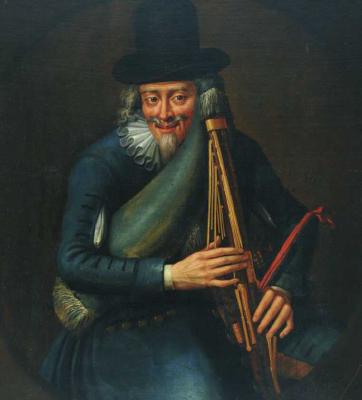
Members may well remember my ongoing investigations into Hale the Piper and his portrait that Eric, my husband, and I discovered, back in 2011. It was hung in the private family apartments of Calke Abbey, a stately pile owned by the National Trust. If you haven’t read yet read the story of the discovery and the background research that was subsequently carried out, then I encourage you to search out the articles which can be found in the archive on the Bagpipe Society webpage. http://bit.ly/Chanter111 and https://bit.ly/Chanter165 .
Meanwhile, a brief synopsis is that we found a portrait of a gentleman, dressed somewhat eccentrically, playing a very interesting and extraordinary set of bagpipes. Following a lead from the late, and much missed, Roderick Cannon, we were able to assign the painting as being a portrait of Hale the Piper from Derbyshire.
Hale is known because of an engraving which depicts him with a keyed bagpipe and a lathe accompanied by a 3/2 hornpipe and a rhyme
Before three monarchs I my skill did prove
Of many lords and knights I have the love
There’s no musitian e’er did know the peer
Of Hale the Piper in fair Darbyshire
The consequence in part you here may know
Pray look upon his hornpipe here below
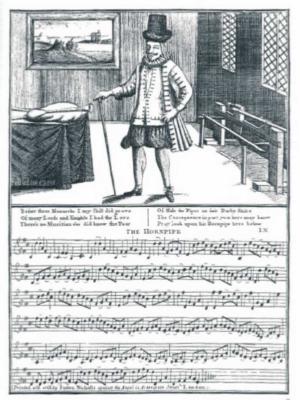
My research into Hale was always frustrated by the fact that I didn’t have a first name and searching archival records without a definite date, and without a full name, was going always going to prove difficult. Despite this, I persevered and by the end of my last update, printed in Chanter, Spring 2021, I had found ‘Hales the Pyper’ performing at Haddon Hall in Derbyshire in January 1670 and a number of references to a musician called Friend Hales being buried in Southwark, London in 1724. These dates lined up with the one piece of dateable evidence I had – the engraving of Hale by Sutton Nichols which was originally made between 1710 and 1712.
I concluded that the portrait was of Hale, that he would have been a young man when he played at Haddon, he then moved to London to seek fame and fortune, worked as a musician there, and died in his early 70s. Without any more hard evidence and not really knowing what else I could do to progress my research, I was content to leave things as they were.
However, this is not the end of the tale.
In early December, 2023 an email arrived from two volunteer archaeology researchers working for the National Trust at Calke Abbey. Paula Whirrity and Adrian Farnsworth had been charged to investigate references to the ‘Old Hall’ in search of possible depictions of the 16th century house which had been destroyed in order to build the current building in 1701. There are no known illustrations of the earlier building but there was a note of an archival reference to a 1748 inventory which mentioned a picture of ‘Old Hall’. This is what they set out to find but what they discovered was something very different.
In the room adjoyning [The room formerly called the Picture Room]
The room hung with printed cotton an Elm cabinet 3 old matted chaires a picture of Old Hale over the chimny A stove grate ornamented with brass hovle tongs poker & fender…
(DRO D2375/F/F/1/9)
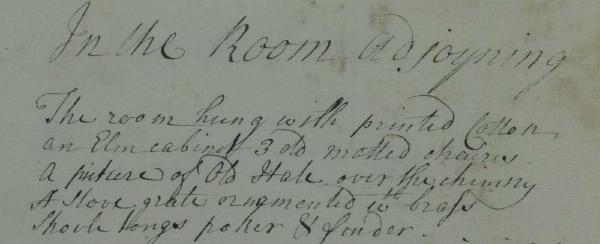
Adrian and Paula realised an earlier transcription error meant that ‘Old Hale’ had been wrongly interpreted and transcribed as ‘Old Hall’ and that the picture of the Elizabethan house had never existed. Wondering who or what was ‘Old Hale’, an internet search led them to the article I’d originally printed in Chanter and they then contacted me.
So, at last, this gives us conclusive proof – the portrait that we had discovered years ago is definitely that of Hale the Piper. Although his glory had clearly been relegated next to the main picture room, with only old chairs and fire irons for company.
Having just settled into this reassuring, and very satisfying, news, more was to come! A few weeks later, in mid-January, I received a phone call from a clearly delighted Paula. She excitedly informed me that they had discovered yet more evidence, the actual purchase of the portrait in the Calke household accounts. On the 3rd February, 1739 the sum of £9‑9‑0 (nine pounds, nine shillings) was paid to a Mr Briggs for the picture of
old Hale the Bag Pipper & Mr Harpurs Dog, Talpo & for new varnishing the coach &c".
(DRO D2375-E-A-1-1-6)
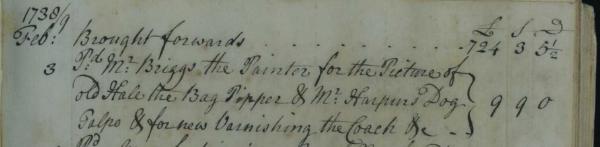
So, here we have it – definite proof that the owner of Calke Abbey, Sir John Harpur, the 4th Baronet, had purchase the portrait of Hale. What is particularly exciting about this entry is that Old Hale is specified as a bagpiper – it is rare to have an attribution of an instrument, let alone a bagpipe. No wonder Paula and Adrian were excited – so were Eric and I!
Further research by the pair uncovered that Mr Briggs had, nine years later, also painted The Chinese House at Calke (a room which had originally been decorated and devised by the studio of the French artist, Louis/Lewis Goupy, who was active in the early part of the 18th century).
Although Mr Briggs had clearly supplied the paintings of Hale and Harpur’s dog, the fact that he had also decorated a room and varnished a coach, would lead one to believe that he was not the artist but perhaps an artisan who also had access to and traded in works of art. Sadly, the portrait of the dog no longer appears to be in Calke’s catalogue of paintings, so I have unable to compare the artistic styles between the two paintings in order to be able to confirm my supposition.
These discoveries, as always it seems, throws up yet more conundrums …. and we still don’t have a first name, again it is simply Old Hale.
The conclusions of my previous research led me to believe that Hale had died in 1724 and yet the painting was not bought for the house until 1739, 15 years later. If the painting had been commissioned by Sir John Harpur at this date, then this would mean that ‘Hales the pyper’ at Haddon Hall, 1670, must have been a very young man when he played there or it was someone else entirely. If he had been, say 18 when playing at Haddon, he would have been 87 when the portrait was done – and whilst the painting shows a man past the prime of youth, it certainly doesn’t depict a person of these advanced years. The portrait does bear a striking resemblance to that of the engraving, which we know was definitely engraved 1710-12, a good 20 years earlier and I summise that the two are more or less contemporary. If the portrait was not commissioned until 1739, it would also throw out the assumption that the musician, Friend Hale, was our man and, again, another character entirely.
Therefore, I would like to believe that Sir John bought the portrait for sentimental reasons, from Mr Briggs acting as a dealer/agent, because Hale the Piper had been well known to him in the past and he wanted a souvenir of him.
Sir John died in 1741, just two years after the painting was bought and perhaps this is why, just 7 years later, in 1748, the painting had been relegated to a back room. Hale had not been known or had no relevance to Sir John’s successor, his eldest son, Sir Henry, who had been born long after Hale had Derbyshire left for London.
In my previous article, I wondered about the importance of the house shown in the background of the original engraving. Was this Calke Abbey? It isn’t a true representation of the building but then neither is the bagpipe which Hale was obviously so proud of. Perhaps Sir John and Hale had been good friends and collaborators, perhaps Sir John had funded and supported Hale’s works and career as a musician and instrument maker, perhaps he had helped effect the introductions to royalty? He may even have originally commissioned and gifted the portrait of Hale some years previously and then bought it back for his personal collection after Hale’s death. Sir John clearly had an interest in music as a later entry on the same inventory page as the painting shows that he paid £3.0.0 for some music books.
There is, I suspect more to discover and I now have another two expert and keen researchers hunting the trail of Hale the Piper, so there may yet be another update in a few years’ time! I am particularly keen to ascertain the importance of the shattered tree stump in the engraving – was this a feature in the grounds of Calke? I may have to investigate!
Many thanks to the Derbyshire Records Office who have granted permission for the reproduction of the images of the inventory and accounts.
https://www.derbyshire.gov.uk/recordoffice


Something wrong or missing from this page? Let us know!