Promoting the Bagpipe Revival since 1986
The Bagpipe Society
Using Native Australian Woods

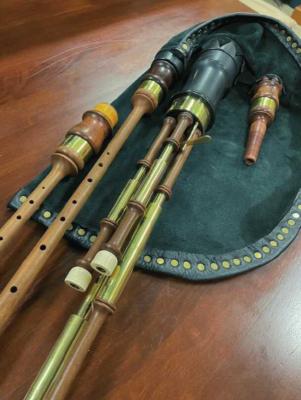
Since 2016, I’ve been working to create beautiful handmade bellows blown smallpipes, of the finest quality, on Australia’s Sunshine Coast.
My interest in bagpipes started in 1990 at the age of 10 when l began taking lessons from a fantastic teacher, friend and mentor named Malcolm Stewart. Malcolm’s patience, attention to detail and musicianship skills are priceless, and made learning to play the pipes a very enjoyable experience.
Owing to this, I attempted competing in several piping events throughout the Sydney region and I was successful in many over my teenage years.
During this time, I was fortunate enough to meet many amazingly talented musicians, including a world class Uilleann pipe maker named Ian Mackenzie. Ian has spent many years perfecting his craft and was kind enough to pass on to me some of his knowledge and enthusiasm for creating an instrument of warm, bright tone and ease of tuning. From day one it was fairly clear to me that producing any instrument requires focus, patience and many hours of forming specific tools like reamers and custom chisels.
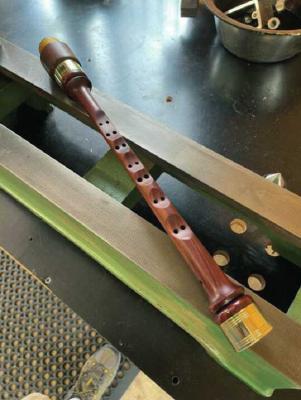
I’ve always steered towards the use of Australian timbers for my smallpipes. We have such an exotic array that it’d be foolish to ignore. Gidgee, for instance, creates a sweet, yet strong tone, but it does take the edge off of tooling, so constant sharpening is a must.
Owing to the sometimes-harsh Australian climate, many of our native trees such as Acacia cambageii (Gidgee), Acacia anura (Mulga), Eucalyptus lesouefii (Goldfields Blackbutt), and Acacia papyrocarpa (Western Myall), etc, are extremely dense. This, along with their quality of tone, makes them remarkably well suited to pipe making.
Unfortunately, it is now becoming harder to obtain these beautiful materials, and I would think that long-term, they will mostly become protected by law, which is probably for the best given humanity’s tendency to overuse natural resources.
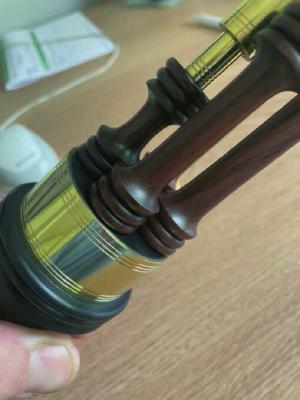
Apart from tone, styling of my instruments has always been a small form of therapy. I recall Ian Mackenzie telling me “the daintier you shape the work, the more interesting it looks”. There are some incredibly flamboyant curves to Spanish instruments, and I love the style, which is why I try to model my smalls on this concept.
Here in Australia, there are now quite a few folk developing an interest in pipe making and, thankfully, their interests lie in creating forms other than highland pipes. Though I do admire the sound of a great highland set, there really are many other styles which should be acknowledged and savoured.
There are already some very talented Uilleann makers here, and their work is sublime and world class, but hearing of someone taking the reins on a Northumbrian and/or Spanish pipe building program, for example, that’d make my day.


Something wrong or missing from this page? Let us know!