Promoting the Bagpipe Revival since 1986
The Bagpipe Society
The Search for the Lincolnshire Bagpipe
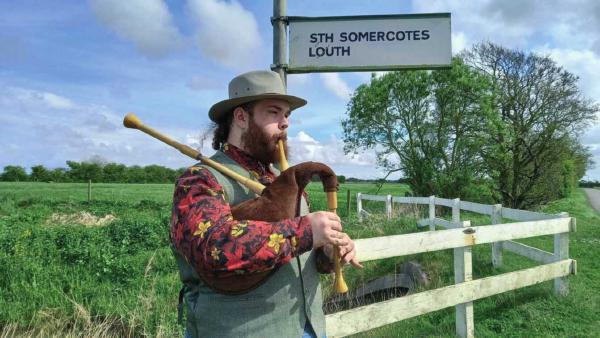
When I first discovered the diverse ecology of bagpipes, naturally one of the first things I did was look into whether there was a type of bagpipe local to my home turf. A couple of minutes of looking online quickly directed me to the articles which had been written by Allister Garrod about the research and reconstruction of the Lincolnshire bagpipes by John Addison in the late 1980s.
John Addison was a maker of NSP, Uilleann Pipes, Musette and other types of Western European Double-Reeded Bagpipes, who lived in the very small village of South Somercotes in the Lincolnshire Marshes. It turns out that I lived there for a few years when I was younger, without knowing a bagpipe maker used to live there. Unfortunately, John passed away a few years before I was even born, but despite this, finding this out still left me with an odd sort of feeling of connection to this instrument and John’s work, and I knew that I had to try my own take at it.
When I first discovered the Lincolnshire Bagpipe and John’s work, I was not yet a bagpipe maker, but simply learning to play a set of Swedish pipes I’d gotten second-hand. However, I knew from the beginning that I wanted to make pipes and it wasn’t long until I was fashioning slightly chewed looking spindles out of whatever wood I could get my hands on, using a £60 lathe which I picked up from a farmhouse in the middle of nowhere. Seeing what I was able to produce at this time, I knew that I should wait to tackle the Lincolnshire pipes until I was sufficiently skilled, and wait I did.
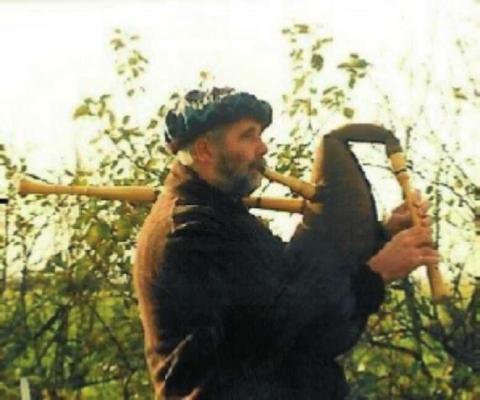
The original instrument was made by John on commission from the Heritage Trust of Lincolnshire. John was aware that the bagpipe he would end up making would be highly conjectural, and he based his reconstruction closely off of the Spanish Gaita, with the option to switch the Gaita chanter for a Smallpipe one. The work had the deadline of the reopening of Bardney Abbey and I’m sure John would have developed something different if he had been without this time constraint. It was made of boxwood with horn ferrules and was quite heavy and thick, and, in my opinion, wasn’t a satisfying conclusion to the research. From the recordings I’ve been able to find of them, I do not find the sound to be particularly inspiring, but some of the old sources do describe them as sounding ‘doleful and monotonous’, so perhaps this is simply additional historical authenticity! Similar characteristics assigned to the sound of the pipes have been of them sounding similar to the ‘croaking of frogs’ and Shakespeare famously alluded to them as being ‘melancholy’.
When I finally decided to begin my attempt in early 2022, I approached the interpretation of the written sources from a very different angle. My area of interest is the single-reeded, conical-bore ‘peasant bagpipes’ of the past, which couldn’t be more different than the type of Pipes John specialized in. I must mention that I don’t mean this in a derogative manner whatsoever, but in my opinion, these pipes, in particular, would be better likened to the former of the two sorts I mention. Pipes like the Torupill, Säckpipa and Pibgorn fascinated me, the long- standing tradition of farmers and countrymen fashioning their own instruments with what they had to hand, and making their own music (or adapting what they had heard) simply for their own enjoyment resonated with me quite strongly.
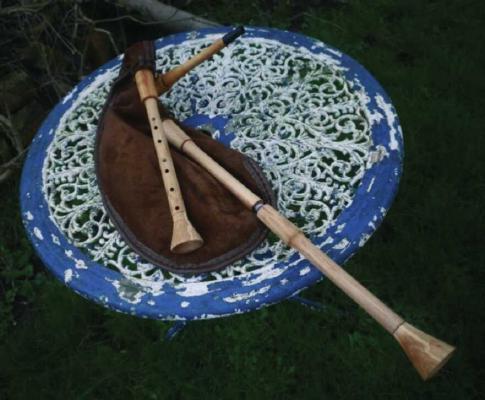
From the sources which John had collected, I imagined something along those lines. A very basic cylindrically-bored single-reeded set of bagpipes. One drone over the shoulder, one plain chanter with a range of about an octave, and made of something which grows here (I chose sycamore). I styled them after the same church carvings that John did, which reflected the generic form of pipes popular at the time, but as they are the only historical depiction of bagpipes in Lincolnshire I referenced their shape for my own set.
The first draft had the overall impression I was happy with. The shape and styling was satisfying but the sound however, was not. I had hoped it would play in something like g/c but it ended up something more like Bb/B, and would unpredictably shriek something awful! It needed gobs of wax to play any sort of useable scale and the drone was far too loud. The size of the chanter made it clumsy to play and the bag, when inflated, pushed it into a strange angle which didn’t help either. So, I decided to start from scratch.
I made an all-new set of measurements and aimed for the key of D. I tried the old-fashioned method of placing the holes on the chanter by laying my fingers in what felt right, and then sized them to pitch. Unfortunately, I couldn’t get it to sound right. I also realised that I’d accidentally turned the drone parts around somewhere along making them, so the first part of the drone had the tenon socket, which is the opposite of what I planned. At this point, I had a very busy patch so I put it onto the backburner for a while.
In March of this year, I took up the project again, and this time, I made my third and most current iteration. It worked! By this point I’d been making Welsh Bagpipes (and Pibgorn) and I referenced the set of measurements I used, as they produced a scale and range very close to how I wanted my recreation of the Lincolnshire Bagpipes to play, and it produced a nasal, reedy tone - just how I’d hoped. The chanter plays in a D scale, with a thumbhole for a minor third, a flattened seventh, and the leading note plays c#, rather than c which would be the standard, which allows me to play some traditional Lincolnshire tunes which require it.
By this point I must admit that considering how little is written about the Lincolnshire Pipes, any reconstruction will likely be a flight of fancy. The sound and popularity is described well, but the appearance and construction has little more said about it than being simply made with one drone. By no means is this a definitive example of what would have been played in Lincolnshire in the past, but it’s the closest I can come up with. And despite this, I am Lincolnshire born and raised, and I invented these pipes in Lincolnshire, so you could argue that these factors still make them ‘Lincolnshire Bagpipes’!
I’m happy with the current version I’ve made and I’m intending on recording some tracks utilizing the pipes alongside other instruments, playing traditional Lincolnshire tunes. For the time being, I won’t be working on any further changes and instead getting to grips with the instrument I’ve come up with now. Big thanks to Al Garrod for publishing the articles which inspired me to take this up in the first place, and the Heritage Crafts Society for supporting this endeavour.
I hope that when I play these pipes out in the countryside of Lincolnshire, the ghosts of people who heard them ‘back in the day’ approve! And perhaps, that John would too.
From Chanter Summer 2024 .


Something wrong or missing from this page? Let us know!