Promoting the Bagpipe Revival since 1986
The Bagpipe Society
IBO Conference in Plovdiv
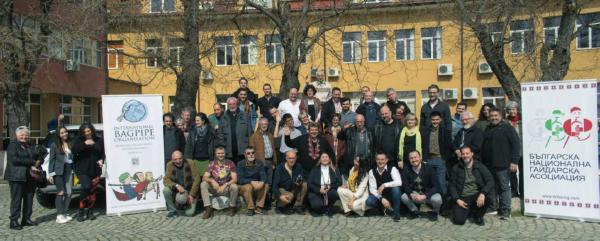
I knew the International Bagpipe Organisation had chosen the right country to hold its conference when, a couple of days before the conference opened, I asked a curator at the Ethnographic Museum in Plovdiv how she knew so much about bagpipes. Did she play, I asked? "Oh no… but you have to understand, for every Bulgarian, the bagpipe is our instrument, our soul. When I hear it, I get goose pimples, every time!"
Before this trip I only really knew the djura gaida from Thrace and the Danube plain. But when I heard the kaba gaida of the Rhodope Mountains, I knew exactly what she meant. The deep throaty sound of the chanter together with the incredibly low single drone do something primeval; and when you hear a good player (and we heard a lot of good players all the way through the conference) the profuse ornamentation together with the steady drone sets up a kind of ringing like a Tibetan singing bowl, which is quite mesmerizing. (And yes. Goose pimples.)
The IBO was set up to expand the knowledge of bagpipes around the world, and lived up to its name with a truly international gathering. Speakers (and players, of course) had come from as far away as Texas and Singapore, covering bagpipes from the Baltic region, the Asturias, France, Bulgaria (naturally), Greece, and even the intersection of Indian pipe bands and Highland pipes.
Anyone who has encountered musicologists in full flow knows that sometimes it can be easy to lose sight of the fact that we actually play music.
Fortunately, the IBO had not forgotten this. Events opened with an evening concert at the Bee Bop Cafe which, since it was International Women's Day, featured gifted female pipers - Nadia Vázquez-Martínez, on both gaita and musette de cour; Adelina Cholakova and Daniela Gaidarova on kaba gaida, and the irrepressible Filiz Ilkay on tulum. In Bulgaria, it's only in the last generation that women have played gaida. And in Turkey, Filiz is the first woman to play tulum professionally. Her enthusiasm and energy was amazing, not just in the concert but over the whole weekend - if she wasn't playing, she was dancing, or doing both at the same time.
The concert was followed by a "curated session", but we got kicked out later to make way for the DJ. That was probably not a bad idea as we were meant to be starting the more academic part of the conference at nine sharp the next morning. (Which didn't happen, oddly enough.) The question of women playing pipes is still a live one in a number of cultures, and a couple of speakers threw light on some of the reasons why. Gvidas
Kovera, speaking on Lithuanian bagpipe culture, mentioned the survival of pagan ritual music in the Baltic area, where the population was converted to Christianity long after the rest of Europe. (This made me wonder whether originally the pipes were seen the same way as the didgeridoo in Aboriginal culture, which is traditionally prohibited to women and belongs specifically to male ceremonies.)
Anton Tunin brought more light to the subject in his talk on the vocabulary of the Greek gaida tradition. The gaida in Greece was an instrument that symbolized fertility, with its union of 'male' (chanter) and 'female' (bag) components. It's perhaps therefore not surprising that it was played only by men; women could drum, but not play the pipes. The ritual meanings extend further; the wood selected was 'male', from fruit trees, and cut at the new moon; but the bag could come only from a female goat. (However, Jordan Langehennig, who raises goats and made his own gaida bag, pointed out there's also a practicality involved, with "one less hole to worry about". According to Anton, the use of fruitwoods was also practical; olivewood is used nowadays, but earlier makers with limited tools found it too hard to work with.) Cassandre Balosso-Bardin's talk on the decoration of bagpipes, set in its social and historical context, also referred to a number of these issues. In many cases, for instance, the instrument is designed to refer explicitly to the animal world, with the use of horns, hair-outside bags, and goat's-head chanter stocks (real or carved). Apotropaic usages are also common, such as a mirror at the back of a diple, intended to frighten evil spirits; red and black painted zampogna (earth colours, the earliest sacred colours); and a Georgian bagpipe adorned with semi-precious stones, crosses, metal chains,and amber (solar, Christ, healing).
(The chabrette's mirror-encrusted stock may have a similar purpose.) On the other hand, human figures are rare till the 19th century, and their introduction on French chanter stocks reflects the fact that Bechonnet was selling to middle class, aspirational buyers, and aiming to make his pipes fit the canons of bourgeois taste. The Great God Pan had somehow become domesticated.
The papers were an interesting mix; some presented individual instruments and their traditions, while others looked at the symbolism or decoration of the pipes, and a number analyzed the musical language of bagpipe traditions. There were also a number of musical examples within some of the papers, as well as musical interludes between the lectures which included what must, for most people, have been a first encounter with the (very shaggy) Armenian bagpipe.
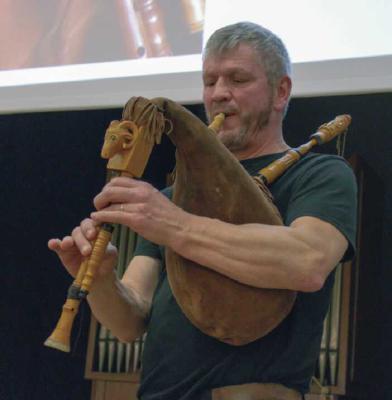
Something that a few participants commented on was the distinction between the 'living' traditions and the 'revival' traditions, though you had to do a bit of reading between the lines to identify it. For instance, Pol Ranson's talk on the muzelzak/muchosa included the fact that only four of the old muzelzak tunes survive, and the Picard piposa players (an isolated island of a former, wider tradition of the same instrument) lost all their music. A new repertoire has had to be established taking melodies from songs and other sources; this is a 'revival' bagpipe playing music that is not its own. (However, the revival included the traditional practice of playing polyphonically.)
For Lithuanian and Belarusian bagpipes, too, song is a major inspiration for modern pipers. The bagpipe tradition in Latvia and Lithuania was the subject of active repression by the authorities (perhaps as a result of those links with ritual, paganism, and fertility celebrations?) over the course of the early modern period, so the pipes had this to contend with as well as the introduction of new instruments and new styles of music.
Many of the revival traditions are tune-driven, taking repertoire from violin players, carillons (in the Low Countries) or song, while the gaida and tulum traditions, for instance, are driven by motifs and ornamentation rather than melody.
I was intrigued to find that Mike York remembered exactly the same passage in Tim Rice's excellent May It Fill Your Soul as I did, with a young child just noodling away on a gaida making some kind of cacophony, and this being treated as learning, rather than a nuisance. Learning this way, he thought, implanted the idiom first, and the 'tunes' came later. That's the way living traditions used to work, and is perhaps one reason that Ivan Georgiev, talking about Petar Yanev's piping in particular and the Rhodope gaida tradition in general, said "Ornament and melody are not separate."
Dimitris Sinapidis talked through the learning of Greek gaida - 'stealing' tunes, improvising, or learning in the family, all very far from the modern conservatoire system. Even getting an instrument in a subsistence economy and traditional society was not easy. And learning would have to be through listening and playing, not formal instruction; Anton Tunin raised laughs when he explained how traditional musicians have no vocabulary for some parts of their music - one of his interviewees told him that "Someone who studies in a university told me I play in G major". A particularly sad note was struck by David Marker, whose encyclopaedic coverage of the variety and multiplicity of zampognas started the conference.
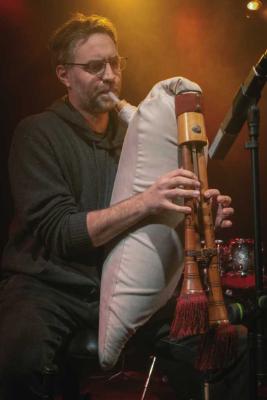
Zampognas are immensely varied; there are single and double reeded styles, and some which can be played with either single or double reeds; some which play only for religious occasions, others which play only for dancing; some with chanters tuned in octaves, others with partly overlapping chanters. The one thing they all have in common is their divergent double chanters - something which perhaps came down from the classical aulos.
The sad thing is that the zampogna is dying. These are hyper-local traditions, passed down in families, in very conservative areas; where the traditions are tied into the Church, the growing secularism of Italian society further imperils the zampogna's future. There's practically nothing being done to secure the future of these instruments - a huge contrast with the cornamusa of northern Italy - and David's splendid playing of the ciaramelle Amatriciana showed it would be a tragedy if they faded away.
One bagpipe that's going from strength to strength is the boha (which Patrick Burbaud reminded us is pronounced boo-wa not boe-ha). Patrick's work has aimed to give the boha a foothold in the twenty-first century, from getting the bagpipe inscribed on that UNESCO intangible heritage register, to 3D printing copies of historical bagpipes. The boha, like the zampogna, is a highly localized bagpipe (and quite distinct from other French pipes); Patrick set out to create "a virtual museum for globalized culture, instead of traditional localized culture".
As well as the distinction between 'living' and 'revival' traditions, there was concern focused on 'authenticity' versus 'modernity', which becomes important when even pipers in a living tradition are exposed to global popular music and classical music norms. Ivan Gergiev referred to the gaida tradition as "vitality combined with mystery" - refining the existing tradition while preserving its intensity and 'soul'.
Maria Fernández Vigo's "Galician roots" analyzed modern compositions submitted for the Ponteareas competition. She divided the compositions into two kinds; first, arrangements of traditional airs, and secondly, original music with a Galician aesthetic. What "sounds" Galician? To some extent, modern players are redefining it - some of the newly composed tunes have now become popular parts of the 'traditional' repertoire.
This is of course nothing new. Even in the early 20th century, things were changing in Galicia, as Luis Bolón's talk on Enrique Ambite, the last 'traditional'
player in A Coruña, showed. During Ambite's lifetime, the format in which the gaita was played changed (from quartets to larger groups), and the fingering also changed, from closed to open fingering.
While most of the papers addressed the traditions of piping from the late 19th century to the present day, some speakers went back much further. Dillon Connolly examined the double-chanter four-drone bagpipe shown in the illuminations of the Cantigas manuscript, setting it in the context of other depictions of musical instruments in the manuscript itself and in other (roughly) contemporary Spanish sources to assess its realism. At Toro Cathedral, carvings show instruments similar to the others in the cantigas, and the musicians even wear similar clothing. The Portico de la Gloria at Santiago cathedral, built about eighty years earlier, shows similar instruments, too. Most of the other instruments shown in the Cantigas are evidenced elsewhere; this one is unusual in being unique.
Reconstructions by Zdenek Seidl and Pablo Carpinteiro have come up with quite different sounds and different solutions to the puzzle of the illustration. There is certainly still more to learn about this bagpipe…

Zhi-En-Loo raced through his talk on the training of Pipe Bands in British India so fast that it was easy to miss some of the delightful anecdotes, such as the Nepali pipers who chewed their reeds (picture a roomful of wincing pipers at this point!) to get what they considered a better sound out of their pipes. "Sounding like bloody snake charmers again!" as a British correspondent complained. Having a pipe band was a way for maharajas and other local rulers to display their status, and most of these bands were trained by the British Army, particularly the 1st
Battalion of the Black Watch. Since instructors and pipers did not often share a language, training was by demonstration and copying; the instructor would tell the player either 'thik' - 'correct', or 'dekho' - 'watch' - then repeating the passage and fingerings. (And yes, that's where the phrase "Take a dekko" comes from, in case you were wondering.)
This was the formal business. But there was a lot more; a visit to the Ethnographic Museum, a tour of the Roman amphitheatre, and the Bishop's Basilica with its Byzantine mosaic floor; plenty of coffee breaks for chatting; and a superb taverna evening, with great Bulgarian food, and great piping - Jon Swayne and Lisa Wolf playing for Dave Faulkner and Mike York to dance a bourrée (with added flirting!), a wonderful set of Greek dances, and an eighteen minute horo from the Bulgarian contingent, plus gaitas galore, tulum, Belgian and French pipes, and the "baptism" of Jordan's djura gaida with its bag made from the skin of one of his own goats ("I tied him up, but I did not pull the trigger"). There was more piping on Sunday afternoon - Filiz was getting everyone's feet tapping together with massed Belarusian and Bulgarian pipers in front of the Ethnographic Museum, and Luc Monod piped the sun down from the lower slopes of Sahat Tepe (having not left quite enough time to summit).
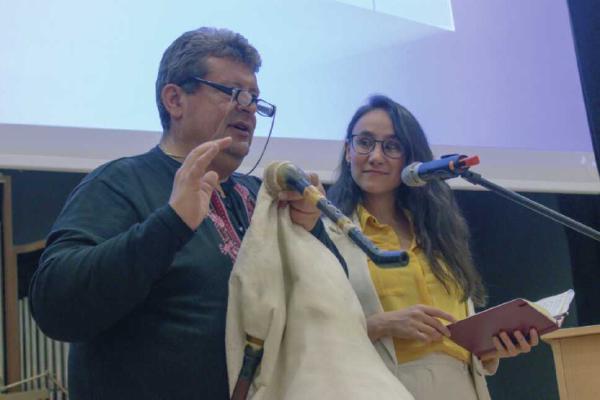
In the end it was all about the music, perhaps best expressed by Petar Yanev, who told us to "Sing the tune, sing it through the instrument."
(Though he also expressed the less elevated sentiment that "a bagpipe is like a woman, if you don't know the right way to touch her, watch out!")
I'd like to make a personal expression of thanks to the Bulgarian contingent, including Veselin Kozarev, Petar Yanev, and a number of others who arranged a visit to a gaida maker's workshop for me at very short notice. Not only was the visit arranged for me, but Petar Yanev took charge of me from my arrival in Smolyan to my departure for Sofia, including arranging my lunch and bus tickets. Blagodarya vi mnogo!
I'm going back in June, I hope. There will be a kaba gaida waiting for me.
All photos in this article were taken by Mihail Kossev


Something wrong or missing from this page? Let us know!