
Promoting the Bagpipe Revival since 1986
The Bagpipe Society
Electronic Bagpipes - an Overview
In the previous Chanter I contributed an interview with the Asturian piper José Ángel Hevia in which he spoke, inter alia, about the electronic pipes he developed with engineer colleagues. Electronic pipes seem to be an area little touched on in Chanter in the past. A review of the Degerpipes (an electronic practice chanter), in the Winter 2012 issue, and an interview with the creator of the Eskin Bagpipe apps for tablets, in Autumn 2020, are the only items of substance that I am aware of.
In Spain, at least, it is common for players of Galician, Asturian and the GHB to have an electronic practice chanter and not uncommon to see electronic pipes played onstage by professional and semi-professional players in folk and rock bands.
In this article I hope to shed some light on the world of electronic piping, without going into the arguments as to whether they merit the name “bagpipes”, as they could probably fill another article. Space means that I will have to gloss over many details, but I will at least attempt to highlight some of the pros and cons of electronic pipes.
This article is based upon my own experience of owning two sets, trying a third hands-on, talking to some other users and studying the technical information available about some of the sets. I am mentioning 5 different makes here which does not include all those available and it is not intended as a review or comparison; I am referring to them as examples of the range of characteristics available. Forgive me if, at any moment, I may be stating what some may think is obvious but I am trying to present the information in a logical manner.
The two basic elements to electronic piping are reproducing a bagpipe or similar sound electronically (usually with a synthesizer) and controlling the sound with a something which allows the use of bagpipe technique (an electronic hardware version of a chanter). Of course, these elements can be combined in different ways: a keyboard or other controller could be used to control the sound or an electronic chanter could control a non-bagpipe sound. An electronic chanter from one manufacturer could control the sounds provided by another manufacturer.
The electronic bagpipe sound - Synthesizers
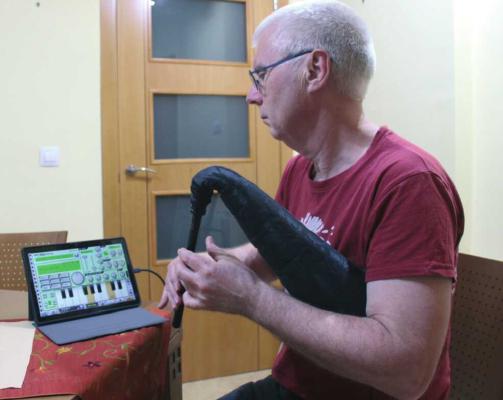
These days the easiest way to reproduce, or at least imitate a bagpipe sound, is to use a sampling synthesizer. For the purposes of practice, this can be a very basic synthesizer built-in to the chanter offering some changes of voice and a small amount of adjustment to the sound but for highest quality of sound and more control, it is necessary to use a separate synthesizer. This could be software running on a PC, Mac, tablet or even a phone, or a piece of dedicated hardware – either within a keyboard or in a separate box which sits in a rack.
There is little space to go into sound sampling properly but it is worth noting that sampling wind instruments is not an easy task and I give an outline here: The simplest instrument to reproduce might be a plucked keyboard instrument such as a harpsichord or spinet where a depressing a key, plucks a string (always with the same velocity), which sounds a note, which then decays without further intervention. A synthesizer can easily reproduce the sound of such an instrument by simply replaying a sample associated with each key.
Then think of a piano where the initial strike of the key can transmit nuances in force to the hammer and pedals can damp or sustain the note after it is struck. Sampling a piano is therefore significantly more complicated than a harpsichord: not only must a basic note be recorded, but it must be edited and stored with a series of parameters which tell the synthesizer how to react when the key is hit at different velocities and how it should react when damping or sustain are applied and so on.
Moving on to a bagpipe, where the sound stream is continuous and the note is continuously changing, sometimes jumping by an interval of an octave, the player may be wanting to achieve or avoid glissando, portamento or legato in fingering and the pressure coming from the bag can cause a change of register or detuning, whether deliberate or unintended. If all these features are to be controlled then there are some large challenges in creating an electronic representation. However, not all these controls are used in reality, especially in a practice instrument.
If you are starting with pipes which include onboard sound, then you should be able to play straight out of the box and simply attaching headphones.
Connecting to a separate synthesizer is an optional extra if you want different sounds and other controls.
Furthermore, for pipes without onboard sound, the manufacturers provide some ‘voices’ and either supply or recommend software for an attached computer (Mac or PC), tablet or even phone. However, as with much computer software, the initial setup may not be straightforward. Moreover, if a player wants to advance to create their own samples, adding new voices and perfecting the sounds, then the level of complexity is perhaps akin to that of mastering reed-making.
Electronic chanters – the controllers
A synthesizer needs a controller – for bagpipes this is an electronic version of the chanter. No column of air is involved so, in theory, its design can be much more flexible and almost any type of chanter could be imitated. Instead of holes, sensors are embedded on the outside of a tube corresponding to the fingerholes of a conventional instrument. A practical constraint is that, instead of being turned from wood, they are usually moulded in plastic and need to be produced in some reasonable quantities to cover the design, tooling and setup costs.
Fingerholes (sensors)
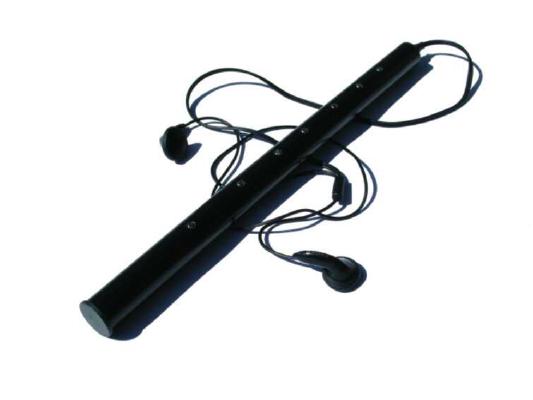
Since the dominant market is for GHB players, most of the chanters have been created with all the sensors in line. For players of instruments with off-centre bottom holes, among simpler pipes is the Mastergaita, which is available with an off-centre bottom hole in right- or left-hand versions. At the top of the range, the other variant is the Redpipes which offers versions corresponding to French, medieval or other pipes with off-centre holes.
Although the sensors may feel like normal fingerholes, under the fingers the first thing you may become aware of is the absence of vibrations when playing. This lack of feedback from the instrument is particularly noticeable when playing through headphones and at low volumes, and it can take some getting used to. Similarly, the resonance coming from the air in the bags of pipes with large bags is also noticeably absent.
The second point is that the function of the sensors is not identical to the holes in a conventional chanter. In the simplest mode they function as on/off switches: as soon as a finger is covering or partially covering a hole, it is treated as closed; there is no legato, vibrato or half-covering or pinching possible. For rapid piping, and styles which use little vibrato, this is not necessarily a huge disadvantage, especially for practice.
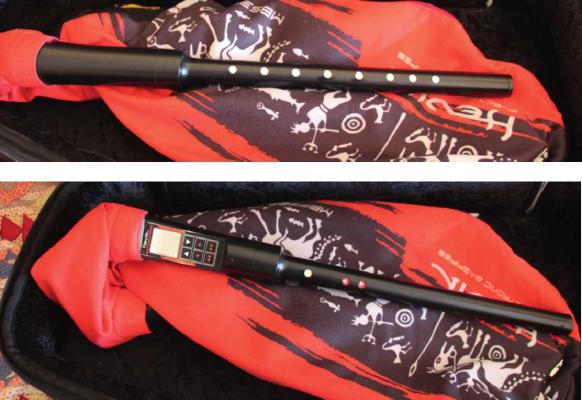
More sophisticated models, such as the Hevia pipes, can function in this on/off mode, but the default is to allow vibrato through the effect known as pitch bend. However, the sensors tend to detect the presence of a finger at a greater distance than in an acoustic chanter, so some adjustment in technique is necessary. It does also allow for the depth of the vibrato to be controlled for each note individually to make it respond as closely as possible to an acoustic instrument but there is a limitation in that half-covering is not really feasible. The Redpipes, which also lie at the top of the range, advertise an option for optical sensors (rather than the conventional ones which I presume are electrostatic), but I have no experience as to how their function differs in practice.
Fingering
The fingering in an electronic set is basically controlled by software. It is a matter of storing electronically what note should come from any combination of fingers; thus an electronic chanter can function with the fingering equivalent of many types of chanter, as long as it has it has the sensors in the corresponding positions. Sensors not needed can also be ignored by the software – the equivalent of taping them over.
The simpler models have one fingering which is set in the factory when ordered, but many options are available (eg. Technopipes and Mastergaita). Further up the range, the Degerpipes and Redpipes allow the player to switch between several fingerings. The Hevia pipes are the most flexible in that, in addition to the fingerings provided by the manufacturer, the player can create new fingerings or modify the ones supplied and tune notes individually. (Please see the links at the end of the article for information on what fingerings are available for each model as there are too many to list here.) Some of the electronic chanters also contain extra sensors for alternative fingering combinations. For example, the Hevia pipes have an extra hole which can be used for solely for vibrato (such as when playing them as a GHB), using the bottom hole for the sub-tonic. The French model of the Redpipes includes a second thumbhole. The chanters variously have extra sensors, switches or control panels to cover other functions such as controlling voices or drones, adjusting modes or fingering, starting and stopping play etc.
Bags
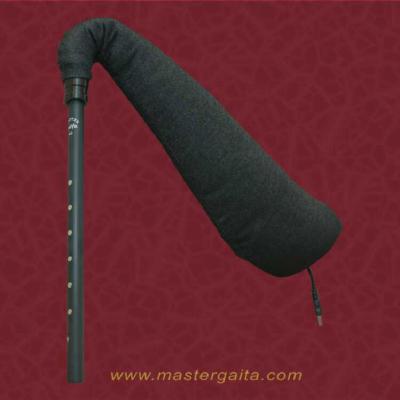
There is a wide variety across the models in terms of their presence or function. The Degerpipe imitates a practice chanter with a blowpipe to control sounding but no bag, The Technopipes have only a chanter, to which a support can be added to hold it in a more realistic playing position. The Mastergaita has a soft bag, about half the length of a conventional bag, enough to hold under the arm and keep the chanter in a conventional playing position but it has no other function. Since there is no bag pressure, it sounds by covering an extra right-hand thumbhole.
The Hevia pipes (in the second version) includes a mouth blown bag, the pressure from the bag then sounds the chanter, which also responds to pressure, in the manner of conventional pipes, including the switching to the second octave with increased pressure.
There is a mechanical adjustment for the valve. This allows air to escape from it (eg. imitating soft or hard reeds), but the rest of the adjustments around pitch and pressure, are made in the chanter’s controls and whatever synthesizer is attached.
The Redpipes offer options of blown bags and non-blown bags, depending on the model.
MIDI
We should mention MIDI (Musical Instrument Digital Interface). This is the standard by which electronic instruments communicate and ensures that equipment from one manufacture can work together from that from another. It is basically a flow of digital information saying, for example, “play a D, now nothing, play a A, slur it up to B♭, stop”. No actual sound is sent, it is not an audio signal, they are merely commands resembling a much more sophisticated version of a piano roll. The commands within it have their own set of names “Note on”, “Note off”, “Pitch Bend” and so on.
For electronic bagpipes, it is the language in which the controller - the electronic chanter - tells the synthesizer what to play. Although the Degerpipes, Technopipes and Redpipes have their own on-board sounds, like the Mastergaita and Hevia pipes, they can also send MIDI signals to control the sound on a synthesizer.
Tuning
Except when using on-board sound, tuning is an issue between the electronic chanter (what note it sends via MIDI according to the programmed fingering) and the synthesizer, where the tuning can be further modified. Fine tuning the whole range is easily possible, as is moving the whole range of the pipes up or down by semi-tones or even octaves. There are too many parameters to go into here, but we should mention that many alternative tunings are possible. The Degerpipes and Redpipes for example offer tempered and natural scales. In the case of the Hevia pipes, any scale is possible through editing the fingerings, and notes can be tuned individually.
Drones
Since the sound is electronic, the sets do not need physical drones. The drone sound comes either from the on-board sound or the separate synthesizer – the MIDI signals the controller sends alongside the notes for the chanter.
The on-board sounds may have some controls for the drones, at least on or off, but the greatest control for the player is on an external synthesizer where they can be re-configured as the player desires.
Latency
When playing an electronic chanter connected to a synthesizer, there is the risk of latency: the chanter sends a signal to the synthesizer to play a note but then can be a noticeable delay between the note being fingered and the note being sounded or changed. This occurs most frequently when the computer, phone or tablet is simply not powerful enough for the task or is being slowed down by other tasks. Curing it can be a question of changing or reconfiguring the software used or uninstalling software not needed for music tasks. The professional solution is generally to use a standalone synthesizer or at least a computer dedicated to the task with no other function.
Latency primarily affects the MIDI connection between the controller (chanter) and computer. However, it is not confined to the MIDI connection: a Bluetooth connection to headphones will generally suffer a degree of latency and, therefore, probably not suitable for electronic pipes, as the sound in your ears may not be synchronized with your fingering.
Portability
This is where practice chanters, in particular Technopipes, present the maximum portability when used with headphones, as they lack a bag or other extra bulk. They are almost pocket sized and are used my many on public transport. However, I have managed to practice on trains and planes with the much larger Hevia pipes.
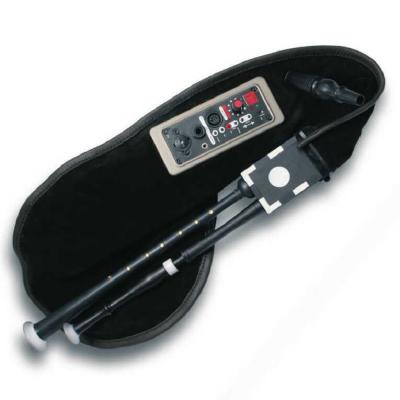
In performance, a lead is generally needed on stage to connect to a synthesizer and PA system and it may resemble an electric guitar set-up especially if pedals are included.
Wireless MIDI connections are also possible but add further complexity. The Redpipes offer versions with built-in speakers, so it is possible to play independently and wander, albeit with a much-reduced playing volume.
For professionals, the greatest advantage in portability by reducing the need to travel with multiple sets of pipes. They also offer stability in tuning during transportation between different climates.
Control of volume
Since the sound is purely electronic, the possibility of practicing at low volumes with or without headphones is a particular advantage. Equally, controlling the volume also allows one to play alongside quieter acoustic instruments than conventional pipes in performance or sessions. On stage, control of pre-amps means a piper can also include dynamics, not so easily achieved with acoustic pipes – there is no need to play off mic.
Grace notes and ornamentation
Returning to the issue of fingering, we should note that, in general, as practice instruments, electronic chanters tend to be less tolerant of inaccuracies in fingering. Therefore, mistakes in executing grace notes stand out, although this can depend on the model, voice and fingering system in use. In general, this can be a very useful feature for practice, but a complication in performance.
Another tool for improving technique can come from recording the MIDI output of the chanter on a computer and examining the exact timing of the notes in a piano roll display alongside an audio recording.
As mentioned above, it may not always be possible to use the identical fingering and technique from an acoustic instrument in the ornamentation.
Other controllers
The electronic chanter in pipe form is not the be-all and end-all of electronic piping. Once you have a bagpipe voice on a synthesizer you can, in theory, use any controller to play it. One example is using a tablet computer: turning it away from you and placing the fingers on the screen to imitate a chanter. There seem to be a number of such apps available to do this, but we should mention here the article from the Autumn 2020 chanter on the Eskin Bagpipe apps
(https://www.bagpipesociety.org.uk/articles/2020/chanter/autumn/eskin-bagpipe-apps/). These include apps not only imitate various chanters but also the Uillean pipe regulators.
Others have used keyboards and a good example is from the central Balkans. With the arrival of the clarinet, and later the accordion, in the 18th and 19th centuries, players took much from the local bagpipe (gaida) styles in creating their playing techniques. In the late 20th century, a similar thing occurred as the accordionists took up synthesizers and adapted the style to imitate the gaida more closely in parts of their repertoire. This is particularly prevalent in northwestern Greece. The local gaida had died out by the 1980s (except in small region), but many bands have taken them up again since the 1990s, but curiously they now play them in a style more reminiscent of the keyboard imitation rather than the traditional one.
Non-bagpipe voices
Once you have a MIDI-compatible electronic chanter, you can play whatever voices you have on your synthesizer (but of course monophonically).
However, most sound ridiculous (a xylophone for example), but some work very well using bagpipe technique, particularly an accordion voice.
Conclusion
Perhaps this article will stimulate more comments from others who have their own, different experiences, but I will try to sum up my views.
It is quite clear that as practice chanters for GHB, Breton biniou bras, Asturian and Galician pipers, electronic pipes are well-established and widespread. For players of other kinds of pipes, the choices may be more limited. As practice and warm-up instruments they can be invaluable in terms of portability and sound containment but they are not a complete substitute, as their function is not identical and regular time on an acoustic instrument is necessary. Healthwise, the electronic instruments also allow for longer sessions with less strain on the lungs, arms or hands.
As technology advances, we may see more developments, including perhaps improvements in the capabilities of the sensors. 3D printing might also allow for more customization in the physical forms of the pipes as well. A downside has been that the disruption to chip manufacture has constrained the developers and manufacturers in recent years.
With respect to performance, Hevia mentioned in the Spring 2024 Chanter how he is able to play pieces which would otherwise be too complex for conventional pipes. I should also mention another of my informants, Bieito Romero, the piper in the Galician group Luar na Lubre. He was very clear in describing the advantages of electronic pipes and, for him, it is tuning. In a typical concert set he needs to play in 5 different pitches and he found it impossible to tour with multiple gaitas, maintain them in tune on stage, and front the band at the same time. For years, he has been using a set of Hevia’s pipes and playing them using a rack synthesizer with the voices of Galician and GHB pipes. He tours with a single conventional gaita to complement them.
Both these players have made significant investments in perfecting the samples which give their pipes their sound. Bieito also emphasizes that the electronic gaita is an important tool, but it is as a complement to, and not a substitute for, the traditional gaita, especially in the context of dances and traditional events. He has also recorded with them and has received criticism for using them. However, he challenges his critics to tell him where they appear on the group’s CDs because (like Hevia) he is no longer sure where himself.
With thanks to Bieito Romero, Hamish Binns and Kim Burton for their assistance.
LINKS
- Technopipes: https://www.fagerstrom.com/
- Mastergaita: https://mastergaita.com/
- Degapipes: https://www.deger.com/
- Redpipes: https://www.redpipes.eu/
- Hevia pipes: https://hevia.es/ (at the time of writing the second model is no longer available, he is developing a third model and the information will eventually appear here)


Something wrong or missing from this page? Let us know!