Promoting the Bagpipe Revival since 1986
The Bagpipe Society
Aristophanes and Shakespeare
We could not describe the bagpipe as a musical instrument possessed of an introverted tendency. The opposite: its place is at the heart of the festival and is subject to the laws of extroversion and many times over the centuries, it has been the subject of comic treatment. For this reason, there is also the expression: Can you beat these bagpipe jokes?
For example, in Greece until a few years ago, if we asked an old player to play the Τsabouna, he would say: “Why should I play? Are we having Carnival? " The Tsabοuna was mainly played during the Carnival period and was accompanied by songs with obscenities and sexual innuendos.
Besides, even the discovery of the bag in the Greek world was accompanied by a tragic and at the same time comic event: The ἀσκολιασμος (askoliasmos), or dancing on a goat leather bag filled with air and smeared with oil, at the festivals of Dionysus, was likewise traced to Icarius, who was said to have killed a ram for having injured the vines and then made a bag of his skin, and then performed a dance. As I demonstrated in a previous article of mine (The Mysterious Symbolism of Askos in Greek Thought – Chanter, Autumn, 2020) the bag has the meaning of the upper human body. And if the bag is the body, we can all consider which part of the human body assumes the allegorical role of the chanter or the position of the blow pipe... As we will see below, the peculiarity of the instrument over the centuries has given rise to many funny incidents and stories.
Who hasn't heard the sound that comes out of the blowpipe when the return valve doesn't fit perfectly?
Part I - The Acharnians
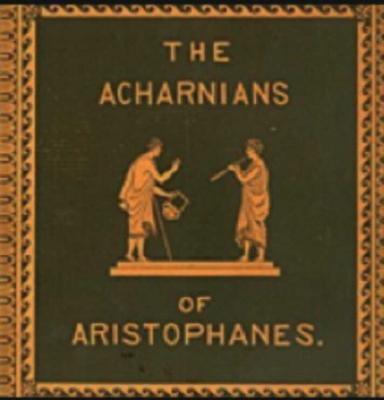
One of the earliest references to bagpipes we have is that of Aristophanes in The Acharnians and, as usual, it is permeated with sexual innuendo and obscenities, The "Acharnians" is the 3rd play of Aristophanes. The subject of the play is the historical events of the first 6 years of the Peloponnesian war. While Aristophanes criticized the abuse of obscenity by other comic poets, he reserved for himself the privilege of using it in his works, with the sole purpose of eliciting easy laughter from his audience. What matters is how effectively the poet handles a technique - that is part of his art, but, from a dramatic point of view, not the only one. In other words, Aristophanes' comedies are high poetry thanks to the key use of obscenity. His works are original, richly lyrical, and technically perfect.
The dialogue is natural and alive. When one reads the comedies of Aristophanes, one thinks that one sees the ancient era alive as if in a movie. Let's read the reference of the great comedian in verses 860 – 870, in the dialogue between the Boeotian merchant and the protagonist οf the play named Dikaiopolis:
(A Boeotian enters, accompanied by a slave carrying certain wares; and by a *procession of 'supers', playing bagpipes with very wheezy notes.)
Boeotian: (Puffing, and rubbing his shoulder) 'By Heracles, my shoulder is quite black and blue. (To the slave) Ismenias, gently set down the pennyroyal and as for you whifflers, who have followed me from Thebes, take up your bones [pipes] and squeak out the catch, the dog’s rump'
Dikaiopolis: (Appearing from his house, and putting his hands to his ears) 'To the crows with you! Stop! Get away from the door, you hornets! Whence have they winged their way to my door, these crack-hemp droning whelps of Chaeris?'
Boeotian. (Complacently ) 'Oh Iolaus, my friend, drive them away with all my heart. They've been wawling behind me all the way from Thebes and have completely stripped my penny-royal of its blossom. But, will you buy anything from me —some chickens or locusts?'
In the Greek text the key words are:
Θείβαθεν αὐλειταὶ πάρα, τοῖς ὀστίνοις φυσεῖτε τὸν πρωκτὸν κυνός / Theban musicians, blow “The Bitch’s Bum” on your bony flutes.
and
Χαιριδῆς βομβαύλιοι; “these crack-hemp droning whelps of Chaeris”
αὐλειταί : because of the reeds in lake Copais, piping and bagpipes flourished in Boeotia; to give dignity to his trade, the Boeotian had provided himself with pipers, to lead the procession, like the ‘whifflers’ in medieval times.
Cited in Henry V, V ; cp. Hen. V line 12 ’the deep-mouth’d sea, which like a mighty whiffler ‘fore the king seems to prepare his way.’ (Whifflers were people who cleared the way for a procession.)
ὀστίνοις, ‘drone on the pipes.’ A translation by v. Leeuwen thinks it could also refer to ‘mouthpieces’
τὸν πρωκτὸν κυνός : “The Bitch’s Bum”. It has been suggested that this refers to a well-known vulgar ditty or ‘catch’.
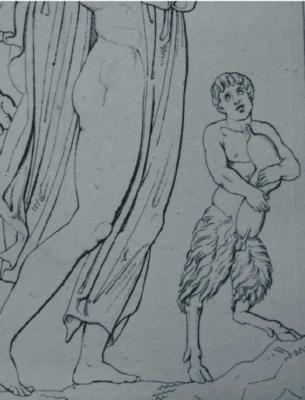
Scholars Blaydes and v. Leeuwen think that a dog’s skin was used to form the bag of the bagpipe and that a bone mouthpiece was inserted into its πρωκτός (anus).
βομβαύλιοι, ‘droning-pipers’, this same joke is used by Shakespeare in Henry IV, Part I when he refers to ’the drone of a Lincolnshire bagpipe.’
Part II – Shakespeare and Aristophanes
The influence of Aristophanes has been shown in some of Shakespeare's plays, especially in Timon of Athens and King Henry IV Part I, in not only some general characteristics but also in comedy. I refer to the tendency of the Elizabethan dramatist to use profanity, dialectical elements, the representation of eccentricity and the epilogue which addresses the audience directly. The use of chorus, prologues and epilogues in Shakespeare comes, directly or indirectly, from the ancient Greek drama, all the Athenian dramatists used them.
Οbscenity in Aristophanes is, almost always, completely connected with the main theme of the works. It plays an important role in the stage action, in the development of the plot and in the characterization of the characters, and it cannot be removed from the work any more easily than any other major dramatic or poetic component. Beyond being a simple concession by the artist for the sake of the audience, vulgar jokes in ancient comedy and innuendo often reach a level of sophistication comparable to that of the most brilliant allusions in poetry and philosophy. For example, in The Acharnians, the protagonist Dikaiopolis comments in this way on the violence, hypocrisy and social and political corruption of the city in contrast to the healthy, "spontaneous indulgence" of the countryside.
As in Aristophanes, so also in Shakespeare: obscenities - some of which are truly vulgar - perform a thematic function. Through them he usually seeks to emphasize a pattern, to deepen a tone or to make a special observation.
Let's look at the direct influence that the Aristophanic Clouds had on Othello with their obscenities (a modern variant of them). The Clouds also played a decisive role in the creation of the sexually oriented Falstaff, while their influence is also found in Festus' song that closes Twelfth Night.
In the first scene of the second act of ‘Othello’, Iago watches Cassio, conversing with the Othello’s wife, Desdemona. As he ponders how he could destroy them all, he makes a vulgar reference to ‘clyster pipes’ - enema plugs or syringes intended for enemas. The indication of "trumpet blowing from within"
which indicates Othello's arrival, is followed by the "enema plug".
In the first scene of the third Act, Shakespeare repeats this motif by having the Clown make puns with words and phrases such as "are these wind instruments", "thereby hangs a tale", "put your pipes in your bags" and "vanish into air". All these expressions are ambiguous and allude to the same part of the anatomy as the "enema plugs” that Iago used. The Clown jokes about farts and something more vulgar than them. This is a strange Clown, whose words, as they seem to repeat Iago's comments, add another note of fear to the slowly unfolding tragedy.
Certainly, Shakespeare must have collected the material for this dialogue from a dialogue between Strepsiades and a student in the famous comedy of Aristophanes Clouds:
Student: Hairephon of the Sphitos asked Socrates his opinion about gnats, whether they buzz from their mouths or from their butts.
Strepsiades: And what did he answer about this matter?
Student: He said that the intestine of the mosquito is narrow and thin, inside it the air rushes directly to its buttock and since the narrow hole approaches, the buttock hurts from the rush of air.
Strepsiades: Well, the gnat's butt is a trumpet.
I think it's amazing how Shakespeare was able to take a comic incident from Aristophanes and turn it into something so dark and terrifying.
Edited by Jane Moulder
Bibliography
- The Acharnians of Aristophanes by W. J. M. Starkie
- The Project Gutenberg eBook of The Acharnians, by Aristophanes
- Aristophanes “Archarnians”, translated by G Theordoridis, 2004
- Poetical Astronomy by Hyginus.
- Dionysos - Archetypal Image of Indestructible Life by Carl Kerényi
- The Maculate Muse: Obscene Language in Attic Comedy. Jeffrey Henderson
- Shakespeare’s Greek Drama Secret by Myron Stagman
- The askos (bag) in ancient Greece, remains, testimonies, iconography, modern tradition. An interdisciplinary approach to ancient Greek life. Terzis I. Georgios:


Something wrong or missing from this page? Let us know!